WO2023095421A1 - セルロース粒子及びセルロース粒子分散液 - Google Patents
セルロース粒子及びセルロース粒子分散液 Download PDFInfo
- Publication number
- WO2023095421A1 WO2023095421A1 PCT/JP2022/034319 JP2022034319W WO2023095421A1 WO 2023095421 A1 WO2023095421 A1 WO 2023095421A1 JP 2022034319 W JP2022034319 W JP 2022034319W WO 2023095421 A1 WO2023095421 A1 WO 2023095421A1
- Authority
- WO
- WIPO (PCT)
- Prior art keywords
- cellulose
- particles
- fine fibrous
- cellulose particles
- fibrous cellulose
- Prior art date
- Legal status (The legal status is an assumption and is not a legal conclusion. Google has not performed a legal analysis and makes no representation as to the accuracy of the status listed.)
- Ceased
Links
Images




Classifications
-
- C—CHEMISTRY; METALLURGY
- C08—ORGANIC MACROMOLECULAR COMPOUNDS; THEIR PREPARATION OR CHEMICAL WORKING-UP; COMPOSITIONS BASED THEREON
- C08J—WORKING-UP; GENERAL PROCESSES OF COMPOUNDING; AFTER-TREATMENT NOT COVERED BY SUBCLASSES C08B, C08C, C08F, C08G or C08H
- C08J3/00—Processes of treating or compounding macromolecular substances
- C08J3/02—Making solutions, dispersions, lattices or gels by other methods than by solution, emulsion or suspension polymerisation techniques
-
- C—CHEMISTRY; METALLURGY
- C08—ORGANIC MACROMOLECULAR COMPOUNDS; THEIR PREPARATION OR CHEMICAL WORKING-UP; COMPOSITIONS BASED THEREON
- C08B—POLYSACCHARIDES; DERIVATIVES THEREOF
- C08B1/00—Preparatory treatment of cellulose for making derivatives thereof, e.g. pre-treatment, pre-soaking, activation
- C08B1/08—Alkali cellulose
-
- C—CHEMISTRY; METALLURGY
- C08—ORGANIC MACROMOLECULAR COMPOUNDS; THEIR PREPARATION OR CHEMICAL WORKING-UP; COMPOSITIONS BASED THEREON
- C08B—POLYSACCHARIDES; DERIVATIVES THEREOF
- C08B15/00—Preparation of other cellulose derivatives or modified cellulose, e.g. complexes
-
- C—CHEMISTRY; METALLURGY
- C08—ORGANIC MACROMOLECULAR COMPOUNDS; THEIR PREPARATION OR CHEMICAL WORKING-UP; COMPOSITIONS BASED THEREON
- C08B—POLYSACCHARIDES; DERIVATIVES THEREOF
- C08B16/00—Regeneration of cellulose
-
- C—CHEMISTRY; METALLURGY
- C08—ORGANIC MACROMOLECULAR COMPOUNDS; THEIR PREPARATION OR CHEMICAL WORKING-UP; COMPOSITIONS BASED THEREON
- C08J—WORKING-UP; GENERAL PROCESSES OF COMPOUNDING; AFTER-TREATMENT NOT COVERED BY SUBCLASSES C08B, C08C, C08F, C08G or C08H
- C08J3/00—Processes of treating or compounding macromolecular substances
- C08J3/02—Making solutions, dispersions, lattices or gels by other methods than by solution, emulsion or suspension polymerisation techniques
- C08J3/03—Making solutions, dispersions, lattices or gels by other methods than by solution, emulsion or suspension polymerisation techniques in aqueous media
-
- C—CHEMISTRY; METALLURGY
- C08—ORGANIC MACROMOLECULAR COMPOUNDS; THEIR PREPARATION OR CHEMICAL WORKING-UP; COMPOSITIONS BASED THEREON
- C08J—WORKING-UP; GENERAL PROCESSES OF COMPOUNDING; AFTER-TREATMENT NOT COVERED BY SUBCLASSES C08B, C08C, C08F, C08G or C08H
- C08J3/00—Processes of treating or compounding macromolecular substances
- C08J3/12—Powdering or granulating
- C08J3/16—Powdering or granulating by coagulating dispersions
-
- C—CHEMISTRY; METALLURGY
- C08—ORGANIC MACROMOLECULAR COMPOUNDS; THEIR PREPARATION OR CHEMICAL WORKING-UP; COMPOSITIONS BASED THEREON
- C08K—Use of inorganic or non-macromolecular organic substances as compounding ingredients
- C08K3/00—Use of inorganic substances as compounding ingredients
- C08K3/01—Use of inorganic substances as compounding ingredients characterized by their specific function
- C08K3/013—Fillers, pigments or reinforcing additives
-
- C—CHEMISTRY; METALLURGY
- C08—ORGANIC MACROMOLECULAR COMPOUNDS; THEIR PREPARATION OR CHEMICAL WORKING-UP; COMPOSITIONS BASED THEREON
- C08K—Use of inorganic or non-macromolecular organic substances as compounding ingredients
- C08K5/00—Use of organic ingredients
- C08K5/04—Oxygen-containing compounds
- C08K5/10—Esters; Ether-esters
- C08K5/11—Esters; Ether-esters of acyclic polycarboxylic acids
-
- C—CHEMISTRY; METALLURGY
- C08—ORGANIC MACROMOLECULAR COMPOUNDS; THEIR PREPARATION OR CHEMICAL WORKING-UP; COMPOSITIONS BASED THEREON
- C08L—COMPOSITIONS OF MACROMOLECULAR COMPOUNDS
- C08L1/00—Compositions of cellulose, modified cellulose or cellulose derivatives
- C08L1/02—Cellulose; Modified cellulose
-
- C—CHEMISTRY; METALLURGY
- C08—ORGANIC MACROMOLECULAR COMPOUNDS; THEIR PREPARATION OR CHEMICAL WORKING-UP; COMPOSITIONS BASED THEREON
- C08L—COMPOSITIONS OF MACROMOLECULAR COMPOUNDS
- C08L101/00—Compositions of unspecified macromolecular compounds
- C08L101/12—Compositions of unspecified macromolecular compounds characterised by physical features, e.g. anisotropy, viscosity or electrical conductivity
- C08L101/14—Compositions of unspecified macromolecular compounds characterised by physical features, e.g. anisotropy, viscosity or electrical conductivity the macromolecular compounds being water soluble or water swellable, e.g. aqueous gels
-
- C—CHEMISTRY; METALLURGY
- C08—ORGANIC MACROMOLECULAR COMPOUNDS; THEIR PREPARATION OR CHEMICAL WORKING-UP; COMPOSITIONS BASED THEREON
- C08L—COMPOSITIONS OF MACROMOLECULAR COMPOUNDS
- C08L5/00—Compositions of polysaccharides or of their derivatives not provided for in groups C08L1/00 or C08L3/00
-
- C—CHEMISTRY; METALLURGY
- C08—ORGANIC MACROMOLECULAR COMPOUNDS; THEIR PREPARATION OR CHEMICAL WORKING-UP; COMPOSITIONS BASED THEREON
- C08J—WORKING-UP; GENERAL PROCESSES OF COMPOUNDING; AFTER-TREATMENT NOT COVERED BY SUBCLASSES C08B, C08C, C08F, C08G or C08H
- C08J2301/00—Characterised by the use of cellulose, modified cellulose or cellulose derivatives
- C08J2301/02—Cellulose; Modified cellulose
Definitions
- the present invention relates to cellulose particles and cellulose particle dispersions.
- Fine fibrous cellulose which is obtained by miniaturizing cellulose fibers, has a low environmental load, and in recent years research has been conducted on its application in various fields. For example, it is expected to be used in fields such as plastic materials, cosmetics, clothing, and construction. ing.
- Fine fibrous cellulose is generally used in an aqueous dispersion with a concentration of 5% by mass or less, and has the property that if it is dried, it will aggregate with each other and form particles depending on the storage conditions. Once fine fibrous cellulose is granulated, even if it is added to water, the granule state is maintained, and it is difficult to redisperse easily due to uncohesion or the like.
- Patent Document 1 there are several techniques focusing on the dispersibility of fine fibrous cellulose, such as those disclosed in Patent Document 1.
- the problem to be solved by the invention is to provide powdery nanofibers capable of enhancing dispersibility in a matrix component such as a resin, and the solution is to provide powdery nanofibers containing a dispersant.
- the dispersant is bonded with at least one selected from the group consisting of a P--OH group, a --COOH group, a --SO 3 H group, and/or their metal bases, and an imidazoline group. is disclosed.
- Patent Document 2 which discloses a related technique, provides cellulose particles that reduce the diameter of the problem to be solved by the invention, ensure flexibility, and reduce irritation to the skin.
- Cellulose having an average particle size D50 of 1 ⁇ m or more and 50 ⁇ m or less, a bulk density of 0.30 g/mL or less, a specific volume of 3.0 mL/g or more, and a linseed oil absorption of 100 mL/100 g or more. It is a thing made into particles.
- the matrix component is a solid content such as a resin, and the aim is to improve the dispersibility of the powdery nanofibers in the solid content.
- the aim is to improve the dispersibility of the powdery nanofibers in the solid content.
- it does not disclose knowledge on whether the powdery nanofibers are unaggregated and well dispersed and mixed.
- Patent Document 2 assumes the use of cellulose particles as an additive for makeup products, there is no description of what to use as the matrix component. It does not disclose the findings related to the dispersibility of Patent Document 3 is a technique relating to porous cellulose particles having a high degree of sphericity, and has little relevance to the subject of the present invention.
- the present invention has been made in view of the above circumstances, and an object of the present invention is to provide cellulose particles and a cellulose particle dispersion with improved redispersibility in aqueous liquids.
- (First aspect) It contains 50% by mass or more of fine fibrous cellulose having an average fiber diameter of 1000 nm or less, and has a compacted bulk density of 0.1 to 200 mg/cm 3 and an average particle diameter of 0.1 to 1000 ⁇ m. and cellulose particles.
- the cellulose particles of the above aspect contain 50% by mass or more of fine fibrous cellulose having an average fiber diameter of 1000 nm or less, relatively fine cellulose fibers are mutually aggregated as the main component.
- the solidified bulk density is 0.1 to 200 mg/cm 3 and the average particle diameter is 0.1 to 1000 ⁇ m, and the cellulose particles are relatively large in size, light in weight, and bulky. It is presumed that when the cellulose particles are dispersed in an aqueous dispersion medium, some of the fibers constituting the cellulose particles are unraveled, resulting in a physically dispersed state. Therefore, the cellulose particles are difficult to precipitate even when re-dispersed in an aqueous liquid.
- the cellulose particles and the cellulose particle dispersion are lightweight and have improved redispersibility in aqueous liquids.
- FIG. 2 is a cross-sectional view taken along line ZZ of FIG. 1;
- FIG. 4 is a diagram showing the results of a redispersion test; 4 is an SEM image of particles of Comparative Example 1.
- FIG. FIG. 11 is a side view of a dryer of another embodiment;
- FIG. 10 is a view of the dryer of FIG. 9 viewed from the Y direction;
- the cellulose particles according to the present embodiment contain 50% by mass or more of fine fibrous cellulose having an average fiber diameter of 1000 nm or less, and have a compacted bulk density of 0.1 to 200 mg/cm 3 and an average particle diameter of 0.1. It is characterized by being ⁇ 1000 ⁇ m.
- the fine fibrous cellulose which is the raw material of the cellulose particles, will be explained.
- Fine fibrous cellulose can be obtained by fibrillating (miniaturizing) raw material pulp, and can be produced by known treatment methods such as chemical treatment and mechanical treatment.
- Raw material pulp of fine fibrous cellulose includes, for example, wood pulp made from broad-leaved trees and coniferous trees, non-wood pulp made from straw, bagasse, cotton, hemp, gart fiber, waste tea paper, waste envelope paper, and magazines. Select and use one or more of waste paper pulp (DIP) made from waste paper, flyer waste paper, corrugated board waste paper, white waste paper, imitation waste paper, fine waste paper, recovered waste paper, waste paper, etc. be able to.
- DIP waste paper pulp
- the various raw materials described above may be in the form of pulverized materials such as cellulose powder.
- organic component-containing products that take into account the reduction of environmental load, so wood pulp made from plant-derived broadleaf trees and coniferous trees other than waste paper is particularly suitable.
- wood pulp for example, one of chemical pulp such as hardwood kraft pulp (LKP), softwood kraft pulp (NKP), sulfite pulp (SP), dissolving pulp (DP), etc., mechanical pulp (TMP), or Two or more types can be selected and used.
- chemical pulp such as hardwood kraft pulp (LKP) and softwood kraft pulp (NKP), which are wood pulps that increase the cellulose content, are preferred, and bleached pulp (BKP) is preferred.
- mechanical pulp examples include stone ground pulp (SGP), pressure stone ground pulp (PGW), refiner ground pulp (RGP), chemi ground pulp (CGP), thermo ground pulp (TGP), ground pulp (GP), One or more of thermomechanical pulp (TMP), chemithermomechanical pulp (CTMP), refiner mechanical pulp (RMP), bleached thermomechanical pulp (BTMP) and the like can be selected and used.
- kraft pulp which is easy to defibrate and has high dispersibility.
- white products emulsions, gels, etc.
- LBKP and NBKP are used from the viewpoint of improving the whiteness. is more preferred.
- the fine fibrous cellulose may be pretreated prior to defibration.
- the raw material pulp may be preliminarily beaten mechanically or the raw material pulp may be chemically modified.
- the method of preliminary beating is not particularly limited, and a known method can be used.
- Pretreatment of raw pulp by chemical methods includes, for example, hydrolysis of polysaccharides with acid (e.g., sulfuric acid, etc.) (acid treatment), hydrolysis of polysaccharides with enzymes (enzyme treatment), swelling of polysaccharides with alkali (alkali treatment ), oxidation of polysaccharides by an oxidizing agent (e.g., ozone, etc.) (oxidation treatment), reduction of polysaccharides by a reducing agent (reduction treatment), oxidation by a TEMPO catalyst (oxidation treatment), anionization by phosphate esterification, carbamate conversion, etc. (anion treatment), cationization (cation treatment) and the like can be exemplified.
- Alkali used for alkali treatment include, for example, sodium hydroxide, lithium hydroxide, potassium hydroxide, aqueous ammonia solution, tetramethylammonium hydroxide, tetraethylammonium hydroxide, tetrabutylammonium hydroxide, benzyltrimethylammonium hydroxide, and the like.
- An organic alkali etc. can be illustrated. From the viewpoint of production costs, it is preferable to use sodium hydroxide.
- Enzyme treatment, acid treatment, and oxidation treatment can lower the water retention of fine fibrous cellulose, increase the degree of crystallinity, and improve homogeneity. If the water retention of the fine fibrous cellulose is low, it becomes easy to dehydrate and dry, which is preferable.
- Enzyme treatment, acid treatment, and oxidation treatment of the raw material pulp decomposes the hemicellulose and amorphous regions of cellulose in the pulp. can be improved.
- the dispersibility of cellulose fibers contributes, for example, to improving the homogeneity of molded articles.
- pretreatment reduces the aspect ratio of fine fibrous cellulose, it is preferable to avoid excessive pretreatment.
- Examples of the fine fibrous cellulose modified by introducing an anionic functional group by anionization include fine fibrous cellulose esterified with a phosphorous acid, fine fibrous cellulose carbamate-ized, and hydroxyl groups of pyranose rings directly converted into carboxyl groups. Examples include oxidized fine fibrous cellulose and the like.
- the fine fibrous cellulose modified by introducing an anionic functional group has relatively high dispersibility. It is presumed that this is because the anionic functional group locally generates a biased charge, and the anionic functional group easily forms a hydrogen bond with water or an organic solvent in the dispersion.
- esterification with phosphorous acid which is an example of anionization
- the fiber raw material can be made finer, and the produced fine fibrous cellulose has a large aspect ratio, excellent strength, and high light transmittance and viscosity. become a thing.
- Esterification with phosphorus oxoacid can be performed by the method described in JP-A-2019-199671.
- modified fine fibrous cellulose obtained by modifying the hydroxyl groups of cellulose fibers to introduce phosphite ester groups can be mentioned.
- the defibration of cellulose fibers can be performed by the fibrillation equipment and method shown below.
- the fibrillation is performed by, for example, one or more types selected from homogenizers such as high-pressure homogenizers and high-pressure homogenizers, grinders, millstone-type friction machines such as grinders, refiners such as conical refiners and disc refiners, various bacteria, and the like. can be done using the means of choice.
- the defibration of cellulose fibers is preferably carried out using a water stream, particularly a high-pressure water stream, using an apparatus and method for refining. According to this apparatus and method, the dimensional uniformity and dispersion uniformity of the obtained fine fibrous cellulose are very high.
- a grinder used for defibrating cellulose fibers for example, Masuko Sangyo Co., Ltd.'s Mascolloider, etc. exist.
- As an apparatus for miniaturization with a high-pressure water stream for example, Star Burst (registered trademark) manufactured by Sugino Machine Co., Ltd. and Nanovater (registered trademark) manufactured by Yoshida Kikai Kogyo Co., Ltd. are available.
- a high-speed rotary homogenizer used for defibrating cellulose fibers there is Clearmix-11S manufactured by M-Technic Co., Ltd., and the like.
- the present inventors defibrated cellulose fibers by a method of grinding between rotating grindstones and a method of refining with a high-pressure water stream, respectively, and observed each of the obtained fibers under a microscope. It has been found that the fibers obtained by the finer method have a more uniform fiber width.
- Defibrillation by high-pressure water jet is carried out by pressurizing the dispersion of cellulose fibers with a pressure booster to, for example, 30 MPa or more, preferably 100 MPa or more, more preferably 150 MPa or more, and particularly preferably 220 MPa or more (high pressure conditions), and the pore diameter is 50 ⁇ m or more. and the pressure difference is reduced to, for example, 30 MPa or more, preferably 80 MPa or more, more preferably 90 MPa or more (reduced pressure conditions). Pulp fibers are defibrated by the cleavage phenomenon caused by this pressure difference.
- a high-pressure homogenizer is preferably used as a device for fibrillating with a high-pressure water stream.
- a high-pressure homogenizer is a homogenizer capable of ejecting a slurry of cellulose fibers at a pressure of, for example, 10 MPa or higher, preferably 100 MPa or higher.
- a high-pressure homogenizer When cellulose fibers are treated with a high-pressure homogenizer, collisions between cellulose fibers, pressure differences, micro-cavitation, etc. act to effectively defibrate the cellulose fibers. Therefore, the number of defibration treatments can be reduced, and the production efficiency of fine fibrous cellulose can be improved.
- a high-pressure homogenizer it is preferable to use one that causes the cellulose fiber slurry to face and collide in a straight line.
- a facing collision type high pressure homogenizer microwavefluidizer/MICROFLUIDIZER (registered trademark), wet jet mill.
- two upstream flow paths are formed so that the pressurized cellulose fiber slurry confronts and collides at the junction.
- the cellulose fiber slurry collides at the confluence portion, and the collided cellulose fiber slurry flows out from the downstream channel.
- the downstream channel is provided perpendicular to the upstream channel, and the upstream channel and the downstream channel form a T-shaped channel.
- the fine fibrous cellulose obtained by fibrillation can be dispersed in an aqueous medium to prepare a dispersion prior to mixing with the inorganic fine particles.
- the aqueous medium is entirely water (aqueous solution).
- the aqueous medium may be another liquid partially compatible with water.
- other liquids for example, lower alcohols having 3 or less carbon atoms can be used.
- fine fibrous cellulose in which the hydroxy groups of cellulose fibers are substituted (modified) to introduce phosphoric acid ester groups is referred to as modified fine fibrous cellulose (hereinafter also referred to as "modified CNF"). It may be distinguished from unmodified fine fibrous cellulose (hereinafter also referred to as "unmodified CNF") in which the hydroxyl groups of the fibers are not substituted. Therefore, fine fibrous cellulose is a concept including modified fine fibrous cellulose and undenatured fine fibrous cellulose.
- the fine fibrous cellulose forming the cellulose particles of the present embodiment may consist of only unmodified fine fibrous cellulose, may consist only of modified fine fibrous cellulose, or may consist of unmodified fine fibrous cellulose. It may contain fine fibrous cellulose and unmodified fine fibrous cellulose.
- a dispersion liquid in which the cellulose particles are dispersed in the dispersion medium exhibits a transparent color.
- a dispersion liquid in which the cellulose particles are dispersed in the dispersion medium exhibits a white color.
- modified fine fibrous cellulose and undenatured fine fibrous cellulose are mixed as fine fibrous cellulose as a raw material of the cellulose particles. Use the one that fits.
- Cellulose particles are in the form of white powder regardless of whether the raw material is fine fibrous cellulose modified or unmodified. Since modified fine fibrous cellulose has a smaller average fiber diameter than unmodified fine fibrous cellulose, cellulose particles formed from modified fine fibrous cellulose have a smaller average fiber diameter than undenatured fine fibrous cellulose when compared with cellulose particles of the same mass. The cellulose particles tend to have a larger specific surface area than the cellulose particles formed from cellulose.
- the fibrillation of the raw material pulp is preferably carried out so that the physical properties of the obtained fine fibrous cellulose have the desired values or evaluations as shown below.
- the upper limit of the average fiber diameter (average fiber width, average diameter of single fibers) of fine fibrous cellulose is 1000 nm or less, preferably 500 nm or less, more preferably 100 nm or less, and particularly preferably 50 nm or less.
- the average fiber diameter of fine fibrous cellulose exceeds 1000 nm, the formed cellulose particles have a relatively small specific surface area, that is, poor porous shape.
- the lower limit of the average fiber diameter of fine fibrous cellulose is not particularly limited.
- the average fiber diameter of fine fibrous cellulose can be adjusted, for example, by selecting raw material pulp, pretreatment, defibration, etc.
- the method for measuring the average fiber diameter of fine fibrous cellulose is as follows. First, 100 ml of an aqueous dispersion of fine fibrous cellulose having a solid concentration of 0.01 to 0.1% by mass was filtered through a Teflon (registered trademark) membrane filter, and filtered once with 100 ml of ethanol and three times with 20 ml of t-butanol. Replace the solvent. It is then freeze-dried and coated with osmium to form a sample. This sample is observed with an electron microscope SEM image at a magnification of 3,000 times to 30,000 times depending on the width of the constituent fibers. Specifically, two diagonal lines are drawn on the observation image, and three straight lines passing through the intersections of the diagonal lines are arbitrarily drawn. Furthermore, the width of a total of 100 fibers intersecting with these three straight lines is visually measured. Then, the median diameter of the measured values is taken as the average fiber diameter.
- the average fiber length (average length of single fibers) of fine fibrous cellulose is, for example, preferably 0.01 to 1000 ⁇ m, more preferably 0.05 to 500 ⁇ m. If the average fiber length exceeds 1000 ⁇ m, the fibers become intricately entangled with each other during drying of the fine fibrous cellulose, making it easier to support other substances.
- the average fiber length can be arbitrarily adjusted, for example, by selecting raw material pulp, pretreatment, defibration, etc.
- the method for measuring the average fiber length of fine fibrous cellulose is to visually measure the length of each fiber in the same manner as for the average fiber diameter. Let the median length of the measured value be the average fiber length.
- the axial ratio (average fiber length/average fiber width) of fine fibrous cellulose is preferably 10 to 1,000,000, more preferably 50 to 500,000, and particularly preferably 100 to 100,000. If the axial ratio of the fine fibrous cellulose is less than 10, the cellulose content is almost in the form of particles, making it difficult to form cellulose particles. On the other hand, if the axial ratio exceeds 1,000,000, the degree of mutual entanglement of the fibers becomes large, making it difficult for the cellulose particles to have a desired average particle size.
- the crystallinity of fine fibrous cellulose preferably has a lower limit of 50 or more, more preferably 60 or more, particularly preferably 65 or more, and an upper limit of 100 or less, more preferably 95 or less, and particularly preferably 95 or less. is 90 or less. If the degree of crystallinity is less than 50, the entanglement of the fibers becomes weak due to temperature changes during drying, etc., and the retention of other substances becomes weak, making it difficult to form cellulose particles with a desired particle size.
- the crystallinity is a value measured by an X-ray diffraction method in accordance with JIS-K0131 (1996) "General Rules for X-ray Diffraction Analysis”.
- the fine fibrous cellulose has an amorphous portion and a crystalline portion, and the degree of crystallinity means the ratio of the crystalline portion to the entire fine fibrous cellulose.
- the peak value in the pseudo-particle size distribution curve of fine fibrous cellulose is preferably one peak.
- the uniformity of the fiber length and fiber diameter of the fine fibrous cellulose is high, and the fine fibrous cellulose is easily entangled with each other during the production of the cellulose particles. Even if it is dispersed, it becomes difficult to unravel.
- the cellulose particles have a small variation in particle size.
- the cellulose particles are sufficiently dispersed in the cosmetic when the cellulose particles are blended as one component of the cosmetic.
- the peak value of fine fibrous cellulose is measured according to ISO-13320 (2009). More specifically, a particle size distribution analyzer (laser diffraction/scattering particle size distribution analyzer manufactured by Seishin Enterprise Co., Ltd.) is used to examine the volume-based particle size distribution of the aqueous dispersion of fine fibrous cellulose. Then, the mode diameter of fine fibrous cellulose is measured from this distribution. Let this mode diameter be a peak value.
- the fine fibrous cellulose preferably has a single peak in a pseudo-particle size distribution curve measured by a laser diffraction method in an aqueous dispersion state. Thus, fine fibrous cellulose having one peak is sufficiently finely refined and can exhibit good physical properties as fine fibrous cellulose, which is preferable.
- the peak value of the pseudo-particle size distribution of the particle size of the fine fibrous cellulose which is the single peak, is, for example, preferably 300 ⁇ m or less, more preferably 200 ⁇ m or less, and particularly 100 ⁇ m or less. preferable.
- the peak value exceeds 300 ⁇ m, there are many relatively large fibers, the particle size of the cellulose particles varies greatly, and the shape of the cellulose particles tends to be uneven.
- the peak value of the particle size of fine fibrous cellulose and the median size of the pseudo-particle size distribution can be adjusted, for example, by selecting raw material pulp, pretreatment, defibration, and the like.
- the water retention of the fine fibrous cellulose is not particularly limited, for example, if it is an unmodified fine fibrous cellulose, it is 500% or less, more preferably 100 to 500%. If the water retention exceeds 500%, the fine fibrous cellulose itself has a high water retention capacity and poor dehydration properties. Although the lower limit of the water retention of the fine fibrous cellulose is not particularly limited, it is preferably 100% or more because the dispersibility of the fine fibrous cellulose is improved.
- the water retention of fine fibrous cellulose can be arbitrarily adjusted, for example, by selecting raw material pulp, pretreatment, defibration, etc.
- the water retention rate of fine fibrous cellulose is the JAPAN TAPPI No. 26 (2000).
- the pulp viscosity of the defibrated fine fibrous cellulose is 1 to 10 cps, more preferably 2 to 9 cps, particularly preferably 3 to 8 cps.
- the pulp viscosity is the viscosity of the solution after dissolving cellulose in the copper ethylenediamine solution, and indicates that the higher the pulp viscosity, the higher the degree of polymerization of cellulose, and also affects the strength of the fiber itself.
- Additives can be added to improve the dispersibility of the cellulose particles produced through the drying process in a solvent. Additives can be added to the fine fibrous cellulose before freezing and should be mixed to homogenize. As additives, one or more selected from the group consisting of polyhydric alcohols, polysaccharides and water-soluble polymers can be used.
- polyhydric alcohols such as glycerin, propylene glycol, butylene glycol, pentanediol, dipropylene glycol, hexanediol, and heptanediol can be used, but are not limited to these.
- Glycerin is particularly preferred from the viewpoint of thickening properties and dispersibility of the composite particles.
- hyaluronic acid salts can be used as polysaccharides, but are not limited to these.
- hyaluronic acid salts and the like are preferable from the viewpoint of thickening properties and dispersibility of cellulose particles.
- water-soluble polymers examples include polyvinyl alcohol, polyvinylpyrrolidone, carboxyvinyl polymer, and polyethylene glycol, but are not limited to these.
- Polyvinylpyrrolidone is particularly preferred from the viewpoint of thickening properties and dispersibility of cellulose particles.
- the cellulose particles may contain inorganic fine particles.
- Inorganic fine particles can impart various functions to cellulose particles.
- metal-based inorganic fine particles diffusely reflect incident light. It can give the effect of diffusely reflecting light.
- the cosmetic can be provided with an effect of suppressing the transmission of sunlight.
- a sunscreen effect is exhibited by applying a cosmetic having a sunlight permeation suppressing effect to the skin.
- the upper limit of the content of inorganic fine particles in the cellulose particles is preferably 50% by mass, preferably 45% by mass or less, and the lower limit is 0% by mass, preferably 5% by mass or more. If the content exceeds 50% by mass, the ratio of the inorganic fine particles to the fine fibrous cellulose is high, the specific gravity of the cellulose particles is high, and high redispersibility in the dispersion medium may be impaired. On the other hand, when the content is 5% by mass or more, the effect of suppressing transmission of sunlight is sufficiently exhibited.
- the upper limit of the primary particle diameter of the inorganic fine particles should be 10 ⁇ m, preferably 5 ⁇ m or less, and more preferably 1 ⁇ m or less.
- the primary particle diameter of the inorganic fine particles exceeds 10 ⁇ m, the inorganic fine particles are less likely to be carried by the fine fibrous cellulose.
- the surface area of the cellulose particles is not sufficiently large.
- the lower limit of the inorganic fine particles is not particularly limited, it may be 1 nm, preferably 2 nm or more, and more preferably 3 nm or more. If the primary particle diameter of the inorganic fine particles is 1 nm or more, when the inorganic fine particles are mixed with the fine fibrous cellulose slurry, the inorganic fine particles disperse and tend to cling to the fine fibrous cellulose.
- the method of measuring the primary particle size of the inorganic fine particles can be performed by electron microscope observation, and the average value of the obtained particle size is used as the measured value.
- the inorganic fine particles can of course be used as they are, but it is preferable to apply a hydrophilic treatment, as they become more compatible with the aqueous dispersion of fine fibrous cellulose.
- the surface treatment agent used for the hydrophilic treatment has the effect of suppressing the surface activity of the inorganic fine particles, improving the dispersibility of the inorganic fine particles, and improving the transparency and creaking.
- the surface treatment agent for the inorganic fine particles is not particularly limited as long as it is dispersible in an aqueous dispersion of fine fibrous cellulose, but one containing anhydrous silicic acid or hydrated silicic acid is preferable.
- the inorganic fine particles are not particularly limited, and known inorganic fine particles can be used. Zinc, iron oxide, cerium oxide and the like can be mentioned. These powders and cellulose particles containing fine fibrous cellulose are preferable because they are excellent in redispersibility in liquids. From the viewpoint of suppressing transmission of sunlight, for example, one or a combination of two or more selected from the group consisting of titanium oxide, zinc oxide, iron oxide, and cerium oxide can be used. In particular, when the inorganic fine particles are titanium oxide, the rutile type is preferable because it improves the suppression of sunlight permeation in the cosmetic composition.
- the shape of the inorganic fine particles that can be included in the cellulose particles is not particularly limited, but may be spherical, rod-like, needle-like, spindle-like, plate-like, polygonal, etc.
- the inorganic fine particles may be attached to the surface of the fine fibrous cellulose in the cellulose particles, or may be included in the fine fibrous cellulose.
- the cellulose particles can support the inorganic fine particles not only on the surface but also on the inside of the cellulose particles.
- the inclusion means a state in which a part of the surface of the inorganic fine particles is covered with fine fibrous cellulose, or when the cellulose particles are observed from the outside, the inorganic fine particles are observed to be covered with fine fibrous cellulose. It can be said that it is impossible.
- the inorganic fine particles can be added to the fine fibrous cellulose before freezing, and should be mixed uniformly.
- the cellulose particles according to the present embodiment preferably contain 50% by mass or more, more preferably 60% by mass or more, and still more preferably 70% by mass or more of fine fibrous cellulose, and the upper limit is 100% by mass. you can If the mass percentage of fine fibrous cellulose in the cellulose particles is less than 50% by mass, the desired bulk density and specific surface area of the cellulose particles of the present invention may not be obtained.
- the cellulose particles according to the present embodiment preferably have a compacted bulk density of 0.1 to 200 mg/cm 3 and an average particle size of 0.1 to 1000 ⁇ m, more preferably a compacted bulk density of 0.1 to 1000 ⁇ m. 150 mg/cm 3 and an average particle size in the range of 0.1 to 700 ⁇ m, more preferably a compacted bulk density in the range of 0.1 to 100 mg/cm 3 and an average particle size in the range of 0.1 to 500 ⁇ m. be.
- the compacted bulk density and the average particle size are factors strongly related to redispersibility.
- the compacted bulk density is 200 mg/cm 3 , which is the upper limit of the above range.
- the cellulose particles are strongly agglomerated, and the dispersibility in the dispersion medium becomes poor. If the amount is less than 1 mg/cm 3 , ultra-lightweight porous cellulose particles are formed, but the shape cannot be maintained for a long time in the air and the particles tend to disintegrate, making handling extremely difficult.
- the average particle size of the cellulose particles is measured using a measuring device conforming to ISO-13320 (2009), specifically a laser diffraction/scattering particle size distribution measuring device (particle size distribution) "LA-960V2". It is a numerical value measured by a dry method without removing attached moisture.
- the specific surface area of the cellulose particles is preferably 20 m 2 /g or more, more preferably 30 m 2 /g or more, still more preferably 40 m 2 /g or more, and the upper limit of the specific surface area is not particularly limited, but is 5000 m 2 /g. If the specific surface area is less than 20 m 2 /g, when the cellulose particles are added to the dispersion medium, the contact area between the cellulose particles and the dispersion medium is small, so that the cellulose particles are difficult to blend with the dispersion medium, resulting in poor redispersibility. On the other hand, particles with a specific surface area exceeding 5000 m 2 /g are preferable in terms of weight reduction and redispersibility, but are very difficult to produce.
- the specific surface area was measured by the BET method. Specifically, NOVA4200e manufactured by Quantachrome Instruments Co., Ltd. was used as a measuring instrument, and measurement was performed by an adsorption method using nitrogen gas.
- the conforming test method is JISZ8830:2013.
- cellulose particles have many hydrogen bonding points of cellulose fibers, and when mixed with a dispersion medium (for example, water, organic solvent, etc.) having affinity with cellulose particles, they are dispersed to form a dispersion liquid.
- a dispersion medium for example, water, organic solvent, etc.
- the polar groups of the cellulose particles themselves bond with other cellulose particles through hydrogen bonding or the like, and the degree of freedom is reduced, resulting in viscosity.
- Cellulose particles in a dispersion have viscosity because they are mutually bonded by hydrogen bonding or the like in a dispersed state. When a shearing force is applied to this dispersion, the hydrogen bonds are weakened and the viscosity is lowered. Therefore, the cellulose particles have thixotropic properties. The viscosity varies depending on the concentration of cellulose particles contained in the dispersion and the raw material of the cellulose particles.
- the B-type viscosity is It is preferably 1000 cps or more, preferably 1000 to 30000 cps, more preferably 1500 to 20000 cps. If the B-type viscosity is less than 1000 cps, the redispersibility in the dispersion medium may be weak.
- a dispersion containing 2% by mass of cellulose particles has a B-type viscosity of 100 cps or more, preferably 100 to 10,000 cps, and more preferably 200 to 9,000 cps when measured at 25° C. and 60 rpm. If the B-type viscosity is less than 100 cps, the ratio to the B-type viscosity at 6 rpm is small, and the redispersibility in the dispersion medium may be weak.
- the Ti value at 25°C of the dispersion liquid containing 2% by mass of cellulose particles is preferably 2 or more, preferably 3 or more, and more preferably 4 or more.
- the Ti value indicates the property (pseudoplasticity) that the viscosity decreases when subjected to shear stress. is good.
- the Ti value of the cellulose particle dispersion was obtained by measuring the 2% by mass dispersion of fine fibrous cellulose required for producing the cellulose particles under the same conditions as those for measuring the cellulose particle dispersion (i.e., at 25°C and 6 rpm. It can be said that the closer the Ti value is to the B-type viscosity of the dispersion and the B-type viscosity of the dispersion at 25° C. and 60 rpm), the higher the redispersibility.
- Ti value (B-type viscosity of dispersion at 25°C, 6 rpm)/(B-type viscosity of dispersion at 25°C, 60 rpm)
- the B-type viscosity was measured in accordance with JIS-Z8803 (2011) “Liquid viscosity measurement method”.
- the B-type viscosity is the resistance torque when the dispersion is stirred, and means that the higher the viscosity, the greater the energy required for stirring.
- the B-type viscosity and Ti value of the dispersion can be adjusted by several factors, for example, the B-type viscosity can be adjusted by changing the properties of the cellulose particles themselves and the concentration of the cellulose particles in the dispersion. can.
- the concentration of the cellulose particles in the dispersion is 1 to 3% by mass.
- the concentration of the cellulose particles in the dispersion liquid is 0.5 to 2.0% by mass, whereby high redispersibility is exhibited in the dispersion liquid. If the concentration exceeds the above range, the amount of cellulose particles in the dispersion is too large, resulting in an extremely high B-type viscosity. No different than the viscosity of water.
- the dispersion When fine fibrous cellulose or cellulose particles are dispersed in water to form a dispersion, the dispersion has a predetermined B-type viscosity. Assuming that the B-type viscosity of the fine fibrous cellulose dispersion is V0 and the B-type viscosity of the cellulose particle dispersion (that is, the cellulose particle dispersion) produced using the fine fibrous cellulose as a raw material is V1, the viscosity change rate PV is It can be expressed by the following formula.
- PV (%) (V1/V0) x 100
- the fine fibrous cellulose concentration (or cellulose particle concentration) is 2% by mass, and when the fine fibrous cellulose is modified, the fine fibrous cellulose concentration (or cellulose particle concentration) in the dispersion is 0.5 mass%. It should be measured as a %.
- the viscosity change rate PV changes depending on the rotation speed when measuring the B-type viscosity.
- the viscosity change rate PV when the rotation speed is 6 rpm is preferably 30%. or more, more preferably 40% or more. If the viscosity change rate PV is less than 30%, the cellulose particles have a high solidity and the feeling of lightness is poor.
- the viscosity change rate PV of the fine fibrous cellulose and cellulose particles of the present embodiment is preferably 40% or more, more preferably 45% or more, when the rotation speed is 60 rpm.
- the moisture content of the cellulose particles is preferably 50% or less, more preferably 40% or less, still more preferably 30% or less. If the moisture content exceeds 50%, the amount of moisture absorbed by the cellulose particles increases, and the feeling of lightness is impaired.
- the bulk density of the cellulose particles of the present embodiment is preferably 0.1 to 200 mg/cm 3 , more preferably 0.1 to 150 mg/cm 3 , still more preferably 0.1 to 100 mg/cm 3 when the solidified bulk density is 0.1 to 100 mg/cm 3 . be. If the compacted bulk density is less than 0.1 mg/cm 3 , the powder tends to disintegrate in the air, resulting in poor handleability. When the solidified bulk density exceeds 200 mg/cm 3 , the fibers become a strong aggregate, resulting in poor dispersibility.
- the cellulose particles preferably have a compacted bulk density of 0.1 to 200 mg/cm 3 and a degree of compaction of preferably 50% or less, more preferably 45% or less, still more preferably 40%. Since the cellulose particles of the present embodiment are relatively lightweight, voids are eliminated in the process of performing a compression operation for measuring the hardened bulk density after measurement of the loose bulk density (that is, elimination of the voids results in cellulose particles are densely packed with each other), the change in the density of the cellulose particles themselves is small, and the particle shape does not readily collapse.
- the cellulose particles are not spherical with excellent sphericity, but have irregularities (although it is difficult to express), when the cellulose particles are filled in a container, a large number of voids of various shapes and sizes are generated.
- the degree of compression exceeds 50%, voids between particles are filled, and the cellulose particles are suggested to collapse, which may result in loss of the lightness of the particles.
- the fibers are strongly agglomerated to form solid particles. , only fills the voids between particles, and there is little collapse of particles itself.
- Cellulose particles are dried as a cellulose nanofiber raw material by a freeze-drying method, a vacuum drying method, a heat drying method, a spray drying method, and a spray freeze/vacuum drying method, which is the drying method of the cellulose particles of the present embodiment.
- a freeze-drying method a vacuum drying method, a heat drying method, a spray drying method, and a spray freeze/vacuum drying method, which is the drying method of the cellulose particles of the present embodiment.
- porous cellulose particles it is particularly preferable to use a spray-freeze/vacuum-drying method because porous cellulose particles can be manufactured. If porous, a large number of pores formed in the cellulose particles can be loaded with another substance, or a large surface area can be utilized. By doing so, properties that cellulose does not have can be imparted to the cellulose particles.
- the spray-type freeze granulation apparatus 1 includes a freeze granulation tank 8, a spray mechanism unit 7 for spraying the raw material M on the upper part of the freeze granulation tank 8, and a frozen cellulose particle provided below the freeze granulation tank 8. and a drying unit 6 for drying the
- the raw material M sprayed into the freezing granulation tank 8 is instantly frozen in the freezing granulation tank 8 to become a frozen body P.
- the frozen body P naturally falls into the drying section 6 and is stored.
- the drying unit 6 is detachably connected to the freeze granulation tank 8, is separated from the freeze granulation tank 8 at the stage when the frozen material P is stored, is sealed, and dries the frozen material P to obtain cellulose particles. It is possible.
- Examples of raw materials M include slurries and dispersions of fine fibrous cellulose.
- the fine fibrous cellulose used in the raw material M may be one group of fine fibrous cellulose, or a combination of two groups of fine fibrous cellulose. When two groups of fine fibrous cellulose are combined, a fine fibrous cellulose group C1 having an average particle size R of 11 to 1000 nm and a fine fibrous cellulose group C2 having an average particle size R of 1 to 10 nm. may be mixed at a mixing ratio of 1:99 to 99:1.
- the spraying mechanism unit 7 includes a raw material flow path to which the raw material M is supplied, a compressed gas flow path to which the compressed gas A is supplied, and a mixed fluid in which the supplied raw material M and the compressed gas A are mixed into a freezing granulation tank. It has a nozzle 5 (also referred to as a two-fluid nozzle) for spraying inside 8 .
- nozzle 5 also referred to as a two-fluid nozzle
- Examples of the form of the nozzle 5 include a three-fluid system, a four-fluid system, a pressure system, an ultrasonic system, and a centrifugal spray system.
- the base end of the raw material channel is connected to a raw material tank that stores the raw material M, and the raw material M flows from the raw material tank to the nozzle 5 by a pump provided in the raw material channel.
- the compressed gas flow path has a mechanism in which the proximal end is connected to a compressed gas supply device such as a compressor or cylinder, and the compressed gas flows into the nozzle 5 by activating the compressed gas supply device. Examples of compressed gas include air, nitrogen, and rare gas.
- the raw material M may contain additives and inorganic fine particles, and may further contain the materials listed below.
- Materials include plasticizers (phthalates, citrates, etc.), emulsifiers (e.g., nonionic surfactants, anionic (anionic) surfactants, cationic (cationic) surfactants, amphoteric surfactants, active agents, phospholipids, etc.) can be used, and it is particularly preferred to use ester-type or ester-ether-type nonionic surfactants, such as glycerin fatty acid esters, polyglycerin, fatty acid esters, propylene Glycol fatty acid esters, sorbitan fatty acid esters, fatty acid esters of sorbitol, and alkylene glycol adducts thereof, polyalkylene glycol fatty acid esters, sucrose fatty acid esters, polysorbate 20, polysorbate 60, polysorbate 80, polyoxyalkylene alkyl ethers,
- plasticizers
- the freeze granulation tank 8 is composed of three tanks, and more specifically, it has three cylinders with different diameters arranged concentrically with the axis extending in the vertical direction. These three cylinders form an inner tank wall 2, an intermediate tank wall 3, and an outer tank wall 4 in this order from the inside.
- a cooling medium filling tank 13 in which a bottomed middle layer surrounded by a tank wall 3 is filled with a cooling medium, and a bottomed outer tank surrounded by an outer tank wall 4 and an inner tank wall 3 keep the temperature in the tank constant.
- a vacuum insulation tank 14 is provided for holding.
- the freezing tank 12 is preferably configured such that the lower end of the inner tank wall 2 is detachably connected to the flange portion 4 a formed at the upper end of the drying section 6 .
- the freezing tank 12 forms the frozen body P by freezing the raw material M sprayed from the nozzle 5 provided near the top surface.
- the freezing tank 12 is preferably kept at a temperature of -10° C. to -200° C. by the cooling medium supplied from the cooling medium filling tank 13 .
- the cooling medium filling tank 13 is filled with a cooling medium for cooling the freezing tank 12 .
- a cooling medium for example, liquid nitrogen, liquid argon, liquid helium, dry ice, or the like can be used.
- the vacuum insulation tank 14 is surrounded by the inner tank wall 2 and the outer tank wall 4, the upper end of the inner tank wall 2 and the upper end of the outer tank wall 4 are closed, and the lower end of the inner tank wall 2 and the lower end of the outer tank wall 4 are closed. is closed so that fluid does not flow into the vacuum insulation tank 14 from the outside, the vacuum state is maintained, and heat transfer between the cooling medium filled in the cooling medium filling tank 13 and the outside air is unlikely to occur. It's becoming
- the cooling medium filling tank 13 has a cooling medium supply pipe 15 extending into the cooling medium filling tank from the outside, and is configured to supply the cooling medium N into the cooling medium filling tank 13. It has a cooling medium introduction pipe 16 for introducing the cooling medium gas obtained by vaporizing the cooling medium N in the tank 13 into the freezing tank 12 , and is configured to introduce the cooling medium gas into the freezing tank 12 .
- the frozen bodies P formed in the freezing granulation tank 8 are stored in the drying section 6 which is detachably attached to the freezing granulation tank 8 . After a predetermined amount of frozen material P is stored in the drying section 6, the drying section 6 is separated from the freeze granulation tank 8, sealed, and freeze-dried to obtain cellulose particles.
- the configuration of the dryer 100 according to this embodiment will be described below.
- the dryer 100 has a drying section 6 and a vacuum mechanism.
- the drying section 6 can be configured to have a cylindrical wall with an axis extending in the vertical direction and a bottom continuous with the wall.
- An exhaust section (not shown) that can be opened and closed can be provided on the cylindrical wall, and the gas in the drying section 6 can be exhausted as the exhaust gas D from the exhaust section.
- the upper end edge of the cylindrical wall forms a flange portion 4a, which is detachably connected to the lower end edge of the freeze granulation tank 8. As shown in FIG. After the frozen material P produced in the freeze granulation tank 8 drops into the drying unit 6, the drying unit 6 is removed from the freeze granulation tank 8, and the flange 4a is covered with an upper lid to seal the frozen material P and freeze-dry it.
- the drying process of the frozen body P can be performed as follows.
- the drying unit 6 is configured to be connectable to the proximal end of a gas pipe 21 for vacuuming, and the gas sucked into the gas pipe 21 is guided to a cooling trap 22 connected to the distal end of the gas pipe 21.
- a part of the gas is condensed and separated as a concentrated liquid or a concentrated solid, and the remaining gas is sucked by a vacuum pump 24 provided at the other end of a gas pipe 23 connected to a cold trap 22 .
- the drying section 6 When the vacuum pump 24 is activated while the drying section 6 is closed, the air pressure in the drying section 6 decreases, and the sublimable or vaporizable substance contained in the frozen body P (for example, the raw material M is water and fine fibrous In the case of a dispersion made of cellulose, water) is sublimated or vaporized and sucked into the vacuum pump 24, and the residue becomes cellulose particles.
- the drying section 6 may be rocked or vibrated in order to prevent the frozen bodies P from aggregating with each other and to dry the individual frozen bodies P evenly. Vibration and rocking of the drying section 6 may be performed manually, or may be performed by providing a vibration mechanism or a rocking mechanism.
- a dryer 200 of another embodiment will be described with reference to FIGS.
- the difference from the dryer 100 of FIG. 1 described above is that it has an axis 30 for swinging the drying section 6 .
- the drying unit 6 can be configured to rotate about the shaft core 30, for example, 100° clockwise or counterclockwise toward the paper surface of FIG.
- the cellulose particles 11 and 12 produced by the above production method are shown in FIGS. 2 to 5.
- the cellulose particles 11 shown in FIGS. 2 and 3 are produced using a spray-type freeze granulator 1 using a 2% by mass aqueous dispersion of unmodified fine fibrous cellulose (Elex (registered trademark)-S) as a raw material. is. A large number of pores 11 a were confirmed in the cellulose particles 11 .
- the cellulose particles 11 shown in FIGS. 4 and 5 were produced using a 2% by weight aqueous dispersion of modified fine fibrous cellulose (ELLEX (registered trademark)-Star) as a raw material using a spray freeze granulator 1. be.
- a large number of pores 12 a were confirmed in the cellulose particles 12 .
- the drying treatment was carried out by putting it in a vacuum dryer (“EYELA FDU-2110” manufactured by Tokyo Rikakikai Co., Ltd.) and vacuum-drying while standing still.
- EYELA FDU-2110 manufactured by Tokyo Rikakikai Co., Ltd.
- vacuum-drying while standing still.
- freeze granulation tank 8 "freeze granulation chamber CS30" by Pris Co., Ltd. can be exemplified.
- Test Example 1 was manufactured as follows. Spray-type freeze granulation using as a raw material a dispersion of fine fibrous cellulose that has not been modified ("ELLEX (registered trademark)-S” manufactured by Daio Paper Co., Ltd.) in water to a concentration of 2% by mass. It was supplied to the apparatus to obtain cellulose particles, which was designated as Test Example 1. The average fiber diameter of the fine fibrous cellulose is 50 nm. Raw materials are sprayed into a spray-type freeze granulator, freeze treatment is performed to obtain a frozen body as an intermediate, and this frozen body is vacuum-dried to obtain cellulose particles. Granulation chamber CS30" is used to freeze the frozen body, and after the frozen body is completely dried, a Pris Co. barrel freeze-drying unit "TFD-10" is used, The frozen body was dried with shaking.
- Test Example 2 was manufactured as follows. Using the same dispersion liquid as the dispersion liquid used in Test Example 1 as a raw material, fine fibrous cellulose is supplied to a "freeze granulation chamber CS30" by Pris Co. to obtain a frozen body as an intermediate, and this frozen body is vacuum-dried. to obtain cellulose particles, which is referred to as Test Example 2. In order to dry the frozen body while standing still, the frozen body was placed in a vacuum dryer ("EYELA FDU-2110" manufactured by Tokyo Rikakikai Co., Ltd.) and vacuum dried while standing still.
- a vacuum dryer (“EYELA FDU-2110" manufactured by Tokyo Rikakikai Co., Ltd.)
- Test Example 3 was manufactured as follows. The fine fibrous cellulose (manufactured by Daio Paper Co., Ltd., "ELLEX (registered trademark)-S”) similar to the fine fibrous cellulose used in Test Example 1 and not denatured, and the citric acid ester were mixed at a mixing ratio of 75%:25. % to obtain a mixture, this mixture is dispersed in water so as to be 2% by mass, and the dispersion liquid is used as a raw material and frozen using Pris Co., Ltd. "Freeze Granulation Chamber CS30" to obtain a frozen body. After obtaining, until the frozen body was completely dried, the frozen body was dried with shaking using Pris' barrel freeze-drying unit "TFD-10" manufactured by Pris. The cellulose particles obtained after drying were referred to as Test Example 3.
- Test Example 4 was manufactured as follows. Fine fibrous cellulose ("ELLEX (registered trademark)-Star” manufactured by Daio Paper Co., Ltd.) in which the hydroxyl group has been modified to a phosphite ester group was dispersed in water to a concentration of 0.5% by mass. After freezing the dispersion liquid as a raw material using Pris Co., Ltd. "freeze granulation chamber CS30" to obtain a frozen body, until the frozen body is completely dried, Pris Co., Ltd.'s barrel freeze-drying unit Using "TFD-10", the frozen body was dried with shaking. The cellulose particles obtained after drying were referred to as Test Example 4. The average fiber diameter of the fine fibrous cellulose is 4 nm.
- Test Example 5 was manufactured as follows. The same dispersion as the dispersion used in Test Example 4 is supplied as a raw material to a "freeze granulation chamber CS30" by Pris Co. to obtain a frozen body as an intermediate, and this frozen body is vacuum-dried to obtain cellulose particles. Therefore, this is referred to as Test Example 5. In order to dry the frozen body while standing still, the frozen body was placed in a vacuum dryer ("EYELA FDU-2110" manufactured by Tokyo Rikakikai Co., Ltd.) and vacuum dried while standing still.
- a vacuum dryer (“EYELA FDU-2110" manufactured by Tokyo Rikakikai Co., Ltd.)
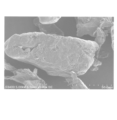
- Comparative Example 1 In Comparative Example 1, fine fibrous cellulose (“ELLEX (registered trademark)-S” manufactured by Daio Paper Co., Ltd.) that has not been modified and glycerin (Fuji Film Wako Pure Chemical Industries, Ltd. glycerin) was mixed at a mixing ratio of 71%:29%. to obtain a mixture, then supply the mixture to a drum dryer, heat dry to obtain a dried product, and then pulverize to obtain cellulose particles having an average particle size of 53.1 ⁇ m. and A SEM image of the particles of Comparative Example 1 is shown in FIG. Compared with the cellulose particles of the present embodiment, the particles of Comparative Example 1 had a solid inside, a small specific surface area, and a high density.
- ELLEX registered trademark
- glycerin Fluji Film Wako Pure Chemical Industries, Ltd. glycerin
- Comparative Example 2 is cellulose particles produced by the same production method as in Comparative Example 1, except that the cellulose particles have an average particle size of 238.8 ⁇ m.
- Comparative Example 3 was produced as follows. Comparative Example 3 was prepared by adjusting the concentration of unmodified fine fibrous cellulose ("ELLEX (registered trademark)-S" manufactured by Daio Paper Co., Ltd.) to 2% by mass.
- Comparative Example 4 was produced as follows. An aqueous dispersion prepared by adjusting the concentration of fine fibrous cellulose ("ELLEX (registered trademark)-Star” manufactured by Daio Paper Co., Ltd.) in which the hydroxyl group is modified to a phosphite ester group to a concentration of 0.5% by mass as a comparative example. 4. (Comparative Examples 3 and 4 are fine fibrous cellulose aqueous dispersions before being processed into cellulose particles.)
- Physical properties were measured for test examples and comparative examples. The physical properties measured were compression degree, loose bulk density, hardened bulk density, specific surface area, moisture content, average particle size, median size, cumulative 10% size, and cumulative 90% size.
- the compressibility is one of the items used for calculating Carr's fluidity index, and was measured according to the ASTM D6393-99 compressibility measurement method.
- the measurement is performed with a “multi-function type powder physical property measuring instrument Multitester MT-02” (manufactured by Seishin Enterprise Co., Ltd.).
- the specific surface area was measured according to the BET multipoint method (N 2 gas adsorption method).
- Instruments used for the measurement are "3Flex” (manufactured by Micromeritics) and “Smart VacPrep (pretreatment device)” (manufactured by Micromeritics).
- the cellulose particles prepared in the test examples and comparative examples were degassed (dried under reduced pressure) in a pretreatment device at 60° C.
- the device used to measure the average particle diameter, median diameter, cumulative 10% diameter, and cumulative 90% diameter is "Laser diffraction/scattering particle size distribution measuring device (particle size distribution) LA-960V2 (dry measurement)” (manufactured by HORIBA). is.
- the mixing ratio of raw materials for test examples and comparative examples is shown in Table 1, and the physical properties are shown in Table 2.
- the B-type viscosity of each redispersion liquid was measured twice under different measurement conditions.
- the first measurement is the B-type viscosity when the water temperature is 25° C. and 6 rpm
- the second measurement is the B-type viscosity when the water temperature is 25° C. and 60 rpm.
- the viscosity change rate (6 rpm) and the viscosity change rate (60 rpm) were calculated according to [Formula 2] and [Formula 3], respectively.
- [Formula 2] 1.
- (Viscosity change rate (6 rpm)) (B type viscosity of X (6 rpm)) / (B type viscosity of Comparative Example 3 (6 rpm)) ⁇ 100
- X is any one of Test Example 1, Test Example 2, Test Example 3, Comparative Example 1, and Comparative Example 2. 2.
- the viscosity change rate (average) is a value obtained by adding the viscosity change rate (60 rpm) to the viscosity change rate (6 rpm) and dividing the result by 2.
- Test Examples 1-5 showed higher values. This tendency was the same for the B-type viscosity (60 rpm). Further, when comparing Comparative Examples 1 and 2 with Test Examples 1 to 5 for the Ti value, Test Examples 1 to 5 showed a higher value. It can be seen that Test Examples 1 to 5 are excellent in thixotropy.
- the rate of change in viscosity is determined by how much the B-type viscosity of cellulose particles produced from fine fibrous cellulose as a starting point is 100% when the B-type viscosity of fine fibrous cellulose as a raw material is taken as 100%. It is expressed numerically. It can be said that the closer the viscosity change rate is to 100%, the closer the B-type viscosity of the cellulose particles is to the B-type viscosity of the fibrous cellulose that is the raw material thereof, and the closer the viscosity change rate is to 0%, the closer the B-type viscosity of the cellulose particles is. It can be said that it deviates from the B-type viscosity of the fibrous cellulose which is the raw material.
- reference numeral 20 denotes an interface
- FIG. 7 is a photograph of the dispersed state after the mixture was transferred to a stoppered bottle and allowed to stand for 20 minutes.
- Test Examples 1 to 5 the cellulose particles were widely dispersed in water, and no clear interface between the cellulose particles was observed.
- the redispersions of Test Examples 4 and 5 had high transparency because the fine fibrous cellulose used had excellent transparency.
- Comparative Examples 1 and 2 an interface 20 was observed.
- Test Examples 4 and 5 the material dispersed in water became transparent. This can be considered as follows.
- microfibrous cellulose which has high hydrophilicity and excellent transparency, is used as the raw material.
- the cellulose particles are dispersed in water, the water permeates between the fibers that make up the cellulose particles, and the hydrogen bonds between the fibers are dissociated. It is thought that it exhibited a transparent color. Also, in Comparative Example 3, it was difficult to settle when dispersed in water.
- JIS, TAPPI, and other tests and measurement methods shown in the above specifications are performed at room temperature, especially 25° C., and atmospheric pressure, especially 1 atm.
- the cellulose particles and cellulose particle dispersion of the present invention can be provided with improved redispersibility in aqueous liquids.
Landscapes
- Chemical & Material Sciences (AREA)
- Health & Medical Sciences (AREA)
- Chemical Kinetics & Catalysis (AREA)
- Medicinal Chemistry (AREA)
- Polymers & Plastics (AREA)
- Organic Chemistry (AREA)
- Dispersion Chemistry (AREA)
- Life Sciences & Earth Sciences (AREA)
- Engineering & Computer Science (AREA)
- Biochemistry (AREA)
- Materials Engineering (AREA)
- Polysaccharides And Polysaccharide Derivatives (AREA)
- Processes Of Treating Macromolecular Substances (AREA)
- Compositions Of Macromolecular Compounds (AREA)
Priority Applications (4)
| Application Number | Priority Date | Filing Date | Title |
|---|---|---|---|
| US18/714,056 US20250051481A1 (en) | 2021-11-29 | 2022-09-14 | Cellulose particles and dispersion liquid of cellulose particles |
| EP22898206.2A EP4442737A4 (en) | 2021-11-29 | 2022-09-14 | CELLULOSE PARTICLES AND DISPERSION OF CELLULOSE PARTICLES |
| CN202280076963.2A CN118284649A (zh) | 2021-11-29 | 2022-09-14 | 纤维素颗粒和纤维素颗粒分散液 |
| KR1020247016187A KR20240117536A (ko) | 2021-11-29 | 2022-09-14 | 셀룰로오스 입자 및 셀룰로오스 입자 분산액 |
Applications Claiming Priority (2)
| Application Number | Priority Date | Filing Date | Title |
|---|---|---|---|
| JP2021192970A JP7414790B2 (ja) | 2021-11-29 | 2021-11-29 | セルロース粒子及びセルロース粒子分散液 |
| JP2021-192970 | 2021-11-29 |
Publications (1)
| Publication Number | Publication Date |
|---|---|
| WO2023095421A1 true WO2023095421A1 (ja) | 2023-06-01 |
Family
ID=86539177
Family Applications (1)
| Application Number | Title | Priority Date | Filing Date |
|---|---|---|---|
| PCT/JP2022/034319 Ceased WO2023095421A1 (ja) | 2021-11-29 | 2022-09-14 | セルロース粒子及びセルロース粒子分散液 |
Country Status (6)
| Country | Link |
|---|---|
| US (1) | US20250051481A1 (https=) |
| EP (1) | EP4442737A4 (https=) |
| JP (2) | JP7414790B2 (https=) |
| KR (1) | KR20240117536A (https=) |
| CN (1) | CN118284649A (https=) |
| WO (1) | WO2023095421A1 (https=) |
Cited By (1)
| Publication number | Priority date | Publication date | Assignee | Title |
|---|---|---|---|---|
| JP7411852B1 (ja) | 2023-03-29 | 2024-01-11 | 日本製紙株式会社 | アニオン変性セルロースナノファイバー含有粉末 |
Families Citing this family (1)
| Publication number | Priority date | Publication date | Assignee | Title |
|---|---|---|---|---|
| JP7616467B1 (ja) | 2024-06-21 | 2025-01-17 | 日清紡ケミカル株式会社 | 燃料電池セパレータ用樹脂組成物、燃料電池セパレータおよび燃料電池セパレータの製造方法 |
Citations (9)
| Publication number | Priority date | Publication date | Assignee | Title |
|---|---|---|---|---|
| WO2017141779A1 (ja) * | 2016-02-18 | 2017-08-24 | スターライト工業株式会社 | ナノファイバー分散体、ナノファイバー分散体の製造方法、この分散体から得られる粉末状ナノファイバー、当該粉末状ナノファイバーを含む樹脂組成物、当該樹脂組成物を用いた3dプリンタ用造形材料 |
| JP2017210596A (ja) | 2016-05-19 | 2017-11-30 | スターライト工業株式会社 | 組成物製造用粉末状セルロースナノファイバー、組成物製造用粉末状セルロースナノファイバーの製造方法、ならびに組成物 |
| JP2018118917A (ja) * | 2017-01-24 | 2018-08-02 | 株式会社ダイセル | スクラブ剤及び皮膚洗浄用組成物 |
| JP2019199671A (ja) | 2018-05-18 | 2019-11-21 | 大王製紙株式会社 | セルロース微細繊維及びその製造方法 |
| JP2019206662A (ja) | 2018-05-30 | 2019-12-05 | 東レ株式会社 | セルロース粒子、およびその製造方法 |
| WO2020059859A1 (ja) * | 2018-09-20 | 2020-03-26 | 日本製紙株式会社 | セルロースファイバーボールおよびこれを含有する紙 |
| JP2020050840A (ja) | 2018-09-28 | 2020-04-02 | 日揮触媒化成株式会社 | 多孔質セルロース粒子とその製造方法、および化粧料 |
| WO2020201900A1 (en) * | 2019-04-01 | 2020-10-08 | Nextmaterials S.R.L. | Low-bulk density aggregate of thermoformed composite materials |
| JP2021169579A (ja) * | 2020-04-16 | 2021-10-28 | 旭化成株式会社 | セルロース繊維乾燥体及びその製造方法、並びに樹脂複合体の製造方法 |
Family Cites Families (7)
| Publication number | Priority date | Publication date | Assignee | Title |
|---|---|---|---|---|
| JPH09124950A (ja) * | 1995-11-01 | 1997-05-13 | Daicel Chem Ind Ltd | 液状樹脂組成物およびその製造方法 |
| JPH1095922A (ja) * | 1996-09-24 | 1998-04-14 | Daicel Chem Ind Ltd | 水性エマルジョン組成物およびその製造方法 |
| JP4879803B2 (ja) | 2005-04-08 | 2012-02-22 | パナソニック株式会社 | 地図情報更新装置および地図情報更新方法 |
| JP2015118556A (ja) | 2013-12-18 | 2015-06-25 | マイクロソフト コーポレーション | コントロールデバイスのための拡張現実オーバーレイ |
| JP6507962B2 (ja) | 2015-09-17 | 2019-05-08 | 王子ホールディングス株式会社 | 微細繊維状セルロース含有組成物 |
| JP7040444B2 (ja) | 2016-07-14 | 2022-03-23 | 東洋製罐グループホールディングス株式会社 | セルロースナノファイバー含有セルロース繊維及び製造方法 |
| JP7488096B2 (ja) * | 2020-04-16 | 2024-05-21 | 旭化成株式会社 | セルロース繊維乾燥体及びその製造方法、並びに樹脂複合体の製造方法 |
-
2021
- 2021-11-29 JP JP2021192970A patent/JP7414790B2/ja active Active
-
2022
- 2022-09-14 WO PCT/JP2022/034319 patent/WO2023095421A1/ja not_active Ceased
- 2022-09-14 KR KR1020247016187A patent/KR20240117536A/ko active Pending
- 2022-09-14 CN CN202280076963.2A patent/CN118284649A/zh active Pending
- 2022-09-14 EP EP22898206.2A patent/EP4442737A4/en active Pending
- 2022-09-14 US US18/714,056 patent/US20250051481A1/en active Pending
-
2023
- 2023-12-28 JP JP2023222108A patent/JP7763827B2/ja active Active
Patent Citations (9)
| Publication number | Priority date | Publication date | Assignee | Title |
|---|---|---|---|---|
| WO2017141779A1 (ja) * | 2016-02-18 | 2017-08-24 | スターライト工業株式会社 | ナノファイバー分散体、ナノファイバー分散体の製造方法、この分散体から得られる粉末状ナノファイバー、当該粉末状ナノファイバーを含む樹脂組成物、当該樹脂組成物を用いた3dプリンタ用造形材料 |
| JP2017210596A (ja) | 2016-05-19 | 2017-11-30 | スターライト工業株式会社 | 組成物製造用粉末状セルロースナノファイバー、組成物製造用粉末状セルロースナノファイバーの製造方法、ならびに組成物 |
| JP2018118917A (ja) * | 2017-01-24 | 2018-08-02 | 株式会社ダイセル | スクラブ剤及び皮膚洗浄用組成物 |
| JP2019199671A (ja) | 2018-05-18 | 2019-11-21 | 大王製紙株式会社 | セルロース微細繊維及びその製造方法 |
| JP2019206662A (ja) | 2018-05-30 | 2019-12-05 | 東レ株式会社 | セルロース粒子、およびその製造方法 |
| WO2020059859A1 (ja) * | 2018-09-20 | 2020-03-26 | 日本製紙株式会社 | セルロースファイバーボールおよびこれを含有する紙 |
| JP2020050840A (ja) | 2018-09-28 | 2020-04-02 | 日揮触媒化成株式会社 | 多孔質セルロース粒子とその製造方法、および化粧料 |
| WO2020201900A1 (en) * | 2019-04-01 | 2020-10-08 | Nextmaterials S.R.L. | Low-bulk density aggregate of thermoformed composite materials |
| JP2021169579A (ja) * | 2020-04-16 | 2021-10-28 | 旭化成株式会社 | セルロース繊維乾燥体及びその製造方法、並びに樹脂複合体の製造方法 |
Non-Patent Citations (1)
| Title |
|---|
| See also references of EP4442737A4 |
Cited By (3)
| Publication number | Priority date | Publication date | Assignee | Title |
|---|---|---|---|---|
| JP7411852B1 (ja) | 2023-03-29 | 2024-01-11 | 日本製紙株式会社 | アニオン変性セルロースナノファイバー含有粉末 |
| WO2024202690A1 (ja) * | 2023-03-29 | 2024-10-03 | 日本製紙株式会社 | アニオン変性セルロースナノファイバー含有粉末 |
| JP2024144025A (ja) * | 2023-03-29 | 2024-10-11 | 日本製紙株式会社 | アニオン変性セルロースナノファイバー含有粉末 |
Also Published As
| Publication number | Publication date |
|---|---|
| JP7763827B2 (ja) | 2025-11-04 |
| US20250051481A1 (en) | 2025-02-13 |
| KR20240117536A (ko) | 2024-08-01 |
| CN118284649A (zh) | 2024-07-02 |
| EP4442737A4 (en) | 2025-11-26 |
| JP7414790B2 (ja) | 2024-01-16 |
| EP4442737A1 (en) | 2024-10-09 |
| JP2023079480A (ja) | 2023-06-08 |
| JP2024028346A (ja) | 2024-03-04 |
Similar Documents
| Publication | Publication Date | Title |
|---|---|---|
| CN102378777B (zh) | 生产纳米纤维状纤维素凝胶的方法 | |
| JP7812474B2 (ja) | 複合粒子及び化粧料組成物 | |
| KR102106815B1 (ko) | 미세 섬유상 셀룰로오스 함유물 | |
| JP7763827B2 (ja) | セルロース粒子 | |
| JP2018009134A (ja) | セルロースナノファイバー含有乾燥体及びその製造方法並びにセルロースナノファイバー含有乾燥体分散液の製造方法 | |
| JP2017057391A (ja) | 微細繊維状セルロース含有物 | |
| JP5910786B1 (ja) | 微細繊維状セルロース含有物 | |
| US20250281382A1 (en) | Oil-based cosmetic | |
| JP7461920B2 (ja) | セルロース粒子及びセルロース粒子分散液 | |
| JP7412472B2 (ja) | 皮膚外用剤 | |
| JP2023149514A5 (https=) | ||
| WO2022118875A1 (ja) | セルロース繊維の湿潤シート及び成形体の製造方法 | |
| Lähdeniemi et al. | Manufacturing of microfibrillated cellulose from never-dried microcrystalline cellulose using Masuko grinder | |
| JP2024098439A (ja) | セルロースナノファイバー含有乾燥体の再分散液の製造方法 | |
| HK40039405A (en) | Process for the production of nano-fibrillar cellulose gels | |
| HK1251005B (en) | Process for the production of a paint composition using nano-fibrillar cellulose gels | |
| HK1251005A1 (en) | Process for the production of a paint composition using nano-fibrillar cellulose gels |
Legal Events
| Date | Code | Title | Description |
|---|---|---|---|
| 121 | Ep: the epo has been informed by wipo that ep was designated in this application |
Ref document number: 22898206 Country of ref document: EP Kind code of ref document: A1 |
|
| WWE | Wipo information: entry into national phase |
Ref document number: 202280076963.2 Country of ref document: CN |
|
| WWE | Wipo information: entry into national phase |
Ref document number: 18714056 Country of ref document: US |
|
| NENP | Non-entry into the national phase |
Ref country code: DE |
|
| ENP | Entry into the national phase |
Ref document number: 2022898206 Country of ref document: EP Effective date: 20240701 |