WO2023089858A1 - ヒートパイプ、およびヒートパイプの製造方法 - Google Patents
ヒートパイプ、およびヒートパイプの製造方法 Download PDFInfo
- Publication number
- WO2023089858A1 WO2023089858A1 PCT/JP2022/024920 JP2022024920W WO2023089858A1 WO 2023089858 A1 WO2023089858 A1 WO 2023089858A1 JP 2022024920 W JP2022024920 W JP 2022024920W WO 2023089858 A1 WO2023089858 A1 WO 2023089858A1
- Authority
- WO
- WIPO (PCT)
- Prior art keywords
- wick
- layer
- heat pipe
- container
- porous layer
- Prior art date
- Legal status (The legal status is an assumption and is not a legal conclusion. Google has not performed a legal analysis and makes no representation as to the accuracy of the status listed.)
- Ceased
Links
Images




Classifications
-
- F—MECHANICAL ENGINEERING; LIGHTING; HEATING; WEAPONS; BLASTING
- F28—HEAT EXCHANGE IN GENERAL
- F28D—HEAT-EXCHANGE APPARATUS, NOT PROVIDED FOR IN ANOTHER SUBCLASS, IN WHICH THE HEAT-EXCHANGE MEDIA DO NOT COME INTO DIRECT CONTACT
- F28D15/00—Heat-exchange apparatus with the intermediate heat-transfer medium in closed tubes passing into or through the conduit walls ; Heat-exchange apparatus employing intermediate heat-transfer medium or bodies
- F28D15/02—Heat-exchange apparatus with the intermediate heat-transfer medium in closed tubes passing into or through the conduit walls ; Heat-exchange apparatus employing intermediate heat-transfer medium or bodies in which the medium condenses and evaporates, e.g. heat pipes
-
- F—MECHANICAL ENGINEERING; LIGHTING; HEATING; WEAPONS; BLASTING
- F28—HEAT EXCHANGE IN GENERAL
- F28D—HEAT-EXCHANGE APPARATUS, NOT PROVIDED FOR IN ANOTHER SUBCLASS, IN WHICH THE HEAT-EXCHANGE MEDIA DO NOT COME INTO DIRECT CONTACT
- F28D15/00—Heat-exchange apparatus with the intermediate heat-transfer medium in closed tubes passing into or through the conduit walls ; Heat-exchange apparatus employing intermediate heat-transfer medium or bodies
- F28D15/02—Heat-exchange apparatus with the intermediate heat-transfer medium in closed tubes passing into or through the conduit walls ; Heat-exchange apparatus employing intermediate heat-transfer medium or bodies in which the medium condenses and evaporates, e.g. heat pipes
- F28D15/04—Heat-exchange apparatus with the intermediate heat-transfer medium in closed tubes passing into or through the conduit walls ; Heat-exchange apparatus employing intermediate heat-transfer medium or bodies in which the medium condenses and evaporates, e.g. heat pipes with tubes having a capillary structure
Definitions
- the present invention relates to a heat pipe and a method for manufacturing a heat pipe.
- This application claims priority based on Japanese Patent Application No. 2021-186955 filed in Japan on November 17, 2021, the content of which is incorporated herein.
- An object of the present invention is to provide a heat pipe with improved heat transport capability, which has been made in consideration of such circumstances.
- a heat pipe includes a container having an inner space and an inner peripheral surface facing the inner space, a container in which a working fluid is sealed, and a container accommodated in the inner space.
- a first wick portion formed in the internal space, wherein the container has a second wick portion including a plurality of grooves formed in the inner peripheral surface of the container; , the first wick portion has a porous layer having an effective pore radius smaller than that of the second wick portion; and a retaining layer that retains the porous layer, and the first wick portion includes the It is in contact with the steam flow path and the second wick.
- the heat pipe has a first wick including a pore layer having a smaller effective pore radius than the second wick. Therefore, the magnitude of the capillary force applied to the working fluid (liquid) can be improved.
- the heat pipe also has a second wick that includes a plurality of grooves. Thereby, the permeability of the second wick portion can be increased, and the flow resistance applied to the working fluid (liquid) can be suppressed. Therefore, the heat transport capability of the heat pipe can be improved.
- the porous layer may be a sintered body of powder.
- the holding layer may be a mesh body.
- porous layer and the retaining layer may be joined to each other by sintering.
- the retention layer may be in contact with the second wick portion, and the porous layer may be in contact with the vapor flow path.
- a method for manufacturing a heat pipe includes a preparation step of preparing a container having a plurality of grooves formed on the inner peripheral surface thereof, and a holding layer; a first sintering step of joining the porous layer to form a first wick; and a second sintering step of joining the first wick on the inner peripheral surface of the container by sintering. .
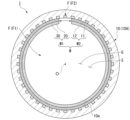
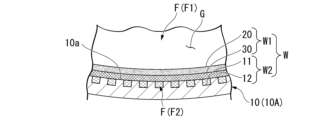
- FIG. 2 is a cross-sectional view taken along line II-II shown in FIG. 1; 3 is an enlarged view of a part of the heat pipe shown in FIG. 2; FIG. It is a figure which shows a part of process of manufacturing the heat pipe which concerns on embodiment of this invention. It is a figure which shows the process following FIG. 4A.
- FIG. 4C is a diagram illustrating a process following FIG. 4B;
- the heat pipe 1 includes a container 10 having an internal space S and a first wick W1 housed in the internal space S. As shown in FIGS. In this embodiment, the container 10 has an elongated shape extending in one direction. A working fluid F is enclosed in the container 10 .
- the direction parallel to the central axis O of the container 10 is called the Z direction or the longitudinal direction Z.
- the direction opposite to the +Z direction is called the -Z direction.
- a section perpendicular to the longitudinal direction Z is called a transverse section.
- a direction perpendicular to the central axis O of the container 10 when viewed from the longitudinal direction Z is referred to as a radial direction.
- the direction approaching the central axis O is referred to as the radially inner side
- the direction away from the central axis O is referred to as the radially outer side.
- the direction of rotation around the central axis O when viewed from the longitudinal direction Z is called the circumferential direction.
- the working fluid F is a well-known substance that changes phases, and changes phases inside the container 10 between a gas phase and a liquid phase.
- the working fluid F water (pure water), alcohol, ammonia, or the like can be used.
- the gas-phase working fluid may be referred to as "vapor F1" and the liquid-phase working fluid may be referred to as "liquid F2.”
- the gas phase and the liquid phase are not particularly distinguished, they may simply be referred to as a working fluid F.
- the container 10 is a closed hollow container. More specifically, in this embodiment, the container 10 has a pipe portion 10A and a pair of closing portions 10B.
- the pipe portion 10A is a cylindrical member and extends in the longitudinal direction Z. As shown in FIG.
- the pair of closing portions 10B closes both ends in the longitudinal direction Z of the pipe portion 10A.
- a space surrounded by the pipe portion 10A and the pair of closing portions 10B corresponds to the internal space S of the container 10 .
- the diameter of the container 10 (pipe portion 10A) is, for example, within the range of 2 to 5 mm.
- the container 10 (pipe portion 10A) has an inner peripheral surface 10a facing radially inward. The inner peripheral surface 10 a faces the internal space S of the container 10 .
- a steam flow path G is formed in the internal space S.
- the steam flow path G is a space through which the steam F1 flows.
- the portion (space) of the internal space S excluding the first wick W1 corresponds to the steam flow path G.
- the steam F1 flows through the steam flow path G mainly in the longitudinal direction Z. As shown in FIG.
- the container 10 has a plurality of grooves 11 recessed radially outward from the inner peripheral surface 10a. Each groove 11 extends over the entire length in the longitudinal direction Z of the inner peripheral surface 10a. In this embodiment, the plurality of grooves 11 are arranged at intervals over the entire circumferential direction of the inner peripheral surface 10a. A protrusion 12 is formed between two circumferentially adjacent grooves 11 . Each projection 12 is in contact with the first wick W1.
- the combination of the plurality of grooves 11 and the plurality of projections 12 may be referred to as a second wick portion W2.
- the first wick portion W1 and the second wick portion W2 may be collectively referred to as a wick portion W.
- the wick portion W is a portion through which the liquid F2 flows.
- the liquid F2 flows through the wick W mainly in the longitudinal direction Z by causing the wick W to generate a capillary force on the liquid F2.
- the working fluid F moves between the wick portion W and the vapor flow path G while undergoing a phase change between the vapor F1 and the liquid F2.
- the groove 11 is formed in a rectangular shape in a cross-sectional view.
- the circumferential dimension of the groove 11 is, for example, within the range of 0.05 to 0.2 mm.
- the radial dimension of the groove 11 is, for example, within the range of 0.05 to 0.2 mm.
- the transmittance of the grooves 11 is, for example, within the range of 5.0-30.0 ⁇ 10 ⁇ 10 m 2 .
- the effective pore radius of the grooves 11 is, for example, within the range of 0.05-0.2 ⁇ 10 ⁇ 3 m.
- the term "effective pore radius" means an effective radius (capillary radius) of grooves, pores, gaps, etc. that generate a capillary force on the liquid F2.
- the first wick portion W1 has a layered (sheet-like) shape extending in the circumferential direction.
- the first wick W1 extends over the entire length of the container 10 in the longitudinal direction Z.
- the first wick W1 is in contact with the steam flow path G and the second wick W2 (projections 12) (see also FIG. 3).
- the first wick W1 and the second wick W2 (projections 12) may be joined together by sintering.
- the first wick W1 does not have to cover the entire second wick W2 in the circumferential direction. In other words, a part of the second wick W2 in the circumferential direction may be exposed to the steam flow path G.
- the first wick W1 has a porous layer 20 and a retaining layer 30 (see also FIG. 3).
- the porous layer 20 and the retention layer 30 are radially adjacent to each other.
- the porous layer 20 and the retention layer 30 may be joined together by sintering.
- the porous layer 20 is positioned radially inward of the retention layer 30 . That is, the porous layer 20 is in contact with the vapor flow path G, and the retaining layer 30 is in contact with the second wick W2.
- the porous layer 20 may be located radially outside the retaining layer 30 . That is, the porous layer 20 may be in contact with the second wick W2, and the retention layer 30 may be in contact with the vapor flow path G.
- the porous layer 20 has a smaller effective pore radius than the second wick W2.
- the porous layer 20 according to the present embodiment is a sintered body obtained by sintering powder, and the effective pore radius of the porous layer 20 is, for example, 0.001 to 0.05 ⁇ 10 ⁇ 3 m. Within range.
- the powder that forms the porous layer 20 for example, metal powder such as copper powder can be used.
- the diameter of the powder forming the pore layer 20 is, for example, within the range of 1-200 ⁇ m. However, if the powder diameter is too large, the capillary force generated by the microporous layer 20 may be reduced. On the other hand, if the diameter of the powder is too small, there is a high possibility that the powder will dissolve during sintering.
- the diameter of the powder is preferably within the range of 5-50 ⁇ m.
- the permeability of the porous layer 20 is, for example, within the range of 0.001 to 0.1 ⁇ 10 ⁇ 10 m 2 .
- the retaining layer 30 supports the porous layer 20 and prevents the porous layer 20 and the powder forming the porous layer 20 from dropping into the grooves 11 and the steam flow path G.
- the retention layer 30 has a larger effective pore radius than the microporous layer 20 .
- the retention layer 30 according to the present embodiment is a mesh body having a plurality of linear bodies, and the effective pore radius of the retention layer 30 is, for example, within the range of 0.05 to 0.5 ⁇ 10 ⁇ 3 m. .
- a metal wire such as a copper wire can be used.
- the diameter of the wire forming the retaining layer 30 is, for example, within the range of 10-100 ⁇ m.
- the transmittance of the retention layer 30 is, for example, within the range of 1.0 to 10.0 ⁇ 10 ⁇ 10 m 2 .
- the method for manufacturing the heat pipe 1 according to this embodiment includes a preparation process, a first sintering process, and a second sintering process.
- the above container 10 and holding layer 30 are prepared.
- the holding layer 30 has a plate-like shape.
- the porous layer 20 is joined onto the holding layer 30 by sintering to form the first wick W1.
- powder is sintered on the retention layer 30 .
- the porous layer 20 having a flat plate shape may be prepared in advance and the prepared porous layer 20 may be joined onto the holding layer 30 by sintering.
- the porous layer 20 and the holding layer 30 may be pressed against each other by a pressing member (not shown) or the like. In this case, the porous layer 20 and the holding layer 30 can be more reliably bonded.
- the first wick W1 formed in the first sintering process is bent into a cylindrical shape and inserted into the container 10, as shown in FIG. 4C. Subsequently, the first wick W1 is joined onto the inner peripheral surface 10a (second wick W2) of the container 10 by sintering.
- the heat pipe 1 according to the present embodiment is manufactured through the above steps.
- the heat pipe 1 is a heat dissipation module that receives heat from the heat source H and releases the received heat to the outside.
- the heat source H is in contact with the -Z end of the container 10 (see FIG. 1).
- the -Z side of the heat pipe 1 may be referred to as the high temperature side
- the +Z side of the heat pipe 1 may be referred to as the low temperature side.
- the liquid F2 permeating the wick W evaporates due to the heat received from the heat source H, undergoes a phase change into vapor F1, and travels toward the vapor flow path G (S1).
- the steam F1 flows through the steam flow path G toward the low temperature side where the pressure and temperature are lower than the high temperature side (S2).
- the vapor F1 eventually condenses and undergoes a phase change to the liquid F2, and the liquid F2 permeates the wick W (S3).
- the liquid F2 that permeates the wick W flows back to the high temperature side due to the capillary force of the wick W (S4).
- the first wick portion W1 includes a porous layer 20 having an effective pore radius smaller than that of the second wick portion W2.
- the porous layer 20 is a sintered body of powder
- the effective pores of the porous layer 20 are smaller than when the porous layer 20 is formed of, for example, twisted wires or braided wires.
- the radius can be made smaller more reliably. Thereby, the heat transport capability of the heat pipe 1 can be improved more reliably.
- the second wick portion W2 includes a plurality of grooves 11. As shown in FIG. As a result, the transmittance of the second wick W2 can be increased compared to the case where the second wick W2 is, for example, a sintered body of powder or a mesh body. As a result, the flow resistance applied to the liquid F2 is reduced, and the heat transport capability of the heat pipe 1 can be improved.
- the heat pipe 1 includes both the second wick W2 having a high transmittance and the first wick W1 (porous layer 20) having an effective pore radius smaller than that of the second wick W2. By having it, the heat transport capability of the heat pipe 1 can be effectively improved.
- the heat pipe 1 includes a retaining layer 30 that retains the porous layer 20 .
- the porous layer 20 and the powder forming the porous layer 20 are less likely to drop into the grooves 11 and the steam flow paths G and clog the grooves 11 and the steam flow paths G.
- the retention layer 30 is a mesh body, the retention layer 30 can easily retain the powder even when the porous layer 20 is formed of powder having a small diameter. 11 and the clogging of the steam flow path G can be suppressed more effectively.
- the porous layer 20 and the retention layer 30 are joined by sintering, clogging of the grooves 11 and the steam flow paths G can be suppressed more reliably.
- twisted wires and braided wires can be used as a structure constituting a general wick.
- the shape of the wick tends to vary. Such variation in the shape of the wick tends to cause variation in the heat transport capacity of the heat pipe.
- the second wick portion W2 according to the present embodiment is a wick composed of grooves 11. As shown in FIG. Therefore, it is possible to suppress variations in the shape of the second wick portion W2 during manufacturing, compared to the case where the second wick portion W2 is a wick composed of a twisted wire or a braided wire, for example. As a result, variations in the heat transport capacity of the heat pipe 1 can be suppressed.
- the porous layer 20 is a sintered body of powder
- variations in the shape of the porous layer 20 can be suppressed, so variations in the heat transport capacity of the heat pipe 1 can be suppressed more effectively. can do.
- the holding layer 30 is a mesh body, it is possible to suppress variation in the shape of the holding layer 30, so that variation in the heat transport capacity of the heat pipe 1 can be suppressed more reliably.
- the heat pipe 1 has the inner space S and the inner peripheral surface 10a facing the inner space S, the container 10 in which the working fluid F is enclosed, and the a first wick portion W1 formed in the inner space S, and the container 10 includes a second wick portion W1 including a plurality of grooves 11 formed in the inner peripheral surface 10a of the container 10.
- the first wick portion W1 has a portion W2, and the first wick portion W1 has a porous layer 20 having an effective pore radius smaller than that of the second wick portion W2, and a retaining layer 30 that retains the porous layer 20.
- the first wick W1 is in contact with the steam flow path G and the second wick W2.
- the heat pipe 1 has the first wick W1 including the pore layer 20 having a smaller effective pore radius than the second wick W2. Therefore, the magnitude of the capillary force applied to the liquid F2 can be improved. Also, the heat pipe 1 has a second wick W2 including a plurality of grooves 11 . Thereby, the transmittance of the second wick W2 can be increased, and the flow resistance applied to the liquid F2 can be suppressed. Therefore, the heat transport capability of the heat pipe 1 can be improved.
- the porous layer 20 is a sintered body of powder. With this configuration, the effective pore radius of the porous layer 20 can be made smaller more reliably. Therefore, the heat transport capability of the heat pipe 1 can be improved more reliably.
- the holding layer 30 is a mesh body. With this configuration, clogging of the grooves 11 and the vapor passages G due to dropping of the microporous layer 20 and the powder forming the microporous layers 20 into the grooves 11 and the vapor passages G is less likely to occur.
- porous layer 20 and the retaining layer 30 may be joined together by sintering. According to this configuration, the porous layer 20 and the powder forming the porous layer 20 are more reliably held in the holding layer 30 .
- the retention layer 30 is in contact with the second wick W2, and the porous layer 20 is in contact with the steam flow path G.
- the porous layer 20 is positioned radially inward of the retention layer 30 .
- the method of manufacturing the heat pipe 1 includes a preparation step of preparing the container 10 having the plurality of grooves 11 formed on the inner peripheral surface 10a and the holding layer 30, and a step of baking the holding layer 30. a first sintering step of joining the porous layer 20 by bonding to form the first wick W1; and a second sintering step to join W1.
- the heat pipe 1 includes both the second wick W2 including the plurality of grooves 11 and the first wick W1 including the pore layer 20 having an effective pore radius larger than that of the second wick W2. can be manufactured. Therefore, a heat pipe with improved heat transport capability can be manufactured. Further, since the porous layer 20, the holding layer 30, and the second wick portion W2 are joined to each other by sintering, the first wick portion W1 may fall off into the steam flow path G, and the porous layer 20, It is possible to suppress dropping of powder or the like forming the porous layer 20 into the grooves 11 .
- the shape of the container 10 is not limited to a cylindrical shape.
- the shape of the pipe portion 10A can be appropriately changed as long as the working fluid F and the first wick portion W1 can be accommodated in the internal space S.
- the shape of the pipe portion 10A may be an elliptical shape, an elliptical shape, a rectangular shape, or the like in a cross-sectional view.
- the diameter of the container 10 may be less than 2 mm or greater than 5 mm.
- the plurality of grooves 11 may not be arranged over the entire inner peripheral surface 10a of the container 10 in the circumferential direction.
- the second wick portion W2 does not have to extend over the entire circumferential direction of the inner peripheral surface 10a.
Landscapes
- Engineering & Computer Science (AREA)
- Life Sciences & Earth Sciences (AREA)
- Sustainable Development (AREA)
- Physics & Mathematics (AREA)
- Thermal Sciences (AREA)
- Mechanical Engineering (AREA)
- General Engineering & Computer Science (AREA)
- Heat-Exchange Devices With Radiators And Conduit Assemblies (AREA)
- Cooling Or The Like Of Semiconductors Or Solid State Devices (AREA)
- Powder Metallurgy (AREA)
Priority Applications (2)
| Application Number | Priority Date | Filing Date | Title |
|---|---|---|---|
| CN202280072159.7A CN118159799A (zh) | 2021-11-17 | 2022-06-22 | 热管、以及热管的制造方法 |
| JP2023562119A JPWO2023089858A1 (https=) | 2021-11-17 | 2022-06-22 |
Applications Claiming Priority (2)
| Application Number | Priority Date | Filing Date | Title |
|---|---|---|---|
| JP2021-186955 | 2021-11-17 | ||
| JP2021186955 | 2021-11-17 |
Publications (1)
| Publication Number | Publication Date |
|---|---|
| WO2023089858A1 true WO2023089858A1 (ja) | 2023-05-25 |
Family
ID=86396605
Family Applications (1)
| Application Number | Title | Priority Date | Filing Date |
|---|---|---|---|
| PCT/JP2022/024920 Ceased WO2023089858A1 (ja) | 2021-11-17 | 2022-06-22 | ヒートパイプ、およびヒートパイプの製造方法 |
Country Status (4)
| Country | Link |
|---|---|
| JP (1) | JPWO2023089858A1 (https=) |
| CN (1) | CN118159799A (https=) |
| TW (1) | TW202321644A (https=) |
| WO (1) | WO2023089858A1 (https=) |
Cited By (1)
| Publication number | Priority date | Publication date | Assignee | Title |
|---|---|---|---|---|
| WO2025079354A1 (ja) * | 2023-10-13 | 2025-04-17 | 株式会社フジクラ | ヒートパイプ |
Citations (14)
| Publication number | Priority date | Publication date | Assignee | Title |
|---|---|---|---|---|
| JPS5512313A (en) * | 1978-07-06 | 1980-01-28 | Mitsubishi Electric Corp | Method of forming artery of heat pipe |
| US20060207750A1 (en) * | 2005-03-18 | 2006-09-21 | Foxconn Technology Co., Ltd. | Heat pipe with composite capillary wick structure |
| US20060283574A1 (en) * | 2005-06-15 | 2006-12-21 | Top Way Thermal Management Co., Ltd. | Thermoduct |
| US20070240855A1 (en) * | 2006-04-14 | 2007-10-18 | Foxconn Technology Co., Ltd. | Heat pipe with composite capillary wick structure |
| US20070240858A1 (en) * | 2006-04-14 | 2007-10-18 | Foxconn Technology Co., Ltd. | Heat pipe with composite capillary wick structure |
| US20120227934A1 (en) * | 2011-03-11 | 2012-09-13 | Kunshan Jue-Chung Electronics Co. | Heat pipe having a composite wick structure and method for making the same |
| JP2013011363A (ja) * | 2011-06-28 | 2013-01-17 | Fujikura Ltd | 扁平型ヒートパイプ |
| US20130014919A1 (en) * | 2011-07-15 | 2013-01-17 | Foxconn Technology Co., Ltd. | Heat pipe |
| JP2013100977A (ja) * | 2011-06-27 | 2013-05-23 | Toshiba Home Technology Corp | 冷却器 |
| JP2014081185A (ja) * | 2012-10-18 | 2014-05-08 | Toshiba Home Technology Corp | 冷却器 |
| JP2015121373A (ja) * | 2013-12-24 | 2015-07-02 | 古河電気工業株式会社 | ヒートパイプ |
| JP2017083074A (ja) * | 2015-10-28 | 2017-05-18 | 株式会社フジクラ | 扁平型ヒートパイプ |
| JP2018179487A (ja) * | 2017-04-12 | 2018-11-15 | 古河電気工業株式会社 | ヒートパイプ |
| JP6980081B1 (ja) * | 2020-11-13 | 2021-12-15 | 古河電気工業株式会社 | ヒートパイプ |
Family Cites Families (5)
| Publication number | Priority date | Publication date | Assignee | Title |
|---|---|---|---|---|
| JP3591339B2 (ja) * | 1998-11-16 | 2004-11-17 | 三菱電機株式会社 | ループ型ヒートパイプ |
| JP5686562B2 (ja) * | 2010-09-24 | 2015-03-18 | 奇▲こう▼科技股▲ふん▼有限公司 | 平型ヒートパイプの封止構造 |
| JP3164636U (ja) * | 2010-09-27 | 2010-12-09 | 奇▲こう▼科技股▲ふん▼有限公司 | 平型ヒートパイプの封止構造 |
| JP2020153586A (ja) * | 2019-03-20 | 2020-09-24 | セイコーエプソン株式会社 | 冷却装置及びプロジェクター |
| JP2021081156A (ja) * | 2019-11-22 | 2021-05-27 | セイコーエプソン株式会社 | 冷却装置及びプロジェクター |
-
2022
- 2022-06-22 JP JP2023562119A patent/JPWO2023089858A1/ja active Pending
- 2022-06-22 CN CN202280072159.7A patent/CN118159799A/zh active Pending
- 2022-06-22 WO PCT/JP2022/024920 patent/WO2023089858A1/ja not_active Ceased
- 2022-07-08 TW TW111125731A patent/TW202321644A/zh unknown
Patent Citations (14)
| Publication number | Priority date | Publication date | Assignee | Title |
|---|---|---|---|---|
| JPS5512313A (en) * | 1978-07-06 | 1980-01-28 | Mitsubishi Electric Corp | Method of forming artery of heat pipe |
| US20060207750A1 (en) * | 2005-03-18 | 2006-09-21 | Foxconn Technology Co., Ltd. | Heat pipe with composite capillary wick structure |
| US20060283574A1 (en) * | 2005-06-15 | 2006-12-21 | Top Way Thermal Management Co., Ltd. | Thermoduct |
| US20070240855A1 (en) * | 2006-04-14 | 2007-10-18 | Foxconn Technology Co., Ltd. | Heat pipe with composite capillary wick structure |
| US20070240858A1 (en) * | 2006-04-14 | 2007-10-18 | Foxconn Technology Co., Ltd. | Heat pipe with composite capillary wick structure |
| US20120227934A1 (en) * | 2011-03-11 | 2012-09-13 | Kunshan Jue-Chung Electronics Co. | Heat pipe having a composite wick structure and method for making the same |
| JP2013100977A (ja) * | 2011-06-27 | 2013-05-23 | Toshiba Home Technology Corp | 冷却器 |
| JP2013011363A (ja) * | 2011-06-28 | 2013-01-17 | Fujikura Ltd | 扁平型ヒートパイプ |
| US20130014919A1 (en) * | 2011-07-15 | 2013-01-17 | Foxconn Technology Co., Ltd. | Heat pipe |
| JP2014081185A (ja) * | 2012-10-18 | 2014-05-08 | Toshiba Home Technology Corp | 冷却器 |
| JP2015121373A (ja) * | 2013-12-24 | 2015-07-02 | 古河電気工業株式会社 | ヒートパイプ |
| JP2017083074A (ja) * | 2015-10-28 | 2017-05-18 | 株式会社フジクラ | 扁平型ヒートパイプ |
| JP2018179487A (ja) * | 2017-04-12 | 2018-11-15 | 古河電気工業株式会社 | ヒートパイプ |
| JP6980081B1 (ja) * | 2020-11-13 | 2021-12-15 | 古河電気工業株式会社 | ヒートパイプ |
Cited By (1)
| Publication number | Priority date | Publication date | Assignee | Title |
|---|---|---|---|---|
| WO2025079354A1 (ja) * | 2023-10-13 | 2025-04-17 | 株式会社フジクラ | ヒートパイプ |
Also Published As
| Publication number | Publication date |
|---|---|
| JPWO2023089858A1 (https=) | 2023-05-25 |
| TW202321644A (zh) | 2023-06-01 |
| CN118159799A (zh) | 2024-06-07 |
Similar Documents
| Publication | Publication Date | Title |
|---|---|---|
| JP5772614B2 (ja) | 冷却器 | |
| TWI589830B (zh) | 平板熱管及其製造方法 | |
| JP7123576B2 (ja) | ヒートパイプ | |
| US9933212B2 (en) | Heat pipe | |
| WO2023089858A1 (ja) | ヒートパイプ、およびヒートパイプの製造方法 | |
| JP6091194B2 (ja) | 宇宙用ループ形ヒートパイプおよび宇宙用ループ形ヒートパイプ用蒸発器 | |
| JP2011007365A (ja) | アルミ繊維多孔質焼結成形体及びその製造方法 | |
| US20070277963A1 (en) | Heat pipe | |
| CN102378882A (zh) | 工作介质存储器、热交换器和热泵 | |
| JP4434677B2 (ja) | ループヒートパイプ用蒸発器 | |
| JP6049837B1 (ja) | 扁平型ヒートパイプ | |
| JP2009041825A (ja) | ループヒートパイプの蒸発器 | |
| JP6312658B2 (ja) | ある角度で半径方向外向きに延びるチャネルを有する円錐ハニカム体 | |
| JP7244375B2 (ja) | ベーパーチャンバー | |
| JP2014025610A (ja) | ウイックの製造方法およびウイック構造 | |
| JPWO2023089858A5 (https=) | ||
| JP2009178622A (ja) | スリット穴付き金属触媒担体 | |
| JP2017146024A (ja) | ヒートパイプ | |
| JPS58106388A (ja) | ヒ−トパイプおよびその製造方法 | |
| US20150090428A1 (en) | Heat transfer device having 3-dimensional projections and an associated method of fabrication | |
| JP7350543B2 (ja) | ベーパーチャンバーおよびベーパーチャンバーの製造方法 | |
| JP2003148886A (ja) | ヒートパイプ及びその製造方法 | |
| WO2024024167A1 (ja) | ヒートパイプ | |
| JP2007017115A (ja) | ヒートパイプ | |
| JP6539694B2 (ja) | ヒートパイプ |
Legal Events
| Date | Code | Title | Description |
|---|---|---|---|
| 121 | Ep: the epo has been informed by wipo that ep was designated in this application |
Ref document number: 22895147 Country of ref document: EP Kind code of ref document: A1 |
|
| WWE | Wipo information: entry into national phase |
Ref document number: 2023562119 Country of ref document: JP |
|
| WWE | Wipo information: entry into national phase |
Ref document number: 202280072159.7 Country of ref document: CN |
|
| WWE | Wipo information: entry into national phase |
Ref document number: 18707748 Country of ref document: US |
|
| 122 | Ep: pct application non-entry in european phase |
Ref document number: 22895147 Country of ref document: EP Kind code of ref document: A1 |