WO2023085409A1 - 粘着テープ及び加工方法 - Google Patents
粘着テープ及び加工方法 Download PDFInfo
- Publication number
- WO2023085409A1 WO2023085409A1 PCT/JP2022/042144 JP2022042144W WO2023085409A1 WO 2023085409 A1 WO2023085409 A1 WO 2023085409A1 JP 2022042144 W JP2022042144 W JP 2022042144W WO 2023085409 A1 WO2023085409 A1 WO 2023085409A1
- Authority
- WO
- WIPO (PCT)
- Prior art keywords
- meth
- adhesive tape
- acrylic polymer
- weight
- parts
- Prior art date
- Legal status (The legal status is an assumption and is not a legal conclusion. Google has not performed a legal analysis and makes no representation as to the accuracy of the status listed.)
- Ceased
Links
Classifications
-
- C—CHEMISTRY; METALLURGY
- C09—DYES; PAINTS; POLISHES; NATURAL RESINS; ADHESIVES; COMPOSITIONS NOT OTHERWISE PROVIDED FOR; APPLICATIONS OF MATERIALS NOT OTHERWISE PROVIDED FOR
- C09J—ADHESIVES; NON-MECHANICAL ASPECTS OF ADHESIVE PROCESSES IN GENERAL; ADHESIVE PROCESSES NOT PROVIDED FOR ELSEWHERE; USE OF MATERIALS AS ADHESIVES
- C09J11/00—Features of adhesives not provided for in group C09J9/00, e.g. additives
- C09J11/02—Non-macromolecular additives
- C09J11/06—Non-macromolecular additives organic
-
- C—CHEMISTRY; METALLURGY
- C09—DYES; PAINTS; POLISHES; NATURAL RESINS; ADHESIVES; COMPOSITIONS NOT OTHERWISE PROVIDED FOR; APPLICATIONS OF MATERIALS NOT OTHERWISE PROVIDED FOR
- C09J—ADHESIVES; NON-MECHANICAL ASPECTS OF ADHESIVE PROCESSES IN GENERAL; ADHESIVE PROCESSES NOT PROVIDED FOR ELSEWHERE; USE OF MATERIALS AS ADHESIVES
- C09J133/00—Adhesives based on homopolymers or copolymers of compounds having one or more unsaturated aliphatic radicals, each having only one carbon-to-carbon double bond, and at least one being terminated by only one carboxyl radical, or of salts, anhydrides, esters, amides, imides, or nitriles thereof; Adhesives based on derivatives of such polymers
- C09J133/04—Homopolymers or copolymers of esters
- C09J133/06—Homopolymers or copolymers of esters of esters containing only carbon, hydrogen and oxygen, the oxygen atom being present only as part of the carboxyl radical
-
- C—CHEMISTRY; METALLURGY
- C09—DYES; PAINTS; POLISHES; NATURAL RESINS; ADHESIVES; COMPOSITIONS NOT OTHERWISE PROVIDED FOR; APPLICATIONS OF MATERIALS NOT OTHERWISE PROVIDED FOR
- C09J—ADHESIVES; NON-MECHANICAL ASPECTS OF ADHESIVE PROCESSES IN GENERAL; ADHESIVE PROCESSES NOT PROVIDED FOR ELSEWHERE; USE OF MATERIALS AS ADHESIVES
- C09J7/00—Adhesives in the form of films or foils
- C09J7/30—Adhesives in the form of films or foils characterised by the adhesive composition
- C09J7/38—Pressure-sensitive adhesives [PSA]
-
- H—ELECTRICITY
- H10—SEMICONDUCTOR DEVICES; ELECTRIC SOLID-STATE DEVICES NOT OTHERWISE PROVIDED FOR
- H10P—GENERIC PROCESSES OR APPARATUS FOR THE MANUFACTURE OR TREATMENT OF DEVICES COVERED BY CLASS H10
- H10P95/00—Generic processes or apparatus for manufacture or treatments not covered by the other groups of this subclass
Definitions
- the present invention relates to an adhesive tape and a processing method using it.
- a semiconductor wafer processing tape is attached to the adherends to temporarily fix the adherends during dicing. As a result, it is possible to prevent chips from flying out during singulation. After dicing, the tape for semiconductor wafer processing is expanded, and the individualized adherends are picked up (peeled off) from the tape for semiconductor wafer processing.
- an adhesive tape is mainly used in which an adhesive layer that undergoes a curing reaction when irradiated with ultraviolet rays is applied to a film base material that is transparent to ultraviolet rays.
- the adhesive layer is irradiated with UV rays after dicing, and the curing reaction proceeds to reduce the adhesive strength of the adhesive layer. Can be picked up easily.
- the push-up pin pushes up the individualized adherend and picks it up.
- it is required to reduce the adhesive residue of the adhesive tape on the adherend and to be able to pick up even a low pin height at a high yield.
- the adhesive tape when the adhesive tape is attached to the adherend, if the wettability of the adhesive to the adherend is not good, the glue cannot follow the steps of the adherend and air bubbles form. In such a case, the adhesive may be cured poorly due to oxygen inhibition or the like during ultraviolet irradiation, and the adhesive may remain uncured on the adherend. In addition, if the adhesive strength to the adherend is insufficient, cutting water may enter between the adherend and the adhesive tape during dicing, contaminating the adherend, and furthermore, separating the adherend into individual pieces. scatter.
- the thickness of the adhesive layer is increased, low molecular weight components and tackifiers are added to increase adhesive strength, and the elastic modulus of the adhesive layer is lowered. It is possible to think of a method of increasing the adhesive strength by increasing the pressure. However, in this case, the adhesive may be melted by frictional heat generated by the rotation of the blade during dicing, and adhesive scraps may adhere to the adherend by being scraped up.
- the adhesive is cured by UV irradiation in a state where it has been scraped up, the individualized adherends will be fixed to the adhesive tape, making it difficult to pick up at a low pin height, or even if it can be picked up, In some cases, the adhesive cannot be peeled off at the interface with the adherend, and the adhesive itself is destroyed, leaving the adhesive on the adherend.
- Patent Document 1 discloses the use of an acrylic polymer and a urethane acrylate oligomer having 3 or more unsaturated bonds.
- the present invention has been made in view of the above problems, and has high adhesive strength before ultraviolet irradiation, low adhesive strength after ultraviolet irradiation, and adhesive strength even when stored for a long time in a high temperature environment.
- An object of the present invention is to provide a pressure-sensitive adhesive tape and a processing method with little decrease in the .
- the present inventors diligently studied to solve the above problems. As a result, the present inventors have found that the above problems can be solved by using an amine compound having a predetermined amount of secondary or higher amine groups, and have completed the present invention.
- the present invention is as follows.
- the adhesive layer contains a (meth) acrylic polymer having a carboxyl group, an amine compound having a secondary or higher amine group, and a photopolymerization initiator,
- the content of the amine compound is 0.1 parts by weight or more with respect to 100 parts by weight of the (meth)acrylic polymer,
- the adhesive layer has an acid value of 10 mgKOH/g or more, Adhesive tape.
- the content of the amine compound is 15 parts by weight or less with respect to 100 parts by weight of the (meth)acrylic polymer.
- the adhesive tape according to [1].
- the amine compound comprises a cyclic amine compound; The adhesive tape according to [1] or [2].
- the cyclic amine compound comprises an alicyclic amine; The adhesive tape according to [3].
- the cyclic amine compound comprises 1,4-diazabicyclo[2,2,2]octane or a derivative thereof; The adhesive tape according to [3] or [4].
- the adhesive layer has an acid value of 100 mgKOH/g or less, [1] The adhesive tape according to any one of [5].
- the (meth)acrylic polymer has a polymerizable double bond at the end and/or side chain, [1] The adhesive tape according to any one of [6].
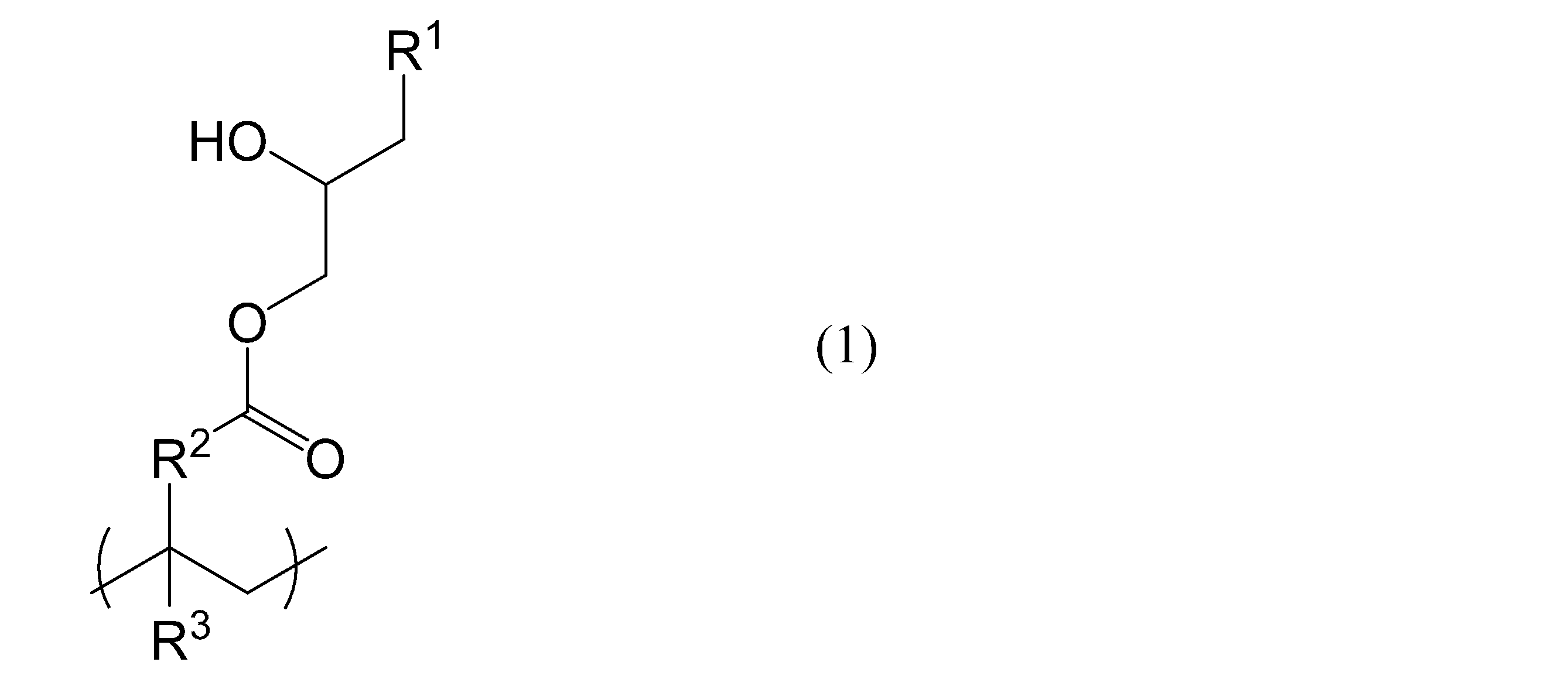
- the (meth) acrylic polymer has a structural unit represented by the following formula (1), [1] The adhesive tape according to any one of [7].
- R 1 represents an organic group having a polymerizable double bond
- R 2 represents a single bond or an organic group having 1 to 6 carbon atoms
- R 3 represents a hydrogen atom or a methyl group.
- the adhesive layer contains an isocyanate compound, The content of the isocyanate compound is 4.0 parts by weight or less with respect to 100 parts by weight of the (meth)acrylic polymer.
- the adherend is a semiconductor wafer, a semiconductor device, or various semiconductor packages, processing method.
- an adhesive tape having high adhesive strength before ultraviolet irradiation, low adhesive strength after ultraviolet irradiation, and little decrease in adhesive strength even when stored for a long time in a high temperature environment, and a processing method. can be provided.
- this embodiment an embodiment of the present invention (hereinafter referred to as “this embodiment”) will be described in detail, but the present invention is not limited to this, and various modifications are possible without departing from the gist thereof. is.
- (meth)acryl means both methacryl and acryl.
- monomer means a compound before polymerization
- structural unit means a repeating unit of a certain monomer in a polymer.
- the adhesive tape of the present embodiment comprises a substrate and an adhesive layer laminated on at least one surface of the substrate, and the adhesive layer is a (meth)acrylic polymer having a carboxyl group (hereinafter referred to as Also referred to as “(meth)acrylic polymer A”), an amine compound having a secondary or higher amine group (hereinafter also referred to as "amine compound B”), and a photopolymerization initiator, and an amine
- the content of compound B is 0.1 parts by weight or more relative to 100 parts by weight of (meth)acrylic polymer A, and the adhesive layer has an acid value of 10 mgKOH/g or more.
- the carboxyl groups derived from the matrix polymer present in the adhesive layer of the adhesive tape can have the function of improving the wettability to the adherend and improving the adhesive strength before UV irradiation.
- the adhesive tape is stored in a high-temperature environment for a long period of time, reactions such as oxidation, esterification, and condensation of the carboxyl groups proceed, and as a result, the adhesiveness derived from the carboxyl groups decreases over time. It turns out that there is a problem.
- the (meth)acrylic polymer A having a carboxyl group and the amine compound B having a predetermined amount of a secondary or higher amine group are used in combination to increase the adhesive strength before UV irradiation. is high, the adhesive strength after ultraviolet irradiation is low, and the decrease in adhesive strength can be suppressed even when stored for a long period of time in a high-temperature environment. This is probably because the amine group of the amine compound B is coordinated to the carboxyl group of the (meth)acrylic polymer A, and the reaction of the carboxyl group, which causes the adhesiveness to decrease over time, is suppressed.
- the mechanism of action is not limited to this.
- the adhesive tape of this embodiment will be described in detail below.
- Substrate Materials constituting the substrate are not particularly limited, but examples include polyvinyl chloride, polyethylene terephthalate, ethylene-vinyl acetate copolymer, ethylene-acrylic acid-acrylic acid ester film, ethylene-ethyl acrylate copolymer. , polyethylene, polypropylene, propylene-based copolymers, ethylene-acrylic acid copolymers, ethylene-(meth)acrylic acid copolymers, ethylene-(meth)acrylic acid-(meth)acrylic acid ester copolymers, etc. is crosslinked with metal ions.
- the materials constituting the substrate may be used singly or in combination of two or more.
- the substrate may also be a laminate of multiple layers from such materials.
- the thickness of the substrate is preferably 10-500 ⁇ m, more preferably 50-200 ⁇ m, and even more preferably 70-150 ⁇ m.
- the thickness of the substrate means the total thickness when the substrate is composed of a plurality of layers.
- the base material may be chemically or physically surface-treated, if necessary, on the surface that comes into contact with the adhesive layer.
- the surface treatment include corona treatment, chromic acid treatment, ozone exposure, flame exposure, high voltage shock exposure, and ionizing radiation treatment.
- Adhesive layer is a layer laminated on at least one surface of the substrate, and comprises a (meth)acrylic polymer A having a carboxyl group, an amine compound B having a secondary or higher amine group, and photopolymerization. and an initiator, and optionally an isocyanate compound and other components.
- the acid value of the adhesive layer is 10 mgKOH/g or more, preferably 20 to 120 mgKOH/g, more preferably 25 to 100 mgKOH/g, still more preferably 30 to 80 mgKOH/g.
- the adhesive layer has an acid value of 10 mgKOH/g or more, the adhesive strength before ultraviolet irradiation is further improved.
- the adhesive layer has an acid value of 120 mgKOH/g or less, the compatibility of each component is further improved, and the adhesive strength after ultraviolet irradiation tends to be further reduced.
- chip pick-up efficiency tends to be further improved due to a decrease in adhesive strength after ultraviolet irradiation.
- the acid value of the adhesive layer can be adjusted by the amount of the (meth)acrylic polymer A and the amine compound B used, which will be described later. Also, the acid value of the adhesive layer can be measured by the method described in Examples.
- the thickness of the adhesive layer is preferably 1.0 to 250 ⁇ m, more preferably 2.0 to 50 ⁇ m, still more preferably 4.0 to 40 ⁇ m.
- the thickness of the adhesive layer is 1.0 ⁇ m or more, the adhesive strength is further improved, and the scattering of the semiconductor chips divided by the expansion tends to be suppressed.
- the thickness of the adhesive layer is 250 ⁇ m or less, the cost tends to be further reduced.
- the total thickness of the adhesive tape when used as an adhesive tape for semiconductor wafer processing is preferably 60-250 ⁇ m, more preferably 70-200 ⁇ m, and still more preferably 70-180 ⁇ m.
- Carboxyl Group-Containing (Meth)Acrylic Polymer A carboxyl group-containing (meth)acrylic polymer A contributes to an improvement in adhesive strength before ultraviolet irradiation and a decrease in adhesive strength after ultraviolet irradiation.
- the (meth)acrylic polymer A may be used singly or in combination of two or more.
- the adhesive layer of the present embodiment may further contain a (meth)acrylic polymer having no carboxyl group, if necessary.
- the polymerization form of the (meth)acrylic polymer A is not particularly limited, but examples include homopolymers, random copolymers, block copolymers, and graft copolymers. Moreover, the polymerization form of the (meth)acrylic polymer A is not particularly limited, but examples thereof include a linear polymer, a branched polymer, and a crosslinked polymer. The crosslinked or branched polymer may be one in which part of the polymerizable double bonds of the linear polymer are bonded by aging or the like.
- the content of (meth)acrylic polymer A is preferably 60 to 99% by mass, more preferably 70 to 99% by mass, and still more preferably 80 to 98% by mass, relative to the total amount of the adhesive layer. be.
- the content of the (meth)acrylic polymer A is within the above range, there is a tendency that the adhesive strength before ultraviolet irradiation is further improved and the adhesive strength after ultraviolet irradiation is further decreased.
- Structural units possessed by (meth)acrylic polymer A include structural units derived from (meth)acrylic acid or its derivatives (meth)acrylic monomers, as well as copolymerizable with (meth)acrylic monomers. may contain a structural unit derived from a monomer having a polymerizable double bond.
- the (meth)acrylic polymer A is not particularly limited as long as it is polymerized with (meth)acrylic monomers as basic units and has carboxyl groups at the ends and/or side chains.
- the (meth)acrylic polymer A may contain a reactive functional group other than a carboxyl group at its terminal and/or side chain. Examples of such reactive functional groups include, but are not limited to, functional groups containing polymerizable double bonds such as hydroxyl groups, epoxy groups, vinyl groups, and (meth)acryloyl groups.
- Monomers constituting the structural units of (meth)acrylic polymer A are not particularly limited, but examples include aliphatic group-containing monomers, carboxyl group-containing monomers, acid anhydride monomers, hydroxyl group-containing monomers, and sulfonic acid group-containing monomers. , phosphate group-containing monomers. Among these, aliphatic group-containing monomers and carboxyl group-containing monomers are more preferable.
- aliphatic group-containing monomers include, but are not limited to, methyl group, ethyl group, n-propyl group, isopropyl group, n-butyl group, t-butyl group, isobutyl group, amyl group, isoamyl group and hexyl group.
- heptyl cyclohexyl, 2-ethylhexyl, octyl, isooctyl, nonyl, isononyl, decyl, isodecyl, undecyl, lauryl, tridecyl, tetradecyl, stearyl, octadecyl, and dodecyl Alkyl (meth)acrylates having linear or branched alkyl groups such as groups. These aliphatic group-containing monomers may be used singly or in combination of two or more.
- the constituent unit of the aliphatic group-containing monomer is preferably 55 to 95 parts by weight, more preferably 65 to 90 parts by weight, more preferably 75 to 95 parts by weight, relative to the total amount of the (meth)acrylic polymer A. 85 parts by weight.
- the content of the structural unit of the aliphatic group-containing monomer is within the above range, the adhesive strength before ultraviolet irradiation is further improved, and the adhesive strength after ultraviolet irradiation is further reduced, and can be used for a long time in a high temperature environment. Even in the case of storage, there is a tendency that the decrease in adhesive strength is further suppressed.
- carboxyl group-containing monomers examples include, but are not limited to, acrylic acid, methacrylic acid, carboxyethyl (meth)acrylate, carboxypentyl (meth)acrylate, itaconic acid, maleic acid, fumaric acid, and crotonic acid. . These carboxyl group-containing monomers may be used singly or in combination of two or more.
- the structural unit of the carboxyl group-containing monomer is preferably 5 to 45 parts by weight, more preferably 10 to 35 parts by weight, still more preferably 15 to 25 parts by weight, relative to the total amount of the (meth)acrylic polymer A. weight part.
- the content of the structural unit of the carboxyl group-containing monomer is within the above range, the adhesive strength before ultraviolet irradiation is further improved, and the adhesive strength after ultraviolet irradiation is further reduced, and long-term storage in a high-temperature environment. Even if it does, the decrease in adhesive strength tends to be more suppressed.
- acid anhydride monomers examples include, but are not limited to, maleic anhydride and itaconic anhydride. These acid anhydride monomers may be used singly or in combination of two or more.
- hydroxyl group-containing monomers include, but are not limited to, 2-hydroxyethyl (meth)acrylate, 2-hydroxypropyl (meth)acrylate, 4-hydroxybutyl (meth)acrylate, and 6 (meth)acrylate. -hydroxyhexyl, 8-hydroxyoctyl (meth)acrylate, 1-hydroxydecyl (meth)acrylate, 12-hydroxylauryl (meth)acrylate, and (4-hydroxymethylcyclohexyl)methyl (meth)acrylate, etc. be done. These hydroxyl group-containing monomers may be used singly or in combination of two or more.
- sulfonic acid group-containing monomers include, but are not limited to, styrenesulfonic acid, allylsulfonic acid, 2-(meth)acrylamido-2-methylpropanesulfonic acid, (meth)acrylamidopropanesulfonic acid, sulfopropyl (meth) Acrylate, and (meth)acryloyloxynaphthalenesulfonic acid, and the like. These sulfonic acid group-containing monomers may be used singly or in combination of two or more.
- the phosphate group-containing monomer is not particularly limited, but includes, for example, 2-hydroxyethyl acryloyl phosphate.
- the (meth)acrylic polymer A preferably has a polymerizable double bond at the end and/or side chain. It is more preferable to have a structural unit with This allows the polymerization initiator to proceed with the polymerization reaction of the (meth)acrylic polymer A by irradiation with ultraviolet rays. As the polymerization reaction of the (meth)acrylic polymer A progresses, the adhesive strength after ultraviolet irradiation tends to decrease, and contamination of adherends tends to be further reduced.
- R 1 represents an organic group having a polymerizable double bond
- R 2 represents a single bond or an organic group having 1 to 6 carbon atoms
- R 3 represents a hydrogen atom or a methyl group.
- Such groups represented by R 1 include, for example, residues after addition of an epoxy compound having a polymerizable double bond to a carboxyl group.
- the organic group having 1 to 6 carbon atoms represented by R 2 is not particularly limited, and examples thereof include linear, branched or cyclic alkyl groups, alkyleneoxy groups and the like.
- R 2 is a single bond
- R 2 examples include structural units in which an epoxy compound having a polymerizable double bond is added to a structural unit derived from acrylic acid or methacrylic acid.
- the (meth) before introducing the polymerizable double bond is )
- the carboxyl group of the structural unit derived from the carboxyl group-containing monomer the anhydrous carboxyl group of the structural unit derived from the acid anhydride monomer, or the hydroxyl group of the structural unit derived from the hydroxyl group-containing monomer of the acrylic polymer A, polymerization and a method of reacting a modifier having a double bond.
- (meth)acrylic polymer A by reacting (meth)acrylic polymer A with an epoxy compound having a polymerizable double bond as a modifier, the constituent units derived from the carboxyl group-containing monomer are allowed to react with the polymerizable double bond via an ester bond. can be introduced. Further, as another example, the (meth)acrylic polymer A is reacted with an isocyanate compound having a polymerizable double bond as a modifier to obtain a structural unit derived from a carboxyl group-containing monomer via an amide bond. Polymerizable double bonds can be introduced.
- the modifier is not particularly limited as long as it has a functional group that reacts with the functional group of the (meth)acrylic polymer A and has a polymerizable double bond. and an isocyanate compound having a polymerizable double bond.
- the content of the structural unit into which a polymerizable double bond is introduced as represented by formula (1) is preferably 2.5 to 25% by mass with respect to the total amount of the (meth)acrylic polymer A, More preferably 5.0 to 20% by mass, still more preferably 7.5 to 15% by mass.
- the content of the structural unit into which the polymerizable double bond is introduced is preferably 15 to 95 mol%, preferably 30 to 85 mol, relative to the total amount of the structural units constituting the (meth)acrylic polymer A. %, and may be 45 to 80 mol %.
- the content of the structural unit into which a polymerizable double bond is introduced is 2.5% by mass or more or 15 mol% or more, the adhesive strength after ultraviolet irradiation is further reduced, and the (meth)acrylic polymer is formed by ultraviolet irradiation.
- the cross-linking reaction of the polymerizable double bond of A progresses sufficiently, and the contact area with the adherend decreases due to curing shrinkage, so that the adhesive force tends to decrease sufficiently.
- the pick-up performance tends to be further improved because it can be easily peeled off.
- the content of the structural unit into which a polymerizable double bond is introduced is 25% by mass or less or 95% by mol or less, the number of carboxyl groups is relatively increased, so that the adhesive strength before ultraviolet irradiation is further improved. There is a tendency.
- the tendency that the adhesive layer cannot withstand the deformation of the adhesive tape due to the push-up of the pin during pick-up and the cracking in the shape of the pin and the resulting adhesive residue are suppressed. It is in.
- the content of the structural unit having a carboxyl group is preferably 5 to 85 mol%, preferably 15 to 70 mol%, relative to the total amount of the structural units constituting the (meth)acrylic polymer A, It may be 25 to 55 mol %.
- the (meth)acrylic polymer A preferably has a double bond equivalent weight of 500 to 2500 g/mol, more preferably 800 to 2000 g/mol, and still more preferably 1000 to 1800 g/mol.
- the (meth)acrylic polymer A has a double bond equivalent of 500 g/mol or more, so the number of carboxyl groups is relatively increased, so the adhesive strength before ultraviolet irradiation tends to be further improved. In addition, since excessive cross-linking can be suppressed, the tendency that the adhesive layer cannot withstand the deformation of the adhesive tape due to the push-up of the pin during pick-up and the cracking in the shape of the pin and the resulting adhesive residue are suppressed. It is in.
- the double bond equivalent of the (meth)acrylic polymer A is 2500 g/mol or less
- the crosslinking reaction of the polymerizable double bonds of the (meth)acrylic polymer A sufficiently proceeds by irradiation with ultraviolet rays, and curing.
- the adhesive strength tends to decrease sufficiently.
- the pick-up performance tends to be further improved because it can be easily peeled off.
- unpolymerized monomers remain in the adhesive layer, there is a possibility that they can react with the double bonds of the (meth)acrylic polymer A when irradiated with ultraviolet rays, which tends to further suppress adhesive residue. It is in.
- the number of carboxyl groups is relatively small, there is a tendency that the decrease in adhesive strength is further suppressed even when stored for a long period of time in a high-temperature environment.
- the "double bond equivalent" described in this specification is according to "acid value, saponification value, ester value, iodine value, hydroxyl value and unsaponifiable matter test method of chemical products” (JIS K 0070).
- the iodine value was measured to determine the amount of double bonds. Specifically, an iodine monochloride solution was added to the sample to add it to the double bond, and excess I was titrated with a sodium thiosulfate solution and obtained by the following formula.
- A ⁇ (BC) x f x 1.269 ⁇ /S
- either the polymerization initiation terminal and/or the polymerization termination terminal of the (meth)acrylic polymer A is modified with a compound having a polymerizable double bond. is mentioned.
- the acid value of the (meth)acrylic polymer A is preferably 10 to 1000 mgKOH/g, 20 to 500 mgKOH/g, 30 to 250 mgKOH/g, and even 30 to 100 mgKOH/g. good.
- the (meth)acrylic polymer A has an acid value of 10 mgKOH/g or more, the adhesive strength before ultraviolet irradiation tends to be further improved.
- the acid value of the (meth)acrylic polymer A is 1000 mgKOH/g or less, the compatibility of each component is further improved, and the adhesive strength after ultraviolet irradiation tends to be further reduced.
- the weight average molecular weight of the (meth)acrylic polymer A is preferably 1.0 ⁇ 10 5 to 2.0 ⁇ 10 6 , more preferably 2.0 ⁇ 10 5 to 1.0 ⁇ 10 6 , more preferably 2.5 ⁇ 10 5 to 8.0 ⁇ 10 5 .
- the weight average molecular weight of the (meth)acrylic polymer A is 1.0 ⁇ 10 5 or more, the high molecular weight component increases, and the higher the molecular weight, the more one (meth)acrylic polymer A ) There are more chances of polymerization between the acrylic polymer A and the polymerizable double bond, so contamination tends to be further reduced.
- the (meth)acrylic polymer A has a weight average molecular weight of 2.0 ⁇ 10 6 or less, so that the (meth)acrylic polymer A easily moves, and one (meth)acrylic polymer A becomes the other (meth) Since the chances of polymerization with the acrylic polymer A increase, contamination tends to be further reduced.
- the smaller the molecular weight the lower the elastic modulus of the pressure-sensitive adhesive, which tends to further improve the pressure-sensitive adhesive strength.
- contamination due to insufficient ultraviolet curing caused by oxygen inhibition can be avoided.
- a soft pressure-sensitive adhesive tends to be sufficiently cured and shrunk by irradiation with ultraviolet rays, so that the pressure-sensitive adhesive strength after curing can be sufficiently lowered, and the pick-up property tends to be further improved.
- the "weight average molecular weight” described in this specification is the molecular weight of a sample obtained by dissolving the (meth)acrylic polymer A in tetrahydrofuran using a gel permeation chromatograph analyzer from the standard polystyrene-equivalent molecular weight calibration curve. is.
- the glass transition point of the (meth)acrylic polymer A is preferably -80 to 23°C, more preferably -70 to 10°C, still more preferably -60 to 0°C.
- the glass transition point of (meth)acrylic polymer A can be measured by differential scanning calorimetry (DSC method) based on JIS K7121.
- the adhesive layer of the present embodiment may further contain a primary amine compound, if necessary, in addition to the amine compound B having a secondary or higher amine group.
- the amine group of the amine compound B is secondary or higher, preferably secondary or tertiary.
- the amine group in the amine compound B is a carboxyl group in the (meth)acrylic polymer A compared with the case where only a primary amine compound is used. becomes easier to coordinate to, and the effect of suppressing the decrease in adhesive strength during high-temperature storage appears remarkably.
- the amine compound B is not particularly limited, but includes, for example, chain amines and cyclic amines. Among these, cyclic amines are preferred.
- the nitrogen atoms in the amine compound B become more likely to coordinate with the carboxyl groups of the (meth)acrylic polymer, and the tendency to further suppress the decrease in adhesive strength during high-temperature storage. It is in.
- chain amines include, but are not limited to, dibutylamine, diisobutylamine, dihexylamine, dioctylamine, bis(2-ethylhexyl)amine, diphenylamine, N-methylaniline, N-ethylaniline, tripropylamine, tri Butylamine, triisobutylamine, trihexylamine, trioctylamine, tris(2-ethylhexyl)amine.
- Cyclic amines include alicyclic amines and aromatic amines.
- alicyclic amines include, but are not limited to, pyrrolidine, piperidine, morpholine, imidazoline; piperazine, homopiperazine, 1-methylpiperazine, 2-methylpiperazine, 1-ethylpiperazine, 1,4-dimethylpiperazine.
- Piperazine compounds such as 1-(2-aminoethyl) piperazine; tetrakis (1,2,2,6,6-pentamethyl-4-piperidyl) butane-1,2,3,4-tetracarboxylate, tetrakis ( 2,2,6,6-tetramethyl-4-piperidyl)butane-1,2,3,4-tetracarboxylate, bis(1,2,2,6,6-pentamethyl-4-piperidyl)sebacic acid, Bis(2,2,6,6-tetramethyl-4-piperidyl)sebacic acid, 1,2,2,6,6-pentamethyl-4-piperidyl methacrylate, 2,2,6,6-tetramethyl-4- Piperidyl methacrylate, N,N'-bis(2,2,6,6-tetramethyl-4-piperidyl)hexane-1,6-diamine, bis(1,2,2,6,6-pentamethyl-4-piperidyl) ) piperidyl compounds
- aromatic amine is not particularly limited, but examples include pyrrole, pyridine, pyrimidine, pyrazine; -ethyl-4-methylimidazole, 2-phenylimidazole, 2-phenyl-4-methylimidazole, 1-benzyl-2-phenylimidazole, 1-cyanoethyl-2-methylimidazole, 1-cyanoethyl-2-undecylimidazole, 1-cyanoethyl-2-ethyl-4-methylimidazole, 1-cyanoethyl-2-phenylimidazole, 2-phenyl-4,5-dihydroxymethylimidazole, 2-phenyl-4-methyl-5-hydroxymethylimidazole, 2, Imidazole compounds such as 3-dihydro-1H-pyrrolo[1,2-a]benzimidazole; 1,3,5-triazine, 1,3,5-triazin-2-amine, 2,4-diamino-6- [2′-methylimid
- alicyclic amines are preferred, piperidyl compounds and 1,4-diazabicyclo[2,2,2]octane compounds are more preferred, and 1,4-diazabicyclo[2,2,2]octane or derivatives thereof is more preferred, and compounds having a hydroxyl group such as 1,4-diazabicyclo[2,2,2]octane-2-methanol are particularly preferred.
- amine compound B since the nitrogen atoms protrude outside of the amine compound B, the coordinating ability with respect to the carboxyl group is further improved. Therefore, by using such an amine compound B, there is a tendency to suppress the decrease in adhesive strength during high-temperature storage. In addition, having a hydroxyl group or the like tends to further improve compatibility with other components.
- the term "derivative" refers to a compound in which a hydrogen atom of a certain compound is substituted with a substituent.
- substituents include, but are not limited to, halogen groups, hydroxyl groups, amino groups, nitro groups, and carboxyl groups.
- the number of amino groups possessed by the amine compound B is preferably 1 to 4, more preferably 1 to 3, still more preferably 1 to 2.
- the number of amino groups is in the above range, the coordinating ability to the carboxyl group is improved, and the decrease in adhesive strength during high-temperature storage tends to be suppressed.
- the content of the amine compound B is 0.1 parts by weight or more, preferably 0.1 to 15 parts by weight, more preferably 0.5 to 100 parts by weight, relative to 100 parts by weight of the (meth)acrylic polymer A. It is 15.0 parts by weight, more preferably 0.5 to 10.0 parts by weight, and even more preferably 0.5 to 5.0 parts by weight.
- the content of the amine compound B is 0.1 parts by weight or more, the effect of coordinating the amine compound B to the carboxyl groups of the (meth)acrylic polymer A is sufficiently exhibited, and the adhesive strength is reduced during high-temperature storage. more restrained. Further, when the content of the amine compound B is 15 parts by weight or less, the adhesive strength before ultraviolet irradiation is further improved, and contamination of the adherend by the amine compound B tends to be more suppressed.
- Photopolymerization Initiator By irradiating the adhesive layer with ultraviolet rays, the photopolymerization initiator generates active species such as radicals, thereby promoting the polymerization of the polymerizable double bonds of the (meth)acrylic polymer A. As a result, the adhesive layer is cured, the viscosity is lowered, and the pick-up property is further improved.
- photopolymerization initiators include, but are not limited to, alkylphenone photopolymerization initiators, acylphosphine oxide photopolymerization initiators, thioxanthone photopolymerization initiators, aromatic ketones, and aromatic onium salts. compounds, organic peroxides, thio compounds (thiophenyl group-containing compounds, etc.), ⁇ -aminoalkylphenone compounds, hexaarylbiimidazole compounds, ketoxime ester compounds, borate compounds, azinium compounds, metallocene compounds, active ester compounds, carbon halogens Compounds with bonds and alkylamine compounds are included.
- alkylphenone-based photopolymerization initiators such as acetophenone, acetophenone benzyl ketal, 1-hydroxycyclohexylphenyl ketone, and 2,2-dimethoxy-2-phenylacetophenone are preferred.
- acetophenone acetophenone benzyl ketal, 1-hydroxycyclohexylphenyl ketone, and 2,2-dimethoxy-2-phenylacetophenone
- polymerization tends to proceed more appropriately.
- the content of the photopolymerization initiator is preferably 0.5 to 10 parts by weight, more preferably 0.5 to 7.5 parts by weight, based on 100 parts by weight of the (meth)acrylic polymer A, More preferably, it is 0.5 to 5.0 parts by weight.
- the content of the photopolymerization initiator is 0.5 parts by weight or more, there is a tendency that the adhesive layer can be sufficiently cured even when the illuminance or irradiation amount of ultraviolet rays is low.
- the content of the photopolymerization initiator is 10 parts by weight or less, the risk of the photopolymerization initiator causing contamination tends to decrease.
- the adhesive layer may contain an isocyanate compound. This tends to further improve the cohesion of the adhesive layer.
- the number of isocyanate groups per molecule of the isocyanate compound is preferably 2-6, more preferably 2-4.
- a plurality of (meth)acrylic polymers A can also be crosslinked by the isocyanate compound, so that the cohesive force of the adhesive layer tends to be further improved.
- the anchoring property between the base material and the adhesive layer is improved, and more stable adhesive properties tend to be obtained.
- isocyanate compounds include, but are not limited to, aromatic diisocyanates such as trimethylolpropane-modified tolylene diisocyanate, tolylene diisocyanate, 4,4-diphenylmethane diisocyanate, and xylylene diisocyanate; cyclohexyl isocyanate); and aliphatic diisocyanates such as hexamethylene diisocyanate and trimethylhexamethylene diisocyanate.
- An isocyanate compound may be used individually by 1 type, or may use 2 or more types together.
- trimethylolpropane-modified tolylene diisocyanate is more preferable.
- the use of such an isocyanate compound tends to further improve the cohesive strength of the adhesive layer.
- the content of the isocyanate compound is preferably 4.0 parts by weight or less, more preferably 0.05 to 2.0 parts by weight, and still more preferably 100 parts by weight of the (meth)acrylic polymer A. 0.1 to 1.5 parts by weight.
- the content of the isocyanate compound is 0.1 parts by weight or more, the cross-linking density of the adhesive layer is further improved, cohesive failure occurring at the time of peeling is further suppressed, and contamination caused by cohesive failure tends to be further suppressed. be.
- the content of the isocyanate compound is 4.0 parts by weight or less, the crosslink density is further lowered and the elastic modulus is lowered, so that the adhesive strength tends to be further improved.
- Additives such as tackifiers, cross-linking retarders, antioxidants, metal trapping agents, UV absorbers, plasticizers, metal powders, fillers, and colorants may be added to the adhesive layer as necessary. good.
- tackifiers include, but are not limited to, petroleum resins, terpene resins, terpene phenol resins, aromatic modified terpene resins, coumarone-indene resins, natural resin rosins, modified rosins, glycerol ester rosins, and pentaerythritol ester rosins. , phenol resins, xylene resins, alicyclic petroleum resins, styrene resins, dicyclopentadiene resins, and the like.
- the cross-linking retarder is not particularly limited, but examples include ⁇ -diketones such as acetylacetone, hexane-2,4-dione, heptane-2,4-dione, octane-2,4-dione; ⁇ -ketoesters such as ethyl acetate, propyl acetoacetate, butyl acetoacetate, octyl acetoacetate, oleyl acetoacetate, lauryl acetoacetate, and stearyl acetoacetate; and benzoylacetone.
- ⁇ -diketones such as acetylacetone, hexane-2,4-dione, heptane-2,4-dione, octane-2,4-dione
- ⁇ -ketoesters such as ethyl acetate, propyl acetoacetate, butyl acetoacetate, oc
- antioxidants include, but are not limited to, methylhydroquinone, hydroquinone, 2,2-methylene-bis(4-methyl-6-tertiarybutylphenol), catechol, hydroquinone monomethyl ether, monotertiarybutylhydroquinone, 2 ,5-ditert-butyl hydroquinone, p-benzoquinone, 2,5-diphenyl-p-benzoquinone, 2,5-ditert-butyl-p-benzoquinone, picric acid, citric acid, phenothiazine, tert-butyl catechol, 2-butyl -4-hydroxyanisole, 2,6-ditert-butyl-p-cresol and 4-[[4,6-bis(octylthio)-1,3,5-triazin-2-yl]amino]-2,6- Di-tertiary butyl phenol is mentioned.
- the adhesive tape of the present embodiment may have a protective film attached to the adhesive layer in order to protect the adhesive layer. Since the protective film is peeled off when the adhesive tape is used, it is preferable that the protective film has excellent peelability.
- the protective film include, but are not limited to, a film made of a fluororesin having a low surface energy, a polyethylene terephthalate film obtained by treating the surface with a silicone-based release agent, and the like.
- the adhesive tape of the present embodiment can be suitably used for processing semiconductor wafers, semiconductor devices, or various semiconductor packages.
- the semiconductor wafer may be a wafer on which an electronic circuit or the like is formed before singulation.
- a semiconductor device refers to various semiconductor chips or elements containing them after being separated into individual pieces.
- a semiconductor package refers to a resin for protecting a semiconductor chip and connection terminals that connect the semiconductor chip to the outside. is attached.
- the method for producing the adhesive tape is not particularly limited, but includes a method of forming an adhesive layer on a substrate.
- the base material of the adhesive tape of this embodiment can be manufactured according to well-known techniques.
- the means for molding the base material is not particularly limited, but the various materials mentioned above can be melt-kneaded using conventional melt-kneading or various mixing devices (single- or twin-screw extruders, rolls, Banbury mixers, various kneaders, etc.).
- the components are mixed by using a T-die method, a calender method, or an inflation method to shape the mixture into a base material.
- Preferred is a method of forming a film using a T-die method using an extruder with good thickness accuracy.
- the adhesive layer of the adhesive tape of this embodiment can be manufactured according to known techniques.
- the means for forming the adhesive layer is not particularly limited, but the above various materials are dissolved in a solvent such as an organic solvent to form a varnish, and this is applied on the protective film by a knife coating method, a roll coating method, or a spray coating method. method, gravure coating method, bar coating method, curtain coating method, or the like, and the solvent is removed to form an adhesive layer.
- An adhesive tape is produced by laminating this on a base material.
- aging treatment may be performed after forming the adhesive layer.
- the formed adhesive layer is stored under a predetermined temperature.
- the temperature conditions are not particularly limited, but are preferably 30 to 50°C, more preferably 35 to 45°C.
- Storage time is not particularly limited, but preferably 24 to 150 hours, more preferably 48 to 100 hours.
- the processing method of the present embodiment includes a bonding step of bonding the adhesive tape and the adherend together, and a dicing step of processing the adherend while the adhesive tape and the adherend are bonded together. and an ultraviolet irradiation step of irradiating the adhesive tape after the dicing step with ultraviolet rays, and processing semiconductor wafers, semiconductor devices, or various semiconductor packages as adherends.
- the processing method of the present embodiment may have a pick-up step of picking up individualized chips from the adhesive tape after ultraviolet irradiation, if necessary.
- the lamination step is not particularly limited as long as it is a step of laminating the adhesive layer of the adhesive tape and the adherend.
- the bonding step may be performed under normal temperature and normal pressure, or may be performed under heating or under reduced pressure as necessary.
- the singulation method by the dicing process is not particularly limited, and conventionally known methods can be used.
- a silicon wafer can be cut into semiconductor chips by rotating a dicing blade containing diamond abrasive grains at a high speed using a dicing machine.
- the ultraviolet irradiation method is not particularly limited, but conventionally known methods can be used.
- an ultraviolet irradiation device is used to irradiate the adhesive tape in the dicing process with ultraviolet rays.
- the pick-up method is not particularly limited, but a conventionally known method can be used.
- an expanding device can be used to stretch the adhesive tape after being irradiated with ultraviolet rays in the surface direction, and the chips can be picked up by a pickup device in a state in which each chip is separated.
- the carboxyl group of the structural unit derived from acrylic acid in the copolymer obtained as described above was reacted with glycidyl methacrylate to obtain acrylic polymer 1 having a double bond in the side chain.
- acrylic polymer 1 among 100 mol% of the structural units derived from acrylic acid in the copolymer, 60 mol% of the structural units are structural units reacted with glycidyl methacrylate, and 40 mol% of the structural units. was a structural unit derived from acrylic acid.
- the carboxyl group of the structural unit derived from acrylic acid in the copolymer obtained as described above was reacted with glycidyl methacrylate to obtain an acrylic polymer 2 having a double bond in the side chain.
- acrylic polymer 2 among 100 mol% of the structural units derived from acrylic acid in the copolymer, 45 mol% of structural units are structural units reacted with glycidyl methacrylate, and 55 mol% of the structural units. was a structural unit derived from acrylic acid.
- the carboxyl group of the structural unit derived from acrylic acid in the copolymer obtained as described above was reacted with glycidyl methacrylate to obtain an acrylic polymer 5 having a double bond in the side chain.
- the acrylic polymer 5 among 100 mol% of the structural units derived from acrylic acid in the copolymer, 80 mol% of the structural units are the structural units reacted with glycidyl methacrylate, and 20 mol% of the structural units. was a structural unit derived from acrylic acid.
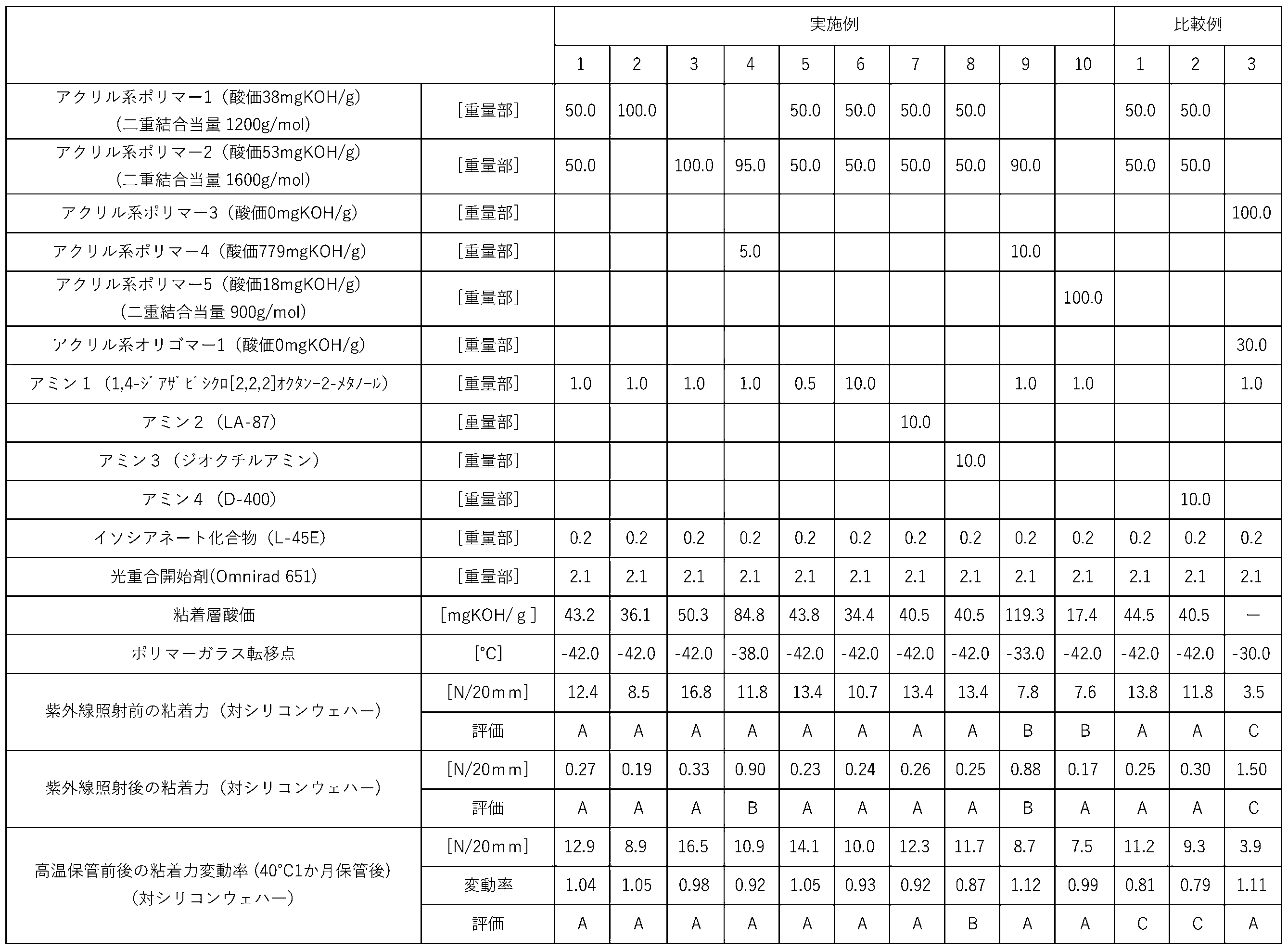
- Example 1 To a solution containing 50 parts by weight of acrylic polymer 1 and 50 parts by weight of acrylic polymer 2, 0.2 parts by weight of trimethylolpropane-modified tolylene diisocyanate (Japan Polyurethane Co., Ltd.: Coronate L-45E) and photopolymerization.
- Trimethylolpropane-modified tolylene diisocyanate Japan Polyurethane Co., Ltd.: Coronate L-45E
- Initiator (2,2-dimethoxy-2-phenylacetophenone (manufactured by BASF: Omnirad 651)) 2.1 parts by weight, amine 1 (1,4-diazabicyclo[2,2,2]octane-2-methanol, Tosoh Co., Ltd.: RZETA, about 33% active ingredient, diluted with dipropylene glycol) was added so that the active ingredient was 1.0 part by weight, to prepare an ultraviolet curable resin composition.
- This resin composition is coated on the release-treated surface of a polyethylene terephthalate protective film that has been subjected to release treatment in advance so that the thickness of the adhesive layer after drying is 10 ⁇ m, and dried at 120° C. for 1 minute. rice field.
- the surface of the adhesive layer and the corona-treated surface of a polyolefin film (substrate) in which the surface to which the adhesive layer is to be bonded was previously subjected to corona treatment were bonded together to transfer the adhesive to the substrate. This was aged in an atmosphere of 40° C. for 72 hours to obtain an adhesive tape.
- Example 2 A pressure-sensitive adhesive tape was produced in the same manner as in Example 1 except that acrylic polymer 2 was not used and 100 parts by weight of acrylic polymer 1 was used.
- Example 3 A pressure-sensitive adhesive tape was produced in the same manner as in Example 1 except that acrylic polymer 1 was not used and 100 parts by weight of acrylic polymer 2 was used.
- Example 4 Acrylic polymer 1 was not used, 95 parts by weight of acrylic polymer 2, and 5 parts by weight of acrylic polymer 4 (polyacrylic acid (manufactured by Fujifilm Wako Pure Chemical Industries, Ltd., product name polyacrylic acid 5000)) were used. An adhesive tape was produced in the same manner as in Example 1.
- Example 5 A pressure-sensitive adhesive tape was produced in the same manner as in Example 1, except that the amount of Amine 1 used was 0.5 parts by weight.
- Example 6 A pressure-sensitive adhesive tape was produced in the same manner as in Example 1, except that the amount of Amine 1 used was 10.0 parts by weight.
- Example 7 The procedure was the same as in Example 1 except that 10.0 parts by weight of amine 2 (2,2,6,6-tetramethyl-4-piperidyl methacrylate, manufactured by ADEKA: LA-87) was used instead of amine 1. to prepare an adhesive tape.
- amine 2 (2,2,6,6-tetramethyl-4-piperidyl methacrylate, manufactured by ADEKA: LA-87
- Example 8 A pressure-sensitive adhesive tape was produced in the same manner as in Example 1, except that 10.0 parts by weight of Amine 3 (dioctylamine, manufactured by Fuji Film Wako Pure Chemical Industries, Ltd.) was used instead of Amine 1.
- Amine 3 dioctylamine, manufactured by Fuji Film Wako Pure Chemical Industries, Ltd.
- Example 9 A pressure-sensitive adhesive tape was produced in the same manner as in Example 1, except that acrylic polymer 1 was not used, and 90 parts by weight of acrylic polymer 2 and 10 parts by weight of acrylic polymer 4 were used.
- Example 10 A pressure-sensitive adhesive tape was produced in the same manner as in Example 1, except that acrylic polymer 1 and acrylic polymer 2 were not used, and 100 parts by weight of acrylic polymer 5 was used.
- Adhesive tape was prepared in the same manner as in Example 1, except that 10.0 parts by weight of primary amine amine 4 (polyoxypropylene diamine, manufactured by HUNTMAN: Jeffamine D-400) was used instead of amine 1. was made.
- primary amine amine 4 polyoxypropylene diamine, manufactured by HUNTMAN: Jeffamine D-400
- the acid value [mgKOH/g] of the adhesive layer included in the adhesive tape of each example and each comparative example was measured by the following method. Specifically, first, 1 g of a resin composition for forming an adhesive layer is weighed, and this resin composition is dissolved in 30 g of tetrahydrofuran (THF) in a conical beaker. 3 drops were added. Then, a 0.1N KOH solution (solvent: 2-propanol (IPA)) was added dropwise from a burette, and the neutralization point was calculated.
- THF tetrahydrofuran
- IPA 2-propanol
- the glass transition point of (meth)acrylic polymer A was measured by differential scanning calorimetry (DSC method) based on JIS K7121.
- the adhesive strength of the adhesive tape of each example and each comparative example was determined by the 180° peel strength measurement method of JIS Z0237 (2009) (Method 1: a test method in which a tape and a sheet are peeled off at 180° against a stainless steel test plate). Measured according to Specifically, the pressure-sensitive adhesive tape was pressed onto the surface-cleaned silicon wafer using a pressure-bonding device (roller mass: 2 kg), and the pressure-sensitive adhesive tape was peeled off from the silicon wafer at 180°. S 0 was measured with a universal tensile tester (Tensilon model number: RTG-1210 manufactured by ORIENTEC) in an environment with a temperature of 23° C. and a humidity of 50%.
- Method 1 a test method in which a tape and a sheet are peeled off at 180° against a stainless steel test plate.
- the double bond equivalent is determined by measuring the iodine value in accordance with “Testing methods for acid value, saponification value, ester value, iodine value, hydroxyl value and unsaponifiable matter of chemical products” (JIS K 0070). A heavy bond amount was determined. Specifically, an iodine monochloride solution was added to the sample to add it to the double bond, and excess I was titrated with a sodium thiosulfate solution and obtained by the following formula.
- A ⁇ (BC) x f x 1.269 ⁇ /S
- the adhesive tape of the present invention has industrial applicability as a semiconductor wafer processing tape, particularly as an adhesive tape used in a dicing process.
Landscapes
- Chemical & Material Sciences (AREA)
- Organic Chemistry (AREA)
- Adhesives Or Adhesive Processes (AREA)
- Adhesive Tapes (AREA)
Abstract
Description
〔1〕
基材と、該基材の少なくとも一方の面に積層された粘着層と、を備え、
前記粘着層が、カルボキシル基を有する(メタ)アクリル系ポリマーと、2級以上のアミン基を有するアミン化合物と、光重合開始剤と、を含有し、
前記アミン化合物の含有量が、前記(メタ)アクリル系ポリマー100重量部に対して、0.1重量部以上であり、
前記粘着層の酸価が、10mgKOH/g以上である、
粘着テープ。
〔2〕
前記アミン化合物の含有量が、前記(メタ)アクリル系ポリマー100重量部に対して、15重量部以下である、
〔1〕に記載の粘着テープ。
〔3〕
前記アミン化合物が、環状アミン化合物を含む、
〔1〕又は〔2〕に記載の粘着テープ。
〔4〕
前記環状アミン化合物が、脂環式アミンを含む、
〔3〕に記載の粘着テープ。
〔5〕
前記環状アミン化合物が、1,4-ジアザビシクロ[2,2,2]オクタン又はその誘導体を含む、
〔3〕又は〔4〕に記載の粘着テープ。
〔6〕
前記粘着層の酸価が、100mgKOH/g以下である、
〔1〕~〔5〕のいずれか一項に記載の粘着テープ。
〔7〕
前記(メタ)アクリル系ポリマーが、末端及び/又は側鎖に重合性二重結合を有する、
〔1〕~〔6〕のいずれか一項に記載の粘着テープ。
〔8〕
前記(メタ)アクリル系ポリマーが、下記式(1)で表される構成単位を有する、
〔1〕~〔7〕のいずれか一項に記載の粘着テープ。

(式中、R1は、重合性二重結合を有する有機基を示し、R2は、単結合又は炭素数1~6の有機基を示し、R3は、水素原子又はメチル基を示す。)
〔9〕
前記粘着層が、イソシアネート化合物を含み、
該イソシアネート化合物の含有量が、前記(メタ)アクリル系ポリマー100重量部に対して、4.0重量部以下である、
〔1〕~〔8〕のいずれか一項に記載の粘着テープ。
〔10〕
〔1〕~〔9〕のいずれか一項に記載の粘着テープと、被着体と、を貼り合わせる貼合工程と、
前記粘着テープと前記被着体とを貼り合わせた状態で、前記被着体を加工するダイシング工程と、
該ダイシング工程後の粘着テープに紫外線を照射する紫外線照射工程と、を有し、
前記被着体が、半導体ウエハ、半導体デバイス、又は各種半導体パッケージである、
加工方法。
本実施形態の粘着テープは、基材と、該基材の少なくとも一方の面に積層された粘着層と、を備え、粘着層が、カルボキシル基を有する(メタ)アクリル系ポリマー(以下、「(メタ)アクリル系ポリマーA」ともいう。)と、2級以上のアミン基を有するアミン化合物(以下、「アミン化合物B」ともいう。)と、光重合開始剤と、を含有し、アミン化合物Bの含有量が、(メタ)アクリル系ポリマーA100重量部に対して、0.1重量部以上であり、粘着層の酸価が、10mgKOH/g以上である。
基材を構成する材料としては、特に制限されないが、例えば、ポリ塩化ビニル、ポリエチレンテレフタレート、エチレン-酢酸ビニル共重合体、エチレン-アクリル酸-アクリル酸エステルフィルム、エチレン-エチルアクリレート共重合体、ポリエチレン、ポリプロピレン、プロピレン系共重合体、エチレン-アクリル酸共重合体、及び、エチレン-(メタ)アクリル酸共重合体やエチレン-(メタ)アクリル酸-(メタ)アクリル酸エステル共重合体等を金属イオンで架橋したアイオノマー樹脂が挙げられる。基材を構成する材料は、これらを1種単独用いても、2種以上を併用してもよい。また、基材は、このような材料から複数の層の積層体であってもよい。
粘着層は、基材の少なくとも一方の面に積層された層であって、カルボキシル基を有する(メタ)アクリル系ポリマーAと、2級以上のアミン基を有するアミン化合物Bと、光重合開始剤と、を含有し、必要に応じて、イソシアネート化合物やその他の成分を含んでいてもよい。
粘着層の酸価は、10mgKOH/g以上であり、好ましくは20~120mgKOH/gであり、より好ましくは25~100mgKOH/gであり、さらに好ましくは30~80mgKOH/gである。粘着層の酸価が10mgKOH/g以上であることにより、紫外線照射前の粘着力がより向上する。また、粘着層の酸価が120mgKOH/g以下であることにより、各成分の相溶性がより向上し、また、紫外線照射後の粘着力がより低下する傾向にある。また、紫外線照射後の粘着力の低下により、チップのピックアップ効率がより向上する傾向にある。粘着層の酸価は後述する(メタ)アクリル系ポリマーAやアミン化合物Bの使用量により調整することができる。また、粘着層の酸価は実施例に記載の方法により測定することができる。
粘着層の厚さは、好ましくは1.0~250μmであり、より好ましくは2.0~50μmであり、さらに好ましくは4.0~40μmである。粘着層の厚さが1.0μm以上であることによって、粘着力がより向上し、エキスパンドによって分割された半導体のチップの飛散が抑制される傾向にある。また、粘着層の厚さが250μm以下であることにより、コストがより低下する傾向にある。
カルボキシル基を有する(メタ)アクリル系ポリマーAは、紫外線照射前の粘着力の向上、紫外線照射後の粘着力の低下に寄与する。(メタ)アクリル系ポリマーAは、1種単独で用いてもよいし、2種以上を併用してもよい。なお、本実施形態の粘着層は、カルボキシル基を有する(メタ)アクリル系ポリマーAに加え、必要に応じて、カルボキシル基を有しない(メタ)アクリル系ポリマーをさらに含んでいてもよい。
(メタ)アクリル系ポリマーAが有する構成単位には、(メタ)アクリル酸又はその誘導体である(メタ)アクリル系モノマーに由来する構成単位の他、(メタ)アクリル系モノマーと共重合可能な重合性二重結合を有するモノマーに由来する構成単位が含まれていてもよい。

(式中、R1は、重合性二重結合を有する有機基を示し、R2は、単結合又は炭素数1~6の有機基を示し、R3は、水素原子又はメチル基を示す。)
A={(B-C)×f×1.269}/S
A:よう素価
B:空試験に用いたチオ硫酸ナトリウム溶液の量(mL)
C:滴定に用いたチオ硫酸ナトリウム溶液の量(mL)
f:チオ硫酸ナトリウム溶液のファクター
S:試料の質量(g)
(メタ)アクリル系ポリマーAの重量平均分子量は、好ましくは1.0×10⁵~2.0×10⁶であり、より好ましくは2.0×10⁵~1.0×10⁶、さらに好ましくは、2.5×10⁵~8.0×10⁵である。
(メタ)アクリル系ポリマーAのガラス転移点は、好ましくは-80~23℃であり、より好ましくは-70~10℃であり、さらに好ましくは-60~0℃である。(メタ)アクリル系ポリマーAのガラス転移点が-80℃以上であることにより、汚染がより低減する傾向にある。また、(メタ)アクリル系ポリマーAのガラス転移点が23℃以下であることにより、被着物に対する接着性がより向上する傾向にある。(メタ)アクリル系ポリマーAのガラス転移点は、JIS K7121に基づいて、示差走査熱量測定法(DSC法)により測定できる。
2級以上のアミン基を有するアミン化合物Bは、(メタ)アクリル系ポリマーA由来のカルボキシル基に対して配位することで、カルボキシル基の酸化、エステル化、縮合などの反応を抑制することができ、経時的な粘着性の低下を抑制できる。なお、本実施形態の粘着層は、2級以上のアミン基を有するアミン化合物Bに加え、必要に応じて、1級のアミン化合物をさらに含んでいてもよい。
粘着層に紫外線照射をすることで、光重合開始剤がラジカルなどの活性種を発生させ、それにより(メタ)アクリル系ポリマーAの重合性二重結合の重合が進行する。これにより粘着層が硬化し、粘度が低下して、ピックアップ性がより向上する。
粘着層は、イソシアネート化合物を含んでいてもよい。これにより、粘着層の凝集力がより向上する傾向にある。イソシアネート化合物一分子当たりのイソシアネート基の数は、好ましくは2~6個であり、より好ましくは2~4個である。このようなイソシアネート化合物を用いることにより、複数の(メタ)アクリル系ポリマーA間をイソシアネート化合物によっても架橋することができるため、粘着層の凝集力がより向上する傾向にある。また、基材と粘着層とのアンカー性も向上し、より安定した粘着特性が得られる傾向にある。
粘着層は、必要に応じて、粘着付与剤、架橋遅延剤、酸化防止剤、金属トラップ剤、紫外線吸収剤、可塑剤、金属粉、フィラー、着色剤などの添加剤を加えてもよい。
本実施形態の粘着テープは、粘着層を保護するため、粘着層に貼り合わせられた保護フィルムを有していてもよい。保護フィルムは、粘着テープの使用時に剥離されるため、剥離性に優れるものが好ましい。保護フィルムとしては、特に制限されないが、例えば、フッ素樹脂からなる表面エネルギーの低いフィルム、ポリエチレンテレフタレートの表面をシリコーン系剥離剤で処理したフィルム等が挙げられる。
本実施形態の粘着テープは、半導体ウエハ、半導体デバイス、又は各種半導体パッケージの加工用途に好適に用いることができる。半導体ウエハは、電子回路等が形成された個片化前のものであってもよい。また、半導体デバイスは、個片化された後の各種半導体チップあるいはそれを含む素子をいい、半導体パッケージとは、半導体チップにそれを保護するための樹脂と半導体チップと外部とを接続する接続端子を付したものをいう。
粘着テープの製造方法としては、特に制限されないが、基材上に粘着層を形成する方法が挙げられる。
本実施形態の加工方法は、上記粘着テープと、被着体と、を貼り合わせる貼合工程と、粘着テープと被着体とを貼り合わせた状態で、被着体を加工するダイシング工程と、ダイシング工程後の粘着テープに紫外線を照射する紫外線照射工程を有し、被着体として半導体ウエハ、半導体デバイス、又は各種半導体パッケージを加工する方法である。また、本実施形態の加工方法は、必要に応じて、紫外線照射後の粘着テープから、個片化したチップをピックアップするピックアップ工程を有していてもよい。
アクリル酸2-エチルヘキシル82重量部と、アクリル酸18重量部と、重合開始剤(アゾビスイソブチロニトリル)0.05重量部とを酢酸エチル中で、65℃で、24時間、共重合させて、共重合体を得た。
アクリル酸2-エチルヘキシル82重量部と、アクリル酸18重量部と、重合開始剤(アゾビスイソブチロニトリル)0.05重量部とを酢酸エチル中で、65℃で、24時間、共重合させて、共重合体を得た。
アクリル酸2-エチルヘキシル82重量部と、アクリル酸18重量部と、重合開始剤(アゾビスイソブチロニトリル)0.05重量部とを酢酸エチル中で、65℃で、24時間、共重合させて、共重合体を得た。
アクリル系ポリマー1を50重量部と、アクリル系ポリマー2を50重量部含む溶液に、トリメチロールプロパン変性トリレンジイソシアネート(日本ポリウレタン株式会社:コロネートL-45E)を0.2重量部と、光重合開始剤(2,2-ジメトキシ-2-フェニルアセトフェノン(BASF社製:Omnirad 651))2.1重量部と、アミン1(1,4-ジアザビシクロ[2,2,2]オクタン-2-メタノール、東ソー製:RZETA、有効成分約33%、ジプロピレングリコールで希釈)を有効成分が1.0重量部となるように加えて、紫外線硬化型の樹脂組成物を調製した。
アクリル系ポリマー2を用いず、アクリル系ポリマー1を100重量部用いたこと以外は実施例1と同様にして、粘着テープを作製した。
アクリル系ポリマー1を用いず、アクリル系ポリマー2を100重量部用いたこと以外は実施例1と同様にして、粘着テープを作製した。
アクリル系ポリマー1を用いず、アクリル系ポリマー2を95重量部、アクリル系ポリマー4(ポリアクリル酸(富士フィルム和光純薬製、製品名ポリアクリル酸 5000))を5重量部使用した以外は、実施例1と同様にして、粘着テープを作製した。
アミン1の使用量を0.5重量部としたこと以外は、実施例1と同様にして、粘着テープを作製した。
アミン1の使用量を10.0重量部としたこと以外は、実施例1と同様にして、粘着テープを作製した。
アミン1に代えて、アミン2(2,2,6,6-テトラメチル-4-ピペリジルメタクリレート、ADEKA製:LA-87)を10.0重量部使用したこと以外は、実施例1と同様にして、粘着テープを作製した。
アミン1に代えて、アミン3(ジオクチルアミン、富士フィルム和光純薬製)を10.0重量部使用したこと以外は、実施例1と同様にして、粘着テープを作製した。
アクリル系ポリマー1を用いず、アクリル系ポリマー2を90重量部、アクリル系ポリマー4を10重量部使用したこと以外は、実施例1と同様にして、粘着テープを作製した。
アクリル系ポリマー1、アクリル系ポリマー2を用いず、アクリル系ポリマー5を100重量部使用したこと以外は、実施例1と同様にして、粘着テープを作製した。
アミン1を用いなかったこと以外は、実施例1と同様にして、粘着テープを作製した。
アミン1に代えて、1級アミンであるアミン4(ポリオキシプロピレンジアミン、HUNTMAN製:ジェファーミン D-400)を10.0重量部使用したこと以外は、実施例1と同様にして、粘着テープを作製した。
アクリル系ポリマー1及びアクリルポリマー2に代えて、カルボキシル基を含有しないアクリル系ポリマー3(三菱ケミカル製:コーポニール N-2993)を100重量部と、カルボキシル基を含有しないアクリル系オリゴマー1(根上工業製:アートレジン UN-904M)を30重量部使用したこと以外は、実施例1と同様にして、粘着テープを作製した。
各実施例および各比較例の粘着テープが備える粘着層の酸価[mgKOH/g]を以下の方法で測定した。具体的には、まず、粘着層を形成するための樹脂組成物を、1g秤量し、この樹脂組成物をコニカルビーカー中において、テトラヒドロフラン(THF)30gに溶解させ、その後、フェノールフタレインを2、3滴添加した。そして、0.1NのKOH溶液(溶媒:2-プロパノール(IPA))をビュレットから滴下して中和点を求めることにより算出した。
(メタ)アクリル系ポリマーAのガラス転移点は、JIS K7121に基づいて、示差走査熱量測定法(DSC法)により測定した。
各実施例および各比較例の粘着テープの粘着力は、JIS Z0237(2009)の180°剥離強度の測定方法(方法1:テープ及びシートをステンレス試験板に対して180°に引きはがす試験方法)に準拠して測定した。具体的には、表面を洗浄したシリコンウエハに粘着テープを圧着装置(ローラの質量2kg)を用いて圧着させて、シリコンウエハに対して180°で粘着テープを引き剥がした際の180°剥離強度S0を、温度23℃湿度50%の環境下において、万能型引張試験機(ORIENTEC社製 テンシロン 型番:RTG-1210)で測定した。
(測定条件)
測定モード :引張り
引張り速度 :300mm/min
チャック間距離:50mm
測定サンプル幅:20mm
(評価基準:紫外線照射前の粘着力)
A:8.0N/20mm以上
B:4.0N/20mm以上8.0N/20mm未満
C:4.0N/20mm未満
(評価基準:紫外線照射後の粘着力)
A:0.5N/20mm未満
B:0.5N/20mm以上1.0N/20mm未満
C:1.0N/20mm以上
各実施例および各比較例の粘着テープを、40℃の恒温機内で1か月間保管し、その後、23℃50%RH雰囲気下に2時間以上保管し、テープ温度を23℃に調整したのち、上記粘着力と同様の方法によって、180°剥離強度を測定した。そして、保管前の粘着テープの粘着力に対する保管後の粘着テープの粘着力の比を粘着力の変動率として算出し、下記評価基準に基づいて、高温保管時の粘着力変動率を評価した。
(評価基準:高温保管時の粘着力変動率)
A:0.90以以上
B:0.85以上0.90未満
C:0.85未満
二重結合当量は、「化学製品の酸価,けん化価,エステル価,よう素価,水酸基価及び不けん化物の試験方法」(JIS K 0070)」に沿って、よう素価を測定し二重結合量を求めた。具体的には、試料に一塩化よう素溶液を添加し二重結合に付加させ、過剰のIをチオ硫酸ナトリウム溶液で滴定し、以下の式で求めた。
A={(B-C)×f×1.269}/S
A:よう素価
B:空試験に用いたチオ硫酸ナトリウム溶液の量(mL)
C:滴定に用いたチオ硫酸ナトリウム溶液の量(mL)
f:チオ硫酸ナトリウム溶液のファクター
S:試料の質量(g)
Claims (10)
- 基材と、該基材の少なくとも一方の面に積層された粘着層と、を備え、
前記粘着層が、カルボキシル基を有する(メタ)アクリル系ポリマーと、2級以上のアミン基を有するアミン化合物と、光重合開始剤と、を含有し、
前記アミン化合物の含有量が、前記(メタ)アクリル系ポリマー100重量部に対して、0.1重量部以上であり、
前記粘着層の酸価が、10mgKOH/g以上である、
粘着テープ。 - 前記アミン化合物の含有量が、前記(メタ)アクリル系ポリマー100重量部に対して、15重量部以下である、
請求項1に記載の粘着テープ。 - 前記アミン化合物が、環状アミン化合物を含む、
請求項1又は2に記載の粘着テープ。 - 前記環状アミン化合物が、脂環式アミンを含む、
請求項3に記載の粘着テープ。 - 前記環状アミン化合物が、1,4-ジアザビシクロ[2,2,2]オクタン又はその誘導体を含む、
請求項3又は4に記載の粘着テープ。 - 前記粘着層の酸価が、100mgKOH/g以下である、
請求項1~5のいずれか一項に記載の粘着テープ。 - 前記(メタ)アクリル系ポリマーが、末端及び/又は側鎖に重合性二重結合を有する、
請求項1~6のいずれか一項に記載の粘着テープ。 - 前記(メタ)アクリル系ポリマーが、下記式(1)で表される構成単位を有する、
請求項1~7のいずれか一項に記載の粘着テープ。
(式中、R1は、重合性二重結合を有する有機基を示し、R2は、単結合又は炭素数1~6の有機基を示し、R3は、水素原子又はメチル基を示す。) - 前記粘着層が、イソシアネート化合物を含み、
該イソシアネート化合物の含有量が、前記(メタ)アクリル系ポリマー100重量部に対して、4.0重量部以下である、
請求項1~8のいずれか一項に記載の粘着テープ。 - 請求項1~9のいずれか一項に記載の粘着テープと、被着体と、を貼り合わせる貼合工程と、
前記粘着テープと前記被着体とを貼り合わせた状態で、前記被着体を加工するダイシング工程と、
該ダイシング工程後の粘着テープに紫外線を照射する紫外線照射工程と、を有し、
前記被着体が、半導体ウエハ、半導体デバイス、又は各種半導体パッケージである、
加工方法。
Priority Applications (2)
| Application Number | Priority Date | Filing Date | Title |
|---|---|---|---|
| CN202280073252.XA CN118176270A (zh) | 2021-11-12 | 2022-11-11 | 粘合带及加工方法 |
| JP2023559934A JP7787903B2 (ja) | 2021-11-12 | 2022-11-11 | 粘着テープ及び加工方法 |
Applications Claiming Priority (2)
| Application Number | Priority Date | Filing Date | Title |
|---|---|---|---|
| JP2021184600 | 2021-11-12 | ||
| JP2021-184600 | 2021-11-12 |
Publications (1)
| Publication Number | Publication Date |
|---|---|
| WO2023085409A1 true WO2023085409A1 (ja) | 2023-05-19 |
Family
ID=86335872
Family Applications (1)
| Application Number | Title | Priority Date | Filing Date |
|---|---|---|---|
| PCT/JP2022/042144 Ceased WO2023085409A1 (ja) | 2021-11-12 | 2022-11-11 | 粘着テープ及び加工方法 |
Country Status (4)
| Country | Link |
|---|---|
| JP (1) | JP7787903B2 (ja) |
| CN (1) | CN118176270A (ja) |
| TW (1) | TWI906563B (ja) |
| WO (1) | WO2023085409A1 (ja) |
Citations (6)
| Publication number | Priority date | Publication date | Assignee | Title |
|---|---|---|---|---|
| JP2004300405A (ja) * | 2003-03-20 | 2004-10-28 | Toyo Ink Mfg Co Ltd | 粘着剤組成物および粘着シート |
| CN101191041A (zh) * | 2006-11-29 | 2008-06-04 | 上海康达化工有限公司 | 丙烯酸酯胶粘剂 |
| JP4705234B2 (ja) * | 2000-09-22 | 2011-06-22 | 日本合成化学工業株式会社 | 再剥離型粘着剤の製造方法 |
| KR20150059242A (ko) * | 2013-11-22 | 2015-06-01 | 주식회사 엘지화학 | 점착제 조성물 |
| WO2016056269A1 (ja) * | 2014-01-23 | 2016-04-14 | 古河電気工業株式会社 | 半導体ウエハ表面保護用粘着テープおよび半導体ウエハの加工方法 |
| WO2017043173A1 (ja) * | 2015-09-10 | 2017-03-16 | 三井化学東セロ株式会社 | 粘着剤組成物及びその製造方法並びに粘着フィルム |
Family Cites Families (1)
| Publication number | Priority date | Publication date | Assignee | Title |
|---|---|---|---|---|
| KR100558749B1 (ko) * | 2003-03-20 | 2006-03-14 | 도요 잉키 세이조 가부시끼가이샤 | 점착제 조성물 및 점착제 시트 |
-
2022
- 2022-11-11 JP JP2023559934A patent/JP7787903B2/ja active Active
- 2022-11-11 CN CN202280073252.XA patent/CN118176270A/zh active Pending
- 2022-11-11 TW TW111143264A patent/TWI906563B/zh active
- 2022-11-11 WO PCT/JP2022/042144 patent/WO2023085409A1/ja not_active Ceased
Patent Citations (6)
| Publication number | Priority date | Publication date | Assignee | Title |
|---|---|---|---|---|
| JP4705234B2 (ja) * | 2000-09-22 | 2011-06-22 | 日本合成化学工業株式会社 | 再剥離型粘着剤の製造方法 |
| JP2004300405A (ja) * | 2003-03-20 | 2004-10-28 | Toyo Ink Mfg Co Ltd | 粘着剤組成物および粘着シート |
| CN101191041A (zh) * | 2006-11-29 | 2008-06-04 | 上海康达化工有限公司 | 丙烯酸酯胶粘剂 |
| KR20150059242A (ko) * | 2013-11-22 | 2015-06-01 | 주식회사 엘지화학 | 점착제 조성물 |
| WO2016056269A1 (ja) * | 2014-01-23 | 2016-04-14 | 古河電気工業株式会社 | 半導体ウエハ表面保護用粘着テープおよび半導体ウエハの加工方法 |
| WO2017043173A1 (ja) * | 2015-09-10 | 2017-03-16 | 三井化学東セロ株式会社 | 粘着剤組成物及びその製造方法並びに粘着フィルム |
Also Published As
| Publication number | Publication date |
|---|---|
| CN118176270A (zh) | 2024-06-11 |
| JPWO2023085409A1 (ja) | 2023-05-19 |
| JP7787903B2 (ja) | 2025-12-17 |
| TWI906563B (zh) | 2025-12-01 |
| TW202328242A (zh) | 2023-07-16 |
Similar Documents
| Publication | Publication Date | Title |
|---|---|---|
| JP7207778B2 (ja) | 半導体加工用粘着テープ、及び半導体装置の製造方法 | |
| JP6419728B2 (ja) | ウエハ保護用粘着シート | |
| JP6580219B2 (ja) | 粘着シートおよび加工されたデバイス関連部材の製造方法 | |
| CN109743877B (zh) | 半导体加工用粘着胶带以及半导体装置的制造方法 | |
| KR20110131772A (ko) | 자외선 경화성 점착수지 조성물 및 이를 포함하는 다이싱용 또는 표면보호용 점착 테이프 | |
| KR102644545B1 (ko) | 점착제 조성물, 점착 시트 및 가공물의 제조 방법 | |
| KR102680601B1 (ko) | 워크 가공용 시트 | |
| JP7547499B2 (ja) | 粘着テープ及び加工方法 | |
| CN107078039B (zh) | 半导体加工用片材 | |
| WO2015046341A1 (ja) | 粘着シート | |
| TW201802903A (zh) | 半導體加工用片 | |
| WO2011125683A1 (ja) | 半導体ウエハ加工用粘着シート | |
| JP7069116B2 (ja) | バックグラインドテープ用基材 | |
| JP7386088B2 (ja) | 粘着剤組成物および該粘着剤組成物を用いた粘着シート | |
| CN112825305A (zh) | 套件、及使用该套件的第三层叠体的制造方法 | |
| JP7787903B2 (ja) | 粘着テープ及び加工方法 | |
| CN108243615A (zh) | 半导体加工片 | |
| JP7658776B2 (ja) | 支持シート、樹脂膜形成用複合シート、キット、及び、樹脂膜付きチップの製造方法 | |
| WO2023188714A1 (ja) | 粘着テープ及び加工方法 | |
| WO2022209153A1 (ja) | ワーク加工用粘着テープ | |
| JP7547498B2 (ja) | 粘着テープ及び加工方法 |
Legal Events
| Date | Code | Title | Description |
|---|---|---|---|
| 121 | Ep: the epo has been informed by wipo that ep was designated in this application |
Ref document number: 22892907 Country of ref document: EP Kind code of ref document: A1 |
|
| WWE | Wipo information: entry into national phase |
Ref document number: 2023559934 Country of ref document: JP |
|
| WWE | Wipo information: entry into national phase |
Ref document number: 12024550681 Country of ref document: PH |
|
| WWE | Wipo information: entry into national phase |
Ref document number: 202280073252.X Country of ref document: CN |
|
| NENP | Non-entry into the national phase |
Ref country code: DE |
|
| 122 | Ep: pct application non-entry in european phase |
Ref document number: 22892907 Country of ref document: EP Kind code of ref document: A1 |