WO2023084676A1 - リラクタンスモータ、圧縮機、空気調和装置、及びリラクタンスモータの製造方法 - Google Patents
リラクタンスモータ、圧縮機、空気調和装置、及びリラクタンスモータの製造方法 Download PDFInfo
- Publication number
- WO2023084676A1 WO2023084676A1 PCT/JP2021/041491 JP2021041491W WO2023084676A1 WO 2023084676 A1 WO2023084676 A1 WO 2023084676A1 JP 2021041491 W JP2021041491 W JP 2021041491W WO 2023084676 A1 WO2023084676 A1 WO 2023084676A1
- Authority
- WO
- WIPO (PCT)
- Prior art keywords
- rotor
- inductances
- reluctance motor
- inductance
- stator
- Prior art date
- Legal status (The legal status is an assumption and is not a legal conclusion. Google has not performed a legal analysis and makes no representation as to the accuracy of the status listed.)
- Ceased
Links
Images










Classifications
-
- H—ELECTRICITY
- H02—GENERATION; CONVERSION OR DISTRIBUTION OF ELECTRIC POWER
- H02K—DYNAMO-ELECTRIC MACHINES
- H02K15/00—Processes or apparatus specially adapted for manufacturing, assembling, maintaining or repairing of dynamo-electric machines
- H02K15/16—Centring rotors within the stators
Definitions
- the present disclosure relates to a reluctance motor, a compressor, an air conditioner, and a method of manufacturing a reluctance motor.
- motors with rare earth sintered magnets or ferrite sintered magnets have become popular in order to improve efficiency and output.
- permanent magnet motors As compressor motors, motors with rare earth sintered magnets or ferrite sintered magnets (hereinafter also referred to as "permanent magnet motors") have become popular in order to improve efficiency and output.
- the direct material cost of permanent magnets is expensive.
- the permanent magnet motor production process requires a magnetization process, which deteriorates productivity.
- rare earth sintered magnet materials for example, heavy rare earth magnets such as dysprosium (Dy) and terbium (Tr)
- Dy dysprosium
- Tr terbium
- motors in which the amount of permanent magnets used is reduced.
- a reluctance motor that is driven by reluctance torque due to an attractive force generated between a stator and a rotor without using a permanent magnet.
- reluctance motors have the problem of low efficiency and low output compared to permanent magnet motors, so it was difficult to adopt them as compressor motors.
- the radial excitation force which is one of the electromagnetic excitation forces, increases, resulting in increased noise and vibration.
- eccentricity the amount of deviation of the center of the rotor from the center of the stator
- the radial excitation force increases.
- Patent Document 1 the position of the rotor is adjusted while measuring the inductance of the stator coil, so the cycle time increases and productivity deteriorates.
- An object of the present disclosure is to reduce vibration and noise of a reluctance motor with a simple configuration.
- a reluctance motor includes a stator having a plurality of coils, and a rotor that rotates about an axis, wherein the position of the rotor in a direction perpendicular to the axis determines the inductance of the plurality of coils.
- the rotor is supported by a support member so that a plurality of inductance differences obtained by measuring with a measuring instrument are at or below a predetermined threshold value, and the allowable position is the plurality of determined based on first data obtained in advance indicating a relationship between an inductance and an adjustment amount that is a distance from a measured position, which is the position of the rotor when the plurality of inductances are measured, to the allowable position; be done.
- a compressor according to another aspect of the present disclosure includes the reluctance motor described above and a compression mechanism section driven by the reluctance motor.
- An air conditioner according to another aspect of the present disclosure includes an outdoor unit having the compressor described above, and an indoor unit.
- a method of manufacturing a reluctance motor is a method of manufacturing a reluctance motor having a stator having a plurality of coils and a rotor rotating about an axis, wherein the inductance of the plurality of coils is a plurality of inductances, and an adjustment amount that is a distance from a measurement position, which is the position of the rotor when the plurality of inductances are measured, to an allowable position where the difference between the plurality of inductances is equal to or less than a predetermined threshold value; a step of preliminarily obtaining first data indicating a relationship between the estimated
- the moving device adjusts the position of the rotor based on the adjustment amount, and the rotor is supported on the stator by a support member.
- noise and vibration of the reluctance motor can be reduced with a simple configuration.
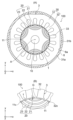
- FIG. 1A is a partial cross-sectional view showing the configuration of a reluctance motor according to Embodiment 1.
- FIG. (B) is a diagram showing a part of the configuration of the reluctance motor shown in FIG. 1(A).
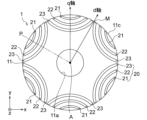
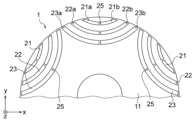
- FIG. 2 is a plan view showing the configuration of the rotor shown in FIG. 1(A); 4 is a plan view showing a part of the configuration of another example of the rotor according to Embodiment 1;
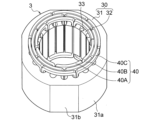
- FIG. 1 is a perspective view showing the configuration of a stator according to Embodiment 1;
- FIG. 4 is a perspective view showing another example of the configuration of the stator according to Embodiment 1;
- FIG. 5 is a diagram showing an example of a process of inserting a coil into the stator core according to Embodiment 1;
- FIG. 4 is an explanatory diagram illustrating a state in which the rotor according to Embodiment 1 is arranged eccentrically with respect to the starter;
- FIG. 5 is an explanatory diagram illustrating the relationship between the inductance of the coil and the position of the rotor when the rotor according to Embodiment 1 is arranged eccentrically with respect to the stator;
- FIG. 4 is an explanatory diagram illustrating a state in which the rotor according to Embodiment 1 is arranged eccentrically with respect to the starter;
- FIG. 5 is an explanatory diagram illustrating the relationship between the inductance of the coil and the position of the rotor when the rotor according to Embodiment 1 is arranged eccentrically with respect to the stator;
- FIG. 4 is an explanatory diagram illustrating a state in which the rotor according to Embodiment 1 is
- FIG. 6 is an explanatory diagram illustrating the relationship between the inductance of the coil and the position of the rotor when the center of the rotor and the center of the stator are aligned according to the first embodiment;
- 1 is a block diagram showing the configuration of a rotor position adjusting device according to Embodiment 1;
- FIG. 4 is an explanatory diagram illustrating a method of measuring the inductance of a coil according to Embodiment 1; 4 is a flow chart showing manufacturing steps of the reluctance motor according to Embodiment 1.
- FIG. 8 is a flow chart showing manufacturing steps of a reluctance motor according to Embodiment 2.
- FIG. FIG. 11 is a block diagram showing the configuration of a learning device according to Embodiment 2;
- FIG. 11 is an explanatory diagram for explaining the concept of learning processing executed by the learning device according to the second embodiment
- 9 is a flowchart showing the flow of learning processing by the learning device according to Embodiment 2
- FIG. 11 is a block diagram showing the configuration of an inference device according to Embodiment 2
- FIG. 11 is an explanatory diagram for explaining the concept of inference processing executed by the inference device according to the second embodiment
- 10 is a flow chart showing the flow of inference processing by the inference device according to Embodiment 2
- 7A is a diagram schematically showing an example of a hardware configuration of a learning device and an inference device according to Embodiment 2
- FIG. 8B is a diagram schematically showing another example of the hardware configuration of the learning device and the inference device according to Embodiment 2;
- FIG. 14A is an explanatory diagram for explaining the concept of learning processing executed by a learning device according to Embodiment 3;
- FIG. 14B is an explanatory diagram for explaining the concept of inference processing executed by the inference device according to Embodiment 3;
- FIG. 11 is an explanatory diagram for explaining a rotor movement amount based on inference processing by an inference device according to Embodiment 3;
- 14 is a flow chart showing the flow of inference processing by the inference device according to Embodiment 3;
- FIG. 11 is a cross-sectional view showing the configuration of a compressor according to Embodiment 4;
- FIG. 10 is a configuration diagram showing the configuration of an air conditioner according to Embodiment 5;
- a reluctance motor, a compressor, an air conditioner, and a method of manufacturing a reluctance motor according to the embodiments of the present disclosure will be described below with reference to the drawings.
- the following embodiments are merely examples, and the embodiments can be appropriately combined and various modifications can be made within the scope of the present disclosure.
- each drawing may show an xyz orthogonal coordinate system.
- a z-axis is a coordinate axis parallel to the axis A of the rotor 1 .
- the x-axis is a coordinate axis orthogonal to the z-axis.
- the y-axis is a coordinate axis orthogonal to both the x-axis and the z-axis.
- the x-axis direction and the y-axis direction are directions perpendicular to the axis A.
- the direction along the circumference of the circle centered on the axis A is called “circumferential direction”.
- the z-axis direction is also called the "axial direction”
- the direction orthogonal to the axial direction is called the "radial direction”.
- FIG. 1A is a partial cross-sectional view showing the configuration of reluctance motor 100 according to Embodiment 1.
- FIG. Reluctance motor 100 is, for example, a synchronous reluctance motor.
- a reluctance motor 100 has a rotor 1, a stator 3, and a housing 8 as a housing. Since the reluctance motor 100 does not have permanent magnets, it is driven by the reluctance torque Tr generated between the stator 3 and the rotor 1 .
- the reluctance motor 100 is not limited to a synchronous reluctance motor, and may be a switched reluctance motor.
- the rotor 1 rotates around the axis A of the shaft 10 .
- a stator 3 surrounds the rotor 1 .
- the stator 3 is fixed to the inner periphery 8a of the cylindrical housing 8.
- the rotor 1 is supported with respect to the stator 3 by support members.
- support members For example, when the reluctance motor 100 is provided in a compressor 400 shown in FIG. It is a compression mechanism part 410 that supports the part.
- FIG. 1(B) is a diagram showing part of the configuration of the reluctance motor 100 shown in FIG. 1(A).
- an annular air gap G is provided between the outer circumference 11c of the rotor 1 and the inner circumference of the stator 3 (specifically, the inner circumference 32c of the teeth 32).
- the air gap G is, for example, within the range of 0.25 mm to 1.25 mm.
- the rotor 1 is supported at a position where the difference in inductance between the plurality of coils 40 (see FIG. 4 described later) of the stator 3 is equal to or less than a predetermined threshold Th in the xy plane. supported by members. Thereby, the eccentricity of the rotor 1 can be suppressed. The reason for this will be described later.
- FIG. 2 is a plan view showing the configuration of the rotor 1 shown in FIG. 1(A).
- the rotor 1 has a shaft 10 , a rotor core 11 , a first slit 21 , a second slit 22 and a third slit 23 .
- the rotor core 11 is cylindrical with the axis A as the center.
- the rotor core 11 has a plurality of electromagnetic steel sheets (magnetic steel sheets 15 shown in FIG. 24 described later) laminated in the z-axis direction.
- the thickness of one electromagnetic steel sheet 15 is, for example, within a range from 0.1 mm to 0.7 mm.
- the plurality of electromagnetic steel sheets 15 are fastened by, for example, caulking and fastening members (for example, rivets 16 shown in FIG. 24 to be described later).
- the shaft 10 is fitted into a shaft insertion hole 11 a formed in the rotor core 11 .
- the first slit 21 , the second slit 22 and the third slit 23 are provided in the rotor core 11 .
- the first slit 21 is formed along the outer circumference 11 c of the rotor core 11 .
- the second slit 22 is formed radially inside the first slit 21, and the third slit 23 is formed radially inside the second slit 22 and radially outside the shaft insertion hole 11a. formed.
- the first slit 21, the second slit 22 and the third slit 23 are collectively called "slits 20".
- the slit 20 penetrates the rotor core 11 in the z-axis direction.
- the shape of the slit 20 when viewed in the z-axis direction is a curved shape that is convex inward in the radial direction.
- the rotor 1 has six poles, for example.
- the magnetic poles of the rotor 1 are indicated as magnetic poles P in FIG.
- the rotor core 11 is formed with, for example, three (three layers) of slits 20 per magnetic pole. Therefore, in the example shown in FIG. 2, the number of slits 20 is eighteen. Note that the number of poles of the rotor 1 is not limited to six, and may be two or more. Also, the number of slits 20 per magnetic pole is not limited to three.
- FIG. 3 is a plan view showing part of the configuration of another example of the rotor 1 according to Embodiment 1.
- the rotor core 11 of the rotor 1 has ribs 25 extending radially so as to divide the first slit 21, the second slit 22 and the third slit 23 in the circumferential direction.
- the first slit 21 includes multiple split slits 21a and 21b
- the second slit 22 includes multiple split slits 22a and 22b
- the third slit 23 includes a plurality of split slits 23a and 23b.
- the axis extending in the direction in which the magnetic flux is most likely to pass is defined as the "d-axis”
- the axis extending in the direction in which the magnetic flux is least likely to pass is defined as the "q-axis”.
- the d-axis is parallel to the direction in which a straight line connecting the axis A and the gap M between the slits 20 adjacent in the circumferential direction extends.
- the q-axis is parallel to the direction in which the straight line connecting the axis A and the center of the slit 20 in the circumferential direction extends.
- the electrical angle formed by the d-axis and the q-axis is 90°.
- the "d-axis” is the axis extending in the direction in which the magnet flux, which is the magnetic flux of the permanent magnet, passes (that is, the direction in which the magnetic flux passes most easily).
- the definitions of "d-axis" and "q-axis" are reversed.
- the rotor 1 has saliency due to the difference between the d-axis inductance and the q-axis inductance. As a result, an attractive force is generated between the stator 3 and the rotor 1 when current flows through the coils 40 (see FIG. 4 described later) of the stator 3 . This attractive force is the reluctance torque Tr .
- the number of pole pairs is Pn
- the d-axis inductance [unit: H] is Ld
- the q-axis inductance [unit: H] is Lq .
- id be the d-axis current [unit: A]
- iq be the q-axis current [unit: A]
- Ia be the magnitude of the current vector
- ⁇ be the leading phase angle of the current vector from the q-axis.
- the reluctance torque Tr is represented by the following equation (1).
- the reluctance torque Tr is proportional to the square of the magnitude Ia of the current vector.
- the reluctance motor 100 since the reluctance motor 100 does not have a permanent magnet, it tends to have a lower power factor than a permanent magnet motor. When the power factor is low, a large amount of motor current is required to obtain the desired torque. In this case, the current limit value of the inverter may be exceeded. Therefore, it is necessary to increase the power factor of the reluctance motor 100 .
- the power factor of the reluctance motor 100 depends on the ratio Ld / Lq of the d-axis inductance Ld to the q-axis inductance Lq . Further, as shown in the above equation (1), the reluctance torque T r is dependent (proportional) to the difference L d ⁇ L q between the d-axis inductance L d and the q-axis inductance L q . Therefore, increasing the ratio L d /L q and the difference L d ⁇ L q is important in designing the reluctance motor 100 to increase the power factor.
- FIG. 4 is a perspective view showing the configuration of the stator 3 according to Embodiment 1.
- FIG. The stator 3 has a stator core 30 and multiple coils 40 . Note that the illustration of the coil 40 is omitted in FIG.
- the stator core 30 has a plurality of electromagnetic steel sheets (for example, electromagnetic steel sheets 35 shown in FIG. 24 to be described later) laminated in the z-axis direction.
- the thickness of one electromagnetic steel sheet 35 is, for example, the same as the thickness of the electromagnetic steel sheet 15 forming the rotor core 11 .
- the plurality of electromagnetic steel sheets 35 are fixed to each other by caulking, for example.
- the stator core 30 has a core back 31 and a plurality of (e.g., 18) teeth 32 .
- the outer circumference 31a of the core back 31 is provided with a plurality of (for example, four) D-cut surfaces 31b, which extend in the z-axis direction. Note that the number of D-cut surfaces 31b provided in the stator core 30 is not limited to plural, and may be one.
- a plurality of teeth 32 extend radially inward from the inner periphery of the core back 31 .
- the plurality of teeth 32 are arranged at equal angular intervals in the circumferential direction.
- a slot 33 is formed between two teeth 32 adjacent in the circumferential direction among the plurality of teeth 32 .
- the number of slots 33 (hereinafter also referred to as “the number of slots”) is the same as the number of teeth 32 .
- the number of slots is 18. Therefore, the combination of the number of poles and the number of slots in the reluctance motor 100 is 6 poles and 18 slots.
- a coil 40 wound around the tooth 32 is accommodated in the slot 33 .
- the number of teeth 32 is not limited to 18, and may be two or more.
- the coil 40 has a conductor such as copper or aluminum and an insulating coating covering the conductor.
- Coil 40 is wound around a plurality of teeth 32 of stator core 30 . In the example shown in FIG. 4 , the coil 40 is wound across multiple teeth 32 . In other words, the coil 40 is wound around the plurality of teeth 32 by distributed winding.
- the stator 3 has multi-phase coils 40 .
- the coils 40 are composed of three-phase coils having half the number of poles of the rotor 1 .
- the stator 3 includes an outer-phase (that is, U-phase) coil 40U as a first-phase coil, a middle-phase (that is, V-phase) coil 40V as a second-phase coil, and a third and an inner-phase (that is, W-phase) coil 40W as a phase coil.
- the stator 3 has 3-phase coils 40U, 40V, and 40W, and 18 slots, thereby forming a 6-pole reluctance motor 100 .
- the number of slots 33 per pole is one.
- three-phase coils 40U, 40V, and 40W are housed in three slots 33 for one pole. Therefore, the coils 40U, 40V, and 40W of each phase are housed in one slot 33 for each pole.
- the coils 40U, 40V, and 40W are each wound at intervals of 3 slots.
- the number of slots is 18, so the pitch of the slots 33 is a mechanical angle of 60° (that is, 360° ⁇ 3/18).
- the pitch of the magnetic poles of the rotor 1 is 60 degrees in mechanical angle.
- the pitch of the slots 33 and the pitch of the magnetic poles are the same, so the winding coefficient is 1.
- the magnetic flux from the stator 3 uniformly passes through the rotor 1, so the magnetic flux of the stator 3 can be effectively used.
- the configuration shown in FIG. 4 since three-phase coils 40 are used, one coil 40 is large and the average circumference of the coil 40 is long.
- FIG. 5 is a perspective view showing another example of the configuration of the stator 3 according to Embodiment 1.
- the stator 3 may have so-called "dividing coils".
- one phase is composed of six coils 40, the number of which is the same as the number of poles of the rotor 1 (see FIG. 2).
- the coils 40 include six outer-phase coils 40A, six middle-phase coils 40B, and six inner-phase coils 40C.
- the outer-phase coil 40A, the middle-phase coil 40B, and the inner-phase coil 40C are each wound at intervals of three slots.
- both the pitch of the slots 33 and the pitch of the magnetic poles are mechanical angles of 60°, similar to FIG.
- a coil of the same phase for example, the coil 40A of the external phase
- the coil ends of the two external phase coils 40A accommodated in one slot 33 are arranged separately on both sides in the circumferential direction. Since the pitch of the slots 33 is the same and one phase is composed of six coils 40, the coils 40 can be reduced in size while maintaining the value of the winding coefficient at one. Therefore, since the circumference of the coil 40 is shortened, the resistance of the coil 40 can be reduced, and the amount of electric wire used can be reduced. Moreover, since the loss in the coil 40 is reduced by reducing the resistance of the coil 40, the efficiency of the reluctance motor 100 can be improved.
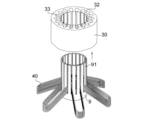
- FIG. 6 shows an example of the process of inserting the coil 40 into the stator core 30 according to the first embodiment.
- the coil 40 is attached to the stator core 30 by an insertion tool 9 (also called an "inserter").
- the insertion device 9 is slid to move the coil 40 to the stator core 30.
- the coil 40 is arranged in the slot 33 by sliding the coil 40 in the z-axis direction. be done.
- a torque ripple is torque pulsation generated in the rotor 1 during operation of the reluctance motor 100 .
- Torque ripple acts in the circumferential direction of the rotor 1 .
- torque ripple occurs when cogging torque is generated between the permanent magnet and the stator core, and when harmonic components are superimposed on the motor voltage and motor current during operation. Since reluctance motor 100 does not have a permanent magnet, torque ripple is not generated by cogging torque in the first embodiment. However, during operation of the reluctance motor 100, torque ripple occurs due to distortion occurring in the respective waveforms of the motor voltage and motor current.
- a radial excitation force is a force that acts radially on the rotor 1 during operation of the reluctance motor 100 .
- the radial excitation force is a force that causes the rotor 1 to vibrate in the radial direction due to the attraction and repulsion forces generated between the rotor 1 and the stator 3 .
- a radial excitation force is likely to be generated when the coils 40 are arranged in a biased manner and when the rotor 1 is arranged eccentrically with respect to the stator 3 .
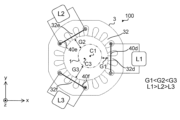
- FIG. 7 is an explanatory diagram illustrating a state in which the rotor 1 according to Embodiment 1 is arranged eccentrically with respect to the stator 3.
- FIG. 7 the state in which the rotor 1 is eccentrically arranged with respect to the stator 3 means that the center C1 of the rotor 1 does not coincide with the center C3 of the stator 3 in the xy plane and This refers to the case where they are arranged at shifted positions. In this case, the radial excitation force tends to increase.
- the torque ripple can be reduced by devising the shape of the slit 20 (see FIG. 2) of the rotor 1.
- FIG. 2 the radial excitation force can be reduced by supporting the rotor 1 during manufacturing of the reluctance motor 100 so that the rotor 1 is not eccentric.
- the air gap G (see FIG. 1(B)) may be reduced in order to increase the power factor.
- electromagnetic excitation forces such as the torque ripple and the radial excitation force described above increase, so noise and vibration of the reluctance motor 100 further increase. Therefore, there is a trade-off relationship between the power factor improvement by reducing the gap and the noise (or vibration) of the reluctance motor 100 .
- the eccentricity E is the distance between the center C1 of the rotor 1 and the center C3 of the stator 3. Also, in the following description, the ratio of the amount of eccentricity E to the size of the air gap G will be referred to as "eccentricity". As the eccentricity increases, the radial excitation force increases. Therefore, it is necessary to suppress the eccentricity when manufacturing (in other words, assembling) the reluctance motor 100 in order to reduce the radial excitation force. In the reluctance motor 100 , the position of the rotor 1 on the xy plane is adjusted based on the inductances of the multiple coils 40 .
- FIG. 8 is an explanatory diagram illustrating the relationship between the inductance of the coils 40d, 40e, and 40f and the position of the rotor 1 when the rotor 1 is arranged eccentrically with respect to the stator 3.
- the relationship between the inductance of the one-phase coil and the position of the rotor 1 will be described for easy understanding of the description. Specifically, three coils 40d, 40e, and 40f, which are half the number of poles of the rotor 1, constitute one phase coil.
- Each of the three coils 40d, 40e, and 40f is connected to a measuring device for measuring inductance (for example, a measuring device 51 shown in FIG. 10, which will be described later).
- a measuring device 51 shown in FIG. 10, which will be described later for example, a measuring device 51 shown in FIG. 10, which will be described later.
- the inductance of the coil 40d is indicated as L1
- the inductance of the coil 40e as L2
- the inductance of the coil 40f as L3.
- one of the multiple teeth 32 around which the coil 40d is wound is represented by 32d
- one of the multiple teeth 32 around which the coil 40e is wound is represented by 32e
- one of the multiple teeth 32 around which the coil 40f is wound is wound.
- 32f the interval (that is, the air gap) between the inner circumference of the tooth 32d and the outer circumference of the rotor 1
- G1 The distance between the inner circumference of the tooth 32e and the outer circumference of the rotor 1
- G3 the distance between the inner circumference of the tooth 32f and the outer circumference of the rotor 1
- the spacings G1, G2, G3 are different from one another.
- the intervals G1, G2, and G3 satisfy the following formula (2).
- the inductance L1 of the coil 40d is larger than the inductances L2 and L3 of the coils 40e and 40f. Also, since the distance G3 between the rotor 1 and the coil 40f is the widest, the inductance L3 of the coil 40f is smaller than the inductances L1 and L2 of the coils 40d and 40e. That is, the multiple inductances L1, L2, and L3 satisfy the following formula (3).
- FIG. 9 is an explanatory diagram for explaining the relationship between the inductance of the coils 40d, 40e, and 40f and the position of the rotor 1 when the center C1 of the rotor 1 and the center C3 of the stator 3 are aligned according to the first embodiment. is.
- the inductances L1, L2 and L3 of the coils 40d, 40e and 40f are also the same. That is, in the example shown in FIG. 9, the multiple intervals G1, G2, and G3 satisfy the following equation (4), and the multiple inductances L1, L2, and L3 satisfy the following equation (5).
- the plurality of inductances L1, L2, L3 are different from each other when the rotor 1 is eccentric, and the difference between the plurality of inductances L1, L2, L3 is small when the rotor 1 is not eccentric (Fig. It can be seen that in the example shown in 9, the difference is 0). Therefore, if the rotor 1 is fixed so that the position of the rotor 1 on the xy plane is an allowable position where the difference between the plurality of inductances L1, L2, and L3 is equal to or less than a predetermined threshold value Th, the eccentricity can be suppressed. can be done.
- Embodiment 1 when manufacturing reluctance motor 100, rotor 1 is fixed so that the position of rotor 1 in the xy plane is a permissible position where multiple inductances L1, L2, and L3 are the same. Specifically, the allowable position is the position of the center C3 of the stator 3 . Note that the permissible position does not necessarily have to be the position of the center C3 of the stator 3 as long as the difference between the plurality of inductances L1, L2, and L3 is equal to or less than a predetermined threshold value Th. In Embodiment 1, a rotor position adjusting device 50 described below is used when reluctance motor 100 is manufactured.
- FIG. 10 is a block diagram showing the configuration of the rotor position adjusting device 50 according to Embodiment 1.
- the rotor position adjusting device 50 adjusts the position of the rotor 1 when manufacturing the reluctance motor 100 in order to suppress the eccentricity of the rotor 1 .
- the rotor position adjustment device 50 is, for example, a coaxial adjustment device that adjusts the position of the rotor 1 so that the center C1 of the rotor 1 is coaxial with the center C3 of the stator 3 .
- the rotor position adjusting device 50 has a measuring device 51 as an inductance measuring section, a moving device 52, and a control device 53 as a control section.
- a measuring device 51 measures the inductance of the coil 40 .
- the measuring device 51 is, for example, an LCZ meter.
- the moving device 52 adjusts the position of the rotor 1 (see FIG. 2).
- the moving device 52 is an xy stage that adjusts the position of the rotor 1 on the xy plane.
- the xy stage is movable in two directions, the x-axis direction and the y-axis direction.
- the control device 53 estimates the amount of adjustment of the position of the rotor 1 required to suppress the eccentricity of the rotor 1 (hereinafter also referred to as "rotor movement amount").
- the amount of rotor movement is, for example, the same as the amount of eccentricity E shown in FIG.
- the control device 53 drives the moving device 52 based on the estimated moving amount of the rotor 1 .
- the control device 53 is, for example, a control circuit made up of a semiconductor integrated circuit.
- the control device 53 may be configured by a processor that executes programs stored in memory.
- the control device 53 has a movement amount estimation section 53a and an operation command section 53b.
- the movement amount estimator 53 a estimates the rotor movement amount based on the measurement result of the measuring device 51 . Specifically, the movement amount estimating unit 53a substitutes the current measured values of the inductances of the multiple coils 40 into the relational expression that is the first data acquired in advance, so as to correspond to the multiple current inductances. Estimates (calculates) the amount of rotor movement to be performed. As a result, the cycle time of the adjustment work is reduced compared to the configuration in which the position of the rotor 1 is adjusted while measuring a plurality of inductances L1, L2, and L3. Therefore, the eccentricity of the rotor 1 can be suppressed while preventing deterioration of productivity of the reluctance motor 100 .
- the relational expression used for estimating the rotor movement amount is an expression that indicates the relationship between a plurality of inductances and the rotor movement amount.
- the pre-obtained relational expression is an expression that indicates the relationship between the plurality of inductances and the position of the rotor 1 .
- the relational expression is obtained, for example, by using a statistical technique such as linear approximation or multiple regression analysis.
- the movement amount estimator 53 a estimates the rotor movement amount ⁇ x in the x-axis direction and the rotor movement amount ⁇ y in the y-axis direction necessary to suppress the eccentricity of the rotor 1 .
- the operation command unit 53b generates an operation command (that is, drive signal) for the moving device 52 based on the estimated rotor movement amounts ⁇ x and ⁇ y.
- the moving device 52 moves the rotor 1 based on the motion command generated by the motion command section 53b.
- the center C1 of the rotor 1 can be brought closer to the center C3 of the stator 3 . Therefore, eccentricity of the rotor 1 can be suppressed.
- FIG. 11 is an explanatory diagram illustrating a method of measuring the inductance of the coil 40 according to the first embodiment. As shown in FIG. 11 , the inductance of the coil 40 is measured by connecting a measuring device 51 to lead wires W1 and W2 drawn out from the coil 40 of the stator 3 .
- the measuring device 51 applies a minute voltage between the lead wires W1 and W2 of the coil 40 and detects a minute current value flowing through the coil 40 .
- a measuring device 51 measures the inductance of the coil 40 based on the voltage value and the current value.
- the measurement result of the inductance is displayed, for example, on the display unit 51a of the measuring device 51 or a display separate from the measuring device 51, so that the operator can confirm the measured value of the inductance of the coil 40. .
- a plurality of inductances L1, L2, L3, the rotor movement amount ⁇ x in the x-axis direction and the rotor movement amount ⁇ y in the y-axis direction are used as derivation data for deriving the relational expression used in the movement amount estimator 53a.
- Data for learning is accumulated by repeating the process of measuring the inductances L1, L2, and L3 and the process of adjusting the position of the rotor 1.
- the accumulated derivation data is recorded in a storage unit (for example, computer or cloud server).
- the cycle time for deriving the relational expression may increase. Therefore, the derivation data may be accumulated within a predetermined time. For example, the process of accumulating the rotor movement amounts ⁇ x and ⁇ y may be terminated when the difference between the plurality of inductances L1, L2, and L3 becomes equal to or less than a predetermined threshold value.
- the plurality of inductances measured by the measuring device 51 are not limited to the inductances of coils of the same phase, and may be the inductances of coils of different phases.
- the plurality of inductances measured by the measuring device 51 are the inductance (first inductance) of the U-phase coil 40U, the inductance (second inductance) of the V-phase coil 40V, and the inductance of the W-phase coil 40W. (third inductance).
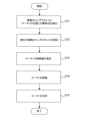
- FIG. 12 is a flow chart showing the manufacturing process of the reluctance motor 100.
- the movement amount estimator 53a of the rotor position adjustment device 50 derives a relational expression representing the relationship between the plurality of inductances L1, L2, L3 and the rotor movement amounts ⁇ x, ⁇ y.
- step ST2 the measuring device 51 measures current inductances L11, L12, and L13 of the plurality of coils 40d, 40e, and 40f.
- step ST3 the movement amount estimator 53a inputs the current plurality of inductances L11, L12, and L13 to the relational expression obtained in advance in step ST1, and calculates the x-axis distance required to suppress the eccentricity of the rotor 1. Estimate the rotor displacement in the direction and the rotor displacement in the y-axis direction.
- step ST4 the operation command unit 53b of the rotor position adjustment device 50 drives the moving device 52 based on the rotor adjustment amount in the x-axis direction and the rotor adjustment amount in the y-axis direction estimated in step ST2. Move the rotor 1.
- step ST5 the rotor 1 is supported by the support member. In other words, the position of rotor 1 in the xy plane is fixed.
- the position of the rotor 1 on the xy plane is determined by the plurality of inductances L1, L2, L3 obtained by measuring the inductances of the plurality of coils 40d, 40e, 40f with the measuring device 51.
- the rotor 1 is supported by the support member so as to be in an allowable position where the difference in is equal to or less than a predetermined threshold value Th.
- the eccentricity of the rotor 1 can be suppressed. Therefore, noise and vibration of the reluctance motor 100 can be reduced.
- the allowable position is the plurality of inductances L1, L2, L3 and the distance from the measurement position where the plurality of inductances L1, L2, L3 are measured to the allowable position. It is determined based on a pre-acquired relational expression showing the relationship between the amount and the amount.
- the cycle time of the adjustment work is reduced compared to the configuration in which the position of the rotor 1 is adjusted while measuring a plurality of inductances L1, L2, and L3. Therefore, the eccentricity of the rotor 1 can be suppressed while preventing deterioration of productivity of the reluctance motor 100 . Therefore, noise and vibration of the reluctance motor 100 can be reduced with a simple configuration.
- the permissible position is the position where the plurality of inductances L1, L2, and L3 are the same. This allows the center C1 of the rotor 1 to coincide with the center C3 of the stator 3 on the xy plane. Therefore, the eccentricity of the rotor 1 can be further suppressed.
- FIG. 13 is a flow chart showing manufacturing steps of the reluctance motor according to the second embodiment.
- the reluctance motor according to the second embodiment is different from the reluctance motor 100 according to the first embodiment in that the rotor 1 is supported at the position where the rotor is moved based on the rotor movement amount inferred by machine learning. differ from Except for this point, the reluctance motor according to the second embodiment is the same as the reluctance motor 100 according to the first embodiment. 2, 9 and 10 are therefore referred to in the following description.
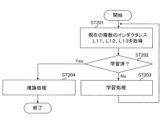
- step ST201 a plurality of inductances L11, L12, and L13, which are current inductances of the plurality of coils 40d, 40e, and 40f (see FIG. 9), are measured.
- step ST202 the control device 53 (see FIG. 10) determines whether learning has been completed. If learning has not been completed (that is, if the determination in step ST202 is No), the process proceeds to step ST203. In step ST203, learning processing is executed. If the learning process has been executed, the process returns to step ST201. Details of the learning process will be described later.
- step ST204 inference processing, which is processing after learning, is executed. Specifically, a learned model generated by machine learning is used to adjust the position of the rotor 1 on the xy plane based on the rotor movement amount estimated from the plurality of inductances L11, L12, and L13. Details of the inference processing will be described later. After the inference process is performed, the process ends.
- the control device 53 of the rotor position adjusting device according to Embodiment 2 has a learning device 250 and an inference device 260 .
- FIG. 14 is a block diagram showing the configuration of the learning device 250 according to the second embodiment.
- the learning device 250 has a learning data acquisition unit 251 as a data acquisition unit, a model generation unit 252 and a storage unit 253 .
- FIG. 15 is an explanatory diagram explaining the concept of the learning process executed by the learning device 250 according to the second embodiment.
- the learning data acquisition unit 251 acquires the inductances L1, L2, and L3 of the plurality of coils 40d, 40e, and 40f, the rotor movement amount ⁇ x in the x-axis direction, and the rotor movement in the y-axis direction.
- the quantity ⁇ y is obtained as learning data (that is, teacher data).
- the learning data acquisition unit 251 is a computer, a cloud server, or the like.
- the rotor movement amount ⁇ x in the x-axis direction and the rotor movement amount ⁇ y in the y-axis direction of the learning data input to the learning data acquisition unit 251 are data acquired by manual adjustment.
- the x-axis of the adjustment amount that indicates the distance from the measurement position where the plurality of inductances L1, L2, and L3 are measured to the allowable position where the plurality of inductances L1, L2, and L3 satisfies Equation (5) described above.
- the directional component is the amount of rotor movement in the x-axis direction
- the y-axis direction component of the adjustment amount is the amount of rotor movement in the y-axis direction.
- the model generation unit 252 generates a plurality of inductances L1 , L2, L3 and the rotor movement amounts .DELTA.x, .DELTA.y, and a learned model 80 is generated.
- the model generator 252 acquires in advance a learned model 80 that indicates the relationship between the plurality of inductances L1, L2, L3 and the rotor movement amounts ⁇ x, ⁇ y.
- the model generation unit 252 outputs the generated trained model 80 , and the storage unit 253 stores the trained model 80 output from the model generation unit 252 .
- the model generator 252 learns the relationship between the plurality of inductances L1, L2, L3 and the rotor movement amounts ⁇ x, ⁇ y by so-called supervised learning according to the neural network 70 as a learning device.
- supervised learning refers to a method of inferring a result from an input by giving a set of input and result data to the learning device 250 as learning data to learn the characteristics of the learning data. .
- the neural network 70 is composed of an input layer 71 consisting of a plurality of neurons, an intermediate layer 72 consisting of a plurality of neurons, and an output layer 73 consisting of at least one or more neurons.
- the intermediate layer 72 is not limited to one layer, and may be two or more layers.
- FIG. 16 is a flow chart showing the flow of learning processing by the learning device 250 according to the second embodiment.
- the learning data acquisition unit 251 acquires a plurality of inductances L1, L2, L3, the rotor movement amount ⁇ x in the x-axis direction, and the rotor movement amount ⁇ y in the y-axis direction as learning data.
- step ST212 the model generation unit 252, based on the plurality of inductances L1, L2, L3, the x-axis direction rotor movement amount ⁇ x, and the y-axis direction rotor movement amount ⁇ y acquired by the learning data acquisition unit 251, A learned model 80 is generated by learning the rotor movement amounts ⁇ x and ⁇ y for suppressing the eccentricity of the rotor 1 .
- step ST213 the storage unit 253 stores the learned model 80 generated by the model generation unit 252, and ends the process.
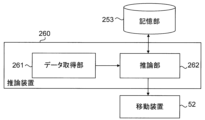
- FIG. 17 is a block diagram showing the configuration of the inference device 260 according to the second embodiment.
- FIG. 18 is an explanatory diagram illustrating the concept of inference processing executed by the inference device 260 according to the second embodiment.
- the inference device 260 has a data acquisition unit 261 and an inference unit 262 .
- the data acquisition unit 261 acquires the current inductance L11 of the coil 40d, the current inductance L12 of the coil 40e, and the current inductance L13 of the coil 40f. That is, the data acquisition unit 261 acquires the current multiple inductances L11, L12, and L13.
- the inference unit 262 infers the rotor movement amount ⁇ x in the x-axis direction and the rotor movement amount ⁇ y in the y-axis direction obtained using the learned model 80 . That is, when the current multiple inductances L11, L12, and L13 acquired by the data acquisition unit 261 are input to the learned model 80 as input data, the inference unit 262 obtains the current multiple inductances L11, L12, and L13 A rotor movement amount ⁇ x in the x-axis direction and a rotor movement amount ⁇ y in the y-axis direction inferred from the above are output as output data. The inference unit 262 generates an operation command based on the output rotor movement amounts ⁇ x and ⁇ y, and outputs it to the moving device 52 .
- the movement device 52 moves the rotor 1 based on the motion command generated by the inference section 262 .
- the moving device 52 moves the rotor 1 so that the position of the rotor 1 on the xy plane is an allowable position where the difference between the plurality of inductances is equal to or less than the threshold value Th.
- the permissible position where the difference between the inductances is equal to or less than the threshold Th is the position where the eccentricity of the rotor 1 is suppressed. Therefore, noise and vibration of the reluctance motor according to the second embodiment can be reduced.
- the rotor 1 can be adjusted in a short time.
- the rotor 1 can be adjusted to the proper position. Therefore, since the cycle time is reduced, productivity of the reluctance motor according to the second embodiment can be improved.
- machine learning enables highly accurate estimation compared to the linear approximation method or multiple regression analysis method, it is possible to improve the accuracy of estimating the rotor movement amount.
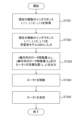
- FIG. 19 is a flow chart showing the processing flow of the inference device 260 according to the second embodiment. As shown in FIG. 19, in step ST221, the data acquisition section 261 acquires a plurality of current inductances L11, L2, and L3.
- step ST222 the inference unit 262 inputs the current multiple inductances L11, L12, and L13 to the learned model 80 stored in the storage unit 253.
- step ST223 the inference unit 262 uses the learned model 80 to output the rotor movement amount ⁇ x in the x-axis direction and the rotor movement amount ⁇ y in the y-axis direction from the plurality of current inductances L11, L12, and L13.
- step ST224 the moving device 52 adjusts the position of the rotor 1 based on the rotor movement amount ⁇ x in the x-axis direction and the rotor movement amount ⁇ y in the y-axis direction output in step ST223.
- step ST225 the rotor 1 is supported at the position where the moving device 52 has moved the rotor 1.
- FIG. 20A is a diagram schematically showing an example of the hardware configuration of the learning device 250 and the inference device 260.
- the learning device 250 and the inference device 260 include, for example, a memory 201 as a storage device that stores a program as software, and an information processing unit that implements the program stored in the memory 201. can be implemented (eg, by a computer) using the processor 202 as Note that part of the learning device 250 and part of the inference device 260 may be implemented by the memory 201 and the processor 202 that executes the program shown in FIG. 20(A).
- FIG. 20B is a diagram schematically showing another example of the hardware configuration of the learning device 250 and the inference device 260.
- the learning device 250 and the inference device 260 may be realized using the processing circuit 203 as dedicated hardware such as a single circuit or a composite circuit.
- the function of the learning device 250 and the function of the inference device 260 are implemented in the processing circuit 203 .
- the inference unit 262 of the inference device 260 inputs the current plurality of inductances L11, L12, and L13 to the learned model 80, and the rotor movement amount ⁇ x in the x-axis direction and the y-axis
- the position of the rotor 1 in the xy plane can be moved to the allowable position based on the output rotor movement amount ⁇ x in the x-axis direction and the output rotor movement amount ⁇ y in the y-axis direction.
- the center C1 of the rotor 1 can be brought closer to the center C3 of the stator 3 . Therefore, eccentricity of the rotor 1 can be suppressed, and noise and vibration of the reluctance motor according to the second embodiment can be reduced.
- the learning device according to the third embodiment is similar to the second embodiment in that the adjusted position of the rotor 1 after moving the rotor 1 to the allowable position by the moving device 52 is also added as learning data. It differs from the learning device 250 .
- the reasoning device according to the third embodiment differs from the reasoning device according to the second embodiment in that the learned model is used to output the position of the rotor 1 from a plurality of inductances L11, L12, and L13. Except for this point, the learning device and the inference device according to the third embodiment are the same as the learning device and the inference device according to the second embodiment, respectively. 1A, 1B, 9, 14 and 17 are therefore referred to in the following description.
- FIG. 21(A) is an explanatory diagram explaining the concept of the learning process executed by the learning device according to the third embodiment.
- the inductance L1 of the coil 40d, the inductance L2 of the coil 40e, and the inductance L3 of the coil 40f are used as learning data.
- the amount of rotor movement ⁇ x in the x-axis direction, the amount of rotor movement ⁇ y in the y-axis direction, and the position of the rotor 1 after adjustment see FIG. 1A).
- the model generation unit 252 (see FIG. 14) of the learning device according to Embodiment 3 generates a trained model 380 based on the input learning data.
- the learned model 380 includes first data indicating the relationship between the plurality of inductances L1, L2, L3 and the rotor movement amounts ⁇ x, ⁇ y, and the relationship between the plurality of inductances L1, L2, L3 and the position of the rotor 1 after adjustment. It has second data indicating the relationship.
- One of the first data and the second data may be obtained by machine learning, and the other may be obtained by a statistical method.
- the adjusted position of the rotor 1 is calculated based on the air gap G between the stator 3 and the rotor 1 (see FIG. 1B). Specifically, based on the minimum value in the entire circumference of the air gap G when the plurality of learning inductances L1, L2, and L3 are measured, and the position in the circumferential direction where the minimum value is measured, A position is calculated. For example, a thickness gauge is used to measure the air gap G.
- the method of measuring the air gap G using a thickness gauge is as follows. For example, a thickness gauge that is equal to or less than the average air gap length is inserted between the stator 3 and the rotor 1, and the length of the smallest part of the entire circumference of the air gap G (hereinafter also referred to as "minimum gap length") call) and position. A plurality of thickness gauges with different thicknesses can be used to identify the minimum gap length and the location where the minimum gap length was measured.
- the multiple inductances L1, L2, and L3 match each other.
- the rotor core 11 and the stator core 30 are manufactured, the roundness of the inner circumference of the stator core 30, the roundness of the outer circumference 11c of the rotor core 11, and the A dimensional error (that is, a dimensional variation) occurs in each shape of the slit 20 . Since the dimensional error affects the flow of magnetic flux flowing from the stator 3 to the rotor 1, differences may occur in the plurality of inductances L1, L2, and L3.
- the rotor 1 may be eccentrically arranged due to dimensional errors. There may be Therefore, in Embodiment 3, the position of the rotor 1 after adjustment is also acquired as learning data, and in addition to the relationship between the plurality of inductances L1, L2, L3 and the rotor movement amount, the plurality of inductances L1, L2, L3 and the position of the rotor 1 after adjustment is generated.
- FIG. 21(B) is an explanatory diagram explaining the concept of the inference processing executed by the inference device according to the third embodiment.
- the inference unit 262 obtains the rotor movement amount ⁇ x in the x-axis direction, the rotor movement amount ⁇ y in the y-axis direction obtained by using the learned model 380, and the adjusted rotor 1 Infer the position (x,y).
- the rotor movement amount ⁇ x in the x-axis direction inferred from the plurality of inductances L11, L12, and L13,
- the rotor movement amount ⁇ y in the y-axis direction and the coordinates (x, y) of the position of the rotor 1 are output as output data.
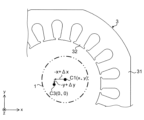
- FIG. 22 is an explanatory diagram for explaining the rotor movement amount based on the inference processing by the inference device according to the third embodiment.
- the coordinates of the origin of the position of the rotor 1 on the xy plane are the coordinates of the center C3 of the stator 3 .
- the inference unit 262 outputs the output rotor movement amount ⁇ x in the x-axis direction, the output rotor movement amount ⁇ y in the y-axis direction, and the position (x, y) of the rotor 1 after adjustment to the moving device 52 .
- the amount of movement of the rotor 1 in the x-axis direction and the amount of movement of the rotor 1 in the y-axis direction adjusted by the moving device 52 is (-y+ ⁇ y).
- FIG. 23 is a flow chart showing the flow of inference processing of the inference device according to the third embodiment. Since step ST321 shown in FIG. 23 is the same as step ST221 shown in FIG. 19, its description is omitted.
- step ST ⁇ b>322 the inference section 262 inputs the current multiple inductances L ⁇ b>11 , L ⁇ b>12 , L ⁇ b>13 to the learned model 380 .
- step ST323 the inference unit 262 uses the learned model 380 to determine the rotor movement amount ⁇ x in the x-axis direction, the rotor movement amount ⁇ y in the y-axis direction, and the adjusted Output the position (x, y) of the rotor 1 .
- step ST324 the moving device 52 moves the rotor 1 based on the rotor movement amount ⁇ x in the x-axis direction, the rotor movement amount ⁇ y in the y-axis direction, and the adjusted position (x, y) of the rotor 1 output in step ST323. Adjust the position of 1.
- step ST325 the rotor 1 is supported at the position where the moving device 52 has moved the rotor 1.
- the inference unit 262 of the inference device inputs the current plurality of inductances L11, L12, and L13 to the learned model 380, and the rotor movement amounts ⁇ x, y in the x-axis direction
- the rotor movement amount ⁇ y in the axial direction and the position (x, y) of the rotor 1 are output.
- x, y) the position of the rotor 1 in the xy plane can be moved to a permissible position.
- the center C1 of the rotor 1 can be brought closer to the center C3 of the stator 3. Therefore, eccentricity of the rotor 1 can be suppressed, and noise and vibration of the reluctance motor according to the third embodiment can be reduced.
- FIG. 24 is a cross-sectional view showing the configuration of compressor 400 according to Embodiment 4.
- Compressor 400 is not limited to a scroll compressor, and may be another type of compressor.
- the compressor 400 has a reluctance motor 100, a compression mechanism section 410 driven by the reluctance motor 100, a sub-frame 401, and a housing 8 as a sealed container.
- the compression mechanism section 410 is connected to the reluctance motor 100 via the shaft 10 .
- the compression mechanism section 410 is an example of the compression mechanism section 410 shown in FIG. 1 and the like.
- the compression mechanism section 410 has a fixed scroll 411 , an orbiting scroll 412 , a compliant frame 413 and a guide frame 414 .
- the fixed scroll 411 and the orbiting scroll 412 each have plate-like spiral teeth and are combined to form a compression chamber 415 .
- the fixed scroll 411 has a discharge port 411a for discharging the refrigerant compressed in the compression chamber 415.
- a suction pipe 402 passing through the housing 8 is press-fitted into the fixed scroll 411 .
- the housing 8 is provided with a discharge pipe 403 for discharging the high-pressure refrigerant gas discharged from the discharge port 411a to the outside. Moreover, the stator 3 of the reluctance motor 100 is incorporated inside the housing 8 by shrink fitting. A glass terminal 404 for electrically connecting the stator 3 and a drive circuit (not shown) is fixed to the housing 8 by welding. The bottom of the housing 8 is an oil reservoir in which refrigerating machine oil (not shown) is stored.
- compressor 400 ⁇ Operation of Compressor 400> Next, the operation of compressor 400 will be described.
- shaft 10 rotates.
- the rotation of the shaft 10 causes the swing scroll 412 to swing with respect to the fixed scroll 411 .
- the volume of the compression chamber 415 formed by the fixed scroll 411 and the orbiting scroll 412 changes, and the refrigerant sucked into the compression chamber 415 from the suction pipe 402 is compressed to form high-pressure refrigerant gas.
- the high-pressure refrigerant gas is discharged from the discharge port 411 a of the fixed scroll 411 into the housing 8 and discharged from the compressor 400 through the discharge pipe 403 .
- Part of the refrigerant gas discharged from the compression chamber 415 into the housing 8 passes through a hole (not shown) provided in the rotor 1, thereby cooling the reluctance motor 100.
- compressor 400 has reluctance motor 100 according to Embodiment 1 and compression mechanism section 410 driven by reluctance motor 100 .
- noise and vibration in the reluctance motor 100 are reduced by suppressing the eccentricity of the rotor 1 . Therefore, by including the reluctance motor 100 in the compressor 400, noise and vibration in the compressor 400 can be reduced.
- FIG. 25 is a configuration diagram showing the configuration of an air conditioner 500 according to Embodiment 5.
- the air conditioner 500 has an outdoor unit 501 and an indoor unit 502 .
- the outdoor unit 501 and the indoor unit 502 are connected by a gas pipe 503 and a liquid pipe 504, which are refrigerant pipes.
- the outdoor unit 501, the indoor unit 502, the gas pipe 503, and the liquid pipe 504 constitute a refrigerant circuit to circulate the refrigerant.
- a gas refrigerant which is a gas refrigerant, flows through the gas pipe 503 .
- a liquid refrigerant or a gas-liquid two-phase refrigerant flows through the liquid pipe 504 .
- the outdoor unit 501 has a compressor 400 according to Embodiment 4, an outdoor heat exchanger 511, an outdoor blower 512, and an expansion valve 513 as a decompression device.
- the compressor 400 can finely change the capacity of the compressor 400 (specifically, the amount of refrigerant delivered per unit time) by, for example, including an inverter device that arbitrarily changes the operating frequency. Since the outdoor unit 501 has the compressor 400 according to Embodiment 4, the quietness of the outdoor unit 501 can be improved.
- the outdoor heat exchanger 511 exchanges heat between the refrigerant and the outdoor air supplied from the outdoor blower 512 .
- the outdoor heat exchanger 511 functions as a condenser. Specifically, the outdoor heat exchanger 511 performs heat exchange between the refrigerant compressed by the compressor 400 and flowing in through a four-way valve (not shown) and the outdoor air, and condenses and liquefies the refrigerant.
- the outdoor heat exchanger 511 functions as an evaporator. Specifically, the outdoor heat exchanger 511 exchanges heat between the low-temperature, low-pressure refrigerant flowing from the liquid pipe 504 through the expansion valve 513 and the outdoor air, and evaporates the refrigerant.
- the expansion valve 513 is a decompression device that decompresses the refrigerant condensed by the condenser. Specifically, the expansion valve 513 expands the liquid refrigerant delivered from the condenser and delivers it as a low-temperature, low-pressure liquid refrigerant. For example, during cooling operation, the expansion valve 513 reduces the pressure of the refrigerant condensed by the outdoor heat exchanger 511 .
- the indoor unit 502 has an indoor heat exchanger 521 and an indoor fan 522 .
- the indoor heat exchanger 521 exchanges heat between the refrigerant and indoor air supplied from the indoor blower 522 .
- the indoor heat exchanger 521 functions as an evaporator.
- the indoor-side heat exchanger 521 sends out the evaporated refrigerant to the gas pipe 503 by exchanging heat between the low-temperature, low-pressure refrigerant and the indoor air.
- the indoor heat exchanger 521 functions as a condenser.
- the indoor heat exchanger 521 performs heat exchange between the refrigerant flowing from the gas pipe 503 and the air, thereby condensing and liquefying the refrigerant (or gas-liquid two-phase conversion), and the liquid pipe Send to 504.
- the air conditioner 500 further has a control device 53 .
- the control device 53 is connected to the terminal device 60 of the user of the air conditioner 500 via a network, for example.
- the terminal device 60 is not limited to a device used by a user of the air conditioner 500, and may be a device used by a maintenance company of the air conditioner 500.
- the control device 53 outputs to the terminal device 60 a signal indicating the current measurement results of the inductances of the multiple coils 40 obtained by the measuring device 51 during actual use in which the reluctance motor 100 is attached to the compressor 400. do.
- the control device 53 determines whether the rotor 1 is biased toward the stator 3 based on the measurement result of the measuring device 51 in a state in which the operation of the reluctance motor 100 is finished, that is, in a state in which the reluctance motor 100 is stopped. It is determined whether or not it is arranged with care.
- the controller 53 determines that the difference between the plurality of inductances exceeds the threshold value Th, that is, when it determines that the eccentricity E of the rotor 1 with respect to the stator 3 is large, the controller 53 outputs the result of the determination as A signal shown is output to the terminal device 60 .
- the user or maintenance contractor can confirm that maintenance for suppressing the eccentricity of the rotor 1 is required, so that the convenience of the air conditioner 500 can be improved.
- air conditioner 500 has outdoor unit 501 having compressor 400 described in Embodiment 4, and indoor unit 502 .
- compressor 400 reduces noise and vibration. Therefore, by providing the compressor 400 in the outdoor unit 501 of the air conditioner 500, noise reduction of the outdoor unit 501 can be realized. Therefore, noise reduction of the air conditioner 500 can be realized.
- the air conditioner 500 further includes a control device 53 that transmits a signal indicating the current measurement result of the inductance of the coil 40 obtained by the measuring device 51 .
- a control device 53 that transmits a signal indicating the current measurement result of the inductance of the coil 40 obtained by the measuring device 51 .
- Rotor 3 Stator 11 Rotor Core 20, 21, 22, 23 Slit 40, 40A, 40B, 40C, 40d, 40e, 40f, 40U, 40V, 40W Coil 51 Measuring Instrument 52 Moving Device 53 Control Device , 80, 380 Trained model 100 Reluctance motor 400 Compressor 401 Subframe (supporting member) 410 Compression mechanism (supporting member) 500 Air conditioner 501 Outdoor unit 502 Indoor unit A Axis G air gap, L1, L2, L3, L11, L12, L13 inductance, Th threshold.
Landscapes
- Engineering & Computer Science (AREA)
- Manufacturing & Machinery (AREA)
- Power Engineering (AREA)
- Synchronous Machinery (AREA)
Priority Applications (2)
| Application Number | Priority Date | Filing Date | Title |
|---|---|---|---|
| JP2023559292A JPWO2023084676A1 (https=) | 2021-11-11 | 2021-11-11 | |
| PCT/JP2021/041491 WO2023084676A1 (ja) | 2021-11-11 | 2021-11-11 | リラクタンスモータ、圧縮機、空気調和装置、及びリラクタンスモータの製造方法 |
Applications Claiming Priority (1)
| Application Number | Priority Date | Filing Date | Title |
|---|---|---|---|
| PCT/JP2021/041491 WO2023084676A1 (ja) | 2021-11-11 | 2021-11-11 | リラクタンスモータ、圧縮機、空気調和装置、及びリラクタンスモータの製造方法 |
Publications (1)
| Publication Number | Publication Date |
|---|---|
| WO2023084676A1 true WO2023084676A1 (ja) | 2023-05-19 |
Family
ID=86335333
Family Applications (1)
| Application Number | Title | Priority Date | Filing Date |
|---|---|---|---|
| PCT/JP2021/041491 Ceased WO2023084676A1 (ja) | 2021-11-11 | 2021-11-11 | リラクタンスモータ、圧縮機、空気調和装置、及びリラクタンスモータの製造方法 |
Country Status (2)
| Country | Link |
|---|---|
| JP (1) | JPWO2023084676A1 (https=) |
| WO (1) | WO2023084676A1 (https=) |
Citations (3)
| Publication number | Priority date | Publication date | Assignee | Title |
|---|---|---|---|---|
| JPH08223875A (ja) * | 1995-02-13 | 1996-08-30 | Hitachi Ltd | 回転電機の回転子軸心位置調整方法及びその装置 |
| JP2011072059A (ja) * | 2009-09-24 | 2011-04-07 | Mitsubishi Electric Corp | 回転電機の回転子軸心位置測定方法及び回転電機の回転子軸心位置測定装置 |
| WO2018220806A1 (ja) * | 2017-06-02 | 2018-12-06 | 三菱電機株式会社 | リラクタンスモータ、圧縮機および空気調和装置 |
-
2021
- 2021-11-11 JP JP2023559292A patent/JPWO2023084676A1/ja not_active Withdrawn
- 2021-11-11 WO PCT/JP2021/041491 patent/WO2023084676A1/ja not_active Ceased
Patent Citations (3)
| Publication number | Priority date | Publication date | Assignee | Title |
|---|---|---|---|---|
| JPH08223875A (ja) * | 1995-02-13 | 1996-08-30 | Hitachi Ltd | 回転電機の回転子軸心位置調整方法及びその装置 |
| JP2011072059A (ja) * | 2009-09-24 | 2011-04-07 | Mitsubishi Electric Corp | 回転電機の回転子軸心位置測定方法及び回転電機の回転子軸心位置測定装置 |
| WO2018220806A1 (ja) * | 2017-06-02 | 2018-12-06 | 三菱電機株式会社 | リラクタンスモータ、圧縮機および空気調和装置 |
Also Published As
| Publication number | Publication date |
|---|---|
| JPWO2023084676A1 (https=) | 2023-05-19 |
Similar Documents
| Publication | Publication Date | Title |
|---|---|---|
| JP6002625B2 (ja) | 永久磁石同期機およびこれを用いた圧縮機 | |
| CN111033947B (zh) | 转子、电动机、压缩机及空调装置 | |
| JP6779304B2 (ja) | ステータ、電動機、駆動装置、圧縮機、及び冷凍空調装置、並びにステータの製造方法 | |
| CN111819764A (zh) | 电动机、压缩机、送风机以及制冷空调装置 | |
| JP2001128395A (ja) | 回転電機および圧縮機および回転電機の製造方法 | |
| US11264847B2 (en) | Reluctance motor, compressor, and air conditioner | |
| EP3358719A1 (en) | Rotary compressor system, rotary compressor, and motor | |
| US20230208232A1 (en) | Stator, electric motor, compressor, and air conditioner | |
| WO2023084676A1 (ja) | リラクタンスモータ、圧縮機、空気調和装置、及びリラクタンスモータの製造方法 | |
| WO2023032134A1 (ja) | 電動機、圧縮機および冷凍サイクル装置 | |
| JP7325650B2 (ja) | 固定子、電動機、圧縮機、空気調和機、及び固定子の製造方法 | |
| WO2014065102A1 (ja) | 永久磁石同期機及びこれを用いた駆動システム、圧縮機 | |
| JP7361805B2 (ja) | 固定子、電動機、圧縮機、空気調和機、及び固定子の製造方法 | |
| US11888370B2 (en) | Stator, motor, compressor, air conditioner, and manufacturing method of stator | |
| WO2022049654A1 (ja) | 固定子、電動機、圧縮機、空気調和機、及び固定子の製造方法 | |
| EP2270955A2 (en) | Rotor of electric motor | |
| JP7292441B2 (ja) | 固定子、電動機、圧縮機、空気調和機、及び固定子の製造方法 | |
| WO2021181593A1 (ja) | 固定子、電動機、圧縮機、空気調和機、及び固定子の製造方法 | |
| WO2023152891A1 (ja) | リラクタンスモータ駆動装置、リラクタンスモータユニット、圧縮機及び空気調和装置 | |
| WO2023021588A1 (ja) | 着磁方法、着磁装置、電動機、圧縮機および冷凍サイクル装置 | |
| JP7353508B2 (ja) | 固定子、電動機、圧縮機および空気調和装置 | |
| JP6002619B2 (ja) | 永久磁石同期機およびこれを用いた圧縮機 | |
| JP7419501B2 (ja) | 着磁方法、電動機の製造方法、電動機、圧縮機、及び空気調和機 | |
| US20230198328A1 (en) | Stator, motor, compressor, refrigeration cycle apparatus, and air conditioner | |
| US20220216757A1 (en) | Stator, electric motor, compressor, air conditioner, method for fabricating stator, and magnetization method |
Legal Events
| Date | Code | Title | Description |
|---|---|---|---|
| 121 | Ep: the epo has been informed by wipo that ep was designated in this application |
Ref document number: 21964031 Country of ref document: EP Kind code of ref document: A1 |
|
| WWE | Wipo information: entry into national phase |
Ref document number: 2023559292 Country of ref document: JP |
|
| NENP | Non-entry into the national phase |
Ref country code: DE |
|
| 122 | Ep: pct application non-entry in european phase |
Ref document number: 21964031 Country of ref document: EP Kind code of ref document: A1 |