WO2023080202A1 - 熱伝導性組成物、及び熱伝導性部材 - Google Patents
熱伝導性組成物、及び熱伝導性部材 Download PDFInfo
- Publication number
- WO2023080202A1 WO2023080202A1 PCT/JP2022/041195 JP2022041195W WO2023080202A1 WO 2023080202 A1 WO2023080202 A1 WO 2023080202A1 JP 2022041195 W JP2022041195 W JP 2022041195W WO 2023080202 A1 WO2023080202 A1 WO 2023080202A1
- Authority
- WO
- WIPO (PCT)
- Prior art keywords
- thermally conductive
- conductive composition
- viscosity
- agent
- composition according
- Prior art date
- Legal status (The legal status is an assumption and is not a legal conclusion. Google has not performed a legal analysis and makes no representation as to the accuracy of the status listed.)
- Ceased
Links
Images

Classifications
-
- C—CHEMISTRY; METALLURGY
- C08—ORGANIC MACROMOLECULAR COMPOUNDS; THEIR PREPARATION OR CHEMICAL WORKING-UP; COMPOSITIONS BASED THEREON
- C08L—COMPOSITIONS OF MACROMOLECULAR COMPOUNDS
- C08L83/00—Compositions of macromolecular compounds obtained by reactions forming in the main chain of the macromolecule a linkage containing silicon with or without sulfur, nitrogen, oxygen or carbon only; Compositions of derivatives of such polymers
- C08L83/04—Polysiloxanes
-
- H—ELECTRICITY
- H01—ELECTRIC ELEMENTS
- H01M—PROCESSES OR MEANS, e.g. BATTERIES, FOR THE DIRECT CONVERSION OF CHEMICAL ENERGY INTO ELECTRICAL ENERGY
- H01M50/00—Constructional details or processes of manufacture of the non-active parts of electrochemical cells other than fuel cells, e.g. hybrid cells
- H01M50/20—Mountings; Secondary casings or frames; Racks, modules or packs; Suspension devices; Shock absorbers; Transport or carrying devices; Holders
- H01M50/204—Racks, modules or packs for multiple batteries or multiple cells
-
- C—CHEMISTRY; METALLURGY
- C08—ORGANIC MACROMOLECULAR COMPOUNDS; THEIR PREPARATION OR CHEMICAL WORKING-UP; COMPOSITIONS BASED THEREON
- C08G—MACROMOLECULAR COMPOUNDS OBTAINED OTHERWISE THAN BY REACTIONS ONLY INVOLVING UNSATURATED CARBON-TO-CARBON BONDS
- C08G77/00—Macromolecular compounds obtained by reactions forming a linkage containing silicon with or without sulfur, nitrogen, oxygen or carbon in the main chain of the macromolecule
- C08G77/04—Polysiloxanes
- C08G77/06—Preparatory processes
- C08G77/08—Preparatory processes characterised by the catalysts used
-
- C—CHEMISTRY; METALLURGY
- C08—ORGANIC MACROMOLECULAR COMPOUNDS; THEIR PREPARATION OR CHEMICAL WORKING-UP; COMPOSITIONS BASED THEREON
- C08K—Use of inorganic or non-macromolecular organic substances as compounding ingredients
- C08K3/00—Use of inorganic substances as compounding ingredients
- C08K3/18—Oxygen-containing compounds, e.g. metal carbonyls
- C08K3/20—Oxides; Hydroxides
- C08K3/22—Oxides; Hydroxides of metals
-
- C—CHEMISTRY; METALLURGY
- C08—ORGANIC MACROMOLECULAR COMPOUNDS; THEIR PREPARATION OR CHEMICAL WORKING-UP; COMPOSITIONS BASED THEREON
- C08K—Use of inorganic or non-macromolecular organic substances as compounding ingredients
- C08K3/00—Use of inorganic substances as compounding ingredients
- C08K3/34—Silicon-containing compounds
- C08K3/36—Silica
-
- C—CHEMISTRY; METALLURGY
- C08—ORGANIC MACROMOLECULAR COMPOUNDS; THEIR PREPARATION OR CHEMICAL WORKING-UP; COMPOSITIONS BASED THEREON
- C08K—Use of inorganic or non-macromolecular organic substances as compounding ingredients
- C08K5/00—Use of organic ingredients
- C08K5/04—Oxygen-containing compounds
- C08K5/10—Esters; Ether-esters
- C08K5/101—Esters; Ether-esters of monocarboxylic acids
-
- C—CHEMISTRY; METALLURGY
- C08—ORGANIC MACROMOLECULAR COMPOUNDS; THEIR PREPARATION OR CHEMICAL WORKING-UP; COMPOSITIONS BASED THEREON
- C08K—Use of inorganic or non-macromolecular organic substances as compounding ingredients
- C08K5/00—Use of organic ingredients
- C08K5/04—Oxygen-containing compounds
- C08K5/10—Esters; Ether-esters
- C08K5/101—Esters; Ether-esters of monocarboxylic acids
- C08K5/103—Esters; Ether-esters of monocarboxylic acids with polyalcohols
-
- C—CHEMISTRY; METALLURGY
- C08—ORGANIC MACROMOLECULAR COMPOUNDS; THEIR PREPARATION OR CHEMICAL WORKING-UP; COMPOSITIONS BASED THEREON
- C08K—Use of inorganic or non-macromolecular organic substances as compounding ingredients
- C08K5/00—Use of organic ingredients
- C08K5/54—Silicon-containing compounds
- C08K5/541—Silicon-containing compounds containing oxygen
- C08K5/5415—Silicon-containing compounds containing oxygen containing at least one Si—O bond
- C08K5/5419—Silicon-containing compounds containing oxygen containing at least one Si—O bond containing at least one Si—C bond
-
- C—CHEMISTRY; METALLURGY
- C08—ORGANIC MACROMOLECULAR COMPOUNDS; THEIR PREPARATION OR CHEMICAL WORKING-UP; COMPOSITIONS BASED THEREON
- C08K—Use of inorganic or non-macromolecular organic substances as compounding ingredients
- C08K7/00—Use of ingredients characterised by shape
- C08K7/16—Solid spheres
- C08K7/18—Solid spheres inorganic
-
- C—CHEMISTRY; METALLURGY
- C09—DYES; PAINTS; POLISHES; NATURAL RESINS; ADHESIVES; COMPOSITIONS NOT OTHERWISE PROVIDED FOR; APPLICATIONS OF MATERIALS NOT OTHERWISE PROVIDED FOR
- C09K—MATERIALS FOR MISCELLANEOUS APPLICATIONS, NOT PROVIDED FOR ELSEWHERE
- C09K5/00—Heat-transfer, heat-exchange or heat-storage materials, e.g. refrigerants; Materials for the production of heat or cold by chemical reactions other than by combustion
- C09K5/02—Materials undergoing a change of physical state when used
- C09K5/06—Materials undergoing a change of physical state when used the change of state being from liquid to solid or vice versa
-
- H—ELECTRICITY
- H01—ELECTRIC ELEMENTS
- H01M—PROCESSES OR MEANS, e.g. BATTERIES, FOR THE DIRECT CONVERSION OF CHEMICAL ENERGY INTO ELECTRICAL ENERGY
- H01M10/00—Secondary cells; Manufacture thereof
- H01M10/60—Heating or cooling; Temperature control
- H01M10/61—Types of temperature control
- H01M10/613—Cooling or keeping cold
-
- H—ELECTRICITY
- H01—ELECTRIC ELEMENTS
- H01M—PROCESSES OR MEANS, e.g. BATTERIES, FOR THE DIRECT CONVERSION OF CHEMICAL ENERGY INTO ELECTRICAL ENERGY
- H01M10/00—Secondary cells; Manufacture thereof
- H01M10/60—Heating or cooling; Temperature control
- H01M10/62—Heating or cooling; Temperature control specially adapted for specific applications
- H01M10/625—Vehicles
-
- H—ELECTRICITY
- H01—ELECTRIC ELEMENTS
- H01M—PROCESSES OR MEANS, e.g. BATTERIES, FOR THE DIRECT CONVERSION OF CHEMICAL ENERGY INTO ELECTRICAL ENERGY
- H01M10/00—Secondary cells; Manufacture thereof
- H01M10/60—Heating or cooling; Temperature control
- H01M10/65—Means for temperature control structurally associated with the cells
- H01M10/653—Means for temperature control structurally associated with the cells characterised by electrically insulating or thermally conductive materials
-
- H—ELECTRICITY
- H01—ELECTRIC ELEMENTS
- H01M—PROCESSES OR MEANS, e.g. BATTERIES, FOR THE DIRECT CONVERSION OF CHEMICAL ENERGY INTO ELECTRICAL ENERGY
- H01M10/00—Secondary cells; Manufacture thereof
- H01M10/60—Heating or cooling; Temperature control
- H01M10/65—Means for temperature control structurally associated with the cells
- H01M10/655—Solid structures for heat exchange or heat conduction
-
- C—CHEMISTRY; METALLURGY
- C08—ORGANIC MACROMOLECULAR COMPOUNDS; THEIR PREPARATION OR CHEMICAL WORKING-UP; COMPOSITIONS BASED THEREON
- C08G—MACROMOLECULAR COMPOUNDS OBTAINED OTHERWISE THAN BY REACTIONS ONLY INVOLVING UNSATURATED CARBON-TO-CARBON BONDS
- C08G77/00—Macromolecular compounds obtained by reactions forming a linkage containing silicon with or without sulfur, nitrogen, oxygen or carbon in the main chain of the macromolecule
- C08G77/04—Polysiloxanes
- C08G77/12—Polysiloxanes containing silicon bound to hydrogen
-
- C—CHEMISTRY; METALLURGY
- C08—ORGANIC MACROMOLECULAR COMPOUNDS; THEIR PREPARATION OR CHEMICAL WORKING-UP; COMPOSITIONS BASED THEREON
- C08G—MACROMOLECULAR COMPOUNDS OBTAINED OTHERWISE THAN BY REACTIONS ONLY INVOLVING UNSATURATED CARBON-TO-CARBON BONDS
- C08G77/00—Macromolecular compounds obtained by reactions forming a linkage containing silicon with or without sulfur, nitrogen, oxygen or carbon in the main chain of the macromolecule
- C08G77/04—Polysiloxanes
- C08G77/20—Polysiloxanes containing silicon bound to unsaturated aliphatic groups
-
- C—CHEMISTRY; METALLURGY
- C08—ORGANIC MACROMOLECULAR COMPOUNDS; THEIR PREPARATION OR CHEMICAL WORKING-UP; COMPOSITIONS BASED THEREON
- C08K—Use of inorganic or non-macromolecular organic substances as compounding ingredients
- C08K3/00—Use of inorganic substances as compounding ingredients
- C08K3/18—Oxygen-containing compounds, e.g. metal carbonyls
- C08K3/20—Oxides; Hydroxides
- C08K3/22—Oxides; Hydroxides of metals
- C08K2003/2227—Oxides; Hydroxides of metals of aluminium
-
- C—CHEMISTRY; METALLURGY
- C08—ORGANIC MACROMOLECULAR COMPOUNDS; THEIR PREPARATION OR CHEMICAL WORKING-UP; COMPOSITIONS BASED THEREON
- C08K—Use of inorganic or non-macromolecular organic substances as compounding ingredients
- C08K2201/00—Specific properties of additives
- C08K2201/001—Conductive additives
-
- C—CHEMISTRY; METALLURGY
- C08—ORGANIC MACROMOLECULAR COMPOUNDS; THEIR PREPARATION OR CHEMICAL WORKING-UP; COMPOSITIONS BASED THEREON
- C08K—Use of inorganic or non-macromolecular organic substances as compounding ingredients
- C08K2201/00—Specific properties of additives
- C08K2201/002—Physical properties
- C08K2201/005—Additives being defined by their particle size in general
-
- C—CHEMISTRY; METALLURGY
- C08—ORGANIC MACROMOLECULAR COMPOUNDS; THEIR PREPARATION OR CHEMICAL WORKING-UP; COMPOSITIONS BASED THEREON
- C08K—Use of inorganic or non-macromolecular organic substances as compounding ingredients
- C08K2201/00—Specific properties of additives
- C08K2201/014—Additives containing two or more different additives of the same subgroup in C08K
-
- C—CHEMISTRY; METALLURGY
- C08—ORGANIC MACROMOLECULAR COMPOUNDS; THEIR PREPARATION OR CHEMICAL WORKING-UP; COMPOSITIONS BASED THEREON
- C08L—COMPOSITIONS OF MACROMOLECULAR COMPOUNDS
- C08L2203/00—Applications
- C08L2203/20—Applications use in electrical or conductive gadgets
-
- C—CHEMISTRY; METALLURGY
- C08—ORGANIC MACROMOLECULAR COMPOUNDS; THEIR PREPARATION OR CHEMICAL WORKING-UP; COMPOSITIONS BASED THEREON
- C08L—COMPOSITIONS OF MACROMOLECULAR COMPOUNDS
- C08L2205/00—Polymer mixtures characterised by other features
- C08L2205/08—Polymer mixtures characterised by other features containing additives to improve the compatibility between two polymers
-
- Y—GENERAL TAGGING OF NEW TECHNOLOGICAL DEVELOPMENTS; GENERAL TAGGING OF CROSS-SECTIONAL TECHNOLOGIES SPANNING OVER SEVERAL SECTIONS OF THE IPC; TECHNICAL SUBJECTS COVERED BY FORMER USPC CROSS-REFERENCE ART COLLECTIONS [XRACs] AND DIGESTS
- Y02—TECHNOLOGIES OR APPLICATIONS FOR MITIGATION OR ADAPTATION AGAINST CLIMATE CHANGE
- Y02E—REDUCTION OF GREENHOUSE GAS [GHG] EMISSIONS, RELATED TO ENERGY GENERATION, TRANSMISSION OR DISTRIBUTION
- Y02E60/00—Enabling technologies; Technologies with a potential or indirect contribution to GHG emissions mitigation
- Y02E60/10—Energy storage using batteries
Definitions
- the present invention relates to thermally conductive compositions and thermally conductive members.
- a thermally conductive composition is filled between a heating element and a radiator, and then cured to form a cured product, which is used as a thermally conductive member that transfers heat generated by the heating element to the radiator. . Since the thermally conductive composition has fluidity, it can fill any gap between the heating element and the radiator. Therefore, the formed thermally conductive member can reliably fill the gap even if the gap between the heating element and the radiator is not uniform, and is used as a thermally conductive gap material. For example, as disclosed in Patent Document 1, it is known to use a thermally conductive member as a gap material in a battery module.
- the thermally conductive member is disposed between the battery cell, which is a heat generator, and the module housing, which is a radiator, and serves to radiate the heat of the battery cell to the outside. It is also used to fix the battery cells between the battery cells and maintain the separated state.
- Thermally conductive compositions for forming thermally conductive members often contain organopolysiloxanes and thermally conductive fillers.
- organopolysiloxanes In general, in order to improve heat dissipation, it is necessary to increase the content of the thermally conductive filler. As a result, handleability deteriorates. For example, when the viscosity of the thermally conductive composition increases, it may become difficult to dispense it with a dispenser or the like. Alternatively, in the operation of compressing the coating formed by applying the thermally conductive composition between the heating element and the radiator, the load may be increased, resulting in deterioration of handleability. Therefore, various studies have been made to reduce the viscosity of the thermally conductive composition.
- Patent Document 2 discloses a thermally conductive silicone grease composition containing a liquid organopolysiloxane, an organopolysiloxane defined by a specific general formula, and a thermally conductive filler. , describes the incorporation of silica-based fillers.
- an object of the present invention is to provide a thermally conductive composition containing a liquid polymer and a thermally conductive filler, which can suppress sedimentation of the thermally conductive filler during storage and has excellent thermal conductivity during use. It is to provide a composition.
- the present inventors have found a thermally conductive composition containing a liquid polymer, a thermally conductive filler, and a structural viscosity-imparting agent, and having a viscosity ratio of at least a certain level under specific conditions measured with a rheometer.
- the inventors have found that the above problems can be solved by a product, and completed the present invention. That is, the present invention provides the following [1] to [39].
- Viscosity ⁇ 1 which contains a liquid polymer, a thermally conductive filler, and a structural viscous agent and is measured by a rheometer under the conditions of a measurement temperature of 25°C and a shear rate of 0.00252 (1/s), and A thermally conductive composition having a viscosity ratio ( ⁇ 1/ ⁇ 3) of more than 10 to a viscosity ⁇ 3 measured at a temperature of 25°C and a shear rate of 0.05432 (1/s).
- Composition Composition.
- the compatibilizer is an ester compound that is liquid at 25°C.
- the thermally conductive composition according to any one of [9] to [12] above, wherein the content of the compatibilizer is 2 to 5 times the content of the structural viscosity-imparting agent.
- the content of the structural viscosity imparting agent with respect to 100 parts by mass of the liquid polymer is X parts by mass or more represented by the following formula (1).
- a supply form of a two-liquid curable thermally conductive material comprising: a second container; [18] A thermally conductive member which is a cured product of the thermally conductive composition according to any one of [1] to [14] above or the two-component curable thermally conductive material according to [15] above.
- the battery module placed in the [20] A step of preparing a mixture containing a liquid polymer, a thermally conductive filler, and a structural viscosifying agent, heating the mixture, and cooling the mixture to a temperature of 25°C measured by a rheometer. , the viscosity ⁇ 1 of the mixture measured at a shear rate of 0.00252 (1/s), and the viscosity ⁇ 3 of the mixture measured at a measurement temperature of 25°C and a shear rate of 0.05432 (1/s). and adjusting the viscosity ratio ( ⁇ 1/ ⁇ 3) to more than 10.
- a thermally conductive member which is a cured product of the thermally conductive composition discharged from the supply form of the thermally conductive composition according to any one of [24] to [37] above.
- thermoly conductive composition that can suppress sedimentation of the thermally conductive filler during storage and is excellent in handleability during use.
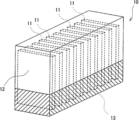
- FIG. 1 is a perspective view showing a typical configuration of a battery module
- FIG. 3 is a perspective view showing a typical configuration of battery cells included in the battery module
- the thermally conductive composition of the present invention contains a liquid polymer, a thermally conductive filler, and a structural viscous agent, and is measured with a rheometer at a temperature of 25°C and a shear rate of 0.00252 (1/s).
- the viscosity ratio ( ⁇ 1/ ⁇ 3) of the viscosity ⁇ 1 measured at a measurement temperature of 25° C. and the viscosity ⁇ 3 measured at a shear rate of 0.05432 (1/s) is greater than 10. be.
- the thermally conductive composition of the present invention has a viscosity ratio ( ⁇ 1/ ⁇ 3) of greater than 10 as measured by a rheometer. If the viscosity ratio ( ⁇ 1/ ⁇ 3) is 10 or less, the thermally conductive filler tends to sediment during storage of the thermally conductive composition, resulting in poor handleability during use. From the viewpoint of suppressing sedimentation of the thermally conductive filler during storage and improving handleability during use, the viscosity ratio ( ⁇ 1/ ⁇ 3) of the thermally conductive composition measured by a rheometer is preferably 15. or more, more preferably 20 or more. Although the upper limit of the viscosity ratio ( ⁇ 1/ ⁇ 3) is not particularly limited, it is 100, for example.
- the viscosity ratio ( ⁇ 1/ ⁇ 3) is preferably more than 10 and 100 or less, more preferably 15 to 100. More preferably 20-100.
- the adjustment of the viscosity ratio ( ⁇ 1/ ⁇ 3) will be described in detail later, but the thermally conductive composition contains a structural viscosity-imparting agent and undergoes heating and cooling treatment, so that loose bonding (internal structure) due to the cohesive force described later is formed.
- the viscosity ratio ( ⁇ 1/ ⁇ 3) measured by a rheometer is greater than 10.
- the range indicated by "-" means a range from a predetermined numerical value or more described before and after "-" to a predetermined numerical value or less.
- Viscosity ⁇ 1 and viscosity ⁇ 3 both represent viscosities in the low shear rate region.
- the viscosity ratio ( ⁇ 1/ ⁇ 3) of the thermally conductive composition is more than 10, the change in viscosity with respect to the change in shear rate in the low shear rate region increases.
- the slope of the graph representing the relationship between shear rate (horizontal axis) and viscosity (vertical axis) increases.
- the viscosity of the thermally conductive composition increases during storage, that is, in a state where the shear rate is extremely low, which is thought to prevent sedimentation of the thermally conductive filler.
- the thermally conductive composition is applied with a dispenser or the applied material is compressed, resulting in a relatively high shear rate.
- the shear rate increases, the viscosity of the thermally conductive composition effectively decreases, which is considered to be excellent in handleability.
- the individual values of viscosity ⁇ 1 and viscosity ⁇ 3 are not particularly limited.
- the viscosity ⁇ 1 is, for example, 3000 (Pa ⁇ s) or more, preferably 5000 (Pa ⁇ s) or more, more preferably 10000 (Pa ⁇ s) or more, and still more preferably 20000 (Pa ⁇ s) or more.
- the upper limit of the viscosity ⁇ 1 is not particularly limited, it is, for example, 100000 (Pa ⁇ s).
- the viscosity ⁇ 1 is, for example, preferably 3000 to 100000 (Pa s), more preferably 5000 to 100000 (Pa s), and further preferably 10000 to 100000 (Pa s). It is preferably from 20,000 to 100,000 (Pa ⁇ s).
- the viscosity ratio ( ⁇ 1/ ⁇ 2) is It is preferably 50 or more, more preferably 80 or more, and still more preferably 100 or more from the viewpoint of improving handleability.
- the viscosity ⁇ 2 is preferably 350 (Pa ⁇ s) or less, more preferably 250 (Pa ⁇ s) or less, and still more preferably 150 (Pa ⁇ s) or less, from the viewpoint of improving handleability.
- the lower limit of the viscosity ⁇ 2 is not particularly limited, it is 50, for example.
- Viscosity ⁇ 1, viscosity ⁇ 2, and viscosity ⁇ 3 of the thermally conductive composition are values measured by a rheometer at 25°C.
- the thermally conductive composition is heated and then cooled to room temperature (25°C) from the viewpoint of evaluating without the influence of shear when the sample is set on the measuring jig. I decided to.
- the heating temperature is set to a temperature equal to or higher than the melting point of the structural viscosity-imparting agent, and preferably equal to or lower than the melting point +50°C.
- the heating temperature may be appropriately set within a range of, for example, 35 to 170.degree.
- the details of the rheometer measurement conditions will be described in Examples.
- the viscosity ⁇ 1, viscosity ⁇ 2, viscosity ⁇ 3, viscosity ratio ( ⁇ 1/ ⁇ 3), viscosity ratio ( ⁇ 1/ ⁇ 2), etc. of the thermally conductive composition depend on the type and amount of the structural viscosity-imparting agent and the thermally conductive filler described later. etc. can be adjusted.
- a thermally conductive composition of the present invention contains a liquid polymer.
- a liquid polymer is a polymer that is liquid at room temperature (25° C.), and examples thereof include materials for obtaining a polymer matrix such as silicone rubber and polyurethane resin.
- the liquid polymer may be a non-reactive compound having no reactive group, or a reactive compound having a reactive group. Examples of reactive groups include alkenyl groups, hydrosilyl groups, hydroxyl groups, isocyanate groups and the like.
- liquid polymers examples include organopolysiloxane, polyol, and polyisocyanate.
- a liquid polymer may be a single component or a mixture of two or more components. Among them, organopolysiloxane is preferable as the liquid polymer. When an organopolysiloxane is used as the liquid polymer, the filling rate of the thermally conductive filler can be easily increased, and the thermal conductivity of the thermally conductive member formed from the thermally conductive composition can be easily improved.
- the organopolysiloxane may be, for example, an organopolysiloxane having a reactive group or an organopolysiloxane having no reactive group, but it should be an organopolysiloxane having a reactive group. is preferred.
- the organopolysiloxane having a reactive group is an organopolysiloxane having a reactive group capable of forming a crosslinked structure. Examples include electron beam-curing silicone and moisture-curing silicone.
- the organopolysiloxane having a reactive group is preferably an addition reaction curable silicone. That is, the liquid polymer of the present invention is preferably addition reaction-curable silicone.
- the addition reaction curable silicone one containing an alkenyl group-containing organopolysiloxane (main agent) and a hydrogen organopolysiloxane (curing agent) is more preferable.
- the liquid polymer in the present invention may contain either one of the main agent and the curing agent that constitute the addition reaction curing type. More specifically, the liquid polymer contained in the thermally conductive composition may be an alkenyl group-containing organopolysiloxane, a hydrogen organopolysiloxane, an alkenyl group-containing organopolysiloxane and It may contain both hydrogen organopolysiloxane.
- thermally conductive composition of the present invention it is also preferable to use the thermally conductive composition of the present invention to prepare a two-pack curable thermally conductive material.
- a first agent comprising a thermally conductive composition containing an alkenyl group-containing organopolysiloxane, a thermally conductive filler, and a structural viscosifying agent and having a viscosity ratio ( ⁇ 1/ ⁇ 3) of greater than 10
- a two-part curable heat conduction consisting of a second part composed of a thermally conductive composition containing polysiloxane, a thermally conductive filler, and a structural viscosifying agent, and having a viscosity ratio ( ⁇ 1/ ⁇ 3) of more than 10. material.
- the first part and the second part are mixed and reacted at the time of use to form a thermally conductive member having a polymer matrix made of silicone rubber.
- the thermally conductive filler is less likely to settle during storage in both the first and second agents, and the first and second agents are easy to handle during use. becomes.
- the liquid polymer used in the two-component curing type thermally conductive material described above may be one other than the addition reaction curing type organopolysiloxane, and the first component and the second component react with each other by mixing.
- a liquid polymer may be included in each of the first agent and the second agent.
- a polyol may be used instead of the alkenyl group-containing organopolysiloxane contained in the first agent, and a polyisocyanate may be used instead of the hydrogen organopolysiloxane contained in the second agent.
- a thermally conductive member having a polymer matrix made of polyurethane resin is obtained.
- the thermally conductive composition of the present invention contains a structural viscosifying agent.
- the structural viscosifying agent is a compound that is solid at room temperature (25° C.), and the viscosity can be increased by adding this to the liquid polymer and placing it under specific conditions.
- the structural viscosity-imparting agent has the function of increasing the viscosity in the low-shear region compared to the state before heating by heating and cooling the mixture blended with the liquid polymer.
- the melting point of the structural tackifier is preferably higher than 25°C, more preferably 30°C or higher, and even more preferably 40°C or higher. Also, the melting point of the structural viscous agent is preferably 120° C.
- the melting point of the structural tackifier is preferably higher than 25°C and 120°C or lower, more preferably 30°C or higher and 80°C or lower, and still more preferably 40°C or higher and 75°C or lower.
- a liquid polymer and a structural viscosifying agent are mixed at room temperature, heated above the melting point of the structural viscosifying agent, and then cooled to room temperature to form a loose bond in the mixture of the liquid polymer and the structural viscosifying agent. (internal structure) is formed. The loose bond is formed by the cohesive forces of the structural viscosifying agent and is not broken by gravity.
- the internal structure is the structure formed by the cohesive forces of the structural thickening agent, thereby increasing the viscosity in the low shear region.
- cohesive force means the action of compounds with the same type of structure sticking together and attracting each other.
- this loose bond is formed in the process of cooling from a heated state above the melting point. Furthermore, loose bonds are broken by shear stress.
- the loose bond is broken when shear stress occurs after cooling, and can be formed again by heating and cooling treatment.
- the structural viscosity-imparting agent is not separated from the liquid polymer for a certain period of time when it is heated to be liquefied.
- the compound preferably has such an affinity that it does not separate into two phases in the compatibility test described later.
- the thermally conductive composition of the present invention can be easily adjusted to the above-described viscosity or viscosity ratio.
- the structural viscosifying agent those having the functions described above can be used without particular limitation.
- the structural viscosity imparting agent when the liquid polymer is an organopolysiloxane, the structural viscosity imparting agent is an ester compound (hereinafter also referred to as ester compound X) which is solid at 25°C, or an alcohol which is solid at 25°C. Compounds are preferred.
- the melting point of the ester compound X is preferably higher than 25°C, more preferably 30°C or higher, and even more preferably 40°C or higher.
- the melting point of the ester compound X is preferably 120° C. or lower, more preferably 80° C. or lower, and still more preferably 75° C. or lower.
- the melting point of the ester compound X is preferably higher than 25°C and 120°C or lower, more preferably 30°C or higher and 80°C or lower, and still more preferably 40°C or higher and 75°C or lower.
- the ester compound X is a compound having an ester group, and may be a monoester having one ester group, or may have two or more ester groups such as a diester, but is a monoester or a diester. is preferred.
- the number of carbon atoms in the ester compound X is not particularly limited as long as the ester compound X is solid at 25°C. , more preferably 100 or less, and still more preferably 50 or less.
- the number of carbon atoms in the ester compound X is, for example, preferably 20-150, more preferably 25-100, even more preferably 30-50.
- the ester compound X is preferably an ester of fatty acid and alcohol.
- the number of carbon atoms in the fatty acid is preferably 2-30, more preferably 10-24.
- the number of carbon atoms in the fatty acid means the total number of carbon atoms including the carbonyl carbon of the carboxyl group.
- the alcohol may be an alcohol having one hydroxyl group or an alcohol having two or more hydroxyl groups.
- the number of carbon atoms in the alcohol is preferably 2-30, more preferably 4-24.
- ester compound X cetyl myristate, pentaerythritol distearate, myristyl myristate, myristyl stearate, behenyl behenylate, glycerin monostearyl ester, ethylene glycol distearyl ester and the like are preferable.
- Ester compound X may be used individually by 1 type, and may use 2 or more types together.
- the melting point of the alcohol compound is preferably above 25°C, more preferably above 30°C, and even more preferably above 40°C. Also, the melting point of the alcohol compound is preferably 120° C. or lower, more preferably 80° C. or lower, and still more preferably 75° C. or lower. The melting point of the alcohol compound is preferably higher than 25°C and 120°C or lower, more preferably 30°C or higher and 80°C or lower, and still more preferably 40°C or higher and 75°C or lower.
- the structured viscosifying agent is an alcohol compound having such a melting point, it becomes easier to adjust the viscosity ratio ( ⁇ 1/ ⁇ 3) within the desired range described above, and sedimentation of the thermally conductive filler during storage is suppressed. It becomes easy to obtain a thermally conductive composition that can be used and is excellent in handleability during use.
- the alcohol compound is a compound having a hydroxy group, and may be a monoalcohol having one hydroxy group, or may have two or more hydroxy groups such as a dialcohol. preferable.
- the number of carbon atoms in the alcohol compound is not particularly limited as long as the alcohol compound is solid at 25°C. It is preferably 36 or less, more preferably 30 or less.
- the number of carbon atoms in the alcohol compound is, for example, preferably 14-40, more preferably 16-36, even more preferably 18-30.
- Alcohol compounds include myristyl alcohol, cetanol, stearyl alcohol, nonadecyl alcohol, arachidyl alcohol, heneicosanol, behenyl alcohol, lignoceryl alcohol, ceryl alcohol, montanyl alcohol, myricyl alcohol, 1-dotriacontanol, Gesyl alcohol and the like are preferred.
- An alcohol compound may be used individually by 1 type, and may use 2 or more types together.
- the ester compound X is preferable from the viewpoint of excellent storage stability.
- the content of the structural viscosity imparting agent in the thermally conductive composition is preferably 0.5 parts by mass or more, more preferably 3 parts by mass or more, and still more preferably 6 parts by mass with respect to 100 parts by mass of the liquid polymer. It is not less than 1 part by mass, preferably not more than 25 parts by mass, and more preferably not more than 20 parts by mass. Further, the content of the structural viscosity-imparting agent in the thermally conductive composition is preferably 0.5 to 20 parts by mass, more preferably 3 to 20 parts by mass, with respect to 100 parts by mass of the liquid polymer, More preferably, it is 6 to 20 parts by mass.
- the content of the structural viscosity-imparting agent in the thermally conductive composition is preferably adjusted according to the content of the compatibilizer described below. Specifically, the content of the structural viscosity-imparting agent with respect to 100 parts by mass of the liquid polymer is preferably X parts by mass or more represented by the following formula (1).
- X (parts by mass) 0.5 + w x 0.2 (Formula 1) (In Formula 1, w represents the content (parts by mass) of the compatibilizer with respect to 100 parts by mass of the liquid polymer)
- the thermally conductive composition of the present invention preferably contains a compatibilizer.
- a compatibilizer By containing the compatibilizer, the viscosity of the thermally conductive composition (especially the viscosity ⁇ 2 at high shear rate) is lowered, the coatability and compressibility are improved, and the handleability is improved.
- the compatibilizer is not particularly limited as long as it is compatible with the liquid polymer at room temperature (25°C), but an ester compound (hereinafter also referred to as ester compound Y) that is liquid at 25°C is preferred.
- ester compound Y an ester compound that is liquid at 25°C is preferred.
- the method of reducing the viscosity of the thermally conductive composition using the ester compound Y differs from the method of reducing the viscosity by using a large amount of a plasticizer such as dimethyl silicone oil.
- the thermally conductive filler tends to sediment during storage. Therefore, sedimentation of the thermally conductive filler can be suppressed even when the ester compound Y is contained.
- the ester compound Y may be a monoester having one ester group, or may have two or more ester groups such as a diester, from the viewpoint of reducing the viscosity of the thermally conductive composition, A monoester is preferable from the viewpoint of maintaining heat resistance.
- the ester compound Y preferably has 12 to 28 carbon atoms, and particularly preferably a monoester having 12 to 28 carbon atoms. When the number of carbon atoms in the ester compound is 12 or more, a certain level of heat resistance of the thermally conductive composition can be ensured.
- the number of carbon atoms in the ester compound is 28 or less, the compatibility with liquid polymers such as organopolysiloxane is improved, and the viscosity of the thermally conductive composition tends to decrease.
- the number of carbon atoms in the ester compound is preferably 13 or more, It is more preferably 17 or more, preferably 26 or less, more preferably 24 or less, and still more preferably 22 or less.
- the carbon number of the ester compound is preferably 13-26, more preferably 17-24, and more preferably 17-22.
- the ester compound is preferably an ester of a fatty acid and an alcohol, and is preferably a compound represented by the following formula (1). preferable.
- R 1 and R 2 are alkyl groups, and at least one of R 1 and R 2 is an alkyl group having 10 or more carbon atoms.
- R 1 and R 2 are alkyl groups, and at least one of R 1 and R 2 is an alkyl group having 10 or more carbon atoms. Since the ester compound of the present invention has 12 to 28 carbon atoms, the total number of carbon atoms of R 1 and R 2 in formula (1) is 11 to 27.
- R 1 and R 2 are each an alkyl group, and may be a linear alkyl group or a branched alkyl group. At least one of R 1 and R 2 is an alkyl group having 10 or more carbon atoms, and only one of R 1 and R 2 is preferably an alkyl group having 10 or more carbon atoms.
- both R 1 and R 2 are preferably alkyl groups having 18 or less carbon atoms.
- R 1 is preferably an alkyl group having 10 or more carbon atoms, more preferably an alkyl group having 11 or more carbon atoms, and preferably an alkyl group having 15 or less carbon atoms.
- R 2 is preferably an alkyl group having 2 or more carbon atoms, more preferably an alkyl group having 3 or more carbon atoms, and preferably an alkyl group having 16 or less carbon atoms, more preferably 12 or less carbon atoms. It is an alkyl group, more preferably an alkyl group having 8 or less carbon atoms.
- R 1 is preferably an alkyl group having 10 to 15 carbon atoms, more preferably an alkyl group having 11 to 15 or more carbon atoms.
- R 2 is preferably an alkyl group having 2 to 16 carbon atoms, more preferably an alkyl group having 3 to 12 carbon atoms, and still more preferably an alkyl group having 3 to 8 carbon atoms.
- R 1 and R 2 are alkyl groups having such carbon atoms, it becomes easier to improve the heat resistance while reducing the viscosity of the thermally conductive composition.
- ester compound Y octyl laurate, 1-methylheptyl laurate, isopropyl myristate, 1-methylheptyl myristate, isopropyl palmitate and the like are preferable, and 1-methylheptyl laurate is more preferable.
- the content of the compatibilizer is 80 parts by mass with respect to 100 parts by mass of the liquid polymer from the viewpoint of suppressing sedimentation of the thermally conductive filler during storage. It is preferably 50 parts by mass or less, more preferably 40 parts by mass or less, and from the viewpoint of improving handleability, it is preferably 5 parts by mass or more, and 10 parts by mass. It is more preferable to be above.
- the content of the compatibilizing agent is preferably 5 to 80 parts by mass, more preferably 10 to 50 parts by mass, and more preferably 10 to 40 parts by mass with respect to 100 parts by mass of the liquid polymer. More preferred.
- the content of the compatibilizer is preferably 1.5 times or more, more preferably 1.8 times or more, and further preferably 2 times or more, the content of the structural viscosity-imparting agent.
- the content of the compatibilizer is preferably 20 times or less, more preferably 12 times or less, and even more preferably 5 times or less than the content of the structural thickening agent.
- the content of the compatibilizer is 1.5 times or more the content of the structural viscosity-imparting agent. It is preferably 20 times or less, more preferably 1.8 times or more and 12 times or less, and even more preferably 2 times or more and 5 times or less.
- the thermally conductive composition of the present invention contains a thermally conductive filler.
- a thermally conductive filler By containing the thermally conductive filler, the thermal conductivity of the thermally conductive composition and the thermally conductive member obtained from the thermally conductive composition is improved.
- thermally conductive fillers include metals, metal oxides, metal nitrides, metal hydroxides, carbon materials, oxides other than metals, nitrides, and carbides.
- the shape of the thermally conductive filler may be spherical or amorphous powder.
- Examples of metals in the thermally conductive filler include aluminum, copper, and nickel; examples of metal oxides include aluminum oxide, magnesium oxide, zinc oxide, and the like represented by alumina; and examples of metal nitrides include aluminum nitride. be able to.
- Metal hydroxides include aluminum hydroxide.
- the carbon material includes spherical graphite, diamond, and the like.
- Examples of oxides, nitrides, and carbides other than metals include quartz, boron nitride, and silicon carbide.
- aluminum oxide and aluminum hydroxide are preferable as the thermally conductive filler, and it is preferable to use aluminum oxide and aluminum hydroxide in combination.
- the average particle size of the thermally conductive filler is preferably 0.1 to 200 ⁇ m, more preferably 0.3 to 100 ⁇ m, even more preferably 0.5 to 70 ⁇ m.
- the thermally conductive filler it is possible to use both a small particle size thermally conductive filler with an average particle size of 0.1 ⁇ m or more and 5 ⁇ m or less and a large particle size thermally conductive filler with an average particle size of more than 5 ⁇ m and 200 ⁇ m or less. preferable.
- the filling rate can be increased by using thermally conductive fillers with different average particle sizes.
- the average particle diameter of the thermally conductive filler can be measured by observing with an electron microscope or the like. More specifically, for example, using an electron microscope or an optical microscope, the particle size of 50 arbitrary thermally conductive fillers is measured, and the average value (arithmetic mean value) thereof can be taken as the average particle size. can.
- the content of the thermally conductive filler is preferably 150 to 3000 parts by mass, more preferably 300 to 2000 parts by mass, and still more preferably 600 to 1600 parts by mass with respect to 100 parts by mass of the liquid polymer.
- the content of the thermally conductive filler is preferably 150 to 3000 parts by mass, more preferably 300 to 2000 parts by mass, and still more preferably 600 to 1600 parts by mass with respect to 100 parts by mass of the liquid polymer.
- the thermally conductive composition of the present invention may contain at least one silicon compound selected from the group consisting of alkoxysilane compounds and alkoxysiloxane compounds. By containing such a silicon compound, the viscosity of the thermally conductive composition tends to decrease.
- alkoxysilane compounds include methyltrimethoxysilane, dimethyldimethoxysilane, diethyldimethoxysilane, trimethylmethoxysilane, methyltriethoxysilane, dimethyldiethoxysilane, ethyltrimethoxysilane, n-propyltrimethoxysilane, di-n -propyldimethoxysilane, di-n-propyldiethoxysilane, isobutyltrimethoxysilane, isobutyltriethoxysilane, isobutyltrimethoxysilane, isobutyltriethoxysilane, n-hexyltrimethoxysilane, n-hexyltriethoxysilane, methylcyclohexyl dimethoxysilane, methylcyclohexyldiethoxysilane, n-octyltrimethoxysilane
- n-decyltrimethoxysilane, dimethyldimethoxysilane, and n-octyltriethoxysilane are preferred, and n-decyltrimethoxysilane is more preferred, from the viewpoint of reducing the viscosity of the thermally conductive composition.
- alkoxysiloxane compounds include methylmethoxysiloxane oligomers, methylphenylmethoxysiloxane oligomers, methylepoxymethoxysiloxane oligomers, methylmercaptomethoxysiloxane oligomers, and methylacryloylmethoxysiloxane oligomers.
- the content of the silicon compound is preferably 0.1 parts by mass or more, more preferably 0.5 parts by mass or more, relative to 100 parts by mass of the liquid polymer. , and preferably 5 parts by mass or less, more preferably 3 parts by mass or less, and even more preferably 2 parts by mass or less.
- the content of the silicon compound is preferably 0.1 to 5 parts by mass, more preferably 0.5 to 3 parts by mass, with respect to 100 parts by mass of the liquid polymer. parts by weight, and more preferably 0.5 to 2 parts by weight.
- the content of the silicon compound is at least these lower limits, the viscosity of the thermally conductive composition tends to decrease. On the other hand, when the content of the silicon compound is at most these upper limits, it is possible to suppress the deterioration of the heat resistance of the thermally conductive composition.
- the thermally conductive composition of the present invention may contain silicone oil from the viewpoint of reducing viscosity.
- silicone oil include straight silicone oils such as dimethylsilicone oil and phenylmethylsilicone oil.
- low-viscosity silicone oil is blended, low-molecular-weight siloxane is likely to occur. Part by mass or less, more preferably 0 part by mass.
- the low-viscosity silicone oil is, for example, a silicone oil having a viscosity of 50 cs or less at 25°C, a silicone oil having a viscosity of 30 cs or less at 25°C, or a silicone oil having a viscosity of 20 cs or less at 25°C.
- the viscosity of the silicone oil was measured using a rheometer MCR-302e manufactured by Anton Paar, adjusting the temperature of the sample to 25 ° C. with a Peltier plate, using a cone plate with a diameter of 50 mm and an angle of 1 °, and a shear rate of 10. (1/sec).
- additives can be contained in the thermally conductive composition of the present invention.
- additives include catalysts, flame retardants, antioxidants, colorants, and the like.
- the method for producing a thermally conductive composition of the present invention includes the steps of preparing a mixture containing a liquid polymer, a thermally conductive filler, and a structural viscosity-imparting agent, heating the mixture, and cooling the mixture. Have a process.
- the step of cooling the mixture by cooling the mixture, the viscosity ⁇ of the mixture measured by a rheometer under the conditions of a measurement temperature of 25 ° C. and a shear rate of 0.00252 (1 / s) and a measurement temperature of 25 ° C.
- the method for producing a thermally conductive composition of the present invention includes a step of mixing a liquid polymer, a thermally conductive filler, a structural viscosity-imparting agent, and optional additives to prepare a mixture; A step of heating the mixture and a step of cooling the mixture are provided in this order. Through such steps, the thermally conductive composition of the present invention having the viscosity ratio ( ⁇ 1/ ⁇ 3) adjusted as described above can be obtained.
- the method for producing a supply form of the thermally conductive composition comprises preparing a mixture containing a liquid polymer, a thermally conductive filler, and a structural viscosity-imparting agent in the above-described method for producing a thermally conductive composition.
- a step of filling the container with the mixture may be provided after the step.
- the step of heating the mixture and the step of cooling the mixture described above are preferably performed after the mixture is filled in a container.
- a known mixing method may be appropriately employed, and for example, a known kneader, kneading roll, mixer, or the like may be used for mixing.
- the heating temperature in the step of heating the mixture may be a temperature at which the structural viscosifying agent melts or higher, for example, a temperature higher than the melting point of the structural viscosifying agent, which is from melting point +10°C to melting point +50°C.
- the upper limit of the heating temperature is not particularly limited, but from the viewpoint of suppressing thermal deterioration of the structural viscosity imparting agent, it is preferably 200 ° C. or less, and when it contains a volatile component, it is as low as possible.
- the temperature is preferably 100° C. or lower, particularly preferably 80° C. or lower.
- the heating time is not particularly limited, but it is set to a time for heating the whole according to the volume of the mixture. For example, it is 5 to 1000 minutes, preferably 10 to 500 minutes. When the heating time is at least these lower limits, the inside of the mixture is likely to be sufficiently heated. When the heating time is equal to or less than these upper limits, when the mixture contains a volatile substance, volatilization of a part of the volatile substance can be suppressed.
- the heated mixture is cooled to room temperature (25° C.).
- the cooling method is not particularly limited, and may be a method of cooling using a cooler or a method of natural cooling. By mixing a compatibilizer, the melting temperature of the structural tackifier can be lowered. Therefore, when it is desired to lower the heating temperature, it is preferable to mix a compatibilizer.
- thermoly conductive composition containing an alkenyl group-containing organopolysiloxane, a thermally conductive filler, and a structural viscous agent and having a viscosity ratio ( ⁇ 1/ ⁇ 3) of more than 10 Part 1 and Part 2 comprising a thermally conductive composition containing a hydrogen organopolysiloxane, a thermally conductive filler, and a structural viscosifying agent and having a viscosity ratio ( ⁇ 1/ ⁇ 3) exceeding 10.
- a two-pack curable thermally conductive material is preferred.
- the mass ratio of the first agent to the second agent is preferably 1 or a value close to 1, specifically preferably 0.9 to 1.1, and 0.95 ⁇ 1.05 is more preferred.
- the mass ratio of the first agent and the second agent is preferably 1 or a value close to 1, specifically preferably 0.9 to 1.1, and 0.95 ⁇ 1.05 is more preferred.
- the addition reaction catalyst is preferably contained in the first agent and not contained in the second agent.
- the first part and the second part are excellent in storage stability before mixing, and after mixing, the reaction is accelerated and can be rapidly cured, and the thermally conductive member obtained by curing.
- Various physical properties can be improved. The reason for this is not clear, but it is presumed that the addition reaction catalyst such as a platinum catalyst is coordinated with the alkenyl group, which is the addition reaction site of the alkenyl group-containing organopolysiloxane, and curing proceeds easily.
- the second agent preferably contains an alkenyl group-containing organopolysiloxane.
- alkenyl group-containing organopolysiloxane in addition to hydrogen organopolysiloxane as a curing agent in the second agent, the mass ratio and viscosity ratio of the second agent to the first agent when preparing a mixture of both can be reduced. It becomes easier to adjust to 1 or a value close to 1.
- the first agent should not contain hydrogen organopolysiloxane as a curing agent.
- the first agent and the second agent are preferably stored separately in containers such as syringes, cartridges, pails, and drums. Specifically, it is preferable to store a first syringe into which the first agent is introduced and a second syringe into which the second agent is introduced. In this case, the first syringe and the second syringe may be arranged in parallel to form a two-liquid parallel type syringe.
- the first and second agents are preferably stored as a first cartridge into which the first agent is introduced and a second cartridge into which the second agent is introduced. Also in this case, the first cartridge and the second cartridge may be arranged in parallel to form a two-liquid parallel type cartridge.
- the first agent and the second agent are the first pail or drum into which the first agent has been introduced, and the second pail or drum into which the second agent has been introduced. It is preferably stored as As described above, the thermally conductive composition of the present invention is prepared through the steps of preparing a mixture, heating the mixture, and cooling the mixture. Therefore, for example, a mixture containing an alkenyl group-containing organopolysiloxane, a thermally conductive filler, and a structural viscosifying agent is prepared, the mixture is introduced into a first syringe, and is subjected to a heating step and a cooling step to obtain a second A first syringe with one agent introduced is obtained.
- a mixture containing a hydrogen organopolysiloxane, a thermally conductive filler, and a structural thickening agent is prepared, the mixture is introduced into a second syringe, and the second agent is obtained through a heating step and a cooling step.
- a second syringe is obtained in which is introduced. Sedimentation of the thermally conductive filler is suppressed in the first agent and the second agent introduced into the first syringe and the second syringe, respectively, and the storage conditions are excellent.
- the first agent and the second agent are discharged from the first syringe and the second syringe, respectively, mixed with a static mixer or the like, and cured to form the thermally conductive member.
- the applied material formed by the discharge is easily compressed and has excellent workability.
- the mixture of the first agent and the second agent is discharged between the heating element and the radiator to form a coating of a certain thickness, and then the coating is easily stretched thinly with a small load. become.
- a supply form of the thermally conductive composition in which the above-described thermally conductive composition is filled in a container.
- supply of a two-liquid curable thermally conductive material composed of a first container filled with the above-described first agent and a second container filled with the above-described second agent.
- containers include syringes, cartridges, pails, and drums, as described above.
- the present invention can also provide a thermally conductive member comprising a polymeric matrix, a thermally conductive filler, and a structured thickening agent having a melting point greater than 25°C.
- the thermally conductive member is a cured product of the thermally conductive composition described above or a cured product of the two-liquid curable thermally conductive material described above.
- the polymer matrix include silicone rubber, polyurethane resin, etc. Among them, silicone rubber is preferred.
- the types of thermally conductive fillers are as described above.
- the melting point of the structural viscosity imparting agent is preferably an ester compound X having a melting point higher than 25° C. and not higher than 120° C.
- the ester compound X is as described above.
- the amount of thermally conductive filler relative to the polymer matrix is the same as the amount of thermally conductive filler relative to the liquid polymer described above, and the amount of structural viscosity-imparting agent relative to the polymer matrix is the same as the amount of structural viscosity-imparting agent relative to the liquid polymer described above. Similar to the amount of viscosifying agent.
- the thermally conductive member is obtained from the thermally conductive composition or two-liquid curable thermally conductive material described above. If the liquid polymer contained in the thermally conductive composition is a reactive compound having a reactive group, the thermally conductive member can be obtained by curing the thermally conductive composition. In the case of a two-liquid curable thermally conductive material, the thermally conductive member is obtained by mixing the first agent and the second agent as described above and curing the mixture. Since the thermally conductive member of the present invention uses the structural viscosity-imparting agent, the thermally conductive composition, which is a raw material, is excellent in handleability, and thus the workability in forming the thermally conductive member is improved. Moreover, sedimentation of the thermally conductive filler during storage is suppressed in the thermally conductive composition as a raw material, and the composition is uniform. Therefore, the composition of the formed thermally conductive member is uniform, and variations in physical properties are reduced.
- the thermal conductivity of the thermally conductive member is preferably 1.0 W/mK or more, more preferably 1.5 W/mK or more, and 2.0 W/mK or more. is more preferred. By making it more than these lower limits, thermal conductivity becomes favorable. Therefore, when used as a gap material for battery cell modules, for example, heat generated from the battery cells can be efficiently transferred to the module housing via the gap material. rise can be suppressed. The higher the thermal conductivity of the thermally conductive member, the better. The thermal conductivity is measured according to ASTM D5470.
- a battery module includes an interstitial material made of a thermally conductive member, a plurality of battery cells, and a module housing for storing the plurality of battery cells, wherein the interstitial material is provided inside the module housing. placed.
- a gap material made of a thermally conductive member is filled between the battery cells and between the battery cell and the module housing, and the filled gap material adheres to the battery cell and the module housing.
- the gap material between the battery cells has a function of maintaining the separated state between the battery cells.
- the gap material between the battery cells and the module housing is in close contact with both the battery cells and the module housing, and has the function of transferring heat generated in the battery cells to the module housing.
- FIG. 1 shows a specific configuration of the battery module.
- FIG. 2 shows a specific configuration of each battery cell.
- a plurality of battery cells 11 are arranged inside the battery module 10 .
- Each battery cell 11 is laminated and enclosed in a flexible outer film, and the overall shape is a flat body that is thin compared to its height and width.
- the positive electrode 11a and the negative electrode 11b are exposed to the outside, and the central portion 11c of the flat surface is formed thicker than the crimped end portions 11d.
- each battery cell 11 is arranged such that its flat surfaces face each other.
- the interstitial material 13 is not filled so as to cover the entire plurality of battery cells 11 stored inside the module housing 12 .
- the interstitial material 13 is filled so as to fill the interstices present in a portion (bottom side portion) inside the module housing 12 .
- the gap material 13 is filled between the battery cells 11 and between the battery cells 11 and the module housing 12 , and is in close contact with the surface of the battery cells 11 and the inner surface of the module housing 12 in this portion.
- the interstitial material 13 filled between the battery cells 11 is adhered to the surfaces of both battery cells 11, and the interstitial material 13 itself has moderate elasticity and flexibility, and the battery cells 11 Even if an external force displacing the mutual gap is applied, strain deformation due to the external force can be alleviated. Therefore, the gap material 13 has a function of keeping the battery cells 11 separated from each other.
- a gap material 13 filling a gap between the battery cell 11 and the inner surface of the module housing 12 is also tightly adhered to the surface of the battery cell 11 and the inner surface of the module housing 12 .
- the heat generated inside the battery cell 11 passes through the interstitial material 13 adhered to the surface of the battery cell 11 and passes through the module housing 12 which is in close contact with the other surface of the interstitial material 13 . communicated internally.
- the gap material 13 is formed in the battery module 10 by applying a liquid thermally conductive composition or a two-liquid curable thermally conductive material using a general dispenser and then curing the applied material. do it.
- a liquid thermally conductive composition or a two-liquid curable thermally conductive material for example, the above-described first syringe and second syringe (or first cartridge and second cartridge) are set in a dispenser, and application is performed by the dispenser. good.
- the two-liquid curable thermally conductive material is easy to store, and if it is mixed immediately before use, it does not harden easily during application with a dispenser, and can be quickly hardened after application.
- application by a dispenser is also preferable in that the battery module 10 can be filled relatively deep inside the housing 12 of the battery module 10 .
- the interstitial material 13 covering the battery cells 11 preferably covers 20 to 100%, more preferably 20 to 40%, of each battery cell 11 on one side of the battery cell 11 . By making it 20% or more, the battery cells 11 can be stably held. In addition, by sufficiently covering the battery cells that generate a large amount of heat, heat radiation efficiency is improved. On the other hand, by making it 100% or less, the heat generated from the battery cells 11 can be efficiently radiated. Also, by setting the content to 40% or less, it is possible to prevent an increase in weight and deterioration of workability. In order to improve heat radiation efficiency, it is preferable to cover the side of the battery cell 11 on which the electrodes 11a and 11b are located with the gap material 13, and it is more preferable to cover the entire electrodes 11a and 11b with the gap material 13.
- the battery module 10 can release heat generated from the battery cells 11 to the module housing 12 via the gap material 13 .
- the interstitial material 13 is also preferably used in a battery pack with multiple battery modules 10 therein.
- a battery pack generally includes a plurality of battery modules 10 and a battery pack housing that accommodates the plurality of battery modules 10 .
- a gap material 13 can be provided between the battery module 10 and the battery pack housing.
- viscosity For Examples 1 to 33 and Comparative Examples 1 to 4, the viscosities of the first part and the second part, which are thermally conductive compositions, were measured as follows. The viscosities at various shear rates were measured with a rheometer using each of the first agent and the second agent as samples. Using a rheometer MCR-302e manufactured by Anton Paar, the temperature of the sample was adjusted with a Peltier plate to 85°C, which is the melting point or higher of each structural viscosifying agent, and after 5 minutes, it was cooled to 25°C. It was left for 10 minutes. After that, using a parallel plate of ⁇ 25 mm, the viscosity was measured while continuously changing the shear rate.
- Viscosity 2 For Comparative Examples 5 to 9, the viscosities of the first and second heat conductive compositions were measured as follows. The viscosities at various shear rates were measured with a rheometer using each of the first agent and the second agent as samples. Using a rheometer MCR-302e manufactured by Anton Paar, the temperature of the sample was set to 25° C. with a Peltier plate and allowed to stand for 10 minutes. After that, using a parallel plate of ⁇ 25 mm, the viscosity was measured while continuously changing the shear rate.
- the sedimentation suppression evaluation for Examples 1 to 33 and Comparative Examples 1 to 4 was performed as follows. For each of the first agent and the second agent, the sedimentation suppression evaluation was performed as follows. 10 cc of each sample was placed in a 15 cc transparent container (cylindrical shape with a diameter of 24 mm) and heated at the melting point of the structural viscosity imparting agent +10° C. for 30 minutes. Subsequently, the sample was naturally cooled in an atmosphere of 25° C. until the temperature reached 25° C., and the state of the sample after standing for 30 days was checked. (Evaluation criteria) 5 No change in appearance. 4 The edge of the surface was slightly smeared with the liquid component. 3 The liquid component bleeds slightly on the surface, but the liquid component did not flow even when tilted. 2 The liquid component was slightly spread on the surface, and the liquid component flowed when tilted. 1 The liquid component was separated when viewed from the side.
- Compressibility evaluation for Examples 1 to 33 and Comparative Examples 1 to 4 was performed as follows. 16.4 cc of each of the raw material of the first agent and the raw material of the second agent described in the table was introduced into each of the first syringe and the second syringe, which are two-liquid parallel type 25 cc syringes. Next, the first part and the second part were heated to the melting point of each structural tackifier +10° C. for 15 minutes, then cooled to 25° C. and allowed to stand for 10 minutes. After that, a static mixer was used to discharge a 2.5 cc sample (a mixture of the first agent and the second agent (mass ratio 1:1)) onto an aluminum plate.
- the ejected product was compressed with a 40 mm ⁇ plunger (compression test jig) at a compression rate of 60 mm/min, and the load value when the gap between the jigs was compressed to 0.665 mm was read. Compressive load.
- the temperature during the compression test was set at 25°C. Compressibility was evaluated according to the following criteria based on the value of compressive load. (Evaluation criteria) 5 Less than 100N 4 100N or more and less than 175N 3 175N or more and less than 250N 2 250N or more and less than 350N 1 350N or more
- Compressibility evaluation 2 Compressibility 2 (compressibility 2) Compressibility evaluation for Comparative Examples 5 to 9 was performed as follows. 16.4 cc each of the raw material of the first agent and the raw material of the second agent described in the table are introduced into the first syringe and the second syringe, which are two-liquid parallel type 25 cc syringes, and the mixture is held at 25 ° C. for 10 minutes. I left it. After that, a static mixer was used to discharge a 2.5 cc sample (a mixture of the first agent and the second agent (mass ratio 1:1)) onto an aluminum plate.
- the ejected product was compressed with a 40 mm ⁇ plunger (compression test jig) at a compression rate of 60 mm/min, and the load value when the gap between the jigs was compressed to 0.665 mm was read. Compressive load.
- the temperature during the compression test was set at 25°C. Compressibility was evaluated according to the following criteria based on the value of compressive load. (Evaluation criteria) 5 Less than 100N 4 100N or more and less than 175N 3 175N or more and less than 250N 2 250N or more and less than 350N 1 350N or more
- Test 2 was conducted in the same manner using 5 g of the silicone A agent, 4 g of the compatibilizer, and 1 g of the structural tackifier used in the example.
- Silicone agent A contains alkenyl group-containing organopolysiloxane and a small amount of addition reaction catalyst (platinum catalyst). Viscosity 400 cs at 25°C.
- Silicone agent B including alkenyl group-containing organopolysiloxanes and hydrogen organopolysiloxanes. Viscosity 300 cs at 25°C.
- ⁇ Heat conductive filler> ⁇ Aluminum oxide spherical, average particle size 12 ⁇ m ⁇ Aluminum oxide spherical, average particle size 45 ⁇ m ⁇ Aluminum hydroxide amorphous, average particle size 1 ⁇ m ⁇ Aluminum hydroxide amorphous, average particle size 10 ⁇ m ⁇ Aluminum hydroxide amorphous, average particle size 90 ⁇ m
- Examples 1 to 33, Comparative Examples 1 to 9 A first agent and a second agent were prepared according to the formulations shown in Tables 1 to 9, and the viscosity, sedimentation inhibition evaluation, and compressibility evaluation described above were performed. The results are shown in Tables 1-9. As described above, for Comparative Examples 5 to 9, "viscosity 2" was used as viscosity evaluation, “sedimentation suppression evaluation 2” was used as sedimentation suppression evaluation, and “compressibility evaluation 2" was performed as compressibility evaluation.
- the thermally conductive composition (first agent and second agent) of the present invention satisfying a viscosity ratio ( ⁇ 1/ ⁇ 3) of more than 10 is a thermally conductive filler during storage. It was found that it is easy to suppress sedimentation and that it is excellent in handleability due to good compressibility.
- the compound used as the compatibilizer is an ester compound, generation of low-molecular-weight siloxane can be suppressed as compared with the method of lowering the viscosity using silicone oil or the like.
- Comparative Example 1 is an example of using fumed silica without using a structured thickening agent, but the viscosity ratio ( ⁇ 1/ ⁇ 3) is as small as 3.8 to 3.9, and the sedimentation suppression evaluation And the result of comprehensive evaluation based on the evaluation of compressibility was worse than any example.
- Comparative Examples 2-4 are examples using PEG-PPG-PEG copolymer as a structural viscosifying agent. is as small as 7.3 to 9.9, and the results of sedimentation inhibition evaluation and overall evaluation are poor.
- Comparative Examples 5 to 9 are examples in which the thermally conductive compositions (the first agent and the second agent) containing the structural viscosifying agent used in the examples were prepared without undergoing the heating step and the cooling step. , the viscosity ratio ( ⁇ 1/ ⁇ 3) was as small as 3.4 to 8.8, and the overall evaluation result was poor.
Landscapes
- Chemical & Material Sciences (AREA)
- Chemical Kinetics & Catalysis (AREA)
- Organic Chemistry (AREA)
- Health & Medical Sciences (AREA)
- Medicinal Chemistry (AREA)
- Polymers & Plastics (AREA)
- Engineering & Computer Science (AREA)
- General Chemical & Material Sciences (AREA)
- Electrochemistry (AREA)
- Manufacturing & Machinery (AREA)
- Physics & Mathematics (AREA)
- Combustion & Propulsion (AREA)
- Thermal Sciences (AREA)
- Materials Engineering (AREA)
- Compositions Of Macromolecular Compounds (AREA)
- Processes Of Treating Macromolecular Substances (AREA)
- Secondary Cells (AREA)
Priority Applications (6)
| Application Number | Priority Date | Filing Date | Title |
|---|---|---|---|
| JP2023502606A JP7370120B2 (ja) | 2021-11-05 | 2022-11-04 | 熱伝導性組成物、及び熱伝導性部材 |
| KR1020247012677A KR20240095196A (ko) | 2021-11-05 | 2022-11-04 | 열전도성 조성물 및 열전도성 부재 |
| CN202280069913.1A CN118103457A (zh) | 2021-11-05 | 2022-11-04 | 导热性组合物及导热性部件 |
| US18/702,575 US20250277112A1 (en) | 2021-11-05 | 2022-11-04 | Thermally conductive composition and thermally conductive member |
| EP22890022.1A EP4428199A4 (en) | 2021-11-05 | 2022-11-04 | THERMALLY CONDUCTIVE COMPOSITION AND THERMALLY CONDUCTIVE ELEMENT |
| JP2023175221A JP2023184534A (ja) | 2021-11-05 | 2023-10-10 | 熱伝導性組成物、及び熱伝導性部材 |
Applications Claiming Priority (2)
| Application Number | Priority Date | Filing Date | Title |
|---|---|---|---|
| JP2021181478 | 2021-11-05 | ||
| JP2021-181478 | 2021-11-05 |
Publications (1)
| Publication Number | Publication Date |
|---|---|
| WO2023080202A1 true WO2023080202A1 (ja) | 2023-05-11 |
Family
ID=86241565
Family Applications (1)
| Application Number | Title | Priority Date | Filing Date |
|---|---|---|---|
| PCT/JP2022/041195 Ceased WO2023080202A1 (ja) | 2021-11-05 | 2022-11-04 | 熱伝導性組成物、及び熱伝導性部材 |
Country Status (6)
| Country | Link |
|---|---|
| US (1) | US20250277112A1 (https=) |
| EP (1) | EP4428199A4 (https=) |
| JP (2) | JP7370120B2 (https=) |
| KR (1) | KR20240095196A (https=) |
| CN (1) | CN118103457A (https=) |
| WO (1) | WO2023080202A1 (https=) |
Cited By (2)
| Publication number | Priority date | Publication date | Assignee | Title |
|---|---|---|---|---|
| JPWO2024225395A1 (https=) * | 2023-04-28 | 2024-10-31 | ||
| WO2024247760A1 (ja) * | 2023-06-01 | 2024-12-05 | 信越化学工業株式会社 | 熱伝導性2液付加硬化型シリコーン組成物、硬化物及びシート |
Families Citing this family (1)
| Publication number | Priority date | Publication date | Assignee | Title |
|---|---|---|---|---|
| US20240400878A1 (en) * | 2021-09-29 | 2024-12-05 | Sekisui Polymatech Co., Ltd. | Thermally conductive composition and thermally conductive member |
Citations (5)
| Publication number | Priority date | Publication date | Assignee | Title |
|---|---|---|---|---|
| WO2017002890A1 (ja) * | 2015-07-02 | 2017-01-05 | 株式会社カネカ | 熱伝導性樹脂組成物 |
| JP2018065977A (ja) * | 2016-10-21 | 2018-04-26 | 積水ポリマテック株式会社 | 熱伝導性組成物および熱伝導性部材 |
| WO2018173860A1 (ja) | 2017-03-22 | 2018-09-27 | 積水ポリマテック株式会社 | バッテリモジュールおよびバッテリパック |
| WO2020095902A1 (ja) * | 2018-11-09 | 2020-05-14 | 積水ポリマテック株式会社 | 熱伝導性組成物、熱伝導性部材、熱伝導性部材の製造方法、放熱構造、発熱複合部材、放熱複合部材 |
| WO2021095507A1 (ja) * | 2019-11-14 | 2021-05-20 | 信越化学工業株式会社 | 熱伝導性シリコーン組成物及び熱伝導性シリコーンシート |
Family Cites Families (6)
| Publication number | Priority date | Publication date | Assignee | Title |
|---|---|---|---|---|
| JP5619487B2 (ja) | 2010-06-24 | 2014-11-05 | 東レ・ダウコーニング株式会社 | 熱伝導性シリコーングリース組成物 |
| KR102146540B1 (ko) * | 2017-09-15 | 2020-08-20 | 주식회사 엘지화학 | 배터리 모듈 |
| KR102578330B1 (ko) * | 2018-06-27 | 2023-09-18 | 다우 실리콘즈 코포레이션 | 열 갭 충전제 및 배터리 관리 시스템을 위한 이의 응용 |
| JP7145732B2 (ja) * | 2018-11-09 | 2022-10-03 | 株式会社ジャパンディスプレイ | 表示装置 |
| JP2021051905A (ja) * | 2019-09-25 | 2021-04-01 | 富士高分子工業株式会社 | シーリング材用熱伝導シート及びこれを組み込んだ発熱性電気・電子部品 |
| US20240400878A1 (en) * | 2021-09-29 | 2024-12-05 | Sekisui Polymatech Co., Ltd. | Thermally conductive composition and thermally conductive member |
-
2022
- 2022-11-04 US US18/702,575 patent/US20250277112A1/en active Pending
- 2022-11-04 CN CN202280069913.1A patent/CN118103457A/zh active Pending
- 2022-11-04 JP JP2023502606A patent/JP7370120B2/ja active Active
- 2022-11-04 EP EP22890022.1A patent/EP4428199A4/en active Pending
- 2022-11-04 WO PCT/JP2022/041195 patent/WO2023080202A1/ja not_active Ceased
- 2022-11-04 KR KR1020247012677A patent/KR20240095196A/ko active Pending
-
2023
- 2023-10-10 JP JP2023175221A patent/JP2023184534A/ja active Pending
Patent Citations (5)
| Publication number | Priority date | Publication date | Assignee | Title |
|---|---|---|---|---|
| WO2017002890A1 (ja) * | 2015-07-02 | 2017-01-05 | 株式会社カネカ | 熱伝導性樹脂組成物 |
| JP2018065977A (ja) * | 2016-10-21 | 2018-04-26 | 積水ポリマテック株式会社 | 熱伝導性組成物および熱伝導性部材 |
| WO2018173860A1 (ja) | 2017-03-22 | 2018-09-27 | 積水ポリマテック株式会社 | バッテリモジュールおよびバッテリパック |
| WO2020095902A1 (ja) * | 2018-11-09 | 2020-05-14 | 積水ポリマテック株式会社 | 熱伝導性組成物、熱伝導性部材、熱伝導性部材の製造方法、放熱構造、発熱複合部材、放熱複合部材 |
| WO2021095507A1 (ja) * | 2019-11-14 | 2021-05-20 | 信越化学工業株式会社 | 熱伝導性シリコーン組成物及び熱伝導性シリコーンシート |
Non-Patent Citations (1)
| Title |
|---|
| See also references of EP4428199A4 |
Cited By (4)
| Publication number | Priority date | Publication date | Assignee | Title |
|---|---|---|---|---|
| JPWO2024225395A1 (https=) * | 2023-04-28 | 2024-10-31 | ||
| JP7727274B2 (ja) | 2023-04-28 | 2025-08-21 | 積水化学工業株式会社 | 熱伝導性部材、熱伝導性組成物、構造体、及び構造体のリワーク方法 |
| WO2024247760A1 (ja) * | 2023-06-01 | 2024-12-05 | 信越化学工業株式会社 | 熱伝導性2液付加硬化型シリコーン組成物、硬化物及びシート |
| JP2024172885A (ja) * | 2023-06-01 | 2024-12-12 | 信越化学工業株式会社 | 熱伝導性2液付加硬化型シリコーン組成物、硬化物及びシート |
Also Published As
| Publication number | Publication date |
|---|---|
| KR20240095196A (ko) | 2024-06-25 |
| CN118103457A (zh) | 2024-05-28 |
| JPWO2023080202A1 (https=) | 2023-05-11 |
| EP4428199A4 (en) | 2025-10-22 |
| EP4428199A1 (en) | 2024-09-11 |
| US20250277112A1 (en) | 2025-09-04 |
| JP7370120B2 (ja) | 2023-10-27 |
| JP2023184534A (ja) | 2023-12-28 |
Similar Documents
| Publication | Publication Date | Title |
|---|---|---|
| WO2023080202A1 (ja) | 熱伝導性組成物、及び熱伝導性部材 | |
| JP7227676B1 (ja) | 熱伝導性組成物及び熱伝導性部材 | |
| TWI542641B (zh) | Hardened organopolysiloxane composition and semiconductor device | |
| TWI428395B (zh) | A thermally conductive silicone grease composition and a hardened product thereof | |
| JP5565758B2 (ja) | 硬化性でグリース状の熱伝導性シリコーン組成物および半導体装置 | |
| JP2010095730A (ja) | 硬化性オルガノポリシロキサン組成物および半導体装置 | |
| KR20170040107A (ko) | 열전도성 실리콘 조성물 및 반도체 장치 | |
| KR20220159899A (ko) | 열전도성 실리콘 조성물 및 그 경화물 | |
| US20240199817A1 (en) | Curable organopolysiloxane composition and semiconductor device | |
| EP4502102A1 (en) | Thermally-conductive composition, two-part thermally-conductive material, delivery form of thermally-conductive composition, thermally-conductive member, battery module, and method for manufacturing delivery form of thermally-conductive composition | |
| JP7179398B1 (ja) | 熱伝導性組成物、熱伝導性部材、バッテリモジュール | |
| EP3722391B1 (en) | Thermally conductive composition | |
| WO2023054538A1 (ja) | 熱伝導性組成物及び熱伝導性部材 | |
| JP2018076423A (ja) | 熱伝導性シリコーン組成物及びその硬化物、ならびに電子装置及びその製造方法 | |
| EP4317322A1 (en) | Heat-conductive composition, heat-conductive member, and battery module | |
| WO2025065334A1 (en) | Thermally conductive silicone composition | |
| JP7698806B2 (ja) | 熱伝導性組成物、2液硬化型熱伝導性材料、2液硬化型熱伝導性材料の供給形態、及びバッテリモジュール | |
| JP7727274B2 (ja) | 熱伝導性部材、熱伝導性組成物、構造体、及び構造体のリワーク方法 | |
| WO2023120514A1 (ja) | 熱伝導性組成物、及び熱伝導性部材 | |
| EP4541867A1 (en) | Thermally conductive composition and thermally conductive member |
Legal Events
| Date | Code | Title | Description |
|---|---|---|---|
| WWE | Wipo information: entry into national phase |
Ref document number: 2023502606 Country of ref document: JP |
|
| 121 | Ep: the epo has been informed by wipo that ep was designated in this application |
Ref document number: 22890022 Country of ref document: EP Kind code of ref document: A1 |
|
| WWE | Wipo information: entry into national phase |
Ref document number: 202280069913.1 Country of ref document: CN |
|
| WWE | Wipo information: entry into national phase |
Ref document number: 18702575 Country of ref document: US |
|
| WWE | Wipo information: entry into national phase |
Ref document number: 2022890022 Country of ref document: EP |
|
| NENP | Non-entry into the national phase |
Ref country code: DE |
|
| ENP | Entry into the national phase |
Ref document number: 2022890022 Country of ref document: EP Effective date: 20240605 |
|
| WWP | Wipo information: published in national office |
Ref document number: 18702575 Country of ref document: US |