WO2023080146A1 - フラックス及び接合体の製造方法 - Google Patents
フラックス及び接合体の製造方法 Download PDFInfo
- Publication number
- WO2023080146A1 WO2023080146A1 PCT/JP2022/040954 JP2022040954W WO2023080146A1 WO 2023080146 A1 WO2023080146 A1 WO 2023080146A1 JP 2022040954 W JP2022040954 W JP 2022040954W WO 2023080146 A1 WO2023080146 A1 WO 2023080146A1
- Authority
- WO
- WIPO (PCT)
- Prior art keywords
- mass
- acid
- flux
- less
- mgkoh
- Prior art date
- Legal status (The legal status is an assumption and is not a legal conclusion. Google has not performed a legal analysis and makes no representation as to the accuracy of the status listed.)
- Ceased
Links
Classifications
-
- B—PERFORMING OPERATIONS; TRANSPORTING
- B23—MACHINE TOOLS; METAL-WORKING NOT OTHERWISE PROVIDED FOR
- B23K—SOLDERING OR UNSOLDERING; WELDING; CLADDING OR PLATING BY SOLDERING OR WELDING; CUTTING BY APPLYING HEAT LOCALLY, e.g. FLAME CUTTING; WORKING BY LASER BEAM
- B23K35/00—Rods, electrodes, materials, or media, for use in soldering, welding, or cutting
- B23K35/22—Rods, electrodes, materials, or media, for use in soldering, welding, or cutting characterised by the composition or nature of the material
- B23K35/24—Selection of soldering or welding materials proper
- B23K35/26—Selection of soldering or welding materials proper with the principal constituent melting at less than 400°C
-
- B—PERFORMING OPERATIONS; TRANSPORTING
- B23—MACHINE TOOLS; METAL-WORKING NOT OTHERWISE PROVIDED FOR
- B23K—SOLDERING OR UNSOLDERING; WELDING; CLADDING OR PLATING BY SOLDERING OR WELDING; CUTTING BY APPLYING HEAT LOCALLY, e.g. FLAME CUTTING; WORKING BY LASER BEAM
- B23K35/00—Rods, electrodes, materials, or media, for use in soldering, welding, or cutting
- B23K35/22—Rods, electrodes, materials, or media, for use in soldering, welding, or cutting characterised by the composition or nature of the material
- B23K35/36—Selection of non-metallic compositions, e.g. coatings or fluxes; Selection of soldering or welding materials, conjoint with selection of non-metallic compositions, both selections being of interest
- B23K35/3601—Selection of non-metallic compositions, e.g. coatings or fluxes; Selection of soldering or welding materials, conjoint with selection of non-metallic compositions, both selections being of interest with inorganic compounds as principal constituents
-
- C—CHEMISTRY; METALLURGY
- C22—METALLURGY; FERROUS OR NON-FERROUS ALLOYS; TREATMENT OF ALLOYS OR NON-FERROUS METALS
- C22C—ALLOYS
- C22C13/00—Alloys based on tin
-
- H—ELECTRICITY
- H05—ELECTRIC TECHNIQUES NOT OTHERWISE PROVIDED FOR
- H05K—PRINTED CIRCUITS; CASINGS OR CONSTRUCTIONAL DETAILS OF ELECTRIC APPARATUS; MANUFACTURE OF ASSEMBLAGES OF ELECTRICAL COMPONENTS
- H05K3/00—Apparatus or processes for manufacturing printed circuits
- H05K3/30—Assembling printed circuits with electric components, e.g. with resistors
- H05K3/32—Assembling printed circuits with electric components, e.g. with resistors electrically connecting electric components or wires to printed circuits
- H05K3/34—Assembling printed circuits with electric components, e.g. with resistors electrically connecting electric components or wires to printed circuits by soldering
Definitions
- the present invention relates to a method for manufacturing a flux and a joined body.
- soldering uses flux, solder, and solder paste that is a mixture of flux and solder. Flux has the effect of chemically removing metal oxides present in the metal surface of the object to be soldered and the solder, and enabling the movement of metal elements at the boundary between the two. Therefore, by performing soldering using flux, an intermetallic compound is formed between the two, and a strong bond can be obtained.
- soldering methods such as reflow soldering and flow soldering are adopted depending on the size of the object to be joined.
- solder paste is first printed on the board. Then, soldering is performed by heating the board on which the components are mounted and the components are mounted in a heating furnace called a reflow furnace.
- flow soldering flux is first applied to a board on which components are mounted. Next, soldering is performed by bringing molten solder jetted from below into contact with the soldering surface while conveying the board on which the components are mounted.
- Flux used for soldering generally contains resin components, solvents, activators, and the like.
- Patent Document 1 describes a flux used for flow soldering containing rosin as a resin component and an organic acid, an organic halogen compound, or an amine hydrohalide as an activator. .
- the resin component and activator contained in the flux remain as flux residue at the joint between the component and the board after soldering.
- some activators tend to deposit in the flux residue after soldering.
- the activator thus deposited on the flux residue absorbs moisture in the air and is ionized. Ionized activators can corrode metals and cause migration.
- an object of the present invention is to provide a method for manufacturing a flux and a bonded body that can further suppress deposition of an activator in the flux residue after soldering.
- a first aspect of the present invention contains a rosin, a terpene phenol resin, and an activator, wherein the terpene phenol resin has a hydroxyl value of more than 70 mgKOH/g, and the activator has a solubility parameter (SP value ) is 11.00 or more.
- the content of the organic acid (A1) is preferably 0.05% by mass or more and 6% by mass or less with respect to the total mass (100% by mass) of the flux.
- the content ratio (mass ratio) of the organic acid (A1) is 1 part by mass or more and 600 parts by mass with respect to the content (100 parts by mass) of the terpene phenol resin.
- the following are preferable.
- a second aspect of the present invention contains a rosin, a terpene phenol resin, and an activator, wherein the terpene phenol resin has a hydroxyl value of more than 70 mgKOH/g, and the activator has the following general formula:
- R 1 represents a chain hydrocarbon group having 2 to 15 carbon atoms, an alicyclic hydrocarbon group having 3 to 15 carbon atoms, an aromatic group, or a carboxy group. However, the chain hydrocarbon group and the alicyclic hydrocarbon group each have a hydroxy group or a carboxy group. ]
- the content of the organic acid (A2) is preferably 0.05% by mass or more and 6% by mass or less with respect to the total mass (100% by mass) of the flux.
- the content ratio (mass ratio) of the organic acid (A2) is 1 part by mass or more and 600 parts by mass with respect to the content (100 parts by mass) of the terpene phenol resin.
- the following are preferable.
- the content of the terpene phenol resin is 0.1% by mass or more and 20% by mass or less with respect to the total mass (100% by mass) of the flux. is preferred.
- a third aspect of the present invention includes a step of obtaining a joined body by soldering a solder alloy to the surface of the substrate treated with the flux according to the first aspect or the second aspect. , a method for manufacturing a conjugate.
- the flux according to the first aspect and the second aspect can be used for both flow soldering and reflow soldering, but is preferably used for flow soldering.
- the substrates used in flow soldering are characterized by being inexpensive, being made of a material that is difficult to get wet, and being easily oxidized. Also, flow soldering has a short soldering time. For these reasons, a highly active activator is used in flow soldering, and after soldering, the highly active activator becomes difficult to dissolve in the flux residue containing resin, etc., and may precipitate on the flux residue. be.
- a specific organic acid which will be described later, may be used as the highly active activator.
- a terpene phenol resin having a hydroxyl value of more than 70 mgKOH/g is used for the specific organic acid. This makes it possible to prevent the activator from depositing on the flux residue.
- the flux according to the first aspect and the second aspect will be described in detail below.
- the solid content of the flux means all remaining components of the flux excluding the solvent.
- the hydroxyl value of the terpene phenol resin is JISK0070 "Acid value, saponification value, ester value, iodine value, hydroxyl value and unsaponifiables test method of chemical products" 7.2 potentiometric titration method means the hydroxyl value measured according to The hydroxyl value measured by this method is the weighted average of the hydroxyl values of all kinds of terpene phenolic resins contained in the flux.
- the flux according to the first aspect contains a rosin, a terpene phenol resin, an activator, a solvent (S), and optionally other components.
- the hydroxyl value of the terpene phenolic resin is greater than 70 mgKOH/g.
- the active agent contains an organic acid (A1) having a solubility parameter (SP value) of 11.00 or more.
- the flux according to this embodiment is suitable as flux for flow soldering.
- rosin includes natural resins containing abietic acid as a main component, mixtures of abietic acid and its isomers, and chemically modified natural resins (sometimes referred to as rosin derivatives). do.
- the total content of abietic acid and isomers of abietic acid in the natural resin is, for example, 40% by mass or more and 80% by mass or less relative to the natural resin.
- the term “main component” refers to a component whose content in the compound is 40% by mass or more among the components constituting the compound.
- abietic acid Representative isomers of abietic acid include neoabietic acid, parastric acid, and levopimaric acid.
- the structure of abietic acid is shown below.
- Examples of the "natural resin” include gum rosin, wood rosin and tall oil rosin.
- a chemically modified natural resin refers to hydrogenation, dehydrogenation, neutralization, alkylene oxide addition, amidation, dimerization and multimerization of the above “natural resin", It includes those subjected to one or more treatments selected from the group consisting of esterification and Diels-Alder cycloaddition.
- rosin derivatives include purified rosin and modified rosin.
- modified rosin include hydrogenated rosin, polymerized rosin, polymerized hydrogenated rosin, disproportionated rosin, acid-modified rosin, rosin ester, acid-modified hydrogenated rosin, acid-anhydride-modified hydrogenated rosin, and acid-modified disproportionated rosin.
- Rosinamines include, for example, dehydroabiethylamine and dihydroabiethylamine. Rosinamine means so-called disproportionated rosinamine. The structures of dehydroabiethylamine and dihydroabiethylamine are shown below.
- One type of rosin may be used alone, or two or more types may be mixed and used.
- a rosin derivative is preferably used as the rosin.
- the rosin derivative it is preferable to use one or more selected from the group consisting of acid-modified hydrogenated rosin, acid-modified rosin, hydrogenated rosin, polymerized rosin, and rosin ester.
- the acid-modified hydrogenated rosin it is preferable to use acrylic acid-modified hydrogenated rosin.
- acrylic acid-modified rosin it is preferable to use acrylic acid-modified rosin.
- the content of the rosin in the flux is preferably 1% by mass or more and 30% by mass or less, and 2% by mass or more and 25% by mass or less with respect to the total amount (100% by mass) of the flux. is more preferable, and more preferably 2% by mass or more and 20% by mass or less.
- the content of the rosin is preferably 10% by mass or more and 90% by mass or less, and 20% by mass or more and 80% by mass or less with respect to the total solid content (100% by mass). and more preferably 30% by mass or more and 75% by mass or less.
- the terpene phenol resin is a copolymer of a terpene monomer and a phenol, a hydrogenated product of the copolymer, and a copolymer of a terpene monomer and a monomer other than the terpene monomer and a phenol, and It means a hydrogenated product of the copolymer.
- Terpene phenol resins include, for example, terpene resins, modified terpene resins, terpene phenol resins, and modified terpene phenol resins.
- modified terpene resins include hydrogenated terpene resins, aromatic modified terpene resins, and hydrogenated aromatic modified terpene resins.
- modified terpene phenol resins include hydrogenated terpene phenol resins.
- Terpene monomers include, for example, hemiterpenes having 5 carbon atoms such as isoprene, monoterpenes having 10 carbon atoms, sesquiterpenes having 15 carbon atoms, diterpenes having 20 carbon atoms, sestateterpenes having 25 carbon atoms, triterpenes with 30 carbon atoms, tetraterpenes with 40 carbon atoms, and the like.
- phenols include phenol, cresol, xylenol and the like.
- the hydroxyl value of the terpene phenol resin is more than 70 mgKOH/g, may be 90 mgKOH/g or more, preferably 110 mgKOH/g or more, more preferably 130 mgKOH/g or more, and 140 mgKOH/g or more. more preferably, 170 mgKOH/g or more is particularly preferable, and 190 mgKOH/g or more is most preferable.
- the upper limit of the hydroxyl value of the terpene phenol resin is not particularly limited as long as the effect of the present invention is exhibited. /g or less.
- the hydroxyl value of the terpene phenol resin may be more than 70 mgKOH/g and 300 mgKOH/g or less, may be 90 mgKOH/g or more and 300 mgKOH/g or less, or may be 110 mgKOH/g or more and 300 mgKOH/g or less. preferably 130 mgKOH/g or more and 300 mgKOH/g or less, more preferably 140 mgKOH/g or more and 300 mgKOH/g or less, particularly preferably 170 mgKOH/g or more and 300 mgKOH/g or less, and 190 mgKOH/g It may be more than or equal to 300 mgKOH/g or less.
- the hydroxyl value of the terpene phenol resin may be more than 70 mgKOH/g and 250 mgKOH/g or less, may be 90 mgKOH/g or more and 250 mgKOH/g or less, or may be 110 mgKOH/g or more and 250 mgKOH/g or less. preferably 130 mgKOH/g or more and 250 mgKOH/g or less, more preferably 140 mgKOH/g or more and 250 mgKOH/g or less, particularly preferably 170 mgKOH/g or more and 250 mgKOH/g or less, and 190 mgKOH/g It may be more than or equal to 250 mgKOH/g or less.
- the hydroxyl value of the terpene phenol resin is more than the lower limit, the effect of suppressing the deposition of the highly polar organic acid (A1) on the flux residue is further enhanced.
- the hydroxyl value of the terpene phenol resin is equal to or less than the upper limit, moisture absorption can be further reduced. This makes it possible to further suppress the decrease in the insulation resistance value of the flux and to further suppress the occurrence of migration.
- terpene phenol resins examples include YS Polyster (terpene phenol resin: manufactured by Yasuhara Chemical Co., Ltd.), Tamanol (terpene phenol resin: manufactured by Arakawa Chemical Industries, Ltd.), Tertac 80 (terpene phenol resin: manufactured by Nippon Terpene Chemical Co., Ltd.), SylvaresTP (terpene Phenolic resin: manufactured by Air Braun Co.) and the like are easily available.
- the terpene phenol resin may be selected from among these so as to have a desired hydroxyl value.
- Terpene phenol resins may be used singly or in combination of two or more.
- the flux according to this embodiment may contain one type of terpene phenolic resin having a hydroxyl value of more than 70 mgKOH/g.
- the flux according to the present embodiment may contain two or more terpene phenol resins having different hydroxyl values, and the weighted average hydroxyl value of these hydroxyl values may be more than 70 mgKOH/g.
- the content of the terpene phenol resin in the flux is preferably 0.1% by mass or more and 20% by mass or less, and 0.2% by mass or more and 10% by mass, relative to the total amount (100% by mass) of the flux. % or less, and more preferably 0.5 mass % or more and 5 mass % or less.
- the content of the terpene phenol resin is preferably 3% by mass or more and 50% by mass or less, and 4% by mass or more and 40% by mass with respect to the total amount (100% by mass) of the solid content. % or less, and more preferably 5 mass % or more and 30 mass % or less.
- the content of the terpene phenol resin is at least the lower limit value, precipitation of the organic acid (A1) in the flux residue after soldering can be further suppressed.
- the content of the terpene phenol resin is equal to or less than the upper limit, it is possible to reduce the possibility that the viscosity of the flux becomes too high.
- the mixing ratio of rosin and terpene phenol resin is 0.5 or more and 20 or less as a mass ratio represented by rosin/terpene phenol resin, that is, the ratio of the content of rosin to the content of terpene phenol resin. It is preferably 1 or more and 10 or less, and even more preferably 1.5 or more and 8 or less.
- the flux of the present embodiment contains an organic acid (A1) having a solubility parameter (SP value) of 11 or more as a specific activator.
- A1 organic acid having a solubility parameter (SP value) of 11 or more as a specific activator.
- the solubility parameter (SP value) means a value calculated from the molecular structure based on the Fedors method.
- ⁇ E represents the sum of the evaporation energies (cal/mol) of the atoms and atomic groups possessed by the molecule of the organic acid (A1).
- ⁇ V represents the total molar volume (cm 3 /mol) at 25° C. of atoms and atomic groups possessed by molecules of the organic acid (A1).
- evaporation energy and molar volume values described in Robert F. Fedors, A method for estimating both the solubility parameters and molar volumes of liquids. Polymer Engineering and Science, 14, 147-154 (1974).
- the SP value of the organic acid (A1) is 11.00 or more, preferably 11.50 or more, more preferably 11.70 or more, even more preferably 12.00 or more, and 12 0.50 or higher is particularly preferred, and 13.00 or higher is most preferred.
- the upper limit of the SP value of the organic acid (A1) is not particularly limited, it may be 25 or 23 or less, for example.
- the SP value of the organic acid (A1) may be 11.00 or more and 25.00 or less, 11.50 or more and 25.00 or less, or 11.70 or more and 25.00 or less. 12.00 or more and 25.00 or less, 12.50 or more and 25.00 or less, or 13.00 or more and 25.00 or less.
- the SP value of the organic acid (A1) may be 11.00 or more and 23.00 or less, 11.50 or more and 23.00 or less, or 11.70 or more and 23.00 or less. 12.00 or more and 23.00 or less, 12.50 or more and 23.00 or less, or 13.00 or more and 23.00 or less.
- the flux of this embodiment employs a terpene phenol resin having a hydroxyl value of more than 70 mgKOH/g. This suppresses precipitation of the organic acid (A1) having an SP value equal to or higher than the lower limit value in the flux residue.
- the organic acid (A1) may be a dicarboxylic acid.
- the dicarboxylic acid include oxalic acid (15.22), malonic acid (14.03), succinic acid (13.21), glutaric acid (12.61), adipic acid (12.15), and pimelic acid. , suberic acid (11.49), azelaic acid (11.25), sebacic acid (11.04), 2,4-diethylglutaric acid (14.89), 1,3-cyclohexanedicarboxylic acid (12.80) etc.
- the numbers in parentheses represent the SP value of each dicarboxylic acid.
- organic acid (A1) may be a hydroxycarboxylic acid.
- hydroxycarboxylic acid examples include 2,2-bis(hydroxymethyl)propionic acid (16.12) and 2,2-bis(hydroxymethyl)butanoic acid (18.31).
- the numbers in parentheses represent the SP value of each hydroxycarboxylic acid.
- organic acid (A1) may be an aromatic carboxylic acid.
- aromatic carboxylic acid examples include picolinic acid (12.78) and dipicolinic acid (13.37).
- Organic acid (A1) is preferably succinic acid, glutaric acid, adipic acid, pimelic acid, suberic acid, azelaic acid, sebacic acid or 2,2-bis(hydroxymethyl)propionic acid, succinic acid, glutaric acid , adipic acid or 2,2-bis(hydroxymethyl)propionic acid, more preferably succinic acid or 2,2-bis(hydroxymethyl)propionic acid.
- the organic acid (A1) may be used alone or in combination of two or more.
- the content of the organic acid (A1) in the flux is preferably 0.05% by mass or more and 6% by mass or less with respect to the total mass (100% by mass) of the flux, and 0.1% by mass. It is more preferably 4 mass % or less, and still more preferably 0.1 mass % or more and 3 mass % or less.
- the content of the organic acid (A1) is preferably 0.5 mass % or more and 50 mass % or less with respect to the total solid content (100 mass %). It is more preferably 5% by mass or more and 40% by mass or less, and even more preferably 1% by mass or more and 40% by mass or less.
- the content of the organic acid (A1) is at least the lower limit, the wettability of the flux can be further enhanced.
- the content of the organic acid (A1) is equal to or less than the upper limit, it becomes possible to further suppress precipitation of the organic acid (A1) in the flux residue after soldering.
- the mixing ratio of the organic acid (A1) and the terpene phenol resin is the mass ratio represented by the organic acid (A1)/terpene phenol resin, that is, the organic acid (A1 ) may be 1 part by mass or more and 600 parts by mass or less, preferably 2 parts by mass or more and 600 parts by mass or less, more preferably 1 part by mass or more and 400 parts by mass or less, and 1 mass part It is more preferably from 1 to 200 parts by mass, particularly preferably from 1 to 100 parts by mass, and most preferably from 1 to 50 parts by mass. Solderability can be improved when the content ratio of the organic acid (A1) is equal to or higher than the lower limit. When the ratio of the content of the organic acid (A1) is equal to or less than the upper limit, it becomes possible to further suppress precipitation of the organic acid (A1) in the flux residue after soldering.
- the activator contained in the flux of this embodiment may contain other activators in addition to the organic acid (A1).
- Other activators include, for example, organic acid-based activators other than the organic acid (A1), amine-based activators, and halogen-based activators.
- organic acid surfactants include undecanedioic acid, dodecanedioic acid, tridecanedioic acid, tetradecanedioic acid, pentadecanedioic acid, hexadecanedioic acid, heptadecanedioic acid, octadecanedioic acid, nonadecanedioic acid, eicosanedioic acid, 4-tert-butylbenzoic acid, palmitic acid, mono-2-ethylhexyl 2-ethylhexylphosphonate, dimer acid, trimer acid, hydrogenated dimer acid, which is a hydrogenated product obtained by adding hydrogen to dimer acid, hydrogen is added to trimer acid Hydrogenated trimer acid, which is an added hydrogenated product, and the like can be mentioned.
- dimer acid and trimer acid examples include dimer acid which is a reaction product of oleic acid and linoleic acid, trimer acid which is a reaction product of oleic acid and linoleic acid, dimer acid which is a reaction product of acrylic acid, and acrylic acid.
- trimer acid which is the reactant of methacrylic acid, dimer acid which is the reactant of methacrylic acid, trimer acid which is the reactant of methacrylic acid, dimer acid which is the reactant of acrylic acid and methacrylic acid, reaction of acrylic acid and methacrylic acid trimer acid, a reactant of oleic acid, dimer acid, a reactant of oleic acid, trimer acid, a reactant of oleic acid, dimer acid, a reactant of linoleic acid, trimer acid, a reactant of linoleic acid, linolenic acid trimer acid, which is a reaction product of linolenic acid, dimer acid, which is a reaction product of acrylic acid and oleic acid, trimer acid, which is a reaction product of acrylic acid and oleic acid, acrylic acid and linoleic acid dimer acid that is the reaction product of acrylic acid and linoleic acid, trimer acid that is the
- dimer acid which is a reaction product of oleic acid and linoleic acid
- Trimer acid which is a reaction product of oleic acid and linoleic acid
- trimer having 54 carbon atoms is a trimer having 54 carbon atoms.
- Other organic acid-based activators may be used singly or in combination of two or more.
- amine-based activators include rosin amines, azoles, guanidines, alkylamine compounds, aminoalcohol compounds and the like.
- rosin amine examples include those described above in ⁇ Rosin>.
- azoles examples include 2-methylimidazole, 2-ethylimidazole, 2-undecylimidazole, 2-heptadecylimidazole, 1,2-dimethylimidazole, 2-ethyl-4-methylimidazole, 2-phenylimidazole, 2-phenyl-4-methylimidazole, 1-benzyl-2-methylimidazole, 1-benzyl-2-phenylimidazole, 1-cyanoethyl-2-methylimidazole, 1-cyanoethyl-2-undecylimidazole, 1-cyanoethyl- 2-ethyl-4-methylimidazole, 1-cyanoethyl-2-phenylimidazole, 1-cyanoethyl-2-undecylimidazolium trimellitate, 1-cyanoethyl-2-phenylimidazolium trimellitate, 2,4-diamino -6-[2′-methylimidazolyl-
- guanidines examples include 1,3-diphenylguanidine, 1,3-di-o-tolylguanidine, 1-o-tolylbiguanide, 1,3-di-o-cumenylguanidine, 1,3-di- and o-cumenyl-2-propionylguanidine.
- alkylamine compounds include ethylamine, triethylamine, ethylenediamine, triethylenetetramine, cyclohexylamine, hexadecylamine, and stearylamine.
- aminoalcohol compounds examples include N,N,N',N'-tetrakis(2-hydroxypropyl)ethylenediamine, monoisopropanolamine and the like. Amine-based activators may be used singly or in combination of two or more.
- Halogen activator examples include amine hydrohalides and organic halogen compounds other than amine hydrohalides.
- An amine hydrohalide is a compound obtained by reacting an amine with a hydrogen halide.
- Examples of the amine used here include amines exemplified in ⁇ Amine-Based Activator>>.
- Hydrogen halides include, for example, hydrides of chlorine, bromine and iodine.
- amine hydrohalides include, for example, cyclohexylamine hydrobromide, hexadecylamine hydrobromide, stearylamine hydrobromide, ethylamine hydrobromide, 1 , 3-diphenylguanidine hydrobromide, ethylamine hydrochloride, stearylamine hydrochloride, diethylaniline hydrochloride, diethanolamine hydrochloride, 2-ethylhexylamine hydrobromide, pyridine hydrobromide, isopropylamine bromide hydrochloride, diethylamine hydrobromide, dimethylamine hydrobromide, dimethylamine hydrochloride, rosinamine hydrobromide, 2-ethylhexylamine hydrochloride, isopropylamine hydrochloride, cyclohexylamine hydrochloride, 2- Pipecoline hydrobromide, 1,3-diphenylguanidine hydrochloride, dimethylbenz
- halogen-based activator for example, a salt obtained by reacting an amine with tetrafluoroboric acid (HBF 4 ) and a complex obtained by reacting an amine with boron trifluoride (BF 3 ) can also be used.
- the complex include boron trifluoride piperidine and the like.
- organic halogen compounds other than amine hydrohalides include halogenated aliphatic compounds.
- a halogenated aliphatic hydrocarbon group refers to an aliphatic hydrocarbon group in which some or all of the hydrogen atoms constituting the aliphatic hydrocarbon group are substituted with halogen atoms.
- Halogenated aliphatic compounds include halogenated aliphatic alcohols and halogenated heterocyclic compounds.
- Halogenated aliphatic alcohols include, for example, 1-bromo-2-propanol, 3-bromo-1-propanol, 3-bromo-1,2-propanediol, 1-bromo-2-butanol, 1,3-dibromo -2-propanol, 2,3-dibromo-1-propanol, 1,4-dibromo-2-butanol, trans-2,3-dibromo-2-butene-1,4-diol and the like.
- halogenated heterocyclic compounds include compounds represented by the following general formula (2).
- R 11 -(R 12 ) n (2) [In the formula, R 11 represents an n-valent heterocyclic group. R 12 represents a halogenated aliphatic hydrocarbon group. ]
- the heterocyclic ring of the n-valent heterocyclic group for R 11 includes a ring structure in which part of carbon atoms constituting an aliphatic hydrocarbon or aromatic hydrocarbon ring is substituted with a heteroatom.
- Heteroatoms in this heterocyclic ring include an oxygen atom, a sulfur atom, a nitrogen atom and the like.
- This heterocyclic ring is preferably a 3- to 10-membered ring, more preferably a 5- to 7-membered ring. Examples of this heterocyclic ring include an isocyanurate ring.
- the halogenated aliphatic hydrocarbon group for R 12 preferably has 1 to 10 carbon atoms, more preferably 2 to 6 carbon atoms, and still more preferably 3 to 5 carbon atoms.
- R 12 is preferably a brominated aliphatic hydrocarbon group or a chlorinated aliphatic hydrocarbon group, more preferably a brominated aliphatic hydrocarbon group, and still more preferably a brominated saturated aliphatic hydrocarbon group.
- halogenated heterocyclic compounds include tris-(2,3-dibromopropyl) isocyanurate.
- organic halogen compounds other than amine hydrohalides include iodides such as 2-iodobenzoic acid, 3-iodobenzoic acid, 2-iodopropionic acid, 5-iodosalicylic acid, and 5-iodoanthranilic acid.
- Carboxyl compounds such as 2-chlorobenzoic acid and 3-chloropropionic acid; Halogens such as brominated carboxyl compounds such as 2,3-dibromopropionic acid, 2,3-dibromosuccinic acid and 2-bromobenzoic acid carboxyl compounds, hydrobromic acid, carbon tetrabromide, chlorinated fatty acid methyl esters (chlorinated paraffins), tetrabromoethane and the like.
- Halogen-based activators may be used singly or in combination of two or more.
- solvent (S) examples include water, alcohol solvents, glycol ether solvents, terpineols and the like.
- alcohol solvents include ethanol, 1-propanol, 2-propanol, 1,2-butanediol, isobornylcyclohexanol, 2,4-diethyl-1,5-pentanediol, 2,2-dimethyl- 1,3-propanediol, 2,5-dimethyl-2,5-hexanediol, 2,5-dimethyl-3-hexyne-2,5-diol, 2,3-dimethyl-2,3-butanediol, 2 -methylpentane-2,4-diol, 1,1,1-tris(hydroxymethyl)propane, 2-ethyl-2-hydroxymethyl-1,3-propanediol, 2,2′-oxybis(methylene)bis( 2-ethyl-1,3-propanediol, 2,2′
- glycol ether solvents examples include diethylene glycol mono-2-ethylhexyl ether, ethylene glycol monophenyl ether, diethylene glycol monohexyl ether (hexyl diglycol), diethylene glycol dibutyl ether, triethylene glycol monobutyl ether, methylpropylene triglycol, butyl Propylene triglycol, triethylene glycol butyl methyl ether, tetraethylene glycol dimethyl ether and the like.
- the solvent (S) may be used alone or in combination of two or more.
- the solvent (S) preferably contains a solvent (S1) having a boiling point of 100° C. or less from the viewpoint of increasing volatility in preheating.
- the boiling point of the solvent (S1) is preferably 60° C. or higher and 100° C. or lower, more preferably 70° C. or higher and 100° C. or lower, still more preferably 75° C. or higher and 100° C. or lower, and 80° C. or higher. 100° C. or lower is particularly preferred.
- the content of the solvent (S1) is preferably 70% by mass or more and 100% by mass or less, and 80% by mass or more and 100% by mass or less with respect to the total mass (100% by mass) of the solvent (S).
- the solvent (S1) having a boiling point of 100° C. or lower is preferably an alcohol solvent from the viewpoint of solubility of the specific activator.
- the alcohol solvent preferably contains 2-propanol.
- the content of the solvent (S) in the flux is preferably 40% by mass or more and 98% by mass or less, and 60% by mass or more and 98% by mass or less with respect to the total amount (100% by mass) of the flux. and more preferably 70% by mass or more and 98% by mass or less.
- the flux according to the present embodiment may optionally contain other components in addition to the rosin, terpene phenolic resin, activator and solvent.
- Other components include thixotropic agents, resin components other than rosin and terpene phenol resins, metal deactivators, surfactants, silane coupling agents, antioxidants, colorants, and the like.
- resin components other than rosin and terpene phenol resin examples include styrene resins, modified styrene resins, xylene resins, modified xylene resins, acrylic resins, polyethylene resins, acrylic-polyethylene copolymer resins, epoxy resins, and silicone resins.
- Modified styrene resins include styrene acrylic resins, styrene maleic acid resins, and the like.
- Modified xylene resins include phenol-modified xylene resins, alkylphenol-modified xylene resins, phenol-modified resol-type xylene resins, polyol-modified xylene resins, and polyoxyethylene-added xylene resins.
- Metal deactivators include hindered phenol compounds and nitrogen compounds.
- the term "metal deactivator” as used herein refers to a compound that has the ability to prevent metal from deteriorating due to contact with a certain compound.
- a hindered phenolic compound refers to a phenolic compound having a bulky substituent (for example, a branched or cyclic alkyl group such as a t-butyl group) on at least one of the ortho positions of phenol.
- a bulky substituent for example, a branched or cyclic alkyl group such as a t-butyl group
- the hindered phenol compound is not particularly limited, and examples thereof include bis[3-(3-tert-butyl-4-hydroxy-5-methylphenyl)propionic acid][ethylenebis(oxyethylene)], N, N '-Hexamethylenebis[3-(3,5-di-tert-butyl-4-hydroxyphenyl)propanamide], 1,6-hexanediolbis[3-(3,5-di-tert-butyl-4 -hydroxyphenyl)propionate], 2,2′-methylenebis[6-(1-methylcyclohexyl)-p-cresol], 2,2′-methylenebis(6-tert-butyl-p-cresol), 2,2′ -methylenebis(6-tert-butyl-4-ethylphenol), triethyleneglycol-bis[3-(3-tert-butyl-5-methyl-4-hydroxyphenyl)propionate], 1,6-hexanediol-bis -[3
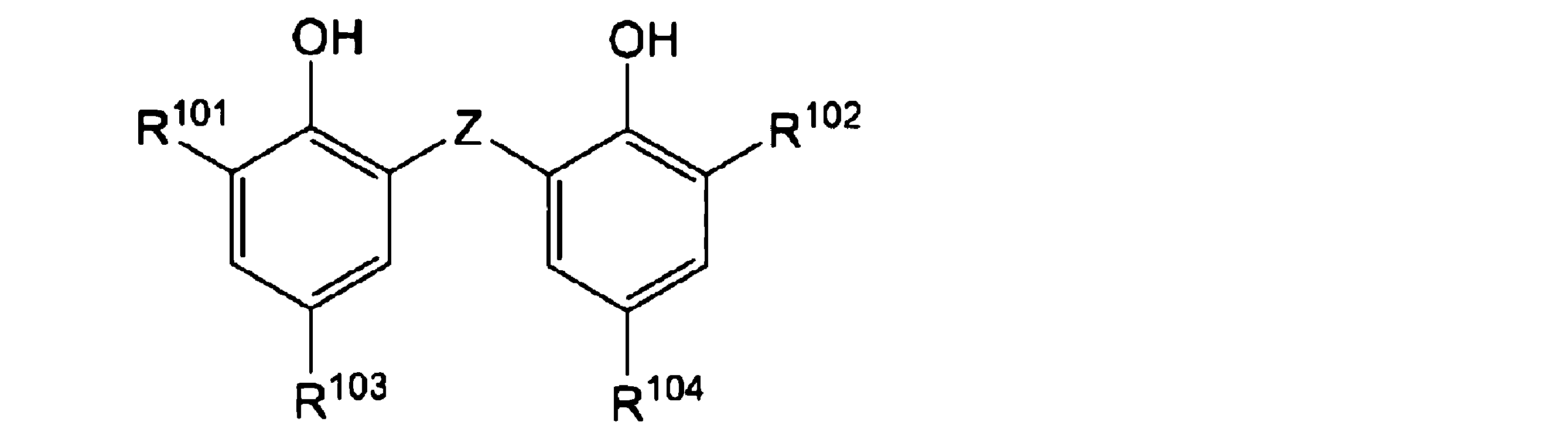
- Z is an optionally substituted alkylene group.
- R 101 and R 102 are each independently an optionally substituted alkyl group, aralkyl group, aryl group, heteroaryl group, cycloalkyl or a heterocycloalkyl group.
- R 103 and R 104 are each independently an optionally substituted alkyl group.
- nitrogen compounds in metal deactivators include hydrazide nitrogen compounds, amide nitrogen compounds, triazole nitrogen compounds, and melamine nitrogen compounds.
- any nitrogen compound having a hydrazide skeleton may be used.
- -butyl-4-hydroxyphenyl)propionyl]hydrazine decanedicarboxylic acid disalicyloyl hydrazide, N-salicylidene-N'-salicylhydrazide, m-nitrobenzhydrazide, 3-aminophthalhydrazide, phthalic acid dihydrazide, adipic acid hydrazide , oxalobis(2-hydroxy-5-octylbenzylidene hydrazide), N'-benzoylpyrrolidonecarboxylic acid hydrazide, N,N'-bis(3-(3,5-di-tert-butyl-4-hydroxyphenyl)propionyl) hydrazine and the like.
- the amide nitrogen compound may be any nitrogen compound having an amide skeleton, and N,N'-bis ⁇ 2-[3-(3,5-di-tert-butyl-4-hydroxyphenyl)propionyloxyl]ethyl ⁇ oxamide and the like.
- the triazole nitrogen compound may be any nitrogen compound having a triazole skeleton, such as N-(2H-1,2,4-triazol-5-yl) salicylamide, 3-amino-1,2,4-triazole, 3-(N-salicyloyl)amino-1,2,4-triazole and the like.
- the melamine-based nitrogen compound may be any nitrogen compound having a melamine skeleton, and examples include melamine and melamine derivatives. More specifically, for example, trisaminotriazine, alkylated trisaminotriazine, alkoxyalkylated trisaminotriazine, melamine, alkylated melamine, alkoxyalkylated melamine, N2-butylmelamine, N2,N2-diethylmelamine, N, N,N',N',N'',N''-hexakis(methoxymethyl)melamine and the like.
- the metal deactivator preferably contains bis[3-(3-tert-butyl-4-hydroxy-5-methylphenyl)propionic acid][ethylenebis(oxyethylene)].
- surfactants include nonionic surfactants and weak cationic surfactants.
- nonionic surfactants include polyethylene glycol, polyethylene glycol-polypropylene glycol copolymers, aliphatic alcohol polyoxyethylene adducts, aromatic alcohol polyoxyethylene adducts, and polyhydric alcohol polyoxyethylene adducts. be done.
- weak cationic surfactants include terminal diamine polyethylene glycol, terminal diamine polyethylene glycol-polypropylene glycol copolymer, aliphatic amine polyoxyethylene adduct, aromatic amine polyoxyethylene adduct, polyvalent amine polyoxy Ethylene adducts can be mentioned.
- surfactants other than the above include polyoxyalkylene acetylene glycols, polyoxyalkylene glyceryl ethers, polyoxyalkylene alkyl ethers, polyoxyalkylene esters, polyoxyalkylene alkylamines, polyoxyalkylene alkylamides, and the like.
- An embodiment of the flux of the first aspect described above contains rosin, a terpene phenol resin, an organic acid (A1) having an SP value of 11.00 or more, and a solvent, and is suitable for flow soldering. It is.
- the specific organic acid (A1) has high activity and tends to precipitate in the flux residue.
- the flux of the present embodiment contains the organic acid (A1), in addition to the rosin, the flux residue after soldering contains , it becomes possible to further suppress the precipitation of the organic acid (A1).
- the flux according to the second aspect contains a rosin, a terpene phenol resin, an activator, a solvent (S), and optionally other components.
- the hydroxyl value of the terpene phenolic resin is greater than 70 mgKOH/g.
- the activator contains an organic acid (A2) represented by the following general formula (1).
- the flux according to this embodiment is suitable as flux for flow soldering.
- R 1 represents a chain hydrocarbon group having 2 to 15 carbon atoms, an alicyclic hydrocarbon group having 3 to 15 carbon atoms, an aromatic group, or a carboxy group. However, the chain hydrocarbon group and the alicyclic hydrocarbon group each have a hydroxy group or a carboxy group. ]
- Rosins include those described above in the first aspect.
- One type of rosin may be used alone, or two or more types may be mixed and used.
- a rosin derivative is preferably used as the rosin.
- the rosin derivative it is preferable to use one or more selected from the group consisting of acid-modified hydrogenated rosin, acid-modified rosin, hydrogenated rosin, polymerized rosin, and rosin ester.
- acid-modified hydrogenated rosin it is preferable to use acrylic acid-modified hydrogenated rosin.
- acrylic acid-modified rosin it is preferable to use acrylic acid-modified rosin.
- the content of the rosin in the flux is preferably 1% by mass or more and 30% by mass or less, and 2% by mass or more and 25% by mass or less with respect to the total amount (100% by mass) of the flux. is more preferable, and more preferably 2% by mass or more and 20% by mass or less.
- the content of the rosin is preferably 10% by mass or more and 90% by mass or less, and 20% by mass or more and 80% by mass or less with respect to the total solid content (100% by mass). and more preferably 30% by mass or more and 75% by mass or less.
- Terpene phenolic resins include those described above in the first aspect. Terpene phenol resins may be used singly or in combination of two or more.
- the hydroxyl value of the terpene phenol resin is more than 70 mgKOH/g, may be 90 mgKOH/g or more, preferably 110 mgKOH/g or more, more preferably 130 mgKOH/g or more, and 140 mgKOH/g or more. more preferably, 170 mgKOH/g or more is particularly preferable, and 190 mgKOH/g or more is most preferable.
- the upper limit of the hydroxyl value of the terpene phenol resin is not particularly limited as long as the effect of the present invention is exhibited. /g or less.
- the hydroxyl value of the terpene phenol resin may be more than 70 mgKOH/g and 300 mgKOH/g or less, may be 90 mgKOH/g or more and 300 mgKOH/g or less, or may be 110 mgKOH/g or more and 300 mgKOH/g or less. preferably 130 mgKOH/g or more and 300 mgKOH/g or less, more preferably 140 mgKOH/g or more and 300 mgKOH/g or less, particularly preferably 170 mgKOH/g or more and 300 mgKOH/g or less, and 190 mgKOH/g It may be more than or equal to 300 mgKOH/g or less.
- the hydroxyl value of the terpene phenol resin may be more than 70 mgKOH/g and 250 mgKOH/g or less, may be 90 mgKOH/g or more and 250 mgKOH/g or less, or may be 110 mgKOH/g or more and 250 mgKOH/g or less. preferably 130 mgKOH/g or more and 250 mgKOH/g or less, more preferably 140 mgKOH/g or more and 250 mgKOH/g or less, particularly preferably 170 mgKOH/g or more and 250 mgKOH/g or less, and 190 mgKOH/g It may be more than or equal to 250 mgKOH/g or less.
- the hydroxyl value of the terpene phenol resin is at least the above lower limit, it is possible to further suppress the deposition of the organic acid (A1) in the flux residue after soldering.
- the hydroxyl value of the terpene phenol resin is equal to or less than the upper limit, moisture absorption can be further reduced. This makes it possible to further suppress the decrease in the insulation resistance value of the flux and to further suppress the occurrence of migration.
- the content of the terpene phenol resin in the flux is preferably 0.1% by mass or more and 20% by mass or less, and 0.2% by mass or more and 10% by mass, relative to the total amount (100% by mass) of the flux. % or less, and more preferably 0.5 mass % or more and 5 mass % or less.
- the content of the terpene phenol resin is preferably 3% by mass or more and 50% by mass or less, and 4% by mass or more and 40% by mass with respect to the total amount (100% by mass) of the solid content. % or less, and more preferably 5 mass % or more and 30 mass % or less.
- the content of the terpene phenol resin is at least the above lower limit, it is possible to further suppress the deposition of the activator in the flux residue after soldering.
- the content of the terpene phenol resin is equal to or less than the upper limit, it is possible to reduce the possibility that the viscosity of the flux becomes too high.
- the mixing ratio of rosin and terpene phenol resin is 0.5 or more and 20 or less as a mass ratio represented by rosin/terpene phenol resin, that is, the ratio of the content of rosin to the content of terpene phenol resin. It is preferably 1 or more and 10 or less, and even more preferably 1.5 or more and 8 or less.
- the flux of this embodiment contains an organic acid (A2) represented by the following general formula (1) as a specific activator.
- R 1 represents a chain hydrocarbon group having 2 to 15 carbon atoms, an alicyclic hydrocarbon group having 3 to 15 carbon atoms, an aromatic group, or a carboxy group. However, the chain hydrocarbon group and the alicyclic hydrocarbon group each have a hydroxy group or a carboxy group. ]
- the chain hydrocarbon group for R 1 may be linear or branched.
- the chain hydrocarbon group and the alicyclic hydrocarbon group may be saturated hydrocarbon groups or unsaturated hydrocarbon groups, and are preferably saturated hydrocarbon groups.
- the chain hydrocarbon group preferably has 2 to 12 carbon atoms, more preferably 3 to 9 carbon atoms, particularly preferably 3 to 7 carbon atoms, and most preferably 3 to 5 carbon atoms.
- Examples of the chain hydrocarbon group include methyl group, ethyl group, n-propyl group, isopropyl group, n-butyl group, isobutyl group, sec-butyl group, tert-butyl group, n-pentyl group and isopentyl group. , sec-pentyl group, tert-pentyl group, neopentyl group, n-hexyl group, isohexyl group, sec-hexyl group, tert-hexyl group, neohexyl group and the like.
- the alicyclic hydrocarbon group preferably has 3 to 12 carbon atoms, more preferably 4 to 12 carbon atoms, and even more preferably 4 to 8 carbon atoms.
- Examples of the alicyclic hydrocarbon group include cyclopropyl group, cyclobutyl group, cyclopentyl group, cyclohexyl group, cycloheptyl group, cyclooctyl group, cyclononyl group, cyclodecyl group, cycloundecyl group and the like.
- the aromatic group for R 1 is a group having at least one aromatic ring, and is, for example, an aromatic hydrocarbon ring such as benzene, naphthalene, anthracene, or phenanthrene, or a part of the carbon atoms constituting the aromatic hydrocarbon ring. is substituted with a heteroatom, condensed rings in which an aromatic hydrocarbon ring and an aromatic heterocycle are condensed, and the like.
- the aromatic group for R 1 has a substituent
- examples of the substituent include a hydrocarbon group having 1 to 20 carbon atoms, an aromatic hydrocarbon group, a carboxy group, a hydroxy group, an amino group, a halogen atom, and the like. with carboxy or hydroxy groups being preferred.
- Examples of the organic acid (A2) represented by the above general formula (1) include dicarboxylic acids, hydroxycarboxylic acids, aromatic carboxylic acids, and the like.
- dicarboxylic acids examples include oxalic acid, malonic acid, succinic acid, glutaric acid, adipic acid, pimelic acid, suberic acid, azelaic acid, sebacic acid, undecanedioic acid, dodecanedioic acid, tridecanedioic acid, tetradecanedioic acid, pentadecanedioic acid, hexadecanedioic acid, 2,4-diethylglutaric acid, 1,3-cyclohexanedicarboxylic acid and the like.
- hydroxycarboxylic acids examples include 2,2-bis(hydroxymethyl)propionic acid and 2,2-bis(hydroxymethyl)butanoic acid.
- aromatic carboxylic acids examples include picolinic acid and dipicolinic acid.
- succinic acid, glutaric acid, adipic acid, pimelic acid, suberic acid, azelaic acid, sebacic acid or 2,2-bis(hydroxymethyl)propionic acid is preferably succinic acid, glutaric acid, adipic acid or 2,2-bis(hydroxymethyl)propionic acid, and succinic acid or 2,2-bis(hydroxymethyl)propionic acid is more preferred.
- the organic acid (A2) represented by the general formula (1) may be used singly or in combination of two or more.
- the content of the organic acid (A2) in the flux is preferably 0.05% by mass or more and 6% by mass or less with respect to the total mass (100% by mass) of the flux, and 0.1% by mass. It is more preferably 4 mass % or less, and still more preferably 0.1 mass % or more and 3 mass % or less.
- the content of the organic acid (A2) is preferably 0.5 mass % or more and 50 mass % or less with respect to the total solid content (100 mass %). It is more preferably 5% by mass or more and 40% by mass or less, and even more preferably 1% by mass or more and 40% by mass or less.
- the content of the organic acid (A2) is at least the lower limit, the wettability of the flux can be further enhanced.
- the content of the organic acid (A2) is equal to or less than the upper limit, it becomes possible to further suppress deposition of the activator in the flux residue after soldering.
- the mixing ratio of the organic acid (A2) and the terpene phenol resin is the mass ratio represented by the organic acid (A2)/terpene phenol resin, that is, the organic acid (A2 ) may be 1 part by mass or more and 600 parts by mass or less, preferably 2 parts by mass or more and 600 parts by mass or less, more preferably 1 part by mass or more and 400 parts by mass or less, and 1 mass part It is more preferably from 1 to 200 parts by mass, particularly preferably from 1 to 100 parts by mass, and most preferably from 1 to 50 parts by mass.
- the ratio of the content of the organic acid (A2) is at least the lower limit, solderability can be improved.
- the ratio of the content of the organic acid (A2) is equal to or less than the upper limit, it becomes possible to further suppress the deposition of the organic acid (A2) in the flux residue after soldering.
- the solvent (S) examples include those mentioned above in the first aspect.
- the solvent (S) may be used alone or in combination of two or more.
- the solvent (S) preferably contains a solvent (S1) having a boiling point of 100° C. or less from the viewpoint of increasing volatility in preheating.
- the boiling point of the solvent (S1) is preferably 60° C. or higher and 100° C. or lower, more preferably 70° C. or higher and 100° C. or lower, still more preferably 75° C. or higher and 100° C. or lower, and 80° C. or higher. 100° C. or lower is particularly preferred.
- the content of the solvent (S1) is preferably 70% by mass or more and 100% by mass or less, and 80% by mass or more and 100% by mass or less with respect to the total mass (100% by mass) of the solvent (S). more preferably 90% by mass or more and 100% by mass or less, particularly preferably 95% by mass or more and 100% by mass or less, and may be 100% by mass.
- the alcohol solvent preferably contains 2-propanol.
- the content of the solvent (S) in the flux is preferably 40% by mass or more and 98% by mass or less, and 60% by mass or more and 98% by mass or less with respect to the total amount (100% by mass) of the flux. and more preferably 70% by mass or more and 98% by mass or less.
- An embodiment of the flux of the second aspect described above contains rosin, a terpene phenol resin, the organic acid (A2) represented by the general formula (1), and a solvent, and is suitable for flow soldering. is preferred.
- the specific organic acid (A2) has high activity and tends to precipitate in the flux residue.
- the flux of the present embodiment contains the organic acid (A2), in addition to the rosin, the flux residue after soldering contains , it becomes possible to further suppress the precipitation of the organic acid (A2).
- a method for manufacturing a joined body according to a third aspect includes a step of obtaining a joined body by soldering a solder alloy to the surface of the substrate treated with the flux according to the first aspect or the second aspect. including.
- An embodiment of the method for manufacturing a joined body according to the third aspect will be described below.
- the manufacturing method of the joined body according to the present embodiment is a method having a component mounting process, a flux application process, a preheating process and a soldering process in this order.
- the component In the component mounting process, the component is mounted on the board.
- substrates include printed wiring boards.
- Components include, for example, integrated circuits, transistors, diodes, resistors, and capacitors.
- the flux of the above embodiment is applied to the soldering surface of the substrate on which the components are mounted.
- Flux applicators include spray fluxers and foaming fluxers.
- the spray fluxer is preferable from the viewpoint of the stability of the coating amount.
- the flux coating amount is preferably 30 to 180 mL/m 2 , more preferably 40 to 150 mL/m 2 , and particularly preferably 50 to 120 mL/m 2 . .
- the soldering surface of the board on which the component is mounted is brought into contact with molten solder in which the solder alloy is melted.
- the method of bringing the molten solder into contact with the soldering surface is not particularly limited as long as the method can bring the molten solder into contact with the substrate. Examples of such a method include a jet method and an immersion method.
- the jet method is a method in which the soldering surface of a circuit board on which components are mounted is brought into contact with jetting molten solder.
- the immersion method is a method in which the soldering surface of a substrate on which components are mounted is brought into contact with the liquid surface of stationary molten solder.
- solder alloy a solder alloy having a known composition can be used.
- the solder alloy is a single Sn solder, or a Sn—Ag system, Sn—Cu system, Sn—Ag—Cu system, Sn—Bi system, Sn—In system, etc., or these alloys containing Sb, Bi, In , Cu, Zn, As, Ag, Cd, Fe, Ni, Co, Au, Ge, P or the like may be added.
- the solder alloy is a Sn--Pb system or a solder alloy in which Sb, Bi, In, Cu, Zn, As, Ag, Cd, Fe, Ni, Co, Au, Ge, P, etc. are added to the Sn--Pb system. There may be.
- the solder alloy is preferably a Pb-free solder.
- the soldering conditions in the soldering process may be appropriately set according to the melting point of the solder.
- the temperature of the molten solder is preferably 230-280.degree. C., more preferably 250-270.degree.
- the board on which the components are mounted is preheated.
- the temperature for heating the substrate in the preheating step is preferably 80 to 130.degree. C., more preferably 90 to 120.degree.
- the flux according to the above embodiment is suitable for flow soldering, but the flux according to the first aspect and the second aspect is not limited to this, and can also be used for reflow soldering.
- Test Examples 1 to 35 Mixtures of test examples were prepared with the compositions shown in Tables 1 to 7. In Tables 1 to 7, the numerical values represent the weight (g) of each component. The raw materials used are shown below.
- Resin A 200 ⁇ 10 mg KOH/g Resin B 150 ⁇ 10 mg KOH/g Resin C 120 ⁇ 10 mg KOH/g Resin D 100 ⁇ 10 mg KOH/g Resin E 60 ⁇ 10 mg KOH/g
- A The activator was dissolved in the mixed liquid by heating, and no precipitate was observed after cooling.
- B Even when heated, the activator did not dissolve in the mixed liquid, and a precipitate was observed after cooling.
- Test Examples 1-2 containing succinic acid and either Resin A or Resin B showed no precipitate after cooling.
- Test Example 6 As shown in Table 2, in Test Example 6 containing glutaric acid and resin A, no precipitate was observed after cooling. In contrast, Test Examples 7 to 10 containing glutaric acid and any of resins B to E exhibited precipitates after cooling.
- Test Example 11 containing adipic acid and resin A, no precipitate was observed after cooling.
- Test Examples 12 to 15 containing adipic acid and any of resins B to E exhibited precipitates after cooling.
- Test Examples 16-19 containing suberic acid and any of Resins A-D showed no precipitate after cooling. In contrast, in Test Example 20 containing suberic acid and resin E, precipitates were observed after cooling.
- Test Examples 21-24 containing sebacic acid and any of Resins A-D showed no precipitate after cooling. In contrast, in Test Example 25 containing sebacic acid and resin E, precipitates were observed after cooling.
- Test Examples 26-27 containing 2,2-bishydroxymethylpropionic acid and either Resin A or Resin B showed no precipitate after cooling.
- Test Examples 28-30 containing 2,2-bishydroxymethylpropionic acid and any of Resins C-E exhibited precipitates after cooling.
- the organic acid (A1) having an SP value of 11.00 or more and the organic acid (A2) represented by the general formula (1) have a terpene phenol having a hydroxyl value of more than 70 mgKOH/g. It was found that the choice of resin was soluble. Further, the organic acid (A1) having an SP value of 11.00 or more and the organic acid (A2) represented by the general formula (1) have a hydroxyl value of 70 mgKOH / g or less for the terpene phenol resin It became clear that it could not be dissolved.
- Resin A 200 ⁇ 10 mg KOH/g Resin B 150 ⁇ 10 mg KOH/g Resin C 120 ⁇ 10 mg KOH/g Resin D 100 ⁇ 10 mg KOH/g Resin E 60 ⁇ 10 mg KOH/g
- Rosin acrylic acid-modified hydrogenated rosin, acrylic acid-modified rosin, hydrogenated rosin, polymerized rosin, rosin ester
- the fluxes of Examples 1 to 23 containing a highly active specific organic acid and a terpene phenolic resin having a hydroxyl value of more than 70 mgKOH/g were evaluated as A or B for deposition of flux residue on the surface.
- the fluxes of Comparative Examples 1 and 2 containing a highly active specific organic acid and a terpene phenolic resin having a hydroxyl value of 70 mgKOH/g or less were evaluated as C for deposition of flux residue on the surface. rice field.
- the flux of Reference Example 2 which contains an organic acid that is not highly active and a terpene phenol resin, gave an evaluation of A for deposition of flux residue on the surface even though the hydroxyl value of the terpene phenol resin was 70 mgKOH/g or less. there were. That is, according to the present invention, even when a highly active specific organic acid is contained, precipitation in flux residue can be suppressed by containing a terpene phenol resin having a hydroxyl value of more than 70 mgKOH/g. can.
- this flux is suitable for flow soldering.
- this flux can be suitably used for soldering electronic substrates used in a hot and humid environment.
Landscapes
- Engineering & Computer Science (AREA)
- Mechanical Engineering (AREA)
- Chemical & Material Sciences (AREA)
- Manufacturing & Machinery (AREA)
- Microelectronics & Electronic Packaging (AREA)
- Inorganic Chemistry (AREA)
- Materials Engineering (AREA)
- Metallurgy (AREA)
- Organic Chemistry (AREA)
- Electric Connection Of Electric Components To Printed Circuits (AREA)
- Compositions Of Macromolecular Compounds (AREA)
- Organic Low-Molecular-Weight Compounds And Preparation Thereof (AREA)
Abstract
Description
フラックスは、はんだ付けの対象となる接合対象物の金属表面及びはんだに存在する金属酸化物を化学的に除去し、両者の境界で金属元素の移動を可能にする効能を持つ。このため、フラックスを使用してはんだ付けを行うことで、両者の間に金属間化合物が形成されるようになり、強固な接合が得られる。
リフローはんだ付けにおいては、まず、基板にソルダペーストが印刷される。次いで、部品が搭載され、リフロー炉と称される加熱炉で、部品が搭載された基板を加熱することにより、はんだ付けを行う。
フローはんだ付けにおいては、まず、部品を搭載した基板にフラックスが塗布される。次いで、部品が搭載された基板を搬送しつつ、下方から噴流させた溶融はんだをはんだ付け面に接触させることにより、はんだ付けを行う。
本発明の第1の態様は、ロジンと、テルペンフェノール樹脂と、活性剤とを含有し、前記テルペンフェノール樹脂の水酸基価は、70mgKOH/g超であり、前記活性剤は、溶解パラメータ(SP値)が11.00以上である有機酸(A1)を含むフラックスである。
[式中、R1は、炭素数2~15の鎖状炭化水素基、炭素数3~15の脂環式炭化水素基、芳香族基、又はカルボキシ基を表す。ただし、前記鎖状炭化水素基及び前記脂環式炭化水素基は、それぞれ、ヒドロキシ基又はカルボキシ基を有する。]
第1の態様及び第2の態様にかかるフラックスは、フローはんだ付け及びリフローはんだ付けのいずれにも用いることができるが、フローはんだ付けに好適に用いられる。
フローはんだ付けに用いられる基板は、安価であり、濡れにくい材質で形成されており、酸化されやすいという特徴がある。また、フローはんだ付けは、はんだ付けの時間が短い。これらの理由により、フローはんだ付けにおいては、活性の強い活性剤が用いられ活性の強い活性剤は、はんだ付け後、樹脂等を含むフラックス残渣中に溶解しにくくなり、フラックス残渣に析出する場合がある。活性の強い活性剤としては、後述する特定有機酸が用いられる場合がある。
第1の態様及び第2の態様にかかるフラックスにおいては、特定有機酸に対して、水酸基価が70mgKOH/g超であるテルペンフェノール樹脂を採用する。これにより、活性剤がフラックス残渣に析出することを抑制することが可能となる。
以下、第1の態様及び第2の態様にかかるフラックスについて、詳細に説明する。
また、本明細書において、テルペンフェノール樹脂の水酸基価は、JISK0070「化学製品の酸価,けん化価,エステル価,よう素価,水酸基価及び不けん化物の試験方法」の7.2電位差滴定法に従って測定される水酸基価を意味する。
この方法により測定される水酸基価は、フラックスに含まれる全ての種類のテルペンフェノール樹脂の水酸基価を加重平均したものである。
第1の態様にかかるフラックスの一実施形態は次のようなものである。本実施形態にかかるフラックスは、ロジンと、テルペンフェノール樹脂と、活性剤と、溶剤(S)と、必要に応じてその他成分とを含有する。
前記テルペンフェノール樹脂の水酸基価は、70mgKOH/g超である。前記活性剤は、溶解パラメータ(SP値)が11.00以上である有機酸(A1)を含む。本実施形態にかかるフラックスは、フローはんだ付け用フラックスとして好適なものである。
本発明において「ロジン」とは、アビエチン酸を主成分とする、アビエチン酸とこの異性体との混合物を含む天然樹脂、及び天然樹脂を化学修飾したもの(ロジン誘導体と呼ぶ場合がある)を包含する。
本明細書において「主成分」とは、化合物を構成する成分のうち、その化合物中の含有量が40質量%以上の成分をいう。

変性ロジンとしては、例えば、水添ロジン、重合ロジン、重合水添ロジン、不均化ロジン、酸変性ロジン、ロジンエステル、酸変性水添ロジン、無水酸変性水添ロジン、酸変性不均化ロジン、無水酸変性不均化ロジン、フェノール変性ロジン及びα,β不飽和カルボン酸変性物(アクリル化ロジン、マレイン化ロジン、フマル化ロジン等)、並びに該重合ロジンの精製物、水素化物及び不均化物、並びに該α,β不飽和カルボン酸変性物の精製物、水素化物及び不均化物、ロジンアルコール、ロジンアミン、水添ロジンアルコール、ロジンエステル、水添ロジンエステル、ロジン石鹸、水添ロジン石鹸、酸変性ロジン石鹸等が挙げられる。

ロジンとしては、ロジン誘導体を用いることが好ましい。
ロジン誘導体としては、酸変性水添ロジン、酸変性ロジン、水添ロジン、重合ロジン、及びロジンエステルからなる群より選択される1種以上を用いることが好ましい。
酸変性水添ロジンとしては、アクリル酸変性水添ロジンを用いることが好ましい。
酸変性ロジンとしては、アクリル酸変性ロジンを用いることが好ましい。
本明細書において、テルペンフェノール樹脂とは、テルペンモノマーとフェノール類との共重合体及びその共重合体の水添化物、並びに、テルペンモノマーとテルペンモノマー以外のモノマーとフェノール類との共重合体及びその共重合体の水添化物を意味する。
テルペンフェノール樹脂としては、例えば、テルペン樹脂、変性テルペン樹脂、テルペンフェノール樹脂、変性テルペンフェノール樹脂等が挙げられる。
変性テルペン樹脂としては、例えば、水添テルペン樹脂、芳香族変性テルペン樹脂、水添芳香族変性テルペン樹脂等が挙げられる。
変性テルペンフェノール樹脂としては、水添テルペンフェノール樹脂等が挙げられる。
フェノール類としては、例えば、フェノール、クレゾール、キシレノール等が挙げられる。
テルペンフェノール樹脂の水酸基価の上限値は、本発明の効果が奏される限り特に限定されないが、例えば、300mgKOH/g以下であってもよいし、250mgKOH/g以下であってもよいし、230mgKOH/g以下であってもよい。
例えば、テルペンフェノール樹脂の水酸基価は、70mgKOH/g超300mgKOH/g以下であってもよく、90mgKOH/g以上300mgKOH/g以下であってもよく、110mgKOH/g以上300mgKOH/g以下であることが好ましく、130mgKOH/g以上300mgKOH/g以下であることがより好ましく、140mgKOH/g以上300mgKOH/g以下であることが更に好ましく、170mgKOH/g以上300mgKOH/g以下であることが特に好ましく、190mgKOH/g以上300mgKOH/g以下であってもよい。
あるいは、テルペンフェノール樹脂の水酸基価は、70mgKOH/g超250mgKOH/g以下であってもよく、90mgKOH/g以上250mgKOH/g以下であってもよく、110mgKOH/g以上250mgKOH/g以下であることが好ましく、130mgKOH/g以上250mgKOH/g以下であることがより好ましく、140mgKOH/g以上250mgKOH/g以下であることが更に好ましく、170mgKOH/g以上250mgKOH/g以下であることが特に好ましく、190mgKOH/g以上250mgKOH/g以下であってもよい。
テルペンフェノール樹脂の水酸基価が前記上限値以下であることにより、吸湿をより低減することができる。これにより、フラックスの絶縁抵抗値の低下をより抑制し、マイグレーションの発生をより抑制することが可能となる。
本実施形態にかかるフラックスは、水酸基価が70mgKOH/g超である、1種類のテルペンフェノール樹脂を含有してもよい。あるいは、本実施形態にかかるフラックスは、水酸基価が異なる2種以上のテルペンフェノール樹脂を含有し、それらの水酸基価を加重平均した水酸基価が70mgKOH/g超であってもよい。
テルペンフェノール樹脂の含有量が前記上限値以下であることにより、フラックスの粘度が高くなり過ぎるおそれを低減することが可能となる。
《特定活性剤》
本実施形態のフラックスは、特定活性剤として、溶解パラメータ(SP値)が11以上である有機酸(A1)を含む。
本明細書において、溶解パラメータ(SP値)とは、Fedors法に基づき分子構造から算出された値を意味する。SP値(δ)は、下記式(sp)から求めることができる。
δ=(ΔE/ΔV)1/2 (cal/cm3)1/2・・・(sp)
式(sp)中、ΔEは、有機酸(A1)の分子が有する原子及び原子団の、蒸発エネルギー(cal/mol)の総和を表す。
ΔVは、有機酸(A1)の分子が有する原子及び原子団の、25℃におけるモル体積(cm3/mol)の総和を表す。
蒸発エネルギー及びモル体積は、Robert F. Fedors, A method for estimating both the solubility parameters and molar volumes of liquids. Polymer Engineering and Science, 14, 147-154 (1974). に記載の数値を用いることができる。
有機酸(A1)のSP値の上限値は、特に限定されないが、例えば、25であってもよく、23以下であってもよい。
例えば、有機酸(A1)のSP値は、11.00以上25.00以下であってもよく、11.50以上25.00以下であってもよく、11.70以上25.00以下であってもよく、12.00以上25.00以下であってもよく、12.50以上25.00以下であってもよく、13.00以上25.00以下であってもよい。
あるいは、有機酸(A1)のSP値は、11.00以上23.00以下であってもよく、11.50以上23.00以下であってもよく、11.70以上23.00以下であってもよく、12.00以上23.00以下であってもよく、12.50以上23.00以下であってもよく、13.00以上23.00以下であってもよい。
本実施形態のフラックスは、水酸基価が70mgKOH/g超であるテルペンフェノール樹脂を採用する。これにより、SP値が前記下限値以上である有機酸(A1)の、フラックス残渣における析出が抑制される。
前記ジカルボン酸としては、例えば、シュウ酸(15.22)、マロン酸(14.03)、コハク酸(13.21)、グルタル酸(12.61)、アジピン酸(12.15)、ピメリン酸、スベリン酸(11.49)、アゼライン酸(11.25)、セバシン酸(11.04)、2,4-ジエチルグルタル酸(14.89)、1,3-シクロヘキサンジカルボン酸(12.80)等が挙げられる。
かっこ内の数値は、各ジカルボン酸のSP値を表す。
前記ヒドロキシカルボン酸としては、例えば、2,2-ビス(ヒドロキシメチル)プロピオン酸(16.12)、2,2-ビス(ヒドロキシメチル)ブタン酸(18.31)等があげられる。
かっこ内の数値は、各ヒドロキシカルボン酸のSP値を表す。
前記芳香族カルボン酸としては、例えば、ピコリン酸(12.78)、ジピコリン酸(13.37)が挙げられる。
有機酸(A1)は、1種を単独で用いてもよく、2種以上を混合して用いてもよい。
前記有機酸(A1)の含有量が前記上限値以下であることにより、はんだ付け後のフラックス残渣における、有機酸(A1)の析出をより抑制することが可能となる。
前記有機酸(A1)の含有量の割合が前記下限値以上であることにより、はんだ付け性を高めることが可能となる。
前記有機酸(A1)の含有量の割合が前記上限値以下であることにより、はんだ付け後のフラックス残渣における、有機酸(A1)の析出をより抑制することが可能となる。
本実施形態のフラックスに含まれる活性剤は、有機酸(A1)に加えて、その他の活性剤を含んでもよい。
その他の活性剤としては、例えば、有機酸(A1)以外の、その他の有機酸系活性剤、アミン系活性剤、ハロゲン系活性剤等が挙げられる。
有機酸系活性剤としては、例えば、ウンデカン二酸、ドデカン二酸、トリデカン二酸、テトラデカン二酸、ペンタデカン二酸、ヘキサデカン二酸、ヘプタデカン二酸、オクタデカン二酸、ノナデカン二酸、エイコサン二酸、4-tert-ブチル安息香酸、パルミチン酸、2-エチルヘキシルホスホン酸モノ-2-エチルヘキシル、ダイマー酸、トリマー酸、ダイマー酸に水素を添加した水添物である水添ダイマー酸、トリマー酸に水素を添加した水添物である水添トリマー酸等が挙げられる。
例えば、オレイン酸とリノール酸との反応物であるダイマー酸は、炭素数が36の2量体である。また、オレイン酸とリノール酸との反応物であるトリマー酸は、炭素数が54の3量体である。
その他の有機酸系活性剤は、1種を単独で用いてもよく、2種以上を混合して用いてもよい。
アミン系活性剤としては、例えば、ロジンアミン、アゾール類、グアニジン類、アルキルアミン化合物、アミノアルコール化合物等が挙げられる。
ロジンアミンとしては、<ロジン>において上述したものが挙げられる。
アミン系活性剤は、1種を単独で用いてもよく、2種以上を混合して用いてもよい。
ハロゲン系活性剤としては、例えば、アミンハロゲン化水素酸塩、アミンハロゲン化水素酸塩以外の有機ハロゲン化合物等が挙げられる。
ここでのアミンとしては、《アミン系活性剤》において例示されるアミンが挙げられる。ハロゲン化水素としては、例えば、塩素、臭素、ヨウ素の水素化物が挙げられる。
ハロゲン化脂肪族化合物としては、ハロゲン化脂肪族アルコール、ハロゲン化複素環式化合物が挙げられる。
[式中、R11は、n価の複素環式基を表す。R12は、ハロゲン化脂肪族炭化水素基を表す。]
R12における、ハロゲン化脂肪族炭化水素基は、炭素数1~10が好ましく、炭素数2~6がより好ましく、炭素数3~5がさらに好ましい。また、R12は、臭素化脂肪族炭化水素基、塩素化脂肪族炭化水素基が好ましく、臭素化脂肪族炭化水素基がより好ましく、臭素化飽和脂肪族炭化水素基がさらに好ましい。
ハロゲン系活性剤は、1種を単独で用いてもよく、2種以上を混合して用いてもよい。
溶剤(S)としては、例えば、水、アルコール系溶剤、グリコールエーテル系溶剤、テルピネオール類等が挙げられる。
アルコール系溶剤としては、例えば、エタノール、1-プロパノール、2-プロパノール、1,2-ブタンジオール、イソボルニルシクロヘキサノール、2,4-ジエチル-1,5-ペンタンジオール、2,2-ジメチル-1,3-プロパンジオール、2,5-ジメチル-2,5-ヘキサンジオール、2,5-ジメチル-3-ヘキシン-2,5-ジオール、2,3-ジメチル-2,3-ブタンジオール、2-メチルペンタン-2,4-ジオール、1,1,1-トリス(ヒドロキシメチル)プロパン、2-エチル-2-ヒドロキシメチル-1,3-プロパンジオール、2,2′-オキシビス(メチレン)ビス(2-エチル-1,3-プロパンジオール)、2,2-ビス(ヒドロキシメチル)-1,3-プロパンジオール、1,2,6-トリヒドロキシヘキサン、1-エチニル-1-シクロヘキサノール、1,4-シクロヘキサンジオール、1,4-シクロヘキサンジメタノール、2,4,7,9-テトラメチル-5-デシン-4,7-ジオール等が挙げられる。
グリコールエーテル系溶剤としては、例えば、ジエチレングリコールモノ-2-エチルヘキシルエーテル、エチレングリコールモノフェニルエーテル、ジエチレングリコールモノヘキシルエーテル(ヘキシルジグリコール)、ジエチレングリコールジブチルエーテル、トリエチレングリコールモノブチルエーテル、メチルプロピレントリグルコール、ブチルプロピレントリグルコール、トリエチレングリコールブチルメチルエーテル、テトラエチレングリコールジメチルエーテル等が挙げられる。
前記溶剤(S)は、予備加熱での揮発性を高める観点から、沸点が100℃以下の溶剤(S1)を含むことが好ましい。前記溶剤(S1)の沸点は、60℃以上100℃以下であることが好ましく、70℃以上100℃以下であることがより好ましく、75℃以上100℃以下であることが更に好ましく、80℃以上100℃以下であることが特に好ましい。
前記溶剤(S1)の含有量は、前記溶剤(S)の総質量(100質量%)に対して、70質量%以上100質量%以下であることが好ましく、80質量%以上100質量%以下であることがより好ましく、90質量%以上100質量%以下であることが更に好ましく、95質量%以上100質量%以下であることが特に好ましく、100質量%であってもよい。前記溶剤(S1)の含有量が前記下限値以上であることにより、前記溶剤(S)の予備加熱での揮発性を高めやすくなる。
前記沸点が100℃以下の溶剤(S1)は、特定活性剤の溶解性の観点から、アルコール系溶剤であることが好ましい。
前記アルコール系溶剤は、2-プロパノールを含むことが好ましい。
本実施形態にかかるフラックスは、ロジン、テルペンフェノール樹脂、活性剤及び溶剤以外に、必要に応じてその他成分を含んでもよい。
その他成分としては、チキソ剤、ロジン及びテルペンフェノール樹脂以外の樹脂成分、金属不活性化剤、界面活性剤、シランカップリング剤、酸化防止剤、着色剤等が挙げられる。
ロジン系樹脂以外の樹脂成分としては、例えば、スチレン樹脂、変性スチレン樹脂、キシレン樹脂、変性キシレン樹脂、アクリル樹脂、ポリエチレン樹脂、アクリル-ポリエチレン共重合樹脂、エポキシ樹脂、シリコーン樹脂等が挙げられる。
変性スチレン樹脂としては、スチレンアクリル樹脂、スチレンマレイン酸樹脂等が挙げられる。変性キシレン樹脂としては、フェノール変性キシレン樹脂、アルキルフェノール変性キシレン樹脂、フェノール変性レゾール型キシレン樹脂、ポリオール変性キシレン樹脂、ポリオキシエチレン付加キシレン樹脂等が挙げられる。
金属不活性化剤としては、例えば、ヒンダードフェノール系化合物、窒素化合物等が挙げられる。ここでいう「金属不活性化剤」とは、ある種の化合物との接触により金属が劣化することを防止する性能を有する化合物をいう。
ヒンダードフェノール系化合物としては、特に限定されず、例えば、ビス[3-(3-tert-ブチル-4-ヒドロキシ-5-メチルフェニル)プロピオン酸][エチレンビス(オキシエチレン)]、N,N’-ヘキサメチレンビス[3-(3,5-ジ-tert-ブチル-4-ヒドロキシフェニル)プロパンアミド]、1,6-ヘキサンジオールビス[3-(3,5-ジ-tert-ブチル-4-ヒドロキシフェニル)プロピオナート]、2,2’-メチレンビス[6-(1-メチルシクロヘキシル)-p-クレゾール]、2,2’-メチレンビス(6-tert-ブチル-p-クレゾール)、2,2’-メチレンビス(6-tert-ブチル-4-エチルフェノール)、トリエチレングリコール-ビス[3-(3-tert-ブチル-5-メチル-4-ヒドロキシフェニル)プロピオネート]、1,6-ヘキサンジオール-ビス-[3-(3,5-ジ-tert-ブチル-4-ヒドロキシフェニル)プロピオネート]、2,4-ビス-(n-オクチルチオ)-6-(4-ヒドロキシ-3,5-ジ-t-ブチルアニリノ)-1,3,5-トリアジン、ペンタエリスリチル-テトラキス[3-(3,5-ジ-tert-ブチル-4-ヒドロキシフェニル)プロピオネート]、2,2-チオ-ジエチレンビス[3-(3,5-ジ-tert-ブチル-4-ヒドロキシフェニル)プロピオネート]、オクタデシル-3-(3,5-ジ-tert-ブチル-4-ヒドロキシフェニル)プロピオネート、N,N’-ヘキサメチレンビス(3,5-ジ-t-ブチル-4-ヒドロキシ-ヒドロシンナマミド)、3,5-ジ-tert-ブチル-4-ヒドロキシベンジルフォスフォネート-ジエチルエステル、1,3,5-トリメチル-2,4,6-トリス(3,5-ジ-tert-ブチル-4-ヒドロキシベンジル)ベンゼン、N,N’-ビス[2-[2-(3,5-ジ-tert-ブチル-4-ヒドロキシフェニル)エチルカルボニルオキシ]エチル]オキサミド、下記化学式で表される化合物等が挙げられる。
界面活性剤としては、ノニオン系界面活性剤、弱カチオン系界面活性剤等が挙げられる。
ノニオン系界面活性剤としては、例えば、ポリエチレングリコール、ポリエチレングリコール-ポリプロピレングリコール共重合体、脂肪族アルコールポリオキシエチレン付加体、芳香族アルコールポリオキシエチレン付加体、多価アルコールポリオキシエチレン付加体が挙げられる。
弱カチオン系界面活性剤としては、例えば、末端ジアミンポリエチレングリコール、末端ジアミンポリエチレングリコール-ポリプロピレングリコール共重合体、脂肪族アミンポリオキシエチレン付加体、芳香族アミンポリオキシエチレン付加体、多価アミンポリオキシエチレン付加体が挙げられる。
特定有機酸(A1)は、活性が高く、フラックス残渣において析出しやすい。しかしながら、本実施形態のフラックスは、有機酸(A1)を含有しても、ロジンに加えて、水酸基価が70mgKOH/g超であるテルペンフェノール樹脂を含有することにより、はんだ付け後のフラックス残渣において、有機酸(A1)の析出をより抑制することが可能となる。
かかる効果が得られる理由は定かではないが、本実施形態のフラックスに含まれる水酸基価が70mgKOH/g超であるテルペンフェノール樹脂により、フラックス残渣中の樹脂成分に対する、有機酸(A1)の相溶性が高められるため、と推測される。
第2の態様にかかるフラックスの一実施形態は次のようなものである。本実施形態にかかるフラックスは、ロジンと、テルペンフェノール樹脂と、活性剤と、溶剤(S)と、必要に応じてその他成分とを含有する。
前記テルペンフェノール樹脂の水酸基価は、70mgKOH/g超である。前記活性剤は、下記一般式(1)で表される有機酸(A2)を含む。本実施形態にかかるフラックスは、フローはんだ付け用フラックスとして好適なものである。
[式中、R1は、炭素数2~15の鎖状炭化水素基、炭素数3~15の脂環式炭化水素基、芳香族基、又はカルボキシ基を表す。ただし、前記鎖状炭化水素基及び前記脂環式炭化水素基は、それぞれ、ヒドロキシ基又はカルボキシ基を有する。]
ロジンとしては、第1の態様において上述したものが挙げられる。
ロジンは、1種を単独で用いてもよく、2種以上を混合して用いてもよい。
ロジンとしては、ロジン誘導体を用いることが好ましい。
ロジン誘導体としては、酸変性水添ロジン、酸変性ロジン、水添ロジン、重合ロジン、及びロジンエステルからなる群より選択される1種以上を用いることが好ましい。
酸変性水添ロジンとしては、アクリル酸変性水添ロジンを用いることが好ましい。
酸変性ロジンとしては、アクリル酸変性ロジンを用いることが好ましい。
テルペンフェノール樹脂としては、第1の態様において上述したものが挙げられる。
テルペンフェノール樹脂は、1種を単独で用いてもよく、2種以上を混合して用いてもよい。
テルペンフェノール樹脂の水酸基価の上限値は、本発明の効果が奏される限り特に限定されないが、例えば、300mgKOH/g以下であってもよいし、250mgKOH/g以下であってもよいし、230mgKOH/g以下であってもよい。
例えば、テルペンフェノール樹脂の水酸基価は、70mgKOH/g超300mgKOH/g以下であってもよく、90mgKOH/g以上300mgKOH/g以下であってもよく、110mgKOH/g以上300mgKOH/g以下であることが好ましく、130mgKOH/g以上300mgKOH/g以下であることがより好ましく、140mgKOH/g以上300mgKOH/g以下であることが更に好ましく、170mgKOH/g以上300mgKOH/g以下であることが特に好ましく、190mgKOH/g以上300mgKOH/g以下であってもよい。
あるいは、テルペンフェノール樹脂の水酸基価は、70mgKOH/g超250mgKOH/g以下であってもよく、90mgKOH/g以上250mgKOH/g以下であってもよく、110mgKOH/g以上250mgKOH/g以下であることが好ましく、130mgKOH/g以上250mgKOH/g以下であることがより好ましく、140mgKOH/g以上250mgKOH/g以下であることが更に好ましく、170mgKOH/g以上250mgKOH/g以下であることが特に好ましく、190mgKOH/g以上250mgKOH/g以下であってもよい。
テルペンフェノール樹脂の水酸基価が前記上限値以下であることにより、吸湿をより低減することができる。これにより、フラックスの絶縁抵抗値の低下をより抑制し、マイグレーションの発生をより抑制することが可能となる。
テルペンフェノール樹脂の含有量が前記上限値以下であることにより、フラックスの粘度が高くなり過ぎるおそれを低減することが可能となる。
《特定活性剤》
本実施形態のフラックスは、特定活性剤として、下記一般式(1)で表される有機酸(A2)を含む。
[式中、R1は、炭素数2~15の鎖状炭化水素基、炭素数3~15の脂環式炭化水素基、芳香族基、又はカルボキシ基を表す。ただし、前記鎖状炭化水素基及び前記脂環式炭化水素基は、それぞれ、ヒドロキシ基又はカルボキシ基を有する。]
前記鎖状炭化水素基及び前記脂環式炭化水素基は、飽和炭化水素基であってもよいし、不飽和炭化水素基であってもよく、飽和炭化水素基であることが好ましい。
R1における前記芳香族基が置換基を有する場合、前記置換基としては、炭素数1~20の炭化水素基、芳香族炭化水素基、カルボキシ基、ヒドロキシ基、アミノ基、ハロゲン原子等が挙げられ、カルボキシ基又はヒドロキシ基が好ましい。
ヒドロキシカルボン酸としては、例えば、2,2-ビス(ヒドロキシメチル)プロピオン酸、2,2-ビス(ヒドロキシメチル)ブタン酸等があげられる。
芳香族カルボン酸としては、例えば、ピコリン酸、ジピコリン酸等が挙げられる。
前記フラックス中の、前記有機酸(A2)の含有量は、フラックスの総質量(100質量%)に対して、0.05質量%以上6質量%以下であることが好ましく、0.1質量%以上4質量%以下であることがより好ましく、0.1質量%以上3質量%以下であることが更に好ましい。
前記有機酸(A2)の含有量が前記上限値以下であることにより、はんだ付け後のフラックス残渣における、活性剤の析出をより抑制することが可能となる。
有機酸(A2)の含有量の割合が前記下限値以上であることにより、はんだ付け性を高めることが可能となる。
有機酸(A2)の含有量の割合が前記上限値以下であることにより、はんだ付け後のフラックス残渣における、有機酸(A2)の析出をより抑制することが可能となる。
その他の活性剤としては、第1の態様において上述したものが挙げられる。
溶剤(S)としては、第1の態様において上述したものが挙げられる。
溶剤(S)は、1種を単独で用いてもよく、2種以上を混合して用いてもよい。
前記溶剤(S)は、予備加熱での揮発性を高める観点から、沸点が100℃以下の溶剤(S1)を含むことが好ましい。前記溶剤(S1)の沸点は、60℃以上100℃以下であることが好ましく、70℃以上100℃以下であることがより好ましく、75℃以上100℃以下であることが更に好ましく、80℃以上100℃以下であることが特に好ましい。
前記溶剤(S1)の含有量は、前記溶剤(S)の総質量(100質量%)に対して、70質量%以上100質量%以下であることが好ましく、80質量%以上100質量%以下であることがより好ましく、90質量%以上100質量%以下であることが更に好ましく、95質量%以上100質量%以下であることが特に好ましく、100質量%であってもよい。前記溶剤(S1)の含有量が前記下限値以上であることにより、前記溶剤(S)の予備加熱での揮発性を高めやすくなる。
前記アルコール系溶剤は、2-プロパノールを含むことが好ましい。
その他成分としては、第1の態様において上述したものが挙げられる。
特定有機酸(A2)は、活性が高く、フラックス残渣において析出しやすい。しかしながら、本実施形態のフラックスは、有機酸(A2)を含有しても、ロジンに加えて、水酸基価が70mgKOH/g超であるテルペンフェノール樹脂を含有することにより、はんだ付け後のフラックス残渣において、有機酸(A2)の析出をより抑制することが可能となる。
かかる効果が得られる理由は定かではないが、本実施形態のフラックスに含まれる水酸基価が70mgKOH/g超であるテルペンフェノール樹脂により、フラックス残渣中の樹脂成分に対する、有機酸(A2)の相溶性が高められるため、と推測される。
第3の態様にかかる接合体の製造方法は、上記の第1の態様又は第2の態様にかかるフラックスで処理された基板の表面に、はんだ合金をはんだ付けすることにより、接合体を得る工程を含む。
以下、第3の態様にかかる接合体の製造方法の一実施形態について説明する。
本実施形態にかかる接合体の製造方法は、部品取付け工程、フラックス塗布工程、予備加熱工程及びはんだ付け工程を、この順に有する方法である。
基板としては、例えば、プリント配線基板などが挙げられる。
部品としては、例えば、集積回路、トランジスタ、ダイオード、抵抗器、及びコンデンサ等が挙げられる。
フラックスの塗布装置としては、スプレーフラクサー、および発泡式フラクサー等が挙げられる。これらの中でも、塗布量の安定性の観点から、スプレーフラクサーが好ましい。
フラックスの塗布量は、はんだ付け性の観点から、30~180mL/m2であることが好ましく、40~150mL/m2であることがより好ましく、50~120mL/m2であることが特に好ましい。
はんだ付け面に溶融はんだを接触させる方法としては、溶融はんだを基板に接触できる方法であればよく、特に限定されない。このような方法としては、例えば、噴流方式、浸漬方式等が挙げられる。
噴流方式は、噴流する溶融はんだに、部品を搭載した基板のはんだ付け面を接触させる方法である。浸漬方式は、静止した溶融はんだの液面に、部品を搭載した基板のはんだ付け面を接触させる方法である。
はんだ合金は、Sn単体のはんだ、又は、Sn-Ag系、Sn-Cu系、Sn-Ag-Cu系、Sn-Bi系、Sn-In系等、あるいは、これらの合金にSb、Bi、In、Cu、Zn、As、Ag、Cd、Fe、Ni、Co、Au、Ge、P等を添加したはんだ合金であってもよい。
はんだ合金は、Sn-Pb系、あるいは、Sn-Pb系にSb、Bi、In、Cu、Zn、As、Ag、Cd、Fe、Ni、Co、Au、Ge、P等を添加したはんだ合金であってもよい。
はんだ合金は、Pbを含まないはんだであることが好ましい。
上記実施形態にかかるフラックスは、フローはんだ付け用に好適なものであるが、第1の態様及び第2の態様にかかるフラックスはこれに限定されず、リフローはんだ付けに用いることもできる。
(試験例1~35)
表1~7に示す組成で試験例の混合液を調合した。表1~7中、数値は各成分の重量(g)を表す。
使用した原料を以下に示した。
2,2-ビスヒドロキシメチルプロピオン酸(SP値:16.12)
コハク酸(SP値:13.21)
グルタル酸(SP値:12.61)
アジピン酸(SP値:12.15)
スベリン酸(SP値:11.49)
セバシン酸(SP値:11.04)
4-tert-ブチル安息香酸(SP値:10.52)
樹脂A 200±10mgKOH/g
樹脂B 150±10mgKOH/g
樹脂C 120±10mgKOH/g
樹脂D 100±10mgKOH/g
樹脂E 60±10mgKOH/g
《活性剤の溶解性の評価》
樹脂A~Eに、活性剤を加えて、混合液を作製した。混合液を、樹脂の軟化点以上まで加熱した後、室温まで冷却した。加熱中、及び冷却後の混合液における、析出物の有無を確認し、以下の判定基準に基づいて評価を行った。結果を表1~7に示した。
A:加熱により活性剤が混合液中で溶解し、冷却後に析出物が認められなかった。
B:加熱しても、活性剤は混合液中で溶解せず、冷却後に析出物が認められた。
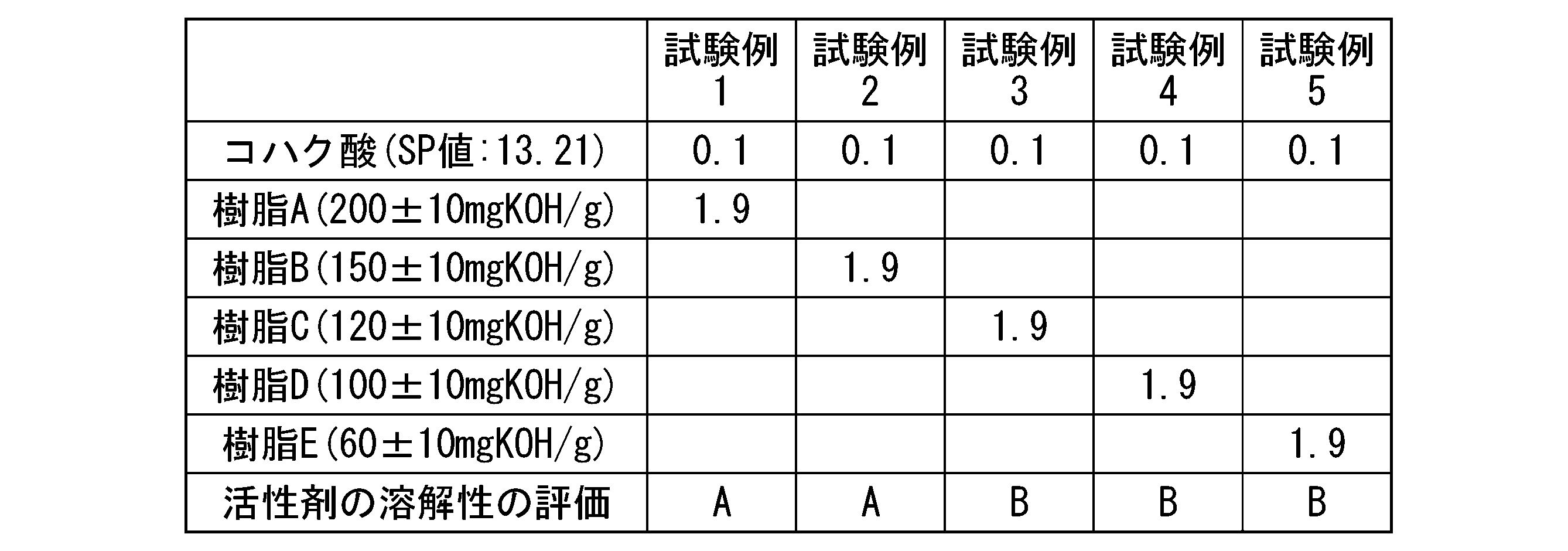
これに対し、コハク酸と、樹脂C~Eのいずれかとを含む試験例3~5は、冷却後に析出物が認められた。

これに対し、グルタル酸と、樹脂B~Eのいずれかとを含む試験例7~10は、冷却後に析出物が認められた。
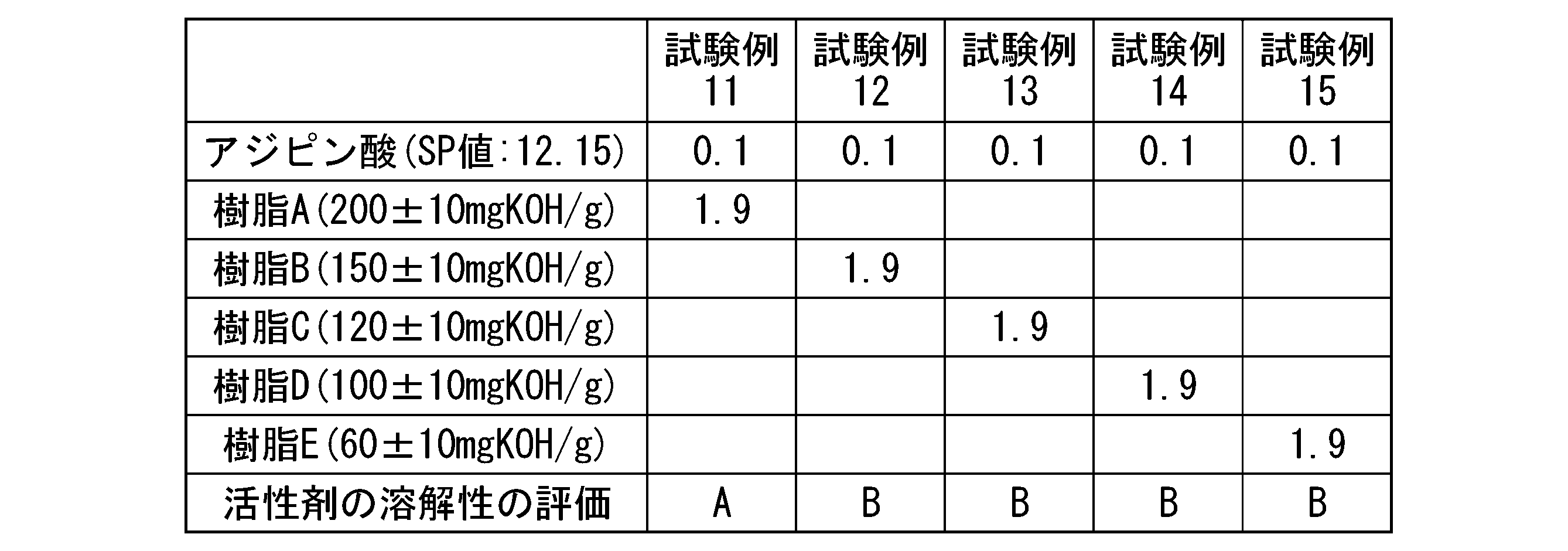
これに対し、アジピン酸と、樹脂B~Eのいずれかとを含む試験例12~15は、冷却後に析出物が認められた。
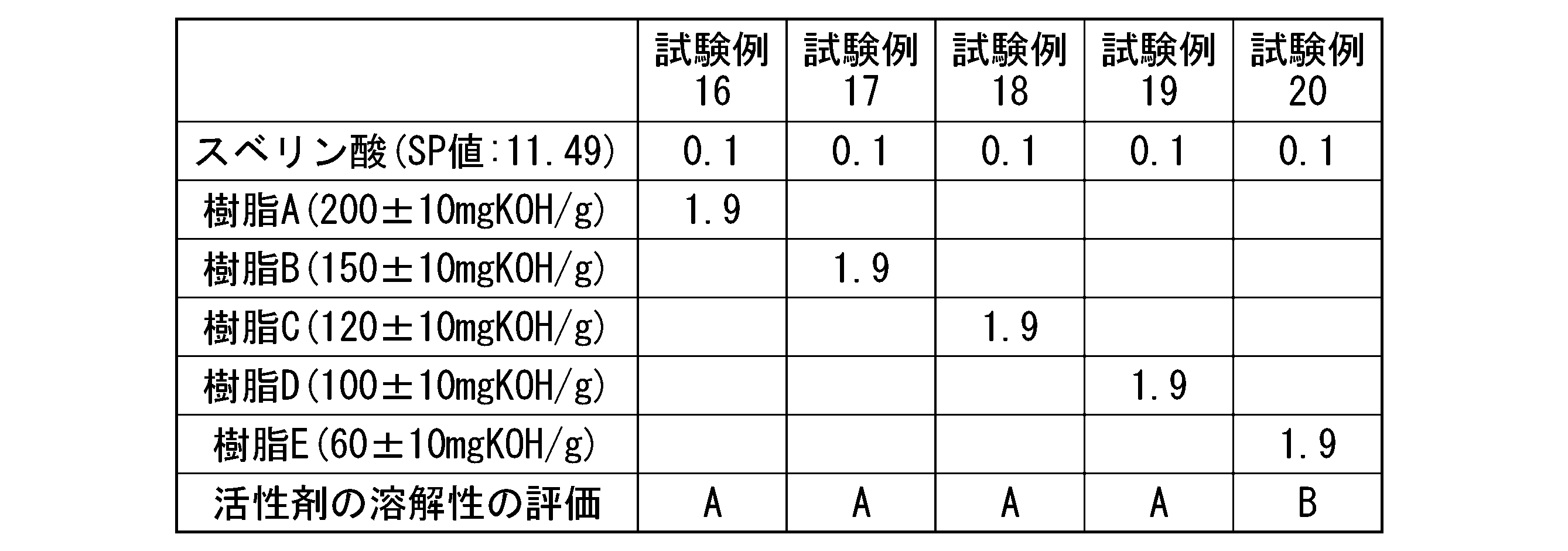
これに対し、スベリン酸と樹脂Eとを含む試験例20は、冷却後に析出物が認められた。
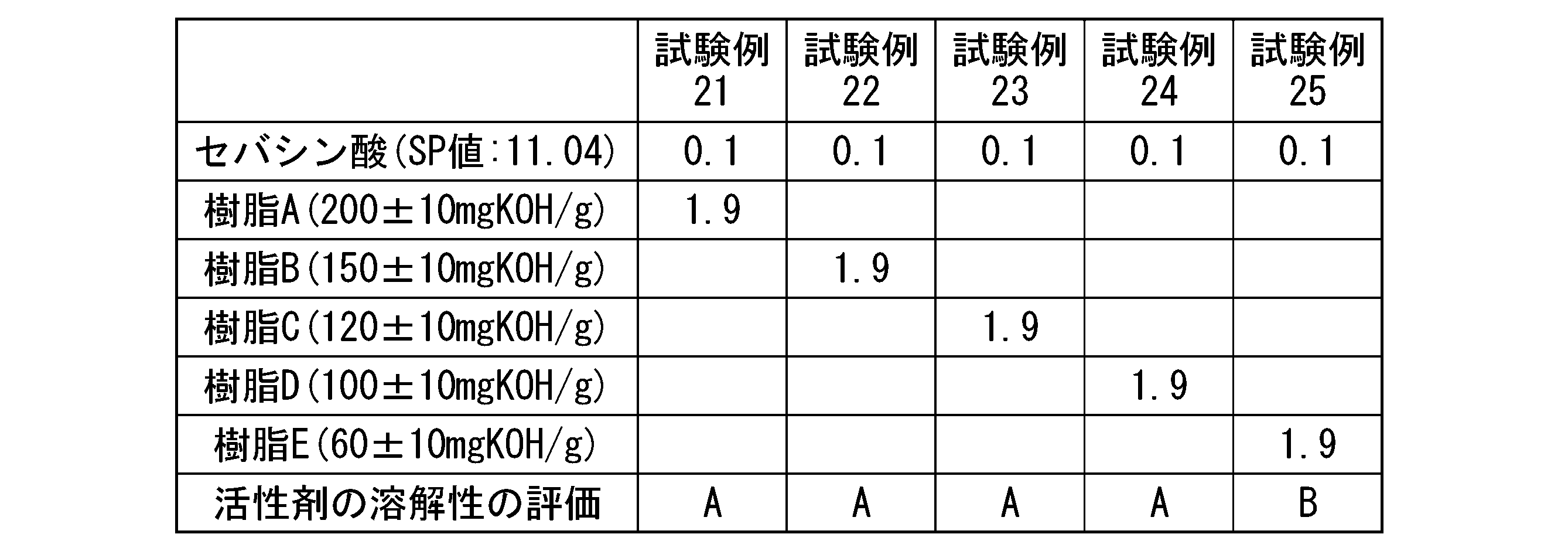
これに対し、セバシン酸と樹脂Eとを含む試験例25は、冷却後に析出物が認められた。
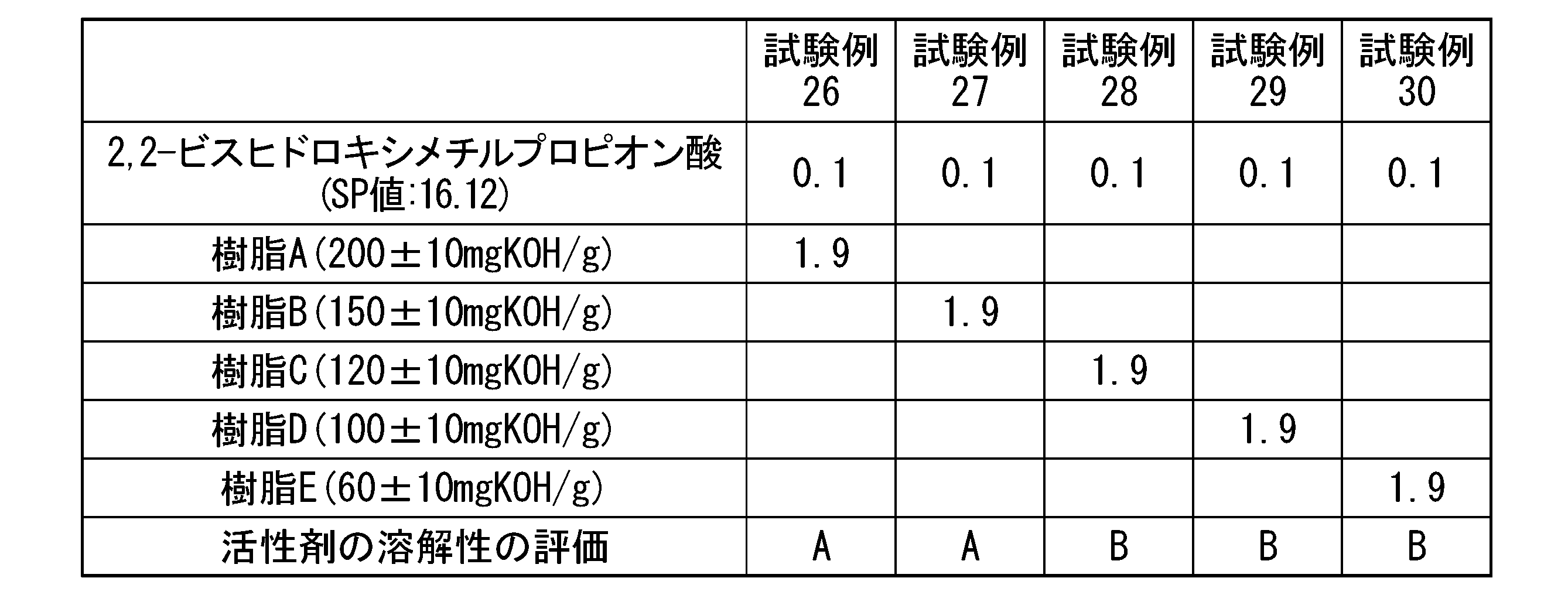
これに対し、2,2-ビスヒドロキシメチルプロピオン酸と、樹脂C~Eのいずれかとを含む試験例28~30は、冷却後に析出物が認められた。
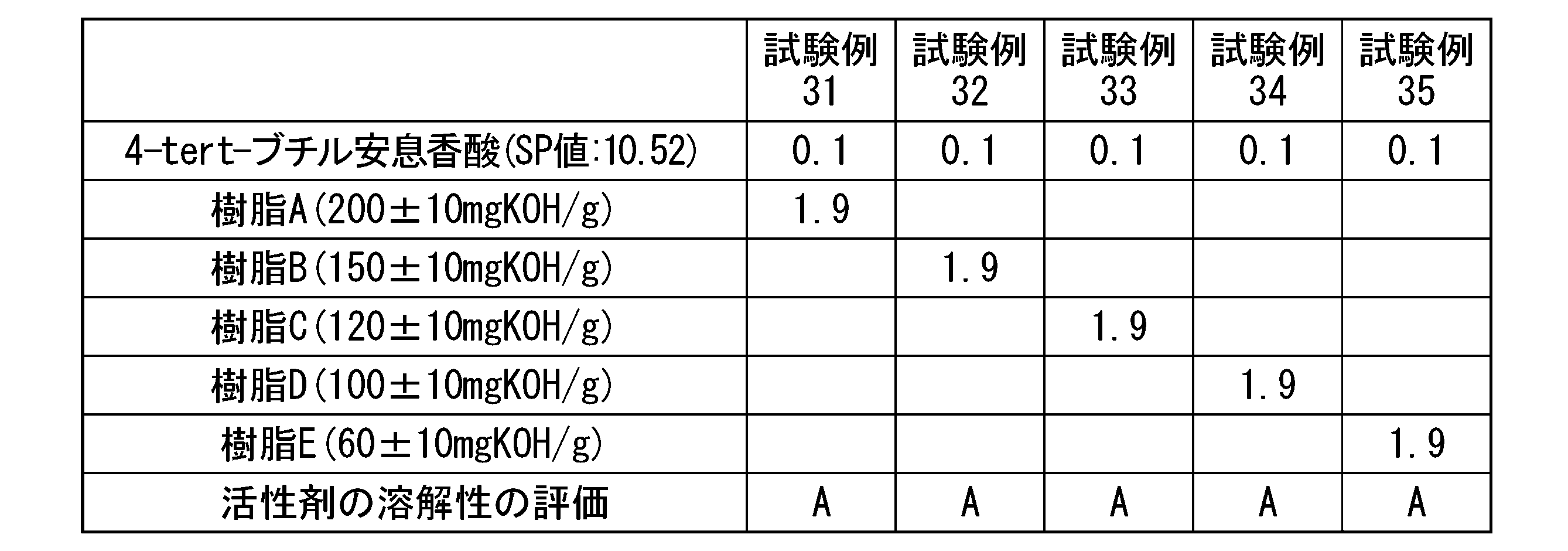
また、SP値が11.00以上である有機酸(A1)、及び、上記一般式(1)で表される有機酸(A2)は、水酸基価が70mgKOH/g以下であるテルペンフェノール樹脂に対して、溶解できないことが明らかになった。
(実施例1~23、比較例1~2、参考例1~2)
以下の表7に示す組成で実施例及び比較例のフラックスを調合した。表7における組成は、フラックスの全量を100質量%とした場合の質量%である。
2,2-ビスヒドロキシメチルプロピオン酸(SP値:16.12)
コハク酸(SP値:13.21)
グルタル酸(SP値:12.61)
アジピン酸(SP値:12.15)
スベリン酸(SP値:11.49)
セバシン酸(SP値:11.04)
その他活性剤:4-tert-ブチル安息香酸(SP値:10.52)
樹脂A 200±10mgKOH/g
樹脂B 150±10mgKOH/g
樹脂C 120±10mgKOH/g
樹脂D 100±10mgKOH/g
樹脂E 60±10mgKOH/g
その他の樹脂成分:シリコーン
酸化防止剤:キノリン化合物
母合金として、Agが3質量%、Cuが0.5質量%、残部がSnの合金からなるインゴットを用意した。
このインゴットを溶解して、溶融はんだを調製した。
《フラックス残渣の表面における析出》
検証方法:
各例のフラックスを、基板に噴霧することにより、前処理した基板を得た。
次いで、前処理した基板に対し、窒素雰囲気下で、溶融はんだを接触させることにより、フローはんだ付けを行った。
基板上のフラックス残渣の表面における析出の有無を確認し、以下の判定基準に基づいて評価を行った。結果を表8~10に示す。
A:フラックス残渣の表面に、析出物が認められなかった。
B:フラックス残渣の表面に、少量の析出物が認められた。
C:フラックス残渣の表面に、大量の析出物が認められた。
評価結果においては、AからCの順に、フラックス残渣の表面における析出物の量が増加する。評価結果が、A~Bであったフラックスは合格であり、Cであったフラックスは不合格であるとした。

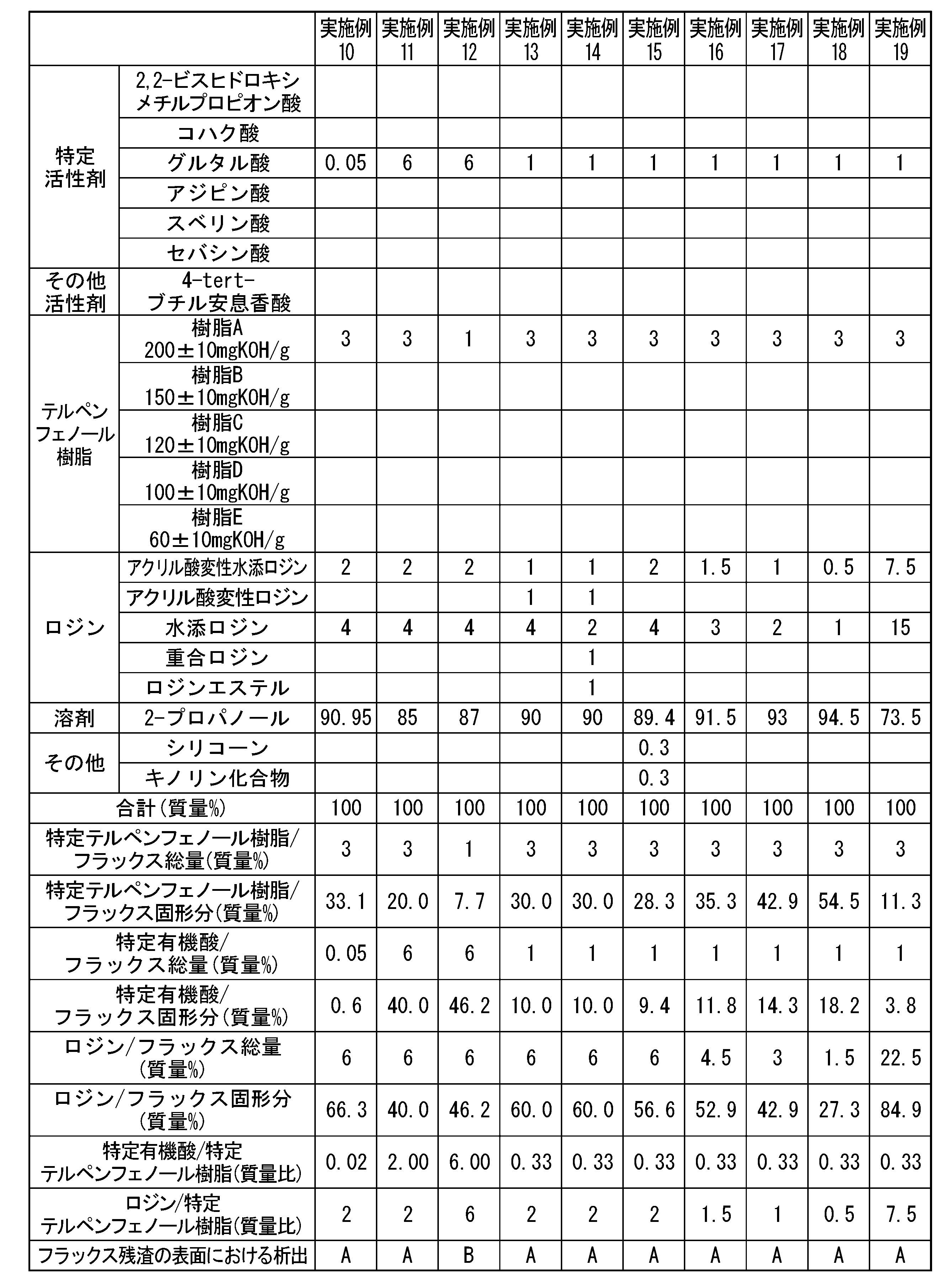

これに対し、活性の高い特定有機酸、及び、水酸基価が70mgKOH/g以下であるテルペンフェノール樹脂を含有する比較例1~2のフラックスは、フラックス残渣の表面における析出の評価が、Cであった。
また、活性が高くない有機酸及びテルペンフェノール樹脂を含有する参考例2のフラックスは、テルペンフェノール樹脂の水酸基価が70mgKOH/g以下であっても、フラックス残渣の表面における析出の評価が、Aであった。
すなわち、本発明によれば、活性の高い特定有機酸を含有する場合であっても、水酸基価が70mgKOH/g超であるテルペンフェノール樹脂を含有することにより、フラックス残渣における析出を抑制することができる。
Claims (8)
- ロジンと、テルペンフェノール樹脂と、活性剤とを含有し、
前記テルペンフェノール樹脂の水酸基価は、70mgKOH/g超であり、
前記活性剤は、溶解パラメータ(SP値)が11.00以上である有機酸(A1)を含む、フラックス。 - 前記有機酸(A1)の含有量は、フラックスの総質量(100質量%)に対して、0.05質量%以上6質量%以下である、請求項1に記載のフラックス。
- 前記有機酸(A1)の含有量の割合(質量比)は、前記テルペンフェノール樹脂の含有量(100質量部)に対して、1質量部以上600質量部以下である、請求項1又は2に記載のフラックス。
- ロジンと、テルペンフェノール樹脂と、活性剤とを含有し、
前記テルペンフェノール樹脂の水酸基価は、70mgKOH/g超であり、
前記活性剤は、下記一般式(1)で表される有機酸(A2)を含む、フラックス。
R1-COOH ・・・(1)
[式中、R1は、炭素数2~15の鎖状炭化水素基、炭素数3~15の脂環式炭化水素基、芳香族基、又はカルボキシ基を表す。ただし、前記鎖状炭化水素基及び前記脂環式炭化水素基は、それぞれ、ヒドロキシ基又はカルボキシ基を有する。] - 前記有機酸(A2)の含有量は、フラックスの総質量(100質量%)に対して、0.05質量%以上6質量%以下である、請求項4に記載のフラックス。
- 前記有機酸(A2)の含有量の割合(質量比)は、前記テルペンフェノール樹脂の含有量(100質量部)に対して、1質量部以上600質量部以下である、請求項4又は5に記載のフラックス。
- 前記テルペンフェノール樹脂の含有量は、フラックスの総質量(100質量%)に対して、0.1質量%以上20質量%以下である、請求項1~6のいずれか一項に記載のフラックス。
- 請求項1~7のいずれか一項に記載のフラックスで処理された基板の表面に、はんだ合金をはんだ付けすることにより、接合体を得る工程を含む、接合体の製造方法。
Priority Applications (2)
| Application Number | Priority Date | Filing Date | Title |
|---|---|---|---|
| MYPI2024002384A MY208555A (en) | 2021-11-08 | 2022-11-02 | Flux and production method for joined body |
| CN202280072345.0A CN118176084B (zh) | 2021-11-08 | 2022-11-02 | 助焊剂及接合体的制备方法 |
Applications Claiming Priority (2)
| Application Number | Priority Date | Filing Date | Title |
|---|---|---|---|
| JP2021182145A JP7071686B1 (ja) | 2021-11-08 | 2021-11-08 | フラックス及び接合体の製造方法 |
| JP2021-182145 | 2021-11-08 |
Publications (1)
| Publication Number | Publication Date |
|---|---|
| WO2023080146A1 true WO2023080146A1 (ja) | 2023-05-11 |
Family
ID=81653400
Family Applications (1)
| Application Number | Title | Priority Date | Filing Date |
|---|---|---|---|
| PCT/JP2022/040954 Ceased WO2023080146A1 (ja) | 2021-11-08 | 2022-11-02 | フラックス及び接合体の製造方法 |
Country Status (5)
| Country | Link |
|---|---|
| JP (1) | JP7071686B1 (ja) |
| CN (1) | CN118176084B (ja) |
| MY (1) | MY208555A (ja) |
| TW (1) | TWI895647B (ja) |
| WO (1) | WO2023080146A1 (ja) |
Cited By (1)
| Publication number | Priority date | Publication date | Assignee | Title |
|---|---|---|---|---|
| CN119730985A (zh) * | 2022-08-26 | 2025-03-28 | 千住金属工业株式会社 | 助焊剂及接合体的制备方法 |
Citations (5)
| Publication number | Priority date | Publication date | Assignee | Title |
|---|---|---|---|---|
| JP2018065982A (ja) * | 2016-10-17 | 2018-04-26 | 東洋インキScホールディングス株式会社 | 研磨部材固定用粘着剤、研磨部材固定用粘着シート、および研磨部材積層体 |
| JP2018114523A (ja) * | 2017-01-17 | 2018-07-26 | 株式会社弘輝 | フラックス及びはんだ組成物 |
| WO2020031693A1 (ja) * | 2018-08-10 | 2020-02-13 | 株式会社弘輝 | フラックス及びソルダペースト |
| JP2020189337A (ja) * | 2019-05-15 | 2020-11-26 | 株式会社弘輝 | フラックス及びソルダペースト |
| WO2020262632A1 (ja) * | 2019-06-27 | 2020-12-30 | 株式会社弘輝 | フラックス及びソルダペースト |
Family Cites Families (2)
| Publication number | Priority date | Publication date | Assignee | Title |
|---|---|---|---|---|
| CN101966632B (zh) * | 2010-09-29 | 2013-07-17 | 广州瀚源电子科技有限公司 | 一种无铅低温焊膏用免洗型助焊剂及其制备方法 |
| JP6268507B1 (ja) * | 2017-06-07 | 2018-01-31 | 千住金属工業株式会社 | やに入りはんだ用フラックス、フラックスコートはんだ用フラックス、やに入りはんだ、及びフラックスコートはんだ |
-
2021
- 2021-11-08 JP JP2021182145A patent/JP7071686B1/ja active Active
-
2022
- 2022-11-02 CN CN202280072345.0A patent/CN118176084B/zh active Active
- 2022-11-02 WO PCT/JP2022/040954 patent/WO2023080146A1/ja not_active Ceased
- 2022-11-02 TW TW111141858A patent/TWI895647B/zh active
- 2022-11-02 MY MYPI2024002384A patent/MY208555A/en unknown
Patent Citations (5)
| Publication number | Priority date | Publication date | Assignee | Title |
|---|---|---|---|---|
| JP2018065982A (ja) * | 2016-10-17 | 2018-04-26 | 東洋インキScホールディングス株式会社 | 研磨部材固定用粘着剤、研磨部材固定用粘着シート、および研磨部材積層体 |
| JP2018114523A (ja) * | 2017-01-17 | 2018-07-26 | 株式会社弘輝 | フラックス及びはんだ組成物 |
| WO2020031693A1 (ja) * | 2018-08-10 | 2020-02-13 | 株式会社弘輝 | フラックス及びソルダペースト |
| JP2020189337A (ja) * | 2019-05-15 | 2020-11-26 | 株式会社弘輝 | フラックス及びソルダペースト |
| WO2020262632A1 (ja) * | 2019-06-27 | 2020-12-30 | 株式会社弘輝 | フラックス及びソルダペースト |
Cited By (1)
| Publication number | Priority date | Publication date | Assignee | Title |
|---|---|---|---|---|
| CN119730985A (zh) * | 2022-08-26 | 2025-03-28 | 千住金属工业株式会社 | 助焊剂及接合体的制备方法 |
Also Published As
| Publication number | Publication date |
|---|---|
| JP2023069919A (ja) | 2023-05-18 |
| TWI895647B (zh) | 2025-09-01 |
| TW202336162A (zh) | 2023-09-16 |
| CN118176084A (zh) | 2024-06-11 |
| JP7071686B1 (ja) | 2022-05-19 |
| MY208555A (en) | 2025-05-14 |
| CN118176084B (zh) | 2025-03-18 |
Similar Documents
| Publication | Publication Date | Title |
|---|---|---|
| CN109996646B (zh) | 助焊剂和焊膏 | |
| TWI846548B (zh) | 助焊劑及焊料膏 | |
| TWI868811B (zh) | 助焊劑及焊料膏 | |
| WO2022255234A1 (ja) | フラックス及びソルダペースト | |
| TWI907739B (zh) | 水溶性助焊劑及焊膏 | |
| US12365054B2 (en) | Flux and solder paste | |
| TWI895647B (zh) | 助焊劑及接合體的製造方法 | |
| WO2023106188A1 (ja) | フラックス及び接合体の製造方法 | |
| JP2023055425A (ja) | フラックス及びソルダペースト | |
| JP7557143B2 (ja) | フラックス及び接合体の製造方法 | |
| JP7730045B2 (ja) | フラックス及びソルダペースト | |
| JP7011212B1 (ja) | フラックス及び接合体の製造方法 | |
| HK40106439B (zh) | 助焊剂及接合体的制备方法 | |
| HK40106439A (zh) | 助焊剂及接合体的制备方法 | |
| HK40107925A (zh) | 助焊剂及接合体的制备方法 | |
| HK40107925B (zh) | 助焊剂及接合体的制备方法 | |
| JP7783547B1 (ja) | 水洗浄用フラックス及び水洗浄用ソルダペースト | |
| JP2023117164A (ja) | フラックス及びソルダペースト | |
| HK40118947B (zh) | 助焊剂及焊膏 | |
| HK40118947A (zh) | 助焊剂及焊膏 | |
| HK40102409A (zh) | 助焊剂和接合体的制备方法 | |
| HK40114072A (zh) | 助焊剂及焊膏 |
Legal Events
| Date | Code | Title | Description |
|---|---|---|---|
| 121 | Ep: the epo has been informed by wipo that ep was designated in this application |
Ref document number: 22889966 Country of ref document: EP Kind code of ref document: A1 |
|
| WWE | Wipo information: entry into national phase |
Ref document number: 12024550926 Country of ref document: PH |
|
| WWE | Wipo information: entry into national phase |
Ref document number: 202280072345.0 Country of ref document: CN |
|
| WWE | Wipo information: entry into national phase |
Ref document number: 2401002773 Country of ref document: TH |
|
| 122 | Ep: pct application non-entry in european phase |
Ref document number: 22889966 Country of ref document: EP Kind code of ref document: A1 |
|
| WWG | Wipo information: grant in national office |
Ref document number: 202280072345.0 Country of ref document: CN |