WO2023074576A1 - ポリカーボネート樹脂 - Google Patents
ポリカーボネート樹脂 Download PDFInfo
- Publication number
- WO2023074576A1 WO2023074576A1 PCT/JP2022/039329 JP2022039329W WO2023074576A1 WO 2023074576 A1 WO2023074576 A1 WO 2023074576A1 JP 2022039329 W JP2022039329 W JP 2022039329W WO 2023074576 A1 WO2023074576 A1 WO 2023074576A1
- Authority
- WO
- WIPO (PCT)
- Prior art keywords
- group
- carbon atoms
- substituted
- unsubstituted
- polycarbonate resin
- Prior art date
- Legal status (The legal status is an assumption and is not a legal conclusion. Google has not performed a legal analysis and makes no representation as to the accuracy of the status listed.)
- Ceased
Links
Classifications
-
- C—CHEMISTRY; METALLURGY
- C08—ORGANIC MACROMOLECULAR COMPOUNDS; THEIR PREPARATION OR CHEMICAL WORKING-UP; COMPOSITIONS BASED THEREON
- C08G—MACROMOLECULAR COMPOUNDS OBTAINED OTHERWISE THAN BY REACTIONS ONLY INVOLVING UNSATURATED CARBON-TO-CARBON BONDS
- C08G64/00—Macromolecular compounds obtained by reactions forming a carbonic ester link in the main chain of the macromolecule
- C08G64/16—Aliphatic-aromatic or araliphatic polycarbonates
- C08G64/1608—Aliphatic-aromatic or araliphatic polycarbonates saturated
-
- C—CHEMISTRY; METALLURGY
- C08—ORGANIC MACROMOLECULAR COMPOUNDS; THEIR PREPARATION OR CHEMICAL WORKING-UP; COMPOSITIONS BASED THEREON
- C08G—MACROMOLECULAR COMPOUNDS OBTAINED OTHERWISE THAN BY REACTIONS ONLY INVOLVING UNSATURATED CARBON-TO-CARBON BONDS
- C08G64/00—Macromolecular compounds obtained by reactions forming a carbonic ester link in the main chain of the macromolecule
- C08G64/04—Aromatic polycarbonates
-
- C—CHEMISTRY; METALLURGY
- C08—ORGANIC MACROMOLECULAR COMPOUNDS; THEIR PREPARATION OR CHEMICAL WORKING-UP; COMPOSITIONS BASED THEREON
- C08G—MACROMOLECULAR COMPOUNDS OBTAINED OTHERWISE THAN BY REACTIONS ONLY INVOLVING UNSATURATED CARBON-TO-CARBON BONDS
- C08G64/00—Macromolecular compounds obtained by reactions forming a carbonic ester link in the main chain of the macromolecule
- C08G64/20—General preparatory processes
- C08G64/30—General preparatory processes using carbonates
-
- C—CHEMISTRY; METALLURGY
- C08—ORGANIC MACROMOLECULAR COMPOUNDS; THEIR PREPARATION OR CHEMICAL WORKING-UP; COMPOSITIONS BASED THEREON
- C08J—WORKING-UP; GENERAL PROCESSES OF COMPOUNDING; AFTER-TREATMENT NOT COVERED BY SUBCLASSES C08B, C08C, C08F, C08G or C08H
- C08J5/00—Manufacture of articles or shaped materials containing macromolecular substances
- C08J5/18—Manufacture of films or sheets
-
- G—PHYSICS
- G02—OPTICS
- G02B—OPTICAL ELEMENTS, SYSTEMS OR APPARATUS
- G02B5/00—Optical elements other than lenses
- G02B5/30—Polarising elements
-
- C—CHEMISTRY; METALLURGY
- C08—ORGANIC MACROMOLECULAR COMPOUNDS; THEIR PREPARATION OR CHEMICAL WORKING-UP; COMPOSITIONS BASED THEREON
- C08J—WORKING-UP; GENERAL PROCESSES OF COMPOUNDING; AFTER-TREATMENT NOT COVERED BY SUBCLASSES C08B, C08C, C08F, C08G or C08H
- C08J2369/00—Characterised by the use of polycarbonates; Derivatives of polycarbonates
Definitions
- the present disclosure relates to a polycarbonate resin, a polycarbonate resin molded article, a film, a method for producing a transparent film, and a retardation film.
- Patent Document 1 discloses a polycarbonate copolymer having an oligofluorene structural unit and a retardation film using the same. A retardation film exhibiting properties is disclosed.
- Patent Document 2 a structure derived from 6,6'-dihydroxy-3,3,3',3'-tetramethyl-1,1'-spirobiindane (hereinafter sometimes abbreviated as SBI) A polycarbonate copolymer containing units and a retardation film using the same are disclosed, which are excellent in heat resistance and optical properties.
- SBI 6,6'-dihydroxy-3,3,3',3'-tetramethyl-1,1'-spirobiindane
- organic EL displays have come to be used as in-vehicle displays, and the retardation film used in organic EL displays must function without problems even in harsher usage environments than before. is being sought.
- organic EL displays for automobiles are used under high temperature and high humidity, so the retardation film is required to have higher resistance to heat and humidity than conventional ones.
- some of the polycarbonate copolymers described in Patent Documents 1 and 2 satisfy the required optical properties, they have insufficient moisture and heat resistance, and can be used under higher temperature conditions and higher humidity atmospheres than before. However, the optical characteristics were insufficient. There is also room for improvement in mechanical properties such as toughness and melt processability.
- the present disclosure has been made in view of such a background, with excellent optical properties, moist heat resistance and mechanical properties, polycarbonate resin with high melt processability, molded articles obtained using it, films, retardation films, and to provide a method for producing a transparent film.
- a first aspect of the present disclosure is a structural unit (A) represented by the following formula (1) and/or the following formula (2), A structural unit (B) represented by the following formula (3); and a structural unit (C) derived from a dihydroxy compound having an acetal ring structure.
- R 1 to R 3 each independently represent a direct bond or a substituted or unsubstituted alkylene group having 1 to 4 carbon atoms.
- R 4 to R 9 are each independently a hydrogen atom, a substituted or unsubstituted alkyl group having 1 to 10 carbon atoms, a substituted or unsubstituted aryl group having 6 to 10 carbon atoms, a substituted or unsubstituted acyl group having 2 to 10 carbon atoms, substituted or unsubstituted alkoxy group having 1 to 10 carbon atoms, substituted or unsubstituted aryloxy group having 6 to 10 carbon atoms, substituted or unsubstituted amino group, substitution or an unsubstituted vinyl group having 2 to 10 carbon atoms, a substituted or unsubstituted ethynyl group having 2 to 10 carbon atoms, a sulfur atom having a substituent, a silicon atom having a substituent, a
- R 10 to R 17 are each independently a hydrogen atom, a substituted or unsubstituted alkyl group having 1 to 20 carbon atoms, or a substituted or unsubstituted aryl group having 6 to 10 carbon atoms.
- X 1 represents a direct bond or a divalent hydrocarbon group having 1 to 20 carbon atoms.
- a second aspect of the present disclosure resides in a polycarbonate resin molded article composed of the above polycarbonate resin.
- a third aspect of the present disclosure is a film composed of the polycarbonate resin.
- a fourth aspect of the present disclosure is a retardation film made of the above film.
- a fifth aspect of the present disclosure is a circularly polarizing plate including the retardation film.
- a sixth aspect of the present disclosure resides in an image display device including the above-described circle changing plate.
- a seventh aspect of the present disclosure is a method for producing a transparent film by molding the polycarbonate resin by a melt film-forming method, A method for producing a transparent film, wherein the polycarbonate resin is molded at a molding temperature of 280° C. or less.
- An eighth aspect of the present disclosure is a structural unit (A) represented by the above formula (1) and/or the above formula (2), and a structural unit (B) represented by the above formula (3), a glass transition temperature of 120° C. or higher and 160° C. or lower;
- the polycarbonate resin has a water absorption of 1.4% or less.
- the polycarbonate resin has a structural unit having a specific oligofluorene structure and a specific copolymer component. Therefore, the polycarbonate resin has excellent optical properties and high moisture and heat resistance.
- polycarbonate resins are excellent in mechanical properties such as toughness and in melt processability.
- polycarbonate resin molded articles, films, retardation films, and circular polarizers composed of the polycarbonate resin have high moisture and heat resistance, and are excellent in optical properties and mechanical properties. Further, since the image display device has the circular polarizing plate, it can be suitably used for a flexible display, an in-vehicle display that requires high moisture and heat resistance, and the like.
- the above polycarbonate resin is molded by a melt film forming method at a molding temperature of 280°C or less.
- a transparent film having excellent mechanical properties such as toughness and optical properties and having high resistance to moist heat is produced.
- the term “structural unit” refers to a partial structure sandwiched between adjacent linking groups in a polymer, a polymerizable group present at the terminal portion of the polymer, and the polymerizable reactive group. It refers to a partial structure sandwiched between adjacent linking groups.
- ⁇ when used in this specification, it is used in the sense of including the numerical values or physical values described before and after it. Numerical values or physical values described as the upper limit and the lower limit are used in the sense of including those values.
- “%” means “% by weight” unless otherwise specified. Further, “parts by weight” and “parts by mass”, and “% by weight” and “% by mass” are substantially synonymous.
- polycarbonate resin is a concept that includes not only polycarbonate resin but also polyester carbonate resin.
- a polyester carbonate resin is a polymer containing a portion in which the structural units constituting the polymer are linked not only by carbonate bonds but also by ester bonds.
- a polycarbonate resin is composed of at least a structural unit (A), a structural unit (B) and a structural unit (C), and has a large number of these structural units in the polymer chain.
- Polycarbonate resin is, for example, a random copolymer.
- Structural unit (A) is represented by the following formula (1) and/or the following formula (2). That is, the polycarbonate resin has a structural unit represented by the formula (1) and/or a structural unit represented by the formula (2) as the structural unit (A).
- Structural unit (B) is represented by the following formula (3).
- Structural unit (C) is a structural unit derived from a dihydroxy compound having an acetal ring structure. An acetal ring structure is also called a cyclic acetal structure.
- R 1 to R 3 are each independently a direct bond, a substituted or unsubstituted alkylene group having 1 to 4 carbon atoms.
- R 4 to R 9 each independently represent a hydrogen atom, a substituted or unsubstituted alkyl group having 1 to 10 carbon atoms, a substituted or unsubstituted aryl group having 6 to 10 carbon atoms, or a substituted or unsubstituted 2 carbon atoms -10 acyl groups, substituted or unsubstituted alkoxy groups having 1 to 10 carbon atoms, substituted or unsubstituted aryloxy groups having 6 to 10 carbon atoms, substituted or unsubstituted amino groups, substituted or unsubstituted carbon atoms 2 to 10 vinyl groups, substituted or unsubstituted ethynyl groups having 2 to 10 carbon atoms, substituted sulfur atoms, substituted silicon atoms, halogen atoms, nitro
- R 10 to R 17 each independently represent a hydrogen atom, a substituted or unsubstituted alkyl group having 1 to 20 carbon atoms, or a substituted or unsubstituted aryl group having 6 to 10 carbon atoms.
- X 1 represents a direct bond or a divalent hydrocarbon group having 1 to 20 carbon atoms.
- the polycarbonate resin contains structural units (A) composed of structural units represented by the following formula (1) and/or structural units represented by the following formula (2).
- the structural unit may be referred to as "oligofluorene structural unit”.
- R 1 to R 3 each independently represent a direct bond or a substituted or unsubstituted alkylene group having 1 to 4 carbon atoms.
- R 4 to R 9 each independently represents a hydrogen atom, a substituted or unsubstituted alkyl group having 1 to 10 carbon atoms, a substituted or unsubstituted aryl group having 6 to 10 carbon atoms, or a substituted or unsubstituted 2 carbon atoms ⁇ 10 acyl group, substituted or unsubstituted alkoxy group having 1 to 10 carbon atoms, substituted or unsubstituted aryloxy group having 6 to 10 carbon atoms, substituted or unsubstituted amino group, substituted or unsubstituted carbon number 2 to 10 vinyl groups, substituted or unsubstituted ethynyl groups having 2 to 10 carbon atoms, substituted sulfur atoms, substituted silicon atoms, halogen atoms, nitro groups
- R 4 to R 9 may be the same or different, and at least two adjacent groups among R 4 to R 9 may combine with each other to form a ring.
- the polycarbonate resin should contain a structural unit represented by formula (2). is preferred.
- alkylene groups can be employed. Specifically, linear alkylene groups such as methylene group, ethylene group, n-propylene group, n-butylene group; methylmethylene group, dimethylmethylene group, ethylmethylene group, propylmethylene group, (1-methylethyl ) methylene group, 1-methylethylene group, 2-methylethylene group, 1-ethylethylene group, 2-ethylethylene group, 1-methylpropylene group, 2-methylpropylene group, 1,1-dimethylethylene group, 2, Examples thereof include branched alkylene groups such as 2-dimethylpropylene group and 3-methylpropylene group.
- linear alkylene groups such as methylene group, ethylene group, n-propylene group, n-butylene group; methylmethylene group, dimethylmethylene group, ethylmethylene group, propylmethylene group, (1-methylethyl ) methylene group, 1-methylethylene group, 2-methylethylene group, 1-ethyl
- R 1 and R 2 are preferably ethylene groups from the viewpoint that the fluorene rings in the polymer are easily oriented perpendicularly to the main chain direction and exhibit stronger reverse wavelength dispersion.
- R1 and R2 can be related to the development of inverse dispersion wavelength dependence.
- Polycarbonate resin exhibits the strongest reverse dispersion wavelength dependence in a state in which the fluorene rings are oriented perpendicular to the main chain direction (stretching direction).
- R 1 and R 2 having 2 to 3 carbon atoms in the main chain of the alkylene group. preferable.
- the number of carbon atoms is 1, there are cases where, unexpectedly, reverse dispersion wavelength dependence is not exhibited.
- alkylene groups can be employed. Specifically, linear alkylene groups such as methylene group, ethylene group, n-propylene group, n-butylene group; methylmethylene group, dimethylmethylene group, ethylmethylene group, propylmethylene group, (1-methylethyl ) methylene group, 1-methylethylene group, 2-methylethylene group, 1-ethylethylene group, 2-ethylethylene group, 1-methylpropylene group, 2-methylpropylene group, 1,1-dimethylethylene group, 2, Examples include branched alkylene groups such as 2-dimethylpropylene group and 3-methylpropylene group.
- linear alkylene groups such as methylene group, ethylene group, n-propylene group, n-butylene group; methylmethylene group, dimethylmethylene group, ethylmethylene group, propylmethylene group, (1-methylethyl ) methylene group, 1-methylethylene group, 2-methylethylene group, 1-ethylethylene
- R 3 preferably has 1 to 2 carbon atoms on the main chain of the alkylene group, more preferably 1 carbon atom. If the number of carbon atoms on the main chain is too large, the fixation of the fluorene ring is weakened as in the case of R1 and R2 , resulting in a decrease in reverse dispersion wavelength dependence, an increase in the photoelastic coefficient, a decrease in heat resistance, etc. may invite. On the other hand, the smaller the number of carbon atoms on the main chain, the better the optical properties and heat resistance.
- Substituents for R 1 to R 3 include, for example, a halogen atom (specifically, a fluorine atom, a chlorine atom, a bromine atom, or an iodine atom); an alkoxy group having 1 to 10 carbon atoms such as a methoxy group and an ethoxy group ; acyl group having 1 to 10 carbon atoms such as acetyl group and benzoyl group; acylamino group having 1 to 10 carbon atoms such as acetamide group and benzoylamide group; nitro group; cyano group; -10 aryl groups are included.
- a halogen atom specifically, a fluorine atom, a chlorine atom, a bromine atom, or an iodine atom
- an alkoxy group having 1 to 10 carbon atoms such as a methoxy group and an ethoxy group
- acyl group having 1 to 10 carbon atoms such as acety
- alkyl groups can be employed as the substituted or unsubstituted alkyl group for R 4 to R 9 .
- linear alkyl groups such as methyl group, ethyl group, n-propyl group, n-butyl group, n-pentyl group, n-hexyl, n-decyl; isopropyl group, 2-methylpropyl group , 2,2-dimethylpropyl group and 2-ethylhexyl group; and cyclic alkyl groups such as cyclopropyl group, cyclopentyl group, cyclohexyl group and cyclooctyl group.
- the number of carbon atoms in the alkyl group is preferably 4 or less, more preferably 2 or less. When the number of carbon atoms is within this range, steric hindrance between fluorene rings is less likely to occur, and desired optical properties derived from the fluorene rings are likely to be obtained.
- Substituents for the alkyl group include the substituents described above for R 1 to R 3 .
- the substituted or unsubstituted aryl group for R 4 to R 9 for example, the following aryl groups can be employed. Specific examples include aryl groups such as phenyl group, 1-naphthyl group and 2-naphthyl group; heteroaryl groups such as 2-pyridyl group, 2-thienyl group and 2-furyl group.
- the number of carbon atoms in the aryl group is preferably 8 or less, more preferably 7 or less. When the number of carbon atoms is within this range, steric hindrance between fluorene rings is less likely to occur, and desired optical properties derived from the fluorene rings are likely to be obtained.
- Substituents for the aryl group include the substituents described above for R 1 to R 3 .
- acyl groups such as formyl group, acetyl group, propionyl group, 2-methylpropionyl group, 2,2-dimethylpropionyl group, and 2-ethylhexanoyl group; benzoyl group, 1-naphthylcarbonyl group, Aromatic acyl groups such as 2-naphthylcarbonyl group and 2-furylcarbonyl group can be mentioned.
- the number of carbon atoms in the acyl group is preferably 4 or less, more preferably 2 or less.
- Substituents for the acyl group include the substituents described above for R 1 to R 3 .
- substituted or unsubstituted alkoxy group or aryloxy group for R 4 to R 9 for example, the following can be employed. Specific examples include a methoxy group, an ethoxy group, an isopropoxy group, a tert-butoxy group, a trifluoromethoxy group, and a phenoxy group.
- the number of carbon atoms in the alkoxy group or aryloxy group is preferably 4 or less, more preferably 2 or less. When the number of carbon atoms is within this range, steric hindrance between fluorene rings is less likely to occur, and desired optical properties derived from the fluorene rings are likely to be obtained.
- Substituents for the alkoxy group or aryloxy group include the substituents described above for R 1 to R 3 .
- the substituted or unsubstituted amino group for R 4 to R 9 for example, the following amino groups can be employed. Specifically, an amino group; N-methylamino group, N,N-dimethylamino group, N-ethylamino group, N,N-diethylamino group, N,N-methylethylamino group, N-propylamino group, N,N-dipropylamino group, N-isopropylamino group, N,N-diisopropylamino group and other aliphatic amino groups; N-phenylamino group, N,N-diphenylamino group and other aromatic amino groups; formamide acylamino groups such as radicals, acetamide group, decanoylamide group, benzoylamide group and chloroacetamide group; alkoxycarbonylamino groups such as benzyloxycarbonylamino group and tert-butyloxycarbonylamino group.
- the amino group is preferably an N,N-dimethylamino group, an N-ethylamino group, or an N,N-diethylamino group, more preferably an N,N-dimethylamino group.
- the amino group does not have protons with high acidity and the molecular weight of the amino group is small, the fluorene ratio can be increased. Therefore, in addition to improving the thermal stability, it is possible to reduce the amount of the monomer having an oligofluorene structural unit.
- Examples of substituted or unsubstituted vinyl or ethynyl groups for R 4 to R 9 include the following. Specifically, vinyl group, 2-methylvinyl group, 2,2-dimethylvinyl group, 2-phenylvinyl group, 2-acetylvinyl group, ethynyl group, methylethynyl group, tert-butylethynyl group, phenylethynyl group , an acetylethynyl group, and a trimethylsilylethynyl group.
- the number of carbon atoms in the vinyl group or ethynyl group is preferably 4 or less.
- the substituted sulfur atom for R 4 to R 9 for example, the following sulfur-containing groups can be employed. Specifically, sulfo group; alkylsulfonyl group such as methylsulfonyl group, ethylsulfonyl group, propylsulfonyl group and isopropylsulfonyl group; arylsulfonyl group such as phenylsulfonyl group and p-tolylsulfonyl group; methylsulfinyl group, ethylsulfinyl alkylsulfinyl groups such as phenylsulfinyl group and p-tolylsulfinyl group; alkylthio groups such as methylthio group and ethylthio group; arylthio groups such as phenylthio group and p-tolylthio group; Alkoxysulfonyl groups such as
- the sulfo group may form a salt with lithium, sodium, potassium, magnesium, ammonium or the like.
- the sulfur-containing group is preferably a methylsulfinyl group, an ethylsulfinyl group, or a phenylsulfinyl group, more preferably a methylsulfinyl group.
- the sulfur-containing group does not have protons with high acidity and the molecular weight of the sulfur-containing group is small, so that the fluorene ratio can be increased. Therefore, in addition to improving the thermal stability, it is possible to reduce the amount of the monomer having an oligofluorene structural unit.
- silyl groups As silicon atoms having substituents in R 4 to R 9 , for example, the following silyl groups can be employed. Specific examples include trialkylsilyl groups such as trimethylsilyl group and triethylsilyl group; and trialkoxysilyl groups such as trimethoxysilyl group and triethoxysilyl group. Trialkylsilyl groups are preferred. This is because it is excellent in stability and handleability.
- a fluorine atom, a chlorine atom, a bromine atom and an iodine atom can be employed as the halogen atom.
- a fluorine atom, a chlorine atom, or a bromine atom from the viewpoint that it is relatively easy to introduce and has a tendency to increase the reactivity of the fluorene 9-position due to its electron-withdrawing property.
- a chlorine atom or a bromine atom is more preferably employed.
- Specific examples of the ring formed by binding together at least two adjacent groups among R 4 to R 9 include substituted fluorene structures shown in the following group [I].
- group [I] the wavy line indicates that the bond connecting the 9-position of the fluorene structure to R1 and R2 or R2 and R3 is schematically omitted.
- the structural unit (A ) is preferably 1% by mass or more, more preferably 3% by mass or more, still more preferably 5% by mass or more, particularly preferably 7% by mass or more, and 10 % or more is most preferable.
- an improvement in the expression of the retardation is expected, and the ratio of the structural unit (A) in the resin can be reduced, thereby widening the range of molecular design.
- the content of the structural unit (A) is preferably 45% by mass or less, more preferably 40% by mass or less, from the viewpoint of facilitating improvement when the resin is required to be modified. It is more preferably not more than 30% by mass, and particularly preferably not more than 30% by mass.
- the linking group is specifically a carbonate group or an ester group present at the end of each structural unit.
- the content of the structural unit (A) is the total content of the structural unit represented by the formula (1) and the structural unit represented by the formula (2). , the content of the other is zero.
- Methods for adjusting the ratio of oligofluorene structural units in the resin include, for example, a method of copolymerizing a monomer having an oligofluorene structural unit and another monomer, and a method of copolymerizing a resin containing an oligofluorene structural unit with another resin.
- a method of blending is mentioned.
- the content of oligofluorene structural units can be precisely controlled, high transparency can be obtained, and uniform properties can be obtained over the entire surface of the film. method is preferred.
- a polycarbonate resin contains a structural unit (B) represented by the following formula (3).
- R 10 to R 17 each independently represent a hydrogen atom, a substituted or unsubstituted alkyl group having 1 to 20 carbon atoms, or a substituted or unsubstituted aryl group having 6 to 10 carbon atoms.
- X 1 represents a direct bond or a divalent hydrocarbon group having 1 to 20 carbon atoms.
- X 1 in formula (3) is a divalent hydrocarbon group having 1 to 20 carbon atoms
- the hydrocarbon group is a substituted or unsubstituted chain alkylene group having 1 to 20 carbon atoms, a substituted or It is preferably an unsubstituted cyclic alkylene group having 6 to 20 carbon atoms, an arylene group having 6 to 20 carbon atoms, or a fluorenylene group having 13 to 20 carbon atoms.
- effects such as improvement in heat resistance and reduction in water absorption can be obtained.
- chain alkylene groups and cyclic alkylene groups include -CH 2 -, -CH(CH 3 )-, -C(CH 3 ) 2 -, -CH(Ph)-, and -C(CH 3 )Ph- , —CPh 2 —, 1,2-ethylene group, 1,3-propylene group, 1,4-butylene group, 1,1-cyclopropylene group, 1,1-cyclobutylene group, 1,1-cyclopentylene group, 1,1-cyclohexylene group, 3,3,5-trimethyl-1,1-cyclohexylene group, 1,1-cyclododecylene group, 1,2-cyclopropylene group, 1,2-cyclobutylene group, 1 ,2-cyclopentylene group, 1,2-cyclohexylene group, 1,3-cyclobutylene group, 1,3-cyclopentylene group, 1,3-cyclohexylene group, 1,4-cyclohexylene group, etc.
- Ph is an unsubstituted phenyl group.
- Arylene groups include 1,2-phenylene groups, 1,3-phenylene groups and 1,4-phenylene groups.
- the fluorenylene group includes a 9,9-fluorenylene group.
- X 1 is a divalent hydrocarbon group having 1 to 20 carbon atoms
- the bonding positions on the benzene ring in the above formula (3) are 2,2′-position, 2,3′-position, 2,4 It may be at the '-position, 3,3'-position, 3,4'-position or 4,4'-position, preferably 4,4'-position. In this case, mechanical properties are further improved.
- the biphenyl skeleton in the above formula (3) is 2,2′-biphenyl skeleton, 2,3′-biphenyl skeleton, 2,4′-biphenyl skeleton, 3,3′- A biphenyl skeleton, a 3,4'-biphenyl skeleton, or a 4,4'-biphenyl skeleton may be used, but the 4,4'-biphenyl skeleton is preferred.
- X 1 in formula (3) is even more preferably -CH 2 -, -CH(CH 3 )-, -C(CH 3 ) 2 -, - CH(Ph)—, —C(CH 3 )Ph—, —CPh 2 —, 9,9-fluorenylene group, 1,1-cyclohexylene group, 3,3,5-trimethyl-1,1-cyclohexylene group , 1,1-cyclododecylene group.
- R 10 to R 17 each independently represent a hydrogen atom, a substituted or unsubstituted alkyl group having 1 to 20 carbon atoms, or a substituted or unsubstituted aryl group.
- the substituted or unsubstituted alkyl group having 1 to 20 carbon atoms may be linear, branched or cyclic, and may have a substituent such as a phenyl group. things are mentioned.
- substituted or unsubstituted aryl groups include phenyl, o-tolyl, m-tolyl, p-tolyl, ethylphenyl, styryl, xylyl, n-propylphenyl, isopropylphenyl, A phenyl group and a naphthyl group which may have a substituent such as an alkyl group, such as a mesityl group, an ethynylphenyl group, a naphthyl group and a vinylnaphthyl group.
- R 10 to R 17 are still more preferably a hydrogen atom or an alkyl group having 1 to 4 carbon atoms, particularly preferably a hydrogen atom or a methyl group.
- dihydroxy compound from which the structural unit (B) is derived examples include 2,2-bis(4-hydroxyphenyl)propane, 2,2-bis(3-methyl -4-hydroxyphenyl)propane, 2,2-bis(4-hydroxy-3,5-dimethylphenyl)propane, 2,2-bis(4-hydroxy-3,5-diethylphenyl)propane, 2,2- Bis(4-hydroxy-(3-phenyl)phenyl)propane, 2,2-bis(4-hydroxy-(3,5-diphenyl)phenyl)propane, 2,2-bis(4-hydroxy-3,5- Dibromophenyl)propane, bis(4-hydroxyphenyl)methane, 1,1-bis(4-hydroxyphenyl)ethane, 2,2-bis(4-hydroxyphenyl)butane, 2,2-bis(4-hydroxyphenyl) ) Pentane, 1,1-bis(4-(4-)propane, 2,2-bis(3-methyl -4-hydroxy
- the dihydroxy compound from which the structural unit (B) is derived is 2,2-bis(4-hydroxy-3,5-dimethylphenyl)propane, 1,1-bis(4-hydroxyphenyl)cyclohexane, 4, 4'-(cyclododecane-1,1-diyl)diphenol, 1,1-bis(4-hydroxyphenyl)-3,3,5-trimethylcyclohexane, 4,4'-(cyclododecane-1,1-diyl)diphenol, 4,4'-( ⁇ -methylbenzylidene)bisphenol and 9,9-bis(4-hydroxy-3-methylphenyl)fluorene.
- Structural unit (B) preferably contains at least one selected from the group consisting of the following formulas (6) to (11), and at least one selected from the group consisting of the following formulas (8) to (11) It is more preferable to contain the following formula (8) and/or the following formula (9) is particularly preferable, and the following formula (8) is most preferable.
- the heat resistance of the resin can be improved and the water absorption can be reduced. That is, the heat resistance can be efficiently improved and the water absorption can be efficiently reduced.
- the photoelastic coefficient of the polycarbonate resin can be reduced, and the mechanical properties of the polymer are also improved.
- the structural unit (B) relative to the total amount of 100% by mass of all the structural units and linking groups that constitute the polycarbonate resin
- the content of is preferably 5% by mass or more, more preferably 10% by mass or more, still more preferably 15% by mass or more, even more preferably 20% by mass or more, and 25 % by mass or more is most preferred.
- the content of the structural unit (B) is preferably 50% by mass or less, more preferably 45% by mass or less, and 40% by mass. % or less, and particularly preferably 35 mass % or less.
- the polycarbonate resin contains a structural unit (C) derived from a dihydroxy compound having an acetal ring structure.
- a dihydroxy compound having an acetal ring structure for example, dioxane glycol represented by the following formula (13) and/or spiroglycol represented by the formula (14) can be used.
- Structural unit (C) is preferably a structural unit derived from spiroglycol represented by formula (14). In this case, the heat resistance of the polycarbonate resin can be enhanced and the photoelastic coefficient can be reduced.
- the total amount of all structural units and linking groups constituting the polycarbonate resin is 100% by mass.
- the content of the structural unit (C) for the is particularly preferred. From the same viewpoint, the content of the structural unit (C) is preferably 75% by mass or less, more preferably 70% by mass or less, even more preferably 65% by mass or less, and 60% by mass or less. % by mass or less is particularly preferred.
- the polycarbonate resin may contain a structural unit (D) derived from at least one compound selected from the group consisting of an aliphatic dihydroxy compound, an alicyclic dihydroxy compound, an oxyalkylene glycol, and a dihydroxy compound having a heterocyclic structure.
- Structural unit (D) means a structural unit other than structural units (A) to (C), and does not include an acetal ring structure even if it has a heterocyclic ring structure.
- the structural unit (D) is selected from the group consisting of aliphatic dihydroxy compounds, alicyclic dihydroxy compounds, and dihydroxy compounds having a heterocyclic structure other than an acetal ring structure. It is preferably a structural unit derived from at least one compound.
- aliphatic dihydroxy compounds include ethylene glycol, 1,2-propanediol, 1,3-propanediol, 1,2-butanediol, 1,3-butanediol, 1,4-butanediol, 1,2 -pentanediol, 1,3-pentanediol, 1,4-pentanediol, 1,5-pentanediol, 1,2-hexanediol, 1,3-hexanediol, 1,4-hexanediol, 1,5- Hexanediol, 1,6-hexanediol, 1,7-heptanediol, 1,8-octanediol, 1,9-nonanediol, 1,10-decanediol, 1,11-undecanediol, 1,12-dodecane Linear aliphatic dihydroxy compounds such as diol
- ethylene glycol, 1,3-propanediol, 1,4-butanediol, 1,5-pentanediol, 1,6-hexanediol, 1,7-heptanediol, 1,8-octanediol, 1 ,9-nonanediol, 1,10-decanediol, 1,11-undecanediol, 1,12-dodecanediol and other linear aliphatic dihydroxy compounds are available and easy to handle. preferable.
- alicyclic dihydroxy compounds include the following dihydroxy compounds. Specifically, 1,2-cyclohexanedimethanol, 1,3-cyclohexanedimethanol, 1,4-cyclohexanedimethanol, tricyclodecanedimethanol, pentacyclopentadecanedimethanol, 2,6-decanedimethanol, 1 ,5-decalindimethanol, 2,3-decalindimethanol, 2,3-norbornanedimethanol, 2,5-norbornanedimethanol, 1,3-adamantanedimethanol, dihydroxy compounds derived from terpene compounds such as limonene 1,2-cyclohexanediol, 1,4-cyclohexanediol, 1,3-adamantanediol, hydrogenated bisphenol A, 2,2, Examples include dihydroxy compounds that are secondary alcohols or tertiary alcohols of alicyclic hydrocarbons, such as 4,4-tetramethyl-1,3-cyclo
- oxyalkylene glycols for example, diethylene glycol, triethylene glycol, tetraethylene glycol, polyethylene glycol, polypropylene glycol, polytetramethylene glycol, etc. can be used.
- dihydroxy compounds having a heterocyclic structure examples include dihydroxy compounds represented by the following formula (12).
- dihydroxy compounds represented by the above formula (12) examples include isosorbide, isomannide, and isoidet, which are related to stereoisomers.
- isosorbide which is abundant as a resource, is easily available, and is obtained by dehydration condensation of sorbitol produced from various starches, is easy to obtain and easy to produce. It is most preferred from the aspect of moldability.
- These dihydroxy compounds (12) may be used singly or in combination of two or more.
- Structural unit (D) is preferably a structural unit derived from the compound of formula (12). In this case, effects such as development of high heat resistance and favorable polymerization reactivity can be obtained.
- the structural unit (C) is a structural unit derived from the compound of formula (14), and the structural unit (D) is a structural unit of the formula It is preferably a structural unit derived from the compound (12).
- the structural unit derived from the compound represented by formula (14) is represented by the following formula (4), and the structural unit derived from the compound represented by formula (12) is represented by the following formula (5) .
- At least one compound selected from the group consisting of the aliphatic dihydroxy compounds, alicyclic dihydroxy compounds, oxyalkylene glycols, and dihydroxy compounds having a heterocyclic structure includes 1,6-hexanediol, 2,2,4 ,4-tetramethyl-1,3-cyclobutanediol, 1,4-cyclohexanedimethanol, tricyclodecanedimethanol, isosorbide, dioxane glycol and spiroglycol are preferred, and isosorbide and spiroglycol are particularly preferred.
- Polycarbonate resins containing structural units derived from these monomers have an even better balance of optical properties, heat resistance, mechanical properties, and the like.
- the total amount of all structural units and linking groups constituting the polycarbonate resin is 100% by mass.
- the total content of the structural unit (C) and the structural unit (D) is preferably 20% by mass or more, more preferably 25% by mass or more, and even more preferably 30% by mass or more , 35% by mass or more.
- the total content of the structural unit (C) and the structural unit (D) is preferably 80% by mass or less, more preferably 75% by mass or less, and 70% by mass or less. More preferably, the content is particularly preferably 65% by mass or less.
- R 18 and R 19 are each an optionally substituted aliphatic hydrocarbon group having 1 to 18 carbon atoms, or an optionally substituted C 6 to 10 and R 18 and R 19 may be the same or different.
- R 18 and R 19 are preferably substituted or unsubstituted aromatic hydrocarbon groups, more preferably unsubstituted aromatic hydrocarbon groups.
- substituents for the aliphatic hydrocarbon group include ester groups, ether groups, amide groups and halogen atoms
- substituents for the aromatic hydrocarbon group include alkyl groups such as methyl and ethyl. be done.
- Examples of the diester carbonate represented by the formula (15) include diphenyl carbonate (hereinafter sometimes abbreviated as DPC), substituted diphenyl carbonate such as ditolyl carbonate, dimethyl carbonate, diethyl carbonate and di-tert- Dialkyl carbonates such as butyl carbonate are exemplified, but diphenyl carbonate and substituted diphenyl carbonate are preferred, and diphenyl carbonate is particularly preferred.
- DPC diphenyl carbonate
- substituted diphenyl carbonate such as ditolyl carbonate, dimethyl carbonate, diethyl carbonate and di-tert- Dialkyl carbonates
- butyl carbonate diphenyl carbonate and substituted diphenyl carbonate are preferred, and diphenyl carbonate is particularly preferred.
- Carbonic acid diesters may contain impurities such as chloride ions, and these impurities may inhibit the polymerization reaction or deteriorate the hue of the resulting resin. It is preferred to use purified ones.
- the polycarbonate resin preferably has the physical properties described below.
- the glass transition temperature of the polycarbonate resin is preferably 120° C. or higher, more preferably 125° C. or higher, and even more preferably 130° C. or higher. When the glass transition temperature is at least the above lower limit, sufficient heat resistance can be obtained. Also, the glass transition temperature of the polycarbonate resin is preferably 160° C. or lower, more preferably 155° C. or lower, and even more preferably 150° C. or lower. When the glass transition temperature is equal to or lower than the above upper limit, the melt processability is improved.
- the glass transition temperature of the polycarbonate resin can be measured by the method described in Examples. The glass transition temperature of the polycarbonate resin can be appropriately adjusted, for example, by changing the types and ratios of the structural units that constitute the resin.
- the water absorption of the polycarbonate resin is preferably 1.4% or less, more preferably 1.3% or less, still more preferably 1.2% or less, particularly preferably 1.1% or less, and most preferably 1%. .0% or less.
- the water absorption of the polycarbonate resin can be measured by the method described below.
- the water absorption rate of the polycarbonate resin can be appropriately adjusted, for example, by changing the type and ratio of structural units constituting the resin.
- the viscosity of the polycarbonate resin is preferably 25 ⁇ 10 ⁇ 12 Pa or less, more preferably 22 ⁇ 10 ⁇ 12 Pa or less, still more preferably 19 ⁇ 10 ⁇ 12 Pa or less, even more preferably 16 ⁇ 10 ⁇ 12 Pa or less, and 15 ⁇ 10 ⁇ 12 Pa or less is particularly preferable, and 14 ⁇ 10 ⁇ 12 Pa or less is most preferable.
- the photoelastic coefficient is equal to or less than the above upper limit, sufficient environmental reliability (visibility does not change depending on usage environment) can be obtained when the polycarbonate resin is used as a retardation film. This property is particularly important for large display devices, flexible displays, and when used in high-temperature and high-humidity environments.
- the structural unit (A) represented by the formula (1) or (2) and the structural unit (B) represented by the formula (3) photoelastic It becomes possible to keep the coefficient lower.
- a polycarbonate resin can be produced by a generally used polymerization method.
- it can be produced using a solution polymerization method or an interfacial polymerization method using phosgene or a carboxylic acid halide, or a melt polymerization method in which a reaction is performed without using a solvent.
- the melt polymerization method is preferable because it does not use a solvent or a highly toxic compound, so that the environmental load can be reduced and the productivity is excellent.
- the solvent When a solvent is used for polymerization, the solvent may remain in the polycarbonate resin, and its plasticizing effect lowers the glass transition temperature of the polycarbonate resin. obtain.
- Halogen-based organic solvents such as methylene chloride are often used as solvents. It can also cause corrosion of parts. Since the polycarbonate resin obtained by the melt polymerization method does not contain a solvent, it is advantageous in terms of processing steps and stabilization of product quality.
- a monomer having the structural unit described above, a diester carbonate, and a polymerization catalyst are mixed, and a transesterification reaction (also referred to as a polycondensation reaction) is carried out under melting.
- the reaction rate is increased while removing the desorbed components out of the system.
- the reaction proceeds to the target molecular weight under high temperature and high vacuum conditions.
- the molten polycarbonate resin is withdrawn from the reactor. Thus, a polycarbonate resin is obtained.
- the reaction rate and the molecular weight of the resulting polycarbonate resin can be controlled by strictly adjusting the molar ratio of all dihydroxy compounds and all diester compounds used in the reaction.
- the molar ratio of diester carbonate to all dihydroxy compounds is preferably adjusted to 0.90 to 1.10, more preferably 0.96 to 1.08, and more preferably 0.98 to 1 Adjustment to 0.06 is particularly preferred.
- the molar ratio of the total amount of carbonic acid diester and all diester compounds to all dihydroxy compounds is preferably adjusted to 0.90 to 1.10, and adjusted to 0.96 to 1.08. is more preferable, and adjusting to 0.98 to 1.06 is particularly preferable.
- the above molar ratio deviates significantly up or down, it will not be possible to produce a resin with the desired molecular weight.
- the above molar ratio is too small, the number of terminal hydroxy groups in the produced resin increases, and the thermal stability of the resin may deteriorate. In addition, a large amount of unreacted dihydroxy compound remains in the polycarbonate resin, which may cause contamination of the molding machine and poor appearance of the molded product in the subsequent molding process.
- the above molar ratio is too large, the speed of the transesterification reaction will decrease under the same conditions, or the residual amount of carbonic acid diesters and diester compounds in the produced polycarbonate resin will increase. Residual low molecular weight components can also lead to problems in the molding process.
- the melt polymerization method is usually carried out in a multistage process of two or more stages.
- the polycondensation reaction may be carried out in two or more stages by using one polymerization reactor and sequentially changing the conditions, or by using two or more reactors and changing the respective conditions to perform two or more stages. However, from the viewpoint of production efficiency, it is carried out using two or more, preferably three or more reactors.
- the polycondensation reaction may be batch type, continuous type, or a combination of batch type and continuous type, but the continuous type is preferred from the viewpoint of production efficiency and quality stability.
- the polycondensation reaction it is important to appropriately control the balance between temperature and pressure in the reaction system. If either the temperature or the pressure is changed too quickly, unreacted monomers may distill out of the reaction system. As a result, the molar ratio of the dihydroxy compound and the diester compound changes, and a polycarbonate resin with a desired molecular weight may not be obtained. Moreover, the polymerization rate of the polycondensation reaction is controlled by the balance between the hydroxyl group terminal and the ester group terminal or carbonate group terminal.
- the wavelength dispersion of the retardation is controlled by the ratio of the fluorene-based monomer and other copolymer components in the polycarbonate resin. There is a risk that it will not be possible.
- the process of the melt polycondensation reaction will be described below by dividing it into a step of consuming monomers to produce oligomers and a step of allowing polymerization to proceed to a desired molecular weight to produce polymers.
- the following conditions can be employed as reaction conditions in the first stage reaction. That is, the internal temperature of the polymerization reactor is usually 130° C. or higher, preferably 150° C. or higher, more preferably 170° C. or higher, and usually 250° C. or lower, preferably 240° C. or lower, more preferably 230° C. or lower. set.
- the pressure in the polymerization reactor is usually 70 kPa or less (hereinafter, pressure represents absolute pressure), preferably 50 kPa or less, more preferably 30 kPa or less, and usually 1 kPa or more, preferably 3 kPa or more, more preferably.
- pressure represents absolute pressure
- the reaction time is set in the range of usually 0.1 hour or longer, preferably 0.5 hour or longer, and usually 10 hours or shorter, preferably 5 hours or shorter, more preferably 3 hours or shorter.
- the first-stage reaction is carried out while distilling off the generated monohydroxy compound derived from the diester compound out of the reaction system.
- the monohydroxy compound distilled out of the reaction system in the first stage reaction is phenol.
- the pressure of the reaction system is gradually lowered from the pressure of the first stage, and the subsequently generated monohydroxy compound is removed from the reaction system, while the pressure of the reaction system is finally reduced to 5 kPa or less. It is preferably 3 kPa or less, more preferably 1 kPa or less.
- the internal temperature is set in the range of usually 210° C. or higher, preferably 220° C. or higher, and usually 270° C. or lower, preferably 260° C. or lower.
- the reaction time is usually 0.1 hour or more, preferably 0.5 hour or more, more preferably 1 hour or more, and usually 10 hours or less, preferably 5 hours or less, more preferably 3 hours or less. set.
- the maximum temperature of the internal temperature in all reaction stages is 270° C. or less, preferably 265° C. or less, more preferably 260° C. or less. do it.
- the transesterification reaction catalyst (hereinafter sometimes simply referred to as catalyst or polymerization catalyst) that can be used during polymerization has a very large effect on the reaction rate and the color tone and thermal stability of the polycarbonate resin obtained by polycondensation. obtain.
- the catalyst to be used is not limited as long as it can satisfy the transparency, hue, heat resistance, thermal stability, and mechanical strength of the polycarbonate resin produced.
- group hereinafter simply referred to as “group 1” and “group 2”) metal compounds, basic boron compounds, basic phosphorus compounds, basic ammonium compounds, basic compounds such as amine compounds.
- at least one metal compound selected from the group consisting of metals of Group 2 of the long period periodic table and lithium is used.
- Group 1 metal compound for example, the following compounds can be adopted, but it is also possible to adopt Group 1 metal compounds other than these.
- Group 2 metal compound for example, the following compounds can be adopted, but Group 2 metal compounds other than these can also be adopted.
- Group 1 metal compound and/or Group 2 metal compound it is also possible to use a basic compound such as a basic boron compound, a basic phosphorus compound, a basic ammonium compound, an amine compound, etc. However, it is particularly preferable to use at least one metal compound selected from the group consisting of metals of Group 2 of the long period periodic table and lithium.
- the amount of the polymerization catalyst used is generally 0.1 ⁇ mol to 300 ⁇ mol, preferably 0.5 ⁇ mol to 100 ⁇ mol, per 1 mol of all dihydroxy compounds used in the polymerization.
- the amount of metal is The above polymerization catalyst is usually used in an amount of 1.0 ⁇ mol or more, preferably 5.0 ⁇ mol or more, particularly preferably 10 ⁇ mol or more per 1 mol of the total dihydroxy compound.
- the amount of the polymerization catalyst used is generally 300 ⁇ mol or less, preferably 200 ⁇ mol or less, and particularly preferably 100 ⁇ mol or less.
- a diester compound when used as a monomer to produce a polyester carbonate resin, a titanium compound, a tin compound, a germanium compound, an antimony compound, a zirconium compound, and lead are used in combination with or without the basic compound.
- Compounds, osmium compounds, zinc compounds, manganese compounds, and other transesterification catalysts can also be used.
- the amount of these transesterification catalysts to be used is usually in the range of 1 ⁇ mol to 1 mmol, preferably in the range of 5 ⁇ mol to 800 ⁇ mol, particularly preferably in the range of 5 ⁇ mol to 800 ⁇ mol, in terms of metal amount, per 1 mol of the total dihydroxy compounds used in the reaction. 10 ⁇ mol to 500 ⁇ mol.
- the amount of catalyst is too small, the polymerization rate will be slow, so the polymerization temperature will have to be raised accordingly in order to obtain a polycarbonate resin with a desired molecular weight. For this reason, the hue of the resulting polycarbonate resin is likely to deteriorate, and unreacted raw materials volatilize during polymerization, resulting in a loss of the molar ratio of the dihydroxy compound and the diester compound, which may prevent the desired molecular weight from being reached. have a nature.
- the amount of the polymerization catalyst used is too large, undesirable side reactions may occur concurrently, resulting in deterioration of the hue of the resulting polycarbonate resin and coloration or decomposition of the polycarbonate resin during molding.
- the Group 1 metals sodium, potassium, and cesium may adversely affect the hue if contained in polycarbonate resin in large amounts. These metals may be mixed not only from the catalyst used, but also from raw materials and reactors. Regardless of the source, the total amount of these metal compounds in the polycarbonate resin is preferably 2 ⁇ mol or less, preferably 1 ⁇ mol or less, and more preferably 0.5 ⁇ mol or less per 1 mol of all the dihydroxy compounds.
- the pelletization method is not limited, but may be a method of withdrawing in a molten state from the final-stage polymerization reactor, cooling and solidifying in the form of strands and pelletizing, a method of uniaxially or in a molten state from the final-stage polymerization reactor.
- the polycarbonate resin is supplied again to a single-screw or twin-screw extruder after being made into a single-screw or twin-screw extruder, melt-extruded, and then solidified by cooling to form pellets.
- the polycarbonate resin is suitable for optical applications, it is preferable that the content of foreign matter in the polycarbonate resin is small. In order to remove foreign matters such as scorch and gel in the polycarbonate resin obtained by melt polycondensation, it is preferable to perform filtration using a filter. Above all, after the polycarbonate resin is melt-extruded with the above-mentioned vented twin-screw extruder in order to remove residual monomers, by-product phenol, etc. by devolatilizing under reduced pressure and to mix additives such as heat stabilizers and release agents. , preferably through a filter.
- the shape of this filter a known shape such as a candle type, pleated type, leaf disc type, etc. can be used.
- the mesh size of the filter is preferably 50 ⁇ m or less, more preferably 40 ⁇ m or less, and even more preferably 20 ⁇ m or less, as a filtration accuracy of 99%. When it is desired to particularly reduce foreign matter, the filter mesh size is preferably 10 ⁇ m or less. 99% filtration accuracy is preferably 1 ⁇ m or more.
- the opening of the filter mentioned here is determined in accordance with ISO16889.
- the polycarbonate resin filtered by the above filter is extruded from the die head in the form of a strand, cooled and solidified, and pelletized with a rotary cutter or the like. is preferably performed in a clean room with a higher degree of cleanliness than Class 7, more preferably Class 6, defined in JISB 9920:2002, in order to prevent contamination from outside air.
- a cooling method such as air cooling or water cooling. It is desirable to prevent redeposition of foreign matter.
- water cooling it is desirable to use water from which metals have been removed with an ion exchange resin or the like, and foreign matter has been removed from the water with a water filter.
- the mesh size of the water filter to be used is preferably 10 to 0.45 ⁇ m as filtration accuracy for 99% removal.
- the polycarbonate resin may be blended with a heat stabilizer in order to prevent a decrease in molecular weight and a deterioration in hue during melt processing.
- heat stabilizers include commonly known hindered phenol heat stabilizers and/or phosphorus heat stabilizers.
- hindered phenol compound for example, the following compounds can be employed. 2,6-di-tert-butylphenol, 2,4-di-tert-butylphenol, 2-tert-butyl-4-methoxyphenol, 2-tert-butyl-4,6-dimethylphenol, 2,6-di- tert-butyl-4-methylphenol, 2,6-di-tert-butyl-4-ethylphenol, 2,5-di-tert-butylhydroquinone, n-octadecyl-3-(3',5'-di- tert-butyl-4'-hydroxyphenyl)propionate, 2-tert-butyl-6-(3'-tert-butyl-5 '-methyl-2'-hydroxybenzyl)-4-methylphenyl acrylate, 2,2'-methylene-bis-(4-methyl-6-tert-butylphenol), 2,2'-methylene-bis-(6- cyclo
- phosphorus compound for example, the following phosphorous acid, phosphoric acid, phosphonous acid, phosphonic acid, esters thereof, and the like can be used, but phosphorus compounds other than these compounds can also be used. It is possible. triphenylphosphite, tris(nonylphenyl)phosphite, tris(2,4-di-tert-butylphenyl)phosphite, tridecylphosphite, trioctylphosphite, trioctadecylphosphite, didecylmonophenylphosphite , dioctylmonophenylphosphite, diisopropylmonophenylphosphite, monobutyldiphenylphosphite, monodecyldiphenylphosphite, monooctyldiphenylphosphite, bis(2,6-di-tert
- Such a heat stabilizer may be added to the reaction solution during melt polymerization, or may be added to the polycarbonate resin using an extruder and kneaded.
- the heat stabilizer or the like may be added to the extruder to form the film, or the heat stabilizer or the like may be added to the polycarbonate resin in advance using an extruder. Alternatively, it may be used in the form of pellets or the like.
- the blending amount of these heat stabilizers is preferably 0.0001 parts by mass or more, more preferably 0.0005 parts by mass or more, further preferably 0.001 parts by mass or more, when the polycarbonate resin is 100 parts by mass. , is preferably 3.0 parts by mass or less, more preferably 2.5 parts by mass or less, and even more preferably 2.0 parts by mass or less.
- Catalyst deactivator Color tone and thermal stability can be improved by adding an acidic compound to the polycarbonate resin to neutralize and deactivate the catalyst used in the polymerization reaction.
- an acidic compound used as the catalyst deactivator a compound having a carboxylic acid group, a phosphoric acid group, a sulfonic acid group, or an ester thereof can be used. It is preferable to use a phosphorus-based compound containing a partial structure represented by.
- Phosphorus compounds represented by formula (16) or (17) above include phosphoric acid, phosphorous acid, phosphonic acid, hypophosphorous acid, polyphosphoric acid, phosphonic acid esters, acidic phosphate esters, and the like.
- phosphorous acid, phosphonic acid, and phosphonic acid esters are more effective in deactivating the catalyst and suppressing coloration, and phosphorous acid is particularly preferred.
- Phosphonic acids include phosphonic acid (phosphorous acid), methylphosphonic acid, ethylphosphonic acid, vinylphosphonic acid, decylphosphonic acid, phenylphosphonic acid, benzylphosphonic acid, aminomethylphosphonic acid, methylenediphosphonic acid, 1-hydroxyethane- 1,1-diphosphonic acid, 4-methoxyphenylphosphonic acid, nitrilotris (methylenephosphonic acid), propylphosphonic anhydride and the like.
- Phosphonates include dimethyl phosphonate, diethyl phosphonate, bis(2-ethylhexyl) phosphonate, dilauryl phosphonate, dioleyl phosphonate, diphenyl phosphonate, dibenzyl phosphonate, dimethyl methylphosphonate, diphenyl methylphosphonate, and ethylphosphonic acid.
- Acidic phosphates include dimethyl phosphate, diethyl phosphate, divinyl phosphate, dipropyl phosphate, dibutyl phosphate, bis(butoxyethyl) phosphate, bis(2-ethylhexyl) phosphate, diisotridecyl phosphate, phosphoric acid Phosphate diesters such as dioleyl, distearyl phosphate, diphenyl phosphate and dibenzyl phosphate, mixtures of diesters and monoesters, diethyl chlorophosphate, zinc stearyl phosphate and the like.
- the amount of the phosphorus-based compound to be added corresponds to the amount of the catalyst used in the polymerization reaction.
- the amount of phosphorus atoms in the phosphorus-based compound is preferably 0.5 to 5 times mol, more preferably 0.7 to 4 times mol, relative to 1 mol of the metal of the catalyst used in the polymerization reaction. It is preferably 0.8-fold mol or more and 3-fold mol or less is particularly preferable.
- Aromatic polycarbonates aromatic polyesters, aliphatic polyesters, polyamides, polystyrenes, polyolefins, acrylics, amorphous polyolefins, ABS, AS, polylactic acid, and polybutylene succinate are used for the purpose of modifying properties such as mechanical properties and solvent resistance.
- a polymer alloy may be obtained by kneading one or more of synthetic resins such as phosphates, rubbers, elastomers, etc. with the polycarbonate resin.
- the above-mentioned additives and modifiers are produced by mixing the above-mentioned components with the polycarbonate resin at the same time or in any order using a mixer such as a tumbler, a V-type blender, a Nauta mixer, a Banbury mixer, a kneading roll, and an extruder.
- a mixer such as a tumbler, a V-type blender, a Nauta mixer, a Banbury mixer, a kneading roll, and an extruder.
- kneading with an extruder, particularly a twin-screw extruder is preferable from the viewpoint of improving dispersibility.
- Method for producing retardation film As a method for forming an unstretched film using a polycarbonate resin, there is a casting method in which the polycarbonate resin is dissolved in a solvent and then cast, and then the solvent is removed.
- a melt film-forming method can be employed. Specific examples of the melt film-forming method include a melt extrusion method using a T-die, a calendar molding method, a hot press method, a co-extrusion method, a co-melting method, a multi-layer extrusion method, an inflation molding method, and the like.
- the method of forming the unstretched film is not particularly limited, but since the casting method may cause problems due to the residual solvent, the melt film forming method is preferable, and in particular, the T-die is used because of the ease of the subsequent stretching process. A hot melt extrusion method is preferred.
- the forming temperature is preferably 280°C or lower, more preferably 270°C or lower, and particularly preferably 265°C or lower. If the molding temperature is too high, there is a possibility that defects due to the generation of foreign matter or air bubbles in the resulting film will increase, or that the film will be colored. However, if the molding temperature is too low, the melt viscosity of the polycarbonate resin will be too high, making it difficult to mold the original film and making it difficult to produce an unstretched film with a uniform thickness. is usually 200°C, preferably 210°C, more preferably 220°C.
- the molding temperature of the unstretched film is the temperature at the time of molding in the melt film-forming method, and is usually the value obtained by measuring the temperature of the polycarbonate resin at the outlet of the die for extruding the molten polycarbonate resin.
- the thickness of the unstretched film is determined according to the design of the thickness of the retardation film after stretching and the stretching conditions such as the stretching ratio. Therefore, it is usually 30 ⁇ m or more, preferably 40 ⁇ m or more, more preferably 50 ⁇ m or more, and is usually 200 ⁇ m or less, preferably 160 ⁇ m or less, more preferably 120 ⁇ m or less.
- the thickness of the part used as the retardation film is preferably a set thickness ⁇ 3 ⁇ m or less, and a set thickness ⁇ 2 ⁇ m or less. It is more preferable that there is a thickness, and it is particularly preferable that the thickness is ⁇ 1 ⁇ m or less.
- the length of the unstretched film in the longitudinal direction is preferably 500 m or longer, more preferably 1000 m or longer, and particularly preferably 1500 m or longer. From the viewpoint of productivity and quality, it is preferable to stretch continuously when manufacturing a retardation film. If the length is too short, the amount of product that can be obtained after conditioning will decrease.
- the term "long" means that the dimension in the longitudinal direction is sufficiently larger than the width direction of the film, and the film can be substantially wound in the longitudinal direction to form a coil. means. More specifically, it means that the dimension in the longitudinal direction of the film is at least ten times greater than the dimension in the width direction.
- the unstretched film obtained as described above preferably has an internal haze of 3% or less, more preferably 2% or less, and particularly preferably 1% or less. If the internal haze of the unstretched film is greater than the above upper limit, light scattering may occur, which may cause depolarization, for example, when laminated with a polarizer. Although the lower limit of the internal haze is not specified, it is usually 0.1%.
- a transparent film with adhesive which had been measured in advance, was attached to both sides of the unstretched film, and the sample in which the influence of external haze was removed was used. The internal haze value is obtained by subtracting the haze value from the measured value of the above sample.
- a retardation film can be obtained by stretching orienting the unstretched film.
- known methods such as vertical uniaxial stretching, horizontal uniaxial stretching using a tenter or the like, simultaneous biaxial stretching combining them, and sequential biaxial stretching can be used. Stretching may be performed in batch mode, but continuous stretching is preferred in terms of productivity. Further, the continuous method can provide a retardation film with less variation in retardation in the film plane than the batch method.
- the stretching temperature is in the range of (Tg ⁇ 20° C.) to (Tg+30° C.), preferably (Tg ⁇ 10° C.) to (Tg+20° C.), with respect to the glass transition temperature (Tg) of the polycarbonate resin used as the raw material. More preferably, it is within the range of (Tg-5°C) to (Tg+15°C).
- the draw ratio is determined by the desired retardation value, and is 1.2 to 4 times, more preferably 1.5 to 3.5 times, and still more preferably 2 to 3 times in both the longitudinal and lateral directions. . If the draw ratio is too small, the effective range in which the desired degree of orientation and orientation angle can be obtained is narrowed. On the other hand, if the draw ratio is too large, the film may break or wrinkle during drawing.
- the stretching rate is also appropriately selected depending on the purpose, but the strain rate represented by the following formula is usually 50 to 2000%/min, preferably 100 to 1500%/min, more preferably 200 to 1000%/min, especially Preferably, it can be selected to be 250-500%/min.
- An excessively high drawing speed may cause breakage during drawing, or increase the variation in optical properties due to long-term use under high-temperature conditions.
- the drawing speed is too low, not only is the productivity lowered, but the draw ratio must be excessively increased to obtain the desired retardation.
- Strain rate (%/min) ⁇ stretching rate (mm/min)/raw film length (mm) ⁇ x 100
- heat setting treatment may be performed in a heating furnace, or relaxation treatment may be performed by controlling the width of the tenter or adjusting the peripheral speed of the rolls.
- the temperature of the heat setting treatment is in the range of 60° C. to (Tg), preferably 70° C. to (Tg ⁇ 5° C.) relative to the glass transition temperature (Tg) of the polycarbonate resin used for the unstretched film. If the heat treatment temperature is too high, the orientation of the molecules obtained by stretching may be disturbed and the desired retardation may be greatly reduced. Further, when a relaxation step is provided, the stress generated in the stretched film can be removed by shrinking it to 95% to 99% of the width of the film expanded by stretching.
- the treatment temperature applied to the film at this time is the same as the heat setting treatment temperature.
- a retardation film can be produced by appropriately selecting and adjusting the processing conditions in such a stretching process.
- the retardation film preferably has an in-plane birefringence ( ⁇ n) at a wavelength of 550 nm of 0.001 or more, more preferably 0.0012 or more, and particularly preferably 0.0015 or more. Since the retardation is proportional to the thickness (d) and birefringence ( ⁇ n) of the film, by setting the birefringence in the above specific range, it is possible to express the desired retardation with a thin film, and the thin film A film compatible with the equipment can be easily produced. In order to develop high birefringence, the degree of orientation of the polymer molecules must be increased by lowering the stretching temperature, increasing the stretching ratio, etc.
- the film tends to break.
- the more excellent the toughness of the polycarbonate resin to be used the more advantageous.
- the higher the toughness of the film for example, the more it is possible to suppress breakage at the clip portion during the film stretching process.
- the film can be folded, bent back, and wound up, and can be applied to foldable applications, bendable applications, and winding applications.
- the film is suitable as a member of a flexible display.
- the retardation film preferably has a thickness of 110 ⁇ m or less, although it depends on the design value of the retardation. Further, the thickness of the retardation film is more preferably 105 ⁇ m or less, still more preferably 100 ⁇ m or less, and particularly preferably 95 ⁇ m or less. On the other hand, if the thickness is excessively thin, the film becomes difficult to handle, wrinkles occur during production, or breakage occurs. Therefore, the lower limit of the thickness of the retardation film is preferably 10 ⁇ m, more preferably 15 ⁇ m. is.
- the value of wavelength dispersion (R450/R550), which is the ratio of the retardation (R450) measured at a wavelength of 450 nm to the retardation (R550) measured at a wavelength of 550 nm, is 0.60 or more and 1.00 or less. It is preferably 0.70 or more and 0.95 or less, and particularly preferably 0.80 or more and 0.90 or less. If the value of the wavelength dispersion is within this range, it is possible to obtain an ideal retardation characteristic over a wide wavelength range in the visible region.
- a retardation film having such wavelength dependence as a quarter-wave plate and bonding it to a polarizing plate a circularly polarizing plate or the like can be produced, and a polarizing plate with less wavelength dependence of hue. and a display device.
- the wavelength dependence of the hue increases, optical compensation is not performed at all wavelengths in the visible region, and coloration and contrast are affected by light passing through the polarizing plate and the display device. Problems, such as a fall, arise.
- the retardation film becomes a circularly polarizing plate by laminating it with a known polarizing film and cutting it into desired dimensions.
- a circularly polarizing plate is, for example, for viewing angle compensation of various displays (liquid crystal display device, organic EL display device, plasma display device, FED field emission display device, SED surface electric field display device), antireflection of external light, color It can be used for compensation, conversion of linearly polarized light into circularly polarized light, and the like.
- polycarbonate copolymers examples are shown below, but the present invention is not limited to the following examples as long as the gist thereof is not exceeded.
- Various production conditions and values of evaluation results in the following examples have the meaning as preferable upper or lower limit values in the embodiments of the present invention, and the preferable range is the above upper or lower limit value and the following It may be a range defined by the value of the example or a combination of the values of the examples.
- the measurement method and evaluation method of each physical property and characteristic are as follows.
- (A) Glass transition temperature The glass transition temperature of the resin was measured using a differential scanning calorimeter DSC6220 manufactured by SII Nanotechnology. About 10 mg of a resin sample was placed in an aluminum pan manufactured by the same company, sealed, and heated from 30° C. to 200° C. at a temperature elevation rate of 20° C./min under a nitrogen stream of 50 mL/min. After holding the temperature for 3 minutes, it was cooled to 30°C at a rate of 20°C/min. The temperature was maintained at 30° C. for 3 minutes, and the temperature was again raised to 200° C. at a rate of 20° C./min.
- the obtained film was cut into a square of 100 mm long and 100 mm wide to prepare a sample.
- This sample was dried at a glass transition temperature of ⁇ 10° C. for 24 hours or more under a reduced pressure of 200 Pa or less.
- the mass of the sample after drying was weighed to 0.1 mg, and this value was defined as the dry mass.
- the dried sample was immersed in desalted water adjusted to 23° C. for 72 hours or more. After immersion, the sample was taken out of the water, and the water on the surface was wiped off with a clean and dry cloth or filter paper.
- the emitted laser light is passed through a polarizer, a sample, a compensator, and an analyzer in this order, picked up by a photodetector (photodiode), and passed through a lock-in amplifier to obtain a waveform with an angular frequency of ⁇ or 2 ⁇ .
- a phase difference was determined, and a distortion optical coefficient O' was determined.
- the directions of the polarizer and the analyzer were orthogonal to each other, and adjusted to form an angle of ⁇ /4 with respect to the stretching direction of the sample.
- the photoelastic coefficient C was obtained from the following equation using the storage elastic modulus E' and the strain optical coefficient O'.
- test piece breaks into 2 pieces (or 3 pieces or more) at the bent portion until the joint surfaces are in complete contact, "cracked” is indicated, and the test piece is still in contact with the joint surfaces. When it was bent without cracking, it was evaluated as “no cracking”. The test was repeated 5 times for the same type of film, and if it was "cracked” three or more times, it was “x: brittle fracture”, and if it was “cracked” twice or less, it was “ ⁇ . : no brittle fracture", and those that did not brittle fracture were evaluated as having excellent toughness.
- BPFM Bis[9-(2-phenoxycarbonylethyl)fluoren-9-yl]methane Synthesized by the method described in paragraph number [0596] of JP-A-2015-25111.
- Example 1 Each raw material was prepared so that the content of each structural unit was the value shown in Table 1. Specifically, first, BP-TMC 30.20 parts by mass (0.097 mol), SPG 37.77 parts by mass (0.124 mol), BPFM 39.47 parts by mass (0.062 mol), DPC 35.41 parts by mass (0.165 mol), and 1.17 ⁇ 10 ⁇ 2 parts by mass (6.64 ⁇ 10 ⁇ 5 mol) of calcium acetate monohydrate as a catalyst were put into a reaction vessel, and the inside of the reactor was replaced with nitrogen under reduced pressure. . The raw materials were dissolved under a nitrogen atmosphere with stirring at 150° C. for about 10 minutes. As the first step of the reaction, the temperature was raised to 220° C.
- Example 2 BP-TMC 30.20 parts by mass (0.097 mol), SPG 39.50 parts by mass (0.130 mol), BPFM 36.65 parts by mass (0.057 mol), DPC 37.60 parts by mass (0.176 mol), Polyester carbonate pellets were obtained in the same manner as in Example 1, except that 1.20 ⁇ 10 ⁇ 2 parts by mass (6.81 ⁇ 10 ⁇ 5 mol) of calcium acetate monohydrate was used as a catalyst. Using the obtained polyester carbonate pellets, the various evaluations described above were carried out. The results are shown in Tables 1-3.
- Example 3 BP-TMC 30.20 parts by mass (0.097 mol), SPG 41.23 parts by mass (0.135 mol), BPFM 33.83 parts by mass (0.053 mol), DPC 39.79 parts by mass (0.186 mol), Polyester carbonate pellets were obtained in the same manner as in Example 1, except that 1.23 ⁇ 10 ⁇ 2 parts by mass (6.98 ⁇ 10 ⁇ 5 mol) of calcium acetate monohydrate was used as a catalyst. Using the obtained polyester carbonate pellets, the various evaluations described above were carried out. Evaluation results are shown in Tables 1 to 3.
- Example 4 BP-TMC 30.20 parts by mass (0.097 mol), SPG 42.96 parts by mass (0.141 mol), BPFM 31.01 parts by mass (0.048 mol), DPC 41.98 parts by mass (0.196 mol), Polyester carbonate pellets were obtained in the same manner as in Example 1, except that 1.26 ⁇ 10 ⁇ 2 parts by mass (7.15 ⁇ 10 ⁇ 5 mol) of calcium acetate monohydrate was used as a catalyst. Using the obtained polyester carbonate pellets, the various evaluations described above were carried out. The results are shown in Tables 1-3.
- Example 5 BP-TMC 30.20 parts by mass (0.097 mol), SPG 44.69 parts by mass (0.147 mol), BPFM 28.19 parts by mass (0.044 mol), DPC 44.17 parts by mass (0.206 mol), Polyester carbonate pellets were obtained in the same manner as in Example 1, except that 1.29 ⁇ 10 ⁇ 2 parts by mass (7.32 ⁇ 10 ⁇ 5 mol) of calcium acetate monohydrate was used as a catalyst. Using the obtained polyester carbonate pellets, the various evaluations described above were carried out. The results are shown in Tables 1-3.
- Example 6 BisP-AP 30.21 parts by mass (0.104 mol), SPG 40.19 parts by mass (0.132 mol), BPFM 35.24 parts by mass (0.055 mol), DPC 40.06 parts by mass (0.187 mol), Polyester carbonate pellets were obtained in the same manner as in Example 1, except that 1.25 ⁇ 10 ⁇ 2 parts by mass (7.08 ⁇ 10 ⁇ 5 mol) of calcium acetate monohydrate was used as a catalyst. Using the obtained polyester carbonate pellets, the various evaluations described above were carried out. The results are shown in Tables 1-3.
- Example 7 BisP-CDE 30.17 parts by mass (0.086 mol), SPG 43.26 parts by mass (0.142 mol), BPFM 31.01 parts by mass (0.048 mol), DPC 39.64 parts by mass (0.185 mol), Polyester carbonate pellets were obtained in the same manner as in Example 1, except that 1.20 ⁇ 10 ⁇ 2 parts by mass (6.83 ⁇ 10 ⁇ 5 mol) of calcium acetate monohydrate was used as a catalyst. Using the obtained polyester carbonate pellets, the various evaluations described above were carried out. The results are shown in Tables 1-3.
- Example 8 BisP-CDE 30.17 parts by mass (0.086 mol), SPG 40.67 parts by mass (0.134 mol), BPFM 35.24 parts by mass (0.055 mol), DPC 36.35 parts by mass (0.170 mol), Polyester carbonate pellets were obtained in the same manner as in Example 1, except that 1.16 ⁇ 10 ⁇ 2 parts by mass (6.58 ⁇ 10 ⁇ 5 mol) of calcium acetate monohydrate was used as a catalyst. Using the obtained polyester carbonate pellets, the various evaluations described above were carried out. The results are shown in Tables 1-3.
- Example 9 BP-TMC 20.13 parts by mass (0.065 mol), SPG 52.15 parts by mass (0.171 mol), BPFM 20.13 parts by mass (0.051 mol), DPC 41.02 parts by mass (0.191 mol), Polyester carbonate pellets were obtained in the same manner as in Example 1, except that 1.25 ⁇ 10 ⁇ 2 parts by mass (7.09 ⁇ 10 ⁇ 5 mol) of calcium acetate monohydrate was used as a catalyst. Using the obtained polyester carbonate pellets, the various evaluations described above were carried out. The results are shown in Tables 1-3.
- Example 10 BP-TMC 20.13 parts by mass (0.065 mol), SPG 41.14 parts by mass (0.135 mol), ISB 10.14 parts by mass (0.069 mol), BPFM 32.42 parts by mass (0.051 mol), Using 48.31 parts by mass (0.226 mol) of DPC and 1.42 ⁇ 10 ⁇ 2 parts by mass (8.08 ⁇ 10 ⁇ 5 mol) of calcium acetate monohydrate as a catalyst, heat was used as the second step of the reaction. Polyester carbonate pellets were obtained in the same manner as in Example 1, except that the medium temperature was raised to 245° C. over 15 minutes. Using the obtained polyester carbonate pellets, the various evaluations described above were carried out. The results are shown in Tables 1-3.
- BP-TMC 10.06 parts by mass (0.032 mol), SPG 35.12 parts by mass (0.115 mol), ISB 25.35 parts by mass (0.173 mol), BPFM 31.72 parts by mass (0.049 mol), Using 58.91 parts by mass (0.275 mol) of DPC and 1.70 ⁇ 10 ⁇ 2 parts by mass (9.64 ⁇ 10 ⁇ 5 mol) of calcium acetate monohydrate as a catalyst, a heating medium was used in the second step of the reaction. Polyester carbonate pellets were obtained in the same manner as in Example 1, except that the temperature was raised to 250° C. over 15 minutes. Using the obtained polyester carbonate pellets, the various evaluations described above were carried out. The results are shown in Tables 1-3.
- Example 12 BP-TMC 15.10 parts by mass (0.049 mol), SPG 52.97 parts by mass (0.174 mol), ISB 5.07 parts by mass (0.035 mol), BPFM 30.31 parts by mass (0.047 mol), Using 46.37 parts by mass (0.216 mol) of DPC and 1.36 ⁇ 10 ⁇ 2 parts by mass (7.72 ⁇ 10 ⁇ 5 mol) of calcium acetate monohydrate as a catalyst, a heat medium was used in the second step of the reaction. Polyester carbonate pellets were obtained in the same manner as in Example 1, except that the temperature was raised to 250° C. over 15 minutes. Using the obtained polyester carbonate pellets, the various evaluations described above were carried out. The results are shown in Tables 1-3.
- the polycarbonate resins of Examples 1 to 14 containing structural units (A), structural units (B), and structural units (C) are excellent in heat and humidity resistance and optical properties.
- the polycarbonate resins of Comparative Examples 1 to 3 which do not contain the structural unit (B), have low wet heat resistance or toughness.
- the polycarbonate resin of Comparative Example 4 containing no structural unit (A), structural unit (B), or structural unit (C) is inferior in optical properties.
- Comparative Example 5 which does not contain the structural unit (C) is not suitable for use as a retardation film under high humidity and heat because of its high water absorption rate and large dimensional change rate. Poor melt processability due to high viscosity.
- Comparative Example 6, which does not contain the structural unit (C) cannot be formed into a film, and has poor formability.
- Comparative Example 7, which does not contain the structural unit (A) has low toughness.
Landscapes
- Chemical & Material Sciences (AREA)
- Health & Medical Sciences (AREA)
- Organic Chemistry (AREA)
- Polymers & Plastics (AREA)
- Medicinal Chemistry (AREA)
- Chemical Kinetics & Catalysis (AREA)
- Engineering & Computer Science (AREA)
- Manufacturing & Machinery (AREA)
- Physics & Mathematics (AREA)
- Materials Engineering (AREA)
- Optics & Photonics (AREA)
- General Physics & Mathematics (AREA)
- Polyesters Or Polycarbonates (AREA)
- Polarising Elements (AREA)
Abstract
Description
特許文献1や特許文献2に記載のポリカーボネート共重合体は、光学特性に関しては要求特性を満足するものもあるものの、耐湿熱性が不十分であり、従来よりも高い温度条件下及び高い湿度雰囲気下では光学特性が不十分であった。また、靭性などの機械物性や溶融加工性についても改良の余地がある。
下記式(3)で表される構造単位(B)と、
アセタール環構造を有するジヒドロキシ化合物に由来する構造単位(C)と、を含む、ポリカーボネート樹脂にある。
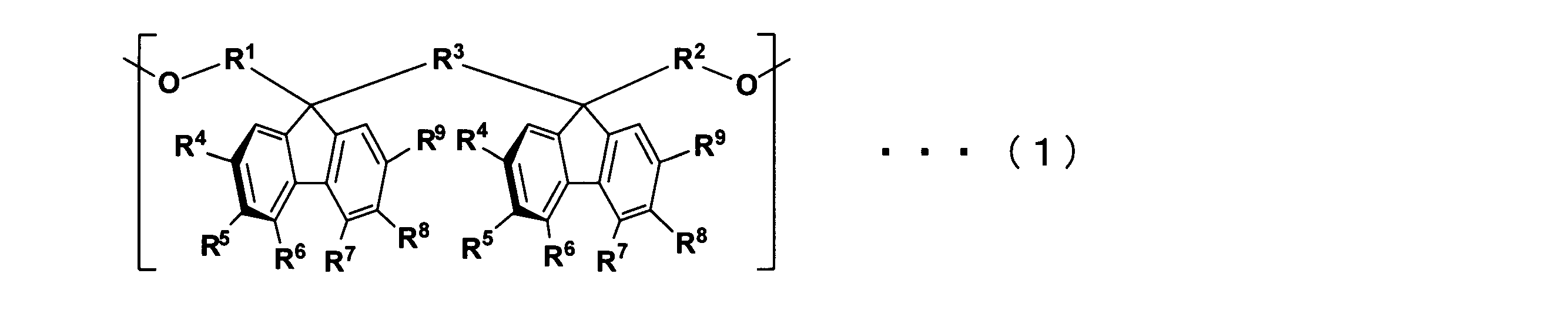

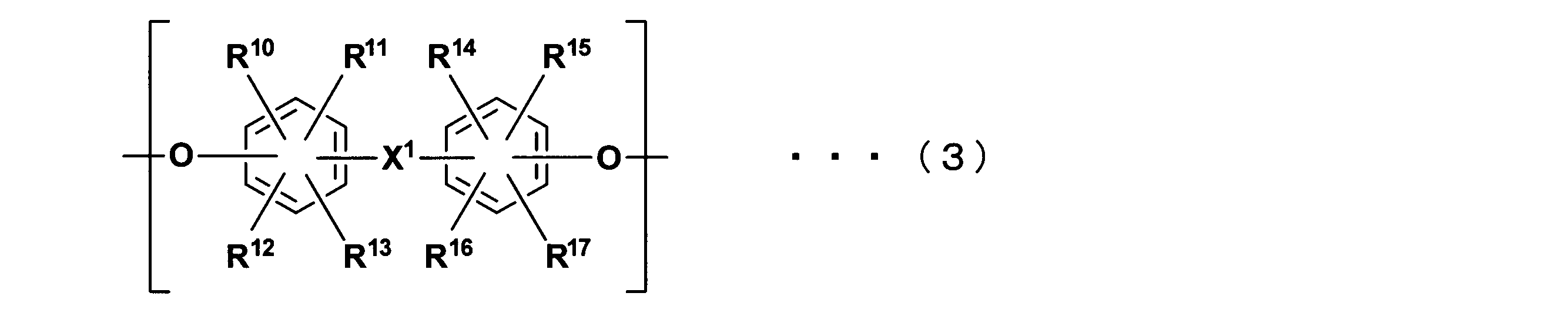
上記ポリカーボネート樹脂を成形温度280℃以下で成形する、透明フィルムの製造方法にある。
上記式(3)で表される構造単位(B)と、を含み、
ガラス転移温度が120℃以上160℃以下であり、
吸水率が1.4%以下である、ポリカーボネート樹脂にある。
また、上記ポリカーボネート樹脂から構成される、ポリカーボネート樹脂成形品、フィルム、位相差フィルム、円偏向板は、高い耐湿熱性を有し、光学特性及び機械物性に優れている。また、上記画像表示装置は、上記円偏向板を有するため、フレキシブルディスプレイや高い耐湿熱性が求められる車載用ディスプレイなどに好適に使用することができる。


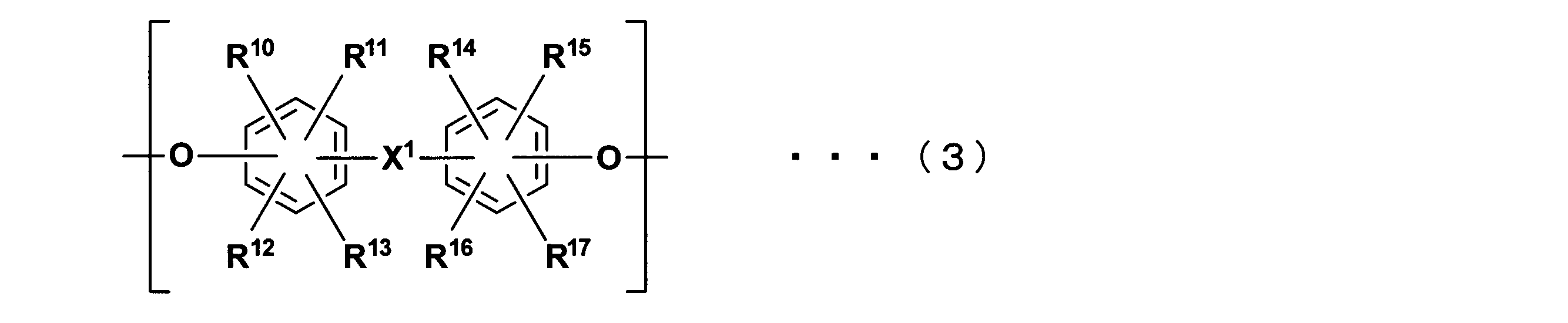
<オリゴフルオレン構造単位>
ポリカーボネート樹脂は、下記式(1)で表される構造単位及び/又は下記式(2)で表される構造単位から構成される構造単位(A)を含む。以下、当該構造単位を「オリゴフルオレン構造単位」と称することがある。
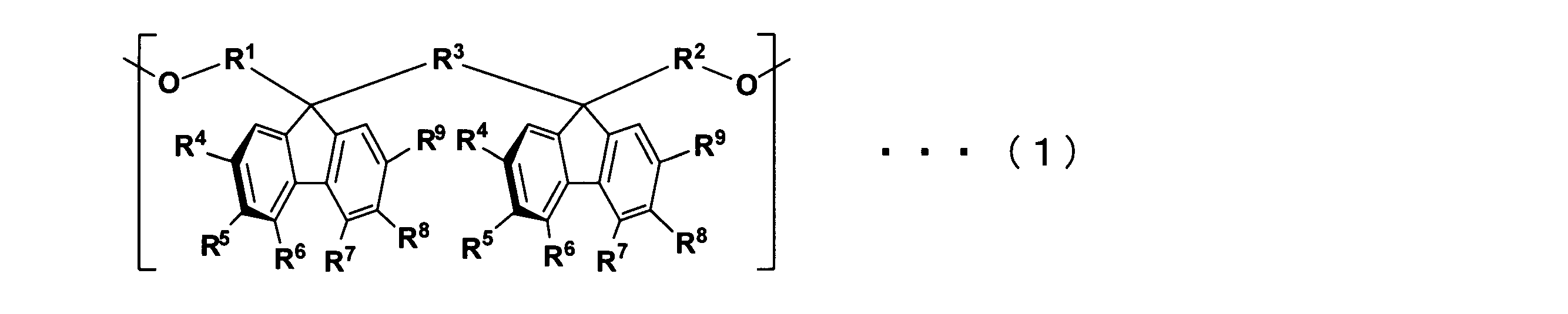

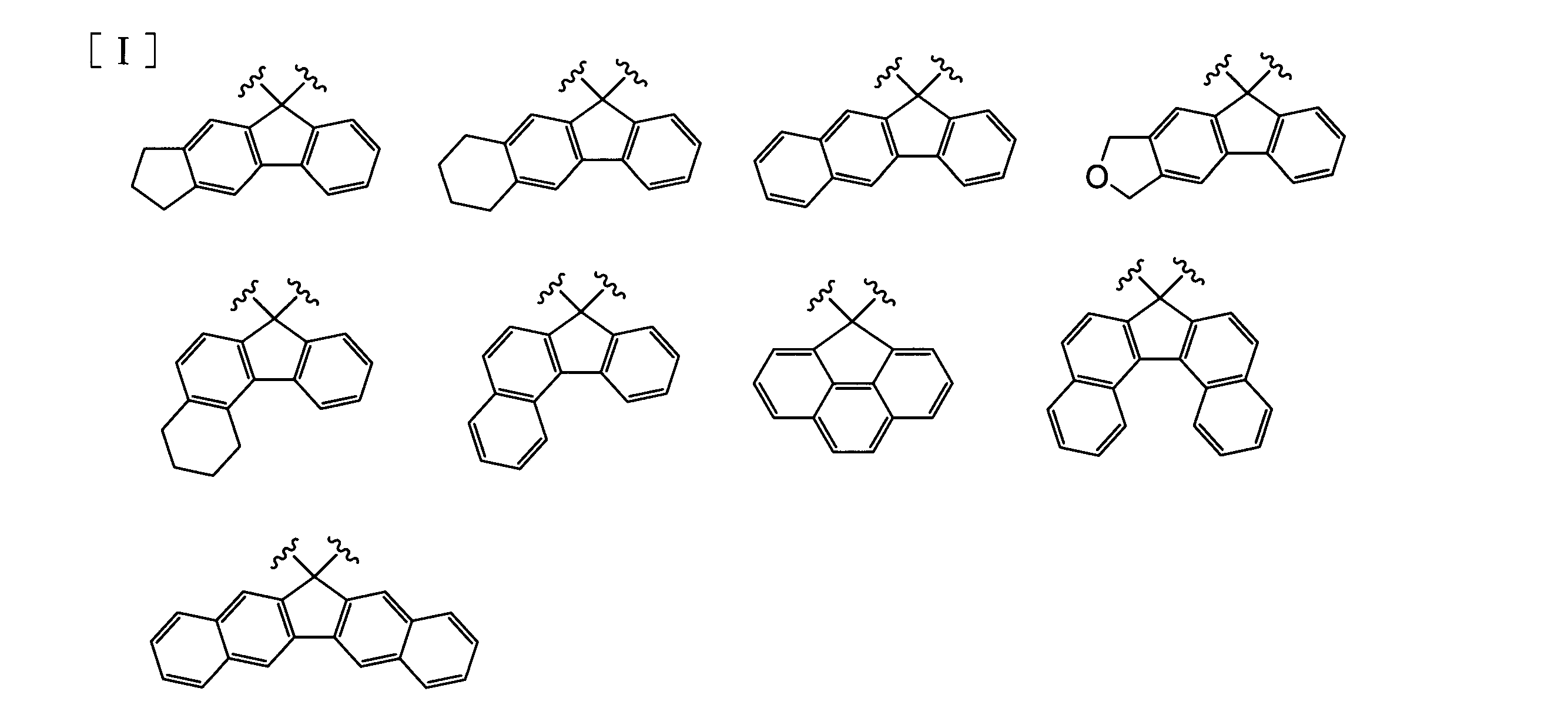
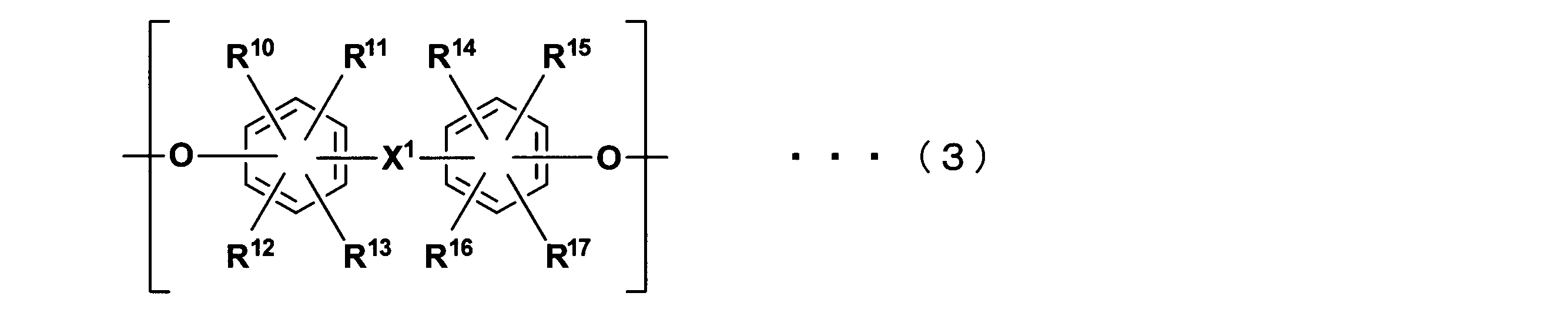
鎖状アルキレン基、環状アルキレン基としては、例えば、-CH2-、-CH(CH3)-、-C(CH3)2-、-CH(Ph)-、-C(CH3)Ph-、-CPh2-、1,2-エチレン基、1,3-プロピレン基、1,4-ブチレン基、1,1-シクロプロピレン基、1,1-シクロブチレン基、1,1-シクロペンチレン基、1,1-シクロヘキシレン基、3,3,5-トリメチル-1,1-シクロヘキシレン基、1,1-シクロドデシレン基、1,2-シクロプロピレン基、1,2-シクロブチレン基、1,2-シクロペンチレン基、1,2-シクロヘキシレン基、1,3-シクロブチレン基、1,3-シクロペンチレン基、1,3-シクロヘキシレン基、1,4-シクロヘキシレン基などが挙げられる。ここで、Phは非置換のフェニル基である。
アリーレン基としては、1,2-フェニレン基、1,3-フェニレン基、1,4-フェニレン基が挙げられる。
フルオレニレン基としては、9,9-フルオレニレン基が挙げられる。
また、X1が炭素数1~20の2価の炭化水素基の場合、上記式(3)におけるベンゼン環における結合位置は、2,2’-位、2,3’-位、2,4’-位、3,3’-位、3,4’-位、4,4’-位のいずれでもよいが、好ましくは4,4’-位である。この場合には、機械物性がより向上する。
一方、X1が直接結合である場合、上記式(3)におけるビフェニル骨格は、2,2’-ビフェニル骨格、2,3’-ビフェニル骨格、2,4’-ビフェニル骨格、3,3’-ビフェニル骨格、3,4’-ビフェニル骨格、4,4’-ビフェニル骨格のいずれでもよいが、好ましくは4,4’-ビフェニル骨格である。
ポリカーボネート樹脂の耐湿熱性をより向上させるという観点から、式(3)のX1として、更により好ましくは、-CH2-、-CH(CH3)-、-C(CH3)2-、-CH(Ph)-、-C(CH3)Ph-、-CPh2-、9,9-フルオレニレン基、1,1-シクロヘキシレン基、3,3,5-トリメチル-1,1-シクロヘキシレン基、1,1-シクロドデシレン基である。
上記式(3)において、R10~R17は、それぞれ独立に、水素原子、置換若しくは非置換の炭素数1~20のアルキル基、または置換若しくは非置換のアリール基を表す。
置換若しくは非置換の炭素数1~20のアルキル基としては、直鎖、分岐、環状のいずれであってもよく、また、フェニル基等の置換基を有していてもよく、次のようなものが挙げられる。
例えば、メチル基、エチル基、n-プロピル基、イソプロピル基、n-ブチル基、sec-ブチル基、tert-ブチル基、n-ペンチル基、イソペンチル基、ネオペンチル基、tert-ペンチル基、シクロペンチル基、n-ヘキシル基、イソヘキシル基、シクロヘキシル基、n-ヘプチル基、シクロヘプチル基、メチルシクロヘキシル基、n-オクチル基、シクロオクチル基、n-ノニル基、3,3,5-トリメチルシクロヘキシル基、n-デシル基、シクロデシル基、n-ウンデシル基、n-ドデシル基、シクロドデシル基、ベンジル基、メチルベンジル基、ジメチルベンジル基、トリメチルベンジル基、ナフチルメチル基、フェネチル基、2-フェニルイソプロピル基等である。
置換若しくは非置換のアリール基としては、例えば、フェニル基、o-トリル基、m-トリル基、p-トリル基、エチルフェニル基、スチリル基、キシリル基、n-プロピルフェニル基、イソプロピルフェニル基、メシチル基、エチニルフェニル基、ナフチル基、ビニルナフチル基等の、アルキル基等の置換基を有していてもよいフェニル基、ナフチル基などである。
R10~R17としては、更により好ましくは、水素原子、炭素数1~4のアルキル基であり、特に好ましくは水素原子、メチル基である。
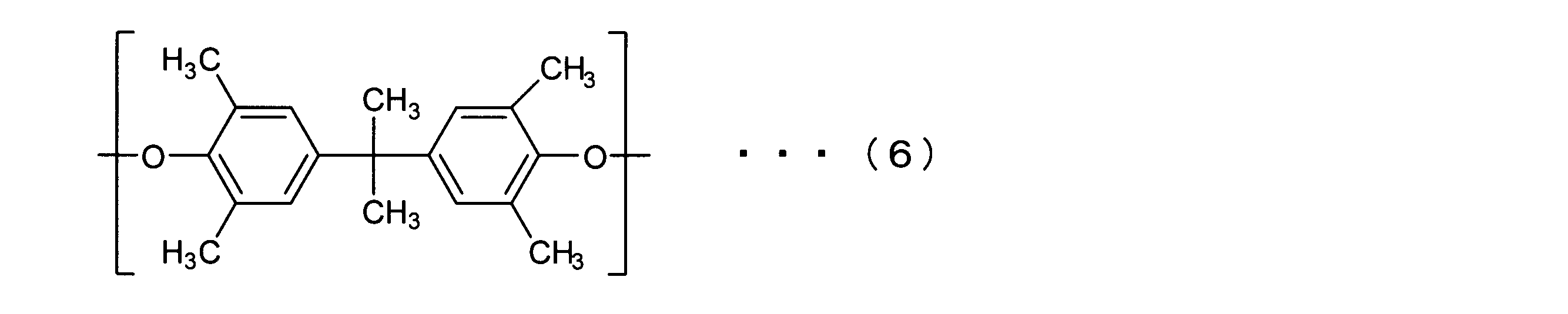


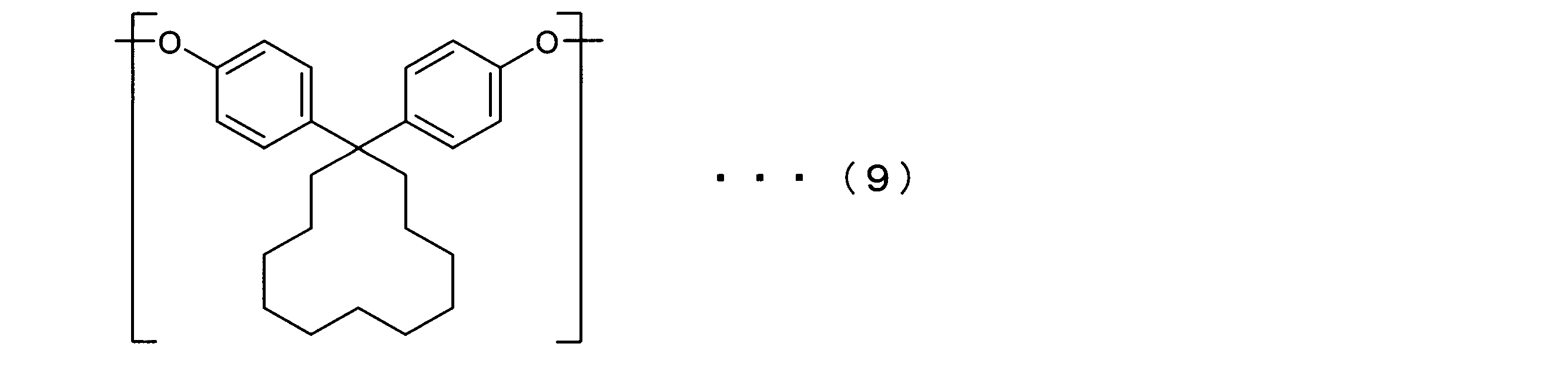

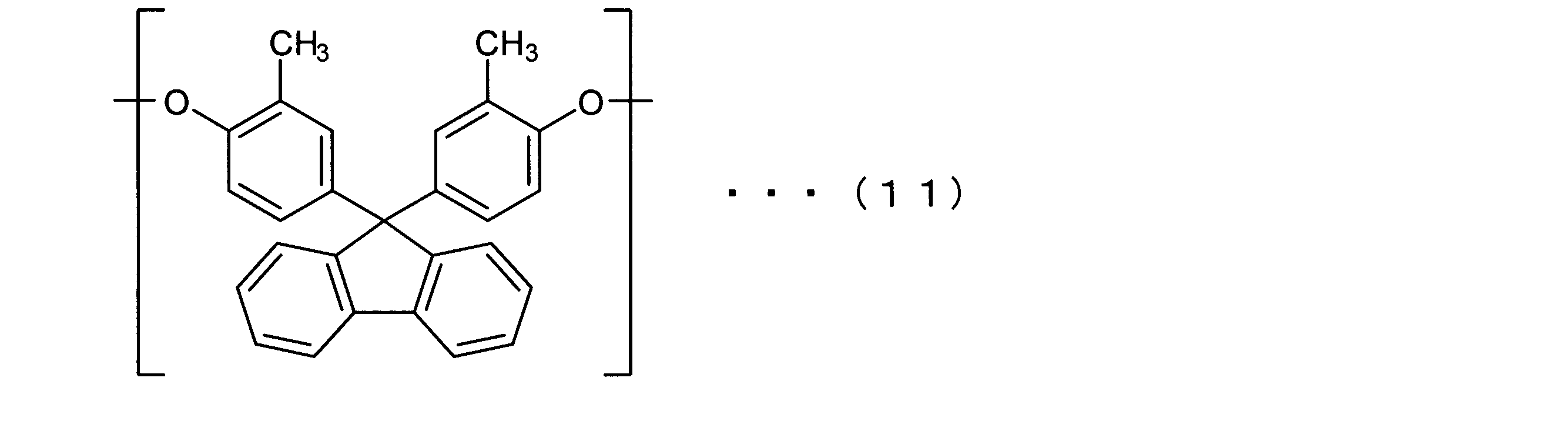





ポリカーボネート樹脂に含有される上記の構造単位の連結基は、下記式(15)で表される炭酸ジエステルを重合することで導入される。

ポリカーボネート樹脂は、以下に記載する物性を有することが好ましい。
ポリカーボネート樹脂のガラス転移温度は、120℃以上が好ましく、125℃以上がより好ましく、130℃以上が更に好ましい。ガラス転移温度が上記下限以上であると、十分な耐熱性を得ることが出来る。また、ポリカーボネート樹脂のガラス転移温度は160℃以下が好ましく、155℃以下がより好ましく、150℃以下が更に好ましい。ガラス転移温度が上記上限以下であると、溶融加工性が向上する。ポリカーボネート樹脂のガラス転移温度は、実施例記載の方法により測定することができる。ポリカーボネート樹脂のガラス転移温度は、例えば樹脂を構成する構造単位の種類及び比率を変えることにより適宜調整することができる。
ポリカーボネート樹脂の吸水率は、好ましくは1.4%以下、より好ましくは1.3%以下、さらに好ましくは1.2%以下であり、特に好ましくは1.1%以下であり、最も好ましくは1.0%以下である。吸水率が上記上限以下であると、湿熱環境下での寸法変化率が十分に低減される。そのため、ポリカーボネート樹脂から構成される位相差フィルムを例えば表示装置に組み込んで使用した際には、表示特性の経時変化を抑制することができる。ポリカーボネート樹脂の吸水率は、後述の方法により測定することができる。ポリカーボネート樹脂の吸水率は、例えば樹脂を構成する構造単位の種類及び比率を変えることにより適宜調整することができる。
ポリカーボネート樹脂のは、25×10-12Pa以下が好ましく、22×10-12Pa以下がより好ましく、19×10-12Pa以下がさらに好ましく、16×10-12Pa以下がさらにより好ましく、15×10―12Pa以下が特に好ましく、14×10―12Pa以下が最も好ましい。光弾性係数が上記上限以下であると、ポリカーボネート樹脂を位相差フィルムとして使用した際に十分な環境信頼性(使用環境により視認性が変化しない)を得ることが出来る。この特性は、特に大型の表示装置やフレキシブルディスプレイ、高温高湿環境下での使用時に重要となる。
上記ポリカーボネート樹脂においては、上記式(1)又は(2)で表される構造単位(A)と、上記式(3)で表される構造単位(B)の含有量を減らすことにより、光弾性係数をより低く抑えることが可能になる。
ポリカーボネート樹脂は、一般に用いられる重合方法で製造することができる。例えば、ホスゲンやカルボン酸ハロゲン化物を用いた溶液重合法又は界面重合法や、溶媒を用いずに反応を行う溶融重合法を用いて製造することができる。これらの製造方法のうち、溶媒や毒性の高い化合物を使用しないことから環境負荷を低減することができ、また、生産性にも優れる溶融重合法によって製造することが好ましい。
また、重縮合反応の重合速度は、ヒドロキシ基末端と、エステル基末端或いはカーボネート基末端とのバランスによって制御される。そのため、特に連続式で重合を行う場合は、未反応モノマーの留出によって末端基のバランスが変動すると、重合速度を一定に制御することが難しくなり、得られるポリカーボネート樹脂の分子量の変動が大きくなるおそれがある。ポリカーボネート樹脂の分子量は溶融粘度と相関するため、得られたポリカーボネート樹脂を成形する際に、溶融粘度が変動し、均一な寸法の成形品が得られない等の問題を招くおそれがある。
具体的に、第1段目の反応における反応条件としては、以下の条件を採用することができる。即ち、重合反応器の内温は、通常130℃以上、好ましくは150℃以上、より好ましくは170℃以上、かつ、通常250℃以下、好ましくは240℃以下、より好ましくは230℃以下の範囲で設定する。また、重合反応器の圧力は、通常70kPa以下(以下、圧力とは絶対圧力を表す。)、好ましくは50kPa以下、より好ましくは30kPa以下、かつ、通常1kPa以上、好ましくは3kPa以上、より好ましくは5kPa以上の範囲で設定する。また、反応時間は、通常0.1時間以上、好ましくは0.5時間以上、かつ、通常10時間以下、好ましくは5時間以下、より好ましくは3時間以下の範囲で設定する。
上記重合触媒の使用量は、通常、重合に使用した全ジヒドロキシ化合物1mol当たり0.1μmol~300μmol、好ましくは0.5μmol~100μmolである。上記重合触媒として、長周期型周期表第2族の金属およびリチウムからなる群より選ばれる少なくとも1種の金属化合物を用いる場合、特にマグネシウム化合物及び/又はカルシウム化合物を用いる場合には、金属量として、上記全ジヒドロキシ化合物1mol当たり、通常、1.0μmol以上、好ましくは5.0μmol以上、特に好ましくは10μmol以上の上記重合触媒を使用する。また、上記重合触媒の使用量は、通常300μmol以下、好ましくは200μmol以下であり、特に好ましくは100μmol以下である。
して、1μm以上であることが好ましい。なお、ここで言う上記フィルターの目開きはISO16889に準拠して決定されるものである。
ポリカーボネート樹脂には本発明の目的を損なわない範囲で、通常用いられる熱安定剤、酸化防止剤、触媒失活剤、紫外線吸収剤、光安定剤、離型剤、染顔料、衝撃改良剤、帯電防止剤、滑剤、潤滑剤、可塑剤、相溶化剤、核剤、難燃剤、無機充填剤、発泡剤等が含まれても差し支えない。
ポリカーボネート樹脂には、必要に応じて、溶融加工時等における分子量の低下や色相の悪化を防止するために熱安定剤を配合することができる。かかる熱安定剤としては、通常知られるヒンダードフェノール系熱安定剤および/又はリン系熱安定剤が挙げられる。
’-メチル-2’-ヒドロキシベンジル)-4-メチルフェニルアクリレート、2,2’-メチレン-ビス-(4-メチル-6-tert-ブチルフェノール)、2,2’-メチレン-ビス-(6-シクロヘキシル-4-メチルフェノール)、2,2’-エチリデン-ビス-(2,4-ジ-tert-ブチルフェノール)、テトラキス-[メチレン-3-(3’,5’-ジ-tert-ブチル-4’-ヒドロキシフェニル)プロピオネート]-メタン、1,3,5-トリメチル-2,4,6-トリス-(3,5-ジ-tert-ブチル-4-ヒドロキシベンジル)ベンゼン等。中でも、テトラキス-[メチレン-3-(3’,5’-ジ-tert-ブチル-4’-ヒドロキシフェニル)プロピオネート]-メタン、n-オクタデシル-3-(3’,5’-ジ-tert-ブチル-4’-ヒドロキシフェニル)プロピオネート、1,3,5-トリメチル-2,4,6-トリス-(3,5-ジ-tert-ブチル-4-ヒドロキシベンジル)ベンゼンを用いることが好ましい。
これらの熱安定剤の配合量は、ポリカーボネート樹脂を100質量部とした場合、0.0001質量部以上が好ましく、0.0005質量部以上がより好ましく、0.001質量部以上がさらに好ましく、また、3.0質量部以下が好ましく、2.5質量部以下がより好ましく、2.0質量部以下がさらに好ましい。
ポリカーボネート樹脂に、重合反応で用いた触媒を中和し、失活させるために酸性化合物を添加することで、色調や熱安定性を向上することができる。触媒失活剤として用いられる酸性化合物としては、カルボン酸基やリン酸基、スルホン酸基を有する化合物、又はそれらのエステル体などを用いることができるが、特に下記式(16)又は(17)で表される部分構造を含有するリン系化合物を用いることが好ましい。
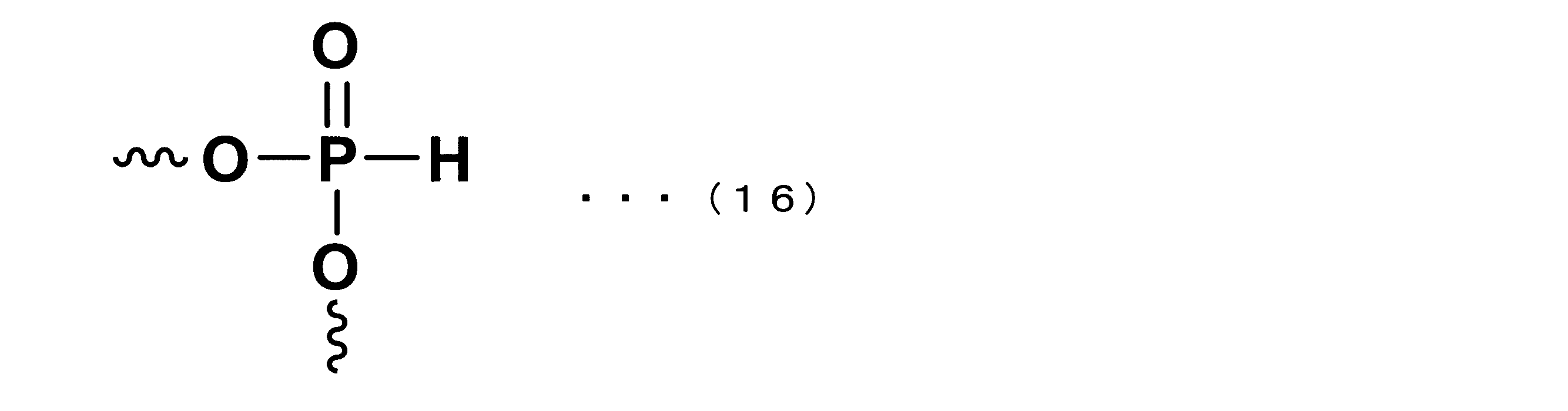
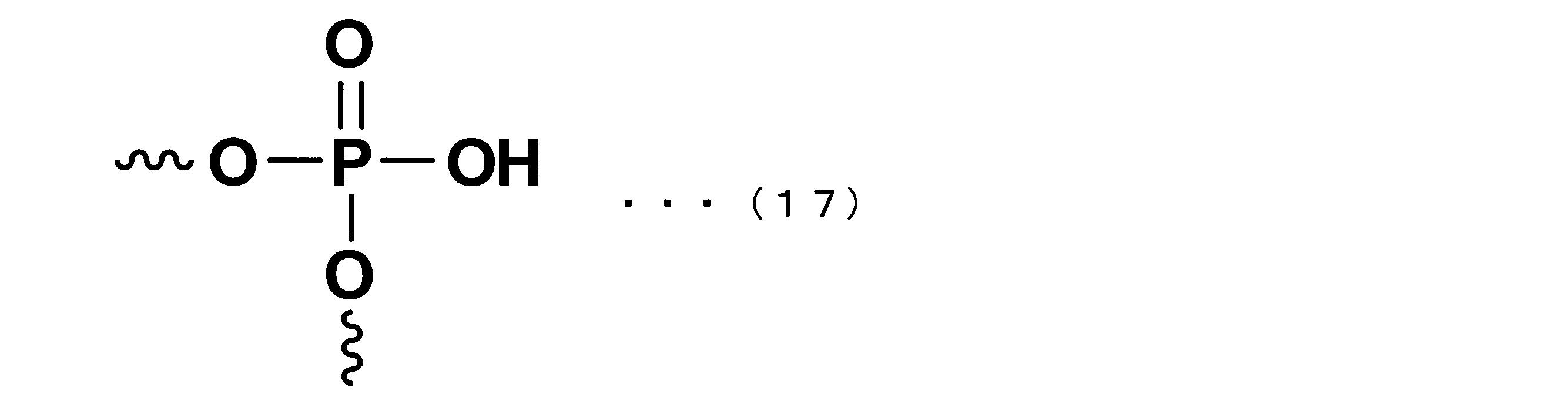
ポリカーボネート樹脂への上記リン系化合物の添加量が少なすぎると、触媒失活や着色抑制の効果が不十分であり、多すぎるとかえってポリカーボネート樹脂が着色してしまったり、特に高温高湿度下での耐久試験において、ポリカーボネート樹脂が着色しやすくなる。上記リン系化合物の添加量は、重合反応に用いた触媒量に対応した量を添加する。重合反応に用いた触媒の金属1molに対して、上記リン系化合物はリン原子の量として0.5倍mol以上、5倍mol以下が好ましく、さらに0.7倍mol以上、4倍mol以下が好ましく、特に0.8倍mol以上、3倍mol以下が好ましい。
機械物性や耐溶剤性等の特性を改質する目的で、芳香族ポリカーボネート、芳香族ポリエステル、脂肪族ポリエステル、ポリアミド、ポリスチレン、ポリオレフィン、アクリル、アモルファスポリオレフィン、ABS、AS、ポリ乳酸、ポリブチレンスクシネート等の合成樹脂やゴム、エラストマー等の1種又は2種以上と、上記ポリカーボネート樹脂とを混練して、ポリマーアロイとしてもよい。
(未延伸フィルムの製造方法)
ポリカーボネート樹脂を用いて、未延伸フィルムを製膜する方法としては、ポリカーボネート樹脂を溶媒に溶解させてキャストした後、溶媒を除去する流延法や、溶媒を用いずにポリカーボネート樹脂を溶融させて製膜する溶融製膜法を採用することができる。溶融製膜法としては、具体的にはTダイを用いた溶融押出法、カレンダー成形法、熱プレス法、共押出法、共溶融法、多層押出、インフレーション成形法等がある。未延伸フィルムの製膜方法は特に限定されないが、流延法では残存溶媒による問題が生じるおそれがあるため、好ましくは溶融製膜法、中でも後の延伸処理のし易さから、Tダイを用いた溶融押出法が好ましい。
上記未延伸フィルムを延伸配向させることにより、位相差フィルムを得ることができる。延伸方法としては縦一軸延伸、テンター等を用いる横一軸延伸、あるいはそれらを組み合わせた同時二軸延伸、逐次二軸延伸等、公知の方法を用いることができる。延伸はバッチ式で行ってもよいが、連続で行うことが生産性において好ましい。さらにバッチ式に比べて、連続式の方がフィルム面内の位相差のばらつきの少ない位相差フィルムが得られる。
歪み速度(%/分)={延伸速度(mm/分)/原反フィルムの長さ(mm)}×100
なお、各物性や特性の測定方法や評価方法は以下の通りである。
樹脂のガラス転移温度は、エスアイアイ・ナノテクノロジー社製示差走査熱量計DSC6220を用いて測定した。約10mgの樹脂試料を同社製アルミパンに入れて密封し、50mL/分の窒素気流下、昇温速度20℃/分で30℃から200℃まで昇温した。3分間温度を保持した後、30℃まで20℃/分の速度で冷却した。30℃で3分保持し、再び200℃まで20℃/分の速度で昇温した。2回目の昇温で得られたDSCデータより、低温側のベースラインを高温側に延長した直線と、ガラス転移の階段状変化部分の曲線の勾配が最大になるような点で引いた接線との交点の温度である、補外ガラス転移開始温度を求め、それをガラス転移温度とした。
ポリカーボネート樹脂のペレットを、200Pa以下の減圧下、100℃の温度で12時間以上乾燥した。次に、乾燥したペレット約4gを小型熱プレス機(アズワン株式会社、AH-2003C AH-1TC)を使用し、縦14cm、横14cm、厚さ0.1mmのスペーサーを用い、試料の上下にポリイミドフィルムを敷いて、温度200~230℃で3分間予熱し、圧力7MPaで5分間加圧後、スペーサーごと取り出し、冷却してフィルムを作製した。
(吸水質量-乾燥質量)/乾燥質量×100=吸水率(%)・・・・・・・・式1
上記樹脂を塩化メチレンに溶解させ、0.6g/dLの濃度の樹脂溶液を調製した。森友理化工業社製ウベローデ型粘度管を用いて、温度20.0℃±0.1℃で測定を行い、溶媒の通過時間t0及び溶液の通過時間tを測定した。得られたt0及びtの値を用いて次式(I)により相対粘度ηrelを求め、更に、得られた相対粘度ηrelを用いて次式(ii)により比粘度ηspを求めた。
ηrel=t/t0 ・・・(I)
ηsp=(η-η0)/η0=ηrel-1 ・・・(ii)
その後、得られた比粘度ηspを濃度c(g/dL)で割って、還元粘度ηsp/cを求めた。この値が高いほど分子量が大きい。
(D)未延伸フィルムの成形
ポリカーボネート樹脂のペレットを、200Pa以下の減圧下、100℃の温度で12時間以上乾燥した。次に、乾燥したペレット約4gを小型熱プレス機(アズワン株式会社、AH-2003C AH-1TC)を使用し、縦14cm、横14cm、厚さ0.1mmのスペーサーを用い、試料の上下にポリイミドフィルムを敷いて、温度200~230℃で3分間予熱し、圧力7MPaで5分間加圧後、スペーサーごと取り出し、冷却して未延伸フィルムを作製した。
He-Neレーザー、偏光子、補償板、検光子、光検出器からなる複屈折測定装置と振動型粘弾性測定装置(レオロジー社製DVE-3)を組み合わせた装置を用いて測定した。(詳細は、日本レオロジー学会誌Vol.19,p93-97(1991)を参照。)
上記の未延伸フィルムから長さ20mm、幅5mmの試験片を切り出し、粘弾性測定装置に固定し、25℃の室温で貯蔵弾性率E’を周波数96Hzにて測定した。同時に、出射されたレーザー光を偏光子、試料、補償板、検光子の順に通し、光検出器(フォトダイオード)で拾い、ロックインアンプを通して角周波数ω又は2ωの波形について、その振幅とひずみに対する位相差を求め、ひずみ光学係数O’を求めた。このとき、偏光子と検光子の方向は直交し、またそれぞれ、試料の伸長方向に対してπ/4の角度をなすように調整した。光弾性係数Cは、貯蔵弾性率E’とひずみ光学係数O’を用いて次式より求めた。
C=O’/E’
以下の実施例および比較例において、光弾性係数が19×10-12Pa-1以下であるものを、使用環境の変化によるフィルムの伸び縮みによる光学特性の変化が小さく優れたものであると評価した。
前述の方法により、厚み100~200μmの未延伸フィルムを作製し、このフィルムから長さ40mm、幅10mmの長方形の試験片を作製した。万力の左右の接合面の間隔を40mmに開き、試験片の両端を接合面内に固定した。次に左右の接合面の間隔を2mm/秒以下の速度で狭めていき、フィルムが万力の接合面の外にはみ出さないようにしながら、略U字状に折れ曲がったフィルム全体を該接合面内で圧縮していった。接合面間が完全に密着する迄に試験片が折れ曲がり部で2片(又は3片以上の破片)に割れた場合を「割れあり」、接合面間が完全に密着してもなお試験片が割れずに折り曲げられた場合「割れなし」とした。同一の種類のフィルムについて5回繰り返して試験を実施し、そのうち3回以上「割れあり」となったものを「×:脆性破壊する」、2回以下「割れあり」となったものを「○:脆性破壊しない」とし、脆性破壊しないものを、靭性に優れるものと評価した。
前述の未延伸フィルムを、株式会社トミー精工製のラボ用オートクレーブ(LSXー300)を使用して、110℃、0.15Mpa、100%RH、24時間の条件で蒸気処理を行い、試験前後でのフィルムの形状の変化や白化の有無を確認した。
<評価>
〇:不透明な部分が全く無い、あるいは一部のみ不透明
×:全体が不透明
(H)フィルムの延伸
未延伸フィルムから幅50mm、長さ125mmのフィルム片を切り出し、バッチ式二軸延伸装置(アイランド工業社製二軸延伸装置BIX-277-AL)を用いて、樹脂のガラス転移温度+15℃の延伸温度、300%/分の延伸速度及び1.5倍の延伸倍率で上記フィルム片の自由端一軸延伸を行い、延伸フィルムを得た。
上記の方法で得られた延伸フィルムの中央部を幅4cm、長さ4cmに切り出し、王子計測機器(株)製位相差測定装置KOBRA-WPRを用いて、測定波長450、500、550、590、630nmで位相差を測定し、波長分散性を測定した。波長分散性は450nmと550nmで測定した位相差R450とR550の比(R450/R550)で示した。R450/R550が1より大きいと波長分散は正であり、1未満では逆波長分散となる。1/4波長板として用いる場合、R450/R550の理想値は0.818である(450/550=0.818)。
以下の実施例と製造例で用いた化合物の略号、および製造元は次のとおりである。
・SPG:スピログリコール(三菱ガス化学社製)
・ISB:イソソルビド(ロケットフルーレ社製)
・PEG-1000:ポリエチレングリコール(三洋化成社製)
・BP-TMC:1,1-ビス(4-ヒドロシキフェニル)-3,3,5-トリメチルシクロヘキサン(本州化学社製)
・BisP-CDE:4,4’ー(シクロドデカンー1,1ージイル)ジフェノール(本州化学社製)
・BCF:9,9-ビス(4-ヒドロキシ-2-メチルフェニル)フルオレン(本州化学社製)
・BisP-AP:4,4’ー(α―メチルベンジリデン)ビスフェノール(本州化学社製)
・BHEPF:9,9-ビス[4-(2-ヒドロキシエトキシ)フェニル]フルオレン(本州化学社製)
特開2014-114281号公報の段落番号[0264]に記載の方法に従い合成した。
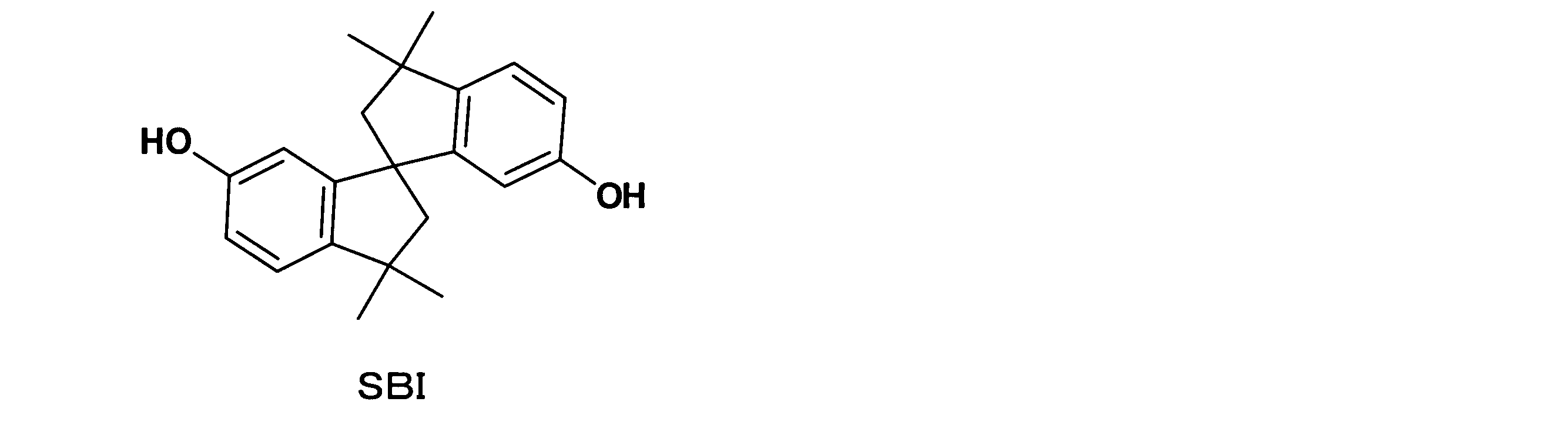
特開2015-25111号公報の段落番号[0596]に記載の方法で合成した。

各構造単位の含有量が表1に示す値となるように各原料を仕込んだ。具体的には、まず、BP-TMC 30.20質量部(0.097mol)、SPG 37.77質量部(0.124mol)、BPFM 39.47質量部(0.062mol)、DPC 35.41質量部(0.165mol)、及び触媒として酢酸カルシウム1水和物1.17×10⁻²質量部(6.64×10⁻⁵mol)を反応容器に投入し、反応装置内を減圧窒素置換した。窒素雰囲気下、150℃で約10分間、攪拌しながら原料を溶解させた。反応1段目の工程として220℃まで30分かけて昇温し、60分間常圧にて反応した。次いで圧力を常圧から13.3kPaまで90分かけて減圧し、13.3kPaで30分間保持し、発生するフェノールを反応系外へ抜き出した。次いで反応2段目の工程として熱媒温度を15分かけて260℃まで昇温しながら、圧力を0.10kPa以下まで15分かけて減圧し、発生するフェノールを反応系外へ抜き出した。所定の撹拌トルクに到達後、窒素で常圧まで復圧して反応を停止し、生成したポリエステルカーボネートを水中に押し出し、ストランドをカッティングしてペレットを得た。得られたポリエステルカーボネートのペレットを用いて、前述の各種評価を行った。結果を表1~表3に示す。なお、表1は、原料の仕込みをmol%の単位で示し、表2は、原料の仕込みを質量%で示すものである。
BP-TMC 30.20質量部(0.097mol)、SPG 39.50質量部(0.130mol)、BPFM 36.65質量部(0.057mol)、DPC 37.60質量部(0.176mol)、及び触媒として酢酸カルシウム1水和物1.20×10⁻²質量部(6.81×10⁻⁵mol)を用いた以外は実施例1と同様の方法で、ポリエステルカーボネートのペレットを得た。得られたポリエステルカーボネートのペレットを用いて、前述の各種評価を行った。結果を表1~表3に示す。
BP-TMC 30.20質量部(0.097mol)、SPG 41.23質量部(0.135mol)、BPFM 33.83質量部(0.053mol)、DPC 39.79質量部(0.186mol)、及び触媒として酢酸カルシウム1水和物1.23×10⁻²質量部(6.98×10⁻⁵mol)を用いた以外は実施例1と同様の方法で、ポリエステルカーボネートのペレットを得た。得られたポリエステルカーボネートのペレットを用いて、前述の各種評価を行った。評価結果を表1~表3に示す。
BP-TMC 30.20質量部(0.097mol)、SPG 42.96質量部(0.141mol)、BPFM 31.01質量部(0.048mol)、DPC 41.98質量部(0.196mol)、及び触媒として酢酸カルシウム1水和物1.26×10⁻²質量部(7.15×10⁻⁵mol)を用いた以外は実施例1と同様の方法で、ポリエステルカーボネートのペレットを得た。得られたポリエステルカーボネートのペレットを用いて、前述の各種評価を行った。結果を表1~表3に示す。
BP-TMC 30.20質量部(0.097mol)、SPG 44.69質量部(0.147mol)、BPFM 28.19質量部(0.044mol)、DPC 44.17質量部(0.206mol)、及び触媒として酢酸カルシウム1水和物1.29×10⁻²質量部(7.32×10⁻⁵mol)を用いた以外は実施例1と同様の方法で、ポリエステルカーボネートのペレットを得た。得られたポリエステルカーボネートのペレットを用いて、前述の各種評価を行った。結果を表1~表3に示す。
BisP-AP 30.21質量部(0.104mol)、SPG 40.19質量部(0.132mol)、BPFM 35.24質量部(0.055mol)、DPC 40.06質量部(0.187mol)、及び触媒として酢酸カルシウム1水和物1.25×10⁻²質量部(7.08×10⁻⁵mol)を用いた以外は実施例1と同様の方法で、ポリエステルカーボネートのペレットを得た。得られたポリエステルカーボネートのペレットを用いて、前述の各種評価を行った。結果を表1~表3に示す。
BisP-CDE 30.17質量部(0.086mol)、SPG 43.26質量部(0.142mol)、BPFM 31.01質量部(0.048mol)、DPC 39.64質量部(0.185mol)、及び触媒として酢酸カルシウム1水和物1.20×10⁻²質量部(6.83×10⁻⁵mol)を用いた以外は実施例1と同様の方法で、ポリエステルカーボネートのペレットを得た。得られたポリエステルカーボネートのペレットを用いて、前述の各種評価を行った。結果を表1~表3に示す。
BisP-CDE 30.17質量部(0.086mol)、SPG 40.67質量部(0.134mol)、BPFM 35.24質量部(0.055mol)、DPC 36.35質量部(0.170mol)、及び触媒として酢酸カルシウム1水和物1.16×10⁻²質量部(6.58×10⁻⁵mol)を用いた以外は実施例1と同様の方法で、ポリエステルカーボネートのペレットを得た。得られたポリエステルカーボネートのペレットを用いて、前述の各種評価を行った。結果を表1~表3に示す。
BP-TMC 20.13質量部(0.065mol)、SPG 52.15質量部(0.171mol)、BPFM 20.13質量部(0.051mol)、DPC 41.02質量部(0.191mol)、及び触媒として酢酸カルシウム1水和物 1.25×10⁻²質量部(7.09×10⁻⁵mol)を用いた以外は実施例1と同様の方法で、ポリエステルカーボネートのペレットを得た。得られたポリエステルカーボネートのペレットを用いて、前述の各種評価を行った。結果を表1~表3に示す。
BP-TMC 20.13質量部(0.065mol)、SPG 41.14質量部(0.135mol)、ISB 10.14質量部(0.069mol)、BPFM 32.42質量部(0.051mol)、DPC 48.31質量部(0.226mol)、及び触媒として酢酸カルシウム1水和物1.42×10⁻²質量部(8.08×10⁻⁵mol)用い、反応2段目の工程として熱媒温度を15分かけて245℃まで昇温した以外は実施例1と同様の方法で、ポリエステルカーボネートのペレットを得た。得られたポリエステルカーボネートのペレットを用いて、前述の各種評価を行った。結果を表1~表3に示す。
BP-TMC 10.06質量部(0.032mol)、SPG 35.12質量部(0.115mol)、ISB 25.35質量部(0.173mol)、BPFM 31.72質量部(0.049mol)、DPC 58.91質量部(0.275mol)、及び触媒として酢酸カルシウム1水和物1.70×10⁻²質量部(9.64×10⁻⁵mol)用い、反応2段目の工程として熱媒温度を15分かけて250℃まで昇温した以外は実施例1と同様の方法で、ポリエステルカーボネートのペレットを得た。得られたポリエステルカーボネートのペレットを用いて、前述の各種評価を行った。結果を表1~表3に示す。
BP-TMC 15.10質量部(0.049mol)、SPG 52.97質量部(0.174mol)、ISB 5.07質量部(0.035mol)、BPFM 30.31質量部(0.047mol)、DPC 46.37質量部(0.216mol)、及び触媒として酢酸カルシウム1水和物1.36×10⁻²質量部(7.72×10⁻⁵mol)用い、反応2段目の工程として熱媒温度を15分かけて250℃まで昇温した以外は実施例1と同様の方法で、ポリエステルカーボネートのペレットを得た。得られたポリエステルカーボネートのペレットを用いて、前述の各種評価を行った。結果を表1~表3に示す。
BisP-CDE 20.11質量部(0.057mol)、SPG 41.35質量部(0.136mol)、ISB 10.14質量部(0.069mol)、BPFM 32.42質量部(0.051mol)、DPC 46.75質量部(0.218mol)、及び触媒として酢酸カルシウム1水和物1.39×10⁻²質量部(7.87×10⁻⁵mol)用い、反応2段目の工程として熱媒温度を15分かけて250℃まで昇温した以外は実施例1と同様の方法で、ポリエステルカーボネートのペレットを得た。得られたポリエステルカーボネートのペレットを用いて、前述の各種評価を行った。結果を表1~表3に示す。
BisP-CDE 10.06質量部(0.029mol)、SPG 36.52質量部(0.120mol)、ISB 25.35質量部(0.173mol)、BPFM 29.60質量部(0.046mol)、DPC 59.76質量部(0.279mol)、及び触媒として酢酸カルシウム1水和物1.70×10⁻²質量部(9.66×10⁻⁵mol)用い、反応2段目の工程として熱媒温度を15分かけて250℃まで昇温した以外は実施例1と同様の方法で、ポリエステルカーボネートのペレットを得た。得られたポリエステルカーボネートのペレットを用いて、前述の各種評価を行った。結果を表1~表3に示す。
SBI 25.16質量部(0.082mol)、SPG 56.62質量部(0.186mol)、BPFM 16.92質量部(0.026mol)、DPC 52.82質量部(0.247mol)、及び触媒として酢酸カルシウム1水和物1.41×10⁻²質量部(8.03×10⁻⁵mol)を用いた以外は実施例1と同様の方法で、ポリエステルカーボネートのペレットを得た。得られたポリエステルカーボネートのペレットを用いて、前述の各種評価を行った。結果を表1~表2、表4に示す。
SBI 20.13質量部(0.065mol)、SPG 48.91質量部(0.161mol)、ISB 10.14質量部(0.069mol)、BPFM 19.74質量部(0.031mol)、DPC 58.25質量部(0.272mol)、及び触媒として酢酸カルシウム1水和物1.56×10⁻²質量部(8.86×10⁻⁵mol)を用い、反応2段目の工程として熱媒温度を15分かけて250℃まで昇温した以外は実施例1と同様の方法でポリカーボネートのペレットを得た。得られたポリカーボネートのペレットを用いて、前述の各種評価を行った。結果を表1~表2、表4に示す。
SPG 30.20質量部(0.099mol)、ISB 39.94質量部(0.273mol)、BPFM 30.31質量部(0.047mol)、DPC 69.67質量部(0.325mol)、及び触媒として酢酸カルシウム1水和物9.84×10⁻⁴質量部(5.59×10⁻⁶mol)を用いた以外は実施例10と同様の方法で、ポリエステルカーボネートのペレットを得た。得られたポリエステルカーボネートのペレットを用いて、前述の各種評価を行った。結果を表1~表2、表4に示す。
ISB 26.72質量部(0.183mol)、PEG1000♯ 0.99質量部(0.001mol)、BHEPF 63.74質量部(0.145mol)、DPC 70.24質量部(0.328mol)、及び触媒として酢酸カルシウム1水和物8.69×10⁻⁴質量部(4.93×10⁻⁶mol)を用いた以外は比較例3と同様の方法で、ポリカーボネートのペレットを得た。得られたポリカーボネートのペレットを用いて、前述の各種評価を行った。結果を表1~表2、表4に示す。
BP-TMC 10.07質量部(0.032mol)、ISB 54.13質量部(0.370mol)、BPFM 38.06質量部(0.059mol)、DPC 74.43質量部(0.347mol)、及び触媒として酢酸カルシウム1水和物1.06×10⁻³質量部(6.04×10⁻⁶mol)を用い、反応2段目の工程として熱媒温度を15分かけて250℃まで昇温した以外は実施例1と同様の方法でポリカーボネートのペレットを得た。得られたポリカーボネートのペレットを用いて、前述の各種評価を行った。結果を表1~表2、表4に示す。
BP-TMC 24.16質量部(0.078mol)、ISB 28.45質量部(0.195mol)、BPFM 30.45質量部(0.048mol)、DPC 49.70質量部(0.232mol)、及び触媒として酢酸カルシウム1水和物1.44×10⁻³質量部(8.18×10⁻⁶mol)を用い、反応2段目の工程として熱媒温度を15分かけて250℃まで昇温した以外は実施例1と同様の方法でポリカーボネートのペレットを得た。本比較例で得られたポリカーボネートは脆く、フィルム成形品を作成することが出来なかったためフィルム成形品を用いた評価を行うことができなかった。
BCF 38.18質量部(0.101mol)、SPG 54.56質量部(0.179mol)、DPC 62.40質量部(0.291mol)、及び触媒として酢酸カルシウム1水和物2.47×10⁻²質量部(1.40×10⁻⁴mol)を用いた以外は実施例1と同様の方法で、ポリエステルカーボネートのペレットを得た。得られたポリエステルカーボネートのペレットを用いて、前述の各種評価を行った。結果を表1~表2、表4に示す。
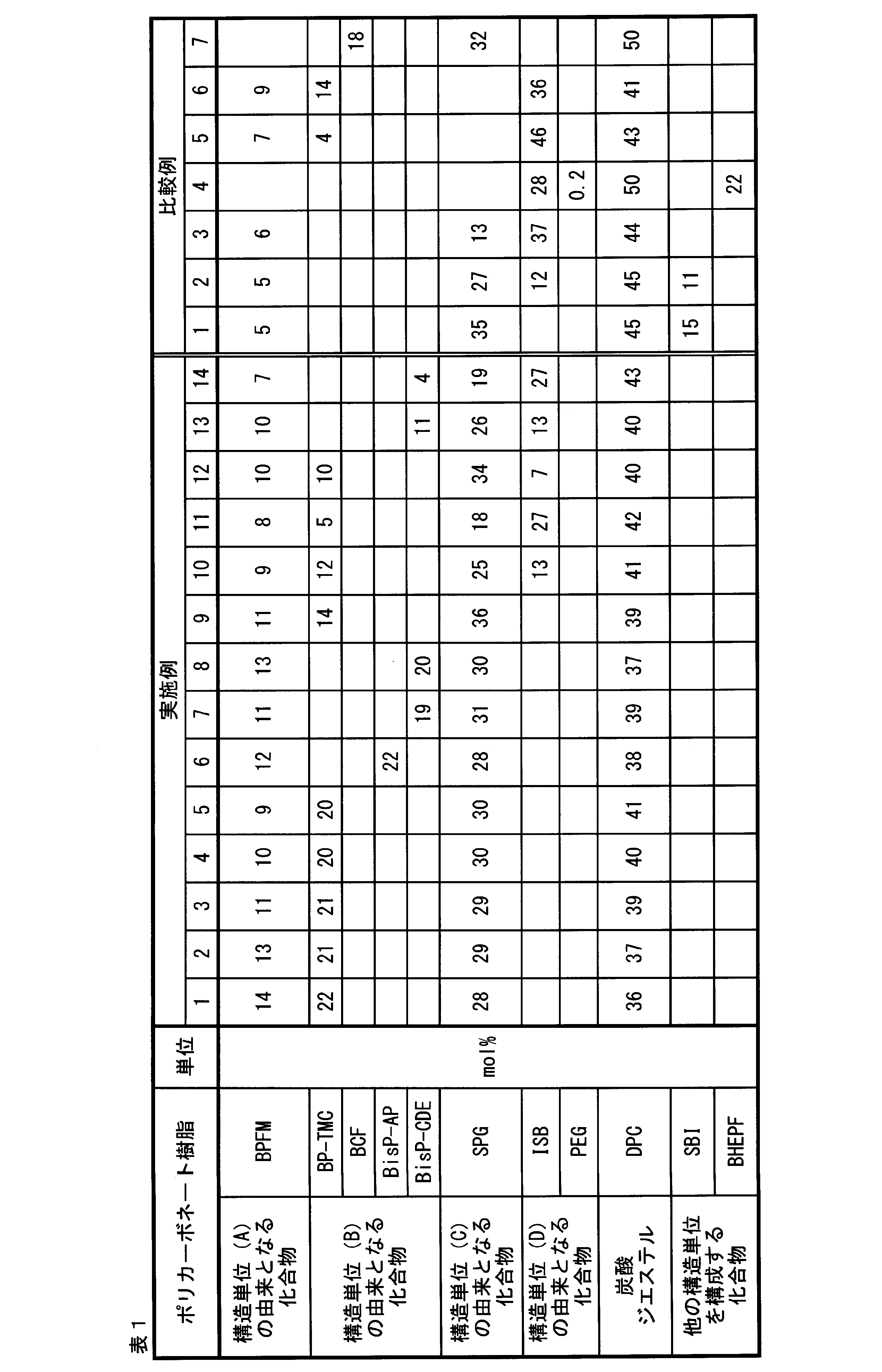
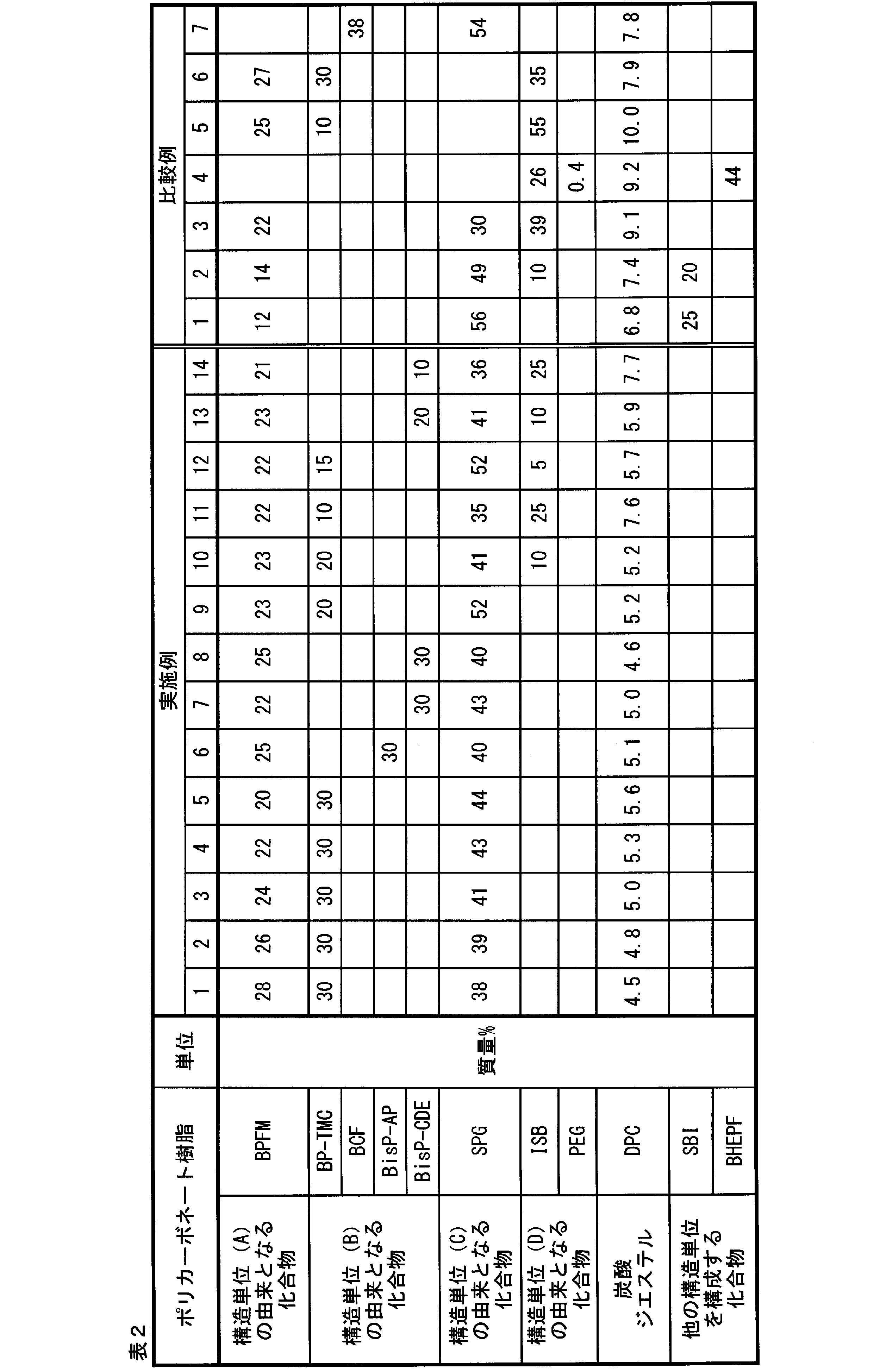

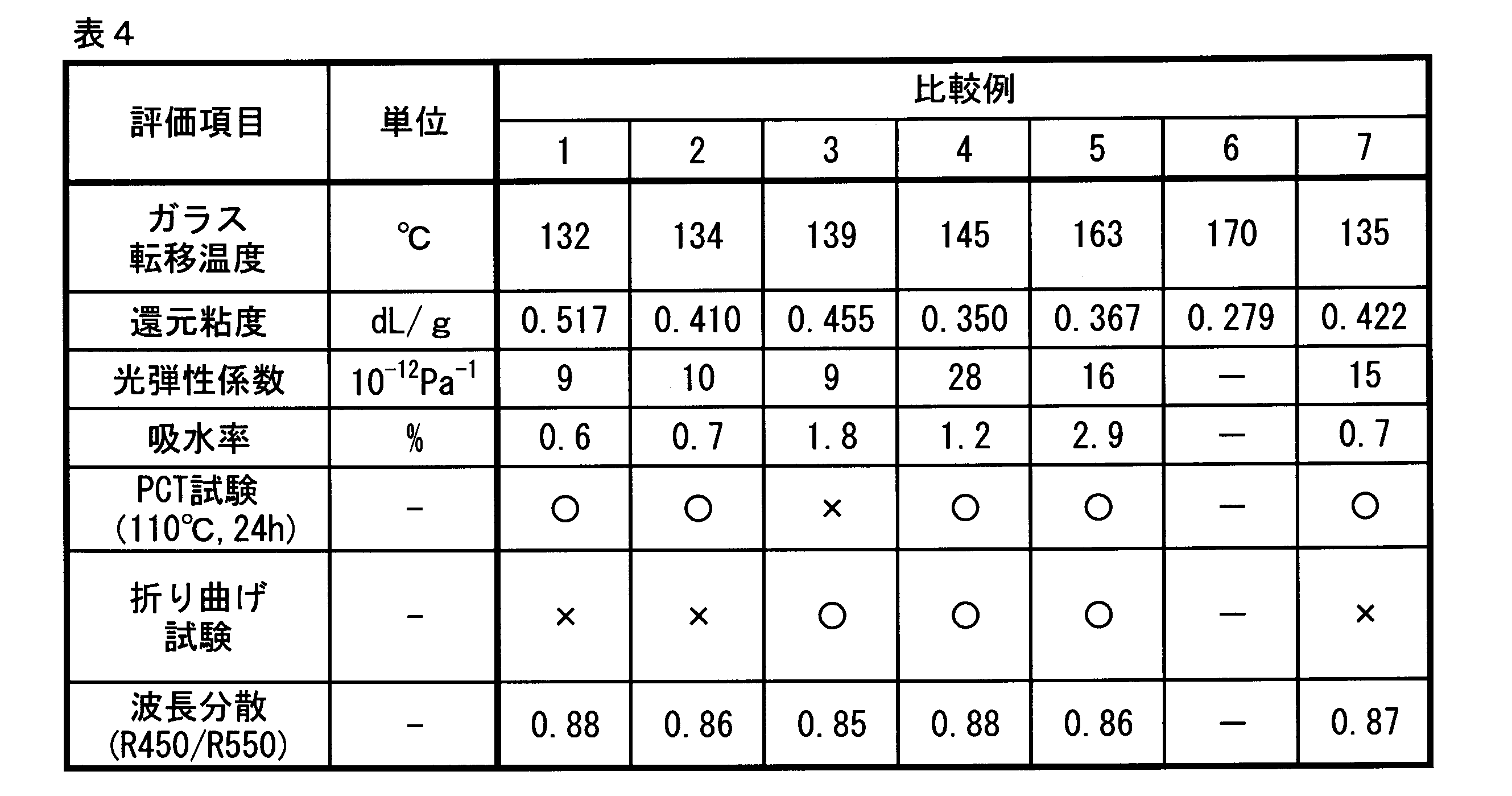
Claims (18)
- 下記式(1)及び/又は下記式(2)で表される構造単位(A)と、
下記式(3)で表される構造単位(B)と、
アセタール環構造を有するジヒドロキシ化合物に由来する構造単位(C)と、を含む、ポリカーボネート樹脂。


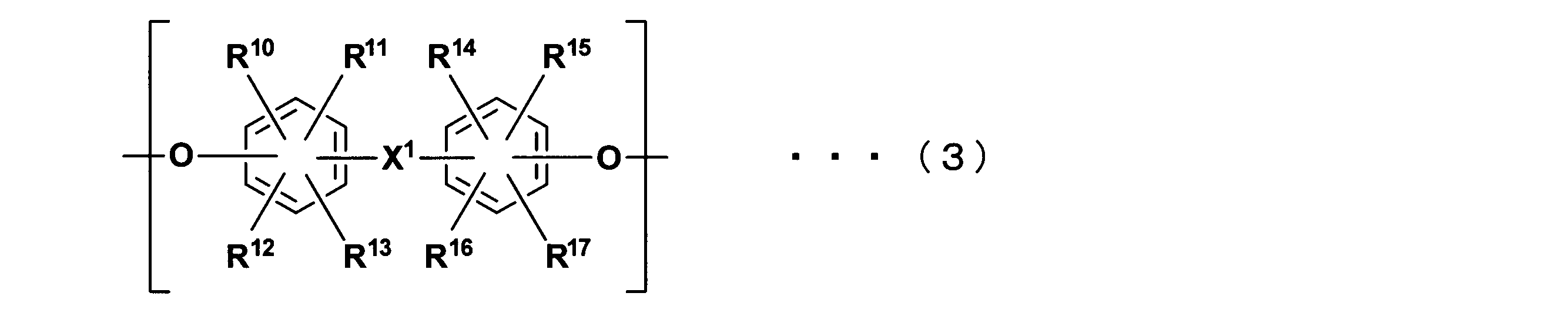
- 上記式(3)中のR10~R17が、それぞれ独立に、水素原子、または、置換若しくは非置換の炭素数1~20のアルキル基、または置換若しくは非置換の炭素数6~10のアリール基であり、X1が、置換若しくは非置換の1~20の鎖状のアルキレン基、置換若しくは非置換の炭素数6~20の環状のアルキレン基、炭素数6~20のアリーレン基、または、炭素数13~20のフルオレニレン基である、請求項1に記載のポリカーボネート樹脂。
- 上記ポリカーボネート樹脂を構成する全ての構造単位及び連結基の含有量の合計100質量%に対して、上記構造単位(A)の含有量が1質量%以上45質量%以下である、請求項1又は2に記載のポリカーボネート樹脂。
- 上記ポリカーボネート樹脂を構成する全ての構造単位及び連結基の含有量の合計100質量%に対して、上記構造単位(B)の含有量が5質量%以上50質量%以下である、請求項1~3のいずれか1項に記載のポリカーボネート樹脂。
- 上記ポリカーボネート樹脂を構成する全ての構造単位及び連結基の含有量の合計100質量%に対して、上記構造単位(C)の含有量が15質量%以上75質量%以下である、請求項1~4のいずれか1項に記載のポリカーボネート樹脂。
- さらに、脂肪族ジヒドロキシ化合物、脂環式ジヒドロキシ化合物、オキシアルキレングリコール及び複素環構造を有するジヒドロキシ化合物からなる群より選ばれる少なくとも1つの化合物に由来する構造単位(D)を含む、請求項1~5のいずれか1項に記載のポリカーボネート樹脂。
- 上記ポリカーボネート樹脂を構成する全ての構造単位及び連結基の含有量の合計100質量%に対して、上記構造単位(C)と上記構造単位(D)との合計含有量が20質量%以上80質量%以下である、請求項6に記載のポリカーボネート樹脂。
- 上記構造単位(C)が下記式(4)で表される構造単位であり、上記構造単位(D)が下記式(5)で表される構造単位である、請求項6又は7に記載のポリカーボネート樹脂。


- 上記ポリカーボネート樹脂のガラス転移温度が120℃以上160℃以下である、請求項1~8のいずれか1項に記載のポリカーボネート樹脂。
- 上記ポリカーボネート樹脂の吸水率が1.4%以下である、請求項1~9のいずれか1項に記載のポリカーボネート樹脂。
- 請求項1~10のいずれか1項に記載のポリカーボネート樹脂から構成される、ポリカーボネート樹脂成形品。
- 請求項1~10のいずれか1項に記載のポリカーボネート樹脂から構成される、フィルム。
- 請求項12に記載のフィルムからなる、位相差フィルム。
- 上記フィルムの、波長550nmにおける位相差R550に対する波長450nmにおける位相差R450の比である波長分散の値が0.60以上、1.00以下である、請求項13に記載の位相差フィルム。
- 請求項13又は14に記載の位相差フィルムを含む、円偏光板。
- 請求項15に記載の円偏光板を含む、画像表示装置。
- 請求項1~10のいずれか1項に記載のポリカーボネート樹脂を溶融製膜法により成形することにより、透明フィルムを製造する方法において、
上記ポリカーボネート樹脂を成形温度280℃以下で成形する、透明フィルムの製造方法。 - 下記式(1)及び/又は下記式(2)で表される構造単位(A)と、
下記式(3)で表される構造単位(B)と、を含み、
ガラス転移温度が120℃以上160℃以下であり、
吸水率が1.4%以下である、ポリカーボネート樹脂。
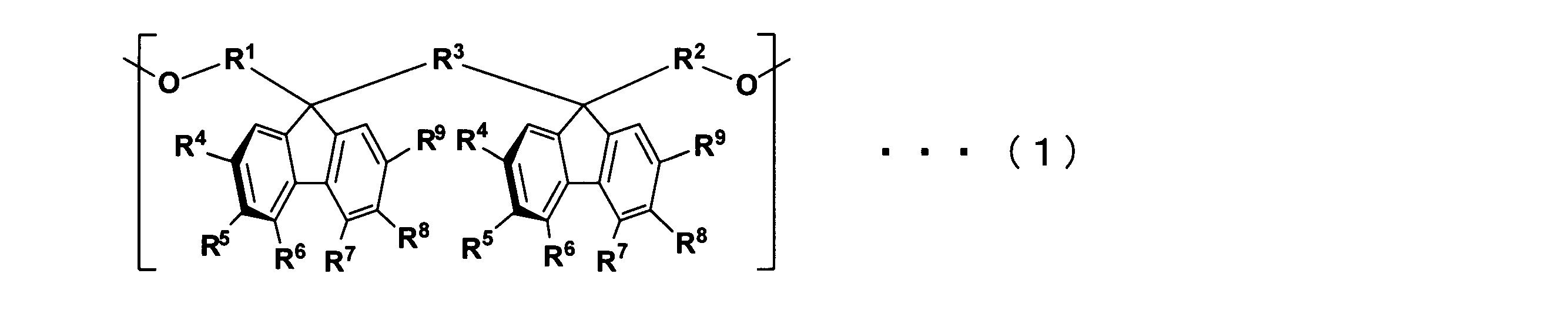

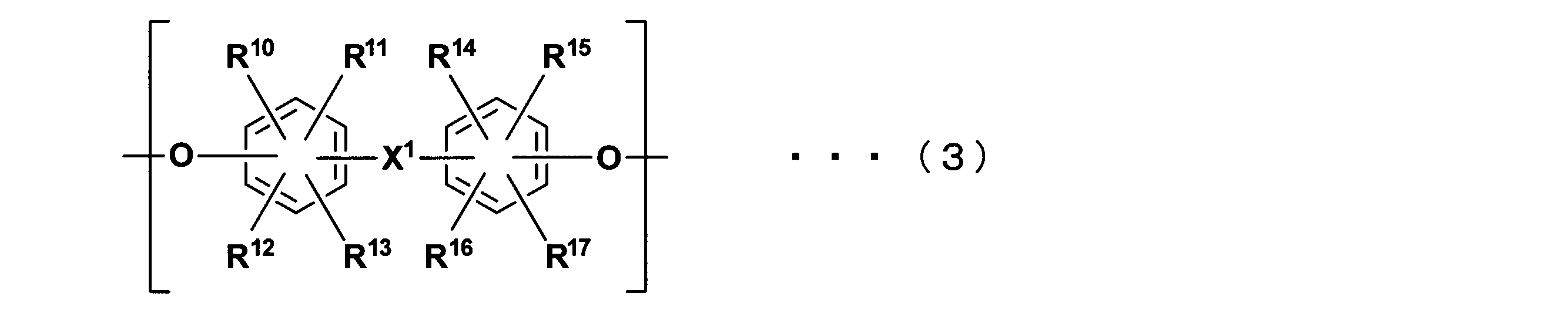
Priority Applications (3)
| Application Number | Priority Date | Filing Date | Title |
|---|---|---|---|
| JP2023556402A JPWO2023074576A1 (ja) | 2021-10-25 | 2022-10-21 | |
| KR1020247008342A KR20240093457A (ko) | 2021-10-25 | 2022-10-21 | 폴리카보네이트 수지 |
| CN202280063102.0A CN117980375A (zh) | 2021-10-25 | 2022-10-21 | 聚碳酸酯树脂 |
Applications Claiming Priority (2)
| Application Number | Priority Date | Filing Date | Title |
|---|---|---|---|
| JP2021173952 | 2021-10-25 | ||
| JP2021-173952 | 2021-10-25 |
Publications (1)
| Publication Number | Publication Date |
|---|---|
| WO2023074576A1 true WO2023074576A1 (ja) | 2023-05-04 |
Family
ID=86159870
Family Applications (1)
| Application Number | Title | Priority Date | Filing Date |
|---|---|---|---|
| PCT/JP2022/039329 Ceased WO2023074576A1 (ja) | 2021-10-25 | 2022-10-21 | ポリカーボネート樹脂 |
Country Status (5)
| Country | Link |
|---|---|
| JP (1) | JPWO2023074576A1 (ja) |
| KR (1) | KR20240093457A (ja) |
| CN (1) | CN117980375A (ja) |
| TW (1) | TW202334276A (ja) |
| WO (1) | WO2023074576A1 (ja) |
Citations (5)
| Publication number | Priority date | Publication date | Assignee | Title |
|---|---|---|---|---|
| JP2015212366A (ja) * | 2014-04-15 | 2015-11-26 | 三菱化学株式会社 | オリゴフルオレンジ(メタ)アクリレート、(メタ)アクリレート樹脂組成物、光学部材及びレンズ |
| JP2017075256A (ja) * | 2015-10-15 | 2017-04-20 | 三菱化学株式会社 | 熱可塑性樹脂、及びそれよりなる光学成形体 |
| JP2017075255A (ja) * | 2015-10-15 | 2017-04-20 | 三菱化学株式会社 | 熱可塑性樹脂、及びそれよりなる光学成形体 |
| JP2018172659A (ja) * | 2017-03-30 | 2018-11-08 | 大阪ガスケミカル株式会社 | フルオレン骨格を有するポリエステル樹脂及びその製造方法、並びに成形体 |
| JP2022146496A (ja) * | 2021-03-22 | 2022-10-05 | 三菱ケミカル株式会社 | 樹脂、及びその成形体 |
Family Cites Families (2)
| Publication number | Priority date | Publication date | Assignee | Title |
|---|---|---|---|---|
| JP2015212368A (ja) | 2014-04-16 | 2015-11-26 | 三菱化学株式会社 | 重縮合系樹脂及びそれよりなる光学フィルム |
| WO2016068152A1 (ja) | 2014-10-28 | 2016-05-06 | 三菱化学株式会社 | ポリカーボネート樹脂、成形品及び光学フィルム |
-
2022
- 2022-10-21 CN CN202280063102.0A patent/CN117980375A/zh active Pending
- 2022-10-21 JP JP2023556402A patent/JPWO2023074576A1/ja active Pending
- 2022-10-21 KR KR1020247008342A patent/KR20240093457A/ko active Pending
- 2022-10-21 WO PCT/JP2022/039329 patent/WO2023074576A1/ja not_active Ceased
- 2022-10-24 TW TW111140235A patent/TW202334276A/zh unknown
Patent Citations (5)
| Publication number | Priority date | Publication date | Assignee | Title |
|---|---|---|---|---|
| JP2015212366A (ja) * | 2014-04-15 | 2015-11-26 | 三菱化学株式会社 | オリゴフルオレンジ(メタ)アクリレート、(メタ)アクリレート樹脂組成物、光学部材及びレンズ |
| JP2017075256A (ja) * | 2015-10-15 | 2017-04-20 | 三菱化学株式会社 | 熱可塑性樹脂、及びそれよりなる光学成形体 |
| JP2017075255A (ja) * | 2015-10-15 | 2017-04-20 | 三菱化学株式会社 | 熱可塑性樹脂、及びそれよりなる光学成形体 |
| JP2018172659A (ja) * | 2017-03-30 | 2018-11-08 | 大阪ガスケミカル株式会社 | フルオレン骨格を有するポリエステル樹脂及びその製造方法、並びに成形体 |
| JP2022146496A (ja) * | 2021-03-22 | 2022-10-05 | 三菱ケミカル株式会社 | 樹脂、及びその成形体 |
Also Published As
| Publication number | Publication date |
|---|---|
| KR20240093457A (ko) | 2024-06-24 |
| CN117980375A (zh) | 2024-05-03 |
| JPWO2023074576A1 (ja) | 2023-05-04 |
| TW202334276A (zh) | 2023-09-01 |
Similar Documents
| Publication | Publication Date | Title |
|---|---|---|
| JP6881512B2 (ja) | ポリカーボネート樹脂、成形品及び光学フィルム | |
| CN106461836B (zh) | 相位差膜、圆偏振片及图像显示装置 | |
| CN106471401B (zh) | 相位差膜、圆偏振片及图像显示装置 | |
| CN106489085A (zh) | 相位差膜、圆偏振片及图像显示装置 | |
| JP6398242B2 (ja) | 樹脂組成物及びそれを用いたフィルム | |
| JP6597157B2 (ja) | 熱可塑性樹脂、及びそれよりなる光学成形体 | |
| JP6565577B2 (ja) | ポリカーボネート樹脂、及びそれよりなる光学フィルム | |
| JP6597158B2 (ja) | 熱可塑性樹脂、及びそれよりなる光学成形体 | |
| JP2015212368A (ja) | 重縮合系樹脂及びそれよりなる光学フィルム | |
| JP6801194B2 (ja) | ポリカーボネート樹脂、該ポリカーボネート樹脂の製造方法、該ポリカーボネート樹脂からなる透明フィルムの製造方法、及び位相差フィルム | |
| KR20240093457A (ko) | 폴리카보네이트 수지 | |
| JP2025026369A (ja) | 樹脂組成物、成形品、フィルム、光学フィルムおよび保護フィルム | |
| JP2024106821A (ja) | 共重合ポリカーボネート樹脂組成物、該組成物の製造方法、および、フィルム | |
| JP2025141680A (ja) | ポリカーボネート樹脂組成物、成形品、レンズおよびフィルム | |
| JP2005042021A (ja) | ポリカーボネート樹脂組成物 | |
| JP2005015545A (ja) | 添加剤マスターおよびそれを使用した耐熱性ポリカーボネート樹脂組成物 |
Legal Events
| Date | Code | Title | Description |
|---|---|---|---|
| 121 | Ep: the epo has been informed by wipo that ep was designated in this application |
Ref document number: 22886903 Country of ref document: EP Kind code of ref document: A1 |
|
| WWE | Wipo information: entry into national phase |
Ref document number: 2023556402 Country of ref document: JP |
|
| WWE | Wipo information: entry into national phase |
Ref document number: 202280063102.0 Country of ref document: CN |
|
| NENP | Non-entry into the national phase |
Ref country code: DE |
|
| 122 | Ep: pct application non-entry in european phase |
Ref document number: 22886903 Country of ref document: EP Kind code of ref document: A1 |