WO2023074404A1 - 発光装置及び電子機器 - Google Patents
発光装置及び電子機器 Download PDFInfo
- Publication number
- WO2023074404A1 WO2023074404A1 PCT/JP2022/038317 JP2022038317W WO2023074404A1 WO 2023074404 A1 WO2023074404 A1 WO 2023074404A1 JP 2022038317 W JP2022038317 W JP 2022038317W WO 2023074404 A1 WO2023074404 A1 WO 2023074404A1
- Authority
- WO
- WIPO (PCT)
- Prior art keywords
- light
- emitting device
- unit
- light emitting
- emitters
- Prior art date
- Legal status (The legal status is an assumption and is not a legal conclusion. Google has not performed a legal analysis and makes no representation as to the accuracy of the status listed.)
- Ceased
Links
Images









Classifications
-
- H—ELECTRICITY
- H04—ELECTRIC COMMUNICATION TECHNIQUE
- H04N—PICTORIAL COMMUNICATION, e.g. TELEVISION
- H04N13/00—Stereoscopic video systems; Multi-view video systems; Details thereof
- H04N13/30—Image reproducers
- H04N13/302—Image reproducers for viewing without the aid of special glasses, i.e. using autostereoscopic displays
- H04N13/32—Image reproducers for viewing without the aid of special glasses, i.e. using autostereoscopic displays using arrays of controllable light sources; using moving apertures or moving light sources
-
- H—ELECTRICITY
- H04—ELECTRIC COMMUNICATION TECHNIQUE
- H04N—PICTORIAL COMMUNICATION, e.g. TELEVISION
- H04N13/00—Stereoscopic video systems; Multi-view video systems; Details thereof
- H04N13/20—Image signal generators
- H04N13/204—Image signal generators using stereoscopic image cameras
- H04N13/254—Image signal generators using stereoscopic image cameras in combination with electromagnetic radiation sources for illuminating objects
-
- G—PHYSICS
- G01—MEASURING; TESTING
- G01B—MEASURING LENGTH, THICKNESS OR SIMILAR LINEAR DIMENSIONS; MEASURING ANGLES; MEASURING AREAS; MEASURING IRREGULARITIES OF SURFACES OR CONTOURS
- G01B11/00—Measuring arrangements characterised by the use of optical techniques
- G01B11/24—Measuring arrangements characterised by the use of optical techniques for measuring contours or curvatures
- G01B11/25—Measuring arrangements characterised by the use of optical techniques for measuring contours or curvatures by projecting a pattern, e.g. one or more lines, moiré fringes on the object
-
- H—ELECTRICITY
- H04—ELECTRIC COMMUNICATION TECHNIQUE
- H04N—PICTORIAL COMMUNICATION, e.g. TELEVISION
- H04N13/00—Stereoscopic video systems; Multi-view video systems; Details thereof
- H04N13/30—Image reproducers
- H04N13/302—Image reproducers for viewing without the aid of special glasses, i.e. using autostereoscopic displays
- H04N13/305—Image reproducers for viewing without the aid of special glasses, i.e. using autostereoscopic displays using lenticular lenses, e.g. arrangements of cylindrical lenses
-
- H—ELECTRICITY
- H04—ELECTRIC COMMUNICATION TECHNIQUE
- H04N—PICTORIAL COMMUNICATION, e.g. TELEVISION
- H04N13/00—Stereoscopic video systems; Multi-view video systems; Details thereof
- H04N13/30—Image reproducers
- H04N13/324—Colour aspects
-
- H—ELECTRICITY
- H04—ELECTRIC COMMUNICATION TECHNIQUE
- H04N—PICTORIAL COMMUNICATION, e.g. TELEVISION
- H04N5/00—Details of television systems
- H04N5/74—Projection arrangements for image reproduction, e.g. using eidophor
Definitions
- the present disclosure proposes a light-emitting device (lighting device) that enables highly accurate imaging (object detection) while having a simple configuration.
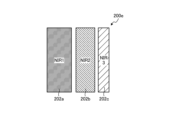
- FIG. 4 is an explanatory diagram showing an example of a planar configuration of a unit 200d according to the embodiment of the present disclosure
- FIG. FIG. 4 is an explanatory diagram showing an example of a planar configuration of a unit 200e according to the embodiment of the present disclosure
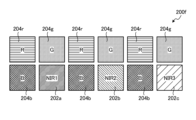
- FIG. FIG. 4 is an explanatory diagram showing an example of a planar configuration of a unit 200f according to the embodiment of the present disclosure
- FIG. 4 is an explanatory diagram showing an example of a planar configuration of a unit 200g according to the embodiment of the present disclosure
- shapes expressed in the following descriptions refer not only to shapes defined mathematically or geometrically, but also to the degree of difference allowed in the operation of the lighting device (light emitting device) and the manufacturing process of the lighting device. It means that similar shapes including (error/distortion) are also included. Furthermore, “identical” as used in the following description with respect to specific shapes does not only mean that they are perfectly matched mathematically or geometrically; This includes cases where there is an allowable degree of difference (error/distortion) in the manufacturing process.
- the subject is imaged, based on the imaged image, a three-dimensional volumetric image of the subject is generated (volumetric capture technology), and projected at a remote location away from the subject.
- a video content providing method has been proposed in which a viewer views a displayed live-action volumetric.
- this content provision method it is possible to change the actual volumetric of the subject according to the production effect and the movement of the viewer's viewpoint. It feels like the subject is actually there. Therefore, according to live-action volumetric, it is possible to enhance the sense of immersion and reality felt by viewers compared to conventional video content.
- a photographed volumetric of the subject 50 can be generated.
- a structured light does not require a plurality of imaging devices (cameras 20) for imaging the subject 50 from multiple viewpoints, so it is possible to avoid increasing the scale of the imaging system.
- the present inventors have created the illumination device 10 that enables highly accurate imaging (object detection) while having a simple configuration. Details of the lighting device 10 according to the embodiment of the present disclosure created by the present inventors will be described below.
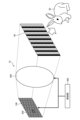
- FIG. 2 is an explanatory diagram showing an example of the configuration of the illumination device 10 according to this embodiment.
- the illumination device 10 according to this embodiment mainly includes a light emitting section (light emitting surface) 100 , a lens (projection lens) 300 , and a control section 400 that controls the light emitting section 100 .
- An outline of each element included in the lighting device 10 according to the present embodiment will be sequentially described below.
- one lighting device 10 can be used to irradiate light of different wavelengths. and the accuracy of background identification can be improved.
- the control unit 400 can irradiate light of different wavelengths from one light emitting unit 100 while switching at high speed. There is no displacement in the stereoscopic image 80 and the background image obtained with the light of . As a result, according to the present embodiment, it is possible to generate highly accurate photographed volumetrics.
- the lens 300 can project light from the light emitting unit 100 (for example, pattern light 60 having a predetermined pattern) onto the subject 50 . At this time, the lens 300 can enlarge or reduce the pattern light 60 according to the size and distance of the subject 50, for example. Details of the functions of the lens 300 according to this embodiment will be described later.
- each light emitting element can be driven individually by the control unit 400, light having various wavelengths and various patterns (predetermined pattern) from one illumination device 10 can be obtained. can be irradiated. Therefore, in this embodiment, it is possible to irradiate light having a suitable wavelength and pattern according to the reflection characteristics of the surface of the subject 50, the shape (for example, unevenness of the surface), and the size. As a result, according to this embodiment, the surface shape of the subject 50 can be captured with high accuracy.
- the illumination device 10 is not limited to the configuration shown in FIG. 2, and may include other elements such as a plurality of lenses 300, for example.
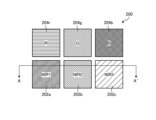
- the light emitting section 100 is configured by arranging unit units (unit regions) 200 each including a predetermined number of light emitting elements in a two-dimensional array on a plane. Furthermore, in this embodiment, the unitary unit 200 is configured by arranging a plurality of light emitting elements 202 and 204 in a two-dimensional array.
- the light emitting elements 202 and 204 can be formed from LEDs (Light Emitting Diodes), OLEDs (Organic Light Emitting Diodes), laser elements composed of semiconductor lasers, liquid crystals, or the like.
- the light emitting elements 202 and 204 are not limited to emitting light having the wavelengths described above. It is only necessary to include two light emitting elements (first light emitter, second light emitter) 202 capable of emitting light.
- the unit 200 includes three light emitting elements (a first light emitter, a second light emitter, a 3 light emitters) 202 .
- the unit 200 can be said to include three light-emitting elements (fourth light-emitting bodies) 204 capable of emitting light of different wavelengths in the visible light region. .
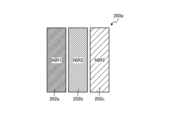
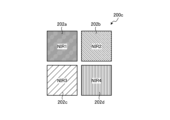
- FIG. 4 to 10 are explanatory diagrams showing an example of the planar configuration of the unit 200 according to this embodiment.
- the planar shape of the light emitting element 202 is not limited to a substantially square shape or a vertically long substantially rectangular shape. , approximately triangular). Furthermore, in this embodiment, as in the example shown in FIG. 4, the unit 200a may be composed only of the light-emitting elements 202 capable of emitting light of wavelengths in the near-infrared region.
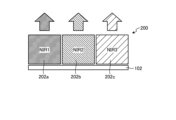
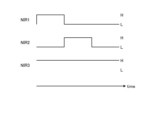
- a light emitting element (NIR1) 202a that emits light with a wavelength of 1500 nm
- a light emitting element (NIR2) 202b that emits light with a wavelength of 1200 nm
- a light emitting element (NIR2) 202b that emits light with a wavelength of 940 nm.
- the element (NIR3) 202c is provided adjacently on the substrate 102 (more specifically, on the same surface of the substrate 102). In this embodiment, by adopting such a cross-sectional configuration, the configuration of the lighting device 10 can be simplified, and the manufacturing of the lighting device 10 can be facilitated.
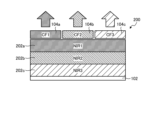
- the light emitting elements 202 may be stacked on the substrate 102 .
- a light-emitting element (NIR1) 202a that emits light is sequentially stacked.
- three color filters 104a, 104b, and 104c are arranged adjacently on the uppermost light emitting element (NIR1) 202a (more specifically, on the same surface of the light emitting element 202a). is provided.
- the color filter 104a selectively transmits light with a wavelength near 1500 nm
- the color filter 104b selectively transmits light with a wavelength near 1200 nm
- the color filter 104c selectively transmits light with a wavelength near 940 nm. wavelengths of light can be selectively transmitted.
- color filters 104a, 104b, and 104c are provided adjacently on a stack of light emitting elements 202a, 202b, and 202c, so that light with different wavelengths is emitted from each section on the plane of the unit 200. can do.
- the pattern light 60 having a suitable wavelength and pattern according to the reflection characteristics, shape (for example, unevenness of the surface) and size of the surface of the subject 50.
- the pattern of the pattern light 60 may be striped, latticed, or dotted (for example, a plurality of cross patterns are arranged at predetermined intervals).
- the shape of the pattern light 60 not only the shape of the pattern light 60 but also the spacing of the patterns can be suitably changed.
- one lighting device 10 can be used to irradiate light having different wavelengths and different patterns, so a plurality of lighting devices 10 and green screens can be prepared. Instead, it is possible to use light having wavelengths and patterns corresponding to the reflection characteristics of the surface of the object 50 and the background. As a result, in this embodiment, it is possible to improve the accuracy of identifying (imaging) the object 50 and the background with a simple configuration.
- the technology of the present disclosure it is possible to use a plurality of lights having different wavelengths according to the reflection characteristics of the subject 50 to be detected. It can be used as an illumination device for detecting a small subject 50 or a small difference in shape, which are difficult to detect.
- the technology of the present disclosure can be applied to medical inspections, shipping inspections in manufacturing processes of foods, pharmaceuticals, and the like.
- the technology of the present disclosure can also be applied to lighting for sensors mounted on autonomous robots, self-driving cars, and the like, which require detailed detection of surrounding conditions.
- the CPU 901 functions as an arithmetic processing device and a control device, and controls all or part of the operations within the smartphone 900 according to various programs recorded in the ROM 902, RAM 903, storage device 904, or the like.
- a ROM 902 stores programs and calculation parameters used by the CPU 901 .
- a RAM 903 temporarily stores programs used in the execution of the CPU 901, parameters that change as appropriate during the execution, and the like.
- the CPU 901 , ROM 902 and RAM 903 are interconnected by a bus 915 .
- the storage device 904 is a data storage device configured as an example of a storage unit of the smartphone 900 .
- the storage device 904 is composed of, for example, a magnetic storage device such as a HDD (Hard Disk Drive), a semiconductor storage device, an optical storage device, or the like.
- the storage device 904 stores programs executed by the CPU 901, various data, and various data acquired from the outside.
- the microphone 912 can collect, for example, the user's call voice, voice including commands for activating functions of the smartphone 900 , and ambient environment voice of the smartphone 900 .
- the input device 913 is, for example, a device operated by a user, such as a button, keyboard, touch panel, or mouse.
- the input device 913 includes an input control circuit that generates an input signal based on information input by the user and outputs the signal to the CPU 901 .
- the user can input various data to the smartphone 900 and instruct processing operations.
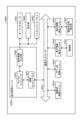
- an operator (physician) 11131 uses an endoscopic surgery system 11000 to perform surgery on a patient 11132 on a patient bed 11133 .
- an endoscopic surgery system 11000 includes an endoscope 11100, other surgical instruments 11110 such as a pneumoperitoneum tube 11111 and an energy treatment instrument 11112, and a support arm device 11120 for supporting the endoscope 11100. , and a cart 11200 loaded with various devices for endoscopic surgery.
- An endoscope 11100 is composed of a lens barrel 11101 whose distal end is inserted into the body cavity of a patient 11132 and a camera head 11102 connected to the proximal end of the lens barrel 11101 .
- an endoscope 11100 configured as a so-called rigid scope having a rigid lens barrel 11101 is illustrated, but the endoscope 11100 may be configured as a so-called flexible scope having a flexible lens barrel. good.
- the CCU 11201 is composed of a CPU (Central Processing Unit), a GPU (Graphics Processing Unit), etc., and controls the operations of the endoscope 11100 and the display device 11202 in an integrated manner. Further, the CCU 11201 receives an image signal from the camera head 11102 and performs various image processing such as development processing (demosaicing) for displaying an image based on the image signal.
- CPU Central Processing Unit
- GPU Graphics Processing Unit
- the input device 11204 is an input interface for the endoscopic surgery system 11000.
- the user can input various information and instructions to the endoscopic surgery system 11000 via the input device 11204 .
- the user inputs an instruction or the like to change the imaging conditions (type of irradiation light, magnification, focal length, etc.) by the endoscope 11100 .
- the treatment instrument control device 11205 controls driving of the energy treatment instrument 11112 for tissue cauterization, incision, blood vessel sealing, or the like.
- the pneumoperitoneum device 11206 inflates the body cavity of the patient 11132 for the purpose of securing the visual field of the endoscope 11100 and securing the operator's working space, and injects gas into the body cavity through the pneumoperitoneum tube 11111. send in.
- the recorder 11207 is a device capable of recording various types of information regarding surgery.
- the printer 11208 is a device capable of printing various types of information regarding surgery in various formats such as text, images, and graphs.
- the light source device 11203 that supplies irradiation light to the endoscope 11100 for photographing the surgical site can be composed of, for example, a light source composed of an LED, a laser light source, or a combination thereof.
- the light source is configured by combining RGB laser light sources, the output intensity and output timing of each color (each wavelength) can be controlled with high precision, so the light source device 11203 adjusts the white balance of the captured image. be able to.
- the observation target is irradiated with laser light from each of the RGB laser light sources in a time-division manner, and by controlling the drive of the imaging element of the camera head 11102 in synchronization with the irradiation timing, each of RGB can be handled. It is also possible to pick up images by time division. According to this method, a color image can be obtained without providing a color filter in the imaging device.
- the light source device 11203 may be configured to be able to supply light in a predetermined wavelength band corresponding to special light observation.
- special light observation for example, the wavelength dependence of light absorption in body tissues is used to irradiate a narrower band of light than the irradiation light (i.e., white light) used during normal observation, thereby observing the mucosal surface layer.
- narrow band imaging in which a predetermined tissue such as a blood vessel is imaged with high contrast, is performed.
- fluorescence observation may be performed in which an image is obtained from fluorescence generated by irradiation with excitation light.
- the body tissue is irradiated with excitation light and the fluorescence from the body tissue is observed (autofluorescence observation), or a reagent such as indocyanine green (ICG) is locally injected into the body tissue and the body tissue is A fluorescence image can be obtained by irradiating excitation light corresponding to the fluorescence wavelength of the reagent.
- the light source device 11203 can be configured to be able to supply narrowband light and/or excitation light corresponding to such special light observation.
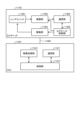
- FIG. 19 is a block diagram showing an example of functional configurations of the camera head 11102 and CCU 11201 shown in FIG.
- the camera head 11102 has a lens unit 11401, an imaging section 11402, a drive section 11403, a communication section 11404, and a camera head control section 11405.
- the CCU 11201 has a communication section 11411 , an image processing section 11412 and a control section 11413 .
- the camera head 11102 and the CCU 11201 are communicably connected to each other via a transmission cable 11400 .
- a lens unit 11401 is an optical system provided at a connection with the lens barrel 11101 . Observation light captured from the tip of the lens barrel 11101 is guided to the camera head 11102 and enters the lens unit 11401 .
- a lens unit 11401 is configured by combining a plurality of lenses including a zoom lens and a focus lens.
- the drive unit 11403 is configured by an actuator, and moves the zoom lens and focus lens of the lens unit 11401 by a predetermined distance along the optical axis under control from the camera head control unit 11405 . Thereby, the magnification and focus of the image captured by the imaging unit 11402 can be appropriately adjusted.
- the communication unit 11404 is composed of a communication device for transmitting and receiving various information to and from the CCU 11201.
- the communication unit 11404 transmits the image signal obtained from the imaging unit 11402 as RAW data to the CCU 11201 via the transmission cable 11400 .
- the communication unit 11404 receives a control signal for controlling driving of the camera head 11102 from the CCU 11201 and supplies it to the camera head control unit 11405 .
- the control signal includes, for example, information to specify the frame rate of the captured image, information to specify the exposure value at the time of imaging, and/or information to specify the magnification and focus of the captured image. Contains information about conditions.
- the camera head control unit 11405 controls driving of the camera head 11102 based on the control signal from the CCU 11201 received via the communication unit 11404.
- the communication unit 11411 transmits a control signal for controlling driving of the camera head 11102 to the camera head 11102 .
- Image signals and control signals can be transmitted by electric communication, optical communication, or the like.
- the technology according to the present disclosure can be realized as a device mounted on any type of moving body such as automobiles, electric vehicles, hybrid electric vehicles, motorcycles, bicycles, personal mobility, airplanes, drones, ships, and robots. may
- the vehicle exterior information detection unit 12030 detects information outside the vehicle in which the vehicle control system 12000 is installed.
- the vehicle exterior information detection unit 12030 is connected with an imaging section 12031 .
- the vehicle exterior information detection unit 12030 causes the imaging unit 12031 to capture an image of the exterior of the vehicle, and receives the captured image.
- the vehicle exterior information detection unit 12030 may perform object detection processing or distance detection processing such as people, vehicles, obstacles, signs, or characters on the road surface based on the received image.
- the microcomputer 12051 controls the driving force generator, the steering mechanism, the braking device, etc. based on the information about the vehicle surroundings acquired by the vehicle exterior information detection unit 12030 or the vehicle interior information detection unit 12040, so that the driver's Cooperative control can be performed for the purpose of autonomous driving, etc., in which vehicles autonomously travel without depending on operation.
- FIG. 20 is a diagram showing an example of the installation position of the imaging unit 12031.
- FIG. 20 is a diagram showing an example of the installation position of the imaging unit 12031.
- At least one of the imaging units 12101 to 12104 may have a function of acquiring distance information.
- at least one of the imaging units 12101 to 12104 may be a stereo camera composed of a plurality of imaging elements, or may be an imaging element having pixels for phase difference detection.
- the unit area further includes a third light emitter that emits light in the near-infrared region having a wavelength different from the wavelengths of light emitted by the first and second light emitters, The control unit individually drives the third light emitter, The light-emitting device according to (1) or (2) above.
- the unit area includes one or more fourth light emitters that emit light in the visible light region, The control unit individually drives the fourth light emitter, The light-emitting device according to any one of (1) to (3) above.
- the unit area further includes one or more sensor elements that receive reflected light from a subject.
- the sensor element is at least one of a SWIR sensor, a visible light sensor, and an EVS.
- the plurality of light emitters are arranged in any one of a square arrangement, a rectangular arrangement, a stripe arrangement, a polygonal arrangement, and a substantially circular arrangement. 1.
- Each unit area is The light-emitting device according to (12) above, which has a plurality of color filters provided on a stack of the first and second light emitters.
- (14) The light-emitting device according to any one of (1) to (13) above, wherein the control section controls each of the light emitters so as to project light having a predetermined pattern onto the subject.
- (15) further comprising a projection lens that projects the light having the predetermined pattern from the light emitting surface onto a subject; The light-emitting device as described in (14) above.
- (16) The light-emitting device according to (15) above, wherein the projection lens enlarges or reduces the light having the predetermined pattern.
- An electronic device equipped with a light emitting device The light emitting device a light emitting surface configured by arranging a plurality of unit areas each including a plurality of light emitters in a two-dimensional array; a control unit that drives the light emitters individually; with Each unit area includes a first light emitter and a second light emitter that emit light having mutually different wavelengths in the near-infrared region, Electronics.
Landscapes
- Engineering & Computer Science (AREA)
- Multimedia (AREA)
- Signal Processing (AREA)
- Physics & Mathematics (AREA)
- Electromagnetism (AREA)
- Computer Vision & Pattern Recognition (AREA)
- General Physics & Mathematics (AREA)
- Non-Portable Lighting Devices Or Systems Thereof (AREA)
- Length Measuring Devices By Optical Means (AREA)
- Measurement Of Optical Distance (AREA)
Priority Applications (3)
| Application Number | Priority Date | Filing Date | Title |
|---|---|---|---|
| CN202280071061.XA CN118140114A (zh) | 2021-10-29 | 2022-10-14 | 发光装置和电子设备 |
| JP2023556316A JPWO2023074404A1 (https=) | 2021-10-29 | 2022-10-14 | |
| US18/690,866 US20240406369A1 (en) | 2021-10-29 | 2022-10-14 | Light emitting device and electronic apparatus |
Applications Claiming Priority (2)
| Application Number | Priority Date | Filing Date | Title |
|---|---|---|---|
| JP2021177064 | 2021-10-29 | ||
| JP2021-177064 | 2021-10-29 |
Publications (1)
| Publication Number | Publication Date |
|---|---|
| WO2023074404A1 true WO2023074404A1 (ja) | 2023-05-04 |
Family
ID=86157981
Family Applications (1)
| Application Number | Title | Priority Date | Filing Date |
|---|---|---|---|
| PCT/JP2022/038317 Ceased WO2023074404A1 (ja) | 2021-10-29 | 2022-10-14 | 発光装置及び電子機器 |
Country Status (4)
| Country | Link |
|---|---|
| US (1) | US20240406369A1 (https=) |
| JP (1) | JPWO2023074404A1 (https=) |
| CN (1) | CN118140114A (https=) |
| WO (1) | WO2023074404A1 (https=) |
Families Citing this family (1)
| Publication number | Priority date | Publication date | Assignee | Title |
|---|---|---|---|---|
| DE102024202999A1 (de) * | 2024-03-28 | 2025-10-02 | Robert Bosch Gesellschaft mit beschränkter Haftung | Optische Einrichtung, die optische Einrichtung umfassende Brille, die optische Einrichtung umfassendes optisches Instrument oder Head-Up Display, und Verfahren zur Einstellung eines Farbverhältnisses eines Laserlichts |
Citations (4)
| Publication number | Priority date | Publication date | Assignee | Title |
|---|---|---|---|---|
| JP2001304821A (ja) * | 2000-02-16 | 2001-10-31 | Fuji Photo Film Co Ltd | 画像撮像装置及び距離測定方法 |
| JP2019515419A (ja) * | 2016-06-13 | 2019-06-06 | グーグル エルエルシー | ある角度範囲を掃引するための発光素子の千鳥状アレイ |
| JP2020161800A (ja) * | 2019-03-20 | 2020-10-01 | 株式会社リコー | 面発光レーザ素子、照明装置、投影装置、計測装置、ロボット、電子機器、移動体、および造形装置 |
| JP2021018079A (ja) * | 2019-07-17 | 2021-02-15 | 株式会社リコー | 撮像装置、計測装置、及び、計測方法 |
Family Cites Families (4)
| Publication number | Priority date | Publication date | Assignee | Title |
|---|---|---|---|---|
| JP2006047069A (ja) * | 2004-08-03 | 2006-02-16 | Funai Electric Co Ltd | 照明装置 |
| JP4645822B2 (ja) * | 2005-04-19 | 2011-03-09 | ソニー株式会社 | 画像表示装置および物体の検出方法 |
| JP6282438B2 (ja) * | 2013-10-18 | 2018-02-21 | スタンレー電気株式会社 | 半導体発光装置 |
| WO2017126164A1 (ja) * | 2016-01-19 | 2017-07-27 | 株式会社村田製作所 | 発光体、発光体の製造方法、及び生体物質標識剤 |
-
2022
- 2022-10-14 JP JP2023556316A patent/JPWO2023074404A1/ja active Pending
- 2022-10-14 US US18/690,866 patent/US20240406369A1/en active Pending
- 2022-10-14 WO PCT/JP2022/038317 patent/WO2023074404A1/ja not_active Ceased
- 2022-10-14 CN CN202280071061.XA patent/CN118140114A/zh active Pending
Patent Citations (4)
| Publication number | Priority date | Publication date | Assignee | Title |
|---|---|---|---|---|
| JP2001304821A (ja) * | 2000-02-16 | 2001-10-31 | Fuji Photo Film Co Ltd | 画像撮像装置及び距離測定方法 |
| JP2019515419A (ja) * | 2016-06-13 | 2019-06-06 | グーグル エルエルシー | ある角度範囲を掃引するための発光素子の千鳥状アレイ |
| JP2020161800A (ja) * | 2019-03-20 | 2020-10-01 | 株式会社リコー | 面発光レーザ素子、照明装置、投影装置、計測装置、ロボット、電子機器、移動体、および造形装置 |
| JP2021018079A (ja) * | 2019-07-17 | 2021-02-15 | 株式会社リコー | 撮像装置、計測装置、及び、計測方法 |
Also Published As
| Publication number | Publication date |
|---|---|
| US20240406369A1 (en) | 2024-12-05 |
| CN118140114A (zh) | 2024-06-04 |
| JPWO2023074404A1 (https=) | 2023-05-04 |
Similar Documents
| Publication | Publication Date | Title |
|---|---|---|
| US12499356B2 (en) | Solid-state image capturing system, solid-state image capturing device, information processing device, image processing method, and information processing method | |
| JP7229988B2 (ja) | 測距システム、及び、受光モジュール、並びに、バンドパスフィルタの製造方法 | |
| US20200013819A1 (en) | Solid-state imaging device and electronic apparatus | |
| WO2018135315A1 (ja) | 撮像装置、画像処理方法および画像処理システム | |
| US11075241B2 (en) | Solid-state imaging device and electronic apparatus | |
| JP2019083501A (ja) | 撮像装置 | |
| WO2017163927A1 (ja) | チップサイズパッケージ、製造方法、電子機器、および内視鏡 | |
| US11750932B2 (en) | Image processing apparatus, image processing method, and electronic apparatus | |
| WO2018139278A1 (ja) | 撮像素子、製造方法、および電子機器 | |
| US10915009B2 (en) | Compound-eye camera module and electronic device | |
| US20230246049A1 (en) | Light detection device | |
| US20190104236A1 (en) | Camera module, method of manufacturing camera module, imaging apparatus, and electronic apparatus | |
| JP2019192802A (ja) | 撮像素子および撮像素子の製造方法 | |
| US11715751B2 (en) | Solid-state imaging element, electronic apparatus, and semiconductor device | |
| US12211310B2 (en) | Imaging device | |
| WO2023074404A1 (ja) | 発光装置及び電子機器 | |
| US20240145506A1 (en) | Semiconductor package and electronic device | |
| WO2019054177A1 (ja) | 撮像素子および撮像素子の製造方法、撮像装置、並びに電子機器 | |
| US11329077B2 (en) | Semiconductor device with a through electrode reception part wider than a through electrode, solid-state imaging device, and electronic equipment | |
| WO2019082686A1 (ja) | 撮像装置 | |
| WO2022196210A1 (ja) | 撮像装置、撮像方法及び電子機器 |
Legal Events
| Date | Code | Title | Description |
|---|---|---|---|
| 121 | Ep: the epo has been informed by wipo that ep was designated in this application |
Ref document number: 22886733 Country of ref document: EP Kind code of ref document: A1 |
|
| WWE | Wipo information: entry into national phase |
Ref document number: 2023556316 Country of ref document: JP |
|
| WWE | Wipo information: entry into national phase |
Ref document number: 202280071061.X Country of ref document: CN |
|
| NENP | Non-entry into the national phase |
Ref country code: DE |
|
| 122 | Ep: pct application non-entry in european phase |
Ref document number: 22886733 Country of ref document: EP Kind code of ref document: A1 |