WO2023073766A1 - 立方晶窒化硼素焼結体 - Google Patents
立方晶窒化硼素焼結体 Download PDFInfo
- Publication number
- WO2023073766A1 WO2023073766A1 PCT/JP2021/039320 JP2021039320W WO2023073766A1 WO 2023073766 A1 WO2023073766 A1 WO 2023073766A1 JP 2021039320 W JP2021039320 W JP 2021039320W WO 2023073766 A1 WO2023073766 A1 WO 2023073766A1
- Authority
- WO
- WIPO (PCT)
- Prior art keywords
- boron nitride
- cubic boron
- volume
- sintered body
- cbn
- Prior art date
- Legal status (The legal status is an assumption and is not a legal conclusion. Google has not performed a legal analysis and makes no representation as to the accuracy of the status listed.)
- Ceased
Links
Images




Classifications
-
- C—CHEMISTRY; METALLURGY
- C22—METALLURGY; FERROUS OR NON-FERROUS ALLOYS; TREATMENT OF ALLOYS OR NON-FERROUS METALS
- C22C—ALLOYS
- C22C26/00—Alloys containing diamond or cubic or wurtzitic boron nitride, fullerenes or carbon nanotubes
-
- B—PERFORMING OPERATIONS; TRANSPORTING
- B22—CASTING; POWDER METALLURGY
- B22F—WORKING METALLIC POWDER; MANUFACTURE OF ARTICLES FROM METALLIC POWDER; MAKING METALLIC POWDER; APPARATUS OR DEVICES SPECIALLY ADAPTED FOR METALLIC POWDER
- B22F3/00—Manufacture of workpieces or articles from metallic powder characterised by the manner of compacting or sintering; Apparatus specially adapted therefor ; Presses and furnaces
- B22F3/12—Both compacting and sintering
- B22F3/14—Both compacting and sintering simultaneously
-
- B—PERFORMING OPERATIONS; TRANSPORTING
- B22—CASTING; POWDER METALLURGY
- B22F—WORKING METALLIC POWDER; MANUFACTURE OF ARTICLES FROM METALLIC POWDER; MAKING METALLIC POWDER; APPARATUS OR DEVICES SPECIALLY ADAPTED FOR METALLIC POWDER
- B22F9/00—Making metallic powder or suspensions thereof
- B22F9/02—Making metallic powder or suspensions thereof using physical processes
- B22F9/04—Making metallic powder or suspensions thereof using physical processes starting from solid material, e.g. by crushing, grinding or milling
-
- C—CHEMISTRY; METALLURGY
- C01—INORGANIC CHEMISTRY
- C01B—NON-METALLIC ELEMENTS; COMPOUNDS THEREOF; METALLOIDS OR COMPOUNDS THEREOF NOT COVERED BY SUBCLASS C01C
- C01B21/00—Nitrogen; Compounds thereof
- C01B21/06—Binary compounds of nitrogen with metals, with silicon, or with boron, or with carbon, i.e. nitrides; Compounds of nitrogen with more than one metal, silicon or boron
- C01B21/064—Binary compounds of nitrogen with metals, with silicon, or with boron, or with carbon, i.e. nitrides; Compounds of nitrogen with more than one metal, silicon or boron with boron
-
- C—CHEMISTRY; METALLURGY
- C01—INORGANIC CHEMISTRY
- C01B—NON-METALLIC ELEMENTS; COMPOUNDS THEREOF; METALLOIDS OR COMPOUNDS THEREOF NOT COVERED BY SUBCLASS C01C
- C01B21/00—Nitrogen; Compounds thereof
- C01B21/06—Binary compounds of nitrogen with metals, with silicon, or with boron, or with carbon, i.e. nitrides; Compounds of nitrogen with more than one metal, silicon or boron
- C01B21/064—Binary compounds of nitrogen with metals, with silicon, or with boron, or with carbon, i.e. nitrides; Compounds of nitrogen with more than one metal, silicon or boron with boron
- C01B21/0648—After-treatment, e.g. grinding, purification
-
- C—CHEMISTRY; METALLURGY
- C04—CEMENTS; CONCRETE; ARTIFICIAL STONE; CERAMICS; REFRACTORIES
- C04B—LIME, MAGNESIA; SLAG; CEMENTS; COMPOSITIONS THEREOF, e.g. MORTARS, CONCRETE OR LIKE BUILDING MATERIALS; ARTIFICIAL STONE; CERAMICS; REFRACTORIES; TREATMENT OF NATURAL STONE
- C04B35/00—Shaped ceramic products characterised by their composition; Ceramics compositions; Processing powders of inorganic compounds preparatory to the manufacturing of ceramic products
- C04B35/515—Shaped ceramic products characterised by their composition; Ceramics compositions; Processing powders of inorganic compounds preparatory to the manufacturing of ceramic products based on non-oxide ceramics
- C04B35/58—Shaped ceramic products characterised by their composition; Ceramics compositions; Processing powders of inorganic compounds preparatory to the manufacturing of ceramic products based on non-oxide ceramics based on borides, nitrides, i.e. nitrides, oxynitrides, carbonitrides or oxycarbonitrides or silicides
- C04B35/583—Shaped ceramic products characterised by their composition; Ceramics compositions; Processing powders of inorganic compounds preparatory to the manufacturing of ceramic products based on non-oxide ceramics based on borides, nitrides, i.e. nitrides, oxynitrides, carbonitrides or oxycarbonitrides or silicides based on boron nitride
- C04B35/5831—Shaped ceramic products characterised by their composition; Ceramics compositions; Processing powders of inorganic compounds preparatory to the manufacturing of ceramic products based on non-oxide ceramics based on borides, nitrides, i.e. nitrides, oxynitrides, carbonitrides or oxycarbonitrides or silicides based on boron nitride based on cubic boron nitrides or Wurtzitic boron nitrides, including crystal structure transformation of powder
-
- C—CHEMISTRY; METALLURGY
- C04—CEMENTS; CONCRETE; ARTIFICIAL STONE; CERAMICS; REFRACTORIES
- C04B—LIME, MAGNESIA; SLAG; CEMENTS; COMPOSITIONS THEREOF, e.g. MORTARS, CONCRETE OR LIKE BUILDING MATERIALS; ARTIFICIAL STONE; CERAMICS; REFRACTORIES; TREATMENT OF NATURAL STONE
- C04B35/00—Shaped ceramic products characterised by their composition; Ceramics compositions; Processing powders of inorganic compounds preparatory to the manufacturing of ceramic products
- C04B35/622—Forming processes; Processing powders of inorganic compounds preparatory to the manufacturing of ceramic products
- C04B35/626—Preparing or treating the powders individually or as batches ; preparing or treating macroscopic reinforcing agents for ceramic products, e.g. fibres; mechanical aspects section B
- C04B35/62605—Treating the starting powders individually or as mixtures
- C04B35/62645—Thermal treatment of powders or mixtures thereof other than sintering
-
- C—CHEMISTRY; METALLURGY
- C04—CEMENTS; CONCRETE; ARTIFICIAL STONE; CERAMICS; REFRACTORIES
- C04B—LIME, MAGNESIA; SLAG; CEMENTS; COMPOSITIONS THEREOF, e.g. MORTARS, CONCRETE OR LIKE BUILDING MATERIALS; ARTIFICIAL STONE; CERAMICS; REFRACTORIES; TREATMENT OF NATURAL STONE
- C04B35/00—Shaped ceramic products characterised by their composition; Ceramics compositions; Processing powders of inorganic compounds preparatory to the manufacturing of ceramic products
- C04B35/622—Forming processes; Processing powders of inorganic compounds preparatory to the manufacturing of ceramic products
- C04B35/626—Preparing or treating the powders individually or as batches ; preparing or treating macroscopic reinforcing agents for ceramic products, e.g. fibres; mechanical aspects section B
- C04B35/62605—Treating the starting powders individually or as mixtures
- C04B35/62645—Thermal treatment of powders or mixtures thereof other than sintering
- C04B35/6265—Thermal treatment of powders or mixtures thereof other than sintering involving reduction or oxidation
-
- C—CHEMISTRY; METALLURGY
- C04—CEMENTS; CONCRETE; ARTIFICIAL STONE; CERAMICS; REFRACTORIES
- C04B—LIME, MAGNESIA; SLAG; CEMENTS; COMPOSITIONS THEREOF, e.g. MORTARS, CONCRETE OR LIKE BUILDING MATERIALS; ARTIFICIAL STONE; CERAMICS; REFRACTORIES; TREATMENT OF NATURAL STONE
- C04B35/00—Shaped ceramic products characterised by their composition; Ceramics compositions; Processing powders of inorganic compounds preparatory to the manufacturing of ceramic products
- C04B35/622—Forming processes; Processing powders of inorganic compounds preparatory to the manufacturing of ceramic products
- C04B35/626—Preparing or treating the powders individually or as batches ; preparing or treating macroscopic reinforcing agents for ceramic products, e.g. fibres; mechanical aspects section B
- C04B35/63—Preparing or treating the powders individually or as batches ; preparing or treating macroscopic reinforcing agents for ceramic products, e.g. fibres; mechanical aspects section B using additives specially adapted for forming the products, e.g.. binder binders
-
- C—CHEMISTRY; METALLURGY
- C04—CEMENTS; CONCRETE; ARTIFICIAL STONE; CERAMICS; REFRACTORIES
- C04B—LIME, MAGNESIA; SLAG; CEMENTS; COMPOSITIONS THEREOF, e.g. MORTARS, CONCRETE OR LIKE BUILDING MATERIALS; ARTIFICIAL STONE; CERAMICS; REFRACTORIES; TREATMENT OF NATURAL STONE
- C04B35/00—Shaped ceramic products characterised by their composition; Ceramics compositions; Processing powders of inorganic compounds preparatory to the manufacturing of ceramic products
- C04B35/622—Forming processes; Processing powders of inorganic compounds preparatory to the manufacturing of ceramic products
- C04B35/64—Burning or sintering processes
- C04B35/645—Pressure sintering
-
- B—PERFORMING OPERATIONS; TRANSPORTING
- B22—CASTING; POWDER METALLURGY
- B22F—WORKING METALLIC POWDER; MANUFACTURE OF ARTICLES FROM METALLIC POWDER; MAKING METALLIC POWDER; APPARATUS OR DEVICES SPECIALLY ADAPTED FOR METALLIC POWDER
- B22F5/00—Manufacture of workpieces or articles from metallic powder characterised by the special shape of the product
- B22F2005/001—Cutting tools, earth boring or grinding tool other than table ware
-
- B—PERFORMING OPERATIONS; TRANSPORTING
- B22—CASTING; POWDER METALLURGY
- B22F—WORKING METALLIC POWDER; MANUFACTURE OF ARTICLES FROM METALLIC POWDER; MAKING METALLIC POWDER; APPARATUS OR DEVICES SPECIALLY ADAPTED FOR METALLIC POWDER
- B22F9/00—Making metallic powder or suspensions thereof
- B22F9/02—Making metallic powder or suspensions thereof using physical processes
- B22F9/04—Making metallic powder or suspensions thereof using physical processes starting from solid material, e.g. by crushing, grinding or milling
- B22F2009/042—Making metallic powder or suspensions thereof using physical processes starting from solid material, e.g. by crushing, grinding or milling using a particular milling fluid
-
- B—PERFORMING OPERATIONS; TRANSPORTING
- B22—CASTING; POWDER METALLURGY
- B22F—WORKING METALLIC POWDER; MANUFACTURE OF ARTICLES FROM METALLIC POWDER; MAKING METALLIC POWDER; APPARATUS OR DEVICES SPECIALLY ADAPTED FOR METALLIC POWDER
- B22F9/00—Making metallic powder or suspensions thereof
- B22F9/02—Making metallic powder or suspensions thereof using physical processes
- B22F9/04—Making metallic powder or suspensions thereof using physical processes starting from solid material, e.g. by crushing, grinding or milling
- B22F2009/043—Making metallic powder or suspensions thereof using physical processes starting from solid material, e.g. by crushing, grinding or milling by ball milling
-
- B—PERFORMING OPERATIONS; TRANSPORTING
- B22—CASTING; POWDER METALLURGY
- B22F—WORKING METALLIC POWDER; MANUFACTURE OF ARTICLES FROM METALLIC POWDER; MAKING METALLIC POWDER; APPARATUS OR DEVICES SPECIALLY ADAPTED FOR METALLIC POWDER
- B22F2201/00—Treatment under specific atmosphere
- B22F2201/20—Use of vacuum
-
- B—PERFORMING OPERATIONS; TRANSPORTING
- B22—CASTING; POWDER METALLURGY
- B22F—WORKING METALLIC POWDER; MANUFACTURE OF ARTICLES FROM METALLIC POWDER; MAKING METALLIC POWDER; APPARATUS OR DEVICES SPECIALLY ADAPTED FOR METALLIC POWDER
- B22F2301/00—Metallic composition of the powder or its coating
- B22F2301/05—Light metals
- B22F2301/052—Aluminium
-
- B—PERFORMING OPERATIONS; TRANSPORTING
- B22—CASTING; POWDER METALLURGY
- B22F—WORKING METALLIC POWDER; MANUFACTURE OF ARTICLES FROM METALLIC POWDER; MAKING METALLIC POWDER; APPARATUS OR DEVICES SPECIALLY ADAPTED FOR METALLIC POWDER
- B22F2301/00—Metallic composition of the powder or its coating
- B22F2301/15—Nickel or cobalt
-
- B—PERFORMING OPERATIONS; TRANSPORTING
- B22—CASTING; POWDER METALLURGY
- B22F—WORKING METALLIC POWDER; MANUFACTURE OF ARTICLES FROM METALLIC POWDER; MAKING METALLIC POWDER; APPARATUS OR DEVICES SPECIALLY ADAPTED FOR METALLIC POWDER
- B22F2301/00—Metallic composition of the powder or its coating
- B22F2301/20—Refractory metals
- B22F2301/205—Titanium, zirconium or hafnium
-
- B—PERFORMING OPERATIONS; TRANSPORTING
- B22—CASTING; POWDER METALLURGY
- B22F—WORKING METALLIC POWDER; MANUFACTURE OF ARTICLES FROM METALLIC POWDER; MAKING METALLIC POWDER; APPARATUS OR DEVICES SPECIALLY ADAPTED FOR METALLIC POWDER
- B22F2302/00—Metal Compound, non-Metallic compound or non-metal composition of the powder or its coating
- B22F2302/10—Carbide
-
- B—PERFORMING OPERATIONS; TRANSPORTING
- B22—CASTING; POWDER METALLURGY
- B22F—WORKING METALLIC POWDER; MANUFACTURE OF ARTICLES FROM METALLIC POWDER; MAKING METALLIC POWDER; APPARATUS OR DEVICES SPECIALLY ADAPTED FOR METALLIC POWDER
- B22F2302/00—Metal Compound, non-Metallic compound or non-metal composition of the powder or its coating
- B22F2302/15—Carbonitride
-
- B—PERFORMING OPERATIONS; TRANSPORTING
- B22—CASTING; POWDER METALLURGY
- B22F—WORKING METALLIC POWDER; MANUFACTURE OF ARTICLES FROM METALLIC POWDER; MAKING METALLIC POWDER; APPARATUS OR DEVICES SPECIALLY ADAPTED FOR METALLIC POWDER
- B22F2302/00—Metal Compound, non-Metallic compound or non-metal composition of the powder or its coating
- B22F2302/20—Nitride
-
- B—PERFORMING OPERATIONS; TRANSPORTING
- B22—CASTING; POWDER METALLURGY
- B22F—WORKING METALLIC POWDER; MANUFACTURE OF ARTICLES FROM METALLIC POWDER; MAKING METALLIC POWDER; APPARATUS OR DEVICES SPECIALLY ADAPTED FOR METALLIC POWDER
- B22F2302/00—Metal Compound, non-Metallic compound or non-metal composition of the powder or its coating
- B22F2302/205—Cubic boron nitride
-
- B—PERFORMING OPERATIONS; TRANSPORTING
- B22—CASTING; POWDER METALLURGY
- B22F—WORKING METALLIC POWDER; MANUFACTURE OF ARTICLES FROM METALLIC POWDER; MAKING METALLIC POWDER; APPARATUS OR DEVICES SPECIALLY ADAPTED FOR METALLIC POWDER
- B22F2998/00—Supplementary information concerning processes or compositions relating to powder metallurgy
- B22F2998/10—Processes characterised by the sequence of their steps
-
- B—PERFORMING OPERATIONS; TRANSPORTING
- B22—CASTING; POWDER METALLURGY
- B22F—WORKING METALLIC POWDER; MANUFACTURE OF ARTICLES FROM METALLIC POWDER; MAKING METALLIC POWDER; APPARATUS OR DEVICES SPECIALLY ADAPTED FOR METALLIC POWDER
- B22F2999/00—Aspects linked to processes or compositions used in powder metallurgy
-
- C—CHEMISTRY; METALLURGY
- C04—CEMENTS; CONCRETE; ARTIFICIAL STONE; CERAMICS; REFRACTORIES
- C04B—LIME, MAGNESIA; SLAG; CEMENTS; COMPOSITIONS THEREOF, e.g. MORTARS, CONCRETE OR LIKE BUILDING MATERIALS; ARTIFICIAL STONE; CERAMICS; REFRACTORIES; TREATMENT OF NATURAL STONE
- C04B2235/00—Aspects relating to ceramic starting mixtures or sintered ceramic products
- C04B2235/02—Composition of constituents of the starting material or of secondary phases of the final product
- C04B2235/30—Constituents and secondary phases not being of a fibrous nature
- C04B2235/38—Non-oxide ceramic constituents or additives
- C04B2235/3852—Nitrides, e.g. oxynitrides, carbonitrides, oxycarbonitrides, lithium nitride, magnesium nitride
- C04B2235/3856—Carbonitrides, e.g. titanium carbonitride, zirconium carbonitride
-
- C—CHEMISTRY; METALLURGY
- C04—CEMENTS; CONCRETE; ARTIFICIAL STONE; CERAMICS; REFRACTORIES
- C04B—LIME, MAGNESIA; SLAG; CEMENTS; COMPOSITIONS THEREOF, e.g. MORTARS, CONCRETE OR LIKE BUILDING MATERIALS; ARTIFICIAL STONE; CERAMICS; REFRACTORIES; TREATMENT OF NATURAL STONE
- C04B2235/00—Aspects relating to ceramic starting mixtures or sintered ceramic products
- C04B2235/02—Composition of constituents of the starting material or of secondary phases of the final product
- C04B2235/30—Constituents and secondary phases not being of a fibrous nature
- C04B2235/38—Non-oxide ceramic constituents or additives
- C04B2235/3852—Nitrides, e.g. oxynitrides, carbonitrides, oxycarbonitrides, lithium nitride, magnesium nitride
- C04B2235/3886—Refractory metal nitrides, e.g. vanadium nitride, tungsten nitride
-
- C—CHEMISTRY; METALLURGY
- C04—CEMENTS; CONCRETE; ARTIFICIAL STONE; CERAMICS; REFRACTORIES
- C04B—LIME, MAGNESIA; SLAG; CEMENTS; COMPOSITIONS THEREOF, e.g. MORTARS, CONCRETE OR LIKE BUILDING MATERIALS; ARTIFICIAL STONE; CERAMICS; REFRACTORIES; TREATMENT OF NATURAL STONE
- C04B2235/00—Aspects relating to ceramic starting mixtures or sintered ceramic products
- C04B2235/02—Composition of constituents of the starting material or of secondary phases of the final product
- C04B2235/30—Constituents and secondary phases not being of a fibrous nature
- C04B2235/40—Metallic constituents or additives not added as binding phase
- C04B2235/402—Aluminium
-
- C—CHEMISTRY; METALLURGY
- C04—CEMENTS; CONCRETE; ARTIFICIAL STONE; CERAMICS; REFRACTORIES
- C04B—LIME, MAGNESIA; SLAG; CEMENTS; COMPOSITIONS THEREOF, e.g. MORTARS, CONCRETE OR LIKE BUILDING MATERIALS; ARTIFICIAL STONE; CERAMICS; REFRACTORIES; TREATMENT OF NATURAL STONE
- C04B2235/00—Aspects relating to ceramic starting mixtures or sintered ceramic products
- C04B2235/02—Composition of constituents of the starting material or of secondary phases of the final product
- C04B2235/50—Constituents or additives of the starting mixture chosen for their shape or used because of their shape or their physical appearance
- C04B2235/54—Particle size related information
- C04B2235/5418—Particle size related information expressed by the size of the particles or aggregates thereof
- C04B2235/5436—Particle size related information expressed by the size of the particles or aggregates thereof micrometer sized, i.e. from 1 to 100 micron
-
- C—CHEMISTRY; METALLURGY
- C04—CEMENTS; CONCRETE; ARTIFICIAL STONE; CERAMICS; REFRACTORIES
- C04B—LIME, MAGNESIA; SLAG; CEMENTS; COMPOSITIONS THEREOF, e.g. MORTARS, CONCRETE OR LIKE BUILDING MATERIALS; ARTIFICIAL STONE; CERAMICS; REFRACTORIES; TREATMENT OF NATURAL STONE
- C04B2235/00—Aspects relating to ceramic starting mixtures or sintered ceramic products
- C04B2235/02—Composition of constituents of the starting material or of secondary phases of the final product
- C04B2235/50—Constituents or additives of the starting mixture chosen for their shape or used because of their shape or their physical appearance
- C04B2235/54—Particle size related information
- C04B2235/5418—Particle size related information expressed by the size of the particles or aggregates thereof
- C04B2235/5445—Particle size related information expressed by the size of the particles or aggregates thereof submicron sized, i.e. from 0,1 to 1 micron
-
- C—CHEMISTRY; METALLURGY
- C04—CEMENTS; CONCRETE; ARTIFICIAL STONE; CERAMICS; REFRACTORIES
- C04B—LIME, MAGNESIA; SLAG; CEMENTS; COMPOSITIONS THEREOF, e.g. MORTARS, CONCRETE OR LIKE BUILDING MATERIALS; ARTIFICIAL STONE; CERAMICS; REFRACTORIES; TREATMENT OF NATURAL STONE
- C04B2235/00—Aspects relating to ceramic starting mixtures or sintered ceramic products
- C04B2235/65—Aspects relating to heat treatments of ceramic bodies such as green ceramics or pre-sintered ceramics, e.g. burning, sintering or melting processes
- C04B2235/66—Specific sintering techniques, e.g. centrifugal sintering
- C04B2235/661—Multi-step sintering
- C04B2235/662—Annealing after sintering
- C04B2235/664—Reductive annealing
-
- C—CHEMISTRY; METALLURGY
- C04—CEMENTS; CONCRETE; ARTIFICIAL STONE; CERAMICS; REFRACTORIES
- C04B—LIME, MAGNESIA; SLAG; CEMENTS; COMPOSITIONS THEREOF, e.g. MORTARS, CONCRETE OR LIKE BUILDING MATERIALS; ARTIFICIAL STONE; CERAMICS; REFRACTORIES; TREATMENT OF NATURAL STONE
- C04B2235/00—Aspects relating to ceramic starting mixtures or sintered ceramic products
- C04B2235/70—Aspects relating to sintered or melt-casted ceramic products
- C04B2235/72—Products characterised by the absence or the low content of specific components, e.g. alkali metal free alumina ceramics
-
- C—CHEMISTRY; METALLURGY
- C04—CEMENTS; CONCRETE; ARTIFICIAL STONE; CERAMICS; REFRACTORIES
- C04B—LIME, MAGNESIA; SLAG; CEMENTS; COMPOSITIONS THEREOF, e.g. MORTARS, CONCRETE OR LIKE BUILDING MATERIALS; ARTIFICIAL STONE; CERAMICS; REFRACTORIES; TREATMENT OF NATURAL STONE
- C04B2235/00—Aspects relating to ceramic starting mixtures or sintered ceramic products
- C04B2235/70—Aspects relating to sintered or melt-casted ceramic products
- C04B2235/72—Products characterised by the absence or the low content of specific components, e.g. alkali metal free alumina ceramics
- C04B2235/728—Silicon content
-
- C—CHEMISTRY; METALLURGY
- C04—CEMENTS; CONCRETE; ARTIFICIAL STONE; CERAMICS; REFRACTORIES
- C04B—LIME, MAGNESIA; SLAG; CEMENTS; COMPOSITIONS THEREOF, e.g. MORTARS, CONCRETE OR LIKE BUILDING MATERIALS; ARTIFICIAL STONE; CERAMICS; REFRACTORIES; TREATMENT OF NATURAL STONE
- C04B2235/00—Aspects relating to ceramic starting mixtures or sintered ceramic products
- C04B2235/70—Aspects relating to sintered or melt-casted ceramic products
- C04B2235/74—Physical characteristics
- C04B2235/76—Crystal structural characteristics, e.g. symmetry
- C04B2235/761—Unit-cell parameters, e.g. lattice constants
-
- C—CHEMISTRY; METALLURGY
- C04—CEMENTS; CONCRETE; ARTIFICIAL STONE; CERAMICS; REFRACTORIES
- C04B—LIME, MAGNESIA; SLAG; CEMENTS; COMPOSITIONS THEREOF, e.g. MORTARS, CONCRETE OR LIKE BUILDING MATERIALS; ARTIFICIAL STONE; CERAMICS; REFRACTORIES; TREATMENT OF NATURAL STONE
- C04B2235/00—Aspects relating to ceramic starting mixtures or sintered ceramic products
- C04B2235/70—Aspects relating to sintered or melt-casted ceramic products
- C04B2235/80—Phases present in the sintered or melt-cast ceramic products other than the main phase
-
- C—CHEMISTRY; METALLURGY
- C04—CEMENTS; CONCRETE; ARTIFICIAL STONE; CERAMICS; REFRACTORIES
- C04B—LIME, MAGNESIA; SLAG; CEMENTS; COMPOSITIONS THEREOF, e.g. MORTARS, CONCRETE OR LIKE BUILDING MATERIALS; ARTIFICIAL STONE; CERAMICS; REFRACTORIES; TREATMENT OF NATURAL STONE
- C04B2235/00—Aspects relating to ceramic starting mixtures or sintered ceramic products
- C04B2235/70—Aspects relating to sintered or melt-casted ceramic products
- C04B2235/96—Properties of ceramic products, e.g. mechanical properties such as strength, toughness, wear resistance
-
- C—CHEMISTRY; METALLURGY
- C22—METALLURGY; FERROUS OR NON-FERROUS ALLOYS; TREATMENT OF ALLOYS OR NON-FERROUS METALS
- C22C—ALLOYS
- C22C26/00—Alloys containing diamond or cubic or wurtzitic boron nitride, fullerenes or carbon nanotubes
- C22C2026/003—Cubic boron nitrides only
-
- C—CHEMISTRY; METALLURGY
- C22—METALLURGY; FERROUS OR NON-FERROUS ALLOYS; TREATMENT OF ALLOYS OR NON-FERROUS METALS
- C22C—ALLOYS
- C22C26/00—Alloys containing diamond or cubic or wurtzitic boron nitride, fullerenes or carbon nanotubes
- C22C2026/005—Alloys containing diamond or cubic or wurtzitic boron nitride, fullerenes or carbon nanotubes with additional metal compounds being borides
-
- C—CHEMISTRY; METALLURGY
- C22—METALLURGY; FERROUS OR NON-FERROUS ALLOYS; TREATMENT OF ALLOYS OR NON-FERROUS METALS
- C22C—ALLOYS
- C22C26/00—Alloys containing diamond or cubic or wurtzitic boron nitride, fullerenes or carbon nanotubes
- C22C2026/006—Alloys containing diamond or cubic or wurtzitic boron nitride, fullerenes or carbon nanotubes with additional metal compounds being carbides
-
- C—CHEMISTRY; METALLURGY
- C22—METALLURGY; FERROUS OR NON-FERROUS ALLOYS; TREATMENT OF ALLOYS OR NON-FERROUS METALS
- C22C—ALLOYS
- C22C26/00—Alloys containing diamond or cubic or wurtzitic boron nitride, fullerenes or carbon nanotubes
- C22C2026/007—Alloys containing diamond or cubic or wurtzitic boron nitride, fullerenes or carbon nanotubes with additional metal compounds being nitrides
-
- C—CHEMISTRY; METALLURGY
- C22—METALLURGY; FERROUS OR NON-FERROUS ALLOYS; TREATMENT OF ALLOYS OR NON-FERROUS METALS
- C22C—ALLOYS
- C22C26/00—Alloys containing diamond or cubic or wurtzitic boron nitride, fullerenes or carbon nanotubes
- C22C2026/008—Alloys containing diamond or cubic or wurtzitic boron nitride, fullerenes or carbon nanotubes with additional metal compounds other than carbides, borides or nitrides
Definitions
- the present disclosure relates to a cubic boron nitride sintered body.
- Cubic boron nitride (hereinafter also referred to as cBN) has hardness and thermal conductivity that are second only to diamond, and is characterized by low reactivity with iron-based metals compared to diamond. For this reason, cubic boron nitride particles (hereinafter also referred to as cBN particles.)
- a cubic boron nitride sintered body (hereinafter also referred to as a cBN sintered body) containing cBN particles is particularly suitable for cutting iron-based difficult-to-cut materials. It is widely used (for example, Patent Document 1 and Patent Document 2).
- the cubic boron nitride sintered body of the present disclosure is A cubic boron nitride sintered body containing 35% by volume or more and 90% by volume or less of cubic boron nitride particles and 10% by volume or more and 65% by volume or less of a binder,
- the cubic boron nitride particles have a lattice constant of 3.6140 ⁇ or more and 3.6161 ⁇ or less
- the silicon content of the cubic boron nitride particles is 0.02% by mass or less
- the binder comprises at least one element selected from the group consisting of elements of Group 4, Group 5, Group 6 of the periodic table, aluminum, silicon, iron, cobalt and nickel, and carbon, nitrogen, boron and oxygen.
- a cubic boron nitride sintered body containing at least one selected from the group consisting of a compound consisting of at least one element selected from the group and a solid solution of the compound.
- FIG. 1 is an image showing an example of a backscattered electron image obtained by observing a cubic boron nitride polycrystal with an SEM.
- FIG. 2 is an image obtained by reading the backscattered electron image of FIG. 1 into image processing software.
- the upper image is a backscattered electron image
- the lower image is a density cross-sectional graph obtained from the backscattered electron image.
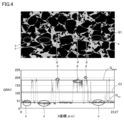
- FIG. 4 is a diagram for explaining a method of defining black areas and binders.
- FIG. 5 is a diagram for explaining the boundary between the black region and the binder.
- FIG. 6 is an image obtained by binarizing the backscattered electron image of FIG.
- the cubic boron nitride sintered body of the present disclosure is A cubic boron nitride sintered body containing 35% by volume or more and 90% by volume or less of cubic boron nitride particles and 10% by volume or more and 65% by volume or less of a binder,
- the cubic boron nitride particles have a lattice constant of 3.6140 ⁇ or more and 3.6161 ⁇ or less
- the silicon content of the cubic boron nitride particles is 0.02% by mass or less
- the binder comprises at least one element selected from the group consisting of elements of Group 4, Group 5, Group 6 of the periodic table, aluminum, silicon, iron, cobalt and nickel, and carbon, nitrogen, boron and oxygen.
- the cubic boron nitride sintered body of the present disclosure is used as a tool material, it is possible to extend the life of the tool, especially in high-efficiency machining.
- the lattice constant of the cubic boron nitride particles is preferably 3.6142 ⁇ or more and 3.6158 ⁇ or less. According to this, the tool life is further improved.
- the lattice constant of the cubic boron nitride particles is preferably 3.6145 ⁇ or more and 3.6155 ⁇ or less. According to this, the tool life is further improved.
- the silicon content of the cubic boron nitride particles is preferably 0.01% by mass or less. According to this, the tool life is further improved.
- the silicon content of the cubic boron nitride particles is preferably 0.001% by mass or less. According to this, the tool life is further improved.
- the content of the cubic boron nitride particles is preferably 40% by volume or more and 80% by volume or less. According to this, the tool life is further improved.
- a compound or the like when represented by a chemical formula, it shall include any conventionally known atomic ratio unless the atomic ratio is particularly limited, and should not necessarily be limited only to those within the stoichiometric range.
- the ratio of the number of atoms constituting TiN includes all conventionally known atomic ratios.
- a cubic boron nitride sintered body according to an embodiment of the present disclosure (hereinafter also referred to as the present embodiment) comprises 35% by volume or more and 90% by volume or less of cubic boron nitride particles and 10% by volume or more and 65% by volume of cubic boron nitride particles.
- a cubic boron nitride sintered body containing the following binder The cubic boron nitride particles have a lattice constant of 3.6140 ⁇ or more and 3.6161 ⁇ or less, The silicon content of the cubic boron nitride particles is 0.02% by mass or less,
- the binder comprises at least one element selected from the group consisting of elements of Group 4, Group 5, Group 6 of the periodic table, aluminum, silicon, iron, cobalt and nickel, and carbon, nitrogen, boron and oxygen.
- the cubic boron nitride sintered body of the present embodiment contains 35% by volume or more and 90% by volume or less of cBN particles with high hardness, strength and toughness. Therefore, the cubic boron nitride sintered body has excellent wear resistance and chipping resistance, and the tool life using the cubic boron nitride sintered body is extended.
- the lattice constant of the cubic boron nitride particles is 3.6140 ⁇ or more and 3.6161 ⁇ or less.
- a lattice constant of a unit cell of a general cubic boron nitride (hereinafter, the lattice constant of the unit cell is simply referred to as a lattice constant) is 3.6162 ⁇ .
- the lattice constant of the cBN particles used in this embodiment is smaller than that of general cBN particles.
- the thermal conductivity of the cBN particles is high, and the occurrence of crater wear caused by cutting heat generated during cutting and the occurrence of defects caused by the development of craters are suppressed.
- the tool life using the cubic boron nitride sintered body is improved.
- the silicon content of the cubic boron nitride particles is 0.02% by mass or less.
- Conventional cBN particles contain about 0.1% by mass of silicon as an impurity. Silicon has a lower thermal conductivity than cubic boron nitride.
- the cBN particles used in the present embodiment have a reduced content of silicon, which has a low thermal conductivity, and thus have a high thermal conductivity. Therefore, in the cBN sintered body having the cBN particles, the occurrence of crater wear due to cutting heat generated during cutting and the occurrence of defects due to the development of craters are suppressed, and the cubic boron nitride sintered body is used. Tool life is improved.
- the binder is at least selected from the group consisting of Group 4 elements, Group 5 elements, Group 6 elements of the periodic table, aluminum, silicon, iron, cobalt and nickel.
- the above binding material has a high binding force with respect to cBN particles. Therefore, the cubic boron nitride sintered body has excellent fracture resistance, and the tool life using the cubic boron nitride sintered body is extended.
- the cubic boron nitride sintered body of the present embodiment comprises 35% by volume or more and 90% by volume or less of cubic boron nitride particles and 10% by volume or more and 65% by volume or less of a binder. Note that the cBN sintered body can contain unavoidable impurities resulting from raw materials, manufacturing conditions, etc., as long as the effects of the present disclosure are exhibited.
- the lower limit of the content of cBN particles in the cBN sintered body is 35% by volume or more, preferably 40% by volume or more, more preferably 45% by volume or more, from the viewpoint of improving hardness.
- the upper limit of the content of cBN particles in the cBN sintered body is 90% by volume or less, preferably 85% by volume or less, more preferably 80% by volume or less.
- the content of cBN particles in the cBN sintered body is 35% by volume or more and 90% by volume or less, preferably 40% by volume or more and 85% by volume or less, and more preferably 45% by volume or more and 80% by volume or less.
- the lower limit of the binder content in the cBN sintered body is 10% by volume or more, preferably 15% by volume or more, more preferably 20% by volume or more, from the viewpoint of ensuring the function as a binder.
- the upper limit of the binder content in the cBN sintered body is 65% by volume or less, preferably 60% by volume or less, more preferably 55% by volume or less, from the viewpoint of improving hardness.
- the content of the binder in the cBN sintered body is 10% by volume or more and 65% by volume or less, preferably 15% by volume or more and 60% by volume or less, and more preferably 20% by volume or more and 55% by volume or less.
- the cBN sintered body of the present embodiment preferably contains 40% by volume or more and 85% by volume or less of cubic boron nitride particles and 15% by volume or more and 60% by volume or less of a binder. % or less of cubic boron nitride particles and 20% by volume or more and 55% by volume or less of a binder.
- the cBN sintered body of the present embodiment preferably consists of 35% by volume or more and 90% by volume or less of cubic boron nitride particles and 10% by volume or more and 65% by volume or less of a binder, and 40% by volume or more and 85% by volume. % or less of cubic boron nitride particles and 15% by volume or more and 60% by volume or less of a binder, more preferably 45% by volume or more and 80% by volume or less of cubic boron nitride particles, and 20% by volume or more and 55% by volume of cubic boron nitride particles. It is more preferable to have a binding material of vol % or less. Even in these cases, the cBN sintered body can contain unavoidable impurities resulting from raw materials, manufacturing conditions, etc., as long as the effects of the present disclosure are exhibited.
- the content rate (% by volume) of the cBN particles and the content rate (% by volume) of the binder in the cBN sintered body were measured using a scanning electron microscope (SEM) ("JSM-7800F” (trade name) manufactured by JEOL Ltd.).
- SEM scanning electron microscope
- EDX energy dispersive X-ray spectrometer
- the cBN sintered body is subjected to structural observation, elemental analysis, etc. can be confirmed by A specific measuring method is as follows.
- the cross section is observed with an SEM at a magnification of 5000 to obtain a backscattered electron image.
- the regions where the cBN particles are present are black regions, and the regions where the binder is present are gray regions and/or white regions.
- the backscattered electron image is binarized using image analysis software ("WinROOF" by Mitani Shoji Co., Ltd.).
- the area where the cBN particles exist black area in the backscattered electron image
- the area where the binder exists gray area and/or white area in the backscattered electron image
- a measurement area (15 ⁇ m ⁇ 20 ⁇ m) is set in the image after binarization.
- the area ratio of pixels derived from the dark field (pixels derived from cBN particles, pixels derived from the black region in the backscattered electron image) to the total area of the measurement field is calculated.
- the cBN particle content (volume %) can be obtained by regarding the calculated area ratio as volume %.
- the area ratio of pixels derived from the bright field (the sum of pixels derived from the binder, pixels derived from the gray area and white area in the backscattered electron image) to the total area of the measurement field is calculated.
- the content rate (% by volume) of the binder can be obtained.
- FIGS. 1 to 6 are drawings for the purpose of explaining the binarization method, and do not necessarily show the cubic boron nitride sintered body of the present embodiment.
- Fig. 1 is an example of a backscattered electron image obtained by observing a cBN sintered body with an SEM.
- the backscattered electron image is read into image processing software.
- the read image is shown in FIG.
- an arbitrary line Q1 is drawn in the read image.
- a concentration cross-sectional view is measured along the line Q1 to read the GRAY value.
- a graph (hereinafter also referred to as “concentration cross-sectional graph”) is prepared with the line Q1 as the X coordinate and the GRAY value as the Y coordinate.
- FIG. 3 showing a backscattered electron image of a cBN sintered body and a concentration cross-sectional graph of the backscattered electron image, the upper image is the backscattered electron image and the lower graph is the concentration cross-sectional graph.
- the width of the backscattered electron image coincides with the width (23.27 ⁇ m) of the X coordinate of the concentration profile graph. Therefore, the distance from the left end of the line Q1 in the backscattered electron image to a specific position on the line Q1 is indicated by the X-coordinate value of the density cross-sectional graph.
- the black region is, for example, the part indicated by the ellipse with symbol c in the backscattered electron image of FIG.
- the gray value of each of the three black regions is read from the density profile graph.
- the gray value of each of the three black regions is the average value of the gray values of the three portions surrounded by the ellipses of symbol c in the density cross-sectional graph of FIG.
- An average value of the respective GRAY values at the three locations is calculated.
- the average value be the gray value of cBN (hereinafter also referred to as G cbn ).
- the binding material is, for example, the portion indicated by the ellipse d in the backscattered electron image of FIG.
- the GRAY value of each of the three binders is read from the concentration profile graph.
- the respective GRAY values of the binders at the three locations are the average values of the GRAY values at the three locations surrounded by the ellipses of symbol d in the concentration cross-sectional graph of FIG.
- An average value of the respective GRAY values at the three locations is calculated.
- the average value is defined as the GRAY value of the binder (hereinafter also referred to as G binder ).
- the GRAY value given by (G cbn +G binder )/2 is defined as the GRAY value of the interface between the black region (cBN particles) and the binder.
- the gray value G cbn of the black region (cBN particles) is indicated by the line G cbn
- the gray value G binder of the binder is indicated by the line G binder
- (G cbn +G binder ) A GRAY value denoted by /2 is denoted by line G1.
- the values of the X coordinate and the Y coordinate at the interface between the black region (cBN particles) and the binder are read. can be done.
- the interface can be defined arbitrarily.
- an example of the region including the interface between the black region (cBN particles) and the binder is the region surrounded by the ellipse with symbol e.
- the interface between the black region (cBN particles) and the binder within the region surrounded by the ellipse indicated by symbol e is indicated by arrow e.
- the tip of the arrow e indicates the position of the intersection of the concentration cross-sectional graph of the GRAY value and the line G1 indicating the GRAY value (G cbn +G binder )/2.
- the X-coordinate and Y-coordinate values of the tip of the arrow e correspond to the X-coordinate and Y-coordinate values of the interface between the black region (cBN particles) and the binder.
- FIG. 6 shows the image after the binarization process.
- the area surrounded by the dotted line is the area subjected to the binarization process.
- the image after the binarization process includes white areas (areas whiter than the bright field, pixels derived from the binder) corresponding to the areas that were white in the backscattered electron image before the binarization process. good too.
- the area ratio of pixels derived from the dark field (pixels derived from cBN particles, pixels derived from the black region in the backscattered electron image) to the area of the measurement field is calculated.
- the cBN particle content (volume %) can be obtained by regarding the calculated area ratio as volume %.
- the dark-field region indicates cBN particles
- the bright-field region indicates the binder, for the same region photographed in the binarized image.
- the content (% by volume) of cubic boron nitride particles in the cubic boron nitride sintered body is measured in five different measurement regions.
- the average of the measured values of the five measurement regions is taken as the content (% by volume) of the cubic boron nitride particles in the cubic boron nitride sintered body of the present embodiment.
- the binder content (% by volume) of the cubic boron nitride sintered body is measured in five different measurement areas.
- the average of the measured values of the five measurement regions is taken as the binder content (% by volume) of the cubic boron nitride sintered body of the present embodiment.
- the cubic boron nitride sintered body of the present embodiment may contain unavoidable impurities as long as the effects of the present disclosure are exhibited.
- inevitable impurities include metal elements such as alkali metal elements (lithium (Li), sodium (Na), potassium (K), etc.) and alkaline earth metal elements (calcium (Ca), magnesium (Mg), etc.). can be mentioned.
- the content of the inevitable impurities is preferably 0.1% by mass or less. The content of inevitable impurities can be measured by secondary ion mass spectrometry (SIMS).
- the lattice constant of the cubic boron nitride particles is 3.6140 ⁇ or more and 3.6161 ⁇ or less. According to this, the thermal conductivity of the cBN particles is increased. Therefore, in the cBN sintered body containing the cBN particles, crater wear due to cutting heat generated during cutting and chipping due to crater development are suppressed, and the tool life is improved.
- the upper limit of the lattice constant of the cBN particles is 3.6161 ⁇ or less, preferably 3.6158 ⁇ or less, more preferably 3.6155 ⁇ or less, from the viewpoint of improving thermal conductivity.
- the lower limit of the lattice constant of the cBN particles is 3.6140 ⁇ or more, preferably 3.6142 ⁇ or more, more preferably 3.6145 ⁇ or more.
- the lattice constant of the cBN particles is 3.6140 ⁇ or more and 3.6161 ⁇ or less, preferably 3.6142 ⁇ or more and 3.6158 ⁇ or less, and more preferably 3.6145 ⁇ or more and 3.6155 ⁇ or less.
- the lattice constant of cBN particles is measured and calculated by the following procedure.
- the cubic boron nitride particles are filled into a capillary for X-ray crystallography with a diameter of 0.3 mm manufactured by TOHO (product name: Mark Tube) to obtain a sealed test piece.
- a powder made of cerium oxide (manufactured by Kojundo Chemical Laboratory) is prepared as a standard sample for calculating the wavelength ⁇ of synchrotron radiation.
- the standard sample powder is packed in a capillary for X-ray crystallography with a diameter of 0.3 mm manufactured by TOHO to obtain a sealed standard sample.
- X-ray diffraction measurement was performed on the sealed test specimen filled with the cubic boron nitride particles under the following conditions, and the main orientations of cubic boron nitride (111), (200), (220), (311 ), (400), and (331), and at least 4 diffraction peaks and 2 diffraction peaks in each of the (422) and (531) orientation planes. Obtain the line profile of the peak.
- X-ray diffraction measurement conditions X-ray source: synchrotron radiation Equipment conditions: detector MYTHEN Energy: 18.000 keV (wavelength: 0.68881 ⁇ ) Camera length: 573mm Measurement peaks: diffraction peaks of at least four or more of each orientation plane of (111), (200), (220), (311), (400), and (331) of cubic boron nitride, and (422) , two diffraction peaks in each of the (531) azimuthal planes, and six or more peaks. However, if it is difficult to obtain a profile due to texture or orientation, the plane index peak is excluded. Measurement conditions: At least 5 measurement points in the half-value width. The basic configuration of this measurement is as described above, and it is necessary to use at least synchrotron radiation because it is necessary to calculate the lattice constant with high accuracy. , the present embodiment is not limited by the above measurement conditions.
- the lattice constant a of the cubic boron nitride particles enclosed in the sealed test specimen is calculated as follows. At least four diffraction peaks among the (111), (200), (220), (311), (400), and (331) orientation planes of cubic boron nitride, and (422) and (531) 3.) Obtaining a line profile of 6 or more diffraction peaks, including 2 diffraction peaks in each azimuthal plane. The line profile is fitted with the sum of a pseudo-Voigt function and a background consisting of a linear function, and the central value 2 ⁇ 0 of the pseudo-Voigt function is obtained for each azimuth plane.
- the cubic boron nitride particles contain cubic boron nitride as a main component, and the content of components other than cubic boron nitride is preferably 1% by mass or less. 5% by mass or less is more preferable, and 0.2% by mass or less is even more preferable.
- the cubic boron nitride particles containing cubic boron nitride as a main component means that the content of cubic boron nitride in the cubic boron nitride particles is 99% by mass or more.
- Components other than cubic boron nitride include silicon, oxygen, lithium, magnesium, calcium, and the like.
- the content of components other than cubic boron nitride (silicon, lithium, magnesium, calcium, etc.) in the cubic boron nitride particles can be measured by high frequency induction plasma emission spectrometry (ICP method). Specifically, it can be measured by the same method as the method for measuring the silicon content, which will be described later.
- ICP method high frequency induction plasma emission spectrometry
- the oxygen content of cubic boron nitride particles is measured by gas analysis (measuring device: "EMGA-920" manufactured by Horiba, Ltd.).
- the silicon content of the cubic boron nitride particles is 0.02% by mass or less. According to this, the thermal conductivity of the cBN particles is increased. Therefore, in the cBN sintered body containing the cBN particles, crater wear due to cutting heat generated during cutting and chipping due to crater development are suppressed, and the tool life is improved.
- the upper limit of the silicon content of the cBN particles is 0.02% by mass or less, preferably 0.01% by mass or less, and more preferably 0.001% by mass or less. Since the silicon content of cBN particles is preferably as low as possible, the lower limit is not particularly limited.
- the lower limit of the silicon content of the cBN particles can be, for example, 0% by mass or more.
- the silicon content of the cBN particles is preferably 0% by mass or more and 0.02% by mass or less, more preferably 0% by mass or more and 0.01% by mass or less, and still more preferably 0% by mass or more and 0.001% by mass or less.
- ICP method induction plasma emission spectrometry
- the median diameter d50 of the circle-equivalent diameter of the cubic boron nitride particles contained in the cubic boron nitride sintered body of the present embodiment (hereinafter also referred to as "median diameter d50") is not particularly limited, but is, for example, 1 nm or more. 15000 nm or less is preferable, 10 nm or more and 12000 nm or less is more preferable, and 100 nm or more and 10000 nm or less is still more preferable. According to this, the tool using the cubic boron nitride sintered body can have a long tool life.
- the median diameter d50 of the equivalent circle diameters of the cubic boron nitride particles (the equivalent circle diameter at which the cumulative number-based frequency is 50%) is measured by the following method.
- the backscattered electron image of the cross section of the cubic boron nitride sintered body is binarized, Cubic boron nitride particles are extracted.
- the observation magnification is 5000 times.
- a measurement area (15 ⁇ m ⁇ 20 ⁇ m) is set in the image after binarization.
- the distribution of equivalent circle diameters of the cubic boron nitride particles is calculated using the above image analysis software. From the distribution of the equivalent circle diameters of the cubic boron nitride particles, the median diameter d50 of the equivalent circle diameters of the cubic boron nitride particles in the measurement field is calculated. The median diameter d50 of the equivalent circle diameter is measured in five different measurement regions. The average of the measured values of the five measurement regions is taken as the median diameter d50 of the equivalent circle diameters of the cubic boron nitride particles in the cubic boron nitride sintered body of the present embodiment.
- the binder plays a role in making it possible to sinter the cBN particles, which are difficult-to-sinter materials, at industrial-level pressure temperatures.
- the reactivity with iron is lower than that of cBN, it has the function of suppressing chemical wear and thermal wear, especially in cutting hardened steel.
- the wear resistance is improved particularly in high-efficiency machining of high-hardness hardened steel.
- the binder is at least one element selected from the group consisting of Group 4 elements, Group 5 elements, Group 6 elements of the periodic table, aluminum, silicon, iron, cobalt and nickel, At least one selected from the group consisting of a compound consisting of at least one element selected from the group consisting of carbon, nitrogen, boron and oxygen, and a solid solution of the compound. That is, the binder contains at least one selected from the group consisting of the above compounds and solid solutions of the above compounds.
- elements of Group 4 of the periodic table include titanium (Ti), zirconium (Zr) and hafnium (Hf).
- Group 5 elements of the periodic table include vanadium (V), niobium (Nb) and tantalum (Ta).
- Periodic Table Group 6 elements include chromium (Cr), molybdenum (Mo) and tungsten (W).
- elements contained in periodic table 4 group elements, 5 group elements, 6 group elements, aluminum, silicon, iron, cobalt and nickel are also referred to as "first elements”.
- Examples of the compound (carbide) containing the first element and carbon include titanium carbide (TiC), zirconium carbide (ZrC), hafnium carbide (HfC), vanadium carbide (VC), niobium carbide (NbC), carbide Mention may be made of tantalum (TaC), chromium carbide (Cr 3 C 2 ), molybdenum carbide (MoC), tungsten carbide (WC), silicon carbide (SiC), tungsten carbide-cobalt (W 2 Co 3 C).
- Examples of the compound (nitride) containing the first element and nitrogen include titanium nitride (TiN), zirconium nitride (ZrN), hafnium nitride (HfN), vanadium nitride (VN), niobium nitride (NbN), Tantalum nitride (TaN), chromium nitride ( Cr2N ), molybdenum nitride (MoN), tungsten nitride (WN), aluminum nitride (AlN), silicon nitride ( Si3N4 ), cobalt nitride ( CoN ), nickel nitride ( NiN), titanium zirconium nitride (TiZrN), titanium hafnium nitride (TiHfN), titanium vanadium nitride (TiVN), titanium niobium nitride (TiNbN), titanium tant
- Examples of the compound (boride) containing the first element and boron include titanium boride (TiB 2 ), zirconium boride (ZrB 2 ), hafnium boride (HfB 2 ), vanadium boride (VB 2 ), niobium boride (NbB 2 ), tantalum boride (TaB 2 ), chromium boride (CrB), molybdenum boride (MoB), tungsten boride (WB), aluminum boride (AlB 2 ), cobalt boride (Co 2 B), nickel boride (Ni 2 B).
- Examples of the compound (oxide) containing the first element and oxygen include titanium oxide (TiO 2 ), zirconium oxide (ZrO 2 ), hafnium oxide (HfO 2 ), vanadium oxide (V 2 O 5 ), niobium oxide ( Nb2O5 ), tantalum oxide ( Ta2O5 ), chromium oxide ( Cr2O3 ), molybdenum oxide ( MoO3 ), tungsten oxide ( WO3 ), aluminum oxide ( Al2O3 ), Mention may be made of silicon oxide (SiO 2 ), cobalt oxide (CoO), nickel oxide (NiO).
- Examples of the compound (carbonitride) containing the first element, carbon, and nitrogen include titanium carbonitride (TiCN), zirconium carbonitride (ZrCN), hafnium carbonitride (HfCN), and titanium niobium carbonitride (TiNbCN). , titanium zirconium carbonitride (TiZrCN), titanium hafnium carbonitride (TiHfCN), titanium tantalum carbonitride (TiTaCN), titanium chromium carbonitride (TiCrCN).
- Examples of the compound (oxynitride) composed of the first element, oxygen, and nitrogen include titanium oxynitride (TiON), zirconium oxynitride (ZrON), hafnium oxynitride (HfON), and vanadium oxynitride (VON).
- TiON titanium oxynitride
- ZrON zirconium oxynitride
- HfON hafnium oxynitride
- VON vanadium oxynitride
- tantalum oxynitride (TaON) tantalum oxynitride
- CrON chromium oxynitride
- MoON molybdenum oxynitride
- WON aluminum oxynitride
- AlON aluminum oxynitride
- SiON silicon oxynitride
- the solid solution of the above compounds means a state in which two or more kinds of compounds are dissolved in each other's crystal structure, and means an interstitial solid solution or a substitutional solid solution.
- the above compounds may be used singly or in combination of two or more.
- the binding material may contain other components in addition to the above compounds.
- Manganese (Mn) and rhenium (Re) can be given as examples of elements constituting other components.
- the lower limit of the total content of the compound and the solid solution of the compound in the binder is preferably 50% by volume or more, more preferably 60% by volume or more, and even more preferably 70% by volume or more.
- the total content of the compound and the solid solution of the compound in the binder is preferably as large as possible, and is not particularly limited, and can be, for example, 100% by volume or less.
- the total content of the compound and the solid solution of the compound in the binder is preferably 50% by volume or more and 100% by volume or less, more preferably 60% by volume or more and 100% by volume or less, and even more preferably 70% by volume or more and 100% by volume or less. .
- composition of the binder contained in the cBN sintered body can be specified by XRD (X-ray diffraction).
- the total content of the above compounds and the solid solution of the above compounds in the binder is measured by the RIR method (Reference Intensity Ratio) by XRD.
- the cubic boron nitride sintered body of the present embodiment is suitable for use in cutting tools, wear-resistant tools, grinding tools, and the like.
- the cutting tool, wear-resistant tool, and grinding tool using the cubic boron nitride sintered body of the present disclosure may each be entirely composed of the cubic boron nitride sintered body, or a part thereof (for example, a cutting tool In the case of , only the cutting edge portion) may be composed of a cubic boron nitride sintered body. Furthermore, a coating film may be formed on the surface of each tool.
- Cutting tools include drills, end mills, indexable cutting inserts for drills, indexable cutting inserts for end mills, indexable cutting inserts for milling, indexable cutting inserts for turning, metal saws, gear cutting tools, reamers. , taps, and cutting tools.
- Wear-resistant tools include dies, scribers, scribing wheels, and dressers. Grinding tools include grinding wheels.
- the cubic boron nitride sintered body of the present embodiment can be produced, for example, by the following method.
- Cubic boron nitride powder (hereinafter also referred to as cBN powder) is a raw material powder of cBN particles contained in a cBN sintered body.
- the cBN powder may be produced by heating and pressurizing after adding a catalyst (Li, Ca, Mg, and their nitrides, borides, and boronitrides) to hexagonal boron nitride powder.
- a cBN powder may be provided.
- the d50 (average particle size) of the cBN powder is not particularly limited, and can be, for example, 0.1 to 12.0 ⁇ m.
- the above cBN powder is subjected to heating/pressurizing treatment and electron beam irradiation. Either the pressure heating treatment or the electron beam irradiation may be performed first.
- the pressurized heat treatment can be performed using an ultra-high pressure and high temperature generator.
- a belt type, a multi-anvil type, a cubic type, or the like can be used as the ultrahigh pressure and high temperature generator depending on the desired generation pressure region.
- the pressure can be 5 to 15 GPa
- the temperature can be 1000 to 2000° C.
- the holding time can be 1 to 60 minutes.
- the electron beam irradiation conditions can be, for example, an irradiation energy of 25 to 30 MeV and an irradiation time of 10 to 24 hours.
- the lattice constant of the cBN particles is reduced to 3.6161 ⁇ or less by performing the above heating/pressurizing treatment and electron beam irradiation.
- the cBN powder is subjected to heat treatment at an oxygen partial pressure of 1 ⁇ 10 -29 atm or less and 800 to 1300 ° C. for 10 to 60 minutes (hereinafter, this step is also referred to as heat treatment under low oxygen.) .
- this step is also referred to as heat treatment under low oxygen.
- the order of the pressurized heat treatment, electron beam irradiation, and low-oxygen heat treatment for the cBN powder is not particularly limited.
- heat treatment under low oxygen may be performed, or after heat treatment under low oxygen, pressure heating treatment and electron beam irradiation are performed. good too.
- the binder raw material powder is the raw material powder of the binder contained in the cBN sintered body.
- the binder raw material powder contains at least one element selected from the group consisting of elements of Group 4, Group 5, Group 6 of the periodic table, aluminum, silicon, iron, cobalt and nickel, and carbon, nitrogen, boron and oxygen. and at least one element selected from the group consisting of
- the binder raw material powder can be prepared, for example, as follows. TiN and Al are mixed and heat-treated in vacuum at 1200° C. for 30 minutes to obtain a compound. The compound is pulverized to prepare a binding material raw material powder. Peaks of TiN, Ti 2 AlN, TiAl 3 and the like are confirmed in the raw material powder of the binder in X-ray diffraction (XRD).
- XRD X-ray diffraction
- the method of mixing and pulverizing each powder is not particularly limited, but from the viewpoint of efficient and homogeneous mixing, mixing and pulverization with media such as balls, and jet mill mixing and pulverization are preferable.
- Each mixing and pulverizing method may be wet or dry.
- ⁇ Mixing process The cBN powder prepared above and the binder raw material powder are mixed by wet ball mill mixing using ethanol, acetone, or the like as a solvent to prepare a mixed powder.
- the solvent is removed by air drying after mixing. Thereafter, a heat treatment is performed to volatilize impurities such as moisture adsorbed on the surface of the mixed powder, thereby cleaning the surface of the mixed powder.
- the mixed powder is filled in a Ta (tantalum) container while being in contact with a WC-6% Co cemented carbide disc, and the container is vacuum-sealed.
- the vacuum-sealed mixed powder is sintered by holding for 5 to 30 minutes under conditions of 3 to 9 GPa and 1100 to 1900° C. using a belt-type ultrahigh pressure and high temperature generator. Thereby, the cubic boron nitride sintered body of the present embodiment is produced.
- the cubic boron nitride sintered body of the present disclosure preferably comprises 35% by volume or more and 90% by volume or less of cubic boron nitride particles and 10% by volume or more and 65% by volume or less of a binder.
- the cubic boron nitride sintered body of the present disclosure preferably comprises 40% by volume or more and 85% by volume or less of cubic boron nitride particles and 15% by volume or more and 60% by volume or less of a binder.
- the cubic boron nitride sintered body of the present disclosure preferably comprises 45% by volume or more and 80% by volume or less of cubic boron nitride particles and 20% by volume or more and 55% by volume or less of a binder.
- the cubic boron nitride sintered body of the present disclosure is composed of cubic boron nitride particles, a binder, and inevitable impurities, and contains 35% by volume or more and 90% by volume or less of cubic boron nitride particles, and 10% by volume or more and 65 It is preferable to include a binder in an amount of vol % or less.
- the cubic boron nitride sintered body of the present disclosure is composed of cubic boron nitride particles, a binder, and inevitable impurities, and contains 40% by volume or more and 85% by volume or less of cubic boron nitride particles, and 15% by volume or more and 60% by volume of cubic boron nitride particles.
- the cubic boron nitride sintered body of the present disclosure is composed of cubic boron nitride particles, a binder, and inevitable impurities, and contains 45% by volume or more and 80% by volume or less of cubic boron nitride particles, and 20% by volume or more and 55% by volume of cubic boron nitride particles. It is preferable to include a binder in an amount of vol % or less.
- ⁇ Preparation of cubic boron nitride powder>> A known cubic boron nitride powder (d50 (average particle size) 3.2 ⁇ m) was prepared. The cBN powder was subjected to pressure heat treatment and/or electron beam irradiation and/or heat treatment under low oxygen conditions.
- the conditions of the pressurized heat treatment are as shown in the "Pressure (GPa)", “Temperature (°C)” and “Time (minutes)” columns of "Pressured heat treatment” in Table 1.
- the cBN powder was subjected to pressure heat treatment at a pressure of 6 GPa and a temperature of 1400° C. for 30 minutes.
- the electron beam irradiation conditions are as shown in the “Energy (eV)” and “Time (hr)” columns of "Electron beam irradiation” in Table 1.
- the cBN powder was irradiated with an electron beam at an irradiation energy of 27 eV for an irradiation time of 15 hours.
- a binder raw material powder was prepared by the following procedure.
- Samples 1 to 7 Samples 13 to 19, Samples 1-1 to 1-5, Samples 1-7 to 1-10> TiN powder and Al powder were mixed at a mass ratio of 85:15, heat-treated at 1200° C. for 30 minutes in a vacuum atmosphere, and then mixed and pulverized in a wet ball mill to obtain raw binder powder.
- Example 8 TiCN powder and Al powder were mixed at a mass ratio of 85:15, heat-treated at 1200° C. for 30 minutes in a vacuum atmosphere, and then mixed and pulverized in a wet ball mill to obtain raw binder powder.
- Sample 1-6> WC powder, Co powder, and Al powder were mixed at a mass ratio of 3:8:1, heat-treated at 1200° C. for 30 minutes in a vacuum atmosphere, and then mixed and pulverized in a wet ball mill to obtain binder raw material powder. Obtained.
- TiO2 powder, Nb2O5 powder and C powder were mixed in a mass ratio of 57.19: 16.79 :26.02 and heat-treated at 2100°C for 60 minutes under a nitrogen atmosphere to form a single-phase TiNbCN composition.
- a compound was synthesized.
- the single-phase compound was pulverized to a particle size of 0.5 ⁇ m by a wet pulverization method to obtain a TiNbCN powder.
- TiNbCN powder and Al powder were mixed at a mass ratio of 85:15, heat-treated at 1200° C. for 30 minutes in a vacuum atmosphere, and then mixed and pulverized in a wet ball mill to obtain raw binder powder.
- TiO2 powder, ZrO2 powder and C powder were mixed in a mass ratio of 58.35:15.88:25.77 and heat-treated at 2100 °C for 60 minutes under a nitrogen atmosphere to form a single-phase compound with a TiZrCN composition. Synthesized. The single-phase compound was pulverized to a particle size of 0.5 ⁇ m by a wet pulverization method to obtain a TiZrCN powder. TiZrCN powder and Al powder were mixed at a mass ratio of 85:15, heat-treated at 1200° C. for 30 minutes in a vacuum atmosphere, and then mixed and pulverized in a wet ball mill to obtain raw binder powder.
- TiO2 powder, HfO2 powder and C powder were mixed at a mass ratio of 52.45:24.38:23.17 and heat-treated at 2100 °C for 60 minutes under a nitrogen atmosphere to form a single-phase compound with a TiHfCN composition. Synthesized. The single-phase compound was pulverized to a particle size of 0.5 ⁇ m by a wet pulverization method to obtain TiHfCN powder.
- TiHfCN powder and Al powder were mixed at a mass ratio of 85:15, heat-treated at 1200° C. for 30 minutes in a vacuum atmosphere, and then mixed and pulverized in a wet ball mill to obtain raw binder powder.
- TiO2 powder, Ta2O5 powder and C powder were mixed at a mass ratio of 51.47:25.12:23.42 and heat-treated at 2100°C for 60 minutes under a nitrogen atmosphere to form a single-phase TiTaCN composition.
- a compound was synthesized.
- the single-phase compound was pulverized to a particle size of 0.5 ⁇ m by a wet pulverization method to obtain TiTaCN powder.
- TiTaCN powder and Al powder were mixed at a mass ratio of 85:15, heat-treated at 1200° C. for 30 minutes in a vacuum atmosphere, and then mixed and pulverized in a wet ball mill to obtain raw binder powder.
- TiO2 powder, Cr2O3 powder and C powder were mixed in a mass ratio of 62.64:10.51:26.84 and heat-treated at 2100° C for 60 minutes under a nitrogen atmosphere to form a single-phase TiCrCN composition.
- a compound was synthesized.
- the single-phase compound was pulverized to a particle size of 0.5 ⁇ m by a wet pulverization method to obtain a TiCrCN powder.
- TiCrCN powder and Al powder were mixed at a mass ratio of 85:15, heat-treated at 1200° C. for 30 minutes in a vacuum atmosphere, and then mixed and pulverized in a wet ball mill to obtain raw binder powder.
- WC powder, Co powder and Al powder were prepared at a mass ratio of 3:8:1.
- Zr powder was added to WC powder, Co powder, and Al powder so as to be 5% by mass of the whole, and mixed.
- Example 23 A cBN sintered body was produced in the same manner as for sample 22, except that Ni powder and Nb powder were added instead of Zr powder when producing the binder material powder.
- ⁇ Sample 24> A cBN sintered body was produced in the same manner as in Sample 22, except that Zr powder was not added when producing the binder raw material powder, and CrN powder was added when mixing the cBN powder and the binder powder. bottom. The CrN powder was added in an amount of 5% by mass with respect to the entire binder. The CrN powder was obtained by treating Cr 2 N (manufactured by Nippon New Metal Co., Ltd.) at 300 kPa and 900° C. for 3 hours in a nitrogen atmosphere.
- ⁇ Mixing process The cBN powder that has been subjected to the above pressurized heat treatment and/or electron beam irradiation and/or heat treatment under low oxygen conditions is mixed with the binder raw material powder, and mixed uniformly by a wet ball mill method using ethanol. A powder was obtained. Thereafter, a degassing process was performed at 900° C. under vacuum to remove impurities such as moisture on the surface.
- the ratio (% by volume) of the cBN particles and the binder in the cubic boron nitride sintered body The proportions described in the columns of "cBN particles (% by volume)” and “binder (% by volume)" in “Body” were adjusted.
- the mixed powder was filled in a Ta (tantalum) container while being in contact with a WC-6% Co cemented carbide disk, and was vacuum-sealed.
- the vacuum-sealed mixed powder is pressurized to 7 GPa at a pressurization rate of 0.4 GPa/min using a belt-type ultra-high pressure and high temperature generator, and held for 20 minutes at 7 GPa and 1700 ° C. for sintering.
- a cBN sintered body of each sample was obtained.
- composition of the binder in the cBN sintered body was measured. Since the specific measuring method is the same as the method described in Embodiment 1, the description thereof will not be repeated. The results are shown in the "binder” column of "cBN sintered body” in Table 2. In all samples, the content of the compounds listed in the "Binder” column of Table 2 in the binder was 50% by volume or more.
- ⁇ Particle size of cBN particles> The median diameter d50 of the circle-equivalent diameter of the cBN grains in the cBN sintered body was measured. Since the specific measuring method is the same as the method described in Embodiment 1, the description thereof will not be repeated. In all the samples, the median diameter d50 of the equivalent circle diameter of the cBN particles was in the range of 1 nm or more and 15000 nm or less.
- a cutting tool (base material shape: CNGA120408) was produced using the cBN sintered body of each sample. Using this, a cutting test was carried out under the following cutting conditions. The following cutting conditions apply to high-speed, high-efficiency machining of hardened steel. Cutting speed: 200m/min. Feeding speed: 0.2 mm/rev. Notch: 0.2mm Coolant: DRY Cutting method: Interrupted cutting Lathe: LB400 (manufactured by Okuma Corporation) Work material: hardened steel (SCM415 V groove, hardness HRC60) Evaluation method: The cutting edge was observed every 0.5 km to confirm the presence or absence of chipping of the cutting edge. The cutting distance at which a defect of 0.2 mm or more occurred was measured, and this cutting distance was defined as the life of the cutting tool. The results are shown in the "tool life (km)" column of Table 1.
- Samples 1 to 25 correspond to Examples, and Samples 1-1 to 1-10 correspond to Comparative Examples. It was confirmed that Samples 1 to 25 (Examples) had a longer tool life in high efficiency machining than Samples 1-1 to 1-10.
Landscapes
- Chemical & Material Sciences (AREA)
- Engineering & Computer Science (AREA)
- Organic Chemistry (AREA)
- Ceramic Engineering (AREA)
- Manufacturing & Machinery (AREA)
- Materials Engineering (AREA)
- Inorganic Chemistry (AREA)
- Structural Engineering (AREA)
- Mechanical Engineering (AREA)
- Crystallography & Structural Chemistry (AREA)
- Metallurgy (AREA)
- Physics & Mathematics (AREA)
- Thermal Sciences (AREA)
- Cutting Tools, Boring Holders, And Turrets (AREA)
- Powder Metallurgy (AREA)
- Ceramic Products (AREA)
Priority Applications (7)
| Application Number | Priority Date | Filing Date | Title |
|---|---|---|---|
| PCT/JP2021/039320 WO2023073766A1 (ja) | 2021-10-25 | 2021-10-25 | 立方晶窒化硼素焼結体 |
| CN202280070913.3A CN118139832A (zh) | 2021-10-25 | 2022-10-24 | 立方晶氮化硼烧结体 |
| EP22886950.9A EP4424655A4 (en) | 2021-10-25 | 2022-10-24 | CUBIC BORON NITRIDE SINTERED BODY |
| JP2023534664A JP7704861B2 (ja) | 2021-10-25 | 2022-10-24 | 立方晶窒化硼素焼結体 |
| US18/702,648 US20250003034A1 (en) | 2021-10-25 | 2022-10-24 | Cubic boron nitride sintered material |
| PCT/JP2022/039524 WO2023074623A1 (ja) | 2021-10-25 | 2022-10-24 | 立方晶窒化硼素焼結体 |
| JP2024065911A JP2024105282A (ja) | 2021-10-25 | 2024-04-16 | 立方晶窒化硼素焼結体 |
Applications Claiming Priority (1)
| Application Number | Priority Date | Filing Date | Title |
|---|---|---|---|
| PCT/JP2021/039320 WO2023073766A1 (ja) | 2021-10-25 | 2021-10-25 | 立方晶窒化硼素焼結体 |
Publications (1)
| Publication Number | Publication Date |
|---|---|
| WO2023073766A1 true WO2023073766A1 (ja) | 2023-05-04 |
Family
ID=86157504
Family Applications (2)
| Application Number | Title | Priority Date | Filing Date |
|---|---|---|---|
| PCT/JP2021/039320 Ceased WO2023073766A1 (ja) | 2021-10-25 | 2021-10-25 | 立方晶窒化硼素焼結体 |
| PCT/JP2022/039524 Ceased WO2023074623A1 (ja) | 2021-10-25 | 2022-10-24 | 立方晶窒化硼素焼結体 |
Family Applications After (1)
| Application Number | Title | Priority Date | Filing Date |
|---|---|---|---|
| PCT/JP2022/039524 Ceased WO2023074623A1 (ja) | 2021-10-25 | 2022-10-24 | 立方晶窒化硼素焼結体 |
Country Status (5)
| Country | Link |
|---|---|
| US (1) | US20250003034A1 (https=) |
| EP (1) | EP4424655A4 (https=) |
| JP (2) | JP7704861B2 (https=) |
| CN (1) | CN118139832A (https=) |
| WO (2) | WO2023073766A1 (https=) |
Families Citing this family (1)
| Publication number | Priority date | Publication date | Assignee | Title |
|---|---|---|---|---|
| JP7755359B1 (ja) * | 2025-04-16 | 2025-10-16 | 大学共同利用機関法人自然科学研究機構 | 界面を有する高融点部材の製造方法 |
Citations (3)
| Publication number | Priority date | Publication date | Assignee | Title |
|---|---|---|---|---|
| JPS61117856A (ja) * | 1984-11-14 | 1986-06-05 | Sumitomo Electric Ind Ltd | ヒ−トシンク |
| JP2005187260A (ja) * | 2003-12-25 | 2005-07-14 | Sumitomo Electric Hardmetal Corp | 高強度高熱伝導性立方晶窒化硼素焼結体 |
| WO2005066381A1 (ja) * | 2004-01-08 | 2005-07-21 | Sumitomo Electric Hardmetal Corp. | 立方晶型窒化硼素焼結体 |
Family Cites Families (12)
| Publication number | Priority date | Publication date | Assignee | Title |
|---|---|---|---|---|
| JP2610645B2 (ja) * | 1988-04-19 | 1997-05-14 | 昭和電工株式会社 | 立方晶窒化ほう素焼結体の製造方法 |
| JPH0881269A (ja) * | 1994-09-16 | 1996-03-26 | Toshiba Corp | 高熱伝導性焼結体および回路基板 |
| JP4330738B2 (ja) * | 1999-11-29 | 2009-09-16 | 電気化学工業株式会社 | 樹脂充填用窒化アルミニウム粉末及びその用途 |
| JP2006024909A (ja) * | 2004-06-08 | 2006-01-26 | Matsushita Electric Ind Co Ltd | 基板の分割方法 |
| JP2006024809A (ja) * | 2004-07-09 | 2006-01-26 | Renesas Technology Corp | 半導体装置及びその製造方法 |
| EP2835195B1 (en) * | 2012-04-03 | 2020-11-18 | Sumitomo Electric Hardmetal Corp. | Sintered cubic boron nitride tool |
| JP5663813B2 (ja) * | 2013-07-03 | 2015-02-04 | 住友電工ハードメタル株式会社 | 表面被覆窒化硼素焼結体工具 |
| CN106898705B (zh) * | 2017-04-25 | 2019-03-01 | 京东方科技集团股份有限公司 | 一种显示面板及其修复方法 |
| CN107434415B (zh) * | 2017-06-12 | 2020-10-02 | 金华中烨超硬材料有限公司 | 一种高热稳定性和良好导热性的聚晶立方氮化硼复合片及其生产方法 |
| US11383300B2 (en) * | 2017-10-30 | 2022-07-12 | Sumitomo Electric Industries, Ltd. | Sintered material and cutting tool including the same |
| KR102738191B1 (ko) * | 2019-12-16 | 2024-12-04 | 스미또모 덴꼬오 하드메탈 가부시끼가이샤 | 입방정 질화붕소 소결체 |
| US11161790B2 (en) * | 2019-12-16 | 2021-11-02 | Sumitomo Electric Hardmetal Corp. | Cubic boron nitride sintered material |
-
2021
- 2021-10-25 WO PCT/JP2021/039320 patent/WO2023073766A1/ja not_active Ceased
-
2022
- 2022-10-24 WO PCT/JP2022/039524 patent/WO2023074623A1/ja not_active Ceased
- 2022-10-24 US US18/702,648 patent/US20250003034A1/en active Pending
- 2022-10-24 JP JP2023534664A patent/JP7704861B2/ja active Active
- 2022-10-24 CN CN202280070913.3A patent/CN118139832A/zh active Pending
- 2022-10-24 EP EP22886950.9A patent/EP4424655A4/en active Pending
-
2024
- 2024-04-16 JP JP2024065911A patent/JP2024105282A/ja active Pending
Patent Citations (3)
| Publication number | Priority date | Publication date | Assignee | Title |
|---|---|---|---|---|
| JPS61117856A (ja) * | 1984-11-14 | 1986-06-05 | Sumitomo Electric Ind Ltd | ヒ−トシンク |
| JP2005187260A (ja) * | 2003-12-25 | 2005-07-14 | Sumitomo Electric Hardmetal Corp | 高強度高熱伝導性立方晶窒化硼素焼結体 |
| WO2005066381A1 (ja) * | 2004-01-08 | 2005-07-21 | Sumitomo Electric Hardmetal Corp. | 立方晶型窒化硼素焼結体 |
Also Published As
| Publication number | Publication date |
|---|---|
| CN118139832A (zh) | 2024-06-04 |
| WO2023074623A1 (ja) | 2023-05-04 |
| EP4424655A4 (en) | 2025-02-26 |
| EP4424655A1 (en) | 2024-09-04 |
| JPWO2023074623A1 (https=) | 2023-05-04 |
| JP7704861B2 (ja) | 2025-07-08 |
| US20250003034A1 (en) | 2025-01-02 |
| JP2024105282A (ja) | 2024-08-06 |
Similar Documents
| Publication | Publication Date | Title |
|---|---|---|
| CN110573475B (zh) | 烧结体以及包含该烧结体的切削工具 | |
| KR102740747B1 (ko) | 입방정 질화붕소 소결체 | |
| KR20220095238A (ko) | 입방정 질화붕소 소결체 | |
| US11629101B2 (en) | Cubic boron nitride sintered material and method of producing same | |
| KR102738191B1 (ko) | 입방정 질화붕소 소결체 | |
| CN114269711B (zh) | 立方晶氮化硼烧结体 | |
| JP7704861B2 (ja) | 立方晶窒化硼素焼結体 | |
| US11591266B2 (en) | Cubic boron nitride sintered material | |
| EP4001241B1 (en) | Cubic boron nitride sintered body | |
| CN114787104B (zh) | 立方晶氮化硼烧结体 | |
| US20220204412A1 (en) | Cubic boron nitride sintered material |
Legal Events
| Date | Code | Title | Description |
|---|---|---|---|
| 121 | Ep: the epo has been informed by wipo that ep was designated in this application |
Ref document number: 21962316 Country of ref document: EP Kind code of ref document: A1 |
|
| NENP | Non-entry into the national phase |
Ref country code: DE |
|
| 122 | Ep: pct application non-entry in european phase |
Ref document number: 21962316 Country of ref document: EP Kind code of ref document: A1 |
|
| NENP | Non-entry into the national phase |
Ref country code: JP |