WO2023047505A1 - 照明制御装置、生体情報取得装置、および、照明制御方法 - Google Patents
照明制御装置、生体情報取得装置、および、照明制御方法 Download PDFInfo
- Publication number
- WO2023047505A1 WO2023047505A1 PCT/JP2021/034932 JP2021034932W WO2023047505A1 WO 2023047505 A1 WO2023047505 A1 WO 2023047505A1 JP 2021034932 W JP2021034932 W JP 2021034932W WO 2023047505 A1 WO2023047505 A1 WO 2023047505A1
- Authority
- WO
- WIPO (PCT)
- Prior art keywords
- unit
- accident
- vehicle
- biometric information
- light
- Prior art date
- Legal status (The legal status is an assumption and is not a legal conclusion. Google has not performed a legal analysis and makes no representation as to the accuracy of the status listed.)
- Ceased
Links
Images





Classifications
-
- B—PERFORMING OPERATIONS; TRANSPORTING
- B60—VEHICLES IN GENERAL
- B60Q—ARRANGEMENT OF SIGNALLING OR LIGHTING DEVICES, THE MOUNTING OR SUPPORTING THEREOF OR CIRCUITS THEREFOR, FOR VEHICLES IN GENERAL
- B60Q3/00—Arrangement of lighting devices for vehicle interiors; Lighting devices specially adapted for vehicle interiors
- B60Q3/80—Circuits; Control arrangements
-
- B—PERFORMING OPERATIONS; TRANSPORTING
- B60—VEHICLES IN GENERAL
- B60R—VEHICLES, VEHICLE FITTINGS, OR VEHICLE PARTS, NOT OTHERWISE PROVIDED FOR
- B60R21/00—Arrangements or fittings on vehicles for protecting or preventing injuries to occupants or pedestrians in case of accidents or other traffic risks
- B60R21/01—Electrical circuits for triggering passive safety arrangements, e.g. airbags, safety belt tighteners, in case of vehicle accidents or impending vehicle accidents
- B60R21/015—Electrical circuits for triggering passive safety arrangements, e.g. airbags, safety belt tighteners, in case of vehicle accidents or impending vehicle accidents including means for detecting the presence or position of passengers, passenger seats or child seats, and the related safety parameters therefor, e.g. speed or timing of airbag inflation in relation to occupant position or seat belt use
- B60R21/01512—Passenger detection systems
- B60R21/0153—Passenger detection systems using field detection presence sensors
- B60R21/01538—Passenger detection systems using field detection presence sensors for image processing, e.g. cameras or sensor arrays
-
- A—HUMAN NECESSITIES
- A61—MEDICAL OR VETERINARY SCIENCE; HYGIENE
- A61B—DIAGNOSIS; SURGERY; IDENTIFICATION
- A61B5/00—Measuring for diagnostic purposes; Identification of persons
- A61B5/0059—Measuring for diagnostic purposes; Identification of persons using light, e.g. diagnosis by transillumination, diascopy, fluorescence
- A61B5/0077—Devices for viewing the surface of the body, e.g. camera, magnifying lens
-
- B—PERFORMING OPERATIONS; TRANSPORTING
- B60—VEHICLES IN GENERAL
- B60Q—ARRANGEMENT OF SIGNALLING OR LIGHTING DEVICES, THE MOUNTING OR SUPPORTING THEREOF OR CIRCUITS THEREFOR, FOR VEHICLES IN GENERAL
- B60Q3/00—Arrangement of lighting devices for vehicle interiors; Lighting devices specially adapted for vehicle interiors
- B60Q3/70—Arrangement of lighting devices for vehicle interiors; Lighting devices specially adapted for vehicle interiors characterised by the purpose
-
- G—PHYSICS
- G06—COMPUTING OR CALCULATING; COUNTING
- G06V—IMAGE OR VIDEO RECOGNITION OR UNDERSTANDING
- G06V20/00—Scenes; Scene-specific elements
- G06V20/50—Context or environment of the image
- G06V20/59—Context or environment of the image inside of a vehicle, e.g. relating to seat occupancy, driver state or inner lighting conditions
-
- G—PHYSICS
- G06—COMPUTING OR CALCULATING; COUNTING
- G06V—IMAGE OR VIDEO RECOGNITION OR UNDERSTANDING
- G06V40/00—Recognition of biometric, human-related or animal-related patterns in image or video data
- G06V40/10—Human or animal bodies, e.g. vehicle occupants or pedestrians; Body parts, e.g. hands
- G06V40/103—Static body considered as a whole, e.g. static pedestrian or occupant recognition
-
- G—PHYSICS
- G06—COMPUTING OR CALCULATING; COUNTING
- G06V—IMAGE OR VIDEO RECOGNITION OR UNDERSTANDING
- G06V40/00—Recognition of biometric, human-related or animal-related patterns in image or video data
- G06V40/10—Human or animal bodies, e.g. vehicle occupants or pedestrians; Body parts, e.g. hands
- G06V40/15—Biometric patterns based on physiological signals, e.g. heartbeat, blood flow
-
- A—HUMAN NECESSITIES
- A61—MEDICAL OR VETERINARY SCIENCE; HYGIENE
- A61B—DIAGNOSIS; SURGERY; IDENTIFICATION
- A61B5/00—Measuring for diagnostic purposes; Identification of persons
- A61B5/02—Detecting, measuring or recording for evaluating the cardiovascular system, e.g. pulse, heart rate, blood pressure or blood flow
-
- A—HUMAN NECESSITIES
- A61—MEDICAL OR VETERINARY SCIENCE; HYGIENE
- A61B—DIAGNOSIS; SURGERY; IDENTIFICATION
- A61B5/00—Measuring for diagnostic purposes; Identification of persons
- A61B5/08—Measuring devices for evaluating the respiratory organs
-
- B—PERFORMING OPERATIONS; TRANSPORTING
- B60—VEHICLES IN GENERAL
- B60Q—ARRANGEMENT OF SIGNALLING OR LIGHTING DEVICES, THE MOUNTING OR SUPPORTING THEREOF OR CIRCUITS THEREFOR, FOR VEHICLES IN GENERAL
- B60Q2500/00—Special features or arrangements of vehicle interior lamps
- B60Q2500/30—Arrangements for illuminating different zones in the vehicle, e.g. front/rear, different seats
-
- B—PERFORMING OPERATIONS; TRANSPORTING
- B60—VEHICLES IN GENERAL
- B60Q—ARRANGEMENT OF SIGNALLING OR LIGHTING DEVICES, THE MOUNTING OR SUPPORTING THEREOF OR CIRCUITS THEREFOR, FOR VEHICLES IN GENERAL
- B60Q3/00—Arrangement of lighting devices for vehicle interiors; Lighting devices specially adapted for vehicle interiors
- B60Q3/70—Arrangement of lighting devices for vehicle interiors; Lighting devices specially adapted for vehicle interiors characterised by the purpose
- B60Q3/76—Arrangement of lighting devices for vehicle interiors; Lighting devices specially adapted for vehicle interiors characterised by the purpose for spotlighting, e.g. reading lamps
-
- B—PERFORMING OPERATIONS; TRANSPORTING
- B60—VEHICLES IN GENERAL
- B60R—VEHICLES, VEHICLE FITTINGS, OR VEHICLE PARTS, NOT OTHERWISE PROVIDED FOR
- B60R21/00—Arrangements or fittings on vehicles for protecting or preventing injuries to occupants or pedestrians in case of accidents or other traffic risks
- B60R21/01—Electrical circuits for triggering passive safety arrangements, e.g. airbags, safety belt tighteners, in case of vehicle accidents or impending vehicle accidents
- B60R2021/01006—Mounting of electrical components in vehicles
-
- B—PERFORMING OPERATIONS; TRANSPORTING
- B60—VEHICLES IN GENERAL
- B60R—VEHICLES, VEHICLE FITTINGS, OR VEHICLE PARTS, NOT OTHERWISE PROVIDED FOR
- B60R21/00—Arrangements or fittings on vehicles for protecting or preventing injuries to occupants or pedestrians in case of accidents or other traffic risks
- B60R21/01—Electrical circuits for triggering passive safety arrangements, e.g. airbags, safety belt tighteners, in case of vehicle accidents or impending vehicle accidents
- B60R2021/01013—Means for detecting collision, impending collision or roll-over
-
- Y—GENERAL TAGGING OF NEW TECHNOLOGICAL DEVELOPMENTS; GENERAL TAGGING OF CROSS-SECTIONAL TECHNOLOGIES SPANNING OVER SEVERAL SECTIONS OF THE IPC; TECHNICAL SUBJECTS COVERED BY FORMER USPC CROSS-REFERENCE ART COLLECTIONS [XRACs] AND DIGESTS
- Y02—TECHNOLOGIES OR APPLICATIONS FOR MITIGATION OR ADAPTATION AGAINST CLIMATE CHANGE
- Y02B—CLIMATE CHANGE MITIGATION TECHNOLOGIES RELATED TO BUILDINGS, e.g. HOUSING, HOUSE APPLIANCES OR RELATED END-USER APPLICATIONS
- Y02B20/00—Energy efficient lighting technologies, e.g. halogen lamps or gas discharge lamps
- Y02B20/40—Control techniques providing energy savings, e.g. smart controller or presence detection
Definitions
- the present disclosure relates to lighting control technology for controlling lighting in the vehicle interior.
- Patent Literature 1 describes an emergency notification device that captures an image of an occupant in the event of a vehicle accident and transmits the captured image to an emergency center.
- a technique for lighting such a lighting device is disclosed.
- Patent Document 1 by turning on the lighting device when a vehicle accident occurs, it is possible to capture an image even in the dark. The captured video is used to visually confirm the situation of the crew in the emergency center.
- An object of the present disclosure is to solve the above problems, and to provide a lighting control technique for controlling lighting so that biometric information can be obtained regardless of imaging conditions when a vehicle accident occurs.
- the lighting control device of the present disclosure includes an accident detection unit that detects an accident of the vehicle using a signal output by a sensor mounted on the vehicle, and when an accident is detected by the accident detection unit, the vehicle detects the accident using visible light.
- a lamp body control part for instructing a lamp body for illuminating a room to light up, and a light color changing part for changing the light color of the lamp body when an accident is detected by an accident detection part are provided.
- a lighting control device that controls lighting so that biological information can be obtained regardless of imaging conditions when a vehicle accident occurs.
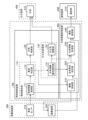
- FIG. 1 is a block diagram showing the configuration of a lighting control device according to Embodiment 1 and peripheral devices related thereto;
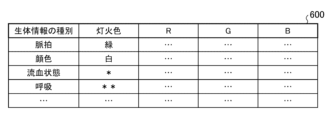
- FIG. It is a figure which shows an example of the correspondence of the classification of biometric information, and a light color.
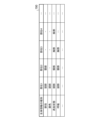
- FIG. 10 is a diagram showing an example of a correspondence relationship between types of biometric information and parts of a living body;
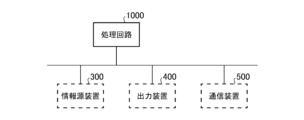
- 1 is a diagram illustrating a first example of a hardware configuration of a lighting control device according to the present disclosure;
- FIG. It is a figure which shows the 2nd example of the hardware configuration of the lighting control apparatus which concerns on this indication.
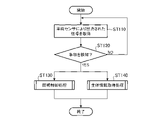
- 4 is a flowchart showing main processing of a lighting control device and main processing of a biological information acquisition device in the present disclosure;
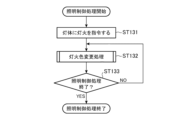
- FIG. 7 is a flow chart showing an example of a lighting control process shown in FIG. 6;
- FIG. FIG. 8 is a flowchart showing an example of a lamp color change process shown in FIG. 7;
- FIG. 7 is a flowchart showing an example of biometric information acquisition processing shown in FIG. 6;
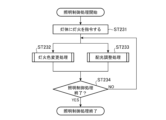
- FIG. 10 is a block diagram showing the configuration of a lighting control device according to Embodiment 2 and peripheral devices related thereto; 9 is a flowchart showing an example of lighting control processing according to Embodiment 2; 12 is a flowchart showing an example of light distribution adjustment processing shown in FIG. 11;
- FIG. 10 is a block diagram showing the configuration of a lighting control device according to Embodiment 3 and peripheral devices related thereto;
- 14 is a flow chart showing an example of
- FIG. 1 is a block diagram showing the configuration of a lighting control device 100 and related peripheral devices according to Embodiment 1. As shown in FIG. 1
- the lighting control device 100 controls lighting in the vehicle interior by instructing lamps 410 that illuminate the interior of the vehicle about lights and lighting colors.
- the lighting control device 100 of the present disclosure instructs to change the lighting color of the lighting body 410 particularly when a vehicle accident occurs.
- a lighting control device 100 shown in FIG. 1 is communicably connected to a biological information acquisition device 200, an information source device 300, and an output device 400. FIG. A detailed configuration example of the lighting control device 100 will be described later.
- the biometric information acquisition device 200 acquires biometric information using a captured image that is an image of the interior of the vehicle, and outputs the acquired biometric information.
- Biological information in the present disclosure is biological information that can be acquired using captured images, and includes, for example, pulse, complexion, bleeding state, respiration, and the like.
- a biological information acquisition device 200 shown in FIG. 1 is communicably connected to a lighting control device 100, an information source device 300, and a communication device. A detailed configuration example of the biometric information acquisition device 200 will be described later.
- the information source device 300 is a device that provides information used for processing by the lighting control device 100 or the biological information acquisition device 200 .
- the information source device 300 is a vehicle sensor 310 and an imaging device 320 mounted on a vehicle.
- Vehicle sensor 310 outputs a signal relating to vehicle information.
- Vehicle information in the present disclosure is information that can determine a vehicle accident, vehicle-related conditions, vehicle interior conditions, and the like.
- the vehicle information is, for example, vehicle speed, acceleration, vehicle position information, seat sensor information, optical sensor information, parking brake information, vehicle device failure notification information, or airbag operation notification information.
- the vehicle sensor 310 is composed of a plurality of sensors that output signals related to the vehicle information.
- Vehicle sensor 310 may transmit a signal regarding vehicle information via an ECU (Electronic Control Unit) (not shown) instead of directly transmitting a signal regarding vehicle information.
- the ECU is a control unit that controls each major operation of the vehicle.
- the ECU is connected to the lighting control device 100 by a wire harness (not shown), and can freely communicate with the lighting control device 100 by a communication method based on the CAN (Controller Area Network) standard.
- CAN Controller Area Network
- the imaging device 320 is arranged at a position capable of capturing an image of the interior of the vehicle, and captures an image of the interior of the vehicle.
- the imaging device 320 has a first imaging element that converts visible light into an electrical signal, and outputs a visible light captured image that is an image of the interior of the vehicle captured by the first imaging element receiving visible light. .
- a visible light captured image is hereinafter simply referred to as a “captured image”.
- the imaging device 320 captures an image of the interior of the vehicle upon receiving a command from the imaging control unit 210 .
- the imaging device 320 receives a command from the imaging control unit 210 of the biological information acquisition device 200 and images the interior of the vehicle.
- the imaging device 320 may use, for example, a camera included in a DMS (Driver Monitoring System). In this case, the imaging device 320 images the passengers including the driver inside the vehicle.
- the imaging device 320 has a second imaging element that converts infrared rays into electrical signals, and the second imaging element receives infrared rays to capture an image of the interior of the vehicle. , may have a function of outputting an infrared captured image.
- An infrared captured image is hereinafter referred to as an "infrared image" to distinguish it from a captured image that is a visible light captured image.
- the image capturing device 320 captures infrared rays and outputs an infrared image in a state in which no accident has occurred in the vehicle. to output the captured image.
- the imaging device 320 may transmit images via an ECU (Electronic Control Unit) (not shown) instead of directly transmitting images (captured images or infrared images).
- the ECU is a control unit that controls each major operation of the vehicle.
- the ECU is connected to the biological information acquisition device 200 or the lighting control device 100 by a wire harness (not shown), and communicates with the biological information acquisition device 200 or the lighting control device 100 by a communication method based on the CAN (Controller Area Network) standard. can communicate freely with
- the output device 400 is a control target device commanded by the lighting control device 100 of the present disclosure, specifically the lamp body 410 .
- the lamp body 410 is provided in, for example, a vehicle interior lighting device, and illuminates the vehicle interior using visible light.
- the lamps 410 are, for example, room lamps, map lamps, foot lamps, side step lamps, door lamps, and ambient lamps.
- the room lamp is a light body 410 that illuminates the entire vehicle interior, and is provided, for example, on the ceiling of the vehicle interior.
- the map lamp is, for example, a lighting body 410 installed for the driver's seat or the passenger's seat.
- the foot lamp is a light body 410 installed so as to illuminate the feet of the passenger.
- the side step lamp is a lamp body 410 built into the side step.
- the door lamp is a lamp body 410 built into the door.
- Ambient lamps are decorative lights that are incorporated into dashboards, center consoles, side door rims, and the like.
- the lamp body 410 in the present disclosure may be the whole lamp body or a part of the lamp body.
- the lamp body 410 shown in FIG. 1 switches between a lit state and a non-lit state according to a command from the lighting control device 100 .
- the lighting body 410 also changes its lighting color according to a command from the lighting control device 100 .
- the lamp body 410 has, for example, a light source in which a plurality of LEDs (Light Emitting Diodes) are aggregated.
- the plurality of LEDs in the lighting body 410 are, for example, three LEDs that emit light of different wavelengths (for example, three primary colors (R, G, B) of light such as red, green, and blue), and the lighting control device
- the wavelength components of each light or the ratio of the light intensity can be changed according to commands from 100 .
- Lighting control in the present disclosure includes lighting color control, brightness control, or light distribution control.
- Light color control is, for example, outputting various colors by adjusting and combining the brightness of each color of RGB.
- Control of light distribution includes control of the irradiation range of light or control of directivity of light. Light distribution control can be realized, for example, by a method of lighting only some of the plurality of LEDs in the lamp body 410 instead of lighting all of them.
- Communication device 500 communicates with the outside of the vehicle. Communication device 500 performs wireless communication with an external device that collects information from a plurality of vehicles, for example.
- the communication device 500 shown in FIG. 1 transmits the vehicle information acquired by the vehicle information acquisition unit 111 from the vehicle sensor 310 and the biometric information acquired by the biometric information acquisition device 200 to a server (not shown) via the communication unit 510. form.
- the lighting control device 100 includes an accident detection section 110 , a lamp body control section 120 , and a lamp color changing section 130 .
- the lighting control device 100 includes a control unit (not shown) and a storage unit (not shown).
- a control unit (not shown) controls, for example, the entire apparatus including each component.
- a storage unit (not shown) stores, for example, information used in the processing of each component or information generated in the processing.
- Accident detection unit 110 detects an accident of the vehicle using a signal output from vehicle sensor 310 mounted on the vehicle.
- a method of detecting a vehicle accident using a signal from the vehicle sensor 310 includes vehicle speed, acceleration, vehicle position information, seat sensor information, optical sensor information, parking brake information, vehicle device failure notification information, or airbag operation notification. Based on the information, it can be realized by a method using already known technology.
- the accident detection unit 110 detects a vehicle accident, the accident detection unit 110 outputs an accident occurrence signal, which is a signal indicating that an accident has occurred.
- Accident detection unit 110 outputs vehicle information indicated by a signal output from vehicle sensor 310 when a vehicle accident is detected. A detailed configuration example of the accident detection unit 110 will be described later.
- the lamp control unit 120 instructs the lamp 410, which uses visible light to illuminate the interior of the vehicle, to turn on the light. Specifically, upon receiving an accident detection signal, which is a signal indicating that an accident has occurred, from the accident detection unit 110, the lamp control unit 120 is a signal that instructs the lamp 410 to turn on the light. Outputs a lighting command signal.
- the light color changer 130 changes the light color of the lamp body 410 when the accident detector 110 detects an accident.
- FIG. 2 is a diagram showing an example of a correspondence relationship between types of biometric information and light colors.
- the light color changer 130 executes processing by referring to the first data 600 as shown in FIG. 2, for example.
- the first data 600 is information indicating the correspondence relationship between the type of biometric information and the light color, and is stored in advance in a storage unit (not shown).
- the light color changing unit 130 refers to the first data 600, selects the type of biometric information, and determines the light color.
- the light color changing unit 130 changes the light color of the lamp body 410 to the determined light color. A detailed configuration example of the light color changing unit 130 will be described later.
- the accident detection unit 110 includes a vehicle information acquisition unit 111 and an accident determination unit 112 .
- Vehicle information acquisition unit 111 acquires a signal output from vehicle sensor 310 .
- Vehicle information acquisition section 111 acquires vehicle information using the acquired signal, and outputs the vehicle information to accident determination section 112 .
- Vehicle information acquisition unit 111 also outputs vehicle information to communication control unit 240 .
- Accident determination unit 112 determines the occurrence of an accident using vehicle information. Upon determining that an accident has occurred, the accident determination unit 112 outputs an accident detection signal, which is a signal indicating that the occurrence of an accident has been detected. The accident determination unit 112 may output the vehicle information used for the determination together with the accident detection signal. The accident determination unit 112 may determine the type of accident using vehicle information. The accident determination unit 112 that executes this determination outputs accident type information indicating the type of the determined accident.
- the light color changer 130 includes a biological information type selector 131 and a light color adjuster 132 .
- the biometric information type selection unit 131 selects the type of biometric information to be acquired by referring to the type information indicating the type of biometric information stored in advance. Specifically, for example, upon receiving an accident detection signal from the accident detection unit 110, the biometric information type selection unit 131 refers to the type information and sequentially selects the type of biometric information to be acquired. Alternatively, for example, upon receiving an accident detection signal from the accident detection unit 110, the biological information type selection unit 131 refers to the type information and selects all types of biological information to be acquired. The biological information type selection unit 131 sends information indicating the selected type to the light color adjustment unit 132 . The biometric information type selection unit 131 also sends information indicating the selected type to the biometric part identification unit 220, which will be described later.
- the light color adjustment unit 132 adjusts the light color of the lamp body 410 according to the type of biometric information selected by the biometric information type selection unit 131 .
- the light color adjustment unit 132 refers to the first data 600 shown in FIG. Send a command signal to command the lights to come on.
- the biometric information type selected by the biometric information type selection unit 131 is pulse
- the light color adjustment unit 132 adjusts the wavelength of the light color to be 490 nm or more and 570 nm or less. As a result, the lamp color becomes so-called green, and the lamp body 410 irradiates the living body with green light.
- the light color adjustment unit 132 adjusts the light color to white.
- the lamp body 410 is instructed to turn on all lights. As a result, the lamp color becomes so-called white, and the lamp body 410 irradiates the living body with white light.
- the biometric information acquiring apparatus 200 shown in FIG. 1 includes an imaging control section 210 , a biometric part specifying section 220 , a biometric information acquiring section 230 , and a communication control section 240 .
- the biological information acquiring apparatus 200 includes a control unit (not shown) and a storage unit (not shown).
- a control unit (not shown) controls, for example, the entire apparatus including each component.
- a storage unit (not shown) stores, for example, information used in the processing of each component or information generated in the processing.
- the imaging control unit 210 instructs the imaging device 320 to perform imaging when a vehicle accident occurs. Specifically, when the accident detection unit 110 detects an accident, the imaging control unit 210 instructs the imaging device 320, which takes an image by receiving visible light, to take an image of the interior of the vehicle. Here, if the imaging device 320 is configured to switch between imaging using visible light and imaging using infrared light, the imaging control unit 210 controls the imaging device in a state where the accident detection unit 110 does not detect an accident. 320 is instructed to perform imaging using infrared light, and when an accident is detected by the accident detection unit 110, the imaging device 320 is instructed to perform imaging using visible light. That is, the imaging control unit 210 instructs the imaging device 320 to perform imaging using infrared rays until the accident detection unit 110 detects an accident.
- the living body part identification unit 220 identifies the position of the living body part in the vehicle interior using the captured image. Specifically, body part identification section 220 analyzes the captured image according to a command from imaging control section 210, and identifies the position of the body part in the vehicle interior. Also, the living body part identification unit 220 extracts and outputs an image in a format that allows identification of the living body part. Specifically, for example, the body part identification unit 220 outputs information indicating the identified part and a captured image of the identified part.
- FIG. 3 is a diagram showing an example of a correspondence relationship between types of biometric information and parts of a living body.
- the body part identification unit 220 has second data 700 as shown in FIG. 3, for example.
- the second data 700 is information indicating the correspondence relationship between the type of biometric information and the part of the biometric body.
- the living body part identification unit 220 refers to the second data 700, extracts and outputs the captured image of the living body part corresponding to the type of biological information selected by the biological information type selecting unit 131 in the light color changing unit 130.
- the parts of the living body identified by the living body part identification unit 220 are, for example, the head, neck, chest, abdomen, shoulders, and arms, but any part that can be identified from the captured image is not limited to the above parts.
- the head or neck is considered to be the site where injury is most likely to lead to death, and is the site where the proportion of exposed bare skin is high.
- the chest or abdomen are considered sites where injuries are likely to result in death.
- the positions of all the parts may be identified according to the type of biological information, or the parts may be identified in order.
- the parts of the living body may be identified by collectively identifying all predetermined parts, or may be identified by classifying the biological information selected by the biological information type selection unit 131 . For example, if you want to acquire the biometric information of the head, you can specify only the part of the head, and after acquiring the biometric information of the head, specify only the part of the chest to acquire the biometric information of the chest. good.
- an example of a method for identifying a body part in the body part identification unit 220 will be described.
- the body part identifying section 220 detects the occupant whose body part is to be identified.
- the detection of the occupant is performed using predetermined rules such as skeletal detection and face detection of the occupant from the captured image, and machine learning.
- predetermined rules such as skeletal detection and face detection of the occupant from the captured image, and machine learning.
- the vehicle information acquired from the vehicle sensor 310 may be used to detect the occupant, or the detection result of the occupant before the occurrence of the accident may be used.
- the occupant detection accuracy may be further improved by using occupant detection information when the vehicle is running, such as when the vehicle speed or acceleration is above a certain threshold, or when the parking brake is off rather than the parking brake information. .
- the biometric information acquiring unit 230 acquires biometric information using the captured image including the body part specified by the part specifying unit.
- the biometric information acquiring section 230 receives the captured image output from the biometric part identifying section 220 .
- the biometric information acquisition unit 230 analyzes the captured image and acquires biometric information.
- the biometric information acquisition unit 230 outputs biometric information.
- Biometric information is acquired, for example, as follows. Bloodshed, complexion: The color and shape of the body part specified in the captured image match a predetermined model, or are estimated from machine learning results.
- ⁇ Pulse Captures and acquires changes in luminance on the face surface that are considered to be caused by the blood flow of the occupant in the captured image. Hemoglobin contained in blood absorbs green light, so adjusting the light color to a green wavelength that makes it easy to detect changes in luminance increases the accuracy of information.
- - Breathing identified from the movement of body parts (chest, shoulders, abdomen, etc.) identified in the captured image.
- the communication control unit 240 causes the biometric information acquired by the biometric information acquiring unit 230 to be transmitted to the communication device.
- the communication control section 240 receives the biometric information output from the biometric information acquisition section 230 .
- the communication control unit 240 outputs a command signal, which is a signal for commanding the communication device to transmit the biological information together with the biological information. Further, when the vehicle information is received from the vehicle information acquisition unit 111, the communication control unit 240 causes the vehicle information to be transmitted together.
- FIG. 4 is a diagram illustrating a first example of the hardware configuration and peripheral devices of the lighting control device 100 according to the present disclosure.
- processing circuit 1000 is connected to information source device 300 , output device 400 and communication device 500 .
- the processing circuit 1000 is capable of transmitting and receiving signals and transmitting and receiving information between the information source device 300 , the output device 400 and the communication device 500 .
- FIG. 5 is a diagram illustrating a second example of the hardware configuration and peripheral devices of the lighting control device 100 according to the present disclosure.
- processor 1001 and memory 1002 are connected to information source device 300 , output device 400 and communication device 500 .
- Processor 1001 is capable of transmitting and receiving signals and transmitting and receiving information between information source device 300 , output device 400 and communication device 500 .
- Each function in the lighting control device 100 or the biological information acquisition device 200 is implemented by a processing circuit.
- Each function of the control unit 240 is implemented by a processing circuit.
- lighting control device 100 or biological information acquisition device 200 performs a series of processes from step ST110 to step ST140 shown in FIG. and processing circuitry for executing.
- the processing circuit may be dedicated hardware or may be a CPU (Central Processing Unit) that executes a program stored in memory.
- CPU Central Processing Unit
- the processing circuit 1000 may be, for example, a single circuit, a composite circuit, a programmed processor, a parallel programmed processor, an ASIC (Application Specific Integrated Circuit), an FPGA ( Field-Programmable Gate Array) or a combination thereof.
- ASIC Application Specific Integrated Circuit
- FPGA Field-Programmable Gate Array
- Each function may be realized by separate processing circuits, or these functions may be collectively realized by one processing circuit.
- the processing circuit is the processor 1001 shown in FIG. 5, the accident detection unit 110, the vehicle information acquisition unit 111, the accident determination unit 112, the lamp body control unit 120, the light color change unit 130, or the light color described later in Embodiment 3.
- the biometric information acquisition unit 230, and the communication control unit 240 are implemented by software, firmware, or a combination of software and firmware. Software or firmware is written as a program and stored in memory 1002 .
- the processor 1001 implements the functions of each unit by reading and executing programs stored in the memory 1002 . That is, the lighting control device 100 includes a memory 1002 for storing a program that, when executed by the processor 1001, results in the series of processes described above. These programs include the accident detection unit 110, the vehicle information acquisition unit 111, the accident determination unit 112, the lamp body control unit 120, the lamp color change unit 130 or the lamp color change unit 130B described later in Embodiment 3, the biological information type selection unit 131, lamp color adjustment unit 132, external light color identification unit 133 described later in Embodiment 3, imaging control unit 140 described later in Embodiments 2 and 3, and A biological part identification unit 150, a biological information acquisition device 200, or a biological information acquisition device 200A, an imaging control unit 210, a biological part identification unit 220, a biological information acquisition unit 230, and a communication It causes a computer to execute a procedure or method for realizing each mechanism of the control unit 240 .
- the memory 1002 includes, for example, non-volatile or volatile semiconductor memories such as RAM (Random Access Memory), ROM (Read Only Memory), flash memory, EPROM (Erasable Programmable Read Only Memory), EEPROM (Electrically-EPROM), Magnetic discs, flexible discs, optical discs, compact discs, mini discs, DVDs, and the like are applicable.
- RAM Random Access Memory
- ROM Read Only Memory
- flash memory EPROM (Erasable Programmable Read Only Memory)
- EEPROM Electrical-EPROM
- Magnetic discs flexible discs, optical discs, compact discs, mini discs, DVDs, and the like are applicable.
- Each function may be partly realized by dedicated hardware and partly realized by software or firmware.
- a processing circuit 1000 as dedicated hardware realizes its function, and for the accident detection unit 110, the processor 1001 reads and executes a program stored in the memory 1002. , may implement that function.
- the processing circuitry may implement each of the above functions through hardware, software, firmware, or a combination thereof.
- FIG. 6 is a flowchart showing main processing of the lighting control device 100 and main processing of the biological information acquisition device 200 in the present disclosure.
- FIG. 7 is a flow chart showing an example of the lighting control process shown in FIG.
- FIG. 8 is a flow chart showing an example of the lamp color changing process shown in FIG.
- FIG. 9 is a flow chart showing an example of the biometric information acquisition process shown in FIG.
- the lighting control device 100 starts processing, for example, at the timing when the engine of the vehicle is started (“START” in FIG. 6).
- Accident detection unit 110 waits until it acquires the signal output from vehicle sensor 310, and starts processing when it acquires the signal output from vehicle sensor 310 (step ST110).
- Accident detection unit 110 determines whether an accident has occurred using the vehicle information indicated by the acquired signal, and detects an accident when it is determined that an accident has occurred.
- vehicle information acquisition section 111 in accident detection section 110 acquires a signal output from vehicle sensor 310 and sends vehicle information indicated by the acquired signal to accident determination section 112 .
- the vehicle information acquisition unit 111 sends vehicle information to the communication control unit 240 .
- Accident determination unit 112 in accident detection unit 110 determines the occurrence of an accident using vehicle information.
- the accident determination unit 112 determines that an accident has occurred, it outputs an accident detection signal to each of the lamp body control unit 120, the biological information type selection unit 131, and the imaging control unit 210.
- Accident detection unit 110 repeats the process from step ST110 in a state where no accident is detected (step ST120 "NO").
- accident detection unit 110 detects an accident (step ST120 "YES")
- lighting control processing step ST130
- biometric information acquisition processing step ST140
- lighting control device 100 executes lighting control processing (step ST130)
- biological information acquisition device 200 executes biological information acquisition processing (step ST140).
- step ST130 Details of the lighting control process (step ST130) will be described.
- the lighting control process is started (lighting control process start in FIG. 7).
- the lamp control unit 120 waits until it receives the accident detection signal output from the accident detection unit 110 .
- the lamp control unit 120 instructs the lamp 410 to turn on the lamp (step ST131).
- Light color changing unit 130 waits until it receives an accident detection signal output from accident detection unit 110 .
- light color change unit 130 proceeds to the light color change process (step ST132).
- a control section (not shown) in the lighting control device 100 determines whether to end the lighting control process (step ST133). For example, when receiving a command to stop processing from the outside, the control unit determines to end the lighting control processing. If the lighting control device 100 determines not to end the lighting control process ("NO" in step ST133), it repeats the light color changing process (step ST132). When the lighting control device 100 determines to end the lighting control process (“YES” in step ST133), the lighting control device 100 ends the lighting control process (end of the lighting control process in FIG. 7).
- the light color changing unit 130 starts the light color changing process (“start light color changing process” in FIG. 8).
- the biological information type selection section 131 in the light color changing section 130 selects the type of biological information to be acquired (step ST132-1).
- the light color adjusting section 132 in the light color changing section 130 adjusts the light color of the lamp body 410 according to the type of biometric information (step ST132-2).
- a control unit determines whether or not all types of biometric information to be acquired have been selected (step ST132-3). When the control unit (not shown) determines that all types of biological information to be acquired have not been selected (step ST132-3 "NO"), the control unit controls to repeat the process from step ST132-1. When the control unit (not shown) determines that all the types of biological information to be acquired have not been selected (step ST132-3 “YES”), the control unit controls to end the light color change process (FIG. 8). (“end of light color change processing”).
- the biometric information acquisition device 200 starts the biometric information acquisition process (“Start biometric information acquisition process” in FIG. 9). For example, when receiving an accident detection signal from the accident determination unit 112 or receiving a captured image from the imaging device 320, the biometric information acquisition device 200 starts biometric information acquisition processing.
- the body part identifying section 220 acquires the captured image captured by the imaging device 320 (step ST141).
- Body part identification section 220 identifies the position of the body part using the captured image (step ST142).
- Body part identification section 220 extracts and outputs an image in a format that allows identification of the body part (step ST143).
- Biological part identifying section 220 acquires the type of biological information (step ST144).
- the biometric information acquisition unit 230 acquires biometric information using the type of biometric information and the image of the body part (step ST145).
- the communication control section 240 causes the communication device to transmit the biometric information acquired by the biometric information acquisition section 230 (step ST146).
- a control unit (not shown) determines whether the biometric information acquisition process is finished (step ST147). When the control unit determines that the biometric information acquisition process will not end (step ST147 "NO"), it controls to repeat the process from step ST144. When the control unit determines that the biometric information acquisition process is to end (“YES” in step ST147), it controls to end the biometric information acquisition process (“End of biometric information acquisition process” in FIG. 9).
- the lighting control device 100 and the biological information acquisition device 200 are integrally configured.
- the lighting control device 100 may be configured to include part or all of the configuration of the biological information acquisition device 200 described above.
- the biological information acquisition device 200 may be configured to include a part or all of the configuration of the lighting control device 100 described above.
- the lighting control device includes an accident detection unit that detects an accident of the vehicle using a signal output by a sensor mounted on the vehicle, and when an accident is detected by the accident detection unit, a visible light is detected.
- a lamp control unit that commands the lamps that illuminate the interior of the vehicle with light to turn on the lights; It was configured to have As a result, it is possible to provide an illumination control device that controls illumination so that biometric information can be obtained regardless of imaging conditions when a vehicle accident occurs.
- the light color changing unit determines the type of biometric information to be obtained by referring to type information indicating the type of biometric information stored in advance.
- a biometric information type selection unit for selection, and a light color adjustment unit for adjusting the light color of the lamp according to the biometric information type selected by the biometric information type selection unit are provided.
- the light color adjustment unit adjusts the wavelength of the light color to be 490 nm or more and 570 nm or less when the biometric information type selected by the biometric information type selection unit is pulse. , configured. As a result, it is possible to provide an illumination control device capable of accurately acquiring a pulse.
- the imaging control unit is configured to instruct the imaging device to perform imaging using infrared rays until an accident is detected by the accident detection unit.
- the imaging control unit is configured to instruct the imaging device to perform imaging using infrared rays until an accident is detected by the accident detection unit.
- the biological information acquisition device includes an accident detection unit that detects an accident of the vehicle using a signal output by a sensor mounted on the vehicle, and when an accident is detected by the accident detection unit, A lamp controller that commands the lamps that illuminate the interior of the vehicle with visible light to turn on, and a lamp color changer that changes the lamp color when an accident is detected by the accident detector.
- an imaging control unit that commands an imaging device that uses visible light to capture an image of the interior of the vehicle; a living body part specifying unit for specifying the position of a living body part in a vehicle interior; a living body information acquiring part for acquiring living body information using a captured image including the living body part specified by the living body part specifying part; and a communication control unit configured to transmit the biometric information acquired by the information acquisition unit to the communication device.
- the lighting control method includes an accident detection step in which an accident detection unit detects an accident of the vehicle using a signal output by a sensor mounted on the vehicle; a lamp control step in which the lamp control unit instructs the lamps that illuminate the interior of the vehicle with visible light to turn on;
- the changing unit includes a lamp color changing step for changing the lamp color of the lamp body.
- Embodiment 2 is a form in which a lighting control device includes an imaging control unit 140 and a living body part identifying part 150, and further adjusts light distribution with respect to the position of the living body part.
- FIG. 10 is a block diagram showing the configuration of a lighting control device 100A and related peripheral devices according to Embodiment 2. As shown in FIG. A lighting control device 100A shown in FIG. The lighting control device 100A also includes a light distribution adjustment unit.
- the imaging control unit 140 has the same configuration as the imaging control unit 210 shown in FIG. 1, and detailed description thereof will be omitted.
- the imaging device 320 receives a command from the imaging control unit 140 of the lighting control device 100A and images the interior of the vehicle.
- a disabled signal is output to the light distribution adjustment unit.
- the body part identifying section 150 estimates the position of the part of the living body.
- the living body part identification unit 150 adjusts the light distribution so that the brightness of the estimated position of the living body part is within the range between the first threshold and the second threshold.
- the biological part identifying unit 150 changes the first threshold value or the second threshold value.
- the light distribution adjustment unit 160 estimates the position of the body part in the vehicle interior, and adjusts the light distribution for the estimated position of the body part.
- the lamp body 410 is instructed to do so.
- light distribution adjustment section 160 receives a non-specification signal from body part identification section 150, it estimates the position of the body part in the vehicle interior.
- the light distribution adjustment unit 160 outputs a command signal for instructing the lamp body 410 to adjust the light distribution with respect to the estimated position of the part of the living body.
- the light distribution adjustment unit 160 uses a predetermined method such as detection of the skeletal structure of the occupant so that the brightness of a part of the body where the part is thought to exist is within a predetermined range. Adjusts the output visible light distribution.
- the light distribution adjustment performed by the light distribution adjustment unit 160 includes at least one of the following three.
- Selection of lamp 410 Select a lamp to be lit or to be extinguished from a plurality of lamps that illuminate the interior of the vehicle.
- Selection of a light source inside the lamp body A light source to be lit is selected from among a plurality of light sources (for example, LEDs) inside the lamp body.
- Dimming of light source Dimming the brightness of the light source.
- the adjustment of the light distribution is determined in advance, for example, based on the result of a dimming simulation based on the combination of (1), (2), and (3) performed during optical design.
- the above (1), (2), and (3) are determined by referring to the simulation results according to the position information and the brightness of the place where the body part exists or is estimated to exist.
- the light distribution adjustment unit 160 adjusts the light distribution according to the determination result so that the light distribution that hits the part is reduced, or Increase the light distribution behind the part. As a result, the brightness of the part is set within the range between the first threshold and the second threshold. Further, for example, if the brightness of the site specified by the living body site identifying unit 150 is below the threshold and is too dark, the light distribution adjusting unit 160 adjusts the light distribution to increase the light distribution that hits the site according to the determination result.
- FIG. 11 is a flowchart illustrating an example of lighting control processing according to the second embodiment.
- the lighting control processing is started (“Lighting control processing start” in FIG. 11).
- the lamp control unit 120 waits until it receives the accident detection signal output from the accident detection unit 110 .
- the lamp control unit 120 instructs the lamp 410 to turn on the lamp (step ST231).
- Light color changing unit 130 waits until it receives an accident detection signal output from accident detection unit 110 .
- light color change unit 130 Upon receiving the accident detection signal output from accident detection unit 110, light color change unit 130 proceeds to the light color change process (step ST232) or the light distribution adjustment process (step ST233).
- the control section (not shown) in the lighting control device 100A determines whether to end the lighting control process (step ST234). For example, when receiving a command to stop processing from the outside, the control unit determines to end the lighting control processing. If the lighting control device 100A determines not to end the lighting control process ("NO" in step ST234), it repeats the light color change process (step ST232) or the light distribution adjustment process (step ST233).
- the lighting control device 100A determines to end the lighting control process (“YES” in step ST234), the lighting control device 100A ends the lighting control process ("END LIGHTING CONTROL PROCESS" in FIG. 11).
- step ST232 The details of the lamp color change process (step ST232) are the same as in FIG. 8, so the description is omitted.
- FIG. 12 is a flowchart showing an example of the light distribution adjustment process shown in FIG. 11;
- the lighting control device 100A starts the light distribution adjustment process (“start light distribution adjustment process” in FIG. 12).
- the body part identifying section 150 acquires the image captured by the imaging device 320 (step ST233-1).
- the living body part identification section 150 identifies the position of each part of the living body using the acquired image (step ST233-2).
- the body part identifying section 150 determines whether the position of the body part has been identified (step ST233-3). When the living body part specifying section 150 determines that the position of the living body part cannot be specified (step ST233-3 "NO"), it estimates the position of the living body part (step ST233-4).
- step ST233-5 light distribution adjustment section 160 adjusts the light distribution so that the brightness at the estimated position is within the range between the first threshold and the second threshold.
- body part identification section 150 determines that the position of the body part has been identified (“YES” in step ST233-3)
- body part identification section 150 outputs an image in a format that allows identification of the body part to biological information acquisition section 230 (step ST233). -6).
- the body part identification section 150 determines whether or not the body information acquisition section 230 has acquired the body information (step ST233-7).
- step ST233-7 determines that the biometric information cannot be acquired (step ST233-7 "NO")
- the biometric part identification section 150 changes the first threshold value or the second threshold value, and proceeds to step ST233-5.
- step ST233-5 is executed, the processing is repeated from step ST233-1. If the biometric information acquiring unit 230 determines that the biometric information has been acquired (step ST233-7 “YES”), the light distribution adjustment process is terminated (“end of light distribution adjustment process” in FIG. 12).
- the illumination control device 100A and the biological information acquisition device 200A are integrally configured.
- the illumination control device 100A may be configured to include a part or all of the configuration of the biological information acquisition device 200A.
- the biological information acquisition device 200A may be configured to include a part or all of the configuration of the lighting control device 100A.
- the lighting control device further includes an imaging control unit that, when an accident is detected by the accident detection unit, commands an imaging device that uses visible light to capture an image of the interior of the vehicle; a living body part identifying unit that identifies the position of a living body part in the vehicle compartment using a captured image captured in accordance with a command; a light distribution adjusting unit that estimates the position of the part of the living body and instructs the lamp body to adjust the light distribution for the estimated position of the part of the living body.
- an illumination control device that controls illumination so that biometric information can be obtained with higher accuracy regardless of imaging conditions when a vehicle accident occurs.
- the biological information acquiring apparatus estimates the position of the part of the living body in the vehicle compartment when the part specifying unit cannot specify the position of the part of the living body in the vehicle compartment, and a light distribution adjusting unit for instructing the lamp body to adjust the light distribution for the light.
- a biological information acquisition device that can obtain biological information with higher accuracy regardless of imaging conditions when a vehicle accident occurs.
- Embodiment 3 is a mode in which illumination is performed with the influence of external light removed.
- FIG. 13 is a block diagram showing the configuration of a lighting control device 100B and related peripheral devices according to the third embodiment. In the lighting control device 100B shown in FIG. 13, the lighting control device 100A shown in FIG. Among the configurations similar to those of the lighting control device A shown in FIG. 11, descriptions of the contents that have already been described will be omitted.
- the external light color identification unit 133 identifies the color of the external light incident on the vehicle interior using the captured image captured by the imaging device 320 and the light color information indicating the light color of the lamp body 410A.
- the light color adjustment unit 132 changes the light color of the lamp 410A from the color indicated by the light color information to the color of the external light. Adjust so that the color is the same as the
- FIG. 14 is a flowchart showing an example of lamp color change processing according to the third embodiment.
- the light color changing unit 130 starts the light color changing process (“start of light color changing process” in FIG. 14).
- the biological information type selection section 131 in the light color changing section 130 selects the type of biological information to be acquired (step ST332-1).
- the ambient light color identification unit 133 obtains the captured image and identifies the ambient light color using the obtained image (step ST332-2).
- the lighting color of the lamp body 410 is determined according to the type of biological information, and the ambient light color is subtracted from the determined lighting color for adjustment (step ST332-3).
- the control unit (not shown) determines whether all types of biometric information to be acquired have been selected (step ST332-4).
- step ST332-4 determines that all types of biometric information to be acquired have not been selected (step ST332-4 "NO"), the control unit controls to repeat the process from step ST332-1.
- step ST332-4 determines that all types of biological information to be acquired have not been selected (step ST332-4 "YES"), the control unit controls to end the light color change process (Fig. 14). (“end of light color change processing”).
- the light color changing unit further uses the captured image captured by the imaging device and the light color information indicating the light color of the lamp body to An external light color specifying unit for specifying a color is further provided, and the light color adjusting unit sets the light color of the lamp body to the color of the lamp when the biometric information type selected by the biometric information type selecting unit is bloodshed or complexion. The color is adjusted by subtracting the color of the outside light from the color indicated by the information.
- an illumination control device capable of illuminating the part of the living body so that it can be easily imaged.
- the present disclosure can freely combine each embodiment, modify any component of each embodiment, or omit any component of each embodiment. .
- the lighting control device according to the present disclosure is suitable for use as a vehicle lighting control device or the like.
- 100, 100A, 100B Lighting control device 110 Accident detection unit, 111 Vehicle information acquisition unit, 112 Accident determination unit, 120 Lamp control unit, 130, 130B Light color change unit, 131 Biological information type selection unit, 132 Light color adjustment 133 External light color identification unit 140 Imaging control unit 150 Biological part identification unit 200, 200A Biological information acquisition device 210 Imaging control unit 220 Biological part identification unit 230 Biological information acquisition unit 240 Communication control unit 300 Information source device, 310 Vehicle sensor, 320 Imaging device, 400, 400A Output device, 410, 410A Lamp, 500 Communication device, 510 Communication unit, 600 First data, 700 Second data, 1000 Processing circuit, 1001 Processor, 1002 memory.
Landscapes
- Engineering & Computer Science (AREA)
- Physics & Mathematics (AREA)
- Health & Medical Sciences (AREA)
- Life Sciences & Earth Sciences (AREA)
- General Physics & Mathematics (AREA)
- Multimedia (AREA)
- Theoretical Computer Science (AREA)
- Mechanical Engineering (AREA)
- Human Computer Interaction (AREA)
- Biophysics (AREA)
- General Health & Medical Sciences (AREA)
- Heart & Thoracic Surgery (AREA)
- Physiology (AREA)
- Cardiology (AREA)
- Computer Vision & Pattern Recognition (AREA)
- Pathology (AREA)
- Biomedical Technology (AREA)
- Medical Informatics (AREA)
- Molecular Biology (AREA)
- Surgery (AREA)
- Animal Behavior & Ethology (AREA)
- Public Health (AREA)
- Veterinary Medicine (AREA)
- Arrangements Of Lighting Devices For Vehicle Interiors, Mounting And Supporting Thereof, Circuits Therefore (AREA)
Priority Applications (4)
| Application Number | Priority Date | Filing Date | Title |
|---|---|---|---|
| US18/292,614 US12397732B2 (en) | 2021-09-24 | 2021-09-24 | Illumination control device, biometric information acquiring device, and illumination control method |
| DE112021008265.5T DE112021008265T5 (de) | 2021-09-24 | 2021-09-24 | Beleuchtungsregelungseinheit, biometrieinformationserfassungseinheit und beleuchtungsregelungsverfahren |
| JP2023549235A JP7483152B2 (ja) | 2021-09-24 | 2021-09-24 | 照明制御装置、生体情報取得装置、および、照明制御方法 |
| PCT/JP2021/034932 WO2023047505A1 (ja) | 2021-09-24 | 2021-09-24 | 照明制御装置、生体情報取得装置、および、照明制御方法 |
Applications Claiming Priority (1)
| Application Number | Priority Date | Filing Date | Title |
|---|---|---|---|
| PCT/JP2021/034932 WO2023047505A1 (ja) | 2021-09-24 | 2021-09-24 | 照明制御装置、生体情報取得装置、および、照明制御方法 |
Publications (1)
| Publication Number | Publication Date |
|---|---|
| WO2023047505A1 true WO2023047505A1 (ja) | 2023-03-30 |
Family
ID=85719359
Family Applications (1)
| Application Number | Title | Priority Date | Filing Date |
|---|---|---|---|
| PCT/JP2021/034932 Ceased WO2023047505A1 (ja) | 2021-09-24 | 2021-09-24 | 照明制御装置、生体情報取得装置、および、照明制御方法 |
Country Status (4)
| Country | Link |
|---|---|
| US (1) | US12397732B2 (https=) |
| JP (1) | JP7483152B2 (https=) |
| DE (1) | DE112021008265T5 (https=) |
| WO (1) | WO2023047505A1 (https=) |
Cited By (1)
| Publication number | Priority date | Publication date | Assignee | Title |
|---|---|---|---|---|
| US20250148798A1 (en) * | 2023-11-07 | 2025-05-08 | Hyundai Motor Company | Method of providing image of event occuring to vehicle and system implementing the same |
Citations (4)
| Publication number | Priority date | Publication date | Assignee | Title |
|---|---|---|---|---|
| JP2015005075A (ja) * | 2013-06-20 | 2015-01-08 | 株式会社デンソー | 事故通報システム |
| JP2015064764A (ja) * | 2013-09-25 | 2015-04-09 | 株式会社オートネットワーク技術研究所 | 車載装置 |
| JP2018019020A (ja) * | 2016-07-29 | 2018-02-01 | ソニーセミコンダクタソリューションズ株式会社 | 撮像装置 |
| JP2018136859A (ja) * | 2017-02-23 | 2018-08-30 | パナソニックIpマネジメント株式会社 | 生体情報取得システム |
Family Cites Families (22)
| Publication number | Priority date | Publication date | Assignee | Title |
|---|---|---|---|---|
| JP2003306106A (ja) | 2002-04-12 | 2003-10-28 | Matsushita Electric Ind Co Ltd | 緊急通報装置 |
| US20100272510A1 (en) * | 2009-04-24 | 2010-10-28 | LED Lane Light Inc. | Illuminated groove seals for pathways |
| CN103931172A (zh) * | 2011-06-10 | 2014-07-16 | 菲力尔系统公司 | 使用热成像智能监控大街的系统及方法 |
| WO2014147494A1 (en) * | 2013-03-18 | 2014-09-25 | Koninklijke Philips N.V. | Methods and apparatus for information management and control of outdoor lighting networks |
| US9904928B1 (en) * | 2014-07-11 | 2018-02-27 | State Farm Mutual Automobile Insurance Company | Method and system for comparing automatically determined crash information to historical collision data to detect fraud |
| JP6100814B2 (ja) * | 2015-02-13 | 2017-03-22 | ファナック株式会社 | 水没保護回路付き数値制御装置 |
| US10282922B1 (en) * | 2015-03-27 | 2019-05-07 | Sunman Engineering, Inc. | Techniques for detecting and reporting a vehicle crash |
| JP6237689B2 (ja) * | 2015-04-16 | 2017-11-29 | トヨタ自動車株式会社 | 周辺情報検出センサの配設構造及び自動運転車両 |
| US10819943B2 (en) * | 2015-05-07 | 2020-10-27 | Magna Electronics Inc. | Vehicle vision system with incident recording function |
| CN109070825B (zh) * | 2016-03-15 | 2021-08-31 | 福特全球技术公司 | 使用车辆动力学来确定撞击位置 |
| WO2017160275A1 (en) * | 2016-03-15 | 2017-09-21 | Ford Global Technologies Llc | Light impact detection for vehicle using low computation overhead |
| DE102016207828A1 (de) * | 2016-05-06 | 2017-11-09 | Robert Bosch Gmbh | Verfahren und Vorrichtung zur Bestimmung von Unfalleinwirkungen auf ein Fahrzeug |
| US10121380B2 (en) * | 2016-08-17 | 2018-11-06 | Panasonic Automotive Systems Company Of America, Division Of Panasonic Corporation Of North America | Automatic motor vehicle accident reporting |
| GB2559139B (en) * | 2017-01-26 | 2020-07-29 | Jaguar Land Rover Ltd | Apparatus and method for incident response |
| WO2019138994A1 (ja) * | 2018-01-11 | 2019-07-18 | パイオニア株式会社 | 情報記録装置、情報記録方法、及び情報記録用プログラム |
| US10796376B2 (en) * | 2018-08-02 | 2020-10-06 | Capital One Services, Llc | Automatic exchange of information for vehicle accidents |
| JP7278117B2 (ja) | 2019-03-15 | 2023-05-19 | 株式会社Subaru | 車両の乗員監視装置、および交通システム |
| JP2020177444A (ja) | 2019-04-18 | 2020-10-29 | 三井住友海上火災保険株式会社 | 乗員損傷推定サーバ、乗員損傷推定システム、乗員損傷推定方法、及びプログラム |
| DE102020000531A1 (de) * | 2020-01-29 | 2020-10-01 | Daimler Ag | Verfahren zum Betrieb einer Beleuchtungseinheit |
| US20230084265A1 (en) | 2020-02-21 | 2023-03-16 | Nec Corporation | Biometric authentication apparatus, biometric authentication method, and computer-readable medium storing program therefor |
| CN115996863A (zh) * | 2020-08-31 | 2023-04-21 | 提爱思科技股份有限公司 | 头枕 |
| JP2022119428A (ja) * | 2021-02-04 | 2022-08-17 | 本田技研工業株式会社 | 運転支援装置 |
-
2021
- 2021-09-24 US US18/292,614 patent/US12397732B2/en active Active
- 2021-09-24 JP JP2023549235A patent/JP7483152B2/ja active Active
- 2021-09-24 DE DE112021008265.5T patent/DE112021008265T5/de not_active Withdrawn
- 2021-09-24 WO PCT/JP2021/034932 patent/WO2023047505A1/ja not_active Ceased
Patent Citations (4)
| Publication number | Priority date | Publication date | Assignee | Title |
|---|---|---|---|---|
| JP2015005075A (ja) * | 2013-06-20 | 2015-01-08 | 株式会社デンソー | 事故通報システム |
| JP2015064764A (ja) * | 2013-09-25 | 2015-04-09 | 株式会社オートネットワーク技術研究所 | 車載装置 |
| JP2018019020A (ja) * | 2016-07-29 | 2018-02-01 | ソニーセミコンダクタソリューションズ株式会社 | 撮像装置 |
| JP2018136859A (ja) * | 2017-02-23 | 2018-08-30 | パナソニックIpマネジメント株式会社 | 生体情報取得システム |
Cited By (1)
| Publication number | Priority date | Publication date | Assignee | Title |
|---|---|---|---|---|
| US20250148798A1 (en) * | 2023-11-07 | 2025-05-08 | Hyundai Motor Company | Method of providing image of event occuring to vehicle and system implementing the same |
Also Published As
| Publication number | Publication date |
|---|---|
| JPWO2023047505A1 (https=) | 2023-03-30 |
| US20240336215A1 (en) | 2024-10-10 |
| DE112021008265T5 (de) | 2024-07-18 |
| JP7483152B2 (ja) | 2024-05-14 |
| US12397732B2 (en) | 2025-08-26 |
Similar Documents
| Publication | Publication Date | Title |
|---|---|---|
| US8078356B2 (en) | Driving assist method and driving assist apparatus | |
| CN105704886B (zh) | 使用可佩戴眼镜的车辆照明控制系统和用于该系统的方法 | |
| CN108657069A (zh) | 用于照明诊断的车辆成像系统和方法 | |
| JP6078032B2 (ja) | 車載用警告装置 | |
| JP6389818B2 (ja) | 車内照明装置 | |
| US10981500B2 (en) | In-cabin lighting device | |
| JP2005136952A (ja) | 色付き赤外線夜間視覚装置 | |
| US10542606B2 (en) | Illuminated badge system for a motor vehicle | |
| CN105034929A (zh) | 照射设备 | |
| JP7483152B2 (ja) | 照明制御装置、生体情報取得装置、および、照明制御方法 | |
| JP2006021591A (ja) | 照明制御システム | |
| JP2021059241A5 (https=) | ||
| WO2023119538A1 (ja) | 乗員監視装置、および、乗員監視方法 | |
| JP2008513294A (ja) | 自動車の照明装置 | |
| CN113497933B (zh) | 内部设备的异常判断装置、异常判断方法以及记录介质 | |
| JP2004189060A (ja) | 車両用周辺視認装置 | |
| JP5182567B2 (ja) | 乗員監視装置 | |
| JPWO2023047505A5 (https=) | ||
| US12367652B2 (en) | Synchronizing image frames by super sampling | |
| US12206992B2 (en) | Image capture with varied illuminations | |
| JP2013224081A (ja) | 画像処理装置および走行支援方法 | |
| CN110386056B (zh) | 车辆和车辆尾灯的控制方法、装置 | |
| JP7647520B2 (ja) | 乗員モニタリングシステム | |
| CN118510097A (zh) | 车内灯光控制方法及相关设备 | |
| JP6227874B2 (ja) | 画像処理装置および走行支援方法 |
Legal Events
| Date | Code | Title | Description |
|---|---|---|---|
| 121 | Ep: the epo has been informed by wipo that ep was designated in this application |
Ref document number: 21958381 Country of ref document: EP Kind code of ref document: A1 |
|
| WWE | Wipo information: entry into national phase |
Ref document number: 2023549235 Country of ref document: JP |
|
| WWE | Wipo information: entry into national phase |
Ref document number: 112021008265 Country of ref document: DE |
|
| 122 | Ep: pct application non-entry in european phase |
Ref document number: 21958381 Country of ref document: EP Kind code of ref document: A1 |
|
| WWG | Wipo information: grant in national office |
Ref document number: 18292614 Country of ref document: US |