WO2023033066A1 - 摺動部材、仮撚機用ディスク、および摺動部材の製造方法 - Google Patents
摺動部材、仮撚機用ディスク、および摺動部材の製造方法 Download PDFInfo
- Publication number
- WO2023033066A1 WO2023033066A1 PCT/JP2022/032838 JP2022032838W WO2023033066A1 WO 2023033066 A1 WO2023033066 A1 WO 2023033066A1 JP 2022032838 W JP2022032838 W JP 2022032838W WO 2023033066 A1 WO2023033066 A1 WO 2023033066A1
- Authority
- WO
- WIPO (PCT)
- Prior art keywords
- sliding member
- fluorine
- sliding contact
- member according
- less
- Prior art date
- Legal status (The legal status is an assumption and is not a legal conclusion. Google has not performed a legal analysis and makes no representation as to the accuracy of the status listed.)
- Ceased
Links
Images

Classifications
-
- C—CHEMISTRY; METALLURGY
- C04—CEMENTS; CONCRETE; ARTIFICIAL STONE; CERAMICS; REFRACTORIES
- C04B—LIME, MAGNESIA; SLAG; CEMENTS; COMPOSITIONS THEREOF, e.g. MORTARS, CONCRETE OR LIKE BUILDING MATERIALS; ARTIFICIAL STONE; CERAMICS; REFRACTORIES; TREATMENT OF NATURAL STONE
- C04B41/00—After-treatment of mortars, concrete, artificial stone or ceramics; Treatment of natural stone
- C04B41/80—After-treatment of mortars, concrete, artificial stone or ceramics; Treatment of natural stone of only ceramics
- C04B41/81—Coating or impregnation
- C04B41/85—Coating or impregnation with inorganic materials
-
- C—CHEMISTRY; METALLURGY
- C04—CEMENTS; CONCRETE; ARTIFICIAL STONE; CERAMICS; REFRACTORIES
- C04B—LIME, MAGNESIA; SLAG; CEMENTS; COMPOSITIONS THEREOF, e.g. MORTARS, CONCRETE OR LIKE BUILDING MATERIALS; ARTIFICIAL STONE; CERAMICS; REFRACTORIES; TREATMENT OF NATURAL STONE
- C04B35/00—Shaped ceramic products characterised by their composition; Ceramics compositions; Processing powders of inorganic compounds preparatory to the manufacturing of ceramic products
- C04B35/01—Shaped ceramic products characterised by their composition; Ceramics compositions; Processing powders of inorganic compounds preparatory to the manufacturing of ceramic products based on oxide ceramics
- C04B35/10—Shaped ceramic products characterised by their composition; Ceramics compositions; Processing powders of inorganic compounds preparatory to the manufacturing of ceramic products based on oxide ceramics based on aluminium oxide
- C04B35/111—Fine ceramics
- C04B35/117—Composites
-
- D—TEXTILES; PAPER
- D02—YARNS; MECHANICAL FINISHING OF YARNS OR ROPES; WARPING OR BEAMING
- D02G—CRIMPING OR CURLING FIBRES, FILAMENTS, THREADS, OR YARNS; YARNS OR THREADS
- D02G1/00—Producing crimped or curled fibres, filaments, yarns, or threads, giving them latent characteristics
- D02G1/02—Producing crimped or curled fibres, filaments, yarns, or threads, giving them latent characteristics by twisting, fixing the twist and backtwisting, i.e. by imparting false twist
- D02G1/04—Devices for imparting false twist
- D02G1/08—Rollers or other friction causing elements
- D02G1/087—Rollers or other friction causing elements between the flanks of rotating discs
-
- C—CHEMISTRY; METALLURGY
- C04—CEMENTS; CONCRETE; ARTIFICIAL STONE; CERAMICS; REFRACTORIES
- C04B—LIME, MAGNESIA; SLAG; CEMENTS; COMPOSITIONS THEREOF, e.g. MORTARS, CONCRETE OR LIKE BUILDING MATERIALS; ARTIFICIAL STONE; CERAMICS; REFRACTORIES; TREATMENT OF NATURAL STONE
- C04B2235/00—Aspects relating to ceramic starting mixtures or sintered ceramic products
- C04B2235/02—Composition of constituents of the starting material or of secondary phases of the final product
- C04B2235/30—Constituents and secondary phases not being of a fibrous nature
- C04B2235/32—Metal oxides, mixed metal oxides, or oxide-forming salts thereof, e.g. carbonates, nitrates, (oxy)hydroxides, chlorides
- C04B2235/3231—Refractory metal oxides, their mixed metal oxides, or oxide-forming salts thereof
- C04B2235/3241—Chromium oxides, chromates, or oxide-forming salts thereof
-
- C—CHEMISTRY; METALLURGY
- C04—CEMENTS; CONCRETE; ARTIFICIAL STONE; CERAMICS; REFRACTORIES
- C04B—LIME, MAGNESIA; SLAG; CEMENTS; COMPOSITIONS THEREOF, e.g. MORTARS, CONCRETE OR LIKE BUILDING MATERIALS; ARTIFICIAL STONE; CERAMICS; REFRACTORIES; TREATMENT OF NATURAL STONE
- C04B2235/00—Aspects relating to ceramic starting mixtures or sintered ceramic products
- C04B2235/02—Composition of constituents of the starting material or of secondary phases of the final product
- C04B2235/30—Constituents and secondary phases not being of a fibrous nature
- C04B2235/44—Metal salt constituents or additives chosen for the nature of the anions, e.g. hydrides or acetylacetonate
- C04B2235/444—Halide containing anions, e.g. bromide, iodate, chlorite
- C04B2235/445—Fluoride containing anions, e.g. fluosilicate
-
- C—CHEMISTRY; METALLURGY
- C04—CEMENTS; CONCRETE; ARTIFICIAL STONE; CERAMICS; REFRACTORIES
- C04B—LIME, MAGNESIA; SLAG; CEMENTS; COMPOSITIONS THEREOF, e.g. MORTARS, CONCRETE OR LIKE BUILDING MATERIALS; ARTIFICIAL STONE; CERAMICS; REFRACTORIES; TREATMENT OF NATURAL STONE
- C04B2235/00—Aspects relating to ceramic starting mixtures or sintered ceramic products
- C04B2235/60—Aspects relating to the preparation, properties or mechanical treatment of green bodies or pre-forms
- C04B2235/616—Liquid infiltration of green bodies or pre-forms
Definitions
- the present disclosure relates to a sliding member, a false twister disk using the sliding member, and a method for manufacturing the sliding member.
- the sliding member of the present disclosure is mainly composed of aluminum oxide and made of ceramics containing fluorine, has a surface layer portion having a sliding contact surface, and an interior surrounded by the surface layer portion, The concentration of fluorine on the sliding surface obtained from elemental mapping is higher than the concentration of fluorine inside.
- the false twister disk of the present disclosure comprises a sliding member.
- a method for manufacturing a sliding member according to the present disclosure includes a step of subjecting the surface of a ceramic sintered body containing aluminum oxide as a main component to at least one of grinding and polishing, and and immersing the ceramic sintered body immersed in the alkaline aqueous solution in a solution containing at least one fluorine-containing compound selected from hydrogen fluoride, ammonium fluoride, ammonium bifluoride and ammonium hydrogen fluoride. and a step of immersing to obtain a sliding member made of ceramics containing aluminum oxide as a main component and containing fluorine.
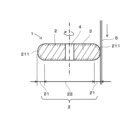
- FIG. 3 is a cross-sectional view of a sliding member according to an embodiment of the present disclosure
- 1 is a perspective view showing an outline of a false twister provided with a false twister disk;
- FIG. 3 is a cross-sectional view of a sliding member according to an embodiment of the present disclosure
- FIG. 1 is a cross-sectional view showing a sliding member 1 of this embodiment.
- This sliding member 1 is used as a disk for a false twister.
- a sliding member 1 of the present embodiment is made of ceramics containing fluorine as a main component of aluminum oxide, and includes a surface layer 2 and an interior 3 surrounded by the surface layer 2 as shown in FIG. Moreover, the sliding member 1 is disk-shaped, for example. A through hole 4 is formed in the central portion of the sliding member 1, and a rotating shaft is mounted in the through hole 4 to rotate the sliding member 1. As shown in FIG.
- the main component in this embodiment means a component that accounts for 80% by mass or more of the total 100% by mass of the components constituting the ceramics.
- Components constituting ceramics can be identified by an X-ray diffractometer (XRD) using CuK ⁇ rays.
- the content of each component can be obtained by converting the metal element obtained by an X-ray fluorescence spectrometer (XRF) or an ICP (Inductively Coupled Plasma) emission spectrometer into an identified component.
- XRD X-ray diffractometer
- ICP Inductively Coupled Plasma
- the surface layer portion 2 is composed of a sliding contact portion 21 and a non-sliding contact portion 22 .
- the sliding contact portion 21 is positioned on the outer peripheral portion of the sliding member 1 and has a sliding contact surface 211 with which the thread 5 sent in a predetermined direction is in sliding contact.
- the sliding contact surface 211 is the surface with which the yarn 5 slides, and may be the entire outer peripheral surface of the sliding contact portion 21 .
- the inside 3 of the sliding member 1 is a portion excluding the surface layer portion 2 .
- the thickness of the surface layer portion 2 varies depending on the composition of the grain boundary phase of the ceramics forming the sliding member 1 and its content, etc., but it is usually 1 ⁇ m or more and 50 ⁇ m or less, preferably 5 ⁇ m or more and 20 ⁇ m or less. It is good to have
- the fluorine concentration on the sliding contact surface 211 of the sliding contact portion 21 is higher than the fluorine concentration on the inner portion 3 .
- Fluorine should be contained in at least the sliding contact portion 21 , and the non-sliding contact portion 22 may contain no fluorine or may contain less fluorine than the sliding contact portion 21 .
- the fluorine concentration on the sliding contact surface 211 is preferably 0.1% by mass or more and 1% by mass or less, preferably 0.2% by mass or more and 0.8% by mass or less.
- the fluorine concentration in the inner portion 3 is preferably 0.4% by mass or less, preferably 0.1% by mass or less with respect to the fluorine concentration on the sliding contact surface 211 .
- the concentration of fluorine can be obtained from elemental mapping using an energy dispersive X-ray spectrometer. Specifically, it is detected in a predetermined analysis range (for example, a magnification of 2000 times, a range of 60 ⁇ m in the horizontal direction and 45 ⁇ m in the vertical direction) by an EDS-equipped scanning electron microscope (SEM/EDS). Semi-quantitative analysis is performed by approximating the total concentration to 100% by the peak intensity ZAF correction method of the elements obtained, and the ratio of the predetermined element to the element of the main component is obtained.
- the acceleration voltage used in elemental mapping is 15 kv.
- a value AB obtained by subtracting an average value B of equivalent circle diameters of the fluorine detection regions from an average value A of the distance between the centers of gravity of adjacent fluorine detection regions on the sliding contact surface 211 of the sliding contact portion 21 obtained from the elemental mapping. is preferably 6 ⁇ m or less. That is, when the value AB is 6 ⁇ m or less, the interval between adjacent fluorine atoms becomes narrower, so that the generation of abrasion powder can be further suppressed.
- the value AB is preferably 2 ⁇ m or more.
- the equivalent circle diameter of the fluorine detection region can be determined using image analysis software.
- image analysis software for example, Image-Pro from Hakuto Co., Ltd., WinROOF2021 from Mitani Shoji Co., Ltd., Azo-kun (ver 2.52) from Asahi Kasei Engineering Co., Ltd. (registered trademark), etc. can be used. can.
- Azo-kun (ver. 2.52) is used as the image analysis software
- the equivalent circle diameter of the fluorine detection region can be measured as follows.
- the setting conditions for this method may be, for example, a threshold of 20, which is an index indicating the brightness of an image, a light brightness, a small figure removal area of 0 ⁇ m 2 , and a noise removal filter.
- the binarized detection region of fluorine and the region colored in blue, light blue, yellowish green, yellow, red, pink, white, etc. in the elemental mapping image of fluorine when elemental mapping is performed. are roughly the same.
- the threshold was set to 20 in the above measurement, the threshold may be adjusted according to the brightness of the elemental mapping. This threshold adjustment is performed by setting the brightness to bright, the binarization method to manual, the small figure removal area to 0 ⁇ m 2 , and the noise removal filter, and then the fluorine detection area of the elemental mapping image and 2 The threshold may be adjusted so that the quantified fluorine detection region generally matches.
- the equivalent circle diameter of the fluorine detection region obtained by the method described above is, for example, 0.2 ⁇ m or more and 3 ⁇ m or less.
- image analysis software "Azou-kun” refers to the image analysis software manufactured by Asahi Kasei Engineering Corporation.
- the distance between the centroids of the fluorine detection regions can be obtained by the following method.
- the center-to-center distance of the fluorine detection region can be obtained by a method called the center-to-center distance method for measuring the degree of dispersion using image analysis software.
- the setting conditions for this method may be the same as the setting conditions used to obtain the equivalent circle diameter of the fluorine detection region.
- a compound containing fluorine and calcium is preferably present on the sliding contact surface 211 . That is, on the sliding contact surface 211, in addition to free carbon, compounds containing fluorine and calcium are present.
- Compounds containing fluorine and calcium include, for example, calcium fluoride whose composition formula is CaF 2 or CaF 3 .
- a compound containing fluorine and calcium acts as a solid lubricant, and can reduce frictional force generated by sliding contact with a material to be slidably contacted (for example, thread 5).
- Such a compound containing fluorine and calcium may be mixed with aluminum oxide, which is the main component, when the sliding member 1 is manufactured. form a phase. Some of the calcium migrates and aggregates when immersed in a solution containing a fluorine-containing compound, and can form the compound by bonding with fluorine.
- the existence of a compound containing fluorine and calcium on the sliding contact surface 211 can be confirmed, for example, by elemental mapping of fluorine and calcium using an X-ray diffraction method and an energy dispersive X-ray spectrometer (EDS). If there is an area where the mapping image of fluorine and the mapping image of calcium overlap on the sliding contact surface 211 by EDS mapping, it may be assumed that a compound containing fluorine and calcium exists in this area.
- EDS energy dispersive X-ray spectrometer
- the average value of skewness (Rsk) in the roughness curve of the sliding contact surface 211 is preferably 0 or less.
- Skewness (Rsk) is a kind of index representing surface properties, and indicates the degree of deviation of unevenness formed on the surface.
- the skewness (Rsk) is positive (that is, Rsk>0)
- the larger the Rsk the more steep protrusions and gradual recesses in the roughness curve.
- the skewness (Rsk) is negative (that is, Rsk ⁇ 0)
- the smaller the Rsk the more steep recesses and gentle protrusions in the roughness curve.
- the skewness (Rsk) has an average value of 0 or less, the projections on the sliding contact surface 211 are rounded, reducing the possibility of damaging the material to be slidably contacted (for example, the thread 5). do.
- the skewness (Rsk) average value is preferably -0.8 or more and 0 or less.
- the skewness (Rsk) can be measured as follows. That is, according to JIS B0601: 2001, it is measured from the roughness curve of the sliding contact surface 211 obtained using an ultra-depth color 3D shape measuring microscope (for example, VK-X1000 manufactured by Keyence Corporation or its successor model). be able to.
- the measurement conditions are coaxial illumination, measurement magnification of 480 times, no cutoff value ⁇ s, cutoff value ⁇ c of 0.08 mm, and end effect correction.
- Two measurement ranges from the sliding contact surface 211 may be set with a range of 710 ⁇ m ⁇ 533 ⁇ m.
- the sliding contact surfaces 211 facing each other in the radial direction may be set.
- four lines to be measured are drawn at approximately equal intervals in the longitudinal direction, line roughness is measured, and an average value of skewness (Rsk) is calculated.
- the length of one line to be measured is, for example, 560 ⁇ m.
- the average value of the root-mean-square slope (R ⁇ q) of the roughness curve of the sliding contact surface 211 is preferably 0.5 or more and 1.4 or less.
- the root-mean-square slope (R ⁇ q) of the roughness curve is the root-mean-square of the local slope dZ/dx at the reference length l of the roughness curve, measured in accordance with JIS B 0601:2001, It is defined by the following formula.
- a roughness curve is obtained in the same manner as described above.
- a high value for the root mean square slope (R ⁇ q) results in a rough surface, while a low value for the root mean square slope (R ⁇ q) results in a smooth surface.
- the sliding contact surface 211 applies an appropriate frictional force to the yarn 5 if the average value of the root mean square gradient (R ⁇ q) is 0.5 or more. Therefore, you can get the right amount of twist.
- the average value of the root-mean-square inclination (R ⁇ q) is 1.4 or less, the inclination of the sliding contact surface 211 becomes gentle, and the possibility of damaging the yarn 5 is reduced.
- the root-mean-square slope (R ⁇ q) may be measured under the same measurement conditions as those used to measure the skewness (Rsk).
- the ceramics constituting the sliding member 1 preferably has an aluminum oxide content of 87% by mass or more and 91% by mass or less.
- the ceramics may contain fluorine, calcium, chromium, magnesium, silicon, etc., in addition to aluminum oxide.
- the content of aluminum oxide is 87% by mass or more, the area occupied by the grain boundary phase on the sliding contact surface 211 is reduced, and the amount of unavoidable impurities contained in the grain boundary phase is also reduced, thereby improving wear resistance.
- the content of aluminum oxide is 87% by mass or more, the analysis accuracy of the fluorine concentration on the sliding contact surface 211 obtained from elemental mapping by an energy dispersive X-ray spectrometer is improved.
- the content of aluminum oxide is 91% by mass or less, the area occupied by the grain boundary phase on the sliding contact surface 211 is large, so the contact angle with pure water is small, and the contact angle with pure water is small. Adhesion of dirt such as snow can be suppressed.
- the ceramic contains chromium, and the content of chromium in terms of oxide (Cr 2 O 3 ) is 3% by mass or more and 5% by mass or less.
- the content of chromium is within this range, the sliding contact surface 211 exhibits a reddish color tone such as a medium dark shade of pink-red. Even if it adheres to the surface 211 and accumulates, it can be easily identified and removed quickly.
- the content of chromium in terms of oxide (Cr 2 O 3 ) can be measured as follows. The content of Cr in the sliding member 1 is measured using an ICP emission spectrometer and converted to the content as Cr 2 O 3 .
- the sliding contact surface 211 has a lightness index L* of 60 or more and 65 or less in the CIE1976L*a*b* color space, a chromaticness index a* of 16 or more and 19 or less, and a chromaticness index b* of 0.1 or more. It should be 2 or less. That is, since the sliding contact surface 211 presents a beautiful color tone called a medium light shade of pink-red, it is possible to provide consumers with a sense of quality, aesthetic satisfaction, and mental peace for a long period of time. can.
- the CIE1976L*a*b* color space is defined by JIS Z 8781-4:2013.
- the lightness index L* and the chromaticness indices a* and b* can be measured using a spectral color difference meter (for example, NF777 manufactured by Nippon Denshoku Industries Co., Ltd. or its successor model).
- a CIE standard light source D65 may be used as the light source, and the viewing angle may be set to 2°.
- the relative density of the ceramics forming the sliding member 1 described above is preferably 95% or more. If the relative density is within the above range, the number of open pores is reduced, so even if the material to be slidably contacted is in sliding contact, it is difficult for grains to come off from around the open pores located on the sliding contact surface 211 .
- the relative density is preferably 98% or higher.
- the relative density is expressed as a percentage (ratio) of the apparent density of the ceramics to the theoretical density of the ceramics.
- the apparent density of ceramics can be determined according to JIS R 1634:1998.
- a method for manufacturing the sliding member 1 of this embodiment will be described below.
- the surface of a ceramic sintered body containing aluminum oxide as a main component is processed by at least one of grinding and polishing to form a predetermined disc shape (for example, disc shape).
- the disc-shaped ceramic sintered body is immersed in an alkaline aqueous solution as needed. This is for facilitating the corrosive action of fluorine, which will be described later.
- the alkaline aqueous solution refers to, for example, an aqueous solution of an alkaline substance such as NaOH, KOH, NH3 , or the like.
- the concentration of the alkaline substance is preferably 20% by mass or more and 50% by mass or less.
- the immersion may be performed, for example, in an aqueous solution at a temperature of 20° C. or higher and 80° C. or lower for a time range of 30 minutes or more and 72 hours.
- the ceramic sintered body is pulled out of the alkaline aqueous solution, washed with water, dried, and then immersed in a solution containing a fluorine-containing compound.
- the fluorine-containing compound is at least one selected from hydrogen fluoride, ammonium fluoride, ammonium bifluoride and ammonium hydrogen fluoride.
- the concentration of the fluorine-containing compound in the solution containing the fluorine-containing compound is preferably 0.5% by mass or more and 5% by mass or less.
- the concentration of the fluorine-containing compound is preferably 0.7% by mass or more and 1.5% by mass or less.
- the immersion is preferably carried out in an aqueous solution at a temperature of 15° C. or higher and 80° C. or lower for a time range of 30 minutes or more and 72 hours, in order to enhance the corrosive action of fluorine.
- the immersion time is preferably 30 minutes or more and 24 hours or less.
- the sliding member 1 of the present embodiment has a high fluorine concentration on the sliding contact surface 211, so that it has high wear resistance and can be used for a long period of time. Since the aggression (frictional force) of the sliding contact surface against the sliding contact surface is reduced, abrasion powder generated from the sliding contact material is suppressed. In addition, since the inside 3 of the sliding member 1 has a low concentration of fluorine, which increases the thermal expansion, it is exposed to high temperatures, and a situation in which a large temperature difference occurs between the surface layer 2 and the inside 3 is repeated. Also, the stress caused by repeated thermal expansion and contraction inside the sliding member is reduced, and cracks are less likely to occur.
- False twister discs are used in the false twisting device of a draw texturing machine.
- the yarn 5 is brought into contact with a plurality of rotating false twister discs 11.
- a plurality of units each having a plurality of false twister discs 11 attached to a rotating shaft 12 are prepared (three units are used in FIG. 2).
- the false twister disk 11 of each unit partially overlaps the false twister disk 11 of the adjacent unit.
- the rotation shafts 12 of the respective units are arranged in parallel, and the false twister discs 11 are not in contact with each other, nor are they in contact with the rotation shafts 12 of adjacent units.
- the rotating shaft 12 is rotated at a high speed, and the yarn 5 is caused to travel between the units at a high speed, thereby causing the yarn 5 to move toward the outer peripheral surface of the false twister disk 11 (that is, the sliding member) of each unit. 1, is rotated, false-twisted and stretched.
- the outer peripheral surface (sliding contact surface 211) of the rotating false twister disk 11 is in direct contact with the yarn 5, and is easily worn.
- the sliding member 1 according to the present embodiment is excellent in wear resistance. Therefore, it can be used for a long period of time.
- the sliding member 1 according to the present embodiment since the sliding member 1 according to the present embodiment has an appropriate frictional force, it is excellent in twisting property and suppresses the generation of abrasion powder (the above-mentioned snow) caused by abrasion of the yarn 5. can.
- the sliding member of the present disclosure is not limited to the application as the false twister disk 11, and can be used as a sliding member such as a seal, a slide ring, a pump, a piston, etc., for example.
Landscapes
- Chemical & Material Sciences (AREA)
- Engineering & Computer Science (AREA)
- Ceramic Engineering (AREA)
- Materials Engineering (AREA)
- Structural Engineering (AREA)
- Organic Chemistry (AREA)
- Composite Materials (AREA)
- Manufacturing & Machinery (AREA)
- Mechanical Engineering (AREA)
- Textile Engineering (AREA)
- Inorganic Chemistry (AREA)
- Sliding-Contact Bearings (AREA)
Priority Applications (3)
| Application Number | Priority Date | Filing Date | Title |
|---|---|---|---|
| JP2023545654A JPWO2023033066A1 (https=) | 2021-08-31 | 2022-08-31 | |
| EP22864648.5A EP4397796A4 (en) | 2021-08-31 | 2022-08-31 | SLIDING ELEMENT, DISC FOR FALSE TORSION MACHINES AND METHOD FOR PRODUCING SLIDING ELEMENT |
| CN202280055908.5A CN117813276A (zh) | 2021-08-31 | 2022-08-31 | 滑动构件、假捻机用盘状件以及滑动构件的制造方法 |
Applications Claiming Priority (2)
| Application Number | Priority Date | Filing Date | Title |
|---|---|---|---|
| JP2021-141948 | 2021-08-31 | ||
| JP2021141948 | 2021-08-31 |
Publications (1)
| Publication Number | Publication Date |
|---|---|
| WO2023033066A1 true WO2023033066A1 (ja) | 2023-03-09 |
Family
ID=85412309
Family Applications (1)
| Application Number | Title | Priority Date | Filing Date |
|---|---|---|---|
| PCT/JP2022/032838 Ceased WO2023033066A1 (ja) | 2021-08-31 | 2022-08-31 | 摺動部材、仮撚機用ディスク、および摺動部材の製造方法 |
Country Status (4)
| Country | Link |
|---|---|
| EP (1) | EP4397796A4 (https=) |
| JP (1) | JPWO2023033066A1 (https=) |
| CN (1) | CN117813276A (https=) |
| WO (1) | WO2023033066A1 (https=) |
Citations (7)
| Publication number | Priority date | Publication date | Assignee | Title |
|---|---|---|---|---|
| JPS5396010A (en) * | 1977-02-01 | 1978-08-22 | Minoru Yoshida | Low temperature manufacture of design porcelain |
| JPH01502426A (ja) * | 1987-03-05 | 1989-08-24 | オライパリ フォバーラルコゾー エース テルベゾェー バーララト | 耐摩耗性の増加した酸化アルミニウムセラミックスの調製方法 |
| JPH09256232A (ja) | 1996-03-21 | 1997-09-30 | Chichibu Onoda Cement Corp | 仮撚ディスク |
| JP2000185986A (ja) * | 1998-12-21 | 2000-07-04 | Nissan Motor Co Ltd | 窒化ケイ素摺動材料 |
| JP2000355754A (ja) * | 1999-06-14 | 2000-12-26 | Ngk Insulators Ltd | フッ化膜を有する部材の製造方法、これに使用する被処理部材およびフッ化膜を有する耐蝕性シール部材 |
| CN106365661A (zh) * | 2016-09-12 | 2017-02-01 | 中国科学院兰州化学物理研究所 | 一种多层结构氧化铝复合陶瓷及其制备方法 |
| JP2017115268A (ja) * | 2015-12-25 | 2017-06-29 | 京セラ株式会社 | 仮撚機用ディスク |
Family Cites Families (8)
| Publication number | Priority date | Publication date | Assignee | Title |
|---|---|---|---|---|
| JP3152774B2 (ja) * | 1992-02-27 | 2001-04-03 | 京セラ株式会社 | 摺動部材用アルミナセラミックス |
| JP2004011026A (ja) * | 1997-10-31 | 2004-01-15 | Suzuki Motor Corp | アルミニウム又はアルミニウム合金の表面処理方法 |
| US20040170347A1 (en) * | 2001-09-28 | 2004-09-02 | Norifumi Ikeda | Rolling unit |
| JP4217027B2 (ja) * | 2002-04-26 | 2009-01-28 | 株式会社タンガロイ | 被覆部材 |
| JP2004353741A (ja) * | 2003-05-28 | 2004-12-16 | Nsk Ltd | 転動装置 |
| CN102390980B (zh) * | 2011-08-12 | 2013-05-08 | 山东轻工业学院 | 梯度自润滑陶瓷刀具材料及其制备方法 |
| CN108191413B (zh) * | 2017-12-26 | 2021-04-23 | 北京建筑材料科学研究总院有限公司 | 一种微晶陶瓷研磨球及其制备方法与应用 |
| CN111365373B (zh) * | 2018-12-25 | 2024-07-12 | 浙江中达精密部件股份有限公司 | 滑动轴承及其制备方法 |
-
2022
- 2022-08-31 JP JP2023545654A patent/JPWO2023033066A1/ja active Pending
- 2022-08-31 WO PCT/JP2022/032838 patent/WO2023033066A1/ja not_active Ceased
- 2022-08-31 CN CN202280055908.5A patent/CN117813276A/zh active Pending
- 2022-08-31 EP EP22864648.5A patent/EP4397796A4/en active Pending
Patent Citations (7)
| Publication number | Priority date | Publication date | Assignee | Title |
|---|---|---|---|---|
| JPS5396010A (en) * | 1977-02-01 | 1978-08-22 | Minoru Yoshida | Low temperature manufacture of design porcelain |
| JPH01502426A (ja) * | 1987-03-05 | 1989-08-24 | オライパリ フォバーラルコゾー エース テルベゾェー バーララト | 耐摩耗性の増加した酸化アルミニウムセラミックスの調製方法 |
| JPH09256232A (ja) | 1996-03-21 | 1997-09-30 | Chichibu Onoda Cement Corp | 仮撚ディスク |
| JP2000185986A (ja) * | 1998-12-21 | 2000-07-04 | Nissan Motor Co Ltd | 窒化ケイ素摺動材料 |
| JP2000355754A (ja) * | 1999-06-14 | 2000-12-26 | Ngk Insulators Ltd | フッ化膜を有する部材の製造方法、これに使用する被処理部材およびフッ化膜を有する耐蝕性シール部材 |
| JP2017115268A (ja) * | 2015-12-25 | 2017-06-29 | 京セラ株式会社 | 仮撚機用ディスク |
| CN106365661A (zh) * | 2016-09-12 | 2017-02-01 | 中国科学院兰州化学物理研究所 | 一种多层结构氧化铝复合陶瓷及其制备方法 |
Non-Patent Citations (1)
| Title |
|---|
| See also references of EP4397796A4 |
Also Published As
| Publication number | Publication date |
|---|---|
| EP4397796A1 (en) | 2024-07-10 |
| JPWO2023033066A1 (https=) | 2023-03-09 |
| CN117813276A (zh) | 2024-04-02 |
| EP4397796A4 (en) | 2025-09-24 |
Similar Documents
| Publication | Publication Date | Title |
|---|---|---|
| EP3657000B2 (en) | Cast iron cylinder liner, and internal combustion engine | |
| EP3604782B1 (en) | Sliding member, piston ring and method of manufacturing a sliding member | |
| JP5511974B2 (ja) | ピストンリング | |
| JP6472389B2 (ja) | ピストンリング及びその製造方法 | |
| JP6563676B2 (ja) | 摩擦材組成物および摩擦材とその製造方法 | |
| JP6718452B2 (ja) | ピストンリング及びその製造方法 | |
| TW201937992A (zh) | 電漿處理裝置用構件及具備其之電漿處理裝置 | |
| CN103403229B (zh) | 复合镀铬覆膜及使用该覆膜的滑动部件 | |
| US20140037236A1 (en) | Slide bearing | |
| CN211598839U (zh) | 气缸套及气缸孔 | |
| CN104520615A (zh) | 锥面形压力环用线材及锥面形压力环 | |
| EP3604867B1 (en) | Sliding member, piston ring and method of manufacturing a sliding member | |
| TW201943317A (zh) | 電漿處理裝置用構件及具備其之電漿處理裝置 | |
| WO2023033066A1 (ja) | 摺動部材、仮撚機用ディスク、および摺動部材の製造方法 | |
| WO2020004061A1 (ja) | ピストンリング | |
| KR102612290B1 (ko) | 플라스마 처리 장치용 부재 및 플라스마 처리 장치 | |
| JP4998458B2 (ja) | セラミック焼結体及びこれを用いた摺動部品、並びに、セラミック焼結体の製造方法 | |
| JP6669487B2 (ja) | 仮撚機用ディスク | |
| Xu et al. | Influence of conversion rate of Si to SiC of C/C-SiC for high-speed trains on braking behavior at high braking energy density | |
| CN101512191A (zh) | 齿轮以及齿轮驱动装置 | |
| TWI821963B (zh) | 附有膜之構件及具備其之電漿處理裝置 | |
| JP6757769B2 (ja) | ピストンリング | |
| JP7780891B2 (ja) | 窒化ケイ素焼結体、機械部品および軸受 | |
| KR102289463B1 (ko) | 세척성이 향상된 생체모방형 세라믹 코팅막 및 이의 형성방법 | |
| KR100906858B1 (ko) | 엔진용 피스톤 링과 그 제조방법 |
Legal Events
| Date | Code | Title | Description |
|---|---|---|---|
| 121 | Ep: the epo has been informed by wipo that ep was designated in this application |
Ref document number: 22864648 Country of ref document: EP Kind code of ref document: A1 |
|
| WWE | Wipo information: entry into national phase |
Ref document number: 2023545654 Country of ref document: JP |
|
| WWE | Wipo information: entry into national phase |
Ref document number: 202280055908.5 Country of ref document: CN |
|
| WWE | Wipo information: entry into national phase |
Ref document number: 2022864648 Country of ref document: EP |
|
| NENP | Non-entry into the national phase |
Ref country code: DE |
|
| ENP | Entry into the national phase |
Ref document number: 2022864648 Country of ref document: EP Effective date: 20240402 |