WO2023008455A1 - 非重合カテキンのエピマー化抑制剤、エピ体非重合カテキン含有容器詰飲料及びその製造方法 - Google Patents
非重合カテキンのエピマー化抑制剤、エピ体非重合カテキン含有容器詰飲料及びその製造方法 Download PDFInfo
- Publication number
- WO2023008455A1 WO2023008455A1 PCT/JP2022/028857 JP2022028857W WO2023008455A1 WO 2023008455 A1 WO2023008455 A1 WO 2023008455A1 JP 2022028857 W JP2022028857 W JP 2022028857W WO 2023008455 A1 WO2023008455 A1 WO 2023008455A1
- Authority
- WO
- WIPO (PCT)
- Prior art keywords
- epi
- epimerization
- catechin
- histidine
- unpolymerized
- Prior art date
- Legal status (The legal status is an assumption and is not a legal conclusion. Google has not performed a legal analysis and makes no representation as to the accuracy of the status listed.)
- Ceased
Links
Classifications
-
- A—HUMAN NECESSITIES
- A23—FOODS OR FOODSTUFFS; TREATMENT THEREOF, NOT COVERED BY OTHER CLASSES
- A23B—PRESERVATION OF FOODS, FOODSTUFFS OR NON-ALCOHOLIC BEVERAGES; CHEMICAL RIPENING OF FRUIT OR VEGETABLES
- A23B70/00—Preservation of non-alcoholic beverages
- A23B70/10—Preservation of non-alcoholic beverages by addition of preservatives
-
- A—HUMAN NECESSITIES
- A23—FOODS OR FOODSTUFFS; TREATMENT THEREOF, NOT COVERED BY OTHER CLASSES
- A23F—COFFEE; TEA; THEIR SUBSTITUTES; MANUFACTURE, PREPARATION, OR INFUSION THEREOF
- A23F3/00—Tea; Tea substitutes; Preparations thereof
- A23F3/16—Tea extraction; Tea extracts; Treating tea extract; Making instant tea
-
- A—HUMAN NECESSITIES
- A23—FOODS OR FOODSTUFFS; TREATMENT THEREOF, NOT COVERED BY OTHER CLASSES
- A23L—FOODS, FOODSTUFFS OR NON-ALCOHOLIC BEVERAGES, NOT OTHERWISE PROVIDED FOR; PREPARATION OR TREATMENT THEREOF
- A23L2/00—Non-alcoholic beverages; Dry compositions or concentrates therefor; Preparation or treatment thereof
- A23L2/52—Adding ingredients
-
- A—HUMAN NECESSITIES
- A23—FOODS OR FOODSTUFFS; TREATMENT THEREOF, NOT COVERED BY OTHER CLASSES
- A23L—FOODS, FOODSTUFFS OR NON-ALCOHOLIC BEVERAGES, NOT OTHERWISE PROVIDED FOR; PREPARATION OR TREATMENT THEREOF
- A23L27/00—Spices; Flavouring agents or condiments; Artificial sweetening agents; Table salts; Dietetic salt substitutes; Preparation or treatment thereof
- A23L27/20—Synthetic spices, flavouring agents or condiments
- A23L27/21—Synthetic spices, flavouring agents or condiments containing amino acids
-
- A—HUMAN NECESSITIES
- A23—FOODS OR FOODSTUFFS; TREATMENT THEREOF, NOT COVERED BY OTHER CLASSES
- A23L—FOODS, FOODSTUFFS OR NON-ALCOHOLIC BEVERAGES, NOT OTHERWISE PROVIDED FOR; PREPARATION OR TREATMENT THEREOF
- A23L33/00—Modifying nutritive qualities of foods; Dietetic products; Preparation or treatment thereof
- A23L33/10—Modifying nutritive qualities of foods; Dietetic products; Preparation or treatment thereof using additives
- A23L33/105—Plant extracts, their artificial duplicates or their derivatives
-
- A—HUMAN NECESSITIES
- A23—FOODS OR FOODSTUFFS; TREATMENT THEREOF, NOT COVERED BY OTHER CLASSES
- A23L—FOODS, FOODSTUFFS OR NON-ALCOHOLIC BEVERAGES, NOT OTHERWISE PROVIDED FOR; PREPARATION OR TREATMENT THEREOF
- A23L33/00—Modifying nutritive qualities of foods; Dietetic products; Preparation or treatment thereof
- A23L33/10—Modifying nutritive qualities of foods; Dietetic products; Preparation or treatment thereof using additives
- A23L33/17—Amino acids, peptides or proteins
Definitions
- the present invention relates to an epimerization inhibitor for non-polymerized catechins.
- the present invention also relates to a packaged beverage containing epi-unpolymerized catechin.
- the present invention also relates to a method for producing a packaged beverage containing epi-unpolymerized catechin.
- Non-polymerized catechins are a kind of polyphenols and are known to have various physiological effects.
- epi-unpolymerized catechins such as epicatechin gallate and epigallocatechin gallate are known to have antioxidant and antiviral effects.
- Health foods that are expected to have the functionality and health effects of non-polymerized catechins are also on the market.
- Patent Document 1 (A) 0.06 to 0.5% by mass of non-polymer catechins, (B) L-isoleucine, L-leucine, L-valine, L-threonine, DL-methionine, L- 0.01 to 5.0% by mass of one or more amino acids or salts thereof selected from methionine, L-histidine, L-phenylalanine, L-lysine and L-tryptophan, and (C) a sweetener of 0.0001 to It describes a packaged beverage containing 20% by mass, having a (G) non-polymer catechin gallate ratio of 5 to 55% by mass, and having a pH of 2.5 to 5.1.
- Beverages containing non-polymerized catechins as active ingredients are useful as functional beverages that contribute to the maintenance and promotion of health.
- part of the epi-non-polymerized catechins undergoes epimerization to become non-epi-unpolymerized catechins during production or storage after production.
- the content of epi-unpolymerized catechins in the beverage is reduced. It is important to enhance the stability of active ingredients in anticipation of functional beverages exhibiting their functionality, and a method capable of suppressing epimerization of non-polymerized catechins is desired.
- Patent Document 1 does not discuss a method for suppressing epimerization of non-polymerized catechins.
- An object of the present invention is to provide an epimerization inhibitor for non-polymerized catechins. Another object of the present invention is to provide a packaged beverage containing epi-unpolymerized catechin in which epimerization of epi-non-polymerized catechin is suppressed, and a method for producing the same.
- the present inventors have investigated techniques for suppressing epimerization of non-polymerized catechins and found that specific amino acids, dipeptides and salts thereof have the effect of suppressing epimerization of non-polymerized catechins.
- the present invention provides the following epimerization inhibitor for non-polymerized catechins, a packaged beverage containing epi-unpolymerized catechins, and a method for producing packaged beverages containing non-polymerized epi-catechins.
- a non-polymerized catechin containing, as an active ingredient, at least one compound (A) selected from the group consisting of aromatic amino acids, cysteine, aromatic amino acids and/or cysteine-containing dipeptides, and salts thereof.
- Epimerization inhibitor is at least one selected from the group consisting of an aromatic amino acid, a dipeptide containing an aromatic amino acid, and a salt thereof.
- [1] suppresses epimerization of non-polymerized catechins. agent.
- [3] Epimerization of non-polymerized catechins according to [1] or [2] above, wherein the aromatic amino acid is at least one amino acid selected from the group consisting of histidine, methylhistidine, phenylalanine, tryptophan and tyrosine. inhibitor.
- [4] Any one of [1] to [3] above, wherein the compound (A) is at least one selected from the group consisting of histidine, methylhistidine, histidine or a dipeptide containing methylhistidine and salts thereof. Epimerization inhibitor of non-polymerized catechins as described.
- Compound (A) is at least one selected from the group consisting of carnosine, anserine and salts thereof, suppressing epimerization of non-polymerized catechins according to any one of [1] to [4] above agent.
- the compound (A) is at least one selected from the group consisting of cysteine, cysteine-containing dipeptides, and salts thereof.
- the epimerization inhibitor for non-polymerized catechins according to any one of [8].
- the epi-unpolymerized catechin (B1) is at least one selected from the group consisting of epicatechin, epigallocatechin, epicatechin gallate and epigallocatechin gallate.
- the epi-unpolymerized catechin (B1) contains epigallocatechin gallate and/or epicatechin gallate, and the epigallocatechin gallate concentration in the beverage is 2400 ⁇ g/mL or less, and/or the epicatechin gallate concentration
- the packaged beverage containing epi-unpolymerized catechins according to [10] or [11] above, wherein the is 2400 ⁇ g/mL or less.
- concentration of 0.015 to 3 w / v%, the pH is more than 4.5 and 8.0 or less, and the Brix is 3.0% or less, and a step of heat-treating at 100 ° C.
- a method for producing a packaged beverage containing epi-unpolymerized catechin comprising: [17] The production method according to [16] above, wherein the epi-unpolymerized catechin (B1) is at least one selected from the group consisting of epicatechin, epigallocatechin, epicatechin gallate and epigallocatechin gallate. . [18] The epi-unpolymerized catechin (B1) contains epigallocatechin gallate and/or epicatechin gallate, and the concentration of epigallocatechin gallate in the mixture is 2400 ⁇ g/mL or less, and/or epicatechin gallate The production method according to [16] or [17] above, wherein the concentration is 2400 ⁇ g/mL or less.
- an epimerization inhibitor for non-polymerized catechins can be provided. Moreover, according to the present invention, it is possible to provide a packaged beverage containing epi-non-polymerized catechin in which epimerization of epi-non-polymerized catechin is suppressed, and a method for producing the same.
- the epimerization inhibitor of non-polymerized catechins of the present invention comprises at least one compound (A) selected from the group consisting of aromatic amino acids, cysteine, dipeptides containing aromatic amino acids and/or cysteine, and salts thereof. as an active ingredient.
- Compound (A) has the effect of suppressing epimerization of non-polymerized catechins.
- Compound (A) may be a single compound or a combination of two or more compounds.
- the aromatic amino acid, cysteine is a free amino acid.
- Epimerization of non-polymerized catechin means that non-polymerized catechin changes to its epimer.
- Epimerization of non-polymerized catechin is that epi-non-polymerized catechin changes to non-epi-non-polymerized catechin (epimerization of epi-non-polymerized catechin). Including changing (epimerization of non-epi unpolymerized catechins).
- the conversion of epi-nonpolymerized catechin to non-epi-nonpolymerized catechin is also called non-epimerization or non-epimerization.
- the conversion of non-epi-unpolymerized catechins to epi-catechins is also referred to as epimerization.
- non-polymerized catechins include epicatechin, epigallocatechin, epicatechin gallate, epigallocatechin gallate and other epi-non-polymerized catechins; is a generic term for The non-polymerized catechin may be one of the above compounds, or may be a combination of two or more compounds.
- epimerization of epi-nonpolymerized catechin to non-epi-nonpolymerized catechin for example, from epicatechin to catechin, from epigallocatechin to gallocatechin, from epicatechin gallate to catechin gallate, or from epigallocatechin
- epimerization of catechin gallate to gallocatechin gallate e.g., from epicatechin to catechin, from epigallocatechin to gallocatechin, from epicatechin gallate to catechin gallate, or from epigallocatechin
- epimerization of non-epi non-polymerized catechins to epi non-polymerized catechins e.g., catechin to epicatechin, gallocatechin to epigallocatechin, catechin gallate to epicatechin gallate, or , epimerization of gallocatechin gallate to epigallocatechin gallate
- the non-polymerized catechin epimerization inhibitor of the present invention is selected from the group consisting of epicatechin, epigallocatechin, epicatechin gallate, epigallocatechin gallate, catechin, gallocatechin, catechin gallate and gallocatechin gallate. It is preferably used for suppressing epimerization of at least one non-polymerized catechin.
- the epimerization inhibitor of unpolymerized catechins of the present invention inhibits the epimerization of at least one epimerized unpolymerized catechin selected from the group consisting of epicatechin, epigallocatechin, epicatechin gallate and epigallocatechin gallate.
- the epimerization inhibitor of non-polymerized catechins of the present invention is suitably used for suppressing the epimerization of epi-non-polymerized catechins to non-epi-non-polymerized catechins.
- Unpolymerized catechins contained in natural products such as plants are mainly epi-unpolymerized catechins.
- the epimerization inhibitor of non-polymerized catechins of the present invention is useful, for example, for inhibiting epimerization of non-polymerized catechins derived from natural products such as plants.
- the compound (A) is preferably at least one selected from the group consisting of aromatic amino acids, dipeptides containing aromatic amino acids, and salts thereof.
- the aromatic amino acid may be any amino acid having an aromatic group.
- At least one amino acid selected from the group consisting of histidine, methylhistidine, phenylalanine, tryptophan and tyrosine is preferable as the aromatic amino acid in the present invention.
- histidine and methylhistidine are more preferable, and histidine is even more preferable, since they are highly effective in suppressing epimerization of non-polymerized catechins.
- Dipeptides containing histidine or methylhistidine are preferred as dipeptides containing aromatic amino acids.
- carnosine and anserine are preferred.
- compound (A) is preferably at least one selected from the group consisting of carnosine, anserine and salts thereof.
- compound (A) is preferably at least one selected from the group consisting of histidine, methylhistidine, dipeptides containing histidine or methylhistidine, and salts thereof. and salts thereof, more preferably at least one selected from the group consisting of these, more preferably histidine and/or salts thereof, and particularly preferably histidine.
- the compound (A) when epimerization of epi-unpolymerized catechin to non-epi-unpolymerized catechin is suppressed, the compound (A) is preferably histidine and/or a salt thereof, more preferably histidine.
- the compound (A) is preferably at least one selected from the group consisting of cysteine, dipeptides containing cysteine, and salts thereof.
- Cysteine-containing dipeptides include, for example, ⁇ -glutamylcysteine.
- the amino acid may be L-form, D-form, or a mixture thereof (DL-form).
- Salts of the above amino acids or dipeptides are not particularly limited, but salts acceptable for food and drink or pharmacologically acceptable salts are preferable.
- the above amino acid or dipeptide salts may be either acid salts or basic salts.
- Acid salts include, for example, inorganic salts such as hydrochlorides, sulfates, nitrates, phosphates; Examples include organic acid salts such as acid salts and propionate salts.
- Examples of basic salts include alkali metal salts such as sodium salts and potassium salts; alkaline earth metal salts such as calcium salts and magnesium salts; Among them, acid salts are preferred, inorganic acid salts are preferred, and hydrochlorides are more preferred.
- the origin and production method of compound (A) are not particularly limited.
- the compound (A) may be derived from natural materials, produced by fermentation, or chemically synthesized.
- Compound (A) may be, for example, one extracted from a plant containing the compound.
- the total content of compound (A) in the epimerization inhibitor of unpolymerized catechins of the present invention may be, for example, 0.01 to 95 w/v%.
- the epimerization inhibitor for unpolymerized catechins of the present invention may contain components (for example, additives) other than the compound (A).
- Addition of the compound (A) to the non-polymerized catechin-containing composition can suppress the epimerization of the non-polymerized catechin.
- the non-polymerized catechin-containing composition may or may not contain the compound (A). Even if the non-polymerized catechin-containing composition contains the compound (A), the epimerization of non-polymerized catechins can be effectively suppressed by adding the epimerization inhibitor of non-polymerized catechins of the present invention. It becomes possible.
- the epimerization inhibitor of non-polymerized catechins of the present invention can be used in various compositions such as foods and drinks containing non-polymerized catechins, pharmaceuticals, quasi-drugs, cosmetics, feeds, and raw materials thereof. can be used to suppress the epimerization of
- the form of the non-polymerized catechin-containing composition is not particularly limited, and may be liquid (e.g., liquid (including suspension, emulsion), gel, etc.) or solid (e.g., powder, particle, etc.). but preferably in liquid form.
- the epimerization inhibitor of non-polymerized catechins is preferably used by being added to the non-polymerized catechin-containing liquid composition. Epimerization of non-polymerized catechins usually proceeds in a solution of non-polymerized catechins. Therefore, when the non-polymerized catechin epimerization inhibitor of the present invention is used in a non-polymerized catechin-containing liquid composition, the effect of the present invention can be particularly greatly obtained.
- the epimerization inhibitor for non-polymerized catechins of the present invention is an epimerized non-polymerized catechin or a non-epi non-polymerized catechin in a composition containing non-polymerized catechins in which epi-non-polymerized catechins and non-epi non-polymerized catechins are not in equilibrium. is preferably used to suppress the epimerization of
- Non-polymerized catechins may be derived from, for example, natural materials or chemically synthesized products.
- non-polymerized catechins can be blended into the composition using natural materials containing non-polymerized catechins, extracts obtained by extracting the natural materials, and the like.
- Plant materials containing epi-unpolymerized catechins include leaves (tea leaves) of Camellia sinensis belonging to the genus Camellia of the family Theaceae.
- Examples of non-polymerized catechin-containing compositions include tea leaf extracts and liquid compositions such as beverages containing the same.
- the non-polymerized catechin-containing composition is preferably a beverage containing non-polymerized catechin, more preferably a packaged beverage containing non-polymerized catechin, still more preferably a packaged beverage containing epi-unpolymerized catechin, particularly Packaged tea beverages containing epi-unpolymerized catechins are preferred.
- the epimerization inhibitor of unpolymerized catechins of the present invention can be suitably used as an epimerization inhibitor of unpolymerized catechins for packaged beverages.
- packaged beverages containing non-polymerized catechins for example, beverages containing epi-unpolymerized catechins, the epi-unpolymerized catechins undergo epimerization over time during and after production.
- the epimerization inhibitor for non-polymerized catechins of the present invention may be added to raw materials during production of the non-polymerized catechin-containing composition, or may be added to the non-polymerized catechin-containing composition.
- the composition When the non-polymerized catechin-containing composition is liquid, the composition preferably has a pH of 3.0 to 8.0, more preferably 3.0 to 7.9.
- the pH of the non-polymerized catechin-containing composition is within the above range, epimerization of non-polymerized catechins can be effectively suppressed when the epimerization inhibitor of non-polymerized catechins of the present invention is used.
- pH is the pH at 25°C. pH can be measured with a commercially available pH meter.
- the non-polymerized catechin-containing composition when suppressing epimerization of the epi-unpolymerized catechin, preferably has an epi-isomer ratio of the unpolymerized catechin of 45% or more, more preferably 50% or more. It is preferably 55% or more, even more preferably 60% or more, particularly preferably 63% or more, and most preferably 65% or more.
- the epi-body rate may be 100% or less, 95% or less, 92% or less, or 90% or less.
- the non-polymerized catechin epimer ratio is preferably 45 to 100%, more preferably 50 to 100%, 55 to 100%, 60 to 100%, or 60 to 95%.
- the epimerization inhibitor of non-polymerized catechins of the present invention is added to a composition containing non-polymerized catechins having an epi-isomer ratio within the above range, the epimerization of non-polymerized epi-isomers of catechins can be effectively suppressed.
- the epi-isomer rate of each epi-isomer unpolymerized catechin such as epigallocatechin gallate and epigallocatechin gallate contained in the non-polymerized catechin-containing composition is within the above range.
- the epimerization rate of epigallocatechin gallate is preferably within the above range, and when the composition contains epicatechin gallate, epicatechin gallate It is preferable that the volume ratio is within the above range.
- the non-polymerized catechin-containing composition contains epicatechin, it is preferable that the epi-isomer rate of epicatechin is within the above range, and when it contains epigallocatechin, the epi-isomer rate of epigallocatechin is within the above range. is preferred.
- the composition containing non-polymerized catechins when suppressing epimerization of non-epi non-polymerized catechins, preferably has a non-epi catechin rate of 45% or more, preferably 50% or more. is more preferably 55% or more, even more preferably 60% or more, particularly preferably 63% or more, and most preferably 65% or more.
- the non-epiform ratio may be 100% or less, 95% or less, 92% or less, or 90% or less.
- the non-epi isomer ratio of non-polymerized catechin is preferably 45-100%, more preferably 50-100%, 55-100%, 60-100% or 60-95%, still more preferably 60-92%.
- the epimerization inhibitor of non-polymerized catechins of the present invention is added to a composition containing non-polymerized catechins having a non-epi isomer ratio within the above range, the epimerization of non-epi non-polymerized catechins can be effectively suppressed. . It is preferable that the non-epi isomer ratio of each non-epi catechin contained in the non-polymerized catechin-containing composition is within the above range.
- the epi- and non-epi catechin ratios of the non-polymerized catechins are calculated from the content (concentration) ( ⁇ g/mL) of the epi-non-polymerized catechins and the non-epi-non-polymerized catechins according to the following equations.
- Ratio of epi isomer (%) 100 x concentration of non-polymerized epi catechin/total concentration of non-polymerized epi catechin and non-polymerized catechin of non-epi catechin
- Ratio of non-epi catechin (%) 100 x concentration of non-polymerized non-epi catechin /Total concentration of epi-non-polymerized catechin and non-epi-non-polymerized catechin
- the amount of the epimerization inhibitor for non-polymerized catechins to be used is not particularly limited, and may be appropriately set according to, for example, the type of compound (A) and the composition containing non-polymerized catechins.
- the amount of the epimerization inhibitor for non-polymerized catechins used may be, for example, an amount such that the content of compound (A) in the composition containing non-polymerized catechins is 0.001 w/v% or more, and the compound ( The content of A) may be 20 w/v% or less.
- the content of histidine and / or a salt thereof in terms of histidine in the non-polymerized catechin-containing composition is 0.003 w / v% or more, 0.008 w /v% or more, 0.01 w/v% or more, 0.011 w/v% or more, or 0.012 w/v% or more, preferably 0.013 w/v% or more, More preferably 0.015 w/v% or more, still more preferably 0.016 w/v% or more or 0.017 w/v% or more, still more preferably 0.018 w/v% or more, particularly preferably 0.019 w/v % or more, most preferably 0.020 w/v % or more.
- histidine and/or a salt thereof has a histidine-equivalent content in the non-polymerized catechin-containing composition, preferably 3 w/v% or less, more preferably 2 w/v% or less, even more preferably 1 w/v%.
- the amount of the epimerization inhibitor of non-polymerized catechin used is such that the content of histidine and/or a salt thereof in terms of histidine contains non-polymerized catechin In the composition, preferably 0.015 to 3 w/v% or 0.015 to 2 w/v%, more preferably 0.015 to 1 w/v%, 0.015 to 0.5 w/v%, 0.015 to 1 w/v%.
- An amount of 0.020 to 0.05 w/v% is preferred.
- it is preferable to add an epimerization inhibitor of non-polymerized catechins so that the content of histidine and/or a salt thereof in terms of histidine in the non-polymerized catechin-containing composition falls within the above range.
- non-polymerized catechins are epimerized such that the content of histidine and/or salts thereof in terms of histidine in beverages (preferably tea beverages) containing non-polymerized catechins falls within the above range.
- An inhibitor is preferably added to the beverage.
- a non-polymerized catechin-containing composition in which epimerization of the non-polymerized catechin is suppressed can be obtained.
- epimerization of the non-polymerized catechin during storage can be suppressed, for example.
- the packaged beverage containing epi-unpolymerized catechin of the present invention contains histidine and/or a salt thereof (A1) and epi-unpolymerized catechin (B1), and has a pH of more than 4.5 and 7.9 or less.
- the histidine and/or salt thereof (A1) has a histidine-equivalent concentration of 0.015 to 3 w/v% and a Brix of 3.0% or less.
- the packaged beverage containing epi-unpolymerized catechin of the present invention (hereinafter sometimes referred to as the packaged beverage of the present invention) is a packaged beverage in which a beverage containing epi-unpolymerized catechin is filled in a container.
- histidine salts include the same amino acid or dipeptide salts as described above.
- the salt of histidine is preferably an acid salt of histidine, more preferably an inorganic acid salt of histidine, and still more preferably a hydrochloride of histidine.
- histidine and/or histidine hydrochloride are preferable as histidine and/or its salt (A1), and histidine is more preferable.
- the epi-unpolymerized catechin (B1) is preferably at least one selected from the group consisting of epicatechin, epigallocatechin, epicatechin gallate and epigallocatechin gallate.
- the epi-unpolymerized catechin (B1) more preferably contains epicatechin gallate and/or epigallocatechin gallate, and more preferably epigallocatechin gallate and/or epicatechin gallate.
- the concentration of histidine and/or its salt (A1) is 0.015 to 3 w/v% in terms of histidine.
- the epi-unpolymerized catechin in the beverage is epimerized over time and converted into the non-epi-unpolymerized catechin.
- the histidine-equivalent concentration of histidine and/or a salt thereof (A) is within the above range, epimerization (non-epimerization) of the epi-unpolymerized catechin (B1) in the beverage over time is effectively suppressed. be able to.
- the concentration of histidine and/or its salt (A1) in the beverage is preferably 0.016 w/v% or more, more preferably 0.017 w/v% or more, and still more preferably It is 0.018 w/v% or more, particularly preferably 0.019 w/v% or more, and most preferably 0.020 w/v% or more.
- the concentration of histidine and/or salts thereof in the beverage is preferably 2 w/v% or less, more preferably 1 w/v% or less or 0.5 w/v% or less, still more preferably 0.2 w/v in terms of histidine. % or less, still more preferably 0.1 w/v % or less, particularly preferably 0.06 w/v % or less, and most preferably 0.05 w/v % or less.
- the histidine-equivalent concentration of histidine and/or a salt thereof in the beverage is preferably 0.015-2 w/v%, more preferably 0.015-1 w/v%, 0.015-0. 5 w/v%, 0.015-0.2 w/v%, 0.016-0.2 w/v%, 0.017-0.2 w/v%, 0.018-0.2 w/v% or 0 0.019 to 0.2 w/v%, more preferably 0.020 to 0.2 w/v%, even more preferably 0.020 to 0.1 w/v%, particularly preferably 0.020 to 0.06 w/v% %, most preferably 0.020-0.05 w/v %.
- the concentration of histidine and/or its salt (A1) can be measured by a known method such as fluorescence method. Histidine and/or its salt (A1) is preferably dissolved and/or dispersed in the beverage.
- the concentration of the epi-unpolymerized catechin (B1) in the beverage is not particularly limited.
- the total concentration of the epi-unpolymerized catechin (B1) in the beverage is, for example, preferably 50 ⁇ g/mL or more, more preferably 100 ⁇ g/mL or more, and preferably 5000 ⁇ g/mL or less, It is more preferably 4800 ⁇ g/mL or less, and even more preferably 2400 ⁇ g/mL or less.
- the total concentration of the epi-unpolymerized catechins (B1) is within the above range, epimerization of the epi-unpolymerized catechins can be more effectively suppressed, which is preferable.
- the beverage of the present invention preferably contains epigallocatechin gallate and/or epicatechin gallate.
- the epigallocatechin gallate concentration in the beverage is 2400 ⁇ g/mL or less and/or the epicatechin gallate concentration is 2400 ⁇ g/mL or less.
- the concentration of epigallocatechin gallate in the beverage is within the above range, epimerization of epigallocatechin gallate to gallocatechin gallate can be further suppressed.
- the concentration of epicatechin gallate is within the above range, epimerization of epicatechin gallate to catechin gallate can be further suppressed.
- the beverage contains epigallocatechin gallate and/or epicatechin gallate, the epigallocatechin gallate concentration in the beverage is 2400 ⁇ g/mL or less, and the epicatechin gallate concentration is 2400 ⁇ g/mL or less.
- the epigallocatechin gallate concentration in the beverage is 2400 ⁇ g/mL or less
- the epicatechin gallate concentration is 2400 ⁇ g/mL or less.
- the concentration of epigallocatechin gallate in the beverage is preferably 50 ⁇ g/mL or more, more preferably 100 ⁇ g/mL or more, and 1200 ⁇ g/mL or less, 800 ⁇ g /mL or less, 600 ⁇ g/mL or less, 400 ⁇ g/mL or less, or 300 ⁇ g/mL or less, more preferably 200 ⁇ g/mL or less, even more preferably 160 ⁇ g/mL or less, and 150 ⁇ g/mL or less. It is particularly preferred to be no more than mL, most preferably no more than 140 ⁇ g/mL.
- the concentration of epicatechin gallate in the beverage is preferably 50 ⁇ g/mL or more, more preferably 100 ⁇ g/mL or more, and is 1200 ⁇ g/mL or less, 800 ⁇ g/mL. 600 ⁇ g/mL or less, 400 ⁇ g/mL or 300 ⁇ g/mL or less, more preferably 200 ⁇ g/mL or less, even more preferably 160 ⁇ g/mL or less, and 150 ⁇ g/mL or less is particularly preferred, and 140 ⁇ g/mL or less is most preferred.
- the epi-unpolymerized catechin (B1) is preferably dissolved and/or dispersed in the beverage.
- the concentration of epi-unpolymerized catechin (B1) can be measured by a high performance liquid chromatography (HPLC) method. As the measurement conditions, the conditions described in Examples can be used.
- the pH of the beverage is preferably more than 4.5 and 7.0 or less, more preferably more than 4.5 and 6.5 or less, 4.7 to 6.5 more preferably 4.9 to 6.5, even more preferably 5.0 to 6.5, particularly preferably 5.0 to 6.2, 5 .0 to 6.0 is most preferred.
- the packaged beverage of the present invention has a Brix of 3.0% or less.
- the beverage preferably has a Brix of 1.8% or less.
- the beverage of the present invention preferably has a Brix of 1.4% or less, more preferably 1.2% or less, even more preferably 1.0% or less, and 0.9% or less. Alternatively, it is particularly preferably 0.8% or less, most preferably 0.7% or less.
- the Brix of the beverage may be 0.01% or more, preferably 0.05% or more, more preferably 0.1% or more, further preferably 0.15% or more, particularly preferably 0.2% or more, 0.3% or more is most preferable.
- the beverage preferably has a Brix of 0.01 to 1.4%, 0.01 to 1.2%, 0.01 to 1.0%, 0.01 to 0.9%, 0.01 to 0.8%, 0.05 to 0.8%, 0.1 to 0.8% or 0.15 to 0.8%, more preferably 0.2 to 0.8% is more preferred, 0.2 to 0.7% is particularly preferred, and 0.3 to 0.7% is most preferred. It is also preferred that the Brix of the beverage is between 0.3 and 0.8%. It is preferable from the viewpoint of flavor that the Brix is within the above range.
- Brix can be evaluated by a Brix value obtained using a saccharimeter or a refractometer.
- the Brix value is a value obtained by converting the refractive index measured at 20° C. into mass/mass percent of the sucrose solution based on the conversion table of ICUMSA (International Commission for the Analysis of Sugar). The unit is "°Bx", "%” or "degree”.
- Brix can be measured, for example, with a digital saccharimeter manufactured by ATAGO, model number: PR-101 ⁇ .
- histidine and/or its salt (A) and epi-unpolymerized catechin (B1) are not particularly limited.
- histidine and/or its salt (A1) may be one extracted from a plant material, one produced by a fermentation method, or a chemically synthesized product.
- the epi-unpolymerized catechin (B1) may be extracted from a plant containing epi-unpolymerized catechin.
- Plant materials containing epi-unpolymerized catechin include, for example, leaves of Camellia sinensis belonging to the genus Camellia of the family Theaceae.
- the beverage of the present invention may contain components other than histidine and/or its salt (A1) and epi-unpolymerized catechin (B1).
- the packaged beverage of the present invention may contain, for example, non-epi non-polymerized catechin (B2).
- the packaged beverage of the present invention preferably has an epi-isomer rate of non-polymerized catechin of 45% or more, more preferably 50% or more, even more preferably 55% or more, and 60% or more. is even more preferred, 63% or more is particularly preferred, and 65% or more is most preferred.
- the epi-body rate may be 100% or less, 95% or less, 92% or less, or 90% or less.
- the non-polymerized catechin epimer ratio in the beverage is preferably 45 to 100%, more preferably 50 to 100%, 55 to 100%, 60 to 100% or 60 to 95%, more preferably 60-92%, even more preferably 60-90%, particularly preferably 63-90%, most preferably 65-90%.
- the epi-isomer rate of each non-polymerized catechin such as epigallocatechin gallate and epigallocatechin gallate contained in the beverage is within the above range.
- the epi-percentage of epigallocatechin gallate is preferably within the above range.
- the epicatechin gallate the epicatechin gallate ratio is preferably within the above range.
- the beverage of the present invention can also be produced by blending an extract of tea tree containing epi-unpolymerized catechins.
- the beverage (liquid for internal use) in the packaged beverage of the present invention is liquid and contains water.
- the form of the beverage may be a straight beverage or a concentrated beverage, but a straight beverage is preferred.
- a straight drink means a drink that can be drunk as it is without dilution.
- Concentrated beverages refer to beverages that are diluted with a drinking solvent such as water.
- Beverages in the present invention may be non-alcoholic beverages or alcoholic beverages, but non-alcoholic beverages are preferred.
- the packaged beverage of the present invention is preferably a beverage other than a beer-taste alcoholic beverage (including beer), and more preferably a non-alcoholic beverage.
- Non-alcoholic beverages refer to beverages with an ethanol concentration of less than 1 v/v%.
- non-alcoholic beverages examples include, but are not limited to, tea beverages, non-alcoholic beer-taste beverages, and the like.
- the non-alcoholic beverage is preferably a non-alcoholic beverage other than a non-alcoholic beer-taste beverage.
- Alcoholic beverages include, but are not limited to, beer, beer-taste beverages, red wine, white wine, whiskey, and the like.
- a tea beverage refers to a beverage containing a plant extract as a tea raw material.
- the raw material plant (plant-derived raw material) of the plant extract is not particularly limited, but includes leaves (tea leaves) of Camellia sinensis belonging to the family Camellia family Camellia sinensis, cereals, and leaves, stems, and roots of plants other than tea.
- tea leaves include tea leaves such as green tea, oolong tea (Tieguanyin, Irotane, Ogonkatsura, Wuyi rock tea, etc.), and black tea.
- One type of tea leaves may be used, or two or more types may be used.
- Green tea is a type of unfermented tea
- oolong tea is a type of semi-fermented tea
- black tea is a type of fermented tea.
- Grains include, for example, wheat such as barley, wheat, dove, and rye; rice such as brown rice; and millet such as beans such as soybeans and black soybeans. Grains can be used singly or in combination of two or more.
- Wheat is preferably barley or pigeon barley. Stems, leaves, or roots of plants other than tea tree include, for example, leaves of sagebrush.
- the beverage of the present invention may contain one or more of tea extracts such as green tea extracts, oolong tea extracts, black tea extracts, and cereal extracts.
- the beverages of the present invention are preferably tea beverages such as green tea beverages, oolong tea beverages, black tea beverages, barley tea beverages, and blended tea beverages.
- a green tea beverage refers to a beverage containing 50% by weight or more of green tea leaves relative to the total amount of raw material plants used in the production of the beverage.
- a black tea beverage refers to a beverage in which black tea leaves are used in an amount of 50% by weight or more based on the total amount of raw material plants used in the production of the beverage.
- Oolong tea beverage refers to a beverage containing 50% by weight or more of oolong tea leaves based on the total amount of raw material plants used for the production of the beverage.
- a barley tea beverage is a beverage containing 50% by weight or more of barley (preferably barley and/or pigeon barley) relative to the total amount of raw material plants used in the production of the beverage.
- Blended tea beverages use multiple types of raw material plants, and the amount of green tea leaves, black tea leaves, oolong tea leaves, and barley used is less than 50% by weight of the total amount of raw material plants used in the manufacture of the beverage. Refers to a certain tea drink.
- the packaged beverage of the present invention contains, for example, additives that can be used in beverages (e.g., antioxidants, flavors, vitamins, pigments, acidulants, emulsifiers, preservatives, seasonings, extracts, pH adjusters, quality additives such as stabilizers) may be contained in one or more.
- additives that can be used in beverages (e.g., antioxidants, flavors, vitamins, pigments, acidulants, emulsifiers, preservatives, seasonings, extracts, pH adjusters, quality additives such as stabilizers) may be contained in one or more.
- the shape of the container is not particularly limited, and examples thereof include metal containers such as cans, bottles, retort pouches, PET bottles, paper packs, aluminum pouches, and vinyl pouches.
- the method for producing the packaged beverage of the present invention is not particularly limited. For example, it can be produced by the following method for producing a packaged beverage containing epi-unpolymerized catechin.
- epimerization of the epi-unpolymerized catechin is suppressed.
- the epimerization of the epimerized non-polymerized catechin for example, it is possible to suppress the decrease in the concentration of the epi-unpolymerized catechin over time during storage of the packaged beverage (decrease in the epi-unpolymerized catechin).
- the present invention also includes the following method for producing a packaged beverage. Contains histidine and/or a salt thereof (A1), an epi-unpolymerized catechin (B1), and an aqueous medium containing water (C), wherein the concentration of histidine and/or salt thereof (A1) in terms of histidine is 0.015 to 3 w/v%, a pH of more than 4.5 and 8.0 or less, and a Brix of 3.0% or less, including a step of heat-treating the mixture at 100 ° C. or higher.
- a method for producing a packaged beverage containing polyunpolymerized catechins is containing polyunpolymerized catechins.
- a mixture containing histidine and/or a salt thereof (A), an epi-unpolymerized catechin (B1), and an aqueous medium containing water (C) is heated to 100°C or higher.
- a process also called a heating process
- the mixture subjected to the heating step is a liquid mixture (liquid composition).
- histidine and/or its salt (A1) are the same as in the case of the beverage described above, and histidine and/or histidine hydrochloride are preferred, and histidine is preferred.
- concentration of histidine and/or a salt thereof (A1) in the mixture, in terms of histidine, is preferably 0.016 w/v% or more, more preferably 0.017 w/v% or more, and still more preferably 0.018 w. /v % or more, particularly preferably 0.019 w/v % or more, and most preferably 0.020 w/v % or more.
- concentration of histidine and/or its salt is preferably 2 w/v% or less, more preferably 1 w/v% or less or 0.5 w/v% or less, still more preferably is 0.2 w/v % or less, still more preferably 0.1 w/v % or less, particularly preferably 0.06 w/v % or less, and most preferably 0.05 w/v % or less.
- the concentration of histidine and/or a salt thereof (A1) in the mixture is preferably 0.015 to 2 w/v%, more preferably 0.015 to 1 w/v%, in terms of histidine, 0.015-0.5 w/v%, 0.015-0.2 w/v%, 0.016-0.2 w/v%, 0.017-0.2 w/v%, 0.018-0. 2 w/v% or 0.019 to 0.2 w/v%, more preferably 0.020 to 0.2 w/v%, even more preferably 0.020 to 0.1 w/v%, particularly preferably 0.020 to 0.1 w/v%.
- the concentration of histidine and/or its salt (A1) in the mixture before heat treatment is preferably within the above range.
- histidine and/or its salt (A1) is preferably dissolved and/or dispersed in the aqueous medium (C).
- the epi-unpolymerized catechin (B1) is preferably at least one selected from the group consisting of epicatechin, epigallocatechin, epicatechin gallate and epigallocatechin gallate. More preferably, the epi-unpolymerized catechin (B1) includes epicatechin gallate and/or epigallocatechin gallate. In the above mixture, the epi-unpolymerized catechin (B1) is preferably dissolved and/or dispersed in the aqueous medium (C).
- the concentration of epigallocatechin gallate in the mixture is preferably 2400 ⁇ g/mL or less.
- the concentration of epigallocatechin gallate in the mixture is 2400 ⁇ g/mL or less, epimerization of epigallocatechin gallate to gallocatechin gallate during heat treatment can be further suppressed.
- the concentration of epicatechin gallate in the mixture is preferably 2400 ⁇ g/mL or less.
- the concentration of epicatechin gallate in the mixture is 2400 ⁇ g/mL or less, epimerization of epicatechin gallate to catechin gallate during heat treatment can be further suppressed.
- the mixture contains epigallocatechin gallate and/or epicatechin gallate, and the concentration of epigallocatechin gallate in the mixture is 2400 ⁇ g/mL or less, and/or the concentration of epicatechin gallate is 2400 ⁇ g/mL. It is preferably 2400 ⁇ g/mL or less, and more preferably, the concentrations of both epigallocatechin gallate and epicatechin gallate are 2400 ⁇ g/mL or less.
- the concentration of epigallocatechin gallate in the mixture is preferably 50 ⁇ g/mL or more, more preferably 100 ⁇ g/mL or more, and is 1200 ⁇ g/mL or less, 800 ⁇ g/mL or less, 600 ⁇ g/mL or less, 400 ⁇ g /mL or less or 300 ⁇ g/mL or less, more preferably 200 ⁇ g/mL or less, even more preferably 160 ⁇ g/mL or less, particularly preferably 150 ⁇ g/mL or less, and 140 ⁇ g /mL or less is most preferred.
- the concentration of epicatechin gallate in the mixture is preferably 50 ⁇ g/mL or more, more preferably 100 ⁇ g/mL or more, and 1200 ⁇ g/mL or less, 800 ⁇ g/mL or less.
- the concentration of epigallocatechin gallate and/or the concentration of epicatechin gallate in the mixture before heat treatment is preferably within the above range.
- the aqueous medium (C) contains water, but may contain solvents other than water. Solvents other than water include alcohols (eg, ethanol), and one or more of these can be used.
- the content of the aqueous medium (C) in the above mixture is preferably 85% by weight or more, more preferably 97.0% by weight or more, still more preferably 98.2% by weight or more, and particularly preferably 98.2 to 99% by weight. 9% by weight.
- the water content in the aqueous medium (C) is preferably 99% by weight or more, more preferably 99.9 to 100% by weight.
- the aqueous medium (C) preferably has an alcohol concentration of less than 1 v/v %, more preferably an ethanol concentration of less than 1 v/v %.
- a mixture having a pH of more than 4.5 and less than or equal to 8.0 is heat-treated.
- the pH of the mixture before the heat treatment should be within the above range.
- the mixture contains histidine and/or a salt thereof at the above concentration and has a pH of more than 4.5 and not more than 8.0, the epimerization of the epi-unpolymerized catechin during heat treatment can be effectively suppressed. can be done. Also, by heating the above mixture, a beverage having a pH exceeding 4.5 and not exceeding 7.9 can be produced.
- the pH of the mixture before heat treatment is preferably more than 4.5 and 7.0 or less, more preferably more than 4.5 and 6.5 or less, and 4.7 to 6.5 more preferably 4.9 to 6.5, even more preferably 5.0 to 6.5, particularly preferably 5.0 to 6.2, 5 .0 to 6.0 is most preferred.
- the mixture may contain components other than histidine and/or its salt (A1), epi-unpolymerized catechin (B1) and aqueous medium (C).
- the mixture may contain, for example, additives that can be used in beverages.
- the mixture may contain non-epi non-polymerized catechin (B2).
- the above mixture preferably has an epi-isomer rate of non-polymerized epi-isomer catechin of 45% or more, more preferably 50% or more, even more preferably 55% or more, and 60% or more. is even more preferred, 63% or more is particularly preferred, and 65% or more is most preferred.
- the epi-body rate may be 100% or less, 95% or less, 92% or less, or 90% or less.
- the epi-isomer ratio of non-polymerized catechin is preferably 45 to 100%, more preferably 50 to 100%, 55 to 100%, 60 to 100% or 60 to 95%, further preferably 60-92%, even more preferably 60-90%, particularly preferably 63-90%, most preferably 65-90%. It is preferable that the epi-isomer rate of each non-polymerized catechin such as epigallocatechin gallate and epigallocatechin gallate contained in the mixture is within the above range. For example, when the mixture contains epigallocatechin gallate, the epi-percentage of epigallocatechin gallate is preferably within the above range.
- the epicatechin gallate ratio is preferably within the above range.
- the ratio of epi-isomer of epicatechin is preferably within the above range, and when the mixture contains epigallocatechin, the ratio of epi-isomer of epigallocatechin is preferably within the above range.
- the epi-isomer ratio of the mixture before heat treatment is preferably within the above range.
- the mixture contains one or more of plant extracts used in the above tea beverages, such as tea extracts such as green tea extracts, oolong tea extracts and black tea extracts, grain extracts, and the like. good too.
- Histidine and/or its salt (A1) and epi-unpolymerized catechin (B1) are not particularly limited. Histidine and/or its salt (A1) may be incorporated into the mixture, for example, in the form of a plant extract containing it.
- the epi-unpolymerized catechin (B1) may be blended into the mixture, for example, in the form of a plant extract containing it.
- the mixture is preferably a raw material liquid for tea beverages (green tea beverages, oolong tea beverages, black tea beverages, barley tea beverages, blended tea beverages, etc.).
- the above mixture has a Brix of 3.0% or less before heat treatment.
- the mixture preferably has a Brix of 1.5% or less, more preferably 1.4% or less, since epimerization of the epimerized non-polymerized catechins during heat treatment can be further suppressed. % or less, more preferably 1.0% or less, particularly preferably 0.9% or less or 0.8% or less, most preferably 0.7% or less .
- the Brix may be 0.01% or more, more preferably 0.05% or more, still more preferably 0.1% or more, even more preferably 0.15% or more, and particularly preferably 0.2% or more , 0.3% or more is most preferred.
- the mixture preferably has a Brix of 0.01 to 1.5% or 0.01 to 1.4%, 0.01 to 1.2%, 0.01 to 1.0%, More preferably 0.01 to 0.9%, 0.01 to 0.8%, 0.05 to 0.8%, 0.1 to 0.8% or 0.15 to 0.8% , more preferably 0.2 to 0.8%, particularly preferably 0.2 to 0.7%, and most preferably 0.3 to 0.7%.
- Brix is also preferably between 0.3 and 0.8%. It is preferable from the viewpoint of the flavor of the obtained beverage that the Brix of the mixture before heat treatment is within the above range.
- the method of adjusting Brix is not particularly limited. For example, a method of diluting with water or the like, a method of adjusting the composition of the mixture, or the like can be employed.
- the mixture is heated to the above temperature. Epimerization of epi-unpolymerized catechins tends to progress at higher temperatures. In the production method of the present invention, epimerization of epi-unpolymerized catechins during heat treatment can be suppressed.
- the temperature of the heat treatment is preferably 115° C. or higher and preferably 150° C. or lower from the viewpoint of effectively suppressing the epimerization of the epi-unpolymerized catechin.
- a heating means is not particularly limited. Heat treatment can be performed using a known device.
- the heat treatment time is preferably 30 seconds to 400 minutes, more preferably 30 seconds to 240 minutes, still more preferably 30 seconds to 14 minutes, and particularly preferably 30 seconds to 5 minutes.
- the heat treatment may be performed after the mixture is filled in the container or before the mixture is filled in the container. Heating in the heat treatment may be heating for sterilization. Heating for sterilization may be performed with a UHT (Ultra High Temperature) sterilizer or a retort sterilizer such as an autoclave.
- UHT Ultra High Temperature
- a retort sterilizer such as an autoclave.
- the production method of the present invention may include steps other than the heating step. After the heat treatment, it is preferable to perform a step of cooling the beverage containing epi-non-polymerized catechin obtained by the heat treatment to preferably 23° C. or lower, more preferably 15° C. or lower.
- the production method of the present invention comprises, for example, histidine and/or a salt thereof (A1), an epi-unpolymerized catechin (B1), and an aqueous medium (C), and the pH exceeds 4.5 to 8.5.
- a step of preparing a mixture having a Brix of 0 or less and a Brix of 3.0% or less, a step of filling a container with the mixture (or a heat-treated mixture (beverage)), a step of replacing the air in the container with nitrogen, etc. may include one or more steps of Examples of the container include the same containers as those used for the above-mentioned packaged beverages.
- the method for preparing the above mixture is not particularly limited. For example, histidine and / or a salt thereof (A1), an aqueous medium (C) containing epi-unpolymerized catechin (B1) and water, and if necessary, other components may be mixed, and pH and Brix may be adjusted to produce. can.
- the mixture may contain, for example, a plant extract such as the tea extract described above.
- the epi-unpolymerized catechin (B1) may be formulated using a tea extract containing it.
- the method for adjusting the pH of the mixture is not particularly limited, and for example, a pH adjuster such as an acid used for adjusting the pH of beverages can be used. Further, for example, by using a histidine salt such as histidine hydrochloride in the preparation of the mixture, the pH of the mixture can be adjusted. The pH and Brix of the mixture may be adjusted during mixing of the components, or after mixing the components. Moreover, if necessary, a step of adjusting the Brix of the beverage containing epi-non-polymerized catechin obtained by the heat treatment may be carried out.
- the packaged beverage containing epi-unpolymerized catechin in which epimerization of epi-unpolymerized catechin is suppressed can be obtained.
- the packaged beverage is preferably a packaged tea beverage (green tea beverage, oolong tea beverage, black tea beverage, barley tea beverage, blended tea beverage, etc.).
- the present invention provides a composition containing at least one compound (A) selected from the group consisting of aromatic amino acids, cysteine, dipeptides containing aromatic amino acids and/or cysteine, and salts thereof, and non-polymerized catechins.
- a method for suppressing epimerization of non-polymerized catechins, which is added to the product, is also included.
- the present invention provides at least one compound (compound (A)) selected from the group consisting of aromatic amino acids, cysteine, aromatic amino acids and/or cysteine-containing dipeptides, and salts thereof, of non-polymerized catechins. Also included is use for inhibiting epimerization.
- the compound (A), the non-polymerized catechins, the non-polymerized catechin-containing composition and preferred embodiments thereof are the same as those in the epimerization inhibitor of the non-polymerized catechins described above.
- ⁇ Method for measuring epi-unpolymerized catechin The concentration of epi-unpolymerized catechin was measured by high performance liquid chromatography. (Measurement condition) The sample diluted 2-fold with 100% methanol was then centrifuged (13,500 rpm x 5 minutes) to collect the supernatant, and the octadecyl group was analyzed using a high-performance liquid chromatograph (model Vanquish) manufactured by Thermo Fisher Scientific. Introduction A packed column for liquid chromatography Unison UK-C18HT (3 mm ⁇ 100 mm: Imtakt) was mounted, and measurement was performed at a column temperature of 40° C. by a gradient method.
- Mobile phase solution A is a distilled aqueous solution containing 0.1% formic acid
- solution B is an acetonitrile solution containing 0.1% formic acid
- the sample injection volume is 2 ⁇ L
- the flow rate is 1.0 mL/min
- the UV detector wavelength is 280 nm.
- Standard substances include (-)-epigallocatechin gallate (manufactured by Fujifilm Wako Pure Chemical Industries, Ltd.), (-)-gallocatechin gallate (manufactured by Fujifilm Wako Pure Chemical Industries, Ltd.), (-)-epicatechin Gallate (manufactured by Fujifilm Wako Pure Chemical Industries, Ltd.), (-)-catechin gallate (manufactured by Nagara Science Co., Ltd.), (-)-epigallocatechin (manufactured by Tokyo Chemical Industry Co., Ltd.), (-)-gallocatechin (manufactured by Fuji Film Wako Pure Chemical Industries, Ltd.), (-)-epicatechin (manufactured by Tokyo Chemical Industry Co., Ltd.) and (+)
- Histidine quantification kit MocroMolar Histidine Assay Kit, manufactured by ProFoldin
- histidine is measured by a fluorescence method (detection method: fluorescence, measurement wavelength: excitation 485 nm, fluorescence 535 nm).
- the heat treatment was performed using an autoclave (model: HV-50IILB) manufactured by Hirayama Seisakusho.
- the epi-isomer rate was obtained by calculating from the concentration ( ⁇ g/mL) of the epi non-polymerized catechin and the non-epi non-polymerized catechin using the following formula.
- Percentage of epi isomer (%) 100 ⁇ concentration of non-polymerized epi catechin/total concentration of non-polymerized epi catechin and non-epi catechin
- Non-epi catechin was calculated by the following formula.
- Non-epi catechin ratio (%) 100 x concentration of non-epi non-polymerized catechin/total concentration of non-epi non-polymerized catechin and non-epi non-polymerized catechin
- L-histidine is manufactured by FUJIFILM Wako Pure Chemical Industries, Ltd. (hereinafter abbreviated as histidine), carnosine is manufactured by FUJIFILM Wako Pure Chemical Industries, Ltd., anserine is manufactured by Combi-Blocks, and 1-methylhistidine is manufactured by Cosmo Bio. 3-methylhistidine manufactured by Sigma-Aldrich, and D-histidine manufactured by FUJIFILM Wako Pure Chemical Industries, Ltd. was used. L-histidine hydrochloride monohydrate manufactured by Fuji Film Wako Pure Chemical Industries, Ltd. was used as the L-histidine hydrochloride reagent.
- L-histidine raw material (food additive with L-histidine content of 98.0% or more) and histidine hydrochloride raw material (food additive with L-histidine hydrochloride content of 98.0% or more) are Ajinomoto Healthy Supply Co., Ltd. product was used. Amino acids other than those described above were manufactured by Fujifilm Wako Pure Chemical Industries, Ltd.
- EGCg raw material contains powdered raw material extracted and refined from green tea (epigallocatechin gallate (EGCg) content is 95.3% by weight, gallocatechin gallate (GCg) content is detected 100% epi-body rate) was used.
- the epicatechin gallate raw material (hereinafter referred to as ECg raw material) is a powdered raw material extracted and refined from green tea (epicatechin gallate (ECg) content of 93.3% by weight, catechin gallate (Cg) content of less than the detection limit, 100% epibody ratio) was used.
- epigallocatechin (EGC) epigallocatechin (purity of 98% or more) manufactured by Tokyo Chemical Industry Co., Ltd. was used.
- epicatechin (EC) epicatechin (purity of 97% or more) manufactured by Tokyo Kasei Kogyo Co., Ltd. was used.
- (+)-catechin manufactured by Tokyo Kasei Kogyo Co., Ltd. was used as catechin (C).
- catechin gallate (Cg) (-)-catechin gallate manufactured by Nagara Science Co., Ltd. was used.
- gallocatechin (GC) ( ⁇ )-gallocatechin manufactured by Fuji Film Wako Pure Chemical Industries, Ltd. was used.
- gallocatechin gallate (GCg) ( ⁇ )-gallocatechin gallate manufactured by Fuji Film Wako Pure Chemical Industries, Ltd. was used.
- blended tea A a commercially available soft drink blended tea (from barley, pigeon barley, roasted rice, soybean, habu tea)
- blended tea B a commercially available soft drink A certain blended tea (derived from green tea, barley, roasted rice, and Japanese black tea)
- blended tea C a commercially available soft drink green tea
- epigallocatechin gallate (EGCg) concentration, gallocatechin gallate (GCg) concentration, epicatechin gallate (ECg) concentration, catechin gallate (Cg) concentration, epicatechin (EC) concentration , catechin (C) concentration, epigallocatechin (EGC) concentration, gallocatechin (GC) concentration, epimerization rate and histidine concentration are described below. Histidine contained in the beverages below was all L-histidine. 1 ⁇ g/mL is 0.0001 w/v% when converted to weight volume concentration (w/v%).
- EGCg epigallocatechin gallate
- Green tea beverage C was used as the base beverage.
- a base liquid was obtained by dissolving the EGCg raw material in the green tea beverage C according to the formulation (w/v%) shown in Table 1.
- the pH of this base solution was adjusted using ascorbic acid (manufactured by Marugo Corporation) (hereinafter abbreviated as VC) and baking soda (manufactured by Marugo Corporation) (hereinafter abbreviated as baking soda), and control samples 1 to 3 ( pH 4.4-5.8) was prepared.
- VC ascorbic acid
- baking soda manufactured by Marugo Corporation
- Samples 1 to 16 (pH 4.9 to 5.2) ) was prepared.
- the compounding recipe shown in the table is the compounding amount of each component (raw material). For example, no histidine was added to control sample 1, but the sample contained 0.0076 w/v% histidine from the base beverage (green tea beverage C). Control samples and samples were filled into glass vials and heated in an autoclave at 115° C. for 5 minutes. After this heating, it was cooled to room temperature and the pH and the concentrations of EGCg and GCg were measured.
- the EGCg ratio (%) was calculated from the sum of the EGCg concentration and the GCg concentration by the formula of 100 ⁇ EGCg concentration/(EGCg concentration+GCg concentration), and this was taken as the epimer ratio (EGCg/(EGCg+GCg)).
- Epi-body rate (%) in Examples 2-12, 14, and 18 was also calculated in the same manner as in Example 1.
- the epimerization reaction rate (k) and the pH-corrected epimerization reaction rate ratio were obtained by the following methods unless otherwise specified.
- the calculations were made assuming that the non-polymerized catechin epi-isomer ratio in the equilibrium state was 45% and the non-epi-isomer ratio was 55%.
- the epimerization reaction rate (k) is the heating time (t), the value (X) obtained by subtracting 45% as the epi-form ratio in the equilibrium state of EGCg and GCg from the epi-form ratio after heating, and the epi-form ratio before heating. It was calculated by the following formula (1), which is represented by the value (X 0 ) obtained by subtracting 45% as the epi-form ratio in the equilibrium state of EGCg and GCg.
- epimerization reaction rate ratios without pH correction were determined.
- the non-pH-corrected epimerization kinetic ratio indicates the kinetic ratio of a sample (k sample and k control sample ) compared to a control sample of similar pH (after heating).
- This epimerization reaction rate ratio is obtained by obtaining the epimerization reaction rate (k sample and k control sample ) from formula (1) by the above method for each of the sample and the control sample, and comparing the epimerization reaction rate of the sample to the sample and Calculated as the ratio of epimerization kinetics of control samples of similar pH (k control samples /k samples ).
- a larger number of this epimerization reaction rate ratio means that the epimerization from epimerization to non-epimerization (non-epimerization) suppression rate is higher.
- Table 1 shows the pH before and after heating, the concentration of EGCg and GCg, the epimerization ratio (EGCg/(EGCg+GCg)), and the epimerization reaction rate ratio (value corrected for pH or value not corrected for pH). show.
- Example 2 A base liquid was obtained by dissolving the EGCg raw material in the blended tea A according to the formulation (w/v%) shown in Table 2. The pH of this base solution was adjusted using VC and sodium bicarbonate to prepare control samples 4-6 (pH 5.0-5.6). In addition, according to the formulation shown in Table 2, the EGCg raw material and amino acids were dissolved and/or suspended in blended tea A, and the pH was adjusted with VC and sodium bicarbonate to prepare samples 17 to 20 (pH 5.3). The control sample and sample were heated and cooled in the same manner as in Example 1. Table 2 shows the pH before and after heating, the concentrations of EGCg and GCg, the epimerization rate (EGCg/(EGCg+GCg)), and the pH-corrected epimerization reaction rate ratio.
- Table 2 shows the pH before and after heating, the concentrations of EGCg and GCg, the epimerization rate (EGCg/(EGCg+GCg)), and the pH-corrected epimerization reaction rate ratio.
- Example 3 A base liquid was obtained by dissolving the EGCg raw material in the green tea beverage C according to the formulation (w/v%) shown in Table 3. The pH of this base solution was adjusted using VC and sodium bicarbonate to prepare control samples 7-9 (pH 4.5-5.6). Further, according to the compounding recipe shown in Table 3, the EGCg raw material and amino acids were dissolved in green tea beverage C, and the pH was adjusted with VC and sodium bicarbonate to prepare samples 21 and 22. The control sample and sample were heated and cooled in the same manner as in Example 1. Table 3 shows the pH before and after heating, the concentrations of EGCg and GCg, the epimerization rate (EGCg/(EGCg+GCg)), and the pH-corrected epimerization reaction rate ratio.
- Example 4 A base liquid was obtained by dissolving the EGCg raw material in the blended tea B according to the formulation (w/v%) shown in Table 4. The pH of this base solution was adjusted using VC and sodium bicarbonate to prepare control samples 10-12 (pH 5.0-5.5). Further, according to the formulation shown in Table 4, the EGCg raw material and histidine, carnosine, anserine, 3-methylhistidine or 4-methylhistidine were dissolved in blended tea B, and the pH was adjusted with VC and sodium bicarbonate. (pH 5.1-5.5) was prepared. Control samples and samples were filled into glass vials, heated in an autoclave at 120° C. for 5 minutes, and cooled to room temperature. Table 4 shows the pH before and after heating, the concentrations of EGCg and GCg, the epimerization rate (EGCg/(EGCg+GCg)), and the pH-corrected epimerization reaction rate ratio.
- Example 5 The EGCg raw material was dissolved in the blended tea A according to the formulation (w/v%) shown in Table 5 to obtain a base liquid. The pH of this base solution was adjusted using VC and sodium bicarbonate to prepare control sample 13 (pH 5.7). Further, according to the formulation shown in Table 5, the EGCg raw material and histidine were dissolved in blended tea A, and the pH was adjusted with VC and sodium bicarbonate to prepare samples 28 to 33 (pH 5.8). Control samples and samples were filled into glass vials, heated in an autoclave at 130° C. for 1 minute, and cooled to room temperature.
- Table 5 shows the pH before and after heating, the concentrations of EGCg and GCg, the epimerization ratio (EGCg/(EGCg+GCg)), and the epimerization reaction rate ratio.
- EGCg/(EGCg+GCg) the epimerization ratio
- epimerization reaction rate ratio the ratio of the kinetics of each sample to the control sample 13 was calculated.
- Example 6 An EGCg raw material was dissolved in green tea beverage C according to the formulation (w/v%) shown in Table 6 to obtain a base liquid. Control samples 14 to 16 (pH 4.5 to 5.6) were prepared by using VC and sodium bicarbonate to adjust the pH of this base solution. Further, according to the formulation shown in Table 6, EGCg raw material and histidine were dissolved in green tea beverage C, and the pH was adjusted with VC and sodium bicarbonate to prepare samples 34 to 42 (pH 5.1). Control samples and samples were filled into glass vials, heated in an autoclave at 115° C. for 5 minutes, and cooled to room temperature. Table 6 shows the pH before and after heating, the concentrations of EGCg and GCg, the epimerization rate (EGCg/(EGCg+GCg)), and the pH-corrected epimerization reaction rate ratio.
- Example 7 The EGCg raw material was dissolved in the blended tea A according to the formulation (w/v%) shown in Table 7 to obtain a base liquid. The pH of this base solution was adjusted using VC and sodium bicarbonate to prepare control samples 17-19 (pH 3.8-5.2). Further, according to the formulation shown in Table 7, the EGCg raw material and histidine were dissolved in blended tea A, and the pH was adjusted with VC and sodium bicarbonate to prepare samples 43 to 45 (pH 5.1 to 5.3). Control samples and samples were filled into glass vials, heated in an autoclave at 130° C. for 1 minute, and cooled to room temperature. Table 7 shows the pH before and after heating, the concentrations of EGCg and GCg, the epimerization rate (EGCg/(EGCg+GCg)), and the pH-corrected epimerization reaction rate ratio.
- Table 7 shows the pH before and after heating, the concentrations of EGCg and GCg, the epimerization rate (EGCg/(EGCg+GCg)),
- Example 8 A base liquid was obtained by dissolving the EGCg raw material in the blended tea A according to the formulation (w/v%) shown in Table 8. Control samples 20 to 25 (pH 2.6 to 5.2) were prepared by using VC and sodium bicarbonate to adjust the pH of this base solution. Further, according to the formulation shown in Table 8, the EGCg raw material and histidine were dissolved in blended tea A, and the pH was adjusted with VC and sodium bicarbonate to prepare samples 46 to 51 (pH 2.6 to 5.1). Control samples and samples were filled into glass vials, heated in an autoclave at 130° C. for 1 minute, and cooled to room temperature.
- Table 8 shows the pH before and after heating, the concentrations of EGCg and GCg, the epimerization rate (EGCg/(EGCg+GCg)), and the epimerization reaction rate ratio.
- EGCg/(EGCg+GCg) the epimerization rate
- Example 9 A base liquid was obtained by dissolving the EGCg raw material in the blended tea A according to the formulation (w/v%) shown in Table 9. The pH of this base solution was adjusted using VC and sodium bicarbonate to prepare control samples 26-28 (pH 6.0-8.0). Also, according to the formulation shown in Table 9, the EGCg raw material and histidine were dissolved in blended tea A, and the pH was adjusted with VC and sodium bicarbonate to prepare samples 52 to 54 (pH 6.0 to 8.0). Control samples and samples were filled into glass vials, heated in an autoclave at 105° C. for 1 minute, and cooled to room temperature.
- Table 9 shows the pH before and after heating, the concentrations of EGCg and GCg, the epimerization rate (EGCg/(EGCg+GCg)), and the epimerization reaction rate ratio.
- EGCg/(EGCg+GCg) the epimerization rate
- a base liquid was obtained by dissolving the EGCg raw material in the blended tea A according to the formulation (w/v%) shown in Table 10. The pH of this base solution was adjusted using VC and sodium bicarbonate to prepare control samples 29-37 (pH 5.3). Also, according to the formulation shown in Table 10, the EGCg raw material and histidine were dissolved in blended tea A, and the pH was adjusted with VC and sodium bicarbonate to prepare samples 55 to 63 (pH 5.3). Control samples and samples were filled into glass vials, heated in an autoclave at 130° C. for 1 minute, and cooled to room temperature.
- Table 10 shows the pH before and after heating, the concentrations of EGCg and GCg, the epimerization rate (EGCg/(EGCg+GCg)), and the epimerization reaction rate ratio.
- EGCg/(EGCg+GCg) the epimerization rate
- Table 10 shows the pH before and after heating, the concentrations of EGCg and GCg, the epimerization rate (EGCg/(EGCg+GCg)), and the epimerization reaction rate ratio.
- the effect of suppressing epimerization was confirmed at any concentration of epi-unpolymerized catechin.
- a particularly high epimerization inhibitory effect was obtained when the concentration of epi-unpolymerized catechin was in the range of 50 to 2400 ⁇ g/mL.
- Example 11 A base liquid was obtained by dissolving the EGCg raw material in green tea beverage C according to the formulation (w/v%) shown in Table 11. The pH of this base solution was adjusted using VC and sodium bicarbonate to prepare control samples 38-42 (pH 5.7). In addition, according to the formulation shown in Table 11, the EGCg raw material and histidine were dissolved in green tea beverage C, and the pH was adjusted with VC and sodium bicarbonate to prepare samples 64 to 68 (pH 5.7). The control sample and sample were heat treated using a heat exchanger (model: MINI UHT P-20) manufactured by Power Point International, Inc. at the temperatures and times shown in Table 11, and cooled to room temperature.
- a heat exchanger model: MINI UHT P-20
- Table 11 shows the pH before and after heating, the concentrations of EGCg and GCg, the epimerization rate (EGCg/(EGCg+GCg)), and the epimerization reaction rate ratio.
- EGCg/(EGCg+GCg) the epimerization rate
- Table 11 shows the pH before and after heating, the concentrations of EGCg and GCg, the epimerization rate (EGCg/(EGCg+GCg)), and the epimerization reaction rate ratio.
- Example 12 A base liquid was obtained by dissolving the ECg raw material in the blended tea A according to the formulation (w/v%) shown in Table 12. The pH of this base liquid was adjusted using VC and sodium bicarbonate to prepare control sample 43 (pH 4.9). Further, according to the formulation shown in Table 12, the EGCg raw material and histidine were dissolved in blended tea A, and the pH was adjusted with VC and sodium bicarbonate to prepare samples 69 to 72 (pH 4.9). A control sample and a sample were placed in a 1.5 mL tube, and a block incubator (model: MG-3100, manufactured by EYELA) was used. Heat at 100° C. for 15-240 minutes and cool to room temperature.
- a block incubator model: MG-3100, manufactured by EYELA
- Table 12 shows the pH before heating, the concentrations of EGCg and GCg before and after heating, the epimerization rate (EGCg/(EGCg+GCg)), and the epimerization reaction rate ratio.
- EGCg/(EGCg+GCg) the epimerization rate
- epimerization reaction rate ratio the ratio of the kinetics of samples 69-72 to control sample 43 was calculated.
- Example 13 An ECg raw material was dissolved in propylene glycol at 80° C. to prepare a 20 w/v % ECg solution (hereinafter referred to as ECg solution) dissolved in propylene glycol.
- An ECg-containing beverage was obtained by dissolving the ECg solution in the blended tea A according to the formulation (w/v%) shown in Table 13. The pH of this ECg-containing beverage was adjusted using VC and baking soda to prepare control sample 44 (pH 5.7). Further, according to the formulation shown in Table 13, the ECg solution and histidine were dissolved in blended tea A, and the pH was adjusted with VC and sodium bicarbonate to prepare sample 73 (pH 5.6).
- Control samples and samples were filter sterilized and sealed in 50 mL glass vials. It was stored at the temperature shown in Table 13 for 3 weeks using an incubator (product name: Heratherm 100, manufactured by Thermo Fisher Scientific). After storage, pH and concentrations of ECg and catechin gallate (Cg) were measured. Table 13 shows pH after storage, concentrations of ECg and Cg, epimerization rate (ECg/(ECg+Cg)), and epimerization reaction rate ratio. In Example 13, the epi-isomer ratio (ECg/(ECg+Cg)) was obtained from the concentration of non-polymerized catechin (w/v%) by the following formula.
- Epibody rate (%) 100 x concentration of ECg/(total concentration of ECg and Cg)
- the epimerization reaction rate (k) is the heating time (t), the value (X) obtained by subtracting 45% as the epimerization rate in the equilibrium state from the epimerization rate after heating, and the epimerization rate in the equilibrium state from the epimerization rate before heating. It was calculated by the following formula (3), which is represented by the value (X 0 ) obtained by subtracting 45% as the bulk ratio.
- the ratio of the kinetics of sample 73 to control sample 44 was calculated.
- the epimerization inhibitory effect of histidine was confirmed in any temperature range from 23°C to 145°C. Epimerization proceeded at higher temperature, but epimerization was effectively inhibited by histidine.
- Example 14 An EGCg raw material was dissolved in green tea beverage C according to the formulation (w/v%) shown in Table 14 to obtain a base liquid. The pH of this base solution was adjusted using VC and sodium bicarbonate to prepare control samples 45-47 (pH 4.5-5.6). In addition, EGCg raw material and histidine or a salt thereof were dissolved in green tea beverage C according to the formulation shown in Table 14 to prepare samples 74 to 77 (pH 5.1). As histidine or a salt thereof, histidine, L-histidine hydrochloride reagent, L-histidine raw material or L-histidine hydrochloride raw material was used. Control samples and samples were filled into glass vials, heated in an autoclave at 115° C.
- Table 14 shows the pH before and after heating, the concentrations of EGCg and GCg, the epimerization rate (EGCg/(EGCg+GCg)), and the pH-corrected epimerization reaction rate ratio.
- Example 15 A base liquid was obtained by dissolving the EGCg raw material in the blended tea beverage A according to the formulation (w/v%) shown in Table 15. The pH of this base solution was adjusted using VC and sodium bicarbonate to prepare control samples 48-50 (pH 4.6-5.6). In addition, samples 78 to 83 (pH 5.0 to 5.2) were prepared by dissolving the EGCg raw material and histidine in a commercially available blended tea beverage A according to the formulation shown in Table 15. L-histidine (histidine) or D-histidine was used. Control samples and samples were filled into glass vials, heated in an autoclave at 115° C. for 5 minutes, and cooled to room temperature. Table 15 shows the pH before and after heating, the concentrations of EGCg and GCg, the epimerization rate (EGCg/(EGCg+GCg)), and the pH-corrected epimerization reaction rate ratio.
- Example 16 In the blending recipe (w / v%) shown in Table 16, blended tea A (concentration of each non-polymerized catechin: below the detection limit) was added to epi-non-polymerized catechin (EGCg raw material, ECg raw material, epigallocatechin (EGC) or epi Catechin (EC)) was dissolved and/or suspended to obtain a liquid containing epi-unpolymerized catechin. Control samples 51 to 62 (pH 4.5 to 5.5) were prepared by adjusting the pH of the resulting solution containing epi-unpolymerized catechin.
- epi-unpolymerized catechin (EGCg raw material, ECg raw material, EGC or EC) and histidine were dissolved and/or suspended in blended tea A, and samples 84 to 87 (pH 5.0) were prepared. 0) was prepared. Control samples and samples were filled into glass vials and heated in an autoclave at 130° C. for 1 minute. After cooling, pH and epi-nonpolymerized catechins (EGCg, ECg, EGC, EC) and non-epi-nonpolymerized catechins (gallocatechin gallate (GCg), catechin gallate (Cg), gallocatechin (GC), catechin (C)) was measured.
- Table 16 shows the pH after heating, the concentration of non-polymerized catechin, the epimerization rate (epimer/(epimer+non-epimer)), and the pH-corrected epimerization reaction rate ratio.
- a "-" indicates that the concentration was below the detection limit.
- the epimerization reaction rate (k) is the heating time (t), the value (X) obtained by subtracting 45% as the epimerization rate in the equilibrium state from the epimerization rate after heating, and the epimerization rate in the equilibrium state from the epimerization rate before heating. It was calculated by the above formula (3), which is represented by the value (X 0 ) obtained by subtracting 45% as the bulk ratio.
- the pH-corrected epimerization reaction rate ratio was calculated in the same manner as in Example 1.
- the above regression equation (formula (2)) is for EGCg (control samples 51 to 53), ECg (control samples 54 to 56), EGC (control samples 57 to 59), and EC (control samples 60 to 62). created each.
- Example 17 In the formulation (w / v%) shown in Table 17, blended tea A (concentration of each non-polymerized catechin: below the detection limit), non-epi non-polymerized catechins (gallocatechin gallate (GCg), catechin gallate (Cg), Gallocatechin (GC) or catechin (C)) was dissolved and/or suspended to obtain a non-epi-nonpolymerized catechin-containing liquid. Control samples 63 to 66 (pH 6.0) were prepared by adjusting the pH of the resulting non-epi-non-polymerized catechin-containing liquid.
- GCg gallocatechin gallate
- Cg catechin gallate
- GC Gallocatechin
- C catechin
- non-epi-nonpolymerized catechin (GCg, Cg, GC or C) and histidine were dissolved and/or suspended in blended tea A, the pH was adjusted, and sample 88 ⁇ 91 (pH 6.0) was prepared. Control samples and samples were placed in 1.5 mL tubes, heated to 100° C. for 15 minutes in a block incubator, and cooled to room temperature. The pH and the concentrations of epi-nonpolymerized catechins (EGCg, ECg, EGC, EC) and non-epi-nonpolymerized catechins (GCg, Cg, GC, C) were measured.
- Table 17 shows the pH after heating, the concentration of non-polymerized catechins, the ratio of non-epi isomers (non-epi isomers/(epi isomers + non-epi isomers)), and the epimerization reaction rate ratio.
- the epimerization reaction rate (k) is the heating time (t), the value (X) obtained by subtracting 55% as the non-epi isomer ratio in the equilibrium state from the non-epi isomer ratio after heating, and the non-epi isomer ratio before heating to the equilibrium It was calculated by the following formula (4), which is represented by the value (X 0 ) obtained by subtracting 55% as the non-epi body ratio of the state.
- the ratio of the kinetics of sample 88 to control 63, sample 89 to control 64, sample 90 to control 65, and sample 91 to control 66 was calculated.
- the higher the number of this epimerization reaction rate ratio the higher the epimerization (epimerization) suppression rate from the non-epimeter to the epimerization.
- Blended tea A (concentration of each non-polymerized catechin: below the detection limit) is diluted with deionized water or white sugar (manufactured by Nisshin Sugar Refining Co., Ltd.) is added and dissolved according to the formulation (w/v%) shown in Table 18. to adjust the Brix and dissolve the EGCg raw material to obtain a base liquid. The pH of this base solution was adjusted using VC and sodium bicarbonate to prepare control samples 67-74 (pH 5.5). Brix (25° C.) was measured with a digital saccharimeter manufactured by ATAGO, model number: PR-101 ⁇ .
- the blended tea A was diluted with deionized water, or white sugar (manufactured by Nisshin Sugar Refining Co., Ltd.) was added and dissolved to adjust the Brix, and the EGCg raw material and histidine were dissolved. , VC and sodium bicarbonate to prepare samples 92 to 99 (pH 5.5). Control samples and samples were filled into glass vials, heated in an autoclave at 130° C. for 1 minute, and cooled to room temperature. Table 18 shows pH before and after heating, concentrations of EGCg and GCg, epimerization rate (EGCg/(EGCg+GCg)), epimerization reaction rate ratio, and Brix.
- sample 92 versus control 67 sample 93 versus control 68, sample 94 versus control 69, sample 95 versus control 70, and control 71.
- the ratios of the reaction rates of sample 96, sample 97 to control 72, sample 98 to control 73, and sample 99 to control 74 were calculated.
- any Brix of 0.1 to 3.1% inhibited the epimerization of epimerized unpolymerized catechin by histidine.
Landscapes
- Life Sciences & Earth Sciences (AREA)
- Engineering & Computer Science (AREA)
- Food Science & Technology (AREA)
- Polymers & Plastics (AREA)
- Chemical & Material Sciences (AREA)
- Nutrition Science (AREA)
- Health & Medical Sciences (AREA)
- Mycology (AREA)
- Proteomics, Peptides & Aminoacids (AREA)
- Zoology (AREA)
- Wood Science & Technology (AREA)
- Botany (AREA)
- Pharmaceuticals Containing Other Organic And Inorganic Compounds (AREA)
Abstract
Description
〔1〕芳香族アミノ酸、システイン、芳香族アミノ酸及び/又はシステインを含むジペプチド、並びに、これらの塩からなる群より選択される少なくとも1種の化合物(A)を有効成分として含む、非重合カテキンのエピマー化抑制剤。
〔2〕化合物(A)が、芳香族アミノ酸、芳香族アミノ酸を含むジペプチド及びこれらの塩からなる群より選択される少なくとも1種である、上記〔1〕に記載の非重合カテキンのエピマー化抑制剤。
〔3〕芳香族アミノ酸が、ヒスチジン、メチルヒスチジン、フェニルアラニン、トリプトファン及びチロシンからなる群より選択される少なくとも1種のアミノ酸である、上記〔1〕又は〔2〕に記載の非重合カテキンのエピマー化抑制剤。
〔4〕化合物(A)が、ヒスチジン、メチルヒスチジン、ヒスチジン又はメチルヒスチジンを含むジペプチド及びこれらの塩からなる群より選択される少なくとも1種である、上記〔1〕~〔3〕のいずれかに記載の非重合カテキンのエピマー化抑制剤。
〔5〕化合物(A)が、ヒスチジン及び/又はその塩である、上記〔1〕~〔4〕のいずれかに記載の非重合カテキンのエピマー化抑制剤。
〔6〕化合物(A)が、カルノシン、アンセリン及びこれらの塩からなる群より選択される少なくとも1種である、上記〔1〕~〔4〕のいずれかに記載の非重合カテキンのエピマー化抑制剤。
〔7〕化合物(A)が、システイン、システインを含むジペプチド及びこれらの塩からなる群より選択される少なくとも1種である、上記〔1〕に記載の非重合カテキンのエピマー化抑制剤。
〔8〕エピカテキン、エピガロカテキン、エピカテキンガレート、エピガロカテキンガレート、カテキン、ガロカテキン、カテキンガレート及びガロカテキンガレートからなる群より選択される少なくとも1種の非重合カテキンのエピマー化を抑制するために使用される、上記〔1〕~〔7〕のいずれかに記載の非重合カテキンのエピマー化抑制剤。
〔9〕エピカテキン、エピガロカテキン、エピカテキンガレート及びエピガロカテキンガレートからなる群より選択される少なくとも1種のエピ体非重合カテキンのエピマー化を抑制するために使用される、上記〔1〕~〔8〕のいずれかに記載の非重合カテキンのエピマー化抑制剤。
〔10〕ヒスチジン及び/又はその塩(A1)と、エピ体非重合カテキン(B1)とを含み、pHが4.5を超えて7.9以下であり、上記ヒスチジン及び/又はその塩(A1)のヒスチジン換算の濃度が0.015~3w/v%であり、Brixが3.0%以下であるエピ体非重合カテキン含有容器詰飲料。
〔11〕エピ体非重合カテキン(B1)が、エピカテキン、エピガロカテキン、エピカテキンガレート及びエピガロカテキンガレートからなる群より選択される少なくとも1種である、上記〔10〕に記載のエピ体非重合カテキン含有容器詰飲料。
〔12〕エピ体非重合カテキン(B1)が、エピガロカテキンガレート及び/又はエピカテキンガレートを含み、飲料中のエピガロカテキンガレートの濃度が2400μg/mL以下、及び/又は、エピカテキンガレートの濃度が2400μg/mL以下である、上記〔10〕又は〔11〕に記載のエピ体非重合カテキン含有容器詰飲料。
〔13〕エピ体非重合カテキン(B1)が、エピガロカテキンガレートを含み、飲料中のエピガロカテキンガレートの濃度が400μg/mL以下である、上記〔10〕~〔12〕のいずれかに記載のエピ体非重合カテキン含有容器詰飲料。
〔14〕Brixが1.4%以下である上記〔10〕~〔13〕のいずれかに記載のエピ体非重合カテキン含有容器詰飲料。
〔15〕飲料が茶飲料である、上記〔10〕~〔14〕のいずれかに記載のエピ体非重合カテキン含有容器詰飲料。
〔16〕ヒスチジン及び/又はその塩(A1)と、エピ体非重合カテキン(B1)と、水を含む水性媒体(C)とを含有し、上記ヒスチジン及び/又はその塩(A1)のヒスチジン換算の濃度が0.015~3w/v%であり、pHが4.5を超えて8.0以下であり、Brixが3.0%以下である混合物を、100℃以上に加熱処理する工程を含む、エピ体非重合カテキン含有容器詰飲料の製造方法。
〔17〕エピ体非重合カテキン(B1)が、エピカテキン、エピガロカテキン、エピカテキンガレート及びエピガロカテキンガレートからなる群より選択される少なくとも1種である、上記〔16〕に記載の製造方法。
〔18〕エピ体非重合カテキン(B1)が、エピガロカテキンガレート及び/又はエピカテキンガレートを含み、上記混合物中のエピガロカテキンガレートの濃度が2400μg/mL以下、及び/又は、エピカテキンガレートの濃度が2400μg/mL以下である、上記〔16〕又は〔17〕に記載の製造方法。
〔19〕エピ体非重合カテキン(B1)が、エピガロカテキンガレートを含み、上記混合物中のエピガロカテキンガレートの濃度が400μg/mL以下である、上記〔16〕~〔18〕のいずれかに記載の製造方法。
〔20〕上記混合物のBrixが1.4%以下である上記〔16〕~〔19〕のいずれかに記載の製造方法。
〔21〕芳香族アミノ酸、システイン、芳香族アミノ酸及び/又はシステインを含むジペプチド、並びに、これらの塩からなる群より選択される少なくとも1種の化合物の、非重合カテキンのエピマー化を抑制するための使用。
本発明の非重合カテキンのエピマー化抑制剤は、芳香族アミノ酸、システイン、芳香族アミノ酸及び/又はシステインを含むジペプチド、並びに、これらの塩からなる群より選択される少なくとも1種の化合物(A)を有効成分として含む。
化合物(A)は、非重合カテキンのエピマー化を抑制する作用を有する。化合物(A)は、1種の化合物であってもよく、2種以上の化合物の組合せであってもよい。上記芳香族アミノ酸、システインは、遊離のアミノ酸である。
非重合カテキンのエピマー化とは、非重合カテキンがそのエピマーに変化することをいう。非重合カテキンのエピマー化は、エピ体非重合カテキンが、非エピ体非重合カテキンに変化すること(エピ体非重合カテキンのエピマー化)、非エピ体非重合カテキンが、エピ体非重合カテキンに変化すること(非エピ体非重合カテキンのエピマー化)を含む。エピ体非重合カテキンが、非エピ体非重合カテキンに変化することを、非エピ体化又は非エピ化ともいう。非エピ体非重合カテキンが、エピ体カテキンに変化することを、エピ体化ともいう。
上記化合物(A)を用いると、エピ体非重合カテキンの非エピ体非重合カテキンへのエピマー化(例えば、エピカテキンからカテキン、エピガロカテキンからガロカテキン、エピカテキンガレートからカテキンガレート、又は、エピガロカテキンガレートからガロカテキンガレートへのエピマー化)、非エピ体非重合カテキンのエピ体非重合カテキンへのエピマー化(例えば、カテキンからエピカテキン、ガロカテキンからエピガロカテキン、カテキンガレートからエピカテキンガレート、又は、ガロカテキンガレートからエピガロカテキンガレートへのエピマー化)を効果的に抑制することができる。例えば、エピ体非重合カテキンは、熱、pH等によってエピマー化して非エピ体非重合カテキンになるが、上記化合物(A)を使用すると、当該エピマー化を効果的に抑制することができる。
芳香族アミノ酸は、芳香族基を有するアミノ酸であればよい。本発明における芳香族アミノ酸として、ヒスチジン、メチルヒスチジン、フェニルアラニン、トリプトファン及びチロシンからなる群より選択される少なくとも1種のアミノ酸が好ましい。中でも、非重合カテキンのエピマー化抑制効果が高いことから、ヒスチジン、メチルヒスチジンがより好ましく、ヒスチジンが更に好ましい。
一態様において、エピ体非重合カテキンの非エピ体非重合カテキンへのエピマー化を抑制する場合、化合物(A)として、ヒスチジン及び/又はその塩が好ましく、ヒスチジンがより好ましい。
上記のアミノ酸又はジペプチドの塩としては、特に限定されないが、飲食品に許容される塩又は薬理学的に許容される塩が好ましい。上記のアミノ酸又はジペプチドの塩は、酸性塩及び塩基性塩のいずれであってもよい。酸性塩として、例えば、塩酸塩、硫酸塩、硝酸塩、リン酸塩等の無機酸塩;酢酸塩、クエン酸塩、マレイン酸塩、リンゴ酸塩、シュウ酸塩、乳酸塩、コハク酸塩、フマル酸塩、プロピオン酸塩等の有機酸塩等が挙げられる。塩基性塩として、例えば、ナトリウム塩、カリウム塩等のアルカリ金属塩;カルシウム塩、マグネシウム塩等のアルカリ土類金属塩等が挙げられる。中でも、酸性塩が好ましく、無機酸塩が好ましく、塩酸塩がより好ましい。
非重合カテキン含有容器詰飲料、例えば、エピ体非重合カテキンを含有する飲料では、製造中及び製造後、経時的にエピ体非重合カテキンがエピマー化する。エピ体非重合カテキン含有容器詰飲料に、上記化合物(A)の少なくとも1種を添加すると、当該飲料中のエピ体非重合カテキンのエピマー化を抑制することができる。本発明の非重合カテキンのエピマー化抑制剤は、非重合カテキン含有組成物の製造中に、原料に添加してもよく、非重合カテキン含有組成物に添加してもよい。
別の一態様において、非エピ体非重合カテキンのエピマー化を抑制する場合、非重合カテキン含有組成物は、非重合カテキンの非エピ体率が、45%以上であることが好ましく、50%以上であることがより好ましく、55%以上であることが更に好ましく、60%以上であることが更により好ましく、63%以上であることが特に好ましく、65%以上であることが最も好ましい。また、上記非エピ体率は、100%以下であってよく、95%以下であってよく、92%以下であってよく、90%以下であってよい。一態様において、非重合カテキンの非エピ体率は、好ましくは45~100%、より好ましくは50~100%、55~100%、60~100%又は60~95%、更に好ましくは60~92%、更により好ましくは60~90%、特に好ましくは63~90%、最も好ましくは65~90%である。非エピ体率が上記の範囲である非重合カテキン含有組成物に本発明の非重合カテキンのエピマー化抑制剤を添加すると、非エピ体非重合カテキンのエピマー化を効果的に抑制することができる。非重合カテキン含有組成物に含まれる各非エピ体非重合カテキンの非エピ体率が上記範囲であることが好ましい。
非重合カテキンのエピ体率及び非エピ体率は、エピ体非重合カテキン及び非エピ体非重合カテキンの含有量(濃度)(μg/mL)から、下記式で計算して求められる。
エピ体率(%)=100×エピ体非重合カテキンの濃度/エピ体非重合カテキン及び非エピ体非重合カテキンの合計濃度
非エピ体率(%)=100×非エピ体非重合カテキンの濃度/エピ体非重合カテキン及び非エピ体非重合カテキンの合計濃度
本発明のエピ体非重合カテキン含有容器詰飲料は、ヒスチジン及び/又はその塩(A1)と、エピ体非重合カテキン(B1)とを含み、pHが4.5を超えて7.9以下であり、上記ヒスチジン及び/又はその塩(A1)のヒスチジン換算の濃度が0.015~3w/v%であり、Brixが3.0%以下である。
本発明のエピ体非重合カテキン含有容器詰飲料(以下、本発明の容器詰飲料ということもある)は、エピ体非重合カテキンを含有する飲料が容器に充填された容器詰飲料である。
一態様において、ヒスチジン及び/又はその塩(A1)として、ヒスチジン及び/又はヒスチジン塩酸塩が好ましく、ヒスチジンがより好ましい。
エピ体非重合カテキン(B1)は、エピカテキン、エピガロカテキン、エピカテキンガレート及びエピガロカテキンガレートからなる群より選択される少なくとも1種であることが好ましい。エピ体非重合カテキン(B1)は、エピカテキンガレート及び/又はエピガロカテキンガレートを含むことがより好ましく、エピガロカテキンガレート及び/又はエピカテキンガレートであることが更に好ましい。
本発明の飲料は、エピガロカテキンガレート及び/又はエピカテキンガレートを含むことが好ましい。この場合、飲料中のエピガロカテキンガレートの濃度が2400μg/mL以下、及び/又は、エピカテキンガレートの濃度が2400μg/mL以下であることが好ましい。飲料中のエピガロカテキンガレートの濃度が上記の範囲であると、エピガロカテキンガレートのガロカテキンガレートへのエピマー化をより抑制することができる。また、エピカテキンガレートの濃度が上記の範囲であると、エピカテキンガレートのカテキンガレートへのエピマー化をより抑制することができる。
一態様においては、飲料がエピガロカテキンガレート及び/又はエピカテキンガレートを含み、飲料中のエピガロカテキンガレートの濃度が2400μg/mL以下であり、かつ、エピカテキンガレートの濃度が2400μg/mL以下であることが好ましい。飲料がエピガロカテキンガレートを含む場合、飲料中のエピガロカテキンガレートの濃度は、50μg/mL以上であることが好ましく、100μg/mL以上であることがより好ましく、また、1200μg/mL以下、800μg/mL以下、600μg/mL以下、400μg/mL以下又は300μg/mL以下であることがより好ましく、200μg/mL以下であることが更に好ましく、160μg/mL以下であることが更により好ましく、150μg/mL以下であることが特に好ましく、140μg/mL以下であることが最も好ましい。飲料がエピカテキンガレートを含む場合、飲料中のエピカテキンガレートの濃度は、50μg/mL以上であることが好ましく、100μg/mL以上であることがより好ましく、また、1200μg/mL以下、800μg/mL以下、600μg/mL以下、400μg/mL又は300μg/mL以下であることがより好ましく、200μg/mL以下であることが更に好ましく、160μg/mL以下であることが更により好ましく、150μg/mL以下であることが特に好ましく、140μg/mL以下であることが最も好ましい。エピ体非重合カテキン(B1)は、飲料において溶解及び/又は分散していることが好ましい。
エピ体非重合カテキン(B1)の濃度は、高速液体クロマトグラフィー(HPLC)法によって測定することができる。測定条件は、実施例に記載の条件を使用することができる。
茶葉としては、緑茶、烏龍茶(鉄観音、色種、黄金桂、武夷岩茶など)、紅茶等の茶葉が挙げられる。茶葉は1種であってもよく、2種以上を用いてもよい。緑茶は、不発酵茶の一種であり、烏龍茶は半発酵茶の一種であり、紅茶は、発酵茶の一種である。
穀物としては、例えば、大麦、小麦、ハト麦、ライ麦等の麦;玄米等の米;大豆、黒大豆等の豆等の雑穀を挙げることができる。穀物は、1種又は2種以上を使用することができる。麦は、好ましくは、大麦、ハト麦である。チャノキ以外の植物の茎、葉又は根としては、例えば、ハブソウの葉等が挙げられる。
本発明の飲料は、緑茶抽出物、烏龍茶抽出物、紅茶抽出物等の茶抽出物、穀物抽出物の1又は2以上を含んでいてもよい。本発明の飲料は、好ましくは、緑茶飲料、烏龍茶飲料、紅茶飲料、麦茶飲料、ブレンド茶飲料等の茶飲料である。緑茶飲料とは、飲料の製造に使用する原料植物の総量に対して、緑茶葉を50重量%以上使用する飲料をいう。紅茶飲料とは、飲料の製造に使用する原料植物の総量に対して、紅茶葉を50重量%以上使用する飲料をいう。烏龍茶飲料とは、飲料の製造に使用する原料植物の総量に対して、烏龍茶葉を50重量%以上使用する飲料をいう。麦茶飲料とは、飲料の製造に使用する原料植物の総量に対して、麦(好ましくは大麦及び/又はハト麦)を50重量%以上使用する飲料をいう。ブレンド茶飲料とは、複数種の原料植物を使用し、飲料の製造に使用する原料植物の総量に対して、緑茶葉、紅茶葉、烏龍茶葉及び麦の使用量がいずれも50重量%未満である茶飲料をいう。
本発明の容器詰飲料の製造方法は特に限定されない。例えば、下記するエピ体非重合カテキン含有容器詰飲料の製造方法により、製造することができる。
本発明は、下記の容器詰飲料の製造方法も包含する。
ヒスチジン及び/又はその塩(A1)と、エピ体非重合カテキン(B1)と、水を含む水性媒体(C)とを含有し、上記ヒスチジン及び/又はその塩(A1)のヒスチジン換算の濃度が0.015~3w/v%であり、pHが4.5を超えて8.0以下であり、Brixが3.0%以下である混合物を、100℃以上に加熱処理する工程を含む、エピ体非重合カテキン含有容器詰飲料の製造方法。
上記混合物中のヒスチジン及び/又はその塩(A1)の濃度は、ヒスチジン換算の濃度で、好ましくは0.016w/v%以上、より好ましくは0.017w/v%以上、更に好ましくは0.018w/v%以上であり、特に好ましくは0.019w/v%以上、最も好ましくは0.020w/v%以上である。また、ヒスチジン及び/又はその塩の濃度が高いと、得られる飲料の香味の観点から好ましくない場合がある。上記混合物中のヒスチジン及び/又はその塩(A1)の濃度は、ヒスチジン換算の濃度で、好ましくは2w/v%以下、より好ましくは1w/v%以下又は0.5w/v%以下、更に好ましくは0.2w/v%以下、更により好ましくは0.1w/v%以下、特に好ましくは0.06w/v%以下、最も好ましくは0.05w/v%以下である。一態様において、上記混合物中のヒスチジン及び/又はその塩(A1)の濃度は、ヒスチジン換算の濃度で、好ましくは0.015~2w/v%、より好ましくは0.015~1w/v%、0.015~0.5w/v%、0.015~0.2w/v%、0.016~0.2w/v%、0.017~0.2w/v%、0.018~0.2w/v%又は0.019~0.2w/v%、更に好ましくは0.020~0.2w/v%、更により好ましくは0.020~0.1w/v%、特に好ましくは0.020~0.06w/v%、最も好ましくは0.020~0.05w/v%である。加熱処理前の上記混合物中のヒスチジン及び/又はその塩(A1)の濃度が上記の範囲であることが好ましい。
上記混合物において、ヒスチジン及び/又はその塩(A1)は、水性媒体(C)に溶解及び/又は分散していることが好ましい。
混合物中のエピガロカテキンガレートの濃度は、50μg/mL以上であることが好ましく、100μg/mL以上であることがより好ましく、また、1200μg/mL以下、800μg/mL以下、600μg/mL以下、400μg/mL以下又は300μg/mL以下であることがより好ましく、200μg/mL以下であることが更に好ましく、160μg/mL以下であることが更により好ましく、150μg/mL以下であることが特に好ましく、140μg/mL以下であることが最も好ましい。上記混合物がエピカテキンガレートを含む場合、混合物中のエピカテキンガレートの濃度は、50μg/mL以上であることが好ましく、100μg/mL以上であることがより好ましく、また、1200μg/mL以下、800μg/mL以下、600μg/mL以下、400μg/mL以下又は300μg/mL以下であることがより好ましく、200μg/mL以下であることが更に好ましく、160μg/mL以下であることが更により好ましく、150μg/mL以下であることが特に好ましく、140μg/mL以下であることが最も好ましい。加熱処理前の上記混合物中のエピガロカテキンガレートの濃度及び/又はエピカテキンガレートの濃度が上記の範囲であることが好ましい。
加熱処理の温度は、エピ体非重合カテキンのエピマー化を効果的に抑制する観点から、115℃以上が好ましく、また、150℃以下が好ましい。加熱の手段は特に限定されない。加熱処理は、公知の装置を使用して行うことができる。
加熱処理の時間は、30秒~400分が好ましく、30秒~240分がより好ましく、30秒~14分が更に好ましく、30秒~5分が特に好ましい。
加熱処理は、上記の混合物を容器に充填した後に行ってもよく、混合物を容器に充填する前に行ってもよい。加熱処理における加熱は、殺菌のための加熱であってもよい。殺菌のため加熱は、UHT(Ultra High Temperature:超高温殺菌)殺菌機で行ってもよく、オートクレーブ等のレトルト殺菌機で行ってもよい。
上記加熱処理によって、ヒスチジン及び/又はその塩(A)、エピ体非重合カテキン(B1)及び水を含む水性媒体(C)を含むエピ体非重合カテキン含有飲料が得られる。エピ体非重合カテキン含有飲料の好ましい態様として、上記の本発明の容器詰飲料の好ましい態様が挙げられる。
加熱処理後は、加熱処理で得られたエピ体非重合カテキン含有飲料を、好ましくは23℃以下、より好ましくは15℃以下に冷却する工程を行うことが好ましい。
本発明の製造方法は、例えば、ヒスチジン及び/又はその塩(A1)と、エピ体非重合カテキン(B1)と、水性媒体(C)とを含有し、pHが4.5を超えて8.0以下であり、Brixが3.0%以下である混合物を準備する工程、当該混合物(又は加熱処理後の混合物(飲料))を容器に充填する工程、容器中の空気を窒素置換する工程等の1又は2以上の工程を含んでいてもよい。容器としては、上記の容器詰飲料に使用される容器と同じものが挙げられる。
上記混合物の調製方法は特に限定されない。例えば、ヒスチジン及び/又はその塩(A1)、エピ体非重合カテキン(B1)及び水を含む水性媒体(C)、必要により他の成分を混合し、pH及びBrixを調整して製造することができる。混合物には、例えば、上記の茶抽出物等の植物抽出物を配合することができる。一態様において、エピ体非重合カテキン(B1)は、これを含む茶抽出物を使用して配合してもよい。混合物のpHを調整する方法は特に限定されず、例えば、飲料のpH調整に使用される酸等のpH調整剤を使用することができる。また、例えば、上記混合物の調製にヒスチジンの塩酸塩等のヒスチジンの塩を用いることで、当該混合物のpHを調整することもできる。混合物のpHやBrixの調整は、成分を混合中に行ってもよく、成分を混合後に行ってもよい。また、必要に応じて、加熱処理で得られたエピ体非重合カテキン含有飲料のBrixを調整する工程を行ってもよい。
本発明は、芳香族アミノ酸、システイン、芳香族アミノ酸及び/又はシステインを含むジペプチド、並びに、これらの塩からなる群より選択される少なくとも1種の化合物(A)を、非重合カテキンを含有する組成物に添加する、非重合カテキンのエピマー化を抑制する方法も包含する。
本発明は、芳香族アミノ酸、システイン、芳香族アミノ酸及び/又はシステインを含むジペプチド、並びに、これらの塩からなる群より選択される少なくとも1種の化合物(化合物(A))の、非重合カテキンのエピマー化を抑制するための使用も包含する。
上記の方法及び使用において、化合物(A)、非重合カテキン、非重合カテキン含有組成物及びそれらの好ましい態様などは、上記した非重合カテキンのエピマー化抑制剤におけるものと同じである。
エピ体非重合カテキンの濃度は、高速液体クロマトグラフィーで測定した。
(測定条件)
100%メタノールで2倍希釈した試料を、次いで遠心分離(13,500rpm×5分)して上清液を回収し、Thermo Fisher Scientific社製、高速液体クロマトグラフ(型式Vanquish)を用い、オクタデシル基導入液体クロマトグラフ用パックドカラム Unison UK-C18HT(3mmφ×100mm:Imtakt)を装着し、カラム温度40℃でグラジエント法により測定した。移動相A液はギ酸を0.1%含有の蒸留水溶液、B液はギ酸を0.1%含有のアセトニトリル溶液とし、試料注入量は2μL、流速1.0mL/分、UV検出器波長は280nmの条件で行った。
グラジエント条件(v/v%)
0min B液2%、3min B液20%、4.2min B液23%、4.5min B液80%、4.6min B液80%、4.7min B液2%
標準物質には、(-)-エピガロカテキンガレート(富士フイルム和光純薬(株)製)、(-)-ガロカテキンガレート(富士フイルム和光純薬(株)製)、(-)-エピカテキンガレート(富士フイルム和光純薬(株)製)、(-)-カテキンガレート(長良サイエンス(株)製)、(-)-エピガロカテキン(東京化成工業(株)製)、(-)-ガロカテキン(富士フイルム和光純薬(株)製)、(-)-エピカテキン(東京化成工業(株)製)及び(+)-カテキン(東京化成工業(株)製)を使用した。
ヒスチジンの定量はヒスチジン定量キット(MicroMolar Histidine Assay Kit、ProFoldin社製)を用いて、キットの手順書通りに測定を行った。このキットでは、ヒスチジンを蛍光法により測定する(検出方法:蛍光、測定波長:励起485nm、蛍光535nm)。
pH(25℃)は、pHメーター(HORIBA社製、型番:LAQUA F71)で測定した。
加熱処理は、オートクレーブについては平山製作所社製のオートクレーブ(型式:HV-50IILB)を使用して行った。
実施例において、エピ体率は、エピ体非重合カテキン及び非エピ体非重合カテキンの濃度(μg/mL)から、下記式で計算して求めた。
エピ体率(%)=100×エピ体非重合カテキンの濃度/エピ体非重合カテキン及び非エピ体非重合カテキンの合計濃度
非エピ体率は、下記式で計算して求めた。
非エピ体率(%)=100×非エピ体非重合カテキンの濃度/エピ体非重合カテキン及び非エピ体非重合カテキンの合計濃度
エピガロカテキンガレート原料(以下、EGCg原料)には、緑茶から抽出・精製した粉末原料(エピガロカテキンガレート(EGCg)の含有量は95.3重量%、ガロカテキンガレート(GCg)含有量は検出限界以下であり、エピ体率は100%)を使用した。エピカテキンガレート原料(以下、ECg原料)には、緑茶から抽出・精製した粉末原料(エピカテキンガレート(ECg)含有量93.3重量%、カテキンガレート(Cg)含有量は検出限界以下であり、エピ体率は100%)を使用した。エピガロカテキン(EGC)は、東京化成工業(株)製のエピガロカテキン(純度98%以上)を使用した。エピカテキン(EC)は、東京化成工業(株)製のエピカテキン(純度97%以上)を使用した。カテキン(C)は東京化成工業(株)製の(+)-カテキンを使用した。カテキンガレート(Cg)は長良サイエンス(株)製の(-)-カテキンガレートを使用した。ガロカテキン(GC)は富士フイルム和光純薬(株)製の(-)-ガロカテキンを使用した。ガロカテキンガレート(GCg)は富士フイルム和光純薬(株)製の(-)-ガロカテキンガレートを使用した。
(ブレンド茶A)
pH5.3、EGCg濃度:検出限界以下、GCg濃度:検出限界以下、ECg濃度:検出限界以下、Cg濃度:検出限界以下、EC濃度:検出限界以下、C濃度:検出限界以下、EGC濃度:検出限界以下、GC濃度:検出限界以下、ヒスチジン濃度:0.0033w/v%
(ブレンド茶B)
pH5.8、EGCg濃度:25μg/mL、GCg濃度:26μg/mL、ECg濃度:11μg/mL、Cg濃度:9μg/mL、EC濃度:検出限界以下、C濃度:検出限界以下、EGC濃度:26μg/mL、GC濃度:20μg/mL、EGCgエピ体率:48.8%、ECgエピ体率:55.0%、EGCエピ体率:57.0%、ヒスチジン濃度:0.0037w/v%
(緑茶飲料C)
pH6.3、EGCg濃度:109μg/mL、GCg濃度:130μg/mL、ECg濃度:33μg/mL、Cg濃度:28μg/mL、EC濃度:40μg/mL、C濃度:39μg/mL、EGC濃度:83μg/mL、GC濃度:84μg/mL、EGCgエピ体率:45.8%、ECgエピ体率:54.2%、ECエピ体率:50.4%、EGCエピ体率:49.6%、ヒスチジン濃度:0.0076w/v%
緑茶飲料Cをベース飲料に使用した。表1に示す配合処方(w/v%)で、緑茶飲料Cに、EGCg原料を溶解させてベース液を得た。このベース液のpHをアスコルビン酸(マルゴコーポレーション社製)(以下、VCと略記する)と重曹(マルゴコーポレーション社製)(以下、重曹と略記する)を用いて調整し、対照試料1~3(pH4.4~5.8)を調製した。
また、表1に示す配合処方で、緑茶飲料Cに、EGCg原料及びアミノ酸を溶解及び/又は懸濁させて、pHをVCと重曹で調整し、試料1~16(pH4.9~5.2)を調製した。なお、表に示す配合処方は、各成分(原料)の配合量である。例えば、対照試料1にはヒスチジンを添加していないが、当該試料には、ベース飲料(緑茶飲料C)由来のヒスチジンが0.0076w/v%含まれている。
対照試料及び試料をガラスバイアルに充填して、オートクレーブで、115℃で5分加熱した。この加熱後、室温まで冷却し、pH並びにEGCg及びGCgの濃度を測定した。
エピマー化反応速度(k)は、加熱時間(t)、加熱後のエピ体率からEGCg、GCgの平衡状態のエピ体率として45%を減算した値(X)、加熱前のエピ体率からEGCg、GCgの平衡状態のエピ体率として45%を減算した値(X0)により表される、下記式(1)により算出した。
式(1) Log(X/X0)=k×t
式(2) X/X0=b×[pH]+A
上記式(2)に、評価対象の試料の加熱後のpHを代入することで、対照試料のpH補正X/X0(評価対象の試料とpHが同じ対照試料のX/X0)を得る。この式(2)にpHを代入して得られる対照試料のpH補正X/X0と、さらに前述エピマー化反応速度算出式(上記の式(1))から、対照試料のpH補正速度(k対照試料)を算出する。これと、試料のエピ体率から算出されるエピマー化反応速度(k試料)との比(k対照試料/k試料)を算出し、pH補正したエピマー化反応速度比とした。
このpH補正したエピマー化反応速度比の数字が大きい方が、エピ体から非エピ体へのエピマー化(非エピ体化)抑制率が高いことを意味する。
このエピマー化反応速度比の数字が大きい方が、エピ体から非エピ体へのエピマー化(非エピ体化)抑制率が高いことを意味する。

表2に示す配合処方(w/v%)で、ブレンド茶Aに、EGCg原料を溶解させてベース液を得た。このベース液のpHをVCと重曹を用いて調整し、対照試料4~6(pH5.0~5.6)を調製した。
また、表2に示す配合処方で、ブレンド茶Aに、EGCg原料及びアミノ酸を溶解及び/又は懸濁させて、VCと重曹でpH調整し、試料17~20(pH5.3)を調製した。
実施例1と同じ方法で、対照試料及び試料を加熱し、冷却を行った。表2に、加熱前及び加熱後のpH、EGCg及びGCgの濃度、エピ体率(EGCg/(EGCg+GCg))、pH補正したエピマー化反応速度比を示す。
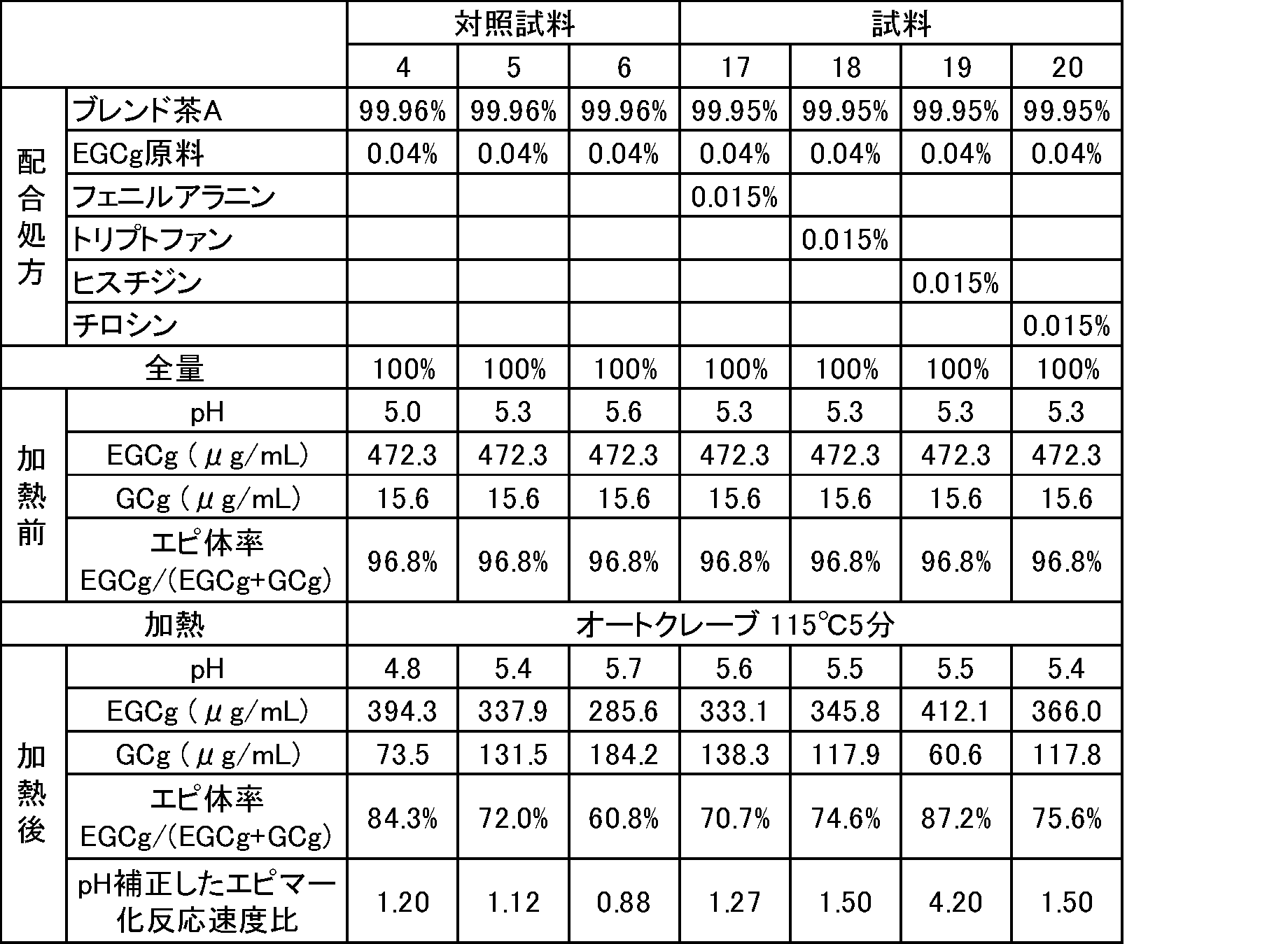
表3に示す配合処方(w/v%)で、緑茶飲料Cに、EGCg原料を溶解させてベース液を得た。このベース液のpHをVCと重曹を用いて調整し、対照試料7~9(pH4.5~5.6)を調製した。
また、表3に示す配合処方で、緑茶飲料Cに、EGCg原料及びアミノ酸を溶解させて、VCと重曹でpHを調整し、試料21~22を調製した。
実施例1と同じ方法で、対照試料及び試料を加熱し、冷却を行った。表3に、加熱前及び加熱後のpH、EGCg及びGCgの濃度、エピ体率(EGCg/(EGCg+GCg))、pH補正したエピマー化反応速度比を示す。
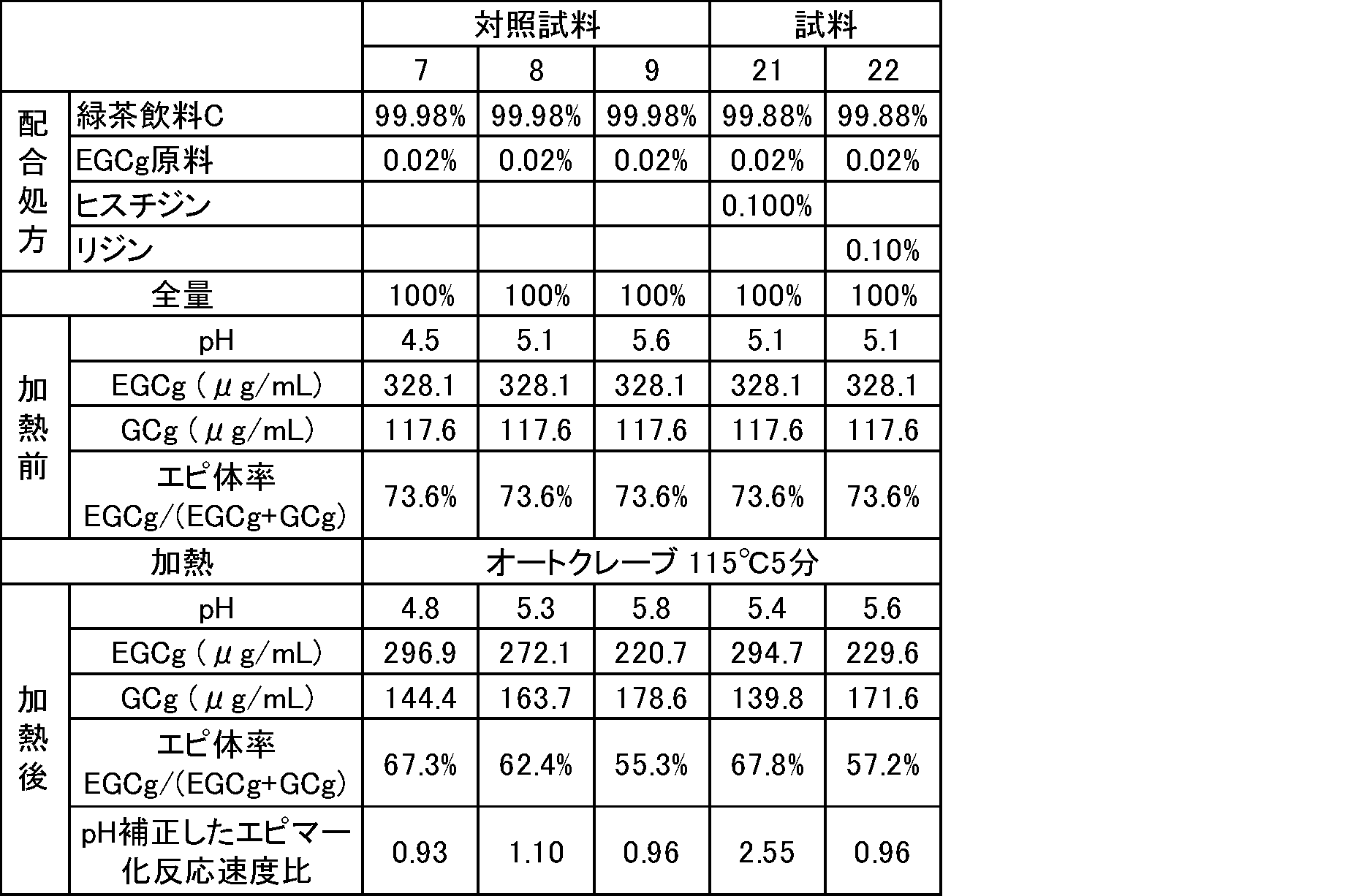
表4に示す配合処方(w/v%)で、ブレンド茶Bに、EGCg原料を溶解させてベース液を得た。このベース液のpHをVCと重曹を用いて調整し、対照試料10~12(pH5.0~5.5)を調製した。
また、表4に示す配合処方で、ブレンド茶Bに、EGCg原料及びヒスチジン、カルノシン、アンセリン、3-メチルヒスチジン又は4-メチルヒスチジンを溶解させて、VCと重曹でpH調整し、試料23~27(pH5.1~5.5)を調製した。
対照試料及び試料をガラスバイアルに充填して、オートクレーブで、120℃で5分加熱し、室温まで冷却した。表4に、加熱前及び加熱後のpH、EGCg及びGCgの濃度、エピ体率(EGCg/(EGCg+GCg))、pH補正したエピマー化反応速度比を示す。
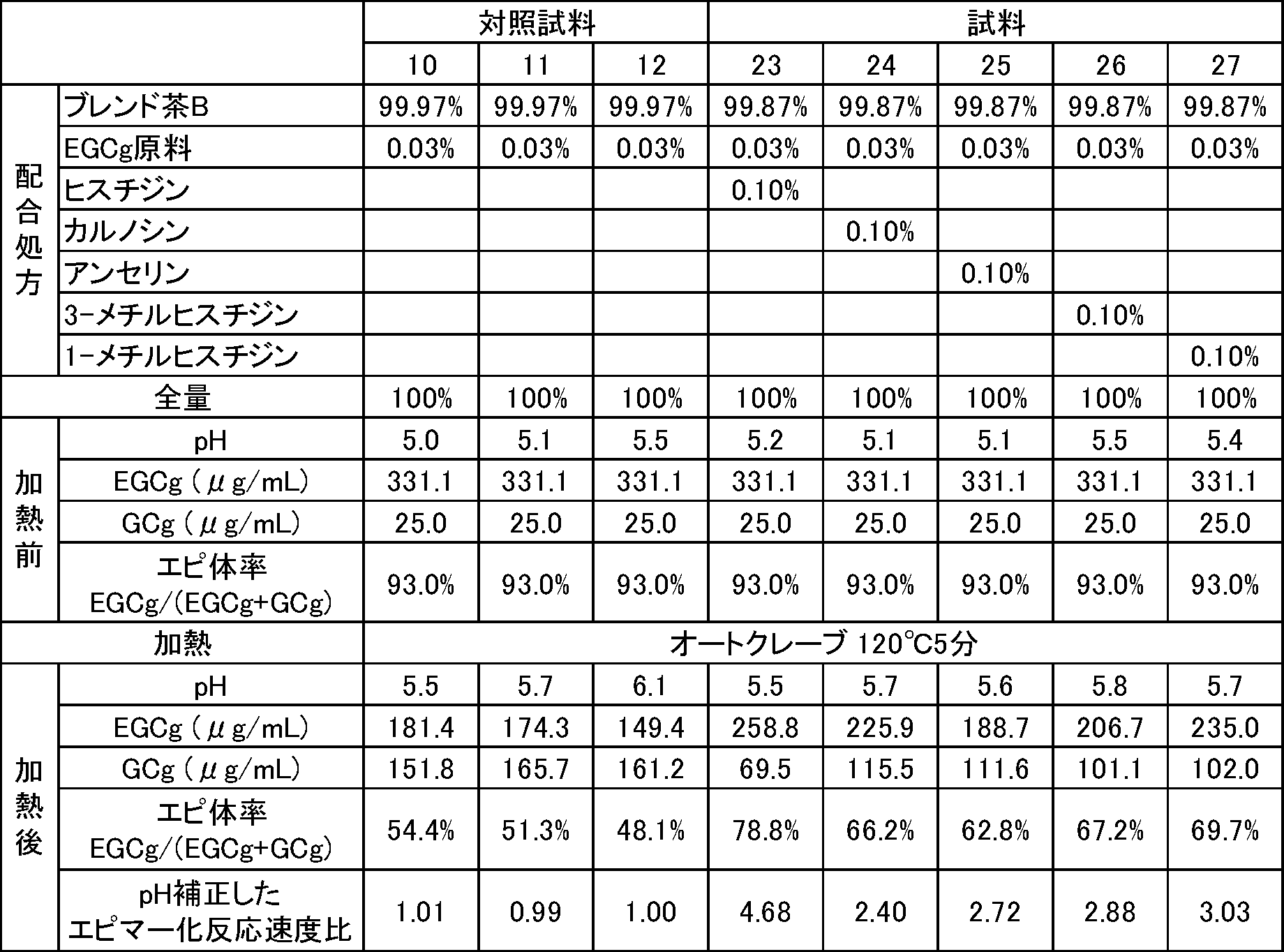
表5に示す配合処方(w/v%)で、ブレンド茶Aに、EGCg原料を溶解させてベース液を得た。このベース液のpHをVCと重曹を用いて調整し、対照試料13(pH5.7)を調製した。
また、表5に示す配合処方で、ブレンド茶Aに、EGCg原料及びヒスチジンを溶解させて、VCと重曹でpH調整し、試料28~33(pH5.8)を調製した。
対照試料及び試料をガラスバイアルに充填して、オートクレーブで、130℃で1分加熱し、室温まで冷却した。表5に、加熱前及び加熱後のpH、EGCg及びGCgの濃度、エピ体率(EGCg/(EGCg+GCg))、エピマー化反応速度比を示す。エピマー化反応速度については、対照試料13に対する各試料の反応速度の比を計算した。

表6に示す配合処方(w/v%)で、緑茶飲料Cに、EGCg原料を溶解させてベース液を得た。このベース液のpHをVCと重曹を用いて、対照試料14~16(pH4.5~5.6)を調製した。
また、表6に示す配合処方で、緑茶飲料Cに、EGCg原料及びヒスチジンを溶解させて、VCと重曹でpH調整し、試料34~42(pH5.1)を調製した。
対照試料及び試料をガラスバイアルに充填して、オートクレーブで、115℃で5分加熱し、室温まで冷却した。表6に、加熱前及び加熱後のpH、EGCg及びGCgの濃度、エピ体率(EGCg/(EGCg+GCg))、pH補正したエピマー化反応速度比を示す。

表7に示す配合処方(w/v%)で、ブレンド茶Aに、EGCg原料を溶解させてベース液を得た。このベース液のpHをVCと重曹を用いて調整し、対照試料17~19(pH3.8~5.2)を調製した。
また、表7に示す配合処方で、ブレンド茶Aに、EGCg原料及びヒスチジンを溶解させて、VCと重曹でpH調整し、試料43~45(pH5.1~5.3)を調製した。
対照試料及び試料をガラスバイアルに充填して、オートクレーブで、130℃で1分加熱し、室温まで冷却した。表7に、加熱前及び加熱後のpH、EGCg及びGCgの濃度、エピ体率(EGCg/(EGCg+GCg))、pH補正したエピマー化反応速度比を示す。
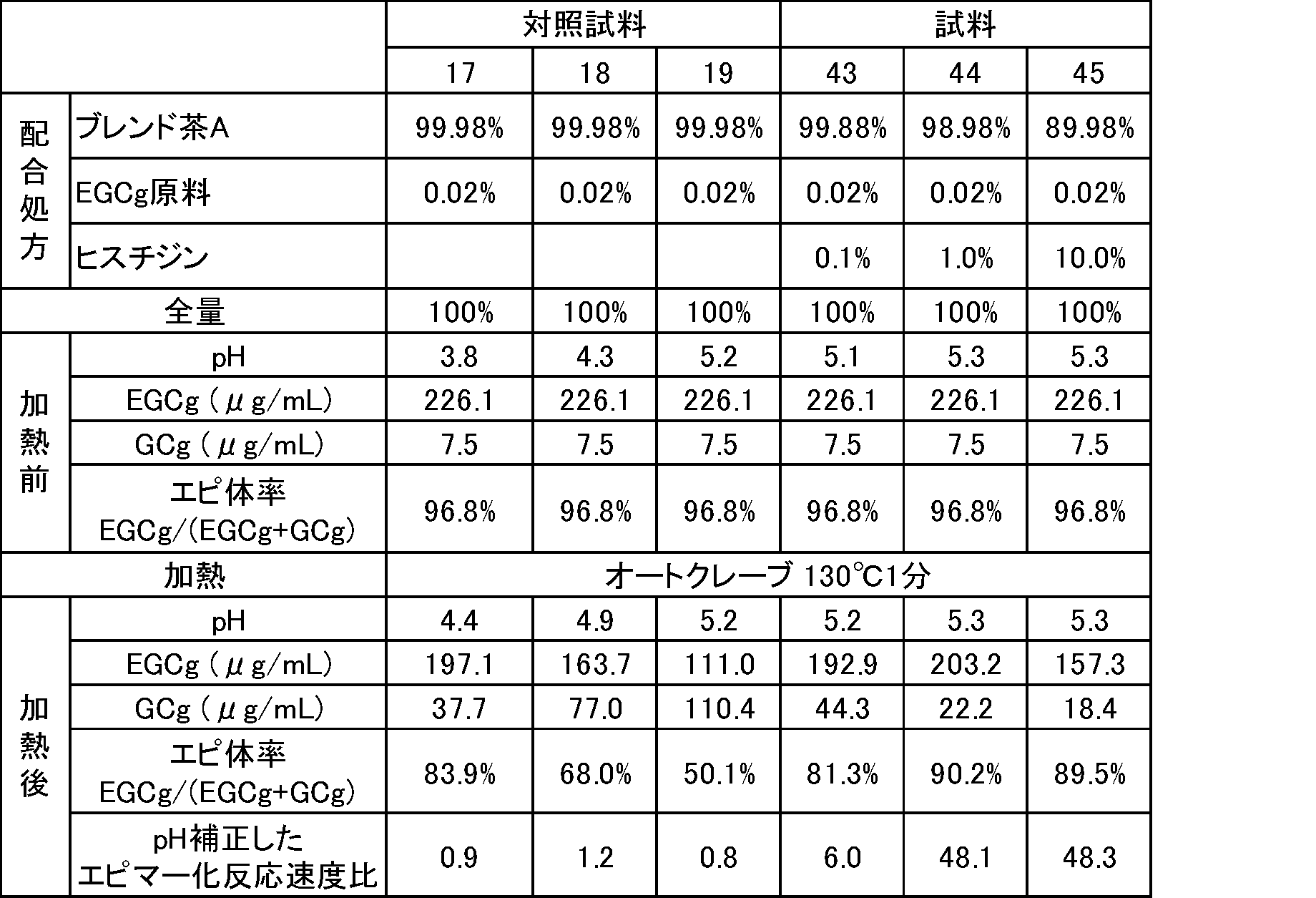
表8に示す配合処方(w/v%)で、ブレンド茶Aに、EGCg原料を溶解させてベース液を得た。このベース液のpHをVCと重曹を用いて、対照試料20~25(pH2.6~5.2)を調製した。
また、表8に示す配合処方で、ブレンド茶Aに、EGCg原料及びヒスチジンを溶解させて、VCと重曹でpH調整し、試料46~51(pH2.6~5.1)を調製した。
対照試料及び試料をガラスバイアルに充填して、オートクレーブで、130℃で1分加熱し、室温まで冷却した。表8に、加熱前及び加熱後のpH、EGCg及びGCgの濃度、エピ体率(EGCg/(EGCg+GCg))、エピマー化反応速度比を示す。エピマー化反応速度比については、対照試料20に対して試料46、対照試料21に対して試料47、対照試料22に対して試料48、対照試料23に対して試料49、対照試料24に対して試料50、対照試料25に対して試料51の反応速度の比を計算した。
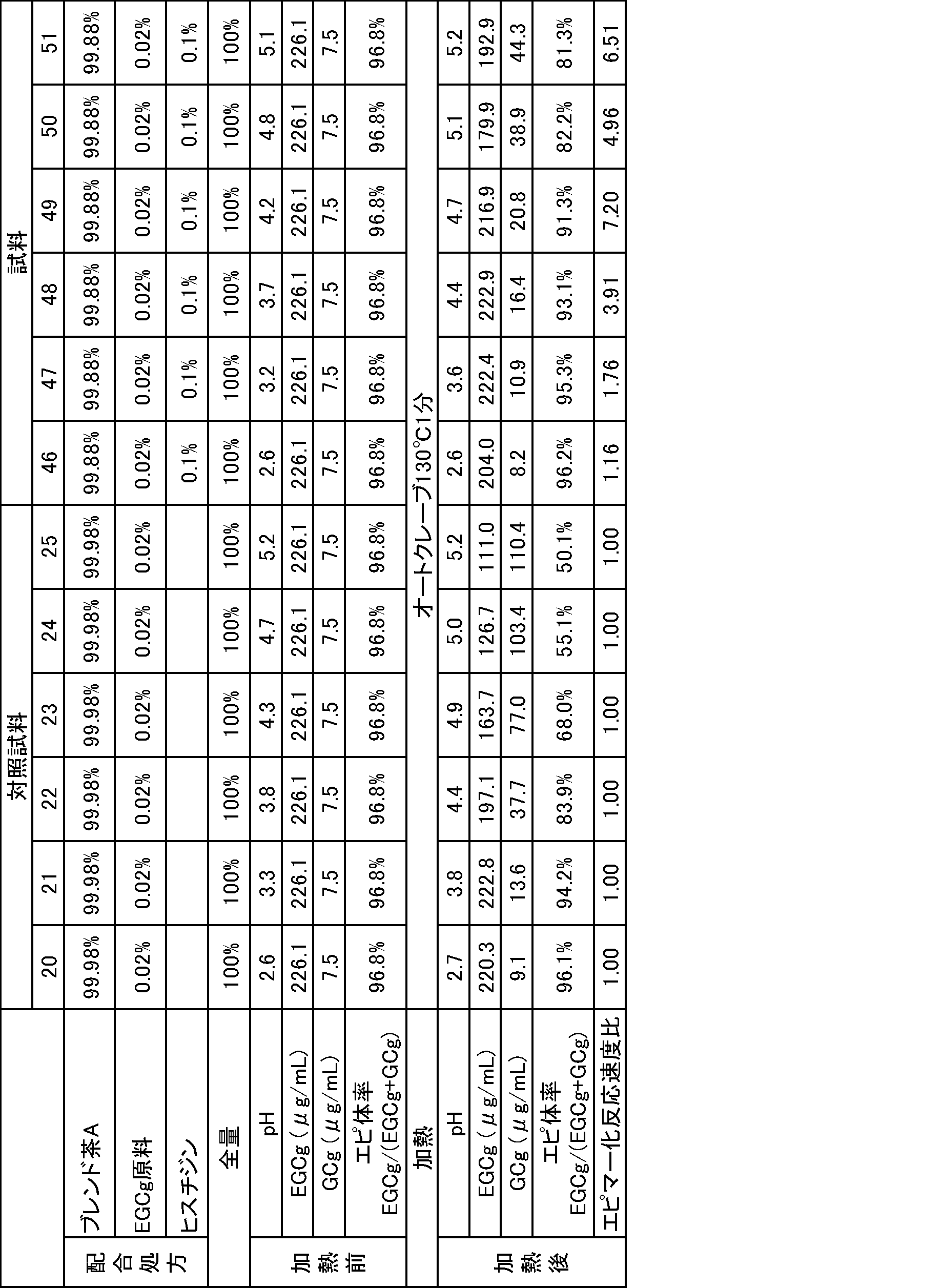
表9に示す配合処方(w/v%)で、ブレンド茶Aに、EGCg原料を溶解させてベース液を得た。このベース液のpHをVCと重曹を用いて調整し、対照試料26~28(pH6.0~8.0)を調製した。
また、表9に示す配合処方で、ブレンド茶Aに、EGCg原料及びヒスチジンを溶解させて、VCと重曹でpH調整し、試料52~54(pH6.0~8.0)を調製した。
対照試料及び試料をガラスバイアルに充填して、オートクレーブで、105℃で1分加熱し、室温まで冷却した。表9に、加熱前及び加熱後のpH、EGCg及びGCgの濃度、エピ体率(EGCg/(EGCg+GCg))、エピマー化反応速度比を示す。エピマー化反応速度比については、対照試料26に対して試料52、対照試料27に対して試料53、対照試料28に対して試料54の反応速度の比を計算した。
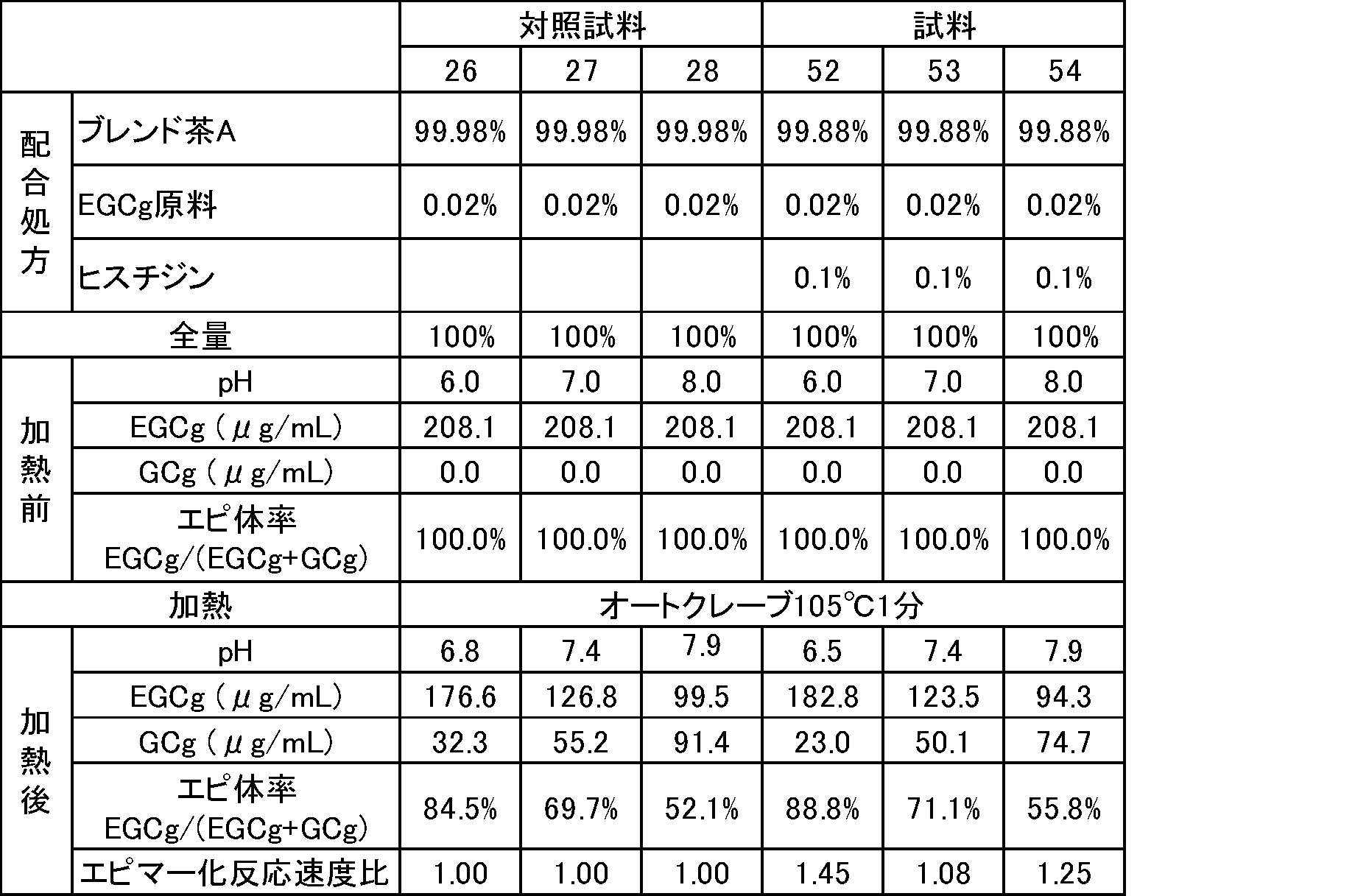
表10に示す配合処方(w/v%)で、ブレンド茶Aに、EGCg原料を溶解させてベース液を得た。このベース液のpHをVCと重曹を用いて調整し、対照試料29~37(pH5.3)を調製した。
また、表10に示す配合処方で、ブレンド茶Aに、EGCg原料及びヒスチジンを溶解させて、VCと重曹でpH調整し、試料55~63(pH5.3)を調製した。
対照試料及び試料をガラスバイアルに充填して、オートクレーブで、130℃で1分加熱し、室温まで冷却した。表10に、加熱前及び加熱後のpH、EGCg及びGCgの濃度、エピ体率(EGCg/(EGCg+GCg))、エピマー化反応速度比を示す。エピマー化反応速度比については、対照試料29に対して試料55、対照試料30に対して試料56、対照試料31に対して試料57、対照試料32に対して試料58、対照試料33に対して試料59、対照試料34に対して試料60、対照試料35に対して試料61、対照試料36に対して試料62、対照試料37に対して試料63の反応速度の比を計算した。

表11に示す配合処方(w/v%)で、緑茶飲料Cに、EGCg原料を溶解させてベース液を得た。このベース液のpHをVCと重曹を用いて調整し、対照試料38~42(pH5.7)を調製した。
また、表11に示す配合処方で、緑茶飲料Cに、EGCg原料及びヒスチジンを溶解させて、VCと重曹でpH調整し、試料64~68(pH5.7)を調製した。
対照試料及び試料を、表11に示す温度及び時間で、パワーポイント・インターナショナル(株)製の熱交換器(型式:MINI UHT P-20)を用いて加熱処理し、室温まで冷却した。表11に、加熱前及び加熱後のpH、EGCg及びGCgの濃度、エピ体率(EGCg/(EGCg+GCg))、エピマー化反応速度比を示す。エピマー化反応速度比については、対照試料38に対して試料64、対照試料39に対して試料65、対照試料40に対して試料66、対照試料41に対して試料67、対照試料42に対して試料68の反応速度の比を計算した。
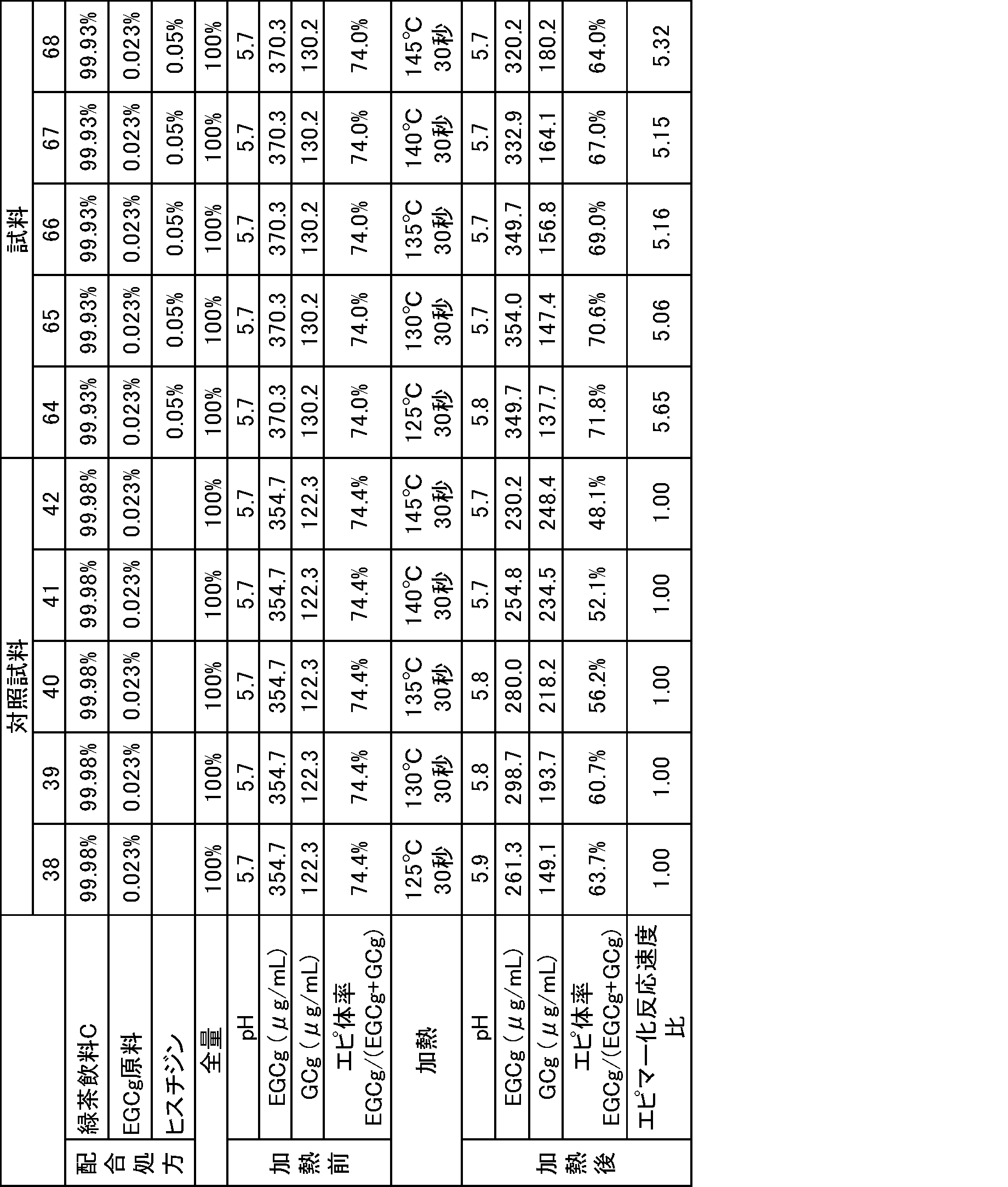
表12に示す配合処方(w/v%)で、ブレンド茶Aに、ECg原料を溶解させてベース液を得た。このベース液のpHをVCと重曹を用いて調整し、対照試料43(pH4.9)を調製した。
また、表12に示す配合処方で、ブレンド茶Aに、EGCg原料及びヒスチジンを溶解させて、VCと重曹でpH調整し、試料69~72(pH4.9)を調製した。
対照試料及び試料を1.5mLチューブに入れ、ブロックインキュベーター(型式:MG-3100、EYELA社製)を用いた。100℃で15~240分加熱し、室温まで冷却した。表12に、加熱前のpH、加熱前及び加熱後のEGCg及びGCgの濃度、エピ体率(EGCg/(EGCg+GCg))、エピマー化反応速度比を示す。エピマー化反応速度比については、対照試料43に対する試料69~72の反応速度の比を計算した。
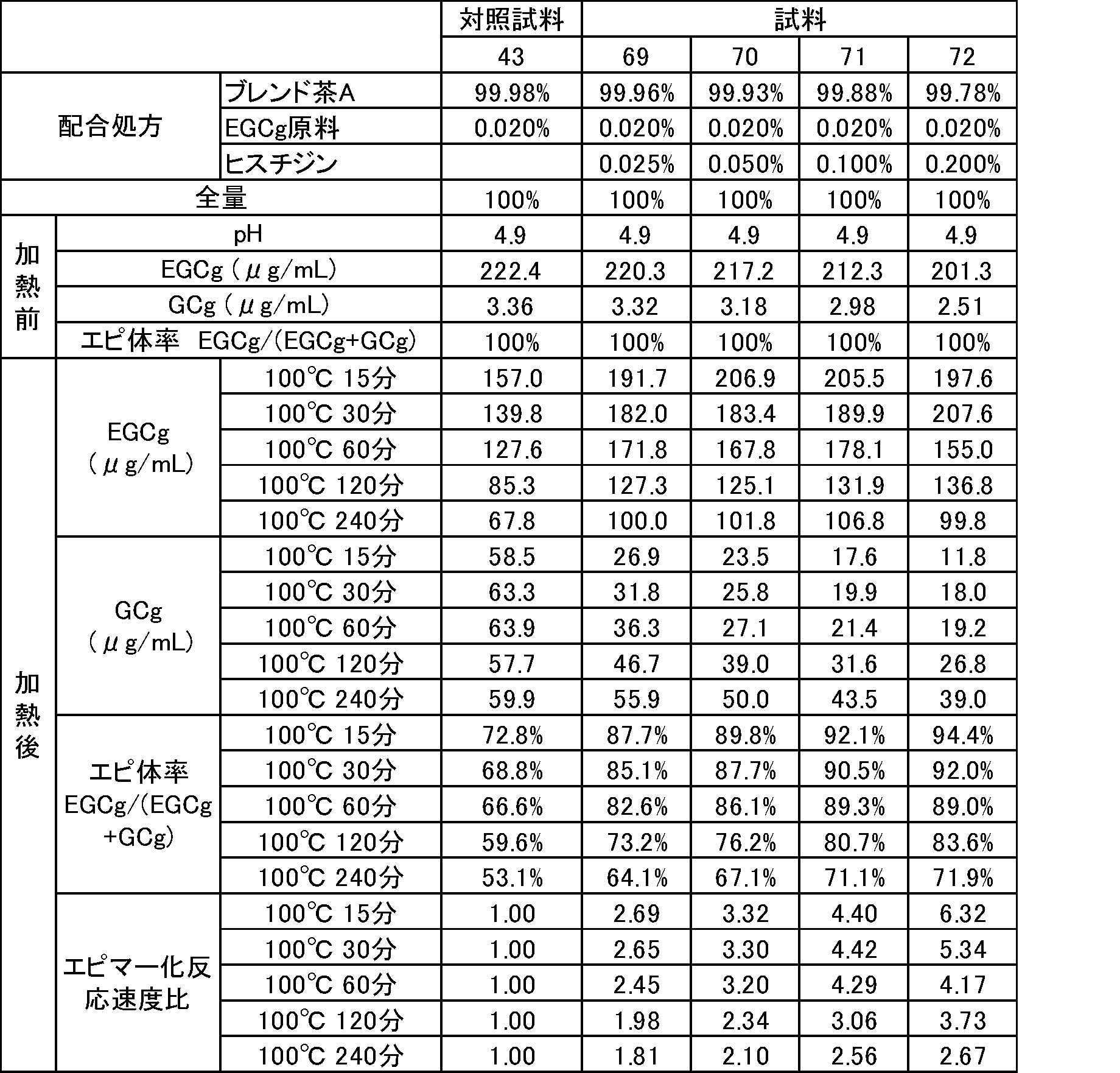
ECg原料をプロピレングリコールに80℃で溶解させ、プロピレングリコールに溶解させた20w/v%ECg溶解液(以下、ECg溶解液)を調製した。表13に示す配合処方(w/v%)で、ブレンド茶Aに、ECg溶解液を溶解させてECg含有飲料を得た。このECg含有飲料のpHをVCと重曹を用いて調整し、対照試料44(pH5.7)を調製した。
また、表13に示す配合処方で、ブレンド茶Aに、ECg溶解液及びヒスチジンを溶解させて、VCと重曹でpH調整し、試料73(pH5.6)を調製した。
対照試料及び試料をフィルター滅菌し、50mLのガラスバイアルに封入した。それをインキュベーター(製品名:Heratherm 100、Thermo Fisher Scientific社製)を用いて表13に示す温度で3週間保管した。保管後、pH並びにECg及びカテキンガレート(Cg)の濃度を測定した。表13に、保管後のpH、ECg及びCgの濃度、エピ体率(ECg/(ECg+Cg))、エピマー化反応速度比を示す。実施例13では、エピ体率(ECg/(ECg+Cg))は、非重合カテキンの濃度(w/v%)から下記式により求めた。
エピ体率(%)=100×ECgの濃度/(ECg及びCgの合計濃度)
エピマー化反応速度(k)は、加熱時間(t)、加熱後のエピ体率から平衡状態のエピ体率として45%を減算した値(X)、加熱前のエピ体率から平衡状態のエピ体率として45%を減算した値(X0)により表される、下記式(3)により算出した。
式(3) Log(X/X0)=k×t
エピマー化反応速度比については、対照試料44に対する試料73の反応速度の比を計算した。
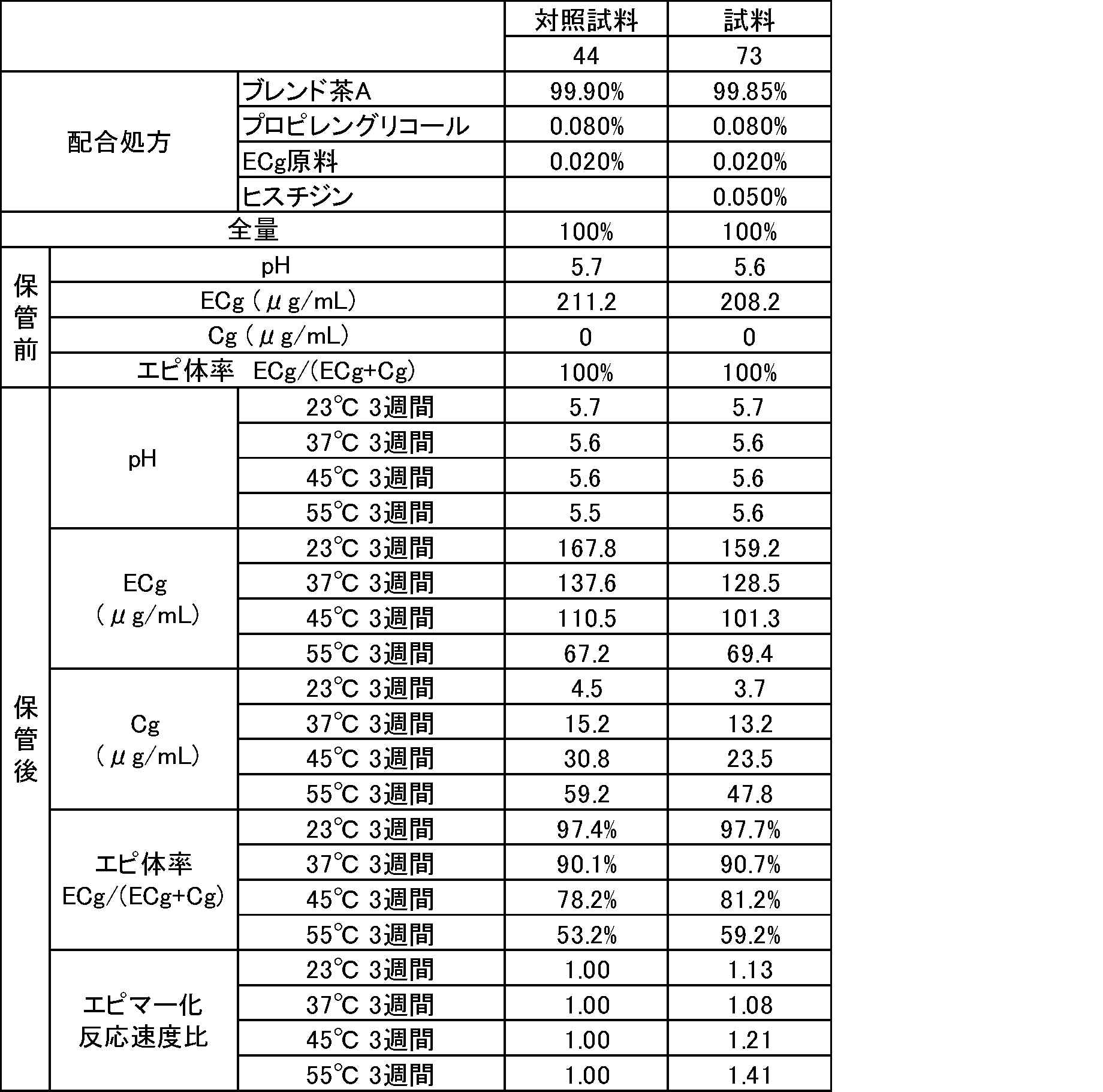
表14に示す配合処方(w/v%)で、緑茶飲料Cに、EGCg原料を溶解させてベース液を得た。このベース液のpHをVCと重曹を用いて調整し、対照試料45~47(pH4.5~5.6)を調製した。
また、表14に示す配合処方で、緑茶飲料Cに、EGCg原料及びヒスチジン又はその塩を溶解させて、試料74~77(pH5.1)を調製した。ヒスチジン又はその塩には、ヒスチジン、L-ヒスチジン塩酸塩試薬、L-ヒスチジン原料又はL-ヒスチジン塩酸塩原料を使用した。
対照試料及び試料をガラスバイアルに充填して、オートクレーブで、115℃で5分加熱し、室温まで冷却した。表14に、加熱前及び加熱後のpH、EGCg及びGCgの濃度、エピ体率(EGCg/(EGCg+GCg))、pH補正したエピマー化反応速度比を示す。
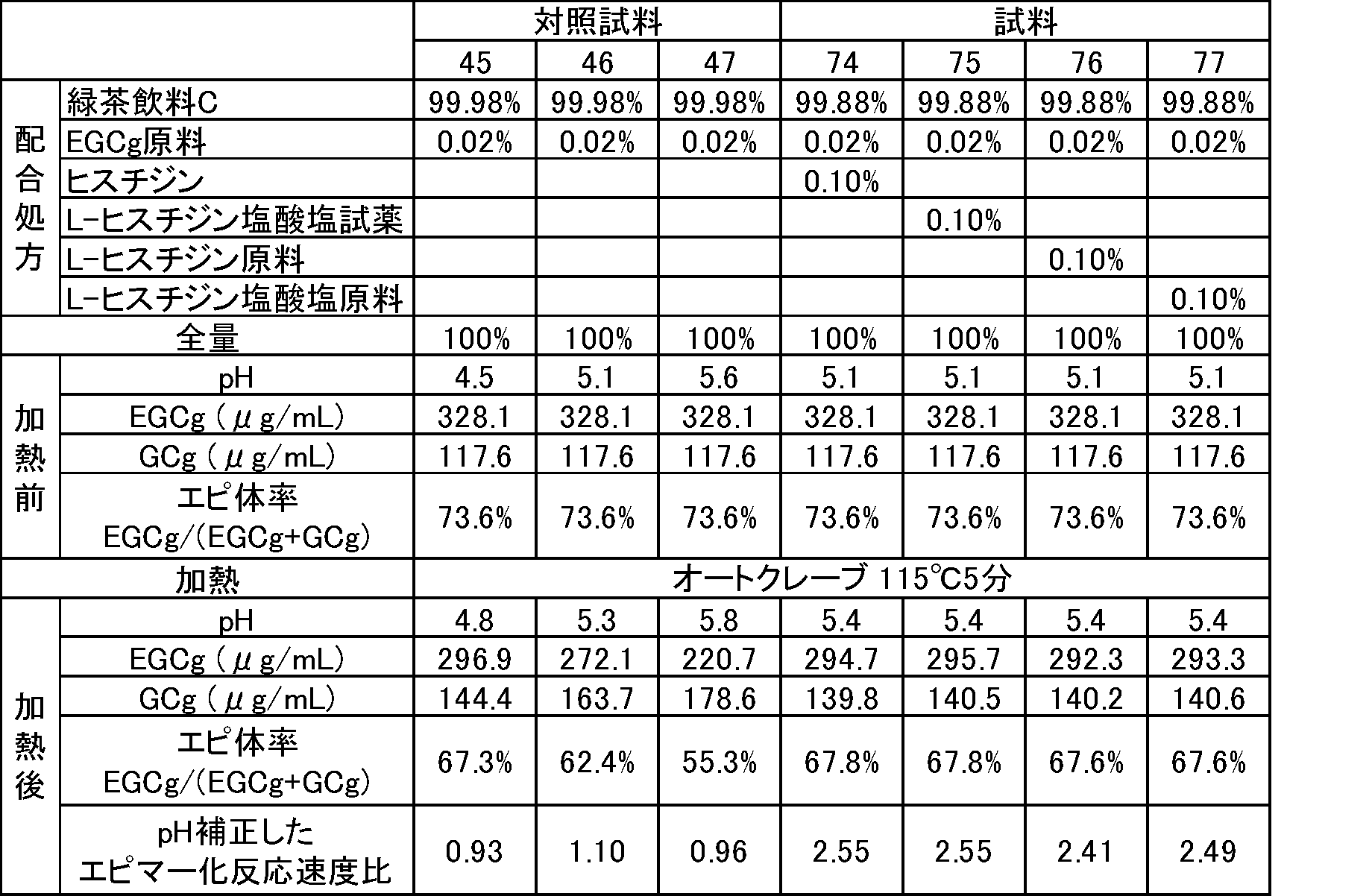
表15に示す配合処方(w/v%)で、ブレンド茶飲料Aに、EGCg原料を溶解させてベース液を得た。このベース液のpHをVCと重曹を用いて調整し、対照試料48~50(pH4.6~5.6)を調製した。
また、表15に示す配合処方で、市販のブレンド茶飲料Aに、EGCg原料及びヒスチジンを溶解させて、試料78~83(pH5.0~5.2)を調製した。L-ヒスチジン(ヒスチジン)又はD-ヒスチジンを使用した。
対照試料及び試料をガラスバイアルに充填して、オートクレーブで、115℃で5分加熱し、室温まで冷却した。表15に、加熱前及び加熱後のpH、EGCg及びGCgの濃度、エピ体率(EGCg/(EGCg+GCg))、pH補正したエピマー化反応速度比を示す。
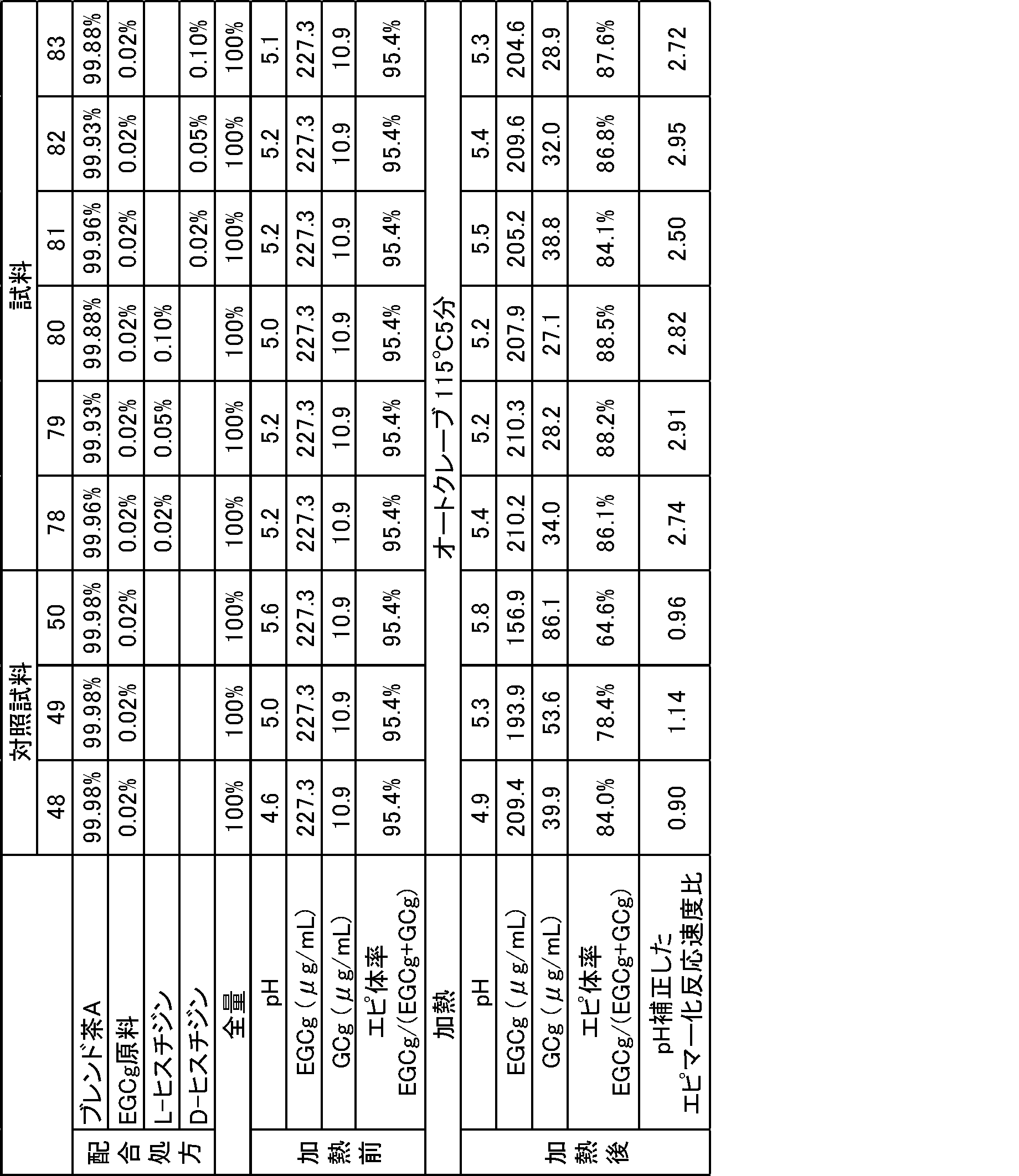
表16に示す配合処方(w/v%)で、ブレンド茶A(各非重合カテキン濃度:検出限界以下)に、エピ体非重合カテキン(EGCg原料、ECg原料、エピガロカテキン(EGC)又はエピカテキン(EC))を溶解及び/又は懸濁させてエピ体非重合カテキン含有液を得た。得られたエピ体非重合カテキン含有液のpHを調整して、対照試料51~62(pH4.5~5.5)を調製した。
また、表16に示す配合処方で、ブレンド茶Aに、エピ体非重合カテキン(EGCg原料、ECg原料、EGC又はEC)及びヒスチジンを溶解及び/又は懸濁させて、試料84~87(pH5.0)を調製した。
対照試料及び試料をガラスバイアルに充填して、オートクレーブで130℃、1分加熱した。冷却後、pH並びにエピ体非重合カテキン(EGCg、ECg、EGC、EC)及び非エピ体非重合カテキン(ガロカテキンガレート(GCg)、カテキンガレート(Cg)、ガロカテキン(GC)、カテキン(C))の濃度を測定した。表16に、加熱後のpH、非重合カテキンの濃度、エピ体率(エピ体/(エピ体+非エピ体))、pH補正したエピマー化反応速度比を示す。「-」は、濃度が検出限界以下であったことを示す。
実施例1と同じ方法で、pH補正したエピマー化反応速度比を算出した。なお、上記の回帰式(式(2))は、EGCg(対照試料51~53)、ECg(対照試料54~56)、EGC(対照試料57~59)、EC(対照試料60~62)についてそれぞれ作成した。

表17に示す配合処方(w/v%)で、ブレンド茶A(各非重合カテキン濃度:検出限界以下)に、非エピ体非重合カテキン(ガロカテキンガレート(GCg)、カテキンガレート(Cg)、ガロカテキン(GC)又はカテキン(C))を溶解及び/又は懸濁させて非エピ体非重合カテキン含有液を得た。得られた非エピ体非重合カテキン含有液のpHを調整して、対照試料63~66(pH6.0)を調製した。
また、表17に示す配合処方で、ブレンド茶Aに、非エピ体非重合カテキン(GCg、Cg、GC又はC)及びヒスチジンを溶解及び/又は懸濁させて、pHを調整して、試料88~91(pH6.0)を調製した。
対照試料及び試料を1.5mLチューブに入れ、ブロックインキュベーターで100℃15分加熱し、室温まで冷却した。pH並びにエピ体非重合カテキン(EGCg、ECg、EGC、EC)及び非エピ体非重合カテキン(GCg、Cg、GC、C)の濃度を測定した。表17に、加熱後のpH、非重合カテキンの濃度、非エピ体率(非エピ体/(エピ体+非エピ体))、エピマー化反応速度比を示す。
式(4) Log(X/X0)=k×t
エピマー化反応速度比については、対照試料63に対する試料88、対照試料64に対する試料89、対照試料65に対する試料90、対照試料66に対する試料91の反応速度の比を計算した。実施例17では、このエピマー化反応速度比の数字が大きい方が、非エピ体からエピ体へのエピマー化(エピ体化)抑制率が高いことを意味する。
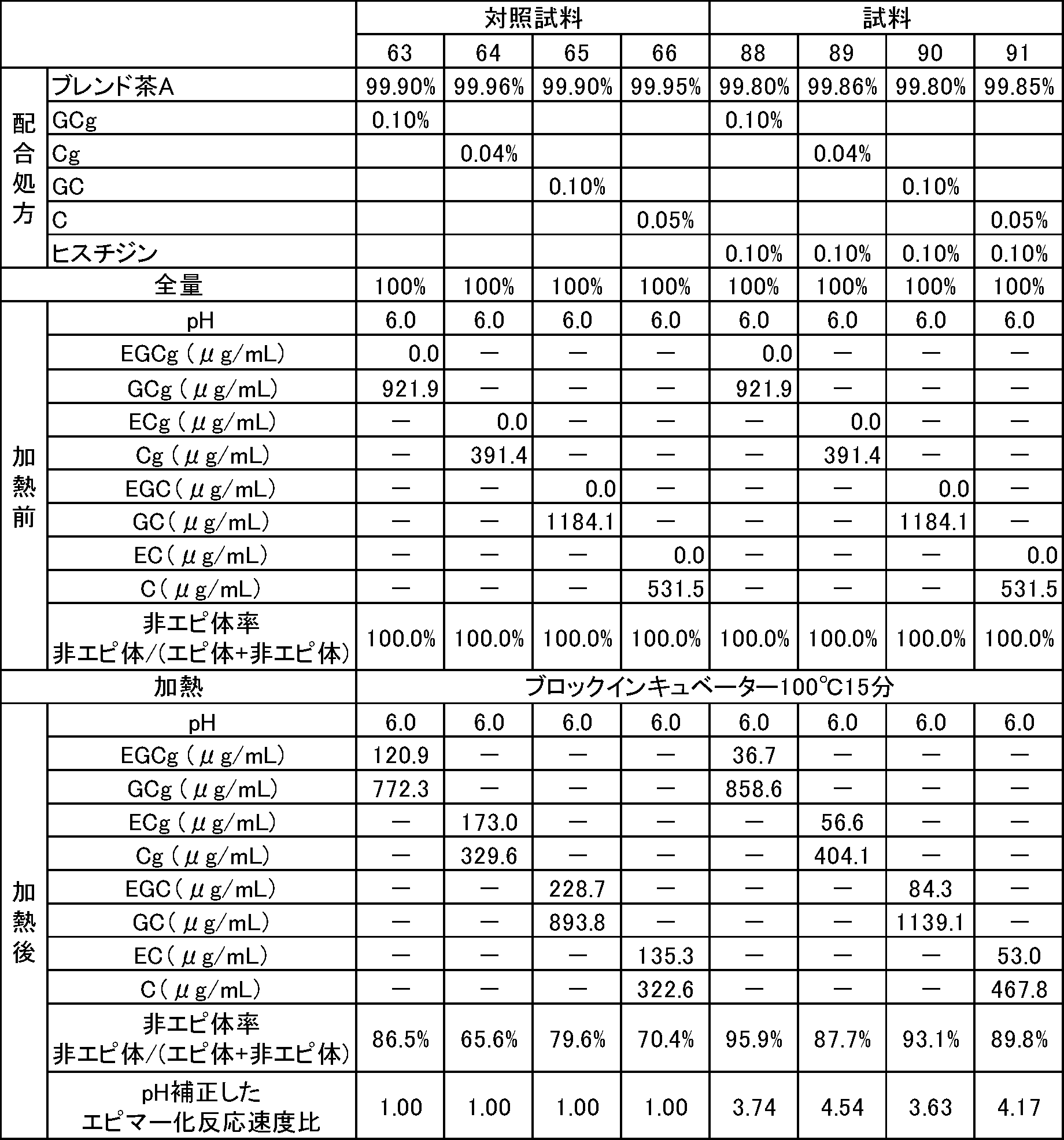
表18に示す配合処方(w/v%)で、ブレンド茶A(各非重合カテキン濃度:検出限界以下)を脱イオン水で希釈するか、又は白砂糖(日新精糖社製)を添加溶解してBrixを調整し、EGCg原料を溶解させてベース液を得た。このベース液のpHをVCと重曹を用いて調整し、対照試料67~74(pH5.5)を調製した。Brix(25℃)は、ATAGO社製デジタル糖度計、型番:PR-101αで測定した。
また、表18に示す配合処方で、ブレンド茶Aを脱イオン水で希釈するか、又は白砂糖(日新精糖社製)を添加溶解してBrixを調整し、EGCg原料及びヒスチジンを溶解させて、VCと重曹でpH調整し、試料92~99(pH5.5)を調製した。
対照試料及び試料をガラスバイアルに充填して、オートクレーブで、130℃で1分加熱し、室温まで冷却した。表18に、加熱前及び加熱後のpH、EGCg及びGCgの濃度、エピ体率(EGCg/(EGCg+GCg))、エピマー化反応速度比、Brixを示す。エピマー化反応速度比については、対照試料67に対して試料92、対照試料68に対して試料93、対照試料69に対して試料94、対照試料70に対して試料95、対照試料71に対して試料96、対照試料72に対して試料97、対照試料73に対して試料98、対照試料74に対して試料99の反応速度の比を計算した。
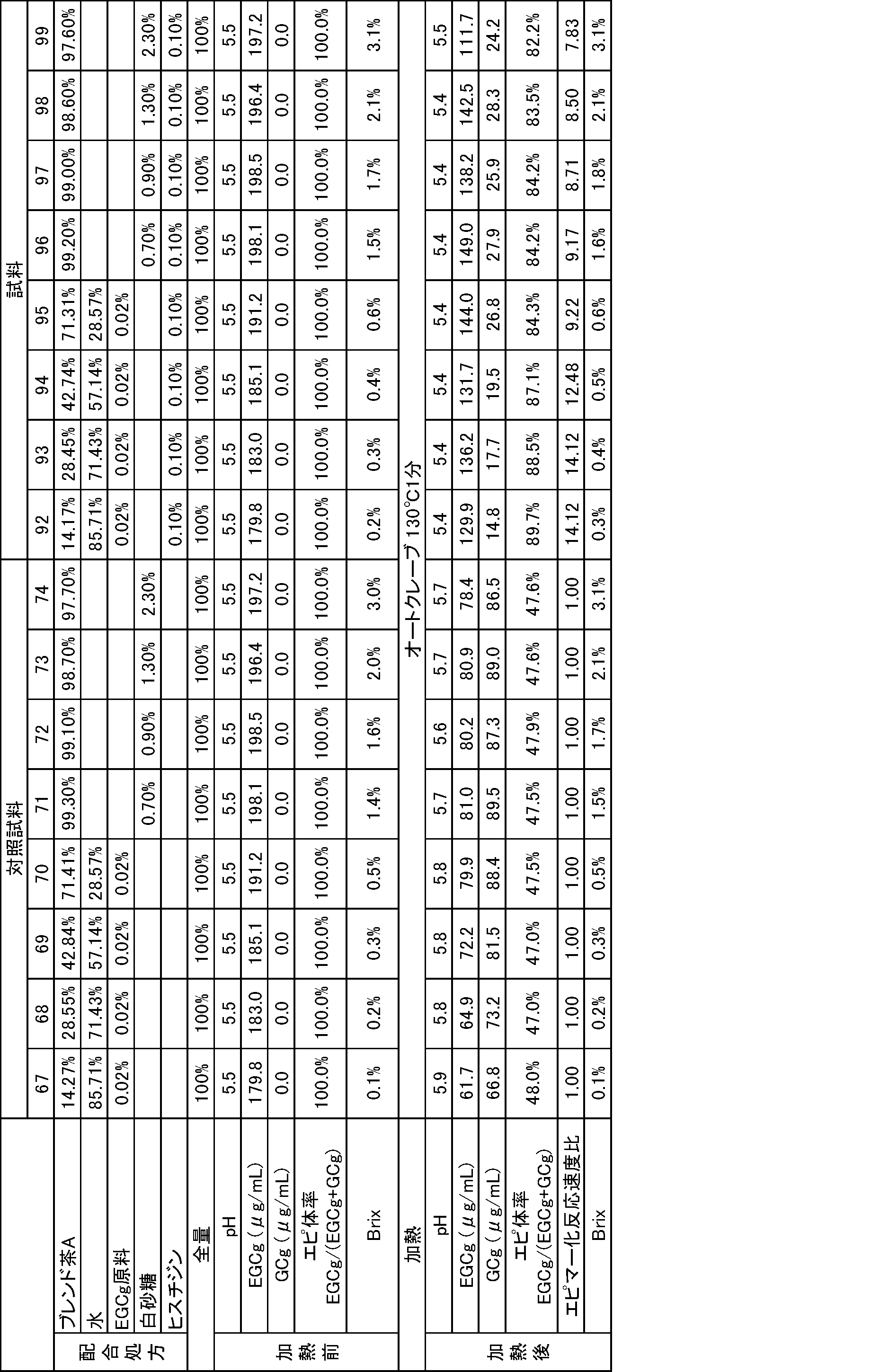
Claims (21)
- 芳香族アミノ酸、システイン、芳香族アミノ酸及び/又はシステインを含むジペプチド、並びに、これらの塩からなる群より選択される少なくとも1種の化合物(A)を有効成分として含む、非重合カテキンのエピマー化抑制剤。
- 化合物(A)が、芳香族アミノ酸、芳香族アミノ酸を含むジペプチド及びこれらの塩からなる群より選択される少なくとも1種である、請求項1に記載の非重合カテキンのエピマー化抑制剤。
- 芳香族アミノ酸が、ヒスチジン、メチルヒスチジン、フェニルアラニン、トリプトファン及びチロシンからなる群より選択される少なくとも1種のアミノ酸である、請求項1又は2に記載の非重合カテキンのエピマー化抑制剤。
- 化合物(A)が、ヒスチジン、メチルヒスチジン、ヒスチジン又はメチルヒスチジンを含むジペプチド及びこれらの塩からなる群より選択される少なくとも1種である、請求項1~3のいずれか一項に記載の非重合カテキンのエピマー化抑制剤。
- 化合物(A)が、ヒスチジン及び/又はその塩である、請求項1~4のいずれか一項に記載の非重合カテキンのエピマー化抑制剤。
- 化合物(A)が、カルノシン、アンセリン及びこれらの塩からなる群より選択される少なくとも1種である、請求項1~4のいずれか一項に記載の非重合カテキンのエピマー化抑制剤。
- 化合物(A)が、システイン、システインを含むジペプチド及びこれらの塩からなる群より選択される少なくとも1種である、請求項1に記載の非重合カテキンのエピマー化抑制剤。
- エピカテキン、エピガロカテキン、エピカテキンガレート、エピガロカテキンガレート、カテキン、ガロカテキン、カテキンガレート及びガロカテキンガレートからなる群より選択される少なくとも1種の非重合カテキンのエピマー化を抑制するために使用される、請求項1~7のいずれか一項に記載の非重合カテキンのエピマー化抑制剤。
- エピカテキン、エピガロカテキン、エピカテキンガレート及びエピガロカテキンガレートからなる群より選択される少なくとも1種のエピ体非重合カテキンのエピマー化を抑制するために使用される、請求項1~8のいずれか一項に記載の非重合カテキンのエピマー化抑制剤。
- ヒスチジン及び/又はその塩(A1)と、エピ体非重合カテキン(B1)とを含み、
pHが4.5を超えて7.9以下であり、前記ヒスチジン及び/又はその塩(A1)のヒスチジン換算の濃度が0.015~3w/v%であり、Brixが3.0%以下であるエピ体非重合カテキン含有容器詰飲料。 - エピ体非重合カテキン(B1)が、エピカテキン、エピガロカテキン、エピカテキンガレート及びエピガロカテキンガレートからなる群より選択される少なくとも1種である、請求項10に記載のエピ体非重合カテキン含有容器詰飲料。
- エピ体非重合カテキン(B1)が、エピガロカテキンガレート及び/又はエピカテキンガレートを含み、飲料中のエピガロカテキンガレートの濃度が2400μg/mL以下、及び/又は、エピカテキンガレートの濃度が2400μg/mL以下である、請求項10又は11に記載のエピ体非重合カテキン含有容器詰飲料。
- エピ体非重合カテキン(B1)が、エピガロカテキンガレートを含み、飲料中のエピガロカテキンガレートの濃度が400μg/mL以下である、請求項10~12のいずれか一項に記載のエピ体非重合カテキン含有容器詰飲料。
- Brixが1.4%以下である請求項10~13のいずれか一項に記載のエピ体非重合カテキン含有容器詰飲料。
- 飲料が茶飲料である、請求項10~14のいずれか一項に記載のエピ体非重合カテキン含有容器詰飲料。
- ヒスチジン及び/又はその塩(A1)と、エピ体非重合カテキン(B1)と、水を含む水性媒体(C)とを含有し、
前記ヒスチジン及び/又はその塩(A1)のヒスチジン換算の濃度が0.015~3w/v%であり、pHが4.5を超えて8.0以下であり、Brixが3.0%以下である混合物を、100℃以上に加熱処理する工程を含む、エピ体非重合カテキン含有容器詰飲料の製造方法。 - エピ体非重合カテキン(B1)が、エピカテキン、エピガロカテキン、エピカテキンガレート及びエピガロカテキンガレートからなる群より選択される少なくとも1種である、請求項16に記載の製造方法。
- エピ体非重合カテキン(B1)が、エピガロカテキンガレート及び/又はエピカテキンガレートを含み、前記混合物中のエピガロカテキンガレートの濃度が2400μg/mL以下、及び/又は、エピカテキンガレートの濃度が2400μg/mL以下である、請求項16又は17に記載の製造方法。
- エピ体非重合カテキン(B1)が、エピガロカテキンガレートを含み、前記混合物中のエピガロカテキンガレートの濃度が400μg/mL以下である、請求項16~18のいずれか一項に記載の製造方法。
- 前記混合物のBrixが1.4%以下である請求項16~19のいずれか一項に記載の製造方法。
- 芳香族アミノ酸、システイン、芳香族アミノ酸及び/又はシステインを含むジペプチド、並びに、これらの塩からなる群より選択される少なくとも1種の化合物の、非重合カテキンのエピマー化を抑制するための使用。
Priority Applications (1)
| Application Number | Priority Date | Filing Date | Title |
|---|---|---|---|
| JP2023538577A JP7844480B2 (ja) | 2021-07-27 | 2022-07-27 | 非重合カテキンのエピマー化抑制剤、エピ体非重合カテキン含有容器詰飲料及びその製造方法 |
Applications Claiming Priority (2)
| Application Number | Priority Date | Filing Date | Title |
|---|---|---|---|
| JP2021-122504 | 2021-07-27 | ||
| JP2021122504 | 2021-07-27 |
Publications (1)
| Publication Number | Publication Date |
|---|---|
| WO2023008455A1 true WO2023008455A1 (ja) | 2023-02-02 |
Family
ID=85087694
Family Applications (1)
| Application Number | Title | Priority Date | Filing Date |
|---|---|---|---|
| PCT/JP2022/028857 Ceased WO2023008455A1 (ja) | 2021-07-27 | 2022-07-27 | 非重合カテキンのエピマー化抑制剤、エピ体非重合カテキン含有容器詰飲料及びその製造方法 |
Country Status (2)
| Country | Link |
|---|---|
| JP (1) | JP7844480B2 (ja) |
| WO (1) | WO2023008455A1 (ja) |
Citations (4)
| Publication number | Priority date | Publication date | Assignee | Title |
|---|---|---|---|---|
| WO2008081582A1 (ja) * | 2006-12-27 | 2008-07-10 | Kao Corporation | 容器詰飲料 |
| JP2011079770A (ja) * | 2009-10-06 | 2011-04-21 | Morinaga & Co Ltd | ポリフェノール類化合物の吸収促進剤及びポリフェノール類化合物を含有する飲食品又は飲食品素材の製造方法 |
| JP2011148778A (ja) * | 2009-12-22 | 2011-08-04 | Taisho Pharmaceutical Co Ltd | 液剤組成物 |
| WO2013141267A1 (ja) * | 2012-03-21 | 2013-09-26 | 株式会社 明治 | ポリフェノール安定化剤、該安定化剤を含有する組成物および加工製品 |
-
2022
- 2022-07-27 WO PCT/JP2022/028857 patent/WO2023008455A1/ja not_active Ceased
- 2022-07-27 JP JP2023538577A patent/JP7844480B2/ja active Active
Patent Citations (4)
| Publication number | Priority date | Publication date | Assignee | Title |
|---|---|---|---|---|
| WO2008081582A1 (ja) * | 2006-12-27 | 2008-07-10 | Kao Corporation | 容器詰飲料 |
| JP2011079770A (ja) * | 2009-10-06 | 2011-04-21 | Morinaga & Co Ltd | ポリフェノール類化合物の吸収促進剤及びポリフェノール類化合物を含有する飲食品又は飲食品素材の製造方法 |
| JP2011148778A (ja) * | 2009-12-22 | 2011-08-04 | Taisho Pharmaceutical Co Ltd | 液剤組成物 |
| WO2013141267A1 (ja) * | 2012-03-21 | 2013-09-26 | 株式会社 明治 | ポリフェノール安定化剤、該安定化剤を含有する組成物および加工製品 |
Also Published As
| Publication number | Publication date |
|---|---|
| JPWO2023008455A1 (ja) | 2023-02-02 |
| JP7844480B2 (ja) | 2026-04-13 |
Similar Documents
| Publication | Publication Date | Title |
|---|---|---|
| AU2014226978B2 (en) | Green Tea Beverage | |
| US11284630B2 (en) | Beverage containing tea polymerized polyphenol and RebD and/or RebM | |
| EP3437485B1 (en) | Stevia-containing beverage | |
| CN1993055B (zh) | 含有氨基酸的茶饮料 | |
| EP4295692A1 (en) | Tea beverage | |
| EP2965635B1 (en) | Light-coloured tea beverage | |
| CN101848655B (zh) | 含有阿斯巴甜的酸性饮料 | |
| US20120263849A1 (en) | Bitterness suppression method | |
| JP7844480B2 (ja) | 非重合カテキンのエピマー化抑制剤、エピ体非重合カテキン含有容器詰飲料及びその製造方法 | |
| CA2632067C (en) | Method for improving absorbability of epigallocatechin gallate, foods, drinks and food/drink materials using the same and method for producing the same | |
| TW202205968A (zh) | 容器裝含阿斯帕拉汀(Aspalathin)之飲料、其製造方法,以及提升容器裝含阿斯帕拉汀之飲料中之阿斯帕拉汀之保存穩定性之方法 | |
| TW201347687A (zh) | 多酚安定劑,含有該安定劑之組成物及加工製品 | |
| JP2013094133A (ja) | 容器詰飲料 | |
| JP7500544B2 (ja) | カテキン類含有飲料、その製造方法及びカテキン類含有飲料の苦味を低減する方法 | |
| TW202100022A (zh) | 飲料組合物 | |
| WO2022124285A1 (ja) | 容器詰アスパラチン含有飲料、その製造方法及び容器詰アスパラチン含有飲料中のアスパラチンの保存安定性を向上させる方法 | |
| JP6745259B2 (ja) | 飲料組成物 | |
| WO2020230801A1 (ja) | 容器詰飲料、及び、イソキサントフモールの保存安定性を高める方法 | |
| WO2024014525A1 (ja) | 容器詰飲料及び飲料中のジヒドロフェルラ酸の安定性を向上させる方法 | |
| TW202100020A (zh) | 容器裝茶飲料 | |
| JP6397559B1 (ja) | カテキン類を高濃度に含有する緑茶飲料 | |
| WO2025037577A1 (ja) | 容器詰め飲料の製造方法 | |
| WO2016042634A1 (ja) | 5-カフェイオルキナ酸含有容器詰飲料 | |
| JP2015091221A (ja) | ケルセチン配糖体を含有する茶飲料 | |
| JP2019080589A (ja) | 飲料組成物 |
Legal Events
| Date | Code | Title | Description |
|---|---|---|---|
| 121 | Ep: the epo has been informed by wipo that ep was designated in this application |
Ref document number: 22849516 Country of ref document: EP Kind code of ref document: A1 |
|
| WWE | Wipo information: entry into national phase |
Ref document number: 2023538577 Country of ref document: JP |
|
| WWE | Wipo information: entry into national phase |
Ref document number: 2401000536 Country of ref document: TH |
|
| NENP | Non-entry into the national phase |
Ref country code: DE |
|
| 122 | Ep: pct application non-entry in european phase |
Ref document number: 22849516 Country of ref document: EP Kind code of ref document: A1 |