WO2023007978A1 - 車両用マウント装置 - Google Patents
車両用マウント装置 Download PDFInfo
- Publication number
- WO2023007978A1 WO2023007978A1 PCT/JP2022/024211 JP2022024211W WO2023007978A1 WO 2023007978 A1 WO2023007978 A1 WO 2023007978A1 JP 2022024211 W JP2022024211 W JP 2022024211W WO 2023007978 A1 WO2023007978 A1 WO 2023007978A1
- Authority
- WO
- WIPO (PCT)
- Prior art keywords
- vehicle
- rear direction
- rib
- voltage component
- pair
- Prior art date
- Legal status (The legal status is an assumption and is not a legal conclusion. Google has not performed a legal analysis and makes no representation as to the accuracy of the status listed.)
- Ceased
Links
Images


Classifications
-
- B—PERFORMING OPERATIONS; TRANSPORTING
- B60—VEHICLES IN GENERAL
- B60K—ARRANGEMENT OR MOUNTING OF PROPULSION UNITS OR OF TRANSMISSIONS IN VEHICLES; ARRANGEMENT OR MOUNTING OF PLURAL DIVERSE PRIME-MOVERS IN VEHICLES; AUXILIARY DRIVES FOR VEHICLES; INSTRUMENTATION OR DASHBOARDS FOR VEHICLES; ARRANGEMENTS IN CONNECTION WITH COOLING, AIR INTAKE, GAS EXHAUST OR FUEL SUPPLY OF PROPULSION UNITS IN VEHICLES
- B60K1/00—Arrangement or mounting of electrical propulsion units
-
- F—MECHANICAL ENGINEERING; LIGHTING; HEATING; WEAPONS; BLASTING
- F16—ENGINEERING ELEMENTS AND UNITS; GENERAL MEASURES FOR PRODUCING AND MAINTAINING EFFECTIVE FUNCTIONING OF MACHINES OR INSTALLATIONS; THERMAL INSULATION IN GENERAL
- F16F—SPRINGS; SHOCK-ABSORBERS; MEANS FOR DAMPING VIBRATION
- F16F15/00—Suppression of vibrations in systems; Means or arrangements for avoiding or reducing out-of-balance forces, e.g. due to motion
- F16F15/02—Suppression of vibrations of non-rotating, e.g. reciprocating systems; Suppression of vibrations of rotating systems by use of members not moving with the rotating systems
- F16F15/04—Suppression of vibrations of non-rotating, e.g. reciprocating systems; Suppression of vibrations of rotating systems by use of members not moving with the rotating systems using elastic means
- F16F15/08—Suppression of vibrations of non-rotating, e.g. reciprocating systems; Suppression of vibrations of rotating systems by use of members not moving with the rotating systems using elastic means with rubber springs ; with springs made of rubber and metal
-
- Y—GENERAL TAGGING OF NEW TECHNOLOGICAL DEVELOPMENTS; GENERAL TAGGING OF CROSS-SECTIONAL TECHNOLOGIES SPANNING OVER SEVERAL SECTIONS OF THE IPC; TECHNICAL SUBJECTS COVERED BY FORMER USPC CROSS-REFERENCE ART COLLECTIONS [XRACs] AND DIGESTS
- Y02—TECHNOLOGIES OR APPLICATIONS FOR MITIGATION OR ADAPTATION AGAINST CLIMATE CHANGE
- Y02T—CLIMATE CHANGE MITIGATION TECHNOLOGIES RELATED TO TRANSPORTATION
- Y02T10/00—Road transport of goods or passengers
- Y02T10/60—Other road transportation technologies with climate change mitigation effect
- Y02T10/62—Hybrid vehicles
Definitions
- the present disclosure relates to a vehicle mounting device that supports a power unit on a vehicle body.
- HV hybrid vehicles
- PHEV plug-in hybrid vehicles
- a drive source power unit
- power control that controls the motor is required due to the layout of the accommodation space and high voltage lines.
- Some layouts are such that high-voltage components such as units (inverters, etc.) are arranged above the power unit.
- the high-voltage parts are arranged closer to the side members due to the support structure for the vehicle body (side members). There is a possibility that it interferes with the mounting device etc.
- Patent Document 1 proposes to control the displacement of the high-voltage parts by providing a guide portion in the tray that supports the high-voltage parts (power control unit) (Patent Document 1).
- At least one embodiment of the present invention provides a vehicle in which high-voltage components are arranged above a power unit. It is an object of the present invention to provide a vehicle mounting device capable of preventing interference with members and improving protection performance of high-voltage components.
- a vehicle mounting device is a vehicle mounting device that supports, on a vehicle body, a power unit in which high-voltage components are arranged in an accommodation space in the front part of the vehicle. a first member fixed to the power unit through which a fastening member is inserted in the vertical direction of the vehicle; and a second member fixed to the vehicle body side and elastically supporting the first member, the first member has a plate-like rib provided in line with the fastening member and protruding upward from the fastening member.
- the configuration (1) above even if the high-voltage component retreats to the rear lower region in the vehicle front-rear direction due to a vehicle collision, the high-voltage component is guarded by the plate-shaped rib that protrudes upward from the fastening member. Therefore, it is possible to prevent the high voltage component from interfering with the fastening member. As a result, it is possible to improve the protection performance of high-voltage parts in the event of a vehicle collision with a simple structure that suppresses increases in cost and weight.
- the rib in the configuration of (1) above, extends in the vehicle front-rear direction, and has an inclined surface at its upper end that gradually rises from the front toward the rear in the vehicle front-rear direction. have.
- the high-voltage component is the inclined surface of the rib that gradually rises from the front to the rear in the vehicle longitudinal direction.
- the high-voltage component is restricted from descending, and interference of the high-voltage component with the fastening member can be suppressed.
- the first member is fixed by a pair of front and rear fastening members spaced apart in the vehicle front-rear direction.
- the rib is provided between the pair of front and rear fastening members and extends in the vehicle front-rear direction from one of the fastening members toward the other fastening member.
- the high-voltage component moves from one (front) fastening member in the vehicle longitudinal direction toward the other (rear) fastening member. Since the high-voltage component is reliably guarded by the rib extending in the longitudinal direction of the vehicle, it is possible to reliably prevent the high-voltage component from interfering with the fastening member. As a result, it is possible to improve the protection performance of high-voltage parts in the event of a vehicle collision with a simple structure that suppresses increases in cost and weight.
- the first member is fixed by a pair of front and rear fastening members spaced apart in the vehicle front-rear direction.
- the rib extends in the vehicle front-rear direction along with the pair of front and rear fastening members in the vehicle width direction, and extends further forward and rearward in the vehicle front-rear direction than the space between the pair of front and rear fastening members.
- the high-voltage component extends in the vehicle front-rear direction side by side with the pair of front and rear fastening members in the vehicle width direction, Since the high-voltage component is guarded by the ribs extending forward and rearward in the vehicle front-rear direction beyond the space between the pair of front and rear fastening members, it is possible to reliably prevent the high-voltage component from interfering with the fastening member. As a result, it is possible to improve the protection performance of high-voltage parts in the event of a vehicle collision with a simple structure that suppresses increases in cost and weight.
- the first member is fixed by a pair of front and rear fastening members at locations having different heights in the longitudinal direction of the vehicle, and the fastening members are fixed.
- the rear side of the vehicle is higher than the front side of the vehicle, and the inclined surface of the rib is inclined according to the interval and height difference between the pair of front and rear fastening members.
- the inclined surface of the rib is inclined (inclined) according to the interval and height difference between the pair of front and rear fastening members.
- the rib prevents the high-voltage component from interfering with the fastening member and moves the high-voltage component above the first member. can be induced.
- it is possible to improve the protection performance of high-voltage parts in the event of a vehicle collision with a simple structure that suppresses increases in cost and weight.
- the rib is a portion extending in the vehicle width direction on the front side of the fastening member in the vehicle front-rear direction. including.
- the rib includes a portion extending in the vehicle width direction on the front side in the vehicle front-rear direction from the fastening member. Since the high-voltage component is guarded by the portion of the rib extending in the vehicle width direction, the high-voltage component can be prevented from interfering with the fastening member. As a result, it is possible to improve the protection performance of high-voltage parts in the event of a vehicle collision with a simple structure that suppresses increases in cost and weight.
- the rib is positioned in the vehicle width direction with respect to the fastening member and extends in the vehicle front-rear direction. and a portion positioned in the vehicle front-rear direction with respect to the fastening member and extending in the vehicle width direction, and provided along the outer peripheral edge of the first member.
- the rib includes a portion positioned adjacent to the fastening member in the vehicle width direction and extending in the vehicle front-rear direction, and a portion adjacent to the fastening member in the vehicle front-rear direction.
- the first member has a portion extending in the width direction of the vehicle at a position where the high-voltage component is positioned to match and is provided along the outer peripheral edge of the first member.
- the rib can prevent the high voltage component from interfering with the fastening member and guide the high voltage component to the upper side of the first member. As a result, it is possible to improve the protection performance of high-voltage parts in the event of a vehicle collision with a simple structure that suppresses increases in cost and weight.
- a simple structure with reduced cost and weight increase It is possible to improve the protection performance of high-voltage components in the event of a vehicle collision.
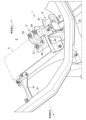
- FIG. 1 is a perspective view schematically showing a vehicular mounting device and its peripheral configuration according to an embodiment of the present invention
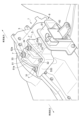
- 2 is an enlarged perspective view of a peripheral configuration including the vehicle mounting device shown in FIG. 1
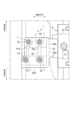
- FIG. 3 is a plan view of a peripheral configuration including the vehicle mounting device shown in FIG. 2
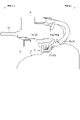
- FIG. 3 is a left side view of a peripheral configuration including the vehicle mounting device shown in FIG. 2
- FIG. 4 is a diagram showing the positional relationship of high-voltage components, a power unit, and a mount adapter before a vehicle crash
- FIG. 4 is a diagram showing the positional relationship among high-voltage components, a power unit, and a mount adapter after a vehicle collision
- FIG. 4 is a diagram showing the positional relationship among high-voltage components, a power unit, and a mount adapter after a vehicle collision
- FIG. 1 is a perspective view schematically showing a vehicle mounting device 1 according to an embodiment of the present invention and its peripheral configuration.
- a vehicle mount device 1 according to an embodiment of the present invention is for supporting a power unit 3 on a vehicle body in an engine room 2 (receiving space) provided in the front part of the vehicle.
- the high-voltage component 4 is arranged above the power unit 3 so as to overlap.
- the power unit 3 includes, for example, an engine, a transaxle, a generator, and a motor, but is not limited to including all of them.
- a vehicle mount device 1 includes a mount adapter 5 (first member) and a mount body 6 (second member).
- the mount adapter 5 and the mount body 6 are members for mounting the power unit 3 (see FIG. 2) to the vehicle body member 23 in the engine room 2 .
- the mount adapter 5 and the mount main body 6 according to the embodiment of the present invention are mounted on the vehicle body member 23 in a state in which the power unit 3 is suspended.
- High voltage components 4 are arranged in the area (see FIG. 5).
- the mount adapter 5 is arranged in the vehicle front-back direction rear lower region of the high voltage component 4, and the high voltage component 4 is pushed by the vehicle body member 21 provided in the front part of the engine room 2 in the collision of the vehicle, and the high voltage component 4 becomes the mount adapter. 5 (see FIG. 6).
- the high-voltage component 4 is, for example, a power drive unit (hereinafter referred to as "PDU"), which is composed of, for example, an inverter and a variable voltage system, and is supplied with high-voltage power (DC power) from a high-voltage battery (not shown).
- PDU power drive unit
- the high-voltage component 4 is supported by, for example, a front bracket 41 and a side bracket 43, and is fixed to a vehicle body member 21 provided in front of the engine room 2 and a vehicle body member 23 provided on the side of the engine room 2. be done.
- the power unit 3 is provided with a plurality of stud bolts 31 to 34 (fastening members), and the mount adapter 5 has a plurality of stud bolts 31 to 34 extending in the vertical direction of the vehicle. It is inserted and fixed to the power unit 3 .
- the tips of the plurality of stud bolts 31 to 34 are pointed from the viewpoint of workability, facilitating the setting of the mount adapter 5 and the attachment of the nut.
- the plurality of stud bolts 31 to 34 are, for example, four stud bolts. Two stud bolts 31 and 32 are provided forward in the vehicle longitudinal direction, and the remaining two stud bolts 33 and 34 are provided in the vehicle longitudinal direction.
- the four stud bolts 33 to 34 are provided in conformity with the shape of the mounting position of the mount adapter 5 of the power unit 3, and the two stud bolts 33 and 34 at the rear in the vehicle longitudinal direction correspond to the two stud bolts 31 at the front. , 32.
- the mount body 6 is fixed to the vehicle body side and elastically supports the mount adapter 5 .
- the mount body 6 is composed of a gate-shaped metal fitting 61 and a mount rubber 62. By interposing the mount rubber 62 between the vehicle body and the mount adapter 5 and between the mount adapter 5 and the gate-shaped metal fitting 61, The mount adapter 5 is elastically supported.
- FIG. 2 is an enlarged perspective view of the peripheral configuration including the vehicle mount device 1 shown in FIG. 3 is a plan view of the peripheral configuration including the vehicle mounting device 1 shown in FIG. 2, and FIG. 4 is a left side view of the peripheral configuration including the vehicle mounting device 1 shown in FIG.
- the mount adapter 5 is provided in accordance with the shape of the installation position of the mount adapter 5 of the power unit 3, and through holes are provided at positions corresponding to the plurality of stud bolts 31 to 34 provided on the power unit 3. It is The mount adapter 5 is provided, for example, so that the rear side is higher than the front side in the vehicle longitudinal direction, and the stud bolts 33 to 34 pass through and the seat surface on which the nut 7 is seated is perpendicular to the stud bolts 33 to 34. It is provided stepwise (see FIG. 4).
- the mount adapter 5 is fixed by a pair of front and rear stud bolts 31 (32) and 33 (34) spaced apart in the vehicle front-rear direction.
- the mount adapter 5 is configured by fitting the nut 7 to a pair of front and rear stud bolts 31 (32) and 33 (34) passing through a pair of front and rear through-holes spaced apart in the longitudinal direction of the vehicle. Fixed.
- the mount adapter 5 has a plurality of ribs 51-53.
- Each of the plurality of ribs 51 to 53 has a plate shape, is provided side by side with the stud bolts 31 to 34 (holes through which the stud bolts 31 to 34 pass), and protrudes from the stud bolts 31 to 34 (see FIG. 4). reference).
- the plurality of ribs are three ribs, two of which ribs 51 and 52 are aligned in the vehicle longitudinal direction with respect to the stud bolts 31 to 34 (holes through which the stud bolts 31 to 34 pass).
- the remaining one rib 53 is provided side by side so as to be adjacent to the three stud bolts 31 to 34 (holes through which the stud bolts 31 to 34 pass).
- each of the plurality of ribs 51 to 53 extends in the longitudinal direction of the vehicle, and has inclined surfaces 51a to 53a which gradually increase in height from front to rear in the longitudinal direction of the vehicle. have.
- the plurality of ribs 51 to 53 are three ribs, and the inclined surfaces 52a and 53a of the two ribs 52 and 53 have the same height in the vehicle width direction and are gradually inclined at the same inclination angle.
- the slanted surface 51a of the remaining one rib 51 also has the same height as the slanted surfaces 52a and 53a of the two ribs 52 and 53 in the vehicle width direction in the vicinity of the top, and gradually increases at the same inclination angle. (see FIG. 4).
- each of the two ribs 51 and 52 out of the plurality of ribs 51 to 53 has a pair of stud bolts 31 to 34 arranged in the longitudinal direction of the vehicle (the stud bolts 31 to 34 pass through the stud bolts 31 to 34). provided between the holes).
- each of the two ribs 51 and 52 is provided between a pair of stud bolts 31 to 34, and the stud bolts 31 and 32 on one side (front) are connected to the stud bolts 33 and 33 on the other (rear). 34.
- one rib 51 of the two ribs 51 and 52 is inclined with respect to the longitudinal direction of the vehicle. There is no change in being provided.
- the stud bolt 31 (32) on one side (front) in the longitudinal direction of the vehicle will move from the stud bolt 31 (32) on the other (rear) in the longitudinal direction of the vehicle.
- the ribs 51 (52) extending in the longitudinal direction of the vehicle toward 33 (34) reliably guard the high voltage component 4, so that the high voltage component 4 interferes with the stud bolts 31-34. can be reliably suppressed (see FIG. 6). As a result, it is possible to improve the protection performance of the high-voltage component 4 in the event of a vehicle collision with a simple structure that suppresses increases in cost and weight.
- One rib 53 among the plurality of ribs 51 to 53 extends in the vehicle front-rear direction along with the pair of stud bolts 32, 34 arranged in the vehicle front-rear direction. It extends forward and rearward in the vehicle longitudinal direction beyond the space between the . With this configuration, even if the high-voltage component 4 retreats to the vehicle front-rear direction rear lower region due to a vehicle collision, it can extend in the vehicle front-rear direction side by side with the pair of front and rear stud bolts 32 and 34 in the vehicle width direction.
- the high voltage component 4 Since the high voltage component 4 is guarded by the ribs 53 extending forward and rearward in the vehicle longitudinal direction beyond the space between the pair of front and rear stud bolts 32, 34, the high voltage component 4 does not interfere with the stud bolts 32, 34. You can definitely prevent it from happening. As a result, it is possible to improve the protection performance of the high-voltage component 4 in the event of a vehicle collision with a simple structure that suppresses increases in cost and weight.
- the stud bolts 31 to 34 include a plurality of stud bolts 31 to 34 having different heights in the vehicle front-rear direction, and the mount adapter 5 has different heights in the vehicle front-rear direction. It is fixed by a pair of front and rear stud bolts 31 (32) and 33 (34). The locations fixed by the plurality of stud bolts 31 to 34 are positioned higher on the rear side of the vehicle than on the front side of the vehicle.
- the inclined surfaces 51a to 53a of the ribs 51 to 53 are inclined according to the interval and height difference between the pair of front and rear stud bolts 31 (32) and 33 (34).
- the inclined surfaces 51a to 53a of the ribs 51 to 53 are inclined (inclined) according to the interval and height difference between the pair of front and rear stud bolts 31 (32) and 33 (34). While limiting the height of the plate-like ribs 51 to 53 projecting from the mount adapter 5, the ribs 51 to 53 can be secured to the high voltage component 4 even when the high voltage component 4 retreats downward in the vehicle front-rear direction due to a vehicle collision.
- the high-voltage component 4 can be guided to the upper side of the mount adapter 5 by preventing interference with the stud bolts 31 to 34 of the mount adapter 5 . As a result, it is possible to improve the protection performance of the high-voltage component 4 in the event of a vehicle collision with a simple structure that suppresses increases in cost and weight.
- one rib 53 among the plurality of ribs 51 to 53 includes a portion 533 extending along the vehicle width direction.
- one rib 53 out of the plurality of ribs 51 to 53 extends in the vehicle width direction on the vehicle front-rear direction front side of the stud bolts 31-34 provided at the vehicle front-rear direction front. including a portion 533 provided.
- the high voltage component 4 is guarded by the portion 533 of the rib extending in the vehicle width direction. As a result, it is possible to improve the protection performance of the high-voltage component 4 in the event of a vehicle collision with a simple structure that suppresses increases in cost and weight.
- portion 533 extending along the vehicle width direction has an inclined surface that is continuous with the inclined surface 53a and gradually rises from the front to the rear in the vehicle longitudinal direction.
- One rib 53 among the plurality of ribs 51-53 has a portion 531 extending in the vehicle longitudinal direction with respect to the stud bolts 31-34 and a portion 531 positioned in the vehicle longitudinal direction with respect to the stud bolts 31-34. It has a portion 533 extending in the width direction. These parts 531 and 533 are provided along the outer peripheral edge of the mount adapter 5 . With this configuration, the rib 53 has a portion 531 that is positioned adjacent to the stud bolts 31 to 34 in the vehicle width direction and extends in the vehicle front-rear direction, and a portion 531 that extends in the vehicle front-rear direction.
- the parts 533 are positioned adjacent to each other in the vehicle front-rear direction and extend in the vehicle width direction, and are provided along the outer peripheral edge of the mount adapter 5, so that the high-voltage component 4 may be damaged by a vehicle collision. Even when it is retracted downward in the front-rear direction, the ribs 53 prevent the high-voltage component 4 from interfering with the stud bolts 31 to 34 and guide the high-voltage component 4 to the upper side of the mount adapter 5 . As a result, it is possible to improve the protection performance of the high-voltage component 4 in the event of a vehicle collision with a simple structure that suppresses increases in cost and weight.
- FIG. 5 is a diagram showing the positional relationship of the high voltage component 4, the power unit 3 and the mount adapter 5 before the vehicle collision
- FIG. 6 shows the high voltage component 4, the power unit 3 and the mount adapter 5 after the vehicle collision. is a diagram showing the positional relationship of .
- the high-voltage component 4 is arranged in an upper front region in the vehicle front-rear direction of the mount adapter 5 that is mounted on a vehicle body member (not shown) while the power unit 3 is suspended. .
- the high voltage component 4 is supported by a front bracket 41 and side brackets (not shown), and includes a vehicle body member 21 provided in front of the engine room 2 and a vehicle body member (not shown) provided on the side of the engine room 2 . ) is fixed. Therefore, before the vehicle crashes, there is a sufficient gap between the high-voltage component 4 and the mount adapter 5 , and the high-voltage component 4 does not interfere with the mount adapter 5 or the power unit 3 .
- the front bracket 41 and the side bracket are pushed by a vehicle body member (not shown) provided in front of the engine room 2 and deformed.
- the part 4 retreats and the high voltage part 4 approaches the mount adapter 5 .
- the high-voltage component 4 collides with the mount adapter 5
- the high-voltage component 4 is guarded by the ribs 51-53 provided on the mount adapter 5, and the inclined surfaces 51a-53a of the ribs 51-53.
- the high voltage component 4 does not interfere with the stud bolts 31 to 34, and the descent of the high voltage component 4 is suppressed.
- the mount adapter 5 even if the high-voltage component 4 retreats rearward and downward in the vehicle front-rear direction due to a vehicle collision, the high-voltage component 4 can be prevented from interfering with the stud bolts 31 to 34. . This allows for a simple structure that reduces cost and weight. It is possible to improve the protection performance of the high voltage component 4 at the time of vehicle collision.
- the present invention is not limited to the above-described embodiments, and includes modifications of the above-described embodiments and modes in which these modes are combined as appropriate.
- Vehicle mount device Engine room (accommodation space) 21 vehicle body member 23 vehicle body member 3 power unit 31, 32, 33, 34 stud bolt (fastening member) 4 high voltage parts 41 front bracket 43 side bracket 5 mount adapter (first member) 51, 52, 53 ribs 51a, 52a, 53a inclined surface 531 portion 533 extending in the longitudinal direction of the vehicle portion 6 extending in the width direction of the vehicle mount body (second member) 61 Gate-shaped metal fitting 62 Mount rubber 7 Nut
Landscapes
- Engineering & Computer Science (AREA)
- Chemical & Material Sciences (AREA)
- Combustion & Propulsion (AREA)
- Mechanical Engineering (AREA)
- General Engineering & Computer Science (AREA)
- Transportation (AREA)
- Physics & Mathematics (AREA)
- Acoustics & Sound (AREA)
- Aviation & Aerospace Engineering (AREA)
- Arrangement Or Mounting Of Propulsion Units For Vehicles (AREA)
- Vibration Prevention Devices (AREA)
Priority Applications (1)
| Application Number | Priority Date | Filing Date | Title |
|---|---|---|---|
| JP2023538327A JP7529162B2 (ja) | 2021-07-27 | 2022-06-16 | 車両用マウント装置 |
Applications Claiming Priority (2)
| Application Number | Priority Date | Filing Date | Title |
|---|---|---|---|
| JP2021122749 | 2021-07-27 | ||
| JP2021-122749 | 2021-07-27 |
Publications (1)
| Publication Number | Publication Date |
|---|---|
| WO2023007978A1 true WO2023007978A1 (ja) | 2023-02-02 |
Family
ID=85086597
Family Applications (1)
| Application Number | Title | Priority Date | Filing Date |
|---|---|---|---|
| PCT/JP2022/024211 Ceased WO2023007978A1 (ja) | 2021-07-27 | 2022-06-16 | 車両用マウント装置 |
Country Status (2)
| Country | Link |
|---|---|
| JP (1) | JP7529162B2 (https=) |
| WO (1) | WO2023007978A1 (https=) |
Citations (4)
| Publication number | Priority date | Publication date | Assignee | Title |
|---|---|---|---|---|
| JP2012144142A (ja) * | 2011-01-12 | 2012-08-02 | Mazda Motor Corp | 電動車両 |
| JP2015140059A (ja) * | 2014-01-28 | 2015-08-03 | トヨタ自動車株式会社 | モータのコネクタ保護構造 |
| WO2017203621A1 (ja) * | 2016-05-25 | 2017-11-30 | 日産自動車株式会社 | 電力変換装置の搭載構造 |
| JP2020138693A (ja) * | 2019-03-01 | 2020-09-03 | トヨタ自動車株式会社 | 電気部品の車載構造 |
-
2022
- 2022-06-16 JP JP2023538327A patent/JP7529162B2/ja active Active
- 2022-06-16 WO PCT/JP2022/024211 patent/WO2023007978A1/ja not_active Ceased
Patent Citations (4)
| Publication number | Priority date | Publication date | Assignee | Title |
|---|---|---|---|---|
| JP2012144142A (ja) * | 2011-01-12 | 2012-08-02 | Mazda Motor Corp | 電動車両 |
| JP2015140059A (ja) * | 2014-01-28 | 2015-08-03 | トヨタ自動車株式会社 | モータのコネクタ保護構造 |
| WO2017203621A1 (ja) * | 2016-05-25 | 2017-11-30 | 日産自動車株式会社 | 電力変換装置の搭載構造 |
| JP2020138693A (ja) * | 2019-03-01 | 2020-09-03 | トヨタ自動車株式会社 | 電気部品の車載構造 |
Also Published As
| Publication number | Publication date |
|---|---|
| JPWO2023007978A1 (https=) | 2023-02-02 |
| JP7529162B2 (ja) | 2024-08-06 |
Similar Documents
| Publication | Publication Date | Title |
|---|---|---|
| US11492044B2 (en) | Vehicle front structure | |
| JP6210092B2 (ja) | 自動車 | |
| CN103338954B (zh) | 车辆设备安装结构 | |
| EP3034345B1 (en) | Fastening structure of onboard apparatus | |
| JP4943494B2 (ja) | 車両衝突時の補機ガイド構造 | |
| CN102858579B (zh) | 车体后部的电器设备的搭载结构 | |
| CN107867160A (zh) | 车体下部结构 | |
| US11420507B2 (en) | Power train support structure for vehicle | |
| CN110626184B (zh) | 电池固定结构 | |
| CN104553717A (zh) | 电动车辆 | |
| US10245933B2 (en) | Vehicle | |
| CN112477599B (zh) | 电气设备的车载构造 | |
| US12448047B2 (en) | Device protection structure of vehicle body | |
| CN110027495A (zh) | 电动车辆和用于电动车辆的偏转器组件 | |
| JP6541171B2 (ja) | 車載機器の固定構造 | |
| JP7196444B2 (ja) | 車両用電源固定構造 | |
| JP7571770B2 (ja) | 車両前部構造 | |
| JP7141998B2 (ja) | 保護部材及び保護構造 | |
| JP2016107907A (ja) | 電力変換装置 | |
| JP2023107098A (ja) | 車載機器の保護構造 | |
| WO2023007978A1 (ja) | 車両用マウント装置 | |
| JP7747062B2 (ja) | 高電圧部品の支持構造 | |
| JP7367594B2 (ja) | バッテリーの車体アース構造、及びバッテリーの車体アース方法 | |
| JP7127581B2 (ja) | 電気部品の車載構造 | |
| US20230382325A1 (en) | Vehicle |
Legal Events
| Date | Code | Title | Description |
|---|---|---|---|
| 121 | Ep: the epo has been informed by wipo that ep was designated in this application |
Ref document number: 22849055 Country of ref document: EP Kind code of ref document: A1 |
|
| WWE | Wipo information: entry into national phase |
Ref document number: 2023538327 Country of ref document: JP |
|
| WWE | Wipo information: entry into national phase |
Ref document number: 2401000535 Country of ref document: TH |
|
| NENP | Non-entry into the national phase |
Ref country code: DE |
|
| 122 | Ep: pct application non-entry in european phase |
Ref document number: 22849055 Country of ref document: EP Kind code of ref document: A1 |