WO2022265090A1 - 吸収性物品 - Google Patents
吸収性物品 Download PDFInfo
- Publication number
- WO2022265090A1 WO2022265090A1 PCT/JP2022/024241 JP2022024241W WO2022265090A1 WO 2022265090 A1 WO2022265090 A1 WO 2022265090A1 JP 2022024241 W JP2022024241 W JP 2022024241W WO 2022265090 A1 WO2022265090 A1 WO 2022265090A1
- Authority
- WO
- WIPO (PCT)
- Prior art keywords
- absorbent
- absorbent article
- cuff
- elastic member
- standing
- Prior art date
- Legal status (The legal status is an assumption and is not a legal conclusion. Google has not performed a legal analysis and makes no representation as to the accuracy of the status listed.)
- Ceased
Links
Images




Classifications
-
- A—HUMAN NECESSITIES
- A61—MEDICAL OR VETERINARY SCIENCE; HYGIENE
- A61F—FILTERS IMPLANTABLE INTO BLOOD VESSELS; PROSTHESES; DEVICES PROVIDING PATENCY TO, OR PREVENTING COLLAPSING OF, TUBULAR STRUCTURES OF THE BODY, e.g. STENTS; ORTHOPAEDIC, NURSING OR CONTRACEPTIVE DEVICES; FOMENTATION; TREATMENT OR PROTECTION OF EYES OR EARS; BANDAGES, DRESSINGS OR ABSORBENT PADS; FIRST-AID KITS
- A61F13/00—Bandages or dressings; Absorbent pads
- A61F13/15—Absorbent pads, e.g. sanitary towels, swabs or tampons for external or internal application to the body; Supporting or fastening means therefor; Tampon applicators
- A61F13/45—Absorbent pads, e.g. sanitary towels, swabs or tampons for external or internal application to the body; Supporting or fastening means therefor; Tampon applicators characterised by the shape
- A61F13/47—Sanitary towels, incontinence pads or napkins
- A61F13/475—Sanitary towels, incontinence pads or napkins characterised by edge leakage prevention means
-
- A—HUMAN NECESSITIES
- A61—MEDICAL OR VETERINARY SCIENCE; HYGIENE
- A61F—FILTERS IMPLANTABLE INTO BLOOD VESSELS; PROSTHESES; DEVICES PROVIDING PATENCY TO, OR PREVENTING COLLAPSING OF, TUBULAR STRUCTURES OF THE BODY, e.g. STENTS; ORTHOPAEDIC, NURSING OR CONTRACEPTIVE DEVICES; FOMENTATION; TREATMENT OR PROTECTION OF EYES OR EARS; BANDAGES, DRESSINGS OR ABSORBENT PADS; FIRST-AID KITS
- A61F13/00—Bandages or dressings; Absorbent pads
- A61F13/15—Absorbent pads, e.g. sanitary towels, swabs or tampons for external or internal application to the body; Supporting or fastening means therefor; Tampon applicators
- A61F13/45—Absorbent pads, e.g. sanitary towels, swabs or tampons for external or internal application to the body; Supporting or fastening means therefor; Tampon applicators characterised by the shape
- A61F13/49—Absorbent pads, e.g. sanitary towels, swabs or tampons for external or internal application to the body; Supporting or fastening means therefor; Tampon applicators characterised by the shape specially adapted to be worn around the waist, e.g. diapers, nappies
-
- A—HUMAN NECESSITIES
- A61—MEDICAL OR VETERINARY SCIENCE; HYGIENE
- A61F—FILTERS IMPLANTABLE INTO BLOOD VESSELS; PROSTHESES; DEVICES PROVIDING PATENCY TO, OR PREVENTING COLLAPSING OF, TUBULAR STRUCTURES OF THE BODY, e.g. STENTS; ORTHOPAEDIC, NURSING OR CONTRACEPTIVE DEVICES; FOMENTATION; TREATMENT OR PROTECTION OF EYES OR EARS; BANDAGES, DRESSINGS OR ABSORBENT PADS; FIRST-AID KITS
- A61F13/00—Bandages or dressings; Absorbent pads
- A61F13/15—Absorbent pads, e.g. sanitary towels, swabs or tampons for external or internal application to the body; Supporting or fastening means therefor; Tampon applicators
- A61F13/51—Absorbent pads, e.g. sanitary towels, swabs or tampons for external or internal application to the body; Supporting or fastening means therefor; Tampon applicators characterised by the outer layers of the pads
- A61F13/511—Topsheet, i.e. the permeable cover or layer facing the skin
-
- A—HUMAN NECESSITIES
- A61—MEDICAL OR VETERINARY SCIENCE; HYGIENE
- A61F—FILTERS IMPLANTABLE INTO BLOOD VESSELS; PROSTHESES; DEVICES PROVIDING PATENCY TO, OR PREVENTING COLLAPSING OF, TUBULAR STRUCTURES OF THE BODY, e.g. STENTS; ORTHOPAEDIC, NURSING OR CONTRACEPTIVE DEVICES; FOMENTATION; TREATMENT OR PROTECTION OF EYES OR EARS; BANDAGES, DRESSINGS OR ABSORBENT PADS; FIRST-AID KITS
- A61F13/00—Bandages or dressings; Absorbent pads
- A61F13/15—Absorbent pads, e.g. sanitary towels, swabs or tampons for external or internal application to the body; Supporting or fastening means therefor; Tampon applicators
- A61F13/53—Absorbent pads, e.g. sanitary towels, swabs or tampons for external or internal application to the body; Supporting or fastening means therefor; Tampon applicators characterised by the absorbing medium
- A61F13/534—Absorbent pads, e.g. sanitary towels, swabs or tampons for external or internal application to the body; Supporting or fastening means therefor; Tampon applicators characterised by the absorbing medium having an inhomogeneous composition through the thickness of the pad
Definitions
- the present invention relates to an absorbent article with a leak-proof cuff having an outward fold.
- An absorbent article such as a disposable diaper, which has a vertical direction corresponding to the front-rear direction of a wearer and a horizontal direction perpendicular to the vertical direction, has an absorbent body for absorbing and holding body fluids, and both sides along the vertical direction of the absorbent body. It is known to have a pair of leak-tight cuffs arranged along the .
- Patent Document 1 in a disposable diaper having such a configuration, elastic members for an absorbent body are arranged near both side edges along the longitudinal direction of the absorbent body for raising the sides of the absorbent body. It is described that the upright portions of a pair of leakage-preventing cuffs and the side portions of the absorbent body are configured to stand up against the wearer's skin.
- the standing portion of the leak-preventing cuff described in Cited Document 1 includes a first portion extending laterally outward from a standing point of the leak-preventing cuff (fixed portion to another member) in an upright state; and a second portion extending laterally inwardly from the end of the first portion opposite the upright point, the distal end of the second portion being the free end of the upright portion.
- the leak-preventing cuff described in Cited Document 1 is a portion (outward folding portion) formed by folding a portion of the sheet material forming the leak-preventing cuff, which extends from the inside to the outside in the lateral direction, outward in the lateral direction. does not have
- Patent Documents 2 and 3 describe an absorbent article provided with a leak-proof cuff (outwardly-folded leak-proof cuff) having the outwardly folded portion.
- the outwardly-folded leak-proof cuff described in Patent Document 2 is divided into an upper region (outerly-folded portion) and a lower region by folding along a longitudinally extending fold, and the fold is the portion of the leak-proof cuff. It is located laterally inwardly of the free end.
- the upper region has a first region located on the free end side and a second region located on the fold side with respect to the lateral center thereof, and the first region and the second region each have:
- One or more longitudinally extending elastic members are arranged in a stretched state.
- the absorbent articles described in Patent Documents 2 and 3 are not configured such that the absorbent body can stand up.
- the present invention comprises an absorbent body having a vertical direction corresponding to the front-rear direction of the wearer and a horizontal direction orthogonal to the vertical direction, and absorbing and holding body fluids, and along both sides along the vertical direction of the absorbent body.
- the present invention relates to an absorbent article comprising a pair of anti-leakage cuffs arranged side by side.
- the absorbent body is positioned at least on both sides of the crotch region corresponding to the wearer's crotch region with the lateral central portion of the absorbent body interposed therebetween.
- the leakage-preventing cuff has, at least in the crotch region, an upright portion that stands up against the wearer's skin when worn, and the upstanding portion is the leakage-preventing cuff.
- the absorbent body rising portion in the natural state of the absorbent article, is arranged from the boundary side with the non-standing portion to the side edge side along the longitudinal direction of the absorbent body rising portion. It is preferable that a virtual extension portion when virtually extended in the facing direction overlaps the second upright portion.
- FIG. 1 is a perspective view schematically showing the natural state of an underpants-type disposable diaper, which is one embodiment of the absorbent article of the present invention.
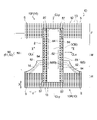
- FIG. 2 is a developed plan view schematically showing the side facing the skin (the top sheet side) of the diaper shown in FIG. 1 in the developed and maximum stretched state.
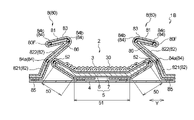
- FIG. 3 is a cross-sectional view schematically showing the II line cross section of the diaper shown in FIG. 2 (the cross section along the thickness direction and the lateral direction).
- FIG. 4 is a cross-sectional view schematically showing a section taken along line II (a cross section along the thickness direction and the lateral direction) of the diaper shown in FIG. 2 in its natural state.
- FIG. 1 is a perspective view schematically showing the natural state of an underpants-type disposable diaper, which is one embodiment of the absorbent article of the present invention.
- FIG. 2 is a developed plan view schematically showing the side facing the skin (the top sheet side) of the diaper shown in FIG. 1 in the developed and maximum stretched state.
- FIG. 5 is a cross-sectional view schematically showing a cross section taken along the line II (a cross section along the thickness direction and the lateral direction) of the diaper shown in FIG. 2 when worn.
- FIG. 6 is a view corresponding to FIG. 3 of an underpants-type disposable diaper that is another embodiment of the absorbent article of the present invention.
- FIG. 7 is a view corresponding to FIG. 4 of an underpants-type disposable diaper, which is still another embodiment of the absorbent article of the present invention.
- FIG. 8 is a view corresponding to FIG. 4 of an underpants-type disposable diaper that is still another embodiment of the absorbent article of the present invention.
- FIG. 9 is a view corresponding to FIG.
- FIG. 10 is a cross-sectional view (equivalent to FIG. 4) schematically showing a II-II cross section (a cross section along the thickness direction and the lateral direction) of the diaper shown in FIG. 9 in its natural state.
- the outwardly-folded leak-proof cuffs such as those described in Patent Documents 2 and 3 are in contact with the wearer's body with their outer folds.
- the length from the starting point (fixed part to other member) to the free end is long, and the shape of the absorbent article makes it easy for fingers to get caught when wearing the absorbent article.
- an object of the present invention is to provide an absorbent article that has a leak-proof cuff that is excellent in erectability and that is less likely to leak.
- the diaper 1 to 4 show an underpants-type disposable diaper 1, which is one embodiment of the absorbent article of the present invention.
- the diaper 1 has a longitudinal direction X corresponding to the front-rear direction of the wearer, that is, a direction extending from the abdominal side to the back side through the crotch portion, and a lateral direction Y perpendicular to the longitudinal direction X.
- the diaper 1 includes an absorbent body 5 that absorbs and retains bodily fluids, and a pair of anti-leakage cuffs 8 arranged along both sides of the absorbent body 5 along the longitudinal direction X. As shown in FIG.
- the diaper 1 has a crotch region M that is arranged between the wearer's crotch region when worn, and an abdominal region that is arranged on the wearer's abdomen side (front side) from the crotch region M. F and a dorsal region R arranged on the wearer's dorsal side (rear side) from the crotch region M.
- the crotch region M extends in the longitudinal direction X across the longitudinal center line CLx of the diaper 1 .
- the vertical center line CLx is an imaginary straight line extending in the horizontal direction Y by halving the diaper 1 in the unfolded and maximum stretched state as shown in FIG.
- the crotch region M includes an excretion-facing portion (not shown) that faces the wearer's excretion such as the penis, and is typically the portion of the diaper 1 where the length (width) in the lateral direction Y is the shortest.
- the abdominal region F, the crotch region M, and the back region R can be each region when the absorbent article in the unfolded and maximally stretched state is divided into three equal parts in the longitudinal direction X.
- the term “unfolded and maximally stretched state” means that the absorbent article is flattened into a flattened state, the elastic members of each part of the absorbent article in the expanded state are stretched to the maximum, and the design dimensions, i.e., the It refers to the state in which the dimension is the same as the dimension when it is flattened in a state where the influence of the elastic member is completely eliminated.
- the absorbent article is cut off at the side seal portions and spread flat to form the expanded state.
- the diaper 1 is formed symmetrically on one side and the other side with respect to the horizontal center line CLy in the unfolded and maximum stretched state as shown in FIG.
- the horizontal center line CLy is an imaginary straight line that extends in the vertical direction X and bisects the diaper 1 in the unfolded and maximum stretched state in the horizontal direction Y.
- the diaper 1 includes an absorbent body 2 including an absorbent body 5 and an outer body 10 arranged on the non-skin facing side of the absorbent body 2 .
- the absorbent main body 2 and the exterior body 10 are joined by a known joining means such as an adhesive.
- the outer body 10 is a member that forms the outer shape of the diaper 1 .
- the peripheral edge of the outer body 10 forms contours of the abdominal area F and the dorsal area R of the diaper 1, respectively.
- the exterior body 10 extends in the lateral direction Y and is located in the ventral region F, and the ventral exterior body 10F is located in the ventral region F.
- the dorsal exterior body 10R extends in the lateral direction Y and is located in the dorsal region R. and That is, the diaper 1 is a so-called split-type underpants-type disposable diaper in which the exterior body is divided into a member arranged on the abdomen side and a member arranged on the back side.
- the absorbent main body 2 has a rectangular shape in a plan view, and is arranged in the central portion of the outer package 10 in the lateral direction Y with its longitudinal direction aligned with the longitudinal direction X of the diaper 1, and extends from the ventral region F to the dorsal region R. It extends in the longitudinal direction X over the entire length, and bridges between the ventral exterior body 10F and the dorsal exterior body 10R which are arranged at a predetermined interval in the longitudinal direction X.
- the term “skin-facing surface” refers to the surface of an absorbent article or its constituent members (e.g., an absorbent body) facing the wearer's skin when the absorbent article is worn, that is, the surface facing the wearer's skin.
- the "non-skin facing surface” is the side of the absorbent article or its constituent members that faces away from the skin when the absorbent article is worn, i.e., the side that is relatively far from the wearer's skin. on the side.
- the term "when worn” as used herein means a state in which the absorbent article is maintained in a normal and appropriate wearing position, that is, in a correct wearing position of the absorbent article.
- a pair of side seal portions are formed by joining both side portions of the ventral exterior body 10F along the longitudinal direction X and both side portions of the dorsal exterior body 10R along the longitudinal direction X to each other. S, S are formed. Thereby, the exterior bodies 10F and 10R are connected in a ring.
- the side seal portion S is formed by a known joining means such as adhesive, heat sealing, ultrasonic sealing, or the like.
- the diaper 1 also has a waist opening WH through which the wearer's torso is passed, and a pair of leg openings LH and LH through which the wearer's lower legs are passed.
- the absorbent main body 2 consists of a liquid-permeable surface sheet 3 arranged at a position relatively close to the wearer's skin and a liquid-impermeable or liquid-impermeable surface sheet 3 arranged at a position relatively far from the wearer's skin. It comprises a permeable or water-repellent back sheet 4 and an absorbent body 5 interposed between the two sheets 3,4. These members constituting the absorbent main body 2 are integrated by a known joining means such as an adhesive.
- the absorbent body 5 has a shape elongated in one direction, such as a rectangular shape in plan view, and is arranged so that its longitudinal direction coincides with the longitudinal direction X of the diaper 1. ing.
- the absorber 5 is arranged at least in the crotch region M. In the diaper 1, the absorber 5 is continuous from the abdomen region F to the back region R via the crotch region M. As shown in FIG. As shown in FIGS.
- the topsheet 3 traverses the skin-facing side of the absorbent body 5 (a pair of absorbent body rising portions 50 and non-standing portions 51, which will be described later) in the lateral direction Y, and Extending portions 3E from both side edges (a pair of absorbent body upright portions 50, 50) of the topsheet 3 along the longitudinal direction X of the absorbent body 5 are wrapped around the non-skin facing side of the absorbent body 5.
- a pair of extending portions 3E, 3E of the top sheet 3 are fixed to a cuff sheet 83 forming the main body of the leak-proof cuff 8 described later, and a fixing portion 85 between the top sheet 3 and the cuff sheet 83 is A pair is formed.
- the surface sheet 3 does not cover the entire non-skin-facing surface of the absorbent body 5, but covers the central portion in the lateral direction Y of the non-skin-facing surface of the absorbent body 5 (the portion located between the pair of fixing portions 85, 85). ) is not covered with the top sheet 3 .
- the surface sheet 3 thus has a size capable of covering the entire skin-facing surface of the absorbent body 5, and covers the skin-facing surface of the absorbent body 5 and both sides of the absorbent body 5 along the longitudinal direction X. The edges are covered over their entire area, and furthermore, a predetermined range is covered inward in the lateral direction Y from the both side edges of the non-skin-facing surface of the absorbent body 5 .
- the surface sheet 3 has an uneven shape 30 on its surface (skin-facing surface or non-skin-facing surface). More specifically, as shown in FIGS. 3 and 4, the surface facing the skin of the topsheet 3 is formed with an uneven shape 30 including a plurality of protrusions and recesses located around the protrusions. .
- the concave-convex shape 30 is not formed on the entire topsheet 3, but is formed on both ends in the horizontal direction Y (portions corresponding to the portions where the elastic members 52 for absorbers described later are disposed).
- the surface sheet 3 may not have the irregularities 30 on the surface, and a flat surface sheet with substantially no irregularities on the surface may be used.
- the topsheet 3 the backsheet 4 and the absorbent body 5, those conventionally used in absorbent articles such as disposable diapers can be used without particular limitation.
- various nonwoven fabrics can be used as the surface sheet 3 .
- the back sheet 4 a resin film, a laminate of a resin film and a non-woven fabric, or the like can be used.
- the absorbent body 5 includes an absorbent core 6 mainly made of a water-absorbent material and a core wrap sheet covering the outer surface (skin-facing surface and non-skin-facing surface) of the absorbent core 6. 7.
- the water-absorbent material one or more selected from fibrous materials such as wood pulp and water-absorbent polymers are typically used.
- the core wrap sheet 7 has liquid permeability and is typically made of paper, nonwoven fabric, or the like.
- the absorbent body 5 may be composed only of the absorbent core 6 without including the core wrap sheet 7 .
- the absorbent core 6 may be, for example, a fiber-stacked type in which the aggregate is mainly composed of a fiber material, and the aggregate carries water-absorbent polymer particles as necessary. It may be of fixed sheet type.
- An absorbent sheet 6A included in a diaper 1A, which will be described later, is an example of the sheet-type absorbent core.
- the sheet type is thinner and more flexible than the stacked type.
- the outer covering 10 of the diaper 1 includes the abdominal outer covering 10F and the back outer covering 10R, which are members independent of each other.
- the abdomen-side exterior body 10F has a rectangular shape elongated in the horizontal direction Y in the unfolded and maximum stretched state of the diaper 1 shown in FIG.
- the back exterior body 10R has a rectangular shape elongated in the horizontal direction Y at the end region in the longitudinal direction X farther from the longitudinal center line CLx, and the end in the longitudinal direction X at the side closer to the longitudinal center line CLx.
- the region has a shape in which the length (width) in the lateral direction Y gradually decreases toward the longitudinal center line CLx.
- the outer layer sheet 11 is arranged at a position relatively distant from the absorbent body 5 and forms the outer surface of the diaper 1, and the outer layer sheet 11 is arranged at a position relatively close to the absorbent body 5 and forms the inner surface of the diaper 1. It is configured including an inner layer sheet 12 . Both sheets 11 and 12 are bonded together and integrated by known bonding means such as heat sealing and ultrasonic sealing. Both the sheets 11 and 12 forming the exterior body 10 may be sheets of the same type, or may be sheets of a different type.
- the sheets 11, 12 may be stretchable, in particular stretchable in the lateral Y direction. As the sheets 11 and 12, nonwoven fabrics produced by various methods can be used. Laminated nonwoven fabrics with more than one layer may be mentioned. Sheets 11 and 12 may be composite sheets in which these nonwoven fabrics and films are laminated together.
- gathers around the waist are formed in the ventral region F and the dorsal region R.
- the waist gathers include an outer body 10 and a plurality of waist gather forming elastic members 13 fixed to the outer body 10 .
- the plurality of elastic members 13 extend in the width direction Y and are intermittently arranged in the longitudinal direction X.
- the waist gathers fix the elastic member 13 between the outer layer sheet 11 and the inner layer sheet 12 of the exterior body 10 in a state of being stretched in the width direction Y, and then release the elastic member 13 from the stretched state. It is made by Thereby, the exterior body 10 can exhibit stretchability in the width direction Y. As shown in FIG.
- the contraction of the elastic members 13 forms a plurality of folds (gathers) in both sheets 11 and 12 extending in a direction intersecting with the contraction direction of the elastic members 13, thereby covering the entire waist of the wearer.
- the waist gathers are formed such that the pleats are substantially continuous over the circumference.
- leg gathers are formed at the leg edges forming the opening edges of the pair of leg openings LH, LH.
- the leg gather includes an outer body 10 and leg gather-forming elastic members 14 fixed to the outer body 10 .
- the leg gathers are produced by fixing the elastic member 14 in a stretched state between the outer layer sheet 11 and the inner layer sheet 12 that constitute the exterior body 10, and then releasing the elastic member 14 from the stretched state.
- the contraction of the elastic members 14 forms a plurality of folds (gathers) extending in the direction crossing the direction of contraction of the elastic members 14 in both sheets 11 and 12, thereby forming the opening edges of the leg openings LH.
- the leg gathers are formed in which the folds are substantially continuous over the entire circumference of the part.
- the number of elastic members 14 may be one or plural.
- the absorbent body 5 and the leak-proof cuff 8 having the outer folded portion each have an upright portion that rises toward the wearer's skin when worn, and are provided separately from each other.
- the upright portion of the body 5 (absorber upright portion 50) and the upright portion 80 of the leak-proof cuff 8 overlap in the longitudinal direction X (at the same position in the longitudinal direction X). This characteristic configuration will be described below.
- the absorbent body 5 is positioned on both sides of the crotch region M corresponding to at least the wearer's crotch region with the central part of the absorbent body 5 in the lateral direction Y interposed therebetween. It has a pair of absorbent body upright portions 50, 50 standing up against the skin of a person, and a non-upright portion 51 located in the central portion and sandwiched between the pair of absorbent body upright portions 50, 50. As shown in FIG. An absorber elastic member 52 is arranged in the absorber standing portion 50 so as to be stretchable in the vertical direction X. As shown in FIG.
- both side edges along the longitudinal direction X of the absorbent body 5 or their vicinity (specifically, for example, 10 mm from the side edges along the longitudinal direction X of the absorbent body 5)
- the absorbent elastic member 52 for erecting the absorbent body erecting portion 50 is arranged in the area within the area).
- the absorber elastic member 52 is arranged between the absorber 5 and the topsheet 3 so as to be stretchable in the longitudinal direction X, and one or both of the absorber 5 and the topsheet 3 is coated with a known adhesive such as an adhesive. is fixed by the fixing means of
- the absorber elastic member 52 is arranged at least in the crotch region M, and may be one as shown in the drawing or may be plural.
- the absorber elastic member 52 may be arranged inside the absorber 5 .
- the absorbent elastic member 52 stretches in the longitudinal direction X between the absorbent core 6 and the core wrap sheet 7 at both side edges along the longitudinal direction X of the absorbent body 5 or in the vicinity thereof. It may be arranged as possible. In that case, the absorbent elastic member 52 can be fixed to one or both of the absorbent core 6 and the core wrap sheet 7 by a known fixing method such as an adhesive.
- Elastic materials can be used without any particular limitation, and examples thereof include synthetic rubbers such as styrene-butadiene, butadiene, isoprene and neoprene, natural rubbers, EVA, elastic polyolefins, and polyurethanes.
- the shape of the elastic member it is preferable to use a thread-like (string rubber, etc.) or string-like (flat rubber, etc.) having a rectangular, square, circular, polygonal cross section, etc., or a multi-filament type thread-like one. can.
- the absorbent body elastic members 52 are fixed to both sides of the absorbent body 5 along the longitudinal direction X (both ends in the lateral direction Y) in a stretched state, so that the diaper 1 is in its natural state.
- both sides of the absorber 5 stand up toward the wearer's skin as a pair of absorber standing portions 50, 50 due to contraction of the elastic member 52 for the absorber.
- the absorbent body 5 has a tray shape with a non-standing part 51 as a bottom and a pair of absorbent body rising parts 50, 50 extending obliquely from the bottom toward the wearer's skin. The absorber 5 deforms when the diaper 1 is worn as well as in the relaxed state.
- the term "natural state” refers to a state (relaxed state) in which the absorbent article is not stretched without applying an external force to each elastic member arranged in the absorbent article such as the diaper 1. means.
- the leak-proof cuff 8 has a standing portion 80 that stands up against the wearer's skin when worn, at least in the crotch region M corresponding to the crotch portion of the wearer.
- the standing portion 80 includes a cuff sheet 83 that forms the main body of the leak-proof cuff 8 and a plurality of cuff elastic members 84 that are fixed to the cuff sheet 83 and extendable in the longitudinal direction X.
- a first standing portion 81 that includes an end portion 80F and extends from the inside to the outside in the lateral direction Y in an upright state, and a fixing portion 85 that connects the cuff sheet 83 to another member and extends to the first standing portion 81.
- the standing portion 80 is a portion of the cuff sheet 83 that is not fixed to other members.
- the first standing portion 81 is a portion (outward folding portion) formed by folding outward in the lateral direction Y a portion of the cuff sheet 83 that extends from the outside to the inside in the lateral direction Y. is a so-called out-fold leak-proof cuff.
- the first standing portion 81 is in contact with the wearer's body, so that the diaper 1 exhibits high leakproof performance.
- the leakage-preventing cuffs 8 are arranged continuously along the sides of the absorbent main body 2 along the longitudinal direction X over substantially the entire length of the absorbent main body 2 in the longitudinal direction X. ing.
- the leakage-preventing cuff 8 is mainly composed of one cuff sheet 83 folded at a fold extending in the longitudinal direction X, and the upright portion 80 is formed by folding the cuff sheet 83. contains the opposite portion of
- Each of the plurality of cuff elastic members 84 is fixed to the standing portion 80 so as to be stretchable in the vertical direction X. As shown in FIG. In this embodiment, as shown in FIGS.
- the cuff elastic member 84 is interposed between the two sheets 83, 83 at the portion facing the cuff sheets 83 in the standing portion 80, and It is fixed to the peripheral cuff sheet 83 by a fixing means such as an adhesive in the state of being stretched in X.
- a fixing means such as an adhesive in the state of being stretched in X.
- a region of the cuff sheet 83 to which the cuff elastic member 84 is fixed so as to be stretchable in the longitudinal direction X is a stretchable region that is stretchable in the longitudinal direction X, and the stretchable region extends in the longitudinal direction X.
- any material that is used as a material for leakproof cuffs in this type of absorbent article can be used without particular limitation. can be used.
- the fixing part 85 is a part that becomes a starting point when the standing part 80 stands up against the wearer's skin. It is a portion fixed to another member by known joining means such as fusion.
- the other member to which the cuff sheet 83 is fixed in the fixing portion 85 is not particularly limited, and can be appropriately selected from constituent members of the diaper 1 positioned around the cuff sheet 83 at the position where the fixing portion 85 is formed.
- the other members are the topsheet 3 (extending portion 3E) and/or the backsheet 4 .
- the fixed portion 85 extends continuously or discontinuously in the longitudinal direction X over substantially the entire length of the cuff sheet 83 in the longitudinal direction X. As shown in FIG.
- the number of cuff elastic members 84 arranged on the leak-proof cuff 8 is not particularly limited, and may be one or more.
- the leak-proof cuff 8 includes three cuff elastic members 84a, 84b, and 84c as the cuff elastic member 84.
- a cuff elastic member 84a is disposed at an intermediate position between the fixing portion 85 and the first standing portion 81 in the second standing portion 82, and the first standing portion 81 and the first standing portion 81 are arranged.
- a cuff elastic member 84b is arranged at the boundary position with the second upright portion 82, and a cuff elastic member 84c is arranged at the free end portion 80F of the first upright portion 81.
- the boundary between the first standing portion 81 and the second standing portion 82 on which the cuff elastic members 84b are arranged is arranged in the horizontal direction Y of the cuff sheet 83 in order to form the first standing portion 81, which is an outwardly folded portion.
- the second upright portion 82 includes a cuff elastic member 84a at an intermediate position between the fixed portion 85 and the first upright portion 81.
- a first portion 821 extending from the fixed portion 85 to the cuff elastic member 84a and a second portion 822 extending from the elastic member 84 a to the first upright portion 81 .
- the fixing part 85 overlaps the absorbent body 5 in a plan view
- the first part 821 extends outward in the lateral direction Y from the fixing part 85
- the second part 822 is for the cuff. It extends inward in the lateral direction Y from the elastic member 84a.
- the second upright portion 82 has a V shape in a cross-sectional view along the thickness direction and the lateral direction Y of the diaper 1 in the natural state as shown in FIG. It faces outward from Y.
- a boundary portion between the first portion 821 and the second portion 822 of the second standing portion 82 where the cuff elastic member 84a is arranged is a fixed portion of the cuff sheet 83 to form the second portion 822. This is a fold portion when the portion extending outward in the lateral direction Y from 85 is folded inward in the lateral direction Y along the longitudinal direction X.
- erection inhibiting portions 87 which are portions where the cuff sheet 83 is inhibited from standing up, are formed.
- the standing-up inhibiting portion 87 is formed in the ventral region F and the dorsal region R. standing portion 82).
- the standing-up inhibiting portion 87 typically, a portion of the cuff sheet 83 (the portion corresponding to the second portion 822) is fixed to the skin-facing surface (top sheet 3) of the absorbent main body 2, Another portion of the cuff sheet 83 (the portion corresponding to the first standing portion 81) is fixed to the portion, and the fixed portion is formed by a known joining means such as an adhesive or fusion. be able to.
- a pair of standing-up inhibiting portions 87, 87 are formed at both ends of the leakage-preventing cuff 8 in the longitudinal direction X, so that when the diaper 1 is worn, the portion sandwiched between the standing-up inhibiting portions 87, 87 is prevented from standing up. As shown in FIG.
- the portion 80 stands up against the wearer's skin with the fixed portion 85 as the starting point due to the contractile force of the cuff elastic members 84 (84a, 84b, 84c).
- the upright upright portion 80 prevents body fluids such as urine excreted by the wearer from moving outward in the lateral direction Y.
- body fluids (excretion) especially in the crotch region M leak outward in the lateral direction Y (lateral leakage). is effectively suppressed.
- the contractile force of the cuff elastic members 84 causes the diaper 1 as a whole to move toward the non-skin-facing side of the absorbent main body 2 at the central portion in the longitudinal direction X. Since the diaper 1 is curved and deformed so as to be convex (toward the back sheet 4 side), the diaper 1 can easily fit the shape of the wearer's body.
- the absorbent body standing portion 50 in the natural state, is aligned in the direction from the boundary side with the non-standing portion 51 toward the side edge side along the longitudinal direction X of the absorbent body standing portion 50. It is characterized in that the virtual extension portion when virtually extended to V overlaps the second upright portion 82 of the leak-proof cuff 8 , more specifically, the second portion 822 of the second upright portion 82 .
- the imaginary extension portion of the absorber upright portion 50 overlaps with the second upright portion 82 (second portion 822) of the leak-proof cuff 8 at least in the entire crotch region M.
- the leak-proof cuff 8 is an outward-folded leak-proof cuff having a first standing portion 81 as an outward-folded portion. Although the performance is high, the standing property is low and it tends to fall down inward in the lateral direction. On the other hand, in the diaper 1, due to the above-described characteristic configuration, the front end portion (absorbing material) of the absorbent body standing portion 50 in the standing state is attached to the surface facing the absorbent body 5 in the second standing portion 82 of the leak-proof cuff 8 in the standing state.
- the side edge along the longitudinal direction X of the body erecting portion 50 abuts and supports the standing leak-proof cuff 8 from the inside in the lateral direction Y, so that the erectability is improved compared to the conventional outward-folded leak-proof cuff. , the problem that the leakage-preventing cuff 8 falls excessively inward in the lateral direction Y (toward the absorber 5) is unlikely to occur. Also, when the diaper 1 is worn, as shown in FIG. Since the part (the part where the cuff elastic member 84b is disposed) can abut on the groin of the crotch part 100 of the wearer as designed, side leakage is effectively prevented.
- FIG. 5 is created from the viewpoint of facilitating an understanding of the action and effect of the main parts (upright part 80 of the leak-proof cuff 8, etc.) of the diaper 1 when worn. is not always in the state shown in FIG.
- the absorber elastic member 52 is at least one of the plurality of cuff elastic members 84 (84a, 84b, 84c). It is preferable that the shrinkage rate is higher than that of the By establishing such a magnitude relationship "shrinkage rate of absorber elastic member 52>shrinkage rate of at least one of a plurality of cuff elastic members 84", the absorber upright portion 50 is larger than the upright portion of the leakage-preventing cuff 8. Since it is easier to stand up than 80, the standing state of the standing portion 80 is easily maintained. In particular, it is preferable that the absorber elastic member 52 has a higher contraction rate than all of the plurality of cuff elastic members 84, in this embodiment, all of the cuff elastic members 84a, 84b, and 84c.
- the shrinkage rate is calculated by the following formula.
- Shrinkage rate (%) (1 - length of stretchable portion of elastic member in absorbent article in natural state / length of stretchable portion of elastic member in absorbent article in unfolded and maximum stretched state ) x 100
- the term “stretchable portion of the elastic member” means, taking the absorber elastic member 52 as an example, the contraction of the elastic member 52 in the diaper 1 in the natural state. This is a portion located in a region where wrinkles are generated in the peripheral sheet material (the top sheet 3 or the core wrap sheet 7 in this embodiment) due to the .
- the “peripheral sheet material” is the cuff sheet 83 in this embodiment.
- the "length of the stretchable portion of the elastic member” is obtained by marking both ends of the elastic member to be measured in the extending direction (longitudinal direction of the absorbent article), and measuring the distance between the pair of marks. Obtained by measurement. The distance may be measured by taking out the elastic member to be measured and its peripheral portion from the absorbent article. It should be noted that the above description of the contraction rate is appropriately applied to the elongation rate of the elastic members 52 and 84, which will be described later.
- the ratio of the contraction rate of the absorber elastic member 52 to the contraction rate of at least one of the plurality of cuff elastic members 84 is preferably 1.1 or more, more preferably, the ratio of the former to the latter. 1.2 or more, preferably 1.6 or less, more preferably 1.4 or less.
- the contraction rate of the absorbent elastic member 52 is higher than the contraction rate of at least one of the plurality of cuff elastic members 84, it is preferably 30% or more, more preferably 40% or more, and preferably 80% or less, more preferably 70% or less.
- the shrinkage rate is preferably 20% or more, more preferably 30% or more, And it is preferably 70% or less, more preferably 60% or less.
- the shrinkage rate of the elastic member can be adjusted by adjusting the type of the elastic member, the thickness (diameter) of the elastic member, the degree of elongation (elongation rate) of the elastic member when fixing the elastic member to another member, etc. is.
- the absorber elastic member 52 is at least one of the plurality of cuff elastic members 84 (84a, 84b, 84c). It is preferable that the elongation rate is high as compared with .
- the absorber upright portion 50 is larger than the upright portion of the leakage-preventing cuff 8. Since it is easier to stand up than 80, the standing state of the standing portion 80 is easily maintained.
- the absorber elastic member 52 has a higher elongation rate than all of the plurality of cuff elastic members 84, in this embodiment, all of the cuff elastic members 84a, 84b, and 84c.
- Elongation rate (%) (the length of the stretchable portion of the elastic member in the absorbent article in the unfolded and stretched state / the length of the stretchable portion of the elastic member in the absorbent article in the natural state) x 100
- the ratio of the elongation rate of the absorbent body elastic member 52 to the elongation rate of at least one of the plurality of cuff elastic members 84 is preferably 1.1 or more, more preferably 1.1 or more, more preferably, assuming that the former > the latter. 1.2 or more, preferably 1.6 or less, more preferably 1.4 or less.
- the elongation rate of the absorbent elastic member 52 is higher than the elongation rate of at least one of the plurality of cuff elastic members 84, it is preferably 150% or more, more preferably 200% or more, and preferably It is 300% or less, more preferably 270% or less.
- the elongation rate is preferably 140% or more, more preferably 180% or more, And it is preferably 280% or less, more preferably 250% or less.
- the elongation rate of the elastic member can be adjusted by adjusting the type of elastic member, the thickness (diameter) of the elastic member, and the like.
- the absorbent body elastic member 52 is provided in a plurality of It is preferable that the cuff elastic member 84 (84a, 84b, 84c) has a longer diameter, ie, a larger thickness, than at least one of the cuff elastic members 84 (84a, 84b, 84c). In particular, it is preferable that the absorber elastic member 52 has a longer diameter than all of the plurality of cuff elastic members 84, in this embodiment, all of the cuff elastic members 84a, 84b, and 84c.
- the "diameter of the elastic member” is the diameter of the elastic member in its natural state, and when the diameter of the elastic member is partially different, it indicates the shortest diameter.
- the ratio of the diameter of the absorber elastic member 52 to the diameter of at least one of the plurality of cuff elastic members 84 is preferably 1.4 or more, more preferably 1.4 or more, more preferably 1.4 or more, assuming that the former > the latter. 8 or more, and preferably 2.6 or less, more preferably 2.2 or less.
- the diameter of the absorbent elastic member 52 is longer than the diameter of at least one of the plurality of cuff elastic members 84, it is preferably 0.8 mm or more, more preferably 1.2 mm or more, and preferably It is 3.0 mm or less, more preferably 2.2 mm or less.
- the diameter of each of the plurality of cuff elastic members 84 is preferably 0.5 mm or more, more preferably 0.8 mm or more, And it is preferably 2.5 mm or less, more preferably 2.0 mm or less.
- the second upright portion 82 includes the cuff elastic member 84a at an intermediate position between the fixed portion 85 and the first upright portion 81.
- the diaper 1 as shown in FIG. In the natural state, it is preferable that the length of the first portion 821 in the extending direction from the fixing portion 85 and the length of the absorbent body standing portion 50 in the standing direction are approximately the same.
- the latter is preferably in the range of 0.9 or more and 1.1 or less, more preferably 0.95 or more and 1.05 or less. Since the difference between the two lengths is small, the function of supporting the leak-preventive cuff 8 by the absorber standing portion 50 described above is stabilized.
- the "length of the first portion 821 in the extending direction from the fixing portion 85" is, for example, the length from the end of the fixing portion 85 in the horizontal direction Y to the cuff elastic member 84a.
- the above-mentioned "length of the absorbent body erecting portion 50 in the erecting direction” is specifically, for example, the length from the boundary between the absorber erecting part 50 and the non-standing part 51 to the tip of the absorber erecting part 50. be.
- the length in the extending direction of the first portion 821 of the second standing portion 82 from the fixed portion 85 and the length of the absorbent body standing portion 50 in the standing direction are approximately the same.
- the length of the absorber standing portion 50 in the standing direction is preferably longer than the length of the second portion 822 of the second standing portion 82 in the extending direction.
- the erecting part 80 (second It is possible to effectively prevent the portion of the upright portion 82) that extends inward in the lateral direction Y from the contact portion with the tip portion of the absorbent body upright portion 50 from excessively bending toward the absorber 5 side.
- the "length in the extending direction of the second portion 822" is, for example, a cuff elastic member 84a (a cuff elastic member disposed at an intermediate position between the fixing portion 85 and the first upright portion 81). 84) to the first standing portion 81 (cuff elastic member 84b).
- the ratio of the length in the standing direction of the absorbent body standing portion 50 to the length in the extending direction of the second portion 822 is preferably 1.0 to 1.0 on the premise that the former > the latter. 1 or more, more preferably 1.2 or more, and preferably 2.0 or less, more preferably 1.7 or less.
- the length of the absorbent body standing portion 50 in the standing direction in the natural state of the diaper 1 is longer than the length in the extending direction of the second portion 822 in the same state, it is preferably 20 mm or more, more preferably. is 25 mm or more, and preferably 40 mm or less, more preferably 30 mm or less.
- the length in the extending direction of the second portion 822 in the natural state of the diaper 1 is shorter than the length in the standing direction of the absorbent body standing portion 50 in the same state, it is preferably 15 mm or more, more preferably 15 mm or more. is 18 mm or more, and preferably 28 mm or less, more preferably 25 mm or less.
- the boundary portion (the innermost portion of the upright portion 80 in the lateral direction Y, the portion where the cuff elastic member 84b is arranged) overlaps the absorber 5 .
- such a configuration is realized as shown in FIG.
- Such a configuration further facilitates support from the inside of the erected leak-preventive cuff 8 by the absorber erecting portion 50 in the erected state described above, so that the predetermined effects of the present invention can be achieved more reliably.
- the absorber elastic member 52 has a shorter length of the portion fixed in an expandable/contractible manner than at least one of the plurality of cuff elastic members 84 (84a, 84b, 84c).
- the "length of the stretchably fixed portion” is the outermost portion on one side (abdominal side) in the longitudinal direction X of the portions of the elastic members 52 and 84 fixed to the peripheral sheet material in the stretched state. It refers to the length between the part located on one side and the part located on the outermost side on the other side (dorsal side).
- the cuff elastic member 84 as an example, in this embodiment, the length between the pair of erection inhibiting portions 87, 87 (see FIG.
- the leakage-preventing cuff 8 can be more reliably positioned on the skin side of the absorbent body erecting part 50, and the structure in which the absorbent body erecting part 50 supports the leakage-preventing cuff 8 can be stably exhibited.
- the absorber elastic member 52 preferably has a shorter length of the stretchably fixed portion.
- the ratio between the length of the stretchably fixed portion of the absorber standing portion 50 and that of at least one of the plurality of cuff elastic members 84 is preferably 1.1 or more assuming that the former ⁇ the latter, and the latter/former. , more preferably 1.2 or more, and preferably 1.8 or less, more preferably 1.5 or less.
- the length of the stretchably fixed portion of the absorbent body standing portion 50 in the unfolded and maximum stretched state of the diaper 1 is shorter than that of at least one of the plurality of cuff elastic members 84 in the same state, It is preferably 200 mm or more, more preferably 250 mm or more, and preferably 380 mm or less, more preferably 330 mm or less.
- the length of at least one stretchably fixed portion of the plurality of cuff elastic members 84 when the diaper 1 is in the unfolded and maximum stretched state is longer than that of the absorber standing portion 50 in the same state, It is preferably 220 mm or more, more preferably 260 mm or more, and preferably 450 mm or less, more preferably 400 mm or less.
- Both ends in the longitudinal direction X of the elastically fixed portion of the absorber elastic member 52 are the elastically fixed portions of at least one of the plurality of cuff elastic members 84 (84a, 84b, 84c). It is preferable to be positioned closer to the center (vertical center line CLx) in the longitudinal direction X of the diaper 1 than to both ends in the longitudinal direction X. This further ensures that the leakage-preventing cuff 8 rises earlier than the absorber standing portion 50 in the area extending from the standing-up inhibiting portion 87 to the crotch region M side.
- the leakage-preventing cuff 8 can be more reliably positioned on the side, and the structure in which the absorbent body erecting portion 50 supports the leakage-preventing cuff 8 can be stably exhibited.
- the part of the cuff elastic member 84a (the cuff elastic member 84 arranged at the intermediate position between the fixing portion 85 and the first standing portion 81) is fixed so as to be stretchable. It is preferable that the absorbent elastic member 52 is located closer to the longitudinal center line CLx than the longitudinal direction X end portions.
- the "both ends in the vertical direction X of the stretchably fixed portion of the absorbent body elastic member 52" are a pair of erection inhibiting portions 87, 87 spaced apart in the vertical direction X (see FIG. 2). It is the boundary between
- the upright portion 80 of the leak-proof cuff 8 includes the cuff sheets 83, 83 facing each other (the facing portions of the cuff sheets 83).
- a leakproof sheet 86 is interposed between the cuff sheets 83 .
- the leak-proof sheet 86 has a property that it is difficult for body fluids such as urine to permeate, the leak-proof performance of the leak-proof cuff 8 can be further improved by arranging this on the upright portion 80 .
- the leak-proof sheet 86 is preferably arranged at least on the second standing portion 82 of the standing portion 80. It is more preferable that they are arranged on the entire upright portion 80 as shown in FIG.
- the leakproof sheet 86 and the cuff sheet 83 may be joined by a joining means such as an adhesive.
- a liquid-impermeable sheet can be used as the leak-proof sheet 86, and for example, a resin film made of an olefin resin such as polyethylene or polypropylene can be used.
- the resin film may have moisture permeability, and a porous resin film can be exemplified as the resin film having moisture permeability.
- the porous resin film can be produced by kneading an inorganic filler into an olefin resin such as polyethylene or polypropylene to form a sheet-like material, and then stretching the sheet in a uniaxial or biaxial direction.
- the surface (more specifically, the surface facing the skin) of the topsheet 3 has the uneven shape 30, and the non-upright portions 51 of the topsheet 3
- the portion corresponding to the non-upright portion 51 (overlapping with the non-upright portion 51 in plan view) has an uneven shape 30 on the surface, and the portion corresponding to the portion of the surface sheet 3 where the absorbent elastic member 52 is arranged (the portion and the plane of the arrangement portion).
- the visually overlapping portion does not have the uneven shape 30 on the surface.
- the above-mentioned "arrangement portion of the absorbent body elastic member 52" is positioned at least in the absorbent body erecting part 50, and typically, as shown in FIGS.
- the surface sheet 3 having the uneven shape 30 on the skin-facing surface has advantages such as excellent dry feeling on the skin-facing surface and contributing to improvement of wearing comfort of the diaper 1.
- the sheet 3 has the uneven shape 30, the rigidity of the object composed of the absorbent body 5 and the top sheet 3 covering it increases compared to the case where the surface sheet 3 does not have the uneven shape 30. , there is a concern that the uprightness of the object is lowered.
- the surface sheet 3 having the uneven shape 30 on its surface is used to take advantage of that advantage, and in order to ensure the uprightness of the absorbent body erecting portion 50, the absorbent body in the topsheet 3
- the part corresponding to the arrangement part of the elastic member 52 is not provided with the concave-convex shape 30 so that the absorber erecting part 50 can be easily erected together with the surface sheet 3 covering the surface thereof.
- FIG. 6 to 10 show other embodiments (diapers 1A, 1B, 1C, 1D) of the absorbent article of the present invention.
- the configuration different from that of the diaper 1 described above will be mainly described, and the configuration similar to that of the diaper 1 will be given the same reference numerals and description thereof will be omitted.
- the description of the diaper 1 is appropriately applied to configurations that are not particularly described in other embodiments described later.
- the absorbent body 5 is provided with an absorbent sheet 6A as the absorbent core 6, which includes a fiber sheet 63 and a water-absorbing polymer arranged on the surface of the fiber sheet 63.
- the absorbent sheet 6A includes fiber sheets 63, 63 facing each other and a large number of particulate water absorbent polymers 64 arranged between the sheets 63, 63.
- the fiber sheets 63, 63 and the fiber sheet 63 and the water-absorbing polymer 64 may be bonded together with an adhesive.
- the diaper 1A shown in FIG. 6 is in the unfolded and maximum stretched state as shown in FIG. In other words, in the diaper 1A in the unfolded and maximum stretched state, as shown in FIG.
- the absorbent body elastic member 52 and the water-absorbing polymer 64 overlap each other in the thickness direction of the absorbent body 5 (vertical direction in FIG. 6). not.
- the problem that the contraction of the absorbent elastic member 52 is inhibited by the water-absorbing polymer 64 is reduced, and the effect continues even after the water-absorbing polymer 64 absorbs bodily fluids and swells.
- the erectability of the portion 50 can be further improved and stabilized.
- the fixed portions 85 of the cuff sheet 83 and the other member (the back sheet 4) are positioned outward in the lateral direction Y of the absorber 5. It is different from the diaper 1 (see FIGS. 3 and 4) that overlaps the body 5 in plan view.
- the first portion 821 extends inward in the lateral direction Y from the fixing portion 85
- the second portion 822 extends inward in the lateral direction Y from the cuff elastic member 84a. there is The same effect as the diaper 1 is exhibited by the diaper 1B.
- a diaper 1C shown in FIG. 8 includes a pair of leak-preventing cuffs 9, 9 having an upright portion 90 standing toward the wearer's skin outside the pair of leak-preventing cuffs 8, 8 in the lateral direction Y. ing. From the relative positional relationship in the lateral direction Y, it can be said that the leak-proof cuff 8 is the inner leak-proof cuff 8 and the leak-proof cuff 9 is the outer leak-proof cuff 9 .
- the leak-proof cuff 8 and the leak-proof cuff 9 are provided separately and extend parallel to each other in the longitudinal direction X.
- the leak-proof cuff 9 does not have an outward fold like the first standing portion 81 of the leak-proof cuff 8 .
- the leak-preventing cuff 9 (upright portion 90) includes a cuff sheet 91 that forms the main body of the leak-preventing cuff 9, and one or more (illustrated 3) cuff elastic members 92 are provided.
- the leak-proof cuffs 9 (cuff sheets 91 ) are arranged continuously along the sides along the longitudinal direction X of the absorbent main body 2 over substantially the entire length in the longitudinal direction X of the absorbent main body 2 .
- the cuff sheet 91 has a fixed portion 93 to be fixed to another member (back sheet 4 ), and the fixed portion 93 serves as a starting point for the standing portion 90 .
- the standing portion 90 includes a facing portion between the cuff sheets 91 formed by folding one cuff sheet 91, and the cuff elastic member 92 is positioned between the sheets 91, 91 at the facing portion. It is interposed and fixed to the surrounding sheet 91 by a fixing means such as an adhesive while being stretched in the longitudinal direction X. As shown in FIG.
- a region of the cuff sheet 91 to which the cuff elastic member 92 is fixed so as to be stretchable in the longitudinal direction X is a stretchable region that is stretchable in the longitudinal direction X, and the stretchable region extends in the longitudinal direction X.
- the leak-proof cuff 9, like the leak-proof cuff 8, may be provided with a leak-proof sheet 86.
- FIG. In this way, the coexistence of the inner leak-preventing cuff 8 and the outer leak-preventing cuff 9 can more reliably prevent side leakage.
- the body fluid that has passed over the inner leak-proof cuff 8 is stocked in the space. Difficult to move outwards.
- a diaper 1D shown in FIG. 9 differs from the diaper 1 in which the absorbent body 5 has a single-layer structure in that the absorbent body 5 has a laminated structure in which a plurality of layers are laminated in plan view. More specifically, in the diaper 1D, as shown in FIG. 10, the absorbent core 6 of the absorbent body 5 includes a first core 61 arranged relatively close to the wearer's skin, and a second core 62 arranged on the side relatively far from the core, and has a laminated structure of both cores 61 and 62 .
- both cores 61 and 62 are not particularly limited, and both cores 61 and 62 may be of the above-described fiber stacking type or the above-described sheet type, or one of the cores 61 and 62 may be of the above-described fiber stacking type and the other may be of the above-described fiber stacking type.
- a sheet type may be used.
- the first core 61 is of the stacking type
- the second core 62 is of the sheet type.
- a portion of the second core 62 extends in the lateral direction Y from both side edges along the longitudinal direction X of the first core 61 having a rectangular shape in plan view and positioned in the center in the lateral direction Y. It extends outward. That is, in the crotch region M of the diaper 1D, the laminated structure of both the cores 61 and 62 is arranged in the central portion in the lateral direction Y, and the second core 62 extends on both sides in the lateral direction Y with the laminated structure interposed therebetween. Protruding portions are arranged, and the number of layers (the number of absorbent cores) in plan view is partially different.
- the absorbent body standing portion 50 includes the extending portion of the second core 62 , and is a portion of the absorbent body 5 having a relatively small number of layers.
- the absorber upright portion 50 has a smaller number of layers than the non-upright portion 51, and thus has a lower flexural rigidity than the non-upright portion 51.
- Excellent standing. Therefore, the diaper 1D is particularly excellent in the erectability of the leakage-preventing cuff 8, and can more reliably achieve the desired effects of the present invention.
- the absorbent article of the present invention is not limited to a pants-type disposable diaper as in the above embodiment, but broadly includes articles used for absorbing bodily fluids (urine, menstrual blood, loose stools, sweat, etc.) excreted from the human body, Also included are unfoldable disposable diapers, sanitary napkins, sanitary shorts and the like having so-called fastening tapes.
- bodily fluids urine, menstrual blood, loose stools, sweat, etc.
- unfoldable disposable diapers sanitary napkins, sanitary shorts and the like having so-called fastening tapes.
- the present invention has been described based on the embodiments, the present invention is not limited to the above embodiments and can be modified as appropriate.
- the exterior body 10 was formed separately into a ventral exterior body and a dorsal exterior body. A form continuously extending over the dorsal region R may be used. All the parts that only one embodiment has as described above can be used interchangeably as appropriate.
- An absorbent body having a longitudinal direction corresponding to the front-rear direction of the wearer and a lateral direction perpendicular to the longitudinal direction, and absorbing and retaining body fluid, and arranged along both sides of the absorbent body along the longitudinal direction.
- An absorbent article comprising a pair of leak-proof cuffs, The absorbent bodies are positioned on both sides of at least a crotch region corresponding to the crotch region of the wearer with the lateral central part of the absorbent bodies interposed therebetween, and a pair of absorbent bodies that stand up against the wearer's skin when worn.
- the leakage-preventing cuff has, at least in the crotch region, an upright portion that stands up toward the wearer's skin when worn.
- the virtual extension portion when the absorbent body erecting portion is virtually extended from the boundary side with the non-standing portion in the direction toward the side edge side along the longitudinal direction of the absorbent body erecting portion is the second 2.
- ⁇ 2> The absorbent article according to ⁇ 1>, wherein the virtual extension portion overlaps the second upright portion in the entire crotch region in a natural state.
- ⁇ 3> The absorbent article according to ⁇ 1> or ⁇ 2>, wherein the absorber elastic member has a higher shrinkage rate than at least one of the plurality of cuff elastic members.
- ⁇ 4> The absorbent article according to any one of ⁇ 1> to ⁇ 3>, wherein the absorber elastic member has a higher contraction rate than all of the plurality of cuff elastic members.
- each of the plurality of cuff elastic members is preferably 20% or more, more preferably 30% or more, and preferably 70% or less, more preferably 60% or less, above ⁇ 1> to ⁇ 4>, the absorbent article according to any one of items.
- ⁇ 6> The absorbent article according to any one of ⁇ 1> to ⁇ 5>, wherein the absorber elastic member has a higher elongation rate than at least one of the plurality of cuff elastic members.
- ⁇ 7> The absorbent article according to any one of ⁇ 1> to ⁇ 6>, wherein the absorber elastic member has a higher elongation rate than all of the plurality of cuff elastic members.
- each of the plurality of cuff elastic members is preferably 140% or more, more preferably 180% or more, and preferably 280% or less, more preferably 250% or less, above ⁇ 1> to ⁇ 7>, the absorbent article according to any one of items.
- ⁇ 9> The absorbent article according to any one of ⁇ 1> to ⁇ 8>, wherein the absorber elastic member has a larger diameter than at least one of the plurality of cuff elastic members.
- ⁇ 10> The absorbent article according to any one of ⁇ 1> to ⁇ 9>, wherein the absorber elastic member has a larger diameter than all of the plurality of cuff elastic members.
- each of the plurality of cuff elastic members is preferably 0.5 mm or more, more preferably 0.8 mm or more, and preferably 2.5 mm or less, more preferably 2.0 mm or less.
- the second upright portion includes the cuff elastic member at an intermediate position between the fixed portion and the first upright portion, and a first portion extending from the fixed portion to the cuff elastic member at the intermediate position. and a second portion extending from the intermediate cuff elastic member to the first upright portion,
- the ratio of the length of the first portion in the extending direction from the fixing portion to the length of the absorbent body erecting portion in the erecting direction is 0.9 as the former/the latter.
- the ratio of the length of the first portion in the extending direction from the fixing portion to the length of the absorbent body erecting portion in the erecting direction is 0.95 as the former/the latter.
- the cuff elastic member is arranged at a boundary position between the first standing portion and the second standing portion, and the cuff elastic member is provided at a free end portion of the standing portion of the first standing portion.
- ⁇ 17> Any one of ⁇ 1> to ⁇ 16>, wherein an end portion of the first standing portion opposite to the free end portion overlaps the absorbent body in a plan view of the absorbent article in an unfolded and maximum stretched state.
- ⁇ 18> The absorber elastic member according to any one of ⁇ 1> to ⁇ 17>, wherein the elastic member for the absorber has a portion that is fixed in a stretchable manner and has a shorter length than at least one of the plurality of the elastic members for the cuff. The absorbent article described.
- the elastic member for absorber has a length of a portion fixed to be stretchable shorter than that of the elastic member for cuff disposed at an intermediate position between the fixing portion and the first upright portion.
- the absorbent article according to any one of ⁇ 18>.
- the length of the stretchably fixed portion of the absorbent body standing portion in the unfolded and maximum stretched state of the absorbent article is preferably 200 mm or more, more preferably 250 mm or more, and more preferably 380 mm or less, more preferably.
- the length of at least one stretchably fixed portion of the plurality of cuff elastic members in the unfolded and maximum stretched state of the absorbent article is preferably 220 mm or more, more preferably 260 mm or more, and preferably 450 mm.
- Both longitudinal ends of the stretchably fixed portion of the absorber elastic member are positioned relative to both longitudinal ends of the stretchably fixed portion of at least one of the plurality of cuff elastic members.
- Both ends in the vertical direction of the stretchably fixed portion of the absorber elastic member are stretchably fixed to the cuff elastic member disposed at an intermediate position between the fixed portion and the first upright portion.
- ⁇ 23> Any one of ⁇ 1> to ⁇ 22>, wherein the upright portion of the leak-proof cuff includes the cuff sheets facing each other, and a leak-proof sheet is interposed between the cuff sheets.
- ⁇ 24> The absorbent article according to any one of ⁇ 1> to ⁇ 23>, wherein the absorbent body erect portion has a lower flexural rigidity than the non-rise portion.
- the absorbent body has a laminated structure in which a plurality of layers are laminated in plan view, and the number of layers in plan view is partially different,
- the absorbent body includes a fiber sheet and a water-absorbing polymer disposed on the surface of the fiber sheet,
- a surface sheet covering the skin facing surface of the absorber is provided, and a portion of the surface sheet corresponding to the non-upright portion has an uneven surface, and a portion of the surface sheet where the absorbent elastic member is disposed.
- ⁇ 28> Separately from the pair of leak-preventing cuffs, another pair of leak-preventing cuffs having an upright portion standing toward the wearer's skin outside the pair of leak-preventing cuffs in the lateral direction is provided.
- the absorbent article according to any one of ⁇ 1> to ⁇ 27> is provided.
- the absorbent article is a disposable diaper, Preferably, an absorbent body including the absorbent body and an exterior body arranged on the non-skin facing side of the absorbent body are provided, and the exterior body is arranged on the ventral side and the dorsal side.
- the absorbent article according to any one of the above ⁇ 1> to ⁇ 28>, which is a disposable diaper divided into a member that separates the absorbent article.
- An absorbent body including the absorbent body is provided, and the absorbent body includes a top sheet positioned relatively close to the wearer's skin and a back face positioned relatively far from the wearer's skin.
- the absorbent article according to any one of ⁇ 1> to ⁇ 29> above comprising a sheet and the absorbent body interposed between the two sheets.
- the surface sheet traverses the skin-facing surface side of the absorbent body in the horizontal direction, and extending portions of the top sheet from both side edges along the longitudinal direction of the absorbent body are non-skin-facing parts of the absorbent body.
- the absorbent article according to ⁇ 30> which is wrapped around the opposing surface side.
- an absorbent article in which the leakage-preventing cuff is excellent in erectability and leakage is unlikely to occur.
Landscapes
- Health & Medical Sciences (AREA)
- Epidemiology (AREA)
- Engineering & Computer Science (AREA)
- Biomedical Technology (AREA)
- Heart & Thoracic Surgery (AREA)
- Vascular Medicine (AREA)
- Life Sciences & Earth Sciences (AREA)
- Animal Behavior & Ethology (AREA)
- General Health & Medical Sciences (AREA)
- Public Health (AREA)
- Veterinary Medicine (AREA)
- Absorbent Articles And Supports Therefor (AREA)
Priority Applications (1)
| Application Number | Priority Date | Filing Date | Title |
|---|---|---|---|
| CN202280043222.4A CN117500462A (zh) | 2021-06-18 | 2022-06-17 | 吸收性物品 |
Applications Claiming Priority (2)
| Application Number | Priority Date | Filing Date | Title |
|---|---|---|---|
| JP2021101948A JP7816930B2 (ja) | 2021-06-18 | 2021-06-18 | 吸収性物品 |
| JP2021-101948 | 2021-06-18 |
Publications (1)
| Publication Number | Publication Date |
|---|---|
| WO2022265090A1 true WO2022265090A1 (ja) | 2022-12-22 |
Family
ID=84527571
Family Applications (1)
| Application Number | Title | Priority Date | Filing Date |
|---|---|---|---|
| PCT/JP2022/024241 Ceased WO2022265090A1 (ja) | 2021-06-18 | 2022-06-17 | 吸収性物品 |
Country Status (3)
| Country | Link |
|---|---|
| JP (1) | JP7816930B2 (https=) |
| CN (1) | CN117500462A (https=) |
| WO (1) | WO2022265090A1 (https=) |
Families Citing this family (1)
| Publication number | Priority date | Publication date | Assignee | Title |
|---|---|---|---|---|
| JP2025161115A (ja) * | 2024-04-11 | 2025-10-24 | 大王製紙株式会社 | 吸収性物品 |
Citations (6)
| Publication number | Priority date | Publication date | Assignee | Title |
|---|---|---|---|---|
| JP2006081652A (ja) * | 2004-09-15 | 2006-03-30 | Kao Corp | 使い捨ておむつ |
| JP2015226831A (ja) * | 2015-08-04 | 2015-12-17 | 王子ホールディングス株式会社 | 使い捨ておむつ |
| JP2016112208A (ja) * | 2014-12-15 | 2016-06-23 | 花王株式会社 | 使い捨ておむつ |
| JP2017108796A (ja) * | 2015-12-15 | 2017-06-22 | 花王株式会社 | 吸収性物品 |
| JP2017205157A (ja) * | 2016-05-16 | 2017-11-24 | ユニ・チャーム株式会社 | パンツ型使い捨ておむつ |
| JP2020069168A (ja) * | 2018-10-31 | 2020-05-07 | ユニ・チャーム株式会社 | 吸収性物品 |
-
2021
- 2021-06-18 JP JP2021101948A patent/JP7816930B2/ja active Active
-
2022
- 2022-06-17 CN CN202280043222.4A patent/CN117500462A/zh active Pending
- 2022-06-17 WO PCT/JP2022/024241 patent/WO2022265090A1/ja not_active Ceased
Patent Citations (6)
| Publication number | Priority date | Publication date | Assignee | Title |
|---|---|---|---|---|
| JP2006081652A (ja) * | 2004-09-15 | 2006-03-30 | Kao Corp | 使い捨ておむつ |
| JP2016112208A (ja) * | 2014-12-15 | 2016-06-23 | 花王株式会社 | 使い捨ておむつ |
| JP2015226831A (ja) * | 2015-08-04 | 2015-12-17 | 王子ホールディングス株式会社 | 使い捨ておむつ |
| JP2017108796A (ja) * | 2015-12-15 | 2017-06-22 | 花王株式会社 | 吸収性物品 |
| JP2017205157A (ja) * | 2016-05-16 | 2017-11-24 | ユニ・チャーム株式会社 | パンツ型使い捨ておむつ |
| JP2020069168A (ja) * | 2018-10-31 | 2020-05-07 | ユニ・チャーム株式会社 | 吸収性物品 |
Also Published As
| Publication number | Publication date |
|---|---|
| CN117500462A (zh) | 2024-02-02 |
| JP7816930B2 (ja) | 2026-02-18 |
| JP2023000883A (ja) | 2023-01-04 |
Similar Documents
| Publication | Publication Date | Title |
|---|---|---|
| TWI513458B (zh) | Pants type absorbent articles | |
| JP5960791B2 (ja) | パンツ型吸収性物品 | |
| RU2740882C1 (ru) | Одноразовый подгузник | |
| TWI480033B (zh) | Pants type absorbent articles | |
| JP4522308B2 (ja) | 使い捨ておむつ及びその製造方法 | |
| JP6001847B2 (ja) | 使い捨ておむつ | |
| JP2021159509A (ja) | パンツ型吸収性物品 | |
| JP5654318B2 (ja) | 吸収性物品 | |
| CN216535789U (zh) | 一次性尿布 | |
| JP7631121B2 (ja) | 吸収性物品 | |
| WO2022265090A1 (ja) | 吸収性物品 | |
| JP2017205484A (ja) | パンツ型使い捨ておむつ | |
| JP6881016B2 (ja) | 成人男性用使い捨ておむつ | |
| JP6080292B2 (ja) | 使い捨ておむつ | |
| JP2012115463A (ja) | 吸収性物品 | |
| JP7569755B2 (ja) | 吸収性物品 | |
| JP2006081653A (ja) | 使い捨ておむつ | |
| JP4901341B2 (ja) | 着用物品 | |
| WO2013180260A1 (ja) | 使い捨ておむつ | |
| JP3241886U (ja) | 吸収体及び吸収性物品 | |
| JP4180031B2 (ja) | 使い捨ておむつ | |
| RU2795406C1 (ru) | Впитывающее изделие | |
| JP6399996B2 (ja) | パンツ型の吸収性物品、及びパンツ型の吸収性物品の製造方法 | |
| JP7623899B2 (ja) | 吸収性物品 | |
| JP3240909U (ja) | 使い捨ておむつ |
Legal Events
| Date | Code | Title | Description |
|---|---|---|---|
| 121 | Ep: the epo has been informed by wipo that ep was designated in this application |
Ref document number: 22825078 Country of ref document: EP Kind code of ref document: A1 |
|
| WWE | Wipo information: entry into national phase |
Ref document number: 202280043222.4 Country of ref document: CN |
|
| WWE | Wipo information: entry into national phase |
Ref document number: 2024101105 Country of ref document: RU |
|
| NENP | Non-entry into the national phase |
Ref country code: DE |
|
| WWP | Wipo information: published in national office |
Ref document number: 2024101105 Country of ref document: RU |
|
| 122 | Ep: pct application non-entry in european phase |
Ref document number: 22825078 Country of ref document: EP Kind code of ref document: A1 |
|
| WWG | Wipo information: grant in national office |
Ref document number: 2024101105 Country of ref document: RU |