WO2022255198A1 - 結晶化ガラスの製造方法 - Google Patents
結晶化ガラスの製造方法 Download PDFInfo
- Publication number
- WO2022255198A1 WO2022255198A1 PCT/JP2022/021446 JP2022021446W WO2022255198A1 WO 2022255198 A1 WO2022255198 A1 WO 2022255198A1 JP 2022021446 W JP2022021446 W JP 2022021446W WO 2022255198 A1 WO2022255198 A1 WO 2022255198A1
- Authority
- WO
- WIPO (PCT)
- Prior art keywords
- glass
- phase separation
- temperature
- less
- crystallized
- Prior art date
- Legal status (The legal status is an assumption and is not a legal conclusion. Google has not performed a legal analysis and makes no representation as to the accuracy of the status listed.)
- Ceased
Links
Images


Classifications
-
- C—CHEMISTRY; METALLURGY
- C03—GLASS; MINERAL OR SLAG WOOL
- C03B—MANUFACTURE, SHAPING, OR SUPPLEMENTARY PROCESSES
- C03B32/00—Thermal after-treatment of glass products not provided for in groups C03B19/00, C03B25/00 - C03B31/00 or C03B37/00, e.g. crystallisation, eliminating gas inclusions or other impurities; Hot-pressing vitrified, non-porous, shaped glass products
- C03B32/02—Thermal crystallisation, e.g. for crystallising glass bodies into glass-ceramic articles
-
- C—CHEMISTRY; METALLURGY
- C03—GLASS; MINERAL OR SLAG WOOL
- C03B—MANUFACTURE, SHAPING, OR SUPPLEMENTARY PROCESSES
- C03B11/00—Pressing molten glass or performed glass reheated to equivalent low viscosity without blowing
- C03B11/12—Cooling, heating, or insulating the plunger, the mould, or the glass-pressing machine; cooling or heating of the glass in the mould
- C03B11/125—Cooling
-
- C—CHEMISTRY; METALLURGY
- C03—GLASS; MINERAL OR SLAG WOOL
- C03B—MANUFACTURE, SHAPING, OR SUPPLEMENTARY PROCESSES
- C03B25/00—Annealing glass products
-
- C—CHEMISTRY; METALLURGY
- C03—GLASS; MINERAL OR SLAG WOOL
- C03C—CHEMICAL COMPOSITION OF GLASSES, GLAZES OR VITREOUS ENAMELS; SURFACE TREATMENT OF GLASS; SURFACE TREATMENT OF FIBRES OR FILAMENTS MADE FROM GLASS, MINERALS OR SLAGS; JOINING GLASS TO GLASS OR OTHER MATERIALS
- C03C10/00—Devitrified glass ceramics, i.e. glass ceramics having a crystalline phase dispersed in a glassy phase and constituting at least 50% by weight of the total composition
Definitions
- the present invention relates to a method for producing crystallized glass.
- High-strength glass is required as a glass plate used for the cover glass of mobile terminals, and crystallized glass is attracting attention.
- Crystallized glass is glass containing crystals precipitated in the glass, and is superior in strength to amorphous glass containing no crystals.
- Patent Document 1 discloses a method for producing a glass-ceramic product by ceramizing a glass article.
- a glass product is heated to a nucleation temperature, the nucleation temperature is maintained for a predetermined time to form nuclei, and then the glass article is heated to the crystallization temperature to reach the crystallization temperature. is maintained for a predetermined time to develop a crystal phase, thereby producing a glass-ceramic product.
- the crystallization process includes two steps of a first heat treatment (nucleation) and a second heat treatment (crystal growth). Improvement is required from the viewpoint of reduction of
- an object of the present invention is to provide a method for producing crystallized glass in which the crystallization process is simplified compared to the conventional method.
- the present inventors melted glass raw materials to obtain molten glass, obtained a glass molded body by molding the molten glass into a predetermined shape by molding means, and then obtained the glass molded body. is slowly cooled to obtain a base glass containing at least one of crystal nuclei and phase separation, and the base glass is heat-treated to grow crystals to obtain crystallized glass, thereby simplifying the crystallization process. , completed the present invention.
- the present invention relates to a method for producing crystallized glass including the following (a1) to (a4). (a1) melting glass raw materials to obtain molten glass; (a2) forming the molten glass into a predetermined shape by forming means to obtain a glass molded body; (a3) slowly cooling the glass molded body, Obtaining a base glass containing at least one of crystal nuclei and/or phase separation (a4) Heat-treating the base glass containing at least one of crystal nuclei and/or phase separation to allow crystal growth to obtain crystallized glass.
- the above (a2) and the above (a3) are performed simultaneously, and the molten glass is formed into a predetermined shape by a forming means and slowly cooled to remove at least one of the crystal nuclei and phase separation. It is preferred to obtain a blank glass comprising:
- the raw glass plate containing at least one of the crystal nuclei and the phase separation has a peak in small-angle X-ray scattering analysis.
- the base glass containing at least one of the crystal nuclei and the phase separation has an interparticle distance of 10 to 100 nm as measured by small-angle X-ray scattering.
- the frit in (a1), is melted at a temperature T1 to obtain the molten glass; In (a2) and (a3) above, obtaining a base glass containing at least one of the crystal nuclei and phase separation at a temperature T2; In the above (a4), heat-treating the base glass at a temperature T3 to cause crystal growth to obtain crystallized glass, Preferably, said temperature T2 is lower than said temperatures T1 and T3.
- the present invention relates to a method for producing crystallized glass including the following (b1) to (b3).
- (b1) frit glass raw materials are melted to obtain molten glass;
- (b2) the molten glass is formed into a predetermined shape by a forming means and slowly cooled to obtain a base glass containing at least one of crystal nuclei and phase separation;
- the present invention relates to a method for producing crystallized glass including the following (c1) to (c3).
- (c1) melting glass raw materials to obtain molten glass;
- (c2) forming the molten glass into a predetermined shape by a forming means and slowly cooling to obtain a raw glass sheet having a peak in small-angle X-ray scattering analysis;
- (c3) heat-treating the base glass having a peak in the small-angle X-ray scattering analysis to allow crystal growth to obtain crystallized glass;
- the present invention relates to a method for producing crystallized glass including the following (d1) to (d3).
- (d1) frit is melted to obtain molten glass;
- (d2) the molten glass is molded into a predetermined shape by molding means and slowly cooled so that the distance between particles measured by small-angle X-ray scattering is 10 to 10.
- (d3) heat-treating the raw glass having an interparticle distance of 10 to 100 nm as measured by small-angle X-ray scattering to grow crystals to obtain crystallized glass;
- the present invention is a method for producing crystallized glass through temperature processes of temperatures T1, T2 and T3,
- the temperature T2 is lower than the temperatures T1 and T3, and relates to a method for producing crystallized glass including obtaining a raw glass containing at least one of crystal nuclei and phase separation at the temperature T2.
- the crystallized glass is represented by mol% based on oxides, 40-70% SiO2 , 10-35% Li 2 O; 1-15% Al 2 O 3 ; 0.5-5 % of P2O5 , 0.5-5% ZrO2 , 0-10% of B2O3 , 0-3% Na 2 O; 0-1% K2O , 0-4% of SnO2 ,
- the total amount of SiO 2 , Al 2 O 3 , P 2 O 5 and B 2 O 3 is preferably 60 to 80%, more preferably Al 2 O 3 is 5% or more and ZrO 2 is 2% or more. preferable.
- the crystallized glass is represented by mol% based on oxides, 50-70% SiO2 , 15-30% Li 2 O, 1-10% Al 2 O 3 , 0.5-5 % of P2O5 , 0.5-8% ZrO2 , 0.1 to 10% MgO, 0-5% of Y2O3 0-10% of B2O3 , 0-3% Na 2 O; 0-1% K2O , It preferably contains 0 to 2% SnO 2 .
- the crystallized glass preferably has a crystallization initiation temperature (Tx) - glass transition temperature (Tg) of 50 to 200°C.
- the raw glass is made into a raw glass containing at least one of crystal nuclei and phase separation in a stage before the raw glass is heat-treated to grow crystals, whereby crystallization is performed.
- the process can be simplified, the number of processes can be reduced, the process time can be shortened, and equipment can be simplified.
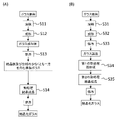
- FIG. 1 is a diagram showing the flow.
- FIG. 1(A) shows the flow of one aspect of the first embodiment of the present invention
- FIG. 1(B) shows the flow of an example of a conventional method.
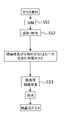
- FIG. 2 is a diagram showing the flow of one aspect of the second embodiment of the present invention.
- FIG. 3 is a diagram showing the flow of one aspect of the third embodiment of the present invention.
- FIG. 4 is a diagram showing the flow of one aspect of the fourth embodiment of the present invention.
- FIG. 5 is a diagram showing the flow of one aspect of the fifth embodiment of the present invention.
- FIG. 6 is a diagram showing the measurement results of small-angle X-ray scattering.
- FIG. 7 is a diagram showing the DSC curve of the glass before crystal growth obtained according to one embodiment of the present invention.
- Crystalized glass refers to glass in which a diffraction peak indicating crystals is recognized by the powder X-ray diffraction method.
- powder X-ray diffractometry for example, CuK ⁇ rays are used to measure the range of 2 ⁇ from 10° to 80°, and when diffraction peaks appear, precipitated crystals are identified by, for example, the three-strength line method.
- glass phase separation refers to the separation of a single-phase glass into two or more glass phases. Whether or not the glass is phase-separated can be judged by SEM (scanning electron microscope). When the glass is phase-separated, it can be observed by SEM that it is separated into two or more phases.
- the state of phase-separated glass includes a binodal state and a spinodal state.
- a binodal state is a phase separation by a nucleation-growth mechanism and is generally spherical.
- the spinodal state is a state in which phase separations are mutually and continuously entangled in three dimensions with some degree of regularity.
- “has a peak in small-angle X-ray scattering analysis” means the value obtained by dividing the highest Intensity by the Intensity when Q (nm -1 ) is 3, [highest Intensity]/ It means that [Intensity when Q(nm ⁇ 1 ) is 3] is greater than 1.
- SAXS small angle X-ray scattering
- amorphous glass is glass that does not contain a crystalline phase, and refers to glass in which no diffraction peak indicating crystals is observed by powder X-ray diffractometry.
- amorphous glass and “crystallized glass” are sometimes simply referred to as "glass”.
- the glass composition is expressed in mol% based on oxides. Further, in this specification, when the glass composition is simply described as “%”, it means mol%. In addition, the phrase “substantially free” of the glass composition means that it is below the level of impurities contained in the raw materials and the like, that is, it is not added intentionally. Specifically, it is less than 0.1%, for example. Moreover, in this specification, “% by mass” and “% by weight” are synonymous. In the present specification, the numerical range “to” includes upper and lower limits.
- the first embodiment of the present invention is characterized by including the following steps (a1) to (a4).
- (a1) a step of melting glass raw materials to obtain molten glass;
- FIG. 1 is a flow diagram showing one aspect of the first embodiment.
- frit is melted to obtain molten glass in step S11.
- the molten glass is formed into a predetermined shape by a forming means to obtain a glass molded body.
- the glass compact is slowly cooled to obtain a base glass containing at least one of crystal nuclei and phase separation.
- the raw glass sheet is heat-treated to grow crystals, and then slowly cooled to obtain crystallized glass.
- step S31 frit is melted in step S31 to obtain molten glass.
- step 32 the molten glass is formed into a predetermined shape by forming means, and in step 33, it is slowly cooled to obtain a glass product.
- the glass product is subjected to a first heat treatment to form nuclei in step S34, and a second heat treatment to grow crystals in step S35, followed by slow cooling to obtain crystallized glass.
- Step (a1) is a step of preparing glass raw materials and melting them to obtain molten glass.
- a known melting means can be used for melting the glass. Specifically, for example, molten glass is obtained by continuously supplying frit into a melting furnace and melting in a high temperature region. A preferable glass composition in the present invention will be described later.
- the temperature at which the frit is melted can be appropriately set depending on the composition of the frit, etc. In order to obtain a homogeneous glass, it is typically preferably 1200° C. or higher, more preferably 1300° C. or higher, and still more preferably 1400° C. °C or higher, particularly preferably 1450°C or higher, most preferably 1500°C or higher. In consideration of erosion and damage of the melting equipment, the melting temperature of the frit is preferably 1700° C. or lower, more preferably 1600° C. or lower, still more preferably 1550° C. or lower, and particularly preferably 1500° C. or lower.
- T1 The temperature at which the frit is melted in step (a1) is defined as T1, and crystal nuclei
- T2 is the temperature for obtaining the base glass containing at least one of phase splitting and phase splitting
- T1 is preferably higher than T2.
- T1-T2 (° C.) is preferably 500° C. or higher, more preferably 600° C. or higher, and still more preferably 700° C. in order to stably form at least one of crystal nuclei and phase separation. °C or higher. Also, if (T1-T2) (°C) is too large, the glass will crack during molding, and it will be difficult to produce at least one of crystal nuclei and phase separation. It is 900° C. or lower, more preferably 800° C. or lower.
- the molding means is not particularly limited, and examples thereof include molding molds.
- the material of the molding mold is not limited, and examples include various heat-resistant alloys (e.g., stainless steel), superhard materials containing tungsten carbide as a main component, various ceramics (e.g., silicon carbide, silicon nitride, etc.), and composite materials containing carbon. is mentioned.
- step (a2) specifically includes, for example, an aspect in which a glass molded body is obtained by pouring molten glass into a molding mold and continuously withdrawing glass molded bodies from the molding mold.
- the shape of the glass molded body is not particularly limited, and examples thereof include a rectangular parallelepiped.
- the cross-sectional shape of the glass molded body is not particularly limited, and examples thereof include rectangular, square, elliptical, and circular.
- the thickness of the glass molded body can be adjusted by adjusting the amount of molten glass supplied to the forming means and the height of the forming means.
- the width of the molding means can be the width of the glass molding.
- the thickness of the glass molded body is preferably 0.5 mm or more, more preferably 0.7 mm or more, and even more preferably 0.9 mm or more. Also, the thickness of the glass molded body is preferably 50 mm or less, more preferably 45 mm or less, still more preferably 40 mm or less, and particularly preferably 35 mm or less. When the thickness of the glass molded body is within the above range, it is easy to form at least one of crystal nuclei and phase separation in the raw glass obtained by slowly cooling the glass molded body.
- the thickness of the glass is preferably 5 mm or more, more preferably 10 mm or more, still more preferably 15 mm or more, and particularly preferably 20 mm. That's it.
- the width of the glass molded body is preferably 100 mm or more, more preferably 150 mm or more, still more preferably 200 mm or more, particularly preferably 300 mm or more, and most preferably 400 mm or more.
- the upper limit of the width of the glass molded body is not particularly limited, but from the viewpoint of handling, it is preferably 5000 mm or less, more preferably 3000 mm or less, even more preferably 1000 mm or less, and particularly preferably 500 mm or less.
- (a3) A step of slowly cooling the glass shaped body to obtain a raw glass sheet containing at least one of crystal nuclei and phase separation. This is a step of generating and/or phase-separating crystal nuclei in the glass compact by cooling to obtain a base glass containing at least one of crystal nuclei and phase-separating.
- the base glass contains at least one of crystal nuclei and phase separation, and preferably contains at least crystal nuclei.
- Specific examples of the base glass include base glass containing only one of crystal nuclei and phase separation, and base glass containing both crystal nuclei and phase separation, with base glass containing only crystal nuclei being preferred.
- crystal nuclei are generated and/or phase separation occurs in the glass compact in the raw glass plate can be confirmed by small-angle X-ray scattering analysis of the raw glass plate. Since ordinary glasses are uniformly amorphous, internal scattering is not observed in SAXS measurements. By containing at least one of crystal nuclei and phase separation, the glass becomes a glass containing extremely minute scattering, and scattering is observed.
- the raw glass sheet containing at least one of crystal nuclei and phase separation obtained in step (a3) preferably has a peak in small-angle X-ray scattering analysis.
- peaks obtained by small-angle X-ray scattering analysis [highest Intensity]/[Intensity when Q (nm ⁇ 1 ) is 3] is preferably greater than 1, and 1.1 1.2 or more is more preferable, and 1.3 or more is particularly preferable.
- the base glass containing at least one of crystal nuclei and phase separation obtained in step (a3) preferably has an interparticle distance of 10 to 100 nm between particles present in the glass as determined by small-angle X-ray scattering measurement.
- the distance between particles calculated from small-angle X-ray scattering measurement represents the distance between particles contained in the glass. It is thought that the smaller the distance between particles, the more the particle structure contained in the glass, and the stronger the scattering and the lower the transmittance.
- the distance between particles is preferably 10 nm or more from the viewpoint of suppressing strong scattering and improving transmittance.
- the distance between particles is preferably 100 nm or less in order to promote crystal growth.
- the interparticle distance is preferably 10 nm or more, more preferably 15 nm or more, and still more preferably 20 nm or more.
- the distance between particles is more preferably 80 nm or less, more preferably 70 nm or less, particularly preferably 60 nm or less, extremely preferably 50 nm or less, most preferably 40 nm or less, and particularly preferably 30 nm or less.
- the temperature at which the glass molded body is slowly cooled in step (a3) can be appropriately set so as to include at least one of crystal nuclei and phase separation in consideration of the glass composition and the thickness of the glass molded body, but it is usually glass transition temperature +300. C. or less, more preferably glass transition temperature +200.degree. C. or less, still more preferably glass transition temperature +100.degree.
- the glass before step (a4) it is preferable to slowly cool it to 100°C or less. If the slow cooling temperature is too low, there is a high possibility that the glass molded body will be strained and cracked. Therefore, it is preferable to slowly cool to a temperature of -50 ° C. or higher, more preferably the glass transition temperature or higher, and still more preferably.
- the glass transition temperature is +30°C or higher.
- the time for which the glass molded body is slowly cooled in order to allow the base glass to contain at least one of crystal nuclei and phase separation is preferably 10 minutes or more.
- the time for slow cooling the glass molded body is preferably 8 hours or less, more preferably 6 hours or less, still more preferably 5 hours or less, even more preferably 4 hours or less, particularly preferably 3 hours or less, most preferably 3 hours or less.
- the step (a2) and the step (a3) may be performed simultaneously, or the molten glass may be formed into a predetermined shape by a forming means and slowly cooled to obtain a base glass containing at least one of crystal nuclei and phase separation. good.
- step (a2) and step (a3) are performed simultaneously, specifically, for example, molten glass is poured into a mold, and a glass molded body is continuously pulled out from the mold to be molded and slowly cooled. to obtain a base glass containing at least one of crystal nuclei and phase separation.
- T2 is the temperature at which the base glass containing at least one of crystal nuclei and phase separation is obtained
- T1 be the temperature at which the frit is melted in step (a1)
- T3 be the temperature at which crystallized glass is obtained by heat-treating the base glass in step (a4) to grow crystals.
- T2 is preferably lower than T1 and T3. .
- T1 and T3 it is preferable to have a temperature range lower than T1 and T3 in the temperature range from obtaining molten glass to obtaining raw glass containing at least one of crystal nuclei and phase separation.
- T2 lower than T1 and T3
- the crystal can be grown in a stable glass shape.
- (a4) A step of heat-treating a base glass containing at least one of crystal nuclei and phase separation to obtain crystallized glass by crystal growth.
- the temperature of a raw glass sheet including one is raised to a crystal growth temperature and held for a predetermined time to grow crystals, thereby obtaining crystallized glass.
- the temperature of the heat treatment in step (a4) is preferably crystallization start temperature + 20°C or higher, more preferably crystallization start temperature + 40°C or higher, still more preferably crystallization start temperature, from the viewpoint of stable crystal growth. +60°C or higher.
- the crystallization start temperature is preferably +200°C or less, more preferably +180°C or less, and still more preferably +150°C or less.
- the heat treatment temperature is preferably 400°C or higher, more preferably 500°C or higher, even more preferably 600°C or higher, particularly preferably 650°C or higher, and most preferably 700°C or higher, from the viewpoint of stable crystal growth.
- the heat treatment temperature is preferably 1000° C. or lower, more preferably 900° C. or lower, and still more preferably 800° C. or lower.
- the temperature at which the base glass is heat-treated and the crystal is grown to obtain the crystallized glass is defined as T3, and in the step (a3), or when the steps (a2) and (a3) are performed simultaneously, the step (a2).
- T3 is preferably higher than T2, where T2 is the temperature at which the raw glass containing at least one of crystal nuclei and phase separation is obtained.
- (T3-T2) (° C.) is preferably 10° C. or higher, more preferably 30° C. or higher, still more preferably 30° C. or higher, from the viewpoint that the temperature of T2 is preferably low for crystal growth in a stable glass shape. 50°C or higher. If (T3-T2) (°C) is too large, crystal growth will be vigorous and transparency will be difficult to obtain.
- the heat treatment time in step (a4) is preferably 10 minutes or longer, more preferably 30 minutes or longer, still more preferably 1 hour or longer, particularly preferably 1.5 hours or longer, and 2 hours, in terms of stable crystal growth. The above is most preferable.
- the time is preferably 10 hours or less, more preferably 8 hours or less, still more preferably 6 hours or less, particularly preferably 4 hours or less, and most preferably 3 hours or less. be.
- the second embodiment of the present invention is characterized by including the following steps (b1) to (b3).
- (b1) Step of melting glass raw materials to obtain molten glass
- (b2) Forming the molten glass into a predetermined shape by a forming means and slowly cooling to obtain a base glass containing at least one of crystal nuclei and phase separation.
- Step (b3) A step of heat-treating the base glass containing at least one of the crystal nucleus and the phase separation to allow crystal growth to obtain crystallized glass.
- FIG. 2 is a flow chart showing one aspect of the second embodiment.
- frit is melted to obtain molten glass in step S51.
- step S52 the molten glass is slowly cooled while being formed into a predetermined shape by a forming means to obtain a base glass containing at least one of crystal nuclei and phase separation.
- the raw glass sheet is heat-treated in step S53 to grow crystals, and then slowly cooled to obtain crystallized glass.
- molten glass is poured into a mold, and a glass molded body is continuously pulled out from the mold to be molded and slowly cooled to obtain crystal nuclei and phase separation.
- the third embodiment of the present invention is characterized by including the following steps (c1) to (c3).
- (c1) A step of melting glass raw materials to obtain molten glass.
- (c2) A step of forming the molten glass into a predetermined shape by a forming means and slowly cooling it to obtain a raw glass sheet having a peak in small-angle X-ray scattering analysis.
- (c3) a step of heat-treating the base glass having a peak in the small-angle X-ray scattering analysis to cause crystal growth to obtain crystallized glass;
- FIG. 3 is a flow diagram showing one aspect of the third embodiment.
- frit is melted to obtain molten glass in step S61.
- the molten glass is slowly cooled while being formed into a predetermined shape by a forming means to obtain a raw sheet glass having a peak in small-angle X-ray scattering analysis.
- the raw glass sheet is heat-treated in step S63 to grow crystals, and then slowly cooled to obtain crystallized glass.
- molten glass is poured into a mold, and a glass molded body is continuously pulled out from the mold, molded and slowly cooled, and small-angle X-ray scattering analysis is performed. obtain a base glass having a peak at , and heat-treat the base glass to cause crystal growth to obtain crystallized glass.
- the fourth embodiment of the present invention is characterized by including the following steps (d1) to (d3).
- (d1) A step of melting frit to obtain molten glass
- (d2) Forming the molten glass into a predetermined shape by a forming means and slowly cooling it so that the distance between particles measured by small-angle X-ray scattering is 10 to 10.
- FIG. 4 is a flow chart showing one aspect of the fourth embodiment.
- frit is melted to obtain molten glass in step S71.
- the molten glass is slowly cooled while being formed into a predetermined shape by a forming means to obtain a blank glass having an interparticle distance of 10 to 100 nm as measured by small-angle X-ray scattering.
- the raw glass sheet is heat-treated in step S73 to grow crystals, and then slowly cooled to obtain crystallized glass.
- molten glass is poured into a mold, and a glass molded body is continuously pulled out from the mold, molded and slowly cooled, and is subjected to small-angle X-ray scattering.
- a base glass having a measured interparticle distance of 10 to 100 nm is obtained, and the base glass is heat-treated to grow crystals to obtain crystallized glass.
- a fifth embodiment of the present invention is a method for producing crystallized glass through temperature processes of temperatures T1, T2 and T3, wherein T2 is lower than T1 and T3 and at least crystal nuclei and phase separation at temperature T2. It is characterized by obtaining a base glass including one. Specifically, it is preferable to have a temperature range lower than T1 and T3 in the temperature range from obtaining molten glass to obtaining raw glass containing at least one of crystal nuclei and phase separation.
- FIG. 5 is a flow diagram showing one aspect of the fifth embodiment.
- the temperature at which the frit is melted to obtain molten glass is T1
- the molten glass is slowly cooled while being formed into a predetermined shape by a forming means to obtain crystals.
- T2 is the temperature at which the raw glass sheet containing at least one of nuclei and/or split phases is obtained
- T3 is the temperature at which the raw glass sheet is heat-treated in step S83 to grow crystals
- T2 is lower than T1 and T3.
- Glass composition The following glass composition A and glass composition B are examples of preferred glass compositions in the manufacturing method of the present embodiment.
- Glass composition A In mol% display based on oxides, 40-70% SiO2 , 10-35% Li 2 O; 1-15% Al 2 O 3 ; 0.5-5 % of P2O5 , 0.5-5% ZrO2 , 0-10% of B2O3 , 0-3% Na 2 O; 0-1% K2O , It preferably contains 0 to 4% SnO 2 .
- Glass composition B In mol% display based on oxides, 50-70% SiO2 , 15-30% Li 2 O, 1-10% Al 2 O 3 , 0.5-5 % of P2O5 , 0.5-8% ZrO2 , 0.1 to 10% MgO, 0-5% of Y2O3 0-10% of B2O3 , 0-3% Na 2 O; 0-1% K2O , It preferably contains 0 to 2% SnO 2 .
- the total amount of SiO 2 , Al 2 O 3 , P 2 O 5 and B 2 O 3 is preferably 60 to 80% in terms of mol % based on oxides.
- SiO 2 , Al 2 O 3 , P 2 O 5 and B 2 O 3 are glass network formers (hereinafter also abbreviated as NWF).
- NWF glass network formers
- a large total amount of these NWFs increases the strength of the glass.
- the total amount of NWFs is preferably 60% or more, more preferably 63% or more, and particularly preferably 65% or more, because it increases the fracture toughness value of the crystallized glass.
- glass containing too many NWFs has a high melting temperature and is difficult to manufacture. Therefore, the total amount of NWFs is preferably 80% or less, more preferably 75%, and even more preferably 70% or less.
- the ratio of the total amount of Li 2 O, Na 2 O and K 2 O to the total amount of NWF, that is, SiO 2 , Al 2 O 3 , P 2 O 5 and B 2 O 3 is 0.20 to 0.60. preferable.
- Li 2 O, Na 2 O and K 2 O are network modifiers, and lowering the ratio to NWF increases the voids in the network and thus improves the impact resistance. Therefore, the ratio of the total amount of Li 2 O, Na 2 O and K 2 O to the total amount of NWF, that is, SiO 2 , Al 2 O 3 , P 2 O 5 and B 2 O 3 is preferably 0.60 or less. 55 or less is more preferable, and 0.50 or less is particularly preferable.
- Li 2 O, Na 2 O and K 2 O are components necessary for chemical strengthening .
- the ratio of the total amount of O and K 2 O to the total amount of NWF, that is, SiO 2 , Al 2 O 3 , P 2 O 5 and B 2 O 3 is preferably 0.20 or more, more preferably 0.25 or more, and 0.25 or more. 30 or more is particularly preferred.
- SiO2 is a component that forms the network structure of glass.
- the content of SiO2 which is a component that increases chemical durability, is preferably 40% or more, more preferably 45% or more, still more preferably 48% or more, even more preferably 50% or more, and particularly preferably 52%. % or more, most preferably 54% or more.
- the content of SiO 2 is preferably 70% or less, more preferably 68% or less, even more preferably 66% or less, and particularly preferably 64% or less in order to improve meltability.
- Al 2 O 3 is a component that increases the surface compressive stress due to chemical strengthening.
- the content of Al 2 O 3 is preferably 1% or more, more preferably 2% or more, still more preferably 3% or more, and 5% or more, 5.5% or more, 6% or more, and 6.5% in preferred order. % or more and 7% or more.
- the content of Al 2 O 3 is preferably 15% or less, more preferably 12% or less, still more preferably 10% or less, and particularly preferably 9% or less, in order to prevent the devitrification temperature of the glass from becoming too high. 8% or less is most preferred.
- Li 2 O is a component that forms surface compressive stress by ion exchange, and is a constituent component of the main crystal.
- the content of Li 2 O is preferably 10% or more, more preferably 14% or more, still more preferably 15% or more, particularly preferably 18% or more, extremely preferably 20% or more, and most preferably 22% or more.
- the content of Li 2 O is preferably 35% or less, more preferably 32% or less, still more preferably 30% or less, particularly preferably 28% or less, and most preferably 26% or less. is.
- Na 2 O is a component that improves the meltability of glass.
- it is preferably 0.5% or more, more preferably 1% or more, and particularly preferably 2% or more. Too much Na 2 O makes it difficult for crystals to precipitate, or when chemically strengthening crystallized glass, the chemical strengthening characteristics deteriorate. % or less is more preferable, and 2.5% or less is even more preferable.
- K 2 O like Na 2 O, is a component that lowers the melting temperature of the glass and may be contained.
- the content is preferably 0.1% or more, more preferably 0.5% or more.
- chemically strengthening crystallized glass if the amount of K 2 O is too large, the chemical strengthening properties deteriorate or the chemical durability deteriorates. More preferably, it is 0.6% or less.
- the total content of Na 2 O and K 2 O, Na 2 O+K 2 O is preferably 1% or more, more preferably 1.5% or more, in order to improve the meltability of the frit.
- the ratio of the K 2 O content to the total content of Li 2 O, Na 2 O and K 2 O (hereinafter also abbreviated as R 2 O) is K 2 O/
- R 2 O is 0.2 or less
- the chemical strengthening characteristics can be enhanced and the chemical durability can be enhanced, which is preferable.
- K 2 O/R 2 O is more preferably 0.15 or less, even more preferably 0.10 or less.
- the R 2 O content is preferably 10% or more, more preferably 15% or more, and even more preferably 20% or more. Also, R 2 O is preferably 29% or less, more preferably 26% or less.
- the content of P 2 O 5 is preferably 0.5% or more, more preferably 1% or more, still more preferably 1.5% or more, particularly preferably 2% or more, very preferably is 2.5% or more.
- the P 2 O 5 content is too high, the phase separation tends to occur during melting and the acid resistance is significantly lowered. It is 8% or less, more preferably 4.5% or less, and particularly preferably 4.2% or less.
- P 2 O 5 is a constituent component of Li 3 PO 4 crystals when the crystallized glass contains Li 3 PO 4 crystals.
- ZrO 2 is a component that increases mechanical strength and chemical durability, and is preferably contained because it significantly improves CS.
- the content of ZrO2 is preferably 0.5% or more, more preferably 1% or more, even more preferably 1.5% or more, particularly preferably 2% or more, most preferably 2.5% or more. is.
- ZrO 2 is preferably 8% or less, more preferably 7.5% or less, even more preferably 7% or less, and particularly preferably 6% or less. If the content of ZrO 2 is too high, the devitrification temperature increases and the viscosity decreases.
- the ZrO 2 content is preferably 5% or less, more preferably 4.5% or less, and 3.5% or less. More preferred.
- ZrO 2 /R 2 O is preferably 0.02 or more, more preferably 0.03 or more, still more preferably 0.04 or more, and particularly preferably 0.1 or more. , 0.15 or more is most preferred.
- ZrO 2 /R 2 O is preferably 0.6 or less, more preferably 0.5 or less, still more preferably 0.4 or less, and particularly preferably 0.3 or less. .
- MgO is a component that stabilizes the glass and also a component that enhances mechanical strength and chemical resistance. Therefore, it is preferable to contain MgO when the Al 2 O 3 content is relatively small.
- the content of MgO is preferably 0.1%, more preferably 1% or more, more preferably 2% or more, still more preferably 3% or more, particularly preferably 4% or more.
- MgO is 7% or less.
- TiO 2 is a component that can promote crystallization and may be contained. When TiO 2 is contained, it is preferably 0.2% or more, more preferably 0.5% or more. On the other hand, in order to suppress devitrification during melting, the content of TiO 2 is preferably 4% or less, more preferably 2% or less, and even more preferably 1% or less.
- SnO 2 has the effect of promoting the formation of crystal nuclei and may be contained.
- SnO 2 is contained, it is preferably 0.5% or more, more preferably 1% or more, still more preferably 1.5% or more, and particularly preferably 2% or more.
- the SnO 2 content is preferably 4% or less, more preferably 3% or less, and even more preferably 2% or less.
- Y 2 O 3 is a component that has the effect of making it difficult for fragments to scatter when the chemically strengthened glass is broken when the crystallized glass is chemically strengthened, and may be contained.
- the content of Y 2 O 3 is preferably 1% or more, more preferably 1.5% or more, still more preferably 2% or more, particularly preferably 2.5% or more, and extremely preferably 3% or more.
- the content of Y 2 O 3 is preferably 5% or less, more preferably 4% or less.
- B 2 O 3 is a component that improves the chipping resistance and meltability of the glass and may be contained.
- the content is preferably 0.5% or more, more preferably 1% or more, and still more preferably 2% or more, in order to improve meltability.
- the content of B 2 O 3 is more preferably 8% or less, still more preferably 6% or less, and particularly preferably 4% or less.
- BaO, SrO, MgO, CaO and ZnO are all components that improve the meltability of the glass and may be contained.
- the total content of BaO, SrO, MgO, CaO and ZnO (hereinafter also abbreviated as BaO + SrO + MgO + CaO + ZnO) is preferably 0.5% or more, more preferably 1% or more, and still more preferably 1.0% or more. 5% or more, particularly preferably 2% or more.
- the content of BaO+SrO+MgO+CaO+ZnO is preferably 8% or less, more preferably 6% or less, still more preferably 5% or less, and particularly preferably 4% or less, because the ion exchange rate decreases.
- BaO, SrO, and ZnO may be contained in order to improve the light transmittance of the crystallized glass by improving the refractive index of the residual glass and bring it closer to the precipitated crystal phase, thereby lowering the haze value.
- the total content of BaO, SrO and ZnO (hereinafter also abbreviated as BaO + SrO + ZnO) is preferably 0.3% or more, more preferably 0.5% or more, further preferably 0.7% or more, and 1% or more. is particularly preferred.
- these components may reduce the ion exchange rate.
- BaO + SrO + ZnO is preferably 2.5% or less, more preferably 2% or less, further preferably 1.7% or less, and 1.5% in order to improve chemical strengthening characteristics. The following are particularly preferred.
- La 2 O 3 , Nb 2 O 5 and Ta 2 O 5 are components that make it difficult for fragments to scatter when the chemically strengthened glass is broken when chemically strengthening the crystallized glass, and increase the refractive index. may be included to When these are contained, the total content of La 2 O 3 , Nb 2 O 5 and Ta 2 O 5 (hereinafter also abbreviated as La 2 O 3 +Nb 2 O 5 +Ta 2 O 5 ) is preferably 0.5% or more, more preferably 1% or more, still more preferably 1.5% or more, and particularly preferably 2% or more.
- La 2 O 3 +Nb 2 O 5 +Ta 2 O 5 is preferably 4% or less, more preferably 3% or less, still more preferably 2% or less, so that the glass is less likely to devitrify during melting. It is preferably 1% or less.
- the glass according to the present embodiment may contain CeO 2 .
- CeO 2 may suppress coloration by oxidizing the glass.
- the content is preferably 0.03% or more, more preferably 0.05% or more, and even more preferably 0.07% or more.
- the content of CeO 2 is preferably 1.5% or less, more preferably 1.0% or less, in order to increase transparency.
- a coloring component may be added within a range that does not impede the achievement of desired properties.
- coloring components include Co3O4 , MnO2 , Fe2O3 , NiO , CuO, Cr2O3 , V2O5 , Bi2O3 , SeO2 , Er2O3 , Nd2O. 3 is mentioned.
- the total content of coloring components is preferably in the range of 1% or less. If it is desired to increase the visible light transmittance of the glass, it is preferred that these components are not substantially contained.
- HfO 2 , Nb 2 O 5 and Ti 2 O 3 may be added in order to increase weather resistance against irradiation with ultraviolet light.
- the total content of HfO 2 , Nb 2 O 5 and Ti 2 O 3 is preferably 1% or less in order to suppress the effects on other properties. 0.5% or less is more preferable, and 0.1% or less is more preferable.
- SO 3 , chlorides, and fluorides may be appropriately contained as clarifiers and the like when melting the glass.
- the total content of components that function as clarifiers is preferably 2% or less, more preferably 2% or less, in terms of % by mass based on oxides, since excessive addition may affect strengthening properties and crystallization behavior. It is 1% or less, more preferably 0.5% or less.
- the lower limit is not particularly limited, it is typically preferably 0.05% or more in total in terms of % by mass based on oxides.
- the content of SO3 is preferably 0.01% or more, more preferably 0.05%, in terms of % by mass based on oxides, because if it is too small, the effect cannot be seen. or more, more preferably 0.1% or more.
- the content of SO3 is preferably 1% or less, more preferably 0.8% or less, and still more preferably 0.6% by mass based on oxides. % or less.
- the content of Cl is preferably 1% or less, and 0.8% by mass based on oxides, because if too much Cl is added, physical properties such as strengthening characteristics may be affected. % or less is more preferable, and 0.6% or less is even more preferable.
- the content of Cl is preferably 0.05% or more, more preferably 0.1%, in terms of % by mass based on oxides, because if it is too small, the effect cannot be seen. or more, more preferably 0.2% or more.
- the content of SnO 2 is preferably 1% or less, and 0.5% or less, in terms of % by mass based on the oxide, because excessive addition affects the crystallization behavior. More preferably, 0.3% or less is even more preferable.
- the content of SnO 2 is preferably 0.02% or more, more preferably 0.02% or more in terms of % by mass based on oxides, because if it is too small, the effect cannot be seen. 05% or more, more preferably 0.1% or more.
- As 2 O 3 is preferably not contained. When Sb 2 O 3 is contained, it is preferably 0.3% or less, more preferably 0.1% or less, and most preferably not contained.
- the crystallized glass obtained by the production method of the present embodiment has a crystallization start temperature (Tx) of -
- the glass transition temperature (Tg) is preferably 200°C or lower, more preferably 150°C or lower, still more preferably 120°C or lower, and most preferably 100°C or lower.
- the crystallization initiation temperature (Tx) - glass transition temperature (Tg) is preferably 50°C or higher, more preferably 70°C or higher, and even more preferably 80°C or higher. , 90° C. or higher is most preferred.
- Tx and Tg are determined from the DSC curve obtained by crushing the glass and using a differential scanning calorimeter.
- FIG. 7 is an example of the DSC curve of the plain glass (glass before crystal growth) obtained according to one embodiment of the present invention.
- the temperature at which the curve rises due to crystallization is defined as the crystallization start temperature (Tx).
- Crystals contained in the present crystallized glass are not particularly limited, and examples thereof include lithium phosphate-based crystals.
- Lithium phosphate-based crystals include, for example, Li 3 PO 4 crystals and Li 4 SiO 4 crystals.
- the present crystallized glass may contain, for example, both Li 3 PO 4 crystals and Li 4 SiO 4 crystals, or may contain either one as a main crystal. Further, the present crystallized glass may have, for example, solid solution crystals of Li 3 PO 4 and Li 4 SiO 4 as main crystals, or solid solution crystals of either Li 3 PO 4 or Li 4 SiO 4 as main crystals.
- This crystallized glass may be cut to an appropriate length as necessary.
- a known cutting method can be used, and examples thereof include a cutting method using a diamond cutter and a cutting method using a water jet.
- This crystallized glass may be ground and polished as necessary to form a glass substrate.
- the chemical strengthening treatment after that is performed. is preferable because a compressive stress layer is also formed on the end face by .
- the present crystallized glass may have a shape other than a plate shape depending on the product or application to which it is applied.
- the glass plate may have a fringing shape or the like in which the thickness of the outer periphery is different.
- the form of the glass plate is not limited to these.
- the two main surfaces may not be parallel to each other, and one or both of the two main surfaces may be curved in whole or in part. More specifically, the glass plate may be, for example, a flat glass plate without warping, or a curved glass plate having a curved surface.
- This crystallized glass may be chemically strengthened glass by chemical strengthening treatment (ion exchange treatment).
- Chemical strengthening is performed by ion exchange treatment.
- the chemical strengthening treatment can be performed, for example, by immersing the glass sheet in molten salt such as potassium nitrate heated to 360-600° C. for 0.1-500 hours.
- the heating temperature of the molten salt is preferably 375 to 500° C.
- the immersion time of the glass plate in the molten salt is preferably 0.3 to 200 hours.
- molten salts for chemical strengthening include nitrates, sulfates, carbonates, and chlorides.
- nitrates include lithium nitrate, sodium nitrate, potassium nitrate, cesium nitrate, and silver nitrate.
- Sulfates include, for example, lithium sulfate, sodium sulfate, potassium sulfate, cesium sulfate, and silver sulfate.
- Carbonates include, for example, lithium carbonate, sodium carbonate, potassium carbonate and the like.
- Chlorides include, for example, lithium chloride, sodium chloride, potassium chloride, cesium chloride, and silver chloride. These molten salts may be used alone, or may be used in combination.
- the processing conditions for the chemical strengthening treatment are not particularly limited, and appropriate conditions may be selected in consideration of the composition (characteristics) of the glass, the type of molten salt, and the desired chemical strengthening characteristics. Also, the chemical strengthening treatment may be performed only once, or the chemical strengthening treatment may be performed a plurality of times under two or more different conditions (multi-stage strengthening).
- crystallized glass used in electronic devices such as mobile devices such as mobile phones and smartphones.
- cover glass for electronic devices such as televisions, personal computers, and touch panels that are not intended for portability, elevator wall surfaces, and wall (full-surface display) glass for buildings such as houses and buildings.
- construction materials such as window glass, table tops, interiors of automobiles and airplanes, cover glasses thereof, and curved housings.
- a method for producing crystallized glass including the following (a1) to (a4). (a1) melting glass raw materials to obtain molten glass; (a2) forming the molten glass into a predetermined shape by forming means to obtain a glass molded body; (a3) slowly cooling the glass molded body, Obtaining a base glass containing at least one of crystal nuclei and phase separation (a4) Heat-treating the base glass containing at least one of the crystal nuclei and phase separation to allow crystal growth to obtain crystallized glass [2] Said ( a2) and the above (a3) are performed simultaneously, and the molten glass is formed into a predetermined shape by a forming means and slowly cooled to obtain a base glass containing at least one of the crystal nuclei and the phase separation, [1] The manufacturing method described in .
- a method for producing crystallized glass including the following (d1) to (d3).
- (d1) frit is melted to obtain molten glass;
- (d2) the molten glass is molded into a predetermined shape by molding means and slowly cooled so that the distance between particles measured by small-angle X-ray scattering is 10 to 10.
- Temperature T1 , T2 and T3 to produce crystallized glass comprising: A method for producing crystallized glass, wherein the temperature T2 is lower than the temperatures T1 and T3, and comprising obtaining a base glass containing at least one of crystal nuclei and phase separation at the temperature T2.
- Example 1 Crystallized glass was produced and evaluated by the following melting process, forming process, slow cooling process and crystal growth process.
- Example 1 is an example. [Melting process] 61 mol % SiO2 , 5 mol % Al2O3 , 21 mol % Li2O , 2 mol % Na2O , 2 mol % P2O5 , 5 mol MgO, based on oxides %, 3 mol % of ZrO 2 , 1 mol % of Y 2 O 3 and 0.3 mol % of SO 3 were weighed and uniformly mixed. The mixed raw materials were put into a platinum crucible, put into an electric furnace at 1600° C. and melted for about 5 hours to obtain molten glass.
- Qmax is the value of Q(nm ⁇ 1 ) (scattering vector) corresponding to the peak of the maximum value of the Intensity of the SAXS data, which clearly has a peak as shown in FIG. A clear peak means that [highest Intensity]/[Intensity when Q(nm ⁇ 1 ) is 3] is greater than one.
- the raw glass sheet had peaks in the small-angle X-ray scattering analysis, indicating that at least one of crystal nuclei and phase separation was formed. Also, Qmax was 0.22 nm ⁇ 1 and the average interparticle distance was 29 nm.
- DSC DSC A raw glass plate obtained using an agate mortar was pulverized to a particle size of 106 ⁇ m to 180 ⁇ m to obtain a powder. About 80 mg of the obtained powder was placed in a platinum cell and heated from room temperature to 1100° C. at a rate of 10° C./min. A curve was measured. The results are shown in FIG.
- Tg was 512°C and Tx was 612°C.
- Crystallized glass was obtained in the same manner as in Example 1, except that the thickness of the base glass was changed to 50 mm in the molding process of Example 1, and was designated as Example 2.
- the haze at the center of the thickness was measured. As a result, haze was better in Example 1 in which the thickness of the base glass was 20 mm than in Example 2 in which the thickness was 50 mm.
Landscapes
- Chemical & Material Sciences (AREA)
- Engineering & Computer Science (AREA)
- Materials Engineering (AREA)
- Organic Chemistry (AREA)
- Ceramic Engineering (AREA)
- Crystallography & Structural Chemistry (AREA)
- Thermal Sciences (AREA)
- Physics & Mathematics (AREA)
- Manufacturing & Machinery (AREA)
- Dispersion Chemistry (AREA)
- Geochemistry & Mineralogy (AREA)
- General Chemical & Material Sciences (AREA)
- Chemical Kinetics & Catalysis (AREA)
- Life Sciences & Earth Sciences (AREA)
- Re-Forming, After-Treatment, Cutting And Transporting Of Glass Products (AREA)
- Glass Compositions (AREA)
Priority Applications (3)
| Application Number | Priority Date | Filing Date | Title |
|---|---|---|---|
| CN202280038974.1A CN117440936A (zh) | 2021-05-31 | 2022-05-25 | 微晶玻璃的制造方法 |
| JP2023525760A JPWO2022255198A1 (https=) | 2021-05-31 | 2022-05-25 | |
| US18/520,792 US20240092678A1 (en) | 2021-05-31 | 2023-11-28 | Crystallized glass manufacturing method |
Applications Claiming Priority (2)
| Application Number | Priority Date | Filing Date | Title |
|---|---|---|---|
| JP2021091740 | 2021-05-31 | ||
| JP2021-091740 | 2021-05-31 |
Related Child Applications (1)
| Application Number | Title | Priority Date | Filing Date |
|---|---|---|---|
| US18/520,792 Continuation US20240092678A1 (en) | 2021-05-31 | 2023-11-28 | Crystallized glass manufacturing method |
Publications (1)
| Publication Number | Publication Date |
|---|---|
| WO2022255198A1 true WO2022255198A1 (ja) | 2022-12-08 |
Family
ID=84323162
Family Applications (1)
| Application Number | Title | Priority Date | Filing Date |
|---|---|---|---|
| PCT/JP2022/021446 Ceased WO2022255198A1 (ja) | 2021-05-31 | 2022-05-25 | 結晶化ガラスの製造方法 |
Country Status (4)
| Country | Link |
|---|---|
| US (1) | US20240092678A1 (https=) |
| JP (1) | JPWO2022255198A1 (https=) |
| CN (1) | CN117440936A (https=) |
| WO (1) | WO2022255198A1 (https=) |
Citations (5)
| Publication number | Priority date | Publication date | Assignee | Title |
|---|---|---|---|---|
| JPS59223243A (ja) * | 1983-05-31 | 1984-12-15 | Inax Corp | 結晶化ガラス物品 |
| JP2000508290A (ja) * | 1996-04-09 | 2000-07-04 | ボーテック・コーポレイション | フライアッシュからのセラミックタイルの製造 |
| JP2010001201A (ja) * | 2007-12-21 | 2010-01-07 | Ohara Inc | 結晶化ガラス |
| US20180099901A1 (en) * | 2016-10-12 | 2018-04-12 | Corning Incorporated | Glass ceramics |
| JP2018158866A (ja) * | 2017-03-23 | 2018-10-11 | 株式会社オハラ | 連続結晶化ガラス成形体の製造方法および装置 |
Family Cites Families (7)
| Publication number | Priority date | Publication date | Assignee | Title |
|---|---|---|---|---|
| US5486495A (en) * | 1994-12-23 | 1996-01-23 | The United States Of America As Represented By The Secretary Of The Navy | Germanate glass ceramic |
| CN1060456C (zh) * | 1996-03-30 | 2001-01-10 | 大连理工大学 | 快速微晶化的氟碱钙硅石微晶玻璃及其生产方法 |
| DE102004048041B4 (de) * | 2004-09-29 | 2013-03-07 | Schott Ag | Verwendung eines Glases oder einer Glaskeramik zur Lichtwellenkonversion |
| US20070071956A1 (en) * | 2005-09-27 | 2007-03-29 | Hoya Corporation | Process for the production of glass shaped material, crystallized glass material, process for the production of crystallized glass material, process for the production of magnetic disk substrate blank, process for the production of magnetic disk substrate and process for the production of magnetic disk |
| JP2011157265A (ja) * | 2010-01-08 | 2011-08-18 | Nippon Electric Glass Co Ltd | 結晶化ガラスの製造方法 |
| JP5603207B2 (ja) * | 2010-11-08 | 2014-10-08 | 湖州大享玻璃制品有限公司 | 結晶化ガラスの連続成形方法および結晶化ガラスの連続成形装置 |
| CN112608032B (zh) * | 2018-10-26 | 2022-04-22 | 成都光明光电股份有限公司 | 微晶玻璃、微晶玻璃制品及其制造方法 |
-
2022
- 2022-05-25 JP JP2023525760A patent/JPWO2022255198A1/ja active Pending
- 2022-05-25 CN CN202280038974.1A patent/CN117440936A/zh active Pending
- 2022-05-25 WO PCT/JP2022/021446 patent/WO2022255198A1/ja not_active Ceased
-
2023
- 2023-11-28 US US18/520,792 patent/US20240092678A1/en active Pending
Patent Citations (5)
| Publication number | Priority date | Publication date | Assignee | Title |
|---|---|---|---|---|
| JPS59223243A (ja) * | 1983-05-31 | 1984-12-15 | Inax Corp | 結晶化ガラス物品 |
| JP2000508290A (ja) * | 1996-04-09 | 2000-07-04 | ボーテック・コーポレイション | フライアッシュからのセラミックタイルの製造 |
| JP2010001201A (ja) * | 2007-12-21 | 2010-01-07 | Ohara Inc | 結晶化ガラス |
| US20180099901A1 (en) * | 2016-10-12 | 2018-04-12 | Corning Incorporated | Glass ceramics |
| JP2018158866A (ja) * | 2017-03-23 | 2018-10-11 | 株式会社オハラ | 連続結晶化ガラス成形体の製造方法および装置 |
Also Published As
| Publication number | Publication date |
|---|---|
| US20240092678A1 (en) | 2024-03-21 |
| JPWO2022255198A1 (https=) | 2022-12-08 |
| CN117440936A (zh) | 2024-01-23 |
Similar Documents
| Publication | Publication Date | Title |
|---|---|---|
| JP2025124861A (ja) | 高周波デバイス用ガラス基板と高周波デバイス用回路基板 | |
| JP2024098122A (ja) | 強化ガラス及び強化用ガラス | |
| CN111670172A (zh) | 化学强化用玻璃 | |
| JPWO2020121888A1 (ja) | 化学強化ガラス板、並びに化学強化ガラスを含むカバーガラス及び電子機器 | |
| JP2025102978A (ja) | 化学強化用ガラス | |
| JP7722372B2 (ja) | ガラスおよび化学強化ガラス | |
| JPWO2016104446A1 (ja) | ガラス及び化学強化ガラス | |
| WO2022181812A1 (ja) | 化学強化ガラスの製造方法及び化学強化ガラス | |
| US20260028269A1 (en) | Glass ceramic having excellent acid and alkali resistance, and preparation method therefor and use thereof | |
| WO2023090177A1 (ja) | 結晶化ガラス | |
| US20230365456A1 (en) | Glass ceramic and chemically strengthened glass | |
| JP2025137782A (ja) | 結晶化ガラス | |
| JP2024086691A (ja) | 透明なガラスセラミックス、特にカバープレートとしてのガラスセラミックス | |
| US20230082423A1 (en) | Glass, crystallized glass and chemically strengthened glass | |
| JP2025159118A (ja) | 化学強化ガラス物品およびその製造方法 | |
| US20240391826A1 (en) | Glass, chemically strengthened glass, and cover glass | |
| WO2022255198A1 (ja) | 結晶化ガラスの製造方法 | |
| JP2021042116A (ja) | 結晶化ガラスおよび強化結晶化ガラス | |
| JP2024178979A (ja) | 化学強化ガラスおよびカバーガラス | |
| WO2024257761A1 (ja) | 強化結晶化ガラス、およびその製造方法 | |
| JP2025091351A (ja) | 化学強化ガラス、化学強化ガラスの製造方法、カバーガラス、太陽電池モジュール | |
| CN118679126A (zh) | 玻璃、化学强化玻璃以及保护玻璃 | |
| JP2024086690A (ja) | 透明なガラスセラミックス、特にカバープレートとしてのガラスセラミックス | |
| WO2025254110A1 (ja) | ガラス、化学強化ガラス、ガラスの製造方法および化学強化ガラスの製造方法 | |
| JP2025146884A (ja) | 化学強化ガラスおよび電子機器筐体 |
Legal Events
| Date | Code | Title | Description |
|---|---|---|---|
| 121 | Ep: the epo has been informed by wipo that ep was designated in this application |
Ref document number: 22815948 Country of ref document: EP Kind code of ref document: A1 |
|
| WWE | Wipo information: entry into national phase |
Ref document number: 2023525760 Country of ref document: JP |
|
| WWE | Wipo information: entry into national phase |
Ref document number: 202280038974.1 Country of ref document: CN |
|
| NENP | Non-entry into the national phase |
Ref country code: DE |
|
| 122 | Ep: pct application non-entry in european phase |
Ref document number: 22815948 Country of ref document: EP Kind code of ref document: A1 |