WO2022249249A1 - 映像解析装置、映像解析システム、及び記憶媒体 - Google Patents
映像解析装置、映像解析システム、及び記憶媒体 Download PDFInfo
- Publication number
- WO2022249249A1 WO2022249249A1 PCT/JP2021/019643 JP2021019643W WO2022249249A1 WO 2022249249 A1 WO2022249249 A1 WO 2022249249A1 JP 2021019643 W JP2021019643 W JP 2021019643W WO 2022249249 A1 WO2022249249 A1 WO 2022249249A1
- Authority
- WO
- WIPO (PCT)
- Prior art keywords
- block
- frame
- video
- machining program
- characteristic
- Prior art date
- Legal status (The legal status is an assumption and is not a legal conclusion. Google has not performed a legal analysis and makes no representation as to the accuracy of the status listed.)
- Ceased
Links
Images






Classifications
-
- G—PHYSICS
- G05—CONTROLLING; REGULATING
- G05B—CONTROL OR REGULATING SYSTEMS IN GENERAL; FUNCTIONAL ELEMENTS OF SUCH SYSTEMS; MONITORING OR TESTING ARRANGEMENTS FOR SUCH SYSTEMS OR ELEMENTS
- G05B19/00—Program-control systems
- G05B19/02—Program-control systems electric
- G05B19/18—Numerical control [NC], i.e. automatically operating machines, in particular machine tools, e.g. in a manufacturing environment, so as to execute positioning, movement or co-ordinated operations by means of program data in numerical form
- G05B19/408—Numerical control [NC], i.e. automatically operating machines, in particular machine tools, e.g. in a manufacturing environment, so as to execute positioning, movement or co-ordinated operations by means of program data in numerical form characterised by data handling or data format, e.g. reading, buffering or conversion of data
-
- G—PHYSICS
- G05—CONTROLLING; REGULATING
- G05B—CONTROL OR REGULATING SYSTEMS IN GENERAL; FUNCTIONAL ELEMENTS OF SUCH SYSTEMS; MONITORING OR TESTING ARRANGEMENTS FOR SUCH SYSTEMS OR ELEMENTS
- G05B19/00—Program-control systems
- G05B19/02—Program-control systems electric
- G05B19/18—Numerical control [NC], i.e. automatically operating machines, in particular machine tools, e.g. in a manufacturing environment, so as to execute positioning, movement or co-ordinated operations by means of program data in numerical form
- G05B19/406—Numerical control [NC], i.e. automatically operating machines, in particular machine tools, e.g. in a manufacturing environment, so as to execute positioning, movement or co-ordinated operations by means of program data in numerical form characterised by monitoring or safety
- G05B19/4063—Monitoring general control system
-
- G—PHYSICS
- G06—COMPUTING OR CALCULATING; COUNTING
- G06T—IMAGE DATA PROCESSING OR GENERATION, IN GENERAL
- G06T7/00—Image analysis
- G06T7/20—Analysis of motion
-
- G—PHYSICS
- G06—COMPUTING OR CALCULATING; COUNTING
- G06V—IMAGE OR VIDEO RECOGNITION OR UNDERSTANDING
- G06V10/00—Arrangements for image or video recognition or understanding
- G06V10/40—Extraction of image or video features
- G06V10/60—Extraction of image or video features relating to illumination properties, e.g. using a reflectance or lighting model
-
- G—PHYSICS
- G06—COMPUTING OR CALCULATING; COUNTING
- G06V—IMAGE OR VIDEO RECOGNITION OR UNDERSTANDING
- G06V20/00—Scenes; Scene-specific elements
- G06V20/40—Scenes; Scene-specific elements in video content
- G06V20/46—Extracting features or characteristics from the video content, e.g. video fingerprints, representative shots or key frames
Definitions
- the present invention relates to a video analysis device, a video analysis system, and a computer-readable storage medium.
- Patent Document 1 ⁇ a machine data acquisition unit that acquires one or more types of machine data related to the operation of the machine in chronological order based on first time information, and a state of the machine based on second time information.
- a measurement data acquisition unit that acquires one or more types of measurement data in chronological order; a second extraction unit for extracting from any of the measurement data a time point at which a preset feature indicating the predetermined event appears; a time point extracted by the first extraction unit and the second extraction unit; and an output unit for outputting the machine data and the measurement data in synchronization with the time points extracted by the extracting unit.
- Patent Document 1 as a first example of a synchronization method, a torque command value included in machine data and acoustic data included in measurement data are synchronized. Specifically, using torque command values as machine data and acoustic data or acceleration data as measurement data, the start and end of machining are extracted, and the machine data and measurement data are synchronized.
- image analysis can detect the timing at which the tool contacts or separates from the workpiece.
- Patent Literature 1 The purpose of Patent Literature 1 is to synchronize multiple types of time-series data. Torque command values, acoustic data, acceleration data, and moving image data are disclosed as the multiple types of time-series data. In Patent Literature 1, these data are synchronized using time information. Correlating data obtained during processing, such as torque command values and acceleration data, with moving image data in this way is useful for analysis of processing. However, the technique disclosed in Patent Literature 1 does not associate the data acquired during processing with the processing program.
- a video analysis device includes a video acquisition unit that acquires a processed video of a numerical control device, a processing program acquisition unit that acquires a processing program of the numerical control device, and a frame included in the processed video. , a video feature detection unit that detects a frame with a feature, a machining program feature detection unit that detects a block that commands a machine tool to perform a feature operation from among the blocks included in the machining program, and a frame with the feature. and a data linking unit that links a block that commands a machine tool to perform a characteristic operation.
- a video analysis system that is one aspect of the present disclosure includes a video acquisition unit that acquires a processed video of a numerical control device, a processing program acquisition unit that acquires a processing program of the numerical control device, and a frame included in the processed video. , a video feature detection unit that detects a frame with a feature, a machining program feature detection unit that detects a block that commands a machine tool to perform a feature operation from among the blocks included in the machining program, and a frame with the feature. and a data linking unit that links a block that commands a machine tool to perform a characteristic operation.
- a storage medium which is one aspect of the present disclosure, acquires a processed image of a numerical controller, acquires a processing program of the numerical controller, and processes frames included in the processed image by being executed by one or more processors. Among them, a frame with a characteristic is detected, and among the blocks included in the machining program, a block that commands a characteristic motion to the machine tool is detected, and a characteristic frame and a characteristic motion are commanded to the machine tool. It stores computer readable instructions that associate blocks to be executed.
- FIG. 10 is a diagram showing an example of luminance change within a region of interest; It is a figure explaining a motion change.
- FIG. 10 is a diagram showing movement of feature points within a region of interest; It is a figure explaining the block which commands a characteristic operation
- FIG. 4 is a diagram showing the relationship between marked frames, the number of frames, and time; FIG.
- FIG. 4 is a diagram showing the relationship between blocks that command a machine tool to perform characteristic operations and execution times of the blocks;
- FIG. 10 is a diagram showing an example in which the number of blocks that command a machine tool to perform characteristic operations is greater than the number of marks; 4 is a flowchart for explaining the operation of the numerical control device;
- FIG. 10 is a diagram showing an example of displaying an image being processed and blocks of a processing program in association with each other; It is a figure explaining the hardware constitutions of a numerical controller.
- a video analysis device is implemented in a numerical control device 100.
- the video analysis device may be mounted on an information processing device such as a PC (personal computer), server, or mobile terminal. Further, the video analysis system 1000 may be configured such that the components of the video analysis device perform distributed processing with a plurality of information processing devices on a network.
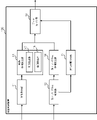
- FIG. 2 is a block diagram of the numerical controller 100.
- the numerical controller 100 includes a video acquisition unit 11 , a processing program acquisition unit 12 , a video feature detection unit 13 , a processing program feature detection unit 14 , an execution time calculation unit 15 and a data linking unit 16 .
- the image acquisition unit 11 acquires the processing image of the machine tool.
- the processed image may be obtained directly from an image captured by a camera, or may be obtained from the storage device of the numerical control device 100 or an external storage device.
- the machining program acquisition unit 12 acquires a machining program.
- the machining program is acquired from the storage device of the numerical controller 100 or an external storage device.
- the image feature detection unit 13 detects a characteristic frame from the frames included in the processed image, and marks the detected frame. Marking refers to, for example, embedding information indicating detection within a detected frame, or externally storing the frame number, time information, or the frame itself.
- the video feature detector 13 includes a manual detector 17 and an automatic detector 18 .
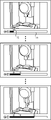
- the manual detection unit 17 presents the image to the operator and marks the image specified by the operator. For example, as shown in FIG. 3, an image being processed is displayed, and a seek bar 31 is displayed below the image. When the operator looks at the image, and if a characteristic image appears, such as a frame of tool exchange or a frame of ON/OFF of the machine light, marking is instructed.
- the seek bar in FIG. 3 displays anchors 32 indicating marked locations.
- the automatic detection unit 18 marks characteristic images using an image processing technique.
- luminance change and motion change are exemplified as image processing techniques, but are not limited thereto.
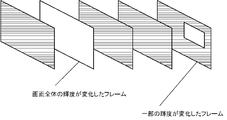
- FIG. 4 is an example of luminance change.
- Examples of luminance changes include a case where the luminance of the entire image changes, a case where the ratio of a specific luminance value changes, and a case where the luminance of the attention area changes.
- An example in which the luminance of the entire image changes is turning on/off the internal light of a machine tool. Machine lights in machine tools are normally off. When the operator is working, turn on the light inside the machine. When the cabin lights are turned on, the entire cabin becomes brighter and the brightness increases. Conversely, when the cabin light is turned off, the entire cabin becomes dark and the brightness decreases.
- the automatic detection section marks a frame in which the brightness of the entire video has changed significantly as a characteristic frame.
- FIG. 5 shows an example of detecting changes in brightness of a region of interest.
- it is set to a region of interest 51 where coolant is discharged.
- the coolant brightness ratio in the region of interest 51 is high, but when the coolant is OFF, the coolant brightness ratio in the image decreases.
- the brightness changes greatly depending on whether the coolant is turned on or off.
- the automatic detection unit 18 compares the sum of the amount of change in luminance of all pixels in the region of interest with a threshold, and detects a frame when the sum of the amount of change in luminance of all pixels in the region of interest exceeds the threshold. Mark as a frame.
- FIG. 6 is an example of motion change.
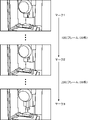
- image processing techniques are used to detect feature points and detect displacement vectors of the feature points.
- the automatic detection unit detects a frame 61 in which the movement amount of the feature point is large and a frame 62 in which the movement direction of the feature point changes greatly. Movement of feature points may be extracted from the entire image or may be extracted from the attention area 52 of the image.
- Feature point detection methods include, but are not limited to, SIFT (Scale-Invariant Feature Transform) and SURF (Speeded-UP Robust Features). SIFT and SURF detect corners of objects as feature points.
- the machining program feature detection unit 14 detects blocks (lines) of the machining program that command the machine tool to perform a characteristic operation.
- a block that commands a machine tool to perform a characteristic operation is, for example, a block in which a specific M code or a code with a large amount of change in axis movement is described.
- a specific M code instructs discharge/stop of coolant, storage of tools, tool change, work change, and the like.
- the machining program feature detection unit 14 extracts from the machining program a block in which an M code for commanding such a characteristic operation is described.
- Codes with a large amount of change in axis movement are [1] parts where the movement of the axis is reversed, [2] parts where the movement direction of the axis changes more than the threshold value, and [3] where the speed changes greatly, such as from cutting feed to rapid feed. This is the part to do.
- the amount of change in axis movement is known from the machining program. In the machining program of FIG. 8, the movement of the axis is reversed in the block described as "X-10.”, which satisfies the condition [1]. In the block described as "Y10.", the moving direction of the axis changes from the X-axis direction to the Y-axis direction, satisfying the condition [2].
- the machining program feature detection unit 14 thus detects a block that commands the machine tool to perform a feature operation.
- the execution time calculator 15 calculates the execution time of each block of the machining program.
- Methods of calculating the execution time include a method of calculating mathematically, a method of calculating by simulation, a method of calculating by actual measurement, and the like.
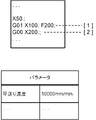
- the mathematical calculation method uses the command coordinate values, the feed rate, and the parameter information of the numerical controller 100 written in the machining program.
- a method of calculating the execution time will be described with reference to the machining program in FIG. As an example, the execution times of [1] 2nd line block "G01 X100.F200;” and [2] 3rd line block "G00 X200.;” are calculated. It is assumed that "rapid traverse speed: 10000 mm/min" is set for executing this machining program.
- the data linking unit 16 links the frames detected by the video feature detection unit 13 and the blocks detected by the processing program feature detection unit 14 .
- marks 1, 2 and 3 are marked. There are 1000 frames between mark 1 and mark 2. Assuming that the frame rate is 30 frames per second, it can be calculated that the interval between mark 1 and mark 2 is 33 seconds. The frame rate differs depending on the image compression method. Also, there are 2000 frames between mark 2 and mark 3 . Assuming that the frame rate is 30 frames per second, the time between mark 2 and mark 3 can be calculated as 66 seconds.
- Fig. 11 shows the relationship between the blocks of the machining program that command the machine tool to perform characteristic operations and the execution time.
- "M6” is a block that commands the machine tool to perform a characteristic operation of tool change.
- block A, block B, and block C are extracted as blocks that command the machine tool to perform characteristic operations.
- Block A describes "M6: Tool Change”
- Block B describes "M6: Tool Change”
- Block C describes "M9: Coolant OFF”.
- the data associating unit 16 associates a characteristic frame with a block that instructs a machine tool to perform a characteristic operation.
- mark 1 and block A, mark 2 and block B, and mark 3 and block C are linked.
- the data linking unit 16 links the remaining frames and blocks based on the linked frames and blocks.
- the block execution time is used for the correspondence.
- the corresponding frame can be calculated from the execution time of the block and the frame rate.
- the execution time of the block on the first line is 5 seconds
- the execution time of the block on the second line is 5 seconds
- the execution time of the block on the third line is 10 seconds.
- the product of execution time and frame rate is the number of frames per block. In this way, frames and blocks are associated with each other.
- the data linking unit 16 uses the execution time to associate frames with blocks, and excludes frames with no link partner and blocks with no link partner. 11 and 12 are examples in which the number of blocks is greater than the number of marks. 10, there are three marking locations, namely mark 1, mark 2, and mark 3. In FIG. 16, four blocks, block A, block B, block C, and block D, are extracted.
- the data associating unit 16 uses the time between block A and block B as “13 seconds”, the time between block B and block C as “20 seconds”, and the time between block C and block D as “67 seconds”. Then, determine which mark matches which block. In this example, there is no mark corresponding to block B. Therefore, block B is not used for tying, and blocks A, C, and D where tying partners exist are used.
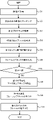
- Numerical control device 100 acquires an image (step S1).
- the numerical controller 100 marks the characteristic video (step S2).
- the method of marking may be manual or automatic.
- Numerical controller 100 acquires a machining program (step S3).
- the numerical controller 100 detects a block in the machining program that commands the machine tool to perform a characteristic operation (step S4).
- the numerical controller 100 calculates the execution time of each block of the machining program (step S5).
- Execution time calculation methods include a mathematical calculation method, a method of calculation by simulation, a method of calculation by actual measurement, and the like.
- the numerical controller 100 compares the number of marked frames and the number of detected blocks (step S6). If the number of marked frames and the number of detected blocks match (step S7; YES), the process proceeds to step S9. If the number of marked frames and the number of detected blocks are different (step S7; NO), the numerical controller 100 compares the time of the marked frame and the time of the detected block, Frames and blocks are detected as marks and blocks that can be linked (step S8).
- the numerical controller 100 associates the frame detected in step S2 with the block detected in step S4 (step S9).
- the numerical control device associates blocks other than the blocks associated in step S9 with video frames using the block execution time and frame rate (step S10). As a result, all blocks of the processing program are associated with video frames.
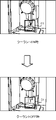
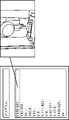
- the numerical control device 100 of the present disclosure can associate a video being processed with blocks of a processing program.
- By associating the video being processed with the processing program as shown in FIG. 14, it is possible to visually analyze the block and the content of processing by viewing the video.
- the numerical control device of the present disclosure associates images and processing programs with a simple mechanism.
- image processing there are also techniques for image analysis using machine learning.
- machine learning it is necessary to perform learning under certain conditions.
- the numerical control device of the present disclosure has a simple configuration because it uses general image processing techniques such as brightness change and displacement vector.
- image processing techniques such as brightness change and displacement vector.
- a machine learning detector specialized for the intended event may be created for each event.
- machine learning detectors specialized for events such as a detector that detects tool change, a detector that detects workpiece change, and a detector that detects coolant ON/OFF, are learned in advance, and which When even one score is equal to or higher than the threshold, it can be detected as a frame having video characteristics.
- a CPU 111 included in the numerical controller 100 is a processor that controls the numerical controller 100 as a whole.
- the CPU 111 reads the system program processed in the ROM 112 via the bus and controls the entire numerical controller 100 according to the system program.
- the RAM 113 temporarily stores calculation data, display data, various data input by the user via the input unit 71, and the like.
- the display unit 70 is a monitor attached to the numerical controller 100 or the like.
- the display unit 70 displays an operation screen, a setting screen, and the like of the numerical controller 100 .
- the input unit 71 is integrated with the display unit 70 or is a keyboard, touch panel, or the like that is separate from the display unit 70 .
- the user operates the input unit 71 to perform input to the screen displayed on the display unit 70 .
- the display unit 70 and the input unit 71 may be mobile terminals.
- the non-volatile memory 114 is, for example, a memory that is backed up by a battery (not shown) so that the memory state is retained even when the power of the numerical controller 100 is turned off.
- the nonvolatile memory 114 stores programs read from an external device via an interface (not shown), programs input via the input unit 71, and various data (for example, , setting parameters obtained from the machine tool, etc.) are stored. Programs and various data stored in the non-volatile memory 114 may be developed in the RAM 113 at the time of execution/use. Various system programs are pre-written in the ROM 112 .
- a controller 40 for controlling tools of a machine tool converts an axis movement command from the CPU 111 into a pulse signal and outputs the pulse signal to a driver 41 .
- a driver 41 converts the pulse signal into a current to drive a servomotor of the machine tool.
- a servo motor moves a tool and a table according to control of the numerical controller 100.
- FIG. The PLC 42 controls external equipment. External devices include a tool changer, coolant, and the like.
Landscapes
- Engineering & Computer Science (AREA)
- Physics & Mathematics (AREA)
- General Physics & Mathematics (AREA)
- Human Computer Interaction (AREA)
- Manufacturing & Machinery (AREA)
- Automation & Control Theory (AREA)
- Multimedia (AREA)
- Theoretical Computer Science (AREA)
- Computer Vision & Pattern Recognition (AREA)
- Software Systems (AREA)
- Numerical Control (AREA)
Priority Applications (5)
| Application Number | Priority Date | Filing Date | Title |
|---|---|---|---|
| DE112021007323.0T DE112021007323T5 (de) | 2021-05-24 | 2021-05-24 | Videoanalysevorrichtung, videoanalysesystem und speichermedium |
| US18/557,047 US20240219887A1 (en) | 2021-05-24 | 2021-05-24 | Video analysis device, video analysis system, and storage medium |
| PCT/JP2021/019643 WO2022249249A1 (ja) | 2021-05-24 | 2021-05-24 | 映像解析装置、映像解析システム、及び記憶媒体 |
| CN202180098344.9A CN117321515A (zh) | 2021-05-24 | 2021-05-24 | 影像解析装置、影像解析系统以及存储介质 |
| JP2023523730A JPWO2022249249A1 (https=) | 2021-05-24 | 2021-05-24 |
Applications Claiming Priority (1)
| Application Number | Priority Date | Filing Date | Title |
|---|---|---|---|
| PCT/JP2021/019643 WO2022249249A1 (ja) | 2021-05-24 | 2021-05-24 | 映像解析装置、映像解析システム、及び記憶媒体 |
Publications (2)
| Publication Number | Publication Date |
|---|---|
| WO2022249249A1 true WO2022249249A1 (ja) | 2022-12-01 |
| WO2022249249A9 WO2022249249A9 (ja) | 2023-09-28 |
Family
ID=84229703
Family Applications (1)
| Application Number | Title | Priority Date | Filing Date |
|---|---|---|---|
| PCT/JP2021/019643 Ceased WO2022249249A1 (ja) | 2021-05-24 | 2021-05-24 | 映像解析装置、映像解析システム、及び記憶媒体 |
Country Status (5)
| Country | Link |
|---|---|
| US (1) | US20240219887A1 (https=) |
| JP (1) | JPWO2022249249A1 (https=) |
| CN (1) | CN117321515A (https=) |
| DE (1) | DE112021007323T5 (https=) |
| WO (1) | WO2022249249A1 (https=) |
Citations (3)
| Publication number | Priority date | Publication date | Assignee | Title |
|---|---|---|---|---|
| JP3543147B2 (ja) * | 2001-07-10 | 2004-07-14 | ヤマザキマザック株式会社 | 工作機械の異常管理装置 |
| JP5620446B2 (ja) * | 2012-09-24 | 2014-11-05 | ファナック株式会社 | Gコード指令によりビデオカメラを操作する機能を備えた数値制御装置 |
| JP6656387B2 (ja) * | 2016-09-09 | 2020-03-04 | マキノジェイ株式会社 | 表示装置を備えた工作機械 |
Family Cites Families (8)
| Publication number | Priority date | Publication date | Assignee | Title |
|---|---|---|---|---|
| US6567162B2 (en) * | 2001-05-31 | 2003-05-20 | The Regents Of The University Of Michigan | Reconfigurable apparatus and method for inspection during a manufacturing process |
| JP2004038624A (ja) * | 2002-07-04 | 2004-02-05 | Nissan Motor Co Ltd | 車両認識方法、車両認識装置及び車両認識用プログラム |
| WO2007030731A2 (en) * | 2005-09-07 | 2007-03-15 | Nr Laboratories, Llc | Positional sensing system and method |
| JP2016194843A (ja) * | 2015-04-01 | 2016-11-17 | ファナック株式会社 | 複数画像を用いたプログラム表示機能を有する数値制御装置 |
| JP2018041247A (ja) * | 2016-09-07 | 2018-03-15 | ファナック株式会社 | 機械の個体識別情報を認識するためのサーバ、方法、プログラム、及びシステム |
| US10518480B2 (en) * | 2018-04-02 | 2019-12-31 | Nanotronics Imaging, Inc. | Systems, methods, and media for artificial intelligence feedback control in additive manufacturing |
| JP6806737B2 (ja) | 2018-06-15 | 2021-01-06 | ファナック株式会社 | 同期装置、同期方法及び同期プログラム |
| JP7412927B2 (ja) | 2018-09-04 | 2024-01-15 | キヤノンメディカルシステムズ株式会社 | 医用情報管理システム、医用情報管理装置、および、医用情報管理方法 |
-
2021
- 2021-05-24 DE DE112021007323.0T patent/DE112021007323T5/de not_active Withdrawn
- 2021-05-24 WO PCT/JP2021/019643 patent/WO2022249249A1/ja not_active Ceased
- 2021-05-24 CN CN202180098344.9A patent/CN117321515A/zh not_active Withdrawn
- 2021-05-24 US US18/557,047 patent/US20240219887A1/en active Pending
- 2021-05-24 JP JP2023523730A patent/JPWO2022249249A1/ja active Pending
Patent Citations (3)
| Publication number | Priority date | Publication date | Assignee | Title |
|---|---|---|---|---|
| JP3543147B2 (ja) * | 2001-07-10 | 2004-07-14 | ヤマザキマザック株式会社 | 工作機械の異常管理装置 |
| JP5620446B2 (ja) * | 2012-09-24 | 2014-11-05 | ファナック株式会社 | Gコード指令によりビデオカメラを操作する機能を備えた数値制御装置 |
| JP6656387B2 (ja) * | 2016-09-09 | 2020-03-04 | マキノジェイ株式会社 | 表示装置を備えた工作機械 |
Also Published As
| Publication number | Publication date |
|---|---|
| WO2022249249A9 (ja) | 2023-09-28 |
| CN117321515A (zh) | 2023-12-29 |
| JPWO2022249249A1 (https=) | 2022-12-01 |
| US20240219887A1 (en) | 2024-07-04 |
| DE112021007323T5 (de) | 2024-02-29 |
Similar Documents
| Publication | Publication Date | Title |
|---|---|---|
| JP4784752B2 (ja) | 画像処理装置 | |
| US20150161808A1 (en) | Simulator, simulation method, and simulation program | |
| US20180027218A1 (en) | Work assistance device, work assistance system, work assistance method, and recording medium storing work assistance program | |
| CN110599441A (zh) | 接缝检查装置 | |
| JP6922239B2 (ja) | 工程監視装置、工程監視装置の制御方法およびプログラム | |
| CN112783935A (zh) | 分析装置 | |
| US20160110611A1 (en) | Numerical control device | |
| JP7401280B2 (ja) | 作業工程判別装置及び作業工程判別システム | |
| WO2022249249A1 (ja) | 映像解析装置、映像解析システム、及び記憶媒体 | |
| JP7170493B2 (ja) | 締め付け確認システム、及び当該締め付け確認システムを用いた方法 | |
| US20210157298A1 (en) | Program restart assisting apparatus | |
| JP7712373B2 (ja) | 教示装置及びロボットシステム | |
| JP6962858B2 (ja) | 画像管理装置 | |
| US20240091945A1 (en) | Industrial machine system | |
| JP7664865B2 (ja) | 加工支援装置及び加工システム | |
| US11321656B2 (en) | Difference extracting device | |
| JP6948294B2 (ja) | 作業異常検知支援装置、作業異常検知支援方法、および作業異常検知支援プログラム | |
| US20240201650A1 (en) | Operational status display device and computer-readable storage medium | |
| JP2008009938A (ja) | 動画像データ処理装置、動画像データ処理方法、動画像データ処理プログラム、およびこれを記録した記録媒体 | |
| US20220122482A1 (en) | Smart system for adapting and enforcing processes | |
| US20250200482A1 (en) | Work analyzing device and work analyzing method | |
| WO2024062541A9 (ja) | 画像生成システム及びコンピュータ読み取り可能な記録媒体 | |
| JPH0821081B2 (ja) | ウィンドウの制御方法 | |
| WO2023218653A1 (ja) | 映像管理装置、及びコンピュータが読み取り可能な記憶媒体 | |
| TW202445509A (zh) | 圖像處理方法、程式、圖像處理系統、圖像處理裝置及檢測裝置 |
Legal Events
| Date | Code | Title | Description |
|---|---|---|---|
| 121 | Ep: the epo has been informed by wipo that ep was designated in this application |
Ref document number: 21942906 Country of ref document: EP Kind code of ref document: A1 |
|
| WWE | Wipo information: entry into national phase |
Ref document number: 2023523730 Country of ref document: JP |
|
| WWE | Wipo information: entry into national phase |
Ref document number: 18557047 Country of ref document: US |
|
| WWE | Wipo information: entry into national phase |
Ref document number: 112021007323 Country of ref document: DE |
|
| WWE | Wipo information: entry into national phase |
Ref document number: 202180098344.9 Country of ref document: CN |
|
| 122 | Ep: pct application non-entry in european phase |
Ref document number: 21942906 Country of ref document: EP Kind code of ref document: A1 |