WO2022244429A1 - 非線形光吸収材料、記録媒体、情報の記録方法及び情報の読出方法 - Google Patents
非線形光吸収材料、記録媒体、情報の記録方法及び情報の読出方法 Download PDFInfo
- Publication number
- WO2022244429A1 WO2022244429A1 PCT/JP2022/012113 JP2022012113W WO2022244429A1 WO 2022244429 A1 WO2022244429 A1 WO 2022244429A1 JP 2022012113 W JP2022012113 W JP 2022012113W WO 2022244429 A1 WO2022244429 A1 WO 2022244429A1
- Authority
- WO
- WIPO (PCT)
- Prior art keywords
- light
- compound
- nonlinear
- photon absorption
- wavelength
- Prior art date
- Legal status (The legal status is an assumption and is not a legal conclusion. Google has not performed a legal analysis and makes no representation as to the accuracy of the status listed.)
- Ceased
Links
Images

Classifications
-
- G—PHYSICS
- G11—INFORMATION STORAGE
- G11B—INFORMATION STORAGE BASED ON RELATIVE MOVEMENT BETWEEN RECORD CARRIER AND TRANSDUCER
- G11B7/00—Recording or reproducing by optical means, e.g. recording using a thermal beam of optical radiation by modifying optical properties or the physical structure, reproducing using an optical beam at lower power by sensing optical properties; Record carriers therefor
- G11B7/004—Recording, reproducing or erasing methods; Read, write or erase circuits therefor
- G11B7/005—Reproducing
-
- C—CHEMISTRY; METALLURGY
- C09—DYES; PAINTS; POLISHES; NATURAL RESINS; ADHESIVES; COMPOSITIONS NOT OTHERWISE PROVIDED FOR; APPLICATIONS OF MATERIALS NOT OTHERWISE PROVIDED FOR
- C09B—ORGANIC DYES OR CLOSELY-RELATED COMPOUNDS FOR PRODUCING DYES, e.g. PIGMENTS; MORDANTS; LAKES
- C09B57/00—Other synthetic dyes of known constitution
-
- C—CHEMISTRY; METALLURGY
- C09—DYES; PAINTS; POLISHES; NATURAL RESINS; ADHESIVES; COMPOSITIONS NOT OTHERWISE PROVIDED FOR; APPLICATIONS OF MATERIALS NOT OTHERWISE PROVIDED FOR
- C09B—ORGANIC DYES OR CLOSELY-RELATED COMPOUNDS FOR PRODUCING DYES, e.g. PIGMENTS; MORDANTS; LAKES
- C09B57/00—Other synthetic dyes of known constitution
- C09B57/007—Squaraine dyes
-
- G—PHYSICS
- G11—INFORMATION STORAGE
- G11B—INFORMATION STORAGE BASED ON RELATIVE MOVEMENT BETWEEN RECORD CARRIER AND TRANSDUCER
- G11B7/00—Recording or reproducing by optical means, e.g. recording using a thermal beam of optical radiation by modifying optical properties or the physical structure, reproducing using an optical beam at lower power by sensing optical properties; Record carriers therefor
- G11B7/24—Record carriers characterised by shape, structure or physical properties, or by the selection of the material
-
- G—PHYSICS
- G11—INFORMATION STORAGE
- G11B—INFORMATION STORAGE BASED ON RELATIVE MOVEMENT BETWEEN RECORD CARRIER AND TRANSDUCER
- G11B7/00—Recording or reproducing by optical means, e.g. recording using a thermal beam of optical radiation by modifying optical properties or the physical structure, reproducing using an optical beam at lower power by sensing optical properties; Record carriers therefor
- G11B7/24—Record carriers characterised by shape, structure or physical properties, or by the selection of the material
- G11B7/241—Record carriers characterised by shape, structure or physical properties, or by the selection of the material characterised by the selection of the material
- G11B7/242—Record carriers characterised by shape, structure or physical properties, or by the selection of the material characterised by the selection of the material of recording layers
- G11B7/244—Record carriers characterised by shape, structure or physical properties, or by the selection of the material characterised by the selection of the material of recording layers comprising organic materials only
Definitions
- the present disclosure relates to a nonlinear light absorbing material, a recording medium, an information recording method, and an information reading method.
- nonlinear optical materials materials that have a non-linear optical effect are called nonlinear optical materials.
- the nonlinear optical effect means that when a substance is irradiated with strong light such as laser light, an optical phenomenon proportional to the square of the electric field of the irradiated light or a higher order than the square occurs in the substance.
- Optical phenomena include absorption, reflection, scattering, and light emission.
- Second-order nonlinear optical effects that are proportional to the square of the electric field of illuminating light include second harmonic generation (SHG), Pockels effect, and parametric effects.
- the third-order nonlinear optical effect proportional to the cube of the electric field of the irradiated light includes two-photon absorption, multi-photon absorption, third harmonic generation (THG), Kerr effect, and the like.
- multiphoton absorption such as two-photon absorption is sometimes referred to as nonlinear optical absorption.
- a material capable of nonlinear optical absorption is sometimes called a nonlinear optical absorption material.
- a material capable of two-photon absorption is sometimes called a two-photon absorption material.
- nonlinear optical materials A lot of research has been actively carried out on nonlinear optical materials.
- inorganic materials from which single crystals can be easily prepared have been developed as nonlinear optical materials.
- nonlinear optical materials made of organic materials Organic materials not only have a higher degree of design freedom than inorganic materials, but also have large nonlinear optical constants.
- organic materials exhibit fast nonlinear responses.
- nonlinear optical materials containing organic materials are sometimes referred to as organic nonlinear optical materials.
- the nonlinear light-absorbing material in one aspect of the present disclosure is Compound A represented by the following formula (1), Compound B represented by the following formula (2), and Compound represented by the following formula (3) having nonlinear light absorption characteristics at a wavelength of 390 nm or more and 420 nm or less At least one selected from the group consisting of C is included as a main component.
- X is an oxygen atom or a sulfur atom
- R 1 and R 2 are each independently an aliphatic hydrocarbon group.
- the present disclosure provides a nonlinear light-absorbing material with improved nonlinear absorption properties for light having wavelengths in the short wavelength range.
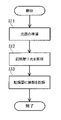
- FIG. 1A is a flow chart of an information recording method using a recording medium containing a nonlinear light absorbing material according to an embodiment of the present disclosure.
- FIG. 1B is a flow chart of a method for reading information using a recording medium containing a nonlinear light absorbing material according to an embodiment of the present disclosure;
- Two-photon absorption means a phenomenon in which a compound absorbs two photons almost simultaneously and transitions to an excited state. Simultaneous two-photon absorption and staged two-photon absorption are known as two-photon absorption. Simultaneous two-photon absorption is sometimes called non-resonant two-photon absorption. Simultaneous two-photon absorption means two-photon absorption in a wavelength region in which no one-photon absorption band exists. Stepwise two-photon absorption is sometimes called resonant two-photon absorption. In stepwise two-photon absorption, a compound absorbs a first photon and then transitions to a higher excited state by further absorbing a second photon. In stepwise two-photon absorption, a compound absorbs two photons sequentially.
- the amount of light absorbed by a compound is usually proportional to the square of the intensity of the irradiated light and exhibits nonlinearity.
- the amount of light absorbed by a compound can be used as an index of the efficiency of two-photon absorption.
- the compound can absorb light only near the focal point of laser light having a high electric field strength. That is, in a sample containing a two-photon absorbing material, compounds can be excited only at desired positions.
- Compounds that cause simultaneous two-photon absorption in this way provide extremely high spatial resolution, and are therefore being studied for applications such as recording layers of three-dimensional optical memories and photocurable resin compositions for stereolithography.
- a two-photon absorption cross section (GM value) is used as an indicator of efficiency of two-photon absorption.
- the unit of the two-photon absorption cross section is GM (10 ⁇ 50 cm 4 ⁇ s ⁇ molecule ⁇ 1 ⁇ photon ⁇ 1 ).
- Many organic two-photon absorption materials with large two-photon absorption cross sections have been proposed so far. For example, many compounds with two-photon absorption cross sections as large as over 500 GM have been reported (eg, Non-Patent Document 1). However, in most reports the two-photon absorption cross section is measured using laser light with a wavelength longer than 600 nm. In particular, near-infrared rays having a wavelength longer than 750 nm are sometimes used as laser light.
- a light emitting device that emits an ultrashort pulse laser with high light intensity tends to be large and unstable in operation. Therefore, it is difficult to adopt such a light-emitting device for industrial use from the viewpoint of versatility and reliability. Considering this fact, in order to apply a two-photon absorption material to industrial applications, a material that exhibits two-photon absorption characteristics even when irradiated with a laser beam of low light intensity is required.
- Formula (i) is a calculation formula for calculating the decrease in light intensity -dI when a sample containing a two-photon absorption compound and having a very small thickness dz is irradiated with light of intensity I.
- the decrease in light intensity -dI is expressed by the sum of a term proportional to the first power of the intensity I of the incident light on the sample and a term proportional to the square of the intensity I.
- ⁇ is the one-photon absorption coefficient (cm ⁇ 1 ).
- ⁇ (2) is the two-photon absorption coefficient (cm/W). From equation (i), it can be seen that the incident light intensity I when the one-photon absorption and the two-photon absorption are equal in the sample is expressed by ⁇ / ⁇ (2) . That is, when the intensity I of incident light is smaller than ⁇ / ⁇ (2) , one-photon absorption preferentially occurs in the sample. Two-photon absorption occurs preferentially in the sample when the intensity I of the incident light is greater than ⁇ / ⁇ (2) . Therefore, there is a tendency that the smaller the value of ⁇ / ⁇ (2) in the sample, the more preferentially two-photon absorption can be achieved by a laser beam with a lower light intensity.
- ⁇ and ⁇ (2) can be represented by the following formulas (ii) and (iii), respectively.
- ⁇ is the molar extinction coefficient (mol ⁇ 1 ⁇ L ⁇ cm ⁇ 1 ).
- N is the number of molecules of the compound per unit volume of the sample (mol ⁇ cm ⁇ 3 ).
- N A is Avogadro's constant.
- ⁇ is the two-photon absorption cross section (GM).
- h ⁇ (h bar) is the Dirac constant (J ⁇ s).
- ⁇ is the angular frequency (rad/s) of incident light.
- ⁇ / ⁇ (2) is determined by ⁇ / ⁇ . That is, in order to preferentially express two-photon absorption by laser light with low light intensity, the ratio ⁇ / ⁇ of the two-photon absorption cross section ⁇ to the molar extinction coefficient ⁇ is large with respect to the wavelength of the irradiated laser light. is desirable. For a compound, when the value of the ratio ⁇ / ⁇ at a particular wavelength is large, it can be said that the nonlinearity of light absorption at that wavelength is high.
- Patent Documents 1 and 2 disclose compounds having a large two-photon absorption cross section for light having a wavelength of around 405 nm.
- Patent Document 3 discloses an optical information recording medium capable of shortening the writing time when using a laser beam having a wavelength of around 405 nm, and a compound contained in the optical information recording medium.
- Patent Document 4 discloses a compound that exhibits a high two-photon absorption cross section when using a laser beam having a wavelength of 800 nm.
- Patent Documents 1 and 3 describe compounds having a large ⁇ -electron conjugated system. Furthermore, Patent Document 2 describes a benzophenone derivative having a large ⁇ -electron conjugated system.
- Patent Document 2 describes a benzophenone derivative having a large ⁇ -electron conjugated system.
- the shift of the peak resulting from one-photon absorption to the longer wavelength region is sometimes referred to as long wavelength shift or red shift.
- part of the wavelength region in which one-photon absorption occurs may overlap with the wavelength of the excitation light.
- a specific example of the wavelength of the excitation light is 405 nm defined by the Blu-ray (registered trademark) standard.
- the nonlinearity of light absorption tends to decrease.
- a compound with low nonlinearity of light absorption is not suitable for the recording layer of a multi-layered three-dimensional optical memory.
- Patent Document 4 discloses a fluorene derivative and its polymer as a two-photon absorption compound. However, the two-photon absorption compound disclosed in Patent Document 4 does not have sufficient two-photon absorption properties for light having a wavelength in the short wavelength range.
- the present inventors have found that compound A represented by formula (1), compound B represented by formula (2), and compound C represented by formula (3), which will be described later, have a short wavelength
- the present inventors have newly found that it has high nonlinear absorption characteristics for light having wavelengths in a certain range, and have completed the nonlinear light absorption material of the present disclosure.
- the present inventors found that the compounds A to C have a large ratio ⁇ / ⁇ of the two-photon absorption cross section ⁇ to the molar extinction coefficient ⁇ with respect to light having a wavelength in the short wavelength region, and the light We found that the nonlinearity of the absorption is high.
- the short wavelength range means a wavelength range including 405 nm, for example, a wavelength range of 390 nm or more and 420 nm or less.
- the nonlinear light absorbing material according to the first aspect of the present disclosure includes Compound A represented by the following formula (1), Compound B represented by the following formula (2), and Compound represented by the following formula (3) having nonlinear light absorption characteristics at a wavelength of 390 nm or more and 420 nm or less At least one selected from the group consisting of C is included as a main component.
- X is an oxygen atom or a sulfur atom
- R 1 and R 2 are each independently an aliphatic hydrocarbon group.
- the nonlinear light-absorbing material according to the first aspect has a large ratio ⁇ / ⁇ of the two-photon absorption cross section ⁇ to the molar extinction coefficient ⁇ for light having a wavelength in a short wavelength region, and tends to exhibit high nonlinearity in light absorption. There is thus, the nonlinear light absorbing material has improved nonlinear absorption characteristics for light having wavelengths in the short wavelength region.
- R 1 and R 2 may each independently be an alkyl group.
- R 1 and R 2 may be methyl groups.
- the X may be an oxygen atom.
- the nonlinear light-absorbing material according to the first aspect may contain the compound C, for example.
- the recording medium according to the sixth aspect of the present disclosure includes A recording layer containing the nonlinear light absorbing material according to any one of the first to fifth aspects is provided.
- the nonlinear light absorbing material has improved nonlinear absorption characteristics for light having a wavelength in the short wavelength range.
- a recording medium containing such a nonlinear light-absorbing material can record information at a high recording density.
- An information recording method includes: preparing a light source that emits light having a wavelength of 390 nm or more and 420 nm or less; condensing the light from the light source and irradiating the recording layer in the recording medium according to the sixth aspect.
- the nonlinear light absorbing material has improved nonlinear absorption characteristics for light having a wavelength in the short wavelength range. According to an information recording method using a recording medium containing such a nonlinear light absorbing material, information can be recorded at a high recording density.
- An information reading method is, for example, a method for reading information recorded by the recording method according to the seventh aspect, comprising: The reading method is measuring optical properties of the recording layer in the recording medium by irradiating the recording layer with light; and reading the information from the recording layer.
- the optical characteristic may be the intensity of light reflected by the recording layer.
- the nonlinear light-absorbing material of the present embodiment is selected from the group consisting of compound A represented by the following formula (1), compound B represented by the following formula (2), and compound C represented by the following formula (3). At least one selected.
- X is an oxygen atom or a sulfur atom, and may be an oxygen atom.
- Specific examples of compound A include dibenzofuran of formula (4) below and dibenzothiophene of formula (5) below.
- R 1 and R 2 are each independently an aliphatic hydrocarbon group.
- the aliphatic hydrocarbon group may be either a saturated aliphatic hydrocarbon group or an unsaturated aliphatic hydrocarbon group.
- a specific example of an aliphatic saturated hydrocarbon group is an alkyl group.
- R 1 and R 2 may independently be alkyl groups.
- the alkyl group may be linear, branched, or cyclic.
- the number of carbon atoms in the alkyl group is not particularly limited, and is, for example, 1 or more and 20 or less.
- the number of carbon atoms in the alkyl group may be 1 or more and 10 or less, or 1 or more and 5 or less, from the viewpoint of facilitating synthesis of compound B.
- the solubility of compound B in the solvent or resin composition can be adjusted.
- At least one hydrogen atom contained in the alkyl group may be substituted with a group containing at least one atom selected from the group consisting of N, O, P and S.
- Alkyl groups include methyl, ethyl, propyl, butyl, 2-methylbutyl, pentyl, hexyl, 2,3-dimethylhexyl, heptyl, octyl, nonyl, decyl, and undecyl groups.
- dodecyl group dodecyl group, tridecyl group, tetradecyl group, pentadecyl group, hexadecyl group, heptadecyl group, octadecyl group, nonadecyl group, eicosyl group, 2-methoxybutyl group, 6-methoxyhexyl group and the like.
- the aliphatic unsaturated hydrocarbon group contains unsaturated bonds such as carbon-carbon double bonds and carbon-carbon triple bonds.
- the number of unsaturated bonds contained in the aliphatic unsaturated hydrocarbon group is, for example, 1 or more and 5 or less.
- the number of carbon atoms in the aliphatic unsaturated hydrocarbon group is not particularly limited, and may be, for example, 2 or more and 20 or less, may be 2 or more and 10 or less, or may be 2 or more and 5 or less.
- the aliphatic unsaturated hydrocarbon group may be linear, branched, or cyclic. A vinyl group, an ethynyl group, etc. are mentioned as an aliphatic unsaturated hydrocarbon group.
- R 1 and R 2 may be the same or different. As an example, both R 1 and R 2 may be methyl groups.
- a specific example of compound B is 9,9-dimethylfluorene of the following formula (6).
- Other examples of compound B include 9,9-diethylfluorene, 9,9-dipropylfluorene, and the like.
- Compounds A to C tend to have excellent two-photon absorption characteristics and small one-photon absorption for light having wavelengths in the short wavelength range.
- compound A, B, or C is irradiated with light having a wavelength of 405 nm, two-photon absorption may occur in the compound, but little one-photon absorption may occur.
- the two-photon absorption cross section of compounds A to C for light having a wavelength of 405 nm may be greater than 1 GM, or greater than or equal to 10 GM.
- the upper limit of the two-photon absorption cross section of compounds A to C is not particularly limited, and is, for example, 1000 GM.
- the two-photon absorption cross section can be measured, for example, by the Z scan method described in J. Opt. Soc. Am. B, 2003, Vol. 20, p. 529.
- the Z scan method is widely used as a method for measuring nonlinear optical constants. In the Z scan method, the measurement sample is moved along the irradiation direction of the beam in the vicinity of the focal point where the laser beam is condensed.
- the two-photon absorption cross section can be calculated by fitting changes in the amount of transmitted light to a theoretical curve predicted from the intensity of incident light, the thickness of the measurement sample, the concentration of the compound in the measurement sample, and the like.
- the molar extinction coefficient of compounds A to C for light having a wavelength of 405 nm may be 100 mol -1 ⁇ L ⁇ cm -1 or less, may be 10 mol -1 ⁇ L ⁇ cm -1 or less, 1 mol ⁇ 1 ⁇ L ⁇ cm ⁇ 1 or less, or 0.1 mol ⁇ 1 ⁇ L ⁇ cm ⁇ 1 or less.
- the lower limit of the molar extinction coefficient of compounds A to C is not particularly limited, and is, for example, 0.00001 mol ⁇ 1 ⁇ L ⁇ cm ⁇ 1 .
- the molar extinction coefficient can be measured, for example, by a method conforming to the provisions of Japanese Industrial Standards (JIS) K0115:2004.
- the concentration of the compound to be measured is adjusted to 100 mmol/L or more and 2 mol/L or less. This concentration is a very high value compared with the concentration in the measurement test of the molar extinction coefficient of the light absorption peak.
- the molar extinction coefficient can be used as a measure of one-photon absorption.
- the ratio ⁇ / ⁇ of the two-photon absorption cross section ⁇ (GM) to the molar extinction coefficient ⁇ (mol ⁇ 1 ⁇ L ⁇ cm ⁇ 1 ) is large for light having a wavelength in the short wavelength region.
- the ratio ⁇ / ⁇ of compounds A to C for light having a wavelength of 405 nm may be 100 or more, 300 or more, 500 or more, or 700 or more; It may be 800 or more.
- the upper limit of the ratio ⁇ / ⁇ of compounds A to C is not particularly limited, and is 5,000, for example.
- compounds A to C absorb two photons
- compounds A to C absorb about twice the energy of the light irradiated to compounds A to C.
- a wavelength of light having about twice the energy of light having a wavelength of 405 nm is, for example, 200 nm.
- One-photon absorption may occur in compounds A to C when the compounds A to C are irradiated with light having a wavelength around 200 nm.
- compounds A to C may exhibit one-photon absorption for light having wavelengths in the vicinity of the wavelength range where two-photon absorption occurs.
- the nonlinear light-absorbing material of this embodiment contains at least one selected from the group consisting of compounds A to C.
- the nonlinear light absorbing material may contain at least one selected from the group consisting of dibenzofuran, dibenzothiophene, 9,9-dimethylfluorene and 9,9'spirobi[9H-fluorene].
- the nonlinear light-absorbing material may contain dibenzofuran as compound A.
- the nonlinear light-absorbing material may contain 9,9-dimethylfluorene as compound B.
- the nonlinear light absorbing material may include compound C, 9,9'spirobi[9H-fluorene].
- the nonlinear light-absorbing material of this embodiment may contain any one of compounds A to C as a main component.
- the “main component” means the component contained in the nonlinear light-absorbing material in the largest amount by weight.
- the nonlinear light-absorbing material consists essentially of any one of compounds A to C, for example. "Consisting essentially of” means excluding other ingredients that modify the essential characteristics of the referenced material.
- the nonlinear light-absorbing material may contain impurities in addition to the compounds A to C.
- the nonlinear light-absorbing material of the present embodiment containing at least one selected from the group consisting of compounds A to C functions, for example, as a two-photon absorption material.
- the optical properties of the compound in the wavelength region of 390 nm or more and 420 nm or less, not only the compound has nonlinear light absorption characteristics in the wavelength region, but also the compound in the wavelength region One-photon absorption must be very small.
- the optical properties of the compound itself may be considered.
- a compound having a minimum one-photon absorption permissible level corresponding to the energy of light having a wavelength sufficiently shorter than the wavelength region of 390 nm or more and 420 nm or less and having a small oscillator strength is used, it is 390 nm or more and 420 nm or less.
- industrial applications may require materials with high concentrations of nonlinear light absorbing compounds. When the concentration of the nonlinear light-absorbing compound is high, the compounds may come close to each other and associate due to ⁇ - ⁇ interaction or the like. The association can change the optical properties of the compound itself.
- Unsubstituted fluorene is a hydrocarbon compound that is non-polar and has high planarity. Unsubstituted fluorene corresponds to a compound in which X in formula (1) above is a methylene group. In this specification, unsubstituted fluorene may be simply referred to as fluorene. When the concentration of fluorene in the material is high, the fluorene molecules are close to each other and associate in various forms. As a result, a plurality of new levels are formed at energy positions lower than the lowest one-photon absorption permissible level of fluorene itself.
- the one-photon absorption spectrum of a material containing fluorene at a high concentration is measured, it can be confirmed that the peak derived from one-photon absorption tails.
- the compound A in which X in formula (1) is an oxygen atom or a sulfur atom tends to suppress the formation of associations between compounds. Therefore, according to the compound A, tailing of the peak due to one-photon absorption is suppressed even when present in the material at a high concentration. That is, compound A tends to have a small molar absorption coefficient for light in the wavelength range of 390 nm or more and 420 nm or less even when it is present in the material at a high concentration, and exhibits high nonlinearity in light absorption.
- a steric hindrance occurs in compound B in which the substituents R 1 and R 2 are introduced into the fluorene. Therefore, even when the concentration of the compound B in the material is high, there is a tendency that the formation of aggregates between the compounds is suppressed. That is, even when compound B is present in the material at a high concentration, peak tailing due to one-photon absorption is suppressed. Furthermore, in compound B, R 1 and R 2 are aliphatic hydrocarbon groups. Therefore, the change in the electronic state of fluorene due to the introduction of R 1 and R 2 is suppressed. That is, in compound B, the long wavelength shift of the peak due to one-photon absorption due to the introduction of R 1 and R 2 is suppressed.
- compound B As a result, in compound B, an increase in the molar absorption coefficient for light in the wavelength range of 390 nm or more and 420 nm or less is suppressed. For the above reasons, compound B tends to have a small molar absorption coefficient for light in the wavelength range of 390 nm to 420 nm and high nonlinearity of light absorption even when present in the material at a high concentration.
- Compound C has greater steric hindrance than fluorene. As a result, even when the concentration of compound C in the material is high, the formation of aggregates between compounds tends to be suppressed. That is, even when the compound C is present in the material at a high concentration, peak tailing due to one-photon absorption is suppressed. For the above reasons, compound C tends to have a small molar absorption coefficient for light in the wavelength range of 390 nm to 420 nm and high nonlinearity of light absorption even when present in the material at a high concentration.
- the nonlinear light-absorbing material of the present embodiment is used, for example, in devices that utilize light having wavelengths in the short wavelength range.
- the nonlinear light-absorbing material of this embodiment is used in devices that utilize light having a wavelength of 390 nm or more and 420 nm or less.
- Such devices include recording media, modeling machines, fluorescence microscopes, and the like.
- Recording media include, for example, a three-dimensional optical memory.
- a specific example of a three-dimensional optical memory is a three-dimensional optical disk.
- modeling machines include optical modeling machines such as 3D printers.
- Fluorescence microscopes include, for example, two-photon fluorescence microscopes.
- the light utilized in these devices for example, has a high photon density near its focal point.
- the power density near the focal point of light used in the device is, for example, 0.1 W/cm 2 or more and 1.0 ⁇ 10 20 W/cm 2 or less.
- the power density near the focal point of this light may be 1.0 W/cm 2 or more, 1.0 ⁇ 10 2 W/cm 2 or more, or 1.0 ⁇ 10 5 W/cm It may be 2 or more.
- a light source for the device for example, a femtosecond laser such as a titanium sapphire laser, or a pulsed laser having a pulse width of picosecond to nanosecond such as a semiconductor laser can be used.
- a recording medium for example, has a thin film called a recording layer. Information is recorded in a recording layer of a recording medium.
- a thin film as a recording layer contains the nonlinear light absorbing material of this embodiment. That is, from another aspect, the present disclosure provides a recording medium comprising a nonlinear light-absorbing material containing at least one compound selected from the group consisting of compounds A to C above.
- the recording layer may further contain a polymer compound that functions as a binder in addition to the nonlinear light absorbing material.
- the recording medium may have a dielectric layer in addition to the recording layer.
- the recording medium comprises, for example, multiple recording layers and multiple dielectric layers. In the recording medium, a plurality of recording layers and a plurality of dielectric layers may be alternately laminated.
- FIG. 1A is a flow chart of an information recording method using the above recording medium.
- a light source that emits light having a wavelength of 390 nm or more and 420 nm or less is prepared.
- the light source for example, a femtosecond laser such as a titanium sapphire laser, or a pulse laser having a pulse width of picoseconds to nanoseconds such as a semiconductor laser can be used.
- the light from the light source is condensed by a lens or the like, and the recording layer of the recording medium is irradiated with the light.
- the light from the light source is condensed by a lens or the like, and the recording area of the recording medium is irradiated with the light.
- the power density near the focal point of this light is, for example, 0.1 W/cm 2 or more and 1.0 ⁇ 10 20 W/cm 2 or less.
- the power density near the focal point of this light may be 1.0 W/cm 2 or more, 1.0 ⁇ 10 2 W/cm 2 or more, or 1.0 ⁇ 10 5 W/cm It may be 2 or more.
- the recording area means a spot existing in the recording layer and capable of recording information by being irradiated with light.
- a physical or chemical change occurs in the recording area irradiated with the above light. For example, heat is generated when a compound A, B or C that absorbs light returns from the transition state to the ground state. This heat alters the binder present in the recording area. This changes the optical characteristics of the recording area. For example, the intensity of light reflected on the recording area, the reflectance of light on the recording area, the absorptance of light on the recording area, the refractive index of light on the recording area, etc. change. In the recording area irradiated with light, the intensity of the fluorescent light emitted from the recording area or the wavelength of the fluorescent light may change. As a result, information can be recorded on the recording layer, more specifically, on the recording area (step S13).
- FIG. 1B is a flow chart of an information reading method using the above recording medium.
- the recording layer of the recording medium is irradiated with light. Specifically, the recording area on the recording medium is irradiated with light.
- the light used in step S21 may be the same as or different from the light used to record information on the recording medium.
- the optical properties of the recording layer are measured. Specifically, the optical characteristics of the recording area are measured. In step S22, for example, the intensity of the light reflected by the recording area is measured as the optical characteristic of the recording area.
- the optical properties of the recording area are the reflectance of light in the recording area, the absorption rate of light in the recording area, the refractive index of light in the recording area, the intensity of fluorescent light emitted from the recording area, The wavelength of fluorescence light may be measured.
- step S23 information is read from the recording layer, more specifically, from the recording area.
- the recording area where the information is recorded can be searched by the following method.
- a specific area of the recording medium is irradiated with light. This light may be the same as or different from the light used to record information on the recording medium.
- the optical properties of the region irradiated with light are measured. Optical properties include, for example, the intensity of light reflected at the region, the reflectance of light at the region, the absorption rate of light at the region, the refractive index of light at the region, and the fluorescence emitted from the region. and the wavelength of fluorescent light emitted from the region. Based on the measured optical characteristics, it is determined whether or not the area irradiated with light is a recording area.
- the intensity of the light reflected by the area is less than or equal to a specific value, it is determined that the area is a recording area.
- the intensity of the light reflected by the area exceeds a specific value, it is determined that the area is not a recording area.
- the method for determining whether or not the area irradiated with light is a recording area is not limited to the above method. For example, if the intensity of light reflected by the area exceeds a specific value, it may be determined that the area is a recording area. Alternatively, if the intensity of the light reflected by the area is less than or equal to a specific value, it may be determined that the area is not a recording area. If it is determined that the area is not a recording area, the same operation is performed on another area of the recording medium. This makes it possible to search for a recording area.
- a recording apparatus includes, for example, a light source that irradiates a recording area on a recording medium with light, a measuring device that measures optical characteristics of the recording region, and a controller that controls the light source and the measuring device.
- a modeling machine performs modeling by, for example, irradiating a photocurable resin composition with light and curing the resin composition.
- a photocurable resin composition for stereolithography contains the nonlinear light absorbing material of the present embodiment.
- the photocurable resin composition contains, for example, a nonlinear light-absorbing material, a polymerizable compound, and a polymerization initiator.
- the photocurable resin composition may further contain additives such as a binder resin.
- the photocurable resin composition may contain an epoxy resin.
- a fluorescence microscope for example, it is possible to irradiate a biological sample containing a fluorescent dye material with light and observe the fluorescence emitted from the dye material.
- a fluorescent dye material to be added to a biological sample contains the nonlinear light absorbing material of this embodiment.
- Example 1 9,9'spirobi[9H-fluorene]
- the compound of Example 2 dibenzofuran
- the compound of Example 3 dibenzothiophene
- 9,9-Dimethylfluorene a compound of Example 4 manufactured by Aldrich
- fluorene which is the compound of Comparative Example 1
- 2,7-di-tert-butylfluorene which is the compound of Comparative Example 2
- 1-fluorenecarboxylic which is the compound of Comparative Example 3
- the acid is manufactured by Tokyo Chemical Industry Co., Ltd.
- the compound of Comparative Example 4 9-fluorenylmethanol, is manufactured by Tokyo Chemical Industry Co., Ltd.
- the compound of Comparative Example 5 9-methyl-9H-fluoren-9-ol, is manufactured by Tokyo Chemical Industry Co., Ltd.
- HPEB hexakis(phenylethynyl)benzene
- two-photon absorption cross-sections were measured for light having a wavelength of 405 nm.
- Two-photon absorption cross sections were measured using the Z scan method described in J. Opt. Soc. Am. B, 2003, Vol. 20, p.
- a titanium sapphire pulsed laser was used as a light source for measuring the two-photon absorption cross section.
- the sample was irradiated with the second harmonic of a titanium sapphire pulsed laser.
- the pulse width of the laser was 80 fs.
- the laser repetition frequency was 1 kHz.
- the average laser power was varied in the range of 0.01 mW to 0.08 mW.
- the light from the laser was light with a wavelength of 405 nm.
- the light from the laser had a center wavelength between 403 nm and 405 nm.
- the full width at half maximum of the light from the laser was 4 nm.
- ⁇ Measurement of molar extinction coefficient> The molar extinction coefficients of the compounds of Examples and Comparative Examples were measured by a method conforming to JIS K0115:2004. Specifically, first, a solution in which a compound was dissolved in a solvent was prepared as a measurement sample. The concentration of the compound in the solution was appropriately adjusted in the range of 100 mmol/L or more and 2 mol/L or less according to the absorbance of the compound to be measured at a wavelength of 405 nm. Next, an absorption spectrum was measured for the measurement sample. The absorbance at a wavelength of 405 nm was read from the resulting spectrum. The molar extinction coefficient was calculated based on the concentration of the compound in the measurement sample and the optical path length of the cell used for measurement.
- Table 1 shows the two-photon absorption cross section ⁇ (GM), the molar extinction coefficient ⁇ (mol ⁇ 1 ⁇ L ⁇ cm ⁇ 1 ) and the ratio ⁇ / ⁇ obtained by the above method.
- the compounds of Examples 1 to 4 which correspond to any of Compounds A to C, all have larger values of the ratio ⁇ / ⁇ for light having a wavelength of 405 nm than the compounds of the comparative examples. , exceeded 100. From these results, it can be seen that the compounds A to C have high nonlinearity of light absorption with respect to light having a wavelength in the short wavelength region, and the nonlinear light absorption characteristics are improved.
- the compounds of Comparative Examples 1, 4, 5, 6 and 9 are compounds in which R 1 or R 2 in formula (2) is not an aliphatic hydrocarbon group. All of these compounds had a ratio ⁇ / ⁇ of less than 100 for light having a wavelength of 405 nm.
- R 1 and R 2 are hydrogen atoms, steric hindrance between compounds is small, and the compounds are considered to be close to each other and associated in various forms. Therefore, in Comparative Example 1, it is presumed that the ratio ⁇ / ⁇ was small because the peak derived from one-photon absorption tailed and the molar extinction coefficient ⁇ increased.
- compound B has a structure in which aliphatic hydrocarbon groups R 1 and R 2 are introduced into fluorene.
- steric hindrance can be increased without significantly changing the electronic state of fluorene, and association between compounds can be suppressed. From this, it is presumed that in Example 4, even when the concentration of the compound in the measurement sample was high, the molar extinction coefficient ⁇ was small and the ratio ⁇ / ⁇ was large.
- the compounds of Comparative Examples 2, 3, 7, 8 and 10 are compounds in which a substituent is introduced into the aromatic ring of fluorene. All of these compounds had a ratio ⁇ / ⁇ of less than 100 for light having a wavelength of 405 nm.
- introduction of a substituent to an aromatic ring greatly affects the electronic state of fluorene having a condensed ring structure. Therefore, the introduction of substituents on the aromatic ring increases the HOMO energy of fluorene or decreases the LUMO energy.
- the compounds of Comparative Examples 11 to 13 are different from fluorene derivatives. All of these compounds had a ratio ⁇ / ⁇ of less than 100 for light having a wavelength of 405 nm.
- the compounds of Comparative Examples 11 to 13 have a large ⁇ -electron conjugated system and therefore have a large transition dipole moment. Therefore, in Comparative Examples 11 to 13, the two-photon absorption cross-sectional area ⁇ was a large value.
- the peak derived from one-photon absorption tends to shift to longer wavelength regions.
- the nonlinear light absorbing material of the present disclosure can be used for applications such as recording layers of three-dimensional optical memories and photocurable resin compositions for stereolithography.
- the nonlinear light-absorbing material of the present disclosure tends to have light absorption characteristics exhibiting high nonlinearity with respect to light having wavelengths in the short wavelength range. Therefore, the nonlinear light-absorbing material of the present disclosure can achieve extremely high spatial resolution in applications such as three-dimensional optical memory and modeling machines. According to the nonlinear light-absorbing material of the present disclosure, compared to conventional nonlinear light-absorbing materials, it is possible to cause two-photon absorption more favorably than one-photon absorption even when irradiated with a laser beam of low light intensity.
Landscapes
- Chemical & Material Sciences (AREA)
- Organic Chemistry (AREA)
- Optical Record Carriers And Manufacture Thereof (AREA)
- Organic Low-Molecular-Weight Compounds And Preparation Thereof (AREA)
Priority Applications (3)
| Application Number | Priority Date | Filing Date | Title |
|---|---|---|---|
| CN202280034378.6A CN117321685A (zh) | 2021-05-18 | 2022-03-17 | 非线性光吸收材料、记录介质、信息的记录方法及信息的读出方法 |
| JP2023522269A JP7738279B2 (ja) | 2021-05-18 | 2022-03-17 | 非線形光吸収材料、記録媒体、情報の記録方法及び情報の読出方法 |
| US18/493,230 US20240062780A1 (en) | 2021-05-18 | 2023-10-24 | Nonlinear light absorption material, recording medium, method for recording information, and method for reading information |
Applications Claiming Priority (2)
| Application Number | Priority Date | Filing Date | Title |
|---|---|---|---|
| JP2021-084183 | 2021-05-18 | ||
| JP2021084183 | 2021-05-18 |
Related Child Applications (1)
| Application Number | Title | Priority Date | Filing Date |
|---|---|---|---|
| US18/493,230 Continuation US20240062780A1 (en) | 2021-05-18 | 2023-10-24 | Nonlinear light absorption material, recording medium, method for recording information, and method for reading information |
Publications (1)
| Publication Number | Publication Date |
|---|---|
| WO2022244429A1 true WO2022244429A1 (ja) | 2022-11-24 |
Family
ID=84140544
Family Applications (1)
| Application Number | Title | Priority Date | Filing Date |
|---|---|---|---|
| PCT/JP2022/012113 Ceased WO2022244429A1 (ja) | 2021-05-18 | 2022-03-17 | 非線形光吸収材料、記録媒体、情報の記録方法及び情報の読出方法 |
Country Status (4)
| Country | Link |
|---|---|
| US (1) | US20240062780A1 (https=) |
| JP (1) | JP7738279B2 (https=) |
| CN (1) | CN117321685A (https=) |
| WO (1) | WO2022244429A1 (https=) |
Citations (4)
| Publication number | Priority date | Publication date | Assignee | Title |
|---|---|---|---|---|
| JPH0588220A (ja) * | 1991-09-26 | 1993-04-09 | Sumitomo Electric Ind Ltd | 有機非線形光学材料 |
| JPH09133936A (ja) * | 1995-10-12 | 1997-05-20 | Hoechst Ag | 非線形光学における材料としてのスピロ化合物の使用 |
| JP2004292744A (ja) * | 2003-03-28 | 2004-10-21 | Toyo Ink Mfg Co Ltd | 光機能材料 |
| JP2011054265A (ja) * | 2009-08-31 | 2011-03-17 | General Electric Co <Ge> | 光学データ記憶媒体及びその使用方法 |
Family Cites Families (5)
| Publication number | Priority date | Publication date | Assignee | Title |
|---|---|---|---|---|
| US5185102A (en) * | 1989-06-08 | 1993-02-09 | Minnesota Mining And Manufacturing Company | Polymeric charge transfer complexes for nonlinear optical applications |
| JP2004250622A (ja) * | 2003-02-21 | 2004-09-09 | Toray Ind Inc | 樹脂組成物 |
| KR101217979B1 (ko) * | 2009-04-24 | 2013-01-02 | 이데미쓰 고산 가부시키가이샤 | 방향족 아민 유도체를 이용한 유기 전계 발광 소자 |
| JP5821661B2 (ja) | 2012-01-26 | 2015-11-24 | デクセリアルズ株式会社 | 新規なビス又はトリス(3−ヒドロキシ−3,3−ジフェニル−1−プロピニル)アリール化合物類、光情報記録材料及び光情報記録媒体 |
| JP6118026B2 (ja) * | 2012-02-14 | 2017-04-19 | ユー・ディー・シー アイルランド リミテッド | 有機電界発光素子とそれに用いることができる化合物および有機電界発光素子用材料、並びに該素子を用いた発光装置、表示装置及び照明装置 |
-
2022
- 2022-03-17 CN CN202280034378.6A patent/CN117321685A/zh active Pending
- 2022-03-17 JP JP2023522269A patent/JP7738279B2/ja active Active
- 2022-03-17 WO PCT/JP2022/012113 patent/WO2022244429A1/ja not_active Ceased
-
2023
- 2023-10-24 US US18/493,230 patent/US20240062780A1/en not_active Abandoned
Patent Citations (4)
| Publication number | Priority date | Publication date | Assignee | Title |
|---|---|---|---|---|
| JPH0588220A (ja) * | 1991-09-26 | 1993-04-09 | Sumitomo Electric Ind Ltd | 有機非線形光学材料 |
| JPH09133936A (ja) * | 1995-10-12 | 1997-05-20 | Hoechst Ag | 非線形光学における材料としてのスピロ化合物の使用 |
| JP2004292744A (ja) * | 2003-03-28 | 2004-10-21 | Toyo Ink Mfg Co Ltd | 光機能材料 |
| JP2011054265A (ja) * | 2009-08-31 | 2011-03-17 | General Electric Co <Ge> | 光学データ記憶媒体及びその使用方法 |
Also Published As
| Publication number | Publication date |
|---|---|
| US20240062780A1 (en) | 2024-02-22 |
| JP7738279B2 (ja) | 2025-09-12 |
| CN117321685A (zh) | 2023-12-29 |
| JPWO2022244429A1 (https=) | 2022-11-24 |
Similar Documents
| Publication | Publication Date | Title |
|---|---|---|
| Chi et al. | Tailored thioxanthone‐based photoinitiators for two‐photon‐controllable polymerization and nanolithographic printing | |
| US20230109287A1 (en) | Compound, non-linear optical material, recording medium, method for recording information, and method for reading information | |
| US20230028064A1 (en) | Light-absorbing material, recording medium using the same, information recording method and information reading method | |
| JP7738279B2 (ja) | 非線形光吸収材料、記録媒体、情報の記録方法及び情報の読出方法 | |
| JP7811720B2 (ja) | 非線形光吸収材料、記録媒体、情報の記録方法及び情報の読出方法 | |
| JP2022177737A (ja) | 非線形吸収材料、記録媒体、情報の記録方法及び情報の読出方法 | |
| JP7766286B2 (ja) | 非線形光吸収材料、記録媒体、情報の記録方法及び情報の読出方法 | |
| JP6994667B1 (ja) | 非線形光学材料、光吸収材料、記録媒体、情報の記録方法及び情報の読出方法 | |
| JP6994666B1 (ja) | 非線形光学材料、光吸収材料、記録媒体、情報の記録方法及び情報の読出方法 | |
| US20240069408A1 (en) | Light absorption material, recording medium, information recording method, and information reading method | |
| JP7390676B1 (ja) | 非線形光吸収材料、記録媒体、情報の記録方法及び情報の読出方法 | |
| CN117296096B (en) | Nonlinear light absorbing material, recording medium, information recording method, and information reading method | |
| JP7738280B2 (ja) | 化合物、光吸収材料、非線形光吸収材料、記録媒体、情報の記録方法及び情報の読出方法 | |
| JP2024026908A (ja) | 光吸収材料、記録媒体、情報の記録方法及び情報の読出方法 | |
| JP2024022706A (ja) | 二光子吸収材料、記録媒体、情報の記録方法及び情報の読出方法 | |
| JP2024026909A (ja) | 二光子吸収材料、記録媒体、情報の記録方法及び情報の読出方法 | |
| JP2024026910A (ja) | 二光子吸収材料、記録媒体、情報の記録方法及び情報の読出方法 | |
| WO2023223693A1 (ja) | 記録媒体、情報の記録方法及び情報の読出方法 | |
| Yan et al. | Synthesis, structure and nonlinear optical properties of a two-photon photopolymerization initiator | |
| JPWO2005109407A1 (ja) | 固形担体に担持させた有機分子の多光子イオン化方法 |
Legal Events
| Date | Code | Title | Description |
|---|---|---|---|
| 121 | Ep: the epo has been informed by wipo that ep was designated in this application |
Ref document number: 22804348 Country of ref document: EP Kind code of ref document: A1 |
|
| WWE | Wipo information: entry into national phase |
Ref document number: 2023522269 Country of ref document: JP |
|
| WWE | Wipo information: entry into national phase |
Ref document number: 202280034378.6 Country of ref document: CN |
|
| NENP | Non-entry into the national phase |
Ref country code: DE |
|
| 122 | Ep: pct application non-entry in european phase |
Ref document number: 22804348 Country of ref document: EP Kind code of ref document: A1 |