WO2022239658A1 - 液晶配向剤、液晶配向膜、及び液晶素子 - Google Patents
液晶配向剤、液晶配向膜、及び液晶素子 Download PDFInfo
- Publication number
- WO2022239658A1 WO2022239658A1 PCT/JP2022/019099 JP2022019099W WO2022239658A1 WO 2022239658 A1 WO2022239658 A1 WO 2022239658A1 JP 2022019099 W JP2022019099 W JP 2022019099W WO 2022239658 A1 WO2022239658 A1 WO 2022239658A1
- Authority
- WO
- WIPO (PCT)
- Prior art keywords
- group
- liquid crystal
- carbon atoms
- meth
- compound
- Prior art date
- Legal status (The legal status is an assumption and is not a legal conclusion. Google has not performed a legal analysis and makes no representation as to the accuracy of the status listed.)
- Ceased
Links
Images

Classifications
-
- C—CHEMISTRY; METALLURGY
- C08—ORGANIC MACROMOLECULAR COMPOUNDS; THEIR PREPARATION OR CHEMICAL WORKING-UP; COMPOSITIONS BASED THEREON
- C08F—MACROMOLECULAR COMPOUNDS OBTAINED BY REACTIONS ONLY INVOLVING CARBON-TO-CARBON UNSATURATED BONDS
- C08F220/00—Copolymers of compounds having one or more unsaturated aliphatic radicals, each having only one carbon-to-carbon double bond, and only one being terminated by only one carboxyl radical or a salt, anhydride ester, amide, imide or nitrile thereof
- C08F220/02—Monocarboxylic acids having less than ten carbon atoms; Derivatives thereof
- C08F220/10—Esters
- C08F220/26—Esters containing oxygen in addition to the carboxy oxygen
- C08F220/30—Esters containing oxygen in addition to the carboxy oxygen containing aromatic rings in the alcohol moiety
- C08F220/301—Esters containing oxygen in addition to the carboxy oxygen containing aromatic rings in the alcohol moiety and one oxygen in the alcohol moiety
-
- C—CHEMISTRY; METALLURGY
- C08—ORGANIC MACROMOLECULAR COMPOUNDS; THEIR PREPARATION OR CHEMICAL WORKING-UP; COMPOSITIONS BASED THEREON
- C08G—MACROMOLECULAR COMPOUNDS OBTAINED OTHERWISE THAN BY REACTIONS ONLY INVOLVING UNSATURATED CARBON-TO-CARBON BONDS
- C08G59/00—Polycondensates containing more than one epoxy group per molecule; Macromolecules obtained by polymerising compounds containing more than one epoxy group per molecule using curing agents or catalysts which react with the epoxy groups
- C08G59/18—Macromolecules obtained by polymerising compounds containing more than one epoxy group per molecule using curing agents or catalysts which react with the epoxy groups ; e.g. general methods of curing
- C08G59/40—Macromolecules obtained by polymerising compounds containing more than one epoxy group per molecule using curing agents or catalysts which react with the epoxy groups ; e.g. general methods of curing characterised by the curing agents used
-
- C—CHEMISTRY; METALLURGY
- C08—ORGANIC MACROMOLECULAR COMPOUNDS; THEIR PREPARATION OR CHEMICAL WORKING-UP; COMPOSITIONS BASED THEREON
- C08G—MACROMOLECULAR COMPOUNDS OBTAINED OTHERWISE THAN BY REACTIONS ONLY INVOLVING UNSATURATED CARBON-TO-CARBON BONDS
- C08G59/00—Polycondensates containing more than one epoxy group per molecule; Macromolecules obtained by polymerising compounds containing more than one epoxy group per molecule using curing agents or catalysts which react with the epoxy groups
- C08G59/18—Macromolecules obtained by polymerising compounds containing more than one epoxy group per molecule using curing agents or catalysts which react with the epoxy groups ; e.g. general methods of curing
- C08G59/40—Macromolecules obtained by polymerising compounds containing more than one epoxy group per molecule using curing agents or catalysts which react with the epoxy groups ; e.g. general methods of curing characterised by the curing agents used
- C08G59/42—Polycarboxylic acids; Anhydrides, halides or low molecular weight esters thereof
-
- C—CHEMISTRY; METALLURGY
- C08—ORGANIC MACROMOLECULAR COMPOUNDS; THEIR PREPARATION OR CHEMICAL WORKING-UP; COMPOSITIONS BASED THEREON
- C08G—MACROMOLECULAR COMPOUNDS OBTAINED OTHERWISE THAN BY REACTIONS ONLY INVOLVING UNSATURATED CARBON-TO-CARBON BONDS
- C08G73/00—Macromolecular compounds obtained by reactions forming a linkage containing nitrogen with or without oxygen or carbon in the main chain of the macromolecule, not provided for in groups C08G12/00 - C08G71/00
- C08G73/06—Polycondensates having nitrogen-containing heterocyclic rings in the main chain of the macromolecule
- C08G73/10—Polyimides; Polyester-imides; Polyamide-imides; Polyamide acids or similar polyimide precursors
-
- G—PHYSICS
- G02—OPTICS
- G02F—OPTICAL DEVICES OR ARRANGEMENTS FOR THE CONTROL OF LIGHT BY MODIFICATION OF THE OPTICAL PROPERTIES OF THE MEDIA OF THE ELEMENTS INVOLVED THEREIN; NON-LINEAR OPTICS; FREQUENCY-CHANGING OF LIGHT; OPTICAL LOGIC ELEMENTS; OPTICAL ANALOGUE/DIGITAL CONVERTERS
- G02F1/00—Devices or arrangements for the control of the intensity, colour, phase, polarisation or direction of light arriving from an independent light source, e.g. switching, gating or modulating; Non-linear optics
- G02F1/01—Devices or arrangements for the control of the intensity, colour, phase, polarisation or direction of light arriving from an independent light source, e.g. switching, gating or modulating; Non-linear optics for the control of the intensity, phase, polarisation or colour
- G02F1/13—Devices or arrangements for the control of the intensity, colour, phase, polarisation or direction of light arriving from an independent light source, e.g. switching, gating or modulating; Non-linear optics for the control of the intensity, phase, polarisation or colour based on liquid crystals, e.g. single liquid crystal display cells
-
- G—PHYSICS
- G02—OPTICS
- G02F—OPTICAL DEVICES OR ARRANGEMENTS FOR THE CONTROL OF LIGHT BY MODIFICATION OF THE OPTICAL PROPERTIES OF THE MEDIA OF THE ELEMENTS INVOLVED THEREIN; NON-LINEAR OPTICS; FREQUENCY-CHANGING OF LIGHT; OPTICAL LOGIC ELEMENTS; OPTICAL ANALOGUE/DIGITAL CONVERTERS
- G02F1/00—Devices or arrangements for the control of the intensity, colour, phase, polarisation or direction of light arriving from an independent light source, e.g. switching, gating or modulating; Non-linear optics
- G02F1/01—Devices or arrangements for the control of the intensity, colour, phase, polarisation or direction of light arriving from an independent light source, e.g. switching, gating or modulating; Non-linear optics for the control of the intensity, phase, polarisation or colour
- G02F1/13—Devices or arrangements for the control of the intensity, colour, phase, polarisation or direction of light arriving from an independent light source, e.g. switching, gating or modulating; Non-linear optics for the control of the intensity, phase, polarisation or colour based on liquid crystals, e.g. single liquid crystal display cells
- G02F1/133—Constructional arrangements; Operation of liquid crystal cells; Circuit arrangements
- G02F1/1333—Constructional arrangements; Manufacturing methods
- G02F1/1334—Constructional arrangements; Manufacturing methods based on polymer dispersed liquid crystals, e.g. microencapsulated liquid crystals
-
- G—PHYSICS
- G02—OPTICS
- G02F—OPTICAL DEVICES OR ARRANGEMENTS FOR THE CONTROL OF LIGHT BY MODIFICATION OF THE OPTICAL PROPERTIES OF THE MEDIA OF THE ELEMENTS INVOLVED THEREIN; NON-LINEAR OPTICS; FREQUENCY-CHANGING OF LIGHT; OPTICAL LOGIC ELEMENTS; OPTICAL ANALOGUE/DIGITAL CONVERTERS
- G02F1/00—Devices or arrangements for the control of the intensity, colour, phase, polarisation or direction of light arriving from an independent light source, e.g. switching, gating or modulating; Non-linear optics
- G02F1/01—Devices or arrangements for the control of the intensity, colour, phase, polarisation or direction of light arriving from an independent light source, e.g. switching, gating or modulating; Non-linear optics for the control of the intensity, phase, polarisation or colour
- G02F1/13—Devices or arrangements for the control of the intensity, colour, phase, polarisation or direction of light arriving from an independent light source, e.g. switching, gating or modulating; Non-linear optics for the control of the intensity, phase, polarisation or colour based on liquid crystals, e.g. single liquid crystal display cells
- G02F1/133—Constructional arrangements; Operation of liquid crystal cells; Circuit arrangements
- G02F1/1333—Constructional arrangements; Manufacturing methods
- G02F1/1337—Surface-induced orientation of the liquid crystal molecules, e.g. by alignment layers
Definitions
- the present invention relates to a liquid crystal aligning agent, a liquid crystal aligning film, a liquid crystal element, a polymer-dispersed liquid crystal element, and a method for producing the same.
- the polymer dispersed liquid crystal element does not require a polarizing plate, it has the advantage of realizing a brighter display than the conventional TN, STN, IPS or VA mode liquid crystal display element using a polarizing plate. Since the structure is also simple, it is applied to light shutter applications such as light control glass and segment display applications such as clocks.
- NCAP Nematic Curvilinear Aligned Phase
- PDLC Polymer Dispersed Liquid Crystal
- PNLC Polymer Network Liquid Crystal
- PSCT Polymer Stabilized Cholesteric Texture
- liquid crystal elements using PDLC and PNLC have been vigorously studied. When no voltage is applied, the liquid crystals are oriented in random directions and become cloudy (light scattering).
- a normal-mode polymer-dispersed liquid crystal element (Patent Document 5), which enters a transparent state by transmitting the A liquid crystal element (Patent Document 6) is known.
- a polymer liquid crystal layer in which liquid crystal molecules are wrapped in a polymer is used as a light control layer, and a pair of glass substrates or plastic substrates in which transparent electrodes made of transparent conductive films are formed on both sides of the light control layer.
- a light modulating element including a structure sandwiched between two layers has been studied, and in some cases, a liquid crystal alignment film for aligning liquid crystal molecules is formed on the surface of the transparent electrode.
- the light control element using the polymer liquid crystal layer has been used in automobile sunroofs, show windows that can display characters and patterns, and smart windows that can be expected to block infrared rays.
- Application to windows is under consideration.
- the adhesion between the polymer liquid crystal layer and the base material in the light modulating element is low, the light scattering property may change over time, and the function of blocking the view may be lost.
- an alignment film having high adhesion to a substrate.
- the present invention has been made to solve the above problems, and provides a liquid crystal aligning agent that provides a liquid crystal alignment film having high light transmittance in a transmission state and high adhesion between a polymer liquid crystal layer and a substrate, and the liquid crystal.
- a liquid crystal alignment film obtained from an alignment agent, a liquid crystal element having the liquid crystal alignment film, and a polymer-dispersed liquid crystal element.
- liquid crystal aligning agent having the following composition is effective for achieving the above objects, and completed the present invention. reached.
- a liquid crystal aligning agent characterized by containing the following (A) component, (B) component and (C) component.
- A) Component a polymer having a carboxyl group, a polymer of a monomer having a polymerizable unsaturated bond (A-1), A polyimide precursor (A-2) having a carboxy group, and a polyimide (A-3) having a carboxy group, at least one polymer (A) selected from the group consisting of;
- Component (C) A compound having at least one carboxyl group and one polymerizable unsaturated bond in the molecule, comprising an alkylene group, an alicyclic hydrocarbon group having 4 to 40 carbon atoms, and 6 carbon atoms.
- the halogen atom includes a fluorine atom, a chlorine atom, a bromine atom, an iodine atom and the like, and * represents a bond.
- a liquid crystal aligning agent that provides a liquid crystal aligning film having high light transmittance in a transmitting state and high adhesion between a polymer liquid crystal layer and a substrate, a liquid crystal aligning film obtained from the liquid crystal aligning agent, and the A liquid crystal element having a liquid crystal alignment film and a polymer dispersed liquid crystal element can be obtained.
- liquid crystal aligning agent of the present invention the liquid crystal aligning film, and the liquid crystal element comprising the liquid crystal aligning film will be described in detail, but the description of the constituent elements described below is an example as one embodiment of the present invention. , are not specific to these contents.
- the liquid crystal aligning agent of this invention contains the said (A) component.
- the polymer (A) contained in the component (A) may be of one type or two or more types.
- Component (A) is at least one polymer (A) selected from the group consisting of (A-1) to (A-3) below.
- A-1) A polymer having a carboxyl group, which is a polymer of a monomer having a polymerizable unsaturated bond.
- A-2) Polyimide Precursor Having Carboxy Group
- A-3) Polyimide Having Carboxy Group Since component (A) contains a carboxy group, a cross-linking reaction with the epoxy group of component (B) occurs. proceed.
- the component (A) is a polymer and has a carboxy group, it is expected that a liquid crystal alignment film with high adhesion to the substrate can be obtained, as well as increased uneven distribution toward the substrate. be done. Furthermore, when the component (A) contains an aligning functional group (for example, a monovalent group "J" in the group "-XJ” described later), the hydrophobicity of the liquid crystal aligning agent increases, Coating defects such as striations and repelling may occur, but by introducing a carboxyl group into component (A), it is possible to adjust the hydrophobicity of the liquid crystal aligning agent, suppressing the occurrence of the coating defects described above. can do.
- an aligning functional group for example, a monovalent group "J" in the group "-XJ” described later
- Polymer (A-1) Polymer (A-1) has a carboxy group.
- Polymer (A-1) is a polymer of monomer (a-1) having a polymerizable unsaturated bond.
- Examples of the monomer (a-1) having a polymerizable unsaturated bond include (meth)acrylic compounds (including unsaturated carboxylic acids, unsaturated carboxylic acid esters and unsaturated polyvalent carboxylic acid anhydrides), ( meth)acrylic acid amide compounds, aromatic vinyl compounds, conjugated diene compounds, maleimide group-containing compounds, ⁇ -methylene- ⁇ -butyrolactone compounds, vinyl compounds and the like.
- the polymer (A-1) is preferably a polymer of a monomer component containing a (meth)acrylic compound among the above.
- the ratio of the (meth)acrylic compound used is preferably 50 mol% or more, and 60 mol% or more, relative to the total amount of the monomers used in the synthesis. is more preferable.
- the monomer (a-1) having a polymerizable unsaturated bond may be used alone or in combination of two or more. That is, the polymer (A-1) may be a homopolymer of one monomer corresponding to the monomer (a-1), or a homopolymer of two or more monomers corresponding to the monomer (a-1). It may be a copolymer.
- the target polymer (A-1) can be obtained by, for example, a method by polymerization using a monomer having a carboxy group and a polymerizable unsaturated bond, or (i) a monomer having an epoxy group and a polymerizable unsaturated bond as a raw material. Synthesizing a polymer having an epoxy group in a side chain by polymerization using at least a part thereof, (ii) then combining the obtained polymer having an epoxy group in a side chain with a carboxylic acid having two or more carboxy groups. It can be obtained by a method of reacting.
- the monomer having a carboxyl group and a polymerizable unsaturated bond include, for example, the compound represented by the compound (C) (the compound corresponding to the component (C)), itaconic acid, maleic acid, or compounds with two or more carboxy groups, such as fumaric acid.
- Monomers that can be used in the synthesis of the polymer (A-1) include monomers having a polymerizable unsaturated bond other than the monomers having a carboxy group and a polymerizable unsaturated bond (hereinafter referred to as monomers having a polymerizable unsaturated bond Also referred to as other monomers.) may be used.
- monomers having a polymerizable unsaturated bond include the following monomers.
- a compound represented by the following formula (S-mA) (excluding the carboxyl group and the monomer having a polymerizable unsaturated bond);
- Amino group-containing (meth)acrylate compounds such as aminoethyl (meth)acrylate and aminopropyl (meth)acrylate;
- Hydroxymethyl group- or alkoxymethyl group-containing (meth)acrylamide compounds such as N-hydroxymethyl (meth)acrylamide, N-methoxymethyl (meth)acrylamide, N-ethoxymethyl (meth)acrylamide, and N-butoxymethyl (meth)acrylamide ;
- P represents a (meth)acryloyloxy group, a styryl group, a vinyloxy group (CH 2 ⁇ CH—O—), a maleimide group, or an ⁇ -methylene- ⁇ -butyrolactone structure.
- J represents a monovalent organic group having at least one group selected from the group consisting of an alicyclic hydrocarbon group having 4 to 40 carbon atoms and an aromatic hydrocarbon group having 6 to 40 carbon atoms, with the proviso that At least one of the hydrogen atoms of the alicyclic hydrocarbon group and the aromatic hydrocarbon group is a halogen atom, a halogen atom-containing alkyl group, a halogen atom-containing alkoxy group, an alkyl group having 3 to 10 carbon atoms, or 3 carbon atoms.
- alkoxy groups alkenyl groups having 3 to 10 carbon atoms, halogen atom-containing alkyl groups, halogen atom-containing alkoxy groups, alkyl groups having 3 to 10 carbon atoms, alkoxy groups having 3 to 10 carbon atoms, and 3 carbon atoms
- the carbon-carbon bond of any methylene group of the alkenyl group from 1 to 10 is replaced with a substituent selected from the group consisting of heteroatom-containing groups interrupted by oxygen atoms.
- P is a (meth)acryloyloxy group, a vinyloxy group (CH 2 ⁇ CH—O—), or a maleimido group
- X represents a single bond or a group bonded to P via a carbon atom.
- two at least one group selected from the group consisting of an alicyclic hydrocarbon group having 4 to 40 carbon atoms and an aromatic hydrocarbon group having 6 to 40 carbon atoms If it is a monovalent organic group having more than, it is sufficient that at least one alicyclic hydrocarbon group or aromatic hydrocarbon group has the substituents exemplified above, and other alicyclic hydrocarbon groups that J has Alternatively, the aromatic hydrocarbon group may be unsubstituted or may have substituents other than those exemplified above.
- halogen atom-containing alkyl groups include halogen atom-containing alkyl groups having 1 to 10 carbon atoms.
- Halogen atom-containing alkoxy groups include, for example, halogen atom-containing alkoxy groups having 1 to 10 carbon atoms.
- the alicyclic hydrocarbon group for J in the above formula (S-mA) includes a cyclobutane ring, cyclopentane ring, cyclohexane ring, cyclodecane ring, steroid skeleton (eg, cholestanyl group, cholesteryl group, lanostanyl group, etc.), and the like.
- a benzene ring, a naphthalene ring, etc. can be mentioned as an aromatic hydrocarbon group.
- Examples of the group "-XJ” include the following structure (S1), and more preferred structures are the following formulas (S1-1) to (S1-5) can be mentioned.
- G 1 represents a divalent cyclic group selected from a phenylene group and a cyclohexylene group. Any hydrogen atom on the cyclic group is an alkyl group having 1 to 3 carbon atoms, an alkoxy group having 1 to 3 carbon atoms, a fluorine-containing alkyl group having 1 to 3 carbon atoms, or a fluorine-containing alkoxy group having 1 to 3 carbon atoms. Alternatively, it may be substituted with a fluorine atom.
- m is an integer of 1-4. When m is 2 or more, multiple X 1 and G 1 each independently have the above definition.
- R 1 is a fluorine atom, a fluorine atom-containing alkyl group having 1 to 10 carbon atoms, a fluorine atom-containing alkoxy group having 1 to 10 carbon atoms, an alkyl group having 3 to 10 carbon atoms, an alkoxy group having 3 to 10 carbon atoms, or carbon represents an alkoxyalkyl group of numbers 3 to 10; (Wherein, X 1 and R 1 have the same definitions as X 1 and R 1 in formula (S1) above.)
- the formula (S-mA) in the monomer (a-1) having a polymerizable unsaturated bond ) is preferably 5 mol % to 90 mol %, more preferably 10 mol % to 90 mol %, from the viewpoint of suitably obtaining the effects of the present invention.
- the polymer (A-1) can be obtained, for example, by polymerizing a monomer having a polymerizable unsaturated bond in the presence of a polymerization initiator.
- polymerization initiators to be used include azo compounds such as 2,2'-azobis(isobutyronitrile) and 2,2'-azobis(2,4-dimethylvaleronitrile).
- the proportion of the polymerization initiator to be used is preferably 0.01 to 30 parts by mass with respect to 100 parts by mass of all the monomers used in the reaction.
- the polymerization reaction is preferably carried out in an organic solvent.
- Organic solvents used in the reaction include, for example, alcohols, ethers, ketones, amides, esters, hydrocarbon compounds, etc.
- the reaction temperature is preferably 30-120°C.
- the amount (a) of the organic solvent used is such that the total amount (b) of the monomers used in the reaction is 0.1 to 60% by mass with respect to the total amount (a+b) of the reaction solution. preferable.
- the molecular weight of the polymer (A-1) used in the present invention is measured by the GPC (Gel Permeation Chromatography) method when considering the strength of the liquid crystal alignment film obtained therefrom, workability during film formation, and coating film properties.
- the weight average molecular weight (Mw) is preferably 5,000 to 1,000,000, more preferably 10,000 to 150,000.
- a polyimide precursor (A-2) is obtained by reacting a diamine component and a tetracarboxylic acid component.
- diamines contained in the diamine component include those described below.
- diamine may be used individually by 1 type, and may be used in combination of 2 or more types.
- Polyimide (A-3) is an imidized product of polyimide precursor (A-2). Incidentally, when the component (A) contains both the polyimide precursor (A-2) and the polyimide (A-3), the polyimide precursor (A-2) and the polyimide (A-3) are the same component. or different components.
- the carboxy group possessed by the polyimide precursor (A-2) and the polyimide (A-3) may be a carboxy group generated by ring-opening of a tetracarboxylic dianhydride, or a carboxy group derived from a carboxy group-containing diamine.
- the polyimide precursor (A-2) may be synthesized using a carboxy group-containing diamine.
- Carboxy group-containing diamines include 2,4-diaminobenzoic acid, 2,5-diaminobenzoic acid, 3,5-diaminobenzoic acid, 4,4'-diaminobiphenyl-3-carboxylic acid, 4,4'-diamino Diphenylmethane-3-carboxylic acid, 4,4'-diaminodiphenylethane-3-carboxylic acid, 4,4'-diaminobiphenyl-3,3'-dicarboxylic acid, 4,4'-diaminobiphenyl-2,2'- Dicarboxylic acid, 3,3'-diaminobiphenyl-4,4'-dicarboxylic acid, 3,3'-diaminobiphenyl-2,4'-dicarboxylic acid, 4,4'-diaminodiphenylmethane-3,3'-dicarboxylic acid , 4,4′-diaminodiphenylethan
- diamines that can be used for synthesizing the polyimide precursor (A-2) diamines other than the carboxy group-containing diamines (hereinafter also referred to as other diamines) may be used.
- the other diamines include the following diamines.
- 1,3-bis(3-amino propyl)-diamines having a siloxane bond such as tetramethyldisiloxane; 1,4-diaminos chlorohexane, 4,4'-methylenebis(cyclohexylamine), a diamine having two amino groups bonded to a group represented by any one of the formulas (Y-1) to (Y-167) described in WO2018/117239 etc.
- aromatic diamine (d) examples include diamines represented by the following formulas (d1-1) and (d1-2). More preferred specific examples are the groups of formulas (d1-1) to (d1-1) to ( Diamine represented by d1-2), cholestanyloxy-3,5-diaminobenzene, cholestanyloxy-3,5-diaminobenzene, cholestanyloxy-2,4-diaminobenzene, 3,5-diaminobenzoic acid Diamines having a steroid skeleton such as cholestanyl, cholestenyl 3,5-diaminobenzoate, lanostanyl 3,5-diaminobenzoate and 3,6-bis(4-aminobenzoyloxy)cholestane can be mentioned.
- X and J are synonymous with each of X and J in Formula (S-mA), including preferred embodiments.
- two X and J are , may be the same or
- the ratio of the aromatic diamine (d) in the diamine component is From the viewpoint of suitably obtaining the effect of , it is preferably 5 mol % to 90 mol %, more preferably 10 mol % to 90 mol %.
- Tetracarboxylic acid components that can be used in the synthesis of the polyimide precursor (A-2) include acyclic aliphatic tetracarboxylic dianhydrides, alicyclic tetracarboxylic dianhydrides, and aromatic tetracarboxylic acids. dianhydrides, or derivatives thereof. Among them, it is more preferable to contain a tetracarboxylic dianhydride or a derivative thereof having at least one partial structure selected from the group consisting of a benzene ring, a cyclobutane ring structure, a cyclopentane ring structure and a cyclohexane ring structure, and a cyclobutane ring structure.
- a tetracarboxylic dianhydride having at least one partial structure selected from the group consisting of a cyclopentane ring structure and a cyclohexane ring structure, or derivatives thereof.
- the tetracarboxylic acid component that can be used in the synthesis of the polyimide precursor (A-2) is preferably the following tetracarboxylic dianhydrides or derivatives thereof (hereinafter collectively referred to as specific tetracarboxylic acid derivatives Also called.) including.
- tetracarboxylic dianhydride derivative examples include tetracarboxylic acid dihalide, tetracarboxylic acid dialkyl ester, or tetracarboxylic acid dialkyl ester dihalide.
- One type may be used alone, or two or more types may be used in combination.
- Acyclic aliphatic tetracarboxylic dianhydrides such as 1,2,3,4-butanetetracarboxylic dianhydride; 1,2,3,4-cyclobutanetetracarboxylic dianhydride, 1,2-dimethyl -1,2,3,4-cyclobutanetetracarboxylic dianhydride, 1,3-dimethyl-1,2,3,4-cyclobutanetetracarboxylic dianhydride, 1,3-dichloro-1,2,3 ,4-cyclobutanetetracarboxylic dianhydride, 1,2,3,4-tetramethyl-1,2,3,4-cyclobutanetetracarboxylic dianhydride, 1,3-difluoro-1,2,3, 4-cyclobutanetetracarboxylic dianhydride, 1,3-bis(trifluoromethyl)-1,2,3,4-cyclobutanetetracarboxylic dianhydride, 1,2,3,4-cyclopentanetetracar
- Preferred examples of the above specific tetracarboxylic acid derivatives include 1,2,3,4-butanetetracarboxylic dianhydride, 1,2,3,4-cyclobutanetetracarboxylic dianhydride, 1,2-dimethyl -1,2,3,4-cyclobutanetetracarboxylic dianhydride, 1,3-dimethyl-1,2,3,4-cyclobutanetetracarboxylic dianhydride, 1,2,3,4-tetramethyl- 1,2,3,4-cyclobutanetetracarboxylic dianhydride, 1,3-difluoro-1,2,3,4-cyclobutanetetracarboxylic dianhydride, 1,3-bis(trifluoromethyl)-1 , 2,3,4-cyclobutanetetracarboxylic dianhydride, 1,2,3,4-cyclopentanetetracarboxylic dianhydride, 1,2,4,5-cyclohexanetetracarboxylic dianhydride, 3, 3
- the proportion of the above-mentioned specific tetracarboxylic acid derivative used is preferably 10 mol% or more, more preferably 20 mol% or more, and even more preferably 50 mol% or more, relative to 1 mol of the total tetracarboxylic acid component used.
- Polyimide (A-3) is an imidized product of a polyimide precursor, and is obtained by dehydrating and ring-closing a polyimide precursor.
- Specific examples of the polyimide precursor include polyamic acid and polyamic acid ester.
- Synthesis of polyamic acid is carried out by reacting a diamine component containing the diamine and a tetracarboxylic acid component containing the tetracarboxylic dianhydride or its derivative in an organic solvent.
- organic solvent examples include cyclohexanone, cyclopentanone, N-methyl-2-pyrrolidone, N-ethyl-2-pyrrolidone, ⁇ -butyrolactone, N,N-dimethylformamide, N,N-dimethylacetamide, dimethyl sulfoxide, 1,3-dimethyl-2-imidazolidinone.
- methyl ethyl ketone, cyclohexanone, cyclopentanone, 4-hydroxy-4-methyl-2-pentanone, propylene glycol monomethyl ether, ethylene glycol monomethyl ether, ethylene glycol monoethyl ether, ethylene Glycol monopropyl ether, diethylene glycol monomethyl ether, or diethylene glycol monoethyl ether can be used.
- Polyamic acid esters are produced by, for example, [I] a method of reacting the polyamic acid obtained by the above method with an esterifying agent, [II] a method of reacting a tetracarboxylic acid diester with a diamine, [III] a tetracarboxylic acid It can be obtained by a known method such as a method of reacting a diester dihalide and a diamine.
- Polyimide can also be obtained by ring-closing (imidizing) the polyimide precursor.
- the imidization ratio as used herein means the ratio of imide groups to the total amount of imide groups derived from tetracarboxylic dianhydride or derivatives thereof and carboxy groups (or derivatives thereof).
- the imidization rate does not necessarily have to be 100%, and can be arbitrarily adjusted according to the application and purpose.
- ⁇ Terminal modifier> When synthesizing the polyimide precursor or polyimide in the present invention, the tetracarboxylic acid component containing the tetracarboxylic dianhydride or its derivative as described above and the diamine component containing the diamine described above are combined with an appropriate terminal modifying agent. A modified polymer may be synthesized.
- terminal modifiers include acetic anhydride, maleic anhydride, nadic anhydride, phthalic anhydride, itaconic anhydride, cyclohexanedicarboxylic anhydride, 3-hydroxyphthalic anhydride, trimellitic anhydride, 3-(3 -trimethoxysilyl)propyl)-3,4-dihydrofuran-2,5-dione, 4,5,6,7-tetrafluoroisobenzofuran-1,3-dione, acids such as 4-ethynylphthalic anhydride monoanhydride; Dicarbonic acid diester compounds such as di-tert-butyl dicarbonate and diallyl dicarbonate; chlorocarbonyl compounds such as acryloyl chloride, methacryloyl chloride and nicotinic chloride; aniline, 2-aminophenol, 3-aminophenol, 4-aminosalicylic acid, 5-aminosalicylic acid, 6-aminosalicylic acid, 2-
- the proportion of the terminal modifier used is preferably 0.01 to 20 mol parts, more preferably 0.01 to 10 mol parts, per 100 mol parts in total of the diamine components used.
- the molecular weight of the polyimide precursor and polyimide used in the present invention is the weight measured by the GPC (Gel Permeation Chromatography) method when considering the strength of the liquid crystal alignment film obtained therefrom, the workability during film formation, and the coating property.
- the average molecular weight (Mw) is preferably from 5,000 to 1,000,000, more preferably from 10,000 to 150,000.
- the molecular weight distribution (Mw/Mn) represented by the ratio of Mw to the polystyrene equivalent number average molecular weight (Mn) measured by GPC is preferably 15 or less, more preferably 10 or less.
- the solution viscosity of the polyimide precursor and polyimide is, for example, a solution having a concentration of 10% by mass, preferably having a solution viscosity of 10 to 800 mPa s, and a solution viscosity of 15 to 500 mPa s. It is more preferable to have
- the solution viscosity (mPa s) is for a polymer solution with a concentration of 10% by mass prepared using these polyimide precursors and a good solvent for polyimide (eg, ⁇ -butyrolactone, N-methyl-2-pyrrolidone, etc.) , are values measured at 25° C. using an E-type rotational viscometer.
- the liquid crystal aligning agent of this invention contains the said (B) component.
- the number of compounds (B) contained in the component (B) may be one, or two or more.
- the (B) component plays the role of a binder that binds the (A) component and the (C) component. Since the component (B) has a plurality of epoxy groups, the cross-linking reaction with the carboxy groups of the component (C) proceeds in addition to the carboxy groups of the component (A).
- the compound (B) include a compound (B-1) containing no tertiary nitrogen atom and having two or more epoxy groups and having a molecular weight of 2000 or less; and having a molecular weight of 2000 or less (B-2).
- Specific examples of the compound (B-1) containing no tertiary nitrogen atoms and having two or more epoxy groups and having a molecular weight of 2000 or less include ethylene glycol diglycidyl ether, polyethylene glycol diglycidyl ether, and propylene glycol diglycidyl.
- a specific example of the compound (B-2) containing a tertiary nitrogen atom and having two or more epoxy groups and having a molecular weight of 2000 or less is N,N,N',N'-tetraglycidyl-1,4 -phenylenediamine, N,N,N',N'-tetraglycidyl-2,2'-dimethyl-4.4'-diaminobiphenyl, 2,2-bis[4-(N,N-diglycidyl-4-amino phenoxy)phenyl]propane, N,N,N',N'-tetraglycidyl-4,4'-diaminodiphenylmethane and other compounds in which a tertiary nitrogen atom is bound to an aromatic carbon atom; N,N,N', N'-tetraglycidyl-1,2-diaminocyclohexane, N,N,N',N'-tetraglycidyl-1,3-d
- the content of the compound (B) contained in the liquid crystal aligning agent of the present invention is preferably 0.1 to 30 parts by mass, more preferably 0.1 to 100 parts by mass with respect to the total of 100 parts by mass of the component (A). 20 parts by mass, more preferably 5 to 20 parts by mass.
- the liquid crystal aligning agent of the present invention contains the component (C).
- the number of compounds (C) contained in the component (C) may be one, or two or more. Since component (C) has a carboxy group, crosslinking with the epoxy group of component (B) proceeds as described above. Therefore, a conjugate is formed between the (A) component-(B) component-(C) component.
- component (C) is a low-molecular-weight component and has specific groups such as alkylene groups, alicyclic hydrocarbon groups, and aromatic hydrocarbon groups, it is expected that uneven distribution to the liquid crystal layer side will increase. be done.
- the component (C) since the component (C) has a polymerizable unsaturated bond, a cross-linking reaction between the polymerizable unsaturated bond of the component (C) and the polymer liquid crystal layer progresses, resulting in high adhesion to the liquid crystal layer. can get. Furthermore, since the component (C) has a small number of polymerizable unsaturated bonds in the molecule, the liquid crystal alignment film maintains high liquid crystal alignment, and high transmittance is obtained in the transmission state.
- Examples of the alkylene group that the compound (C) may have include a linear alkylene group having 1 to 20 carbon atoms.
- the alkylene group that the compound (C) may have is more preferably a straight-chain alkylene group having 2 to 20 carbon atoms, more preferably a straight-chain alkylene group having 4 to 20 carbon atoms, from the viewpoint of suitably obtaining the effects of the present invention. It is a chain alkylene group.
- the compound (C) include the following compounds having a molecular weight of 2000 or less. - Alicyclic hydrocarbon groups with 4 to 40 carbon atoms (cyclobutane ring, cyclopentane ring, cyclohexane ring, cyclodecane ring, steroid skeleton, etc.) and aromatic hydrocarbon groups with 6 to 40 carbon atoms (benzene ring, naphthalene ring, etc.)
- the compound (mc) preferably contains an organic group represented by the following formula (w) in the molecule.
- Compound (mc) containing an organic group represented by formula (w) in which ring A' is a benzene ring or a naphthalene ring is more preferred.
- m represents an integer of 0 to 4.
- Preferred specific examples of the compound (mc) include the following formulas (mc-1) to (mc-16), vinyl group-containing aromatic carboxylic acids such as 4-vinylbenzoic acid; carboxy group-containing maleimides such as 4-maleimidobenzoic acid; ; carboxy group-containing (meth)acrylamide compounds such as N-(4-carboxyphenyl)methacrylamide and N-(4-carboxyphenyl)acrylamide.
- n is more preferably an integer of 2 to 20, still more preferably an integer of 4 to 20, from the viewpoint of suitably obtaining the effects of the present invention. (n is an integer from 1 to 20.)
- the content of the compound (C) contained in the liquid crystal aligning agent of the present invention is preferably 0.1 to 30 parts by mass, more preferably 0.1 to 100 parts by mass with respect to the total of 100 parts by mass of the component (A). 20 parts by mass, more preferably 5 to 20 parts by mass.
- the liquid crystal aligning agent of the present invention contains the above components (A), (B) and (C) as essential components, and is preferably prepared by dissolving and containing them in an organic solvent.
- the blending ratio of the component (A) used in the liquid crystal aligning agent of the present invention is not particularly limited.
- the content of the component (A) contained in the liquid crystal aligning agent is 0.1 to 30% by mass, preferably 1 to 10% by mass.
- the organic solvent contained in the liquid crystal aligning agent is not particularly limited as long as it can dissolve the polymer.
- lactone solvents such as ⁇ -valerolactone and ⁇ -butyrolactone; Methyl-2-pyrrolidone, N-ethyl-2-pyrrolidone, N-(n-propyl)-2-pyrrolidone, N-isopropyl-2-pyrrolidone, N-(n-butyl)-2-pyrrolidone, N-(tert -butyl)-2-pyrrolidone, N-(n-pentyl)-2-pyrrolidone, N-methoxypropyl-2-pyrrolidone, N-ethoxyethyl-2-pyrrolidone, N-methoxybutyl-2-pyrrolidone, N-cyclohexyl -lactam solvents such as 2-pyrrolidone; N,N-dimethylformamide, N,N-diethyl
- the organic solvent used for the liquid crystal aligning agent may be composed of a solvent having a boiling point of 190°C or less at 1 atm.
- Preferred solvent compositions when composed of a solvent having a boiling point of 190° C. or lower at 1 atmosphere include cyclohexanone and ethylene glycol monobutyl ether, cyclohexanone and propylene glycol monobutyl ether, cyclohexanone and propylene glycol monomethyl ether, and cyclopentanone and propylene glycol.
- the liquid crystal aligning agent in this invention contains the above (A) component, (B) component, and (C) component as an essential component, it may contain other components as needed.
- Such other components include, for example, polymers other than the polymer constituting component (A) (hereinafter also referred to as other polymers).
- Other components include a crosslinkable compound (D), a functional silane compound, a metal chelate compound, a curing accelerator, a surfactant, an antioxidant, a sensitizer, an antiseptic, a dielectric constant of the liquid crystal alignment film and an electric Compounds for adjusting resistance, photoradical generators, photoacid generators, photobase generators, ultraviolet absorbers, light stabilizers, and the like.
- crosslinkable compound (D) a crosslinkable compound (d-1) having at least one substituent selected from an isocyanate group, an oxetane group, a cyclocarbonate group, a blocked isocyanate group, a hydroxy group and an alkoxy group, and At least one crosslinkable compound selected from the group consisting of crosslinkable compounds (d-2) having a polymerizable unsaturated group can be mentioned.
- polysiloxane polyester, polyamide, polyurea, polyorganosiloxane, cellulose derivative, polyacetal, polystyrene derivative, poly(styrene-maleic anhydride) copolymer, poly(isobutylene-malein). acid anhydride) copolymer, poly(vinyl ether-maleic anhydride) copolymer, poly(styrene-phenylmaleimide) derivative, and the like.
- poly(styrene-maleic anhydride) copolymer examples include SMA1000, 2000, 3000 (manufactured by Cray Valley), GSM301 (manufactured by Gifu Shellac Manufacturing Co., Ltd.), etc.
- Poly(isobutylene-maleic acid Anhydride) copolymers include Isoban-600 (manufactured by Kuraray Co., Ltd.), and specific examples of poly(vinyl ether-maleic anhydride) copolymers include Gantrez AN-139 (methyl vinyl ether anhydride). maleic acid resin, manufactured by Ashland).
- the proportion of use is preferably 50% by mass or less, more preferably 0.1 to 40% by mass, relative to the total amount of polymers contained in the liquid crystal aligning agent, More preferably, it is 0.1 to 30% by mass.
- crosslinkable compounds (d-1) and (d-2) include compounds having two or more oxetanyl groups described in paragraphs [0170] to [0175] of WO2011/132751; Coronate AP Stable M, Coronate 2503, 2515, 2507, 2513, 2555, Millionate MS-50 (manufactured by Tosoh Corporation), Takenate B-830, B-815N, B-820NSU, B-842N, B-846N, B- Compounds having a blocked isocyanate group such as 870N, B-874N, B-882N (manufactured by Mitsui Chemicals, Inc.); (4-hydroxy-3,5-dihydroxymethylphenyl)propane, 2,2-bis(4-hydroxy-3,5-dimethoxymethylphenyl)propane, 2,2-bis(4-hydroxy-3,5-dihydroxy compounds having a hydroxy group or an alkoxy group such as methylphenyl)-1,1,1,3,
- the content of the crosslinkable compound (D) is preferably 0.01 to 30 parts by mass, more preferably 0.1 to 20 parts by mass, with respect to 100 parts by mass of the polymer component contained in the liquid crystal aligning agent. More preferably, it is 1 to 20 parts by mass.
- Compounds for adjusting the dielectric constant and electrical resistance include monoamines having nitrogen-containing aromatic heterocycles such as 3-picolylamine.
- a monoamine having a nitrogen-containing aromatic heterocycle it is preferably 0.1 to 30 parts by mass, more preferably 0.1 to 100 parts by mass relative to 100 parts by mass of the polymer component contained in the liquid crystal aligning agent. 20 parts by mass.
- Preferred specific examples of functional silane compounds include 3-aminopropyltrimethoxysilane, 3-aminopropyltriethoxysilane, 3-aminopropyldiethoxymethylsilane, 2-aminopropyltrimethoxysilane, 2-aminopropyltriethoxysilane.
- Silane N-(2-aminoethyl)-3-aminopropyltrimethoxysilane, N-(2-aminoethyl)-3-aminopropylmethyldimethoxysilane, 3-ureidopropyltrimethoxysilane, 3-ureidopropyltriethoxy silane, vinyltrimethoxysilane, vinyltriethoxysilane, 2-(3,4-epoxycyclohexyl)ethyltrimethoxysilane, 3-glycidoxypropylmethyldimethoxysilane, 3-glycidoxypropyltrimethoxysilane, 3-glycidoxysilane sidoxypropylmethyldiethoxysilane, 3-glycidoxypropyltriethoxysilane, p-styryltrimethoxysilane, 3-methacryloxypropylmethyldimethoxysilane, 3-methacryloxypropyltrimethoxysilane,
- photoradical generators examples include compounds described on pages 54 to 56 of WO2014/171493. Among them, it is preferable to use a photo-radical generator from the viewpoint of adhesion between the liquid crystal layer of the liquid crystal element and the liquid crystal alignment film.
- the ultraviolet absorber examples include inorganic ultraviolet absorbers such as titanium dioxide, cerium oxide, zinc oxide, and iron oxide, and organic ultraviolet absorbers such as benzotriazole-based, triazine-based, and benzophenone-based ultraviolet absorbers. Among them, triazine-based ultraviolet absorbers are preferred.
- the light stabilizer examples include hindered amine light stabilizers (HALS).
- HALS hindered amine light stabilizers
- the hindered amine light stabilizer is preferably a hindered amine light stabilizer having a reactive functional group.
- the solid content concentration in the liquid crystal aligning agent (ratio of the total mass of components other than the organic solvent of the liquid crystal aligning agent to the total mass of the liquid crystal aligning agent) is appropriately selected in consideration of viscosity, volatility, etc., but is preferably is in the range of 1 to 10% by mass.
- the range of preferable solid content concentration changes with methods used when apply
- the solid content concentration is particularly preferably in the range of 1.5 to 4.5% by mass.
- the printing method it is particularly preferable to set the solid content concentration in the range of 3 to 9% by mass, thereby setting the solution viscosity in the range of 12 to 50 mPa ⁇ s.
- the liquid crystal alignment film of the present invention is obtained from the above liquid crystal alignment agent.
- the liquid crystal alignment film of the present invention can be used as a horizontal alignment type or a vertical alignment type liquid crystal alignment film, but it is a liquid crystal alignment film suitable for a polymer-dispersed liquid crystal element to be described later.
- the liquid crystal device of the present invention comprises the above liquid crystal alignment film.
- FIG. 1 is a schematic cross-sectional view showing an example of the liquid crystal element of the present invention.
- the liquid crystal element (100) comprises a pair of substrates consisting of a first substrate (11) and a second substrate (17), and a second substrate (17).
- a light control layer (14) disposed between a first substrate (11) and a second substrate (17).
- the light modulating layer (14) is a layer having a function of changing the see-through property according to the state of electric field applied by the transparent electrodes (12) and (16).
- the light control layer (14) is formed of a polymer-dispersed liquid crystal containing a polymer/liquid crystal composite containing a polymer phase and a liquid crystal phase as an essential component.
- polymer-dispersed liquid crystal examples include, but are not limited to, liquid crystal molecules dispersed in a transparent polymer material (PDLC), and polymer resin in a continuous layer of liquid crystal molecules.
- PDLC transparent polymer material
- examples include polymer network liquid crystal (PNLC) in which a network is formed, polymer stabilized cholesteric liquid crystal (PSCT) using cholesteric liquid crystal molecules, and the like.
- PNLC polymer network liquid crystal
- PSCT polymer stabilized cholesteric liquid crystal
- An example in which the light modulating layer (14) is formed of the above PDLC will be described below.
- the liquid crystal element illustrated in FIG. 1 is switched between a transmissive state that transmits light and an opaque state that scatters light by changing the applied voltage in addition to whether or not an electric field is applied to the light control layer (14).
- a more preferable form of the liquid crystal element is a normal mode type polymer dispersed liquid crystal element that becomes a cloudy (light scattering) state when no voltage is applied, and becomes a transparent state by transmitting light when a voltage is applied, or a liquid crystal element of a normal mode type, or when no voltage is applied.
- This is a reverse mode type polymer dispersed liquid crystal element that is in a transmissive state at times and in a scattering state when a voltage is applied.
- the thickness of the light modulating layer (14) is preferably 1 to 30 ⁇ m, more preferably 1 to 20 ⁇ m, from the viewpoint of controlling the alignment state of the liquid crystal material and suitably exhibiting the light modulating function. More preferably, it is ⁇ 15 ⁇ m.
- the first base material (11) and the second base material (17) are not particularly limited as long as they function as supports for supporting the transparent electrodes, but transparent film materials can be suitably used.
- the transparent film material is not particularly limited, and a flexible transparent film material can be used.
- the transparent film material include polyester resins such as polyethylene terephthalate (PET) and polyethylene naphthalate (PEN), acrylic resins such as polymethyl methacrylate (PMMA), polyolefin resins such as polypropylene (PP), triacetyl cellulose ( Cellulose-based resins such as cellulose triacetate (TAC), cycloolefin polymer (COP), polycarbonate (PC) resins and other transparent film materials can be suitably used.
- PET is preferably used from the viewpoint of strength, heat resistance and transparency.
- the thickness of the first base material (11) and the second base material (17) is not particularly limited, but from the viewpoint of having the strength to function suitably as a base material, it is preferably 20 to 300 ⁇ m. More preferably ⁇ 150 ⁇ m.
- the transparent electrodes (12) and (16) are not particularly limited as long as a substantially uniform electric field can be applied to the light control layer (14), but a transparent conductive material perceived as transparent is preferably used.
- Materials constituting the transparent electrode include, for example, ITO (Indium Tin Oxide), IZO (Indium Zinc Oxide), AZO (Aluminum-doped Zinc Oxide), GZO (Gallium-doped Zinc Oxide), and ATO (Antimony Tin Oxide). , ZNO (Zinc Oxide) and other metal oxides, as well as materials containing conductive polymer films, silver nanowires, carbon nanotubes, silver alloys, and the like can be used.
- Liquid crystal alignment films (13) and (15) are formed on the electrode arrangement surfaces of the first base material (11) and the second base material (17), respectively.
- the liquid crystal alignment films (13) and (15) are organic thin films that regulate the alignment orientation of the liquid crystal molecules in the light control layer (14).
- It is a liquid crystal aligning film formed with the liquid crystal aligning agent containing a component.
- the liquid crystal alignment films (13) and (15) may be provided on at least one of the pair of substrates, but are preferably provided on both substrates from the viewpoint of alignment stability.
- the light control layer (14) contains a liquid crystal composition and a liquid crystal composition in a space surrounded by a pair of base materials and a sealant (not shown) disposed between the pair of base materials so as to surround the outer edge of the electrode arrangement surface. It is formed by disposing a light control layer-forming material containing a polymerizable compound component and then polymerizing the light control layer-forming material.
- the liquid crystal element of the present invention is a polymer-dispersed liquid crystal element, it can be produced, for example, by a method including the following steps (1) to (4).
- Step (1) a step of applying the liquid crystal aligning agent of the present invention to one or both of a pair of substrates with electrodes;
- Step (2) Baking the coating film formed on the base material in Step (1)
- Step (3) Arranging a material for forming a light control layer
- the material for forming the light-modulating layer in step (3) is changed to a liquid crystal composition to which no polymerizable compound component is added, or polymerized.
- the liquid crystal element can be obtained in the same manner as the polymer dispersed liquid crystal element.
- step (4) may be omitted or may be performed as necessary.
- the liquid crystal alignment film may be formed on at least one of the pair of substrates, and may be on both sides or on one side.
- a step of applying a liquid crystal aligning agent to one or both of a pair of substrates with electrodes (step (1))
- the liquid crystal aligning agent of the present invention is applied onto at least one electrode arrangement surface of the substrate with electrodes by an appropriate coating method such as a roll coater method, a spin coat method, a printing method, an inkjet method, or the like.
- the base material include the above-described film base material and glass base material.
- preheating is preferably carried out first for the purpose of preventing dripping of the applied liquid crystal aligning agent.
- the prebaking temperature is preferably 30 to 150°C, more preferably 40 to 130°C, and particularly preferably 50 to 120°C.
- the prebaking time is preferably 0.25 to 10 minutes, more preferably 0.5 to 5 minutes, still more preferably 1 to 5 minutes.
- a further heating (post-baking) step may then be performed to remove the solvent.
- the post-bake temperature is preferably 80-190°C, more preferably 120-180°C.
- the post-bake time is preferably 5-30 minutes, more preferably 5-20 minutes.
- the thickness of the film thus formed is preferably 1 to 1000 nm, more preferably 5 to 1000 nm, even more preferably 10 to 1000 nm.
- the coating film formed in the above step (2) can be used as it is as a liquid crystal alignment film, but the coating film may be subjected to an alignment ability imparting treatment.
- Alignment imparting treatment includes rubbing treatment in which the coating film is rubbed in a fixed direction with a roll wrapped with a cloth made of fibers such as nylon, rayon, cotton, etc., and photo-alignment treatment in which the coating film is irradiated with polarized or non-polarized radiation. processing and the like.
- ultraviolet rays and visible rays including light with a wavelength of 150 to 800 nm can be used as radiation to irradiate the coating film.
- the radiation When the radiation is polarized, it may be linearly polarized or partially polarized. Further, when the radiation used is linearly polarized or partially polarized, irradiation may be performed in a direction perpendicular to the surface of the substrate, may be performed in an oblique direction, or may be performed in combination. When non-polarized radiation is applied, the direction of irradiation is oblique.
- Step (3) A pair of electrode-attached substrates having liquid crystal alignment films formed on one or both of them as described above are prepared, and the material for forming a light control layer is placed between the two substrates facing each other.
- the first method is a method of arranging two substrates facing each other with a gap (cell gap) so that the respective liquid crystal alignment films face each other, and is called a vacuum injection method.
- the cell gap is preferably 1 to 100 ⁇ m, more preferably 2 to 50 ⁇ m, still more preferably 5 to 20 ⁇ m.
- the peripheries of the two substrates are bonded together using a sealing agent, and the liquid crystal composition, the polymerizable compound component and, if necessary, the polymerization initiator are placed in the cell gap defined by the substrate surfaces and the sealing agent. After injecting and filling the contained material for forming a light modulating layer and making contact with the film surface, the injection hole is sealed.
- the second method is a method called the ODF (One Drop Fill) method.
- ODF One Drop Fill
- an ultraviolet light-curing sealant is applied to a predetermined location on one of the two substrates on which the liquid crystal alignment film is formed, and the above-mentioned is applied to several predetermined locations on the surface of the liquid crystal alignment film.
- a light modulating layer forming material is dropped.
- the other substrate is attached so that the liquid crystal alignment films face each other, and the liquid crystal composition is spread over the entire surface of the substrate and brought into contact with the film surface.
- the entire surface of the substrate is irradiated with ultraviolet light to cure the sealant.
- the third method is a technique called the roll-to-roll method.
- the light control layer-forming material is applied onto the film surface of the first electrode-attached substrate on which the transparent conductive film is provided, and the transparent conductive film on the second glass substrate is formed.
- a method of making the thickness uniform by laminating such that the provided film surface and the light control layer-forming material are in contact with each other can be used.
- Methods for applying the light modulating layer-forming material used in the present invention include applicator method, bar coating method, roll coating method, direct gravure coating method, reverse gravure coating method, inkjet method, die coating method, cap coating method, and the like.
- a known and commonly used method can be used. In any method, it is desirable to remove the flow orientation at the time of liquid crystal filling by heating the liquid crystal composition to a temperature at which the used liquid crystal composition assumes an isotropic phase and then slowly cooling to room temperature.
- the light modulating layer-forming material of the present invention contains a liquid crystal composition, a polymerizable compound component and, if necessary, a polymerization initiator.
- the material for forming the light control layer may further contain an orientation additive, an anisotropic dye, an ultraviolet absorber/light stabilizer, and a chain transfer agent, if necessary.
- the content of the liquid crystal composition contained in the light-modulating layer-forming material is preferably 40 parts by mass or more, more preferably 50 parts by mass or more, and even more preferably 60 parts by mass or more with respect to 100 parts by mass of the light-modulating layer-forming material. . Moreover, it is 90 mass parts or less, and 80 mass parts or less is more preferable.
- the content of the polymerizable compound component is preferably 10 parts by mass or more, more preferably 20 parts by mass or more, relative to 100 parts by mass of the light control layer-forming material. Also, it is preferably 60 parts by mass or less, more preferably 50 parts by mass or less, and even more preferably 40 parts by mass or less.
- Liquid crystal compounds constituting the liquid crystal composition include nematic liquid crystal compounds and smectic liquid crystal compounds.
- the said liquid crystal compound can be used individually by 1 type or in mixture of 2 or more types.
- Liquid crystal compounds are preferably nematic liquid crystal compounds, for example, Schiff base liquid crystal compounds, azoxy liquid crystal compounds, biphenyl liquid crystal compounds, phenylcyclohexane liquid crystal compounds, ester liquid crystal compounds, terphenyl liquid crystal compounds, biphenylcyclohexane liquid crystal compounds, Pyrimidine-based liquid crystal compounds, dioxane-based liquid crystal compounds, bicyclooctane-based liquid crystal compounds, cubane-based liquid crystal compounds, and the like can be used.
- these liquid crystal compounds include, for example, cholesteric liquid crystal compounds such as cholestyl chloride, cholesteryl nonaate, and cholesteryl carbonate; Chiral agents; ferroelectric liquid crystal compounds such as p-decyloxybenzylidene-p-amino-2-methylbutyl cinnamate and the like may be added and used.
- cholesteric liquid crystal compounds such as cholestyl chloride, cholesteryl nonaate, and cholesteryl carbonate
- Chiral agents ferroelectric liquid crystal compounds such as p-decyloxybenzylidene-p-amino-2-methylbutyl cinnamate and the like may be added and used.
- ferroelectric liquid crystal compounds such as p-decyloxybenzylidene-p-amino-2-methylbutyl cinnamate and the like may be added and used.
- the liquid crystal composition various ones disclosed in JP-A-2007-009120 and JP-A-
- a negative-type liquid crystal composition exhibiting negative dielectric anisotropy (hereinafter also referred to as negative-type liquid crystal) is used as the liquid crystal composition.
- Positive liquid crystals include ZLI-2293, ZLI-4792, MLC-2003, MLC-2041, MLC-3019, and MLC-7081 manufactured by Merck.
- Examples of negative liquid crystals include Sb-323010 manufactured by Champagne, MLC-6608, MLC-6609, and MLC-6610 manufactured by Merck.
- the light control layer-forming material preferably contains a polymerizable compound component.
- a polymerizable compound component it is preferable to use a radical polymerizable compound (monomer) and an oligomer thereof. Polymers obtained by polymerizing these monomers can also be used. Specific examples include (meth)acryloyl group-containing phosphate compounds, monofunctional (meth)acrylate compounds, bifunctional (meth)acrylate compounds, and trifunctional or higher (meth)acrylate compounds.
- (Meth)acryloyl group-containing phosphate compounds include 2-(meth)acryloyloxyethyl acid phosphate (e.g., Kyoeisha Chemical Co., Ltd., "Light Ester P-1M", “Light Acrylate P-1A”, etc.), Bis (2-(meth)acryloyloxyethyl) acid phosphate (for example, “Light Ester P-2M”, “Light Acrylate P-2A” manufactured by Kyoeisha Chemical Co., Ltd., "KAYAMERPM-21” manufactured by Nippon Kayaku Co., Ltd., etc.
- triacryloyloxyethyl phosphate for example, "Viscoat #3PA” manufactured by Osaka Organic Chemical Industry Co., Ltd.
- other ethylenically unsaturated compounds having 3 or more ethylenically unsaturated groups.
- monofunctional (meth)acrylate compounds include isobornyl (meth)acrylate, cyclohexyl (meth)acrylate, dicyclopentenyl (meth)acrylate, dicyclopentenyloxyethyl (meth)acrylate, or P (Meth) acryloyloxy group, and J is a monovalent organic group having an alicyclic hydrocarbon group with 4 to 40 carbon atoms, such as a compound represented by the above formula (S-mA) Monofunctional (meth)acrylate compounds having an alicyclic structure; 2-hydroxypropyl (meth)acrylate, 2-hydroxyethyl (meth)acrylate, 3-hydroxypropyl (meth)acrylate, 4-hydroxybutyl (meth)acrylate, Monofunctional (meth)acrylate compounds having an alcoholic hydroxy group such as 5-hydroxypentyl (meth)acrylate, 6-hydroxyhexyl (meth)acrylate and partially ethoxylated 2-hydroxy (meth)acrylate;
- EBECRYL 270 EBECRYL 9270
- Acrylate e.g., "NK Ester A-TMMT” manufactured by Shin-Nakamura Kogyo Co., Ltd.
- pentaerythritol tetra (meth) acrylate e.g., Shin-Nakamura Kogyo Co., Ltd.
- NK Ester ATM-35E ditrimethylolpropane tetra (meth) acrylate, dipentaerythritol hexa (meth) acrylate (for example, “NK Ester A-DPH” manufactured by Shin Nakamura Kogyo Co., Ltd.), or dipentaerythritol monohydroxy penta (meth) trifunctional or higher (meth)acrylate compounds such as acrylates, or oligomers thereof.
- NK Ester ATM-35E ditrimethylolpropane tetra (meth) acrylate
- dipentaerythritol hexa (meth) acrylate for example, “NK Ester A-DPH” manufactured by Shin Nakamura Kogyo Co., Ltd.
- dipentaerythritol monohydroxy penta (meth) trifunctional or higher (meth)acrylate compounds such as acrylates, or oligomers thereof.
- An ionic polymerizable compound can also be used as the polymerizable compound.
- melamine derivatives and benzoguanamine derivatives described on pages 14-15 of WO2014/171493, 1,3,5-tris(methoxymethoxy)benzene, 1,2,4-tris(isopropoxymethoxy)benzene, 1,4-bis(sec-butoxymethoxy)benzene, 2,6-dihydroxymethyl-p-tert-butylphenol, and compounds containing epoxy and isocyanate groups described on pages 15-16 of WO2014/171493.
- an ionic initiator that generates an acid or base upon exposure to ultraviolet light can be introduced for the purpose of promoting the polymerization reaction.
- Specific examples include the ionic initiators described on pages 16-17 of WO2014/171493.
- the material for forming the light-modulating layer contains a radical initiator (also referred to as a photopolymerization initiator) that generates radicals upon exposure to ultraviolet rays for the purpose of promoting the polymerization reaction of the polymerizable compound, particularly the radical polymerization of the polymerizable compound.
- a radical initiator also referred to as a photopolymerization initiator
- Specific examples include benzoin and its alkyl ethers, benzyl ketals, acetophenones, acylphosphine oxides, benzophenones, aminobenzophenones, and radical initiators described on pages 13-14 of WO2014/171493.
- acetophenones examples include hydroxyacetophenone, aminoacetophenone, dialkoxyacetophenone, and halogenated acetophenone.
- commercially available products of these photopolymerization initiators include, for example, Irgacure (registered trademark) 907 (2-[4-(methylthio)benzoyl]-2-(4-morpholinyl)propane) manufactured by BASF, Irgacure 651 (2 ,2-dimethoxy-2-phenylacetophenone), Irgacure 369 (1-(4-morpholinophenyl)-2-(dimethylamino)-2-benzyl-1-butanone), Irgacure 184 or Omnirad 184 from IGM Resins ( 1-hydroxycyclohexylphenyl ketone) and the like.
- the proportion of the polymerization initiator to be used is preferably in the range of 0.01 to 5 parts by mass with respect to 100 parts by mass of the material for forming the light control layer.
- the photopolymerization initiators may be used singly or in combination of two or more.
- the radical initiator can be used alone or in combination of two or more depending on the properties.
- orientation additive examples of the orientation additive added to the material for forming the light-modulating layer include compounds described in JP-A-2019-065230 [0049].
- the amount of the orientation additive used in the light-modulating layer-forming material is preferably 0.1 to 30 parts by mass, more preferably 0, per 100 parts by mass of the light-modulating layer-forming material, from the viewpoint of the optical properties of the device. .5 to 30 parts by mass, particularly preferably 1 to 20 parts by mass.
- the orientation additive can be used in combination of two or more.
- the light modulating layer-forming material can additionally contain an anisotropic dye (also referred to as a dichroic dye or a dichroic dye).
- anisotropic dye means a substance capable of anisotropic absorption of light in at least part or all of the visible region, eg, within the wavelength range of 400-700 nm.
- the type of anisotropic dyes is not particularly limited, and for example black dyes or color dyes can be used.
- an anisotropic dye for example, various known dyes disclosed in JP-A-2007-009120 and JP-A-2011-246411 can be used.
- the mixing ratio of the anisotropic dye can be, for example, 0.01 parts by mass to 5 parts by mass with respect to 100 parts by mass of the light control layer forming material, but the above ratio can be changed as necessary. can do.
- the light-modulating layer-forming material can additionally contain an ultraviolet absorber/light stabilizer.
- the ultraviolet absorber/light stabilizer include the compounds exemplified above.
- the content of the ultraviolet absorber is preferably 0.1 to 3 parts by mass, more preferably 0.1 to 2 parts by mass, and 0.3 to 1.5 parts by mass with respect to 100 parts by mass of the liquid crystal composition. More preferred.
- the content of the light stabilizer is preferably 1 to 10 parts by mass, more preferably 2 to 8 parts by mass, and even more preferably 3 to 6 parts by mass with respect to 100 parts by mass of the liquid crystal composition.
- the light modulating layer-forming material may additionally contain a chain transfer agent.
- chain transfer agents are butanediol dithioglopionate, pentaerythritol tetrakis(3-mercaptobutyrate), triethylene glycol dimercaptan, and the like.
- the degree of cross-linking of the polymer phase is prevented from becoming too high, which makes the liquid crystal material more responsive to an electric field and enables low-voltage driving.
- the content of the chain transfer agent is preferably 0.05 to 30 parts by mass, preferably 0.1 to 20 parts by mass, based on 100 parts by mass of the polymerizable compound component.
- step (4) A step of polymerizing a light-modulating layer-forming material to form a light-modulating layer containing a polymer phase and a liquid crystal phase (step (4))
- the method for polymerizing the light modulating layer-forming material of the present invention include a method of irradiating an active energy ray, a thermal polymerization method, and the like.
- a method of irradiating ultraviolet rays a method of irradiating ultraviolet rays through one of a pair of electrode-attached substrates can be mentioned.
- the light source of the ultraviolet irradiation device used examples include metal halide lamps and high-pressure mercury lamps.
- the wavelength of the ultraviolet rays is preferably 250 to 400 nm. Among them, 310 to 370 nm is preferable.
- the irradiation light intensity of the ultraviolet rays can be appropriately determined by experiments or the like, and the end point may be determined by the concentration of the unreacted polymerizable compound in the liquid crystal composition.
- Appropriate irradiation light amount of ultraviolet rays is preferably 0.05 J/cm 2 or more, and particularly preferably 1.0 J/cm 2 or more.
- the irradiation intensity of ultraviolet rays is preferably 1 mW/cm 2 or more, and may be 20 mW/cm 2 or more in order to complete the polymerization of the polymerizable compound.
- the irradiation time of ultraviolet rays is 1 to 3600 seconds, preferably 60 to 3600 seconds, and still more preferably 60 to 1800 seconds. Further, while the ultraviolet rays are irradiated, the voltage may be applied between the electrodes or may not be applied between the electrodes.
- Both the ultraviolet treatment and the heat treatment may be performed at the same time, or the heat treatment may be performed after the ultraviolet treatment.
- the temperature for heat treatment is preferably 20 to 120.degree. More preferably, it is 30 to 100°C.
- the liquid crystal element of the present invention is used in transportation equipment and machinery such as automobiles, railroads, and aircraft. Specifically, it is used as a light shutter element for light control windows and rearview mirrors that control the transmission and blocking of light. It can be used preferably.
- the liquid crystal element of the present invention can also be used for the light guide plate of display devices such as liquid crystal displays and organic light emitting diode displays, and the back plate of transparent displays using these displays. Specifically, when the liquid crystal element of the present invention is used for the back plate of a transparent display, the transparent display and the liquid crystal element of the present invention are combined, and when a screen is displayed on the transparent display, light entering from the back side is prevented from entering the liquid crystal of the present invention. It can be used for suppressing with elements.
- liquid crystal L1 Sb-323010 (negative liquid crystal, manufactured by Champagne)
- R1 isobornyl acrylate (manufactured by Osaka Organic Chemical Industry Co., Ltd., IBXA)
- R2 A compound component represented by the following formula [R2] (manufactured by Nippon Kayaku Co., Ltd., KAYARAD HX-220, m and n are integers satisfying 2 in total, and a mixture containing a plurality of compounds may be.)
- R3 A compound component represented by the following formula [R3] (manufactured by Nippon Kayaku Co., Ltd., KAYARAD HX-620, m' and n' are integers satisfying 4 in total, and a plurality of compounds It may be a mixture containing
- R4 Compound component represented by the following formula [R4] (manufactured by Shin-Nakamura Chemical Co., Ltd., ethoxylated pentaerythritol tetraacrylate, NK ester ATM-35E, a,
- (methacrylic monomer) A1 to A3 compounds represented by the following formulas (A1) to (A3)
- B1 a compound represented by the following formula (B1) (compound (B))
- C1 to C5 compounds represented by the following formulas (C1) to (C5) (compound (C))
- NMP N-methyl-2-pyrrolidone
- BCS ethylene glycol monobutyl ether
- CHN cyclohexanone
- PGME propylene glycol monomethyl ether
- Imidation rate (%) (1- ⁇ x/y) x 100 (x is the proton peak integrated value derived from the NH group of the amic acid, y is the peak integrated value of the reference proton, and ⁇ is the reference proton for one NH group proton of the amic acid in the case of polyamic acid (imidization rate is 0%) is the ratio of the number of
- This reaction solution was poured into methanol (400 mL), and the resulting precipitate was filtered off. This precipitate was washed with methanol and dried under reduced pressure at 100° C. to obtain a polyimide powder.
- This polyimide had an imidization rate of 80%, a number average molecular weight of 19,600, and a weight average molecular weight of 49,100.
- NMP (11.3 g) was added to the obtained polyimide powder (2.0 g) and dissolved by stirring at 70° C. for 24 hours.
- D3 5.0 mass % NMP solution, 2.0 g was added and stirred at 70°C for 15 hours to obtain a polyimide (1) solution.
- Example 1 Additive B1 (0.03 g), additive C1 (0.03 g), CHN (1.3 g), and PGME were added to the solution (2.0 g) of the methacrylic polymer (1) obtained in Synthesis Example 1. (4.2 g) was added and stirred at room temperature to obtain a liquid crystal aligning agent (1). Abnormality, such as turbidity and precipitation, was not seen by this liquid crystal aligning agent, and it was confirmed that it is a uniform solution.
- Example 2 Additive B1 (0.03 g), additive C2 (0.03 g), CHN (1.3 g), and PGME were added to the solution (2.0 g) of the methacrylic polymer (1) obtained in Synthesis Example 1. (4.2 g) was added and stirred at room temperature to obtain a liquid crystal aligning agent (2). Abnormality, such as turbidity and precipitation, was not seen by this liquid crystal aligning agent, and it was confirmed that it is a uniform solution.
- Example 3 Additive B1 (0.03 g), additive C3 (0.03 g), CHN (1.3 g), and PGME were added to the solution (2.0 g) of the methacrylic polymer (1) obtained in Synthesis Example 1. (4.2 g) was added and stirred at room temperature to obtain a liquid crystal aligning agent (3). Abnormality, such as turbidity and precipitation, was not seen in this liquid crystal aligning agent, and it was confirmed that it was a uniform solution.
- Example 4 Additive B1 (0.03 g), additive C4 (0.03 g), CHN (1.3 g), and PGME were added to the solution (2.0 g) of the methacrylic polymer (1) obtained in Synthesis Example 1. (4.2 g) was added and stirred at room temperature to obtain a liquid crystal aligning agent (4). Abnormality, such as turbidity and precipitation, was not seen in this liquid crystal aligning agent, and it was confirmed that it was a uniform solution.
- Example 5 Additive B1 (0.03 g), additive C5 (0.03 g), CHN (1.3 g), and PGME were added to the solution (2.0 g) of the methacrylic polymer (1) obtained in Synthesis Example 1. (4.2 g) was added and stirred at room temperature to obtain a liquid crystal aligning agent (5). Abnormality, such as turbidity and precipitation, was not seen by this liquid crystal aligning agent, and it was confirmed that it is a uniform solution.
- Example 7 Additive B1 (0.046 g), additive C2 (0.046 g), NMP (1.9 g), and BCS (5.06 g) were added to the polyimide (1) solution (3.06 g) obtained in Synthesis Example 2. 0 g) was added, and the mixture was stirred at 25° C. for 2 hours to obtain a liquid crystal aligning agent (7). Abnormality, such as turbidity and precipitation, was not seen by this liquid crystal aligning agent, and it was confirmed that it is a uniform solution.
- Table 1 shows the composition of each liquid crystal aligning agent obtained in Examples and Comparative Examples.
- the numerical value in the parenthesis about an additive shows content (mass part) with respect to 100 mass parts of each polymer.
- liquid crystal aligning agents of Examples 1 to 7 and Comparative Examples 1 to 6 were pressure-filtered through membrane filters having a pore size of 1 ⁇ m to prepare liquid crystal elements. Specifically, this liquid crystal aligning agent is applied onto the ITO surface of a PET (polyethylene terephthalate) substrate with ITO electrodes (length: 150 mm, width: 150 mm, thickness: 0.2 mm) washed with pure water using a bar coater. After application, heat treatment was performed on a hot plate at 100° C. for 5 minutes and then in a thermal circulation clean oven at 120° C. for 2 minutes to obtain an ITO substrate with an alignment film having a thickness of 100 nm.
- the liquid crystal element before this treatment was irradiated with ultraviolet rays at a wavelength of 365 nm, an ultraviolet illuminance of 4 mW, and an irradiation time of 250 seconds using an ultraviolet irradiation device having an ultraviolet light emitting diode as a light source. At that time, the temperature in the irradiation device was controlled at 25°C. Thus, a liquid crystal element (reverse type element) was obtained.
- Evaluation of optical properties was performed by measuring the haze (also referred to as haze) of the liquid crystal element when no voltage was applied. Specifically, HAZE was measured using BYK haze-gardi (manufactured by Tetsutani Co., Ltd.) as a measuring device. In the evaluation, the lower the HAZE, the more excellent this evaluation, that is, the transparency.
- the evaluation of the scattering properties during voltage application was performed by applying 48 V to the liquid crystal element by AC driving and measuring the HAZE under the same conditions as above. In the evaluation, the higher the HAZE, the better this evaluation, that is, the scattering property. Table 2 shows the evaluation results of the optical properties.
Landscapes
- Physics & Mathematics (AREA)
- Chemical & Material Sciences (AREA)
- Nonlinear Science (AREA)
- Medicinal Chemistry (AREA)
- Polymers & Plastics (AREA)
- Organic Chemistry (AREA)
- Health & Medical Sciences (AREA)
- Chemical Kinetics & Catalysis (AREA)
- Crystallography & Structural Chemistry (AREA)
- General Physics & Mathematics (AREA)
- Optics & Photonics (AREA)
- Mathematical Physics (AREA)
- Spectroscopy & Molecular Physics (AREA)
- Dispersion Chemistry (AREA)
- Liquid Crystal (AREA)
Abstract
Description
調光用途においては、液晶分子を高分子で包み込んだ高分子液晶層を調光層とし、該調光層を両側から、透明導電膜による透明電極を形成した一対のガラス基材やプラスチック基材で挟持した構造を含む調光素子が検討されており、透明電極の表面には液晶分子を配向する液晶配向膜が形成されている場合もある。
上記のような用途では光散乱状態において視界を遮断する一方で、透過状態には十分な視界を確保することが必要である。そのため、PDLCやPNLCを用いた調光素子では、これまで以上に透過状態での光透過率を可能な限り向上させることが求められている。
また、調光素子における高分子液晶層と基材との密着性が低いと、光散乱性が経時的に変化して、視界を遮断する機能が失われる恐れがあるため、高分子液晶層と基材との密着性が高い配向膜が求められている。
下記の(A)成分、(B)成分及び(C)成分を含有することを特徴とする液晶配向剤。
(A)成分:
カルボキシ基を有する重合体であって、重合性不飽和結合を有するモノマーの重合体(A-1)、
カルボキシ基を有するポリイミド前駆体(A-2)、及び
カルボキシ基を有するポリイミド(A-3)、
よりなる群から選ばれる少なくとも1種の重合体(A)。
(B)成分:分子内に、エポキシ基を2つ以上有する、分子量2000以下の化合物(B)。
(C)成分:分子内に、カルボキシ基を少なくとも一つと、重合性不飽和結合を一つ有する、化合物であって、アルキレン基、炭素数4~40の脂環式炭化水素基及び炭素数6~40の芳香族炭化水素基からなる群から選ばれる少なくとも1種の基を有する、分子量2000以下の化合物(C)。
なお、本発明において、ハロゲン原子としては、フッ素原子、塩素原子、臭素原子、ヨウ素原子等が挙げられ、*は結合手を表す。
本発明の液晶配向剤は、上記(A)成分を含有する。なお、(A)成分に含有される重合体(A)は、1種であってもよく、2種以上であってもよい。
(A)成分は、以下の(A-1)~(A-3)よりなる群から選ばれる少なくとも1種の重合体(A)である。
(A-1):カルボキシ基を有する重合体であって、重合性不飽和結合を有するモノマーの重合体。
(A-2):カルボキシ基を有するポリイミド前駆体
(A-3):カルボキシ基を有するポリイミド
(A)成分は、カルボキシ基を含有するため、(B)成分が有するエポキシ基との架橋反応が進行する。また、(A)成分は、重合体であり、且つ、カルボキシ基を有するため、基材側への偏在性が高くなると共に、基材との密着性が高い液晶配向膜が得られることが期待される。さらに、(A)成分が、配向性官能基(例えば、後述する基「-X-J」における1価の基「J」など)を含有する場合、液晶配向剤の疎水性が高くなって、ストリエーションやハジキなどの塗布不良が発生する可能性があるが、(A)成分にカルボキシ基を導入することで、液晶配向剤の疎水性の調整が可能となり、上記の塗布不良の発生を抑制することができる。
重合体(A-1)は、カルボキシ基を有する。
重合体(A-1)は、重合性不飽和結合を有するモノマー(a-1)の重合体である。
上記重合性不飽和結合を有するモノマー(a-1)としては、例えば(メタ)アクリル系化合物(不飽和カルボン酸、不飽和カルボン酸エステル及び不飽和多価カルボン酸無水物を含む。)、(メタ)アクリル酸アミド系化合物、芳香族ビニル化合物、共役ジエン化合物、マレイミド基含有化合物、α-メチレン-γ-ブチロラクトン化合物、ビニル化合物などが挙げられる。重合体(A-1)は、透明性や材料強度などの観点から、上記のうち、(メタ)アクリル系化合物を含むモノマー成分の重合体であることが好ましい。重合体(A-1)の合成に際し、(メタ)アクリル系化合物の使用割合は、合成に使用するモノマーの合計量に対して、50モル%以上とすることが好ましく、60モル%以上とすることがより好ましい。
上記重合性不飽和結合を有するモノマー(a-1)は、一種を単独で用いてもよく、二種以上を組み合わせて用いてもよい。即ち、重合体(A-1)は、モノマー(a-1)に該当する1種のモノマーの単独重合体であってもよいし、モノマー(a-1)に該当する2種以上のモノマーの共重合体であってもよい。
アミノエチル(メタ)アクリレート、及びアミノプロピル(メタ)アクリレート等のアミノ基含有(メタ)アクリレート化合物;
N-ヒドロキシメチル(メタ)アクリルアミド、N-メトキシメチル(メタ)アクリルアミド、N-エトキシメチル(メタ)アクリルアミド、N-ブトキシメチル(メタ)アクリルアミド等のヒドロキシメチル基又はアルコキシメチル基含有(メタ)アクリルアミド化合物;
アリルグリシジルエーテル、アクリル酸グリシジル、メタクリル酸グリシジル、メタクリル酸2-メチルグリシジル、α-エチルアクリル酸グリシジル、α-n-プロピルアクリル酸グリシジル、α-n-ブチルアクリル酸グリシジル、アクリル酸3,4-エポキシブチル、メタクリル酸3,4-エポキシブチル、アクリル酸6,7-エポキシヘプチル、メタクリル酸6,7-エポキシヘプチル、α-エチルアクリル酸-6,7-エポキシヘプチル、o-ビニルベンジルグリシジルエーテル、m-ビニルベンジルグリシジルエーテル、p-ビニルベンジルグリシジルエーテル、メタクリル酸3,4-エポキシシクロへキシルメチル、3-エテニル-7-オキサビシクロ[4.1.0]ヘプタン、1,2-エポキシ-5-ヘキセン、1,7-オクタジエンモノエポキサイド等のエポキシ骨格を有する化合物;
3-(アクリロイルオキシメチル)オキセタン、3-(メタクリロイルオキシメチル)オキセタン、3-(アクリロイルオキシメチル)-2-メチルオキセタン、3-(メタクリロイルオキシメチル)-2-メチルオキセタン、3-(アクリロイルオキシメチル)-3-エチルオキセタン、3-(メタクリロイルオキシメチル)-3-エチルオキセタンなどのオキセタン骨格を有する化合物;
2-(2-ピリジルカルボニルオキシ)エチル(メタ)アクリレート、2-(3-ピリジルカルボニルオキシ)エチル(メタ)アクリレート、2-(4-ピリジルカルボニルオキシ)エチル(メタ)アクリレート等の窒素原子含有芳香族複素環を有する化合物;
メチル(メタ)アクリレート、エチル(メタ)アクリレート、イソプロピル(メタ)アクリレート、ベンジル(メタ)アクリレート、フェニル(メタ)アクリレート、2,2,2-トリフルオロエチル(メタ)アクリレート、tert-ブチル(メタ)アクリレート、シクロヘキシル(メタ)アクリレート、イソボルニル(メタ)アクリレート、2-メトキシエチル(メタ)アクリレート、メトキシトリエチレングリコール(メタ)アクリレート、2-エトキシエチル(メタ)アクリレート、テトラヒドロフルフリル(メタ)アクリレート、3-メトキシブチル(メタ)アクリレート、2-メチル-2-アダマンチル(メタ)アクリレート、2-プロピル-2-アダマンチル(メタ)アクリレート、8-メチル-8-トリシクロデシル(メタ)アクリレート、及び、8-エチル-8-トリシクロデシル(メタ)アクリレートなどの(メタ)アクリル酸エステル化合物;
アクリルアミド、メタクリルアミド、N-メチルアクリルアミド、N,N-ジメチルアクリルアミド、N,N-ジエチルアクリルアミドなどの(メタ)アクリル酸アミド化合物;
メチルビニルエーテル、ベンジルビニルエーテル、ビニルナフタレン、ビニルカルバゾールなどのビニルエーテル化合物;スチレン、メチルスチレン、クロロスチレン、及びブロモスチレンなどの芳香族ビニル化合物;マレイミド、N-メチルマレイミド、N-フェニルマレイミド、及びN-シクロヘキシルマレイミドなどのマレイミド基含有化合物。

Xは、単結合、-(CH2)a-(aは1~15の整数である。)、-CONH-、-NHCO-、-CO-N(CH3)-、-NH-、-O-、-COO-、-OCO-、-CH=CH-COO-CH2-Ak-(Akは炭素数1~17のアルキレン基を表し、Akが有するメチレン基の一部(Akがメチレン基の時は全部)は、-O-、-CONH-、-COO-、又は-OCO-で置き換えられてもよい。)、又は-((CH2)a1-A1)m1-(a1は1~15の整数であり、A1は酸素原子又は-COO-を表し、m1は1~2の整数である。m1が2の場合、複数のa1及びA1は、それぞれ独立して上記定義を有する。)を表す。
Jは、炭素数4~40の脂環式炭化水素基及び炭素数6~40の芳香族炭化水素基からなる群から選ばれる少なくとも1種の基を有する1価の有機基を表し、但し、上記脂環式炭化水素基及び芳香族炭化水素基が有する水素原子の少なくとも一つは、ハロゲン原子、ハロゲン原子含有アルキル基、ハロゲン原子含有アルコキシ基、炭素数3~10のアルキル基、炭素数3~10のアルコキシ基、炭素数3~10のアルケニル基、並びにハロゲン原子含有アルキル基、ハロゲン原子含有アルコキシ基、炭素数3~10のアルキル基、炭素数3~10のアルコキシ基、及び炭素数3~10のアルケニル基の任意のメチレン基が有する炭素-炭素結合が酸素原子で中断されているヘテロ原子含有基からなる群から選ばれる置換基で置換されている。また、Pが(メタ)アクリロイルオキシ基、ビニルオキシ基(CH2=CH-O-)、又はマレイミド基である場合、Xは、単結合、又は炭素原子を介してPと結合する基を表す。)
ハロゲン原子含有アルコキシ基としては、例えば、炭素数1~10のハロゲン原子含有アルコキシ基が挙げられる。

G1は、フェニレン基、及びシクロヘキシレン基から選ばれる2価の環状基を表す。前記環状基上の任意の水素原子は、炭素数1~3のアルキル基、炭素数1~3のアルコキシ基、炭素数1~3のフッ素含有アルキル基、炭素数1~3のフッ素含有アルコキシ基又はフッ素原子で置換されていてもよい。
mは、1~4の整数である。mが2以上の場合、複数のX1、及びG1は、それぞれ独立して上記定義を有する。
R1はフッ素原子、炭素数1~10のフッ素原子含有アルキル基、炭素数1~10のフッ素原子含有アルコキシ基、炭素数3~10のアルキル基、炭素数3~10のアルコキシ基、又は炭素数3~10のアルコキシアルキル基を表す。

ポリイミド前駆体(A-2)は、ジアミン成分とテトラカルボン酸成分とを反応させることで得られる。ジアミン成分に含まれるジアミンの例としては、後述のものが挙げられる。なお、ジアミンは、一種を単独で用いてもよく、二種以上を組み合わせて用いてもよい。
ポリイミド(A-3)は、ポリイミド前駆体(A-2)のイミド化物である。
なお、(A)成分がポリイミド前駆体(A-2)及びポリイミド(A-3)の両方を含有する場合、ポリイミド前駆体(A-2)及びポリイミド(A-3)は同じ構成成分であってもよいし、異なる構成成分であってもよい。
カルボキシ基含有ジアミンとしては、2,4-ジアミノ安息香酸、2,5-ジアミノ安息香酸、3,5-ジアミノ安息香酸、4,4’-ジアミノビフェニル-3-カルボン酸、4,4’-ジアミノジフェニルメタン-3-カルボン酸、4,4’-ジアミノジフェニルエタン-3-カルボン酸、4,4’-ジアミノビフェニル-3,3’-ジカルボン酸、4,4’-ジアミノビフェニル-2,2’-ジカルボン酸、3,3’-ジアミノビフェニル-4,4’-ジカルボン酸、3,3’-ジアミノビフェニル-2,4’-ジカルボン酸、4,4’-ジアミノジフェニルメタン-3,3’-ジカルボン酸、4,4’-ジアミノジフェニルエタン-3,3’-ジカルボン酸、4,4’-ジアミノジフェニルエーテル-3,3’-ジカルボン酸などが挙げられる。


ポリイミド前駆体(A-2)の合成に用いることのできるテトラカルボン酸成分としては、好ましくは、以下のテトラカルボン酸二無水物又はその誘導体(以下、これらを総称して特定のテトラカルボン酸誘導体ともいう。)を含む。
尚、上記テトラカルボン酸二無水物の誘導体としては、テトラカルボン酸ジハライド、テトラカルボン酸ジアルキルエステル、又はテトラカルボン酸ジアルキルエステルジハライドなどが挙げられ、上記テトラカルボン酸二無水物又はその誘導体は、一種を単独で用いてもよく、二種以上を組み合わせて用いてもよい。
ポリイミド(A-3)は、ポリイミド前駆体のイミド化物であり、ポリイミド前駆体を脱水閉環することで得られる。上記ポリイミド前駆体の具体例としては、ポリアミック酸、ポリアミック酸エステルが挙げられる。
ポリアミック酸の合成は、上記ジアミンを含むジアミン成分と、上記テトラカルボン酸二無水物またはその誘導体を含むテトラカルボン酸成分とを有機溶媒中で反応させることにより行われる。
本発明におけるポリイミド前駆体やポリイミドを合成するに際して、上記の如きテトラカルボン酸二無水物またはその誘導体を含むテトラカルボン酸成分、及び上記ジアミンを含むジアミン成分とともに、適当な末端修飾剤を用いて末端修飾型の重合体を合成することとしてもよい。
二炭酸ジ-tert-ブチル、二炭酸ジアリルなどの二炭酸ジエステル化合物;アクリロイルクロリド、メタクリロイルクロリド、ニコチン酸クロリドなどのクロロカルボニル化合物;アニリン、2-アミノフェノール、3-アミノフェノール、4-アミノサリチル酸、5-アミノサリチル酸、6-アミノサリチル酸、2-アミノ安息香酸、3-アミノ安息香酸、4-アミノ安息香酸、シクロヘキシルアミン、n-ブチルアミン、n-ペンチルアミン、n-ヘキシルアミン、n-ヘプチルアミン、n-オクチルアミンなどのモノアミン化合物;エチルイソシアネート、フェニルイソシアネート、ナフチルイソシアネート、2-アクリロイルオキシエチルイソシアネ-ト及び2-メタクリロイルオキシエチルイソシアネ-トなどの不飽和結合を有するイソシアネートなどのモノイソシアネート化合物;エチルイソチオシアネート、アリルイソチオシアネートなどのイソチオシアネート化合物などを挙げることができる。
本発明の液晶配向剤は、上記(B)成分を含有する。なお、(B)成分に含有される化合物(B)は、1種であってもよく、2種以上であってもよい。

本発明の液晶配向剤は、上記(C)成分を含有する。なお、(C)成分に含有される化合物(C)は、1種であってもよく、2種以上であってもよい。
(C)成分がカルボキシ基を有することによって、上記のとおり(B)成分のエポキシ基との架橋が進行する。そのため、(A)成分-(B)成分-(C)成分間で結合体が形成される。また、(C)成分は低分子量成分であり、アルキレン基、脂環式炭化水素基、芳香族炭化水素基などの特定の基を有するため、液晶層側への偏在性が高くなることが期待される。加えて、(C)成分は重合性不飽和結合を有することから、(C)成分の重合性不飽和結合と高分子液晶層との架橋反応が進行するため、液晶層との高い密着性が得られる。さらに、(C)成分は分子内に有する重合性不飽和結合の数が少ないため、液晶配向膜は高い液晶配向性が維持され、透過状態において高い透過率が得られる。
・炭素数4~40の脂環式炭化水素基(シクロブタン環、シクロペンタン環、シクロヘキサン環、シクロデカン環、ステロイド骨格など)及び炭素数6~40の芳香族炭化水素基(ベンゼン環、ナフタレン環など)からなる群から選ばれる少なくとも1種の環状基(以下、環状基(Cy)ともいう。)を有するカルボキシ基含有(メタ)アクリレート化合物(C-1)
・上記環状基(Cy)を有するビニル基含有芳香族カルボン酸(C-2)
・上記環状基(Cy)を有するカルボキシ基含有マレイミド(C-3)
・上記環状基(Cy)を有するカルボキシ基含有(メタ)アクリルアミド化合物(C-4)
(以下、(C-1)~(C-4)を総称して、化合物(mc)ともいう。)
・アルキレン基を有する(メタ)アクリレート化合物(C-5)(但し、上記化合物(mc)は除く。)
アルキレン基を有する(メタ)アクリレート化合物(C-5)としては、例えば、2-カルボキシエチル(メタ)アクリレート、2-カルボキシプロピル(メタ)アクリレート、5-カルボキシペンチル(メタ)アクリレート、2-(2-アクリロイルオキシ)エチルコハク酸、2-(2-メタクリロイルオキシ)エチルコハク酸等の、分子内に、カルボキシ基を少なくとも一つと、重合性不飽和結合を一つ有する、分子量2000以下の化合物が挙げられる。


本発明の液晶配向剤は、上記の如き(A)成分、(B)成分及び(C)成分を必須成分として含有するが、好ましくは有機溶媒中に溶解含有されて調製される。本発明の液晶配向剤で使用する(A)成分の配合割合は特に限定されないが、例えば、液晶配向剤に含まれる(A)成分の含有量が、液晶配向剤に対して、0.1~30質量%、好ましくは、1~10質量%である。
かかるその他の成分としては、例えば(A)成分を構成する重合体以外の重合体(以下、その他の重合体とも言う。)が挙げられる。
またその他の成分としては、架橋性化合物(D)、官能性シラン化合物、金属キレート化合物、硬化促進剤、界面活性剤、酸化防止剤、増感剤、防腐剤、液晶配向膜の誘電率や電気抵抗を調整するための化合物、光ラジカル発生剤、光酸発生剤、光塩基発生剤、紫外線吸収剤及び光安定剤などが挙げられる。
架橋性化合物(D)としては、イソシアネート基、オキセタン基、シクロカーボネート基、ブロックイソシアネート基、ヒドロキシ基及びアルコキシ基から選ばれる少なくとも1種の置換基を有する架橋性化合物(d-1)、並びに、重合性不飽和基を有する架橋性化合物(d-2)からなる群から選ばれる少なくとも1種の架橋性化合物が挙げられる。
その他の重合体を使用する場合、その使用割合は、液晶配向剤に含有される重合体の合計に対して好ましくは50質量%以下であり、より好ましくは0.1~40質量%であり、更に好ましくは0.1~30質量%である。
本発明の液晶配向膜は、上記液晶配向剤から得られる。本発明の液晶配向膜は、水平配向型若しくは垂直配向型の液晶配向膜に用いることもできるが、後述する高分子分散型液晶素子に好適な液晶配向膜である。本発明の液晶素子は、上記液晶配向膜を具備するものである。
図1は、本発明の液晶素子の一例を示す概略断面図であり、液晶素子(100)は、第1基材(11)及び第2基材(17)からなる一対の基材と、第1基材(11)と第2基材(17)との間に配置された調光層(14)と、を備えている。
調光層(14)は、透明電極(12)、(16)による電界の印加状態に応じて、透視性を変化させる機能を有する層である。
調光層(14)は、高分子相と液晶相を含む高分子・液晶複合体を必須成分とする高分子分散型液晶により形成されている。上記高分子分散型液晶としては、特に限定されないが、例えば、透明な高分子材料の中に液晶分子の液滴を分散させたもの(PDLC)、液晶分子の連続層の中に高分子樹脂のネットワークが形成されたポリマーネットワーク型液晶(PNLC)、コレステリック液晶分子を用いた高分子安定型コレステリック液晶(PSCT)等を挙げることができる。以下では、調光層(14)が上記PDLCにより形成された例について説明する。
上記液晶素子のより好ましい形態は、電圧無印加時に白濁(光散乱)状態となり、電圧印加時に光を透過して透過状態となる、ノーマルモード型の高分子分散型液晶素子、あるいは、電圧無印加時に透過状態となり、電圧印加時には散乱状態となる、リバースモード型の高分子分散型液晶素子である。
本発明の液晶素子が高分子分散型液晶素子の場合、例えば以下の工程(1)~(4)を含む方法により製造することができる。
工程(1):一対の電極付基材の一方または両方に、本発明の液晶配向剤を塗布する工程、
工程(2):前記工程(1)によって前記基材上に形成された塗膜を焼成する工程
工程(3):調光層形成材料を配置する工程
工程(4):前記配置された調光層形成材料を重合して、高分子相と液晶相を含む調光層を形成する工程
また、本発明の高分子分散型液晶素子がゲスト-ホスト型の調光素子である場合は、液晶組成物に後述する染料を含む方法により製造することができる。また、本発明の液晶素子が高分子分散型液晶素子以外の液晶素子である場合、工程(3)における調光層形成材料を、重合性化合物成分を添加しない液晶組成物に変更するか、重合性化合物成分を5質量%以下添加する液晶組成物に変更することで、高分子分散型液晶素子と同様の方法で得ることができる。この場合において、工程(4)は省略してもよいし、必要に応じて行ってもよい。さらに、液晶配向膜は一対の基材の少なくとも一方に形成されていればよく、両側又は片側のどちらでもよい。
電極付基材の少なくとも一方の電極配置面上に、本発明の液晶配向剤を、例えばロー
ルコーター法、スピンコート法、印刷法、インクジェット法などの適宜の塗布方法により塗布する。ここで基材としては、上記したフィルム基材又はガラス基材が挙げられる。
液晶配向剤を塗布後、塗布した液晶配向剤の液垂れ防止等の目的で、好ましくは先ず予備加熱(プレベーク)が実施される。プレベーク温度は、好ましくは30~150℃であり、より好ましくは40~130℃であり、特に好ましくは50~120℃である。プレベーク時間は好ましくは0.25~10分であり、より好ましくは0.5~5分であり、更に好ましくは1~5分である。そして溶剤を除去するため、さらに加熱(ポストベーク)工程を実施してもよい。このポストベーク温度は好ましくは80~190℃であり、より好ましくは120~180℃である。ポストベーク時間は好ましくは5~30分であり、より好ましくは5~20分である。このようにして形成される膜の膜厚は、1~1000nmが好ましく、5~1000nmがより好ましく、10~1000nmが更に好ましい。
上記のようにして一方または両方に液晶配向膜が形成された一対の電極付基材を準備し、対向配置した2枚の基材間に調光層形成材料を配置する。具体的には以下の3つの方法が挙げられる。第一の方法は、それぞれの液晶配向膜が対向するように間隙(セルギャップ)を介して2枚の基材を対向配置する方法であり、真空注入法と呼ばれる。PDLC型液晶素子やPNLC型液晶素子においては、セルギャップを好ましくは1~100μm、より好ましくは2~50μm、更に好ましくは5~20μmとすることが好ましい。次いで、2枚の基材の周辺部をシール剤を用いて貼り合わせ、基材表面及びシール剤により区画されたセルギャップ内に液晶組成物、重合性化合物成分および必要に応じて重合開始剤を含有する調光層形成材料を注入充填して膜面に接触した後、注入孔を封止する。
本発明の調光層形成材料は、液晶組成物、重合性化合物成分および必要に応じて重合開始剤を含有する。また、上記調光層形成材料は、さらに必要に応じて、配向性添加剤、異方性染料、紫外線吸収剤・光安定剤、連鎖移動剤を含有してもよい。調光層形成材料に含有される液晶組成物の含有割合は、調光層形成材料100質量部に対して40質部以上が好ましく、50質量部以上がより好ましく、60質量部以上がさらに好ましい。また、90質量部以下であり、80質量部以下がより好ましい。重合性化合物成分の含有量は、調光層形成材料100質量部に対して10質量部以上が好ましく、20質量部以上がさらに好ましい。また、60質量部以下が好ましく、50質量部以下がより好ましく、40質量部以下がさらに好ましい。
液晶組成物を構成する液晶化合物としては、ネマチック液晶化合物及びスメクチック液晶化合物などを挙げることができる。上記液晶化合物は、1種単独で又は2種以上を混合して用いることができる。液晶化合物は、中でもネマチック液晶化合物が好ましく、例えばシッフベース系液晶化合物、アゾキシ系液晶化合物、ビフェニル系液晶化合物、フェニルシクロヘキサン系液晶化合物、エステル系液晶化合物、ターフェニル系液晶化合物、ビフェニルシクロヘキサン系液晶化合物、ピリミジン系液晶化合物、ジオキサン系液晶化合物、ビシクロオクタン系液晶化合物、キュバン系液晶化合物などを用いることができる。また、これらの液晶化合物に、例えばコレスチルクロライド、コレステリルノナエート、コレステリルカーボネートなどのコレステリック液晶化合物;商品名「C-15」、「CB-15」(メルク社製)として販売されているようなカイラル剤;p-デシロキシベンジリデン-p-アミノ-2-メチルブチルシンナメートなどの強誘電性液晶化合物などを、添加して使用してもよい。
上記液晶組成物としては、特開2007-009120号公報、特開2011-246411号公報に開示されているような種々のものを用いることができる。
ノーマルモード型の高分子分散型液晶素子として用いる場合、上記液晶組成物としては、正の誘電率異方性を示すポジ型の液晶組成物(以下、ポジ型液晶ともいう。)が使用される。リバース型の高分子分散型液晶素子として用いる場合、上記液晶組成物としては、負の誘電率異方性を示すネガ型の液晶組成物(以下、ネガ型液晶ともいう。)が使用される。
ポジ型液晶としては、メルク社製のZLI-2293、ZLI-4792、MLC-2003、MLC-2041、MLC-3019、又はMLC-7081などが挙げられる。
ネガ型液晶としては、例えば、シャンペン社製のSb-323010、メルク社製のMLC-6608、MLC-6609、又はMLC-6610などが挙げられる。
PDLC型液晶素子やPNLC型液晶素子において、上記調光層形成材料は重合性化合物成分を含有することが好ましい。重合性化合物成分を構成する重合性化合物としては、ラジカル重合型の重合性化合物(モノマー)及びそのオリゴマーを用いることが好ましい。また、これらのモノマーを重合反応させたポリマーを用いることもできる。具体的には、(メタ)アクリロイル基含有リン酸エステル化合物、単官能(メタ)アクリレート化合物、2官能(メタ)アクリレート化合物、3官能以上の(メタ)アクリレート化合物が挙げられる。
(メタ)アクリロイル基含有リン酸エステル化合物としては、2-(メタ)アクリロイロキシエチルアシッドホスフェート(例えば、共栄社化学社製の「ライトエステルP-1M」、「ライトアクリレートP-1A」等)、ビス(2-(メタ)アクリロイロキシエチル)アシッドホスフェート(例えば、共栄社化学社製の「ライトエステルP-2M」、「ライトアクリレートP-2A」、日本化薬社製の「KAYAMERPM-21」等)、トリアクリロイルオキシエチルホスフェート(例えば、大阪有機化学工業社製の「ビスコート#3PA」)等のエチレン性不飽和基を3個以上有するリン酸基含有エチレン性不飽和化合物が挙げられる。
単官能(メタ)アクリレート化合物の好ましい具体例として、イソボルニル(メタ)アクリレート、シクロヘキシル(メタ)アクリレ
ート、ジシクロペンテニル(メタ)アクリレ-ト、ジシクロペンテニルオキシエチル(メタ)アクリレ-ト、又はPが(メタ)アクリロイルオキシ基であって、且つ、Jが炭素数4~40の脂環式炭化水素基を有する1価の有機基である、上記式(S-mA)で表される化合物などの脂環式構造を有する単官能(メタ)アクリレート化合物;2-ヒドロキシプロピル(メタ)アクリレート、2-ヒドロキシエチル(メタ)アクリレート、3-ヒドロキシプロピル(メタ)アクリレート、4-ヒドロキシブチル(メタ)アクリレート、5-ヒドロキシペンチル(メタ)アクリレート、6-ヒドロキシヘキシル(メタ)アクリレート及び部分的にエトキシ化された2-ヒドロキシ(メタ)アクリレートなどのアルコール性ヒドロキシ基を有する単官能(メタ)アクリレート化合物;(メタ)アクリル酸グリシジル、α-エチル(メタ)アクリル酸グリシジル、α-n-プロピル(メタ)アクリル酸グリシジル、α-n-ブチル(メタ)アクリル酸グリシジル、(メタ)アクリル酸-3,4-エポキシブチル、(メタ)アクリル酸-4,5-エポキシペンチル、(メタ)アクリル酸-3,4-エポキシブチル、(メタ)アクリル酸-6,7-エポキシペンチル、α-エチル(メタ)アクリル酸-6,7-エポキシペンチル、β-メチルグリシジル(メタ)アクリレート、(メタ)アクリル酸-3,4-エポキシシクロヘキシルなどのエポキシ基を有する単官能(メタ)アクリレート化合物、あるいは上記重合体(A-1)を得るためのモノマーで例示した化合物が挙げられる。
2官能(メタ)アクリレート化合物、3官能以上の(メタ)アクリレート化合物の好ましい具体例として、ジエチレングリコールジ(メタ)アクリレート、1,4-ブタンジオールジ(メタ)アクリレート、1,3-ブチレングリコールジ(メタ)アクリレート、1,6-へキサンジオールジ(メタ)アクリレート、ネオペンチルグリコールジ(メタ)アクリレート、テトラエチレングリコールジ(メタ)アクリレート、4,4’-ビフェニルジ(メタ)アクリレート、ジシクロペンタニルジ(メタ)アクリレート、グリセロールジ(メタ)アクリレート、1,9-ノナンジオールジ(メタ)アクリレート、ポリエチレングリコールジ(メタ)アクリレート、ポリプロピレングリコールジ(メタ)アクリレート、ヒドロキシピバリン酸変性ネオペンチルグリコールジ(メタ)アクリレート(例えば、日本化薬社製の、「KAYARAD HX-220」、「KAYARAD HX-620」等)、2,2,3,3,4,4-ヘキサフルオロペンタンジオール-1,5-ジ(メタ)アクリレート、又はウレタン結合を有する2官能(メタ)アクリレート化合物(例えば、ウレタン結合および脂環式構造を有する2官能(メタ)アクリレート化合物として、ダイセル・オルネクス社製の、「EBECRYL 230」、「EBECRYL 270」「EBECRYL 9270」)などの2官能(メタ)アクリレート化合物;トリメチロールプロパントリ(メタ)アクリレート(例えば、新中村工業社製の「NKエステル TMPT」)、ペンタエリスリトールトリ(メタ)アクリレート(例えば、新中村工業社製の「NKエステル A-TMMT」等)、ペンタエリスリトールテトラ(メタ)アクリレート、エトキシ化ペンタエリスリトールテトラアクリレート(例えば、新中村工業社製の「NKエステル ATM-35E」等)、ジトリメチロールプロパンテトラ(メタ)アクリレート、ジペンタエリスリトールヘキサ(メタ)アクリレート(例えば、新中村工業社製の「NKエステル A-DPH」等)、又はジペンタエリスリトールモノヒドロキシペンタ(メタ)アクリレートなどの3官能以上の(メタ)アクリレート化合物、あるいはこれらのオリゴマーが挙げられる。上記に記載の化合物のほか、WO2015/012368の58~60頁に記載される単官能の重合性化合物、二官能の重合性化合物及び多官能の重合性化合物、又はWO2018/159302の段落[0195]~[0205]に記載の化合物を用いることもできる。
調光層形成材料は、重合性化合物の重合反応を促進させる、特に、重合性化合物のラジカル重合を促進させる目的で、紫外線によりラジカルを発生するラジカル開始剤(光重合開始剤ともいう)を導入することが好ましい。具体的には、ベンゾイン及びそのアルキルエーテル化物、ベンジルケタール類、アセトフェノン類、アシルホスフィンオキサイド類、ベンゾフェノン類、アミノベンゾフェノン類、WO2014/171493の13~14頁に記載されるラジカル開始剤が挙げられる。上記アセトフェノン類としては、例えば、ヒドロキシアセトフェノン、アミノアセトフェノン、ジアルコキシアセトフェノン、ハロゲン化アセトフェノン等を用いることができる。これらの光重合開始剤の市販品としては、例えば、BASF社製のイルガキュア(登録商標)907(2-[4-(メチルチオ)ベンゾイル]-2-(4-モルホリニル)プロパン)、イルガキュア651(2,2-ジメトキシ-2-フェニルアセトフェノン)、イルガキュア369(1-(4-モルホリノフェニル)-2-(ジメチルアミノ)-2-ベンジル-1-ブタノン)、イルガキュア184又はIGM Resins社製のOmnirad 184(1-ヒドロキシシクロヘキシルフェニルケトン)等を挙げることができる。重合開始剤の使用割合は、調光層形成材料の100質量部に対して0.01~5質量部の範囲にあることが好ましい。
上記光重合開始剤は、1種単独で又は2種以上を混合して用いることができる。また、ラジカル開始剤は、各特性に応じて、1種類又は2種類以上を混合して使用することもできる。
調光層形成材料に添加される配向性添加剤としては、例えば特開2019-065230号公報〔0049〕に記載の化合物を例示することができる。
調光層形成材料における配向性添加剤の使用量は、素子の光学特性の点から、調光層形成材料100質量部に対して、0.1~30質量部が好ましく、より好ましくは、0.5~30質量部であり、特に好ましくは、1~20質量部である。配向性添加剤は、2種以上を混合して使用できる。
上記調光層形成材料はまた、異方性染料(二色性染料、二色性色素ともいう。)を追加で含むことができる。用語「異方性染料」は可視光領域、例えば、400~700nmの波長範囲内の少なくとも一部または全範囲で光の異方性吸収が可能な物質を意味する。
異方性染料の種類は特別に制限されないし、例えば、黒色染料またはカラー染料を使用することができる。このような異方性染料としては、例えば、特開2007-009120号公報、特開2011-246411号公報に開示されているような種々の公知のものを用いることができる。異方性染料の配合割合は、例えば、調光層形成材料100質量部に対して0.01質量部~5質量部の割合で含まれることができるが、上記の割合は必要に応じて変更することができる。
上記調光層形成材料はまた、紫外線吸収剤・光安定剤を追加で含むことができる。紫外線吸収剤・光安定剤の具体例としては、上記した例示化合物が挙げられる。上記紫外線吸収剤の含有量は、液晶組成物100質量部に対して、0.1~3質量部が好ましく、0.1~2質量部がより好ましく、0.3~1.5質量部がさらに好ましい。上記光安定剤の含有量は、液晶組成物100質量部に対して、1~10質量部が好ましく、2~8質量部がより好ましく、3~6質量部がさらに好ましい。
上記調光層形成材料はまた、連鎖移動剤を追加で含むことができる。連鎖移動剤の好ましい具体例は、ブタンジオールジチオグロピオネート、ペンタエリスリトールテトラキス(3-メルカプトブチレート)、トリエチレングリコールジメルカプタンなどである。
高分子相の架橋度が高くなり過ぎるのを防止し、それによって、液晶材料が電界に応じて応答し易くなり、低電圧駆動が可能となる。
連鎖移動剤の含有量は、重合性化合物成分100質量部に対して、0.05~30質量部が好ましく、0.1~20質量部が好ましい。
本発明の調光層形成材料を重合させる方法としては、活性エネルギー線を照射する方法や熱重合法等が挙げられる。中でも、上記調光層形成材料の重合は、紫外線を照射して行うことが好ましい。また、紫外線照射の方法としては、一対の電極付基材の一方を通して紫外線を照射する方法が挙げられる。用いる紫外線照射装置の光源としては、例えば、メタルハライドランプ又は高圧水銀ランプが挙げられる。その際、紫外線の波長は、250~400nmが好ましい。なかでも、310~370nmが好ましい。
紫外線の照射光強度は、実験等で適宜定めることができ、上記液晶組成物中の未反応の重合性化合物の濃度等でその終点を決めても良い。
適正な紫外線の照射光量は、0.05J/cm2以上が好ましく、特に好ましくは、1.0J/cm2以上である。紫外線の照射強度は、1mW/cm2以上が好ましく、重合性化合物の重合を完結するため、20mW/cm2以上であってもよい。紫外線の照射時間は、1~3600秒、より好ましくは60~3600秒、さらに好ましくは、60~1800秒である。また、紫外線を照射する間は、電極間に電圧を印加した状態であっても、電極間に電圧を印加しない状態であってもよい。
L1:Sb-323010(ネガ型液晶、シャンペン社製)
R1:イソボルニルアクリレート(大阪有機化学工業社製、IBXA)
R2:下記式[R2]で表される化合物成分(日本化薬社製、KAYARAD HX-220、mとnは、mとnの合計が2を満たす整数であり、複数の化合物を含む混合物であってもよい。)
R3:下記式[R3]で表される化合物成分(日本化薬社製、KAYARAD HX-620、m’とn’は、m’とn’の合計が4を満たす整数であり、複数の化合物を含む混合物であってもよい。)
R4:下記式[R4]で表される化合物成分(新中村化学工業社製、エトキシ化ペンタエリスリトールテトラアクリレート、NKエステル ATM-35E、a、b、c、dは、a、b、c及びdの合計が35を満たす整数であり、複数の化合物を含む混合物であってもよい。)
R5:ペンタエリスリトールテトラキス(3-メルカプトブチレート)(昭和電工社製、カレンズMT PE1)
R6:下記式[R6]で表される化合物
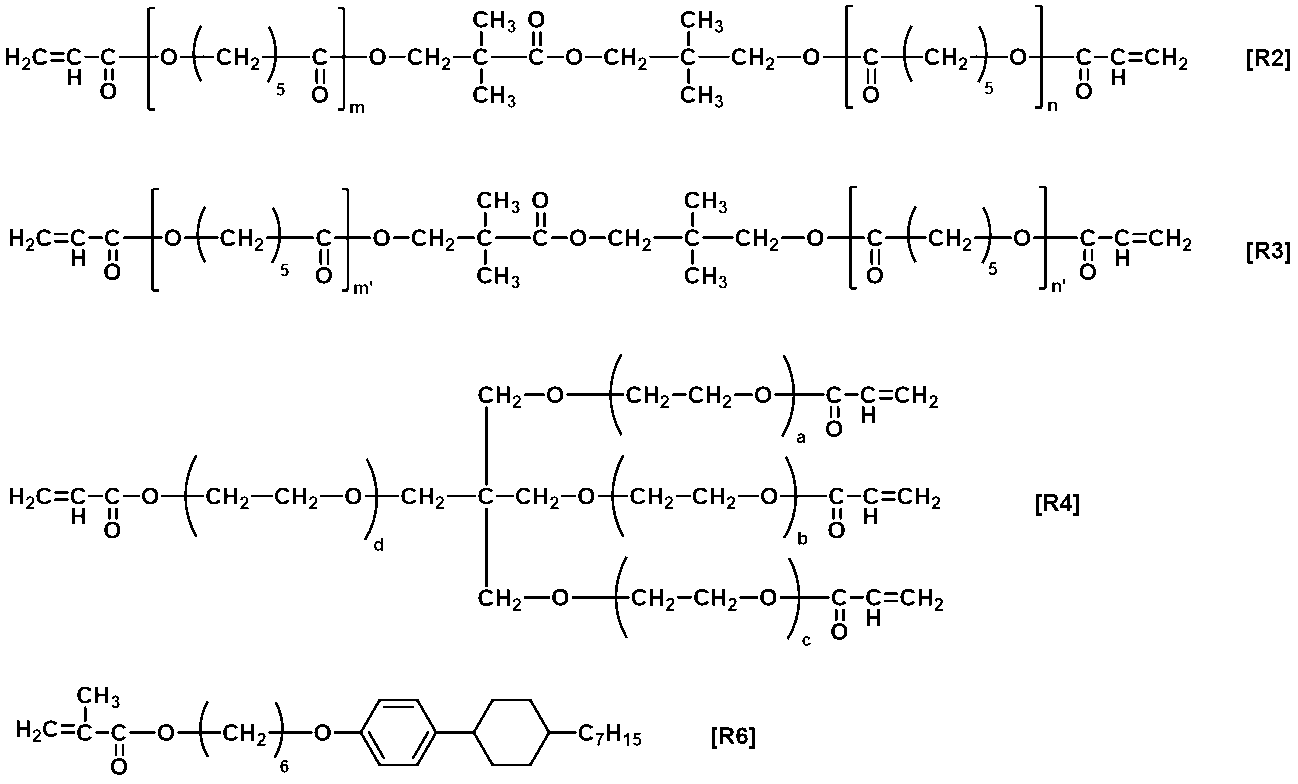
P1:1-ヒドロキシシクロヘキシルフェニルケトン(IGM Resins社製、Omnirad 184)
A1~A3:下記式(A1)~(A3)で表される化合物

B1:下記式(B1)で表される化合物(化合物(B))


D1:3,5-ジアミノ安息香酸
D2:1,3-ジアミノ-4-{4-〔トランス-4-(トランス-4-n-ペンチルシクロへキシル)シクロへキシル〕フェノキシ}ベンゼン

E1:1,2,3,4-シクロブタンテトラカルボン酸二無水物
E2:ビシクロ[3.3.0]オクタン-2,4,6,8-テトラカルボン酸二無水物

D3:3-アミノメチルピリジン

NMP:N-メチル-2-ピロリドン
BCS:エチレングリコールモノブチルエーテル
CHN:シクロヘキサノン
PGME:プロピレングリコールモノメチルエーテル
常温ゲル浸透クロマトグラフィー(GPC)装置(GPC-101、昭和電工社製)、カラム(KD-803,KD-805の直列、昭和電工社製)を用いて、以下のようにして測定した。
カラム温度:50℃
溶離液:N,N-ジメチルホルムアミド(添加剤として、臭化リチウム一水和物(LiBr・H2O)が30mmol/L(リットル)、リン酸・無水結晶(o-リン酸)が30mmol/L、テトラヒドロフラン(THF)が10mL/L)
流速:1.0mL/分
検量線作成用標準サンプル:TSK 標準ポリエチレンオキサイド(分子量;約900,000、150,000、100,000及び30,000)(東ソー社製)及びポリエチレングリコール(分子量:約12,000、4,000及び1,000)(ポリマーラボラトリー社製)。
ポリイミド粉末20mgをNMR(核磁気共鳴)サンプル管(NMRサンプリングチューブスタンダード,φ5(草野科学社製))に入れ、重水素化ジメチルスルホキシド(DMSO-d6,0.05質量%TMS(テトラメチルシラン)混合品)(0.53ml)を添加し、超音波をかけて完全に溶解させた。この溶液をNMR測定機(JNW-ECA500、日本電子データム社製)にて500MHzのプロトンNMRを測定した。イミド化率は、イミド化前後で変化しない構造に由来するプロトンを基準プロトンとして決め、このプロトンのピーク積算値と、9.5~10.0ppm付近に現れるアミック酸のNH基に由来するプロトンピーク積算値とを用い以下の式によって求めた。
イミド化率(%)=(1-α・x/y)×100
(xはアミック酸のNH基由来のプロトンピーク積算値、yは基準プロトンのピーク積算値、αはポリアミック酸(イミド化率が0%)の場合におけるアミック酸のNH基プロトン1個に対する基準プロトンの個数割合である。)
<合成例1>
A1(2.44g、6.80mmol)、A2(0.40g、1.70mmol)、及びA3(0.73g、8.50mmol)をCHN(21.0g)中に溶解し、ダイアフラムポンプで脱気・窒素復圧を行った後、重合開始剤としてAIBN(アゾビスイソブチロニトリル、0.14g、0.85mmol)を加え、再び脱気・窒素復圧を行った。その後、60℃で13時間反応させメタクリル系重合体(1)の溶液を得た。
<合成例2>
E2(5.35g,21.4mmol)、D2(3.72g,8.6mmol)、及びD1(3.04g,20.0mmol)をNMP(36.3g)中で混合し、80℃で5時間反応させた後、E1(1.28g,6.5mmol)及びNMP(3.86g)を加え、40℃で6時間反応させ、樹脂固形分濃度が25.0質量%のポリアミック酸溶液を得た。
得られたポリアミック酸溶液(20.0g)にNMPを加え、6質量%に希釈した後、イミド化触媒として無水酢酸(4.50g)、及びピリジン(3.30g)を加え、90℃で3時間反応させた。この反応溶液をメタノール(400mL)中に投入し、得られた沈殿物を濾別した。この沈殿物をメタノールで洗浄し、100℃で減圧乾燥してポリイミド粉末を得た。このポリイミドのイミド化率は80%であり、数平均分子量は19,600、重量平均分子量は49,100であった。
得られたポリイミド粉末(2.0g)に、NMP(11.3g)を加え、70℃にて24時間撹拌して溶解させた。この溶液に、D3(5.0質量%のNMP溶液,2.0g)を加えて70℃にて15時間撹拌してポリイミド(1)の溶液を得た。
以下に、液晶配向剤の製造例を記載する。この液晶配向剤は、液晶素子の作製及びその評価のためにも使用される。
合成例1で得られたメタクリル系重合体(1)の溶液(2.0g)に、添加剤B1(0.03g)、添加剤C1(0.03g)、CHN(1.3g)、及びPGME(4.2g)を加え、室温にて撹拌することにより、液晶配向剤(1)を得た。この液晶配向剤に、濁りや析出などの異常は見られず、均一な溶液であることが確認された。
合成例1で得られたメタクリル系重合体(1)の溶液(2.0g)に、添加剤B1(0.03g)、添加剤C2(0.03g)、CHN(1.3g)、及びPGME(4.2g)を加え、室温にて撹拌することにより、液晶配向剤(2)を得た。この液晶配向剤に、濁りや析出などの異常は見られず、均一な溶液であることが確認された。
合成例1で得られたメタクリル系重合体(1)の溶液(2.0g)に、添加剤B1(0.03g)、添加剤C3(0.03g)、CHN(1.3g)、及びPGME(4.2g)を加え、室温にて撹拌することにより、液晶配向剤(3)を得た。この液晶配向剤に、濁りや析出などの異常は見られず、均一な溶液であることが確認された。
合成例1で得られたメタクリル系重合体(1)の溶液(2.0g)に、添加剤B1(0.03g)、添加剤C4(0.03g)、CHN(1.3g)、及びPGME(4.2g)を加え、室温にて撹拌することにより、液晶配向剤(4)を得た。この液晶配向剤に、濁りや析出などの異常は見られず、均一な溶液であることが確認された。
合成例1で得られたメタクリル系重合体(1)の溶液(2.0g)に、添加剤B1(0.03g)、添加剤C5(0.03g)、CHN(1.3g)、及びPGME(4.2g)を加え、室温にて撹拌することにより、液晶配向剤(5)を得た。この液晶配向剤に、濁りや析出などの異常は見られず、均一な溶液であることが確認された。
合成例2で得られたポリイミド(1)の溶液(3.06g)に、添加剤B1(0.046g)、添加剤C1(0.046g)、NMP(1.9g)、及びBCS(5.0g)を加え、25℃にて2時間撹拌して液晶配向剤(6)を得た。この液晶配向剤に、濁りや析出などの異常は見られず、均一な溶液であることが確認された。
合成例2で得られたポリイミド(1)の溶液(3.06g)に、添加剤B1(0.046g)、添加剤C2(0.046g)、NMP(1.9g)、及びBCS(5.0g)を加え、25℃にて2時間撹拌して液晶配向剤(7)を得た。この液晶配向剤に、濁りや析出などの異常は見られず、均一な溶液であることが確認された。
合成例1で得られたメタクリル系重合体(1)の溶液(2.0g)に、CHN(1.3g)、及びPGME(4.2g)を加え、室温にて撹拌することにより、液晶配向剤(8)を得た。この液晶配向剤に、濁りや析出などの異常は見られず、均一な溶液であることが確認された。
合成例1で得られたメタクリル系重合体(1)の溶液(2.0g)に、添加剤B1(0.03g)、CHN(1.3g)、及びPGME(4.2g)を加え、室温にて撹拌することにより、液晶配向剤(9)を得た。この液晶配向剤に、濁りや析出などの異常は見られず、均一な溶液であることが確認された。
合成例1で得られたメタクリル系重合体(1)の溶液(2.0g)に、添加剤C1(0.03g)、CHN(1.3g)、及びPGME(4.2g)を加え、室温にて撹拌することにより、液晶配向剤(10)を得た。この液晶配向剤に、濁りや析出などの異常は見られず、均一な溶液であることが確認された。
合成例1で得られたメタクリル系重合体(1)の溶液(2.0g)に、添加剤B1(0.03g)、添加剤A3(0.03g)、CHN(1.3g)、及びPGME(4.2g)を加え、室温にて撹拌することにより、液晶配向剤(11)を得た。この液晶配向剤に、濁りや析出などの異常は見られず、均一な溶液であることが確認された。
合成例2で得られたポリイミド(1)の溶液(3.06g)にNMP(1.9g)、及びBCS(5.0g)を加え、25℃で2時間撹拌して、液晶配向剤(12)を得た。この液晶配向剤に、濁りや析出などの異常は見られず、均一な溶液であることが確認された。
合成例2で得られたポリイミド(1)の溶液(3.06g)に添加剤B1(0.046g)、NMP(1.9g)、及びBCS(5.0g)を加え、25℃で2時間撹拌して、液晶配向剤(13)を得た。この液晶配向剤に、濁りや析出などの異常は見られず、均一な溶液であることが確認された。

R1(0.90g)、R2(1.50g)、R3(1.50g)、R4(0.30g)、R5(0.30g)及びR6(0.50g)を混合し、25℃で6時間撹拌して、重合性化合物の溶液を作製した。その後、作製した重合性化合物の溶液、L1(4.0g)及びP1(0.10g)を混合し、25℃で6時間撹拌して、調光層形成材料(A)を得た。
上記実施例1~7及び比較例1~6の液晶配向剤を、それぞれ細孔径1μmのメンブランフィルタで加圧濾過し、液晶素子の作製を行った。具体的には、この液晶配向剤を、純水で洗浄したITO電極付きPET(ポリエチレンテレフタレート)基板(縦:150mm、横:150mm、厚さ:0.2mm)のITO面上にバーコーターにて塗布し、ホットプレート上にて100℃で5分間、次いで熱循環型クリーンオーブンにて120℃で2分間加熱処理をして、膜厚が100nmの配向膜付きのITO基板を得た。尚、実施例1~7の液晶配向剤を用いた塗布膜に関し、いずれもストリエーションやハジキなどの塗布不良は見られず、均一な塗布膜が得られた。得られた配向膜付きのITO基板を2枚用意し、その一方の基板の配向膜面に、厚さ6μmのスペーサーを塗布した。その後、その基板のスペーサーを塗布した配向膜面に、ODF法にて上記の調光層形成材料(A)を滴下し、次いで、他方の基板の配向膜界面が向き合うように貼り合わせを行い、処理前の液晶素子を得た。
電圧無印加時の透明性の評価は、電圧無印加状態での液晶素子のヘーズ(曇り度、HAZEともいう)を測定することで行った。具体的には、測定装置にBYK haze-gardi(テツタニ社製)を用いて、HAZEの測定を行った。評価は、HAZEが低いものほど、本評価、即ち、透明性に優れるとした。
電圧印加時の散乱特性の評価は、液晶素子に、交流駆動で48Vを印加し、上記と同様の条件で、HAZEを測定することで行った。評価は、HAZEが高いものほど、本評価、即ち散乱特性に優れるとした。
光学特性の評価結果を表2に示す。
作製した液晶素子を島津製作所社製の小型卓上試験機EZ-SXにて、下側基板をステージに固定した後、上側の基板の端部を固定し、上側基板を上方向へ引っ張り、液晶層と配向膜が剥離する剥離強度(N/25mm)を測定した。この値が大きいほど、本評価、即ち密着性に優れるとした。
密着性の評価結果を表2に示す。

Claims (10)
- 下記の(A)成分、(B)成分及び(C)成分を含有することを特徴とする液晶配向剤。
(A)成分:
カルボキシ基を有する重合体であって、重合性不飽和結合を有するモノマー(a-1)の重合体(A-1)、
カルボキシ基を有するポリイミド前駆体(A-2)、及び
カルボキシ基を有するポリイミド(A-3)、
よりなる群から選ばれる少なくとも1種の重合体(A)。
(B)成分:分子内に、エポキシ基を2つ以上有する、分子量2000以下の化合物(B)。
(C)成分:分子内に、カルボキシ基を少なくとも一つと、重合性不飽和結合を一つ有する、化合物であって、アルキレン基、炭素数4~40の脂環式炭化水素基及び炭素数6~40の芳香族炭化水素基からなる群から選ばれる少なくとも1種の基を有する、分子量2000以下の化合物(C)。 - 前記重合体(A-1)が、カルボキシ基及び重合性不飽和結合を有するモノマーを用いた重合により得られる、請求項1に記載の液晶配向剤。
- 前記化合物(C)が、
炭素数4~40の脂環式炭化水素基及び炭素数6~40の芳香族炭化水素基からなる群から選ばれる少なくとも1種の環状基(Cy)を有するカルボキシ基含有(メタ)アクリレート化合物(C-1)、
前記環状基(Cy)を有するビニル基含有芳香族カルボン酸(C-2)、
前記環状基(Cy)を有するカルボキシ基含有マレイミド(C-3)、
前記環状基(Cy)を有するカルボキシ基含有(メタ)アクリルアミド化合物(C-4)、及び
アルキレン基を有する(メタ)アクリレート化合物(C-5)(但し、前記カルボキシ基含有(メタ)アクリレート化合物(C-1)は除く。)
からなる群から選ばれる少なくとも1種である、
請求項1に記載の液晶配向剤。 - 前記重合性不飽和結合を有するモノマー(a-1)が、
(メタ)アクリル系化合物、
(メタ)アクリル酸アミド系化合物、
芳香族ビニル化合物、
共役ジエン化合物、
マレイミド基含有化合物、
α-メチレン-γ-ブチロラクトン化合物、及び
ビニル化合物
からなる群から選ばれる少なくとも1種である、
請求項1に記載の液晶配向剤。 - 前記化合物(B)が、第三級窒素原子を含有せず、エポキシ基を2つ以上有する、分子量2000以下の化合物(B-1)、及び第三級窒素原子を含有し、エポキシ基を2つ以上有する、分子量2000以下の化合物(B-2)からなる群から選ばれる少なくとも1種である、
請求項1に記載の液晶配向剤。 - 前記重合体(A-1)が、下記式(S-mA)で表される化合物(但し、カルボキシ基及び重合性不飽和結合を有するモノマーを除く。)を用いて合成される、請求項1に記載の液晶配向剤。

Xは、単結合、-(CH2)a-(aは1~15の整数である。)、-CONH-、-NHCO-、-CO-N(CH3)-、-NH-、-O-、-COO-、-OCO-、-CH=CH-COO-CH2-Ak-(Akは炭素数1~17のアルキレン基を表し、Akが有するメチレン基の一部(Akがメチレン基の時は全部)は、-O-、-CONH-、-COO-、又は-OCO-で置き換えられてもよい。)、又は-((CH2)a1-A1)m1-(a1は1~15の整数であり、A1は酸素原子又は-COO-を表し、m1は1~2の整数である。m1が2の場合、複数のa1及びA1は、それぞれ独立して上記定義を有する。)を表す。
Jは、炭素数4~40の脂環式炭化水素基及び炭素数6~40の芳香族炭化水素基からなる群から選ばれる少なくとも1種の基を有する1価の有機基を表し、但し、上記脂環式炭化水素基及び芳香族炭化水素基が有する水素原子の少なくとも一つは、ハロゲン原子、ハロゲン原子含有アルキル基、ハロゲン原子含有アルコキシ基、炭素数3~10のアルキル基、炭素数3~10のアルコキシ基、炭素数3~10のアルケニル基、並びにハロゲン原子含有アルキル基、ハロゲン原子含有アルコキシ基、炭素数3~10のアルキル基、炭素数3~10のアルコキシ基、及び炭素数3~10のアルケニル基の任意のメチレン基が有する炭素-炭素結合が酸素原子で中断されているヘテロ原子含有基からなる群から選ばれる置換基で置換されている。また、Pが(メタ)アクリロイルオキシ基、ビニルオキシ基(CH2=CH-O-)、又はマレイミド基である場合、Xは、単結合、又は炭素原子を介してPと結合する基を表す。) - 前記ポリイミド前駆体(A-2)、および前記ポリイミド(A-3)よりなる群から選ばれる少なくとも1種の重合体が、ジアミン成分とテトラカルボン酸成分とを反応させることで得られる重合体であって、前記ジアミン成分が、基「-X-J」で表される構造を側鎖に有する芳香族ジアミンを含有する、請求項1に記載の液晶配向剤。
(前記基「-X-J」において、Xは、単結合、-(CH2)a-(aは1~15の整数である。)、-CONH-、-NHCO-、-CO-N(CH3)-、-NH-、-O-、-COO-、-OCO-、-CH=CH-COO-CH2-Ak-(Akは炭素数1~17のアルキレン基を表し、Akが有するメチレン基の一部(Akがメチレン基の時は全部)は、-O-、-CONH-、-COO-、又は-OCO-で置き換えられてもよい。)、又は-((CH2)a1-A1)m1-(a1は1~15の整数であり、A1は酸素原子又は-COO-を表し、m1は1~2の整数である。m1が2の場合、複数のa1及びA1は、それぞれ独立して上記定義を有する。)を表す。
Jは、炭素数4~40の脂環式炭化水素基及び炭素数6~40の芳香族炭化水素基からなる群から選ばれる少なくとも1種の基を有する1価の有機基を表し、但し、上記脂環式炭化水素基及び芳香族炭化水素基が有する水素原子の少なくとも一つは、ハロゲン原子、ハロゲン原子含有アルキル基、ハロゲン原子含有アルコキシ基、炭素数3~10のアルキル基、炭素数3~10のアルコキシ基、炭素数3~10のアルケニル基、並びにハロゲン原子含有アルキル基、ハロゲン原子含有アルコキシ基、炭素数3~10のアルキル基、炭素数3~10のアルコキシ基、及び炭素数3~10のアルケニル基の任意のメチレン基が有する炭素-炭素結合が酸素原子で中断されているヘテロ原子含有基からなる群から選ばれる置換基で置換されている。) - 請求項1~7のいずれか一項に記載の液晶配向剤を用いて形成された液晶配向膜。
- 請求項8に記載の液晶配向膜を具備する液晶素子。
- 以下の工程(1)~(4)を含む、高分子分散型液晶素子の製造方法。
工程(1):一対の電極付基材の一方または両方に、請求項1~7のいずれか一項に記載の液晶配向剤を塗布する工程、
工程(2):前記工程(1)によって前記基材上に形成された塗膜を焼成する工程
工程(3):調光層形成材料を配置する工程
工程(4):前記配置された調光層形成材料を重合して、高分子相と液晶相を含む調光層を形成する工程
Priority Applications (3)
| Application Number | Priority Date | Filing Date | Title |
|---|---|---|---|
| CN202280034419.1A CN117321493A (zh) | 2021-05-13 | 2022-04-27 | 液晶取向剂、液晶取向膜以及液晶元件 |
| KR1020237041084A KR20240007182A (ko) | 2021-05-13 | 2022-04-27 | 액정 배향제, 액정 배향막, 및 액정 소자 |
| JP2023520972A JPWO2022239658A1 (ja) | 2021-05-13 | 2022-04-27 |
Applications Claiming Priority (2)
| Application Number | Priority Date | Filing Date | Title |
|---|---|---|---|
| JP2021-081715 | 2021-05-13 | ||
| JP2021081715 | 2021-05-13 |
Publications (1)
| Publication Number | Publication Date |
|---|---|
| WO2022239658A1 true WO2022239658A1 (ja) | 2022-11-17 |
Family
ID=84028309
Family Applications (1)
| Application Number | Title | Priority Date | Filing Date |
|---|---|---|---|
| PCT/JP2022/019099 Ceased WO2022239658A1 (ja) | 2021-05-13 | 2022-04-27 | 液晶配向剤、液晶配向膜、及び液晶素子 |
Country Status (5)
| Country | Link |
|---|---|
| JP (1) | JPWO2022239658A1 (ja) |
| KR (1) | KR20240007182A (ja) |
| CN (1) | CN117321493A (ja) |
| TW (1) | TW202311505A (ja) |
| WO (1) | WO2022239658A1 (ja) |
Cited By (1)
| Publication number | Priority date | Publication date | Assignee | Title |
|---|---|---|---|---|
| WO2025089272A1 (ja) * | 2023-10-25 | 2025-05-01 | Toppanホールディングス株式会社 | 調光シート、調光装置、および、調光シートの製造方法 |
Citations (2)
| Publication number | Priority date | Publication date | Assignee | Title |
|---|---|---|---|---|
| JP2014056236A (ja) * | 2012-08-10 | 2014-03-27 | Jsr Corp | 液晶配向剤 |
| JP2015094830A (ja) * | 2013-11-11 | 2015-05-18 | Jsr株式会社 | 液晶配向剤、液晶配向膜、液晶配向膜の製造方法、液晶表示素子及び液晶表示素子の製造方法 |
Family Cites Families (7)
| Publication number | Priority date | Publication date | Assignee | Title |
|---|---|---|---|---|
| US4435047A (en) | 1981-09-16 | 1984-03-06 | Manchester R & D Partnership | Encapsulated liquid crystal and method |
| JP2550627B2 (ja) | 1986-12-23 | 1996-11-06 | 旭硝子株式会社 | 液晶光学素子 |
| JP2724596B2 (ja) | 1987-10-20 | 1998-03-09 | 大日本インキ化学工業株式会社 | 液晶デバイス及びその製造方法 |
| JPH0743475B2 (ja) | 1988-02-23 | 1995-05-15 | ケント ステイト ユニバーシティ | 選択的眺め角度を有する液晶光変調材料 |
| WO2009041708A1 (ja) * | 2007-09-26 | 2009-04-02 | Jsr Corporation | 液晶配向剤、液晶配向膜および液晶表示素子 |
| WO2014133154A1 (ja) | 2013-03-01 | 2014-09-04 | 日産化学工業株式会社 | 液晶表示素子、液晶配向膜及び液晶配向処理剤 |
| TWI844632B (zh) | 2019-03-08 | 2024-06-11 | 日商日產化學股份有限公司 | 樹脂組成物、樹脂膜及液晶顯示元件 |
-
2022
- 2022-04-27 JP JP2023520972A patent/JPWO2022239658A1/ja active Pending
- 2022-04-27 KR KR1020237041084A patent/KR20240007182A/ko active Pending
- 2022-04-27 WO PCT/JP2022/019099 patent/WO2022239658A1/ja not_active Ceased
- 2022-04-27 CN CN202280034419.1A patent/CN117321493A/zh active Pending
- 2022-05-04 TW TW111116748A patent/TW202311505A/zh unknown
Patent Citations (2)
| Publication number | Priority date | Publication date | Assignee | Title |
|---|---|---|---|---|
| JP2014056236A (ja) * | 2012-08-10 | 2014-03-27 | Jsr Corp | 液晶配向剤 |
| JP2015094830A (ja) * | 2013-11-11 | 2015-05-18 | Jsr株式会社 | 液晶配向剤、液晶配向膜、液晶配向膜の製造方法、液晶表示素子及び液晶表示素子の製造方法 |
Cited By (1)
| Publication number | Priority date | Publication date | Assignee | Title |
|---|---|---|---|---|
| WO2025089272A1 (ja) * | 2023-10-25 | 2025-05-01 | Toppanホールディングス株式会社 | 調光シート、調光装置、および、調光シートの製造方法 |
Also Published As
| Publication number | Publication date |
|---|---|
| CN117321493A (zh) | 2023-12-29 |
| KR20240007182A (ko) | 2024-01-16 |
| JPWO2022239658A1 (ja) | 2022-11-17 |
| TW202311505A (zh) | 2023-03-16 |
Similar Documents
| Publication | Publication Date | Title |
|---|---|---|
| KR20070110791A (ko) | 액정 배향제 및 액정 표시 소자 | |
| WO2022220199A1 (ja) | 液晶配向剤、液晶配向膜及び液晶表示素子 | |
| CN102653681B (zh) | 液晶取向剂、液晶取向膜和液晶显示元件 | |
| JP7831478B2 (ja) | 液晶配向剤、液晶配向膜及び液晶表示素子 | |
| WO2023013622A1 (ja) | 液晶配向剤、液晶配向膜、及び液晶表示素子 | |
| JP2024105348A (ja) | 液晶配向剤、液晶配向膜及び液晶表示素子 | |
| JP7848806B2 (ja) | 液晶配向剤、液晶配向膜、及び液晶表示素子 | |
| JP7351435B2 (ja) | 液晶配向剤、液晶配向膜及び液晶表示素子 | |
| WO2023286735A1 (ja) | 液晶配向剤、液晶配向膜、液晶表示素子の製造方法及び液晶表示素子 | |
| WO2023074392A1 (ja) | 液晶配向剤、液晶配向膜及び液晶表示素子 | |
| JP5556396B2 (ja) | 液晶配向剤、液晶配向膜、液晶表示素子、化合物及びこの化合物の製造方法 | |
| JPWO2019193854A1 (ja) | 液晶配向剤、液晶配向膜、液晶素子及び液晶素子の製造方法 | |
| KR20240007182A (ko) | 액정 배향제, 액정 배향막, 및 액정 소자 | |
| KR20250169353A (ko) | 액정 배향제, 액정 배향막, 액정 표시 소자 | |
| TW202436600A (zh) | 液晶配向劑、液晶配向膜及液晶顯示元件 | |
| WO2023286733A1 (ja) | 液晶配向剤、液晶配向膜、液晶表示素子の製造方法及び液晶表示素子 | |
| WO2023074569A1 (ja) | 液晶配向剤、液晶配向膜及び液晶表示素子 | |
| WO2023008071A1 (ja) | 液晶配向剤、液晶配向膜、及び液晶表示素子 | |
| WO2023068085A1 (ja) | 液晶配向剤、液晶配向膜、液晶表示素子、及び化合物 | |
| WO2023032784A1 (ja) | 液晶配向剤、液晶配向膜、及び液晶表示素子 | |
| TW202534109A (zh) | 液晶配向劑、液晶配向膜及液晶顯示元件 | |
| WO2023022155A1 (ja) | 高分子分散型液晶素子およびその製造方法 | |
| WO2025177974A1 (ja) | 液晶配向剤、液晶配向膜、及び液晶表示素子 | |
| KR20250006072A (ko) | 액정 배향제, 액정 배향막 및 액정 표시 소자 | |
| TW202536065A (zh) | 液晶配向劑、液晶配向膜及液晶顯示元件 |
Legal Events
| Date | Code | Title | Description |
|---|---|---|---|
| 121 | Ep: the epo has been informed by wipo that ep was designated in this application |
Ref document number: 22807360 Country of ref document: EP Kind code of ref document: A1 |
|
| WWE | Wipo information: entry into national phase |
Ref document number: 2023520972 Country of ref document: JP |
|
| WWE | Wipo information: entry into national phase |
Ref document number: 202280034419.1 Country of ref document: CN |
|
| ENP | Entry into the national phase |
Ref document number: 20237041084 Country of ref document: KR Kind code of ref document: A |
|
| NENP | Non-entry into the national phase |
Ref country code: DE |
|
| 122 | Ep: pct application non-entry in european phase |
Ref document number: 22807360 Country of ref document: EP Kind code of ref document: A1 |