WO2022230228A1 - 伸縮シート、及び使い捨てのパンツ型着用物品 - Google Patents
伸縮シート、及び使い捨てのパンツ型着用物品 Download PDFInfo
- Publication number
- WO2022230228A1 WO2022230228A1 PCT/JP2021/045899 JP2021045899W WO2022230228A1 WO 2022230228 A1 WO2022230228 A1 WO 2022230228A1 JP 2021045899 W JP2021045899 W JP 2021045899W WO 2022230228 A1 WO2022230228 A1 WO 2022230228A1
- Authority
- WO
- WIPO (PCT)
- Prior art keywords
- sheet
- elastic sheet
- elastic
- nonwoven fabric
- stretch
- Prior art date
- Legal status (The legal status is an assumption and is not a legal conclusion. Google has not performed a legal analysis and makes no representation as to the accuracy of the status listed.)
- Ceased
Links
Images


Classifications
-
- A—HUMAN NECESSITIES
- A61—MEDICAL OR VETERINARY SCIENCE; HYGIENE
- A61F—FILTERS IMPLANTABLE INTO BLOOD VESSELS; PROSTHESES; DEVICES PROVIDING PATENCY TO, OR PREVENTING COLLAPSING OF, TUBULAR STRUCTURES OF THE BODY, e.g. STENTS; ORTHOPAEDIC, NURSING OR CONTRACEPTIVE DEVICES; FOMENTATION; TREATMENT OR PROTECTION OF EYES OR EARS; BANDAGES, DRESSINGS OR ABSORBENT PADS; FIRST-AID KITS
- A61F13/00—Bandages or dressings; Absorbent pads
- A61F13/15—Absorbent pads, e.g. sanitary towels, swabs or tampons for external or internal application to the body; Supporting or fastening means therefor; Tampon applicators
- A61F13/15203—Properties of the article, e.g. stiffness or absorbency
-
- A—HUMAN NECESSITIES
- A61—MEDICAL OR VETERINARY SCIENCE; HYGIENE
- A61F—FILTERS IMPLANTABLE INTO BLOOD VESSELS; PROSTHESES; DEVICES PROVIDING PATENCY TO, OR PREVENTING COLLAPSING OF, TUBULAR STRUCTURES OF THE BODY, e.g. STENTS; ORTHOPAEDIC, NURSING OR CONTRACEPTIVE DEVICES; FOMENTATION; TREATMENT OR PROTECTION OF EYES OR EARS; BANDAGES, DRESSINGS OR ABSORBENT PADS; FIRST-AID KITS
- A61F13/00—Bandages or dressings; Absorbent pads
- A61F13/15—Absorbent pads, e.g. sanitary towels, swabs or tampons for external or internal application to the body; Supporting or fastening means therefor; Tampon applicators
-
- B—PERFORMING OPERATIONS; TRANSPORTING
- B32—LAYERED PRODUCTS
- B32B—LAYERED PRODUCTS, i.e. PRODUCTS BUILT-UP OF STRATA OF FLAT OR NON-FLAT, e.g. CELLULAR OR HONEYCOMB, FORM
- B32B5/00—Layered products characterised by the non- homogeneity or physical structure, i.e. comprising a fibrous, filamentary, particulate or foam layer; Layered products characterised by having a layer differing constitutionally or physically in different parts
- B32B5/22—Layered products characterised by the non- homogeneity or physical structure, i.e. comprising a fibrous, filamentary, particulate or foam layer; Layered products characterised by having a layer differing constitutionally or physically in different parts characterised by the presence of two or more layers which are next to each other and are fibrous, filamentary, formed of particles or foamed
- B32B5/24—Layered products characterised by the non- homogeneity or physical structure, i.e. comprising a fibrous, filamentary, particulate or foam layer; Layered products characterised by having a layer differing constitutionally or physically in different parts characterised by the presence of two or more layers which are next to each other and are fibrous, filamentary, formed of particles or foamed one layer being a fibrous or filamentary layer
- B32B5/26—Layered products characterised by the non- homogeneity or physical structure, i.e. comprising a fibrous, filamentary, particulate or foam layer; Layered products characterised by having a layer differing constitutionally or physically in different parts characterised by the presence of two or more layers which are next to each other and are fibrous, filamentary, formed of particles or foamed one layer being a fibrous or filamentary layer another layer next to it also being fibrous or filamentary
-
- B—PERFORMING OPERATIONS; TRANSPORTING
- B32—LAYERED PRODUCTS
- B32B—LAYERED PRODUCTS, i.e. PRODUCTS BUILT-UP OF STRATA OF FLAT OR NON-FLAT, e.g. CELLULAR OR HONEYCOMB, FORM
- B32B7/00—Layered products characterised by the relation between layers; Layered products characterised by the relative orientation of features between layers, or by the relative values of a measurable parameter between layers, i.e. products comprising layers having different physical, chemical or physicochemical properties; Layered products characterised by the interconnection of layers
- B32B7/04—Interconnection of layers
- B32B7/05—Interconnection of layers the layers not being connected over the whole surface, e.g. discontinuous connection or patterned connection
-
- A—HUMAN NECESSITIES
- A61—MEDICAL OR VETERINARY SCIENCE; HYGIENE
- A61F—FILTERS IMPLANTABLE INTO BLOOD VESSELS; PROSTHESES; DEVICES PROVIDING PATENCY TO, OR PREVENTING COLLAPSING OF, TUBULAR STRUCTURES OF THE BODY, e.g. STENTS; ORTHOPAEDIC, NURSING OR CONTRACEPTIVE DEVICES; FOMENTATION; TREATMENT OR PROTECTION OF EYES OR EARS; BANDAGES, DRESSINGS OR ABSORBENT PADS; FIRST-AID KITS
- A61F13/00—Bandages or dressings; Absorbent pads
- A61F13/15—Absorbent pads, e.g. sanitary towels, swabs or tampons for external or internal application to the body; Supporting or fastening means therefor; Tampon applicators
- A61F13/15203—Properties of the article, e.g. stiffness or absorbency
- A61F2013/15284—Properties of the article, e.g. stiffness or absorbency characterized by quantifiable properties
- A61F2013/15292—Resistance, i.e. modulus or strength
Definitions
- the present disclosure relates to a stretchable sheet and a disposable pants-type wearing article comprising the stretchable sheet.
- Patent Document 1 discloses a first step of heating and melting an elastic resin material whose main component is a thermoplastic elastic resin, and forming a film or a A second step of linearly discharging to form a film-like or linear intermediate, and until the thickness or width of the film-like intermediate or the thickness of the linear intermediate reaches a predetermined value.
- a method for manufacturing a stretchable composite sheet, and a stretchable composite sheet manufactured by the manufacturing method characterized by comprising a sixth step of bonding.
- an object of the present disclosure is to provide a stretchable sheet that, when stretched in a first direction, is less likely to shrink in a second direction perpendicular to the first direction.
- the present disclosure discloses a stretch sheet having a first direction, a second direction, and a thickness direction that are orthogonal to each other, and is used by being stretched in the first direction, wherein the stretch sheet Laminated sheets including a first nonwoven fabric, a second nonwoven fabric, and an elastic sheet disposed between the first nonwoven fabric and the second nonwoven fabric, wherein the elastic sheet is stretched in a second direction in a predetermined tensile test.
- a plurality of dot-like joints having a tensile force ratio of 0.8 to 5.0 of the second tensile force in to the first tensile force in the first direction, wherein the stretch sheet joins the laminated sheets
- the present inventors have found a stretchable sheet characterized by having a portion.
- the stretchable sheet of the present disclosure is less likely to shrink in the second direction perpendicular to the first direction when stretched in the first direction.
- FIG. 1 is a diagram for explaining a stretch sheet 1 according to the first embodiment.
- FIG. 2 is a diagram for explaining the stretch sheet 1 according to the first embodiment.
- FIG. 3 is a diagram for explaining the stretch sheet 1 according to the first embodiment.
- FIG. 4 is a diagram for explaining the stretch sheet 1 according to the first embodiment.
- FIG. 5 is a diagram for explaining the stretch sheet 1 according to the second embodiment.
- FIG. 6 is a diagram for explaining the pants-type diaper 101 according to the third embodiment.
- FIG. 7 is a diagram for explaining the pants-type diaper 101 according to the third embodiment.
- FIG. 8 is a diagram for explaining the pants-type diaper 101 according to the third embodiment.
- ⁇ "Follow a given direction for the target object
- "along a predetermined direction” with respect to an object extends such that the object has an intersection angle of less than ⁇ 45° with a predetermined direction (e.g., first direction, second direction, etc.).
- a predetermined direction e.g., first direction, second direction, etc.
- the object is preferably 30° or less, more preferably 15° or less, and even more preferably 10° or less, and even more preferably 30° or less, more preferably 15° or less, and even more preferably 10° or less, with the predetermined direction. It preferably has a crossing angle of 5° or less. In this specification, when the crossing angle is 2° or less, it may be referred to as "parallel to the predetermined direction".
- the natural state of an object eg, stretch sheet, first nonwoven fabric, second nonwoven fabric, elastic sheet, laminated sheet
- an object eg, stretch sheet, first nonwoven fabric, second nonwoven fabric, elastic sheet, laminated sheet
- the stretchable sheet is composed of a laminated sheet including a first nonwoven fabric, a second nonwoven fabric, and an elastic sheet disposed between the first nonwoven fabric and the second nonwoven fabric, wherein the elastic sheet has a tensile force ratio of the second tensile force in the second direction to the first tensile force in the first direction of 0.8 to 5.0 in a predetermined tensile test;
- the elastic sheet has a plurality of dot-shaped joints joining the laminated sheets,
- the stretch sheet characterized by:
- the elastic sheet has a predetermined tensile force ratio. Therefore, the elastic sheet is a sheet that is easily stretched in the first direction and in the second direction orthogonal to the first direction and has excellent stretchability. On the other hand, the elastic sheet tends to exhibit material shrinkage, shrinking in the second direction when stretched in the first direction. Also, the elastic sheet tends to exhibit material shrinkage, shrinking in the first direction when stretched in the second direction. Since the stretchable sheet has a plurality of dot-shaped joints joining the laminated sheets, it is difficult to shrink in the second direction when stretched in the first direction.
- the stretchable sheet when used for a worn article, when the worn article is stretched in the stretch direction (first direction), the wear article is stretched in a direction (second direction) perpendicular to the stretch direction. Because it does not shrink easily, it is comfortable to wear.
- the elastic sheet comprises a first nonwoven fabric, a second nonwoven fabric, and an elastic sheet formed by molding an elastic resin material containing a thermoplastic elastic resin as a main component into a sheet shape, which is disposed between the first nonwoven fabric and the second nonwoven fabric. It consists of a laminated sheet containing The elastic sheet has a plurality of dot-shaped joints joining the laminated sheets,
- the stretch sheet characterized by:
- the elastic sheet is formed by molding an elastic resin material containing a thermoplastic elastic resin as a main component into a sheet shape.
- the sheet is easy to stretch in two directions and has excellent stretchability.
- the elastic sheet tends to exhibit material shrinkage, shrinking in the second direction when stretched in the first direction.
- the elastic sheet tends to exhibit material shrinkage, shrinking in the first direction when stretched in the second direction. Since the stretchable sheet has a plurality of dot-shaped joints joining the laminated sheets, it is difficult to shrink in the second direction when stretched in the first direction.
- the stretchable sheet when used for a worn article, when the worn article is stretched in the stretch direction (first direction), the wear article is stretched in a direction (second direction) perpendicular to the stretch direction. Because it does not shrink easily, it is comfortable to wear.
- the stretchable sheet has a non-joined portion where the laminated sheet is not joined,
- the plurality of dot-shaped joints extend in a direction along the second direction with a plurality of non-joint portions constituting the non-joint portion sandwiched therebetween, and Aspect 1 (or Aspect 1'), wherein the elastic sheet in a natural state has a curved portion in which the elastic sheet is curved in the thickness direction in at least a part of the plurality of non-bonded portions. ) or the stretch sheet according to 2.
- the elastic sheet Since the elastic sheet has a predetermined curved portion in its natural state, the elastic sheet itself contracts in the second direction when the elastic sheet is stretched in the first direction. Even in the case shown in FIG. shrinkage in the second direction), the elastic sheet is less likely to shrink in the second direction. For the same reason, when the stretchable sheet is used for a wearing article, the wearing article is less likely to shrink in the second direction when the wearing article is stretched in the first direction, and the wearing feeling is excellent.
- the elastic sheet has a predetermined curved portion in at least a part of the plurality of non-joint portions in its natural state. Therefore, when the elastic sheet is stretched in the second direction, in addition to the "material extensibility" of the material of the elastic sheet itself, the curved portion of the elastic sheet is deformed into a flat shape, so that the elastic sheet is stretched in the second direction. (To be precise, the elastic sheet stretches in the second direction when viewed from the top of the stretch sheet). have sex. In addition, when the elastic sheet is used for a worn article, the worn article is excellent in wearing feeling for the same reason.
- the thickness direction is divided into a first thickness direction and a second thickness direction that are opposite to each other,
- the curved portion includes a first curved portion that is curved so as to be convex in the first thickness direction, and a second curved portion that is curved so as to be convex in the second thickness direction.
- the elastic sheet has a predetermined first curved portion and second curved portion in its natural state. Therefore, when the elastic sheet is stretched in the first direction, even if the elastic sheet exhibits material shrinkage, the elastic sheet deforms the first curved portion and the second curved portion to a flat state. Therefore, the elastic sheet is less likely to shrink in the second direction. For the same reason, when the stretchable sheet is used for a wearing article, the wearing article is less likely to shrink in the second direction when the wearing article is stretched in the first direction, and the wearing feeling is excellent.
- the elastic sheet has predetermined first curved portions and second curved portions in its natural state. Therefore, when the elastic sheet is stretched in the second direction, the elastic sheet exerts structural extensibility by flatly deforming the first curved portion and the second curved portion in addition to its material extensibility. Therefore, the stretch sheet has a certain stretchability in the second direction. In addition, when the elastic sheet is used for a worn article, the worn article is excellent in wearing feeling for the same reason.
- the elastic sheet includes a storage space defined by a first nonwoven fabric and a second nonwoven fabric spaced apart from each other in at least a part of the plurality of non-bonded portions, and the curved portion defines the storage space.
- the stretch sheet according to aspect 3 or 4 which is stored in.
- each of the first nonwoven fabric and the second nonwoven fabric has its convex shape. Structural shrinkage-suppressing properties can be exhibited by flattening the stretchable sheet, so that the stretchable sheet is less likely to shrink in the second direction.
- the elastic sheet has a predetermined storage space, and the curved portion is stored in the storage space. Therefore, when the elastic sheet is stretched in the second direction, the first nonwoven fabric and the second nonwoven fabric are changed from the convex shape to the flat shape as the curved portion of the elastic sheet changes its structure to a flat shape.
- the stretch sheet has a certain stretchability in the second direction because it can exhibit structural extensibility that changes the structure.
- Aspect 6 Aspect 3, wherein the plurality of dot-shaped joints are arranged at a predetermined first pitch in a direction along the first direction, and are arranged at a predetermined second pitch in a direction along the second direction. 6.
- the stretchable sheet according to any one of -5. Since the plurality of dot-shaped joints are arranged at predetermined positions in the stretchable sheet, the stretchable sheet is difficult to shrink in the second direction orthogonal to the first direction when the stretchable sheet is stretched in the first direction.
- a disposable pant-type wearing article comprising a waist region having a waist opening and having a waist direction and a height direction,
- the elastic sheet according to any one of Aspect 1 (or Aspect 1') to 8 is provided in the waist region so that the first direction is along the waist direction,
- the above underpants-type wearing article characterized by:
- the elastic sheet is provided in the waist area so that the first direction is along the waist direction. It is difficult to shrink in the height direction when stretching in the direction. Therefore, the pants-type wearing article is excellent in wearing feeling.
- Aspect 13 Any one of Aspect 1 (or Aspect 1′) to 12, wherein the elastic sheet in the natural state has a thickness that is 4 to 10 times the thickness when the elastic sheet is stretched by 50% in the first direction.
- the elastic sheet described in the item Since the elastic sheet has a predetermined thickness in its natural state, the elastic sheet (the elastic sheet, the first nonwoven fabric and the second nonwoven fabric) has the property of suppressing structural shrinkage when the elastic sheet is stretched in the first direction. It becomes easy to exert, and the elastic sheet becomes difficult to shrink in the second direction.
- Aspect 14 Any one of Aspect 1 (or Aspect 1') to 13, wherein the stretch sheet in the natural state has a thickness that is 4 to 10 times the thickness when the stretch sheet is stretched 50% in the second direction.
- the elastic sheet described in the item Since the elastic sheet has a predetermined thickness in its natural state, the elastic sheet (the elastic sheet, the first nonwoven fabric and the second nonwoven fabric) exhibits structural extensibility when the elastic sheet is stretched in the second direction. and the stretch sheet has a certain stretchability in the second direction.
- FIG. 1 is a plan view of an elastic sheet 1 in a natural state.
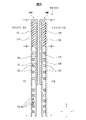
- FIG. 2 is a cross-sectional view of the elastic sheet 1 in its natural state, taken along the II-II cross section of FIG.
- FIG. 3 is a sectional view corresponding to the section II-II in FIG. 1 of the elastic sheet 1 when the elastic sheet 1 is stretched in the first direction D 1 .
- FIG. 4 is a sectional view corresponding to the section II-II in FIG. 1 of the elastic sheet 1 when the elastic sheet 1 is stretched in the second direction D2.
- the stretch sheet 1 has a first direction D1, a second direction D2, and a thickness direction T, which are orthogonal to each other, and is used by being stretched mainly in the first direction D1.
- the thickness direction T includes a first thickness direction T 1 that is the direction from the second nonwoven fabric 5 to the first nonwoven fabric 3, and a second thickness direction T 1 that is the direction from the first nonwoven fabric 3 to the second nonwoven fabric 5. and the vertical direction T 2 .
- the elastic sheet 1 is formed by forming a first nonwoven fabric 3, a second nonwoven fabric 5, and an elastic resin material mainly composed of a thermoplastic elastic resin disposed between the first nonwoven fabric 3 and the second nonwoven fabric 5 into a sheet shape. It is composed of a laminated sheet 9 consisting of an elastic sheet 7 and an elastic sheet 7 .
- the stretchable sheet 1 has a plurality of dot-shaped joints 11 joining the laminated sheets 9 .
- the plurality of dot-shaped joints 11 are intermittently arranged at a first pitch P 1 in a first direction intersecting direction D 1 ′ (a direction along the first direction) having an intersecting angle ⁇ with the first direction D 1 .
- the plurality of dot-shaped joints 11 are intermittently arranged at a second pitch P2 in a direction parallel to the second direction D2.
- portions other than the plurality of dot-shaped joined portions 11 are non-joined portions 13 to which the laminated sheet 9 is not joined.
- the non-bonded portion 13 includes a plurality of non-bonded portion portions 15, and the plurality of dot-shaped bonded portions 11 are spaced apart in the second direction D2 with the non-bonded portion portion 15 interposed therebetween. there is In other words, the dot-shaped joint portions 11 and the non-joint portions 15 are alternately arranged in the second direction D2.
- the plurality of dot-shaped joints 11 are spaced apart with the non-joint portions 15 interposed therebetween in the first cross direction D 1 ′.
- the dot-shaped joint portions 11 and the non-joint portions 15 are alternately arranged in the first cross direction D 1 '.
- the elastic sheet 1 in the natural state has a curved portion 17 in which the elastic sheet 7 curves in the thickness direction T at the non-bonded portion 15 .
- the elastic sheet 1 in the natural state includes a first curved portion 19, which is curved so that the elastic sheet 7 protrudes in the first thickness direction T1, and an elastic A second curved portion 21 is provided so that the sheet 7 is curved to protrude in the second thickness direction T2.
- the first curved portion 19 is formed in the thickness direction T of the two dot-shaped joints 11 that define the non-bonded portion 15 (storage space 23) to which the first curved portion 19 belongs. It is arranged at a position away from the reference plane BS connecting the centers toward the first thickness direction T1.
- the second curved portion 21 extends in the thickness direction of two dot-shaped joints 11 that define the non-bonded portion 15 (storage space 23 ) to which the second curved portion 21 belongs among the plurality of dot-shaped joints 11 . It is arranged at a position away from the reference plane BS connecting the centers of T in the second thickness direction T2.
- the stretch sheet 1 in the natural state has the first nonwoven fabric 3 and the second nonwoven fabric 5 (more precisely, the first nonwoven fabric 3
- the storage space 23 is defined by a surface (not shown) on the second nonwoven fabric 5 side of the second nonwoven fabric 5 and a surface on the first nonwoven fabric 3 side of the second nonwoven fabric 5, and the first curved portion 19 of the elastic sheet 7 and the second bending portion 21 are housed in the housing space 23 .
- the elastic sheet 7 When the stretchable sheet 1 is stretched in the first direction D1, the elastic sheet 7 itself exhibits material contractility such that it shrinks in the second direction D2. Structural contraction suppression in the second direction D2 due to the flat deformation of the second curved portion 21 can be exhibited.
- the first nonwoven fabric 3 when the elastic sheet 1 is stretched in the first direction D1, the first nonwoven fabric 3 exhibits material shrinkage, but the first curved portion 19 and the second curved portion 21 of the elastic sheet 7 deform flatly.
- the first nonwoven fabric 3 can exhibit structural shrinkage suppression properties by changing the structure from a convex shape to a flat shape, so that the first nonwoven fabric 3 is less likely to shrink in the second direction D2. Become. For the same reason as the first nonwoven fabric 3, the second nonwoven fabric 5 is less likely to shrink in the second direction D2.
- the storage space 23 and the first curved portion 19 and the second curved portion 21 of the elastic sheet 7 are arranged to move the elastic sheet 1 in the first direction D 1 when the elastic sheet 1 is stretched in the first direction D 1 . It is difficult to affect the extensibility to. As a result, as shown in FIG. 3, when stretching the stretch sheet 1 in the first direction D1, the stretch sheet 1 is less likely to shrink in the second direction D2.
- the elastic sheet 1 in its natural state has a thickness about 10 times the thickness when the elastic sheet 1 is stretched 50% in the first direction D1. Thereby, when the stretchable sheet 1 is stretched in the first direction D1, the stretchable sheet 1 is less likely to shrink in the second direction D2.
- the elastic sheet 7 When the stretchable sheet 1 is stretched in the second direction D2, the elastic sheet 7 combines the material extensibility of the elastic sheet 7 itself in the second direction D2 with the first curved portion 19 and the second curved portion of the elastic sheet 7.
- the elastic sheet 7 has a certain degree of stretchability in the second direction D2 because the portion 21 deforms flatly to exhibit structural stretchability in the second direction D2.
- the first nonwoven fabric 3 when the elastic sheet 1 is stretched in the second direction D2, the first nonwoven fabric 3 has the material extensibility, and the first curved portion 19 and the second curved portion 21 of the elastic sheet 7 are flattened.
- the first nonwoven fabric 3 can exhibit structural extensibility by changing the structure from a convex shape to a flat shape, so that the first nonwoven fabric 3 can be stretched to a certain extent in the second direction D2. have sex.
- the second nonwoven fabric 5 has a certain stretchability in the second direction D2.
- the elastic sheet 1 can have a certain elongation in the second direction D2, as shown in FIG.
- the elastic sheet 1 in its natural state has a thickness about 10 times the thickness when the elastic sheet 1 is stretched 50% in the second direction D2.
- the stretch sheet 1 has a certain stretchability in the second direction D2.
- the second pitch P2 is smaller than the first pitch P1.
- the elastic sheet 7 in a predetermined tensile test, is subjected to the second tensile force in the second direction D 2 of the elastic sheet 7 in the first direction D 1 .
- the tensile force ratio for one tensile force is 0.8 to 5.0.
- the elastic sheet 7 has excellent stretchability not only in the first direction D1 but also in the second direction D2.
- the elastic sheet 7 tends to exhibit material shrinkage properties such that it shrinks in the second direction D2 when stretched in the first direction D1, and when stretched in the second direction D2, it tends to shrink in the first direction. It tends to exhibit material shrinkage that shrinks to D1.
- a predetermined tensile test will be described later.
- FIG. 5 is a diagram for explaining a stretch sheet 1 according to another embodiment of the present disclosure (hereinafter referred to as “second embodiment”), and is a plan view of the stretch sheet 1.
- the stretch sheet 1 according to the second embodiment includes a first nonwoven fabric 3, a second nonwoven fabric (not shown), and a thermoplastic elastic resin interposed between the first nonwoven fabric 3 and the second nonwoven fabric (not shown). and an elastic sheet (not shown) formed by molding an elastic resin material mainly composed of a laminated sheet (not shown). dot-like joints 11 are provided.
- the plurality of dot-shaped joints 11 are intermittently arranged at a first pitch P 1 in a first direction intersecting direction D 1 ′ having an intersecting angle ⁇ with the first direction D 1 . Also, the plurality of dot-shaped joints 11 are intermittently arranged at a second pitch P2 in a direction parallel to the second direction D2.
- the second pitch P2 is larger than the first pitch P1.
- the first curved portion (not shown) and the second curved portion (not shown) of the elastic sheet are likely to be enlarged, and as a result, the stretchable sheet 1 is likely to stretch in the second direction D2.
- the rest of the stretch sheet 1 according to the second embodiment is the same as the stretch sheet 1 according to the first embodiment, so the description is omitted.
- FIG. 6-8 illustrate a disposable pant-type wearing article, specifically a disposable pant-type diaper 101, according to yet another embodiment of the present disclosure (hereinafter referred to as "third embodiment"). It is a diagram for Specifically, FIG. 6 is a perspective view of the pants-type diaper 101. FIG. FIG. 7 is an exploded view of the pants-type diaper 101. FIG. FIG. 8 is an end view of the left engaging portion 109 of the exterior body 103, corresponding to the VIII-VIII end face of FIG. Note that FIG. 8 does not reflect the state of compression from the viewpoint of understanding the constituent members of the left locking portion 109 (locking portion 107) in the exterior body 103. As shown in FIG.
- a pants-type diaper 101 according to the third embodiment is divided into an outer body 103 and an absorbent main body 105 arranged inside (skin side) of the outer body 103 .
- the pants-type diaper 101 has a waistline direction WD and a height direction HD perpendicular to the waistline direction WD when worn.
- the underpants-type diaper 101 according to the first embodiment has a longitudinal direction L, a width direction W, and a thickness direction T which are orthogonal to each other in the unfolded state.
- the pants-type diaper 101 is divided into a front body FP and a back body RP by a longitudinal center line LC extending parallel to the width direction W at the center in the longitudinal direction L.
- the pants-type diaper 101 is divided in the longitudinal direction L into a waist region WR in which a pair of locking portions 107 (a left locking portion 109 and a right locking portion 111) are present, and a leg region CR.
- the waist region WR is divided into a front waist region FWR arranged on the front body FP and a back waist region RWR arranged on the back body RP.
- the leg circumference region CR is arranged between the front waist region FWR and the rear waist region RWR.
- the waist region WR and the leg region CR are in contact with the waist opening 113 and the leg opening 115, respectively.
- the outer body 103 includes a front outer sheet 121, a front inner sheet 123, and a front elastic sheet 133 and a plurality of front thread-like elastic members disposed between the front outer sheet 121 and the front inner sheet 123 in the front waist region FWR. 137.
- Each of the front outer sheet 121, the front inner sheet 123, and the front folded sheet 125, which will be described later, is made of a long-fiber nonwoven fabric containing 100% by mass of heat-fusible fibers.
- the front elastic sheet 133 is formed by molding an elastic resin material containing a thermoplastic elastic resin as a main component into a sheet shape.
- Each of the plurality of front thread-like elastic members 137 is a rubber thread.
- the outer body 103 includes a front folded sheet 125 formed by folding the front outer sheet 121 inwardly at the edge (not shown) of the waist opening 113 in the front waist region FWR.
- the folded sheet 125 is arranged inside (skin side) of the front inner sheet 123 .
- the front elastic sheet 133 is arranged in the front stretchable sheet arrangement region 135 of the front waist region FWR, and the plurality of front thread-like elastic members 137 are arranged in the front elastic thread member arrangement region 139 of the front waist region FWR. .
- the front elastic sheet arrangement area 135 occupies about 25% of the height (not shown) in the height direction HD of the front waist area FWR, and is arranged closer to the waist opening 113 .
- the front elastic thread member arrangement region 139 occupies about 75% of the height (not shown) of the front waist region FWR in the height direction HD, and is in contact with the front elastic sheet arrangement region 135. It is arranged near the turning opening 115 .
- the front elastic sheet 133 is ultrasonically joined together with the front outer sheet 121, the front inner sheet 123 and the front folded sheet 125 to form the front elastic sheet 119 which is a laminated sheet.
- the front stretchable sheet 119 includes a plurality of front dot-shaped joints 145 formed by ultrasonically joining and fusing the front outer sheet 121, the front elastic sheet 133, the front inner sheet 123, and the front folded sheet 125. ing.
- the plurality of front dot-shaped joints 145 are arranged in the pattern shown in FIG. 1 in the front elastic sheet arrangement area 135 .
- the front stretchable sheet 119 is arranged such that the first direction (the first direction D 1 in FIG. 1) coincides with the waistline direction WD.
- no adhesive for example, hot melt adhesive
- the front outer sheet 121 the front elastic sheet 133, the front inner sheet 123, and the front folded sheet 125.
- the exterior body 103 includes a rear outer sheet 127, a rear inner sheet 129, and a rear elastic sheet 151 disposed between the rear outer sheet 127 and the rear inner sheet 129 in the rear waist region RWR. and a plurality of rear leg elastic thread members 158 .
- Each of the rear outer sheet 127, the rear inner sheet 129, and the later-described rear folded sheet 131 is made of a long-fiber nonwoven fabric containing 100% by mass of heat-fusible fibers.
- the rear elastic sheet 151 is formed by molding an elastic resin material containing a thermoplastic elastic resin as a main component into a sheet shape.
- Each of the plurality of rear thread elastic members 155 and the plurality of rear leg thread elastic members 158 is a rubber thread.
- the exterior body 103 includes a rear folded sheet 131 formed by folding the rear outer sheet 127 inwardly at the edge (not shown) of the waist opening 113 in the rear waist region RWR. , the rear folded sheet 131 is arranged inside (skin side) of the rear inner sheet 129 .
- the rear elastic sheet 151 is arranged in the rear stretchable sheet arrangement region 153 of the rear waist region RWR, and the plurality of rear elastic thread members 155 are arranged in the rear elastic thread member arrangement region 157 of the rear waist region RWR. are placed.
- the rear elastic sheet placement region 153 occupies about 25% of the height (not shown) in the height direction HD of the rear waist region RWR, and is arranged closer to the waist opening 113 .
- the rear elastic thread member arrangement region 157 occupies about 75% of the height (not shown) of the rear waist region RWR in the height direction HD, and is in contact with the rear elastic sheet arrangement region 153. , and the leg opening 115. As shown in FIG.
- the rear elastic sheet 151 is ultrasonically bonded together with the rear outer sheet 127, the rear inner sheet 129, and the rear folded sheet 131 to form the rear elastic sheet 120, which is a laminated sheet. is doing.
- the rear stretchable sheet 120 has a plurality of rear dots formed by ultrasonically bonding and fusing a rear outer sheet 127, a rear elastic sheet 151, a rear inner sheet 129, and a rear folding sheet 131. It has a shape joint 163 .
- the plurality of rear dot-shaped joints 163 are arranged in the pattern shown in FIG. 1 in the rear elastic sheet arrangement area 153 .
- the rear stretchable sheet 120 is arranged such that the first direction (the first direction D 1 in FIG. 1) coincides with the waistline direction WD.
- an adhesive for example, a hot melt adhesive for bonding the rear outer sheet 127, the rear elastic sheet 151, the rear inner sheet 129, and the rear folded sheet 131 is not used. Not done.
- Each of the pair of engaging portions 107 folds the pants-type diaper 101 in the unfolded state with the longitudinal center line LC as the folding line and the absorbent main body 105 facing inward. After folding, it is formed by squeezing both ends in the width direction W of the front waistline region FWR and the rear waistline region RWR (not labeled).
- the elastic sheet 117 composed of the front elastic sheet 119 and the rear elastic sheet 120 is arranged so as to be in contact with the waist opening 113 .
- the portion of the waist region WR from the waist opening 113 tends to expand, making it easy to wear.
- the stretchability of the portion of the waist region WR near the waist opening 113 is less likely to decrease over time, the waist region WR of the pants-type diaper 101 is less likely to slip off when worn. Since the effect of the stretchable sheet 117 composed of the front stretchable sheet 119 and the rear stretchable sheet 120 has been described in the first embodiment, it will be omitted.
- the stretch sheet of the present disclosure has a first direction, a second direction, and a thickness direction (divided into a first thickness direction and a second thickness direction that are opposite to each other), which are orthogonal to each other. and is used to stretch in a first direction. It should be noted that the stretchable sheet of the present disclosure can also be used so as to stretch in the second direction in addition to the first direction.
- the elastic sheet is composed of a laminated sheet including a first nonwoven fabric, a second nonwoven fabric, and an elastic sheet interposed between the first nonwoven fabric and the second nonwoven fabric.
- the laminated sheet may include an additional sheet.
- the elastic sheet is not particularly limited as long as it has a predetermined tensile force ratio, and can be any sheet.
- the following are listed.
- the thermoplastic elastic resin for example, a thermoplastic resin exhibiting rubber elasticity at room temperature is preferable, and examples thereof include thermoplastic elastomers described in JIS K 6418:2007.
- the thermoplastic elastic resin preferably has a temperature range of about 100° C. or less in which it undergoes elastic deformation.
- the elastic resin material containing the thermoplastic elastic resin as a main component preferably contains more than 50% by mass, more preferably 70% by mass or more, even more preferably 80% by mass or more, and even more preferably 90% by mass. Contains more than mass %. Further, the elastic resin material containing the thermoplastic elastic resin as a main component can contain 100% by mass of the thermoplastic elastic resin. As a result, the elastic sheet can easily stretch in the first direction and the second direction, and can easily have a predetermined tensile force ratio.
- thermoplastic elastic resin examples include olefin elastomers (e.g., VERSIFY (trademark) available from The Dow Chemical Company), propylene elastomers (e.g., Vistamaxx (trademark) available from ExxonMobil), and styrene elastomers. (For example, Quintac (trademark) of Nippon Zeon Co., Ltd.) and the like.
- the elastic sheet can be produced using the thermoplastic elastic resin, for example, according to the method described in WO 2019/150801.
- Each of the first nonwoven fabric and the second nonwoven fabric includes, for example, an air-through nonwoven fabric, a spunbond nonwoven fabric, a point-bond nonwoven fabric, a spunlace nonwoven fabric, a needle-punched nonwoven fabric, a meltblown nonwoven fabric, and an SMS. nonwoven fabrics (spunbond-meltblown-spunbond nonwoven fabrics) and the like. Examples of the additional sheet include the nonwoven fabrics described above.
- the nonwoven fabric contains heat-fusible fibers, and the nonwoven fabric preferably contains heat-fusible fibers in an amount of preferably 50% by mass or more, more preferably 70% by mass or more, even more preferably 80% by mass or more, and even more preferably 80% by mass or more. It preferably contains 90% by mass or more.
- the said nonwoven fabric can contain 100 mass % of said heat-fusible fibers. As a result, the strength of the first nonwoven fabric, the second nonwoven fabric, and the stretch sheet is excellent. Further, when a plurality of dot-shaped joints are fusion-bonded portions, the plurality of dot-shaped joints can be easily formed.
- the stretchable sheet of the present disclosure includes a plurality of dot-shaped joints joining the laminated sheets.
- Each of the plurality of dot-shaped junctions is not particularly limited, but has a length between a length L 1 in a direction parallel to the first direction and a length L 2 in a direction parallel to the second direction.
- the ratio (L 2 /L 1 ) is preferably 1/4-4, more preferably 1/3-3, and even more preferably 1/2-2.
- the dot-shaped joints themselves are less likely to interfere with the elongation of the stretchable sheet in the first direction and the elongation in the second direction.
- the stretch sheet is less likely to have directionality in its bendability, and the stretch sheet is excellent in touch.
- the elastic sheet is used for a worn article, the worn article is excellent in wearing feeling.
- Each of length L 1 and length L 2 is preferably 0.05 mm or greater, and more preferably 0.1 mm or greater. Also, each of length L 1 and length L 2 is preferably 1.0 mm or less, more preferably 0.5 mm or less, and even more preferably 0.4 mm or less.
- the dot-shaped joints themselves are less likely to hinder the elongation of the elastic sheet in the first direction and the elongation in the second direction.
- the stretch sheet is less likely to have directionality in its bendability, and the stretch sheet is excellent in touch.
- the elastic sheet is used for a worn article, the worn article is excellent in wearing feeling.
- the shape of each of the plurality of dot-shaped joints (the shape in the planar direction of the stretchable sheet) is not particularly limited, and examples thereof include circular, elliptical, and rectangular shapes.
- Each of the plurality of dot-shaped joints can be, for example, a fused part (eg, embossed, ultrasonically fused part), a bonded part (eg, hot-melt adhesive), or the like.
- the joint is a fusion, particularly an ultrasonic fusion. This is because the fused portion, particularly the fused portion formed by ultrasonic waves, is less likely to impede the stretchability of the stretch sheet by reducing its size.
- the tensile force ratio of the second tensile force in the second direction of the elastic sheet to the first tensile force in the first direction of the elastic sheet is 0.8 or more in a predetermined tensile test.
- the tensile force ratio is 5.0 or less, preferably 3.0 or less, more preferably 2.0 or less, and even more preferably 1.5 or less.
- the elastic sheet has excellent stretchability in any direction. Further, as the tensile force ratio approaches 1, the easiness of elongation in the first direction and the easiness of elongation in the second direction become equal, and the elastic sheet tends to be uniformly elongated in any direction.
- each of the first tensile force and the second tensile force may vary depending on the application of the stretch sheet.
- each of the first tensile force and the second tensile force is preferably 0.2 N or more, more preferably 0.3 N or more, and even more preferably 0.5 N. and preferably 5.0N or less, more preferably 3.0N or less, and even more preferably 2.0N or less.
- the predetermined tensile test is performed as follows. (1) As a tensile tester, prepare a universal tester (3400 series) manufactured by Instron. (2) A cold spray or the like is applied to the stretchable sheet, the elastic sheet is taken out from the stretchable sheet, and the taken out elastic sheet is allowed to stand under the conditions of 25°C ⁇ 2°C under natural conditions for 24 hours. (3) Cut the elastic sheet into a size of 50 mm x 40 mm (first direction x second direction) to prepare a first direction sample, and stretch the first direction sample so that the first direction is the stretching direction. Distance between chucks: Set on a jig with 40 mm.
- the first direction sample is stretched at a speed of 300 mm / min to an elongation rate of 100% (+40 mm, distance between chucks: 80 mm).
- a first cycle consisting of a first return pass for returning to an elongation rate of 0% ( ⁇ 0 mm, distance between chucks: 40 mm) is performed at a high speed.
- the first direction sample is stretched at a speed of 300 mm / min to an elongation rate of 100% (+40 mm, distance between chucks: 80 mm) in a second forward pass, and then the first direction sample. at a speed of 300 mm/min.
- the sample size can be appropriately changed and the first tensile force and the second tensile force can be measured.
- the first tensile force and the second tensile force can be measured.
- the first tensile force and the second tensile force are converted to a length of 40 mm in the orthogonal direction.
- the length in the orthogonal direction is 20 mm (50% of the specified value)
- double the value is adopted as the first tensile force and the second tensile force.
- the stretchable sheet of the present disclosure includes a plurality of dot-shaped joints joining the laminated sheets, and non-joined sections to which the laminated sheets are not joined. Further, the non-joint portion is divided into a plurality of non-joint portions.
- the plurality of dot-shaped junctions can be arranged intermittently so as to extend in the first direction and the second direction, for example, arranged in a zigzag pattern.
- the plurality of dot-shaped joints can be intermittently arranged so as to extend in the first direction, and between the plurality of dot-shaped joints, Each of a plurality of non-joint portions constituting the non-joint portion can be arranged. Also, the plurality of dot-shaped joint portions can extend at a predetermined first pitch in a direction along the first direction.
- the plurality of dot-shaped joints can be intermittently arranged so as to extend in the second direction, and between the plurality of dot-shaped joints, Each of a plurality of non-joint portions constituting the non-joint portion can be arranged. Also, the plurality of dot-shaped joint portions can extend at a predetermined second pitch in a direction along the second direction.
- Each of the first pitch and the second pitch is preferably 1.0 mm or more, more preferably 2.0 mm or more, and even more preferably 3.0 mm or more. Also, each of the first pitch and the second pitch is preferably 20.0 mm or less, more preferably 15.0 mm or less, and even more preferably 10.0 mm or less. As a result, the stretchability of the stretch sheet in the first direction is less likely to be hindered, and the shrinkage of the stretch sheet in the second direction can be easily suppressed.
- the size relationship between the first pitch and the second pitch is not particularly limited, the first pitch may be the same as the second pit, the second pitch may be smaller than the first pitch, and The second pitch may be greater than the first pitch.
- the second pitch is smaller than the first pitch, the curved portion of the elastic sheet tends to be compact, the thickness of the stretch sheet in the natural state tends to be thin, and the stretch sheet is excellent in appearance.
- the second pitch is larger than the first pitch, the curved portion of the elastic sheet is likely to be enlarged, and the stretchable sheet is likely to stretch in the second direction.
- the elastic sheet of the present disclosure at least a portion of the plurality of non-bonded portion portions disposed between the plurality of dot-shaped bonded portions extending in the second direction, the elastic sheet extends in the thickness direction. It is preferred to have a curved portion that curves toward . As a result, the elastic sheet, and thus the stretchable sheet, can exhibit "structural contraction suppression" and "structural extensibility" in the second direction.
- the elastic sheet as a whole, and thus the stretchable sheet as a whole, can easily exhibit "structural shrinkage suppressing properties" and "structural extensibility" in the second direction.
- the curved portion includes the first curved portion that is curved so as to be convex in the first thickness direction, and the first curved portion that is curved so as to be convex in the second thickness direction. It is preferable to have a curved second curved portion.
- the elastic sheet and, in turn, the stretchable sheet are likely to exhibit "structural contraction restraint" and "structural extensibility" in the second direction.
- the first curved portion is separated in the first thickness direction from the reference plane connecting the thickness direction centers of the two dot-shaped joint portions that define the joint portion where the first curved portion exists.
- the second curved portion is preferably arranged at a position away from the reference plane in the second thickness direction.
- the curved portion In the natural state of the elastic sheet, the curved portion has a height that is preferably twice or more, more preferably three times or more, and even more preferably four times or more the thickness of the elastic sheet itself. In addition, in the natural state of the elastic sheet, the curved portion preferably has a height that is 20 times or less, more preferably 15 times or less, and even more preferably 10 times or less the thickness of the elastic sheet itself. . This makes it easier for the elastic sheet, and thus the stretchable sheet, to exhibit "structural contraction suppression" and "structural extensibility" in the second direction.
- the height means the difference between the highest portion and the lowest portion in the thickness direction of the elastic sheet in the non-bonded portion. Also, the thickness of the elastic sheet itself and the height are different.
- the stretch sheet in the natural state is cooled with liquid nitrogen to form a predetermined cross section, for example, a cross section passing through a plurality of dot-shaped joints extending in the second direction, and the cross section is examined with a microscope or the like. It can be measured by observing with , and using image processing software or the like.
- the stretchable sheet of the present disclosure at least some of the plurality of non-bonded portion portions disposed between the plurality of dot-shaped bonded portions extending in the second direction are spaced apart from each other. It is preferable that a storage space defined by the first nonwoven fabric and the second nonwoven fabric be provided, and the curved portion be stored in the storage space. This makes it easier for the stretch sheet to exhibit "structural shrinkage suppression” and "structural extensibility”.
- the stretch sheet as a whole can easily exhibit "structural shrinkage suppression” and "structural extensibility".
- the elastic sheet When the elastic sheet has the storage space, the elastic sheet has a thickness in a natural state when stretched by 50% (second direction, when stretched 1.5 times its original length). It preferably has a thickness of 3 to 20 times, more preferably 3 to 15 times, and even more preferably 4 to 10 times. This makes it easier for the stretch sheet to exhibit "structural extensibility" in the second direction.
- the thickness of the elastic sheet in the natural state is the thickness when stretched by 50% (first direction, when stretched 1.5 times the original length). It preferably has a thickness of 3 to 20 times, more preferably 3 to 15 times, and even more preferably 4 to 10 times. This makes it easier for the stretch sheet to exhibit "structural shrinkage suppressing properties" in the second direction.
- the thickness of the elastic sheet in the natural state or at the time of 50% elongation is measured using a thickness gauge (for example, FS-60DS manufactured by Daiei Kagaku Seiki Seisakusho Co., Ltd., probe area 15 cm 2 ), and a constant pressure of 3 g / cm 2 and the thickness after 10 seconds of pressurization at each site can be adopted.
- a thickness gauge for example, FS-60DS manufactured by Daiei Kagaku Seiki Seisakusho Co., Ltd., probe area 15 cm 2
- a constant pressure of 3 g / cm 2 and the thickness after 10 seconds of pressurization at each site can be adopted.
- the stretch sheet of the present disclosure is not particularly limited and can be produced by any method.
- the stretchable sheet of the present disclosure is formed, for example, by stretching the elastic sheet in the first direction and stretching the first nonwoven fabric and the second nonwoven fabric in the second direction to form a laminated sheet, and And it can be produced by forming a plurality of dot-like joints on the laminated sheet while maintaining the stretched state of the second nonwoven fabric.
- the stretch sheet of the present disclosure is not particularly limited and can be used for any application.
- the sheet of the present disclosure can be used for wearing articles, for example, pants-type wearing articles.
- Disposable pants-type wearing articles in the present disclosure are not particularly limited, and include items having a waist region having a waist opening, such as disposable diapers, disposable shorts, and disposable pants.
- the wearing article of the present disclosure may include the stretchable sheet described above in the waist region such that the first direction is along the waist direction.
- the elastic sheet is arranged so as to be in contact with the waist opening.
- the wearing article is less likely to get stuffy when worn.
- the elastic sheet is in contact with the waist opening, preferably 5% or less of the height of the waist region (height in the height direction) from the waist opening, More preferably it is included in the range of 3% or less, and even more preferably 1% or less.
- the stretchable sheet can be arranged in a predetermined stretchable sheet arrangement area extending in the waistline direction and the height direction in the waistline area. Further, in the predetermined stretchable sheet arrangement area, the stretchable sheet (elastic sheet) can be arranged continuously (entirely) or intermittently in the stretchable sheet arrangement area.
- the stretchable sheet in the predetermined stretchable sheet arrangement area, can be arranged continuously or intermittently in the height direction. Moreover, in the predetermined stretchable sheet arrangement area, the stretchable sheet can be arranged continuously or intermittently in the waist circumference direction.
- the effect of the stretch sheet can be achieved in the entire stretch sheet arrangement area.
- the effect of the elastic sheet can be achieved in the entire stretch sheet arrangement area.
- intermittently arranging the elastic sheet in the area where the elastic sheet is arranged intermittently in at least one of the height direction and the waist circumference direction
- the effect of the elastic sheet can be exhibited, and the expansion and contraction in the elastic sheet area can be improved.
- the air permeability of the sheet air permeability in the thickness direction
- the elastic sheet arrangement area may be arranged within 100% of the height of the waist area in the height direction, but is preferably 75% or less, more preferably 50% or less, and still more preferably It is arranged so as to fit within an area of 25% or less.
- the elastic sheet arrangement area is preferably arranged within an area of 5% or more, more preferably 10% or more, and even more preferably 12% or more in the height direction. As a result, the wearing article is less likely to get stuffy when worn.
- the elastic sheet arrangement area may be arranged so as to make a circle in the waistline direction in the elastic sheet arrangement area.
- the elastic sheet (elastic sheet) has a predetermined height (length) in the height direction, preferably 5 mm or more, more preferably 10 mm or more, and even more preferably 15 mm or more. As a result, the wearing article can properly exhibit the function of the stretchable sheet.
- a plurality of dot-shaped joints (L 1 : 0.3 mm, L 2 : 0.2 mm) are intermittent at a first pitch of 8.2 mm in a first direction having an intersection angle ⁇ of 5° with the first direction. and intermittently in a direction parallel to the second direction at a second pitch of 6.0 mm.
- Elastic sheet no. 1 to No. Stretch sheet No. 3 stretched in the first direction. 4 (Manufacturing Example 4), it is more difficult to shrink in the second direction, and the elastic laminated nonwoven fabric No. 1 (manufacturing example 5) and stretch film-containing laminated nonwoven fabric No. 1 (manufacturing example 6) and the same level of shrinkability in the second direction.
- elastic sheet No. 1 to No. 3 (manufacturing examples 1 to 3) are stretch sheet Nos. 4 (manufacturing example 4) in terms of extensibility in the second direction.
Landscapes
- Health & Medical Sciences (AREA)
- Epidemiology (AREA)
- Engineering & Computer Science (AREA)
- Biomedical Technology (AREA)
- Heart & Thoracic Surgery (AREA)
- Vascular Medicine (AREA)
- Life Sciences & Earth Sciences (AREA)
- Animal Behavior & Ethology (AREA)
- General Health & Medical Sciences (AREA)
- Public Health (AREA)
- Veterinary Medicine (AREA)
- Absorbent Articles And Supports Therefor (AREA)
Priority Applications (1)
| Application Number | Priority Date | Filing Date | Title |
|---|---|---|---|
| JP2023517031A JPWO2022230228A1 (https=) | 2021-04-27 | 2021-12-13 |
Applications Claiming Priority (2)
| Application Number | Priority Date | Filing Date | Title |
|---|---|---|---|
| CN202110459063.3A CN115245421A (zh) | 2021-04-27 | 2021-04-27 | 伸缩性片和一次性的内裤型穿着物品 |
| CN202110459063.3 | 2021-04-27 |
Publications (1)
| Publication Number | Publication Date |
|---|---|
| WO2022230228A1 true WO2022230228A1 (ja) | 2022-11-03 |
Family
ID=83695932
Family Applications (1)
| Application Number | Title | Priority Date | Filing Date |
|---|---|---|---|
| PCT/JP2021/045899 Ceased WO2022230228A1 (ja) | 2021-04-27 | 2021-12-13 | 伸縮シート、及び使い捨てのパンツ型着用物品 |
Country Status (3)
| Country | Link |
|---|---|
| JP (1) | JPWO2022230228A1 (https=) |
| CN (1) | CN115245421A (https=) |
| WO (1) | WO2022230228A1 (https=) |
Citations (5)
| Publication number | Priority date | Publication date | Assignee | Title |
|---|---|---|---|---|
| JPH09117982A (ja) * | 1995-10-25 | 1997-05-06 | Kuraray Co Ltd | 伸縮性複合シート |
| JP2008260131A (ja) * | 2007-04-10 | 2008-10-30 | Zuiko Corp | 積層伸縮シートの製造方法 |
| WO2016103837A1 (ja) * | 2014-12-24 | 2016-06-30 | ユニ・チャーム株式会社 | 使い捨て着用物品 |
| JP2017012233A (ja) * | 2015-06-26 | 2017-01-19 | ユニ・チャーム株式会社 | 使い捨ての着用物品 |
| JP2017012231A (ja) * | 2015-06-26 | 2017-01-19 | ユニ・チャーム株式会社 | 着用物品 |
-
2021
- 2021-04-27 CN CN202110459063.3A patent/CN115245421A/zh active Pending
- 2021-12-13 WO PCT/JP2021/045899 patent/WO2022230228A1/ja not_active Ceased
- 2021-12-13 JP JP2023517031A patent/JPWO2022230228A1/ja active Pending
Patent Citations (5)
| Publication number | Priority date | Publication date | Assignee | Title |
|---|---|---|---|---|
| JPH09117982A (ja) * | 1995-10-25 | 1997-05-06 | Kuraray Co Ltd | 伸縮性複合シート |
| JP2008260131A (ja) * | 2007-04-10 | 2008-10-30 | Zuiko Corp | 積層伸縮シートの製造方法 |
| WO2016103837A1 (ja) * | 2014-12-24 | 2016-06-30 | ユニ・チャーム株式会社 | 使い捨て着用物品 |
| JP2017012233A (ja) * | 2015-06-26 | 2017-01-19 | ユニ・チャーム株式会社 | 使い捨ての着用物品 |
| JP2017012231A (ja) * | 2015-06-26 | 2017-01-19 | ユニ・チャーム株式会社 | 着用物品 |
Also Published As
| Publication number | Publication date |
|---|---|
| CN115245421A (zh) | 2022-10-28 |
| JPWO2022230228A1 (https=) | 2022-11-03 |
Similar Documents
| Publication | Publication Date | Title |
|---|---|---|
| US7741235B2 (en) | Composite sheet and absorbent article using the same | |
| CN100448575C (zh) | 复合伸缩部件及其制造方法 | |
| TWI475982B (zh) | Absorbent items | |
| TWI343801B (https=) | ||
| JP3609361B2 (ja) | 立体シート材料 | |
| CN206642003U (zh) | 短裤型吸收性物品 | |
| JP4535771B2 (ja) | 複合伸縮部材及びその製造方法 | |
| WO2001058401A1 (fr) | Shorts jetables | |
| JP4841475B2 (ja) | パンツ型使い捨ておむつ | |
| JP2006027089A (ja) | 複合伸縮部材及びその製造方法 | |
| CN101541525A (zh) | 复合片及使用复合片的吸收性物品 | |
| WO2022230228A1 (ja) | 伸縮シート、及び使い捨てのパンツ型着用物品 | |
| JP7545230B2 (ja) | 伸縮性シート、及び該伸縮性シートを備えた吸収性物品 | |
| JP6997254B2 (ja) | 伸縮性シート、及び該伸縮性シートを備えた吸収性物品 | |
| CN110831557A (zh) | 一次性穿着物品 | |
| JP2019097926A (ja) | 複合伸縮部材 | |
| CN115802994B (zh) | 一次性穿着物品 | |
| WO2022145212A1 (ja) | 使い捨ての着用物品 | |
| JP2019030439A (ja) | 複合伸縮部材及びこれを備えた吸収性物品並びに複合伸縮部材の製造方法 | |
| JP2023094942A (ja) | 伸縮性積層体の製造方法 | |
| WO2022145211A1 (ja) | 着用物品 | |
| JP7820269B2 (ja) | パンツ型の使い捨ておむつ | |
| JP7699039B2 (ja) | パンツ型着用物品 | |
| JP7474665B2 (ja) | 吸収性物品 | |
| JP5734622B2 (ja) | 使い捨ておむつ |
Legal Events
| Date | Code | Title | Description |
|---|---|---|---|
| 121 | Ep: the epo has been informed by wipo that ep was designated in this application |
Ref document number: 21939383 Country of ref document: EP Kind code of ref document: A1 |
|
| ENP | Entry into the national phase |
Ref document number: 2023517031 Country of ref document: JP Kind code of ref document: A |
|
| WWE | Wipo information: entry into national phase |
Ref document number: 202317071743 Country of ref document: IN |
|
| NENP | Non-entry into the national phase |
Ref country code: DE |
|
| 122 | Ep: pct application non-entry in european phase |
Ref document number: 21939383 Country of ref document: EP Kind code of ref document: A1 |