WO2022224553A1 - 部品供給装置、部品実装装置、および、部品供給方法 - Google Patents
部品供給装置、部品実装装置、および、部品供給方法 Download PDFInfo
- Publication number
- WO2022224553A1 WO2022224553A1 PCT/JP2022/005076 JP2022005076W WO2022224553A1 WO 2022224553 A1 WO2022224553 A1 WO 2022224553A1 JP 2022005076 W JP2022005076 W JP 2022005076W WO 2022224553 A1 WO2022224553 A1 WO 2022224553A1
- Authority
- WO
- WIPO (PCT)
- Prior art keywords
- component
- parts
- air
- section
- conveying
- Prior art date
- Legal status (The legal status is an assumption and is not a legal conclusion. Google has not performed a legal analysis and makes no representation as to the accuracy of the status listed.)
- Ceased
Links
Images






Classifications
-
- H—ELECTRICITY
- H05—ELECTRIC TECHNIQUES NOT OTHERWISE PROVIDED FOR
- H05K—PRINTED CIRCUITS; CASINGS OR CONSTRUCTIONAL DETAILS OF ELECTRIC APPARATUS; MANUFACTURE OF ASSEMBLAGES OF ELECTRICAL COMPONENTS
- H05K13/00—Apparatus or processes specially adapted for manufacturing or adjusting assemblages of electric components
- H05K13/02—Feeding of components
-
- H—ELECTRICITY
- H05—ELECTRIC TECHNIQUES NOT OTHERWISE PROVIDED FOR
- H05K—PRINTED CIRCUITS; CASINGS OR CONSTRUCTIONAL DETAILS OF ELECTRIC APPARATUS; MANUFACTURE OF ASSEMBLAGES OF ELECTRICAL COMPONENTS
- H05K13/00—Apparatus or processes specially adapted for manufacturing or adjusting assemblages of electric components
- H05K13/04—Mounting of components, e.g. of leadless components
Definitions
- the present disclosure relates to a component supply device, a component mounting device, and a component supply method.
- Patent Literature 1 discloses an electronic component supply device provided with a component supply rail that supplies components supplied from a component relay chamber to an extraction position.
- the component supply rail is vibrated by the vibrating mechanism to supply the component to the pick-up position.
- the present disclosure provides a component supply apparatus, a component mounting apparatus, and a component supply method capable of suppressing blackening of components during transportation of the components.
- a component supply device is a component supply device that supplies components stored in a component storage unit in a bulk state to an extraction position where a holding unit that holds the components extracts the components.
- an aligning section for aligning the parts supplied from the storage section and conveying them to the pick-up position; and a first inclined surface provided along the aligning section and inclined downward toward the aligning section.
- the aligning portion and the first conveying portion are a plurality of first sloping surfaces that open to the aligning portion and the first inclined surface on which the components of the first conveying portion are supported; comprising a plurality of first air ejection holes for levitating and conveying the component by ejecting air, wherein the plurality of first air ejection holes comprise the alignment portion and the Each of the first inclined surfaces is configured to be capable of ejecting air upward in a first direction from the component storage portion toward the take-out position.
- a component mounting apparatus includes the above-described component supply device, a head for holding the component supplied by the component supply device, a drive unit that moves the head, and a component that is held by the head. and a board holding part for holding a board on which the components are mounted.
- a parts supply method is a parts supply method in a parts supply device that supplies parts stored in a parts storage unit in a bulk state to a pick-up position where a holding unit that holds the parts picks up the parts.
- the component supply device includes an aligning unit that aligns the components supplied from the component storage unit and conveys them to the take-out position, and an aligning unit that is provided along the aligning unit and tilts downward toward the aligning unit.
- a first transport portion having a first inclined surface, wherein the alignment portion and the first transport portion are positioned at the first portion on which the components of the alignment portion and the first transport portion are supported; a plurality of first air ejection holes opening to an inclined surface, the plurality of first air ejection holes for levitating and conveying the parts by ejecting air, the parts supply method comprising: In each of the aligning portion and the first inclined surface, air is ejected upward in a first direction toward the pick-up position from the component storage portion.
- a component supply device or the like capable of suppressing blackening of components during transport of the components.
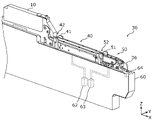
- FIG. 1 is a schematic diagram of a supply unit according to an embodiment.
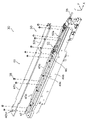
- FIG. 2 is a perspective view schematically showing part of the feeder according to the embodiment.
- FIG. 3 is a perspective view showing the component supply device according to the embodiment.
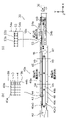
- FIG. 4A is a plan view showing the component supply device according to the embodiment;
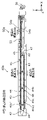
- FIG. 4B is a plan view showing a component conveying direction in the component supply device according to the embodiment.
- FIG. 5A is a cross-sectional view showing the Va-Va cross section shown in (a) of FIG. 4A.
- FIG. 5B is a cross-sectional view showing the Vb-Vb cross section shown in (a) of FIG. 4A.
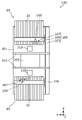
- FIG. 6A is a sectional view showing the VIa-VIa section shown in (a) of FIG.
- FIG. 6B is a perspective view showing a part surrounded by a broken line frame shown in (a) of FIG. 4A.
- FIG. 7 is a block diagram showing the functional configuration of the component supply device according to the embodiment.
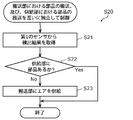
- FIG. 8 is a flow chart showing the operation of the component supply device according to the embodiment.
- FIG. 9A is a diagram showing a first example of step S20 shown in FIG.
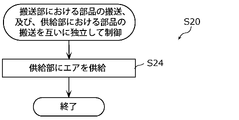
- FIG. 9B is a diagram showing a second example of step S20 shown in FIG.
- FIG. 9C is a diagram showing a third example of step S20 shown in FIG.
- FIG. 9D is a diagram showing a fourth example of step S20 shown in FIG.
- FIG. 10 is a diagram showing the configuration of the component mounting apparatus according to the embodiment.
- FIG. 11 is a block diagram showing the functional configuration of a component supply device according to another embodiment.
- each figure is a schematic diagram and is not necessarily strictly illustrated. Therefore, for example, scales and the like do not necessarily match in each drawing. Moreover, in each figure, substantially the same configurations are denoted by the same reference numerals, and overlapping descriptions are omitted or simplified.
- the X-axis, Y-axis and Z-axis indicate three axes of a three-dimensional orthogonal coordinate system.
- the X-axis direction indicates the component transport direction
- the Z-axis direction indicates the vertical direction of the component supply device.
- a planar view means viewing from the Z-axis direction
- a cross-sectional view means viewing a cross section defined by the Y-axis and the Z-axis from the X-axis direction.
- FIG. 1 A component supply device and the like according to the present embodiment will be described below with reference to FIGS. 1 to 10.
- FIG. 1 A component supply device and the like according to the present embodiment will be described below with reference to FIGS. 1 to 10.
- FIG. 1 is a diagram schematically showing a supply unit 80 according to this embodiment.
- the supply unit 80 is a device for supplying components (for example, electronic components) used in a component mounting apparatus (for example, the component mounting apparatus 100 shown in FIG. 10), which will be described later.
- 1 also shows a mounting head 107 that holds and takes out a component from the feeder 20 when the supply unit 80 is attached to the component mounting apparatus. Holding includes at least one of sucking or gripping. 1 shows a state in which the cover 11 of the case 10 is open.
- the supply unit 80 includes a case 10, a feeder 20, and a truck 70.
- the supply unit 80 is movable and detachably attached to the component mounting apparatus.
- the case 10 is a hollow box body, and contains parts in a bulk state inside.
- the case 10 accommodates bulk components, for example.
- the case 10 is detachably attached to the feeder 20 and supplies the contained components to the feeder 20 .
- the case 10 supplies the accommodated components to the feeder 20 by being shaken by vibration or the like while being attached to the feeder 20 .
- the case 10 is an example of a component storage section.
- the component is, for example, an electronic component such as a resistor and a capacitor, but is not limited to this, and may be an object such as a substrate that can be mounted on an object.
- at least a part of the component may be made of metal, and may have chargeability or magnetism. A metal part or a part having chargeability or magnetism may be provided exposed, for example.
- the metal portion may be, for example, a metal layer (plated layer).
- the case 10 has a cover 11.
- the cover 11 is provided over an opening for supplying parts from the inside of the case 10 to the feeder 20 .
- the cover 11 covers the opening when the case 10 is not attached to the feeder 20 .
- the cover 11 is opened when the case 10 is attached to the feeder 20 .
- the cover 11 is pushed toward the negative side of the X axis by a rod (not shown) provided on the attached portion 32, thereby Rotate with the direction as the axis of rotation.
- the feeder 20 supplies the components stored in the case 10 in a bulk state to a pick-up position where the mounting head 107 holding the components picks them up.
- the feeder 20 has a configuration for conveying parts by air rather than by vibration.
- the carriage 70 is detachably attached to the feeder 20 and moves the feeder 20 to a predetermined position of the component mounting apparatus. Note that the carriage 70 is not an essential component.
- FIG. 2 is a perspective view schematically showing part of the feeder 20 according to this embodiment.
- the feeder 20 has a component supply device 30 and a body portion 60. As shown in FIGS. 1 and 2, the feeder 20 has a component supply device 30 and a body portion 60. As shown in FIGS. 1 and 2, the feeder 20 has a component supply device 30 and a body portion 60. As shown in FIGS. 1 and 2, the feeder 20 has a component supply device 30 and a body portion 60. As shown in FIGS. 1 and 2, the feeder 20 has a component supply device 30 and a body portion 60.
- the component supply device 30 is detachably attached to the case 10 and conveys components supplied from the case 10 .
- the component supply device 30 has a transport section 40 and a supply section 50 .
- the component supply device 30 also has a mounted portion 32 to which the case 10 is mounted, and a tube 36 used for vacuum suction for fixing the component.
- the transport unit 40 is a transport mechanism for aligning a plurality of components supplied from the case 10 to the component supply position 42 and transporting them to the supply unit 50 .
- the transport section 40 has, for example, a second sensor 41 that detects the amount of components accommodated in the transport section 40 . It can also be said that the second sensor 41 detects the storage state of parts (for example, the amount of parts) in the transport section 40 .
- the second sensor 41 may detect, for example, the storage state of components in a first transport portion (for example, the first transport portion 40a1 shown in FIG. 4A), which will be described later.
- the second sensor 41 may, for example, detect the presence or absence of a component at a predetermined position on the transport section 40 .
- the second sensor 41 is not particularly limited as long as it can detect parts.
- the second sensor 41 may be a sensor that detects components using light.
- the second sensor 41 is an example of a second detector.
- alignment means aligning the orientation of multiple parts and arranging them in a row.
- alignment means, for example, that the long sides of the parts are in the first direction (X-axis plus direction) from the part supply position 42 toward the supply unit 50, and the parts are aligned in the first direction. are arranged in a row.
- arranging in a line is not limited to being in a complete line, but may be substantially in a line, and may be, for example, in a zigzag shape.
- a direction (for example, X-axis direction) and a direction (for example, X-axis positive direction) are simply referred to as a direction (for example, first direction).
- the supply unit 50 is a transport mechanism, one end of which is connected to the transport unit 40, for supplying a plurality of components transported from the transport unit 40 to a pick-up position where the mounting head 107 picks up the components.
- the supply section 50 has a first sensor 51 that detects the amount of components accommodated in the supply section 50 .
- the first sensor 51 detects, for example, the presence or absence of a component at a predetermined position of the supply section 50 .
- the first sensor 51 is provided, for example, in the vicinity of the supply unit entrance 52 which is the connection position between the transport unit 40 and the supply unit 50, and detects the components that have passed through the supply unit entrance 52.
- the first sensor 51 is not particularly limited as long as it can detect parts.
- the first sensor 51 may be a sensor that detects components using light.
- the mounting part 32 is a part to which the case 10 is attached and detached, and fixes the case 10 and opens and closes the cover 11 of the case 10 .
- the tube 36 forms a vacuum path for fixing the parts transported to the take-out position by vacuum suction.
- the tube 36 communicates with a suction hole (suction hole 55a shown in FIG. 6B) for sucking a component provided in the supply section 50 .
- the suction hole is provided at the extraction position.
- the component supply device 30 is detachably attached to the body portion 60 .
- the main body portion 60 is a container housing a first air supply portion 62 (first supply portion 62), a second air supply portion 63 (first supply portion 63), a third sensor 64, and the like. , for example, a box. Further, the body portion 60 may house the control portion 61 .
- the first air supply section 62 communicates with a plurality of air ejection holes opening in the transport section 40, and supplies air ejected from the plurality of air ejection holes.
- the second air supply section 63 communicates with a plurality of air ejection holes opening in the supply section 50, and supplies air ejected from the plurality of air ejection holes.
- the first air supply unit 62 and the second air supply unit 63 supply, for example, compressed air to the extent that parts can be floated and transported.
- the pressure of the compressed air is controlled by a regulator or the like.
- the first air supply section 62 and the plurality of air ejection holes of the transport section 40 are connected to the first air passage (for example, the first air supply section 62 shown in FIG.
- a valve for example, an electromagnetic valve
- the second air supply part 63 and the plurality of air ejection holes of the supply part 50 are connected to a second air passage (for example, a broken line path connected to the second air supply part 63 shown in FIG. 2) by a tube or the like.
- a valve for example, an electromagnetic valve for switching the presence or absence of air supply is provided on the second air passage.
- the gas supplied by the first air supply unit 62 and the second air supply unit 63 is not limited to air, and may be other gas.
- the third sensor 64 detects whether or not there is a component at the pick-up position by measuring the flow rate or the degree of vacuum in a vacuum path connected to a suction hole provided in the supply section 50 for sucking the component. do.
- the third sensor 64 detects that there is a part at the pick-up position when the flow rate of air is below a predetermined value or the degree of vacuum is above a predetermined value.
- the mounting head 107 sucks and holds the component at the pickup position based on the detection result of the third sensor 64 .
- a vacuum path is an example of an air path.
- the third sensor 64 is an example of a third detector.
- the control unit 61 is a control device that controls the transportation of components in the component supply device 30 .
- the control unit 61 controls the transport of components in the transport unit 40 and the transport of components in the supply unit 50 independently of each other.
- the control unit 61 controls, for example, the air ejected from the plurality of air ejection holes of the conveying unit 40 and the air ejected from the plurality of air ejection holes of the supply unit 50 independently of each other via the air supply mechanism.
- Controlling air includes at least one control of ON/OFF of air, air pressure, air ejection direction, air flow rate, and the like.
- the control unit 61 controls the air supply mechanism.
- the air supply mechanism includes, for example, at least one of the first air supply unit 62 and the second air supply unit 63, regulators, valves, air paths, air ejection holes, and the like.
- the air supply mechanism includes, for example, a plurality of air ejection holes 43b opening in a support surface 43a (an example of a first support surface) on which parts are supported in the transport section 40, and a support surface 43b on which the parts are supported in the supply section 50. It is a mechanism for ejecting air for conveying a component from each of a plurality of air ejection holes 53b opened in a surface 53a (an example of a second support surface).
- the control unit 61 generates thrust only in the first direction (forward direction, X-axis plus direction) by floating and conveying the component.
- the control unit 61 may control the first air supply unit 62, the second air supply unit 63, and the like, and supply pulse air by repeating ON and OFF of the blowing of air at predetermined intervals. That is, the component may be transported while moving up and down in the Z-axis direction.
- the conditions for blowing air for floating and transporting are not limited to the above.
- control section 61 is not limited to this, and may be provided in the component supply device 30, for example.
- the body portion 60 may accommodate an air suction device that communicates with the suction holes and the tube 36 and fixes the component at the removal position by sucking air from the suction holes.
- FIG. 3 is a perspective view showing the component supply device 30 according to this embodiment.
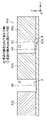
- FIG. 4A is a plan view showing the component supply device 30 according to this embodiment. Specifically, (a) of FIG. 4A shows a plan view of the component supply device 30 according to the present embodiment, and (b) of FIG. 4A shows the body portion 40a shown in (a) of FIG. 4A. (c) of FIG. 4A shows an enlarged dashed line area of the main body 50a shown in (a) of FIG. 4A.
- FIG. 4B is a plan view showing the conveying direction of components in component supply device 30 according to the present embodiment.
- FIG. 4B is a diagram in which the conveying directions d1 to d4 of the parts are superimposed on the plan view shown in FIG. In FIG. 4B, the component transport directions d1 to d4 are indicated by dotted arrows inside.
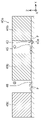
- FIG. 5A is a cross-sectional view showing the Va-Va cross section shown in (a) of FIG. 4A.
- FIG. 5B is a cross-sectional view showing the Vb-Vb cross section shown in (a) of FIG. 4A.
- 5A and 5B illustrate a rectangular part P as an example of the part. 5A and 5B also show symbols indicating the direction in which the component P is conveyed.
- the x symbol in the circle indicates that the part P is being transported from the front to the back (from the positive side of the X axis to the negative side of the X axis), and the dot symbol in the circle indicates that the part P is being transported from the back. This indicates that the sheet is being conveyed forward (from the minus side of the X axis to the plus side of the X axis).
- the driving force for the components in the component supply device 30 is all air. In other words, in the present embodiment, vibration is not used to generate the propulsion force for the parts in the parts supply device 30 .
- the transport section 40 of the component supply device 30 has a main body section 40a and a lid section 40b.
- the lid portion 40b covers the main body portion 40a and is fixed to the main body portion 40a by a fastening member 38 such as a screw.
- a through hole 40b1 through which components from the case 10 pass is formed in the lid portion 40b. The component passes through the through hole 40b1 and is supplied to the component supply position 42. As shown in FIG.
- a rubber sheet member may be provided on the Z-axis negative side surface of the lid portion 40b.
- the sheet member With the lid portion 40b fixed to the main body portion 40a, the sheet member may be provided within the component supply position 42 in a plan view, or may be arranged between the component supply position 42, the component alignment portion 43, and the first inclined surface. 44 may be provided on the boundary. Further, the sheet member is provided at a predetermined distance from the component supply position 42 in a state where the lid portion 40b is fixed to the main body portion 40a.
- the predetermined spacing is, for example, greater than the length of the shortest side of the part and less than the length of the longest side of the part if the part is a rectangular parallelepiped.
- the sheet member has a function of contacting only a standing part (a member whose long side is in the vertical direction) and laying down the contacting member. As a result, it is possible to prevent the standing component from being transported to the component aligning section 43 or the first inclined surface 44 .
- the body portion 40a includes a second sensor 41 (see FIG. 2), a component supply position 42, a component alignment portion 43, a first inclined surface 44, and a second sensor 40a.
- a plurality of air ejection holes of the conveying section 40 are arranged in a component supply position 42, a component aligning section 43, a first inclined surface 44, a second inclined surface 45, a turning section 47, and a return conveying section 48. formed.
- a component supply position 42 is a portion (area) where components are supplied from the case 10 .
- the parts supply position 42 has a plurality of air ejection holes (not shown) for supplying the parts supplied from the case 10 and the parts returned via the return conveying part 48 to the parts alignment part 43 . formed.
- the component supply position 42 is a flat surface, for example, at least a portion thereof may be inclined.
- the component supply position 42 is connected to each of the component alignment section 43 and the first inclined surface 44 . That is, the components at the component supply position 42 are supplied to either the component alignment part 43 or the first inclined surface 44 by air from a plurality of air ejection holes (not shown) formed at the component supply position 42 . be.
- the parts aligning section 43 aligns the parts and conveys them to the supply section 50 .
- the component aligning unit 43 aligns the components and transports them in the transport direction d1 shown in FIG. 4B.
- the component alignment section 43 is provided extending in the first direction.
- a plurality of air ejection holes 43b are formed in the support surface 43a of the component alignment section 43.
- the parts aligning section 43 sequentially conveys a plurality of parts by air ejected from a plurality of air ejection holes 43b.
- the parts aligning section 43 can convey a plurality of parts at the same time through a plurality of air ejection holes 43b.
- part of the air passage for communicating the first air supply portion 62 and the air ejection hole 43b is illustrated by a broken line.
- the component alignment portion 43 is a concave groove extending in the first direction.
- the support surface 43a is configured by the bottom surface of the groove.
- the support surface 43 a is located on the Z-axis minus side of the first inclined surface 44 .
- the support surface 43a is formed with a plurality of air ejection holes 43b, which are openings for levitating and conveying the component in the first direction.
- a plurality of air ejection holes 44b formed in the support surface 43a are formed so as to be able to eject air upward in a first direction. That is, the plurality of air ejection holes 43b formed in the support surface eject air obliquely upward in the first direction when viewed in the Y-axis direction.
- a plurality of air ejection holes 43b formed in the support surface 43a eject air in a direction perpendicular to the support surface 43a when viewed from the X-axis direction.
- the width of the part alignment part 43 in the Y-axis direction is larger than the length of the shortest side of the part P and smaller than the length of the longest side of the part P, but is not limited to this. Further, when the component P is a rectangular parallelepiped, the width of the component alignment section 43 in the Y-axis direction may be smaller than twice the length of the shortest side of the component P. Also, the width of the component alignment portion 43 in the Y-axis direction may be determined including the dimensional tolerance of the component P.
- component alignment portion 43 is not limited to being a groove, and may be, for example, a flat surface connected to the lower end portion (Y-axis plus side end portion) of the first inclined surface 44 , or the first inclined surface 43 . may be inclined in the opposite direction to the inclined surface 44 of .
- the first inclined surface 44 is provided along the component alignment section 43 and slopes downward toward the component alignment section 43 . It can also be said that the first inclined surface 44 is provided adjacent to the component alignment section 43 .
- the first inclined surface 44 is provided to move the components supplied from the component supply position 42 to the first inclined surface 44 toward the component alignment section 43 .
- the first inclined surface 44 is, for example, a flat inclined surface extending in the first direction.
- the first inclined surface 44 is formed with a plurality of air ejection holes 44b that are openings for floating and conveying the components P on the first inclined surface 44 to the component aligning section 43 .
- a plurality of air ejection holes 44b formed in the first inclined surface 44 are formed so as to be able to eject air upward in a first direction.
- a plurality of air ejection holes 44b formed in the first inclined surface 44 eject air in a direction perpendicular to the first inclined surface 44 when viewed from the X-axis direction.
- the first inclined surface 44 is formed with a plurality of air ejection holes 44b.
- part of the air passage for communicating the first air supply portion 62 and the air ejection hole 44b is shown by a dashed line in the air ejection hole 44b on the X-axis plus side in (b) of FIG. 4A.
- the inclination angle of the first inclined surface 44 is not particularly limited. may be such an angle that it does not move (for example, it does not slip or rotate) to the component alignment part 43 .
- the components on the first inclined surface 44 move to the component aligning portion 43 in a state in which air is not ejected from the plurality of air ejection holes 44b of the first inclined surface 44, so that the first inclined surface It is possible to suppress the occurrence of friction between the surface 44 and the component P, that is, the blackening of the component.
- the inclination angle of the first inclined surface 44 is such that, for example, air is ejected from the plurality of air ejection holes 44b of the first inclined surface 44, and the part P on the first inclined surface 44 is the part The angle may be such that it moves to the alignment section 43 .
- the inclination angle of the first inclined surface 44 may be, for example, 10 degrees or less, or may be 5 degrees or less.
- the angle of inclination is the angle when the direction (Y-axis direction) of the support surface 43a of the component alignment section 43 in FIG. The angles are as follows.
- the air on the first inclined surface 44 is pulsed air, the parts P on the first inclined surface 44 are more likely to be affected by the inclination of the first inclined surface 44 , and the component aligning section 43 can be easier to move.
- the second inclined surface 45 is provided along the component alignment section 43 on the downstream side (X-axis plus side) of the first inclined surface 44 in the first direction.
- the parts P that have moved from the second inclined surface 44 to the second inclined surface 45 are suppressed from moving to the component alignment part 43.
- at least a portion of the second inclined surface 45 is inclined downward in a direction opposite to the component alignment section 43 .
- the second inclined surface 45 is not limited to being inclined.
- the second inclined surface 45 may be a surface parallel to the support surface 43a of the component alignment section 43, which is arranged on the Z-axis plus side of the support surface 43a.
- the second inclined surface 45 has a plurality of air ejection holes so that air can be ejected upward on the side opposite to the component alignment section 43 (Y-axis minus side). may be provided.
- the length in the Y-axis direction of the second inclined surface 45 is longer than the length in the Y-axis direction of the component alignment section 43, for example.
- the length of the second inclined surface 45 in the Y-axis direction is longer than the length of the long side of the component P, for example.
- FIG. 4A shows an example in which the first inclined surface 44 and the second inclined surface 45 are directly connected. Between them, a switching portion is provided for gradually switching the inclination angle from the first inclined surface 44 to the second inclined surface 45 from the component supply position 42 side (upstream side) toward the supply section 50 side (downstream side). good too.
- first conveying portion 40a1 includes at least the first inclined surface 44. As shown in FIG.
- the first conveying portion 40a1 may further include a second inclined surface 45. As shown in FIG.
- the cover 46 is positioned at a position corresponding to the end of the first conveying portion 40a1 (for example, the second inclined surface 45) on the take-out position side in the first direction (the end on the plus side of the X axis). It is arranged with a predetermined gap in the Z-axis direction from the support surface 43a of 43, and covers the part alignment section 43 from above. It can also be said that the cover 46 partially covers the component alignment section 43 and the component rectilinear advance section 53 .
- the cover 46 is provided to prevent the parts P from being transported to the supply part 50 in an overlapping state, for example, when there are parts P overlapping in the vertical direction (Z-axis direction) in the parts alignment section 43 .
- the predetermined gap is, for example, a gap that allows the cover 46 to contact the upper member without contacting the lower member when there is a vertically overlapping component P in the component alignment section 43. .
- the cover 46 has a shape that allows the upper part to be moved to the swivel part 47 .
- the cover 46 moves the upper component to the turning portion 47 by, for example, contacting the end surface of the cover 46 on the negative side of the X axis with the upper component.
- the surface of the cover 46 on the negative X-axis side is, for example, an inclined surface that inclines in the positive direction of the X-axis as it goes from the positive Y-axis side to the negative Y-axis side (separates from the parts alignment unit 43) in plan view. good too.
- the inclined surface may be formed with a plurality of air ejection holes for ejecting air in the Y-axis negative direction.
- the components are transported from the transport unit 40 to the supply unit 50 by passing through the component alignment unit 43 formed in a tunnel shape by the cover 46 .
- the turning portion 47 is a portion (area) for moving the parts from the second inclined surface 45 and the cover 46 to the return transport portion 48, and is connected to the second inclined surface 45 and the return transport portion 48, respectively. It is The turning section 47 conveys the component P in the conveying direction d2 shown in FIG. 4B.
- the revolving portion 47 is formed with a plurality of air ejection holes for moving parts.
- the turning part 47 is a flat surface, for example, at least a part thereof may be inclined.
- the return conveying portion 48 is connected to the second inclined surface 45 and provided along the first conveying portion 40a1, and extends in a second direction opposite to the first direction (minus direction of the X axis). Conveying parts.
- the return conveying unit 48 conveys the part P in the conveying direction d3 shown in FIG. 4B.
- a return conveying section 48 is provided to return the components that have not been aligned by the component aligning section 43 to the component supply position 42 .
- the return conveying portion 48 is formed with a plurality of air ejection holes (not shown) that open in a support surface that supports the components of the return conveying portion 48, and air is ejected upward in the second direction from the plurality of air ejection holes.
- the parts are transported to the parts supply position 42 by jetting.
- the pressure or flow rate of the air ejected from the plurality of air ejection holes of the return conveying section 48 is determined by the air ejection holes of the component alignment section 43, the first inclined surface 44 and the second inclined surface 45. may be higher than or equal to the pressure or flow rate of
- the air ejection holes formed in the support surface of the return conveying portion 48 are an example of the second air ejection holes.
- the support surface of the return transport unit 48 may be, for example, an inclined surface that inclines upward (Z-axis plus direction) from the turning unit 47 toward the component supply position 42 .
- the parts may be transported from the turning part 47 to the part supply position 42 at a position higher than the turning part 47 by the return transfer part 48 .
- the second conveying portion 40a2 is configured including a return conveying portion 48.
- the second conveying portion 40a2 opens onto a supporting surface (an example of a third supporting surface) on which the components of the second conveying portion 40a2 are supported, and is configured to be capable of ejecting air upward in a second direction. It can also be said that it has a plurality of air ejection holes (an example of the second air ejection holes).
- the side walls 49a and 49c and the partition wall 49b are walls that extend in the first direction and form the first conveying portion 40a1 and the second conveying portion 40a2.
- the side wall 49a and the partition wall 49b form the first conveying portion 40a1, and the partition wall 49b and the side wall 49c form the second conveying portion 40a2.
- the partition wall 49b functions as a partition that prevents the air jetted from one of the first conveying portion 40a1 and the second conveying portion 40a2 from flowing to the other.
- side walls 49a and 49c and the partition wall 49b may be integrally formed, for example. In other words, no gap need be formed between the first conveying portion 40a1 and the second conveying portion 40a2.
- the conveying portion 40 as described above, no gap is formed between the first conveying portion 40a1 and the second conveying portion 40a2. 2 can be brought closer to each other, and the width (the length in the Y-axis direction) of the transport section 40 can be reduced. That is, the component supply device 30 can be miniaturized. In addition, it is possible to prevent the component from being caught in the gap. For example, it is possible to smoothly turn the parts in the turning section 47 .
- the transport section 40 has a first transport section 40a1 that transports components in the first direction toward the supply section 50, and is provided along the first transport section 40a1. and a second conveying portion 40a2 for conveying the parts in a second direction opposite to the first direction.
- An annular path is formed by the first transport portion 40a1 and the second transport portion 40a2.
- the first conveying portion 40a1 is not formed in the supply section 50. That is, the length in the first direction of the first conveying portion 40a1 is the total length in the first direction of the component aligning portion 43 and the component rectilinear advancing portion 53 (an example of the length of the aligning portion in the first direction). shorter.
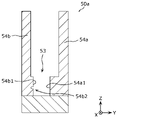
- FIG. 6A is a sectional view showing the VIa-VIa section shown in (a) of FIG. 4A.
- FIG. 6B is a perspective view showing the portion of the broken line frame VIb shown in (a) of FIG. 4A.
- 6A and 6B omit illustration of a plurality of air ejection holes formed in the support surface (bottom surface). Further, in FIG. 6B, illustration of the side wall 54a is omitted.
- the supply section 50 of the component supply device 30 has a body section 50a and a lid section 50b.
- the lid portion 50b covers the main body portion 50a and is fixed to the main body portion 50a by a fastening member 38 such as a screw.
- the body portion 50a has a first sensor 51 (see FIG. 2), a component rectilinear portion 53, and side walls 54a and 54b.
- the first sensor 51 is provided, for example, in the vicinity of the inlet of the component straight advancing section 53 (near the supply section inlet 52), and detects the components passing through the supply section inlet 52.
- FIG. Sidewalls 54a and 54b are examples of side members.
- the parts rectilinear advancing section 53 is connected to the parts aligning section 43, and supplies the parts to the picking-up position by conveying the aligned parts from the conveying section 40 to the picking-up position.
- the component alignment unit 43 transports the aligned components P from the transport unit 40 in the transport direction d1 shown in FIG. 4B.
- the component rectilinear portion 53 is provided extending in the first direction.
- a plurality of air ejection holes 53b are formed in the support surface 53a of the component rectilinear portion 53.
- the parts rectilinear advance section 53 sequentially conveys a plurality of parts by air ejected from a plurality of air ejection holes 53b.
- the parts rectilinear advance section 53 can convey a plurality of parts at the same time through a plurality of air ejection holes 53b.
- part of the air passage for communicating the second air supply portion 63 and the air ejection hole 53b is illustrated by a dashed line.
- the component rectilinear portion 53 is a concave groove extending in the first direction.
- a support surface 53a of the component rectilinear portion 53 is formed by the bottom surface of the groove and supports the component.
- the support surface 53a is connected to the support surface 43a of the component alignment section 43 and is on the same plane as the support surface 43a.
- the support surface 53a is formed with a plurality of air ejection holes 53b for floating and conveying the component in the first direction.
- a plurality of air ejection holes 53b formed in the support surface 53a are formed so as to be able to eject air upward in a first direction.
- the plurality of air ejection holes 53b formed in the support surface 53a eject air obliquely upward in the first direction when viewed in the Y-axis direction.
- a plurality of air ejection holes 53b formed in the support surface 53a eject air in a direction perpendicular to the support surface 53a when viewed from the X-axis direction.
- the width (length in the Y-axis direction) of the part rectilinear portion 53 is larger than the length of the shortest side of the part and smaller than the length of the longest side of the part.
- the width of the component rectilinear portion 53 may be the same as the width of the component alignment portion 43 .
- the component rectilinear portion 53 has two side walls 54a and 54b arranged to face each other with a gap in the width direction of the support surface 53a.
- One of the two sidewalls 54a and 54b (the sidewall 54b in the example of FIGS. 6A and 6B) is the other sidewall of the two sidewalls 54a and 54b (the sidewall in the example of FIGS. 6A and 6B).
- 54a) has a plurality of air ejection holes 54b2 for ejecting air.
- the plurality of air ejection holes 54b2 are formed by one of the mutually facing wall surfaces 54a1 and 54b1 (in the example of FIGS.
- the wall surface 54b1 A plurality of air ejection holes 54b2 are provided along the first direction on the wall surface 54b1. During the period when air is jetted from the plurality of air jet holes 53b of the support surface 53a of the component rectilinear advance portion 53, air is also jetted from the plurality of air jet holes 54b2.
- a plurality of air ejection holes 54b2 are provided so as to be able to eject air onto the component being floated and conveyed by the component rectilinear advancing portion 53.
- the plurality of air ejection holes 54b2 are provided, for example, at a height at which air can be ejected to the component.
- the pressure or flow rate of air ejected from the air ejection holes 54b2 may be smaller than the pressure or flow rate of air ejected from the air ejection holes 53b.
- the air ejection hole 54b2 is an example of a third air ejection hole.
- the component rectilinear advance portion 53 has a wall portion 55 at the end of the component rectilinear advance portion 53 in the first direction, which contacts the end surface of the component in the first direction.
- the wall portion 55 abuts on the component to stop the component from being conveyed in the first direction.
- the wall portion 55 has the function of positioning the component at the take-out position 56 .
- the wall portion 55 is formed with suction holes 55a for sucking air.
- the component is firmly positioned on the wall portion 55 by sucking the first direction side surface of the component conveyed to the take-out position 56 by the suction holes 55a. The part is thereby fixed in the pick-up position. Further, the transportation of the component to the pick-up position 56 may be assisted by air suction through the suction holes 55a. The component may be drawn to the pick-up position 56 by sucking air through the suction holes 55a. In this way, the suction holes 55a may have the function of transporting the component in addition to the function of positioning the component.
- the air ejection holes 53b are formed up to the extraction position 56.
- suction holes for fixing the component cannot be provided at the extraction position on the support surface 53a of the component rectilinear advance portion 53 .
- the suction holes 55a in the wall portion 55 the component can be fixed at a desired position without hindering the levitation and transportation of the component.
- the suction hole 55a is an example of a suction portion that suctions the end face of the component on the first direction side (the end face on the plus side of the X axis).
- the adsorption section is not limited to adsorbing a component by air suction, and may be configured to adsorb a component by any of electrostatic force, magnetic force, and adhesive force. Any existing configuration may be used as the configuration for attracting the component by any of electrostatic force, magnetic force, and adhesive force.
- the attraction section includes one or more electrodes for generating electrostatic force.
- the control unit 61 may apply a DC voltage to one or more electrodes to cause the component to be attracted (for example, in close contact) to the wall 55 by an electrostatic force between the one or more electrodes and the component.
- the parts rectilinear advancing part 53 and the parts aligning part 43 form an aligning part in the parts supply device 30 .
- the aligning section aligns the components supplied from the case 10 and conveys them to the pick-up position.
- the plurality of air ejection holes are configured to be capable of ejecting air upward in a first direction from the case 10 toward the removal position 56 on each of the alignment portion and the first inclined surface 44 .
- the plurality of air ejection holes here includes air ejection holes 43b, 44b and 53b.
- the air ejection holes 43b and 53b are an example of first air ejection holes
- the air ejection hole 44b is an example of a second air ejection hole.
- the component rectilinear advancing portion 53 constitutes a downstream portion of the aligning portion on the take-out position 56 side in the first direction.
- control unit 61 may turn off air suction by the suction holes 55a at the timing when the component is taken out by the mounting head 107 .
- the components P are transported in the direction of the arrow (transportation directions d1 to d4).
- the component P is transported to the component alignment section 43 and the first inclined surface 44 after being supplied to the component supply position 42 .
- the parts P on the first inclined surface 44 are moved to the part alignment section 43 by air.
- the parts P on the parts alignment section 43 are conveyed to the parts rectilinear advance section 53 by air. In this way, some of the components P are distributed between the component supply position 42, the component alignment unit 43, and The parts are conveyed in the order of the part rectilinear advance section 53 .
- the parts P that have not fallen from the first inclined surface 44 to the part alignment section 43 are conveyed to the second conveying section 40a2 via the revolving section 47.
- the parts P on the second conveying portion 40a2 are conveyed to the upstream side of the parts aligning section 43 and the parts rectilinear advancing section 53, and conveyed to the parts aligning section 43 and the first inclined surface 44 again.
- part of the parts P is aligned as indicated by the circular arrows (arrow group) passing through the parts alignment section 43, the turning section 47, the return conveying section 48, and the parts supply position 42.
- the part 43 , turning part 47 , return transfer part 48 , and component supply position 42 are circularly conveyed in this order.
- FIG. 7 is a block diagram showing the functional configuration of the component supply device 30 according to this embodiment.
- the component supply device 30 includes, as a functional configuration, the first sensor 51, the second sensor 41, the control section 61, the first air supply section 62, and the and a second air supply portion 63 .
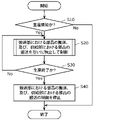
- FIG. 8 is a flow chart showing the operation of the component supply device 30 according to this embodiment.
- the control unit 61 determines whether or not production requiring operation of the component supply device 30 has started (S10). For example, the control unit 61 may determine that production has started when the mounting system to which the component supply device 30 is attached has started operation, or information indicating that production has started from a higher-level control device. It may be determined that production has started by obtaining
- the control section 61 controls the transportation of the parts in the transportation section 40 and the transportation of the parts in the supply section 50 independently of each other (S20). In other words, the control unit 61 does not uniformly control the transportation of components in the transportation unit 40 and the supply unit 50 . In the present embodiment, the control unit 61 controls the air transportation of the components in the transportation unit 40 and the air transportation of the components in the supply unit 50 independently of each other.
- control unit 61 determines whether or not production has ended (S30). For example, the control unit 61 may determine that the production has ended when the operation of the component mounting apparatus to which the component supply device 30 is attached has ended, or the upper control device indicates that the production has ended. By acquiring the information, it may be determined that the production is finished, or when the number of parts detected by the first sensor 51 exceeds a predetermined number, it may be determined that the production is finished.
- control unit 61 stops controlling the transportation of the parts in the transportation unit 40 and the transportation of the parts in the supply unit 50 (S40). If not (No in S30), the process returns to step S20 to continue the processing of step S20.
- control unit 61 ends the operation.
- FIG. 9A is a diagram showing a first example of step S20 shown in FIG.
- FIG. 9A shows the operation in a state where the supply of air in the conveying section 40 is stopped. Air may be supplied to the supply unit 50 during the operation shown in FIG. 9A.
- the control unit 61 acquires a detection result from the first sensor 51 indicating whether or not there is a component in the supply unit 50 (S21). For example, the control unit 61 acquires the detection result from the first sensor 51 at predetermined time intervals.
- the control unit 61 supplies air to the transport unit 40 (S23). It can be said that the control unit 61 starts supplying air to the conveying unit 40, for example, when the result of step S22 is No. Specifically, the control unit 61 controls the first air supply unit 62 and the like to eject air from the air ejection holes of the conveying unit 40 .
- the control unit 61 controls, for example, air flow in each of the component supply position 42, the component alignment unit 43, the first inclined surface 44, the second inclined surface 45, the turning unit 47, and the return conveying unit 48. Control supply integrally.
- the control section 61 causes air to be jetted from all of the multiple air jetting holes formed in the conveying section 40 .
- control section 61 may control the conveyance of components in the conveying section 40 based on the detection result of the first sensor 51, for example.
- control unit 61 acquires from the first sensor 51 a detection result indicating that there is no component in the supply unit 50 (for example, a detection result indicating that there is no component at a predetermined position in the supply unit 50), 40 is caused to transport the parts.
- FIG. 9B is a diagram showing a second example of step S20 shown in FIG.
- the control unit 61 supplies air to the supply unit 50 (S24). Specifically, the control unit 61 controls the second air supply unit 63 and the like to eject air from at least the air ejection holes 53b of the supply unit 50 .
- the control section 61 causes air to be ejected from each of the air ejection holes 53b and 54b2.
- the controller 61 may integrally control the supply of air to each of the air ejection holes 53b and 54b2.
- the controller 61 may cause the suction holes 55a to suck air.
- control unit 61 may control the conveyance of components in the supply unit 50 without depending on the detection result of the first sensor 51, for example.
- the control section 61 may always perform control for supplying components to the pick-up position of the supply section 50 .
- control section 61 may perform control to supply air from the second air supply section 63 to the plurality of air ejection holes 53b when the component mounting apparatus 100 is in operation.
- FIG. 9C is a diagram showing a third example of step S20 shown in FIG.
- the control unit 61 may perform steps S25 to S27 in addition to the operations shown in FIG. 9A. If there is no component in the supply unit 50 (No in S22), the control unit 61 supplies air to the supply unit 50 for a predetermined period (S25). For example, when the determination in step S22 is No, the control unit 61 continues supplying air to the supply unit 50 for a predetermined period without causing the transport unit 40 to supply air immediately. At this time, air is not supplied to the conveying section 40 .
- control unit 61 acquires the detection result after air is supplied from the first sensor 51 to the supply unit 50 (S26). Based on the detection result obtained in step S26, if there are no parts in the supply unit 50 (No in S27), the control unit 61 supplies air to the transport unit 40 (S23), and if there are parts in the supply unit 50 ( Yes in S27), air is not supplied to the conveying unit 40;
- the control unit 61 causes the supply unit 50 to carry the component for a predetermined period of time, and after the predetermined period of time, the component is not at the predetermined position.
- the transport unit 40 may be caused to transport the components.
- the parts are conveyed by the conveying section 40 only when there are no parts by the supply section 50, so that blackening of the parts due to contact of the parts in the conveying section 40 or the like can be further suppressed.
- FIG. 9D is a diagram showing a fourth example of step S20 shown in FIG.
- control section 61 may supply air to the aligning section and the first conveying section 40a1 (S28).
- control unit 61 may perform control to supply parts from the case 10 based on the detection result of the second sensor 41, for example. For example, when the control unit 61 acquires from the second sensor 41 a detection result indicating that there is no component in the transport unit 40 (for example, a detection result indicating that there is no component at a predetermined position of the transport unit 40), , parts are supplied to the parts supply position 42 by vibrating the case 10 or the like. Further, for example, when there is no component at a predetermined position on the transport unit 40, the control unit 61 causes the transport unit 40 to transport the component for a predetermined period of time. Since there are no parts in the transport section 40 , the parts may be supplied from the case 10 to the part supply position 42 .
- control unit 61 controls the conveyance of the parts in the conveying unit 40 based on the detection result of the second sensor 41, and Conveyance of parts may be controlled.
- FIG. 10 is a diagram showing the configuration of a component mounting apparatus 100 according to this embodiment.
- the component mounting apparatus 100 has a function of picking up a component from a component feeder and transferring and mounting the component onto a board 103 .
- the substrate 103 is an example of an object on which components are mounted.
- the component mounting apparatus 100 includes a supply unit 80, a base 101, a board transfer mechanism 102, a component mounting mechanism 108 including a mounting head 107, a board recognition camera 109, and a component recognition camera 110. and a power supply unit (not shown).
- the substrate transfer mechanism 102 is arranged near the center of the base 101 along the X-axis (in the transfer direction of the substrate 103).
- the substrate transport mechanism 102 transports the substrate 103 carried in from the upstream side in the direction along the X-axis, and positions and holds it on the mounting stage set for executing the component mounting work.
- the board transfer mechanism 102 is an example of a board holding section that holds the board 103 on which the component held by the mounting head 107 is mounted.
- the supply unit 80 is detachably attached to a supply unit attachment section (not shown) of the base 101 which is the main body of the component mounting apparatus 100 . More specifically, the carriage 70 that constitutes the supply unit 80 is attached to the supply unit attachment portion.
- the supply unit mounting portions are provided on both sides of the substrate transport mechanism 102 , and the supply units 80 are also arranged on both sides of the substrate transport mechanism 102 .
- a plurality of feeders 20 can be arranged in parallel along the Y-axis in each supply unit 80, and at least one feeder 20 (bulk feeder) is mounted in parallel.
- each functional unit for example, the first air supply unit 62 and the second air supply unit 63, etc.
- the power supply unit is electrically connected. , and power is supplied from the power supply unit to each functional unit of the supply unit 80 .
- the feeder 20 arranged in the supply unit 80 supplies components to the pick-up position (pick-up position 56 shown in FIG. 6B) by the mounting head 107 of the component mounting mechanism 108 .
- the mounting head 107 is an example of a head.
- An X-axis moving table 105 having a linear drive mechanism is arranged in the X-axis direction at the end in the Y-axis negative direction on the upper surface of the base 101.
- the X-axis moving table 105 is similarly linearly driven.
- Two Y-axis moving tables 106 equipped with mechanisms are coupled so as to be movable in the X-axis direction.
- a mounting head 107 is mounted on each of the two Y-axis moving tables 106 so as to be movable in the Y-axis direction.
- the mounting head 107 mounts (mounts) the component held by the feeder 20 arranged in the supply unit 80 on the board 103 .
- the mounting head 107 mounts the component on the board 103 based on the detection result of the third sensor 64, for example.
- the mounting head 107 is equipped with component suction nozzles 107a that can suction and hold components and can move up and down individually.
- the mounting head 107 includes a Z-axis elevating mechanism for elevating the component suction nozzle 107a and a ⁇ -axis rotating mechanism for rotating the component suction nozzle 107a around the nozzle axis.
- the component suction nozzle 107a is an example of a holding unit that holds a component.
- a component mounting mechanism 108 is configured by the substrate transport mechanism 102 , the X-axis moving table 105 , the Y-axis moving table 106 and the mounting head 107 .
- the X-axis movement table 105 and the Y-axis movement table 106 are examples of a driving section that moves the mounting head 107 .
- a component recognition camera 110 is arranged between each of the upper and lower carriages 70 and the substrate transport mechanism 102 .
- the component recognition camera 110 images the component held by the mounting head 107 .
- a processing unit (not shown) recognizes and processes the imaging result by image recognition, thereby identifying and detecting the position of the component.
- the mounting head 107 is equipped with a board recognition camera 109 which is positioned on the lower surface side of the Y-axis moving table 106 and moves integrally with the mounting head 107 .
- the board recognition camera 109 moves above the board 103 positioned by the board transfer mechanism 102 and picks up an image of the board 103 .
- the position of the substrate 103 is detected by similarly recognizing the imaging result by the image recognition of the processing unit.
- the power supply unit supplies power to each functional unit of the component mounting apparatus 100 .
- the power supply unit supplies power to, for example, the supply unit 80 arranged in the substrate transport mechanism 102 .
- the power supply section supplies electric power to the first air supply section 62 and the second air supply section 63 of the supply unit 80 and the like.
- the power supply unit may be connected to an external power supply.
- a component supply device 30 supplies components stored in a case 10 (an example of a component storage unit) in a bulk state to an extraction position 56 where a holding unit that holds the components extracts the components. It is a device.
- the parts supply device 30 includes a parts aligning section 43 and a parts rectilinear advance section 53 (an example of an aligning section) for aligning and conveying the parts supplied from the case 10 to a pick-up position 56 , and and a first conveying portion 40a1 having a first slanted surface 44 that slopes downward toward a component alignment portion 43 and a component rectilinear advance portion 53. As shown in FIG.
- the parts aligning portion 43, the parts straight advancing portion 53, and the first conveying portion 40a1 are composed of the parts arranging portion 43, the parts straight advancing portion 53, and the first inclined surface 44 on which the parts of the first conveying portion 40a1 are supported.
- a plurality of air ejection holes 43b, 44b and 53b (an example of first air ejection holes) that open to the have
- the plurality of air ejection holes 43b, 44b and 53b are arranged in the first direction (X axis positive direction) and upwardly.
- the propulsive force when a propulsive force is applied to a part by vibration, the propulsive force is applied in the negative direction of the X axis, the direction of the Y axis, etc. in addition to the positive direction of the X axis.
- Contact and the like can occur.
- an alignment wall for example, a tapered wall in a plan view
- contact between the parts and the wall may occur. That is, when parts are transported using vibration or alignment walls, blackening of the parts can occur during transport of the parts.
- the components are conveyed in the first direction (X-axis positive direction) and by the upward air, so that the components are transported in the first direction (X-axis positive direction).
- Propulsion can be reliably given only by For example, since it is possible to suppress the movement of the parts in the negative direction of the X-axis or the like compared to the case where the propulsive force is applied to the parts by vibration, it is possible to suppress the contact of the parts.
- air is also ejected to the first inclined surface 44, the parts on the first inclined surface 44 are moved to the parts alignment part 43 while suppressing the friction between the parts and the first inclined surface 44. can be moved and aligned.
- the component supply device 30 can suppress blackening of the components during transport of the components.
- the first conveying portion 40 a 1 may further have a second inclined surface 45 that slopes downward in the direction opposite to the component alignment section 43 and the component rectilinear advance section 53 .
- the second inclined surface 45 may be provided downstream of the first inclined surface 44 in the first direction.
- the component alignment section 43 and the component straight advancing section 53 are arranged with a predetermined gap from the supporting surfaces 43a and 53a (an example of the first supporting surface) on which the components of the component aligning section 43 and the straight straight advancing section 53 are supported.
- a cover 46 covering a portion of the upper portion may be further provided.
- the length in the first direction of first conveying portion 40a1 is shorter than the length in the first direction of component aligning portion 43 and component rectilinear advancing portion 53, and cover 46 is located in the first direction of first conveying portion 40a1. may be provided at a position corresponding to the end on the take-out position 56 side.
- the second conveying portion 40a2 opens onto a support surface (an example of a third supporting surface) on which the components of the second conveying portion 40a2 are supported, and is configured to be capable of ejecting air upward in a second direction.
- the parts that have not been conveyed by the parts aligning section 43 and the parts rectilinear advance section 53 can be conveyed by the air even in the second conveying portion 40a2. It can be returned to the upstream side of the component alignment section 43 and the component rectilinear advance section 53 while suppressing the occurrence of friction. Therefore, it is possible to return the component to the upstream side while suppressing blackening of the component.
- the downstream portion of the component aligning portion 43 and the component straight advancing portion 53 on the take-out position 56 side in the first direction is the width direction (Y-axis direction) of the support surfaces 43a and 53a of the component aligning portion 43 and the straight component advancing portion 53. ) spaced apart and facing each other (an example of a side member).
- One side wall 54b of the two side walls 54a and 54b has a plurality of air ejection holes 54b2 (an example of a third air ejection hole) for ejecting air toward the other side wall 54a of the two side walls 54a and 54b. ).
- the parts can be brought closer to the side wall 54a (positioned) by the air, so that the components can be moved by the structure such as the wall portion. contact with other objects can be suppressed as compared with the case of moving the side wall 54a. Therefore, the component supply device 30 can bring the components closer to the side wall 54a while suppressing blackening of the components during transport of the components.
- the component aligning portion 43 and the component rectilinear advance portion 53 have a wall portion 55 at the terminal end of the component aligning portion 43 and the component rectilinear advance portion 53 in the first direction, the wall portion 55 coming into contact with the end face of the component on the first direction side.
- the wall portion 55 may have a suction portion (for example, a suction hole 55a for sucking air) for sucking the end surface of the component.
- the air ejection holes can be formed on the wall portion 55.
- the component can be fixed at the pick-up position 56 by the sucking portion (for example, the sucking hole 55a).
- a suction hole 55a for sucking air is formed in the wall portion 55, and a third sensor 64 (an example of a sensor) for measuring the flow rate or degree of vacuum in the air path connected to the suction hole 55a is further provided.
- a third sensor 64 an example of a sensor
- the component supply device 30 can suppress the blackening of the component compared to the case where the presence or absence of the component is determined using a contact sensor.
- the component alignment portion 43 and the component rectilinear advance portion 53 may be grooves extending in the first direction.
- the component supply device 30 can effectively align the components with the grooves.
- the parts supply method is a parts supply method in the parts supply device 30 that supplies the parts stored in the case 10 in a bulk state to the pick-up position 56 where the parts are picked up by the holding unit that holds the parts. is.
- the component supply device 30 is provided along the component aligning unit 43 and the component straight advancing unit 53 for aligning the components supplied from the case 10 and conveying them to the take-out position 56, and along the component aligning unit 43 and the component straight advancing unit 53.
- a first conveying portion 40 a 1 having a portion 43 and a first inclined surface 44 that slopes downward toward the parts rectilinear advance portion 53 may be provided.
- the component aligning portion 43, the component rectilinear advance portion 53, and the first conveying portion 40a1 form a first inclined surface on which the components of the component aligning portion 43, the component rectilinear advance portion 53, and the first conveying portion 40a1 are supported.
- a plurality of air ejection holes 43b, 44b, and 53b (an example of first air ejection holes) that open to and 44, and are for ejecting air to levitate and convey parts. and 53b.
- the component supply method is such that air is jetted upward in the first direction toward the take-out position 56 from the case 10 at each of the component alignment portion 43, the component rectilinear advance portion 53, and the first inclined surface 44. may contain.
- the component supply device 30 is a component supply device that supplies components stored in the case 10 in a bulk state up to an extraction position 56 where the components are extracted by a holding unit that holds the components.
- the component supply device 30 includes a transport unit 40 that aligns and transports the components supplied from the case 10, and a supply unit that is connected at one end to the transport unit 40 and supplies the components transported from the transport unit 40 to the pickup position 56. 50 , and a control unit 61 that independently controls the transport of components in the transport unit 40 and the transport of components in the supply unit 50 .
- the component supply device 30 can suppress blackening of the components during transport of the components.
- a first sensor 51 (an example of a first detection section) that detects the amount of components accommodated in the supply section 50 may be provided. Then, the control section 61 may control the transportation of the component in the transportation section 40 based on the detection result of the first sensor 51 .
- the conveyance of the parts in the conveying section 40 is controlled according to the amount of the parts in the supply section 50, the conveyance of the parts can be reduced compared to the case where the conveyance section 40 is controlled regardless of the amount of the parts in the supply section 50.
- the number of transfers or transfer time of parts in the section 40 can be reduced.
- the component supply device 30 according to one aspect of the present disclosure can further suppress blackening of the components during transport of the components.
- the first sensor 51 detects the presence or absence of a component at a predetermined position of the supply unit 50, and the control unit 61 receives a detection result from the first sensor 51 indicating that there is no component at the predetermined position.
- the transport unit 40 may be caused to transport the component.
- the transport unit 40 transports the component.
- the transport unit 40 does not transport the component. Therefore, since it is possible to limit the transportation of components by the transportation unit 40 to the case where there is no component at a predetermined position in the supply unit 50 , the component supply device 30 can prevent the components from contacting with each other in the transportation unit 40 and causing the blackening of the components. can be suppressed.
- control unit 61 when there is no component at a predetermined position, the control unit 61 further causes the supply unit 50 to convey the component for a predetermined period of time. may be made to transport the parts.
- the component supply device 30 can further suppress blackening of components in the transport section 40 .
- control unit 61 may control the conveyance of components in the supply unit 50 regardless of the detection result of the first sensor 51 .
- the supply unit 50 can convey the parts under constant conditions regardless of the detection result of the first sensor 51 . Therefore, the supply unit 50 can more reliably supply the components to the pick-up position 56 .
- the conveying unit 40 has a plurality of air ejection holes 43b that open in a support surface 43a (an example of a first support surface) that supports the components, and ejects air to float and transport the components.
- the supply unit 50 has a plurality of air ejection holes 53b that open to a support surface 53a (an example of a second support surface) that supports components, and ejects air. It may have a plurality of air ejection holes 53b for levitating and conveying the component.
- the control section 61 may independently control the air ejected from the plurality of air ejection holes 43b and the air ejected from the plurality of air ejection holes 53b.
- the parts are levitated and conveyed, so that friction between the parts and the support surfaces 43a and 53a can be suppressed.
- the air ejected from the plurality of air ejection holes 43b and the air ejected from the plurality of air ejection holes 53b are controlled independently of each other, compared to the case where the two airs are integrally controlled, either It is possible to perform flexible control such as stopping the supply of one air. By stopping the supply of air, it is possible to suppress the contact of parts in the component. Therefore, the component supply device 30 according to one aspect of the present disclosure can further suppress blackening of the components during transport of the components.
- the transport unit 40 is connected to a first transport portion 40a1 that transports components in a first direction from the case 10 to the supply unit 50, and is connected to the first transport portion 40a1.
- a second transport portion 40a2 may be provided along the portion 40a1 for transporting components from the first transport portion 40a1 in a second direction opposite to the first direction.
- the parts that have not been transported from the transport unit 40 to the supply unit 50 can be returned to the upstream side (X-axis minus side) of the transport unit 40 .
- the transport section 40 may further include a component alignment section 43 that is provided along the first transport portion 40a1 and that aligns the components transported in the first direction.
- the parts aligned by the parts alignment section 43 can be supplied to the supply section 50 .
- a second sensor 41 (an example of a second detection unit) that detects the amount of components in the first transport portion 40a1 may be further provided. Then, the control section 61 may perform control for supplying components from the case 10 based on the detection result of the second sensor 41 .
- the parts supply device 30 can suppress the parts from coming into contact with each other.
- the parts supply method is a parts supply method of the parts supply device 30 that supplies the parts stored in the case 10 in a bulk state to the pick-up position 56 where the parts are picked up by the holding unit that holds the parts.
- the component supply device 30 includes a transport unit 40 that aligns and transports the components supplied from the case 10, and a supply unit that is connected at one end to the transport unit 40 and supplies the components transported from the transport unit 40 to the pickup position 56. 50.
- the component supply method may include controlling the component transport in the transport unit 40 and the component transport in the supply unit 50 independently of each other.
- the component mounting apparatus 100 includes the component supply device 30 described above, the mounting head 107 (an example of a head) for holding the component supplied by the component supply device 30, and the mounting head 107 and a Y-axis moving table 106 (an example of a driving unit), and a substrate transport mechanism 102 (a part of the substrate holding unit) that holds the substrate 103 on which the components held by the mounting head 107 are mounted. example).
- the component mounting apparatus 100 can mount on the board 103 a component whose blackening is suppressed.
- FIG. 11 is a block diagram showing the functional configuration of a component supply device 30a according to another embodiment.
- the component supply device 30a includes a first sensor 51, a second sensor 41, a control section 61, a first vibration supply section 62a, and a second vibration supply section 63a. may have.
- the first vibration supply unit 62a is a vibration generator for vibrating the transport unit 40, and vibrates the transport unit 40 along the X-axis direction, for example.
- the second vibration supply unit 63a is a vibration generator for vibrating the supply unit 50, and vibrates the supply unit 50 along the X-axis direction, for example.
- the control unit 61 controls the transport of the component by vibration in the transport unit 40 and the transport of the component by vibration in the supply unit 50 independently of each other.
- the transport section 40 and the supply section 50 may be provided with a gap, for example.
- the controller 61 to vibrate the conveying unit 40 only when there is no component in the supply unit 50, it is possible to suppress the contact of the components when the conveying unit 40 conveys the components.
- the first transport portion 40a1 and the second transport portion 40a2 of the transport section 40 may be provided with a gap, for example.
- the component supply device 30a may convey components using both vibration and air.
- the component supply device 30a may transport components by vibration in the transport unit 40 and transport components by air in the supply unit 50 .
- the first inclined surface and the second inclined surface may not be provided when the conveying unit 40 conveys the component by vibration.
- the shapes of the air ejection holes and the suction holes in the above embodiment are, for example, circular, but are not limited to this, and may be of any shape. Also, the arrangement of the air ejection holes is not limited to the above embodiment.
- the first sensor and the second sensor detect the presence or absence of parts as the quantity of parts, but the present invention is not limited to this, and the quantity of parts may be detected. Then, the control section may supply air to the conveying section when the number of components detected by the first sensor is equal to or less than a predetermined number. Further, the control unit may cause the parts to be supplied from the case when the number of parts detected by the second sensor is equal to or less than a predetermined number. Also, the quantity of parts is not limited to the number of parts, and may be, for example, the weight of the parts. In this case, the first sensor and the second sensor are implemented by sensors capable of detecting the weight of the parts.
- transport section and the supply section may be integrally formed, or may be formed separately and connected.
- the component supply device has been described as an example configured by a transport section and a supply section, but may be configured further including a body section (for example, body section 60). That is, the component supply device may be realized by the feeder according to the above embodiment.
- the component supply device is a device that conveys components supplied from a case that stores randomly stacked components
- the parts feeder may, for example, convey parts supplied from a bowl whose inner wall is provided with a spiral track along which the parts can travel.
- the feeder may be a bowl feeder.
- each component may be configured with dedicated hardware or realized by executing a software program suitable for each component.
- Each component may be realized by reading and executing a software program recorded in a recording medium such as a hard disk or a semiconductor memory by a program execution unit such as a CPU or processor.
- each step in the flowchart is executed is for illustrative purposes in order to specifically describe the present disclosure, and orders other than the above may be used. Also, some of the steps may be executed concurrently (in parallel) with other steps, or some of the steps may not be executed.
- the division of functional blocks in the block diagram is an example, and a plurality of functional blocks can be realized as one functional block, one functional block can be divided into a plurality of functional blocks, and some functions can be moved to other functional blocks.
- single hardware or software may process functions of a plurality of functional blocks having similar functions in parallel or in a time division manner.
- these general or specific aspects may be implemented in a system, method, integrated circuit, computer program, or non-transitory recording medium such as a computer-readable CD-ROM. It may be implemented in any combination of circuits, computer programs or recording media.
- each component described in the above embodiments may be realized as software, or typically as an LSI, which is an integrated circuit. These may be made into one chip individually, or may be made into one chip so as to include part or all of them.
- LSI is used here, it may also be called IC, system LSI, super LSI, or ultra LSI depending on the degree of integration.
- the method of circuit integration is not limited to LSI, and may be realized by a dedicated circuit or a general-purpose processor.
- An FPGA Field Programmable Gate Array
- a reconfigurable processor that can reconfigure the connections or settings of the circuit cells inside the LSI may be used.
- an integrated circuit technology that replaces the LSI emerges due to advances in semiconductor technology or another technology derived from it, the components may naturally be integrated using that technology.
- a system LSI is an ultra-multifunctional LSI manufactured by integrating multiple processing units on a single chip. Specifically, it includes a microprocessor, ROM (Read Only Memory), RAM (Random Access Memory), etc.
- a computer system comprising A computer program is stored in the ROM. The system LSI achieves its functions by the microprocessor operating according to the computer program.
- one aspect of the present disclosure may be a computer program that causes a computer to execute each characteristic step included in the component supply method shown in any one of FIGS. 8 to 9D.
- the program may be a program to be executed by a computer.
- one aspect of the present disclosure may be a computer-readable non-transitory recording medium on which such a program is recorded.
- such a program may be recorded on a recording medium and distributed or distributed. For example, by installing the distributed program in a device having another processor and causing the processor to execute the program, it is possible to cause the device to perform the above processes.
- the present disclosure is useful for a mounting apparatus or the like for producing mounted boards by mounting components on boards.
Landscapes
- Engineering & Computer Science (AREA)
- Manufacturing & Machinery (AREA)
- Microelectronics & Electronic Packaging (AREA)
- Feeding Of Articles To Conveyors (AREA)
Priority Applications (1)
| Application Number | Priority Date | Filing Date | Title |
|---|---|---|---|
| JP2023516298A JP7825183B2 (ja) | 2021-04-20 | 2022-02-09 | 部品供給装置 |
Applications Claiming Priority (2)
| Application Number | Priority Date | Filing Date | Title |
|---|---|---|---|
| JP2021071125 | 2021-04-20 | ||
| JP2021-071125 | 2021-04-20 |
Publications (1)
| Publication Number | Publication Date |
|---|---|
| WO2022224553A1 true WO2022224553A1 (ja) | 2022-10-27 |
Family
ID=83722766
Family Applications (1)
| Application Number | Title | Priority Date | Filing Date |
|---|---|---|---|
| PCT/JP2022/005076 Ceased WO2022224553A1 (ja) | 2021-04-20 | 2022-02-09 | 部品供給装置、部品実装装置、および、部品供給方法 |
Country Status (2)
| Country | Link |
|---|---|
| JP (1) | JP7825183B2 (https=) |
| WO (1) | WO2022224553A1 (https=) |
Cited By (1)
| Publication number | Priority date | Publication date | Assignee | Title |
|---|---|---|---|---|
| WO2025203569A1 (ja) * | 2024-03-29 | 2025-10-02 | 株式会社Fuji | バルクフィーダ |
Citations (5)
| Publication number | Priority date | Publication date | Assignee | Title |
|---|---|---|---|---|
| JPS57155124U (https=) * | 1981-03-24 | 1982-09-29 | ||
| JP2006088266A (ja) * | 2004-09-24 | 2006-04-06 | Ckd Corp | 非接触吸着装置 |
| JP2010280473A (ja) * | 2009-06-04 | 2010-12-16 | Ntn Corp | 振動式部品供給装置 |
| JP2011114084A (ja) * | 2009-11-25 | 2011-06-09 | Nitto Kogyo Co Ltd | 電子部品供給装置 |
| JP2011178560A (ja) * | 2010-02-04 | 2011-09-15 | Eiko Sangyo Kk | チップ部品の整列供給装置 |
-
2022
- 2022-02-09 WO PCT/JP2022/005076 patent/WO2022224553A1/ja not_active Ceased
- 2022-02-09 JP JP2023516298A patent/JP7825183B2/ja active Active
Patent Citations (5)
| Publication number | Priority date | Publication date | Assignee | Title |
|---|---|---|---|---|
| JPS57155124U (https=) * | 1981-03-24 | 1982-09-29 | ||
| JP2006088266A (ja) * | 2004-09-24 | 2006-04-06 | Ckd Corp | 非接触吸着装置 |
| JP2010280473A (ja) * | 2009-06-04 | 2010-12-16 | Ntn Corp | 振動式部品供給装置 |
| JP2011114084A (ja) * | 2009-11-25 | 2011-06-09 | Nitto Kogyo Co Ltd | 電子部品供給装置 |
| JP2011178560A (ja) * | 2010-02-04 | 2011-09-15 | Eiko Sangyo Kk | チップ部品の整列供給装置 |
Cited By (1)
| Publication number | Priority date | Publication date | Assignee | Title |
|---|---|---|---|---|
| WO2025203569A1 (ja) * | 2024-03-29 | 2025-10-02 | 株式会社Fuji | バルクフィーダ |
Also Published As
| Publication number | Publication date |
|---|---|
| JP7825183B2 (ja) | 2026-03-06 |
| JPWO2022224553A1 (https=) | 2022-10-27 |
Similar Documents
| Publication | Publication Date | Title |
|---|---|---|
| KR101120441B1 (ko) | 플레이트 공급 및 배출 디바이스, 이를 이용한 인쇄 플레이트 형성 디바이스, 플레이트 공급 테이블, 및 플레이트 배출 테이블 | |
| CN101873792B (zh) | 工件插入机构以及工件插入方法 | |
| TWI657027B (zh) | 物品供應裝置 | |
| JP6577965B2 (ja) | 部品供給装置、および保持具決定方法 | |
| JP4525514B2 (ja) | バルクフィーダおよび電子部品実装装置 | |
| CN103796498B (zh) | 吸嘴更换机构以及电子部件安装装置 | |
| WO2022224553A1 (ja) | 部品供給装置、部品実装装置、および、部品供給方法 | |
| JP4881123B2 (ja) | 実装機およびその部品清掃方法 | |
| JP2006273579A (ja) | ワーク供給方法およびワーク供給装置 | |
| JP2008147386A (ja) | 表面実装装置 | |
| JP2022165693A (ja) | 部品供給装置、部品実装装置、および、部品供給方法 | |
| CN112623738B (zh) | 部件供给装置以及部件安装装置 | |
| JP4396244B2 (ja) | 電子部品実装装置およびトレイフィーダ | |
| JP7657297B2 (ja) | 部品供給装置 | |
| JP6492988B2 (ja) | 保持装置、搬送装置、部品の搬送方法、基板装置の製造方法 | |
| JP4849082B2 (ja) | テープフィーダ | |
| JP7008835B2 (ja) | 部品供給装置 | |
| JPWO2019138480A1 (ja) | 部品供給装置 | |
| JP6482908B2 (ja) | 物品供給装置 | |
| JP4667113B2 (ja) | 電子部品装着装置 | |
| JP4710751B2 (ja) | バルクフィーダおよび電子部品実装装置 | |
| JP7504714B2 (ja) | ボウルフィーダ | |
| JP7822595B2 (ja) | キャリアテープ装填装置 | |
| JP4487691B2 (ja) | 電子部品の吸着ノズルおよび電子部品実装装置 | |
| JP2010129605A (ja) | 電子部品廃棄箱及び電子部品装着装置、並びに電子部品装着方法 |
Legal Events
| Date | Code | Title | Description |
|---|---|---|---|
| 121 | Ep: the epo has been informed by wipo that ep was designated in this application |
Ref document number: 22791336 Country of ref document: EP Kind code of ref document: A1 |
|
| WWE | Wipo information: entry into national phase |
Ref document number: 2023516298 Country of ref document: JP |
|
| NENP | Non-entry into the national phase |
Ref country code: DE |
|
| 122 | Ep: pct application non-entry in european phase |
Ref document number: 22791336 Country of ref document: EP Kind code of ref document: A1 |