WO2022210600A1 - 物理精製パーム油(rbdpо)の製造方法 - Google Patents
物理精製パーム油(rbdpо)の製造方法 Download PDFInfo
- Publication number
- WO2022210600A1 WO2022210600A1 PCT/JP2022/015178 JP2022015178W WO2022210600A1 WO 2022210600 A1 WO2022210600 A1 WO 2022210600A1 JP 2022015178 W JP2022015178 W JP 2022015178W WO 2022210600 A1 WO2022210600 A1 WO 2022210600A1
- Authority
- WO
- WIPO (PCT)
- Prior art keywords
- glycidol
- palm oil
- rbdpo
- oil
- refined palm
- Prior art date
- Legal status (The legal status is an assumption and is not a legal conclusion. Google has not performed a legal analysis and makes no representation as to the accuracy of the status listed.)
- Ceased
Links
Classifications
-
- A—HUMAN NECESSITIES
- A23—FOODS OR FOODSTUFFS; TREATMENT THEREOF, NOT COVERED BY OTHER CLASSES
- A23D—EDIBLE OILS OR FATS, e.g. MARGARINES, SHORTENINGS OR COOKING OILS
- A23D9/00—Other edible oils or fats, e.g. shortenings or cooking oils
- A23D9/007—Other edible oils or fats, e.g. shortenings or cooking oils characterised by ingredients other than fatty acid triglycerides
-
- A—HUMAN NECESSITIES
- A23—FOODS OR FOODSTUFFS; TREATMENT THEREOF, NOT COVERED BY OTHER CLASSES
- A23D—EDIBLE OILS OR FATS, e.g. MARGARINES, SHORTENINGS OR COOKING OILS
- A23D9/00—Other edible oils or fats, e.g. shortenings or cooking oils
- A23D9/02—Other edible oils or fats, e.g. shortenings or cooking oils characterised by the production or working-up
-
- C—CHEMISTRY; METALLURGY
- C11—ANIMAL OR VEGETABLE OILS, FATS, FATTY SUBSTANCES OR WAXES; FATTY ACIDS THEREFROM; DETERGENTS; CANDLES
- C11B—PRODUCING, e.g. BY PRESSING RAW MATERIALS OR BY EXTRACTION FROM WASTE MATERIALS, REFINING OR PRESERVING FATS, FATTY SUBSTANCES, e.g. LANOLIN, FATTY OILS OR WAXES; ESSENTIAL OILS; PERFUMES
- C11B3/00—Refining fats or fatty oils
- C11B3/02—Refining fats or fatty oils by chemical reaction
- C11B3/04—Refining fats or fatty oils by chemical reaction with acids
-
- C—CHEMISTRY; METALLURGY
- C11—ANIMAL OR VEGETABLE OILS, FATS, FATTY SUBSTANCES OR WAXES; FATTY ACIDS THEREFROM; DETERGENTS; CANDLES
- C11B—PRODUCING, e.g. BY PRESSING RAW MATERIALS OR BY EXTRACTION FROM WASTE MATERIALS, REFINING OR PRESERVING FATS, FATTY SUBSTANCES, e.g. LANOLIN, FATTY OILS OR WAXES; ESSENTIAL OILS; PERFUMES
- C11B3/00—Refining fats or fatty oils
- C11B3/10—Refining fats or fatty oils by adsorption
-
- C—CHEMISTRY; METALLURGY
- C11—ANIMAL OR VEGETABLE OILS, FATS, FATTY SUBSTANCES OR WAXES; FATTY ACIDS THEREFROM; DETERGENTS; CANDLES
- C11B—PRODUCING, e.g. BY PRESSING RAW MATERIALS OR BY EXTRACTION FROM WASTE MATERIALS, REFINING OR PRESERVING FATS, FATTY SUBSTANCES, e.g. LANOLIN, FATTY OILS OR WAXES; ESSENTIAL OILS; PERFUMES
- C11B3/00—Refining fats or fatty oils
- C11B3/12—Refining fats or fatty oils by distillation
- C11B3/14—Refining fats or fatty oils by distillation with the use of indifferent gases or vapours, e.g. steam
Definitions
- the present invention relates to a method for producing physically refined palm oil (RBDPO).
- Glycidol is a compound in which epoxy rings are formed at the 2- and 3-positions of the glycerol skeleton.
- glycidol fatty acid esters which are ester-bonded fatty acids to glycidol, have been detected in several kinds of edible oils and fats.
- the content is particularly high in palm oil and refined edible fats made from palm oil (Non-Patent Document 1).
- Non-Patent Document 2 discloses a document pointing out its toxicity
- Patent Document 1 discloses a low-temperature deodorizing treatment of a glyceride composition at 190 to 230° C.
- Patent Documents 2 and 3 disclose production methods in which degumming is performed. ing.
- Patent Document 1 It was found that the method of Patent Document 1 has the problem that the acid value of the refined oil after deodorization is not sufficiently reduced and the refined oil flavor becomes oily.
- the object of the present invention is to solve the above problems and provide a physically refined palm oil (RBDPO) that has good flavor and color and has a content of glycidol and glycidol fatty acid ester reduced to a satisfactory level.
- RBDPO physically refined palm oil
- decolorizing crude palm oil CPO
- a contact treatment process with acid is performed to reduce the phosphorus content in the decolorized palm oil to a certain concentration or less, and then deodorize it in a specific temperature range, resulting in good flavor and color and excellent oxidation stability. and found that glycidol and glycidol fatty acid ester can be reduced, and completed the present invention.
- the present invention (1) In the refining process of crude palm oil (CPO), after deacidification and / or degumming treatment, when subjecting to the decolorization process, including a process of adding an aqueous solution of acid, the phosphorus concentration in the oil after the decolorization process is 10 ppm or less, and the fat and oil after the deodorization process at 230 ° C. to 260 ° C.
- CPO crude palm oil
- An aqueous citric acid and/or phosphoric acid solution having a concentration of 1 to 85% by weight (3)
- the step of adding an aqueous acid solution is a step of adding an aqueous acid solution to the mixture of clay and fat in the decolorization step.
- the manufacturing process of palm oil consists of crude palm oil (CPO), which is obtained by squeezing the pulp of oil palms, through refining processes such as degumming, deacidification, decolorization, deodorization, and dewaxing, to obtain physically refined palm oil (RBDPO).
- CPO crude palm oil
- RBDPO physically refined palm oil
- a refining process from crude palm oil (CPO) to obtain It consists of a refining process from physically refined palm oil (RBDPO), in which physically refined palm oil (RBDPO) is further refined by decolorization and deodorization.
- the production method of the present invention is applied to the production process of obtaining physically refined palm oil (RBDPO) from crude palm oil (CPO).
- the raw fats and oils that can be used in the present invention are fats and oils obtained by subjecting crude palm oil (CPO) to deacidification using an alkali or degumming using an acid, which is usually performed before the decolorization process. If there is, it is not particularly limited. If a treatment that is usually performed before the decolorization step, such as deoxidizing with an alkali or degumming with an acid, is not performed, the glycidol concentration is not sufficiently reduced, which is not preferable.
- CPO crude palm oil
- the decolorization process includes a decolorization preparatory process in which the raw fats and oils are transferred to a reaction apparatus (decolorization can) for performing the decolorization process, and a processing aid such as decolorization clay is added to the decolorization can and the decolorization can is heated. It consists of a series of steps including a decolorization step performed under reduced pressure, a decolorization filtration step in which after decolorization is cooled if necessary and white clay is filtered out, the decolorization preparatory step, the decolorization step, and the decolorization filtration step.
- the deodorizing step includes a deodorizing preparatory step of transferring the decolored oil after decolorization and filtration to a deodorizing vessel (deodorizing tower), a deodorizing step in the deodorizing tower, a post-deodorizing treatment step including cooling, addition of an antioxidant, and the like. , the deodorizing preparatory step, the deodorizing step, and the deodorizing post-treatment step.
- the present invention is a step of adding an aqueous solution of acid when subjecting crude palm oil (CPO) to a decolorization step after carrying out preliminary purification by deacidification using alkali or degumming using acid in the purification step of crude palm oil (CPO).
- a step of adding an aqueous acid solution is included immediately before the decolorization step during the decolorization step.
- An aqueous solution of an organic acid and/or an inorganic acid can be used as the acid used in the present invention.
- organic acids include ascorbic acid, erythorbic acid, lactic acid, tartaric acid, citric acid, gallic acid, phosphoric acid, and malic acid, and at least one organic acid or derivative thereof selected from the group consisting of salts thereof.
- the inorganic acid it is preferable to use phosphoric acids, and examples include orthophosphoric acid, diphosphoric acid (pyrophosphoric acid), and metaphosphoric acid.
- an aqueous solution of citric acid and/or phosphoric acid is used as the acid.
- the concentration of the citric acid and/or phosphoric acid aqueous solution to be added is preferably 1 to 85% by weight, and the amount of the citric acid and/or phosphoric acid aqueous solution to be added is preferably 0.01 to 10% by weight.
- the amount of citric acid and/or phosphoric acid aqueous solution added is more preferably 0.01 to 5% by weight, more preferably 0.05 to 1% by weight. , and even more preferably 0.05 to 0.5% by weight.
- the amount of citric acid and/or phosphoric acid aqueous solution added is less than 0.01% by weight, the reduction amount of glycidol and glycidol fatty acid ester may be insufficient. On the other hand, if it exceeds 10% by weight, the load on equipment may increase.
- the phosphorus concentration is the concentration of elemental phosphorus present in fats and oils.
- the phosphorus concentration allows estimation of the concentration of phospholipids present in the fat.
- Phospholipids present in fats and oils may be coordinated with metal elements.
- Phosphoric acid may be added in degumming in pretreatment or in the present invention, but phosphoric acid is water-soluble and cannot remain in fats and oils. It does not affect.
- the phosphorus concentration in fats and oils after decolorization in the present invention is 10 ppm or less. If it exceeds 10 ppm, the effects of the present invention cannot be obtained. Although it is only speculation, it is assumed that the phospholipid content during deodorization or the concentration of metal elements coordinating with phospholipids may affect the increase or decrease in the residual amounts of glycidol and glycidol fatty acid esters.
- the deodorizing step is carried out at a deodorizing temperature of 230-260°C.
- a deodorizing temperature of 230-260°C.
- the degree of vacuum is more preferably 200-800 Pa, still more preferably 200-700 Pa. If the degree of vacuum exceeds 800 Pa, the flavor of the deodorized edible oil may deteriorate, which is not preferable.
- the amount of steam used is less than 0.5% by weight, the flavor of the deodorized edible fat and oil may deteriorate, which is not preferable. Furthermore, if the amount of steam used exceeds 5% by weight, the load on the equipment may increase, which is not preferable.
- the deodorizing time is preferably 30 to 120 minutes, more preferably 60 to 90 minutes. If the deodorizing time is shorter than 30 minutes, the flavor of the deodorized edible oil may deteriorate, which is not preferable. If the deodorizing time exceeds 120 minutes, the content of glycidol and glycidol fatty acid ester may increase, which is not preferable.
- the deodorizing apparatus used in the present invention includes a vacuum steam distillation apparatus, and may be carried out in batch, semi-continuous, continuous, or the like.
- a semi-continuous system or a continuous system is preferably used.
- the semi-continuous system for example, a Girdler type deodorizing system comprising a deodorizing tower having several trays can be used. In this device, oil is supplied from the upper part, and after contacting the oil with steam on the tray for an appropriate time, the oil is lowered to the lower tray, and is intermittently lowered one after another to perform treatment. It is something to do.
- a thin film deodorizing device or the like that can bring the thin film of oil and fat into contact with water vapor can be used. It is preferred to use a semi-continuous system because the temperature and steam consumption can be controlled.
- CDM stability is a value that indicates the oxidation stability of fats and oils.
- the value obtained by the CDM stability test is herein referred to as "CDM stability time" as an evaluation and index of oxidation stability.
- the longer the CDM stabilization time the better the oxidation stability.
- the CDM stability test method follows the standard fat analysis test method 2.5.1.2-1996. Specifically, the oil is heated to 120° C. in a reaction vessel and clean air is blown into the oil, volatile decomposition products produced by oxidation are captured in water, and the conductivity of the water is continuously measured. The time up to the inflection point where the value changes abruptly indicates the "CDM stability time".
- the content of glycidol and glycidol fatty acid ester is measured by the following method.
- 0.3 mL of isooctane is added to 100 mg of a fat sample to dissolve the fat sample.
- Add 50 ⁇ L of the 2.0 ⁇ g/mL internal standard mixed solution and 3 mL of hexane to the test tube and close the lid. After stirring the test tube with a vortex mixer and centrifuging, the aqueous layer is transferred to a new test tube with a Pasteur pipette.
- % in an example means a basis of weight.
- Flavor evaluation was performed by a plurality of people, and the best flavor (tasteless/odorless) was given 5 points, and the worse the flavor, the lower the score.
- the score of flavor in the table indicates the average value of the score scored by each evaluator. As for the evaluation criteria, a score of 3 or more was considered pass, and a score of less than 3 was considered unacceptable.
- CDM stability time Oxidation stability of fats and oils is evaluated using a CDM tester Rancimat manufactured by Metrohm. Measurement conditions: measurement temperature of 120°C, air blowing rate of 20 L/h, and 3 g of oil sample charged. For (1) evaluation of flavor and (3) evaluation of CDM stability time, fats and oils after deodorization were used. (2) For evaluation of phosphorus concentration, fats and oils from which activated clay was removed after decolorization were used.
- Example 1 Crude palm oil (CPO) degummed with phosphoric acid was subjected to a decolorization-deodorization process. An 85% aqueous solution of phosphoric acid was added to CPO as a raw material in an amount of 0.1% by weight based on the weight of oil. Activated clay was added in an amount of 1.5% by weight based on the weight of fat and oil, and decolorization was performed for 10 minutes under conditions of 110° C. and 1330 Pa while stirring. After decolorization, the fat and oil from which the activated clay was removed was deodorized for 90 minutes under the conditions of 250° C., 266 Pa, and 3% by weight of steam. After deodorizing, the glycidol fatty acid ester contained in the oil was analyzed.
- Example 2 Crude palm oil (CPO) preliminarily subjected to deacidification using alkali was subjected to a decolorization-deodorization process. An 85% aqueous solution of phosphoric acid was added to CPO as a raw material in an amount of 0.1% by weight based on the weight of oil. Activated clay was adjusted to 1.5% by weight based on fat and oil, and decolorization was performed for 10 minutes under the conditions of 110° C. and 1330 Pa. After decolorization, the fat and oil from which the activated clay was removed was deodorized for 90 minutes under the conditions of 250° C., 266 Pa, and 3% by weight of steam. After deodorizing, the glycidol fatty acid ester contained in the oil was analyzed.
- Example 3 Crude palm oil (CPO) degummed with phosphoric acid was subjected to a decolorization-deodorization process.
- a 50% aqueous citric acid solution was added to CPO as a raw material in an amount of 0.1% by weight based on fat and oil.
- Activated clay was adjusted to 1.5% by weight based on fat and oil, and decolorization was performed for 10 minutes under the conditions of 110° C. and 1330 Pa. After decolorization, the fat and oil from which the activated clay was removed was deodorized for 90 minutes under the conditions of 250° C., 266 Pa, and 3% by weight of steam. After deodorizing, the glycidol fatty acid ester contained in the oil was analyzed.
- Table 2 shows the evaluation results of the fats and oils obtained in Examples 1-3 and Comparative Examples 1-3.
- Comparative Example 1 is a comparative example in which degumming was performed in the same manner as in Patent Documents 2 and 3, but because it did not satisfy the constitution of the present invention, the content of glycidol and glycidol fatty acid ester could not be reduced.
- oils and fats can be produced in which the contents of glycidol and glycidol fatty acid esters are reduced without impairing the flavor.
Landscapes
- Chemical & Material Sciences (AREA)
- Life Sciences & Earth Sciences (AREA)
- Oil, Petroleum & Natural Gas (AREA)
- Engineering & Computer Science (AREA)
- Chemical Kinetics & Catalysis (AREA)
- Wood Science & Technology (AREA)
- Microbiology (AREA)
- Organic Chemistry (AREA)
- Food Science & Technology (AREA)
- Polymers & Plastics (AREA)
- General Chemical & Material Sciences (AREA)
- Fats And Perfumes (AREA)
- Edible Oils And Fats (AREA)
Abstract
Description
(1) 粗パーム油(CPО)の精製工程において、脱酸および/または脱ガム処理後に、脱色作業工程に供する際に、酸を水溶液添加する工程を含み、脱色工程後の油脂中のリン濃度が10ppm以下、230℃~260℃での脱臭工程後の油脂が下記を満たす、物理精製パーム油(RBDPО)の製造方法、
脱臭工程後の油脂品質:
・グリシドールおよびグリシドール脂肪酸エステルの含有量が、グリシドール当量で1.5mg/kg以下
・CDM安定性時間が10時間以上
(2) 前記、酸を水溶液添加する工程において、酸として下記の水溶液を0.01~10重量%添加する、(1)の、物理精製パーム油(RBDPО)の製造方法、
・濃度1~85重量%である、クエン酸および/またはリン酸水溶液
(3) 前記、酸を水溶液添加する工程が、脱色工程における白土と油脂の混合物に、酸水溶液を添加する工程である、(1)の物理精製パーム油(RBDPО)の製造方法、
(4) 前記、酸を水溶液添加する工程が、脱色工程における白土と油脂の混合物に、酸水溶液を添加する工程である、(2)の物理精製パーム油(RBDPО)の製造方法、
(5) 前記、脱臭工程が下記条件である、(1)~(4)のいずれかの物理精製パーム油(RBDPО)の製造方法、
・真空度100~800Pa
・水蒸気使用量0.5~5重量%
(6) (1)または(2)の物理精製パーム油(RBDPО)の製造方法による、物理精製パーム油(RBDPО)のグリシドールおよびグリシドール脂肪酸エステルの低減方法、
(7) (3)の物理精製パーム油(RBDPО)の製造方法による、物理精製パーム油(RBDPО)のグリシドールおよびグリシドール脂肪酸エステルの低減方法、
(8) (4)の物理精製パーム油(RBDPО)の製造方法による、物理精製パーム油(RBDPО)のグリシドールおよびグリシドール脂肪酸エステルの低減方法、
(9) (5)の物理精製パーム油(RBDPО)の製造方法による、物理精製パーム油(RBDPО)のグリシドールおよびグリシドール脂肪酸エステルの低減方法、である。
さらに、CDM安定性時間が10時間以上で得られ、酸化安定性を向上させることができる。
物理精製パーム油(RBDPO)を更に脱色、脱臭などの精製を行う、物理精製パーム油(RBDPO)からの精製工程から構成される。
本発明において脱臭作業工程とは、脱色ろ過後の脱色油を脱臭容器(脱臭塔)へ移送する脱臭準備工程、脱臭塔での脱臭工程、冷却、酸化防止剤の添加等を含む脱臭後処理工程、以上の脱臭準備工程、脱臭工程、脱臭後処理工程の一連の工程から構成される。
真空度は、より好ましくは200~800Pa、さらに好ましくは200~700Paである。真空度が800Paを超える場合、脱臭後の食用油脂の風味が悪化する場合があるため好ましくない。さらに、水蒸気使用量が0.5重量%より低い場合、同じく脱臭後の食用油脂の風味が悪化する場合があるため好ましくない。さらに、水蒸気使用量が5重量%を超える場合、設備への負荷が大きくなる場合があるため好ましくない。脱臭時間については、30~120分であることが好ましく、特に60分~90分であることが好ましい。脱臭時間が30分より短い場合、脱臭後の食用油脂の風味が悪化する場合があるため好ましくない。脱臭時間が120分を超える場合、グリシドール及びグリシドール脂肪酸エステルの含有量が増加する場合があるため好ましくない。
半連続式装置としては、例えば数段のトレイを備えた脱臭塔からなるガードラー式脱臭装置等を用いることができる。本装置は、上部から油脂を供給し、トレイ上で油脂と水蒸気の接触を適当な時間行った後、油脂を下段のトレイへ下降させ、間欠的に次々と下降しながら移動することにより処理を行うものである。連続式装置としては、薄膜状の油脂と水蒸気を接触させることが可能な薄膜脱臭装置等を用いることができる。温度と水蒸気使用量が管理できる点で、半連続式装置を使用することが好ましい。
なお、GC-MSについては、分子イオンピークm/z 147、m/z 150、を用いて定量する。
風味の評価は複数人で行い、最も風味が良い(無味・無臭)の場合は5点とし、風味が悪くなるに従い点数が低くなるよう評価した。表中の風味の点数は各評価人が採点した点数の平均値を示す。評価基準は、3点以上が合格、3点未満が不合格とした。
(元素含有量の分析)
リン濃度の分析には、誘導結合プラズマ質量分析装置 (Agilent社製 7700 Series ICP-MS) を用いた。本発明における分析機器条件を表1に示す。なお、分析試料は以下の方法を用いて調製した。油脂1gをフッ素樹脂製試料分解容器に入れ、精秤後、濃硝酸 7mlと過酸化水素 1ml を添加し、マイクロ波試料分解装置 (マイルストーン製ETHOS PLUS) で酸分解を実施した。分解後、超純水を用いて50mlへと定容したものを試料溶液とした。

メトローム社製CDM試験機ランシマットを使用して油脂の酸化安定性を評価する。
測定条件:測定温度120℃、空気吹き込み量20L/h、油脂検体3g仕込み。
なお、(1)風味評価と、(3)CDM安定性時間の評価には、脱臭後の油脂を使用した。(2)リン濃度の評価には、脱色終了後、活性白土を除去した油脂を使用した。
リン酸による脱ガムを施した粗パーム油(CPO)を脱色-脱臭の工程に供した。85%リン酸水溶液を対油脂重量0.1重量%、原料であるCPOに添加した。活性白土を対油脂重量1.5重量%添加し、攪拌しながら110℃、1330Paの条件で10分間脱色処理した。脱色終了後、活性白土を除去した油脂を、250℃、266Pa、蒸気使用量3重量%の条件で90分間脱臭処理した。脱臭後、油脂に含まれるグリシドール脂肪酸エステルの分析を実施した。
アルカリを用いた脱酸を予備精製として施した粗パーム油(CPO)を脱色-脱臭の工程に供した。85%リン酸水溶液を対油脂重量0.1重量%、原料であるCPOに添加した。活性白土を対油脂重量1.5重量%し、110℃、1330Paの条件で10分間脱色処理した。脱色終了後、活性白土を除去した油脂を、250℃、266Pa、蒸気使用量3重量%の条件で90分間脱臭処理した。脱臭後、油脂に含まれるグリシドール脂肪酸エステルの分析を実施した。
リン酸による脱ガムを施した粗パーム油(CPO)を脱色-脱臭の工程に供した。50%クエン酸水溶液を対油脂重量0.1重量%、原料であるCPOに添加した。活性白土を対油脂重量1.5重量%し、110℃、1330Paの条件で10分間脱色処理した。脱色終了後、活性白土を除去した油脂を、250℃、266Pa、蒸気使用量3重量%の条件で90分間脱臭処理した。脱臭後、油脂に含まれるグリシドール脂肪酸エステルの分析を実施した。
リン酸による脱ガムを施した粗パーム油(CPO)を脱色-脱臭の工程に供した。活性白土を対油脂重量1.5重量%添加し、攪拌しながら110℃、1330Paの条件で10分間脱色処理した。脱色終了後、活性白土を除去した油脂を、250℃、266Pa、蒸気使用量3重量%の条件で90分間脱臭処理した。脱臭後、油脂に含まれるグリシドール脂肪酸エステルの分析を実施した。
リン酸による脱ガムを施した粗パーム油(CPO)を脱色-脱臭の工程に供した。85%リン酸水溶液を対油脂重量0.1重量%、原料であるCPOに添加した。活性白土を対油脂重量1.5重量%添加し、攪拌しながら110℃、1330Paの条件で10分間脱色処理した。脱色終了後、活性白土を除去した油脂を、210℃、266Pa、蒸気使用量3重量%の条件で90分間脱臭処理した。脱臭後、油脂に含まれるグリシドール脂肪酸エステルの分析を実施した。
粗パーム油(CPO)を脱色-脱臭の工程に供した。85%リン酸水溶液を対油脂重量0.1重量%、原料であるCPOに添加した。活性白土を対油脂重量1.5重量%添加し、攪拌しながら110℃、1330Paの条件で10分間脱色処理した。脱色終了後、活性白土を除去した油脂を、250℃、266Pa、蒸気使用量3重量%の条件で90分間脱臭処理した。脱臭後、油脂に含まれるグリシドール脂肪酸エステルの分析を実施した。
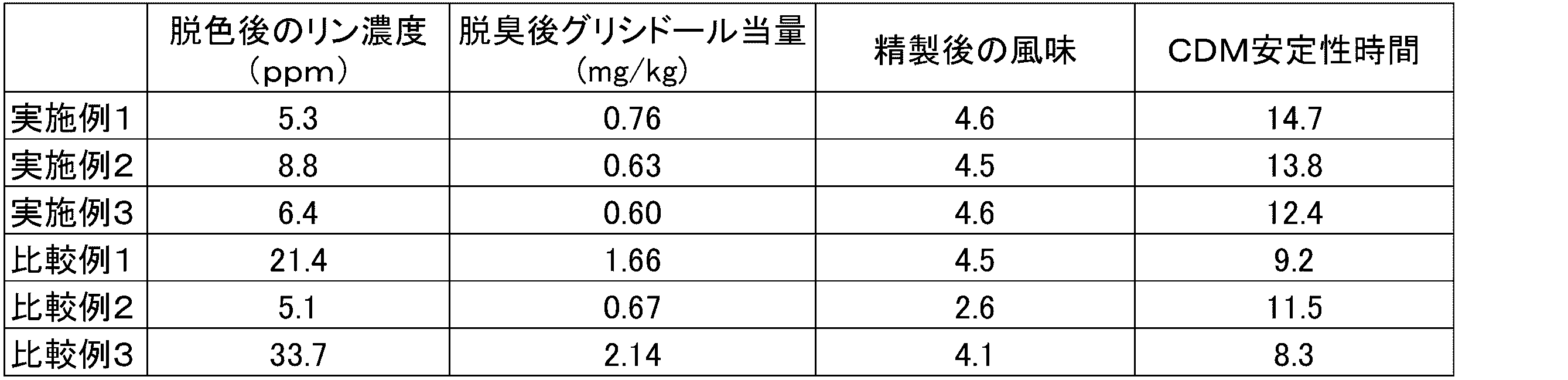
・比較例2は脱臭温度を210℃とした場合であるが、この場合、風味が2.6点となった
・比較例3はアルカリによる脱酸や酸による脱ガムによる予備精製を実施しなかった場合、リン濃度が10ppm以下とならなかったため、脱臭後のグリシドール当量が2.14mg/kgとなり、精製後のグリシドール当量を1.0mg/kg以下に低減することができなかった。

Claims (9)
- 粗パーム油(CPО)の精製工程において、脱酸及び/又は脱ガム処理後に、脱色作業工程に供する際に、酸を水溶液添加する工程を含み、脱色工程後の油脂中のリン濃度が10ppm以下、230℃~260℃での脱臭工程後の油脂が下記を満たす、物理精製パーム油(RBDPО)の製造方法。
脱臭工程後の油脂品質:
・グリシドール及びグリシドール脂肪酸エステルの含有量が、グリシドール当量で1.5mg/kg以下
・CDM安定性時間が10時間以上 - 前記、酸を水溶液添加する工程において、酸として下記の水溶液を0.01~10重量%添加する、請求項1に記載の、物理精製パーム油(RBDPО)の製造方法。
・濃度1~85重量%である、クエン酸及び/又はリン酸水溶液 - 前記、酸を水溶液添加する工程が、脱色工程における白土と油脂の混合物に、酸水溶液を添加する工程である、請求項1に記載の物理精製パーム油(RBDPО)の製造方法。
- 前記、酸を水溶液添加する工程が、脱色工程における白土と油脂の混合物に、酸水溶液を添加する工程である、請求項2に記載の物理精製パーム油(RBDPО)の製造方法。
- 前記、脱臭工程が下記条件である、請求項1~請求項4のいずれか1項に記載の物理精製パーム油(RBDPО)の製造方法。
・真空度100~800Pa
・水蒸気使用量0.5~5重量% - 請求項1又は請求項2に記載の物理精製パーム油(RBDPО)の製造方法による、物理精製パーム油(RBDPО)のグリシドール及びグリシドール脂肪酸エステルの低減方法。
- 請求項3に記載の物理精製パーム油(RBDPО)の製造方法による、物理精製パーム油(RBDPО)のグリシドール及びグリシドール脂肪酸エステルの低減方法。
- 請求項4に記載の物理精製パーム油(RBDPО)の製造方法による、物理精製パーム油(RBDPО)のグリシドール及びグリシドール脂肪酸エステルの低減方法。
- 請求項5に記載の物理精製パーム油(RBDPО)の製造方法による、物理精製パーム油(RBDPО)のグリシドール及びグリシドール脂肪酸エステルの低減方法。
Priority Applications (1)
| Application Number | Priority Date | Filing Date | Title |
|---|---|---|---|
| JP2022556668A JP7239908B2 (ja) | 2021-03-29 | 2022-03-28 | 物理精製パーム油(rbdpо)の製造方法 |
Applications Claiming Priority (2)
| Application Number | Priority Date | Filing Date | Title |
|---|---|---|---|
| JP2021-056142 | 2021-03-29 | ||
| JP2021056142 | 2021-03-29 |
Publications (1)
| Publication Number | Publication Date |
|---|---|
| WO2022210600A1 true WO2022210600A1 (ja) | 2022-10-06 |
Family
ID=83459299
Family Applications (1)
| Application Number | Title | Priority Date | Filing Date |
|---|---|---|---|
| PCT/JP2022/015178 Ceased WO2022210600A1 (ja) | 2021-03-29 | 2022-03-28 | 物理精製パーム油(rbdpо)の製造方法 |
Country Status (2)
| Country | Link |
|---|---|
| JP (1) | JP7239908B2 (ja) |
| WO (1) | WO2022210600A1 (ja) |
Citations (5)
| Publication number | Priority date | Publication date | Assignee | Title |
|---|---|---|---|---|
| JP2013049829A (ja) * | 2011-07-29 | 2013-03-14 | Nisshin Oillio Group Ltd | グリセリド組成物の製造方法 |
| CN103060088A (zh) * | 2011-10-18 | 2013-04-24 | 丰益(上海)生物技术研发中心有限公司 | 控制油脂中缩水甘油酯的方法 |
| JP2013542180A (ja) * | 2010-09-03 | 2013-11-21 | ステパン カンパニー | カルボン酸エステル流中の有機ハロ及びオキシラン種の除去 |
| CN104694250A (zh) * | 2013-12-10 | 2015-06-10 | 丰益(上海)生物技术研发中心有限公司 | 一种降低油脂中3-mcpd酯和/或缩水甘油酯的方法 |
| WO2020254506A1 (en) * | 2019-06-18 | 2020-12-24 | Palsgaard A/S | Method of producing a low glycidol monoglyceride composition and the low glycidol monoglyceride composition as such |
-
2022
- 2022-03-28 JP JP2022556668A patent/JP7239908B2/ja active Active
- 2022-03-28 WO PCT/JP2022/015178 patent/WO2022210600A1/ja not_active Ceased
Patent Citations (5)
| Publication number | Priority date | Publication date | Assignee | Title |
|---|---|---|---|---|
| JP2013542180A (ja) * | 2010-09-03 | 2013-11-21 | ステパン カンパニー | カルボン酸エステル流中の有機ハロ及びオキシラン種の除去 |
| JP2013049829A (ja) * | 2011-07-29 | 2013-03-14 | Nisshin Oillio Group Ltd | グリセリド組成物の製造方法 |
| CN103060088A (zh) * | 2011-10-18 | 2013-04-24 | 丰益(上海)生物技术研发中心有限公司 | 控制油脂中缩水甘油酯的方法 |
| CN104694250A (zh) * | 2013-12-10 | 2015-06-10 | 丰益(上海)生物技术研发中心有限公司 | 一种降低油脂中3-mcpd酯和/或缩水甘油酯的方法 |
| WO2020254506A1 (en) * | 2019-06-18 | 2020-12-24 | Palsgaard A/S | Method of producing a low glycidol monoglyceride composition and the low glycidol monoglyceride composition as such |
Also Published As
| Publication number | Publication date |
|---|---|
| JPWO2022210600A1 (ja) | 2022-10-06 |
| JP7239908B2 (ja) | 2023-03-15 |
Similar Documents
| Publication | Publication Date | Title |
|---|---|---|
| JP6919755B2 (ja) | グリシドール及びグリシドール脂肪酸エステル含有量を低減させた食用油脂及びその製造方法 | |
| EP2721131B1 (en) | Method for manufacturing refined fats and oils | |
| JP5955119B2 (ja) | 食用油脂の製造方法 | |
| EP2548941B2 (en) | Production process for refined fat or oil | |
| JP7294861B2 (ja) | 油脂の製造方法 | |
| EP4082350B1 (en) | Method for manufacturing an edible oil/fat with reduced content of glycidol and glycidol fatty acid esters | |
| EP2894215B1 (en) | Fat composition | |
| Engelmann et al. | Degumming and neutralization of rice bran oil | |
| JP2009102491A (ja) | 脱酸油脂の製造方法またはそれによって得られる精製油脂 | |
| JP6451447B2 (ja) | モノクロロプロパンジオール生成物質含有量を低減させた精製パーム油の製造方法 | |
| JP7239908B2 (ja) | 物理精製パーム油(rbdpо)の製造方法 | |
| CN108130186A (zh) | 一种油脂的脱色方法 | |
| US20210071103A1 (en) | Edible oil refining | |
| JP2009108145A (ja) | 脱酸油脂の製造方法またはそれによって得られる精製油脂 | |
| JP7837275B2 (ja) | グリシドール類の含有量が低減された食用油脂の製造方法 | |
| WO2022210599A1 (ja) | 育児用調製粉乳用油脂組成物の製造方法 | |
| CHEW | Quality Improvement of Crude Palm Oil via in situ Washing with Treated Aerobic Liquor: Process Development and Product Evaluation | |
| JP7347690B2 (ja) | 食用油脂の製造方法 | |
| RU2135554C1 (ru) | Способ получения гидратированных растительных масел и пищевых растительных фосфолипидов | |
| EP4195943A1 (en) | Removal of unwanted mineral oil hydrocarbons | |
| WO2022035594A1 (en) | Removal of unwanted mineral oil hydrocarbons | |
| EP4195945A1 (en) | Removal of unwanted mineral oil hydrocarbons | |
| CN114761524A (zh) | 纯化油脂的制造方法 | |
| WO2025205059A1 (ja) | 調製油の製造方法、油脂組成物の製造方法、及びフライ調理用油脂組成物の着色の抑制方法 | |
| US3326947A (en) | Process for removing the halphen test response from alkali refined cottonseed oil |
Legal Events
| Date | Code | Title | Description |
|---|---|---|---|
| ENP | Entry into the national phase |
Ref document number: 2022556668 Country of ref document: JP Kind code of ref document: A |
|
| 121 | Ep: the epo has been informed by wipo that ep was designated in this application |
Ref document number: 22780811 Country of ref document: EP Kind code of ref document: A1 |
|
| WWE | Wipo information: entry into national phase |
Ref document number: 2301006156 Country of ref document: TH |
|
| NENP | Non-entry into the national phase |
Ref country code: DE |
|
| WWE | Wipo information: entry into national phase |
Ref document number: 11202306769W Country of ref document: SG |
|
| 122 | Ep: pct application non-entry in european phase |
Ref document number: 22780811 Country of ref document: EP Kind code of ref document: A1 |