WO2022202098A1 - 感光性樹脂組成物 - Google Patents
感光性樹脂組成物 Download PDFInfo
- Publication number
- WO2022202098A1 WO2022202098A1 PCT/JP2022/007899 JP2022007899W WO2022202098A1 WO 2022202098 A1 WO2022202098 A1 WO 2022202098A1 JP 2022007899 W JP2022007899 W JP 2022007899W WO 2022202098 A1 WO2022202098 A1 WO 2022202098A1
- Authority
- WO
- WIPO (PCT)
- Prior art keywords
- bond
- photosensitive resin
- group
- resin composition
- formula
- Prior art date
- Legal status (The legal status is an assumption and is not a legal conclusion. Google has not performed a legal analysis and makes no representation as to the accuracy of the status listed.)
- Ceased
Links
Classifications
-
- C—CHEMISTRY; METALLURGY
- C08—ORGANIC MACROMOLECULAR COMPOUNDS; THEIR PREPARATION OR CHEMICAL WORKING-UP; COMPOSITIONS BASED THEREON
- C08G—MACROMOLECULAR COMPOUNDS OBTAINED OTHERWISE THAN BY REACTIONS ONLY INVOLVING UNSATURATED CARBON-TO-CARBON BONDS
- C08G73/00—Macromolecular compounds obtained by reactions forming a linkage containing nitrogen with or without oxygen or carbon in the main chain of the macromolecule, not provided for in groups C08G12/00 - C08G71/00
- C08G73/06—Polycondensates having nitrogen-containing heterocyclic rings in the main chain of the macromolecule
- C08G73/10—Polyimides; Polyester-imides; Polyamide-imides; Polyamide acids or similar polyimide precursors
-
- G—PHYSICS
- G03—PHOTOGRAPHY; CINEMATOGRAPHY; ANALOGOUS TECHNIQUES USING WAVES OTHER THAN OPTICAL WAVES; ELECTROGRAPHY; HOLOGRAPHY
- G03F—PHOTOMECHANICAL PRODUCTION OF TEXTURED OR PATTERNED SURFACES, e.g. FOR PRINTING, FOR PROCESSING OF SEMICONDUCTOR DEVICES; MATERIALS THEREFOR; ORIGINALS THEREFOR; APPARATUS SPECIALLY ADAPTED THEREFOR
- G03F7/00—Photomechanical, e.g. photolithographic, production of textured or patterned surfaces, e.g. printing surfaces; Materials therefor, e.g. comprising photoresists; Apparatus specially adapted therefor
- G03F7/004—Photosensitive materials
-
- G—PHYSICS
- G03—PHOTOGRAPHY; CINEMATOGRAPHY; ANALOGOUS TECHNIQUES USING WAVES OTHER THAN OPTICAL WAVES; ELECTROGRAPHY; HOLOGRAPHY
- G03F—PHOTOMECHANICAL PRODUCTION OF TEXTURED OR PATTERNED SURFACES, e.g. FOR PRINTING, FOR PROCESSING OF SEMICONDUCTOR DEVICES; MATERIALS THEREFOR; ORIGINALS THEREFOR; APPARATUS SPECIALLY ADAPTED THEREFOR
- G03F7/00—Photomechanical, e.g. photolithographic, production of textured or patterned surfaces, e.g. printing surfaces; Materials therefor, e.g. comprising photoresists; Apparatus specially adapted therefor
- G03F7/004—Photosensitive materials
- G03F7/027—Non-macromolecular photopolymerisable compounds having carbon-to-carbon double bonds, e.g. ethylenic compounds
-
- G—PHYSICS
- G03—PHOTOGRAPHY; CINEMATOGRAPHY; ANALOGOUS TECHNIQUES USING WAVES OTHER THAN OPTICAL WAVES; ELECTROGRAPHY; HOLOGRAPHY
- G03F—PHOTOMECHANICAL PRODUCTION OF TEXTURED OR PATTERNED SURFACES, e.g. FOR PRINTING, FOR PROCESSING OF SEMICONDUCTOR DEVICES; MATERIALS THEREFOR; ORIGINALS THEREFOR; APPARATUS SPECIALLY ADAPTED THEREFOR
- G03F7/00—Photomechanical, e.g. photolithographic, production of textured or patterned surfaces, e.g. printing surfaces; Materials therefor, e.g. comprising photoresists; Apparatus specially adapted therefor
- G03F7/20—Exposure; Apparatus therefor
-
- G—PHYSICS
- G03—PHOTOGRAPHY; CINEMATOGRAPHY; ANALOGOUS TECHNIQUES USING WAVES OTHER THAN OPTICAL WAVES; ELECTROGRAPHY; HOLOGRAPHY
- G03F—PHOTOMECHANICAL PRODUCTION OF TEXTURED OR PATTERNED SURFACES, e.g. FOR PRINTING, FOR PROCESSING OF SEMICONDUCTOR DEVICES; MATERIALS THEREFOR; ORIGINALS THEREFOR; APPARATUS SPECIALLY ADAPTED THEREFOR
- G03F7/00—Photomechanical, e.g. photolithographic, production of textured or patterned surfaces, e.g. printing surfaces; Materials therefor, e.g. comprising photoresists; Apparatus specially adapted therefor
- G03F7/26—Processing photosensitive materials; Apparatus therefor
- G03F7/30—Imagewise removal using liquid means
- G03F7/32—Liquid compositions therefor, e.g. developers
-
- H—ELECTRICITY
- H10—SEMICONDUCTOR DEVICES; ELECTRIC SOLID-STATE DEVICES NOT OTHERWISE PROVIDED FOR
- H10P—GENERIC PROCESSES OR APPARATUS FOR THE MANUFACTURE OR TREATMENT OF DEVICES COVERED BY CLASS H10
- H10P76/00—Manufacture or treatment of masks on semiconductor bodies, e.g. by lithography or photolithography
- H10P76/20—Manufacture or treatment of masks on semiconductor bodies, e.g. by lithography or photolithography of masks comprising organic materials
- H10P76/204—Manufacture or treatment of masks on semiconductor bodies, e.g. by lithography or photolithography of masks comprising organic materials of organic photoresist masks
- H10P76/2041—Photolithographic processes
Definitions
- the present invention provides a photosensitive resin composition, a resin film obtained from the composition, a photosensitive resist film using the composition, a method for producing a substrate with a cured relief pattern, a substrate with a cured relief pattern, and a cured relief pattern. semiconductor device.
- polyimide resin which has excellent heat resistance, electrical properties, and mechanical properties, has been used as an insulating material for electronic parts, and as a passivation film, surface protective film, interlayer insulating film, etc. for semiconductor devices.
- these polyimide resins those provided in the form of a photosensitive polyimide precursor easily form a heat-resistant relief pattern film by thermal imidization treatment by applying, exposing, developing, and curing the precursor. be able to.
- Such a photosensitive polyimide precursor has the feature of enabling a significant process reduction compared to conventional non-photosensitive polyimide resins.
- Patent Documents 1 and 2 propose a photosensitive resin composition containing polyamic acid or polyimide using a diamine having a (meth)acryloyloxy group.
- the photosensitive resin used to obtain the hardened relief pattern is divided into two types: the positive type, in which the photosensitive resin in the exposed areas is dissolved in the developer by exposure and development, leaving the photosensitive resin in the unexposed areas, and the photosensitive resin in the unexposed areas. is dissolved in the developer, and the photosensitive resin in the exposed areas remains.
- the negative type is inferior to the positive type in resolution, but is easy to form a thick film or a film, and is excellent in reliability.
- an object of the present invention is to provide a photosensitive resin composition that can be developed with an organic solvent, has a low dielectric loss tangent in the resulting cured film and has a high tensile elongation, and a photosensitive resin composition obtained from the composition.
- the object of the present invention is to provide a resin film obtained by the composition, a photosensitive resist film using the composition, a method for producing a substrate with a cured relief pattern, a substrate with a cured relief pattern, and a semiconductor device having a cured relief pattern.
- a photosensitive resin composition contains an aromatic diamine compound having a photopolymerizable group and a tetracarboxylic acid having three or more aromatic rings.
- organic solvent development is possible, and a photosensitive resin composition having a low dielectric loss tangent and a high tensile elongation in the resulting cured film can be obtained.
- the present invention has been completed.
- a photosensitive resin composition comprising a reaction product of an aromatic diamine compound having a photopolymerizable group and a tetracarboxylic acid derivative having three or more aromatic rings, and a solvent.
- the polyamic acid has at least a structural unit represented by the following formula (1)
- the photosensitive resin composition according to [2], wherein the polyimide has at least a structural unit represented by the following formula (2).
- Ar 1 represents a divalent organic group having a photopolymerizable group and an aromatic ring
- Ar 2 represents a tetravalent organic group having three or more aromatic rings.
- Ar 3 represents a divalent organic group having a photopolymerizable group and an aromatic ring
- Ar 4 represents a tetravalent organic group having three or more aromatic rings.
- X 1 and X 2 each independently represent a direct bond, an ether bond, an ester bond, an amide bond, a urethane bond, a urea bond, a thioether bond, or a sulfonyl bond.
- R 1 and R 2 each independently represent an optionally substituted alkyl group having 1 to 6 carbon atoms.
- Y represents a divalent organic group represented by the following formula (3-1) or (3-2).
- n1 and n2 each independently represent an integer of 0 to 3; When there are multiple R 1 s, the multiple R 1s may be the same or different. When there are multiple R 2 s, the multiple R 2s may be the same or different. * represents a bond.
- Z 1 represents a direct bond, an ether bond, an ester bond, an amide bond, a urethane bond, a urea bond, a thioether bond, or a sulfonyl bond.
- R 3 and R 4 each independently represent an optionally substituted hydrocarbon group having 1 to 6 carbon atoms.
- m1 represents an integer of 0 to 3;
- n3 and n4 each independently represent an integer of 0 to 4;
- Z 1 is plural, the plural Z 1 may be the same or different.
- n4 is plural, the plural n4 may be the same or different.
- R 3 is plural, the plural R 3 may be the same or different.
- R 4 is plural, the plural R 4 may be the same or different.
- Z 2 represents a divalent organic group represented by formula (4) or (5) below.
- R 5 and R 6 each independently represent an optionally substituted hydrocarbon group having 1 to 6 carbon atoms.
- n5 and n6 each independently represent an integer of 0 to 4; When R 5 is plural, the plural R 5 may be the same or different. When R 6 is plural, the plural R 6 may be the same or different.
- * represents a bond.
- R 7 and R 8 each independently represent a hydrogen atom or a hydrocarbon group having 1 to 6 carbon atoms which may be substituted with a halogen atom. * represents a bond.
- R 9 and R 10 each independently represent an optionally substituted alkylene group having 1 to 6 carbon atoms or an optionally substituted arylene group having 6 to 10 carbon atoms. * represents a bond.
- Ar 1 in the formula (1) and Ar 3 in the formula (2) are divalent organic groups represented by the following formula (6): A photosensitive resin composition.
- Z3 represents an ether bond , an ester bond, an amide bond, a urethane bond or a urea bond
- Z4 represents a direct bond, an ester bond or an amide bond.
- Z5 represents a direct bond, ether bond, ester bond, amide bond, urethane bond, urea bond, thioether bond, or sulfonyl bond.
- m2 represents an integer of 0 to 1;
- R 11 represents a direct bond or an alkylene group having 2 to 6 carbon atoms which may be substituted with a hydroxyl group, and
- R 12 represents a hydrogen atom or a methyl group. * represents a bond.
- [6] The photosensitive resin composition according to [ 5 ], wherein Z3 and Z4 in formula ( 6 ) are ester bonds.
- [7] The photosensitive resin composition according to [5] or [6], wherein R 11 in formula (6) is a 1,2-ethylene group.
- a photosensitive resist film comprising a substrate film, a photosensitive resin layer formed from the photosensitive resin composition according to any one of [1] to [11], and a cover film.
- [15] (1) A step of applying the photosensitive resin composition according to any one of [1] to [11] onto a substrate to form a photosensitive resin layer on the substrate; (2) exposing the photosensitive resin layer; (3) developing the exposed photosensitive resin layer to form a relief pattern; (4) A method for producing a substrate with a cured relief pattern, comprising the step of heat-treating the relief pattern to form a cured relief pattern.
- the method for producing a cured relief patterned substrate according to [15] wherein the developer used for the development is an organic solvent.
- a substrate with a cured relief pattern produced by the method according to [15] or [16].
- a semiconductor device comprising a semiconductor element and a cured film provided above or below the semiconductor element, wherein the cured film comprises the photosensitive resin composition according to any one of [1] to [11].
- a semiconductor device that is a cured relief pattern formed from a material.
- a photosensitive resin composition that can be developed with an organic solvent and has a low dielectric loss tangent and a high tensile elongation in the resulting cured film, a resin film obtained from the composition, A photosensitive resist film using the composition, a method for producing a substrate with a cured relief pattern, a substrate with a cured relief pattern, and a semiconductor device having a cured relief pattern are obtained.
- the photosensitive resin composition of the present invention contains at least a reaction product and a solvent, and further contains other components as necessary.
- the reaction product is a reaction product between an aromatic diamine compound having a photopolymerizable group and a tetracarboxylic acid derivative having three or more aromatic rings.
- the reaction product contains, as constituent components, an aromatic diamine compound having a photopolymerizable group and a tetracarboxylic acid derivative having three or more aromatic rings, and if necessary, other diamines as constituent components. compounds, and other tetracarboxylic acid derivatives.
- the reaction product is, for example, polyamic acid or polyimide obtained by dehydration ring closure of polyamic acid.
- Photosensitivity is imparted to the resin composition containing the reaction product by including the aromatic diamine compound having a photopolymerizable group in the reaction product.
- the reaction product contains an aromatic diamine compound and a tetracarboxylic acid derivative having three or more aromatic rings as constituent components, the obtained cured film has a low dielectric loss tangent and a high tensile elongation. .
- aromatic diamine compound having a photopolymerizable group two amino groups may be bonded to one aromatic ring or may be bonded to each of the two aromatic rings.
- Aromatic rings include aromatic hydrocarbon rings, aromatic heterocycles, and the like.
- the aromatic diamine compound may have an aromatic ring to which no amino group is bonded.
- photopolymerizable groups examples include radically polymerizable groups, cationic polymerizable groups, and anionically polymerizable groups. Among these, a radically polymerizable group is preferred.
- examples of radically polymerizable groups include acryloyl groups, methacryloyl groups, propenyl ether groups, vinyl ether groups, and vinyl groups.
- the reaction product contains an aromatic diamine compound having three or more aromatic rings as a diamine compound other than the aromatic diamine compound having a photopolymerizable group in the resulting cured film. It is preferable in that dielectric loss tangent and higher tensile elongation can be obtained.
- the number of aromatic rings in the aromatic diamine compound having 3 or more aromatic rings is not particularly limited as long as it is 3 or more, but may be 4 or more, for example.
- the upper limit of the number of aromatic rings is not particularly limited, but may be, for example, 8 or less, or 6 or less.
- aromatic rings in "3 or more aromatic rings” polycyclic aromatic rings formed by condensing two or more aromatic rings such as naphthalene ring and anthracene ring are counted as one aromatic ring. . Therefore, a naphthalene ring is counted as one aromatic ring.
- a biphenyl ring is not a fused ring and counts as two aromatic rings.
- a perylene ring is regarded as a structure formed by bonding two naphthalene rings and counted as two aromatic rings.
- Aromatic rings include aromatic hydrocarbon rings, aromatic heterocycles, and the like.
- tetracarboxylic acid derivatives examples include tetracarboxylic dianhydride, tetracarboxylic acid dihalide, tetracarboxylic acid dialkyl ester, and tetracarboxylic acid dialkyl ester dihalide.
- Carboxylic dianhydrides are preferred.
- Aromatic tetracarboxylic acids refer to compounds having a total of four carboxy groups attached to the same or different aromatic rings.
- the number of aromatic rings in the tetracarboxylic acid derivative having 3 or more aromatic rings is not particularly limited as long as it is 3 or more, but may be 4 or more, for example.
- the upper limit of the number of aromatic rings is not particularly limited, but may be, for example, 8 or less, or 6 or less.
- the ratio of the aromatic diamine compound having a photopolymerizable group to the total diamine compound constituting the reaction product is not particularly limited, but from the viewpoint of obtaining sufficient photosensitivity, 10 to 100 mol% is preferable, and 50 to 50 mol%. 100 mol % is more preferred.
- the ratio of the aromatic tetracarboxylic acid derivative having three or more aromatic rings to the total tetracarboxylic acid derivative constituting the reaction product is not particularly limited, but from the viewpoint of suitably obtaining the effects of the present invention, it is 20. ⁇ 100 mol% is preferred, and 50 to 100 mol% is more preferred.
- the reaction product is preferably a polyamic acid or a polyimide obtained by dehydrating and ring-closing a polyamic acid. From the viewpoint of obtaining a finer relief pattern, polyimide obtained by dehydrating and ring-closing a polyamic acid is more preferable.
- the imidization rate of polyimide need not be 100%.
- the imidization rate may be, for example, 90% or more, 95% or more, or 98% or more.
- Polyamic acid preferably has at least a structural unit represented by the following formula (1).
- Polyimide preferably has at least a structural unit represented by the following formula (2).
- Ar 1 represents a divalent organic group having a photopolymerizable group and an aromatic ring
- Ar 2 represents a tetravalent organic group having three or more aromatic rings.
- Ar 3 represents a divalent organic group having a photopolymerizable group and an aromatic ring
- Ar 4 represents a tetravalent organic group having three or more aromatic rings.
- Ar 1 and Ar 3 are divalent organic groups having a photopolymerizable group and an aromatic ring, and are not particularly limited as long as the effects of the present invention are exhibited.
- the divalent organic group having a photopolymerizable group and an aromatic ring is a residue obtained by removing two amino groups from an aromatic diamine compound having a photopolymerizable group. Examples of the photopolymerizable group include the photopolymerizable groups described above.
- Ar 1 and Ar 3 are preferably divalent organic groups represented by the following formula (6).
- Z 3 is an ether bond (-O-), an ester bond (-COO-), an amide bond (-NHCO-), a urethane bond (-NHCOO-) or a urea bond (-NHCONH-).
- Z 4 represents a direct bond, an ester bond (--COO--) or an amide bond (--NHCO--).
- Z 5 is a direct bond, ether bond (-O-), ester bond (-COO-), amide bond (-NHCO-), urethane bond (-NHCOO-), urea bond (-NHCONH-), thioether bond (- S—) or a sulfonyl bond (—SO 2 —).
- m2 represents an integer from 0 to 1;
- R 11 represents a direct bond or an alkylene group having 2 to 6 carbon atoms which may be substituted with a hydroxyl group, and
- R 12 represents a hydrogen atom or a methyl group. * represents a bond.
- alkylene group having 2 to 6 carbon atoms which may be substituted with a hydroxyl group
- examples of the alkylene group having 2 to 6 carbon atoms which may be substituted with a hydroxyl group include 1,1-ethylene group, 1,2-ethylene group, 1,2-propylene group, 1,3-propylene group, 1,4-butylene group, 1,2-butylene group, 2,3-butylene group, 1,2-pentylene group, 2,4-pentylene group, 1,2-hexylene group, 1,2-cyclopropylene group , 1,2-cyclobutylene group, 1,3-cyclobutylene group, 1,2-cyclopentylene group, 1,2-cyclohexylene group, alkylene in which at least part of these hydrogen atoms are substituted with hydroxyl groups groups (eg, 2-hydroxy-1,3-propylene group) and the like.
- hydroxyl groups groups eg, 2-hydroxy-1,3-propylene group
- Z3 is preferably an ester bond.
- Z4 is preferably an ester bond.
- R 11 is preferably a 1,2-ethylene group.
- Examples of the divalent organic group represented by Formula (6) include the following divalent organic groups.
- * represents a bond. The two bonds are, for example, positioned meta to a substituent having a photopolymerizable group.
- Ar 2 in formula (1) and Ar 4 in formula (2) are not particularly limited as long as they are tetravalent organic groups having three or more aromatic rings and exhibiting the effect of the present invention. , is preferably a divalent organic group represented by the following formula (3) from the viewpoint of suitably obtaining the effects of the present invention.
- X 1 and X 2 are each independently a direct bond, an ether bond (-O-), an ester bond (-COO-), an amide bond (-NHCO-), a urethane bond (-NHCOO-) , represents a urea bond (-NHCONH-), a thioether bond (-S-) or a sulfonyl bond (-SO 2 -).
- R 1 and R 2 each independently represent an optionally substituted alkyl group having 1 to 6 carbon atoms.
- Y represents a divalent organic group represented by the following formula (3-1) or (3-2).
- n1 and n2 each independently represent an integer of 0 to 3; When there are multiple R 1 s, the multiple R 1s may be the same or different. When there are multiple R 2 s, the multiple R 2s may be the same or different. * represents a bond. ]
- Examples of the optionally substituted alkyl group having 1 to 6 carbon atoms for R 1 and R 2 include alkyl groups having 1 to 6 carbon atoms.
- Examples of alkyl groups having 1 to 6 carbon atoms include methyl group, ethyl group, propyl group, butyl group, pentyl group and hexyl group.
- an alkyl group unless otherwise specified for its structure, may be linear, branched, cyclic, or two or more of these.
- substituents on the optionally substituted alkyl group having 1 to 6 carbon atoms include a halogen atom, a hydroxy group, a mercapto group, a carboxy group, a cyano group, a formyl group, a haloformyl group, a sulfo group, an amino group, nitro group, nitroso group, oxo group, thioxy group, alkoxy group having 1 to 6 carbon atoms, and the like.
- “1 to 6 carbon atoms" in “optionally substituted alkyl group having 1 to 6 carbon atoms” refers to the number of carbon atoms in the "alkyl group” excluding substituents. Also, the number of substituents is not particularly limited.
- Z 1 is a direct bond, an ether bond (-O-), an ester bond (-COO-), an amide bond (-NHCO-), a urethane bond (-NHCOO-), a urea bond ( -NHCONH-), a thioether bond (-S-) or a sulfonyl bond (-SO 2 -).
- R 3 and R 4 each independently represent an optionally substituted hydrocarbon group having 1 to 6 carbon atoms.
- m1 represents an integer of 0 to 3;
- n3 and n4 each independently represent an integer of 0 to 4;
- Z 1 is plural, the plural Z 1 may be the same or different.
- n4 When n4 is plural, the plural n4 may be the same or different.
- R 3 When R 3 is plural, the plural R 3 may be the same or different.
- R 4 When R 4 is plural, the plural R 4 may be the same or different.
- * represents a bond.
- Z 2 represents a divalent organic group represented by formula (4) or (5) below.
- R 5 and R 6 each independently represent an optionally substituted hydrocarbon group having 1 to 6 carbon atoms.
- n5 and n6 each independently represent an integer of 0 to 4; When R 5 is plural, the plural R 5 may be the same or different.
- R 6 When R 6 is plural, the plural R 6 may be the same or different. * represents a bond. ]
- Examples of the optionally substituted hydrocarbon group having 1 to 6 carbon atoms in R 3 , R 4 , R 5 and R 6 include an optionally substituted alkyl group having 1 to 6 carbon atoms, An optionally substituted phenyl group is included.
- Substituents include, for example, a halogen atom, a hydroxy group, a mercapto group, a carboxy group, a cyano group, a formyl group, a haloformyl group, a sulfo group, an amino group, a nitro group, a nitroso group, an oxo group, a thioxy group, and 1 carbon atom. alkoxy groups of 1 to 6, and the like.
- the "1 to 6 carbon atoms" of the "optionally substituted hydrocarbon group having 1 to 6 carbon atoms” refers to the number of carbon atoms in the "hydrocarbon group” excluding substituents. Also, the number of substituents is not particularly limited.
- R 3 , R 4 , R 5 and R 6 include, for example, the substituted alkyl group exemplified in the description of R 1 and R 2 A good alkyl group having 1 to 6 carbon atoms is exemplified.
- R 7 and R 8 each independently represent a hydrogen atom or a hydrocarbon group having 1 to 6 carbon atoms which may be substituted with a halogen atom. * represents a bond.
- R 9 and R 10 each independently represent an optionally substituted alkylene group having 1 to 6 carbon atoms or an optionally substituted arylene group having 6 to 10 carbon atoms. * represents a bond.
- the hydrocarbon group having 1 to 6 carbon atoms which may be substituted with a halogen atom for R 7 and R 8 includes, for example, an alkyl group having 1 to 6 carbon atoms and a halogenated alkyl group having 1 to 6 carbon atoms. groups, phenyl groups, halogenated phenyl groups, and the like.
- alkyl groups having 1 to 6 carbon atoms include methyl group, ethyl group, propyl group, butyl group, pentyl group and hexyl group.
- Examples of the halogen atom in the halogenated alkyl group having 1 to 6 carbon atoms include fluorine atom, chlorine atom, bromine atom and iodine atom.
- the halogenated alkyl group having 1 to 6 carbon atoms and the halogenated phenyl group may be partially or wholly halogenated.
- substituents on the optionally substituted alkylene group having 1 to 6 carbon atoms in R 9 and R 10 include a halogen atom, a hydroxy group, a mercapto group, a carboxy group, a cyano group, a formyl group, a haloformyl group, sulfo group, amino group, nitro group, nitroso group, oxo group, thioxy group, alkoxy group having 1 to 6 carbon atoms, and the like.
- the optionally substituted alkylene group having 1 to 6 carbon atoms includes, for example, an alkylene group having 1 to 6 carbon atoms and a halogenated alkylene group having 1 to 6 carbon atoms.
- alkylene group having 1 to 6 carbon atoms examples include methylene group, ethylene group, propylene group, and butylene group.
- the "1 to 6 carbon atoms" of the "optionally substituted alkylene group having 1 to 6 carbon atoms” refers to the number of carbon atoms in the "alkylene group” excluding substituents. Also, the number of substituents is not particularly limited.
- substituents on the optionally substituted arylene group having 6 to 10 carbon atoms in R 9 and R 10 include a halogen atom, an optionally halogenated C 1 to 6 alkyl group, halogen alkoxy groups having 1 to 6 carbon atoms which may be substituted, and the like. Halogenation may be partially or wholly.
- the arylene group includes, for example, a phenylene group and a naphthylene group.
- the "6 to 10 carbon atoms" of the "optionally substituted arylene group having 6 to 10 carbon atoms" refers to the number of carbon atoms in the "arylene group” excluding substituents. Also, the number of substituents is not particularly limited.
- Examples of the divalent organic group represented by formula (4) include divalent organic groups represented by the following formulae.
- * represents a bond.
- Examples of the divalent organic group represented by formula (5) include divalent organic groups represented by the following formulae.
- R 13 to R 15 are each independently a halogen atom, an alkyl group having 1 to 6 carbon atoms which may be substituted with a halogen atom, or an alkyl group having 1 to 6 carbon atoms which may be substituted with a halogen atom represents an alkoxy group.
- n13 represents an integer of 0 to 5;
- n14 and n15 each independently represent an integer of 0 to 4;
- R 13 is plural, the plural R 13 may be the same or different.
- R 14 is plural, the plural R 14 may be the same or different.
- R 15 is plural, the plural R 15 may be the same or different.
- * represents a bond.
- alkyl groups having 1 to 6 carbon atoms which may be substituted with halogen atoms for R 13 to R 15 include alkyl groups having 1 to 6 carbon atoms and halogen having 1 to 6 carbon atoms.
- alkyl group examples include methyl group, ethyl group, propyl group, butyl group, pentyl group and hexyl group.
- the halogen atom in the halogenated alkyl group having 1 to 6 carbon atoms include fluorine atom, chlorine atom, bromine atom and iodine atom.
- a halogenated alkyl group having 1 to 6 carbon atoms may be partially or completely halogenated.
- alkoxy group having 1 to 6 carbon atoms which may be substituted with a halogen atom for R 13 to R 15 are an alkyl group having 1 to 6 carbon atoms which may be substituted with a halogen atom. based on.
- Ar 2 and Ar 4 include, for example, tetravalent organic groups represented by the following formulas.
- * represents a bond.
- the polyamic acid may have structural units other than the structural unit represented by formula (1).
- Other structural units include, for example, structural units represented by the following formula (1′).
- Polyimide may have structural units other than the structural unit represented by formula (2).
- Other structural units include, for example, structural units represented by the following formula (2′).
- Ar 1 ' is a divalent organic group other than a divalent organic group having a photopolymerizable group and an aromatic ring or a divalent organic group having a photopolymerizable group and an aromatic ring
- Ar 2′ represents a tetravalent organic group having 3 or more aromatic rings or a tetravalent organic group having no 3 or more aromatic rings.
- Ar 1' is a divalent organic group having a photopolymerizable group and an aromatic ring and Ar 2' is a tetravalent organic group having 3 or more aromatic rings is excluded.
- Ar 3′ is a divalent organic group other than a divalent organic group having a photopolymerizable group and an aromatic ring or a divalent organic group having a photopolymerizable group and an aromatic ring and Ar 4′ represents a tetravalent organic group having 3 or more aromatic rings or a tetravalent organic group having no 3 or more aromatic rings.
- Ar 3' is a divalent organic group having a photopolymerizable group and an aromatic ring and Ar 4' is a tetravalent organic group having 3 or more aromatic rings is excluded.
- Combinations of Ar 1′ and Ar 2′ include the following combinations (i) to (iii). (i): A combination in which Ar 1′ represents a photopolymerizable group and a divalent organic group having an aromatic ring, and Ar 2′ represents a tetravalent organic group having no three or more aromatic rings (ii) ): Ar 1′ represents a divalent organic group other than a photopolymerizable group and a divalent organic group having an aromatic ring, and Ar 2′ is a tetravalent organic group having no three or more aromatic rings (iii): Ar 1 ' represents a divalent organic group other than a photopolymerizable group and a divalent organic group having an aromatic ring, and Ar 2 ' has three or more aromatic rings 4 a combination representing a valent organic group
- Combinations of Ar 3′ and Ar 4′ include the following combinations (iv) to (vi).
- Ar 3' represents a divalent organic group other than a photopolymerizable group and a divalent organic group having an aromatic ring
- Ar 4' is a tetravalent organic group having no three or more aromatic rings
- Ar 3 ' represents a divalent organic group other than a photopolymerizable group and a divalent organic group having an aromatic ring
- Ar 4 ' has three or more aromatic rings 4 a combination representing a valent organic group
- ⁇ Ar 1′ and Ar 3′ As the divalent organic group having a photopolymerizable group and an aromatic ring in Ar 1' and Ar 3' , for example, the divalent organic group having a photopolymerizable group and an aromatic ring exemplified in the description of Ar 1 and Ar 3 organic group.
- the divalent organic group other than the photopolymerizable group and the divalent organic group having an aromatic ring in Ar 1' and Ar 3' is not particularly limited, but the resulting cured film has a lower dielectric loss tangent and a higher A divalent organic group having three or more aromatic rings is preferred because it provides high tensile elongation.
- the divalent organic group having three or more aromatic rings is not particularly limited, it is preferably a divalent organic group represented by the following formula (13).
- X 21 and X 22 are each independently a direct bond, an ether bond (-O-), an ester bond (-COO-), an amide bond (-NHCO-), a urethane bond (-NHCOO-) , represents a urea bond (-NHCONH-), a thioether bond (-S-) or a sulfonyl bond (-SO 2 -).
- R 21 and R 22 each independently represent an optionally substituted alkyl group having 1 to 6 carbon atoms.
- Y 20 represents a divalent organic group represented by the following formula (13-1) or (13-2).
- n21 and n22 each independently represent an integer of 0 to 4; When R 21 is plural, the plural R 21 may be the same or different. When R 22 is plural, the plural R 22 may be the same or different. * represents a bond. ]
- optionally substituted alkyl group having 1 to 6 carbon atoms for R 21 and R 22 include the optionally substituted alkyl groups having 1 to 6 carbon atoms exemplified in the description of R 1 and R 2 .
- An alkyl group is mentioned.
- “1 to 6 carbon atoms" of “optionally substituted alkyl group having 1 to 6 carbon atoms” refers to the number of carbon atoms in the "alkyl group” excluding substituents. Also, the number of substituents is not particularly limited.
- Z 21 is a direct bond, an ether bond (-O-), an ester bond (-COO-), an amide bond (-NHCO-), a urethane bond (-NHCOO-), a urea bond ( -NHCONH-), a thioether bond (-S-) or a sulfonyl bond (-SO 2 -).
- R 23 and R 24 each independently represent an optionally substituted hydrocarbon group having 1 to 6 carbon atoms.
- m21 represents an integer of 0 to 3;
- n23 and n24 each independently represent an integer of 0 to 4;
- the plural Z 21 may be the same or different.
- n24 When n24 is plural, the plural n24 may be the same or different.
- R 23 When R 23 is plural, the plural R 23 may be the same or different.
- R 24 When R 24 is plural, the plural R 24 may be the same or different.
- * represents a bond.
- Z 22 represents a divalent organic group represented by formula (14) or (15) below.
- R 25 and R 26 each independently represent an optionally substituted hydrocarbon group having 1 to 6 carbon atoms.
- n25 and n26 each independently represent an integer of 0 to 4;
- R 25 When R 25 is plural, the plural R 25 may be the same or different.
- R 26 When R 26 is plural, the plural R 26 may be the same or different. * represents a bond. ]
- optionally substituted hydrocarbon group having 1 to 6 carbon atoms in R 23 , R 24 , R 25 and R 26 are those in the description of R 3 , R 4 , R 5 and R 6 Examples include optionally substituted hydrocarbon groups having 1 to 6 carbon atoms.
- “1 to 6 carbon atoms" of “optionally substituted hydrocarbon group having 1 to 6 carbon atoms” refers to the number of carbon atoms in the "hydrocarbon group” excluding substituents. Also, the number of substituents is not particularly limited.
- R 23 , R 24 , R 25 and R 26 include, for example, the substituted alkyl group exemplified in the description of R 1 and R 2 A good alkyl group having 1 to 6 carbon atoms is exemplified.
- R 27 and R 28 each independently represent a hydrogen atom or a hydrocarbon group having 1 to 6 carbon atoms which may be substituted with a halogen atom. * represents a bond.
- R 29 and R 30 each independently represent an optionally substituted alkylene group having 1 to 6 carbon atoms or an optionally substituted arylene group having 6 to 10 carbon atoms. * represents a bond.
- hydrocarbon group having 1 to 6 carbon atoms which may be substituted with a halogen atom for R 27 and R 28 are optionally substituted with the halogen atoms exemplified in the description of R 7 and R 8
- a hydrocarbon group having 1 to 6 carbon atoms can be mentioned.
- optionally substituted alkylene group having 1 to 6 carbon atoms for R 29 and R 30 include the optionally substituted alkylene groups having 1 to 6 carbon atoms exemplified in the description of R 9 and R 10 .
- An alkylene group is mentioned.
- the "1 to 6 carbon atoms" of the "optionally substituted alkylene group having 1 to 6 carbon atoms” refers to the number of carbon atoms in the "alkylene group” excluding substituents. Also, the number of substituents is not particularly limited.
- optionally substituted arylene group having 6 to 10 carbon atoms for R 29 and R 30 include the optionally substituted arylene groups having 6 to 10 carbon atoms exemplified in the description of R 9 and R 10 .
- An arylene group is mentioned.
- the "6 to 10 carbon atoms" of the "optionally substituted arylene group having 6 to 10 carbon atoms” refers to the number of carbon atoms in the "arylene group” excluding substituents. Also, the number of substituents is not particularly limited.
- Examples of the divalent organic group represented by formula (14) include divalent organic groups represented by the following formulae.
- * represents a bond.
- Examples of the divalent organic group represented by formula (15) include divalent organic groups represented by the following formulas.
- R 33 to R 35 are each independently a halogen atom, an alkyl group having 1 to 6 carbon atoms which may be substituted with a halogen atom, or an alkyl group having 1 to 6 carbon atoms which may be substituted with a halogen atom represents an alkoxy group.
- n33 represents an integer of 0 to 5;
- n34 and n35 each independently represent an integer of 0 to 4;
- R 33 is plural, the plural R 33 may be the same or different.
- R 34 is plural, the plural R 34 may be the same or different.
- R 35 is plural, the plural R 35 may be the same or different.
- * represents a bond.
- alkyl groups having 1 to 6 carbon atoms which may be substituted with halogen atoms for R 33 to R 35 include the carbon atoms optionally substituted by halogen atoms exemplified in the description of R 13 to R 15 Examples include alkyl groups having 1 to 6 atoms.
- Specific examples of the alkoxy group having 1 to 6 carbon atoms which may be substituted with a halogen atom for R 33 to R 35 are an alkyl group having 1 to 6 carbon atoms which may be substituted with a halogen atom, based on.
- Ar 1' and Ar 3' include, for example, divalent organic groups represented by the following formulas.
- * represents a bond.
- Ar 1′ and Ar 3′ include, for example, divalent organic groups represented by the following formulas.
- * represents a bond.
- ⁇ Ar 2′ and Ar 4′ Examples of the tetravalent organic group having 3 or more aromatic rings for Ar 2' and Ar 4' include the tetravalent organic groups having 3 or more aromatic rings exemplified in the description of Ar 2 and Ar 4 . groups.
- the tetravalent organic group having no three or more aromatic rings in Ar 2' and Ar 4' is, for example, a tetravalent organic group having one or two aromatic rings or an aromatic ring.
- a tetravalent organic group that does not have A tetravalent organic group having one or two aromatic rings is derived, for example, from an aromatic tetracarboxylic dianhydride derivative.
- the tetravalent organic group having no aromatic ring is derived from, for example, an aliphatic tetracarboxylic anhydride derivative.
- examples of such a tetravalent organic group include, but are not particularly limited to, the following tetravalent organic groups.
- * represents a bond.
- the ratio of the structural unit represented by formula (1) in the total structural units of the polyamic acid is not particularly limited, but from the viewpoint of obtaining sufficient photosensitivity, it is preferably 10 to 100 mol%, and 50 to 100 mol%. more preferred.
- a structural unit is also a repeating unit.
- the proportion of the structural unit represented by the formula (1′) in the total structural units of the polyamic acid is not particularly limited, but is 1 to 90 mol. %, more preferably 1 to 50 mol %.
- the polyimide may have a structural unit represented by formula (1) in addition to the structural unit represented by formula (2).
- the total ratio of the structural units represented by the formula (1) and the structural units represented by the formula (2) in the total structural units of the polyimide is not particularly limited, but from the viewpoint of obtaining sufficient photosensitivity, it is 10 ⁇ 100 mol% is preferred, and 50 to 100 mol% is more preferred.
- the structural unit represented by the formula (1') in all the structural units of the polyimide and the structural unit represented by formula (2′) is not particularly limited, but is preferably 1 to 90 mol %, more preferably 1 to 50 mol %.
- the weight average molecular weight of the reaction product is not particularly limited. 0000 is preferred, 7,000 to 50,000 is more preferred, 10,000 to 50,000 is even more preferred, and 10,000 to 40,000 is particularly preferred.
- the reaction product comprises an aromatic diamine compound having a photopolymerizable group, a tetracarboxylic acid derivative having three or more aromatic rings, and optionally other diamine compounds and other tetracarboxylic acid derivatives. Obtained by reaction.
- the method for producing the reaction product is not particularly limited, and includes, for example, a known method for obtaining polyamic acid or polyimide by reacting a diamine compound and a tetracarboxylic acid derivative.
- Polyamic acid and polyimide can be synthesized by a known method as described in WO2013/157586, for example.
- the reaction product is produced, for example, by reacting (condensation polymerization) a diamine component containing an aromatic diamine compound having a photopolymerizable group with a tetracarboxylic acid derivative component having three or more aromatic rings in a solvent. It is done by reacting (condensation polymerization) a diamine component containing an aromatic diamine compound having a photopolymerizable group with a tetracarboxylic acid derivative component having three or more aromatic rings in a solvent. It is done by reacting (condensation polymerization) a diamine component containing an aromatic diamine compound having a photopolymerizable group with a tetracarboxylic acid derivative component having three or more aromatic rings in a solvent. It is done by reacting (condensation polymerization) a diamine component containing an aromatic diamine compound having a photopolymerizable group with a tetracarboxylic acid derivative component having three or more aromatic rings in a solvent.
- solvents include N-methyl-2-pyrrolidone, N-ethyl-2-pyrrolidone, ⁇ -butyrolactone, N,N-dimethylformamide, N,N-dimethylacetamide, N,N-dimethylpropionamide, N,N-dimethylisobutyric acid amide, dimethylsulfoxide, 1,3-dimethyl-2-imidazolidinone.
- the polymer has high solvent solubility, methyl ethyl ketone, cyclohexanone, cyclopentanone, 4-hydroxy-4-methyl-2-pentanone, or the following formulas [D-1] to [D-3] Any of the indicated solvents can be used.
- D 1 represents an alkyl group having 1 to 3 carbon atoms
- D 2 represents an alkyl group having 1 to 3 carbon atoms
- -3 represents an alkyl group having 1 to 4 carbon atoms.
- solvents may be used alone or in combination. Furthermore, even a solvent that does not dissolve the reaction product may be used by mixing with the above solvent within the range that the reaction product does not precipitate.
- the reaction can be carried out at any concentration, preferably 1 to 50% by mass, more preferably 5 to 30% by mass.
- the initial stage of the reaction may be carried out at a high concentration, and then the solvent may be added.
- the ratio of the total number of moles of the diamine component to the total number of moles of the tetracarboxylic acid derivative component is preferably 0.8 to 1.2. As in a normal polycondensation reaction, the closer this molar ratio is to 1.0, the greater the molecular weight of the reaction product produced.
- thermal polymerization inhibitor When reacting the diamine component and the tetracarboxylic acid derivative component, a thermal polymerization inhibitor may be added to the reaction system in order to avoid polymerization of the photopolymerizable group.
- thermal polymerization inhibitors include hydroquinone, 4-methoxyphenol, N-nitrosodiphenylamine, p-tert-butylcatechol, phenothiazine, N-phenylnaphthylamine, ethylenediaminetetraacetic acid, 1,2-cyclohexanediaminetetraacetic acid, and glycol ether.
- diaminetetraacetic acid 2,6-di-tert-butyl-p-cresol, 5-nitroso-8-hydroxyquinoline, 1-nitroso-2-naphthol, 2-nitroso-1-naphthol, 2-nitroso-5-( N-ethyl-N-sulfopropylamino)phenol, N-nitroso-N-phenylhydroxylamine ammonium salt, N-nitroso-N(1-naphthyl)hydroxylamine ammonium salt and the like.
- the amount of the thermal polymerization inhibitor used is not particularly limited.
- Polyimide is obtained by dehydrating and ring-closing the polyamic acid, which is the reaction product obtained in the above reaction.
- Methods for obtaining polyimide include thermal imidization in which the polyamic acid solution, which is the reaction product obtained in the above reaction, is heated as it is, and chemical imidization in which a catalyst is added to the polyamic acid solution.
- the temperature for thermal imidization in a solution is 100 to 400° C., preferably 120 to 250° C. It is preferable to perform the imidization reaction while removing water produced by the imidization reaction from the system.
- the chemical imidization can be carried out by adding a basic catalyst and an acid anhydride to the polyamic acid solution obtained by the reaction and stirring at -20 to 250°C, preferably 0 to 180°C. .
- the amount of the basic catalyst is 0.1 to 30 mol times, preferably 0.2 to 20 mol times the amount of the amic acid groups, and the amount of the acid anhydride is 1 to 50 mol times the amount of the amic acid groups, preferably 1. 5 to 30 mol times.
- the basic catalyst include pyridine, triethylamine, trimethylamine, tributylamine, and trioctylamine. Among them, triethylamine is preferred because it hardly produces polyisoimide as a by-product.
- Examples of the acid anhydride include acetic anhydride, trimellitic anhydride, and pyromellitic anhydride. Among them, acetic anhydride is preferable because purification after completion of the reaction is facilitated.
- the rate of imidization by chemical imidization (ratio of repeating units to be ring-closed to all repeating units of the polyimide precursor, also referred to as rate of ring closure) can be controlled by adjusting the amount of catalyst, reaction temperature, and reaction time. can.
- the reaction solution may be put into a solvent to precipitate.
- Solvents used for precipitation include methanol, ethanol, isopropyl alcohol, acetone, hexane, butyl cellosolve, heptane, methyl ethyl ketone, methyl isobutyl ketone, toluene, benzene, and water.
- the polymer precipitated by putting it into a solvent can be filtered and recovered, and then dried at room temperature or under heat under normal pressure or reduced pressure.
- polyimide In polyimide, some or all of the repeating units are ring-closed.
- the imidization rate of polyimide is preferably 20 to 99%, preferably 30 to 99%, more preferably 50 to 99%.
- the polyimide may be end-sealed.
- a method for terminal blocking is not particularly limited, and for example, a conventionally known method using a monoamine or an acid anhydride can be used.
- solvent contained in the photosensitive resin composition it is preferable to use an organic solvent from the viewpoint of the solubility of the reaction product.
- an organic solvent from the viewpoint of the solubility of the reaction product.
- D 1 represents an alkyl group having 1 to 3 carbon atoms
- D 2 represents an alkyl group having 1 to 3 carbon atoms
- -3 represents an alkyl group having 1 to 4 carbon atoms.
- the solvent is in the range of, for example, 30 parts by mass to 1500 parts by mass, preferably 100 parts by mass to 1000 parts by mass with respect to 100 parts by mass of the reaction product, depending on the desired coating thickness and viscosity of the photosensitive resin composition. can be used in the range of
- the photosensitive resin composition may further contain components other than the reaction product and the solvent.
- Other components include, for example, photoradical polymerization initiators (also referred to as “photoradical initiators”), crosslinkable compounds (also referred to as “crosslinkers”), thermosetting agents, other resin components, fillers, and sensitizers. , adhesion aids, thermal polymerization inhibitors, azole compounds, hindered phenol compounds, and the like.
- the photoradical polymerization initiator is not particularly limited as long as it is a compound that absorbs the light source used for photocuring. benzoyldioxy)hexane, 1,4-bis[ ⁇ -(tert-butyldioxy)-iso-propoxy]benzene, di-tert-butyl peroxide, 2,5-dimethyl-2,5-bis(tert-butyldioxy)hexene Hydroperoxide, ⁇ -(iso-propylphenyl)-iso-propyl hydroperoxide, tert-butyl hydroperoxide, 1,1-bis(tert-butyldioxy)-3,3,5-trimethylcyclohexane, butyl-4,4- Bis(tert-butyldioxy)valerate, cyclohexanone peroxide, 2,2′,5,5′-tetra(tert-butylperoxycarbonyl)benz
- Radical photopolymerization initiators are commercially available, for example, IRGACURE [registered trademark] 651, 184, 2959, 127, 907, 369, 379EG, 819, 819DW, 1800, 1870, 784, OXE01, OXE02, OXE03, OXE04, 250, 1173, MBF, TPO, 4265, TPO (manufactured by BASF), KAYACURE [registered trademark] DETX-S, MBP, DMBI, EPA, OA (manufactured by Nippon Kayaku Co., Ltd.), VICURE-10, 55 (manufactured by STAUFFER Co.
- IRGACURE registered trademark
- the content of the photoradical polymerization initiator is not particularly limited, but is preferably 0.1 parts by mass to 20 parts by mass with respect to 100 parts by mass of the reaction product, and from the viewpoint of photosensitivity characteristics, 0.5 parts by mass to 15 parts by mass. part is more preferred. If it contains 0.1 parts by mass or more of the photoradical polymerization initiator with respect to 100 parts by mass of the reaction product, the photosensitivity of the photosensitive resin composition is likely to be improved, on the other hand, if it contains 20 parts by mass or less is likely to improve the thick-film curability of the photosensitive resin composition.
- a monomer having a photoradical polymerizable unsaturated bond (a crosslinkable compound) can be arbitrarily included in the photosensitive resin composition.
- a crosslinkable compound a (meth)acrylic compound that undergoes a radical polymerization reaction with a photoradical polymerization initiator is preferable.
- acrylate ethylene glycol or polyethylene glycol mono or di (meth) acrylate, propylene glycol or polypropylene glycol mono or di (meth) acrylate, glycerol mono, di or tri (meth) acrylate, 1,4-butanediol di (Meth)acrylate, 1,6-hexanediol di(meth)acrylate, 1,9-nonanediol di(meth)acrylate, 1,10-decanediol di(meth)acrylate, neopentyl glycol di( meth)acrylate, cyclohexane di(meth)acrylate, cyclohexanedimethanol di(meth)acrylate, tricyclodecanedimethanol di(meth)acrylate, dioxane glycol di(meth)acrylate, bisphenol A mono- or di(meth)acrylate ) acrylate, di(meth)acrylate of bisphenol F, di(me
- the content of the crosslinkable compound is not particularly limited, it is preferably 1 to 100 parts by mass, more preferably 1 to 50 parts by mass, relative to 100 parts by mass of the reaction product.
- heat curing agent examples include hexamethoxymethylmelamine, tetramethoxymethylglycoluril, tetramethoxymethylbenzoguanamine, 1,3,4,6-tetrakis(methoxymethyl)glycoluril, 1,3,4,6-tetrakis ( butoxymethyl)glycoluril, 1,3,4,6-tetrakis(hydroxymethyl)glycoluril, 1,3-bis(hydroxymethyl)urea, 1,1,3,3-tetrakis(butoxymethyl)urea and 1, 1,3,3-tetrakis(methoxymethyl)urea and the like.
- the content of the thermosetting agent in the photosensitive resin composition is not particularly limited.
- fillers include inorganic fillers, and specific examples include sols of silica, aluminum nitride, boron nitride, zirconia, alumina, and the like.
- the content of the filler in the photosensitive resin composition is not particularly limited.
- the photosensitive resin composition may further contain a resin component other than the reaction product.
- resin components that can be contained in the photosensitive resin composition include polyoxazoles, polyoxazole precursors, phenol resins, polyamides, epoxy resins, siloxane resins, and acrylic resins.
- the content of these resin components is not particularly limited, but is preferably in the range of 0.01 to 20 parts by mass with respect to 100 parts by mass of the reaction product.
- the photosensitive resin composition may optionally contain a sensitizer to improve photosensitivity.
- Sensitizers include, for example, Michler's ketone, 4,4'-bis(diethylamino)benzophenone, 2,5-bis(4'-diethylaminobenzal)cyclopentane, 2,6-bis(4'-diethylaminobenzal) Cyclohexanone, 2,6-bis(4'-diethylaminobenzal)-4-methylcyclohexanone, 4,4'-bis(dimethylamino)chalcone, 4,4'-bis(diethylamino)chalcone, p-dimethylaminocinnamyl denindanone, p-dimethylaminobenzylideneindanone, 2-(p-dimethylaminophenylbiphenylene)-benzothiazole, 2-(p-dimethylaminophenylvinylene)benzo
- the content of the sensitizer is not particularly limited, it is preferably 0.1 to 25 parts by mass with respect to 100 parts by mass of the reaction product.
- an adhesion promoter can optionally be added to the photosensitive resin composition in order to improve the adhesion between the film formed using the photosensitive resin composition and the substrate.
- adhesion promoters include ⁇ -aminopropyldimethoxysilane, N-( ⁇ -aminoethyl)- ⁇ -aminopropylmethyldimethoxysilane, ⁇ -glycidoxypropylmethyldimethoxysilane, ⁇ -mercaptopropylmethyldimethoxysilane, 3-(meth)acryloxypropyldimethoxymethylsilane, 3-(meth)acryloxypropyltrimethoxysilane, dimethoxymethyl-3-piperidinopropylsilane, diethoxy-3-glycidoxypropylmethylsilane, N-(3 -diethoxymethylsilylpropyl)succinimide, N-[3-(triethoxysilyl)
- adhesion aids it is more preferable to use a silane coupling agent in terms of adhesion.
- the content of the adhesion aid is not particularly limited, but is preferably in the range of 0.5 parts by mass to 25 parts by mass with respect to 100 parts by mass of the reaction product.
- thermal polymerization inhibitor can be arbitrarily blended in order to improve the stability of the viscosity and photosensitivity of the photosensitive resin composition, particularly during storage in the state of a solution containing a solvent.
- thermal polymerization inhibitors include hydroquinone, 4-methoxyphenol, N-nitrosodiphenylamine, p-tert-butylcatechol, phenothiazine, N-phenylnaphthylamine, ethylenediaminetetraacetic acid, 1,2-cyclohexanediaminetetraacetic acid, and glycol ether.
- diaminetetraacetic acid 2,6-di-tert-butyl-p-cresol, 5-nitroso-8-hydroxyquinoline, 1-nitroso-2-naphthol, 2-nitroso-1-naphthol, 2-nitroso-5-( N-ethyl-N-sulfopropylamino)phenol, N-nitroso-N-phenylhydroxylamine ammonium salt, N-nitroso-N(1-naphthyl)hydroxylamine ammonium salt and the like are used.
- the content of the thermal polymerization inhibitor is not particularly limited, but is preferably in the range of 0.005 parts by mass to 12 parts by mass with respect to 100 parts by mass of the reaction product.
- Azole compound when using a substrate made of copper or a copper alloy, an azole compound can optionally be added to the photosensitive resin composition in order to suppress discoloration of the substrate.
- Azole compounds include, for example, 1H-triazole, 5-methyl-1H-triazole, 5-ethyl-1H-triazole, 4,5-dimethyl-1H-triazole, 5-phenyl-1H-triazole, 4-t-butyl -5-phenyl-1H-triazole, 5-hydroxyphenyl-1H-triazole, phenyltriazole, p-ethoxyphenyltriazole, 5-phenyl-1-(2-dimethylaminoethyl)triazole, 5-benzyl-1H-triazole, Hydroxyphenyltriazole, 1,5-dimethyltriazole, 4,5-diethyl-1H-triazole, 1H-benzotriazole, 2-(5-methyl-2-hydroxyphenyl)benzotriazole, 2-
- the content of the azole compound is not particularly limited, but it is preferably 0.1 to 20 parts by mass with respect to 100 parts by mass of the reaction product, and from the viewpoint of photosensitivity characteristics, 0.5 to 5 parts by mass. Part is more preferred.
- the content of the azole compound with respect to 100 parts by mass of the reaction product is 0.1 parts by mass or more, discoloration of the copper or copper alloy surface when the photosensitive resin composition is formed on copper or copper alloy is suppressed, and on the other hand, when it is 20 parts by mass or less, the photosensitivity is excellent, which is preferable.
- a hindered phenolic compound can optionally be incorporated into the photosensitive resin composition to inhibit discoloration on copper.
- Hindered phenol compounds include, for example, 2,6-di-t-butyl-4-methylphenol, 2,5-di-t-butyl-hydroquinone, octadecyl-3-(3,5-di-t-butyl -4-hydroxyphenyl)propionate, isooctyl-3-(3,5-di-t-butyl-4-hydroxyphenyl)propionate, 4,4′-methylenebis(2,6-di-t-butylphenol), 4,4′-thio-bis(3-methyl-6-t-butylphenol), 4,4′-butylidene-bis(3-methyl-6-t-butylphenol), triethylene glycol-bis[3-(3 -t-butyl-5-methyl-4-hydroxyphenyl)propionate], 1,6
- 1,3,5-tris(4-t-butyl-3-hydroxy-2,6-dimethylbenzyl)-1,3,5-triazine-2,4,6-(1H,3H,5H )-trione is particularly preferred.
- the content of the hindered phenol compound is not particularly limited, but it is preferably 0.1 to 20 parts by mass with respect to 100 parts by mass of the reaction product, and from the viewpoint of photosensitivity characteristics, 0.5 to 20 parts by mass It is more preferably 10 parts by mass.
- the content of the hindered phenol compound with respect to 100 parts by mass of the reaction product is 0.1 parts by mass or more, for example, when a photosensitive resin composition is formed on copper or a copper alloy, discoloration of copper or copper alloy - Corrosion is prevented, and on the other hand, when it is 20 parts by mass or less, it is preferable because it is excellent in photosensitivity.
- the photosensitive resin composition can be suitably used as a negative photosensitive resin composition for producing a cured relief pattern, which will be described later.
- the resin film of the present invention is a baked product of the coating film of the photosensitive resin composition of the present invention.
- a method conventionally used for coating a photosensitive resin composition for example, a method of coating with a spin coater, a bar coater, a blade coater, a curtain coater, a screen printer, etc., or a method of spray coating with a spray coater. method etc. can be used.
- a baking method for obtaining a baked product various methods can be selected such as, for example, using a hot plate, using an oven, and using a heating oven in which a temperature program can be set. Firing can be performed, for example, at 130° C. to 250° C. for 30 minutes to 5 hours.
- Air may be used as the atmospheric gas during heat curing, or an inert gas such as nitrogen or argon may be used.
- the thickness of the resin film is not particularly limited, but is preferably 1 ⁇ m to 100 ⁇ m, more preferably 2 ⁇ m to 50 ⁇ m.
- the resin film is, for example, an insulating film.
- the photosensitive resin composition of the present invention can be used for photosensitive resist films (so-called dry film resists).
- the photosensitive resist film has a base film, a photosensitive resin layer (photosensitive resin film) formed from the photosensitive resin composition of the present invention, and a cover film.
- a photosensitive resin layer and a cover film are laminated in this order on a base film.
- a photosensitive resist film is produced, for example, by coating a base film with a photosensitive resin composition, drying it to form a photosensitive resin layer, and then laminating a cover film on the photosensitive resin layer.
- a method conventionally used for coating a photosensitive resin composition for example, a method of coating with a spin coater, a bar coater, a blade coater, a curtain coater, a screen printer, etc., or a method of spray coating with a spray coater. method etc. can be used.
- the drying method includes, for example, conditions of 20° C. to 200° C. for 1 minute to 1 hour.
- the thickness of the resulting photosensitive resin layer is not particularly limited, but is preferably 1 ⁇ m to 100 ⁇ m, more preferably 2 ⁇ m to 50 ⁇ m.
- a known base film can be used, and for example, a thermoplastic resin film or the like is used.
- the thermoplastic resin include polyester such as polyethylene terephthalate.
- the thickness of the base film is preferably 2 ⁇ m to 150 ⁇ m.
- a known cover film can be used, for example, a polyethylene film, a polypropylene film, or the like.
- As the cover film a film having adhesive strength to the photosensitive resin layer smaller than that of the base film is preferable.
- the thickness of the cover film is preferably 2 ⁇ m to 150 ⁇ m, more preferably 2 ⁇ m to 100 ⁇ m, particularly preferably 5 ⁇ m to 50 ⁇ m.
- the base film and the cover film may be made of the same film material, or may be made of different films.
- the method for producing a cured relief patterned substrate of the present invention comprises: (1) a step of applying the photosensitive resin composition according to the present invention onto a substrate to form a photosensitive resin layer (photosensitive resin film) on the substrate; (2) exposing the photosensitive resin layer; (3) developing the exposed photosensitive resin layer to form a relief pattern; (4) heat-treating the relief pattern to form a cured relief pattern.
- the photosensitive resin composition according to the present invention is applied onto the substrate. Then, if necessary, it is dried to form a photosensitive resin layer.
- a method conventionally used for coating a photosensitive resin composition for example, a method of coating with a spin coater, a bar coater, a blade coater, a curtain coater, a screen printer, etc., or a method of spray coating with a spray coater. method etc. can be used.
- the coating film made of the photosensitive resin composition can be dried, and drying methods include, for example, air drying, heat drying using an oven or hot plate, vacuum drying, and the like. Specifically, when air drying or heat drying is performed, drying can be performed at 20° C. to 200° C. for 1 minute to 1 hour. As described above, a photosensitive resin layer can be formed on the substrate.
- Step of exposing the photosensitive resin layer the photosensitive resin layer formed in the above step (1) is exposed using an exposure device such as a contact aligner, a mirror projection, a stepper, or the like to form a photomask having a pattern. Alternatively, it is exposed to an ultraviolet light source or the like through a reticle or directly.
- Light sources used for exposure include, for example, g-line, h-line, i-line, ghi-line broadband, and KrF excimer laser.
- the exposure amount is desirably 25 mJ/cm 2 to 2000 mJ/cm 2 .
- post-exposure baking PEB
- pre-development baking may be performed at any combination of temperature and time, if necessary.
- the temperature is preferably 50° C. to 200° C.
- the time is preferably 10 seconds to 600 seconds. is not limited to
- Step of developing the exposed photosensitive resin layer to form a relief pattern an unexposed portion of the exposed photosensitive resin layer is removed by development.
- a developing method for developing the photosensitive resin layer after exposure any of conventionally known photoresist developing methods such as a rotary spray method, a paddle method, an immersion method accompanied by ultrasonic treatment, and the like can be used. method can be selected and used.
- rinsing may be performed for the purpose of removing the developer.
- post-development baking may be performed at any combination of temperature and time, if necessary. Organic solvents are preferred as the developer used for development.
- organic solvents examples include N-methyl-2-pyrrolidone, N-ethyl-2-pyrrolidone, N-cyclohexyl-2-pyrrolidone, N,N-dimethylacetamide, cyclopentanone, cyclohexanone, ⁇ -butyrolactone, ⁇ - Acetyl- ⁇ -butyrolactone and the like are preferred.
- two or more kinds of each solvent can be used, for example, several kinds can be used in combination.
- the rinsing liquid used for rinsing an organic solvent that is miscible with the developer and has low solubility in the photosensitive resin composition is preferable.
- Preferred examples of the rinse liquid include methanol, ethanol, isopropyl alcohol, ethyl lactate, propylene glycol methyl ether acetate, toluene, and xylene.
- two or more kinds of each solvent can be used, for example, several kinds can be used in combination.
- Step of Heating the Relief Pattern to Form a Hardened Relief Pattern the relief pattern obtained by the development is heated and converted into a hardened relief pattern.
- the reaction product is a polyamic acid
- this heating results in thermal imidization resulting in a cured relief pattern comprising polyimide.
- various methods can be selected, for example, a method using a hot plate, a method using an oven, and a method using a heating oven capable of setting a temperature program. Heating can be performed, for example, at 130° C. to 250° C. for 30 minutes to 5 hours. Air may be used as the atmospheric gas during heat curing, or an inert gas such as nitrogen or argon may be used.
- the thickness of the cured relief pattern is not particularly limited, it is preferably 1 ⁇ m to 100 ⁇ m, more preferably 2 ⁇ m to 50 ⁇ m.
- Embodiments also provide a semiconductor device comprising a semiconductor element and a cured film provided over or under the semiconductor element.
- a cured film is a cured relief pattern formed from the photosensitive resin composition of the present invention.
- the cured relief pattern can be obtained, for example, by steps (1) to (4) in the method for producing a substrate with a cured relief pattern described above.
- the present invention can also be applied to a method of manufacturing a semiconductor device using a semiconductor element as a substrate and including the above-described method of manufacturing a substrate with a cured relief pattern as part of the steps.
- the semiconductor device of the present invention forms a cured relief pattern as a surface protective film, an interlayer insulating film, a rewiring insulating film, a protective film for a flip chip device, a protective film for a semiconductor device having a bump structure, or the like. It can be manufactured by combining with a manufacturing method of a semiconductor device.
- a display device comprising a display element and a cured film provided on top of the display element, wherein the cured film is the cured relief pattern described above.
- the cured relief pattern may be laminated in direct contact with the display element, or may be laminated with another layer interposed therebetween.
- the cured film includes a surface protective film, an insulating film, and a flattening film for TFT (Thin Film Transistor) liquid crystal display elements and color filter elements, projections for MVA (Multi-domain Vertical Alignment) type liquid crystal display devices, and A partition wall for an organic EL (Electro-Luminescence) device cathode can be mentioned.
- the photosensitive resin composition of the present invention in addition to application to the semiconductor device as described above, is also used for applications such as interlayer insulating films of multilayer circuits, cover coats for flexible copper-clad plates, solder resist films, and liquid crystal alignment films. Useful.
- the weight-average molecular weight (Mw) shown in the synthesis examples below is the result of measurement by gel permeation chromatography (hereinafter abbreviated as GPC in this specification).
- GPC gel permeation chromatography
- HPC-8320GPC manufactured by Tosoh Corporation
- Chemical imidization rate a proton derived from a structure that does not change before and after imidization is determined as a reference proton, and the peak integrated value of this proton and the proton derived from the NH group of amic acid appearing around 9.5 ppm to 11.0 ppm. It was calculated by the following formula using the peak integrated value.
- Chemical imidization rate (%) (1- ⁇ x/y) x 100
- x is the proton peak integrated value derived from the NH group of the amic acid
- y the peak integrated value of the reference proton
- ⁇ is one NH group proton of the amic acid in the case of polyamic acid (imidization rate is 0%). is the number ratio of reference protons to
- the resulting polyamic acid had a repeating unit structure represented by (P-2) below, and had a weight average molecular weight (Mw) of 25,273 as measured by GPC in terms of polystyrene.
- the resulting polyamic acid had a repeating unit structure represented by (P-5) below, and had a weight average molecular weight (Mw) of 27,852 as measured by GPC in terms of polystyrene.
- the resulting polyamic acid had a repeating unit structure represented by (P-6) below, and had a weight average molecular weight (Mw) of 56,737 as measured by GPC in terms of polystyrene.
- the resulting polyamic acid had a repeating unit structure represented by (P-15) below, and had a weight average molecular weight (Mw) of 24,559 as measured by GPC in terms of polystyrene.
- Example 1 27.75 g of the solution containing the polyamic acid (P-1) obtained in Synthesis Example 1 (solid content concentration: 30% by weight), NK Ester A-200 (polyethylene glycol diacrylate, Shin-Nakamura Chemical Co., Ltd.) as a cross-linking agent )) 1.67 g, IRGACURE [registered trademark] OXE01 (1,2-octanedione, 1-[4-(phenylthio) phenyl-, 2-(O-benzoyloxime)] as a photoradical initiator, BASF Japan ( Co., Ltd.) 0.42 g and KBM-5103 (3-acryloxypropyltrimethoxysilane, Shin-Etsu Chemical Co., Ltd.) 0.17 g were mixed and dissolved.
- a solution of a negative photosensitive resin composition was prepared by filtering with a filter.
- Example 2 32.24 g of the solution (solid content concentration: 30% by weight) containing the polyamic acid (P-2) obtained in Synthesis Example 2, NK Ester A-200 (polyethylene glycol diacrylate, Shin-Nakamura Chemical Co., Ltd.) as a cross-linking agent )) 1.93 g, IRGACURE [registered trademark] OXE01 (1,2-octanedione, 1-[4-(phenylthio) phenyl-, 2-(O-benzoyloxime)] as a photoradical initiator, BASF Japan ( Co., Ltd.) 0.48 g, IRGANOX [registered trademark] 3114 (1,3,5-tris(3,5-di-tert-butyl-4-hydroxybenzyl)-1,3,5-triazine-2,4 , 6(1H,3H,5H)-Trione, BASF Japan Co., Ltd.) 0.15 g, and KBM-5103 (3-
- Example 3 33.16 g of a solution containing the polyamic acid (P-2) obtained in Synthesis Example 2 (solid concentration: 30% by weight), NK ester A-DOD-N (1,10-decanediol diacrylate, Shin-Nakamura Chemical Co., Ltd.) 1.93 g, IRGACURE [registered trademark] OXE01 (1,2-octanedione, 1-[4-(phenylthio)phenyl-,2-(O-benzoyloxime) as a photoradical initiator )], manufactured by BASF Japan Ltd.) 0.48 g, IRGANOX [registered trademark] 3114 (1,3,5-tris(3,5-di-tert-butyl-4-hydroxybenzyl)-1,3,5 -Triazine-2,4,6(1H,3H,5H)-trione, manufactured by BASF Japan Co., Ltd.) 0.15 g, and KBM-5103 (3-acryloxypropy
- Example 4 22.08 g of the solution (solid content concentration: 30% by weight) containing the polyamic acid (P-3) obtained in Synthesis Example 3, NK Ester A-200 (polyethylene glycol diacrylate, Shin-Nakamura Chemical Co., Ltd.) as a cross-linking agent )) 1.32 g, IRGACURE [registered trademark] OXE01 (1,2-octanedione, 1-[4-(phenylthio) phenyl-, 2-(O-benzoyloxime)] as a photoradical initiator, BASF Japan ( Co., Ltd.) 0.33 g, IRGANOX [registered trademark] 3114 (1,3,5-tris(3,5-di-tert-butyl-4-hydroxybenzyl)-1,3,5-triazine-2,4 , 6 (1H, 3H, 5H) -trione, manufactured by BASF Japan Co., Ltd.) 0.10 g, KBM-5103 (3
- Example 5 32.49 g of a solution containing the polyamic acid (P-3) obtained in Synthesis Example 3 (solid concentration: 30% by weight), NK ester A-DOD-N (1,10-decanediol diacrylate, Shin-Nakamura Chemical Co., Ltd.) 0.97 g, IRGACURE [registered trademark] OXE01 (1,2-octanedione, 1-[4-(phenylthio)phenyl-,2-(O-benzoyloxime) as a photoradical initiator )], manufactured by BASF Japan Ltd.) 0.49 g, IRGANOX [registered trademark] 3114 (1,3,5-tris(3,5-di-tert-butyl-4-hydroxybenzyl)-1,3,5 -Triazine-2,4,6(1H,3H,5H)-trione, manufactured by BASF Japan Co., Ltd.) 0.15 g, KBM-5103 (3-acryloxypropyl
- Example 6 33.16 g of a solution containing the polyamic acid (P-4) obtained in Synthesis Example 4 (solid concentration: 30% by weight), NK ester A-DOD-N (1,10-decanediol diacrylate, Shin-Nakamura Chemical Co., Ltd.) 0.99 g, IRGACURE [registered trademark] OXE01 (1,2-octanedione, 1-[4-(phenylthio)phenyl-,2-(O-benzoyloxime) as a photoradical initiator )], manufactured by BASF Japan Ltd.) 0.50 g, IRGANOX [registered trademark] 3114 (1,3,5-tris(3,5-di-tert-butyl-4-hydroxybenzyl)-1,3,5 -Triazine-2,4,6(1H,3H,5H)-trione, manufactured by BASF Japan Co., Ltd.) 0.15 g, and KBM-5103 (3-acryloxypropy
- Example 7 29.96 g of the solution containing the polyamic acid (P-5) obtained in Synthesis Example 5 (solid content concentration: 30% by weight), NK Ester A-200 (polyethylene glycol diacrylate, Shin-Nakamura Chemical Co., Ltd.) as a cross-linking agent )) 1.80 g, IRGACURE [registered trademark] OXE01 (1,2-octanedione, 1-[4-(phenylthio) phenyl-, 2-(O-benzoyloxime)] as a photoradical initiator, BASF Japan ( Co., Ltd.) 0.45 g, IRGANOX [registered trademark] 3114 (1,3,5-tris(3,5-di-tert-butyl-4-hydroxybenzyl)-1,3,5-triazine-2,4 , 6 (1H, 3H, 5H) -trione, manufactured by BASF Japan Co., Ltd.) 0.13 g, KBM-5103 (3
- Example 8 23.89 g of a solution containing the polyamic acid (P-5) obtained in Synthesis Example 5 (solid concentration: 30% by weight), NK ester A-DOD-N (1,10-decanediol diacrylate, Shin-Nakamura Chemical Co., Ltd.) 0.72 g, IRGACURE [registered trademark] OXE01 (1,2-octanedione, 1-[4-(phenylthio)phenyl-,2-(O-benzoyloxime) as a photoradical initiator )], manufactured by BASF Japan Ltd.) 0.36 g, IRGANOX [registered trademark] 3114 (1,3,5-tris(3,5-di-tert-butyl-4-hydroxybenzyl)-1,3,5 -Triazine-2,4,6(1H,3H,5H)-trione, manufactured by BASF Japan Co., Ltd.) 0.11 g, KBM-5103 (3-acryloxypropyl
- Example 9 37.84 g of the solution (solid content concentration: 20% by weight) containing the polyamic acid (P-6) obtained in Synthesis Example 6, NK Ester A-200 (polyethylene glycol diacrylate, Shin-Nakamura Chemical Co., Ltd.) as a cross-linking agent )) 1.51 g, IRGACURE [registered trademark] OXE01 (1,2-octanedione, 1-[4-(phenylthio) phenyl-, 2-(O-benzoyloxime)] as a photoradical initiator, BASF Japan ( Co., Ltd.) 0.38 g, IRGANOX [registered trademark] 3114 (1,3,5-tris(3,5-di-tert-butyl-4-hydroxybenzyl)-1,3,5-triazine-2,4 , 6 (1H, 3H, 5H) -trione, BASF Japan Co., Ltd.) 0.11 g, and KBM-5103 (3-
- Example 11 22.08 g of the solution (solid content concentration: 30% by weight) containing the polyamic acid (P-8) obtained in Synthesis Example 8, NK Ester A-200 (polyethylene glycol diacrylate, Shin-Nakamura Chemical Co., Ltd.) as a cross-linking agent )) 1.32 g, IRGACURE [registered trademark] OXE01 (1,2-octanedione, 1-[4-(phenylthio) phenyl-, 2-(O-benzoyloxime)] as a photoradical initiator, BASF Japan ( Co., Ltd.) 0.33 g, IRGANOX [registered trademark] 3114 (1,3,5-tris(3,5-di-tert-butyl-4-hydroxybenzyl)-1,3,5-triazine-2,4 , 6 (1H, 3H, 5H) -trione, manufactured by BASF Japan Co., Ltd.) 0.10 g, KBM-5103 (3
- Example 12 31.50 g of a solution containing the polyamic acid (P-8) obtained in Synthesis Example 8 (solid concentration: 30% by weight), NK ester A-DOD-N (1,10-decanediol diacrylate, Shin-Nakamura Chemical Co., Ltd.) 0.95 g, IRGACURE [registered trademark] OXE01 (1,2-octanedione, 1-[4-(phenylthio)phenyl-,2-(O-benzoyloxime) as a photoradical initiator )], manufactured by BASF Japan Ltd.) 0.47 g, IRGANOX [registered trademark] 3114 (1,3,5-tris(3,5-di-tert-butyl-4-hydroxybenzyl)-1,3,5 -Triazine-2,4,6(1H,3H,5H)-trione, manufactured by BASF Japan Co., Ltd.) 0.14 g, KBM-5103 (3-acryloxypropyl
- Example 13 Solution containing polyamic acid (P-9) obtained in Synthesis Example 9 (solid content concentration: 20% by weight) 33.11 g, NK Ester A-200 (polyethylene glycol diacrylate, Shin-Nakamura Chemical Co., Ltd.) as a cross-linking agent )) 1.32 g, IRGACURE [registered trademark] OXE01 (1,2-octanedione, 1-[4-(phenylthio) phenyl-, 2-(O-benzoyloxime)] as a photoradical initiator, BASF Japan ( Co., Ltd.) 0.33 g, IRGANOX [registered trademark] 3114 (1,3,5-tris(3,5-di-tert-butyl-4-hydroxybenzyl)-1,3,5-triazine-2,4 , 6(1H,3H,5H)-trione, BASF Japan Co., Ltd.) 0.10 g, and KBM-5103 (3-acryloxy
- Example 14 20.75 g of the solution (solid content concentration: 30% by weight) containing the polyamic acid (P-10) obtained in Synthesis Example 10, NK Ester A-200 (polyethylene glycol diacrylate, Shin-Nakamura Chemical Co., Ltd.) as a cross-linking agent )) 1.25 g, IRGACURE [registered trademark] OXE01 (1,2-octanedione, 1-[4-(phenylthio) phenyl-, 2-(O-benzoyloxime)] as a photoradical initiator, BASF Japan ( Co., Ltd.) 0.31 g, IRGANOX [registered trademark] 3114 (1,3,5-tris(3,5-di-tert-butyl-4-hydroxybenzyl)-1,3,5-triazine-2,4 , 6 (1H, 3H, 5H) -trione, manufactured by BASF Japan Co., Ltd.) 0.09 g, KBM-5103 (3
- Example 15 Solution containing polyamic acid (P-11) obtained in Synthesis Example 11 (solid concentration: 25% by weight) 23.66 g, N-ethyl-2-pyrrolidone 0.99 g, NK ester A-DOD- as a cross-linking agent N (1,10-decanediol diacrylate, manufactured by Shin-Nakamura Chemical Co., Ltd.) 0.59 g, IRGACURE [registered trademark] OXE01 (1,2-octanedione, 1-[4-(phenylthio ) Phenyl-,2-(O-benzoyloxime)], manufactured by BASF Japan Ltd.) 0.30 g, IRGANOX [registered trademark] 3114 (1,3,5-tris(3,5-di-tert-butyl- 4-hydroxybenzyl)-1,3,5-triazine-2,4,6(1H,3H,5H)-trione, manufactured by BASF Japan Ltd.) 0.09
- Example 16 24.78 g of a solution (solid concentration: 25% by weight) containing the polyamic acid (P-12) obtained in Synthesis Example 12, NK ester A-DOD-N (1,10-decanediol diacrylate, Shin-Nakamura Chemical Co., Ltd.) 0.62 g, IRGACURE [registered trademark] OXE01 (1,2-octanedione, 1-[4-(phenylthio)phenyl-,2-(O-benzoyloxime) as a photoradical initiator )], manufactured by BASF Japan Ltd.) 0.31 g, IRGANOX [registered trademark] 3114 (1,3,5-tris(3,5-di-tert-butyl-4-hydroxybenzyl)-1,3,5 -Triazine-2,4,6(1H,3H,5H)-trione, manufactured by BASF Japan Co., Ltd.) 0.09 g, and KBM-5103 (3-acryloxypropy
- Example 17 > 27.64 g of the solution (solid content concentration: 30% by weight) containing the polyamic acid (P-13) obtained in Synthesis Example 13, NK Ester A-200 (polyethylene glycol diacrylate, Shin-Nakamura Chemical Co., Ltd.) as a cross-linking agent )) 1.66 g, IRGACURE [registered trademark] OXE01 (1,2-octanedione, 1-[4-(phenylthio) phenyl-, 2-(O-benzoyloxime)] as a photoradical initiator, BASF Japan ( Co., Ltd.) 0.41 g, IRGANOX [registered trademark] 3114 (1,3,5-tris(3,5-di-tert-butyl-4-hydroxybenzyl)-1,3,5-triazine-2,4 , 6(1H,3H,5H)-trione, BASF Japan Co., Ltd.) 0.12 g, and KBM-5103 (3-
- Example 18 28.42 g of a solution containing the polyamic acid (P-13) obtained in Synthesis Example 13 (solid concentration: 30% by weight), NK ester A-DOD-N (1,10-decanediol diacrylate, Shin-Nakamura Chemical Co., Ltd.) 0.85 g, IRGACURE [registered trademark] OXE01 (1,2-octanedione, 1-[4-(phenylthio)phenyl-,2-(O-benzoyloxime) as a photoradical initiator )], manufactured by BASF Japan Ltd.) 0.43 g, IRGANOX [registered trademark] 3114 (1,3,5-tris(3,5-di-tert-butyl-4-hydroxybenzyl)-1,3,5 -Triazine-2,4,6(1H,3H,5H)-trione, manufactured by BASF Japan Co., Ltd.) 0.13 g, and KBM-5103 (3-acryloxypropy
- Example 19 27.64 g of the solution (solid content concentration: 30% by weight) containing the polyamic acid (P-14) obtained in Synthesis Example 14, NK Ester A-200 (polyethylene glycol diacrylate, Shin-Nakamura Chemical Co., Ltd.) as a cross-linking agent )) 1.66 g, IRGACURE [registered trademark] OXE01 (1,2-octanedione, 1-[4-(phenylthio) phenyl-, 2-(O-benzoyloxime)] as a photoradical initiator, BASF Japan ( Co., Ltd.) 0.41 g, IRGANOX [registered trademark] 3114 (1,3,5-tris(3,5-di-tert-butyl-4-hydroxybenzyl)-1,3,5-triazine-2,4 , 6(1H,3H,5H)-trione, BASF Japan Co., Ltd.) 0.12 g, and KBM-5103 (3-
- Example 20 28.42 g of a solution containing the polyamic acid (P-14) obtained in Synthesis Example 14 (solid concentration: 30% by weight), NK ester A-DOD-N (1,10-decanediol diacrylate, Shin-Nakamura Chemical Co., Ltd.) 0.85 g, IRGACURE [registered trademark] OXE01 (1,2-octanedione, 1-[4-(phenylthio)phenyl-,2-(O-benzoyloxime) as a photoradical initiator )], manufactured by BASF Japan Ltd.) 0.43 g, IRGANOX [registered trademark] 3114 (1,3,5-tris(3,5-di-tert-butyl-4-hydroxybenzyl)-1,3,5 -Triazine-2,4,6(1H,3H,5H)-trione, manufactured by BASF Japan Co., Ltd.) 0.13 g, and KBM-5103 (3-acryloxypropy
- Example 21 21.40 g of a solution containing the polyamic acid (P-15) obtained in Synthesis Example 15 (solid content concentration: 30% by weight), NK Ester A-200 (polyethylene glycol diacrylate, Shin-Nakamura Chemical Co., Ltd.) as a cross-linking agent )) 1.28 g, IRGACURE [registered trademark] OXE01 (1,2-octanedione, 1-[4-(phenylthio) phenyl-, 2-(O-benzoyloxime)] as a photoradical initiator, BASF Japan ( Co., Ltd.) 0.32 g, IRGANOX [registered trademark] 3114 (1,3,5-tris(3,5-di-tert-butyl-4-hydroxybenzyl)-1,3,5-triazine-2,4 , 6 (1H, 3H, 5H) -trione, manufactured by BASF Japan Co., Ltd.) 0.10 g, KBM-5103
- Example 22 37.81 g of a solution containing the polyamic acid (P-16) obtained in Synthesis Example 16 (solid concentration: 30% by weight), NK ester A-DOD-N (1,10-decanediol diacrylate, Shin-Nakamura Chemical Co., Ltd.) 2.27 g, IRGACURE [registered trademark] OXE01 (1,2-octanedione, 1-[4-(phenylthio)phenyl-,2-(O-benzoyloxime) as a photoradical initiator )], manufactured by BASF Japan Ltd.) 0.57 g, IRGANOX [registered trademark] 3114 (1,3,5-tris(3,5-di-tert-butyl-4-hydroxybenzyl)-1,3,5 -Triazine-2,4,6(1H,3H,5H)-trione, manufactured by BASF Japan Co., Ltd.) 0.17 g, and KBM-5103 (3-acryloxypropy
- Example 23 65.34 g of a solution containing the polyamic acid (P-17) obtained in Synthesis Example 17 (solid concentration: 25% by weight), NK Ester A-200 (polyethylene glycol diacrylate, Shin-Nakamura Chemical Co., Ltd.) as a cross-linking agent )) 3.27 g, IRGACURE [registered trademark] OXE01 (1,2-octanedione, 1-[4-(phenylthio) phenyl-, 2-(O-benzoyloxime)] as a photoradical initiator, BASF Japan ( Co., Ltd.) 0.82 g, IRGANOX [registered trademark] 3114 (1,3,5-tris(3,5-di-tert-butyl-4-hydroxybenzyl)-1,3,5-triazine-2,4 , 6(1H,3H,5H)-Trione, BASF Japan Co., Ltd.) 0.25 g, and KBM-5103 (3-
- Example 24 38.23 g of a solution containing the polyamic acid (P-18) obtained in Synthesis Example 18 (solid concentration: 25% by weight), NK ester A-DOD-N (1,10-decanediol diacrylate, Shin-Nakamura Chemical Co., Ltd.) 0.96 g, IRGACURE [registered trademark] OXE01 (1,2-octanedione, 1-[4-(phenylthio)phenyl-,2-(O-benzoyloxime) as a photoradical initiator )], manufactured by BASF Japan Ltd.) 0.48 g, IRGANOX [registered trademark] 3114 (1,3,5-tris(3,5-di-tert-butyl-4-hydroxybenzyl)-1,3,5 -Triazine-2,4,6(1H,3H,5H)-trione, manufactured by BASF Japan Co., Ltd.) 0.14 g, and KBM-5103 (3-acryloxypropy
- Example 25 38.23 g of a solution containing the polyamic acid (P-19) obtained in Synthesis Example 19 (solid concentration: 25% by weight), NK ester A-DOD-N (1,10-decanediol diacrylate, Shin-Nakamura Chemical Co., Ltd.) 0.96 g, IRGACURE [registered trademark] OXE01 (1,2-octanedione, 1-[4-(phenylthio)phenyl-,2-(O-benzoyloxime) as a photoradical initiator )], manufactured by BASF Japan Ltd.) 0.48 g, IRGANOX [registered trademark] 3114 (1,3,5-tris(3,5-di-tert-butyl-4-hydroxybenzyl)-1,3,5 -Triazine-2,4,6(1H,3H,5H)-trione, manufactured by BASF Japan Co., Ltd.) 0.14 g, and KBM-5103 (3-acryloxypropy
- Example 26 38.57 g of a solution (solid concentration: 20% by weight) containing the polyamic acid (P-20) obtained in Synthesis Example 20, NK ester A-DOD-N (1,10-decanediol diacrylate, Shin-Nakamura Chemical Co., Ltd.) 0.77 g, IRGACURE [registered trademark] OXE01 (1,2-octanedione, 1-[4-(phenylthio)phenyl-,2-(O-benzoyloxime) as a photoradical initiator )], manufactured by BASF Japan Ltd.) 0.39 g, IRGANOX [registered trademark] 3114 (1,3,5-tris(3,5-di-tert-butyl-4-hydroxybenzyl)-1,3,5 -Triazine-2,4,6(1H,3H,5H)-trione, manufactured by BASF Japan Co., Ltd.) 0.12 g, and KBM-5103 (3-acryloxypropy
- Example 27 38.57 g of a solution containing the polyamic acid (P-21) obtained in Synthesis Example 21 (solid concentration: 20% by weight), NK ester A-DOD-N (1,10-decanediol diacrylate, Shin-Nakamura Chemical Co., Ltd.) 0.77 g, IRGACURE [registered trademark] OXE01 (1,2-octanedione, 1-[4-(phenylthio)phenyl-,2-(O-benzoyloxime) as a photoradical initiator )], manufactured by BASF Japan Ltd.) 0.39 g, IRGANOX [registered trademark] 3114 (1,3,5-tris(3,5-di-tert-butyl-4-hydroxybenzyl)-1,3,5 -Triazine-2,4,6(1H,3H,5H)-trione, manufactured by BASF Japan Co., Ltd.) 0.12 g, and KBM-5103 (3-acryloxypropy
- Example 28 Powder 11.02 g of the solvent-soluble polyimide (P-22) obtained in Synthesis Example 22, N-ethyl-2-pyrrolidone 25.71 g, NK ester A-DOD-N (1,10-decane Diol diacrylate, manufactured by Shin-Nakamura Chemical Co., Ltd.) 2.20 g, IRGACURE [registered trademark] OXE01 (1,2-octanedione, 1-[4-(phenylthio)phenyl-,2-( O-benzoyloxime)], manufactured by BASF Japan Ltd.) 0.55 g, IRGANOX [registered trademark] 3114 (1,3,5-tris(3,5-di-tert-butyl-4-hydroxybenzyl)-1 , 3,5-triazine-2,4,6(1H,3H,5H)-trione, manufactured by BASF Japan Co., Ltd.) 0.17 g, and KBM-5103 (3-acryloxypropyltri
- NK Ester A-200 polyethylene glycol diacrylate, Shin
- NK Ester A-200 polyethylene glycol diacrylate, Shin
- NK Ester A-200 polyethylene glycol diacrylate, Shin
- NK Ester A-200 polyethylene glycol diacrylate,
- NK Ester A-200 polyethylene glycol diacrylate,
- the negative photosensitive resin compositions of Examples 1 to 30 fully dissolved (developed) the photosensitive resin film in the unexposed area (0 mJ/cm 2 ) after development, and the exposed area (300 mJ/cm 2 ) of the photosensitive resin film remained without being dissolved (developed). That is, since a clear dissolution difference (dissolution contrast) of the photosensitive resin film was obtained in the exposed and unexposed areas, the relief pattern creation process using general-purpose organic solvents such as cyclopentanone for development It can be suitably used as a negative photosensitive resin composition for.
- the negative photosensitive resin compositions prepared in Examples 1 to 30 and Comparative Examples 1 to 6 were spin-coated onto a 4-inch silicon wafer coated with an aluminum foil having a thickness of 20 ⁇ m, and heated at 115 degrees on a hot plate. C. for 180 seconds or 270 seconds to form a photosensitive resin film on the aluminum foil.
- an i-line aligner PLA-501, manufactured by Canon Inc.
- the entire surface of the wafer was exposed at 500 mJ/cm 2 , then in a nitrogen atmosphere at 160° C. for 1 hour, then at 230° C. for 1 hour. Baked.
- the film was obtained by immersing the baked aluminum foil in 6N hydrochloric acid to dissolve the aluminum foil.
- the dielectric loss tangent measurement conditions are as follows.
- ⁇ Measurement method Perturbation cavity resonator method
- ⁇ Vector network analyzer FieldFox N9926A (manufactured by Keysight Technologies Inc.)
- ⁇ Cavity resonator TMR-1A (manufactured by Keycom Co., Ltd.)
- ⁇ Cavity volume 1192822 mm 3
- ⁇ Measurement frequency about 1 GHz
- Sample tube made of PTFE, inner diameter: 3 mm, length of about 30 mm (manufactured by Keycom Co., Ltd.)
- the aluminum wafer was immersed in 6N hydrochloric acid to dissolve the aluminum, thereby obtaining a film with a width of 5 mm. rice field.
- the tensile elongation of the obtained film was measured using a desktop precision universal testing machine (Autograph AGS-10kNX, manufactured by Shimadzu Corporation). The conditions for measuring the tensile elongation are as follows.
- ⁇ Desktop precision universal testing machine Autograph AGS-10kNX (manufactured by Shimadzu Corporation) ⁇ Film width: 5mm ⁇ Distance between grips: 25mm
- the tensile elongation of 50% means that the film is stretched up to 1.5 times, in other words, the film breaks when the distance between the grips is 1.5 times (37.5 mm).
- Table 2 shows the measurement results of dielectric loss tangent and tensile elongation.
- the dielectric loss tangent values at 1 GHz of the films obtained from the negative photosensitive resin compositions of Examples 1 to 30 were lower than those of Comparative Examples 1 to 5.
- the films obtained from the negative photosensitive resin compositions of Examples 1 to 30 had higher tensile elongation values than those of Comparative Examples 1 to 6. That is, the negative photosensitive resin compositions of Examples 1 to 30 can form a relief pattern, have a low dielectric loss tangent, and have a high tensile elongation at the same time. It can be suitably used for the production of electronic materials that require properties.
Landscapes
- Physics & Mathematics (AREA)
- General Physics & Mathematics (AREA)
- Chemical & Material Sciences (AREA)
- Spectroscopy & Molecular Physics (AREA)
- Health & Medical Sciences (AREA)
- Chemical Kinetics & Catalysis (AREA)
- Medicinal Chemistry (AREA)
- Polymers & Plastics (AREA)
- Organic Chemistry (AREA)
- Materials For Photolithography (AREA)
- Macromolecular Compounds Obtained By Forming Nitrogen-Containing Linkages In General (AREA)
- Polymerisation Methods In General (AREA)
Abstract
Description
一方で、低い誘電正接を有する樹脂は脆い傾向にあり、例えば半田リフロー工程などの熱処理工程の際に、隣接する材料の熱膨張に追従できず、破断したり、層間密着性が低下することがある。そのため、半導体装置に用いられる樹脂には高い引張伸度が求められる。
しかし、特許文献1及び特許文献2に記載の感光性樹脂組成物は、それら特性の全てが満足できるものではない。
[2] 前記反応生成物が、ポリアミック酸又はポリアミック酸を脱水閉環して得られるポリイミドである、[1]に記載の感光性樹脂組成物。
[3] 前記ポリアミック酸が、下記式(1)で表される構造単位を少なくとも有し、
前記ポリイミドが、下記式(2)で表される構造単位を少なくとも有する、[2]に記載の感光性樹脂組成物。
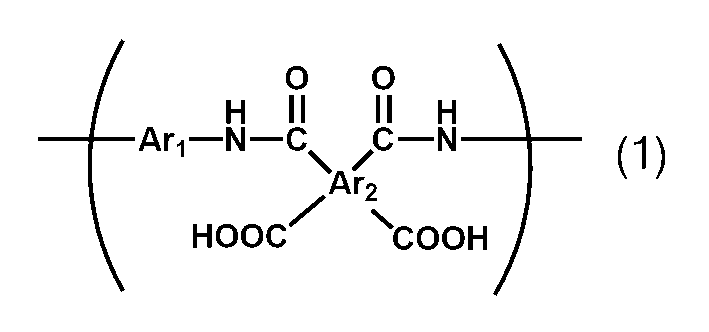
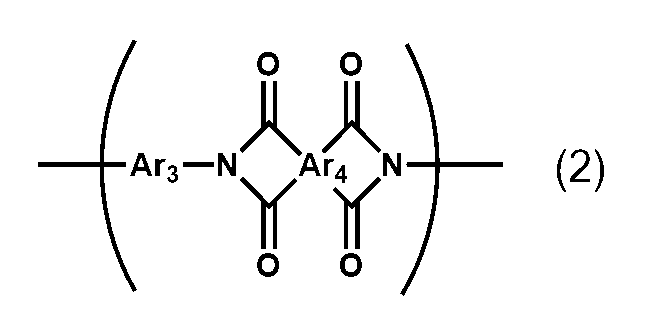
[4] 前記式(1)中のAr2及び前記式(2)中のAr4が下記式(3)で表される4価の有機基である、[3]に記載の感光性樹脂組成物。


式(3-2)中、Z2は下記式(4)又は(5)で表される2価の有機基を表す。R5及びR6はそれぞれ独立に置換されていてもよい炭素原子数1乃至6の炭化水素基を表す。n5及びn6はそれぞれ独立に0乃至4の整数を表す。R5が複数の場合、複数のR5は同じでもよいし異なっていてもよい。R6が複数の場合、複数のR6は同じでもよいし異なっていてもよい。*は結合手を表す。]

[式(4)中、R7及びR8はそれぞれ独立に水素原子、又はハロゲン原子で置換されていてもよい炭素原子数1乃至6の炭化水素基を表す。*は結合手を表す。
式(5)中、R9及びR10はそれぞれ独立に置換されていてもよい炭素原子数1乃至6のアルキレン基又は置換されていてもよい炭素原子数6乃至10のアリーレン基を表す。*は結合手を表す。]
[5] 前記式(1)中のAr1及び前記式(2)中のAr3が下記式(6)で表される2価の有機基である、[3]又は[4]に記載の感光性樹脂組成物。

[6] 前記式(6)におけるZ3及びZ4がエステル結合である、[5]に記載の感光性樹脂組成物。
[7] 前記式(6)におけるR11が1,2-エチレン基である、[5]又は[6]に記載の感光性樹脂組成物。
[8] さらに光ラジカル重合開始剤を含む、[1]~[7]のいずれかに記載の感光性樹脂組成物。
[9] さらに架橋性化合物を含む、[1]~[8]のいずれかに記載の感光性樹脂組成物。
[10] 絶縁膜形成用である、[1]~[9]のいずれかに記載の感光性樹脂組成物。
[11] ネガ型感光性樹脂組成物である、[1]~[10]のいずれかに記載の感光性樹脂組成物。
[12] [1]~[11]のいずれかに記載の感光性樹脂組成物の塗布膜の焼成物である、樹脂膜。
[13] 絶縁膜である、[12]に記載の樹脂膜。
[14] 基材フィルムと、[1]~[11]のいずれかに記載の感光性樹脂組成物から形成される感光性樹脂層と、カバーフィルムとを有する、感光性レジストフィルム。
[15](1)[1]~[11]のいずれかに記載の感光性樹脂組成物を基板上に塗布して、感光性樹脂層を該基板上に形成する工程と、
(2)該感光性樹脂層を露光する工程と、
(3)該露光後の感光性樹脂層を現像して、レリーフパターンを形成する工程と、
(4)該レリーフパターンを加熱処理して、硬化レリーフパターンを形成する工程と
を含む、硬化レリーフパターン付き基板の製造方法。
[16] 前記現像に用いられる現像液が有機溶媒である、[15]に記載の硬化レリーフパターン付き基板の製造方法。
[17] [15]又は[16]に記載の方法により製造された、硬化レリーフパターン付き基板。
[18] 半導体素子と該半導体素子の上部又は下部に設けられた硬化膜とを備える半導体装置であって、該硬化膜は、[1]~[11]のいずれかに記載の感光性樹脂組成物から形成される硬化レリーフパターンである半導体装置。
本発明の感光性樹脂組成物は、反応生成物と、溶剤とを少なくとも含み、更に必要に応じてその他の成分を含む。
反応生成物は、光重合性基を有する芳香族ジアミン化合物と3つ以上の芳香族環を有するテトラカルボン酸誘導体との反応生成物である。
反応生成物は、構成成分として、光重合性基を有する芳香族ジアミン化合物と、3つ以上の芳香族環を有するテトラカルボン酸誘導体とを含み、必要に応じて、構成成分として、その他のジアミン化合物、及びその他のテトラカルボン酸誘導体を含んでいてもよい。
反応生成物は、例えば、ポリアミック酸、又はポリアミック酸を脱水閉環して得られるポリイミドである。
反応生成物が、芳香族ジアミン化合物と、3つ以上の芳香族環を有するテトラカルボン酸誘導体とを構成成分に含むことにより、得られる硬化膜において、低い誘電正接及び高い引張伸度が得られる。
なお、芳香族ジアミン化合物は、アミノ基が結合していない芳香族環を有していてもよい。
ラジカル重合性基としては、例えば、アクリロイル基、メタクリロイル基、プロペニルエーテル基、ビニルエーテル基、ビニル基などが挙げられる。
芳香族環としては、芳香族炭化水素環、芳香族複素環などが挙げられる。
反応生成物を構成する全テトラカルボン酸誘導体に対する、3つ以上の芳香族環を有する芳香族テトラカルボン酸誘導体の割合としては、特に限定されないが、本発明の効果を好適に得る観点から、20~100モル%が好ましく、50~100モル%がより好ましい。
ポリイミドは、下記式(2)で表される構造単位を少なくとも有することが好ましい。
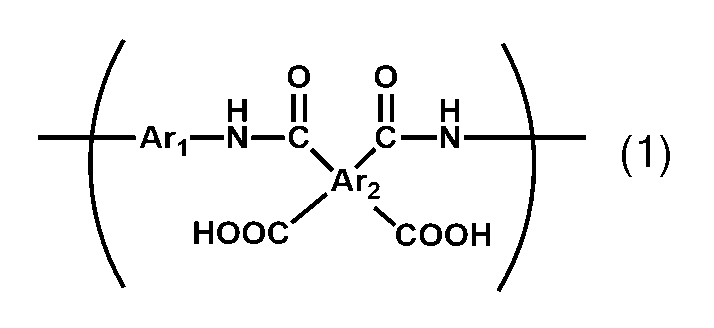
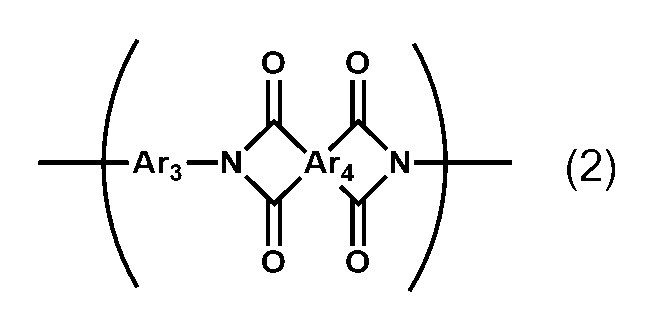
Ar1及びAr3は、光重合性基及び芳香族環を有する2価の有機基であり、本発明の効果を奏するものであれば、特に限定されない。なお、光重合性基及び芳香族環を有する2価の有機基は、光重合性基を有する芳香族ジアミン化合物から2つのアミノ基を除いた残基である。
光重合性基としては、例えば、前述の光重合性基が挙げられる。

Z4としては、エステル結合が好ましい。
R11としては、1,2-エチレン基が好ましい。

式(1)中のAr2及び式(2)中のAr4としては、3つ以上の芳香族環を有し、本発明の効果を奏する4価の有機基であれば、特に限定されないが、本発明の効果を好適に得る観点から、好ましくは下記式(3)で表される2価の有機基である。
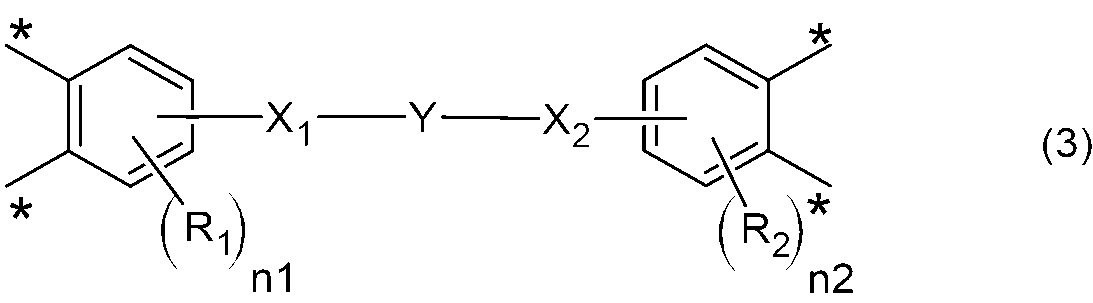
置換されていてもよい炭素原子数1乃至6のアルキル基における置換基としては、例えば、ハロゲン原子、ヒドロキシ基、メルカプト基、カルボキシ基、シアノ基、ホルミル基、ハロホルミル基、スルホ基、アミノ基、ニトロ基、ニトロソ基、オキソ基、チオキシ基、炭素原子数1乃至6のアルコキシ基などが挙げられる。
なお、「置換されていてもよい炭素原子数1乃至6のアルキル基」の「炭素原子数1乃至6」とは、置換基を除く「アルキル基」の炭素原子数を指す。また、置換基の数としては特に限定されない。
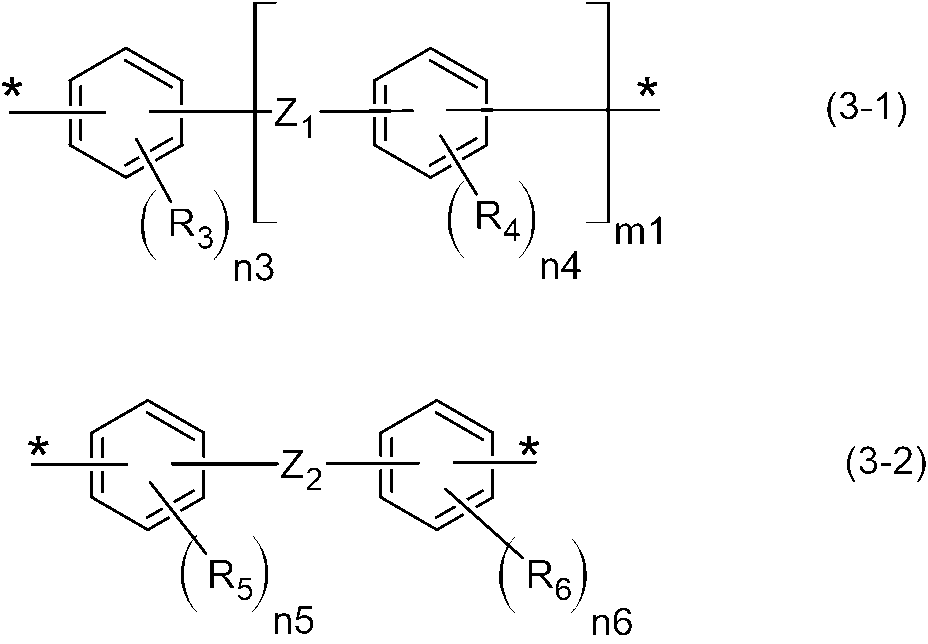
式(3-2)中、Z2は下記式(4)又は(5)で表される2価の有機基を表す。R5及びR6はそれぞれ独立に置換されていてもよい炭素原子数1乃至6の炭化水素基を表す。n5及びn6はそれぞれ独立に0乃至4の整数を表す。R5が複数の場合、複数のR5は同じでもよいし異なっていてもよい。R6が複数の場合、複数のR6は同じでもよいし異なっていてもよい。*は結合手を表す。]
なお、「置換されていてもよい炭素原子数1乃至6の炭化水素基」の「炭素原子数1乃至6」とは、置換基を除く「炭化水素基」の炭素原子数を指す。また、置換基の数としては特に限定されない。
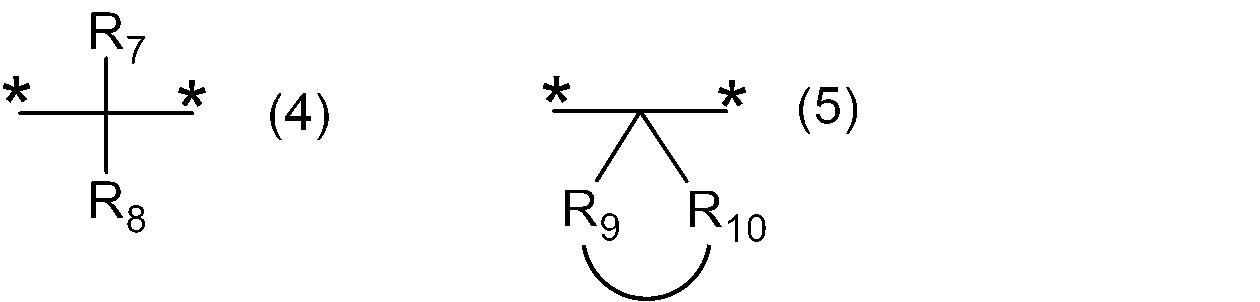
式(5)中、R9及びR10はそれぞれ独立に置換されていてもよい炭素原子数1乃至6のアルキレン基又は置換されていてもよい炭素原子数6乃至10のアリーレン基を表す。*は結合手を表す。]
置換されていてもよい炭素原子数1乃至6のアルキレン基としては、例えば、炭素原子数1乃至6のアルキレン基、炭素原子数1乃至6のハロゲン化アルキレン基などが挙げられる。炭素原子数1乃至6のアルキレン基としては、例えば、メチレン基、エチレン基、プロピレン基、ブチレン基等が挙げられる。
なお、「置換されていてもよい炭素原子数1乃至6のアルキレン基」の「炭素原子数1乃至6」とは、置換基を除く「アルキレン基」の炭素原子数を指す。また、置換基の数としては特に限定されない。
アリーレン基としては、例えば、フェニレン基、ナフチレン基等が挙げられる。
なお、「置換されていてもよい炭素原子数6乃至10のアリーレン基」の「炭素原子数6乃至10」とは、置換基を除く「アリーレン基」の炭素原子数を指す。また、置換基の数としては特に限定されない。


R13~R15におけるハロゲン原子で置換されていてもよい炭素原子数1乃至6のアルコキシ基の具体例としては、ハロゲン原子で置換されていてもよい炭素原子数1乃至6のアルキル基をアルコキシ基にしたものが挙げられる。


ポリアミック酸は、式(1)で表される構造単位以外のその他の構造単位を有していてもよい。その他の構造単位としては、例えば、下記式(1’)で表される構造単位、が挙げられる。
ポリイミドは、式(2)で表される構造単位以外のその他の構造単位を有していてもよい。その他の構造単位としては、例えば、下記式(2’)で表される構造単位、が挙げられる。
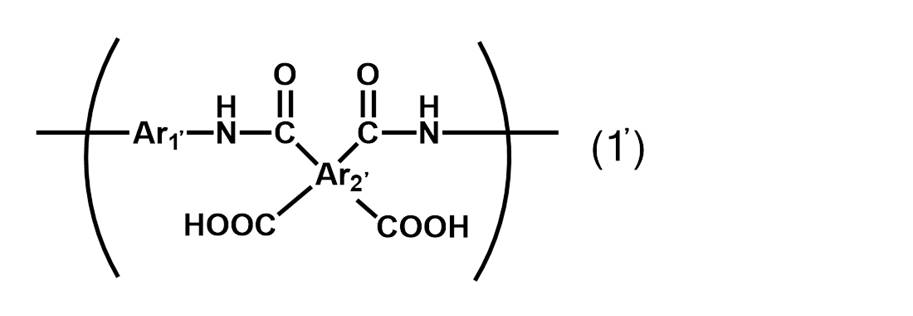

(i):Ar1’が光重合性基及び芳香族環を有する2価の有機基を表し、Ar2’が3つ以上の芳香族環を有しない4価の有機基を表す組み合わせ
(ii):Ar1’が光重合性基及び芳香族環を有する2価の有機基以外の2価の有機基を表し、Ar2’が3つ以上の芳香族環を有しない4価の有機基を表す組み合わせ
(iii):Ar1’が光重合性基及び芳香族環を有する2価の有機基以外の2価の有機基を表し、Ar2’が3つ以上の芳香族環を有する4価の有機基を表す組み合わせ
(iv):Ar3’が光重合性基及び芳香族環を有する2価の有機基を表し、Ar4’が3つ以上の芳香族環を有しない4価の有機基を表す組み合わせ
(v):Ar3’が光重合性基及び芳香族環を有する2価の有機基以外の2価の有機基を表し、Ar4’が3つ以上の芳香族環を有しない4価の有機基を表す組み合わせ
(vi):Ar3’が光重合性基及び芳香族環を有する2価の有機基以外の2価の有機基を表し、Ar4’が3つ以上の芳香族環を有する4価の有機基を表す組み合わせ
Ar1’及びAr3’における光重合性基及び芳香族環を有する2価の有機基としては、例えば、Ar1及びAr3の説明において例示した光重合性基及び芳香族環を有する2価の有機基が挙げられる。
Ar1’及びAr3’における光重合性基及び芳香族環を有する2価の有機基以外の2価の有機基としては、特に限定されないが、得られる硬化膜において、より低い誘電正接及びより高い引張伸度が得られる点から、3つ以上の芳香族環を有する2価の有機基が好ましい。
3つ以上の芳香族環を有する2価の有機基としては、特に限定されないが、好ましくは下記式(13)で表される2価の有機基である。

なお、「置換されていてもよい炭素原子数1乃至6のアルキル基」の「炭素原子数1乃至6」とは、置換基を除く「アルキル基」の炭素原子数を指す。また、置換基の数としては特に限定されない。

式(13-2)中、Z22は下記式(14)又は(15)で表される2価の有機基を表す。R25及びR26はそれぞれ独立に置換されていてもよい炭素原子数1乃至6の炭化水素基を表す。n25及びn26はそれぞれ独立に0乃至4の整数を表す。R25が複数の場合、複数のR25は同じでもよいし異なっていてもよい。R26が複数の場合、複数のR26は同じでもよいし異なっていてもよい。*は結合手を表す。]
なお、「置換されていてもよい炭素原子数1乃至6の炭化水素基」の「炭素原子数1乃至6」とは、置換基を除く「炭化水素基」の炭素原子数を指す。また、置換基の数としては特に限定されない。

式(15)中、R29及びR30はそれぞれ独立に置換されていてもよい炭素原子数1乃至6のアルキレン基又は置換されていてもよい炭素原子数6乃至10のアリーレン基を表す。*は結合手を表す。]
なお、「置換されていてもよい炭素原子数1乃至6のアルキレン基」の「炭素原子数1乃至6」とは、置換基を除く「アルキレン基」の炭素原子数を指す。また、置換基の数としては特に限定されない。
なお、「置換されていてもよい炭素原子数6乃至10のアリーレン基」の「炭素原子数6乃至10」とは、置換基を除く「アリーレン基」の炭素原子数を指す。また、置換基の数としては特に限定されない。
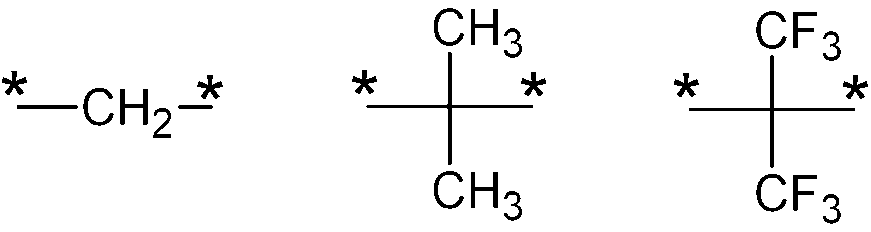

R33~R35におけるハロゲン原子で置換されていてもよい炭素原子数1乃至6のアルコキシ基の具体例としては、ハロゲン原子で置換されていてもよい炭素原子数1乃至6のアルキル基をアルコキシ基にしたものが挙げられる。


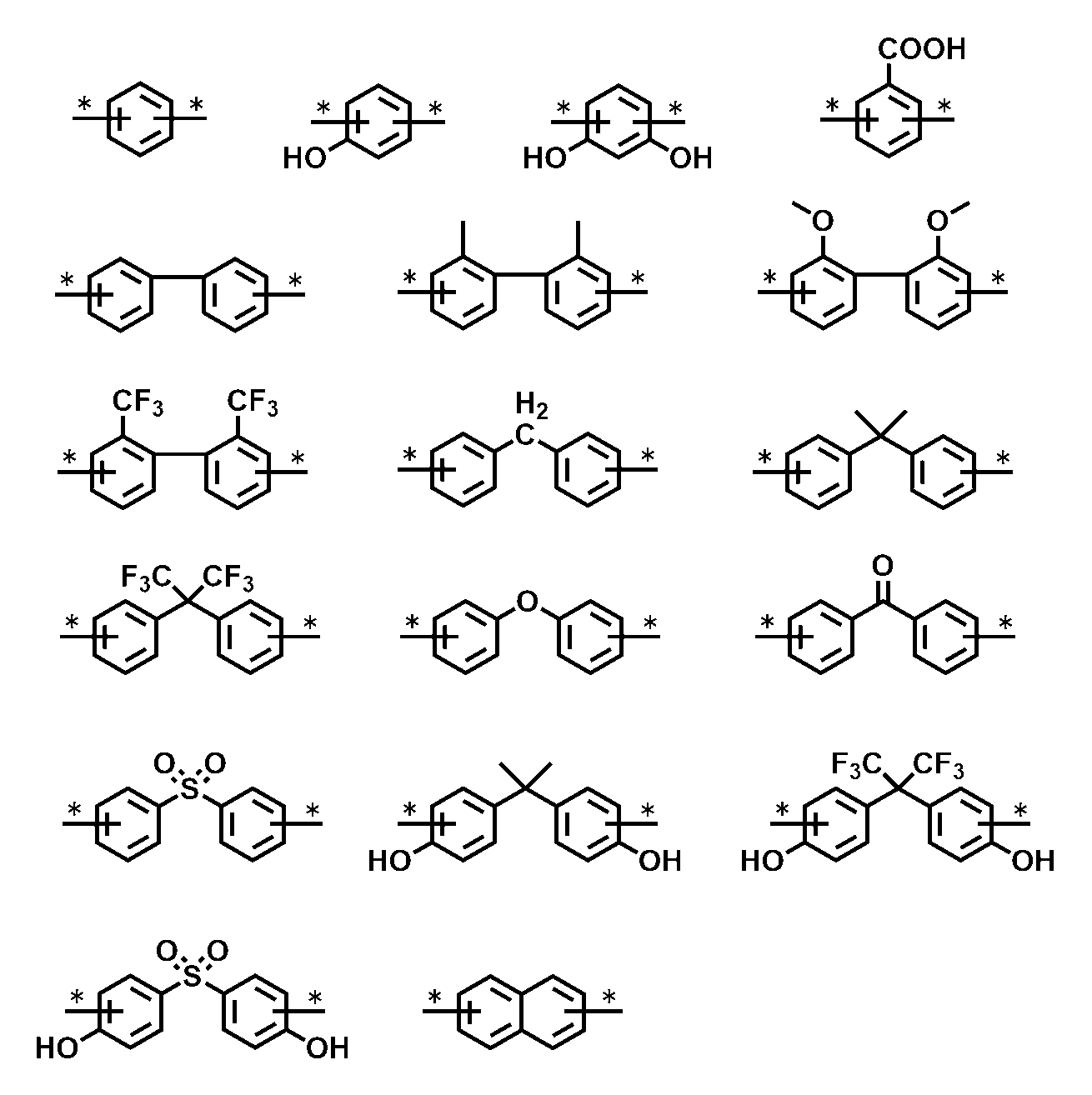
Ar2’及びAr4’における3つ以上の芳香族環を有する4価の有機基としては、例えば、Ar2及びAr4の説明において例示した3つ以上の芳香族環を有する4価の有機基が挙げられる。
Ar2’及びAr4’における3つ以上の芳香族環を有しない4価の有機基としては、例えば、1つ又は2つの芳香族環を有する4価の有機基又は芳香族環を有さない4価の有機基が挙げられる。1つ又は2つの芳香族環を有する4価の有機基は、例えば、芳香族テトラカルボン酸二無水物誘導体に由来する。さらに、芳香族環を有さない4価の有機基は、例えば脂肪族テトラカルボン酸無水物誘導体に由来する。そのような4価の有機基としては、特に限定されないが、例えば、以下の4価の有機基などが挙げられる。


ポリアミック酸が式(1’)で表される構造単位を有する場合、ポリアミック酸の全構造単位における式(1’)で表される構造単位の割合としては、特に限定されないが、1~90モル%が好ましく、1~50モル%がより好ましい。
ポリイミドの全構造単位における式(1)で表される構造単位と式(2)で表される構造単位との合計の割合としては、特に限定されないが、十分な感光性を得る観点から、10~100モル%が好ましく、50~100モル%がより好ましい。
ポリイミドが式(1’)で表される構造単位及び式(2’)で表される構造単位の少なくともいずれかを有する場合、ポリイミドの全構造単位における式(1’)で表される構造単位と式(2’)で表される構造単位との合計の割合としては、特に限定されないが、1~90モル%が好ましく、1~50モル%がより好ましい。
反応生成物は、光重合性基を有する芳香族ジアミン化合物と3つ以上の芳香族環を有するテトラカルボン酸誘導体と、必要に応じて、その他のジアミン化合物と、その他のテトラカルボン酸誘導体とを反応させて得られる。

反応においては、ジアミン成分の合計モル数とテトラカルボン酸誘導体成分の合計モル数の比は0.8~1.2であることが好ましい。通常の縮重合反応同様、このモル比が1.0に近いほど生成する反応生成物の分子量は大きくなる。
熱重合禁止剤としては、例えば、ヒドロキノン、4-メトキシフェノール、N-ニトロソジフェニルアミン、p-tert-ブチルカテコール、フェノチアジン、N-フェニルナフチルアミン、エチレンジアミン四酢酸、1,2-シクロヘキサンジアミン四酢酸、グリコールエーテルジアミン四酢酸、2,6-ジ-tert-ブチル-p-クレゾール、5-ニトロソ-8-ヒドロキシキノリン、1-ニトロソ-2-ナフトール、2-ニトロソ-1-ナフトール、2-ニトロソ-5-(N-エチル-N-スルフォプロピルアミノ)フェノール、N-ニトロソ-N-フェニルヒドロキシルアミンアンモニウム塩、N-ニトロソ-N(1-ナフチル)ヒドロキシルアミンアンモニウム塩等が挙げられる。
熱重合禁止剤の使用量としては、特に限定されない。
ポリイミドを得る方法としては、上記反応で得られた反応生成物であるポリアミック酸の溶液をそのまま加熱する熱イミド化、又はポリアミック酸の溶液に触媒を添加する化学イミド化が挙げられる。溶液中で熱イミド化させる場合の温度は、100~400℃、好ましくは120~250℃であり、イミド化反応により生成する水を系外に除きながら行う方が好ましい。
感光性樹脂組成物に含有される溶剤としては、反応生成物に対する溶解性の点から、有機溶剤を用いることが好ましい。具体的には、N,N-ジメチルホルムアミド、N-メチル-2-ピロリドン、N-エチル-2-ピロリドン、N,N-ジメチルアセトアミド、N,N-ジメチルプロピオンアミド、N,N-ジメチルイソ酪酸アミド、ジメチルスルホキシド、ジエチレングリコールジメチルエーテル、シクロペンタノン、シクロヘキサノン、γ-ブチロラクトン、α-アセチル-γ-ブチロラクトン、テトラメチル尿素、1,3-ジメチル-2-イミダゾリノン、N-シクロヘキシル-2-ピロリドン、プロピレングリコールモノメチルエーテルアセテート、プロピレングリコールモノメチルエーテル、プロピレングリコールモノエチルエーテル、プロピレングリコールモノプロピルエーテル、プロピレングリコールモノブチルエーテル、2-ヒドロキシイソ酪酸メチル、乳酸エチル又は下記の式[D-1]~式[D-3]で示される溶剤等が挙げられ、これらは単独又は2種以上の組合せで用いることができる。

実施の形態では、感光性樹脂組成物は、反応生成物及び溶剤以外のその他の成分をさらに含有してもよい。その他の成分としては、例えば、光ラジカル重合開始剤(「光ラジカル開始剤」ともいう)、架橋性化合物(「架橋剤」ともいう)、熱硬化剤、その他の樹脂成分、フィラー、増感剤、接着助剤、熱重合禁止剤、アゾール化合物、ヒンダードフェノール化合物などが挙げられる。
光ラジカル重合開始剤としては、光硬化時に使用する光源に吸収をもつ化合物であれば特に限定されないが、例えば、tert-ブチルペルオキシ-iso-ブチレート、2,5-ジメチル-2,5-ビス(ベンゾイルジオキシ)ヘキサン、1,4-ビス[α-(tert-ブチルジオキシ)-iso-プロポキシ]ベンゼン、ジ-tert-ブチルペルオキシド、2,5-ジメチル-2,5-ビス(tert-ブチルジオキシ)ヘキセンヒドロペルオキシド、α-(iso-プロピルフェニル)-iso-プロピルヒドロペルオキシド、tert-ブチルヒドロペルオキシド、1,1-ビス(tert-ブチルジオキシ)-3,3,5-トリメチルシクロヘキサン、ブチル-4,4-ビス(tert-ブチルジオキシ)バレレート、シクロヘキサノンペルオキシド、2,2’,5,5’-テトラ(tert-ブチルペルオキシカルボニル)ベンゾフェノン、3,3’,4,4’-テトラ(tert-ブチルペルオキシカルボニル)ベンゾフェノン、3,3’,4,4’-テトラ(tert-アミルペルオキシカルボニル)ベンゾフェノン、3,3’,4,4’-テトラ(tert-ヘキシルペルオキシカルボニル)ベンゾフェノン、3,3’-ビス(tert-ブチルペルオキシカルボニル)-4,4’-ジカルボキシベンゾフェノン、tert-ブチルペルオキシベンゾエート、ジ-tert-ブチルジペルオキシイソフタレート等の有機過酸化物;9,10-アントラキノン、1-クロロアントラキノン、2-クロロアントラキノン、オクタメチルアントラキノン、1,2-ベンズアントラキノン等のキノン類;ベンゾインメチル、ベンゾインエチルエーテル、α-メチルベンゾイン、α-フェニルベンゾイン等のベンゾイン誘導体;2,2-ジメトキシ-1,2-ジフェニルエタン-1-オン、1-ヒドロキシシクロヘキシルフェニルケトン、2-ヒドロキシ-2-メチル-1-フェニル-プロパン-1-オン、1-[4-(2-ヒドロキシエトキシ)-フェニル]-2-ヒドロキシ-2-メチル-1-プロパン-1-オン、2-ヒドロキシ-1-[4-{4-(2-ヒドロキシ-2-メチル-プロピオニル)ベンジル}-フェニル]-2-メチル-プロパン-1-オン、フェニルグリオキシリックアシッドメチルエステル、2-メチル-1-[4-(メチルチオ)フェニル]-2-モルホリノプロパン-1-オン、2-ベンジル-2-ジメチルアミノ-1-(4-モルホリノフェニル)-1-ブタノン、2-ジメチルアミノ-2-(4-メチルベンジル)-1-(4-モルホリン-4-イル-フェニル)-ブタン-1-オン等のアルキルフェノン系化合物;ビス(2,4,6-トリメチルベンゾイル)-フェニルホスフィンオキサイド、2,4,6-トリメチルベンゾイル-ジフェニル-ホスフィンオキサイド等のアシルホスフィンオキサイド系化合物;2-(O-ベンゾイルオキシム)-1-[4-(フェニルチオ)フェニル]-1,2-オクタンジオン、1-(O-アセチルオキシム)-1-[9-エチル-6-(2-メチルベンゾイル)-9H-カルバゾール-3-イル]エタノン等のオキシムエステル系化合物が挙げられる。
これらの光ラジカル重合開始剤は、単独で用いてもよく、二種以上を組み合わせて用いてもよい。
実施の形態では、レリーフパターンの解像性を向上させるために、光ラジカル重合性の不飽和結合を有するモノマー(架橋性化合物)を任意に感光性樹脂組成物に含有させることができる。
このような架橋性化合物としては、光ラジカル重合開始剤によりラジカル重合反応する(メタ)アクリル化合物が好ましく、特に以下に限定するものではないが、ジエチレングリコールジ(メタ)アクリレート、テトラエチレングリコールジ(メタ)アクリレート、エチレングリコール又はポリエチレングリコールモノ又はジ(メタ)アクリレート、プロピレングリコール又はポリプロピレングリコールのモノ又はジ(メタ)アクリレート、グリセロールのモノ、ジ又はトリ(メタ)アクリレート、1,4-ブタンジオールのジ(メタ)アクリレート、1,6-ヘキサンジオールのジ(メタ)アクリレート、1,9-ノナンジオールのジ(メタ)アクリレート、1,10-デカンジオールのジ(メタ)アクリレート、ネオペンチルグリコールのジ(メタ)アクリレート、シクロヘキサンジ(メタ)アクリレート、シクロヘキサンジメタノールのジ(メタ)アクリレート、トリシクロデカンジメタノールのジ(メタ)アクリレート、ジオキサングリコールのジ(メタ)アクリレート、ビスフェノールAのモノ又はジ(メタ)アクリレート、ビスフェノールFのジ(メタ)アクリレート、水添ビスフェノールAのジ(メタ)アクリレート、ベンゼントリメタクリレート、9,9-ビス[4-(2-ヒドロキシエトキシ)フェニル]フルオレンのジ(メタ)アクリレート、トリス(2-ヒドロキシエチル)イソシアヌレートのジ(メタ)アクリレート、イソボルニル(メタ)アクリレート、アクリルアミド及びその誘導体、メタクリルアミド及びその誘導体、トリメチロールプロパントリ(メタ)アクリレート、グリセロールのジ又はトリ(メタ)アクリレート、ペンタエリスリトールのジ、トリ、又はテトラ(メタ)アクリレート、並びにこれら化合物のエチレンオキサイド又はプロピレンオキサイド付加物等の化合物、2-イソシアネートエチル(メタ)アクリレート又はイソシアネート含有(メタ)アクリレート、及びこれらにメチルエチルケトンオキシム、ε-カプロラクタム、γ-カプロラクタム、3,5-ジメチルピラゾール、マロン酸ジエチル、エタノール、イソプロパノール、n-ブタノール、1-メトキシ-2-プロパノール等のブロック剤を付加した化合物を挙げることができる。尚、これらの化合物は単独で使用しても、2種類以上を組み合わせて使用してもよい。また、本明細書において、(メタ)アクリレートはアクリレート及びメタクリレートを意味する。
熱硬化剤としては、例えば、ヘキサメトキシメチルメラミン、テトラメトキシメチルグリコールウリル、テトラメトキシメチルベンゾグアナミン、1,3,4,6-テトラキス(メトキシメチル)グリコールウリル、1,3,4,6-テトラキス(ブトキシメチル)グリコールウリル、1,3,4,6-テトラキス(ヒドロキシメチル)グリコールウリル、1,3-ビス(ヒドロキシメチル)尿素、1,1,3,3-テトラキス(ブトキシメチル)尿素及び1,1,3,3-テトラキス(メトキシメチル)尿素などが挙げられる。
感光性樹脂組成物における熱硬化剤の含有量は、特に限定されない。
フィラーとしては、例えば無機フィラーが挙げられ、具体的にはシリカ、窒化アルミ二ウム、窒化ボロン、ジルコニア、アルミナなどのゾルが挙げられる。
感光性樹脂組成物にけるフィラーの含有量は、特に限定されない。
実施の形態では、感光性樹脂組成物は、反応生成物以外の樹脂成分をさらに含有してもよい。感光性樹脂組成物に含有させることができる樹脂成分としては、例えば、ポリオキサゾール、ポリオキサゾール前駆体、フェノール樹脂、ポリアミド、エポキシ樹脂、シロキサン樹脂、アクリル樹脂等が挙げられる。
これらの樹脂成分の含有量は、特に限定されないが、反応生成物100質量部に対して、好ましくは0.01質量部~20質量部の範囲である。
実施の形態では、感光性樹脂組成物には、光感度を向上させるために増感剤を任意に配合することができる。
増感剤としては、例えば、ミヒラーズケトン、4,4’-ビス(ジエチルアミノ)ベンゾフェノン、2,5-ビス(4’-ジエチルアミノベンザル)シクロペンタン、2,6-ビス(4’-ジエチルアミノベンザル)シクロヘキサノン、2,6-ビス(4’-ジエチルアミノベンザル)-4-メチルシクロヘキサノン、4,4’-ビス(ジメチルアミノ)カルコン、4,4’-ビス(ジエチルアミノ)カルコン、p-ジメチルアミノシンナミリデンインダノン、p-ジメチルアミノベンジリデンインダノン、2-(p-ジメチルアミノフェニルビフェニレン)-ベンゾチアゾール、2-(p-ジメチルアミノフェニルビニレン)ベンゾチアゾール、2-(p-ジメチルアミノフェニルビニレン)イソナフトチアゾール、1,3-ビス(4’-ジメチルアミノベンザル)アセトン、1,3-ビス(4’-ジエチルアミノベンザル)アセトン、3,3’-カルボニル-ビス(7-ジエチルアミノクマリン)、3-アセチル-7-ジメチルアミノクマリン、3-エトキシカルボニル-7-ジメチルアミノクマリン、3-ベンジロキシカルボニル-7-ジメチルアミノクマリン、3-メトキシカルボニル-7-ジエチルアミノクマリン、3-エトキシカルボニル-7-ジエチルアミノクマリン、N-フェニル-N’-エチルエタノールアミン、N-フェニルジエタノールアミン、N-p-トリルジエタノールアミン、N-フェニルエタノールアミン、4-モルホリノベンゾフェノン、ジメチルアミノ安息香酸イソアミル、ジエチルアミノ安息香酸イソアミル、2-メルカプトベンズイミダゾール、1-フェニル-5-メルカプトテトラゾール、2-メルカプトベンゾチアゾール、2-(p-ジメチルアミノスチリル)ベンズオキサゾール、2-(p-ジメチルアミノスチリル)ベンズチアゾール、2-(p-ジメチルアミノスチリル)ナフト(1,2-d)チアゾール、2-(p-ジメチルアミノベンゾイル)スチレン等が挙げられる。
これらは単独で、又は複数の組合せで用いることができる。
実施の形態では、感光性樹脂組成物を用いて形成される膜と基材との接着性を向上させるために、接着助剤を任意に感光性樹脂組成物に配合することができる。
接着助剤としては、例えば、γ-アミノプロピルジメトキシシラン、N-(β-アミノエチル)-γ-アミノプロピルメチルジメトキシシラン、γ-グリシドキシプロピルメチルジメトキシシラン、γ-メルカプトプロピルメチルジメトキシシラン、3-(メタ)アクリロキシプロピルジメトキシメチルシラン、3-(メタ)アクリロキシプロピルトリメトキシシラン、ジメトキシメチル-3-ピペリジノプロピルシラン、ジエトキシ-3-グリシドキシプロピルメチルシラン、N-(3-ジエトキシメチルシリルプロピル)スクシンイミド、N-〔3-(トリエトキシシリル)プロピル〕フタルアミド酸、ベンゾフェノン-3,3’-ビス(N-〔3-トリエトキシシリル〕プロピルアミド)-4,4’-ジカルボン酸、ベンゼン-1,4-ビス(N-〔3-トリエトキシシリル〕プロピルアミド)-2,5-ジカルボン酸、3-(トリエトキシシリル)プロピルスクシニックアンハイドライド、N-フェニルアミノプロピルトリメトキシシラン等のシランカップリング剤、及びアルミニウムトリス(エチルアセトアセテート)、アルミニウムトリス(アセチルアセトネート)、エチルアセトアセテートアルミニウムジイソプロピレート等のアルミニウム系接着助剤等が挙げられる。
実施の形態では、特に溶剤を含む溶液の状態での保存時の感光性樹脂組成物の粘度及び光感度の安定性を向上させるために、熱重合禁止剤を任意に配合することができる。
熱重合禁止剤としては、例えば、ヒドロキノン、4-メトキシフェノール、N-ニトロソジフェニルアミン、p-tert-ブチルカテコール、フェノチアジン、N-フェニルナフチルアミン、エチレンジアミン四酢酸、1,2-シクロヘキサンジアミン四酢酸、グリコールエーテルジアミン四酢酸、2,6-ジ-tert-ブチル-p-クレゾール、5-ニトロソ-8-ヒドロキシキノリン、1-ニトロソ-2-ナフトール、2-ニトロソ-1-ナフトール、2-ニトロソ-5-(N-エチル-N-スルフォプロピルアミノ)フェノール、N-ニトロソ-N-フェニルヒドロキシルアミンアンモニウム塩、N-ニトロソ-N(1-ナフチル)ヒドロキシルアミンアンモニウム塩等が用いられる。
例えば、銅又は銅合金から成る基板を用いる場合には、基板変色を抑制するためにアゾール化合物を任意に感光性樹脂組成物に配合することができる。
アゾール化合物としては、例えば、1H-トリアゾール、5-メチル-1H-トリアゾール、5-エチル-1H-トリアゾール、4,5-ジメチル-1H-トリアゾール、5-フェニル-1H-トリアゾール、4-t-ブチル-5-フェニル-1H-トリアゾール、5-ヒドロキシフェニル-1H-トリアゾール、フェニルトリアゾール、p-エトキシフェニルトリアゾール、5-フェニル-1-(2-ジメチルアミノエチル)トリアゾール、5-ベンジル-1H-トリアゾール、ヒドロキシフェニルトリアゾール、1,5-ジメチルトリアゾール、4,5-ジエチル-1H-トリアゾール、1H-ベンゾトリアゾール、2-(5-メチル-2-ヒドロキシフェニル)ベンゾトリアゾール、2-[2-ヒドロキシ-3,5-ビス(α,α―ジメチルベンジル)フェニル]-ベンゾトリアゾール、2-(3,5-ジ-t-ブチル-2-ヒドロキシフェニル)ベンゾトリアゾール、2-(3-t-ブチル-5-メチル-2-ヒドロキシフェニル)-ベンゾトリアゾール、2-(3,5-ジ-t-アミル-2-ヒドロキシフェニル)ベンゾトリアゾール、2-(2’-ヒドロキシ-5’-t-オクチルフェニル)ベンゾトリアゾール、ヒドロキシフェニルベンゾトリアゾール、トリルトリアゾール、5-メチル-1H-ベンゾトリアゾール、4-メチル-1H-ベンゾトリアゾール、4-カルボキシ-1H-ベンゾトリアゾール、5-カルボキシ-1H-ベンゾトリアゾール、1H-テトラゾール、5-メチル-1H-テトラゾール、5-フェニル-1H-テトラゾール、5-アミノ-1H-テトラゾール、1-メチル-1H-テトラゾール等が挙げられる。特に好ましくは、トリルトリアゾール、5-メチル-1H-ベンゾトリアゾール、及び4-メチル-1H-ベンゾトリアゾールが挙げられる。
また、これらのアゾール化合物は、1種で用いても2種以上の混合物で用いてもよい。
実施の形態では、銅上の変色を抑制するためにヒンダードフェノール化合物を任意に感光性樹脂組成物に配合することができる。
ヒンダードフェノール化合物としては、例えば、2,6-ジ-t-ブチル-4-メチルフェノール、2,5-ジ-t-ブチル-ハイドロキノン、オクタデシル-3-(3,5-ジ-t-ブチル-4-ヒドロキシフェニル)プロピオネ-ト、イソオクチル-3-(3,5-ジ-t-ブチル-4-ヒドロキシフェニル)プロピオネート、4、4’-メチレンビス(2、6-ジ-t-ブチルフェノール)、4,4’-チオ-ビス(3-メチル-6-t-ブチルフェノール)、4,4’-ブチリデン-ビス(3-メチル-6-t-ブチルフェノール)、トリエチレングリコール-ビス〔3-(3-t-ブチル-5-メチル-4-ヒドロキシフェニル)プロピオネート〕、1,6-ヘキサンジオール-ビス〔3-(3,5-ジ-t-ブチル-4-ヒドロキシフェニル)プロピオネート〕、2,2-チオ-ジエチレンビス〔3-(3,5-ジ-t-ブチル-4-ヒドロキシフェニル)プロピオネート〕、N,N’ヘキサメチレンビス(3,5-ジ-t-ブチル-4-ヒドロキシ-ヒドロシンナマミド)、2,2’-メチレン-ビス(4-メチル-6-t-ブチルフェノール)、2,2’-メチレン-ビス(4-エチル-6-t-ブチルフェノール)、ペンタエリスリチル-テトラキス〔3-(3,5-ジ-t-ブチル-4-ヒドロキシフェニル)プロピオネート〕、トリス-(3,5-ジ-t-ブチル-4-ヒドロキシベンジル)-イソシアヌレート、1,3,5-トリメチル-2,4,6-トリス(3,5-ジ-t-ブチル-4-ヒドロキシベンジル)ベンゼン、1,3,5-トリス(3-ヒドロキシ-2,6-ジメチル-4-イソプロピルベンジル)-1,3,5-トリアジン-2,4,6-(1H,3H,5H)-トリオン、1,3,5-トリス(4-t-ブチル-3-ヒドロキシ-2,6-ジメチルベンジル)-1,3,5-トリアジン-2,4,6-(1H,3H,5H)-トリオン、1,3,5-トリス(4-s-ブチル-3-ヒドロキシ-2,6-ジメチルベンジル)-1,3,5-トリアジン-2,4,6-(1H,3H,5H)-トリオン、1,3,5-トリス[4-(1-エチルプロピル)-3-ヒドロキシ-2,6-ジメチルベンジル]-1,3,5-トリアジン-2,4,6-(1H,3H,5H)-トリオン、1,3,5-トリス[4-トリエチルメチル-3-ヒドロキシ-2,6-ジメチルベンジル]-1,3,5-トリアジン-2,4,6-(1H,3H,5H)-トリオン、1,3,5-トリス(3-ヒドロキシ-2,6-ジメチル-4-フェニルベンジル)-1,3,5-トリアジン-2,4,6-(1H,3H,5H)-トリオン、1,3,5-トリス(4-t-ブチル-3-ヒドロキシ-2,5,6-トリメチルベンジル)-1,3,5-トリアジン-2,4,6-(1H,3H,5H)-トリオン、1,3,5-トリス(4-t-ブチル-5-エチル-3-ヒドロキシ-2,6-ジメチルベンジル)-1,3,5-トリアジン-2,4,6-(1H,3H,5H)-トリオン、1,3,5-トリス(4-t-ブチル-6-エチル-3-ヒドロキシ-2-メチルベンジル)-1,3,5-トリアジン-2,4,6-(1H,3H,5H)-トリオン、1,3,5-トリス(4-t-ブチル-6-エチル-3-ヒドロキシ-2,5-ジメチルベンジル)-1,3,5-トリアジン-2,4,6-(1H,3H,5H)-トリオン、1,3,5-トリス(4-t-ブチル-5,6-ジエチル-3-ヒドロキシ-2-メチルベンジル)-1,3,5-トリアジン-2,4,6-(1H,3H,5H)-トリオン、1,3,5-トリス(4-t-ブチル-3-ヒドロキシ-2-メチルベンジル)-1,3,5-トリアジン-2,4,6-(1H,3H,5H)-トリオン、1,3,5-トリス(4-t-ブチル-3-ヒドロキシ-2,5-ジメチルベンジル)-1,3,5-トリアジン-2,4,6-(1H,3H,5H)-トリオン、1,3,5-トリス(4-t-ブチル-5‐エチル-3-ヒドロキシ-2-メチルベンジル)-1,3,5-トリアジン-2,4,6-(1H,3H,5H)-トリオン等が挙げられるが、これに限定されるものではない。
これらの中でも、1,3,5-トリス(4-t-ブチル-3-ヒドロキシ-2,6-ジメチルベンジル)-1,3,5-トリアジン-2,4,6-(1H,3H,5H)-トリオンが特に好ましい。
本発明の樹脂膜は、本発明の感光性樹脂組成物の塗布膜の焼成物である。
塗布方法としては、従来から感光性樹脂組成物の塗布に用いられている方法、例えば、スピンコーター、バーコーター、ブレードコーター、カーテンコーター、スクリーン印刷機等で塗布する方法、スプレーコーターで噴霧塗布する方法等を用いることができる。
焼成物を得る際の焼成の方法としては、例えば、ホットプレートによるもの、オーブンを用いるもの、温度プログラムを設定できる昇温式オーブンを用いるもの等種々の方法を選ぶことができる。焼成は、例えば、130℃~250℃で30分~5時間の条件で行うことができる。加熱硬化時の雰囲気気体としては空気を用いてもよく、窒素、アルゴン等の不活性ガスを用いることもできる。
樹脂膜の厚みとしては、特に限定されないが、1μm~100μmが好ましく、2μm~50μmがより好ましい。
樹脂膜は、例えば、絶縁膜である。
本発明の感光性樹脂組成物は、感光性レジストフィルム(所謂、ドライフィルムレジスト)に用いることができる。
感光性レジストフィルムは、基材フィルムと、本発明の感光性樹脂組成物から形成される感光性樹脂層(感光性樹脂膜)と、カバーフィルムとを有する。
通常、基材フィルム上に、感光性樹脂層と、カバーフィルムとがこの順で積層されている。
塗布方法としては、従来から感光性樹脂組成物の塗布に用いられている方法、例えば、スピンコーター、バーコーター、ブレードコーター、カーテンコーター、スクリーン印刷機等で塗布する方法、スプレーコーターで噴霧塗布する方法等を用いることができる。
乾燥の方法としては、例えば、20℃~200℃で1分~1時間の条件が挙げられる。
得られる感光性樹脂層の厚みとしては、特に限定されないが、1μm~100μmが好ましく、2μm~50μmがより好ましい。
カバーフィルムには、公知のものを使用でき、例えばポリエチレンフィルム、ポリプロピレンフィルム等が用いられる。カバーフィルムとしては、感光性樹脂層との接着力が、基材フィルムよりも小さいフィルムが好ましい。カバーフィルムの厚みは、2μm~150μmが好ましく、2μm~100μmがより好ましく、5μm~50μmが特に好ましい。
基材フィルムとカバーフィルムとは、同一のフィルム材料であってもよいし、異なるフィルムを用いてもよい。
本発明の硬化レリーフパターン付き基板の製造方法は、
(1)本発明に係る感光性樹脂組成物を基板上に塗布して、感光性樹脂層(感光性樹脂膜)を該基板上に形成する工程と、
(2)該感光性樹脂層を露光する工程と、
(3)該露光後の感光性樹脂層を現像して、レリーフパターンを形成する工程と、
(4)該レリーフパターンを加熱処理して、硬化レリーフパターンを形成する工程と
を含む。
本工程では、本発明に係る感光性樹脂組成物を基板上に塗布し、必要に応じて、その後に乾燥させて、感光性樹脂層を形成する。塗布方法としては、従来から感光性樹脂組成物の塗布に用いられている方法、例えば、スピンコーター、バーコーター、ブレードコーター、カーテンコーター、スクリーン印刷機等で塗布する方法、スプレーコーターで噴霧塗布する方法等を用いることができる。
本工程では、上記(1)工程で形成した感光性樹脂層を、コンタクトアライナー、ミラープロジェクション、ステッパー等の露光装置を用いて、パターンを有するフォトマスク又はレチクルを介して又は直接に、紫外線光源等により露光する。
露光の際に使用される光源としては、例えば、g線、h線、i線、ghi線ブロードバンド、及びKrFエキシマレーザーが挙げられる。露光量は25mJ/cm2~2000mJ/cm2が望ましい。
本工程では、露光後の感光性樹脂層のうち未露光部を現像除去する。露光(照射)後の感光性樹脂層を現像する現像方法としては、従来知られているフォトレジストの現像方法、例えば、回転スプレー法、パドル法、超音波処理を伴う浸漬法等の中から任意の方法を選択して使用することができる。また、現像の後、現像液を除去する目的でリンスを施してもよい。さらに、レリーフパターンの形状を調整する等の目的で、必要に応じて、任意の温度及び時間の組合せによる現像後ベークを施してもよい。
現像に使用される現像液としては、有機溶媒が好ましい。有機溶媒としては、例えば、N-メチル-2-ピロリドン、N-エチル-2-ピロリドン、N-シクロヘキシル-2-ピロリドン、N,N-ジメチルアセトアミド、シクロペンタノン、シクロヘキサノン、γ-ブチロラクトン、α-アセチル-γ-ブチロラクトン等が好ましい。また、各溶媒を2種以上、例えば数種類組合せて用いることもできる。
リンスに使用されるリンス液としては、現像液と混和し、感光性樹脂組成物に対して溶解性が低い有機溶媒が好ましい。リンス液としては、例えば、メタノール、エタノール、イソプロピルアルコール、乳酸エチル、プロピレングリコールメチルエーテルアセテート、トルエン、キシレン等が好ましい。また、各溶媒を2種以上、例えば数種類組合せて用いることもできる。
本工程では、上記現像により得られたレリーフパターンを加熱して硬化レリーフパターンに変換する。反応生成物がポリアミック酸の場合には、この加熱によって熱的イミド化が行われ、ポリイミドを含む硬化レリーフパターンが得られる。加熱硬化の方法としては、例えば、ホットプレートによるもの、オーブンを用いるもの、温度プログラムを設定できる昇温式オーブンを用いるもの等種々の方法を選ぶことができる。加熱は、例えば、130℃~250℃で30分~5時間の条件で行うことができる。加熱硬化時の雰囲気気体としては空気を用いてもよく、窒素、アルゴン等の不活性ガスを用いることもできる。
実施の形態では、半導体素子と該半導体素子の上部又は下部に設けられた硬化膜とを備える半導体装置も提供される。硬化膜は、本発明の感光性樹脂組成物から形成される硬化レリーフパターンである。硬化レリーフパターンは、例えば、上述した硬化レリーフパターン付き基板の製造方法における工程(1)~(4)により得ることができる。
また、本発明は、基板として半導体素子を用い、上述した硬化レリーフパターン付き基板の製造方法を工程の一部として含む半導体装置の製造方法にも適用できる。本発明の半導体装置は、硬化レリーフパターンを、表面保護膜、層間絶縁膜、再配線用絶縁膜、フリップチップ装置用保護膜、又はバンプ構造を有する半導体装置の保護膜等として形成し、既知の半導体装置の製造方法と組合せることで製造することができる。
実施の形態では、表示体素子と該表示体素子の上部に設けられた硬化膜とを備える表示体装置であって、該硬化膜は上述の硬化レリーフパターンである表示体装置が提供される。ここで、当該硬化レリーフパターンは、当該表示体素子に直接接して積層されていてもよく、別の層を間に挟んで積層されていてもよい。例えば、該硬化膜として、TFT(Thin Film Transistor)液晶表示素子及びカラーフィルター素子の表面保護膜、絶縁膜、及び平坦化膜、MVA(Multi-domain Vertical Alignment)型液晶表示装置用の突起、並びに有機EL(Electro-Luminescence)素子陰極用の隔壁を挙げることができる。
・カラム:Shodex〔登録商標〕KD-805/Shodex〔登録商標〕KD-803(昭和電工(株)製)
・カラム温度:50℃
・流量:1mL/分
・溶離液:N,N-ジメチルホルムアミド(DMF)、臭化リチウム一水和物(30mM)/リン酸(30mM)/テトラヒドロフラン(1%)
・標準試料:ポリエチレンオキシド
化学イミド化率(%)=(1-α・x/y)×100
上記式において、xはアミド酸のNH基由来のプロトンピーク積算値、yは基準プロトンのピーク積算値、αはポリアミック酸(イミド化率が0%)の場合におけるアミド酸のNH基プロトン1個に対する基準プロトンの個数割合である。
3,5-ジアミノ安息香酸2-(メタクリロイルオキシ)エチル(BEM-S、和光純薬工業(株)製)11.00g、2,6-ジ-tert-ブチル-p-クレゾール0.05g、及びN-エチル-2-ピロリドン33.14gを空気下、室温で撹拌して溶解させた後、4,4’-(4,4’-イソプロピリデンジフェノキシ)ジフタル酸無水物21.45g、及びN-エチル-2-ピロリドン42.68gを系内に加え、室温で1時間撹拌した後、60℃で93時間撹拌した。得られたポリアミック酸は下記(P-1)で表される繰り返し単位構造を有し、GPCによるポリスチレン換算で測定される重量平均分子量(Mw)は22,868であった。

3,5-ジアミノ安息香酸2-(メタクリロイルオキシ)エチル(BEM-S、和光純薬工業(株)製)9.85g、1,4-ビス[2-(4-アミノフェニル)-2-プロピル]ベンゼン12.84g、2,6-ジ-tert-ブチル-p-クレゾール0.04g、及びN-エチル-2-ピロリドン53.04gを空気下、室温で撹拌して溶解させた後、4,4’-(4,4’-イソプロピリデンジフェノキシ)ジフタル酸無水物37.25g、及びN-エチル-2-ピロリドン86.91gを系内に加え、室温で3時間撹拌した後、50℃で89時間撹拌した。得られたポリアミック酸は下記(P-2)で表される繰り返し単位構造を有し、GPCによるポリスチレン換算で測定される重量平均分子量(Mw)は25,273であった。
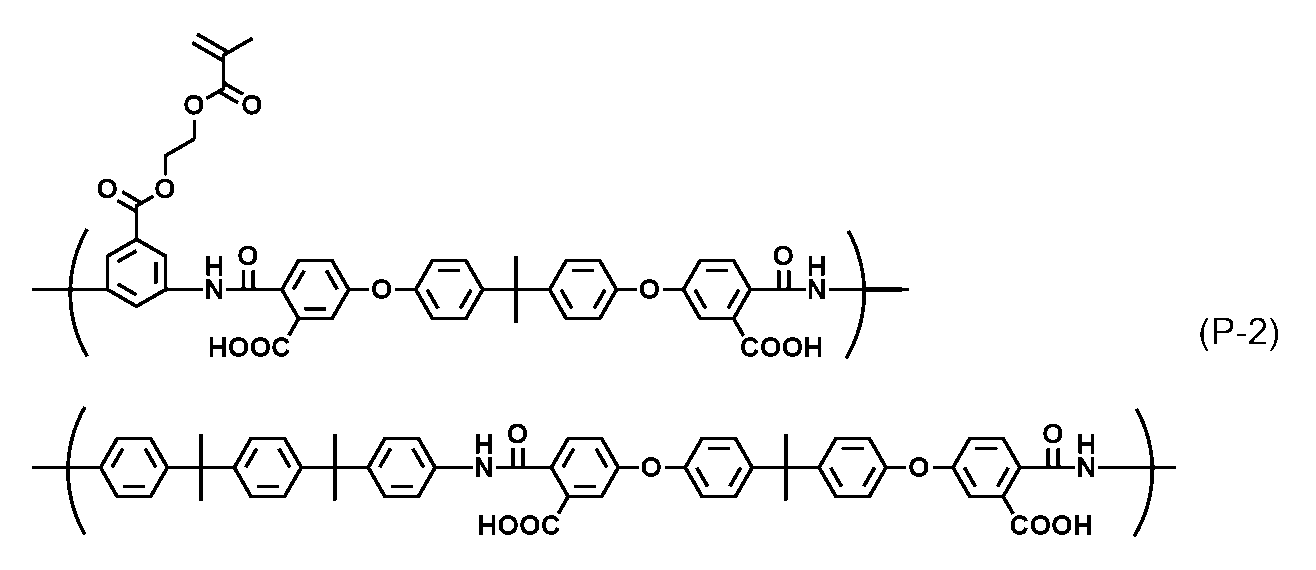
3,5-ジアミノ安息香酸2-(メタクリロイルオキシ)エチル(BEM-S、和光純薬工業(株)製)10.18g、1,4-ビス(4-アミノフェノキシ)ベンゼン11.26g、2,6-ジ-tert-ブチル-p-クレゾール0.04g、及びN-エチル-2-ピロリドン50.13gを空気下、室温で撹拌して溶解させた後、4,4’-(4,4’-イソプロピリデンジフェノキシ)ジフタル酸無水物38.49g、及びN-エチル-2-ピロリドン89.82gを系内に加え、室温で3時間撹拌した後、50℃で89時間撹拌した。得られたポリアミック酸は下記(P-3)で表される繰り返し単位構造を有し、GPCによるポリスチレン換算で測定される重量平均分子量(Mw)は26,998であった。

3,5-ジアミノ安息香酸2-(メタクリロイルオキシ)エチル(BEM-S、和光純薬工業(株)製)13.73g、2,2-ビス[4-(4-アミノフェノキシ)フェニル]プロパン9.14g、2,6-ジ-tert-ブチル-p-クレゾール0.06g、及びN-エチル-2-ピロリドン53.50gを空気下、室温で撹拌して溶解させた後、4,4’-(4,4’-イソプロピリデンジフェノキシ)ジフタル酸無水物37.08g、及びN-エチル-2-ピロリドン86.53gを系内に加え、室温で2時間撹拌した後、50℃で88時間撹拌した。得られたポリアミック酸は下記(P-4)で表される繰り返し単位構造を有し、GPCによるポリスチレン換算で測定される重量平均分子量(Mw)は24,973であった。

3,5-ジアミノ安息香酸2-(メタクリロイルオキシ)エチル(BEM-S、和光純薬工業(株)製)9.47g、2,2-ビス[4-(4-アミノフェノキシ)フェニル]プロパン14.70g、2,6-ジ-tert-ブチル-p-クレゾール0.04g、及びN-エチル-2-ピロリドン56.49gを空気下、室温で撹拌して溶解させた後、4,4’-(4,4’-イソプロピリデンジフェノキシ)ジフタル酸無水物35.79g、及びN-エチル-2-ピロリドン83.51gを系内に加え、室温で3時間撹拌した後、50℃で89時間撹拌した。得られたポリアミック酸は下記(P-5)で表される繰り返し単位構造を有し、GPCによるポリスチレン換算で測定される重量平均分子量(Mw)は27,852であった。

3,5-ジアミノ安息香酸2-(メタクリロイルオキシ)エチル(BEM-S、和光純薬工業(株)製)3.59g、2,2-ビス[4-(4-アミノフェノキシ)フェニル]プロパン13.01g、2,6-ジ-tert-ブチル-p-クレゾール0.01g、及びN-エチル-2-ピロリドン66.47gを空気下、室温で撹拌して溶解させた後、4,4’-(4,4’-イソプロピリデンジフェノキシ)ジフタル酸無水物23.33g、及びN-エチル-2-ピロリドン93.33gを系内に加え、室温で3時間撹拌した後、50℃で95時間撹拌した。得られたポリアミック酸は下記(P-6)で表される繰り返し単位構造を有し、GPCによるポリスチレン換算で測定される重量平均分子量(Mw)は56,737であった。

3,5-ジアミノ安息香酸2-(メタクリロイルオキシ)エチル(BEM-S、和光純薬工業(株)製)1.16g、2,2-ビス[4-(4-アミノフェノキシ)フェニル]プロパン16.22g、2,6-ジ-tert-ブチル-p-クレゾール0.01g、及びN-エチル-2-ピロリドン69.53gを空気下、室温で撹拌して溶解させた後、4,4’-(4,4’-イソプロピリデンジフェノキシ)ジフタル酸無水物22.62g、及びN-エチル-2-ピロリドン90.47gを系内に加え、室温で3時間撹拌した後、50℃で95時間撹拌した。得られたポリアミック酸は下記(P-7)で表される繰り返し単位構造を有し、GPCによるポリスチレン換算で測定される重量平均分子量(Mw)は58,225であった。
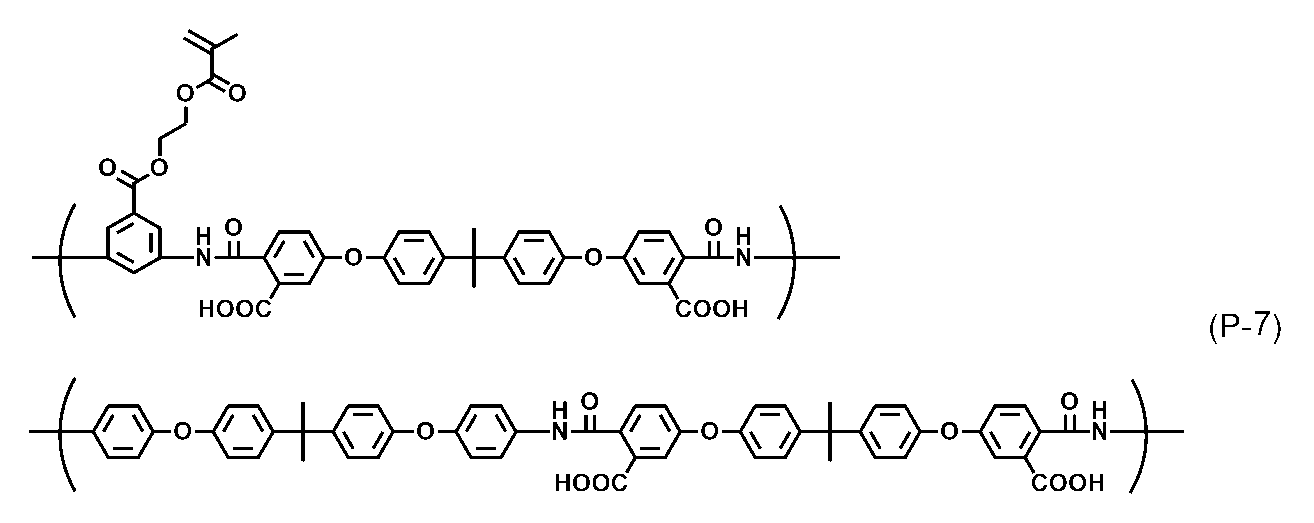
3,5-ジアミノ安息香酸2-(メタクリロイルオキシ)エチル(BEM-S、和光純薬工業(株)製)9.71g、4,4’-ビス(4-アミノフェノキシ)ビフェニル13.54g、2,6-ジ-tert-ブチル-p-クレゾール0.04g、及びN-エチル-2-ピロリドン54.34gを空気下、室温で撹拌して溶解させた後、4,4’-(4,4’-イソプロピリデンジフェノキシ)ジフタル酸無水物36.72g、及びN-エチル-2-ピロリドン85.67gを系内に加え、室温で3時間撹拌した後、50℃で92時間撹拌した。得られたポリアミック酸は下記(P-8)で表される繰り返し単位構造を有し、GPCによるポリスチレン換算で測定される重量平均分子量(Mw)は33,012であった。
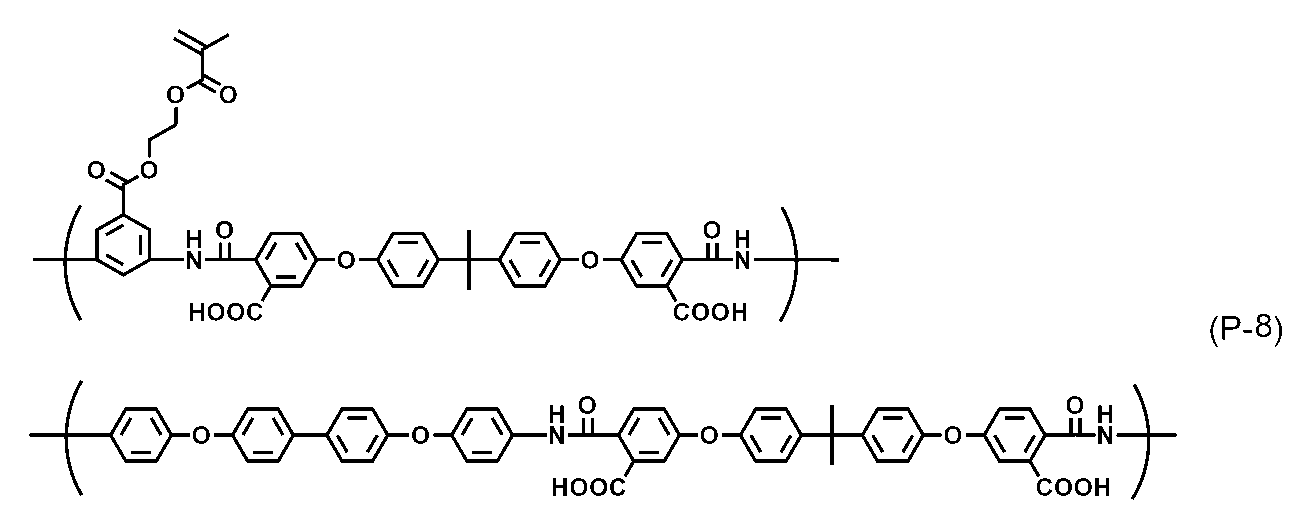
3,5-ジアミノ安息香酸2-(メタクリロイルオキシ)エチル(BEM-S、和光純薬工業(株)製)6.22g、ビス[4-(4-アミノフェノキシ)フェニル]スルホン10.18g、2,6-ジ-tert-ブチル-p-クレゾール0.03g、及びN-エチル-2-ピロリドン65.70gを空気下、室温で撹拌して溶解させた後、4,4’-(4,4’-イソプロピリデンジフェノキシ)ジフタル酸無水物23.52g、及びN-エチル-2-ピロリドン94.08gを系内に加え、室温で2時間撹拌した後、50℃で92時間撹拌した。得られたポリアミック酸は下記(P-9)で表される繰り返し単位構造を有し、GPCによるポリスチレン換算で測定される重量平均分子量(Mw)は31,175であった。
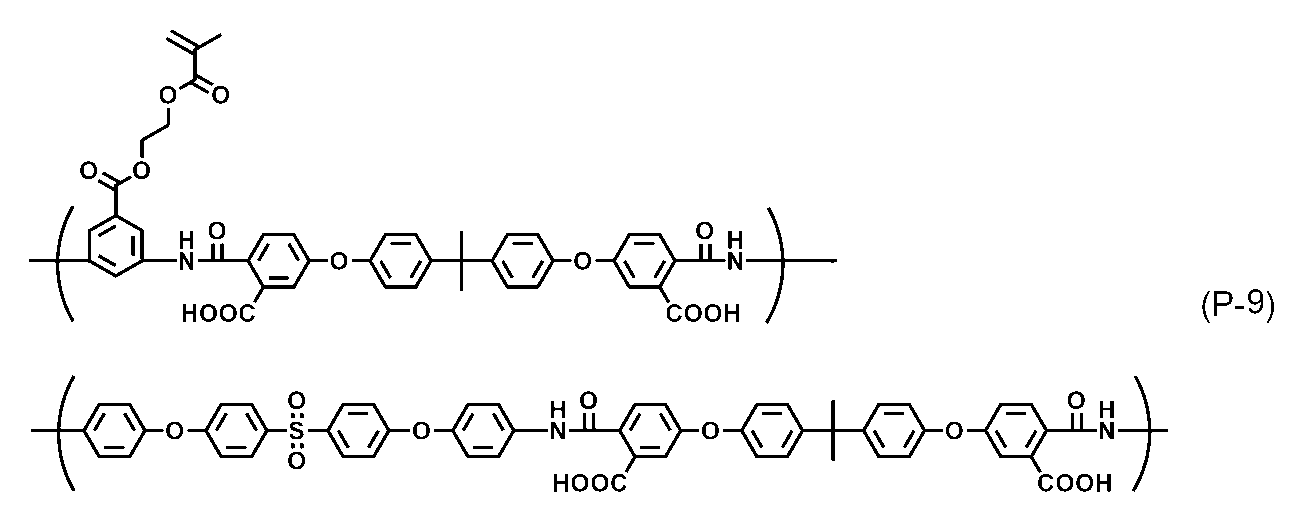
3,5-ジアミノ安息香酸2-(メタクリロイルオキシ)エチル(BEM-S、和光純薬工業(株)製)6.62g、9,9-ビス[4-(4-アミノフェノキシ)フェニル]フルオレン(BPF-AN、JFEケミカル(株)製)13.34g、及びN-エチル-2-ピロリドン79.86gを空気下、室温で撹拌して溶解させた後、4,4’-(4,4’-イソプロピリデンジフェノキシ)ジフタル酸無水物25.04g、及びN-エチル-2-ピロリドン25.14gを系内に加え、室温で3時間撹拌した後、40℃で42時間撹拌した。得られたポリアミック酸は下記(P-10)で表される繰り返し単位構造を有し、GPCによるポリスチレン換算で測定される重量平均分子量(Mw)は25,249であった。

3,5-ジアミノ安息香酸2-(メタクリロイルオキシ)エチル(BEM-S、和光純薬工業(株)製)7.94g、ビス(4-アミノフェニル)テレフタレート10.46g、4-メトキシフェノール0.05g、及びN-エチル-2-ピロリドン87.05gを空気下、室温で撹拌して溶解させた後、4,4’-(4,4’-イソプロピリデンジフェノキシ)ジフタル酸無水物29.98g、及びN-エチル-2-ピロリドン58.04gを系内に加え、室温で3時間撹拌した後、50℃で74時間撹拌した。得られたポリアミック酸は下記(P-11)で表される繰り返し単位構造を有し、GPCによるポリスチレン換算で測定される重量平均分子量(Mw)は29,792であった。
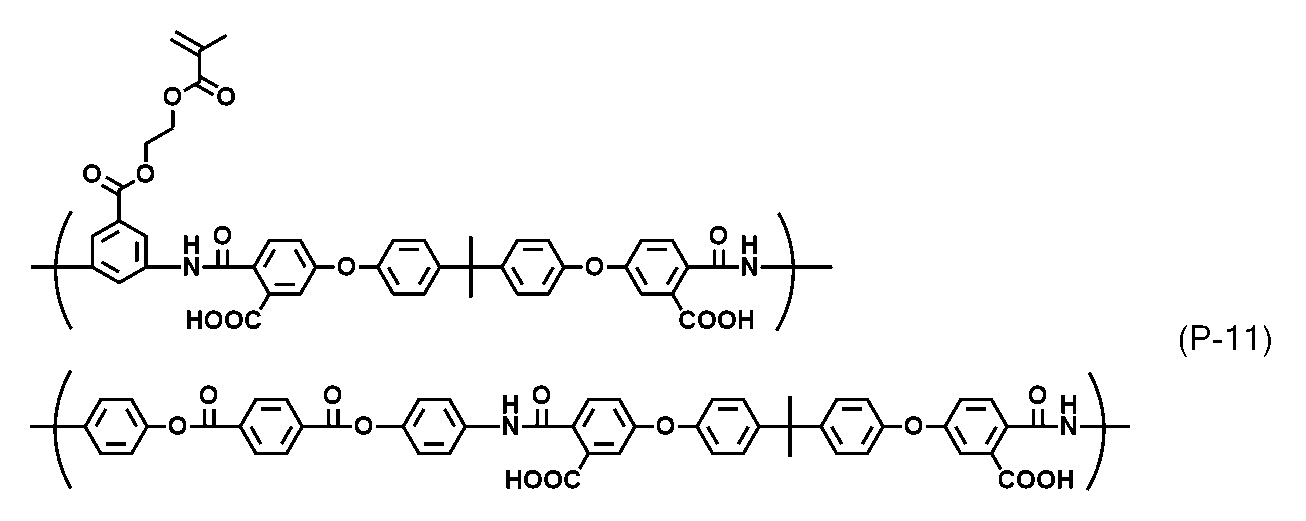
3,5-ジアミノ安息香酸2-(メタクリロイルオキシ)エチル(BEM-S、和光純薬工業(株)製)7.94g、1,4-フェニレンビス(4-アミノベンゾエート)10.46g、4-メトキシフェノール0.05g、及びN-エチル-2-ピロリドン87.05gを空気下、室温で撹拌して溶解させた後、4,4’-(4,4’-イソプロピリデンジフェノキシ)ジフタル酸無水物29.98g、及びN-エチル-2-ピロリドン58.04gを系内に加え、室温で3時間撹拌した後、50℃で74時間撹拌した。得られたポリアミック酸は下記(P-12)で表される繰り返し単位構造を有し、GPCによるポリスチレン換算で測定される重量平均分子量(Mw)は24,660であった。
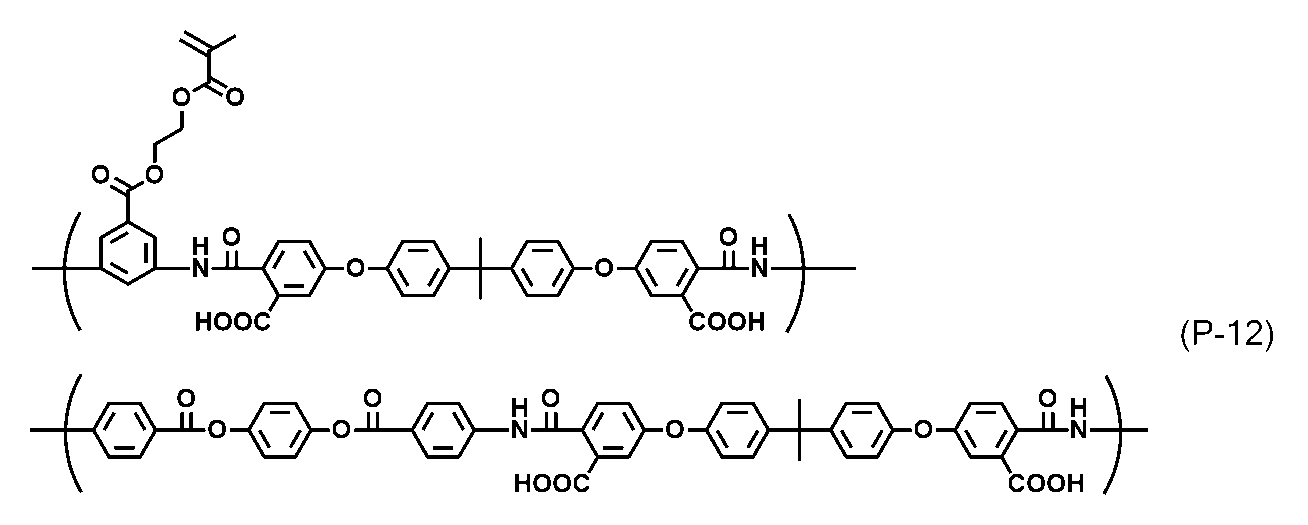
3,5-ジアミノ安息香酸2-(メタクリロイルオキシ)エチル(BEM-S、和光純薬工業(株)製)10.95g、2,2-ビス[4-(4-アミノフェノキシ)フェニル]プロパン17.01g、2,6-ジ-tert-ブチル-p-クレゾール0.05g、及びN-エチル-2-ピロリドン112.00gを空気下、室温で撹拌して溶解させた後、ヒドロキノンジフタル酸無水物(HQDA、エア・ウォーター(株)製)32.00g、及びN-エチル-2-ピロリドン28.00gを系内に加え、室温で2時間撹拌した後、40℃で39時間撹拌した。得られたポリアミック酸は下記(P-13)で表される繰り返し単位構造を有し、GPCによるポリスチレン換算で測定される重量平均分子量(Mw)は21,092であった。

3,5-ジアミノ安息香酸2-(メタクリロイルオキシ)エチル(BEM-S、和光純薬工業(株)製)8.63g、2,2-ビス[4-(4-アミノフェノキシ)フェニル]プロパン13.41g、2,6-ジ-tert-ブチル-p-クレゾール0.04g、及びN-エチル-2-ピロリドン88.32gを空気下、室温で撹拌して溶解させた後、ビス-(1,3-ジオキソ-1,3-ジヒドロイソベンゾフラン-5-カルボン酸)プロパン-2,2-ジイルビス(2-メチル-4,1-フェニレン)37.92g、及びN-エチル-2-ピロリドン51.68gを系内に加え、室温で2時間撹拌した後、40℃で39時間撹拌した。得られたポリアミック酸は下記(P-14)で表される繰り返し単位構造を有し、GPCによるポリスチレン換算で測定される重量平均分子量(Mw)は16,379であった。

3,5-ジアミノ安息香酸2-(メタクリロイルオキシ)エチル(BEM-S、和光純薬工業(株)製)6.23g、2,2-ビス[4-(4-アミノフェノキシ)フェニル]プロパン9.68g、及びN-エチル-2-ピロリドン63.64gを空気下、室温で撹拌して溶解させた後、9,9-ビス[4-(3,4-ジカルボキシフェノキシ)フェニルフルオレン二酸無水物(BPF-PA,JFEケミカル(株)製)29.09g、及びN-エチル-2-ピロリドン41.36gを系内に加え、室温で3時間撹拌した後、40℃で42時間撹拌した。得られたポリアミック酸は下記(P-15)で表される繰り返し単位構造を有し、GPCによるポリスチレン換算で測定される重量平均分子量(Mw)は24,559であった。
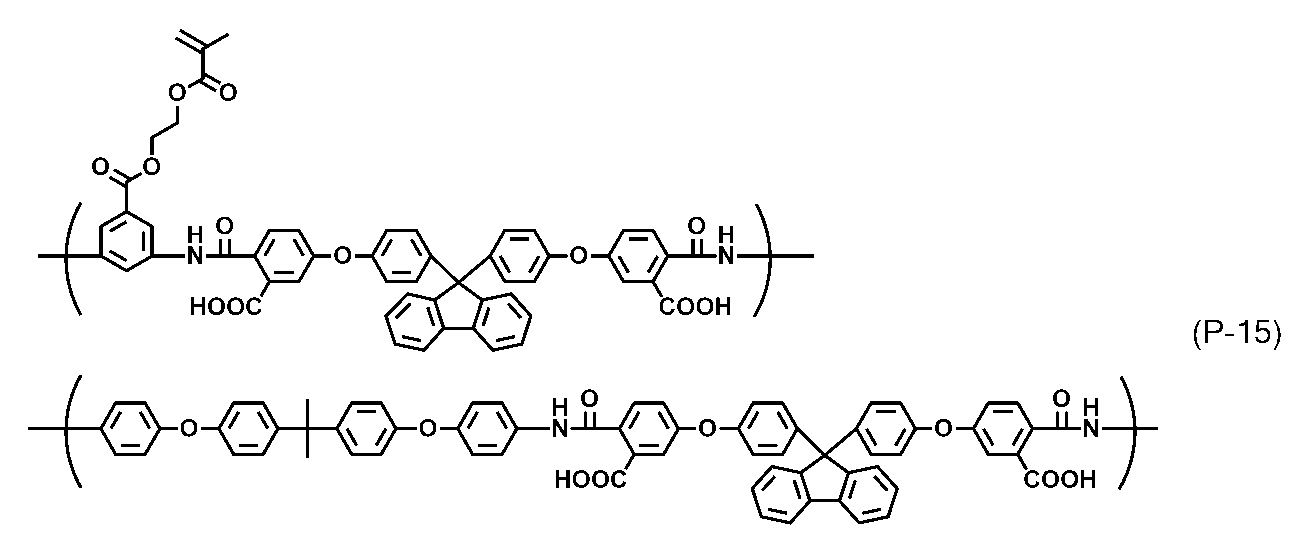
3,5-ジアミノ安息香酸2-(メタクリロイルオキシ)エチル(BEM-S、和光純薬工業(株)製)5.29g、2,2-ビス[4-(4-アミノフェノキシ)フェニル]ヘキサフルオロプロパン10.36g、4-メトキシフェノール0.04g、及びN-エチル-2-ピロリドン65.87gを空気下、室温で撹拌して溶解させた後、9,9-ビス[4-(3,4-ジカルボキシフェノキシ)フェニルフルオレン二酸無水物(BPF-PA,JFEケミカル(株)製)24.68g、及びN-エチル-2-ピロリドン28.23gを系内に加え、室温で4時間撹拌した後、50℃で26.5時間撹拌した。得られたポリアミック酸は下記(P-16)で表される繰り返し単位構造を有し、GPCによるポリスチレン換算で測定される重量平均分子量(Mw)は28,330であった。
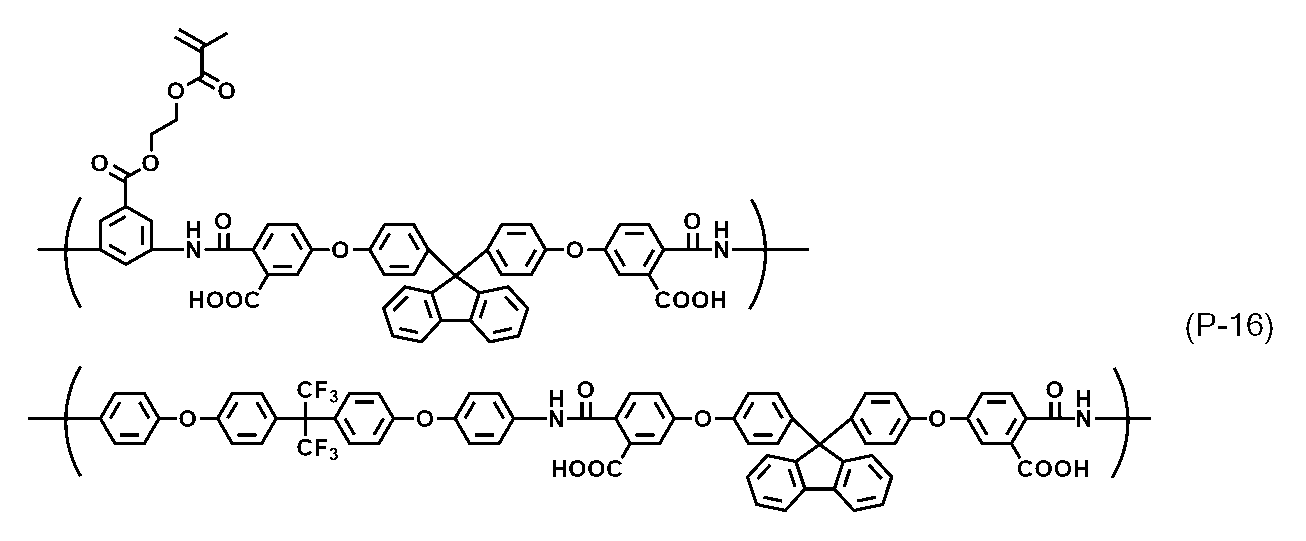
3,5-ジアミノ安息香酸2-(メタクリロイルオキシ)エチル(BEM-S、和光純薬工業(株)製)6.181g、2,2-ビス[4-(4-アミノフェノキシ)フェニル]プロパン9.60g、4-メトキシフェノール0.04g、及びN-エチル-2-ピロリドン79.65gを空気下、室温で撹拌して溶解させた後、5-イソベンゾフランカルボン酸、1,3-ジヒドロ-1,3-ジオキソ-シクロヘキシリデン-4,1-フェニレンエステル(BPZ-TME、本州化学工業(株)製)24.0g及びN-エチル-2-ピロリドン39.82gを系内に加え、室温で1時間撹拌した後、50℃で63時間撹拌した。得られたポリアミック酸は下記(P-17)で表される繰り返し単位構造を有し、GPCによるポリスチレン換算で測定される重量平均分子量(Mw)は13,550であった。
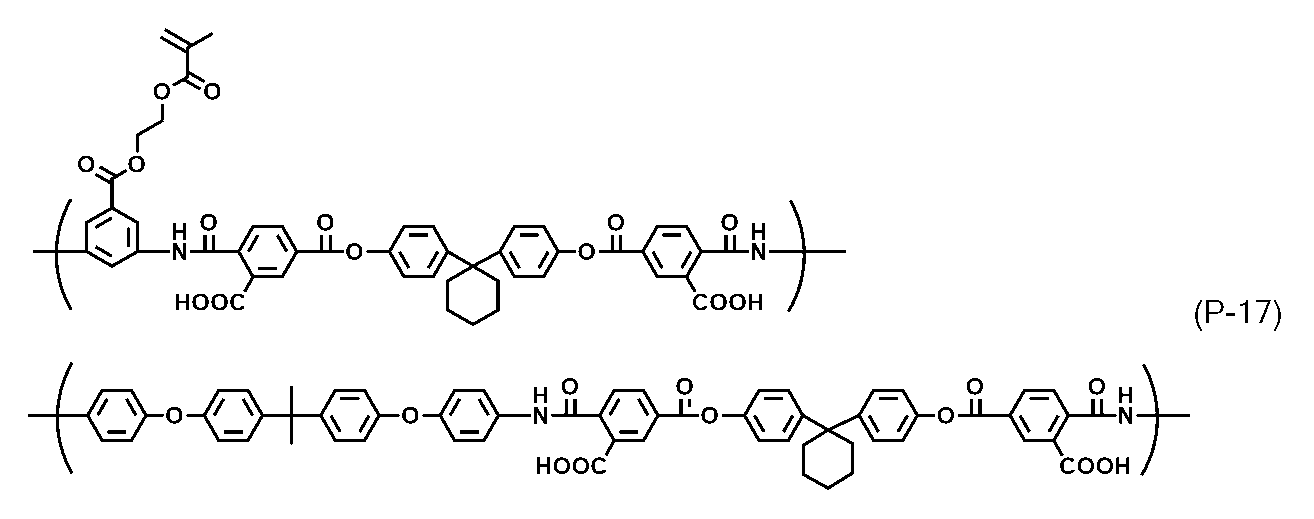
3,5-ジアミノ安息香酸2-(メタクリロイルオキシ)エチル(BEM-S、和光純薬工業(株)製)8.65g、2,2-ビス[4-(4-アミノフェノキシ)フェニル]プロパン13.44g、4-メトキシフェノール0.053g、及びN-エチル-2-ピロリドン105.62gを空気下、室温で撹拌して溶解させた後、P-フェニレンビス(トリメリテート無水物)(TAHQ、マナック(株)製)15.0g、4,4’-(4,4’-イソプロピリデンジフェノキシ)ジフタル酸無水物15.67g及びN-エチル-2-ピロリドン52.81gを系内に加え、室温で1時間撹拌した後、50℃で40時間撹拌した。得られたポリアミック酸は下記(P-18)で表される繰り返し単位構造を有し、GPCによるポリスチレン換算で測定される重量平均分子量(Mw)は36,287であった。

3,5-ジアミノ安息香酸2-(メタクリロイルオキシ)エチル(BEM-S、和光純薬工業(株)製)8.65g、2,2-ビス[4-(4-アミノフェノキシ)フェニル]プロパン13.44g、4-メトキシフェノール0.054g、及びN-エチル-2-ピロリドン107.24gを空気下、室温で撹拌して溶解させた後、P-フェニレンビス(トリメリテート無水物)(TAHQ、マナック(株)製)9.0g、4,4’-(4,4’-イソプロピリデンジフェノキシ)ジフタル酸無水物22.49g及びN-エチル-2-ピロリドン53.62gを系内に加え、室温で1時間撹拌した後、50℃で40時間撹拌した。得られたポリアミック酸は下記(P-19)で表される繰り返し単位構造を有し、GPCによるポリスチレン換算で測定される重量平均分子量(Mw)は34,006であった。
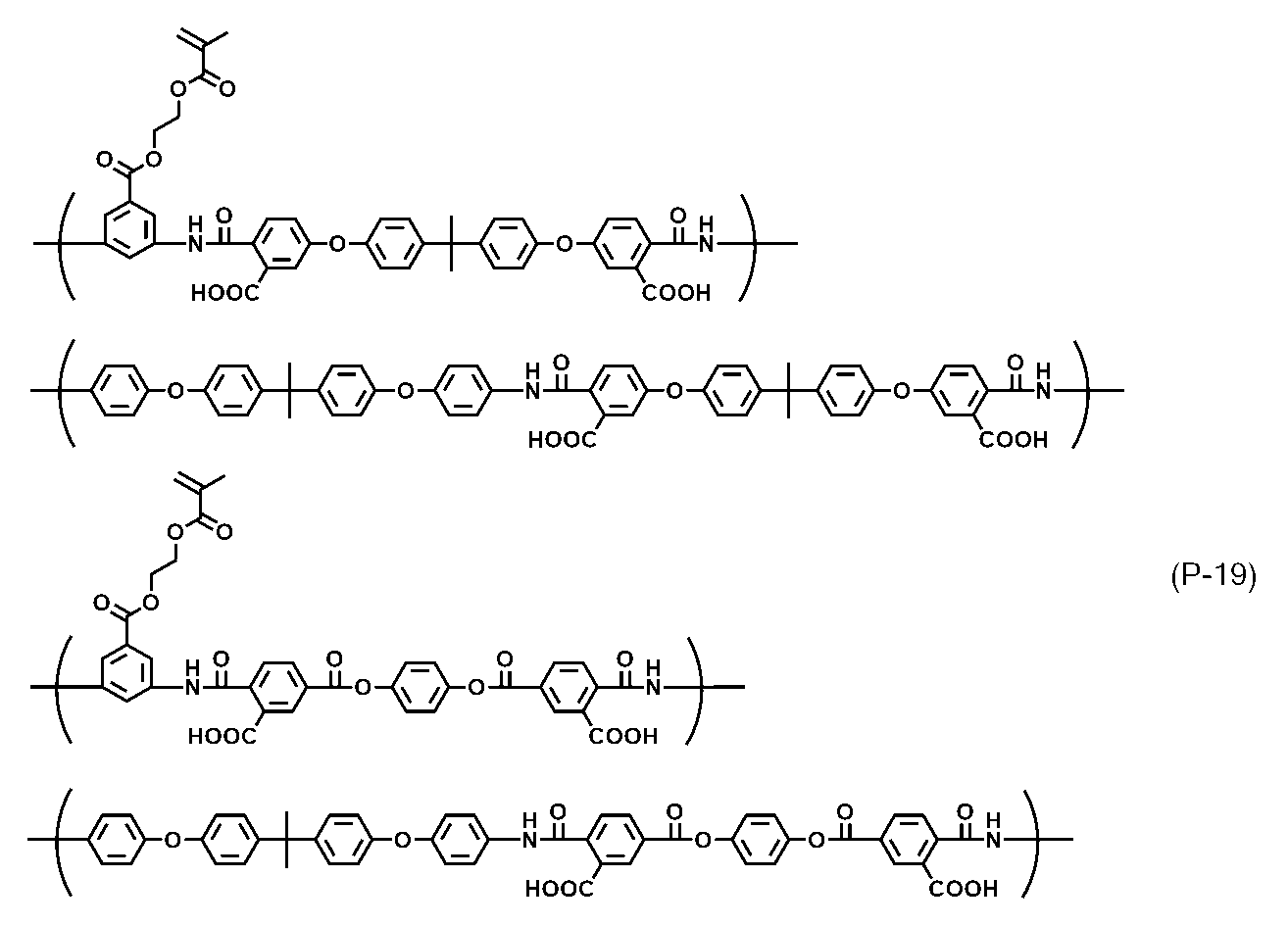
3,5-ジアミノ安息香酸2-(メタクリロイルオキシ)エチル(BEM-S、和光純薬工業(株)製)7.418g、2,2-ビス[4-(4-アミノフェノキシ)フェニル]プロパン11.52g、4-メトキシフェノール0.047g、及びN-エチル-2-ピロリドン126.47gを空気下、室温で撹拌して溶解させた後、p-ビフェニレンビス(トリメリット酸モノエステル酸無水物)(BP-TME、本州化学(株)製)15.0g、4,4’-(4,4’-イソプロピリデンジフェノキシ)ジフタル酸無水物13.44g及びN-エチル-2-ピロリドン63.23gを系内に加え、室温で1時間撹拌した後、50℃で40時間撹拌した。得られたポリアミック酸は下記(P-20)で表される繰り返し単位構造を有し、GPCによるポリスチレン換算で測定される重量平均分子量(Mw)は28,962であった。
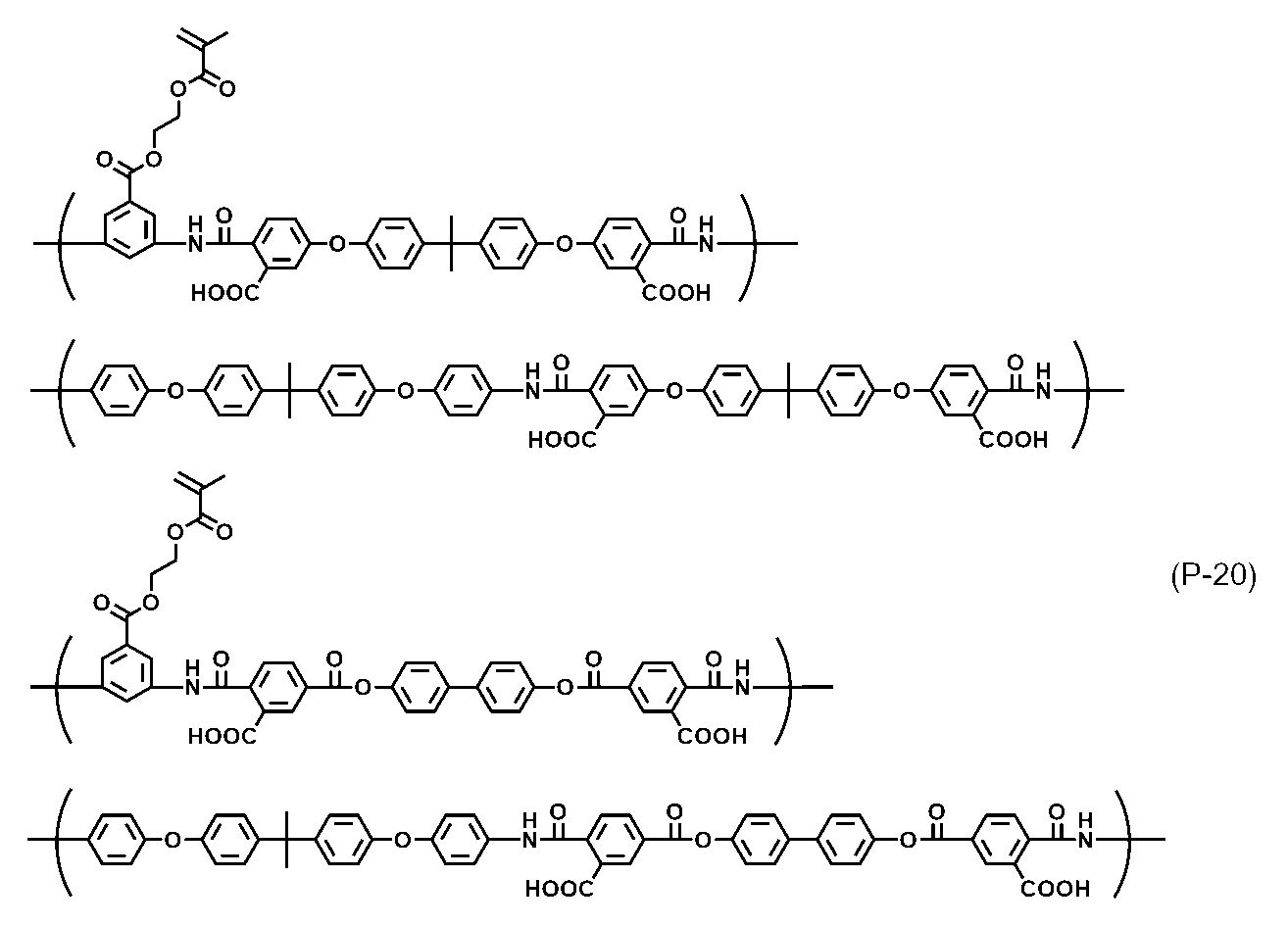
3,5-ジアミノ安息香酸2-(メタクリロイルオキシ)エチル(BEM-S、和光純薬工業(株)製)7.418g、2,2-ビス[4-(4-アミノフェノキシ)フェニル]プロパン11.52g、4-メトキシフェノール0.047g、及びN-エチル-2-ピロリドン126.47gを空気下、室温で撹拌して溶解させた後、p-ビフェニレンビス(トリメリット酸モノエステル酸無水物)(BP-TME、本州化学(株)製)9.0g、4,4’-(4,4’-イソプロピリデンジフェノキシ)ジフタル酸無水物19.28g及びN-エチル-2-ピロリドン63.23gを系内に加え、室温で1時間撹拌した後、50℃で40時間撹拌した。得られたポリアミック酸は下記(P-21)で表される繰り返し単位構造を有し、GPCによるポリスチレン換算で測定される重量平均分子量(Mw)は26,182であった。
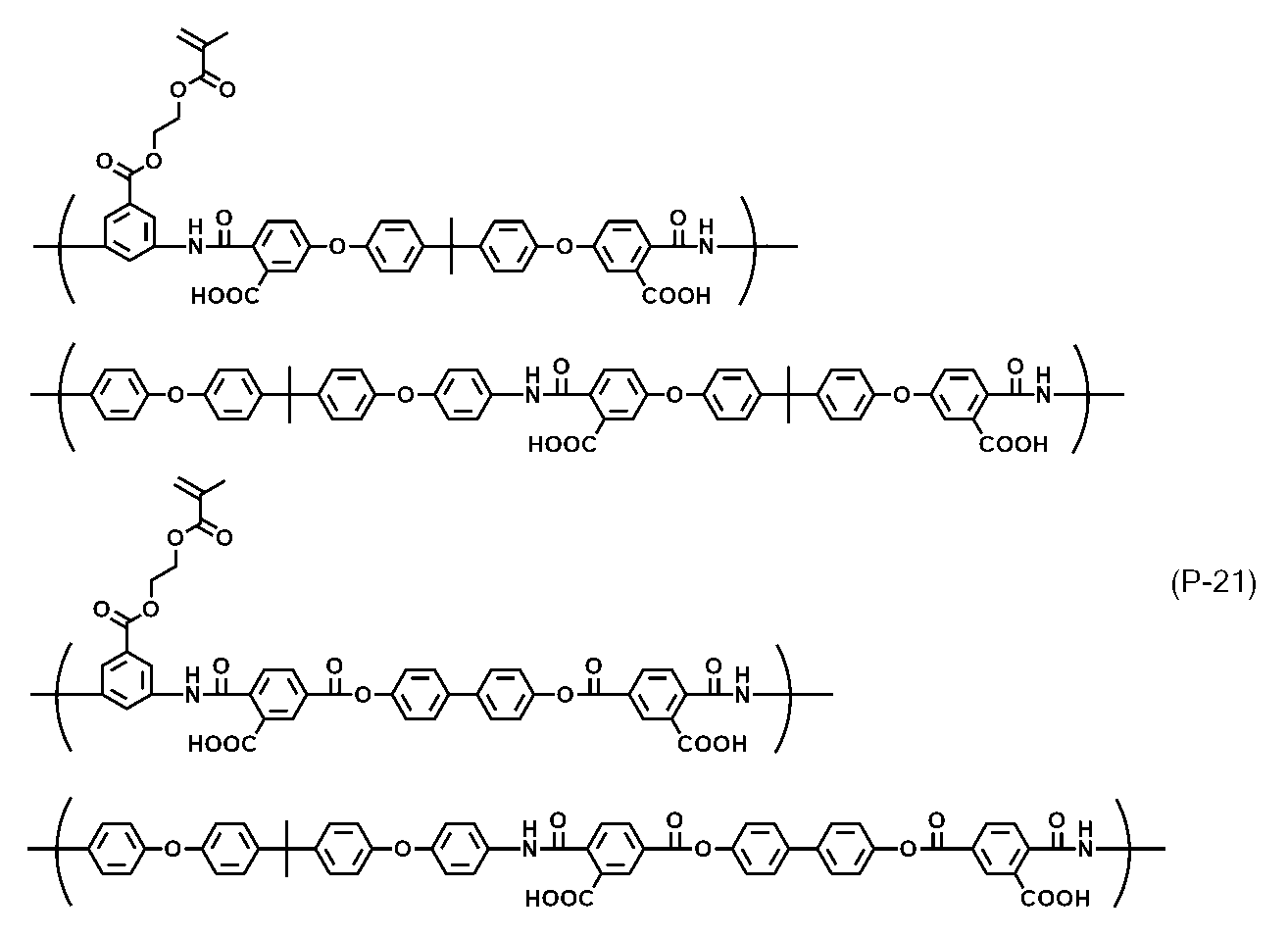
合成例16で得られたポリアミック酸(P-16)40.21gに、N-エチル-2-ピロリドン80.42g、無水酢酸3.66g、及びトリエチルアミン0.61gを加えて、空気下室温で30分撹拌した後、60℃で3時間撹拌した。この溶液を、撹拌しているメタノール437.15gにゆっくりと加えた後に10分撹拌し、得られた沈殿物を濾別した。この沈殿物をメタノール874.30gで洗浄した後に、80℃で減圧乾燥し、下記(P-22)で表される繰り返し単位構造を有する溶剤可溶型ポリイミド粉末を得た。化学イミド化率は95.3%であった。

3,5-ジアミノ安息香酸2-(メタクリロイルオキシ)エチル(BEM-S、和光純薬工業(株)製)9.51g、2,2-ビス[4-(4-アミノフェノキシ)フェニル]ヘキサフルオロプロパン18.66g、4-メトキシフェノール0.06g、及びN-エチル-2-ピロリドン98.06gを空気下、室温で撹拌して溶解させた後、4,4’-(ヘキサフルオロイソプロピリデン)ジフタル酸無水物23.99g、4,4’-(4,4’-イソプロピリデンジフェノキシ)ジフタル酸無水物7.87g、及びN-エチル-2-ピロリドン42.03gを系内に加え、室温で2時間撹拌した後、50℃で24時間撹拌した。GPCによるポリスチレン換算で測定される重量平均分子量(Mw)は29,468であった。得られたポリアミック酸50.00gに、N-エチル-2-ピロリドン100.00g、無水酢酸5.51g、及びトリエチルアミン0.91gを加えて、空気下室温で30分撹拌した後、60℃で3時間撹拌した。この溶液を、撹拌しているメタノール547.47gにゆっくりと加えた後に10分撹拌し、得られた沈殿物を濾別した。この沈殿物をメタノール1094.94gで洗浄した後に、80℃で減圧乾燥し、下記(P-23)で表される繰り返し単位構造を有する溶剤可溶型ポリイミド粉末を得た。化学イミド化率は95.3%であった。
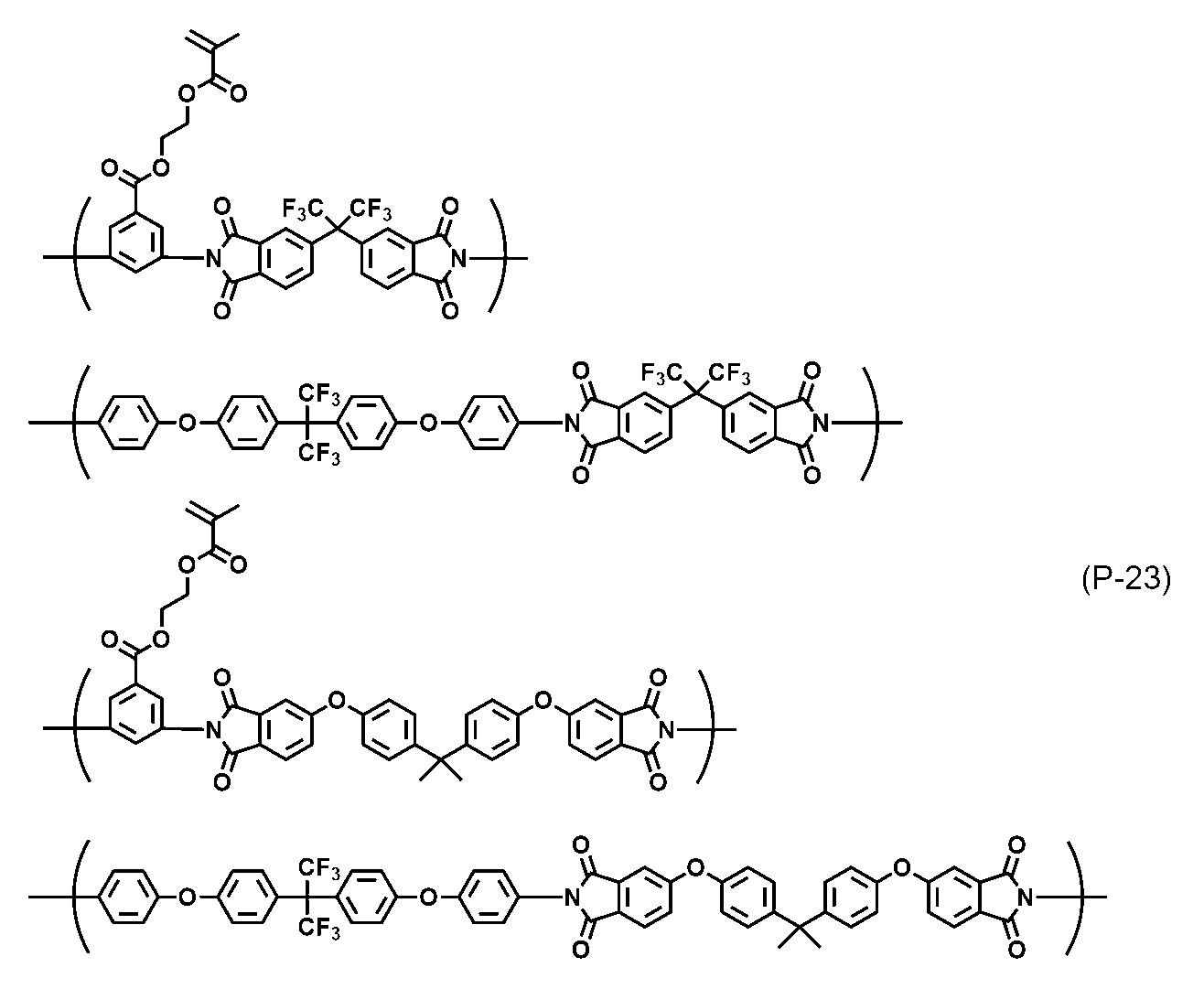
3,5-ジアミノ安息香酸2-(メタクリロイルオキシ)エチル(BEM-S、和光純薬工業(株)製)9.25g、2,2-ビス[4-(4-アミノフェノキシ)フェニル]ヘキサフルオロプロパン18.15g、4-メトキシフェノール0.06g、及びN-エチル-2-ピロリドン97.52gを空気下、室温で撹拌して溶解させた後、4,4’-(ヘキサフルオロイソプロピリデン)ジフタル酸無水物15.55g、4,4’-(4,4’-イソプロピリデンジフェノキシ)ジフタル酸無水物16.76g、及びN-エチル-2-ピロリドン41.79gを系内に加え、室温で2時間撹拌した後、50℃で24時間撹拌した。GPCによるポリスチレン換算で測定される重量平均分子量(Mw)は30,055であった。得られたポリアミック酸50.00gに、N-エチル-2-ピロリドン100.00g、無水酢酸5.39g、及びトリエチルアミン0.89gを加えて、空気下室温で30分撹拌した後、60℃で3時間撹拌した。この溶液を、撹拌しているメタノール546.97gにゆっくりと加えた後に10分撹拌し、得られた沈殿物を濾別した。この沈殿物をメタノール1093.94gで洗浄した後に、80℃で減圧乾燥し、下記(P-24)で表される繰り返し単位構造を有する溶剤可溶型ポリイミド粉末を得た。化学イミド化率は95.3%であった。

3,5-ジアミノ安息香酸2-(メタクリロイルオキシ)エチル(BEM-S、和光純薬工業(株)製)30.00g、2,6-ジ-tert-ブチル-p-クレゾール0.13g、及びN-エチル-2-ピロリドン90.38gを空気下、室温で撹拌して溶解させた後、ピロメリット酸無水物24.51g、及びN-エチル-2-ピロリドン37.11gを系内に加え、室温で13時間撹拌した後、80℃で51時間撹拌した。得られたポリアミック酸は下記(P-25)で表される繰り返し単位構造を有し、GPCによるポリスチレン換算で測定される重量平均分子量(Mw)は10,579であった。

3,5-ジアミノ安息香酸2-(メタクリロイルオキシ)エチル(BEM-S、和光純薬工業(株)製)42.28g、4-メトキシフェノール0.09g、及びN-エチル-2-ピロリドン144.42gを空気下、室温で撹拌して溶解させた後、3,3’,4,4’-ビフェニルテトラカルボン酸二無水物46.13g、及びN-エチル-2-ピロリドン61.89gを系内に加え、室温で1時間撹拌した後、80℃で75時間撹拌した。下記(P-26)で表される繰り返し単位構造を有するポリアミック酸を得られた。

3,5-ジアミノ安息香酸2-(メタクリロイルオキシ)エチル(BEM-S、和光純薬工業(株)製)31.71g、4-メトキシフェノール0.09g、及びN-エチル-2-ピロリドン137.13gを空気下、室温で撹拌して溶解させた後、4,4’-(ヘキサフルオロイソプロピリデン)ジフタル酸無水物52.24g、及びN-エチル-2-ピロリドン58.77gを系内に加え、室温で3時間撹拌した後、80℃で75時間撹拌した。下記(P-27)で表される繰り返し単位構造を有するポリアミック酸を得られた。
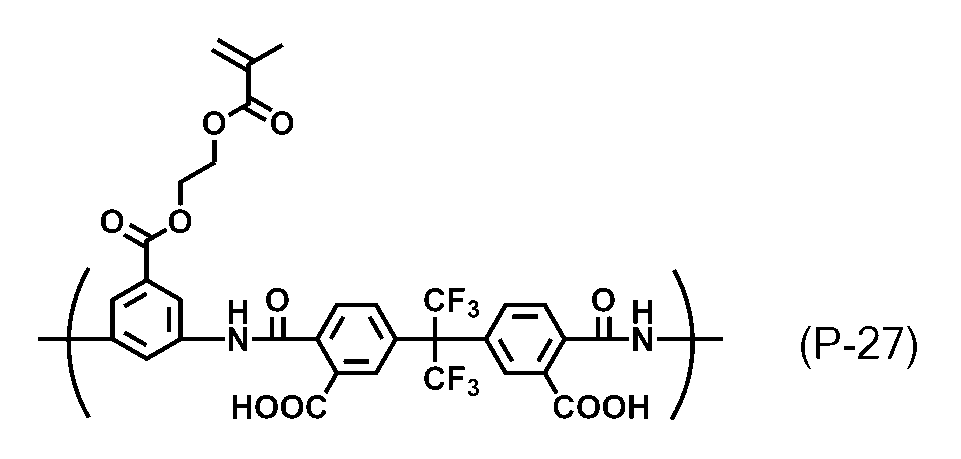
3,5-ジアミノ安息香酸2-(メタクリロイルオキシ)エチル(BEM-S、和光純薬工業(株)製)18.00g、2,6-ジ-tert-ブチル-p-クレゾール0.08g、及びN-エチル-2-ピロリドン54.23gを空気下、室温で撹拌して溶解させた後、1,2,3,4-シクロブタンテトラカルボン酸二無水物13.22g、及びN-エチル-2-ピロリドン30.40gを系内に加え、室温で62時間撹拌した後、40℃で34時間撹拌した。得られたポリアミック酸は下記(P-28)で表される繰り返し単位構造を有し、GPCによるポリスチレン換算で測定される重量平均分子量(Mw)は42,930であった。

3,5-ジアミノ安息香酸2-(メタクリロイルオキシ)エチル(BEM-S、和光純薬工業(株)製)15.00g、2,6-ジ-tert-ブチル-p-クレゾール0.06g、及びN-エチル-2-ピロリドン45.19gを空気下、室温で撹拌して溶解させた後、1,1’-ビシクロヘキサン-3,3’,4,4’-テトラカルボン酸-3,3’,4,4’-二無水物(BPDA-H、岩谷瓦斯(株)製)17.21g、及びN-エチル-2-ピロリドン30.12gを系内に加え、室温で62時間撹拌した後、40℃で34時間撹拌した。得られたポリアミック酸は下記(P-29)で表される繰り返し単位構造を有し、GPCによるポリスチレン換算で測定される重量平均分子量(Mw)は45,136であった。
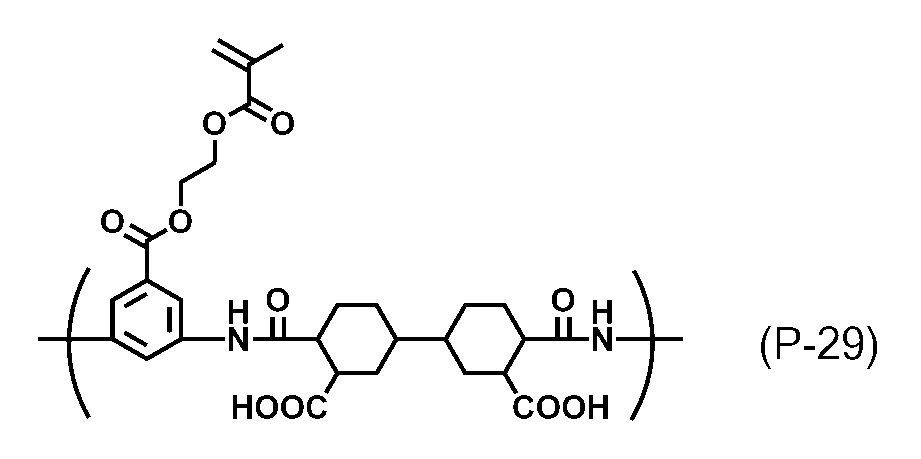
3,5-ジアミノ安息香酸2-(メタクリロイルオキシ)エチル(BEM-S、和光純薬工業(株)製)8.60g、2,2-ビス[4-(4-アミノフェノキシ)フェニル]ヘキサフルオロプロパン16.85g、4-メトキシフェノール0.05g、及びN-エチル-2-ピロリドン148.85gを空気下、室温で撹拌して溶解させた後、4,4’-(ヘキサフルオロイソプロピリデン)ジフタル酸無水物27.72g、及びN-エチル-2-ピロリドン63.79gを系内に加え、室温で1時間撹拌した後、50℃で87時間撹拌した。得られたポリアミック酸のGPCによるポリスチレン換算で測定される重量平均分子量(Mw)は27,335であった。
得られたポリアミック酸60.00gに、N-エチル-2-ピロリドン60.00g、無水酢酸4.49g、及びピリジン0.58gを加えて、空気下室温で30分撹拌した後、50℃で3時間撹拌した。この溶液を、撹拌しているメタノール437.76gにゆっくりと加えた後に10分撹拌し、得られた沈殿物を濾別した。この沈殿物をメタノール875.52gで洗浄した後に、60℃で減圧乾燥し、下記(P-30)で表される繰り返し単位構造を有する溶剤可溶型ポリイミド粉末を得た。化学イミド化率は93.2%であった。
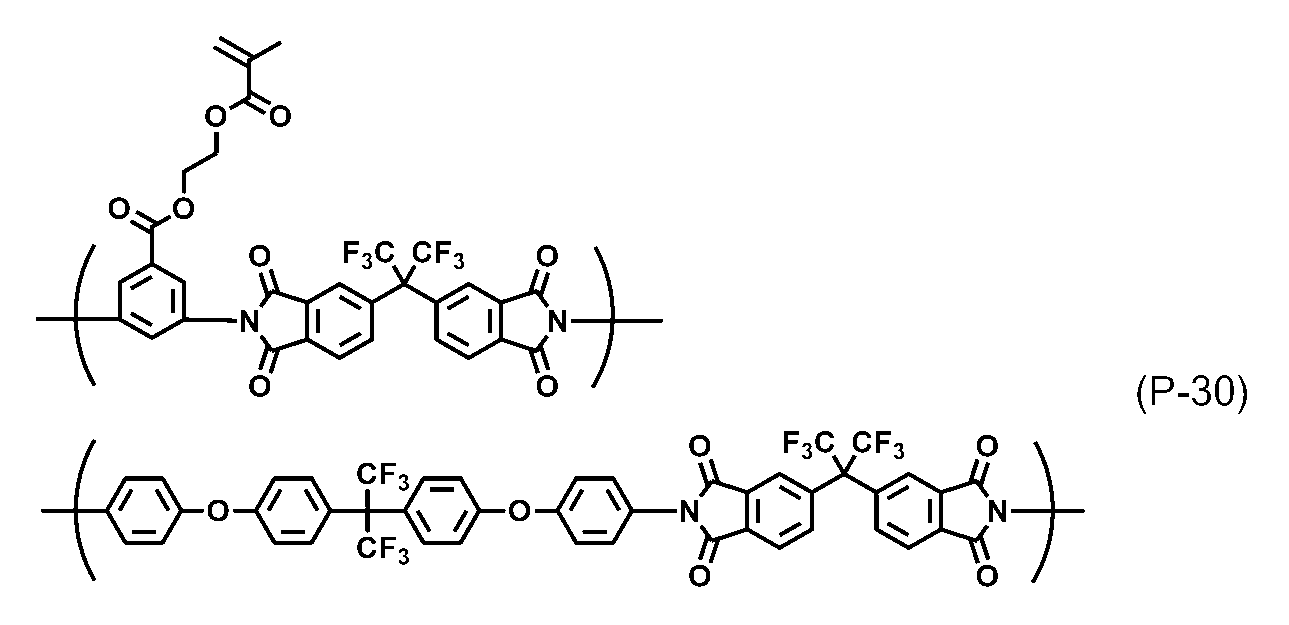
合成例1で得られたポリアミック酸(P-1)を含む溶液(固形分濃度:30重量%)27.75g、架橋剤としてNKエステル A-200(ポリエチレングリコールジアクリレート、新中村化学工業(株)製)1.67g、光ラジカル開始剤としてIRGACURE[登録商標]OXE01(1,2-オクタンジオン,1-[4-(フェニルチオ)フェニル-,2-(O-ベンゾイルオキシム)]、BASFジャパン(株)製)0.42g、及びKBM-5103(3-アクリロキシプロピルトリメトキシシラン、信越化学工業(株)製)0.17gを混合して溶解させた後、孔径5μmのポリプロピレン製フィルターを用いてろ過することで、ネガ型感光性樹脂組成物の溶液を調製した。
合成例2で得られたポリアミック酸(P-2)を含む溶液(固形分濃度:30重量%)32.24g、架橋剤としてNKエステル A-200(ポリエチレングリコールジアクリレート、新中村化学工業(株)製)1.93g、光ラジカル開始剤としてIRGACURE[登録商標]OXE01(1,2-オクタンジオン,1-[4-(フェニルチオ)フェニル-,2-(O-ベンゾイルオキシム)]、BASFジャパン(株)製)0.48g、IRGANOX[登録商標]3114(1,3,5-トリス(3,5-ジ-tert-ブチル-4-ヒドロキシベンジル)-1,3,5-トリアジン-2,4,6(1H,3H,5H)-トリオン、BASFジャパン(株)製)0.15g、及びKBM-5103(3-アクリロキシプロピルトリメトキシシラン、信越化学工業(株)製)0.19gを混合して溶解させた後、孔径5μmのポリプロピレン製フィルターを用いてろ過することで、ネガ型感光性樹脂組成物の溶液を調製した。
合成例2で得られたポリアミック酸(P-2)を含む溶液(固形分濃度:30重量%)33.16g、架橋剤としてNKエステル A-DOD-N(1,10-デカンジオールジアクリレート、新中村化学工業(株)製)1.93g、光ラジカル開始剤としてIRGACURE[登録商標]OXE01(1,2-オクタンジオン,1-[4-(フェニルチオ)フェニル-,2-(O-ベンゾイルオキシム)]、BASFジャパン(株)製)0.48g、IRGANOX[登録商標]3114(1,3,5-トリス(3,5-ジ-tert-ブチル-4-ヒドロキシベンジル)-1,3,5-トリアジン-2,4,6(1H,3H,5H)-トリオン、BASFジャパン(株)製)0.15g、及びKBM-5103(3-アクリロキシプロピルトリメトキシシラン、信越化学工業(株)製)0.19gを混合して溶解させた後、孔径5μmのポリプロピレン製フィルターを用いてろ過することで、ネガ型感光性樹脂組成物の溶液を調製した。
合成例3で得られたポリアミック酸(P-3)を含む溶液(固形分濃度:30重量%)22.08g、架橋剤としてNKエステル A-200(ポリエチレングリコールジアクリレート、新中村化学工業(株)製)1.32g、光ラジカル開始剤としてIRGACURE[登録商標]OXE01(1,2-オクタンジオン,1-[4-(フェニルチオ)フェニル-,2-(O-ベンゾイルオキシム)]、BASFジャパン(株)製)0.33g、IRGANOX[登録商標]3114(1,3,5-トリス(3,5-ジ-tert-ブチル-4-ヒドロキシベンジル)-1,3,5-トリアジン-2,4,6(1H,3H,5H)-トリオン、BASFジャパン(株)製)0.10g、KBM-5103(3-アクリロキシプロピルトリメトキシシラン、信越化学工業(株)製)0.13g、及びN-エチル-2-ピロリドン11.04gを混合して溶解させた後、孔径5μmのポリプロピレン製フィルターを用いてろ過することで、ネガ型感光性樹脂組成物の溶液を調製した。
合成例3で得られたポリアミック酸(P-3)を含む溶液(固形分濃度:30重量%)32.49g、架橋剤としてNKエステル A-DOD-N(1,10-デカンジオールジアクリレート、新中村化学工業(株)製)0.97g、光ラジカル開始剤としてIRGACURE[登録商標]OXE01(1,2-オクタンジオン,1-[4-(フェニルチオ)フェニル-,2-(O-ベンゾイルオキシム)]、BASFジャパン(株)製)0.49g、IRGANOX[登録商標]3114(1,3,5-トリス(3,5-ジ-tert-ブチル-4-ヒドロキシベンジル)-1,3,5-トリアジン-2,4,6(1H,3H,5H)-トリオン、BASFジャパン(株)製)0.15g、KBM-5103(3-アクリロキシプロピルトリメトキシシラン、信越化学工業(株)製)0.19g、及びN-エチル-2-ピロリドン0.71gを混合して溶解させた後、孔径5μmのポリプロピレン製フィルターを用いてろ過することで、ネガ型感光性樹脂組成物の溶液を調製した。
合成例4で得られたポリアミック酸(P-4)を含む溶液(固形分濃度:30重量%)33.16g、架橋剤としてNKエステル A-DOD-N(1,10-デカンジオールジアクリレート、新中村化学工業(株)製)0.99g、光ラジカル開始剤としてIRGACURE[登録商標]OXE01(1,2-オクタンジオン,1-[4-(フェニルチオ)フェニル-,2-(O-ベンゾイルオキシム)]、BASFジャパン(株)製)0.50g、IRGANOX[登録商標]3114(1,3,5-トリス(3,5-ジ-tert-ブチル-4-ヒドロキシベンジル)-1,3,5-トリアジン-2,4,6(1H,3H,5H)-トリオン、BASFジャパン(株)製)0.15g、及びKBM-5103(3-アクリロキシプロピルトリメトキシシラン、信越化学工業(株)製)0.20gを混合して溶解させた後、孔径5μmのポリプロピレン製フィルターを用いてろ過することで、ネガ型感光性樹脂組成物の溶液を調製した。
合成例5で得られたポリアミック酸(P-5)を含む溶液(固形分濃度:30重量%)29.96g、架橋剤としてNKエステル A-200(ポリエチレングリコールジアクリレート、新中村化学工業(株)製)1.80g、光ラジカル開始剤としてIRGACURE[登録商標]OXE01(1,2-オクタンジオン,1-[4-(フェニルチオ)フェニル-,2-(O-ベンゾイルオキシム)]、BASFジャパン(株)製)0.45g、IRGANOX[登録商標]3114(1,3,5-トリス(3,5-ジ-tert-ブチル-4-ヒドロキシベンジル)-1,3,5-トリアジン-2,4,6(1H,3H,5H)-トリオン、BASFジャパン(株)製)0.13g、KBM-5103(3-アクリロキシプロピルトリメトキシシラン、信越化学工業(株)製)0.18g、及びN-エチル-2-ピロリドン2.48gを混合して溶解させた後、孔径5μmのポリプロピレン製フィルターを用いてろ過することで、ネガ型感光性樹脂組成物の溶液を調製した。
合成例5で得られたポリアミック酸(P-5)を含む溶液(固形分濃度:30重量%)23.89g、架橋剤としてNKエステル A-DOD-N(1,10-デカンジオールジアクリレート、新中村化学工業(株)製)0.72g、光ラジカル開始剤としてIRGACURE[登録商標]OXE01(1,2-オクタンジオン,1-[4-(フェニルチオ)フェニル-,2-(O-ベンゾイルオキシム)]、BASFジャパン(株)製)0.36g、IRGANOX[登録商標]3114(1,3,5-トリス(3,5-ジ-tert-ブチル-4-ヒドロキシベンジル)-1,3,5-トリアジン-2,4,6(1H,3H,5H)-トリオン、BASFジャパン(株)製)0.11g、KBM-5103(3-アクリロキシプロピルトリメトキシシラン、信越化学工業(株)製)0.14g、及びN-エチル-2-ピロリドン4.78gを混合して溶解させた後、孔径5μmのポリプロピレン製フィルターを用いてろ過することで、ネガ型感光性樹脂組成物の溶液を調製した。
合成例6で得られたポリアミック酸(P-6)を含む溶液(固形分濃度:20重量%)37.84g、架橋剤としてNKエステル A-200(ポリエチレングリコールジアクリレート、新中村化学工業(株)製)1.51g、光ラジカル開始剤としてIRGACURE[登録商標]OXE01(1,2-オクタンジオン,1-[4-(フェニルチオ)フェニル-,2-(O-ベンゾイルオキシム)]、BASFジャパン(株)製)0.38g、IRGANOX[登録商標]3114(1,3,5-トリス(3,5-ジ-tert-ブチル-4-ヒドロキシベンジル)-1,3,5-トリアジン-2,4,6(1H,3H,5H)-トリオン、BASFジャパン(株)製)0.11g、及びKBM-5103(3-アクリロキシプロピルトリメトキシシラン、及び信越化学工業(株)製)0.15gを混合して溶解させた後、孔径5μmのポリプロピレン製フィルターを用いてろ過することで、ネガ型感光性樹脂組成物の溶液を調製した。
合成例7で得られたポリアミック酸(P-7)を含む溶液(固形分濃度:20重量%)37.84g、架橋剤としてNKエステル A-200(ポリエチレングリコールジアクリレート、新中村化学工業(株)製)1.51g、光ラジカル開始剤としてIRGACURE[登録商標]OXE01(1,2-オクタンジオン,1-[4-(フェニルチオ)フェニル-,2-(O-ベンゾイルオキシム)]、BASFジャパン(株)製)0.38g、IRGANOX[登録商標]3114(1,3,5-トリス(3,5-ジ-tert-ブチル-4-ヒドロキシベンジル)-1,3,5-トリアジン-2,4,6(1H,3H,5H)-トリオン、BASFジャパン(株)製)0.11g、及びKBM-5103(3-アクリロキシプロピルトリメトキシシラン、信越化学工業(株)製)0.15gを混合して溶解させた後、孔径5μmのポリプロピレン製フィルターを用いてろ過することで、ネガ型感光性樹脂組成物の溶液を調製した。
合成例8で得られたポリアミック酸(P-8)を含む溶液(固形分濃度:30重量%)22.08g、架橋剤としてNKエステル A-200(ポリエチレングリコールジアクリレート、新中村化学工業(株)製)1.32g、光ラジカル開始剤としてIRGACURE[登録商標]OXE01(1,2-オクタンジオン,1-[4-(フェニルチオ)フェニル-,2-(O-ベンゾイルオキシム)]、BASFジャパン(株)製)0.33g、IRGANOX[登録商標]3114(1,3,5-トリス(3,5-ジ-tert-ブチル-4-ヒドロキシベンジル)-1,3,5-トリアジン-2,4,6(1H,3H,5H)-トリオン、BASFジャパン(株)製)0.10g、KBM-5103(3-アクリロキシプロピルトリメトキシシラン、信越化学工業(株)製)0.13g、及びN-エチル-2-ピロリドン11.04gを混合して溶解させた後、孔径5μmのポリプロピレン製フィルターを用いてろ過することで、ネガ型感光性樹脂組成物の溶液を調製した。
合成例8で得られたポリアミック酸(P-8)を含む溶液(固形分濃度:30重量%)31.50g、架橋剤としてNKエステル A-DOD-N(1,10-デカンジオールジアクリレート、新中村化学工業(株)製)0.95g、光ラジカル開始剤としてIRGACURE[登録商標]OXE01(1,2-オクタンジオン,1-[4-(フェニルチオ)フェニル-,2-(O-ベンゾイルオキシム)]、BASFジャパン(株)製)0.47g、IRGANOX[登録商標]3114(1,3,5-トリス(3,5-ジ-tert-ブチル-4-ヒドロキシベンジル)-1,3,5-トリアジン-2,4,6(1H,3H,5H)-トリオン、BASFジャパン(株)製)0.14g、KBM-5103(3-アクリロキシプロピルトリメトキシシラン、信越化学工業(株)製)0.19g、及びN-エチル-2-ピロリドン1.75gを混合して溶解させた後、孔径5μmのポリプロピレン製フィルターを用いてろ過することで、ネガ型感光性樹脂組成物の溶液を調製した。
合成例9で得られたポリアミック酸(P-9)を含む溶液(固形分濃度:20重量%)33.11g、架橋剤としてNKエステル A-200(ポリエチレングリコールジアクリレート、新中村化学工業(株)製)1.32g、光ラジカル開始剤としてIRGACURE[登録商標]OXE01(1,2-オクタンジオン,1-[4-(フェニルチオ)フェニル-,2-(O-ベンゾイルオキシム)]、BASFジャパン(株)製)0.33g、IRGANOX[登録商標]3114(1,3,5-トリス(3,5-ジ-tert-ブチル-4-ヒドロキシベンジル)-1,3,5-トリアジン-2,4,6(1H,3H,5H)-トリオン、BASFジャパン(株)製)0.10g、及びKBM-5103(3-アクリロキシプロピルトリメトキシシラン、信越化学工業(株)製)0.13gを混合して溶解させた後、孔径5μmのポリプロピレン製フィルターを用いてろ過することで、ネガ型感光性樹脂組成物の溶液を調製した。
合成例10で得られたポリアミック酸(P-10)を含む溶液(固形分濃度:30重量%)20.75g、架橋剤としてNKエステル A-200(ポリエチレングリコールジアクリレート、新中村化学工業(株)製)1.25g、光ラジカル開始剤としてIRGACURE[登録商標]OXE01(1,2-オクタンジオン,1-[4-(フェニルチオ)フェニル-,2-(O-ベンゾイルオキシム)]、BASFジャパン(株)製)0.31g、IRGANOX[登録商標]3114(1,3,5-トリス(3,5-ジ-tert-ブチル-4-ヒドロキシベンジル)-1,3,5-トリアジン-2,4,6(1H,3H,5H)-トリオン、BASFジャパン(株)製)0.09g、KBM-5103(3-アクリロキシプロピルトリメトキシシラン、信越化学工業(株)製)0.12g、及びN-エチル-2-ピロリドン2.47を混合して溶解させた後、孔径5μmのポリプロピレン製フィルターを用いてろ過することで、ネガ型感光性樹脂組成物の溶液を調製した。
合成例11で得られたポリアミック酸(P-11)を含む溶液(固形分濃度:25重量%)23.66g、N-エチル-2-ピロリドン0.99g、架橋剤としてNKエステル A-DOD-N(1,10-デカンジオールジアクリレート、新中村化学工業(株)製)0.59g、光ラジカル開始剤としてIRGACURE[登録商標]OXE01(1,2-オクタンジオン,1-[4-(フェニルチオ)フェニル-,2-(O-ベンゾイルオキシム)]、BASFジャパン(株)製)0.30g、IRGANOX[登録商標]3114(1,3,5-トリス(3,5-ジ-tert-ブチル-4-ヒドロキシベンジル)-1,3,5-トリアジン-2,4,6(1H,3H,5H)-トリオン、BASFジャパン(株)製)0.09g、及びKBM-5103(3-アクリロキシプロピルトリメトキシシラン、信越化学工業(株)製)0.12gを混合して溶解させた後、孔径5μmのポリプロピレン製フィルターを用いてろ過することで、ネガ型感光性樹脂組成物の溶液を調製した。
合成例12で得られたポリアミック酸(P-12)を含む溶液(固形分濃度:25重量%)24.78g、架橋剤としてNKエステル A-DOD-N(1,10-デカンジオールジアクリレート、新中村化学工業(株)製)0.62g、光ラジカル開始剤としてIRGACURE[登録商標]OXE01(1,2-オクタンジオン,1-[4-(フェニルチオ)フェニル-,2-(O-ベンゾイルオキシム)]、BASFジャパン(株)製)0.31g、IRGANOX[登録商標]3114(1,3,5-トリス(3,5-ジ-tert-ブチル-4-ヒドロキシベンジル)-1,3,5-トリアジン-2,4,6(1H,3H,5H)-トリオン、BASFジャパン(株)製)0.09g、及びKBM-5103(3-アクリロキシプロピルトリメトキシシラン、信越化学工業(株)製)0.12gを混合して溶解させた後、孔径5μmのポリプロピレン製フィルターを用いてろ過することで、ネガ型感光性樹脂組成物の溶液を調製した。
合成例13で得られたポリアミック酸(P-13)を含む溶液(固形分濃度:30重量%)27.64g、架橋剤としてNKエステル A-200(ポリエチレングリコールジアクリレート、新中村化学工業(株)製)1.66g、光ラジカル開始剤としてIRGACURE[登録商標]OXE01(1,2-オクタンジオン,1-[4-(フェニルチオ)フェニル-,2-(O-ベンゾイルオキシム)]、BASFジャパン(株)製)0.41g、IRGANOX[登録商標]3114(1,3,5-トリス(3,5-ジ-tert-ブチル-4-ヒドロキシベンジル)-1,3,5-トリアジン-2,4,6(1H,3H,5H)-トリオン、BASFジャパン(株)製)0.12g、及びKBM-5103(3-アクリロキシプロピルトリメトキシシラン、信越化学工業(株)製)0.17gを混合して溶解させた後、孔径5μmのポリプロピレン製フィルターを用いてろ過することで、ネガ型感光性樹脂組成物の溶液を調製した。
合成例13で得られたポリアミック酸(P-13)を含む溶液(固形分濃度:30重量%)28.42g、架橋剤としてNKエステル A-DOD-N(1,10-デカンジオールジアクリレート、新中村化学工業(株)製)0.85g、光ラジカル開始剤としてIRGACURE[登録商標]OXE01(1,2-オクタンジオン,1-[4-(フェニルチオ)フェニル-,2-(O-ベンゾイルオキシム)]、BASFジャパン(株)製)0.43g、IRGANOX[登録商標]3114(1,3,5-トリス(3,5-ジ-tert-ブチル-4-ヒドロキシベンジル)-1,3,5-トリアジン-2,4,6(1H,3H,5H)-トリオン、BASFジャパン(株)製)0.13g、及びKBM-5103(3-アクリロキシプロピルトリメトキシシラン、信越化学工業(株)製)0.17gを混合して溶解させた後、孔径5μmのポリプロピレン製フィルターを用いてろ過することで、ネガ型感光性樹脂組成物の溶液を調製した。
合成例14で得られたポリアミック酸(P-14)を含む溶液(固形分濃度:30重量%)27.64g、架橋剤としてNKエステル A-200(ポリエチレングリコールジアクリレート、新中村化学工業(株)製)1.66g、光ラジカル開始剤としてIRGACURE[登録商標]OXE01(1,2-オクタンジオン,1-[4-(フェニルチオ)フェニル-,2-(O-ベンゾイルオキシム)]、BASFジャパン(株)製)0.41g、IRGANOX[登録商標]3114(1,3,5-トリス(3,5-ジ-tert-ブチル-4-ヒドロキシベンジル)-1,3,5-トリアジン-2,4,6(1H,3H,5H)-トリオン、BASFジャパン(株)製)0.12g、及びKBM-5103(3-アクリロキシプロピルトリメトキシシラン、信越化学工業(株)製)0.17gを混合して溶解させた後、孔径5μmのポリプロピレン製フィルターを用いてろ過することで、ネガ型感光性樹脂組成物の溶液を調製した。
合成例14で得られたポリアミック酸(P-14)を含む溶液(固形分濃度:30重量%)28.42g、架橋剤としてNKエステル A-DOD-N(1,10-デカンジオールジアクリレート、新中村化学工業(株)製)0.85g、光ラジカル開始剤としてIRGACURE[登録商標]OXE01(1,2-オクタンジオン,1-[4-(フェニルチオ)フェニル-,2-(O-ベンゾイルオキシム)]、BASFジャパン(株)製)0.43g、IRGANOX[登録商標]3114(1,3,5-トリス(3,5-ジ-tert-ブチル-4-ヒドロキシベンジル)-1,3,5-トリアジン-2,4,6(1H,3H,5H)-トリオン、BASFジャパン(株)製)0.13g、及びKBM-5103(3-アクリロキシプロピルトリメトキシシラン、信越化学工業(株)製)0.17gを混合して溶解させた後、孔径5μmのポリプロピレン製フィルターを用いてろ過することで、ネガ型感光性樹脂組成物の溶液を調製した。
合成例15で得られたポリアミック酸(P-15)を含む溶液(固形分濃度:30重量%)21.40g、架橋剤としてNKエステル A-200(ポリエチレングリコールジアクリレート、新中村化学工業(株)製)1.28g、光ラジカル開始剤としてIRGACURE[登録商標]OXE01(1,2-オクタンジオン,1-[4-(フェニルチオ)フェニル-,2-(O-ベンゾイルオキシム)]、BASFジャパン(株)製)0.32g、IRGANOX[登録商標]3114(1,3,5-トリス(3,5-ジ-tert-ブチル-4-ヒドロキシベンジル)-1,3,5-トリアジン-2,4,6(1H,3H,5H)-トリオン、BASFジャパン(株)製)0.10g、KBM-5103(3-アクリロキシプロピルトリメトキシシラン、信越化学工業(株)製)0.13g、及びN-エチル-2-ピロリドン1.77gを混合して溶解させた後、孔径5μmのポリプロピレン製フィルターを用いてろ過することで、ネガ型感光性樹脂組成物の溶液を調製した。
合成例16で得られたポリアミック酸(P-16)を含む溶液(固形分濃度:30重量%)37.81g、架橋剤としてNKエステル A-DOD-N(1,10-デカンジオールジアクリレート、新中村化学工業(株)製)2.27g、光ラジカル開始剤としてIRGACURE[登録商標]OXE01(1,2-オクタンジオン,1-[4-(フェニルチオ)フェニル-,2-(O-ベンゾイルオキシム)]、BASFジャパン(株)製)0.57g、IRGANOX[登録商標]3114(1,3,5-トリス(3,5-ジ-tert-ブチル-4-ヒドロキシベンジル)-1,3,5-トリアジン-2,4,6(1H,3H,5H)-トリオン、BASFジャパン(株)製)0.17g、及びKBM-5103(3-アクリロキシプロピルトリメトキシシラン、信越化学工業(株)製)0.23gを混合して溶解させた後、孔径5μmのポリプロピレン製フィルターを用いてろ過することで、ネガ型感光性樹脂組成物の溶液を調製した。
合成例17で得られたポリアミック酸(P-17)を含む溶液(固形分濃度:25重量%)65.34g、架橋剤としてNKエステル A-200(ポリエチレングリコールジアクリレート、新中村化学工業(株)製)3.27g、光ラジカル開始剤としてIRGACURE[登録商標]OXE01(1,2-オクタンジオン,1-[4-(フェニルチオ)フェニル-,2-(O-ベンゾイルオキシム)]、BASFジャパン(株)製)0.82g、IRGANOX[登録商標]3114(1,3,5-トリス(3,5-ジ-tert-ブチル-4-ヒドロキシベンジル)-1,3,5-トリアジン-2,4,6(1H,3H,5H)-トリオン、BASFジャパン(株)製)0.25g、及びKBM-5103(3-アクリロキシプロピルトリメトキシシラン、信越化学工業(株)製)0.33gを混合して溶解させた後、孔径5μmのポリプロピレン製フィルターを用いてろ過することで、ネガ型感光性樹脂組成物の溶液を調製した。
合成例18で得られたポリアミック酸(P-18)を含む溶液(固形分濃度:25重量%)38.23g、架橋剤としてNKエステル A-DOD-N(1,10-デカンジオールジアクリレート、新中村化学工業(株)製)0.96g、光ラジカル開始剤としてIRGACURE[登録商標]OXE01(1,2-オクタンジオン,1-[4-(フェニルチオ)フェニル-,2-(O-ベンゾイルオキシム)]、BASFジャパン(株)製)0.48g、IRGANOX[登録商標]3114(1,3,5-トリス(3,5-ジ-tert-ブチル-4-ヒドロキシベンジル)-1,3,5-トリアジン-2,4,6(1H,3H,5H)-トリオン、BASFジャパン(株)製)0.14g、及びKBM-5103(3-アクリロキシプロピルトリメトキシシラン、信越化学工業(株)製)0.19gを混合して溶解させた後、孔径5μmのポリプロピレン製フィルターを用いてろ過することで、ネガ型感光性樹脂組成物の溶液を調製した。
合成例19で得られたポリアミック酸(P-19)を含む溶液(固形分濃度:25重量%)38.23g、架橋剤としてNKエステル A-DOD-N(1,10-デカンジオールジアクリレート、新中村化学工業(株)製)0.96g、光ラジカル開始剤としてIRGACURE[登録商標]OXE01(1,2-オクタンジオン,1-[4-(フェニルチオ)フェニル-,2-(O-ベンゾイルオキシム)]、BASFジャパン(株)製)0.48g、IRGANOX[登録商標]3114(1,3,5-トリス(3,5-ジ-tert-ブチル-4-ヒドロキシベンジル)-1,3,5-トリアジン-2,4,6(1H,3H,5H)-トリオン、BASFジャパン(株)製)0.14g、及びKBM-5103(3-アクリロキシプロピルトリメトキシシラン、信越化学工業(株)製)0.19gを混合して溶解させた後、孔径5μmのポリプロピレン製フィルターを用いてろ過することで、ネガ型感光性樹脂組成物の溶液を調製した。
合成例20で得られたポリアミック酸(P-20)を含む溶液(固形分濃度:20重量%)38.57g、架橋剤としてNKエステル A-DOD-N(1,10-デカンジオールジアクリレート、新中村化学工業(株)製)0.77g、光ラジカル開始剤としてIRGACURE[登録商標]OXE01(1,2-オクタンジオン,1-[4-(フェニルチオ)フェニル-,2-(O-ベンゾイルオキシム)]、BASFジャパン(株)製)0.39g、IRGANOX[登録商標]3114(1,3,5-トリス(3,5-ジ-tert-ブチル-4-ヒドロキシベンジル)-1,3,5-トリアジン-2,4,6(1H,3H,5H)-トリオン、BASFジャパン(株)製)0.12g、及びKBM-5103(3-アクリロキシプロピルトリメトキシシラン、信越化学工業(株)製)0.15gを混合して溶解させた後、孔径5μmのポリプロピレン製フィルターを用いてろ過することで、ネガ型感光性樹脂組成物の溶液を調製した。
合成例21で得られたポリアミック酸(P-21)を含む溶液(固形分濃度:20重量%)38.57g、架橋剤としてNKエステル A-DOD-N(1,10-デカンジオールジアクリレート、新中村化学工業(株)製)0.77g、光ラジカル開始剤としてIRGACURE[登録商標]OXE01(1,2-オクタンジオン,1-[4-(フェニルチオ)フェニル-,2-(O-ベンゾイルオキシム)]、BASFジャパン(株)製)0.39g、IRGANOX[登録商標]3114(1,3,5-トリス(3,5-ジ-tert-ブチル-4-ヒドロキシベンジル)-1,3,5-トリアジン-2,4,6(1H,3H,5H)-トリオン、BASFジャパン(株)製)0.12g、及びKBM-5103(3-アクリロキシプロピルトリメトキシシラン、信越化学工業(株)製)0.15gを混合して溶解させた後、孔径5μmのポリプロピレン製フィルターを用いてろ過することで、ネガ型感光性樹脂組成物の溶液を調製した。
合成例22で得られた溶剤可溶型ポリイミド(P-22)の粉末11.02g、N-エチル-2-ピロリドン25.71g、架橋剤としてNKエステル A-DOD-N(1,10-デカンジオールジアクリレート、新中村化学工業(株)製)2.20g、光ラジカル開始剤としてIRGACURE[登録商標]OXE01(1,2-オクタンジオン,1-[4-(フェニルチオ)フェニル-,2-(O-ベンゾイルオキシム)]、BASFジャパン(株)製)0.55g、IRGANOX[登録商標]3114(1,3,5-トリス(3,5-ジ-tert-ブチル-4-ヒドロキシベンジル)-1,3,5-トリアジン-2,4,6(1H,3H,5H)-トリオン、BASFジャパン(株)製)0.17g、及びKBM-5103(3-アクリロキシプロピルトリメトキシシラン、信越化学工業(株)製)0.22gを混合して溶解させた後、孔径5μmのポリプロピレン製フィルターを用いてろ過することで、ネガ型感光性樹脂組成物の溶液を調製した。
合成例23で得られた溶剤可溶型ポリイミド(P-23)の粉末10.89g、N-エチル-2-ピロリドン26.00g、架橋剤としてNKエステル A-DOD-N(1,10-デカンジオールジアクリレート、新中村化学工業(株)製)2.18g、光ラジカル開始剤としてIRGACURE[登録商標]OXE01(1,2-オクタンジオン,1-[4-(フェニルチオ)フェニル-,2-(O-ベンゾイルオキシム)]、BASFジャパン(株)製)0.54g、IRGANOX[登録商標]3114(1,3,5-トリス(3,5-ジ-tert-ブチル-4-ヒドロキシベンジル)-1,3,5-トリアジン-2,4,6(1H,3H,5H)-トリオン、BASFジャパン(株)製)0.16g、及びKBM-5103(3-アクリロキシプロピルトリメトキシシラン、信越化学工業(株)製)0.22gを混合して溶解させた後、孔径5μmのポリプロピレン製フィルターを用いてろ過することで、ネガ型感光性樹脂組成物の溶液を調製した。
合成例24で得られた溶剤可溶型ポリイミド(P-24)の粉末10.89g、N-エチル-2-ピロリドン26.00g、架橋剤としてNKエステル A-DOD-N(1,10-デカンジオールジアクリレート、新中村化学工業(株)製)2.18g、光ラジカル開始剤としてIRGACURE[登録商標]OXE01(1,2-オクタンジオン,1-[4-(フェニルチオ)フェニル-,2-(O-ベンゾイルオキシム)]、BASFジャパン(株)製)0.54g、IRGANOX[登録商標]3114(1,3,5-トリス(3,5-ジ-tert-ブチル-4-ヒドロキシベンジル)-1,3,5-トリアジン-2,4,6(1H,3H,5H)-トリオン、BASFジャパン(株)製)0.16g、及びKBM-5103(3-アクリロキシプロピルトリメトキシシラン、信越化学工業(株)製)0.22gを混合して溶解させた後、孔径5μmのポリプロピレン製フィルターを用いてろ過することで、ネガ型感光性樹脂組成物の溶液を調製した。
比較合成例1で得られたポリアミック酸(P-25)を含む溶液(固形分濃度:30重量%)27.75g、架橋剤としてNKエステル A-200(ポリエチレングリコールジアクリレート、新中村化学工業(株)製)1.67g、光ラジカル開始剤としてIRGACURE[登録商標]OXE01(1,2-オクタンジオン,1-[4-(フェニルチオ)フェニル-,2-(O-ベンゾイルオキシム)]、BASFジャパン(株)製)0.42g、及びKBM-5103(3-アクリロキシプロピルトリメトキシシラン、信越化学工業(株)製)0.17gを混合して溶解させた後、孔径5μmのポリプロピレン製フィルターを用いてろ過することで、ネガ型感光性樹脂組成物の溶液を調製した。
比較合成例2で得られたポリアミック酸(P-26)を含む溶液(固形分濃度:30重量%)26.17g、架橋剤としてNKエステル A-200(ポリエチレングリコールジアクリレート、新中村化学工業(株)製)1.57g、光ラジカル開始剤としてIRGACURE[登録商標]OXE01(1,2-オクタンジオン,1-[4-(フェニルチオ)フェニル-,2-(O-ベンゾイルオキシム)]、BASFジャパン(株)製)0.39g、及びKBM-5103(3-アクリロキシプロピルトリメトキシシラン、信越化学工業(株)製)0.16gを混合して溶解させた後、孔径5μmのポリプロピレン製フィルターを用いてろ過することで、ネガ型感光性樹脂組成物の溶液を調製した。
比較合成例3で得られたポリアミック酸(P-27)を含む溶液(固形分濃度:30重量%)25.08g、架橋剤としてNKエステル A-200(ポリエチレングリコールジアクリレート、新中村化学工業(株)製)1.50g、光ラジカル開始剤としてIRGACURE[登録商標]OXE01(1,2-オクタンジオン,1-[4-(フェニルチオ)フェニル-,2-(O-ベンゾイルオキシム)]、BASFジャパン(株)製)0.38g、及びKBM-5103(3-アクリロキシプロピルトリメトキシシラン、信越化学工業(株)製)0.15gを混合して溶解させた後、孔径5μmのポリプロピレン製フィルターを用いてろ過することで、ネガ型感光性樹脂組成物の溶液を調製した。
比較合成例4で得られたポリアミック酸(P-28)を含む溶液(固形分濃度:27重量%)27.96g、架橋剤としてNKエステル A-200(ポリエチレングリコールジアクリレート、新中村化学工業(株)製)1.51g、光ラジカル開始剤としてIRGACURE[登録商標]OXE01(1,2-オクタンジオン,1-[4-(フェニルチオ)フェニル-,2-(O-ベンゾイルオキシム)]、BASFジャパン(株)製)0.38g、及びKBM-5103(3-アクリロキシプロピルトリメトキシシラン、信越化学工業(株)製)0.15gを混合して溶解させた後、孔径5μmのポリプロピレン製フィルターを用いてろ過することで、ネガ型感光性樹脂組成物の溶液を調製した。
比較合成例5で得られたポリアミック酸(P-29)を含む溶液(固形分濃度:30重量%)27.75g、架橋剤としてNKエステル A-200(ポリエチレングリコールジアクリレート、新中村化学工業(株)製)1.67g、光ラジカル開始剤としてIRGACURE[登録商標]OXE01(1,2-オクタンジオン,1-[4-(フェニルチオ)フェニル-,2-(O-ベンゾイルオキシム)]、BASFジャパン(株)製)0.42g、及びKBM-5103(3-アクリロキシプロピルトリメトキシシラン、信越化学工業(株)製)0.17gを混合して溶解させた後、孔径5μmのポリプロピレン製フィルターを用いてろ過することで、ネガ型感光性樹脂組成物の溶液を調製した。
比較合成例6で得られた溶剤可溶型ポリイミド(P-30)の粉末9.14g、N-エチル-2-ピロリドン16.98g、架橋剤としてNKエステル A-DOD-N(1,10-デカンジオールジアクリレート、新中村化学工業(株)製)1.83g、光ラジカル開始剤としてIRGACURE[登録商標]OXE01(1,2-オクタンジオン,1-[4-(フェニルチオ)フェニル-,2-(O-ベンゾイルオキシム)]、BASFジャパン(株)製)0.46g、IRGANOX[登録商標]3114(1,3,5-トリス(3,5-ジ-tert-ブチル-4-ヒドロキシベンジル)-1,3,5-トリアジン-2,4,6(1H,3H,5H)-トリオン、BASFジャパン(株)製)0.14g、及びKBM-5103(3-アクリロキシプロピルトリメトキシシラン、信越化学工業(株)製)0.18gを混合して溶解させた後、孔径5μmのポリプロピレン製フィルターを用いてろ過することで、ネガ型感光性樹脂組成物の溶液を調製した。
実施例1乃至実施例30及び比較例1乃至比較例6で調製したネガ型感光性樹脂組成物を8インチシリコンウェハ上にスピンコーター(CLEAN TRACK ACT-8、東京エレクトロン(株)製)を用いて塗布し、115℃、180秒間又は270秒間焼成することで、ウェハ上に膜厚5乃至15μmの感光性樹脂膜を形成した。次に、i線ステッパー(NSR-2205i12D、ニコン(株)製)を用いて露光した。さらに、自動現像装置(AD-1200、ミカサ(株)製)を用い、現像液としてシクロペンタノンを用いて20乃至240秒間、スプレー現像した後、リンス液としてプロピレングリコールモノメチルエーテルアセテート(PGMEA)を10秒間、スプレーリンスした。成膜直後の膜厚と0mJ/cm2(未露光部)及び300mJ/cm2(露光部)における現像後の膜厚を干渉膜厚計(ラムダエースVM-2110、SCREEN(株)製)を用いて測定することで、未露光部と露光部の膜厚を比較した。膜厚の測定結果を表1に示す。
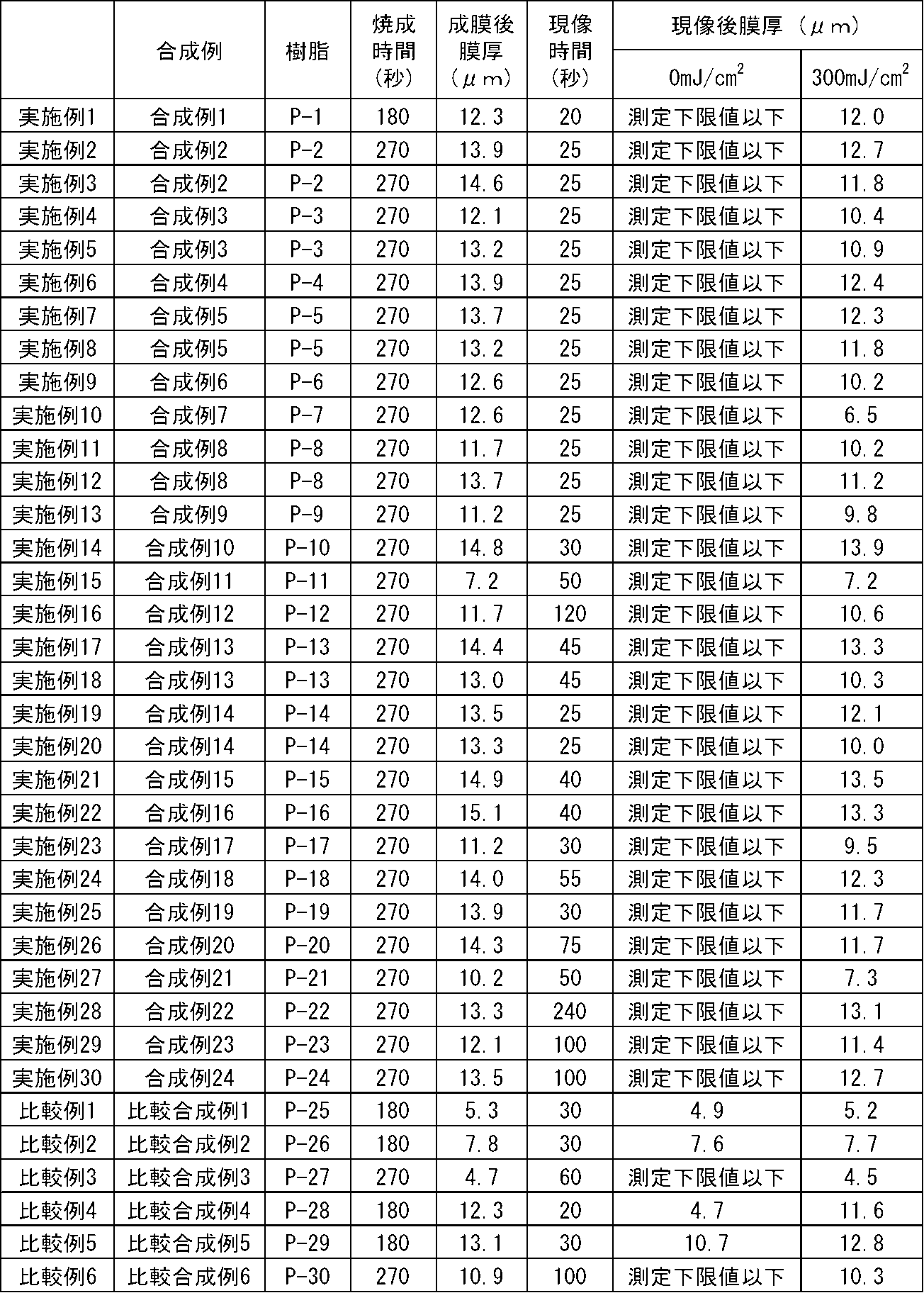
実施例1乃至実施例30及び比較例1乃至比較例6で調製したネガ型感光性樹脂組成物を20μm厚のアルミニウム箔を被覆させた4インチシリコンウェハ上にスピンコートし、ホットプレート上で115℃、180秒間又は270秒間焼成することで、アルミニウム箔上に感光性樹脂膜を形成した。次に、i線アライナー(PLA-501、キヤノン(株)製)を用いて、ウェハ上に500mJ/cm2で全面露光した後、窒素雰囲気中、160℃、1時間、次いで230℃、1時間焼成した。さらに、焼成したアルミニウム箔を6N塩酸に浸漬し、アルミニウム箔を溶解させることで、フィルムを得た。次に、得られたフィルムを80℃、2時間減圧乾燥し、温度約25℃、湿度約42%の環境下で24時間放置した後、1GHzにおける誘電正接を空洞共振器(TMR-1A、キーコム(株)製)を用いて測定した。誘電正接の測定条件は以下の通りである。
・測定方法:摂動方式空洞共振器法
・ベクトルネットワークアナライザー:FieldFox N9926A(キーサイト・テクノロジーズ(株)製)
・空洞共振器:TMR-1A(キーコム(株)製)
・キャビティ容積:1192822mm3
・測定周波数:約1GHz
・サンプルチューブ:PTFE製、内径:3mm、長さ約30mm(キーコム(株)製)
実施例1乃至実施例30及び比較例1乃至比較例6で調製したネガ型感光性樹脂組成物を100nm厚のアルミニウムウェハ上にスピンコートし、ホットプレート上で115℃、180秒間又は270秒間焼成することで、アルミニウムウェハ上に感光性樹脂膜を形成した。次に、i線アライナー(PLA-501、キヤノン(株)製)を用いて、ウェハ上に500mJ/cm2で全面露光した後、窒素雰囲気中、160℃、1時間、次いで230℃、1時間焼成した。さらに、ダイシングソー(DAD323、(株)ディスコ製)で感光性樹脂膜を幅5mm間隔でカットした後、このアルミニウムウェハを6N塩酸に浸漬し、アルミニウムを溶解させることで、幅5mmのフィルムを得た。次に、得られたフィルムを卓上形精密万能試験機(オートグラフAGS-10kNX、(株)島津製作所製)を用いて、フィルムの引張伸度を測定した。引張伸度の測定条件は以下の通りである。
・卓上形精密万能試験機:オートグラフAGS-10kNX((株)島津製作所製)
・フィルム幅:5mm
・つかみ具間距離:25mm
ここで、引張伸度が50%であるとは、フィルムが1.5倍まで伸びること、言い換えればつかみ具間距離が1.5倍(37.5mm)においてフィルムが破断することを意味する。
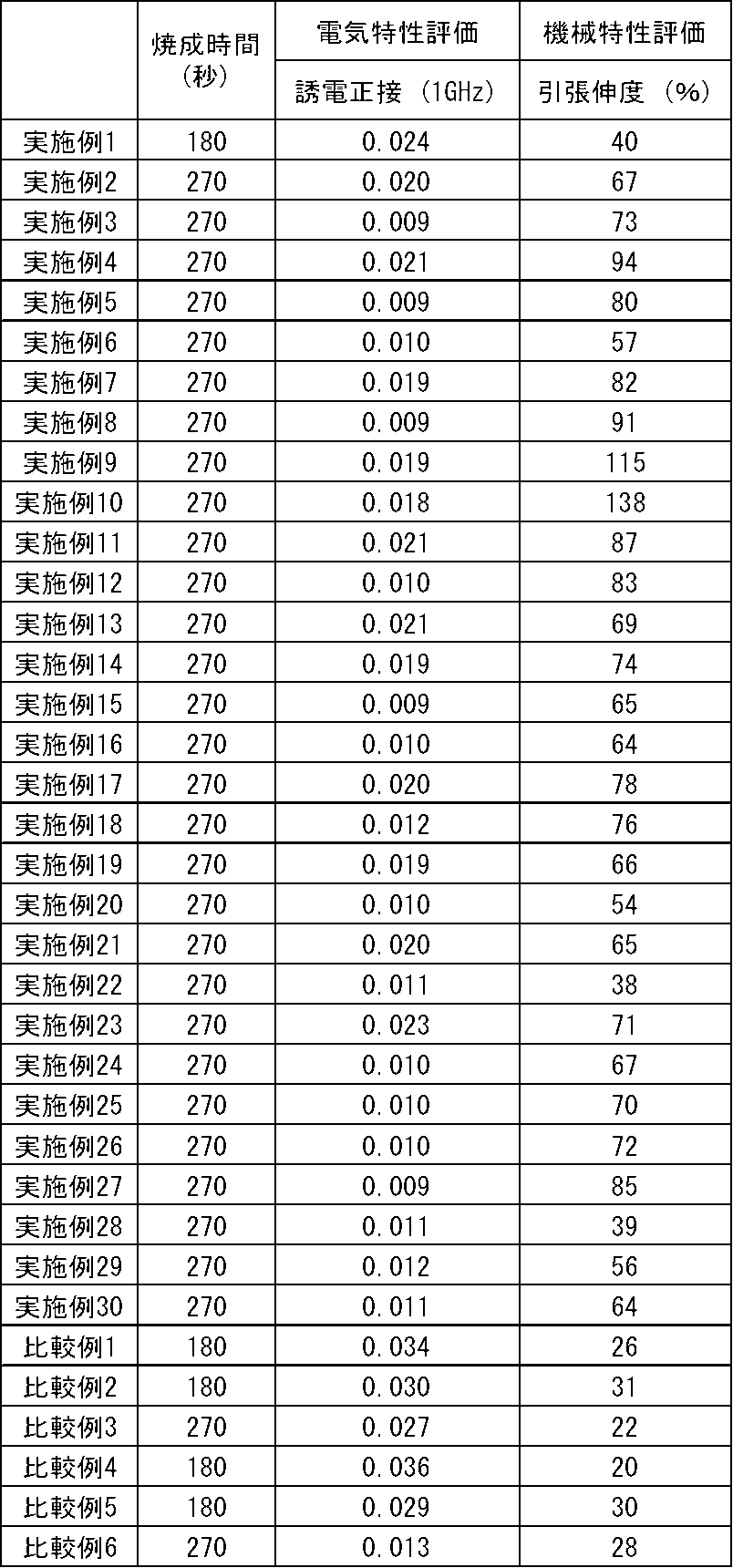
すなわち、実施例1乃至実施例30のネガ型感光性樹脂組成物はレリーフパターンの作成が可能であり、誘電正接が低く、さらに引張伸度が高い特長を同時に有するため、優れた電気特性や機械特性を必要とする電子材料の製造に好適に用いることができる。
Claims (18)
- 光重合性基を有する芳香族ジアミン化合物と3つ以上の芳香族環を有するテトラカルボン酸誘導体との反応生成物と、溶剤とを含む、感光性樹脂組成物。
- 前記反応生成物が、ポリアミック酸又はポリアミック酸を脱水閉環して得られるポリイミドである、請求項1に記載の感光性樹脂組成物。
- 前記ポリアミック酸が、下記式(1)で表される構造単位を少なくとも有し、
前記ポリイミドが、下記式(2)で表される構造単位を少なくとも有する、請求項2に記載の感光性樹脂組成物。

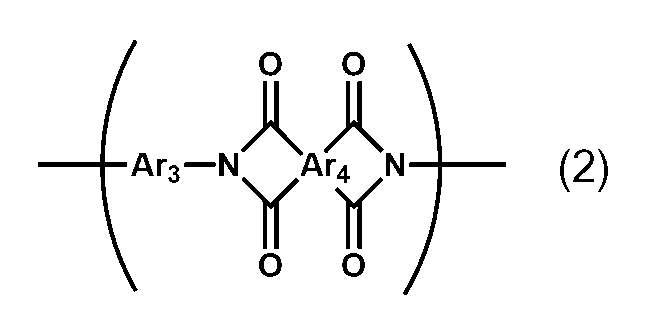
- 前記式(1)中のAr2及び前記式(2)中のAr4が下記式(3)で表される4価の有機基である、請求項3に記載の感光性樹脂組成物。

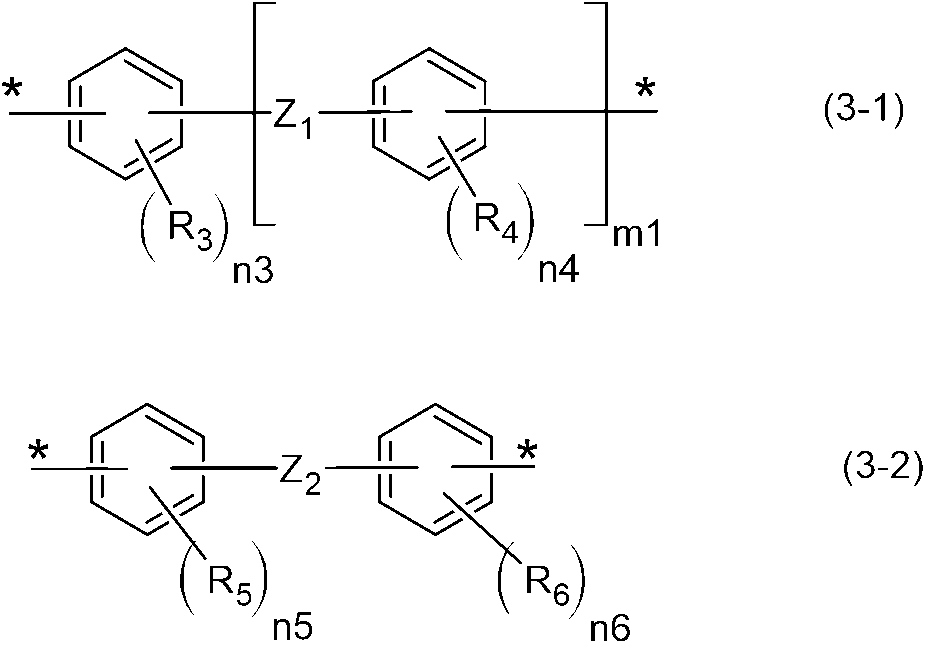
式(3-2)中、Z2は下記式(4)又は(5)で表される2価の有機基を表す。R5及びR6はそれぞれ独立に置換されていてもよい炭素原子数1乃至6の炭化水素基を表す。n5及びn6はそれぞれ独立に0乃至4の整数を表す。R5が複数の場合、複数のR5は同じでもよいし異なっていてもよい。R6が複数の場合、複数のR6は同じでもよいし異なっていてもよい。*は結合手を表す。]

[式(4)中、R7及びR8はそれぞれ独立に水素原子、又はハロゲン原子で置換されていてもよい炭素原子数1乃至6の炭化水素基を表す。*は結合手を表す。
式(5)中、R9及びR10はそれぞれ独立に置換されていてもよい炭素原子数1乃至6のアルキレン基又は置換されていてもよい炭素原子数6乃至10のアリーレン基を表す。*は結合手を表す。] - 前記式(1)中のAr1及び前記式(2)中のAr3が下記式(6)で表される2価の有機基である、請求項3又は4に記載の感光性樹脂組成物。

- 前記式(6)におけるZ3及びZ4がエステル結合である、請求項5に記載の感光性樹脂組成物。
- 前記式(6)におけるR11が1,2-エチレン基である、請求項5又は6に記載の感光性樹脂組成物。
- さらに光ラジカル重合開始剤を含む、請求項1~7のいずれかに記載の感光性樹脂組成物。
- さらに架橋性化合物を含む、請求項1~8のいずれかに記載の感光性樹脂組成物。
- 絶縁膜形成用である、請求項1~9のいずれかに記載の感光性樹脂組成物。
- ネガ型感光性樹脂組成物である、請求項1~10のいずれかに記載の感光性樹脂組成物。
- 請求項1~11のいずれかに記載の感光性樹脂組成物の塗布膜の焼成物である、樹脂膜。
- 絶縁膜である、請求項12に記載の樹脂膜。
- 基材フィルムと、請求項1~11のいずれかに記載の感光性樹脂組成物から形成される感光性樹脂層と、カバーフィルムとを有する、感光性レジストフィルム。
- (1)請求項1~11のいずれかに記載の感光性樹脂組成物を基板上に塗布して、感光性樹脂層を該基板上に形成する工程と、
(2)該感光性樹脂層を露光する工程と、
(3)該露光後の感光性樹脂層を現像して、レリーフパターンを形成する工程と、
(4)該レリーフパターンを加熱処理して、硬化レリーフパターンを形成する工程と
を含む、硬化レリーフパターン付き基板の製造方法。 - 前記現像に用いられる現像液が有機溶媒である、請求項15に記載の硬化レリーフパターン付き基板の製造方法。
- 請求項15又は16に記載の方法により製造された、硬化レリーフパターン付き基板。
- 半導体素子と該半導体素子の上部又は下部に設けられた硬化膜とを備える半導体装置であって、該硬化膜は、請求項1~11のいずれかに記載の感光性樹脂組成物から形成される硬化レリーフパターンである半導体装置。
Priority Applications (3)
| Application Number | Priority Date | Filing Date | Title |
|---|---|---|---|
| KR1020237030944A KR102922080B1 (ko) | 2021-03-22 | 2022-02-25 | 감광성 수지 조성물 |
| CN202280019418.XA CN116982003A (zh) | 2021-03-22 | 2022-02-25 | 感光性树脂组合物 |
| JP2023508841A JP7786452B2 (ja) | 2021-03-22 | 2022-02-25 | 感光性樹脂組成物 |
Applications Claiming Priority (2)
| Application Number | Priority Date | Filing Date | Title |
|---|---|---|---|
| JP2021046929 | 2021-03-22 | ||
| JP2021-046929 | 2021-03-22 |
Publications (1)
| Publication Number | Publication Date |
|---|---|
| WO2022202098A1 true WO2022202098A1 (ja) | 2022-09-29 |
Family
ID=83395591
Family Applications (1)
| Application Number | Title | Priority Date | Filing Date |
|---|---|---|---|
| PCT/JP2022/007899 Ceased WO2022202098A1 (ja) | 2021-03-22 | 2022-02-25 | 感光性樹脂組成物 |
Country Status (4)
| Country | Link |
|---|---|
| JP (1) | JP7786452B2 (ja) |
| KR (1) | KR102922080B1 (ja) |
| CN (1) | CN116982003A (ja) |
| WO (1) | WO2022202098A1 (ja) |
Cited By (5)
| Publication number | Priority date | Publication date | Assignee | Title |
|---|---|---|---|---|
| CN115626989A (zh) * | 2022-10-28 | 2023-01-20 | 嘉兴瑞华泰薄膜技术有限公司 | 光敏聚酰亚胺、光敏聚酰亚胺薄膜及其制备方法和应用 |
| JP2023143861A (ja) * | 2021-03-26 | 2023-10-06 | 財團法人工業技術研究院 | 感光性組成物およびこれにより作製されるフィルム |
| WO2024185652A1 (ja) * | 2023-03-08 | 2024-09-12 | 富士フイルム株式会社 | 樹脂組成物、硬化物、積層体、硬化物の製造方法、積層体の製造方法、半導体デバイスの製造方法、及び、半導体デバイス |
| WO2025142645A1 (ja) * | 2023-12-26 | 2025-07-03 | 住友ベークライト株式会社 | 感光性樹脂組成物、硬化物および半導体装置 |
| US12607932B2 (en) | 2021-03-26 | 2026-04-21 | Industrial Technology Research Institute | Photosensitive composition and film prepared from the same |
Citations (4)
| Publication number | Priority date | Publication date | Assignee | Title |
|---|---|---|---|---|
| JPH01113748A (ja) * | 1987-10-27 | 1989-05-02 | Hitachi Chem Co Ltd | 感光性樹脂組成物 |
| JPH01118514A (ja) * | 1987-11-02 | 1989-05-11 | Hitachi Chem Co Ltd | 感光性樹脂組成物 |
| WO1999051662A1 (en) * | 1998-04-01 | 1999-10-14 | Kanegafuchi Kagaku Kogyo Kabushiki Kaisha | Polyimide compositions |
| WO2021107024A1 (ja) * | 2019-11-27 | 2021-06-03 | 富士フイルム株式会社 | 硬化性樹脂組成物、硬化膜、積層体、硬化膜の製造方法、半導体デバイス、及び、樹脂 |
Family Cites Families (3)
| Publication number | Priority date | Publication date | Assignee | Title |
|---|---|---|---|---|
| KR100583857B1 (ko) * | 1998-04-01 | 2006-05-26 | 가부시키가이샤 가네카 | 폴리이미드화합물 |
| JP2000147768A (ja) * | 1998-11-07 | 2000-05-26 | Pi Gijutsu Kenkyusho:Kk | ネガ型感光性ポリイミド組成物及び絶縁膜 |
| JP2000347404A (ja) | 1999-06-02 | 2000-12-15 | Hitachi Chemical Dupont Microsystems Ltd | 感光性重合体組成物並びにこれを用いた電子部品及びその製造法 |
-
2022
- 2022-02-25 CN CN202280019418.XA patent/CN116982003A/zh active Pending
- 2022-02-25 KR KR1020237030944A patent/KR102922080B1/ko active Active
- 2022-02-25 JP JP2023508841A patent/JP7786452B2/ja active Active
- 2022-02-25 WO PCT/JP2022/007899 patent/WO2022202098A1/ja not_active Ceased
Patent Citations (4)
| Publication number | Priority date | Publication date | Assignee | Title |
|---|---|---|---|---|
| JPH01113748A (ja) * | 1987-10-27 | 1989-05-02 | Hitachi Chem Co Ltd | 感光性樹脂組成物 |
| JPH01118514A (ja) * | 1987-11-02 | 1989-05-11 | Hitachi Chem Co Ltd | 感光性樹脂組成物 |
| WO1999051662A1 (en) * | 1998-04-01 | 1999-10-14 | Kanegafuchi Kagaku Kogyo Kabushiki Kaisha | Polyimide compositions |
| WO2021107024A1 (ja) * | 2019-11-27 | 2021-06-03 | 富士フイルム株式会社 | 硬化性樹脂組成物、硬化膜、積層体、硬化膜の製造方法、半導体デバイス、及び、樹脂 |
Cited By (7)
| Publication number | Priority date | Publication date | Assignee | Title |
|---|---|---|---|---|
| JP2023143861A (ja) * | 2021-03-26 | 2023-10-06 | 財團法人工業技術研究院 | 感光性組成物およびこれにより作製されるフィルム |
| JP7456038B2 (ja) | 2021-03-26 | 2024-03-26 | 財團法人工業技術研究院 | 感光性組成物およびこれにより作製されるフィルム |
| US12607932B2 (en) | 2021-03-26 | 2026-04-21 | Industrial Technology Research Institute | Photosensitive composition and film prepared from the same |
| CN115626989A (zh) * | 2022-10-28 | 2023-01-20 | 嘉兴瑞华泰薄膜技术有限公司 | 光敏聚酰亚胺、光敏聚酰亚胺薄膜及其制备方法和应用 |
| WO2024185652A1 (ja) * | 2023-03-08 | 2024-09-12 | 富士フイルム株式会社 | 樹脂組成物、硬化物、積層体、硬化物の製造方法、積層体の製造方法、半導体デバイスの製造方法、及び、半導体デバイス |
| WO2025142645A1 (ja) * | 2023-12-26 | 2025-07-03 | 住友ベークライト株式会社 | 感光性樹脂組成物、硬化物および半導体装置 |
| JP7736225B1 (ja) * | 2023-12-26 | 2025-09-09 | 住友ベークライト株式会社 | 感光性樹脂組成物、硬化物および半導体装置 |
Also Published As
| Publication number | Publication date |
|---|---|
| TW202244131A (zh) | 2022-11-16 |
| JPWO2022202098A1 (ja) | 2022-09-29 |
| CN116982003A (zh) | 2023-10-31 |
| KR102922080B1 (ko) | 2026-02-03 |
| KR20230160249A (ko) | 2023-11-23 |
| JP7786452B2 (ja) | 2025-12-16 |
Similar Documents
| Publication | Publication Date | Title |
|---|---|---|
| WO2023106104A1 (ja) | 感光性樹脂組成物 | |
| JP7786452B2 (ja) | 感光性樹脂組成物 | |
| JP7131557B2 (ja) | 感光性樹脂組成物 | |
| JP5415861B2 (ja) | 感光性樹脂組成物、パターン形成方法、及び半導体装置 | |
| WO2023106108A1 (ja) | 感光性樹脂組成物 | |
| JP6935982B2 (ja) | 樹脂組成物、硬化レリーフパターンの製造方法、及び半導体装置 | |
| JP7331860B2 (ja) | 感光性絶縁膜組成物 | |
| JP7530736B2 (ja) | 感光性樹脂組成物、硬化レリーフパターンの製造方法、硬化レリーフパターン、半導体装置及び表示体装置 | |
| WO2023106101A1 (ja) | 樹脂組成物 | |
| WO2021117586A1 (ja) | 感光性絶縁膜形成組成物 | |
| JP7332076B1 (ja) | 絶縁膜形成用感光性樹脂組成物 | |
| JP7782317B2 (ja) | 感光性樹脂組成物 | |
| TWI827467B (zh) | 絕緣膜形成用感光性樹脂組成物 | |
| WO2024219463A1 (ja) | ネガ型感光性樹脂組成物、並びにこれを用いた硬化レリーフパターンの製造方法及び硬化膜 | |
| TWI918874B (zh) | 感光性樹脂組成物 | |
| JP2022073737A (ja) | 感光性樹脂組成物、および硬化膜の製造方法 | |
| JP2022050106A (ja) | ネガ型感光性樹脂組成物、硬化膜および化合物 | |
| WO2025220442A1 (ja) | 絶縁膜形成用感光性樹脂組成物 | |
| JP7471480B2 (ja) | 樹脂組成物、硬化レリーフパターンの製造方法、及び半導体装置 | |
| JP2025169530A (ja) | ポリイミドの製造方法及び感光性樹脂組成物 | |
| WO2026100734A1 (ja) | 感光性樹脂組成物、硬化物、パターン硬化物の製造方法、及び電子部品 | |
| WO2025182050A1 (ja) | 感光性樹脂組成物、パターン硬化物の製造方法、パターン硬化物、及び電子部品 | |
| WO2026100079A1 (ja) | 感光性樹脂組成物、硬化物、パターン硬化物の製造方法、及び電子部品 | |
| WO2026042402A1 (ja) | 絶縁膜形成用感光性樹脂組成物 |
Legal Events
| Date | Code | Title | Description |
|---|---|---|---|
| 121 | Ep: the epo has been informed by wipo that ep was designated in this application |
Ref document number: 22774896 Country of ref document: EP Kind code of ref document: A1 |
|
| WWE | Wipo information: entry into national phase |
Ref document number: 202280019418.X Country of ref document: CN Ref document number: 2023508841 Country of ref document: JP |
|
| NENP | Non-entry into the national phase |
Ref country code: DE |
|
| 122 | Ep: pct application non-entry in european phase |
Ref document number: 22774896 Country of ref document: EP Kind code of ref document: A1 |