WO2022190613A1 - 空気浄化装置 - Google Patents
空気浄化装置 Download PDFInfo
- Publication number
- WO2022190613A1 WO2022190613A1 PCT/JP2022/000764 JP2022000764W WO2022190613A1 WO 2022190613 A1 WO2022190613 A1 WO 2022190613A1 JP 2022000764 W JP2022000764 W JP 2022000764W WO 2022190613 A1 WO2022190613 A1 WO 2022190613A1
- Authority
- WO
- WIPO (PCT)
- Prior art keywords
- water
- section
- sterilization
- water level
- compartment
- Prior art date
- Legal status (The legal status is an assumption and is not a legal conclusion. Google has not performed a legal analysis and makes no representation as to the accuracy of the status listed.)
- Ceased
Links
Images






Classifications
-
- A—HUMAN NECESSITIES
- A61—MEDICAL OR VETERINARY SCIENCE; HYGIENE
- A61L—METHODS OR APPARATUS FOR STERILISING MATERIALS OR OBJECTS IN GENERAL; DISINFECTION, STERILISATION OR DEODORISATION OF AIR; CHEMICAL ASPECTS OF BANDAGES, DRESSINGS, ABSORBENT PADS OR SURGICAL ARTICLES; MATERIALS FOR BANDAGES, DRESSINGS, ABSORBENT PADS OR SURGICAL ARTICLES
- A61L9/00—Disinfection, sterilisation or deodorisation of air
- A61L9/01—Deodorant compositions
-
- C—CHEMISTRY; METALLURGY
- C02—TREATMENT OF WATER, WASTE WATER, SEWAGE, OR SLUDGE
- C02F—TREATMENT OF WATER, WASTE WATER, SEWAGE, OR SLUDGE
- C02F1/00—Treatment of water, waste water, or sewage
- C02F1/46—Treatment of water, waste water, or sewage by electrochemical methods
- C02F1/461—Treatment of water, waste water, or sewage by electrochemical methods by electrolysis
Definitions
- the present disclosure generates hypochlorous acid with salt-containing water in a water storage container, rotates a filter partially immersed in the water in the water storage container, and ventilates the filter to contain hypochlorous acid.
- the present invention relates to an air purifier equipped with an air passage for sterilizing with fresh water.
- a conventional air purifying device As a conventional air purifying device, a main body case having an air inlet and an air outlet, a water storage container in which an electrolysis unit having electrodes for electrochemically treating water is disposed, and water in the water storage container is retained.
- an air purifier that includes a gas-liquid contact portion, a blower that blows air to the gas-liquid contact portion, and a water supply portion that automatically supplies water so that the water level in the water storage container is constant (see, for example, Patent Document 1).
- the air that is ventilated into the main body from the outside of the main body case is sterilized by passing through the gas-liquid contact portion.
- an electrolytic cell having an electrolysis unit is provided separately from the water storage container, and a transport section for transporting electrochemically treated water to the water storage container having a gas-liquid contact portion;
- a control section for controlling the transportation section is provided separately from the water storage container, and a transport section for transporting electrochemically treated water to the water storage container having a gas-liquid contact portion;
- the air purifying device of the present disclosure includes a body case provided with an intake port and an air outlet.
- the main body case has a gas-liquid contact part that makes air contact with water containing hypochlorous acid, an air passage that communicates the intake port and the outlet via the gas-liquid contact portion, and air that passes through the air passage.
- an electrolytic cell that electrochemically processes water to generate hypochlorous acid
- a water supply compartment that stores water
- a sterilization compartment having a gas-liquid contact part
- a first transport unit for transporting water in the water supply compartment to the electrolytic cell
- a second transport unit for transporting water containing hypochlorous acid in the electrolytic cell to the sterilization compartment
- a blower for transporting water containing hypochlorous acid in the electrolytic cell to the sterilization compartment
- a blower a first transport unit and a second 2
- a control section for controlling the transport section
- a water supply section for stopping water supply when the water level in the water supply section reaches a predetermined water level.
- a water supply compartment and a disinfection compartment are provided within the water reservoir.
- the water storage container has a first guide part configured to guide the water in the sterilization compartment to the water supply compartment when the water level in the sterilization compartment reaches or exceeds a predetermined water level.
- the present disclosure can provide an air purification device that exhibits stable sterilization performance and can prevent water leakage to the outside of the main body case.
- FIG. 1 is a perspective view of an air cleaner according to Embodiment 1 of the present disclosure.
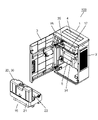
- FIG. 2 is a perspective view of the same air purifier with the door opened.
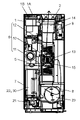
- FIG. 3 is a cross-sectional view showing the structure of the air cleaner.
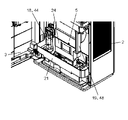
- FIG. 4 is a perspective view of a water reservoir of the air cleaner.
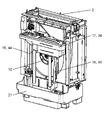
- FIG. 5 is a perspective view showing the internal structure of the air cleaner.
- FIG. 6 is a perspective view of the water reservoir of the air purifier.
- FIG. 7 is a plan view of the water reservoir of the air purifier.
- FIG. 8 is a plan view of the water reservoir of the air purifier.
- FIG. 9 is a perspective view of the water supply unit of the air cleaner.
- FIG. 10 is a perspective view of an electrolytic cell of the same air cleaner.
- FIG. 10 is a perspective view of an electrolytic cell of the same air cleaner.
- FIG. 11 is a perspective view of an electrolytic cell of the air cleaner.
- FIG. 12 is a cross-sectional view of an electrolytic cell of the same air cleaner.
- FIG. 13 is a perspective view of a tablet loading mechanism of the air cleaner.
- FIG. 14 is a perspective view showing the inside of the tablet loading case of the tablet loading mechanism of the air cleaner.
- FIG. 15 is a perspective view of the water reservoir of the air purifier.
- FIG. 16 is a cross-sectional view of the water reservoir of the air cleaner.
- FIG. 17 is a cross-sectional view of the water reservoir of the air cleaner according to Embodiment 2 of the present disclosure.
- FIG. 1 and 2 are perspective views of air purifier 100 according to Embodiment 1 of the present disclosure.
- FIG. 1 is a perspective view of the air purifier 100 as seen from the front side.
- FIG. 2 is a front perspective view of the air purifier 100 with the door opened and the water reservoir 16 removed.
- FIG. 3 is a side cross-sectional view of the air purifier 100 of Embodiment 1.
- FIG. 1 is a perspective view of the air purifier 100 as seen from the front side.
- FIG. 2 is a front perspective view of the air purifier 100 with the door opened and the water reservoir 16 removed.
- FIG. 3 is a side cross-sectional view of the air purifier 100 of Embodiment 1.
- the vertical direction in the state where the air purifier 100 is installed as shown in FIG. 1 may be referred to as the up-down direction, and the horizontal direction as the left-right direction.
- the surface of the air purification device 100 on which the door 3 is provided is referred to as the “front surface”
- the surface facing the front surface of the air purification device 100 is referred to as the “back surface”.
- the right side as viewed from the front side of the air purifier 100 is referred to as the "right side”
- the left side as the "left side”.
- an air purification device 100 of the present embodiment includes a substantially box-shaped main body case 1. As shown in FIG. Approximately rectangular intake ports 2 are provided on both side surfaces of the body case 1 . A door 3 that can be opened and closed is provided on the front surface of the main body case 1 . By opening the door 3, a part of the air purification unit 7 (see FIG. 3) inside the body case 1, which will be described later, can be taken out. An openable air outlet 4 is provided on the top surface of the main body case 1 .
- a partition plate 5 As shown in FIGS. 2 and 3 , a partition plate 5 , a blower 6 , an air cleaning unit 7 , an air passage 8 , and a control section 9 are provided inside the main body case 1 .
- the partition plate 5 is a plate provided in the center of the body case 1, and separates the front side and the back side of the body case 1 together with a partition wall 24 (see FIG. 4), which will be described later.
- the back side of the main body case 1 separated by the partition plate 5 is the air passage 8 .
- the blower 6 sucks air into the main body case 1 through the air inlet 2 and blows out the sucked air through the outlet 4 .
- the blower 6 is provided in the center of the body case 1 and includes a motor section 10 , a fan section 11 rotated by the motor section 10 , and a casing section 12 surrounding the motor section 10 and the fan section 11 .
- the operation of the blower 6 in this embodiment is determined by the operation section 1A provided in the main body case 1. As shown in FIGS. 1, 2 and 3, the operating portion 1A is covered with an openable cover 1B provided on the top surface of the main body case 1. As shown in FIGS. A user of the air purification device 100 of the present disclosure can adjust the air volume of the blower 6 step by step by operating an air volume switching button (not shown) provided on the operation unit 1A. Information operated by the user is sent to the control section 9 as an input signal.
- the fan section 11 is fixed to a motor shaft 13 extending horizontally from the motor section 10 .
- the fan unit 11 is, for example, a sirocco fan.
- the motor section 10 is fixed to the casing section 12 .
- a discharge port 14 is provided on the upper surface side of the main body case 1 of the casing portion 12 .
- a suction port 15 is provided on the rear side of the main body case 1 of the casing portion 12 .
- FIG. 4 is a perspective view of the air purifier 100 of Embodiment 1 with the water storage container 21 arranged inside the main body case 1 .
- FIG. 5 is a perspective view showing the internal structure of the air purifier 100 of Embodiment 1 with some components removed.
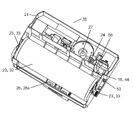
- FIG. 6 is a perspective view of the water reservoir 16 of the air cleaner 100 of Embodiment 1.
- the air purification unit 7 stores water from the water supply unit 22 in the electrolytic bath 34, and puts electrolysis-enhancing tablets into the water in the electrolytic bath 34 by the tablet injection mechanism 35 to generate electricity.
- Water containing hypochlorous acid is generated by decomposition, and the generated water containing hypochlorous acid is brought into contact with the air sucked into the main body case 1 from the intake port 2 by the blower 6 and is discharged from the blowout port 4. It is a spraying device.
- the air purification unit 7 includes a water storage section 16 , an electrolytic section 17 , a first transport section 18 , a second transport section 19 and a third transport section 20 .
- the water storage unit 16 stores water and performs sterilization.
- the water storage section 16 has a water storage container 21 , a water supply section 22 and a gas-liquid contact section 23 .
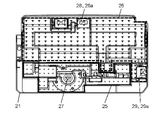
- FIG. 7 is a plan view of the water reservoir 16 of the air cleaner 100 of Embodiment 1.
- FIG. 8 is a plan view showing the internal structure of the air purifying device 100 of Embodiment 1 with some of the constituent parts of the water reservoir 16 removed.
- the water storage container 21 is arranged in the lower part of the main body case 1, has a box shape with an open top, and has a structure capable of storing water. there is
- the water storage container 21 has a partition wall 24 , a water supply section 25 and a sterilization section 26 .
- the partition wall 24 is a plate that separates the front side of the main body case 1 (outside the air passage 8) from the back side of the main body case 1 (air passage 8) in the water storage container 21.
- the partition wall 24 extends upward from the bottom surface of the water storage container 21 .
- the upper end of the partition wall 24 is arranged above the upper end of the water storage container 21 . Part of the surface of the upper end of the partition wall 24 is in contact with the wall surface of the partition plate 5 .
- the front side of the main body case 1 (outside the air passage 8) and the rear side of the main body case 1 (the air passage 8) are separated from each other so that air does not flow in and out.
- the water supply section 25 has a substantially bowl shape and is a section that stores water supplied from the water supply section 22 .
- the water supply section 25 is positioned closer to the front side of the main body case 1 than the partition wall 24 in the water storage container 21 arranged in the lower portion of the main body case 1 .
- the water supply section 25 has a structure capable of holding the water supply section 22 .
- a cylindrical protrusion 27 is provided at the bottom of the water supply section 25 at a position where the water supply section 22 is held.
- the sterilization compartment 26 has a substantially bowl shape and is a compartment for storing water containing hypochlorous acid at a predetermined concentration.
- the sterilization section 26 is provided so as to straddle the front side and the back side of the partition wall 24, and the front side and the back side of the partition wall 24 are separated by an opening (not shown) provided below the water surface of the partition wall 24. communicates with The sterilization section 26 has a first water amount detection section 28 and a second water amount detection section 29 for detecting the water level in the sterilization section 26 .
- the first water level detection unit 28 detects that the water level in the sterilization section 26 has fallen below the drought water level, which is lower than the target water level.
- the target water level refers to the water level of the maximum amount of water set for each component in the air purification operation of the air purifier 100 of the present disclosure.
- the drought water level refers to the minimum water level set for each component in the air purification operation of the air purification device 100 of the present disclosure.
- the first water volume detection unit 28 is located on the back side of the partition wall 24 in the sterilization section 26, and has a first float portion 28a having buoyancy and a first detection sensor (not shown) that detects the position of the first float portion 28a. without).
- a first float portion 28 a is located within the disinfection compartment 26 .
- the first detection sensor is embedded in the wall of the main body case 1 near the first float portion 28a. When the water level in the sterilization section 26 drops below the water level of the drought, the first detection sensor cannot detect the first float part 28a due to the accompanying floating of the first float part 28a. At this time, the first detection sensor sends a signal to the controller 9 indicating that the water level in the sterilization section 26 has fallen below the water level of the drought.
- the second water level detection unit 29 detects that the water level in the sterilization section 26 has reached the target water level.
- the second water amount detection unit 29 is located on the front side of the partition wall 24 in the sterilization section 26, and has a second float portion 29a having buoyancy and a second detection sensor (not shown) that detects the position of the second float portion 29a. without).
- a second float portion 29 a is positioned within the disinfection compartment 26 .
- the second detection sensor is embedded near the second float portion 29a in the wall portion of the main body case 1. As shown in FIG. When the water level in the sterilization section 26 rises and reaches the target water level, the second detection sensor detects the second float portion 29a by the accompanying floating of the second float portion 29a. At this time, the second detection sensor sends a signal to the controller 9 indicating that the water level in the sterilization section 26 has reached the target water level.
- FIG. 9 is a perspective view of the water supply section 22 of the air cleaner 100 of Embodiment 1.
- FIG. 9 is a perspective view of the water supply section 22 of the air cleaner 100 of Embodiment 1.
- the water supply unit 22 is installed in the water supply section 25, has a structure that is detachable from the water supply section 25, and automatically supplies water so that the water level in the water supply section 25 is constant.
- the water supply unit 22 has a hollow tank 30 for storing water and a handle 30a provided on the top of the tank 30 .
- the handle 30 a is integrated with the tank 30 . Therefore, the user can attach/detach the water supply unit 22 to/from the water supply section 25 while holding the handle 30a.
- the tank 30 has a circular tank opening (not shown) in the center of the bottom when it is attached to the water supply section 25 .
- the tank opening of the tank 30 has a cylindrical shape with a central axis extending vertically, and is configured to be sealed by a cap 31 detachable from the outer circumference of the tank opening.
- the cap 31 has a cylindrical shape with its central axis extending vertically. At the center of the bottom surface of the cap 31 attached to the water storage container 21, a cap opening 31a having a cylindrical shape and opening in the vertical direction is provided. The cap opening 31a is provided with a faucet 31b for opening and closing the lid opening.
- the faucet 31b has a cylindrical shaft (not shown), an on-off valve (not shown) provided on one side of the shaft so as to block the cap opening 31a, and the shaft passing through its center.
- a coiled spring (not shown) is provided on the other side of the shaft and a spring detent (not shown) is provided on the other side of the shaft.
- the spring stopper portion hits the projection 27 of the water supply section 25. This causes the spring stop portion to move upward while compressing the spring. Along with this, the on-off valve of the faucet 31b moves upward and separates from the cap opening 31a of the cap 31 . As a result, the water in the tank 30 flows into the water supply section 25 through the cap opening 31 a of the cap 31 .
- the water supply section 25 can always maintain a constant water level.
- the gas-liquid contact portion 23 is located on the back side of the partition wall 24 in the sterilization section 26 , and the water stored in the sterilization section 26 and the air blower 6 move the gas-liquid contact section 23 into the main body case 1 . It is a member that makes contact with the sucked room air.
- the gas-liquid contact portion 23 has a filter 32, a filter frame 33, and a driving portion (not shown).
- the filter 32 has water retentivity, is configured in a cylindrical shape, and has a configuration in which holes through which air can flow are provided on the circumference.
- the filter 32 is attached to the filter frame 33 so that one end of the filter 32 is immersed in the water of the sterilization compartment 26 .
- the filter frame 33 is rotatably supported by bearings (not shown) provided in the water storage container 21 .
- the filter 32 and the filter frame 33 are structured so as to be rotated by a drive section.
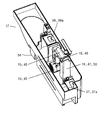
- FIG. 10 is a perspective view of the electrolytic cell 34 of the air cleaner 100 of Embodiment 1.
- FIG. 11 is a perspective view showing the internal structure of the air purifier 100 of the first embodiment with some components removed from the electrolytic cell 34 .
- FIG. 12 is a cross-sectional view of the electrolytic cell 34 of the air cleaner 100 of Embodiment 1 as viewed from the side.
- the electrolyzer 17 electrolyzes the water in the electrolytic cell 34 to produce water containing hypochlorous acid.
- the electrolysis section 17 includes an electrolytic bath 34, a tablet loading mechanism 35 (see FIG. 2), and an electrolysis unit 36.
- the electrolytic bath 34 is provided above the water storage container 21 and has a substantially box shape with an open top.
- the electrolytic bath 34 stores water transported from the water storage portion 16 by the first transport portion 18 in the electrolytic bath 34 .
- the electrolytic bath 34 has a third water level detector 37 and a fourth water level detector 38 for detecting the water level of the electrolytic bath 34 .
- the third water level detection unit 37 detects that the water level in the electrolytic cell 34 has reached or exceeded the water shortage level, or that it has fallen below the water shortage level.
- the third water amount detection unit 37 has a third float portion 37a having buoyancy and a third detection sensor (not shown) that detects the position of the third float portion 37a.
- a third float portion 37 a is arranged in the electrolytic bath 34 .
- the third detection sensor is embedded near the third float portion 37a in the wall portion of the main body case 1. As shown in FIG.
- the third detection sensor detects the third float portion 37a by floating of the third float portion 37a when the water level in the electrolytic cell 34 rises from a water level lower than the water shortage level and reaches the water shortage level.
- the third detection sensor sends a signal to the controller 9 indicating that the water level in the electrolytic cell 34 has reached the water shortage level or higher. Further, when the water level in the electrolytic cell 34 drops below the water shortage level, the third detection sensor cannot detect the third float part 37a due to the accompanying floating of the third float part 37a. At this time, the third detection sensor sends a signal to the controller 9 indicating that the water level in the electrolytic cell 34 has fallen below the water level of the water shortage.
- the fourth water level detection unit 38 detects that the water level in the electrolytic cell 34 has reached the target water level.
- the fourth water amount detection unit 38 has a fourth float portion 38a having buoyancy and a fourth detection sensor (not shown) that detects the position of the fourth float portion 38a.
- a fourth float portion 38 a is positioned in the electrolytic bath 34 .
- the fourth detection sensor is embedded near the fourth float portion 38a in the wall portion of the main body case 1. As shown in FIG.
- the fourth detection sensor detects the fourth float portion 38a due to the accompanying floating of the fourth float portion 38a when the water level in the electrolytic bath 34 rises and reaches the target water level. At this time, the fourth detection sensor sends a signal to the controller 9 indicating that the water level in the electrolytic cell 34 has reached the target water level.
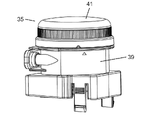
- FIG. 13 is a perspective view of the tablet loading mechanism 35 of the air cleaner 100 of Embodiment 1.
- FIG. 14 is a perspective view showing the inside of the tablet loading case 39 of the tablet loading mechanism 35 of the air cleaner 100 of Embodiment 1.
- FIG. 13 is a perspective view of the tablet loading mechanism 35 of the air cleaner 100 of Embodiment 1.
- FIG. 14 is a perspective view showing the inside of the tablet loading case 39 of the tablet loading mechanism 35 of the air cleaner 100 of Embodiment 1.
- the tablet loading mechanism 35 is installed above the electrolytic cell 34.
- the tablet injection mechanism 35 includes a tablet injection case 39, a tablet injection member 40 provided in the tablet injection case 39, a tablet injection cover 41 detachably provided on the top of the tablet injection case 39, and the tablet injection member 40. and a loading motor that rotates the .
- the tablet charging cover 41 is removed from the tablet charging case 39 and the electrolysis promoting tablet 42 is placed in the tablet charging case 39
- the tablet charging member 40 is rotated by the charging motor.
- the injection motor rotates the tablet injection member 40 at predetermined time intervals by the control unit 9 .
- the electrolysis promoting tablet 42 automatically drops from the opening 39 a in the bottom of the tablet-inserting case 39 into the electrolytic bath 34 .
- sodium chloride can be used for the electrolysis enhancing tablet 42 .
- the electrolysis unit 36 immerses a first electrode (not shown) and a second electrode (not shown) in the water of the electrolytic bath 34, and applies a voltage to the first electrode and the second electrode. , electrochemically treats the water in the electrolytic cell 34 containing the electrolysis enhancing tablets 42 thrown in by the tablet feeding mechanism 35 to generate hypochlorous acid.
- An example of the electrolysis promoting tablet 42 is sodium chloride.
- the electrolytic unit 36 electrochemically electrolyzes the aqueous sodium chloride solution to generate electrolyzed water containing active oxygen species (hypochlorous acid is used as an example in the present embodiment).
- reactive oxygen species refer to oxygen molecules with higher oxidation activity than normal oxygen and their related substances.
- active oxygen species include not only so-called narrowly-defined active oxygen such as superoxide anions, singlet oxygen, hydroxyl radicals, or hydrogen peroxide, but also so-called broadly-defined active oxygen species such as ozone and hypochlorous acid (hypohalogenous acid). Contains active oxygen.
- generating electrolyzed water containing active oxygen species here hypochlorous acid
- the first transport section 18 transports water from the water storage section 16 to the electrolysis section 17.
- the first transport section 18 has a first pump 43 provided to be submerged in the water of the water supply section 25 and a first transport channel 44 connected to the first pump 43 . is doing.
- the first pump 43 is a drawing-up pump, and moves the water supplied from the water supply section 22 to the water supply section 25 to the first transport waterway 44 and transports it to the electrolytic cell 34 .
- the first transport waterway 44 is a cylindrical pipe with openings at both ends. One end of the opening of the first transport channel 44 is connected to the first pump 43 , and the other end of the opening of the first transport channel 44 is positioned above the top surface of the electrolytic cell 34 .
- the second transport section 19 transports water from the electrolysis section 17 to the water storage section 16.
- the second transport unit 19 includes a second pump 45 provided so as to be immersed in the water of the electrolytic cell 34, a second pre-transport channel 46 connected to the second pump 45, and a It has a supply tank 47 and a second post-transport channel 48 connected to the supply tank 47 .
- the second pump 45 is a pumping type pump, and moves the water that has been electrochemically treated in the electrolytic bath 34 to the second pre-stage transport water channel 46 and transports it to the supply bath 47 .
- the second front-stage transport waterway 46 is a cylindrical pipe with openings at both ends. One end of the opening of the second pre-transport channel 46 is connected to the second pump 45 , and the other end of the opening of the second pre-transport channel 46 is connected to a later-described connection port 49 of the supply tank 47 .
- the supply tank 47 has a substantially bowl shape with an opening on the top surface, and is provided inside the electrolytic tank 34 .
- a connection port 49 for connecting to the second front-stage transport water channel 46 is provided on the side surface of the supply tank 47 .
- a drop opening 50 is provided on the bottom surface of the supply tank 47 .
- the upper end of the supply bath 47 is provided lower than the upper end of the electrolytic bath 34 .
- connection port 49 is provided on a part of the side surface of the supply tank 47 and has a circular shape equal to the outer diameter of the second front-stage transport water channel 46 .
- the drop opening 50 is provided so as to penetrate the bottom surface of the supply tank 47 and has a circular shape with a predetermined diameter.
- the second rear-stage transport waterway 48 is a cylindrical pipe with openings at both ends. One end of the opening of the second rear-stage transport channel 48 is connected to the drop opening 50 , and the other end of the opening of the second rear-stage transport channel 48 is positioned above the sterilization section 26 .
- the third transport section 20 transports the water in the water supply section 25 to the sterilization section 26.
- the third transport section 20 has a third pump 51 provided to be submerged in the water of the water supply section 25 and a third transport channel 52 connected to the third pump 51 .
- the third pump 51 is a pumping type pump, and moves the water supplied from the water supply section 22 to the water supply section 25 to the third transport channel 52 and transports it to the sterilization section 26 .
- the third transport channel 52 is a cylindrical pipe with openings at both ends. One end of the opening of the third transport channel 52 is connected to the third pump 51, and the other end of the opening of the third transport channel 52 is located directly above the water surface on the front side of the partition wall 24 of the sterilization section 26. ing.
- the main body case 1 has the third transport section 20 that transports the water in the water supply section 25 to the sterilization section 26.
- the air passage 8 communicates the intake port 2 and the blowout port 4 with each other.
- the air passage 8 is provided with a gas-liquid contact portion 23 , a blower 6 , and an air outlet 4 in this order from the air inlet 2 .
- the fan portion 11 is rotated by the motor portion 10 , the outside air that has entered the air passage 8 through the air intake port 2 is blown out from the air outlet 4 via the air-liquid contact portion 23 and the blower 6 in order.
- the control unit 9 is provided inside the main body case 1 .
- the control unit 9 receives signals from the first water amount detection unit 28, the second water amount detection unit 29, the third water amount detection unit 37, the fourth water amount detection unit 38, and the operation unit 1A. . Further, the control section 9 controls operations of the electrolysis unit 36 , the first transport section 18 , the second transport section 19 , the third transport section 20 and the tablet loading mechanism 35 . Thereby, the control unit 9 adjusts the concentration and amount of water containing hypochlorous acid in the sterilization section 26 .
- control unit 9 controls the consumption of hypochlorous acid in the water containing hypochlorous acid in the sterilization section 26 and the hypochlorous acid It is possible to estimate the decrease in the water content of the acid-laden water.
- the control unit 9 When the third water amount detection unit 37 detects that the water level in the electrolytic cell 34 is lower than the water shortage level, the control unit 9 operates the first pump 43 to supply water through the first transport water channel 44. to start transporting water from the water supply compartment 25 to the electrolytic cell 34 .
- the control unit 9 operates the tablet insertion mechanism 35 to insert the electrolysis promoting tablet 42 into the electrolytic cell 34 .
- the control section 9 stops the operation of the first pump 43 .
- control section 9 starts the operation of the electrolysis unit 36, and stops the operation of the electrolysis unit 36 after a predetermined time has passed. As a result, water containing a certain concentration of hypochlorous acid is generated and retained in the electrolytic bath 34 .
- the control unit 9 estimates that a predetermined amount of hypochlorous acid in the sterilization section 26 has been consumed from the signal indicating the air volume of the blower 6 sent from the operation unit 1A, the second pump 45 is operated. , transport of water containing hypochlorous acid from the electrolytic cell 34 to the supply cell 47 via the second pre-stage transport channel 46 is started.
- the control unit 9 stops the operation of the second pump 45.
- the hypochlorous acid-containing water transported to the supply tank 47 gradually moves through the drop opening 50 to the second rear-stage transport water channel 48, and then to the sterilization section 26 via the second rear-stage transport water channel 48. be transported.
- control unit 9 When the control unit 9 estimates that the amount of water in the sterilization section 26 has decreased by a predetermined amount based on the signal indicating the air volume of the blower 6 received from the operation unit 1A, the control unit 9 operates the third pump 51 to operate the water supply section 25. to the disinfection compartment 26.
- the control unit 9 stops the operation of the third pump 51 . At this time, by mixing the water containing hypochlorous acid transported from the second transport unit 19 and the water transported from the third transport unit 20, the concentration of hypochlorous acid in the sterilization section 26 is set to a predetermined value. is adjusted to a concentration of
- the sterilization section 26 retains water containing hypochlorous acid in a predetermined range of water volume and concentration. As a result, it is possible to provide an air purifier that exhibits stable sterilization performance.
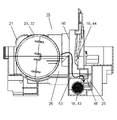
- FIG. 15 is a perspective view of the water reservoir 16 of the air cleaner 100 of Embodiment 1.
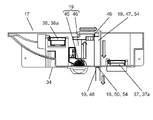
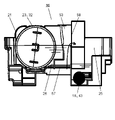
- FIG. FIG. 16 is a cross-sectional view of water reservoir 16 of air cleaner 100 of Embodiment 1. As shown in FIG.
- the partition wall 24 is provided with a first guide portion 53 at a position higher than the target water level of the sterilization section 26 .
- the first guide part 53 guides water from the sterilization section 26 to the water supply section 25 when the water level in the sterilization section 26 exceeds the target water level and the water surface reaches a predetermined water level. That is, the water storage container 21 includes the first guide portion 53 that guides the water in the sterilization section 26 to the water supply section 25 when the water level in the sterilization section 26 reaches or exceeds a predetermined water level.
- the first guide part 53 only needs to guide the water in the sterilization section 26 to the water supply section 25 when the water level in the sterilization section 26 reaches or exceeds a predetermined water level. not something to do.
- the feature of this embodiment is that it has a water supply section 22 that stops supplying water when the water level in the water supply section 25 reaches a predetermined water level, and the water supply section 25 and the sterilization section 26 are provided in the water storage container 21, and the sterilization section It is provided with a first guide portion 53 that guides the water in the sterilization section 26 to the water supply section 25 when the water level in 26 reaches or exceeds a predetermined level.
- control unit 9 operates abnormally, or the transport unit itself malfunctions, and the first transport unit 18 and the second transport unit 19 do not stop and operate continuously. can. That is, the control unit 9 causes the first transport unit 18 to transport a predetermined amount of water in the water supply section 25 to the electrolytic cell 34 before the amount of water in the electrolytic cell 34 becomes less than a predetermined amount. This is the case where a predetermined amount of water containing hypochlorous acid in the electrolytic cell 34 is transported to the sterilization section 26 by the second transport section 19 before the amount of water containing hypochlorous acid becomes less than the predetermined amount.
- the first transport section 18 transfers a predetermined amount of water in the water supply section 25 to the electrolytic cell 34. are transporting. Therefore, the water level in the water supply section 25 becomes lower than the predetermined water level, and the water supply from the water supply section 22 does not stop. That is, since the water newly supplied from the water supply unit 22 to the water supply section 25 is transported into the sterilization section 26 by the first transport section 18 and the second transport section 19, the water continues to overflow from the sterilization section 26. .
- the water supply section 25 is equipped with a tank 30 that automatically supplies water to the lower end of the cap opening 31a, so that the water level in the sterilization section 26 reaches the cap opening 31a. Water is continuously supplied to the water supply section 25 as long as the position remains lower than the lower end of the . Along with this, the water level in the sterilization section 26 rises and continues to overflow. Note that the volume of the tank 30 is larger than the volume of the entire water storage container 21 .
- the water storage container 21 is provided with a first guide portion 53 that guides the water in the sterilization section 26 to the water supply section 25 when the water level in the sterilization section 26 reaches or exceeds a predetermined water level
- Water in the sterilization section 26 is guided to the water supply section 25 by the first guide portion 53 .
- the water level in the water supply section 25 rises to a predetermined water level, and water supply from the water supply section 22 to the water supply section 25 stops. That is, water is not newly supplied from the water supply unit 22 to the water supply section 25 .
- the water in the sterilization section 26 is guided to the water supply section 25 by the first guide portion 53, and the water level in the water supply section 25 rises. do.
- the tank 30 is sealed by the water surface, the water supply from the water supply section 22 stops, and the water level in the entire water storage container 21 stops rising. .
- the supply tank 47 and the drop opening 50 in the present embodiment cause the water containing hypochlorous acid in the electrolytic tank 34 to flow into the second transport section 19 when the water level in the electrolytic tank 34 rises above a predetermined level. 10 and 12) that guides water so as to flow into the second rear-stage transport channel 48, which is a part.
- the second transport section 19 has a second post-stage transport channel 48 that communicates the electrolytic cell 34 and the sterilization section 26 .
- the electrolytic cell 34 is arranged above the sterilization section 26, and when the water level of the electrolytic cell 34 becomes higher than a predetermined water level, the water containing hypochlorous acid in the electrolytic cell 34 flows into the second post-stage transport water channel 48. It has a second guide part 54 that guides water to.
- control unit 9 operates abnormally, or the first transportation unit 18 itself malfunctions, and the first transportation unit 18 continues to operate even after the water level of the electrolytic cell 34 reaches the target water level. It is possible to assume a failure that continues the transportation operation.
- the supply tank 47 has a substantially bowl shape with an opening at the top, and is provided inside the electrolytic tank 34 .
- a drop opening 50 is provided on the bottom surface of the supply tank 47 .
- the water supply section 25 is equipped with the tank 30 that automatically supplies water to the lower end of the cap opening 31a, the water level in the sterilization section 26 is lower than the lower end of the cap opening 31a.
- Water supply to the water supply section 25 is continuously performed as long as . Accordingly, the water level in the sterilization section 26 continues to rise. Note that the volume of the tank 30 is larger than the volume of the entire water storage container 21 .
- the water in the sterilization section 26 is guided to the water supply section 25 by the first guide portion 53, and the water level in the water supply section 25 rises.
- the tank 30 is sealed by the water surface, the water supply from the water supply section 22 stops, and the water level in the entire water storage container 21 stops rising. .
- the water storage container 21 has a volume capable of holding the total amount of water of the target water level of the water supply section 25, the target water level of the sterilization section 26, and the target water level of the electrolyzer 34. .
- the second transportation unit 19 even after the control unit 9 operates abnormally or the second transportation unit 19 itself malfunctions and the water level in the sterilization section 26 reaches the target water level, the second transportation unit 19 It is possible to assume a failure that continues the transportation operation of It should be noted that the water level in the water storage container 21 becomes the highest in the case of this failure.
- the water storage container 21 has a volume capable of holding the total amount of water of the target water level of the water supply section 25, the target water level of the sterilization section 26, and the target water level of the electrolytic cell 34. Therefore, even if all the water containing hypochlorous acid in the electrolytic cell 34 is transported to the sterilization section 26 by the second transport section 19 , the water will not overflow from the water storage container 21 . As a result, water can be prevented from overflowing from the water storage container 21 . Therefore, it is possible to provide an air purifier that exhibits stable sterilization performance and prevents water leakage to the outside of the main body case 1 .
- the third transport section 20 transports the water in the water supply section 25 to the sterilization section 26, and the water containing hypochlorous acid transported from the electrolytic cell 34 by the second transport section 19 and the water supply section 25 Mix water in any proportion. This makes it possible to adjust the concentration of hypochlorous acid in the sterilization section 26 to a predetermined concentration.
- the water supply section 25 is equipped with the tank 30 that automatically supplies water to the lower end of the cap opening 31a, the water level in the sterilization section 26 is lower than the lower end of the cap opening 31a. As long as , the water supply to the water supply section 25 is continuously performed, and the water level in the sterilization section 26 continues to rise accordingly. Note that the volume of the tank 30 is larger than the volume of the entire water storage container 21 .
- the raised water level in the sterilization section 26 reaches a predetermined water level, the water in the sterilization section 26 is guided to the water supply section 25 by the first guide portion 53, and the water level in the water supply section 25 rises.
- the water in the sterilization section 26 can be sufficiently guided to the water supply section 25.
- the air passage 8 and the outside of the air passage 8 are communicated through the opening, and when the fan part 11 is stopped, the gaseous state volatilized in the sterilization section 26 in the air passage 8 of hypochlorous acid passes through the opening and moves above the water supply section 25 outside the air passage 8 and dissolves in the water in the water supply section.
- an error occurs in the generated concentration of water containing hypochlorous acid in the electrolytic cell.
- the air purification performance of the air purification device in this embodiment may not be stable.
- the first guide part 53 has a tubular shape provided in the partition wall 24 so as to allow the sterilization section 26 and the water supply section 25 to communicate with each other.
- the edge of the opening 55 (see FIGS. 11 and 16) on one side (water supply section) of the first guide portion 53 is immersed in the water stored in the water supply section 25 .
- the edge of the opening 56 (see FIGS. 15 and 16) on the other side (sterilization section) of the first guide portion 53 protrudes above the surface of the water stored in the water storage container 21 .
- a portion of the edge of the opening 56 on the other side of the first guide portion 53 is provided lower than the water level at which water overflows from the sterilization section 26 .
- the other (the sterilization) It is desirable that the water entering from the opening 56 on the side of the water supply section 53 flows into the opening 55 on the one side (the water supply section) of the first guide portion 53 . It is desirable that the highest portion of the lower surface of the inner peripheral surface of the first guide portion 53 is higher than the target water level of the sterilization section 26 and lower than the height of the water level at which water overflows from the sterilization section 26. .
- the lower surface of the inner peripheral surface of the first guide portion 53 is the surface through which water first flows when the water starts to flow in the first guide portion 53 .
- the water level in the sterilization section 26 continues to rise above the target water level due to a failure of the air purifying device 100 in the present embodiment, it reaches a predetermined water level lower than the water level at which water overflows from the sterilization section 26. At this time, the water in the sterilization section 26 that has entered the first guide section 53 from the opening 56 on the other side by the first guide section 53 flows into the water supply section 25 from the opening 55 on the one side. That is, the water in the sterilization section 26 can be guided to the water supply section 25 .
- Part of the air that has passed through the gas-liquid contact portion 23 in the air passage 8 in the present embodiment can enter the first guide portion 53 from the opening 56 on the other side.
- the edge of the opening 55 on one side is immersed in the water stored in the water supply section 25 . Therefore, air does not enter the air passage 8 from outside the air passage 8 . That is, the air passage 8 and the outside of the air passage 8 are separated from each other by the partition wall 24, the partition plate 5, the first guide portion 53, and the water surface of the water storage container 21 so that air does not flow in and out. Thereby, it is possible to guide water from the sterilization section 26 to the water supply section 25 without lowering the air purification performance.
- FIG. 17 is a cross-sectional view of water reservoir 16 of air cleaner 100 of Embodiment 2. As shown in FIG. Components similar to those of the air purifier 100 of Embodiment 1 are denoted by the same reference numerals, and detailed descriptions thereof are omitted. A difference from the first embodiment is the position of the opening edge of the first guide portion 53 .
- the first guide part 53 has a tubular shape and is provided on the partition wall 24 so as to allow the sterilization section 26 and the water supply section 25 to communicate with each other.
- the edge of the opening 57 on one side (the sterilization section) of the first guide portion 53 is immersed in the water stored in the sterilization section 26 .
- the edge of the opening 58 on the other (water supply compartment) side of the first guide portion 53 protrudes above the water surface of the water stored in the water storage container 21 .
- a part of the edge of the opening 58 on the other side of the first guide part 53 is provided lower than the water level at which water overflows from the sterilization section 26 .
- the water level of the sterilization section 26 reaches a predetermined water level higher than the target water level of the sterilization section 26 and lower than the water level at which water overflows from the sterilization section 26, one side of the first guide portion 53 (the sterilization The water entering from the opening 57 on the side of the water supply section flows into the opening 58 on the other side (the water supply section) of the first guide portion 53 .
- the highest portion of the lower surface of the inner peripheral surface of the first guide portion 53 is higher than the target water level of the sterilization section 26 and lower than the water level at which water overflows from the sterilization section 26 .
- the lower surface of the inner peripheral surface of the first guide portion 53 is the surface through which water first flows when the water starts to flow in the first guide portion 53 .
- the water level in the sterilization section 26 When the water level in the sterilization section 26 continues to rise above the target water level due to a failure of the air purifying device 100 in the present embodiment, it reaches a predetermined water level lower than the water level at which water overflows from the sterilization section 26. As the water level rises, the water in the sterilization section 26 enters the first guide section 53 through the opening 57 on one side and flows into the water supply section 25 through the opening 58 on the other side. That is, the water in the sterilization section 26 can be guided to the water supply section 25 .
- the edge of the opening 57 on one side of the first guide portion 53 is immersed in the water stored in the sterilization section 26 of the air that has passed through the gas-liquid contact portion 23 in the air passage 8 in the present embodiment. . Therefore, it does not enter the first guide portion 53 . That is, the air passage 8 and the outside of the air passage 8 are separated from each other by the partition wall 24, the partition plate 5, the first guide portion 53, and the water surface of the water storage container 21 so that air does not flow in and out. Thereby, it is possible to guide water from the sterilization section 26 to the water supply section 25 without lowering the air purification performance.
- the air purifying device according to the present disclosure is useful as an air purifying device or the like for home use or office use.
Landscapes
- Life Sciences & Earth Sciences (AREA)
- Health & Medical Sciences (AREA)
- Chemical & Material Sciences (AREA)
- Water Supply & Treatment (AREA)
- Chemical Kinetics & Catalysis (AREA)
- Hydrology & Water Resources (AREA)
- Engineering & Computer Science (AREA)
- Environmental & Geological Engineering (AREA)
- Electrochemistry (AREA)
- Organic Chemistry (AREA)
- General Chemical & Material Sciences (AREA)
- Epidemiology (AREA)
- Animal Behavior & Ethology (AREA)
- General Health & Medical Sciences (AREA)
- Public Health (AREA)
- Veterinary Medicine (AREA)
- Disinfection, Sterilisation Or Deodorisation Of Air (AREA)
- Water Treatment By Electricity Or Magnetism (AREA)
Priority Applications (2)
| Application Number | Priority Date | Filing Date | Title |
|---|---|---|---|
| JP2023505149A JPWO2022190613A1 (https=) | 2021-03-12 | 2022-01-12 | |
| CN202280019574.6A CN117042816B (zh) | 2021-03-12 | 2022-01-12 | 空气净化装置 |
Applications Claiming Priority (2)
| Application Number | Priority Date | Filing Date | Title |
|---|---|---|---|
| JP2021-039837 | 2021-03-12 | ||
| JP2021039837 | 2021-03-12 |
Publications (1)
| Publication Number | Publication Date |
|---|---|
| WO2022190613A1 true WO2022190613A1 (ja) | 2022-09-15 |
Family
ID=83227253
Family Applications (1)
| Application Number | Title | Priority Date | Filing Date |
|---|---|---|---|
| PCT/JP2022/000764 Ceased WO2022190613A1 (ja) | 2021-03-12 | 2022-01-12 | 空気浄化装置 |
Country Status (3)
| Country | Link |
|---|---|
| JP (1) | JPWO2022190613A1 (https=) |
| CN (1) | CN117042816B (https=) |
| WO (1) | WO2022190613A1 (https=) |
Citations (6)
| Publication number | Priority date | Publication date | Assignee | Title |
|---|---|---|---|---|
| JP2007236576A (ja) * | 2006-03-08 | 2007-09-20 | Sanyo Electric Co Ltd | 空気除菌装置 |
| JP2008023098A (ja) * | 2006-07-21 | 2008-02-07 | Sanyo Electric Co Ltd | 空気除菌装置 |
| JP2008079724A (ja) * | 2006-09-26 | 2008-04-10 | Sanyo Electric Co Ltd | 空気除菌装置 |
| JP2009058160A (ja) * | 2007-08-30 | 2009-03-19 | Sanyo Electric Co Ltd | 空気清浄機用電解水ミスト発生ユニット |
| JP2011244866A (ja) * | 2010-05-24 | 2011-12-08 | Sanyo Electric Co Ltd | 空気除菌装置 |
| JP2020000771A (ja) * | 2018-07-02 | 2020-01-09 | パナソニックIpマネジメント株式会社 | 空間殺菌装置 |
Family Cites Families (4)
| Publication number | Priority date | Publication date | Assignee | Title |
|---|---|---|---|---|
| JP4721921B2 (ja) * | 2006-01-30 | 2011-07-13 | 三洋電機株式会社 | 空気除菌装置 |
| JP4928869B2 (ja) * | 2006-08-21 | 2012-05-09 | 三洋電機株式会社 | 空気除菌装置 |
| JP2018175740A (ja) * | 2017-04-21 | 2018-11-15 | パナソニックIpマネジメント株式会社 | 空気浄化装置 |
| JP2020120790A (ja) * | 2019-01-29 | 2020-08-13 | パナソニックIpマネジメント株式会社 | 空気浄化装置 |
-
2022
- 2022-01-12 JP JP2023505149A patent/JPWO2022190613A1/ja active Pending
- 2022-01-12 WO PCT/JP2022/000764 patent/WO2022190613A1/ja not_active Ceased
- 2022-01-12 CN CN202280019574.6A patent/CN117042816B/zh active Active
Patent Citations (6)
| Publication number | Priority date | Publication date | Assignee | Title |
|---|---|---|---|---|
| JP2007236576A (ja) * | 2006-03-08 | 2007-09-20 | Sanyo Electric Co Ltd | 空気除菌装置 |
| JP2008023098A (ja) * | 2006-07-21 | 2008-02-07 | Sanyo Electric Co Ltd | 空気除菌装置 |
| JP2008079724A (ja) * | 2006-09-26 | 2008-04-10 | Sanyo Electric Co Ltd | 空気除菌装置 |
| JP2009058160A (ja) * | 2007-08-30 | 2009-03-19 | Sanyo Electric Co Ltd | 空気清浄機用電解水ミスト発生ユニット |
| JP2011244866A (ja) * | 2010-05-24 | 2011-12-08 | Sanyo Electric Co Ltd | 空気除菌装置 |
| JP2020000771A (ja) * | 2018-07-02 | 2020-01-09 | パナソニックIpマネジメント株式会社 | 空間殺菌装置 |
Also Published As
| Publication number | Publication date |
|---|---|
| CN117042816A (zh) | 2023-11-10 |
| JPWO2022190613A1 (https=) | 2022-09-15 |
| CN117042816B (zh) | 2026-03-24 |
Similar Documents
| Publication | Publication Date | Title |
|---|---|---|
| JP6528081B2 (ja) | 空気浄化装置 | |
| US11561016B2 (en) | Humidifier | |
| WO2011065289A1 (ja) | 給水タンク及びそれを備えた電解装置 | |
| JP2011244866A (ja) | 空気除菌装置 | |
| JP5289215B2 (ja) | 空気除菌装置 | |
| JP2023143658A (ja) | 空間浄化装置 | |
| WO2022190613A1 (ja) | 空気浄化装置 | |
| CN117120106B (zh) | 空气净化装置 | |
| JP7702598B2 (ja) | 空気浄化装置 | |
| WO2022209123A1 (ja) | 空気浄化装置 | |
| CN117120105B (zh) | 空气净化装置 | |
| JP2009106706A (ja) | 空気除菌装置 | |
| JP2022153769A (ja) | 空気浄化装置 | |
| JP7671938B2 (ja) | 空気浄化装置 | |
| JP7724398B2 (ja) | 空気浄化装置 | |
| CN114786736B (zh) | 空气净化装置 | |
| WO2023037784A1 (ja) | 空間浄化装置 | |
| JP7361249B2 (ja) | 空気浄化装置 | |
| HK40100346A (zh) | 空气净化装置 | |
| JP2023113227A (ja) | 空気調和装置 | |
| JP2024078193A (ja) | 空気浄化装置 | |
| JP7607193B2 (ja) | 空気浄化装置 | |
| JP2023147449A (ja) | 貯水タンク | |
| JP2023137226A (ja) | 給水タンク | |
| JP2022182222A (ja) | 空気調和装置 |
Legal Events
| Date | Code | Title | Description |
|---|---|---|---|
| 121 | Ep: the epo has been informed by wipo that ep was designated in this application |
Ref document number: 22766581 Country of ref document: EP Kind code of ref document: A1 |
|
| WWE | Wipo information: entry into national phase |
Ref document number: 2023505149 Country of ref document: JP |
|
| WWE | Wipo information: entry into national phase |
Ref document number: 202280019574.6 Country of ref document: CN |
|
| NENP | Non-entry into the national phase |
Ref country code: DE |
|
| 122 | Ep: pct application non-entry in european phase |
Ref document number: 22766581 Country of ref document: EP Kind code of ref document: A1 |