WO2022181218A1 - 制御装置、制御方法、制御プログラム、及び投影装置 - Google Patents
制御装置、制御方法、制御プログラム、及び投影装置 Download PDFInfo
- Publication number
- WO2022181218A1 WO2022181218A1 PCT/JP2022/003613 JP2022003613W WO2022181218A1 WO 2022181218 A1 WO2022181218 A1 WO 2022181218A1 JP 2022003613 W JP2022003613 W JP 2022003613W WO 2022181218 A1 WO2022181218 A1 WO 2022181218A1
- Authority
- WO
- WIPO (PCT)
- Prior art keywords
- projection
- control
- control device
- image data
- color shading
- Prior art date
- Legal status (The legal status is an assumption and is not a legal conclusion. Google has not performed a legal analysis and makes no representation as to the accuracy of the status listed.)
- Ceased
Links
Images





Classifications
-
- G—PHYSICS
- G09—EDUCATION; CRYPTOGRAPHY; DISPLAY; ADVERTISING; SEALS
- G09G—ARRANGEMENTS OR CIRCUITS FOR CONTROL OF INDICATING DEVICES USING STATIC MEANS TO PRESENT VARIABLE INFORMATION
- G09G3/00—Control arrangements or circuits, of interest only in connection with visual indicators other than cathode-ray tubes
- G09G3/001—Control arrangements or circuits, of interest only in connection with visual indicators other than cathode-ray tubes using specific devices not provided for in groups G09G3/02 - G09G3/36, e.g. using an intermediate record carrier such as a film slide; Projection systems; Display of non-alphanumerical information, solely or in combination with alphanumerical information, e.g. digital display on projected diapositive as background
- G09G3/002—Control arrangements or circuits, of interest only in connection with visual indicators other than cathode-ray tubes using specific devices not provided for in groups G09G3/02 - G09G3/36, e.g. using an intermediate record carrier such as a film slide; Projection systems; Display of non-alphanumerical information, solely or in combination with alphanumerical information, e.g. digital display on projected diapositive as background to project the image of a two-dimensional display, such as an array of light emitting or modulating elements or a CRT
-
- H—ELECTRICITY
- H04—ELECTRIC COMMUNICATION TECHNIQUE
- H04N—PICTORIAL COMMUNICATION, e.g. TELEVISION
- H04N9/00—Details of colour television systems
- H04N9/12—Picture reproducers
- H04N9/31—Projection devices for colour picture display, e.g. using electronic spatial light modulators [ESLM]
- H04N9/3179—Video signal processing therefor
- H04N9/3182—Colour adjustment, e.g. white balance, shading or gamut
-
- G—PHYSICS
- G03—PHOTOGRAPHY; CINEMATOGRAPHY; ANALOGOUS TECHNIQUES USING WAVES OTHER THAN OPTICAL WAVES; ELECTROGRAPHY; HOLOGRAPHY
- G03B—APPARATUS OR ARRANGEMENTS FOR TAKING PHOTOGRAPHS OR FOR PROJECTING OR VIEWING THEM; APPARATUS OR ARRANGEMENTS EMPLOYING ANALOGOUS TECHNIQUES USING WAVES OTHER THAN OPTICAL WAVES; ACCESSORIES THEREFOR
- G03B21/00—Projectors or projection-type viewers; Accessories therefor
-
- G—PHYSICS
- G09—EDUCATION; CRYPTOGRAPHY; DISPLAY; ADVERTISING; SEALS
- G09G—ARRANGEMENTS OR CIRCUITS FOR CONTROL OF INDICATING DEVICES USING STATIC MEANS TO PRESENT VARIABLE INFORMATION
- G09G3/00—Control arrangements or circuits, of interest only in connection with visual indicators other than cathode-ray tubes
- G09G3/001—Control arrangements or circuits, of interest only in connection with visual indicators other than cathode-ray tubes using specific devices not provided for in groups G09G3/02 - G09G3/36, e.g. using an intermediate record carrier such as a film slide; Projection systems; Display of non-alphanumerical information, solely or in combination with alphanumerical information, e.g. digital display on projected diapositive as background
-
- G—PHYSICS
- G09—EDUCATION; CRYPTOGRAPHY; DISPLAY; ADVERTISING; SEALS
- G09G—ARRANGEMENTS OR CIRCUITS FOR CONTROL OF INDICATING DEVICES USING STATIC MEANS TO PRESENT VARIABLE INFORMATION
- G09G5/00—Control arrangements or circuits for visual indicators common to cathode-ray tube indicators and other visual indicators
-
- H—ELECTRICITY
- H04—ELECTRIC COMMUNICATION TECHNIQUE
- H04N—PICTORIAL COMMUNICATION, e.g. TELEVISION
- H04N9/00—Details of colour television systems
- H04N9/12—Picture reproducers
- H04N9/31—Projection devices for colour picture display, e.g. using electronic spatial light modulators [ESLM]
- H04N9/3141—Constructional details thereof
- H04N9/315—Modulator illumination systems
- H04N9/3155—Modulator illumination systems for controlling the light source
-
- G—PHYSICS
- G09—EDUCATION; CRYPTOGRAPHY; DISPLAY; ADVERTISING; SEALS
- G09G—ARRANGEMENTS OR CIRCUITS FOR CONTROL OF INDICATING DEVICES USING STATIC MEANS TO PRESENT VARIABLE INFORMATION
- G09G2320/00—Control of display operating conditions
- G09G2320/02—Improving the quality of display appearance
- G09G2320/0233—Improving the luminance or brightness uniformity across the screen
-
- G—PHYSICS
- G09—EDUCATION; CRYPTOGRAPHY; DISPLAY; ADVERTISING; SEALS
- G09G—ARRANGEMENTS OR CIRCUITS FOR CONTROL OF INDICATING DEVICES USING STATIC MEANS TO PRESENT VARIABLE INFORMATION
- G09G2320/00—Control of display operating conditions
- G09G2320/02—Improving the quality of display appearance
- G09G2320/0242—Compensation of deficiencies in the appearance of colours
-
- G—PHYSICS
- G09—EDUCATION; CRYPTOGRAPHY; DISPLAY; ADVERTISING; SEALS
- G09G—ARRANGEMENTS OR CIRCUITS FOR CONTROL OF INDICATING DEVICES USING STATIC MEANS TO PRESENT VARIABLE INFORMATION
- G09G2320/00—Control of display operating conditions
- G09G2320/06—Adjustment of display parameters
- G09G2320/0626—Adjustment of display parameters for control of overall brightness
-
- G—PHYSICS
- G09—EDUCATION; CRYPTOGRAPHY; DISPLAY; ADVERTISING; SEALS
- G09G—ARRANGEMENTS OR CIRCUITS FOR CONTROL OF INDICATING DEVICES USING STATIC MEANS TO PRESENT VARIABLE INFORMATION
- G09G2320/00—Control of display operating conditions
- G09G2320/06—Adjustment of display parameters
- G09G2320/0666—Adjustment of display parameters for control of colour parameters, e.g. colour temperature
-
- G—PHYSICS
- G09—EDUCATION; CRYPTOGRAPHY; DISPLAY; ADVERTISING; SEALS
- G09G—ARRANGEMENTS OR CIRCUITS FOR CONTROL OF INDICATING DEVICES USING STATIC MEANS TO PRESENT VARIABLE INFORMATION
- G09G5/00—Control arrangements or circuits for visual indicators common to cathode-ray tube indicators and other visual indicators
- G09G5/02—Control arrangements or circuits for visual indicators common to cathode-ray tube indicators and other visual indicators characterised by the way in which colour is displayed
-
- G—PHYSICS
- G09—EDUCATION; CRYPTOGRAPHY; DISPLAY; ADVERTISING; SEALS
- G09G—ARRANGEMENTS OR CIRCUITS FOR CONTROL OF INDICATING DEVICES USING STATIC MEANS TO PRESENT VARIABLE INFORMATION
- G09G5/00—Control arrangements or circuits for visual indicators common to cathode-ray tube indicators and other visual indicators
- G09G5/10—Intensity circuits
Definitions
- the present invention relates to a control device, control method, control program, and projection device.
- Patent Document 1 an image projected on a screen through a projector optical system is measured at each position by dividing the illuminance and chromaticity to detect the unevenness of the entire image, and drive the liquid crystal panel position corresponding to each part.
- the level is set independently and the set data is stored in the memory as unevenness correction data for a plurality of different lens shift positions of the projection lens.
- the lens shift position is detected.
- a correction coefficient for correcting color unevenness at a predetermined zooming position within the zooming range of the projection lens is stored in advance in correspondence with a predetermined projection position within the projection range of the projection lens and a predetermined projection position, and projection is performed.
- projection position data within the projection range of the projection lens is detected
- zooming position data within the zoom range of the projection lens corresponding to the projection position is detected
- color unevenness at the stored predetermined projection position and predetermined zooming position is detected.
- a color unevenness correction coefficient corresponding to the detected projection position and zooming position is obtained from the correction coefficients by interpolation value calculation, and the color unevenness correction coefficient obtained by the interpolation value calculation is added to the video signal to automatically correct the color unevenness. is described.
- a projector receives an input for selecting the position of a projection lens, adjusts the position of the projection lens according to the position of the projection lens selected according to the received input, and adjusts the position of the selected projection lens. It is described that the image quality is adjusted according to the position of the projection lens by controlling the light modulation device according to the setting related to the formation of the image light corresponding to the position of (1).
- An embodiment according to the technology of the present disclosure provides a control device, a control method, a control program, and a projection device capable of improving projection quality.
- a control device of the present invention is a control device for a projection device that projects an image light-modulated by a light modulation element, and includes a processor, the processor adjusting output of a light source used for projection by the projection device. , and adjustment of the image data input to the light modulation element are used together to perform control for correcting the color shading of the projection image to be projected.
- a control method of the present invention is a control method by a control device of a projection device that projects an image light-modulated by a light modulation element, wherein a processor of the control device outputs a light source used by the projection device for the projection.
- the adjustment and the adjustment of the image data input to the light modulation element are used together to perform control for correcting the color shading of the projection image to be projected.
- a control program according to the present invention is a control program for a projection device that projects an image light-modulated by an optical modulation element, wherein a processor controlling the projection device is provided with output adjustment of a light source used by the projection device for the projection. and the adjustment of the image data input to the light modulation element are used together to perform control for correcting the color shading of the projection image to be projected.
- the projection device of the present invention includes a projection unit that projects an image light-modulated by a light modulation element, output adjustment of a light source used for the projection by the projection unit, and adjustment of image data input to the light modulation element. and a control device for performing control for correcting color shading of a projected image by using together.
- control device a control method, a control program, and a projection device capable of improving projection quality.
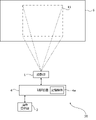
- FIG. 1 is a schematic diagram showing a schematic configuration of a projection device 10 to which a control device of an embodiment is applied;
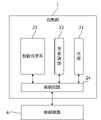
- FIG. 2 is a schematic diagram showing an example of an internal configuration of a projection unit 1 shown in FIG. 1;
- FIG. 1 is a schematic diagram showing an external configuration of a projection device 10;
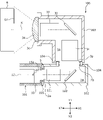
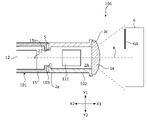
- FIG. 4 is a schematic cross-sectional view of an optical unit 106 of the projection device 10 shown in FIG. 3.
- FIG. FIG. 10 is a diagram showing an example of a projection image before shifting; It is a figure which shows an example of the projection image after a shift. 4 is a diagram showing an example of color shading correction by the control device 4.
- FIG. 10 is a diagram showing an example of a projection image before shifting; It is a figure which shows an example of
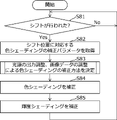
- FIG. 4 is a flowchart showing an example of processing by the control device 4; 7 is a flowchart illustrating an example of processing for determining a color shading correction method; 3 is a schematic diagram showing another external configuration of the projection device 10.
- FIG. 11 is a schematic cross-sectional view of the optical unit 106 of the projection device 10 shown in FIG. 10.
- FIG. 11 is a schematic cross-sectional view of the optical unit 106 of the projection device 10 shown in FIG. 10.
- FIG. 1 is a schematic diagram showing a schematic configuration of a projection device 10 to which the control device of the embodiment is applied.
- the projection device 10 includes a projection section 1 , a control device 4 and an operation reception section 2 .
- the projection unit 1 is configured by, for example, a liquid crystal projector or a projector using LCOS (Liquid Crystal On Silicon). In the following description, it is assumed that the projection unit 1 is a liquid crystal projector.
- the control device 4 controls projection by the projection device 10 .
- the control device 4 is an example of the control device of the present invention.
- the control device 4 includes a control unit configured by various processors, a communication interface (not shown) for communicating with each unit, and a storage medium such as a hard disk, SSD (Solid State Drive), or ROM (Read Only Memory). 4a, and controls the projection unit 1 in an integrated manner.
- various processors of the control unit of the control device 4 the circuit configuration is changed after manufacturing such as CPU (Central Processing Unit), FPGA (Field Programmable Gate Array), which is a general-purpose processor that executes programs and performs various processes.
- Programmable Logic Device which is a processor, or a dedicated electric circuit, etc., which is a processor having a circuit configuration specially designed to execute specific processing such as ASIC (Application Specific Integrated Circuit) is included.
- ASIC Application Specific Integrated Circuit
- the control unit of the control device 4 may be composed of one of various processors, or a combination of two or more processors of the same type or different types (for example, a combination of multiple FPGAs or a combination of a CPU and an FPGA). may consist of
- the operation reception unit 2 detects instructions from the user (user instructions) by receiving various operations from the user.
- the operation reception unit 2 is an operation unit such as buttons, keys, and joysticks provided on the main body of the projection device 10 . Therefore, when the operation reception unit 2 is operated, it can be determined that the user is positioned near the projection device 10 .
- the projection target 6 is an object such as a screen having a projection surface on which a projection image is displayed by the projection unit 1.
- the projection surface of the projection target 6 is a rectangular plane.
- the top, bottom, left, and right of the projection object 6 in FIG. 1 are the top, bottom, left, and right of the actual projection object 6 .
- a projection range 11 indicated by a dashed line is an area of the projection object 6 onto which the projection light is irradiated by the projection unit 1 .
- the projection range 11 is rectangular.
- the projection range 11 is part or all of the projectable range that can be projected by the projection unit 1 .
- the projection unit 1, the control device 4, and the operation reception unit 2 are realized by, for example, one device (see FIGS. 3 and 4, for example).
- the projection unit 1, the control device 4, and the operation reception unit 2 may be separate devices that cooperate by communicating with each other.
- FIG. 2 is a schematic diagram showing an example of the internal configuration of the projection unit 1 shown in FIG.
- the projection unit 1 includes a light source 21, a light modulation unit 22, a projection optical system 23, and a control circuit 24.
- the light source 21 includes a light-emitting element such as a laser or LED (Light Emitting Diode), and emits white light, for example.
- a light-emitting element such as a laser or LED (Light Emitting Diode), and emits white light, for example.
- the light modulation unit 22 modulates each color light emitted from the light source 21 and separated into three colors of red, blue, and green by a color separation mechanism (not shown) based on image information, and outputs each color image. It is a light modulation element composed of a liquid crystal panel. Red, blue, and green filters may be mounted on these three liquid crystal panels, respectively, and the white light emitted from the light source 21 may be modulated by each liquid crystal panel to emit an image of each color.
- the projection optical system 23 receives the light from the light source 21 and the light modulation section 22, and includes at least one lens and is configured by, for example, a relay optical system. The light that has passed through the projection optical system 23 is projected onto the projection object 6 .
- a region of the projection object 6 irradiated with light that passes through the entire range of the light modulation unit 22 is a projectable range that can be projected by the projection unit 1 .
- a projection range 11 is a region of this projectable range that is irradiated with the light that is actually transmitted from the light modulation section 22 .
- the size, position, and shape of the projection range 11 change in the projectable range.
- the control circuit 24 controls the light source 21, the light modulating unit 22, and the projection optical system 23 based on the display data input from the control device 4, so that an image based on the display data is projected onto the projection object 6. be projected.
- the display data to be input to the control circuit 24 is composed of red display data, blue display data, and green display data.
- control circuit 24 enlarges or reduces the projection range 11 (see FIG. 1) of the projection unit 1 by changing the projection optical system 23 based on commands input from the control device 4 . Further, the control device 4 may move the projection range 11 of the projection unit 1 by changing the projection optical system 23 based on the user's operation received by the operation reception unit 2 .
- the projection device 10 also includes a shift mechanism that mechanically or optically moves the projection range 11 while maintaining the image circle of the projection optical system 23 .
- the image circle of the projection optical system 23 is an area in which the projection light incident on the projection optical system 23 passes through the projection optical system 23 appropriately in terms of light falloff, color separation, peripheral curvature, and the like.
- the shift mechanism is realized by at least one of an optical system shift mechanism that performs optical system shift and an electronic shift mechanism that performs electronic shift.
- the optical system shift mechanism is, for example, a mechanism that moves the projection optical system 23 in a direction perpendicular to the optical axis (see, for example, FIGS. 3 and 4), or a mechanism that shifts the light modulation section 22 instead of moving the projection optical system 23. It is a mechanism that moves in the direction perpendicular to the axis. Further, the optical system shift mechanism may combine the movement of the projection optical system 23 and the movement of the light modulation section 22 .
- the electronic shift mechanism is a mechanism that shifts the pseudo projection range 11 by changing the light transmission range in the light modulation section 22 .
- the projection device 10 may also include a projection direction changing mechanism that moves the projection range 11 together with the image circle of the projection optical system 23 .
- the projection direction changing mechanism is a mechanism that changes the projection direction of the projection unit 1 by changing the orientation of the projection unit 1 by mechanical rotation (see FIGS. 3 and 4, for example).
- FIG. 3 is a schematic diagram showing the external configuration of the projection device 10.
- FIG. 4 is a schematic cross-sectional view of the optical unit 106 of the projection device 10 shown in FIG. FIG. 4 shows a cross section along the optical path of the light emitted from the main body 101 shown in FIG.
- the projection device 10 includes a main body 101 and an optical unit 106 protruding from the main body 101 .
- the operation reception section 2 , the control device 4 , and the light source 21 , the light modulation section 22 and the control circuit 24 in the projection section 1 are provided in the main body section 101 .
- a projection optical system 23 in the projection unit 1 is provided in the optical unit 106 .
- the optical unit 106 includes a first member 102 supported by the body portion 101 and a second member 103 supported by the first member 102 .
- first member 102 and the second member 103 may be an integrated member.
- the optical unit 106 may be detachably attached to the main body 101 (in other words, replaceable).
- the body part 101 has a housing 15 (see FIG. 4) in which an opening 15a (see FIG. 4) for passing light is formed in a portion connected to the optical unit 106.
- a light source 21 Inside the housing 15 of the main unit 101, as shown in FIG. 3, there are a light source 21 and a light modulation unit 22 ( (see FIG. 2) is provided.
- the light emitted from the light source 21 enters the light modulating section 22 of the light modulating unit 12, is spatially modulated by the light modulating section 22, and is emitted.
- the image formed by the light spatially modulated by the light modulation unit 12 passes through the opening 15a of the housing 15 and enters the optical unit 106, and the projection object 6 as the projection object. , and the image G1 becomes visible to the observer.
- the optical unit 106 includes a first member 102 having a hollow portion 2A connected to the inside of the main body portion 101, a second member 103 having a hollow portion 3A connected to the hollow portion 2A, and The first optical system 121 and the reflecting member 122 arranged, the second optical system 31, the reflecting member 32, the third optical system 33, and the lens 34 arranged in the hollow portion 3A, the shift mechanism 105, and the projection direction change and a mechanism 104 .
- the first member 102 is, for example, a member having a rectangular cross-sectional outline, and the openings 2a and 2b are formed on surfaces perpendicular to each other.
- the first member 102 is supported by the body portion 101 with the opening 2a arranged at a position facing the opening 15a of the body portion 101 .
- Light emitted from the light modulating portion 22 of the light modulating unit 12 of the main body portion 101 enters the hollow portion 2A of the first member 102 through the openings 15a and 2a.
- the incident direction of light entering the hollow portion 2A from the main body portion 101 is described as the direction X1, the direction opposite to the direction X1 is described as the direction X2, and the directions X1 and X2 are collectively described as the direction X.
- the direction from the front to the back of the paper surface and the opposite direction are described as a direction Z.
- the direction from the front to the back of the paper is described as a direction Z1
- the direction from the back to the front of the paper is described as a direction Z2.
- a direction perpendicular to the direction X and the direction Z is described as a direction Y, of the directions Y, the upward direction in FIG. 4 is described as a direction Y1, and the downward direction in FIG. 4 is described as a direction Y2.
- the projection device 10 is arranged so that the direction Y2 is the vertical direction.
- the projection optical system 23 shown in FIG. 2 is composed of a first optical system 121, a reflecting member 122, a second optical system 31, a reflecting member 32, a third optical system 33, and a lens .
- the optical axis K of this projection optical system 23 is shown in FIG.
- the first optical system 121, the reflecting member 122, the second optical system 31, the reflecting member 32, the third optical system 33, and the lens 34 are arranged along the optical axis K in this order from the light modulation section 22 side.
- the first optical system 121 includes at least one lens, and guides the light that has entered the first member 102 from the main body 101 and travels in the direction X1 to the reflecting member 122 .
- the reflecting member 122 reflects the light incident from the first optical system 121 in the direction Y1.
- the reflecting member 122 is composed of, for example, a mirror.
- the first member 102 has an opening 2b on the optical path of the light reflected by the reflecting member 122, and the reflected light passes through the opening 2b and advances to the hollow portion 3A of the second member 103.
- the second member 103 is a member having a substantially T-shaped cross-sectional outline, and an opening 3a is formed at a position facing the opening 2b of the first member 102.
- the light from the body portion 101 that has passed through the opening 2b of the first member 102 enters the hollow portion 3A of the second member 103 through this opening 3a.
- the cross-sectional outlines of the first member 102 and the second member 103 are arbitrary, and are not limited to those described above.
- the second optical system 31 includes at least one lens and guides light incident from the first member 102 to the reflecting member 32 .
- the reflecting member 32 reflects the light incident from the second optical system 31 in the direction X2 and guides it to the third optical system 33 .
- the reflecting member 32 is composed of, for example, a mirror.
- the third optical system 33 includes at least one lens and guides the light reflected by the reflecting member 32 to the lens 34.
- the lens 34 is arranged at the end of the second member 103 so as to block the opening 3c formed at the end of the second member 103 on the direction X2 side.
- the lens 34 projects the light incident from the third optical system 33 onto the projection object 6 .
- the projection direction changing mechanism 104 is a rotating mechanism that rotatably connects the second member 103 to the first member 102 .
- the projection direction changing mechanism 104 allows the second member 103 to rotate about a rotation axis extending in the direction Y (specifically, the optical axis K).
- the projection direction changing mechanism 104 is not limited to the arrangement position shown in FIG. 4 as long as it can rotate the optical system.
- the number of rotating mechanisms is not limited to one, and a plurality of rotating mechanisms may be provided.
- the shift mechanism 105 is a mechanism for moving the optical axis K of the projection optical system (in other words, the optical unit 106) in a direction perpendicular to the optical axis K (direction Y in FIG. 4). Specifically, the shift mechanism 105 is configured to change the position of the first member 102 in the direction Y with respect to the body portion 101 .
- the shift mechanism 105 may be one that moves the first member 102 manually, or one that moves the first member 102 electrically.
- FIG. 4 shows a state in which the shift mechanism 105 has moved the first member 102 to the maximum extent in the direction Y1. Shift mechanism 105 moves first member 102 in direction Y2 from the state shown in FIG. By changing the relative position, the image G1 projected onto the projection object 6 can be shifted (translated) in the direction Y2.
- the shift mechanism 105 may be a mechanism that moves the light modulation section 22 in the Y direction instead of moving the optical unit 106 in the Y direction. Even in this case, the image G1 projected onto the projection target 6 can be moved in the direction Y2.
- FIG. 5 is a diagram showing an example of a projection image before shifting.
- FIG. 6 is a diagram showing an example of a projected image after shifting.
- the control device 4 before the control device 4 performs control to shift the projection range 11, as shown in FIG. .
- color shading occurs at the right end of the projection image projected onto the projection range 11 as shown in FIG. This color shading is due to vignetting of the projection optical system 23, which differs for each color (wavelength), for example.
- the original image is a uniform white image (each pixel value of red, green, and blue is “255”), but the projection image projected onto the projection range 11 loses the balance of red, green, and blue.
- the green and blue pixel values are relatively lower than the red pixel value, resulting in reddish color unevenness.
- this reddish color unevenness is represented by the dot density.
- FIG. 7 is a diagram showing an example of color shading correction by the control device 4.
- the control device 4 performs control for correcting color shading (for example, color unevenness correction) of the projection image projected onto the projection range 11 .
- Correction of color shading means, for example, reducing color unevenness caused by color shading.
- control device 4 acquires the correction parameter corresponding to the shift position of the projection range 11 based on the correspondence information indicating the correction parameter of the color shading corresponding to the shift position of the projection range 11, and performs the acquired correction. Controls correction of color shading based on parameters.
- This correspondence information may be a correspondence table that associates each shift position of the projection device 10 with a color shading correction parameter, or may be a function capable of deriving a color shading correction parameter from the shift position of the projection range 11. There may be.
- a correction parameter for color shading is, for example, a gain for each color (red, green, and blue) for each pixel of image data input to the light modulation unit 22 .
- the correction parameter may also be a table indicating the gain of each pixel for each color, or may be a function capable of deriving the gain of each pixel for each color.
- the correction parameter for color shading is, for example, a correction parameter capable of suppressing color shading while maintaining the brightness of each pixel.
- Brightness is, for example, the brightness calculated by averaging the pixel values of red, green and blue.
- the average of each pixel value of red, green, and blue may be a weighted average such as red pixel value ⁇ 0.21+green pixel value ⁇ 0.72+ ⁇ blue pixel value ⁇ 0.07, or a simple average.
- control device 4 performs control for correcting color shading by both adjusting the output of the light source 21 used for projection by the projection device 10 and adjusting the image data input to the light modulation section 22 .
- the projection device 10 may operate in multiple modes with different output powers of the light source 21 .
- the control device 4 adjusts the output power of the light source 21 used for projection by the projection device 10 and adjusts the output power of the light source 21 used for projection by the projection device 10 according to the remaining output power of the light source 21 before color shading correction.
- the adjustment of and the combination mode of are made different.
- Adjusting the image data means changing the pixel value of the image data, that is, applying a gain.
- the control device 4 controls the image data input to the light modulation unit 22 so that the red light is generated according to the generated color shading. control to lower the pixel value of (give a negative gain). For example, if the original image data is white image data in which each pixel value of red, green, and blue is “255” in the entire area, the control device 4 will change the portion of this image data that causes reddish color unevenness to red. Control is performed so that the pixel value is set to "200" and the green and blue image values are kept at "255". As a result, in the projection image projected onto the projection range 11, the red pixel value can be made closer to the green and blue pixel values, and color shading can be suppressed.
- the control device 4 when the output power of the light source 21 is set to 50% before correcting the color shading, the control device 4 first sets the output power of the light source 21 to 100% and the Control is performed to lower the red, green and blue pixel values for the image data. For example, if the original image data is white image data with red, green and blue pixel values of "255" in the entire area, the control device 4 sets the red, green and blue pixel values of this image data to "128". control. Then, the control device 4 performs control to increase the green and blue pixel values in accordance with the color shading that occurs.
- control device 4 sets the pixel values of green and blue to "160” and sets the image value of red to "128" for a portion of the image data where reddish color unevenness occurs.
- the red pixel value can be made closer to the green and blue pixel values, and color shading can be suppressed.
- each pixel value described above is an example for explanation, and actual control is based on each pixel value of the original image data and a color shading correction parameter corresponding to the shift position of the projection range 11.
- Each pixel value is determined by
- control device 4 may correct the brightness shading of the projection image projected onto the projection range 11 . While the above-described color shading is due to the vignetting of the projection optical system 23 which differs for each color, the luminance shading is due to the vignetting of the projection optical system 23 which does not differ for each color. The projection image projected on the range 11 becomes uneven in brightness.
- the control device 4 acquires the correction parameter corresponding to the shift position of the projection range 11 based on the correspondence information indicating the luminance shading correction parameter corresponding to the shift position of the projection range 11, and based on the acquired correction parameter control to correct luminance shading.
- This correspondence information may be a correspondence table that associates each shift position of the projection device 10 with a luminance shading correction parameter, or may be a function capable of deriving a luminance shading correction parameter from the shift position of the projection range 11. There may be.
- a luminance shading correction parameter is, for example, a gain for each pixel of image data input to the light modulation unit 22 .
- the correction parameter may also be a table indicating the gain of each pixel, or a function capable of deriving the gain of each pixel.
- FIG. 8 is a flowchart showing an example of processing by the control device 4. As shown in FIG. The control device 4 executes the processing shown in FIG. 8, for example.
- control device 4 determines whether or not the projection range 11 has been shifted (step S81), and waits until the projection range 11 is shifted (step S81: No loop).
- the shift of the projection range 11 is performed, for example, according to a user's operation on the operation reception unit 2 .
- step S81 if the projection range 11 has been shifted (step S81: Yes), the control device 4 uses the correspondence information between the shift positions and the color shading correction parameters to determine the post-shift projection device. A correction parameter for color shading corresponding to the position of 10 (shift position) is obtained (step S82).
- control device 4 determines a method of correcting color shading by combining the output adjustment of the light source 21 used for projection by the projection device 10 and the adjustment of the image data input to the light modulation section 22 (step S83). ). Determination of the correction method in step S83 will be described later with reference to FIG. Next, the control device 4 performs control to correct color shading by the correction method determined in step S83 (step S84).
- control device 4 performs control to correct the brightness shading of the projection image projected onto the projection range 11 (step S85), and returns to step S81.
- step S85 for example, the control device 4 uses the correspondence information between the shift position and the luminance shading correction parameter to determine the luminance shading correction parameter corresponding to the position (shift position) of the projection device 10 after the shift. Control is performed to correct luminance shading based on the obtained correction parameters.
- step S85 the control device 4 corrects luminance shading while maintaining the ratio of the red, green, and blue gains adjusted in step S84.
- the control device 4 may perform this brightness shading correction only by adjusting the image data input to the light modulating section 22, or may adjust the output of the light source 21 used for projection by the projection device 10, and adjust the output of the light modulating section 22. may be performed in combination with the adjustment of the image data input to .
- control device 4 adjusts the output of the light source 21 and adjusts the image data input to the light modulation section 22 in combination to adjust the color shading of the projection image projected onto the projection range 11. control to correct the Accordingly, color shading correction can be performed more flexibly than color shading correction only by adjusting image data input to the light modulation unit 22, for example.
- the quality of the projection image projected onto the projection range 11 can be improved.
- control device 4 may perform luminance shading correction in a state in which color shading correction has been performed.
- luminance shading that occurs separately from color shading can also be suppressed.
- the quality of the projected image projected onto the projection range 11 is further improved by correcting color shading, which has a greater impact on the quality of the projected image projected onto the projection range 11, over luminance shading.
- FIG. 9 is a flow chart showing an example of a process for determining a color shading correction method.
- the control device 4 adjusts the output of the light source 21 used for projection by the projection device 10, adjusts the image data input to the light modulation unit 22, and Determines how color shading is corrected in combination with
- the control device 4 provisionally determines the red, blue, and green gain amounts for each pixel of the image data based on the color shading correction parameters obtained in step S82 shown in FIG. 8 (step S91).
- this color shading correction parameter is a correction parameter capable of suppressing color shading while maintaining the luminance of each pixel (for example, the average of each pixel value of red, green and blue).
- the provisional determination in step S91 is performed while allowing an upper limit value in the light modulating section 22, which will be described later.
- the control device 4 determines whether or not the gain of the image data input to the light modulation section 22 is possible based on the gain amount provisionally determined in step S91 (step S92). For example, when the control device 4 gains the image data with the gain amount provisionally determined in step S91, each pixel value of red, blue, and green in each pixel of the image data is the upper limit value (for example, “ 255") or less determines whether gain is possible.
- step S92 if the gain is possible (step S92: Yes), the control device 4 determines the gain amount tentatively determined in step S91 as the red, blue, and green gain amount for each pixel of the image data (step S93), the series of processes is terminated.
- step S92 if the gain is not possible (step S92: No), the control device 4 determines whether the output power of the light source 21 can be increased (step S94). For example, the control device 4 determines whether the current output power of the light source 21 is less than the upper limit of the output power of the light source 21 .
- step S94 if the output power of the light source 21 can be increased (step S94: Yes), the control device 4 determines the amount of increase in the output power of the light source 21 (step S95). For example, the control device 4 may determine the amount of increase by which the output power of the light source 21 is increased up to the upper limit, or the minimum amount that can suppress color shading in combination with the adjustment of the image data input to the light modulation section 22 . A limit increment may be determined.
- control device 4 adjusts the gain amount tentatively determined in step S91 so as to be equal to or less than the upper limit value of the light modulation section 22, based on the increase in the output power of the light source 21 determined in step S95 (step S96). For example, the control device 4 maintains the gain amount of red, blue, and green in each pixel, and maintains the ratio of the gain amounts between colors, while maintaining each pixel value of red, blue, and green in each pixel to be equal to or lower than the upper limit value in the light modulation section 22. Adjust so that
- the control device 4 adjusts the gain amount of red, blue, and green in each pixel of the image data to be 1/N of the gain amount provisionally determined in step S91. conduct. As a result, it is possible to derive a gain amount capable of suppressing a change in luminance due to correction of color shading while correcting color shading.
- the control device 4 sets the gain amount of red, blue, and green in each pixel of the image data to step S91. While maintaining the color ratio of the gain amounts provisionally determined by , the highest pixel value is adjusted to be the upper limit value in the light modulation unit 22 . As a result, it is possible to derive a gain amount capable of minimizing changes in luminance due to color shading correction while correcting color shading.
- step S96 the control device 4 proceeds to step S93, determines the gain amount adjusted in step S96 as the red, blue, and green gain amount for each pixel of the image data, and ends the series of processes.
- the control device 4 adjusts the red, blue, and green gain amount for each pixel of the determined image data in the color shading correction in step S94 shown in FIG. gain control of the image data input to the light modulation unit 22 with the gain amount of . Further, when the amount of increase in the output power of the light source 21 is determined in step S95, the control device 4 increases the output power of the light source 21 by the determined amount of increase in the color shading correction in step S94 shown in FIG. control.
- step S94 if the output power of the light source 21 cannot be increased (step S94: No), the control device 4 terminates the series of processes. In this case, the control device 4 does not correct the color shading in step S94 shown in FIG. Alternatively, in this case, the control device 4, in the color shading correction in step S94 shown in FIG. Control may be performed to gain the image data input to the light modulation unit 22 with the red, blue, and green gain amounts for each pixel of the image data adjusted to the upper limit value in the unit 22 .
- control device 4 adjusts the output of the light source 21 used for projection by the projection device 10 and adjusts the image data input to the light modulation section 22 in combination based on the output of the light source 21. Control switching. As a result, according to the margin of the output of the light source 21, it is possible to flexibly switch between the output adjustment of the light source 21 used for projection by the projection device 10 and the adjustment of the image data input to the light modulation section 22. Color shading can be corrected.
- control device 4 adjusts the output of the light source 21 used for projection by the projection device 10 and adjusts the image data input to the light modulation unit 22 based on the image data input to the light modulation unit 22. Control is performed to switch modes of combined use. Specifically, the control device 4 selects the above mode of combination based on the pixel value of each color of the image data input to the light modulating section 22 and the maximum value of the pixel values of each color in the light modulating section 22. Control switching.
- control device 4 can adjust the luminance (for example, the average of each pixel value of red, green, and blue) only by adjusting (for example, gain) within the limited range (for example, upper limit value) of the pixel value of the image data input to the light modulation unit 22.
- control is performed to correct color shading by adjusting the image data input to the light modulation unit 22 .
- the control device 4 adjusts the output of the light source 21 and adjusts the light source. Control is performed to adjust the image data input to the modulation unit 22 and to correct the color shading.
- maintaining the brightness means maintaining the brightness to such an extent that the effect on the substantial appearance of the projected image can be ignored. include.
- ⁇ Modification 1> 3 and 4 as the configuration of the projection device 10, the configuration in which the optical axis K is bent twice using the reflecting member 122 and the reflecting member 32 has been described. A configuration in which the axis K is not bent may be adopted, or a configuration in which either the reflecting member 122 or the reflecting member 32 is omitted and the optical axis K is bent once may be adopted.
- FIG. 10 is a schematic diagram showing another external configuration of the projection device 10.
- FIG. FIG. 11 is a schematic cross-sectional view of the optical unit 106 of the projection device 10 shown in FIG.
- the same parts as those shown in FIGS. 3 and 4 are denoted by the same reference numerals, and description thereof is omitted.
- the optical unit 106 shown in FIG. 10 includes the first member 102 supported by the main body 101 and does not include the second member 103 shown in FIGS. 10 does not include the reflecting member 122, the second optical system 31, the reflecting member 32, the third optical system 33, and the projection direction changing mechanism 104 shown in FIGS.
- the projection optical system 23 shown in FIG. 2 is composed of the first optical system 121 and the lens 34.
- the optical axis K of this projection optical system 23 is shown in FIG.
- the first optical system 121 and the lens 34 are arranged along the optical axis K in this order from the light modulation section 22 side.
- the first optical system 121 guides the light that has entered the first member 102 from the main body 101 and travels in the direction X1 to the lens 34 .
- the lens 34 is arranged at the end of the main body 101 in the direction X1 so as to close the opening 3c.
- the lens 34 projects the light incident from the first optical system 121 onto the projection object 6 .
- control device 4 performs control for correcting color shading based on the shift position of the projection range 11
- the configuration is not limited to this.
- the control device 4 is configured to perform control for correcting color shading by adjusting the output of the light source 21 and adjusting the image data input to the light modulation unit 22, regardless of the shift position of the projection range 11.
- the projection device 10 does not have to be configured so that the projection range 11 can be shifted.
- control device of the embodiment may be another device that can directly or indirectly communicate with the projection device 10 .
- control device of the embodiment may be an information terminal such as a personal computer or a smart phone that can communicate with the projection device 10 .
- the control device of the embodiment executes the various controls described above by communicating with the projection device 10 .
- a control device for a projection device that projects an image light-modulated by a light modulation element with a processor The processor performs control for correcting color shading of the projected image by adjusting the output of the light source used for the projection by the projection device and adjusting the image data input to the light modulation element. , Control device.
- the control device is capable of shifting a projection range of the image,
- the processor performs control to correct the color shading based on the shift position of the projection range. Control device.
- control device performs control to correct the color shading based on information indicating a correction parameter corresponding to the shift position. Control device.
- control device performs control to correct luminance shading of the image in a state in which the color shading has been corrected. Control device.
- control device according to any one of (1) to (4), The processor performs control to switch the mode of combined use based on the output of the light source. Control device.
- the control device according to any one of (1) to (5), The processor performs control to switch the mode of combined use based on the image data. Control device.
- the control device performs control to switch the mode of combined use based on the pixel value of each color of the image data and the limited range of the pixel value of each color in the light modulation element. Control device.
- a control method by a control device of a projection device that projects an image light-modulated by a light modulation element comprising: The processor of the control device corrects the color shading of the projected image by adjusting the output of the light source used for the projection by the projection device and adjusting the image data input to the light modulation element. control, control method.
- the control method according to The projection device is capable of shifting a projection range of the image,
- the processor performs control to correct the color shading based on the shift position of the projection range. control method.
- the control method performs control to correct the color shading based on information indicating a correction parameter corresponding to the shift position. control method.
- the control method according to any one of (9) to (11), The processor performs control to correct luminance shading of the image in a state in which the color shading has been corrected. control method.
- the control method according to any one of (9) to (12), The processor performs control to switch the mode of combined use based on the output of the light source. control method.
- the control method according to any one of (9) to (13), The processor performs control to switch the mode of combined use based on the image data. control method.
- the control method according to The processor performs control to switch the mode of combined use based on the pixel value of each color of the image data and the limited range of the pixel value of each color in the light modulation element. control method.
- a control program for a projection device that projects an image light-modulated by a light modulation element A processor that controls the projection device, Control to correct the color shading of the projected image to be projected by combining the output adjustment of the light source used for the projection by the projection device and the adjustment of the image data input to the light modulation element; Control program for executing processing.
- a projection device comprising:
Landscapes
- Engineering & Computer Science (AREA)
- Physics & Mathematics (AREA)
- General Physics & Mathematics (AREA)
- Computer Hardware Design (AREA)
- Theoretical Computer Science (AREA)
- Multimedia (AREA)
- Signal Processing (AREA)
- Transforming Electric Information Into Light Information (AREA)
- Video Image Reproduction Devices For Color Tv Systems (AREA)
- Projection Apparatus (AREA)
Priority Applications (3)
| Application Number | Priority Date | Filing Date | Title |
|---|---|---|---|
| CN202280016855.6A CN116888955A (zh) | 2021-02-26 | 2022-01-31 | 控制装置、控制方法、控制程序及投影装置 |
| JP2023502219A JPWO2022181218A1 (https=) | 2021-02-26 | 2022-01-31 | |
| US18/450,470 US12542879B2 (en) | 2021-02-26 | 2023-08-16 | Control device, control method, control program, and projection apparatus |
Applications Claiming Priority (2)
| Application Number | Priority Date | Filing Date | Title |
|---|---|---|---|
| JP2021-030085 | 2021-02-26 | ||
| JP2021030085 | 2021-02-26 |
Related Child Applications (1)
| Application Number | Title | Priority Date | Filing Date |
|---|---|---|---|
| US18/450,470 Continuation US12542879B2 (en) | 2021-02-26 | 2023-08-16 | Control device, control method, control program, and projection apparatus |
Publications (1)
| Publication Number | Publication Date |
|---|---|
| WO2022181218A1 true WO2022181218A1 (ja) | 2022-09-01 |
Family
ID=83048126
Family Applications (1)
| Application Number | Title | Priority Date | Filing Date |
|---|---|---|---|
| PCT/JP2022/003613 Ceased WO2022181218A1 (ja) | 2021-02-26 | 2022-01-31 | 制御装置、制御方法、制御プログラム、及び投影装置 |
Country Status (4)
| Country | Link |
|---|---|
| US (1) | US12542879B2 (https=) |
| JP (1) | JPWO2022181218A1 (https=) |
| CN (1) | CN116888955A (https=) |
| WO (1) | WO2022181218A1 (https=) |
Citations (3)
| Publication number | Priority date | Publication date | Assignee | Title |
|---|---|---|---|---|
| JP2003018502A (ja) * | 2001-06-29 | 2003-01-17 | Toshiba Corp | 投射型表示装置 |
| JP2008225031A (ja) * | 2007-03-13 | 2008-09-25 | Seiko Epson Corp | プロジェクタ |
| JP2017129698A (ja) * | 2016-01-20 | 2017-07-27 | セイコーエプソン株式会社 | プロジェクター、及び、プロジェクターの制御方法 |
Family Cites Families (5)
| Publication number | Priority date | Publication date | Assignee | Title |
|---|---|---|---|---|
| JP3616594B2 (ja) | 2001-11-01 | 2005-02-02 | Necビューテクノロジー株式会社 | 投射用レンズの状態に対応した色むら補正方法とその装置 |
| JP6331340B2 (ja) * | 2013-11-08 | 2018-05-30 | セイコーエプソン株式会社 | 表示装置、及び、表示装置の制御方法 |
| JP2016143015A (ja) | 2015-02-05 | 2016-08-08 | セイコーエプソン株式会社 | プロジェクター、及びプロジェクターの制御方法 |
| CN107409192B (zh) * | 2015-03-27 | 2021-04-16 | 索尼公司 | 图像显示设备及方法、信息处理方法以及计算机可读介质 |
| JP7147617B2 (ja) * | 2019-02-19 | 2022-10-05 | セイコーエプソン株式会社 | プロジェクター及びプロジェクターの制御方法 |
-
2022
- 2022-01-31 JP JP2023502219A patent/JPWO2022181218A1/ja not_active Abandoned
- 2022-01-31 WO PCT/JP2022/003613 patent/WO2022181218A1/ja not_active Ceased
- 2022-01-31 CN CN202280016855.6A patent/CN116888955A/zh active Pending
-
2023
- 2023-08-16 US US18/450,470 patent/US12542879B2/en active Active
Patent Citations (3)
| Publication number | Priority date | Publication date | Assignee | Title |
|---|---|---|---|---|
| JP2003018502A (ja) * | 2001-06-29 | 2003-01-17 | Toshiba Corp | 投射型表示装置 |
| JP2008225031A (ja) * | 2007-03-13 | 2008-09-25 | Seiko Epson Corp | プロジェクタ |
| JP2017129698A (ja) * | 2016-01-20 | 2017-07-27 | セイコーエプソン株式会社 | プロジェクター、及び、プロジェクターの制御方法 |
Also Published As
| Publication number | Publication date |
|---|---|
| US20230388462A1 (en) | 2023-11-30 |
| US12542879B2 (en) | 2026-02-03 |
| JPWO2022181218A1 (https=) | 2022-09-01 |
| CN116888955A (zh) | 2023-10-13 |
Similar Documents
| Publication | Publication Date | Title |
|---|---|---|
| US7403318B2 (en) | Image display device, image display method, and image display program | |
| US9841662B2 (en) | Projector and method for controlling projector | |
| JP4552986B2 (ja) | 画像表示装置 | |
| US10701325B2 (en) | Multi-projection system, projector, and method for controlling projector | |
| JP6057397B2 (ja) | プロジェクタ、色補正装置および投写方法 | |
| JP2009216857A (ja) | プロジェクタ、画像表示システム、及び画像補正方法 | |
| JP2009036884A (ja) | 投射型表示装置及び表示方法 | |
| JP2009058656A (ja) | 画像表示装置 | |
| WO2022181218A1 (ja) | 制御装置、制御方法、制御プログラム、及び投影装置 | |
| JP2011209514A (ja) | 画像表示装置および画像表示方法 | |
| US12041392B2 (en) | Projection system, projection method, and control program | |
| US20240040095A1 (en) | Projection system and calibration method thereof | |
| US11930306B2 (en) | Projection apparatus, projection method, and control program | |
| US20190129293A1 (en) | Projector and method for controlling projector | |
| JP4556470B2 (ja) | 光学表示装置 | |
| US11483527B2 (en) | Method of operation of a control device configured to control a plurality of projectors and control device | |
| JP2006251445A (ja) | プロジェクタ、画像表示方法、および画像表示プログラム | |
| JP2007163988A (ja) | プロジェクタ | |
| US12328526B2 (en) | Information processing method, information processing device, and non-transitory computer-readable storage medium storing program | |
| JP6651865B2 (ja) | プロジェクター、及び、プロジェクターの制御方法 | |
| JP2004233813A (ja) | 色むら補正画像処理装置、方法及びプログラム、並びに投射型画像表示装置 | |
| CN117518694A (zh) | 投影系统及其校正方法 | |
| JP2024140087A (ja) | 色調整方法 | |
| CN120447264A (zh) | 一种电子设备和处理方法 | |
| JP2006251329A (ja) | 画像表示装置 |
Legal Events
| Date | Code | Title | Description |
|---|---|---|---|
| 121 | Ep: the epo has been informed by wipo that ep was designated in this application |
Ref document number: 22759259 Country of ref document: EP Kind code of ref document: A1 |
|
| WWE | Wipo information: entry into national phase |
Ref document number: 2023502219 Country of ref document: JP |
|
| WWE | Wipo information: entry into national phase |
Ref document number: 202280016855.6 Country of ref document: CN |
|
| NENP | Non-entry into the national phase |
Ref country code: DE |
|
| 122 | Ep: pct application non-entry in european phase |
Ref document number: 22759259 Country of ref document: EP Kind code of ref document: A1 |