WO2022176044A1 - 落下感を体験可能な仮想体験装置 - Google Patents
落下感を体験可能な仮想体験装置 Download PDFInfo
- Publication number
- WO2022176044A1 WO2022176044A1 PCT/JP2021/005846 JP2021005846W WO2022176044A1 WO 2022176044 A1 WO2022176044 A1 WO 2022176044A1 JP 2021005846 W JP2021005846 W JP 2021005846W WO 2022176044 A1 WO2022176044 A1 WO 2022176044A1
- Authority
- WO
- WIPO (PCT)
- Prior art keywords
- falling
- image
- state
- headset
- flat plate
- Prior art date
- Legal status (The legal status is an assumption and is not a legal conclusion. Google has not performed a legal analysis and makes no representation as to the accuracy of the status listed.)
- Ceased
Links
Images




Classifications
-
- A—HUMAN NECESSITIES
- A63—SPORTS; GAMES; AMUSEMENTS
- A63F—CARD, BOARD, OR ROULETTE GAMES; INDOOR GAMES USING SMALL MOVING PLAYING BODIES; VIDEO GAMES; GAMES NOT OTHERWISE PROVIDED FOR
- A63F13/00—Video games, i.e. games using an electronically generated display having two or more dimensions
- A63F13/25—Output arrangements for video game devices
- A63F13/28—Output arrangements for video game devices responding to control signals received from the game device for affecting ambient conditions, e.g. for vibrating players' seats, activating scent dispensers or affecting temperature or light
- A63F13/285—Generating tactile feedback signals via the game input device, e.g. force feedback
-
- A—HUMAN NECESSITIES
- A63—SPORTS; GAMES; AMUSEMENTS
- A63G—MERRY-GO-ROUNDS; SWINGS; ROCKING-HORSES; CHUTES; SWITCHBACKS; SIMILAR DEVICES FOR PUBLIC AMUSEMENT
- A63G31/00—Amusement arrangements
- A63G31/02—Amusement arrangements with moving substructures
- A63G31/06—Amusement arrangements with moving substructures with undulatory motion of the substructure
-
- A—HUMAN NECESSITIES
- A63—SPORTS; GAMES; AMUSEMENTS
- A63G—MERRY-GO-ROUNDS; SWINGS; ROCKING-HORSES; CHUTES; SWITCHBACKS; SIMILAR DEVICES FOR PUBLIC AMUSEMENT
- A63G31/00—Amusement arrangements
- A63G31/16—Amusement arrangements creating illusions of travel
-
- G—PHYSICS
- G02—OPTICS
- G02B—OPTICAL ELEMENTS, SYSTEMS OR APPARATUS
- G02B27/00—Optical systems or apparatus not provided for by any of the groups G02B1/00 - G02B26/00, G02B30/00
- G02B27/01—Head-up displays
- G02B27/017—Head mounted
-
- G—PHYSICS
- G06—COMPUTING OR CALCULATING; COUNTING
- G06F—ELECTRIC DIGITAL DATA PROCESSING
- G06F3/00—Input arrangements for transferring data to be processed into a form capable of being handled by the computer; Output arrangements for transferring data from processing unit to output unit, e.g. interface arrangements
- G06F3/01—Input arrangements or combined input and output arrangements for interaction between user and computer
- G06F3/011—Arrangements for interaction with the human body, e.g. for user immersion in virtual reality
-
- G—PHYSICS
- G06—COMPUTING OR CALCULATING; COUNTING
- G06T—IMAGE DATA PROCESSING OR GENERATION, IN GENERAL
- G06T19/00—Manipulating three-dimensional [3D] models or images for computer graphics
- G06T19/003—Navigation within 3D models or images
-
- G—PHYSICS
- G09—EDUCATION; CRYPTOGRAPHY; DISPLAY; ADVERTISING; SEALS
- G09B—EDUCATIONAL OR DEMONSTRATION APPLIANCES; APPLIANCES FOR TEACHING, OR COMMUNICATING WITH, THE BLIND, DEAF OR MUTE; MODELS; PLANETARIA; GLOBES; MAPS; DIAGRAMS
- G09B9/00—Simulators for teaching or training purposes
- G09B9/02—Simulators for teaching or training purposes for teaching control of vehicles or other craft
- G09B9/08—Simulators for teaching or training purposes for teaching control of vehicles or other craft for teaching control of aircraft, e.g. Link trainer
- G09B9/28—Simulation of stick forces or the like
-
- A—HUMAN NECESSITIES
- A63—SPORTS; GAMES; AMUSEMENTS
- A63F—CARD, BOARD, OR ROULETTE GAMES; INDOOR GAMES USING SMALL MOVING PLAYING BODIES; VIDEO GAMES; GAMES NOT OTHERWISE PROVIDED FOR
- A63F2300/00—Features of games using an electronically generated display having two or more dimensions, e.g. on a television screen, showing representations related to the game
- A63F2300/80—Features of games using an electronically generated display having two or more dimensions, e.g. on a television screen, showing representations related to the game specially adapted for executing a specific type of game
- A63F2300/8082—Virtual reality
-
- A—HUMAN NECESSITIES
- A63—SPORTS; GAMES; AMUSEMENTS
- A63F—CARD, BOARD, OR ROULETTE GAMES; INDOOR GAMES USING SMALL MOVING PLAYING BODIES; VIDEO GAMES; GAMES NOT OTHERWISE PROVIDED FOR
- A63F2300/00—Features of games using an electronically generated display having two or more dimensions, e.g. on a television screen, showing representations related to the game
- A63F2300/80—Features of games using an electronically generated display having two or more dimensions, e.g. on a television screen, showing representations related to the game specially adapted for executing a specific type of game
- A63F2300/8094—Unusual game types, e.g. virtual cooking
Definitions
- the present invention relates to a virtual experience device that allows you to experience the sensation of falling, such as bungee jumping and roller coasters.
- a training device that promotes health by combining exercise equipment and a VR (Virtual Reality) headset has also been put to practical use.
- a bicycle-shaped indoor exercise device called an exercise bike (registered trademark) or a spin bike is combined with a VR headset, and a spin sensor connected to the VR headset via Bluetooth (registered trademark) is attached.
- a training device software on the market that advances images of Street View (registered trademark) with a VR headset in accordance with the rotation of the pedal on which the user is (Non-Patent Document 1).
- Non-Patent Document 2 bungee VR software that streams images of roller coasters and bungee jumps to VR headsets
- a training device that uses only exercise equipment is intended to improve health, so it does not have a game nature.
- the combination of exercise equipment and a VR headset limits the enjoyment of the game, and it is not possible to create a sense of fear and challenge that is popular among young people.
- games that use VR headsets and hand switches even if they are bungee jumping video software, do not have enough sense of fear and challenge because the body does not move, and the experience is not comparable to actual bungee jumping. satisfaction is insufficient.
- a virtual experience device capable of experiencing a feeling of falling according to the present invention includes: A flat plate on which the experiencer is fixed, A rotation support part for rotatably supporting the flat plate is formed, and the flat plate is rotated from a first state in which the head of the experiencer is positioned above the feet to an inverted state in which the body of the experiencer stands upside down.
- the VR headset is a sensor for detecting a second state when the fixture rotates from the first state and the height from the floor on which the fixture is installed becomes equal to or less than a predetermined height; a display for displaying video in virtual space; and image software including a still image displayed on the display in the first state and a falling image displayed on the display after the second state.
- the participant is fixed in a prone position on the flat plate.
- Belts for example, are used to fix the experiencer, and the ankles and abdomen of the experiencer are fixed to a flat plate with this belt.
- the flat plate to which the experiencer is fixed can rotate the experiencer from a first state in which the head is positioned above the feet to an inverted state in which the body of the experiencer is upside down.
- a sensor provided in the VR headset detects the second condition.
- a positioning sensor that detects the position of the VR headset can be used as this sensor.
- a positioning sensor consists of, for example, a plurality of cameras arranged in a VR headset. By processing the images captured by these cameras, the position of the VR headset (position on three axes) is detected. It is also possible to use a gyro sensor as another example of the positioning sensor, and it is also possible to use well-known sensors such as an infrared sensor and an LED sensor. In the present invention, any sensor that can detect at least the height on the Z-axis may be used. These sensors desirably have a function of tracking changes in the position of the VR headset.
- video software is pre-installed in the VR headset.
- the image software includes a still image displayed on the display in the first state, and a falling image displayed on the display after entering the second state.
- a still image is an image of the surroundings before falling
- a falling image is an image of the falling direction after falling.
- the visual software is, for example, bungee jumping visual software.
- the experiencer is fixed in a prone position on a flat plate and the video software is activated.
- the user is in the first state in which the head is positioned above the feet, the video software outputs a still image, and the display in the VR headset displays the still image.
- the sensor of the VR headset is a sensor that detects and tracks the position of the VR headset, the still image changes according to the detection output. That is, when the user rotates the head, the image following the direction of rotation is displayed as a still image.
- the fixture falls from the still image.
- Switch to video That is, when the flat plate begins to rotate forward from the first state, the second state where the height from the floor to the position of the VR headset is less than a predetermined height is triggered, and from the still image Switch to falling footage. At this time, since the flat plate is rotating, the falling image is displayed on the display in the VR headset in synchronization with the rotation of the user's body.
- the falling video includes a video in which the experiencer's body continues to fall even after being in the inverted state. It takes about 1 second for the flat plate to rotate from the second state to the inverted state, but the falling image takes longer, for example, about 4 seconds. Therefore, the falling image continues from when the user becomes inverted and the rotation stops.
- the VR headset notifies the outside that it is in the lowest position state when the falling image reaches the lowest position.
- the notification to the outside can be made, for example, by vibrating a hand switch connected to the VR headset via Bluetooth (registered trademark).
- the outside By informing the outside that the falling image is in the lowest position state, it is possible to further enhance the sense of immersion after reaching the lowest position.
- the assistant recognizes from the vibration of the hand switch that the falling image is in the lowest position, the flat plate is rotated in the reverse direction. At this time, the falling image is set as the image when returning upward from the lowest position.
- This image and the reverse rotation of the flat plate give the viewer the illusion of floating or returning upward due to negative acceleration near the lowest position.
- the present invention provides a highly immersive experience of an actual falling state in a virtual space by combining a tool having a rotation center that rotatably supports a flat plate and a VR headset with a built-in sensor. make it possible to
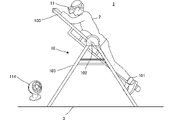
- FIG. 1 is a view of the experiencer fixed on a flat plate in the bungee jumping virtual experience device of the present invention.
- FIG. 2 is a diagram showing a state in which a flat plate is rotating in the bungee jumping virtual experience device of the present invention.
- FIG. 3 is a diagram showing a state in which the user stands upside down in the virtual bungee jumping experience apparatus of the present invention.
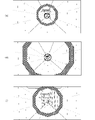
- FIGS. 4A to 4C are clipped images of a still image and a falling image of the bungee jumping virtual experience device of the present invention.
- FIGS. 5(D) to 5(F) are clipped images of falling images of the bungee jumping virtual experience device of the present invention.
- FIG. 6(G) to (I) are clipped images of falling images of the bungee jumping virtual experience device of the present invention.
- FIG. 7 shows an electrical configuration diagram of the virtual experience device 1.
- FIG. 8 is a flow chart showing the operation of the virtual experience device 1. As shown in FIG.
- FIG. 1 is a diagram of the experiencer fixed on a flat plate in the bungee jumping virtual experience device of the present invention.
- the virtual experience device 1 is composed of a device 10 and a VR headset 11.
- the device 10 includes a flat plate 100 capable of fixing the experience person 2 in a prone position, a belt 101 fixing both ankles of the experience person 2 on the flat plate 100 to the flat plate 100, and a rotation support rotatably supporting the flat plate 100. It is composed of a portion 102 and an instrument main body 103 to which the rotation support portion 102 is fixed and which holds the flat plate 100 stably.
- the instrument body 103 has an inverted V-shaped structure when viewed from the front, and is installed on the flat floor 3 .
- the reason why the instrument body 103 has an inverted V-shaped structure is to facilitate transportation of the instrument body 103 as a whole by closing the apex portion.
- the instrument body 103 may have any structure as long as it can rotatably support the flat plate 100 .
- the VR headset 11 is provided with a positioning sensor 110 composed of multiple cameras, a control unit 111, and a display 112 (see FIG. 7).
- the positioning sensor 110 consists of, for example, multiple cameras arranged in a VR headset. By processing the images captured by these cameras, the position (three-axis position) of the VR headset 11 including the distance (height) between the floor 3 and the sensor 110 is detected.
- a gyro sensor can also be used as another example of the positioning sensor 110, and it is also possible to configure it with a well-known sensor such as an infrared sensor or an LED sensor. In the present invention, any sensor that can detect at least the height on the Z-axis may be used. These sensors desirably have a function of tracking changes in the position of the VR headset.
- This state is the first state in which the head of the user 2 is positioned above the feet.
- Bungee video software is pre-installed in the VR headset 11, and the software is also in an operating state.
- This bungee video software consists of a still video showing the surrounding video before falling and a falling video when falling.
- a still image is displayed on the display 112 of the VR headset 11 .
- a still image is an image of the surroundings of the VR headset 11 before falling.
- the VR headset 11 is provided with a positioning sensor 110 having a tracking function, if the experiencer 2 lowers his/her face so as to look downward, the image of the lowest position during the jump is displayed in the VR headset 11. It is displayed on the display 112 . Also, when the experiencer 2 turns his or her neck to look left or right, the surrounding images change accordingly.
- the flat plate 100 is slightly rotated forward as shown in FIG.
- an assistant lifts the bottom of the flat plate 100 and rotates the flat plate 100 .
- the flat plate 100 rotates from the state shown in FIG. 1 to the state shown in FIG. At this time, the user is in a state immediately before jumping down in an actual bungee jump, and the display 112 displays an image of the lowest position immediately before the jump.
- FIG. 2 shows a state in which the flat plate 100 is rotating in the bungee jumping virtual experience device 1 and immediately before the distance between the positioning sensor 110 and the floor 3 reaches h1.
- the height of the VR headset 11 from the floor 3 is h1+ ⁇ .
- the positioning sensor 110 provided in the VR headset 11 detects that the VR headset 11 is lowered by several tens of centimeters due to the change from FIG. 1 to FIG. During this time, the image output from the bungee video software is a still image, but since the positional change of the VR headset 11 corresponding to the positional change of the head of the experiencer 2 is tracked, becomes an image. In FIG. 2, the still image is an image looking down from the top of the building.
- the distance between the positioning sensor 110 and the floor 3 immediately becomes h1. This time is the second state. Triggered by the second state, the image of the bungee image software is switched from the still image to the falling image. Further, the flat plate 100 rotates at once to the inverted state shown in FIG.
- the flat plate 100 rotates slightly forward from the first state (FIG. 1) and is just before falling (FIG. 2). After passing through the second state of h1, the flat plate 100 suddenly changes to an inverted state (FIG. 3) and stops rotating.
- the rotation time from FIG. 2 to FIG. 3 is around 1 second (hereinafter simply referred to as 1 second).
- the bungee image software outputs still images from the first state in FIG. 1 to the state in FIG.
- the output is switched to the falling image.
- it becomes an inverted state (FIG. 3) and continues to output the falling image.
- the falling video has a length of about 4 seconds (hereinafter simply referred to as 4 seconds). Therefore, the experiencer 2 watches the falling image for several seconds from the second state to the inverted state.
- the flat plate 100 further rotates to the state shown in FIG. Watch a video that suddenly falls from the still video. Also, during this period, the body of the experiencer 2 is rapidly rotated by 90 degrees and becomes an inverted state. The falling image continues for a few more seconds even after being in an inverted state.
- the cross-modal effect is a phenomenon in which certain sensory information interferes with other sensory information (mechanism) and changes the sensory information itself.
- spatial perception is modulated by a cross-modal effect through visual input from the VR headset 11, sensory input of gravitational acceleration due to the rotation of the flat plate 100, sensory input in an inverted state, etc. It seems that it is giving the illusion of a sudden fall. It can be said that the present embodiment utilizes the illusion of this cross-modal effect. As a result, even if the rotation is as short as 1 second, it is possible to virtually experience falling for 4 seconds.
- the VR headset 11 notifies the hand switch 113 that it is in the lowest position when the falling image reaches the lowest position.
- the hand switch 113 vibrates at this time.
- the assistant rotates the flat plate 100 in the reverse direction because he/she can know that the falling image is in the lowest position.
- the falling image is switched to a floating image that returns upward from the lowest position or floats near the lowest position. Due to this floating image and the reverse rotation of the flat plate 100, the experiencer 2 has the illusion of floating or returning upward due to negative acceleration in the vicinity of the lowest position.
- experiencer 2 can obtain a virtual experience of bungee jumping.
- the body of the user 2 rotates in synchronization with watching the video of the bungee jumping, the sense of immersion when falling is great. For this reason, the experiencer 2 can have a virtual experience that includes a feeling of fear similar to that of an actual bungee jump.
- the fan 114 is arranged in front of the virtual experience apparatus 1.
- FIG. The blower 114 provides the experience person 2 with wind at the time of falling.
- the blower 114 starts blowing air when the still image is displayed, and stops blowing air when the falling image is completely finished.
- the amount of air to be blown is rapidly increased from the time when the falling image starts to be displayed. By controlling the amount of air blown in this way, the feeling of actual bungee jumping can be brought closer.
- the bungee video software is activated after the experiencer 2 is fixed to the flat plate 100 as shown in FIG.
- the bungee image software outputs a still image including the image frame of FIG. 4A immediately before the fall of FIG.
- This still image is an image just before the fall, looking down from the roof of the building.
- the image frame of FIG. 4A is obtained by extracting the visual field direction of the experiencer 2 from the image that displays the surroundings in 3D, when the experiencer 2 turns the neck up, down, left, and right, it responds accordingly. Display moving images in the viewing direction.
- the image switches from the still image to the falling image.
- the continuous image of the falling is displayed on the display 112 in the VR headset 11, and the body of the experiencing person 2 rotates, thereby giving the experiencing person 2 a strong sense of immersion during the fall. obtain.
- the control unit 111 causes the hand switch 113 to vibrate.
- the assistant reversely rotates the flat plate 100 by knowing the vibration of the hand switch.
- the bungee image software switches from the falling image to a floating image that moves up and down near the lowest position. Due to this floating image and the reverse rotation of the flat plate 100, the experiencer 2 has the illusion of floating or returning upward due to negative acceleration in the vicinity of the lowest position.
- FIG. 7 shows an electrical configuration diagram of the virtual experience device 1.
- the VR headset 11 includes a positioning sensor 110 composed of multiple cameras, a control unit 111, and a display 112 capable of 3D display.
- the VR headset 11 is also connected to the hand switch 113 and the fan 114 via Bluetooth (registered trademark).
- the control unit 111 has a memory (not shown) in which bungee video software is installed in advance.
- FIG. 8 is a flowchart showing the operation of the virtual experience device 1.
- This flowchart is executed by the control unit 111 provided in the VR headset 11.
- the VR headset 11 is activated by turning on the power switch provided on the main body. After activation, the bungee video software is activated by the hand switch 113 connected to the control unit 111 via Bluetooth (registered trademark) (ST1, 2). The image displayed on the display 112 at this time is a still image.
- the assistant lifts up the bottom of the flat plate 100 located at the feet of the experiencer 2 .
- the experiencer 2 moves forward a little to move the center of gravity forward (toward the head), and if necessary, lift both hands upward.
- the flat plate 100 begins to rotate around the rotation support portion 102, and the rotation of the flat plate 100 stops once in a state where the head is slightly lower than horizontal (FIG. 2).
- the distance between the VR headset 11 and the floor 3 is less than the predetermined height h1.
- the display 112 of the VR headset 11 outputs a still image of a downward view from the roof of the building, showing the state just before the fall.
- the positioning sensor 110 detects that the distance between the VR headset 11 and the floor 3 has reached a predetermined height h1, resulting in the second state (ST3). Then, the image is switched from the still image to the falling image.
- the flat plate 100 rotates from the second state to the inverted state of FIG. This time is 1 second. Since the falling image continues for 4 seconds, the falling image is displayed on the display 112 for a while even in the inverted state shown in FIG.
- the hand switch 113 When the falling image becomes the image of the lowest position (ST5), the hand switch 113 is vibrated. The assistant finds that the falling image has become the image of the lowest position, and reversely rotates the flat plate 100 at this timing. Then, the image is switched from the falling image to the floating image (ST7).
- the experiencer 2 has the illusion of returning upward or floating due to negative acceleration in the vicinity of the lowest position.
- the fan 114 connected by Bluetooth is arranged on the floor 3 in front of the virtual experience device 1 (on the left side in FIGS. 1 to 3).
- the control unit 111 starts blowing air from the air blower 114 at ST1.
- ST5 When ST5 is reached or when ST7 is finished, blowing air is stopped.
- the feeling of falling from bungee jumping can be further enhanced.
- the sensation of wind pressure due to blowing air contributes to the cross-modal effect described above.
- the wind when falling (FIGS. 2 to 3) is stronger than when it is stopped (FIGS. 1 and 2), and the feeling of falling becomes greater.
- the plate 100 rotates from the state shown in FIG. 1 to the state shown in FIG.
- the experiencer 2 can experience an actual bungee jump in the virtual space with a strong sense of immersion.
- roller coaster falling image software can be installed instead of bungee image software.
- roller coaster falling video software it is possible to experience the rapid descent of an actual roller coaster with a strong sense of immersion in the same way as with bungee video software.
- the instrument main body 103 has an inverted V-shaped structure. It doesn't matter if it's not. Further, if the floor 3 can keep the instrument body 103 substantially horizontal, the instrument body 103 may be combined with a stand or a rail for turning the instrument body 103 left and right or moving it back and forth. With such a structure, it is possible to experience a virtual experience that is closer to actual bungee jumping by moving the device body 103 forward or left and right in the stopped state.
- the rotation of the flat plate 100 can be performed automatically using a motor instead of manually.
- the time for the flat plate 100 to rotate from FIG. 2 to FIG. 3 is set to 1 second, and the falling image output time is set to 4 seconds, but the time is not limited to these. These times are appropriately set according to the type of the user 2 (adult or child), the size and structure of the equipment body 103, the characteristics of the video software (type of bungee jumping or roller coaster, falling), and the like. It is also possible to perform these settings with hand switches, switches of the VR headset 11, or the like.
Landscapes
- Engineering & Computer Science (AREA)
- Physics & Mathematics (AREA)
- Theoretical Computer Science (AREA)
- General Physics & Mathematics (AREA)
- Multimedia (AREA)
- General Engineering & Computer Science (AREA)
- Human Computer Interaction (AREA)
- Software Systems (AREA)
- Remote Sensing (AREA)
- Radar, Positioning & Navigation (AREA)
- Optics & Photonics (AREA)
- Computer Graphics (AREA)
- Computer Hardware Design (AREA)
- Educational Technology (AREA)
- Educational Administration (AREA)
- Business, Economics & Management (AREA)
- Aviation & Aerospace Engineering (AREA)
- Force Measurement Appropriate To Specific Purposes (AREA)
- User Interface Of Digital Computer (AREA)
- Processing Or Creating Images (AREA)
Priority Applications (6)
| Application Number | Priority Date | Filing Date | Title |
|---|---|---|---|
| EP21926484.3A EP4295932B1 (en) | 2021-02-17 | 2021-02-17 | Virtual experience device enabling experiencing feeling of falling |
| JP2023500170A JP7495770B2 (ja) | 2021-02-17 | 2021-02-17 | 落下感を体験可能な仮想体験装置 |
| KR1020237031121A KR20230141871A (ko) | 2021-02-17 | 2021-02-17 | 낙하감을 체험 가능한 가상 체험 장치 |
| US18/275,503 US12496517B2 (en) | 2021-02-17 | 2021-02-17 | Virtual experience device enabling experiencing feeling of falling |
| CN202180093265.9A CN116829236B (zh) | 2021-02-17 | 2021-02-17 | 可体验坠落感的虚拟体验装置 |
| PCT/JP2021/005846 WO2022176044A1 (ja) | 2021-02-17 | 2021-02-17 | 落下感を体験可能な仮想体験装置 |
Applications Claiming Priority (1)
| Application Number | Priority Date | Filing Date | Title |
|---|---|---|---|
| PCT/JP2021/005846 WO2022176044A1 (ja) | 2021-02-17 | 2021-02-17 | 落下感を体験可能な仮想体験装置 |
Publications (1)
| Publication Number | Publication Date |
|---|---|
| WO2022176044A1 true WO2022176044A1 (ja) | 2022-08-25 |
Family
ID=82931239
Family Applications (1)
| Application Number | Title | Priority Date | Filing Date |
|---|---|---|---|
| PCT/JP2021/005846 Ceased WO2022176044A1 (ja) | 2021-02-17 | 2021-02-17 | 落下感を体験可能な仮想体験装置 |
Country Status (6)
| Country | Link |
|---|---|
| US (1) | US12496517B2 (https=) |
| EP (1) | EP4295932B1 (https=) |
| JP (1) | JP7495770B2 (https=) |
| KR (1) | KR20230141871A (https=) |
| CN (1) | CN116829236B (https=) |
| WO (1) | WO2022176044A1 (https=) |
Citations (3)
| Publication number | Priority date | Publication date | Assignee | Title |
|---|---|---|---|---|
| JPS53140560A (en) | 1977-05-13 | 1978-12-07 | Suwa Seikosha Kk | Electronic clock |
| JP2020517366A (ja) * | 2017-04-25 | 2020-06-18 | ユニバーサル シティ スタジオズ リミテッド ライアビリティ カンパニー | 運動シミュレーション遊園地アトラクション |
| JP2020178869A (ja) * | 2019-04-25 | 2020-11-05 | 株式会社ロジリシティ | 疑似体験装置、疑似体験システム |
Family Cites Families (10)
| Publication number | Priority date | Publication date | Assignee | Title |
|---|---|---|---|---|
| JPS5630363Y2 (https=) | 1977-04-13 | 1981-07-20 | ||
| KR20020038164A (ko) * | 2000-11-16 | 2002-05-23 | 전용민 | 가상 번지점프 장치 |
| WO2010105499A1 (en) * | 2009-03-14 | 2010-09-23 | Quan Xiao | Methods and apparatus for providing user somatosensory experience for thrill seeking jumping like activities |
| JP6594041B2 (ja) * | 2015-05-22 | 2019-10-23 | Jfeスチール株式会社 | 危険体感システム |
| WO2017217724A1 (ko) * | 2016-06-13 | 2017-12-21 | 와바다다(주) | 가상 현실 기반 활강 체험 시스템 |
| KR101948660B1 (ko) | 2017-02-15 | 2019-05-10 | 이순구 | 가상현실 체험용 시뮬레이션 보드 장치 |
| US20190270022A1 (en) * | 2018-03-02 | 2019-09-05 | Falcon's Treehouse Llc | Network gaming ride attraction |
| CN109331461B (zh) * | 2018-09-14 | 2023-08-04 | 南京全控航空科技有限公司 | 高速坠落模拟装置与控制方法 |
| IT201900003207A1 (it) * | 2019-03-06 | 2020-09-06 | 10 Ottobre S R L | Tomaia per calzature e procedimento per la produzione di tomaie per calzature. |
| KR102239347B1 (ko) | 2019-07-12 | 2021-04-13 | 주식회사 알마로꼬 | 체공체험 시뮬레이션 장치 |
-
2021
- 2021-02-17 JP JP2023500170A patent/JP7495770B2/ja active Active
- 2021-02-17 KR KR1020237031121A patent/KR20230141871A/ko not_active Ceased
- 2021-02-17 EP EP21926484.3A patent/EP4295932B1/en active Active
- 2021-02-17 CN CN202180093265.9A patent/CN116829236B/zh active Active
- 2021-02-17 US US18/275,503 patent/US12496517B2/en active Active
- 2021-02-17 WO PCT/JP2021/005846 patent/WO2022176044A1/ja not_active Ceased
Patent Citations (3)
| Publication number | Priority date | Publication date | Assignee | Title |
|---|---|---|---|---|
| JPS53140560A (en) | 1977-05-13 | 1978-12-07 | Suwa Seikosha Kk | Electronic clock |
| JP2020517366A (ja) * | 2017-04-25 | 2020-06-18 | ユニバーサル シティ スタジオズ リミテッド ライアビリティ カンパニー | 運動シミュレーション遊園地アトラクション |
| JP2020178869A (ja) * | 2019-04-25 | 2020-11-05 | 株式会社ロジリシティ | 疑似体験装置、疑似体験システム |
Non-Patent Citations (4)
| Title |
|---|
| "Omoracy VR 3", OMORACY, 22 December 2018 (2018-12-22), XP055965645, Retrieved from the Internet <URL:omoracy.com/2018/12/22/bungy-vr-3> [retrieved on 20210423] * |
| "SKE] VR", SKE] VR, 10 November 2020 (2020-11-10), XP055965639, Retrieved from the Internet <URL:https://note.com/merrycopter/n/n5c6767bb2447> [retrieved on 20210428] * |
| ANONYMOUS: "Omoracy", INTERNET ARCHIVE WAYBACK MACHINE, 28 September 2020 (2020-09-28), pages 1 - 6, XP055965171, Retrieved from the Internet <URL:https://web.archive.org/web/20200928121211/http://omoracy.com/> [retrieved on 20220927] * |
| See also references of EP4295932A4 |
Also Published As
| Publication number | Publication date |
|---|---|
| EP4295932A4 (en) | 2024-11-13 |
| EP4295932A1 (en) | 2023-12-27 |
| CN116829236B (zh) | 2026-04-28 |
| JPWO2022176044A1 (https=) | 2022-08-25 |
| US20240115939A1 (en) | 2024-04-11 |
| EP4295932B1 (en) | 2025-10-29 |
| JP7495770B2 (ja) | 2024-06-05 |
| CN116829236A (zh) | 2023-09-29 |
| KR20230141871A (ko) | 2023-10-10 |
| US12496517B2 (en) | 2025-12-16 |
Similar Documents
| Publication | Publication Date | Title |
|---|---|---|
| US20200376398A1 (en) | Interactive plush character system | |
| ES2618333T3 (es) | Procedimiento para hacer funcionar un dispositivo, en particular una atracción, un medio de transporte, un aparato de gimnasio o similar | |
| RU2120664C1 (ru) | Система для погружения пользователя в виртуальную реальность | |
| CA3233770A1 (en) | Enhanced classroom applications, methods, and systems using sensor relays including solar and virtual embodiments | |
| US9039576B2 (en) | Curved track simulation device | |
| WO1998051385A1 (en) | Game machine for moving body | |
| CN110227258A (zh) | 在头戴式显示器上转变游戏过程 | |
| CN202870750U (zh) | 一种基于手机的体感控制系统 | |
| US12511838B1 (en) | Collision avoidance system for head mounted display utilized in room scale virtual reality system | |
| JP2006136694A (ja) | 携帯ゲーム保持具 | |
| US10981060B1 (en) | Collision avoidance system for room scale virtual reality system | |
| CN110191746A (zh) | Vr娱乐搭乘装置 | |
| TWI683687B (zh) | 雲端虛擬實境之運動健身機系統 | |
| JP6701357B2 (ja) | Vrアミューズメント用搭乗装置 | |
| JP2007307284A (ja) | センサー付きコントローラー保持具 | |
| KR102033513B1 (ko) | Vr 컨텐츠 기반의 사용자 운동제공을 위한 좌식 시스템 | |
| WO2022176044A1 (ja) | 落下感を体験可能な仮想体験装置 | |
| JP6740158B2 (ja) | 仮想旅行の体験装置 | |
| TWI909078B (zh) | 可體驗墜落感的虛擬體驗裝置 | |
| KR20120044270A (ko) | 운동용 자전거를 이용한 두뇌 훈련 시스템 | |
| JP4186858B2 (ja) | 仮想空間内移動装置 | |
| CN203102284U (zh) | 可用于体感游戏的平板电脑 | |
| KR102328405B1 (ko) | 날으는 체감이 증대된 4d vr시뮬레이터 | |
| CN212757193U (zh) | 一种具有体感互动装置的鞋 | |
| Loviscach | Playing with all senses: Human–Computer interface devices for games |
Legal Events
| Date | Code | Title | Description |
|---|---|---|---|
| 121 | Ep: the epo has been informed by wipo that ep was designated in this application |
Ref document number: 21926484 Country of ref document: EP Kind code of ref document: A1 |
|
| WWE | Wipo information: entry into national phase |
Ref document number: 18275503 Country of ref document: US |
|
| WWE | Wipo information: entry into national phase |
Ref document number: 2023500170 Country of ref document: JP |
|
| WWE | Wipo information: entry into national phase |
Ref document number: 202317053218 Country of ref document: IN Ref document number: 202180093265.9 Country of ref document: CN |
|
| ENP | Entry into the national phase |
Ref document number: 20237031121 Country of ref document: KR Kind code of ref document: A |
|
| WWE | Wipo information: entry into national phase |
Ref document number: 1020237031121 Country of ref document: KR |
|
| WWE | Wipo information: entry into national phase |
Ref document number: 2021926484 Country of ref document: EP |
|
| NENP | Non-entry into the national phase |
Ref country code: DE |
|
| ENP | Entry into the national phase |
Ref document number: 2021926484 Country of ref document: EP Effective date: 20230918 |
|
| WWE | Wipo information: entry into national phase |
Ref document number: 523450291 Country of ref document: SA |
|
| WWE | Wipo information: entry into national phase |
Ref document number: 523450291 Country of ref document: SA |
|
| WWG | Wipo information: grant in national office |
Ref document number: 523450291 Country of ref document: SA |
|
| WWR | Wipo information: refused in national office |
Ref document number: 1020237031121 Country of ref document: KR |
|
| WWG | Wipo information: grant in national office |
Ref document number: 2021926484 Country of ref document: EP |
|
| WWG | Wipo information: grant in national office |
Ref document number: 18275503 Country of ref document: US |
|
| WWC | Wipo information: continuation of processing after refusal or withdrawal |
Ref document number: 1020237031121 Country of ref document: KR |