WO2022176017A1 - 非晶質体及び当該非晶質体を含む組成物 - Google Patents
非晶質体及び当該非晶質体を含む組成物 Download PDFInfo
- Publication number
- WO2022176017A1 WO2022176017A1 PCT/JP2021/005721 JP2021005721W WO2022176017A1 WO 2022176017 A1 WO2022176017 A1 WO 2022176017A1 JP 2021005721 W JP2021005721 W JP 2021005721W WO 2022176017 A1 WO2022176017 A1 WO 2022176017A1
- Authority
- WO
- WIPO (PCT)
- Prior art keywords
- amorphous
- solid dispersion
- acid
- amorphous solid
- compound
- Prior art date
- Legal status (The legal status is an assumption and is not a legal conclusion. Google has not performed a legal analysis and makes no representation as to the accuracy of the status listed.)
- Ceased
Links
Images


Classifications
-
- C—CHEMISTRY; METALLURGY
- C07—ORGANIC CHEMISTRY
- C07D—HETEROCYCLIC COMPOUNDS
- C07D409/00—Heterocyclic compounds containing two or more hetero rings, at least one ring having sulfur atoms as the only ring hetero atoms
- C07D409/14—Heterocyclic compounds containing two or more hetero rings, at least one ring having sulfur atoms as the only ring hetero atoms containing three or more hetero rings
-
- A—HUMAN NECESSITIES
- A61—MEDICAL OR VETERINARY SCIENCE; HYGIENE
- A61K—PREPARATIONS FOR MEDICAL, DENTAL OR TOILETRY PURPOSES
- A61K9/00—Medicinal preparations characterised by special physical form
- A61K9/14—Particulate form, e.g. powders, Processes for size reducing of pure drugs or the resulting products, Pure drug nanoparticles
- A61K9/141—Intimate drug-carrier mixtures characterised by the carrier, e.g. ordered mixtures, adsorbates, solid solutions, eutectica, co-dried, co-solubilised, co-kneaded, co-milled, co-ground products, co-precipitates, co-evaporates, co-extrudates, co-melts; Drug nanoparticles with adsorbed surface modifiers
- A61K9/145—Intimate drug-carrier mixtures characterised by the carrier, e.g. ordered mixtures, adsorbates, solid solutions, eutectica, co-dried, co-solubilised, co-kneaded, co-milled, co-ground products, co-precipitates, co-evaporates, co-extrudates, co-melts; Drug nanoparticles with adsorbed surface modifiers with organic compounds
-
- A—HUMAN NECESSITIES
- A61—MEDICAL OR VETERINARY SCIENCE; HYGIENE
- A61K—PREPARATIONS FOR MEDICAL, DENTAL OR TOILETRY PURPOSES
- A61K31/00—Medicinal preparations containing organic active ingredients
- A61K31/33—Heterocyclic compounds
- A61K31/395—Heterocyclic compounds having nitrogen as a ring hetero atom, e.g. guanethidine or rifamycins
- A61K31/495—Heterocyclic compounds having nitrogen as a ring hetero atom, e.g. guanethidine or rifamycins having six-membered rings with two or more nitrogen atoms as the only ring heteroatoms, e.g. piperazine or tetrazines
- A61K31/496—Non-condensed piperazines containing further heterocyclic rings, e.g. rifampin, thiothixene or sparfloxacin
-
- A—HUMAN NECESSITIES
- A61—MEDICAL OR VETERINARY SCIENCE; HYGIENE
- A61K—PREPARATIONS FOR MEDICAL, DENTAL OR TOILETRY PURPOSES
- A61K47/00—Medicinal preparations characterised by the non-active ingredients used, e.g. carriers or inert additives; Targeting or modifying agents chemically bound to the active ingredient
- A61K47/06—Organic compounds, e.g. natural or synthetic hydrocarbons, polyolefins, mineral oil, petrolatum or ozokerite
- A61K47/08—Organic compounds, e.g. natural or synthetic hydrocarbons, polyolefins, mineral oil, petrolatum or ozokerite containing oxygen, e.g. ethers, acetals, ketones, quinones, aldehydes, peroxides
- A61K47/12—Carboxylic acids; Salts or anhydrides thereof
-
- A—HUMAN NECESSITIES
- A61—MEDICAL OR VETERINARY SCIENCE; HYGIENE
- A61K—PREPARATIONS FOR MEDICAL, DENTAL OR TOILETRY PURPOSES
- A61K9/00—Medicinal preparations characterised by special physical form
- A61K9/0012—Galenical forms characterised by the site of application
- A61K9/0053—Mouth and digestive tract, i.e. intraoral and peroral administration
-
- A—HUMAN NECESSITIES
- A61—MEDICAL OR VETERINARY SCIENCE; HYGIENE
- A61K—PREPARATIONS FOR MEDICAL, DENTAL OR TOILETRY PURPOSES
- A61K9/00—Medicinal preparations characterised by special physical form
- A61K9/14—Particulate form, e.g. powders, Processes for size reducing of pure drugs or the resulting products, Pure drug nanoparticles
- A61K9/141—Intimate drug-carrier mixtures characterised by the carrier, e.g. ordered mixtures, adsorbates, solid solutions, eutectica, co-dried, co-solubilised, co-kneaded, co-milled, co-ground products, co-precipitates, co-evaporates, co-extrudates, co-melts; Drug nanoparticles with adsorbed surface modifiers
- A61K9/146—Intimate drug-carrier mixtures characterised by the carrier, e.g. ordered mixtures, adsorbates, solid solutions, eutectica, co-dried, co-solubilised, co-kneaded, co-milled, co-ground products, co-precipitates, co-evaporates, co-extrudates, co-melts; Drug nanoparticles with adsorbed surface modifiers with organic macromolecular compounds
-
- A—HUMAN NECESSITIES
- A61—MEDICAL OR VETERINARY SCIENCE; HYGIENE
- A61K—PREPARATIONS FOR MEDICAL, DENTAL OR TOILETRY PURPOSES
- A61K9/00—Medicinal preparations characterised by special physical form
- A61K9/14—Particulate form, e.g. powders, Processes for size reducing of pure drugs or the resulting products, Pure drug nanoparticles
- A61K9/16—Agglomerates; Granulates; Microbeadlets ; Microspheres; Pellets; Solid products obtained by spray drying, spray freeze drying, spray congealing,(multiple) emulsion solvent evaporation or extraction
- A61K9/1605—Excipients; Inactive ingredients
- A61K9/1617—Organic compounds, e.g. phospholipids, fats
-
- A—HUMAN NECESSITIES
- A61—MEDICAL OR VETERINARY SCIENCE; HYGIENE
- A61K—PREPARATIONS FOR MEDICAL, DENTAL OR TOILETRY PURPOSES
- A61K9/00—Medicinal preparations characterised by special physical form
- A61K9/14—Particulate form, e.g. powders, Processes for size reducing of pure drugs or the resulting products, Pure drug nanoparticles
- A61K9/16—Agglomerates; Granulates; Microbeadlets ; Microspheres; Pellets; Solid products obtained by spray drying, spray freeze drying, spray congealing,(multiple) emulsion solvent evaporation or extraction
- A61K9/1605—Excipients; Inactive ingredients
- A61K9/1629—Organic macromolecular compounds
- A61K9/1635—Organic macromolecular compounds obtained by reactions only involving carbon-to-carbon unsaturated bonds, e.g. polyvinyl pyrrolidone, poly(meth)acrylates
-
- A—HUMAN NECESSITIES
- A61—MEDICAL OR VETERINARY SCIENCE; HYGIENE
- A61K—PREPARATIONS FOR MEDICAL, DENTAL OR TOILETRY PURPOSES
- A61K9/00—Medicinal preparations characterised by special physical form
- A61K9/14—Particulate form, e.g. powders, Processes for size reducing of pure drugs or the resulting products, Pure drug nanoparticles
- A61K9/16—Agglomerates; Granulates; Microbeadlets ; Microspheres; Pellets; Solid products obtained by spray drying, spray freeze drying, spray congealing,(multiple) emulsion solvent evaporation or extraction
- A61K9/1605—Excipients; Inactive ingredients
- A61K9/1629—Organic macromolecular compounds
- A61K9/1652—Polysaccharides, e.g. alginate, cellulose derivatives; Cyclodextrin
-
- A—HUMAN NECESSITIES
- A61—MEDICAL OR VETERINARY SCIENCE; HYGIENE
- A61K—PREPARATIONS FOR MEDICAL, DENTAL OR TOILETRY PURPOSES
- A61K9/00—Medicinal preparations characterised by special physical form
- A61K9/20—Pills, tablets, discs, rods
- A61K9/2004—Excipients; Inactive ingredients
- A61K9/2022—Organic macromolecular compounds
- A61K9/205—Polysaccharides, e.g. alginate, gums; Cyclodextrin
- A61K9/2054—Cellulose; Cellulose derivatives, e.g. hydroxypropyl methylcellulose
-
- A—HUMAN NECESSITIES
- A61—MEDICAL OR VETERINARY SCIENCE; HYGIENE
- A61K—PREPARATIONS FOR MEDICAL, DENTAL OR TOILETRY PURPOSES
- A61K9/00—Medicinal preparations characterised by special physical form
- A61K9/20—Pills, tablets, discs, rods
- A61K9/28—Dragees; Coated pills or tablets, e.g. with film or compression coating
- A61K9/2806—Coating materials
- A61K9/2833—Organic macromolecular compounds
- A61K9/284—Organic macromolecular compounds obtained by reactions only involving carbon-to-carbon unsaturated bonds, e.g. polyvinyl pyrrolidone
- A61K9/2846—Poly(meth)acrylates
Definitions
- the present disclosure provides an amorphous form comprising 7-[4-(4-benzo[b]thiophen-4-yl-piperazin-1-yl)butoxy]-1H-quinolin-2-one, and the amorphous
- the present invention relates to compositions and the like containing bodies. It should be noted that the contents of all documents mentioned herein are hereby incorporated by reference.
- compound (I) 7-[4-(4-benzo[b]thiophen-4-yl-piperazin-1-yl)butoxy]-1H-quinolin-2-one (hereinafter also referred to as compound (I) or brexpiprazole) is It has dopamine D2 receptor partial agonistic action, serotonin 5 - HT2A receptor antagonistic action and adrenergic ⁇ 1 receptor antagonistic action. In addition to these actions, compound (I) is known to have a serotonin uptake inhibitory action (or serotonin reuptake inhibitory action) and has a wide therapeutic spectrum for central nervous system diseases (particularly schizophrenia). (Patent Document 1).
- brexpiprazole is known as a drug that is poorly soluble in water (poorly soluble drug). Poorly soluble drugs also have low solubility in the gastrointestinal tract, which may pose a problem of poor absorption from the gastrointestinal mucosa. Therefore, formulation design that improves the solubility and oral absorbability of poorly soluble drugs is still an important technical issue in order to develop efficacy of poorly soluble drugs.
- An object of the present invention is to provide an amorphous solid dispersion containing compound (I), an amorphous body (amorphous) containing compound (I) and an organic acid, which has excellent dissolution properties and, more preferably, excellent stability.
- the object is to provide an amorphous solid dispersion containing the amorphous body, a pharmaceutical composition containing the amorphous body or the amorphous solid dispersion, a preparation method thereof, and the like.
- the present inventors have found that by adding a specific polymer to compound (I), an amorphous solid dispersion of compound (I) exhibiting excellent dissolution properties can be obtained.
- the present inventors have found that an amorphous body containing compound (I) and an organic acid can be obtained, and that the amorphous solid dispersion containing the compound (I) and an organic acid is the compound ( It has also been found that I) is superior in dissolution and preferably stability.
- Section 1 An amorphous form comprising 7-[4-(4-benzo[b]thiophen-4-yl-piperazin-1-yl)butoxy]-1H-quinolin-2-one and at least one organic acid.
- Section 2. Item 2. The amorphous body according to Item 1, wherein the organic acid is a carboxylic acid.
- Item 2a Item 2. The amorphous body according to Item 1, wherein the organic acid is a monocarboxylic acid, a dicarboxylic acid, or a tricarboxylic acid.
- Item 2b The amorphous body according to Item 1, wherein the organic acid is a monocarboxylic acid, a dicarboxylic acid, or a tricarboxylic acid.
- the organic acid is selected from the group consisting of acetic acid, lactic acid, malic acid, citric acid, oxalic acid, tartaric acid, propionic acid, malonic acid, succinic acid, glutaric acid, adipic acid, fumaric acid, maleic acid, and phthalic acid
- the organic acid is at least one carboxylic acid selected from the group consisting of acetic acid, lactic acid, malic acid, tartaric acid, propionic acid, malonic acid, succinic acid, glutaric acid, adipic acid, fumaric acid, and phthalic acid.
- Section 4. An amorphous solid dispersion comprising the amorphous body of paragraphs 1, 2, 2a, 2b, 2c, 2d, 3, or 3a and at least one enteric polymer.
- Item 5. An amorphous solid dispersion comprising 7-[4-(4-benzo[b]thiophen-4-yl-piperazin-1-yl)butoxy]-1H-quinolin-2-one and at least one enteric polymer body.
- Item 6. Item 6. The amorphous solid dispersion according to item 4 or 5, wherein the enteric polymer is a nonionic water-soluble polymer.
- Item 7 The amorphous solid dispersion according to any one of Items 4 to 6, wherein the enteric polymer is at least one selected from the group consisting of hydroxypropylmethylcellulose and derivatives thereof, and polyvinylpyrrolidone.
- Item 7a The amorphous solid dispersion according to any one of Items 4 to 7, wherein the enteric polymer is hypromellose acetate succinate.
- Item 7b The ratio of 7-[4-(4-benzo[b]thiophen-4-yl-piperazin-1-yl)butoxy]-1H-quinolin-2-one to the enteric polymer is from 100:10 by mass 500 range.
- Item 8a HPLC Chromatography of 7-[4-(4-benzo[b]thiophen-4-yl-piperazin-1-yl)butoxy]-1H-quinolin-2-one after storage at 40° C.
- the medicament according to Item 10 containing 7-[4-(4-benzo[b]thiophen-4-yl-piperazin-1-yl)butoxy]-1H-quinolin-2-one in the range of 5 mg to 60 mg.
- Item 10b The pharmaceutical composition according to Item 10 or 10a, which contains the amorphous body and/or amorphous solid dispersion in the range of 10 to 40% by mass based on the weight of the core tablet (uncoated tablet).
- Item 11 Item 10, 10a, or 10b, wherein the hydrophilic polymer is at least one selected from the group consisting of cellulose-based water-soluble polymers, polyalkylene oxides, polyalkylene glycols, and polyvinyl alcohols. Section 11a.
- Item 10, 10a, 10b, or 11 wherein the hydrophilic polymer is at least one selected from the group consisting of hydroxypropylmethylcellulose, hydroxypropylcellulose, and methylcellulose.
- Item 11b The pharmaceutical composition according to Item 10, 10a, or 10b or Item 11 or 11a, which contains the hydrophilic polymer in the range of 30 to 90% by mass relative to the weight of the core tablet (uncoated tablet).
- Item 12 The pharmaceutical composition of paragraphs 10, 10a, or 10b or paragraphs 11, 11a, or 11b, which is an oral solid pharmaceutical composition.
- Item 13 The pharmaceutical composition of paragraphs 10, 10a, or 10b or paragraphs 11, 11a, or 11b, which is an oral solid pharmaceutical composition.
- a steady-state blood concentration of 7-[4-(4-benzo[b]thiophen-4-yl-piperazin-1-yl)butoxy]-1H-quinolin-2-one upon oral administration in humans was 15 ng.
- Item 13 The pharmaceutical composition according to Item 12, which is maintained in the range of /mL to 400 ng/mL for 1 week.
- amorphous and non-crystalline forms of compound (I) having good dissolution properties and more preferably good stability suitable for use in pharmaceutical compositions, particularly oral sustained release pharmaceutical compositions, are provided.
- Crystalline solid dispersions can be provided.
- diseases responsive to compound (I) or a salt thereof include the following: schizophrenia, treatment-resistant, refractory or chronic schizophrenia, ataxic affective disorder, psychotic disorder, mood disorder, and bipolar disorder.
- sexual disorders e.g., bipolar I disorder and bipolar II disorder
- depression endogenous depression, major depression, melancholy and treatment-resistant depression
- dysthymia disorder e.g., cyclothymia disorder
- anxiety disorders e.g., panic attack, panic disorder, agoraphobia, social phobia, obsessive-compulsive disorder, post-traumatic stress disorder, generalized anxiety disorder, acute stress disorder, etc.
- somatoform disorders e.g., hysteria, somatization disorder, conversion disorder
- pain disorder hypochondriasis, etc.
- factitious disorder dissociative disorder
- sexual disorder e.g., sexual dysfunction, sexual desire disorder, sexual arousal disorder, erectile dysfunction, etc.
- eating disorder
- anhedonia disease anhedonia, iatrogenic anhedonia, psychological or mental anhedonia, anhedonia associated with depression, anhedonia associated with schizophrenia, etc.
- delirium cognitive disorders, Alzheimer's disease, Parkinson's disease, cognitive impairment associated with other neurodegenerative disorders, Alzheimer's disease, cognitive impairment associated with neurodegenerative disorders of Parkinson's disease and related disorders, cognitive impairment associated with schizophrenia, treatment-resistant, refractory or chronic schizophrenia, etc.
- FIG. 1 shows the results of examining the dissolution rates of amorphous solid dispersions containing compound (I) prepared using various enteric polymers. The results of measuring the elution rate of compound (I) from each amorphous solid dispersion obtained using compound (I), an enteric polymer, and various organic acids are shown. 1 shows the results of X-ray diffraction analysis of an amorphous solid dispersion of compound (I) or an amorphous solid dispersion of compound (I) and lactic acid. Fig. 1 shows TGA analysis results of each amorphous solid dispersion obtained using compound (I), an enteric polymer, and lactic acid. FIG.
- the present disclosure provides an amorphous solid dispersion containing the compound (I), an amorphous body containing the compound (I) and an organic acid (amorphous), an amorphous solid dispersion containing the amorphous body, the amorphous
- the present disclosure preferably includes, but is not limited to, pharmaceutical compositions containing crystalloids or amorphous solid dispersions, methods of preparing the same, and the like, which are disclosed herein and may be used by those skilled in the art to Inclusive of all that is recognizable.
- amorphous substances included in the present disclosure include compound (I) and organic acids.
- the amorphous body is sometimes referred to as "the amorphous body of the present disclosure”.
- carboxylic acid is preferable, and monocarboxylic acid, dicarboxylic acid, or tricarboxylic acid is more preferable.
- hydroxy acids also called hydroxycarboxylic acids.
- carboxylic acids having 1 to 8 (1, 2, 3, 4, 5, 6, 7, or 8) carbon atoms are preferred.
- the carboxylic acid may also be substituted with one or more (eg, 1, 2, or 3) —OH groups.
- the carboxylic acid may have one aromatic ring (especially benzene ring) or heterocyclic ring in its structure.
- the carboxylic acid may be linear or branched, and may be saturated or unsaturated.
- More specific examples include acetic acid, lactic acid, malic acid, citric acid, oxalic acid, tartaric acid, propionic acid, malonic acid, succinic acid, glutaric acid, adipic acid, fumaric acid, maleic acid, and phthalic acid. be done. Lactic acid is particularly preferred.
- the organic acid can be used singly or in combination of two or more. When two or more organic acids are used in combination, a combination of citric acid, tartaric acid and fumaric acid is particularly preferred.
- Amorphous solid dispersions encompassed by the present disclosure include the amorphous bodies and enteric polymers of the present disclosure.
- the amorphous solid dispersion is sometimes referred to as "amorphous solid dispersion of the present disclosure”.
- the enteric polymer may be a polymer that does not dissolve at low pH and dissolves at around mid-century (eg, pH 5-6) or higher.
- Specific examples include nonionic water-soluble polymers, preferably hypromellose (hydroxypropylmethylcellulose) or derivatives thereof, polyvinylpyrrolidone, and the like.
- the hypromellose derivative is preferably an ester of hypromellose and a carboxylic acid (preferably monocarboxylic acid or dicarboxylic acid).
- carboxylic acid include acetic acid, lactic acid, malic acid, citric acid, oxalic acid, tartaric acid, propionic acid, malonic acid, succinic acid, glutaric acid, adipic acid, fumaric acid, maleic acid, and phthalic acid. be done.
- These carboxylic acids may form an ester either singly or in combination of two or more.
- Preferred examples of esters of hypromellose and carboxylic acid include hypromellose acetate, succinate and hypromellose phthalate.
- the amorphous solid dispersion of the present disclosure can be prepared, for example, by spray-drying a mixture containing compound (I), an organic acid, and an enteric polymer.
- the amorphous solid dispersion thus obtained contains an amorphous body containing compound (I) and an organic acid (that is, the amorphous body of the present disclosure).
- a preferred example of the mixture to be subjected to the spray drying treatment is a composition in which compound (I), an organic acid, and an enteric polymer are dissolved in an organic solvent.
- the organic solvent for example, a dichloromethane/ethanol mixture is preferable.
- the mixed solution is preferably a mixed solution in which the mass ratio of dichloromethane:ethanol is about 80-50:20-50, more preferably about 80-60:20-40.
- a dichloromethane/ethanol mixture is used as the organic solvent, for example, after dissolving the organic acid in ethanol, dichloromethane is added and mixed, the enteric polymer is further dissolved therein, and finally the compound (I ) are added and dissolved to prepare a mixture that is subjected to a spray drying process.
- the spray drying treatment can be performed by a known method.
- the mass ratio of the compound (I) contained in the amorphous material or amorphous solid dispersion of the present disclosure to the organic acid is, for example, about 100:0.1 to 60.
- the upper or lower limit of the range (0.1 to 60) is, for example, 0.2, 0.3, 0.4, 0.5, 0.6, 0.7, 0.8, 0.9, 1 , 2, 3, 4, 5, 6, 7, 8, 9, 10, 11, 12, 13, 14, 15, 16, 17, 18, 19, 20, 21, 22, 23, 24, 25, 26 , 27, 28, 29, 30, 31, 32, 33, 34, 35, 36, 37, 38, 39, 40, 41, 42, 43, 44, 45, 46, 47, 48, 49, 50, 51 , 52, 53, 54, 55, 56, 57, 58, or 59.
- the range may be on the order of 0.5-55 or 1-50.
- the mass ratio of compound (I) to the organic acid is preferably about 100:30 to 60, more preferably about 100:40 to 60.
- the mass ratio of compound (I) to the enteric polymer contained in the amorphous solid dispersion of the present disclosure is, for example, about 100:10 to 500.
- the upper or lower limit of the range (10 to 500) is, for example, 20, 30, 40, 50, 60, 70, 80, 90, 100, 110, 120, 130, 140, 150, 160, 170, 180, 190, 200, 210, 220, 230, 240, 250, 260, 270, 280, 290, 300, 310, 320, 330, 340, 350, 360, 370, 380, 390, 400, 410, 420, 430, 440, 450, 460, 470, 480, or 490.
- the range may be on the order of 20-400 or 50-300.
- the amorphous solid dispersion of the present disclosure preferably has excellent stability.
- excellent in stability refers to, for example, a decomposition product (HPLC measurement of 8-(1-benzothiophen-4-yl)-8-aza-5-azoniaspiro[4.5]decane (also referred to herein as compound (D)), which is one of the degradation products It means that the peak area of the obtained chromatogram is 0.1% or less of the total peak area of compound (I) and its decomposition products.
- the above storage conditions are based on the standards of the International Council for Harmonization of Technical Requirements for Pharmaceuticals for Human Use (ICH), "Stability Test Guidelines" (May 1, 2001, Pharmaceutical Evaluation No.
- degradation products refers to the effects of light, heat, pH and water, or reactions with pharmaceutical excipients or direct container/closure systems that result in degradation of the drug substance during manufacture or storage of the drug product. Impurities generated by chemical change.
- a pharmaceutical composition encompassed by the present disclosure contains the amorphous body of the present disclosure or the amorphous solid dispersion of the present disclosure. In addition to this, it is preferable to further contain a hydrophilic polymer.
- the pharmaceutical composition is sometimes referred to as "the pharmaceutical composition of the present disclosure”.
- the pharmaceutical composition of the present disclosure is preferably an oral pharmaceutical composition, and preferably a solid pharmaceutical composition. More preferred are oral solid pharmaceutical compositions.
- the dosage form of the pharmaceutical composition of the present disclosure is not particularly limited, but examples include tablets, pills, powders, granules, gels, capsules, powder inhalants and the like.
- hydrophilic polymer for example, a cellulose-based water-soluble polymer, polyalkylene oxide (eg, polyethylene oxide), polyalkylene glycol (eg, polyethylene glycol), polyvinyl alcohol, etc. can be used.
- polyalkylene oxide eg, polyethylene oxide
- polyalkylene glycol eg, polyethylene glycol
- polyvinyl alcohol etc.
- cellulose-based polymer a cellulose-based water-soluble polymer known in the pharmaceutical field can be preferably used.
- some of the OH groups of cellulose have a structure in which hydrogen atoms are substituted with methyl groups and/or hydroxypropyl groups.
- hypromellose (hydroxypropylmethylcellulose) or derivatives thereof are preferably mentioned.
- hydroxypropyl cellulose, methyl cellulose and the like are preferably mentioned.
- the hydrophilic polymer can be used singly or in combination of two or more.
- hydrophilic polymer for example, a cellulose-based water-soluble polymer having a viscosity of 2.5 to 35,000 mm 2 /s as a 2% aqueous solution can be used.
- a cellulose-based water-soluble polymer having a viscosity of 2.5 to 17.5 mm 2 /s as a 2% aqueous solution is particularly preferred.
- the hydrophilic polymer the same polymer as the enteric polymer may be used, or a different polymer may be used.
- the pharmaceutical composition containing the amorphous solid dispersion of the present disclosure contains the enteric polymer, when the enteric polymer is a hydrophilic polymer, the pharmaceutical composition is the present Included in the disclosed pharmaceutical compositions.
- the pharmaceutical composition of the present disclosure is a solid pharmaceutical composition, it preferably contains a mixture of the amorphous body or solid amorphous dispersion of the present disclosure and a hydrophilic polymer.
- a particularly preferred form is a hydrogel sustained-release composition.
- the composition contains the amorphous material or amorphous solid dispersion of the present disclosure as an active ingredient, and further contains the hydrophilic polymer.
- a preferred form of the hydrogel sustained-release composition is a hydrogel matrix tablet. Hydrogel matrix tablets control drug release by absorbing water in the gastrointestinal tract (in the case of enteric-coated tablets, the coating film dissolves due to the increase in pH after gastric excretion). This is a known technique.
- the sustained-release base in the hydrogel matrix tablet
- the hydrophilic polymer described above can be used, and more specifically, for example, cellulose-based water-soluble polymer, polyalkylene oxide ( For example, polyethylene oxide), polyalkylene glycol (eg, polyethylene glycol), polyvinyl alcohol, and the like can be used.
- polyalkylene oxide For example, polyethylene oxide
- polyalkylene glycol eg, polyethylene glycol
- polyvinyl alcohol and the like
- the cellulose-based polymer should have a viscosity of 80 to 35,000 mm 2 /s as a 2% aqueous solution, depending on the desired dissolution rate. preferably used.
- the sustained-release base can be contained, for example, in an amount of 30-90% by mass or 50-80% by mass relative to the weight of the core tablet.
- the hydrogel matrix tablet may further contain other additives.
- additives include, for example, disintegrants, lubricants, fluidizers, and the like.
- Disintegrants preferably include, for example, sodium starch glycolate.
- the disintegrant can be contained, for example, in an amount of about 10-50% by weight or 20-40% by weight based on the weight of the core tablet.
- Lubricants include, for example, magnesium stearate.
- the lubricant can be contained, for example, in an amount of 0.1 to 5% by mass or 0.2 to 3% by mass relative to the mass of the core tablet.
- As the fluidizing agent for example, silicon dioxide (especially light anhydrous silicic acid) is preferably used.
- the fluidizing agent can be contained, for example, in an amount of about 0.1 to 5% by weight or 0.1 to 3% by weight based on the weight of the core tablet.
- a hydrogel matrix tablet with an enteric coating is more preferable.
- a known enteric coating composition can be used for the enteric coating.
- an enteric coating composition containing an enteric base such as Eudragit, a plasticizer such as triethyl citrate, and a lubricant such as talc can be preferably used.
- the enteric coating can be contained, for example, in an amount of about 1 to 40 parts by weight or about 10 to 30 parts by weight with respect to 100 parts by weight of the core tablet.
- the oral pharmaceutical composition of the present disclosure has a steady-state blood concentration of compound (I) when orally administered to humans (especially adults), for example, 15 ng/mL to 400 ng/mL or 50 ng /mL to 300 ng/mL for 1 week.
- oral pharmaceutical compositions of the present disclosure may preferably be administered orally less frequently than once a day, eg, once a week.
- the oral pharmaceutical compositions of the present disclosure may preferably be administered one tablet per dose, or two or more tablets per dose, such as 2, 3, 4, or 5 tablets per dose.
- a person skilled in the art would know from the pharmacokinetic information on the above-mentioned plain tablets and the evaluation based on the single administration protocol and continuous administration protocol for the oral pharmaceutical composition of the present disclosure, etc., to achieve the above blood concentrations of the oral pharmaceutical composition of the present disclosure can be determined appropriately.
- the dose of compound (I) per dose is about 5 mg to 60 mg, or about 10 mg to 60 mg, 20 mg to 60 mg, or about 45 mg to 60 mg.
- compound (I) (brexpiprazole) was synthesized according to a known method and then pulverized with a hammer mill.
- HPMC AS-LF hypermethylcellulose acetate succinate: Shin-Etsu Chemical Co., Ltd., AQOAT
- HPMC AS-MF hyperromellose acetate succinate: Shin-Etsu Chemical Co., Ltd., AQOAT
- HPMC AS-HF hyperromellose acetate succinate: Shin-Etsu Chemical Co., Ltd., AQOAT
- TC-5R Hypromellose: Shin-Etsu Chemical Co., Ltd.
- TC-5R Hypromellose: Shin-Etsu Chemical Co., Ltd.
- 10% solution viscosity of methanol / dichloromethane mixture (1: 1) Japanese Pharmacopoeia method
- K-25 polyvinylpyrrolidone: BASF, Kollidon 25
- the release rate of compound (I) from each obtained amorphous solid dispersion was evaluated by measuring the dissolution rate of compound (I) at 1 hour intervals over 24 hours.
- the dissolution test was performed according to the paddle method prescribed in the Japanese Pharmacopoeia 17th edition dissolution test.
- As the test liquid 900 mL of the dissolution test second liquid (pH about 7, potassium dihydrogen phosphate, disodium hydrogen phosphate) listed in the Japanese Pharmacopoeia was used, and the test was carried out at 37° C. and a paddle rotation speed of 50 rpm. Sampling was performed over time, and compound (I) in the sampling solution was quantified with a UV detector (absorbance measurement wavelength: 323 nm and 380 nm).
- the first wavelength (323 nm) was set as the wavelength at which the maximum absorbance of the active ingredient can be detected, and the second wavelength (380 nm) was set as the wavelength at which the active ingredient-derived absorbance is not detected.
- the elution mass ratio (%) of compound (I) when the total amount (mass) of compound (I) contained in each amorphous solid dispersion was taken as 100% was defined as the elution rate.
- compound (I) itself hammer-mill crushed product; indicated as HM
- HM hammer-mill crushed product
- HPMC AS-HF was used as the enteric polymer for preparing the amorphous solid dispersion.
- compound (D) (8- The degree of formation of (1-benzothiophen-4-yl)-8-aza-5-azoniaspiro[4.5]decane) was examined by HPLC.
- an amorphous solid dispersion was weighed out in terms of compound (I), and a 50% MeCN/50% MeOH solution was added to completely dissolve it to make 100 mL. 10 mL of the solution was set aside and 1% acetic acid solution was added to make 25 mL. After filtering this using a 0.45 ⁇ m filter, 50 ⁇ L was injected into HPLC.
- the solution was 213.9 g or 210.5 g of a mixture of 80% dichloromethane/20% ethanol (w/w), 6 g of compound (I), 12 g of enteric polymer (HPMC AS-HF), and 0 of various organic acids. .6 g, 0.3 g, or 0.06 g were dissolved.
- dichloromethane is added and mixed, the enteric polymer (HPMC AS-HF) is further dissolved, and finally compound (I) is added. to dissolve.
- the composition of the solution is 430 g of a mixture of 80% dichloromethane/20% ethanol (w/w), 20 g of compound (I), and an enteric polymer. 40 g of (HPMC AS-HF) and 10 g of lactic acid (50% of compound (I)) or 0.2 g (1% of compound (I)) were dissolved. (The dissolution order was the same as above.)
- the composition of the solution is changed to a 60% dichloromethane/40% ethanol (w/w) mixture, 16 g of compound (I), 32 g of enteric polymer (HPMC AS-HF), and various organic acids (1.6 g of citric acid, 0.8 g of tartaric acid, and 1.6 g of fumaric acid) were dissolved in 912 g of the mixture (dissolution order: are the same as above). Also, only in this case, the spray drying conditions were changed as follows.
- the following table shows the amount of compound (D) in the amorphous solid dispersions obtained using various organic acids after storage at 40°C for 4 weeks under closed conditions.
- the blending amount (%) of each organic acid is the ratio of the mass of the organic acid contained in the solution when the mass of compound (I) contained in the solution subjected to spray drying is taken as 100%.
- the raw material lactic acid is a liquid with a purity of 85-92% and contains about 10% water as an impurity.
- the spray-drying process eliminates water, leaving about 8.8 g/10 g of lactic acid remaining after preparation. The same applies to the following considerations.
- each amorphous solid dispersion obtained using various organic acids inhibits decomposition of compound (I) during long-term storage.
- all the amorphous solid dispersions obtained in this test stably maintained their amorphous state even after long-term storage.
- the stability over time of compound (I) contained in each amorphous solid dispersion obtained using various organic acids was improved. This is a revised version of the "Guidelines for Impurities in Drugs Containing New Active Ingredients" (June 23, 1997, Yakushin No. 539) (Notification No. 0624001, Jun. 24, 2003), the stability was considered satisfactory.
- each amorphous solid dispersion obtained using various organic acids is compared to the amorphous solid dispersion (Comp./HF) obtained without using an organic acid, Improved dissolution rate.
- amorphous solid dispersion obtained without using an organic acid
- XRD X-ray diffraction
- amorphous solid dispersions (i) and (ii) were analyzed by X-ray diffraction immediately after preparation and after storage at 40°C for 3 days in a sealed state after preparation.
- TGA and DSC Thermal Analysis of Amorphous Solid Dispersion
- TGA and DSC Thermogravimetry
- DSC differential scanning calorimetry
- the following measuring instruments were used.
- the amount of sample (amorphous solid dispersion (ii)) was about 5 mg in each case.
- TGA TGA Q5000 (TA Instruments)
- DSC DSC Q2000 (TA Instruments)
- the temperature was raised to 250°C at 10°C/min.
- the temperature was first raised to 100 ° C. at 10 ° C./min to evaporate the dichloromethane and ethanol that are considered to remain in trace amounts, then cooled to 25 ° C. at 10 ° C./min, and again. The temperature was raised to 150°C at 10°C/min.
- amorphous solid dispersion (ii) was analyzed by NMR.
- Compound (I) itself, HPMC AS-HF, and lactic acid, which were not formed into an amorphous solid dispersion, were also subjected to NMR analysis in the same manner.
- an amorphous solid dispersion (also referred to as “amorphous solid dispersion (iii)”) prepared from a solution of HPMC AS-HF and lactic acid was similarly subjected to NMR analysis.
- the solution of HPMC AS-HF and lactic acid was prepared by dissolving 40 g of HPMC AS-HF and 10 g of lactic acid in 430 g of a 70% methylene chloride/30% ethanol (w/w) mixture.
- the NMR measurement conditions are shown below. Measuring equipment: ECA-500 (JEOL RESONANCE) Observation nucleus: 1 H Sample amount: about 5 mg Solvent: DMSO- d6 Chemical shift reference value: 2.49 ppm (DMSO) Accumulated times: 8 times
- hydrogel sustained-release formulation (hydrogel matrix tablet) containing amorphous solid dispersion (ii) was manufactured according to a conventional known manufacturing process. Specifically, each tablet contains 41.4 mg of amorphous solid dispersion (ii) (containing 12 mg of compound (I)), 80 mg of hypromellose, 60 mg of sodium starch glycolate, and 0.6 mg of magnesium stearate. , These raw materials were mixed and tableted to prepare hydrogel matrix tablets (uncoated tablets). Hydrogel matrix tablets control drug release by absorbing water in the gastrointestinal tract (in the case of coated tablets, the coating film dissolves due to an increase in pH after gastric excretion). This is a known technique.
- an enteric coating was applied to the hydrogel matrix tablet (uncoated tablet) to prepare an enteric coating agent.
- an enteric coating agent Specifically, per tablet, 9.1 mg of methacrylic acid copolymer LD (Eudragit L30D-55, Evonik), 4.55 mg of talc, and 0.91 mg of triethyl citrate are coated in a conventional manner using a general-purpose coating machine. It was enteric coated. Thereafter, color coating was performed using OPADRY 03A420002 (5.4 mg) to obtain enteric coated tablets.
- the release rate of compound (I) from the obtained enteric-coated tablets was evaluated by measuring the dissolution rate of compound (I) at hourly intervals over 24 hours.
- the dissolution test was performed in the same manner as described above. The results are shown in FIG.
- the enteric coating exhibited an excellent supersaturated dissolution profile.
- test formulation is a hydrogel matrix tablet prepared according to the present disclosure containing 12 mg of an amorphous solid dispersion of Compound (I) as an active ingredient.
- a single tablet of compound (I) (a tablet containing compound (I) that was not made into an amorphous solid dispersion) was administered once, and after a washout, 12 mg of the test formulation (12 mg tablet per tablet) was administered as a single dose.
- the PK parameters of compound (I) were analyzed.
Landscapes
- Health & Medical Sciences (AREA)
- Chemical & Material Sciences (AREA)
- Engineering & Computer Science (AREA)
- Life Sciences & Earth Sciences (AREA)
- Bioinformatics & Cheminformatics (AREA)
- Public Health (AREA)
- Epidemiology (AREA)
- Pharmacology & Pharmacy (AREA)
- Animal Behavior & Ethology (AREA)
- General Health & Medical Sciences (AREA)
- Medicinal Chemistry (AREA)
- Veterinary Medicine (AREA)
- Organic Chemistry (AREA)
- Nutrition Science (AREA)
- Physiology (AREA)
- Chemical Kinetics & Catalysis (AREA)
- General Chemical & Material Sciences (AREA)
- Oil, Petroleum & Natural Gas (AREA)
- Molecular Biology (AREA)
- Biophysics (AREA)
- Medicinal Preparation (AREA)
- Pharmaceuticals Containing Other Organic And Inorganic Compounds (AREA)
Abstract
化合物(I)を含む非晶質固体分散体、化合物(I)及び有機酸を含む非晶質体(アモルファス)、当該非晶質体を含む非晶質固体分散体、当該非晶質体又は非晶質固体分散体を含有する医薬組成物、並びにこれらの調製方法等が提供される。
Description
本開示は、7-[4-(4-ベンゾ[b]チオフェン-4-イル-ピペラジン-1-イル)ブトキシ]-1H-キノリン-2-オンを含む非晶質体、及び当該非晶質体を含む組成物等に関する。なお、本明細書に記載される全ての文献の内容は参照により本明細書に組み込まれる。
7-[4-(4-ベンゾ[b]チオフェン-4-イル-ピペラジン-1-イル)ブトキシ]-1H-キノリン-2-オン(以下、化合物(I)又はブレクスピプラゾールともいう)は、ドパミンD2受容体パーシャルアゴニスト作用、セロトニン5-HT2A受容体アンタゴニスト作用及びアドレナリンα1受容体アンタゴニスト作用を有する。また化合物(I)は、それらの作用に加えてセロトニン取り込み阻害作用(あるいはセロトニン再取り込み阻害作用)を併有し、中枢神経疾患(特に統合失調症)に対して広い治療スペクラムを有することが知られている(特許文献1)。また、ブレクスピプラゾールは水に溶けにくい薬物(難溶性薬物)として知られている。難溶性薬物は消化管内における溶解度も低いため、消化管粘膜からの吸収が劣ることが問題となることがある。したがって、難溶性薬物の溶解性を改善し、かつ経口吸収性を改善する製剤設計は、難溶性薬物の薬効発現のために、現在においてもなお、重要な技術的課題である。
本発明の課題は、溶出性に優れ、さらに好ましくは安定性に優れた、化合物(I)を含む非晶質固体分散体、化合物(I)及び有機酸を含む非晶質体(アモルファス)、当該非晶質体を含む非晶質固体分散体、当該非晶質体又は非晶質固体分散体を含有する医薬組成物、並びにこれらの調製方法等の提供である。
本発明者らは、化合物(I)に特定のポリマーを加えることにより、優れた溶出性を示す化合物(I)の非晶質固体分散体が得られることを見いだした。
さらに、本発明者らは、化合物(I)及び有機酸を含む非晶質体が得られること、並びに、当該化合物(I)及び有機酸を含む非晶質固体分散体は、含まれる化合物(I)の溶出性及び好ましくは安定性に優れること、も見いだした。
本開示は例えば以下の項に記載の主題を包含する。
項1.
7-[4-(4-ベンゾ[b]チオフェン-4-イル-ピペラジン-1-イル)ブトキシ]-1H-キノリン-2-オン及び少なくとも1種の有機酸を含む非晶質体。
項2.
有機酸がカルボン酸である、項1に記載の非晶質体。
項2a.
有機酸がモノカルボン酸、ジカルボン酸、又はトリカルボン酸である、項1に記載の非晶質体。
項2b.有機酸が、1個~8個の炭素原子を有するカルボン酸である、項1、2、又は2aに記載の非晶質体。
項2c.
有機酸が、酢酸、乳酸、リンゴ酸、クエン酸、シュウ酸、酒石酸、プロピオン酸、マロン酸、コハク酸、グルタル酸、アジピン酸、フマル酸、マレイン酸、及びフタル酸からなる群より選択される少なくとも1種のカルボン酸である、項1、2、2a、又は2bに記載の非晶質体。
項2d.
有機酸が、酢酸、乳酸、リンゴ酸、酒石酸、プロピオン酸、マロン酸、コハク酸、グルタル酸、アジピン酸、フマル酸、及びフタル酸からなる群より選択される少なくとも1種のカルボン酸である、項1、2、2a、2b、又は2cに記載の非晶質体。
項3.
有機酸が乳酸である、項1、2、2a、2b、2c、又は2dに記載の非晶質体。
項3a.
7-[4-(4-ベンゾ[b]チオフェン-4-イル-ピペラジン-1-イル)ブトキシ]-1H-キノリン-2-オンと有機酸との比率が、質量比で100:0.1~60の範囲である、項1、2、2a、2b、2c、2d、又は3に記載の非晶質体。
項4.
項1、2、2a、2b、2c、2d、3、又は3aに記載の非晶質体、及び少なくとも1種の腸溶性ポリマーを含む、非晶質固体分散体。
項5.
7-[4-(4-ベンゾ[b]チオフェン-4-イル-ピペラジン-1-イル)ブトキシ]-1H-キノリン-2-オン及び少なくとも1種の腸溶性ポリマーを含む、非晶質固体分散体。
項6.
腸溶性ポリマーが非イオン性の水溶性ポリマーである、項4又は5に記載の非晶質固体分散体。
項7.
腸溶性ポリマーが、ヒドロキシプロピルメチルセルロース及びその誘導体、並びにポリビニルピロリドンからなる群より選択される少なくとも1種である、項4~6のいずれかに記載の非晶質固体分散体。
項7a.
腸溶性ポリマーが、ヒプロメロース酢酸エステルコハク酸エステルである、項4~7のいずれかに記載の非晶質固体分散体。
項7b.
7-[4-(4-ベンゾ[b]チオフェン-4-イル-ピペラジン-1-イル)ブトキシ]-1H-キノリン-2-オンと腸溶性ポリマーとの比率が、質量比で100:10~500の範囲である、項4、5、6、7、又は7aに記載の非晶質固体分散体。
項8.
スプレードライ粉末である、項1、2、2a、2b、2c、2d、3、又は3aに記載の非晶質体、あるいは項4、5、6、7、7a、又は7bに記載の非晶質固体分散体。
項8a.
7-[4-(4-ベンゾ[b]チオフェン-4-イル-ピペラジン-1-イル)ブトキシ]-1H-キノリン-2-オンを40℃、密閉条件で4週間保存した後のHPLCのクロマトグラムにおいて、7-[4-(4-ベンゾ[b]チオフェン-4-イル-ピペラジン-1-イル)ブトキシ]-1H-キノリン-2-オン及びその分解生成物のピークエリアの合計面積を100%としたときの、8-(1-ベンゾチオフェン-4-イル)-8-アザ-5-アゾニアスピロ[4.5]デカンのピークエリアの面積の割合が0.1%以下であることを特徴とする、項4、5、6、7、7a、7b、又は8に記載の非晶質固体分散体。
項9.
7-[4-(4-ベンゾ[b]チオフェン-4-イル-ピペラジン-1-イル)ブトキシ]-1H-キノリン-2-オンと、腸溶性ポリマー及び有機酸の少なくとも一方とを含む混合物を噴霧乾燥する工程を含む、請求項1~3のいずれかに記載の非晶質体、あるいは項4、5、6、7、7a、7b、8、又は8aに記載の非晶質固体分散体の製造方法。
項10.
請求項1、2、及び3に記載の非晶質体、並びに項4、5、6、7、7a、7b、8、及び9に記載の非晶質固体分散体からなる群より選択される少なくとも1種と、
親水性ポリマーと
を含有する医薬組成物。
項10a.
7-[4-(4-ベンゾ[b]チオフェン-4-イル-ピペラジン-1-イル)ブトキシ]-1H-キノリン-2-オンを5mg~60mgの範囲で含有する、項10に記載の医薬組成物。
項10b.
非晶質体及び/又は非晶質固体分散体を、コア錠剤(素錠)の重量に対して、10~40質量%の範囲で含有する、項10又は10aに記載の医薬組成物。
項11.
親水性ポリマーが、セルロース系水溶性高分子、ポリアルキレンオキサイド、ポリアルキレングリコール、及びポリビニルアルコールからなる群より選択される少なくとも1種である、項10、10a、又は10bに記載の医薬組成物。
項11a.
親水性ポリマーが、ヒドロキシプロピルメチルセルロース、ヒドロキシプロピルセルロース、及びメチルセルロースからなる群より選択される少なくとも1種である、項10、10a、10b、又は11に記載の医薬組成物。
項11b.
親水性ポリマーを、コア錠剤(素錠)の重量に対して、30~90質量%の範囲で含有する、項10、10a、又は10bあるいは項11又は11aに記載の医薬組成物。
項12.
経口固形医薬組成物である、項10、10a、又は10bあるいは項11、11a、又は11bに記載の医薬組成物。
項13.
ヒト経口投与時の定常状態時の7-[4-(4-ベンゾ[b]チオフェン-4-イル-ピペラジン-1-イル)ブトキシ]-1H-キノリン-2-オンの血中濃度が、15ng/mL~400ng/mLの範囲で1週間維持される、項12に記載の医薬組成物。
項14.
週1回、7-[4-(4-ベンゾ[b]チオフェン-4-イル-ピペラジン-1-イル)ブトキシ]-1H-キノリン-2-オンを、5mg~60mgの用量で投与するための、項10、10a、10b、11、11a、11b、12、又は13に記載の医薬組成物。
項15.
中枢神経疾患を予防または治療するための項10、10a、10b、11、11a、11b、12、13、又は14に記載の医薬組成物。
項15a.
統合失調症、治療抵抗性、難治性または慢性統合失調症、失調感情障害、精神病性障害、気分障害、双極性障害、うつ病、内因性うつ病、大うつ病、メランコリー及び治療抵抗性うつ病、気分変調性障害、気分循環性障害、不安障害、身体表現性障害、虚偽性障害、解離性障害、性障害、摂食障害、睡眠障害、適応障害、物質関連障害、無快感症、せん妄、認知障害、神経変性疾患に伴う認知障害、神経変性疾患に起因した認知障害、統合失調症の認知障害、治療抵抗性、難治性または慢性統合失調症に起因する認知障害、嘔吐、乗物酔い、肥満、偏頭痛、疼痛、精神遅滞、自閉性障害、トウレット障害、チック障害、注意欠陥多動性障害、行為障害、ダウン症候群、認知症に伴う衝動性症状、並びに境界性人格障害からなる群より選ばれる少なくとも1種の中枢神経疾患を予防または治療するための、項10、10a、10b、11、11a、11b、12、13、14、又は15に記載の医薬組成物。
項1.
7-[4-(4-ベンゾ[b]チオフェン-4-イル-ピペラジン-1-イル)ブトキシ]-1H-キノリン-2-オン及び少なくとも1種の有機酸を含む非晶質体。
項2.
有機酸がカルボン酸である、項1に記載の非晶質体。
項2a.
有機酸がモノカルボン酸、ジカルボン酸、又はトリカルボン酸である、項1に記載の非晶質体。
項2b.有機酸が、1個~8個の炭素原子を有するカルボン酸である、項1、2、又は2aに記載の非晶質体。
項2c.
有機酸が、酢酸、乳酸、リンゴ酸、クエン酸、シュウ酸、酒石酸、プロピオン酸、マロン酸、コハク酸、グルタル酸、アジピン酸、フマル酸、マレイン酸、及びフタル酸からなる群より選択される少なくとも1種のカルボン酸である、項1、2、2a、又は2bに記載の非晶質体。
項2d.
有機酸が、酢酸、乳酸、リンゴ酸、酒石酸、プロピオン酸、マロン酸、コハク酸、グルタル酸、アジピン酸、フマル酸、及びフタル酸からなる群より選択される少なくとも1種のカルボン酸である、項1、2、2a、2b、又は2cに記載の非晶質体。
項3.
有機酸が乳酸である、項1、2、2a、2b、2c、又は2dに記載の非晶質体。
項3a.
7-[4-(4-ベンゾ[b]チオフェン-4-イル-ピペラジン-1-イル)ブトキシ]-1H-キノリン-2-オンと有機酸との比率が、質量比で100:0.1~60の範囲である、項1、2、2a、2b、2c、2d、又は3に記載の非晶質体。
項4.
項1、2、2a、2b、2c、2d、3、又は3aに記載の非晶質体、及び少なくとも1種の腸溶性ポリマーを含む、非晶質固体分散体。
項5.
7-[4-(4-ベンゾ[b]チオフェン-4-イル-ピペラジン-1-イル)ブトキシ]-1H-キノリン-2-オン及び少なくとも1種の腸溶性ポリマーを含む、非晶質固体分散体。
項6.
腸溶性ポリマーが非イオン性の水溶性ポリマーである、項4又は5に記載の非晶質固体分散体。
項7.
腸溶性ポリマーが、ヒドロキシプロピルメチルセルロース及びその誘導体、並びにポリビニルピロリドンからなる群より選択される少なくとも1種である、項4~6のいずれかに記載の非晶質固体分散体。
項7a.
腸溶性ポリマーが、ヒプロメロース酢酸エステルコハク酸エステルである、項4~7のいずれかに記載の非晶質固体分散体。
項7b.
7-[4-(4-ベンゾ[b]チオフェン-4-イル-ピペラジン-1-イル)ブトキシ]-1H-キノリン-2-オンと腸溶性ポリマーとの比率が、質量比で100:10~500の範囲である、項4、5、6、7、又は7aに記載の非晶質固体分散体。
項8.
スプレードライ粉末である、項1、2、2a、2b、2c、2d、3、又は3aに記載の非晶質体、あるいは項4、5、6、7、7a、又は7bに記載の非晶質固体分散体。
項8a.
7-[4-(4-ベンゾ[b]チオフェン-4-イル-ピペラジン-1-イル)ブトキシ]-1H-キノリン-2-オンを40℃、密閉条件で4週間保存した後のHPLCのクロマトグラムにおいて、7-[4-(4-ベンゾ[b]チオフェン-4-イル-ピペラジン-1-イル)ブトキシ]-1H-キノリン-2-オン及びその分解生成物のピークエリアの合計面積を100%としたときの、8-(1-ベンゾチオフェン-4-イル)-8-アザ-5-アゾニアスピロ[4.5]デカンのピークエリアの面積の割合が0.1%以下であることを特徴とする、項4、5、6、7、7a、7b、又は8に記載の非晶質固体分散体。
項9.
7-[4-(4-ベンゾ[b]チオフェン-4-イル-ピペラジン-1-イル)ブトキシ]-1H-キノリン-2-オンと、腸溶性ポリマー及び有機酸の少なくとも一方とを含む混合物を噴霧乾燥する工程を含む、請求項1~3のいずれかに記載の非晶質体、あるいは項4、5、6、7、7a、7b、8、又は8aに記載の非晶質固体分散体の製造方法。
項10.
請求項1、2、及び3に記載の非晶質体、並びに項4、5、6、7、7a、7b、8、及び9に記載の非晶質固体分散体からなる群より選択される少なくとも1種と、
親水性ポリマーと
を含有する医薬組成物。
項10a.
7-[4-(4-ベンゾ[b]チオフェン-4-イル-ピペラジン-1-イル)ブトキシ]-1H-キノリン-2-オンを5mg~60mgの範囲で含有する、項10に記載の医薬組成物。
項10b.
非晶質体及び/又は非晶質固体分散体を、コア錠剤(素錠)の重量に対して、10~40質量%の範囲で含有する、項10又は10aに記載の医薬組成物。
項11.
親水性ポリマーが、セルロース系水溶性高分子、ポリアルキレンオキサイド、ポリアルキレングリコール、及びポリビニルアルコールからなる群より選択される少なくとも1種である、項10、10a、又は10bに記載の医薬組成物。
項11a.
親水性ポリマーが、ヒドロキシプロピルメチルセルロース、ヒドロキシプロピルセルロース、及びメチルセルロースからなる群より選択される少なくとも1種である、項10、10a、10b、又は11に記載の医薬組成物。
項11b.
親水性ポリマーを、コア錠剤(素錠)の重量に対して、30~90質量%の範囲で含有する、項10、10a、又は10bあるいは項11又は11aに記載の医薬組成物。
項12.
経口固形医薬組成物である、項10、10a、又は10bあるいは項11、11a、又は11bに記載の医薬組成物。
項13.
ヒト経口投与時の定常状態時の7-[4-(4-ベンゾ[b]チオフェン-4-イル-ピペラジン-1-イル)ブトキシ]-1H-キノリン-2-オンの血中濃度が、15ng/mL~400ng/mLの範囲で1週間維持される、項12に記載の医薬組成物。
項14.
週1回、7-[4-(4-ベンゾ[b]チオフェン-4-イル-ピペラジン-1-イル)ブトキシ]-1H-キノリン-2-オンを、5mg~60mgの用量で投与するための、項10、10a、10b、11、11a、11b、12、又は13に記載の医薬組成物。
項15.
中枢神経疾患を予防または治療するための項10、10a、10b、11、11a、11b、12、13、又は14に記載の医薬組成物。
項15a.
統合失調症、治療抵抗性、難治性または慢性統合失調症、失調感情障害、精神病性障害、気分障害、双極性障害、うつ病、内因性うつ病、大うつ病、メランコリー及び治療抵抗性うつ病、気分変調性障害、気分循環性障害、不安障害、身体表現性障害、虚偽性障害、解離性障害、性障害、摂食障害、睡眠障害、適応障害、物質関連障害、無快感症、せん妄、認知障害、神経変性疾患に伴う認知障害、神経変性疾患に起因した認知障害、統合失調症の認知障害、治療抵抗性、難治性または慢性統合失調症に起因する認知障害、嘔吐、乗物酔い、肥満、偏頭痛、疼痛、精神遅滞、自閉性障害、トウレット障害、チック障害、注意欠陥多動性障害、行為障害、ダウン症候群、認知症に伴う衝動性症状、並びに境界性人格障害からなる群より選ばれる少なくとも1種の中枢神経疾患を予防または治療するための、項10、10a、10b、11、11a、11b、12、13、14、又は15に記載の医薬組成物。
本発明によれば、医薬組成物、特に持続放出性の経口医薬組成物での使用に適した、溶出性に優れ、さらに好ましくは安定性に優れた化合物(I)の非晶質体及び非晶質固体分散体を提供することができる。
尚、化合物(I)又はその塩に応答性の疾患は、例えば、以下である:統合失調症、治療抵抗性、難治性又は慢性統合失調症、失調感情障害、精神病性障害、気分障害、双極性障害(例えば、双極性I型障害及び双極性II型障害)、うつ病、内因性うつ病、大うつ病、メランコリー及び治療抵抗性うつ病、気分変調性障害、気分循環性障害、不安障害(例えば、パニック発作、パニック障害、広場恐怖、社会恐怖、強迫性障害、外傷後ストレス障害、全般性不安障害、急性ストレス障害等)、身体表現性障害(例えば、ヒステリー、身体化障害、転換性障害、疼痛性障害、心気症等)、虚偽性障害、解離性障害、性障害(例えば、性機能不全、性的欲求障害、性的興奮障害、勃起障害等)、摂食障害(例えば、神経性無食欲症、神経性大食症等)、睡眠障害、適応障害、物質関連障害(例えば、アルコール乱用、中毒及び薬物耽溺、覚醒剤中毒、麻薬中毒等)、無快感症(例えば、快感消失症、anhedonia、医原性無快感症、心理的、精神的な原因での無快感症、鬱病に伴う無快感症、統合失調症に伴う無快感症等)、せん妄、認知障害、アルツハイマー病、パーキンソン病、その他の神経変性疾患に伴う認知障害、アルツハイマー病、パーキンソン病及び関連障害の神経変性疾患に起因した認知障害、統合失調症の認知障害、治療抵抗性、難治性又は慢性統合失調症等に起因する認知障害、嘔吐、乗物酔い、肥満、偏頭痛、疼痛、精神遅滞、自閉性障害(自閉症)、トウレット障害、チック障害、注意欠陥多動性障害、行為障害、ダウン症候群、認知症に伴う衝動性症状(例えば、アルツハイマー型認知症に伴う焦燥)、境界性人格障害等、中枢神経系の種々の障害。
以下、本開示に包含される各実施形態について、さらに詳細に説明する。本開示は、化合物(I)を含む非晶質固体分散体、化合物(I)及び有機酸を含む非晶質体(アモルファス)、当該非晶質体を含む非晶質固体分散体、当該非晶質体又は非晶質固体分散体を含有する医薬組成物、並びにこれらの調製方法等を好ましく包含するが、これらに限定されるわけではなく、本開示は本明細書に開示され当業者が認識できる全てを包含する。
前記の通り、本開示に包含される非晶質体は、化合物(I)及び有機酸を含む。本明細書においては、当該非晶質体を「本開示の非晶質体」ということがある。
有機酸としては、カルボン酸が好ましく、モノカルボン酸、ジカルボン酸、又はトリカルボン酸がより好ましい。また、ヒドロキシ酸(ヒドロキシカルボン酸とも呼ばれる)も好ましい。例えば、1~8個(1、2、3、4、5、6、7、又は8個)の炭素原子を有するカルボン酸が好ましい。また、当該カルボン酸は、1個以上(例えば1、2、又は3個)の-OH基で置換されていてもよい。また、当該カルボン酸は、構造に1個の芳香族環(特にベンゼン環)又は複素環を有していてもよい。また、当該カルボン酸は、直鎖又は分枝鎖状であってもよく、また、飽和又は不飽和であってもよい。
より具体的には、例えば、酢酸、乳酸、リンゴ酸、クエン酸、シュウ酸、酒石酸、プロピオン酸、マロン酸、コハク酸、グルタル酸、アジピン酸、フマル酸、マレイン酸、及びフタル酸等が挙げられる。乳酸が特に好ましい。
有機酸は、1種または2種以上を組み合わせて用いることができる。2種以上の有機酸を組み合わせて用いる場合、クエン酸、酒石酸、及びフマル酸の組合せが特に好ましい。
本開示に包含される非晶質固体分散体は、本開示の非晶質体及び腸溶性ポリマーを含む。本明細書においては、当該非晶質固体分散体を「本開示の非晶質固体分散体」ということがある。
腸溶性ポリマーは、低pHでは溶解せず、中世付近(例えばpH5~6)又はそれより高いpHで溶解するポリマーであればよい。具体的には、例えば、非イオン性の水溶性ポリマー、好ましくはヒプロメロース(ヒドロキシプロピルメチルセルロース)若しくはその誘導体、ポリビニルピロリドン等が挙げられる。
なお、本明細書において、ヒプロメロース誘導体としては、ヒプロメロースとカルボン酸(好ましくはモノカルボン酸又はジカルボン酸)とのエステルが好ましい。当該カルボン酸としては、例えば、酢酸、乳酸、リンゴ酸、クエン酸、シュウ酸、酒石酸、プロピオン酸、マロン酸、コハク酸、グルタル酸、アジピン酸、フマル酸、マレイン酸、及びフタル酸等が挙げられる。これらのカルボン酸は、1種単独で又は2種以上を組み合わせてエステルを形成してよい。ヒプロメロースとカルボン酸とのエステルとしては、例えば、ヒプロメロース酢酸エステルコハク酸エステル、ヒプロメロースフタル酸エステル等が好ましく挙げられる。
本開示の非晶質固体分散体は、例えば、化合物(I)、有機酸、及び腸溶性ポリマーを含む混合物を噴霧乾燥処理(スプレードライ処理)して調製することができる。このようにして得られる非晶質固体分散体には、化合物(I)及び有機酸を含む非晶質体(すなわち、本開示の非晶質体)が含まれている。
噴霧乾燥処理に供される混合物としては、有機溶媒に、化合物(I)、有機酸、及び腸溶性ポリマーを溶解させた組成物が好ましく例示される。有機溶媒としては、例えばジクロロメタン/エタノール混合液が好ましい。当該混合液としては、ジクロロメタン:エタノールが質量比で80~50:20~50程度の混合液が好ましく、80~60:20~40程度の混合液がより好ましい。なお、有機溶媒としてジクロロメタン/エタノール混合液を用いる場合には、例えば、エタノールに有機酸を溶解させた後にジクロロメタンを添加して混合し、これにさらに腸溶性ポリマーを溶解させ、最後に化合物(I)を加えて溶解させて、噴霧乾燥処理に供する混合物を調製することが好ましい。噴霧乾燥処理(スプレードライ処理)は、公知の方法により行うことができる。
本開示の非晶質体又は非晶質固体分散体に含まれる化合物(I)と有機酸との比率は、質量比で、例えば100:0.1~60程度が挙げられる。当該範囲(0.1~60)の上限又は下限は、例えば、0.2、0.3、0.4、0.5、0.6、0.7、0.8、0.9、1、2、3、4、5、6、7、8、9、10、11、12、13、14、15、16、17、18、19、20、21、22、23、24、25、26、27、28、29、30、31、32、33、34、35、36、37、38、39、40、41、42、43、44、45、46、47、48、49、50、51、52、53、54、55、56、57、58、又は59であってもよい。例えば当該範囲は、0.5~55又は1~50程度であってもよい。
非晶質体又は非晶質固体分散体の安定性を高めるためには、有機酸を、有機酸の塩が析出しない範囲で可能な限り多く配合することが望ましい。例えば、有機酸として乳酸を用いる場合、化合物(I)と有機酸との比率は、質量比で、100:30~60程度が中でも好ましく、例えば100:40~60程度がより好ましい。
また、本開示の非晶質固体分散体に含まれる化合物(I)と腸溶性ポリマーとの比率は、質量比で、例えば100:10~500程度が挙げられる。当該範囲(10~500)の上限又は下限は、例えば20、30、40、50、60、70、80、90、100、110、120、130、140、150、160、170、180、190、200、210、220、230、240、250、260、270、280、290、300、310、320、330、340、350、360、370、380、390、400、410、420、430、440、450、460、470、480、又は490であってもよい。例えば当該範囲は20~400又は50~300程度であってもよい。
本開示の非晶質固体分散体は、好ましく安定性に優れる。本明細書において、「安定性に優れる」とは、例えば好ましくは、本開示の非晶質固体分散体を40℃、密閉条件で4週間保存した後の、化合物(I)の分解生成物(degradation products)の一つである8-(1-ベンゾチオフェン-4-イル)-8-アザ-5-アゾニアスピロ[4.5]デカン(本明細書では化合物(D)とも呼ぶ)のHPLC測定で得られるクロマトグラムのピーク面積が、化合物(I)及びその分解生成物のピーク面積の総量の0.1%以下であることをいう。ここで、上記保存条件は、International Council for Harmonisation of Technical Requirements for Pharmaceuticals for Human Use(ICH)の基準に基づいて定められた、「安定性試験ガイドライン」(平成13年5月1日医薬審発第565号医薬局審査管理課長通知)の改訂版(医薬審発第0603001号、平成15年6月3日)に基づくものである。なお、湿度に関しては、同ガイドラインの「2.2.7.2.不透過性の容器に包装された製剤」に基づき、本願では検討していない。
なお、本願明細書において「分解生成物」とは、光、熱、pH及び水の作用、あるいは医薬品添加物や直接容器/施栓系との反応により、製剤の製造中あるいは保存中に原薬が化学変化を起こして生成した不純物をいう。
本開示に包含される医薬組成物は、本開示の非晶質体、あるいは本開示の非晶質固体分散体を含有する。これに加えてさらに親水性ポリマーを含有することが好ましい。本明細書においては、当該医薬組成物を「本開示の医薬組成物」ということがある。
本開示の医薬組成物は、好ましくは経口医薬組成物であり、また好ましくは固形医薬組成物である。より好ましくは、経口固形医薬組成物である。
本開示の医薬組成物の剤形は特に限定はされないが、例えば錠剤、丸剤、散剤、顆粒剤、ゲル剤、カプセル剤、粉末吸入剤等が挙げられる。
親水性ポリマーとしては、例えば、セルロース系水溶性高分子、ポリアルキレンオキサイド(例えばポリエチレンオキサイド)、ポリアルキレングリコール(例えばポリエチレングリコール)、ポリビニルアルコール等を用いることができる。
セルロース系ポリマーとしては、製剤学分野で公知のセルロース系水溶性高分子を好ましく用いることができる。また例えば、セルロースのOH基の一部が、水素原子がメチル基及び/又はヒドロキシプロピル基に置換した構造を有するものが好ましい。例えば、ヒプロメロース(ヒドロキシプロピルメチルセルロース)若しくはその誘導体が好ましく挙げられる。また例えば、ヒドロキシプロピルセルロース、メチルセルロース等が好ましく挙げられる。
親水性ポリマーは、1種単独で又は2種以上を組み合わせて用いることができる。
親水性ポリマーとしては、また、例えば2%水溶液としての粘度が2.5~35,000mm2/sのセルロース系水溶性高分子を用いることができる。特に2%水溶液としての粘度が2.5~17.5mm2/sのセルロース系水溶性高分子が好ましい。
なお、当該親水性ポリマーとして、上記腸溶性ポリマーと同じポリマーを使用しても異なるポリマーを使用してもよい。また、本開示の非晶質固体分散体を含む医薬組成物は、上記腸溶性ポリマーを含有していることから、当該腸溶性ポリマーが親水性ポリマーである場合には、当該医薬組成物は本開示の医薬組成物に包含される。
特に本開示の医薬組成物が、固形医薬組成物である場合、本開示の非晶質体若しくは本開示の非晶質固体分散体と親水性ポリマーとの混合物を含有することが好ましい。
本開示の医薬組成物が経口固形医薬組成物である場合、特に好ましい一形態として、ハイドロゲル徐放性組成物を挙げることができる。当該組成物は、本開示の非晶質体又は非晶質固体分散体を有効成分として含有し、さらに上記親水性ポリマーを含有する。ハイドロゲル徐放性組成物の形態としては、ハイドロゲルマトリクス錠を好ましく挙げることができる。ハイドロゲルマトリクス錠は、(腸溶コーティングを施した錠剤の場合は胃排泄後のpH上昇によってコーティング皮膜が溶解して)消化管の水分を吸収して形成されるハイドロゲルが薬物放出を制御する公知の技術である。
ハイドロゲルマトリクス錠における徐放性基剤(ハイドロゲル形成基剤)としては、上述の親水性ポリマーを使用することができ、より具体的には例えば、セルロース系水溶性高分子、ポリアルキレンオキサイド(例えばポリエチレンオキサイド)、ポリアルキレングリコール(例えばポリエチレングリコール)、ポリビニルアルコール等を用いることができる。本開示においては、上記の通り、セルロース系ポリマーを用いることが好ましい。徐放性基剤としてセルロース系ポリマー(例えばヒプロメロース)を用いる場合、当該セルロース系ポリマーは、目的とする溶出速度に応じて、2%水溶液としての粘度が80~35,000mm2/sのものを用いるのが好ましい。
徐放性基剤は、例えば、コア錠剤の重量に対して、30~90質量%又は50~80質量%程度含有されることができる。
ハイドロゲルマトリクス錠は、さらに他の添加剤を含有してもよい。このような添加剤としては、例えば崩壊剤、滑沢剤、及び流動化剤等が挙げられる。崩壊剤としては、例えばデンプングリコール酸ナトリウムが好ましく挙げられる。崩壊剤は、例えば、コア錠剤の質量に対して、10~50質量%又は20~40質量%程度含有されることができる。滑沢剤としては、例えばステアリン酸マグネシウムが好ましく挙げられる。滑沢剤は、例えば、コア錠剤の質量に対して、0.1~5質量%又は0.2~3質量%程度含有されることができる。流動化剤としては、例えば二酸化ケイ素(特に軽質無水ケイ酸)が好ましく挙げられる。流動化剤は、例えば、コア錠剤の質量に対して、0.1~5質量%又は0.1~3質量%程度含有されることができる。
ハイドロゲルマトリクス錠は、腸溶コーティングを備えたものがより好ましい。腸溶コーティングには、公知の腸溶コーティング組成物を用いることができる。例えば、オイドラギット等の腸溶基剤、クエン酸トリエチル等の可塑剤、タルク等の滑沢剤を含む腸溶コーティング組成物を好ましく用いることができる。腸溶コーティングは、例えば、コア錠剤100質量部に対して、1~40質量部又は10~30質量部程度含有されることができる。
特に制限はされないが、本開示の経口医薬組成物は、ヒト(特に成人)へ経口投与した時の定常状態時の化合物(I)の血中濃度が、例えば15ng/mL~400ng/mL又は50ng/mL~300ng/mLの範囲で1週間維持されることが好ましい。
化合物(I)を含む普通錠(非放出制御製剤)0.5mg錠、1mg錠、2mg錠については、日米欧を含む多数の国で統合失調症の治療薬として既に上市されている。普通錠は、臨床試験において安全性及び統合失調症等の中枢神経疾患に対する有効性が認められており、また薬物動態の詳細な解析も行われている。普通錠に関するこうした情報を考慮すれば、ヒト投与時に定常状態で15ng/mL~400ng/mL又は50ng/mL~300ng/mL程度の化合物(I)の血中濃度を維持できる経口医薬組成物であれば、既に上市されている普通錠と同様に、統合失調症等の中枢神経疾患を予防又は治療するために用いることが可能であると理解できる。
したがって、本開示の経口医薬組成物は、好ましくは、1日1回よりも低頻度で、例えば週1回、経口投与され得る。本開示の経口医薬組成物は、好ましくは、1回あたり1錠投与してもよいし、1回あたり2錠以上、例えば1回あたり2錠、3錠、4錠、又は5錠、投与してもよい。また、当業者であれば、上記の普通錠に関する薬物動態の情報及び本開示の経口医薬組成物に対する単回投与プロトコール及び連続投与プロトコールに基づいた評価等から、上記の血中濃度を達成するための本開示の経口医薬組成物の投与量を適切に決定することができる。例えば、1回あたりの化合物(I)の投与量は、5mg~60mg相当程度、あるいは10mg~60mg、20mg~60mg、又は45mg~60mg相当程度が挙げられる。
なお、本明細書において「含む」とは、「本質的にからなる」と、「からなる」をも包含する(The term "comprising" includes "consisting essentially of” and "consisting of.")。また、本開示は、本明細書に説明した構成要件を任意の組み合わせを全て包含する。
また、上述した本開示の各実施形態について説明した各種特性(性質、構造、機能等)は、本開示に包含される主題を特定するにあたり、どのように組み合わせられてもよい。すなわち、本開示には、本明細書に記載される組み合わせ可能な各特性のあらゆる組み合わせからなる主題が全て包含される。
以下、例を示して本開示の実施形態をより具体的に説明するが、本開示の実施形態は下記の例に限定されるものではない。なお、以下特に断らない限り、化合物(I)(ブレクスピプラゾール)は、公知の方法に従って合成した後にハンマーミルで粉砕したものを用いた。
化合物(I)(ブレクスピプラゾール)の非晶質固体分散体の調製
80%ジクロロメタン/20%エタノール(w/w)混合液205.5gに、化合物(I)6g及び各種腸溶性ポリマー12gを溶解させた(固形物濃度8w/w%)。得られた溶解液を、アトマイザーにて以下の条件にて噴霧乾燥(スプレードライ)して、非晶質固体分散体(具体的にはスプレードライ粉末)を得た。
・flow rate (mL/min) : 8
・Atomizing air (M Pa) : 0.15
・Inlet temperature (℃) : 75
・Drying Air (m3/min) : 0.45
・Overnight vacuum drying at 50℃
80%ジクロロメタン/20%エタノール(w/w)混合液205.5gに、化合物(I)6g及び各種腸溶性ポリマー12gを溶解させた(固形物濃度8w/w%)。得られた溶解液を、アトマイザーにて以下の条件にて噴霧乾燥(スプレードライ)して、非晶質固体分散体(具体的にはスプレードライ粉末)を得た。
・flow rate (mL/min) : 8
・Atomizing air (M Pa) : 0.15
・Inlet temperature (℃) : 75
・Drying Air (m3/min) : 0.45
・Overnight vacuum drying at 50℃
なお、腸溶性ポリマーとしては、以下のものを用いた。
HPMC AS-LF(ヒプロメロース酢酸エステルコハク酸エステル:信越化学工業株式会社、AQOAT)(pH5.5以上で溶解する)
HPMC AS-MF(ヒプロメロース酢酸エステルコハク酸エステル:信越化学工業株式会社、AQOAT)(pH6.0以上で溶解する)
HPMC AS-HF(ヒプロメロース酢酸エステルコハク酸エステル:信越化学工業株式会社、AQOAT)(pH6.8以上で溶解する)
TC-5R(ヒプロメロース:信越化学工業株式会社)(20℃における2%水溶液粘度(日本薬局方)が約6mPa・s)
HP-50(ヒプロメロースフタル酸エステル:信越化学工業株式会社)(pH5.0以上で溶解する。また、20℃における、メタノール/ジクロロメタン混合液(1:1)の10%溶液粘度(日本薬局方)が約55mPa・s。)
HP-55(ヒプロメロースフタル酸エステル:信越化学工業株式会社)(pH5.5以上で溶解する。また、20℃における、メタノール/ジクロロメタン混合液(1:1)の10%溶液粘度(日本薬局方)が約40mPa・s。)
K-25(ポリビニルピロリドン:BASF、Kollidon 25)
HPMC AS-LF(ヒプロメロース酢酸エステルコハク酸エステル:信越化学工業株式会社、AQOAT)(pH5.5以上で溶解する)
HPMC AS-MF(ヒプロメロース酢酸エステルコハク酸エステル:信越化学工業株式会社、AQOAT)(pH6.0以上で溶解する)
HPMC AS-HF(ヒプロメロース酢酸エステルコハク酸エステル:信越化学工業株式会社、AQOAT)(pH6.8以上で溶解する)
TC-5R(ヒプロメロース:信越化学工業株式会社)(20℃における2%水溶液粘度(日本薬局方)が約6mPa・s)
HP-50(ヒプロメロースフタル酸エステル:信越化学工業株式会社)(pH5.0以上で溶解する。また、20℃における、メタノール/ジクロロメタン混合液(1:1)の10%溶液粘度(日本薬局方)が約55mPa・s。)
HP-55(ヒプロメロースフタル酸エステル:信越化学工業株式会社)(pH5.5以上で溶解する。また、20℃における、メタノール/ジクロロメタン混合液(1:1)の10%溶液粘度(日本薬局方)が約40mPa・s。)
K-25(ポリビニルピロリドン:BASF、Kollidon 25)
得られた各非晶質固体分散体からの化合物(I)の放出速度を、化合物(I)の溶出率を24時間にわたって1時間間隔で測定することにより評価した。当該溶出試験は、第十七改正日本薬局方溶出試験で規定されたパドル法に従って行った。試験液として、日本薬局方収載の溶出試験第二液(pH約7、リン酸二水素カリウム、リン酸水素二ナトリウム)900mLを用い、37℃、パドル回転速度50rpmで行った。経時的にサンプリングを行い、サンプリング溶液中の化合物(I)をUV検出器(吸光度測定波長:323nm及び380nm)にて定量した。第一波長(323nm)は主薬の吸光度が最大限検出できる波長、第二波長(380nm)は主薬由来の吸光度が検出されない波長として設定した。各非晶質固体分散体に含まれる化合物(I)全量(質量)を100%としたときの化合物(I)の溶出質量割合(%)を溶出率とした。なお、非晶質固体分散体化させていない化合物(I)そのもの(ハンマーミル粉砕品;HMと表示)についても、当該溶出試験により量出率を検討した。結果を図1に示す。
当該結果から、いずれの腸溶性ポリマーを用いて調製した化合物(I)を含む非晶質固体分散体も、優れた溶出性を奏することが分かった。
なお、以下の検討においては、特に断らない限り、非晶質固体分散体調製のための腸溶性ポリマーとして、HPMC AS-HFを用いた。
非晶質固体分散体における、化合物(I)の安定性の検討
腸溶性ポリマーとしてHPMC AS-HFを用いて調製した非晶質固体分散体について、含まれる化合物(I)の安定性を調べるため、保存後に生じる化合物(I)の分解生成物量を測定した。
腸溶性ポリマーとしてHPMC AS-HFを用いて調製した非晶質固体分散体について、含まれる化合物(I)の安定性を調べるため、保存後に生じる化合物(I)の分解生成物量を測定した。
具体的には、当該非晶質固体分散体を40℃、密閉条件で4週間保存した後、化合物(I)(ブレクスピプラゾール)の分解生成物の一つである化合物(D)(8-(1-ベンゾチオフェン-4-イル)-8-アザ-5-アゾニアスピロ[4.5]デカン)がどの程度生じているかを、HPLCにより検討した。

より具体的には、化合物(I)換算で、非晶質固体分散体50mgを秤取し、50%MeCN/50%MeOH溶液を添加して完全溶解させ、100mLとした。当該溶液 10mLを取り分け、1%酢酸溶液を添加して25mLとした。これを0.45μmのフィルターを用いて濾過後、50μLをHPLCにinjectionした。
得られたHPLCのクロマトグラムにおいて、化合物(I)のピークエリア及び化合物(I)の分解生成物のピークエリアの合計面積を100%としたときの、化合物(D)のピークエリアの面積の割合を算出した。
以上の検討の結果、化合物(D)は、0.14%生じていることがわかった。
次に、各種有機酸を当該溶解液に更に溶解させ、上記と同様の条件で噴霧乾燥(スプレードライ)させて非晶質固体分散体を調製し、得られた非晶質固体分散体の安定性を調べるため、40℃、密閉条件で4週間保存した後、化合物(D)がどの程度生じているかを、上記と同様の条件でHPLCにより測定した。
なお、溶解液は、80%ジクロロメタン/20%エタノール(w/w)混合液213.9g又は210.5gに、化合物(I)6g、腸溶性ポリマー(HPMC AS-HF)12g、各種有機酸0.6g、0.3g、又は0.06gを溶解させた。また、溶解順序としては、エタノールに有機酸を完全に溶解させた後にジクロロメタンを添加して混合し、これにさらに腸溶性ポリマー(HPMC AS-HF)を溶解させ、最後に化合物(I)を加えて溶解させた。
但し、有機酸として乳酸を溶解させた溶解液を調製する場合には、溶解液の組成を80%ジクロロメタン/20%エタノール(w/w)混合液430gに、化合物(I)20g、腸溶性ポリマー(HPMC AS-HF)40g、乳酸10g(化合物(I)の50%)又は0.2g(同1%)を溶解させた。(溶解順序は上記と同様とした。)
また、有機酸としてクエン酸、酒石酸、及びフマル酸を溶解させた溶解液を調製する場合には、溶解液の組成を60%ジクロロメタン/40%エタノール(w/w)混合液に変更し、当該混合液912gに、化合物(I)16g、腸溶性ポリマー(HPMC AS-HF)32g、各種有機酸(クエン酸1.6g、酒石酸0.8g、フマル酸1.6g)を溶解させた(溶解順序は上記と同様とした)。また、この場合のみ、噴霧乾燥条件を次のように変更した。
・flow rate (mL/min) : 10
・Atomizing air (M Pa) : 0.15
・Inlet temperature (℃) : 80
・Outlet temperature(℃) : 49~50
・Drying Air (m3/min) : 0.40
・Overnight vacuum drying at 50℃
・flow rate (mL/min) : 10
・Atomizing air (M Pa) : 0.15
・Inlet temperature (℃) : 80
・Outlet temperature(℃) : 49~50
・Drying Air (m3/min) : 0.40
・Overnight vacuum drying at 50℃
40℃、密閉条件で4週間保存した後の、各種有機酸を用いて得られた非晶質固体分散体における、化合物(D)の量を以下の表に示す。表中、各有機酸の配合量(%)は、噴霧乾燥に供する溶解液に含有される化合物(I)質量を100%としたときの、当該溶解液に含有される有機酸の質量の割合を示す。
なお、原料の乳酸は純度85~92%の液体のものであり、不純物として約10%の水分が含まれている。噴霧乾燥処理により水分は無くなり、調製後に残る乳酸分は約8.8g/10gになる。以下の検討でも同様である。
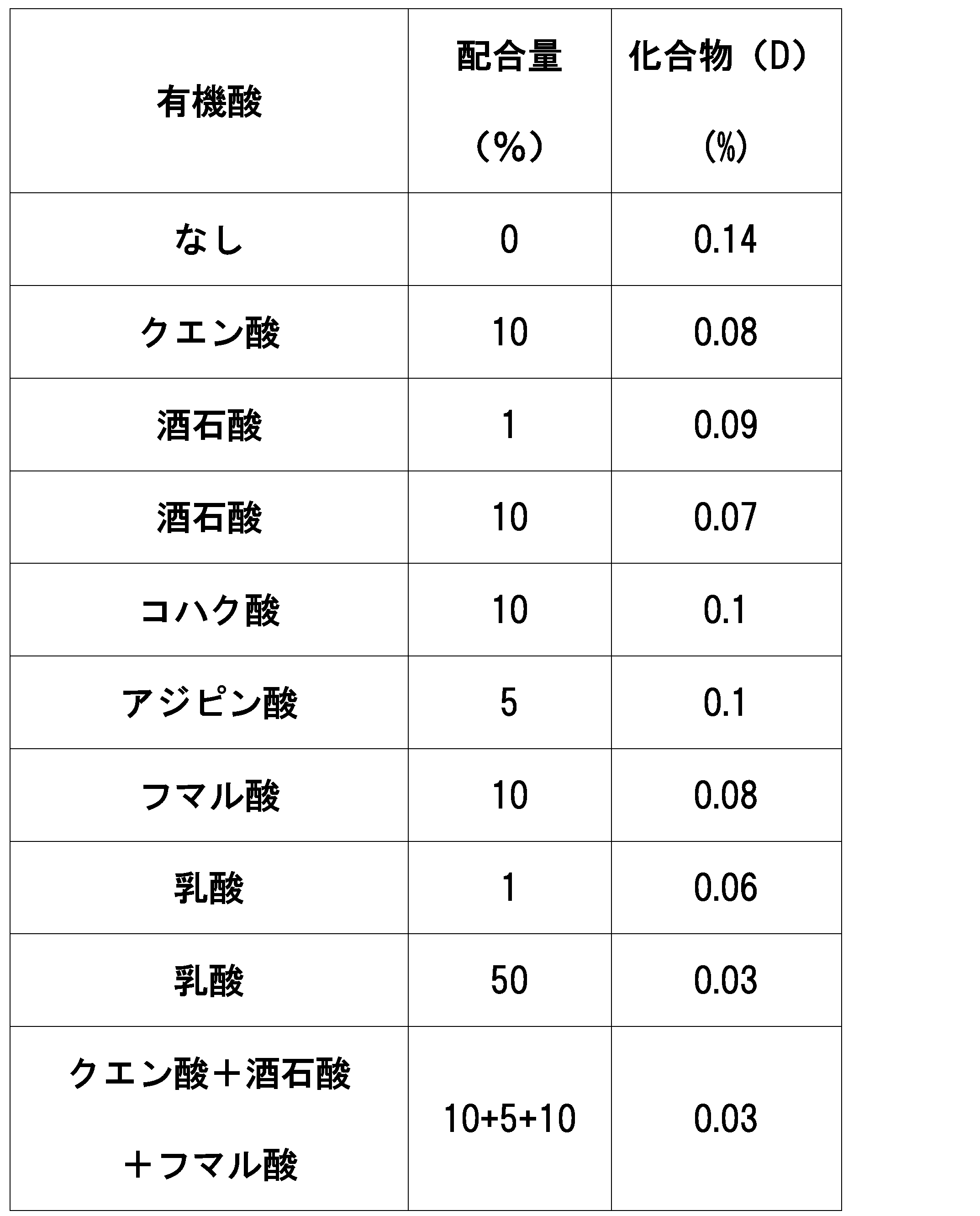
各種有機酸を用いて得られた各非晶質固体分散体は、長期保存による化合物(I)の分解が抑制されることが分かった。また、本試験で得られた全ての非晶質固体分散体は、長期保存後も非晶質の状態が安定に保持された。換言すれば、各種有機酸を用いて得られた各非晶質固体分散体に含まれる化合物(I)の経時安定性が向上することが分かった。これは、ICHの基準に基づいて定められた、「新有効成分含有医薬品のうち製剤の不純物に関するガイドライン」(平成9年6月23日薬審第539号薬務局審査課長通知)の改訂版(医薬審発第0624001号、平成15年6月24日)に照らして、満足できる安定性であると考えられた。
また、各種有機酸を用いて得られた各非晶質固体分散体からの、化合物(I)の放出速度を、化合物(I)の溶出率を24時間にわたって1時間間隔で測定することにより評価した。当該溶出試験は、上記と同様にして行った。結果を図2に示す。図2において、Comp.は化合物(I)を表す。また、HFはHPMC AS-HFを表す。また、Cit、Tar、Fum、Lac、Suc、及びAdiは、それぞれ、クエン酸、酒石酸、フマル酸、乳酸、コハク酸、及びアジピン酸を表す。また、HMは非晶質固体分散体化させていない化合物(I)そのもの(ハンマーミル粉砕品)を表す。
当該結果からわかるように、各種有機酸を用いて得られた各非晶質固体分散体は、有機酸を用いずに得られた非晶質固体分散体(Comp./HF)に比べて、溶出率が向上した。特に、乳酸、あるいは有機酸を組み合わせて(クエン酸、酒石酸、及びフマル酸)用いた場合に、顕著に溶出率が向上した。
非晶質固体分散体のX線回折法(XRD)による解析
70%ジクロロメタン/30%エタノール(w/w)混合液162gに、化合物(I)12gを溶解させて得た溶解液(i)、あるいは、化合物(I)12g及び乳酸6gを溶解させて得た溶解液(ii)、について、上記と同様にして噴霧乾燥(スプレードライ)して、非晶質固体分散体(i)及び非晶質固体分散体(ii)を得た。
70%ジクロロメタン/30%エタノール(w/w)混合液162gに、化合物(I)12gを溶解させて得た溶解液(i)、あるいは、化合物(I)12g及び乳酸6gを溶解させて得た溶解液(ii)、について、上記と同様にして噴霧乾燥(スプレードライ)して、非晶質固体分散体(i)及び非晶質固体分散体(ii)を得た。
そして、非晶質固体分散体(i)及び(ii)について、調製直後、及び調製後密封状態で3日間40℃で保管した後に、X線回折法により解析した。
X線回折法の条件を以下に示す。
機種:X’Pert Pro MPD (スペクトリス社)
電圧 (kV): 45
電流 (mA): 40
Configration: Spinner reflect-trans
Scan axis :2 theta
Start angle: 3.000
End angle: 40.000
Step size: 0.0167113
Time per step: 3.175
Scan speed (°/s): 0.668451
Wobble axis: omega
Number of steps: 5
Step size: 1.000
機種:X’Pert Pro MPD (スペクトリス社)
電圧 (kV): 45
電流 (mA): 40
Configration: Spinner reflect-trans
Scan axis :2 theta
Start angle: 3.000
End angle: 40.000
Step size: 0.0167113
Time per step: 3.175
Scan speed (°/s): 0.668451
Wobble axis: omega
Number of steps: 5
Step size: 1.000
当該解析結果を図3に示す。図3右側に非晶質固体分散体(i)の結果を、左側に非晶質固体分散体(ii)の結果を示す。非晶質固体分散体(i)では、3日間40℃で保管した後に多くのピークが現れたことから、一部の非晶質体が結晶に転移したと考えられた一方、非晶質固体分散体(ii)では、3日間40℃で保管した後であってもパターンが変化せず、非晶質の状態が安定に保持されたと考えられた。
非晶質固体分散体の熱分析(TGA及びDSC)
非晶質固体分散体(ii)について、熱重量測定(TGA)及び示差走査熱量測定(DSC)を行った。
非晶質固体分散体(ii)について、熱重量測定(TGA)及び示差走査熱量測定(DSC)を行った。
測定機器としては、次のものを使用した。なお、試料(非晶質固体分散体(ii))量は、いずれも約5mgとした。
TGA: TGA Q5000 (TA Instruments社)
DSC: DSC Q2000 (TA Instruments社)
TGA: TGA Q5000 (TA Instruments社)
DSC: DSC Q2000 (TA Instruments社)
TGA分析については、250℃まで10℃/minで昇温した。DSC分析については、最初に100℃まで10℃/minで昇温して、微量で残存していると考えられるジクロロメタン及びエタノールを揮発させたあと、25℃まで10℃/minで冷却し、再度10℃/minで150℃まで上昇させた。
結果を図4a(TGA分析)及び図4b(DSC分析)に示す。図4aにおいて、発熱を示すピークは測定されなかった(点線丸枠で囲った部分参照)。図4bにおいて、重量変化を示すピークは測定されなかった(点線丸枠で囲った部分参照)。これらのことからも、非晶質固体分散体(ii)は、結晶に転移していない(非晶質のままである)ことが示唆され、従って非晶質固体分散体(ii)が安定であることが裏付けられた。
非晶質固体分散体のNMR測定
非晶質固体分散体(ii)について、NMRによる解析を行った。なお、非晶質固体分散体化させていない化合物(I)そのもの、HPMC AS-HF、及び乳酸についても、同様にNMR解析を行った。さらには、HPMC AS-HF及び乳酸を溶解した溶解液から調製した非晶質固体分散体(「非晶質固体分散体(iii)」とも呼ぶ)、についても、同様にNMR解析を行った。なお、当該HPMC AS-HF及び乳酸を溶解した溶解液は、70%塩化メチレン/30%エタノール(w/w)混合液430gに、HPMC AS-HF40g及び乳酸10gを溶解させた液である。
以下にNMRの測定条件を示す。
測定機器:ECA-500 (JEOL RESONANCE社)
観測核:1H
試料量:約5 mg
溶媒:DMSO-d6
ケミカルシフトの基準値:2.49 ppm(DMSO)
積算回数:8回
非晶質固体分散体(ii)について、NMRによる解析を行った。なお、非晶質固体分散体化させていない化合物(I)そのもの、HPMC AS-HF、及び乳酸についても、同様にNMR解析を行った。さらには、HPMC AS-HF及び乳酸を溶解した溶解液から調製した非晶質固体分散体(「非晶質固体分散体(iii)」とも呼ぶ)、についても、同様にNMR解析を行った。なお、当該HPMC AS-HF及び乳酸を溶解した溶解液は、70%塩化メチレン/30%エタノール(w/w)混合液430gに、HPMC AS-HF40g及び乳酸10gを溶解させた液である。
以下にNMRの測定条件を示す。
測定機器:ECA-500 (JEOL RESONANCE社)
観測核:1H
試料量:約5 mg
溶媒:DMSO-d6
ケミカルシフトの基準値:2.49 ppm(DMSO)
積算回数:8回
結果を図5に示す。図5において、化合物(I)と非晶質固体分散体(ii)とでは、ピークの位置がずれている(図中の点線を参照)。このことから、非晶質固体分散体(ii)においては、化合物(I)と乳酸とが分子的にインタラクションしていることが分かった。そして、非晶質固体分散体(ii)に含まれる非晶質体(アモルファス)は、化合物(I)及び乳酸からなる非晶質体であることが分かった。
錠剤の調製及び検討
非晶質固体分散体(ii)を含有するハイドロゲル徐放性製剤(ハイドロゲルマトリクス錠)を、通常の既知の製造プロセスに従って製造した。具体的には、1錠あたり、非晶質固体分散体(ii)41.4mg(化合物(I)を12mg含む)、ヒプロメロース80mg、デンプングリコール酸ナトリウム60mg、及びステアリン酸マグネシウム0.6mgとなるよう、これらの原料を混合し、打錠して、ハイドロゲルマトリクス錠(素錠)を調製した。なお、ハイドロゲルマトリクス錠は、(コーティングを施した錠剤の場合は胃排泄後のpH上昇によってコーティング皮膜が溶解して)消化管の水分を吸収して形成されるハイドロゲルが薬物放出を制御する公知の技術である。
非晶質固体分散体(ii)を含有するハイドロゲル徐放性製剤(ハイドロゲルマトリクス錠)を、通常の既知の製造プロセスに従って製造した。具体的には、1錠あたり、非晶質固体分散体(ii)41.4mg(化合物(I)を12mg含む)、ヒプロメロース80mg、デンプングリコール酸ナトリウム60mg、及びステアリン酸マグネシウム0.6mgとなるよう、これらの原料を混合し、打錠して、ハイドロゲルマトリクス錠(素錠)を調製した。なお、ハイドロゲルマトリクス錠は、(コーティングを施した錠剤の場合は胃排泄後のpH上昇によってコーティング皮膜が溶解して)消化管の水分を吸収して形成されるハイドロゲルが薬物放出を制御する公知の技術である。
さらに、当該ハイドロゲルマトリクス錠(素錠)に、腸溶コーティングを施し、腸溶コーティング剤を調製した。具体的には、1錠あたり、メタクリル酸コポリマーLD(Eudragit L30D-55、エボニック社)9.1mg、タルク4.55mg、クエン酸トリエチル0.91mgを、汎用のコーティング機を用いて常法通りに腸溶コーティングを行った。その後、OPADRY 03A420002(5.4mg)を用いてカラーコーティングを行い、腸溶コーティング錠を得た。
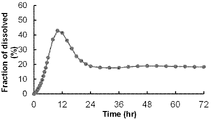
得られた腸溶コーティング錠からの、化合物(I)の放出速度を、化合物(I)の溶出率を24時間にわたって1時間間隔で測定することにより評価した。当該溶出試験は、上記と同様にして行った。結果を図6に示す。当該腸溶コーティング剤は、優れた過飽和溶出プロファイルを示した。
ヒト経口投与時の化合物(I)の血中濃度の評価
本開示の経口医薬組成物をヒトに経口投与した際の化合物(I)の血中濃度を、以下の単回投与プロトコールに基づいて評価した。本評価において使用する製剤(試験製剤)は、有効成分として12mgの化合物(I)の非晶質固体分散体を含む、本開示に従って調製されるハイドロゲルマトリクス錠である。単回投与プロトコールでは、化合物(I)の普通錠(非晶質固体分散体化させていない化合物(I)を含む錠剤)を単回投与し、休薬後、試験製剤12mg(12mg錠を1錠)を単回投与した。化合物(I)のPKパラメータを解析した。普通錠と比較してtmax(最高血漿中濃度到達時間)の中央値が延長された。こうした結果から、本開示の経口医薬組成物を用いることにより、週1回製剤として望ましい化合物(I)の血中濃度(例えば定常状態時で15ng/mL~400ng/mL)が維持されると考えられる。
本開示の経口医薬組成物をヒトに経口投与した際の化合物(I)の血中濃度を、以下の単回投与プロトコールに基づいて評価した。本評価において使用する製剤(試験製剤)は、有効成分として12mgの化合物(I)の非晶質固体分散体を含む、本開示に従って調製されるハイドロゲルマトリクス錠である。単回投与プロトコールでは、化合物(I)の普通錠(非晶質固体分散体化させていない化合物(I)を含む錠剤)を単回投与し、休薬後、試験製剤12mg(12mg錠を1錠)を単回投与した。化合物(I)のPKパラメータを解析した。普通錠と比較してtmax(最高血漿中濃度到達時間)の中央値が延長された。こうした結果から、本開示の経口医薬組成物を用いることにより、週1回製剤として望ましい化合物(I)の血中濃度(例えば定常状態時で15ng/mL~400ng/mL)が維持されると考えられる。
Claims (15)
- 7-[4-(4-ベンゾ[b]チオフェン-4-イル-ピペラジン-1-イル)ブトキシ]-1H-キノリン-2-オン及び少なくとも1種の有機酸を含む非晶質体。
- 有機酸がカルボン酸である、請求項1に記載の非晶質体。
- 有機酸が乳酸である、請求項1又は2に記載の非晶質体。
- 請求項1~3のいずれかに記載の非晶質体、及び少なくとも1種の腸溶性ポリマーを含む、非晶質固体分散体。
- 7-[4-(4-ベンゾ[b]チオフェン-4-イル-ピペラジン-1-イル)ブトキシ]-1H-キノリン-2-オン及び少なくとも1種の腸溶性ポリマーを含む、非晶質固体分散体。
- 腸溶性ポリマーが非イオン性の水溶性ポリマーである、請求項4又は5に記載の非晶質固体分散体。
- 腸溶性ポリマーが、ヒドロキシプロピルメチルセルロース及びその誘導体、並びにポリビニルピロリドンからなる群より選択される少なくとも1種である、請求項4~6のいずれかに記載の非晶質固体分散体。
- スプレードライ粉末である、請求項1~3のいずれかに記載の非晶質体又は請求項4~7のいずれかに記載の非晶質固体分散体。
- 7-[4-(4-ベンゾ[b]チオフェン-4-イル-ピペラジン-1-イル)ブトキシ]-1H-キノリン-2-オンと、腸溶性ポリマー及び有機酸の少なくとも一方とを含む混合物を噴霧乾燥する工程を含む、請求項1~3のいずれかに記載の非晶質体又は請求項4~8のいずれかに記載の非晶質固体分散体の製造方法。
- 請求項1~3のいずれかに記載の非晶質体及び請求項4~8のいずれかに記載の非晶質固体分散体からなる群より選択される少なくとも1種と、
親水性ポリマーと
を含有する医薬組成物。 - 親水性ポリマーが、セルロース系水溶性高分子、ポリアルキレンオキサイド、ポリアルキレングリコール、及びポリビニルアルコールからなる群より選択される少なくとも1種である、請求項10に記載の医薬組成物。
- 経口固形医薬組成物である、請求項10又は11に記載の医薬組成物。
- ヒト経口投与時の定常状態時の7-[4-(4-ベンゾ[b]チオフェン-4-イル-ピペラジン-1-イル)ブトキシ]-1H-キノリン-2-オンの血中濃度が、15ng/mL~400ng/mLの範囲で1週間維持される、請求項12に記載の医薬組成物。
- 週1回、7-[4-(4-ベンゾ[b]チオフェン-4-イル-ピペラジン-1-イル)ブトキシ]-1H-キノリン-2-オンを、5mg~60mgの用量で投与するための、請求項9~13のいずれかに記載の医薬組成物。
- 中枢神経疾患を予防または治療するための請求項9~14のいずれかに記載の医薬組成物。
Priority Applications (6)
| Application Number | Priority Date | Filing Date | Title |
|---|---|---|---|
| PCT/JP2021/005721 WO2022176017A1 (ja) | 2021-02-16 | 2021-02-16 | 非晶質体及び当該非晶質体を含む組成物 |
| JP2023500872A JP7834709B2 (ja) | 2021-02-16 | 2022-02-16 | 非晶質体及び当該非晶質体を含む組成物 |
| PCT/JP2022/006064 WO2022176877A1 (ja) | 2021-02-16 | 2022-02-16 | 非晶質体及び当該非晶質体を含む組成物 |
| US18/546,602 US20240158380A1 (en) | 2021-02-16 | 2022-02-16 | Amorphous form and composition containing said amorphous form |
| CN202280014342.1A CN116829553A (zh) | 2021-02-16 | 2022-02-16 | 非晶质形以及含有该非晶质形的组合物 |
| EP22756195.8A EP4296269A4 (en) | 2021-02-16 | 2022-02-16 | AMORPHOUS FORM AND COMPOSITION WITH THIS AMORPHOUS FORM |
Applications Claiming Priority (1)
| Application Number | Priority Date | Filing Date | Title |
|---|---|---|---|
| PCT/JP2021/005721 WO2022176017A1 (ja) | 2021-02-16 | 2021-02-16 | 非晶質体及び当該非晶質体を含む組成物 |
Publications (1)
| Publication Number | Publication Date |
|---|---|
| WO2022176017A1 true WO2022176017A1 (ja) | 2022-08-25 |
Family
ID=82930564
Family Applications (2)
| Application Number | Title | Priority Date | Filing Date |
|---|---|---|---|
| PCT/JP2021/005721 Ceased WO2022176017A1 (ja) | 2021-02-16 | 2021-02-16 | 非晶質体及び当該非晶質体を含む組成物 |
| PCT/JP2022/006064 Ceased WO2022176877A1 (ja) | 2021-02-16 | 2022-02-16 | 非晶質体及び当該非晶質体を含む組成物 |
Family Applications After (1)
| Application Number | Title | Priority Date | Filing Date |
|---|---|---|---|
| PCT/JP2022/006064 Ceased WO2022176877A1 (ja) | 2021-02-16 | 2022-02-16 | 非晶質体及び当該非晶質体を含む組成物 |
Country Status (5)
| Country | Link |
|---|---|
| US (1) | US20240158380A1 (ja) |
| EP (1) | EP4296269A4 (ja) |
| JP (1) | JP7834709B2 (ja) |
| CN (1) | CN116829553A (ja) |
| WO (2) | WO2022176017A1 (ja) |
Cited By (1)
| Publication number | Priority date | Publication date | Assignee | Title |
|---|---|---|---|---|
| WO2025154730A1 (ja) * | 2024-01-18 | 2025-07-24 | 沢井製薬株式会社 | 固体分散体、固体分散体を含む製剤、及び固体分散体の製造方法 |
Citations (3)
| Publication number | Priority date | Publication date | Assignee | Title |
|---|---|---|---|---|
| JP5952917B2 (ja) * | 2012-04-23 | 2016-07-13 | 大塚製薬株式会社 | ベンゾチオフェン化合物又はその塩の、二水和物、及びその製造方法 |
| US20190160005A1 (en) * | 2017-11-24 | 2019-05-30 | Biophore India Pharmaceuticals Pvt. Ltd. | Method of Preparing Solid Dispersions of Active Pharmaceutical Ingredients |
| JP2019529564A (ja) * | 2016-09-23 | 2019-10-17 | デルポー・インコーポレイテッドDelpor, Inc. | 小分子治療剤化合物のための組成物 |
Family Cites Families (6)
| Publication number | Priority date | Publication date | Assignee | Title |
|---|---|---|---|---|
| IN191496B (ja) * | 1999-07-30 | 2003-12-06 | Ranbaxy Lab Ltd | |
| GB2383042A (en) * | 2001-10-18 | 2003-06-18 | Cipla Ltd | Amorphous alendronate sodium |
| JO3227B1 (ar) * | 2011-09-08 | 2018-03-08 | Otsuka Pharma Co Ltd | مشتقات بنزو ثيوفين بها استبدال ببرازين كعوامل مضادة للذهان |
| JP2013139441A (ja) * | 2011-12-28 | 2013-07-18 | Otsuka Pharmaceut Co Ltd | マイクロスフェア |
| AR091349A1 (es) * | 2012-04-30 | 2015-01-28 | Otsuka Pharma Co Ltd | Formulacion oral |
| TWI803187B (zh) * | 2014-08-08 | 2023-05-21 | 日商中外製藥股份有限公司 | 包含4環性化合物的非晶質體之固體分散體及製劑 |
-
2021
- 2021-02-16 WO PCT/JP2021/005721 patent/WO2022176017A1/ja not_active Ceased
-
2022
- 2022-02-16 WO PCT/JP2022/006064 patent/WO2022176877A1/ja not_active Ceased
- 2022-02-16 CN CN202280014342.1A patent/CN116829553A/zh active Pending
- 2022-02-16 EP EP22756195.8A patent/EP4296269A4/en active Pending
- 2022-02-16 US US18/546,602 patent/US20240158380A1/en active Pending
- 2022-02-16 JP JP2023500872A patent/JP7834709B2/ja active Active
Patent Citations (3)
| Publication number | Priority date | Publication date | Assignee | Title |
|---|---|---|---|---|
| JP5952917B2 (ja) * | 2012-04-23 | 2016-07-13 | 大塚製薬株式会社 | ベンゾチオフェン化合物又はその塩の、二水和物、及びその製造方法 |
| JP2019529564A (ja) * | 2016-09-23 | 2019-10-17 | デルポー・インコーポレイテッドDelpor, Inc. | 小分子治療剤化合物のための組成物 |
| US20190160005A1 (en) * | 2017-11-24 | 2019-05-30 | Biophore India Pharmaceuticals Pvt. Ltd. | Method of Preparing Solid Dispersions of Active Pharmaceutical Ingredients |
Cited By (1)
| Publication number | Priority date | Publication date | Assignee | Title |
|---|---|---|---|---|
| WO2025154730A1 (ja) * | 2024-01-18 | 2025-07-24 | 沢井製薬株式会社 | 固体分散体、固体分散体を含む製剤、及び固体分散体の製造方法 |
Also Published As
| Publication number | Publication date |
|---|---|
| JP7834709B2 (ja) | 2026-03-24 |
| WO2022176877A1 (ja) | 2022-08-25 |
| EP4296269A4 (en) | 2025-02-19 |
| EP4296269A1 (en) | 2023-12-27 |
| JPWO2022176877A1 (ja) | 2022-08-25 |
| CN116829553A (zh) | 2023-09-29 |
| US20240158380A1 (en) | 2024-05-16 |
Similar Documents
| Publication | Publication Date | Title |
|---|---|---|
| JP5285105B2 (ja) | 医薬品組成物 | |
| CA3088272A1 (en) | Pharmaceutical compositions for treating cystic fibrosis | |
| JP6487599B2 (ja) | エスシタロプラム医薬組成物 | |
| WO2020242935A1 (en) | Methods of treatment for cystic fibrosis | |
| KR20210052471A (ko) | 신규한 방법 | |
| TW201031405A (en) | Pharmaceutical dosage form comprising nifedipine or nisoldipine and an angiotensin II antagonist and/or a diuretic | |
| JPWO2002024166A1 (ja) | 崩壊性が良好な経口製剤 | |
| AU2011290614A1 (en) | Nalbuphine-based formulations and uses thereof | |
| AU2016259762B2 (en) | Vortioxetine pyroglutamate | |
| CA3187118A1 (en) | Amorphous form of a malt1 inhibitor and formulations thereof | |
| KR20250002779A (ko) | Glp1 정제 조성물 | |
| JP5288791B2 (ja) | 難水溶性物質含有微細化組成物 | |
| KR20070115918A (ko) | 멀티플 유닛형 경구 서방성 제제 및 그 제조방법 | |
| JP4730985B2 (ja) | 安定化された医薬製剤 | |
| JP7834709B2 (ja) | 非晶質体及び当該非晶質体を含む組成物 | |
| US12409140B2 (en) | Therapeutic formulations and uses thereof | |
| WO2025214247A1 (zh) | 恩扎卢胺药物组合物及其制备方法和用途 | |
| TW202222321A (zh) | Mcl—1抑制劑配製物 | |
| KR102641708B1 (ko) | 알칼리화제를 포함하는 셀레콕시브 함유 고체분산체 및 이의 제조방법 | |
| JP2016155777A (ja) | モンテルカスト又はその塩を含む組成物 | |
| WO2023063381A1 (ja) | 粉末製剤 | |
| EP3572069A1 (en) | Increasing solubility and bioavailability of enzalutamide | |
| KR20200094499A (ko) | 타다라필 함유 고체분산체 및 이의 제조방법 | |
| HK40100310A (zh) | 包含孟鲁司特或其药学上可接受的盐和左西替利嗪或其药学上可接受的盐的稳定性提高的薄膜包衣片剂 | |
| CN120676932A (zh) | 贝祖拉替尼制剂 |
Legal Events
| Date | Code | Title | Description |
|---|---|---|---|
| 121 | Ep: the epo has been informed by wipo that ep was designated in this application |
Ref document number: 21926457 Country of ref document: EP Kind code of ref document: A1 |
|
| NENP | Non-entry into the national phase |
Ref country code: DE |
|
| 122 | Ep: pct application non-entry in european phase |
Ref document number: 21926457 Country of ref document: EP Kind code of ref document: A1 |
|
| NENP | Non-entry into the national phase |
Ref country code: JP |