WO2022158373A1 - タンパク質、溶血性連鎖球菌ワクチン、dna、ベクター、形質転換体、タンパク質を製造する方法、バキュロウイルス、アグロバクテリウム、ラテックス粒子、キット及び抗ストレプトリジンo抗体の測定方法 - Google Patents
タンパク質、溶血性連鎖球菌ワクチン、dna、ベクター、形質転換体、タンパク質を製造する方法、バキュロウイルス、アグロバクテリウム、ラテックス粒子、キット及び抗ストレプトリジンo抗体の測定方法 Download PDFInfo
- Publication number
- WO2022158373A1 WO2022158373A1 PCT/JP2022/000954 JP2022000954W WO2022158373A1 WO 2022158373 A1 WO2022158373 A1 WO 2022158373A1 JP 2022000954 W JP2022000954 W JP 2022000954W WO 2022158373 A1 WO2022158373 A1 WO 2022158373A1
- Authority
- WO
- WIPO (PCT)
- Prior art keywords
- protein
- amino acid
- acid sequence
- antibody
- streptolysin
- Prior art date
- Legal status (The legal status is an assumption and is not a legal conclusion. Google has not performed a legal analysis and makes no representation as to the accuracy of the status listed.)
- Ceased
Links
Images

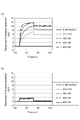

Classifications
-
- A—HUMAN NECESSITIES
- A01—AGRICULTURE; FORESTRY; ANIMAL HUSBANDRY; HUNTING; TRAPPING; FISHING
- A01H—NEW PLANTS OR NON-TRANSGENIC PROCESSES FOR OBTAINING THEM; PLANT REPRODUCTION BY TISSUE CULTURE TECHNIQUES
- A01H1/00—Processes for modifying genotypes ; Plants characterised by associated natural traits
-
- A—HUMAN NECESSITIES
- A01—AGRICULTURE; FORESTRY; ANIMAL HUSBANDRY; HUNTING; TRAPPING; FISHING
- A01H—NEW PLANTS OR NON-TRANSGENIC PROCESSES FOR OBTAINING THEM; PLANT REPRODUCTION BY TISSUE CULTURE TECHNIQUES
- A01H5/00—Angiosperms, i.e. flowering plants, characterised by their plant parts; Angiosperms characterised otherwise than by their botanic taxonomy
-
- A—HUMAN NECESSITIES
- A01—AGRICULTURE; FORESTRY; ANIMAL HUSBANDRY; HUNTING; TRAPPING; FISHING
- A01K—ANIMAL HUSBANDRY; AVICULTURE; APICULTURE; PISCICULTURE; FISHING; REARING OR BREEDING ANIMALS, NOT OTHERWISE PROVIDED FOR; NEW BREEDS OF ANIMALS
- A01K67/00—Rearing or breeding animals, not otherwise provided for; New or modified breeds of animals
- A01K67/027—New or modified breeds of vertebrates
-
- A—HUMAN NECESSITIES
- A61—MEDICAL OR VETERINARY SCIENCE; HYGIENE
- A61K—PREPARATIONS FOR MEDICAL, DENTAL OR TOILETRY PURPOSES
- A61K39/00—Medicinal preparations containing antigens or antibodies
- A61K39/02—Bacterial antigens
- A61K39/09—Lactobacillales, e.g. aerococcus, enterococcus, lactobacillus, lactococcus, streptococcus
-
- A—HUMAN NECESSITIES
- A61—MEDICAL OR VETERINARY SCIENCE; HYGIENE
- A61P—SPECIFIC THERAPEUTIC ACTIVITY OF CHEMICAL COMPOUNDS OR MEDICINAL PREPARATIONS
- A61P31/00—Antiinfectives, i.e. antibiotics, antiseptics, chemotherapeutics
- A61P31/04—Antibacterial agents
-
- C—CHEMISTRY; METALLURGY
- C07—ORGANIC CHEMISTRY
- C07K—PEPTIDES
- C07K14/00—Peptides having more than 20 amino acids; Gastrins; Somatostatins; Melanotropins; Derivatives thereof
- C07K14/195—Peptides having more than 20 amino acids; Gastrins; Somatostatins; Melanotropins; Derivatives thereof from bacteria
-
- C—CHEMISTRY; METALLURGY
- C07—ORGANIC CHEMISTRY
- C07K—PEPTIDES
- C07K14/00—Peptides having more than 20 amino acids; Gastrins; Somatostatins; Melanotropins; Derivatives thereof
- C07K14/195—Peptides having more than 20 amino acids; Gastrins; Somatostatins; Melanotropins; Derivatives thereof from bacteria
- C07K14/315—Peptides having more than 20 amino acids; Gastrins; Somatostatins; Melanotropins; Derivatives thereof from bacteria from Streptococcus (G), e.g. Enterococci
-
- C—CHEMISTRY; METALLURGY
- C12—BIOCHEMISTRY; BEER; SPIRITS; WINE; VINEGAR; MICROBIOLOGY; ENZYMOLOGY; MUTATION OR GENETIC ENGINEERING
- C12N—MICROORGANISMS OR ENZYMES; COMPOSITIONS THEREOF; PROPAGATING, PRESERVING, OR MAINTAINING MICROORGANISMS; MUTATION OR GENETIC ENGINEERING; CULTURE MEDIA
- C12N15/00—Mutation or genetic engineering; DNA or RNA concerning genetic engineering, vectors, e.g. plasmids, or their isolation, preparation or purification; Use of hosts therefor
- C12N15/09—Recombinant DNA-technology
- C12N15/63—Introduction of foreign genetic material using vectors; Vectors; Use of hosts therefor; Regulation of expression
- C12N15/74—Vectors or expression systems specially adapted for prokaryotic hosts other than E. coli, e.g. Lactobacillus, Micromonospora
-
- C—CHEMISTRY; METALLURGY
- C12—BIOCHEMISTRY; BEER; SPIRITS; WINE; VINEGAR; MICROBIOLOGY; ENZYMOLOGY; MUTATION OR GENETIC ENGINEERING
- C12N—MICROORGANISMS OR ENZYMES; COMPOSITIONS THEREOF; PROPAGATING, PRESERVING, OR MAINTAINING MICROORGANISMS; MUTATION OR GENETIC ENGINEERING; CULTURE MEDIA
- C12N15/00—Mutation or genetic engineering; DNA or RNA concerning genetic engineering, vectors, e.g. plasmids, or their isolation, preparation or purification; Use of hosts therefor
- C12N15/09—Recombinant DNA-technology
- C12N15/63—Introduction of foreign genetic material using vectors; Vectors; Use of hosts therefor; Regulation of expression
- C12N15/79—Vectors or expression systems specially adapted for eukaryotic hosts
- C12N15/80—Vectors or expression systems specially adapted for eukaryotic hosts for fungi
-
- C—CHEMISTRY; METALLURGY
- C12—BIOCHEMISTRY; BEER; SPIRITS; WINE; VINEGAR; MICROBIOLOGY; ENZYMOLOGY; MUTATION OR GENETIC ENGINEERING
- C12N—MICROORGANISMS OR ENZYMES; COMPOSITIONS THEREOF; PROPAGATING, PRESERVING, OR MAINTAINING MICROORGANISMS; MUTATION OR GENETIC ENGINEERING; CULTURE MEDIA
- C12N15/00—Mutation or genetic engineering; DNA or RNA concerning genetic engineering, vectors, e.g. plasmids, or their isolation, preparation or purification; Use of hosts therefor
- C12N15/09—Recombinant DNA-technology
- C12N15/63—Introduction of foreign genetic material using vectors; Vectors; Use of hosts therefor; Regulation of expression
- C12N15/79—Vectors or expression systems specially adapted for eukaryotic hosts
- C12N15/80—Vectors or expression systems specially adapted for eukaryotic hosts for fungi
- C12N15/81—Vectors or expression systems specially adapted for eukaryotic hosts for fungi for yeasts
-
- C—CHEMISTRY; METALLURGY
- C12—BIOCHEMISTRY; BEER; SPIRITS; WINE; VINEGAR; MICROBIOLOGY; ENZYMOLOGY; MUTATION OR GENETIC ENGINEERING
- C12N—MICROORGANISMS OR ENZYMES; COMPOSITIONS THEREOF; PROPAGATING, PRESERVING, OR MAINTAINING MICROORGANISMS; MUTATION OR GENETIC ENGINEERING; CULTURE MEDIA
- C12N5/00—Undifferentiated human, animal or plant cells, e.g. cell lines; Tissues; Cultivation or maintenance thereof; Culture media therefor
- C12N5/10—Cells modified by introduction of foreign genetic material
-
- C—CHEMISTRY; METALLURGY
- C12—BIOCHEMISTRY; BEER; SPIRITS; WINE; VINEGAR; MICROBIOLOGY; ENZYMOLOGY; MUTATION OR GENETIC ENGINEERING
- C12P—FERMENTATION OR ENZYME-USING PROCESSES TO SYNTHESISE A DESIRED CHEMICAL COMPOUND OR COMPOSITION OR TO SEPARATE OPTICAL ISOMERS FROM A RACEMIC MIXTURE
- C12P21/00—Preparation of peptides or proteins
- C12P21/02—Preparation of peptides or proteins having a known sequence of two or more amino acids, e.g. glutathione
-
- G—PHYSICS
- G01—MEASURING; TESTING
- G01N—INVESTIGATING OR ANALYSING MATERIALS BY DETERMINING THEIR CHEMICAL OR PHYSICAL PROPERTIES
- G01N33/00—Investigating or analysing materials by specific methods not covered by groups G01N1/00 - G01N31/00
- G01N33/48—Biological material, e.g. blood, urine; Haemocytometers
- G01N33/50—Chemical analysis of biological material, e.g. blood, urine; Testing involving biospecific ligand binding methods; Immunological testing
- G01N33/53—Immunoassay; Biospecific binding assay; Materials therefor
-
- G—PHYSICS
- G01—MEASURING; TESTING
- G01N—INVESTIGATING OR ANALYSING MATERIALS BY DETERMINING THEIR CHEMICAL OR PHYSICAL PROPERTIES
- G01N33/00—Investigating or analysing materials by specific methods not covered by groups G01N1/00 - G01N31/00
- G01N33/48—Biological material, e.g. blood, urine; Haemocytometers
- G01N33/50—Chemical analysis of biological material, e.g. blood, urine; Testing involving biospecific ligand binding methods; Immunological testing
- G01N33/53—Immunoassay; Biospecific binding assay; Materials therefor
- G01N33/543—Immunoassay; Biospecific binding assay; Materials therefor with an insoluble carrier for immobilising immunochemicals
Definitions
- the present invention relates to proteins, hemolytic streptococcal vaccines, DNAs, vectors, transformants, methods for producing proteins, baculoviruses, Agrobacterium, latex particles, kits, and methods for measuring anti-streptolysin O antibodies.
- Streptolysin O is a protein with hemolytic activity produced by Streptococcus pyogenes.
- Anti-SLO antibodies (ASO) in the blood increase when humans are infected with hemolytic streptococci. Taking advantage of this, the presence or absence of hemolytic streptococcus infection is clinically performed by measuring the amount of ASO in blood.
- SLO is used as a raw material for ASO measurement reagents.
- SLO is a protein with a total length of 571 amino acid residues, but the peptide from the N-terminus to the 33rd amino acid residue is a signal peptide.
- SLO34-571 without a signal peptide has been used as a raw material for ASO measurement reagents.
- modified SLO lacking the C-terminal region has been developed for the purpose of providing SLO with no hemolytic activity and high thermostability (Patent Document 1).
- proteins containing epitopes of neutralizing antibodies against SLO can be used as vaccine antigens capable of producing neutralizing antibodies, and can be used as test antigens capable of quantifying neutralizing antibody titers. they thought. That is, an object of the present invention is to determine the location of epitopes of neutralizing antibodies against SLO and to provide proteins (SLO antigens) containing such epitopes.
- the present inventors examined the reactivity of neutralizing antibodies against SLO and found that it was 100% against SLO82-571 and approximately 70% against SLO34-460 and SLO82-460. -460 was identified as the major epitope of neutralizing antibodies against SLO. The present inventors have completed the present invention based on these findings.
- a diagnostic antigen for measuring a neutralizing antibody that neutralizes the hemolytic action of streptolysin O comprising the protein according to any one of [1] to [3] above.
- a hemolytic streptococcal vaccine containing the protein according to any one of [1] to [3] above.
- the transformant according to [8] above, wherein the transformant is selected from bacteria, insect cells, insects, animal cells, animals, plant cells and plants.
- a method for producing the protein according to any one of [1] to [3] above which comprises culturing, breeding, or cultivating the transformant according to [8] or [9] above.
- method including.
- a method for producing the protein according to any one of [1] to [3] above comprising the step of infecting host insect cells or insects with the baculovirus according to [11] above. .
- a kit for measuring ASO containing the latex particles of [16] above.
- ASO is a neutralizing antibody that neutralizes the hemolytic action of SLO.
- a method for measuring ASO using the latex particles described in [16] above. [20] The step of contacting the latex particles according to [16] above with a test sample that may contain ASO, and the step of measuring the agglutination reaction of the latex particles by the antigen-antibody reaction between the antibody and the protein; A method for measuring an anti-SLO antibody, comprising: [21] The method of [19] or [20] above, wherein the ASO is a neutralizing antibody that neutralizes the hemolytic action of SLO.
- vaccine antigens capable of producing neutralizing antibodies against SLO and proteins (SLO antigens) that can be used as test antigens capable of quantifying neutralizing antibody titers against SLO. can.
- FIG. 3 shows the results of SDS-PAGE of each SLO variant under non-reducing conditions.
- Leftmost lane molecular weight markers
- lane 1 SLO34-460
- lane 2 SLO82-460
- lane 3 SLO82-571.
- FIG. 4 shows the results of an antibody absorption test using SLO34-460.
- (a) shows the results when ASO-positive serum before antibody absorption was added as a ligand
- (b) shows the results when the flow-through fraction after antibody absorption was added as a ligand.
- FIG. 10 shows the results of an antibody absorption test using SLO82-460.
- (a) shows the results when ASO-positive serum before antibody absorption was added as a ligand
- (b) shows the results when the flow-through fraction after antibody absorption was added as a ligand.
- One embodiment of the present invention is a protein selected from the following (a) to (g): (a) a protein consisting of the amino acid sequence set forth in SEQ ID NO: 3, (b) a protein set forth in SEQ ID NO: 2 A protein consisting of an amino acid sequence, (c) a protein consisting of an amino acid sequence set forth in SEQ ID NO: 4, and (d) an amino acid sequence set forth in SEQ ID NO: 2, in which part of the amino acid residues at positions 1 to 48 is deleted.
- a protein consisting of an amino acid sequence (e) a protein consisting of an amino acid sequence in which part of the amino acid residues at positions 380 to 490 in the amino acid sequence set forth in SEQ ID NO: 4 is deleted, (f) (a) to (e) (g) the C-terminus and N-terminus of any of the proteins (a) to (f) is a protein to which at least one of is tagged. Since such proteins contain epitopes for neutralizing antibodies against SLO, they can be vaccine antigens capable of producing neutralizing antibodies.
- SLO34-571 obtained by removing amino acid residues at positions 1 to 33 (signal peptide) from full-length SLO is a protein consisting of the amino acid sequence shown in SEQ ID NO:1.
- SLO34-460 obtained by removing amino acid residues at positions 1 to 33 and positions 461 to 571 from full-length SLO is "a protein consisting of the amino acid sequence shown in SEQ ID NO:2".
- SLO82-460 obtained by removing amino acid residues at positions 1 to 81 and positions 461 to 571 from full-length SLO is "a protein consisting of the amino acid sequence shown in SEQ ID NO:3".
- SLO82-571 obtained by removing amino acid residues at positions 1 to 81 from full-length SLO is "a protein consisting of the amino acid sequence shown in SEQ ID NO:4".
- a protein consisting of an amino acid sequence in which a part of the amino acid residues at positions 1 to 48 in the amino acid sequence set forth in SEQ ID NO: 2 is deleted is the amino acid residues at positions 34 to 81 of SLO34-460 to full-length SLO. It corresponds to a protein in which part of the group is deleted.
- the position and number of amino acid residues to be deleted are not limited, and any one or more amino acid residues within the range of positions 1 to 48 may be deleted.
- a protein consisting of an amino acid sequence in which a part of the amino acid residues at positions 380 to 490 in the amino acid sequence set forth in SEQ ID NO: 4 is deleted is amino acid residues at positions 461 to 571 of SLO82-571 to full-length SLO It corresponds to a protein in which part of the group is deleted.
- the position and number of amino acid residues to be deleted are not limited, and any one or more amino acid residues within the range of positions 461-571 may be deleted.
- a method for determining that a protein binds to ASO is an immunoassay method on a detection substrate on which a protein is immobilized, and includes an ELISA method, an immunochromatographic method, and a latex aggregation (LA) method.
- CLIA chemiluminescence immunoassay
- TR-FRET time-resolved fluorescence resonance energy transfer
- QCM Quadrat Crystal Microscope Balance
- BLI BioLayer Interferometry
- TIA turbidimetric immunoassay
- TR- FRET time-resolved fluorescence resonance energy transfer
- QCM Quadrat Crystal Microbalance
- BLI BioLayer Interferometry
- the test statistic includes a difference obtained by subtracting the measured value of (i) from the measured value of (ii), or a value obtained by dividing the measured value of (ii) by the measured value of (i), etc.
- the tag in the "protein having a tag attached to at least one of the C-terminus and N-terminus of any one of (a) to (f)" is protein isolation, purification, immobilization, detection, solubilization, It is a peptide or protein added for purposes such as visualization.
- solubilizing tags include glutathione S-transferase (GST), maltose binding protein (MBP), thioredoxin (TRX) and Nus tags
- detection tags include S tag, HSV tag, FLAG tag, His tag, Strep tag, Strep-II tag, Myc tag, HA tag, V5 tag, E tag, T7 tag, VSV-G tag, Glu-Glu tag and Avi tag.
- His-tag, Strep-tag and Strep-II-tag can also be used as purification tags. These tagged proteins can be expressed as fusion proteins. Proteins to which these tags have been added can be used as vaccine antigens capable of producing neutralizing antibodies as they are. Alternatively, the protein to which these tags have been added may be treated with a digestive enzyme to cleave the tags to obtain any one of the proteins (a) to (f). His tag is preferable among these tags.
- the His tag can be used for protein purification by utilizing the property of specifically binding to metal ions such as nickel. The number of histidine residues contained in the His tag may be, for example, 4-10, 5-7, or 6.
- the protein is preferably any protein selected from the following (a') to (e'): (a') a protein consisting of the amino acid sequence set forth in SEQ ID NO: 3, (b') SEQ ID NO: (c') a protein consisting of the amino acid sequence of SEQ ID NO: 2 in which part of the amino acid residues at positions 1 to 48 are deleted; (d') Proteins (e') (a') to (d') comprising an amino acid sequence having 90% or more identity with the amino acid sequence of any of the proteins (a') to (c') and binding to ASO A tag is added to at least one of the C-terminus and the N-terminus of any protein.
- Such proteins contain SLO82-460, which is the major epitope of neutralizing antibodies against SLO, and are therefore particularly useful as vaccine antigens capable of producing neutralizing antibodies.
- One embodiment of the present invention is a diagnostic antigen for measuring neutralizing antibodies that neutralize the hemolytic action of SLO consisting of the above proteins.
- the protein can be used as a diagnostic antigen for measuring the neutralizing antibody.
- the diagnostic antigen can be used to qualitatively evaluate the presence or absence of the neutralizing antibody in the test sample, or to quantitatively evaluate the concentration of the neutralizing antibody in the test sample. If the neutralizing antibody ability of a subject can be measured, it may be possible to predict the severity of the subject and the risk of reinfection.
- One embodiment of the present invention is a hemolytic streptococcal vaccine containing the above protein.
- the dosage form of the vaccine may be liquid, powder (lyophilized powder, dry powder), capsule, tablet, or frozen, for example.
- the vaccine may contain a pharmaceutically acceptable carrier.
- a pharmaceutically acceptable carrier any carrier commonly used in vaccine production can be used without limitation.
- the carriers include saline, buffered saline, dextrose, water, glycerol, isotonic aqueous buffers, and combinations thereof.
- Emulsifiers, preservatives (eg, thimerosal), tonicity agents, pH adjusters, inactivators (eg, formalin) and the like may further be added to the vaccine as appropriate.
- Vaccine administration routes include, for example, transdermal administration, sublingual administration, eye drop administration, intradermal administration, intramuscular administration, oral administration, enteral administration, nasal administration, intravenous administration, subcutaneous administration, intraperitoneal administration, oral It may be administered by inhalation to the lungs.
- the method of administering the vaccine may be, for example, a syringe, a transdermal patch, a microneedle, an implantable sustained release device, a syringe connected to a microneedle, a needleless device, or a method of administration by spray.
- the vaccine contains an adjuvant together with the above protein.
- adjuvants include, for example, aluminum adjuvants or oil-in-water emulsion adjuvants containing squalene (AS03, MF59, etc.), CpG and 3-O-deacylated-4′-monophosphoryl lipid A (MPL), etc. body ligands, saponin-based adjuvants, polymeric adjuvants such as poly- ⁇ -glutamic acid, and polysaccharides such as chitosan and inulin.
- Mammals that are targets of the vaccine of this embodiment include, for example, mice, rats, guinea pigs, hamsters, rabbits, cats, dogs, sheep, pigs, cows, horses, goats, monkeys, and humans.
- the vaccine according to this embodiment may be used for humans, children under the age of 5, and elderly people over the age of 65.
- One embodiment of the present invention is a DNA encoding the above protein. By using such DNA, the above protein can be produced.
- One embodiment of the present invention is a vector containing the above DNA.
- Vectors include, for example, plasmids, viruses, cosmids, lambda phages and artificial chromosomes.
- Viruses include, for example, retroviruses, lentiviruses, adenoviruses, adeno-associated viruses and baculoviruses.
- the vector is preferably an expression vector containing a promoter sequence and the like.
- the vector preferably has a promoter sequence, ribosome binding sequence, translation initiation site, polyadenylation tail, Kozak sequence and the like.
- the vector is capable of autonomous replication in the prokaryote and preferably has a promoter sequence, ribosome binding sequence, translation initiation site, and the like.
- vectors can also contain, for example, replication origins, genetic markers, antibiotic resistance, epitopes, targeting sequences and reporter genes.
- One embodiment of the present invention is a transformant containing the vector.
- transformants for example, prokaryotes such as bacteria, eukaryotes such as yeast, filamentous fungi, insects, animals, algae and plants, and cells thereof can be used.
- Transformants are preferably selected from bacteria, insect cells, insects, animal cells, animals, plant cells and plants.
- bacteria examples include Escherichia coli, bacteria of the genus Brevibacillus, bacteria of the genus Corynebacterium, and bacteria of the genus Rhodococcus.
- yeast examples include yeast belonging to the genera Saccharomyces, Pichia, Candida, and Torulopsis.
- filamentous fungi examples include filamentous fungi belonging to the genera Aspergillus, Penicillium and Trichoderma.
- insects examples include insects belonging to the family Noctuidae and Silkworm family of Lepidoptera.
- Animals include, for example, mammals, and animal cells include, for example, cells derived from human cervical cancer, human fetal kidney, hamster ovary, and African green monkey kidney.
- algae examples include algae belonging to the genera Chlamydomonas and Synechococcus.
- Plants include, for example, Solanaceae (e.g., tobacco, eggplant, tomato, green pepper, pepper), Rosaceae (e.g., rose, strawberry), Brassicaceae (e.g., Arabidopsis thaliana, rapeseed, Chinese cabbage, cabbage, radish, rapeseed), Asteraceae (e.g., chrysanthemum, chrysanthemum, lettuce), Chenopodiaceae (e.g., spinach, sugar beet), Poaceae (e.g., wheat, rice, barley, corn) and Legumes (e.g., soybean, adzuki bean, kidney bean, broad bean) Examples include plants belonging to For example, the plant body may be a plant of the family Solanaceae or Brassicaceae, a Nicotiana plant or an Arabidopsis plant, such as Nicotiana benthamian, Nicotiana tabacum or Arabidopsis. thaliana).
- Solanaceae
- Examples of methods for transformation into expression hosts include electroporation, methods using calcium ions, spheroplast methods, protoplast methods, lithium acetate methods, calcium phosphate methods, lipofection methods, and competent cell methods. can be done.
- Examples of methods for expressing heterologous proteins using plants as expression hosts include the agroinfiltration method, the plant virus vector method, the magnICON (registered trademark) system, and the particle gun method.
- the vector may be directly transformed into an expression host, or the vector may be transformed into any cell and the cell may be used to transform the expression host.
- Such cells include, for example, bacteria, yeast and animal cells.
- the protein can be expressed in the expression host or expression host cell by infecting the transformed bacterium into the expression host or expression host cell.
- the bacterium into which the vector is introduced includes, for example, Agrobacterium species, Rhizobium species, Sinorhizobium species, Mesorhizobium species, Filobacterium ( Phyllobacterium species, Ochrobactrum species and Bradyrhizobium species, preferably Agrobacterium. That is, one embodiment of the present invention is an Agrobacterium containing the above vector.
- a known method can be used to express the above protein using a plant as an expression host.
- Such methods include, for example, the agroinfiltration method, the plant virus vector method, the magnICON® system, and the particle gun method.
- a plant expressing the protein can be obtained by transforming Agrobacterium with the vector and infecting the plant with the Agrobacterium.
- RNA is obtained from the cDNA of the plant virus genome into which the DNA encoding the above protein has been inserted.
- this RNA is used as a vector to inoculate and infect plants.
- viral vectors include, for example, tobacco mosaic virus (TMV) vectors, plumpox virus (PPV) vectors, potato X virus (PVX) vectors, alfalfa mosaic virus (AIMV) vectors, cucumber mosaic virus (CMV) vectors, cowpea mosaic virus (CPMV) vectors, zucchini yellow mosaic virus (ZYMV) vectors, and the like.
- a plant expressing the protein can be obtained as follows. First, cDNA of TMV or PVX genome into which DNA encoding the above protein is inserted is introduced into a T-DNA vector. Then, a plant body is infected with Agrobacterium transformed with the obtained T-DNA vector.
- a baculovirus that incorporates the above vector into bacmid DNA can be used. That is, one embodiment of the present invention is a baculovirus in which the above vector is incorporated into bacmid DNA.
- Bacmid DNA is a shuttle vector that can replicate in insects or insect cells and Escherichia coli, and is a DNA obtained by introducing a bacterial artificial chromosome (BAC) sequence into the genomic DNA of a baculovirus that grows in insects so that it can autonomously replicate in Escherichia coli. is.
- the above vector is incorporated into the bacmid DNA of the baculovirus of this embodiment. If bacmid DNA is purified from E. coli and transfected into insect cells, it can be propagated as a baculovirus in insect cells.
- One embodiment of the present invention is a method for producing the above protein, comprising the step of culturing, rearing or cultivating the above transformant. By culturing, breeding, or cultivating the transformant, the protein can be expressed in the transformant.
- the production method of this embodiment may further include a step of extracting the expressed protein.
- Protein extraction can be carried out by known methods, for example, physical crushing (homogenizer, bead mill, ultrasonic wave, French press, etc.), osmotic shock method, freeze-thaw method, addition of surfactant. and the enzymatic digestion method.
- the production method of this embodiment may further include a step of isolating, purifying and/or concentrating the extracted protein.
- Protein isolation, purification and/or concentration can be performed by, for example, affinity, ion exchange, gel filtration and hydrophobic interaction chromatography.
- One embodiment of the present invention is a method for producing the above protein, comprising the step of infecting a host plant with the above Agrobacterium.
- the production method of this embodiment may further include a step of cultivating the infected host plant.
- the production method of this embodiment may further include a step of extracting the expressed protein.
- the method of protein extraction is as described above.
- the production method of this embodiment may further include a step of isolating, purifying and/or concentrating the extracted protein. Methods for protein isolation, purification and/or concentration are described above.
- One embodiment of the present invention is a method for producing the protein, comprising the step of infecting host insect cells or insects with the baculovirus.
- the production method of this embodiment may further include a step of culturing or breeding infected host insect cells or insects.
- the production method of this embodiment may further include a step of extracting the expressed protein.
- the method of protein extraction is as described above.
- the production method of this embodiment may further include a step of isolating, purifying and/or concentrating the extracted protein. Methods for protein isolation, purification and/or concentration are described above.
- One embodiment of the present invention is a method for producing the protein, comprising the step of infecting a host animal cell or animal with the vector, wherein the vector is a viral vector.
- Viral vectors include retroviruses, lentiviruses, adenoviruses, adeno-associated viruses and baculoviruses.
- the production method of this embodiment may further include a step of culturing or breeding infected host animal cells or animals.
- the production method of this embodiment may further include a step of extracting the expressed protein.
- the method of protein extraction is as described above.
- the production method of this embodiment may further include a step of isolating, purifying and/or concentrating the extracted protein. Methods for protein isolation, purification and/or concentration are described above.
- One embodiment of the present invention is latex particles to which the protein is adsorbed.
- Materials for latex particles include, for example, polystyrene and divinylbenzene.
- the average particle size of the latex particles can be from 0.1 ⁇ m to 5 ⁇ m.
- the particle size of latex particles can be measured by a dynamic light scattering method.
- the term "average particle size" refers to the particle size when the integrated value from the small particle size reaches 50% of the total in the volume-based particle size distribution curve obtained by the dynamic light scattering method. (median diameter).
- the above protein can be adsorbed to latex particles by a general physical adsorption method.
- An embodiment of the present invention is a kit for measuring ASO, containing the latex particles.
- a kit for measuring ASO can be used to qualitatively evaluate the presence or absence of ASO in a test sample, or to quantitatively evaluate the concentration of ASO in a test sample.
- the kit for measuring ASO may further contain a buffer solution for diluting the ASO standard sample and the test sample.
- the ASO to be measured is preferably a neutralizing antibody that neutralizes the hemolytic action of SLO. Since the above protein contains epitopes for neutralizing antibodies against SLO, neutralizing antibody titers can also be measured.
- One embodiment of the present invention is a method for measuring ASO using the latex particles.
- the ASO measurement method can be used to qualitatively evaluate the presence or absence of ASO in the test sample, or to quantitatively evaluate the concentration of ASO in the test sample.
- the measurement method includes the steps of contacting the latex particles with a test sample that may contain ASO, and measuring the agglutination reaction of the latex particles by the antigen-antibody reaction between the antibody and the protein. include.
- the latex particles and the test sample that may contain ASO can be brought into contact.
- the interaction between the ASO contained in the test sample and the protein aggregates the latex particles and changes the absorbance of the suspension.
- the amount of change in absorbance (endpoint method) or rate of change (rate method) is measured. Nephelometric or colorimetric methods are preferably used for the measurement.
- light in the visible to near-infrared region usually 300 nm to 1000 nm, preferably 500 nm to 900 nm, is irradiated from the outside of the cell, and the agglutination reaction of the latex particles is detected by detecting a change in absorbance or a change in intensity of scattered light. is measured.
- the time for the agglutination reaction can be 1 minute to 30 minutes, preferably 1 minute to 10 minutes, but is not limited to these.
- the temperature at which the agglutination reaction is performed can be 35°C to 40°C, and can also be 36°C to 38°C, but is not limited thereto.
- a calibration curve is drawn by plotting the concentration of ASO in the standard sample on the horizontal axis and the amount or rate of change in the measured absorbance on the vertical axis.
- the amount or rate of change in absorbance is measured by the same method, and the measurement results are applied to the calibration curve to quantitatively evaluate ASO in the test sample.
- a threshold value for the amount or rate of change in absorbance is set in advance, and when the threshold value is exceeded, the presence of ASO in the test sample can be qualitatively evaluated.
- test sample is not particularly limited as long as it can contain the target antibody. Blood, serum, plasma, urine, feces, cerebrospinal fluid or dilutions thereof are preferred.
- the ASO to be measured is preferably a neutralizing antibody that neutralizes the hemolytic action of SLO. Since the above protein contains epitopes for neutralizing antibodies against SLO, neutralizing antibody titers can also be measured.
- Test example 1 Preparation of SLO variants having the amino acid sequences shown in SEQ ID NOs: 2 to 4, lacking some of the amino acid residues of SLO, were prepared by the following method.
- SEQ ID NO: 2 SLO34-460
- SEQ ID NO: 3 SLO82-460
- SEQ ID NO: 4 SLO82-571
- SLO variants were produced in a plant transient expression system described in Japanese Patent No. 5015012 .
- the SLO variant genes encoding SEQ ID NOS: 2-4 were cloned into a tobacco mosaic virus (TMV) vector (Icon Genetics). After introducing these vectors into Agrobacterium for transformation and culturing, the mixture of the culture medium was infiltrated into leaves of Nicotiana benthamiana and harvested after about one week. Harvested leaves (infected leaves) were frozen and ground using a mortar. To 10 g of ground infected leaves, 30 ml of extraction buffer was added and left on ice for 30 minutes. After that, it was centrifuged at 15,000 ⁇ g and 4° C.
- Fig. 1 shows the results of SDS-PAGE of each SLO variant under non-reducing conditions. As shown in FIG. 1, each target SLO variant was detected as a major band, confirming that all SLO variants were highly purified.
- Test example 2 Antibody absorption test 2.1. Antibody Absorption to Immobilized SLO Variant Each SLO variant was immobilized on an antigen-immobilized column (Pierce NHS-Activated Agarose Spin Columns, manufactured by Thermo Scientific), and an ASO positive serum control (Immunoceuthera I-(H) " Seiken RD, manufactured by Denka) or an ASO-positive serum sample was added and allowed to react (antibody absorption) at 4° C. for 16 hours. A flow-through fraction after the reaction was collected, and the buffer of the flow-through fraction was replaced with PBS using a desalting column (PD MiniTrap G-25, manufactured by Cytiva).
- a surface plasmon resonance (SPR) method was used to confirm whether ASO was present in the passing fraction after antibody absorption.
- the SPR method was performed using a Biacore (Biacore 8K, Cytiva) equipped with a protein A-immobilized sensor chip (Series S Sensor Chip Protein A, Cytiva).
- Biacore Biacore 8K, Cytiva
- a protein A-immobilized sensor chip Series S Sensor Chip Protein A, Cytiva
- FIG. 2 shows the results when SLO34-460 and SLO82-460 were used as the SLO variant and analyte immobilized on the column
- FIG. 3 shows the results, respectively.
- the area of the immobilized portion on the sensor chip is 1.2 mm 2 (Reference 1) and 1000 RU ⁇ 1 ng/mm 2 (p13 of Reference 2). Therefore, a response with a capture level of about 3000 RU means that the total amount of IgG captured on the sensor chip is 3.6 ng. Assuming the molecular weight of IgG to be 150 kDa, 3.6 ng of IgG is approximately 0.024 pmol. Also, converting the unit of the analyte concentration of 900 nM gives 0.9 pmol/mm 3 .
- the volume of the reaction site of the sensor chip is 0.06 mm 3 (reference document 1)
- the amount of substance of the analyte present in the reaction site volume is 0.054 pmol. Therefore, when the concentration of the analyte, or SLO variant, is 900 nM, the SLO variant is present at the reaction site of the sensor chip more than twice as much as the antibody against the SLO variant (ASO), which detects the binding signal. is sufficient.
- ASO antibody against the SLO variant
- Test example 3 Neutralizing antibody titer measurement 3.1. Pre-incubation of SLO variant and ASO To SLO34-571 dissolved using PBS solution, DTT was added to 10 mM DTT and incubated at room temperature (25 ° C.) for 5 minutes to activate the SLO variant (reference) 3), DTT was removed using an ultrafiltration column. Subsequently, 80 ⁇ l of a PBS solution containing 0.6 ⁇ g/ml of the activated SLO variant, and a serially diluted ASO-positive serum control or a solution of the flow-through fraction after antibody absorption using a PBS solution. 80 ⁇ l were added to a 96-well U-bottom plate and pre-incubated at 25° C. for 1 hour.
- Neutralization capacity (%) at each dilution stage was calculated from the degree of hemolysis using the following formula.
- Neutralizing capacity (%) 100- ⁇ (sample-non-hemolytic control)/(hemolytic control-non-hemolytic control) ⁇ x 100
- Hemolysis control Absorbance (OD 541 ) when PBS solution was added instead of ASO positive serum control or flow-through fraction after antibody absorption
- a dilution ratio (IC 50 ) showing 50% neutralizing ability was calculated from the neutralizing ability (%) at each dilution stage, and this was used as the neutralizing antibody titer.
- Table 2 shows the neutralizing antibody titers before and after antibody absorption using the ASO positive serum control.
- SLO34-460 and SLO82-460 can capture most of the neutralizing antibodies, about 70%, regardless of the specimen, and the remaining 30% of the neutralizing antibodies have domain 4 as an epitope. It shows that it is an antibody. Therefore, SLO34-460 and SLO82-460 have been shown to be the major epitopes of neutralizing antibodies that not only diagnose hemolytic streptococcal infection, but also provide clinically important hemolytic protection against hemolytic streptococcal infection. was done. Therefore, we believe that these antigens are also useful as vaccine antigens against hemolytic streptococci.
- Literature 5 HUGO, FERDINAND, et al., “Use of a monoclonal antibody to determine the mode of transmembrane pore formation by streptolysin O.”, Infection and Immunity, 1986, 54.3: 641-645.
Landscapes
- Health & Medical Sciences (AREA)
- Life Sciences & Earth Sciences (AREA)
- Chemical & Material Sciences (AREA)
- Engineering & Computer Science (AREA)
- Genetics & Genomics (AREA)
- Organic Chemistry (AREA)
- General Health & Medical Sciences (AREA)
- Biomedical Technology (AREA)
- Biotechnology (AREA)
- Zoology (AREA)
- Wood Science & Technology (AREA)
- Molecular Biology (AREA)
- Bioinformatics & Cheminformatics (AREA)
- Biochemistry (AREA)
- Microbiology (AREA)
- Immunology (AREA)
- General Engineering & Computer Science (AREA)
- Medicinal Chemistry (AREA)
- Physics & Mathematics (AREA)
- Biophysics (AREA)
- Mycology (AREA)
- Hematology (AREA)
- Environmental Sciences (AREA)
- Urology & Nephrology (AREA)
- Plant Pathology (AREA)
- Cell Biology (AREA)
- Animal Behavior & Ethology (AREA)
- Proteomics, Peptides & Aminoacids (AREA)
- Botany (AREA)
- Public Health (AREA)
- Pathology (AREA)
- General Physics & Mathematics (AREA)
- Analytical Chemistry (AREA)
- Food Science & Technology (AREA)
- General Chemical & Material Sciences (AREA)
- Chemical Kinetics & Catalysis (AREA)
- Developmental Biology & Embryology (AREA)
- Gastroenterology & Hepatology (AREA)
- Pharmacology & Pharmacy (AREA)
- Veterinary Medicine (AREA)
Abstract
(a)配列番号3に記載のアミノ酸配列からなるタンパク質、(b)配列番号2に記載のアミノ酸配列からなるタンパク質、(c)配列番号4に記載のアミノ酸配列からなるタンパク質、(d)配列番号2に記載のアミノ酸配列において、1位~48位のアミノ酸残基の一部が欠失したアミノ酸配列からなるタンパク質、(e)配列番号4に記載のアミノ酸配列において、380位~490位のアミノ酸残基の一部が欠失したアミノ酸配列からなるタンパク質、(f)(a)~(e)のいずれかのタンパク質のアミノ酸配列と90%以上の同一性を有するアミノ酸配列からなり、抗ストレプトリジンO抗体と結合するタンパク質及び(g)(a)~(f)のいずれかのタンパク質のC末端及びN末端の少なくとも一方にタグが付加されているタンパク質から選択される、いずれかのタンパク質を開示する。
Description
本発明は、タンパク質、溶血性連鎖球菌ワクチン、DNA、ベクター、形質転換体、タンパク質を製造する方法、バキュロウイルス、アグロバクテリウム、ラテックス粒子、キット及び抗ストレプトリジンO抗体の測定方法に関する。
ストレプトリジンO(SLO)は、溶血性連鎖球菌(Streptococcus pyogenes)が産生する溶血活性を有するタンパク質である。ヒトが溶血性連鎖球菌に感染すると、血液中の抗SLO抗体(ASO)が増加する。これを利用して、血液中のASOの量を測定することで、溶血性連鎖球菌の感染の有無を調べることが臨床的に行われている。SLOはASO測定試薬の原料として利用されている。
SLOは全長571アミノ酸残基のタンパク質であるが、N末端から33番目のアミノ酸残基までのペプチドはシグナルペプチドである。シグナルペプチドを含まないSLO34-571がASO測定試薬の原料として利用されてきた。近年、溶血活性がなく、熱安定性の高いSLOを提供することを目的として、C末端領域を欠損させた改変型SLOが開発されている(特許文献1)。
SLOに対する中和抗体のエピトープがSLOのどの位置に存在するのかはいまだに研究されていない。SLOに対する中和抗体のエピトープが含まれるタンパク質は、中和抗体の産生が可能なワクチン抗原として利用可能であり、また、中和抗体価を定量し得る検査用抗原として利用可能であると本発明者らは考えた。すなわち、本発明の課題は、SLOに対する中和抗体のエピトープの位置を決定し、かかるエピトープが含まれるタンパク質(SLO抗原)を提供することにある。
本発明者らは、SLOに対する中和抗体の反応性を調べたところ、SLO82-571に対しては100%、SLO34-460及びSLO82-460に対しては約70%であることを見い出し、SLO82-460がSLOに対する中和抗体の主要なエピトープであることを明らかにした。本発明者らは、これらの知見に基づき、本発明を完成するに至った。
すなわち、本発明は以下の[1]~[21]に関する。
[1]以下の(a)~(g)から選択される、いずれかのタンパク質:
(a)配列番号3に記載のアミノ酸配列からなるタンパク質
(b)配列番号2に記載のアミノ酸配列からなるタンパク質
(c)配列番号4に記載のアミノ酸配列からなるタンパク質
(d)配列番号2に記載のアミノ酸配列において、1位~48位のアミノ酸残基の一部が欠失したアミノ酸配列からなるタンパク質
(e)配列番号4に記載のアミノ酸配列において、380位~490位のアミノ酸残基の一部が欠失したアミノ酸配列からなるタンパク質
(f)(a)~(e)のいずれかのタンパク質のアミノ酸配列と90%以上の同一性を有するアミノ酸配列からなり、ASOと結合するタンパク質
(g)(a)~(f)のいずれかのタンパク質のC末端及びN末端の少なくとも一方にタグが付加されているタンパク質。
[2]以下の(a’)~(e’)から選択される、いずれかのタンパク質:
(a’)配列番号3に記載のアミノ酸配列からなるタンパク質
(b’)配列番号2に記載のアミノ酸配列からなるタンパク質
(c’)配列番号2に記載のアミノ酸配列において、1位~48位のアミノ酸残基の一部が欠失したアミノ酸配列からなるタンパク質
(d’)(a’)~(c’)のいずれかのタンパク質のアミノ酸配列と90%以上の同一性を有するアミノ酸配列からなり、ASOと結合するタンパク質
(e’)(a’)~(d’)のいずれかのタンパク質のC末端及びN末端の少なくとも一方にタグが付加されているタンパク質。
[3]上記タグがHisタグである、[1]又は[2]に記載のタンパク質。
[4]上記[1]~[3]のいずれか一つに記載のタンパク質からなる、ストレプトリジンOの溶血作用を中和する中和抗体を測定するための診断用抗原。
[5]上記[1]~[3]のいずれか一つに記載のタンパク質を含む溶血性連鎖球菌ワクチン。
[6]上記[1]~[3]のいずれか一つに記載のタンパク質をコードするDNA。
[7]上記[6]に記載のDNAを含むベクター。
[8]上記[7]に記載のベクターを含む形質転換体。
[9]上記形質転換体は、細菌、昆虫細胞、昆虫、動物細胞、動物、植物細胞及び植物から選択される、上記[8]に記載の形質転換体。
[10]上記[1]~[3]のいずれか一つに記載のタンパク質を製造する方法であって、上記[8]又は[9]に記載の形質転換体を培養、飼育又は栽培する工程を含む方法。
[11]上記[7]に記載のベクターをバクミドDNAに組み込んだバキュロウイルス。
[12]上記[1]~[3]のいずれか一つに記載のタンパク質を製造する方法であって、上記[11]に記載のバキュロウイルスを宿主昆虫細胞又は昆虫に感染させる工程を含む方法。
[13]上記[1]~[3]のいずれか一つに記載のタンパク質を製造する方法であって、上記[7]に記載のベクターがウイルスベクターであり、当該ベクターを宿主動物細胞又は動物に感染させる工程を含む方法。
[14]上記[7]に記載のベクターを含むアグロバクテリウム。
[15]上記[1]~[3]のいずれか一つに記載のタンパク質を製造する方法であって、上記[14]に記載のアグロバクテリウムを宿主植物に感染させる工程を含む方法。
[16]上記[1]~[3]のいずれか一つに記載のタンパク質が吸着されたラテックス粒子。
[17]上記[16]に記載のラテックス粒子を含む、ASOを測定するためのキット。
[18]上記ASOがSLOの溶血作用を中和する中和抗体である、上記[17]に記載のキット。
[19]上記[16]に記載ラテックス粒子を用いるASOの測定方法。
[20]上記[16]に記載のラテックス粒子とASOを含有し得る被験試料を接触させる工程、及び
前記抗体及び前記タンパク質の抗原抗体反応による前記ラテックス粒子の凝集反応を測定する工程、
を含む、抗SLO抗体の測定方法。
[21]上記ASOがSLOの溶血作用を中和する中和抗体である、上記[19]又は[20]に記載の方法。
[1]以下の(a)~(g)から選択される、いずれかのタンパク質:
(a)配列番号3に記載のアミノ酸配列からなるタンパク質
(b)配列番号2に記載のアミノ酸配列からなるタンパク質
(c)配列番号4に記載のアミノ酸配列からなるタンパク質
(d)配列番号2に記載のアミノ酸配列において、1位~48位のアミノ酸残基の一部が欠失したアミノ酸配列からなるタンパク質
(e)配列番号4に記載のアミノ酸配列において、380位~490位のアミノ酸残基の一部が欠失したアミノ酸配列からなるタンパク質
(f)(a)~(e)のいずれかのタンパク質のアミノ酸配列と90%以上の同一性を有するアミノ酸配列からなり、ASOと結合するタンパク質
(g)(a)~(f)のいずれかのタンパク質のC末端及びN末端の少なくとも一方にタグが付加されているタンパク質。
[2]以下の(a’)~(e’)から選択される、いずれかのタンパク質:
(a’)配列番号3に記載のアミノ酸配列からなるタンパク質
(b’)配列番号2に記載のアミノ酸配列からなるタンパク質
(c’)配列番号2に記載のアミノ酸配列において、1位~48位のアミノ酸残基の一部が欠失したアミノ酸配列からなるタンパク質
(d’)(a’)~(c’)のいずれかのタンパク質のアミノ酸配列と90%以上の同一性を有するアミノ酸配列からなり、ASOと結合するタンパク質
(e’)(a’)~(d’)のいずれかのタンパク質のC末端及びN末端の少なくとも一方にタグが付加されているタンパク質。
[3]上記タグがHisタグである、[1]又は[2]に記載のタンパク質。
[4]上記[1]~[3]のいずれか一つに記載のタンパク質からなる、ストレプトリジンOの溶血作用を中和する中和抗体を測定するための診断用抗原。
[5]上記[1]~[3]のいずれか一つに記載のタンパク質を含む溶血性連鎖球菌ワクチン。
[6]上記[1]~[3]のいずれか一つに記載のタンパク質をコードするDNA。
[7]上記[6]に記載のDNAを含むベクター。
[8]上記[7]に記載のベクターを含む形質転換体。
[9]上記形質転換体は、細菌、昆虫細胞、昆虫、動物細胞、動物、植物細胞及び植物から選択される、上記[8]に記載の形質転換体。
[10]上記[1]~[3]のいずれか一つに記載のタンパク質を製造する方法であって、上記[8]又は[9]に記載の形質転換体を培養、飼育又は栽培する工程を含む方法。
[11]上記[7]に記載のベクターをバクミドDNAに組み込んだバキュロウイルス。
[12]上記[1]~[3]のいずれか一つに記載のタンパク質を製造する方法であって、上記[11]に記載のバキュロウイルスを宿主昆虫細胞又は昆虫に感染させる工程を含む方法。
[13]上記[1]~[3]のいずれか一つに記載のタンパク質を製造する方法であって、上記[7]に記載のベクターがウイルスベクターであり、当該ベクターを宿主動物細胞又は動物に感染させる工程を含む方法。
[14]上記[7]に記載のベクターを含むアグロバクテリウム。
[15]上記[1]~[3]のいずれか一つに記載のタンパク質を製造する方法であって、上記[14]に記載のアグロバクテリウムを宿主植物に感染させる工程を含む方法。
[16]上記[1]~[3]のいずれか一つに記載のタンパク質が吸着されたラテックス粒子。
[17]上記[16]に記載のラテックス粒子を含む、ASOを測定するためのキット。
[18]上記ASOがSLOの溶血作用を中和する中和抗体である、上記[17]に記載のキット。
[19]上記[16]に記載ラテックス粒子を用いるASOの測定方法。
[20]上記[16]に記載のラテックス粒子とASOを含有し得る被験試料を接触させる工程、及び
前記抗体及び前記タンパク質の抗原抗体反応による前記ラテックス粒子の凝集反応を測定する工程、
を含む、抗SLO抗体の測定方法。
[21]上記ASOがSLOの溶血作用を中和する中和抗体である、上記[19]又は[20]に記載の方法。
本発明によれば、SLOに対する中和抗体の産生が可能なワクチン抗原や、SLOに対する中和抗体価を定量し得る検査用抗原としての利用可能性を有するタンパク質(SLO抗原)を提供することができる。
以下、本発明の実施形態について詳細に説明する。
本発明の一実施形態は、以下の(a)~(g)から選択されるいずれかのタンパク質:(a)配列番号3に記載のアミノ酸配列からなるタンパク質、(b)配列番号2に記載のアミノ酸配列からなるタンパク質、(c)配列番号4に記載のアミノ酸配列からなるタンパク質、(d)配列番号2に記載のアミノ酸配列において、1位~48位のアミノ酸残基の一部が欠失したアミノ酸配列からなるタンパク質、(e)配列番号4に記載のアミノ酸配列において、380位~490位のアミノ酸残基の一部が欠失したアミノ酸配列からなるタンパク質、(f)(a)~(e)のいずれかのタンパク質のアミノ酸配列と90%以上の同一性を有するアミノ酸配列からなり、ASOと結合するタンパク質、(g)(a)~(f)のいずれかのタンパク質のC末端及びN末端の少なくとも一方にタグが付加されているタンパク質である。かかるタンパク質は、SLOに対する中和抗体のエピトープを含んでいるため、中和抗体の産生が可能なワクチン抗原となり得る。
全長SLOから1位~33位のアミノ酸残基(シグナルペプチド)を除いたSLO34-571は、配列番号1に示すアミノ酸配列からなるタンパク質である。全長SLOから1位~33位及び461位~571位のアミノ酸残基を除いたSLO34-460は、「配列番号2に示すアミノ酸配列からなるタンパク質」である。全長SLOから1位~81位及び461位~571位のアミノ酸残基を除いたSLO82-460は、「配列番号3に示すアミノ酸配列からなるタンパク質」である。全長SLOから1位~81位のアミノ酸残基を除いたSLO82-571は、「配列番号4に示すアミノ酸配列からなるタンパク質」である。
「配列番号2に記載のアミノ酸配列において、1位~48位のアミノ酸残基の一部が欠失したアミノ酸配列からなるタンパク質」は、SLO34-460から全長SLOの34位~81位のアミノ酸残基の一部が欠失したタンパク質に相当する。欠失するアミノ酸残基の位置及び数は限定されず、1位~48位の範囲の任意の1又は複数のアミノ酸残基が欠失していてもよい。
「配列番号4に記載のアミノ酸配列において、380位~490位のアミノ酸残基の一部が欠失したアミノ酸配列からなるタンパク質」は、SLO82-571から全長SLOの461位~571位のアミノ酸残基の一部が欠失したタンパク質に相当する。欠失するアミノ酸残基の位置及び数は限定されず、461位~571位の範囲の任意の1又は複数のアミノ酸残基が欠失していてもよい。
「(a)~(e)のいずれかのタンパク質のアミノ酸配列と90%以上の同一性を有するアミノ酸配列からなり、ASOと結合するタンパク質」におけるアミノ酸配列の同一性は、91%以上、92%以上、93%以上、94%以上、95%以上、96%以上、97%以上、98%以上又は99%以上であってよく、100%未満であってよい。タンパク質がASOと結合することの判定方法は、タンパク質を固定化した検出基板上での免疫学的測定法であって、ELISA法、イムノクロマトグラフィー法、免疫凝集法ラテックス凝集(latex agglutination:LA)法、化学発光免疫測定法(Chemiluminescent Immunoassay:CLIA)、Pulse Immunoassay 法、時間分解蛍光-蛍光共鳴エネルギー転移(time-resolved fluorescence resonance energy transfer:TR-FRET)法、QCM(Quartz Crystal Microbalance:水晶振動子マイクロバランス)法、バイオレイヤー干渉(BioLayer Interferometry: BLI)法及び表面プラズモン共鳴法等が挙げられるが、この限りではない。また、タンパク質を検出基板上に固定化しない免疫学的測定法にも適応可能であり、turbidimetric immuno assay (TIA)法や時間分解蛍光-蛍光共鳴エネルギー転移(time-resolved fluorescence resonance energy transfer:TR-FRET)法、QCM(Quartz Crystal Microbalance:水晶振動子マイクロバランス)法、バイオレイヤー干渉(BioLayer Interferometry: BLI)法及び表面プラズモン共鳴法等が挙げられるが、これもまたこの限りではない。ここで、タンパク質とASOの結合の有無の判定には、ASOを絶対に含まない対象試験群(i)と、ASOを含んでいる可能性のある対象試験群(ii)に対して、それぞれタンパク質を作用させたときの2つの計量値から算出される検定統計量を用いて、2つの母集団の母平均の差の検定を行う。前記検定統計量とは、(ii)の測定値から(i)の測定値を減算した差分、もしくは(ii)の測定値を(i)の測定値で除した値、等が挙げられるが、採用する検定統計量はこの限りでもない。よって前記検定統計量を用いて、帰無仮説H0:μi=μii、対立仮説H1:μi≠μii、有意水準α=0.05としたときに、検定統計量t0が棄却域にあればH0は棄却され、タンパク質とASOは結合したと判断する。
「(a)~(f)のいずれかのタンパク質のC末端及びN末端の少なくとも一方にタグが付加されているタンパク質」におけるタグは、タンパク質の単離、精製、固定化、検出、可溶化、可視化などを目的として付加されるペプチド又はタンパク質である。例えば、可溶化タグとして、グルタチオンS-トランスフェラーゼ(GST)、マルトース結合タンパク質(MBP)、チオレドキシン(TRX)及びNusタグが挙げられ、検出用タグとして、Sタグ、HSVタグ、FLAGタグ、Hisタグ、Strepタグ、Strep-IIタグ、Mycタグ、HAタグ、V5タグ、Eタグ、T7タグ、VSV-Gタグ、Glu-Gluタグ及びAviタグが挙げられる。Hisタグ、Strepタグ及びStrep-IIタグは精製用タグとしても利用可能である。これらのタグが付加されたタンパク質は、融合タンパク質として発現させることができる。これらのタグが付加されたタンパク質は、そのまま中和抗体の産生が可能なワクチン抗原として用いることができる。また、これらのタグが付加されたタンパク質を消化酵素処理してタグを切断し、(a)~(f)のいずれかのタンパク質を得てもよい。これらのタグの中でもHisタグが好ましい。Hisタグは、ニッケル等の金属イオンと特異的に結合する性質を利用して、タンパク質の精製に用いることができる。Hisタグに含まれるヒスチジン残基は、例えば、4~10個であってよく、5~7個であってよく、6個であってよい。
上記タンパク質は、好ましくは、以下の(a’)~(e’)から選択される、いずれかのタンパク質:(a’)配列番号3に記載のアミノ酸配列からなるタンパク質、(b’)配列番号2に記載のアミノ酸配列からなるタンパク質、(c’)配列番号2に記載のアミノ酸配列において、1位~48位のアミノ酸残基の一部が欠失したアミノ酸配列からなるタンパク質、(d’)(a’)~(c’)のいずれかのタンパク質のアミノ酸配列と90%以上の同一性を有するアミノ酸配列からなり、ASOと結合するタンパク質、(e’)(a’)~(d’)のいずれかのタンパク質のC末端及びN末端の少なくとも一方にタグが付加されているタンパク質である。かかるタンパク質は、SLOに対する中和抗体の主要なエピトープであるSLO82-460を含んでいるため、中和抗体の産生が可能なワクチン抗原としての特に有用性が高い。
本発明の一実施形態は、上記タンパク質からなるSLOの溶血作用を中和する中和抗体を測定するための診断用抗原である。以下に記載するASOを測定するためのキット及びASOの測定方法で説明するように、上記タンパク質は上記中和抗体を測定するための診断用抗原として利用することができる。上記診断用抗原は、被験試料中の上記中和抗体の有無を定性的に評価するために、又は、被験試料中の上記中和抗体の濃度を定量的に評価するために用いることができる。被験者の中和抗体能を測定することができれば、被験者の重症度及び再感染のリスクなどを予測できる可能性がある。
本発明の一実施形態は、上記タンパク質を含む溶血性連鎖球菌ワクチンである。
ワクチンの剤形は、例えば、液状、粉末状(凍結乾燥粉末、乾燥粉末)、カプセル状、錠剤、凍結状態であってもよい。
ワクチンは、医薬として許容されうる担体を含んでいてもよい。上記担体としては、ワクチン製造に通常用いられる担体を制限なく使用することができる。具体的には、上記担体は、食塩水、緩衝食塩水、デキストロース、水、グリセロール、等張水性緩衝液及びそれらの組み合わせが挙げられる。ワクチンは、乳化剤、保存剤(例えば、チメロサール)、等張化剤、pH調整剤、不活化剤(例えば、ホルマリン)等が、更に適宜配合されてもよい。
ワクチンの投与経路は、例えば、経皮投与、舌下投与、点眼投与、皮内投与、筋肉内投与、経口投与、経腸投与、経鼻投与、静脈内投与、皮下投与、腹腔内投与、口から肺への吸入投与であってもよい。
ワクチンの投与方法は、例えば、シリンジ、経皮的パッチ、マイクロニードル、移植可能な徐放性デバイス、マイクロニードルを接続したシリンジ、無針装置、又はスプレーによって投与する方法であってもよい。
ワクチンの免疫原性をさらに高めるために、ワクチンが上記タンパク質と共にアジュバントを含むことも可能である。アジュバントとしては、例えば、アルミニウムアジュバント又はスクアレンを含む水中油型乳濁アジュバント(AS03、MF59等)、CpG及び3-O-脱アシル化-4’-モノホスホリル lipid A(MPL)等のToll様受容体のリガンド、サポニン系アジュバント、ポリγ-グルタミン酸等のポリマー系アジュバント、キトサン及びイヌリン等の多糖類が挙げられる。
本実施形態のワクチンの対象となる哺乳動物としては、例えば、マウス、ラット、モルモット、ハムスター、ウサギ、ネコ、イヌ、ヒツジ、ブタ、ウシ、ウマ、ヤギ、サル、ヒト等が挙げられる。本実施形態に係るワクチンは、ヒトに対して用いられてもよく、5歳未満の小児、65歳以上の高齢者に対して用いられてもよい。
本発明の一実施形態は、上記タンパク質をコードするDNAである。かかるDNAを利用することで、上記タンパク質を製造することができる。
本発明の一実施形態は、上記DNAを含むベクターである。
ベクターとしては、例えば、プラスミド、ウイルス、コスミド、ラムダファージ及び人工染色体等が挙げられる。ウイルスとしては、例えば、レトロウイルス、レンチウイルス、アデノウイルス、アデノ随伴ウイルス及びバキュロウイルスが挙げられる。ベクターは、プロモーター配列等を含む発現ベクターであることが好ましい。
発現宿主が真核生物である場合、ベクターは、プロモーター配列、リボソーム結合配列、翻訳開始サイト、ポリアデニル化テール及びコザック配列等を有することが好ましい。
発現宿主が細菌等の原核生物である場合、ベクターは、原核生物中で自立複製が可能であり、プロモーター配列、リボソーム結合配列及び翻訳開始サイト等を有することが好ましい。
ベクターは、これらの他に、例えば、複製起点、遺伝的マーカー、抗生物質耐性、エピトープ、ターゲティング配列及びレポーター遺伝子等を含むこともできる。
本発明の一実施形態は、上記ベクターを含む形質転換体である。
形質転換体は、例えば、細菌等の原核生物、酵母、糸状真菌、昆虫、動物、藻類及び植物等の真核生物並びにこれらの細胞を用いることができる。形質転換体は、好ましくは、細菌、昆虫細胞、昆虫、動物細胞、動物、植物細胞及び植物から選択される。
細菌としては、例えば、大腸菌、ブレビバチルス属細菌、コリネバクテリウム属細菌及びロドコッカス属細菌等を挙げることができる。
酵母としては、例えば、サッカロミケス属、ピチア属、カンジダ属及びトルロプシス属に属する酵母等を挙げることができる。
糸状真菌としては、例えば、アスペルギルス属、ペニシリウム属及びトリコデルマ属に属する糸状真菌等を挙げることができる。
昆虫としては、例えば、チョウ目のヤガ科及びカイコガ科の昆虫等を挙げることができる。
動物としては、例えば、哺乳類動物が挙げられ、動物細胞としては、例えば、ヒト子宮頸がん、ヒト胎児腎、ハムスター卵巣及びアフリカミドリザル腎を由来とする細胞等を挙げることができる。
藻類としては、例えば、クラミドモナス属及びシネココッカス属に属する藻類等を挙げることができる。
植物としては、例えば、ナス科(例えば、タバコ、ナス、トマト、ピーマン、トウガラシ)、バラ科(例えば、バラ、イチゴ)、アブラナ科(例えば、シロイヌナズナ、アブラナ、ハクサイ、キャベツ、ダイコン、ナタネ)、キク科(例えば、キク、シュンギク、レタス)、アカザ科(例えば、ホウレンソウ、テンサイ)、イネ科(例えば、コムギ、イネ、オオムギ、トウモロコシ)及びマメ科(例えば、ダイズ、アズキ、インゲン、ソラマメ)に属する植物等が挙げられる。例えば、植物体は、ナス科又アブラナ科の植物であってよく、タバコ属植物又はシロイヌナズナ属植物であってよく、ニコチアナ・ベンサミアーナ(Nicotiana benthamian))、ニコチアナ・タバカム(Nicotiana tabacum)又はシロイヌナズナ(Arabidopsis thaliana)であってもよい。
発現宿主へ形質転換する方法としては、例えば、エレクトロポレーション法、カルシウムイオンを用いる方法、スフェロプラスト法、プロトプラスト法、酢酸リチウム法、リン酸カルシウム法、リポフェクション法、及びコンピテントセル法等を挙げることができる。植物を発現宿主として異種タンパク質を発現させる方法としては、例えば、アグロインフィルトレーション法、植物ウイルスベクター法、magnICON(登録商標)システム、及びパーティクルガン法が挙げられる。
上記ベクターを直接発現宿主に形質転換してもよく、上記ベクターを任意の細胞へ形質転換し、その細胞を利用して発現宿主へ形質転換してもよい。かかる細胞としては、例えば、細菌、酵母及び動物細胞等が挙げられる。例えば、形質転換された細菌を発現宿主又は発現宿主細胞に感染させることで、発現宿主又は発現宿主細胞において上記タンパク質を発現させることができる。
形質転換体が植物である場合は、ベクターを導入する細菌としては、例えば、アグロバクテリウム(Agrobacterium)種、リゾビウム(Rhizobium)種、シノリゾビウム(Sinorhizobium)種、メソリゾビウム(Mesorhizobium)種、フィロバクテリウム(Phyllobacterium)種、オクロバクテリウム(Ochrobactrum)種及びブラディリゾビウム(Bradyrhizobium)種の細菌が挙げられ、アグロバクテリウムであることが好ましい。すなわち、本発明の一実施形態は、上記ベクターを含むアグロバクテリウムである。
植物が形質転換体である場合について以下により詳細に説明する。植物を発現宿主として上記タンパク質を発現させる方法は、公知の方法により行うことができる。そのような方法としては、例えば、アグロインフィルトレーション法、植物ウイルスベクター法、magnICON(登録商標)システム、及びパーティクルガン法が挙げられる。
アグロインフィルトレーション法を使用する場合、上記ベクターでアグロバクテリウムを形質転換し、そのアグロバクテリウムを植物体に感染させることで上記タンパク質を発現する植物体を得ることができる。
植物ウイルスベクター法を使用する場合、次のようにして、上記タンパク質を発現する植物体を得ることができる。まず、上記タンパク質をコードするDNAを挿入した植物ウイルスゲノムのcDNAからRNAを得る。次いで、このRNAをベクターとして植物体に接種して感染させる。このようなウイルスベクターとしては、例えば、タバコモザイクウイルス(TMV)ベクター、プラムポックスウイルス(PPV)ベクター、ジャガイモXウイルス(PVX)ベクター、アルファルファモザイクウイルス(AIMV)ベクター、キュウリモザイクウイルス(CMV)ベクター、カウピーモザイクウイルス(CPMV)ベクター、及びズッキーニイエローモザイクウイルス(ZYMV)ベクター等が挙げられる。
magnICON(登録商標)システムを使用する場合、次のようにして、上記タンパク質を発現する植物体を得ることができる。まず、上記タンパク質をコードするDNAを挿入したTMV又はPVXゲノムのcDNAをT-DNAベクター内に導入する。次いで、得られたT-DNAベクターで形質転換したアグロバクテリウムを植物体に感染させる。
形質転換体が昆虫又は昆虫細胞である場合、上記ベクターをバクミドDNAに組み込んだバキュロウイルスを利用することができる。すなわち、本発明の一実施形態は上記ベクターをバクミドDNAに組み込んだバキュロウイルスである。バクミドDNAとは、昆虫又は昆虫細胞と大腸菌で複製可能なシャトルベクターであり、昆虫で増殖するバキュロウイルスのゲノムDNAに大腸菌内で自律複製するように細菌人工染色体(BAC)の配列を導入したDNAである。本実施形態のバキュロウイルスのバクミドDNAには上記ベクターが組み込まれている。バクミドDNAを大腸菌から精製して昆虫細胞にトランスフェクションすれば、バキュロウイルスとして昆虫細胞内で増殖可能となる。
本発明の一実施形態は、上記形質転換体を培養、飼育又は栽培する工程を含む、上記タンパク質を製造する方法である。上記形質転換体を培養、飼育又は栽培することで、上記形質転換体内に上記タンパク質を発現させることができる。
本実施形態の製造方法は、発現させたタンパク質を抽出する工程をさらに含んでいてよい。タンパク質の抽出は、公知の方法により行うことができるが、例えば、物理的な破砕(ホモジナイザー、ビーズミル、超音波、フレンチプレス等)による方法、浸透圧ショック法、凍結融解法、界面活性剤の添加による方法及び酵素消化法により行うことができる。
本実施形態の製造方法は、抽出したタンパク質を単離、精製及び/又は濃縮する工程をさらに含んでいてよい。タンパク質の単離、精製及び/又は濃縮は、例えば、アフィニティー、イオン交換、ゲルろ過及び疎水性相互作用クロマトグラフィーにより行うことができる。
本発明の一実施形態は、上記アグロバクテリウムを宿主植物に感染させる工程を含む、上記タンパク質を製造する方法である。
本実施形態の製造方法は、感染させた宿主植物を栽培する工程をさらに含んでいてもよい。本実施形態の製造方法は、発現させたタンパク質を抽出する工程をさらに含んでいてよい。タンパク質の抽出の方法は、上述のとおりである。本実施形態の製造方法は、抽出したタンパク質を単離、精製及び/又は濃縮する工程をさらに含んでいてよい。タンパク質の単離、精製及び/又は濃縮の方法は、上述のとおりである。
本発明の一実施形態は、上記バキュロウイルスを宿主昆虫細胞又は昆虫に感染させる工程を含む、上記タンパク質を製造する方法である。
本実施形態の製造方法は、感染させた宿主昆虫細胞又は昆虫を培養又は飼育する工程をさらに含んでいてもよい。本実施形態の製造方法は、発現させたタンパク質を抽出する工程をさらに含んでいてよい。タンパク質の抽出の方法は、上述のとおりである。本実施形態の製造方法は、抽出したタンパク質を単離、精製及び/又は濃縮する工程をさらに含んでいてよい。タンパク質の単離、精製及び/又は濃縮の方法は、上述のとおりである。
本発明の一実施形態は、上記ベクターがウイルスベクターであり、当該ベクターを宿主動物細胞又は動物に感染させる工程を含む、上記タンパク質を製造する方法である。ウイルスベクターとしては、レトロウイルス、レンチウイルス、アデノウイルス、アデノ随伴ウイルス及びバキュロウイルスが挙げられる。
本実施形態の製造方法は、感染させた宿主動物細胞又は動物を培養又は飼育する工程をさらに含んでいてもよい。本実施形態の製造方法は、発現させたタンパク質を抽出する工程をさらに含んでいてよい。タンパク質の抽出の方法は、上述のとおりである。本実施形態の製造方法は、抽出したタンパク質を単離、精製及び/又は濃縮する工程をさらに含んでいてよい。タンパク質の単離、精製及び/又は濃縮の方法は、上述のとおりである。
本発明の一実施形態は、上記タンパク質が吸着されたラテックス粒子である。
ラテックス粒子の材質は、例えば、ポリスチレン、ジビニルベンゼン等が挙げられる。ラテックス粒子の平均粒径は0.1μm~5μmとすることができる。なお、ラテックス粒子の粒径は、動的光散乱法によって測定することができる。本明細書において「平均粒径」とは、動的光散乱法によって得られた体積基準の粒径の分布曲線において、小粒径からの積算値が全体の50%に達したときの粒径(メディアン径)を意味する。
上記タンパク質は、一般的な物理吸着法によりラテックス粒子に吸着させることができる。
本発明の一実施形態は、上記ラテックス粒子を含む、ASOを測定するためのキットである。
ASOを測定するためのキットは、被験試料中のASOの有無を定性的に評価するために、又は、被験試料中のASOの濃度を定量的に評価するために用いることができる。
ASOを測定するためのキットは、さらに、ASOの標準試料及び被験試料を希釈する緩衝液等を含んでいてもよい。
測定するASOはSLOの溶血作用を中和する中和抗体であることが好ましい。上記タンパク質は、SLOに対する中和抗体のエピトープを含んでいるため、中和抗体価も測定することが可能である。
本発明の一実施形態は、上記ラテックス粒子を用いるASOの測定方法である。
ASOの測定方法は、被験試料中のASOの有無を定性的に評価するために、又は、被験試料中のASOの濃度を定量的に評価するために行うことができる。
一実施形態において、上記測定方法は、上記ラテックス粒子とASOを含有し得る被験試料を接触させる工程、及び、前記抗体及び前記タンパク質の抗原抗体反応による前記ラテックス粒子の凝集反応を測定する工程、を含む。
上記ラテックス粒子を含む懸濁液と被検試料とを混合することで、上記ラテックス粒子とASOを含有し得る被験試料とを接触させることができる。両者を接触させると、上記被検試料中に含まれるASOと上記タンパク質との間の相互作用によって上記ラテックス粒子が凝集し、懸濁液の吸光度が変化する。この吸光度の変化量(エンドポイント法)又は変化率(レート法)を測定する。測定は、比濁法又は比色法が好適に用いられる。例えば、セル外部より可視光から近赤外域の光、通常300nm~1000nm、好ましくは500nm~900nmの光を照射し、吸光度変化又は散乱光の強度変化を検出することにより、上記ラテックス粒子の凝集反応が測定される。
凝集反応を行う時間は、1分~30分とすることができ、好ましくは1分~10分であるが、これらに限られない。凝集反応を行う温度は、35℃~40℃とすることができ、36~38℃とすることもできるが、これらに限られない。
測定すべきASOを種々の既知濃度で含む複数の標準試料を準備し、それらについて上記方法により吸光度の変化量又は変化率を測定する。標準試料中のASOの濃度を横軸、測定された吸光度の変化量又は変化率を縦軸にプロットして検量線を描く。未知の被検試料についても同じ方法により吸光度の変化量又は変化率を測定し、測定結果を上記検量線に当てはめることにより、被検試料中のASOを定量的に評価することができる。また、あらかじめ吸光度の変化量又は変化率の閾値を設定しておき、閾値を超えた場合に被験試料中にASOが存在すると定性的に評価することができる。
被験試料は、標的抗体を含有し得るものであれば特に限定されないが、血液、血清、血漿、尿、便、唾液、組織液、髄液、ぬぐい液等の体液等又はその希釈物が挙げられ、血液、血清、血漿、尿、便、髄液又はこれらの希釈物が好ましい。
測定するASOはSLOの溶血作用を中和する中和抗体であることが好ましい。上記タンパク質は、SLOに対する中和抗体のエピトープを含んでいるため、中和抗体価も測定することが可能である。
試験例1.SLO改変体の作製
SLOのアミノ酸残基の一部を欠いた、配列番号2~4に示すアミノ酸配列を有するSLO改変体を以下の方法で作製した。
配列番号2:SLO34-460
配列番号3:SLO82-460
配列番号4:SLO82-571
SLOのアミノ酸残基の一部を欠いた、配列番号2~4に示すアミノ酸配列を有するSLO改変体を以下の方法で作製した。
配列番号2:SLO34-460
配列番号3:SLO82-460
配列番号4:SLO82-571
1.1.SLO改変体の植物における発現及び精製
特許第5015012号公報に記載の植物一過性発現系でSLO改変体を作製した。配列番号2~4をコードするSLO改変体の遺伝子を、タバコモザイクウイルス(TMV)ベクター(Icon Genetics社製)にクローニングした。これらのベクターをアグロバクテリウムに導入して形質転換して培養した後、培養液の混合液をニコチアナ・ベンサミアーナの葉にインフィルトレーションし、1週間ほどで収穫した。収穫した葉(感染葉)を凍結後、乳鉢を用いて磨砕した。10gの磨砕された感染葉に対して、30mlの抽出バッファーを加え、氷上で30分放置した。その後、15,000×g,4℃にて15分間遠心し、上清を回収した。回収した上清をさらに15,000×g,4℃にて10分間遠心し、上清を回収した。以下に示した条件で、上清をNiアフィニティーカラム(His GraviTrap、Cytiva社製)に添加し、溶出画分を回収した。回収した溶出画分を脱塩カラム(Econo-Pac 10DG Desalting Columns、Bio-Rad Laboratories社製)を用いてバッファー置換を行い、限外ろ過カラム(Vivaspin Turbo 15, 10,000 MWCO PES、Sartorius社製)を用いて濃縮した。
特許第5015012号公報に記載の植物一過性発現系でSLO改変体を作製した。配列番号2~4をコードするSLO改変体の遺伝子を、タバコモザイクウイルス(TMV)ベクター(Icon Genetics社製)にクローニングした。これらのベクターをアグロバクテリウムに導入して形質転換して培養した後、培養液の混合液をニコチアナ・ベンサミアーナの葉にインフィルトレーションし、1週間ほどで収穫した。収穫した葉(感染葉)を凍結後、乳鉢を用いて磨砕した。10gの磨砕された感染葉に対して、30mlの抽出バッファーを加え、氷上で30分放置した。その後、15,000×g,4℃にて15分間遠心し、上清を回収した。回収した上清をさらに15,000×g,4℃にて10分間遠心し、上清を回収した。以下に示した条件で、上清をNiアフィニティーカラム(His GraviTrap、Cytiva社製)に添加し、溶出画分を回収した。回収した溶出画分を脱塩カラム(Econo-Pac 10DG Desalting Columns、Bio-Rad Laboratories社製)を用いてバッファー置換を行い、限外ろ過カラム(Vivaspin Turbo 15, 10,000 MWCO PES、Sartorius社製)を用いて濃縮した。
カラム体積(CV)=1mL
ステップ:平衡化/10CV,負荷/30CV,洗浄/15CV,溶出/3CVx3
抽出バッファー:20mMリン酸バッファーpH7.4,500mM塩化ナトリウム,20mMイミダゾール
カラム平衡化バッファー:抽出バッファーと同一
溶出バッファー:20mMリン酸バッファーpH7.4,500mM塩化ナトリウム,500mMイミダゾール
各SLO改変体を精製したときの各タンパク質の精製収量を表1に示す。表1に示したとおり、いずれのSLO改変体も良好な発現が認められた。また、SLOのドメイン4(461-571アミノ酸残基からなる)を除いたSLO改変体である、SLO34-460及びSLO82-460の収量は、SLO82-571の収量の2.5倍以上であった。
ステップ:平衡化/10CV,負荷/30CV,洗浄/15CV,溶出/3CVx3
抽出バッファー:20mMリン酸バッファーpH7.4,500mM塩化ナトリウム,20mMイミダゾール
カラム平衡化バッファー:抽出バッファーと同一
溶出バッファー:20mMリン酸バッファーpH7.4,500mM塩化ナトリウム,500mMイミダゾール
各SLO改変体を精製したときの各タンパク質の精製収量を表1に示す。表1に示したとおり、いずれのSLO改変体も良好な発現が認められた。また、SLOのドメイン4(461-571アミノ酸残基からなる)を除いたSLO改変体である、SLO34-460及びSLO82-460の収量は、SLO82-571の収量の2.5倍以上であった。

また、各SLO改変体の非還元状態下でのSDS-PAGEの結果を図1に示す。図1に示したとおり、目的とする各SLO改変体が主要なバンドとして検出され、いずれのSLO改変体も高純度で精製されていることが確認された。
試験例2.抗体吸収試験
2.1.固定化SLO改変体に対する抗体の吸収
抗原固定化カラム(Pierce NHS-Activated Agarose Spin Columns、Thermo Scientific社製)に各SLO改変体を固定化し、ASO陽性血清コントロール(イムノキューセラI-(H)「生研」RD、デンカ社製)又はASO陽性血清検体を添加して、4℃で16時間反応(抗体吸収)させた。反応後の素通り画分を回収し、脱塩カラム(PD MiniTrap G-25、Cytiva社製)を用いて、素通り画分のバッファーをPBSに置換した。
2.1.固定化SLO改変体に対する抗体の吸収
抗原固定化カラム(Pierce NHS-Activated Agarose Spin Columns、Thermo Scientific社製)に各SLO改変体を固定化し、ASO陽性血清コントロール(イムノキューセラI-(H)「生研」RD、デンカ社製)又はASO陽性血清検体を添加して、4℃で16時間反応(抗体吸収)させた。反応後の素通り画分を回収し、脱塩カラム(PD MiniTrap G-25、Cytiva社製)を用いて、素通り画分のバッファーをPBSに置換した。
2.2.固定化SLO改変体に対する抗体吸収の確認
表面プラズモン共鳴(SPR)法を用いて、抗体吸収後の素通り画分にASOが混在していないかを確認した。プロテインAが固定化されたセンサーチップ(Series S Sensor Chip Protein A、Cytiva社製)を装着したBiacore(Biacore 8K、Cytiva社製)を用いて、SPR法を実施した。抗体吸収前のASO陽性血清又は抗体吸収後のSLO改変体固定化カラムの素通り画分をリガンドとして添加し、抗体をセンサーチップ上のプロテインAに結合させると、Capture levelとしてともに約3000RUのレスポンスが得られる。さらに、そこへ分析物として固定化に使用した各SLO改変体を種々の濃度で添加した。カラムに固定化したSLO改変体及び分析物がSLO34-460のときの結果を図2に、SLO82-460のときの結果を図3に、それぞれ示す。
表面プラズモン共鳴(SPR)法を用いて、抗体吸収後の素通り画分にASOが混在していないかを確認した。プロテインAが固定化されたセンサーチップ(Series S Sensor Chip Protein A、Cytiva社製)を装着したBiacore(Biacore 8K、Cytiva社製)を用いて、SPR法を実施した。抗体吸収前のASO陽性血清又は抗体吸収後のSLO改変体固定化カラムの素通り画分をリガンドとして添加し、抗体をセンサーチップ上のプロテインAに結合させると、Capture levelとしてともに約3000RUのレスポンスが得られる。さらに、そこへ分析物として固定化に使用した各SLO改変体を種々の濃度で添加した。カラムに固定化したSLO改変体及び分析物がSLO34-460のときの結果を図2に、SLO82-460のときの結果を図3に、それぞれ示す。
抗体吸収前のASO陽性血清をリガンドとして添加した場合は、濃度依存的に分析物に対する結合のシグナルが観察された(図2(a)及び図3(a))。一方、抗体吸収後のSLO改変体固定化カラムの素通り画分をリガンドとして添加したときは、900nMという比較的高濃度のSLO改変体を添加しても結合シグナルは観察されなかった(図2(b)及び図3(b))。
ここで、センサーチップ上の固定化部分の面積は1.2mm2(参考文献1)であり、かつ1000RU≒1ng/mm2(参考文献2のp13)である。よって、Capture levelが約3000RUのレスポンスは、センサーチップ上に補足された全IgG量は3.6ngであることを意味する。IgGの分子量を150kDaとすると、3.6ngのIgGは約0.024pmolである。また、分析物濃度900nMの単位を変換すると0.9pmol/mm3となる。センサーチップの反応部位の体積は0.06mm3(参考文献1)であることから、反応部位体積中に存在する分析物の物質量は0.054pmolとなる。したがって、分析物すなわちSLO改変体の濃度が900nMのとき、センサーチップの反応部位において、SLO改変体はSLO改変体に対する抗体(ASO)の2倍以上存在しており、これは結合シグナルを検出するのに十分である。しかし、SLO改変体固定化カラムの素通り画分をリガンドとして添加したときに結合が見られなかったことは、その素通り画分中にASOが存在しないことを示しており、化学量論的に矛盾はない。
なお、分析物添加時のセンサーグラムに段差が生じているのは、分析物の溶媒(PBS)とバッファー(0.01M HEPES,pH7.4,0.15M塩化ナトリウム,3mM EDTA,0.05% Tween20)の屈折率の差異に起因した、いわゆる溶媒効果のためであり(参考文献2のp64)、当該検査分野では自明の事実である。
以上の結果から、SLO改変体固定化カラムの素通り画分には、固定化したSLO改変体に結合する抗体(ASO)は存在しないことが確認された。
試験例3.中和抗体価測定
3.1.SLO改変体とASOのプレインキュベーション
PBS溶液を用いて溶解したSLO34-571に、10mM DTTとなるようにDTTを加え、室温(25℃)で5分間インキュベートしてSLO改変体を活性化し(参考文献3)、限外ろ過カラムを用いてDTTを除去した。続いて、活性化したSLO改変体を0.6μg/mlとなるようにPBS溶液で調製した溶液80μlと、PBS溶液を用いて段階希釈したASO陽性血清コントロール又は抗体吸収後の素通り画分の溶液80μlとを、96穴U底プレートに加え、25℃で1時間プレインキュベートした。
3.1.SLO改変体とASOのプレインキュベーション
PBS溶液を用いて溶解したSLO34-571に、10mM DTTとなるようにDTTを加え、室温(25℃)で5分間インキュベートしてSLO改変体を活性化し(参考文献3)、限外ろ過カラムを用いてDTTを除去した。続いて、活性化したSLO改変体を0.6μg/mlとなるようにPBS溶液で調製した溶液80μlと、PBS溶液を用いて段階希釈したASO陽性血清コントロール又は抗体吸収後の素通り画分の溶液80μlとを、96穴U底プレートに加え、25℃で1時間プレインキュベートした。
3.2.溶血試験
ウサギ脱繊維血液(コージンバイオ社製、カタログ番号12065305)をPBSで洗浄し、3%ウサギ脱繊維血液を調製した。SLO34-571とASOがプレインキュベーションされたプレートに80μlの3%ウサギ脱繊維血液を加え、37℃で45分間インキュベートした。その後、プレートを1000xgで5分間遠心し、200μlの上清を吸光度測定用の平底プレートへ移し、溶血の程度を表す541nmの吸光度を測定した(参考文献4及び5)。溶血の程度から以下の式を用いて、各希釈段階での中和能(%)を算出した。
中和能(%)=100-{(サンプル-非溶血コントロール)/(溶血コントロール-非溶血コントロール)}×100
サンプル:各サンプルの吸光度(OD541)
非溶血コントロール:SLO改変体及びASO陽性血清コントロール又は抗体吸収後の素通り画分の代わりにPBS溶液を添加した場合の吸光度(OD541)
溶血コントロール:ASO陽性血清コントロール又は抗体吸収後の素通り画分の代わりにPBS溶液を添加したときの吸光度(OD541)
ウサギ脱繊維血液(コージンバイオ社製、カタログ番号12065305)をPBSで洗浄し、3%ウサギ脱繊維血液を調製した。SLO34-571とASOがプレインキュベーションされたプレートに80μlの3%ウサギ脱繊維血液を加え、37℃で45分間インキュベートした。その後、プレートを1000xgで5分間遠心し、200μlの上清を吸光度測定用の平底プレートへ移し、溶血の程度を表す541nmの吸光度を測定した(参考文献4及び5)。溶血の程度から以下の式を用いて、各希釈段階での中和能(%)を算出した。
中和能(%)=100-{(サンプル-非溶血コントロール)/(溶血コントロール-非溶血コントロール)}×100
サンプル:各サンプルの吸光度(OD541)
非溶血コントロール:SLO改変体及びASO陽性血清コントロール又は抗体吸収後の素通り画分の代わりにPBS溶液を添加した場合の吸光度(OD541)
溶血コントロール:ASO陽性血清コントロール又は抗体吸収後の素通り画分の代わりにPBS溶液を添加したときの吸光度(OD541)
各希釈段階での中和能(%)から50%の中和能を示す希釈倍率(IC50)を算出し、これを中和抗体価とした。ASO陽性血清コントロールを用いた抗体吸収前後の中和抗体価を表2に示す。
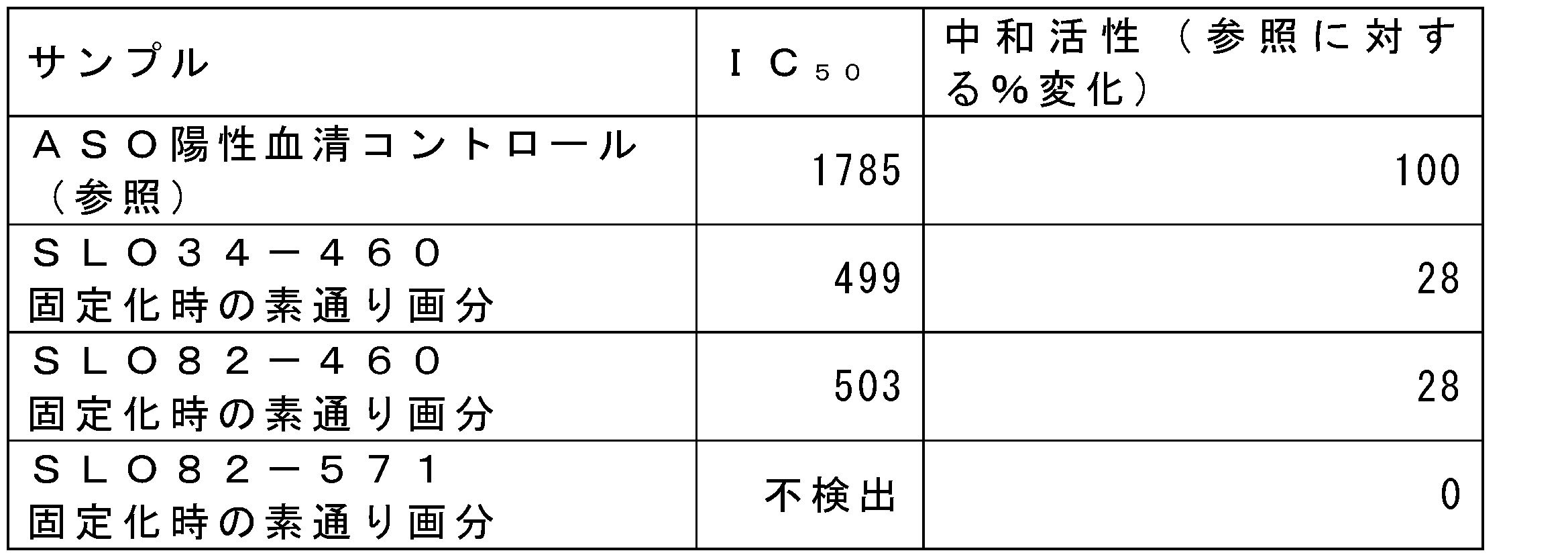
表2に示した結果から明らかなように、SLO34-460又はSLO82-460を固定化したときの素通り画分では、抗体吸収前のASO陽性血清コントロールに比して7割程度中和活性が低下した。したがって、各SLO改変体に対する中和抗体の反応性は表3にようになるといえる。

ASO陽性血清コントロールの代わりに、ASO陽性が既知の臨床検体(血清)を用いた同様の実験を行ったところ、同様の結果が得られた。表4及び表5に示す。
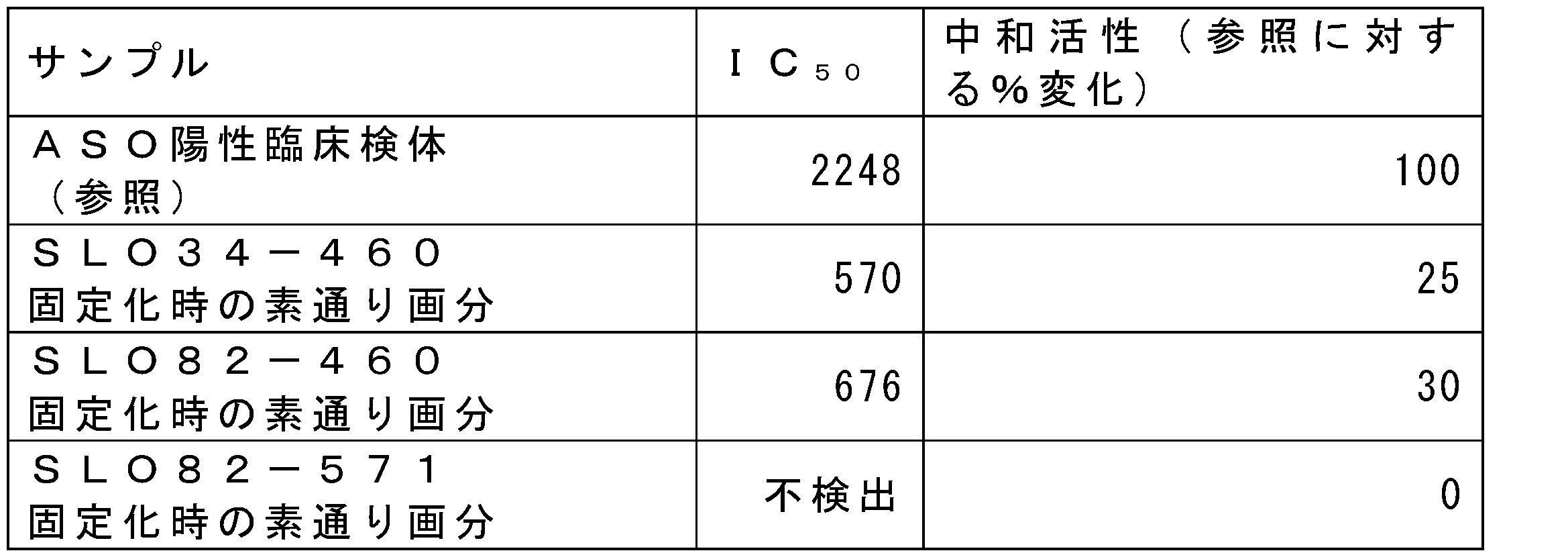

さらに他のASO陽性臨床検体についても、同様の実験を実施した。表6及び表7に示した結果から明らかなように、中和抗体価(IC50)の異なるASO陽性臨床検体においても同様に、SLO34-460及びSLO82-460は、7割程度の中和抗体を捉えることが示された。
以上の結果は、SLOに対する中和抗体のうち、SLO34-460及びSLO82-460をエピトープとする中和抗体の存在比は、検体によらず7割程度と一定であることを示している。
なお、本結果より、残りの3割の中和抗体はドメイン4(461-571アミノ酸残基からなる)をエピトープとする抗体であることは自明なため、表6及び表7においては、SLO82-571固定化時の素通り画分の中和活性(%)及びSLO82-571に対する中和抗体の反応性のデータは示していない。
以上の結果は、SLOに対する中和抗体のうち、SLO34-460及びSLO82-460をエピトープとする中和抗体の存在比は、検体によらず7割程度と一定であることを示している。
なお、本結果より、残りの3割の中和抗体はドメイン4(461-571アミノ酸残基からなる)をエピトープとする抗体であることは自明なため、表6及び表7においては、SLO82-571固定化時の素通り画分の中和活性(%)及びSLO82-571に対する中和抗体の反応性のデータは示していない。


以上の結果は、SLO34-460及びSLO82-460は、検体によらず7割程度の大半の中和抗体を捉えることが可能であり、残りの3割の中和抗体はドメイン4をエピトープとする抗体であることを示している。したがって、SLO34-460及びSLO82-460は、溶血性連鎖球菌感染症の診断のみならず、臨床上重要な溶血性連鎖球菌感染による溶血防御能を示す中和抗体の主要なエピトープであることが示された。よって、これらの抗原は溶血性連鎖球菌に対するワクチン抗原としても有用であると考える。
参考文献一覧
参考文献1:新井盛夫著、「表面プラズモン共鳴を用いたバイオセンサー(BIACORE)による生体分子相互作用の解析-血栓止血領域研究への利用-」、日本血栓止血学会誌、第8巻(第5号)、397頁~405頁、1997年
参考文献2:橋本せつ子及び森本香織編、「Biacoreを用いた相互作用解析 実験法」、丸善出版、2012年
参考文献3:BHAKDI, SUCHARIT, et al., “Isolation and identification of two hemolytic forms of streptolysin-O.”, Infection and immunity, 1984, 46.2: 394-400.
参考文献4:DALE, James B., et al., “Antibodies against a synthetic peptide of SagA neutralize the cytolytic activity of streptolysin S from group A streptococci.”, Infection and immunity, 2002, 70.4: 2166-2170.
文献5:HUGO, FERDINAND, et al., “Use of a monoclonal antibody to determine the mode of transmembrane pore formation by streptolysin O.”, Infection and immunity, 1986, 54.3: 641-645.
参考文献1:新井盛夫著、「表面プラズモン共鳴を用いたバイオセンサー(BIACORE)による生体分子相互作用の解析-血栓止血領域研究への利用-」、日本血栓止血学会誌、第8巻(第5号)、397頁~405頁、1997年
参考文献2:橋本せつ子及び森本香織編、「Biacoreを用いた相互作用解析 実験法」、丸善出版、2012年
参考文献3:BHAKDI, SUCHARIT, et al., “Isolation and identification of two hemolytic forms of streptolysin-O.”, Infection and immunity, 1984, 46.2: 394-400.
参考文献4:DALE, James B., et al., “Antibodies against a synthetic peptide of SagA neutralize the cytolytic activity of streptolysin S from group A streptococci.”, Infection and immunity, 2002, 70.4: 2166-2170.
文献5:HUGO, FERDINAND, et al., “Use of a monoclonal antibody to determine the mode of transmembrane pore formation by streptolysin O.”, Infection and immunity, 1986, 54.3: 641-645.
Claims (21)
- 以下の(a)~(g)から選択される、いずれかのタンパク質:
(a)配列番号3に記載のアミノ酸配列からなるタンパク質
(b)配列番号2に記載のアミノ酸配列からなるタンパク質
(c)配列番号4に記載のアミノ酸配列からなるタンパク質
(d)配列番号2に記載のアミノ酸配列において、1位~48位のアミノ酸残基の一部が欠失したアミノ酸配列からなるタンパク質
(e)配列番号4に記載のアミノ酸配列において、380位~490位のアミノ酸残基の一部が欠失したアミノ酸配列からなるタンパク質
(f)(a)~(e)のいずれかのタンパク質のアミノ酸配列と90%以上の同一性を有するアミノ酸配列からなり、抗ストレプトリジンO抗体と結合するタンパク質
(g)(a)~(f)のいずれかのタンパク質のC末端及びN末端の少なくとも一方にタグが付加されているタンパク質。 - 以下の(a’)~(e’)から選択される、いずれかのタンパク質:
(a’)配列番号3に記載のアミノ酸配列からなるタンパク質
(b’)配列番号2に記載のアミノ酸配列からなるタンパク質
(c’)配列番号2に記載のアミノ酸配列において、1位~48位のアミノ酸残基の一部が欠失したアミノ酸配列からなるタンパク質
(d’)(a’)~(c’)のいずれかのタンパク質のアミノ酸配列と90%以上の同一性を有するアミノ酸配列からなり、抗ストレプトリジンO抗体と結合するタンパク質
(e’)(a’)~(d’)のいずれかのタンパク質のC末端及びN末端の少なくとも一方にタグが付加されているタンパク質。 - 前記タグがHisタグである、請求項1又は2に記載のタンパク質。
- 請求項1~3のいずれか一項に記載のタンパク質からなる、ストレプトリジンOの溶血作用を中和する中和抗体を測定するための診断用抗原。
- 請求項1~3のいずれか一項に記載のタンパク質を含む溶血性連鎖球菌ワクチン。
- 請求項1~3のいずれか一項に記載のタンパク質をコードするDNA。
- 請求項6に記載のDNAを含むベクター。
- 請求項7に記載のベクターを含む形質転換体。
- 前記形質転換体は、細菌、昆虫細胞、昆虫、動物細胞、動物、植物細胞及び植物から選択される、請求項8に記載の形質転換体。
- 請求項1~3のいずれか一項に記載のタンパク質を製造する方法であって、
請求項8又は9に記載の形質転換体を培養、飼育又は栽培する工程を含む方法。 - 請求項7に記載のベクターをバクミドDNAに組み込んだバキュロウイルス。
- 請求項1~3のいずれか一項に記載のタンパク質を製造する方法であって、
請求項11に記載のバキュロウイルスを宿主昆虫細胞又は昆虫に感染させる工程を含む方法。 - 請求項1~3のいずれか一項に記載のタンパク質を製造する方法であって、
請求項7に記載のベクターがウイルスベクターであり、当該ベクターを宿主動物細胞又は動物に感染させる工程を含む方法。 - 請求項7に記載のベクターを含むアグロバクテリウム。
- 請求項1~3のいずれか一項に記載のタンパク質を製造する方法であって、
請求項14に記載のアグロバクテリウムを宿主植物に感染させる工程を含む方法。 - 請求項1~3のいずれか一項に記載のタンパク質が吸着されたラテックス粒子。
- 請求項16に記載のラテックス粒子を含む、抗ストレプトリジンO抗体を測定するためのキット。
- 前記抗ストレプトリジンO抗体がストレプトリジンOの溶血作用を中和する中和抗体である、請求項17に記載のキット。
- 請求項16に記載ラテックス粒子を用いる抗ストレプトリジンO抗体の測定方法。
- 請求項16に記載のラテックス粒子と抗ストレプトリジンO抗体を含有し得る被験試料を接触させる工程、及び
前記抗体及び前記タンパク質の抗原抗体反応による前記ラテックス粒子の凝集反応を測定する工程、
を含む、抗ストレプトリジンO抗体の測定方法。 - 前記抗ストレプトリジンO抗体がストレプトリジンOの溶血作用を中和する中和抗体である、請求項19又は20に記載の測定方法。
Priority Applications (1)
| Application Number | Priority Date | Filing Date | Title |
|---|---|---|---|
| JP2022576635A JP7601913B2 (ja) | 2021-01-19 | 2022-01-13 | タンパク質、溶血性連鎖球菌ワクチン、dna、ベクター、形質転換体、タンパク質を製造する方法、バキュロウイルス、アグロバクテリウム、ラテックス粒子、キット及び抗ストレプトリジンo抗体の測定方法 |
Applications Claiming Priority (2)
| Application Number | Priority Date | Filing Date | Title |
|---|---|---|---|
| JP2021006503 | 2021-01-19 | ||
| JP2021-006503 | 2021-01-19 |
Publications (1)
| Publication Number | Publication Date |
|---|---|
| WO2022158373A1 true WO2022158373A1 (ja) | 2022-07-28 |
Family
ID=82549010
Family Applications (1)
| Application Number | Title | Priority Date | Filing Date |
|---|---|---|---|
| PCT/JP2022/000954 Ceased WO2022158373A1 (ja) | 2021-01-19 | 2022-01-13 | タンパク質、溶血性連鎖球菌ワクチン、dna、ベクター、形質転換体、タンパク質を製造する方法、バキュロウイルス、アグロバクテリウム、ラテックス粒子、キット及び抗ストレプトリジンo抗体の測定方法 |
Country Status (2)
| Country | Link |
|---|---|
| JP (1) | JP7601913B2 (ja) |
| WO (1) | WO2022158373A1 (ja) |
Cited By (1)
| Publication number | Priority date | Publication date | Assignee | Title |
|---|---|---|---|---|
| EP4538284A1 (en) * | 2023-10-12 | 2025-04-16 | Tanea Medical AB | Novel engineered streptolysin o derived epitopes |
Citations (4)
| Publication number | Priority date | Publication date | Assignee | Title |
|---|---|---|---|---|
| CN101302526A (zh) * | 2008-06-27 | 2008-11-12 | 四川省迈克科技有限责任公司 | 重组可溶性溶血链球菌溶血素o基因、重组蛋白及其制备方法 |
| JP2012502969A (ja) * | 2008-09-17 | 2012-02-02 | ノバルティス アーゲー | 組み合わせgasワクチンおよび治療法 |
| CN103304645A (zh) * | 2012-03-16 | 2013-09-18 | 深圳迈瑞生物医疗电子股份有限公司 | 重组链球菌溶血素o蛋白、核苷酸序列、制备方法及应用 |
| WO2017204325A1 (ja) * | 2016-05-27 | 2017-11-30 | 東洋紡株式会社 | 改変型ストレプトリジンo |
-
2022
- 2022-01-13 JP JP2022576635A patent/JP7601913B2/ja active Active
- 2022-01-13 WO PCT/JP2022/000954 patent/WO2022158373A1/ja not_active Ceased
Patent Citations (4)
| Publication number | Priority date | Publication date | Assignee | Title |
|---|---|---|---|---|
| CN101302526A (zh) * | 2008-06-27 | 2008-11-12 | 四川省迈克科技有限责任公司 | 重组可溶性溶血链球菌溶血素o基因、重组蛋白及其制备方法 |
| JP2012502969A (ja) * | 2008-09-17 | 2012-02-02 | ノバルティス アーゲー | 組み合わせgasワクチンおよび治療法 |
| CN103304645A (zh) * | 2012-03-16 | 2013-09-18 | 深圳迈瑞生物医疗电子股份有限公司 | 重组链球菌溶血素o蛋白、核苷酸序列、制备方法及应用 |
| WO2017204325A1 (ja) * | 2016-05-27 | 2017-11-30 | 東洋紡株式会社 | 改変型ストレプトリジンo |
Cited By (2)
| Publication number | Priority date | Publication date | Assignee | Title |
|---|---|---|---|---|
| EP4538284A1 (en) * | 2023-10-12 | 2025-04-16 | Tanea Medical AB | Novel engineered streptolysin o derived epitopes |
| WO2025078558A1 (en) | 2023-10-12 | 2025-04-17 | Tanea Medical Ab | Novel engineered streptolysin o derived epitopes |
Also Published As
| Publication number | Publication date |
|---|---|
| JPWO2022158373A1 (ja) | 2022-07-28 |
| JP7601913B2 (ja) | 2024-12-17 |
Similar Documents
| Publication | Publication Date | Title |
|---|---|---|
| CN109897104B (zh) | 人7型腺病毒单克隆抗体3-3e及其应用 | |
| ES2344150T3 (es) | Procedimientos y reactivos para diagnosticar la infeccion por hantavirus. | |
| KR101528169B1 (ko) | 아비박테리움 파라갈리나룸 항체의 검출방법 및 키트 | |
| CN109232736B (zh) | 特异性结合猪传染性胃肠炎病毒的单克隆抗体、药物组合物、试剂盒及其应用 | |
| CN106589082B (zh) | 活动性结核病诊断分子的筛选与应用 | |
| CN112876559B (zh) | 一种特异性结合猪轮状病毒的单克隆抗体及其应用 | |
| US10168330B2 (en) | Marker system, in particular for baculovirus-expressed subunit antigens | |
| CN105158480A (zh) | 用于检测小反刍兽疫病毒血凝素蛋白抗体的试剂盒及其使用方法 | |
| WO2006084467A1 (en) | Surface-located streptococcus pneumoniae polypeptides | |
| KR102707584B1 (ko) | 코로나바이러스 감염증19의 진단 및 백신을 위한 재조합 뉴클레오캡시드 단백질 및 이의 용도 | |
| KR20120001741A (ko) | 생물학적 시료 중의 물질을 검출하는 방법 | |
| CN106636004B (zh) | 一种tmv-cmv-pvy三重病毒胶体金快速检测试纸条 | |
| JP7601913B2 (ja) | タンパク質、溶血性連鎖球菌ワクチン、dna、ベクター、形質転換体、タンパク質を製造する方法、バキュロウイルス、アグロバクテリウム、ラテックス粒子、キット及び抗ストレプトリジンo抗体の測定方法 | |
| CN109957009A (zh) | 抗人7型腺病毒抗体2-1h及其应用 | |
| CN116375889B (zh) | 狂犬病病毒糖蛋白抗原、截短体及其应用 | |
| JP6770805B2 (ja) | 検体中の特定の細菌を検出する方法 | |
| KR100905066B1 (ko) | 마이코플라즈마 뉴모니아성 폐렴 진단을 위한 재조합단백질 및 이를 이용한 진단 키트 | |
| CN107167606A (zh) | 多诊断试剂盒 | |
| CN104845981A (zh) | 田鼠巴贝虫Bm1524抗原及其应用 | |
| US8569473B2 (en) | Pestivirus species | |
| CN111426824A (zh) | 一种胶体金试纸及其制备方法和应用 | |
| CN113372454B (zh) | 尼帕病毒受体结合糖蛋白及其应用 | |
| CN111704661B (zh) | 日本血吸虫童虫高表达基因或其编码蛋白的应用 | |
| CN110357951B (zh) | 一种日本血吸虫免疫表位重组蛋白及其应用 | |
| CN103467582A (zh) | 结核杆菌重要抗原的高通量筛选及其在结核病诊断中的应用 |
Legal Events
| Date | Code | Title | Description |
|---|---|---|---|
| 121 | Ep: the epo has been informed by wipo that ep was designated in this application |
Ref document number: 22742495 Country of ref document: EP Kind code of ref document: A1 |
|
| ENP | Entry into the national phase |
Ref document number: 2022576635 Country of ref document: JP Kind code of ref document: A |
|
| NENP | Non-entry into the national phase |
Ref country code: DE |
|
| 122 | Ep: pct application non-entry in european phase |
Ref document number: 22742495 Country of ref document: EP Kind code of ref document: A1 |