WO2022154115A1 - 形質転換またはゲノム編集された次世代植物体の製造方法 - Google Patents
形質転換またはゲノム編集された次世代植物体の製造方法 Download PDFInfo
- Publication number
- WO2022154115A1 WO2022154115A1 PCT/JP2022/001349 JP2022001349W WO2022154115A1 WO 2022154115 A1 WO2022154115 A1 WO 2022154115A1 JP 2022001349 W JP2022001349 W JP 2022001349W WO 2022154115 A1 WO2022154115 A1 WO 2022154115A1
- Authority
- WO
- WIPO (PCT)
- Prior art keywords
- plant
- gene
- genome
- generation
- less
- Prior art date
- Legal status (The legal status is an assumption and is not a legal conclusion. Google has not performed a legal analysis and makes no representation as to the accuracy of the status listed.)
- Ceased
Links
Images
Classifications
-
- A—HUMAN NECESSITIES
- A01—AGRICULTURE; FORESTRY; ANIMAL HUSBANDRY; HUNTING; TRAPPING; FISHING
- A01H—NEW PLANTS OR NON-TRANSGENIC PROCESSES FOR OBTAINING THEM; PLANT REPRODUCTION BY TISSUE CULTURE TECHNIQUES
- A01H1/00—Processes for modifying genotypes ; Plants characterised by associated natural traits
-
- A—HUMAN NECESSITIES
- A01—AGRICULTURE; FORESTRY; ANIMAL HUSBANDRY; HUNTING; TRAPPING; FISHING
- A01H—NEW PLANTS OR NON-TRANSGENIC PROCESSES FOR OBTAINING THEM; PLANT REPRODUCTION BY TISSUE CULTURE TECHNIQUES
- A01H5/00—Angiosperms, i.e. flowering plants, characterised by their plant parts; Angiosperms characterised otherwise than by their botanic taxonomy
-
- C—CHEMISTRY; METALLURGY
- C12—BIOCHEMISTRY; BEER; SPIRITS; WINE; VINEGAR; MICROBIOLOGY; ENZYMOLOGY; MUTATION OR GENETIC ENGINEERING
- C12N—MICROORGANISMS OR ENZYMES; COMPOSITIONS THEREOF; PROPAGATING, PRESERVING, OR MAINTAINING MICROORGANISMS; MUTATION OR GENETIC ENGINEERING; CULTURE MEDIA
- C12N15/00—Mutation or genetic engineering; DNA or RNA concerning genetic engineering, vectors, e.g. plasmids, or their isolation, preparation or purification; Use of hosts therefor
- C12N15/09—Recombinant DNA-technology
-
- C—CHEMISTRY; METALLURGY
- C12—BIOCHEMISTRY; BEER; SPIRITS; WINE; VINEGAR; MICROBIOLOGY; ENZYMOLOGY; MUTATION OR GENETIC ENGINEERING
- C12N—MICROORGANISMS OR ENZYMES; COMPOSITIONS THEREOF; PROPAGATING, PRESERVING, OR MAINTAINING MICROORGANISMS; MUTATION OR GENETIC ENGINEERING; CULTURE MEDIA
- C12N15/00—Mutation or genetic engineering; DNA or RNA concerning genetic engineering, vectors, e.g. plasmids, or their isolation, preparation or purification; Use of hosts therefor
- C12N15/09—Recombinant DNA-technology
- C12N15/63—Introduction of foreign genetic material using vectors; Vectors; Use of hosts therefor; Regulation of expression
- C12N15/79—Vectors or expression systems specially adapted for eukaryotic hosts
- C12N15/82—Vectors or expression systems specially adapted for eukaryotic hosts for plant cells, e.g. plant artificial chromosomes (PACs)
-
- C—CHEMISTRY; METALLURGY
- C12—BIOCHEMISTRY; BEER; SPIRITS; WINE; VINEGAR; MICROBIOLOGY; ENZYMOLOGY; MUTATION OR GENETIC ENGINEERING
- C12N—MICROORGANISMS OR ENZYMES; COMPOSITIONS THEREOF; PROPAGATING, PRESERVING, OR MAINTAINING MICROORGANISMS; MUTATION OR GENETIC ENGINEERING; CULTURE MEDIA
- C12N5/00—Undifferentiated human, animal or plant cells, e.g. cell lines; Tissues; Cultivation or maintenance thereof; Culture media therefor
- C12N5/10—Cells modified by introduction of foreign genetic material
Definitions
- the present invention relates to a method for transforming a plant or editing a genome, and a method for producing a transformant or a genome-edited individual of a plant using the same.
- Non-Patent Document 1 describes a method of infecting a ripe embryo immediately after germination with Agrobacterium and introducing a gene.
- the transformed plant individual becomes a chimera (transformed cells and wild-type cells exist in the same individual), and only when the germ cells are transformed cells. , The introduced gene is transmitted to the next generation.
- the ratio of germ cells to somatic cells of plants is extremely small, and in the implanter transformation method, the efficiency with which transformed cells are transmitted from the current generation (the chimeric individual after transformation) to the next generation is low. Therefore, in order to obtain transformants in the next generation, it is necessary to increase the number of transformants of the current generation and / or increase the number of tillers of the current generation to acquire and analyze many next-generation plants (seed). The problem was that it required a lot of time, labor, and growing space. Further, in other transformation methods including the above tissue culture, the same point has been a problem when a transformant having chimericity is produced.
- the present invention provides a method for obtaining a next-generation transformant or genome-edited individual from a present-generation transformant or genome-edited individual having chimerism in a short time and with low labor.
- the present invention also provides a method for obtaining transformants or genome-edited individuals by conserving growth space.
- the present invention further provides a method for producing a plant transformant or a genome-edited individual having excellent reproducibility.
- the present inventors have completed the present invention as a result of diligent studies for solving the above-mentioned problems.
- the present invention includes the following.
- ⁇ 1> An introduction step of introducing at least one kind of nucleic acid and / or at least one kind of protein into a plant cell, and a growth step of growing a plant from the plant cell to obtain a plant having an effective fractionation number of 1 or less.
- a method for transforming or editing a plant which comprises a step of obtaining a next-generation plant transformed or genome-edited from the plant.
- ⁇ 2> A method for producing a plant transformant or a genome-edited individual, which comprises using the method according to ⁇ 1> above.
- ⁇ 3> A plant transformant or genome-edited individual produced by the production method of ⁇ 2> above (excluding those known at the time of filing).
- the next-generation transformant or genome-edited individual can be obtained in a short time and with low labor from the present-generation transformant or genome-edited individual having chimerism.
- a transformant or a genome-edited individual can be obtained by saving a growing space.
- a plant transformant or a genome-edited individual can be reproducibly produced.
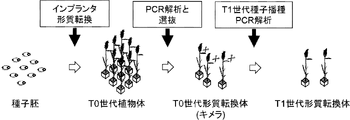
- FIG. 1 is a diagram showing a flow of procedures according to an embodiment of the present invention in Example 1.
- the plant transformation method or genome editing method according to the present invention is an introduction step of introducing at least one nucleic acid and / or at least one protein into a plant cell, and the plant is grown from the plant cell to obtain a plant. It includes a growing step and an acquisition step of acquiring a transformed or genome-edited next-generation plant from the plant.
- gene editing is a part of a technique called a new bleeding technique (NBT), in which a specific gene on the genome is cleaved and a mutation is introduced by using a meganuclease, CRISPR-CAS, or the like.
- NBT new bleeding technique
- the targeted gene can be destroyed with high efficiency.
- some countries do not treat it as a recombinant plant because it can destroy only the targeted gene without leaving a trace of genetic recombination.
- genome editing by connecting fragments homologous to the sequences on both sides of the cleavage sequence on both sides of the DNA fragment to be introduced into the site, it is possible to efficiently insert or replace the site-specific DNA fragment. It is possible.
- Genome editing can be said to be a technique different from the conventional plant transformation methods in which foreign genes are integrated almost randomly, such as the direct introduction method and the Agrobacterium method, and the genome is defined from the definition of the transformation method.
- Genome editing technology is characterized by including the step of cleaving genomic DNA using a nuclease or a guide RNA and a nuclease capable of targeting the cleavage site, and is a conventional transformation method using such a targetable nuclease or a guide RNA and a nuclease. Can be distinguished from.
- nuclease protein may be introduced into the cell, and the DNA and / or RNA encoding the nuclease gene is introduced into the cell to express the nuclease protein. It means that it may be.
- guide RNA RNA may be introduced into cells, or DNA capable of expressing guide RNA may be introduced to express guide RNA.
- the plant cell into which a nucleic acid and / or protein is introduced is not particularly limited and may be appropriately selected depending on the intended purpose. , Plant immature or ripe seed cells are preferred, seed embryo shoot apex cells are more preferred, embryo shoot apex cells in immature or ripe seeds are even more preferred, ripe seed embryo shoot apex cells in particular. preferable.
- the stem apex of the seed embryo is not particularly limited and may be appropriately selected depending on the intended purpose. However, endosperm, pods, leaf primordia, and / or excess stalks are removed from the seeds and exposed. The shoot apex is preferable.
- the "seed” includes not only natural seeds obtained by cultivating (or culturing) a plant under natural or similar conditions, but also artificial seeds, but is preferably natural seeds. However, if an artificial seed capable of obtaining a transformable stem apex is developed, it is also preferable to use it. Natural seeds include not only seeds obtained in outdoor fields, but also seeds obtained by greenhouse cultivation and seeds obtained from tissue cultures such as in vitro seedlings. Seeds obtained by direct reprogramming or the like can also be preferably used as long as the stem apex can be obtained.
- the stem apex means a tissue consisting of a growth point (stem apex meristem) at the tip of the stem and several leaf primordia generated from the growth point and the growth point.
- a growth point stem apex meristem
- leaf primordia generated from the growth point and the growth point.
- only the hemispherical (dome-shaped) growth point from which the leaf primordia is removed may be used as the stem apex, or the stem apex containing the growth point and the leaf primordia and the plant tissue including the stem apex may be used. good.
- a virus-free tissue can be obtained by using only the growth points from which the leaf primordia have been removed.
- the stem apex is not particularly limited and may be appropriately selected depending on the intended purpose, but the stem apex of a ripe seed embryo or the stem apex of an immature embryo is preferable.
- the ripe seed embryo (ripe embryo) is an embryo of a ripe seed, and the ripe seed means a seed that has completed the ripening process after pollination and is fully ripe as a seed. Whether or not the ripening process is completed can be determined by whether or not the water content of the seed is 35% or less.
- the immature embryo is an embryo of an immature seed, and the immature seed means an embryo that is not fully ripe as a seed. Whether or not the seeds are immature can be determined by the degree of ripening of the seeds (the water content of the seeds is greater than 35%) as described above.
- the method for introducing at least one nucleic acid and / or at least one protein into plant cells is preferably an implanter transformation method or an implanter genome editing method, and is widely used for seed-producing plants, plants that produce underground stems, and plants. It can be applied to plants that can be cultivated at the shoot apex. Therefore, the target plant of the present invention is preferably a seed plant including angiosperms and gymnosperms. Angiosperms include monocotyledonous and dicotyledonous plants.
- the implanter transformation method or the genome editing method is generally a transformation method or a genome editing method that does not include an operation of tissue culture, and transforms or genomes cells at a growth point site while the plant is growing. This is a method to edit. However, in the present specification, the implanter transformation method or the implanter genome editing method is used in the sense that it includes only the tissue culture method using shoot apex culture and does not include other methods including tissue culture operations. do.
- the monocotyledonous plant may be of any kind, and examples thereof include grasses, liliaceae, bananas, pineapples, and orchids.
- Examples of gramineous plants include rice, wheat, barley, corn, embaku, shiva, sorghum, rye, millet, sugar cane and the like.
- Examples of Liliaceae plants include leeks and asparagus.
- Examples of Musaceae plants include bananas.
- Examples of plants of the Bromeliaceae family include pineapples.
- Examples of orchidaceous plants include orchids.
- the dicotyledonous plants include, for example, Abranaceae plants, legumes, eggplants, melons, hirugaos, roses, mulberry plants, aois, sardines, sardines, and tades. Examples include family plants.
- Brassicaceae plants include Arabidopsis thaliana, Chinese cabbage, rapeseed, cabbage, cauliflower, and radish.
- legumes include soybeans, adzuki beans, common beans, peas, cowpeas, alfalfa and the like.
- Solanaceae plants include tomatoes, eggplants, potatoes, tobacco, and capsicum.
- Cucurbitaceae plants include oriental melon, cucumber, melon, and watermelon.
- Convolvulaceae plants include morning glory, sweet potato (convolvulaceae), bindweed and the like.
- Rosaceae plants include roses, strawberries, and apples.
- Morus alba plants include morus alba, figs, and rubber trees.
- mallow plants include cotton and kenaf.
- Asteraceae plants include lettuce.
- Amaranthaceae plants include sugar beet (sugar beet) and the like.
- Examples of Polygonaceae plants include buckwheat.
- gymnosperms include pine, sugi, ginkgo and cycad.
- the plant is not particularly limited and may be appropriately selected depending on the intended purpose, but wheat, barley, rye, embaku, rice, corn, or soybean is preferable, and wheat, barley, rye, or embaku is more preferable. , Wheat, barley, or rye is more preferred, wheat, or barley is particularly preferred, and wheat is most preferred. Wheat plants are known to be similar in morphology and the like (Zadoks JC, Chang TT, Konzak CF. A Decimal Code for the Growth Stages of Cereals. Weed Research. Weed Research. 1974, 1974. stages of plants (https://ahdb.org.uk/knowledge-library/the-growt-stages-of-cerals), J-STAGE 2000 Vol. 95, No. 6, 395-403 (https://www.jstags) .Go.jp/article/jbrewsocjapan1988/95/6/95_6_395/_pdf/-char/en)).
- the ripe seeds of the plant are made to absorb water. If necessary, vernalization may be performed before water absorption. Water absorption is performed by soaking the seeds in water and incubating them.
- the water absorption temperature is preferably 15 to 25 ° C. for wheat, barley or rice, and 25 to 35 ° C. for corn or soybean, for example. At this time, the water may be changed at least once.
- the water absorption period is preferably before the radicles start to grow or before new leaf primordia are formed.
- water absorption time it is less than 16 hours after water absorption, preferably 12 hours, although it depends on the dormant state of the seed.
- the shoot apex of the embryo in the seed absorbed above is exposed.
- the shoot apex is exposed by removing the pods and leaf primordia.
- the stem apex is exposed by removing the seed coat and cotyledons.
- the shoot apex is exposed by sprouting from the seed potato and removing the leaf primordia from the cut buds.
- the stem apex is exposed by removing the leaf primordia from the seed embryo or the extracted apical or lateral bud.
- the means of exposure may be any one that can remove the sheath leaves and leaf primordia or seed coats and leaflets under a stereomicroscope, and for example, a needle having a diameter of about 0.2 mm or the like is pierced. Instruments for installation, tweezers, pipettes, syringes, and cutting instruments such as scalpels and cutters. The endosperm and excess stalk portion are then excised using a cutting instrument such as a scalpel, and the embryo and stalk containing the exposed stalk apex are placed on an agar medium with the stalk apex facing upward. The scalpel may be replaced with a new sterile scalpel at the final stage of cutting the shoot apex to obtain a virus-free shoot apex. In this case, virus-free transformants or genome-edited individuals can be obtained.
- a known genetic engineering method can be used for the introduction of the target gene, and the method is not particularly limited.
- a recombinant vector containing the target gene is prepared, and the agrobacterium method / virus method is used as a biological method, and the electroporation method / particle gun method is used as a physical method, targeting the shoot apex of a ripe embryo.
- -Nucleic acids (recombinant vectors, etc.) and proteins can be introduced by the microinjection method, whisker method, plasma method, laser injection method, PEG-calcium phosphate method, liposome method, etc. as chemical methods.
- the physical method is preferable, and the method using a gene gun (particle gun) (particle gun method) is more preferable.
- the method of introducing into ripe seed embryos by using the particle gun method is preferable from the viewpoint of introduction efficiency into plants.
- the particle gun method is also effective in introducing genes into the stem apex of potatoes.
- the particle gun method is a method in which metal fine particles are coated with a gene and injected into a cell tissue, and is effective when the infection efficiency of Agrobacterium is low as in monocotyledonous plants.
- the vector used in the present invention is not particularly limited, and for example, pAL system (pAL51, pAL156, etc.), pUC system (pUC18, pUC19, pUC9, etc.), pBI system (pBI121, pBI101, pBI221, pBI2113, pBI101.2, etc.), A pPZP system, a pSMA system, an intermediate vector system (pLGV23Neo, pNCAT, etc.), cauliflower mosaic virus (CaMV), green beans mosaic virus (BGMV), tobacco mosaic virus (TMV), and the like can be used.
- pAL system pAL51, pAL156, etc.
- pUC system pUC18, pUC19, pUC9, etc.
- pBI system pBI121, pBI101, pBI221, pBI2113, pBI101.2, etc.
- a pPZP system a pSMA system
- an intermediate vector system p
- a vector containing the target gene can be prepared, for example, as follows.
- a method is used in which the purified DNA is cleaved with an appropriate restriction enzyme, inserted into a restriction enzyme site or a multicloning site of the appropriate vector DNA, and ligated to the vector. Can be done.
- the target gene may be inserted into the intermediate vector by double cross-over, and TA cloning, In-Fusion cloning, or the like may be used.
- the target gene for transformation is not particularly limited as long as it is desired to express or suppress the expression of the gene, and it may be an endogenous gene or a foreign gene of the target plant.
- a different species may be used, and for example, genes such as animals, plants, microorganisms, and viruses can be used.
- genes include, for example, sugar metabolism-related genes, lipid metabolism-related genes, useful substance (pharmaceuticals, enzymes, pigments, aromatic components, etc.) production genes, plant growth control (promotion / suppression) genes, flowering control-related genes, and tolerance.
- Disease-resistant insect feeding resistance, nematodes, mold (fungi) and bacterial disease resistance, virus (disease) resistance, etc.
- environmental stress low temperature, high temperature, dryness, salt, photodamage, ultraviolet rays
- target gene may be introduced so as to express antisense, ribozyme, RNAi, etc., depending on the purpose of gene transfer.
- the target gene for genome editing is not particularly limited, and any gene may be desired to be disrupted, inserted or replaced.
- the nuclease gene to be introduced may be of a different species from which it is derived, and for example, genes such as animals, plants, microorganisms, and viruses, or artificially synthesized genes can be used. Examples of such genes include meganuclease genes, TALENs, CRISPR-CAS systems, TARGET-AIDs and the like.
- genes that can be targeted for genome editing there are no particular restrictions on the genes that can be targeted for genome editing, but for example, sugar metabolism-related genes, lipid metabolism-related genes, useful substance (pharmaceuticals, enzymes, pigments, aromatic components, etc.) production-related genes, plant growth control (promotion / promotion / Suppression) related genes, flowering regulation related genes, disease resistance (insect feeding resistance, nematodes, mold (fungi) and bacterial disease resistance, virus (disease) resistance, etc.) related genes, environmental stress (low temperature, high temperature, Dried, salt, photodamage, ultraviolet rays) resistance-related genes, transporter-related genes, flour-making characteristics, bread-making characteristics, noodle-making characteristics-related genes, recombinant enzyme-related genes, and the like can be mentioned.
- the desired mutation may be introduced by inserting or substituting foreign DNA between the cut sites by recombination.
- Examples of the protein encoded by the site-specific nuclease gene include zinc finger nuclease, protein expressing zinc finger nuclease activity, and TAL effector nucleoase (TALEN).
- Zinc finger nucleases are fusion proteins of several zinc finger motifs that recognize specific bases and FokI nucleases.
- TALLEN is a fusion protein of Transcriction Activator Like (TAL) effector and FokI nuclease.
- Site-specific nucleases are composed of other additional targeting techniques such as meganucleases, RNA-induced CRISPR-Cas9, or leucine zippers.
- the expression of one or more gene products can be altered or modified by introducing a site-specific nuclease into a cell using a gene gun and transforming or editing the genome. That is, a CRISPR-Cas system containing a DNA molecule encoding one or more gene products and which may contain one or more guide RNAs targeting the Cas protein and the DNA molecule in the expressing cell is introduced thereby.
- One or more guide RNAs target the genomic locus of a DNA molecule encoding one or more gene products, and the Cas protein cleaves the genomic locus of a DNA molecule encoding one or more gene products.
- the expression of one or more gene products can be modified or modified.
- nuclease gene or protein When a nuclease gene or protein is introduced into a cell using a gene gun to edit the genome, it is not always necessary to integrate it into the genome to obtain a stable transformant.
- the nuclease gene can be transiently expressed, thereby allowing genome editing.
- Genome editing can also be performed by introducing proteins (and guide RNAs) into cells. According to these methods, the obtained genome-edited individual may not be a genetically modified product.
- the Cas protein and guide RNA may be naturally occurring (combinations) or may be non-naturally occurring combinations. In the present invention, the expression of two or more gene products may be modified or modified.
- the guide RNA may contain a guide sequence fused to the tracr sequence.
- the length of the guide RNA is at least 15, 16, 17, 18, 19, 20 nucleotides, and the preferred upper limit number of nucleotides is 35 or less, more preferably 25 or less, still more preferably 22 or less, and most preferably 20. be.
- the cells to be transformed or genome-edited are plant cells, more preferably cells of shoot apical meristem, still more preferably L2 cells in shoot apical meristem, and most preferably stem. It is a shoot apical stem cell that migrates to the germline in the apical meristem.
- the "germ cell lineage” is a general term for germ cells from the primordial germ cell which is the source of the germ cell to the egg cell and the sperm cell which are the final products
- the "L2 layer” is the shoot apical division. The second cell layer from the outside of the tissue.
- the Cas protein may contain one or more nuclear localization signals (NLS).
- the Cas protein is a type II CRISPR-based enzyme.
- the Cas protein is a Cas9 protein.
- the Cas9 protein is Streptococcus pneumoniae (S. pneumoniae), Streptococcus pyogenes (S. pyogenes), or S. pneumoniae. It is S. thermophilus Cas9 and may contain mutant Cas9 derived from those organisms.
- the protein can be a Cas9 homolog or ortholog.
- the Cas protein may be codon-optimized for expression in eukaryotic cells.
- the Cas protein can direct the cleavage of one or two strands in the localization of the target sequence.
- the expression of the gene product is reduced and the gene product is a protein.
- a addition signal, selectable marker gene, etc. can be linked to the vector.
- the target gene to be inserted into the vector may be a plurality of types per vector, and the recombinant vector to be coated on the fine particles may be a plurality of types per fine particle.
- a recombinant vector containing a target gene and a recombinant vector containing a drug resistance gene may be separately prepared, mixed, coated with fine particles, and shot into a plant tissue.
- the target gene for genome editing may be two or more, or a vector may be constructed so that two or more target genes can be cleaved.
- two or more kinds of vectors may be prepared, or a plurality of guide RNAs may be inserted so as to be expressed on one plasmid. It may also contain a guide sequence in which the guide RNA is fused to the tracr sequence.
- the double strand may be cleaved site-specifically to promote homologous recombination and site-specific genome editing may be performed.
- DNA having homologous sequences on both sides of the cleavage region may be introduced to cause double crossover recombination.
- Homologous recombination can also be performed using a D10A mutant of Cas9, which is known to function as a nickase (a DNA cleaving enzyme that inserts a nick into only one DNA strand).
- Specific examples include, for example, cauliflower mosaic virus (CaMV) 35S promoter, El2-35S omega promoter, noparin synthase gene promoter (Pnos), corn-derived ubiquitin promoter, rice-derived actin promoter, tobacco-derived PR protein promoter, ADH. , RuBisco promoter and the like.
- Translation efficiency can be increased by using a sequence that enhances translation activity, for example, an omega sequence of tobacco mosaic virus.
- a protein can be translated from a plurality of coding regions by inserting an IRES (internal ribosome entry site) as a translation start region on the 3'-downstream side of the promoter and on the 5'-upstream side of the translation start codon.
- IRES internal ribosome entry site
- the terminator may be any sequence that can terminate the transcription of the gene transcribed by the promoter and has a poly A addition signal.
- a terminator for a nopaline synthase (NOS) gene and a terminator for an octopine synthase (OCS) gene for example, a terminator for a nopaline synthase (NOS) gene and a terminator for an octopine synthase (OCS) gene.
- NOS nopaline synthase
- OCS octopine synthase
- the selection marker gene examples include a herbicide resistance gene (biaraphos resistance gene, glyphosate resistance gene (EPSPS), sulfonylurea resistance gene (ALS)), drug resistance gene (tetracycline resistance gene, ampicillin resistance gene, canamycin resistance gene). , Hyglomycin resistance gene, Spectinomycin resistance gene, Chloramphenicol resistance gene, Neomycin resistance gene, etc.), Fluorescent or luminescent reporter genes (luciferase, ⁇ -galactosidase, ⁇ -glucuronidase (GUS), green fluorescence protein (GFP) ) Etc.), neomycin phosphotransferase II (NPT II), dihydrofolate reductase and other enzyme genes.
- EPSPS glyphosate resistance gene
- ALS sulfonylurea resistance gene
- drug resistance gene tetracycline resistance gene, ampicillin resistance gene, canamycin resistance gene.
- Hyglomycin resistance gene Spectinomycin
- the vector containing the target gene to be introduced into a plant may be a circular plasmid, linear DNA obtained by cutting the plasmid with a restriction enzyme or the like, or a nucleic acid cassette fragment obtained by cutting out only the DNA fragment to be introduced. These DNA fragments may be DNA fragments amplified by PCR.
- the nucleic acid to be added is not particularly limited and may be a sequence derived from a vector, but the sequence of the target site for introduction is more preferably used.
- the vector containing the above target gene is introduced into a ripe wheat embryo by the particle gun method.
- the target gene and / or protein can be introduced by covering the surface of fine particles (microcarriers) and shooting them into plant cells with a gene gun.
- fine particles metal fine particles are preferably used because they have a high specific gravity, are chemically inactive, and are less likely to cause harm to the living body in order to enhance the penetrating force into cells.
- gold particles, tungsten particles and the like are particularly preferably used.
- the target gene can be introduced into plant cells as follows. First, fine particles such as gold particles or tungsten particles are washed and sterilized, and the fine particles, nucleic acids (recombinant vector, linear DNA, RNA, etc.) and / or proteins, CaCl 2 , and spermidine are added while stirring with a vortex mixer or the like. Nucleic acid and / or protein is coated on gold or tungsten particles and washed with ethanol or phosphate buffered physiological saline as necessary.
- the lower limit of the average particle size of the fine particles is not particularly limited and may be appropriately selected depending on the intended purpose, but is preferably 0.3 ⁇ m or more, more preferably 0.4 ⁇ m or more, and further preferably 0.5 ⁇ m or more. Preferably, 0.6 ⁇ m is particularly preferable.
- the upper limit of the average particle size of the fine particles is not particularly limited and may be appropriately selected depending on the intended purpose, but is preferably 1.5 ⁇ m or less, more preferably 1.4 ⁇ m or less, still more preferably 1.3 ⁇ m or less. , 1.2 ⁇ m or less is particularly preferable, 1.1 ⁇ m is even more preferable, and 1.0 ⁇ m or less is most preferable.
- the average particle size is not particularly limited and may be appropriately selected depending on the intended purpose, and examples thereof include a number average particle size.
- Gold particles or tungsten particles are applied to the macrocarrier film as uniformly as possible using a pipetman or the like, and then dried in a sterile environment such as a clean bench.
- a sterile environment such as a clean bench.
- protein-coated fine particles it is preferable to use a hydrophilic macrocarrier film.
- hydrophilic macrocarrier film a hydrophilic film may be attached to the macrocarrier film, or a hydrophilic coating may be applied.
- a hydrophilic coating may be applied.
- the method for making the film hydrophilic include a method using a surfactant, a photocatalyst, and a hydrophilic polymer.
- hydrophilic polymer used in the above method examples include polyester, polyethylene glycol, hydroxyethyl methacrylate, hydroxypropyl methacrylate, dihydroxyethyl methacrylate, diethylene glycol methacrylate, triethylene glycol methacrylate, polyethylene glycol methacrylate, vinylpyrrolidone, acrylic acid, acrylamide, and dimethylacrylamide. , Glucoxyoxyethyl methacrylate, 3-sulfopropylmethacryloxyethyldimethylammonium betaine, 2-methacryloyloxyethyl phosphorylcholine, 1-carboxydimethylmethacryloxyethyl methaneammonium and other hydrophilic monomer polymers.
- a macrocarrier film and a plate on which the stem apex of the target ripe embryo is placed are installed in the particle gun device, and high-pressure helium gas is emitted from the gas acceleration tube toward the macrocarrier film.
- the macrocarrier film stops at the stopping plate, but the gold particles pass through the stopping plate and penetrate the target placed under the stopping plate, and the target gene is introduced.
- the distance between the stopping plate and the target shoot apex depends on the particle size of the fine particles, but is, for example, preferably 9 cm or less, more preferably 8 cm or less, still more preferably 7 cm or less, and particularly preferably 6 cm or less.
- the lower limit of the distance is, for example, preferably 2 cm or more, more preferably 3 cm or more, still more preferably 4 cm or more.
- the optimum value of the distance between the stopping plate and the target can be appropriately determined by a transient expression experiment or the like according to the type, particle size, gas pressure, etc. of the fine particles.
- the gas pressure depends on the type of fine particles and the distance from the target, but is preferably 1,100 to 2,000 psi, more preferably 1,200 to 1,600 psi.
- the optimum pressure can be appropriately determined by a transient expression experiment or the like according to the type of fine particles, the type of target, the distance between the target and the stopping plate, and the like.
- the number of times the fine particles are shot into the shoot apex is preferably 2 times or more, more preferably 3 times or more, and more preferably 4 times or more.
- the upper limit of the number of times the fine particles are shot into the shoot apex is preferably 20 times or less, more preferably 15 times or less, and further preferably 10 times or less.
- the optimum number can be appropriately determined by a transient expression experiment or the like.
- nucleic acids are released from the fine particles, and the nucleic acids are integrated into genomic DNA to obtain transformed cells.
- a nucleic acid that proliferates in the form of a plasmid such as geminivirus or an artificial chromosome is introduced, it may be transformed without integration.
- Nucleic acids and / or proteins are released from the microparticles in cells that have been bombarded with microparticles by the genome editing method, and the nucleic acids translocate to the nucleus to express nucleases, thereby cleaving genomic DNA and causing mutations in the process of repair.
- the resulting genome-edited cells are obtained.
- genome editing occurs by translocating to the nucleus (organelle) by a nuclear localization signal (which may be an organelle translocation signal) and cleaving DNA.
- Genome editing can be applied not only to nuclear genome genes but also to organelles (intracellular organelles such as chloroplasts and mitochondria).
- the transfer signal to each organelle may be introduced by ligating it to a nuclease, or a promoter ligating to a nuclease or the like may be used only in each organelle.
- the growth step of growing a plant from a plant cell is a growth step of growing the plant from the plant cell to obtain a plant having an effective number of fractions of 1 or less.
- the growth step is not particularly limited and may be appropriately selected depending on the intended purpose.
- cells into which at least one nucleic acid and / or at least one protein have been introduced are grown on an agar medium for about 2 weeks.
- the agar medium may be any medium as long as it is a commonly used medium for culturing plants, but MS medium, Gamborg B5 medium, LS medium and the like, and more preferably MS medium can be used.
- the growth temperature is preferably 15 to 30 ° C, more preferably 20 ° C to 25 ° C, and even more preferably 22 ° C.
- a transformant or a genome-edited individual can also be obtained by growing in a normal medium (without antibiotics) without applying selective pressure with a drug or the like.
- Further resistance genes may be introduced.
- a drug resistance gene When a drug resistance gene is introduced, transformed cells or genome editing cells can be selectively cultured by the drug.
- a selective agent suitable for shoot apex culture for example, a sulfonyl urea-based herbicide chlorosulfuron (resistance can be acquired by introducing a mutant ALS gene (acetobutyric acid synthase gene) is known.
- the drug resistance gene may be on the same vector as the target gene or on a different vector.
- Genome-editing individuals can also be selected by simultaneously introducing a nuclease and a drug resistance gene.
- a drug resistance gene is introduced, cells into which a nuclease gene and / or a nuclease has been introduced by a drug can be selectively cultured.
- a selective agent suitable for shoot apex culture for example, a sulfonyl urea-based herbicide chlorosulfuron (resistance can be acquired by introducing a mutant ALS gene (acetobutyric acid synthase gene)) is known.
- the drug resistance gene When introducing a drug resistance gene, the drug resistance gene may be on the same vector as the nuclease gene or on a different vector. When inserted on separate vectors, when they are integrated into separate chromosomes, they can be produced into genome-edited plant individuals and drug-resistant gene individuals by self-pollination or backcrossing to progeny. It has the advantage of being separable.
- the soil volume per plant (soil volume per individual (plant) when transplanted to the soil) in the growth step is not particularly limited and may be appropriately selected according to the purpose. However, from the viewpoint of obtaining the next-generation transformant or genome-edited individual in a short time and with low labor, and saving the growth space, less than 200 mL is preferable, 190 mL or less is more preferable, and 180 mL or less is further preferable. 150 mL or less is particularly preferable, and 100 mL or less is most preferable.
- the number of effective herbicides can be set to 1 or less.
- the soil capacity per plant soil capacity per individual (plant) when transplanted to the soil) in the growth process is not particularly limited. However, it can be appropriately selected according to the purpose, but less than 500 mL is preferable, and 400 mL is preferable from the viewpoint of obtaining the next-generation transformant or genome-edited individual in a short time and with low labor and saving the growth space. The following is more preferable, 200 mL or less is further preferable, 150 mL or less is particularly preferable, and 100 mL or less is most preferable.
- the "effective tiller” refers to a tiller that forms ears containing seeds having germination ability.
- the number of effective tillers is "1 or less” means that the spikes containing seeds having germination ability only in the main culm are formed, or the germination ability is only in one place of the main culm and tiller. It refers to a state in which ears containing seeds having seeds are formed.
- the upper limit of the length from the base of the main culm to the base of the spike (the length of the main culm from the soil to the base of the spike (plant height)) of a plant having an effective tiller number of 1 or less is particularly limited. However, it can be appropriately selected depending on the intended purpose, but it is preferably 600 mm or less, and more preferably 500 mm or less. By obtaining a plant whose length from the base of the main culm to the base of the ear is in the above range, it is possible to efficiently obtain a plant having an effective tiller number of 1 or less.
- the lower limit of the length from the base of the main culm to the base of the spike (the length of the main culm from the soil to the base of the spike (plant height)) of a plant having an effective tiller number of 1 or less is particularly limited. However, it can be appropriately selected depending on the intended purpose, but it is preferably 100 mm or more, and more preferably 200 mm or more.
- RNA expressed from the target gene in the grown individual into which the gene has been introduced or the grown individual in which the target mutation has been confirmed.
- the presence or absence of RNA can be confirmed by, for example, the RT-PCR method. It may be detected by Northern blotting.
- the gene transfer efficiency is calculated from the number of explants used for transfer and the number of growing individuals having foreign genes.
- Genome editing efficiency is calculated from the number of explants used for introduction and the number of growing individuals with target mutations.
- Next-generation transformants or genome-edited individuals can be obtained by sowing and growing T1 generation seeds harvested from the spikes formed on the main culm of the transgenic growing individual. According to the method of the present invention, next-generation transformants or genome-edited individuals can be obtained with high efficiency and reproducibility.
- the plant transformant or genome-editing method is used as a method for producing a plant transformant or a genome-edited individual according to the present invention.
- Example 1 Gene transfer to shoot apex (preparation of transformant) To generate transformants in wheat, the GFP gene was introduced into shoot apical meristems using the particle gun method.
- a plasmid DNA solution (1 ⁇ g / ⁇ L) purified by Qiagen Plasmamid Midi Kit (Qiagen) was placed so as to be 5 ⁇ g per 750 ⁇ g of gold particles.
- the sterilized gold particle-containing solution was carefully suspended using an ultrasonic generator (Ultrasonic Cleaner UW-25 manufactured by Taga Electric Co., Ltd.), placed in an appropriate amount in the above tube, and stirred by pipetting.
- the vortex was vigorously suspended for 5 minutes. After allowing to stand at room temperature for 10 minutes, it was centrifuged at 9,100 ⁇ g for 2 seconds. The supernatant was removed and washed with 70% ethanol and 99.5% ethanol. Finally, the supernatant was removed and 24 ⁇ L of 99.5% ethanol was added and suspended well. In a clean bench, 6 ⁇ L was poured into the center of the macro carrier and air-dried.
- the particle gun uses Biolistic (registered trademark) PDS-1000 / He Particle Delivery System (BIO-RAD), the pressure at the time of shooting is about 94.9 kgf / cm 2 (1,350 psi), and the distance to the target tissue. was 5 cm. I shot 4 times per petri dish. After shooting, it was allowed to stand overnight at 22 ° C. in a dark place.
- GFP-F ACGGCCACAAAGTTCAGCGT (SEQ ID NO: 1)
- GFP-R ACCAGTGATCGCGCTTTCT (SEQ ID NO: 2)
- PCR is performed using TaKara PCR Thermal Cycler Dice (registered trademark) at 95 ° C. for 3 minutes, followed by a reaction at 95 ° C. for 30 seconds, 60 ° C. for 30 seconds, and 72 ° C. for 1 minute as one cycle. 33 cycles were performed. After the PCR reaction, 1.0% agarose gel electrophoresis was performed, and the PCR product was detected by staining with ethidium bromide. The one in which the expected 601 bp GFP gene fragment was detected was determined to be a gene-introduced individual.
- T1 generation seeds harvested from the spikes formed on the main culm were sown.
- the presence or absence of the GFP gene, which is a fluorescent reporter gene, was investigated in the obtained plants by the PCR method. Genomic DNA was extracted from the 1-2 leaves (50 mg) using the benzyl chloride method, and the subsequent operations were in accordance with Example 1-5.
- Example 2 Introduction of RNP to shoot apex (preparation of genome-edited individual)
- the method shown in Example 1 can also be applied when a target mutation is induced in the genome.
- a target mutant individual is prepared from the shoot apical meristem into which CRISPR-Cas9 (RNP) has been introduced, and the mutation transmission efficiency to the next generation is confirmed.
- RNP CRISPR-Cas9
- crRNA GUUGCCGUAGGUGCCCCGGguuuuaggcuauugcuguuguug (SEQ ID NO: 3)
- tracrRNA AAACAGCAUAAGCAAGUUAAAAAUAAGGCUAGUCCUCUUAUCACUUGAAAAAGUGGCACCGAGUCGGUGCU (SEQ ID NO: 4)
- RNP-introduced individuals The RNP-introduced individuals that had been allowed to stand overnight were transplanted into a disposable plant cell culture vessel (Sigma) containing MS-maltose medium, and 1-2 in a long day (22 ° C., 16 hours). It was grown for a week. Transformants and genome-edited individuals grown on the medium for 1-2 weeks were transplanted into soil. When inducing 6 or more tillers, 2900 mL of soil was used per strain. On the other hand, when inducing one or less tillers, 97.2 mL (45 mm ⁇ 45 mm ⁇ 47 mm cell tray) of soil was used per strain. Then, the ears were grown in an artificial weather room (22 ° C., 16 hours day length, 10000-15000 lux) until the ears were ripe.
- PCR reaction solution 0.7 ⁇ L of genomic DNA, 0.4 U of KODFX Neo (TOYOBO), 2 ⁇ 5 ⁇ L of attached buffer, 0.4 mM dNTPs, and 0.2 ⁇ M of each primer were added, and the mixture was filled up to a total of 10 ⁇ L with sterile distilled water.
- PCR For PCR, using TaKara PCR Thermal Cycler Dice, the reaction was carried out at 98 ° C. for 10 seconds and 68 ° C. for 1 minute as one cycle, and this was performed for 35 cycles. After the PCR reaction, 1 ⁇ L of each PCR product, 1 ⁇ L of 10 ⁇ attached buffer, and 5 U of an appropriate restriction enzyme were added, and the mixture was filled up with sterile distilled water to a total of 10 ⁇ L. After reacting at 37 ° C. for 3 hours, 2.0% agarose gel electrophoresis was performed and stained with ethidium bromide.
- the PCR product In the wild-type strain, the PCR product is completely cleaved by the restriction enzyme, whereas in the individual into which the mutation is introduced, the PCR product is left uncut. DNA was extracted and purified from the uncut band and subjected to sequence analysis, and those having a mutation introduced into the target gene sequence were determined to be individuals with the target gene mutation introduced.
- T1 generation seeds harvested from the spikes formed on the main culm were sown.
- the presence or absence of target mutations was investigated in the obtained plants.
- Genomic DNA was extracted from the 1-2 leaves (50 mg) using the benzyl chloride method, and the subsequent operations were in accordance with Example 2-5.
- Example 3 DNA introduction into shoot apex (preparation of genome-edited individual)
- the method shown in Example 1 can also be applied when a target mutation is induced in the genome.
- a target mutant individual is prepared from a shoot apical meristem into which a DNA expressing CRISPR-Cas9 is introduced, and the mutation transmission efficiency to the next generation is confirmed.
- a gRNA targeting the TaGASR7 gene was used in the preparation.
- the gene is designed to be expressed under the control of the maize ubiquitin promoter and the first intron.
- a terminator of the nopaline synthase (NOS) gene is added.
- TaGASR7 target sequence CCGCCGGGGCACCTACCGCAAC (SEQ ID NO: 7)
- DNA-introduced individuals The DNA-introduced individuals that had been allowed to stand overnight were transplanted into a disposable plant cell culture vessel (Sigma) containing MS-maltose medium, and were transplanted for 1-2 weeks at a long day (22 ° C., 16 hours). It was grown. Transformants and genome-edited individuals grown on the medium for 1-2 weeks were transplanted into soil. About 100 mL (45 mm ⁇ 45 mm ⁇ 47 mm cell tray) of soil was used per strain. Then, the ears were grown in an artificial weather room (22 ° C., 16 hours day length, 10000-15000 lux) until the ears were ripe.
- T0 generation flag leaf The method for confirming target mutation in T0 generation flag leaf was according to Example 2-5.
- the length (plant height) of the main culm from the soil to the base of the spike was measured for each of the genome-edited individuals in which the target mutation was confirmed (Table 3).
- the minimum plant height was 250 mm and the maximum plant height was 496 mm, which was 600 mm or less in all individuals.
- Example 4 Gene transfer to shoot apex (preparation of transformant) The number of tillers was investigated depending on the soil volume and the presence or absence of fertilization. 1. 1. Preparation of ripe wheat seeds Prepared in the same manner as in Example 1.
- the fertilization group (Pelemaru-kun 111, guaranteed component amount: nitrogen total amount 11%, phosphoric acid total amount 11%, potassium total amount 11%, water-soluble bitter soil 2%, water-soluble boron 0. 1%, Maruishi Co., Ltd.) was established.
- the amount of fertilization was 1.5 g / L, and the fertilization was performed once in the 4th to 6th leaf stages. In addition, 3 individuals were investigated per test plot.
- Examples of aspects of the present invention include the following.
- a method for transforming or editing a plant which comprises a step of obtaining a next-generation plant transformed or genome-edited from the plant.
- ⁇ 3> The method according to ⁇ 1> or ⁇ 2>, wherein the soil volume per plant in the growing step is 190 mL or less.
- ⁇ 4> The method according to any one of ⁇ 1> to ⁇ 3>, wherein the plant cell is a cell at the shoot apex of a seed embryo.
- ⁇ 5> The method according to ⁇ 4> above, wherein the stem apex of the seed embryo is an exposed stem apex by removing endosperm, pods, leaf primordia, and / or excess stalk from the seed. be.
- ⁇ 6> The method according to any one of ⁇ 4> or ⁇ 5> above, wherein the cells at the shoot apex of the seed embryo include shoot apical stem cells that migrate to the germline.
- the stem apex of the seed embryo is the stem apex of a ripe seed embryo.
- ⁇ 8> The method according to any one of ⁇ 1> to ⁇ 7>, wherein in the introduction step, at least one nucleic acid and / or at least one protein is introduced by a physical method.
- the physical method is a method using a gene gun.
- ⁇ 10> The method according to any one of ⁇ 1> to ⁇ 9>, wherein the plant is any one selected from the group consisting of wheat, barley, rye, embaku, rice, corn and soybean.
- ⁇ 11> A method for producing a plant transformant or a genome-edited individual, which comprises using the method according to any one of ⁇ 1> to ⁇ 10>.
- the present invention can be used in agriculture, pharmaceutical industry, enzyme industry, etc.
Landscapes
- Health & Medical Sciences (AREA)
- Life Sciences & Earth Sciences (AREA)
- Genetics & Genomics (AREA)
- Engineering & Computer Science (AREA)
- Organic Chemistry (AREA)
- Chemical & Material Sciences (AREA)
- Biotechnology (AREA)
- Biomedical Technology (AREA)
- Bioinformatics & Cheminformatics (AREA)
- Wood Science & Technology (AREA)
- Zoology (AREA)
- General Engineering & Computer Science (AREA)
- General Health & Medical Sciences (AREA)
- Biochemistry (AREA)
- Microbiology (AREA)
- Plant Pathology (AREA)
- Biophysics (AREA)
- Molecular Biology (AREA)
- Physics & Mathematics (AREA)
- Botany (AREA)
- Developmental Biology & Embryology (AREA)
- Environmental Sciences (AREA)
- Cell Biology (AREA)
- Physiology (AREA)
- Breeding Of Plants And Reproduction By Means Of Culturing (AREA)
Abstract
植物細胞に少なくとも1種の核酸および/または少なくとも1種のタンパク質を導入する導入工程と、該植物細胞から植物体を生育させ有効分げつ数が1以下の植物体を得る生育工程と、該植物体から形質転換またはゲノム編集された次世代植物体を取得する取得工程とを含むことを特徴とする植物の形質転換またはゲノム編集方法である。
Description
本発明は、植物の形質転換またはゲノム編集方法、およびそれを用いた植物の形質転換体またはゲノム編集個体の製造方法に関する。
現在普及している植物の一般的な形質転換法は、in vitro培養系のプロトプラスト、カルス、または組織片などに外来遺伝子を、電気穿孔法、アグロバクテリウム・ツメファシエンス菌を介してまたはパーティクルガン法などにより導入する方法である。しかしこれらの方法では、遺伝子が細胞または組織に導入されたとしても、植物品種によっては、細胞の脱分化/再分化を伴う組織培養が困難であり、植物体を再生して形質転換体を作製することが難しいという問題があった。また、形質転換効率が十分に高くなく、そのため選択マーカー遺伝子を導入してマーカー選抜を行わなければならないという問題もあった。さらに、長期の組織培養を必要とすることに伴い、体細胞変異(ソマクローナル変異)が頻繁に生じる点も問題であった。そのため、形質転換植物作製の労力軽減や形質転換植物の安全性の観点から、上記の組織培養を伴わないインプランタ形質転換方法およびインプランタ形質転換植物体の作製方法の開発が求められていた。
一方、コムギやイネなどにおいて、in vitro培養系のカルスまたは組織片を用いないインプランタ形質転換法も知られている。インプランタ形質転換方法としては、露出させた未熟胚または完熟胚の茎頂に、パーティクルガン法を用いて直接遺伝子導入する方法が知られている(特許文献1、2)。また、非特許文献1には、発芽直後の完熟胚にアグロバクテリウムを感染させ、遺伝子導入する方法が記載されている。これらの文献に記載の方法では、共通して、形質転換後の植物個体はキメラ(形質転換細胞と野生型細胞が同一個体中に存在)となり、生殖細胞が形質転換細胞であった場合に限り、次世代に導入遺伝子が伝達される。
しかし、植物の体細胞に対する生殖細胞の割合は極めて少なく、インプランタ形質転換法においては、当代(形質転換後のキメラ個体)から次世代へ形質転換細胞が伝達される効率は低い。故に、次世代で形質転換体を取得するためには、当代の形質転換体数を増やす、および/または当代の分げつ数を増やし、多くの次世代植物(種子)を取得・解析する必要があり、多大な時間と労力、生育スペースを要する点が問題であった。さらに、上記組織培養を含めた他の形質転換法においても、キメラ性を有する形質転換体が作製された場合には、同様の点が問題であった。
Supartana et al. (2005) Development of simple and efficient in planta transformation for rice (Oryza sativa L.) using Agrobacterium tumefaciencs. Journal of Bioscience AND Bioengineering (2005) 4, 391-397
本発明は、キメラ性を有する当代の形質転換体またはゲノム編集個体から、短時間かつ低労力で次世代の形質転換体またはゲノム編集個体を取得する方法を提供する。本発明はまた、生育スペースを節約して、形質転換体またはゲノム編集個体を取得する方法を提供する。本発明はさらに、再現性に優れる植物の形質転換体またはゲノム編集個体の作製方法を提供する。
本発明者らは、前述の課題解決のために鋭意検討を行なった結果、本発明を完成するに至った。
すなわち、本発明は以下を包含する。
<1> 植物細胞に少なくとも1種の核酸および/または少なくとも1種のタンパク質を導入する導入工程と、該植物細胞から植物体を生育させ有効分げつ数が1以下の植物体を得る生育工程と、該植物体から形質転換またはゲノム編集された次世代植物体を取得する取得工程とを含むことを特徴とする植物の形質転換またはゲノム編集方法である。
<2> 前記<1>に記載の方法を用いることを特徴とする植物の形質転換体またはゲノム編集個体の製造方法である。
<3> 前記<2>の製造方法により製造された植物の形質転換体またはゲノム編集個体である(出願時に公知のものを除く)。
<1> 植物細胞に少なくとも1種の核酸および/または少なくとも1種のタンパク質を導入する導入工程と、該植物細胞から植物体を生育させ有効分げつ数が1以下の植物体を得る生育工程と、該植物体から形質転換またはゲノム編集された次世代植物体を取得する取得工程とを含むことを特徴とする植物の形質転換またはゲノム編集方法である。
<2> 前記<1>に記載の方法を用いることを特徴とする植物の形質転換体またはゲノム編集個体の製造方法である。
<3> 前記<2>の製造方法により製造された植物の形質転換体またはゲノム編集個体である(出願時に公知のものを除く)。
本発明の方法によれば、キメラ性を有する当代の形質転換体またはゲノム編集個体から、短時間かつ低労力で次世代の形質転換体またはゲノム編集個体を取得することができる。本発明によれば、生育スペースを節約して、形質転換体またはゲノム編集個体を取得することができる。本発明によれば、植物の形質転換体またはゲノム編集個体を再現よく作製することができる。
以下、本発明を詳細に説明する。
本発明に係る植物の形質転換方法またはゲノム編集方法は、植物細胞に少なくとも1種の核酸および/または少なくとも1種のタンパク質を導入する導入工程、該植物細胞から植物体を生育させ植物体を得る生育工程、および該植物体から形質転換またはゲノム編集された次世代植物体を取得する取得工程を含む。
本発明に係る植物の形質転換方法またはゲノム編集方法は、植物細胞に少なくとも1種の核酸および/または少なくとも1種のタンパク質を導入する導入工程、該植物細胞から植物体を生育させ植物体を得る生育工程、および該植物体から形質転換またはゲノム編集された次世代植物体を取得する取得工程を含む。
本明細書において、「ゲノム編集」とは、ニューブリーディングテクニック(NBT)といわれる技術の一部で、メガヌクレアーゼ、CRISPR-CASなどを用いて、ゲノム上の特定の遺伝子を切断して変異を導入することで遺伝子を破壊すること、部位特異的にDNA断片を挿入または置換すること、または、CRISPRシステムから、ヌクレアーゼ活性を除去したものに、脱アミノ化酵素であるデアミナーゼを付加した人工酵素複合体を構築し、細胞中で発現させることで、狙った点変異を高効率に導入して遺伝子機能を改変することも含まれるがこれらに限られず、ゲノムを編集できる技術であればよい。ゲノム編集技術を用いることで、狙った遺伝子を高い効率で破壊できる。遺伝子破壊の場合、遺伝子組換えの痕跡を残さずに狙った遺伝子のみを破壊できることから組換え植物と取り扱わない国もある。また、ゲノム編集によれば、切断配列の両側の配列に相同な断片を、その部位に導入したいDNA断片の両側に連結しておくことで、効率よく部位特異的なDNA断片の挿入または置換が可能である。
上記意味で、ゲノム編集は、外来遺伝子がほぼランダムに組み込まれる従来型の植物の形質転換法、例えば、直接導入法やアグロバクテリウム法などとは異なる技術とも言え、形質転換法の定義からゲノム編集技術を除く考え方もあり得る。ゲノム編集技術では、切断部位をターゲティングできるヌクレアーゼまたはガイドRNAとヌクレアーゼを用いてゲノムDNAを切断する工程を含むことが特徴で、かかるターゲティングできるヌクレアーゼまたはガイドRNAとヌクレアーゼを用いない従来型の形質転換法とは区別できる。ここで、「ヌクレアーゼまたはガイドRNAとヌクレアーゼを用いて」という意味は、ヌクレアーゼタンパク質を細胞に導入してもよく、ヌクレアーゼ遺伝子をコードするDNAおよび/またはRNAを細胞に導入してヌクレアーゼタンパク質を発現させてもよいという意味である。また、ガイドRNAについてもRNAを細胞に導入してもよく、ガイドRNAを発現し得るDNAを導入してガイドRNAを発現させてもよい趣旨である。
1.植物細胞に少なくとも1種の核酸および/または少なくとも1種のタンパク質を導入する導入工程
核酸および/またはタンパク質を導入する植物細胞としては、特に制限はなく、目的に応じて適宜選択することができるが、植物の未熟種子または完熟種子の細胞が好ましく、種子胚の茎頂の細胞がより好ましく、未熟種子または完熟種子における胚の茎頂の細胞がさらに好ましく、完熟種子胚の茎頂の細胞が特に好ましい。
核酸および/またはタンパク質を導入する植物細胞としては、特に制限はなく、目的に応じて適宜選択することができるが、植物の未熟種子または完熟種子の細胞が好ましく、種子胚の茎頂の細胞がより好ましく、未熟種子または完熟種子における胚の茎頂の細胞がさらに好ましく、完熟種子胚の茎頂の細胞が特に好ましい。
前記種子胚の茎頂としては、特に制限はなく、目的に応じて適宜選択することができるが、該種子から胚乳、鞘葉、葉原基、および/または余分な胚盤を除去し、露出させた茎頂が好ましい。
本明細書において、「種子」とは、植物を天然またはそれに近い条件下で栽培(または培養)して得られる天然の種子のみでなく、人工種子も含むが、好ましくは天然の種子である。ただし、形質転換可能な茎頂が取得できる人工種子が開発されればそれを用いることも好ましい。天然の種子には、野外の畑などで得られる種子のみでなく、温室栽培により得られる種子や、インビトロ苗などの組織培養物から得られる種子も含まれる。ダイレクト・リプログラミングなどにより得られる種子も茎頂が取得できる限り好ましく使用し得る。
前記茎頂とは、茎の先端の成長点(茎頂分裂組織)ならびに成長点および成長点から生じた数枚の葉原基からなる組織を含む意味である。本発明においては、葉原基を除去した半球状(ドーム状)の成長点のみを茎頂として用いても良く、成長点および葉原基を含む茎頂や該茎頂を含む植物組織を用いてもよい。葉原基を除去した成長点のみを用いることでウイルスフリーの組織が得られる。
前記茎頂としては、特に制限はなく、目的に応じて適宜選択することができるが、完熟種子胚の茎頂、または未熟胚の茎頂が好ましい。
前記完熟種子胚(完熟胚)とは、完熟種子の胚であり、前記完熟種子とは、受粉後の登熟過程が終了して種子として完熟しているものをいう。なお、前記登熟過程が終了したか否かは、種子の水分含量が35%以下であるか否かで判別することができる。
前記未熟胚とは、未熟種子の胚であり、前記未熟種子とは、種子として完熟していないものをいう。未熟種子であるか否かは、上記のとおり、種子の登熟度(種子の水分含量が35%より大きい)により判別することができる。
前記茎頂としては、特に制限はなく、目的に応じて適宜選択することができるが、完熟種子胚の茎頂、または未熟胚の茎頂が好ましい。
前記完熟種子胚(完熟胚)とは、完熟種子の胚であり、前記完熟種子とは、受粉後の登熟過程が終了して種子として完熟しているものをいう。なお、前記登熟過程が終了したか否かは、種子の水分含量が35%以下であるか否かで判別することができる。
前記未熟胚とは、未熟種子の胚であり、前記未熟種子とは、種子として完熟していないものをいう。未熟種子であるか否かは、上記のとおり、種子の登熟度(種子の水分含量が35%より大きい)により判別することができる。
植物細胞に少なくとも1種の核酸および/または少なくとも1種のタンパク質を導入する方法はインプランタ形質転換法またはインプランタゲノム編集方法であることが好ましく、広く一般に種子を生じる植物、地下茎を生じる植物および茎頂培養可能な植物に適用することができる。従って、本発明の対象植物は、被子植物および裸子植物を含む種子植物が好ましい。被子植物には、単子葉植物および双子葉植物が含まれる。インプランタ形質転換法またはインプランタゲノム編集方法とは、一般には組織培養の操作を含まない形質転換法またはゲノム編集方法であり、植物が成長する状態のまま成長点部位の細胞を形質転換またはゲノム編集させる方法である。ただし、本明細書においては、インプランタ形質転換法またはインプランタゲノム編集方法は、茎頂培養を用いる組織培養方法のみは含み、その他の組織培養の操作を含む方法は含まれないという意味で使用する。
単子葉植物としては、いずれの種類であってもよいが、例えば、イネ科植物、ユリ科植物、バショウ科植物、パイナップル科植物、ラン科植物などが挙げられる。
イネ科植物としては、イネ、コムギ、オオムギ、トウモロコシ、エンバク、シバ、ソルガム、ライムギ、アワ、サトウキビなどが挙げられる。ユリ科植物としては、ネギ、アスパラガスなどが挙げられる。バショウ科植物としては、バナナなどが挙げられる。パイナップル科植物としては、パイナップルなどが挙げられる。ラン科植物としては、ランなどが挙げられる。
双子葉植物としては、例えば、アブラナ科植物、マメ科植物、ナス科植物、ウリ科植物、ヒルガオ科植物、バラ科植物、クワ科植物、アオイ科植物、キク科植物、ヒユ科植物、およびタデ科植物などが挙げられる。
アブラナ科植物としては、シロイヌナズナ、ハクサイ、ナタネ、キャベツ、カリフラワー、ダイコンなどが挙げられる。マメ科植物としては、ダイズ、アズキ、インゲンマメ、エンドウ、ササゲ、アルファルファなどが挙げられる。ナス科植物としては、トマト、ナス、ジャガイモ、タバコ、トウガラシなどが挙げられる。ウリ科植物としては、マクワウリ、キュウリ、メロン、スイカなどが挙げられる。ヒルガオ科植物としては、アサガオ、サツマイモ(カンショ)、ヒルガオなどが挙げられる。バラ科植物としては、バラ、イチゴ、リンゴなどが挙げられる。クワ科植物としては、クワ、イチジク、ゴムノキなどが挙げられる。アオイ科植物としては、ワタ、ケナフなどが挙げられる。キク科植物としては、レタスなどが挙げられる。ヒユ科植物としては、テンサイ(サトウダイコン)などが挙げられる。タデ科植物としては、ソバなどが挙げられる。
一方、裸子植物としては、マツ、スギ、イチョウおよびソテツなどが挙げられる。
一方、裸子植物としては、マツ、スギ、イチョウおよびソテツなどが挙げられる。
前記植物としては、特に制限はなく、目的に応じて適宜選択することができるが、コムギ、オオムギ、ライムギ、エンバク、イネ、トウモロコシ、またはダイズが好ましく、コムギ、オオムギ、ライムギ、またはエンバクがより好ましく、コムギ、オオムギ、またはライムギがさらに好ましく、コムギ、またはオオムギが特に好ましく、コムギが最も好ましい。
なお、ムギ類植物は、形態等が類似することが知られている(Zadoks JC, Chang TT, Konzak CF. A Decimal Code for the Growth Stages of Cereals. Weed Research. 1974, 14415-21.、The growth stages of cereals (https://ahdb.org.uk/knowledge-library/the-growth-stages-of-cereals)、醸協2000 第95巻 第6号 395-403(https://www.jstage.jst.go.jp/article/jbrewsocjapan1988/95/6/95_6_395/_pdf/-char/en))。
なお、ムギ類植物は、形態等が類似することが知られている(Zadoks JC, Chang TT, Konzak CF. A Decimal Code for the Growth Stages of Cereals. Weed Research. 1974, 14415-21.、The growth stages of cereals (https://ahdb.org.uk/knowledge-library/the-growth-stages-of-cereals)、醸協2000 第95巻 第6号 395-403(https://www.jstage.jst.go.jp/article/jbrewsocjapan1988/95/6/95_6_395/_pdf/-char/en))。
植物細胞に少なくとも1種の核酸および/または少なくとも1種のタンパク質を導入する工程の1実施態様としては、まず植物の完熟種子を吸水させる。必要により吸水前に春化処理をしてもよい。吸水は、種子を水に浸種し、インキュベートすることにより行われる。吸水温度は、例えば、コムギ、オオムギまたはイネの場合には、15~25℃が好ましく、トウモロコシまたはダイズでは25~35℃が好ましい。この際、一度以上、水を交換してもよい。吸水期間は、例えば、コムギの場合には、幼根が伸長を開始する前まで、または新しい葉原基が形成される前までが好ましい。吸水時間で表すと、種子の休眠状態にもよるが、吸水後16時間未満であり、好ましくは12時間である。この吸水工程により、種子を柔らくすることで茎頂を露出させ易くすることができる。
次いで、上記で吸水させた種子における胚の茎頂を露出させる。コムギ、オオムギ、イネ、またはトウモロコシの場合には、鞘葉および葉原基を除去することで、茎頂を露出させる。ダイズの場合には、種皮および子葉を除去することで、茎頂を露出させる。ジャガイモの場合には、種芋から芽出しを行い、切り出した幼芽より葉原基を除去することで、茎頂を露出させる。リンゴの場合には、種子胚または摘出した頂芽もしくは側芽から葉原基を除去することで、茎頂を露出させる。露出手段としては、実体顕微鏡下において、鞘葉および葉原基または種皮および子葉を除去することができるものであればいずれのものであってよいが、例えば、直径0.2mm程度の針などの穿設するための器具、ピンセット、ピペット、注射器、並びにメスおよびカッターなどの切断器具が挙げられる。次いで、メスなどの切断器具を用いて胚乳および余分な胚盤部分を切除し、露出した茎頂を含む胚および胚盤を寒天培地上に、茎頂を上向きに置床する。ウイルスフリーの茎頂を得るために、茎頂を切り出す最終段階でメスを新規な滅菌メスに取り替えてもよい。この場合はウイルスフリーの形質転換体またはゲノム編集個体を得ることができる。
目的遺伝子の導入には、公知の遺伝子工学的手法を用いることができ、特に限定されない。一般的には、目的遺伝子を含む組換えベクターを作製して、完熟胚の茎頂を標的に、生物的手法としてアグロバクテリウム法・ウィルス法、物理的手法としてエレクトロポレーション法・パーティクルガン法・マイクロインジェクション法・ウィスカー法・プラズマ法・レーザーインジェクション法、化学的手法としてPEG-リン酸カルシウム法・リポソーム法、などにより、核酸(組換えベクターなど)やタンパク質などを導入することができるが、これらの中でも、物理的手法が好ましく、遺伝子銃(パーティクルガン)を用いる手法(パーティクルガン法)がより好ましい。
コムギ、イネ、トウモロコシまたはダイズでは、植物体への導入効率から、パーティクルガン法を用いて完熟種子胚に導入する方法が好ましい。また、パーティクルガン法はジャガイモの茎頂に遺伝子を導入するのにも有効である。パーティクルガン法は、金属微粒子に遺伝子をコーティングして細胞組織に打ち込む方法であり、単子葉植物のようにアグロバクテリウムの感染効率が低い場合に有効である。
コムギ、イネ、トウモロコシまたはダイズでは、植物体への導入効率から、パーティクルガン法を用いて完熟種子胚に導入する方法が好ましい。また、パーティクルガン法はジャガイモの茎頂に遺伝子を導入するのにも有効である。パーティクルガン法は、金属微粒子に遺伝子をコーティングして細胞組織に打ち込む方法であり、単子葉植物のようにアグロバクテリウムの感染効率が低い場合に有効である。
本発明に用いるベクターは特に限定されず、例えば、pAL系(pAL51、pAL156など)、pUC系(pUC18、pUC19、pUC9など)、pBI系(pBI121、pBI101、pBI221、pBI2113、pBI101.2など)、pPZP系、pSMA系、中間ベクター系(pLGV23Neo、pNCATなど)、カリフラワーモザイクウイルス(CaMV)、インゲンマメモザイクウイルス(BGMV)、タバコモザイクウイルス(TMV)などを用いることができる。
目的遺伝子を含むベクターは、例えば以下のようにして作製することができる。ベクターに目的遺伝子を挿入するには、例えば、精製されたDNAを適当な制限酵素で切断し、適当なベクターDNAの制限酵素部位またはマルチクローニングサイトなどに挿入してベクターに連結する方法を用いることができる。また、二重交叉組換え(double cross-over)により中間ベクターに目的遺伝子を挿入してもよく、TAクローニング、In-Fusionクローニングなどを用いてもよい。
形質転換の目的遺伝子は特に限定されず、その遺伝子の発現または発現の抑制が望まれるものであればよく、対象となる植物の内因性遺伝子または外来遺伝子でもよい。外来遺伝子としては、生物種が異なるものであってもよく、例えば、動物、植物、微生物、ウイルスなどの遺伝子を用いることができる。そのような遺伝子として、例えば、糖代謝関連遺伝子、脂質代謝関連遺伝子、有用物質(医薬、酵素、色素、芳香成分など)生産遺伝子、植物生長制御(促進/抑制)遺伝子、開花調節関連遺伝子、耐病虫害性(昆虫食害抵抗性、線虫、カビ(菌類)および細菌病抵抗性、ウイルス(病)抵抗性など)遺伝子、環境ストレス(低温、高温、乾燥、塩、光障害、紫外線)耐性遺伝子、トランスポーター遺伝子、製粉特性・製パン特性・製麺特性関連遺伝子、部位特異的ヌクレアーゼ遺伝子などが挙げられる。また、目的遺伝子は、センス鎖以外に、遺伝子導入の目的に応じてアンチセンス、リボザイム、RNAiなどを発現するように導入してもよい。
ゲノム編集のターゲットとなる遺伝子は特に限定されず、その遺伝子の破壊または挿入・置換が望まれるものであればよい。また、導入するヌクレアーゼ遺伝子は、由来する生物種が異なるものであってもよく、例えば、動物、植物、微生物、ウイルスなどの遺伝子や、人工合成遺伝子を用いることができる。そのような遺伝子としては、例えば、メガヌクレアーゼ遺伝子、TALEN、CRISPR-CASシステム、TARGET-AIDなどがあげられる。
ゲノム編集のターゲットとなりうる遺伝子としては特に制限はないが、例えば、糖代謝関連遺伝子、脂質代謝関連遺伝子、有用物質(医薬、酵素、色素、芳香成分など)生産関連遺伝子、植物生長制御(促進/抑制)関連遺伝子、開花調節関連遺伝子、耐病虫害性(昆虫食害抵抗性、線虫、カビ(菌類)および細菌病抵抗性、ウイルス(病)抵抗性など)関連遺伝子、環境ストレス(低温、高温、乾燥、塩、光障害、紫外線)耐性関連遺伝子、トランスポーター関連遺伝子、製粉特性・製パン特性・製麺特性関連遺伝子、組換え酵素関連遺伝子などが挙げられる。
ゲノム編集の標的となる遺伝子については、切断した部位の間に組換えにより外来DNA挿入または置換することにより目的の変異を導入してもよい。
部位特異的ヌクレアーゼ遺伝子がコードするタンパク質としては、例えば、ジンクフィンガーヌクレアーゼ、ジンクフィンガーヌクレアーゼ活性を発現するタンパク質またはTAL effector nuclease(TALEN)などが挙げられる。ジンクフィンガーヌクレアーゼは、特定の塩基を認識するジンクフィンガーモチーフ数個とFokIヌクレアーゼの融合タンパク質である。TALLENはTranscription Activator Like (TAL) effectorとFokIヌクレアーゼの融合タンパク質である。部位特異的ヌクレアーゼは、他の追加の標的化技術、例えば、メガヌクレアーゼ、RNA誘発性CRISPR-Cas9、またはロイシンジッパーなどで構成される。
部位特異的ヌクレアーゼを遺伝子銃を用いて細胞に導入して、形質転換またはゲノム編集することにより、1つ以上の遺伝子産物の発現を変更または改変することができる。すなわち、1つ以上の遺伝子産物をコードするDNA分子を含有し、発現する細胞中に、Casタンパク質およびDNA分子をターゲティングする1つ以上のガイドRNAを含み得るCRISPR-Casシステムを導入し、それにより1つ以上のガイドRNAが、1つ以上の遺伝子産物をコードするDNA分子のゲノム遺伝子座をターゲティングし、Casタンパク質が、1つ以上の遺伝子産物をコードするDNA分子のゲノム遺伝子座を開裂し、それにより1つ以上の遺伝子産物の発現を変更または改変することができる。
遺伝子銃を用いてヌクレアーゼ遺伝子またはタンパク質を細胞に導入してゲノム編集を行う場合、必ずしもゲノムにインテグレートさせて安定な形質転換体を取る必要は無い。ヌクレアーゼ遺伝子を一過的に発現させ、それによりゲノム編集を行うことができる。また、タンパク質(およびガイドRNA)を細胞に導入することによってもゲノム編集を行うことができる。これらの方法によれば、得られたゲノム編集個体は遺伝子組換え体とはならない場合がある。
Casタンパク質およびガイドRNAは、天然に存在するもの(組み合わせ)であってもよく、天然には存在しない組み合わせであってもよい。本発明においては、2つ以上の遺伝子産物の発現を変更または改変してもよい。ガイドRNAが、tracr配列に融合しているガイド配列を含んでいてもよい。
ガイドRNAの長さは、少なくとも15、16、17、18、19、20ヌクレオチドであり、好ましい上限のヌクレオチド数は、35以下、より好ましくは25以下、さらに好ましくは22以下、最も好ましくは20である。
本発明において、形質転換またはゲノム編集される細胞は、植物細胞であり、より好ましくは、茎頂分裂組織の細胞であり、さらに好ましくは茎頂分裂組織中のL2細胞であり、もっとも好ましくは茎頂分裂組織中の生殖細胞系列に移行する茎頂幹細胞である。ここで、「生殖細胞系列」とは、生殖細胞の源である始原生殖細胞から最終産物である卵細胞や精細胞に至るまでの生殖細胞の総称であり、「L2層」とは、茎頂分裂組織の外側から2番目の細胞層をいう。
本発明においては、Casタンパク質が1つ以上の核局在化シグナル(NLS)を含んでいてもよい。一部の実施形態において、Casタンパク質は、II型CRISPR系酵素である。一部の実施形態において、Casタンパク質は、Cas9タンパク質である。一部の実施形態において、Cas9タンパク質は、肺炎連鎖球菌(S.pneumoniae)、化膿性連鎖球菌(S.pyogenes)、またはS.サーモフィラス(S.thermophilus)Cas9であり、それらの生物に由来する突然変異Cas9を含み得る。タンパク質は、Cas9ホモログまたはオルソログであり得る。
Casタンパク質は、真核細胞中の発現のためにコドン最適化されていてもよい。Casタンパク質は、標的配列の局在における1または2つの鎖の開裂を指向し得る。本発明の他の側面において、遺伝子産物の発現を減少させ、遺伝子産物はタンパク質である。
ベクターには、目的遺伝子のほかに、例えばプロモーター、エンハンサー、インシュレーター、イントロン、ターミネーター、ポリA付加シグナル、選抜マーカー遺伝子などを連結することができる。
ベクターに挿入する目的遺伝子は1ベクターあたり複数種であってもよく、微粒子に被覆する組換えベクターも1微粒子あたり複数種であってもよい。例えば、目的遺伝子を含む組換えベクターと、薬剤耐性遺伝子を含む組換えベクターを別々に作製し、混合して微粒子を被覆して植物組織に撃ち込んでもよい。
ゲノム編集の目的遺伝子は2以上であってもよく、2以上の目的遺伝子を切断できるようにベクターを構築してもよい。その場合、2種類以上のベクターを作製してもよく、1つのプラスミド上に複数のガイドRNAを発現するように挿入してもよい。また、ガイドRNAがtracr配列に融合しているガイド配列を含んでいてもよい。
ゲノム編集により、部位特異的に二本鎖を切断し、相同組換えを促進して部位特異的ゲノム編集を行ってもよい。この場合は切断領域の両側に相同な配列を有するDNAを導入して二重交叉組換えを起こせばよい。また、ニッカーゼ(一方のDNA鎖のみにnickを入れるDNA切断酵素)として機能することが知られているCas9のD10A変異体を用いても同様に相同組換えを行うことができる。
プロモーターとしては、植物体内または植物細胞において機能し、構成的に発現するか、植物の特定の組織内あるいは特定の発育段階において発現を導くことのできるDNAであれば、植物由来のものでなくてもよい。具体例としては、例えば、カリフラワーモザイクウイルス(CaMV)35Sプロモーター、El2―35Sオメガプロモーター、ノパリン合成酵素遺伝子のプロモーター(Pnos)、トウモロコシ由来ユビキチンプロモーター、イネ由来のアクチンプロモーター、タバコ由来PRタンパク質プロモーター、ADH、RuBiscoプロモーターなどが挙げられる。翻訳活性を高める配列、例えば、タバコモザイクウイルスのオメガ配列を用いて翻訳効率を上げることができる。また、翻訳開始領域としてIRES(internal ribosomal entry site)をプロモーターの3’―下流側で、翻訳開始コドンの5’―上流側に挿入することで複数のコーディング領域からタンパク質を翻訳させることもできる。
ターミネーターとしては、前記プロモーターにより転写された遺伝子の転写を終結でき、ポリA付加シグナルを有する配列であればよく、例えば、ノパリン合成酵素(NOS)遺伝子のターミネーター、オクトピン合成酵素(OCS)遺伝子のターミネーター、CaMV 35S ターミネーターなどが挙げられる。
選抜マーカー遺伝子としては、例えば、除草剤耐性遺伝子(ビアラホス耐性遺伝子、グリフォセート耐性遺伝子(EPSPS)、スルホニル尿素系耐性遺伝子(ALS))、薬剤耐性遺伝子(テトラサイクリン耐性遺伝子、アンピシリン耐性遺伝子、カナマイシン耐性遺伝子、ハイグロマイシン耐性遺伝子、スペクチノマイシン耐性遺伝子、クロラムフェニコール耐性遺伝子、ネオマイシン耐性遺伝子など)、蛍光または発光レポーター遺伝子(ルシフェラーゼ、β-ガラクトシダーゼ、β-グルクロニターゼ(GUS)、グリーンフルオレッセンスプロテイン(GFP)など)、ネオマイシンホスホトランスフェラーゼII(NPT II)、ジヒドロ葉酸レダクターゼなどの酵素遺伝子が挙げられる。ただし、選抜マーカー遺伝子を導入しなくても形質転換体またはゲノム編集個体の作製は可能である。
植物に導入する目的遺伝子を含むベクターとしては、環状のプラスミドでも良く、プラスミドを制限酵素等で切断した線状DNA、導入するDNA断片のみを切り出した核酸カセット断片であってもよい。これらのDNA断片は、PCRによって増幅されたDNA断片であってもよい。この場合付加される核酸としては、特に制限されず、ベクター由来の配列であってもよいが、導入の標的部位の配列がより好ましく用いられる。
上記目的遺伝子を含むベクターを、パーティクルガン法でコムギの完熟胚に導入する。目的遺伝子および/またはタンパク質は微粒子(マイクロキャリア)の表面に被覆して植物細胞に遺伝子銃で撃ち込むことで導入することができる。微粒子としては、細胞内への貫通力を高めるため、高比重で、かつ、化学的に不活性であり生体に害を及ぼしにくいという理由から金属微粒子が好ましく用いられる。金属微粒子の中でも、金粒子、タングステン粒子などが特に好ましく用いられる。
パーティクルガン法では以下のようにして目的遺伝子を植物細胞に導入することができる。まず、金粒子またはタングステン粒子などの微粒子を洗浄滅菌し、該微粒子、核酸(組換えベクター、直鎖状DNA、RNAなど)および/またはタンパク質、CaCl2、スペルミジンをボルテックスミキサーなどで攪拌しながら加えて、核酸および/またはタンパク質を金粒子またはタングステン粒子にコーティングし、必要に応じてエタノールまたはリン酸緩衝生理食塩水で洗浄する。
前記微粒子の平均粒径の下限値としては、特に制限はなく、目的に応じて適宜選択することができるが、0.3μm以上が好ましく、0.4μm以上がより好ましく、0.5μm以上がさらに好ましく、0.6μmが特に好ましい。
前記微粒子の平均粒径の上限値としては、特に制限はなく、目的に応じて適宜選択することができるが、1.5μm以下が好ましく、1.4μm以下がより好ましく、1.3μm以下さらに好ましく、1.2μm以下が特に好ましく、1.1μmがさらに特に好ましく、1.0μm以下が最も好ましい。
前記平均粒径としては、特に制限はなく、目的に応じて適宜選択することができ、個数平均粒径などが挙げられる。
前記微粒子の平均粒径の上限値としては、特に制限はなく、目的に応じて適宜選択することができるが、1.5μm以下が好ましく、1.4μm以下がより好ましく、1.3μm以下さらに好ましく、1.2μm以下が特に好ましく、1.1μmがさらに特に好ましく、1.0μm以下が最も好ましい。
前記平均粒径としては、特に制限はなく、目的に応じて適宜選択することができ、個数平均粒径などが挙げられる。
金粒子またはタングステン粒子は、ピペットマンなどを用いてマクロキャリアフィルムに可能な限り均一に塗布した後、クリーンベンチなどの無菌環境中で乾燥させる。タンパク質をコートした微粒子の場合は、親水性のマクロキャリアフィルムを用いるのが好ましい。
親水性のマクロキャリアフィルムは、マクロキャリアフィルムに親水性フィルムを貼付しても良いし、親水性コーティングを施しても良い。フィルムを親水化する手法としては、界面活性剤や光触媒、親水性ポリマーを利用する手法等が挙げられる。
上記手法に用いられる親水性ポリマーとしては、ポリエステル、ポリエチレングリコール、ヒドロキシエチルメタクリレート、ヒドロキシプロピルメタクリレート、ジヒドロキシエチルメタクリレート、ジエチレングリコールメタクリレート、トリエチレングリコールメタクリレート、ポリエチレングリコールメタクリレート、ビニルピロリドン、アクリル酸、アクリルアミド、ジメチルアクリルアミド、グルコキシオキシエチルメタクリレート、3-スルホプロピルメタクリルオキシエチルジメチルアンモニウムベタイン、2-メタクリロイルオキシエチルホスホリルコリン、1-カルボキシジメチルメタクリロイルオキシエチルメタンアンモニウム等の親水性モノマーの重合体が挙げられる。
そして、マクロキャリアフィルム、ターゲットの完熟胚の茎頂を置床したプレートをパーティクルガン装置に設置し、ガス加速管から高圧ヘリウムガスをマクロキャリアフィルムに向かって発射する。マクロキャリアフィルムはストッピングプレートで止まるが、金粒子はストッピングプレートを通過して、ストッピングプレートの下に設置したターゲットに貫入し、目的遺伝子が導入される。
そして、マクロキャリアフィルム、ターゲットの完熟胚の茎頂を置床したプレートをパーティクルガン装置に設置し、ガス加速管から高圧ヘリウムガスをマクロキャリアフィルムに向かって発射する。マクロキャリアフィルムはストッピングプレートで止まるが、金粒子はストッピングプレートを通過して、ストッピングプレートの下に設置したターゲットに貫入し、目的遺伝子が導入される。
ストッピングプレートとターゲットとなる茎頂との距離は、微粒子の粒径にもよるが、例えば、9cm以下が好ましく、より好ましくは8cm以下、さらに好ましくは7cm以下、特に好ましくは6cm以下であり、距離の下限としては、例えば、2cm以上が好ましく、より好ましくは3cm以上、さらに好ましくは4cm以上である。ストッピングプレートとターゲットの距離は、微粒子の種類、粒径、ガス圧などに応じて、一過的発現実験などにより、適宜最適な値を決定することができる。
ガス圧としては、微粒子の種類、ターゲットとの距離にもよるが、好ましくは、例えば、1,100~2,000psiが好ましく、より好ましくは1,200~1,600psiである。ガス圧については、微粒子の種類、ターゲットの種類、ターゲットとストッピングプレートとの距離などに応じて、一過的発現実験などにより、適宜最適な圧力を決定することができる。
茎頂に微粒子を撃ち込む回数としては、2回以上が好ましく、さらに好ましくは3回以上、より好ましくは4回以上である。茎頂に微粒子を撃ち込む回数の上限としては、20回以下が好ましく、より好ましくは15回以下、さらに好ましくは10回以下である。撃ち込む回数については、一過的発現実験などにより、適宜最適な回数を決定することができる。
形質転換法により微粒子を撃ち込まれた細胞中では、核酸が微粒子から遊離し、核酸がゲノムDNAにインテグレートすることで形質転換細胞が得られる。ただし、ジェミニウイルスのようなプラスミド状で増殖する核酸や人工染色体を導入した場合はインテグレートせずに形質転換する場合もあり得る。また、本発明の形質転換法によれば、オルガネラへの外来遺伝子の導入も可能である。その場合にはオルガネラで特異的に発現するプロモーターを機能的に連結された遺伝子を用いるのが好ましい。
ゲノム編集方法により微粒子を撃ち込まれた細胞中では、核酸および/またはタンパク質が微粒子から遊離し、核酸が核に移行してヌクレアーゼを発現することでゲノムDNAを切断し、その修復の過程で変異が起こりゲノム編集された細胞が得られる。タンパク質の場合は、核移行シグナル(オルガネラ移行シグナルであってもよい)により核(オルガネラ)に移行し、DNAを切断することにより、ゲノム編集が起こる。ゲノム編集は核のゲノム遺伝子のみでなく、オルガネラ(葉緑体、ミトコンドリアなどの細胞内小器官)の遺伝子についても適用可能である。この場合は、各オルガネラへの移行シグナルをヌクレアーゼに連結させて導入してもよく、ヌクレアーゼなどに連結するプロモーターを各オルガネラでのみ発現するプロモーターを用いてもよい。
2.植物細胞から植物体を生育させる生育工程
前記植物細胞から植物体を生育させる生育工程は、植物細胞から植物体を生育させ有効分げつ数が1以下の植物体を得る生育工程である。
前記植物細胞から植物体を生育させる生育工程は、植物細胞から植物体を生育させ有効分げつ数が1以下の植物体を得る生育工程である。
前記生育工程としては、特に制限はなく、目的に応じて適宜選択することができ、例えば、少なくとも1種の核酸および/または少なくとも1種のタンパク質を導入した細胞を寒天培地上で2週間程度生育させた後、土へ移植する工程が挙げられる。
前記寒天培地は、通常用いられている植物培養用の培地であれば何でも良いが、好ましくはMS培地、ガンボルグB5培地、LS培地等、より好ましくはMS培地を用いることができる。生育温度は、例えば、コムギの場合には、15~30℃が好ましく、さらに好ましくは20℃~25℃、より好ましくは22℃である。
前記寒天培地は、通常用いられている植物培養用の培地であれば何でも良いが、好ましくはMS培地、ガンボルグB5培地、LS培地等、より好ましくはMS培地を用いることができる。生育温度は、例えば、コムギの場合には、15~30℃が好ましく、さらに好ましくは20℃~25℃、より好ましくは22℃である。
茎頂へのボンバードメントの場合、薬剤などによる選択圧をかけずに(抗生物質などを含まない)通常の培地で生育させることによっても形質転換体またはゲノム編集個体を得ることができるが、薬剤耐性遺伝子をさらに導入してもよい。薬剤耐性遺伝子を導入した場合は、薬剤により形質転換細胞またはゲノム編集細胞を選択的に培養することができる。茎頂培養に適した選択薬剤としては、例えば、スルフォニル尿素系除草剤クロロスルフロン(変異型ALS遺伝子(アセト酪酸合成酵素遺伝子)導入により耐性獲得可能)などが知られている。薬剤耐性遺伝子を導入する場合、該薬剤耐性遺伝子は目的遺伝子と同じベクター上にあってもよく別のベクター上にあってもよい。別々のベクター上に挿入した場合は、それらが別々の染色体に組み込まれた場合、自家受粉や戻し交配を行って後代を取ることにより目的遺伝子が導入された植物個体と薬剤耐性遺伝子を有する植物個体とに分離できるというメリットがある。
ヌクレアーゼと薬剤耐性遺伝子を同時に導入することでゲノム編集個体を選択することもできる。薬剤耐性遺伝子を導入した場合は、薬剤によりヌクレアーゼ遺伝子および/またはヌクレアーゼが導入された細胞を選択的に培養することができる。茎頂培養に適した選択薬剤としては、例えば、スルフォニル尿素系除草剤クロロスルフロン(変異型ALS遺伝子(アセト酪酸合成酵素遺伝子)導入により耐性獲得可能)などが知られている。
ヌクレアーゼと薬剤耐性遺伝子を同時に導入することでゲノム編集個体を選択することもできる。薬剤耐性遺伝子を導入した場合は、薬剤によりヌクレアーゼ遺伝子および/またはヌクレアーゼが導入された細胞を選択的に培養することができる。茎頂培養に適した選択薬剤としては、例えば、スルフォニル尿素系除草剤クロロスルフロン(変異型ALS遺伝子(アセト酪酸合成酵素遺伝子)導入により耐性獲得可能)などが知られている。
薬剤耐性遺伝子を導入する場合、該薬剤耐性遺伝子はヌクレアーゼ遺伝子と同じベクター上にあってもよく別のベクター上にあってもよい。別々のベクター上に挿入した場合は、それらが別々の染色体に組み込まれた場合、自家受粉や戻し交配を行って後代を取ることによりゲノム編集された植物個体と薬剤耐性遺伝子を有する植物個体とに分離できるというメリットがある。
前記生育工程における、前記植物体1つあたりの土容量(前記土へ移植する際の1個体(植物体)あたりの土容量)としては、特に制限はなく、目的に応じて適宜選択することができるが、短時間かつ低労力で次世代の形質転換体またはゲノム編集個体を取得する点、および生育スペースを節約する点から、200mL未満が好ましく、190mL以下がより好ましく、180mL以下がさらに好ましく、150mL以下が特に好ましく、100mL以下が最も好ましい。
ただし、それ以上の容量の土を用いた場合においても、生育温度、施水量、施肥量、湿度、光強度、光周期、薬剤(農薬、除草剤、抗生物質)投与量等を調節することにより、有効分げつ数を1以下とすることが可能である。
例えば、施肥量を0とした場合の、前記生育工程における、前記植物体1つあたりの土容量(前記土へ移植する際の1個体(植物体)あたりの土容量)としては、特に制限はなく、目的に応じて適宜選択することができるが、短時間かつ低労力で次世代の形質転換体またはゲノム編集個体を取得する点、および生育スペースを節約する点から、500mL未満が好ましく、400mL以下がより好ましく、200mL以下がさらに好ましく、150mL以下が特に好ましく、100mL以下が最も好ましい。
例えば、施肥量を0とした場合の、前記生育工程における、前記植物体1つあたりの土容量(前記土へ移植する際の1個体(植物体)あたりの土容量)としては、特に制限はなく、目的に応じて適宜選択することができるが、短時間かつ低労力で次世代の形質転換体またはゲノム編集個体を取得する点、および生育スペースを節約する点から、500mL未満が好ましく、400mL以下がより好ましく、200mL以下がさらに好ましく、150mL以下が特に好ましく、100mL以下が最も好ましい。
ここで、「有効分げつ」とは、発芽能力を有する種子を含む穂を形成した分げつをいう。有効分げつ数を1以下とすることにより、導入遺伝子の次世代への伝達効率を高めることが可能となる。ここで、有効分げつ数が「1以下」とは、主稈にのみ発芽能力を有する種子を含む穂を形成した状態、もしくは主稈および分げつ(tiller)1か所にのみ発芽能力を有する種子を含む穂を形成した状態をいう。
前記有効分げつ数が1以下の植物体の主稈の基部から穂の基部までの長さ(土から穂の基部までの主稈の長さ(草丈))の上限値としては、特に制限はなく、目的に応じて適宜選択することができるが、600mm以下であることが好ましく、500mm以下であることがより好ましい。主稈の基部から穂の基部までの長さが上記範囲である植物体を得ることにより、有効分げつ数が1以下の植物体を効率的に取得することができる。
前記有効分げつ数が1以下の植物体の主稈の基部から穂の基部までの長さ(土から穂の基部までの主稈の長さ(草丈))の下限値としては、特に制限はなく、目的に応じて適宜選択することができるが、100mm以上であることが好ましく、200mm以上であることがより好ましい。
3.植物体から形質転換またはゲノム編集された次世代植物体を取得する取得工程
生育したT0世代(当代)個体から、いずれかの葉または複数の葉からDNAを抽出して、PCR法および/またはサザンブロット法を行うことにより、遺伝子導入個体を選抜することができる。また、PCR産物を制限酵素処理することにより、目的遺伝子がゲノム編集(標的変異)されたか否かを検出することで、ゲノム編集個体を選抜することができる。この際、T1世代(次世代)における遺伝子導入効率および/またはゲノム編集効率との相関性の高さを考慮し、生育個体の止葉をサンプリングするのが好ましい。ただし、本発明によればT0世代において遺伝子導入個体および/またはゲノム編集個体を選抜しなくても、T1世代において遺伝子導入個体および/またはゲノム編集個体を取得することができる。
生育したT0世代(当代)個体から、いずれかの葉または複数の葉からDNAを抽出して、PCR法および/またはサザンブロット法を行うことにより、遺伝子導入個体を選抜することができる。また、PCR産物を制限酵素処理することにより、目的遺伝子がゲノム編集(標的変異)されたか否かを検出することで、ゲノム編集個体を選抜することができる。この際、T1世代(次世代)における遺伝子導入効率および/またはゲノム編集効率との相関性の高さを考慮し、生育個体の止葉をサンプリングするのが好ましい。ただし、本発明によればT0世代において遺伝子導入個体および/またはゲノム編集個体を選抜しなくても、T1世代において遺伝子導入個体および/またはゲノム編集個体を取得することができる。
遺伝子導入された生育個体または標的変異が確認された生育個体について、目的遺伝子から発現されたRNAの有無を調べることもできる。RNAの有無は、例えばRT-PCR法などで確認することができる。ノザンブロッティングにより検出してもよい。また、目的遺伝子から発現されたタンパク質の有無を調べることもできる。タンパク質の有無は、例えば植物片の染色、電気泳動、ELISA法、RIA、ドットイミュノバイディングアッセイ、および/またはウエスタンブロット法などで確認することができる。
遺伝子導入効率は、導入に用いた外植片数と外来遺伝子を有していた生育個体数から算出する。ゲノム編集効率は、導入に用いた外植片数と標的変異を有していた生育個体数から算出する。
遺伝子導入された生育個体の主稈に形成された穂から収穫したT1世代種子を播種し、生育させることにより次世代の形質転換体またはゲノム編集個体を取得することができる。本発明の手法によれば、次世代の形質転換体またはゲノム編集個体を高効率で再現性良く取得することが可能となる。
遺伝子導入された生育個体の主稈に形成された穂から収穫したT1世代種子を播種し、生育させることにより次世代の形質転換体またはゲノム編集個体を取得することができる。本発明の手法によれば、次世代の形質転換体またはゲノム編集個体を高効率で再現性良く取得することが可能となる。
本発明に係る植物の形質転換体またはゲノム編集個体を製造する方法は、前記植物の形質転換またはゲノム編集方法を用いる。
以下、実施例により本発明を具体的に説明するが、本発明はこれらの実施例により何ら限定されるものではない。
[実施例1]茎頂への遺伝子導入(形質転換体の作製)
コムギにおける形質転換体を作製するため、パーティクルガン法を用いて、茎頂分裂組織へGFP遺伝子を導入した。
コムギにおける形質転換体を作製するため、パーティクルガン法を用いて、茎頂分裂組織へGFP遺伝子を導入した。
1.コムギ完熟種子の調製
コムギ(Triticum aestivum cv. Fielder)の完熟種子をハイター(次亜塩素酸濃度6%、花王株式会社)に浸漬し、室温で20分間振とう後、クリーンベンチ内で滅菌水を用いて洗浄した。洗浄後、滅菌水で湿らせたキムタオルまたはろ紙上に載せ、休眠打破のため4℃にて2日間インキュベートした。その後、22℃で約12時間インキュベートし、以下の実験に用いた。
コムギ(Triticum aestivum cv. Fielder)の完熟種子をハイター(次亜塩素酸濃度6%、花王株式会社)に浸漬し、室温で20分間振とう後、クリーンベンチ内で滅菌水を用いて洗浄した。洗浄後、滅菌水で湿らせたキムタオルまたはろ紙上に載せ、休眠打破のため4℃にて2日間インキュベートした。その後、22℃で約12時間インキュベートし、以下の実験に用いた。
2.完熟種子胚中の茎頂の露出
実体顕微鏡下において、上記発芽種子の胚部分の鞘葉および第1葉原基から第3葉原基を針(直径0.20mm)の先端を用いて除去した。その後、滅菌済みナイフ(または滅菌済みメス)を用いて、胚乳および余分な胚盤部分を除去し、茎頂部分を完全に露出させた。これを30個/プレートとなるようにMS-maltose培地(4.3g/L MS salt,MS vitamin,30g/L マルトース,0.98g/L MES,3%PPM(plant preservative mixture,ナカライテスク),7.0g/L phytagel(登録商標、シグマアルドリッチ),pH5.8)に置床した。
実体顕微鏡下において、上記発芽種子の胚部分の鞘葉および第1葉原基から第3葉原基を針(直径0.20mm)の先端を用いて除去した。その後、滅菌済みナイフ(または滅菌済みメス)を用いて、胚乳および余分な胚盤部分を除去し、茎頂部分を完全に露出させた。これを30個/プレートとなるようにMS-maltose培地(4.3g/L MS salt,MS vitamin,30g/L マルトース,0.98g/L MES,3%PPM(plant preservative mixture,ナカライテスク),7.0g/L phytagel(登録商標、シグマアルドリッチ),pH5.8)に置床した。
3.遺伝子導入
コムギ完熟胚の茎頂への遺伝子導入は、パーティクルガン法を用いて以下のようにして行った。実施例においては、導入遺伝子は蛍光レポーター遺伝子GFP(S65T)を含むプラスミドDNA(pUC系プラスミド)を用いた。当該遺伝子は、トウモロコシのユビキチンプロモーターと第一イントロンの制御下で発現するよう設計されたものである。ターミネーターとしては、ノパリン合成酵素(NOS)遺伝子のターミネーターが付加されている。0.6μmの各金粒子30mgをはかり取り、70%エタノール500μLを加え、ボルテックスにてよく懸濁した。その後、遠心により金粒子を沈殿させ、エタノールを除去した。その後、滅菌水500μLを加え滅菌金粒溶液とした。
コムギ完熟胚の茎頂への遺伝子導入は、パーティクルガン法を用いて以下のようにして行った。実施例においては、導入遺伝子は蛍光レポーター遺伝子GFP(S65T)を含むプラスミドDNA(pUC系プラスミド)を用いた。当該遺伝子は、トウモロコシのユビキチンプロモーターと第一イントロンの制御下で発現するよう設計されたものである。ターミネーターとしては、ノパリン合成酵素(NOS)遺伝子のターミネーターが付加されている。0.6μmの各金粒子30mgをはかり取り、70%エタノール500μLを加え、ボルテックスにてよく懸濁した。その後、遠心により金粒子を沈殿させ、エタノールを除去した。その後、滅菌水500μLを加え滅菌金粒溶液とした。
1.5mLチューブに、Qiagen Plasmid Midi Kit(Qiagen)により精製したプラスミドDNA溶液(1μg/μL)を、金粒子750μgあたり5μgになるように入れた。滅菌金粒子含有溶液は使用前に、超音波発生器(多賀電機製超音波洗浄機UW-25)を使って念入りに懸濁し、上記チューブに適当量入れピペッティングにより攪拌した。次に上記チューブに、金粒子750μgあたり2.5M CaCl2(nacalai tesque)25μLと0.1M Spermidine(nacalai tesque)10μLを加えた。混合後すぐに、ボルテックスにより5分間激しく懸濁した。10分間室温にて静置後、9,100×gで2秒間遠心した。上清を除去し、70%エタノールおよび99.5%エタノールで洗浄した。最後に、上清を除去して99.5%エタノールを24μL添加してよく懸濁した。クリーンベンチ内でマクロキャリアの中央に6μLずつ注ぎ、風乾させた。
パーティクルガンは、Biolistic(登録商標) PDS-1000/He Particle Delivery System(BIO-RAD)を使用し、撃ち込み時の圧力は約94.9kgf/cm2(1,350psi)とし、標的組織までの距離は5cmとした。1シャーレにつき4回ずつ撃ち込んだ。撃ち込み後、22℃、暗所において一晩静置した。
4.形質転換体の確認と生育
実体蛍光顕微鏡(Leica社製MZFLIII)下で茎頂におけるGFP蛍光(励起:470/40 吸収:525/50)を観察することで、茎頂へ遺伝子導入されたことを確認した。これら遺伝子導入処理を施した全ての個体を、MS-maltose培地を入れたディスポーザブル植物細胞培養容器(Sigma)に移植し、長日(22℃、16時間日長)で育成した。1-2週間生育させた。培地上で1-2週間生育させた形質転換体およびゲノム編集個体を土へ移植した。2つ以上の分げつを誘導する場合は、1株あたり570mLの土を使用した。一方、1つ以下の分げつを誘導する場合は、1株あたり97.2mL(45mm×45mm×47mmセルトレイ)の土を使用した。その後、人工気象室内(22℃、16時間日長、10000-15000lux)において、穂が登熟するまで生育させた。
実体蛍光顕微鏡(Leica社製MZFLIII)下で茎頂におけるGFP蛍光(励起:470/40 吸収:525/50)を観察することで、茎頂へ遺伝子導入されたことを確認した。これら遺伝子導入処理を施した全ての個体を、MS-maltose培地を入れたディスポーザブル植物細胞培養容器(Sigma)に移植し、長日(22℃、16時間日長)で育成した。1-2週間生育させた。培地上で1-2週間生育させた形質転換体およびゲノム編集個体を土へ移植した。2つ以上の分げつを誘導する場合は、1株あたり570mLの土を使用した。一方、1つ以下の分げつを誘導する場合は、1株あたり97.2mL(45mm×45mm×47mmセルトレイ)の土を使用した。その後、人工気象室内(22℃、16時間日長、10000-15000lux)において、穂が登熟するまで生育させた。
5.T0世代止葉における導入遺伝子の確認
得られた植物体において、蛍光レポーター遺伝子であるGFP遺伝子の有無をPCR法により調査した。主穂の止葉(50mg)から塩化ベンジル法を用いてゲノミックDNAを抽出し、これを鋳型として、GFP遺伝子に特異的な配列から作製したプライマーを用いてPCR反応を行った。
GFP-F:ACGGCCACAAGTTCAGCGT(配列番号1)
GFP-R:ACCATGTGATCGCGCTTCT(配列番号2)
得られた植物体において、蛍光レポーター遺伝子であるGFP遺伝子の有無をPCR法により調査した。主穂の止葉(50mg)から塩化ベンジル法を用いてゲノミックDNAを抽出し、これを鋳型として、GFP遺伝子に特異的な配列から作製したプライマーを用いてPCR反応を行った。
GFP-F:ACGGCCACAAGTTCAGCGT(配列番号1)
GFP-R:ACCATGTGATCGCGCTTCT(配列番号2)
PCR反応液には、ゲノミックDNA20ng、ExTaqHS(登録商標、TaKaRa)0.25U、10×添付バッファー1.5μL、2mM dNTPs、プライマー対各2.5pmolを加え、滅菌蒸留水で合計15μLにフィルアップした。
PCRは、TaKara PCR Thermal Cycler Dice(登録商標)を用いて、95℃で3分間処理後、95℃を30秒間、60℃を30秒間、および72℃を1分間の反応を1サイクルとしてこれを33サイクル行った。PCR反応後、1.0%のアガロースゲル電気泳動を行い、エチジウムブロマイドで染色してPCR産物を検出し、予想される601bpのGFP遺伝子断片が検出されたものを、遺伝子導入個体と判断した。
6.T1世代幼葉における導入遺伝子の確認
主稈に形成された穂から収穫したT1世代種子を播種した。得られた植物体において、蛍光レポーター遺伝子であるGFP遺伝子の有無をPCR法により調査した。第1-2葉(50mg)から塩化ベンジル法を用いてゲノミックDNAを抽出し、それ以降の操作は実施例1-5に従った。
主稈に形成された穂から収穫したT1世代種子を播種した。得られた植物体において、蛍光レポーター遺伝子であるGFP遺伝子の有無をPCR法により調査した。第1-2葉(50mg)から塩化ベンジル法を用いてゲノミックDNAを抽出し、それ以降の操作は実施例1-5に従った。
その結果、T0世代の有効分げつ数が1であった場合、T0世代からT1世代へGFP遺伝子が伝達される効率は66.7%と高効率であった(表1)。一方、T0世代の有効分げつ数が2であった場合、T0世代からT1世代へGFP遺伝子が伝達される効率は16.7%であった(表1)。インプランタ形質転換法により、キメラ性を有するT0世代形質転換体を作製した場合、その有効分げつ数を抑制することで、導入遺伝子の次世代への伝達効率が高くなることがわかった。また、土容量を少なくすることで、当代個体の生育スペースを節約することが可能であった。さらにT0世代の主稈由来の穂から収穫したT1種子のみを解析対象とすることで、時間および労力を節約することが可能であった。

[実施例2]茎頂へのRNP導入(ゲノム編集個体の作製)
実施例1で示した手法は、ゲノム中に標的変異を誘導した際にも適用可能である。ここではその一例として、CRISPR-Cas9(RNP)を導入した茎頂分裂組織から標的変異個体を作製し、次世代への変異伝達効率を確認した例を示す。作製するにあたり、TaGASR7遺伝子を標的としたgRNAを使用した。
実施例1で示した手法は、ゲノム中に標的変異を誘導した際にも適用可能である。ここではその一例として、CRISPR-Cas9(RNP)を導入した茎頂分裂組織から標的変異個体を作製し、次世代への変異伝達効率を確認した例を示す。作製するにあたり、TaGASR7遺伝子を標的としたgRNAを使用した。
1.コムギ完熟種子の調製
実施例1-1の方法に従った。
実施例1-1の方法に従った。
2.完熟種子胚中の茎頂の露出
実施例1-2に記載の方法に準拠して行った。
実施例1-2に記載の方法に準拠して行った。
3.金粒子の調整とRNP撃ち込み
0.6μmの金粒子60mgをはかり取り、70%エタノール500μLを加え、ボルテックスにてよく懸濁した。その後、遠心により金粒子を沈殿させ、エタノールを除去した。その後、Nuclease-Free Waterで金粒子を3回洗浄し、Nuclease-Free Water500μLを加え金粒子ストック溶液とした。
実施例においては、gRNAとしてcrRNAおよびtracrRNA(ファスマック)の混合物(0.5μg/μL)を用いた。Cas9タンパク質として、Streptococcus pyogenes 由来のCas9(TaKaRa社製)を用いた。
0.6μmの金粒子60mgをはかり取り、70%エタノール500μLを加え、ボルテックスにてよく懸濁した。その後、遠心により金粒子を沈殿させ、エタノールを除去した。その後、Nuclease-Free Waterで金粒子を3回洗浄し、Nuclease-Free Water500μLを加え金粒子ストック溶液とした。
実施例においては、gRNAとしてcrRNAおよびtracrRNA(ファスマック)の混合物(0.5μg/μL)を用いた。Cas9タンパク質として、Streptococcus pyogenes 由来のCas9(TaKaRa社製)を用いた。
crRNA:
GUUGCCGUAGGUGCCCGGguuuuagagcuaugcuguuuug(配列番号3)
tracrRNA:
AAACAGCAUAGCAAGUUAAAAUAAGGCUAGUCCGUUAUCAACUUGAAAAAGUGGCACCGAGUCGGUGCU(配列番号4)
GUUGCCGUAGGUGCCCGGguuuuagagcuaugcuguuuug(配列番号3)
tracrRNA:
AAACAGCAUAGCAAGUUAAAAUAAGGCUAGUCCGUUAUCAACUUGAAAAAGUGGCACCGAGUCGGUGCU(配列番号4)
上記gRNAの混合物4μL、Cas9タンパク質(TaKaRa社製) 12μg、10×Cut Smartバッファー5μL、Ribolock RNase Inhibitor 1.0μLを加え、滅菌蒸留水で合計20μLにフィルアップした。室温で10分間静置した後、1,4-ビス(3-オレオイルアミドプロピル)ピペラジン/ヒストンH1タンパク質混合物(3:1、1330μg/mL)5μLを加え、室温で5分間静置した。金粒子1500μgを入れ、氷上で10分間静置した。上清を捨てた後、Nuclease-Free Waterを26μL加え、これを金粒子/Cas9複合体とした。クリーンベンチ内でマクロキャリアの中央に、1.0~1.5cm角に切った親水性フィルム(3M、SH2CLHF)を貼りつけた。これに上記金粒子/Cas9複合体を6μLずつ注ぎ、風乾させた。なお、1プレートあたり4回の撃ち込みを行った。
4.RNP導入処理個体の生育
一晩静置したRNP導入処理個体をMS-maltose培地を入れたディスポーザブル植物細胞培養容器(Sigma)に移植し、長日(22℃、16時間日長)で1-2週間生育させた。培地上で1-2週間生育させた形質転換体およびゲノム編集個体を土へ移植した。6つ以上の分げつを誘導する場合は、1株あたり2900mLの土を使用した。一方、1つ以下の分げつを誘導する場合は、1株あたり97.2mL(45mm×45mm×47mmセルトレイ)の土を使用した。その後、人工気象室内(22℃、16時間日長、10000-15000lux)において、穂が登熟するまで生育させた。
一晩静置したRNP導入処理個体をMS-maltose培地を入れたディスポーザブル植物細胞培養容器(Sigma)に移植し、長日(22℃、16時間日長)で1-2週間生育させた。培地上で1-2週間生育させた形質転換体およびゲノム編集個体を土へ移植した。6つ以上の分げつを誘導する場合は、1株あたり2900mLの土を使用した。一方、1つ以下の分げつを誘導する場合は、1株あたり97.2mL(45mm×45mm×47mmセルトレイ)の土を使用した。その後、人工気象室内(22℃、16時間日長、10000-15000lux)において、穂が登熟するまで生育させた。
5.T0世代止葉における標的変異の確認
得られた植物体において、標的遺伝子に変異が導入されているかを調査した。止葉(50mg)から塩化ベンジル法を用いてゲノミックDNAを抽出し、これを鋳型として、Aゲノム、BゲノムおよびDゲノムにおけるTaGASR7遺伝子に共通な配列から作製したプライマーを用いてPCR反応を行った。
TaGASR7-F:CCTTCATCCTTCAGCCATGCAT(配列番号5)
TaGASR7-R:CCACTAAATGCCTATCACATACG(配列番号6)
得られた植物体において、標的遺伝子に変異が導入されているかを調査した。止葉(50mg)から塩化ベンジル法を用いてゲノミックDNAを抽出し、これを鋳型として、Aゲノム、BゲノムおよびDゲノムにおけるTaGASR7遺伝子に共通な配列から作製したプライマーを用いてPCR反応を行った。
TaGASR7-F:CCTTCATCCTTCAGCCATGCAT(配列番号5)
TaGASR7-R:CCACTAAATGCCTATCACATACG(配列番号6)
PCR反応液には、ゲノミックDNA0.7μL、KODFXNeo(TOYOBO)0.4U、2×添付バッファー5μL、0.4mMdNTPs、プライマー対各0.2μMを加え、滅菌蒸留水で合計10μLにフィルアップした。
PCRは、TaKara PCR Thermal Cycler Diceを用いて、98℃を10秒間、68℃を1分間の反応を1サイクルとしてこれを35サイクル行った。PCR反応後、各PCR産物を1μL、10×添付バッファー1μL、適当な制限酵素5Uを加え、滅菌蒸留水で合計10μLにフィルアップした。37℃、3時間で反応させた後、2.0%のアガロースゲル電気泳動を行い、エチジウムブロマイドで染色した。
野生型株ではPCR産物が制限酵素により完全に切断されるのに対し、変異が導入された個体ではPCR産物に切れ残りが生じる。切れ残ったバンドからDNAを抽出・精製し、シークエンス解析にかけ、標的遺伝子配列に変異が導入されているものについて、標的遺伝子変異導入個体と判断した。
6.T1世代幼葉における標的変異の確認
主稈に形成された穂から収穫したT1世代種子を播種した。得られた植物体において、標的変異の有無を調査した。第1-2葉(50mg)から塩化ベンジル法を用いてゲノミックDNAを抽出し、それ以降の操作は実施例2-5に従った。
主稈に形成された穂から収穫したT1世代種子を播種した。得られた植物体において、標的変異の有無を調査した。第1-2葉(50mg)から塩化ベンジル法を用いてゲノミックDNAを抽出し、それ以降の操作は実施例2-5に従った。
その結果、T0世代の有効分げつ数が0であった場合、T0世代からT1世代へ標的変異が伝達される効率は66.7%と高効率であった(表2)。一方、T0世代の有効分げつ数が6以上であった場合、T0世代からT1世代へ標的変異が伝達された個体は得られなかった(表2)。以上の結果から、実施例1と同様に、インプランタ形質転換法により、キメラ性を有するT0世代ゲノム編集体を作製した場合、その有効分げつ数を抑制することで、導入変異の次世代への伝達効率が高くなることがわかった。

[実施例3]茎頂へのDNA導入(ゲノム編集個体の作製)
実施例1で示した手法は、ゲノム中に標的変異を誘導した際にも適用可能である。ここではその一例として、CRISPR-Cas9を発現するDNAを導入した茎頂分裂組織から標的変異個体を作製し、次世代への変異伝達効率を確認した例を示す。作製するにあたり、TaGASR7遺伝子を標的としたgRNAを使用した。
実施例1で示した手法は、ゲノム中に標的変異を誘導した際にも適用可能である。ここではその一例として、CRISPR-Cas9を発現するDNAを導入した茎頂分裂組織から標的変異個体を作製し、次世代への変異伝達効率を確認した例を示す。作製するにあたり、TaGASR7遺伝子を標的としたgRNAを使用した。
1.コムギ完熟種子の調製
実施例1-1に従った。
実施例1-1に従った。
2.完熟種子胚中の茎頂の露出
実施例1-2に従った。
実施例1-2に従った。
3.遺伝子導入
コムギ完熟胚の茎頂への遺伝子導入は、パーティクルガン法を用いて以下のようにして行った。実施例においては、gRNA発現用プラスミドとして、pTAKN-2ベクターのマルチクローニングサイトへコムギU6プロモーターおよびgRNA scaffoldをクローニングした。その後、内部のBbsIサイトへ各標的遺伝子の標的配列を導入し、各gRNA発現用プラスミドとした。Cas9発現用プラスミドとして、全合成したStreptococcus pyogenes 由来のCas9遺伝子を含むプラスミドDNA(pUC系プラスミド)を用いた。当該遺伝子は、トウモロコシのユビキチンプロモーターと第一イントロンの制御下で発現するよう設計されたものである。ターミネーターとしては、ノパリン合成酵素(NOS)遺伝子のターミネーターが付加されている。
TaGASR7標的配列:CCGCCGGGCACCTACGGCAAC(配列番号7)
コムギ完熟胚の茎頂への遺伝子導入は、パーティクルガン法を用いて以下のようにして行った。実施例においては、gRNA発現用プラスミドとして、pTAKN-2ベクターのマルチクローニングサイトへコムギU6プロモーターおよびgRNA scaffoldをクローニングした。その後、内部のBbsIサイトへ各標的遺伝子の標的配列を導入し、各gRNA発現用プラスミドとした。Cas9発現用プラスミドとして、全合成したStreptococcus pyogenes 由来のCas9遺伝子を含むプラスミドDNA(pUC系プラスミド)を用いた。当該遺伝子は、トウモロコシのユビキチンプロモーターと第一イントロンの制御下で発現するよう設計されたものである。ターミネーターとしては、ノパリン合成酵素(NOS)遺伝子のターミネーターが付加されている。
TaGASR7標的配列:CCGCCGGGCACCTACGGCAAC(配列番号7)
上記各gRNA発現用プラスミド、Cas9遺伝子発現用プラスミドを金粒子750μgあたり各々7μg、3μgを加えた。金粒子径は0.6μmとし、金粒子量は1回の撃ち込みあたり、187.5μgになるように入れた。
4.DNA導入個体の生育
一晩静置したDNA導入処理個体をMS-maltose培地を入れたディスポーザブル植物細胞培養容器(Sigma)に移植し、長日(22℃、16時間日長)で1-2週間生育させた。培地上で1-2週間生育させた形質転換体およびゲノム編集個体を土へ移植した。1株あたり約100mL(45mm×45mm×47mmセルトレイ)の土を使用した。その後、人工気象室内(22℃、16時間日長、10000-15000lux)において、穂が登熟するまで生育させた。
一晩静置したDNA導入処理個体をMS-maltose培地を入れたディスポーザブル植物細胞培養容器(Sigma)に移植し、長日(22℃、16時間日長)で1-2週間生育させた。培地上で1-2週間生育させた形質転換体およびゲノム編集個体を土へ移植した。1株あたり約100mL(45mm×45mm×47mmセルトレイ)の土を使用した。その後、人工気象室内(22℃、16時間日長、10000-15000lux)において、穂が登熟するまで生育させた。
5.T0世代止葉における標的変異の確認および草丈の測定
T0世代止葉における標的変異の確認方法は実施例2-5に従った。標的変異が確認されたゲノム編集個体の各々について、土から穂の基部までの主稈の長さ(草丈)を測定した(表3)。その結果、分げつ数が0であった11個体のT0世代ゲノム編集個体について、草丈の最小値は250mm、最大値は496mmであり、全個体において600mm以下であった。
T0世代止葉における標的変異の確認方法は実施例2-5に従った。標的変異が確認されたゲノム編集個体の各々について、土から穂の基部までの主稈の長さ(草丈)を測定した(表3)。その結果、分げつ数が0であった11個体のT0世代ゲノム編集個体について、草丈の最小値は250mm、最大値は496mmであり、全個体において600mm以下であった。

6.T1世代幼葉における標的変異の確認
T1世代幼葉における標的変異の確認方法は実施例2-6に従った。11系統のT0世代ゲノム編集個体のうち、6系統においてT1世代への標的変異の伝達が確認された(表3)。T0世代からT1世代へ標的変異が伝達される効率は54.5%と高効率であった(表3)。以上の結果から、実施例1と同様に、インプランタ形質転換法により、キメラ性を有するT0世代ゲノム編集体を作製した場合、その有効分げつ数を抑制することで、導入変異の次世代への伝達効率が高くなることがわかった。
T1世代幼葉における標的変異の確認方法は実施例2-6に従った。11系統のT0世代ゲノム編集個体のうち、6系統においてT1世代への標的変異の伝達が確認された(表3)。T0世代からT1世代へ標的変異が伝達される効率は54.5%と高効率であった(表3)。以上の結果から、実施例1と同様に、インプランタ形質転換法により、キメラ性を有するT0世代ゲノム編集体を作製した場合、その有効分げつ数を抑制することで、導入変異の次世代への伝達効率が高くなることがわかった。
[実施例4]茎頂への遺伝子導入(形質転換体の作製)
土容量、施肥の有無の違いによる分げつ数を調査した。
1.コムギ完熟種子の調製
実施例1と同様に調製した。
土容量、施肥の有無の違いによる分げつ数を調査した。
1.コムギ完熟種子の調製
実施例1と同様に調製した。
2.完熟種子胚中の茎頂の露出
実施例1と同様に調製した。
実施例1と同様に調製した。
3.植物体の生育と分げつ数調査
翌日、調製した全ての個体を、MS-maltose培地を入れたディスポーザブル植物細胞培養容器(Sigma)に移植し、長日(22℃、16時間日長)で育成した。培地上で1週間生育させた植物体を土(スーパーミックスA、窒素:150-260mg/L、リン酸:70-160mg/L、カリウム:190-320mg/L、pH5.0-6.0、サカタのタネ)へ移植し、温室で約2か月間が生育させ、分げつ数を調査した。調査にあたり、80mL、100mL、150mL、200mL、300mL、400mL、500mLの容量の土を使用した。また、土容量80mL~300mL区については施肥区(ペレ丸くん111、保証成分量:窒素全量11%、リン酸全量11%、カリウム全量11%、水溶性苦土2%、水溶性ホウ素0.1%、丸石株式会社)を設けた。施肥量は1.5g/Lとし、第4-6葉期に1回行った。また、1試験区につき3個体を調査した。
翌日、調製した全ての個体を、MS-maltose培地を入れたディスポーザブル植物細胞培養容器(Sigma)に移植し、長日(22℃、16時間日長)で育成した。培地上で1週間生育させた植物体を土(スーパーミックスA、窒素:150-260mg/L、リン酸:70-160mg/L、カリウム:190-320mg/L、pH5.0-6.0、サカタのタネ)へ移植し、温室で約2か月間が生育させ、分げつ数を調査した。調査にあたり、80mL、100mL、150mL、200mL、300mL、400mL、500mLの容量の土を使用した。また、土容量80mL~300mL区については施肥区(ペレ丸くん111、保証成分量:窒素全量11%、リン酸全量11%、カリウム全量11%、水溶性苦土2%、水溶性ホウ素0.1%、丸石株式会社)を設けた。施肥量は1.5g/Lとし、第4-6葉期に1回行った。また、1試験区につき3個体を調査した。
有効分げつ数を調査した結果、施肥しない場合は、土容量400mLまでは全ての植物個体において、有効分げつ数が1以下であった。一方、施肥した場合は、150mLまでは全ての植物個体において有効分げつ数が1以下であった。この結果から、施肥の有無に関わらず、土容量200mL未満までは有効分げつ数が1以下となることがわかった(表4)。
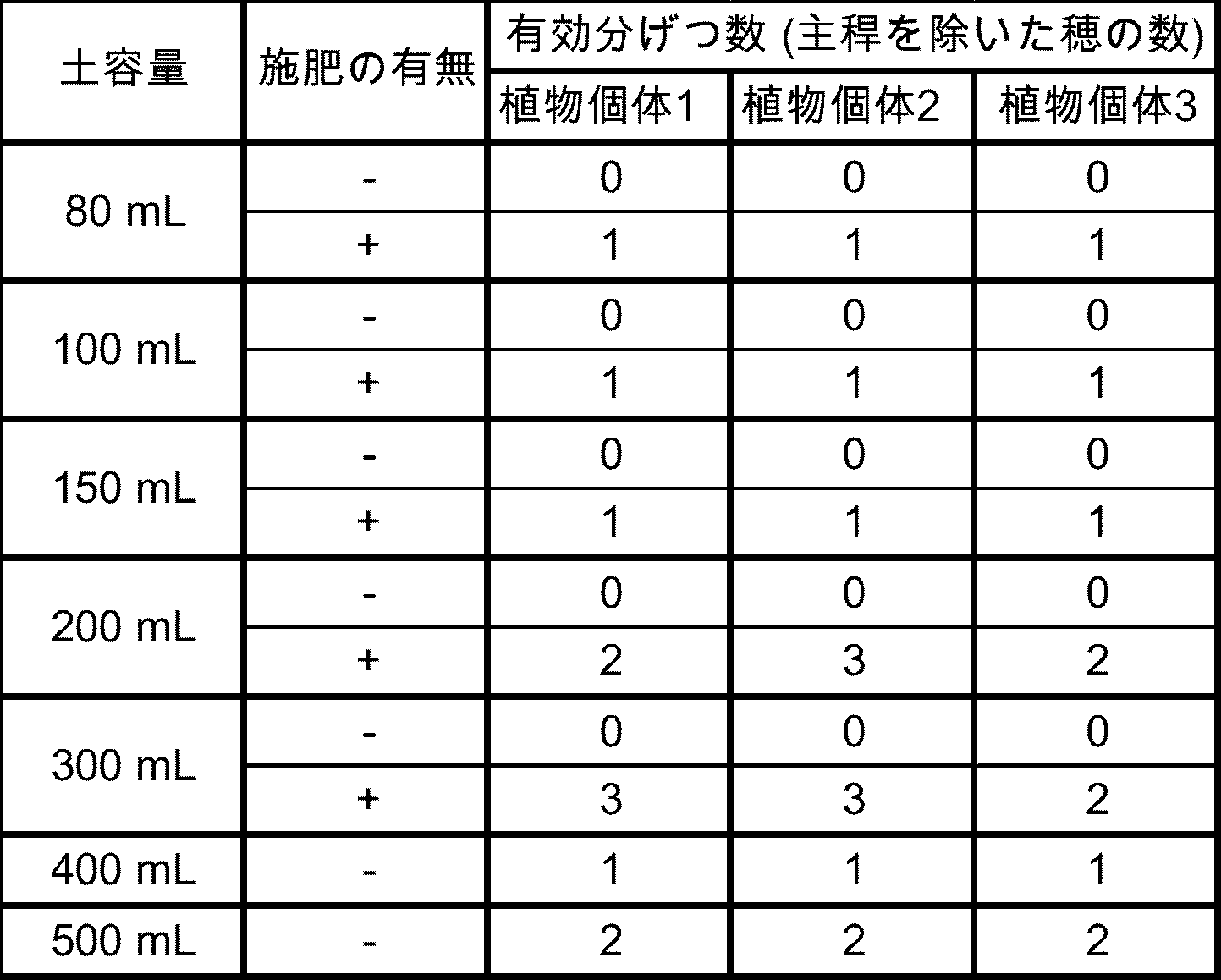
従来の方法(例えば、650mm×420mmのばんじゅうを敷き、汎用の7号ポット(直径21cm:土容量約3.5L)を用いる方法)では、仮に100個体の植物体を生育させた場合、ばんじゅう17個分のスペース(4.64m2)が必要となる。一方、本発明の方法(例えば、50mm×50mmのセルトレイ(土容量約80mL-100mL)を用いる方法)では、同数の植物体を生育させた場合、ばんじゅう1個分のスペース(0.27m2)で足り、生育スペースを大幅に節約できる。
また、7号ポット(土容量約3.5L)で生育させ、10本の分げつから平均20粒/穂の種子を収穫した場合、1系統のT1世代の全ての個体を解析するためには200個体を解析しなければならない。一方、本発明の方法では、主稈の種子のみを収穫した場合でも効率よくT1世代の形質転換体を取得できるため、T1世代20個体を解析すれば良く、要する時間・労力を大幅に節約できる。
また、7号ポット(土容量約3.5L)で生育させ、10本の分げつから平均20粒/穂の種子を収穫した場合、1系統のT1世代の全ての個体を解析するためには200個体を解析しなければならない。一方、本発明の方法では、主稈の種子のみを収穫した場合でも効率よくT1世代の形質転換体を取得できるため、T1世代20個体を解析すれば良く、要する時間・労力を大幅に節約できる。
本発明の態様としては、例えば、以下のものなどが挙げられる。
<1> 植物細胞に少なくとも1種の核酸および/または少なくとも1種のタンパク質を導入する導入工程と、該植物細胞から植物体を生育させ有効分げつ数が1以下の植物体を得る生育工程と、該植物体から形質転換またはゲノム編集された次世代植物体を取得する取得工程とを含むことを特徴とする植物の形質転換またはゲノム編集方法である。
<2> 前記有効分げつ数が1以下の植物体の主稈の基部から穂の基部までの長さが600mm以下である、前記<1>に記載の方法である。
<3> 前記生育工程における、前記植物体1つあたりの土容量が190mL以下である、前記<1>または<2>に記載の方法である。
<4> 前記植物細胞が、種子胚の茎頂の細胞である、前記<1>から<3>のいずれかに記載の方法である。
<5> 前記種子胚の茎頂が、該種子から胚乳、鞘葉、葉原基、および/または余分な胚盤を除去し、露出させた茎頂である、前記<4>に記載の方法である。
<6> 前記種子胚の茎頂の細胞が、生殖細胞系列へ移行する茎頂幹細胞を含む、前記<4>または<5>のいずれかに記載の方法である。
<7> 前記種子胚の茎頂が、完熟種子胚の茎頂である、前記<4>から<6>のいずれかに記載の方法である。
<8> 前記導入工程において、物理的手法により、少なくとも1種の核酸および/または少なくとも1種のタンパク質を導入する、前記<1>から<7>のいずれかに記載の方法である。
<9> 前記物理的手法が、遺伝子銃を用いる手法である、前記<8>に記載の方法である。
<10> 前記植物が、コムギ、オオムギ、ライムギ、エンバク、イネ、トウモロコシおよびダイズからなる群から選ばれるいずれか1である、前記<1>から<9>のいずれかに記載の方法である。
<11> 前記<1>から<10>のいずれかに記載の方法を用いることを特徴とする植物の形質転換体またはゲノム編集個体の製造方法である。
<1> 植物細胞に少なくとも1種の核酸および/または少なくとも1種のタンパク質を導入する導入工程と、該植物細胞から植物体を生育させ有効分げつ数が1以下の植物体を得る生育工程と、該植物体から形質転換またはゲノム編集された次世代植物体を取得する取得工程とを含むことを特徴とする植物の形質転換またはゲノム編集方法である。
<2> 前記有効分げつ数が1以下の植物体の主稈の基部から穂の基部までの長さが600mm以下である、前記<1>に記載の方法である。
<3> 前記生育工程における、前記植物体1つあたりの土容量が190mL以下である、前記<1>または<2>に記載の方法である。
<4> 前記植物細胞が、種子胚の茎頂の細胞である、前記<1>から<3>のいずれかに記載の方法である。
<5> 前記種子胚の茎頂が、該種子から胚乳、鞘葉、葉原基、および/または余分な胚盤を除去し、露出させた茎頂である、前記<4>に記載の方法である。
<6> 前記種子胚の茎頂の細胞が、生殖細胞系列へ移行する茎頂幹細胞を含む、前記<4>または<5>のいずれかに記載の方法である。
<7> 前記種子胚の茎頂が、完熟種子胚の茎頂である、前記<4>から<6>のいずれかに記載の方法である。
<8> 前記導入工程において、物理的手法により、少なくとも1種の核酸および/または少なくとも1種のタンパク質を導入する、前記<1>から<7>のいずれかに記載の方法である。
<9> 前記物理的手法が、遺伝子銃を用いる手法である、前記<8>に記載の方法である。
<10> 前記植物が、コムギ、オオムギ、ライムギ、エンバク、イネ、トウモロコシおよびダイズからなる群から選ばれるいずれか1である、前記<1>から<9>のいずれかに記載の方法である。
<11> 前記<1>から<10>のいずれかに記載の方法を用いることを特徴とする植物の形質転換体またはゲノム編集個体の製造方法である。
本発明は、農業、医薬産業、酵素産業などに利用できる。
Claims (11)
- 植物細胞に少なくとも1種の核酸および/または少なくとも1種のタンパク質を導入する導入工程と、該植物細胞から植物体を生育させ有効分げつ数が1以下の植物体を得る生育工程と、該植物体から形質転換またはゲノム編集された次世代植物体を取得する取得工程とを含むことを特徴とする植物の形質転換またはゲノム編集方法。
- 前記有効分げつ数が1以下の植物体の主稈の基部から穂の基部までの長さが600mm以下である、請求項1に記載の方法。
- 前記生育工程における、前記植物体1つあたりの土容量が190mL以下である、請求項1または2に記載の方法。
- 前記植物細胞が、種子胚の茎頂の細胞である、請求項1から3のいずれかに記載の方法。
- 前記種子胚の茎頂が、該種子から胚乳、鞘葉、葉原基、および/または余分な胚盤を除去し、露出させた茎頂である、請求項4に記載の方法。
- 前記種子胚の茎頂の細胞が、生殖細胞系列へ移行する茎頂幹細胞を含む、請求項4または5のいずれかに記載の方法。
- 前記種子胚の茎頂が、完熟種子胚の茎頂である、請求項4から6のいずれかに記載の方法。
- 前記導入工程において、物理的手法により、少なくとも1種の核酸および/または少なくとも1種のタンパク質を導入する、請求項1から7のいずれかに記載の方法。
- 前記物理的手法が、遺伝子銃を用いる手法である、請求項8に記載の方法。
- 前記植物が、コムギ、オオムギ、ライムギ、エンバク、イネ、トウモロコシおよびダイズからなる群から選ばれるいずれか1である、請求項1から9のいずれかに記載の方法。
- 請求項1から10のいずれかに記載の方法を用いることを特徴とする植物の形質転換体またはゲノム編集個体の製造方法。
Applications Claiming Priority (4)
| Application Number | Priority Date | Filing Date | Title |
|---|---|---|---|
| JP2021-005883 | 2021-01-18 | ||
| JP2021005883 | 2021-01-18 | ||
| JP2021210547 | 2021-12-24 | ||
| JP2021-210547 | 2021-12-24 |
Publications (1)
| Publication Number | Publication Date |
|---|---|
| WO2022154115A1 true WO2022154115A1 (ja) | 2022-07-21 |
Family
ID=82448185
Family Applications (1)
| Application Number | Title | Priority Date | Filing Date |
|---|---|---|---|
| PCT/JP2022/001349 Ceased WO2022154115A1 (ja) | 2021-01-18 | 2022-01-17 | 形質転換またはゲノム編集された次世代植物体の製造方法 |
Country Status (1)
| Country | Link |
|---|---|
| WO (1) | WO2022154115A1 (ja) |
Citations (4)
| Publication number | Priority date | Publication date | Assignee | Title |
|---|---|---|---|---|
| WO2017195906A1 (ja) * | 2016-05-13 | 2017-11-16 | 株式会社カネカ | 植物のゲノム編集方法 |
| WO2017195905A1 (ja) * | 2016-05-13 | 2017-11-16 | 株式会社カネカ | 形質転換植物の作製方法 |
| CN111662924A (zh) * | 2019-03-07 | 2020-09-15 | 山东舜丰生物科技有限公司 | 一种调控水稻株型和种子粒重的基因编辑方法 |
| CN111848764A (zh) * | 2020-04-10 | 2020-10-30 | 中国科学技术大学 | 一种水稻蛋白OsARP6在调控水稻株型中的用途 |
-
2022
- 2022-01-17 WO PCT/JP2022/001349 patent/WO2022154115A1/ja not_active Ceased
Patent Citations (4)
| Publication number | Priority date | Publication date | Assignee | Title |
|---|---|---|---|---|
| WO2017195906A1 (ja) * | 2016-05-13 | 2017-11-16 | 株式会社カネカ | 植物のゲノム編集方法 |
| WO2017195905A1 (ja) * | 2016-05-13 | 2017-11-16 | 株式会社カネカ | 形質転換植物の作製方法 |
| CN111662924A (zh) * | 2019-03-07 | 2020-09-15 | 山东舜丰生物科技有限公司 | 一种调控水稻株型和种子粒重的基因编辑方法 |
| CN111848764A (zh) * | 2020-04-10 | 2020-10-30 | 中国科学技术大学 | 一种水稻蛋白OsARP6在调控水稻株型中的用途 |
Non-Patent Citations (1)
| Title |
|---|
| "Dictionary of Plant Breeding (1st edition)", 1 January 2005, JAPANESE SOCIETY OF BREEDING, JP, ISBN: 4-563-07788-7, article JAPAN SOCIETY OF BREEDING: "Tillering", pages: 592, XP009538378 * |
Similar Documents
| Publication | Publication Date | Title |
|---|---|---|
| JP7321477B2 (ja) | 植物のゲノム編集方法 | |
| US11518998B2 (en) | Method for creating transformed plant | |
| US11492630B2 (en) | Methods and hybrids for targeted nucleic acid editing in plants using CRISPR/Cas systems | |
| JP2018503392A (ja) | 遺伝子一過性発現により完全な植物において部位特異的改変を行うための方法 | |
| WO2008112267A2 (en) | Transformation of immature soybean seeds through organogenesis | |
| CN115768898A (zh) | 用于顽拗型植物的快速基因组修饰的方法 | |
| KR102677434B1 (ko) | 벼 Os03g52870 유전자 유래 화분 특이적 발현 프로모터 및 이의 용도 | |
| JP7665906B2 (ja) | 植物の改変方法、植物のゲノム編集方法、及び植物の作製方法 | |
| JP7616514B2 (ja) | 腋芽メリステムを用いた植物の改変方法 | |
| US11499158B2 (en) | Method for modifying plant | |
| KR102880225B1 (ko) | 벼 Os09g03890 유전자 유래 화분 특이적 발현 프로모터 및 이의 용도 | |
| WO2022154115A1 (ja) | 形質転換またはゲノム編集された次世代植物体の製造方法 | |
| JP7605390B2 (ja) | コムギのゲノム編集方法、及びその利用 | |
| KR20230033830A (ko) | 환경 스트레스에 대한 저항성을 조절하는 up 유전자 및 이의 용도 | |
| AU2024361001A1 (en) | Genome editing method and method for producing genome-edited plant | |
| WO2025079531A1 (ja) | ゲノム編集方法及びゲノム編集された植物の製造方法 | |
| KR102937608B1 (ko) | 벼 OsLAT52_L4 유전자 유래 화분 특이적 발현 프로모터 및 이의 용도 | |
| Hilman et al. | A Comprehensive Method to Generating and Identifying Transgenic Tobacco Lines with a Single Transgene Integration Locus for Functional Analysis. | |
| JP2025145825A (ja) | 植物のゲノム編集方法 | |
| KR20250064103A (ko) | 키다리병 저항성을 증진시키는 OsNAC59 가이드 RNA 및 이를 이용한 키다리병 저항성이 증진된 벼 | |
| KR20230175077A (ko) | 벼 Os05g20150 유전자 유래 화분 특이적 발현 프로모터 및 이의 용도 | |
| KR20240128182A (ko) | 벼 유전자 유래 화분 특이적 발현 프로모터 및 이의 용도 | |
| KR20240023262A (ko) | 체관 발달을 조절하는 토마토 유래 SlJUL 유전자와 이의 용도 | |
| EFFICIENCY | Reviews, challenges |
Legal Events
| Date | Code | Title | Description |
|---|---|---|---|
| 121 | Ep: the epo has been informed by wipo that ep was designated in this application |
Ref document number: 22739520 Country of ref document: EP Kind code of ref document: A1 |
|
| NENP | Non-entry into the national phase |
Ref country code: DE |
|
| 122 | Ep: pct application non-entry in european phase |
Ref document number: 22739520 Country of ref document: EP Kind code of ref document: A1 |
|
| NENP | Non-entry into the national phase |
Ref country code: JP |