WO2022152102A1 - 一种易清洁的温室覆盖膜材料、制备方法及清洁方法 - Google Patents
一种易清洁的温室覆盖膜材料、制备方法及清洁方法 Download PDFInfo
- Publication number
- WO2022152102A1 WO2022152102A1 PCT/CN2022/071199 CN2022071199W WO2022152102A1 WO 2022152102 A1 WO2022152102 A1 WO 2022152102A1 CN 2022071199 W CN2022071199 W CN 2022071199W WO 2022152102 A1 WO2022152102 A1 WO 2022152102A1
- Authority
- WO
- WIPO (PCT)
- Prior art keywords
- easy
- greenhouse
- cover film
- film
- greenhouse cover
- Prior art date
- Legal status (The legal status is an assumption and is not a legal conclusion. Google has not performed a legal analysis and makes no representation as to the accuracy of the status listed.)
- Ceased
Links
Classifications
-
- A—HUMAN NECESSITIES
- A01—AGRICULTURE; FORESTRY; ANIMAL HUSBANDRY; HUNTING; TRAPPING; FISHING
- A01G—HORTICULTURE; CULTIVATION OF VEGETABLES, FLOWERS, RICE, FRUIT, VINES, HOPS OR SEAWEED; FORESTRY; WATERING
- A01G9/00—Cultivation in receptacles, forcing-frames or greenhouses; Edging for beds, lawn or the like
- A01G9/14—Greenhouses
- A01G9/1438—Covering materials therefor; Materials for protective coverings used for soil and plants, e.g. films, canopies, tunnels or cloches
-
- B—PERFORMING OPERATIONS; TRANSPORTING
- B08—CLEANING
- B08B—CLEANING IN GENERAL; PREVENTION OF FOULING IN GENERAL
- B08B3/00—Cleaning by methods involving the use or presence of liquid or steam
- B08B3/02—Cleaning by the force of jets or sprays
-
- B—PERFORMING OPERATIONS; TRANSPORTING
- B08—CLEANING
- B08B—CLEANING IN GENERAL; PREVENTION OF FOULING IN GENERAL
- B08B3/00—Cleaning by methods involving the use or presence of liquid or steam
- B08B3/04—Cleaning involving contact with liquid
- B08B3/08—Cleaning involving contact with liquid the liquid having chemical or dissolving effect
-
- B—PERFORMING OPERATIONS; TRANSPORTING
- B29—WORKING OF PLASTICS; WORKING OF SUBSTANCES IN A PLASTIC STATE IN GENERAL
- B29D—PRODUCING PARTICULAR ARTICLES FROM PLASTICS OR FROM SUBSTANCES IN A PLASTIC STATE
- B29D7/00—Producing flat articles, e.g. films or sheets
- B29D7/01—Films or sheets
-
- Y—GENERAL TAGGING OF NEW TECHNOLOGICAL DEVELOPMENTS; GENERAL TAGGING OF CROSS-SECTIONAL TECHNOLOGIES SPANNING OVER SEVERAL SECTIONS OF THE IPC; TECHNICAL SUBJECTS COVERED BY FORMER USPC CROSS-REFERENCE ART COLLECTIONS [XRACs] AND DIGESTS
- Y02—TECHNOLOGIES OR APPLICATIONS FOR MITIGATION OR ADAPTATION AGAINST CLIMATE CHANGE
- Y02A—TECHNOLOGIES FOR ADAPTATION TO CLIMATE CHANGE
- Y02A40/00—Adaptation technologies in agriculture, forestry, livestock or agroalimentary production
- Y02A40/10—Adaptation technologies in agriculture, forestry, livestock or agroalimentary production in agriculture
- Y02A40/25—Greenhouse technology, e.g. cooling systems therefor
Definitions
- the invention relates to the technical field of preparation of greenhouse covering film materials and system design thereof, in particular to an easy-to-clean greenhouse covering film material, a preparation method and a cleaning method.
- plastic film is light in weight, convenient in installation, low in price and high in light transmittance, and has become the most widely used type of covering material for greenhouses in my country.
- greenhouse covering plastic films can be divided into five types: polyvinyl chloride (PVC), polyethylene (PE), polyolefin (PO), ethylene-vinyl acetate copolymer (EVA) and polycarbonate (PC).
- the researchers proposed to design a dustproof shed film which is mainly based on the hydrophobic modification of the surface of the film.
- the surface structure design of the shed film (made into needles) makes it difficult for dust particles to be adsorbed on the surface of the shed film, and the composite nano-titanium dioxide film realizes the light of the shed film. Catalytic self-cleaning, etc.
- the development of new materials has greatly increased the cost of commercial greenhouse films, and it is difficult to meet the dust-proof requirements of greenhouse films that have been put into the market on a large scale.
- the invention provides a low-cost, high-efficiency, convenient and universal cleaning technology for the greenhouse covering film, aiming at the problem of dust pollution on the surface of the greenhouse covering film in the background technology.
- the present invention provides an easy-to-clean greenhouse covering film material.
- An easy-to-clean greenhouse cover film material comprising: a cover film body as a base, and a highly dense nano film formed by a polyphenol-metal complex coated on the surface of the cover film body.
- the raw material of the nano-film comprises plant polyphenols, metal ions and stabilizer solution.
- concentration ratio of the plant polyphenols to the metal ions is 4:1 to 4:4.
- the pH value of the stabilizer solution is 6.0-9.0
- the stabilizer solution includes but is not limited to anhydrous citric acid, disodium hydrogen phosphate dodecahydrate, sodium bicarbonate, sodium hydroxide, sodium carbonate, lemon Any one or more of sodium, sodium dihydrogen phosphate, imidazole, and sodium acetate.
- the plant polyphenols include but are not limited to any one or more of tannins, bayberry tannins, oak tannins, and black wattle tannins;
- the metal ions include but are not limited to aluminum (Al) , any one or more of iron (Fe), zinc (Zn), copper (Cu), cerium (Ce), ytterbium (Yb), and samarium (Sm).
- the pH value of the cleaning agent solution is 3.0-5.0, including but not limited to any one or more of citric acid, hydrochloric acid, and acetic acid.
- the material of the cover film body is selected from any one of polyethylene (PE), polyolefin (PO), ethylene-vinyl acetate copolymer (EVA) and polycarbonate (PC).
- PE polyethylene
- PO polyolefin
- EVA ethylene-vinyl acetate copolymer
- PC polycarbonate
- the plant polyphenols have multiple interfacial forces and biocompatibility, and can well adhere to the surfaces of metals, inorganic salts, polymer materials and biological cell membranes; and the phenolic hydroxyl groups can coordinate with many metal ions. It can form complexes with pH responsiveness, which makes the complexes formed by plant polyphenols and metal ions have broad application prospects in the surface modification of materials.
- the present invention also provides a preparation method of the first aspect.
- the plant polyphenol solution was mixed with the metal ion solution, in order to make the polyphenol-metal form low ligands attached to the substrate surface of the greenhouse covering film, and lay the foundation for the formation of a dense polyphenol-metal supramolecular network barrier film.
- the stabilizer solution When the stabilizer solution is sprayed for the second time, it promotes the formation of a nano-supramolecular film with a higher coordination number and a denser nano-supramolecular film in situ by the low-ligand complex on the surface of the main body substrate of the greenhouse cover film, and has a good barrier.
- the adhesion ability of the box makes the dust in the air not directly deposited on the substrate surface of the greenhouse cover film, but on the supramolecular network film, which lays the foundation for easy cleaning of the deposited dust.
- the present invention also provides a cleaning method of the first aspect.
- the polyphenol-metal supramolecular coordination complexation dissociates, and it is easy to be washed with clean water from the greenhouse cover.
- the surface of the film falls off, and at the same time, the accumulated dust is peeled off the surface of the greenhouse cover film, so that the greenhouse cover film is easy to clean, and the light transmittance of the greenhouse cover film is restored, so as not to affect the photosynthesis of plants in the greenhouse.
- the cleaning agent can recover and separate the dust by precipitation, so as to realize the recovery and reuse of the plant polyphenols and metal ions in the supernatant.
- the present invention also provides the application of the highly dense nano-film formed by the polyphenol-metal complex in the first aspect in film-forming and cleaning technology, such as can also be used for greenhouse cover glass, architectural window, lens surface protection Dust cleaning.
- the present invention has the following beneficial effects:
- the easy-to-clean greenhouse cover film material of the present invention is composed of polyphenol-metal nano-film, has good optical transmittance, does not affect the optical properties of the original greenhouse cover film body; the film quality is small, and the biocompatibility is good, It will not corrode and damage the greenhouse cover film and glass surface, and can be used on a large scale.
- the polyphenol-metal nano-film prepared by the present invention has pH value responsiveness.
- plant polyphenols and metals can form a supramolecular network structure with a high ratio, which can Stably adheres to the surface of the greenhouse cover film, and prevents dust from directly depositing on the greenhouse cover film and glass surface; when the amount of dust deposition makes the light transmittance of the greenhouse cover film worse, spray and wash the cleaning agent with a pH value of 3.0 ⁇ 5.0 , and rinse with clean water to dissociate the nano-film formed by plant polyphenols and metal ions, and at the same time remove the dust adhering to the nano-film, so as to realize the easy cleaning of the greenhouse covering film.
- the present invention uses plant polyphenolic compounds, which have wide sources, low prices and high reactivity. It can effectively adhere to the surface of commercial greenhouse cover films and glass through multiple interfacial forces such as hydrogen bonding, van der Waals force, electrostatic adsorption, etc., and coordinate and complex with various metal ions to form a stable supramolecular network film.
- the surface of the cover film is chemically modified to prevent dust from directly depositing on the greenhouse cover film and the glass surface.
- the film preparation method is simple, and the film formation is fast and efficient, which can save time and cost.
- the present invention has the characteristics of low cost, no damage, high efficiency, easy control, etc., and opens up a new dust-proof idea and new technology that is easy to form a film and easy to clean.
- Fig. 1 is the optical performance diagram of each polyolefin + bayberry tannin + metal ion easy-cleaning greenhouse cover film in Example 2 of the present invention; Spectrum of solar light transmittance with wavelengths of 250-2500 nm, Figure (b) is a comparison of light transmittance between various easy-to-clean greenhouse mulch films based on polyolefin PO and the body PO of the greenhouse mulch film, Figure (c) ) is the scanning electron microscope image of polyolefin + myricetus tannin + iron ion (PO+BT+Fe 3+ ) easy-to-clean greenhouse cover film, and the inset is the energy spectrum of iron element;
- Fig. 2 is the optical performance diagram of the easy-to-clean greenhouse covering films formed by various greenhouse covering film bodies + bayberry tannin + iron ion complexes in Example 2 of the present invention
- (a) is various greenhouse covering film bodies + bayberry single
- Figure (b) is the light transmittance comparison of the easy-to-clean greenhouse cover film and the base greenhouse cover film. ;
- Fig. 3 is a graph of the optical properties of PO+BT/TA+Fe 3+ /Al 3+ in Example 2 of the present invention; wherein Fig. (a) is an easy-to-clean complex formed by polyolefin+various plant polyphenols+various metal ions The solar transmittance spectrum of the greenhouse cover film at a wavelength of 250 ⁇ 2500 nm, Figure (b) is the light transmittance of the easy-to-clean greenhouse cover film PO+BT/TA+Fe 3+ /Al 3+ and the greenhouse cover film body PO comparison chart;
- FIG. 4 is a schematic diagram of a self-designed dust raising device for a simulated dust pollution experiment in Example 3 of the present invention, wherein 1, the blowing pump, 2, the dust bin, 3, the pipeline, and 4, the dust deposition chamber.
- Example 5 is an optical picture of three stages of easy-to-clean greenhouse cover film PO+BT+Fe 3+ , after dust pollution, and after cleaning in Example 3 of the present invention
- Figure 6 is the optical performance diagram of the greenhouse film of PO+BT+Fe 3+ easy-to-clean greenhouse cover film, after dust pollution, and after cleaning in Example 3 of the present invention
- Figure (a) is PO+BT+Fe 3+ easy-to-clean greenhouse film The solar transmittance spectrum with wavelengths of 250-2500 nm in three stages after cleaning the greenhouse cover film, after dust pollution, and after cleaning
- Figure (b) PO+BT+Fe 3+ easy-to-clean greenhouse cover film, after dust pollution, Comparison of light transmittance in three stages after cleaning and before unmodified;
- Fig. 7 is the optical transmittance diagram of PO+BT+Fe 3+ easy-to-clean greenhouse cover film and greenhouse cover film body PO in Example 3 of the present invention, which are continuously cycled 10 times in the stages of dust pollution and cleaning;
- Example 8 is a schematic diagram of the design of the recovery of polyphenol and metal ion solution by the easy-to-clean greenhouse covering film system in Example 4 of the present invention.
- the polyphenol-metal mulching film samples are numbered according to the greenhouse mulching film body + plant polyphenol components + metal ions, such as polyolefin + bayberry tannin + iron ions (PO+BT+Fe 3+ ).
- the plant polyphenol solution and the metal ion solution are used as the stock solution to be sprayed on the surface of the greenhouse cover film body to complete the first spraying; and the stabilizer solution is used to carry out the second spraying.
- the concentration ratio of the plant polyphenols to the metal ions is 4:1 to 4:4;
- the pH of the stabilizer solution used is 6.0 to 9.0;
- the plant polyphenols include but are not limited to tannins, black wattle tannins , any one or more of oak tannin and bayberry tannin;
- the metal ions include but are not limited to aluminum (Al), iron (Fe), zinc (Zn), cerium (Ce), ytterbium (Yb), Any one or more of samarium (Sm).
- the main body base material of the greenhouse cover film is a commercial greenhouse cover film organic polymer plastic film material and greenhouse glass material, including but not limited to polyethylene (PE), polyolefin (PO), ethylene-vinyl acetate copolymer (EVA) and Polycarbonate (PC) either.
- PE polyethylene
- PO polyolefin
- EVA ethylene-vinyl acetate copolymer
- PC Polycarbonate
- the substrate is a polyolefin (PO) film
- the polyphenol in the polyphenol-metal complex is myricetus tannin BT.
- Table 1 The composition of each sample is shown in Table 1.
- FIG. 1(a) is the solar transmittance spectrum of 7 kinds of easy-to-clean greenhouse cover films based on polyolefin PO and untreated greenhouse cover film bulk PO film at wavelengths of 250-2500 nm
- (b) ) is the light transmittance comparison chart of 7 kinds of easy-to-clean greenhouse cover films based on polyolefin PO and the untreated greenhouse cover film body PO film, it can be seen that the polyphenol-metal coated on the surface of the greenhouse cover film body The complex film does not affect the original optical properties of the PO film of the greenhouse cover film, and the light transmittance of the easy-to-clean greenhouse cover film coated with the polyphenol-metal complex film is greater than 88%.
- (c) is the SEM and Fe energy spectrum of the easy-to-clean greenhouse cover film PO+BT+Fe 3+ , which proves that the complexation of bayberry tannin and iron ions on the
- the polyphenol-metal complex film is a complex film of bayberry tannin and Fe 3+ , and the composition of each sample is shown in Table 2.
- FIG. 2 (a) is the solar transmittance spectrum of four kinds of easy-to-clean greenhouse mulch films and their respective untreated greenhouse mulch films at wavelengths of 250-2500 nm, (b) is the four kinds of easy-to-clean greenhouse mulch films Comparison of light transmittance of the films with their respective untreated greenhouse mulch film bodies. As can be seen from Figure 2, compared with the untreated greenhouse cover film body, it can be seen that the easy-to-clean greenhouse cover film prepared by coating different greenhouse cover film bodies with the same polyphenol-metal complex film still has good performance. optical performance.
- the main body of the greenhouse cover film is a polyolefin (PO) film
- the polyphenol in the polyphenol-metal complex is a mixed solution of bayberry tannin BT and tannic acid TA
- the metal ions are a mixture of Fe 3+ and Al 3+ Solution
- the easy-to-clean greenhouse cover film PO+BT/TA+Fe 3+ /Al 3+ was prepared by spraying.
- the optical properties of the prepared sample 12 were tested, and the test results are shown in FIG. 3 .
- Example 2 The sample 1 in Example 2: PO+BT+Fe 3+ easy-to-clean greenhouse cover film was cut into a 10 ⁇ 10 cm sample, placed on the sample stage of the dust deposition chamber, turned on the power of the blowing pump, and carried out the dust deposition experiment 5 min, the test system is shown in Figure 4.
- the dust is common air dust particles in daily life.
- Example 2 Take the sample 1 in Example 2: PO+BT+Fe 3+ easy-to-clean greenhouse mulch film and the greenhouse mulch film body without any treatment PO cut into 10 ⁇ 10 cm samples, and these two samples are covered in greenhouse Film material preparation, dust deposition experiment, cleaning experiment, 10 consecutive cycle tests, and detection of the optical transmittance of the greenhouse covering film after each cleaning, the test results are shown in Figure 7.
- the nano dust-proof protective film formed by bayberry tannin and iron metal ions on the PO greenhouse cover film can be cleaned by cleaning agent to restore the light transmission performance, and the dust can be easily removed by spraying liquid. It is isolated from the PO film to effectively avoid dust pollution. After 10 cycles of treatment, the performance is still stable, and the average light transmittance is stable at about 88%, which means that polyphenols and metal ions are formed on the surface of the greenhouse covering film for many times.
- the supramolecular network structure film does not affect the performance of the greenhouse cover film body, and can effectively solve the problem of dust pollution of the greenhouse cover film body for a long time to meet the actual needs.
- Reference Example 3 For sample 1: PO+BT+Fe 3+ easy-to-clean greenhouse cover film cycle performance test experiment, a greenhouse cover film body system that can be driven and cleaned by electricity is designed.
- the equipment system is shown in Figure 8.
- the easy-to-clean greenhouse covering film system consists of 1. spraying module, 2. recycling module, 3. sediment separation tank, 4. spraying liquid purification tank, 5. working tank, 6. electric It is composed of a water pump, which constitutes the daily dust protection and cleaning operations of the greenhouse covering film body.
- the spraying module is responsible for spraying liquid to prepare easy-to-clean greenhouse covering film materials and cleaning agent cleaning tasks;
- the recycling module is responsible for diverting waste liquid and sediment to the sediment separation tank;
- the sediment separation tank is responsible for the preliminary separation of spraying liquid and sediment;
- the spraying liquid purification tank is responsible for the separation and purification of the spraying liquid and the water phase;
- the working tank is responsible for loading the spraying liquid, stabilizer solution and cleaning agent of the greenhouse covering film material, and spraying, stabilizing and cleaning the easy-to-clean greenhouse covering film material respectively;
- the water pump is responsible for Transport liquids.
Landscapes
- Chemical & Material Sciences (AREA)
- Life Sciences & Earth Sciences (AREA)
- Engineering & Computer Science (AREA)
- Chemical Kinetics & Catalysis (AREA)
- General Chemical & Material Sciences (AREA)
- Materials Engineering (AREA)
- Soil Sciences (AREA)
- Environmental Sciences (AREA)
- Mechanical Engineering (AREA)
- Greenhouses (AREA)
Abstract
一种易清洁温室覆盖膜材料,包含:作为基底的温室覆盖膜本体,和包覆于温室覆盖膜本体表面的多酚-金属络合物形成的高度致密的纳米薄膜。该易清洁温室覆盖膜外层由多酚-金属纳米薄膜组成,具有良好的光学透过率,不影响原有的温室覆盖膜本体的光学性能;薄膜质量小,生物相容性好,不会对温室覆盖膜、温室覆盖玻璃表面腐蚀和破坏,可以大规模使用。所制备的多酚-金属纳米薄膜能够阻隔粉尘直接沉积于温室覆盖膜和温室覆盖玻璃表面,当粉尘沉积量使温室覆盖膜透光性变差时,通过喷洗清洗剂,并用清水冲洗,即可解离由植物多酚和金属离子形成的纳米薄膜,同时将粘附于纳米薄膜上的粉尘一并去除,实现温室覆盖膜的易清洗。还涉及一种制备易清洁温室覆盖膜材料的方法以及一种易清洁温室覆盖膜的清洁方法。
Description
本发明涉及温室覆盖膜材料制备及其系统设计技术领域,具体涉及一种易清洁温室覆盖膜材料、制备方法及清洁方法。
背景技术
近年来我国现代化温室面积正不断扩大、科技水平也在不断增长。目前,我国取得了可喜的温室种植成果:全国大中拱棚以上的设施面积达370万公顷(5550万亩),占世界设施园艺面积的80%。温室的发展与推广给农户带来了巨大的经济效益,极大提高了农民收入水平。我国温室种类较多,按其覆盖材料种类分为:玻璃温室、PC 阳光板温室、塑料薄膜温室等。其中,塑料薄膜质量轻、安装方便、价格低廉、透光率较高等,成为我国温室应用最为广泛的一种覆盖材料类型。温室覆盖塑料膜按主要成分可分为聚氯乙烯(PVC)、聚乙烯(PE)、聚烯烃(PO)、乙烯-醋酸乙烯共聚物(EVA)和聚碳酸酯(PC)等5种。
温室种植作为现代农业发展新方向,逐渐改变了传统种植模式,其在提高作物产量、提升品质以及缓解我国淡季蔬菜供应等方面发挥有不可替代的作用;人工干预下,可提供最佳生长环境,但随着时间延长,处在自然状态下的温室由于风吹、雨淋很容易粘附空气中的固体颗粒,温室表面会沉积较多灰尘,甚至会滋生藻类植物,对于温室内透光率产生较大影响。尤其近几年雾霾天气持续增多进一步加重了温室污染程度,用户对温室进行清洗的意愿持续增强。现阶段,尽管我国对于温室清洗方面一般采用自制的简易工具手动喷水对于温室薄膜进行清洗,效率较低、危险性较高、清洁效果也并不理想。对于一般的低矮棚室,手动清洗方法尚可应用;但由于日光温室普遍高度较高、跨度较大,手动清洗方法将难以应用,这很大程度影响农户实际清洗温室的积极性。同时,通常采用酸性清洗液人工清洗,清洗剂对棚膜造成严重腐蚀并缩短棚膜使用寿命。近些年来,不断有研究人员提出一些温室清洗装置,但现阶段多数温室清洗机的研究还仅停留在专利与试制阶段,鲜有清洗设备可真正的投入到市场并得到应用推广。例如,广西大学、长江大学先后研制了一种塑料薄膜清洗机,该设备采用高压泵喷射水流作为水轮旋转的动力,高速旋转的水轮表面附着有清洁毛刷,对塑料薄膜外表面进行高速摩擦,配合水流的冲洗来达到清洗目的。该款清洗设备结构设计较为简单、成本低廉,但是清洁效果并不理想、耗水量较大、自动化水平较低、在北方寒冷的冬季无法使用。借助光伏清洗机和架设清洗机器人进行棚膜表面清洗,但是光伏清洗机和机器人用于棚膜的清洗需要花费大量人力和财力。
此外,研究者提出设计防尘棚膜,主要基于膜的表面疏水改性,棚膜表面结构设计(做成针状)使得粉尘颗粒难以吸附在棚膜表面,复合纳米二氧化钛薄膜实现棚膜的光催化自清洁等。但是,对于新材料的开发极大的增加了商用大棚膜的成本,且并难以满足已经大规模投入市场棚膜的防尘需求。
因此,根据我国实际需求,有必要提供一种低成本、安全可靠以及通用性较好的日光温室清洗技术,解决日光温室薄膜清洗难、清洗慢、清洗不彻底的问题。本发明技术方案的实施对提高日光温室光照强度、增加作物产量、减轻劳动强度以及提高农户经济效益具有重要现实意义。
发明内容
本发明是针对背景技术中温室覆盖膜表面粉尘污染问题,提供一种低成本、高效、便捷、通用的温室覆盖膜清洁技术。
为了达到上述目的,第一方面,本发明提供了一种易清洁温室覆盖膜材料。
一种易清洁温室覆盖膜材料,包含:作为基底的覆盖膜本体,和包覆于所述覆盖膜本体表面的多酚-金属络合物形成的高度致密的纳米薄膜。
进一步地,所述纳米薄膜的原料包含植物多酚、金属离子和稳定剂溶液所述植物多酚与金属离子的浓度比为4:1~4:4。
进一步地,所述稳定剂溶液的pH值为6.0~9.0,所述稳定剂溶液包含但不限于无水柠檬酸、十二水磷酸氢二钠、碳酸氢钠、氢氧化钠、碳酸钠、柠檬酸钠、磷酸二氢钠、咪唑、醋酸钠中任一种或多种。
进一步地,所述植物多酚包含但不限于单宁酸、杨梅单宁、橡碗单宁、黑荆树单宁中任一种或多种;所述金属离子包含但不限于铝(Al)、铁(Fe)、锌(Zn)、铜(Cu)、铈(Ce)、镱(Yb)、钐(Sm)中的任一种或多种。
进一步地,所述清洗剂溶液的pH值为3.0~5.0,包含但不限于柠檬酸、盐酸、醋酸中任一种或多种。
进一步地,所述覆盖膜本体的材料选自聚乙烯(PE)、聚烯烃(PO)、乙烯-醋酸乙烯共聚物(EVA)和聚碳酸酯(PC)中任一种。
本发明第一方面中,植物多酚具有界面多重作用力和生物相容性,能够很好的粘附在金属、无机盐、高分子材料和生物细胞膜表面;而且酚羟基能够和许多金属离子配位形成络合物,具有pH响应性,使得植物多酚与金属离子形成的络合物在材料表面修饰具有广泛的应用前景。
第二方面,本发明还提供了一种第一方面的制备方法。
一种易清洁温室覆盖膜材料的制备方法,包含:将多酚-金属络合物形成的高度致密的纳米薄膜喷涂于温室覆盖膜本体基底表面;分为两步进行,具体为先将植物多酚和金属离子作为原液,喷涂在温室覆盖膜本体基底表面上,然后喷涂稳定剂溶液(pH = 6.0~9.0),使得原液中植物多酚与金属离子配位络合,在温室覆盖膜本体基底表面形成稳定的多酚-金属超分子纳米薄膜。
第一次采用植物多酚溶液与金属离子溶液混合,是为了使多酚-金属形成低配体附着在温室覆盖膜本体基底表面,为形成致密多酚-金属超分子网络结构阻隔膜奠定基础,当所述第二次喷涂稳定剂溶液时,促进了低配体络合物在温室覆盖膜本体基底表面原位进一步形成配位数更高、更致密的纳米超分子薄膜,具有很好的阻隔盒粘附能力,使空气中的粉尘不能直接沉积于温室覆盖膜本体基底表面,而是沉积于超分子网络薄膜上,为易清洗该沉积粉尘奠定基础。
第三方面,本发明还提供了一种第一方面的清洁方法。
一种易清洁温室覆盖膜材料的清洁方法,在使用后的所述易清洁温室覆盖膜的表面喷涂清洁液(pH = 3.0~5.0)。温室覆盖膜在使用过程中,当大量的粉尘堆积于易清洁温室覆盖膜材料表面时,通过喷洗清洗剂,多酚-金属超分子配位络合作用解离,易被清水冲洗从温室覆盖膜表面脱落,同时将堆积的粉尘一起剥离温室覆盖膜表面,达到温室覆盖膜的易清洗,恢复温室覆盖膜的透光性,从而不影响温室内植物光合作用。
进一步地,所述清洗剂可通过回收并沉淀分离粉尘,实现上清液中植物多酚和金属离子的回收再次使用。
本发明还提供了一种第一方面中的多酚-金属络合物形成的高度致密的纳米薄膜在成膜和清洗技术中的应用,如还可用于温室覆盖玻璃、建筑窗、镜头表面防尘清洗。
与现有技术相比,本发明具有以下有益效果:
1.本发明的易清洁温室覆盖膜材料由多酚-金属纳米薄膜组成,具有良好的光学透过率,不影响原有温室覆盖膜本体的光学性能;薄膜质量小,生物相容性好,不会对温室覆盖膜、玻璃表面腐蚀和破坏,可以大规模使用。
2.本发明所制备的多酚-金属纳米薄膜具有pH值响应性,在pH值为6.0~9.0的稳定剂溶液中,植物多酚与金属能够形成高配为较高的超分子网络结构,能够稳定的粘附在温室覆盖膜表面,并阻隔粉尘直接沉积于温室覆盖膜和玻璃表面;当粉尘沉积量使温室覆盖膜透光性变差时,通过喷洗pH值为3.0~5.0的清洗剂,并用清水冲洗,即可解离由植物多酚和金属离子形成的纳米薄膜,同时将粘附于纳米薄膜上的粉尘一并去除,实现温室覆盖膜的易清洗。
3.本发明采用植物多酚类化合物,来源广泛、价格低廉、反应活性高。可通过界面多重作用力如氢键、范德华力、静电吸附等对商业化温室覆盖膜、玻璃进行有效的表面粘附,与多种金属离子配位络合形成稳定的超分子网络薄膜,对温室覆盖膜表面进行化学修饰,防止灰尘直接沉积于温室覆盖膜和玻璃表面,同时该薄膜制备方法简便,且成膜快速、高效,能够节约时间和成本。
4.本发明具有低沉本、无损伤、高效率、易操控等特点,开辟了一种易成膜,易清洗的防尘新思路、新技术。
附图说明
图1为本发明实施例2中各聚烯烃+杨梅单宁+金属离子易清洗温室覆盖膜的光学性能图;(a)为各种聚烯烃+杨梅单宁+金属离子易清洗温室覆盖膜在波长为250~2500 nm的太阳光透过率光谱图,图(b)为各种以聚烯烃PO为基底的易清洗温室覆盖膜与温室覆盖膜本体PO的透光率对比图,图(c)为聚烯烃+杨梅单宁+铁离子(PO+BT+Fe
3+)易清洗温室覆盖膜扫描电镜图,插图为铁元素的能谱图;
图2为本发明实施例2中各种温室覆盖膜本体+杨梅单宁+铁离子络合物形成的易清洗温室覆盖膜的光学性能图;(a)为各种温室覆盖膜本体+杨梅单宁+铁离子制备的易清洗温室覆盖膜在波长为250~2500 nm的太阳光透过率光谱图,图(b)为该易清洗温室覆盖膜与基底温室覆盖膜本体的透光率对比图;
图3为本发明实施例2中PO+BT/TA+Fe
3+/Al
3+的光学性能图;其中图(a)为聚烯烃+多种植物多酚+多种金属离子络合形成的易清洗温室覆盖膜在波长为250~2500 nm的太阳光透过率光谱图,图(b)为易清洗温室覆盖膜PO+BT/TA+Fe
3+/Al
3+与温室覆盖膜本体PO的透光率对比图;
图4为本发明实施例3中模拟粉尘污染实验自行设计的扬尘设备示意图,其中1、吹气泵,2、粉尘仓,3、管路,4、粉尘沉积室。
图5为本发明实施例3中易清洗温室覆盖膜PO+BT+Fe
3+、粉尘污染后、清洗后三个阶段的光学图片;
图6为本发明实施例3中PO+BT+Fe
3+易清洗温室覆盖膜、粉尘污染后、清洗后三个阶段棚膜光学性能图;图(a)为PO+BT+Fe
3+易清洗温室覆盖膜、粉尘污染后、清洗后三个阶段波长为250~2500 nm的太阳光透过率光谱图,图(b)PO+BT+Fe
3+易清洗温室覆盖膜、粉尘污染后、清洗后三个阶段与未改性前透光率对比图;
图7为本发明实施例3中PO+BT+Fe
3+易清洗温室覆盖膜与温室覆盖膜本体PO,进行粉尘污染、清洗等阶段的连续循环10次的光学透光率图;
图8为本发明实施例4中该易清洁温室覆盖膜系统回收多酚与金属离子溶液的设计示意图。
具体实施方式
下面通过实施例对本发明进行具体的描述。有必要在此指出的是,本实施例只用于对本发明进行进一步说明,不能理解为对本发明保护范围的限制。
本发明实施例中多酚-金属覆盖膜样品按照温室覆盖膜本体+植物多酚成分+金属离子来编号,如聚烯烃+杨梅单宁+铁离子(PO+BT+Fe
3+)。
实施例1
易清洁温室覆盖膜材料的制备:
将植物多酚溶液与金属离子溶液作为原液,喷涂于所述温室覆盖膜本体表面,完成第一次喷涂;以及用稳定剂溶液进行二次喷涂。
其中,所述植物多酚与金属离子的浓度比为4:1~4:4;所用稳定剂溶液pH为6.0~9.0;所述植物多酚包含但不限于单宁酸、黑荆树单宁、橡碗单宁、杨梅单宁中任一种或多种;所述金属离子包含但不限于铝(Al)、铁(Fe)、锌(Zn)、铈(Ce)、镱(Yb)、钐(Sm)中的任一种或多种。
所述温室覆盖膜本体基底材料为市售温室覆盖膜有机高分子塑料膜材料和大棚玻璃材料,包含但不限于聚乙烯(PE)、聚烯烃(PO)、乙烯-醋酸乙烯共聚物(EVA)和聚碳酸酯(PC)中任一种。
实施例2
测试易清洁温室覆盖膜的光学透过率:
(1)不同种类多酚-金属络合物在同一种基底温室覆盖膜本体上的光学性能测定:
基底为聚烯烃(PO)膜,多酚-金属络合物中多酚为杨梅单宁BT,各样品的成分如表1所示。
表1

对上述样品1-样品7与温室覆盖膜本体PO膜进行光学透光率测试,测试结果如图1所示。图1中(a)为7种以聚烯烃PO为基底的易清洗温室覆盖膜与未经处理的温室覆盖膜本体PO膜在波长为250~2500 nm的太阳光透过率光谱图,(b)为7种以聚烯烃PO为基底的易清洗温室覆盖膜与未经处理的温室覆盖膜本体PO膜的透光率对比图,可以看出包覆于温室覆盖膜本体表面的多酚-金属络合物薄膜并不影响温室覆盖膜本体PO膜原有的光学性能,且经多酚-金属络合物薄膜包覆后的易清洗温室覆盖膜透光率均大于88%。(c)为易清洗温室覆盖膜PO+BT+Fe
3+的SEM和Fe元素的能谱图,证明了杨梅单宁与铁离子在温室覆盖膜本体PO膜上络合形成具有良好透光性的薄膜。
(2)同一种多酚-金属络合物薄膜包覆在不同材质的温室覆盖膜本体上的光学性能测定:
多酚-金属络合物薄膜为杨梅单宁与Fe
3+的络合物薄膜,各样品的成分如表2所示。
表2
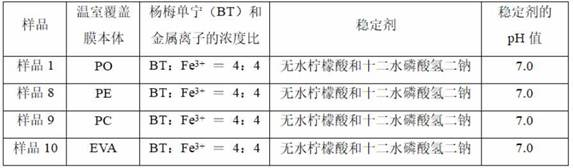
对样品1、样品8-样品10及其各自未经处理的温室覆盖膜本体基底进行光学透光率测试,测试结果如图2所示。图2中(a)为4种易清洁温室覆盖膜与其各自未经处理的温室覆盖膜本体在波长为250~2500 nm的太阳光透过率光谱图,(b)为4种易清洁温室覆盖膜与其各自未经处理的温室覆盖膜本体的透光率对比图。从图2中可看出,与未经处理的温室覆盖膜本体对比可看出,经同一种多酚-金属络合物薄膜包覆不同温室覆盖膜本体制备的易清洗温室覆盖膜仍具有良好的光学性能。
(3)多种多酚与多种金属离子形成的的多酚-金属络合物薄膜包覆在同一温室覆盖膜本体上的光学性能测试:
设置样品12:温室覆盖膜本体为聚烯烃(PO)膜,多酚-金属络合物中多酚为杨梅单宁BT、单宁酸TA混合溶液,金属离子为Fe
3+、Al
3+混合溶液,浓度比为,BT:TA:Al
3+:Fe
3+ = 2:2:2:1,所用稳定剂为无水柠檬酸和十二水磷酸氢二钠混合液(pH = 7.4),通过喷涂制备易清洗温室覆盖膜PO+BT/TA+Fe
3+/Al
3+。对所制备的样品12进行光学性能测试,测试结果如图3所示。(a)为样品12与其未经处理的基底在波长为250~2500 nm的太阳光透过率光谱图,图(b)为样品12与其未经处理的温室覆盖膜本体基底的透光率对比图。由图3可知,植物多酚(BT和TA)与金属离子(Fe
3+和Al
3+)形成的络合物能够在聚烯烃PO膜上形成薄膜,且不影响PO膜的光学性能。
实施例3
易清洁温室覆盖膜粉尘污染实验、清洗试验及持久防尘试验:
(1)易清洁温室覆盖膜粉尘污染实验
将实施例2中的样品1:PO+BT+Fe
3+易清洁温室覆盖膜裁制成10 × 10 cm样品,放置在粉尘沉积室的样品台上,打开吹气泵的电源,进行粉尘沉积实验5 min,测试系统如图4所示。
所述粉尘为生活中常见空气粉尘颗粒。
(2)易清洁温室覆盖膜粉尘清洗实验
对上述易清洁温室覆盖膜经过粉尘污染沉积后,用清洗剂(pH为3.0的盐酸溶液)对污染的温室覆盖膜进行冲洗,再用清水冲洗掉多余的清洗剂,则实现易清洁温室覆盖膜的清洗。将清洗后的温室覆盖膜进行光学性能测试,并记录数据:PO+BT+Fe
3+易清洗温室覆盖膜、粉尘污染后、清洗后三个阶段的光学图片如图5所示;PO+BT+Fe
3+易清洗温室覆盖膜、粉尘污染后、清洗后三个阶段光学性能如图6所示,图6中(a)PO+BT+Fe
3+易清洗温室覆盖膜、粉尘污染后、清洗后阶段波长为250~2500 nm的太阳光透过率光谱图,(b)为PO+BT+Fe
3+易清洗温室覆盖膜、粉尘污染后、清洗后阶段与未处理温室覆盖膜本体的透光率对比图。
(3)易清洁温室覆盖膜持久防尘试验
取实施例2中的样品1:PO+BT+Fe
3+易清洁温室覆盖膜与未经任何处理的温室覆盖膜本体PO裁制为10 × 10 cm的样品,对这两种样品进行温室覆盖膜材料制备、粉尘沉积实验、清洗实验,连续10次循环测试,并检测每次清洗后温室覆盖膜的光学透过率,试验结果如图7所示。
从图7的稳定循环试验结果可看出,杨梅单宁与铁金属离子在PO温室覆盖膜上形成的纳米防尘保护膜能够通过清洗剂清洗恢复透光性能,并通过喷涂液简便的将粉尘与PO膜隔绝,有效避免粉尘污染,在经过10此循环处理后,性能仍然稳定,平均透光率稳定在88%左右,也就是说在温室覆盖膜本体表面多次形成多酚与金属离子形成的超分子网络结构薄膜并不影响温室覆盖膜本体的使用性能,能够长期有效的解决温室覆盖膜本体粉尘污染问题,满足实际需要。
实施例4
易清洁温室覆盖膜系统回收植物多酚和金属离子溶液体系的设计:
参考实施例3对样品1:PO+BT+Fe
3+易清洁温室覆盖膜循环性能测试实验,设计一种能够通过电力驱动清洁的温室覆盖膜本体系统。
所述设备装置系统如图8所示,易清洁温室覆盖膜系统由1、喷涂模块,2、回收模块,3、泥沙分离池,4、喷涂液提纯池,5、工作池,6、电动水泵组成,构成温室覆盖膜本体日常的粉尘防护和清洗作业。
其中,喷涂模块负责喷涂液制备易清洗温室覆盖膜材料、清洗剂清洗任务;回收模块负责将废液和泥沙引流到泥沙分离池;泥沙分离池负责喷涂液与泥沙的初步分离;喷涂液提纯池负责喷涂液与水相的分离提纯;工作池负责装载温室覆盖膜材料喷涂液、稳定剂溶液、清洗剂,分别进行易清洗温室覆盖膜材料的喷涂、稳定、清洗工作;水泵负责输运液体。
实施例5
易清洁温室覆盖膜PE+VT+Fe
3+的制备:
将植物多酚溶液橡碗单宁VT与金属离子Fe
3+作为原液,橡碗单宁和Fe
3+的浓度比分别为:VT:Fe
3+ = 4:2,喷涂于温室覆盖膜本体聚乙烯(PE)膜表面,完成第一次喷涂;再用稳定剂无水柠檬酸和十二水磷酸氢二钠混合液(pH = 7.4)进行二次喷涂,即得所述易清洁温室覆盖膜PE+VT+Fe
3+。
实施例6
易清洁温室覆盖膜PC+BWT+Ce
3+的制备:
将植物多酚溶液黑荆树单宁BWT与金属离子Ce
3+作为原液,黑荆树单宁和Ce
3+的浓度比分别为:BWT:Ce
3+ = 4:3,喷涂于温室覆盖膜本体聚碳酸酯(PC)膜表面,完成第一次喷涂;再用稳定剂氢氧化钠液(pH = 8.4)进行二次喷涂,即得所述易清洁温室覆盖膜PC+BWT+Ce
3+。
实施例7
易清洁温室覆盖膜EVA+BWT+ Yb
3+的制备:
将植物多酚溶液黑荆树单宁BWT与金属离子Yb
3+作为原液,黑荆树单宁和Yb
3+的浓度比分别为:BWT:Yb
3+ = 4:3,喷涂于温室覆盖膜本体乙烯-醋酸乙烯共聚物(EVA)膜表面,完成第一次喷涂;再用稳定剂氢氧化钠液(pH =
9.0)进行二次喷涂,即得所述易清洁温室覆盖膜PC+BWT+ Yb
3+。
最后应说明的是:以上各实施例仅用以说明本发明的技术方案,而非对其限制;尽管参照前述各实施例对本发明进行了详细的说明,但本领域的普通技术人员应当理解:其依然可以对前述各实施例所记载的技术方案进行修改,或者对其中部分或者全部技术特征进行等同替换;而这些修改或者替换,并不使相应技术方案的本质脱离本发明各实施例技术方案的范围。
Claims (10)
- 一种易清洁温室覆盖膜材料,其特征在于,所述易清洁温室覆盖膜材料包含:作为基底的温室覆盖膜本体,和包覆于所述温室覆盖膜本体表面的多酚-金属络合物形成的高度致密的纳米薄膜。
- 如权利要求1所述的易清洁温室覆盖膜材料,其特征在于,所述纳米薄膜的原料包含植物多酚、金属离子和稳定剂溶液;其中,所述植物多酚与金属离子的浓度比为4:1~4:4,所述稳定剂溶液的pH值为6.0~9.0。
- 如权利要求2所述的易清洁温室覆盖膜材料,其特征在于,所述稳定剂溶液包含但不限于无水柠檬酸、十二水磷酸氢二钠、碳酸氢钠、氢氧化钠、碳酸钠、柠檬酸钠、磷酸二氢钠、咪唑、醋酸钠中任一种或多种。
- 如权利要求2所述的易清洁温室覆盖膜材料,其特征在于,所述植物多酚包含但不限于单宁酸、杨梅单宁、橡碗单宁、黑荆树单宁中任一种或多种;所述金属离子包含但不限于铝(Al)、铁(Fe)、锌(Zn)、铜(Cu)、铈(Ce)、镱(Yb)、钐(Sm)中的任一种或多种。
- 如权利要求1所述的易清洁温室覆盖膜材料,所述温室覆盖膜本体的材料选自聚乙烯(PE)、聚烯烃(PO)、乙烯-醋酸乙烯共聚物(EVA)和聚碳酸酯(PC)中任一种。
- 一种制备如利要求1-5任一所述的易清洁温室覆盖膜材料的方法,其特征在于,所述方法包含:将多酚-金属络合物形成的高度致密的纳米薄膜喷涂于温室覆盖膜本体基底表面。
- 如权利要求6所述的方法,其特征在于,所述多酚-金属络合物形成的高度致密的纳米薄膜喷涂于温室覆盖膜本体基底表面分两次进行,具体为:将植物多酚溶液与金属离子溶液作为原液,喷涂于所述温室覆盖膜本体表面,完成第一次喷涂;以及用稳定剂溶液进行二次喷涂。
- 一种采用如权利要求6或7所述制备方法得到的易清洁温室覆盖膜材料。
- 一种如权利要求1-5、8任一所述的易清洁温室覆盖膜的清洁方法,其特征在于,所述方法为,在使用后的所述易清洁温室覆盖膜的表面喷涂清洗剂。
- 如权利要求9所述的方法,其特征在于,所述清洗剂的pH值为3.0~5.0,包含但不限于柠檬酸、盐酸、醋酸中任一种或多种。
Applications Claiming Priority (2)
| Application Number | Priority Date | Filing Date | Title |
|---|---|---|---|
| CN202110054209.6A CN112690148B (zh) | 2021-01-15 | 2021-01-15 | 一种易清洁温室覆盖膜材料、制备方法及清洁方法 |
| CN202110054209.6 | 2021-01-15 |
Publications (1)
| Publication Number | Publication Date |
|---|---|
| WO2022152102A1 true WO2022152102A1 (zh) | 2022-07-21 |
Family
ID=75515332
Family Applications (1)
| Application Number | Title | Priority Date | Filing Date |
|---|---|---|---|
| PCT/CN2022/071199 Ceased WO2022152102A1 (zh) | 2021-01-15 | 2022-01-11 | 一种易清洁的温室覆盖膜材料、制备方法及清洁方法 |
Country Status (2)
| Country | Link |
|---|---|
| CN (1) | CN112690148B (zh) |
| WO (1) | WO2022152102A1 (zh) |
Families Citing this family (4)
| Publication number | Priority date | Publication date | Assignee | Title |
|---|---|---|---|---|
| CN112690148B (zh) * | 2021-01-15 | 2022-06-21 | 四川大学 | 一种易清洁温室覆盖膜材料、制备方法及清洁方法 |
| CN113728908B (zh) * | 2021-09-27 | 2022-09-06 | 四川大学 | 抑藻材料及其在无土栽培中的应用 |
| CN113736298B (zh) * | 2021-09-27 | 2022-07-01 | 四川大学 | 抑藻材料及其在农用大棚膜中的应用 |
| CN113749116B (zh) * | 2021-09-27 | 2022-08-02 | 四川大学 | 抑藻材料及其应用 |
Citations (10)
| Publication number | Priority date | Publication date | Assignee | Title |
|---|---|---|---|---|
| KR20010035296A (ko) * | 2001-02-01 | 2001-05-07 | 박완규 | 비닐하우스용 제설장치 |
| JP2003105104A (ja) * | 2001-09-27 | 2003-04-09 | Asahi Glass Co Ltd | 透明性に優れるフッ素樹脂フィルム |
| CN102702806A (zh) * | 2012-06-05 | 2012-10-03 | 西北永新集团有限公司 | 自洁增效太阳能涂料的制备及应用 |
| CN205989544U (zh) * | 2016-05-23 | 2017-03-01 | 上海农园绿色工程有限公司 | 基于聚烯烃材料的温室覆盖膜 |
| CN106976291A (zh) * | 2017-03-29 | 2017-07-25 | 嘉兴市南湖花卉园艺工程有限公司 | 一种大棚膜及其制备方法 |
| CN206641089U (zh) * | 2017-03-30 | 2017-11-17 | 邵彬 | 一种节能环保农业大棚 |
| CN110038838A (zh) * | 2019-03-28 | 2019-07-23 | 石河子大学 | 一种实现温室大棚薄膜覆盖杂质自动清洁的装置 |
| JP2019122353A (ja) * | 2018-01-19 | 2019-07-25 | 呉炎東Wu,Yen−Dong | 植物の抗酸化物質含量を高める方法 |
| CN111632504A (zh) * | 2020-06-01 | 2020-09-08 | 南京林业大学 | 一种自清洁的超疏水纳米纤维膜及其制备方法 |
| CN112690148A (zh) * | 2021-01-15 | 2021-04-23 | 四川大学 | 一种易清洁温室覆盖膜材料、制备方法及清洁方法 |
Family Cites Families (4)
| Publication number | Priority date | Publication date | Assignee | Title |
|---|---|---|---|---|
| TWI682010B (zh) * | 2015-03-31 | 2020-01-11 | 日商日揮觸媒化成股份有限公司 | 被膜形成用之塗佈液及其製造方法、以及附被膜基材之製造方法 |
| CN105921132A (zh) * | 2016-07-11 | 2016-09-07 | 李旭颖 | 利用杨梅加工副产物生产吸附剂的方法 |
| CN108854591A (zh) * | 2018-05-30 | 2018-11-23 | 厦门理工学院 | 一种以单宁酸-钛为分离层的复合纳滤膜及其制备方法 |
| CN108815586B (zh) * | 2018-07-05 | 2019-05-14 | 四川大学 | 一种具有长效超亲水性能的生物抗污涂层及其制备方法 |
-
2021
- 2021-01-15 CN CN202110054209.6A patent/CN112690148B/zh active Active
-
2022
- 2022-01-11 WO PCT/CN2022/071199 patent/WO2022152102A1/zh not_active Ceased
Patent Citations (10)
| Publication number | Priority date | Publication date | Assignee | Title |
|---|---|---|---|---|
| KR20010035296A (ko) * | 2001-02-01 | 2001-05-07 | 박완규 | 비닐하우스용 제설장치 |
| JP2003105104A (ja) * | 2001-09-27 | 2003-04-09 | Asahi Glass Co Ltd | 透明性に優れるフッ素樹脂フィルム |
| CN102702806A (zh) * | 2012-06-05 | 2012-10-03 | 西北永新集团有限公司 | 自洁增效太阳能涂料的制备及应用 |
| CN205989544U (zh) * | 2016-05-23 | 2017-03-01 | 上海农园绿色工程有限公司 | 基于聚烯烃材料的温室覆盖膜 |
| CN106976291A (zh) * | 2017-03-29 | 2017-07-25 | 嘉兴市南湖花卉园艺工程有限公司 | 一种大棚膜及其制备方法 |
| CN206641089U (zh) * | 2017-03-30 | 2017-11-17 | 邵彬 | 一种节能环保农业大棚 |
| JP2019122353A (ja) * | 2018-01-19 | 2019-07-25 | 呉炎東Wu,Yen−Dong | 植物の抗酸化物質含量を高める方法 |
| CN110038838A (zh) * | 2019-03-28 | 2019-07-23 | 石河子大学 | 一种实现温室大棚薄膜覆盖杂质自动清洁的装置 |
| CN111632504A (zh) * | 2020-06-01 | 2020-09-08 | 南京林业大学 | 一种自清洁的超疏水纳米纤维膜及其制备方法 |
| CN112690148A (zh) * | 2021-01-15 | 2021-04-23 | 四川大学 | 一种易清洁温室覆盖膜材料、制备方法及清洁方法 |
Non-Patent Citations (1)
| Title |
|---|
| YU MUPING: "Preparation and Application of Tannic Acid-metal Complex Film", MASTER'S THESIS OF ANHUI NORMAL UNIVERSITY, 31 January 2019 (2019-01-31), XP055950984 * |
Also Published As
| Publication number | Publication date |
|---|---|
| CN112690148A (zh) | 2021-04-23 |
| CN112690148B (zh) | 2022-06-21 |
Similar Documents
| Publication | Publication Date | Title |
|---|---|---|
| WO2022152102A1 (zh) | 一种易清洁的温室覆盖膜材料、制备方法及清洁方法 | |
| US20130291923A1 (en) | Washing apparatus for solar cell module, and solar cell module including same | |
| CN113402933A (zh) | 一种清水混凝土保护剂及其施工方法 | |
| CN105039953A (zh) | 蛋白质自组装构筑超疏水表面的方法 | |
| WO2016004754A1 (zh) | 一种具有自清洁性的pvdf涂层材料及其制备方法与应用 | |
| CN113073291A (zh) | 一种用于温室薄膜的超疏水改性方法 | |
| CN113736298B (zh) | 抑藻材料及其在农用大棚膜中的应用 | |
| CN115490437B (zh) | 一种增透显示盖板玻璃镀膜工艺方法 | |
| CN104058476A (zh) | 一种太阳能蒸馏装置及其制备方法 | |
| CN107520931B (zh) | 一种覆盖裸土用生态纤维板及其制备方法 | |
| CN115188899A (zh) | 高湿度空气中一步法印刷制备钙钛矿太阳能电池的方法 | |
| US20230180680A1 (en) | Superhydrophobic modified film and modification method, and triboelectric nanogenerator (teng) composed thereof and preparation method | |
| CN106206956B (zh) | 一种含铜离子钙钛矿薄膜的制备方法 | |
| CN1579998A (zh) | 吸水保水功能膜及其生产方法和设备 | |
| KR101239358B1 (ko) | 태양전지모듈의 세정장치 및 이를 포함하는 태양전지모듈 | |
| CN203807198U (zh) | 一种太阳能蒸馏装置 | |
| CN117479557A (zh) | 一种半透明钙钛矿太阳电池及其制备方法 | |
| CN117777847A (zh) | 一种自清洁光伏玻璃涂料及其制备方法 | |
| CN213132556U (zh) | 植物培养室空气自净装置 | |
| CN103346264A (zh) | 一种纳米氧化锌薄膜的制备方法以及一种有机太阳能电池的制备方法 | |
| CN103122458B (zh) | 45#钢表面具有缓蚀性能的自组装膜的制备方法 | |
| CN111187530B (zh) | 一种氟硅复合可见光催化抑菌防污涂料及其制备方法 | |
| CN1219016C (zh) | 农用长效防雾膜及其制备方法 | |
| CN118290803B (zh) | 一种自清洁农用防雾棚膜的制备方法 | |
| CN119789662B (zh) | 一种抑制铅泄漏钙钛矿太阳能电池及其制备方法 |
Legal Events
| Date | Code | Title | Description |
|---|---|---|---|
| 121 | Ep: the epo has been informed by wipo that ep was designated in this application |
Ref document number: 22738982 Country of ref document: EP Kind code of ref document: A1 |
|
| NENP | Non-entry into the national phase |
Ref country code: DE |
|
| 122 | Ep: pct application non-entry in european phase |
Ref document number: 22738982 Country of ref document: EP Kind code of ref document: A1 |