WO2022137667A1 - 一次電池 - Google Patents
一次電池 Download PDFInfo
- Publication number
- WO2022137667A1 WO2022137667A1 PCT/JP2021/033477 JP2021033477W WO2022137667A1 WO 2022137667 A1 WO2022137667 A1 WO 2022137667A1 JP 2021033477 W JP2021033477 W JP 2021033477W WO 2022137667 A1 WO2022137667 A1 WO 2022137667A1
- Authority
- WO
- WIPO (PCT)
- Prior art keywords
- positive electrode
- lithium
- primary battery
- electrolytic solution
- weight
- Prior art date
- Legal status (The legal status is an assumption and is not a legal conclusion. Google has not performed a legal analysis and makes no representation as to the accuracy of the status listed.)
- Ceased
Links
Images


Classifications
-
- H—ELECTRICITY
- H01—ELECTRIC ELEMENTS
- H01M—PROCESSES OR MEANS, e.g. BATTERIES, FOR THE DIRECT CONVERSION OF CHEMICAL ENERGY INTO ELECTRICAL ENERGY
- H01M6/00—Primary cells; Manufacture thereof
- H01M6/14—Cells with non-aqueous electrolyte
- H01M6/16—Cells with non-aqueous electrolyte with organic electrolyte
- H01M6/162—Cells with non-aqueous electrolyte with organic electrolyte characterised by the electrolyte
- H01M6/168—Cells with non-aqueous electrolyte with organic electrolyte characterised by the electrolyte by additives
-
- H—ELECTRICITY
- H01—ELECTRIC ELEMENTS
- H01M—PROCESSES OR MEANS, e.g. BATTERIES, FOR THE DIRECT CONVERSION OF CHEMICAL ENERGY INTO ELECTRICAL ENERGY
- H01M4/00—Electrodes
- H01M4/02—Electrodes composed of, or comprising, active material
- H01M4/06—Electrodes for primary cells
-
- H—ELECTRICITY
- H01—ELECTRIC ELEMENTS
- H01M—PROCESSES OR MEANS, e.g. BATTERIES, FOR THE DIRECT CONVERSION OF CHEMICAL ENERGY INTO ELECTRICAL ENERGY
- H01M4/00—Electrodes
- H01M4/02—Electrodes composed of, or comprising, active material
- H01M4/36—Selection of substances as active materials, active masses, active liquids
- H01M4/38—Selection of substances as active materials, active masses, active liquids of elements or alloys
- H01M4/381—Alkaline or alkaline earth metals elements
- H01M4/382—Lithium
-
- H—ELECTRICITY
- H01—ELECTRIC ELEMENTS
- H01M—PROCESSES OR MEANS, e.g. BATTERIES, FOR THE DIRECT CONVERSION OF CHEMICAL ENERGY INTO ELECTRICAL ENERGY
- H01M4/00—Electrodes
- H01M4/02—Electrodes composed of, or comprising, active material
- H01M4/36—Selection of substances as active materials, active masses, active liquids
- H01M4/48—Selection of substances as active materials, active masses, active liquids of inorganic oxides or hydroxides
- H01M4/50—Selection of substances as active materials, active masses, active liquids of inorganic oxides or hydroxides of manganese
-
- H—ELECTRICITY
- H01—ELECTRIC ELEMENTS
- H01M—PROCESSES OR MEANS, e.g. BATTERIES, FOR THE DIRECT CONVERSION OF CHEMICAL ENERGY INTO ELECTRICAL ENERGY
- H01M4/00—Electrodes
- H01M4/02—Electrodes composed of, or comprising, active material
- H01M4/64—Carriers or collectors
- H01M4/66—Selection of materials
- H01M4/661—Metal or alloys, e.g. alloy coatings
- H01M4/662—Alloys
-
- H—ELECTRICITY
- H01—ELECTRIC ELEMENTS
- H01M—PROCESSES OR MEANS, e.g. BATTERIES, FOR THE DIRECT CONVERSION OF CHEMICAL ENERGY INTO ELECTRICAL ENERGY
- H01M4/00—Electrodes
- H01M4/02—Electrodes composed of, or comprising, active material
- H01M4/64—Carriers or collectors
- H01M4/66—Selection of materials
- H01M4/663—Selection of materials containing carbon or carbonaceous materials as conductive part, e.g. graphite, carbon fibres
-
- H—ELECTRICITY
- H01—ELECTRIC ELEMENTS
- H01M—PROCESSES OR MEANS, e.g. BATTERIES, FOR THE DIRECT CONVERSION OF CHEMICAL ENERGY INTO ELECTRICAL ENERGY
- H01M6/00—Primary cells; Manufacture thereof
- H01M6/02—Details
-
- H—ELECTRICITY
- H01—ELECTRIC ELEMENTS
- H01M—PROCESSES OR MEANS, e.g. BATTERIES, FOR THE DIRECT CONVERSION OF CHEMICAL ENERGY INTO ELECTRICAL ENERGY
- H01M6/00—Primary cells; Manufacture thereof
- H01M6/14—Cells with non-aqueous electrolyte
- H01M6/16—Cells with non-aqueous electrolyte with organic electrolyte
-
- H—ELECTRICITY
- H01—ELECTRIC ELEMENTS
- H01M—PROCESSES OR MEANS, e.g. BATTERIES, FOR THE DIRECT CONVERSION OF CHEMICAL ENERGY INTO ELECTRICAL ENERGY
- H01M6/00—Primary cells; Manufacture thereof
- H01M6/14—Cells with non-aqueous electrolyte
- H01M6/16—Cells with non-aqueous electrolyte with organic electrolyte
- H01M6/162—Cells with non-aqueous electrolyte with organic electrolyte characterised by the electrolyte
- H01M6/164—Cells with non-aqueous electrolyte with organic electrolyte characterised by the electrolyte by the solvent
-
- H—ELECTRICITY
- H01—ELECTRIC ELEMENTS
- H01M—PROCESSES OR MEANS, e.g. BATTERIES, FOR THE DIRECT CONVERSION OF CHEMICAL ENERGY INTO ELECTRICAL ENERGY
- H01M2300/00—Electrolytes
- H01M2300/0017—Non-aqueous electrolytes
- H01M2300/0025—Organic electrolyte
- H01M2300/0028—Organic electrolyte characterised by the solvent
- H01M2300/0037—Mixture of solvents
Definitions
- This technology is related to primary batteries.
- the positive electrode contains manganese oxide in a mixed crystal state, and the non-aqueous electrolyte solution contains LiClO 4 and LiN (SO 2 R1) (SO 2 R 2).
- the positive electrode contains a manganese oxide, and the non-aqueous electrolyte contains a salt having an inorganic anion containing sulfur and fluorine (see, for example, Patent Document 2).
- the positive electrode contains manganese oxide, and the non-aqueous electrolyte solution contains LiClO 4 and LiN (FSO 2 ) 2 (see, for example, Patent Document 3).
- the non-aqueous electrolyte solution contains LiClO 4 , LiN (CF 3 SO 2 ) 2 , pyromellitic acid anhydride and the like (see, for example, Patent Document 4).
- the positive electrode contains manganese dioxide, and the non-aqueous electrolyte solution contains LiClO 4 and LiN (CF 3 SO 2 ) 2 (see, for example, Patent Document 5). .).
- the primary battery of one embodiment of the present technology includes a positive electrode containing manganese dioxide, a negative electrode containing a lithium-based material, an alkali metal compound represented by the formula (1), and a dicarboxylic acid anhydride compound represented by the formula (2). It is provided with an electrolytic solution containing.
- MeN (C x F 2x + 1 SO 2 ) (C y F 2y + 1 SO 2 ) ⁇ ⁇ ⁇ (1)
- Me is an alkali metal element.
- x and y is an integer of 0 or more.
- lithium-based material is a general term for materials containing lithium as a constituent element. Therefore, the lithium-based material may be a simple substance of lithium, a compound of lithium, an alloy of lithium, or a mixture of two or more of them.
- the "benzene-based aromatic ring” is a ring containing one or more benzene rings. However, the ring containing two or more benzene rings is a fused ring of the two or more benzene rings.
- the positive electrode contains manganese dioxide
- the negative electrode contains a lithium-based material
- the electrolytic solution contains an alkali metal compound and a dicarboxylic acid anhydride compound, which is excellent.
- the swelling characteristic can be obtained.
- the effect of this technique is not necessarily limited to the effect described here, and may be any of a series of effects related to this technique described later.
- FIG. 1 It is a block diagram which shows the structure of the application example (smart meter) of a primary battery.
- the primary battery described here has a flat three-dimensional shape. That is, the primary battery described below has a three-dimensional shape having an outer diameter larger than the height, and is a so-called coin-type primary battery.
- FIG. 1 shows a cross-sectional configuration of a primary battery.
- this primary cell includes a battery can 10, a gasket 20, a positive electrode 30, a negative electrode 40, a separator 50, a conductive layer 60, and an electrolytic solution which is a liquid electrolyte. There is. However, in FIG. 1, the illustration of the electrolytic solution is omitted.
- outer diameter is the maximum dimension of the primary battery in the horizontal direction in FIG. 1
- height is the maximum dimension of the primary battery in the vertical direction in FIG. ..
- the battery can 10 is a storage member for accommodating the positive electrode 30, the negative electrode 40, the separator 50, and the like.
- the battery can 10 includes a pair of vessel-shaped members (positive electrode container 11 and negative electrode container 12) in which one end is open and the other end is closed.
- the positive electrode container 11 is a storage member for a positive electrode that stores the positive electrode 30.
- the positive electrode container 11 has a substantially cylindrical three-dimensional shape having a bottom portion and a side wall portion, and has an opening portion 11K which is an open end portion. Since the positive electrode container 11 is indirectly connected to the positive electrode 30 via the conductive layer 60, it also serves as a current collector for the positive electrode 30 and is a terminal for external connection of the positive electrode 30. It also serves as a (so-called positive electrode terminal).
- the positive electrode container 11 contains any one or more of conductive materials such as metal materials, and specific examples of the metal materials are aluminum, stainless steel, and the like.
- the type of stainless steel is not particularly limited, but specifically, SUS316, SUS430, SUS444, and the like.
- the positive electrode container 11 may be a single layer or a multilayer. Further, the surface of the positive electrode container 11 may be plated.
- the negative electrode container 12 is a storage member for a negative electrode that stores the negative electrode 40.
- the negative electrode container 12 has a substantially cylindrical three-dimensional shape having a bottom portion and a side wall portion, and has an opening portion 12K which is an open end portion. Since the negative electrode container 12 is connected to the negative electrode 40, it also serves as a current collector for the negative electrode 40 and also as a terminal for external connection of the negative electrode 40 (so-called negative electrode terminal). Also serves as.
- the inner diameter of the opening 12K of the negative electrode container 12 is smaller than the inner diameter of the opening 11K of the positive electrode container 11.
- the negative electrode container 12 is inserted into the positive electrode container 11 in a state where the positive electrode container 11 and the negative electrode container 12 are arranged so that the openings 11K and 12K face each other.
- the negative electrode container 12 contains any one or more of the conductive materials such as a metal material, and the details regarding the metal material are the same as those regarding the positive electrode container 11.
- the positive electrode container 11 and the negative electrode container 12 are crimped to each other via the gasket 20 in a state where the negative electrode container 12 is inserted inside the positive electrode container 11.
- the end portion of the negative electrode container 12 on the side facing the positive electrode container 11 is folded outward so as to move away from the positive electrode container 11 after approaching the positive electrode container 11.
- the battery can 10 is sealed with the positive electrode 30, the negative electrode 40, the separator 50, and the like housed inside.
- the gasket 20 is a ring-shaped sealing member interposed between the positive electrode container 11 and the negative electrode container 12 and sealing the gap between the positive electrode container 11 and the negative electrode container 12.
- the gasket 20 contains any one or more of the polymer compounds.
- the polymer are polypropylene (PP), polybutylene terephthalate (PBT), nylon and the like.
- Specific examples of the polymer compound are fluororesins such as perfluoroalkoxy alkane (PFA) and polytetrafluoroethylene (PTFE).
- high molecular weight compounds include polyphenylene ether (PEE), polysulfone (PSF), polyarate (PAR), polyethersulphon (PES), polyphenylene sulfide (PPS), polyetheretherketone (PEEK) and polyetherimide. (PEI) and the like.
- PES polyphenylene ether
- PPS polysulfone
- PAR polyarate
- PES polyethersulphon
- PPS polyphenylene sulfide
- PEEK polyetheretherketone
- PEI polyetherimide.
- any one of PPS, PBT and PEI is preferable, and PPS having excellent moisture permeation resistance is particularly preferable, considering the sealing performance in a high temperature environment and the mass productivity (moldability) of the gasket 20. ..
- the positive electrode 30 is a coin-shaped pellet, that is, a positive electrode mixture molded so as to be a coin-shaped pellet.
- the positive electrode 30 contains a positive electrode active material, and may further contain a positive electrode binder, a positive electrode conductive agent, and the like.
- the positive electrode active material contains manganese dioxide (MnO 2 ). This is because the operating voltage is higher than when the positive electrode active material contains iron sulfide, copper oxide, or the like. Further, this is because the load characteristics are improved as compared with a primary battery that operates in almost the same voltage range, specifically, a primary battery in which the positive electrode active material contains graphite fluoride or the like.
- the positive electrode active material may contain a plurality of types of manganese dioxide having different crystallinities.
- manganese dioxide is not particularly limited, but specifically, it is ⁇ -MnO 2 , ⁇ -MnO 2 , ⁇ -MnO 2 ⁇ -MnO 2 , and the like. Of these, ⁇ -MnO 2 is preferable. This is because the highest theoretical capacity can be obtained.
- manganese dioxide may contain Mn 2 O 3 and Mn 3 O 4 as impurities.
- the specific surface area of the manganese dioxide particles is not particularly limited, but is preferably 10 m 2 / g to 50 m 2 / g. This is because the reaction area of the manganese dioxide particles is appropriately increased, so that the heavy load characteristics are improved and the decomposition reaction of the electrolytic solution in the high temperature storage environment is suppressed. Therefore, from the viewpoint of achieving both heavy load characteristics and high temperature storage characteristics, it is effective that the specific surface area is 10 m 2 / g to 50 m 2 / g as described above.
- the positive electrode binder contains any one or more of the polymer compounds, and specific examples of the polymer compounds are fluoropolymer compounds such as polytetrafluoroethylene and polyvinylidene fluoride. be.
- the positive electrode conductive agent contains any one or more of the conductive materials such as carbon material. Specific examples of the carbon material are carbon black, graphite, graphene and the like, and carbon fibers such as vapor phase carbon fiber (VGCF) may be used.
- VGCF vapor phase carbon fiber
- the positive electrode 30 preferably contains a positive electrode binder. This is because the moldability of the positive electrode 30 is improved.
- the content of the positive electrode binder in the positive electrode 30 is not particularly limited, but is preferably 1.4% by mass or more and less than 10% by mass. This is because excellent mechanical strength and the like can be obtained while the decrease in discharge capacity is suppressed.
- the positive electrode 30 contains a positive electrode conductive agent. This is because the conductivity of the positive electrode 30 is improved.
- the positive electrode 30 contains a positive electrode conductive agent (carbon material)
- the mixing ratio (weight ratio) of the positive electrode active material (manganese dioxide) and the positive electrode conductive agent is not particularly limited, but among them, the positive electrode active material: positive electrode.
- the conductive agent 90:10 to 97: 3 is preferable. This is because excellent pulse discharge characteristics on the order of several tens of mA can be obtained while ensuring electrical characteristics such as battery capacity.
- the negative electrode 40 contains any one or more of the lithium-based materials. This is because the weight energy density is high, so that a primary battery having a high capacity, more specifically, a lithium primary battery is manufactured. In order to improve the large current characteristics of the primary battery in a low temperature environment, it is preferable to use two or more kinds of lithium-based materials.
- the lithium-based material is a general term for materials containing lithium as a constituent element. Therefore, the lithium-based material may be a simple substance of lithium, an alloy of lithium, a compound of lithium, or a mixture of two or more of them. Specific examples of lithium alloys include lithium aluminum alloys, lithium tin alloys, lithium silicon alloys and lithium nickel alloys. Specific examples of the lithium compound are LiC6 and the like.
- the negative electrode 40 may be a coin-shaped pellet, that is, a negative electrode mixture molded so as to be a coin-shaped pellet.
- the negative electrode 40 may contain a negative electrode binder. The details regarding the negative electrode binder are the same as those regarding the positive electrode binder.
- the separator 50 comprises one or both of a porous membrane and a nonwoven fabric, each of which is a polymeric compound such as polyethylene, polypropylene, methylpentene polymer, polybutylene terephthalate and polyphenylene sulfide. Includes any one or more of the above.
- the separator 50 may contain any one or more of inorganic materials such as glass fiber and ceramic.
- the separator 50 may be a single layer or a multilayer. Further, the surface of the separator 50 may be coated with a surfactant or the like.
- the separator 50 is preferably a non-woven fabric. This is because the liquid absorption property of the electrolytic solution by the separator 50 is improved.
- the basis weight of the nonwoven fabric is preferably 10 g / m 2 to 100 g / m 2 , and the thickness of the nonwoven fabric is preferably 80 ⁇ m to 500 ⁇ m. This is because the liquid absorption property of the electrolytic solution by the separator 50 is ensured, and the occurrence of an internal short circuit is suppressed in the primary battery after high temperature storage.
- the conductive layer 60 is interposed between the positive electrode container 11 and the positive electrode 30. This is because the pulse discharge characteristics on the order of several tens of mA are improved.
- the conductive layer 60 contains any one or more of powdery conductive materials (plurality of conductive particles), and specific examples of the conductive materials are silver, carbon materials, and the like. be.
- the electrolytic solution is impregnated in each of the positive electrode 30, the negative electrode 40 and the separator 50, and contains an alkali metal compound represented by the formula (1) and an anhydrous dicarboxylic acid compound represented by the formula (2).
- the electrolytic solution may further exist in the surrounding spaces such as the positive electrode 30, the negative electrode 40, and the separator 50 inside the battery can 10.
- MeN (C x F 2x + 1 SO 2 ) (C y F 2y + 1 SO 2 ) ⁇ ⁇ ⁇ (1)
- Me is an alkali metal element.
- x and y is an integer of 0 or more.
- the electrolytic solution contains an alkali metal compound and a dicarboxylic acid anhydride compound together is that even if the positive electrode 30 contains manganese dioxide, both the decomposition reaction of the solvent and the decomposition reaction of the electrolytic solution are suppressed. be. The details of the reason explained here will be described later.
- the alkali metal compound has a cation (Me) which is an alkali metal ion and an imide anion (N (C x F 2x + 1 SO 2 )) having two fluorosulfur-containing groups (N (C x F 2x + 1 SO 2)). It is a compound (alkali metal imide salt) containing Cy F 2y + 1 SO 2 )).
- the type of the alkali metal compound may be only one type or may be two or more types.
- alkali metal element is not particularly limited as long as it is an element belonging to Group 1 of the long periodic table, but specifically, it is lithium, sodium, potassium or the like. Above all, the alkali metal element is preferably lithium. This is because the alkali metal compound also functions as an electrolyte salt depending on the negative electrode containing the lithium-based material, which increases the battery capacity.
- each of x and y is not particularly limited as long as it is an integer of 0 or more.
- the value of x and the value of y may be the same as each other or may be different from each other.
- alkali metal compounds include bis (fluorosulfonyl) imidelithium (LiN (FSO 2 ) 2 ), bis (trifluoromethanesulfonyl) imidelithium (LiN (CF 3 SO 2 ) 2 ) and bis (pentafluoroethanesulfonyl). Lithium imide lithium (LiN (C 2 F 5 SO 2 ) 2 ) and the like. This is because even if the positive electrode 30 contains manganese dioxide, the decomposition reaction of the electrolytic solution is sufficiently suppressed on the surface of the positive electrode 30.
- the content of the alkali metal compound in the electrolytic solution is not particularly limited, but is preferably 1.0% by weight to 22.0% by weight. This is because the decomposition reaction of the electrolytic solution is further suppressed on the surface of the positive electrode 30.
- the type of the dicarboxylic acid anhydride may be only one type, or may be two or more types.
- the anhydrous dicarboxylic acid compound is a compound in which z anhydrous dicarboxylic acid compound groups that are divalent are introduced into the benzene-based aromatic ring, in other words, 2z hydrogens in the benzene-based aromatic ring are contained. It is a compound substituted with z anhydrous dicarboxylic acid groups.
- the "benzene-based aromatic ring” is a ring containing one or more benzene rings.
- the ring containing two or more benzene rings is a fused ring of the two or more benzene rings. Therefore, the ring containing one benzene ring is a so-called benzene ring.
- Specific examples of the ring containing two or more benzene rings are a naphthalene ring, an anthracene ring, a phenanthrene ring and the like.
- the reason why the anhydrous dicarboxylic acid compound contains a benzene-based aromatic ring is that the anhydrous dicarboxylic acid compound is likely to be adsorbed on the positive electrode 30 and thus a film that causes a large steric hindrance is likely to be formed. As a result, the decomposition reaction of the electrolytic solution caused by the reaction with the positive electrode 30 is suppressed even in a high temperature environment.
- another anhydrous dicarboxylic acid compound that does not contain a benzene-based aromatic ring is used, other anhydrous dicarboxylic acid anhydrides are less likely to be adsorbed on the positive electrode 30, which is caused by the reaction with the positive electrode 30. The decomposition reaction of the electrolytic solution is not suppressed. Details of the other dicarboxylic acid anhydrides described here will be described later.
- the two carbon atoms in the benzene-based aromatic ring to which the anhydrous dicarboxylic acid group is bonded may be two carbon atoms adjacent to each other or separated from each other via one or two or more carbon atoms. It may be two carbon atoms.
- z is not particularly limited as long as it is an integer of 2 or more. Therefore, the number of dicarboxylic acid anhydride groups is not one but two or more. When the number of anhydrous dicarboxylic acid groups is only one, the decomposition reaction of the electrolytic solution is not suppressed on the surface of the positive electrode 30 containing manganese dioxide, whereas the number of anhydrous dicarboxylic acid groups is two or more. This is because the decomposition reaction of the electrolytic solution is suppressed on the surface of the positive electrode 30 containing manganese dioxide.
- anhydrous dicarboxylic acid compound having one anhydrous dicarboxylic acid group When another anhydrous dicarboxylic acid compound having one anhydrous dicarboxylic acid group is used, the other anhydrous dicarboxylic acid compound reacts with the negative electrode 40 during aging of the primary battery. Since most of the other dicarboxylic acid anhydride compounds are decomposed, the decomposition reaction of the electrolytic solution is not suppressed as described above.
- anhydrous dicarboxylic acid compound examples include pyromellitic acid anhydride and meritic acid anhydride. This is because the decomposition reaction of the electrolytic solution is suppressed on the surface of the positive electrode 30, while the increase in the electrical resistance of the positive electrode 30 is suppressed.
- the benzene-based aromatic ring benzene ring
- the number of anhydrous dicarboxylic acid groups 2
- the benzene-based aromatic ring 3.
- the number of benzene rings and dicarboxylic acid anhydride groups 3.
- the content of the anhydrous dicarboxylic acid compound in the electrolytic solution is not particularly limited, but is preferably 0.1% by weight to 5.0% by weight. This is because the increase in the electric resistance of the positive electrode 30 is further suppressed.
- the electrolytic solution may further contain any one or more of other materials such as a solvent and an electrolyte salt.
- the solvent contains any one or more of non-aqueous solvents (organic solvents), and the electrolytic solution containing the non-aqueous solvent is a so-called non-aqueous electrolytic solution.
- the non-aqueous solvent contains one or both of a high boiling point solvent and a low boiling point solvent.
- the high boiling point solvent is a solvent having a higher boiling point than the low boiling point solvent, and specifically, a cyclic carbonate ester or the like.
- a cyclic carbonate ester or the like Specific examples of the cyclic carbonate are ethylene carbonate, propylene carbonate, butylene carbonate and the like.
- a specific example of the cyclic carbonic acid ester may be vinylene carbonate having an unsaturated bond (intercarbon double bond).
- the low boiling point solvent is a solvent having a boiling point lower than that of the high boiling point solvent, and specifically, an ether compound or the like.
- the ether compound include 1,2-dimethoxyethane (monoglyme), diglyme, triglyme, tetraglyme, methoxyethoxyethane, 1,2-diethoxyethane, tetrahydrofuran, ⁇ -butyllactone and 1,3-dioxolane. be.
- the non-aqueous solvent preferably contains a cyclic carbonate ester and a dialkoxyalkane.
- the cyclic carbonate contains one or both of the above-mentioned propylene carbonate and butylene carbonate
- the dialkoxyalkane is the above-mentioned 1,2-dimethoxyethane and 1,2-diethoxyethane. It is preferable to include one or both of them.
- the mixing ratio is within the above range because the content of dialkoxyalkane is optimized with respect to the content of cyclic carbonate ester, so that the electricity of the positive electrode 30 is ensured while the electrical characteristics such as battery capacity are guaranteed. This is because the increase in resistance is more suppressed. This is also because the leakage of the electrolytic solution is suppressed.
- the electrolyte salt contains any one or more of light metal salts such as lithium salts.
- the lithium salt include lower lithium carboxylate, lithium halide, lithium nitrate, lithium perchlorate, lithium hexafluorophosphate, lithium borofluoride, lithium chloroborate, fluorine-containing alkylsulfonylimide lithium, lithium hexafluoroarsenate, and the like.
- the electrolyte salt contains lithium perchlorate. This is because excellent conductivity and long-term reliability can be obtained and the cost is low.
- the content of the electrolyte salt in the electrolytic solution is not particularly limited, but is preferably 12% by weight or less, and more preferably 1% by weight to 12% by weight. This is because the increase in the electric resistance of the positive electrode 30 is further suppressed while the electrical characteristics such as the battery capacity are guaranteed.
- the weight of the electrolytic solution is not particularly limited, but is preferably within a predetermined range with respect to the weight of the positive electrode 30.
- the value of the ratio W3 / W4 is a value rounded to the third decimal place.
- the ratio W3 / W4 is within the above range because the amount of the electrolytic solution is optimized with respect to the weight of the positive electrode 30 and the discharge capacity increases.
- the procedure for calculating the ratio W3 / W4 is as described below.
- a primary battery having a closed circuit voltage (OCV) of 3.08 V or more is used.
- OCV closed circuit voltage
- the amount of the electrolytic solution decreases with the use of the primary battery, but if the OCV is 3.08V or more, the amount of the electrolytic solution is not excessively decreased in the primary battery, so that the usage history of the primary battery This is because the ratio W3 / W4 can be calculated stably and with good reproducibility without being affected. Further, if the OCV is 3.08V or more, the discharge capacity increases.
- the weight WA is the electrolytic solution and the series. It is the sum of the weights of each component.
- each component is washed with a cleaning solvent to wash away the electrolytic solution adhering to each component, and then the component is dried.
- the type of the cleaning solvent is not particularly limited, but specifically, it is an organic solvent such as dimethyl carbonate.
- the weight WB of a series of components after drying is measured.
- the sum of the weights of each component is defined as the weight WB.
- the weight W4 of the positive electrode 30 which is one component is also measured.
- the primary battery is manufactured by the procedure described below.
- the positive electrode active material, the positive electrode binder, and the positive electrode conductive agent are mixed with each other to form a positive electrode mixture, and then the positive electrode mixture and the solvent are mixed with each other to obtain a positive electrode mixture.
- This solvent may be an aqueous solvent or an organic solvent.
- the solvent in the positive electrode mixture dispersion is evaporated by heating the positive electrode mixture dispersion.
- the positive electrode mixture after drying is pressure-molded using a tableting machine. As a result, the positive electrode 30 which is a molded body of the positive electrode mixture is produced.
- the conductive layer 60 is formed by applying a paste containing a conductive material to the inner bottom surface of the positive electrode container 11.
- a paste containing a conductive material When silver is used as the conductive material, a silver paste is used, and when a carbon material is used as the conductive material, a carbon paste is used.
- the positive electrode 30 is housed inside the positive electrode container 11 in which the conductive layer 60 is formed on the inner bottom surface, and the negative electrode 40 is housed inside the negative electrode container 12. As a result, the positive electrode 30 is indirectly connected to the positive electrode container 11 via the conductive layer 60.
- the positive electrode 30 housed inside the positive electrode container 11 and the negative electrode 40 housed inside the negative electrode container 12 are laminated with each other via the separator 50 impregnated with the electrolytic solution.
- the negative electrode container 12 is inserted into the positive electrode container 11 via the gasket 20.
- a part of the electrolytic solution is impregnated into each of the positive electrode 30 and the negative electrode 40.
- the battery can 10 is formed by crimping the positive electrode container 11 and the negative electrode container 12 to each other via the gasket 20.
- the positive electrode 30, the negative electrode 40, the separator 50, and the like are enclosed inside the battery can 10, so that the primary battery is completed.
- the positive electrode 30 contains manganese dioxide
- the negative electrode 40 contains a lithium-based material
- the electrolytic solution is the alkali metal compound represented by the formula (1) and the anhydride represented by the formula (2). Contains dicarboxylic acid compounds. Therefore, excellent swelling characteristics can be obtained for the reasons described below.
- the positive electrode 30 contains manganese dioxide, as described above, the operating voltage is increased and the load characteristics are improved, but due to the water content such as water of crystallization and adhering water contained in the manganese dioxide.
- the solvent in the electrolytic solution is easily hydrolyzed. As a result, gas is likely to be generated due to the hydrolysis of the solvent, so that the primary battery is likely to swell. This tendency becomes remarkable especially when the solvent contains a cyclic carbonic acid ester and the primary battery is used and stored in a high temperature environment, and carbonic acid gas is generated due to the hydrolysis of the cyclic carbonate ester. It will be easier.
- the anhydrous dicarboxylic acid compound captures water, so that the solvent in the electrolytic solution is less likely to be hydrolyzed. As a result, the gas caused by the hydrolysis of the solvent is less likely to be generated, so that the primary battery is less likely to swell.
- the function of suppressing the hydrolysis of the solvent described here is exhibited by the anhydrous dicarboxylic acid compound that satisfies the conditions shown in the formula (2), but the conditions shown in the formula (2) are not satisfied. It is not exhibited by other dicarboxylic acid anhydride compounds.
- This "other dicarboxylic acid anhydride compound” is a compound that does not satisfy the conditions represented by the formula (2), and specifically, glutaric acid anhydride, phthalic acid anhydride, malonic acid anhydride and maleine. Acid anhydride and the like.
- the dicarboxylic acid anhydride represented by the formula (2) Since the other dicarboxylic acid anhydride compounds exemplified here do not have a benzene-based aromatic ring or have only one dicarboxylic acid anhydride group, the dicarboxylic acid anhydride represented by the formula (2). It is different from the compound.
- the electrolytic solution contains an alkali metal compound
- the alkali metal compound is adsorbed on the surface of the positive electrode 30 to form an electrochemically stable film on the surface of the positive electrode 30. ..
- the decomposition reaction of the electrolytic solution is suppressed on the surface of the positive electrode 30, so that the gas caused by the decomposition reaction of the electrolytic solution is less likely to be generated.
- the synergistic action of the alkali metal compound and the dicarboxylic acid anhydride suppresses the generation of gas due to the hydrolysis of the solvent and also suppresses the generation of gas due to the decomposition reaction of the electrolytic solution. .. Therefore, excellent swelling characteristics can be obtained.
- the alkali metal element (Me) in the formula (1) is lithium, the swelling characteristics are guaranteed and the electrical characteristics such as the battery capacity are improved, so that a higher effect can be obtained.
- the alkali metal compound contains any one or more of bis (fluorosulfonyl) imide lithium, bis (trifluoromethanesulfonyl) imide lithium and bis (pentafluoroethanesulfonyl) imide lithium, the positive electrode. Even if 30 contains manganese dioxide, the decomposition reaction of the electrolytic solution is sufficiently suppressed on the surface of the positive electrode 30, so that a higher effect can be obtained.
- the dicarboxylic acid anhydride compound contains one or both of pyromellitic acid anhydride and meritonic acid anhydride
- the electric resistance of the positive electrode 30 is suppressed while the decomposition reaction of the electrolytic solution is suppressed on the surface of the positive electrode 30. Is less likely to increase. Therefore, not only excellent swelling characteristics can be obtained, but also excellent electrical resistance characteristics can be obtained, so that a higher effect can be obtained.
- the content of the alkali metal compound in the electrolytic solution is 1.0% by weight to 22.0% by weight, the decomposition reaction of the electrolytic solution is further suppressed on the surface of the positive electrode 30, so that a higher effect can be obtained. be able to.
- the content of the anhydrous dicarboxylic acid compound in the electrolytic solution is 0.1% by weight to 5.0% by weight, the increase in the electric resistance of the positive electrode 30 is further suppressed. Therefore, not only excellent swelling characteristics can be obtained, but also excellent electrical resistance characteristics can be obtained, so that a higher effect can be obtained.
- the electrolytic solution contains a cyclic carbonate ester such as propylene carbonate and a dialkoxyalkane such as dimethoxyethane, and the mixing ratio is 0.10 to 7.00, electrical characteristics such as battery capacity are guaranteed. However, since the electric resistance of the positive electrode 30 is less likely to increase, a higher effect can be obtained.
- the electrolytic solution contains lithium perchlorate as an electrolytic salt and the content of the electrolytic salt in the electrolytic solution is 1% by weight to 12% by weight, the electrical characteristics such as the battery capacity are guaranteed. Since the electric resistance of the positive electrode 30 is less likely to increase, a higher effect can be obtained.
- the negative electrode 40 is directly adjacent to the separator 50. However, as shown in FIG. 2 corresponding to FIG. 1, since the primary battery further includes the powder layer 70, the negative electrode 40 may be indirectly adjacent to the separator 50 via the powder layer 70.
- the powder layer 70 is arranged between the negative electrode 40 and the separator 50, and is adjacent to each of the negative electrode 40 and the separator 50. Further, the powder layer 70 is a layer (so-called fine powder layer) containing a powdery conductive material (a plurality of conductive particles), and the conductive material is one or both of a lithium alloy and a carbon material. Includes. Specific examples of the lithium alloy are lithium aluminum alloy and the like. Specific examples of the carbon material are any one or more of graphite and carbon black, and the carbon black includes furnace black, channel black, acetylene black, thermal black and the like.
- an aluminum foil is attached to the surface of the negative electrode 40 containing the lithium-based material.
- the aluminum foil is pulverized and the aluminum foil reacts with the lithium-based material, so that the powder layer 70 containing the lithium aluminum alloy is formed.
- a lithium-aluminum alloy is used as the conductive material in the powder layer 70 forming step
- another forming method different from the above-mentioned forming method is used depending on the composition of the lithium-aluminum alloy, as described later. You may. Details of other forming methods will be described later.
- one or more of the crimping methods such as pressure crimping and ultrasonic crimping may be used on the surface of the negative electrode 40 containing the lithium-based material.
- the carbon material is crimped.
- the carbon material is dispersed in the solution of the lithium-based material.
- the powder layer 70 containing the carbon material is formed.
- a method other than the above-mentioned two methods (known method) may be used.
- the crimping method it is preferable to use pressure crimping from the viewpoint of ease of manufacture.
- FIG. 2 shows a case where the outer edge of the powder layer 70 is located inside the outer edge of the negative electrode 40.
- the outer edge of the powder layer 70 may be located outside the outer edge of the negative electrode 40.
- the positive electrode 30 and the negative electrode 40 are separated from each other via the separator 50, the same effect can be obtained.
- the electrical resistance of the primary battery decreases, the electrical characteristics such as the battery capacity are further improved, so that a higher effect can be obtained.
- the powder layer 70 described in the second modification contains a lithium-aluminum alloy as the lithium alloy. This is because the electrical resistance of the primary battery is sufficiently reduced, so that the electrical characteristics such as the battery capacity are sufficiently improved.
- the lithium-aluminum alloy include LiAl, Li 3 Al 2 , Li 9 Al 4 , Li 3 Al, Li 10 Al 90 and Li 5 Al 95 .
- the composition of the lithium-aluminum alloy is not particularly limited, but it is particularly preferable that the lithium-aluminum alloy has a composition represented by the formula (3). This is because the electrical characteristics such as the battery capacity are improved while the swelling characteristics are guaranteed.
- m / n is a parameter that determines the composition of the lithium-aluminum alloy, and the value of m / n is a value rounded to the third decimal place.
- lithium-aluminum alloy having the composition shown in the formula (3) are LiAl, Li 3 Al 2 and Li 9 Al 4 .
- the weight of aluminum contained in the powder layer 70 is not particularly limited, but is preferably within a predetermined range with respect to the weights of the negative electrode 40 and the powder layer 70, respectively.
- the value of the ratio W1 / W2 is a value rounded to the third decimal place.
- the ratio W1 / W2 is within the above range because the amount of aluminum is optimized for the weights of the negative electrode 40 and the powder layer 70, so that the discharge capacity increases.
- the procedure for calculating the ratio W1 / W2 is as described below.
- the negative electrode container 12 (hereinafter, simply referred to as “negative electrode container 12”) containing the negative electrode 40, the powder layer 70, and the electrolytic solution is recovered.
- the negative electrode container 12 is washed with a cleaning solvent to wash away the electrolytic solution adhering to the negative electrode 40, and then the weight WC of the negative electrode container 12 is measured.
- this weight WC is the sum of the weight of the negative electrode container 12, the weight of the negative electrode 40, and the weight of the powder layer 70.
- the details of the cleaning solvent are as described above.
- the negative electrode container 12 is put into pure water.
- the lithium component contained in the negative electrode container 12 reacts with pure water, so that the lithium component is dissolved and removed. Since this lithium component is a lithium-based material contained in the negative electrode 40 and a lithium aluminum alloy contained in the powder layer 70, the negative electrode container 12 to the negative electrode can be used by utilizing the above-mentioned reaction with pure water. 40 and the powder layer 70 are dissolved and removed.
- the negative electrode container 12 after cleaning is dried, the weight WD of the negative electrode container 12 after drying is measured, and then the weight WD is subtracted from the weight WC to obtain the weight of the negative electrode 40 and the weight of the powder layer 70.
- the sum W2 of is calculated.
- the aqueous solution obtained by the above-mentioned cleaning treatment is recovered.
- this aqueous solution contains unreacted aluminum because it contains a solution of a lithium-based material and a solution of a lithium aluminum alloy.
- unreacted aluminum is dissolved by adding aqua regia to the aqueous solution.
- ICP inductively coupled plasma
- PS3500DDII manufactured by Hitachi High-Tech Science Co., Ltd.
- the primary battery may further include a positive electrode ring 80.
- the positive electrode ring 80 is a ring-shaped member that houses the positive electrode 30, and is arranged between the positive electrode 30 and the conductive layer 60. That is, the positive electrode ring 80 has a substantially three-dimensional shape in which one end is open and the other end is partially open.
- the positive electrode 30 is adjacent to the conductive layer 60 through an opening provided in the positive electrode ring 80 in a state of being accommodated by the positive electrode ring 80.
- the positive electrode ring 80 contains a metal material such as stainless steel. Details regarding stainless steel are as described above. Further, the positive electrode ring 80 may be fixed (welded) to the inner bottom surface of the positive electrode container 11.
- FIG. 3 shows a case where the outer edge of the conductive layer 60 is located outside the outer edge of the positive electrode ring 80.
- the outer edge of the conductive layer 60 may be located inside the outer edge of the positive electrode ring 80.
- the positive electrode 30 is electrically connected to the positive electrode container 11 via the conductive layer 60 in response to the positive electrode 30 being adjacent to the conductive layer 60 via the positive electrode ring 80, the same applies.
- the effect can be obtained.
- the electrical connection state between the positive electrode 30 and the positive electrode container 11 is easily maintained at the time of discharge, it is possible to suppress a decrease in the so-called current collecting effect.
- FIG. 4 shows a block configuration of a smart meter 100, which is an example of a communication device for LPWA.
- the smart meter 100 includes a power supply board 101, a measurement circuit 102, a register board 103, and a communication interface board 104.
- the power supply board 101 includes the above-mentioned primary battery, and supplies electric power to each of the measurement circuit 102, the register board 103, and the communication interface board 104.
- the measurement circuit 102 digitally measures the power consumption.
- the register board 103 includes a microcontroller, memory, and the like, and executes software, security algorithms, and the like for setting charges and the like. Therefore, the smart meter 100 can realize various functions that are difficult to realize with an analog smart meter.
- the communication interface board 104 uses the LPWA communication method to transmit information such as power consumption to an electric power company, a relay device, a base station, and the like. Therefore, unlike the analog smart meter, the smart meter 100 can realize automation of examinations such as power consumption by communicating using the communication interface board 104.
- the power supply board 101 since the power supply board 101 includes the above-mentioned primary battery, it is possible to improve the swelling characteristics of the smart meter 100 that employs the LPWA communication method.
- the primary battery shown in FIG. 1 was manufactured by the procedure described below.
- a positive electrode mixture is prepared by mixing a positive electrode active material (manganese dioxide (MnO 2 )), a positive electrode binder (polytetrafluoroethylene), and a positive electrode conductive agent (natural graphite which is a carbon material) with each other. And said.
- the positive electrode mixture was added to the aqueous solvent (pure water), and then the aqueous solvent was stirred to prepare a positive electrode mixture dispersion.
- the solvent was stirred by adding an electrolyte salt (lithium perchlorate (LiClO 4 )) to the solvent (cyclic carbonate and dialalkalkane). Then, the alkali metal compound and the anhydrous dicarboxylic acid compound were added to the solvent, and the solvent was stirred.
- an electrolyte salt lithium perchlorate (LiClO 4 )
- the solvent cyclic carbonate and dialalkalkane
- PC Propylene carbonate
- DME dimethoxyethane
- the content (% by weight) of the electrolyte salt in the electrolytic solution is as shown in Table 1.
- alkali metal compound bis (fluorosulfonyl) imide lithium (LiFSI), bis (trifluoromethanesulfonyl) imide lithium (LiTFSI), and bis (pentafluoroethanesulfonyl) imide lithium (LiBETI) were used.
- the content (% by weight) of the alkali metal compound in the electrolytic solution is as shown in Table 1.
- dicarboxylic acid anhydride compound pyromellitic acid anhydride (PMDA) and mellitic anhydride (TMA) were used.
- the content (% by weight) of the anhydrous dicarboxylic acid compound in the electrolytic solution is as shown in Table 1.
- an electrolytic solution was prepared by the same procedure except that one or both of the alkali metal compound and the dicarboxylic acid anhydride compound were not used.
- an electrolytic solution was prepared by the same procedure except that another alkali metal compound was used instead of the alkali metal compound, and the anhydrous dicarboxylic acid compound was prepared.
- the electrolytic solution was prepared by the same procedure except that another dicarboxylic acid anhydride compound was used instead.
- another alkali metal compound bis (trimethylsilyl) amidolithium (LiSA) was used.
- dicarboxylic acid anhydride compounds glutaric acid anhydride (GA), phthalic acid anhydride (PA), malonic acid anhydride (MLOA), and maleic acid anhydride (MLEA) were used.
- Polyphenylene sulfide was placed.
- the electrolytic solution was dropped from above the gasket 20 into the negative electrode container 12, and then the positive electrode 30 was placed on the gasket 20.
- a part of the electrolytic solution was impregnated into each of the positive electrode 30, the negative electrode 40 and the separator 50.
- the positive electrode container 11 and the negative electrode container 12 were crimped to each other using a crimper.
- CCV closed circuit voltage
- Examples 2-1 to 2-6> As shown in Table 3, a primary battery was prepared by the same procedure as in Example 1-3 except that the type of solvent was changed and the mixing ratio was changed, and then the battery characteristics of the primary battery were evaluated. did.
- butylene carbonate (BC) which is a cyclic carbonate ester and diethoxyethane (DEE) which is a dialkoxy alkane were newly used.
- DEE diethoxyethane
- the mixing ratio (weight ratio) of the cyclic carbonate ester and the dialkoxy alkane was changed.
- Examples 3-1 to 3-5> As shown in Table 4, a primary battery was prepared by the same procedure as in Example 1-3 except that the content of the electrolyte salt was changed, and then the battery characteristics of the primary battery were evaluated.
- Examples 4-1 and 4-2> As shown in Table 5, a primary battery was produced by the same procedure as in Example 1-3 except that the powder layer 70 was formed, and then the battery characteristics of the primary battery were evaluated.
- graphite C
- carbon material graphite powder
- Examples 5-1 to 5-13> As shown in Table 6, a primary battery is manufactured by the same procedure as in Example 1-3 except that the composition of the lithium-aluminum alloy used as the material for forming the powder layer 70 is changed, and then the primary battery is manufactured. Battery characteristics were evaluated.
- composition of the lithium-aluminum alloy that is, the value of m / n shown in the formula (3) is as shown in Table 6.
- the method for forming the powder layer 70 containing LiAl is as described above.
- the method for forming the powder layer 70 containing each of Li 5 Al 95 , Li 10 Al 90 , Li 3 Al 2 and Li 9 Al 4 is as described below.
- aluminum powder atomized aluminum powder # 205 manufactured by Minaruko Co., Ltd.
- a coin-shaped battery including a positive electrode (pellet), a negative electrode (lithium metal plate), and an electrolytic solution (the solvent is propylene carbonate and the electrolyte salt is 6% by mass of lithium perchlorate) is produced.
- the composition of the alloy pellet was adjusted by terminating the discharge when the capacity of the battery reached a specific capacity according to the relationship between the potential and the capacity described in the following paper.
- the alloy forming method described in the following paper is different from the alloy pellet forming method described here in that alloying is advanced using cyclic voltammetry. There is.
- the chemical composition of the alloy that is stably formed in the relationship between the potential and the capacity is constant, here, by utilizing the fact that a similar alloy can be formed even by using a constant current discharge, the above-mentioned As a result, alloy pellets are formed.
- the alloy pellets were crushed using a crusher to obtain a crushed product.
- the pulverized product was press-molded and attached to the surface of the negative electrode 40 on the side facing the positive electrode 30.
- the method for forming the powder layer 70 containing Li 3 Al is as described below.
- lithium metal ingots and aluminum ingots were prepared.
- the weight ratio of the lithium metal ingot and the aluminum ingot was adjusted according to the composition of the lithium aluminum alloy.
- the alloy block was crushed using a crusher to obtain a crushed product.
- the pulverized product was press-molded and attached to the surface of the negative electrode 40 on the side facing the positive electrode 30.
- the respective values of the ratio W1 / W2 and the ratio W3 / W4 are as shown in Table 6.
- the values of the ratio W1 / W2 were adjusted to be desired values by changing the weights of the negative electrode 40 and the powder layer 70, respectively.
- the value of the ratio W3 / W4 was adjusted to be a desired value.
- the battery characteristics of the primary battery not only the above-mentioned swelling characteristics and electrical resistance characteristics, but also the discharge characteristics were newly evaluated.
- the battery structure of the primary battery is a coin type.
- the battery structure of the primary battery is not particularly limited, and may be a button type, a cylindrical type, a square type, or the like.
Landscapes
- Chemical & Material Sciences (AREA)
- Chemical Kinetics & Catalysis (AREA)
- Electrochemistry (AREA)
- General Chemical & Material Sciences (AREA)
- Engineering & Computer Science (AREA)
- Materials Engineering (AREA)
- Manufacturing & Machinery (AREA)
- Inorganic Chemistry (AREA)
- Primary Cells (AREA)
- Battery Electrode And Active Subsutance (AREA)
Abstract
一次電池は、二酸化マンガンを含む正極と、リチウム系材料を含む負極と、式(1)で表されるアルカリ金属化合物および式(2)で表される無水ジカルボン酸化合物を含む電解液とを備える。 MeN(Cx F2x+1SO2 )(Cy F2y+1SO2 ) ・・・(1) (Meは、アルカリ金属元素である。xおよびyのそれぞれは、0以上の整数である。) W(-C(=O)-O-C(=O)-)z ・・・(2) (Wは、2z個の水素が脱離したベンゼン系芳香族環である。zは、2以上の整数である。)
Description
本技術は、一次電池に関する。
一次電池の開発が進められており、その一次電池の構成に関しては様々な検討がなされている。
具体的には、高温保存特性などを改善するために、正極が混晶状態の酸化マンガンを含んでいると共に、非水電解液がLiClO4 およびLiN(SO2 R1)(SO2 R2)などを含んでいる(例えば、特許文献1参照。)。開回路電圧のばらつきを抑制するために、正極がマンガン酸化物を含んでいると共に、非水電解質が硫黄およびフッ素を含む無機アニオンを有する塩などを含んでいる(例えば、特許文献2参照。)。高温貯蔵時の膨れなどを抑制するために、正極がマンガン酸化物を含んでいると共に、非水電解液がLiClO4 およびLiN(FSO2 )2 などを含んでいる(例えば、特許文献3参照。)。高温雰囲気下での膨れを抑制するために、非水電解液がLiClO4 、LiN(CF3 SO2 )2 およびピロメリット酸無水物などを含んでいる(例えば、特許文献4参照。)。高温雰囲気下での膨れを抑制するために、正極が二酸化マンガンを含んでいると共に、非水電解液がLiClO4 およびLiN(CF3 SO2 )2 などを含んでいる(例えば、特許文献5参照。)。
一次電池の電池特性に関する様々な検討がなされているが、その一次電池の膨れ特性は未だ十分でないため、改善の余地がある。
よって、優れた膨れ特性を得ることが可能である一次電池が望まれている。
本技術の一実施形態の一次電池は、二酸化マンガンを含む正極と、リチウム系材料を含む負極と、式(1)で表されるアルカリ金属化合物および式(2)で表される無水ジカルボン酸化合物を含む電解液とを備えたものである。
MeN(Cx F2x+1SO2 )(Cy F2y+1SO2 ) ・・・(1)
(Meは、アルカリ金属元素である。xおよびyのそれぞれは、0以上の整数である。)
(Meは、アルカリ金属元素である。xおよびyのそれぞれは、0以上の整数である。)
W(-C(=O)-O-C(=O)-)z ・・・(2)
(Wは、2z個の水素が脱離したベンゼン系芳香族環である。zは、2以上の整数である。)
(Wは、2z個の水素が脱離したベンゼン系芳香族環である。zは、2以上の整数である。)
ここで、「リチウム系材料」とは、リチウムを構成元素として含んでいる材料の総称である。このため、リチウム系材料は、リチウムの単体でもよいし、リチウムの化合物でもよいし、リチウムの合金でもよいし、それらの2種類以上の混合物でもよい。
また、「ベンゼン系芳香族環」とは、1個以上のベンゼン環を含む環である。ただし、2個以上のベンゼン環を含む環は、その2個以上のベンゼン環の縮合環である。
本技術の一実施形態の一次電池によれば、正極が二酸化マンガンを含んでおり、負極がリチウム系材料を含んでおり、電解液がアルカリ金属化合物および無水ジカルボン酸化合物を含んでいるので、優れた膨れ特性を得ることができる。
なお、本技術の効果は、必ずしもここで説明された効果に限定されるわけではなく、後述する本技術に関連する一連の効果のうちのいずれの効果でもよい。
以下、本技術の一実施形態に関して、図面を参照しながら詳細に説明する。なお、説明する順序は、下記の通りである。
1.一次電池
1-1.構成
1-2.製造方法
1-3.作用および効果
2.変形例
3.一次電池の用途
1.一次電池
1-1.構成
1-2.製造方法
1-3.作用および効果
2.変形例
3.一次電池の用途
<1.一次電池>
まず、本技術の一実施形態の一次電池に関して説明する。
まず、本技術の一実施形態の一次電池に関して説明する。
ここで説明する一次電池は、扁平な立体的形状を有している。すなわち、以下で説明する一次電池は、外径が高さよりも大きい立体的形状を有しており、いわゆるコイン型と呼称される一次電池である。
<1-1.構成>
図1は、一次電池の断面構成を表している。この一次電池は、図1に示したように、電池缶10と、ガスケット20と、正極30と、負極40と、セパレータ50と、導電層60と、液状の電解質である電解液とを備えている。ただし、図1では、電解液の図示を省略している。
図1は、一次電池の断面構成を表している。この一次電池は、図1に示したように、電池缶10と、ガスケット20と、正極30と、負極40と、セパレータ50と、導電層60と、液状の電解質である電解液とを備えている。ただし、図1では、電解液の図示を省略している。
なお、上記した「外径」とは、図1中の横方向における一次電池の最大寸法であると共に、上記した「高さ」とは、図1中の縦方向における一次電池の最大寸法である。
[電池缶]
電池缶10は、正極30、負極40およびセパレータ50などを収納する収納部材である。ここでは、電池缶10は、一端部が開放されていると共に他端部が閉塞されている一対の器状の部材(正極容器11および負極容器12)を含んでいる。
電池缶10は、正極30、負極40およびセパレータ50などを収納する収納部材である。ここでは、電池缶10は、一端部が開放されていると共に他端部が閉塞されている一対の器状の部材(正極容器11および負極容器12)を含んでいる。
(正極容器)
正極容器11は、正極30を収納する正極用収納部材である。この正極容器11は、底部および側壁部を有する略円筒状の立体的形状を有しており、開放された一端部である開口部11Kを有している。なお、正極容器11は、導電層60を介して正極30に間接的に連結されているため、その正極30の集電体としての役割を兼ねていると共に、その正極30の外部接続用の端子(いわゆる正極端子)としての役割も兼ねている。
正極容器11は、正極30を収納する正極用収納部材である。この正極容器11は、底部および側壁部を有する略円筒状の立体的形状を有しており、開放された一端部である開口部11Kを有している。なお、正極容器11は、導電層60を介して正極30に間接的に連結されているため、その正極30の集電体としての役割を兼ねていると共に、その正極30の外部接続用の端子(いわゆる正極端子)としての役割も兼ねている。
この正極容器11は、金属材料などの導電性材料のうちのいずれか1種類または2種類以上を含んでおり、その金属材料の具体例は、アルミニウムおよびステンレス鋼などである。ステンレス鋼の種類は、特に限定されないが、具体的には、SUS316、SUS430およびSUS444などである。なお、正極容器11は、単層でもよいし、多層でもよい。また、正極容器11の表面に鍍金処理が施されていてもよい。
(負極容器)
負極容器12は、負極40を収納する負極用収納部材である。この負極容器12は、正極容器11と同様に底部および側壁部を有する略円筒状の立体的形状を有しており、開放された一端部である開口部12Kを有している。なお、負極容器12は、負極40に連結されているため、その負極40の集電体としての役割を兼ねていると共に、その負極40の外部接続用の端子(いわゆる負極端子)としての役割も兼ねている。
負極容器12は、負極40を収納する負極用収納部材である。この負極容器12は、正極容器11と同様に底部および側壁部を有する略円筒状の立体的形状を有しており、開放された一端部である開口部12Kを有している。なお、負極容器12は、負極40に連結されているため、その負極40の集電体としての役割を兼ねていると共に、その負極40の外部接続用の端子(いわゆる負極端子)としての役割も兼ねている。
ここでは、負極容器12の開口部12Kの内径が正極容器11の開口部11Kの内径よりも小さくなっている。これにより、開口部11K,12Kが互いに対向するように正極容器11および負極容器12が配置された状態において、その負極容器12が正極容器11の内部に挿入されている。
この負極容器12は、金属材料などの導電性材料のうちのいずれか1種類または2種類以上を含んでおり、その金属材料に関する詳細は、正極容器11に関する詳細と同様である。
ここでは、正極容器11および負極容器12は、その正極容器11の内部に負極容器12が挿入された状態において、ガスケット20を介して互いに加締められている。この場合において、正極容器11に対向する側における負極容器12の端部は、その正極容器11に近づいたのち、その正極容器11から遠ざかるように外側に向かって折り返されている。これにより、電池缶10は、正極30、負極40およびセパレータ50などが内部に収納されている状態において密封されている。
[ガスケット]
ガスケット20は、正極容器11と負極容器12との間に介在しており、その正極容器11と負極容器12との間の隙間を封止するリング状の封止部材である。このガスケット20は、高分子化合物のうちのいずれか1種類または2種類以上を含んでいる。高分子の具体例は、ポリプロピレン(PP)、ポリブチレンテレフタレート(PBT)およびナイロンなどである。また、高分子化合物の具体例は、パーフルオロアルコキシアルカン(PFA)およびポリテトラフルオロエチレン(PTFE)などのフッ素樹脂である。さらに高分子化合物の具体例は、ポリフェニレンエーテル(PEE)、ポリスルフォン(PSF)、ポリアレート(PAR)、ポリエーテルスルフォン(PES)、ポリフェニレンサルファイド(PPS)、ポリエーテルエーテルケトン(PEEK)およびポリエーテルイミド(PEI)などである。中でも、高温環境下での封止性能とガスケット20の量産性(成型性)とを考慮すると、PPS、PBTおよびPEIのうちのいずれかが好ましく、優れた耐透湿性能を有するPPSが特に好ましい。
ガスケット20は、正極容器11と負極容器12との間に介在しており、その正極容器11と負極容器12との間の隙間を封止するリング状の封止部材である。このガスケット20は、高分子化合物のうちのいずれか1種類または2種類以上を含んでいる。高分子の具体例は、ポリプロピレン(PP)、ポリブチレンテレフタレート(PBT)およびナイロンなどである。また、高分子化合物の具体例は、パーフルオロアルコキシアルカン(PFA)およびポリテトラフルオロエチレン(PTFE)などのフッ素樹脂である。さらに高分子化合物の具体例は、ポリフェニレンエーテル(PEE)、ポリスルフォン(PSF)、ポリアレート(PAR)、ポリエーテルスルフォン(PES)、ポリフェニレンサルファイド(PPS)、ポリエーテルエーテルケトン(PEEK)およびポリエーテルイミド(PEI)などである。中でも、高温環境下での封止性能とガスケット20の量産性(成型性)とを考慮すると、PPS、PBTおよびPEIのうちのいずれかが好ましく、優れた耐透湿性能を有するPPSが特に好ましい。
[正極]
正極30は、コイン状のペレットであり、すなわちコイン状のペレットとなるように成型された正極合剤である。この正極30は、正極活物質を含んでおり、さらに、正極結着剤および正極導電剤などを含んでいてもよい。
正極30は、コイン状のペレットであり、すなわちコイン状のペレットとなるように成型された正極合剤である。この正極30は、正極活物質を含んでおり、さらに、正極結着剤および正極導電剤などを含んでいてもよい。
正極活物質は、二酸化マンガン(MnO2 )を含んでいる。正極活物質が硫化鉄および酸化銅などを含んでいる場合と比較して、作動電圧が高くなるからである。また、ほぼ同様の電圧範囲において作動する一次電池、具体的には正極活物質がフッ化黒鉛などを含んでいる一次電池と比較して、負荷特性が向上するからである。なお、正極活物質は、互いに異なる結晶性を有する複数種類の二酸化マンガンを含んでいてもよい。
二酸化マンガンの種類は、特に限定されないが、具体的には、α-MnO2 、β-MnO2 、γ-MnO2 ε-MnO2 などである。中でも、β-MnO2 が好ましい。最も高い理論容量が得られるからである。なお、二酸化マンガンは、不純物としてMn2 O3 およびMn3 O4 などを含んでいてもよい。
二酸化マンガンの粒子の比表面積は、特に限定されないが、中でも、10m2 /g~50m2 /gであることが好ましい。二酸化マンガンの粒子の反応面積が適正に大きくなるため、重負荷特性が向上すると共に、高温保存環境下における電解液の分解反応が抑制されるからである。このため、重負荷特性と高温保存特性とを両立させる観点から、上記したように、比表面積は10m2 /g~50m2 /gであることが効果的である。
正極結着剤は、高分子化合物のうちのいずれか1種類または2種類以上を含んでおり、その高分子化合物の具体例は、ポリテトラフルオロエチレンおよびポリフッ化ビニリデンなどのフッ素系高分子化合物である。正極導電剤は、炭素材料などの導電性材料のうちのいずれか1種類または2種類以上を含んでいる。炭素材料の具体例は、カーボンブラック、グラファイトおよびグラフェンなどであり、気相法炭素繊維(VGCF)などの炭素繊維でもよい。
特に、正極30は、正極結着剤を含んでいることが好ましい。正極30の成型性が向上するからである。正極30中における正極結着剤の含有量は、特に限定されないが、中でも、1.4質量%以上10質量%未満であることが好ましい。放電容量の減少が抑制されながら、優れた機械的強度などが得られるからである。
また、正極30は、正極導電剤を含んでいることが好ましい。正極30の導電性が向上するからである。正極30が正極導電剤(炭素材料)を含んでいる場合において、正極活物質(二酸化マンガン)と正極導電剤との混合比(重量比)は、特に限定されないが、中でも、正極活物質:正極導電剤=90:10~97:3であることが好ましい。電池容量などの電気的特性が担保されながら、優れた数十mAオーダーのパルス放電特性などが得られるからである。
[負極]
負極40は、リチウム系材料のうちのいずれか1種類または2種類以上を含んでいる。重量エネルギー密度が高くなるため、高容量を有する一次電池、より具体的にはリチウム一次電池が作製されるからである。なお、低温環境中における一次電池の大電流特性を向上させるためには、2種類以上のリチウム系材料を用いることが好ましい。
負極40は、リチウム系材料のうちのいずれか1種類または2種類以上を含んでいる。重量エネルギー密度が高くなるため、高容量を有する一次電池、より具体的にはリチウム一次電池が作製されるからである。なお、低温環境中における一次電池の大電流特性を向上させるためには、2種類以上のリチウム系材料を用いることが好ましい。
この「リチウム系材料」は、上記したように、リチウムを構成元素として含んでいる材料の総称である。このため、リチウム系材料は、リチウムの単体でもよいし、リチウムの合金でもよいし、リチウムの化合物でもよいし、それらの2種類以上の混合物でもよい。リチウムの合金の具体例は、リチウムアルミニウム合金、リチウムスズ合金、リチウムケイ素合金およびリチウムニッケル合金などである。リチウムの化合物の具体例は、LiC6 などである。
なお、リチウム系材料がリチウムの化合物である場合において、負極40は、コイン状のペレットであり、すなわちコイン状のペレットとなるように成型された負極合剤でもよい。この場合には、負極40が負極結着剤を含んでいてもよい。負極結着剤に関する詳細は、正極結着剤に関する詳細と同様である。
[セパレータ]
セパレータ50は、正極30と負極40と間に介在しているため、正極30および負極40は、セパレータ50を介して互いに対向している。
セパレータ50は、正極30と負極40と間に介在しているため、正極30および負極40は、セパレータ50を介して互いに対向している。
このセパレータ50は、多孔質膜および不織布のうちの一方または双方を含んでいる、多孔質膜および不織布のそれぞれは、ポリエチレン、ポリプロピレン、メチルペンテンポリマー、ポリブチレンテレフタラートおよびポリフェニレンサルファイドなどの高分子化合物のうちのいずれか1種類または2種類以上を含んでいる。なお、セパレータ50は、ガラス繊維およびセラミックなどの無機材料のうちのいずれか1種類または2種類以上を含んでいてもよい。
なお、セパレータ50は、単層でもよいし、多層でもよい。また、セパレータ50の表面には、界面活性剤などが塗布されていてもよい。
中でも、セパレータ50は、不織布であることが好ましい。セパレータ50による電解液の吸液性が向上するからである。なお、不織布の坪量は10g/m2 ~100g/m2 であると共に、不織布の厚さは80μm~500μmであることが好ましい。セパレータ50による電解液の吸液性が担保されながら、高温保存後の一次電池において内部短絡の発生が抑制されるからである。
[導電層]
導電層60は、正極容器11と正極30との間に介在している。数十mAオーダーのパルス放電特性などが向上するからである。
導電層60は、正極容器11と正極30との間に介在している。数十mAオーダーのパルス放電特性などが向上するからである。
この導電層60は、粉末状の導電性材料(複数の導電性粒子)のうちのいずれか1種類または2種類以上を含んでおり、その導電性材料の具体例は、銀および炭素材料などである。
[電解液]
電解液は、正極30、負極40およびセパレータ50のそれぞれに含浸されており、式(1)で表されるアルカリ金属化合物および式(2)で表される無水ジカルボン酸化合物を含んでいる。なお、電解液は、さらに、電池缶10の内部において、正極30、負極40およびセパレータ50などの周辺の空間に存在していてもよい。
電解液は、正極30、負極40およびセパレータ50のそれぞれに含浸されており、式(1)で表されるアルカリ金属化合物および式(2)で表される無水ジカルボン酸化合物を含んでいる。なお、電解液は、さらに、電池缶10の内部において、正極30、負極40およびセパレータ50などの周辺の空間に存在していてもよい。
MeN(Cx F2x+1SO2 )(Cy F2y+1SO2 ) ・・・(1)
(Meは、アルカリ金属元素である。xおよびyのそれぞれは、0以上の整数である。)
(Meは、アルカリ金属元素である。xおよびyのそれぞれは、0以上の整数である。)
W(-C(=O)-O-C(=O)-)z ・・・(2)
(Wは、2z個の水素が脱離したベンゼン系芳香族環である。zは、2以上の整数である。)
(Wは、2z個の水素が脱離したベンゼン系芳香族環である。zは、2以上の整数である。)
電解液がアルカリ金属化合物と無水ジカルボン酸化合物とを一緒に含んでいるのは、正極30が二酸化マンガンを含んでいても、溶媒の分解反応および電解液の分解反応の双方が抑制されるからである。ここで説明した理由の詳細に関しては、後述する。
(アルカリ金属化合物)
アルカリ金属化合物は、式(1)に示したように、アルカリ金属イオンであるカチオン(Me)と、2個のフッ素硫黄含有基を有するイミドアニオン(N(Cx F2x+1SO2 )(Cy F2y+1SO2 ))とを含む化合物(アルカリ金属イミド塩)である。なお、アルカリ金属化合物の種類は、1種類だけでもよいし、2種類以上でもよい。
アルカリ金属化合物は、式(1)に示したように、アルカリ金属イオンであるカチオン(Me)と、2個のフッ素硫黄含有基を有するイミドアニオン(N(Cx F2x+1SO2 )(Cy F2y+1SO2 ))とを含む化合物(アルカリ金属イミド塩)である。なお、アルカリ金属化合物の種類は、1種類だけでもよいし、2種類以上でもよい。
アルカリ金属元素(Me)の種類は、長周期型周期表の1族に属する元素であれば、特に限定されないが、具体的には、リチウム、ナトリウムおよびカリウムなどである。中でも、アルカリ金属元素は、リチウムであることが好ましい。負極がリチウム系材料を含んでいることに応じて、アルカリ金属化合物が電解質塩としても機能するため、電池容量が増加するからである。
xおよびyのそれぞれは、上記したように、0以上の整数であれば、特に限定されない。xの値とyの値とは、互いに同じでもよいし、互いに異なってもよい。
アルカリ金属化合物の具体例は、ビス(フルオロスルホニル)イミドリチウム(LiN(FSO2 )2 )、ビス(トリフルオロメタンスルホニル)イミドリチウム(LiN(CF3 SO2 )2 )およびビス(ペンタフルオロエタンスルホニル)イミドリチウム(LiN(C2 F5 SO2 )2 )などである。正極30が二酸化マンガンを含んでいても、その正極30の表面において電解液の分解反応が十分に抑制されるからである。
確認までに説明しておくと、ビス(フルオロスルホニル)イミドリチウムではx=y=0であり、ビス(トリフルオロメタンスルホニル)イミドリチウムではx=y=1であり、ビス(ペンタフルオロエタンスルホニル)イミドリチウムではx=y=2である。
電解液中におけるアルカリ金属化合物の含有量は、特に限定されないが、中でも、1.0重量%~22.0重量%であることが好ましい。正極30の表面において電解液の分解反応がより抑制されるからである。
(無水ジカルボン酸化合物)
無水ジカルボン酸化合物は、式(2)に示したように、2z個の水素が脱離したベンゼン系芳香族環(W)と、z個の無水ジカルボン酸基(-C(=O)-O-C(=O)-)とを含む化合物である。なお、無水ジカルボン酸化合物の種類は、1種類だけでもよいし、2種類以上でもよい。
無水ジカルボン酸化合物は、式(2)に示したように、2z個の水素が脱離したベンゼン系芳香族環(W)と、z個の無水ジカルボン酸基(-C(=O)-O-C(=O)-)とを含む化合物である。なお、無水ジカルボン酸化合物の種類は、1種類だけでもよいし、2種類以上でもよい。
すなわち、無水ジカルボン酸化合物は、2価であるz個の無水ジカルボン酸化合物基がベンゼン系芳香族環に導入された化合物であり、言い換えれば、ベンゼン系芳香族環のうちの2z個の水素がz個の無水ジカルボン酸基により置換された化合物である。
「ベンゼン系芳香族環」とは、上記したように、1個以上のベンゼン環を含む環である。ただし、2個以上のベンゼン環を含む環は、その2個以上のベンゼン環の縮合環である。このため、1個のベンゼン環を含む環は、いわゆるベンゼン環である。2個以上のベンゼン環を含む環の具体例は、ナフタレン環、アントラセン環およびフェナントレン環などである。
無水ジカルボン酸化合物がベンゼン系芳香族環を含んでいるのは、その無水ジカルボン酸化合物が正極30に吸着しやすくなるため、大きな立体障害となる被膜が形成されやすくなるからである。これにより、高温環境下においても、正極30との反応に起因する電解液の分解反応が抑制される。なお、ベンゼン系芳香族環を含んでいない他の無水ジカルボン酸化合物を用いた場合には、その他の無水ジカルボン酸無水物が正極30に吸着しにくくなるため、その正極30との反応に起因する電解液の分解反応が抑制されない。ここで説明した他の無水ジカルボン酸無水物の詳細に関しては、後述する。
無水ジカルボン酸基が結合されるベンゼン系芳香族環中の2個の炭素原子は、互いに隣り合っている2個の炭素原子でもよいし、1個または2個以上の炭素原子を介して互いに離隔されている2個の炭素原子でもよい。
zは、上記したように、2以上の整数であれば、特に限定されない。このため、無水ジカルボン酸基の数は、1個ではなく、2個以上である。無水ジカルボン酸基の数が1個だけである場合には、二酸化マンガンを含んでいる正極30の表面において電解液の分解反応が抑制されないのに対して、無水ジカルボン酸基の数が2個以上であると、二酸化マンガンを含んでいる正極30の表面において電解液の分解反応が抑制されるからである。なお、無水ジカルボン酸基の数が1個である他の無水ジカルボン酸化合物を用いた場合には、一次電池のエージング時において他の無水ジカルボン酸化合物が負極40と反応することに起因して、その他の無水ジカルボン酸化合物の大部分が分解してしまうため、上記したように、電解液の分解反応が抑制されない。
無水ジカルボン酸化合物の具体例は、ピロメリット酸無水物およびメリト酸無水物などである。正極30の表面において電解液の分解反応が抑制されながら、その正極30の電気抵抗の増加が抑制されるからである。
確認までに説明しておくと、ピロメリット酸無水物では、ベンゼン系芳香族環=ベンゼン環、無水ジカルボン酸基の数=2個であると共に、メリト酸無水物では、ベンゼン系芳香族環=ベンゼン環、無水ジカルボン酸基の数=3個である。
電解液中における無水ジカルボン酸化合物の含有量は、特に限定されないが、中でも、0.1重量%~5.0重量%であることが好ましい。正極30の電気抵抗の増加がより抑制されるからである。
(他の材料)
電解液は、さらに、溶媒および電解質塩などの他の材料のうちのいずれか1種類または2種類以上を含んでいてもよい。
電解液は、さらに、溶媒および電解質塩などの他の材料のうちのいずれか1種類または2種類以上を含んでいてもよい。
溶媒は、非水溶媒(有機溶剤)のうちのいずれか1種類または2種類以上を含んでおり、その非水溶媒を含んでいる電解液は、いわゆる非水電解液である。非水溶媒は、高沸点溶媒および低沸点溶媒のうちの一方または双方を含んでいる。
高沸点溶媒は、低沸点溶媒よりも高い沸点を有する溶媒であり、具体的には、環状炭酸エステルなどである。環状炭酸エステルの具体例は、炭酸エチレン、炭酸プロピレンおよび炭酸ブチレンなどである。この他、環状炭酸エステルの具体例は、不飽和結合(炭素間二重結合)を有する炭酸ビニレンなどでもよい。
低沸点溶媒は、高沸点溶媒よりも低い沸点を有する溶媒であり、具体的には、エーテル化合物などである。エーテル化合物の具体例は、1,2-ジメトキシエタン(モノグライム)、ジグライム、トリグライム、テトラグライム、メトキシエトキシエタン、1,2-ジエトキシエタン、テトラヒドロフラン、γ-ブチルラクトンおよび1,3-ジオキソランなどである。
中でも、非水溶媒は、環状炭酸エステルおよびジアルコキシアルカンを含んでいることが好ましい。この場合において、環状炭酸エステルは、上記した炭酸プロピレンおよび炭酸ブチレンのうちの一方または双方を含んでいると共に、ジアルコキシアルカンは、上記した1,2-ジメトキシエタンおよび1,2-ジエトキシエタンのうちの一方または双方を含んでいることが好ましい。
環状炭酸エステルとジアルコキシアルカンとの混合比は、0.10~7.00であることが好ましい。この混合比は、電解液中における環状炭酸エステルの含有量に対する、電解液中におけるジアルコキシアルカンの含有量の比であるため、混合比=電解液中におけるジアルコキシアルカンの含有量/電解液中における環状炭酸エステルの含有量という計算式に基づいて算出される。
混合比が上記した範囲内であるのは、環状炭酸エステルの含有量に対してジアルコキシアルカンの含有量が適正化されるため、電池容量などの電気的特性が担保されながら、正極30の電気抵抗の増加がより抑制されるからである。また、電解液の漏液も抑制されるからである。
電解質塩は、リチウム塩などの軽金属塩のうちのいずれか1種類または2種類以上を含んでいる。リチウム塩の具体例は、低級カルボン酸リチウム、リチウムハライド、硝酸リチウム、過塩素酸リチウム、ヘキサフルオロリン酸リチウム、ホウフッ化リチウム、クロロボラン酸リチウム、含フッ素アルキルスルホニルイミドリチウム、ヘキサフルオロヒ素酸リチウム、ヘキサフルオロアンチモン酸リチウム、4フェニルホウ酸リチウム、ビスオキサラートホウ酸リチウムおよびLiCn F2n+1SO3 (n≧1)などである。
中でも、電解質塩は、過塩素酸リチウムを含んでいることが好ましい。優れた導電性および長期信頼性などが得られると共に、安価だからである。
電解液中における電解質塩の含有量は、特に限定されないが、中でも、12重量%以下であることが好ましく、1重量%~12重量%であることがより好ましい。電池容量などの電気的特性が担保されながら、正極30の電気抵抗の増加がより抑制されるからである。
(電解液の重量)
電解液の重量は、特に限定されないが、中でも、正極30の重量に対して所定の範囲内であることが好ましい。具体的には、電解液の重量W3と正極30の重量W4との比W3/W4は、0.18~0.33であることが好ましい。この比W3/W4は、重量W4に対する重量W3の比であるため、比W3/W4=重量W3/重量W4という計算式に基づいて算出される。なお、比W3/W4の値は、小数点第三位の値が四捨五入された値とする。
電解液の重量は、特に限定されないが、中でも、正極30の重量に対して所定の範囲内であることが好ましい。具体的には、電解液の重量W3と正極30の重量W4との比W3/W4は、0.18~0.33であることが好ましい。この比W3/W4は、重量W4に対する重量W3の比であるため、比W3/W4=重量W3/重量W4という計算式に基づいて算出される。なお、比W3/W4の値は、小数点第三位の値が四捨五入された値とする。
比W3/W4が上記した範囲内であるのは、電解液の量が正極30の重量に対して適正化されるため、放電容量が増加するからである。
比W3/W4を算出する手順は、以下で説明する通りである。ただし、一次電池を用いて比W3/W4を算出する場合には、閉回路電圧(OCV)が3.08V以上である一次電池を用いる。電解液の量は一次電池の使用に応じて減少するが、OCVが3.08V以上であれば、その一次電池では電解液の量が過度に減少していないため、その一次電池の使用履歴の影響をほとんど受けずに比W3/W4を安定かつ再現性よく算出可能だからである。また、OCVが3.08V以上であれば、放電容量が増加するからである。
最初に、一次電池の重量WAを測定する。この一次電池は、上記したように、電解液と共に、正極30、負極40およびセパレータ50などの一連の構成部品(電解液を除く。)を備えているため、重量WAは、電解液および一連の構成部品のそれぞれの重量の和である。
続いて、一次電池を解体することにより、一連の構成部品を回収する。続いて、洗浄用の溶媒を用いて各構成部品を洗浄することにより、各構成部品に付着している電解液を洗い流したのち、その各構成部品を乾燥させる。この洗浄用の溶媒の種類は、特に限定されないが、具体的には、炭酸ジメチルなどの有機溶剤である。
続いて、乾燥後の一連の構成部品の重量WBを測定する。この場合には、各構成部品の重量を測定することにより、各構成部品の重量の和を重量WBとする。これにより、一構成部品である正極30の重量W4も測定される。
最後に、重量WAから重量WBを差し引くことにより、電解液の重量W3(=WA-WB)を算出したのち、重量W3,W4のそれぞれの算出結果に基づいて、比W3/W4を算出する。
<1-2.製造方法>
以下で説明する手順により、一次電池を製造する。
以下で説明する手順により、一次電池を製造する。
[正極の作製]
最初に、正極活物質と、正極結着剤と、正極導電剤とを互いに混合させることにより、正極合剤としたのち、その正極合剤と、溶媒とを互いに混合させることにより、正極合剤分散液を調製する。この溶媒は、水性溶媒でもよいし、有機溶剤でもよい。続いて、正極合剤分散液を加熱することにより、その正極合剤分散液中の溶媒を蒸発させる。最後に、打錠機を用いて乾燥後の正極合剤を加圧成型する。これにより、正極合剤の成型体である正極30が作製される。
最初に、正極活物質と、正極結着剤と、正極導電剤とを互いに混合させることにより、正極合剤としたのち、その正極合剤と、溶媒とを互いに混合させることにより、正極合剤分散液を調製する。この溶媒は、水性溶媒でもよいし、有機溶剤でもよい。続いて、正極合剤分散液を加熱することにより、その正極合剤分散液中の溶媒を蒸発させる。最後に、打錠機を用いて乾燥後の正極合剤を加圧成型する。これにより、正極合剤の成型体である正極30が作製される。
[負極の準備]
負極40として、リチウムの単体であるリチウム金属箔を準備する。
負極40として、リチウムの単体であるリチウム金属箔を準備する。
[電解液の調製]
溶媒に電解質塩を投入したのち、その溶媒にアルカリ金属化合物および無水ジカルボン酸化合物を添加する。これにより、溶媒中において電解質塩、アルカリ金属化合物および無水ジカルボン酸化合物のそれぞれが分散または溶解されるため、電解液が調製される。
溶媒に電解質塩を投入したのち、その溶媒にアルカリ金属化合物および無水ジカルボン酸化合物を添加する。これにより、溶媒中において電解質塩、アルカリ金属化合物および無水ジカルボン酸化合物のそれぞれが分散または溶解されるため、電解液が調製される。
[導電層の形成]
導電性材料を含むペーストを正極容器11の内側底面に塗布することにより、導電層60を形成する。導電性材料として銀を用いる場合には、銀ペーストを用いると共に、導電性材料として炭素材料を用いる場合には、カーボンペーストを用いる。
導電性材料を含むペーストを正極容器11の内側底面に塗布することにより、導電層60を形成する。導電性材料として銀を用いる場合には、銀ペーストを用いると共に、導電性材料として炭素材料を用いる場合には、カーボンペーストを用いる。
[一次電池の組み立て]
最初に、導電層60が内側底面に形成されている正極容器11の内部に正極30を収容すると共に、負極容器12の内部に負極40を収容する。これにより、正極30が導電層60を介して正極容器11に間接的に連結される。
最初に、導電層60が内側底面に形成されている正極容器11の内部に正極30を収容すると共に、負極容器12の内部に負極40を収容する。これにより、正極30が導電層60を介して正極容器11に間接的に連結される。
続いて、電解液が含浸されているセパレータ50を介して、正極容器11の内部に収容されている正極30と負極容器12の内部に収容されている負極40とを互いに積層させる。この場合には、正極容器11の内部にガスケット20を介して負極容器12を挿入する。これにより、電解液の一部が正極30および負極40のそれぞれに含浸される。
最後に、ガスケット20を介して正極容器11および負極容器12を互いに加締めることにより、電池缶10を形成する。これにより、電池缶10の内部に正極30、負極40およびセパレータ50などが封入されるため、一次電池が完成する。
<1-3.作用および効果>
この一次電池によれば、正極30が二酸化マンガンを含んでおり、負極40がリチウム系材料を含んでおり、電解液が式(1)に示したアルカリ金属化合物および式(2)に示した無水ジカルボン酸化合物を含んでいる。よって、以下で説明する理由により、優れた膨れ特性を得ることができる。
この一次電池によれば、正極30が二酸化マンガンを含んでおり、負極40がリチウム系材料を含んでおり、電解液が式(1)に示したアルカリ金属化合物および式(2)に示した無水ジカルボン酸化合物を含んでいる。よって、以下で説明する理由により、優れた膨れ特性を得ることができる。
正極30が二酸化マンガンを含んでいると、上記したように、作動電圧が高くなると共に負荷特性が向上する反面、その二酸化マンガン中に含まれている結晶水および付着水などの水分に起因して電解液中の溶媒が加水分解されやすくなる。これにより、溶媒の加水分解に起因してガスが発生しやすくなるため、一次電池が膨れやすくなる。この傾向は、特に、溶媒が環状炭酸エステルを含んでいると共に、高温環境中において一次電池が使用および保存された場合において顕著となり、その環状炭酸エステルの加水分解に起因して炭酸ガスが発生しやすくなる。
これに対して、電解液が無水ジカルボン酸化合物を含んでいると、その無水ジカルボン酸化合物が水分を補足するため、その電解液中の溶媒が加水分解されにくくなる。これにより、溶媒の加水分解に起因したガスが発生しにくくなるため、一次電池が膨れにくくなる。
ここで説明した溶媒の加水分解の抑制機能は、式(2)に示した条件が満たされている無水ジカルボン酸化合物により発揮されるが、その式(2)に示した条件が満たされていない他の無水ジカルボン酸化合物では発揮されない。この「他の無水ジカルボン酸化合物」とは、式(2)に示した条件が満たされていない化合物であり、具体的には、グルタル酸無水物、フタル酸無水物、マロン酸無水物およびマレイン酸無水物などである。ここで例示した他の無水ジカルボン酸化合物は、ベンゼン系芳香族環を有しておらず、または1個の無水ジカルボン酸基だけしか有していないため、式(2)に示した無水ジカルボン酸化合物とは異なっている。
しかも、電解液がアルカリ金属化合物を含んでいるため、そのアルカリ金属化合物が正極30の表面に吸着することに起因して、その正極30の表面に電気化学的に安定である被膜が形成される。これにより、正極30の表面において電解液の分解反応が抑制されるため、その電解液の分解反応に起因したガスも発生しにくくなる。
これらのことから、アルカリ金属化合物と無水ジカルボン酸化合物との相乗作用により、溶媒の加水分解に起因したガスの発生が抑制されると共に、電解液の分解反応に起因したガスの発生も抑制される。よって、優れた膨れ特性を得ることができる。
特に、式(1)中のアルカリ金属元素(Me)がリチウムであれば、膨れ特性が担保されながら、電池容量などの電気的特性が向上するため、より高い効果を得ることができる。
また、アルカリ金属化合物がビス(フルオロスルホニル)イミドリチウム、ビス(トリフルオロメタンスルホニル)イミドリチウムおよびビス(ペンタフルオロエタンスルホニル)イミドリチウムのうちのいずれか1種類または2種類以上を含んでいれば、正極30が二酸化マンガンを含んでいても、その正極30の表面において電解液の分解反応が十分に抑制されるため、より高い効果を得ることができる。
また、無水ジカルボン酸化合物がピロメリット酸無水物およびメリト酸無水物のうちの一方または双方を含んでいれば、正極30の表面において電解液の分解反応が抑制されながら、その正極30の電気抵抗が増加しにくくなる。よって、優れた膨れ特性が得られるだけでなく、優れた電気抵抗特性も得られるため、より高い効果を得ることができる。
また、電解液中におけるアルカリ金属化合物の含有量が1.0重量%~22.0重量%であれば、正極30の表面において電解液の分解反応がより抑制されるため、より高い効果を得ることができる。
また、電解液中における無水ジカルボン酸化合物の含有量が0.1重量%~5.0重量%であれば、正極30の電気抵抗の増加がより抑制される。よって、優れた膨れ特性が得られるだけでなく、優れた電気抵抗特性も得られるため、より高い効果を得ることができる。
また、電解液が炭酸プロピレンなどの環状炭酸エステルとジメトキシエタンなどのジアルコキシアルカンとを含んでおり、混合比が0.10~7.00であれば、電池容量などの電気的特性が担保されながら、正極30の電気抵抗がより増加しにくくなるため、より高い効果を得ることができる。
また、電解液が電解質塩として過塩素酸リチウムを含んでおり、その電解液中における電解質塩の含有量が1重量%~12重量%であれば、電池容量などの電気的特性が担保されながら、正極30の電気抵抗がより増加しにくくなるため、より高い効果を得ることができる。
また、比W3/W4が0.18~0.33であれば、放電容量が増加するため、より高い効果を得ることができる。
<2.変形例>
上記した一次電池の構成は、以下で説明するように、適宜、変更可能である。なお、以下で説明する一連の変形例は、互いに組み合わされてもよい。
上記した一次電池の構成は、以下で説明するように、適宜、変更可能である。なお、以下で説明する一連の変形例は、互いに組み合わされてもよい。
[変形例1]
図1では、一次電池が導電層60を備えているため、正極30が導電層60を介して正極容器11に間接的に連結されている。しかしながら、一次電池が導電層60を備えていないため、正極30が正極容器11に直接的に連結されていてもよい。この場合においても、正極30が正極容器11に電気的に接続されるため、同様の効果を得ることができる。
図1では、一次電池が導電層60を備えているため、正極30が導電層60を介して正極容器11に間接的に連結されている。しかしながら、一次電池が導電層60を備えていないため、正極30が正極容器11に直接的に連結されていてもよい。この場合においても、正極30が正極容器11に電気的に接続されるため、同様の効果を得ることができる。
[変形例2]
図1では、負極40がセパレータ50に直接的に隣接されている。しかしながら、図1に対応する図2に示したように、一次電池がさらに粉末層70を備えているため、負極40が粉末層70を介してセパレータ50に間接的に隣接されていてもよい。
図1では、負極40がセパレータ50に直接的に隣接されている。しかしながら、図1に対応する図2に示したように、一次電池がさらに粉末層70を備えているため、負極40が粉末層70を介してセパレータ50に間接的に隣接されていてもよい。
この粉末層70は、負極40とセパレータ50との間に配置されており、その負極40およびセパレータ50のそれぞれに隣接されている。また、粉末層70は、粉末状の導電性材料(複数の導電性粒子)を含んでいる層(いわゆる微粉層)であり、その導電性材料は、リチウム合金および炭素材料のうちの一方または双方を含んでいる。リチウム合金の具体例は、リチウムアルミニウム合金などである。炭素材料の具体例は、黒鉛およびカーボンブラックなどのうちのいずれか1種類または2種類以上であり、そのカーボンブラックは、ファーネスブラック、チャンネルブラック、アセチレンブラックおよびサーマルブラックなどを含んでいる。
導電性材料としてリチウムアルミニウム合金を用いる場合には、リチウム系材料を含んでいる負極40の表面にアルミニウム箔を貼り付ける。これにより、一次電池がエージングまたは放電される過程において、アルミニウム箔が粉末化すると共に、そのアルミニウム箔がリチウム系材料と反応するため、リチウムアルミニウム合金を含む粉末層70が形成される。
なお、粉末層70の形成工程において、導電性材料としてリチウムアルミニウム合金を用いる場合には、後述するように、そのリチウムアルミニウム合金の組成によっては、上記した形成方法とは異なる他の形成方法を用いてもよい。この他の形成方法の詳細に関しては、後述する。
導電性材料として炭素材料を用いる場合には、加圧圧着および超音波圧着などの圧着法のうちのいずれか1種類または2種類以上を用いて、リチウム系材料を含んでいる負極40の表面に炭素材料を圧着させる。または、リチウム系材料の溶解物中に炭素材料を分散させる。これにより、炭素材料を含む粉末層70が形成される。なお、粉末層70を形成するためには、上記した2種類の方法以外の他の方法(公知の方法)を用いてもよい。また、圧着法を用いる場合には、製造容易性の観点から加圧圧着を用いることが好ましい。
なお、図2では、粉末層70の外縁が負極40の外縁よりも内側に位置している場合を示している。しかしながら、粉末層70の外縁は、負極40の外縁よりも外側に位置していてもよい。
この場合においても、正極30および負極40がセパレータ50を介して互いに離隔されるため、同様の効果を得ることができる。この場合には、特に、一次電池の電気抵抗が低下することに応じて電池容量などの電気的特性がより向上するため、より高い効果を得ることができる。
[変形例3]
変形例2において説明した粉末層70は、特に、リチウム合金としてリチウムアルミニウム合金を含んでいることが好ましい。一次電池の電気抵抗が十分に低下するため、電池容量などの電気的特性が十分に向上するからである。リチウムアルミニウム合金の具体例は、LiAl、Li3 Al2 、Li9 Al4 、Li3 Al、Li10Al90およびLi5 Al95などである。
変形例2において説明した粉末層70は、特に、リチウム合金としてリチウムアルミニウム合金を含んでいることが好ましい。一次電池の電気抵抗が十分に低下するため、電池容量などの電気的特性が十分に向上するからである。リチウムアルミニウム合金の具体例は、LiAl、Li3 Al2 、Li9 Al4 、Li3 Al、Li10Al90およびLi5 Al95などである。
リチウムアルミニウム合金の組成は、特に限定されないが、中でも、そのリチウムアルミニウム合金は、式(3)で表される組成を有していることが好ましい。膨れ特性が担保されながら、電池容量などの電気的特性が向上するからである。式(3)から明らかなように、m/nは、リチウムアルミニウム合金の組成を決定するパラメータであり、そのm/nの値は、小数点第三位の値が四捨五入された値とする。
Lim Aln ・・・(3)
(mおよびnは、m>0、n>0および1.00≦(m/n)≦2.25を満たす。)
(mおよびnは、m>0、n>0および1.00≦(m/n)≦2.25を満たす。)
式(3)に示した組成を有するリチウムアルミニウム合金の具体例は、LiAl、Li3 Al2 およびLi9 Al4 などである。
粉末層70中に含まれているアルミニウムの重量は、特に限定されないが、中でも、負極40および粉末層70のそれぞれの重量に対して所定の範囲内であることが好ましい。具体的には、粉末層70中に含まれているアルミニウムの重量W1と、負極40の重量と粉末層70の重量との和W2との比W1/W2は、0.08~0.50であることが好ましい。この比W1/W2は、和W2に対する重量W1の比であるため、比W1/W2=重量W1/和W2という計算式に基づいて算出される。なお、比W1/W2の値は、小数点第三位の値が四捨五入された値とする。
比W1/W2が上記した範囲内であるのは、アルミニウムの量が負極40および粉末層70のそれぞれの重量に対して適正化されるため、放電容量が増加するからである。
比W1/W2を算出する手順は、以下で説明する通りである。最初に、一次電池を解体することにより、負極40、粉末層70および電解液が収納されている負極容器12(以下、単に「負極容器12」と呼称する。)を回収する。続いて、洗浄用の溶媒を用いて負極容器12を洗浄することにより、その負極40に付着している電解液を洗い流したのち、その負極容器12の重量WCを測定する。この重量WCは、上記したように、負極容器12の重量と、負極40の重量と、粉末層70の重量との和である。なお、洗浄用の溶媒に関する詳細は、上記した通りである。
続いて、純水中に負極容器12を投入する。これにより、負極容器12に含まれているリチウム成分が純水と反応するため、そのリチウム成分が溶解除去される。このリチウム成分は、負極40中に含まれているリチウム系材料および粉末層70中に含まれているリチウムアルミニウム合金であるため、上記した純水との反応を利用して、負極容器12から負極40および粉末層70が溶解除去される。
続いて、洗浄後の負極容器12を乾燥させると共に、その乾燥後の負極容器12の重量WDを測定したのち、重量WCから重量WDを差し引くことにより、負極40の重量と粉末層70の重量との和W2が算出される。
続いて、上記した洗浄処理により得られた水溶液を回収する。この水溶液は、上記したように、リチウム系材料の溶解物と、リチウムアルミニウム合金の溶解物とを含んでいるため、未反応のアルミニウムを含んでいる。続いて、水溶液に王水を添加することにより、未反応のアルミニウムを溶解させる。
続いて、必要に応じて水溶液を希釈したのち、高周波誘導結合プラズマ(ICP)発光分光分析法を用いて水溶液を分析することにより、その水溶液中に含まれているアルミニウムの濃度(g/l=g/dm3 )を測定する。この場合には、分析装置として、株式会社日立ハイテクサイエンス製の高分解能ICP発光分光分析装置 PS3500DDIIなどを使用可能である。
最後に、アルミニウムの濃度に水溶液の体積(l=dm3 )を乗ずることにより、粉末層70中に含まれていたアルミニウムの重量W1を算出したのち、重量W1,W2のそれぞれの算出結果に基づいて、比W1/W2を算出する。
[変形例4]
図1に対応する図3に示したように、一次電池がさらに正極リング80を備えていてもよい。
図1に対応する図3に示したように、一次電池がさらに正極リング80を備えていてもよい。
この正極リング80は、正極30を収容するリング状の部材であり、その正極30と導電層60との間に配置されている。すなわち、正極リング80は、一端部が開放されていると共に他端部が一部に開口部を有している略器状の立体的形状を有している。正極30は、正極リング80により収容された状態において、その正極リング80に設けられている開口部を通じて導電層60に隣接されている。
この正極リング80は、ステンレス鋼などの金属材料を含んでいる。ステンレス鋼に関する詳細は、上記した通りである。また、正極リング80は、正極容器11の内側底面に固定(溶着)されていてもよい。
なお、図3では、導電層60の外縁が正極リング80の外縁よりも外側に位置している場合を示している。しかしながら、導電層60の外縁は、正極リング80の外縁よりも内側に位置していてもよい。
この場合においても、正極30が正極リング80を介して導電層60に隣接されることに応じて、その正極30が導電層60を介して正極容器11に電気的に連結されるため、同様の効果を得ることができる。この場合には、特に、放電時において正極30と正極容器11との電気的な接続状態が維持されやすくなるため、いわゆる集電効果の低下を抑制することができる。
<3.一次電池の用途>
上記した一次電池は、様々な用途に適用可能である。一次電池の用途は、特に限定されないため、任意に選択可能である。
上記した一次電池は、様々な用途に適用可能である。一次電池の用途は、特に限定されないため、任意に選択可能である。
ここでは、通信機器の一例であるLPWA(Low Power Wide Area )用通信機器に一次電池が適用される場合に関して説明する。
図4は、LPWA用通信機器の一例であるスマートメータ100のブロック構成を表している。このスマートメータ100は、図4に示したように、電源ボード101と、計測回路102と、レジスタボード103と、通信インターフェースボード104とを備えている。
電源ボード101は、上記した一次電池を含んでおり、計測回路102、レジスタボード103および通信インターフェースボード104のそれぞれに電力を供給する。計測回路102は、消費電力をデジタル方式で計測する。レジスタボード103は、マイクロコントローラおよびメモリなどを含んでおり、料金設定などを行うためにソフトウェアおよびセキュリティアルゴリズムなどを実行する。このため、スマートメータ100では、アナログ方式のスマートメータでは実現が困難である多様な機能を実現可能である。
通信インターフェースボード104は、LPWA通信方式を用いて、消費電力量などの情報を電力会社、中継装置および基地局などに送信する。このため、スマートメータ100では、アナログ方式のスマートメータとは異なり、通信インターフェースボード104を用いて通信することにより、消費電力などの検診の自動化を実現可能である。
このスマートメータ100によれば、電源ボード101が上記した一次電池を含んでいるため、LPWA通信方式を採用したスマートメータ100の膨れ特性を改善することができる。
本技術の実施例に関して説明する。
<実施例1-1~1-12および比較例1-1~1-8>
一次電池を製造したのち、その一次電池の電池特性を評価した。
一次電池を製造したのち、その一次電池の電池特性を評価した。
[一次電池の製造]
以下で説明する手順により、図1に示した一次電池を製造した。
以下で説明する手順により、図1に示した一次電池を製造した。
(正極の作製)
最初に、正極活物質(二酸化マンガン(MnO2 ))と、正極結着剤(ポリテトラフルオロエチレン)と、正極導電剤(炭素材料である天然黒鉛)とを互いに混合させることにより、正極合剤とした。この場合には、二酸化マンガンとしてβ-MnO2 を用いたと共に、混合比(重量比)を正極活物質:正極結着剤:正極導電剤=90:2:8とした。続いて、水性溶媒(純水)に正極合剤を投入したのち、その水性溶媒を攪拌することにより、正極合剤分散液を調製した。続いて、正極合剤分散液を加熱(加熱温度=180℃)することにより、その正極合剤分散液を乾燥させた。最後に、打錠機を用いて乾燥後の正極合剤を加圧成型した。これにより、ペレット状の正極30(外径=14.0mm,厚さ=1.82mm,体積密度=2.90g/cm3 )が作製された。
最初に、正極活物質(二酸化マンガン(MnO2 ))と、正極結着剤(ポリテトラフルオロエチレン)と、正極導電剤(炭素材料である天然黒鉛)とを互いに混合させることにより、正極合剤とした。この場合には、二酸化マンガンとしてβ-MnO2 を用いたと共に、混合比(重量比)を正極活物質:正極結着剤:正極導電剤=90:2:8とした。続いて、水性溶媒(純水)に正極合剤を投入したのち、その水性溶媒を攪拌することにより、正極合剤分散液を調製した。続いて、正極合剤分散液を加熱(加熱温度=180℃)することにより、その正極合剤分散液を乾燥させた。最後に、打錠機を用いて乾燥後の正極合剤を加圧成型した。これにより、ペレット状の正極30(外径=14.0mm,厚さ=1.82mm,体積密度=2.90g/cm3 )が作製された。
(導電層の形成)
正極容器11(ニッケル鍍金されたSUS430)の内側底面にカーボンペーストを塗布したのち、そのカーボンペーストを乾燥させた。これにより、炭素材料を含む導電層60が形成された。
正極容器11(ニッケル鍍金されたSUS430)の内側底面にカーボンペーストを塗布したのち、そのカーボンペーストを乾燥させた。これにより、炭素材料を含む導電層60が形成された。
(負極の作製)
負極容器12(ニッケル鍍金されたSUS430)の内側底面にリチウム系材料(外径=16.5mmおよび厚さ=0.84mmであるリチウム金属箔(Li))をプレス成形しながら貼り付けた。これにより、リチウムの単体を含む負極40が作製された。
負極容器12(ニッケル鍍金されたSUS430)の内側底面にリチウム系材料(外径=16.5mmおよび厚さ=0.84mmであるリチウム金属箔(Li))をプレス成形しながら貼り付けた。これにより、リチウムの単体を含む負極40が作製された。
(電解液の調製)
溶媒(環状炭酸エステルおよびジアルコキシアルカン)に電解質塩(過塩素酸リチウム(LiClO4 ))を添加することにより、その溶媒を攪拌した。こののち、溶媒にアルカリ金属化合物および無水ジカルボン酸化合物を添加することにより、その溶媒を攪拌した。
溶媒(環状炭酸エステルおよびジアルコキシアルカン)に電解質塩(過塩素酸リチウム(LiClO4 ))を添加することにより、その溶媒を攪拌した。こののち、溶媒にアルカリ金属化合物および無水ジカルボン酸化合物を添加することにより、その溶媒を攪拌した。
環状炭酸エステルとしては、炭酸プロピレン(PC)を用いたと共に、ジアルコキシアルカンとしては、ジメトキシエタン(DME)を用いた。この場合には、環状炭酸エステルとジアルコキシアルカンとの混合比を2.00とした。電解液中における電解質塩の含有量(重量%)は、表1に示した通りである。
アルカリ金属化合物としては、ビス(フルオロスルホニル)イミドリチウム(LiFSI)と、ビス(トリフルオロメタンスルホニル)イミドリチウム(LiTFSI)と、ビス(ペンタフルオロエタンスルホニル)イミドリチウム(LiBETI)とを用いた。電解液中におけるアルカリ金属化合物の含有量(重量%)は、表1に示した通りである。
無水ジカルボン酸化合物としては、ピロメリット酸無水物(PMDA)と、メリト酸無水物(TMA)とを用いた。電解液中における無水ジカルボン酸化合物の含有量(重量%)は、表1に示したとおりである。
これにより、アルカリ金属化合物および無水ジカルボン酸化合物を含む電解液が調製された。
なお、比較のために、表2に示したように、アルカリ金属化合物および無水ジカルボン酸化合物のうちの一方または双方を用いなかったことを除いて同様の手順により、電解液を調製した。
また、比較のために、表2に示したように、アルカリ金属化合物の代わりに他のアルカリ金属化合物を用いたことを除いて同様の手順により、電解液を調製したと共に、無水ジカルボン酸化合物の代わりに他の無水ジカルボン酸化合物を用いたことを除いて同様の手順により、電解液を調製した。他のアルカリ金属化合物としては、ビス(トリメチルシリル)アミドリチウム(LiSA)を用いた。他の無水ジカルボン酸化合物としては、グルタル酸無水物(GA)と、フタル酸無水物(PA)と、マロン酸無水物(MLOA)と、マレイン酸無水物(MLEA)とを用いた。
(一次電池の組み立て)
最初に、負極容器12の内側底面に形成されている負極40の上にセパレータ50(厚さ=190μmである不織布)を配置したのち、そのセパレータ50の上にガスケット20(厚さ=0.37mmであるポリフェニレンサルファイド)を配置した。続いて、ガスケット20の上から負極容器12の内部に電解液を滴下したのち、そのガスケット20の上に正極30を配置した。これにより電解液の一部が正極30、負極40およびセパレータ50のそれぞれに含浸された。最後に、正極30の上に正極容器11を配置したのち、クリンパを用いて正極容器11および負極容器12を互いに加締めた。これにより、電池缶10が形成されたと共に、その電池缶10の内部に正極30、負極40およびセパレータ50などが封入されたため、一次電池(外径=20mmおよび厚さ=3.2mm)が完成した。
最初に、負極容器12の内側底面に形成されている負極40の上にセパレータ50(厚さ=190μmである不織布)を配置したのち、そのセパレータ50の上にガスケット20(厚さ=0.37mmであるポリフェニレンサルファイド)を配置した。続いて、ガスケット20の上から負極容器12の内部に電解液を滴下したのち、そのガスケット20の上に正極30を配置した。これにより電解液の一部が正極30、負極40およびセパレータ50のそれぞれに含浸された。最後に、正極30の上に正極容器11を配置したのち、クリンパを用いて正極容器11および負極容器12を互いに加締めた。これにより、電池缶10が形成されたと共に、その電池缶10の内部に正極30、負極40およびセパレータ50などが封入されたため、一次電池(外径=20mmおよび厚さ=3.2mm)が完成した。
[電池特性の評価]
一次電池の電池特性(膨れ特性および電気抵抗特性)を評価したところ、表1および表2に示した結果が得られた。
一次電池の電池特性(膨れ特性および電気抵抗特性)を評価したところ、表1および表2に示した結果が得られた。
(膨れ特性)
最初に、常温環境中(温度=23℃)において、一次電池の厚さ(保存前の厚さ(mm))を測定した。この場合には、電池缶10の中央部の厚さを測定した。続いて、高温環境中(温度=140℃)において一次電池を保存(保存時間=72時間)したのち、常温環境中において一次電池を冷却した。続いて、10mAの電流で0.5秒間に渡って一次電池を放電させたのち、その一次電池の厚さ(保存後の厚さ(mm))を測定した。最後に、膨れ量(mm)=保存後の厚さ-保存前の厚さという計算式に基づいて、膨れ特性を評価するための指標である膨れ量を算出した。
最初に、常温環境中(温度=23℃)において、一次電池の厚さ(保存前の厚さ(mm))を測定した。この場合には、電池缶10の中央部の厚さを測定した。続いて、高温環境中(温度=140℃)において一次電池を保存(保存時間=72時間)したのち、常温環境中において一次電池を冷却した。続いて、10mAの電流で0.5秒間に渡って一次電池を放電させたのち、その一次電池の厚さ(保存後の厚さ(mm))を測定した。最後に、膨れ量(mm)=保存後の厚さ-保存前の厚さという計算式に基づいて、膨れ特性を評価するための指標である膨れ量を算出した。
(電気抵抗特性)
最初に、恒温糟中(温度=140℃)において一次電池を保存(保存時間=72時間)した。続いて、恒温糟中から一次電池を取り出したのち、低温環境中(温度=-40℃)において温度が環境温度(=-40℃)と同等になるまで一次電池を放置(冷却)した。最後に、一次電池の温度が環境温度に到達した時点において、その一次電池に10mAの電流を0.5秒間流した直後の電圧(V)を測定することにより、電気抵抗特性を評価するための指標である閉路電圧(Closed Circuit Voltage(CCV))を求めた。
最初に、恒温糟中(温度=140℃)において一次電池を保存(保存時間=72時間)した。続いて、恒温糟中から一次電池を取り出したのち、低温環境中(温度=-40℃)において温度が環境温度(=-40℃)と同等になるまで一次電池を放置(冷却)した。最後に、一次電池の温度が環境温度に到達した時点において、その一次電池に10mAの電流を0.5秒間流した直後の電圧(V)を測定することにより、電気抵抗特性を評価するための指標である閉路電圧(Closed Circuit Voltage(CCV))を求めた。

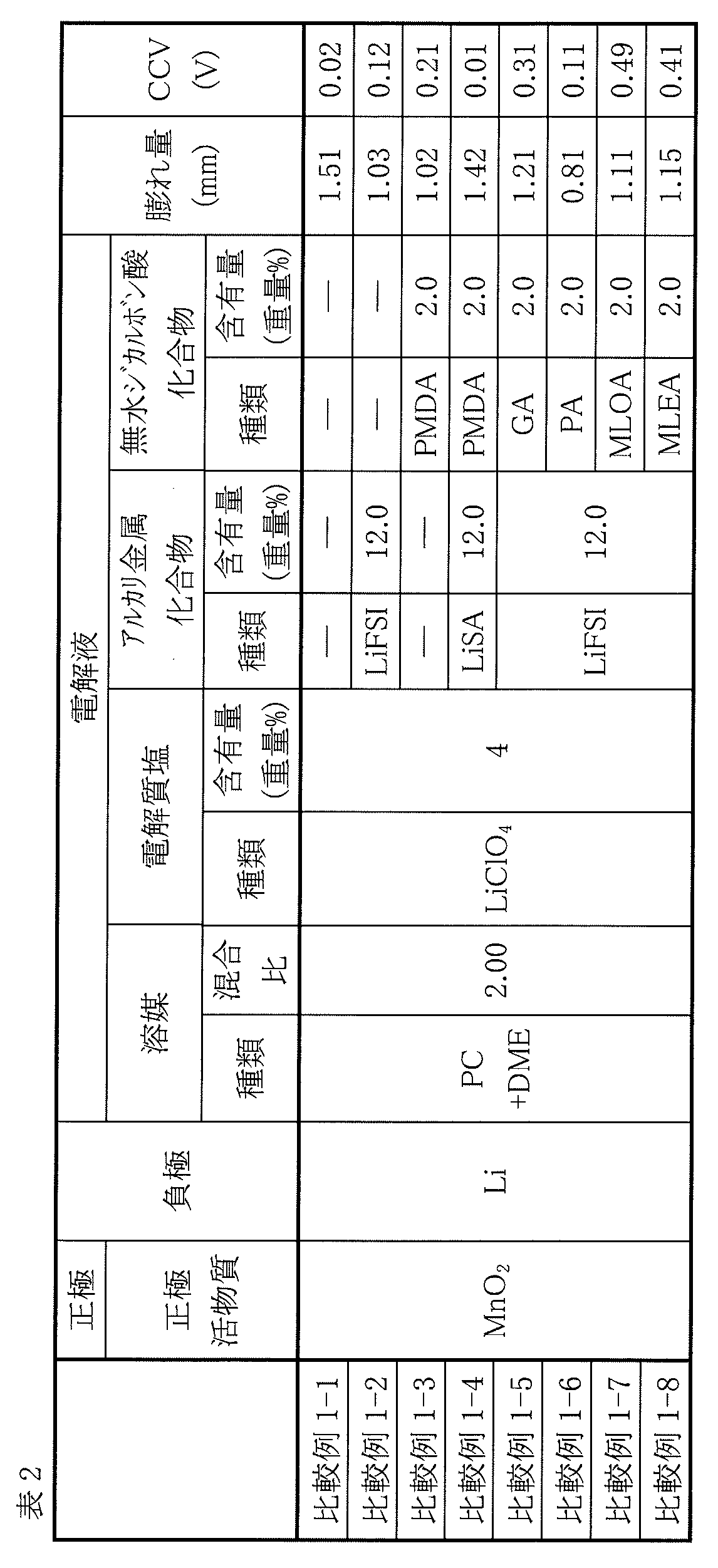
[考察]
表1および表2に示したように、正極30が二酸化マンガンを含んでいると共に負極40がリチウム系材料を含んでいる一次電池の膨れ量は、電解液の組成に応じて大きく変動した。以下では、電解液がアルカリ金属化合物も無水ジカルボン酸化合物も含んでいない場合(比較例1-1)の膨れ量を比較基準とする。
表1および表2に示したように、正極30が二酸化マンガンを含んでいると共に負極40がリチウム系材料を含んでいる一次電池の膨れ量は、電解液の組成に応じて大きく変動した。以下では、電解液がアルカリ金属化合物も無水ジカルボン酸化合物も含んでいない場合(比較例1-1)の膨れ量を比較基準とする。
具体的には、電解液がアルカリ金属化合物および無水ジカルボン酸化合物のうちのいずれか一方だけを含んでいる場合(比較例1-2,1-3)には、膨れ量が僅かに減少した。また、電解液が他のアルカリ金属化合物を含んでいる場合(比較例1-4)には、膨れ量がごく僅かに減少したと共に、電解液が他の無水ジカルボン酸化合物を含んでいる場合(比較例1-5~1-8)には、膨れ量が僅かに減少した。
これに対して、電解液がアルカリ金属化合物および無水ジカルボン酸化合物の双方を含んでいる場合(実施例1-1~1-12)には、膨れ量が著しく減少した。この場合には、特に、以下で説明する一連の傾向が得られた。
第1に、アルカリ金属化合物の種類および無水ジカルボン酸化合物の種類のそれぞれを変更しても、膨れ量が減少した。
第2に、電解液がアルカリ金属化合物および無水ジカルボン酸化合物の双方を含んでいると、膨れ量が著しく減少しただけでなく、CCVも著しく増加した。この場合には、電解液中におけるアルカリ金属化合物の含有量が1.0重量%~22.0重量%であると、膨れ量がより減少したと共に、CCVがより増加した。
第3に、電解液中における無水ジカルボン酸化合物の含有量が0.1重量%~5.0重量%であると、高いCCVが維持されながら、膨れ量がより減少した。
<実施例2-1~2-6>
表3に示したように、溶媒の種類を変更したと共に混合比を変更したことを除いて実施例1-3と同様の手順により、一次電池を作製したのち、その一次電池の電池特性を評価した。
表3に示したように、溶媒の種類を変更したと共に混合比を変更したことを除いて実施例1-3と同様の手順により、一次電池を作製したのち、その一次電池の電池特性を評価した。
溶媒としては、新たに、環状炭酸エステルである炭酸ブチレン(BC)と、ジアルコキシアルカンであるジエトキシエタン(DEE)を用いた。混合比を変更するためには、環状炭酸エステルとジアルコキシアルカンとの混合比(重量比)を変更した。

表3に示したように、溶媒の種類を変更すると共に混合比を変更しても(実施例1-3,2-1~2-6)、膨れ量が著しく減少した。この場合には、特に、混合比が0.10~7.00であると(実施例1-3,2-2,2-3)、膨れ量がより減少したと共に、CCVがより増加した。
<実施例3-1~3-5>
表4に示したように、電解質塩の含有量を変更したことを除いて実施例1-3と同様の手順により、一次電池を作製したのち、その一次電池の電池特性を評価した。
表4に示したように、電解質塩の含有量を変更したことを除いて実施例1-3と同様の手順により、一次電池を作製したのち、その一次電池の電池特性を評価した。

表4に示したように、電解質塩(過塩素酸リチウム)の含有量を変更しても(実施例1-3,3-1~3-5)、膨れ量が著しく減少した。この場合には、特に、電解質塩の含有量が1重量%~12重量%であると(実施例1-3,3-2~3-4)、膨れ量が著しく減少しながらOCVがより増加した。
<実施例4-1,4-2>
表5に示したように、粉末層70を形成したことを除いて実施例1-3と同様の手順により、一次電池を作製したのち、その一次電池の電池特性を評価した。
表5に示したように、粉末層70を形成したことを除いて実施例1-3と同様の手順により、一次電池を作製したのち、その一次電池の電池特性を評価した。
粉末層70の形成材料(導電性材料)としては、リチウム合金であるリチウムアルミニウム合金(LiAl,式(3)に示したm/n=0.08)と、炭素材料である黒鉛(C)を用いた。リチウムアルミニウム合金を用いて粉末層70を形成する場合には、正極30に対向する側における負極40の表面にアルミニウム箔をプレス成形しながら貼り付けた。炭素材料を用いて粉末層70を形成する場合には、正極30に対向する側における負極40の表面に黒鉛粉末を加圧圧着した。
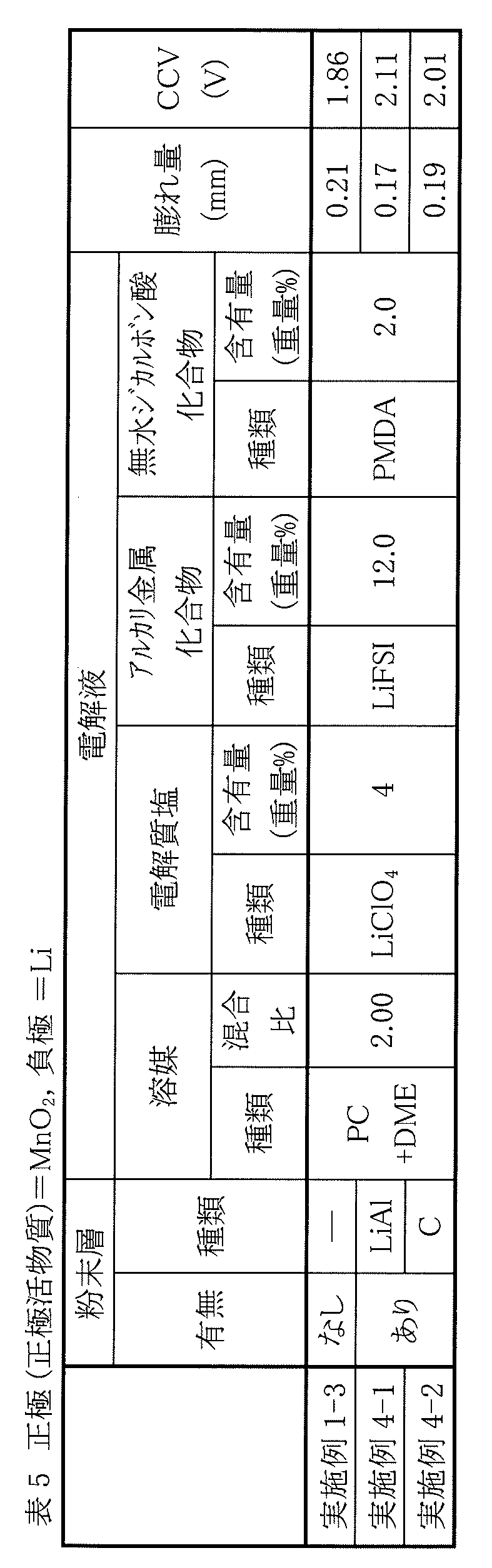
表5に示したように、粉末層70を形成しても(実施例4-1,4-2)、膨れ量が著しく減少した。この場合には、特に、粉末層70を用いると(実施例4-1,4-2)、その粉末層70を用いない場合(実施例1-3)と比較して、膨れ量がより減少したと共に、CCVがより増加した。
<実施例5-1~5-13>
表6に示したように、粉末層70の形成材料として用いたリチウムアルミニウム合金の組成を変更したことを除いて実施例1-3と同様の手順により、一次電池を作製したのち、その一次電池の電池特性を評価した。
表6に示したように、粉末層70の形成材料として用いたリチウムアルミニウム合金の組成を変更したことを除いて実施例1-3と同様の手順により、一次電池を作製したのち、その一次電池の電池特性を評価した。
リチウムアルミニウム合金の組成、すなわち式(3)に示したm/nの値は、表6に示した通りである。
ここでは、6種類のリチウムアルミニウム合金を用いた。具体的には、m/n=0.05であるLi5 Al95と、m/n=0.11であるLi10Al90と、m/n=1.00であるLiAlと、m/n=1.50であるLi3 Al2 と、m/n=2.25であるLi9 Al4 と、m/n=3.00であるLi3 Alとを用いた。LiAlを含む粉末層70の形成方法は、上記した通りである。
Li5 Al95、Li10Al90、Li3 Al2 およびLi9 Al4 とのそれぞれを含む粉末層70の形成方法は、以下で説明する通りである。最初に、アルミニウム粉(ミナルコ株式会社製のアトマイズアルミ粉 #205)を加圧圧粉することにより、ペレット(外径=15mm,厚さ=0.5mm)を得た。続いて、正極(ペレット)と、負極(リチウム金属板)と、電解液(溶媒は炭酸プロピレンおよび電解質塩は6質量%の過塩素酸リチウム)とを備えたコイン型の電池を作製したのち、高温環境中(温度=150℃)において電池を定電流放電(電流密度=160μA/cm2 )させることにより、合金ペレット(リチウムアルミニウム合金)を得た。
この場合には、下記の論文に記載されている電位と容量との関係にしたがって、電池の容量が特定の容量に到達した時点において放電を終了させることにより、合金ペレットの組成を調整した。
なお、下記の論文に記載されている合金の形成方法は、厳密には、サイクリックボルタンメトリーを用いて合金化を進行させている点において、ここで説明してる合金ペレットの形成方法とは異なっている。しかしながら、電位と容量との関係において安定に形成される合金の化学組成は一定であるため、ここでは、定電流放電を用いても同様の合金が形成可能であることを利用することにより、上記したように、合金ペレットを形成している。
続いて、粉砕機を用いて合金ペレットを粉砕することにより、粉砕物を得た。最後に、正極30に対向する側における負極40の表面に粉砕物をプレス成形しながら貼り付けた。
Journal of The Electrochemical Society,166(16),A4034-A4040(2019)
Electrochemical Formation of Four Al-Li Phases (β-AlLi,Al2Li3,AlLi2-x,Al4Li9) at Intermediate Temperatures
Mohammadreza Zamanzad Ghavidel,Martin R. Kupsta,Jon Le,Eliana Feygin ,Andres Espitia,Michael D. Fleischauer
Electrochemical Formation of Four Al-Li Phases (β-AlLi,Al2Li3,AlLi2-x,Al4Li9) at Intermediate Temperatures
Mohammadreza Zamanzad Ghavidel,Martin R. Kupsta,Jon Le,Eliana Feygin ,Andres Espitia,Michael D. Fleischauer
Li3 Alを含む粉末層70の形成方法は、以下で説明する通りである。最初に、リチウム金属塊およびアルミニウム塊を準備した。この場合には、リチウムアルミニウム合金の組成に応じて、リチウム金属塊とアルミニウム塊との重量比を調整した。続いて、リチウム塊およびアルミニウム塊を加熱(加熱温度=700℃)することにより、そのリチウム塊とアルミニウム塊との溶融混合物を得たのち、その溶融混合物を冷却することにより、合金塊を得た。続いて、粉砕機を用いて合金塊を粉砕することにより、粉砕物を得た。最後に、正極30に対向する側における負極40の表面に粉砕物をプレス成形しながら貼り付けた。
比W1/W2および比W3/W4のそれぞれの値は、表6に示した通りである。ここでは、負極40および粉末層70のそれぞれの重量を変化させることにより、比W1/W2の値が所望の値となるように調整した。また、OCV=3.2Vである一次電池を用いて、正極30の重量を変化させることにより、比W3/W4の値が所望の値となるように調整した。
なお、一次電池の電池特性としては、上記した膨れ特性および電気抵抗特性だけでなく、新たに放電特性も評価した。ただし、膨れ特性および電気低抵抗特性のそれぞれを評価する場合には、一次電池の保存条件を温度=120℃および保存期間=1000時間に変更した。放電特性を評価する場合には、常温環境中(温度=23℃)において、電気抵抗=15kΩとして電圧が0Vに到達するまで一次電池を放電させることにより、放電特性を評価するための指標である放電容量(mAh)を測定した。

表6に示したように、粉末層70(リチウムアルミニウム合金)を用いた場合(実施例4-1,5-1~5-13)には、その粉末層70を用いなかった場合(実施例1-3)と比較して、そのリチウムアルミニウム合金の組成を変更しても、膨れ量が同等以下に抑えられながら、同等以上の高いCCVが得られた。
粉末層70(リチウムアルミニウム合金)を用いた場合には、特に、以下で説明する一連の傾向が得られた。
第1に、リチウムアルミニウム合金の組成を決定するm/nが1.00~2.25であると、膨れ量が抑えられながら、より高いCCVが得られた。
第2に、比W1/W2が0.08~0.50であると、膨れ量が抑えられると共に高いCCVが得られながら、より高い放電容量が得られた。
第3に、比W3/W4が0.18~0.33であると、膨れ量が抑えられると共に高いCCVが得られながら、より高い放電容量が得られた。
[まとめ]
表1~表6に示した結果から、正極30が二酸化マンガンを含んでおり、負極40がリチウム系材料を含んでおり、電解液がアルカリ金属化合物および無水ジカルボン酸化合物を含んでいると、膨れ量が減少した。よって、一次電池において優れた膨れ特性が得られた。
表1~表6に示した結果から、正極30が二酸化マンガンを含んでおり、負極40がリチウム系材料を含んでおり、電解液がアルカリ金属化合物および無水ジカルボン酸化合物を含んでいると、膨れ量が減少した。よって、一次電池において優れた膨れ特性が得られた。
以上、一実施形態および実施例を挙げながら本技術に関して説明したが、その本技術の構成は、一実施形態および実施例において説明された構成に限定されないため、種々に変形可能である。
具体的には、一次電池の電池構造がコイン型である場合に関して説明した。しかしながら、一次電池の電池構造は、特に限定されないため、ボタン型、円筒型および角型などでもよい。
本明細書中に記載された効果は、あくまで例示であるため、本技術の効果は、本明細書中に記載された効果に限定されない。よって、本技術に関して、他の効果が得られてもよい。
Claims (13)
- 二酸化マンガンを含む正極と、
リチウム系材料を含む負極と、
式(1)で表されるアルカリ金属化合物および式(2)で表される無水ジカルボン酸化合物を含む電解液と
を備えた、一次電池。
MeN(Cx F2x+1SO2 )(Cy F2y+1SO2 ) ・・・(1)
(Meは、アルカリ金属元素である。xおよびyのそれぞれは、0以上の整数である。)
W(-C(=O)-O-C(=O)-)z ・・・(2)
(Wは、2z個の水素が脱離したベンゼン系芳香族環である。zは、2以上の整数である。) - 前記アルカリ金属元素は、リチウムである、
請求項1記載の一次電池。 - 前記アルカリ金属化合物は、ビス(フルオロスルホニル)イミドリチウム、ビス(トリフルオロメタンスルホニル)イミドリチウムおよびビス(ペンタフルオロエタンスルホニル)イミドリチウムのうちの少なくとも1種を含む、
請求項2記載の一次電池。 - 前記無水ジカルボン酸化合物は、ピロメリット酸無水物およびメリト酸無水物のうちの少なくとも一方を含む、
請求項1ないし請求項3のいずれか1項に記載の一次電池。 - 前記電解液中における前記アルカリ金属化合物の含有量は、1.0重量%以上22.0重量%以下である、
請求項1ないし請求項4のいずれか1項に記載の一次電池。 - 前記電解液中における前記無水ジカルボン酸化合物の含有量は、0.1重量%以上5.0重量%以下である、
請求項1ないし請求項5のいずれか1項に記載の一次電池。 - 前記電解液は、環状炭酸エステルおよびジアルコキシアルカンを含み、
前記環状炭酸エステルは、炭酸プロピレンおよび炭酸ブチレンのうちの少なくとも一方を含み、
前記ジアルコキシアルカンは、1,2-ジメトキシエタンおよび1,2-ジエトキシエタンのうちの少なくとも一方を含み、
前記電解液中における前記環状炭酸エステルの含有量に対する、前記電解液中における前記ジアルコキシアルカンの含有量の比は、0.10以上7.00以下である、
請求項1ないし請求項6のいずれか1項に記載の一次電池。 - 前記電解液は、電解質塩を含み、
前記電解質塩は、過塩素酸リチウムを含み、
前記電解液中における前記電解質塩の含有量は、1重量%以上12重量%以下である、
請求項1ないし請求項7のいずれか1項に記載の一次電池。 - さらに、
前記正極と前記負極との間に配置されたセパレータと、
前記負極と前記セパレータの間に配置され、リチウム合金および炭素材料のうちの少なくとも一方を含む粉末層と
を備えた、請求項1ないし請求項8のいずれか1項に記載の一次電池。 - 前記粉末層は、前記リチウム合金を含み、
前記リチウム合金は、リチウムアルミニウム合金を含む、
請求項9記載の一次電池。 - 前記リチウムアルミニウム合金は、式(3)で表される組成を有する、
請求項10記載の一次電池。
Lim Aln ・・・(3)
(mおよびnは、m>0、n>0および1.00≦m/n≦2.25を満たす。) - 前記負極の重量と前記粉末層の重量との和に対する、前記粉末層中に含まれているアルミニウムの重量の比は、0.08以上0.50以下である、
請求項10または請求項11に記載の一次電池。 - 前記正極の重量に対する前記電解液の重量の比は、0.18以上0.33以下である、
請求項1ないし請求項12のいずれか1項に記載の一次電池。
Priority Applications (1)
| Application Number | Priority Date | Filing Date | Title |
|---|---|---|---|
| US18/209,781 US20230327140A1 (en) | 2020-12-25 | 2023-06-14 | Primary battery |
Applications Claiming Priority (4)
| Application Number | Priority Date | Filing Date | Title |
|---|---|---|---|
| JP2020217291 | 2020-12-25 | ||
| JP2020-217291 | 2020-12-25 | ||
| JP2021-104242 | 2021-06-23 | ||
| JP2021104242 | 2021-06-23 |
Related Child Applications (1)
| Application Number | Title | Priority Date | Filing Date |
|---|---|---|---|
| US18/209,781 Continuation US20230327140A1 (en) | 2020-12-25 | 2023-06-14 | Primary battery |
Publications (1)
| Publication Number | Publication Date |
|---|---|
| WO2022137667A1 true WO2022137667A1 (ja) | 2022-06-30 |
Family
ID=82157491
Family Applications (1)
| Application Number | Title | Priority Date | Filing Date |
|---|---|---|---|
| PCT/JP2021/033477 Ceased WO2022137667A1 (ja) | 2020-12-25 | 2021-09-13 | 一次電池 |
Country Status (2)
| Country | Link |
|---|---|
| US (1) | US20230327140A1 (ja) |
| WO (1) | WO2022137667A1 (ja) |
Citations (4)
| Publication number | Priority date | Publication date | Assignee | Title |
|---|---|---|---|---|
| JP2004047413A (ja) * | 2001-12-11 | 2004-02-12 | Hitachi Maxell Ltd | 非水電解液およびそれを用いた非水電解液電池 |
| JP2017531285A (ja) * | 2014-08-14 | 2017-10-19 | ソルヴェイ(ソシエテ アノニム) | スルトン及びフッ素化溶媒を含む非水電解質組成物 |
| WO2019059365A1 (ja) * | 2017-09-22 | 2019-03-28 | 三菱ケミカル株式会社 | 非水系電解液、非水系電解液二次電池、及びエネルギーデバイス |
| WO2019150896A1 (ja) * | 2018-01-30 | 2019-08-08 | ダイキン工業株式会社 | 電解液、電気化学デバイス、リチウムイオン二次電池及びモジュール |
-
2021
- 2021-09-13 WO PCT/JP2021/033477 patent/WO2022137667A1/ja not_active Ceased
-
2023
- 2023-06-14 US US18/209,781 patent/US20230327140A1/en active Pending
Patent Citations (4)
| Publication number | Priority date | Publication date | Assignee | Title |
|---|---|---|---|---|
| JP2004047413A (ja) * | 2001-12-11 | 2004-02-12 | Hitachi Maxell Ltd | 非水電解液およびそれを用いた非水電解液電池 |
| JP2017531285A (ja) * | 2014-08-14 | 2017-10-19 | ソルヴェイ(ソシエテ アノニム) | スルトン及びフッ素化溶媒を含む非水電解質組成物 |
| WO2019059365A1 (ja) * | 2017-09-22 | 2019-03-28 | 三菱ケミカル株式会社 | 非水系電解液、非水系電解液二次電池、及びエネルギーデバイス |
| WO2019150896A1 (ja) * | 2018-01-30 | 2019-08-08 | ダイキン工業株式会社 | 電解液、電気化学デバイス、リチウムイオン二次電池及びモジュール |
Also Published As
| Publication number | Publication date |
|---|---|
| US20230327140A1 (en) | 2023-10-12 |
Similar Documents
| Publication | Publication Date | Title |
|---|---|---|
| US8637192B2 (en) | Nonaqueous electrolytic solution containing magnesium ions, and electrochemical device using the same | |
| JP5034799B2 (ja) | マグネシウムイオン含有非水電解液及びその製造方法、並びに電気化学デバイス | |
| US5051325A (en) | Secondary battery | |
| US9525197B2 (en) | Stable non-aqueous electrolyte promoting ideal reaction process in rechargeable lithium-air batteries | |
| US20090081545A1 (en) | HIGH CAPACITY AND HIGH RATE LITHIUM CELLS WITH CFx-MnO2 HYBRID CATHODE | |
| JP2787153B2 (ja) | 二次電池及びその製造方法 | |
| CN101154725B (zh) | 非水可再充电电池用负极活性材料及其非水可再充电电池 | |
| JP4380265B2 (ja) | 水系リチウム二次電池 | |
| JP4579588B2 (ja) | リチウムイオン二次電池 | |
| JP6500001B2 (ja) | リチウム二次電池用正極活物質、リチウム二次電池用正極及びリチウム二次電池 | |
| JP2008270175A (ja) | 非水電解質二次電池用正極および非水電解質二次電池 | |
| WO2019142060A1 (en) | Rechargeable metal halide battery | |
| JP5958256B2 (ja) | 非水電解質二次電池 | |
| JP4877898B2 (ja) | 非水電解質二次電池 | |
| EP3698420B1 (en) | Additives and methods to add additives in a rechargeable non-aqueous lithium-air battery | |
| JP3287376B2 (ja) | リチウム二次電池とその製造方法 | |
| KR100379979B1 (ko) | 무수 전해질 2차 전지 | |
| KR101309240B1 (ko) | 신규한 이온성 액체를 포함하는 리튬 공기 전지용 겔 고분자 전해질 및 리튬 공기 전지 | |
| JP4880930B2 (ja) | 非水電解液及びリチウム二次電池 | |
| JPH0837025A (ja) | 非水電解液 | |
| JP3523145B2 (ja) | 鉄複合酸化物電池 | |
| US20230327140A1 (en) | Primary battery | |
| JP6743799B2 (ja) | 電解質、蓄電デバイス及び蓄電デバイスの製造方法 | |
| JP2002015768A (ja) | 非水電解質二次電池の製造方法 | |
| JP3451602B2 (ja) | 非水電解質電池 |
Legal Events
| Date | Code | Title | Description |
|---|---|---|---|
| 121 | Ep: the epo has been informed by wipo that ep was designated in this application |
Ref document number: 21909825 Country of ref document: EP Kind code of ref document: A1 |
|
| NENP | Non-entry into the national phase |
Ref country code: DE |
|
| 122 | Ep: pct application non-entry in european phase |
Ref document number: 21909825 Country of ref document: EP Kind code of ref document: A1 |
|
| NENP | Non-entry into the national phase |
Ref country code: JP |