WO2022124183A1 - 含フッ素重合体 - Google Patents
含フッ素重合体 Download PDFInfo
- Publication number
- WO2022124183A1 WO2022124183A1 PCT/JP2021/044212 JP2021044212W WO2022124183A1 WO 2022124183 A1 WO2022124183 A1 WO 2022124183A1 JP 2021044212 W JP2021044212 W JP 2021044212W WO 2022124183 A1 WO2022124183 A1 WO 2022124183A1
- Authority
- WO
- WIPO (PCT)
- Prior art keywords
- fluorine
- formula
- group
- containing polymer
- film
- Prior art date
- Legal status (The legal status is an assumption and is not a legal conclusion. Google has not performed a legal analysis and makes no representation as to the accuracy of the status listed.)
- Ceased
Links
Classifications
-
- C—CHEMISTRY; METALLURGY
- C08—ORGANIC MACROMOLECULAR COMPOUNDS; THEIR PREPARATION OR CHEMICAL WORKING-UP; COMPOSITIONS BASED THEREON
- C08F—MACROMOLECULAR COMPOUNDS OBTAINED BY REACTIONS ONLY INVOLVING CARBON-TO-CARBON UNSATURATED BONDS
- C08F220/00—Copolymers of compounds having one or more unsaturated aliphatic radicals, each having only one carbon-to-carbon double bond, and only one being terminated by only one carboxyl radical or a salt, anhydride ester, amide, imide or nitrile thereof
- C08F220/02—Monocarboxylic acids having less than ten carbon atoms; Derivatives thereof
- C08F220/10—Esters
- C08F220/22—Esters containing halogen
- C08F220/24—Esters containing halogen containing perhaloalkyl radicals
-
- G—PHYSICS
- G03—PHOTOGRAPHY; CINEMATOGRAPHY; ANALOGOUS TECHNIQUES USING WAVES OTHER THAN OPTICAL WAVES; ELECTROGRAPHY; HOLOGRAPHY
- G03F—PHOTOMECHANICAL PRODUCTION OF TEXTURED OR PATTERNED SURFACES, e.g. FOR PRINTING, FOR PROCESSING OF SEMICONDUCTOR DEVICES; MATERIALS THEREFOR; ORIGINALS THEREFOR; APPARATUS SPECIALLY ADAPTED THEREFOR
- G03F7/00—Photomechanical, e.g. photolithographic, production of textured or patterned surfaces, e.g. printing surfaces; Materials therefor, e.g. comprising photoresists; Apparatus specially adapted therefor
- G03F7/004—Photosensitive materials
-
- C—CHEMISTRY; METALLURGY
- C08—ORGANIC MACROMOLECULAR COMPOUNDS; THEIR PREPARATION OR CHEMICAL WORKING-UP; COMPOSITIONS BASED THEREON
- C08F—MACROMOLECULAR COMPOUNDS OBTAINED BY REACTIONS ONLY INVOLVING CARBON-TO-CARBON UNSATURATED BONDS
- C08F222/00—Copolymers of compounds having one or more unsaturated aliphatic radicals, each having only one carbon-to-carbon double bond, and at least one being terminated by a carboxyl radical and containing at least one other carboxyl radical in the molecule; Salts, anhydrides, esters, amides, imides, or nitriles thereof
- C08F222/10—Esters
- C08F222/1006—Esters of polyhydric alcohols or polyhydric phenols
- C08F222/102—Esters of polyhydric alcohols or polyhydric phenols of dialcohols, e.g. ethylene glycol di(meth)acrylate or 1,4-butanediol dimethacrylate
Definitions
- the present disclosure relates to fluorine-containing polymers.
- the fluorine-containing polymer has water repellency, oil repellency, low water absorption, heat resistance, weather resistance, corrosion resistance, transparency, photosensitive, low refractive index, low dielectric property, etc. Due to its characteristics, it is being used or developed in a wide range of application fields, mainly in the field of advanced materials. In particular, when it comes to coating applications, antireflection films that apply low refractive index and transparency of visible light, optical devices that apply transparency in the high wavelength band (optical communication wavelength band), and ultraviolet regions (especially vacuum ultraviolet). Active research and development is being carried out in fields such as resist materials that apply transparency in the wavelength range. As a polymer design common to these application fields, by introducing as much fluorine as possible, transparency is realized at each wavelength used, adhesion to the substrate, and high glass transition point (hardness) are realized. It is something that you try to make.
- Patent Document 1 describes a polymerizable monomer represented by the following formula (6).
- R 1p is a hydrogen atom, a halogen atom, a hydrocarbon group, and a fluorine-containing alkyl group (the fluorine-containing alkyl group is a linear or branched chain and may contain a cyclic structure).
- R 2p is a divalent to trivalent organic group, wherein the organic group is an aliphatic hydrocarbon group (the aliphatic hydrocarbon group is a linear or branched chain. , Aromatic ring groups, or groups selected from their composite substituents, wherein some or all of the hydrogen atoms may be substituted with fluorine atoms or hydroxyl groups.
- 3p is a hydrogen atom, a hydrocarbon group, a fluorine-containing alkyl group (the fluorine-containing alkyl group is a linear or branched chain and may contain a cyclic structure), or an aromatic ring group, and the hydrocarbon group is used.
- M is an integer of 1 to 2. Represents. When m is 2, the two R3p can be the same or different from each other.)
- the polymerizable monomer represented by the formula (6) has a (CF 3 ) 2 (OR 3p ) C-site derived from hexafluoroacetone, has a high fluorine content, and is well-balanced in the same molecule. It is a monomeric compound that has succeeded in having a polar group.
- the polymerizable monomer is also excellent in polymerizable property, and the fluorine-containing polymer obtained by polymerizing the polymerizable monomer has the transparency brought about by the fluorine atom, the adhesion brought about by the polar group, and the processability. It is known that it has excellent physical properties as an antireflection film material, an optical device material, a resist material, and the like.
- the fluoropolymer When a fluoropolymer produced by using the polymerizable monomer represented by the formula (6) is used as a resist material, the fluoropolymer is dissolved in a solvent and contains the fluoropolymer. It is used as a film-forming solution. When the film-forming solution is applied onto a substrate or a thin film such as a resist film and baked to form a film, and then the film is immersed in a developing solution, a residue may be generated on the substrate. rice field.
- An object of the present disclosure is to provide a fluorine-containing polymer used in a film-forming solution capable of forming a film in which a residue is unlikely to be formed when immersed in a developing solution.
- the fluorine-containing polymer of the present disclosure is a fluorine-containing polymer containing a repeating unit represented by the following formula (1) and a repeating unit represented by the following formula (2), and is represented by the above formula (1). It is represented by a mass percentage based on the represented repeating unit, and is characterized in that the content of the repeating unit represented by the above formula (2) is 1500 ppm or less.
- R 1 and R 2 are independently hydrogen atom, methyl group, ethyl group, n-propyl group, iso-propyl group, n-butyl group and iso-butyl group, respectively.
- Sc-butyl group or t-butyl group, R 3 and R 4 are independent hydrogen atoms, methyl or ethyl groups, R 5 is a hydrogen atom or trifluoromethyl group, and R 6 is hydrogen. Atomic, chlorine atom, methyl group or trifluoromethyl group.
- R5 is a trifluoromethyl group.
- R 3 and R 4 are hydrogen atoms.
- R 1 is a methyl group or an iso-propyl group and R 2 is a hydrogen atom.
- the fluorine-containing polymer of the present disclosure preferably contains a repeating unit represented by the above formula (1) and other repeating units other than the repeating unit represented by the above formula (2).
- the fluorine-containing polymer of the present disclosure is preferably used as a film-forming solution.
- the present disclosure can provide a fluorine-containing polymer used in a film-forming solution capable of forming a film in which a residue is unlikely to be generated when immersed in a developing solution.
- the fluorine-containing polymer of the present disclosure is a fluorine-containing polymer containing a repeating unit represented by the following formula (1) and a repeating unit represented by the following formula (2), and is represented by the above formula (1). It is represented by a mass percentage based on the represented repeating unit, and is characterized in that the content of the repeating unit represented by the above formula (2) is 1500 ppm or less.
- R 1 and R 2 are independently hydrogen atom, methyl group, ethyl group, n-propyl group, iso-propyl group, n-butyl group and iso-butyl group, respectively.
- Sc-butyl group or t-butyl group, R 3 and R 4 are independent hydrogen atoms, methyl or ethyl groups, R 5 is a hydrogen atom or trifluoromethyl group, and R 6 is hydrogen. Atomic, chlorine atom, methyl group or trifluoromethyl group.
- the fluorine-containing polymer of the present disclosure can be used as a resist film, a resist film and / or an upper layer film that protects a resist pattern (hereinafter, also simply referred to as "upper layer film").
- the fluorine-containing polymer is dissolved in a solvent to obtain a film-forming solution containing the fluorine-containing polymer.
- the repeating unit represented by the formula (2) is a repeating unit derived from a fluorine-containing monomer synthesized as an unavoidable by-reactant when producing the fluorine-containing polymer of the present disclosure.
- a fluorine-containing polymer containing a repeating unit represented by the formula (1) and a repeating unit represented by the formula (2) when the proportion of the repeating unit represented by the formula (2) is large, the fluorine-containing weight thereof.
- the ratio of the repeating unit represented by the formula (2) is sufficiently small. Therefore, when a film is formed by using the film-forming solution containing the fluorine-containing polymer of the present disclosure, when the film is immersed in a developing solution, the film is rapidly dissolved and a residue is less likely to be generated.
- the content of the repeating unit represented by the formula (2) is 1500 ppm or less, expressed in parts per million based on the repeating unit represented by the formula (1).
- the content of the repeating unit represented by the formula (2) is preferably 450 ppm or less, and more preferably 200 ppm or less.
- the content of the repeating unit represented by the formula (2) is preferably 10 ppm or more.
- the method for producing a fluorinated polymer of the present disclosure includes a fluorinated monomer synthesis step, a fluorinated monomer purification step, and a polymerization step. Each process will be described below.
- ⁇ Fluorine-containing monomer synthesis step a group consisting of an unsaturated carboxylic acid, an ester of an unsaturated carboxylic acid, an acid halide of the unsaturated carboxylic acid, and an anhydride of the unsaturated carboxylic acid in the diol represented by the following formula (3). At least one selected from the above (hereinafter, also referred to as "unsaturated carboxylic acid and the like") is reacted.
- R 1 and R 2 are independently hydrogen atom, methyl group, ethyl group, n-propyl group, iso-propyl group and n-butyl group, respectively.
- Iso-butyl group, sec-butyl group or t-butyl group, R 3 and R 4 are independently hydrogen atom, methyl group or ethyl group, and R 5 is hydrogen atom or trifluoromethyl group.
- R 6 is a hydrogen atom, a chlorine atom, a methyl group or a trifluoromethyl group.
- the diol represented by the formula (3) has the same molecule of two alcohol moieties, a fluorine-containing alcohol moiety containing a fluorine atom and an alkyl alcohol moiety not having a fluorine atom.
- the fluorine-containing alcohol moiety is electron-withdrawing and has a bulky trifluoromethyl group. It is presumed that the fluorine-containing alcohol moiety is electron-withdrawing and its steric effect suppresses the nucleophilicity of the unshared electron pair at the alcohol moiety, and addition reactions such as unsaturated carboxylic acids are unlikely to occur. ) Is synthesized as the main reaction product.
- the fluorine-containing alcohol moiety remains in the fluorine-containing monomer represented by the formula (4).
- a slight addition reaction such as unsaturated carboxylic acid occurs. Therefore, when synthesizing the fluorine-containing monomer represented by the formula (4), the fluorine-containing monomer represented by the formula (5) is synthesized as an unavoidable side reaction product.
- the composition obtained in the fluorine-containing monomer synthesis step is represented by the fluorine-containing monomer represented by the formula (4), which is the main reaction product, and the formula (5), which is the side reaction product. Fluorine-containing monomer is included.
- an unsaturated carboxylic acid or the like is further added to the addition site of the unsaturated carboxylic acid or the like of the fluorine-containing monomer represented by the formula (4), and the following formula (7) is added.
- the fluorine-containing monomer represented by may be synthesized.
- the composition obtained in the fluorine-containing monomer synthesis step may contain a fluorine-containing monomer represented by the formula (7).
- R 1 and R 2 are independently hydrogen atom, methyl group, ethyl group, n-propyl group, iso-propyl group, n-butyl group, iso-butyl group and sec-butyl group.
- R 3 and R 4 are independently hydrogen atom, methyl group or ethyl group
- R 5 is hydrogen atom or trifluoromethyl group
- R 6 is hydrogen atom, chlorine atom, respectively. Methyl group or trifluoromethyl group.
- the fluorine-containing polymer of the present disclosure may contain a repeating unit derived from the monomer represented by the formula (7).
- an addition reaction such as an unsaturated carboxylic acid is unlikely to occur in the fluorine-containing alcohol moiety containing a fluorine atom, so that it is not suitable only in the fluorine-containing alcohol moiety containing a fluorine atom. Almost no compound such as saturated carboxylic acid has undergone an addition reaction. Further, even if such a compound is generated, an addition reaction such as an unsaturated carboxylic acid rapidly occurs at the alkyl alcohol moiety that does not have a highly reactive fluorine atom, and the fluorine-containing compound represented by the formula (5) is contained. The monomer is synthesized.
- the compound in which the addition reaction such as unsaturated carboxylic acid occurs only in the fluorine-containing alcohol moiety containing a fluorine atom in the diol represented by the formula (3) is contained. Almost undetected.
- R 1 is preferably a methyl group or an iso-propyl group, and R 2 to R 4 are preferably hydrogen atoms. 5 is preferably a trifluoromethyl group.
- R 1 is a methyl group or an iso-propyl group
- R 2 to R 4 are hydrogen atoms
- R 5 is a trifluoromethyl group.
- At least one selected from the group consisting of unsaturated carboxylic acid, ester of unsaturated carboxylic acid, acid halide of unsaturated carboxylic acid and anhydride of unsaturated carboxylic acid used in the fluorine-containing monomer synthesis step is methacryl.
- examples thereof include agents, acrylicizing agents and other esterifying agents.
- Examples of the methacrylic acid agent used in the fluorine-containing monomer synthesis step include methyl methacrylate, ethyl methacrylate, n-propyl methacrylate, iso-propyl methacrylate, n-butyl methacrylate, iso-butyl methacrylate and sec methacrylate.
- -Methacrylic acid esters such as butyl and tert-butyl methacrylate, acid halides such as chloride, methacrylic acid fluoride and methacrylic acid bromide, methacrylic acid anhydrides, methacrylic acid and the like can be exemplified.
- Examples of the acrylate agent used in the fluorine-containing monomer synthesis step include methyl acrylate, ethyl acrylate, n-propyl acrylate, iso-propyl acrylate, n-butyl acrylate, iso-butyl acrylate, and sec acrylate.
- -Acrylic acid esters such as butyl and tert-butyl acrylic acid, acid halides such as acrylic acid chloride, acrylic acid fluoride and acrylic acid bromide, acrylic acid anhydrides, acrylic acid and the like can be exemplified.
- esterifying agent used in the fluorine-containing monomer synthesis step examples include carboxylic acid esters not contained in the methacrylizing agent and the acrylicizing agent, acid halides such as carboxylic acid chloride, carboxylic acid anhydrides, and carboxylic acids. can do.
- a methacrylic acid agent it is preferable to use a methacrylic acid agent, and more preferably to use a methacrylic anhydride and / or a methacrylic acid chloride.
- the diol represented by the formula (3) is composed of a group consisting of an unsaturated carboxylic acid, an ester of an unsaturated carboxylic acid, an acid halide of the unsaturated carboxylic acid, and an anhydride of the unsaturated carboxylic acid. Acids and bases may be added as needed when reacting at least one selected species.
- the diol represented by the formula (3) is composed of a group consisting of an unsaturated carboxylic acid, an ester of an unsaturated carboxylic acid, an acid halide of the unsaturated carboxylic acid, and an anhydride of the unsaturated carboxylic acid.
- the reaction conditions for reacting at least one selected species are preferably 30 to 130 ° C. for 0.5 to 8 hours.
- the amount of the fluorine-containing monomer represented by the formula (5) as a by-reactant varies depending on the type of unsaturated carboxylic acid and the like, the reaction temperature and the reaction time. If the amount of unsaturated carboxylic acid or the like used is too small, the amount of fluorine-containing monomer represented by the formula (5) can be reduced, but the unreacted diol represented by the formula (3) can be reduced. Since a large amount remains, it is necessary to separate the fluorine-containing monomer represented by the formula (4) and the diol represented by the formula (3).
- the amount of unsaturated carboxylic acid or the like used is too large, the amount of the fluorine-containing monomer represented by the formula (5) is increased.
- homopolymers such as unsaturated carboxylic acids may be produced. For this reason, it is selected from the group consisting of the diol represented by the formula (3) used, an unsaturated carboxylic acid, an ester of an unsaturated carboxylic acid, an acid halide of the unsaturated carboxylic acid, and an anhydride of the unsaturated carboxylic acid.
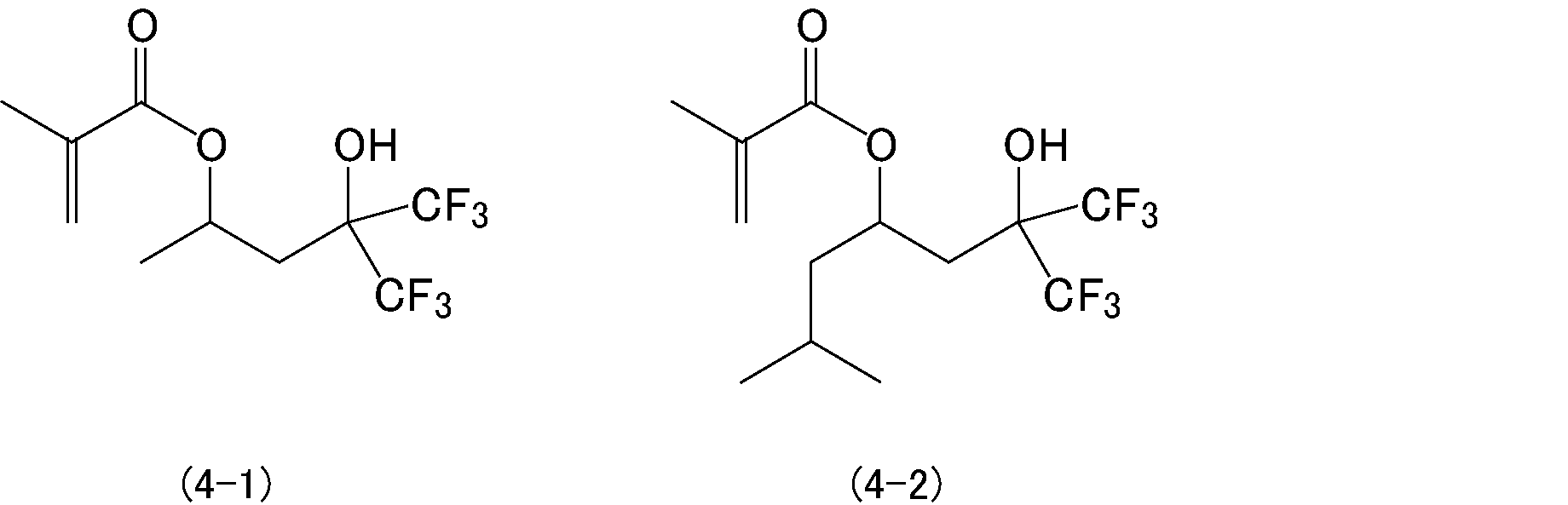
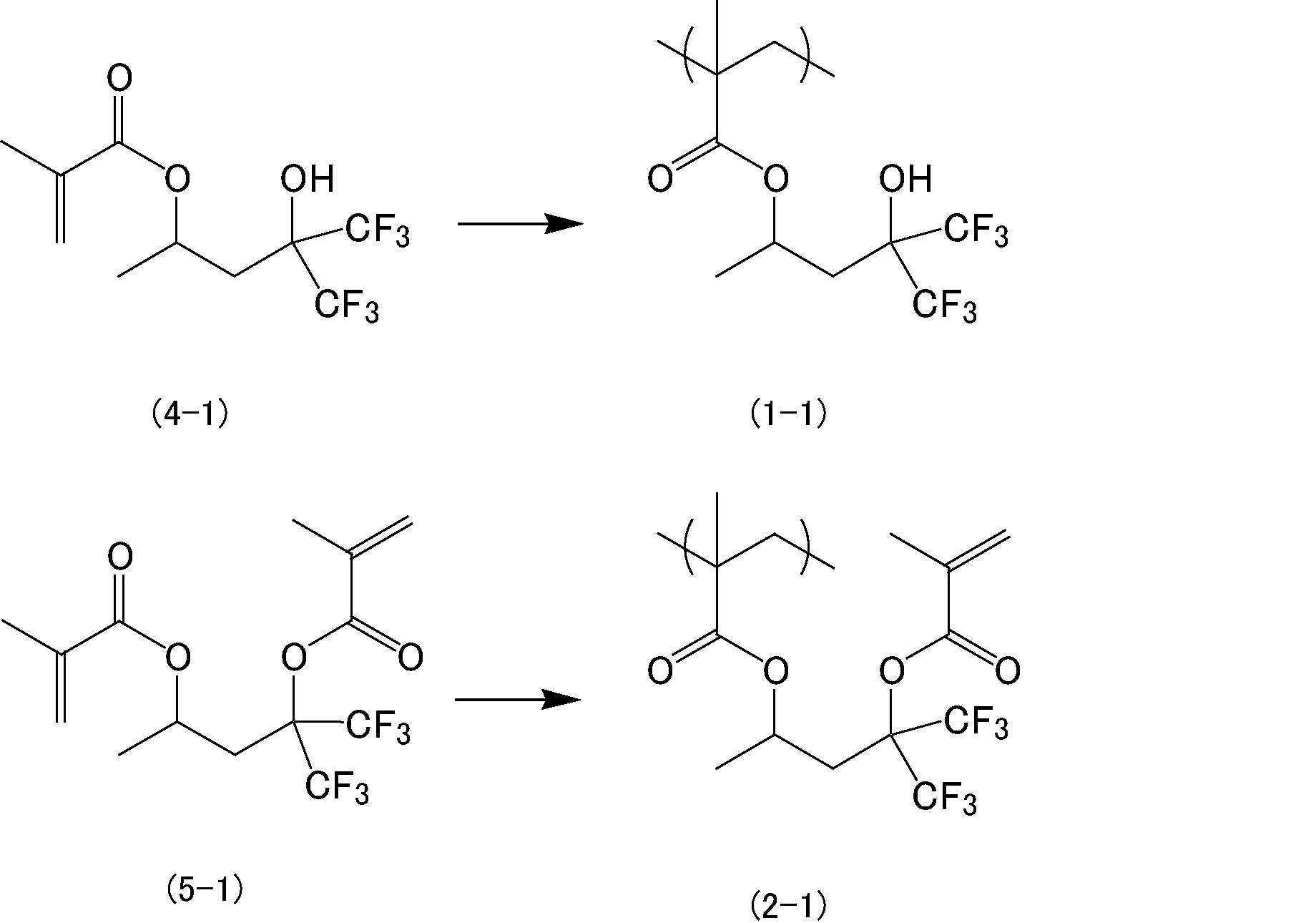
- a preferable compound as the fluorine-containing monomer represented by the formula (4) obtained in the fluorine-containing monomer synthesis step is methacrylic acid 5, which is a fluorine-containing monomer represented by the following formula (4-1).
- 5,5-Trifluoro-4-hydroxy-4-trifluoromethylpentane-2-yl and 1,1,1-trifluoromethacrylate which is a fluorine-containing monomer represented by the following formula (4-2) -2-hydroxy-2-trifluoromethylheptane-4-yl can be mentioned.
- the fluorine-containing monomer represented by the formula (5) is removed from the composition obtained by the fluorine-containing monomer synthesis step, and the fluorine-containing monomer represented by the formula (4) is removed.
- the content of the fluorine-containing monomer represented by the formula (5) is 1500 ppm or less, expressed as a mass percentage based on the monomer.
- the content of the fluorine-containing monomer represented by the formula (5) is preferably 450 ppm or less, more preferably 200 ppm or less.
- the content of the fluorine-containing monomer represented by the formula (5) is preferably 10 ppm or more.
- the fluorine-containing monomer of the present disclosure produced by performing this step it is represented by the formula (2) in terms of mass per million based on the repeating unit represented by the formula (1).
- the content of the repeating unit can be 1500 ppm or less.
- the method for removing the fluorine-containing monomer represented by the formula (5) from the composition is not particularly limited, but for example, a known method such as column chromatography, precision distillation or crystallization can be used. These methods may be combined in order to obtain a fluorine-containing monomer represented by the formula (4) having high purity. Hereinafter, each method will be described in detail.
- the fluorine-containing monomer represented by the formula (5) is removed from the composition by filling a general columnar tubular base material with a filler and flowing the composition in a mobile phase using an organic solvent.
- the filler is not particularly limited, and silica gel or alumina gel is preferable, and alumina gel is more preferable.
- As the filler one type may be used, or two or more types may be used.
- the mobile phase is not particularly limited, and general organic solvents such as hexane, heptane, toluene and ethyl acetate can be used. Further, one type of mobile phase may be used, or two or more types may be used.
- the temperature at which the column chromatograph is performed is preferably in the range of 0 ° C to 40 ° C, more preferably in the range of 20 ° C to 30 ° C.
- Increasing the amount (height) of the filler added requires a lot of time, but increasing the amount (height) of the filler added improves the degree of separation.
- the height of the filler is preferably 5 cm to 15 cm.
- the fluorine-containing monomer represented by the formula (4) may cause a polymerization reaction.
- a polymerization inhibitor may be added to the composition.
- oxygen may be introduced into the distillation column.
- the polymerization inhibitor is not particularly limited, but is o-cresol, m-cresol, p-cresol, 6-t-butyl-2,4-xylenol, 2,6-di-t-butyl-p-cresol, hydroquinone.
- polymerization inhibitors examples include N, N'-di-2-naphthyl-p-phenylenediamine (trade name, non-flex F) and N, N-diphenyl-p-phenylenediamine (trade name, non-flex F) manufactured by Seiko Kagaku Co., Ltd.
- non-flex H 4,4'-bis (a, a-dimethylbenzyl) diphenylamine (trade name, non-flex DCD), 2,2'-methylene-bis (4-methyl-6-tert-butylphenol) ) (Product name, non-flex MBP), N- (1-methylheptyl) -N'-phenyl-p-phenylenediamine (trade name, Ozonone 35), or ammonium N-nitrosophenyl manufactured by Wako Pure Chemical Industries, Ltd. Hydroxylamine (trade name, Q-1300) or N-nitrosophenylhydroxyamine aluminum salt (trade name, Q-1301) can be exemplified.
- the amount of the polymerization inhibitor used in the precision distillation is not particularly limited, but is 0.01 part by mass or more with respect to 100 parts by mass of the fluorine-containing monomer represented by the formula (4) based on before the precision distillation. It is preferably 5 parts by mass or less, and more preferably 0.01 parts by mass or more and 1 part by mass or less.
- the amount of the polymerization inhibitor is less than 0.01 parts by mass with respect to 100 parts by mass of the fluorine-containing monomer represented by the formula (4), the fluorine-containing monomer represented by the formula (4) is polymerized. It becomes difficult to prevent.
- the polymerization inhibitor exceeds 5 parts by mass with respect to 100 parts by mass of the fluorine-containing monomer represented by the formula (4), the effect of preventing the polymerization of the fluorine-containing monomer represented by the formula (4) is the upper limit. It becomes difficult to improve cost effectiveness.
- the content of the fluorine-containing monomer represented by the formula (4) in the composition can be measured by gas chromatography.
- the fluorine-containing monomer represented by the formula (5) can be removed from the composition by using crystallization.
- Crystallization is an operation in which a composition is dissolved in a good solvent, a poor solvent is added, or the temperature is lowered to precipitate a fluorine-containing monomer represented by the formula (4), and crystals are grown. be.
- the type of solvent used for crystallization is not particularly limited as long as the fluorine-containing monomer represented by the formula (4) is easily soluble or insoluble, but alcohols, nitriles, ketones and amides are not particularly limited. Classes, sulfoxides, ethers, hydrofluorocarbons, hydrofluoroethers, hydrocarbons, aromatic hydrocarbons or water.
- Examples of alcohols include methanol, ethanol, n-propanol, isopropanol, ethylene glycol, propylene glycol and the like.
- Examples of nitriles include acetonitrile, benzonitrile and the like.
- Examples of the ketones include acetone, methyl ethyl ketone, diethyl ketone, methyl-n-propyl ketone, methyl-iso-propyl ketone, methyl-n-butyl ketone, methyl-iso-butyl ketone and the like.
- Examples of the amides include N, N-dimethylformamide, N, N-dimethylacetamide, N, N-dimethylimidazolidinone and the like.
- Examples of sulfoxides include dimethyl sulfoxide and the like.
- Examples of ethers include diethyl ether, methyl-t-butyl ether, diisopropyl ether, dibutyl ether, tetrahydrofuran and the like.
- Examples of hydrofluorocarbons include trifluoromethane, difluoromethane, 1,1,1,2-tetrafluoroethane, 1,1,1-tetrafluoroethane, 1,1-difluoroethane, 1,1,1,2,3.
- hydrofluoroethers include methyl 1,1,2,2,2-pentafluoroethyl ether, methyltrifluoromethyl ether, methyl 1,1,2,2-tetrafluoroethyl ether, 1,1,2,2.
- hydrocarbons examples include butane, pentane, hexane, heptane, octane, nonane, decane and the like.
- aromatic hydrocarbons examples include benzene, toluene, xylene, mesitylene, perfluorobenzene and the like. It is preferable to use at least one compound selected from these solvents as a good solvent or a poor solvent.
- the amount of the solvent for crystallization is 50 parts by mass or more and 2000 parts by mass or less with respect to 100 parts by mass of the fluorine-containing monomer represented by the formula (4), based on the amount before crystallization. It is preferably 100 parts by mass or more, and more preferably 1000 parts by mass or less.
- the amount of the solvent is less than 50 parts by mass with respect to 100 parts by mass of the fluorine-containing monomer represented by the formula (4), the slurry of the fluorine-containing monomer represented by the formula (4) precipitated by crystallization. It is difficult to stir and mix.
- the content of the fluorine-containing monomer represented by the formula (4) in the composition can be measured by gas chromatography.
- the polymerization step by polymerizing the fluorine-containing monomer represented by the formula (4) using the composition after the fluorine-containing monomer purification step, the compound containing the repeating unit represented by the formula (1) is contained. Use as a fluorine polymer. Since the composition after the fluorine-containing monomer purification step contains the fluorine-containing monomer represented by the formula (5) that cannot be completely removed, the fluorine-containing simple substance represented by the formula (5) is contained. The monomer also polymerizes. Therefore, the obtained fluorine-containing polymer of the present disclosure contains a repeating unit represented by the formula (2).
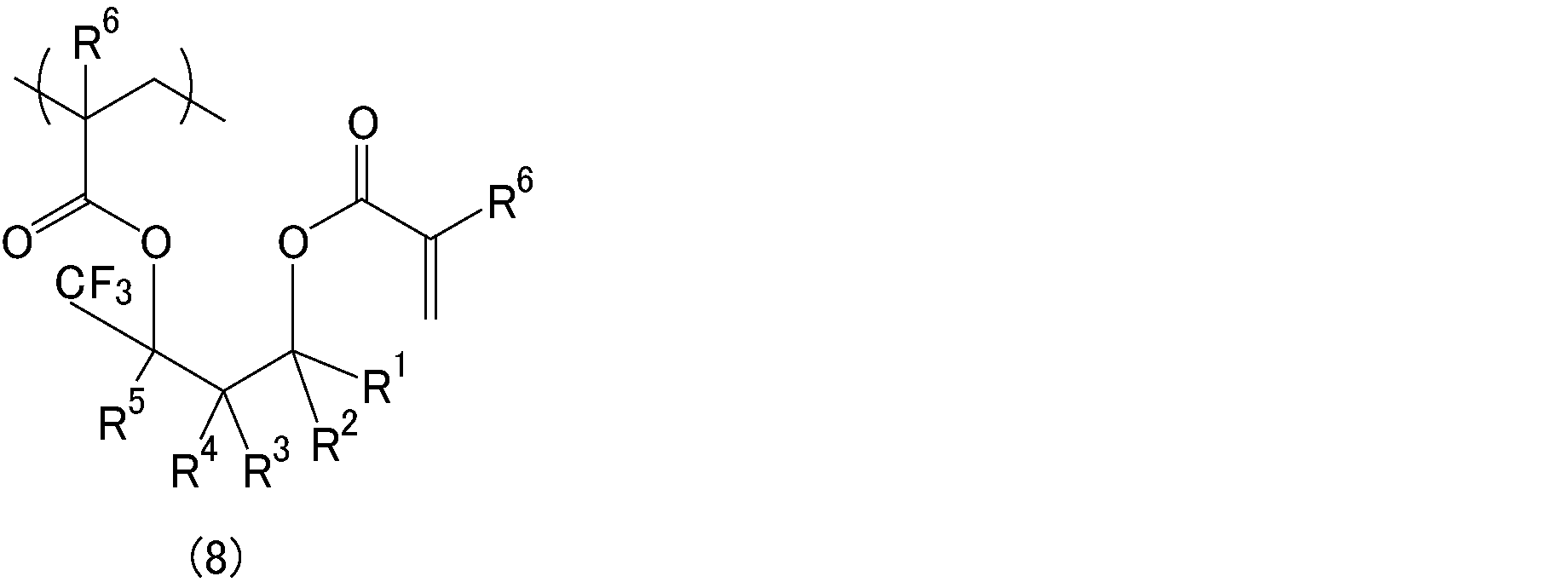
- an unsaturated carboxylic acid or the like which has undergone an addition reaction to a fluorine-containing alcohol moiety containing a fluorine atom of the fluorine-containing monomer represented by the formula (5) may be polymerized. Therefore, the obtained fluorine-containing polymer of the present disclosure may contain a repeating unit represented by the following formula (8).
- R 1 and R 2 are independently hydrogen atom, methyl group, ethyl group, n-propyl group, iso-propyl group, n-butyl group, iso-butyl group and sec-butyl group.
- R 3 and R 4 are independently hydrogen atom, methyl group or ethyl group
- R 5 is hydrogen atom or trifluoromethyl group
- R 6 is hydrogen atom, chlorine atom, respectively. Methyl group or trifluoromethyl group.
- an unsaturated carboxylic acid or the like which has undergone an addition reaction to an alkyl alcohol moiety which does not have a fluorine atom of the fluorine-containing monomer represented by the formula (5), and a fluorine-containing alcohol moiety containing a fluorine atom.
- both unsaturated carboxylic acids and the like that have undergone an addition reaction to the above may polymerize. Therefore, the fluorine-containing polymer of the present disclosure may contain such a repeating unit.
- a composition after the fluorine-containing monomer purification step contains a fluorine-containing monomer represented by the formula (4) and another monomer other than the fluorine-containing monomer represented by the formula (5).
- the polymerization reaction may be carried out using the composition.
- the resulting fluorinated polymer of the present disclosure will contain repeating units derived from another monomer. That is, the fluorine-containing polymer of the present disclosure may contain a repeating unit represented by the formula (1) and other repeating units other than the repeating unit represented by the formula (2).
- Examples of the monomer other than the fluorine-containing monomer represented by the formula (4) and the fluorine-containing monomer represented by the formula (5) include the following monomers. That is, a monomer having a hexafluoroisopropanol group (-C (CF 3 ) 2 OH), acrylic acid esters, methacrylic acid esters, fluoroacrylic acid esters, fluoromethacrylic acid esters, styrenes, etc.
- Fluorostyrenes vinyl ethers, fluorinated vinyl ethers, allyl ethers, fluorinated allyl ethers, unsaturated amides, olefins, fluorinated olefins, norbornene compounds, fluorinated norbornene compounds, vinylsilanes, vinylsulfonic acids or Vinyl sulfonic acid ester Acrylic acid, maleic acid methacrylate, maleic anhydride, fumaric acid, sulfur dioxide and the like.
- a monomer containing an acid-degradable group may be used as another monomer.
- a fluorine-containing polymer using a monomer containing an acid-decomposable group
- electromagnetic waves or electrons having a wavelength of 300 nm or less are formed on the resist film formed on the substrate.
- acid-degradable groups are decomposed and acids are generated in the resist film. With this acid, the solubility of the resist film in the exposed portion in the alkaline developer in development can be improved.
- a monomer having a lactone structure may be used as another monomer.
- a fluorine-containing copolymer having a lactone structure By producing a fluorine-containing copolymer using a monomer having a lactone structure, the adhesion between the resist film containing the fluorine-containing copolymer and the substrate can be improved when the fluorine-containing polymer is used as a resist. Can be improved. Further, when the upper layer film on the resist pattern is formed by using the fluorine-containing copolymer, not only the adhesion with the resist pattern of the lower layer is improved, but also the affinity with the developer during development is enhanced. It is possible to obtain a high-definition resist pattern.
- One of these other monomers may be added, or two or more thereof may be added.
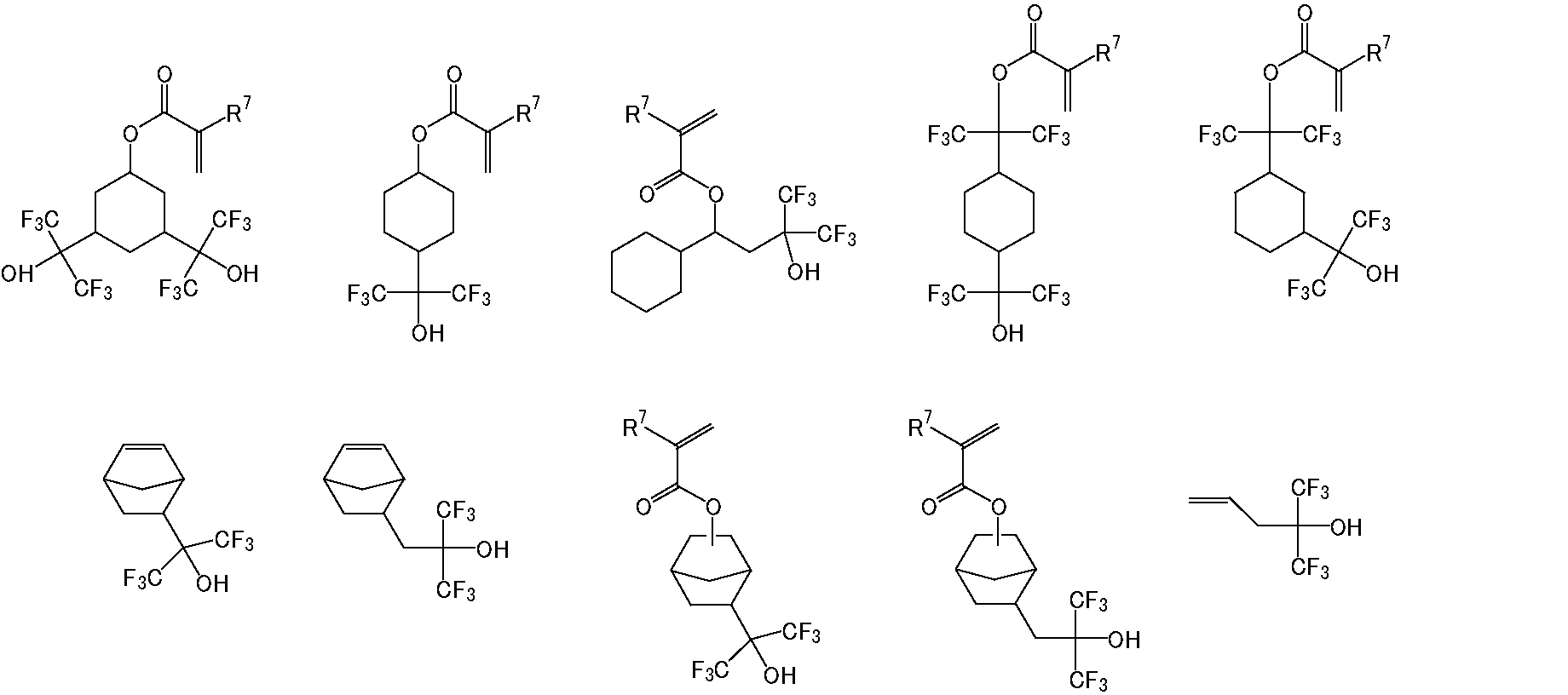
- Examples of the monomer having a hexafluoroisopropanol group include the following monomers.
- R 7 is a hydrogen atom, a methyl group, a fluorine atom, or a trifluoromethyl group, and the hydrogen atom of the hydroxyl group may be substituted with a protective group.
- acrylic acid esters examples include methyl acrylate, ethyl acrylate, n-propyl acrylate, isopropyl acrylate, n-butyl acrylate, isobutyl acrylate, n-hexyl acrylate, n-octyl acrylate, 2-ethylhexyl acrylate, lauryl acrylate, and 2-hydroxyl.
- Examples thereof include ethyl acrylate, 2-hydroxypropyl acrylate tert-butyl acrylate, 3-oxocyclohexyl acrylate, adamantyl acrylate, methyl adamantyl acrylate, ethyl adamantyl acrylate, hydroxyadamantyl acrylate, cyclohexyl acrylate, and tricyclodecanyl acrylate.
- methacrylic acid esters examples include methyl methacrylate, ethyl methacrylate, n-propyl methacrylate, isopropyl methacrylate, n-butyl methacrylate, isobutyl methacrylate, n-hexyl methacrylate, n-octyl methacrylate, 2-ethylhexyl methacrylate, lauryl methacrylate and 2-hydroxyl methacrylate.
- Examples thereof include ethyl methacrylate, 2-hydroxypropyl methacrylate, tert-butyl methacrylate, 3-oxocyclohexyl methacrylate, adamantyl methacrylate, methyl adamantyl methacrylate, ethyl adamantyl methacrylate, hydroxyadamantyl methacrylate, cyclohexyl methacrylate, tricyclodecanyl methacrylate and the like. ..
- the fluorine-containing acrylic acid ester and the fluorine-containing methacrylic acid ester may be an acrylic acid ester or a methacrylic acid ester containing an alkyl group having a fluorine atom or a fluorine atom at the ⁇ -position of the acrylic structure, and the ester structure may be formed. It may be an acrylic acid ester or a methacrylic acid ester containing a fluorine atom or an alkyl group having a fluorine atom.
- an alkyl group having a fluorine atom or a fluorine atom may be contained in both the ⁇ -position and the ester moiety of the acrylic structure. Further, a cyano group may be introduced at the ⁇ -position of the acrylic structure.
- alkyl group having a fluorine atom to be introduced at the ⁇ -position of the acrylic structure in the fluorine-containing acrylic acid ester or the fluorine-containing methacrylic acid ester include a trifluoromethyl group, a trifluoroethyl group, and nonafluoro-n-.
- a butyl group can be exemplified.
- the ester structure may have a fluorinated alkyl group such as a perfluoroalkyl group or a fluoroalkyl group. Further, the cyclic structure and the fluorine atom may coexist in the ester structure.
- the cyclic structure has a fluorine atom, a trifluoromethyl group, a fluorine-containing benzene ring having a hexafluoroisopropyl hydroxyl group, a fluorine-containing cyclopentane ring, a fluorine-containing cyclohexane ring, a fluorine-containing cycloheptane ring, or the like.
- the ester structure may be a t-butyl ester group having a fluorine atom.
- fluoroacrylic acid esters examples include 2,2,2-trifluoroethyl acrylate, 2,2,3,3-tetrafluoropropyl acrylate, and 1,1,1,3,3,3-hexafluoroisopropyl.
- fluorine-containing methacrylic acid esters examples include 2,2,2-trifluoroethyl methacrylate, 2,2,3,3-tetrafluoropropyl methacrylate, 1,1,1,3,3,3-hexafluoroisopropyl methacrylate.
- styrenes and fluorinated styrenes include styrene, hydroxystyrene, fluorinated styrene and the like.
- the fluorinated styrene may be pentafluorostyrene, trifluoromethylstyrene, bistrifluoromethylstyrene or the like as styrene in which hydrogen in the aromatic ring is substituted with a fluorine atom or a trifluoromethyl group. Further, styrene may be obtained by substituting hydrogen in the aromatic ring with a hexafluoroisopropanol group or a hexafluoroisopropanol group in which the hydroxyl group thereof is protected with a protecting group.
- styrene in which a halogen, an alkyl group and a fluorine-containing alkyl group are bonded to the ⁇ -position, styrene containing a perfluorovinyl group and the like may be used.
- Vinyl ethers, fluorine-containing vinyl ethers, allyl ethers, and fluorine-containing allyl ethers have a hydroxyl group such as a methyl group, an ethyl group, a propyl group, a butyl group, a hydroxyethyl group, or a hydroxybutyl group in the structure. May be good. Further, these compounds may contain a cyclohexyl group, a norbornyl group, an aromatic ring, or cyclic vinyls or allyl ethers having a hydrogen or carbonyl bond in the cyclic structure thereof, and have these. Part or all of the hydrogen atom may be replaced with a fluorine atom.
- unsaturated amides include acrylamide, methacrylamide, N-methylol acrylamide, N-methylol methacrylamide, diacetone acrylamide and the like.
- olefins examples include ethylene, propylene, isobutene, cyclopentene, cyclohexene and the like.
- fluorine-containing olefins examples include vinyl fluoride, vinylidene fluoride, trifluoroethylene, chlorotrifluoroethylene, tetrafluoroethylene, hexafluoropropylene, hexafluoroisobutene and the like.
- the monomer having a norbornene moiety may have one or more norbornene moieties in the monomer, and the hydrogen atom of the norbornene moiety may be substituted with a functional group containing a fluorine atom.
- Examples of such a monomer include cyclopentadiene and norbornene compounds synthesized by a Diels-Alder addition reaction between cyclopentadiene and an unsaturated compound.
- the unsaturated compounds used when synthesizing the norbornene compound include acrylic acid, methacrylic acid, ⁇ -fluoroacrylic acid, ⁇ -trifluoromethylacrylic acid, acrylic acid ester, methacrylic acid ester, fluorine-containing acrylic acid ester, and the like.
- the acid-degradable group can be used without particular limitation as long as it is hydrolyzed by an acid generated from a photoacid generator contained in the resist and desorbed from the fluoropolymer. ..
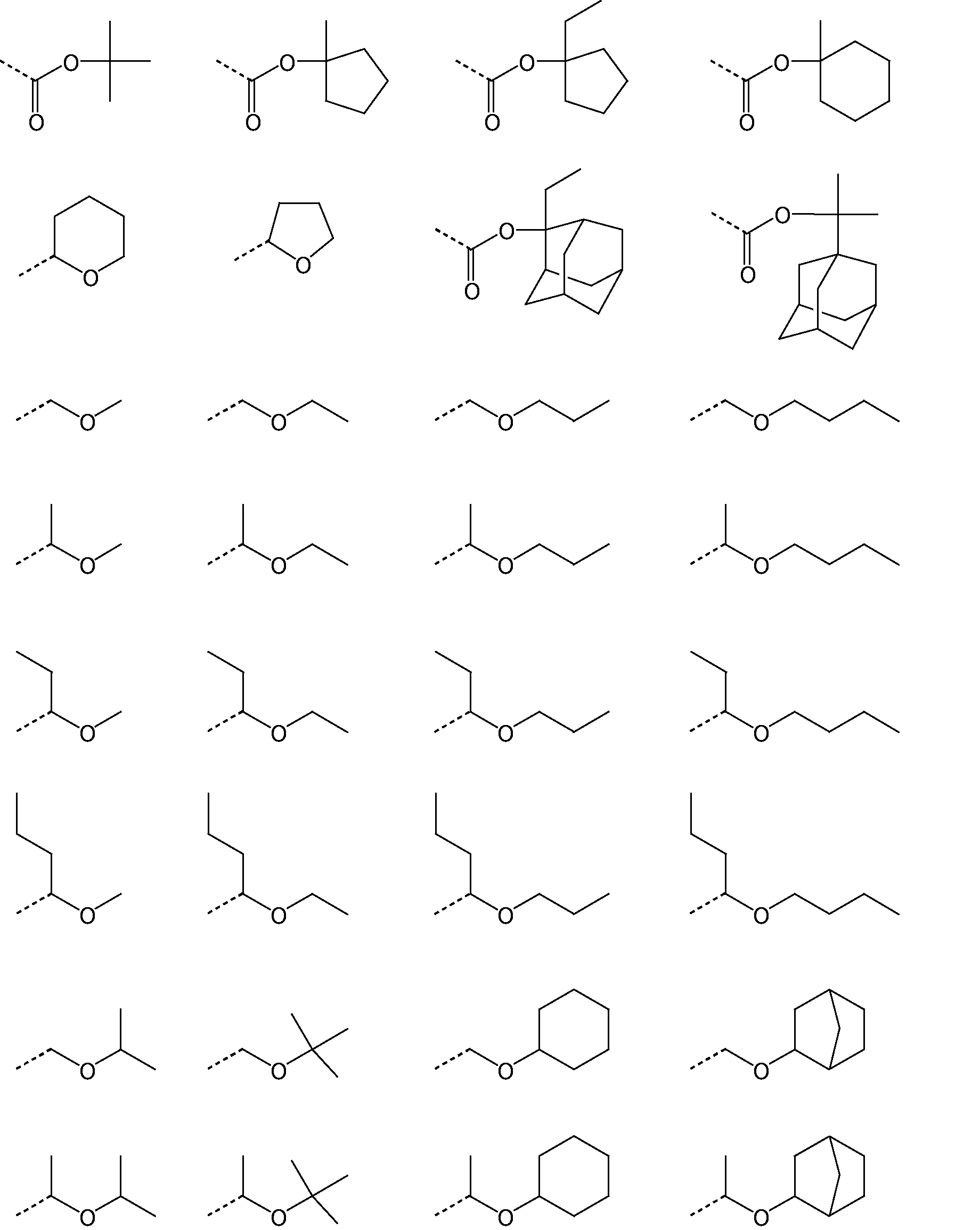
- a monomer having an acid-decomposable group represented by the following formula (9) or formula (10) is preferable.
- R 8 , R 9 , R 10 , and R 12 are independently linear alkyl having 1 to 25 carbon atoms and branched chain or cyclic alkyl having 3 to 25 carbon atoms, respectively.
- a group, in which a part or all of the hydrogen atom contained in the alkyl group may be substituted with a fluorine atom, an oxygen atom, a nitrogen atom, a sulfur atom or a hydroxyl group.
- R 8 , R 9 , and R 10 Any two of them may be bonded to form a ring.
- R 11 is a hydrogen atom, a linear alkyl group having 1 to 25 carbon atoms, and a branched chain or cyclic alkyl group having 3 to 25 carbon atoms. , A part or all of the hydrogen atom contained in the alkyl group may be substituted with a fluorine atom, an oxygen atom, a nitrogen atom, a sulfur atom or a hydroxyl group. The dotted line is a bond.
- acid-decomposable groups represented by the formulas (9) and (10) include the acid-decomposable groups shown below.
- the dotted line is a bond.
- the monomer having a lactone structure there are many monocyclic lactone structures such as a group obtained by removing one hydrogen atom from ⁇ -butyrolactone and mevalonic lactone, and a group obtained by removing one hydrogen atom from norbornan lactone.
- a monomer having a cyclic lactone structure and the like can be exemplified.
- the obtained fluoropolymer of the present disclosure is used as a component of the resist film or the upper layer film. If this is the case, the solubility in the organic solvent when preparing the coating liquid is increased, and there is an effect of improving the solubility in the developing liquid when developing.
- the fluoropolymer of the present disclosure obtained by adding 1,1,2,2-tetrahydroheptadecafluoro-n-decylacrylate is used as a component of the upper layer film, the adhesion to the resist film of the lower layer of the upper layer film is improved.
- the exposure time can be shortened by the immersion exposure using water as the exposure medium.
- the surface tension can be reduced, the surface of the upper film can be smoothed, and the film thickness can be made uniform.
- the amount thereof is not particularly limited, but in the fluorinated polymer of the present disclosure after polymerization, when all the repeating units contained in the fluorinated polymer are 100 mL%, another monomer is added.
- the proportion of the repeating unit derived from the monomer is preferably 1 mol% or more and 80 mol% or less, more preferably 5 mol% or more and 70 mol% or less, and further preferably 10 mol% or more and 60 mol% or less. preferable.
- the ratio of the repeating unit derived from another monomer is less than 1 mol%, the effect of improving the solubility in an organic solvent expected when the obtained fluoropolymer is used as a resist, and the resist on the substrate.
- the ratio of the repeating unit derived from another monomer exceeds 80 mol%, the ratio of the repeating unit represented by the formula (1) decreases, and the effect of improving the transparency of the resist film and the solvent solubility are improved. It becomes difficult to obtain the effect of making it.
- the polymerization reaction in the polymerization step is not particularly limited, and may be a radical polymerization reaction, an ionic polymerization reaction, a coordination anionic polymerization reaction, a living anionic polymerization reaction, or a cationic polymerization reaction. Among these, a radical polymerization reaction is preferable.
- the polymerization initiator is not particularly limited as long as the polymerization reaction occurs, but an azo compound, a peroxide compound, or a redox compound can be used. ..
- Examples of the azo compound include azobisisobutyronitrile.
- Examples of the peroxide compound include t-butylperoxypivalate, di-t-butyl peroxide, i-butylyl peroxide, lauroyl peroxide, succinic acid peroxide, dicinnamyl peroxide, and di-n-propyl peroxide. Examples thereof include dicarbonate, t-butylperoxyallyl monocarbonate, benzoyl peroxide, hydrogen peroxide and ammonium persulfate.
- Examples of the redox-based compound are used in combination with an oxidizing agent and a reducing agent, and examples thereof include hydrogen peroxide, persulfate, and cumene hydroperoxide as the oxidizing agent side, and iron (II) ion salt and copper as the reducing agent side.
- Ion salts, hydrogen peroxide, triethylamine and the like can be mentioned.
- a polymerization solvent may be used.
- the polymerization solvent is not particularly limited as long as it does not inhibit the radical polymerization reaction, and may be an organic solvent or water.
- the organic solvent include hydrocarbon solvents, ester solvents, ketone solvents, alcohol solvents, ether solvents, cyclic ether solvents, freon solvents, aromatic solvents and the like. Only one kind of these solvents may be used, or two or more kinds of these solvents may be used in combination.
- ester solvent examples include acetic acid, n-butyl acetate and the like.
- ketone solvent examples include acetone, methyl isobutyl ketone and the like.
- hydrocarbon solvent examples include toluene, cyclohexane and the like.
- alcohol solvent examples include methanol, isopropyl alcohol, and ethylene glycol monomethyl ether.
- a molecular weight adjusting agent such as mercaptan may be used.
- the reaction temperature in the radical polymerization reaction is appropriately changed depending on the type of the radical polymerization initiator or the radical polymerization initiator, but is preferably 20 ° C. or higher and 200 ° C. or lower, and is preferably 30 ° C. or higher and 140 ° C. or lower. More preferred.
- a known method can be used as a method for removing the organic solvent or water as a medium from the solution or dispersion liquid containing the synthesized fluorine-containing polymer after the polymerization step. Specifically, methods such as reprecipitation, filtration, and heating distilling under reduced pressure can be exemplified.
- the fluorine-containing polymer of the present disclosure containing the repeating unit represented by the formula (1) and the repeating unit represented by the formula (2) can be produced.
- the weight average molecular weight of the fluorine-containing polymer of the present disclosure is preferably 5000 to 20000, more preferably 7000 to 12000.
- the weight average molecular weight of the fluorine-containing polymer means a numerical value measured by gel permeation chromatography (GPC) under the following conditions.
- the fluorine-containing polymer of the present disclosure can be used as a component of a resist film. Further, the fluorine-containing polymer of the present disclosure can be used as a component of the resist film and / or the upper layer film that protects the resist pattern.
- the upper layer film can be formed by immersion exposure by using the fluorine-containing polymer of the present disclosure.
- the resist film and / or the resist pattern on which the upper layer film is formed may be either a negative type or a positive type.
- the fluorine-containing polymer of the present disclosure contains an aliphatic chain structure and a hexafluoroisopropanol group, it has a characteristic of high light transmittance at a wavelength of 300 nm or less.
- the fluorine-containing polymer of the present disclosure is used for forming a resist film, it is possible to use an electromagnetic wave having a wavelength of 300 nm or less in the exposure.
- the weight average molecular weight of the fluorine-containing polymer of the present disclosure is solubility in a solvent, a resist film or an upper layer film after film formation. It affects the physical properties of the film, for example, the glass transition temperature Tg.
- the fluorine-containing polymer of the present disclosure is used for forming a resist film, if the weight average molecular weight is high, the dissolution rate in a developing solution tends to be slow. When the weight average molecular weight is low, the dissolution rate in a developing solution tends to be high.
- the fluoropolymer of the present disclosure is used for forming a resist film or an upper layer film
- the fluoropolymer of the present disclosure is dissolved in a solvent or a mixed solution of water and a solvent and diluted to obtain a film forming solution. ..
- the solvent does not easily erode the resist film and / or the resist pattern on which the upper layer film is formed, and the additives contained therein are difficult to elute. It is preferably a solvent.
- the solvent for dissolving the fluorine-containing copolymer of the present disclosure preferably has a boiling point of 70 ° C to 170 ° C. If the boiling point of the solvent is less than 70 ° C., evaporation is too fast and it is difficult to form a uniform film. If the boiling point of the solvent exceeds 170 ° C, it takes time to dry the coating film and the throughput tends to decrease.
- Examples of the type of the solvent include a hydrocarbon-based solvent, an alcohol-based solvent, an ether-based solvent, an ester-based solvent, a fluorine-based solvent, and the like.
- Some of the hydrogen atoms contained in hydrocarbon-based solvents of the same kind, alcohol-based solvents with 1 to 20 carbon atoms, and hydrocarbons of alkanes and alicyclics with 5 to 20 carbon atoms and alcohols with 1 to 20 carbon atoms. It is preferably a fluorine-based solvent substituted with a fluorine atom or the like. These may be used alone or in combination of two or more. When two or more kinds are used in combination, the composition of the hydrocarbon solvent and the alcohol solvent is expressed by mass ratio, and a solvent having a hydrocarbon solvent: alcohol solvent 50 to 99.9: 0.1 to 50 is preferable. ..
- hydrocarbon solvent examples include pentane, hexane, heptane, octane, nonane, and decane.
- alcohol-based solvent examples include normal butanol, isobutanol, tashaributanol, methylethylcarbinol, pentanol, amyl alcohol, hexyl alcohol, heptyl alcohol, 4-methyl-2-pentanol and the like.
- the solvent is preferably a fluorine-based solvent from the viewpoint that the fluorine-containing polymer can be dissolved quickly.
- fluorosolvent examples include 2-fluoroanisole, 3-fluoroanisole, 4-fluoroanisole, 2,3-difluoroanisole, 2,4-difluoroanisole, 2,5-difluoroanisole, 5,8-.
- the solid content concentration in the film-forming solution is 3% by mass or more, 25% by mass or less, more preferably 5% by mass or more. It is preferable to dissolve the fluoropolymer with a solvent so that the content is 15% by mass or less. Within the above range, there is no unevenness in thickness, and a resist film or an upper layer film can be quickly formed.
- the film-forming solution contains a photoacid generator, a quencher, another non-fluorine polymer, etc. in addition to the fluorine-containing polymer and the solvent. You may be.
- the film-forming solution may contain other non-fluorine polymers in addition to the fluorine-containing polymer and the solvent.
- a resist film may be formed by applying a film-forming solution to a substrate and baking. After that, the formed resist film is immersed in a developing solution and dissolved.
- the developer is not particularly limited, and for example, a tetramethylammonium hydroxide aqueous solution having a concentration of 0.1% by mass or more and 10% by mass or less can be used.
- the content of the repeating unit represented by the formula (2) is 1500 ppm or less, expressed in parts per million based on the repeating unit represented by the formula (1). .. Therefore, when the formed resist film is immersed in a developing solution, it dissolves quickly and a residue is less likely to be generated.
- the base material on which the film-forming solution is applied is not particularly limited, and a CPU (Central Processing Unit) or SRAM (Central Processing Unit) arranged on a silicon wafer, a compound semiconductor substrate, an insulating substrate, or the like is used. Static Random Access Memory) and DRAM (Dynamic Random Access Memory) can be exemplified.
- the film-forming solution may be applied directly on the substrate to form a resist film, or the substrate may be provided with another layer and then on the layer.
- a film-forming solution may be applied to the resist film to form a resist film. Examples of another layer include an antireflection film, a SiO 2 film, a Si 3N 4 film , and the like.
- the antireflection film can be formed by using, for example, an antireflection coating agent (for example, ARCs manufactured by Nissan Chemical Industries, Ltd.).
- an antireflection coating agent for example, ARCs manufactured by Nissan Chemical Industries, Ltd.
- a SiO 2 film can be formed on the surface of the silicon wafer by performing high temperature steam treatment at 900 ° C. in an oxidation furnace.
- the Si 3 N 4 film can be formed by chemically vapor deposition (CVD) treating SiH 2 and NH 3 on the SiO 2 film formed on the surface of the silicon wafer.
- a film-forming solution may be applied to a substrate to form a resist film. After that, the resist film may be exposed or immersed in liquid.
- the fluorine-containing polymer of the present disclosure is used for forming an upper layer film
- the present film-forming solution may be applied onto the resist film and / or the resist pattern to form the upper layer film. After that, the upper film may be exposed or immersed in liquid.
- the wavelength of the electromagnetic wave to be exposed is not particularly limited, but an electromagnetic wave having a wavelength of 300 nm or less is preferable in order to obtain a high-definition pattern.
- a KrF excimer laser (wavelength 248 nm) or an ArF excimer laser (wavelength 193 nm) can be used.
- the ArF excimer laser is preferred.
- extreme ultraviolet rays EUV Extremerivolet, wavelength 13.5 nm
- X-rays X-rays
- EB ejectron beam electron beams
- the fluorine-containing polymer of the present disclosure can be used as an upper layer film of a resist film when manufacturing a semiconductor device.
- the upper film may be immersed and exposed.
- the semiconductor device using the fluorine-containing polymer of the present disclosure is not particularly limited, but is a CPU (Central Processing Unit) arranged on a silicon wafer, a compound semiconductor substrate, an insulating substrate, etc., and a SRAM (Static Random Access Memory). ), DRAM (Dynamic Random Access Memory) can be exemplified.
- CPU Central Processing Unit
- SRAM Static Random Access Memory
- DRAM Dynamic Random Access Memory
- the immersion exposure is an exposure process in which a liquid for immersion is filled between the lens of the exposure apparatus and the base material.
- the space between the lens of the exposure apparatus and the substrate is filled with the liquid for immersion, the exposure incident on the substrate through the lens is more than when the space between the lens of the exposure apparatus and the substrate is filled with air.
- the incident angle of light can be reduced. Therefore, the numerical aperture of the lens can be increased, and the resolution can be improved. Further, even in the exposure using a conventional lens having a numerical aperture, the depth focus can be expanded and a stable yield can be ensured.
- pattern formation in the case of immersion exposure, poor pattern formation may occur due to the intrusion of the immersion liquid into the resist film. In addition, poor pattern formation may occur due to the permeation of various components from the resist film into the liquid for immersion. Further, if droplets remain on the substrate after immersion exposure, pattern defects may occur. In the case of immersion exposure, an upper layer film for preventing such pattern formation defects is formed on the resist film.
- the fluorine-containing polymer of the present disclosure is useful as a material for an upper layer film formed on such a resist film.
- a resist solution is applied on a substrate such as a silicon wafer with a spinner or the like. After that, prebaking is performed to form a resist film.
- the film-forming solution containing the fluorine-containing polymer of the present disclosure is applied to the surface of the formed resist film to a uniform thickness using a spinner or the like. Then, by heat treatment, an upper layer film can be formed on the resist film.
- an electromagnetic wave having a wavelength of 300 nm or less is irradiated to the upper layer film and the resist film through a mask or a reticle on which a circuit pattern is described.
- the electromagnetic wave passes through the medium (for example, water) and the upper layer film and reaches the lower layer resist film.
- the resist film does not come into direct contact with the exposure medium due to the formation of the upper layer film. Therefore, it is possible to prevent the exposure medium from being immersed in the resist film and swelling, and to prevent the components of the resist film from being eluted into the exposure medium.
- a developer After baking the exposed substrate, it is developed with a developer.
- a tetramethylammonium hydroxide aqueous solution having a concentration of 0.1% by mass or more and 10% by mass or less as an alkaline aqueous solution can be used as the developing solution.
- the upper layer film is dissolved, and only the exposed portion of the lower layer resist film is dissolved.
- the content of the repeating unit represented by the formula (2) is 1500 ppm or less, expressed in parts per million based on the repeating unit represented by the formula (1). .. Therefore, when the formed upper layer film is immersed in a developing solution, the upper layer film is rapidly dissolved and a residue is less likely to be generated. As a result, the edge portion of the obtained resist pattern is formed sharply.
- methacrylic acid 5,5,5-trifluoro-4-hydroxy-4-trifluoromethylpentane-2-yl (fluorine-containing monomer represented by the formula (4-1)) is contained. 3.0 kg of the distillate was produced. The obtained fraction was precisely distilled in an Oldershaw distillation column to obtain 2.76 kg of a fraction having a boiling point of 80 ° C. at a pressure of 0.5 kPa. When the obtained fraction was measured by GC-MS, it was represented by methacrylic acid 5,5,5-trifluoro-4-hydroxy-4-trifluoromethylpentane-2-yl (formula (4-1)). The purity of the fluorine-containing monomer) was 99.8%.
- the separated organic layer was washed twice with 200 g of water, and then the solvent was distilled off by a rotary evaporator. Then, distillation was performed with a distillation apparatus equipped with a Vigreux tube. Fractions at 86 ° C. to 88 ° C. were collected at a reduced pressure of 0.5 kPa to obtain 16 g of oil.
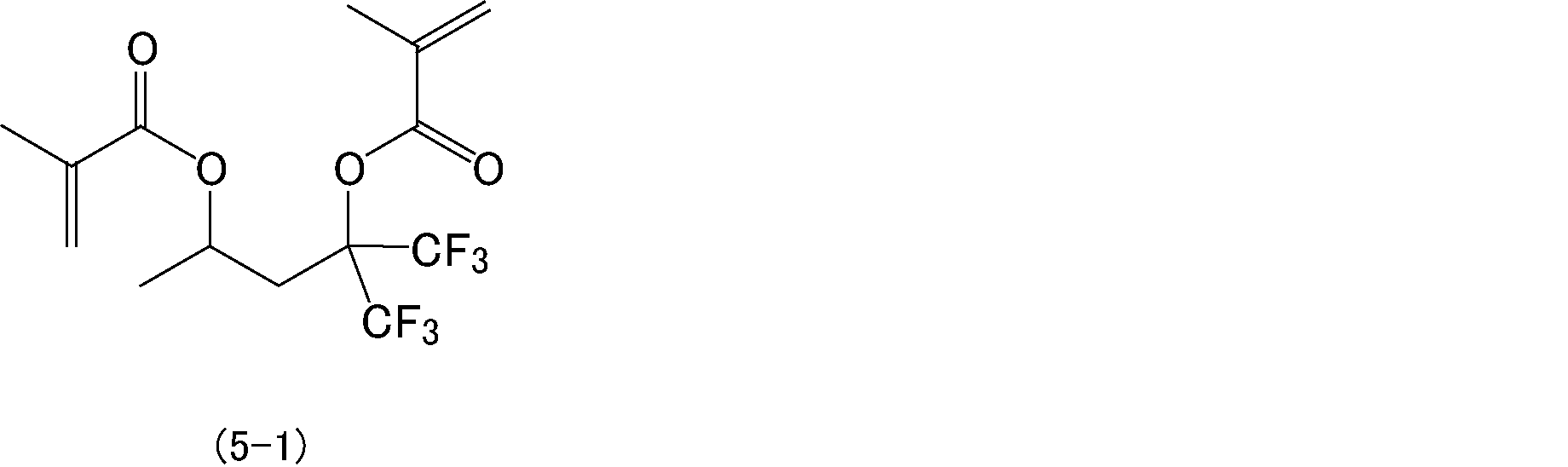
- the oil content measured by GC-MS includes a single amount of fluorine-containing 1,1,1-trifluoro-2- (trifluoromethyl) pentane-2,4-diyl (formula (5-1)) represented by methacrylic acid.
- Body is 96% by mass, unreacted methacrylic acid 5,5,5-trifluoro-4-hydroxy-4-trifluoromethylpentane-2-yl (fluorine-containing single amount represented by the formula (4-1)). Body) was contained in an amount of 2.5% by mass. The oil content was used as a standard sample of methacrylic acid 1,1,1-trifluoro-2- (trifluoromethyl) pentane-2,4-diyl (fluorine-containing monomer represented by the formula (5-1)). did.
- Example 1 ⁇ Polymerization process> At room temperature (about 20 ° C.), 100 g of the raw material composition A was placed in a 500 mL container, and dimethyl-2,2'-azobis (2-methylpropionate) (manufactured by Wako Pure Chemical Industries, Ltd., product name V) was charged. -601) 200 g of 2-butanone in which 6.26 g was dissolved was added to prepare a solution of the raw material composition A, and then the mixture was transferred to a dropping funnel. Next, the dropping funnel was separately attached to a 500 mL reactor charged with 100 g of 2-butanone, and the temperature of 2-butanone was raised to 78 ° C.
- reaction solution containing the fluorine-containing polymer was gradually added dropwise to n-heptane adjusted to a temperature of 25 ° C. over 1 hour while stirring, and then further stirred for 1 hour to obtain a slurry of the fluorine-containing polymer. Obtained.
- the obtained slurry was filtered under reduced pressure to obtain a cake. By drying the cake, the powder of the fluorine-containing polymer according to Example 1 was obtained.
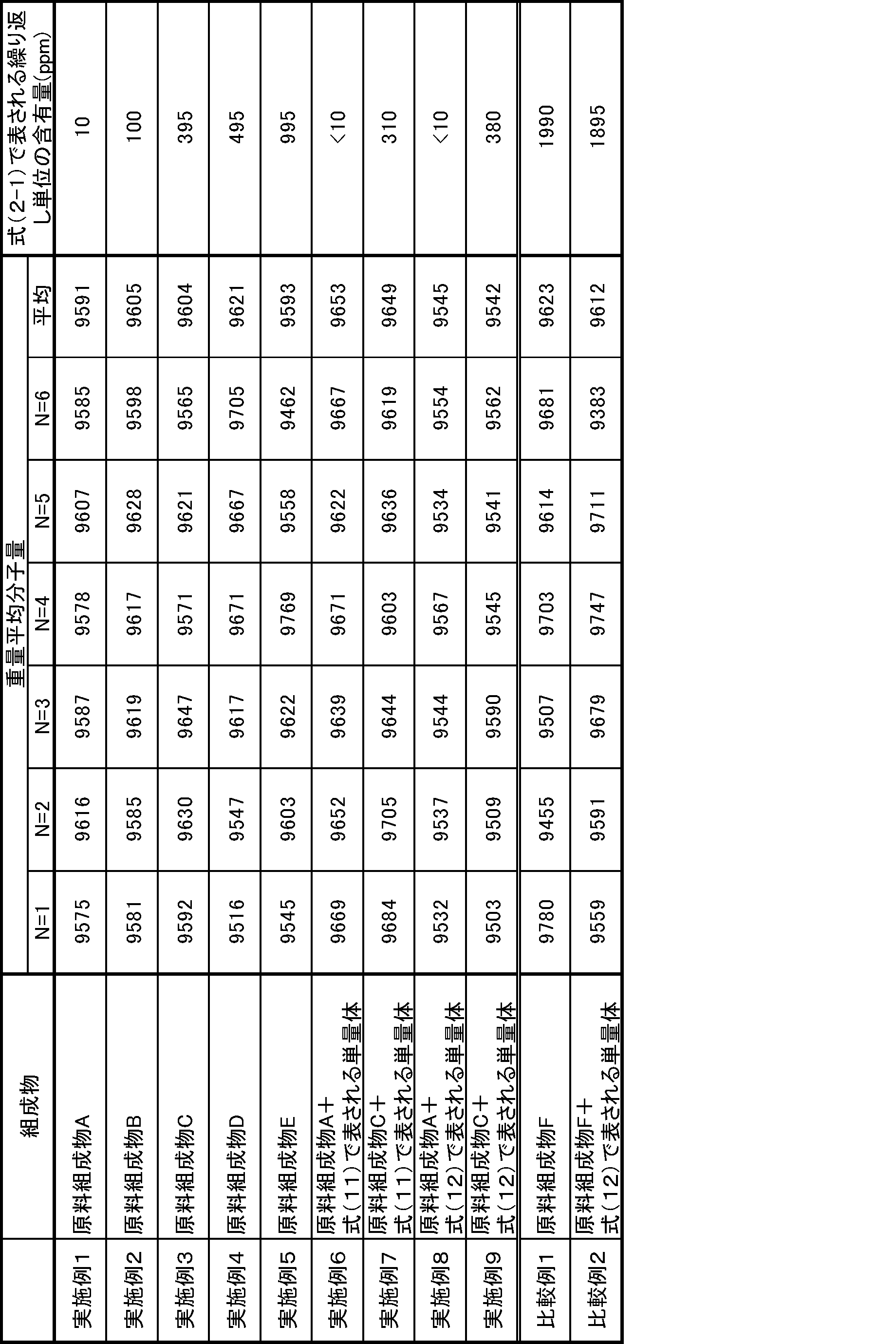
- Example 2 (Example 2) to (Example 5) Fluorine-containing polymers according to Examples 2 to 5, respectively, were produced in the same manner as in Example 1 except that the raw material compositions B to E were used instead of the raw material composition A. Then, the weight average molecular weight of the fluorine-containing polymer according to Examples 2 to 5 was measured. The results are shown in Table 2.
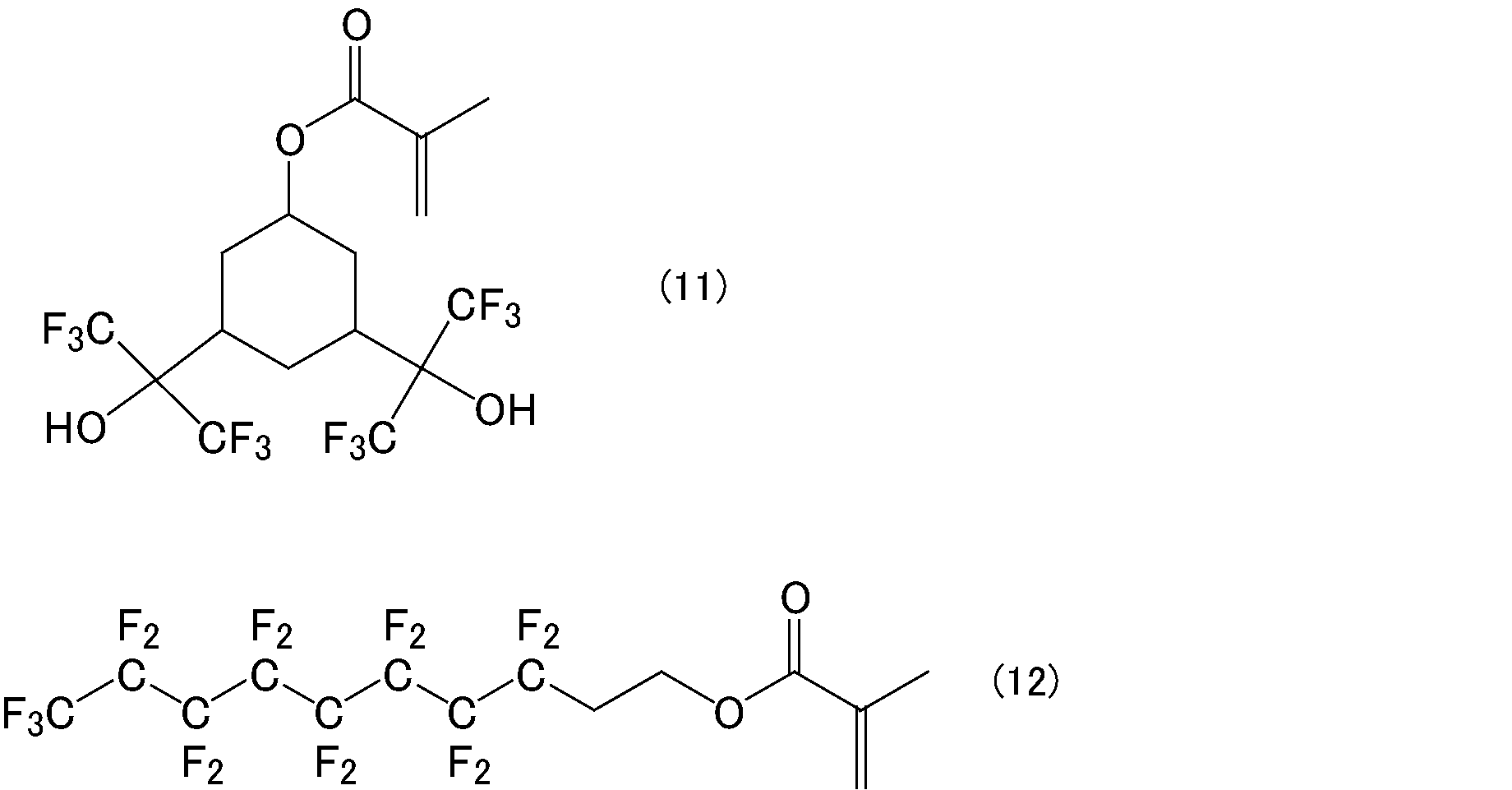
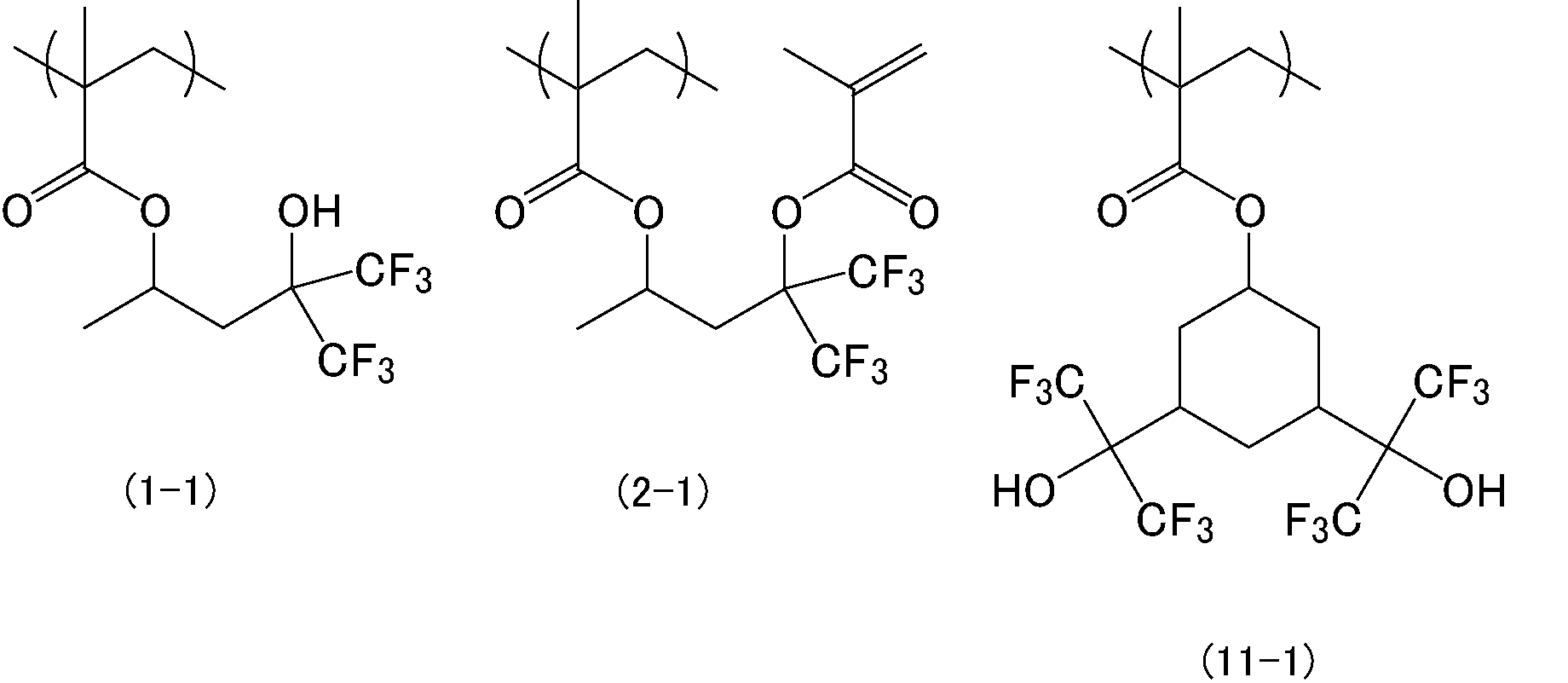
- the raw material composition A is 80 g, represented by 3,5-bis (1,1,1,3,3,3-hexafluoro-2-hydroxyisopropyl) cyclohexyl methacrylate (formula (11)).
- 20 g of (monomer) is placed in a 500 mL container to dissolve 6.26 g of dimethyl-2,2'-azobis (2-methylpropionate) (manufactured by Wako Pure Chemical Industries, Ltd., product name V-601).
- 2-butanone After adding 200 g of 2-butanone to prepare a mixed solution with the raw material composition A, the solution was transferred to a dropping funnel. Next, the dropping funnel was separately attached to a 500 mL reactor charged with 100 g of 2-butanone, and the temperature of 2-butanone was raised to 78 ° C.
- Example 7 The fluorine-containing polymer according to Example 7 was produced in the same manner as in Example 6 except that the raw material composition C was used instead of the raw material composition A. Then, the weight average molecular weight of the fluorine-containing polymer according to Example 7 was measured. The results are shown in Table 2.
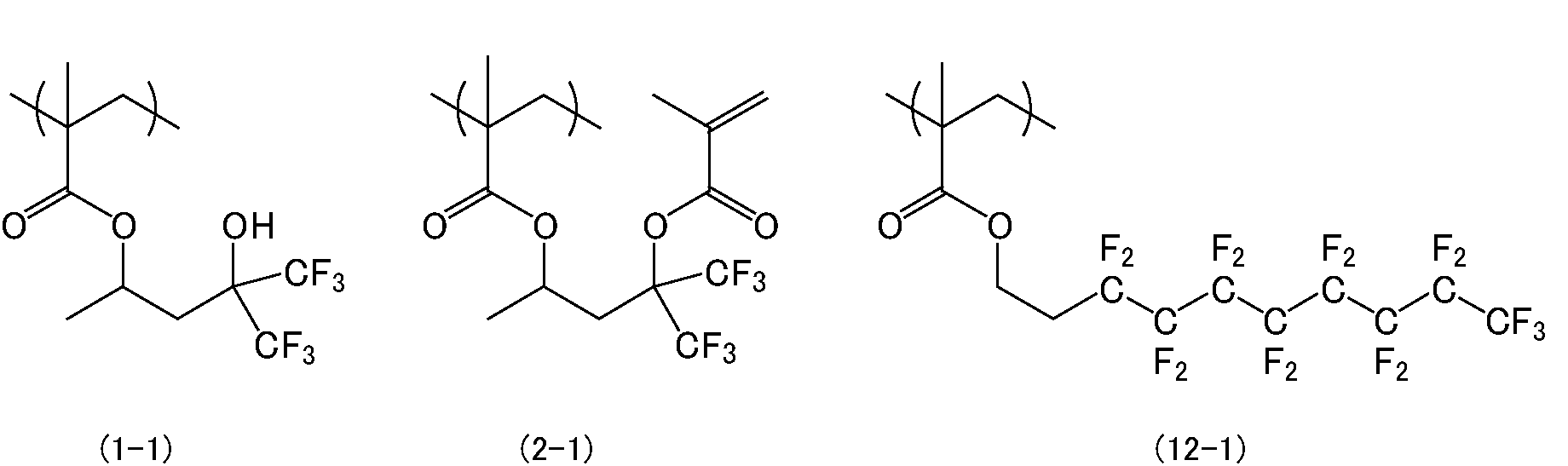
- Example 8 At room temperature (about 20 ° C.), 95 g of the raw material composition A and 5 g of 1,1,2,2-tetrahydroheptadecafluoro-n-decylacrylate (monomer represented by the formula (12)) are placed in a 500 mL container. After charging, 200 g of 2-butanone in which 6.26 g of dimethyl-2,2'-azobis (2-methylpropionate) was dissolved was added to prepare a mixed solution with the raw material composition A, and then the solution was transferred to a dropping funnel. Next, the dropping funnel was separately attached to a 500 mL reactor charged with 100 g of 2-butanone, and the temperature of 2-butanone was raised to 78 ° C.
- Table 2 shows the results of measuring the weight average molecular weight of the fluorine-containing polymer according to Example 8 in each production.
- Example 9 The fluorine-containing polymer according to Example 9 was produced in the same manner as in Example 8 except that the raw material composition C was used instead of the raw material composition A. Then, the weight average molecular weight of the fluorine-containing polymer according to Example 9 was measured. The results are shown in Table 2.
- Comparative Example 1 The fluorine-containing polymer according to Comparative Example 1 was produced in the same manner as in Example 1 except that the raw material composition F was used instead of the raw material composition A. Then, the weight average molecular weight of the fluorine-containing polymer according to Comparative Example 1 was measured. The results are shown in Table 2.
- Comparative Example 2 The fluorine-containing polymer according to Comparative Example 2 was produced in the same manner as in Example 8 except that the raw material composition F was used instead of the raw material composition A. Then, the weight average molecular weight of the fluorine-containing polymer according to Comparative Example 2 was measured. The results are shown in Table 2.
- each film-forming solution was spin-coated on a silicon wafer and baked at 110 ° C. to obtain a uniform resist film.
- These resist films were immersed in an aqueous solution of tetramethylammonium hydroxide having a concentration of 2.38% by mass as a developing solution to dissolve them, and the solubility was evaluated.
- the presence or absence of residue on the substrate was evaluated with a laser microscope.
- the laser microscope was performed using KEYENCE VX-1100.
- the evaluation criteria are as follows. ⁇ : When immersed in a developing solution, it quickly dissolved in the developing solution and the film disappeared.
- ⁇ When immersed in a developing solution, it dissolved within 60 seconds and the film disappeared.
- X When the film was immersed in a developing solution and taken out 60 seconds later, a punctate residue was observed at the site where the film was present, although the film was dissolved.
- the substrate coated with these resist films was cut in half, half of which was immersed in pure water for 30 minutes, and the swelling and dissolution of the membrane were evaluated as compared with the substrate not soaked.
- the evaluation method is as follows. The evaluation was made by observing the substrate with or without immersion with a laser microscope. The laser microscope was performed using KEYENCE VX-1100. The results are shown in Table 3. The evaluation criteria are as follows. ⁇ : No swelling or dissolution of the membrane occurred. X: The membrane was swollen and dissolved.
- the resist film prepared by using the fluorine-containing polymers according to Examples 1 to 9 having a low content ratio of the repeating unit represented by the formula (2-1) has solubility in a developing solution. It was good.
- the resist film prepared by using the fluorine-containing polymers according to Comparative Examples 1 and 2 having a high content ratio of the repeating unit represented by the formula (2-1) had poor solubility in a developing solution.
Landscapes
- Chemical & Material Sciences (AREA)
- Health & Medical Sciences (AREA)
- Chemical Kinetics & Catalysis (AREA)
- Medicinal Chemistry (AREA)
- Polymers & Plastics (AREA)
- Organic Chemistry (AREA)
- Physics & Mathematics (AREA)
- General Physics & Mathematics (AREA)
- Addition Polymer Or Copolymer, Post-Treatments, Or Chemical Modifications (AREA)
- Macromonomer-Based Addition Polymer (AREA)
- Organic Low-Molecular-Weight Compounds And Preparation Thereof (AREA)
- Materials For Photolithography (AREA)
Abstract
Description

当該重合性単量体は重合性にも優れ、当該重合性単量体を重合して得た含フッ素重合体は、フッ素原子によってもたらされる透明性と、極性基によってもたらされる密着性、加工性を併せ持ち、反射防止膜材料、光デバイス材料、レジスト材料等として優れた物性を有することが知られている。
当該成膜用溶液を、基材上やレジスト膜などの薄膜に塗布してベークすることにより膜を形成し、その後、当該膜を現像液に浸漬すると、基材上に残渣が生じることがあった。
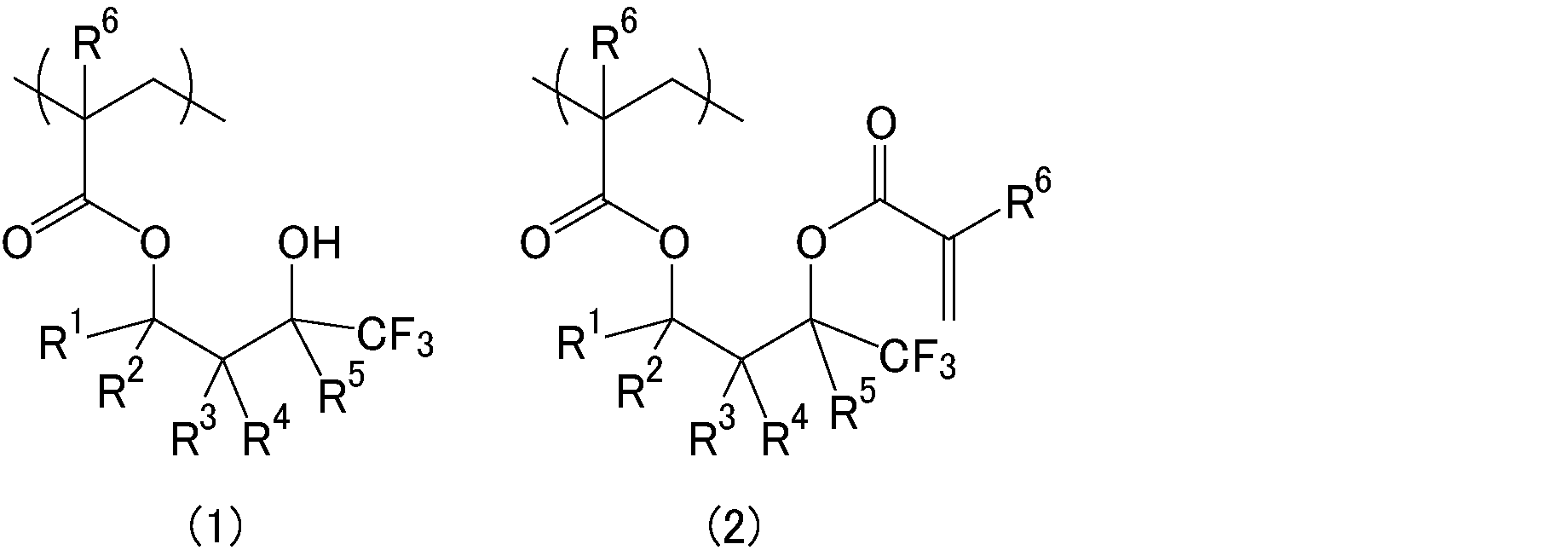
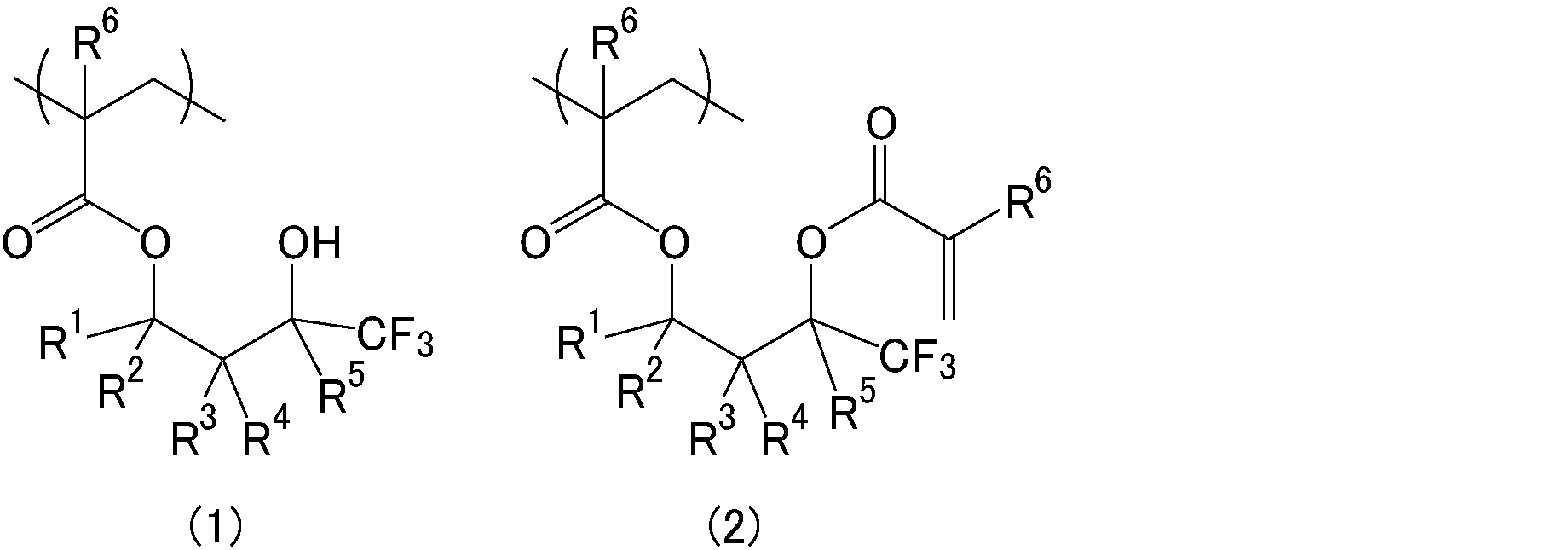
式(1)で表される繰り返し単位と式(2)で表される繰り返し単位とを含む含フッ素重合体において、式(2)で表される繰り返し単位の割合が多い場合、当該含フッ素重合体を含む成膜用溶液を、基材上やレジスト膜などの薄膜に塗布し、ベークすることにより膜を形成し、その後、当該膜を現像液に浸漬すると、残渣が残りやすくなる。
しかし、本開示の含フッ素重合体では、式(2)で表される繰り返し単位の割合が充分に少ない。そのため、本開示の含フッ素重合体を含む成膜用溶液を用いて膜を形成した場合、当該膜を現像液に浸漬すると、速やかに当該膜が溶解し、残渣が生じにくくなる。
含フッ素単量体合成工程では、下記式(3)で表されるジオールに不飽和カルボン酸、不飽和カルボン酸のエステル、不飽和カルボン酸の酸ハライド及び不飽和カルボン酸の無水物からなる群から選択される少なくとも1種(以下、「不飽和カルボン酸等」とも記載する)を反応させる。
これにより、主反応物である下記式(4)で表される含フッ素単量体と、副反応物である下記式(5)で表される含フッ素単量体とを含む組成物を得ることができる。

含フッ素アルコール部位が電子吸引性であることと、その立体効果によりアルコール部位の非共有電子対の求核性が抑制され、不飽和カルボン酸等の付加反応は起こりにくいと推察され、式(4)で表される含フッ素単量体が主反応物として合成される。
その結果、含フッ素単量体合成工程で得られる組成物には、主反応物である式(4)で表される含フッ素単量体と、副反応物である式(5)で表される含フッ素単量体とが含まれる。
含フッ素単量体合成工程で得られる組成物には、式(7)で表される含フッ素単量体が含まれていてもよい。

そのため、含フッ素単量体合成工程で得られる組成物には、式(3)で表されるジオールにおいてフッ素原子を含む含フッ素アルコール部位のみに不飽和カルボン酸等の付加反応が起こった化合物はほとんど検知されない。
このような式(3)で表されるジオールを用いた場合、製造される本開示の含フッ素重合体において、式(1)で表される繰り返し単位、及び、式(2)で表される繰り返し単位のR1はメチル基またはiso-プロピル基となり、R2~R4は水素原子となり、R5はトリフルオロメチル基となる。
不飽和カルボン酸等の使用量を少なくしすぎると、式(5)で表される含フッ素単量体の生成量を少なくすることができるが、未反応の式(3)で表されるジオールが多く残るので、式(4)で表される含フッ素単量体と式(3)で表されるジオールとの分離が必要になる。
また、不飽和カルボン酸等の使用量を多くしすぎると、式(5)で表される含フッ素単量体の生成量が多くなる。また、不飽和カルボン酸等のホモポリマーが生成することがある。
このような理由から、使用する式(3)で表されるジオールと不飽和カルボン酸、不飽和カルボン酸のエステル、不飽和カルボン酸の酸ハライド及び不飽和カルボン酸の無水物からなる群から選択される少なくとも1種とのモル量割合は、[使用する式(3)で表されるジオールのモル量]:[不飽和カルボン酸、不飽和カルボン酸のエステル、不飽和カルボン酸の酸ハライド及び不飽和カルボン酸の無水物からなる群から選択される少なくとも1種のモル量]=1:0.7~1:1.3であることが好ましい。
含フッ素単量体精製工程では、含フッ素単量体合成工程により得られた組成物から式(5)で表される含フッ素単量体を除去し、式(4)で表される含フッ素単量体を基準とする質量百万分率で表して、式(5)で表される含フッ素単量体の含有量を1500ppm以下とする。
また、式(5)で表される含フッ素単量体の含有量は、450ppm以下であることが好ましく、200ppm以下であることがより好ましい。また、式(5)で表される含フッ素単量体の含有量は、10ppm以上であることが好ましい。
以下、各方法について詳述する。
一般的なカラム用筒状基材に、充填剤を詰め、移動相に有機溶剤を用いて、組成物を流すことで組成物中から式(5)で表される含フッ素単量体の除去を行う。
充填剤は、特に限定されず、シリカゲルやアルミナゲルが好ましく、アルミナゲルがより好ましい。充填剤は、1種を用いてもよく、2種以上を用いてもよい。
移動相は、特に限定されず、ヘキサン、ヘプタン、トルエン、酢酸エチル等一般有機溶剤を使用することができる。また、移動相は、1種を用いてもよく、2種以上を用いてもよい。
カラムクロマトグラフを行う際の温度は0℃~40℃の範囲が好ましく、20℃~30℃の範囲であることがより好ましい。
充填剤の添加量(高さ)を増やすと多くの時間が必要になるが、充填剤の添加量(高さ)を増やすことで分離度は向上する。カラム用筒状基材として型番:ILC-B22-300、製造元:桐山製作所を用いる場合は、充填剤の高さは、5cm~15cmが望ましい。
精密蒸留を用いて組成物から式(5)で表される含フッ素単量体を除去する際に必要な蒸留塔の理論段数は、5段以上、40段以下である。
理論段数が5段未満では充分に式(5)で表される含フッ素単量体を除去することは困難である。蒸留塔の段数は高いほど、式(5)で表される含フッ素単量体を分離除去する能力が向上するが、40段を超えると、分離除去する能力が上限に近づき、費用対効果が向上しにくくなる。
また、蒸留塔に酸素を導入してもよい。
式(4)で表される含フッ素単量体100質量部に対して重合禁止剤が0.01質量部未満であると、式(4)で表される含フッ素単量体が重合することを防ぎにくくなる。
式(4)で表される含フッ素単量体100質量部に対して重合禁止剤が5質量部を超えると、式(4)で表される含フッ素単量体の重合を防ぐ効果が上限に近づき、費用対効果が向上しにくくなる。
なお、組成物中の式(4)で表される含フッ素単量体の含有量は、ガスクロマトグラフィーにより測定することができる。
晶析を用いて、組成物から式(5)で表される含フッ素単量体を除去することができる。
晶析は、組成物を、良溶媒に溶解し、貧溶媒を添加したり、温度を下げることで、式(4)で表される含フッ素単量体を析出させ、結晶を成長させる操作である。
ニトリル類としてはアセトニトリル、ベンゾニトリル等が挙げられる。
ケトン類としてはアセトン、メチルエチルケトン、ジエチルケトン、メチル-n-プロピルケトン、メチル-iso-プロピルケトン、メチル-n-ブチルケトン、メチル-iso-ブチルケトン等が挙げられる。
アミド類としては、N,N-ジメチルホルムアミド、N,N-ジメチルアセトアミド、N,N-ジメチルイミダゾリジノン等が挙げられる。
スルホキシド類としてはジメチルスルホキシド等が挙げられる。
エーテル類としてはジエチルエーテル、メチル-t-ブチルエーテル、ジイソプロピルエーテル、ジブチルエーテル、テトラヒドロフラン等が挙げられる。
ハイドロフルオロカーボン類としては、トリフルオロメタン、ジフルオロメタン、1,1,1,2-テトラフルオロエタン、1,1,1-テトラフルオロエタン、1,1-ジフルオロエタン、1,1,1,2,3,3,3-ヘプタフルオロプロパン、1,1,1,3,3,3-ヘキサフルオロプロパン、1,1,1,3,3-ヘプタフルオロプロパン、1,1,1,3,3-ペンタフルオロブタン、1,1,1,2,2,3,4,5,5,5-デカフルオロペンタン、1,1,2,2,3,3,4-ヘプタフルオロシクロペンタン等が挙げられる。
ハイドロフルオロエーテル類としては、メチル1,1,2,2,2-ペンタフルオロエチルエーテル、メチルトリフルオロメチルエーテル、メチル1,1,2,2-テトラフルオロエチルエーテル、1,1,2,2-テトラフルオロ-1-(2,2,2-トリフルオロエトキシ)エタン、(2,2,3,3-テトラフロオプロピル)(1,1,2,3,3,3-ヘキサフルオロプロピル)エーテル、(メチル)(ノナフルオロブチル)エーテル、(メチル)(ノナフルオロイソブチル)エーテル、(エチル)(ノナフルオロブチル)エーテル、(エチル)(ノナフルオロイソブチル)エーテル、1,1,1,2,2,3,4,5,5,5-デカフルオロ-3-メトキシ-4-(トリフルオロメチル)ペンタン、2-トリフルオロメチルー3-エトキシ-ドデカフルオロヘキサン、1,1,1,2,3-ヘキサフルオロ-4-(1,1,2,3,3,3-ヘキサフルオロプロポキシ)ペンタン等が挙げられる。
炭化水素類としてはブタン、ペンタン、ヘキサン、ヘプタン、オクタン、ノナン、デカン等が挙げられる。
芳香族系炭化水素類としてはベンゼン、トルエン、キシレン、メシチレン、パーフルオロベンゼン等が挙げられる。
これら溶媒より選ばれた少なくとも1種の化合物を良溶媒または貧溶媒として用いることが好ましい。
式(4)で表される含フッ素単量体100質量部に対して、溶媒の量が50質量部未満では晶析にて析出した式(4)で表される含フッ素単量体のスラリーの攪拌混合が難しい。
式(4)で表される含フッ素単量体100質量部に対して、溶媒を2000質量部を超えて加え溶解させたとしても、不純物を除去する効率は上限に近づき、費用対効果が向上しにくくなる。
なお、組成物中の式(4)で表される含フッ素単量体の含有量は、ガスクロマトグラフィーにより測定することができる。
重合工程では、含フッ素単量体精製工程後の組成物を用いて式(4)で表される含フッ素単量体を重合することにより、式(1)で表される繰り返し単位を含む含フッ素重合体とする。
なお、含フッ素単量体精製工程後の組成物には、除去しきれない式(5)で表される含フッ素単量体が含まれるので、この式(5)で表される含フッ素単量体も重合する。そのため、得られる本開示の含フッ素重合体は、式(2)で表される繰り返し単位を含むことになる。
そのため、得られる本開示の含フッ素重合体は、下記式(8)で表される繰り返し単位を含んでいてもよい。
そのため、本開示の含フッ素重合体は、このような繰り返し単位を含んでいてもよい。
この場合、得られる本開示の含フッ素重合体は、別の単量体に由来する繰り返し単位を含むことになる。つまり、本開示の含フッ素重合体は、式(1)で表される繰り返し単位及び式(2)で表される繰り返し単位以外のその他の繰り返し単位を含んでいてもよい。
すなわち、ヘキサフルオロイソプロパノール基(-C(CF3)2OH)を有する単量体、アクリル酸エステル類、メタクリル酸エステル類、含フッ素アクリル酸エステル類、含フッ素メタクリル酸エステル類、スチレン類、含フッ素スチレン類、ビニルエーテル類、含フッ素ビニルエーテル類、アリルエーテル類、含フッ素アリルエーテル類、不飽和アミド類、オレフィン類、含フッ素オレフィン類、ノルボルネン化合物、含フッ素ノルボルネン化合物、ビニルシラン類、ビニルスルホン酸またはビニルスルホン酸エステルアクリル酸、メタクリル酸マレイン酸、無水マレイン酸、フマル酸、二酸化硫黄等である。
酸分解性基を含む単量体を用いて含フッ素重合体を製造することで、含フッ素重合体をレジストとして用いた際に、基材に成膜したレジスト膜に波長300nm以下の電磁波または電子線等の高エネルギー線の露光により酸分解性基が分解しレジスト膜中で酸が発生する。
この酸により、現像における露光部のレジスト膜のアルカリ現像液への溶解性を向上させることができる。
ラクトン構造を有する単量体を用いて含フッ素共重合体を製造することで、含フッ素重合体をレジストとして用いた際に、含フッ素共重合体を含むレジスト膜と基材との密着性を向上させることができる。また当該含フッ素共重合体を用い、レジストパターン上の上層膜を形成した場合、下層のレジストパターンとの密着性を向上させるばかりでなく、現像する際に現像液との親和性を高めたり、高精細なレジストパターンを得ることが可能となる。
また、これらの化合物は、シクロヘキシル基、ノルボルニル基、芳香環、もしくはその環状構造内に水素やカルボニル結合を有した環状型ビニル類またはアリルエーテル類を構造中に含有してもよく、これらを有する水素原子の一部または全部がフッ素原子で置換されていてもよい。
含フッ素オレフィン類としては、フッ化ビニル、フッ化ビニリデン、トリフルオロエチレン、クロロトリフルオロエチレン、テトラフルオロエチレン、ヘキサフルオロプロピレン、ヘキサフルオロイソブテン等を例示することができる。
このような単量体としては、シクロペンタジエン、シクロヘキサジエンと不飽和化合物とのDiels-Alder付加反応で合成されるノルボルネン化合物が挙げられる。

1,1,2,2-テトラヒドロヘプタデカフルオロ-n-デシルアクリレートを加えて得られる本開示の含フッ素重合体を上層膜の成分とした場合、上層膜の下層のレジスト膜への密着性が向上するとともに上層膜表面の撥水性が向上するため、水を露光媒体とする液浸露光にて露光時間の短縮が可能になる。また表面張力を低減でき、上層膜表面の平滑化、膜厚の均一化が図れる。
別の単量体由来の繰り返し単位の割合が、1mol%未満であると、得られる含フッ素重合体をレジストとした際に期待される有機溶剤への溶解性が向上する効果、基材にレジスト膜を形成した際のレジスト膜と基材との密着性、レジストパターンの耐エッチング性が向上する効果が得られにくくなる。
別の単量体由来の繰り返し単位の割合が、80mol%を超えると、式(1)で表される繰り返し単位の割合が少なくなり、レジスト膜の透明性を向上させる効果、溶剤溶解性を向上させる効果が得られにくくなる。
これらの中では、ラジカル重合反応であることが好ましい。
過酸化物系化合物としては、t-ブチルパーオキシピバレート、ジ-t-ブチルパーオキシド、i-ブチリルパーオキシド、ラウロイルパーオキサイド、スクシン酸パーオキシド、ジシンナミルパーオキシド、ジ-n-プロピルパーオキシジカーボネート、t-ブチルパーオキシアリルモノカーボネート、過酸化ベンゾイル、過酸化水素または過硫酸アンモニウム等が挙げられる。
レドックス系化合物としては、酸化剤と還元剤の組み合わせで用い、酸化剤側として、過酸化水素、過硫酸塩、クメンヒドロペルオキシド等が挙げられ、還元剤側として、鉄(II)イオン塩、銅(I)イオン塩、アンモニア、トリエチルアミン等が挙げられる。
重合溶剤としては、ラジカル重合反応を阻害しないものであれば特に限定されず、有機溶剤であってもよく、水であってもよい。
有機溶剤としては、炭化水素系溶剤、エステル系溶剤、ケトン系溶剤、アルコール系溶剤、エーテル系溶剤、環状エーテル系溶剤、フロン系溶剤、芳香族系溶剤等を上げることができる。
これらの溶剤は1種のみを用いてもよく、2種類以上を併用してもよい。
ケトン系溶剤としては、アセトン、メチルイソブチルケトン等を例示することができる。
炭化水素系溶剤としては、トルエン、シクロヘキサン等を例示することができる。
アルコール系溶剤としては、メタノール、イソプロピルアルコール、エチレングリコールモノメチルエーテルを例示することができる。
ラジカル重合反応における反応温度は、ラジカル重合開始剤あるいはラジカル重合開始剤の種類により適宜変更されるが、20℃以上、200℃以下であることが好ましく、30℃以上、140℃以下であることがより好ましい。
具体的には再沈殿、ろ過、減圧下での加熱留出等の方法を例示することができる。
装置:東ソー社製、HLC-8320GPC
重合性単量体分析用カラム:東ソー社製、TSKgelシリーズ(G2500HXL、G2000HXL、G1000HXL、G1000HXLの順に直列に接続)
重合体分析用カラム:東ソー社製、TSKgelシリーズ(G2500HXL、G2000HXL、G1000HXL、G1000HXLの順に直列に接続)
温度プログラム:40℃(保持)
流速:1mL/分
検出器:示差屈折検出器(RI)
溶離液:テトラヒドロフラン(THF)
基準物質:ポリスチレン標準液
本開示の含フッ素重合体は、レジスト膜の成分として用いることができる。
また、本開示の含フッ素重合体はレジスト膜及び/又はレジストパターンを保護する上層膜の成分として使用することができる。
本開示の含フッ素重合体を、レジスト膜を形成するために用いる場合に、重量平均分子量が高いと、現像液への溶解速度が遅くなりやすい。重量平均分子量が低い場合、現像液への溶解速度が速くなる傾向がある。
本開示の含フッ素重合体を、上層膜を形成するために用いる場合の溶剤は、上層膜が形成されるレジスト膜及び/又はレジストパターンを浸食しにくく、これらに含まれる添加剤が溶出しにくい溶剤であることが好ましい。
溶剤の沸点が70℃未満であると、蒸発が早すぎて均一な膜を形成しにくい。
溶剤の沸点が170℃を超えると塗膜の乾燥に時間がかかりスループットが低下しやすくなる。
2種以上を併用する場合、炭化水素系溶剤とアルコール系溶剤の組成は質量比で表わして、炭化水素系溶剤:アルコール系溶剤=50~99.9:0.1~50である溶剤が好ましい。
これらは、1種単独を用いてもよく、2種以上を併用してもよい。
上記範囲であると、厚さに斑がなく、速やかにレジスト膜又は上層膜を形成することができる。
本開示の含フッ素重合体を、上層膜を形成するために用いる場合、成膜用溶液は、含フッ素重合体、溶剤以外にも他非フッ素重合体等を含んでいてもよい。
現像液は特に限定されず、例えば、濃度0.1質量%以上、10質量%以下のテトラメチルアンモニウムヒドロキシド水溶液を用いることができる。
本開示の含フッ素重合体では、式(1)で表される繰り返し単位を基準とする質量百万分率で表して、式(2)で表される繰り返し単位の含有量が1500ppm以下である。
そのため、形成されたレジスト膜を現像液に浸漬すると、速やかに溶解し、残渣が生じにくくなる。
成膜用溶液を塗布する際は、成膜用溶液を基材の上に直接塗布して、レジスト膜を形成してもよく、基材に、別の層を設けてから、その層の上に成膜用溶液を塗布し、レジスト膜を形成してもよい。
別の層としては、例えば、反射防止膜、SiO2膜、Si3N4膜等が挙げられる。
反射防止膜は、例えば、反射防止用コーティング剤(例えば、日産化学(株)製のARC類等)を用いて形成することができる。
基材としてシリコンウェハを用いる場合、酸化炉において、900℃、高温スチーム処理を行うことで、シリコンウェハの表面にSiO2膜を形成することができる。また、シリコンウェハの表面に形成されたSiO2膜にSiH2及びNH3を化学蒸着(CVD)処理することにより、Si3N4膜を形成することができる。
また、本開示の含フッ素重合体を、上層膜を形成するために用いる場合、本成膜用溶液をレジスト膜及び/又はレジストパターン上に塗布し、上層膜を形成してもよい。その後、上層膜に露光又は液浸露光を行ってもよい。
電磁波照射器としては、KrFエキシマレーザ(波長248nm)やArFエキシマレーザ(波長193nm)を用いることができる。これらの中では、ArFエキシマレーザが好ましい。
また、極端紫外線(EUV Extremeultraviolet、波長13.5nm)、X線、他に電子線(EB electron beam)も使用することができる。
露光装置のレンズと基材との間を液浸用液体で満たすと、露光装置のレンズと基材との間が空気で満たされている場合よりも、レンズを通って基材に入射する露光光の入射角を小さくすることができる。そのため、レンズの開口数(numerical aperture)を大きくすることができ、解像度を向上させることができる。
また、従来の開口数を有するレンズを用いた露光においても、深度焦点を拡大することが可能であり、安定した歩留が確保できる。
液浸露光を行う場合、このようなパターン形成不良等を防ぐための上層膜を、レジスト膜の上に形成することが行われている。
本開示の含フッ素重合体は、このようなレジスト膜の上に形成する上層膜の材料として有用である。
そのため、形成された上層膜を現像液に浸漬すると、上層膜が速やかに溶解し、残渣が生じにくくなる。その結果、得られるレジストパターンのエッジ部分がシャープに形成される。
<含フッ素単量体合成工程>
温度計、還流冷却器および攪拌器を備えた1Lの三口フラスコに、1,1,1-トリフルオロ-2-(トリフルオロメチル)ペンタン-1,3-ジオール(下記式(3-1)で表される化合物)100g(0.44mol)、メタクリル酸無水物74.6g(0.48mol)、メタンスルホン酸4.2g(0.044mol)、トルエン400gおよびフェノチアジン0.5gを入れた。その後、三口フラスコの底部を50℃に調温したオイルバスに浸し、攪拌しつつ、4時間反応させ組成物を得た。
組成物をガスクロマトグラフィーにより測定したところ、副反応物であるメタクリル酸を除き、反応液中には、メタクリル酸5,5,5-トリフルオロ-4-ヒドロキシ-4-トリフルオロメチルペンタン-2-イル(式(4-1)で示される化合物)が94.5質量%、1,1,1-トリフルオロ-2-(トリフルオロメチル)ペンタン-1,3-ジオールが1.6質量%、メタクリル酸無水物が2.0質量%、その他の化合物が1.9質量%含まれていることが判明した。

得られた組成物を分液ロートに入れ、重曹水400gを加え2回洗浄した後、有機層を採取し、硫酸マグネシウム30gを加え乾燥した後、硫酸マグネシウムを濾過により除去した。濾液に重合禁止剤としてフェノチアジンを0.7g添加し、溶剤留去をした後、減圧蒸留(8Torr=1.1kPa)を行い、80℃~82℃の留分を集め、留分112gを得た。収率は87%であった。
得られた留分をオールダーショウ式蒸留塔にて精密蒸留し、圧力0.5kPaにて沸点80℃の留分2.76kgを得た。
得られた留分をGC-MSで測定したところ、メタクリル酸5,5,5-トリフルオロ-4-ヒドロキシ-4-トリフルオロメチルペンタン-2-イル(式(4-1)で表される含フッ素単量体)の純度は99.8%であった。
精密蒸留前にGC-MSで測定したメタクリル酸1,1,1-トリフルオロ-2-(トリフルオロメチル)ペンタン-2,4-ジイル(式(5-1)で表される含フッ素単量体)の濃度は2,600ppmであったが、精密蒸留後は10ppmに減少していた。このようにして精密蒸留で純度を高めたメタクリル酸5,5,5-トリフルオロ-4-ヒドロキシ-4-トリフルオロメチルペンタン-2-イル(式(4-1)で表される含フッ素単量体)を含む組成物を得た。この組成物をメタクリル酸5,5,5-トリフルオロ-4-ヒドロキシ-4-トリフルオロメチルペンタン-2-イル(式(4-1)で表される含フッ素単量体)の標準試料とした。
温度計、還流冷却器および攪拌器を備えた1Lの三口フラスコに、メタクリル酸5,5,5-トリフルオロ-4-ヒドロキシ-4-トリフルオロメチルペンタン-2-イル(式(4-1)で表される含フッ素単量体)の標準試料100gを入れ、さらにトリエチルアミン60g、N,N-ジメチルアミノピリジン4gおよびフェノチアジン1gを加えた。フラスコ底部を氷浴に浸け、攪拌しつつ無水メタクリル酸79gを滴下した後、室温に戻して一時間攪拌し反応液を得た。反応液を分液ロートに移し、トルエン300gで希釈後、希塩酸200mLを加え反応を終了させ、有機層を分取した。分取した有機層を水200gで2回洗浄した後にロータリーエバポレーターで溶剤を留去した。次いで、ビグリュー管を備えた蒸留装置にて蒸留を行った。減圧度0.5kPaで86℃~88℃の留分を採取し16gの油分を得た。GC-MSで測定した油分には、メタクリル酸1,1,1-トリフルオロ-2-(トリフルオロメチル)ペンタン-2,4-ジイル(式(5-1)で表される含フッ素単量体)が96質量%、未反応のメタクリル酸5,5,5-トリフルオロ-4-ヒドロキシ-4-トリフルオロメチルペンタン-2-イル(式(4-1)で表される含フッ素単量体)が2.5質量%含まれていた。当該油分を、メタクリル酸1,1,1-トリフルオロ-2-(トリフルオロメチル)ペンタン-2,4-ジイル(式(5-1)で表される含フッ素単量体)の標準試料とした。
作製したメタクリル酸5,5,5-トリフルオロ-4-ヒドロキシ-4-トリフルオロメチルペンタン-2-イル(式(4-1)で表される含フッ素単量体)の標準試料及びメタクリル酸1,1,1-トリフルオロ-2-(トリフルオロメチル)ペンタン-2,4-ジイル(式(5-1)で表される含フッ素単量体)の標準試料を用い、表1に示す割合となるように、原料組成物A~Fを調製した。

<重合工程>
室温(約20℃)にて、原料組成物A、100gを500mLの容器に仕込み、ジメチル-2,2'-アゾビス(2-メチルプロピオネート)(和光純薬工業株式会社製、製品名V-601)6.26gを溶解させた2-ブタノン200gを加え、原料組成物Aの溶液とした後、滴下ロートへ移した。次いで、別途、2-ブタノン100gを仕込んだ500mLの反応器に本滴下ロートを取り付け、2-ブタノンを78℃まで昇温した。
実施例1に係る含フッ素重合体の分子量をゲルパーミエーションクロマトグラフィ(GPC)で測定したところ、重量平均分子量は9575であった(N=1)。
原料組成物Aに換えて原料組成物B~原料組成物Eを使用した以外は、実施例1と同様にして、それぞれ、実施例2~実施例5に係る含フッ素重合体を製造した。そして、実施例2~実施例5に係る含フッ素重合体の重量平均分子量を測定した。結果を表2に示す。
室温(約20℃)にて、原料組成物A80g、3,5-ビス(1,1,1,3,3,3-ヘキサフルオロ-2-ヒドロキシイソプロピル)シクロヘキシルメタクリレート(式(11)で表される単量体)20gを500mLの容器に仕込み、ジメチル-2,2'-アゾビス(2-メチルプロピオネート)(和光純薬工業株式会社製、製品名V-601)6.26gを溶解させた2-ブタノン200gを加え、原料組成物Aとの混合溶液とした後、滴下ロートへ移した。次いで、別途、2-ブタノン100gを仕込んだ500mLの反応器に本滴下ロートを取り付け、2-ブタノンを78℃まで昇温した。
次に、反応液より、2-ブタノンを除去し、実施例6に係る含フッ素重合体の分子量をGPCで測定したところ、9669であった(N=1)。
原料組成物Aに換えて原料組成物Cを使用した以外は、実施例6と同様にして、実施例7に係る含フッ素重合体を製造した。そして、実施例7に係る含フッ素重合体の重量平均分子量を測定した。結果を表2に示す。
室温(約20℃)にて、原料組成物A95g、1,1,2,2-テトラヒドロヘプタデカフルオロ-n-デシルアクリレート(式(12)で表される単量体)5gを500mLの容器に仕込み、ジメチル-2,2'-アゾビス(2-メチルプロピオネート)6.26gを溶解させた2-ブタノン200gを加え、原料組成物Aとの混合溶液とした後、滴下ロートへ移した。次いで、別途、2-ブタノン100gを仕込んだ500mLの反応器に本滴下ロートを取り付け、2-ブタノンを78℃まで昇温した。
反応液より、2-ブタノンを除去し得られた実施例8に係る含フッ素共重合体の分子量をゲルパーミエーションクロマトグラフィ(GPC)で測定したところ、重量平均分子量は9532であった(N=1)。
原料組成物Aに換えて原料組成物Cを使用した以外は、実施例8と同様にして、実施例9に係る含フッ素重合体を製造した。そして、実施例9に係る含フッ素重合体の重量平均分子量を測定した。結果を表2に示す。
原料組成物Aに換えて原料組成物Fを使用した以外は、実施例1と同様にして、比較例1に係る含フッ素重合体を製造した。そして、比較例1に係る含フッ素重合体の重量平均分子量を測定した。結果を表2に示す。
原料組成物Aに換えて原料組成物Fを使用した以外は、実施例8と同様にして、比較例2に係る含フッ素重合体を製造した。そして、比較例2に係る含フッ素重合体の重量平均分子量を測定した。結果を表2に示す。
各実施例及び各比較例に係る含フッ素重合体について、式(1-1)で表される繰り返し単位及び式(2-1)で表される繰り返し単位の含有量を測定し、式(1-1)で表される繰り返し単位を基準とする質量百万分率で式(2-1)で表される繰り返し単位の含有量を算出した。結果を表2に示す。
なお、重合体における各繰り返し単位の式(2-1)で表される繰り返し単位の含有量は、以下のように測定した。
まず、各実施例及び各比較例における反応後の溶液をHPLCにより測定し、反応後の溶液中に原料となる単量体が残存していないことをHPLCで確認した。
それを踏まえ、各実施例及び各比較例に係る重合体の1H-NMR、19F-NMR又は13C-NMRの測定値から各実施例及び各比較例に係る重合体に含まれる式(2-1)で表される繰り返し単位の含有量を定量した。
各実施例及び各比較例に係る含フッ素重合体を、n-ヘプタン95質量%、n-ヘキシルアルコール5質量%の混合溶剤に溶解させ、それぞれ固形分濃度2.5質量%の成膜用溶液を得た。
これらのレジスト膜を、現像液としての濃度2.38質量%のテトラメチルアンモニウムヒドロキシド水溶液に浸漬し溶解させ、溶解性を評価した。
レーザー顕微鏡にて基材上の残渣の有無を評価した。レーザー顕微鏡はキーエンス社VX-1100を用いて行った。
結果を表3に示す。
評価基準は以下の通りである。
◎:現像液に浸漬させたところ、現像液に速やかに溶解し、膜が消失した。
〇:現像液に浸漬させたところ、60秒以内に溶解し、膜が消失した。
×:現像液に浸漬させ60秒後にとりだしたところ、膜は溶解しているものの膜のあった部位に点状の残渣が認められた。
評価方法は以下の通りである。
レーザー顕微鏡にて上記浸漬有無の基材上を観察し評価した。レーザー顕微鏡はキーエンス社VX-1100を用いて行った。
結果を表3に示す。
評価基準は以下の通りである。
〇:膜の膨潤及び溶解が生じていなかった。
×:膜の膨潤及び溶解が生じていた。

一方、式(2-1)で表される繰り返し単位の含有割合が高い比較例1及び2に係る含フッ素重合体を用いて作製したレジスト膜は現像液への溶解性が悪かった。
Claims (6)
- 下記式(1)で表される繰り返し単位と、下記式(2)で表される繰り返し単位とを含む含フッ素重合体であって、
前記式(1)で表される繰り返し単位を基準とする質量百万分率で表して、前記式(2)で表される繰り返し単位の含有量が1500ppm以下であることを特徴とする含フッ素重合体。

- R5がトリフルオロメチル基である、請求項1に記載の含フッ素重合体。
- R3及びR4が水素原子である、請求項1または2に記載の含フッ素重合体。
- R1がメチル基またはiso-プロピル基であり、R2が水素原子である、請求項1~3のいずれか1項に記載の含フッ素重合体。
- 前記式(1)で表される繰り返し単位及び前記式(2)で表される繰り返し単位以外のその他の繰り返し単位を含む請求項1~4のいずれか1項に記載の含フッ素重合体。
- 成膜用溶液に用いられる請求項1~5のいずれか1項に記載の含フッ素重合体。
Priority Applications (3)
| Application Number | Priority Date | Filing Date | Title |
|---|---|---|---|
| US18/266,348 US20240043593A1 (en) | 2020-12-10 | 2021-12-02 | Fluorine-Containing Polymer |
| KR1020237020967A KR20230117582A (ko) | 2020-12-10 | 2021-12-02 | 함불소 중합체 |
| CN202180083298.5A CN116848162B (zh) | 2020-12-10 | 2021-12-02 | 含氟聚合物 |
Applications Claiming Priority (2)
| Application Number | Priority Date | Filing Date | Title |
|---|---|---|---|
| JP2020-205258 | 2020-12-10 | ||
| JP2020205258A JP7071675B1 (ja) | 2020-12-10 | 2020-12-10 | 含フッ素重合体 |
Publications (1)
| Publication Number | Publication Date |
|---|---|
| WO2022124183A1 true WO2022124183A1 (ja) | 2022-06-16 |
Family
ID=81653426
Family Applications (1)
| Application Number | Title | Priority Date | Filing Date |
|---|---|---|---|
| PCT/JP2021/044212 Ceased WO2022124183A1 (ja) | 2020-12-10 | 2021-12-02 | 含フッ素重合体 |
Country Status (6)
| Country | Link |
|---|---|
| US (1) | US20240043593A1 (ja) |
| JP (2) | JP7071675B1 (ja) |
| KR (1) | KR20230117582A (ja) |
| CN (1) | CN116848162B (ja) |
| TW (1) | TWI907586B (ja) |
| WO (1) | WO2022124183A1 (ja) |
Families Citing this family (1)
| Publication number | Priority date | Publication date | Assignee | Title |
|---|---|---|---|---|
| TW202506768A (zh) | 2023-05-31 | 2025-02-16 | 日商中央硝子股份有限公司 | 共聚物、撥水劑用聚合物、撥水膜形成用組合物、樹脂膜及抗蝕劑圖案之形成方法 |
Citations (2)
| Publication number | Priority date | Publication date | Assignee | Title |
|---|---|---|---|---|
| JP2010001273A (ja) * | 2008-06-23 | 2010-01-07 | Central Glass Co Ltd | 含フッ素モノマーの製造方法 |
| JP2020026410A (ja) * | 2018-08-14 | 2020-02-20 | セントラル硝子株式会社 | 含フッ素重合性単量体の蒸留精製法 |
Family Cites Families (3)
| Publication number | Priority date | Publication date | Assignee | Title |
|---|---|---|---|---|
| JP4083399B2 (ja) * | 2001-07-24 | 2008-04-30 | セントラル硝子株式会社 | 含フッ素重合性単量体およびそれを用いた高分子化合物 |
| US7067691B2 (en) * | 2003-12-26 | 2006-06-27 | Central Glass Co., Ltd. | Process for producing α-substituted acrylic acid esters |
| WO2020162104A1 (ja) * | 2019-02-04 | 2020-08-13 | セントラル硝子株式会社 | 有機発光素子封止用組成物、および該組成物を用いた有機発光素子封止膜、並びにその形成方法 |
-
2020
- 2020-12-10 JP JP2020205258A patent/JP7071675B1/ja active Active
-
2021
- 2021-12-02 KR KR1020237020967A patent/KR20230117582A/ko active Pending
- 2021-12-02 CN CN202180083298.5A patent/CN116848162B/zh active Active
- 2021-12-02 US US18/266,348 patent/US20240043593A1/en active Pending
- 2021-12-02 WO PCT/JP2021/044212 patent/WO2022124183A1/ja not_active Ceased
- 2021-12-10 TW TW110146397A patent/TWI907586B/zh active
-
2022
- 2022-04-21 JP JP2022070210A patent/JP7381949B2/ja active Active
Patent Citations (2)
| Publication number | Priority date | Publication date | Assignee | Title |
|---|---|---|---|---|
| JP2010001273A (ja) * | 2008-06-23 | 2010-01-07 | Central Glass Co Ltd | 含フッ素モノマーの製造方法 |
| JP2020026410A (ja) * | 2018-08-14 | 2020-02-20 | セントラル硝子株式会社 | 含フッ素重合性単量体の蒸留精製法 |
Also Published As
| Publication number | Publication date |
|---|---|
| CN116848162A (zh) | 2023-10-03 |
| JP2022092439A (ja) | 2022-06-22 |
| JP2022101644A (ja) | 2022-07-06 |
| TWI907586B (zh) | 2025-12-11 |
| JP7071675B1 (ja) | 2022-05-19 |
| KR20230117582A (ko) | 2023-08-08 |
| US20240043593A1 (en) | 2024-02-08 |
| JP7381949B2 (ja) | 2023-11-16 |
| TW202235468A (zh) | 2022-09-16 |
| CN116848162B (zh) | 2025-12-30 |
Similar Documents
| Publication | Publication Date | Title |
|---|---|---|
| JP4484603B2 (ja) | トップコート組成物 | |
| JP5018743B2 (ja) | 含フッ素化合物とその高分子化合物 | |
| JP4410508B2 (ja) | 含フッ素化合物とその高分子化合物 | |
| JP5577684B2 (ja) | 含フッ素重合性単量体、含フッ素重合体、レジスト材料及びパターン形成方法 | |
| JP2005029527A5 (ja) | ||
| JP2005029527A (ja) | フッ素系環状化合物、フッ素系重合性単量体、フッ素系高分子化合物、並びにそれを用いたレジスト材料及びパターン形成方法 | |
| JP5556160B2 (ja) | トップコート組成物 | |
| CN1976913B (zh) | 内酯化合物、含内酯的单体、它们的聚合物、使用该聚合物的抗蚀剂组合物、使用该抗蚀剂组合物的图形形成方法 | |
| JP7071675B1 (ja) | 含フッ素重合体 | |
| JP7381948B2 (ja) | 含フッ素重合体の製造方法及び組成物 | |
| JP6908816B2 (ja) | 含フッ素単量体、それを用いた含フッ素重合体、それを用いた化学増幅型レジストおよびそれを用いたパターン形成方法 | |
| JP4166076B2 (ja) | 含フッ素ビニルエーテルおよびそれを使用した含フッ素重合体、ならびに含フッ素重合体を使用したレジスト材料 | |
| JP2009073835A (ja) | 含フッ素化合物、溶解抑制剤、それらを用いたレジスト材料 |
Legal Events
| Date | Code | Title | Description |
|---|---|---|---|
| 121 | Ep: the epo has been informed by wipo that ep was designated in this application |
Ref document number: 21903287 Country of ref document: EP Kind code of ref document: A1 |
|
| WWE | Wipo information: entry into national phase |
Ref document number: 202180083298.5 Country of ref document: CN Ref document number: 18266348 Country of ref document: US |
|
| ENP | Entry into the national phase |
Ref document number: 20237020967 Country of ref document: KR Kind code of ref document: A |
|
| NENP | Non-entry into the national phase |
Ref country code: DE |
|
| 122 | Ep: pct application non-entry in european phase |
Ref document number: 21903287 Country of ref document: EP Kind code of ref document: A1 |