WO2022102134A1 - 通信経路探索装置、通信経路探索方法、及びプログラム - Google Patents
通信経路探索装置、通信経路探索方法、及びプログラム Download PDFInfo
- Publication number
- WO2022102134A1 WO2022102134A1 PCT/JP2020/042637 JP2020042637W WO2022102134A1 WO 2022102134 A1 WO2022102134 A1 WO 2022102134A1 JP 2020042637 W JP2020042637 W JP 2020042637W WO 2022102134 A1 WO2022102134 A1 WO 2022102134A1
- Authority
- WO
- WIPO (PCT)
- Prior art keywords
- node
- network
- information
- branches
- nodes
- Prior art date
- Legal status (The legal status is an assumption and is not a legal conclusion. Google has not performed a legal analysis and makes no representation as to the accuracy of the status listed.)
- Ceased
Links
Images




Classifications
-
- H—ELECTRICITY
- H04—ELECTRIC COMMUNICATION TECHNIQUE
- H04J—MULTIPLEX COMMUNICATION
- H04J14/00—Optical multiplex systems
- H04J14/02—Wavelength-division multiplex systems
- H04J14/0227—Operation, administration, maintenance or provisioning [OAMP] of WDM networks, e.g. media access, routing or wavelength allocation
- H04J14/0254—Optical medium access
- H04J14/0256—Optical medium access at the optical channel layer
- H04J14/0257—Wavelength assignment algorithms
-
- H—ELECTRICITY
- H04—ELECTRIC COMMUNICATION TECHNIQUE
- H04J—MULTIPLEX COMMUNICATION
- H04J14/00—Optical multiplex systems
- H04J14/02—Wavelength-division multiplex systems
- H04J14/0227—Operation, administration, maintenance or provisioning [OAMP] of WDM networks, e.g. media access, routing or wavelength allocation
- H04J14/0254—Optical medium access
- H04J14/0267—Optical signaling or routing
- H04J14/0271—Impairment aware routing
-
- H—ELECTRICITY
- H04—ELECTRIC COMMUNICATION TECHNIQUE
- H04L—TRANSMISSION OF DIGITAL INFORMATION, e.g. TELEGRAPHIC COMMUNICATION
- H04L45/00—Routing or path finding of packets in data switching networks
- H04L45/12—Shortest path evaluation
-
- H—ELECTRICITY
- H04—ELECTRIC COMMUNICATION TECHNIQUE
- H04L—TRANSMISSION OF DIGITAL INFORMATION, e.g. TELEGRAPHIC COMMUNICATION
- H04L45/00—Routing or path finding of packets in data switching networks
- H04L45/16—Multipoint routing
-
- H—ELECTRICITY
- H04—ELECTRIC COMMUNICATION TECHNIQUE
- H04L—TRANSMISSION OF DIGITAL INFORMATION, e.g. TELEGRAPHIC COMMUNICATION
- H04L45/00—Routing or path finding of packets in data switching networks
- H04L45/24—Multipath
-
- H—ELECTRICITY
- H04—ELECTRIC COMMUNICATION TECHNIQUE
- H04L—TRANSMISSION OF DIGITAL INFORMATION, e.g. TELEGRAPHIC COMMUNICATION
- H04L45/00—Routing or path finding of packets in data switching networks
- H04L45/48—Routing tree calculation
Definitions
- the present invention relates to a communication path search device, a communication path search method, and a program technology.
- wavelength selection switch that outputs an arbitrary wavelength of an optical input signal to an arbitrary direction
- WSS wavelength selection switch
- a wavelength selection switch having a function of outputting an optical signal of the same wavelength to a plurality of directions (transmission lines) has been introduced. It has been devised (see, for example, Non-Patent Document 1). By using such a wavelength selection switch, it is possible to realize optical multicast in which the wavelength output from one node is branched by a relay node and distributed to a plurality of nodes.
- the Steiner tree which is the smallest spanning tree based on a graph subset. Construction of the Steiner tree is an NP-hard problem, but there is an algorithm that solves it efficiently (see, for example, Non-Patent Document 1). Further, in general, the number of routes that WSS can output has an upper limit due to the number of ports and other restrictions.
- an object of the present invention is to provide a technique capable of constructing a Steiner tree satisfying the restrictions.
- One aspect of the present invention is a device that constructs a multicast route for a plurality of nodes connected to a network, and is a network device that manages device specifications including constraint information on the maximum number of branches of each node on the network.
- the information management unit, the network topology management unit that manages the link information between the nodes on the network, and the request include the start / end node information, the new request, the existing request, and the number of branches of each node.
- It is a communication route search device including the constraint information of the above and a multicast tree calculation unit for constructing a Steiner tree of a route connecting start / end nodes based on the link information.
- One aspect of the present invention is a device that constructs a multicast route for a plurality of nodes connected to a network, and is a network device that manages device specifications including constraint information on the maximum number of branches of each node on the network.
- the information management unit, the network topology management unit that manages the link information between the nodes on the network, the request includes the start / end node information, the plurality of requests, the constraint information of the number of branches of each node, and the above.
- It is a communication route search device including a multicast tree calculation unit that constructs a Steiner tree of a route connecting start / end nodes based on link information.
- One aspect of the present invention is a communication route search method for constructing a multicast route for a plurality of nodes connected to a network, in which the request includes start / end node information, and the multicast tree calculation unit newly adds the above. Based on the request, the existing request, the constraint information of the maximum number of branches of each node on the network, and the link information between the nodes on the network, a Steiner tree of the route connecting the start and end nodes is constructed. , It is a communication route search method.
- One aspect of the present invention is a communication route search method for constructing a multicast route for a plurality of nodes connected to a network, wherein the request includes start / end node information, and the multicast tree calculation unit has a plurality of the above.
- a communication route search method that constructs a Steiner tree for the route connecting the start and end nodes based on the request, the constraint information on the maximum number of branches of each node on the network, and the link information between the nodes on the network. be.
- the request includes the start / end node information, the new request, the existing request, the constraint information of the maximum number of branches of each node on the network, and the node on the network. It is a program that builds a Steiner tree of the route connecting the start and end nodes based on the link information between them.
- a request includes start / end node information, a plurality of the requests, constraint information on the maximum number of branches of each node on the network, and link information between the nodes on the network. It is a program that builds a Steiner tree of the route connecting the start and end nodes.
- FIG. 1 is a diagram showing a configuration example of an optical path design device including the communication path search device of the embodiment.
- the optical path design device 1 includes an optical path design unit 2, an optical path information management unit 3, and a communication path search device 4.
- the communication route search device 4 includes a multicast tree design unit 41, a network topology management unit 42, and a network device information management unit 43.
- the optical path design device 1 has, for example, one function of a device that manages and operates an optical network.
- the optical path design device 1 is based on an optical path request (hereinafter, also referred to as “request”) including start / end node information arriving (or manually input) at the optical network management operation device, and the optical path design result.
- Design multicast tree and assigned frequency).
- the optical path design unit 2 is based on the acquired optical path request, the frequency information 54 on the multicast tree managed by the optical path information management unit 3, and the multicast tree information 52 output by the multicast tree design unit 41. Design the design results.
- the optical path information management unit 3 manages the frequency information 54 on the multicast tree.
- the optical path information management unit 3 outputs the frequency information 54 on the multicast tree 53 output by the optical path design unit 2 to the optical path design unit 2.
- the communication route search device 4 constructs a multicast tree from the start / end node information 51 input from the optical path design unit 2, and outputs the multicast tree information 52 related to the constructed multicast tree to the optical path design unit 2.
- the multicast tree design unit 41 includes start / end node information 51 input from the optical path design unit 2, a network topology 61 managed by the network topology management unit 42, and device constraint information 62 managed by the network device information management unit 43. Build a multicast tree based on.
- the multicast tree design unit 41 outputs the multicast tree information 52 to the optical path design unit 2.
- the network topology 61 is connection form information between devices on a communication network.
- the network topology management unit 42 manages link information between nodes on the network.
- the link information includes the distance information of the link (fiber) which is the network topology 61.
- the network device information management unit 43 manages the device specifications of each node on the network.
- the device specifications of each node include information on the maximum number of branches, which is device constraint information 62. Information on the maximum number of branches will be described later.
- the communication path search device 4 is configured by using a processor such as a CPU (Central Processing Unit) and a memory.
- the communication route search device 4 functions as a multicast tree design unit 41, a network topology management unit 42, and a network device information management unit 43 by executing a program by the processor. Even if all or part of each function of the communication path search device 4 is realized by using hardware such as ASIC (Application Specific Integrated Circuit), PLD (Programmable Logic Device), and FPGA (Field Programmable Gate Array). good.
- ASIC Application Specific Integrated Circuit
- PLD Programmable Logic Device
- FPGA Field Programmable Gate Array
- Computer-readable recording media include, for example, flexible disks, magneto-optical disks, ROMs, CD-ROMs, portable media such as semiconductor storage devices (for example, SSD: Solid State Drive), hard disks and semiconductor storage built in computer systems. It is a storage device such as a device.
- the above program may be transmitted over a telecommunication line.
- FIG. 2 is a diagram for explaining a method of counting the number of branches of the communication node according to the embodiment.
- the example of FIG. 2 is an example of a tree constructed by the multicast tree design unit 41, in which nodes are connected in the order of A, B, C, and D. Further, in FIG. 2, node A is a start point s, node B is a first end point d1, and node D is a second end point d2.
- Each node is provided with, for example, a wavelength selection switch (WSS).
- WSS wavelength selection switch
- node B In the example of FIG. 2, data is transmitted from the start point s to the first end point d1 and the second end point d2.
- the data transmitted from node A In node B, the data transmitted from node A is distributed between the own node and the node D. Therefore, the number of branches of the node B is 2.
- the multicast tree is searched when requests arrive sequentially.
- the device constraint is that the maximum number of branches per node is two.
- the maximum number of branches which is a device constraint, is, for example, a constraint on the number of WSS branches.
- circles indicate communication nodes (hereinafter, also referred to as “nodes”), and lines indicate links.
- FIG. 3 is a diagram showing a first operating state when requests according to the present embodiment arrive sequentially.
- the node n11 is the start point s
- the node n33 is the first end point d1.
- the multicast tree design unit 41 searches for a route connecting the start and end points with the shortest route as shown in FIG.
- the multicast tree design unit 41 searches for the first route R1 in the order of node n11 to node n12, node n12 to node n22, node n22 to node n23, and node n23 to node n33 as shown in FIG.
- FIG. 4 is a diagram showing a second operating state when the requests according to the present embodiment arrive sequentially.
- the state of FIG. 4 is an operating state of a difference in which the multicast tree design unit 41 has acquired a request for the node n41 as the second end point d2 with respect to the state of FIG.
- the multicast tree design unit 41 newly constructs a Steiner tree so that a plurality of routes are the shortest based on the existing start / end point and the newly acquired start / end point.
- the node 31 is a branch point and the number of branches is 2.
- the node n31 distributes the data transmitted from the node n11 toward the node n32 and the node n41.
- the multicast tree design unit 41 searches for a second route and a third route.
- the second route is a route in the order of node n11 to node n21, node n21 to node n31, node n31 to node n32, and node n32 to node n33.
- the third route is a route in the order of node n11 to node n21, node n21 to node n31, and node n31 to node n41.
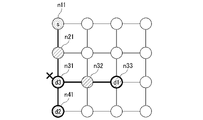
- FIG. 5 is a diagram showing a third operating state when the requests according to the present embodiment arrive sequentially.
- the state of FIG. 5 is an operating state of the difference obtained by the multicast tree design unit 41 from the state of FIG. 4 with a request for the third end point d3 as the node n31. Further, the state of FIG. 5 is a state in which a node exceeding the maximum number of branches has occurred.
- the multicast tree design unit 41 checks the number of branches every time a tree is constructed. In this state, the node n31 distributes the data transmitted from the node n11 toward its own node, the node n32, and the node n41. Therefore, the number of branches of the node n31 is 3. In this case, the maximum of two constraints per node are not satisfied.
- FIG. 6 is a diagram showing a fourth operating state when the requests according to the present embodiment arrive sequentially.
- the state of FIG. 6 is a state in which the Steiner tree is reconstructed so as to satisfy the condition from the state of FIG.
- the multicast tree design unit 41 increases the link cost between the node n31 (third end point) exceeding the maximum number of branches and the second end point d2 (node n41) closest to the node n31. Then, the Steiner tree is constructed again so that the branch does not occur (dashed line g1).
- the route to the end point d2 is in the order of node n11 to node n21, node n21 to node n31, node n31 to node n32, node n32 to node n42, and node n42 to node n41.
- the multicast tree design unit 41 newly constructs a Steiner tree at the start and end points of existing and new arrivals when there is a new request, and ends the process when there is no new request.
- FIGS. 3 to 6 have described an example in which the maximum number of branches per node is 2, the maximum number of branches may be 3 or more depending on the application.
- the link cost will be described.
- the link cost for example, the link distance (fiber length) held in the network topology management unit is used.
- the multicast tree design unit 41 sets a value sufficiently larger than those (for example, when the maximum value of the link distance is 100, the cost is multiplied by 100, etc.).
- the data of the Steiner tree constructed at the time of searching the multicast tree will be described.
- the Steiner tree data is defined by a set of via links (or nodes).
- the route search process is closed to the communication route search device 4, and communication with the actual node does not occur.
- the communication path search device 4 sets each device when actually setting the optical multicast tree based on the search result.
- Multicast is a route design from one start point to a plurality of end points. Therefore, multicast is not always the shortest path. Further, the subject to be designed and managed is not a node such as a transmitter / receiver, but a remote device (communication path search device 4, optical path design device 1, etc.).
- the maximum number of branches per node is determined by the device specifications of the wavelength selection switch. For example, the number of branches of a node using the same wavelength selection switch has the same maximum number of branches.
- the information on the maximum number of branches is held by the network device information management unit 43.
- the calculation of the link cost is determined by, for example, the distance of the link (fiber).
- the distance information of the link is held by the network topology management unit 42.
- the management means is an example and is arbitrary, and may be, for example, a database or a text file.
- FIG. 7 is a flowchart of a processing procedure when requests according to the present embodiment arrive sequentially.
- the multicast tree design unit 41 determines whether there is a new request (step S1). When there is a new request (step S1; YES), the multicast tree design unit 41 proceeds to the process of step S2. If there is no new request (step S1; NO), the multicast tree design unit 41 ends the process.
- the multicast tree design unit 41 builds a Steiner tree with new requests and existing requests (step S2).
- the multicast tree design unit 41 determines whether there are more nodes in the Steiner tree than the maximum number of branches (step S3). When the Steiner tree has more nodes than the maximum number of branches (step S3; YES), the multicast tree design unit 41 proceeds to the process of step S4. If the Steiner tree does not have more nodes than the maximum number of branches (step S3; NO), the multicast tree design unit 41 returns to the process of step S1.
- the multicast tree design unit 41 increases the link cost between the node having more branches than the maximum number of branches and the end point node having the lowest link cost from the corresponding node (step S4). After the processing, the multicast tree design unit 41 returns to the processing of step S2.
- the Steiner tree is reconstructed every time a request is acquired, and the link is changed based on the link cost when each node of the reconstructed Steiner tree exceeds the maximum number of branches.
- a Steiner tree that satisfies the constraint (for example, the maximum number of branches of the wavelength selection switch (WSS)) is used. Can be built.
- FIG. 8 is a flowchart of a processing procedure when a plurality of requests according to the present embodiment are collectively processed.
- the multicast tree design unit 41 constructs a Steiner tree from a request set (step S11).
- the multicast tree design unit 41 determines whether there are more nodes in the Steiner tree than the maximum number of branches (step S12). When the Steiner tree has more nodes than the maximum number of branches (step S12; YES), the multicast tree design unit 41 proceeds to the process of step S13. When the Steiner tree does not have more nodes than the maximum number of branches (step S12; NO), the multicast tree design unit 41 ends the process.
- the multicast tree design unit 41 increases the link cost between the node having more branches than the maximum number of branches and the end point node having the lowest link cost from the corresponding node (step S13). After the processing, the multicast tree design unit 41 returns to the processing of step S11.
- a Steiner tree is constructed by all requests, and when each node of the constructed Steiner tree exceeds the maximum number of branches, the link is changed based on the link cost.
- a Steiner tree that satisfies the constraint (for example, the maximum number of branches of the wavelength selection switch (WSS)) can be constructed by changing the link weight when a link that does not satisfy the constraint of the number of branches occurs. ..
- the Steiner tree refers to the smallest tree in a network (graph) consisting of a subset containing transmit and receive nodes.
- There are multiple algorithms for constructing a Steiner tree such as a method of constructing by sequentially connecting the shortest paths calculated from the transmitting node to each receiving node, or between transmitting and receiving nodes for a known algorithm, the spanning tree.
- the Steiner tree that satisfies the restriction can be constructed by changing the link weight.
- the network is an example of an optical network, but the network is not limited to the optical network and may be another network. Further, in each of the above-described embodiments, an example in which the maximum number of branches is predetermined has been described, but the present invention is not limited to this.
- the communication path search device 4 may acquire constraint information such as the maximum number of branches together with the request, for example. Further, in each of the above-described embodiments, the device constraint has described an example of the maximum number of branches of a node, but the present invention is not limited to this.
- the present invention can be applied to the construction of a network such as an optical network when the node has a contract or the like.
- Optical path design device 1 ... Optical path design device, 2 ... Optical path design unit, 3 ... Optical path information management unit, 4 ... Communication path search device, 41 ... Multicast tree design unit, 42 ... Network topology management unit, 43 ... Network device information management unit
Landscapes
- Engineering & Computer Science (AREA)
- Computer Networks & Wireless Communication (AREA)
- Signal Processing (AREA)
- Data Exchanges In Wide-Area Networks (AREA)
Priority Applications (3)
| Application Number | Priority Date | Filing Date | Title |
|---|---|---|---|
| JP2022561249A JP7485990B2 (ja) | 2020-11-16 | 2020-11-16 | 通信経路探索装置、通信経路探索方法、及びプログラム |
| PCT/JP2020/042637 WO2022102134A1 (ja) | 2020-11-16 | 2020-11-16 | 通信経路探索装置、通信経路探索方法、及びプログラム |
| US18/034,288 US12445371B2 (en) | 2020-11-16 | 2020-11-16 | Communication path finding device, communication path finding method, and program |
Applications Claiming Priority (1)
| Application Number | Priority Date | Filing Date | Title |
|---|---|---|---|
| PCT/JP2020/042637 WO2022102134A1 (ja) | 2020-11-16 | 2020-11-16 | 通信経路探索装置、通信経路探索方法、及びプログラム |
Publications (1)
| Publication Number | Publication Date |
|---|---|
| WO2022102134A1 true WO2022102134A1 (ja) | 2022-05-19 |
Family
ID=81602398
Family Applications (1)
| Application Number | Title | Priority Date | Filing Date |
|---|---|---|---|
| PCT/JP2020/042637 Ceased WO2022102134A1 (ja) | 2020-11-16 | 2020-11-16 | 通信経路探索装置、通信経路探索方法、及びプログラム |
Country Status (3)
| Country | Link |
|---|---|
| US (1) | US12445371B2 (https=) |
| JP (1) | JP7485990B2 (https=) |
| WO (1) | WO2022102134A1 (https=) |
Cited By (1)
| Publication number | Priority date | Publication date | Assignee | Title |
|---|---|---|---|---|
| WO2024236810A1 (ja) * | 2023-05-18 | 2024-11-21 | 日本電信電話株式会社 | 光パス設計装置、光パス設計方法、および、光パス設計プログラム |
Families Citing this family (1)
| Publication number | Priority date | Publication date | Assignee | Title |
|---|---|---|---|---|
| CN116800667A (zh) * | 2023-06-21 | 2023-09-22 | 电子科技大学长三角研究院(湖州) | 一种适用于Mesh网络多播规划的直线斯坦纳树编解码方法 |
Citations (2)
| Publication number | Priority date | Publication date | Assignee | Title |
|---|---|---|---|---|
| JP2006527541A (ja) * | 2003-06-06 | 2006-11-30 | 松下電器産業株式会社 | 静的高密度マルチキャスト経路及び帯域管理 |
| JP2010074657A (ja) * | 2008-09-19 | 2010-04-02 | Nippon Telegr & Teleph Corp <Ntt> | 光通信ノード装置 |
Family Cites Families (39)
| Publication number | Priority date | Publication date | Assignee | Title |
|---|---|---|---|---|
| JPH10117215A (ja) | 1996-08-22 | 1998-05-06 | Furukawa Electric Co Ltd:The | ネットワーク間接続方法及びその装置 |
| WO2000038228A1 (fr) * | 1998-12-22 | 2000-06-29 | Fujitsu Limited | Appareil et procede de cablage brute et support d'enregistrement conservant un programme de cablage brute |
| DE19945663A1 (de) | 1999-09-23 | 2001-04-05 | Siemens Ag | Internet-Telefonadapter |
| US6678524B1 (en) | 2000-05-31 | 2004-01-13 | Telefonaktiebolaget Lm Ericsson (Publ) | Bearer selection in a mobile communication system having both circuit-switched and packet-switched bearers |
| JP4095325B2 (ja) | 2002-03-29 | 2008-06-04 | キヤノン株式会社 | 画像配信方法およびその動作処理を実行するプログラムおよびそのプログラムを記憶した記憶媒体、および画像配信装置および画像受信装置 |
| JP4458767B2 (ja) | 2003-04-16 | 2010-04-28 | エボリウム・エス・アー・エス | 携帯電話システム |
| JP3937337B2 (ja) | 2003-08-15 | 2007-06-27 | 日本電信電話株式会社 | 配信レート制御方法及びシステム |
| KR20060088939A (ko) | 2005-02-02 | 2006-08-07 | 삼성전자주식회사 | 광 네트워크에서의 광채널 할당시스템 및 그 방법 |
| US20070079307A1 (en) | 2005-09-30 | 2007-04-05 | Puneet Dhawan | Virtual machine based network carriers |
| US7822065B2 (en) | 2007-01-07 | 2010-10-26 | Wei Lu | Open wireless architecture (OWA) medium access control (MAC) processing architecture for future mobile terminal |
| US20080235361A1 (en) | 2007-03-21 | 2008-09-25 | David Crosbie | Management layer method and apparatus for dynamic assignment of users to computer resources |
| JP5164628B2 (ja) | 2008-03-24 | 2013-03-21 | 株式会社日立製作所 | ネットワークスイッチ装置、サーバシステム及びサーバシステムにおけるサーバ移送方法 |
| TW201007574A (en) | 2008-08-13 | 2010-02-16 | Inventec Corp | Internet server system and method of constructing and starting a virtual machine |
| EP2175607A1 (en) | 2008-10-08 | 2010-04-14 | NEC Corporation | Method for establishing a thin client session |
| US20110126197A1 (en) | 2009-11-25 | 2011-05-26 | Novell, Inc. | System and method for controlling cloud and virtualized data centers in an intelligent workload management system |
| US9141420B2 (en) | 2010-11-04 | 2015-09-22 | Alcatel Lucent | Overload control in a cloud computing environment |
| US9785478B1 (en) | 2010-11-12 | 2017-10-10 | Vmware, Inc. | Mass migration of desktop deployments to virtual desktop infrastructures |
| WO2013003327A1 (en) | 2011-06-27 | 2013-01-03 | University Of Massachusetts | Dynamic advance reservation with delayed allocation |
| US9461881B2 (en) | 2011-09-30 | 2016-10-04 | Commvault Systems, Inc. | Migration of existing computing systems to cloud computing sites or virtual machines |
| US8719534B1 (en) | 2012-03-21 | 2014-05-06 | Netapp, Inc. | Method and system for generating a migration plan |
| KR101384934B1 (ko) | 2012-06-29 | 2014-04-14 | 인텔렉추얼디스커버리 주식회사 | 모바일 노드의 이동을 처리하기 위한 방법 및 장치 |
| EP2687982A1 (en) | 2012-07-16 | 2014-01-22 | NTT DoCoMo, Inc. | Hierarchical system for managing a plurality of virtual machines, method and computer program |
| US20140181984A1 (en) | 2012-12-21 | 2014-06-26 | International Business Machines Corporation | Method and apparatus for authentication of solution topology |
| US9069608B2 (en) | 2013-03-06 | 2015-06-30 | Vmware, Inc. | Method and system for providing a roaming remote desktop |
| EP3041311B1 (en) | 2013-08-26 | 2023-10-04 | Nec Corporation | Communication apparatus and method in communication system, and communication path control apparatus and method |
| JP6001516B2 (ja) | 2013-09-24 | 2016-10-05 | 株式会社日立製作所 | 通信システム及び通信装置 |
| US20150363219A1 (en) | 2014-03-14 | 2015-12-17 | Avni Networks Inc. | Optimization to create a highly scalable virtual netork service/application using commodity hardware |
| US9780909B2 (en) * | 2014-12-29 | 2017-10-03 | Juniper Networks, Inc. | Network topology optimization with feasible optical paths |
| US9146769B1 (en) | 2015-04-02 | 2015-09-29 | Shiva Shankar | Systems and methods for copying a source machine to a target virtual machine |
| US20170235737A1 (en) | 2016-02-12 | 2017-08-17 | Nutanix, Inc. | Entity database ranking |
| US10785144B2 (en) | 2016-12-30 | 2020-09-22 | Equinix, Inc. | Latency equalization |
| US11089105B1 (en) | 2017-12-14 | 2021-08-10 | Pure Storage, Inc. | Synchronously replicating datasets in cloud-based storage systems |
| US10929195B2 (en) | 2017-08-07 | 2021-02-23 | Dynavisor, Inc. | Method and system for cloud virtualization |
| US10855537B2 (en) | 2018-04-24 | 2020-12-01 | Vmware, Inc. | Methods and apparatus for template driven infrastructure in virtualized server systems |
| EP3564687B1 (en) | 2018-05-03 | 2023-02-22 | Siemens Aktiengesellschaft | Determination of power transmission line parameters using asynchronous measurements |
| US10904136B2 (en) * | 2018-08-06 | 2021-01-26 | Telefonaktiebolaget Lm Ericsson (Publ) | Multicast distribution tree versioning for minimizing multicast group traffic disruption |
| CN111416794B (zh) | 2019-01-08 | 2022-07-29 | 华为技术有限公司 | 一种数据传输方法及电子设备 |
| US11301407B2 (en) | 2019-01-08 | 2022-04-12 | Intel Corporation | Technologies for accelerator fabric protocol multipathing |
| US11496404B2 (en) | 2019-06-27 | 2022-11-08 | Google Llc | Congestion control for low latency datacenter networks |
-
2020
- 2020-11-16 US US18/034,288 patent/US12445371B2/en active Active
- 2020-11-16 JP JP2022561249A patent/JP7485990B2/ja active Active
- 2020-11-16 WO PCT/JP2020/042637 patent/WO2022102134A1/ja not_active Ceased
Patent Citations (2)
| Publication number | Priority date | Publication date | Assignee | Title |
|---|---|---|---|---|
| JP2006527541A (ja) * | 2003-06-06 | 2006-11-30 | 松下電器産業株式会社 | 静的高密度マルチキャスト経路及び帯域管理 |
| JP2010074657A (ja) * | 2008-09-19 | 2010-04-02 | Nippon Telegr & Teleph Corp <Ntt> | 光通信ノード装置 |
Non-Patent Citations (1)
| Title |
|---|
| YING LIU, JIANPING WU, KE XU, MINGWEI XU: "The degree-constrained multicasting algorithm using ant algorithm", TELECOMMUNICATIONS, 2003. ICT 2003. 10TH INTERNATIONAL CONFERENCE ON FEB. 23 - MAR. 1, 2003, PISCATAWAY, NJ, USA,IEEE, vol. 1, 23 February 2003 (2003-02-23) - 1 March 2003 (2003-03-01), pages 370 - 374, XP010637834, ISBN: 978-0-7803-7661-8, DOI: 10.1109/ICTEL.2003.1191257 * |
Cited By (1)
| Publication number | Priority date | Publication date | Assignee | Title |
|---|---|---|---|---|
| WO2024236810A1 (ja) * | 2023-05-18 | 2024-11-21 | 日本電信電話株式会社 | 光パス設計装置、光パス設計方法、および、光パス設計プログラム |
Also Published As
| Publication number | Publication date |
|---|---|
| JPWO2022102134A1 (https=) | 2022-05-19 |
| US12445371B2 (en) | 2025-10-14 |
| US20250016089A1 (en) | 2025-01-09 |
| JP7485990B2 (ja) | 2024-05-17 |
Similar Documents
| Publication | Publication Date | Title |
|---|---|---|
| US11316607B2 (en) | Machine learning techniques for selecting paths in multi-vendor reconfigurable optical add/drop multiplexer networks | |
| US8538260B2 (en) | Wavelength selection | |
| JP5918376B2 (ja) | 光配信ネットワーク管理方法及びシステム | |
| EP1533941B1 (en) | Availability aware cost modeling for optical core networks | |
| CN101459469B (zh) | 网元设备的光层业务调度方法及网管控制系统 | |
| US20170093705A1 (en) | Systems and methods for latency based routing | |
| US8737836B2 (en) | Apparatus and method for setting an optical path in an optical network | |
| WO2022102134A1 (ja) | 通信経路探索装置、通信経路探索方法、及びプログラム | |
| EP1769600B1 (en) | Path establishment | |
| JP5639550B2 (ja) | パス再配置方法及び装置 | |
| JP6637911B2 (ja) | ネットワーク設計装置、ネットワーク設計方法およびネットワーク設計処理プログラム | |
| JP2017098894A (ja) | ネットワーク管理装置、復旧手順決定方法及びプログラム | |
| JP7787471B2 (ja) | 制御システム、制御装置、ネットワーク装置、制御方法及びプログラム | |
| JP7787470B2 (ja) | 制御システム、制御装置、ネットワーク装置、制御方法及びプログラム | |
| JP7723324B2 (ja) | 信号伝送システム及び信号伝送方法 | |
| JP7780114B2 (ja) | 光パス設計装置、光パス設計方法およびプログラム | |
| Wnuk et al. | Multi-objective Optimization in Optical Networks | |
| da Costa Freitas | Designing Ultra-High Bandwidth Optical Networks Using Machine Learning Techniques | |
| WO2025253538A1 (ja) | 情報処理装置、情報処理方法、及びプログラム | |
| JP2003023447A (ja) | 光チャネル設定方法および光チャネル設定装置ならびにノードの構成方法 | |
| Skorin-Kapov et al. | Heuristic algorithms considering various objectives for virtual topology design in WDM optical networks | |
| WO2018181031A1 (ja) | 光パス設計装置および光パス設計方法 | |
| Din et al. | Survivable Virtual Topology Reconfiguration Problem on WDM Networks with Reconfiguration Constraint | |
| KR20100059320A (ko) | 스파스-스플리팅 광 네트워크에서의 멀티캐스팅 라우팅 방법 |
Legal Events
| Date | Code | Title | Description |
|---|---|---|---|
| ENP | Entry into the national phase |
Ref document number: 2022561249 Country of ref document: JP Kind code of ref document: A |
|
| WWE | Wipo information: entry into national phase |
Ref document number: 18034288 Country of ref document: US |
|
| NENP | Non-entry into the national phase |
Ref country code: DE |
|
| 122 | Ep: pct application non-entry in european phase |
Ref document number: 20961657 Country of ref document: EP Kind code of ref document: A1 |
|
| WWG | Wipo information: grant in national office |
Ref document number: 18034288 Country of ref document: US |