WO2022091995A1 - シス型アスタキサンチンを含む機能性食品用組成物 - Google Patents
シス型アスタキサンチンを含む機能性食品用組成物 Download PDFInfo
- Publication number
- WO2022091995A1 WO2022091995A1 PCT/JP2021/039214 JP2021039214W WO2022091995A1 WO 2022091995 A1 WO2022091995 A1 WO 2022091995A1 JP 2021039214 W JP2021039214 W JP 2021039214W WO 2022091995 A1 WO2022091995 A1 WO 2022091995A1
- Authority
- WO
- WIPO (PCT)
- Prior art keywords
- astaxanthin
- cis
- type
- composition
- composition according
- Prior art date
- Legal status (The legal status is an assumption and is not a legal conclusion. Google has not performed a legal analysis and makes no representation as to the accuracy of the status listed.)
- Ceased
Links
Images



Classifications
-
- A—HUMAN NECESSITIES
- A23—FOODS OR FOODSTUFFS; TREATMENT THEREOF, NOT COVERED BY OTHER CLASSES
- A23K—FODDER
- A23K20/00—Accessory food factors for animal feeding-stuffs
- A23K20/10—Organic substances
- A23K20/179—Colouring agents, e.g. pigmenting or dyeing agents
-
- A—HUMAN NECESSITIES
- A23—FOODS OR FOODSTUFFS; TREATMENT THEREOF, NOT COVERED BY OTHER CLASSES
- A23K—FODDER
- A23K50/00—Feeding-stuffs specially adapted for particular animals
- A23K50/70—Feeding-stuffs specially adapted for particular animals for birds
- A23K50/75—Feeding-stuffs specially adapted for particular animals for birds for poultry
-
- A—HUMAN NECESSITIES
- A23—FOODS OR FOODSTUFFS; TREATMENT THEREOF, NOT COVERED BY OTHER CLASSES
- A23L—FOODS, FOODSTUFFS OR NON-ALCOHOLIC BEVERAGES, NOT OTHERWISE PROVIDED FOR; PREPARATION OR TREATMENT THEREOF
- A23L33/00—Modifying nutritive qualities of foods; Dietetic products; Preparation or treatment thereof
- A23L33/10—Modifying nutritive qualities of foods; Dietetic products; Preparation or treatment thereof using additives
-
- A—HUMAN NECESSITIES
- A61—MEDICAL OR VETERINARY SCIENCE; HYGIENE
- A61K—PREPARATIONS FOR MEDICAL, DENTAL OR TOILETRY PURPOSES
- A61K31/00—Medicinal preparations containing organic active ingredients
- A61K31/12—Ketones
- A61K31/122—Ketones having the oxygen directly attached to a ring, e.g. quinones, vitamin K1, anthralin
-
- A—HUMAN NECESSITIES
- A61—MEDICAL OR VETERINARY SCIENCE; HYGIENE
- A61K—PREPARATIONS FOR MEDICAL, DENTAL OR TOILETRY PURPOSES
- A61K8/00—Cosmetics or similar toiletry preparations
- A61K8/18—Cosmetics or similar toiletry preparations characterised by the composition
- A61K8/30—Cosmetics or similar toiletry preparations characterised by the composition containing organic compounds
- A61K8/33—Cosmetics or similar toiletry preparations characterised by the composition containing organic compounds containing oxygen
- A61K8/35—Ketones, e.g. benzophenone
-
- A—HUMAN NECESSITIES
- A61—MEDICAL OR VETERINARY SCIENCE; HYGIENE
- A61P—SPECIFIC THERAPEUTIC ACTIVITY OF CHEMICAL COMPOUNDS OR MEDICINAL PREPARATIONS
- A61P27/00—Drugs for disorders of the senses
- A61P27/02—Ophthalmic agents
-
- A—HUMAN NECESSITIES
- A61—MEDICAL OR VETERINARY SCIENCE; HYGIENE
- A61P—SPECIFIC THERAPEUTIC ACTIVITY OF CHEMICAL COMPOUNDS OR MEDICINAL PREPARATIONS
- A61P27/00—Drugs for disorders of the senses
- A61P27/02—Ophthalmic agents
- A61P27/12—Ophthalmic agents for cataracts
-
- A—HUMAN NECESSITIES
- A61—MEDICAL OR VETERINARY SCIENCE; HYGIENE
- A61Q—SPECIFIC USE OF COSMETICS OR SIMILAR TOILETRY PREPARATIONS
- A61Q19/00—Preparations for care of the skin
- A61Q19/02—Preparations for care of the skin for chemically bleaching or whitening the skin
Definitions
- the present invention relates to a functional food composition containing cis-type astaxanthin.
- Carotenoids are natural pigments that are widely present in nature, and astaxanthin, adonylbin, adonixanthin, zeaxanthin, ⁇ -cryptoxanthin and the like are known as one type of carotenoid. These carotenoids are known to have various physiological actions, and are expected to be used as foods, pharmaceuticals, and the like. Carotenoids exert their physiological effects by being absorbed and accumulated in each tissue in the body. Therefore, various reports on the absorption and accumulation of carotenoids have been made (Non-Patent Documents 1 to 3).
- Non-Patent Document 1 describes the amount of astaxanthin accumulated in each organ when three types of feeds having different mixing ratios of astaxanthin are prepared and each of them is fed to rats for 14 days.
- Non-Patent Document 2 compares the accumulation of lycopene isomers (trans or cis) in the liver of mice, and in the cis-type lycopene-administered group, the lycopene concentration in the liver is higher than that of the trans-type-administered group. Is also stated to be three times higher.
- Non-Patent Document 3 evaluates the absorbability and accumulation of astaxanthin in a geometric isomer (trans or cis) or optical isomer in rainbow trout, and the trans / cis mixed feed is more suitable than the trans / cis mixed feed.
- a geometric isomer trans or cis
- optical isomer in rainbow trout
- astaxanthin levels in blood, liver and intestines are high.
- Non-Patent Document 1 the administered astaxanthin is a chemically synthesized product, and basically the ratio of trans form is large, and the functionality of cis-type astaxanthin has not been evaluated.
- the difference in absorption and accumulation in the body due to the isomer of astaxanthin is not described.
- Non-Patent Document 2 The results described in Non-Patent Document 2 are the results of tests on lycopene, and do not describe astaxanthin. In addition, the only organ evaluated was the liver, and no mention was made of differences in accumulation due to isomers in other organs.
- Non-Patent Document 3 The results described in Non-Patent Document 3 are evaluation results for rainbow trout (fish), and the differences in accumulation, absorption, and functionality due to isomers of terrestrial organisms including mammals are not stated.
- the astaxanthin being compared is trans-type astaxanthin (cis-form ratio 3%) and trans / cis-mixed astaxanthin (cis-form ratio 36%). It is lower than trans-type astaxanthin.
- the present invention is as follows. (1) A composition for a functional food containing at least 20% of cis-type astaxanthin with respect to all astaxanthin. (2) A feed composition containing at least 20% of cis-type astaxanthin with respect to all astaxanthin. (3) The composition according to (1) or (2), wherein the cis-type astaxanthin is 13Z-astaxanthin and / or 15Z-astaxanthin. (4) Any one of (1) to (3), wherein the accumulated amount of cis-type astaxanthin in the target tissue or organ when used for food or external use is at least 10 times as much as that of trans-type astaxanthin. The composition according to the section.
- composition according to (4) wherein the target tissue or target organ is at least one selected from the group consisting of lung, prostate, skin, eye, blood, adrenal gland, intestine, and testis.
- the composition according to any one of (1) to (5) which is used for sunscreen or whitening.
- the composition according to any one of (1) to (5) which is used for prevention or amelioration of eye strain or eye disease.
- the composition according to (7), wherein the eye disease is keratitis, pterygium, cataract or macular degeneration.
- the composition according to any one of (1) to (5) which is used for improving heat stress tolerance.
- the composition according to any one of (1) to (5) which is used for improving the reproduction rate.
- the composition according to (4), wherein the target tissue or target organ is an egg.
- the present invention includes the following aspects.
- a sunscreen or whitening agent containing cis-type astaxanthin or a pharmaceutically acceptable salt thereof are examples of sunscreen or whitening agent containing cis-type astaxanthin or a pharmaceutically acceptable salt thereof.
- a sun protection method or a whitening method comprising administering to a mammal cis-type astaxanthin or a pharmaceutically acceptable salt thereof.
- An agent for preventing or ameliorating eye strain or eye disease which comprises cis-type astaxanthin or a pharmaceutically acceptable salt thereof.
- a method for preventing or ameliorating eye strain or eye disease which comprises administering cis-type astaxanthin or a pharmaceutically acceptable salt thereof to a mammal.
- a composition for a functional food containing cis-type astaxanthin is provided.
- cis-type astaxanthin containing an increased proportion of cis-form contained in the composition of the present invention absorption into the body is improved as compared with trans-type, and high accumulation is exhibited in a specific tissue. It can be expected to have a better effect than the trans-type astaxanthin.
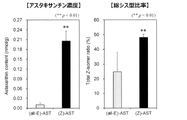
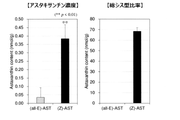
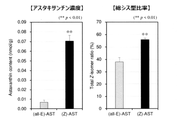
- the UV-A region is 320 nm to 400 nm, and the UV-B region is 280 to 315 nm. It is a figure which shows the accumulation amount and the isomer ratio (after 14 days) of astaxanthin in an eye. It is a figure which shows the accumulation amount of astaxanthin in plasma and the isomer ratio (after 14 days). It is a figure which shows the accumulation amount of astaxanthin in an adrenal gland, and the isomer ratio (after 14 days). It is a figure which shows the accumulation amount of astaxanthin in the testis and the isomer ratio (after 14 days).
- the present invention relates to a functional food composition, a feed composition or a pharmaceutical composition containing cis-type astaxanthin. It is known that the pharmacokinetics of astaxanthin in animals depends on its isomer. Astaxanthin with different isomer ratios was administered to animals and evaluated for absorption and accumulation in the body. Astaxanthin for cis type was more effective than trans type for lung, prostate, skin, eye, plasma, adrenal gland and testis. It became clear that the accumulation was significantly high. Astaxanthin has attracted particular attention for its effects on eye strain, nephropathy, and skin-beautifying effects, and it has been found that cis-type astaxanthin exhibits high accumulation in the sites involved in them.
- composition of the present invention contains cis-type astaxanthin, or a pharmaceutically acceptable salt thereof. However, the composition of the present invention may partially contain a trans form of astaxanthin.
- the structure of astaxanthin is composed of a polyene chain consisting of nine conjugated double bonds in the center and end groups (terminal groups) attached to both ends thereof, and when the carbon skeleton to be the polyene chain is attached to the same side. It becomes a cis-type and a trans-type geometric isomer on the opposite side.
- the case where the carbon skeleton is arranged in the cis type is represented by Z
- the case where the carbon skeleton is arranged in the trans type is represented by E
- the positions thereof are represented by numbers.
- the upper part of the structural formula shown below represents (13Z) -astaxanthin (the carbon at the 13th position is the cis type), and the lower part represents (9Z) -astaxanthin (the carbon at the 9th position is the cis type).
- “All-E” means that all double bonds are trans type.
- the composition of the present invention contains at least 20% of cis-type astaxanthin based on the mass (100%) of all astaxanthin in the composition, and the lower limit is 20% or more, 30% or more, 40% or more. Includes 50% or more, 55% or more or 60% or more.
- the upper limit is 100% or less, 90% or less, 80% or less, 75% or less, 70% or less, or 65% or less.
- the content of the entire composition of cis-type astaxanthin is referred to as "cis-form ratio" or simply "cis ratio”.
- the composition of the present invention is 20 to 100% in one embodiment and 20 to 100% in another aspect when the mass of the entire composition is used as a reference. It is 20-90%, and in yet another embodiment, it contains, for example, 80%.
- cis-type astaxanthin is 20 to 100%, 20 to 90%, 20 to 80% or 20 to 70% in another embodiment, and 20 to 60% in yet another embodiment. ..
- the composition of the present invention can be a commercially available product or can be produced by a conventional chemical synthesis method. Further, it may be produced by chemically synthesizing or mixing naturally-derived astaxanthin within the above composition range. When feeding to humans, astaxanthin derived from a natural product is more preferable from the viewpoint of safety.
- a naturally derived composition produced by a fermentation method using microorganisms, an extraction and purification method from animals, plants and the like can be used.
- astaxanthin produced by extraction and purification from a microorganism belonging to the genus Paracoccus (Paracoccus), for example, Paracoccus carotinifaciens or the like can be used as a component in the composition of the present invention.
- the composition of the present invention can be produced, for example, according to the method described in JP2012-158569A. Specifically, dried cells of Paracoccus carotinifaciens are subjected to room temperature extraction using acetone, the extract is concentrated by an evaporator, and when the concentrate is separated into two layers, it becomes a concentrate. A hexane-chloroform (1: 1) mixture is added and mixed well, and then a liquid separation operation is performed to obtain an organic solvent layer. The organic solvent layer is concentrated to dryness with an evaporator. The concentrated dry matter is dissolved in chloroform, and astaxanthin is separated on a silica gel column. For example, the astaxanthin free form can be obtained as crystals by concentrating the fraction eluted with acetone: hexane (5: 5) and leaving it at 4 ° C.
- the cis conversion rate can be increased by subjecting the composition to a cis conversion conversion treatment.
- heat treatment may be performed.
- the heat treatment may be carried out in a solvent such as ethyl acetate, ethanol or acetone.
- the treatment for adjusting the cis-type astaxanthin content is not limited to the heat treatment, and may be a light irradiation treatment, a treatment using a catalyst that promotes the cis isomerization reaction, or the like.
- a separation method using the difference in solubility between trans-type and cis-type astaxanthin can also be used.
- Confirmation that astaxanthin is cis-type in the composition of the present invention can be performed, for example, by HPLC or the like.
- the cis-type astaxanthin may be in the form of a pharmaceutically acceptable salt, and these salts are also included in the composition in the present invention.
- the pharmaceutically acceptable salt is not particularly limited as long as it forms a pharmaceutically acceptable salt with astaxanthin, and is, for example, a halide hydride (for example, a fluorinated hydride).
- Hydrochloride, hydrobromide, hydroiodide, etc. inorganic salts (eg, sulfates, nitrates, perchlorates, phosphates, carbonates, bicarbonates, etc.), organic carboxylates (For example, acetate, oxalate, maleate, tartrate, fumarate, citrate, etc.), organic sulfonates (eg, methanesulfonate, trifluoromethanesulfonate, ethanesulfonate, benzenesulfonate, etc.) Acid salts, toluene sulfonates, camphor sulfonates, etc.), amino acid salts (eg, asparagate, glutamate, etc.), quaternary amine salts, alkali metal salts (eg, sodium salts, potassium salts, etc.), alkaline earth metals Examples thereof include salts (for example, magnesium salts, calcium salts, etc.).
- the composition of the present invention can be added or encapsulated in any form such as tablets, capsules, granules, powders, tablets, jellies, gummies, gums, drinks, PET bottles, etc., or added to any food or drink. It can be a food composition.
- the "food composition” includes a solid composition as well as a liquid composition for drinking.
- Food compositions include, for example, confectionery (jelly, yogurt, pudding, biscuits and cookies, chocolate, candy, cakes, ice cream, chewing gum), retort foods, soups, beverages (juices, teas, jelly beverages, powders).
- composition of the present invention can be used as a functional food (including health foods and supplements) in the form of the above-mentioned food or beverage.
- the dose of the composition of the present invention can be appropriately changed depending on factors such as the ingestor's age, weight, gender, and condition.
- the daily intake of the composition of the present invention is 0.001 to 100 mg, preferably 0.005 to 70 mg, more preferably 0.01 to 50 mg, per day for an adult weighing 60 kg in terms of cis-type astaxanthin. It is more preferably 0.1 to 20 mg, but is not limited to this range. If necessary, the above intake may be divided into once or several times, for example, 2 to 3 times a day.
- the composition of the present invention can be used as animal feed.
- the target animal is not particularly limited, but is, for example, a non-human mammal or an oviparous animal.
- non-human mammals include, but are not limited to, domestic animals or rabbits (cattle, horses, sheep, goats, pigs, wild boars, deer, rabbits, etc.).
- ovarian animals include birds (chicken, quail, turkey, ostrich, pheasant, pigeon, duck, geese and other poultry), fish and shellfish (salmon, trout, shrimp, crab, etc.), but are limited to these. It is not something that is done.
- the amount added to the feed is, for example, 0.1 ppm to 500 ppm (mass%), preferably 0.5 ppm to 100 ppm, more preferably 0.5 ppm to 100 ppm, based on the total feed. Is 1 ppm to 50 ppm.
- the composition of the present invention is highly absorbed into target tissues or organs such as blood, liver, kidney, adrenal gland, intestine, lung, prostate, testis, skin and eye when used for human consumption or external use, for example. Shows sex and accumulation. In particular, it exhibits high absorbency and accumulation for lung, prostate, skin, eye, blood (plasma), adrenal gland and testis. Further, when the composition of the present invention is used for food or external use in non-human mammals, it exhibits high absorbability and accumulation in the above-mentioned target tissues or organs, and also aims at improving heat stress resistance and reproductive rate. Can be. Heat stress is thought to adversely affect productivity and physiological function by causing an increase in body temperature of animals (livestock, etc.). An increase in body temperature not only causes a decrease in feed intake and a decrease in daily weight gain, but also increases oxidative stress in the body and adversely affects physiological functions such as hormone secretion, resulting in a decrease in fertility.
- Improving the reproductive rate means improving at least one of fertilization rate (conception rate), implantation rate, and pregnancy rate, and preventing or preventing embryonic dysgenesis. As a result, it is possible to prevent an extension of the number of empty fetal days, a decrease in the initial conception rate, and the like, and contribute to the improvement of dairy farming or livestock performance.
- the composition of the present invention can be used for such heat stress and improvement of reproductive rate.
- the composition of the present invention when the composition of the present invention is edible as a feed for birds and fish, it exhibits high absorbability and accumulation in eggs as well as the above-mentioned target tissues or organs. In this case, it is useful for improving the color of egg yolk and fortifying egg yolk. Color improvement includes improving yellow from orange to red-orange.
- fortification of egg yolk includes stabilization of nutritional components contained in egg yolk and enhancement of antioxidant effect. For example, it stabilizes and decomposes vitamins (vitamins A, D, E, K, B6, B12, folic acid, pantetonic acid, biotin, etc.), fatty acids (saturated or polyvalent or monovalent unsaturated fatty acids), cholesterol, etc. in egg yolk. It can be suppressed.
- the accumulated amount (absorption) of cis-type astaxanthin in these target tissues or organs is at least 10 times (for example, 10 times, 12 times, 14 times, 16 times, 18 times, 20 times, 22 times) that of the trans type. , 24 times, 26 times, 28 times, 30 times, 32 times, 34 times, 36 times, 38 times, 40 times).
- the composition of the present invention has a high accumulation amount of cis-type astaxanthin in the target tissue or the target organ when it is used for food or external use.
- the composition of the present invention has higher absorption of cis-type astaxanthin in the target tissue or target organ than the trans-type.
- the absorbability of the 13Z isomer (13Z-astaxanthin) or the 15Z isomer (15Z-astaxanthin) of astaxanthin is high.
- Lycopene is known to have high absorbency of 5Z isomers and 9Z isomers, but the absorbency of cis-type astaxanthin in the present invention is different from that of lycopene, and the absorbency of 13Z and 15Z isomers is high. It is characteristic in that it is particularly high.
- the composition of the present invention may contain both the 13Z isomer and the 15Z isomer, or may contain only one of them.
- the content ratio (% by mass) of the 13Z isomer is 10% to 70%, preferably 20% to 60%, based on the total amount of astaxanthin in the composition.
- the content ratio (% by mass) of the 15Z isomer is 1% to 20%, preferably 2% to 18%, and more preferably 3 to 15% with respect to the total astaxanthin in the composition.
- composition of the present invention is useful as a food composition or a pharmaceutical composition for the prevention or treatment of diseases in the above-mentioned target tissues or organs.
- the following are examples of uses of the composition of the present invention in each tissue.
- Blood Arteriosclerosis, blood flow improvement, etc.
- Liver Hepatitis, liver cirrhosis, NAFLD (non-alcoholic fatty liver disease), etc.
- Kidney Nephropathy, etc.
- Adrenal Adrenal fatigue, etc.
- Prosthesis Prostatic hypertrophy, etc.
- Kidney Improvement of sperm count, etc.
- Skin Sunscreen, whitening, improvement of wrinkles, etc.
- Additives include, for example, solubilizers, lubricants, tonics, stabilizers, preservatives, antioxidants, surfactants, sweeteners, seasonings, emulsifiers, suspending agents, preservatives, and additives. Shapers, thickeners, disintegrants, colorants, fragrances and the like can be added.
- the dosage form of the composition of the present invention is not particularly limited, and may be a preparation generally produced for oral administration or parenteral administration.
- tablets eg, naked tablets, sugar-coated tablets, film-coated tablets, enteric coated tablets, sustained-release tablets, orally disintegrating tablets, sublingual tablets, chewable tablets, etc.
- capsules eg, hard capsules, soft capsules, etc.
- Capsules elixirs, rounds, powders, powders, granules, troches, syrups, dry syrups, etc.
- injections intravenous drip, subcutaneous, intramuscular, etc.
- drips examples thereof include agents, emulsions, inhalants, aerosols, suppositories, ointments, creams, gels, patches, bops, lotions, eye ointments, eye drops, nasal drops and the like.
- prevention or treatment of a disease in the above-mentioned target tissue means to improve the disease or the symptom caused by the disease by medical or non-medical practice, and to prepare for the expected deterioration in advance. It includes the act of preventing the occurrence or recurrence of symptoms caused by it.
- treatment means to improve the disease or the symptom caused by the disease by medical practice. Improvement includes stopping, alleviating, or delaying the development or exacerbation of the disease or condition.
- the cis-type astaxanthin-containing composition used in the examples was produced by the following method. Astaxanthin produced according to the method described in Japanese Patent Application Laid-Open No. 2012-158569 was subjected to cis conversion treatment. Specifically, astaxanthin powder was dissolved in dichloromethane, heated at 80 ° C. for 3 hours, and then the solvent was removed by an evaporator. Further, it was redissolved in ethanol, separated by a filter, and then the solvent was removed again to obtain a cis-type astaxanthin-containing composition.
- the produced cis-type astaxanthin was suspended in soybean oil to form a cis-type astaxanthin composition (concentration: 10 mg / mL), and stored frozen in a dark place until use (-20 ° C.).
- the cis-type astaxanthin composition is simply referred to as "cis-type astaxanthin”.
- the trans-type astaxanthin composition (simply referred to as “trans-type astaxanthin”) was produced according to the method described in JP2012-158569.
- Trans-type astaxanthin (cis ratio 0.3%) or cis-type astaxanthin (cis ratio 80.8%) was administered to rats (SD rats, males, 7 weeks old) at a dose of 10 mg / kg body weight / day for 14 days. It was administered orally continuously. After the final administration, various tissues (blood, liver, kidney, adrenal gland, lung, prostate, testis, skin, eye, cerebral cortex) were collected and the amount of astaxanthin accumulated in each tissue was analyzed.
- FIG. 1 shows the amount of astaxanthin accumulated in the lung and the isomer ratio (after 14 days).
- the lung astaxanthin concentration in the cis-type administration group was 36.7 times that in the trans-type administration group, indicating that it accumulates in the lung at a high concentration.
- Table 1 shows the ratio (%) of each cis form accumulated in the lung.
- FIG. 2 shows the amount of astaxanthin accumulated in the prostate and the isomer ratio (after 14 days).
- the concentration of astaxanthin in the prostate of the cis-type administration group was 18.8 times that of the trans-type administration group, indicating that it accumulates in the prostate at a high concentration.
- Table 2 shows the ratio (%) of each cis form accumulated in the prostate.
- FIG. 3 shows the amount of astaxanthin accumulated in the skin and the isomer ratio (after 14 days).
- the concentration of astaxanthin in the skin of the cis-type administration group was 12.2 times that of the trans-type administration group, indicating that it accumulates in the skin at a high concentration.
- Table 3 shows the ratio of each cis form accumulated in the skin.
- the upper panel is the absorption spectrum of trans-type astaxanthin
- the lower panel is the absorption spectrum of cis-type astaxanthin.
- the absorption wavelength peculiar to the cis type for UV-A (wavelength: 320 nm to 400 nm) was observed. This result shows that the composition of the present invention is useful as a sunscreen (so-called "drinking sunscreen").
- FIG. 5 shows the amount of astaxanthin accumulated in the eye and the isomer ratio (after 14 days).
- Table 4 shows the ratio (%) of each cis form accumulated in the eye.
- Astaxanthin was detected in the eye in the cis-type administration group, but not in the trans-type administration group.
- FIG. 6 shows the amount of astaxanthin accumulated in plasma and the isomer ratio (after 14 days).
- the plasma astaxanthin concentration in the cis-type administration group was 67.4 times that in the trans-type administration group, indicating that it accumulates in plasma at a high concentration.
- Table 5 shows the ratio (%) of each cis form accumulated in plasma.
- FIG. 7 shows the amount of astaxanthin accumulated in the adrenal gland and the isomer ratio (after 14 days).
- the concentration of astaxanthin in the adrenal gland of the cis-type administration group was 10.8 times that of the trans-type administration group, indicating that it accumulates in the adrenal gland at a high concentration.
- Table 6 shows the ratio (%) of each cis form accumulated in the adrenal gland.
- FIG. 8 shows the amount of astaxanthin accumulated in the testis and the isomer ratio (after 14 days).
- the astaxanthin concentration in the testis of the cis-type administration group was 10.3 times that of the trans-type administration group, indicating that it accumulates in the testis at a high concentration.
- Table 7 shows the ratio (%) of each cis form accumulated in the testis.
- Astaxanthin is known to have eye strain, improvement of nephropathy, and skin-beautifying effect. Since it was shown that cis-type astaxanthin has high accumulation in the eye and skin in the present invention, the composition of the present invention can be used for eyestrain or eye diseases (eg, keratitis, pterygium, cataract or macular degeneration). It is useful for the prevention or improvement of illness) and as a sunscreen.
- eyestrain or eye diseases eg, keratitis, pterygium, cataract or macular degeneration
Landscapes
- Health & Medical Sciences (AREA)
- Life Sciences & Earth Sciences (AREA)
- Chemical & Material Sciences (AREA)
- Veterinary Medicine (AREA)
- General Health & Medical Sciences (AREA)
- Public Health (AREA)
- Engineering & Computer Science (AREA)
- Animal Behavior & Ethology (AREA)
- Polymers & Plastics (AREA)
- Pharmacology & Pharmacy (AREA)
- Ophthalmology & Optometry (AREA)
- Food Science & Technology (AREA)
- Birds (AREA)
- Medicinal Chemistry (AREA)
- General Chemical & Material Sciences (AREA)
- Organic Chemistry (AREA)
- Nuclear Medicine, Radiotherapy & Molecular Imaging (AREA)
- Animal Husbandry (AREA)
- Zoology (AREA)
- Chemical Kinetics & Catalysis (AREA)
- Bioinformatics & Cheminformatics (AREA)
- Epidemiology (AREA)
- Mycology (AREA)
- Nutrition Science (AREA)
- Emergency Medicine (AREA)
- Dermatology (AREA)
- Acyclic And Carbocyclic Compounds In Medicinal Compositions (AREA)
Abstract
【課題】機能性食品用組成物の提供。 【解決手段】シス型アスタキサンチンを含む、機能性食品用組成物。
Description
本発明は、シス型アスタキサンチンを含む機能性食品用組成物に関する。
カロテノイドは、自然界に広く存在する天然色素であり、カロテノイドの一種としてアスタキサンチン、アドニルビン、アドニキサンチン、ゼアキサンチン、β-クリプトキサンチン等が知られている。これらのカロテノイドには各種生理作用を有することが知られており、食品、医薬品等としての用途が期待されている。
カロテノイドは、体内の各組織に吸収及び蓄積されることにより、その生理作用が発揮される。このため、カロテノイドの吸収や蓄積に関する各種報告がなされている(非特許文献1~3)。
カロテノイドは、体内の各組織に吸収及び蓄積されることにより、その生理作用が発揮される。このため、カロテノイドの吸収や蓄積に関する各種報告がなされている(非特許文献1~3)。
非特許文献1には、アスタキサンチンの混合比率が異なる3種類の飼料を調製し、それぞれをラットに14日間給餌させたときの各臓器におけるアスタキサンチン蓄積量について記載されている。
非特許文献2には、リコペンの異性体(トランス体又はシス体)によるマウスの肝臓への蓄積性を比較しており、シス型リコペン投与群では、肝臓中のリコペン濃度がトランス型投与群よりも3倍高いことが記載されている。
非特許文献2には、リコペンの異性体(トランス体又はシス体)によるマウスの肝臓への蓄積性を比較しており、シス型リコペン投与群では、肝臓中のリコペン濃度がトランス型投与群よりも3倍高いことが記載されている。
非特許文献3には、アスタキサンチンの幾何異性体(トランス体又はシス体)又は光学異性体のニジマスにおける体内吸収性・蓄積性を評価しており、トランス/シス混合飼料より、トランス体飼料の方が、血中、肝臓および腸でのアスタキサンチン濃度が高いことが記載されている。
しかしながら、非特許文献1では、投与されたアスタキサンチンは化学合成品であり、基本的にトランス体の比率が多く、シス型アスタキサンチンの機能性は評価されていない。また、アスタキサンチンの異性体による体内吸収性や蓄積性の相違については述べられていない。
非特許文献2に記載の結果は、リコペンについて試験された結果であり、アスタキサンチンについて記載されていない。また、評価された臓器は肝臓のみであり、他の臓器での異性体による蓄積性の相違については言及されていない。
非特許文献3に記載の結果は、ニジマス(魚類)での評価結果であり、哺乳類を含む陸上生物についての異性体による蓄積性、吸収性、機能性の違いは述べられていない。また、比較しているアスタキサンチンはトランス型アスタキサンチン(シス体比率3%)とトランス/シス混合型アスタキサンチン(シス体比率36%)であり、比較対象である混合型アスタキサンチンの吸収性及び蓄積性は、トランス型アスタキサンチンに比べて低い。
Dietrich P, Anne-Katrine L. Tissue distribution of astaxanthin in rats following exposure to graded levels in the feed. Comp Biochem Physiol C 145(2007)202-209
Z-isomers od lycopene exhibit greater liver accumulation than the all-E-isomer in mice. Biosci. Biotechnol. Biochem. 2020Feb;84(2):428-431
Accumulation of Astaxanthin all-E, 9Z and 13Z Geometrical Isomers and 3 and 3’ RS Optical Isomers in Rainbow Trout (Oncortynchus mykiss) is Selective. J. Nutr. 129:391-398, 1999.
上記のことから、体内における吸収及び蓄積性に優れ、機能性食品として有用なアスタキサンチンを開発することが求められていた。
本発明者は、上記課題を解決するために鋭意検討を行った結果、シス型アスタキサンチンが機能性食品用組成物として有用であることを見出し、本発明を完成するに至った。
すなわち、本発明は以下の通りである。
(1)シス型アスタキサンチンを、全アスタキサンチンに対し少なくとも20%含む、機能性食品用組成物。
(2)シス型アスタキサンチンを、全アスタキサンチンに対し少なくとも20%含む、飼料用組成物。
(3)シス型アスタキサンチンが、13Z-アスタキサンチン及び/又は15Z-アスタキサンチンである(1)又は(2)に記載の組成物。
(4)食用又は外用に供したときの対象組織又は対象臓器におけるシス型アスタキサンチンの蓄積量が、トランス型アスタキサンチンに対して少なくとも10倍の量である、(1)~(3)のいずれか1項に記載の組成物。
(5)前記対象組織又は対象臓器が、肺、前立腺、皮膚、眼、血液、副腎、腸、及び精巣からなる群から選ばれる少なくとも1種である、(4)に記載の組成物。
(6)日焼け止め又は美白のために使用される、(1)~(5)のいずれか1項に記載の組成物。
(7)眼精疲労又は眼疾患の予防又は改善のために使用される、(1)~(5)のいずれか1項に記載の組成物。
(8)前記眼疾患が、角膜炎、翼状片、白内障又は黄斑変性症である、(7)に記載の組成物。
(9)暑熱ストレス耐性向上のために使用される、(1)~(5)のいずれか1項に記載の組成物。
(10)繁殖率向上のために使用される、(1)~(5)のいずれか1項に記載の組成物。
(11)前記対象組織又は対象臓器が卵である、(4)に記載の組成物。
(12)卵黄の色味改善又は卵黄の栄養強化のために使用される、(11)に記載の組成物。
(13)(1)、及び(3)~(8)のいずれか1項に記載の組成物を含む、機能性食品。
(14)(2)~(5)、及び(9)~(12)のいずれか1項に記載の組成物を含む、飼料。
さらに、本発明は以下の態様を含む。
(15)シス型アスタキサンチン、又はその薬学的に許容される塩を含む医薬組成物。
(16)シス型アスタキサンチン、又はその薬学的に許容される塩を含む、日焼け防止剤又は美白剤。
(17)シス型アスタキサンチン、又はその薬学的に許容される塩を哺乳動物に投与することを含む、日焼け防止方法又は美白方法。
(18)シス型アスタキサンチン、又はその薬学的に許容される塩を含む、眼精疲労又は眼疾患の予防又は改善剤。
(19)シス型アスタキサンチン、又はその薬学的に許容される塩を哺乳動物に投与することを含む、眼精疲労又は眼疾患の予防又は改善方法。
(20)日焼け防止又は美白用における使用のための、シス型アスタキサンチン又はその薬学的に許容される塩。
(1)シス型アスタキサンチンを、全アスタキサンチンに対し少なくとも20%含む、機能性食品用組成物。
(2)シス型アスタキサンチンを、全アスタキサンチンに対し少なくとも20%含む、飼料用組成物。
(3)シス型アスタキサンチンが、13Z-アスタキサンチン及び/又は15Z-アスタキサンチンである(1)又は(2)に記載の組成物。
(4)食用又は外用に供したときの対象組織又は対象臓器におけるシス型アスタキサンチンの蓄積量が、トランス型アスタキサンチンに対して少なくとも10倍の量である、(1)~(3)のいずれか1項に記載の組成物。
(5)前記対象組織又は対象臓器が、肺、前立腺、皮膚、眼、血液、副腎、腸、及び精巣からなる群から選ばれる少なくとも1種である、(4)に記載の組成物。
(6)日焼け止め又は美白のために使用される、(1)~(5)のいずれか1項に記載の組成物。
(7)眼精疲労又は眼疾患の予防又は改善のために使用される、(1)~(5)のいずれか1項に記載の組成物。
(8)前記眼疾患が、角膜炎、翼状片、白内障又は黄斑変性症である、(7)に記載の組成物。
(9)暑熱ストレス耐性向上のために使用される、(1)~(5)のいずれか1項に記載の組成物。
(10)繁殖率向上のために使用される、(1)~(5)のいずれか1項に記載の組成物。
(11)前記対象組織又は対象臓器が卵である、(4)に記載の組成物。
(12)卵黄の色味改善又は卵黄の栄養強化のために使用される、(11)に記載の組成物。
(13)(1)、及び(3)~(8)のいずれか1項に記載の組成物を含む、機能性食品。
(14)(2)~(5)、及び(9)~(12)のいずれか1項に記載の組成物を含む、飼料。
さらに、本発明は以下の態様を含む。
(15)シス型アスタキサンチン、又はその薬学的に許容される塩を含む医薬組成物。
(16)シス型アスタキサンチン、又はその薬学的に許容される塩を含む、日焼け防止剤又は美白剤。
(17)シス型アスタキサンチン、又はその薬学的に許容される塩を哺乳動物に投与することを含む、日焼け防止方法又は美白方法。
(18)シス型アスタキサンチン、又はその薬学的に許容される塩を含む、眼精疲労又は眼疾患の予防又は改善剤。
(19)シス型アスタキサンチン、又はその薬学的に許容される塩を哺乳動物に投与することを含む、眼精疲労又は眼疾患の予防又は改善方法。
(20)日焼け防止又は美白用における使用のための、シス型アスタキサンチン又はその薬学的に許容される塩。
本発明により、シス型アスタキサンチンを含む機能性食品用組成物が提供される。本発明の組成物に含まれるシス体比率を高めたシス型アスタキサンチンを摂取することで、トランス型よりも体内吸収性が向上し、特定の組織で高い蓄積性を示すことから、蓄積部位において従来のトランス型アスタキサンチンよりも優れた効能が期待できる。
本発明は、シス型アスタキサンチンを含む、機能性食品用組成物、飼料用組成物又は医薬組成物に関する。
動物におけるアスタキサンチンの体内動態は、その異性体によって異なることが知られている。今回、異性体比率の異なるアスタキサンチンを動物に投与し、体内吸収性と蓄積性を評価した結果、トランス型よりシス型アスタキサンチンの方が、肺、前立腺、皮膚、眼、血漿、副腎及び精巣への蓄積性が有意に高いことが明らかとなった。アスタキサンチンの効能は、眼精疲労や腎症改善、美肌作用等が特に注目されており、シス型アスタキサンチンはそれらに関与する部位に高い蓄積性を示すことを見出した。
動物におけるアスタキサンチンの体内動態は、その異性体によって異なることが知られている。今回、異性体比率の異なるアスタキサンチンを動物に投与し、体内吸収性と蓄積性を評価した結果、トランス型よりシス型アスタキサンチンの方が、肺、前立腺、皮膚、眼、血漿、副腎及び精巣への蓄積性が有意に高いことが明らかとなった。アスタキサンチンの効能は、眼精疲労や腎症改善、美肌作用等が特に注目されており、シス型アスタキサンチンはそれらに関与する部位に高い蓄積性を示すことを見出した。
本発明の組成物は、シス型アスタキサンチン、又はその薬学的に許容される塩を含む。但し、本発明の組成物には、アスタキサンチンのトランス型を一部に含んでいてもよい。
ここで、アスタキサンチンの構造は、中央に9個の共役二重結合からなるポリエン鎖とその両端に付くエンドグループ(末端基)から構成されており、ポリエン鎖となる炭素骨格が同じ側につくとシス型、反対側につくとトランス型の幾何異性体となる。本明細書においては、炭素骨格の配置がシス型の場合をZ、トランス型の場合をEとして表し、その位置を番号で表す。例えば、下記に示す構造式の上は(13Z)-アスタキサンチンを表し(13位の炭素がシス型)、下は(9Z)-アスタキサンチン(9位の炭素がシス型)を表す。他の位置のシス型についても、同様に表記する。なお、「All-E」は二重結合がすべてトランス型であることを表す。

本発明の組成物は、シス型アスタキサンチンを、当該組成物中の全アスタキサンチンの質量(100%)を基準として、少なくとも20%を含み、下限値として20%以上、30%以上、40%以上、50%以上、55%以上又は60%以上含む。また、上限値として100%以下、90%以下、80%以下、75%以下、70%以下、又は65%以下の割合で含む。本発明においては、シス型アスタキサンチンの組成物全体の含有率を「シス体比率」又は単に「シス比率」という。
シス体比率の下限値及び上限値は任意に組み合わせることができ、例えば、本発明の組成物は、組成物全体の質量を基準とする場合は、一態様では20~100%、別の態様では20~90%であり、さらに別の態様では例えば80%を含有する。
このうち、シス型アスタキサンチンは、全アスタキサンチンに対して20~100%、別の態様では20~90%、20~80%又は20~70%であり、さらに別の態様では20~60%である。
このうち、シス型アスタキサンチンは、全アスタキサンチンに対して20~100%、別の態様では20~90%、20~80%又は20~70%であり、さらに別の態様では20~60%である。
本発明の組成物は、市販品を用いることができ、あるいは従来の化学合成法により製造することができる。また、化学合成又は天然由来のアスタキサンチンを上記組成の範囲内で混合することにより製造されたものであってもよい。ヒトに摂食させる場合には、安全性の観点から、天然物由来のアスタキサンチンであることがより好ましい。
本発明の組成物は、微生物による発酵法、又は動物や植物等からの抽出及び精製方法等により製造された天然由来のものを使用することができる。例えば、本発明の組成物中の成分として、パラコッカス属(Paracoccus)に属する微生物、例えば、パラコッカス・カロティニファシエンス(Paracoccus carotinifaciens)等から抽出および精製により製造したアスタキサンチンを使用することができる。
本発明の組成物は、微生物による発酵法、又は動物や植物等からの抽出及び精製方法等により製造された天然由来のものを使用することができる。例えば、本発明の組成物中の成分として、パラコッカス属(Paracoccus)に属する微生物、例えば、パラコッカス・カロティニファシエンス(Paracoccus carotinifaciens)等から抽出および精製により製造したアスタキサンチンを使用することができる。
本発明の組成物は、例えば特開2012-158569号公報に記載の方法に準じて製造することができる。具体的には、パラコッカス・カロティニファシエンス(Paracoccus carotinifaciens)の乾燥菌体を、アセトンを使用する室温抽出に供し、抽出液をエバポレーターで濃縮し、濃縮液が二層に分離したところで濃縮物にヘキサン-クロロホルム(1:1)混合液を加えて良く混和した後、分液操作により有機溶媒層を得る。前記有機溶媒層をエバポレーターで濃縮乾固する。濃縮乾固物をクロロホルムに溶解し、シリカゲルカラムにてアスタキサンチンを分離する。例えばアセトン:ヘキサン(5:5)で溶出する画分を濃縮し、4℃で放置することで、アスタキサンチン遊離体を結晶として得ることができる。
本発明の組成物は、シス型アスタキサンチンをそのまま用いることができるが、当該組成物に対しシス化変換処理を施すことにより、シス化率を高めることができる。上記アスタキサンチンをシス型に変換するには、例えば、熱処理をすればよい。熱処理は、酢酸エチル、エタノール、アセトン等の溶媒中で実施してもよい。なお、シス型アスタキサンチン含有率を調製するための処理は、熱処理に限られず、光照射処理やシス異性化反応を促進する触媒を用いた処理等であってもよい。さらに、シス型アスタキサンチン含有率を高度に高める手法としては、トランス型とシス型アスタキサンチンの溶解度の差を利用した分離法等を行うこともできる。
本発明の組成物中、アスタキサンチンがシス型であることの確認は、例えばHPLC等により行うことができる。
本発明の組成物中、アスタキサンチンがシス型であることの確認は、例えばHPLC等により行うことができる。
また本発明において、シス型アスタキサンチンは、薬学的に許容可能な塩の形態であってもよく、これらの塩も本発明に組成物に含まれる。本発明において、薬学的に許容可能な塩は、アスタキサンチンと薬学的に許容可能な塩を形成するものであれば特に限定されるものではなく、例えばハロゲン化水素酸塩(例えばフッ化水素酸塩、塩酸塩、臭化水素酸塩、ヨウ化水素酸塩等)、無機酸塩(例えば硫酸塩、硝酸塩、過塩素酸塩、リン酸塩、炭酸塩、重炭酸塩等)、有機カルボン酸塩(例えば酢酸塩、シュウ酸塩、マレイン酸塩、酒石酸塩、フマル酸塩、クエン酸塩等)、有機スルホン酸塩(例えばメタンスルホン酸塩、トリフルオロメタンスルホン酸塩、エタンスルホン酸塩、ベンゼンスルホン酸塩、トルエンスルホン酸塩、カンファースルホン酸塩等)、アミノ酸塩(例えばアスパラギン酸塩、グルタミン酸塩等)、四級アミン塩、アルカリ金属塩(例えばナトリウム塩、カリウム塩等)、アルカリ土類金属塩(例えばマグネシウム塩、カルシウム塩等)等が挙げられる。
本発明の組成物は、錠剤、カプセル、顆粒、粉末、タブレット、ゼリー、グミ、ガム、ドリンク、ペットボトル等の任意の形態に添加または封入するか、あるいは任意の飲食品に添加することで、食品組成物とすることができる。本発明において、「食品組成物」には、固形組成物のほか、飲用のための液体組成物が含まれる。
食品組成物は、例えば、菓子類(ゼリー、ヨーグルト、プリン、ビスケットやクッキー類、チョコレート、キャンディ、ケーキ、アイスクリーム、チューインガム)、レトルト食品、スープ、飲料(ジュース類、お茶類、ゼリー飲料、粉末飲料、炭酸飲料、スポーツ飲料等)、乳製品等、油脂食品(マヨネーズ、ドレッシング、バター等)、調味料(ケチャップ、ソース等)、パン類、又は麺類(うどん、そば、ラーメン、パスタ等)の食品又は飲料に含めることができる。但し、食品及び飲料は上記したものに限定されるものではない。
本発明の組成物は、上記食品又は飲料の形態で、機能性食品(健康食品、サプリメントを含む)として使用することができる。
食品組成物は、例えば、菓子類(ゼリー、ヨーグルト、プリン、ビスケットやクッキー類、チョコレート、キャンディ、ケーキ、アイスクリーム、チューインガム)、レトルト食品、スープ、飲料(ジュース類、お茶類、ゼリー飲料、粉末飲料、炭酸飲料、スポーツ飲料等)、乳製品等、油脂食品(マヨネーズ、ドレッシング、バター等)、調味料(ケチャップ、ソース等)、パン類、又は麺類(うどん、そば、ラーメン、パスタ等)の食品又は飲料に含めることができる。但し、食品及び飲料は上記したものに限定されるものではない。
本発明の組成物は、上記食品又は飲料の形態で、機能性食品(健康食品、サプリメントを含む)として使用することができる。
本発明の組成物の用量は、摂取者の年齢、体重、性別、状態等の要因によって適宜変更することができる。例えば、本発明の組成物の1日当たりの摂取量は、シス型アスタキサンチン換算で体重60kgの成人1日当たり、0.001~100mg、好ましくは0.005~70mg、より好ましくは0.01~50mg、さらに好ましくは0.1~20mgであるが、この範囲に限定されるものではない。必要に応じて、上記摂取量を1日あたり1回又は数回、例えば2~3回に分けて分割摂取することもできる。
さらに、本発明の組成物は、動物の飼料として使用することができる。
対象となる動物は特に限定されるものではないが、例えば非ヒト哺乳類又は卵生動物である。非ヒト哺乳類動物としては、例えば家畜又は家兎(ウシ、ウマ、ヒツジ、ヤギ、ブタ、イノシシ、シカ、ウサギ等)が挙げられるが、これらに限定されるものではない。また卵生動物としては、鳥類(ニワトリ、ウズラ、七面鳥、ダチョウ、キジ、ハト、アヒル、ガチョウ等の家禽類)、魚介類(サケ、マス、エビ、カニ等)などが挙げられるが、これらに限定されるものではない。
本発明組成物を飼料添加物として使用する場合には、飼料への添加量は、飼料全体に対して例えば0.1ppm~500ppm(質量%)であり、好ましくは0.5ppm~100ppm、さらに好ましくは1ppm~50ppmである。
対象となる動物は特に限定されるものではないが、例えば非ヒト哺乳類又は卵生動物である。非ヒト哺乳類動物としては、例えば家畜又は家兎(ウシ、ウマ、ヒツジ、ヤギ、ブタ、イノシシ、シカ、ウサギ等)が挙げられるが、これらに限定されるものではない。また卵生動物としては、鳥類(ニワトリ、ウズラ、七面鳥、ダチョウ、キジ、ハト、アヒル、ガチョウ等の家禽類)、魚介類(サケ、マス、エビ、カニ等)などが挙げられるが、これらに限定されるものではない。
本発明組成物を飼料添加物として使用する場合には、飼料への添加量は、飼料全体に対して例えば0.1ppm~500ppm(質量%)であり、好ましくは0.5ppm~100ppm、さらに好ましくは1ppm~50ppmである。
本発明の組成物は、例えばヒトの食用又は外用に供したときに、血液、肝臓、腎臓、副腎、腸、肺、前立腺、精巣、皮膚及び眼などの対象組織又は対象臓器に対して高い吸収性及び蓄積性を示す。特に、肺、前立腺、皮膚、眼、血液(血漿)、副腎及び精巣に対しては、特に高い吸収性及び蓄積性を示す。
また本発明の組成物を非ヒト哺乳動物の食用又は外用に供したときは、上記対象組織又は対象臓器に対して高い吸収性及び蓄積性を示すほか、暑熱ストレス耐性向上や繁殖率向上を目的とすることができる。暑熱ストレスは、動物(家畜等)の体温上昇を引き起こすことで、生産性や生理機能に悪影響を与えると考えられている。体温上昇は飼料の摂取量の減少や日増体量の低下などを引き起こすだけでなく、体内の酸化ストレスを亢進させ、ホルモン分泌等の生理機能に悪影響を与える結果、繁殖能力も低下させる。
また本発明の組成物を非ヒト哺乳動物の食用又は外用に供したときは、上記対象組織又は対象臓器に対して高い吸収性及び蓄積性を示すほか、暑熱ストレス耐性向上や繁殖率向上を目的とすることができる。暑熱ストレスは、動物(家畜等)の体温上昇を引き起こすことで、生産性や生理機能に悪影響を与えると考えられている。体温上昇は飼料の摂取量の減少や日増体量の低下などを引き起こすだけでなく、体内の酸化ストレスを亢進させ、ホルモン分泌等の生理機能に悪影響を与える結果、繁殖能力も低下させる。
繁殖率の向上とは、受精率(受胎率)、着床率、及び妊娠率の少なくとも一つを向上させること、並びに胚の発育不全の予防又は防止を意味する。これにより、空胎日数の延長、初回受胎率の低下などを防止し、酪農又は畜産成績の向上に寄与することができる。
本発明の組成物は、このような暑熱ストレス及び繁殖率向上のために使用することができる。
本発明の組成物は、このような暑熱ストレス及び繁殖率向上のために使用することができる。
さらに、本発明の組成物を鳥類や魚類の飼料として食用に供したときは、上記対象組織又は対象臓器のほか、卵に対しても高い吸収性及び蓄積性を示す。この場合は、卵黄の色味改善や卵黄の栄養強化に有用である。色味改善は、黄色をオレンジ色~赤橙色に改善することが含まれる。また卵黄の栄養強化は、卵黄に含まれる栄養成分の安定化、抗酸化効果の増強などが含まれる。例えば卵黄中のビタミン(ビタミンA、D、E、K、B6、B12、葉酸、パンテトン酸、ビオチン等)、脂肪酸(飽和又は多価若しくは一価の不飽和脂肪酸)、コレステロールなどを安定化し、分解抑制することができる。
これらの対象組織又は対象臓器におけるシス型アスタキサンチンの蓄積量(吸収性)は、トランス型に対して少なくとも10倍(例えば10倍、12倍、14倍、16倍、18倍、20倍、22倍、24倍、26倍、28倍、30倍、32倍、34倍、36倍、38倍、40倍)の量である。
上記の通り、本発明の組成物は、食用又は外用に供したときに、対象組織又は対象臓器においてシス型アスタキサンチンの蓄積量が高い。言い換えると、本発明の組成物は、対象組織又は対象臓器におけるシス型アスタキサンチンの吸収性がトランス型に対して高いとも言える。特に、アスタキサンチンの13Z異性体(13Z-アスタキサンチン)又は15Z異性体(15Z-アスタキサンチン)の吸収性が高い。リコペンは5Z異性体や9Z異性体の吸収性が高いことが知られているが、本発明におけるシス型アスタキサンチンの吸収性は、リコペンの吸収性とは異なり、13Z及び15Z異性体の吸収性が特に高い点で特徴的である。
本発明の組成物は、13Z異性体及び15Z異性体の両者を含むものでもよく、いずれか一方のみを含むものでもよい。
本発明において、13Z異性体の含有比率(質量%)は、組成物中のアスタキサンチン全体に対し10%~70%、好ましくは20%~60%である。
また、15Z異性体の含有比率(質量%)は、組成物中のアスタキサンチン全体に対し1%~20%、好ましくは2%~18%、さらに好ましくは3~15%である。
本発明において、13Z異性体の含有比率(質量%)は、組成物中のアスタキサンチン全体に対し10%~70%、好ましくは20%~60%である。
また、15Z異性体の含有比率(質量%)は、組成物中のアスタキサンチン全体に対し1%~20%、好ましくは2%~18%、さらに好ましくは3~15%である。
本発明の組成物は、上記対象組織又は対象臓器における疾患の予防又は治療用の食品用組成物又は医薬組成物として有用である。例えば、本発明の組成物の各組織における用途として以下のものが挙げられる。
血液:動脈硬化、血流改善など
肝臓:肝炎、肝硬変、NAFLD(非アルコール性脂肪性肝疾患)など
腎臓:腎症など
副腎:副腎疲労など
腸:腸内細菌叢の改善、免疫賦活など
肺:肺気腫など
前立腺:前立腺肥大症など
精巣:精子数改善など
皮膚:日焼け止め、美白、しわ改善など
眼:眼精疲労、眼疾患(角膜炎、翼状片、白内障又は黄斑変性症など)など
肝臓:肝炎、肝硬変、NAFLD(非アルコール性脂肪性肝疾患)など
腎臓:腎症など
副腎:副腎疲労など
腸:腸内細菌叢の改善、免疫賦活など
肺:肺気腫など
前立腺:前立腺肥大症など
精巣:精子数改善など
皮膚:日焼け止め、美白、しわ改善など
眼:眼精疲労、眼疾患(角膜炎、翼状片、白内障又は黄斑変性症など)など
本発明の組成物を食品用組成物又は医薬組成物として使用する場合には、必要に応じて経口上許容可能な、又は薬学的に許容可能な添加剤をさらに含めることができる。添加剤としては、例えば溶解剤、滑沢剤、等張化剤、安定化剤、保存料、抗酸化剤、界面活性剤、甘味料、調味料、乳化剤、懸濁化剤、防腐剤、賦形剤、増粘剤、崩壊剤、着色料、香料等を添加することができる。
本発明の組成物の剤形は、特に限定されるものではなく、経口投与用又は非経口投与用として一般的に製造される製剤とすることができる。例えば、経口投与では、錠剤(例えば、裸錠、糖衣錠、フィルムコーティング錠、腸溶錠、徐放錠、口腔内崩壊錠、舌下錠、チュアブル錠等)、カプセル剤(例えば、硬カプセル、軟カプセル)、エリキシル剤、丸剤、粉剤、散剤、顆粒剤、トローチ剤、シロップ剤、ドライシロップ剤等が挙げられ、非経口投与では、注射剤(点滴静注、皮下注、筋肉注射等)、点滴剤、乳剤、吸入剤、エアロゾル剤、坐剤、軟膏、クリーム剤、ゲル剤、貼付剤、バップ剤、ローション剤、眼軟膏剤、点眼剤、点鼻剤等が挙げられる。
ここで、上記対象組織における疾患の予防又は治療において、「予防」は、疾患又はそれに起因する症状を医療行為又は非医療行為により改善するとともに、想定される悪化に対して事前に備え、疾患又はそれに起因する症状の発生又は再発を未然に防ぐ行為を含む。また、「治療」は、疾患又はそれに起因する症状を医療行為により改善することをいう。改善には、上記疾患又は症状の進展又は悪化を止め、緩和し、又は遅延させることを包含する。
実施例
以下、実施例により本発明をさらに具体的に説明する。但し、本発明の範囲はこれらの実施例により限定されるものではない。
[製造例]
実施例に使用するシス型アスタキサンチン含有組成物は以下の方法により製造した。
特開2012-158569号公報に記載の方法に準じて製造したアスタキサンチンにシス化変換処理を施した。具体的には、アスタキサンチン粉末をジクロロメタンに溶解、80℃で3時間加熱後、エバポレーターで溶媒を除去した。さらに、エタノールに再溶解し、フィルター分離後、再び溶媒除去することにより、シス型アスタキサンチン含有組成物を得た。
以下、実施例により本発明をさらに具体的に説明する。但し、本発明の範囲はこれらの実施例により限定されるものではない。
[製造例]
実施例に使用するシス型アスタキサンチン含有組成物は以下の方法により製造した。
特開2012-158569号公報に記載の方法に準じて製造したアスタキサンチンにシス化変換処理を施した。具体的には、アスタキサンチン粉末をジクロロメタンに溶解、80℃で3時間加熱後、エバポレーターで溶媒を除去した。さらに、エタノールに再溶解し、フィルター分離後、再び溶媒除去することにより、シス型アスタキサンチン含有組成物を得た。
製造されたシス型アスタキサンチンは大豆油に懸濁させてシス型アスタキサンチン組成物とし(濃度10mg/mL)、使用まで暗所で冷凍保存した(-20℃)。以下、シス型アスタキサンチン組成物を単に「シス型アスタキサンチン」という。
なお、トランス型アスタキサンチン組成物(単に「トランス型アスタキサンチン」という)は、特開2012-158569号公報に記載の方法に準じて製造した。
なお、トランス型アスタキサンチン組成物(単に「トランス型アスタキサンチン」という)は、特開2012-158569号公報に記載の方法に準じて製造した。
[方法]
ラット(SDラット、オス、7週齢)に対して、トランス型アスタキサンチン(シス比率0.3%)又はシス型アスタキサンチン(シス比率80.8%)を投与量10mg/kg体重/dayで14日間連続経口投与した。
最終投与後に各種組織(血液、肝臓、腎臓、副腎、肺、前立腺、精巣、皮膚、眼、大脳皮質)を採取し、それぞれの組織におけるアスタキサンチン蓄積量を分析した。
ラット(SDラット、オス、7週齢)に対して、トランス型アスタキサンチン(シス比率0.3%)又はシス型アスタキサンチン(シス比率80.8%)を投与量10mg/kg体重/dayで14日間連続経口投与した。
最終投与後に各種組織(血液、肝臓、腎臓、副腎、肺、前立腺、精巣、皮膚、眼、大脳皮質)を採取し、それぞれの組織におけるアスタキサンチン蓄積量を分析した。
[測定結果]
図1は、アスタキサンチンの肺への蓄積量と異性体比率(14日後)を示す。
シス型投与群の肺中アスタキサンチン濃度は、トランス型投与群の36.7倍であり、肺に高濃度で蓄積することが示された。
図1は、アスタキサンチンの肺への蓄積量と異性体比率(14日後)を示す。
シス型投与群の肺中アスタキサンチン濃度は、トランス型投与群の36.7倍であり、肺に高濃度で蓄積することが示された。
肺中に蓄積された各シス体比率(%)を表1に示す。
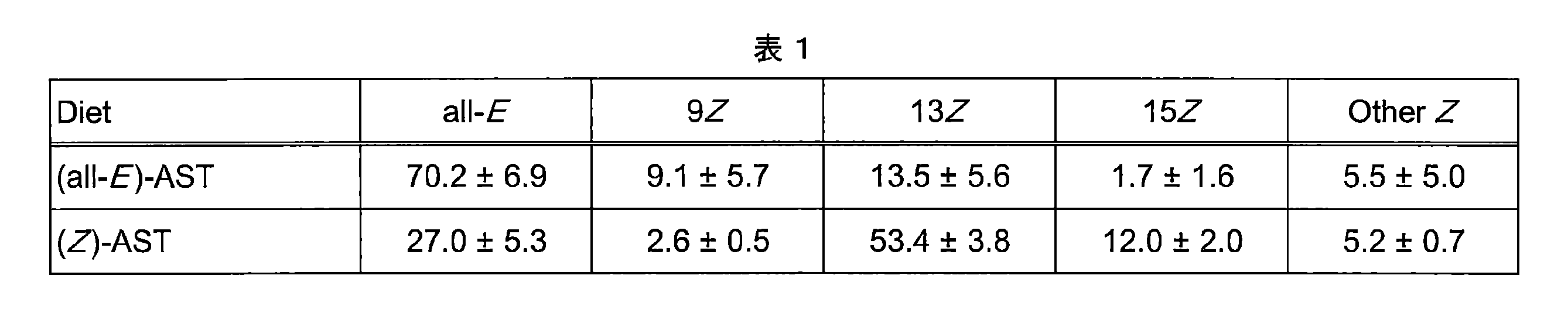
表1において、「Diet」は投与したアスタキサンチン(AST)の種類を表し、「(all-E)-AST」はトランス型アスタキサンチン、「(Z)-AST]はシス型アスタキサンチンである。異性体のうち、「(all-E)」はトランス型、「9Z」は9シス型、「13Z」は13シス型、「15Z」は15シス型を表す。「Other Z」は9Z、13Z及び15Z以外の他のシス型を表す。本実施例において、以下、同様に表記する。
図2は、アスタキサンチンの前立腺への蓄積量と異性体比率(14日後)を示す。
シス型投与群の前立腺中アスタキサンチン濃度は、トランス型投与群の18.8倍であり、前立腺に高濃度で蓄積することが示された。
前立腺中に蓄積された各シス体比率(%)を表2に示す。

シス型投与群の前立腺中アスタキサンチン濃度は、トランス型投与群の18.8倍であり、前立腺に高濃度で蓄積することが示された。
前立腺中に蓄積された各シス体比率(%)を表2に示す。
図3は、アスタキサンチンの皮膚への蓄積量と異性体比率(14日後)を示す。
シス型投与群の皮膚中アスタキサンチン濃度は、トランス型投与群の12.2倍であり、皮膚に高濃度で蓄積することが示された。
皮膚中に蓄積された各シス体比率を表3に示す。

シス型投与群の皮膚中アスタキサンチン濃度は、トランス型投与群の12.2倍であり、皮膚に高濃度で蓄積することが示された。
皮膚中に蓄積された各シス体比率を表3に示す。
また、シス型アスタキサンチン及びトランス型アスタキサンチンの紫外線(470nm)に対する吸収スペクトルを、HPLC(Prominence、島津製作所社製)を用いて測定した。
結果を図4に示す。図4において、上パネルはトランス型アスタキサンチンの吸収スペクトル、下パネルはシス型アスタキサンチンの吸収スペクトルである。
図4下パネルに示す通り、UV-A(波長:320nm~400nm)に対するシス型特有の吸収波長が認められた。この結果は、本発明の組成物が日焼け防止剤(いわゆる「飲む日焼け止め」)として有用であることを示すものである。
図4下パネルに示す通り、UV-A(波長:320nm~400nm)に対するシス型特有の吸収波長が認められた。この結果は、本発明の組成物が日焼け防止剤(いわゆる「飲む日焼け止め」)として有用であることを示すものである。
図5は、アスタキサンチンの眼への蓄積量と異性体比率(14日後)を示す。
眼中に蓄積された各シス体比率(%)を表4に示す。

眼中に蓄積された各シス体比率(%)を表4に示す。
シス型投与群では、眼中にアスタキサンチンが検出されたのに対し、トランス型投与群では検出されなかった。
図6は、アスタキサンチンの血漿への蓄積量と異性体比率(14日後)を示す。
シス型投与群の血漿中アスタキサンチン濃度は、トランス型投与群の67.4倍であり、血漿中に高濃度で蓄積することが示された。
血漿中に蓄積された各シス体比率(%)を表5に示す。

シス型投与群の血漿中アスタキサンチン濃度は、トランス型投与群の67.4倍であり、血漿中に高濃度で蓄積することが示された。
血漿中に蓄積された各シス体比率(%)を表5に示す。
図7は、アスタキサンチンの副腎への蓄積量と異性体比率(14日後)を示す。
シス型投与群の副腎中アスタキサンチン濃度は、トランス型投与群の10.8倍であり、副腎中に高濃度で蓄積することが示された。
副腎中に蓄積された各シス体比率(%)を表6に示す。

シス型投与群の副腎中アスタキサンチン濃度は、トランス型投与群の10.8倍であり、副腎中に高濃度で蓄積することが示された。
副腎中に蓄積された各シス体比率(%)を表6に示す。
図8は、アスタキサンチンの精巣への蓄積量と異性体比率(14日後)を示す。
シス型投与群の精巣中アスタキサンチン濃度は、トランス型投与群の10.3倍であり、精巣中に高濃度で蓄積することが示された。
精巣中に蓄積された各シス体比率(%)を表7に示す。

シス型投与群の精巣中アスタキサンチン濃度は、トランス型投与群の10.3倍であり、精巣中に高濃度で蓄積することが示された。
精巣中に蓄積された各シス体比率(%)を表7に示す。
[まとめ]
アスタキサンチンの体内吸収性及び体内蓄積性は、トランス型よりもシス型の方が高かった。特に、肺、前立腺、皮膚、眼、血液、副腎、精巣への蓄積優位性が非常に高かった(トランス型の10倍以上)。
シス型のうち13シス型及び15シス型は、いずれも体内吸収性及び体内蓄積性が特に高いことが示された。そして、13シス型アスタキサンチンは、皮膚に多く蓄積され、UV-A領域の紫外光を吸収する。
アスタキサンチンの体内吸収性及び体内蓄積性は、トランス型よりもシス型の方が高かった。特に、肺、前立腺、皮膚、眼、血液、副腎、精巣への蓄積優位性が非常に高かった(トランス型の10倍以上)。
シス型のうち13シス型及び15シス型は、いずれも体内吸収性及び体内蓄積性が特に高いことが示された。そして、13シス型アスタキサンチンは、皮膚に多く蓄積され、UV-A領域の紫外光を吸収する。
アスタキサンチンは、眼精疲労や腎症改善、美肌作用などを有することが知られている。本発明において、シス型アスタキサンチンが眼、皮膚への蓄積性が高いことが示されたことから、本発明の組成物は、眼精疲労又は眼疾患(例えば角膜炎、翼状片、白内障又は黄斑変性症)の予防又は改善に有用であり、日焼け止めとして有用である。
Claims (14)
- シス型アスタキサンチンを、全アスタキサンチンに対し少なくとも20%含む、機能性食品用組成物。
- シス型アスタキサンチンを、全アスタキサンチンに対し少なくとも20%含む、飼料用組成物。
- シス型アスタキサンチンが、13Z-アスタキサンチン及び/又は15Z-アスタキサンチンである請求項1又は2に記載の組成物。
- 食用又は外用に供したときの対象組織又は対象臓器におけるシス型アスタキサンチンの蓄積量が、トランス型アスタキサンチンに対して少なくとも10倍の量である、請求項1~3のいずれか1項に記載の組成物。
- 前記対象組織又は対象臓器が、肺、前立腺、皮膚、眼、血液、副腎、腸、及び精巣からなる群から選ばれる少なくとも1種である、請求項4に記載の組成物。
- 日焼け止め又は美白のために使用される、請求項1~5のいずれか1項に記載の組成物。
- 眼精疲労又は眼疾患の予防又は改善のために使用される、請求項1~5のいずれか1項に記載の組成物。
- 前記眼疾患が、角膜炎、翼状片、白内障又は黄斑変性症である、請求項7に記載の組成物。
- 暑熱ストレス耐性向上のために使用される、請求項1~5のいずれか1項に記載の組成物。
- 繁殖率向上のために使用される、請求項1~5のいずれか1項に記載の組成物。
- 前記対象組織又は対象臓器が卵である、請求項4に記載の組成物。
- 卵黄の色味改善又は卵黄の栄養強化のために使用される、請求項11に記載の組成物。
- 請求項1、及び3~8のいずれか1項に記載の組成物を含む、機能性食品。
- 請求項2~5、及び9~12のいずれか1項に記載の組成物を含む、飼料。
Priority Applications (1)
| Application Number | Priority Date | Filing Date | Title |
|---|---|---|---|
| JP2022559105A JPWO2022091995A1 (ja) | 2020-10-26 | 2021-10-25 |
Applications Claiming Priority (2)
| Application Number | Priority Date | Filing Date | Title |
|---|---|---|---|
| JP2020-178754 | 2020-10-26 | ||
| JP2020178754 | 2020-10-26 |
Publications (1)
| Publication Number | Publication Date |
|---|---|
| WO2022091995A1 true WO2022091995A1 (ja) | 2022-05-05 |
Family
ID=81381454
Family Applications (1)
| Application Number | Title | Priority Date | Filing Date |
|---|---|---|---|
| PCT/JP2021/039214 Ceased WO2022091995A1 (ja) | 2020-10-26 | 2021-10-25 | シス型アスタキサンチンを含む機能性食品用組成物 |
Country Status (2)
| Country | Link |
|---|---|
| JP (1) | JPWO2022091995A1 (ja) |
| WO (1) | WO2022091995A1 (ja) |
Cited By (2)
| Publication number | Priority date | Publication date | Assignee | Title |
|---|---|---|---|---|
| JP2023167797A (ja) * | 2022-05-13 | 2023-11-24 | 学校法人 名城大学 | 肌質改善剤 |
| JP2024004404A (ja) * | 2022-06-28 | 2024-01-16 | アニコム ホールディングス株式会社 | フード提案システム及びフード提案方法 |
Citations (6)
| Publication number | Priority date | Publication date | Assignee | Title |
|---|---|---|---|---|
| WO2005011712A1 (en) * | 2003-07-25 | 2005-02-10 | Washington State University Research Foundation | Natural astaxanthin extract reduces dna oxidation |
| JP2010193865A (ja) * | 2009-02-27 | 2010-09-09 | Jx Nippon Oil & Energy Corp | カロテノイドの製造方法 |
| WO2013032333A1 (en) * | 2011-09-01 | 2013-03-07 | Algae Biotech S.L. | Oral dosage units containing astaxanthin, phospholipids and omega-3 fatty acids |
| JP2018510634A (ja) * | 2015-03-19 | 2018-04-19 | ビーエーエスエフ ソシエタス・ヨーロピアBasf Se | アスタキサンチン組成物(i) |
| JP2019017268A (ja) * | 2017-07-12 | 2019-02-07 | Jxtgエネルギー株式会社 | カロテノイド増強剤 |
| WO2021172372A1 (ja) * | 2020-02-26 | 2021-09-02 | Eneos株式会社 | シス型キサントフィル組成物および使用方法 |
-
2021
- 2021-10-25 JP JP2022559105A patent/JPWO2022091995A1/ja active Pending
- 2021-10-25 WO PCT/JP2021/039214 patent/WO2022091995A1/ja not_active Ceased
Patent Citations (6)
| Publication number | Priority date | Publication date | Assignee | Title |
|---|---|---|---|---|
| WO2005011712A1 (en) * | 2003-07-25 | 2005-02-10 | Washington State University Research Foundation | Natural astaxanthin extract reduces dna oxidation |
| JP2010193865A (ja) * | 2009-02-27 | 2010-09-09 | Jx Nippon Oil & Energy Corp | カロテノイドの製造方法 |
| WO2013032333A1 (en) * | 2011-09-01 | 2013-03-07 | Algae Biotech S.L. | Oral dosage units containing astaxanthin, phospholipids and omega-3 fatty acids |
| JP2018510634A (ja) * | 2015-03-19 | 2018-04-19 | ビーエーエスエフ ソシエタス・ヨーロピアBasf Se | アスタキサンチン組成物(i) |
| JP2019017268A (ja) * | 2017-07-12 | 2019-02-07 | Jxtgエネルギー株式会社 | カロテノイド増強剤 |
| WO2021172372A1 (ja) * | 2020-02-26 | 2021-09-02 | Eneos株式会社 | シス型キサントフィル組成物および使用方法 |
Non-Patent Citations (7)
| Title |
|---|
| HAYASHI YOSHIAKI, HONDA MASAKI, KAWASAKI YUKI: "Effect of astaxanthin in egg yolk and egg quality on meal-feeding with different ratios of astaxanthin isomers to an egg-laying hen", YOUKEI NO TOMO, no. 716, 1 October 2021 (2021-10-01), pages 42 - 47, XP009536215, ISSN: 0385-1648 * |
| HAYASHI YOSHIAKI, HONDA MASAKI, KAWASAKI YUKI: "Effect of astaxanthin in egg yolk and egg quality on meal-feeding with different ratios of astaxanthin isomers to and egg-laying hen", JAPANESE JOURNAL OF POULTRY SCIENCE, vol. 57, 28 March 2020 (2020-03-28), JP , pages 20, XP009536196, ISSN: 0029-0254 * |
| HONDA MASAKI: "Enhanced Efficiency of Caretenoid Processing Utilizing Change in Physiochemical Properties Induced by Z-isomerization", JAPAN JOURNAL OF FOOD ENGINEERING, vol. 21, no. 1, 27 March 2020 (2020-03-27), JP , pages 1 - 10, XP009536197, ISSN: 1345-7942, DOI: 10.11301/jsfe.20565 * |
| LIU, X. ; OSAWA, T.: "Cis astaxanthin and especially 9-cis astaxanthin exhibits a higher antioxidant activity in vitro compared to the all-trans isomer", BIOCHEMICAL AND BIOPHYSICAL RESEARCH COMMUNICATIONS, ELSEVIER, AMSTERDAM NL, vol. 357, no. 1, 25 May 2007 (2007-05-25), Amsterdam NL , pages 187 - 193, XP026863479, ISSN: 0006-291X, DOI: 10.1016/j.bbrc.2007.03.120 * |
| MAOKA, TAKASHI: "Caretenoids-Natural pigments and their roles", ENEOS TECHNICAL REVIEW, vol. 56, no. 3, 1 October 2014 (2014-10-01), Tokyo, Japan , pages 12 - 19, XP009536474, ISSN: 1348-5008 * |
| ØSTERLIE M, BJERKENG BJØRN, LIAAEN-JENSEN SYNNØVE: "Plasma appearance and distribution of astaxanthin E/Z and R/S isomers in plasma lipoproteins of men after single dose administration of astaxanthin", THE JOURNAL OF NUTRITIONAL BIOCHEMISTRY, ELSEVIER, AMSTERDAM, NL, vol. 11, no. 10, 1 October 2000 (2000-10-01), AMSTERDAM, NL , pages 482 - 490, XP055926133, ISSN: 0955-2863, DOI: 10.1016/S0955-2863(00)00104-2 * |
| ØSTERLIE MARIANNE, BJERKENG BJØRN, LIAAEN-JENSEN SYNNØVE: "Accumulation of Astaxanthin all-E, 9Z and 13Z Geometrical Isomers and 3 and 3 RS Optical Isomers in Rainbow Trout (Oncorhynchus mykiss) is Selective ", JOURNAL OF NUTRITION, vol. 129, no. 2, 1 February 1999 (1999-02-01), pages 391 - 398, XP055926272, DOI: 10.1093/jn/129.2.391 * |
Cited By (3)
| Publication number | Priority date | Publication date | Assignee | Title |
|---|---|---|---|---|
| JP2023167797A (ja) * | 2022-05-13 | 2023-11-24 | 学校法人 名城大学 | 肌質改善剤 |
| JP2024004404A (ja) * | 2022-06-28 | 2024-01-16 | アニコム ホールディングス株式会社 | フード提案システム及びフード提案方法 |
| JP7559010B2 (ja) | 2022-06-28 | 2024-10-01 | アニコム ホールディングス株式会社 | フード提案システム及びフード提案方法 |
Also Published As
| Publication number | Publication date |
|---|---|
| JPWO2022091995A1 (ja) | 2022-05-05 |
Similar Documents
| Publication | Publication Date | Title |
|---|---|---|
| JP3938942B2 (ja) | 脂質代謝改善剤 | |
| EP2156751B1 (en) | Novel sweetener having sugar-like taste and production method and use of the same | |
| JP5715046B2 (ja) | 目的とするヘキソースを所定量含む原料糖とは異なる糖組成の糖組成物の製造方法および製造された糖組成物の用途 | |
| EP2754444B1 (en) | Composition for improving in vivo metabolism parameter | |
| KR102303570B1 (ko) | 에너지 소비의 촉진 및/또는 에너지 소비 기능 저하의 치료 및/또는 예방제, 또는 방법 | |
| JP5876205B2 (ja) | D−ソルボースからなる甘味料におけるd−ソルボースの甘味の不足や、甘味の持続を改良する方法 | |
| US20210324434A1 (en) | Method for producing rare sugar-containing composition and rare sugar-containing composition | |
| WO2022091995A1 (ja) | シス型アスタキサンチンを含む機能性食品用組成物 | |
| Johnson et al. | A critical review of the safety of phenolic antioxidants in foods | |
| JP5563285B2 (ja) | 飲食品、医薬品、又は医薬部外品、並びに、プロトパナキサトリオールの安定化方法、及びプロトパナキサジオールの安定化方法 | |
| EP1186245B1 (en) | Carotenoid esters | |
| JP5240810B2 (ja) | D−プシコースの血中d−フラクトース濃度上昇抑制への使用 | |
| JP7779498B2 (ja) | シス型ルテインを含む機能性食品用組成物及び機能性食品 | |
| JP4915959B2 (ja) | 砂糖様味質をもつ新規甘味料、その製造法および用途 | |
| JP5950395B2 (ja) | 卵白アルブミン分解物を含有する脂質代謝改善剤 | |
| JP7216260B2 (ja) | コプロコッカス属菌の増殖促進用組成物 | |
| JP5943516B2 (ja) | D−ソルボースを有効成分とする生体機能改善用甘味料 | |
| JP6734101B2 (ja) | 心拍数回復促進組成物 | |
| KR20150011777A (ko) | 코르티코스테론 저하용 조성물 | |
| JP2007099777A (ja) | 脂質代謝改善剤 | |
| JP7156639B2 (ja) | レスベラトロール誘導体の新規用途 | |
| US20220054432A1 (en) | Composition for increasing retention of carotenoid in blood | |
| WO2017187540A1 (ja) | エーテル型グリセロリン脂質含有組成物及びその製造方法 | |
| WO2021045138A1 (ja) | 過敏性腸症候群の改善のための組成物 | |
| JP5546854B2 (ja) | ダンマラン系トリテルペン類含有飲食品組成物及び呈味改善方法 |
Legal Events
| Date | Code | Title | Description |
|---|---|---|---|
| 121 | Ep: the epo has been informed by wipo that ep was designated in this application |
Ref document number: 21886113 Country of ref document: EP Kind code of ref document: A1 |
|
| ENP | Entry into the national phase |
Ref document number: 2022559105 Country of ref document: JP Kind code of ref document: A |
|
| NENP | Non-entry into the national phase |
Ref country code: DE |
|
| 122 | Ep: pct application non-entry in european phase |
Ref document number: 21886113 Country of ref document: EP Kind code of ref document: A1 |