WO2022085672A1 - バインダジェット法を用いた三次元物体造形方法 - Google Patents
バインダジェット法を用いた三次元物体造形方法 Download PDFInfo
- Publication number
- WO2022085672A1 WO2022085672A1 PCT/JP2021/038563 JP2021038563W WO2022085672A1 WO 2022085672 A1 WO2022085672 A1 WO 2022085672A1 JP 2021038563 W JP2021038563 W JP 2021038563W WO 2022085672 A1 WO2022085672 A1 WO 2022085672A1
- Authority
- WO
- WIPO (PCT)
- Prior art keywords
- binder
- material powder
- raw material
- dimensional
- hydrocolloid
- Prior art date
- Legal status (The legal status is an assumption and is not a legal conclusion. Google has not performed a legal analysis and makes no representation as to the accuracy of the status listed.)
- Ceased
Links
Images



Classifications
-
- B—PERFORMING OPERATIONS; TRANSPORTING
- B22—CASTING; POWDER METALLURGY
- B22F—WORKING METALLIC POWDER; MANUFACTURE OF ARTICLES FROM METALLIC POWDER; MAKING METALLIC POWDER; APPARATUS OR DEVICES SPECIALLY ADAPTED FOR METALLIC POWDER
- B22F10/00—Additive manufacturing of workpieces or articles from metallic powder
- B22F10/10—Formation of a green body
- B22F10/14—Formation of a green body by jetting of binder onto a bed of metal powder
-
- B—PERFORMING OPERATIONS; TRANSPORTING
- B28—WORKING CEMENT, CLAY, OR STONE
- B28B—SHAPING CLAY OR OTHER CERAMIC COMPOSITIONS; SHAPING SLAG; SHAPING MIXTURES CONTAINING CEMENTITIOUS MATERIAL, e.g. PLASTER
- B28B1/00—Producing shaped prefabricated articles from the material
- B28B1/30—Producing shaped prefabricated articles from the material by applying the material on to a core or other moulding surface to form a layer thereon
-
- B—PERFORMING OPERATIONS; TRANSPORTING
- B29—WORKING OF PLASTICS; WORKING OF SUBSTANCES IN A PLASTIC STATE IN GENERAL
- B29C—SHAPING OR JOINING OF PLASTICS; SHAPING OF MATERIAL IN A PLASTIC STATE, NOT OTHERWISE PROVIDED FOR; AFTER-TREATMENT OF THE SHAPED PRODUCTS, e.g. REPAIRING
- B29C64/00—Additive manufacturing, i.e. manufacturing of three-dimensional [3D] objects by additive deposition, additive agglomeration or additive layering, e.g. by 3D printing, stereolithography or selective laser sintering
- B29C64/10—Processes of additive manufacturing
- B29C64/165—Processes of additive manufacturing using a combination of solid and fluid materials, e.g. a powder selectively bound by a liquid binder, catalyst, inhibitor or energy absorber
-
- B—PERFORMING OPERATIONS; TRANSPORTING
- B33—ADDITIVE MANUFACTURING TECHNOLOGY
- B33Y—ADDITIVE MANUFACTURING, i.e. MANUFACTURING OF THREE-DIMENSIONAL [3D] OBJECTS BY ADDITIVE DEPOSITION, ADDITIVE AGGLOMERATION OR ADDITIVE LAYERING, e.g. BY 3D PRINTING, STEREOLITHOGRAPHY OR SELECTIVE LASER SINTERING
- B33Y10/00—Processes of additive manufacturing
-
- Y—GENERAL TAGGING OF NEW TECHNOLOGICAL DEVELOPMENTS; GENERAL TAGGING OF CROSS-SECTIONAL TECHNOLOGIES SPANNING OVER SEVERAL SECTIONS OF THE IPC; TECHNICAL SUBJECTS COVERED BY FORMER USPC CROSS-REFERENCE ART COLLECTIONS [XRACs] AND DIGESTS
- Y02—TECHNOLOGIES OR APPLICATIONS FOR MITIGATION OR ADAPTATION AGAINST CLIMATE CHANGE
- Y02P—CLIMATE CHANGE MITIGATION TECHNOLOGIES IN THE PRODUCTION OR PROCESSING OF GOODS
- Y02P10/00—Technologies related to metal processing
- Y02P10/25—Process efficiency
Definitions
- the present invention relates to a three-dimensional object modeling method, and more particularly to a binder used in a binder jet method.
- Patent Document 1 exemplifies a mixed solution of ethylene glycol, ethylene glycol monobutyl ether, or the like as a binder.
- this kind of organic binder may contaminate the working environment, it was desired to develop a safer and harmless binder.
- the present invention has been made in view of the above circumstances, and an object of the present invention is to provide a three-dimensional object modeling method using a binder jet method, which is safer and harmless than conventional methods and does not cause environmental pollution.
- the present invention comprises supplying raw material powder to form a single raw material powder layer having a predetermined layer thickness, and selectively ejecting a binder so that a desired shape is drawn on the single raw material powder layer. Then, the step of forming the two-dimensional bond is repeated to form a three-dimensional bond in which the two-dimensional bond is laminated and bonded inside the raw material powder layer laminated in multiple layers.
- an aqueous solution containing a hydrocolloid is used as the binder.
- the concentration of the hydrocolloid in the binder is Awt% and the amount of the binder added to the raw material powder is Bwt%
- the concentration of the hydrocolloid [A ⁇ B] wt% with respect to the raw material powder is 0.16 wt% or more. Is preferable.
- the concentration of the hydrocolloid in the binder is preferably 2 wt% or more, and the amount of the binder added to the raw material powder is preferably 4 wt% or more.
- the hydrocolloid is preferably pectin alone.
- the hydrocolloid is preferably a mixture of pectin and pullulan.
- the binder preferably contains an antioxidant.
- the binder preferably contains a surfactant.
- Physical properties such as the viscosity and surface tension of the binder in the present invention may be appropriately adjusted according to the ejection conditions.
- FIG. 1 schematically shows a process of a method of laminating a three-dimensional object by a binder jet method and sintering a three-dimensional bonded body having a desired shape to form a sintered body.
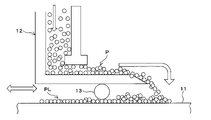
- the raw material powder P is naturally dropped from the hopper 12 onto a horizontally set powder bed 11 having a predetermined area. While supplying and spreading, a single layer of raw material powder layer PL having a predetermined thickness is formed. As shown in FIG. 2, the raw material powder layer PL is leveled so as to have a flat and uniform thickness by pressurizing the surface by a roller 13 that moves in conjunction with the hopper 12.
- the thickness of the raw material powder layer PL of one layer is, for example, about 40 to 50 ⁇ m, but is appropriately set in the range of about 100 ⁇ m or less.
- the raw material powder P is supplied again from the hopper 12 and flattened by the roller 13 on the first raw material powder layer PL on which the two-dimensional bonded body 2G is formed, and the second raw material powder layer PL is formed.
- the binder B is selectively ejected from the printer head 14 onto the surface of the raw material powder layer PL of the second layer so as to draw a desired shape, and the raw material powder P is bonded by the binder to form a two-dimensional bond.
- the raw material powder P is laminated on the raw material powder layer PL on which the two-dimensional bonded body 2G having a desired shape is formed by the binder B to form the next raw material powder layer PL, and then the raw material powder layer is formed.
- the process of selectively ejecting the binder B onto the PL is repeated many times to form a three-dimensional bonded body 3G in which a large number of two-dimensional bonded bodies 2G are laminated and bonded inside the multi-layered raw material powder layer PL. (Shown in FIG. 1 (C)).
- the raw material powder layer PL superposed on the upper and lower sides is at least partially superposed on the supply portion of the binder B, and the two-dimensional bonded bodies 2G are bonded to each other.
- a three-dimensional coupled body 3G that is continuous up and down is formed.
- the multi-layered raw material powder layer PL in a state where the three-dimensional bond 3G is embedded inside is dried.
- the three-dimensional bonded body 3G is taken out from the inside of the raw material powder layer PL.
- a laminated raw material powder P that surrounds the three-dimensional bonded body 3G and has no binder B printed and is not bonded is used, for example, a suction nozzle. It can be removed by inhalation or the like.
- the method for removing the raw material powder P not bound by the binder B is not limited to this, and an appropriate method is selected.
- the taken out three-dimensional bonded body 3G is sintered under predetermined sintering conditions to obtain a sintered body.
- a small amount of one of ultrafine SiO 2 powder, TiO powder, Al 2 O 3 powder, or a mixed powder of two or more kinds is added as a fluidizing agent to any fine main raw material powder. Is preferably used.
- metal powder or ceramic powder is used as the main raw material powder.
- the metal powder include all powders used in powder metallurgy such as stainless steel, high-speed steel, nickel-based heat-resistant steel, and low carbon steel, and metal injection molding (MIM).
- MIM metal injection molding
- the ceramic powder include alumina and silicon carbide.
- the particle size of the main raw material powder used is, for example, an average particle size of 2 to 25 ⁇ m. If it is less than 2 ⁇ m, it is difficult to obtain uniform fluidity and laminated state of the fine powder, and if it is more than 25 ⁇ m, the three-dimensional powder molded body obtained by the binder jet method is sintered at the sintering temperature of a normal metal powder. In such cases, it may be difficult to secure the sintering density of 95% or more, which is industrially required. Within this range, 5 to 15 ⁇ m is preferable, and 7 to 10 ⁇ m is more preferable.
- a powder having an average particle size of about 10 ⁇ m, which is expressed as ⁇ 22 ⁇ m, or a powder having an average particle size of about 7.5 ⁇ m, which is expressed as ⁇ 15 ⁇ m, is commercially available, and these are suitable and available.
- the fluidizing agent When the fluidizing agent is added, the fluidity becomes good when the raw material powder P is supplied, and a suitable raw material powder layer PL is formed.
- the particle size of the fluidizing agent for example, one having a primary particle diameter of 7 to 40 nm is used. If it is less than 7 nm, agglomeration of particles occurs and a uniform dispersed state cannot be obtained when mixed with the main raw material powder, and if it exceeds 40 nm, spherical nanoparticles become irregular in production, so that the lubricating effect on the main raw material powder May decrease. Within this range, 7 to 30 nm is preferable, and 10 to 20 nm is more preferable.
- the fluidizing agent of the present invention as described above, one of a SiO 2 powder, a TiO powder, and an Al 2 O 3 powder, or a mixed powder of two or more kinds is used, and all of them have the same effect. Is shown.
- the amount of the fluidizing agent added to the main raw material powder is, for example, 0.01 to 0.15 wt%. If it is less than 0.01 wt%, there is no effect of improving the fluidity, and if it exceeds 0.15 wt%, it cannot be properly cut out from the hopper at the time of laminating and becomes fluid and flows out from the hopper, resulting in proper laminating and eventually molding. May be impossible. Within this range, 0.02 to 0.07 wt% is preferable, and 0.025 to 0.05 wt% is even more preferable.
- the raw material powder of the present embodiment is not limited to the above-mentioned constitution, and for example, only the main raw material powder may be used as the raw material powder without adding the above-mentioned fluidizing agent.
- the hydrocolloid can be used alone or in admixture of at least two.
- the concentration of the hydrocolloid in the binder is preferably 4.5 wt% or less, and the amount of the binder added to the raw material powder is preferably 8 wt% or less.
- the content of hydrocolloid is defined as follows in this embodiment. That is, when the concentration of the hydrocolloid in the binder B is A wt% and the amount of the binder B added to the raw material powder P is B wt%, the concentration of the hydrocolloid [A ⁇ B] wt% with respect to the raw material powder P is 0.16 wt% or more. It is preferable to have.
- the above [A ⁇ B] is preferably 0.16 wt% or more. Within this range, the above [A ⁇ B] is preferably 0.36 wt% or less, more preferably 0.33 wt% or less, and even more preferably 0.30 wt% or less.
- pectin and pullulan are particularly preferably used.
- Pectin is preferably used alone.
- pullulan it is preferably used as a mixture with pectin.
- pectin as a simple substance as a hydrocolloid or as a mixture of pectin and pullulan, the three-dimensional bond 3G before sintering can be obtained with a desired strength (bending stress of 150 [N / /]. It can have cm 2 ] or more).
- the binder B of the present embodiment can contain an antioxidant substance in addition to the above-mentioned hydrocolloid.
- antioxidants include carotenoids such as astaxanthin, zeaxanthin, lutein, ⁇ -carotene, ⁇ -carotene and lycopene, polyphenols such as anthocyanin, tannin, catechin and flavonoids, vitamin C, vitamin E and minerals.
- carotenoids such astaxanthin, zeaxanthin, lutein, ⁇ -carotene, ⁇ -carotene and lycopene
- polyphenols such as anthocyanin
- tannin catechin and flavonoids
- vitamin C vitamin E and minerals.
- an antioxidant can effectively suppress the oxidation (rust) of the raw material powder layer PL in the drying step. Therefore, when an iron-based powder is used as the main raw material powder, it is preferable to add an antioxidant in an amount as required.
- the binder B of the present embodiment it is preferable to contain a surfactant (emulsifier) in addition to the above-mentioned hydrocolloid.
- a surfactant emulsifier
- the surface tension of the binder is lowered, and the binder B is easily ejected from the printer head.
- a synthetic additive such as glycerin fatty acid ester can be used.
- the step of selectively ejecting the binder B to form the two-dimensional bonded body 2G is repeated so as to be drawn, and the two-dimensional shape is formed inside the raw material powder layer PL laminated in multiple layers.
- a hydrocolloid aqueous solution is used as the binder B.
- Hydrocolloid is a substance composed of food-derived components, and is a substance that can be subjected to various processing such as thickening, gelling, emulsification, and milk protein stabilization. Therefore, even if it is taken into the human body, it is harmless and does not have an adverse effect.
- the aqueous solution containing such a hydrocolloid in water is used as the binder B, the working environment is not contaminated in the above-mentioned method for forming the three-dimensional bonded body 3G, and the work environment is safer than before. The work can be carried out in a harmless state.
- the present embodiment uses the hydrocolloid as a binder instead of dispersing and containing the hydrocolloid in the raw material powder P, it is possible to use a conventional raw material powder P. Therefore, the raw material powder P can be easily reused after the three-dimensional bonded body 3G is taken out. In addition, the amount of hydrocolloid used is the minimum necessary, and cost increase can be suppressed.
- the concentration of the hydrocolloid in the binder B is Awt% and the amount of the binder B added to the raw material powder P is Bwt%
- the concentration of the hydrocolloid [A ⁇ B] wt% with respect to the raw material powder P is 0. .16 wt% or more.
- the hydrocolloid contained in the binder B is pectin alone. Thereby, the strength of the three-dimensional bonded body 3G can be effectively improved.
- the hydrocolloid contained in the binder B is a mixture of pectin and pullulan. Thereby, the strength of the three-dimensional bonded body 3G can be effectively improved.
- the strength of the three-dimensional conjugate 3G is improved. The effect of can be remarkably obtained.
- the pectin: pullulan is preferably 1: 9 to 3: 7, more preferably 1: 9 to 2: 8.
- the binder B contains an antioxidant.
- the oxidation (rust) of the raw material powder layer PL can be effectively suppressed in the drying step, and as a result, the raw material powder P can be effectively suppressed. Even if is an iron-based powder, the powder can be reused.
- the binders of Test Examples 1 to 16 were ejected from the printer head onto the raw material powder and dried to prepare test pieces of a three-dimensional bonded body, respectively, and the test pieces before sintering were subjected to a test method conforming to JIS Z2511. , A test was conducted to determine the bending stress. As shown in FIG. 3, the bending stress is the bending stress when the specified test piece TP is bridged over the stage J1 and a force is applied in the vertical direction from above with the jig J2 to the center of the stage J1 to break the test piece TP. Measure as. The results are also shown in Table 1.
- FIG. 5 shows the relationship between the compounding ratio of pectin and pullulan used as the hydrocolloid and the bending stress [N / cm 2 ] of each test piece.
- the concentration [A ⁇ B] wt% of the hydrocolloid with respect to the raw material powder is 0.16 wt% or more, the desired bending stress of 150 [N / cm 2 ] or more is secured. can do. Therefore, it was confirmed that the concentration [A ⁇ B] wt% of the hydrocolloid with respect to the raw material powder is preferably 0.16 wt% or more.
- the pre-sintered three-dimensional bond obtained from the raw material powder and the binder has the desired strength (bending stress is 150 [N / cm 2 ] or more), ⁇ , the pre-sintered three-dimensional bond obtained from both The case where does not have the desired strength (bending stress of 150 [N / cm 2 ] or more) is regarded as x, and the results are also shown in Table 1.
- the bending stress of the three-dimensional bond is about 200 [N / cm 2 ], and the desired bending stress (150 [N / cm 2 ]). ])
- the hydrocolloid is a mixture of pectin and pullulan
- pectin: pullulan 0.5: 9.5 to 9.5: 0.5
- pectin: pullulan 1: 9 to 9: 1.
- the present invention is a technique that can be used when molding a three-dimensional sintered body by the binder jet method.
Landscapes
- Engineering & Computer Science (AREA)
- Chemical & Material Sciences (AREA)
- Manufacturing & Machinery (AREA)
- Materials Engineering (AREA)
- Mechanical Engineering (AREA)
- Physics & Mathematics (AREA)
- Optics & Photonics (AREA)
- Ceramic Engineering (AREA)
Priority Applications (1)
| Application Number | Priority Date | Filing Date | Title |
|---|---|---|---|
| JP2022557552A JPWO2022085672A1 (https=) | 2020-10-19 | 2021-10-19 |
Applications Claiming Priority (2)
| Application Number | Priority Date | Filing Date | Title |
|---|---|---|---|
| JP2020175211 | 2020-10-19 | ||
| JP2020-175211 | 2020-10-19 |
Publications (1)
| Publication Number | Publication Date |
|---|---|
| WO2022085672A1 true WO2022085672A1 (ja) | 2022-04-28 |
Family
ID=81290591
Family Applications (1)
| Application Number | Title | Priority Date | Filing Date |
|---|---|---|---|
| PCT/JP2021/038563 Ceased WO2022085672A1 (ja) | 2020-10-19 | 2021-10-19 | バインダジェット法を用いた三次元物体造形方法 |
Country Status (2)
| Country | Link |
|---|---|
| JP (1) | JPWO2022085672A1 (https=) |
| WO (1) | WO2022085672A1 (https=) |
Cited By (1)
| Publication number | Priority date | Publication date | Assignee | Title |
|---|---|---|---|---|
| JP2024008037A (ja) * | 2022-07-07 | 2024-01-19 | 大平洋ランダム株式会社 | セラミックス粉末とそれによるセラミックス造形物及びその製造方法 |
Citations (3)
| Publication number | Priority date | Publication date | Assignee | Title |
|---|---|---|---|---|
| JPH11172302A (ja) * | 1997-12-11 | 1999-06-29 | Yamaha Corp | 金属射出成形用バインダーおよびこれを用いた成形法 |
| WO2015115897A1 (en) * | 2014-02-03 | 2015-08-06 | Nederlandse Organisatie Voor Toegepast-Natuurwetenschappelijk Onderzoek Tno | Method for the production of an edible object by powder bed (3d) printing and food products obtainable therewith |
| US20180339946A1 (en) * | 2015-11-24 | 2018-11-29 | Sgl Carbon Se | 3-d printing of a ceramic component |
Family Cites Families (2)
| Publication number | Priority date | Publication date | Assignee | Title |
|---|---|---|---|---|
| JP2004330743A (ja) * | 2003-05-12 | 2004-11-25 | Fuji Photo Film Co Ltd | 三次元造形物の製造方法 |
| EP3472297B1 (en) * | 2016-06-21 | 2023-12-06 | The Procter & Gamble Company | Aesthetic particles |
-
2021
- 2021-10-19 JP JP2022557552A patent/JPWO2022085672A1/ja active Pending
- 2021-10-19 WO PCT/JP2021/038563 patent/WO2022085672A1/ja not_active Ceased
Patent Citations (3)
| Publication number | Priority date | Publication date | Assignee | Title |
|---|---|---|---|---|
| JPH11172302A (ja) * | 1997-12-11 | 1999-06-29 | Yamaha Corp | 金属射出成形用バインダーおよびこれを用いた成形法 |
| WO2015115897A1 (en) * | 2014-02-03 | 2015-08-06 | Nederlandse Organisatie Voor Toegepast-Natuurwetenschappelijk Onderzoek Tno | Method for the production of an edible object by powder bed (3d) printing and food products obtainable therewith |
| US20180339946A1 (en) * | 2015-11-24 | 2018-11-29 | Sgl Carbon Se | 3-d printing of a ceramic component |
Non-Patent Citations (1)
| Title |
|---|
| HOLLAND SONIA; FOSTER TIM; MACNAUGHTAN WILLIAM; TUCK CHRIS: "Design and characterisation of food grade powders and inks for microstructure control using 3D printing", JOURNAL OF FOOD ENGINEERING, ELSEVIER, AMSTERDAM, NL, vol. 220, 1 January 1900 (1900-01-01), AMSTERDAM, NL, pages 12 - 19, XP085250988, ISSN: 0260-8774, DOI: 10.1016/j.jfoodeng.2017.06.008 * |
Cited By (2)
| Publication number | Priority date | Publication date | Assignee | Title |
|---|---|---|---|---|
| JP2024008037A (ja) * | 2022-07-07 | 2024-01-19 | 大平洋ランダム株式会社 | セラミックス粉末とそれによるセラミックス造形物及びその製造方法 |
| JP7711032B2 (ja) | 2022-07-07 | 2025-07-22 | 大平洋ランダム株式会社 | セラミックス粉末とそれによるセラミックス造形物及びその製造方法 |
Also Published As
| Publication number | Publication date |
|---|---|
| JPWO2022085672A1 (https=) | 2022-04-28 |
Similar Documents
| Publication | Publication Date | Title |
|---|---|---|
| JP6933402B2 (ja) | 3dインクジェット印刷のためのタングステンーカーバイド/コバルトインク組成物 | |
| JP5920460B2 (ja) | インクジェット用インク、印刷方法およびセラミック電子部品の製造方法 | |
| EP1853673B1 (en) | Aqueous-based dispersions of metal nanoparticles | |
| JP5632746B2 (ja) | マイクロカプセル及びその製造方法並びにマイクロカプセルを含む飲食品 | |
| WO2022085672A1 (ja) | バインダジェット法を用いた三次元物体造形方法 | |
| JP6780064B2 (ja) | 顔料組成物及びインクジェット用水性インク組成物 | |
| US20190270135A1 (en) | Metallic build material granules | |
| EP3915698A1 (en) | Binder solutions comprising nanoparticles for use in additive manufacturing | |
| EP3898855B1 (en) | Conductive ink jet printing ink composition | |
| EP3441982A1 (en) | Joining material and joining method using same | |
| EP3656751A1 (en) | Ceramic paste compositions for 3d printing | |
| EP3259321A1 (en) | Titanium inks, methods of making and using the same to make titanium articles | |
| JP2023507718A (ja) | 超硬合金又はサーメット体の3d印刷のための熱硬化性バインダーの使用 | |
| JP5040878B2 (ja) | スラリーの製造方法及び製造装置 | |
| JP2023040127A (ja) | 積層造形用粉末材料 | |
| CN112548114A (zh) | 一种采用墨水直写打印金属零件的方法 | |
| JP2008169050A (ja) | セラミックスグリーンシート及びその製造方法 | |
| CN112094529A (zh) | 一种柔印环保接装纸水性油墨的加工方法 | |
| CN113695580A (zh) | 一种以CrSiMnMoV工具钢为基体的复合材料及制备工艺 | |
| US20170361290A1 (en) | Aqueous dispersant formulation | |
| KR102049462B1 (ko) | 은점토 제조방법 | |
| Yang | Binder Jetting of Ceramics | |
| JP2008038206A (ja) | 白金粘土用白金粉末及びこの白金粉末を含む白金粘土 | |
| WO2026096191A1 (en) | Particle compositions and methods of preparing and using particle compositions | |
| CN115251376A (zh) | 一种叶黄素酯纳米微囊及其制备方法 |
Legal Events
| Date | Code | Title | Description |
|---|---|---|---|
| 121 | Ep: the epo has been informed by wipo that ep was designated in this application |
Ref document number: 21882813 Country of ref document: EP Kind code of ref document: A1 |
|
| ENP | Entry into the national phase |
Ref document number: 2022557552 Country of ref document: JP Kind code of ref document: A |
|
| NENP | Non-entry into the national phase |
Ref country code: DE |
|
| 122 | Ep: pct application non-entry in european phase |
Ref document number: 21882813 Country of ref document: EP Kind code of ref document: A1 |