WO2022085586A1 - ガスバリア積層体及び包装材 - Google Patents
ガスバリア積層体及び包装材 Download PDFInfo
- Publication number
- WO2022085586A1 WO2022085586A1 PCT/JP2021/038248 JP2021038248W WO2022085586A1 WO 2022085586 A1 WO2022085586 A1 WO 2022085586A1 JP 2021038248 W JP2021038248 W JP 2021038248W WO 2022085586 A1 WO2022085586 A1 WO 2022085586A1
- Authority
- WO
- WIPO (PCT)
- Prior art keywords
- layer
- gas barrier
- overcoat layer
- film
- barrier
- Prior art date
- Legal status (The legal status is an assumption and is not a legal conclusion. Google has not performed a legal analysis and makes no representation as to the accuracy of the status listed.)
- Ceased
Links
Images
Classifications
-
- B—PERFORMING OPERATIONS; TRANSPORTING
- B65—CONVEYING; PACKING; STORING; HANDLING THIN OR FILAMENTARY MATERIAL
- B65D—CONTAINERS FOR STORAGE OR TRANSPORT OF ARTICLES OR MATERIALS, e.g. BAGS, BARRELS, BOTTLES, BOXES, CANS, CARTONS, CRATES, DRUMS, JARS, TANKS, HOPPERS, FORWARDING CONTAINERS; ACCESSORIES, CLOSURES, OR FITTINGS THEREFOR; PACKAGING ELEMENTS; PACKAGES
- B65D65/00—Wrappers or flexible covers; Packaging materials of special type or form
- B65D65/38—Packaging materials of special type or form
- B65D65/40—Applications of laminates for particular packaging purposes
-
- B—PERFORMING OPERATIONS; TRANSPORTING
- B32—LAYERED PRODUCTS
- B32B—LAYERED PRODUCTS, i.e. PRODUCTS BUILT-UP OF STRATA OF FLAT OR NON-FLAT, e.g. CELLULAR OR HONEYCOMB, FORM
- B32B27/00—Layered products comprising a layer of synthetic resin
- B32B27/06—Layered products comprising a layer of synthetic resin as the main or only constituent of a layer, which is next to another layer of the same or of a different material
- B32B27/08—Layered products comprising a layer of synthetic resin as the main or only constituent of a layer, which is next to another layer of the same or of a different material of synthetic resin
-
- B—PERFORMING OPERATIONS; TRANSPORTING
- B32—LAYERED PRODUCTS
- B32B—LAYERED PRODUCTS, i.e. PRODUCTS BUILT-UP OF STRATA OF FLAT OR NON-FLAT, e.g. CELLULAR OR HONEYCOMB, FORM
- B32B27/00—Layered products comprising a layer of synthetic resin
- B32B27/16—Layered products comprising a layer of synthetic resin specially treated, e.g. irradiated
-
- B—PERFORMING OPERATIONS; TRANSPORTING
- B32—LAYERED PRODUCTS
- B32B—LAYERED PRODUCTS, i.e. PRODUCTS BUILT-UP OF STRATA OF FLAT OR NON-FLAT, e.g. CELLULAR OR HONEYCOMB, FORM
- B32B27/00—Layered products comprising a layer of synthetic resin
- B32B27/30—Layered products comprising a layer of synthetic resin comprising vinyl (co)polymers; comprising acrylic (co)polymers
- B32B27/306—Layered products comprising a layer of synthetic resin comprising vinyl (co)polymers; comprising acrylic (co)polymers comprising vinyl acetate or vinyl alcohol (co)polymers
-
- B—PERFORMING OPERATIONS; TRANSPORTING
- B32—LAYERED PRODUCTS
- B32B—LAYERED PRODUCTS, i.e. PRODUCTS BUILT-UP OF STRATA OF FLAT OR NON-FLAT, e.g. CELLULAR OR HONEYCOMB, FORM
- B32B27/00—Layered products comprising a layer of synthetic resin
- B32B27/32—Layered products comprising a layer of synthetic resin comprising polyolefins
-
- B—PERFORMING OPERATIONS; TRANSPORTING
- B32—LAYERED PRODUCTS
- B32B—LAYERED PRODUCTS, i.e. PRODUCTS BUILT-UP OF STRATA OF FLAT OR NON-FLAT, e.g. CELLULAR OR HONEYCOMB, FORM
- B32B27/00—Layered products comprising a layer of synthetic resin
- B32B27/36—Layered products comprising a layer of synthetic resin comprising polyesters
-
- B—PERFORMING OPERATIONS; TRANSPORTING
- B65—CONVEYING; PACKING; STORING; HANDLING THIN OR FILAMENTARY MATERIAL
- B65D—CONTAINERS FOR STORAGE OR TRANSPORT OF ARTICLES OR MATERIALS, e.g. BAGS, BARRELS, BOTTLES, BOXES, CANS, CARTONS, CRATES, DRUMS, JARS, TANKS, HOPPERS, FORWARDING CONTAINERS; ACCESSORIES, CLOSURES, OR FITTINGS THEREFOR; PACKAGING ELEMENTS; PACKAGES
- B65D65/00—Wrappers or flexible covers; Packaging materials of special type or form
- B65D65/38—Packaging materials of special type or form
- B65D65/42—Applications of coated or impregnated materials
-
- B—PERFORMING OPERATIONS; TRANSPORTING
- B65—CONVEYING; PACKING; STORING; HANDLING THIN OR FILAMENTARY MATERIAL
- B65D—CONTAINERS FOR STORAGE OR TRANSPORT OF ARTICLES OR MATERIALS, e.g. BAGS, BARRELS, BOTTLES, BOXES, CANS, CARTONS, CRATES, DRUMS, JARS, TANKS, HOPPERS, FORWARDING CONTAINERS; ACCESSORIES, CLOSURES, OR FITTINGS THEREFOR; PACKAGING ELEMENTS; PACKAGES
- B65D81/00—Containers, packaging elements, or packages, for contents presenting particular transport or storage problems, or adapted to be used for non-packaging purposes after removal of contents
- B65D81/24—Adaptations for preventing deterioration or decay of contents; Applications to the container or packaging material of food preservatives, fungicides, pesticides or animal repellants
-
- C—CHEMISTRY; METALLURGY
- C08—ORGANIC MACROMOLECULAR COMPOUNDS; THEIR PREPARATION OR CHEMICAL WORKING-UP; COMPOSITIONS BASED THEREON
- C08J—WORKING-UP; GENERAL PROCESSES OF COMPOUNDING; AFTER-TREATMENT NOT COVERED BY SUBCLASSES C08B, C08C, C08F, C08G or C08H
- C08J7/00—Chemical treatment or coating of shaped articles made of macromolecular substances
- C08J7/04—Coating
- C08J7/042—Coating with two or more layers, where at least one layer of a composition contains a polymer binder
- C08J7/0423—Coating with two or more layers, where at least one layer of a composition contains a polymer binder with at least one layer of inorganic material and at least one layer of a composition containing a polymer binder
-
- C—CHEMISTRY; METALLURGY
- C08—ORGANIC MACROMOLECULAR COMPOUNDS; THEIR PREPARATION OR CHEMICAL WORKING-UP; COMPOSITIONS BASED THEREON
- C08J—WORKING-UP; GENERAL PROCESSES OF COMPOUNDING; AFTER-TREATMENT NOT COVERED BY SUBCLASSES C08B, C08C, C08F, C08G or C08H
- C08J7/00—Chemical treatment or coating of shaped articles made of macromolecular substances
- C08J7/04—Coating
- C08J7/043—Improving the adhesiveness of the coatings per se, e.g. forming primers
-
- C—CHEMISTRY; METALLURGY
- C08—ORGANIC MACROMOLECULAR COMPOUNDS; THEIR PREPARATION OR CHEMICAL WORKING-UP; COMPOSITIONS BASED THEREON
- C08J—WORKING-UP; GENERAL PROCESSES OF COMPOUNDING; AFTER-TREATMENT NOT COVERED BY SUBCLASSES C08B, C08C, C08F, C08G or C08H
- C08J7/00—Chemical treatment or coating of shaped articles made of macromolecular substances
- C08J7/04—Coating
- C08J7/048—Forming gas barrier coatings
-
- B—PERFORMING OPERATIONS; TRANSPORTING
- B32—LAYERED PRODUCTS
- B32B—LAYERED PRODUCTS, i.e. PRODUCTS BUILT-UP OF STRATA OF FLAT OR NON-FLAT, e.g. CELLULAR OR HONEYCOMB, FORM
- B32B2250/00—Layers arrangement
- B32B2250/24—All layers being polymeric
-
- B—PERFORMING OPERATIONS; TRANSPORTING
- B32—LAYERED PRODUCTS
- B32B—LAYERED PRODUCTS, i.e. PRODUCTS BUILT-UP OF STRATA OF FLAT OR NON-FLAT, e.g. CELLULAR OR HONEYCOMB, FORM
- B32B2255/00—Coating on the layer surface
- B32B2255/10—Coating on the layer surface on synthetic resin layer or on natural or synthetic rubber layer
-
- B—PERFORMING OPERATIONS; TRANSPORTING
- B32—LAYERED PRODUCTS
- B32B—LAYERED PRODUCTS, i.e. PRODUCTS BUILT-UP OF STRATA OF FLAT OR NON-FLAT, e.g. CELLULAR OR HONEYCOMB, FORM
- B32B2255/00—Coating on the layer surface
- B32B2255/20—Inorganic coating
-
- B—PERFORMING OPERATIONS; TRANSPORTING
- B32—LAYERED PRODUCTS
- B32B—LAYERED PRODUCTS, i.e. PRODUCTS BUILT-UP OF STRATA OF FLAT OR NON-FLAT, e.g. CELLULAR OR HONEYCOMB, FORM
- B32B2255/00—Coating on the layer surface
- B32B2255/20—Inorganic coating
- B32B2255/205—Metallic coating
-
- B—PERFORMING OPERATIONS; TRANSPORTING
- B32—LAYERED PRODUCTS
- B32B—LAYERED PRODUCTS, i.e. PRODUCTS BUILT-UP OF STRATA OF FLAT OR NON-FLAT, e.g. CELLULAR OR HONEYCOMB, FORM
- B32B2255/00—Coating on the layer surface
- B32B2255/26—Polymeric coating
-
- B—PERFORMING OPERATIONS; TRANSPORTING
- B32—LAYERED PRODUCTS
- B32B—LAYERED PRODUCTS, i.e. PRODUCTS BUILT-UP OF STRATA OF FLAT OR NON-FLAT, e.g. CELLULAR OR HONEYCOMB, FORM
- B32B2255/00—Coating on the layer surface
- B32B2255/28—Multiple coating on one surface
-
- B—PERFORMING OPERATIONS; TRANSPORTING
- B32—LAYERED PRODUCTS
- B32B—LAYERED PRODUCTS, i.e. PRODUCTS BUILT-UP OF STRATA OF FLAT OR NON-FLAT, e.g. CELLULAR OR HONEYCOMB, FORM
- B32B2307/00—Properties of the layers or laminate
- B32B2307/50—Properties of the layers or laminate having particular mechanical properties
- B32B2307/514—Oriented
-
- B—PERFORMING OPERATIONS; TRANSPORTING
- B32—LAYERED PRODUCTS
- B32B—LAYERED PRODUCTS, i.e. PRODUCTS BUILT-UP OF STRATA OF FLAT OR NON-FLAT, e.g. CELLULAR OR HONEYCOMB, FORM
- B32B2307/00—Properties of the layers or laminate
- B32B2307/50—Properties of the layers or laminate having particular mechanical properties
- B32B2307/536—Hardness
-
- B—PERFORMING OPERATIONS; TRANSPORTING
- B32—LAYERED PRODUCTS
- B32B—LAYERED PRODUCTS, i.e. PRODUCTS BUILT-UP OF STRATA OF FLAT OR NON-FLAT, e.g. CELLULAR OR HONEYCOMB, FORM
- B32B2307/00—Properties of the layers or laminate
- B32B2307/50—Properties of the layers or laminate having particular mechanical properties
- B32B2307/54—Yield strength; Tensile strength
-
- B—PERFORMING OPERATIONS; TRANSPORTING
- B32—LAYERED PRODUCTS
- B32B—LAYERED PRODUCTS, i.e. PRODUCTS BUILT-UP OF STRATA OF FLAT OR NON-FLAT, e.g. CELLULAR OR HONEYCOMB, FORM
- B32B2307/00—Properties of the layers or laminate
- B32B2307/70—Other properties
- B32B2307/724—Permeability to gases, adsorption
- B32B2307/7242—Non-permeable
-
- B—PERFORMING OPERATIONS; TRANSPORTING
- B32—LAYERED PRODUCTS
- B32B—LAYERED PRODUCTS, i.e. PRODUCTS BUILT-UP OF STRATA OF FLAT OR NON-FLAT, e.g. CELLULAR OR HONEYCOMB, FORM
- B32B2307/00—Properties of the layers or laminate
- B32B2307/70—Other properties
- B32B2307/748—Releasability
-
- B—PERFORMING OPERATIONS; TRANSPORTING
- B32—LAYERED PRODUCTS
- B32B—LAYERED PRODUCTS, i.e. PRODUCTS BUILT-UP OF STRATA OF FLAT OR NON-FLAT, e.g. CELLULAR OR HONEYCOMB, FORM
- B32B2553/00—Packaging equipment or accessories not otherwise provided for
-
- B—PERFORMING OPERATIONS; TRANSPORTING
- B32—LAYERED PRODUCTS
- B32B—LAYERED PRODUCTS, i.e. PRODUCTS BUILT-UP OF STRATA OF FLAT OR NON-FLAT, e.g. CELLULAR OR HONEYCOMB, FORM
- B32B7/00—Layered products characterised by the relation between layers; Layered products characterised by the relative orientation of features between layers, or by the relative values of a measurable parameter between layers, i.e. products comprising layers having different physical, chemical or physicochemical properties; Layered products characterised by the interconnection of layers
- B32B7/04—Interconnection of layers
- B32B7/12—Interconnection of layers using interposed adhesives or interposed materials with bonding properties
-
- B—PERFORMING OPERATIONS; TRANSPORTING
- B65—CONVEYING; PACKING; STORING; HANDLING THIN OR FILAMENTARY MATERIAL
- B65D—CONTAINERS FOR STORAGE OR TRANSPORT OF ARTICLES OR MATERIALS, e.g. BAGS, BARRELS, BOTTLES, BOXES, CANS, CARTONS, CRATES, DRUMS, JARS, TANKS, HOPPERS, FORWARDING CONTAINERS; ACCESSORIES, CLOSURES, OR FITTINGS THEREFOR; PACKAGING ELEMENTS; PACKAGES
- B65D2565/00—Wrappers or flexible covers; Packaging materials of special type or form
- B65D2565/38—Packaging materials of special type or form
- B65D2565/381—Details of packaging materials of special type or form
- B65D2565/387—Materials used as gas barriers
-
- C—CHEMISTRY; METALLURGY
- C08—ORGANIC MACROMOLECULAR COMPOUNDS; THEIR PREPARATION OR CHEMICAL WORKING-UP; COMPOSITIONS BASED THEREON
- C08J—WORKING-UP; GENERAL PROCESSES OF COMPOUNDING; AFTER-TREATMENT NOT COVERED BY SUBCLASSES C08B, C08C, C08F, C08G or C08H
- C08J2323/00—Characterised by the use of homopolymers or copolymers of unsaturated aliphatic hydrocarbons having only one carbon-to-carbon double bond; Derivatives of such polymers
- C08J2323/02—Characterised by the use of homopolymers or copolymers of unsaturated aliphatic hydrocarbons having only one carbon-to-carbon double bond; Derivatives of such polymers not modified by chemical after treatment
- C08J2323/10—Homopolymers or copolymers of propene
- C08J2323/12—Polypropene
-
- C—CHEMISTRY; METALLURGY
- C08—ORGANIC MACROMOLECULAR COMPOUNDS; THEIR PREPARATION OR CHEMICAL WORKING-UP; COMPOSITIONS BASED THEREON
- C08J—WORKING-UP; GENERAL PROCESSES OF COMPOUNDING; AFTER-TREATMENT NOT COVERED BY SUBCLASSES C08B, C08C, C08F, C08G or C08H
- C08J2429/00—Characterised by the use of homopolymers or copolymers of compounds having one or more unsaturated aliphatic radicals, each having only one carbon-to-carbon double bond, and at least one being terminated by an alcohol, ether, aldehydo, ketonic, acetal, or ketal radical; Hydrolysed polymers of esters of unsaturated alcohols with saturated carboxylic acids; Derivatives of such polymer
- C08J2429/02—Homopolymers or copolymers of unsaturated alcohols
- C08J2429/04—Polyvinyl alcohol; Partially hydrolysed homopolymers or copolymers of esters of unsaturated alcohols with saturated carboxylic acids
Definitions
- This disclosure relates to gas barrier laminates and packaging materials.
- a barrier film including a barrier coat layer, an inorganic oxide-deposited layer, and a base material layer in this order is known (for example, Patent Document 1).
- a heat-resistant base material such as a polyester film or a nylon film is generally used, and the heat-resistant base material is further bonded to polypropylene, polyethylene, or the like. It is possible to make bags with.
- the barrier film itself due to the recent trend toward monomaterials, there is an increasing need for the barrier film itself to be a polypropylene or polyethylene base material.
- the present disclosure has been made in view of the above circumstances, and an object of the present disclosure is to provide a gas barrier laminate capable of achieving good processability by using a polyolefin base material.
- the present disclosure is also intended to provide a packaging material comprising the gas barrier laminate.
- the present disclosure includes a base material layer containing a polyolefin resin, a barrier layer, and an overcoat layer containing a polyvinyl alcohol resin, and the hardness of the surface of the overcoat layer is measured by the nanoindentation method.
- a gas barrier laminate having a capacity of 5 GPa or less.
- the barrier layer may contain a metal, a metal oxide, a metal nitride or a metal oxynitride.
- the overcoat layer may contain Si.
- the overcoat layer may contain an inorganic layered compound.
- the present disclosure provides a packaging material comprising the above gas barrier laminate and a sealant layer.
- gas barrier laminate capable of achieving good processability by using a polyolefin base material. Further, according to the present disclosure, it is possible to provide a packaging material provided with the gas barrier laminate.
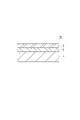
- FIG. 1 is a schematic cross-sectional view showing a gas barrier laminate according to an embodiment.
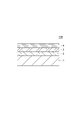
- FIG. 2 is a schematic cross-sectional view showing a packaging material according to an embodiment.
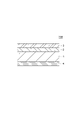
- FIG. 3 is a schematic cross-sectional view showing a packaging material according to an embodiment.
- FIG. 1 is a schematic cross-sectional view showing a gas barrier laminate (barrier film) according to an embodiment.
- the gas barrier laminate 10 shown in FIG. 1 includes a base material layer 1, a barrier layer 2, and an overcoat layer 3 in this order.
- the base material layer is a film that serves as one of the supports, and contains a polyolefin-based resin.
- polystyrene resin examples include polyethylene (PE), polypropylene (PP), polybutene (PB), cycloolefin polymer and the like.
- polyolefin-based resin examples include acid-modified polyolefins obtained by graft-modifying a polyolefin with an unsaturated carboxylic acid, an acid anhydride of an unsaturated carboxylic acid, an ester of an unsaturated carboxylic acid, or the like.
- a raw material monomer for polypropylene synthesis a small amount of second, third, etc. components such as ethylene and butene may be used. From the viewpoint of excellent heat resistance, a propylene monopolymer film can be used as the base material layer.
- the film constituting the base material layer may be a stretched film or a non-stretched film.
- the film constituting the base material layer may be a stretched film.
- the stretching method is not particularly limited, and any method may be used as long as a film having stable dimensions can be supplied, such as stretching by inflation, uniaxial stretching, or biaxial stretching.
- the thickness of the base material layer is not particularly limited, but from the viewpoint of obtaining excellent impact resistance and excellent gas barrier property, it can be 9 to 100 ⁇ m, and may be 15 to 30 ⁇ m.
- the film constituting the base material layer is subjected to various pretreatments such as corona treatment, plasma treatment, frame treatment, etc., and a coat layer such as an easy-adhesion layer is provided on the laminated surface of the other layers as long as the barrier performance is not impaired. It doesn't matter.
- the film constituting the base material layer may contain additives such as an antistatic agent, an ultraviolet absorber, a plasticizer, and a lubricant, if necessary.
- the barrier layer is a layer that imparts gas barrier properties to the base material layer. By using the barrier layer, high gas barrier properties can be obtained while suppressing the thickness. Since the barrier layer can be formed on the base material by vacuum film forming, it can also be called a vacuum film forming layer.
- the barrier layer can contain a metal, a metal oxide, a metal nitride or a metal oxynitride.
- the constituent material of the barrier layer include a metal such as metallic aluminum (Al), a metal oxide such as silicon oxide (SiOx) and aluminum oxide (AlOx), and a metal nitride such as silicon nitride (SiN). , Metallic oxynitrides such as silicon oxynitride (SiON) and the like.
- the constituent materials of the barrier layer can be aluminum oxide and silicon oxide.
- the constituent material of the barrier layer can be silicon oxide.
- its O / Si ratio can be 1.2 to 1.9 from the viewpoint of gas barrier properties.
- the thickness of the barrier layer can be 5 to 80 nm.
- the layer thickness is 5 nm or more, it becomes easy to obtain sufficient gas barrier properties. Further, when the layer thickness is 80 nm or less, the generation of cracks due to the deformation due to the internal stress of the thin film is suppressed, and the deterioration of the gas barrier property is easily suppressed. If the layer thickness exceeds 80 nm, the cost tends to increase due to an increase in the amount of material used, a long film forming time, and the like, which is not preferable from an economical point of view. From the above viewpoint, the layer thickness of the barrier layer may be 10 to 50 nm and may be 20 to 40 nm.
- the polyvinyl alcohol-based resin may have a vinyl alcohol unit obtained by saponifying vinyl ester units, and examples thereof include polyvinyl alcohol (PVA) and ethylene-vinyl alcohol copolymer (EVOH).
- PVA polyvinyl alcohol
- EVOH ethylene-vinyl alcohol copolymer
- PVA can be preferably used from the viewpoint of versatility, solubility and the like.
- vinyl esters such as vinyl acetate, vinyl formate, vinyl propionate, vinyl valerate, vinyl caprate, vinyl laurate, vinyl stearate, vinyl pivalate, vinyl versatic acid, etc. are independently polymerized. Then, the saponified resin is mentioned.
- the PVA may be a copolymerized or post-modified modified PVA.
- the copolymerized PVA can be obtained, for example, by copolymerizing a vinyl ester with an unsaturated monomer copolymerizable with the vinyl ester and then saponifying the vinyl ester.
- the post-modified PVA can be obtained by copolymerizing an unsaturated monomer with PVA obtained by polymerizing a vinyl ester and then saponifying it in the presence of a polymerization catalyst.
- the amount of modification in the modified PVA can be less than 50 mol% from the viewpoint of exhibiting sufficient gas barrier properties, and can be 10 mol% or more from the viewpoint of obtaining the effect of modification.
- Examples of the unsaturated monomer include olefins such as ethylene, propylene, isobutylene, ⁇ -octene, ⁇ -dodecene, and ⁇ -octadecene; 3-butene-1-ol, 4-pentin-1-ol, and 5-hexene-. Hydroxy group-containing ⁇ -olefins such as 1-ol; unsaturated acids such as acrylic acid, methacrylic acid, crotonic acid, maleic acid, maleic anhydride, itaconic acid, and undecylenic acid; nitriles such as acrylonitrile and metaacrylonitrile; diacetone acrylamide.
- olefins such as ethylene, propylene, isobutylene, ⁇ -octene, ⁇ -dodecene, and ⁇ -octadecene
- 3-butene-1-ol 4-pentin-1-ol
- Amid such as acrylamide and methacrylamide; olefin sulfonic acid such as ethylene sulfonic acid, allyl sulfonic acid and methallyl sulfonic acid; alkyl vinyl ether, dimethyl allyl vinyl ketone, N-vinylpyrrolidone, vinyl chloride, vinyl ethylene carbonate, 2,2 -Vinyl compounds such as dialkyl-4-vinyl-1,3-dioxolane, glycerin monoallyl ether, 3,4-diacetoxy-1-butene; vinylidene chloride, 1,4-diacetoxy-2-butene, vinylene carbonate, polyoxy Examples thereof include propylene and polyoxypropylene vinylamine.
- the unsaturated monomer may be an olefin, and may be ethylene in particular.
- polymerization catalyst examples include radical polymerization catalysts such as azobisisobutyronitrile, benzoyl peroxide, and lauryl peroxide.
- the polymerization method is not particularly limited, and bulk polymerization, emulsion polymerization, solvent polymerization and the like can be adopted.
- the degree of polymerization of PVA is preferably 300 to 3000. When the degree of polymerization is 300 or more, the barrier property is unlikely to be lowered, and when it is 3000 or less, it is easy to suppress the deterioration of the coating suitability due to the viscosity being too high.
- the degree of saponification of PVA is preferably 80 mol% or more, more preferably 90 mol% or more, still more preferably 98 mol% or more. Further, the saponification degree of PVA may be 100 mol% or less or 99.9 mol% or less.
- the degree of polymerization and saponification of PVA can be measured according to the method described in JIS K 6726 (1994).
- EVOH is generally a copolymer of ethylene with an acid vinyl ester such as vinyl acetate, vinyl formate, vinyl propionate, vinyl valerate, vinyl caprate, vinyl laurate, vinyl stearate, vinyl pivalate, vinyl versatic acid and the like. It is obtained by converting.
- the ethylene unit content of EVOH is 10 mol% or more, more preferably 15 mol% or more, further preferably 20 mol% or more, and particularly preferably larger than 35 mol%.
- the ethylene unit content of EVOH is preferably 65 mol% or less, more preferably 55 mol% or less, still more preferably less than 50 mol%.
- the gas barrier property or the dimensional stability under high humidity can be kept good.
- the gas barrier property can be enhanced.
- the ethylene unit content of EVOH can be determined by the NMR method.
- Saponification can be performed with alkali or acid, but alkali can be used from the viewpoint of saponification rate.
- alkali include alkali metal hydroxides such as sodium hydroxide and potassium hydroxide, and alkali metal alkoxides such as sodium ethylate, potassium ethyllate and lithium methylate.
- the overcoat layer may contain Si (Si element).
- the overcoat layer may be a cured product of a raw material for forming an overcoat layer containing a polyvinyl alcohol-based resin and a silane compound (organosilicon compound).
- the silane compound include alkoxysilanes (tetraalkoxysilanes) such as tetramethoxysilane and tetraethoxysilane, and silazanes such as hexamethyldisilazane.
- a compound generally used as a silane coupling agent or a polysiloxane compound having a siloxane bond may be used.
- the silane coupling agent By using the silane coupling agent, the strength in the overcoat layer is further improved, and the barrier property and the water resistance are easily improved.
- the silane coupling agent include epoxysilane (glycidoxypropyltrimethoxysilane, glycidoxypropyltriethoxysilane, etc.), (meth) acrylic silane (acryloxypropyltrimethoxysilane, etc.), aminosilane, ureidosilane, and the like. Examples thereof include isocyanate silane, isocyanurate silane (tris (3-trialkoxysilylpropyl) isocyanurate, etc.), mercaptosilane, and the like. These may be used alone or in combination of two or more.
- the amount of the silane compound in the raw material is 0.1 to 5.0 parts by mass with respect to 1 part by mass of the polyvinyl alcohol-based resin from the viewpoint of adhesion to the barrier layer and maintenance of gas barrier property. It may be 0.3 to 5.0 parts by mass, 0.4 to 4.5 parts by mass, and 0.5 to 4.0 parts by mass.
- the overcoat layer may contain a polyurethane resin from the viewpoint of bending resistance and gas barrier properties. That is, the overcoat layer may be a cured product of a raw material for forming an overcoat layer containing a polyvinyl alcohol-based resin, a polyurethane resin, and a silane compound.
- the polyurethane resin include an aqueous polyurethane resin.
- the aqueous polyurethane resin contains an acid group-containing polyurethane resin and a polyamine compound.
- the aqueous polyurethane resin By using the water-based polyurethane resin, it is easy to impart flexibility and gas barrier property, particularly oxygen barrier property, to the overcoat layer.
- the aqueous polyurethane resin a commercially available one may be used, or one manufactured by a known manufacturing method may be used. Examples of commercially available products include Takelac WPB-341 (manufactured by Mitsui Chemicals, Inc.) and Hydran HW350 (manufactured by DIC Corporation).
- the amount of the polyurethane resin in the raw material for forming the overcoat layer is 0.9 to 4.0 parts by mass with respect to 1 part by mass of the polyvinyl alcohol-based resin from the viewpoint of bending resistance and gas barrier property. It may be 1.1 to 3.0 parts by mass, and may be 1.2 to 2.5 parts by mass.
- the overcoat layer may contain an inorganic layered compound.
- the overcoat layer may be a cured product of a raw material for forming an overcoat layer containing a polyvinyl alcohol-based resin and an inorganic layered compound.
- the inorganic layered compound include montmorillonite, smectite, mica and the like.
- the inorganic layered compound may be a metal oxide such as silica synthesized on a flat plate.
- the amount of the inorganic layered compound in the raw material (that is, the amount of the inorganic layered compound in the overcoat layer) is the polyvinyl alcohol-based resin 1 from the viewpoint of adhesion to the barrier layer and maintenance of gas barrier property. It can be 0.01 to 0.6 parts by mass, and may be 0.1 to 0.5 parts by mass.
- the thickness of the overcoat layer is not particularly limited, but from the viewpoint of barrier properties and processability, it can be 0.05 to 2 ⁇ m, 0.1 to 0.6 ⁇ m, and 0.2 to 0. It may be 5 ⁇ m.
- the hardness of the surface of the overcoat layer (the surface opposite to the barrier layer side of the overcoat layer) is 1.5 GPa or less in the measurement by the nanoindentation method (measurement using the nanoindenter).
- the inventor can suppress damage to the barrier layer and the overcoat layer itself by using an overcoat layer that is not too hard when a polyolefin base material that is softer than a polyester base material or the like is used, thereby processing. It is presumed that this is because the aptitude can be kept good.
- the hardness can be 1.3 GPa or less, 1.1 GPa or less, and 0.9 GPa or less.
- the lower limit of the hardness is not particularly limited, but can be 0.1 GPa from the viewpoint of the degree of cross-linking that maintains the barrier property.
- the hardness of the surface of the overcoat layer can be adjusted by the amount of the silane compound or the layered compound added, the processing temperature at the time of forming the overcoat layer, and the like.
- the composite elastic modulus of the surface of the overcoat layer can be 10 GPa or less as measured by the nanoindentation method. As a result, even when a polyolefin base material is used, it is possible to prevent breakage and sticking during film winding, and it is possible to realize good processability. The inventor speculates that the processability can be kept good by using an overcoat layer that is not too hard, as described above. From this point of view, the composite elastic modulus can be 9 GPa or less, may be 7.5 GPa or less, and may be 6 GPa or less. The lower limit of the composite elastic modulus is not particularly limited, but can be set to 1 GPa from the viewpoint of the degree of cross-linking that maintains the barrier property. The composite elastic modulus of the surface of the overcoat layer can be adjusted by the amount of the silane compound or the layered compound added, the processing temperature at the time of forming the overcoat layer, and the like.
- the measurement method of each characteristic by the nanoindentation method will be described below.
- the nanoindentation method is a method in which a quasi-static indentation test is performed on a sample to acquire the mechanical properties of the sample.
- the sample is fixed to a sample fixing jig such as a magnet disk or a slide glass using an adhesive, and then fixed to the stage of the measuring device.
- a sample fixing jig such as a magnet disk or a slide glass using an adhesive
- a measuring device a Hybrid TI-Premier (trade name) manufactured by Bruker Japan Co., Ltd. can be used, and as an indenter for measurement, a Berkovich diamond indenter manufactured by Bruker Japan Co., Ltd. can be used.
- the measurement by the nanoindentation method is performed at room temperature (25 ° C) under the conditions of displacement control mode and pushing speed of 30 nm / sec, pushing to a depth of 30 nm, holding at the maximum depth for 1 second, and unloading speed. This is done by unloading under the condition of 30 nm / sec.
- molten quartz as a standard sample is tested in advance, and the relationship between the contact depth of the indenter and the sample and the contact projection area is calibrated. Then, the unloading curve in the region of 60 to 95% with respect to the maximum load at the time of unloading is analyzed by the Oliver-Pharr method, and the hardness and the composite elastic modulus of the measurement sample are calculated.
- the packaging material is cut into a size of 2 cm in length and width, and the entire cut packaging material is immersed in an ethyl acetate solvent.
- the packaging material is taken out, and the sealant layer is peeled off from the end face of the packaging material.
- ions are applied to the peeled surface of the gas barrier laminate as follows. Perform etching treatment. First, in order to improve the effect of the ion etching treatment by altering the adhesive, the entire gas barrier laminate from which the sealant layer has been peeled off is immersed in an ethyl acetate solvent.
- the gas barrier laminate was taken out, and the peeled surface of the gas barrier laminate was subjected to ion etching treatment for 10 minutes under the HARD treatment conditions using Plasma Ion Bomberda PIB-10 (manufactured by Vacuum Device Co., Ltd.). Is carried out three times.
- the overcoat layer may be exposed to the entire peeled surface or only a part of the peeled surface.
- the surface roughness may be confirmed by, for example, an atomic force microscope (AFM). Specifically, the surface shapes of the overcoat layer without the sealant layer and the overcoat layer removed as described above after the sealant layer is provided are measured by AFM and the surface roughness is compared. , You can check if the overcoat layer is exposed.
- AFM atomic force microscope
- the overcoat layer is formed. It can be judged that it is sufficiently exposed.
- the gas barrier laminate may be provided with an anchor coat layer (adhesion layer) on the base material layer in order to improve the adhesion with the barrier layer.
- the material of the anchor coat layer include polyester resin, polyamide resin, polyurethane resin (resin obtained by reacting polyol with isocyanate such as polyester urethane and acrylic urethane), epoxy resin, phenol resin, (meth) acrylic resin, and polyacetic acid.
- examples thereof include vinyl resins, ethylene-vinyl alcohol copolymers, polyolefin resins such as polyethylene and polypropylene, and cellulose resins.
- the anchor coat layer may contain Si derived from a silane coupling agent.
- the anchor coat layer may be a cured product of a raw material containing the above resin and a silane coupling agent.
- the thickness of the anchor coat layer can be 0.01 to 2 ⁇ m and may be 0.05 to 0.5 ⁇ m from the viewpoint of layer uniformity, flexibility and the like.
- the gas barrier laminate can be manufactured, for example, by a manufacturing method including a step of forming a barrier layer on a base material layer and a step of forming an overcoat layer on the barrier layer.
- the barrier layer can be formed, for example, by a vacuum film forming method.
- a vacuum film forming method a physical vapor deposition method or a chemical vapor deposition method can be used.
- the physical vapor deposition method include a vacuum vapor deposition method, a sputtering method, and an ion plating method.
- the chemical vapor deposition method include a thermal CVD method, a plasma CVD method, and an optical CVD method.
- the process of forming the barrier layer is not limited to these.
- a coating liquid (raw material for forming an overcoat layer) containing a polyvinyl alcohol-based resin and a liquid medium
- the coating liquid can be obtained by dissolving, for example, a powder of a polyvinyl alcohol-based resin obtained by synthesis in a liquid medium.
- the liquid medium include water, dimethyl sulfoxide, dimethylformamide, dimethylacetamide, N-methylpyrrolidone, various glycols, alcohols such as isopropyl alcohol, polyhydric alcohols such as trimethylolpropane, and amines such as ethylenediamine and diethylenetriamine. Can be mentioned. These may be used alone or in combination of two or more. Water can be used as a liquid medium from the viewpoint of reducing the environmental load. In this case, the coating liquid can be obtained by dissolving the polyvinyl alcohol-based resin powder in water at a high temperature (for example, 80 ° C.).
- the content of the solid content containing the polyvinyl alcohol-based resin in the coating liquid can be 3 to 20% by mass from the viewpoint of maintaining good coatability.
- the coating liquid may contain the above-mentioned silane compound, polyurethane resin, and inorganic layered compound.
- the content of these components in the coating liquid may be adjusted so that the amount of each component relative to the amount of the polyvinyl alcohol-based resin is a desired amount.
- the coating liquid may contain additives such as isocyanate and polyethyleneimine in order to improve adhesion. Further, the coating liquid may contain additives such as preservatives, plasticizers, alcohols and surfactants.
- the coating liquid can be applied onto the barrier layer by any appropriate method.
- the coating liquid can be applied by, for example, a wet film forming method such as a gravure coater, a dip coater, a reverse coater, a wire bar coater, and a die coater.
- the coating temperature and the drying temperature of the coating liquid are not particularly limited, and may be, for example, 50 ° C. or higher.
- the overcoat layer may be formed on the barrier layer by an extrusion method.
- extrusion multi-layer extrusion using a T-die can be adopted.
- the adhesive that can be used during extrusion include maleic anhydride-modified polypropylene resin.
- the above adhesive may be applied onto the barrier layer and then dried to form an adhesive layer on the barrier layer in advance.
- the thickness of the adhesive layer can be 0.1 to 50 ⁇ m, and may be 0.5 to 20 ⁇ m, from the viewpoint of adhesiveness, followability, processability, and the like.
- Step of forming the anchor coat layer When forming the anchor coat layer, it can be carried out prior to the step of forming the barrier layer.
- the anchor coat layer can be formed on the base material layer by a coating method or an extrusion method using the material of the anchor coat layer as in the overcoat layer.
- the packaging material includes the above-mentioned gas barrier laminate and a sealant layer.
- the sealant layer include a layer containing a polyolefin-based resin or a polyester-based resin.
- the thickness of the sealant layer can be appropriately determined depending on the intended purpose, but can be, for example, 15 to 200 ⁇ m.
- An adhesive layer may be provided between the overcoat layer and the sealant layer, or between the base material layer and the sealant layer, in order to improve the adhesion between the layers.
- the adhesive layer can be formed by using a one-component curing type or a two-component curing type urethane-based adhesive or the like.
- 2 and 3 are schematic cross-sectional views showing a packaging material according to an embodiment.
- the packaging material 100 shown in FIG. 2 includes a gas barrier laminate including a base material layer 1, a barrier layer 2, and an overcoat layer 3 in this order, and a sealant layer 4 provided on the overcoat layer 3 of the gas barrier laminate.
- a gas barrier laminate including a base material layer 1, a barrier layer 2, and an overcoat layer 3 in this order, and a sealant layer 4 provided on the overcoat layer 3 of the gas barrier laminate.
- the content of the polyolefin resin is 90% by mass or more (preferably 95% by mass or more) based on the total mass of the packaging material 100. be able to.
- Such a packaging material 100 can realize a monomaterial.
- the packaging material 100 in which the sealant layer 4 is bonded to the surface of the gas barrier laminated body on the overcoat layer 3 side is exemplified, but the sealant layer 4 is bonded to the surface of the gas barrier laminated body on the base material layer 1 side. It may be the combined packaging material 200 (see FIG. 3).
- composition for forming anchor coat layer A solution of xylylene diisocyanate and isophorone diisocyanate was prepared in a solution of a mixture of acrylic polyol and isocyanate silane. Mix so that the number of NCO groups of xylylene diisocyanate and isophorone diisocyanate is equal to the number of OH groups of acrylic polyol, and the total solid content (total amount of acrylic polyol, xylylene diisocyanate and isophorone diisocyanate) is 5. It was diluted with ethyl acetate to a mass%.
- Isocyanate silane is added so as to be 5 parts by mass with respect to 100 parts by mass of the total amount of acrylic polyol, xylylene diisocyanate and isophorone diisocyanate, and these are mixed to form an anchor coat layer forming composition (anchor coat material).
- anchor coat material an anchor coat material
- composition L1 for forming an overcoat layer The following solutions A, B, and C were mixed at a mass ratio of 65/25/10 to prepare an overcoat layer forming composition (overcoat material).
- Solution A To 17.9 g of tetraethoxysilane (Si (OC 2 H 5 ) 4 ) and 10 g of methanol, 72.1 g of 0.1N hydrochloric acid was added and stirred for 30 minutes to hydrolyze, and the solid content was 5% by mass (5% by mass). Hydrolyzed solution of SiO 2 equivalent).
- Liquid B 5% by mass of polyvinyl alcohol / isopropyl alcohol solution (water: isopropyl alcohol mass ratio is 95: 5).
- Solution C 1,3,5-tris (3-trialkoxysilylpropyl) isocyanurate was diluted with a mixed solution of water / isopropyl alcohol (mass ratio of water: isopropyl alcohol 1: 1) to a solid content of 5% by mass. Hydrolyzed solution.
- composition L2 for forming an overcoat layer
- liquids B and D were mixed so that the content of the water-swellable synthetic mica in the overcoat layer was 30% by mass. This was diluted with water and methanol (mass ratio 1: 1) to prepare an overcoat layer forming composition.
- Liquid B 5% by mass of polyvinyl alcohol / isopropyl alcohol solution (water: isopropyl alcohol mass ratio is 95: 5)
- Liquid D As the water-swellable mica, a water-swellable synthetic mica (Somasif MEB-3, manufactured by Corp Agri) was used. The water-swellable synthetic mica was treated using a bead mill so that the area particle size was 2 ⁇ m. Then, water was added so that the final solid content concentration was 8% by mass.
- composition L3 for forming an overcoat layer (Preparation of composition L3 for forming an overcoat layer) Polyurethane resin, 5% PVA aqueous solution and epoxy silane were mixed so that the solid content ratio of each was 60:35: 5, and diluted with water and isopropanol so that the solid content concentration of the liquid was 5%. A composition for forming an overcoat layer was prepared. At this time, the amount of isopropanol was 10% by mass based on the total composition for forming the overcoat layer.
- OPP film Polypropylene homopolymerized layer (thickness: 20 ⁇ m) PE film (with corona treatment): SMUQ (manufactured by Tokyo Ink Co., Ltd., thickness: 25 ⁇ m, stretched HDPE)
- Example 1 Using maleic anhydride-modified polypropylene resin as an adhesive layer, an EVOH layer as an anchor coat layer was formed on an OPP film by coextrusion.
- the thickness of the adhesive layer was 1 ⁇ m, and the thickness of the EVOH layer was 1 ⁇ m.
- a transparent inorganic oxide layer (barrier layer) made of silicon oxide (SiOx) having a thickness of 30 nm was formed on the anchor coat layer by using a vacuum vapor deposition apparatus based on an electron beam heating method.
- the O / Si ratio in the inorganic oxide layer was 1.8.
- the overcoat layer forming composition L1 is applied onto the inorganic oxide layer by a gravure roll coating method, and the coating film is heated and dried at 80 ° C. for 1 minute to overcoat the thickness by 0.3 ⁇ m.
- a coat layer was formed. This gave a barrier film.
- Example 2 The composition for forming an anchor coat layer is applied to the corona-treated surface of the PE film by a gravure roll coating method, and the coating film is dried and cured at 60 ° C. to obtain a coating amount of 0. An anchor coat layer of 1 g / m 2 was formed. Next, an inorganic oxide layer was formed on the anchor coat layer in the same manner as in Example 1. An overcoat layer was formed on the inorganic oxide layer in the same manner as in Example 1 except that the composition L2 for forming the overcoat layer was used. This gave a barrier film.
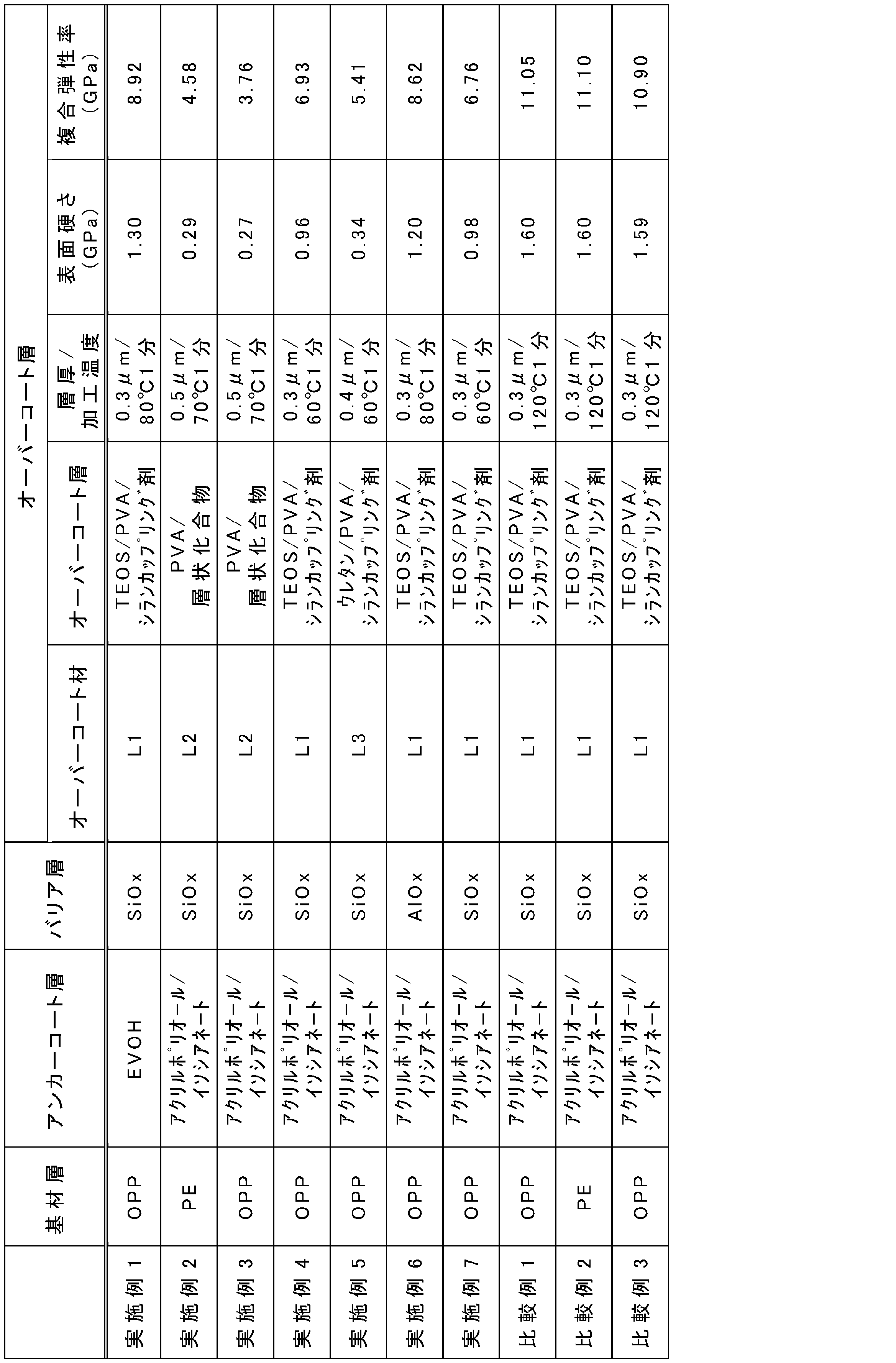
- a barrier film was obtained in the same manner as in Example 2 except that the base material layer, the barrier layer and the overcoat material, and at least one of the layer thickness and the processing temperature were changed as shown in Table 1.
- a transparent inorganic oxide layer (barrier layer) made of aluminum oxide (AlOx) having a thickness of 10 nm was formed on the anchor coat layer by using a vacuum vapor deposition apparatus based on an electron beam heating method.
- the packaging material was cut to a size of 2 cm in length and width, and the entire cut packaging material was immersed in an ethyl acetate solvent.
- the packaging material was taken out, and the sealant layer was peeled off from the end face of the packaging material.
- the entire barrier film from which the sealant layer was peeled off was immersed in the ethyl acetate solvent again.
- the barrier film was taken out, and the peeled surface of the barrier film was subjected to ion etching treatment for 10 minutes under the HARD treatment conditions using Plasma Ion Bomberda PIB-10 (manufactured by Vacuum Device Co., Ltd.).
- the barrier film obtained in each example was fixed to a jig for fixing a magnet disk sample using an instant adhesive (Aron Alpha, manufactured by Toagosei Co., Ltd.) and fixed to the stage of the apparatus.
- An instant adhesive Aron Alpha, manufactured by Toagosei Co., Ltd.
- a Hybrid TI-Premier (trade name) manufactured by Bruker Japan Co., Ltd. was used as a measuring device, and a Berkovich diamond indenter manufactured by Bruker Japan Co., Ltd. was used as an indenter for measurement.
- the hardness and the composite elastic modulus of the surface of the overcoat layer were measured by the nanoindentation method.
- the measurement by the nanoindentation method is performed at room temperature (25 ° C) under the conditions of displacement control mode and pushing speed of 30 nm / sec, pushing to a depth of 30 nm, holding at the maximum depth for 1 second, and unloading speed. This was done by unloading under the condition of 30 nm / sec.
- the number of measurement points was 30 points (5 points x 3 points x 2 sets), and the measurement interval was 50 ⁇ m.
- molten quartz as a standard sample was tested in advance, and the relationship between the contact depth of the indenter and the sample and the contact projection area was calibrated.
- Evaluation A Can be wound up without any problem in transportation Evaluation B: Can be wound up to the extent that the middle end surface of transportation is slightly lifted Evaluation C: Can be wound up even though the middle end surface of transportation is curled Evaluation D: Can be wound in a tubular shape from the middle end surface of transportation Poor removal-Evaluation of sticking- It was confirmed that the film was easily peeled off (peeling property) when the film was rewound from the wound roll and conveyed. Evaluation A: Can be peeled off without problems Evaluation B: Films are slightly sticking to each other but can be peeled off Evaluation C: Films are sticking to each other but can be peeled off Evaluation D: Films stick to each other and cannot be peeled off
- Base material layer 1 ... Base material layer, 2 ... Barrier layer, 3 ... Overcoat layer, 4 ... Sealant layer, 10 ... Gas barrier laminate, 100, 200 ... Packaging material.
Landscapes
- Chemical & Material Sciences (AREA)
- Engineering & Computer Science (AREA)
- Mechanical Engineering (AREA)
- Health & Medical Sciences (AREA)
- Chemical Kinetics & Catalysis (AREA)
- Medicinal Chemistry (AREA)
- Polymers & Plastics (AREA)
- Organic Chemistry (AREA)
- Food Science & Technology (AREA)
- Inorganic Chemistry (AREA)
- Laminated Bodies (AREA)
Abstract
ポリオレフィン系樹脂を含む基材層と、バリア層と、ポリビニルアルコール系樹脂を含むオーバーコート層と、を備え、オーバーコート層表面の硬さが、ナノインデンテーション法による測定において1.5GPa以下である、ガスバリア積層体。
Description
本開示は、ガスバリア積層体及び包装材に関する。
食品等の包装に用いられる包装材料として、バリアコート層と、無機酸化物蒸着層と、基材層とをこの順に備えてなる、バリアフィルムが知られている(例えば、特許文献1)。
特許文献1をはじめとした従来のバリアフィルム(ガスバリア積層体)では、一般的にはポリエステルフィルムやナイロンフィルムといった耐熱性の基材が用いられており、それをさらにポリプロピレンやポリエチレン等と貼り合わせることで製袋化を可能としている。しかしながら、近年のモノマテリアル化の流れから、バリアフィルム自体もポリプロピレンやポリエチレン基材にするというニーズが高まっている。
ところが、ポリプロピレンやポリエチレン等のポリオレフィン系の樹脂を、ポリエステルフィルムやナイロンフィルムと同等に基材として用いてバリアフィルムを作製しようとすると、フィルム巻取り時に折れや貼り付き等の加工上の問題が生じる虞がある。
本開示は上記事情に鑑みてなされたものであり、ポリオレフィン基材を用いて、良好な加工適性を実現することのできるガスバリア積層体を提供することを目的とする。本開示はまた、当該ガスバリア積層体を備える包装材を提供することを目的とする。
発明者らが鋭意検討した結果、オーバーコート層(バリアコート層)表面の硬さを所定値以下に調整することが、加工適性改善の重要なファクターであることを見出し、本開示に係るガスバリア積層体を完成するに至った。
本開示は、ポリオレフィン系樹脂を含む基材層と、バリア層と、ポリビニルアルコール系樹脂を含むオーバーコート層と、を備え、オーバーコート層表面の硬さが、ナノインデンテーション法による測定において1.5GPa以下である、ガスバリア積層体を提供する。
一態様において、バリア層は、金属、金属酸化物、金属窒化物又は金属酸窒化物を含んでよい。
一態様において、オーバーコート層は、Siを含んでよい。
一態様において、オーバーコート層は、無機層状化合物を含んでよい。
本開示は、上記ガスバリア積層体と、シーラント層とを備える、包装材を提供する。
本開示によれば、ポリオレフィン基材を用いて、良好な加工適性を実現することのできるガスバリア積層体を提供することができる。また、本開示によれば、当該ガスバリア積層体を備える包装材を提供することができる。
以下、場合により図面を参照しつつ本開示の好適な実施形態について詳細に説明する。なお、図面中、同一又は相当部分には同一符号を付し、重複する説明は省略する。また、図面の寸法比率は図示の比率に限られるものではない。
<ガスバリア積層体>
図1は、一実施形態に係るガスバリア積層体(バリアフィルム)を示す模式断面図である。図1に示すガスバリア積層体10は、基材層1、バリア層2、オーバーコート層3、をこの順で備える。
図1は、一実施形態に係るガスバリア積層体(バリアフィルム)を示す模式断面図である。図1に示すガスバリア積層体10は、基材層1、バリア層2、オーバーコート層3、をこの順で備える。
(基材層)
基材層は支持体の一つとなるフィルムであり、ポリオレフィン系樹脂を含む。
基材層は支持体の一つとなるフィルムであり、ポリオレフィン系樹脂を含む。
ポリオレフィン系樹脂としては、例えばポリエチレン(PE)、ポリプロピレン(PP)、ポリブテン(PB)、シクロオレフィンポリマー等が挙げられる。また、ポリオレフィン系樹脂としては、ポリオレフィンを、不飽和カルボン酸、不飽和カルボン酸の酸無水物、不飽和カルボン酸のエステル等を用いてグラフト変性して得られる酸変性ポリオレフィン等が挙げられる。ポリプロピレン合成時の原料モノマーとして、エチレンやブテン等の第二、第三等の成分を少量用いてもよい。優れた耐熱性の観点から、基材層としてプロピレンのモノポリマーフィルムを用いることができる。
基材層を構成するフィルムは、延伸フィルムであってよく、非延伸フィルムであってよい。但し、耐衝撃性、耐熱性、耐水性、寸法安定性等の観点から、基材層を構成するフィルムは延伸フィルムであってよい。延伸方法としては特に限定されず、インフレーションによる延伸、または一軸延伸、二軸延伸など、寸法が安定したフィルムが供給可能であれば、どのような方法でもよい。
基材層の厚さは特に制限されないが、優れた耐衝撃性と優れたガスバリア性とを得る観点から、9~100μmとすることができ、15~30μmであってよい。
基材層を構成するフィルムには、他層の積層面に、バリア性能を損なわない範囲でコロナ処理、プラズマ処理、フレーム処理などの各種前処理を施したり、易接着層などのコート層を設けても構わない。
基材層を構成するフィルムには、必要に応じて帯電防止剤、紫外線吸収剤、可塑剤、滑剤といった添加剤が含まれていてもよい。
(バリア層)
バリア層は、基材層にガスバリア性を付与する層である。バリア層を用いることにより、厚さを抑えつつ高いガスバリア性を得ることができる。バリア層は、真空製膜により基材上に形成することができるため、真空製膜層と言うこともできる。
バリア層は、基材層にガスバリア性を付与する層である。バリア層を用いることにより、厚さを抑えつつ高いガスバリア性を得ることができる。バリア層は、真空製膜により基材上に形成することができるため、真空製膜層と言うこともできる。
バリア層は、金属、金属酸化物、金属窒化物又は金属酸窒化物を含むことができる。バリア層の構成材料としては、具体的には、金属アルミニウム(Al)等の金属、酸化ケイ素(SiOx)、酸化アルミニウム(AlOx)等の金属酸化物、シリコンナイトライド(SiN)等の金属窒化物、シリコンオキシナイトライド(SiON)等の金属酸窒化物などが挙げられる。透明性及びバリア性の観点から、バリア層の構成材料は、酸化アルミニウム及び酸化ケイ素とすることができる。また、加工時に引っ張り延伸性に優れる観点から、バリア層の構成材料は、酸化ケイ素とすることができる。バリア層として酸化ケイ素膜を用いる場合、ガスバリア性の観点からそのO/Si比は1.2~1.9とすることができる。
バリア層の層厚は、5~80nmとすることができる。層厚が5nm以上であると、充分なガスバリア性を得易くなる。また、層厚が80nm以下であると、薄膜の内部応力による変形によりクラックが発生することが抑制され、ガスバリア性の低下が抑制され易くなる。なお、層厚が80nmを超えると、材料使用量の増加、膜形成時間の長時間化等に起因してコストが増加し易いため、経済的観点からも好ましくない。上記の観点から、バリア層の層厚は、10~50nmであってよく、20~40nmであってよい。
(オーバーコート層)
ポリビニルアルコール系樹脂としては、ビニルエステル単位がケン化されてなるビニルアルコール単位を有するものであればよく、例えば、ポリビニルアルコール(PVA)、エチレン-ビニルアルコール共重合体(EVOH)が挙げられる。汎用性、溶解性等の観点から、PVAを好適に用いることができる。
ポリビニルアルコール系樹脂としては、ビニルエステル単位がケン化されてなるビニルアルコール単位を有するものであればよく、例えば、ポリビニルアルコール(PVA)、エチレン-ビニルアルコール共重合体(EVOH)が挙げられる。汎用性、溶解性等の観点から、PVAを好適に用いることができる。
PVAとしては、例えば、酢酸ビニル、ギ酸ビニル、プロピオン酸ビニル、バレリン酸ビニル、カプリン酸ビニル、ラウリン酸ビニル、ステアリン酸ビニル、ピバル酸ビニル、バーサチック酸ビニル等のビニルエステルを、単独で重合し、次いでケン化した樹脂が挙げられる。
PVAは、共重合変性又は後変性された変性PVAであってもよい。共重合変性PVAは、例えばビニルエステルと、ビニルエステルと共重合可能な不飽和モノマーを共重合させた後にケン化することで得られる。後変性されたPVAは、ビニルエステルを重合させた後にケン化して得られたPVAに、重合触媒の存在下で不飽和モノマーを共重合させることで得られる。変性PVAにおける変性量は、充分なガスバリア性を発現する観点から、50モル%未満とすることができ、また変性による効果を得る観点から10モル%以上とすることができる。
上記の不飽和モノマーとしては、例えばエチレン、プロピレン、イソブチレン、α-オクテン、α-ドデセン、α-オクタデセン等のオレフィン;3-ブテン-1-オール、4-ペンチン-1-オール、5-ヘキセン-1-オール等のヒドロキシ基含有α-オレフィン;アクリル酸、メタクリル酸、クロトン酸、マレイン酸、無水マレイン酸、イタコン酸、ウンデシレン酸等の不飽和酸;アクリロニトリル、メタアクリロニトリル等のニトリル;ジアセトンアクリルアミド、アクリルアミド、メタクリルアミド等のアミド;エチレンスルホン酸、アリルスルホン酸、メタアリルスルホン酸等のオレフィンスルホン酸;アルキルビニルエーテル、ジメチルアリルビニルケトン、N-ビニルピロリドン、塩化ビニル、ビニルエチレンカーボネート、2,2-ジアルキル-4-ビニル-1,3-ジオキソラン、グリセリンモノアリルエーテル、3,4-ジアセトキシ-1-ブテン等のビニル化合物;塩化ビニリデン、1,4-ジアセトキシ-2-ブテン、ビニレンカーボネート、ポリオキシプロピレン、ポリオキシプロピレンビニルアミン等が挙げられる。ガスバリア性の観点からは、不飽和モノマーとしてはオレフィンとすることができ、特にエチレンであってよい。
重合触媒としては、アゾビスイソブチロニトリル、過酸化ベンゾイル、過酸化ラウリル等のラジカル重合触媒が挙げられる。重合方法は特に制限されず、塊状重合、乳化重合、溶媒重合等を採用することができる。
PVAの重合度は300~3000が好ましい。重合度が300以上であるとバリア性が低下し難く、また3000以下であると粘度が高すぎることによる塗工適性の低下を抑制し易い。PVAのケン化度は80モル%以上が好ましく、90モル%以上がより好ましく、98モル%以上がさらに好ましい。また、PVAのケン化度は100モル%以下であっても、99.9モル%以下であってもよい。PVAの重合度及びケン化度は、JIS K 6726(1994)に記載の方法に準拠して測定できる。
EVOHは、一般にエチレンと、酢酸ビニル、ギ酸ビニル、プロピオン酸ビニル、バレリン酸ビニル、カプリン酸ビニル、ラウリン酸ビニル、ステアリン酸ビニル、ピバル酸ビニル、バーサチック酸ビニル等の酸ビニルエステルとの共重合体をケン化して得られる。
EVOHのエチレン単位含有量は10モル%以上であり、15モル%以上がより好ましく、20モル%以上がさらに好ましく、35モル%より大きいことが特に好ましい。また、EVOHのエチレン単位含有量は65モル%以下が好ましく、55モル%以下がより好ましく、50モル%未満がさらに好ましい。エチレン単位含有量が10モル%以上であると、高湿度下におけるガスバリア性あるいは寸法安定性を良好に保つことができる。一方、エチレン単位含有量が65モル%以下であると、ガスバリア性を高めることができる。EVOHのエチレン単位含有量は、NMR法により求めることができる。
ケン化はアルカリ又は酸で行うことができるが、ケン化速度の観点からアルカリを用いることができる。アルカリとしては、水酸化ナトリウム、水酸化カリウム等のアルカリ金属水酸化物、ナトリウムエチラート、カリウムエチラート、リチウムメチラート等のアルカリ金属アルコキシドが挙げられる。
オーバーコート層はSi(Si元素)を含んでいてもよい。具体的には、オーバーコート層は、ポリビニルアルコール系樹脂及びシラン化合物(有機ケイ素化合物)を含むオーバーコート層形成原料の硬化物であってよい。シラン化合物としては、テトラメトキシシラン、テトラエトキシシラン等のアルコキシシラン(テトラアルコキシシラン)、ヘキサメチルジシラザン等のシラザンなどが挙げられる。シラン化合物としては、一般的にシランカップリング剤として用いられる化合物や、シロキサン結合を有するポリシロキサン化合物を用いてもよい。シランカップリング剤を用いることでオーバーコート層内の強度がより向上し、バリア性や耐水性が向上し易い。シランカップリング剤としては、例えば、エポキシシラン(グリシドキシプロピルトリメトキシシラン、グリシドキシプロピルトリエトキシシラン等)、(メタ)アクリルシラン(アクリロキシプロピルトリメトキシシラン等)、アミノシラン、ウレイドシラン、イソシアネートシラン、イソシアヌレートシラン(トリス(3-トリアルコキシシリルプロピル)イソシアヌレート等)、メルカプトシラン等が挙げられる。これらは単独で、または、二種以上組み合わせて用いてよい。
オーバーコート層を形成する際、上記原料におけるシラン化合物の量は、バリア層との密着性及びガスバリア性維持の観点から、ポリビニルアルコール系樹脂1質量部に対して0.1~5.0質量部とすることができ、0.3~5.0質量部であってよく、0.4~4.5質量部であってよく、0.5~4.0質量部であってよい。
オーバーコート層は、耐屈曲性及びガスバリア性の観点から、ポリウレタン樹脂を含んでよい。すなわち、オーバーコート層は、ポリビニルアルコール系樹脂、ポリウレタン樹脂及びシラン化合物を含むオーバーコート層形成原料の硬化物であってよい。ポリウレタン樹脂としては水性ポリウレタン樹脂が挙げられる。
水性ポリウレタン樹脂は、酸基含有ポリウレタン樹脂及びポリアミン化合物を含む。水性ポリウレタン樹脂を用いることで、オーバーコート層に柔軟性と、ガスバリア性、特に酸素バリア性を付与し易い。水性ポリウレタン樹脂は、市販のものを用いてもよく、公知の製造方法により製造したものを用いてもよい。市販のものとしては、タケラック WPB-341(三井化学株式会社製)、ハイドラン HW350(DIC株式会社製)等が挙げられる。
オーバーコート層を形成する際、オーバーコート層形成原料におけるポリウレタン樹脂の量は、耐屈曲性及びガスバリア性の観点から、ポリビニルアルコール系樹脂1質量部に対して0.9~4.0質量部とすることができ、1.1~3.0質量部であってよく、1.2~2.5質量部であってよい。
オーバーコート層は、無機層状化合物を含んでいてもよい。具体的には、オーバーコート層は、ポリビニルアルコール系樹脂及び無機層状化合物を含むオーバーコート層形成原料の硬化物であってよい。無機層状化合物としては、モンモリロナイト、スメクタイト、マイカ等が挙げられる。また、無機層状化合物としては、平板上に合成されたシリカ等の金属酸化物であってもよい。
オーバーコート層を形成する際、上記原料における無機層状化合物の量(すなわち、オーバーコート層における無機層状化合物の量)は、バリア層との密着性及びガスバリア性維持の観点から、ポリビニルアルコール系樹脂1質量部に対して0.01~0.6質量部とすることができ、0.1~0.5質量部であってよい。
オーバーコート層の厚さは特に制限されないが、バリア性と加工適性の観点から、0.05~2μmとすることができ、0.1~0.6μmであってよく、0.2~0.5μmであってよい。
オーバーコート層表面(オーバーコート層のバリア層側とは反対側の表面)の硬さは、ナノインデンテーション法による測定(ナノインデンターを用いる測定)において1.5GPa以下である。これにより、ポリオレフィン基材を用いる場合であっても、フィルム巻取り時に折れや貼り付き等が生じることを抑制することができ、良好な加工適性を実現することが可能となる。この理由について発明者は、ポリエステル基材等に比べ柔らかいポリオレフィン基材を用いる場合、硬過ぎないオーバーコート層を用いることで、バリア層やオーバーコート層自身が損傷することを抑制でき、それにより加工適性を良好に保つことができるためであると推察している。この観点から、当該硬さは1.3GPa以下とすることができ、1.1GPa以下であってよく、0.9GPa以下であってよい。硬さの下限は特に限定されないが、バリア性を保つ架橋度合いの観点から、0.1GPaとすることができる。オーバーコート層表面の硬さは、シラン化合物や層状化合物の添加量、オーバーコート層形成時の加工温度などにより調整することができる。
オーバーコート層表面の複合弾性率は、ナノインデンテーション法による測定において10GPa以下とすることができる。これにより、ポリオレフィン基材を用いる場合であっても、フィルム巻取り時に折れや貼り付き等が生じることを抑制することができ、良好な加工適性を実現することが可能となる。発明者は、上記と同様に、硬過ぎないオーバーコート層を用いることで、加工適性を良好に保つことができると推察している。この観点から、当該複合弾性率は9GPa以下とすることができ、7.5GPa以下であってよく、6GPa以下であってよい。複合弾性率の下限は特に限定されないが、バリア性を保つ架橋度合いの観点から、1GPaとすることができる。オーバーコート層表面の複合弾性率は、シラン化合物や層状化合物の添加量、オーバーコート層形成時の加工温度などにより調整することができる。
ナノインデンテーション法による各特性の測定方法について以下に説明する。ナノインデンテーション法とは、試料に対して準静的な押し込み試験を行い、試料の機械特性を取得する方法である。
まず、試料を、接着剤を用いてマグネットディスクやスライドガラス等の試料固定用治具に固定し、測定装置のステージに固定する。測定装置としては、ブルカージャパン株式会社製のHysitron TI-Premier(商品名)を用いることができ、測定用の圧子としては、ブルカージャパン株式会社製のバーコビッチ型ダイヤモンド圧子を用いることができる。
ナノインデンテーション法による測定は、常温(25℃)において、変位制御モード及び押し込み速度30nm/秒の条件にて、深さ30nmまで押し込みを行い、最大深さにて1秒間保持し、除荷速度30nm/秒の条件にて除荷することで行う。測定試料の硬さ及び複合弾性率の算出のため、標準試料となる溶融石英を予め試験し、圧子及び試料の接触深さと接触投影面積との関係を校正する。その後、除荷時の最大荷重に対して60~95%領域の除荷曲線をOliver-Pharr法にて解析し、測定試料の硬さ及び複合弾性率を算出する。
ガスバリア積層体のオーバーコート層側の表面にシーラント層が貼り合わされている場合は(図2の包装材の態様)、例えば以下の手順によりオーバーコート層を露出させた後に、ナノインデンテーション法による測定を行えばよい。
まず、包装材を縦横2cmの大きさに裁断し、裁断した包装材全体を酢酸エチル溶媒に浸漬させる。浸漬開始から1時間後に包装材を取り出し、包装材の端面からシーラント層を剥離する。
シーラント層を剥離したガスバリア積層体には、オーバーコート層とシーラント層間に設けられた接着剤が残存するため、この接着剤を取り除くために、ガスバリア積層体の剥離面に対して以下のようにイオンエッチング処理を施す。まず、接着剤を変質させることでイオンエッチング処理の効果を向上させるため、シーラント層を剥離したガスバリア積層体全体を、酢酸エチル溶媒に浸漬させる。浸漬開始から30分後にガスバリア積層体を取り出し、ガスバリア積層体の剥離面に対してプラズマイオンボンバーダ PIB-10(株式会社真空デバイス製)を用いて、HARDの処理条件で10分間のイオンエッチング処理を3回実施する。なお、イオンエッチング処理による剥離面の汚染を防ぐため、イオンエッチング処理の前にはプラズマイオンボンバーダの電極をピカール液(日本磨料工業株式会社製)により洗浄することが好ましい。
以上の手順によって、オーバーコート層が剥離面全体に露出することもあれば、剥離面の一部のみに露出することもある。オーバーコート層が露出していることを確認するためには、例えば原子間力顕微鏡(AFM)によって表面粗さを確認すればよい。具体的には、シーラント層を設けないオーバーコート層と、シーラント層を設けた後に上記のとおり除去したオーバーコート層との、それぞれの表面形状をAFMにより測定し、表面粗さを比較することで、オーバーコート層が露出しているかどうかを確認できる。例えば、AFMにより5μmの視野で形状測定を行い、それぞれの算術平均粗さ(Ra)が同程度であれば(例えば前者では0.51nm、後者では0.54nm)であれば、オーバーコート層が充分に露出していると判断できる。
(アンカーコート層)
ガスバリア積層体は、基材層上に、バリア層との密着性向上のため、アンカーコート層(密着層)を備えていてよい。アンカーコート層の材質としては、例えば、ポリエステル樹脂、ポリアミド樹脂、ポリウレタン樹脂(ポリエステルウレタン、アクリルウレタン等のポリオールとイソシアネートを反応させた樹脂)、エポキシ樹脂、フェノール樹脂、(メタ)アクリル樹脂、ポリ酢酸ビニル樹脂、エチレン-ビニルアルコール共重合体、ポリエチレンやポリプロピレン等のポリオレフィン樹脂、セルロース樹脂などが挙げられる。アンカーコート層は、シランカップリング剤に由来するSiを含んでいてもよい。具体的には、アンカーコート層は、上記樹脂及びシランカップリング剤を含む原料の硬化物であってよい。
ガスバリア積層体は、基材層上に、バリア層との密着性向上のため、アンカーコート層(密着層)を備えていてよい。アンカーコート層の材質としては、例えば、ポリエステル樹脂、ポリアミド樹脂、ポリウレタン樹脂(ポリエステルウレタン、アクリルウレタン等のポリオールとイソシアネートを反応させた樹脂)、エポキシ樹脂、フェノール樹脂、(メタ)アクリル樹脂、ポリ酢酸ビニル樹脂、エチレン-ビニルアルコール共重合体、ポリエチレンやポリプロピレン等のポリオレフィン樹脂、セルロース樹脂などが挙げられる。アンカーコート層は、シランカップリング剤に由来するSiを含んでいてもよい。具体的には、アンカーコート層は、上記樹脂及びシランカップリング剤を含む原料の硬化物であってよい。
アンカーコート層の厚さは、層の均一性、柔軟性等の観点から、0.01~2μmとすることができ、0.05~0.5μmであってよい。
<ガスバリア積層体の製造方法>
ガスバリア積層体は、例えば、基材層上にバリア層を形成する工程、及び、バリア層上にオーバーコート層を形成する工程を備える製造方法により製造することができる。
ガスバリア積層体は、例えば、基材層上にバリア層を形成する工程、及び、バリア層上にオーバーコート層を形成する工程を備える製造方法により製造することができる。
(バリア層を形成する工程)
バリア層は、例えば真空製膜法で形成することができる。真空製膜法としては、物理気相成長法あるいは化学気相成長法を用いることができる。物理気相成長法としては、真空蒸着法、スパッタリング法、イオンプレーティング法等を挙げることができる。化学気相成長法としては、熱CVD法、プラズマCVD法、光CVD法等を挙げることができる。ただし、バリア層を形成する工程はこれらに限定されるものではない。
バリア層は、例えば真空製膜法で形成することができる。真空製膜法としては、物理気相成長法あるいは化学気相成長法を用いることができる。物理気相成長法としては、真空蒸着法、スパッタリング法、イオンプレーティング法等を挙げることができる。化学気相成長法としては、熱CVD法、プラズマCVD法、光CVD法等を挙げることができる。ただし、バリア層を形成する工程はこれらに限定されるものではない。
(オーバーコート層を形成する工程)
本工程においては、ポリビニルアルコール系樹脂及び液状媒体を含む塗布液(オーバーコート層形成原料)を用いることができる。当該塗布液は、例えば合成により得られたポリビニルアルコール系樹脂の粉末を、液状媒体に溶解させて得ることができる。液状媒体としては、水、ジメチルスルホキシド、ジメチルホルムアミド、ジメチルアセトアミド、N-メチルピロリドン、各種グリコール類、イソプロピルアルコール等のアルコール類、トリメチロールプロパン等の多価アルコール類、エチレンジアミン、ジエチレントリアミン等のアミン類などが挙げられる。これらは単独で、または、二種以上組み合わせて用いてよい。環境負荷低減等の観点から、液状媒体として水を用いることができる。この場合、ポリビニルアルコール系樹脂の粉末を、高温(例えば80℃)の水に溶解させることで塗布液を得ることができる。
本工程においては、ポリビニルアルコール系樹脂及び液状媒体を含む塗布液(オーバーコート層形成原料)を用いることができる。当該塗布液は、例えば合成により得られたポリビニルアルコール系樹脂の粉末を、液状媒体に溶解させて得ることができる。液状媒体としては、水、ジメチルスルホキシド、ジメチルホルムアミド、ジメチルアセトアミド、N-メチルピロリドン、各種グリコール類、イソプロピルアルコール等のアルコール類、トリメチロールプロパン等の多価アルコール類、エチレンジアミン、ジエチレントリアミン等のアミン類などが挙げられる。これらは単独で、または、二種以上組み合わせて用いてよい。環境負荷低減等の観点から、液状媒体として水を用いることができる。この場合、ポリビニルアルコール系樹脂の粉末を、高温(例えば80℃)の水に溶解させることで塗布液を得ることができる。
塗布液中のポリビニルアルコール系樹脂を含む固形分の含有量は、良好な塗布性を維持する観点から3~20質量%とすることができる。
塗布液には、上記シラン化合物、ポリウレタン樹脂、及び無機層状化合物が含まれていてよい。塗布液中のこれらの成分の含有量は、ポリビニルアルコール系樹脂の量に対する各成分の量が所望量となるよう調整すればよい。
塗布液には、密着性向上のためにイソシアネートやポリエチレンイミン等の添加剤が含まれていてよい。また、塗布液には、防腐剤、可塑剤、アルコール、界面活性剤等の添加剤が含まれていてよい。
バリア層上への塗布液の塗布は、任意の適切な方法により行うことができる。塗布液の塗布は、例えばグラビアコーター、ディップコーター、リバースコーター、ワイヤーバーコーター、ダイコーター等のウェット成膜法により行うことができる。塗布液の塗布温度及び乾燥温度は特に制限されず、例えば50℃以上とすることができる。
オーバーコート層は、押出法によりバリア層上に形成してもよい。押出の場合は、Tダイを用いた多層押出を採用することができる。押出時に用いることができる接着剤としては、例えば、無水マレイン酸変性ポリプロピレン樹脂が挙げられる。
上記の接着剤をバリア層上に塗工後、乾燥することで、バリア層上に接着層を予め形成しておいてよい。
接着層の厚さは、接着性、追随性、加工性等の観点から、0.1~50μmとすることができ、0.5~20μmであってよい。
(アンカーコート層を形成する工程)
アンカーコート層を形成する場合は、バリア層を形成する工程に先立ち実施することができる。アンカーコート層の形成方法は、オーバーコート層と同様にアンカーコート層の材料を用いて塗布法又は押出法により基材層上に形成することができる。
アンカーコート層を形成する場合は、バリア層を形成する工程に先立ち実施することができる。アンカーコート層の形成方法は、オーバーコート層と同様にアンカーコート層の材料を用いて塗布法又は押出法により基材層上に形成することができる。
<包装材>
包装材は、上記のガスバリア積層体と、シーラント層と、を備える。シーラント層としては、ポリオレフィン系樹脂やポリエステル系樹脂を含む層が挙げられる。シーラント層の厚さは目的に応じ適宜決定できるが、例えば15~200μmとすることができる。オーバーコート層とシーラント層間、又は基材層とシーラント層間には、層間の密着性をより良好とするため、必要に応じて接着層を設けてもよい。接着層は、一液硬化型や二液硬化型のウレタン系接着剤等を用いて形成することができる。図2及び図3は、一実施形態に係る包装材を示す模式断面図である。
包装材は、上記のガスバリア積層体と、シーラント層と、を備える。シーラント層としては、ポリオレフィン系樹脂やポリエステル系樹脂を含む層が挙げられる。シーラント層の厚さは目的に応じ適宜決定できるが、例えば15~200μmとすることができる。オーバーコート層とシーラント層間、又は基材層とシーラント層間には、層間の密着性をより良好とするため、必要に応じて接着層を設けてもよい。接着層は、一液硬化型や二液硬化型のウレタン系接着剤等を用いて形成することができる。図2及び図3は、一実施形態に係る包装材を示す模式断面図である。
図2に示す包装材100は、基材層1、バリア層2、オーバーコート層3、をこの順で備えるガスバリア積層体と、ガスバリア積層体のオーバーコート層3上に設けられたシーラント層4とを備える。例えば、基材層1及びシーラント層4を共にポリオレフィン系樹脂とした場合、包装材100の全質量を基準として、ポリオレフィン系樹脂の含有率を90質量%以上(好ましくは95質量%以上)とすることができる。このような包装材100はモノマテリアルを実現することができる。
上記実施形態においては、ガスバリア積層体のオーバーコート層3側の表面にシーラント層4が貼り合わされた包装材100を例示したが、ガスバリア積層体の基材層1側の表面にシーラント層4が貼り合わされた包装材200であってもよい(図3参照)。
以下、本開示を実験例により、さらに具体的に説明するが、本開示はこれら実験例に限定されるものではない。
(アンカーコート層形成用組成物の準備)
アクリルポリオールとイソシアネートシランを混合した溶液に、キシリレンジイソシアネートとイソホロンジイソシアネートを混合した溶液を作製した。アクリルポリオールのOH基の数に対してキシリレンジイソシアネートとイソホロンジイソシアネートのNCO基の数が等量となるように混合し、全固形分(アクリルポリオール、キシリレンジイソシアネート及びイソホロンジイソシアネートの合計量)が5質量%になるよう酢酸エチルで希釈した。イソシアネートシランは、アクリルポリオール、キシリレンジイソシアネート及びイソホロンジイソシアネートの合計量100質量部に対して5質量部となるように添加し、これらを混合することでアンカーコート層形成用組成物(アンカーコート材)を調製した。
アクリルポリオールとイソシアネートシランを混合した溶液に、キシリレンジイソシアネートとイソホロンジイソシアネートを混合した溶液を作製した。アクリルポリオールのOH基の数に対してキシリレンジイソシアネートとイソホロンジイソシアネートのNCO基の数が等量となるように混合し、全固形分(アクリルポリオール、キシリレンジイソシアネート及びイソホロンジイソシアネートの合計量)が5質量%になるよう酢酸エチルで希釈した。イソシアネートシランは、アクリルポリオール、キシリレンジイソシアネート及びイソホロンジイソシアネートの合計量100質量部に対して5質量部となるように添加し、これらを混合することでアンカーコート層形成用組成物(アンカーコート材)を調製した。
(オーバーコート層形成用組成物L1の調製)
下記のA液、B液、C液を、質量比で65/25/10で混合して、オーバーコート層形成用組成物(オーバーコート材)を調製した。
A液:テトラエトキシシラン(Si(OC2H5)4)17.9gとメタノール10gに、0.1N塩酸72.1gを加えて30分間攪拌して加水分解させた、固形分5質量%(SiO2換算)の加水分解溶液。
B液:ポリビニルアルコールの5質量%水/イソプロピルアルコール溶液(水:イソプロピルアルコールの質量比は95:5)。
C液:1,3,5-トリス(3-トリアルコキシシリルプロピル)イソシアヌレートを水/イソプロピルアルコールの混合液(水:イソプロピルアルコールの質量比は1:1)で固形分5質量%に希釈した加水分解溶液。
(オーバーコート層形成用組成物L2の調製)
下記のB液及びD液を、オーバーコート層における水膨潤性合成雲母の含有量が30質量%となるように混合した。これを水及びメタノール(質量比が1:1)で希釈し、オーバーコート層形成用組成物を調製した。
B液:ポリビニルアルコールの5質量%水/イソプロピルアルコール溶液(水:イソプロピルアルコールの質量比は95:5)
D液:水膨潤性雲母として、水膨潤性合成雲母(ソマシフ MEB-3、コープアグリ社製)を用いた。面積粒径が2μmとなるように、ビーズミルを用いて水膨潤性合成雲母を処理した。その後、最終的な固形分濃度が8質量%となるように水を添加した。
下記のB液及びD液を、オーバーコート層における水膨潤性合成雲母の含有量が30質量%となるように混合した。これを水及びメタノール(質量比が1:1)で希釈し、オーバーコート層形成用組成物を調製した。
B液:ポリビニルアルコールの5質量%水/イソプロピルアルコール溶液(水:イソプロピルアルコールの質量比は95:5)
D液:水膨潤性雲母として、水膨潤性合成雲母(ソマシフ MEB-3、コープアグリ社製)を用いた。面積粒径が2μmとなるように、ビーズミルを用いて水膨潤性合成雲母を処理した。その後、最終的な固形分濃度が8質量%となるように水を添加した。
(オーバーコート層形成用組成物L3の調製)
ポリウレタン樹脂と5%PVA水溶液とエポキシシランを、それぞれの固形分比が60:35:5となるように混合し、液の固形分濃度が5%となる様に、水とイソプロパノールで希釈し、オーバーコート層形成用組成物を調製した。このとき、イソプロパノールは、オーバーコート層形成用組成物全体の10質量%とした。
ポリウレタン樹脂と5%PVA水溶液とエポキシシランを、それぞれの固形分比が60:35:5となるように混合し、液の固形分濃度が5%となる様に、水とイソプロパノールで希釈し、オーバーコート層形成用組成物を調製した。このとき、イソプロパノールは、オーバーコート層形成用組成物全体の10質量%とした。
(基材層の準備)
OPPフィルム:ポリプロピレン単独重合層(厚さ:20μm)
PEフィルム(コロナ処理有):SMUQ(東京インキ株式会社製、厚さ:25μm、延伸HDPE)
OPPフィルム:ポリプロピレン単独重合層(厚さ:20μm)
PEフィルム(コロナ処理有):SMUQ(東京インキ株式会社製、厚さ:25μm、延伸HDPE)
(実施例1)
無水マレイン酸変性ポリプロピレン樹脂を接着層として用いて、OPPフィルム上にアンカーコート層としてのEVOH層を共押出により形成した。接着層の厚さは1μmであり、EVOH層の厚さは1μmであった。
電子線加熱方式による真空蒸着装置を用いて、アンカーコート層上に厚さ30nmの酸化ケイ素(SiOx)からなる透明な無機酸化物層(バリア層)を形成した。無機酸化物層におけるO/Si比は1.8であった。
無機酸化物層上に、上記オーバーコート層形成用組成物L1をグラビアロールコート法にて塗工し、塗膜を80℃の条件で1分間加熱乾燥させることで、厚さ0.3μmのオーバーコート層を形成した。これによりバリアフィルムを得た。
(実施例2)
PEフィルムのコロナ処理面に、上記アンカーコート層形成用組成物をグラビアロールコート法にて塗工し、塗膜を60℃で乾燥及び硬化させることで、単位面積当たりの塗工量が0.1g/m2であるアンカーコート層を形成した。
次に、実施例1と同様にしてアンカーコート層上に無機酸化物層を形成した。
オーバーコート層形成用組成物L2を用いたこと以外は実施例1と同様にして、無機酸化物層上にオーバーコート層を形成した。これによりバリアフィルムを得た。
PEフィルムのコロナ処理面に、上記アンカーコート層形成用組成物をグラビアロールコート法にて塗工し、塗膜を60℃で乾燥及び硬化させることで、単位面積当たりの塗工量が0.1g/m2であるアンカーコート層を形成した。
次に、実施例1と同様にしてアンカーコート層上に無機酸化物層を形成した。
オーバーコート層形成用組成物L2を用いたこと以外は実施例1と同様にして、無機酸化物層上にオーバーコート層を形成した。これによりバリアフィルムを得た。
(その他の実施例及び比較例)
基材層、バリア層及びオーバーコート材、並びに層厚及び加工温度の少なくともいずれかを表1に示すように変更したこと以外は、実施例2と同様にしてバリアフィルムを得た。なお、実施例6では、電子線加熱方式による真空蒸着装置を用いて、アンカーコート層上に厚さ10nmの酸化アルミニウム(AlOx)からなる透明な無機酸化物層(バリア層)を形成した。
基材層、バリア層及びオーバーコート材、並びに層厚及び加工温度の少なくともいずれかを表1に示すように変更したこと以外は、実施例2と同様にしてバリアフィルムを得た。なお、実施例6では、電子線加熱方式による真空蒸着装置を用いて、アンカーコート層上に厚さ10nmの酸化アルミニウム(AlOx)からなる透明な無機酸化物層(バリア層)を形成した。
(シーラント層の積層及び剥離)
実施例7及び比較例3で得られたバリアフィルムについては、オーバーコート層側の表面に、接着剤(三井化学株式会社製 タケラックA525/タケネートA52)を用いてシーラント層を貼り合わせ、図2に示す包装材を得た。その後、以下の手順により再度オーバーコート層を露出させた。このようにして得られたバリアフィルムを、後述の表面硬さ及び複合弾性率測定に供した。
実施例7及び比較例3で得られたバリアフィルムについては、オーバーコート層側の表面に、接着剤(三井化学株式会社製 タケラックA525/タケネートA52)を用いてシーラント層を貼り合わせ、図2に示す包装材を得た。その後、以下の手順により再度オーバーコート層を露出させた。このようにして得られたバリアフィルムを、後述の表面硬さ及び複合弾性率測定に供した。
[手順]
包装材を縦横2cmの大きさに裁断し、裁断した包装材全体を酢酸エチル溶媒に浸漬させた。浸漬開始から1時間後に包装材を取り出し、包装材の端面からシーラント層を剥離した。次に、シーラント層を剥離したバリアフィルム全体を、再度酢酸エチル溶媒に浸漬させた。浸漬開始から30分後にバリアフィルムを取り出し、バリアフィルムの剥離面に対してプラズマイオンボンバーダ PIB-10(株式会社真空デバイス製)を用いて、HARDの処理条件で10分間のイオンエッチング処理を3回実施した。なお、イオンエッチング処理の前にはプラズマイオンボンバーダの電極をピカール液(日本磨料工業株式会社製)により洗浄した。これにより、再度オーバーコート層を露出させたバリアフィルムを得た。
包装材を縦横2cmの大きさに裁断し、裁断した包装材全体を酢酸エチル溶媒に浸漬させた。浸漬開始から1時間後に包装材を取り出し、包装材の端面からシーラント層を剥離した。次に、シーラント層を剥離したバリアフィルム全体を、再度酢酸エチル溶媒に浸漬させた。浸漬開始から30分後にバリアフィルムを取り出し、バリアフィルムの剥離面に対してプラズマイオンボンバーダ PIB-10(株式会社真空デバイス製)を用いて、HARDの処理条件で10分間のイオンエッチング処理を3回実施した。なお、イオンエッチング処理の前にはプラズマイオンボンバーダの電極をピカール液(日本磨料工業株式会社製)により洗浄した。これにより、再度オーバーコート層を露出させたバリアフィルムを得た。
オーバーコート層が露出していることの確認は、原子間力顕微鏡(AFM)により行った。具体的には、シーラント層を設けないオーバーコート層と、シーラント層を設けた後に上記のとおり除去したオーバーコート層との、それぞれの表面形状をAFMにより測定し、表面粗さを比較することで、オーバーコート層が露出しているかどうかを確認した。
(表面硬さ及び複合弾性率測定)
瞬間接着剤(アロンアルファ、東亜合成株式会社製)を用いて、各例で得られたバリアフィルムを、マグネットディスク試料固定用治具に固定し、装置のステージに固定した。測定装置として、ブルカージャパン株式会社製のHysitron TI-Premier(商品名)を用い、測定用の圧子として、ブルカージャパン株式会社製のバーコビッチ型ダイヤモンド圧子を用いた。
各フィルムのオーバーコート層表面の平坦部を選定後、オーバーコート層表面の硬さ及び複合弾性率を、ナノインデンテーション法により測定した。ナノインデンテーション法による測定は、常温(25℃)において、変位制御モード及び押し込み速度30nm/秒の条件にて、深さ30nmまで押し込みを行い、最大深さにて1秒間保持し、除荷速度30nm/秒の条件にて除荷することで行った。測定点数は30点(5箇所×3点×2セット)とし、測定間隔は50μmとした。なお、オーバーコート層表面の硬さ及び複合弾性率の算出のため、標準試料となる溶融石英を予め試験し、圧子及び試料の接触深さと接触投影面積との関係を校正した。その後、除荷時の最大荷重に対して60~95%領域の除荷曲線をOliver-Pharr法にて解析し、オーバーコート層表面の硬さ及び複合弾性率を算出した。結果を表1に示す。
(加工適性)
フィルムの折れ及び貼り付きについて以下の基準で評価した。結果を表2に示す。いずれの評価においても評価Dが無いものを、加工適性が良好であると判断した。
-折れ評価-
オーバーコート層をグラビアロールコート法にて形成した際の、フィルムの搬送状態及び巻取り状態を確認した。
評価A:搬送に問題なく巻き取り可能
評価B:搬送中端面が少し浮き上がる程度で巻き取り可能
評価C:搬送中端面がカールするが巻き取り可能
評価D:搬送中端面から筒状に折れ、巻き取り不良
-貼り付き評価-
巻き取ったロールから再度フィルムを巻き出して搬送した際の、フィルムの剥がし易さ(剥離性)を確認した。
評価A:問題なく剥離可能
評価B:フィルム同士が軽度に粘着しているが剥離可能
評価C:フィルム同士が粘着しているが剥離可能
評価D:フィルム同士が貼りつき剥離不能

1…基材層、2…バリア層、3…オーバーコート層、4…シーラント層、10…ガスバリア積層体、100,200…包装材。
Claims (5)
- ポリオレフィン系樹脂を含む基材層と、バリア層と、ポリビニルアルコール系樹脂を含むオーバーコート層と、を備え、
前記オーバーコート層表面の硬さが、ナノインデンテーション法による測定において1.5GPa以下である、ガスバリア積層体。 - 前記バリア層が、金属、金属酸化物、金属窒化物又は金属酸窒化物を含む、請求項1に記載のガスバリア積層体。
- 前記オーバーコート層が、Siを含む、請求項1又は2に記載のガスバリア積層体。
- 前記オーバーコート層が、無機層状化合物を含む、請求項1~3のいずれか一項に記載のガスバリア積層体。
- 請求項1~4のいずれか一項に記載のガスバリア積層体と、シーラント層とを備える、包装材。
Priority Applications (4)
| Application Number | Priority Date | Filing Date | Title |
|---|---|---|---|
| CN202180069868.5A CN116323210A (zh) | 2020-10-23 | 2021-10-15 | 阻气层叠体以及包装材料 |
| EP21882727.7A EP4234235A4 (en) | 2020-10-23 | 2021-10-15 | MULTILAYER GAS BARRIER BODY AND PACKAGING MATERIAL |
| JP2022557481A JPWO2022085586A1 (ja) | 2020-10-23 | 2021-10-15 | |
| US18/135,953 US12371236B2 (en) | 2020-10-23 | 2023-04-18 | Gas barrier laminate and packaging material |
Applications Claiming Priority (2)
| Application Number | Priority Date | Filing Date | Title |
|---|---|---|---|
| JP2020-178146 | 2020-10-23 | ||
| JP2020178146 | 2020-10-23 |
Related Child Applications (1)
| Application Number | Title | Priority Date | Filing Date |
|---|---|---|---|
| US18/135,953 Continuation US12371236B2 (en) | 2020-10-23 | 2023-04-18 | Gas barrier laminate and packaging material |
Publications (1)
| Publication Number | Publication Date |
|---|---|
| WO2022085586A1 true WO2022085586A1 (ja) | 2022-04-28 |
Family
ID=81290424
Family Applications (1)
| Application Number | Title | Priority Date | Filing Date |
|---|---|---|---|
| PCT/JP2021/038248 Ceased WO2022085586A1 (ja) | 2020-10-23 | 2021-10-15 | ガスバリア積層体及び包装材 |
Country Status (5)
| Country | Link |
|---|---|
| US (1) | US12371236B2 (ja) |
| EP (1) | EP4234235A4 (ja) |
| JP (1) | JPWO2022085586A1 (ja) |
| CN (1) | CN116323210A (ja) |
| WO (1) | WO2022085586A1 (ja) |
Cited By (12)
| Publication number | Priority date | Publication date | Assignee | Title |
|---|---|---|---|---|
| JP7238938B1 (ja) | 2021-09-30 | 2023-03-14 | 東洋紡株式会社 | 積層フィルム及び包装材料 |
| WO2023145393A1 (ja) * | 2022-01-31 | 2023-08-03 | 凸版印刷株式会社 | ガスバリア性積層体の製造方法、ガスバリア性積層体、包装フィルム、包装容器及び包装製品 |
| WO2023219141A1 (ja) * | 2022-05-12 | 2023-11-16 | 凸版印刷株式会社 | ガスバリアフィルム、包装フィルム及び包装袋 |
| WO2024150748A1 (ja) * | 2023-01-11 | 2024-07-18 | Toppanホールディングス株式会社 | ガスバリア性積層体、包装容器及び包装製品 |
| WO2024154708A1 (ja) * | 2023-01-20 | 2024-07-25 | Toppanホールディングス株式会社 | 積層体、及び積層体の製造方法、包装袋、並びに包装体 |
| JP7605357B1 (ja) | 2023-10-20 | 2024-12-24 | 大日本印刷株式会社 | 積層体および包装袋 |
| JPWO2025004889A1 (ja) * | 2023-06-29 | 2025-01-02 | ||
| CN119365339A (zh) * | 2022-06-15 | 2025-01-24 | 凸版控股株式会社 | 多层膜以及包装膜 |
| WO2025041858A1 (ja) | 2023-08-24 | 2025-02-27 | 大日本印刷株式会社 | 積層体及びそれを用いた包装製品 |
| WO2025041851A1 (ja) * | 2023-08-24 | 2025-02-27 | 大日本印刷株式会社 | 積層体、包装袋および加熱殺菌パウチ |
| WO2025070809A1 (ja) | 2023-09-29 | 2025-04-03 | 大日本印刷株式会社 | バリアフィルム及びそれを用いた積層体 |
| WO2025070810A1 (ja) | 2023-09-29 | 2025-04-03 | 大日本印刷株式会社 | バリアフィルム及びそれを用いた積層体 |
Families Citing this family (1)
| Publication number | Priority date | Publication date | Assignee | Title |
|---|---|---|---|---|
| WO2023141597A1 (en) * | 2022-01-21 | 2023-07-27 | Okeanos Group, Llc | Layer including calcium carbonate |
Citations (18)
| Publication number | Priority date | Publication date | Assignee | Title |
|---|---|---|---|---|
| JPH09327882A (ja) * | 1996-06-11 | 1997-12-22 | Toppan Printing Co Ltd | 強密着ハイバリア透明積層体 |
| JP2005008787A (ja) * | 2003-06-20 | 2005-01-13 | Toppan Printing Co Ltd | 押出ラミネート用接着樹脂組成物およびそれを用いたフィルム積層体 |
| JP2005014298A (ja) * | 2003-06-24 | 2005-01-20 | Toppan Printing Co Ltd | 水分吸収機能を持つ蒸着フィルム積層体 |
| JP2005096353A (ja) * | 2003-09-26 | 2005-04-14 | Toppan Printing Co Ltd | ガスバリアフィルム積層体 |
| JP2005220154A (ja) * | 2004-02-03 | 2005-08-18 | Sumitomo Chemical Co Ltd | 多層フィルムおよび重包装用袋 |
| JP2007168085A (ja) * | 2005-12-19 | 2007-07-05 | Toppan Printing Co Ltd | 高ガスバリア性を有する積層体 |
| JP2008049605A (ja) * | 2006-08-25 | 2008-03-06 | Toppan Printing Co Ltd | レトルト適性を付与した透明積層体 |
| JP2008073993A (ja) * | 2006-09-22 | 2008-04-03 | Dainippon Printing Co Ltd | ガスバリア性積層フィルム |
| JP2009006582A (ja) | 2007-06-28 | 2009-01-15 | Toppan Printing Co Ltd | ガスバリア性フィルム |
| JP2011201280A (ja) * | 2010-03-26 | 2011-10-13 | Toyobo Co Ltd | ラミネートガスバリア性積層フィルム及び包装体 |
| JP2018176741A (ja) * | 2017-04-05 | 2018-11-15 | ユニチカ株式会社 | ガスバリア性積層フィルム |
| JP2019130736A (ja) * | 2018-01-30 | 2019-08-08 | 大日本印刷株式会社 | 積層体及び該積層体からなる包装材料 |
| JP2020006564A (ja) * | 2018-07-06 | 2020-01-16 | 凸版印刷株式会社 | ガスバリア性積層フィルム及び輸液バッグ用外装袋 |
| WO2020085110A1 (ja) * | 2018-10-26 | 2020-04-30 | 王子ホールディングス株式会社 | ガスバリア性積層体およびその製造方法 |
| JP2020117243A (ja) * | 2019-01-21 | 2020-08-06 | 凸版印刷株式会社 | 蓋材および包装体 |
| JP2020128069A (ja) * | 2019-02-12 | 2020-08-27 | 凸版印刷株式会社 | 包装材用積層体、及びそれを用いた包装袋 |
| EP4039463A1 (en) | 2019-09-30 | 2022-08-10 | Dai Nippon Printing Co., Ltd. | Barrier laminate, heat sealing laminate provided with barrier laminate, and packaging container provided with heat sealing laminate |
| EP4205974A1 (en) | 2020-08-31 | 2023-07-05 | Toppan Inc. | Gas barrier layered body, packaging material, packaging bag and tube container |
Family Cites Families (8)
| Publication number | Priority date | Publication date | Assignee | Title |
|---|---|---|---|---|
| JP5311004B2 (ja) * | 2008-07-09 | 2013-10-09 | 凸版印刷株式会社 | 透明ガスバリアフィルム、透明包装材料 |
| JP5786940B2 (ja) * | 2011-07-15 | 2015-09-30 | コニカミノルタ株式会社 | ガスバリア性フィルム及びその製造方法 |
| US10030113B2 (en) * | 2014-03-31 | 2018-07-24 | Dai Nippon Printing Co., Ltd. | Gas barrier film and method for producing it |
| CN107405896A (zh) * | 2015-03-27 | 2017-11-28 | 凸版印刷株式会社 | 层叠膜及包装袋 |
| JP7489026B2 (ja) | 2018-08-20 | 2024-05-23 | 大日本印刷株式会社 | バリアフィルムおよび包装材料 |
| JP7207427B2 (ja) * | 2018-12-21 | 2023-01-18 | 凸版印刷株式会社 | ガスバリアフィルムの製造方法 |
| JP7400192B2 (ja) * | 2019-02-21 | 2023-12-19 | Toppanホールディングス株式会社 | 基材フィルムの搬送装置および当該基材を用いたガスバリアフィルムの製造方法 |
| WO2021019648A1 (ja) * | 2019-07-29 | 2021-02-04 | 凸版印刷株式会社 | ガスバリア積層体及びこれを用いた包装材 |
-
2021
- 2021-10-15 WO PCT/JP2021/038248 patent/WO2022085586A1/ja not_active Ceased
- 2021-10-15 CN CN202180069868.5A patent/CN116323210A/zh active Pending
- 2021-10-15 EP EP21882727.7A patent/EP4234235A4/en active Pending
- 2021-10-15 JP JP2022557481A patent/JPWO2022085586A1/ja active Pending
-
2023
- 2023-04-18 US US18/135,953 patent/US12371236B2/en active Active
Patent Citations (18)
| Publication number | Priority date | Publication date | Assignee | Title |
|---|---|---|---|---|
| JPH09327882A (ja) * | 1996-06-11 | 1997-12-22 | Toppan Printing Co Ltd | 強密着ハイバリア透明積層体 |
| JP2005008787A (ja) * | 2003-06-20 | 2005-01-13 | Toppan Printing Co Ltd | 押出ラミネート用接着樹脂組成物およびそれを用いたフィルム積層体 |
| JP2005014298A (ja) * | 2003-06-24 | 2005-01-20 | Toppan Printing Co Ltd | 水分吸収機能を持つ蒸着フィルム積層体 |
| JP2005096353A (ja) * | 2003-09-26 | 2005-04-14 | Toppan Printing Co Ltd | ガスバリアフィルム積層体 |
| JP2005220154A (ja) * | 2004-02-03 | 2005-08-18 | Sumitomo Chemical Co Ltd | 多層フィルムおよび重包装用袋 |
| JP2007168085A (ja) * | 2005-12-19 | 2007-07-05 | Toppan Printing Co Ltd | 高ガスバリア性を有する積層体 |
| JP2008049605A (ja) * | 2006-08-25 | 2008-03-06 | Toppan Printing Co Ltd | レトルト適性を付与した透明積層体 |
| JP2008073993A (ja) * | 2006-09-22 | 2008-04-03 | Dainippon Printing Co Ltd | ガスバリア性積層フィルム |
| JP2009006582A (ja) | 2007-06-28 | 2009-01-15 | Toppan Printing Co Ltd | ガスバリア性フィルム |
| JP2011201280A (ja) * | 2010-03-26 | 2011-10-13 | Toyobo Co Ltd | ラミネートガスバリア性積層フィルム及び包装体 |
| JP2018176741A (ja) * | 2017-04-05 | 2018-11-15 | ユニチカ株式会社 | ガスバリア性積層フィルム |
| JP2019130736A (ja) * | 2018-01-30 | 2019-08-08 | 大日本印刷株式会社 | 積層体及び該積層体からなる包装材料 |
| JP2020006564A (ja) * | 2018-07-06 | 2020-01-16 | 凸版印刷株式会社 | ガスバリア性積層フィルム及び輸液バッグ用外装袋 |
| WO2020085110A1 (ja) * | 2018-10-26 | 2020-04-30 | 王子ホールディングス株式会社 | ガスバリア性積層体およびその製造方法 |
| JP2020117243A (ja) * | 2019-01-21 | 2020-08-06 | 凸版印刷株式会社 | 蓋材および包装体 |
| JP2020128069A (ja) * | 2019-02-12 | 2020-08-27 | 凸版印刷株式会社 | 包装材用積層体、及びそれを用いた包装袋 |
| EP4039463A1 (en) | 2019-09-30 | 2022-08-10 | Dai Nippon Printing Co., Ltd. | Barrier laminate, heat sealing laminate provided with barrier laminate, and packaging container provided with heat sealing laminate |
| EP4205974A1 (en) | 2020-08-31 | 2023-07-05 | Toppan Inc. | Gas barrier layered body, packaging material, packaging bag and tube container |
Non-Patent Citations (1)
| Title |
|---|
| See also references of EP4234235A4 |
Cited By (29)
| Publication number | Priority date | Publication date | Assignee | Title |
|---|---|---|---|---|
| JP7537541B2 (ja) | 2021-09-30 | 2024-08-21 | 東洋紡株式会社 | 積層フィルム及び包装材料 |
| WO2023054103A1 (ja) * | 2021-09-30 | 2023-04-06 | 東洋紡株式会社 | 積層フィルム及び包装材料 |
| JP2023050911A (ja) * | 2021-09-30 | 2023-04-11 | 東洋紡株式会社 | 積層フィルム及び包装材料 |
| JP2023054108A (ja) * | 2021-09-30 | 2023-04-13 | 東洋紡株式会社 | 積層フィルム及び包装材料 |
| JP7238938B1 (ja) | 2021-09-30 | 2023-03-14 | 東洋紡株式会社 | 積層フィルム及び包装材料 |
| WO2023145393A1 (ja) * | 2022-01-31 | 2023-08-03 | 凸版印刷株式会社 | ガスバリア性積層体の製造方法、ガスバリア性積層体、包装フィルム、包装容器及び包装製品 |
| JP7658492B2 (ja) | 2022-05-12 | 2025-04-08 | Toppanホールディングス株式会社 | 包装フィルム及び包装袋 |
| WO2023219141A1 (ja) * | 2022-05-12 | 2023-11-16 | 凸版印刷株式会社 | ガスバリアフィルム、包装フィルム及び包装袋 |
| JP2024094345A (ja) * | 2022-05-12 | 2024-07-09 | Toppanホールディングス株式会社 | 包装フィルム及び包装袋 |
| JPWO2023219141A1 (ja) * | 2022-05-12 | 2023-11-16 | ||
| JP7473088B2 (ja) | 2022-05-12 | 2024-04-23 | Toppanホールディングス株式会社 | ガスバリアフィルム、包装フィルム及び包装袋 |
| CN119365339A (zh) * | 2022-06-15 | 2025-01-24 | 凸版控股株式会社 | 多层膜以及包装膜 |
| EP4541581A4 (en) * | 2022-06-15 | 2025-09-17 | Toppan Holdings Inc | MULTILAYER FILM AND PACKAGING FILM |
| WO2024150748A1 (ja) * | 2023-01-11 | 2024-07-18 | Toppanホールディングス株式会社 | ガスバリア性積層体、包装容器及び包装製品 |
| WO2024154708A1 (ja) * | 2023-01-20 | 2024-07-25 | Toppanホールディングス株式会社 | 積層体、及び積層体の製造方法、包装袋、並びに包装体 |
| JPWO2025004889A1 (ja) * | 2023-06-29 | 2025-01-02 | ||
| WO2025004889A1 (ja) * | 2023-06-29 | 2025-01-02 | Toppanホールディングス株式会社 | ガスバリア積層体、並びにこれを用いた包装材及び真空断熱材 |
| JP7704320B2 (ja) | 2023-06-29 | 2025-07-08 | Toppanホールディングス株式会社 | ガスバリア積層体、並びにこれを用いた包装材及び真空断熱材 |
| WO2025041851A1 (ja) * | 2023-08-24 | 2025-02-27 | 大日本印刷株式会社 | 積層体、包装袋および加熱殺菌パウチ |
| JPWO2025041858A1 (ja) * | 2023-08-24 | 2025-02-27 | ||
| JP7736214B2 (ja) | 2023-08-24 | 2025-09-09 | 大日本印刷株式会社 | 積層体及びそれを用いた包装製品 |
| WO2025041858A1 (ja) | 2023-08-24 | 2025-02-27 | 大日本印刷株式会社 | 積層体及びそれを用いた包装製品 |
| KR20260057476A (ko) | 2023-08-24 | 2026-04-28 | 다이니폰 인사츠 가부시키가이샤 | 적층체 및 그것을 이용한 포장 제품 |
| WO2025070809A1 (ja) | 2023-09-29 | 2025-04-03 | 大日本印刷株式会社 | バリアフィルム及びそれを用いた積層体 |
| WO2025070810A1 (ja) | 2023-09-29 | 2025-04-03 | 大日本印刷株式会社 | バリアフィルム及びそれを用いた積層体 |
| KR20260084612A (ko) | 2023-09-29 | 2026-06-05 | 다이니폰 인사츠 가부시키가이샤 | 배리어 필름 및 그것을 이용한 적층체 |
| KR20260079586A (ko) | 2023-09-29 | 2026-06-02 | 다이니폰 인사츠 가부시키가이샤 | 배리어 필름 및 그것을 이용한 적층체 |
| JP7605357B1 (ja) | 2023-10-20 | 2024-12-24 | 大日本印刷株式会社 | 積層体および包装袋 |
| JP2025070928A (ja) * | 2023-10-20 | 2025-05-02 | 大日本印刷株式会社 | 積層体および包装袋 |
Also Published As
| Publication number | Publication date |
|---|---|
| CN116323210A (zh) | 2023-06-23 |
| JPWO2022085586A1 (ja) | 2022-04-28 |
| US20230257172A1 (en) | 2023-08-17 |
| US12371236B2 (en) | 2025-07-29 |
| EP4234235A4 (en) | 2024-04-17 |
| EP4234235A1 (en) | 2023-08-30 |
Similar Documents
| Publication | Publication Date | Title |
|---|---|---|
| US12371236B2 (en) | Gas barrier laminate and packaging material | |
| US12071288B2 (en) | Gas barrier layered body, and packaging material and tube container using same | |
| US20260077576A1 (en) | Laminate and packaging bag | |
| JP7529082B2 (ja) | 包装材 | |
| KR102551734B1 (ko) | 편광 필름, 점착제층 부착 편광 필름 및 화상 표시 장치 및 그 연속 제조 방법 | |
| EP4520526A1 (en) | Gas barrier film, packaging film, and packaging bag | |
| WO2017204162A1 (ja) | 偏光フィルム、粘着剤層付き偏光フィルム、及び画像表示装置 | |
| WO2022044502A1 (ja) | ガスバリア積層体、包装材、包装袋及びチューブ容器 | |
| US20210163777A1 (en) | Water-resistant gas barrier film, and method for producing water-resistant gas barrier film | |
| US20250144922A1 (en) | Gas barrier film and barrier laminate | |
| JP2026003089A (ja) | 積層体、包装材料、包装体及び包装物品 | |
| JP5709634B2 (ja) | 積層体の製造方法 | |
| JP7704320B2 (ja) | ガスバリア積層体、並びにこれを用いた包装材及び真空断熱材 | |
| JP2024017663A (ja) | 積層体、包装材料、および包装体 | |
| JP2024017603A (ja) | 積層体、包装材料、および包装体 | |
| JP2025014665A (ja) | バリア性積層体 | |
| JP2023132666A (ja) | 積層体、包装材料、および包装体 | |
| WO2024024780A1 (ja) | 積層体、包装材料、および包装体 | |
| JP2023132662A (ja) | 積層体、包装材料、および包装体 | |
| JP2023132663A (ja) | 積層体、包装材料、および包装体 |
Legal Events
| Date | Code | Title | Description |
|---|---|---|---|
| 121 | Ep: the epo has been informed by wipo that ep was designated in this application |
Ref document number: 21882727 Country of ref document: EP Kind code of ref document: A1 |
|
| ENP | Entry into the national phase |
Ref document number: 2022557481 Country of ref document: JP Kind code of ref document: A |
|
| NENP | Non-entry into the national phase |
Ref country code: DE |
|
| ENP | Entry into the national phase |
Ref document number: 2021882727 Country of ref document: EP Effective date: 20230523 |