WO2022080349A1 - トイレットロール - Google Patents
トイレットロール Download PDFInfo
- Publication number
- WO2022080349A1 WO2022080349A1 PCT/JP2021/037672 JP2021037672W WO2022080349A1 WO 2022080349 A1 WO2022080349 A1 WO 2022080349A1 JP 2021037672 W JP2021037672 W JP 2021037672W WO 2022080349 A1 WO2022080349 A1 WO 2022080349A1
- Authority
- WO
- WIPO (PCT)
- Prior art keywords
- paper
- toilet
- roll
- pattern
- toilet paper
- Prior art date
- Legal status (The legal status is an assumption and is not a legal conclusion. Google has not performed a legal analysis and makes no representation as to the accuracy of the status listed.)
- Ceased
Links
Images
Classifications
-
- A—HUMAN NECESSITIES
- A47—FURNITURE; DOMESTIC ARTICLES OR APPLIANCES; COFFEE MILLS; SPICE MILLS; SUCTION CLEANERS IN GENERAL
- A47K—SANITARY EQUIPMENT NOT OTHERWISE PROVIDED FOR; TOILET ACCESSORIES
- A47K10/00—Body-drying implements; Toilet paper; Holders therefor
- A47K10/16—Paper towels; Toilet paper; Holders therefor
-
- B—PERFORMING OPERATIONS; TRANSPORTING
- B41—PRINTING; LINING MACHINES; TYPEWRITERS; STAMPS
- B41M—PRINTING, DUPLICATING, MARKING, OR COPYING PROCESSES; COLOUR PRINTING
- B41M5/00—Duplicating or marking methods; Sheet materials for use therein
- B41M5/50—Recording sheets characterised by the coating used to improve ink, dye or pigment receptivity, e.g. for ink-jet or thermal dye transfer recording
-
- D—TEXTILES; PAPER
- D21—PAPER-MAKING; PRODUCTION OF CELLULOSE
- D21H—PULP COMPOSITIONS; PREPARATION THEREOF NOT COVERED BY SUBCLASSES D21C OR D21D; IMPREGNATING OR COATING OF PAPER; TREATMENT OF FINISHED PAPER NOT COVERED BY CLASS B31 OR SUBCLASS D21G; PAPER NOT OTHERWISE PROVIDED FOR
- D21H19/00—Coated paper; Coating material
- D21H19/66—Coatings characterised by a special visual effect, e.g. patterned, textured
- D21H19/68—Coatings characterised by a special visual effect, e.g. patterned, textured uneven, broken, discontinuous
-
- D—TEXTILES; PAPER
- D21—PAPER-MAKING; PRODUCTION OF CELLULOSE
- D21H—PULP COMPOSITIONS; PREPARATION THEREOF NOT COVERED BY SUBCLASSES D21C OR D21D; IMPREGNATING OR COATING OF PAPER; TREATMENT OF FINISHED PAPER NOT COVERED BY CLASS B31 OR SUBCLASS D21G; PAPER NOT OTHERWISE PROVIDED FOR
- D21H27/00—Special paper not otherwise provided for, e.g. made by multi-step processes
- D21H27/002—Tissue paper; Absorbent paper
-
- D—TEXTILES; PAPER
- D21—PAPER-MAKING; PRODUCTION OF CELLULOSE
- D21H—PULP COMPOSITIONS; PREPARATION THEREOF NOT COVERED BY SUBCLASSES D21C OR D21D; IMPREGNATING OR COATING OF PAPER; TREATMENT OF FINISHED PAPER NOT COVERED BY CLASS B31 OR SUBCLASS D21G; PAPER NOT OTHERWISE PROVIDED FOR
- D21H27/00—Special paper not otherwise provided for, e.g. made by multi-step processes
- D21H27/02—Patterned paper
-
- D—TEXTILES; PAPER
- D21—PAPER-MAKING; PRODUCTION OF CELLULOSE
- D21H—PULP COMPOSITIONS; PREPARATION THEREOF NOT COVERED BY SUBCLASSES D21C OR D21D; IMPREGNATING OR COATING OF PAPER; TREATMENT OF FINISHED PAPER NOT COVERED BY CLASS B31 OR SUBCLASS D21G; PAPER NOT OTHERWISE PROVIDED FOR
- D21H27/00—Special paper not otherwise provided for, e.g. made by multi-step processes
- D21H27/30—Multi-ply
Definitions
- the present invention relates to a toilet roll in which toilet paper is rolled into a roll.
- Toilet rolls are daily items that are consumed on a daily basis, and since the toilet space is limited in space, long winding length is an important factor for consumers to decide to purchase.
- the winding length of the toilet roll is generally around 25 m for a 2-ply one, which is also called a double, and about 50 m for a 1-ply one, which is also called a single, in popular products for general households. , Long products having a winding length 1.5 to 3 times that of the winding length are also becoming widespread (Patent Document 1 below).
- the toilet paper In such a long toilet roll, in order to have a winding diameter that can be used in a commonly used household toilet paper holder, the toilet paper has a low paper density, the paper thickness has been reduced, and the paper thickness has been reduced. It needs to be hard-wound.
- the toilet paper needs to be low in paper density, the paper thickness needs to be thin, and the paper must be rolled hard. Therefore, when printing a pattern, ink strike through occurs. , Unnecessary ink bleeding may occur on the back surface.
- the pattern of the lower layer toilet paper may be excessively visible in the long product, and the desired design may not be obtained by the pattern. ..
- a main object of the present invention is to provide a long toilet roll that is easy to manufacture, has no wrinkles or twists, and can visually recognize a design having excellent design.
- the first means to solve the above problems is It is a toilet roll with a winding diameter of 110 to 115 mm, which is a roll of 2-ply toilet paper.
- a pattern formed by halftone dot printing and solid printing is printed on one side, and the ratio of the total area of the pattern portion is 10 to 20%, and the ratio of the total area of the halftone dot portion is 7.5% or more.
- Toilet paper with a 1-ply paper thickness of 60 to 90 ⁇ m, in which the ratio of the total area of the solid portion is 4.0% or less, is set so that the side on which the pattern is printed is on the outer layer side, and the winding density is 0. It is a toilet roll characterized by being wound in a paper tube of 85 to 90 m at 83 to 2.05.
- the second means is The toilet roll according to the first means, which has a porosity of 5 to 18%.
- a toilet roll that is easy to manufacture, has no wrinkles or twists, and can visually recognize a design having excellent design, even though it is a long toilet roll.
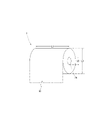
- the toilet roll 1 according to the present invention is a two-ply strip-shaped toilet paper 10 wound around a paper tube (also referred to as a tube core) 20 in a roll shape.
- the winding diameter L2 (diameter) of the toilet paper according to the present invention is 110 to 115 mm.
- the winding diameter of the toilet roll is defined as 120 mm or less in JIS P 4501, and the holder for setting a general toilet roll is created based on this 120 mm.
- the toilet roll of the present invention has a winding diameter of 110 to 115 mm, and is large enough to be set in a general holder.
- the winding diameter is a value measured using a dialmeter rule manufactured by Muratec KDS Co., Ltd. or an equivalent machine thereof. The measured value shall be the average value measured at three locations by changing the location in the width direction.
- the toilet roll according to the present invention is characterized in that a pattern formed by halftone dot printing and solid printing is printed on one side, the ratio of the total area of the pattern portion is 10 to 20%, and the total area of the halftone dot portion is total.
- Toilet paper with a 1-ply paper thickness of 60 to 90 ⁇ m, in which the ratio of the area is 7.5% or more and the ratio of the total area of the solid portion is 4.0% or less, is that the surface on which the pattern is printed is printed. It is wound on a 65 to 90 m paper tube with a winding density of 0.83 to 2.05 so as to be on the outer layer side.
- the toilet roll according to the present invention is less likely to cause ink strike through when printing a pattern, is less likely to cause unnecessary ink bleeding on the back surface, and cuts paper during manufacturing. Is unlikely to occur.
- the toilet roll according to the present invention has a thickness of 60 to 90 ⁇ m in one ply of the rolled toilet paper.
- the paper thickness of 1 ply is within this range, it is possible to obtain sufficient strength and softness as toilet paper, and when a length of 65 to 90 m is wound around a paper tube, the winding diameter is L2 (diameter). Can be in the range of 110 to 115 mm.
- the pattern printing conditions according to the present invention there is no ink strike through or unnecessary ink bleeding on the back surface, and it is possible to prevent paper breakage during manufacturing.
- the paper thickness is measured by adjusting the humidity of the test piece for 8 hours or more under the conditions of JIS P8111 (1998), and then dial thickness gauge (thickness measuring instrument) "PEACOCK G type" (Ozaki Seisakusho Co., Ltd.) under the same conditions. It shall be measured in the state of 1 ply using (manufactured by). Specifically, make sure that there is no dust, dust, etc. between the plunger and the measuring table, lower the plunger on the measuring table, move the memory of the dial thickness gauge to set the zero point, and then set the zero point. , Raise the plunger, place the sample on the test table, slowly lower the plunger and read the gauge at that time.
- dial thickness gauge thickness measuring instrument
- the plunger is only put on and cannot be pressed.
- the terminal of the plunger is made of metal so that a circular plane having a diameter of 10 mm hits the paper plane perpendicularly, and the load at the time of measuring the paper thickness is about 70 gf.
- the paper thickness is an average value obtained by performing the measurement 10 times. Even if the toilet paper has irregularities due to embossing, the measurement is performed in the same manner. In this case, the measurement is performed so that all one recess is within the range of the measuring table. The crushing of unevenness at the time of measurement can be ignored. In this paper thickness measurement, the difference in paper thickness caused by the crushing of the recesses can be ignored.
- the toilet paper according to the present invention preferably has a basis weight in the range of 11.5 to 16.0 g / m 2 . More preferably, it is 12.0 to 15.5 g / m 2 . If it is in the range of 12.5 to 16.0 g / m 2 , it is easy to adjust the winding density and porosity of the toilet roll according to the present invention. Further, in the toilet roll according to the present invention, the dry tensile strength and the wet tensile strength may be appropriately adjusted by a known method within a range that does not interfere with the action and effect of the present invention.
- the toilet roll according to the present invention has a design printed on one side of the toilet paper, and is wound around a paper tube so that the side on which the design is printed is on the outer layer side. That is, the toilet roll according to the present invention has a design only on the surface located in the outer layer. By printing the design on the outer layer side, the design can be visually recognized directly from the outside, and in particular, even if the design is printed so as to be thin as in halftone dot printing, it becomes easy to see firmly.
- the toilet paper since the toilet paper has many layers of toilet paper, if the pattern below it is transparent, there is a risk that the pattern on the lower layer and the pattern on the outer surface will be mixed and visually recognized.
- the toilet paper of the present invention since the toilet paper of the present invention has two plies, an unprinted layer is interposed in the ply on the inner layer side, so that the pattern is formed only on the outer layer as the range of the paper thickness specified in the present invention. Then, while the design on the outer surface can be sufficiently visually recognized, the design on the lower layer becomes difficult to visually recognize. Furthermore, the above-mentioned basis weight is even more so. In order to have the pattern only on the outer layer surface side, the winding may be performed so that the printed surface is on the outside.
- the design according to the present invention is formed by printing, and does not include those colored at the papermaking stage by supplying a dye to the papermaking raw material.
- the specific design of the design is not particularly limited.
- plants such as flowers, trees and grass, creatures such as humans, animals, fish, shellfish and insects, nature such as mountains, rivers, seas, clouds, forests and forests, planets and satellites such as the moon, sun and stars.
- a form in which one or several kinds are appropriately selected and drawn from the symbols such as a car, an airplane, an artificial object such as a train, and the like can be exemplified.
- the area of one design is not particularly limited, but if it is about 102 mm 2 to 918 mm 2 , it is easy to see the design, and it is easy to feel that the design is excellent, and the amount of ink in one design part is excessively large. It is difficult for strike-through to occur.
- the design according to the present invention is formed by halftone dot printing and solid printing.
- the ratio of the total area of the symbol portion is 10 to 20%.
- This symbol portion is a portion in which a halftone dot portion and a solid portion are combined.
- the ratio of the total area means the ratio of the design part to the area of one side of the toilet paper. Since the design of the toilet paper on which the design is printed is repeated at a predetermined pitch due to the manufacturing process, the method of calculating the ratio of the total area of the design portion is the tip excluding the tail seal portion of the toilet paper.
- Ten sheets of 50 cm each are cut from the portion to prepare a sample, and the ratio of the area of the design portion to the area of one side (width of toilet paper x 50 cm) in each sheet is calculated and used as the average value of the 10 sheets.
- the area of the symbol portion in the sample may be measured by optically scanning the sample and using known software.
- the toilet paper does not feel hard due to ink application during use, and in particular, with other roll configurations according to the present invention such as winding length and winding diameter. It prevents the occurrence of wrinkles and twists during manufacturing with the necessary tension.
- the halftone dot printing is microscopically composed of an ink-applied portion and a non-inked portion, but the halftone dot portion in the present invention is a halftone dot including not only the ink-applied portion but also the non-inked portion. It means the entire part recognized as one pattern by printing.
- the ratio of the halftone dot portion to the solid portion in one pattern is preferably 60:40 to 90:10, and particularly preferably 65:35 to 85:15.
- each halftone dot in the halftone dot printing according to the present invention is not particularly limited.
- it can be a rhombus, a square, a rectangle, a circle, an ellipse, a polygon, a star, and the like.
- the ratio of the total area of the halftone dots is 7.5% or more, and the ratio of the total area of the solid part is 4.0% or less.
- strike-through can be achieved by applying ink without deteriorating the recognition of the pattern. It will be difficult and excellent in design.
- the toilet paper does not become excessively hard as a whole, and wrinkles and twists during the above-mentioned manufacturing are less likely to occur.
- the solid portion is not excessively recognized through the non-designed portion of the toilet paper located on the outer surface side, and is recognized as an intended design. It becomes an easy toilet roll.
- the ratio of the total area of the netted part and the ratio of the total area of the solid part like the ratio of the total area of the design part, 10 sheets of 50 cm each from the tip part excluding the tail seal part of the toilet paper. Cut to make a sample, calculate the ratio of the area of the design part to the area of one side (width of toilet paper x 50 cm) in each sheet, and use it as the average value of the 10 sheets.
- the area of the halftone dot portion and the solid portion in the sample may also be measured by optically scanning the sample and using known software.
- the halftone dot area ratio in the halftone dot portion is 20 to 60%, particularly preferably 30 to 50%.
- the halftone dot area ratio is the ratio of the actual ink-applied portion in the halftone dot portion.
- the halftone dot area ratio is less than 20%, the sharpness of the pattern becomes inferior, and when the halftone dot area ratio exceeds 60%, it approaches solid printing, and the design is not lightened by the halftone dot printing. As it decreases, the design portion tends to become hard. Further, particularly in the case of a water-based ink, the paper is shrunk due to moisture, and wrinkles and twists are likely to occur on the paper in the total area ratio of the design according to the present invention.
- the design of the toilet paper according to the present invention be printed by flexographic printing (letterprint printing) using water-based ink.
- intaglio printing such as gravure printing and lithographic printing such as offset printing can also be adopted.
- the viscosity is 10 to 50 cps
- the vehicle is 5 to 25% by mass
- the water content is 95 to 75% by mass
- the sharpness of the pattern can be sufficiently obtained and the water content on the paper is sufficient. Wrinkles and twists are less likely to occur even if the ink penetrates.
- the viscosity is a value measured by a B-type viscometer.
- the number of lines of the anilox roll used is preferably 40 to 100/1 inch, more preferably 50 to 80/1 inch, regardless of the halftone dot portion and the solid portion. .. Suitable for forming the design according to the present invention.
- toilet paper having the above pattern is wound on a 65 to 90 m paper tube with a winding density of 0.83 to 2.05.
- the winding length of toilet paper is 65 to 90 m, which is more than twice as long as the conventional popular product for general households with a 2-ply 25 m winding length.
- the winding length is measured while unwinding the toilet roll without applying tension. For example, the measurement may be performed while folding back in a zigzag manner by 5 m from the unwinding.
- the toilet roll according to the present invention has the above-mentioned winding length and a winding density of 0.83 to 2.05. It is preferably 1.05 to 1.45, and particularly preferably 1.05 to 1.25.
- the winding density according to the present invention is a value calculated by multiplying the actual cross-sectional area by the theoretical cross-sectional area.
- the actual cross-sectional area is a value calculated by multiplying the roll length by the paper thickness.
- the theoretical cross-sectional area is a value calculated by (winding diameter / 2) ⁇ (winding diameter / 2) ⁇ ⁇ - (paper tube outer diameter / 2) ⁇ (paper tube outer diameter / 2) ⁇ (paper tube outer diameter / 2) ⁇ ⁇ . ..
- the ratio of the total area of the design portion of the toilet paper is set to 10 to 20%, the ratio of the total area of the netted portion is set to 7.5% or more, and the solid portion is further covered.
- the ratio of the total area is set to 4.0% or less, the design can be sufficiently recognized, it is difficult to strike through, and wrinkles and twists are extremely small. That is, when the winding length is long and the winding density is increased, it is necessary to increase the tension to form the toilet roll and wind the toilet paper around the paper tube. In toilet paper with a pattern, the stretch of the paper will be different between the printed part to which ink is applied and the non-printed part to which ink is applied.
- the outer diameter of the paper tube (paper tube diameter) L3 is preferably 35 to 45 mm ⁇ , which is the same as the general size. Within this range, the winding density of the toilet roll according to the present invention can be used.
- the toilet roll according to the present invention preferably has a porosity of 5 to 18%.
- the porosity (%) according to the present invention is a value calculated by (actual void volume of the entire roll) / (theoretical roll volume) ⁇ 100.
- the actual void volume of the entire roll is calculated by (actual cross-sectional area (cm 2 )) ⁇ (roll width (cm)), and the theoretical roll volume is (roll length (cm) ⁇ 2 ⁇ paper thickness (1 ply, cm). )) ⁇ (Roll width (cm)).
- the porosity (actual porosity of the entire roll,%) is ((theoretical roll volume (cm 3 ))-(actual roll volume (cm 3 ))) / (theoretical roll volume (cm 3 )) x 100 (%). It is calculated by.
- the roll width L1 may be about 100 to 130 mm.
- the porosity according to the present invention is an index showing how much space exists in the toilet roll. This index is adjusted by embossing, paper thickness, and roll hardness. If the paper is thick, the porosity will be low, but if there is excessively deep and hard embossing that is hard to crush, the paper layer itself may be thick, and in either case, it may feel hard.
- the roll tends to feel hard, and when the porosity is high, the roll tends to feel soft. If the porosity exceeds 18%, the strike-through of the pattern becomes remarkable, the design of the roll is difficult to see, and the core is easily displaced. If it is less than 5%, the softness of the roll becomes difficult to develop.
- the lower layer pattern 40 visible through the white portion of the upper layer toilet paper without pattern printing is excessively clearly and excessively visually recognized. Instead of being printed, it becomes vaguely and faintly visible.
- the design composed of the directly visible solid portion 41 and the halftone dot portion 42 such as the upper layer can be clearly visually recognized. Therefore, the contrast between the directly visible symbols 41 and 42 and the lower layer symbol 40 visually recognized through the white portion of the toilet paper gives a unique and characteristic design.
- the pattern printing is 10 to 20%
- the pattern range is not excessively wide, and the effect of the contrast between the directly visible printed portion and the white portion and the printed portion visually visible through the upper layer can be preferably felt. Become.
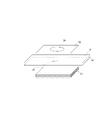
- ⁇ E ′ in the procedure for measuring the whiteness and the color difference ⁇ E, ⁇ E ′ according to the present invention, as shown in FIG. 2, five sheets of white paperboard 31 are placed on a horizontal measuring table, and the measurement target is placed on the white paperboard 31.
- the sample 33 is stacked, and the portion of the toilet paper 34 collected from the same toilet roll as the sample 33 without a symbol is overlapped so as to cover the symbol portion 32 to be measured of the sample 33.
- a white paper sheet 35 having a window punching portion 36 having a diameter of 20 mm is stacked on the white sheet paper 35 so that the symbol portion 32 to be measured is located inside the window punching portion 36.
- the whiteness and the Lab value of the pattern to be measured are separated from the window punching portion 36 via the toilet paper 34. Measure with a whiteness / color difference meter.
- the toilet paper 34 stacked on the sample 32 is removed so that the measurement point does not move, and the whiteness and the Lab value of the pattern portion to be measured (the Lab value obtained by directly measuring the pattern printing portion of the lower layer) are measured. Measure with a spectral whiteness / color difference meter.
- the sample was further removed, and the whiteness and Lab value of the uppermost layer portion of the five stacked white paper sheets 31 (the Lab value of the white portion of the upper layer toilet paper without pattern printing) were measured by a spectroscopic whiteness / color difference meter. Measure (blank value).
- the spectral whiteness / color difference meter is measured using a spectral whiteness meter / color difference meter PF7000 manufactured by Nippon Denshoku Industries Co., Ltd. or an equivalent machine thereof.
- the number of colors constituting the design given to the toilet paper according to the present invention is not limited, but it is desirable to use 1 to 3 colors from the viewpoint of cost, equipment, and the low density and easy bleeding of the toilet paper. Further, the color may be different between the solid portion and the halftone dot portion.
- the Lab value of the above symbol if there are a plurality of colors in one symbol, it is preferable to measure all the parts of the different colors and all the measured values are in the above numerical range. ..
- the fiber in the toilet paper according to the present invention is not limited, but is preferably 70 to 100% by mass of virgin pulp and 0 to 30% by mass of used paper pulp.
- used paper pulp When the used paper pulp is blended, it can be produced at a lower cost than the one made of 100% by mass of virgin pulp. Further, in the process of regenerating pulp from recycled paper, recycled pulp tends to have finer fibers than the pulp fibers before regeneration, and due to the nature of such fibers, the fibers do not have to be thickened. It becomes dense and the paper power tends to increase. On the other hand, if it is mixed excessively, the texture such as flexibility is lowered. Therefore, in consideration of the characteristics of the recycled paper pulp, the blending ratio may be set in the range of 0 to 30% by mass.
- the type of used paper pulp is not necessarily limited, but milk carton used paper and used paper pulp made from high-quality used paper are particularly desirable. Since these contain a large amount of hardwood kraft pulp (LBKP) derived from raw materials, it is easy to develop paper power
- the virgin pulp used should be softwood kraft pulp (NBKP) and hardwood kraft pulp (LBKP). It is desirable that the blending ratio of these is NBKP: LBKP from 20:80 to 50:50.
- Toilet paper produced using a fiber material composed of this virgin pulp and the above-mentioned high-quality recycled paper pulp has a mechanical pulp derived from recycled paper of 5% by mass or less, an ash content of 3% by mass or less, and a whiteness of 80 to 80. It will be about 85%.
- the toilet roll according to the present invention may be embossed.
- the toilet paper is embossed, the toilet paper itself is soft, and the unevenness of the surface makes it easier to wipe off the stool. Further, when the toilet paper is embossed, the surface of the paper has irregularities, so that it becomes difficult to see the pattern of the lower layer through the paper surface, and the design becomes excellent.
- the toilet roll according to the present invention is embossed, but the embossing pattern is not necessarily limited.
- the embossing can be an appropriate embossing pattern such as micro-embossing, dot-shaped embossing, or design embossing.
- it is desirable that the embossing pattern according to the present invention is embossing, which is called double embossing, in which one ply is embossed and two plies are laminated. It is easy to determine the winding density and winding hardness according to the present invention.
- the strike-through prevention property was examined for the examples and comparative examples of the toilet roll of the present invention.
- the composition of the toilet roll and the physical properties and composition of the toilet paper according to each example are as shown in Table 1 below.
- Example 1 the paper thickness is thin due to the lengthening, but by using halftone dot printing, the total area of the design is 10% or more, and the back side is sufficiently designed. It is also prevented from coming off.
- Comparative Example 1 the ratio of the total area of the symbols is the same as that of Example 1, but all the symbols are solid printed. In this Comparative Example 1, strike-through has been confirmed.
- Comparative Example 2 the design is composed of a halftone dot portion and a solid portion, but the ratio of the total area of the solid portion is higher than that of the present invention. In this Comparative Example 2, strike-through has also been confirmed. In Comparative Example 3 and Comparative Example 4, the ratio of the total area of the symbols is the same as that of Examples 2 and 4, but the symbols are composed of only the solid portion. These are also confirmed to be strike-through. It can be confirmed that the toilet roll according to the present invention can prevent strike-through of the design even if the length is increased.
Landscapes
- Health & Medical Sciences (AREA)
- Public Health (AREA)
- Sanitary Thin Papers (AREA)
Priority Applications (3)
| Application Number | Priority Date | Filing Date | Title |
|---|---|---|---|
| EP21880088.6A EP4201279A4 (en) | 2020-10-14 | 2021-10-12 | TOILET PAPER ROLL |
| US18/248,582 US20240074624A1 (en) | 2020-10-14 | 2021-10-12 | Toilet paper roll |
| CN202180064850.6A CN116322447B (zh) | 2020-10-14 | 2021-10-12 | 卷筒卫生纸 |
Applications Claiming Priority (2)
| Application Number | Priority Date | Filing Date | Title |
|---|---|---|---|
| JP2020173384A JP7256782B2 (ja) | 2020-10-14 | 2020-10-14 | トイレットロール |
| JP2020-173384 | 2020-10-14 |
Publications (1)
| Publication Number | Publication Date |
|---|---|
| WO2022080349A1 true WO2022080349A1 (ja) | 2022-04-21 |
Family
ID=81208222
Family Applications (1)
| Application Number | Title | Priority Date | Filing Date |
|---|---|---|---|
| PCT/JP2021/037672 Ceased WO2022080349A1 (ja) | 2020-10-14 | 2021-10-12 | トイレットロール |
Country Status (6)
| Country | Link |
|---|---|
| US (1) | US20240074624A1 (enExample) |
| EP (1) | EP4201279A4 (enExample) |
| JP (1) | JP7256782B2 (enExample) |
| CN (1) | CN116322447B (enExample) |
| TW (1) | TWI883279B (enExample) |
| WO (1) | WO2022080349A1 (enExample) |
Citations (6)
| Publication number | Priority date | Publication date | Assignee | Title |
|---|---|---|---|---|
| JP2004209082A (ja) * | 2003-01-07 | 2004-07-29 | Daio Paper Corp | 衛生薄葉紙および衛生薄葉紙ロール |
| JP2008188070A (ja) | 2007-01-31 | 2008-08-21 | Daio Paper Corp | 印刷衛生薄葉紙及びその製造方法 |
| JP2008295832A (ja) * | 2007-05-31 | 2008-12-11 | Daio Paper Corp | ロールペーパー |
| JP2010051761A (ja) * | 2008-07-31 | 2010-03-11 | Daio Paper Corp | 衛生薄葉紙及び衛生薄葉紙の製造方法 |
| US20140349056A1 (en) * | 2013-05-22 | 2014-11-27 | The Procter & Gamble Company | Absorbent paper product having visual elements |
| JP2018064664A (ja) | 2016-10-17 | 2018-04-26 | 日本製紙クレシア株式会社 | トイレットロール |
Family Cites Families (9)
| Publication number | Priority date | Publication date | Assignee | Title |
|---|---|---|---|---|
| EP0956804A1 (en) * | 1998-05-13 | 1999-11-17 | The Procter & Gamble Company | Paper tissue roll |
| JP2003265353A (ja) * | 2002-03-18 | 2003-09-24 | Daio Paper Corp | 衛生薄葉ロール紙 |
| JP2007135851A (ja) * | 2005-11-17 | 2007-06-07 | Daio Paper Corp | 衛生薄葉紙 |
| JP5840659B2 (ja) * | 2013-08-30 | 2016-01-06 | 大王製紙株式会社 | トイレットロールの製造方法 |
| JP5684874B2 (ja) * | 2013-09-03 | 2015-03-18 | 大王製紙株式会社 | トイレットロールの製造方法及びトイレットロール |
| JP6853006B2 (ja) * | 2016-09-29 | 2021-03-31 | 大王製紙株式会社 | 衛生薄葉紙の印刷用印版及び衛生薄葉紙の製造方法 |
| JP6666294B2 (ja) * | 2017-03-30 | 2020-03-13 | 大王製紙株式会社 | トイレットロール |
| JP7033529B2 (ja) * | 2018-12-12 | 2022-03-10 | 大王製紙株式会社 | トイレットロール |
| JP7294635B2 (ja) * | 2019-02-28 | 2023-06-20 | 日本製紙クレシア株式会社 | トイレットロール |
-
2020
- 2020-10-14 JP JP2020173384A patent/JP7256782B2/ja active Active
-
2021
- 2021-10-12 EP EP21880088.6A patent/EP4201279A4/en active Pending
- 2021-10-12 CN CN202180064850.6A patent/CN116322447B/zh active Active
- 2021-10-12 WO PCT/JP2021/037672 patent/WO2022080349A1/ja not_active Ceased
- 2021-10-12 US US18/248,582 patent/US20240074624A1/en not_active Abandoned
- 2021-10-13 TW TW110137911A patent/TWI883279B/zh active
Patent Citations (6)
| Publication number | Priority date | Publication date | Assignee | Title |
|---|---|---|---|---|
| JP2004209082A (ja) * | 2003-01-07 | 2004-07-29 | Daio Paper Corp | 衛生薄葉紙および衛生薄葉紙ロール |
| JP2008188070A (ja) | 2007-01-31 | 2008-08-21 | Daio Paper Corp | 印刷衛生薄葉紙及びその製造方法 |
| JP2008295832A (ja) * | 2007-05-31 | 2008-12-11 | Daio Paper Corp | ロールペーパー |
| JP2010051761A (ja) * | 2008-07-31 | 2010-03-11 | Daio Paper Corp | 衛生薄葉紙及び衛生薄葉紙の製造方法 |
| US20140349056A1 (en) * | 2013-05-22 | 2014-11-27 | The Procter & Gamble Company | Absorbent paper product having visual elements |
| JP2018064664A (ja) | 2016-10-17 | 2018-04-26 | 日本製紙クレシア株式会社 | トイレットロール |
Non-Patent Citations (1)
| Title |
|---|
| See also references of EP4201279A4 |
Also Published As
| Publication number | Publication date |
|---|---|
| CN116322447B (zh) | 2025-09-16 |
| EP4201279A1 (en) | 2023-06-28 |
| EP4201279A4 (en) | 2024-10-02 |
| JP7256782B2 (ja) | 2023-04-12 |
| CN116322447A (zh) | 2023-06-23 |
| TW202214163A (zh) | 2022-04-16 |
| JP2022064645A (ja) | 2022-04-26 |
| TWI883279B (zh) | 2025-05-11 |
| US20240074624A1 (en) | 2024-03-07 |
Similar Documents
| Publication | Publication Date | Title |
|---|---|---|
| JP5602998B2 (ja) | 衛生薄葉紙ロール | |
| JP7550272B2 (ja) | トイレットロール | |
| JP7312282B1 (ja) | トイレットロール | |
| JP2023118956A5 (enExample) | ||
| JP6186484B1 (ja) | トイレットロール | |
| WO2022080349A1 (ja) | トイレットロール | |
| JP7033529B2 (ja) | トイレットロール | |
| JP6394511B2 (ja) | 紙製基材 | |
| JP6996044B2 (ja) | シャワートイレ用トイレットロール | |
| JP2022064645A5 (enExample) | ||
| JP2025188203A (ja) | トイレットロール | |
| JP2025188202A (ja) | トイレットロール | |
| JP2025188201A (ja) | トイレットロール | |
| JP5490358B2 (ja) | ロールペーパー | |
| JP7324333B1 (ja) | トイレットロール | |
| JP2018061676A (ja) | トイレットロール | |
| JP2008188070A (ja) | 印刷衛生薄葉紙及びその製造方法 | |
| JP4464896B2 (ja) | 着色紙シート製品 | |
| JP6914984B2 (ja) | トイレットペーパー及びトイレットペーパーの製造方法 | |
| JP2018051149A (ja) | トイレットロール | |
| JP2018064664A (ja) | トイレットロール | |
| JP6186483B1 (ja) | トイレットロール | |
| JP2024142077A (ja) | トイレットロール | |
| WO2024070045A1 (ja) | キッチンペーパーロール | |
| JP2018057599A (ja) | トイレットロール |
Legal Events
| Date | Code | Title | Description |
|---|---|---|---|
| 121 | Ep: the epo has been informed by wipo that ep was designated in this application |
Ref document number: 21880088 Country of ref document: EP Kind code of ref document: A1 |
|
| ENP | Entry into the national phase |
Ref document number: 2021880088 Country of ref document: EP Effective date: 20230324 |
|
| NENP | Non-entry into the national phase |
Ref country code: DE |
|
| WWG | Wipo information: grant in national office |
Ref document number: 202180064850.6 Country of ref document: CN |