WO2022070748A1 - 車両用センサ装置及び車両用灯具 - Google Patents
車両用センサ装置及び車両用灯具 Download PDFInfo
- Publication number
- WO2022070748A1 WO2022070748A1 PCT/JP2021/032169 JP2021032169W WO2022070748A1 WO 2022070748 A1 WO2022070748 A1 WO 2022070748A1 JP 2021032169 W JP2021032169 W JP 2021032169W WO 2022070748 A1 WO2022070748 A1 WO 2022070748A1
- Authority
- WO
- WIPO (PCT)
- Prior art keywords
- transmission region
- outer cover
- region
- generating member
- heat generating
- Prior art date
- Legal status (The legal status is an assumption and is not a legal conclusion. Google has not performed a legal analysis and makes no representation as to the accuracy of the status listed.)
- Ceased
Links
Images








Classifications
-
- F—MECHANICAL ENGINEERING; LIGHTING; HEATING; WEAPONS; BLASTING
- F21—LIGHTING
- F21S—NON-PORTABLE LIGHTING DEVICES; SYSTEMS THEREOF; VEHICLE LIGHTING DEVICES SPECIALLY ADAPTED FOR VEHICLE EXTERIORS
- F21S41/00—Illuminating devices specially adapted for vehicle exteriors, e.g. headlamps
- F21S41/20—Illuminating devices specially adapted for vehicle exteriors, e.g. headlamps characterised by refractors, transparent cover plates, light guides or filters
-
- F—MECHANICAL ENGINEERING; LIGHTING; HEATING; WEAPONS; BLASTING
- F21—LIGHTING
- F21S—NON-PORTABLE LIGHTING DEVICES; SYSTEMS THEREOF; VEHICLE LIGHTING DEVICES SPECIALLY ADAPTED FOR VEHICLE EXTERIORS
- F21S43/00—Signalling devices specially adapted for vehicle exteriors, e.g. brake lamps, direction indicator lights or reversing lights
- F21S43/20—Signalling devices specially adapted for vehicle exteriors, e.g. brake lamps, direction indicator lights or reversing lights characterised by refractors, transparent cover plates, light guides or filters
-
- F—MECHANICAL ENGINEERING; LIGHTING; HEATING; WEAPONS; BLASTING
- F21—LIGHTING
- F21S—NON-PORTABLE LIGHTING DEVICES; SYSTEMS THEREOF; VEHICLE LIGHTING DEVICES SPECIALLY ADAPTED FOR VEHICLE EXTERIORS
- F21S45/00—Arrangements within vehicle lighting devices specially adapted for vehicle exteriors, for purposes other than emission or distribution of light
- F21S45/60—Heating of lighting devices, e.g. for demisting
-
- F—MECHANICAL ENGINEERING; LIGHTING; HEATING; WEAPONS; BLASTING
- F21—LIGHTING
- F21V—FUNCTIONAL FEATURES OR DETAILS OF LIGHTING DEVICES OR SYSTEMS THEREOF; STRUCTURAL COMBINATIONS OF LIGHTING DEVICES WITH OTHER ARTICLES, NOT OTHERWISE PROVIDED FOR
- F21V29/00—Protecting lighting devices from thermal damage; Cooling or heating arrangements specially adapted for lighting devices or systems
- F21V29/90—Heating arrangements
-
- F—MECHANICAL ENGINEERING; LIGHTING; HEATING; WEAPONS; BLASTING
- F21—LIGHTING
- F21V—FUNCTIONAL FEATURES OR DETAILS OF LIGHTING DEVICES OR SYSTEMS THEREOF; STRUCTURAL COMBINATIONS OF LIGHTING DEVICES WITH OTHER ARTICLES, NOT OTHERWISE PROVIDED FOR
- F21V5/00—Refractors for light sources
-
- G—PHYSICS
- G01—MEASURING; TESTING
- G01S—RADIO DIRECTION-FINDING; RADIO NAVIGATION; DETERMINING DISTANCE OR VELOCITY BY USE OF RADIO WAVES; LOCATING OR PRESENCE-DETECTING BY USE OF THE REFLECTION OR RERADIATION OF RADIO WAVES; ANALOGOUS ARRANGEMENTS USING OTHER WAVES
- G01S13/00—Systems using the reflection or reradiation of radio waves, e.g. radar systems; Analogous systems using reflection or reradiation of waves whose nature or wavelength is irrelevant or unspecified
- G01S13/88—Radar or analogous systems specially adapted for specific applications
- G01S13/93—Radar or analogous systems specially adapted for specific applications for anti-collision purposes
- G01S13/931—Radar or analogous systems specially adapted for specific applications for anti-collision purposes of land vehicles
-
- G—PHYSICS
- G01—MEASURING; TESTING
- G01S—RADIO DIRECTION-FINDING; RADIO NAVIGATION; DETERMINING DISTANCE OR VELOCITY BY USE OF RADIO WAVES; LOCATING OR PRESENCE-DETECTING BY USE OF THE REFLECTION OR RERADIATION OF RADIO WAVES; ANALOGOUS ARRANGEMENTS USING OTHER WAVES
- G01S7/00—Details of systems according to groups G01S13/00, G01S15/00, G01S17/00
- G01S7/02—Details of systems according to groups G01S13/00, G01S15/00, G01S17/00 of systems according to group G01S13/00
- G01S7/03—Details of HF subsystems specially adapted therefor, e.g. common to transmitter and receiver
Definitions
- the present invention relates to a vehicle sensor device and a vehicle lamp equipped with the vehicle sensor device.
- a vehicle sensor device that is mounted inside a lamp cover of a vehicle and detects an object outside the vehicle using electromagnetic waves is known.
- the electromagnetic wave transmitted from the sensor is reflected by the ice and snow, which may affect the detection accuracy.
- the vehicle sensor device described in the following Patent Document 1 is known as a vehicle sensor device capable of reducing the influence of such ice and snow.
- the vehicle sensor device described in Patent Document 1 is arranged inside a lamp cover, and includes a sensor that transmits / receives electromagnetic waves to the outside of the vehicle and a separator that partitions a space in which the sensor is arranged.
- it is determined whether or not ice and snow are attached to the lamp cover based on the change in the behavior of the reflected wave power of the electromagnetic wave transmitted from the sensor, and the ice and snow are attached. When it is determined that the lamp cover is turned on, the light source in the lamp cover is turned on.
- the radiant heat from the light source is conducted to the lamp cover via the separator, and the ice and snow adhering to the lamp cover are melted, so that it is possible to suppress the influence on the detection accuracy of the sensor. Will be done.
- Patent Document 2 describes a vehicle lamp in which a heating element that generates heat when energized is attached to a lamp cover. According to the vehicle lighting equipment of Patent Document 2, since the lamp cover can be directly heated by the heating element that generates heat by energization, it is expected that the efficiency of removing ice and snow will be improved.
- an object of the present invention is to provide a vehicle sensor device capable of suppressing a decrease in detection accuracy and a vehicle lamp equipped with the vehicle sensor device.
- the vehicle sensor device is arranged inside the vehicle with respect to the outer cover and the outer cover, and transmits / receives a predetermined electromagnetic wave transmitted through the outer cover.
- a sensor unit that outputs a signal related to the electromagnetic wave incident on the inside of the outer cover and a transmission region of the outer cover through which the electromagnetic wave transmitted from the sensor unit is transmitted are heated by energization.
- the heat-generating member is provided with a heat-generating member, and the heat-generating member is attached to the outer cover so that the inside of the transmission region is sparser than the outside of the transmission region.
- the heat generating member for heating the transmission region is attached to the outer cover, as compared with the case where the outer cover is heated by heat conduction of radiant heat from the light source as in Patent Document 1, for example. Therefore, the outer cover can be directly heated, and the ice and snow adhering to the outer cover can be effectively melted. Further, according to this vehicle sensor device, since the heat generating member is attached so that the inside of the transmission region is sparser than the outside of the transmission region, the electromagnetic wave transmitted from the sensor unit is reflected by the heat generation member. Therefore, it can be suppressed to become noise. As described above, according to this vehicle sensor device, since it is possible to effectively remove ice and snow while suppressing the reflection of electromagnetic waves by the heat generating member, it is possible to suppress a decrease in detection accuracy.
- the heat generating member may not be arranged inside the transmission region.
- the reflection of electromagnetic waves by the heat generating member can be suppressed more effectively.
- the heat generating member is arranged outside the permeation region, ice and snow adhering to the permeation region can be effectively melted by the heat from the heat generating member.
- the vehicle sensor device operates the sensor unit so as to scan the electromagnetic wave along a predetermined direction, reflects the electromagnetic wave by a predetermined object, and receives the electromagnetic wave received by the sensor unit.
- a control unit for calculating the position of the object based on the above is further provided, and the heat generating member inside the transmission region is centered on the outer edge side of the transmission region in a direction perpendicular to the predetermined direction in the transmission region. It may be attached to the outer cover so that the side is sparser.
- an object to be detected is generally irradiated with electromagnetic waves transmitted and received through a region on the center side of a transmission region in a direction perpendicular to the direction in which electromagnetic waves are scanned. It is an object. Therefore, by attaching a heat generating member inside the transmission region so that the center side of the transmission region in the vertical direction becomes sparse, it is possible to suppress the reflection of electromagnetic waves on the center side of the transmission region to become noise, and detect it. It is possible to suppress a decrease in the detection accuracy of the target object. Further, by arranging the heat generating member so that the outer edge side of the transmission region in the vertical direction becomes dense inside the transmission region, the transmission region can be heated more effectively and adheres to the transmission region. It can effectively melt ice and snow.
- the heat generating member may be attached to the outer cover so as to surround the entire circumference of the transmission region.
- the permeation region can be effectively warmed as compared with the case where the heat generating member is attached to a part of the entire circumference of the permeation region, and the efficiency of removing ice and snow can be improved.
- the heat generating member may be attached only to a region of the outer cover that is vertically lower than the center of the transmission region.
- the ice and snow attached to the lower side of the permeation area can be melted first. After that, the ice and snow remaining on the upper side of the permeation region can fall and melt in the lower region from which the ice and snow have been removed. Therefore, even when the heat generating member is attached only to the lower region in this way, ice and snow can be effectively removed. Further, since the heat generating member can be reduced as compared with the case where the heat generating member is attached to the entire periphery of the transmission region, the cost can be reduced.
- the heat generating member may be in the form of a mesh.
- the mesh shape means a shape that divides a predetermined region into a plurality of sections, such as a net shape, a grid shape, or a porous shape. If the heat-generating member has such a mesh shape, a plurality of sections surrounded by the heat-generating member are formed in the outer cover. Then, each of the compartments can be heated from the entire circumference by the heat generating member surrounding these compartments. Therefore, the outer cover can be heated more effectively, and the efficiency of removing ice and snow can be improved.
- the vehicle lighting fixture of the present invention is arranged inside the vehicle with respect to the vehicle sensor device according to the first aspect according to any one of the above and the outer cover, and the outer cover is provided.
- a lamp unit that emits light to the outside of the vehicle via the It is characterized in that it is attached to the outer cover so that the inside of the light emitting region is sparser.
- this vehicle lamp is provided with the vehicle sensor device according to the first aspect described in any of the above, it is possible to suppress a decrease in detection accuracy. Further, in this vehicle lamp, since the heat generating member is attached so as to heat the light emitting region, ice and snow adhering to the light emitting region can be removed. Further, since the heat generating member is sparser inside the light emitting region than outside the light emitting region, the light emitted from the lamp unit is suppressed from being reflected by the heat generating member inside the light emitting region. It is possible to suppress a decrease in the emission efficiency of light from the lamp unit.
- the vehicle sensor device is arranged inside the vehicle with respect to the outer cover and the outer cover, and transmits / receives a predetermined electromagnetic wave transmitted through the outer cover.
- the sensor unit that outputs a signal related to the electromagnetic wave incident on the inside of the outer cover and the sensor unit are operated so as to scan the electromagnetic wave along a predetermined direction, and are reflected by a predetermined object to be reflected by the sensor unit.
- a control unit that calculates the position of the object based on the electromagnetic wave received in the above, and a heat generating member that is attached to the outer cover and heats a transmission region of the outer cover through which the electromagnetic wave is transmitted by energization.
- the heat generating member is characterized in that a part of the inside of the transmission region extends along the predetermined direction and crosses the transmission region.
- the heat generating member for heating the transmission region is attached to the outer cover, as compared with the case where the outer cover is heated by heat conduction of radiant heat from the light source as in Patent Document 1, for example. Therefore, the outer cover can be directly heated, and the ice and snow adhering to the outer cover can be effectively melted. Further, since the heat generating member crosses the inside of the transmission region, the transmission region is heated over the entire length of the transmission region in the predetermined direction, and the transmission region can be effectively warmed. Therefore, the ice and snow adhering to the permeation region can be effectively melted.
- the heat generating member inside the transmission region extends in a direction intersecting the predetermined direction
- the electromagnetic wave to be scanned is reflected by the heat generating member and the intensity of the electromagnetic wave received by the sensor unit in the predetermined direction is high.
- the distribution may change, leading to a decrease in detection accuracy.
- the heat generating member crosses a part of the inside of the transmission region along the predetermined direction. Therefore, the change in the intensity distribution of the electromagnetic wave received by the sensor unit in the predetermined direction is suppressed, and the deterioration of the detection accuracy can be suppressed.
- this vehicle sensor device since it is possible to effectively remove ice and snow while suppressing the influence of the reflection of electromagnetic waves by the heat generating member, it is possible to suppress the deterioration of the detection accuracy.
- the heat generating member inside the transmission region in the direction perpendicular to the predetermined direction in the transmission region, is closer to the center side than the outer edge side of the transmission region. It may be attached to the outer cover so as to be sparse.
- the heat generating member is provided so that the center side of the transmission region in the vertical direction becomes sparse inside the transmission region. By attaching it, it is possible to suppress the reflection of electromagnetic waves on the center side of the transmission region to become noise, and it is possible to suppress the deterioration of the detection accuracy of the object to be detected. Further, by arranging the heat generating member so that the outer edge side of the transmission region in the vertical direction becomes dense inside the transmission region, the transmission region can be heated more effectively and adheres to the transmission region. It can effectively melt ice and snow.
- the heat generating member may be attached to the outer cover so that the inside of the transmission region is sparser than the outside of the transmission region.
- the heat generating member may be attached to the outer cover so as to surround the entire circumference of the transmission region.
- the transmission area is more effective than the case where the heat generating member is attached to a part of the entire circumference of the transmission area. It can be warmed up and the efficiency of removing ice and snow can be improved.
- the heat generating member may be attached only to a region of the outer cover that is vertically lower than the center of the transmission region.
- the vehicle sensor device according to the second aspect can effectively remove ice and snow, etc., as compared with the case where the heat generating member is attached to the entire circumference of the transmission region. Since the number of heat generating members can be reduced, the cost can be reduced.
- the vehicle lighting fixture of the present invention is arranged inside the vehicle with respect to the vehicle sensor device according to the second aspect according to any one of the above and the outer cover, and the outer cover is provided.
- a lamp unit that emits light to the outside of the vehicle via the vehicle, and at least a part of the heat generating member inside the transmission region is the outer side of the transmission region along the predetermined direction. It is characterized in that it extends to the light emitting region of the cover from which the light is emitted.
- this vehicle lamp is provided with the vehicle sensor device according to the second aspect described in any of the above, it is possible to suppress a decrease in detection accuracy. Further, in this vehicle lamp, since the heat generating member is attached so as to heat the light emitting region, ice and snow adhering to the light emitting region can be removed. Further, in this vehicle lamp, since the heat generating member inside the transmission region extends to the light emission region along a predetermined direction, the light emission region can be heated by the heat generation member that heats the transmission region. Therefore, it is not necessary to separately provide a heat generating member for heating the light emitting region, and the wiring cost can be reduced.
- a vehicle sensor device capable of suppressing a decrease in detection accuracy and a vehicle lamp equipped with the vehicle sensor device.
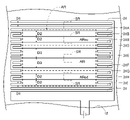
- FIG. 1 It is a figure which shows mainly the vicinity of a transmission region and the vicinity of a light emission region of the heater according to the fourth embodiment of the present invention from the same viewpoint as in FIG. It is a figure which shows the modification of the wiring pattern of the heating wire of FIG. It is a figure which shows the heater which concerns on 5th Embodiment of this invention from the same viewpoint as FIG. It is a figure which shows the modification of the wiring pattern of the heating wire of FIG. It is a figure which shows the 2nd modification of the wiring pattern of the heating wire of FIG. It is a figure which shows the modification of the wiring pattern of the heating wire of FIG. It is a figure which shows the heater which concerns on the modification of 1st Embodiment of this invention from the same viewpoint as FIG. It is a figure which shows the heater which concerns on the modification of 2nd Embodiment of this invention from the same viewpoint as FIG.
- FIG. 1 is a front view showing an outline of a vehicle and a vehicle lighting fixture provided with a vehicle sensor device according to the first embodiment of the present invention.
- the vehicle lighting fixture VL of the present embodiment is a vehicle headlight of the vehicle VE, and includes a vehicle sensor device 1 and a lighting fixture unit LU as a main configuration.
- the vehicle sensor device 1 and the lamp unit LU are substantially arranged along the left-right direction.
- the front means the traveling direction of the vehicle VE, and the left and right mean the left side and the right side with respect to the traveling direction.
- the lamp unit LU is arranged inside the vehicle VE with respect to the outer cover 12 described later, and emits light to the outside of the vehicle VE through the outer cover 12. As shown by the broken line in FIG. 1, the light emitted from the lamp unit LU passes through the light emission region LR of the outer cover 12 and is emitted in front of the vehicle VE.
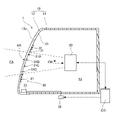
- FIG. 2 is a diagram showing an outline of a cross section of the vehicle sensor device 1 on the line II-II shown in FIG.
- the vehicle sensor device 1 includes a housing 10, a sensor unit 20, a heater 30, and a control unit CO as main configurations. In FIG. 1, the heater 30 and the control unit CO are not shown.
- the control unit CO is connected to the sensor unit 20 and the heater 30.
- the control unit CO is composed of, for example, an integrated circuit such as a microcontroller, an IC (Integrated Circuit), an LSI (Large-scale Integrated Circuit), an ASIC (Application Specific Integrated Circuit), or an NC (Numerical Control) device. Further, when an NC device is used, these may be those using a machine learning device or those not using a machine learning device.
- the control unit CO may be unique to the vehicle sensor device 1, or at least a part of the control unit CO may be included in the ECU (Electronic Control Unit) of the vehicle VE.
- the housing 10 of the present embodiment includes the housing 11 and the outer cover 12 as the main configurations.
- the outer cover 12 is made of a material that transmits light emitted from the lamp unit LU and electromagnetic waves transmitted and received from the sensor unit 20 described later. Examples of the material for forming such an outer cover 12 include a resin such as polycarbonate.
- the housing 11 is configured in a box shape having an opening in the front, and the outer cover 12 is fixed to the housing 11 so as to close the opening. As shown in FIG. 2, the outer cover 12 extends substantially along the vertical direction.
- the housing 11 may be made of a material different from that of the outer cover 12, or may be made of the same material.
- a housing space 13 surrounded by the housing 11 and the outer cover 12 is formed in the housing 10, and the sensor unit 20 and the lamp unit LU are arranged in the housing space 13.
- the sensor unit 20 of this embodiment is a millimeter wave radar that transmits and receives millimeter waves as the above electromagnetic waves.
- FIG. 3 is a diagram showing an outline of the sensor unit 20 viewed forward. As shown in FIG. 3, the sensor unit 20 includes a transmitting antenna 25 and a plurality of receiving antennas 26. The control unit CO is connected to the transmitting antenna 25 and each receiving antenna 26. Although three receiving antennas 26 are shown in FIG. 3, there may be two or four or more receiving antennas 26.
- the transmitting antenna 25 transmits the millimeter wave EW forward. Therefore, the millimeter wave EW passes through a predetermined region of the outer cover 12 and propagates toward the front outside the vehicle.
- the millimeter wave EW is emitted from the transmitting antenna 25 so that the spread in the left-right direction is larger than the spread in the vertical direction. Therefore, as shown by the broken line in FIG. 1, the transmission region AR transmitted by the millimeter wave EW transmitted from the sensor unit 20 in the outer cover 12 is a substantially rectangular shape flat in the left-right direction.
- the transmitting antenna 25 uses a control signal from the control unit CO to make the millimeter wave EW a millimeter wave whose intensity is substantially constant and whose frequency repeatedly increases and decreases in a predetermined cycle.
- the millimeter wave EW passes through the transmission region AR and is emitted to the outside of the vehicle, it spreads largely in the left-right direction as compared with the vertical direction, and a detectable region FA by the millimeter wave EW is formed.
- the detectable region FA is a substantially rectangular shape that is flat in the left-right direction in the forward view, and is a substantially fan shape that is wider toward the front side in the upward view.
- the detectable area FA is also referred to as a FOV area.
- the millimeter wave EW is reflected by the object, and a part of the reflected millimeter wave EW passes through the transmission region AR and is incident on the accommodation space 13.
- the millimeter wave EW reflected by the object may be incident on the accommodation space 13 from other than the transmission region AR in the outer cover 12 when the position of the receiving antenna 26 and the position of the transmitting antenna 25 are separated from each other.
- each of the plurality of receiving antennas 26 has substantially the same configuration. As shown in FIG. 3, each of these receiving antennas 26 and the transmitting antenna 25 are arranged side by side at predetermined intervals along the left-right direction. Further, the center of the receiving antenna 26 in the vertical direction and the center of the transmitting antenna 25 in the vertical direction are generally located on a straight line extending in the left-right direction. Each of the receiving antennas 26 has, for example, a configuration in which a plurality of patch antennas are overlapped in the vertical direction. Each of the receiving antennas 26 receives the millimeter wave EW reflected by the object and incident on the accommodation space 13.
- each of the receiving antennas 26 outputs a signal indicating the waveform of the millimeter wave EW as a signal related to the received millimeter wave EW to the control unit CO.
- the strength of the electromagnetic wave received by the receiving antenna 26 is included as an element forming the waveform of the electromagnetic wave.
- the control unit CO When the signal related to the millimeter wave EW is input from each receiving antenna 26, the control unit CO is based on, for example, the signal related to the received millimeter wave EW and the signal indicating the waveform of the electromagnetic wave emitted from the transmitting antenna 25, for example.
- the distance from the vehicle VE to the object is calculated by the FMCW (Frequency Modified Continuous Wave) method.
- the plurality of receiving antennas 26 are provided at intervals in the left-right direction, a phase difference occurs in the millimeter wave EW reflected by the object and received by each receiving antenna 26. Based on this phase difference, the control unit CO is left and right with respect to the reference line SL in which the object OB in the detectable region FA shown in FIG.
- a predetermined direction for scanning an electromagnetic wave corresponds to a direction in which a plurality of receiving antennas are arranged in parallel, and is a left-right direction in the present embodiment. Therefore, in the present embodiment, the direction perpendicular to the predetermined direction for scanning the electromagnetic wave is generally the vertical direction.
- the scanning method of the sensor unit 20 is not limited to the electronic scanning method.
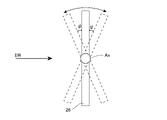
- one receiving antenna 26 may be rotated about the axis Ax extending in the vertical direction to change the angle of the receiving antenna 26 with respect to the left-right direction.
- FIG. 5 is a view of the one receiving antenna 26 viewed upward.
- the electromagnetic wave received by one receiving antenna 26 has a phase difference depending on the angle ⁇ of the receiving antenna 26. Therefore, the control unit CO calculates, for example, whether the object OB in the detectable region FA is unevenly distributed to the left or right with respect to the reference line SL at an angle ⁇ based on this phase difference. Can be done.
- the method of calculating the position of an object in the detectable region based on the phase difference of the electromagnetic wave generated by mechanically changing the direction of the receiving antenna in this way is called the mechanical scan method.
- the predetermined direction for scanning the electromagnetic wave corresponds to the direction in which the angle ⁇ of the receiving antenna is defined, and is the left-right direction in the present embodiment. Therefore, in the present embodiment, the direction perpendicular to the predetermined direction for scanning the electromagnetic wave is generally the vertical direction.
- the sensor unit 20 may be configured to emit a pulsed electromagnetic wave while the transmitting antenna 25 rotates about the axis extending in the vertical direction, for example.
- the direction of scanning the electromagnetic wave can be set to the left-right direction by rotating the transmitting antenna 25 about the axis extending in the vertical direction in this way.
- the control unit CO calculates the position of the object OB by, for example, the ToF (Time of Flight) method.
- control unit CO of the present embodiment operates the sensor unit 20 so as to scan the millimeter wave, which is an electromagnetic wave, along a predetermined direction, and the electromagnetic wave reflected by the object OB and received by the sensor unit 20.
- the position of the object OB is calculated based on.
- the heater 30 includes a plurality of heating wires 31 as heat generating members.
- Each of the heating wires 31 is attached to the inside of the transmission region AR and its vicinity on the inner surface 12i of the outer cover 12.
- the heat generating member may be attached to the entire inner surface 12i outside the transmission region AR.
- Each of the heating wires 31 is connected to the power supply circuit 32 via the connector 33.
- the power supply circuit 32 supplies a current from a power source (not shown) to each of the heating wires 31 by a control signal from the control unit CO.
- a control signal from the control unit CO As a result, each of the heating wires 31 is heated to a predetermined temperature by the electric resistance to energization, and as a result, at least the transmission region AR is heated.
- Such a heating wire 31 is formed on the inner surface 12i by, for example, applying or printing a conductive paste such as silver paste, gold paste, copper paste, aluminum paste, ITO paste on the inner surface 12i, or by using a predetermined adhesive. It may be attached. Alternatively, the heating wire 31 may be attached to the outer cover 12 with a metal wire attached to the outer cover 12 by a hot cloth wire or the like.
- the hot cloth wire means that heat is applied to the base material on which the heating wire is provided to soften the base material, and the metal wire is applied to the softened base material to be embedded in the base material. Therefore, in the case of using a hot cloth wire, at least a part of the heat generating member can be attached to the inside of the outer cover 12.
- the position where the heat generating member is attached may be the outer surface 12o of the outer cover 12.
- the heat generating member may be attached to the inner surface 12i of the outer cover 12 or the inside of the outer cover, it is possible to prevent ice, snow, dirt, etc. from adhering to the heat generating member.
- the heat generating member may be attached to at least the region for heating the transmission region AR, and may or may not be attached to, for example, the light emitting region LR in the region where it can be heated.
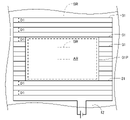
- FIG. 6 is a diagram showing a state mainly in the vicinity of the transmission region AR of the heater 30 in the present embodiment.
- the plurality of heating wires 31 extend along the left-right direction, which is the direction in which the electromagnetic wave is scanned, and surround the entire circumference of the transmission region AR indicated by the broken line.
- the heat generating member of the present embodiment is attached so as to surround the entire circumference of the transmission region AR.
- the addition of a reference numeral to a part of the heating wire 31 is omitted in this figure and the following figures.
- the plurality of heating wires 31 have the same thickness, and the distance between the heating wires 31 adjacent to each other outside the transmission region AR is the same D1.
- the addition of a reference numeral to a part of the interval D1 of the heating wire 31 is omitted in this figure and the following figures.
- each of the heating wires 31A, 31B, 31C, and 31D crosses a part of the inside of the transmission region AR. Inside the transmission region AR, the intervals between the heating wires 31A and 31B, the intervals between the heating wires 31B and 31C, and the intervals between the heating wires 31C and 31D are the same D2, respectively.
- the interval D2 is wider than the interval D1 and, in the present embodiment, is approximately three times the interval D1.
- FIG. 7 is a diagram showing a modified example of the wiring pattern of the heating wire 31 described with reference to FIG. 6, and the same reference numerals are used for the same configurations as those described with reference to FIG. 6, and the description thereof will be omitted.
- the heating wires 31 are formed in series, the heating wires 31 are not branched at least in and around the transmission region AR, and the arrangement of the heating wires 31 in the transmission region AR is the transmission region in FIG. It is the same as the arrangement of the heating wire 31 in AR.
- a plurality of unit region SRs having the same area are defined inside the transmission region AR and outside the transmission region AR, respectively.
- one unit region SR inside and one outside the transmission region AR is exemplified by a alternate long and short dash line.
- approximately one heating wire 31 crosses each unit region SR inside the transmission region AR, and approximately three unit region SRs outside the transmission region AR. The heating wire 31 crosses.
- the average ratio of the heat generating member to each unit region SR inside the transmission region AR is outside the transmission region AR. It is smaller than the average of the ratio of the heat generating member to each unit area SR in.
- the heat generating member is attached to the outer cover 12 so that the inside of the transmission region AR is sparser than the outside of the transmission region AR.
- the above ratio may be referred to as density.
- the vehicle sensor device 1 of the present embodiment can be grasped as follows as the first aspect. That is, the vehicle sensor device 1 of the present embodiment is arranged inside the outer cover 12 and the vehicle VE with respect to the outer cover 12, and transmits / receives millimeter wave EW transmitted through the outer cover 12 to the inside of the outer cover 12. Heat generation that heats the transmission region AR that is attached to the outer cover 12 and transmits the millimeter wave EW transmitted from the sensor unit 20 of the outer cover 12 and the sensor unit 20 that outputs the signal related to the incident millimeter wave EW. A plurality of heating wires 31 which are members are provided, and the heat generating member is attached to the outer cover 12 so that the inside of the transmission region AR is sparser than the outside of the transmission region AR.
- the vehicle sensor device 1 of the first aspect since a plurality of heating wires 31 for heating the transmission region AR by energization are attached to the outer cover 12 as heat generating members, for example, from the lighting unit LU. Compared with the case where the outer cover 12 is heated by utilizing the heat conduction of radiant heat, the outer cover 12 can be directly heated, and the ice and snow adhering to the outer cover 12 can be effectively melted. Further, according to the vehicle sensor device 1, the heat generating member is attached so that the inside of the transmission region AR is sparser than the outside of the transmission region AR, and occupies the region inside the transmission region AR.
- the ratio of the heat generating member is small, it is possible to suppress that millimeter waves are reflected by the heat generating member and become noise. Further, in the present embodiment, since the heat generating member is also attached to the inside of the transmission region AR, the ice and snow adhering to the inside of the transmission region AR is more effective than the case where the heat generating member is not arranged inside the transmission region AR. Can be removed. As described above, according to the vehicle sensor device 1 grasped as the first aspect, since it is possible to effectively remove ice and snow while suppressing the reflection of millimeter waves by the heat generating member, it is possible to suppress the deterioration of the detection accuracy. ..
- the vehicle sensor device 1 of the present embodiment can be grasped as follows as the second aspect. That is, the vehicle sensor device 1 of the present embodiment is arranged inside the vehicle VE with respect to the outer cover 12 and the outer cover 12, and transmits / receives millimeter wave EW, which is a predetermined electromagnetic wave transmitted through the outer cover 12, to the outer.
- the sensor unit 20 that outputs a signal related to the millimeter wave EW incident on the inside of the cover 12 and the sensor unit 20 are operated so as to scan the millimeter wave EW along the left and right directions that are predetermined directions, and the sensor unit 20 is operated with a predetermined object.
- the control unit CO that reflects and calculates the position of the object based on the millimeter wave EW received by the sensor unit 20 and the transmission region AR that is attached to the outer cover 12 and through which the millimeter wave EW passes is energized.
- a plurality of heating wires 31 which are heat generating members to be heated by the above are provided, and the heat generating member extends a part of the inside of the transmission region AR along a predetermined direction and crosses the transmission region AR.
- the transmission region AR is heated over the entire length of the transmission region AR in the left-right direction, and the transmission region AR is heated. Can be effectively warmed. Therefore, the ice and snow adhering to the transmission region AR can be effectively melted.
- the heat generating member inside the transmission region AR extends in a direction intersecting the left-right direction in which the electromagnetic wave is scanned, the scanned electromagnetic wave is reflected by the heat generating member, and the intensity distribution of the received electromagnetic wave in the left-right direction is increased. It changes and can lead to a decrease in detection accuracy.
- the heat generating member crosses the inside of the transmission region AR along the left-right direction. Therefore, the change in the intensity distribution of the electromagnetic wave received by the sensor unit 20 in the left-right direction is suppressed, and the deterioration of the detection accuracy can be suppressed.
- the vehicle sensor device 1 grasped as the second aspect since it is possible to effectively remove ice and snow while suppressing the influence of the reflection of millimeter waves by the heat generating member, the deterioration of the detection accuracy is suppressed. Can be.
- the predetermined direction for scanning the electromagnetic wave is the left-right direction.
- the object to be detected is generally a moving object such as another vehicle or a pedestrian.
- such a moving body is easily detected by scanning an electromagnetic wave in the left-right direction or the front-back direction. Therefore, as described above, when the predetermined direction is the left-right direction, other vehicles, pedestrians, and the like can be effectively detected.
- the outer cover 12 of the vehicle sensor device attached to the vehicle extends substantially along the vertical direction as described above, so that when the predetermined direction is the left-right direction, the outer cover 12 extends in the predetermined direction.
- the vertical direction is generally the vertical direction.
- the heat generating member is densely attached to the outside of the transmission region AR, so that the ice and snow adhering to the upper side or the lower side of the transmission region AR are effectively removed.
- the weight of the ice and snow promotes the fall of the ice and snow, which can increase the efficiency of removing the ice and snow.
- the heat generating member is attached to the outer cover 12 so as to surround the entire circumference of the transmission region AR.
- the transmission region AR can be effectively warmed and the efficiency of removing ice and snow can be improved, as compared with the case where the heat generating member is attached to a part of the entire circumference of the transmission region AR.
- the vehicle sensor device 1 according to the present embodiment has the same configuration as the vehicle sensor device 1 according to the first embodiment except that the configuration of the heater is different. Therefore, only the heater according to this embodiment will be described.
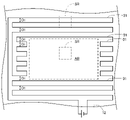
- FIG. 8 is a diagram showing the heater according to the present embodiment from the same viewpoint as in FIG.
- the heat generating member of the heater of the present embodiment is a plurality of heating wires 31 extending in the left-right direction as in the first embodiment, but the heat generating member is inside the transmission region AR.
- a heating wire 31 is non-arranged.
- the heating wire 31P extending substantially perpendicular to the direction in which these heating wires 31 extend to each of the ends of the heating wire 31 on the transmission region AR side that does not cross the inside of the transmission region AR. Is connected. In this way, in the present embodiment, all the heating wires 31 are conducted by connecting some of the heating wires in parallel.
- the wiring pattern for conducting all the heating wires is not limited to this.
- FIG. 9 is a diagram showing a modified example of the wiring pattern of the heating wire 31 described with reference to FIG. 8, and description thereof will be omitted by using the same reference numerals for the same configurations as those described with reference to FIG.
- the heating wire 31 is not arranged in the transmission region AR as in the heating wire 31 of FIG. Therefore, the vehicle sensor device 1 of the present embodiment does not correspond to the second aspect, but corresponds only to the first aspect. Further, the heating wire 31 similar to the heating wire 31 of FIG. 8 is formed in series, and the heating wire 31 is not branched at least around the transmission region AR.
- the heating wire 31 By attaching the heating wire 31 in this way, the current flowing through the heating wire 31 becomes constant regardless of the portion of the heating wire 31, and when the resistance value of the heating wire 31 is constant, the amount of heat generated in the heating wire 31 is unevenly distributed. It can be suppressed.
- the average ratio of the heat generating member to each unit region SR of the outer cover 12 inside the transmission region AR is zero.
- the average ratio of the heat generating member to each unit region SR inside the transmission region AR is the transmission region AR. It is smaller than the average of the ratio of the heat-generating member to each unit area SR on the outside of. Therefore, in the present embodiment, the heat generating member is attached to the outer cover 12 so that the inside of the transmission region AR is sparser than the outside of the transmission region AR.
- the vehicle sensor device 1 of the present embodiment suppresses the reflection of millimeter waves by the heat generating member while suppressing ice and snow, etc., as in the case of grasping the vehicle sensor device 1 of the first embodiment in the first aspect. Since it can be effectively removed, it is possible to suppress a decrease in detection accuracy.
- the heating wire 31 which is a heat generating member does not cross the transmission region AR. Therefore, the vehicle sensor device 1 of the present embodiment corresponds only to the first aspect and does not correspond to the second aspect.
- the predetermined direction for scanning the electromagnetic wave is the left-right direction, it is easy to detect the moving object, and the direction perpendicular to the predetermined direction is generally the vertical direction. , The efficiency of removing ice and snow can be increased.
- the heat generating member since the heat generating member is not arranged inside the transmission region AR, the reflection of the electromagnetic wave by the heat generating member can be suppressed more effectively. On the other hand, since the heat generating member is arranged outside the transmission region AR, the ice and snow adhering to the transmission region AR can be effectively melted by the heat from the heat generating member.
- the vehicle sensor device 1 according to the present embodiment has the same configuration as the vehicle sensor device 1 according to the first embodiment except that the configuration of the heater is different. Therefore, only the heater according to this embodiment will be described.
- FIG. 10 is a diagram showing the heater according to the present embodiment from the same viewpoint as in FIG.
- the heat generating member of the heater of the present embodiment is a plurality of heating wires 31 having the same thickness as in the first embodiment.
- a plurality of heating wires 31 are attached to the outer cover 12 in the following arrangement.
- each of the plurality of heating wires 31 which are heat generating members extends along the left-right direction which is the direction in which the electromagnetic wave is scanned. Further, on the outside of the transmission region AR, the distance between the heating wires 31 adjacent to each other is the same D1.
- each of the heating wires 31A to 31I crosses a part of the inside of the transmission region AR. Further, of these heating wires 31A to 31I, the heating wires 31A to 31C cross the upper region ARou inside the transmission region AR, respectively, and the heating wires 31G to 31I cross the lower region ARod inside the transmission region AR, respectively.
- the heat rays 31D to 31F cross the central region ARi sandwiched between the upper region ARou and the lower region ARod, respectively.
- Each of the heating wires 31 located between the heating wires 31A to 31I is connected to a heating wire extending substantially in the vertical direction along the outer edge of the transmission region AR. In this way, in the present embodiment, all the heating wires 31 are conducted by connecting some of the heating wires in parallel.
- the wiring pattern for conducting all the heating wires is not limited to this.
- FIG. 11 is a diagram showing a modified example of the wiring pattern of the heating wire 31 described with reference to FIG. 10, and the same reference numerals are used for the same configurations as those described with reference to FIG. 10, and the description thereof will be omitted.
- the heating wire 31 similar to the heating wire 31 of FIG. 10 is formed in series, and the heating wire 31 is not branched at least in the transmission region AR and its surroundings, and the heating wire 31 in the transmission region AR is not branched.
- the arrangement is the same as the arrangement of the heating wire 31 in the transmission region AR in FIG.
- the heating wire 31 By attaching the heating wire 31 in this way, the current flowing through the heating wire 31 becomes constant regardless of the portion of the heating wire 31, and when the resistance value of the heating wire 31 is constant, the amount of heat generated in the heating wire 31 is unevenly distributed. It can be suppressed.
- the upper region ARou is divided into four equal divisions along the left-right direction, and the lower region ARod is the lower division.
- the central area ARi corresponds to one section on the side and the central area ARi corresponds to two sections in the center.
- the heating wires 31A to 31C are arranged at the same interval D2 in the upper region ARou, the heating wires 31G to 31I are arranged at the same interval D2 in the lower region ARod, and the heating wires 31D to 31F are arranged in the central region ARi. They are arranged at intervals D3.
- the interval D2 is set to be three times the interval D1, but the interval D2 may be larger or smaller than the interval D1 as long as it is larger than the interval D1.
- the interval D3 is larger than the interval D2, and in the present embodiment, the interval D3 is 5 times the interval D1, but if the interval D3 is larger than the interval D2, it may be larger or smaller than the interval D1.
- the interval D3 may be approximately twice or more the interval D2.
- FIGS. 10 and 11 a plurality of unit regions SR having the same area are defined in each of the upper region ARou, the lower region ARod, the central region ARi, and the outer side of the transmission region AR.
- FIGS. Illustrated by a chain line.
- heating wires 31 Due to the arrangement of the heating wires 31 as described above, in the present embodiment, roughly two heating wires 31 cross each unit region SR of the upper region ARou and each unit region SR of the lower region ARod, and each of the central region ARi. Approximately one heating wire 31 crosses the unit region SR. Further, approximately four heating wires 31 cross each unit region SR outside the transmission region AR.
- the average ratio of the heat generating member to each unit region SR inside the transmission region AR is the unit region SR outside the transmission region AR. It is smaller than the average ratio of heat-generating members.
- the heat generating member is attached to the outer cover 12 so that the inside of the transmission region AR is sparser than the outside of the transmission region AR. Therefore, as in the first embodiment, it is possible to suppress that millimeter waves are reflected by the heat generating member and become noise.
- the heat generating member is also attached to the inside of the transmission region AR, the ice and snow adhering to the inside of the transmission region AR can be effectively removed as compared with the case where the heat generating member is not arranged inside the transmission region AR. Can be done.
- the average ratio of the heat generating members occupying each unit region SR of the central region ARi is the heat generating member occupying each unit region SR of the upper region ARou. Less than the average ratio.
- the average ratio of heat-generating members to each unit region SR in the central region ARi is smaller than the average ratio of heat-generating members to each unit region SR in the lower region ARod. Therefore, in the present embodiment, in the direction perpendicular to the left-right direction in which the electromagnetic wave is scanned in the transmission region AR, the heat generating member inside the transmission region AR is sparser on the center side than on the outer edge side of the transmission region AR. It is attached to the outer cover 12.
- an object to be detected is generally an object that is irradiated with electromagnetic waves transmitted and received through a region on the center side of a transmission region in a direction perpendicular to the direction in which electromagnetic waves are scanned.
- the object to be detected as such is generally a moving object such as another vehicle or a pedestrian. Therefore, as in the present embodiment, by attaching the heat generating member so that the central region ARi is relatively sparse inside the transmission region AR, the electromagnetic wave is reflected on the central side of the transmission region AR to generate noise. It is possible to suppress the deterioration of the detection accuracy of a moving object, for example, which is the detection target.
- the electromagnetic waves transmitted and received through the region on the upper edge side of the inside of the transmission region AR are mainly above the viewpoint of the driver of the vehicle VE. It is considered to be an electromagnetic wave reflected by a non-moving object such as an existing sign. Further, the electromagnetic waves transmitted and received through the region on the lower edge side of the inside of the transmission region AR are mainly non-moving objects such as roads existing substantially below the viewpoint of the driver of the vehicle VE. It is considered to be a reflected electromagnetic wave.
- the detection target is a moving body as described above, even if the heat generating members are arranged relatively densely in the upper region ARou and the lower region ARod, the detection accuracy of the detection target is unlikely to deteriorate. Therefore, by densely arranging the heat generating members in the upper region ARou and the lower region ARod, it is possible to more effectively remove ice and snow without affecting the detection accuracy. Therefore, the decrease in detection accuracy can be further suppressed.
- the predetermined direction for scanning the electromagnetic wave is the left-right direction, it may be easier to detect the moving object. Further, since the direction perpendicular to the predetermined direction is generally the vertical direction, the efficiency of removing ice and snow can be further improved.
- the upper region ARou, the lower region ARod, and the central region ARi do not need to be defined as described above.
- ARi can be specified as appropriate.
- the upper region ARou is in the range of 10 to 30% along the direction perpendicular to the left-right direction of the transmission region AR
- the center region ARi is 40 to 80% along the direction perpendicular to the left-right direction of the transmission region AR.
- the lower region ARod may be defined as a range of 10 to 30% along the direction perpendicular to the left-right direction of the transmission region AR.
- FIG. 12 is a diagram showing a second modification of the wiring pattern of the heating wire of FIG. 10, and the same reference numerals are used for the same configurations as those described with reference to FIG. 10, and the description thereof will be omitted. In the modification shown in FIG.
- the distance D2 between the heating wires 31 in the upper region ARou and the lower region ARod is larger than the distance D3 between the heating wires 31 in the central region ARi.
- approximately one heating wire 31 crosses the unit region SR of the upper region ARou and the unit region SR of the lower region ARod, and the unit region SR of the central region ARi is approximately.
- Two heating wires 31 cross.
- all the heating wires 31 are conducted by connecting some of the heating wires in parallel.
- the wiring pattern for conducting all the heating wires is not limited to this.
- FIG. 13 is a diagram showing a modified example of the wiring pattern of the heating wire 31 described with reference to FIG. 12, and the same reference numerals are used for the same configurations as those described with reference to FIG. 12, and the description thereof will be omitted.
- the heating wire 31 similar to the heating wire 31 of FIG. 12 is formed in series, and the heating wire 31 is not branched at least in the transmission region AR and its surroundings, and the heating wire 31 in the transmission region AR is not branched.
- the arrangement is the same as the arrangement of the heating wire 31 in the transmission region AR in FIG.
- the heating wire 31 By attaching the heating wire 31 in this way, the current flowing through the heating wire 31 becomes constant regardless of the portion of the heating wire 31, and when the resistance value of the heating wire 31 is constant, the amount of heat generated in the heating wire 31 is unevenly distributed. It can be suppressed.
- the heating wires 31A and 31B are arranged at the interval D2 in the upper region ARou, and the heating wires 31G and 31H are arranged at the interval D2 in the lower region ARod.
- the heating wires 31C to 31F are arranged in ALi at the same interval D3.
- the interval D2 is set to 5 times the interval D1, but the interval D2 may be larger or smaller than the interval D1 as long as it is larger than the interval D1.
- the interval D3 is smaller than the interval D2, and in these modifications, the interval D3 is 5 times the interval D1, but if the interval D3 is smaller than the interval D2, it may be larger or smaller than 3 times the interval D1. ..
- the interval D3 may be approximately half or less of the interval D2.
- the heat generating member inside the transmission region AR is attached so as to be denser on the center side than on the outer edge side of the transmission region AR in the direction perpendicular to the left-right direction in the transmission region AR. ..
- the central region ARi can be heated more effectively than the upper region ARou and the lower region ARod, so that ice and snow adhering to the central region ARi can be effectively removed.
- the heat generating member inside the transmission region AR may be attached at the same density on the outer edge side and the center side of the transmission region AR.
- the vehicle sensor device 1 according to the present embodiment has the same configuration as the vehicle sensor device 1 according to the first embodiment except that the configuration of the heater is different. Therefore, only the heater according to this embodiment will be described.
- FIG. 14 is a diagram showing mainly the vicinity of the transmission region and the vicinity of the light emission region of the heater according to the present embodiment from the same viewpoint as in FIG.
- the heating member of the heater of the present embodiment is a plurality of heating wires 31 having the same thickness as in the first embodiment.
- a plurality of heating wires 31 are attached to the outer cover 12 in the following arrangement.
- the plurality of heating wires 31 extend in the left-right direction from the vicinity of the transmission region AR and the transmission region AR to the vicinity of the light emission region LR and the light emission region LR. There is. With such a configuration, not only the transmission region AR but also the light emission region LR is heated by the plurality of heating wires 31. Of these heating wires 31, each of the heating wires 31A to 31D crosses a part of the inside of the transmission region AR and further crosses a part of the inside of the light emission region LR as in the first embodiment. Further, in the present embodiment, the heating wire 31E located three below the heating wire 31D crosses a part of the inside of the light emitting region LR.
- the four heating wires 31A, 31B, 31C, 31D extending from the transmission region AR and the heating wires 31E extending from the outside of the transmission region AR are each of the light emitting region LR. Cross part of the inner area.
- Each of the heating wires 31 between the heating wires 31A and 31D is divided into three in the left-right direction with the transmission region AR and the light emission region LR interposed therebetween, and is the first section between the transmission region AR and the light emission region LR. It has a second section on the side opposite to the first section side with the transmission region AR as a reference, and a third section on the side opposite to the first section side with the light emission region LR as a reference. These first to third sections are connected in parallel to the heating wires 31A to 31C via the heating wires extending in the vertical direction.
- the two heating wires 31 directly under the heating wire 31D are divided into two with the light emitting region LR in between, and the first section on the transmission region AR side and the light emitting region LR with the light emitting region LR as a reference. It has a second section on the opposite side to the first section side with reference to.
- Each of the first section and the second section of the heating wire 31 is connected in parallel to the heating wire 31D via the heating wire extending in the vertical direction. In this way, in the present embodiment, all the heating wires 31 are conducted by connecting some of the heating wires in parallel.
- the wiring pattern for conducting all the heating wires 31 is not limited to this.
- FIG. 15 is a diagram showing a modified example of the wiring pattern of the heating wire 31 described with reference to FIG. 14, and the same reference numerals are used for the same configurations as those described with reference to FIG. 14, and the description thereof will be omitted.
- the same heating wire 31 as the heating wire 31 of FIG. 14 is formed in series, and the heating wire 31 is not branched at least in the transmission region AR, the light emission region LR, and the periphery thereof, and the transmission region is formed.
- the arrangement of the heating wire 31 in the AR and the light emitting region LR is the same as the arrangement of the heating wire 31 in the transmission region AR and the light emitting region LR in FIG.
- the heating wire 31 By attaching the heating wire 31 in this way, the current flowing through the heating wire 31 becomes constant regardless of the portion of the heating wire 31, and when the resistance value of the heating wire 31 is constant, the amount of heat generated in the heating wire 31 is unevenly distributed. It can be suppressed.
- the intervals between the heating wires 31A and 31B, the intervals between the heating wires 31B and 31C, and the intervals between the heating wires 31C and 31D are the same D2 inside the transmission region AR and inside the light emitting region LR, respectively. Is. Further, inside the light emitting region LR, the distance between the heating wires 31D and 31E is also D2. On the other hand, the distance between the heating wires 31 adjacent to each other is the same D1 except for the inside of the transmission region AR and the inside of the light emission region LR.
- the interval D2 is set to be three times the interval D1, but the interval D2 may be larger or smaller than the interval D1 as long as it is larger than the interval D1.
- a plurality of unit regions SR having the same area are defined inside the transmission region AR and outside the transmission region AR, respectively. Further, a plurality of unit regions SR having the same area as each other are defined inside the light emitting region LR and outside the light emitting region LR. In addition, in FIGS. 14 and 15, only a part of the unit region SRs out of the plurality of unit region SRs is shown in order to avoid obscuring the figure.
- the heating wires 31 Due to the arrangement of the heating wires 31 as described above, approximately one heating wire 31 crosses each unit region SR inside the transmission region AR, and approximately three heating wires 31 cross each unit region SR outside the transmission region AR. .. Therefore, in the present embodiment, when focusing on the region of the outer cover 12 where the heat generating member is arranged, the average ratio of the heat generating member to each unit region SR inside the transmission region AR is outside the transmission region AR. It is smaller than the average of the ratio of the heat generating member to each unit area SR. As described above, in the present embodiment, as in the first embodiment, the heat generating member is attached to the outer cover 12 so that the inside of the transmission region AR is sparser than the outside of the transmission region AR.
- the heating wires 31 due to the arrangement of the heating wires 31 as described above, approximately three heating wires 31 cross each unit region SR outside the light emitting region LR. On the other hand, inside the light emission region LR, approximately one heating wire 31 crosses each unit region SR. Therefore, in the present embodiment, when focusing on the region of the outer cover 12 where the heat generating member is arranged, the average ratio of the heat generating member to each unit region SR inside the light emitting region LR is the light emitting region LR. It is smaller than the average of the ratio of the heat-generating member to each unit region SR on the outside of. Therefore, in the present embodiment, the heat generating member is attached to the outer cover 12 so that the inside of the light emitting region LR is sparser than the outside of the light emitting region LR.
- the heat generating member is attached to the outer cover 12 so that the inside of the transmission region AR is sparser than the outside of the transmission region AR. Therefore, as in the first embodiment, the vehicle sensor. It is possible to suppress a decrease in the detection accuracy of the device 1.
- the heat generating member is attached so as to heat the light emitting region LR, ice and snow adhering to the light emitting region can be removed. Further, since this heat generating member is sparser inside the light emitting region LR than outside the light emitting region LR, the light emitted from the lamp unit LU is reflected by the heat generating member inside the light emitting region LR. Can be suppressed, and the decrease in light emission efficiency from the lamp unit LU can be suppressed.
- the heat generating member inside the transmission region AR extends to the light emission region LR along the left-right direction, the light emission region LR can be heated by the heat generation member that heats the transmission region AR. .. Therefore, it is not necessary to separately provide a heat generating member for heating the light emitting region LR, and the wiring cost can be reduced.
- the heating wire that heats the light emission region LR may be provided separately from the heating wire that heats the transmission region AR.
- the predetermined direction for scanning the electromagnetic wave is the left-right direction, it is easy to detect the moving object, and the direction perpendicular to the predetermined direction is generally the vertical direction. , The efficiency of removing ice and snow can be increased.
- the heating wires 31A to 31D inside the transmission region AR extend outside the transmission region AR along the left-right direction to the light emission region LR.
- the heating wires 31A and 31B may extend outside the transmission region AR along the left-right direction to the light emission region LR.
- the density of the heat generating member may be the same between the inside and the outside of the light emission region LR, or the outside of the light emission region LR.
- the heat generating member may be attached so that the inside is denser than the inside.
- the heat generating member may not be arranged inside the light emitting region LR.
- the vehicle sensor device 1 according to the present embodiment has the same configuration as the vehicle sensor device 1 according to the first embodiment except that the configuration of the heater is different. Therefore, only the heater according to this embodiment will be described.
- FIG. 16 is a diagram showing the heater according to the present embodiment from the same viewpoint as in FIG.
- each of the plurality of heating wires 31 which are heat generating members is arranged at the same interval D1 and extends in the left-right direction which is the scanning direction of the electromagnetic wave.
- each heating wire 31 extending in the left-right direction is connected in parallel, and all the heating wires 31 are conducted.
- FIG. 17 is a diagram showing a modified example of the wiring pattern of the heating wire 31 described with reference to FIG. 16, and the same reference numerals are used for the same configurations as those described with reference to FIG.
- the heating wire 31 similar to the heating wire 31 of FIG. 16 is formed in series, and the heating wire 31 is not branched at least in the transmission region AR and its surroundings, and the heating wire 31 in the transmission region AR is not branched.
- the arrangement is the same as the arrangement of the heating wire 31 in the transmission region AR in FIG.
- the heat generating member when focusing on the region of the outer cover 12 where the heat generating member is arranged, the heat generating member occupying each unit region SR inside the transmission region AR.
- the average of the ratios of the heat-generating members is the same as the average of the ratios of the heat-generating members in each unit region SR outside the transmission region AR.
- the heat generating member is attached at the same density inside and outside the transmission region AR. Therefore, the vehicle sensor device 1 of the present embodiment does not correspond to the first aspect, but corresponds only to the second aspect.
- the distance between the heating wires inside the transmission region AR and the distance between the heating wires outside the transmission region AR are the same. Therefore, in order to make the distance between the heating wires inside the transmission region AR different from the distance between the heating wires outside and to make all the heating wires conductive, for example, as in the first embodiment.
- the heating wire directly under the heating wire that crosses the inside of the transmission region AR is divided into two with the transmission region AR in between, and each end of the divided heating wire on the transmission region AR side is connected to the heating wire directly above. There is no need to let it. Therefore, wiring can be simplified.
- FIG. 18 is a diagram showing a second modification of the wiring pattern of the heating wire of FIG. 16, and description of the same configuration as that described with reference to FIG. 16 will be omitted by using the same reference numerals. As shown in FIG.
- the distance D2 between the heating wires 31 inside the transmission region AR is made smaller than the distance D1 between the heating wires 31 outside, and the transmission region is smaller than the outside of the transmission region AR.
- a heat generating member is attached so that the inside of the AR becomes denser.
- Some heating wires 31 are connected in parallel with some other heating wires 31.
- FIG. 19 is a diagram showing a modified example of the wiring pattern of the heating wire 31 described with reference to FIG. 18, and the same reference numerals are used for the same configurations as those described with reference to FIG. 18, and the description thereof will be omitted.
- the heating wire 31 similar to the heating wire 31 of FIG. 18 is formed in series, and the heating wire 31 is not branched at least in the transmission region AR and its surroundings, and the heating wire 31 in the transmission region AR is not branched.
- the arrangement is the same as the arrangement of the heating wire 31 in the transmission region AR in FIG.
- the heating wire 31 By attaching the heating wire 31 in this way, the current flowing through the heating wire 31 becomes constant regardless of the portion of the heating wire 31, and when the resistance value of the heating wire 31 is constant, the amount of heat generated in the heating wire 31 is unevenly distributed. It can be suppressed.
- FIG. 20 is a diagram showing a heater according to a modified example of the first embodiment from the same viewpoint as in FIG. As shown in FIG.
- the plurality of heating wires 31 which are heat generating members are attached only to the region of the outer cover 12 which is vertically lower than the center C of the transmission region AR.
- the ice and snow adhering to the lower side of the transmission region AR can be melted.
- the ice and snow remaining on the upper side of the transmission region AR can fall and melt in the lower region from which the ice and snow has been removed. Therefore, even when the heat generating member is attached only to the lower region in this way, ice and snow can be effectively removed. Further, since the heat generating member can be reduced as compared with the case where the heat generating member is attached to the entire periphery of the transmission region AR, the cost can be reduced.
- the heating wire may be attached only to the region vertically below the center of the transmission region AR. Further, in the fourth embodiment, the heating wire may be attached only to the region vertically lower than the center of the transmission region AR or the center of the light emission region LR. Further, in these examples, the heating wires 31 may be formed in series as described with reference to FIG. 7 and the like.
- FIG. 21 is a diagram showing how such a modification is applied to the second embodiment from the same viewpoint as in FIG. Therefore, this modification corresponds to the case where the vehicle sensor device 1 is grasped in the first aspect.
- the end portion of each of the plurality of heating wires 131 on the transmission region AR side is connected to the heat generating member 131P surrounding the outside of the transmission region, and all the heating wires 131 are conducted.
- the heat-generating member is in the shape of a mesh in this way, a plurality of compartments SD surrounded by the heat-generating member are formed in the outer cover 12. Then, each of the compartments SD can be heated from all around by the heat generating member surrounding these compartments SD. Therefore, the outer cover 12 can be heated more effectively, and the efficiency of removing ice and snow can be improved.
- the heating wire is attached in a mesh shape to the inside of the transmission region AR and the inside of the light emission region LR, and the outside of the transmission region AR and the light emission region. The heating wire may be attached so that the inside of the transmission region AR and the inside of the light emission region LR are sparser than the outside of the LR.
- the heating wire 31 attached to the inside of the transmission region AR or the inside of the light emission region LR is attached to the outside of the transmission region AR or the outside of the light emission region LR. May be thin.
- the average of the ratios of the heat generating members to each unit region of the outer cover 12 inside the transmission region AR and the inside of the light emission region LR is set to the outside of the transmission region AR and the outside of the light emission region LR. It can be made even smaller than the average ratio of heat generating members in each unit area of the outer cover 12. Therefore, the heat generating member inside the transmission region AR and the inside of the light emission region LR can be made sparser.
- the heating wire attached to the inside of the transmission region AR is made thinner than the heating wire attached to the outside of the transmission region AR, and the heating wire in the central region ARi is set to the upper region ARou or the lower region. It may be thinner than the heating wire in ARod.
- the sensor unit 20 is a millimeter wave radar.
- the sensor unit 20 is not particularly limited as long as it can transmit and receive a predetermined electromagnetic wave transmitted through the outer cover 12 to detect an object existing outside the vehicle VE.
- the sensor unit 20 may be a LiDAR (Light Detection and Ringing) that transmits and receives laser light as an electromagnetic wave.
- the predetermined electromagnetic wave transmitted and received by the sensor unit 20 may be infrared rays or ultraviolet rays.
- the heat generating member is a heating wire
- the heat generating member is not particularly limited as long as it is heated by energization.
- the heat generating member may be a film-shaped member.
- the vehicle sensor device 1 may be attached to the left side or the right side of the vehicle VE to transmit and receive electromagnetic waves to the left side or the right side of the vehicle VE to detect an object on the left side or the right side.
- the vehicle sensor device 1 may be easy to detect a moving object such as a two-wheeled vehicle or a pedestrian existing on the side of the vehicle VE.
- the transmitting antenna 25 and the plurality of receiving antennas 26 are arranged in the front-rear direction so that the direction of scanning the electromagnetic wave is the front-back direction. Can be.
- the direction perpendicular to the predetermined direction of scanning the electromagnetic wave can be a substantially vertical direction.
- the vehicle sensor device 1 may be attached to the rear of the vehicle VE so that electromagnetic waves are transmitted and received to the rear side of the vehicle VE to detect an object behind.
- the direction of scanning the electromagnetic wave can be set to the left-right direction by arranging the transmitting antenna 25 and the plurality of receiving antennas 26 in the left-right direction. ..
- the vehicle lighting fixture is a vehicle headlight
- the present invention is not limited to this.
- the vehicle lighting equipment may be a tail lamp for a vehicle.
- the transmitting antenna 25 is configured so that the FOV region of the electromagnetic wave becomes a substantially rectangular shape flat in the vertical direction in the forward view, and the transmitting antenna 25 and each of the receiving antenna 26 are designated on a straight line parallel to the vertical direction. You may arrange them at intervals. As a result, the direction in which the electromagnetic wave is scanned can be set to the vertical direction. Further, the direction of scanning the electromagnetic wave is not limited to the left-right direction, the front-back direction, and the vertical direction, and may be, for example, a direction inclined at a predetermined angle with respect to the left-right direction.
- the electromagnetic wave is transmitted so that the transmission region AR has a rectangular shape
- the electromagnetic wave may be transmitted so that the transmission region AR has a shape different from the rectangle.
- a vehicle sensor device capable of suppressing a decrease in detection accuracy and a vehicle lamp equipped with the vehicle sensor device are provided, and can be used in a field such as an automobile.
Landscapes
- Engineering & Computer Science (AREA)
- General Engineering & Computer Science (AREA)
- Radar, Positioning & Navigation (AREA)
- Remote Sensing (AREA)
- Physics & Mathematics (AREA)
- Computer Networks & Wireless Communication (AREA)
- General Physics & Mathematics (AREA)
- Electromagnetism (AREA)
- Radar Systems Or Details Thereof (AREA)
- Geophysics And Detection Of Objects (AREA)
Priority Applications (1)
| Application Number | Priority Date | Filing Date | Title |
|---|---|---|---|
| JP2022553704A JP7621373B2 (ja) | 2020-09-30 | 2021-09-01 | 車両用センサ装置及び車両用灯具 |
Applications Claiming Priority (6)
| Application Number | Priority Date | Filing Date | Title |
|---|---|---|---|
| JP2020165965 | 2020-09-30 | ||
| JP2020165966 | 2020-09-30 | ||
| JP2020-165965 | 2020-09-30 | ||
| JP2020-165966 | 2020-09-30 | ||
| JP2021094787 | 2021-06-04 | ||
| JP2021-094787 | 2021-06-04 |
Publications (1)
| Publication Number | Publication Date |
|---|---|
| WO2022070748A1 true WO2022070748A1 (ja) | 2022-04-07 |
Family
ID=80950200
Family Applications (1)
| Application Number | Title | Priority Date | Filing Date |
|---|---|---|---|
| PCT/JP2021/032169 Ceased WO2022070748A1 (ja) | 2020-09-30 | 2021-09-01 | 車両用センサ装置及び車両用灯具 |
Country Status (2)
| Country | Link |
|---|---|
| JP (1) | JP7621373B2 (https=) |
| WO (1) | WO2022070748A1 (https=) |
Cited By (1)
| Publication number | Priority date | Publication date | Assignee | Title |
|---|---|---|---|---|
| WO2025119681A1 (en) * | 2023-12-07 | 2025-06-12 | Valeo Vision | Lighting device and motor vehicle |
Citations (5)
| Publication number | Priority date | Publication date | Assignee | Title |
|---|---|---|---|---|
| JP3117480U (ja) * | 2004-10-07 | 2006-01-05 | レーアウ アクチエンゲゼルシヤフト ウント コンパニー | レーダ送受信ユニットと作用結合された自動車のフロントモジュール/バンパのポリマ内部表面に設けられた加熱部材 |
| US20170175971A1 (en) * | 2015-12-21 | 2017-06-22 | Min Shiang Corporation | Heating device for a vehicle lamp |
| JP2017183063A (ja) * | 2016-03-30 | 2017-10-05 | 大日本印刷株式会社 | 加熱電極付き合わせガラス板、及び乗り物 |
| JP2017215242A (ja) * | 2016-06-01 | 2017-12-07 | 豊田合成株式会社 | 車両用装飾部品 |
| WO2020075539A1 (ja) * | 2018-10-09 | 2020-04-16 | 豊田合成株式会社 | 電波透過カバー |
-
2021
- 2021-09-01 JP JP2022553704A patent/JP7621373B2/ja active Active
- 2021-09-01 WO PCT/JP2021/032169 patent/WO2022070748A1/ja not_active Ceased
Patent Citations (5)
| Publication number | Priority date | Publication date | Assignee | Title |
|---|---|---|---|---|
| JP3117480U (ja) * | 2004-10-07 | 2006-01-05 | レーアウ アクチエンゲゼルシヤフト ウント コンパニー | レーダ送受信ユニットと作用結合された自動車のフロントモジュール/バンパのポリマ内部表面に設けられた加熱部材 |
| US20170175971A1 (en) * | 2015-12-21 | 2017-06-22 | Min Shiang Corporation | Heating device for a vehicle lamp |
| JP2017183063A (ja) * | 2016-03-30 | 2017-10-05 | 大日本印刷株式会社 | 加熱電極付き合わせガラス板、及び乗り物 |
| JP2017215242A (ja) * | 2016-06-01 | 2017-12-07 | 豊田合成株式会社 | 車両用装飾部品 |
| WO2020075539A1 (ja) * | 2018-10-09 | 2020-04-16 | 豊田合成株式会社 | 電波透過カバー |
Cited By (1)
| Publication number | Priority date | Publication date | Assignee | Title |
|---|---|---|---|---|
| WO2025119681A1 (en) * | 2023-12-07 | 2025-06-12 | Valeo Vision | Lighting device and motor vehicle |
Also Published As
| Publication number | Publication date |
|---|---|
| JPWO2022070748A1 (https=) | 2022-04-07 |
| JP7621373B2 (ja) | 2025-01-24 |
Similar Documents
| Publication | Publication Date | Title |
|---|---|---|
| US12269391B2 (en) | Vehicle light fitting, radar module, radar, and vehicle | |
| US11370366B2 (en) | Decorative component for vehicle | |
| JP7312608B2 (ja) | 車両用装飾部品 | |
| JP6589726B2 (ja) | 車両用撮影装置 | |
| JP7844686B2 (ja) | レーダ装置 | |
| JP2020056788A (ja) | 車両用ランプ | |
| US20140098517A1 (en) | Low and high beam headlamp | |
| CN106256043A (zh) | 用于车辆的天线设备 | |
| CN104583805A (zh) | 包括具有有源场景照明的光学检测器的驾驶员辅助系统 | |
| TW202030499A (zh) | 用於發光和雷達輻射之車輛的雷達和發光配置及方法和用途 | |
| JP7126746B2 (ja) | 車両レーダ装置 | |
| WO2019035296A1 (ja) | 電波透過カバー | |
| JP7484163B2 (ja) | 赤外線センサ用カバー | |
| EP4063722B1 (en) | Light emitting unit, and lamp device | |
| CN105531151A (zh) | 具体用于机动车辆照明构件的、包括在照明方向的平面中的印刷电路板的照明系统 | |
| WO2022070748A1 (ja) | 車両用センサ装置及び車両用灯具 | |
| CN110979154A (zh) | 探测灯组及车辆 | |
| WO2022102743A1 (ja) | カバー | |
| WO2020196316A1 (ja) | ライダ装置 | |
| JP2023110258A (ja) | 車両用外装品 | |
| JP7379284B2 (ja) | 発光ユニット及びランプ装置 | |
| CN105829167A (zh) | 用于机动车、具有用于探测故障状态的保险装置的照明装置和用于探测故障状态的方法 | |
| JP7842854B2 (ja) | 車両のレーダーセンサの放射コーンに対向して設置することを意図した除氷装置を含む自動車部品 | |
| WO2021200590A1 (ja) | 防曇発熱体 | |
| KR20190083873A (ko) | 차량용 램프 및 차량 |
Legal Events
| Date | Code | Title | Description |
|---|---|---|---|
| 121 | Ep: the epo has been informed by wipo that ep was designated in this application |
Ref document number: 21875050 Country of ref document: EP Kind code of ref document: A1 |
|
| ENP | Entry into the national phase |
Ref document number: 2022553704 Country of ref document: JP Kind code of ref document: A |
|
| NENP | Non-entry into the national phase |
Ref country code: DE |
|
| 122 | Ep: pct application non-entry in european phase |
Ref document number: 21875050 Country of ref document: EP Kind code of ref document: A1 |