WO2022054874A1 - 硬化性樹脂組成物、熱伝導材料、熱伝導シート、熱伝導層付きデバイス - Google Patents
硬化性樹脂組成物、熱伝導材料、熱伝導シート、熱伝導層付きデバイス Download PDFInfo
- Publication number
- WO2022054874A1 WO2022054874A1 PCT/JP2021/033173 JP2021033173W WO2022054874A1 WO 2022054874 A1 WO2022054874 A1 WO 2022054874A1 JP 2021033173 W JP2021033173 W JP 2021033173W WO 2022054874 A1 WO2022054874 A1 WO 2022054874A1
- Authority
- WO
- WIPO (PCT)
- Prior art keywords
- group
- epoxy
- compound
- epoxy compound
- heat conductive
- Prior art date
- Legal status (The legal status is an assumption and is not a legal conclusion. Google has not performed a legal analysis and makes no representation as to the accuracy of the status listed.)
- Ceased
Links
Classifications
-
- C—CHEMISTRY; METALLURGY
- C08—ORGANIC MACROMOLECULAR COMPOUNDS; THEIR PREPARATION OR CHEMICAL WORKING-UP; COMPOSITIONS BASED THEREON
- C08G—MACROMOLECULAR COMPOUNDS OBTAINED OTHERWISE THAN BY REACTIONS ONLY INVOLVING UNSATURATED CARBON-TO-CARBON BONDS
- C08G59/00—Polycondensates containing more than one epoxy group per molecule; Macromolecules obtained by polymerising compounds containing more than one epoxy group per molecule using curing agents or catalysts which react with the epoxy groups
- C08G59/18—Macromolecules obtained by polymerising compounds containing more than one epoxy group per molecule using curing agents or catalysts which react with the epoxy groups ; e.g. general methods of curing
- C08G59/40—Macromolecules obtained by polymerising compounds containing more than one epoxy group per molecule using curing agents or catalysts which react with the epoxy groups ; e.g. general methods of curing characterised by the curing agents used
- C08G59/62—Alcohols or phenols
-
- C—CHEMISTRY; METALLURGY
- C08—ORGANIC MACROMOLECULAR COMPOUNDS; THEIR PREPARATION OR CHEMICAL WORKING-UP; COMPOSITIONS BASED THEREON
- C08J—WORKING-UP; GENERAL PROCESSES OF COMPOUNDING; AFTER-TREATMENT NOT COVERED BY SUBCLASSES C08B, C08C, C08F, C08G or C08H
- C08J5/00—Manufacture of articles or shaped materials containing macromolecular substances
- C08J5/12—Bonding of a preformed macromolecular material to the same or other solid material such as metal, glass, leather, e.g. using adhesives
-
- C—CHEMISTRY; METALLURGY
- C08—ORGANIC MACROMOLECULAR COMPOUNDS; THEIR PREPARATION OR CHEMICAL WORKING-UP; COMPOSITIONS BASED THEREON
- C08J—WORKING-UP; GENERAL PROCESSES OF COMPOUNDING; AFTER-TREATMENT NOT COVERED BY SUBCLASSES C08B, C08C, C08F, C08G or C08H
- C08J5/00—Manufacture of articles or shaped materials containing macromolecular substances
- C08J5/18—Manufacture of films or sheets
-
- C—CHEMISTRY; METALLURGY
- C08—ORGANIC MACROMOLECULAR COMPOUNDS; THEIR PREPARATION OR CHEMICAL WORKING-UP; COMPOSITIONS BASED THEREON
- C08K—Use of inorganic or non-macromolecular organic substances as compounding ingredients
- C08K3/00—Use of inorganic substances as compounding ingredients
- C08K3/18—Oxygen-containing compounds, e.g. metal carbonyls
- C08K3/20—Oxides; Hydroxides
- C08K3/22—Oxides; Hydroxides of metals
-
- C—CHEMISTRY; METALLURGY
- C08—ORGANIC MACROMOLECULAR COMPOUNDS; THEIR PREPARATION OR CHEMICAL WORKING-UP; COMPOSITIONS BASED THEREON
- C08K—Use of inorganic or non-macromolecular organic substances as compounding ingredients
- C08K3/00—Use of inorganic substances as compounding ingredients
- C08K3/38—Boron-containing compounds
-
- C—CHEMISTRY; METALLURGY
- C08—ORGANIC MACROMOLECULAR COMPOUNDS; THEIR PREPARATION OR CHEMICAL WORKING-UP; COMPOSITIONS BASED THEREON
- C08L—COMPOSITIONS OF MACROMOLECULAR COMPOUNDS
- C08L33/00—Compositions of homopolymers or copolymers of compounds having one or more unsaturated aliphatic radicals, each having only one carbon-to-carbon double bond, and only one being terminated by only one carboxyl radical, or of salts, anhydrides, esters, amides, imides or nitriles thereof; Compositions of derivatives of such polymers
- C08L33/04—Homopolymers or copolymers of esters
- C08L33/14—Homopolymers or copolymers of esters of esters containing halogen, nitrogen, sulfur, or oxygen atoms in addition to the carboxy oxygen
-
- C—CHEMISTRY; METALLURGY
- C08—ORGANIC MACROMOLECULAR COMPOUNDS; THEIR PREPARATION OR CHEMICAL WORKING-UP; COMPOSITIONS BASED THEREON
- C08L—COMPOSITIONS OF MACROMOLECULAR COMPOUNDS
- C08L61/00—Compositions of condensation polymers of aldehydes or ketones; Compositions of derivatives of such polymers
- C08L61/34—Condensation polymers of aldehydes or ketones with monomers covered by at least two of the groups C08L61/04, C08L61/18 and C08L61/20
-
- C—CHEMISTRY; METALLURGY
- C08—ORGANIC MACROMOLECULAR COMPOUNDS; THEIR PREPARATION OR CHEMICAL WORKING-UP; COMPOSITIONS BASED THEREON
- C08L—COMPOSITIONS OF MACROMOLECULAR COMPOUNDS
- C08L63/00—Compositions of epoxy resins; Compositions of derivatives of epoxy resins
-
- C—CHEMISTRY; METALLURGY
- C09—DYES; PAINTS; POLISHES; NATURAL RESINS; ADHESIVES; COMPOSITIONS NOT OTHERWISE PROVIDED FOR; APPLICATIONS OF MATERIALS NOT OTHERWISE PROVIDED FOR
- C09K—MATERIALS FOR MISCELLANEOUS APPLICATIONS, NOT PROVIDED FOR ELSEWHERE
- C09K5/00—Heat-transfer, heat-exchange or heat-storage materials, e.g. refrigerants; Materials for the production of heat or cold by chemical reactions other than by combustion
- C09K5/08—Materials not undergoing a change of physical state when used
- C09K5/14—Solid materials, e.g. powdery or granular
-
- H—ELECTRICITY
- H10—SEMICONDUCTOR DEVICES; ELECTRIC SOLID-STATE DEVICES NOT OTHERWISE PROVIDED FOR
- H10W—GENERIC PACKAGES, INTERCONNECTIONS, CONNECTORS OR OTHER CONSTRUCTIONAL DETAILS OF DEVICES COVERED BY CLASS H10
- H10W40/00—Arrangements for thermal protection or thermal control
- H10W40/10—Arrangements for heating
-
- H—ELECTRICITY
- H10—SEMICONDUCTOR DEVICES; ELECTRIC SOLID-STATE DEVICES NOT OTHERWISE PROVIDED FOR
- H10W—GENERIC PACKAGES, INTERCONNECTIONS, CONNECTORS OR OTHER CONSTRUCTIONAL DETAILS OF DEVICES COVERED BY CLASS H10
- H10W40/00—Arrangements for thermal protection or thermal control
- H10W40/20—Arrangements for cooling
- H10W40/25—Arrangements for cooling characterised by their materials
Definitions
- the present invention relates to a curable resin composition, a heat conductive material, a heat conductive sheet, and a device with a heat conductive layer.
- Patent Document 1 describes an insulating thermal conductivity containing a predetermined (meth) acrylic copolymer, which is a copolymer of a (meth) acrylic monomer and glycidyl methacrylate, and a thermally conductive filler. The sheet is disclosed.
- the heat conductive material is also required to be able to firmly adhere to the object (adhesive material) that transfers heat, and the peel (peeling) strength of the heat conductive material to the adherend may be sufficiently high. It has been demanded.
- the present inventors examined the insulating heat conductive sheet described in Patent Document 1, it was confirmed that there is room for improvement in the peel strength of the formed insulating heat conductive sheet with respect to the adherend.
- Another object of the present invention is to provide a curable resin composition capable of providing a heat conductive material having excellent peel strength. Another object of the present invention is to provide a heat conductive material, a heat conductive sheet, and a device with a heat conductive layer relating to the curable resin composition.
- a curable resin composition containing a phenol compound, a first epoxy compound, a second epoxy compound, and an inorganic substance. Satisfying at least one of the requirements that the phenol compound contains a phenol compound having a triazine skeleton and that the first epoxy compound contains an epoxy compound having a triazine skeleton.
- the second epoxy compound is a curable resin composition which is an acrylic resin having an epoxy group in a side chain.
- [3] The curable resin composition according to [1] or [2], wherein the inorganic substance contains aggregated boron nitride having an average particle size of 20 ⁇ m or more.
- the first epoxy compound is a polyhydroxybenzene type epoxy compound, an epoxy compound having a biphenyl skeleton, a bisphenol F type epoxy compound, a phenol novolac type epoxy compound, a phenoxy resin, and an epoxy compound represented by the general formula (E2).
- C represents a carbon atom.
- U represents an integer of 3 or 4.
- V represents a substituent or a hydrogen atom having no epoxy group.
- W represents an epoxy-containing group.
- the epoxy-containing group is a group that is an epoxy group itself, or a monovalent group that contains an epoxy group as a part.
- a plurality of Ws existing in the general formula (E2) may be the same or different from each other.
- a curable resin composition capable of providing a heat conductive material having excellent peel strength. Further, according to the present invention, it is possible to provide a heat conductive material, a heat conductive sheet, and a device with a heat conductive layer relating to the curable resin composition.
- the curable resin composition the heat conductive material, the heat conductive sheet, and the device with the heat conductive layer of the present invention will be described in detail.
- the description of the constituent elements described below may be based on the representative embodiments of the present invention, but the present invention is not limited to such embodiments.
- the numerical range represented by using "-" means a range including the numerical values before and after "-" as the lower limit value and the upper limit value.
- (meth) acryloyl group means “either one or both of acryloyl group and methacryloyl group”.
- (meth) acrylamide group means “either one or both of an acrylamide group and a methacrylamide group”.
- (meth) acrylic means “either one or both of acrylic and methacrylic”.
- the acid anhydride group may be a monovalent group or a divalent group.
- the acid anhydride group represents a monovalent group, a substitution obtained by removing an arbitrary hydrogen atom from an acid anhydride such as maleic anhydride, phthalic anhydride, pyromellitic anhydride, and trimellitic anhydride.
- the group is mentioned.
- the acid anhydride group represents a divalent group, the group represented by * -CO-O-CO- * is intended (* represents a bond position).
- substituents and the like that do not specify substitution or non-substitution if possible, further substituents (for example, a group of substituents described later) are added to the groups as long as the desired effect is not impaired.
- Y may be possessed.
- alkyl group means a substituted or unsubstituted alkyl group (an alkyl group which may have a substituent) as long as the desired effect is not impaired.
- the type of the substituent, the position of the substituent, and the number of the substituents in the case of "may have a substituent” are not particularly limited. Examples of the number of substituents include one or two or more.
- substituent examples include a monovalent non-metal atomic group excluding a hydrogen atom, and a group selected from the following substituent group Y is preferable.
- halogen atom examples include a chlorine atom, a fluorine atom, a bromine atom, and an iodine atom.
- Substituent group Y Halogen atoms (-F, -Br, -Cl, -I, etc.), hydroxyl groups, amino groups, carboxylic acid groups and their conjugate base groups, anhydrous carboxylic acid groups, cyanate ester groups, unsaturated polymerizable groups, epoxy groups, oxetanyl Group, aziridinyl group, thiol group, isocyanate group, thioisocyanate group, aldehyde group, alkoxy group, allyloxy group, alkylthio group, arylthio group, alkyldithio group, aryldithio group, N-alkylamino group, N, N-dialkylamino Group, N-arylamino group, N, N-diarylamino group, N-alkyl-N-arylamino group, acyloxy group, carbamoyloxy group, N-alkylcarbamoyloxy group, N-ary
- sulfinamoyl group N-alkylsulfinamoyl group, N, N-dialkylsulfinamoyl group, N-arylsulfinamoyl group, N, N-diarylsulfinamoyl group, N-alkyl-N-arylsulfina Moil group, sulfamoyl group, N-alkyl sulfamoyl group, N, N-dialkyl sulfamoyl group, N-aryl sulfamoyl group, N, N-diaryl sulfamoyl group, N-alkyl-N-arylsul Famoyl group, N-acylsulfamoyl group and its conjugated base group, N-alkylsulfonylsulfamoyl group (-SO 2 NHSO 2 (alkyl)) and its conjugated base group, N-arylsulfon
- each of the above-mentioned groups may further have a substituent (for example, one or more groups among the above-mentioned groups), if possible.
- a substituent for example, one or more groups among the above-mentioned groups
- an aryl group which may have a substituent is also included as a group selectable from the substituent group Y.
- the number of carbon atoms of the group is, for example, 1 to 20.
- the number of atoms other than the hydrogen atom of the group selected from the substituent group Y is, for example, 1 to 30.
- these substituents may or may not form a ring by bonding with each other or with a group to be substituted, if possible.
- the alkyl group (or the alkyl group moiety in a group containing an alkyl group as a partial structure, such as an alkoxy group) may be a cyclic alkyl group (cycloalkyl group) and has one or more cyclic structures as a partial structure. It may be an alkyl group.
- composition The curable resin composition of the present invention (hereinafter, also simply referred to as “composition”) is a curable resin composition containing a phenol compound, a first epoxy compound, a second epoxy compound, and an inorganic substance. , Satisfying at least one of the requirements that the phenol compound contains a phenol compound having a triazine skeleton and that the first epoxy compound contains an epoxy compound having a triazine skeleton.
- the second epoxy compound is a curable resin composition which is an acrylic resin having an epoxy group in a side chain.
- the composition of the present invention contains a second epoxy compound which is an acrylic resin having an epoxy group in the side chain. Such a second epoxy compound exhibits good adhesion to the adherend. Further, in addition to the second epoxy compound, the composition of the present invention also contains a phenol compound which is a compound having a triazine skeleton and / or the first epoxy compound described above.
- the composition of the present invention comprises a phenolic compound.
- the phenol compound is a compound having 1 or more (preferably 2 or more, more preferably 2 to 10) hydroxyl groups directly bonded to the aromatic ring group. Above all, the phenol compound preferably has a triazine skeleton.
- a phenol compound means having one or more (for example, 1 to 5) triazine ring groups in the compound.
- the phenol compound is preferably a compound represented by the general formula (Z).
- E 1 to E 6 independently represent a single bond, -NH-, or -NR-.
- R represents a substituent.
- the substituent represented by R include a linear or branched alkyl group having 1 to 5 carbon atoms.
- E 1 to E 6 are preferably -NH- or -NR-, and more preferably -NH-.
- B 1 represents a single bond or a k + 1 valent organic group.
- B 2 represents a single bond or an l + 1 valent organic group.
- B 3 represents a single bond or m + 1 valent organic group.
- B 4 represents a single bond or an n + 1 valent organic group.
- the values of k, l, m, and n in the above-mentioned k + 1-valent organic group, l + 1-valent organic group, m + 1-valent organic group, and n + 1-valent organic group are specified in the general formula (Z). , K, l, m, and n.
- the value of m in the m + 1 valent organic group represented by B 3 indicates the number of X 3 to which the B 3 is bonded. Is the same as the value of.
- Examples of the organic group represented by B 1 to B 4 include a group obtained by removing j hydrogen atoms from a hydrocarbon group which may have a hetero atom having 1 to 20 carbon atoms.
- j means k + 1, l + 1, m + 1, or n + 1.
- the hydrocarbon group before removing j hydrogen atoms may have, for example, an aliphatic hydrocarbon group having 1 to 20 carbon atoms and a substituent which may have a substituent. Examples thereof include one or more groups selected from the group consisting of an aliphatic ring group having 3 to 20 carbon atoms and an aromatic ring group having 3 to 20 carbon atoms which may have a substituent.
- the group further consists of -O-, -S-, -CO-, -NR N- ( RN is a hydrogen atom or a substituent), and -SO 2- . It may be a group consisting of a combination of one or more of the selected divalent linking groups.
- Examples of the aliphatic hydrocarbon group having 1 to 20 carbon atoms include methane, ethane, propane, butane, pentane, hexane, and heptane.
- Examples of the aliphatic ring group having 3 to 20 carbon atoms include a cyclohexane ring group, a cycloheptane ring group, a norbornane ring group, and an adamantane ring group.
- Examples of the aromatic ring group having 3 to 20 carbon atoms include an aromatic hydrocarbon group having 6 to 20 carbon atoms and an aromatic heterocyclic group having 3 to 20 carbon atoms.
- Examples of the aromatic hydrocarbon group having 6 to 20 carbon atoms include a benzene ring, a naphthalene ring, an anthracene ring and the like, and examples of the aromatic heterocyclic group having 3 to 20 carbon atoms include a furan ring and a pyrrole ring. , Thiophene ring, pyridine ring, thiazole ring, carbazole ring, indole ring, benzothiazole ring and the like.
- k, l, m, and n each independently represent an integer of 0 or more.
- the total of k, l, r ⁇ m, and n is 2 or more, preferably an integer of 2 to 12, and more preferably an integer of 4 to 8.
- the value of m in "r ⁇ m" is an average value of m that may exist in a plurality of values.
- k, l, m, and n are preferably 0 to 5, and more preferably 1 to 2.
- k is preferably 1 or more (for example, 1 to 2)
- l is preferably 1 or more (for example, 1 to 2)
- m is preferably 1 or more (for example, 1 to 2).
- n is 1 or more (for example, 1 to 2).
- B 1 does not have X 1 .
- B 2 does not have X 2 .
- m does not have X 3 .
- B 4 does not have X 4 .
- B 1 is a single bond
- k is 1.
- B 2 is a single bond
- l is 1.
- B 3 is a single bond
- m is 1.
- B 4 is a single bond
- n is 1.
- L represents a divalent organic group.
- the organic group include an aromatic ring group which may have a substituent, an aliphatic hydrocarbon group which may have a substituent, an aliphatic ring group which may have a substituent, and-. Examples thereof include O-, -S-, -N (RN)-, -CO-, and a group combining these.
- RN represents a substituent. Examples of the substituent represented by RN include a linear or branched alkyl group having 1 to 5 carbon atoms. Further, examples of the substituent which the aromatic ring group, the aliphatic hydrocarbon group and the aliphatic ring group may have include a linear or branched alkyl group having 1 to 5 carbon atoms. Can be mentioned.
- Examples of the aromatic ring group include an aromatic hydrocarbon group having 6 to 20 carbon atoms and an aromatic heterocyclic group having 3 to 20 carbon atoms.
- Examples of the aromatic hydrocarbon group having 6 to 20 carbon atoms include a monocyclic aromatic ring group such as a benzene ring; a polycyclic aromatic ring group such as a naphthalene ring and an anthracene ring; and the like, and the number of carbon atoms is high.
- Examples of the 3 to 20 aromatic heterocyclic groups include monocyclic aromatic ring groups such as a furan ring, a pyrrole ring, a thiophene ring, a pyridine ring, and a thiazole ring; a benzothiazole ring, a carbazole ring, and an indole ring. Etc., Polycyclic aromatic ring groups; and the like.
- As the aromatic ring group as L a group obtained by removing two hydrogen atoms from the above example can be mentioned.
- Examples of the aliphatic hydrocarbon group include an alkylene group having 1 to 12 carbon atoms, and specifically, a methylene group, an ethylene group, a propylene group, a butylene group, a pentylene group, a hexylene group and a methylhexylene group. , And a heptylene group and the like.
- Examples of the aliphatic ring group include a cyclohexane ring group, a cycloheptane ring group, a norbornane ring group, an adamantane ring group and the like.
- As the aliphatic ring group as L a group obtained by removing two hydrogen atoms from the above example can be mentioned.
- An aromatic ring group which may have a substituent an aliphatic hydrocarbon group which may have a substituent, an aliphatic ring group which may have a substituent, or -O-, -S.
- a group in which -, -NR N- or -CO- is combined not only a divalent linking group consisting of a combination of two or more of these, but also a group of the same type (for example, an aromatic ring group) is connected via a single bond. It may be a divalent linking group in which two or more are combined.
- L in the above general formula (P2) may have a divalent aromatic ring group or a substituent which may have a substituent. It is a divalent organic group having at least one selected from the group consisting of a divalent aliphatic ring group which may have and an alkylene group which may have a branch having 2 or more carbon atoms. It is preferable, and a divalent organic group having a divalent aromatic ring group which may have a substituent may be more preferable because the thermal conductivity is more excellent.
- r is an integer of 0 or more. r is preferably an integer of 0 to 20, and more preferably an integer of 0 to 10.
- X 1 to X 4 each independently represent an aromatic ring group having a phenolic hydroxyl group.
- the "aromatic ring group having a phenolic hydroxyl group” may be any aromatic ring group having one or more (for example, 1 to 4) hydroxyl groups (phenolic hydroxyl groups) directly bonded to the aromatic ring.
- the aromatic ring group may or may not have a substituent other than the hydroxyl group.
- the aromatic ring group may be monocyclic or polycyclic, and may have a heteroatom as a ring member atom.
- the number of ring member atoms of the aromatic ring group is preferably 5 to 15, more preferably 6 to 10, and even more preferably 6.
- the aromatic ring group is preferably a benzene ring group.
- a substituent that the aromatic ring group may have other than the hydroxyl group a substituent having 1 to 6 carbon atoms is preferable, a hydrocarbon group having 1 to 6 carbon atoms is more preferable, and a linear chain having 1 to 6 carbon atoms is more preferable. Alternatively, a branched alkyl group is more preferable.
- k X 1 , l X 2 , r ⁇ m X 3 , and n X 4 is a phenolic hydroxyl group. It is also preferable that the aromatic ring group has a substituent arranged at the ortho position of the phenolic hydroxyl group. The substituent may be present in only one of the ortho positions of the phenolic hydroxyl group, or may be present in both.
- the value of m in "r ⁇ m" is an average value of m that may exist in a plurality of values.
- the "substituted group arranged at the ortho position” is preferably a substituent having 1 to 6 carbon atoms, more preferably a hydrocarbon group having 1 to 6 carbon atoms, and a linear or branched chain having 1 to 6 carbon atoms.
- Alkyl groups in the form are more preferable.
- the aromatic ring groups other than the "aromatic ring group having a phenolic hydroxyl group and a substituent arranged at the ortho position of the phenolic hydroxyl group” are It may or may not have a substituent other than a hydroxyl group (phenolic hydroxyl group).
- the aromatic ring group other than the "aromatic ring group having a phenolic hydroxyl group and a substituent arranged at the ortho position of the phenolic hydroxyl group” include a hydroxyphenyl group.
- aromatic ring groups having phenolic hydroxyl groups represented by any of X 1 to X 4
- at least one is “phenolic hydroxyl group and phenol”. It is also preferable that it is an aromatic ring group other than the "aromatic ring group having a substituent arranged at the ortho position of the sex hydroxyl group”.
- aromatic ring groups having phenolic hydroxyl groups represented by X 1 to X 4 there are also aromatic ring groups other than "aromatic ring groups having a phenolic hydroxyl group and a substituent arranged at the ortho position of the phenolic hydroxyl group”. It is considered that the symmetry of the compound as a whole is broken, the melting point of the compound is lowered, and the handleability of the semi-cured film formed from the composition is improved.
- the phenol compound is also preferably a compound represented by the general formula (Z1).
- the phenol compound preferably contains a compound represented by the general formula (Z1), and the phenol compound may be the compound itself represented by the general formula (Z1).
- the content of the compound represented by the general formula (Z1) is preferably 10 to 100% by mass, more preferably 25 to 100% by mass, still more preferably 50 to 100% by mass, based on the total mass of the phenol compound.
- r represents an integer of 0 or more. r is preferably an integer of 0 to 20, and more preferably an integer of 0 to 10.
- L represents a divalent organic group.
- the divalent organic group represented by L in the general formula (Z1) is, for example, the same as the divalent organic group represented by L in the general formula (Z1).
- R Z represents a hydrogen atom or a substituent.
- the substituent represented by RZ is preferably a substituent having 1 to 6 carbon atoms, more preferably a hydrocarbon group having 1 to 6 carbon atoms, and a linear or linear group having 1 to 6 carbon atoms. It is more preferably a branched alkyl group.
- At least one (preferably 30% or more, more preferably 50% or more, still more preferably 65% or more, preferably 90% or less, more preferably 80) of (3 + r) RZs present in the general formula (Z1). % Or less) may represent a substituent.
- At least one (for example, 1 to 2) of R Z existing in (3 + r) in the general formula (Z1) may represent a hydrogen atom.
- the above R z (preferably R z which is a substituent) is bonded to the above benzene ring group. It is also preferable that it exists in the para position with respect to NH.
- the phenol compound is also preferably a compound represented by the general formula (Z2).
- the phenol compound preferably contains a compound represented by the general formula (Z2), and the phenol compound may be the compound itself represented by the general formula (Z2).
- the content of the compound represented by the general formula (Z2) is preferably 10 to 100% by mass, more preferably 25 to 100% by mass, still more preferably 50 to 100% by mass, based on the total mass of the phenol compound.
- R Z represents a hydrogen atom or a substituent. It is also preferable that at least one of the two RZs represents a substituent, and it is also preferable that both represent a substituent.
- the substituent represented by RZ is preferably a substituent having 1 to 6 carbon atoms, more preferably a hydrocarbon group having 1 to 6 carbon atoms, and an alkyl group having 1 to 6 carbon atoms. Is even more preferable.
- the alkyl group may be linear or branched. It is also preferable that the alkyl group is unsubstituted.
- the two Rz in the general formula (Z2) may be the same or different from each other.
- phenol compounds include, for example, benzene polyols such as benzenediol or benzenetriol, biphenylaralkyl type phenol resin, phenol novolac resin, cresol novolac resin, aromatic hydrocarbon formaldehyde resin modified phenol resin, and dicyclopentadienephenol addition type.
- Resin phenol aralkyl resin, polyvalent phenol novolac resin synthesized from polyhydric hydroxy compound and formaldehyde, naphthol aralkyl resin, trimethylolmethane resin, tetraphenylol ethane resin, naphthol novolak resin, naphthol phenol co-condensed novolak resin, naphthol.
- Cresol co-condensed novolak resin biphenyl-modified phenol resin, biphenyl-modified naphthol resin, aminotriazine-modified phenol resin, alkoxy group-containing aromatic ring-modified novolak resin and the like are also preferable.
- the molecular weight of the phenol compound is preferably 225 to 2000, more preferably 225 to 1000.
- the molecular weight is a weight average molecular weight.
- the hydroxyl group content of the phenol compound is preferably 2.0 mmol / g or more, more preferably 4.0 mmol / g or more.
- the upper limit is preferably 25.0 mmol / g or less, more preferably 10.0 mmol / g or less.
- the hydroxyl group content is intended to be the number of hydroxyl groups (preferably phenolic hydroxyl groups) possessed by 1 g of the phenol compound.
- the phenol compound may have an active hydrogen-containing group (carboxylic acid group or the like) capable of polymerizing with an epoxy compound (first epoxy compound and second epoxy compound) in addition to the hydroxyl group. You don't have to.
- the lower limit of the active hydrogen content (total content of hydrogen atoms in hydroxyl groups, carboxylic acid groups, etc.) of the phenol compound is preferably 2.0 mmol / g or more, and more preferably 4.0 mmol / g or more.
- the upper limit is preferably 25.0 mmol / g or less, more preferably 10.0 mmol / g or less.
- the composition of the present invention is a compound having a group capable of reacting with an epoxy compound (first epoxy compound and second epoxy compound) (also referred to as “other active hydrogen-containing compound”). May include.
- the mass ratio of the content of other active hydrogen-containing compounds to the content of the phenol compound is preferably 0 to 1, more preferably 0 to 0.1, and 0 to 0.05. Is more preferable.
- the composition of the present invention comprises a first epoxy compound.
- the epoxy compound is a compound having at least one epoxy group (oxylanyl group) in one molecule and does not correspond to the second epoxy compound described later.
- the epoxy group is a group obtained by removing one or more hydrogen atoms (preferably one hydrogen atom) from the oxylan ring. If possible, the epoxy group may further have a substituent (a linear or branched alkyl group having 1 to 5 carbon atoms, or the like).
- the number of epoxy groups contained in the first epoxy compound is preferably 2 or more, more preferably 2 to 1000, and even more preferably 2 to 40 in one molecule.
- the molecular weight of the first epoxy compound is preferably 150 or more, more preferably 300 or more.
- the upper limit of the molecular weight is not limited, and for example, 100,000 or less is preferable, and 10,000 or less is more preferable.
- the molecular weight is a weight average molecular weight.
- the number average molecular weight and the weight average molecular weight are the weight average molecular weights obtained in terms of polystyrene by gel permeation chromatography (GPC).
- the epoxy group content of the first epoxy compound is preferably 2.0 to 20.0 mmol / g, more preferably 5.0 to 15.0 mmol / g.
- the epoxy group content is intended to be the number of epoxy groups contained in 1 g of the epoxy compound.
- the first epoxy compound also preferably has an aromatic ring group (preferably an aromatic hydrocarbon ring group).
- the first epoxy compound may or may not exhibit liquid crystallinity. That is, the first epoxy compound may be a liquid crystal compound. In other words, it may be a liquid crystal compound having an epoxy group.
- the first epoxy compound (which may be a liquid crystal epoxy compound) include a compound having at least a rod-like structure (rod-like compound) and a compound having at least a disk-like structure (disk). State compound).
- the rod-shaped compound and the disk-shaped compound will be described in detail.
- Examples of the first epoxy compound which is a rod-shaped compound include azomethines, azoxys, cyanobiphenyls, cyanophenyl esters, benzoic acid esters, cyclohexanecarboxylic acid phenyl esters, cyanophenylcyclohexanes, and cyano-substituted phenylpyrimidines. Examples thereof include alkoxy-substituted phenylpyrimidines, phenyldioxans, trans, and alkenylcyclohexylbenzonitriles. Not only low molecular weight compounds as described above, but also high molecular weight compounds can be used.
- the polymer compound is a polymer compound obtained by polymerizing a rod-shaped compound having a low molecular weight reactive group.
- Preferred rod-shaped compounds include rod-shaped compounds represented by the following general formula (XXI).
- Q 1 and Q 2 are independent epoxy groups, and L 111 , L 112 , L 113 , and L 114 independently represent a single bond or a divalent linking group, respectively. ..
- a 111 and A 112 each independently represent a divalent linking group (spacer group) having 1 to 20 carbon atoms.
- M represents a mesogen group.
- the epoxy groups of Q1 and Q2 may or may not have a substituent.
- L 111 , L 112 , L 113 , and L 114 each independently represent a single bond or a divalent linking group.
- the divalent linking groups represented by L 111 , L 112 , L 113 , and L 114 are independently -O-, -S-, -CO-, -NR 112- , and -CO-O, respectively.
- R 112 is an alkyl group or a hydrogen atom having 1 to 7 carbon atoms.
- L 113 and L 114 are preferably —O— independently of each other.
- L 111 and L 112 are preferably single bonds independently of each other.
- a 111 and A 112 each independently represent a divalent linking group having 1 to 20 carbon atoms.
- the divalent linking group may contain heteroatoms such as non-adjacent oxygen and sulfur atoms.
- an alkylene group, an alkenylene group, or an alkynylene group having 1 to 12 carbon atoms is preferable.
- the above-mentioned alkylene group, alkenylene group, or alkynylene group may or may not have an ester group.
- the divalent linking group is preferably linear, and the divalent linking group may or may not have a substituent.
- substituents examples include a halogen atom (fluorine atom, chlorine atom, and bromine atom), a cyano group, a methyl group, and an ethyl group.
- a 111 and A 112 are each independently preferably an alkylene group having 1 to 12 carbon atoms, and more preferably a methylene group.
- M represents a mesogen group, and examples of the mesogen group include known mesogen groups. Of these, a group represented by the following general formula (XXII) is preferable.
- W 1 and W 2 independently represent a divalent cyclic alkylene group, a divalent cyclic alkaneylene group, an arylene group, or a divalent heterocyclic group, respectively.
- L 115 represents a single bond or a divalent linking group.
- n represents an integer of 1 to 4.
- W 1 and W 2 examples include 1,4-cyclohexenediyl, 1,4-cyclohexanediyl, 1,4-phenylene, pyrimidine-2,5-diyl, pyridine-2,5-diyl, 1,3. 4-Thiadiazole-2,5-diyl, 1,3,4-oxadiazole-2,5-diyl, naphthalene-2,6-diyl, naphthalene-1,5-diyl, thiophene-2,5-diyl, And pyridazine-3,6-zyl.
- W 1 and W 2 may each have a substituent.
- substituents include the groups exemplified in the above-mentioned substituent group Y, and more specifically, a halogen atom (fluorine atom, chlorine atom, bromine atom, and iodine atom), cyano group, and carbon.
- An alkyl group having a number of 1 to 10 for example, a methyl group, an ethyl group, a propyl group, etc.
- an alkoxy group having 1 to 10 carbon atoms for example, a methoxy group, an ethoxy group, etc.
- a group having 1 to 10 carbon atoms for example, formyl group, acetyl group, etc.
- Acrylic group eg, formyl group, acetyl group, etc.
- alkoxycarbonyl group having 1 to 10 carbon atoms eg, methoxycarbonyl group, ethoxycarbonyl group, etc.
- acyloxy group having 1 to 10 carbon atoms eg, ethoxycarbonyl group, etc.
- Acetyloxy group, propionyloxy group, etc.), nitro group, trifluoromethyl group, difluoromethyl group and the like can be mentioned.
- the plurality of W 1s may be the same or different from each other.
- L 115 represents a single bond or a divalent linking group.
- the divalent linking group represented by L 115 include the above-mentioned divalent linking groups represented by L 111 to L 114 , and examples thereof include -CO-O- and -O-CO-. , -CH 2 -O-, and -O-CH 2- .
- the plurality of L 115s may be the same or different from each other.
- the preferred skeleton of the basic skeleton of the mesogen group represented by the above general formula (XXII) is illustrated below.
- the above-mentioned mesogen groups may be substituted with a substituent in these skeletons.
- the biphenyl skeleton is preferable in that the obtained heat conductive material has more excellent heat conductivity.
- the compound represented by the general formula (XXI) can be synthesized by referring to the method described in JP-A No. 11-513019 (WO97 / 00600).
- the rod-shaped compound may be a monomer having a mesogen group described in JP-A No. 11-323162 and Japanese Patent No. 4118691.
- the rod-shaped compound is preferably a compound represented by the general formula (E1).
- LE1 independently represents a single bond or a divalent linking group. Of these, LE1 is preferably a divalent linking group.
- the alkylene group may be linear, branched or cyclic, but a linear alkylene group having 1 to 2 carbon atoms is preferable.
- a plurality of LE1s may be the same or different from each other.
- LE2 is preferably single-bonded, -CO-O-, or -O-CO- independently of each other. When there are a
- LE3 is a 5-membered or 6-membered aromatic ring group or a 5-membered or 6-membered ring which may independently have a single bond or a substituent. Represents a non-aromatic ring group or a polycyclic group composed of these rings. Examples of the aromatic ring group and the non-aromatic ring group represented by LE3 include 1,4-cyclohexanediyl group, 1,4-cyclohexendyl group and 1,4-phenylene which may have a substituent.
- pyrimidin-2,5-diyl group pyridine-2,5-diyl group, 1,3,4-thiadiazol-2,5-diyl group, 1,3,4-oxadiazole-2,5-diyl
- examples thereof include a group, a naphthalene-2,6-diyl group, a naphthalene-1,5-diyl group, a thiophene-2,5-diyl group, and a pyridazine-3,6-diyl group.
- a transformer body is preferable.
- LE3 is preferably a single bond, a 1,4-phenylene group, or a 1,4-cyclohexenediyl group.
- the substituent of the group represented by LE3 is preferably an alkyl group, an alkoxy group, a halogen atom, a cyano group, a nitro group, or an acetyl group, and more preferably an alkyl group (preferably 1 carbon number). preferable.
- the substituents may be the same or different.
- the plurality of LE3s may be the same or different.
- pe represents an integer of 0 or more.
- pe is an integer of 2 or more, a plurality of ( -LE3 - LE2- ) may be the same or different from each other.
- pe is preferably 0 to 2, more preferably 0 or 1, and even more preferably 0.
- LE4 independently represents a substituent.
- the substituent an alkyl group, an alkoxy group, a halogen atom, a cyano group, a nitro group, or an acetyl group are preferable, and an alkyl group (preferably 1 carbon number) is more preferable.
- a plurality of LE4s may be the same or different from each other. Further, when le described below is an integer of 2 or more, a plurality of LE4s existing in the same ( LE4 ) le may be the same or different.
- le independently represents an integer of 0 to 4. Among them, le is preferably 0 to 2 independently of each other. A plurality of le may be the same or different from each other.
- one or both of the two existing "epoxy groups-LE1-" are replaced with diglycidylaminoalkylene groups (preferably diglycidyl aminomethylene groups). Is also preferable.
- the rod-shaped compound preferably has a biphenyl skeleton in that the obtained heat conductive material has better heat conductivity.
- the first epoxy compound preferably has a biphenyl skeleton, and in this case, the first epoxy compound is more preferably a rod-shaped compound.
- the first epoxy compound which is a disc-shaped compound, has a disc-shaped structure at least partially.
- the disk-like structure has at least an alicyclic or aromatic ring.
- the disk-shaped compound can form a columnar structure by forming a stacking structure by ⁇ - ⁇ interaction between molecules.
- Angew. Chem. Int. Ed. examples thereof include the triphenylene structure described in 2012, 51, 7990-7793 or JP-A-7-306317, and the tri-substituted benzene structure described in JP-A-2007-002220 and JP-A-2010-2440338.
- a heat conductive material showing high heat conductivity can be obtained.
- the rod-shaped compound can conduct heat only linearly (one-dimensionally), whereas the disk-shaped compound can conduct heat planarly (two-dimensionally) in the normal direction, so that the heat conduction path is It is thought that the number will increase and the thermal conductivity will improve.
- the disk-shaped compound preferably has three or more epoxy groups.
- a cured product of a composition containing a disk-shaped compound having three or more epoxy groups tends to have a high glass transition temperature and high heat resistance.
- the number of epoxy groups contained in the disk-shaped compound is preferably 8 or less, and more preferably 6 or less.
- disk-shaped compound examples include C.I. Destrade et al. , Mol. Crysr. Liq. Cryst. , Vol. 71, page 111 (1981); Chemical Society of Japan, Quarterly Review of Chemistry, No. 22, Liquid crystal chemistry, Chapter 5, Chapter 10, Section 2 (1994); B. Kohne et al. , Angew. Chem. Soc. Chem. Comm. , Page 1794 (1985); J. Mol. Zhang et al. , J. Am. Chem. Soc. , Vol. In the compounds described in 116, page 2655 (1994), and Japanese Patent No. 4592225, compounds having at least one end (preferably three or more) as an epoxy group can be mentioned.
- disk-shaped compound examples include Angew. Chem. Int. Ed. Ends in the triphenylene structure described in 2012, 51, 7990-7793, and JP-A-7-306317, and the tri-substituted benzene structure described in JP-A-2007-002220 and JP-A-2010-240383. Examples thereof include compounds in which at least one (preferably three or more) of the above is used as an epoxy group.
- a compound represented by any of the following formulas (D1) to (D16) is preferable from the viewpoint of better thermal conductivity of the heat conductive material.
- equations (D1) to (D15) will be described, and then the equation (D16) will be described.
- "-LQ” represents “-L-Q”
- QL- represents "QL-”.
- L represents a divalent linking group.
- L is independently an alkylene group, an alkaneylene group, an arylene group, -CO-, -NH-, -O-, -S-, and a combination thereof. It is preferable that the group is selected from the group consisting of, and two or more groups are selected from the group consisting of an alkylene group, an alkenylene group, an arylene group, -CO-, -NH-, -O-, and -S-. More preferably, it is a combined group.
- the alkylene group preferably has 1 to 12 carbon atoms.
- the number of carbon atoms of the alkenylene group is preferably 2 to 12.
- the arylene group preferably has 10 or less carbon atoms.
- the alkylene group, alkenylene group, and arylene group may have a substituent (preferably an alkyl group, a halogen atom, a cyano, an alkoxy group, an acyloxy group, etc.).
- L is shown below.
- the bond on the left side binds to the side of the central structure of the compound represented by any of the formulas (D1) to (D15) (hereinafter, also simply referred to as "central ring"), and the bond on the right side.
- AL means an alkylene group or an alkenylene group
- AR means an arylene group.
- the alkylene group represented by AL may be linear or branched, and has, for example, 1 to 12 carbon atoms.
- the alkenylene group represented by AL may be linear or branched, and has, for example, 2 to 12 carbon atoms.
- the arylene group represented by AR may be monocyclic or polycyclic, and the number of ring member atoms is preferably 6 to 12.
- Q independently represents a hydrogen atom or a substituent.
- substituents include the groups exemplified in the above-mentioned substituent group Y. More specifically, as the substituent, the above-mentioned reactive functional group, halogen atom, isocyanate group, cyano group, unsaturated polymerizable group, epoxy group, oxetanyl group, aziridinyl group, thioisocyanate group, aldehyde group, and Examples include sulfo groups.
- Q is a group other than the epoxy group, it is preferable that Q is stable with respect to the epoxy group.
- one or more (preferably two or more) Qs represent an epoxy group. Above all, from the viewpoint of better thermal conductivity of the heat conductive material, it is preferable that all Qs represent epoxy groups.
- the compounds represented by the formulas (D1) to (D15) preferably do not have -NH- from the viewpoint of the stability of the epoxy group.
- the compound represented by the formula (D4) is preferable from the viewpoint of more excellent thermal conductivity of the heat conductive material.
- the central ring of the disc-shaped compound is preferably a triphenylene ring.
- the compound represented by the formula (XI) is preferable from the viewpoint of more excellent thermal conductivity of the heat conductive material.
- R 11 , R 12 , R 13 , R 14 , R 15 , and R 16 are independently * -X 11 -L 11 -P 11 or * -X 12 -L, respectively.
- * represents the bonding position with the triphenylene ring.
- R 11 , R 12 , R 13 , R 14 , R 15 , and R 16 two or more are * -X 11 -L 11 -P 11 , and three or more are * -X 11 -L. 11 -P 11 is preferable.
- R 11 and R 12 one or more of R 13 and R 14 , and any one of R 15 and R 16
- the number is * -X 11 -L 11 -P 11 .
- R 11 , R 12 , R 13 , R 14 , R 15 and R 16 are all * -X 11 -L 11 -P 11 .
- R 11 , R 12 , R 13 , R 14 , R 15 and R 16 are all the same.
- X 11 is independently single-bonded, -O-, -CO-, -NH-, -O-CO-, -O-CO-O-, -O-CO-NH-, -O-CO-.
- X 11 independently have -O-, -O-CO-, -O-CO-O-, -O-CO-NH-, -CO-O-, -CO-NH-, and -NH.
- -CO- or -NH-CO-O- is preferable, and -O-, -O-CO-, -CO-O-, -O-CO-NH-, or -CO-NH- is more preferable.
- -O-CO- or -CO-O- is even more preferred.
- L 11 independently represents a single bond or a divalent linking group.
- divalent linking groups include -O-, -O-CO-, -CO-O-, -S-, -NH-, and alkylene groups (preferably 1 to 10 carbon atoms, 1 to 8 carbon atoms). Is more preferable, 1 to 7 is more preferable), an arylene group (the number of carbon atoms is preferably 6 to 20, more preferably 6 to 14, and even more preferably 6 to 10), or a group consisting of a combination thereof. Can be mentioned.
- Examples of the alkylene group include a methylene group, an ethylene group, a propylene group, a butylene group, a pentylene group, a hexylene group, and a heptylene group.
- Examples of the arylene group include a 1,4-phenylene group, a 1,3-phenylene group, a 1,4-naphthylene group, a 1,5-naphthylene group and an anthrasenylene group, and a 1,4-phenylene group is preferable. ..
- the alkylene group and the arylene group may each have a substituent.
- the number of substituents is preferably 1 to 3, more preferably 1.
- the substitution position of the substituent is not particularly limited.
- As the substituent a halogen atom or an alkyl group having 1 to 3 carbon atoms is preferable, and a methyl group is more preferable. It is also preferable that the alkylene group and the arylene group are unsubstituted. Of these, the alkylene group is preferably unsubstituted.
- Examples of ⁇ X 11 ⁇ L 11 ⁇ include L101 to L143, which are examples of L described above.
- P11 represents an epoxy group.
- the epoxy group may or may not have a substituent.
- X 12 is the same as X 11 , and the preferred conditions are also the same.
- L 12 is the same as L 11 , and the preferred conditions are also the same.
- Examples of ⁇ X 12 ⁇ L 12 ⁇ include L101 to L143, which are examples of L described above.
- Y 12 is a hydrogen atom, a linear, branched or cyclic alkyl group having 1 to 20 carbon atoms, or a linear, branched or cyclic alkyl group having 1 to 20 carbon atoms.
- one or more methylene groups are substituted with -O-, -S-, -NH-, -N (CH 3 )-, -CO-, -O-CO-, or -CO-O-.
- One Y 12 is a linear, branched or cyclic alkyl group having 1 to 20 carbon atoms, or a linear, branched or cyclic alkyl group having 1 to 20 carbon atoms.
- one or more hydrogen atoms contained in Y 12 may be substituted with a halogen atom.
- the compound represented by the formula (XI) conforms to the methods described in JP-A-7-306317, JP-A-7-281028, JP-A-2005-156822, and JP-A-2006-301614. Can be synthesized.
- a compound represented by the formula (D16) is also preferable as the disk-shaped compound.
- R 17X , R 18X , and R 19X each independently represent * -X 211X- (Z 21X -X 212X ) n21X- L 21X -Q. * Represents the position of connection with the central ring.
- X 211X and X 212X are independently single-bonded, -O-, -CO-, -NH-, -O-CO-, -O-CO-O-, -O-CO-NH-, -O. -CO-S-, -CO-O-, -CO-NH-, -CO-S-, -NH-CO-, -NH-CO-O-, -NH-CO-NH-, -NH-CO Represents —S—, —S—, —S—CO—, —S—CO—O—, —S—CO—NH—, or —S—CO—S—.
- Z 21X independently represents a 5- or 6-membered aromatic ring group or a 5-membered or 6-membered non-aromatic ring group, respectively.
- L 21X represents a single bond or a divalent linking group.
- Q is synonymous with Q in the formulas (D1) to (D15), and the preferred conditions are also the same.
- at least one (preferably all) Q among the plurality of Qs present represents an epoxy group.
- n21X represents an integer of 0 to 3. When n21X is 2 or more, a plurality of (Z 21X -X 212X ) may be the same or different.
- the compound represented by the formula (D16) As the compound represented by the formula (D16), the compound represented by the formula (XII) is preferable.
- R 17 , R 18 and R 19 are independently * -X 211- (Z 21 -X 212 ) n21 -L 21 -P 21 or * -X 221- (Z 22 -X 222 ). Represents n22 - Y22 . * Represents the position of connection with the central ring. Two or more of R 17 , R 18 , and R 19 are * -X 211- (Z 21 -X 212 ) n21 -L 21 -P 21 . From the viewpoint of better thermal conductivity of the heat conductive material, R 17 , R 18 and R 19 are all * -X 211- (Z 21 -X 212 ) n21 -L 21 -P 21 . preferable. In addition, it is preferable that R 17 , R 18 , and R 19 are all the same.
- X 211 , X 212 , X 221 and X 222 are independently single-bonded, -O-, -CO-, -NH-, -O-CO-, -O-CO-O-, -O, respectively.
- -CO-NH-, -O-CO-S-, -CO-O-, -CO-NH-, -CO-S-, -NH-CO-, -NH-CO-O-, -NH-CO Represents -NH-, -NH-CO-S-, -S-, -S-CO-, -S-CO-O-, -S-CO-NH-, or -S-CO-S-.
- single bond, -NH-, -O-, -CO-O-, or -O-CO- is preferable, respectively.
- Z 21 and Z 22 independently represent a 5-membered or 6-membered aromatic ring group or a 5-membered or 6-membered non-aromatic ring group, for example, a benzene ring group (1,4-). Examples thereof include a phenylene group and a 1,3-phenylene group), and an aromatic heterocyclic group.
- the aromatic ring group and the non-aromatic ring group may have a substituent.
- the number of substituents is preferably 1 to 4, more preferably 1 or 2, and even more preferably 1.
- the substitution position of the substituent is not particularly limited.
- a halogen atom or a methyl group is preferable. It is also preferable that the aromatic ring group and the non-aromatic ring group are unsubstituted. Further, as the substituent, it may further have a group represented by "-X 212 -L 21 -P 21 ".
- aromatic heterocyclic group examples include the following aromatic heterocyclic groups.
- * represents a site that binds to X 211 or X 221 .
- ** represents a site that binds to X 212 or X 222 .
- a 41 and A 42 each independently represent a methine group or a nitrogen atom.
- X4 represents an oxygen atom, a sulfur atom, or an imino group. It is preferable that at least one of A 41 and A 42 is a nitrogen atom, and it is more preferable that both are nitrogen atoms. Further, X4 is preferably an oxygen atom.
- n21 and n22 which will be described later, are two or more, a plurality of (Z 21 -X 212 ) and (Z 22 -X 222 ) may be the same or different from each other.
- L 21 independently represents a single bond or a divalent linking group, and is synonymous with L 11 in the above formula (XI).
- Examples of L 21 include -O-, -O-CO-, -CO-O-, -S-, -NH-, and an alkylene group (the number of carbon atoms is preferably 1 to 10 and more preferably 1 to 8). ⁇ 7 is more preferable), an arylene group (the number of carbon atoms is preferably 6 to 20, more preferably 6 to 14, and even more preferably 6 to 10), or a group composed of a combination thereof is preferable.
- examples of ⁇ X212 ⁇ L21 ⁇ include L101 to L143, which are examples of L in the above formulas (D1) to (D15).
- the bond on the left side of L101 to L143 binds to the side of the central structure of the compound (hereinafter, also simply referred to as “central ring”), and the bond on the right side binds to P21.
- P21 represents an epoxy group.
- the epoxy group may or may not have a substituent.
- Each of Y 22 has a hydrogen atom, a linear, branched or cyclic alkyl group having 1 to 20 carbon atoms, or a linear, branched or branched alkyl group having 1 to 20 carbon atoms.
- one or more methylene groups are -O-, -S-, -NH-, -N (CH 3 )-, -CO-, -O-CO-, or -CO-.
- n21 and n22 each independently represent an integer of 0 to 3, and an integer of 1 to 3 is preferable from the viewpoint of better thermal conductivity.
- Preferred examples of the disk-shaped compound include the following compounds.
- R represents -X 212 -L 21 -P 21 .
- the compound represented by the formula (XII) can be synthesized according to the methods described in JP-A-2010-244038, JP-A-2006-07692, and JP-A-2007-002220.
- the disk-shaped compound is preferably a compound having a hydrogen-bonding functional group from the viewpoint of reducing the electron density, strengthening the stacking, and facilitating the formation of a columnar aggregate.
- Hydrogen-bonding functional groups include -O-CO-NH-, -CO-NH-, -NH-CO-, -NH-CO-O-, -NH-CO-NH-, and -NH-CO-S. -Or-S-CO-NH- and the like can be mentioned.
- the first epoxy compound has, for example, a phenolic hydroxyl group in the general formula (Z), the general formula (Z1), or the general formula (Z2) described in the description of the phenol compound.
- a compound represented by a general formula can be used instead of the epoxy-containing group.
- the epoxy-containing group is a group that is the epoxy group itself, or a monovalent group that contains an epoxy group as a part.
- the monovalent group containing the epoxy group as a part is a group having one or more (preferably 1 to 8) epoxy groups in the whole group.
- the monovalent group containing the epoxy group as a part is preferably a group represented by "-(divalent hydrocarbon group) M1- (-O-2-valent hydrocarbon group-) M2 -epoxide group".
- M1 represents 0 or 1.
- M2 represents an integer of 1 or more (preferably 1 to 10).
- the divalent hydrocarbon group may or may not have a substituent, and the divalent hydrocarbon group may further have an epoxy-containing group as a substituent.
- the divalent hydrocarbon groups that may be present in a plurality thereof may be the same or different from each other.
- an epoxy compound represented by the general formula (DN) can be mentioned.
- nDN represents an integer of 0 or more, preferably 0 to 5, and more preferably 1.
- RDN represents a single bond or a divalent linking group.
- the divalent linking group includes -O-, -O-CO-, -CO-O-, -S-, an alkylene group (preferably 1 to 10 carbon atoms), and an arylene group (the carbon number is preferably 1 to 10). 6 to 20 is preferable), or a group composed of a combination thereof is preferable, an alkylene group is more preferable, and a methylene group is more preferable.
- an epoxy compound represented by the general formula (E2) can also be mentioned.
- C represents a carbon atom.
- U represents an integer of 3 or 4.
- "U” in “4-U” indicating the number of V and "U” indicating the number of W show the same value. That is, the general formula (E2) is "VC (-W) 3 " or "C (-W) 4 ".
- V represents a substituent or a hydrogen atom having no epoxy group.
- the above-mentioned substituent having no epoxy group is a substituent other than the epoxy group and does not contain an epoxy group as a part of the substituent.
- the substituent having no epoxy group include a group selected from the substituent group Y, excluding an epoxy group and a group containing an epoxy group as a part.
- the substituent having no epoxy group is preferably an alkyl group, and more preferably a linear or branched alkyl group.
- the alkyl group preferably has 1 to 5 carbon atoms.
- W represents an epoxy-containing group.
- the epoxy-containing group is a group that is the epoxy group itself, or a monovalent group that contains an epoxy group as a part.
- the monovalent group containing the epoxy group as a part is a group having one or more (preferably 1 to 8) epoxy groups in the whole group.
- the monovalent group containing the epoxy group as a part is preferably a group represented by "-(divalent hydrocarbon group) M1- (-O-2-valent hydrocarbon group-) M2 -epoxide group".
- M1 represents 0 or 1.
- M2 represents an integer of 1 or more (preferably 1 to 10).
- the divalent hydrocarbon group may or may not have a substituent, and the divalent hydrocarbon group may further have an epoxy-containing group as a substituent.
- the divalent hydrocarbon groups that may be present in a plurality thereof may be the same or different from each other.
- a plurality of Ws existing in the general formula (E2) may be the same or different from each other.
- Examples of the other first epoxy compound include compounds in which the epoxy group is fused. Examples of such a compound include 3,4: 8,9-diepoxybicyclo [4.3.0] nonane and the like.
- first epoxy compounds include, for example, bisphenol A type epoxy compound, bisphenol F type epoxy compound, bisphenol S type epoxy compound, and bisphenol AD, which are glycidyl ethers such as bisphenol A, F, S, and AD.
- Type epoxy compound, etc . hydrogenated bisphenol A type epoxy compound, hydrogenated bisphenol AD type epoxy compound, etc .
- phenol novolac type glycidyl ether phenol novolak type epoxy compound), cresol novolak type glycidyl ether (cresol novolak type epoxy compound) ), Bisphenol A novolak type glycidyl ether, etc .
- Dicyclopentadiene type glycidyl ether dicyclopentadiene type epoxy compound
- Dihydroxypentadiene type glycidyl ether dihydroxypentadiene type epoxy compound
- Polyhydroxybenzene type glycidyl ether polyhydroxybenzene type epoxy compound
- the first epoxy is a compound in which one or more of the glycidyl ether group and / or the glycidyl ester group in each of the above compounds is replaced with a diglycidylamino group or a diglycidylaminoalkylene group (diglycidylaminomethylene group, etc.). It may be used as a compound.
- Each of the above compounds may have a substituent.
- the aromatic ring group, cycloalkane ring group, and / or alkylene group contained in each of the above compounds is other than the glycidyl ether group, the glycidyl ester group, the diglycidyl amino group, and / or the diglycidyl aminoalkylene group. It may have a substituent of.
- the first epoxy compound a polyhydroxybenzene type epoxy compound, an epoxy compound having a biphenyl skeleton, a bisphenol F type epoxy compound, a phenol novolac type epoxy compound, a phenoxy resin, or .
- the first epoxy compound may be the above-mentioned one or more kinds of epoxy compounds themselves, or may be contained in a part thereof.
- the content of the above-mentioned one or more kinds of epoxy compounds is preferably 30 to 100% by mass, more preferably 60 to 100% by mass, still more preferably 90 to 100% by mass, based on the total mass of the first epoxy compound.
- composition of the present invention at least one of the fact that the phenol compound contains a phenol compound having a triazine skeleton (Requirement 1) and that the first epoxy compound contains an epoxy compound having a triazine skeleton (Requirement 2). Meet the requirements.
- the composition may satisfy only Requirement 1, only Requirement 2, or both Requirement 1 and Requirement 2.
- the compound and the first epoxy compound "have a triazine skeleton"
- the compound has one or more (for example, 1 to 5) triazine ring groups.
- the phenol compound having a triazine skeleton include the above-mentioned compound represented by the general formula (Z), the compound represented by the general formula (Z1), and the compound represented by the general formula (Z2). Be done.
- a compound in which A 2 , A 3 , and A 4 are all ⁇ N in the compound represented by the above, and represented by the general formula (Z) in which the phenolic hydroxyl group is replaced with an epoxy group-containing group.
- the content thereof is more than 0% by mass and 100% by mass or less with respect to the total mass of the phenol compound, and is 30 to 100. It is preferably by mass, more preferably 60 to 100% by mass, still more preferably 90 to 100% by mass.
- the first epoxy compound contains an epoxy compound having a triazine skeleton (that is, when requirement 2 is satisfied)
- the content of the phenol compound having a triazine skeleton may be outside the above-mentioned preferable range.
- the content thereof is more than 0% by mass and 100% by mass or less based on the total mass of the first epoxy compound. It is preferably 30 to 100% by mass, more preferably 60 to 100% by mass, still more preferably 90 to 100% by mass.
- the phenol compound contains a phenol compound having a triazine skeleton (that is, when requirement 1 is satisfied)
- the content of the first epoxy compound having a triazine skeleton may be outside the above-mentioned preferable range.
- the total content of the phenol compound having a triazine skeleton and the first epoxy compound having a triazine skeleton is the total phenol compound and the total first epoxy compound.
- the total content of it is preferably more than 0% by mass and less than 100% by mass, more preferably 1 to 90% by mass, still more preferably 5 to 80% by mass.
- the total content of the first epoxy compound and the phenol compound in the composition is preferably 5 to 90% by mass, more preferably 10 to 50% by mass, and 12 to 12 to the total solid content of the composition. 40% by mass is more preferable.
- the first epoxy compound and / or the phenol compound may be used alone or in combination of two or more.
- the solid content is intended as a component forming a heat conductive material and does not contain a solvent.
- the component forming the heat conductive material referred to here may be a component whose chemical structure changes by reacting (polymerizing) when forming the heat conductive material. Further, if it is a component forming a heat conductive material, even if its property is liquid, it is regarded as a solid content.
- the composition of the present invention comprises a second epoxy compound.
- the second epoxy compound is an acrylic resin having an epoxy group in the side chain.
- the second epoxy compound may or may not have a graft structure. Further, the second epoxy compound may or may not have a block structure. The second epoxy compound may have a branch structure or a star structure.
- the second epoxy compound contains an acrylic repeating unit in the resin, and the acrylic repeating unit is a repeating unit based on (meth) acrylic acid and a repeating unit based on (meth) acrylic acid esters. , Repeating units based on (meth) acrylamides, repeating units based on (meth) acrylic acid halides, and repeating units based on cyanoacrylic acids. Among them, as the acrylic repeating unit, a repeating unit based on (meth) acrylic acid or a repeating unit based on (meth) acrylic acid esters is preferable.
- the repeating unit when expressed as a repeating unit based on a specific monomer, a repeating unit derived from a specific monomer, or the like, the repeating unit is a repeating unit having a structure in which the specific monomer is polymerized. All you need is. For example, when a repeating unit formed by using a monomer different from a specific monomer is modified or deprotected to obtain a repeating unit having the same structure as a repeating unit having a structure in which a specific monomer is polymerized, this is performed.
- the obtained repeating unit is also expressed as a repeating unit based on a specific monomer or a repeating unit derived from a specific monomer.
- the second epoxy compound has an epoxy group in the side chain. That is, the second epoxy compound has a repeating unit with an epoxy group.
- the repeating unit having an epoxy group may be a part or all of the acrylic repeating unit, or may be a part or all of the repeating unit other than the acrylic repeating unit described later, and at least the acrylic repeating unit. It is preferable that a part of the repeating unit has an epoxy group.
- the repeating unit having an epoxy group is, for example, a repeating unit based on (meth) acrylic acid esters having an epoxy group and / or (meth) acrylic acid amides having an epoxy group.
- acrylic repeating unit (acrylic repeating unit having no epoxy group) other than the repeating unit having an epoxy group examples include the repeating unit based on the following monomers. That is, examples of the monomer include (meth) acrylic acid; 2-hydroxyethyl (meth) acrylic acid, 1-hydroxy-2-propyl (meth) acrylic acid, and 2,3-dihydroxypropyl (meth) acrylic acid.
- N-dimethylacrylic acid amides and other (meth) acrylic acid amides N-dimethylacrylic acid amides and other (meth) acrylic acid amides; (meth) acrylic acid chloride and other acrylic acid halides; methyl cyanoacrylate, ethyl cyanoacrylate, butyl cyanoacrylate, and octyl cyanoacrylate.
- Cyanoacrylic acids such as, and the like.
- acrylic repeating unit which is a repeating unit having an epoxy group
- examples of the acrylic repeating unit include a repeating unit based on the following monomers.
- R 1 represents a hydrogen atom or a methyl group
- R 2 represents a divalent hydrocarbon group (alkylene group or the like) having 1 to 8 carbon atoms.
- the second epoxy compound may have a repeating unit other than the acrylic repeating unit.
- the repeating unit other than the acrylic repeating unit include a repeating unit based on olefin (ethylene and the like), a repeating unit based on styrenes (styrene and the like), and a repeating unit based on maleic anhydride.
- a part or all of the repeating units other than the acrylic repeating unit may have an epoxy group in the side chain.
- the second epoxy compound also preferably has a graft structure.
- the second epoxy compound has a main chain structure having a repeating unit having an epoxy group, and a repeating unit other than the repeating unit having an epoxy group (repeating unit based on olefin, acrylic repeating unit having no epoxy group). It is also preferable to have a side chain which is a polymer composed of a unit and / or a repeating unit based on styrenes having no epoxy group).
- the content of the acrylic repeating unit in the second epoxy compound is preferably 1 to 100% by mass, more preferably 1 to 50% by mass, and 1 to 20% by mass with respect to the total mass of the second epoxy compound. Is more preferable.
- the content thereof is preferably 1 to 99% by mass, more preferably 10 to 80% by mass, based on the total mass of the second epoxy compound. It is preferable, and 20 to 70% by mass is more preferable.
- the content of the repeating unit having an epoxy group (preferably an acrylic repeating unit having an epoxy group) in the second epoxy compound is preferably 1 to 100% by mass with respect to the total mass of the second epoxy compound. 10 to 80% by mass is more preferable, and 20 to 70% by mass is further preferable.
- the weight average molecular weight of the second epoxy compound is preferably 1000 to 5000000, more preferably 2000 to 25000000, and even more preferably 7000 to 1000000.
- the Tg (glass transition temperature) of the second epoxy compound is preferably ⁇ 60 to 130 ° C., more preferably ⁇ 15 to 100 ° C., and even more preferably ⁇ 5 to 80 ° C.
- the epoxy group content of the second epoxy compound is preferably 0.05 to 20.0 mmol / g, more preferably 0.1 to 10.0 mmol / g, and even more preferably 0.1 to 5.0 mmol / g.
- the second epoxy compound a commercially available product may be used.
- Commercially available products include, for example, LOTADER AX series (manufactured by Arkema), Modiper A4100, Modiper A4300, Modiper A4400 (manufactured by NOF), Marproof G series (manufactured by NOF), and Teisan Resin SG-P3 (manufactured by NOF). Nagase ChemteX Co., Ltd.).
- the content of the second epoxy compound is preferably 1 to 50% by mass, more preferably 2 to 35% by mass, still more preferably 3 to 25% by mass, and 3 to 15% by mass with respect to the total solid content of the composition. % Is particularly preferable.
- the content of the second epoxy compound is preferably 1 to 200 parts by mass, more preferably 5 to 170 parts by mass, and 10 to 150 parts by mass with respect to 100 parts by mass of the total content of the first epoxy compound and the phenol compound. By mass is more preferred, 10 to 60 parts by mass is even more preferred.
- the content of the second epoxy compound is preferably 5 to 500 parts by mass, more preferably 10 to 400 parts by mass, still more preferably 20 to 300 parts by mass with respect to 100 parts by mass of the content of the first epoxy compound. ..
- the second epoxy compound may be used alone or in combination of two or more.
- the ratio of the number of hydroxyl groups (preferably phenolic hydroxyl groups) contained in the phenol compound to the total number of epoxy groups contained in the first epoxy compound and the second epoxy compound (number of epoxy groups /).
- the number of hydroxyl groups) is preferably 30/70 to 70/30, more preferably 40/60 to 60/40, and even more preferably 45/55 to 55/45. That is, the ratio of the content of the phenol compound, the first epoxy compound, and the second epoxy compound in the composition is such that the above-mentioned "number of epoxy groups / number of phenolic hydroxyl groups" is within the above range. The ratio is preferable.
- the epoxy group of the epoxy compound (the first epoxy compound and the second epoxy compound) and active hydrogen active hydrogen derived from a phenolic hydroxyl group may be used, and other active hydrogen-containing compounds may be used.
- the equivalent ratio (number of epoxy groups / number of active hydrogens) to (which may be active hydrogen) is preferably 30/70 to 70/30, more preferably 40/60 to 60/40, and 45/55 to. 55/45 is more preferred.
- the composition comprises an inorganic substance.
- any inorganic substance conventionally used for the inorganic filler of the heat conductive material may be used.
- the inorganic substance preferably contains an inorganic nitride and / or an inorganic oxide, and more preferably contains at least an inorganic nitride (preferably boron nitride), because the heat conductive material is more excellent in thermal conductivity and insulating property. It is preferable to contain both an inorganic nitride (preferably boron nitride) and an inorganic oxide (preferably aluminum oxide).
- the shape of the inorganic substance is not particularly limited, and may be in the form of particles, a film, or a plate.
- Examples of the shape of the particulate inorganic substance include rice granules, spherical shape, cube shape, spindle shape, scaly shape, agglomerated shape, and indefinite shape.
- the inorganic oxide examples include zirconium oxide (ZrO 2 ), titanium oxide (TIO 2 ), silicon oxide (SiO 2 ), aluminum oxide (Al 2 O 3 ), iron oxide (Fe 2 O 3 , FeO, Fe 3 ). O 4 ), copper oxide (CuO, Cu 2 O), zinc oxide (ZnO), yttrium oxide (Y 2 O 3 ), niobium oxide (Nb 2 O 5 ), molybdenum oxide (MoO 3 ), indium oxide (In 2 ).
- ZrO 2 zirconium oxide
- TiO 2 titanium oxide
- silicon oxide SiO 2
- aluminum oxide Al 2 O 3
- iron oxide Fe 2 O 3 , FeO, Fe 3
- O 4 copper oxide (CuO, Cu 2 O), zinc oxide (ZnO), yttrium oxide (Y 2 O 3 ), niobium oxide (Nb 2 O 5 ), molybdenum oxide (MoO 3 ), indium oxide (In 2 ).
- the inorganic oxide is preferably titanium oxide, aluminum oxide (alumina), or zinc oxide, and more preferably aluminum oxide.
- the inorganic oxide may be an oxide produced by oxidizing a metal prepared as a non-oxide in an environment or the like.
- inorganic nitride examples include boron nitride (BN), carbon nitride (C 3 N 4 ), silicon nitride (Si 3 N 4 ), gallium nitride (GaN), indium nitride (InN), and aluminum nitride (AlN).
- BN boron nitride
- C 3 N 4 carbon nitride
- Si 3 N 4 silicon nitride
- GaN gallium nitride
- InN indium nitride
- AlN aluminum nitride
- the inorganic nitride preferably contains an aluminum atom, a boron atom, or a silicon atom, more preferably aluminum nitride, boron nitride, or silicon nitride, and even more preferably aluminum nitride or boron nitride. It is particularly preferable to contain boron nitride.
- the size of the inorganic substance is not particularly limited, but the average particle size of the inorganic substance is preferably 500 ⁇ m or less, more preferably 300 ⁇ m or less, still more preferably 200 ⁇ m or less, in that the dispersibility of the inorganic substance is more excellent.
- the lower limit is not particularly limited, but in terms of handleability, 10 nm or more is preferable, and 100 nm or more is more preferable.
- the average particle size of the inorganic substance the catalog value is adopted when a commercially available product is used. If there is no catalog value, as the method for measuring the average particle size, 100 inorganic substances are randomly selected, the particle size (major axis) of each inorganic substance is measured, and the arithmetic is performed. Calculate on average.
- the inorganic substance preferably contains at least one of an inorganic nitride and an inorganic oxide, and more preferably contains at least an inorganic nitride. It may contain both inorganic nitrides and inorganic oxides.
- the inorganic nitride preferably contains at least one of boron nitride and aluminum nitride, more preferably at least boron nitride, and further preferably at least agglomerated boron nitride having an average particle size of 20 ⁇ m or more. ..
- the content of the inorganic nitride (preferably boron nitride and / or aluminum nitride, more preferably aggregated boron nitride having an average particle size of 20 ⁇ m or more) in the inorganic substance is 10 to 100% by mass with respect to the total mass of the inorganic substance. Is preferable, 40 to 100% by mass is more preferable, and 60 to 100% by mass is further preferable.
- As the inorganic oxide aluminum oxide is preferable.
- the composition is an inorganic substance (preferably an inorganic nitride or an inorganic oxide, more preferably an inorganic nitride) having an average particle size of 20 ⁇ m or more (preferably 30 ⁇ m or more). , More preferably, boron nitride, particularly preferably aggregated boron nitride).
- the inorganic material contained in the composition (preferably an inorganic nitride or an inorganic oxide, more preferably an inorganic nitride, further preferably boron nitride and / or aluminum nitride) has a substantially average particle size of 20 ⁇ m or more (preferably 30 ⁇ m). It is also preferable that only the inorganic substances of the above) are used.
- the fact that the inorganic substances are substantially only inorganic substances having an average particle size of 20 ⁇ m or more means that the content of the inorganic substances having an average particle size of 20 ⁇ m or more is more than 99% by mass with respect to the total mass of the inorganic substances.
- the inorganic substance preferably has an inorganic substance having a different average particle size, for example, both an inorganic substance X having an average particle size of 20 ⁇ m or more and an inorganic substance Y having an average particle size of less than 20 ⁇ m. It is also preferable to include it.
- the average particle size of the inorganic substance X is preferably 20 to 300 ⁇ m, more preferably 30 to 200 ⁇ m.
- the average particle size of the inorganic substance Y is preferably 1 nm or more and less than 20 ⁇ m, and more preferably 10 nm or more and 15 ⁇ m or less.
- the inorganic substance X is preferably an inorganic nitride or an inorganic oxide, more preferably an inorganic nitride, further preferably boron nitride, and particularly preferably agglutinating boron nitride.
- the inorganic substance Y is preferably an inorganic nitride or an inorganic oxide, more preferably boron nitride or aluminum oxide.
- the inorganic substance X and the inorganic substance Y one kind may be used alone, or two or more kinds may be used.
- the mass ratio of the content of the inorganic substance X to the content of the inorganic substance Y is preferably 50/50 to 99/1, and 60/40 to 95/5. Is more preferable.
- Inorganic substances may be surface-treated.
- the surface treatment is intended to be a treatment different from the surface modification using a surface modifier described later.
- a functional group is introduced on the surface of the inorganic substance, and the inorganic substance easily interacts with a phenol compound, an epoxy compound, and / or a surface modifier described later, and is formed as a heat conductive material. It is considered that the thermal conductivity and peel strength of the above are further improved.
- the surface treatment includes, for example, plasma treatment (vacuum plasma treatment, atmospheric pressure plasma treatment, aqua plasma treatment, etc.), ultraviolet irradiation treatment, corona treatment, electron beam irradiation treatment, ozone treatment, firing treatment, flame treatment, and Oxidizing agent treatment and the like can be mentioned.
- the oxidizing agent treatment may be carried out under acidic conditions or basic conditions (pH 12 or higher, etc.).
- the content of the inorganic substance in the composition is preferably 20% by mass or more, more preferably 50% by mass or more, still more preferably 60% by mass or more, based on the total solid content of the composition.
- the upper limit is less than 100% by mass, preferably 95% by mass or less, and more preferably less than 80% by mass.
- the composition also preferably contains a curing accelerator.
- the curing accelerator include tris-orthotrilphosphine, triphenylphosphine, boron trifluoride amine complex, and the compounds described in paragraph 0052 of JP2012-06722.
- tetraphenylphosphonium tetraphenylborate TPP-K
- tetraphenylphosphonium tetra-p-tolylborate TPP-MK
- TPP-LA tetra-n-butylphosphonium laurate
- bis (tetra-n-butylphosphonium) ) Pyromeritate and phosphonium salt-based curing accelerators such as quaternary phosphonium-based compounds (phosphonium salts) such as bis (naphthalen-2,3-dioxy) phenylsilicate adduct of tetraphenylphosphonium can also be mentioned.
- 2-methylimidazole (trade name; 2MZ), 2-undecylimidazole (trade name; C11-Z), 2-heptadecylimidazole (trade name; C17Z), 1,2-dimethylimidazole (trade name).
- the compound described in paragraph 0052 of JP-A-2004-043405 can also be mentioned.
- the phosphorus-based curing accelerator to which triphenylborane is added to triarylphosphine include the compounds described in paragraph 0024 of JP-A-2014-005382.
- the curing accelerator preferably contains a compound containing a phosphorus atom, and preferably contains a phosphonium salt.
- the curing accelerator may be a compound containing a phosphorus atom or a phosphonium salt itself.
- the content of the compound containing a phosphorus atom or the phosphonium salt is preferably 10 to 100% by mass, more preferably 50 to 100% by mass, still more preferably 80 to 100% by mass, based on the total mass of the curing accelerator.
- the curing accelerator may be used alone or in combination of two or more.
- the content of the curing accelerator is preferably 0.002% by mass or more, more preferably 0.02% by mass or more, still more preferably 0.07% by mass or more, based on the total solid content of the composition.
- the content of the curing accelerator is preferably 5% by mass or less, more preferably 2% by mass or less, still more preferably 1% by mass or less, based on the total solid content of the composition.
- the content of the curing accelerator is preferably 0.01% by mass or more, more preferably 0.10% by mass or more, and 0, based on the total epoxy compounds (total of the first epoxy compound and the second epoxy compound). It is more preferably .55% by mass or more.
- the content of the curing accelerator is preferably 40% by mass or less, more preferably 12% by mass or less, further preferably 10% by mass or less, and particularly preferably 5% by mass or less, based on the total epoxy compound.
- the composition of the present invention may further contain a surface modifier as a component different from the above-mentioned components.
- the surface modifier is a component that surface-modifies the above-mentioned inorganic substances.
- surface modification means a state in which an organic substance is adsorbed on at least a part of the surface of the inorganic substance.
- the form of adsorption is not particularly limited, and may be in a bonded state. That is, the surface modification also includes a state in which an organic group obtained by desorption of a part of an organic substance is bonded to the surface of the inorganic substance.
- the bond may be any bond such as a covalent bond, a coordinate bond, an ionic bond, a hydrogen bond, a van der Waals bond, and a metal bond.
- the surface modification may be made to form a monomolecular film on at least a part of the surface.
- the monolayer is a monolayer formed by chemisorption of organic molecules and is known as Self-Assembled MonoLayer (SAM).
- SAM Self-Assembled MonoLayer
- the surface modification may be only a part of the surface of an inorganic substance, or may be the whole.
- the term "surface-modified inorganic substance” means an inorganic substance that has been surface-modified with a surface modifier, that is, a substance in which an organic substance is adsorbed on the surface of the inorganic substance. That is, in the composition of the present invention, the inorganic substance may constitute a surface-modified inorganic substance (preferably a surface-modified inorganic nitride and / or a surface-modified inorganic oxide) in combination with the surface modifier.
- a conventionally known surface modifier such as a carboxylic acid such as a long-chain alkyl fatty acid, an organic phosphonic acid, an organic phosphoric acid ester, and an organic silane molecule (silane coupling agent) can be used.
- a carboxylic acid such as a long-chain alkyl fatty acid, an organic phosphonic acid, an organic phosphoric acid ester, and an organic silane molecule (silane coupling agent)
- silane coupling agent organic silane molecule
- the silane coupling agent is, for example, a compound having a hydrolyzable group directly bonded to a Si atom.
- the hydrolyzable group include an alkoxy group (preferably 1 to 10 carbon atoms) and a halogen atom such as a chlorine atom.
- the number of hydrolyzable groups directly bonded to the Si atom of the silane coupling agent is preferably 1 or more, more preferably 2 or more, still more preferably 3 or more. There is no upper limit to the above number, for example, 10,000. It is also preferable that the silane coupling agent has a reactive group.
- the reactive group examples include an epoxy group, an oxetanyl group, a vinyl group, a (meth) krill group, a styryl group, an amino group, an isocyanate group, a mercapto group, and an acid anhydride group.
- the number of reactive groups contained in the silane coupling agent is preferably 1 or more, more preferably 2 or more, and even more preferably 3 or more. There is no upper limit to the above number, for example, 10,000.
- silane coupling agent examples include 3-aminopropyltriethoxysilane, 3- (2-aminoethyl) aminopropyltriethoxysilane, 3-aminopropyltrimethoxysilane, and 3- (2-aminoethyl) aminopropyltri.
- examples thereof include methoxysilane, N-phenyl-3-aminopropyltrimethoxysilane, 3-mercaptotriethoxysilane, and 3-ureidopropyltriethoxysilane.
- the surface modifier may be used alone or in combination of two or more.
- the content of the surface modifier is preferably 0.005 to 5% by mass, more preferably 0.05 to 3% by mass, based on the total solid content of the composition.
- the content of the surface modifier is preferably 0.01 to 10% by mass, more preferably 0.10 to 5% by mass, based on the total inorganic substances.
- the composition of the present invention may contain an ion scavenger.
- the ionic scavenger adsorbs ionic impurities in the composition or in the heat conductive material formed with the composition. This makes it possible to maintain good insulation reliability of the heat conductive material even when the heat conductive material absorbs moisture in the composition.
- the ion scavenger a known one can be used without particular limitation.
- the ion trapping agent include a cation adsorbent that captures cations by ion exchange, an anion adsorbent that captures anions by ion exchange, and both cations and anions that are captured by ion exchange.
- inorganic ion adsorbents such as ion trapping agents; triazinethiol compounds; triazineamine compounds; benzoimidazole compounds; benzotriazole compounds; aminotriazole compounds; and bisphenol-based reducing agents.
- inorganic ion adsorbents such as ion trapping agents; triazinethiol compounds; triazineamine compounds; benzoimidazole compounds; benzotriazole compounds; aminotriazole compounds; and bisphenol-based reducing agents.
- all or a part of the above-mentioned inorganic substances may also function as an ion scavenger.
- the inorganic ion adsorbent includes one or more oxides, oxide hydrates, and hydroxides selected from the group consisting of antimony, bismuth, zirconium, titanium, tin, magnesium, and aluminum. Can be mentioned. Among them, two or more kinds of oxides, oxidative hydrates, or hydroxides selected from the group consisting of bismuth, zirconium, magnesium, and aluminum are preferable, and a three-component system of magnesium, aluminum, and zirconium is preferable. Hydrotalsite, which is a two-component oxide hydrate of oxide, bismuth and zirconium, and a hydroxide containing magnesium and aluminum, is more preferable, and hydrotalcite is further preferable.
- Examples of the triazine thiol compound include 2-dibutylamino-4,6-dimercapto-s-triazine.
- Examples of the benzimidazole compound include benzimidazole.
- Examples of the benzotriazole compound include 1H-benzotriazole, carboxybenzotriazole, 2- (2'-hydroxy-5'-tert-octylphenyl) benzotriazole, 2- (2'-hydroxy-5'-methylphenyl).
- Benzotriazole and 2,2'-methylenebis [6- (2H-benzotriazole-2-yl) -4-tert-octylphenol] can be mentioned.
- aminotriazole compound examples include 3-amino-1,2,4-triazole and 3,5-diamino-1,2,4-triazole.
- bisphenol-based reducing agent examples include 2,2'-methylenebis- (4-ethyl-6-t-butylphenol) and 4,4'-butylidenebis- (6-t-butyl-3-methylphenol). Can be mentioned.
- ion scavenger for example, DHF-4A, DHT-4A, DHT-4A-2, DHT-4C, Kyoward 500, KW-2000, and KW-2100 (trade name, Kyowa).
- IXE-100, IXE-500, IXE-600, IXE-700F, IXE-800, IXE-6107, IXEPLAS-A1, IXEPLAS-A2, and IXEPLAS-B1 (trade name, manufactured by Toagosei Co., Ltd.) ); Gisnet DB (trade name, manufactured by Sankyo Pharmaceutical Co., Ltd.); VD-3 and VD-5 (trade name, manufactured by Shikoku Kasei Co., Ltd.); and Yoshinox BB (trade name, manufactured by Yoshitomi Pharmaceutical Co., Ltd.). ..
- the content of the ion scavenger is, for example, 0.01 to 10% by mass with respect to the total solid content of the composition.
- the content of such an ion scavenger is preferably larger than the range of this content.
- the ion scavenger may be used alone or in combination of two or more.
- the composition may further contain a solvent.
- the type of solvent is not particularly limited, and it is preferably an organic solvent.
- the organic solvent include cyclopentanone, cyclohexanone, ethyl acetate, methyl ethyl ketone, dichloromethane, tetrahydrofuran and the like.
- the content of the solvent is preferably an amount having a solid content concentration of the composition of 20 to 90% by mass, more preferably 30 to 80% by mass, and more preferably 50 to 80% by mass. Is more preferable.
- the content of the solvent is preferably 5 to 80% by mass, more preferably 15 to 70% by mass, still more preferably 20 to 50% by mass, based on the total mass of the composition.
- the method for producing the composition is not particularly limited, and a known method can be adopted.
- the above-mentioned various components can be mixed and produced.
- various components may be mixed all at once or sequentially.
- the method of mixing the components is not particularly limited, and a known method can be used.
- the mixing device used for mixing is preferably a liquid disperser, for example, a stirrer such as a rotating revolution mixer, a high-speed rotary shear type stirrer, a colloid mill, a roll mill, a high-pressure injection disperser, an ultrasonic disperser, a bead mill, etc. And a homogenizer can be mentioned.
- the mixing device may be used alone or in combination of two or more. Degassing may be performed before, after, and / or at the same time as mixing.
- the composition of the present invention is preferably a composition for forming a heat conductive material.
- the composition of the present invention is cured to obtain a heat conductive material.
- the curing method of the composition is not particularly limited, but a thermosetting reaction is preferable.
- the heating temperature during the thermosetting reaction is not particularly limited. For example, it may be appropriately selected in the range of 50 to 250 ° C. Further, when the thermosetting reaction is carried out, heat treatments having different temperatures may be carried out a plurality of times.
- the curing treatment is preferably performed on a film-like or sheet-like composition. Specifically, for example, the composition may be applied to form a film and a curing reaction may be carried out.
- the composition When performing the curing treatment, it is preferable to apply the composition on the substrate to form a coating film and then cure. At this time, a different base material may be brought into contact with the coating film formed on the base material, and then the curing treatment may be performed. The cured product (heat conductive material) obtained after curing may or may not be separated from one or both of the substrates. Further, when the curing treatment is performed, the composition may be applied on different substrates to form coating films, and the curing treatment may be performed in a state where the obtained coating films are in contact with each other. The cured product (heat conductive material) obtained after curing may or may not be separated from one or both of the substrates.
- the curing treatment may be completed when the composition is in a semi-cured state. Further, after the composition is made into a semi-hardened state, a further curing treatment may be carried out to complete the curing.
- the curing treatment also referred to as "semi-hardening treatment” for bringing the composition into a semi-hardening state and the curing treatment (also referred to as "main curing treatment") for completely curing are divided into separate steps. You may go.
- a composition is applied onto a substrate to form a coating film, and then the coating film on the substrate is heated without pressure as it is to obtain a semi-cured heat conductive material (“semi-cured”). It may be a "cured film” or a “semi-cured sheet"), or the coating film on the substrate may be heated or the like to form a semi-cured film while being pressed together.
- the press working may be carried out before or after the above heating or the like, or may be carried out during the press working.
- the semi-hardening treatment When press working is performed in the semi-hardened film, it may be easy to adjust the film thickness of the obtained semi-hardened film and / or reduce the amount of voids in the semi-hardened film.
- the semi-hardening treatment may be performed in a state where the coating films formed on different substrates are laminated, or the semi-hardening treatment may be performed without laminating the coating films.
- the semi-hardening treatment may be carried out in a state where the coating film formed from the composition is further in contact with a material other than the coating film.
- the obtained semi-cured film may be used as it is as a heat conductive material, or may be used as a completely cured heat conductive material after the semi-hardened film is further subjected to the main curing treatment.
- the semi-hardened film may be heated as it is without pressure, or may be heated after being pressed or while being pressed.
- the main curing treatment may be performed in a state where the separate semi-hardened films are laminated, or the main curing treatment may be performed without laminating the semi-hardened films.
- the main curing treatment may be carried out in a state where the semi-hardened film is arranged so as to be in contact with the device or the like to be used. It is also preferable that the device and the heat conductive material of the present invention are adhered to each other by this curing treatment.
- the press used for the press processing there are no restrictions on the press used for the press processing that may be performed during the semi-hardening treatment and / or the curing treatment in the main curing treatment, and for example, a flat plate press may be used or a roll press may be used. good.
- a roll press for example, a substrate with a coating film obtained by forming a coating film on the substrate is sandwiched between a pair of rolls in which two rolls face each other, and the above pair of rolls is used. It is preferable to apply pressure in the film thickness direction of the coated substrate while rotating the substrate to pass the coated substrate.
- the base material may be present on only one side of the coating film, or the base material may be present on both sides of the coating film.
- the substrate with a coating film may be passed through the roll press only once or may be passed a plurality of times.
- the semi-hardening treatment and / or the curing treatment in the main curing treatment or the like only one of the treatment by the flat plate press and the treatment by the roll press may be carried out, or both may be carried out.
- the shape of the heat conductive material is not particularly limited, and can be molded into various shapes depending on the application.
- a typical shape of the molded heat conductive material is, for example, a sheet shape. That is, the heat conductive material obtained by using the composition of the present invention is preferably a heat conductive sheet. Further, the thermal conductivity of the heat conductive material obtained by using the composition of the present invention is preferably isotropic rather than anisotropic.
- the heat conductive material is preferably insulating (electrically insulating).
- the composition of the present invention is preferably a thermally conductive insulating composition.
- the volume resistivity of the heat conductive material at 23 ° C. and 65% relative humidity is preferably 10 10 ⁇ ⁇ cm or more, more preferably 10 12 ⁇ ⁇ cm or more, and even more preferably 10 14 ⁇ ⁇ cm or more.
- the upper limit is not particularly limited, but is usually 10 18 ⁇ ⁇ cm or less.
- the heat conductive material obtained by using the composition of the present invention can be used as a heat radiating material such as a heat radiating sheet, and can be used for heat radiating applications of various devices. More specifically, a device with a heat conductive layer can be produced by arranging a heat conductive layer containing the heat conductive material of the present invention on the device, and heat generated from the device can be efficiently dissipated by the heat conductive layer.
- the heat conductive layer may be a heat conductive layer including a heat conductive multilayer sheet described later. Since the heat conductive material obtained by using the composition of the present invention has sufficient heat conductivity and high heat resistance, it is used for various electric devices such as personal computers, general household appliances, and automobiles.
- the heat conductive material obtained by using the composition of the present invention has sufficient heat conductivity even in a semi-cured state, it reaches light for photocuring such as gaps between members of various devices. It can also be used as a heat radiating material to be placed in areas where it is difficult to make it. In addition, since it has excellent adhesiveness, it can also be used as an adhesive having thermal conductivity.
- the heat conductive material obtained by using the composition of the present invention may be used in combination with other members other than the members formed from the present composition.
- the heat conductive material heat conductive sheet or the like
- a support adhesion material
- the support include a plastic material, a metal material, and glass.
- the plastic material include polyester such as polyethylene terephthalate (PET), polycarbonate, acrylic resin, epoxy resin, polyurethane, polyamide, polyolefin, cellulose derivative, and silicone.
- the metal material include copper and aluminum.
- the support (adhesive material) is also preferably in the form of a sheet.
- the film thickness of the sheet-shaped heat conductive material (heat conductive sheet) is preferably 100 to 300 ⁇ m, more preferably 150 to 250 ⁇ m.
- an adhesive layer and / or an adhesive layer may be combined with the heat conductive material (preferably a heat conductive sheet).
- the heat conductive material preferably a heat conductive sheet.
- a heat conductive multilayer sheet having a heat conductive sheet and an adhesive layer or an adhesive layer provided on one side or both sides of the heat conductive sheet may be produced. ..
- one of the adhesive layer and the pressure-sensitive adhesive layer may be provided on one side or both sides of the heat conductive sheet, respectively, or both may be provided.
- An adhesive layer may be provided on one surface of the heat conductive sheet, and an adhesive layer may be provided on the other surface. Further, the adhesive layer and / or the adhesive layer may be partially provided on one side or both sides of the heat conductive sheet, or may be provided on the entire surface.
- the heat conductive material such as the heat conductive sheet may be in a semi-cured state (semi-cured film), and the heat conductive sheet in the heat conductive multilayer sheet may be in a semi-cured state. ..
- the adhesive layer in the heat conductive multilayer sheet may be in a cured state, a semi-cured state, or an uncured state.
- MEH-7500 Phenolic compound manufactured by Meiwa Kasei, which does not have a triazine skeleton
- G2050M Marproof G2050M / weight average molecular weight 200,000 / glass transition point 74 ° C./Polymer A: Weight average molecular weight 130000 / repeating unit based on methyl methacrylate, repeating unit based on 2-ethylhexyl acrylate, repeating unit based on glycidyl methacrylate, respectively, in order. Contains 37% by mass, 33% by mass, and 30% by mass / glass transition point 10 ° C.
- ⁇ Inorganic matter> The inorganic substances used in Examples and Comparative Examples are shown below.
- C-1 TPP-MK (Tetraphenylphosphonium Tetra-p-Trillbolate)
- C-2 Tris-orthotrilphosphine-C-3: Triphenylphosphine-C-4: 2PHZ-PW (2-phenyl-4,5-dihydroxymethylimidazole)
- KBM-573 N-phenyl-3-aminopropyltrimethoxysilane, manufactured by Shinetsu Silicone Co., Ltd. was used as a surface modifier.
- Epoxy compounds (first epoxy compound and second epoxy compound) and phenol compound of the combination shown in Table 1 below are equalized (the number of epoxy groups in the epoxy compound and the number of hydroxyl groups in the phenol compound are equal). ) was prepared. At this time, in the finally obtained composition, the content of the second epoxy compound and the total content of the phenol compound and the first epoxy compound are adjusted to be as shown in Table 1 below. did. (For example, in the composition of Example 1, the content of the second epoxy compound is 5% by mass with respect to the total solid content of the composition, and the total content of the phenol compound and the first epoxy compound is the composition.
- the composition was such that the first epoxy compound, the second epoxy compound, and the phenol compound were equivalent as a whole).
- the solid content of the raw material is adjusted so as to be as shown in Table 1 below.
- SG-P3 used in the composition of Example 21 is distributed in a state where the second epoxy compound (solid content) is dispersed in a solvent, whereas in the composition of Example 21, the second epoxy compound is distributed.
- the content of (solid content) itself was adjusted to be 5% by mass with respect to the total solid content of the composition).
- the amount of the solvent added was set so that the solid content concentration of the composition was 50 to 80% by mass.
- the solid content concentration of the composition was adjusted for each composition within the above range so that the viscosities of the compositions were about the same.
- the total content (content of the above mixture) of the first epoxy compound and the phenol compound in the composition is the "total amount (% by mass)" column in Table 1 with respect to the total solid content of the composition.
- the amount shown in is shown in.
- the amounts of the curing accelerator, the surface modifier, the inorganic nitride, the inorganic oxide, and the second epoxy compound in the composition are each in each mass in Table 1 with respect to the total solid content of the composition.
- the amount (% by mass) shown in parentheses was used.
- the polyester film is peeled off from the semi-cured sheet with the polyester film, and the obtained semi-cured sheet is cut into strips of 20 mm ⁇ 60 mm, and the electrolytic copper foil (20 mm ⁇ 100 mm, thickness: 35 ⁇ m) and the aluminum plate (30 mm) which are the adherends are cut out. It was sandwiched between ⁇ 60 mm, thickness: 1 mm).
- the obtained laminate was heat-pressed under air (hot plate temperature 180 ° C., pressure 20 MPa for 5 minutes, then hot plate temperature 180 ° C., normal pressure for 90 minutes) to obtain a heat conductive sheet.
- An aluminum base substrate with a copper foil integrated with the adherend was obtained.
- the copper foil peel strength of the obtained sample was measured by using a digital force gauge (ZTS-200N, manufactured by Imada Co., Ltd.) and a 90-degree peeling test jig (P90-200N-BB, manufactured by Imada Co., Ltd.) to JIS C 6481. It was measured according to the method for measuring the peeling strength in the normal state described in 1.
- the peeling of the copper foil in the peel strength test was performed at an angle of 90 ° with respect to the aluminum base substrate with the copper foil at a peeling rate of 50 mm / min.
- peel strength peel strength
- Table 1 shows the composition of the solid content and the test results of the composition in each Example or Comparative Example.
- the effect of the present invention is more excellent when the inorganic substance contains both an inorganic substance having an average particle size of 20 ⁇ m or more and an inorganic substance having an average particle size of less than 20 ⁇ m (see the results of Example 2 and the like). ..
- the first epoxy compound is a polyhydroxybenzene type epoxy compound, an epoxy compound having a biphenyl skeleton, a bisphenol F type epoxy compound, a phenol novolac type epoxy compound, a phenoxy resin, or an epoxy compound represented by the general formula (E2).
- E2 an epoxy compound represented by the general formula (E2).
- thermo conductivity of the heat conductive material (heat conductive sheet) obtained by using the composition of the present invention was measured by the method shown below, the heat conductive material produced by using the composition of any of the examples. It was also confirmed that the (heat conduction sheet) had a heat conductivity of 15 W / m ⁇ K or more. As a result, it was confirmed that the heat conductive material obtained by using the composition of the present invention exhibits good heat conductivity.
- the thermal conductivity of the obtained heat conductive sheet was measured by the following method. (1) Using “LFA467” manufactured by NETZSCH, the thermal diffusivity in the thickness direction of the heat conductive sheet was measured by a laser flash method. (2) The specific gravity of the heat conductive sheet was measured by the Archimedes method (using the “solid specific gravity measurement kit") using the balance "XS204" manufactured by Metler Toledo. (3) Using “DSC320 / 6200” manufactured by Seiko Instruments Inc., the specific heat of the heat conductive sheet at 25 ° C. was determined under the heating condition of 10 ° C./min. (4) The obtained thermal diffusivity was multiplied by the specific gravity and the specific heat to calculate the thermal conductivity of the heat conductive sheet.
Landscapes
- Chemical & Material Sciences (AREA)
- Organic Chemistry (AREA)
- Chemical Kinetics & Catalysis (AREA)
- Polymers & Plastics (AREA)
- Health & Medical Sciences (AREA)
- Medicinal Chemistry (AREA)
- Engineering & Computer Science (AREA)
- Materials Engineering (AREA)
- Manufacturing & Machinery (AREA)
- Physics & Mathematics (AREA)
- Combustion & Propulsion (AREA)
- Thermal Sciences (AREA)
- Compositions Of Macromolecular Compounds (AREA)
Abstract
本発明は、ピール強度に優れた熱伝導材料を与え得る硬化性成物を提供する。上記硬化性樹脂組成物に関する熱伝導材料、熱伝導シート、及び、熱伝導層付きデバイスを提供する。本発明の硬化性樹脂組成物は、フェノール化合物、第1のエポキシ化合物、第2のエポキシ化合物、及び、無機物を含む、硬化性樹脂組成物であって、上記フェノール化合物がトリアジン骨格を有するフェノール化合物を含むこと、及び、上記第1のエポキシ化合物がトリアジン骨格を有するエポキシ化合物を含むこと、の少なくとも一方の要件を満たし、上記第2のエポキシ化合物は、側鎖にエポキシ基を有するアクリル樹脂である。
Description
本発明は、硬化性樹脂組成物、熱伝導材料、熱伝導シート、及び、熱伝導層付きデバイスに関する。
パーソナルコンピュータ、一般家電、及び自動車等の様々な電気機器に用いられているパワー半導体デバイスは、近年、小型化が急速に進んでいる。小型化に伴い高密度化されたパワー半導体デバイスから発生する熱の制御が困難になっている。
このような問題に対応するため、パワー半導体デバイスからの放熱を促進する熱伝導材料が用いられている。
例えば、特許文献1には、(メタ)アクリル系モノマーとグリシジルメタクリレートとの共重合体等である所定の(メタ)アクリル系共重合体と、熱伝導性フィラーと、を含有する絶縁性熱伝導シートが開示されている。
このような問題に対応するため、パワー半導体デバイスからの放熱を促進する熱伝導材料が用いられている。
例えば、特許文献1には、(メタ)アクリル系モノマーとグリシジルメタクリレートとの共重合体等である所定の(メタ)アクリル系共重合体と、熱伝導性フィラーと、を含有する絶縁性熱伝導シートが開示されている。
ところで、熱伝導材料は、熱を移動させる対象物(被着材)と強固に接着できることも求められており、熱伝導材料の被着材に対する、ピール(剥離)強度が十分に高くなることも求められている。
本発明者らは、特許文献1に記載された絶縁性熱伝導シートについて検討したところ、形成された絶縁性熱伝導シートの被着材に対するピール強度について改善の余地があることが確認された。
本発明者らは、特許文献1に記載された絶縁性熱伝導シートについて検討したところ、形成された絶縁性熱伝導シートの被着材に対するピール強度について改善の余地があることが確認された。
そこで、本発明は、ピール強度に優れた熱伝導材料を与え得る硬化性樹脂組成物を提供することを課題とする。
また、本発明は、上記硬化性樹脂組成物に関する熱伝導材料、熱伝導シート、及び、熱伝導層付きデバイスを提供することをも課題とする。
また、本発明は、上記硬化性樹脂組成物に関する熱伝導材料、熱伝導シート、及び、熱伝導層付きデバイスを提供することをも課題とする。
本発明者らは、上記課題を解決すべく鋭意検討した結果、以下の構成により上記課題が解決できることを見出した。
〔1〕
フェノール化合物、第1のエポキシ化合物、第2のエポキシ化合物、及び、無機物を含む、硬化性樹脂組成物であって、
上記フェノール化合物がトリアジン骨格を有するフェノール化合物を含むこと、及び、上記第1のエポキシ化合物がトリアジン骨格を有するエポキシ化合物を含むこと、の少なくとも一方の要件を満たし、
上記第2のエポキシ化合物は、側鎖にエポキシ基を有するアクリル樹脂である、硬化性樹脂組成物。
〔2〕
上記無機物が、窒化ホウ素を含む、〔1〕に記載の硬化性樹脂組成物。
〔3〕
上記無機物が、平均粒径が20μm以上である凝集状窒化ホウ素を含む、〔1〕又は〔2〕に記載の硬化性樹脂組成物。
〔4〕
上記無機物が、無機酸化物を含む、〔1〕~〔3〕のいずれかに記載の硬化性樹脂組成物。
〔5〕
上記無機物が、平均粒径が20μm以上の無機物である無機物Xと、平均粒径が20μm未満の無機物である無機物Yとの両方を含む、〔1〕~〔4〕のいずれかに記載の硬化性樹脂組成物。
〔6〕
上記第1のエポキシ化合物が、ポリヒドロキシベンゼン型エポキシ化合物、ビフェニル骨格を有するエポキシ化合物、ビスフェノールF型エポキシ化合物、フェノールノボラック型エポキシ化合物、フェノキシ樹脂、及び、一般式(E2)で表されるエポキシ化合物からなる群から選択される1種以上のエポキシ化合物を含む、〔1〕~〔5〕のいずれかに記載の硬化性樹脂組成物。
(V-)4-UC(-W)U (E2)
一般式(E2)中、Cは、炭素原子を表す。
Uは、3又は4の整数を表す。
Vは、エポキシ基を有さない置換基又は水素原子を表す。
Wは、エポキシ含有基を表す。
上記エポキシ含有基は、エポキシ基そのものである基、又は、エポキシ基を一部分に含む一価の基である。
一般式(E2)中に複数存在するWは、それぞれ同一でも異なっていてもよい。
〔7〕
更に、硬化促進剤を含む、〔1〕~〔6〕のいずれかに記載の硬化性樹脂組成物。
〔8〕
〔1〕~〔7〕のいずれかに記載の硬化性樹脂組成物を硬化して得られる、熱伝導材料。
〔9〕
〔8〕に記載の熱伝導材料からなる、熱伝導シート。
〔10〕
デバイスと、上記デバイス上に配置された〔9〕に記載の熱伝導シートを含む熱伝導層とを有する、熱伝導層付きデバイス。
フェノール化合物、第1のエポキシ化合物、第2のエポキシ化合物、及び、無機物を含む、硬化性樹脂組成物であって、
上記フェノール化合物がトリアジン骨格を有するフェノール化合物を含むこと、及び、上記第1のエポキシ化合物がトリアジン骨格を有するエポキシ化合物を含むこと、の少なくとも一方の要件を満たし、
上記第2のエポキシ化合物は、側鎖にエポキシ基を有するアクリル樹脂である、硬化性樹脂組成物。
〔2〕
上記無機物が、窒化ホウ素を含む、〔1〕に記載の硬化性樹脂組成物。
〔3〕
上記無機物が、平均粒径が20μm以上である凝集状窒化ホウ素を含む、〔1〕又は〔2〕に記載の硬化性樹脂組成物。
〔4〕
上記無機物が、無機酸化物を含む、〔1〕~〔3〕のいずれかに記載の硬化性樹脂組成物。
〔5〕
上記無機物が、平均粒径が20μm以上の無機物である無機物Xと、平均粒径が20μm未満の無機物である無機物Yとの両方を含む、〔1〕~〔4〕のいずれかに記載の硬化性樹脂組成物。
〔6〕
上記第1のエポキシ化合物が、ポリヒドロキシベンゼン型エポキシ化合物、ビフェニル骨格を有するエポキシ化合物、ビスフェノールF型エポキシ化合物、フェノールノボラック型エポキシ化合物、フェノキシ樹脂、及び、一般式(E2)で表されるエポキシ化合物からなる群から選択される1種以上のエポキシ化合物を含む、〔1〕~〔5〕のいずれかに記載の硬化性樹脂組成物。
(V-)4-UC(-W)U (E2)
一般式(E2)中、Cは、炭素原子を表す。
Uは、3又は4の整数を表す。
Vは、エポキシ基を有さない置換基又は水素原子を表す。
Wは、エポキシ含有基を表す。
上記エポキシ含有基は、エポキシ基そのものである基、又は、エポキシ基を一部分に含む一価の基である。
一般式(E2)中に複数存在するWは、それぞれ同一でも異なっていてもよい。
〔7〕
更に、硬化促進剤を含む、〔1〕~〔6〕のいずれかに記載の硬化性樹脂組成物。
〔8〕
〔1〕~〔7〕のいずれかに記載の硬化性樹脂組成物を硬化して得られる、熱伝導材料。
〔9〕
〔8〕に記載の熱伝導材料からなる、熱伝導シート。
〔10〕
デバイスと、上記デバイス上に配置された〔9〕に記載の熱伝導シートを含む熱伝導層とを有する、熱伝導層付きデバイス。
本発明によれば、ピール強度に優れた熱伝導材料を与え得る硬化性樹脂組成物を提供できる。
また、本発明によれば、上記硬化性樹脂組成物に関する熱伝導材料、熱伝導シート、及び、熱伝導層付きデバイスを提供できる。
また、本発明によれば、上記硬化性樹脂組成物に関する熱伝導材料、熱伝導シート、及び、熱伝導層付きデバイスを提供できる。
以下、本発明の硬化性樹脂組成物、熱伝導材料、熱伝導シート、及び、熱伝導層付きデバイスについて詳細に説明する。
以下に記載する構成要件の説明は、本発明の代表的な実施態様に基づいてなされる場合があるが、本発明はそのような実施態様に制限されない。
なお、本明細書において、「~」を用いて表される数値範囲は、「~」の前後に記載される数値を下限値及び上限値として含む範囲を意味する。
以下に記載する構成要件の説明は、本発明の代表的な実施態様に基づいてなされる場合があるが、本発明はそのような実施態様に制限されない。
なお、本明細書において、「~」を用いて表される数値範囲は、「~」の前後に記載される数値を下限値及び上限値として含む範囲を意味する。
また、本明細書において、「(メタ)アクリロイル基」との記載は、「アクリロイル基及びメタクリロイル基のいずれか一方又は双方」の意味を表す。また、「(メタ)アクリルアミド基」との記載は、「アクリルアミド基及びメタクリルアミド基のいずれか一方又は双方」の意味を表す。「(メタ)アクリル」との記載は、「アクリル及びメタクリルのいずれか一方又は双方」の意味を表す。
本明細書において、酸無水物基は、1価の基であってもよく、2価の基であってもよい。なお、酸無水物基が1価の基を表す場合、無水マレイン酸、無水フタル酸、無水ピロメリット酸、及び、無水トリメリット酸等の酸無水物から任意の水素原子を除いて得られる置換基が挙げられる。また、酸無水物基が2価の基を表す場合、*-CO-O-CO-*で表される基を意図する(*は結合位置を表す)。
なお、本明細書において、置換又は無置換を明記していない置換基等については、可能な場合、目的とする効果を損なわない範囲で、その基に更に置換基(例えば、後述する置換基群Y)を有していてもよい。例えば、「アルキル基」という表記は、目的とする効果を損なわない範囲で、置換又は無置換のアルキル基(置換基を有してもよいアルキル基)を意味する。
また、本明細書において、「置換基を有していてもよい」という場合の置換基の種類、置換基の位置、及び置換基の数は特に制限されない。置換基の数としては、例えば、1個、又は、2個以上が挙げられる。置換基としては、例えば、水素原子を除く1価の非金属原子団が挙げられ、以下の置換基群Yから選択される基が好ましい。
本明細書において、ハロゲン原子としては、例えば、塩素原子、フッ素原子、臭素原子、及び、ヨウ素原子が挙げられる。
また、本明細書において、「置換基を有していてもよい」という場合の置換基の種類、置換基の位置、及び置換基の数は特に制限されない。置換基の数としては、例えば、1個、又は、2個以上が挙げられる。置換基としては、例えば、水素原子を除く1価の非金属原子団が挙げられ、以下の置換基群Yから選択される基が好ましい。
本明細書において、ハロゲン原子としては、例えば、塩素原子、フッ素原子、臭素原子、及び、ヨウ素原子が挙げられる。
置換基群Y:
ハロゲン原子(-F、-Br、-Cl、-I等)、水酸基、アミノ基、カルボン酸基及びその共役塩基基、無水カルボン酸基、シアネートエステル基、不飽和重合性基、エポキシ基、オキセタニル基、アジリジニル基、チオール基、イソシアネート基、チオイソシアネート基、アルデヒド基、アルコキシ基、アリーロキシ基、アルキルチオ基、アリールチオ基、アルキルジチオ基、アリールジチオ基、N-アルキルアミノ基、N,N-ジアルキルアミノ基、N-アリールアミノ基、N,N-ジアリールアミノ基、N-アルキル-N-アリールアミノ基、アシルオキシ基、カルバモイルオキシ基、N-アルキルカルバモイルオキシ基、N-アリールカルバモイルオキシ基、N,N-ジアルキルカルバモイルオキシ基、N,N-ジアリールカルバモイルオキシ基、N-アルキル-N-アリールカルバモイルオキシ基、アルキルスルホキシ基、アリールスルホキシ基、アシルチオ基、アシルアミノ基、N-アルキルアシルアミノ基、N-アリールアシルアミノ基、ウレイド基、N’-アルキルウレイド基、N’,N’-ジアルキルウレイド基、N’-アリールウレイド基、N’,N’-ジアリールウレイド基、N’-アルキル-N’-アリールウレイド基、N-アルキルウレイド基、N-アリールウレイド基、N’-アルキル-N-アルキルウレイド基、N’-アルキル-N-アリールウレイド基、N’,N’-ジアルキル-N-アルキルウレイド基、N’,N’-ジアルキル-N-アリールウレイド基、N’-アリール-N-アルキルウレイド基、N’-アリール-N-アリールウレイド基、N’,N’-ジアリール-N-アルキルウレイド基、N’,N’-ジアリール-N-アリールウレイド基、N’-アルキル-N’-アリール-N-アルキルウレイド基、N’-アルキル-N’-アリール-N-アリールウレイド基、アルコキシカルボニルアミノ基、アリーロキシカルボニルアミノ基、N-アルキル-N-アルコキシカルボニルアミノ基、N-アルキル-N-アリーロキシカルボニルアミノ基、N-アリール-N-アルコキシカルボニルアミノ基、N-アリール-N-アリーロキシカルボニルアミノ基、ホルミル基、アシル基、アルコキシカルボニル基、アリーロキシカルボニル基、カルバモイル基、N-アルキルカルバモイル基、N,N-ジアルキルカルバモイル基、N-アリールカルバモイル基、N,N-ジアリールカルバモイル基、N-アルキル-N-アリールカルバモイル基、アルキルスルフィニル基、アリールスルフィニル基、アルキルスルホニル基、アリールスルホニル基、スルホ基(-SO3H)及びその共役塩基基、アルコキシスルホニル基、アリーロキシスルホニル基、スルフィナモイル基、N-アルキルスルフィナモイル基、N,N-ジアルキルスルフィナモイル基、N-アリールスルフィナモイル基、N,N-ジアリールスルフィナモイル基、N-アルキル-N-アリールスルフィナモイル基、スルファモイル基、N-アルキルスルファモイル基、N,N-ジアルキルスルファモイル基、N-アリールスルファモイル基、N,N-ジアリールスルファモイル基、N-アルキル-N-アリールスルファモイル基、N-アシルスルファモイル基及びその共役塩基基、N-アルキルスルホニルスルファモイル基(-SO2NHSO2(alkyl))及びその共役塩基基、N-アリールスルホニルスルファモイル基(-SO2NHSO2(aryl))及びその共役塩基基、N-アルキルスルホニルカルバモイル基(-CONHSO2(alkyl))及びその共役塩基基、N-アリールスルホニルカルバモイル基(-CONHSO2(aryl))及びその共役塩基基、アルコキシシリル基(-Si(Oalkyl)3)、アリーロキシシリル基(-Si(Oaryl)3)、ヒドロキシシリル基(-Si(OH)3)及びその共役塩基基、ホスホノ基(-PO3H2)及びその共役塩基基、ジアルキルホスホノ基(-PO3(alkyl)2)、ジアリールホスホノ基(-PO3(aryl)2)、アルキルアリールホスホノ基(-PO3(alkyl)(aryl))、モノアルキルホスホノ基(-PO3H(alkyl))及びその共役塩基基、モノアリールホスホノ基(-PO3H(aryl))及びその共役塩基基、ホスホノオキシ基(-OPO3H2)及びその共役塩基基、ジアルキルホスホノオキシ基(-OPO3(alkyl)2)、ジアリールホスホノオキシ基(-OPO3(aryl)2)、アルキルアリールホスホノオキシ基(-OPO3(alkyl)(aryl))、モノアルキルホスホノオキシ基(-OPO3H(alkyl))及びその共役塩基基、モノアリールホスホノオキシ基(-OPO3H(aryl))及びその共役塩基基、シアノ基、ニトロ基、アリール基、アルケニル基、アルキニル基、及びアルキル基。また、上述の各基は、可能な場合、更に置換基(例えば、上述の各基のうちの1以上の基)を有してもよい。例えば、置換基を有してもよいアリール基も、置換基群Yから選択可能な基として含まれる。
置換基群Yから選択される基が炭素原子を有する場合、上記基が有する炭素数としては、例えば、1~20である。
置換基群Yから選択される基が有する水素原子以外の原子の数としては、例えば、1~30である。
また、これらの置換基は、可能であるならば置換基同士、又は置換している基と結合して環を形成してもよいし、していなくてもよい。例えば、アルキル基(又は、アルコキシ基のように、アルキル基を部分構造として含む基におけるアルキル基部分)は、環状のアルキル基(シクロアルキル基)でもよく、部分構造として1以上の環状構造を有するアルキル基でもよい。
ハロゲン原子(-F、-Br、-Cl、-I等)、水酸基、アミノ基、カルボン酸基及びその共役塩基基、無水カルボン酸基、シアネートエステル基、不飽和重合性基、エポキシ基、オキセタニル基、アジリジニル基、チオール基、イソシアネート基、チオイソシアネート基、アルデヒド基、アルコキシ基、アリーロキシ基、アルキルチオ基、アリールチオ基、アルキルジチオ基、アリールジチオ基、N-アルキルアミノ基、N,N-ジアルキルアミノ基、N-アリールアミノ基、N,N-ジアリールアミノ基、N-アルキル-N-アリールアミノ基、アシルオキシ基、カルバモイルオキシ基、N-アルキルカルバモイルオキシ基、N-アリールカルバモイルオキシ基、N,N-ジアルキルカルバモイルオキシ基、N,N-ジアリールカルバモイルオキシ基、N-アルキル-N-アリールカルバモイルオキシ基、アルキルスルホキシ基、アリールスルホキシ基、アシルチオ基、アシルアミノ基、N-アルキルアシルアミノ基、N-アリールアシルアミノ基、ウレイド基、N’-アルキルウレイド基、N’,N’-ジアルキルウレイド基、N’-アリールウレイド基、N’,N’-ジアリールウレイド基、N’-アルキル-N’-アリールウレイド基、N-アルキルウレイド基、N-アリールウレイド基、N’-アルキル-N-アルキルウレイド基、N’-アルキル-N-アリールウレイド基、N’,N’-ジアルキル-N-アルキルウレイド基、N’,N’-ジアルキル-N-アリールウレイド基、N’-アリール-N-アルキルウレイド基、N’-アリール-N-アリールウレイド基、N’,N’-ジアリール-N-アルキルウレイド基、N’,N’-ジアリール-N-アリールウレイド基、N’-アルキル-N’-アリール-N-アルキルウレイド基、N’-アルキル-N’-アリール-N-アリールウレイド基、アルコキシカルボニルアミノ基、アリーロキシカルボニルアミノ基、N-アルキル-N-アルコキシカルボニルアミノ基、N-アルキル-N-アリーロキシカルボニルアミノ基、N-アリール-N-アルコキシカルボニルアミノ基、N-アリール-N-アリーロキシカルボニルアミノ基、ホルミル基、アシル基、アルコキシカルボニル基、アリーロキシカルボニル基、カルバモイル基、N-アルキルカルバモイル基、N,N-ジアルキルカルバモイル基、N-アリールカルバモイル基、N,N-ジアリールカルバモイル基、N-アルキル-N-アリールカルバモイル基、アルキルスルフィニル基、アリールスルフィニル基、アルキルスルホニル基、アリールスルホニル基、スルホ基(-SO3H)及びその共役塩基基、アルコキシスルホニル基、アリーロキシスルホニル基、スルフィナモイル基、N-アルキルスルフィナモイル基、N,N-ジアルキルスルフィナモイル基、N-アリールスルフィナモイル基、N,N-ジアリールスルフィナモイル基、N-アルキル-N-アリールスルフィナモイル基、スルファモイル基、N-アルキルスルファモイル基、N,N-ジアルキルスルファモイル基、N-アリールスルファモイル基、N,N-ジアリールスルファモイル基、N-アルキル-N-アリールスルファモイル基、N-アシルスルファモイル基及びその共役塩基基、N-アルキルスルホニルスルファモイル基(-SO2NHSO2(alkyl))及びその共役塩基基、N-アリールスルホニルスルファモイル基(-SO2NHSO2(aryl))及びその共役塩基基、N-アルキルスルホニルカルバモイル基(-CONHSO2(alkyl))及びその共役塩基基、N-アリールスルホニルカルバモイル基(-CONHSO2(aryl))及びその共役塩基基、アルコキシシリル基(-Si(Oalkyl)3)、アリーロキシシリル基(-Si(Oaryl)3)、ヒドロキシシリル基(-Si(OH)3)及びその共役塩基基、ホスホノ基(-PO3H2)及びその共役塩基基、ジアルキルホスホノ基(-PO3(alkyl)2)、ジアリールホスホノ基(-PO3(aryl)2)、アルキルアリールホスホノ基(-PO3(alkyl)(aryl))、モノアルキルホスホノ基(-PO3H(alkyl))及びその共役塩基基、モノアリールホスホノ基(-PO3H(aryl))及びその共役塩基基、ホスホノオキシ基(-OPO3H2)及びその共役塩基基、ジアルキルホスホノオキシ基(-OPO3(alkyl)2)、ジアリールホスホノオキシ基(-OPO3(aryl)2)、アルキルアリールホスホノオキシ基(-OPO3(alkyl)(aryl))、モノアルキルホスホノオキシ基(-OPO3H(alkyl))及びその共役塩基基、モノアリールホスホノオキシ基(-OPO3H(aryl))及びその共役塩基基、シアノ基、ニトロ基、アリール基、アルケニル基、アルキニル基、及びアルキル基。また、上述の各基は、可能な場合、更に置換基(例えば、上述の各基のうちの1以上の基)を有してもよい。例えば、置換基を有してもよいアリール基も、置換基群Yから選択可能な基として含まれる。
置換基群Yから選択される基が炭素原子を有する場合、上記基が有する炭素数としては、例えば、1~20である。
置換基群Yから選択される基が有する水素原子以外の原子の数としては、例えば、1~30である。
また、これらの置換基は、可能であるならば置換基同士、又は置換している基と結合して環を形成してもよいし、していなくてもよい。例えば、アルキル基(又は、アルコキシ基のように、アルキル基を部分構造として含む基におけるアルキル基部分)は、環状のアルキル基(シクロアルキル基)でもよく、部分構造として1以上の環状構造を有するアルキル基でもよい。
[組成物]
本発明の硬化性樹脂組成物(以下、単に「組成物」とも言う)は、フェノール化合物、第1のエポキシ化合物、第2のエポキシ化合物、及び、無機物を含む、硬化性樹脂組成物であって、
上記フェノール化合物がトリアジン骨格を有するフェノール化合物を含むこと、及び、上記第1のエポキシ化合物がトリアジン骨格を有するエポキシ化合物を含むこと、の少なくとも一方の要件を満たし、
上記第2のエポキシ化合物は、側鎖にエポキシ基を有するアクリル樹脂である、硬化性樹脂組成物である。
本発明の硬化性樹脂組成物(以下、単に「組成物」とも言う)は、フェノール化合物、第1のエポキシ化合物、第2のエポキシ化合物、及び、無機物を含む、硬化性樹脂組成物であって、
上記フェノール化合物がトリアジン骨格を有するフェノール化合物を含むこと、及び、上記第1のエポキシ化合物がトリアジン骨格を有するエポキシ化合物を含むこと、の少なくとも一方の要件を満たし、
上記第2のエポキシ化合物は、側鎖にエポキシ基を有するアクリル樹脂である、硬化性樹脂組成物である。
本発明の組成物が、上記のような構成で本発明の課題が解決されるメカニズムは必ずしも明らかではないが、本発明者らは以下のように推測している。
すなわち、本発明の組成物は、側鎖にエポキシ基を有するアクリル樹脂である第2のエポキシ化合物を含んでいる。このような第2のエポキシ化合物は、被着材に対して良好な密着性を示す。更に、本発明の組成物は、第2のエポキシ化合物に加えて、トリアジン骨格を有する化合物であるフェノール化合物及び/又は上記第1のエポキシ化合物、も含む。これらのトリアジン骨格を有する化合物は、第2のエポキシ化合物と適度に相溶性が異なり、第2のエポキシ化合物は塗膜の界面側(空気界面側及び/又は基材界面側)に多く偏析しやすい。そのため、偏析した第2のエポキシ化合物により、組成物から熱伝導材料が形成された際の、熱伝導材料と被着材との密着性が向上する。更に、第2のエポキシ化合物とは別の第1のエポキシ化合物が存在することで、組成物から形成される熱伝導材料自体の強度も十分で、熱伝導材料自体の破断も起こりにくくなっている。その結果として、本発明の組成物を用いて形成された熱伝導材料のピール強度が良好になった、と推測している。
以下、本発明の組成物を用いて形成される熱伝導材料のピール強度が優れることを、本発明の効果が優れるともいう。
すなわち、本発明の組成物は、側鎖にエポキシ基を有するアクリル樹脂である第2のエポキシ化合物を含んでいる。このような第2のエポキシ化合物は、被着材に対して良好な密着性を示す。更に、本発明の組成物は、第2のエポキシ化合物に加えて、トリアジン骨格を有する化合物であるフェノール化合物及び/又は上記第1のエポキシ化合物、も含む。これらのトリアジン骨格を有する化合物は、第2のエポキシ化合物と適度に相溶性が異なり、第2のエポキシ化合物は塗膜の界面側(空気界面側及び/又は基材界面側)に多く偏析しやすい。そのため、偏析した第2のエポキシ化合物により、組成物から熱伝導材料が形成された際の、熱伝導材料と被着材との密着性が向上する。更に、第2のエポキシ化合物とは別の第1のエポキシ化合物が存在することで、組成物から形成される熱伝導材料自体の強度も十分で、熱伝導材料自体の破断も起こりにくくなっている。その結果として、本発明の組成物を用いて形成された熱伝導材料のピール強度が良好になった、と推測している。
以下、本発明の組成物を用いて形成される熱伝導材料のピール強度が優れることを、本発明の効果が優れるともいう。
以下、組成物に含まれる成分について詳述する。
〔フェノール化合物〕
本発明の組成物はフェノール化合物を含む。
フェノール化合物は、芳香環基に直接結合する水酸基を1以上(好ましくは2以上、より好ましくは2~10)有する化合物である。
中でも、フェノール化合物は、トリアジン骨格を有することが好ましい。
フェノール化合物が「トリアジン骨格を有する」とは、化合物中に1個以上(例えば1~5個)のトリアジン環基を有することを意味する。
本発明の組成物はフェノール化合物を含む。
フェノール化合物は、芳香環基に直接結合する水酸基を1以上(好ましくは2以上、より好ましくは2~10)有する化合物である。
中でも、フェノール化合物は、トリアジン骨格を有することが好ましい。
フェノール化合物が「トリアジン骨格を有する」とは、化合物中に1個以上(例えば1~5個)のトリアジン環基を有することを意味する。
フェノール化合物は、一般式(Z)で表される化合物が好ましい。

上記一般式(Z)中、同一の符号で表される基が複数存在する場合、特段の断りがない限り、複数存在する同一の符号で表される基は、それぞれ同一でも異なっていてもよい。
一般式(Z)中、E1~E6は、それぞれ独立に、単結合、-NH-、又は、-NR-を表す。
Rは、置換基を表す。Rの表す置換基としては、例えば、炭素数1~5の直鎖状又は分岐鎖状のアルキル基が挙げられる。
E1~E6は、それぞれ独立に、-NH-、又は、-NR-が好ましく、-NH-がより好ましい。
Rは、置換基を表す。Rの表す置換基としては、例えば、炭素数1~5の直鎖状又は分岐鎖状のアルキル基が挙げられる。
E1~E6は、それぞれ独立に、-NH-、又は、-NR-が好ましく、-NH-がより好ましい。
一般式(Z)中、B1は、単結合又はk+1価の有機基を表す。
B2は、単結合又はl+1価の有機基を表す。
B3は、単結合又はm+1価の有機基を表す。
B4は、単結合又はn+1価の有機基を表す。
上記k+1価の有機基、l+1価の有機基、m+1価の有機基、及び、n+1価の有機基におけるk、l、m、及び、nの値は、一般式(Z)中に明示される、k、l、m、及び、nの値と一致する。
なお、rが2以上であって、複数存在するmの値が異なる場合、B3で表されるm+1価の有機基におけるmの値は、そのB3が結合するX3の数を示すmの値と同一である。
B2は、単結合又はl+1価の有機基を表す。
B3は、単結合又はm+1価の有機基を表す。
B4は、単結合又はn+1価の有機基を表す。
上記k+1価の有機基、l+1価の有機基、m+1価の有機基、及び、n+1価の有機基におけるk、l、m、及び、nの値は、一般式(Z)中に明示される、k、l、m、及び、nの値と一致する。
なお、rが2以上であって、複数存在するmの値が異なる場合、B3で表されるm+1価の有機基におけるmの値は、そのB3が結合するX3の数を示すmの値と同一である。
B1~B4が表す有機基としては、例えば、炭素数1~20のヘテロ原子を有していてもよい炭化水素基からj個の水素原子を除いた基等が挙げられる。なお、j個とは、k+1個、l+1個、m+1個、又は、n+1個のことをいう。
ここで、j個の水素原子を除く前の炭化水素基としては、例えば、置換基を有していてもよい炭素数1~20の脂肪族炭化水素基、置換基を有していてもよい炭素数3~20の脂肪族環基、及び、置換基を有していてもよい炭素数3~20の芳香環基からなる群から選択される1以上の基が挙げられる。また、上記1以上の基に対して、更に、-O-、-S-、-CO-、-NRN-(RNは水素原子又は置換基)、及び、-SO2-からなる群から選択される2価の連結基の1以上を組み合わせてなる基でもよい。
炭素数1~20の脂肪族炭化水素基としては、例えば、メタン、エタン、プロパン、ブタン、ペンタン、ヘキサン、及び、ヘプタン等が挙げられる。
炭素数3~20の脂肪族環基としては、例えば、シクロヘキサン環基、シクロヘプタン環基、ノルボルナン環基、及び、アダマンタン環基等が挙げられる。
炭素数3~20の芳香環基としては、例えば、炭素数6~20の芳香族炭化水素基、及び、炭素数3~20の芳香族複素環基等が挙げられる。
炭素数6~20の芳香族炭化水素基としては、例えば、ベンゼン環、ナフタレン環、アントラセン環等が挙げられ、炭素数3~20の芳香族複素環基としては、例えば、フラン環、ピロール環、チオフェン環、ピリジン環、チアゾール環、カルバゾール環、インドール環、及び、ベンゾチアゾール環等が挙げられる。
ここで、j個の水素原子を除く前の炭化水素基としては、例えば、置換基を有していてもよい炭素数1~20の脂肪族炭化水素基、置換基を有していてもよい炭素数3~20の脂肪族環基、及び、置換基を有していてもよい炭素数3~20の芳香環基からなる群から選択される1以上の基が挙げられる。また、上記1以上の基に対して、更に、-O-、-S-、-CO-、-NRN-(RNは水素原子又は置換基)、及び、-SO2-からなる群から選択される2価の連結基の1以上を組み合わせてなる基でもよい。
炭素数1~20の脂肪族炭化水素基としては、例えば、メタン、エタン、プロパン、ブタン、ペンタン、ヘキサン、及び、ヘプタン等が挙げられる。
炭素数3~20の脂肪族環基としては、例えば、シクロヘキサン環基、シクロヘプタン環基、ノルボルナン環基、及び、アダマンタン環基等が挙げられる。
炭素数3~20の芳香環基としては、例えば、炭素数6~20の芳香族炭化水素基、及び、炭素数3~20の芳香族複素環基等が挙げられる。
炭素数6~20の芳香族炭化水素基としては、例えば、ベンゼン環、ナフタレン環、アントラセン環等が挙げられ、炭素数3~20の芳香族複素環基としては、例えば、フラン環、ピロール環、チオフェン環、ピリジン環、チアゾール環、カルバゾール環、インドール環、及び、ベンゾチアゾール環等が挙げられる。
一般式(Z)中、k、l、m、及び、nは、それぞれ独立に、0以上の整数を表す。ただし、k、l、r×m、及び、nの合計は2以上であり、2~12の整数であることが好ましく、4~8の整数であることがより好ましい。
なお、「r×m」におけるmの値は、複数存在し得るmの平均値である。
k、l、m、及び、nは、それぞれ独立に、0~5が好ましく、1~2がより好ましい。
例えば、kが1以上(例えば1~2)であるのが好ましく、lが1以上(例えば1~2)であるのが好ましく、mが1以上(例えば1~2)であるのが好ましく、nが1以上(例えば1~2)であるのが好ましい。
なお、kが0の場合、B1はX1を有さない。lが0の場合、B2はX2を有さない。mが0の場合、B3はX3を有さない。nが0の場合、B4はX4を有さない。
また、B1が単結合の場合、kは1である。B2が単結合の場合、lは1である。B3が単結合の場合、mは1である。B4が単結合の場合、nは1である。
なお、「r×m」におけるmの値は、複数存在し得るmの平均値である。
k、l、m、及び、nは、それぞれ独立に、0~5が好ましく、1~2がより好ましい。
例えば、kが1以上(例えば1~2)であるのが好ましく、lが1以上(例えば1~2)であるのが好ましく、mが1以上(例えば1~2)であるのが好ましく、nが1以上(例えば1~2)であるのが好ましい。
なお、kが0の場合、B1はX1を有さない。lが0の場合、B2はX2を有さない。mが0の場合、B3はX3を有さない。nが0の場合、B4はX4を有さない。
また、B1が単結合の場合、kは1である。B2が単結合の場合、lは1である。B3が単結合の場合、mは1である。B4が単結合の場合、nは1である。
Lは、2価の有機基を表す。
有機基としては、例えば、置換基を有していてもよい芳香環基、置換基を有していてもよい脂肪族炭化水素基、置換基を有していてもよい脂肪族環基、-O-、-S-、-N(RN)-、-CO-、及び、これらを組み合わせた基が挙げられる。
RNは、置換基を表す。RNの表す置換基としては、例えば、炭素数1~5の直鎖状又は分岐鎖状のアルキル基等が挙げられる。
また、芳香環基、脂肪族炭化水素基、及び、脂肪族環基が有していてもよい置換基としては、例えば、炭素数1~5の直鎖状又は分岐鎖状のアルキル基等が挙げられる。
有機基としては、例えば、置換基を有していてもよい芳香環基、置換基を有していてもよい脂肪族炭化水素基、置換基を有していてもよい脂肪族環基、-O-、-S-、-N(RN)-、-CO-、及び、これらを組み合わせた基が挙げられる。
RNは、置換基を表す。RNの表す置換基としては、例えば、炭素数1~5の直鎖状又は分岐鎖状のアルキル基等が挙げられる。
また、芳香環基、脂肪族炭化水素基、及び、脂肪族環基が有していてもよい置換基としては、例えば、炭素数1~5の直鎖状又は分岐鎖状のアルキル基等が挙げられる。
芳香環基としては、例えば、炭素数6~20の芳香族炭化水素基、及び、炭素数3~20の芳香族複素環基が挙げられる。
炭素数6~20の芳香族炭化水素基としては、例えば、ベンゼン環等の単環式芳香環基;ナフタレン環、及び、アントラセン環等の多環式芳香環基;等が挙げられ、炭素数3~20の芳香族複素環基としては、例えば、フラン環、ピロール環、チオフェン環、ピリジン環、及び、チアゾール環等の単環式芳香環基;ベンゾチアゾール環、カルバゾール環、及び、インドール環等の多環式芳香環基;等が挙げられる。
なお、Lとしての芳香環基は、上記例示から2個の水素原子を除いた基が挙げられる。
炭素数6~20の芳香族炭化水素基としては、例えば、ベンゼン環等の単環式芳香環基;ナフタレン環、及び、アントラセン環等の多環式芳香環基;等が挙げられ、炭素数3~20の芳香族複素環基としては、例えば、フラン環、ピロール環、チオフェン環、ピリジン環、及び、チアゾール環等の単環式芳香環基;ベンゾチアゾール環、カルバゾール環、及び、インドール環等の多環式芳香環基;等が挙げられる。
なお、Lとしての芳香環基は、上記例示から2個の水素原子を除いた基が挙げられる。
脂肪族炭化水素基としては、例えば、炭素数1~12のアルキレン基等が挙げられ、具体的には、メチレン基、エチレン基、プロピレン基、ブチレン基、ペンチレン基、ヘキシレン基、メチルヘキシレン基、及び、へプチレン基等が挙げられる。
脂肪族環基としては、例えば、シクロヘキサン環基、シクロヘプタン環基、ノルボルナン環基、及び、アダマンタン環基等が挙げられる。
なお、Lとしての脂肪族環基は、上記例示から2個の水素原子を除いた基が挙げられる。
なお、Lとしての脂肪族環基は、上記例示から2個の水素原子を除いた基が挙げられる。
置換基を有していてもよい芳香環基、置換基を有していてもよい脂肪族炭化水素基、置換基を有していてもよい脂肪族環基、又は、-O-、-S-、-NRN-若しくは-CO-を組み合わせた基としては、これらの2つ以上の組み合わせからなる2価の連結基だけでなく、同種の基(例えば、芳香環基)を単結合を介して2つ以上組み合わせた2価の連結基であってもよい。
本発明においては、熱伝導材料の熱伝導性がより優れる点から、Lの両末端が炭素原子であることが好ましい。末端の炭素原子は環状構造の一部でもよい。
また、本発明においては、熱伝導材料の熱伝導性がより優れる点から、上記一般式(P2)中のLが、置換基を有していてもよい2価の芳香環基、置換基を有していてもよい2価の脂肪族環基、及び、炭素数2以上の分岐を有していてもよいアルキレン基からなる群から選択される少なくとも1種を有する2価の有機基であることが好ましく、熱伝導性がより優れるとの理由から置換基を有していてもよい2価の芳香環基を有する2価の有機基がより好ましい。
また、本発明においては、熱伝導材料の熱伝導性がより優れる点から、上記一般式(P2)中のLが、置換基を有していてもよい2価の芳香環基、置換基を有していてもよい2価の脂肪族環基、及び、炭素数2以上の分岐を有していてもよいアルキレン基からなる群から選択される少なくとも1種を有する2価の有機基であることが好ましく、熱伝導性がより優れるとの理由から置換基を有していてもよい2価の芳香環基を有する2価の有機基がより好ましい。
一般式(Z)中、rは0以上の整数である。
rは0~20の整数であることが好ましく、0~10の整数であることがより好ましい。
rは0~20の整数であることが好ましく、0~10の整数であることがより好ましい。
一般式(Z)中、X1~X4は、それぞれ独立に、フェノール性水酸基を有する芳香環基を表す。
「フェノール性水酸基を有する芳香環基」は、芳香環に直接結合する水酸基(フェノール性水酸基)を1個以上(例えば1~4個)有する芳香環基であればよい。上記芳香環基は上記水酸基以外の置換基を有しいてもよく、有していなくてもよい。上記芳香環基は、単環でも多環でもよく、環員原子としてヘテロ原子を有していてもよい。上記芳香環基の環員原子の数は5~15が好ましく、6~10がより好ましく、6が更に好ましい。
上記芳香環基は、ベンゼン環基が好ましい。
上記芳香環基が上記水酸基以外に有し得る置換基としては、炭素数1~6の置換基が好ましく、炭素数1~6の炭化水素基がより好ましく、炭素数1~6の直鎖状又は分岐鎖状のアルキル基が更に好ましい。
「フェノール性水酸基を有する芳香環基」は、芳香環に直接結合する水酸基(フェノール性水酸基)を1個以上(例えば1~4個)有する芳香環基であればよい。上記芳香環基は上記水酸基以外の置換基を有しいてもよく、有していなくてもよい。上記芳香環基は、単環でも多環でもよく、環員原子としてヘテロ原子を有していてもよい。上記芳香環基の環員原子の数は5~15が好ましく、6~10がより好ましく、6が更に好ましい。
上記芳香環基は、ベンゼン環基が好ましい。
上記芳香環基が上記水酸基以外に有し得る置換基としては、炭素数1~6の置換基が好ましく、炭素数1~6の炭化水素基がより好ましく、炭素数1~6の直鎖状又は分岐鎖状のアルキル基が更に好ましい。
一般式(Z)中、k個存在するX1、l個存在するX2、r×m個存在するX3、及び、n個存在するX4のうちの少なくとも1個は、フェノール性水酸基とフェノール性水酸基のオルト位に配置された置換基とを有する芳香環基であることも好ましい。上記置換基は、上記フェノール性水酸基のオルト位の一方だけに存在してもよいし、両方に存在してもよい。
なお、「r×m」におけるmの値は、複数存在し得るmの平均値である。
また、「オルト位に配置された置換基」は、炭素数1~6の置換基が好ましく、炭素数1~6の炭化水素基がより好ましく、炭素数1~6の直鎖状又は分岐鎖状のアルキル基が更に好ましい。
言い換えると、(k+l+r×m+n)個存在するX1~X4のいずれかで表される「フェノール性水酸基を有する芳香環基」のうち、少なくとも1個(好ましくは30%以上、より好ましくは50%以上、更に好ましくは65%以上。好ましくは100%以下、より好ましくは90%以下、更に好ましくは80%以下)が「フェノール性水酸基とフェノール性水酸基のオルト位に配置された置換基とを有する芳香環基」を表してもよい。
なお、「r×m」におけるmの値は、複数存在し得るmの平均値である。
また、「オルト位に配置された置換基」は、炭素数1~6の置換基が好ましく、炭素数1~6の炭化水素基がより好ましく、炭素数1~6の直鎖状又は分岐鎖状のアルキル基が更に好ましい。
言い換えると、(k+l+r×m+n)個存在するX1~X4のいずれかで表される「フェノール性水酸基を有する芳香環基」のうち、少なくとも1個(好ましくは30%以上、より好ましくは50%以上、更に好ましくは65%以上。好ましくは100%以下、より好ましくは90%以下、更に好ましくは80%以下)が「フェノール性水酸基とフェノール性水酸基のオルト位に配置された置換基とを有する芳香環基」を表してもよい。
X1~X4で表されるフェノール性水酸基を有する芳香環基において、「フェノール性水酸基とフェノール性水酸基のオルト位に配置された置換基とを有する芳香環基」以外の芳香環基は、水酸基(フェノール性水酸基)以外の置換基を有してもよく有してなくてもよい。
「フェノール性水酸基とフェノール性水酸基のオルト位に配置された置換基とを有する芳香環基」以外の芳香環基は、例えば、ヒドロキシフェニル基が挙げられる。
(k+l+r×m+n)個存在するX1~X4のいずれかで表される「フェノール性水酸基を有する芳香環基」のうち、少なくとも1個(例えば1~2個)が「フェノール性水酸基とフェノール性水酸基のオルト位に配置された置換基とを有する芳香環基」以外の芳香環基であることも好ましい。
X1~X4で表されるフェノール性水酸基を有する芳香環基において、「フェノール性水酸基とフェノール性水酸基のオルト位に配置された置換基とを有する芳香環基」以外の芳香環基も存在していることで、化合物全体としての対称性が崩れ、化合物の融点が低下し、組成物から形成される半硬化膜の取り扱い性が向上すると考えられている。
「フェノール性水酸基とフェノール性水酸基のオルト位に配置された置換基とを有する芳香環基」以外の芳香環基は、例えば、ヒドロキシフェニル基が挙げられる。
(k+l+r×m+n)個存在するX1~X4のいずれかで表される「フェノール性水酸基を有する芳香環基」のうち、少なくとも1個(例えば1~2個)が「フェノール性水酸基とフェノール性水酸基のオルト位に配置された置換基とを有する芳香環基」以外の芳香環基であることも好ましい。
X1~X4で表されるフェノール性水酸基を有する芳香環基において、「フェノール性水酸基とフェノール性水酸基のオルト位に配置された置換基とを有する芳香環基」以外の芳香環基も存在していることで、化合物全体としての対称性が崩れ、化合物の融点が低下し、組成物から形成される半硬化膜の取り扱い性が向上すると考えられている。
フェノール化合物は、一般式(Z1)で表される化合物であることも好ましい。
フェノール化合物は、一般式(Z1)で表される化合物を含むことが好ましく、フェノール化合物が一般式(Z1)で表される化合物そのものであってもよい。一般式(Z1)で表される化合物の含有量は、フェノール化合物の全質量に対して、10~100質量%が好ましく、25~100質量%がより好ましく、50~100質量%が更に好ましい。
フェノール化合物は、一般式(Z1)で表される化合物を含むことが好ましく、フェノール化合物が一般式(Z1)で表される化合物そのものであってもよい。一般式(Z1)で表される化合物の含有量は、フェノール化合物の全質量に対して、10~100質量%が好ましく、25~100質量%がより好ましく、50~100質量%が更に好ましい。
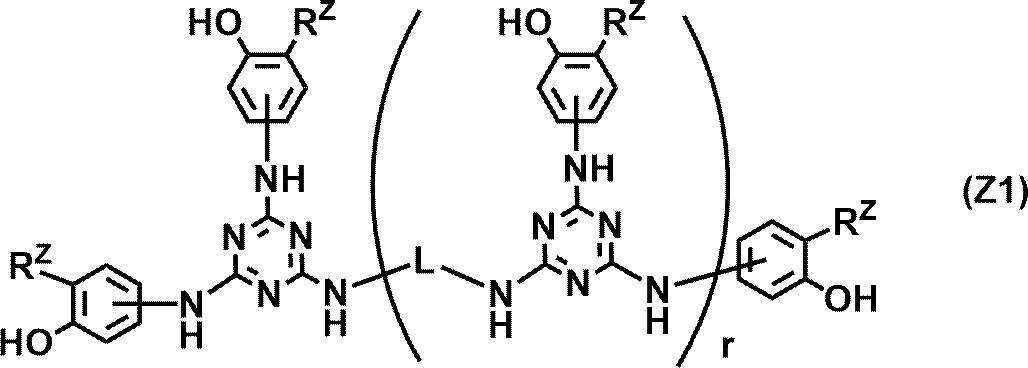
一般式(Z1)中、rは0以上の整数を表す。rは0~20の整数であることが好ましく、0~10の整数であることがより好ましい。
Lは、2価の有機基を表す。一般式(Z1)におけるLで表される2価の有機基は、例えば、一般式(Z1)におけるLで表される2価の有機基と同様である。
RZは、水素原子又は置換基を表す。
RZで表される置換基は、炭素数1~6の置換基であることが好ましく、炭素数1~6の炭化水素基であることがより好ましく、炭素数1~6の直鎖状又は分岐鎖状のアルキル基であることが更に好ましい。
一般式(Z1)中に(3+r)個存在するRZの少なくとも1個(好ましくは30%以上、より好ましくは50%以上、更に好ましくは65%以上。好ましくは90%以下、より好ましくは80%以下)は置換基を表してもよい。
一般式(Z1)中に(3+r)個存在するRZの少なくとも1個(例えば1~2個)は水素原子を表してもよい。
一般式(Z1)中におけるRz(好ましくは置換基であるRz)及びOHが結合したベンゼン環基において、上記Rz(好ましくは置換基であるRz)は、上記ベンゼン環基が結合するNHに対するパラ位に存在していることも好ましい。
Lは、2価の有機基を表す。一般式(Z1)におけるLで表される2価の有機基は、例えば、一般式(Z1)におけるLで表される2価の有機基と同様である。
RZは、水素原子又は置換基を表す。
RZで表される置換基は、炭素数1~6の置換基であることが好ましく、炭素数1~6の炭化水素基であることがより好ましく、炭素数1~6の直鎖状又は分岐鎖状のアルキル基であることが更に好ましい。
一般式(Z1)中に(3+r)個存在するRZの少なくとも1個(好ましくは30%以上、より好ましくは50%以上、更に好ましくは65%以上。好ましくは90%以下、より好ましくは80%以下)は置換基を表してもよい。
一般式(Z1)中に(3+r)個存在するRZの少なくとも1個(例えば1~2個)は水素原子を表してもよい。
一般式(Z1)中におけるRz(好ましくは置換基であるRz)及びOHが結合したベンゼン環基において、上記Rz(好ましくは置換基であるRz)は、上記ベンゼン環基が結合するNHに対するパラ位に存在していることも好ましい。
フェノール化合物は、一般式(Z2)で表される化合物であることも好ましい。
フェノール化合物は、一般式(Z2)で表される化合物を含むことが好ましく、フェノール化合物が一般式(Z2)で表される化合物そのものであってもよい。一般式(Z2)で表される化合物の含有量は、フェノール化合物の全質量に対して、10~100質量%が好ましく、25~100質量%がより好ましく、50~100質量%が更に好ましい。
フェノール化合物は、一般式(Z2)で表される化合物を含むことが好ましく、フェノール化合物が一般式(Z2)で表される化合物そのものであってもよい。一般式(Z2)で表される化合物の含有量は、フェノール化合物の全質量に対して、10~100質量%が好ましく、25~100質量%がより好ましく、50~100質量%が更に好ましい。
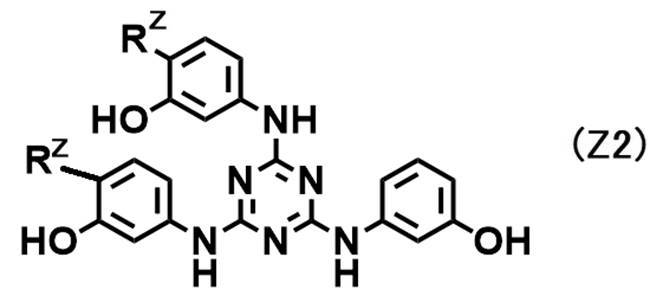
一般式(Z2)中、RZは、水素原子又は置換基を表す。
2個存在するRZの少なくとも一方は置換基を表すことも好ましく、両方が置換基を表すことも好ましい。
RZで表される置換基は、炭素数1~6の置換基であることが好ましく、炭素数1~6の炭化水素基であることがより好ましく、炭素数1~6のアルキル基であることが更に好ましい。
上記アルキル基は、直鎖状でも分岐鎖状でもよい。上記アルキル基は無置換であることも好ましい。
一般式(Z2)中の2個のRzは、それぞれ同一でも異なっていてもよい。
2個存在するRZの少なくとも一方は置換基を表すことも好ましく、両方が置換基を表すことも好ましい。
RZで表される置換基は、炭素数1~6の置換基であることが好ましく、炭素数1~6の炭化水素基であることがより好ましく、炭素数1~6のアルキル基であることが更に好ましい。
上記アルキル基は、直鎖状でも分岐鎖状でもよい。上記アルキル基は無置換であることも好ましい。
一般式(Z2)中の2個のRzは、それぞれ同一でも異なっていてもよい。
その他にもフェノール化合物としては、例えば、ベンゼンジオール若しくはベンゼントリオール等のベンゼンポリオール、ビフェニルアラルキル型フェノール樹脂、フェノールノボラック樹脂、クレゾールノボラック樹脂、芳香族炭化水素ホルムアルデヒド樹脂変性フェノール樹脂、ジシクロペンタジエンフェノール付加型樹脂、フェノールアラルキル樹脂、多価ヒドロキシ化合物とホルムアルデヒドとから合成される多価フェノールノボラック樹脂、ナフトールアラルキル樹脂、トリメチロールメタン樹脂、テトラフェニロールエタン樹脂、ナフトールノボラック樹脂、ナフトールフェノール共縮ノボラック樹脂、ナフトールクレゾール共縮ノボラック樹脂、ビフェニル変性フェノール樹脂、ビフェニル変性ナフトール樹脂、アミノトリアジン変性フェノール樹脂、又は、アルコキシ基含有芳香環変性ノボラック樹脂等も好ましい。
フェノール化合物の分子量は、225~2000が好ましく、225~1000がより好ましい。
なお、上記分子量に分子量分布がある場合、上記分子量は重量平均分子量である。
なお、上記分子量に分子量分布がある場合、上記分子量は重量平均分子量である。
フェノール化合物の水酸基含有量は、2.0mmol/g以上が好ましく、4.0mmol/g以上がより好ましい。上限値は、25.0mmol/g以下が好ましく、10.0mmol/g以下がより好ましい。
なお、上記水酸基含有量は、フェノール化合物1gが有する、水酸基(好ましくはフェノール性水酸基)の数を意図する。
また、フェノール化合物は、水酸基以外にも、エポキシ化合物(第1のエポキシ化合物及び第2のエポキシ化合物)と重合反応できる活性水素含有基(カルボン酸基等)を有していてもよいし、有していなくてもよい。フェノール化合物の活性水素の含有量(水酸基及びカルボン酸基等における水素原子の合計含有量)の下限値は、2.0mmol/g以上が好ましく、4.0mmol/g以上がより好ましい。上限値は、25.0mmol/g以下が好ましく、10.0mmol/g以下がより好ましい。
なお、上記水酸基含有量は、フェノール化合物1gが有する、水酸基(好ましくはフェノール性水酸基)の数を意図する。
また、フェノール化合物は、水酸基以外にも、エポキシ化合物(第1のエポキシ化合物及び第2のエポキシ化合物)と重合反応できる活性水素含有基(カルボン酸基等)を有していてもよいし、有していなくてもよい。フェノール化合物の活性水素の含有量(水酸基及びカルボン酸基等における水素原子の合計含有量)の下限値は、2.0mmol/g以上が好ましく、4.0mmol/g以上がより好ましい。上限値は、25.0mmol/g以下が好ましく、10.0mmol/g以下がより好ましい。
なお、本発明の組成物は、フェノール化合物以外にも、エポキシ化合物(第1のエポキシ化合物及び第2のエポキシ化合物)と反応可能な基を有する化合物(「その他の活性水素含有化合物」ともいう)を含んでもよい。
ただし、本発明の組成物において、フェノール化合物の含有量に対する、その他の活性水素含有化合物の含有量の質量比は、0~1が好ましく、0~0.1がより好ましく、0~0.05が更に好ましい。
ただし、本発明の組成物において、フェノール化合物の含有量に対する、その他の活性水素含有化合物の含有量の質量比は、0~1が好ましく、0~0.1がより好ましく、0~0.05が更に好ましい。
〔第1のエポキシ化合物〕
本発明の組成物は第1のエポキシ化合物を含む。
エポキシ化合物は、1分子中に、少なくとも1つのエポキシ基(オキシラニル基)を有する化合物であって、後述する第2のエポキシ化合物には該当しない化合物である。
上記エポキシ基は、オキシラン環から1以上の水素原子(好ましくは1の水素原子)を除いてなる基である。上記エポキシ基は、可能な場合、更に置換基(直鎖状又は分岐鎖状の炭素数1~5のアルキル基等)を有していてもよい。
本発明の組成物は第1のエポキシ化合物を含む。
エポキシ化合物は、1分子中に、少なくとも1つのエポキシ基(オキシラニル基)を有する化合物であって、後述する第2のエポキシ化合物には該当しない化合物である。
上記エポキシ基は、オキシラン環から1以上の水素原子(好ましくは1の水素原子)を除いてなる基である。上記エポキシ基は、可能な場合、更に置換基(直鎖状又は分岐鎖状の炭素数1~5のアルキル基等)を有していてもよい。
第1のエポキシ化合物が有するエポキシ基の数は、1分子中、2以上が好ましく、2~1000がより好ましく、2~40が更に好ましい。
第1のエポキシ化合物の分子量は、150以上が好ましく、300以上がより好ましい。上記分子量の上限に制限はなく、例えば100000以下が好ましく、10000以下がより好ましい。
なお、上記分子量に分子量分布がある場合、上記分子量は重量平均分子量である。
本明細書において、数平均分子量及び重量平均分子量は、ゲルパーミエーションクロマトグラフィ(GPC)によるポリスチレン換算で求めた重量平均分子量である。
なお、上記分子量に分子量分布がある場合、上記分子量は重量平均分子量である。
本明細書において、数平均分子量及び重量平均分子量は、ゲルパーミエーションクロマトグラフィ(GPC)によるポリスチレン換算で求めた重量平均分子量である。
第1のエポキシ化合物のエポキシ基含有量は、2.0~20.0mmol/gが好ましく、5.0~15.0mmol/gがより好ましい。
なお、上記エポキシ基含有量は、エポキシ化合物1gが有する、エポキシ基の数を意図する。
第1のエポキシ化合物は、芳香環基(好ましくは芳香族炭化水素環基)を有するのも好ましい。
なお、上記エポキシ基含有量は、エポキシ化合物1gが有する、エポキシ基の数を意図する。
第1のエポキシ化合物は、芳香環基(好ましくは芳香族炭化水素環基)を有するのも好ましい。
第1のエポキシ化合物は、液晶性を示してもよく示さなくてもよい。
つまり、第1のエポキシ化合物は、液晶化合物であってよい。言い換えれば、エポキシ基を有する液晶化合物であってもよい。
第1のエポキシ化合物(液晶性のエポキシ化合物であってもよい)としては、例えば、少なくとも部分的に棒状構造を含む化合物(棒状化合物)、及び、少なくとも部分的に円盤状構造を含む化合物(円盤状化合物)が挙げられる。
以下、棒状化合物及び円盤状化合物について詳述する。
つまり、第1のエポキシ化合物は、液晶化合物であってよい。言い換えれば、エポキシ基を有する液晶化合物であってもよい。
第1のエポキシ化合物(液晶性のエポキシ化合物であってもよい)としては、例えば、少なくとも部分的に棒状構造を含む化合物(棒状化合物)、及び、少なくとも部分的に円盤状構造を含む化合物(円盤状化合物)が挙げられる。
以下、棒状化合物及び円盤状化合物について詳述する。
(棒状化合物)
棒状化合物である第1のエポキシ化合物としては、アゾメチン類、アゾキシ類、シアノビフェニル類、シアノフェニルエステル類、安息香酸エステル類、シクロヘキサンカルボン酸フェニルエステル類、シアノフェニルシクロヘキサン類、シアノ置換フェニルピリミジン類、アルコキシ置換フェニルピリミジン類、フェニルジオキサン類、トラン類、及び、アルケニルシクロヘキシルベンゾニトリル類が挙げられる。以上のような低分子化合物だけではなく、高分子化合物も使用できる。上記高分子化合物は、低分子の反応性基を有する棒状化合物が重合した高分子化合物である。
好ましい棒状化合物としては、下記一般式(XXI)で表される棒状化合物が挙げられる。
一般式(XXI):Q1-L111-A111-L113-M-L114-A112-L112-Q2
棒状化合物である第1のエポキシ化合物としては、アゾメチン類、アゾキシ類、シアノビフェニル類、シアノフェニルエステル類、安息香酸エステル類、シクロヘキサンカルボン酸フェニルエステル類、シアノフェニルシクロヘキサン類、シアノ置換フェニルピリミジン類、アルコキシ置換フェニルピリミジン類、フェニルジオキサン類、トラン類、及び、アルケニルシクロヘキシルベンゾニトリル類が挙げられる。以上のような低分子化合物だけではなく、高分子化合物も使用できる。上記高分子化合物は、低分子の反応性基を有する棒状化合物が重合した高分子化合物である。
好ましい棒状化合物としては、下記一般式(XXI)で表される棒状化合物が挙げられる。
一般式(XXI):Q1-L111-A111-L113-M-L114-A112-L112-Q2
一般式(XXI)中、Q1及びQ2はそれぞれ独立に、エポキシ基であり、L111、L112、L113、及び、L114はそれぞれ独立に、単結合又は2価の連結基を表す。A111及びA112はそれぞれ独立に、炭素数1~20の2価の連結基(スペーサ基)を表す。Mはメソゲン基を表す。
Q1及びQ2のエポキシ基は、置換基を有していてもよいし、有していなくてもよい。
Q1及びQ2のエポキシ基は、置換基を有していてもよいし、有していなくてもよい。
一般式(XXI)中、L111、L112、L113、及び、L114はそれぞれ独立に、単結合又は2価の連結基を表す。
L111、L112、L113、及び、L114で表される2価の連結基としては、それぞれ独立に、-O-、-S-、-CO-、-NR112-、-CO-O-、-O-CO-O-、-CO-NR112-、-NR112-CO-、-O-CO-、-CH2-O-、-O-CH2-、-O-CO-NR112-、-NR112-CO-O-、及び、-NR112-CO-NR112-からなる群より選ばれる2価の連結基であるのが好ましい。上記R112は炭素数1~7のアルキル基又は水素原子である。
中でも、L113及びL114は、それぞれ独立に、-O-が好ましい。
L111及びL112は、それぞれ独立に、単結合が好ましい。
L111、L112、L113、及び、L114で表される2価の連結基としては、それぞれ独立に、-O-、-S-、-CO-、-NR112-、-CO-O-、-O-CO-O-、-CO-NR112-、-NR112-CO-、-O-CO-、-CH2-O-、-O-CH2-、-O-CO-NR112-、-NR112-CO-O-、及び、-NR112-CO-NR112-からなる群より選ばれる2価の連結基であるのが好ましい。上記R112は炭素数1~7のアルキル基又は水素原子である。
中でも、L113及びL114は、それぞれ独立に、-O-が好ましい。
L111及びL112は、それぞれ独立に、単結合が好ましい。
一般式(XXI)中、A111及びA112は、それぞれ独立に、炭素数1~20の2価の連結基を表す。
2価の連結基は、隣接していない酸素原子及び硫黄原子等のヘテロ原子を含んでいてもよい。中でも、炭素数1~12の、アルキレン基、アルケニレン基、又は、アルキニレン基が好ましい。上記、アルキレン基、アルケニレン基、又は、アルキニレン基がエステル基を有していてもよいし、有していなくてもよい。
2価の連結基は直鎖状であるのが好ましく、また、上記2価の連結基は置換基を有していてもよいし、有していなくてもよい。置換基としては、例えば、ハロゲン原子(フッ素原子、塩素原子、及び、臭素原子)、シアノ基、メチル基、及び、エチル基が挙げられる。
中でも、A111及びA112は、それぞれ独立に、炭素数1~12のアルキレン基が好ましく、メチレン基がより好ましい。
2価の連結基は、隣接していない酸素原子及び硫黄原子等のヘテロ原子を含んでいてもよい。中でも、炭素数1~12の、アルキレン基、アルケニレン基、又は、アルキニレン基が好ましい。上記、アルキレン基、アルケニレン基、又は、アルキニレン基がエステル基を有していてもよいし、有していなくてもよい。
2価の連結基は直鎖状であるのが好ましく、また、上記2価の連結基は置換基を有していてもよいし、有していなくてもよい。置換基としては、例えば、ハロゲン原子(フッ素原子、塩素原子、及び、臭素原子)、シアノ基、メチル基、及び、エチル基が挙げられる。
中でも、A111及びA112は、それぞれ独立に、炭素数1~12のアルキレン基が好ましく、メチレン基がより好ましい。
一般式(XXI)中、Mはメソゲン基を表し、上記メソゲン基としては、公知のメソゲン基が挙げられる。中でも、下記一般式(XXII)で表される基が好ましい。
一般式(XXII):-(W1-L115)n-W2-
一般式(XXII):-(W1-L115)n-W2-
一般式(XXII)式中、W1及びW2は、それぞれ独立に、2価の環状アルキレン基、2価の環状アルケニレン基、アリーレン基、又は、2価のヘテロ環基を表す。L115は、単結合又は2価の連結基を表す。nは、1~4の整数を表す。
W1及びW2としては、例えば、1,4-シクロヘキセンジイル、1,4-シクロヘキサンジイル、1,4-フェニレン、ピリミジン-2,5-ジイル、ピリジン-2,5-ジイル、1,3,4-チアジアゾール-2,5-ジイル、1,3,4-オキサジアゾール-2,5-ジイル、ナフタレン-2,6-ジイル、ナフタレン-1,5-ジイル、チオフェン-2,5-ジイル、及び、ピリダジン-3,6-ジイルが挙げられる。1,4-シクロヘキサンジイルの場合、トランス体及びシス体の構造異性体のどちらの異性体であってもよく、任意の割合の混合物でもよい。中でも、トランス体が好ましい。
W1及びW2は、それぞれ置換基を有していてもよい。置換基としては、例えば、上述した置換基群Yで例示された基が挙げられ、より具体的には、ハロゲン原子(フッ素原子、塩素原子、臭素原子、及び、ヨウ素原子)、シアノ基、炭素数1~10のアルキル基(例えば、メチル基、エチル基、及び、プロピル基等)、炭素数1~10のアルコキシ基(例えば、メトキシ基、及び、エトキシ基等)、炭素数1~10のアシル基(例えば、ホルミル基、及び、アセチル基等)、炭素数1~10のアルコキシカルボニル基(例えば、メトキシカルボニル基、及び、エトキシカルボニル基等)、炭素数1~10のアシルオキシ基(例えば、アセチルオキシ基、及び、プロピオニルオキシ基等)、ニトロ基、トリフルオロメチル基、及び、ジフルオロメチル基等が挙げられる。
W1が複数存在する場合、複数存在するW1は、それぞれ同一でも異なっていてもよい。
W1及びW2は、それぞれ置換基を有していてもよい。置換基としては、例えば、上述した置換基群Yで例示された基が挙げられ、より具体的には、ハロゲン原子(フッ素原子、塩素原子、臭素原子、及び、ヨウ素原子)、シアノ基、炭素数1~10のアルキル基(例えば、メチル基、エチル基、及び、プロピル基等)、炭素数1~10のアルコキシ基(例えば、メトキシ基、及び、エトキシ基等)、炭素数1~10のアシル基(例えば、ホルミル基、及び、アセチル基等)、炭素数1~10のアルコキシカルボニル基(例えば、メトキシカルボニル基、及び、エトキシカルボニル基等)、炭素数1~10のアシルオキシ基(例えば、アセチルオキシ基、及び、プロピオニルオキシ基等)、ニトロ基、トリフルオロメチル基、及び、ジフルオロメチル基等が挙げられる。
W1が複数存在する場合、複数存在するW1は、それぞれ同一でも異なっていてもよい。
一般式(XXII)式中、L115は、単結合又は2価の連結基を表す。L115で表される2価の連結基としては、上述したL111~L114で表される2価の連結基の具体例が挙げられ、例えば、-CO-O-、-O-CO-、-CH2-O-、及び、-O-CH2-が挙げられる。
L115が複数存在する場合、複数存在するL115は、それぞれ同一でも異なっていてもよい。
L115が複数存在する場合、複数存在するL115は、それぞれ同一でも異なっていてもよい。
上記一般式(XXII)で表されるメソゲン基の基本骨格で好ましい骨格を、以下に例示する。上記メソゲン基は、これらの骨格に置換基が置換していてもよい。

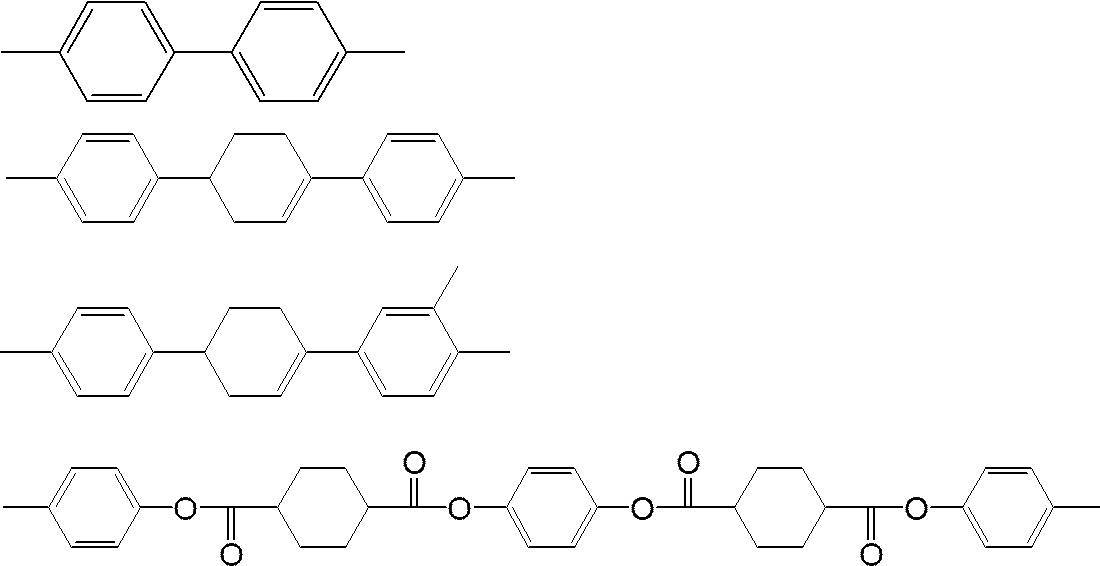
上記骨格の中でも、得られる熱伝導材料の熱伝導性がより優れる点でビフェニル骨格が好ましい。
なお、一般式(XXI)で表される化合物は、特表平11-513019号公報(WO97/00600)に記載の方法を参照して合成できる。
棒状化合物は、特開平11-323162号公報及び特許4118691号に記載のメソゲン基を有するモノマーであってもよい。
なお、一般式(XXI)で表される化合物は、特表平11-513019号公報(WO97/00600)に記載の方法を参照して合成できる。
棒状化合物は、特開平11-323162号公報及び特許4118691号に記載のメソゲン基を有するモノマーであってもよい。
また、一般式(XXI)で表される化合物において、「Q1-L111-」及び「-L112-Q2」の一方又は両方が、ジグリシジルアミノ基に置き換わった化合物も好ましい。
中でも、棒状化合物は、一般式(E1)で表される化合物であるのが好ましい。

一般式(E1)中、LE1は、それぞれ独立に、単結合又は2価の連結基を表す。
中でも、LE1は、2価の連結基が好ましい。
2価の連結基は、-O-、-S-、-CO-、-NH-、-CH=CH-、-C≡C-、-CH=N-、-N=CH-、-N=N-、置換意を有していてもよいアルキレン基、又は、これらの2以上の組み合わせからなる基が好ましく、-O-アルキレン基-又は-アルキレン基-O-がより好ましい。
なお上記アルキレン基は、直鎖状、分岐鎖状、及び、環状のいずれでもよいが、炭素数1~2の直鎖状アルキレン基が好ましい。
複数存在するLE1は、それぞれ同一でも異なっていてもよい。
中でも、LE1は、2価の連結基が好ましい。
2価の連結基は、-O-、-S-、-CO-、-NH-、-CH=CH-、-C≡C-、-CH=N-、-N=CH-、-N=N-、置換意を有していてもよいアルキレン基、又は、これらの2以上の組み合わせからなる基が好ましく、-O-アルキレン基-又は-アルキレン基-O-がより好ましい。
なお上記アルキレン基は、直鎖状、分岐鎖状、及び、環状のいずれでもよいが、炭素数1~2の直鎖状アルキレン基が好ましい。
複数存在するLE1は、それぞれ同一でも異なっていてもよい。
一般式(E1)中、LE2は、それぞれ独立に、単結合、-CH=CH-、-CO-O-、-O-CO-、-C(-CH3)=CH-、-CH=C(-CH3)-、-CH=N-、-N=CH-、-N=N-、-C≡C-、-N=N+(-O-)-、-N+(-O-)=N-、-CH=N+(-O-)-、-N+(-O-)=CH-、-CH=CH-CO-、-CO-CH=CH-、-CH=C(-CN)-、又は、-C(-CN)=CH-を表す。
中でも、LE2は、それぞれ独立に、単結合、-CO-O-、又は、-O-CO-が好ましい。
LE2が複数存在する場合、複数存在するLE2は、それぞれ同一でも異なっていてもよい。
中でも、LE2は、それぞれ独立に、単結合、-CO-O-、又は、-O-CO-が好ましい。
LE2が複数存在する場合、複数存在するLE2は、それぞれ同一でも異なっていてもよい。
一般式(E1)中、LE3は、それぞれ独立に、単結合、又は、置換基を有していてもよい、5員環若しくは6員環の芳香環基又は5員環若しくは6員環の非芳香環基、又は、これらの環からなる多環基を表す。
LE3で表される芳香環基及び非芳香環基の例としては、置換基を有していてもよい、1,4-シクロヘキサンジイル基、1,4-シクロヘキセンジイル基、1,4-フェニレン基、ピリミジン-2,5-ジイル基、ピリジン-2,5-ジイル基、1,3,4-チアジアゾール-2,5-ジイル基、1,3,4-オキサジアゾール-2,5-ジイル基、ナフタレン-2,6-ジイル基、ナフタレン-1,5-ジイル基、チオフェン-2,5-ジイル基、及び、ピリダジン-3,6-ジイル基が挙げられる。1,4-シクロヘキサンジイル基の場合、トランス体及びシス体の構造異性体のどちらの異性体であってもよく、任意の割合の混合物でもよい。中でも、トランス体であるのが好ましい。
中でも、LE3は、単結合、1,4-フェニレン基、又は、1,4-シクロヘキセンジイル基が好ましい。
LE3で表される基が有する置換基は、それぞれ独立に、アルキル基、アルコキシ基、ハロゲン原子、シアノ基、ニトロ基、又は、アセチル基が好ましく、アルキル基(好ましくは炭素数1)がより好ましい。
なお、置換基が複数存在する場合、置換基は、それぞれ同一でも異なっていてもよい。
LE3が複数存在する場合、複数存在するLE3は、それぞれ同一でも異なっていてもよい。
LE3で表される芳香環基及び非芳香環基の例としては、置換基を有していてもよい、1,4-シクロヘキサンジイル基、1,4-シクロヘキセンジイル基、1,4-フェニレン基、ピリミジン-2,5-ジイル基、ピリジン-2,5-ジイル基、1,3,4-チアジアゾール-2,5-ジイル基、1,3,4-オキサジアゾール-2,5-ジイル基、ナフタレン-2,6-ジイル基、ナフタレン-1,5-ジイル基、チオフェン-2,5-ジイル基、及び、ピリダジン-3,6-ジイル基が挙げられる。1,4-シクロヘキサンジイル基の場合、トランス体及びシス体の構造異性体のどちらの異性体であってもよく、任意の割合の混合物でもよい。中でも、トランス体であるのが好ましい。
中でも、LE3は、単結合、1,4-フェニレン基、又は、1,4-シクロヘキセンジイル基が好ましい。
LE3で表される基が有する置換基は、それぞれ独立に、アルキル基、アルコキシ基、ハロゲン原子、シアノ基、ニトロ基、又は、アセチル基が好ましく、アルキル基(好ましくは炭素数1)がより好ましい。
なお、置換基が複数存在する場合、置換基は、それぞれ同一でも異なっていてもよい。
LE3が複数存在する場合、複数存在するLE3は、それぞれ同一でも異なっていてもよい。
一般式(E1)中、peは、0以上の整数を表す。
peが2以上の整数である場合、複数存在する(-LE3-LE2-)は、それぞれ同一でも異なっていてもよい。
中でも、peは、0~2が好ましく、0又は1がより好ましく、0が更に好ましい。
peが2以上の整数である場合、複数存在する(-LE3-LE2-)は、それぞれ同一でも異なっていてもよい。
中でも、peは、0~2が好ましく、0又は1がより好ましく、0が更に好ましい。
一般式(E1)中、LE4は、それぞれ独立に、置換基を表す。
置換基は、それぞれ独立に、アルキル基、アルコキシ基、ハロゲン原子、シアノ基、ニトロ基、又は、アセチル基が好ましく、アルキル基(好ましくは炭素数1)がより好ましい。
複数存在するLE4は、それぞれ同一でも異なっていてもよい。また、次に説明するleが2以上の整数である場合、同一の(LE4)le中に複数存在するLE4も、それぞれ同一でも異なっていてもよい。
置換基は、それぞれ独立に、アルキル基、アルコキシ基、ハロゲン原子、シアノ基、ニトロ基、又は、アセチル基が好ましく、アルキル基(好ましくは炭素数1)がより好ましい。
複数存在するLE4は、それぞれ同一でも異なっていてもよい。また、次に説明するleが2以上の整数である場合、同一の(LE4)le中に複数存在するLE4も、それぞれ同一でも異なっていてもよい。
一般式(E1)中、leは、それぞれ独立に、0~4の整数を表す。
中でも、leは、それぞれ独立に、0~2が好ましい。
複数存在するleは、それぞれ同一でも異なっていてもよい。
中でも、leは、それぞれ独立に、0~2が好ましい。
複数存在するleは、それぞれ同一でも異なっていてもよい。
また、一般式(E1)で表される化合物において、2個存在する「エポキシ基-LE1-」の一方又は両方が、ジグリシジルアミノアルキレン基(好ましくはジグリシジルアミノメチレン基)に置き換わった化合物も好ましい。
棒状化合物は、得られる熱伝導材料の熱伝導性がより優れる点でビフェニル骨格を有するのが好ましい。
言い換えると、第1のエポキシ化合物は、ビフェニル骨格を有するのが好ましく、この場合の第1のエポキシ化合物は棒状化合物であるのがより好ましい。
言い換えると、第1のエポキシ化合物は、ビフェニル骨格を有するのが好ましく、この場合の第1のエポキシ化合物は棒状化合物であるのがより好ましい。
(円盤状化合物)
円盤状化合物である第1のエポキシ化合物は、少なくとも部分的に円盤状構造を有する。
円盤状構造は、少なくとも、脂環又は芳香族環を有する。特に、円盤状構造が、芳香族環を有する場合、円盤状化合物は、分子間のπ-π相互作用によるスタッキング構造の形成により柱状構造を形成しうる。
円盤状構造として、具体的には、Angew.Chem.Int. Ed. 2012, 51, 7990-7993又は特開平7-306317号公報に記載のトリフェニレン構造、並びに、特開2007-002220号公報及び特開2010-244038号公報に記載の3置換ベンゼン構造等が挙げられる。
円盤状化合物である第1のエポキシ化合物は、少なくとも部分的に円盤状構造を有する。
円盤状構造は、少なくとも、脂環又は芳香族環を有する。特に、円盤状構造が、芳香族環を有する場合、円盤状化合物は、分子間のπ-π相互作用によるスタッキング構造の形成により柱状構造を形成しうる。
円盤状構造として、具体的には、Angew.Chem.Int. Ed. 2012, 51, 7990-7993又は特開平7-306317号公報に記載のトリフェニレン構造、並びに、特開2007-002220号公報及び特開2010-244038号公報に記載の3置換ベンゼン構造等が挙げられる。
第1のエポキシ化合物として円盤状化合物を用いれば、高い熱伝導性を示す熱伝導材料が得られる。その理由としては、棒状化合物が直線的(一次元的)にしか熱伝導できないのに対して、円盤状化合物は法線方向に平面的(二次元的)に熱伝導できるため、熱伝導パスが増え、熱伝導率が向上する、と考えられる。
上記円盤状化合物は、エポキシ基を3つ以上有するのが好ましい。3つ以上のエポキシ基を有する円盤状化合物を含む組成物の硬化物はガラス転移温度が高く、耐熱性が高い傾向がある。
円盤状化合物が有するエポキシ基の数は、8以下が好ましく、6以下より好ましい。
円盤状化合物が有するエポキシ基の数は、8以下が好ましく、6以下より好ましい。
円盤状化合物の具体例としては、C. Destrade et al., Mol. Crysr. Liq. Cryst., vol. 71, page 111 (1981) ;日本化学会編、季刊化学総説、No.22、液晶の化学、第5章、第10章第2節(1994);B. Kohne et al., Angew. Chem. Soc. Chem. Comm., page 1794 (1985);J. Zhang et al., J. Am. Chem. Soc., vol. 116, page 2655 (1994)、及び特許第4592225号に記載されている化合物等において末端の少なくとも1つ(好ましくは3つ以上)をエポキシ基とした化合物が挙げられる。
円盤状化合物としては、Angew.Chem.Int. Ed. 2012, 51, 7990-7993、及び特開平7-306317号公報に記載のトリフェニレン構造、並びに、特開2007-002220号公報、及び、特開2010-244038号公報に記載の3置換ベンゼン構造において末端の少なくとも1つ(好ましくは3つ以上)をエポキシ基とした化合物等が挙げられる。
円盤状化合物としては、Angew.Chem.Int. Ed. 2012, 51, 7990-7993、及び特開平7-306317号公報に記載のトリフェニレン構造、並びに、特開2007-002220号公報、及び、特開2010-244038号公報に記載の3置換ベンゼン構造において末端の少なくとも1つ(好ましくは3つ以上)をエポキシ基とした化合物等が挙げられる。
円盤状化合物としては、熱伝導材料の熱伝導性がより優れる観点から、以下に示す式(D1)~(D16)のいずれかで表される化合物が好ましい。
まず、式(D1)~(D15)について説明し、その後、式(D16)について説明する。
なお、以下の式中、「-LQ」は「-L-Q」を表し、「QL-」は「Q-L-」を表す。
まず、式(D1)~(D15)について説明し、その後、式(D16)について説明する。
なお、以下の式中、「-LQ」は「-L-Q」を表し、「QL-」は「Q-L-」を表す。
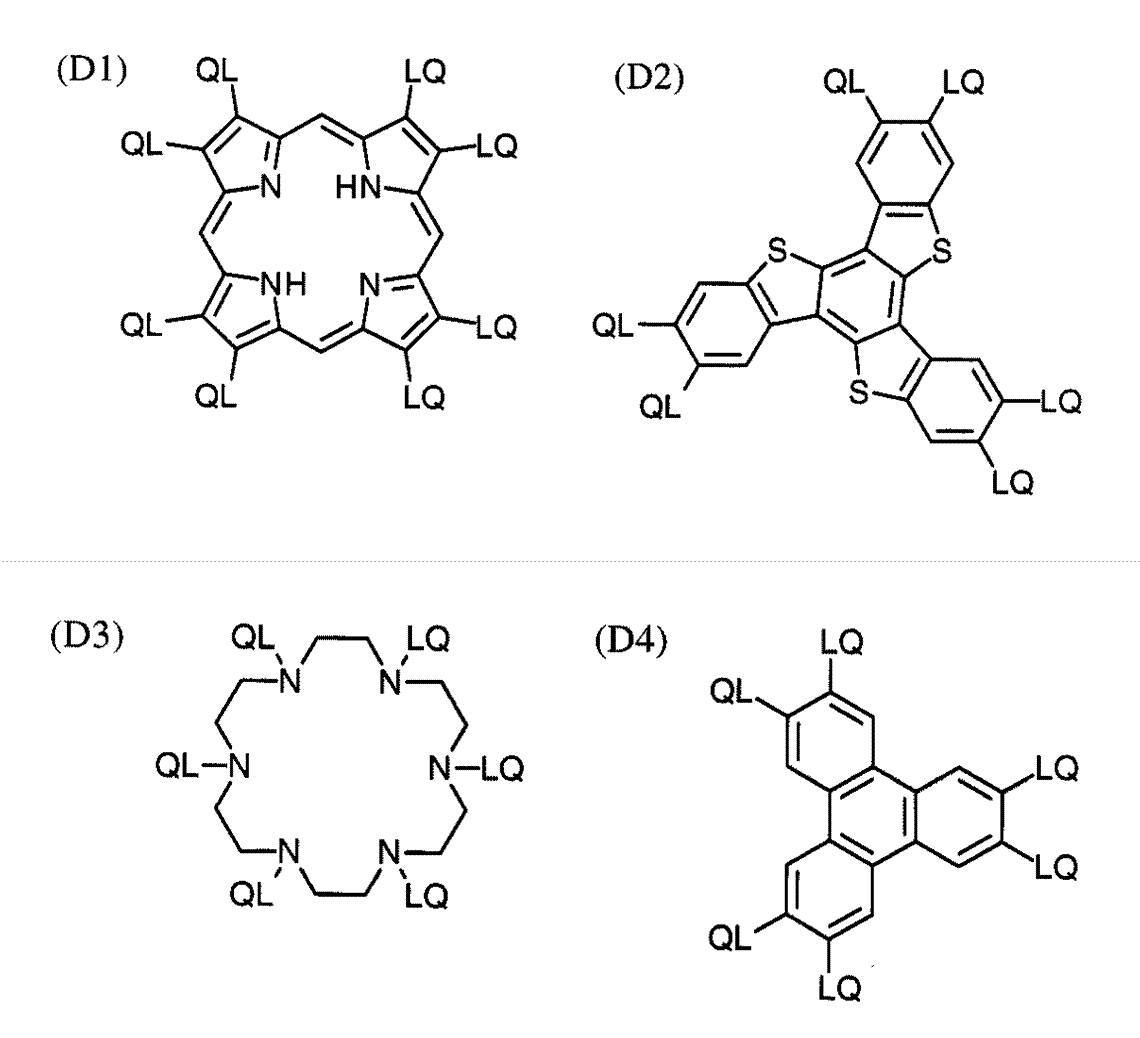

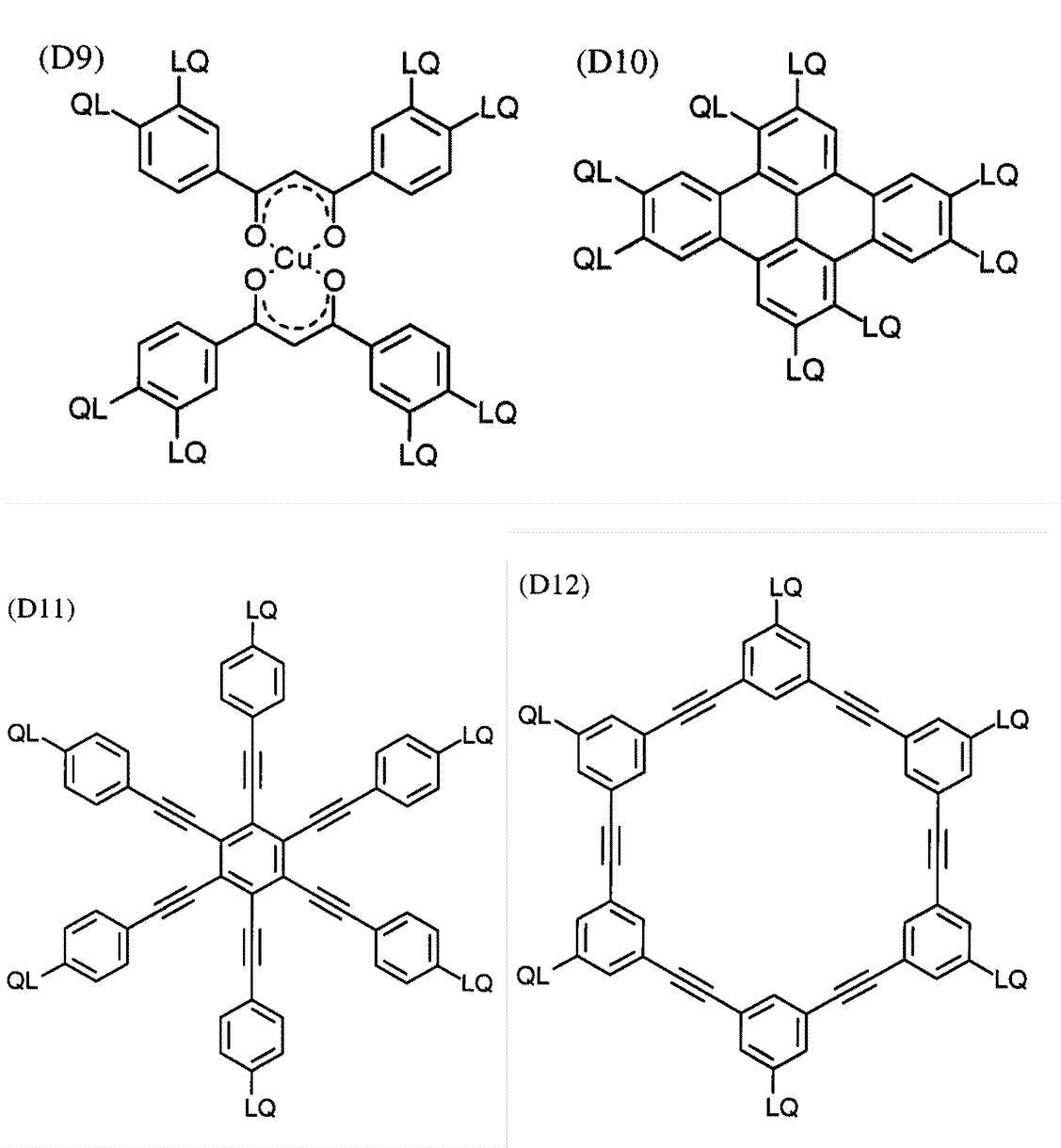
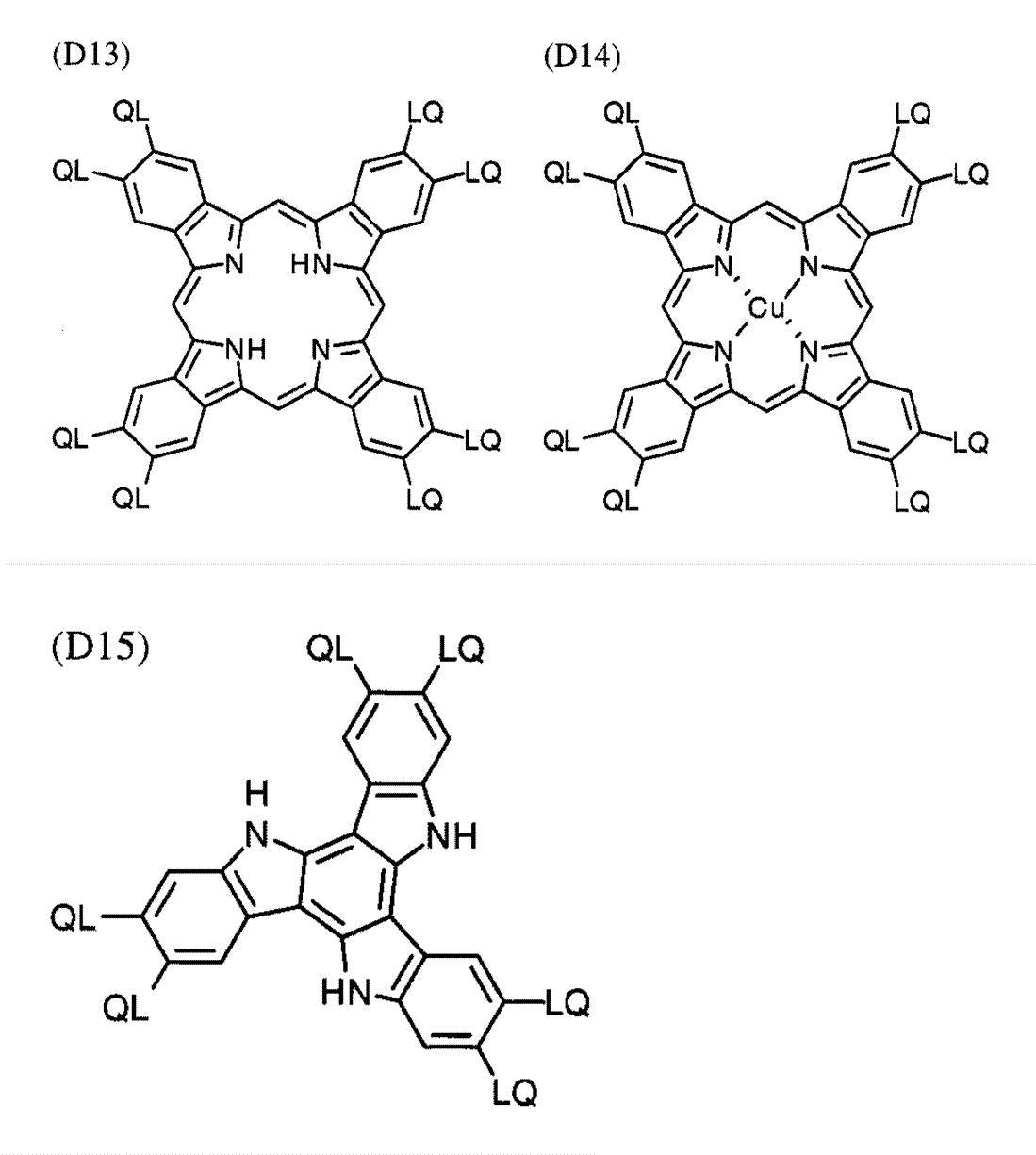
式(D1)~(D15)中、Lは2価の連結基を表す。
熱伝導材料の熱伝導性がより優れる観点から、Lは、それぞれ独立に、アルキレン基、アルケニレン基、アリーレン基、-CO-、-NH-、-O-、-S-、及び、これらの組み合わせからなる群より選ばれる基であるのが好ましく、アルキレン基、アルケニレン基、アリーレン基、-CO-、-NH-、-O-、及び、-S-からなる群より選ばれる基を2個以上組み合わせた基であるのがより好ましい。
上記アルキレン基の炭素数は、1~12が好ましい。上記アルケニレン基の炭素数は、2~12が好ましい。上記アリーレン基の炭素数は、10以下が好ましい。
アルキレン基、アルケニレン基、及び、アリーレン基は、置換基(好ましくは、アルキル基、ハロゲン原子、シアノ、アルコキシ基、及び、アシルオキシ基等)を有していてもよい。
熱伝導材料の熱伝導性がより優れる観点から、Lは、それぞれ独立に、アルキレン基、アルケニレン基、アリーレン基、-CO-、-NH-、-O-、-S-、及び、これらの組み合わせからなる群より選ばれる基であるのが好ましく、アルキレン基、アルケニレン基、アリーレン基、-CO-、-NH-、-O-、及び、-S-からなる群より選ばれる基を2個以上組み合わせた基であるのがより好ましい。
上記アルキレン基の炭素数は、1~12が好ましい。上記アルケニレン基の炭素数は、2~12が好ましい。上記アリーレン基の炭素数は、10以下が好ましい。
アルキレン基、アルケニレン基、及び、アリーレン基は、置換基(好ましくは、アルキル基、ハロゲン原子、シアノ、アルコキシ基、及び、アシルオキシ基等)を有していてもよい。
Lの例を以下に示す。以下の例では、左側の結合手が式(D1)~(D15)のいずれかで表される化合物の中心構造(以下、単に「中心環」ともいう)の側に結合し、右側の結合手がQに結合する。
ALはアルキレン基又はアルケニレン基を意味し、ARはアリーレン基を意味する。
ALで表されるアルキレン基は、直鎖状でも分岐鎖状でもよく、炭素数は例えば1~12である。ALで表されるアルケニレン基は、直鎖状でも分岐鎖状でもよく、炭素数は例えば2~12である。ARで表されるアリーレン基は、単環でも多環でもよく、環員原子数は6~12が好ましい。
ALはアルキレン基又はアルケニレン基を意味し、ARはアリーレン基を意味する。
ALで表されるアルキレン基は、直鎖状でも分岐鎖状でもよく、炭素数は例えば1~12である。ALで表されるアルケニレン基は、直鎖状でも分岐鎖状でもよく、炭素数は例えば2~12である。ARで表されるアリーレン基は、単環でも多環でもよく、環員原子数は6~12が好ましい。
L101:-AL-CO-O-AL-
L102:-AL-CO-O-AL-O-
L103:-AL-CO-O-AL-O-AL-
L104:-AL-CO-O-AL-O-CO-
L105:-CO-AR-O-AL-
L106:-CO-AR-O-AL-O-
L107:-CO-AR-O-AL-O-CO-
L108:-CO-NH-AL-
L109:-NH-AL-O-
L110:-NH-AL-O-CO-
L111:-O-AL-
L112:-O-AL-O-
L113:-O-AL-O-CO-
L102:-AL-CO-O-AL-O-
L103:-AL-CO-O-AL-O-AL-
L104:-AL-CO-O-AL-O-CO-
L105:-CO-AR-O-AL-
L106:-CO-AR-O-AL-O-
L107:-CO-AR-O-AL-O-CO-
L108:-CO-NH-AL-
L109:-NH-AL-O-
L110:-NH-AL-O-CO-
L111:-O-AL-
L112:-O-AL-O-
L113:-O-AL-O-CO-
L114:-O-AL-O-CO-NH-AL-
L115:-O-AL-S-AL-
L116:-O-CO-AL-AR-O-AL-O-CO-
L117:-O-CO-AR-O-AL-CO-
L118:-O-CO-AR-O-AL-O-CO-
L119:-O-CO-AR-O-AL-O-AL-O-CO-
L120:-O-CO-AR-O-AL-O-AL-O-AL-O-CO-
L121:-S-AL-
L122:-S-AL-O-
L123:-S-AL-O-CO-
L124:-S-AL-S-AL-
L125:-S-AR-AL-
L126:-O-CO-AL-
L127:-O-CO-AL-O-
L128:-O-CO-AR-O-AL-
L129:-O-CO-
L130:-O-CO-AR-O-AL-O-CO-AL-S-AR-
L131:-O-CO-AL-S-AR-
L132:-O-CO-AR-O-AL-O-CO-AL-S-AL-
L133:-O-CO-AL-S-AR-
L134:-O-AL-S-AR-
L135:-AL-CO-O-AL-O-CO-AL-S-AR-
L136:-AL-CO-O-AL-O-CO-AL-S-AL-
L137:-O-AL-O-AR-
L138:-O-AL-O-CO-AR-
L139:-O-AL-NH-AR-
L140:-O-CO-AL-O-AR-
L141:-O-CO-AR-O-AL-O-AR-
L142:-AL-CO-O-AR-
L143:-AL-CO-O-AL-O-AR-
L115:-O-AL-S-AL-
L116:-O-CO-AL-AR-O-AL-O-CO-
L117:-O-CO-AR-O-AL-CO-
L118:-O-CO-AR-O-AL-O-CO-
L119:-O-CO-AR-O-AL-O-AL-O-CO-
L120:-O-CO-AR-O-AL-O-AL-O-AL-O-CO-
L121:-S-AL-
L122:-S-AL-O-
L123:-S-AL-O-CO-
L124:-S-AL-S-AL-
L125:-S-AR-AL-
L126:-O-CO-AL-
L127:-O-CO-AL-O-
L128:-O-CO-AR-O-AL-
L129:-O-CO-
L130:-O-CO-AR-O-AL-O-CO-AL-S-AR-
L131:-O-CO-AL-S-AR-
L132:-O-CO-AR-O-AL-O-CO-AL-S-AL-
L133:-O-CO-AL-S-AR-
L134:-O-AL-S-AR-
L135:-AL-CO-O-AL-O-CO-AL-S-AR-
L136:-AL-CO-O-AL-O-CO-AL-S-AL-
L137:-O-AL-O-AR-
L138:-O-AL-O-CO-AR-
L139:-O-AL-NH-AR-
L140:-O-CO-AL-O-AR-
L141:-O-CO-AR-O-AL-O-AR-
L142:-AL-CO-O-AR-
L143:-AL-CO-O-AL-O-AR-
式(D1)~(D15)中、Qは、それぞれ独立に、水素原子又は置換基を表す。
置換基としては、上述した置換基群Yで例示される基が挙げられる。より具体的には、置換基としては、上記反応性官能基、ハロゲン原子、イソシアネート基、シアノ基、不飽和重合性基、エポキシ基、オキセタニル基、アジリジニル基、チオイソシアネート基、アルデヒド基、及び、スルホ基が挙げられる。
ただし、Qがエポキシ基以外の基である場合、Qはエポキシ基に対して安定であるのが好ましい。
なお、式(D1)~(D15)中、1つ以上(好ましくは2つ以上)のQは、エポキシ基を表す。中でも、熱伝導材料の熱伝導性がより優れる観点から、すべてのQがエポキシ基を表すのが好ましい。
なお、式(D1)~(D15)で表される化合物は、エポキシ基の安定性の点からは、-NH-を有さないのが好ましい。
置換基としては、上述した置換基群Yで例示される基が挙げられる。より具体的には、置換基としては、上記反応性官能基、ハロゲン原子、イソシアネート基、シアノ基、不飽和重合性基、エポキシ基、オキセタニル基、アジリジニル基、チオイソシアネート基、アルデヒド基、及び、スルホ基が挙げられる。
ただし、Qがエポキシ基以外の基である場合、Qはエポキシ基に対して安定であるのが好ましい。
なお、式(D1)~(D15)中、1つ以上(好ましくは2つ以上)のQは、エポキシ基を表す。中でも、熱伝導材料の熱伝導性がより優れる観点から、すべてのQがエポキシ基を表すのが好ましい。
なお、式(D1)~(D15)で表される化合物は、エポキシ基の安定性の点からは、-NH-を有さないのが好ましい。
式(D1)~(D15)で表される化合物の中でも、熱伝導材料の熱伝導性がより優れる観点から、式(D4)で表される化合物が好ましい。言い換えると、円盤状化合物の中心環はトリフェニレン環であるのが好ましい。
式(D4)で表される化合物としては、熱伝導材料の熱伝導性がより優れる観点から、式(XI)で表される化合物が好ましい。
式(D4)で表される化合物としては、熱伝導材料の熱伝導性がより優れる観点から、式(XI)で表される化合物が好ましい。

式(XI)中、R11、R12、R13、R14、R15、及び、R16は、それぞれ独立に、*-X11-L11-P11、又は、*-X12-L12-Y12を表す。
なお、*はトリフェニレン環との結合位置を表す。
R11、R12、R13、R14、R15、及び、R16のうち、2個以上は、*-X11-L11-P11であり、3個以上が*-X11-L11-P11であるのが好ましい。
中でも、熱伝導材料の熱伝導性がより優れる観点から、R11及びR12のいずれか1個以上、R13及びR14のいずれか1個以上、並びに、R15及びR16のいずれか1個以上が、*-X11-L11-P11であるのが好ましい。
R11、R12、R13、R14、R15、及び、R16が、全て、*-X11-L11-P11であるのがより好ましい。加えて、R11、R12、R13、R14、R15、及び、R16が、全て同一であるのが更に好ましい。
なお、*はトリフェニレン環との結合位置を表す。
R11、R12、R13、R14、R15、及び、R16のうち、2個以上は、*-X11-L11-P11であり、3個以上が*-X11-L11-P11であるのが好ましい。
中でも、熱伝導材料の熱伝導性がより優れる観点から、R11及びR12のいずれか1個以上、R13及びR14のいずれか1個以上、並びに、R15及びR16のいずれか1個以上が、*-X11-L11-P11であるのが好ましい。
R11、R12、R13、R14、R15、及び、R16が、全て、*-X11-L11-P11であるのがより好ましい。加えて、R11、R12、R13、R14、R15、及び、R16が、全て同一であるのが更に好ましい。
X11は、それぞれ独立に、単結合、-O-、-CO-、-NH-、-O-CO-、-O-CO-O-、-O-CO-NH-、-O-CO-S-、-CO-O-、-CO-NH-、-CO-S-、-NH-CO-、-NH-CO-O-、-NH-CO-NH-、-NH-CO-S-、-S-、-S-CO-、-S-CO-O-、-S-CO-NH-、又は、-S-CO-S-を表す。
中でも、X11は、それぞれ独立に、-O-、-O-CO-、-O-CO-O-、-O-CO-NH-、-CO-O-、-CO-NH-、-NH-CO-、又は、-NH-CO-O-が好ましく、-O-、-O-CO-、-CO-O-、-O-CO-NH-、又は、-CO-NH-がより好ましく、-O-CO-又は-CO-O-が更に好ましい。
中でも、X11は、それぞれ独立に、-O-、-O-CO-、-O-CO-O-、-O-CO-NH-、-CO-O-、-CO-NH-、-NH-CO-、又は、-NH-CO-O-が好ましく、-O-、-O-CO-、-CO-O-、-O-CO-NH-、又は、-CO-NH-がより好ましく、-O-CO-又は-CO-O-が更に好ましい。
L11は、それぞれ独立に、単結合又は2価の連結基を表す。
2価の連結基の例としては、-O-、-O-CO-、-CO-O-、-S-、-NH-、アルキレン基(炭素数は、1~10が好ましく、1~8がより好ましく、1~7が更に好ましい。)、アリーレン基(炭素数は、6~20が好ましく、6~14がより好ましく、6~10が更に好ましい。)、又は、これらの組み合わせからなる基が挙げられる。
上記アルキレン基としては、メチレン基、エチレン基、プロピレン基、ブチレン基、ペンチレン基、ヘキシレン基、及び、ヘプチレン基が挙げられる。
上記アリーレン基としては、1,4-フェニレン基、1,3-フェニレン基、1,4-ナフチレン基、1,5-ナフチレン基、及び、アントラセニレン基が挙げられ、1,4-フェニレン基が好ましい。
2価の連結基の例としては、-O-、-O-CO-、-CO-O-、-S-、-NH-、アルキレン基(炭素数は、1~10が好ましく、1~8がより好ましく、1~7が更に好ましい。)、アリーレン基(炭素数は、6~20が好ましく、6~14がより好ましく、6~10が更に好ましい。)、又は、これらの組み合わせからなる基が挙げられる。
上記アルキレン基としては、メチレン基、エチレン基、プロピレン基、ブチレン基、ペンチレン基、ヘキシレン基、及び、ヘプチレン基が挙げられる。
上記アリーレン基としては、1,4-フェニレン基、1,3-フェニレン基、1,4-ナフチレン基、1,5-ナフチレン基、及び、アントラセニレン基が挙げられ、1,4-フェニレン基が好ましい。
上記アルキレン基及び上記アリーレン基はそれぞれ置換基を有していてもよい。置換基の数は、1~3が好ましく、1がより好ましい。置換基の置換位置は特に制限されない。置換基としては、ハロゲン原子又は炭素数1~3のアルキル基が好ましく、メチル基がより好ましい。
上記アルキレン基及び上記アリーレン基は無置換であるのも好ましい。中でも、アルキレン基は無置換であるのが好ましい。
上記アルキレン基及び上記アリーレン基は無置換であるのも好ましい。中でも、アルキレン基は無置換であるのが好ましい。
-X11-L11-の例として、上述のLの例であるL101~L143が挙げられる。
P11は、エポキシ基を表す。上記エポキシ基は置換基を有していてもよく、有していなくてもよい。
X12は、X11と同様であり、好適な条件も同様である。
L12は、L11と同様であり、好適な条件も同様である。
-X12-L12-の例として、上述のLの例であるL101~L143が挙げられる。
L12は、L11と同様であり、好適な条件も同様である。
-X12-L12-の例として、上述のLの例であるL101~L143が挙げられる。
Y12は、水素原子、炭素数1~20の直鎖状、分岐鎖状、若しくは、環状のアルキル基、又は、炭素数1~20の直鎖状、分岐鎖状、若しくは、環状のアルキル基において1個又は2個以上のメチレン基が-O-、-S-、-NH-、-N(CH3)-、-CO-、-O-CO-、又は-CO-O-で置換された基を表す。
Y12が、炭素数1~20の直鎖状、分岐鎖状、若しくは、環状のアルキル基、又は、炭素数1~20の直鎖状、分岐鎖状、若しくは、環状のアルキル基において1個又は2個以上のメチレン基が-O-、-S-、-NH-、-N(CH3)-、-CO-、-O-CO-、又は-CO-O-で置換された基の場合、Y12に含まれる水素原子の1個以上がハロゲン原子で置換されていてもよい。
Y12が、炭素数1~20の直鎖状、分岐鎖状、若しくは、環状のアルキル基、又は、炭素数1~20の直鎖状、分岐鎖状、若しくは、環状のアルキル基において1個又は2個以上のメチレン基が-O-、-S-、-NH-、-N(CH3)-、-CO-、-O-CO-、又は-CO-O-で置換された基の場合、Y12に含まれる水素原子の1個以上がハロゲン原子で置換されていてもよい。
式(XI)で表される化合物の具体例については、特開平7-281028号公報の段落番号0028~0036、特開平7-306317号公報、特開2005-156822号公報の段落番号0016~0018、特開2006-301614号公報の段落番号0067~0072、及び、液晶便覧(平成12年丸善株式会社発刊)330頁~333頁に記載の化合物において、末端の少なくとも1つ(好ましくは3つ以上)をエポキシ基とした化合物が挙げられる。
式(XI)で表される化合物は、特開平7-306317号公報、特開平7-281028号公報、特開2005-156822号公報、及び、特開2006-301614号公報に記載の方法に準じて合成できる。
また、熱伝導材料の熱伝導性がより優れる観点から、円盤状化合物として、式(D16)で表される化合物も好ましい。

式(D16)中、A2X、A3X、及び、A4Xは、それぞれ独立に、-CH=又は-N=を表す。中でも、A2X、A3X、及び、A4Xが、いずれも-CH=であること、又は、いずれも-N=であることが好ましい。つまり、A2X、A3X、及び、A4Xを含む6員環が、ベンゼン環であること、又は、トリアジン環であることが好ましい。
R17X、R18X、及び、R19Xは、それぞれ独立に、*-X211X-(Z21X-X212X)n21X-L21X-Qを表す。*は、中心環との結合位置を表す。
X211X及びX212Xは、それぞれ独立に、単結合、-O-、-CO-、-NH-、-O-CO-、-O-CO-O-、-O-CO-NH-、-O-CO-S-、-CO-O-、-CO-NH-、-CO-S-、-NH-CO-、-NH-CO-O-、-NH-CO-NH-、-NH-CO-S-、-S-、-S-CO-、-S-CO-O-、-S-CO-NH-、又は、-S-CO-S-を表す。
Z21Xは、それぞれ独立に、5員環若しくは6員環の芳香環基、又は、5員環若しくは6員環の非芳香環基を表す。
L21Xは、単結合又は2価の連結基を表す。
Qは、式(D1)~(D15)におけるQと同義であり、好ましい条件も同様である。式(D16)中、複数存在するQのうち、少なくとも1つ(好ましくは全部)のQは、エポキシ基を表す。
n21Xは、0~3の整数を表す。n21Xが2以上の場合、複数存在する(Z21X-X212X)は、同一でも異なっていてもよい。
R17X、R18X、及び、R19Xは、それぞれ独立に、*-X211X-(Z21X-X212X)n21X-L21X-Qを表す。*は、中心環との結合位置を表す。
X211X及びX212Xは、それぞれ独立に、単結合、-O-、-CO-、-NH-、-O-CO-、-O-CO-O-、-O-CO-NH-、-O-CO-S-、-CO-O-、-CO-NH-、-CO-S-、-NH-CO-、-NH-CO-O-、-NH-CO-NH-、-NH-CO-S-、-S-、-S-CO-、-S-CO-O-、-S-CO-NH-、又は、-S-CO-S-を表す。
Z21Xは、それぞれ独立に、5員環若しくは6員環の芳香環基、又は、5員環若しくは6員環の非芳香環基を表す。
L21Xは、単結合又は2価の連結基を表す。
Qは、式(D1)~(D15)におけるQと同義であり、好ましい条件も同様である。式(D16)中、複数存在するQのうち、少なくとも1つ(好ましくは全部)のQは、エポキシ基を表す。
n21Xは、0~3の整数を表す。n21Xが2以上の場合、複数存在する(Z21X-X212X)は、同一でも異なっていてもよい。
式(D16)で表される化合物としては、式(XII)で表される化合物が好ましい。
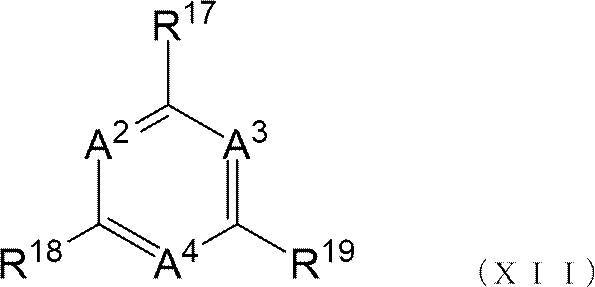
式(XII)中、A2、A3、及び、A4は、それぞれ独立に、-CH=又は-N=を表す。中でも、A2、A3、及び、A4が、いずれも-CH=であること、又は、いずれも-N=であることが好ましい。つまり、A2、A3、及び、A4を含む6員環が、ベンゼン環であること、又は、トリアジン環であることが好ましい。
R17、R18、及び、R19は、それぞれ独立に、*-X211-(Z21-X212)n21-L21-P21、又は、*-X221-(Z22-X222)n22-Y22を表す。*は中心環との結合位置を表す。
R17、R18、及び、R19のうち2個以上は、*-X211-(Z21-X212)n21-L21-P21である。熱伝導材料の熱伝導性がより優れる観点から、R17、R18、及び、R19は全てが、*-X211-(Z21-X212)n21-L21-P21であるのが好ましい。
加えて、R17、R18、及び、R19が、全て同一であるのが好ましい。
R17、R18、及び、R19のうち2個以上は、*-X211-(Z21-X212)n21-L21-P21である。熱伝導材料の熱伝導性がより優れる観点から、R17、R18、及び、R19は全てが、*-X211-(Z21-X212)n21-L21-P21であるのが好ましい。
加えて、R17、R18、及び、R19が、全て同一であるのが好ましい。
X211、X212、X221、及び、X222は、それぞれ独立に、単結合、-O-、-CO-、-NH-、-O-CO-、-O-CO-O-、-O-CO-NH-、-O-CO-S-、-CO-O-、-CO-NH-、-CO-S-、-NH-CO-、-NH-CO-O-、-NH-CO-NH-、-NH-CO-S-、-S-、-S-CO-、-S-CO-O-、-S-CO-NH-、又は、-S-CO-S-を表す。
中でも、X211、X212、X221、及び、X222としては、それぞれ独立に、単結合、-NH-、-O-、-CO-O-、又は、-O-CO-が好ましい。
中でも、X211、X212、X221、及び、X222としては、それぞれ独立に、単結合、-NH-、-O-、-CO-O-、又は、-O-CO-が好ましい。
Z21及びZ22は、それぞれ独立に、5員環若しくは6員環の芳香環基、又は、5員環若しくは6員環の非芳香環基を表し、例えば、ベンゼン環基(1,4-フェニレン基及び1,3-フェニレン基等)、並びに、芳香族複素環基が挙げられる。
上記芳香環基及び上記非芳香環基は、置換基を有していてもよい。置換基を有する場合、置換基の数は、1~4が好ましく、1又は2がより好ましく、1が更に好ましい。置換基の置換位置は、特に制限されない。置換基としては、ハロゲン原子又はメチル基が好ましい。上記芳香環基及び上記非芳香環基は無置換であるのも好ましい。また、置換基として、更に「-X212-L21-P21」で表される基を有していてもよい。
芳香族複素環基としては、例えば、以下の芳香族複素環基が挙げられる。

式中、*はX211又はX221に結合する部位を表す。**はX212又はX222に結合する部位を表す。A41及びA42は、それぞれ独立に、メチン基又は窒素原子を表す。X4は、酸素原子、硫黄原子、又は、イミノ基を表す。
A41及びA42は、少なくとも一方が窒素原子であるのが好ましく、両方が窒素原子であるのがより好ましい。また、X4は、酸素原子であるのが好ましい。
A41及びA42は、少なくとも一方が窒素原子であるのが好ましく、両方が窒素原子であるのがより好ましい。また、X4は、酸素原子であるのが好ましい。
後述するn21及びn22が2以上の場合、複数存在する(Z21-X212)及び(Z22-X222)は、それぞれ同一でも異なっていてもよい。
L21は、それぞれ独立に、単結合又は2価の連結基を表し、上述した式(XI)におけるL11と同義である。L21としては、-O-、-O-CO-、-CO-O-、-S-、-NH-、アルキレン基(炭素数は、1~10が好ましく、1~8がより好ましく、1~7が更に好ましい。)、アリーレン基(炭素数は、6~20が好ましく、6~14がより好ましく、6~10が更に好ましい。)、又は、これらの組み合わせからなる基が好ましい。
後述するn22が1以上の場合において、-X212-L21-の例としては、上述の式(D1)~(D15)におけるLの例であるL101~L143が同様に挙げられる。ただしこの場合、L101~L143における左側の結合手が化合物の中心構造(以下、単に「中心環」ともいう)の側に結合し、右側の結合手がP21に結合する。
P21は、エポキシ基を表す。上記エポキシ基は置換基を有していてもよく、有していなくてもよい。
Y22は、それぞれ独立に、水素原子、炭素数1~20の直鎖状、分岐鎖状、若しくは、環状のアルキル基、又は、炭素数1~20の直鎖状、分岐鎖状、若しくは、環状のアルキル基において1個又は2個以上のメチレン基が-O-、-S-、-NH-、-N(CH3)-、-CO-、-O-CO-、又は、-CO-O-で置換された基を表し、一般式(XI)におけるY12と同義であり、好ましい範囲も同様である。
n21及びn22はそれぞれ独立に、0~3の整数を表し、熱伝導性がより優れる観点から、1~3の整数が好ましい。中でも、A2、A3、及び、A4が、いずれも-CH=である場合はn21及びn22がそれぞれ独立に2~3の整数であることがより好ましく、A2、A3、及び、A4が、いずれも-N=である場合はn21及びn22がそれぞれ独立に1であることがより好ましい。
円盤状化合物の好ましい例としては、以下の化合物が挙げられる。
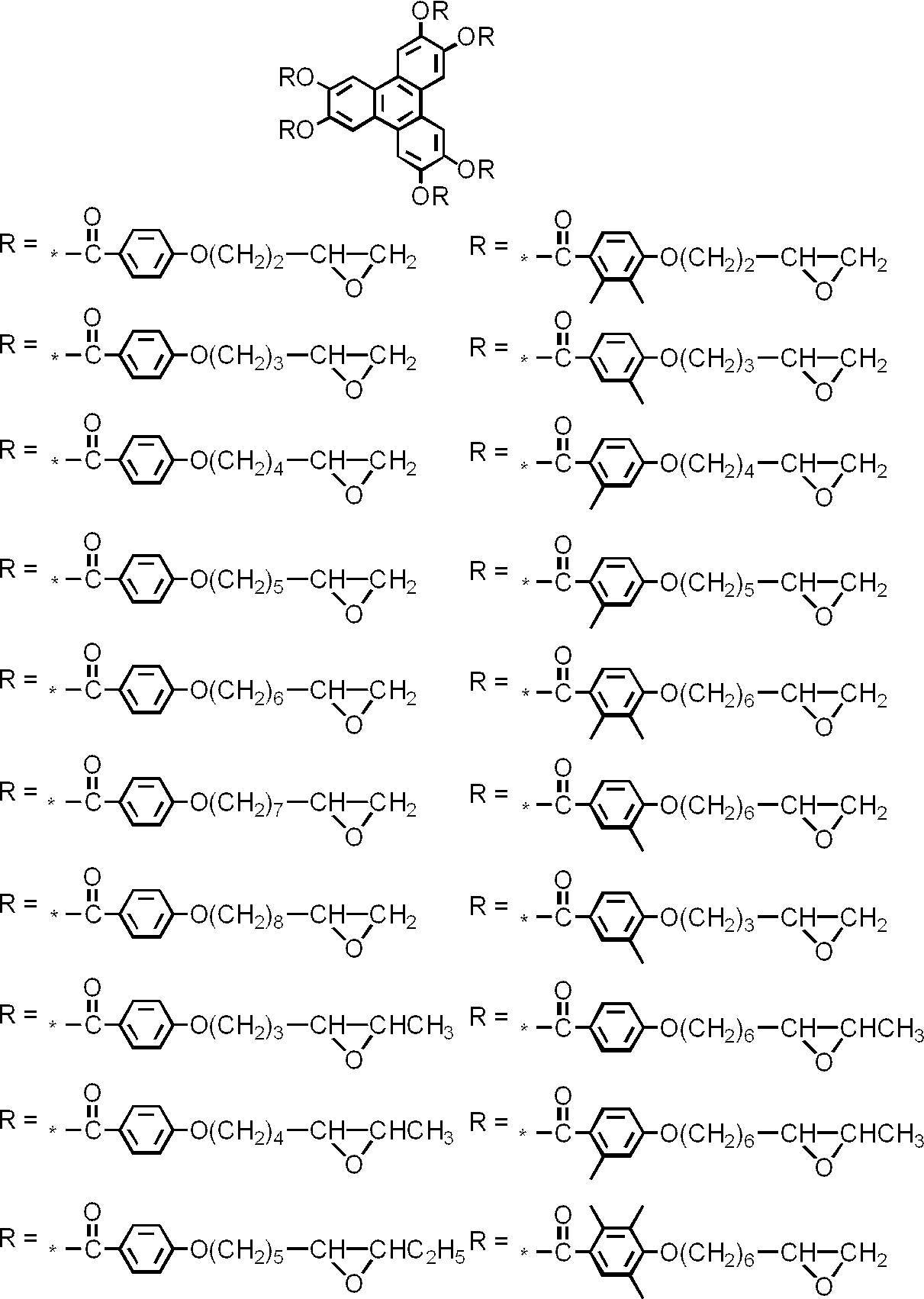

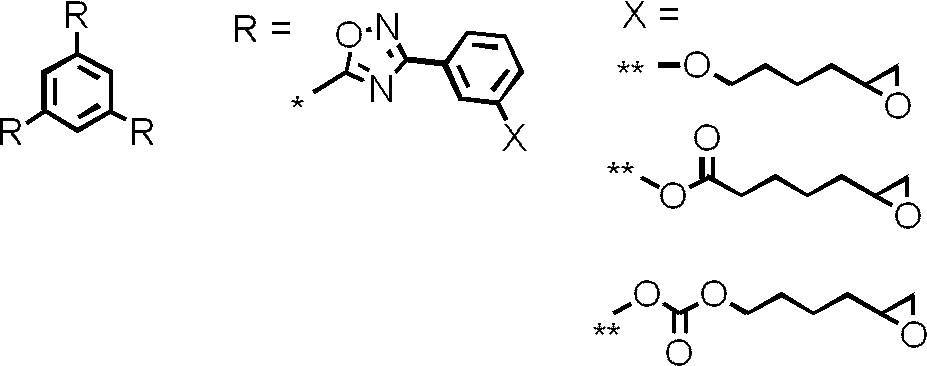


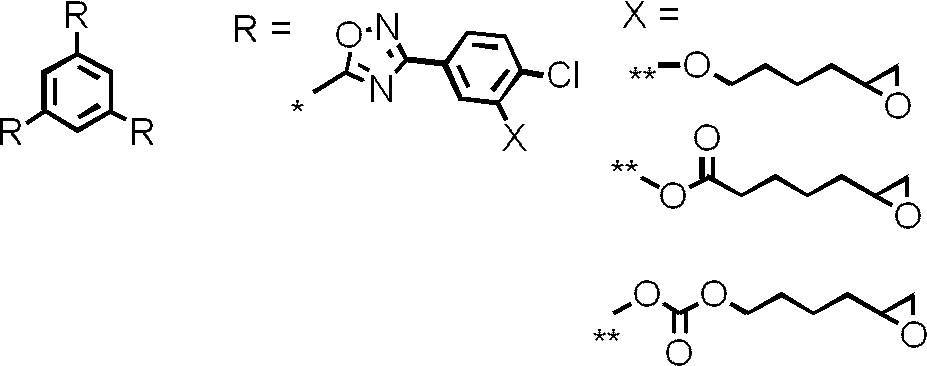
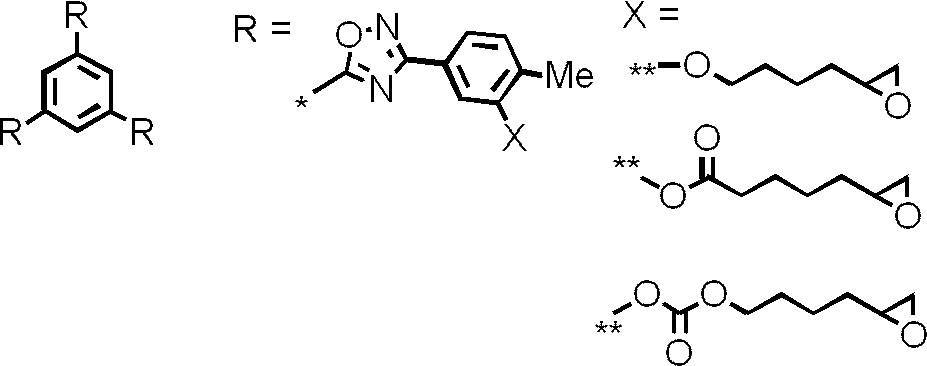

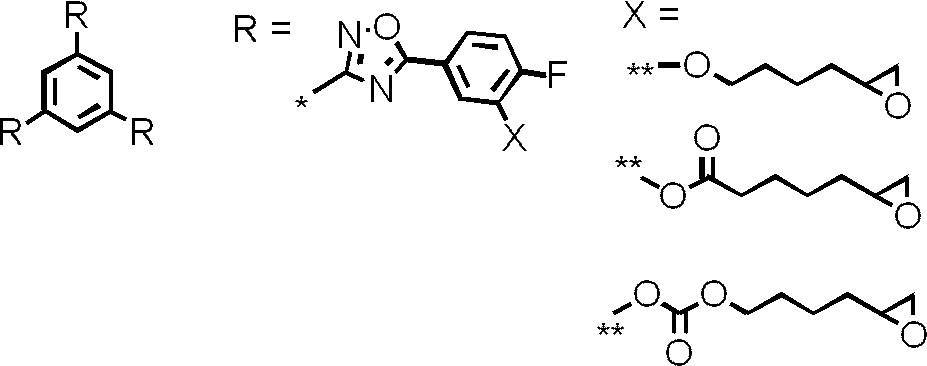


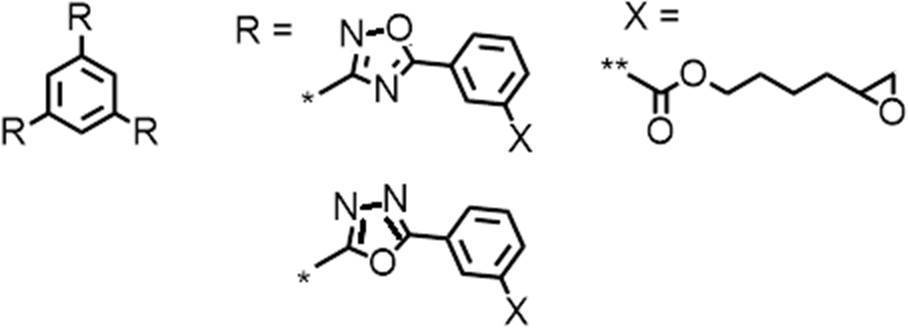
なお、下記構造式中、Rは、-X212-L21-P21を表す。
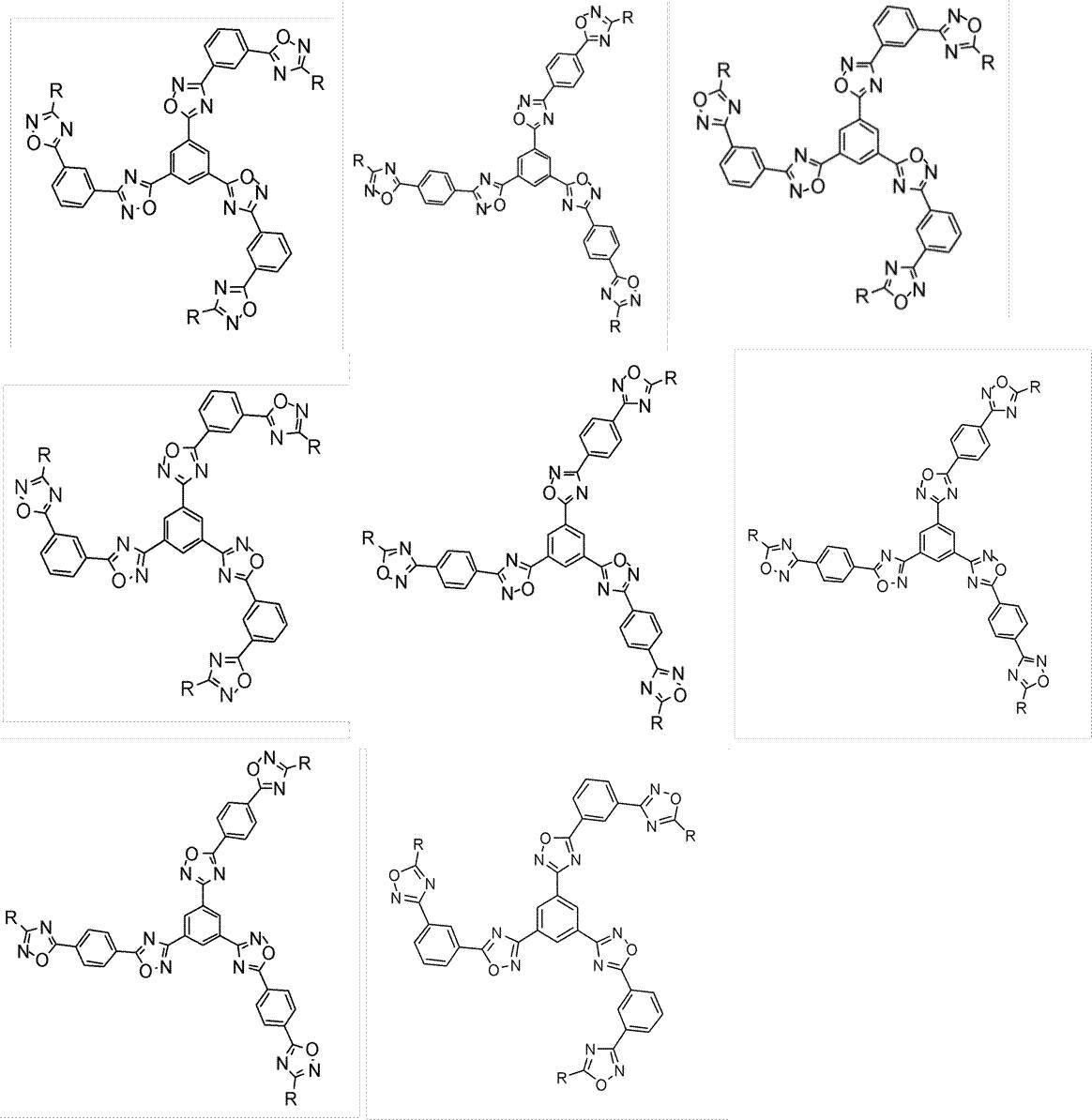

式(XII)で表される化合物の詳細、及び具体例については、特開2010-244038号公報の段落0013~0077に記載の化合物において、末端の少なくとも1つ(好ましくは3つ以上)をエポキシ基とした化合物を参照でき、その内容は本明細書に組み込まれる。
式(XII)で表される化合物は、特開2010-244038号公報、特開2006-076992号公報、及び、特開2007-002220号公報に記載の方法に準じて合成できる。
なお、電子密度を減らしてスタッキングを強くし、カラム状集合体を形成しやすくなるという観点から、円盤状化合物は水素結合性官能基を有する化合物であるのも好ましい。水素結合性官能基としては、-O-CO-NH-、-CO-NH-、-NH-CO-、-NH-CO-O-、-NH-CO-NH-、-NH-CO-S-、又は、-S-CO-NH-等が挙げられる。
(その他の第1のエポキシ化合物)
上述のエポキシ化合物以外にも、第1のエポキシ化合物は、例えば、フェノール化合物の説明中で述べた一般式(Z)、一般式(Z1)、又は、一般式(Z2)において、フェノール性水酸基をエポキシ含有基に代えた一般式で表される化合物も使用できる。
エポキシ含有基は、エポキシ基そのものである基、又は、エポキシ基を一部分に含む一価の基である。
上記エポキシ基を一部分に含む一価の基は、基全体の中にエポキシ基を1個以上(好ましくは1~8個)有する基である。
上記エポキシ基を一部分に含む一価の基は、「-(2価の炭化水素基)M1-(-O-2価の炭化水素基-)M2-エポキシ基」で表される基が好ましい。上記基において、M1は、0又は1を表す。M2は、1以上(好ましくは1~10)の整数を表す。上記基における2価の炭化水素基としては、例えば、アルキレン基(好ましくは炭素数1~6)、アルケニレン基(-CH=CH-等。好ましくは炭素数2~6)、アルキニレン基(-C≡C-等。好ましくは炭素数2~6)、アリーレン基(フェニレン基等。好ましくは炭素数6~15)、及び、これらを組み合わせた基が挙げられる。上記2価の炭化水素基は置換基を有していても有していなくてもよく、上記2価の炭化水素基が置換基として更にエポキシ含有基を有してもよい。複数存在してもよい上記2価の炭化水素基は、それぞれ同一でも異なっていてもよい。
上述のエポキシ化合物以外にも、第1のエポキシ化合物は、例えば、フェノール化合物の説明中で述べた一般式(Z)、一般式(Z1)、又は、一般式(Z2)において、フェノール性水酸基をエポキシ含有基に代えた一般式で表される化合物も使用できる。
エポキシ含有基は、エポキシ基そのものである基、又は、エポキシ基を一部分に含む一価の基である。
上記エポキシ基を一部分に含む一価の基は、基全体の中にエポキシ基を1個以上(好ましくは1~8個)有する基である。
上記エポキシ基を一部分に含む一価の基は、「-(2価の炭化水素基)M1-(-O-2価の炭化水素基-)M2-エポキシ基」で表される基が好ましい。上記基において、M1は、0又は1を表す。M2は、1以上(好ましくは1~10)の整数を表す。上記基における2価の炭化水素基としては、例えば、アルキレン基(好ましくは炭素数1~6)、アルケニレン基(-CH=CH-等。好ましくは炭素数2~6)、アルキニレン基(-C≡C-等。好ましくは炭素数2~6)、アリーレン基(フェニレン基等。好ましくは炭素数6~15)、及び、これらを組み合わせた基が挙げられる。上記2価の炭化水素基は置換基を有していても有していなくてもよく、上記2価の炭化水素基が置換基として更にエポキシ含有基を有してもよい。複数存在してもよい上記2価の炭化水素基は、それぞれ同一でも異なっていてもよい。
また、その他の第1のエポキシ化合物としては、例えば、一般式(DN)で表されるエポキシ化合物も挙げられる。

一般式(DN)中、nDNは、0以上の整数を表し、0~5が好ましく、1がより好ましい。
RDNは、単結合又は2価の連結基を表す。2価の連結基としては、-O-、-O-CO-、-CO-O-、-S-、アルキレン基(炭素数は、1~10が好ましい。)、アリーレン基(炭素数は、6~20が好ましい。)、又は、これらの組み合わせからなる基が好ましく、アルキレン基がより好ましく、メチレン基がより好ましい。
RDNは、単結合又は2価の連結基を表す。2価の連結基としては、-O-、-O-CO-、-CO-O-、-S-、アルキレン基(炭素数は、1~10が好ましい。)、アリーレン基(炭素数は、6~20が好ましい。)、又は、これらの組み合わせからなる基が好ましく、アルキレン基がより好ましく、メチレン基がより好ましい。
その他の第1のエポキシ化合物としては、一般式(E2)で表されるエポキシ化合物も挙げられる。
(V-)4-UC(-W)U (E2)
(V-)4-UC(-W)U (E2)
一般式(E2)中、Cは、炭素原子を表す。
一般式(E2)中、Uは、3又は4の整数を表す。
一般式(E2)中において、Vの数を示す「4-U」中の「U」と、Wの数を示す「U」とは同じ値を示す。つまり、一般式(E2)は、「V-C(-W)3」又は「C(-W)4」である。
一般式(E2)中において、Vの数を示す「4-U」中の「U」と、Wの数を示す「U」とは同じ値を示す。つまり、一般式(E2)は、「V-C(-W)3」又は「C(-W)4」である。
一般式(E2)中、Vは、エポキシ基を有さない置換基又は水素原子を表す。
上記エポキシ基を有さない置換基は、エポキシ基以外の置換基であり、かつ、置換基の一部分としてもエポキシ基を含むことがない置換基である。
上記エポキシ基を有さない置換基としては、例えば、置換基群Yから選択される基であって、エポキシ基及びエポキシ基を一部分に含む基を除いた基が挙げられる。
上記エポキシ基を有さない置換基は、アルキル基が好ましく、直鎖状又は分岐鎖状のアルキル基がより好ましい。上記アルキル基は、炭素数1~5が好ましい。
上記エポキシ基を有さない置換基は、エポキシ基以外の置換基であり、かつ、置換基の一部分としてもエポキシ基を含むことがない置換基である。
上記エポキシ基を有さない置換基としては、例えば、置換基群Yから選択される基であって、エポキシ基及びエポキシ基を一部分に含む基を除いた基が挙げられる。
上記エポキシ基を有さない置換基は、アルキル基が好ましく、直鎖状又は分岐鎖状のアルキル基がより好ましい。上記アルキル基は、炭素数1~5が好ましい。
一般式(E2)中、Wは、エポキシ含有基を表す。
エポキシ含有基は、エポキシ基そのものである基、又は、エポキシ基を一部分に含む一価の基である。
上記エポキシ基を一部分に含む一価の基は、基全体の中にエポキシ基を1個以上(好ましくは1~8個)有する基である。
上記エポキシ基を一部分に含む一価の基は、「-(2価の炭化水素基)M1-(-O-2価の炭化水素基-)M2-エポキシ基」で表される基が好ましい。上記基において、M1は、0又は1を表す。M2は、1以上(好ましくは1~10)の整数を表す。上記基における2価の炭化水素基としては、例えば、アルキレン基(好ましくは炭素数1~6)、アルケニレン基(-CH=CH-等。好ましくは炭素数2~6)、アルキニレン基(-C≡C-等。好ましくは炭素数2~6)、アリーレン基(フェニレン基等。好ましくは炭素数6~15)、及び、これらを組み合わせた基が挙げられる。上記2価の炭化水素基は置換基を有していても有していなくてもよく、上記2価の炭化水素基が置換基として更にエポキシ含有基を有してもよい。複数存在してもよい上記2価の炭化水素基は、それぞれ同一でも異なっていてもよい。
一般式(E2)中に複数存在するWは、それぞれ同一でも異なっていてもよい。
エポキシ含有基は、エポキシ基そのものである基、又は、エポキシ基を一部分に含む一価の基である。
上記エポキシ基を一部分に含む一価の基は、基全体の中にエポキシ基を1個以上(好ましくは1~8個)有する基である。
上記エポキシ基を一部分に含む一価の基は、「-(2価の炭化水素基)M1-(-O-2価の炭化水素基-)M2-エポキシ基」で表される基が好ましい。上記基において、M1は、0又は1を表す。M2は、1以上(好ましくは1~10)の整数を表す。上記基における2価の炭化水素基としては、例えば、アルキレン基(好ましくは炭素数1~6)、アルケニレン基(-CH=CH-等。好ましくは炭素数2~6)、アルキニレン基(-C≡C-等。好ましくは炭素数2~6)、アリーレン基(フェニレン基等。好ましくは炭素数6~15)、及び、これらを組み合わせた基が挙げられる。上記2価の炭化水素基は置換基を有していても有していなくてもよく、上記2価の炭化水素基が置換基として更にエポキシ含有基を有してもよい。複数存在してもよい上記2価の炭化水素基は、それぞれ同一でも異なっていてもよい。
一般式(E2)中に複数存在するWは、それぞれ同一でも異なっていてもよい。
その他の第1のエポキシ化合物としては、エポキシ基が、縮環している化合物も挙げられる。このような化合物としては、例えば、3,4:8,9-ジエポキシビシクロ[4.3.0]ノナン等が挙げられる。
その他の第1のエポキシ化合物としては、他にも、例えば、ビスフェノールA、F、S、AD等のグリシジルエーテルであるビスフェノールA型エポキシ化合物、ビスフェノールF型エポキシ化合物、ビスフェノールS型エポキシ化合物、ビスフェノールAD型エポキシ化合物等;水素添加したビスフェノールA型エポキシ化合物、水素添加したビスフェノールAD型エポキシ化合物等;フェノールノボラック型のグリシジルエーテル(フェノールノボラック型エポキシ化合物)、クレゾールノボラック型のグリシジルエーテル(クレゾールノボラック型エポキシ化合物)、ビスフェノールAノボラック型のグリシジルエーテル等;ジシクロペンタジエン型のグリシジルエーテル(ジシクロペンタジエン型エポキシ化合物);ジヒドロキシペンタジエン型のグリシジルエーテル(ジヒドロキシペンタジエン型エポキシ化合物);レゾルシノール等のジヒドロキシベンゼンのグリシジルエーテルのようなポリヒドロキシベンゼン型のグリシジルエーテル(ポリヒドロキシベンゼン型エポキシ化合物);ベンゼンポリカルボン酸型のグリシジルエステル(ベンゼンポリカルボン酸型エポキシ化合物);トリスフェノールメタン型エポキシ化合物;及び、フェノキシ樹脂等が挙げられる。上述の各化合物におけるグリシジルエーテル基及び/又はグリシジルエステル基の1個又は2個以上が、ジグリシジルアミノ基又はジグリシジルアミノアルキレン基(ジグリシジルアミノメチレン基等)に置き換わった化合物を第1のエポキシ化合物として使用してもよい。
上述の各化合物は、置換基を有していてもよい。例えば、上述の各化合物に含まれる芳香環基、シクロアルカン環基、及び/又は、アルキレン基等が、グリシジルエーテル基、グリシジルエステル基、ジグリシジルアミノ基、及び/又は、ジグリシジルアミノアルキレン基以外の置換基を有していてもよい。
上述の各化合物は、置換基を有していてもよい。例えば、上述の各化合物に含まれる芳香環基、シクロアルカン環基、及び/又は、アルキレン基等が、グリシジルエーテル基、グリシジルエステル基、ジグリシジルアミノ基、及び/又は、ジグリシジルアミノアルキレン基以外の置換基を有していてもよい。
中でも、第1のエポキシ化合物としては、本発明の効果がより優れる点から、ポリヒドロキシベンゼン型エポキシ化合物、ビフェニル骨格を有するエポキシ化合物、ビスフェノールF型エポキシ化合物、フェノールノボラック型エポキシ化合物、フェノキシ樹脂、又は、一般式(E2)で表されるエポキシ化合物からなる群から選択される1種以上のエポキシ化合物を含むことが好ましい。また、例えば、トリアジン骨格を有さない第1のエポキシ化合物として、上記1種以上のエポキシ化合物を含むことが好ましい。
第1のエポキシ化合物は、上記1種以上のエポキシ化合物そのものであってもよいし、一部に含んでいてもよい。上記1種以上のエポキシ化合物の含有量は、第1のエポキシ化合物の全質量に対して、30~100質量%が好ましく、60~100質量%がより好ましく、90~100質量%が更に好ましい。
第1のエポキシ化合物は、上記1種以上のエポキシ化合物そのものであってもよいし、一部に含んでいてもよい。上記1種以上のエポキシ化合物の含有量は、第1のエポキシ化合物の全質量に対して、30~100質量%が好ましく、60~100質量%がより好ましく、90~100質量%が更に好ましい。
〔フェノール化合物と第1のエポキシ化合物との関係性〕
本発明の組成物において、フェノール化合物がトリアジン骨格を有するフェノール化合物を含むこと(要件1)、及び、第1のエポキシ化合物がトリアジン骨格を有するエポキシ化合物を含むこと(要件2)、の少なくとも一方の要件を満たす。
組成物は、要件1のみを満たしてもよいし、要件2のみを満たしてもよいし、要件1及び要件2の両方を満たしてもよい。
本発明の組成物において、フェノール化合物がトリアジン骨格を有するフェノール化合物を含むこと(要件1)、及び、第1のエポキシ化合物がトリアジン骨格を有するエポキシ化合物を含むこと(要件2)、の少なくとも一方の要件を満たす。
組成物は、要件1のみを満たしてもよいし、要件2のみを満たしてもよいし、要件1及び要件2の両方を満たしてもよい。
フェノール化合物及び第1のエポキシ化合物が「トリアジン骨格を有する」とは、化合物中に1個以上(例えば1~5個)のトリアジン環基を有することを意味する。
トリアジン骨格を有するフェノール化合物としては、例えば、上述の、一般式(Z)で表される化合物、一般式(Z1)で表される化合物、及び、一般式(Z2)で表される化合物が挙げられる。
トリアジン骨格を有するエポキシ化合物としては、例えば、上述の、式(D16)で表される化合物においてA2X、A3X、及び、A4Xがいずれも-N=である形態の化合物、式(XII)で表される化合物においてA2、A3、及び、A4がいずれも-N=である形態の化合物、一般式(Z)においてフェノール性水酸基をエポキシ基含有基に代えた一般式で表される化合物、一般式(Z1)においてフェノール性水酸基をエポキシ基含有基に代えた一般式で表される化合物、及び、一般式(Z2)においてフェノール性水酸基をエポキシ基含有基に代えた一般式で表される化合物が挙げられる。
なお、エポキシ化合物がトリアジン骨格を有していたとしても、そのエポキシ化合物が後述する第2のエポキシ化合物に該当する場合は、そのエポキシ化合物は第1のエポキシ化合物には含まれない。つまり、組成物が、トリアジン骨格を有する第2のエポキシ化合物を含んでいたとしても、それによっては要件2を充足しない。
トリアジン骨格を有するフェノール化合物としては、例えば、上述の、一般式(Z)で表される化合物、一般式(Z1)で表される化合物、及び、一般式(Z2)で表される化合物が挙げられる。
トリアジン骨格を有するエポキシ化合物としては、例えば、上述の、式(D16)で表される化合物においてA2X、A3X、及び、A4Xがいずれも-N=である形態の化合物、式(XII)で表される化合物においてA2、A3、及び、A4がいずれも-N=である形態の化合物、一般式(Z)においてフェノール性水酸基をエポキシ基含有基に代えた一般式で表される化合物、一般式(Z1)においてフェノール性水酸基をエポキシ基含有基に代えた一般式で表される化合物、及び、一般式(Z2)においてフェノール性水酸基をエポキシ基含有基に代えた一般式で表される化合物が挙げられる。
なお、エポキシ化合物がトリアジン骨格を有していたとしても、そのエポキシ化合物が後述する第2のエポキシ化合物に該当する場合は、そのエポキシ化合物は第1のエポキシ化合物には含まれない。つまり、組成物が、トリアジン骨格を有する第2のエポキシ化合物を含んでいたとしても、それによっては要件2を充足しない。
フェノール化合物が、トリアジン骨格を有するフェノール化合物を含む場合(つまり要件1を満たす場合)、その含有量は、フェノール化合物の全質量に対して、0質量%超100質量%以下であり、30~100質量%が好ましく、60~100質量%がより好ましく、90~100質量%が更に好ましい。なお、第1のエポキシ化合物が、トリアジン骨格を有するエポキシ化合物を含む場合(つまり要件2を満たす場合)、トリアジン骨格を有するフェノール化合物の含有量は、上記好適範囲の範囲外であってもよい。
第1のエポキシ化合物が、トリアジン骨格を有するエポキシ化合物を含む場合(つまり要件2を満たす場合)、その含有量は、第1のエポキシ化合物の全質量に対して、0質量%超100質量%以下であり、30~100質量%が好ましく、60~100質量%がより好ましく、90~100質量%が更に好ましい。なお、フェノール化合物が、トリアジン骨格を有するフェノール化合物を含む場合(つまり要件1を満たす場合)、トリアジン骨格を有する第1のエポキシ化合物の含有量は、上記好適範囲の範囲外であってもよい。
第1のエポキシ化合物が、トリアジン骨格を有するエポキシ化合物を含む場合(つまり要件2を満たす場合)、その含有量は、第1のエポキシ化合物の全質量に対して、0質量%超100質量%以下であり、30~100質量%が好ましく、60~100質量%がより好ましく、90~100質量%が更に好ましい。なお、フェノール化合物が、トリアジン骨格を有するフェノール化合物を含む場合(つまり要件1を満たす場合)、トリアジン骨格を有する第1のエポキシ化合物の含有量は、上記好適範囲の範囲外であってもよい。
フェノール化合物と第1のエポキシ化合物との少なくとも一部がトリアジン骨格を有する化合物以外であることも好ましい。
フェノール化合物の全部又は一部がトリアジン骨格を有する化合物以外でもよく、第1のエポキシ化合物の全部又は一部がトリアジン骨格を有する化合物以外でもよい。
架橋密度を調整し本発明の効果をより向上させる点から、トリアジン骨格を有するフェノール化合物とトリアジン骨格を有する第1のエポキシ化合物との合計含有量は、全フェノール化合物と全第1のエポキシ化合物との合計含有量に対して、0質量%超100質量%未満が好ましく、1~90質量%がより好ましく、5~80質量%が更に好ましい。
フェノール化合物の全部又は一部がトリアジン骨格を有する化合物以外でもよく、第1のエポキシ化合物の全部又は一部がトリアジン骨格を有する化合物以外でもよい。
架橋密度を調整し本発明の効果をより向上させる点から、トリアジン骨格を有するフェノール化合物とトリアジン骨格を有する第1のエポキシ化合物との合計含有量は、全フェノール化合物と全第1のエポキシ化合物との合計含有量に対して、0質量%超100質量%未満が好ましく、1~90質量%がより好ましく、5~80質量%が更に好ましい。
また、組成物中、第1のエポキシ化合物とフェノール化合物との合計含有量は、組成物の全固形分に対して、5~90質量%が好ましく、10~50質量%がより好ましく、12~40質量%が更に好ましい。
第1のエポキシ化合物及び/又はフェノール化合物は、1種単独で使用してもよく2種以上使用してもよい。
なお、固形分とは、熱伝導材料を形成する成分を意図し、溶媒は含まれない。ここでいう、熱伝導材料を形成する成分は、熱伝導材料を形成する際に反応(重合)して化学構造が変化する成分でもよい。また、熱伝導材料を形成する成分であれば、その性状が液体状であっても、固形分とみなす。
第1のエポキシ化合物及び/又はフェノール化合物は、1種単独で使用してもよく2種以上使用してもよい。
なお、固形分とは、熱伝導材料を形成する成分を意図し、溶媒は含まれない。ここでいう、熱伝導材料を形成する成分は、熱伝導材料を形成する際に反応(重合)して化学構造が変化する成分でもよい。また、熱伝導材料を形成する成分であれば、その性状が液体状であっても、固形分とみなす。
〔第2のエポキシ化合物〕
本発明の組成物は、第2のエポキシ化合物を含む。
第2のエポキシ化合物は、側鎖にエポキシ基を有するアクリル樹脂である。
本発明の組成物は、第2のエポキシ化合物を含む。
第2のエポキシ化合物は、側鎖にエポキシ基を有するアクリル樹脂である。
第2のエポキシ化合物は、グラフト構造を有していても有していなくてもよい。また、第2のエポキシ化合物は、ブロック構造を有していても有していなくてもよい。第2のエポキシ化合物は、ブランチ構造、又は、スター構造であってもよい。
第2のエポキシ化合物は、樹脂中に、アクリル系繰り返し単位を含んでおり、アクリル系繰り返し単位をしては、(メタ)アクリル酸に基づく繰り返し単位、(メタ)アクリル酸エステル類に基づく繰り返し単位、(メタ)アクリルアミド類に基づく繰り返し単位、(メタ)アクリル酸ハライドに基づく繰り返し単位、及び、シアノアクリル酸類に基づく繰り返し単位が挙げられる。中でも、アクリル系繰り返し単位をしては、(メタ)アクリル酸に基づく繰り返し単位、又は、(メタ)アクリル酸エステル類に基づく繰り返し単位が好ましい。
なお、本明細書において、特定のモノマーに基づく繰り返し単位、又は、特定のモノマーに由来する繰り返し単位等と表現する場合、その繰り返し単位は、その特定のモノマーが重合してなる構造の繰り返し単位であればよい。例えば、特定のモノマーとは異なるモノマーを用いて形成した繰り返し単位を修飾又は脱保護等して、特定のモノマーが重合してなる構造の繰り返し単位と同一構造の繰り返し単位とした場合、このようにして得られた繰り返し単位も、特定のモノマーに基づく繰り返し単位、又は、特定のモノマーに由来する繰り返し単位として表現する。
なお、本明細書において、特定のモノマーに基づく繰り返し単位、又は、特定のモノマーに由来する繰り返し単位等と表現する場合、その繰り返し単位は、その特定のモノマーが重合してなる構造の繰り返し単位であればよい。例えば、特定のモノマーとは異なるモノマーを用いて形成した繰り返し単位を修飾又は脱保護等して、特定のモノマーが重合してなる構造の繰り返し単位と同一構造の繰り返し単位とした場合、このようにして得られた繰り返し単位も、特定のモノマーに基づく繰り返し単位、又は、特定のモノマーに由来する繰り返し単位として表現する。
第2のエポキシ化合物は側鎖にエポキシ基を有する。つまり、第2のエポキシ化合物は、エポキシ基を有する繰り返し単位を有する。
エポキシ基を有する繰り返し単位は、アクリル系繰り返し単位の一部又は全部であってもよく、後述のアクリル系繰り返し単位以外の繰り返し単位の一部又は全部であってもよく、少なくとも、アクリル系繰り返し単位の一部がエポキシ基を有する繰り返し単位であることが好ましい。
エポキシ基を有する繰り返し単位は、例えば、エポキシ基を有する(メタ)アクリル酸エステル類、及び/又は、エポキシ基を有する(メタ)アクリル酸アミド類に基づく繰り返し単位である。
エポキシ基を有する繰り返し単位は、アクリル系繰り返し単位の一部又は全部であってもよく、後述のアクリル系繰り返し単位以外の繰り返し単位の一部又は全部であってもよく、少なくとも、アクリル系繰り返し単位の一部がエポキシ基を有する繰り返し単位であることが好ましい。
エポキシ基を有する繰り返し単位は、例えば、エポキシ基を有する(メタ)アクリル酸エステル類、及び/又は、エポキシ基を有する(メタ)アクリル酸アミド類に基づく繰り返し単位である。
エポキシ基を有する繰り返し単位以外のアクリル系繰り返し単位(エポキシ基を有さないアクリル系繰り返し単位)としては、例えば、以下のモノマーに基づく繰り返し単位が挙げられる。
すなわち、上記モノマーとしては、例えば、(メタ)アクリル酸;(メタ)アクリル酸2-ヒドロキシエチル、(メタ)アクリル酸1-ヒドロキシ-2-プロピル、(メタ)アクリル酸2,3-ジヒドロキシプロピル、(メタ)アクリル酸ヒドロキシメチル、(メタ)アクリル酸メチル、(メタ)アクリル酸エチル、(メタ)アクリル酸プロピル、(メタ)アクリル酸イソプロピル、(メタ)アクリル酸ブチル、(メタ)アクリル酸ヘキシル、(メタ)アクリル酸2-エチルヘキシル、(メタ)アクリル酸オクチル、(メタ)アクリル酸ラウリル、(メタ)アクリル酸2-ヒドロキシブチル、(メタ)アクリル酸2-ヒドロキシ-3-フェノキシプロピル、(メタ)アクリル酸テトラヒドロフルフラル、メトキシジエチレングリコール(メタ)アクリレート、メトキシテトラエチレングリコール(メタ)アクリレート、及び、(メタ)アクリル酸ベンジル等の(メタ)アクリル酸エステル類;アクリル酸アミド、メタクリルアミド、及び、N,N-ジメチルアクリル酸アミド等の(メタ)アクリル酸アミド類;(メタ)アクリル酸クロライド等のアクリル酸ハライド;シアノアクリル酸メチル、シアノアクリル酸エチル、シアノアクリル酸ブチル、及び、シアノアクリル酸オクチル等のシアノアクリル酸類、が挙げられる。
すなわち、上記モノマーとしては、例えば、(メタ)アクリル酸;(メタ)アクリル酸2-ヒドロキシエチル、(メタ)アクリル酸1-ヒドロキシ-2-プロピル、(メタ)アクリル酸2,3-ジヒドロキシプロピル、(メタ)アクリル酸ヒドロキシメチル、(メタ)アクリル酸メチル、(メタ)アクリル酸エチル、(メタ)アクリル酸プロピル、(メタ)アクリル酸イソプロピル、(メタ)アクリル酸ブチル、(メタ)アクリル酸ヘキシル、(メタ)アクリル酸2-エチルヘキシル、(メタ)アクリル酸オクチル、(メタ)アクリル酸ラウリル、(メタ)アクリル酸2-ヒドロキシブチル、(メタ)アクリル酸2-ヒドロキシ-3-フェノキシプロピル、(メタ)アクリル酸テトラヒドロフルフラル、メトキシジエチレングリコール(メタ)アクリレート、メトキシテトラエチレングリコール(メタ)アクリレート、及び、(メタ)アクリル酸ベンジル等の(メタ)アクリル酸エステル類;アクリル酸アミド、メタクリルアミド、及び、N,N-ジメチルアクリル酸アミド等の(メタ)アクリル酸アミド類;(メタ)アクリル酸クロライド等のアクリル酸ハライド;シアノアクリル酸メチル、シアノアクリル酸エチル、シアノアクリル酸ブチル、及び、シアノアクリル酸オクチル等のシアノアクリル酸類、が挙げられる。
エポキシ基を有する繰り返し単位であるアクリル系繰り返し単位(エポキシ基を有するアクリル系繰り返し単位)としては、例えば、以下のモノマーに基づく繰り返し単位が挙げられる。
なお、以下において、R1は、水素原子又はメチル基を表し、R2は、炭素数1~8の2価の炭化水素基(アルキレン基等)を表す。なお、同一の構造式中にR1が複数存在する場合、それらは、同一でも異なっていてもよい。
なお、以下において、R1は、水素原子又はメチル基を表し、R2は、炭素数1~8の2価の炭化水素基(アルキレン基等)を表す。なお、同一の構造式中にR1が複数存在する場合、それらは、同一でも異なっていてもよい。
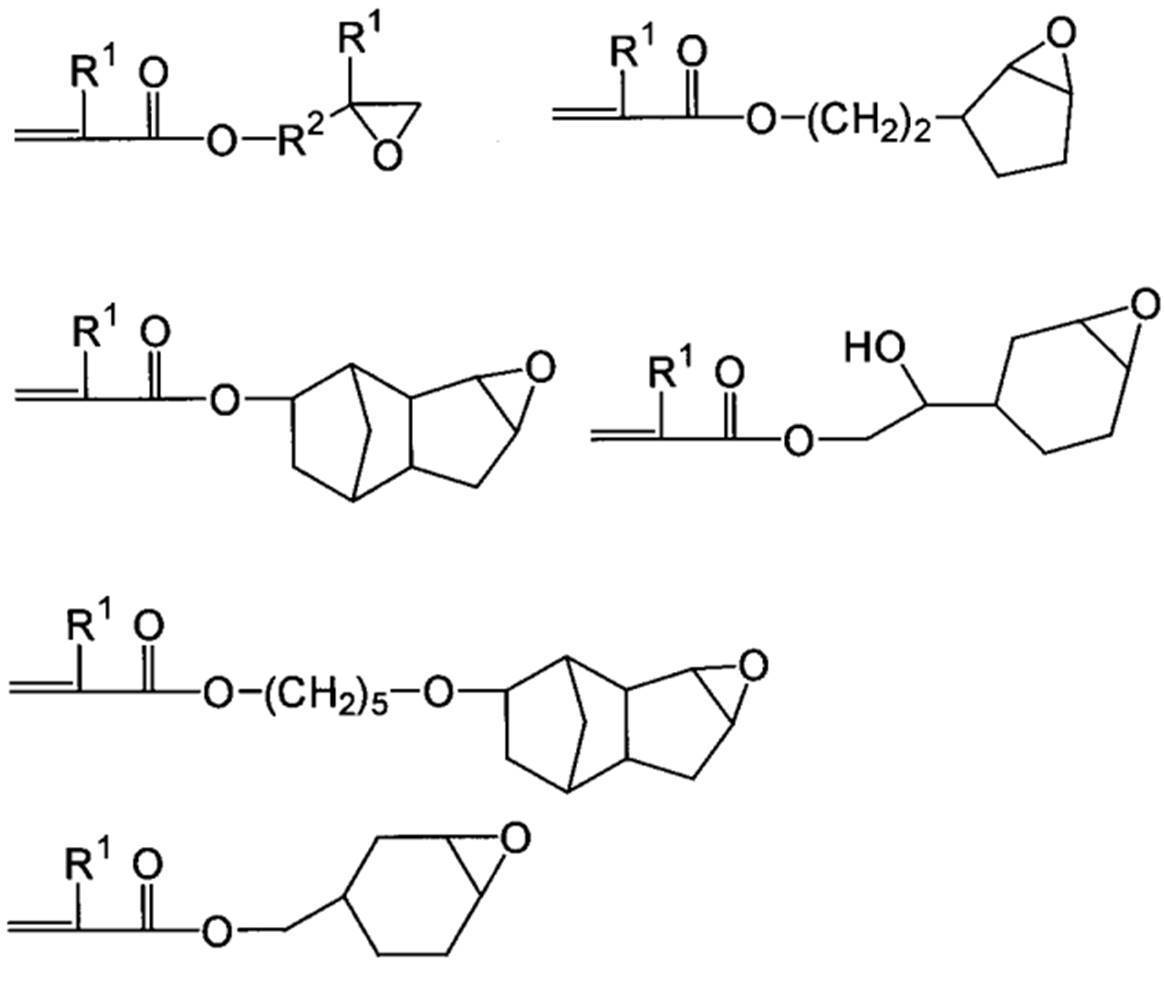
第2のエポキシ化合物は、アクリル系繰り返し単位以外の繰り返し単位を有していてもよい。アクリル系繰り返し単位以外の繰り返し単位としては、例えば、オレフィン(エチレン等)に基づく繰り返し単位、スチレン類(スチレン等)に基づく繰り返し単位、及び、無水マレイン酸に基づく繰り返し単位が挙げられる。
アクリル系繰り返し単位以外の繰り返し単位の一部又は全部が側鎖にエポキシ基を有していてもよい。
アクリル系繰り返し単位以外の繰り返し単位の一部又は全部が側鎖にエポキシ基を有していてもよい。
第2のエポキシ化合物は、グラフト構造を有することも好ましい。
例えば、第2のエポキシ化合物は、エポキシ基を有する繰り返し単位を有する主鎖構造を有し、エポキシ基を有する繰り返し単位以外の繰り返し単位(オレフィンに基づく繰り返し単位、エポキシ基を有さないアクリル系繰り返し単位、及び/又は、エポキシ基を有さないスチレン類に基づく繰り返し単位等)からなる重合体である側鎖を有することも好ましい。
例えば、第2のエポキシ化合物は、エポキシ基を有する繰り返し単位を有する主鎖構造を有し、エポキシ基を有する繰り返し単位以外の繰り返し単位(オレフィンに基づく繰り返し単位、エポキシ基を有さないアクリル系繰り返し単位、及び/又は、エポキシ基を有さないスチレン類に基づく繰り返し単位等)からなる重合体である側鎖を有することも好ましい。
第2のエポキシ化合物中、アクリル系繰り返し単位の含有量は、第2のエポキシ化合物の全質量に対して、1~100質量%が好ましく、1~50質量%がより好ましく、1~20質量%が更に好ましい。
第2のエポキシ化合物がアクリル系繰り返し単位以外の繰り返し単位を有する場合、その含有量は、第2のエポキシ化合物の全質量に対して、1~99質量%が好ましく、10~80質量%がより好ましく、20~70質量%が更に好ましい。
第2のエポキシ化合物中、エポキシ基を有する繰り返し単位(好ましくはエポキシ基を有するアクリル系繰り返し単位)の含有量は、第2のエポキシ化合物の全質量に対して、1~100質量%が好ましく、10~80質量%がより好ましく、20~70質量%が更に好ましい。
第2のエポキシ化合物がアクリル系繰り返し単位以外の繰り返し単位を有する場合、その含有量は、第2のエポキシ化合物の全質量に対して、1~99質量%が好ましく、10~80質量%がより好ましく、20~70質量%が更に好ましい。
第2のエポキシ化合物中、エポキシ基を有する繰り返し単位(好ましくはエポキシ基を有するアクリル系繰り返し単位)の含有量は、第2のエポキシ化合物の全質量に対して、1~100質量%が好ましく、10~80質量%がより好ましく、20~70質量%が更に好ましい。
第2のエポキシ化合物の重量平均分子量は、1000~5000000が好ましく、2000~2500000がより好ましく、7000~1000000が更に好ましい。
第2のエポキシ化合物のTg(ガラス転移温度)は、-60~130℃が好ましく、-15~100℃がより好ましく、-5~80℃が更に好ましい。
第2のエポキシ化合物のTg(ガラス転移温度)は、-60~130℃が好ましく、-15~100℃がより好ましく、-5~80℃が更に好ましい。
第2のエポキシ化合物のエポキシ基含有量は、0.05~20.0mmol/gが好ましく、0.1~10.0mmol/gがより好ましく、0.1~5.0mmol/gが更に好ましい。
第2のエポキシ化合物としては、市販品を使用してもよい。市販品としては、例えば、LOTADER AXシリーズ(アルケマ社製)、モディパーA4100、モディパーA4300、モディパーA4400(日油社製)、マープルーフGシリーズ(日油社製)、及び、テイサンレジンSG-P3(ナガセケムテックス社製)が挙げられる。
第2のエポキシ化合物の含有量は、組成物の全固形分に対して、1~50質量%が好ましく、2~35質量%がより好ましく、3~25質量%が更に好ましく、3~15質量%が特に好ましい。
第2のエポキシ化合物の含有量は、第1のエポキシ化合物とフェノール化合物との合計含有量100質量部に対して、1~200質量部が好ましく、5~170質量部がより好ましく、10~150質量部が更に好ましく、10~60質量部が更に好ましい。
第2のエポキシ化合物の含有量は、第1のエポキシ化合物の含有量100質量部に対して、5~500質量部が好ましく、10~400質量部がより好ましく、20~300質量部が更に好ましい。
第2のエポキシ化合物は、1種単独で使用してもよく2種以上使用してもよい。
第2のエポキシ化合物の含有量は、第1のエポキシ化合物とフェノール化合物との合計含有量100質量部に対して、1~200質量部が好ましく、5~170質量部がより好ましく、10~150質量部が更に好ましく、10~60質量部が更に好ましい。
第2のエポキシ化合物の含有量は、第1のエポキシ化合物の含有量100質量部に対して、5~500質量部が好ましく、10~400質量部がより好ましく、20~300質量部が更に好ましい。
第2のエポキシ化合物は、1種単独で使用してもよく2種以上使用してもよい。
組成物において、フェノール化合物に含まれる水酸基(好ましくはフェノール性水酸基)の数に対する、第1のエポキシ化合物及び第2のエポキシ化合物に含まれる合計のエポキシ基の数との比(エポキシ基の数/水酸基の数)は、30/70~70/30が好ましく、40/60~60/40がより好ましく、45/55~55/45が更に好ましい。
つまり、組成物中の、フェノール化合物と第1のエポキシ化合物と第2のエポキシ化合物との含有量の比は、上記「エポキシ基の数/フェノール性水酸基の数」が上記範囲内になるような比であるのが好ましい。
つまり、組成物中の、フェノール化合物と第1のエポキシ化合物と第2のエポキシ化合物との含有量の比は、上記「エポキシ基の数/フェノール性水酸基の数」が上記範囲内になるような比であるのが好ましい。
また、組成物において、エポキシ化合物(第1のエポキシ化合物及び第2のエポキシ化合物)のエポキシ基と、活性水素(フェノール性水酸基に由来する活性水素であってもよく、その他の活性水素含有化合物の活性水素であってもよい)との当量比(エポキシ基の数/活性水素の数)は、30/70~70/30が好ましく、40/60~60/40がより好ましく、45/55~55/45が更に好ましい。
〔無機物〕
組成物は、無機物を含む。
無機物としては、従来から熱伝導材料の無機フィラーに用いられているいずれの無機物を用いてもよい。無機物としては、熱伝導材料の熱伝導性及び絶縁性がより優れる点から、無機窒化物及び/又は無機酸化物を含むのが好ましく、少なくとも無機窒化物(好ましくは窒化ホウ素)を含むのがより好ましく、無機窒化物(好ましくは窒化ホウ素)及び無機酸化物(好ましくは酸化アルミニウム)の両方を含むのが更に好ましい。
組成物は、無機物を含む。
無機物としては、従来から熱伝導材料の無機フィラーに用いられているいずれの無機物を用いてもよい。無機物としては、熱伝導材料の熱伝導性及び絶縁性がより優れる点から、無機窒化物及び/又は無機酸化物を含むのが好ましく、少なくとも無機窒化物(好ましくは窒化ホウ素)を含むのがより好ましく、無機窒化物(好ましくは窒化ホウ素)及び無機酸化物(好ましくは酸化アルミニウム)の両方を含むのが更に好ましい。
無機物の形状は特に制限されず、粒子状であってもよく、フィルム状であってもよく、又は板状であってもよい。粒子状無機物の形状は、米粒状、球形状、立方体状、紡錘形状、鱗片状、凝集状、及び、不定形状が挙げられる。
無機酸化物としては、例えば、酸化ジルコニウム(ZrO2)、酸化チタン(TiO2)、酸化ケイ素(SiO2)、酸化アルミニウム(Al2O3)、酸化鉄(Fe2O3、FeO、Fe3O4)、酸化銅(CuO、Cu2O)、酸化亜鉛(ZnO)、酸化イットリウム(Y2O3)、酸化ニオブ(Nb2O5)、酸化モリブデン(MoO3)、酸化インジウム(In2O3、In2O)、酸化スズ(SnO2)、酸化タンタル(Ta2O5)、酸化タングステン(WO3、W2O5)、酸化鉛(PbO、PbO2)、酸化ビスマス(Bi2O3)、酸化セリウム(CeO2、Ce2O3)、酸化アンチモン(Sb2O3、Sb2O5)、酸化ゲルマニウム(GeO2、GeO)、酸化ランタン(La2O3)、及び、酸化ルテニウム(RuO2)等が挙げられる。
上記の無機酸化物は、1種のみを使用していてもよいし、2種以上を使用していてもよい。
無機酸化物は、酸化チタン、酸化アルミニウム(アルミナ)、又は酸化亜鉛が好ましく、酸化アルミニウムがより好ましい。
無機酸化物は、非酸化物として用意された金属が、環境下等で酸化して生じている酸化物であってもよい。
上記の無機酸化物は、1種のみを使用していてもよいし、2種以上を使用していてもよい。
無機酸化物は、酸化チタン、酸化アルミニウム(アルミナ)、又は酸化亜鉛が好ましく、酸化アルミニウムがより好ましい。
無機酸化物は、非酸化物として用意された金属が、環境下等で酸化して生じている酸化物であってもよい。
無機窒化物としては、例えば、窒化ホウ素(BN)、窒化炭素(C3N4)、窒化ケイ素(Si3N4)、窒化ガリウム(GaN)、窒化インジウム(InN)、窒化アルミニウム(AlN)、窒化クロム(Cr2N)、窒化銅(Cu3N)、窒化鉄(Fe4N)、窒化鉄(Fe3N)、窒化ランタン(LaN)、窒化リチウム(Li3N)、窒化マグネシウム(Mg3N2)、窒化モリブデン(Mo2N)、窒化ニオブ(NbN)、窒化タンタル(TaN)、窒化チタン(TiN)、窒化タングステン(W2N)、窒化タングステン(WN2)、窒化イットリウム(YN)、及び、窒化ジルコニウム(ZrN)等が挙げられる。
上記の無機窒化物は、1種のみを使用していてもよいし、2種以上を使用していてもよい。
無機窒化物は、アルミニウム原子、ホウ素原子、又は、珪素原子を含むのが好ましく、窒化アルミニウム、窒化ホウ素、又は、窒化珪素を含むのがより好ましく、窒化アルミニウム又は窒化ホウ素を含むのが更に好ましく、窒化ホウ素を含むのが特に好ましい。
上記の無機窒化物は、1種のみを使用していてもよいし、2種以上を使用していてもよい。
無機窒化物は、アルミニウム原子、ホウ素原子、又は、珪素原子を含むのが好ましく、窒化アルミニウム、窒化ホウ素、又は、窒化珪素を含むのがより好ましく、窒化アルミニウム又は窒化ホウ素を含むのが更に好ましく、窒化ホウ素を含むのが特に好ましい。
無機物の大きさは特に制限されないが、無機物の分散性がより優れる点で、無機物の平均粒径は500μm以下が好ましく、300μm以下がより好ましく、200μm以下が更に好ましい。下限は特に制限されないが、取り扱い性の点で、10nm以上が好ましく、100nm以上がより好ましい。
無機物の平均粒径としては、市販品を用いる場合、カタログ値を採用する。カタログ値が無い場合、上記平均粒径の測定方法としては、電子顕微鏡を用いて、100個の無機物を無作為に選択して、それぞれの無機物の粒径(長径)を測定し、それらを算術平均して求める。
無機物の平均粒径としては、市販品を用いる場合、カタログ値を採用する。カタログ値が無い場合、上記平均粒径の測定方法としては、電子顕微鏡を用いて、100個の無機物を無作為に選択して、それぞれの無機物の粒径(長径)を測定し、それらを算術平均して求める。
無機物は、1種のみを使用していてもよいし、2種以上を使用してもよい。
無機物は、無機窒化物及び無機酸化物の少なくとも一方を含むのが好ましく、無機窒化物を少なくとも含むのがより好ましい。無機窒化物と無機酸化物との両方を含んでもよい。
上記無機窒化物としては、窒化ホウ素及び窒化アルミニウムの少なくとも一方を含むのが好ましく、窒化ホウ素を少なくとも含むのがより好ましく、平均粒径が20μm以上である凝集状窒化ホウ素を少なくとも含むのが更に好ましい。
無機物中における無機窒化物(好ましくは窒化ホウ素及び/又は窒化アルミニウム、より好ましくは平均粒径が20μm以上である凝集状窒化ホウ素)の含有量は、無機物の全質量に対して10~100質量%が好ましく、40~100質量%がより好ましく、60~100質量%が更に好ましい。
上記無機酸化物としては、酸化アルミニウムが好ましい。
無機物は、無機窒化物及び無機酸化物の少なくとも一方を含むのが好ましく、無機窒化物を少なくとも含むのがより好ましい。無機窒化物と無機酸化物との両方を含んでもよい。
上記無機窒化物としては、窒化ホウ素及び窒化アルミニウムの少なくとも一方を含むのが好ましく、窒化ホウ素を少なくとも含むのがより好ましく、平均粒径が20μm以上である凝集状窒化ホウ素を少なくとも含むのが更に好ましい。
無機物中における無機窒化物(好ましくは窒化ホウ素及び/又は窒化アルミニウム、より好ましくは平均粒径が20μm以上である凝集状窒化ホウ素)の含有量は、無機物の全質量に対して10~100質量%が好ましく、40~100質量%がより好ましく、60~100質量%が更に好ましい。
上記無機酸化物としては、酸化アルミニウムが好ましい。
熱伝導材料の熱伝導性がより優れる点で、組成物は、平均粒径が20μm以上(好ましくは、30μm以上)の無機物(好ましくは、無機窒化物又は無機酸化物、より好ましくは無機窒化物、更に好ましくは窒化ホウ素、特に好ましくは凝集状窒化ホウ素)を少なくとも含むのが好ましい。
組成物が含む無機物(好ましくは無機窒化物又は無機酸化物、より好ましくは無機窒化物、更に好ましくは窒化ホウ素及び/又は窒化アルミニウム)は、実質的に平均粒径が20μm以上(好ましくは、30μm以上)の無機物のみであるのも好ましい。無機物が、実質的に平均粒径が20μm以上の無機物のみであるとは、無機物の全質量に対して、平均粒径が20μm以上の無機物の含有量が99質量%超であることを言う。
また、無機物は、平均粒径が異なる無機物をそれぞれ有するのも好ましく、例えば、平均粒径が20μm以上の無機物である無機物Xと、平均粒径が20μm未満の無機物である無機物Yとの両方を含むのも好ましい。
上記無機物Xの平均粒径は、20~300μmが好ましく、30~200μmがより好ましい。上記無機物Yの平均粒径は、1nm以上20μm未満が好ましく、10nm以上15μm以下がより好ましい。
無機物Xは、無機窒化物又は無機酸化物が好ましく、無機窒化物がより好ましく、窒化ホウ素が更に好ましく、凝集状窒化ホウ素が特に好ましい。
無機物Yは、無機窒化物又は無機酸化物が好ましく、窒化ホウ素又は酸化アルミニウムがより好ましい。
無機物X及び無機物Yは、それぞれ、1種単独で使用してもよく、2種以上を使用してもよい。
無機物中、無機物Xの含有量と無機物Yの含有量との質量比(無機物Xの含有量/無機物Yの含有量)は、50/50~99/1が好ましく、60/40~95/5が更に好ましい。
上記無機物Xの平均粒径は、20~300μmが好ましく、30~200μmがより好ましい。上記無機物Yの平均粒径は、1nm以上20μm未満が好ましく、10nm以上15μm以下がより好ましい。
無機物Xは、無機窒化物又は無機酸化物が好ましく、無機窒化物がより好ましく、窒化ホウ素が更に好ましく、凝集状窒化ホウ素が特に好ましい。
無機物Yは、無機窒化物又は無機酸化物が好ましく、窒化ホウ素又は酸化アルミニウムがより好ましい。
無機物X及び無機物Yは、それぞれ、1種単独で使用してもよく、2種以上を使用してもよい。
無機物中、無機物Xの含有量と無機物Yの含有量との質量比(無機物Xの含有量/無機物Yの含有量)は、50/50~99/1が好ましく、60/40~95/5が更に好ましい。
無機物(特に窒化ホウ素)は、表面処理されていてもよい。なお表面処理とは、後述する表面修飾剤を用いた表面修飾とは異なる処理を意図する。
このような処理を行うことで、無機物の表面に官能基が導入され、無機物がフェノール化合物、エポキシ化合物、及び/又は、後述の表面修飾剤等と相互作用しやすくなり、形成される熱伝導材料の熱伝導性及びピール強度等がより改善すると考えられている。
表面処理としては、例えば、プラズマ処理(真空プラズマ処理、大気圧プラズマ処理、及び、アクアプラズマ処理等)、紫外線照射処理、コロナ処理、電子線照射処理、オゾン処理、焼成処理、火炎処理、及び、酸化剤処理等が挙げられる。上記酸化剤処理としては、酸性条件で行ってもよいし塩基性条件(pH12以上等)で行ってもよい。
このような処理を行うことで、無機物の表面に官能基が導入され、無機物がフェノール化合物、エポキシ化合物、及び/又は、後述の表面修飾剤等と相互作用しやすくなり、形成される熱伝導材料の熱伝導性及びピール強度等がより改善すると考えられている。
表面処理としては、例えば、プラズマ処理(真空プラズマ処理、大気圧プラズマ処理、及び、アクアプラズマ処理等)、紫外線照射処理、コロナ処理、電子線照射処理、オゾン処理、焼成処理、火炎処理、及び、酸化剤処理等が挙げられる。上記酸化剤処理としては、酸性条件で行ってもよいし塩基性条件(pH12以上等)で行ってもよい。
組成物中における無機物の含有量は、組成物の全固形分に対して、20質量%以上が好ましく、50質量%以上がより好ましく、60質量%以上が更に好ましい。上限は100質量%未満であり、95質量%以下が好ましく、80質量%未満がより好ましい。
〔硬化促進剤〕
組成物は、更に、硬化促進剤を含むことも好ましい。
硬化促進剤としては、例えば、トリスオルトトリルホスフィン、トリフェニルホスフィン、三フッ化ホウ素アミン錯体、及び、特開2012-067225号公報の段落0052に記載の化合物が挙げられる。また、テトラフェニルホスホニウムテトラフェニルボレート(TPP-K)、テトラフェニルホスホニウムテトラ-p-トリルボラート(TPP-MK)、テトラ-n-ブチルホスホニウムラウレート(TBP-LA)、ビス(テトラ-n-ブチルホスホニウム)ピロメリテート、及び、テトラフェニルホスホニウムのビス(ナフタレン-2,3-ジオキシ)フェニルシリケート付加物のような四級ホスホニウム系化合物(ホスホニウム塩)等のオニウム塩系硬化促進剤も挙げられる。
その他にも、2-メチルイミダゾール(商品名;2MZ)、2-ウンデシルイミダゾール(商品名;C11-Z)、2-ヘプタデシルイミダゾール(商品名;C17Z)、1,2-ジメチルイミダゾール(商品名;1.2DMZ)、2-エチル-4-メチルイミダゾール(商品名;2E4MZ)、2-フェニルイミダゾール(商品名;2PZ)、2-フェニル-4-メチルイミダゾール(商品名;2P4MZ)、1-ベンジル-2-メチルイミダゾール(商品名;1B2MZ)、1-ベンジル-2-フェニルイミダゾール(商品名;1B2PZ)、1-シアノエチル-2-メチルイミダゾール(商品名;2MZ-CN)、1-シアノエチル-2-ウンデシルイミダゾール(商品名;C11Z-CN)、1-シアノエチル-2-フェニルイミダゾリウムトリメリテイト(商品名;2PZCNS-PW)、2,4-ジアミノ-6-[2’-メチルイミダゾリル-(1’)]-エチル-s-トリアジン(商品名;2MZ-A)、2,4-ジアミノ-6-[2’-ウンデシルイミダゾリル-(1’)]-エチル-s-トリアジン(商品名;C11Z-A)、2,4-ジアミノ-6-[2’-エチル-4’-メチルイミダゾリル-(1’)]-エチル-s-トリアジン(商品名;2E4MZ-A)、2,4-ジアミノ-6-[2’-メチルイミダゾリル-(1’)]-エチル-s-トリアジンイソシアヌル酸付加物(商品名;2MA-OK)、2-フェニル-4,5-ジヒドロキシメチルイミダゾール(商品名;2PHZ-PW)、2-フェニル-4-メチル-5-ヒドロキシメチルイミダゾール(商品名;2P4MHZ-PW)、1-シアノエチル-2-フェニルイミダゾール(商品名;2PZ-CN)、2,4-ジアミノ-6-[2’-メチルイミダゾリル-(1’)]-エチル-s-トリアジン(商品名;2MZA-PW)、及び、2,4-ジアミノ-6-[2’-メチルイミダゾリル-(1’)]-エチル-s-トリアジンイソシアヌル酸付加物(商品名;2MAOK-PW)等のイミダゾール系硬化促進剤等が挙げられる(いずれも四国化成工業(株)製)。更に、トリアリールホスフィン系の硬化促進剤として特開2004-043405号公報の段落0052に記載の化合物も挙げられる。トリアリールホスフィンにトリフェニルボランが付加したリン系硬化促進剤として、特開2014-005382号公報の段落0024に記載の化合物も挙げられる。
中でも、硬化促進剤は、リン原子を含む化合物を含むことが好ましく、ホスホニウム塩を含むことも好ましい。硬化促進剤は、リン原子を含む化合物又はホスホニウム塩そのものであってもよい。リン原子を含む化合物又はホスホニウム塩の含有量は、硬化促進剤の全質量に対して、10~100質量%が好ましく、50~100質量%がより好ましく、80~100質量%が更に好ましい。
硬化促進剤は、1種単独で使用してもよく2種以上使用してもよい。
硬化促進剤の含有量は、組成物の全固形分に対して、0.002質量%以上が好ましく、0.02質量%以上がより好ましく、0.07質量%以上が更に好ましい。硬化促進剤の含有量は、組成物の全固形分に対して、5質量%以下が好ましく、2質量%以下がより好ましく、1質量%以下が更に好ましい。
硬化促進剤の含有量は、全エポキシ化合物(第1のエポキシ化合物及び第2のエポキシ化合物の合計)に対して、0.01質量%以上が好ましく、0.10質量%以上がより好ましく、0.55質量%以上が更に好ましい。硬化促進剤の含有量は、全エポキシ化合物に対して、40質量%以下が好ましく、12質量%以下がより好ましく、10質量%以下が更に好ましく、5質量%以下が特に好ましい。
組成物は、更に、硬化促進剤を含むことも好ましい。
硬化促進剤としては、例えば、トリスオルトトリルホスフィン、トリフェニルホスフィン、三フッ化ホウ素アミン錯体、及び、特開2012-067225号公報の段落0052に記載の化合物が挙げられる。また、テトラフェニルホスホニウムテトラフェニルボレート(TPP-K)、テトラフェニルホスホニウムテトラ-p-トリルボラート(TPP-MK)、テトラ-n-ブチルホスホニウムラウレート(TBP-LA)、ビス(テトラ-n-ブチルホスホニウム)ピロメリテート、及び、テトラフェニルホスホニウムのビス(ナフタレン-2,3-ジオキシ)フェニルシリケート付加物のような四級ホスホニウム系化合物(ホスホニウム塩)等のオニウム塩系硬化促進剤も挙げられる。
その他にも、2-メチルイミダゾール(商品名;2MZ)、2-ウンデシルイミダゾール(商品名;C11-Z)、2-ヘプタデシルイミダゾール(商品名;C17Z)、1,2-ジメチルイミダゾール(商品名;1.2DMZ)、2-エチル-4-メチルイミダゾール(商品名;2E4MZ)、2-フェニルイミダゾール(商品名;2PZ)、2-フェニル-4-メチルイミダゾール(商品名;2P4MZ)、1-ベンジル-2-メチルイミダゾール(商品名;1B2MZ)、1-ベンジル-2-フェニルイミダゾール(商品名;1B2PZ)、1-シアノエチル-2-メチルイミダゾール(商品名;2MZ-CN)、1-シアノエチル-2-ウンデシルイミダゾール(商品名;C11Z-CN)、1-シアノエチル-2-フェニルイミダゾリウムトリメリテイト(商品名;2PZCNS-PW)、2,4-ジアミノ-6-[2’-メチルイミダゾリル-(1’)]-エチル-s-トリアジン(商品名;2MZ-A)、2,4-ジアミノ-6-[2’-ウンデシルイミダゾリル-(1’)]-エチル-s-トリアジン(商品名;C11Z-A)、2,4-ジアミノ-6-[2’-エチル-4’-メチルイミダゾリル-(1’)]-エチル-s-トリアジン(商品名;2E4MZ-A)、2,4-ジアミノ-6-[2’-メチルイミダゾリル-(1’)]-エチル-s-トリアジンイソシアヌル酸付加物(商品名;2MA-OK)、2-フェニル-4,5-ジヒドロキシメチルイミダゾール(商品名;2PHZ-PW)、2-フェニル-4-メチル-5-ヒドロキシメチルイミダゾール(商品名;2P4MHZ-PW)、1-シアノエチル-2-フェニルイミダゾール(商品名;2PZ-CN)、2,4-ジアミノ-6-[2’-メチルイミダゾリル-(1’)]-エチル-s-トリアジン(商品名;2MZA-PW)、及び、2,4-ジアミノ-6-[2’-メチルイミダゾリル-(1’)]-エチル-s-トリアジンイソシアヌル酸付加物(商品名;2MAOK-PW)等のイミダゾール系硬化促進剤等が挙げられる(いずれも四国化成工業(株)製)。更に、トリアリールホスフィン系の硬化促進剤として特開2004-043405号公報の段落0052に記載の化合物も挙げられる。トリアリールホスフィンにトリフェニルボランが付加したリン系硬化促進剤として、特開2014-005382号公報の段落0024に記載の化合物も挙げられる。
中でも、硬化促進剤は、リン原子を含む化合物を含むことが好ましく、ホスホニウム塩を含むことも好ましい。硬化促進剤は、リン原子を含む化合物又はホスホニウム塩そのものであってもよい。リン原子を含む化合物又はホスホニウム塩の含有量は、硬化促進剤の全質量に対して、10~100質量%が好ましく、50~100質量%がより好ましく、80~100質量%が更に好ましい。
硬化促進剤は、1種単独で使用してもよく2種以上使用してもよい。
硬化促進剤の含有量は、組成物の全固形分に対して、0.002質量%以上が好ましく、0.02質量%以上がより好ましく、0.07質量%以上が更に好ましい。硬化促進剤の含有量は、組成物の全固形分に対して、5質量%以下が好ましく、2質量%以下がより好ましく、1質量%以下が更に好ましい。
硬化促進剤の含有量は、全エポキシ化合物(第1のエポキシ化合物及び第2のエポキシ化合物の合計)に対して、0.01質量%以上が好ましく、0.10質量%以上がより好ましく、0.55質量%以上が更に好ましい。硬化促進剤の含有量は、全エポキシ化合物に対して、40質量%以下が好ましく、12質量%以下がより好ましく、10質量%以下が更に好ましく、5質量%以下が特に好ましい。
〔表面修飾剤〕
本発明の組成物は、上述の成分とは異なる成分として、更に表面修飾剤を含んでいてもよい。
表面修飾剤は、上述の無機物を表面修飾する成分である。
本明細書において、「表面修飾」とは無機物の表面の少なくとも一部に有機物が吸着している状態を意味する。吸着の形態は特に限定されず、結合している状態であればよい。すなわち、表面修飾は、有機物の一部が脱離して得られる有機基が無機物表面に結合している状態も含む。結合は、共有結合、配位結合、イオン結合、水素結合、ファンデルワールス結合、及び、金属結合等、いずれの結合であってもよい。表面修飾は、表面の少なくとも一部に単分子膜を形成するようになされていてもよい。単分子膜は、有機分子の化学吸着によって形成される単層膜であり、Self-AssembledMonoLayer(SAM)として知られている。なお、本明細書において、表面修飾は、無機物の表面の一部のみであっても、全体であってもよい。本明細書において、「表面修飾無機物」は、表面修飾剤により表面修飾されている無機物、すなわち無機物の表面に有機物が吸着している物質を意味する。
つまり、本発明の組成物において、無機物は、表面修飾剤と共同して、表面修飾無機物(好ましくは表面修飾無機窒化物及び/又は表面修飾無機酸化物)を構成していてもよい。
本発明の組成物は、上述の成分とは異なる成分として、更に表面修飾剤を含んでいてもよい。
表面修飾剤は、上述の無機物を表面修飾する成分である。
本明細書において、「表面修飾」とは無機物の表面の少なくとも一部に有機物が吸着している状態を意味する。吸着の形態は特に限定されず、結合している状態であればよい。すなわち、表面修飾は、有機物の一部が脱離して得られる有機基が無機物表面に結合している状態も含む。結合は、共有結合、配位結合、イオン結合、水素結合、ファンデルワールス結合、及び、金属結合等、いずれの結合であってもよい。表面修飾は、表面の少なくとも一部に単分子膜を形成するようになされていてもよい。単分子膜は、有機分子の化学吸着によって形成される単層膜であり、Self-AssembledMonoLayer(SAM)として知られている。なお、本明細書において、表面修飾は、無機物の表面の一部のみであっても、全体であってもよい。本明細書において、「表面修飾無機物」は、表面修飾剤により表面修飾されている無機物、すなわち無機物の表面に有機物が吸着している物質を意味する。
つまり、本発明の組成物において、無機物は、表面修飾剤と共同して、表面修飾無機物(好ましくは表面修飾無機窒化物及び/又は表面修飾無機酸化物)を構成していてもよい。
表面修飾剤としては、長鎖アルキル脂肪酸等のカルボン酸、有機ホスホン酸、有機リン酸エステル、有機シラン分子(シランカップリング剤)等従来公知の表面修飾剤を使用できる。その他、例えば、特開2009-502529号公報、特開2001-192500号公報、特許4694929号に記載の表面修飾剤を利用してもよい。
上記シランカップリング剤は、例えば、Si原子に直接結合した加水分解性基を有する化合物である。
上記加水分解性基としては、アルコキシ基(好ましくは炭素数1~10)、及び、塩素原子等のハロゲン原子が挙げられる。
シランカップリング剤が有する、Si原子に直接結合した加水分解性基の数は、1以上が好ましく、2以上がより好ましく、3以上が更により好ましい。上記数に上限はなく、例えば、10000である。
シランカップリング剤は、反応性基を有することも好ましい。
上記反応性基の具体例としては、エポキシ基、オキセタニル基、ビニル基、(メタ)クリル基、スチリル基、アミノ基、イソシアネート基、メルカプト基、及び、酸無水物基が挙げられる。
シランカップリング剤が有する、反応性基の数は、1以上が好ましく、2以上がより好ましく、3以上が更により好ましい。上記数に上限はなく、例えば、10000である。
シランカップリング剤としては、例えば、3-アミノプロピルトリエトキシシラン、3-(2-アミノエチル)アミノプロピルトリエトキシシラン、3-アミノプロピルトリメトキシシラン、3-(2-アミノエチル)アミノプロピルトリメトキシシラン、N-フェニル-3-アミノプロピルトリメトキシシラン、3-メルカプトトリエトキシシラン、及び、3-ウレイドプロピルトリエトキシシランが挙げられる。
上記加水分解性基としては、アルコキシ基(好ましくは炭素数1~10)、及び、塩素原子等のハロゲン原子が挙げられる。
シランカップリング剤が有する、Si原子に直接結合した加水分解性基の数は、1以上が好ましく、2以上がより好ましく、3以上が更により好ましい。上記数に上限はなく、例えば、10000である。
シランカップリング剤は、反応性基を有することも好ましい。
上記反応性基の具体例としては、エポキシ基、オキセタニル基、ビニル基、(メタ)クリル基、スチリル基、アミノ基、イソシアネート基、メルカプト基、及び、酸無水物基が挙げられる。
シランカップリング剤が有する、反応性基の数は、1以上が好ましく、2以上がより好ましく、3以上が更により好ましい。上記数に上限はなく、例えば、10000である。
シランカップリング剤としては、例えば、3-アミノプロピルトリエトキシシラン、3-(2-アミノエチル)アミノプロピルトリエトキシシラン、3-アミノプロピルトリメトキシシラン、3-(2-アミノエチル)アミノプロピルトリメトキシシラン、N-フェニル-3-アミノプロピルトリメトキシシラン、3-メルカプトトリエトキシシラン、及び、3-ウレイドプロピルトリエトキシシランが挙げられる。
表面修飾剤は、1種単独で使用してもよく2種以上使用してもよい。
組成物が表面修飾剤を含む場合、表面修飾剤の含有量は、組成物の全固形分に対して、0.005~5質量%が好ましく、0.05~3質量%がより好ましい。
組成物が表面修飾剤を含む場合、表面修飾剤の含有量は、全無機物に対して、0.01~10質量%が好ましく、0.10~5質量%がより好ましい。
組成物が表面修飾剤を含む場合、表面修飾剤の含有量は、組成物の全固形分に対して、0.005~5質量%が好ましく、0.05~3質量%がより好ましい。
組成物が表面修飾剤を含む場合、表面修飾剤の含有量は、全無機物に対して、0.01~10質量%が好ましく、0.10~5質量%がより好ましい。
〔イオン捕捉剤〕
本発明の組成物は、イオン捕捉剤を含んでいてもよい。
イオン捕捉剤は、組成物中又は組成物を用いて形成される熱伝導材料中においてイオン性の不純物を吸着する。これにより、組成物中又熱伝導材料が吸湿した場合でも、熱伝導材料の絶縁信頼性を良好に維持できる。
イオン捕捉剤としては、特に制限されず公知のものを使用できる。イオン捕捉剤としては、例えば、イオン交換により陽イオンを捕捉する陽イオン吸着剤、イオン交換により陰イオンを捕捉する陰イオン吸着剤、及び、イオン交換により陽イオンと陰イオンの両方を捕捉する両イオン捕捉剤などの無機イオン吸着剤;トリアジンチオール化合物;トリアジンアミン化合物;ベンゾイミダゾール化合物;ベンゾトリアゾール化合物;アミノトリアゾール化合物;並びに、ビスフェノール系還元剤が挙げられる。
なお、上述の無機物の全部又は一部が、イオン捕捉剤としての機能を兼ねていてもよい。
本発明の組成物は、イオン捕捉剤を含んでいてもよい。
イオン捕捉剤は、組成物中又は組成物を用いて形成される熱伝導材料中においてイオン性の不純物を吸着する。これにより、組成物中又熱伝導材料が吸湿した場合でも、熱伝導材料の絶縁信頼性を良好に維持できる。
イオン捕捉剤としては、特に制限されず公知のものを使用できる。イオン捕捉剤としては、例えば、イオン交換により陽イオンを捕捉する陽イオン吸着剤、イオン交換により陰イオンを捕捉する陰イオン吸着剤、及び、イオン交換により陽イオンと陰イオンの両方を捕捉する両イオン捕捉剤などの無機イオン吸着剤;トリアジンチオール化合物;トリアジンアミン化合物;ベンゾイミダゾール化合物;ベンゾトリアゾール化合物;アミノトリアゾール化合物;並びに、ビスフェノール系還元剤が挙げられる。
なお、上述の無機物の全部又は一部が、イオン捕捉剤としての機能を兼ねていてもよい。
無機イオン吸着剤としては、アンチモン、ビスマス、ジルコニウム、チタン、スズ、マグネシウム、及び、アルミニウムからなる群から選択される1種又は2種以上の、酸化物、酸化水和物、及び、水酸化物が挙げられる。
中でも、ビスマス、ジルコニウム、マグネシウム、及び、アルミニウムからなる群から選択される2種以上の、酸化物、酸化水和物、又は、水酸化物が好ましく、マグネシウム、アルミニウム、及び、ジルコニウムの3成分系酸化物、ビスマス及びジルコニウムの2成分系酸化水和物、並びに、マグネシウム及びアルミニウムを含む水酸化物であるハイドロタルサイトがより好ましく、ハイドロタルサイトが更に好ましい。
中でも、ビスマス、ジルコニウム、マグネシウム、及び、アルミニウムからなる群から選択される2種以上の、酸化物、酸化水和物、又は、水酸化物が好ましく、マグネシウム、アルミニウム、及び、ジルコニウムの3成分系酸化物、ビスマス及びジルコニウムの2成分系酸化水和物、並びに、マグネシウム及びアルミニウムを含む水酸化物であるハイドロタルサイトがより好ましく、ハイドロタルサイトが更に好ましい。
トリアジンチオール化合物としては、例えば、2-ジブチルアミノ-4,6-ジメルカプト-s-トリアジンが挙げられる。
ベンゾイミダゾール化合物としては、例えば、ベンゾイミダゾールが挙げられる。
ベンゾトリアゾール化合物としては、例えば、1H-ベンゾトリアゾール、カルボキシベンゾトリアゾール、2-(2’-ヒドロキシ-5’-tert-オクチルフェニル)ベンゾトリアゾール、2-(2’-ヒドロキシ-5’-メチルフェニル)ベンゾトリアゾール、及び、2,2’-メチレンビス[6-(2H-ベンゾトリアゾール-2-イル)-4-tert-オクチルフェノール]が挙げられる。
アミノトリアゾール化合物としては、例えば、3-アミノ-1,2,4-トリアゾール、及び、3,5-ジアミノ-1,2,4-トリアゾールが挙げられる。
ビスフェノール系還元剤としては、例えば、2,2’-メチレンビス-(4-エチル-6-t-ブチルフェノール)、及び、4,4’-ブチリデンビス-(6-t-ブチル-3-メチルフェノール)が挙げられる。
ベンゾイミダゾール化合物としては、例えば、ベンゾイミダゾールが挙げられる。
ベンゾトリアゾール化合物としては、例えば、1H-ベンゾトリアゾール、カルボキシベンゾトリアゾール、2-(2’-ヒドロキシ-5’-tert-オクチルフェニル)ベンゾトリアゾール、2-(2’-ヒドロキシ-5’-メチルフェニル)ベンゾトリアゾール、及び、2,2’-メチレンビス[6-(2H-ベンゾトリアゾール-2-イル)-4-tert-オクチルフェノール]が挙げられる。
アミノトリアゾール化合物としては、例えば、3-アミノ-1,2,4-トリアゾール、及び、3,5-ジアミノ-1,2,4-トリアゾールが挙げられる。
ビスフェノール系還元剤としては、例えば、2,2’-メチレンビス-(4-エチル-6-t-ブチルフェノール)、及び、4,4’-ブチリデンビス-(6-t-ブチル-3-メチルフェノール)が挙げられる。
イオン捕捉剤は市販品を用いてもよく、例えば、DHF-4A、DHT-4A、DHT-4A-2、DHT-4C、キョーワード500、KW-2000、及び、KW-2100(商品名、協和化学社製);IXE-100、IXE-500、IXE-600、IXE-700F、IXE-800、IXE-6107、IXEPLAS-A1、IXEPLAS-A2、及び、IXEPLAS-B1(商品名、東亞合成社製);ジスネットDB(商品名、三協製薬社製);VD-3、及び、VD-5(商品名、四国化成社製);並びに、ヨシノックスBB(商品名、吉富製薬社製)が挙げられる。
組成物がイオン捕捉剤を含む場合、イオン捕捉剤の含有量は、組成物の全固形分に対して、例えば、0.01~10質量%である。イオン捕捉剤としての機能を兼ねる無機物が含まれている場合、そのようなイオン捕捉剤の含有量は、この含有量の範囲よりも多いことも好ましい。
イオン捕捉剤は、1種単独で使用してもよく2種以上使用してもよい。
イオン捕捉剤は、1種単独で使用してもよく2種以上使用してもよい。
〔溶媒〕
組成物は、更に、溶媒を含んでいてもよい。
溶媒の種類は特に制限されず、有機溶媒であるのが好ましい。有機溶媒としては、例えば、シクロペンタノン、シクロヘキサノン、酢酸エチル、メチルエチルケトン、ジクロロメタン、及び、テトラヒドロフラン等が挙げられる。
組成物が溶媒を含む場合、溶媒の含有量は、組成物の固形分濃度を、20~90質量%とする量が好ましく、30~80質量%とする量がより好ましく、50~80質量%とする量が更に好ましい。
溶媒の含有量は、組成物の全質量に対して、5~80質量%が好ましく、15~70質量%がより好ましく、20~50質量%が更に好ましい。
組成物は、更に、溶媒を含んでいてもよい。
溶媒の種類は特に制限されず、有機溶媒であるのが好ましい。有機溶媒としては、例えば、シクロペンタノン、シクロヘキサノン、酢酸エチル、メチルエチルケトン、ジクロロメタン、及び、テトラヒドロフラン等が挙げられる。
組成物が溶媒を含む場合、溶媒の含有量は、組成物の固形分濃度を、20~90質量%とする量が好ましく、30~80質量%とする量がより好ましく、50~80質量%とする量が更に好ましい。
溶媒の含有量は、組成物の全質量に対して、5~80質量%が好ましく、15~70質量%がより好ましく、20~50質量%が更に好ましい。
〔組成物の製造方法〕
組成物の製造方法は特に制限されず、公知の方法を採用でき、例えば、上述した各種成分を混合して製造できる。混合する際には、各種成分を一括で混合しても、順次混合してもよい。
成分を混合する方法に特に制限はなく、公知の方法を使用できる。混合に使用する混合装置は、液中分散機が好ましく、例えば、自転公転ミキサー、高速回転せん断型撹拌機等の撹拌機、コロイドミル、ロールミル、高圧噴射式分散機、超音波分散機、ビーズミル、及び、ホモジナイザーが挙げられる。混合装置は1種単独で使用してもよく、2種以上使用してもよい。混合の前後に、及び/又は、同時に、脱気処理を行ってもよい。
組成物の製造方法は特に制限されず、公知の方法を採用でき、例えば、上述した各種成分を混合して製造できる。混合する際には、各種成分を一括で混合しても、順次混合してもよい。
成分を混合する方法に特に制限はなく、公知の方法を使用できる。混合に使用する混合装置は、液中分散機が好ましく、例えば、自転公転ミキサー、高速回転せん断型撹拌機等の撹拌機、コロイドミル、ロールミル、高圧噴射式分散機、超音波分散機、ビーズミル、及び、ホモジナイザーが挙げられる。混合装置は1種単独で使用してもよく、2種以上使用してもよい。混合の前後に、及び/又は、同時に、脱気処理を行ってもよい。
〔組成物の硬化方法〕
本発明の組成物は熱伝導材料形成用組成物であるのが好ましい。
本発明の組成物を硬化処理して熱伝導材料が得られる。
組成物の硬化方法は、特に制限されないが、熱硬化反応が好ましい。
熱硬化反応の際の加熱温度は特に制限されない。例えば、50~250℃の範囲で適宜選択すればよい。また、熱硬化反応を行う際には、温度の異なる加熱処理を複数回にわたって実施してもよい。
硬化処理は、フィルム状又はシート状とした組成物について行うのが好ましい。具体的には、例えば、組成物を塗布成膜し硬化反応を行えばよい。
硬化処理を行う際は、基材上に組成物を塗布して塗膜を形成してから硬化させるのが好ましい。この際、基材上に形成した塗膜に、更に異なる基材を接触させてから硬化処理を行ってもよい。硬化後に得られた硬化物(熱伝導材料)は、基材の一方又は両方と分離してもよいし分離しなくてもよい。
また、硬化処理を行う際に、別々の基材上に組成物を塗布して、それぞれ塗膜を形成し、得られた塗膜同士を接触させた状態で硬化処理を行ってもよい。硬化後に得られた硬化物(熱伝導材料)は、基材の一方又は両方と分離してもよいし分離しなくてもよい。
本発明の組成物は熱伝導材料形成用組成物であるのが好ましい。
本発明の組成物を硬化処理して熱伝導材料が得られる。
組成物の硬化方法は、特に制限されないが、熱硬化反応が好ましい。
熱硬化反応の際の加熱温度は特に制限されない。例えば、50~250℃の範囲で適宜選択すればよい。また、熱硬化反応を行う際には、温度の異なる加熱処理を複数回にわたって実施してもよい。
硬化処理は、フィルム状又はシート状とした組成物について行うのが好ましい。具体的には、例えば、組成物を塗布成膜し硬化反応を行えばよい。
硬化処理を行う際は、基材上に組成物を塗布して塗膜を形成してから硬化させるのが好ましい。この際、基材上に形成した塗膜に、更に異なる基材を接触させてから硬化処理を行ってもよい。硬化後に得られた硬化物(熱伝導材料)は、基材の一方又は両方と分離してもよいし分離しなくてもよい。
また、硬化処理を行う際に、別々の基材上に組成物を塗布して、それぞれ塗膜を形成し、得られた塗膜同士を接触させた状態で硬化処理を行ってもよい。硬化後に得られた硬化物(熱伝導材料)は、基材の一方又は両方と分離してもよいし分離しなくてもよい。
硬化処理は、組成物を半硬化状態にした時点で終了してもよい。また、組成物を半硬化状態にした後、更に硬化処理を実施して、硬化を完全にしてもよい。
組成物を半硬化状態にするための硬化処理(「半硬化処理」ともいう)と、硬化を完全にするための硬化処理(「本硬化処理」ともいう)とを、別々の工程に分けて行ってもよい。
組成物を半硬化状態にするための硬化処理(「半硬化処理」ともいう)と、硬化を完全にするための硬化処理(「本硬化処理」ともいう)とを、別々の工程に分けて行ってもよい。
例えば、半硬化処理では、基材上に組成物を塗布して塗膜を形成した後、そのまま無加圧で基材上の塗膜を加熱等して半硬化状態の熱伝導材料(「半硬化膜」又は「半硬化シート」ともいう)としてもよいし、プレス加工を併用しながら基材上の塗膜を加熱等して半硬化膜としてもよい。プレス加工をする場合、プレス加工は、上記加熱等の、前後に実施されてもよいし、最中に実施されてもよい。半硬化処理においてプレス加工を実施すると、得られる半硬化膜の膜厚の調整、及び/又は、半硬化膜中のボイド量の低減をしやすい場合がある。
半硬化処理において、別々の基材上に形成した塗膜同士を積層させた状態で半硬化処理を行ってもよいし、塗膜同士を積層させずに半硬化処理を行ってもよい。半硬化処理は、組成物から形成された塗膜と、更に、上記塗膜以外の材料とを接触させた状態で実施してもよい。
半硬化処理において、別々の基材上に形成した塗膜同士を積層させた状態で半硬化処理を行ってもよいし、塗膜同士を積層させずに半硬化処理を行ってもよい。半硬化処理は、組成物から形成された塗膜と、更に、上記塗膜以外の材料とを接触させた状態で実施してもよい。
得られた、半硬化膜を、そのまま熱伝導材料として使用してもよいし、半硬化膜に更に本硬化処理を施してから完全に硬化した熱伝導材料として使用してもよい。
本硬化処理においては、半硬化膜を、そのまま無加圧で加熱等してもよいし、プレス加工を行ってから、又は、行いながら加熱等してもよい。この際、本硬化処理において、別々の半硬化膜同士を積層させた状態で本硬化処理を行ってもよいし、半硬化膜同士を積層させずに本硬化処理を行ってもよい。
また、本硬化処理は、半硬化膜を、使用されるデバイス等に接触するように配置した状態で実施してもよい。本硬化処理によって、デバイスと本発明の熱伝導材料とが接着するのも好ましい。
本硬化処理においては、半硬化膜を、そのまま無加圧で加熱等してもよいし、プレス加工を行ってから、又は、行いながら加熱等してもよい。この際、本硬化処理において、別々の半硬化膜同士を積層させた状態で本硬化処理を行ってもよいし、半硬化膜同士を積層させずに本硬化処理を行ってもよい。
また、本硬化処理は、半硬化膜を、使用されるデバイス等に接触するように配置した状態で実施してもよい。本硬化処理によって、デバイスと本発明の熱伝導材料とが接着するのも好ましい。
半硬化処理及び/又は本硬化処理等における硬化処理の際に実施してもよいプレス加工に使用するプレスに制限はなく、例えば、平板プレスを使用してもよいしロールプレスを使用してもよい。
ロールプレスを使用する場合は、例えば、基材上に塗膜を形成して得た塗膜付き基材を、2本のロールが対向する1対のロールに挟持し、上記1対のロールを回転させて上記塗膜付き基材を通過させながら、上記塗膜付き基材の膜厚方向に圧力を付加するのが好ましい。上記塗膜付き基材は、塗膜の片面にのみ基材が存在していてもよいし、塗膜の両面に基材が存在していてもよい。上記塗膜付き基材は、ロールプレスに1回だけ通過させてもよいし複数回通過させてもよい。
半硬化処理及び/又は本硬化処理等における硬化処理の際に、平板プレスによる処理とロールプレスによる処理とは一方のみを実施してもよいし両方を実施してもよい。
ロールプレスを使用する場合は、例えば、基材上に塗膜を形成して得た塗膜付き基材を、2本のロールが対向する1対のロールに挟持し、上記1対のロールを回転させて上記塗膜付き基材を通過させながら、上記塗膜付き基材の膜厚方向に圧力を付加するのが好ましい。上記塗膜付き基材は、塗膜の片面にのみ基材が存在していてもよいし、塗膜の両面に基材が存在していてもよい。上記塗膜付き基材は、ロールプレスに1回だけ通過させてもよいし複数回通過させてもよい。
半硬化処理及び/又は本硬化処理等における硬化処理の際に、平板プレスによる処理とロールプレスによる処理とは一方のみを実施してもよいし両方を実施してもよい。
硬化反応を含む熱伝導材料の作製については、「高熱伝導性コンポジット材料」(シーエムシー出版、竹澤由高著)も参照できる。
熱伝導材料の形状に特に制限はなく、用途に応じて様々な形状に成形できる。成形された熱伝導材料の典型的な形状としては、例えば、シート状が挙げられる。
つまり、本発明の組成物を用いて得られる熱伝導材料は、熱伝導シートであるのも好ましい。
また、本発明の組成物を用いて得られる熱伝導材料の熱伝導性は異方的ではなく等方的であるのが好ましい。
つまり、本発明の組成物を用いて得られる熱伝導材料は、熱伝導シートであるのも好ましい。
また、本発明の組成物を用いて得られる熱伝導材料の熱伝導性は異方的ではなく等方的であるのが好ましい。
熱伝導材料は、絶縁性(電気絶縁性)であるのが好ましい。言い換えると、本発明の組成物は、熱伝導性絶縁組成物であるのが好ましい。
例えば、熱伝導材料の23℃相対湿度65%における体積抵抗率は、1010Ω・cm以上が好ましく、1012Ω・cm以上がより好ましく、1014Ω・cm以上が更に好ましい。上限は特に制限されないが、通常1018Ω・cm以下である。
例えば、熱伝導材料の23℃相対湿度65%における体積抵抗率は、1010Ω・cm以上が好ましく、1012Ω・cm以上がより好ましく、1014Ω・cm以上が更に好ましい。上限は特に制限されないが、通常1018Ω・cm以下である。
〔熱伝導材料の用途〕
本発明の組成物を用いて得られる熱伝導材料は放熱シート等の放熱材として使用でき、各種デバイスの放熱用途に使用できる。より具体的には、デバイス上に本発明の熱伝導材料を含む熱伝導層を配置して熱伝導層付きデバイスを作製して、デバイスからの発熱を効率的に熱伝導層で放熱できる。上記熱伝導層は、後述する熱伝導性多層シート含む熱伝導層であってもよい。
本発明の組成物を用いて得られる熱伝導材料は十分な熱伝導性を有するとともに、高い耐熱性を有しているため、パーソナルコンピュータ、一般家電、及び、自動車等の様々な電気機器に用いられているパワー半導体デバイスの放熱用途に適している。
更に、本発明の組成物を用いて得られる熱伝導材料は、半硬化状態であっても十分な熱伝導性を有するため、各種装置の部材の隙間等の、光硬化のための光を到達させるのが困難な部位に配置する放熱材としても使用できる。また、接着性にも優れるため、熱伝導性を有する接着剤としての使用も可能である。
本発明の組成物を用いて得られる熱伝導材料は放熱シート等の放熱材として使用でき、各種デバイスの放熱用途に使用できる。より具体的には、デバイス上に本発明の熱伝導材料を含む熱伝導層を配置して熱伝導層付きデバイスを作製して、デバイスからの発熱を効率的に熱伝導層で放熱できる。上記熱伝導層は、後述する熱伝導性多層シート含む熱伝導層であってもよい。
本発明の組成物を用いて得られる熱伝導材料は十分な熱伝導性を有するとともに、高い耐熱性を有しているため、パーソナルコンピュータ、一般家電、及び、自動車等の様々な電気機器に用いられているパワー半導体デバイスの放熱用途に適している。
更に、本発明の組成物を用いて得られる熱伝導材料は、半硬化状態であっても十分な熱伝導性を有するため、各種装置の部材の隙間等の、光硬化のための光を到達させるのが困難な部位に配置する放熱材としても使用できる。また、接着性にも優れるため、熱伝導性を有する接着剤としての使用も可能である。
本発明の組成物を用いて得られる熱伝導材料は、本組成物から形成される部材以外の、他の部材と組み合わせて使用されてもよい。
例えば、熱伝導材料(熱伝導シート等)は、本組成物から形成された層の他の、支持体(被着材)と組み合わせられていてもよい。
支持体(被着材)としては、例えば、プラスチック材料、金属材料、又は、ガラスが挙げられる。プラスチック材料としては、例えば、ポリエチレンテレフタレート(PET)等のポリエステル、ポリカーボネート、アクリル樹脂、エポキシ樹脂、ポリウレタン、ポリアミド、ポリオレフィン、セルロース誘導体、及び、シリコーンが挙げられる。金属材料としては、例えば、銅及びアルミが挙げられる。
支持体(被着材)は、シート状であることも好ましい。
シート状の熱伝導材料(熱伝導シート)の膜厚は、100~300μmが好ましく、150~250μmがより好ましい。
例えば、熱伝導材料(熱伝導シート等)は、本組成物から形成された層の他の、支持体(被着材)と組み合わせられていてもよい。
支持体(被着材)としては、例えば、プラスチック材料、金属材料、又は、ガラスが挙げられる。プラスチック材料としては、例えば、ポリエチレンテレフタレート(PET)等のポリエステル、ポリカーボネート、アクリル樹脂、エポキシ樹脂、ポリウレタン、ポリアミド、ポリオレフィン、セルロース誘導体、及び、シリコーンが挙げられる。金属材料としては、例えば、銅及びアルミが挙げられる。
支持体(被着材)は、シート状であることも好ましい。
シート状の熱伝導材料(熱伝導シート)の膜厚は、100~300μmが好ましく、150~250μmがより好ましい。
また、熱伝導材料(好ましくは熱伝導シート)に対して、接着剤層及び/又は粘着剤層を組み合わせてもよい。
このような接着剤層及び/又は粘着剤層を介して、熱伝導材料をデバイスのような熱を移動させるべき対象物と接合することで、熱伝導材料と対象物との、より強固な接合を実現できる。本発明の組成物から形成される熱伝導材料は、接着剤層及び粘着剤層との密着性も良好で、熱伝導材料と接着剤層又は粘着剤層との界面における剥離も抑制できる。
例えば、熱伝導性多層シートとして、熱伝導シートと、上記熱伝導シートの片面又は両面に設けられた、接着剤層又は粘着剤層と、を有する、熱伝導性多層シートを作製してもよい。
なお、上記熱伝導シートの片面又は両面には、それぞれ接着剤層及び粘着剤層の一方が設けられていてもよく、両方が設けられていてもよい。上記熱伝導シートの一面に接着剤層が設けられていて、他の面に粘着剤層が設けられていてもよい。また、上記熱伝導シートの片面又は両面には、接着剤層及び/又は粘着剤層が部分的に設けられていてもよく、全面的に設けられていてもよい。
なお、上述の通り、本発明において熱伝導シート等の熱伝導材料は半硬化状態(半硬化膜)であってもよく、熱伝導性多層シートにおける熱伝導シートが半硬化状態であってもよい。熱伝導性多層シートにおける接着剤層は硬化していてもよく半硬化状態であってもよく未硬化状態であってもよい。
このような接着剤層及び/又は粘着剤層を介して、熱伝導材料をデバイスのような熱を移動させるべき対象物と接合することで、熱伝導材料と対象物との、より強固な接合を実現できる。本発明の組成物から形成される熱伝導材料は、接着剤層及び粘着剤層との密着性も良好で、熱伝導材料と接着剤層又は粘着剤層との界面における剥離も抑制できる。
例えば、熱伝導性多層シートとして、熱伝導シートと、上記熱伝導シートの片面又は両面に設けられた、接着剤層又は粘着剤層と、を有する、熱伝導性多層シートを作製してもよい。
なお、上記熱伝導シートの片面又は両面には、それぞれ接着剤層及び粘着剤層の一方が設けられていてもよく、両方が設けられていてもよい。上記熱伝導シートの一面に接着剤層が設けられていて、他の面に粘着剤層が設けられていてもよい。また、上記熱伝導シートの片面又は両面には、接着剤層及び/又は粘着剤層が部分的に設けられていてもよく、全面的に設けられていてもよい。
なお、上述の通り、本発明において熱伝導シート等の熱伝導材料は半硬化状態(半硬化膜)であってもよく、熱伝導性多層シートにおける熱伝導シートが半硬化状態であってもよい。熱伝導性多層シートにおける接着剤層は硬化していてもよく半硬化状態であってもよく未硬化状態であってもよい。
以下に実施例に基づいて本発明を更に詳細に説明する。以下の実施例に示す材料、使用量、割合、処理内容、及び、処理手順等は、本発明の趣旨を逸脱しない限り適宜変更できる。したがって、本発明の範囲は以下に示す実施例により限定的に解釈されるべきではない。
[組成物の調製及び評価]
〔各種成分〕
以下に、実施例及び比較例で使用した各種成分を示す。
〔各種成分〕
以下に、実施例及び比較例で使用した各種成分を示す。
<フェノール化合物>
以下に、実施例及び比較例で使用したフェノール化合物を示す。
以下に、実施例及び比較例で使用したフェノール化合物を示す。
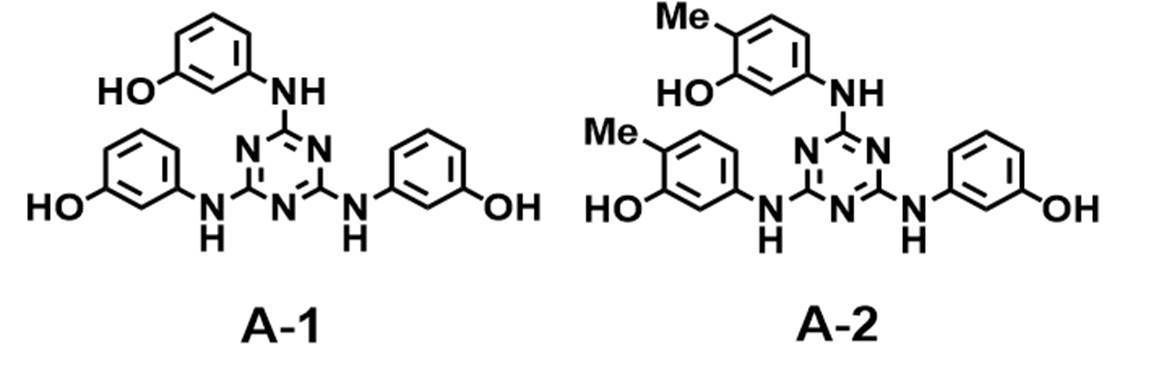
・A-3:MEH-7500(明和化成製、トリアジン骨格を有さないフェノール化合物)
<第1のエポキシ化合物>
以下に、実施例及び比較例で使用したエポキシ化合物を示す。
B-8の重量平均分子量は3000であり、B-9のnの値の平均値は10である。
以下に、実施例及び比較例で使用したエポキシ化合物を示す。
B-8の重量平均分子量は3000であり、B-9のnの値の平均値は10である。
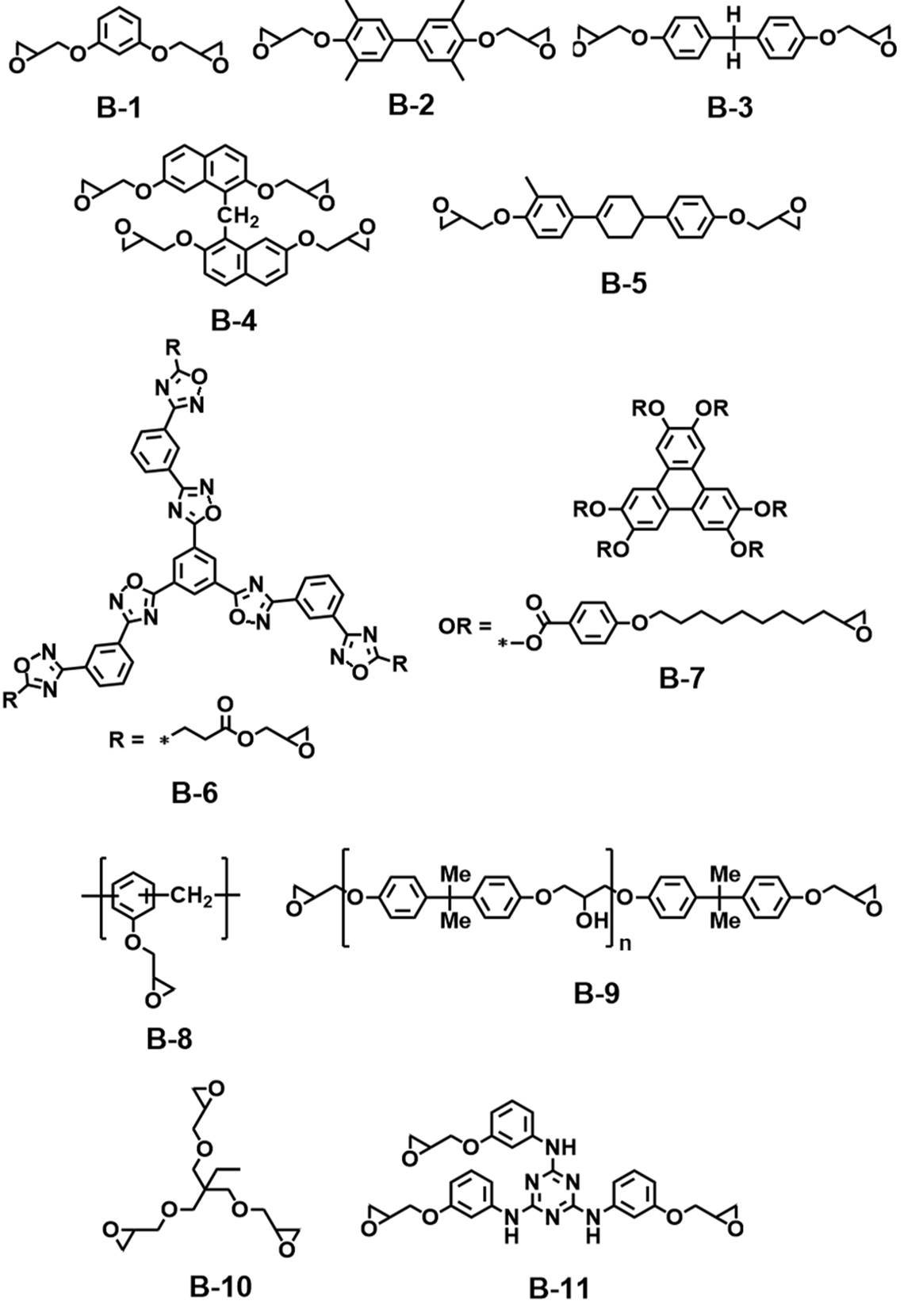
<第2のエポキシ化合物>
・LOTADER AX:LOTADER AX8900/エチレン-アクリル酸エステル-グリシジルメタクリレート共重合体/アルケマ社製
・A4100:モディパーA4100/主鎖にエチレン-メタクリル酸グリシジル共重合体骨格を有し、側鎖にポリスチレン骨格を有する樹脂/ガラス転移点0℃/日油社製
・SG-P3:テイサンレジンSG-P3/重量平均分子量850000/ガラス転移点12℃/ナガセケムテックス社製
・G2050M:マープルーフG2050M/重量平均分子量200000/ガラス転移点74℃/日油社製
・ポリマーA:重量平均分子量130000/メタアクリル酸メチルに基づく繰り返し単位、2-エチルヘキシルアクリレートに基づく繰り返し単位、グリシジルメタクリレートに基づく繰り返し単位を、それぞれ順に、37質量%、33質量%、30質量%含む/ガラス転移点10℃
・LOTADER AX:LOTADER AX8900/エチレン-アクリル酸エステル-グリシジルメタクリレート共重合体/アルケマ社製
・A4100:モディパーA4100/主鎖にエチレン-メタクリル酸グリシジル共重合体骨格を有し、側鎖にポリスチレン骨格を有する樹脂/ガラス転移点0℃/日油社製
・SG-P3:テイサンレジンSG-P3/重量平均分子量850000/ガラス転移点12℃/ナガセケムテックス社製
・G2050M:マープルーフG2050M/重量平均分子量200000/ガラス転移点74℃/日油社製
・ポリマーA:重量平均分子量130000/メタアクリル酸メチルに基づく繰り返し単位、2-エチルヘキシルアクリレートに基づく繰り返し単位、グリシジルメタクリレートに基づく繰り返し単位を、それぞれ順に、37質量%、33質量%、30質量%含む/ガラス転移点10℃
<無機物>
以下に、実施例及び比較例で使用した無機物を示す。
・HP-40:凝集状窒化ホウ素、平均粒径:40μm、水島合金鉄社製
・AA-3:酸化アルミニウム、平均粒径:3μm、住友化学社製
・AA-04:酸化アルミニウム、平均粒径:0.4μm、住友化学社製
以下に、実施例及び比較例で使用した無機物を示す。
・HP-40:凝集状窒化ホウ素、平均粒径:40μm、水島合金鉄社製
・AA-3:酸化アルミニウム、平均粒径:3μm、住友化学社製
・AA-04:酸化アルミニウム、平均粒径:0.4μm、住友化学社製
<硬化促進剤>
・C-1:TPP-MK(テトラフェニルホスホニウムテトラ-p-トリルボラート)
・C-2:トリスオルトトリルホスフィン
・C-3:トリフェニルホスフィン
・C-4:2PHZ-PW(2-フェニル-4,5-ジヒドロキシメチルイミダゾール)
・C-1:TPP-MK(テトラフェニルホスホニウムテトラ-p-トリルボラート)
・C-2:トリスオルトトリルホスフィン
・C-3:トリフェニルホスフィン
・C-4:2PHZ-PW(2-フェニル-4,5-ジヒドロキシメチルイミダゾール)
<溶媒>
溶媒として、シクロペンタノンを使用した。
溶媒として、シクロペンタノンを使用した。
<表面修飾剤>
表面修飾剤として、KBM-573(N-フェニル-3-アミノプロピルトリメトキシシラン、信越シリコーン社製)を使用した。
表面修飾剤として、KBM-573(N-フェニル-3-アミノプロピルトリメトキシシラン、信越シリコーン社製)を使用した。
〔組成物の調製〕
下記表1に示す組み合わせのエポキシ化合物(第1のエポキシ化合物及び第2のエポキシ化合物)とフェノール化合物とを、当量(エポキシ化合物のエポキシ基の数と、フェノール化合物の水酸基の数とが等しくなる量)で配合した混合体を調製した。
この際、最終的に得られる組成物において、第2のエポキシ化合物の含有量、及び、フェノール化合物と第1のエポキシ化合物の合計含有量が下記表1に示す通りの含有量になるように調整した。
(例えば、実施例1の組成物においては、第2のエポキシ化合物の含有量が組成物の全固形分に対して5質量%で、フェノール化合物と第1のエポキシ化合物の合計含有量が組成物の全固形分に対して29.9質量%で、かつ、第1のエポキシ化合物と第2のエポキシ化合物とフェノール化合物とが全体として当量になるような配合とした)
また、溶媒との混合状態で流通する原料を使用する場合は、その原料の固形分の含有量が下記表1に示す通りの含有量になるように調整した。
(例えば、実施例21の組成物において使用するSG-P3は、第2のエポキシ化合物(固形分)が溶媒に分散した状態で流通するが、実施例21の組成物では、第2のエポキシ化合物(固形分)そのものの含有量が組成物の全固形分に対して5質量%になるように調整した)
下記表1に示す組み合わせのエポキシ化合物(第1のエポキシ化合物及び第2のエポキシ化合物)とフェノール化合物とを、当量(エポキシ化合物のエポキシ基の数と、フェノール化合物の水酸基の数とが等しくなる量)で配合した混合体を調製した。
この際、最終的に得られる組成物において、第2のエポキシ化合物の含有量、及び、フェノール化合物と第1のエポキシ化合物の合計含有量が下記表1に示す通りの含有量になるように調整した。
(例えば、実施例1の組成物においては、第2のエポキシ化合物の含有量が組成物の全固形分に対して5質量%で、フェノール化合物と第1のエポキシ化合物の合計含有量が組成物の全固形分に対して29.9質量%で、かつ、第1のエポキシ化合物と第2のエポキシ化合物とフェノール化合物とが全体として当量になるような配合とした)
また、溶媒との混合状態で流通する原料を使用する場合は、その原料の固形分の含有量が下記表1に示す通りの含有量になるように調整した。
(例えば、実施例21の組成物において使用するSG-P3は、第2のエポキシ化合物(固形分)が溶媒に分散した状態で流通するが、実施例21の組成物では、第2のエポキシ化合物(固形分)そのものの含有量が組成物の全固形分に対して5質量%になるように調整した)
上記混合体、溶媒、所望に応じて使用する表面修飾剤、及び、硬化促進剤の順で混合した後、無機物を添加した。得られた混合物を自転公転ミキサー(THINKY社製、あわとり練太郎ARE-310)で5分間処理して、各実施例又は比較例の組成物(硬化性樹脂組成物)を得た。
ここで、溶媒の添加量は、組成物の固形分濃度が50~80質量%になる量とした。
なお、組成物の固形分濃度は、組成物の粘度がそれぞれ同程度になるように、上記範囲内で組成物ごとに調整した。
組成物中、第1のエポキシ化合物とフェノール化合物との合計含有量(上記混合体の含有量)は、組成物の全固形分に対して、表1中の「合計量(質量%)」欄に示す量になるようにした。
組成物中、硬化促進剤、表面修飾剤、無機窒化物、無機酸化物、及び、第2のエポキシ化合物の量は、それぞれ、組成物の全固形分に対して、表1中の各マスにおけるカッコ内に示す量(質量%)になるようにした。
なお、組成物の固形分濃度は、組成物の粘度がそれぞれ同程度になるように、上記範囲内で組成物ごとに調整した。
組成物中、第1のエポキシ化合物とフェノール化合物との合計含有量(上記混合体の含有量)は、組成物の全固形分に対して、表1中の「合計量(質量%)」欄に示す量になるようにした。
組成物中、硬化促進剤、表面修飾剤、無機窒化物、無機酸化物、及び、第2のエポキシ化合物の量は、それぞれ、組成物の全固形分に対して、表1中の各マスにおけるカッコ内に示す量(質量%)になるようにした。
[評価]
〔半硬化シート(半硬化膜)の作製〕
マイクロメーター付きアプリケーターを用いて、離型処理したポリエステルフィルム(PET756501リンテック社製、膜厚75μm)の離型面上に、調製した組成物を均一に塗布し、120℃で4分間乾燥して半硬化シート(半硬化膜)を作製した。
なお、組成物の塗布量は、後述の方法で得られる銅箔付きアルミベース基板中の熱伝導シートの平均膜厚は120μmになるように調整した。
〔半硬化シート(半硬化膜)の作製〕
マイクロメーター付きアプリケーターを用いて、離型処理したポリエステルフィルム(PET756501リンテック社製、膜厚75μm)の離型面上に、調製した組成物を均一に塗布し、120℃で4分間乾燥して半硬化シート(半硬化膜)を作製した。
なお、組成物の塗布量は、後述の方法で得られる銅箔付きアルミベース基板中の熱伝導シートの平均膜厚は120μmになるように調整した。
〔ピール強度の評価〕
ポリエステルフィルム付き半硬化シートからポリエステルフィルムを剥がし、得られた半硬化シートを20mm×60mmの短冊状に切り出し、被着体である電解銅箔(20mm×100mm、厚み:35μm)とアルミニウム板(30mm×60mm、厚み:1mm)の間に挟んだ。得られた積層体を、空気下で熱プレス処理(熱板温度180℃、圧力20MPaで5分間処理した後、熱板温度180℃、常圧下で90分間処理)することにより、熱伝導シートと被着体とが一体化した銅箔付きアルミベース基板を得た。
得られたサンプルの銅箔ピール強度を、デジタルフォースゲージ(ZTS-200N、株式会社イマダ製)と90度剥離試験治具(P90-200N-BB、株式会社イマダ製)を用いて、JIS C 6481に記載の常態での引きはがし強さの測定方法に従って測定した。ピール強度試験における銅箔の剥離は、銅箔付きアルミベース基板に対して90°の角度で、50mm/分の剥離速度で実施した。
ポリエステルフィルム付き半硬化シートからポリエステルフィルムを剥がし、得られた半硬化シートを20mm×60mmの短冊状に切り出し、被着体である電解銅箔(20mm×100mm、厚み:35μm)とアルミニウム板(30mm×60mm、厚み:1mm)の間に挟んだ。得られた積層体を、空気下で熱プレス処理(熱板温度180℃、圧力20MPaで5分間処理した後、熱板温度180℃、常圧下で90分間処理)することにより、熱伝導シートと被着体とが一体化した銅箔付きアルミベース基板を得た。
得られたサンプルの銅箔ピール強度を、デジタルフォースゲージ(ZTS-200N、株式会社イマダ製)と90度剥離試験治具(P90-200N-BB、株式会社イマダ製)を用いて、JIS C 6481に記載の常態での引きはがし強さの測定方法に従って測定した。ピール強度試験における銅箔の剥離は、銅箔付きアルミベース基板に対して90°の角度で、50mm/分の剥離速度で実施した。
測定された引きはがし強さ(ピール強度)を下記基準に照らして区分し、評価した。
A+:6N/cm以上
A:5N/cm以上6N/cm未満
B:4N/cm以上5N/cm未満
C:4N/cm未満
A+:6N/cm以上
A:5N/cm以上6N/cm未満
B:4N/cm以上5N/cm未満
C:4N/cm未満
[結果]
以下、表1を示す。
表1には、各実施例又は比較例における組成物の固形分の配合と試験結果とを示す。
以下、表1を示す。
表1には、各実施例又は比較例における組成物の固形分の配合と試験結果とを示す。
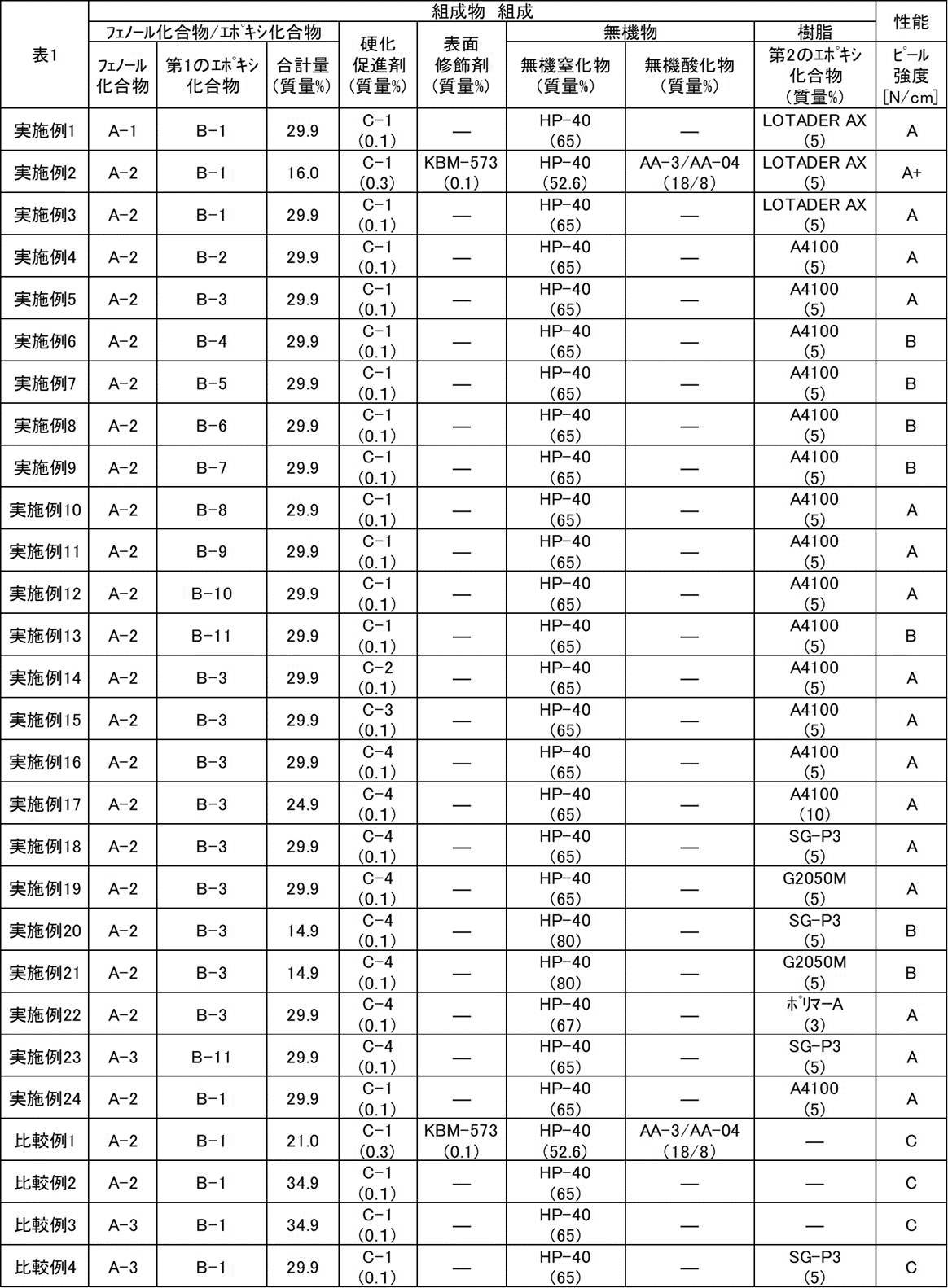
表に示す結果より、本発明の組成物を使用すれば本発明の効果を実現できることが確認された。
中でも、無機物が、窒化ホウ素と共に無機酸化物を含む場合、本発明の効果がより優れることが確認された(実施例2の結果等を参照)。
無機物が、平均粒径が20μm以上の無機物と、平均粒径が20μm未満の無機物との両方を含む場合、本発明の効果がより優れることが確認された(実施例2の結果等を参照)。
第1のエポキシ化合物が、ポリヒドロキシベンゼン型エポキシ化合物、ビフェニル骨格を有するエポキシ化合物、ビスフェノールF型エポキシ化合物、フェノールノボラック型エポキシ化合物、フェノキシ樹脂、又は、一般式(E2)で表されるエポキシ化合物を使用する場合、本発明の効果がより優れることが確認された(実施例4~13、24の結果の比較等を参照)。
組成物の全固形分に対する無機物の含有量が80質量%未満である場合、本発明の効果がより優れることが確認された(実施例18~21の結果の比較等を参照)。
[熱伝導率の確認]
また、本発明の組成物を用いて得られる熱伝導材料(熱伝導シート)について、下記に示す方法で熱伝導率を測定したところ、いずれの実施例の組成物を用いて作製した熱伝導材料(熱伝導シート)でも、熱伝導率が15W/m・K以上であることが確認された。これにより、本発明の組成物を用いて得られる熱伝導材料が良好な熱伝導性を示すことが確認された。
また、本発明の組成物を用いて得られる熱伝導材料(熱伝導シート)について、下記に示す方法で熱伝導率を測定したところ、いずれの実施例の組成物を用いて作製した熱伝導材料(熱伝導シート)でも、熱伝導率が15W/m・K以上であることが確認された。これにより、本発明の組成物を用いて得られる熱伝導材料が良好な熱伝導性を示すことが確認された。
〔測定手順〕
<熱伝導シートの作製>
上述の方法で得られた半硬化シートに離型処理したポリエステルフィルムを被せ、空気下で熱プレス(熱板温度180℃、圧力20MPaで5分間処理)した。その後、常圧下で180℃で90分加熱処理して樹脂シートを得た。樹脂シートの両面にあるポリエステルフィルムを剥がし、平均膜厚120μmの熱伝導性シート(熱伝導材料)を得た。
<熱伝導シートの作製>
上述の方法で得られた半硬化シートに離型処理したポリエステルフィルムを被せ、空気下で熱プレス(熱板温度180℃、圧力20MPaで5分間処理)した。その後、常圧下で180℃で90分加熱処理して樹脂シートを得た。樹脂シートの両面にあるポリエステルフィルムを剥がし、平均膜厚120μmの熱伝導性シート(熱伝導材料)を得た。
<評価方法>
得られた熱伝導シートについて、以下の方法で熱伝導率を測定した。
(1)NETZSCH社製の「LFA467」を用いて、レーザーフラッシュ法で熱伝導性シートの厚み方向の熱拡散率を測定した。
(2)メトラー・トレド社製の天秤「XS204」を用いて、熱伝導性シートの比重をアルキメデス法(「固体比重測定キット」使用)で測定した。
(3)セイコーインスツル社製の「DSC320/6200」を用い、10℃/分の昇温条件の下、25℃における熱伝導性シートの比熱を求めた。
(4)得られた熱拡散率に比重及び比熱を乗じて、熱伝導性シートの熱伝導率を算出した。
得られた熱伝導シートについて、以下の方法で熱伝導率を測定した。
(1)NETZSCH社製の「LFA467」を用いて、レーザーフラッシュ法で熱伝導性シートの厚み方向の熱拡散率を測定した。
(2)メトラー・トレド社製の天秤「XS204」を用いて、熱伝導性シートの比重をアルキメデス法(「固体比重測定キット」使用)で測定した。
(3)セイコーインスツル社製の「DSC320/6200」を用い、10℃/分の昇温条件の下、25℃における熱伝導性シートの比熱を求めた。
(4)得られた熱拡散率に比重及び比熱を乗じて、熱伝導性シートの熱伝導率を算出した。
Claims (10)
- フェノール化合物、第1のエポキシ化合物、第2のエポキシ化合物、及び、無機物を含む、硬化性樹脂組成物であって、
前記フェノール化合物がトリアジン骨格を有するフェノール化合物を含むこと、及び、前記第1のエポキシ化合物がトリアジン骨格を有するエポキシ化合物を含むこと、の少なくとも一方の要件を満たし、
前記第2のエポキシ化合物は、側鎖にエポキシ基を有するアクリル樹脂である、硬化性樹脂組成物。 - 前記無機物が、窒化ホウ素を含む、請求項1に記載の硬化性樹脂組成物。
- 前記無機物が、平均粒径が20μm以上である凝集状窒化ホウ素を含む、請求項1又は2に記載の硬化性樹脂組成物。
- 前記無機物が、無機酸化物を含む、請求項1~3のいずれか1項に記載の硬化性樹脂組成物。
- 前記無機物が、平均粒径が20μm以上の無機物である無機物Xと、平均粒径が20μm未満の無機物である無機物Yとの両方を含む、請求項1~4のいずれか1項に記載の硬化性樹脂組成物。
- 前記第1のエポキシ化合物が、ポリヒドロキシベンゼン型エポキシ化合物、ビフェニル骨格を有するエポキシ化合物、ビスフェノールF型エポキシ化合物、フェノールノボラック型エポキシ化合物、フェノキシ樹脂、及び、一般式(E2)で表されるエポキシ化合物からなる群から選択される1種以上のエポキシ化合物を含む、請求項1~5のいずれか1項に記載の硬化性樹脂組成物。
(V-)4-UC(-W)U (E2)
一般式(E2)中、Cは、炭素原子を表す。
Uは、3又は4の整数を表す。
Vは、エポキシ基を有さない置換基又は水素原子を表す。
Wは、エポキシ含有基を表す。
前記エポキシ含有基は、エポキシ基そのものである基、又は、エポキシ基を一部分に含む一価の基である。
一般式(E2)中に複数存在するWは、それぞれ同一でも異なっていてもよい。 - 更に、硬化促進剤を含む、請求項1~6のいずれか1項に記載の硬化性樹脂組成物。
- 請求項1~7のいずれか1項に記載の硬化性樹脂組成物を硬化して得られる、熱伝導材料。
- 請求項8に記載の熱伝導材料からなる、熱伝導シート。
- デバイスと、前記デバイス上に配置された請求項9に記載の熱伝導シートを含む熱伝導層とを有する、熱伝導層付きデバイス。
Priority Applications (1)
| Application Number | Priority Date | Filing Date | Title |
|---|---|---|---|
| JP2022547651A JPWO2022054874A1 (ja) | 2020-09-11 | 2021-09-09 |
Applications Claiming Priority (2)
| Application Number | Priority Date | Filing Date | Title |
|---|---|---|---|
| JP2020-152880 | 2020-09-11 | ||
| JP2020152880 | 2020-09-11 |
Publications (1)
| Publication Number | Publication Date |
|---|---|
| WO2022054874A1 true WO2022054874A1 (ja) | 2022-03-17 |
Family
ID=80632140
Family Applications (1)
| Application Number | Title | Priority Date | Filing Date |
|---|---|---|---|
| PCT/JP2021/033173 Ceased WO2022054874A1 (ja) | 2020-09-11 | 2021-09-09 | 硬化性樹脂組成物、熱伝導材料、熱伝導シート、熱伝導層付きデバイス |
Country Status (2)
| Country | Link |
|---|---|
| JP (1) | JPWO2022054874A1 (ja) |
| WO (1) | WO2022054874A1 (ja) |
Cited By (1)
| Publication number | Priority date | Publication date | Assignee | Title |
|---|---|---|---|---|
| CN115073818A (zh) * | 2022-06-17 | 2022-09-20 | 山东海科创新研究院有限公司 | 一种导热填料、高导热聚醚砜复合材料及其制备方法 |
Citations (8)
| Publication number | Priority date | Publication date | Assignee | Title |
|---|---|---|---|---|
| JP2004214288A (ja) * | 2002-12-27 | 2004-07-29 | Lintec Corp | チップ用保護膜形成用シート |
| JP2008277759A (ja) * | 2007-04-04 | 2008-11-13 | Sekisui Chem Co Ltd | 絶縁性熱伝導シート |
| JP2009227947A (ja) * | 2008-03-25 | 2009-10-08 | Mitsubishi Electric Corp | 熱伝導性樹脂組成物、熱伝導性樹脂シート及びパワーモジュール |
| WO2013031844A1 (ja) * | 2011-08-30 | 2013-03-07 | 日立化成株式会社 | 液状インキ |
| JP2015061924A (ja) * | 2014-12-02 | 2015-04-02 | 日立化成株式会社 | 熱伝導シート、熱伝導シートの製造方法、及び熱伝導シートを用いた放熱装置 |
| WO2017195902A1 (ja) * | 2016-05-13 | 2017-11-16 | 日立化成株式会社 | 樹脂組成物、プリプレグ、樹脂付き金属箔、積層板、プリント配線板及び樹脂組成物の製造方法 |
| WO2020153205A1 (ja) * | 2019-01-23 | 2020-07-30 | 富士フイルム株式会社 | 組成物、熱伝導シート、熱伝導層付きデバイス |
| WO2020158259A1 (ja) * | 2019-02-01 | 2020-08-06 | 富士フイルム株式会社 | 熱伝導材料形成用組成物、熱伝導材料 |
-
2021
- 2021-09-09 JP JP2022547651A patent/JPWO2022054874A1/ja active Pending
- 2021-09-09 WO PCT/JP2021/033173 patent/WO2022054874A1/ja not_active Ceased
Patent Citations (8)
| Publication number | Priority date | Publication date | Assignee | Title |
|---|---|---|---|---|
| JP2004214288A (ja) * | 2002-12-27 | 2004-07-29 | Lintec Corp | チップ用保護膜形成用シート |
| JP2008277759A (ja) * | 2007-04-04 | 2008-11-13 | Sekisui Chem Co Ltd | 絶縁性熱伝導シート |
| JP2009227947A (ja) * | 2008-03-25 | 2009-10-08 | Mitsubishi Electric Corp | 熱伝導性樹脂組成物、熱伝導性樹脂シート及びパワーモジュール |
| WO2013031844A1 (ja) * | 2011-08-30 | 2013-03-07 | 日立化成株式会社 | 液状インキ |
| JP2015061924A (ja) * | 2014-12-02 | 2015-04-02 | 日立化成株式会社 | 熱伝導シート、熱伝導シートの製造方法、及び熱伝導シートを用いた放熱装置 |
| WO2017195902A1 (ja) * | 2016-05-13 | 2017-11-16 | 日立化成株式会社 | 樹脂組成物、プリプレグ、樹脂付き金属箔、積層板、プリント配線板及び樹脂組成物の製造方法 |
| WO2020153205A1 (ja) * | 2019-01-23 | 2020-07-30 | 富士フイルム株式会社 | 組成物、熱伝導シート、熱伝導層付きデバイス |
| WO2020158259A1 (ja) * | 2019-02-01 | 2020-08-06 | 富士フイルム株式会社 | 熱伝導材料形成用組成物、熱伝導材料 |
Cited By (2)
| Publication number | Priority date | Publication date | Assignee | Title |
|---|---|---|---|---|
| CN115073818A (zh) * | 2022-06-17 | 2022-09-20 | 山东海科创新研究院有限公司 | 一种导热填料、高导热聚醚砜复合材料及其制备方法 |
| CN115073818B (zh) * | 2022-06-17 | 2023-12-26 | 山东海科创新研究院有限公司 | 一种导热填料、高导热聚醚砜复合材料及其制备方法 |
Also Published As
| Publication number | Publication date |
|---|---|
| JPWO2022054874A1 (ja) | 2022-03-17 |
Similar Documents
| Publication | Publication Date | Title |
|---|---|---|
| JP7528204B2 (ja) | 変性窒化ホウ素粒子の製造方法、変性窒化ホウ素粒子、熱伝導材料形成用組成物、熱伝導材料、熱伝導シート、熱伝導層付きデバイス | |
| WO2022070718A1 (ja) | 表面修飾窒化ホウ素粒子、表面修飾窒化ホウ素粒子の製造方法、熱伝導材料形成用組成物、熱伝導材料、熱伝導シート、熱伝導層付きデバイス | |
| WO2021059806A1 (ja) | 熱伝導材料形成用組成物、熱伝導材料、熱伝導シート、熱伝導層付きデバイス | |
| JP7773996B2 (ja) | 硬化性組成物、熱伝導材料、熱伝導シート、熱伝導層付きデバイス | |
| KR102579529B1 (ko) | 조성물, 열전도 시트, 열전도층 부착 디바이스 | |
| US20210403786A1 (en) | Composition and thermally conductive material | |
| US12391859B2 (en) | Composition for forming thermally conductive material, and thermally conductive material | |
| US12448555B2 (en) | Composition for forming thermally conductive material, thermally conductive material, and surface-modified inorganic substance | |
| WO2022054874A1 (ja) | 硬化性樹脂組成物、熱伝導材料、熱伝導シート、熱伝導層付きデバイス | |
| JP2023055252A (ja) | 硬化性組成物、複合粒子の製造方法、熱伝導材料、熱伝導シート、熱伝導層付きデバイス | |
| JP7440626B2 (ja) | 硬化性組成物、熱伝導材料、熱伝導シート、熱伝導層付きデバイス、化合物 | |
| JP7828288B2 (ja) | 硬化性組成物、熱伝導材料、熱伝導シート、熱伝導層付きデバイス | |
| JP7367063B2 (ja) | 窒化ホウ素粒子、熱伝導材料形成用組成物、熱伝導材料、熱伝導シート、熱伝導層付きデバイス | |
| WO2022153807A1 (ja) | 硬化性組成物、熱伝導材料、熱伝導シート、熱伝導層付きデバイス | |
| JP7183307B2 (ja) | 熱伝導材料形成用組成物、熱伝導材料、熱伝導シート、熱伝導層付きデバイス | |
| WO2021166541A1 (ja) | 熱伝導材料形成用組成物、熱伝導シート、熱伝導性多層シート、及び、熱伝導層付きデバイス | |
| US20230099722A1 (en) | Composition for forming thermally conductive material, thermally conductive material, thermally conductive sheet, and device with thermally conductive layer | |
| JP2021054922A (ja) | 熱伝導材料形成用組成物、熱伝導材料、熱伝導シート、熱伝導層付きデバイス | |
| JP2021098800A (ja) | 熱伝導材料形成用組成物、熱伝導材料、熱伝導シート、熱伝導層付きデバイス、表面修飾窒化ホウ素 | |
| JP2022098178A (ja) | 熱伝導材料形成用組成物、熱伝導材料、熱伝導シート、熱伝導層付きデバイス | |
| JP7324283B2 (ja) | 熱伝導材料形成用組成物、熱伝導材料、熱伝導シート、熱伝導層付きデバイス | |
| WO2022137994A1 (ja) | 熱伝導層形成用シート、熱伝導層形成用シートの製造方法 | |
| JP2022061152A (ja) | 熱伝導材料形成用組成物、硬化物、熱伝導シート、熱伝導層付きデバイス | |
| CN115066465A (zh) | 组合物、导热材料、导热片及带导热层的器件 |
Legal Events
| Date | Code | Title | Description |
|---|---|---|---|
| 121 | Ep: the epo has been informed by wipo that ep was designated in this application |
Ref document number: 21866832 Country of ref document: EP Kind code of ref document: A1 |
|
| ENP | Entry into the national phase |
Ref document number: 2022547651 Country of ref document: JP Kind code of ref document: A |
|
| NENP | Non-entry into the national phase |
Ref country code: DE |
|
| 122 | Ep: pct application non-entry in european phase |
Ref document number: 21866832 Country of ref document: EP Kind code of ref document: A1 |