WO2022054374A1 - 感光性転写材料、樹脂パターンの製造方法、回路配線の製造方法及び電子機器の製造方法 - Google Patents
感光性転写材料、樹脂パターンの製造方法、回路配線の製造方法及び電子機器の製造方法 Download PDFInfo
- Publication number
- WO2022054374A1 WO2022054374A1 PCT/JP2021/024174 JP2021024174W WO2022054374A1 WO 2022054374 A1 WO2022054374 A1 WO 2022054374A1 JP 2021024174 W JP2021024174 W JP 2021024174W WO 2022054374 A1 WO2022054374 A1 WO 2022054374A1
- Authority
- WO
- WIPO (PCT)
- Prior art keywords
- resin layer
- mass
- photosensitive resin
- meth
- compound
- Prior art date
- Legal status (The legal status is an assumption and is not a legal conclusion. Google has not performed a legal analysis and makes no representation as to the accuracy of the status listed.)
- Ceased
Links
Images


Classifications
-
- B—PERFORMING OPERATIONS; TRANSPORTING
- B32—LAYERED PRODUCTS
- B32B—LAYERED PRODUCTS, i.e. PRODUCTS BUILT-UP OF STRATA OF FLAT OR NON-FLAT, e.g. CELLULAR OR HONEYCOMB, FORM
- B32B7/00—Layered products characterised by the relation between layers; Layered products characterised by the relative orientation of features between layers, or by the relative values of a measurable parameter between layers, i.e. products comprising layers having different physical, chemical or physicochemical properties; Layered products characterised by the interconnection of layers
- B32B7/02—Physical, chemical or physicochemical properties
- B32B7/023—Optical properties
-
- G—PHYSICS
- G03—PHOTOGRAPHY; CINEMATOGRAPHY; ANALOGOUS TECHNIQUES USING WAVES OTHER THAN OPTICAL WAVES; ELECTROGRAPHY; HOLOGRAPHY
- G03F—PHOTOMECHANICAL PRODUCTION OF TEXTURED OR PATTERNED SURFACES, e.g. FOR PRINTING, FOR PROCESSING OF SEMICONDUCTOR DEVICES; MATERIALS THEREFOR; ORIGINALS THEREFOR; APPARATUS SPECIALLY ADAPTED THEREFOR
- G03F7/00—Photomechanical, e.g. photolithographic, production of textured or patterned surfaces, e.g. printing surfaces; Materials therefor, e.g. comprising photoresists; Apparatus specially adapted therefor
- G03F7/004—Photosensitive materials
-
- G—PHYSICS
- G03—PHOTOGRAPHY; CINEMATOGRAPHY; ANALOGOUS TECHNIQUES USING WAVES OTHER THAN OPTICAL WAVES; ELECTROGRAPHY; HOLOGRAPHY
- G03F—PHOTOMECHANICAL PRODUCTION OF TEXTURED OR PATTERNED SURFACES, e.g. FOR PRINTING, FOR PROCESSING OF SEMICONDUCTOR DEVICES; MATERIALS THEREFOR; ORIGINALS THEREFOR; APPARATUS SPECIALLY ADAPTED THEREFOR
- G03F7/00—Photomechanical, e.g. photolithographic, production of textured or patterned surfaces, e.g. printing surfaces; Materials therefor, e.g. comprising photoresists; Apparatus specially adapted therefor
- G03F7/004—Photosensitive materials
- G03F7/09—Photosensitive materials characterised by structural details, e.g. supports, auxiliary layers
-
- G—PHYSICS
- G03—PHOTOGRAPHY; CINEMATOGRAPHY; ANALOGOUS TECHNIQUES USING WAVES OTHER THAN OPTICAL WAVES; ELECTROGRAPHY; HOLOGRAPHY
- G03F—PHOTOMECHANICAL PRODUCTION OF TEXTURED OR PATTERNED SURFACES, e.g. FOR PRINTING, FOR PROCESSING OF SEMICONDUCTOR DEVICES; MATERIALS THEREFOR; ORIGINALS THEREFOR; APPARATUS SPECIALLY ADAPTED THEREFOR
- G03F7/00—Photomechanical, e.g. photolithographic, production of textured or patterned surfaces, e.g. printing surfaces; Materials therefor, e.g. comprising photoresists; Apparatus specially adapted therefor
- G03F7/004—Photosensitive materials
- G03F7/09—Photosensitive materials characterised by structural details, e.g. supports, auxiliary layers
- G03F7/11—Photosensitive materials characterised by structural details, e.g. supports, auxiliary layers having cover layers or intermediate layers, e.g. subbing layers
-
- G—PHYSICS
- G03—PHOTOGRAPHY; CINEMATOGRAPHY; ANALOGOUS TECHNIQUES USING WAVES OTHER THAN OPTICAL WAVES; ELECTROGRAPHY; HOLOGRAPHY
- G03F—PHOTOMECHANICAL PRODUCTION OF TEXTURED OR PATTERNED SURFACES, e.g. FOR PRINTING, FOR PROCESSING OF SEMICONDUCTOR DEVICES; MATERIALS THEREFOR; ORIGINALS THEREFOR; APPARATUS SPECIALLY ADAPTED THEREFOR
- G03F7/00—Photomechanical, e.g. photolithographic, production of textured or patterned surfaces, e.g. printing surfaces; Materials therefor, e.g. comprising photoresists; Apparatus specially adapted therefor
- G03F7/20—Exposure; Apparatus therefor
-
- G—PHYSICS
- G06—COMPUTING OR CALCULATING; COUNTING
- G06F—ELECTRIC DIGITAL DATA PROCESSING
- G06F3/00—Input arrangements for transferring data to be processed into a form capable of being handled by the computer; Output arrangements for transferring data from processing unit to output unit, e.g. interface arrangements
- G06F3/01—Input arrangements or combined input and output arrangements for interaction between user and computer
- G06F3/03—Arrangements for converting the position or the displacement of a member into a coded form
- G06F3/041—Digitisers, e.g. for touch screens or touch pads, characterised by the transducing means
-
- H—ELECTRICITY
- H05—ELECTRIC TECHNIQUES NOT OTHERWISE PROVIDED FOR
- H05K—PRINTED CIRCUITS; CASINGS OR CONSTRUCTIONAL DETAILS OF ELECTRIC APPARATUS; MANUFACTURE OF ASSEMBLAGES OF ELECTRICAL COMPONENTS
- H05K3/00—Apparatus or processes for manufacturing printed circuits
- H05K3/02—Apparatus or processes for manufacturing printed circuits in which the conductive material is applied to the surface of the insulating support and is thereafter removed from such areas of the surface which are not intended for current conducting or shielding
- H05K3/06—Apparatus or processes for manufacturing printed circuits in which the conductive material is applied to the surface of the insulating support and is thereafter removed from such areas of the surface which are not intended for current conducting or shielding the conductive material being removed chemically or electrolytically, e.g. by photo-etch process
Definitions
- the present disclosure relates to a photosensitive transfer material, a method for manufacturing a resin pattern, a method for manufacturing a circuit wiring, and a method for manufacturing an electronic device.
- Photosensitive transfer materials containing a photosensitive resin layer are widely used for forming various patterns by photolithography.
- a resin is produced by exposing and developing a photosensitive resin layer transferred onto the substrate by bonding the photosensitive transfer material and the substrate.
- a pattern can be formed.
- the resin pattern is used, for example, as a permanent film or a protective film for etching.
- Patent Document 1 includes a temporary support, a curable resin layer, and a protective film in this order, and the oxygen permeability coefficient of the protective film is 100 cm 3.25 ⁇ m / m 2 .
- a transfer film having a surface roughness Ra of 24 hours atm or more and a surface roughness Ra of the surface of the protective film on the curable resin layer side is 5 to 60 nm is disclosed.
- defects for example, morphological defects
- a resin pattern having a high-resolution line width such as 10 ⁇ m or less
- an increase in defects in the resin pattern is caused by a break in the circuit wiring (hereinafter, may be referred to as “open”) and a short circuit (hereinafter, “short””. In some cases.) May be invited.
- a temporary support having a second surface S2 on the opposite side of the first surface S1 and the first surface S1 and the temporary support on the second surface S2 of the temporary support.
- a photosensitive resin layer having a second surface P2 on the opposite side of the first surface P1 facing and the first surface P1 and the photosensitive resin on the second surface P2 of the photosensitive resin layer. Includes a first surface C1 facing the layer and a protective film having a second surface C2 on the opposite side of the first surface C1, and the arithmetic average roughness of the second surface P2 of the photosensitive resin layer.
- a photosensitive transfer material having Ra of 20 nm or less.
- ⁇ 2> The photosensitive transfer material according to ⁇ 1>, wherein the minimum resolution of the photosensitive resin layer is 10 ⁇ m or less.
- ⁇ 3> The photosensitive transfer material according to ⁇ 1> or ⁇ 2>, wherein the arithmetic average roughness Ra of the first surface C1 of the protective film is 10 nm or less.
- ⁇ 4> The photosensitive transfer material according to any one of ⁇ 1> to ⁇ 3>, wherein the temporary support has a thickness of 20 ⁇ m or less.
- ⁇ 5> The photosensitive transfer material according to any one of ⁇ 1> to ⁇ 4>, wherein the thickness of the photosensitive resin layer is 10 ⁇ m or less.
- ⁇ 6> The photosensitive transfer material according to any one of ⁇ 1> to ⁇ 5>, further comprising an intermediate layer between the temporary support and the photosensitive resin layer.
- ⁇ 7> The photosensitive transfer material according to any one of ⁇ 1> to ⁇ 6>, wherein the haze of the temporary support is less than 1.0%.
- ⁇ 8> The photosensitive transfer material according to any one of ⁇ 1> to ⁇ 7>, wherein the temporary support has a peeling force of 0.5 mN / mm or more.
- ⁇ 9> The photosensitive transfer material according to any one of ⁇ 1> to ⁇ 8>, wherein the arithmetic average roughness Ra of the first surface S1 of the temporary support is 50 nm or less.
- ⁇ 10> The photosensitive transfer material according to any one of ⁇ 1> to ⁇ 9>, wherein the arithmetic average roughness Ra of the second surface C2 of the protective film is 50 nm or less.
- the photosensitive transfer material according to any one of ⁇ 1> to ⁇ 10> is brought into contact with the substrate, and the photosensitive resin layer and the temporary support are arranged in this order on the substrate.
- a method for producing a resin pattern which comprises pattern exposure of the photosensitive resin layer and development of the exposed photosensitive resin layer to form a resin pattern.
- the photosensitive transfer material according to any one of ⁇ 1> to ⁇ 10> is brought into contact with a substrate containing a conductive layer, and a photosensitive resin layer and a temporary support are placed on the substrate in this order.
- the photosensitive resin layer is exposed to a pattern, the exposed photosensitive resin layer is developed to form a resin pattern, and the conductive layer is not covered by the resin pattern.
- the photosensitive transfer material according to any one of ⁇ 1> to ⁇ 10> is brought into contact with the substrate, and the photosensitive resin layer and the temporary support are arranged in this order on the substrate.
- a method for manufacturing an electronic device comprising: pattern-exposing the photosensitive resin layer, and developing the exposed photosensitive resin layer to form a resin pattern used as a permanent film.
- a photosensitive transfer material that forms a resin pattern with few defects.
- a method for producing a resin pattern having few defects there is provided a method of manufacturing a circuit wiring having few defects.
- a method of manufacturing an electronic device including a resin pattern having few defects there is provided.
- FIG. 1 is a schematic side view showing the configuration of a photosensitive transfer material according to an embodiment of the present disclosure.
- FIG. 2 is a schematic exploded side view of the photosensitive transfer material shown in FIG.
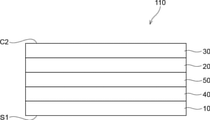
- FIG. 3 is a schematic side view showing the configuration of the photosensitive transfer material according to another embodiment of the present disclosure.
- the numerical range indicated by using "-" indicates a range including the numerical values before and after "-" as the lower limit value and the upper limit value, respectively.
- the upper limit value or the lower limit value described in one numerical range may be replaced with the upper limit value or the lower limit value of the numerical range described in another stepwise description.
- the upper limit value or the lower limit value described in a certain numerical range may be replaced with the value shown in the examples.
- process is included in this term not only as an independent process but also as long as the intended purpose of the process is achieved even if it cannot be clearly distinguished from other processes. ..
- the amount of the above-mentioned components in the composition is the total amount of the plurality of the above-mentioned substances present in the composition unless otherwise specified. Means.
- ordinal numbers are terms used to distinguish the components, and do not limit the number of components and the superiority or inferiority of the components.
- a group (atomic group) not described as substituted or unsubstituted includes a group having a substituent and a group having no substituent.
- the notation "alkyl group” includes an alkyl group having a substituent (substituted alkyl group) and an alkyl group having no substituent (unsubstituted alkyl group).
- the chemical structural formula may be represented by a simplified structural formula omitting a hydrogen atom.
- (meth) acrylic acid means acrylic acid or methacrylic acid.
- (meth) acrylate means acrylate or methacrylate.
- the "(meth) acryloyl group” means an acryloyl group or a methacryloyl group.
- exposure includes not only exposure using light but also drawing using particle beams such as electron beam and ion beam, unless otherwise specified.
- the light used for exposure include the emission line spectrum of a mercury lamp, far ultraviolet rays and extreme ultraviolet rays (EUV (Extreme ultraviolet) light) typified by an excima laser, and active rays (active energy rays) such as X-rays.
- EUV Extrem ultraviolet rays
- active energy rays active energy rays
- the weight average molecular weight (Mw) and the number average molecular weight (Mn) are columns of TSKgel GMHxL (Tosoh Corporation), TSKgel G4000HxL (Tosoh Corporation) and TSKgel G2000HxL (Tosoh Corporation) unless otherwise specified. It is a molecular weight converted by detecting a compound in tetrahydrofuran (THF) with a differential refractometer using a gel permeation chromatography (GPC) analyzer using the above and using polystyrene as a standard substance.
- GPC gel permeation chromatography
- solid content means a component excluding a solvent.
- references to "one embodiment” or “an embodiment” is a technical element described in connection with that embodiment (eg, a particular feature, structure or characteristic; hereinafter the same in this paragraph. ) Means be included in at least one embodiment of the present disclosure.
- the appearance of the expression “one embodiment” or “a certain embodiment” does not necessarily mean all the same embodiments. Any embodiment may be combined with at least one other embodiment in a manner consistent with the purposes of the present disclosure.
- the photosensitive transfer material according to the embodiment of the present disclosure includes a temporary support having a first surface S1 and a second surface S2 on the opposite side of the first surface S1 and a second surface of the temporary support.
- a photosensitive resin layer having a first surface P1 facing the temporary support and a second surface P2 on the opposite side of the first surface P1 on the surface S2, and the second surface of the photosensitive resin layer.
- a protective film having a first surface C1 facing the photosensitive resin layer and a second surface C2 on the opposite side of the first surface C1 is included on the surface P2 of the above-mentioned photosensitive resin layer.
- the arithmetic average roughness Ra of the second surface P2 is 20 nm or less. According to the above-described embodiment, there is provided a photosensitive transfer material that forms a resin pattern with few defects.
- the resin pattern is formed through bonding of the photosensitive transfer material and a substrate.
- the inventors of the present disclosure impede the exposure of the photosensitive resin layer due to the bubbles generated between the photosensitive transfer material and the substrate due to the bonding between the photosensitive transfer material and the substrate, resulting in defects in the resin pattern. Clarified. The higher the resolution of the resin pattern, the more the effect cannot be ignored.
- the inventors of the present disclosure examined the relationship between the characteristics of the photosensitive transfer material and the generation of bubbles in the bonding between the photosensitive transfer material and the substrate, and as a result, the surface of the photosensitive resin layer in contact with the substrate It was found that the generation of bubbles can be suppressed by increasing the smoothness. It was found that the generation of air bubbles between the photosensitive transfer material and the substrate can be suppressed by setting the arithmetic average roughness Ra of the second surface P2 of the photosensitive resin layer in contact with the substrate to 20 nm or less. Therefore, according to one embodiment of the present disclosure, there is provided a photosensitive transfer material that forms a resin pattern with few defects.
- FIG. 1 is a schematic side view showing the configuration of a photosensitive transfer material according to an embodiment of the present disclosure.
- FIG. 2 is a schematic exploded side view of the photosensitive transfer material shown in FIG.
- FIG. 3 is a schematic side view showing the configuration of the photosensitive transfer material according to another embodiment of the present disclosure.
- the photosensitive transfer material 100 shown in FIGS. 1 and 2 includes a temporary support 10, a photosensitive resin layer 20, and a protective film 30 in this order.
- the temporary support 10 has a second surface S2 on the opposite side of the first surface S1 and the first surface S1.
- the photosensitive resin layer 20 is arranged on the second surface S2 of the temporary support 10.
- the photosensitive resin layer 20 has a first surface P1 facing the temporary support 10 and a second surface P2 on the opposite side of the first surface P1.
- the protective film 30 is arranged on the second surface P2 of the photosensitive resin layer 20.
- the protective film 30 has a first surface C1 facing the photosensitive resin layer 20 and a second surface C2 on the opposite side of the first surface C1.
- the photosensitive transfer material 110 shown in FIG. 3 includes a temporary support 10, a thermoplastic resin layer 40, a water-soluble resin layer 50, a photosensitive resin layer 20, and a protective film 30 in this order.
- the thermoplastic resin layer 40 and the water-soluble resin layer 50 are arranged between the temporary support 10 and the photosensitive resin layer 20.
- the thermoplastic resin layer 40 and the water-soluble resin layer 50 are intermediate layers described later.
- the water-soluble resin layer 50 is a water-soluble layer described later.
- the photosensitive transfer material includes a temporary support having a first surface S1 and a second surface S2 on the opposite side of the first surface S1.
- the temporary support supports at least the photosensitive resin layer.
- the temporary support is a member that can be peeled off from an adjacent layer (for example, a photosensitive resin layer).
- the second surface S2 of the temporary support faces the photosensitive resin layer.
- the arithmetic average roughness Ra of the first surface S1 of the temporary support is preferably 50 nm or less, more preferably 30 nm or less, and particularly preferably 10 nm or less.
- the arithmetic mean roughness Ra of the first surface S1 of the temporary support becomes smaller, the light scattered by the temporary support is reduced and the resolution is improved. Further, in the exposure of the photosensitive resin layer via the temporary support, for example, the bubbles generated between the temporary support and the photomask are reduced, and the defects of the resin pattern are reduced.
- the arithmetic average roughness Ra of the second surface S2 of the temporary support is preferably 50 nm or less, more preferably 30 nm or less, and particularly preferably 10 nm or less. As the arithmetic mean roughness Ra of the second surface S2 of the temporary support becomes smaller, the light scattered by the temporary support is reduced and the resolution is improved.
- the arithmetic mean roughness Ra is measured by the following method.
- a three-dimensional optical profiler (New View7300, Zygo) is used to obtain the surface profile of the target surface.
- the measurement and analysis software "Microscope Application” of "MetroPro ver 8.3.2” is used.
- the "Surface Map” screen is displayed by the above software, and the histogram data is obtained in the "Surface Map” screen. From the obtained histogram data, the arithmetic mean roughness Ra of the target surface is calculated.
- the arithmetic mean roughness Ra of the target surface is measured after the target surface is exposed by peeling of the other layer.
- the temporary support preferably has light transmission.
- “having light transmittance” means that the transmittance at the wavelength used for pattern exposure is 50% or more.
- the transmittance of the temporary support at the wavelength used for pattern exposure (more preferably the wavelength of 365 nm) is preferably 60% or more, preferably 70% or more. Is more preferable.
- the temporary support is preferably highly transparent from the viewpoint that the pattern can be exposed via the temporary support, and the transmittance at 365 nm is preferably 60% or more, more preferably 70% or more.
- Transmittance is the ratio of the intensity of light that has passed through an object (emitted light) to the intensity of light that is perpendicularly incident on the main surface of the object (incident light).
- the transmittance is measured using a known spectroscope (for example, "MCPD Series", Otsuka Electronics Co., Ltd.).
- the haze of the temporary support is preferably less than 1.0%, more preferably less than 0.5%, and particularly preferably less than 0.3%. From the viewpoint of pattern formation during pattern exposure via the temporary support and transparency of the temporary support, it is preferable that the haze of the temporary support is small. Specifically, the haze value of the temporary support is preferably 2% or less, more preferably 0.5% or less, still more preferably 0.1% or less. The lower limit of the haze of the temporary support is not limited. The haze of the temporary support may be greater than 0% or greater than or equal to 0.1%.
- haze is measured as total light haze using a haze meter (for example, NDH2000, Nippon Denshoku Industries Co., Ltd.).
- the peeling force of the temporary support is preferably 0.5 mN / mm, preferably 0.5 mN / mm to 2.0 mN, because it is stronger than the peeling force of the protective film to be peeled off first and needs to be peeled off after laminating. It is more preferably / mm, and particularly preferably 0.7 mN / mm to 1.0 mN / mm.
- the peeling force of the temporary support is not limited to the above-mentioned numerical range because it is also caused by the peeling force of the protective film.
- the peeling force of the temporary support is measured by the following method.
- the photosensitive transfer material from which the protective film has been peeled off is laminated on a copper substrate under laminating conditions of a laminating roll temperature of 100 ° C., a linear pressure of 0.6 MPa, and a linear velocity of 1.0 m / min (laminating speed).
- a tape PINTACK, Nitto Denko KK
- the test piece is cut to a size of 100 mm ⁇ 40 mm to prepare a test piece.
- the surface of the test piece on the copper substrate side is fixed on the sample table.
- the tape is pulled in the direction of 180 degrees at 5.5 mm / sec, and the tensile strength (unit: mN / mm) of the temporary support is measured. The measured value is adopted as the peeling force of the temporary support.
- the thickness of the temporary support is not limited.
- the thickness of the temporary support may be determined depending on the material from the viewpoints of strength as a support, flexibility required for bonding to a substrate, and light transmission required for exposure. In the exposure of the photosensitive resin layer via the temporary support, the resolution is improved as the thickness of the temporary support becomes smaller.
- the thickness of the temporary support is preferably 100 ⁇ m or less, more preferably 50 ⁇ m or less, further preferably 20 ⁇ m or less, and particularly preferably 16 ⁇ m or less.
- the thickness of the temporary support is preferably 5 ⁇ m to 100 ⁇ m, more preferably 10 ⁇ m to 50 ⁇ m, and even more preferably 10 ⁇ m to 20 ⁇ m. It is particularly preferably 10 ⁇ m to 16 ⁇ m.
- the thickness of the temporary support is measured using a contact type film thickness meter (Tokyo Seimitsu Co., Ltd., E-ST-100).
- the layer structure of the temporary support is not limited.
- the temporary support may be a temporary support having a single-layer structure or a multi-layer structure.
- Examples of the temporary support having a single-layer structure include a glass substrate, a resin film, and paper.
- a resin film is preferable from the viewpoint of strength, flexibility and light transmission.
- Examples of the resin film include polyethylene terephthalate (PET) film, cellulose triacetate film, polystyrene film and polycarbonate film. Among the above, PET film is preferable, and biaxially stretched PET film is more preferable.
- Examples of the method for producing a resin film include an extrusion molding method.
- Examples of the temporary support having a multi-layer structure include a temporary support including a base material and a particle-containing layer.
- the temporary support having a multi-layer structure may include a layer other than the above-mentioned particle-containing layer (for example, an adhesive layer).
- the temporary support is referred to as a particle-containing layer (hereinafter referred to as "first particle-containing layer”) arranged as the outermost layer of the temporary support in the stacking direction from the temporary support to the photosensitive resin layer.
- first particle-containing layer arranged as the outermost layer of the temporary support in the stacking direction from the temporary support to the photosensitive resin layer.
- the temporary support preferably includes a base material and a particle-containing layer (first particle-containing layer) arranged as an outermost layer on the first surface S1 side of the temporary support in this order. ..
- the surface of the first particle-containing layer includes the first surface S1 of the temporary support.
- the temporary support is a particle-containing layer (hereinafter referred to as a particle-containing layer) arranged as the outermost layer of the temporary support and the base material in the stacking direction from the temporary support to the photosensitive resin layer.
- the second particle-containing layer may be included in this order.
- the temporary support may include a base material and a particle-containing layer (second particle-containing layer) arranged as the outermost layer on the second surface side of the temporary support in this order.
- the surface of the second particle-containing layer includes the second surface S2 of the temporary support.
- the temporary support may include a plurality of particle-containing layers.
- the temporary support may include the first particle-containing layer, the base material, and the second particle-containing layer in this order in the stacking direction from the temporary support to the photosensitive resin layer.
- the base material examples include a glass substrate, a resin film, and paper.
- the base material is preferably a resin film, more preferably a polyethylene terephthalate (PET) film, and particularly preferably a biaxially stretched PET film.
- PET polyethylene terephthalate
- the resin film examples include the resin film described above.
- the method for producing a resin film include an extrusion molding method.
- Examples of the particles in the particle-containing layer include inorganic particles and organic particles.
- Examples of the inorganic particles include particles containing an inorganic oxide.
- Examples of the inorganic oxide include silicon oxide (silica), titanium oxide (titania), zirconium oxide (zirconia), magnesium oxide (magnesia) and aluminum oxide (alumina).
- Examples of the organic particles include particles containing a polymer.
- Examples of the polymer include acrylic resin, polyester, polyurethane, polycarbonate, polyolefin and polystyrene. From the viewpoint of wear resistance of the particles, the particles are preferably inorganic particles, more preferably particles containing an inorganic oxide, and consist of silicon oxide, titanium oxide, zirconium oxide, magnesium oxide and aluminum oxide. It is more preferable that the particles contain at least one selected more, and it is particularly preferable that the particles contain silicon oxide.
- the particle size of the particles in the particle-containing layer is not limited. From the viewpoint of haze, the average particle size of the particles is preferably 100 nm or less, more preferably 80 nm or less, and particularly preferably 60 nm or less. From the viewpoint of transportability, the average particle size of the particles is preferably 5 nm or more, more preferably 20 nm or more, and particularly preferably 40 nm or more. In the present disclosure, the average particle size of the particles is measured by the following method. The particle size of 10 particles is measured using a transmission electron microscope (TEM). Here, the "particle diameter" is the maximum value of a straight line connecting two points on the contour line of the particle in a plan view. The arithmetic mean of the measured values is used as the average particle size of the particles.
- TEM transmission electron microscope
- the shape of the particles in the particle-containing layer is not limited. Examples of the shape of the particles in a plan view include a circle, an ellipse, a polygon, and an amorphous shape.
- the particle-containing layer may contain a binder.
- the binder include polymers.
- the polymer include acrylic resin, polyurethane, polyolefin, styrene-butadiene polymer, polyester, polyvinyl chloride and polyvinylidene chloride.
- the thickness of the particle-containing layer is not limited.
- the thickness of the particle-containing layer (excluding the particles exposed on the surface of the particle-containing layer; the same shall apply hereinafter in this paragraph) is preferably 5 nm to 100 nm, more preferably 20 nm to 80 nm, and more preferably 40 nm to 40 nm. It is particularly preferably 60 nm.
- the thickness of the particle-containing layer can be measured by observing a cross section with an SEM (Scanning Electron Microscope).
- the method for producing the particle-containing layer is not limited.
- the particle-containing layer is formed, for example, by applying a particle-containing layer-forming composition on a substrate and drying the applied particle-containing layer-forming composition.
- the composition for forming a particle-containing layer may be applied on an unstretched film, a uniaxially stretched film, or a biaxially stretched film.
- the unstretched film or the uniaxially stretched film coated with the composition for forming a particle-containing layer may be further stretched.
- the particle-containing layer may be formed together with the substrate by, for example, a coextrusion method.
- the temporary support is preferably a film, more preferably a resin film.
- the temporary support is preferably a film that is flexible and does not undergo significant deformation, shrinkage, or elongation under pressure, or under pressure and heating.
- the film include a polyethylene terephthalate film (for example, a biaxially stretched polyethylene terephthalate film), a polymethylmethacrylate film, a cellulose triacetate film, a polystyrene film, a polyimide film, and a polycarbonate film.
- a polyethylene terephthalate film is preferable as the temporary support.
- the film used as the temporary support is free from deformation such as wrinkles and scratches.
- the film used as the temporary support is free from deformation (for example, wrinkles), scratches and defects.
- the number of fine particles, foreign substances, defects and precipitates contained in the temporary support is small.
- the number of fine particles, foreign matter and defects having a diameter of 1 ⁇ m or more is preferably 50 pieces / 10 mm 2 or less, more preferably 10 pieces / 10 mm 2 or less, and further preferably 3 pieces / 10 mm 2 or less. It is preferable that the number is 0/10 mm 2 .
- Preferred embodiments of the provisional support are, for example, paragraphs 0017 to paragraph 0018 of JP-A-2014-85643, paragraphs 0019 to paragraph 0026 of JP-A-2016-27363, and paragraphs 0041 to paragraphs of International Publication No. 2012/081680. 0057, paragraphs 0029 to 0040 of International Publication No. 2018/179370 and paragraphs 0012 to 0032 of JP-A-2019-101405. The contents of these publications are incorporated herein by reference.
- a layer containing fine particles may be provided on the surface of the temporary support in terms of imparting handleability.
- the lubricant layer may be provided on one side of the temporary support or on both sides.
- the diameter of the particles contained in the lubricant layer is preferably 0.05 ⁇ m to 0.8 ⁇ m.
- the thickness of the lubricant layer is preferably 0.05 ⁇ m to 1.0 ⁇ m.
- the photosensitive transfer material according to the embodiment of the present disclosure is on the second surface S2 of the temporary support, on the first surface P1 facing the temporary support and on the opposite side of the first surface P1. Includes a photosensitive resin layer having surface P2 of 2.
- the second surface P2 of the photosensitive resin layer faces the protective film.
- the arithmetic average roughness Ra of the second surface P2 of the photosensitive resin layer is 20 nm or less.
- the arithmetic average roughness Ra of the second surface P2 of the photosensitive resin layer is 20 nm or less, bubbles are generated between the photosensitive transfer material and the substrate when the photosensitive transfer material is bonded to the substrate. Suppress. As a result, a resin pattern with few defects is formed.
- the arithmetic average roughness Ra of the second surface P2 of the photosensitive resin layer is preferably 10 nm or less, more preferably 6 nm or less, and particularly preferably 5 nm or less.
- the arithmetic average roughness Ra of the second surface P2 of the photosensitive resin layer is preferably 4 nm or less, more preferably 3 nm or less, and particularly preferably 2 nm or less.
- the lower limit of the arithmetic mean roughness Ra of the second surface P2 of the photosensitive resin layer is not limited.
- the arithmetic average roughness Ra of the second surface P2 of the photosensitive resin layer may be 0.1 nm or more, 0.5 nm or more, or 1 nm or more.
- a method for reducing the arithmetic average roughness Ra of the second surface P2 of the photosensitive resin layer for example, photosensitive having high surface smoothness by uniform application and drying of the composition for forming a photosensitive resin layer described later.
- examples thereof include a method of forming a resin layer.
- the photosensitive resin layer comes into contact with the protective film in the photosensitive transfer material, as a method for reducing the arithmetic mean roughness Ra of the second surface P2 of the photosensitive resin layer, for example, it has high surface smoothness.
- a method using a protective film can also be mentioned.
- the photosensitive resin layer forms a resin pattern, for example, through transfer to a substrate, exposure, and development.
- the photosensitive resin layer is preferably a negative photosensitive resin layer in which the solubility of the exposed portion in the developing solution is reduced by exposure and the non-exposed portion is removed by development.
- the resin pattern formed from the negative photosensitive resin layer corresponds to the cured layer.
- the photosensitive resin layer is not limited to the negative type photosensitive resin layer.
- the photosensitive resin layer may be a positive photosensitive resin layer whose solubility in a developing solution of an exposed portion is improved by exposure and the exposed portion is removed by development.
- the photosensitive resin layer may contain a binder polymer.
- the binder polymer include (meth) acrylic resin, styrene resin, epoxy resin, amide resin, amide epoxy resin, alkyd resin, phenol resin, ester resin, urethane resin, and the reaction of epoxy resin with (meth) acrylic acid.
- examples thereof include the obtained epoxy acrylate resin and the acid-modified epoxy acrylate resin obtained by reacting the epoxy acrylate resin with the acid anhydride.
- the binder polymer is a (meth) acrylic resin in that it is excellent in alkali developability and film forming property.
- the (meth) acrylic resin means a resin having a structural unit derived from the (meth) acrylic compound.
- the content of the structural units derived from the (meth) acrylic compound is preferably 50% by mass or more, more preferably 70% by mass or more, more preferably 90% by mass, based on all the structural units of the (meth) acrylic resin. It is particularly preferable that it is by mass or more.
- the (meth) acrylic resin may be composed of only a structural unit derived from the (meth) acrylic compound, or may have a structural unit derived from a polymerizable monomer other than the (meth) acrylic compound. .. That is, the upper limit of the content of the constituent units derived from the (meth) acrylic compound is 100% by mass or less with respect to all the constituent units of the (meth) acrylic resin.
- Examples of the (meth) acrylic compound include (meth) acrylic acid, (meth) acrylic acid ester, (meth) acrylamide, and (meth) acrylonitrile.
- Examples of the (meth) acrylic acid ester include (meth) acrylic acid alkyl ester, (meth) acrylic acid tetrahydrofurfuryl ester, (meth) acrylic acid dimethylaminoethyl ester, (meth) acrylic acid diethylaminoethyl ester, and (meth) acrylic acid ester.
- Acrylic acid glycidyl ester (meth) acrylic acid benzyl ester, 2,2,2-trifluoroethyl (meth) acrylate, and 2,2,3,3-tetrafluoropropyl (meth) acrylate.
- Meta) Acrylic acid alkyl esters are preferred.
- the (meth) acrylamide include acrylamide such as diacetone acrylamide.
- Examples of the (meth) acrylic acid alkyl ester include (meth) methyl acrylate, (meth) ethyl acrylate, (meth) propyl acrylate, (meth) butyl acrylate, (meth) pentyl (meth) acrylate, and (meth).
- (meth) acrylic acid ester a (meth) acrylic acid alkyl ester having an alkyl group having 1 to 4 carbon atoms is preferable, and methyl (meth) acrylate or ethyl (meth) acrylate is more preferable.
- the (meth) acrylic resin may have a structural unit other than the structural unit derived from the (meth) acrylic compound.
- the polymerizable monomer forming the structural unit is not particularly limited as long as it is a compound other than the (meth) acrylic compound that can be copolymerized with the (meth) acrylic compound, and is, for example, styrene, vinyltoluene, and ⁇ . -Styrene compounds such as methylstyrene which may have a substituent on the ⁇ -position or aromatic ring, vinyl alcohol esters such as acrylonitrile and vinyl-n-butyl ether, maleic acid, maleic acid anhydride, monomethyl maleate, maleic acid.
- maleic acid monoesters such as monoethyl and monoisopropyl maleic acid, fumaric acid, silicic acid, ⁇ -cyanosilicic acid, itaconic acid, and crotonic acid. These polymerizable monomers may be used alone or in combination of two or more.
- the (meth) acrylic resin preferably has a structural unit having an acid group from the viewpoint of improving the alkali developability.
- the acid group include a carboxy group, a sulfo group, a phosphoric acid group, and a phosphonic acid group.
- the (meth) acrylic resin more preferably has a structural unit having a carboxy group, and particularly preferably has a structural unit derived from the above-mentioned (meth) acrylic acid.
- the content of the structural unit having an acid group (preferably the structural unit derived from (meth) acrylic acid) in the (meth) acrylic resin is excellent in developability with respect to the total mass of the (meth) acrylic resin. It is preferably 10% by mass or more.
- the upper limit is not particularly limited, but is preferably 50% by mass or less, and more preferably 40% by mass or less in terms of excellent alkali resistance.
- the (meth) acrylic resin has a structural unit derived from the above-mentioned (meth) acrylic acid alkyl ester.
- the content of the constituent units derived from the (meth) acrylic acid alkyl ester in the (meth) acrylic resin is preferably 50% by mass to 90% by mass, preferably 60% by mass, based on all the constituent units of the (meth) acrylic resin. It is more preferably mass% to 90% by mass, and particularly preferably 65% by mass to 90% by mass.
- the (meth) acrylic resin a resin having both a structural unit derived from (meth) acrylic acid and a structural unit derived from (meth) acrylic acid alkyl ester is preferable, and the structural unit derived from (meth) acrylic acid and the structural unit derived from (meth) acrylic acid are preferable.
- a resin composed only of structural units derived from the (meth) acrylic acid alkyl ester is more preferable.
- an acrylic resin having a structural unit derived from methacrylic acid, a structural unit derived from methyl methacrylate, and a structural unit derived from ethyl acrylate is also preferable.
- the (meth) acrylic resin may have at least one selected from the group consisting of a structural unit derived from methacrylic acid and a structural unit derived from a methacrylic acid alkyl ester because the effect of the present invention is more excellent. It is preferable to have both a structural unit derived from methacrylic acid and a structural unit derived from an alkyl methacrylate ester.
- the total content of the constituent units derived from methacrylic acid and the constituent units derived from methacrylic acid alkyl ester in the (meth) acrylic resin is higher than that of all the constituent units of the (meth) acrylic resin because the effect of the present invention is more excellent. It is preferably 40% by mass or more, and more preferably 60% by mass or more.
- the upper limit is not particularly limited, and may be 100% by mass or less, preferably 80% by mass or less.
- the (meth) acrylic resin is at least one selected from the group consisting of a structural unit derived from methacrylic acid and a structural unit derived from methacrylic acid, and acrylic acid, because the effect of the present invention is more excellent. It is also preferable to have at least one selected from the group consisting of the structural unit derived from the acrylic acid alkyl ester and the structural unit derived from the acrylic acid alkyl ester. From the viewpoint that the effect of the present invention is more excellent, the total content of the structural unit derived from methacrylic acid and the structural unit derived from methacrylic acid alkyl ester is the structural unit derived from acrylic acid and the structural unit derived from acrylic acid alkyl ester. It is preferable that the mass ratio is 60/40 to 80/20 with respect to the total content of.
- the (meth) acrylic resin preferably has an ester group at the terminal in that the photosensitive resin layer after transfer is excellent in developability.
- the terminal portion of the (meth) acrylic resin is composed of a site derived from the polymerization initiator used in the synthesis.
- a (meth) acrylic resin having an ester group at the terminal can be synthesized by using a polymerization initiator that generates a radical having an ester group.
- the binder polymer is preferably, for example, a binder polymer having an acid value of 60 mgKOH / g or more from the viewpoint of developability.
- the binder polymer is, for example, a resin having a carboxy group having an acid value of 60 mgKOH / g or more (so-called carboxy group-containing resin) from the viewpoint that it is easily crosslinked with the crosslinked component by heating to form a strong film. It is more preferable, and a (meth) acrylic resin having a carboxy group having an acid value of 60 mgKOH / g or more (so-called carboxy group-containing (meth) acrylic resin) is particularly preferable.
- the binder polymer is a resin having a carboxy group
- the three-dimensional crosslink density can be increased by, for example, adding a thermally crosslinkable compound such as a blocked isocyanate compound to thermally crosslink the binder polymer.
- a thermally crosslinkable compound such as a blocked isocyanate compound
- the carboxy group of the resin having a carboxy group is dehydrated and made hydrophobic, the wet heat resistance can be improved.
- the carboxy group-containing (meth) acrylic resin having an acid value of 60 mgKOH / g or more is not particularly limited as long as the above acid value conditions are satisfied, and can be appropriately selected from known (meth) acrylic resins.
- a carboxy group-containing acrylic resin having an acid value of 60 mgKOH / g or more among the polymers described in paragraph 0025 of JP-A-2011-095716, a carboxy group-containing acrylic resin having an acid value of 60 mgKOH / g or more, and the polymers described in paragraphs 0033 to paragraph 0052 of JP-A-2010-237589. Of these, a carboxy group-containing acrylic resin having an acid value of 60 mgKOH / g or more can be preferably used.
- the "acid value” is the mass (mg) of potassium hydroxide required to neutralize 1 g of the sample.
- the binder polymer is a styrene-acrylic copolymer.
- the styrene-acrylic copolymer refers to a resin having a structural unit derived from a styrene compound and a structural unit derived from a (meth) acrylic compound, and the structural unit derived from the styrene compound.
- the total content of the constituent units derived from the (meth) acrylic compound is preferably 30% by mass or more, more preferably 50% by mass or more, based on all the constituent units of the copolymer. preferable.
- the content of the structural units derived from the styrene compound is preferably 1% by mass or more, more preferably 5% by mass or more, and 5% by mass, based on all the structural units of the copolymer. It is particularly preferable that the content is -80% by mass.
- the content of the structural units derived from the (meth) acrylic compound is preferably 5% by mass or more, more preferably 10% by mass or more, based on all the structural units of the copolymer. , 20% by mass to 95% by mass is particularly preferable.
- the binder polymer preferably has an aromatic ring structure, and more preferably has a structural unit having an aromatic ring structure, from the viewpoint that the effect of the present invention is more excellent.
- the monomer forming a structural unit having an aromatic ring structure include styrene compounds such as styrene, tert-butoxystyrene, methylstyrene, and ⁇ -methylstyrene, and benzyl (meth) acrylate. Of these, styrene compounds are preferable, and styrene is more preferable. Further, it is more preferable that the binder polymer has a structural unit (constituent unit derived from styrene) represented by the following formula (S) from the viewpoint that the effect of the present invention is more excellent.
- the content of the structural unit having an aromatic ring structure is 5% by mass or more with respect to all the structural units of the binder polymer from the viewpoint that the effect of the present invention is more excellent. It is preferably 90% by mass, more preferably 10% by mass to 70% by mass, and particularly preferably 20% by mass to 60% by mass. Further, the content of the structural unit having an aromatic ring structure in the binder polymer is preferably 5 mol% to 70 mol% with respect to all the structural units of the binder polymer from the viewpoint that the effect of the present invention is more excellent. It is more preferably 10 mol% to 60 mol%, and particularly preferably 20 mol% to 60 mol%.
- the content of the structural unit represented by the above formula (S) in the binder polymer is 5 mol% to 70 mol% with respect to all the structural units of the binder polymer because the effect of the present invention is more excellent. It is preferably 10 mol% to 60 mol%, more preferably 20 mol% to 60 mol%, and particularly preferably 20 mol% to 50 mol%.
- the above “constituent unit” is synonymous with the "monomer unit”.
- the above-mentioned "monomer unit” may be modified after polymerization by a polymer reaction or the like. The same applies to the following.
- the binder polymer preferably has an aliphatic hydrocarbon ring structure because the effect of the present invention is more excellent. That is, the binder polymer preferably has a structural unit having an aliphatic hydrocarbon ring structure.
- the structural unit having an aliphatic hydrocarbon ring structure either a monocyclic aliphatic hydrocarbon structure or a polycyclic aliphatic hydrocarbon structure can be used, and among them, the binder polymer has two or more rings. It is more preferable that the aliphatic hydrocarbon ring has a fused ring structure.
- Examples of the ring constituting the aliphatic hydrocarbon ring structure in the structural unit having the aliphatic hydrocarbon ring structure include a tricyclodecane ring, a cyclohexane ring, a cyclopentane ring, a norbornane ring, and an isoborone ring.
- a ring in which two or more aliphatic hydrocarbon rings are condensed is preferable because the effect of the present invention is more excellent, and a tetrahydrodicyclopentadiene ring (tricyclo [5.2.1.0 2,6 ] decane) is preferable. Ring) is more preferred.
- the monomer forming a structural unit having an aliphatic hydrocarbon ring structure examples include dicyclopentanyl (meth) acrylate, cyclohexyl (meth) acrylate, and isobornyl (meth) acrylate.
- the binder polymer more preferably has a structural unit represented by the following formula (Cy), and the structural unit represented by the above formula (S) and the following formula. It is more preferable to have a structural unit represented by (Cy).
- RM represents a hydrogen atom or a methyl group
- RCy represents a monovalent group having an aliphatic hydrocarbon ring structure.
- the RM in the formula ( Cy ) is preferably a methyl group.
- the RCy in the formula ( Cy ) is preferably a monovalent group having an aliphatic hydrocarbon ring structure having 5 to 20 carbon atoms, and a fat having 6 to 16 carbon atoms, because the effect of the present invention is more excellent. It is more preferably a monovalent group having a group hydrocarbon ring structure, and particularly preferably a monovalent group having an aliphatic hydrocarbon ring structure having 8 to 14 carbon atoms.
- the aliphatic hydrocarbon ring structure in RCy of the formula ( Cy ) has a cyclopentane ring structure, a cyclohexane ring structure, a tetrahydrodicyclopentadiene ring structure, a norbornane ring structure, or a norbornane ring structure, because the effect of the present invention is more excellent. It is preferably an isoborone ring structure, more preferably a cyclohexane ring structure or a tetrahydrodicyclopentadiene ring structure, and particularly preferably a tetrahydrodicyclopentadiene ring structure.
- the aliphatic hydrocarbon ring structure in RCy of the formula ( Cy ) is preferably a ring structure in which two or more aliphatic hydrocarbon rings are fused, from the viewpoint that the effect of the present invention is more excellent. It is more preferable that the ring is a condensed ring of ⁇ 4 aliphatic hydrocarbon rings.
- the binder polymer may have one type of structural unit having an aliphatic hydrocarbon ring structure alone, or may have two or more types.
- the content of the structural unit having an aliphatic hydrocarbon ring structure is higher than that of all the structural units of the binder polymer because the effect of the present invention is more excellent. It is preferably 5% by mass to 90% by mass, more preferably 10% by mass to 80% by mass, and particularly preferably 20% by mass to 70% by mass.
- the content of the structural unit having an aliphatic hydrocarbon ring structure in the binder polymer is 5 mol% to 70 mol% with respect to all the structural units of the binder polymer from the viewpoint that the effect of the present invention is more excellent. It is preferably 10 mol% to 60 mol%, more preferably 20 mol% to 50 mol%, and particularly preferably 20 mol% to 50 mol%. Further, the content of the structural unit represented by the above formula (Cy) in the binder polymer is 5 mol% to 70 mol% with respect to all the structural units of the binder polymer because the effect of the present invention is more excellent. It is preferably 10 mol% to 60 mol%, more preferably 20 mol% to 50 mol%, and particularly preferably 20 mol% to 50 mol%.
- the binder polymer has a structural unit having an aromatic ring structure and a structural unit having an aliphatic hydrocarbon ring structure
- the total content of the structural unit having an aromatic ring structure and the structural unit having an aliphatic hydrocarbon ring structure is the present.
- it is preferably 10% by mass to 90% by mass, more preferably 20% by mass to 80% by mass, and 40% by mass to 40% by mass with respect to all the constituent units of the binder polymer. It is particularly preferably 75% by mass.
- the total content of the structural unit having an aromatic ring structure and the structural unit having an aliphatic hydrocarbon ring structure in the binder polymer is 10 with respect to all the structural units of the binder polymer because the effect of the present invention is more excellent. It is preferably mol% to 80 mol%, more preferably 20 mol% to 70 mol%, and particularly preferably 40 mol% to 60 mol%. Further, the total content of the structural unit represented by the above formula (S) and the structural unit represented by the above formula (Cy) in the binder polymer is the total structural unit of the binder polymer from the viewpoint that the effect of the present invention is more excellent.
- the binder polymer is preferably 10 mol% to 80 mol%, more preferably 20 mol% to 70 mol%, and particularly preferably 40 mol% to 60 mol%.
- the molar amount nS of the structural unit represented by the above formula (S) and the molar amount nCy of the structural unit represented by the above formula (Cy) in the binder polymer are given by the following formulas because the effects of the present invention are more excellent. It is preferable to satisfy the relationship shown in (SCy), more preferably to satisfy the following formula (SCy-1), and particularly preferably to satisfy the following formula (SCy-2).
- the binder polymer preferably has a structural unit having an acid group from the viewpoint that the effect of the present invention is more excellent.
- the acid group include a carboxy group, a sulfo group, a phosphonic acid group, and a phosphoric acid group, and a carboxy group is preferable.
- the structural unit having the acid group the structural unit derived from (meth) acrylic acid shown below is preferable, and the structural unit derived from methacrylic acid is more preferable.
- the binder polymer may have one type of structural unit having an acid group alone or two or more types.
- the content of the structural unit having an acid group is 5% by mass to 50% by mass with respect to all the structural units of the binder polymer because the effect of the present invention is more excellent.
- % More preferably 5% by mass to 40% by mass, and particularly preferably 10% by mass to 30% by mass.
- the content of the constituent unit having an acid group in the binder polymer is preferably 5 mol% to 70 mol% with respect to all the constituent units of the binder polymer, from the viewpoint of further excellent effect of the present invention.
- the content of the constituent units derived from (meth) acrylic acid in the binder polymer is 5 mol% to 70 mol% with respect to all the constituent units of the binder polymer from the viewpoint of further excellent effect of the present invention. It is preferably 10 mol% to 50 mol%, more preferably 20 mol% to 40 mol%.
- the binder polymer preferably has a reactive group, and more preferably has a structural unit having a reactive group, from the viewpoint that the effect of the present invention is more excellent.
- a reactive group a radically polymerizable group is preferable, and an ethylenically unsaturated group is more preferable.
- the binder polymer preferably has a structural unit having an ethylenically unsaturated group in the side chain.
- the "main chain” represents a relatively longest bound chain among the molecules of the polymer compound constituting the resin, and the "side chain” represents an atomic group branched from the main chain. ..
- an ethylenically unsaturated group an allyl group or a (meth) acryloxy group is more preferable.
- structural units having a reactive group include, but are not limited to, those shown below.
- the binder polymer may have one type of structural unit having a reactive group alone or two or more types.
- the content of the structural unit having a reactive group is 5% by mass or more with respect to all the structural units of the binder polymer from the viewpoint that the effect of the present invention is more excellent. It is preferably 70% by mass, more preferably 10% by mass to 50% by mass, and particularly preferably 20% by mass to 40% by mass. Further, the content of the structural unit having a reactive group in the binder polymer is preferably 5 mol% to 70 mol% with respect to all the structural units of the binder polymer from the viewpoint that the effect of the present invention is more excellent. It is more preferably 10 mol% to 60 mol%, and particularly preferably 20 mol% to 50 mol%.
- a reactive group into a binder polymer functional groups such as a hydroxy group, a carboxy group, a primary amino group, a secondary amino group, an acetoacetyl group and a sulfo group, an epoxy compound and a blocked isocyanate compound are used.
- functional groups such as a hydroxy group, a carboxy group, a primary amino group, a secondary amino group, an acetoacetyl group and a sulfo group, an epoxy compound and a blocked isocyanate compound are used.
- Examples thereof include a method of reacting a compound such as an isocyanate compound, a vinyl sulfone compound, an aldehyde compound, a methylol compound and a carboxylic acid anhydride.
- a preferred example of a means for introducing a reactive group into a binder polymer is that a polymer having a carboxy group is synthesized by a polymerization reaction and then glycidyl (meth) acrylate is added to a part of the carboxy group of the obtained polymer by the polymer reaction.
- a means for introducing a (meth) acryloxy group into a polymer by reacting with the polymer By this means, a binder polymer having a (meth) acryloxy group in the side chain can be obtained.
- the polymerization reaction is preferably carried out under a temperature condition of 70 ° C. to 100 ° C., and more preferably carried out under a temperature condition of 80 ° C.
- the polymerization initiator used in the above polymerization reaction an azo-based initiator is preferable, and for example, V-601 (trade name) or V-65 (trade name) manufactured by Wako Pure Chemical Industries, Ltd. is more preferable.
- the polymer reaction is preferably carried out under temperature conditions of 80 ° C to 110 ° C. In the above polymer reaction, it is preferable to use a catalyst such as an ammonium salt.
- the binder polymer the polymers shown below are preferable because the effects of the present invention are more excellent.
- the content ratios (a to d) and the weight average molecular weight Mw of each structural unit shown below can be appropriately changed according to the purpose.
- the binder polymer may contain a polymer having a structural unit having a carboxylic acid anhydride structure (hereinafter, also referred to as “polymer X”).
- the carboxylic acid anhydride structure may be either a chain carboxylic acid anhydride structure or a cyclic carboxylic acid anhydride structure, but a cyclic carboxylic acid anhydride structure is preferable.
- a cyclic carboxylic acid anhydride structure As the ring having a cyclic carboxylic acid anhydride structure, a 5- to 7-membered ring is preferable, a 5-membered ring or a 6-membered ring is more preferable, and a 5-membered ring is particularly preferable.
- the structural unit having a carboxylic acid anhydride structure is a structural unit containing a divalent group obtained by removing two hydrogen atoms from the compound represented by the following formula P-1 in the main chain, or the following formula P-1. It is preferable that the monovalent group obtained by removing one hydrogen atom from the represented compound is a structural unit bonded to the main chain directly or via a divalent linking group.
- RA1a represents a substituent
- n1a RA1a may be the same or different
- n 1a represents an integer of 0 or more.
- Z 1a may have a monocyclic aliphatic hydrocarbon structure or a polycyclic aliphatic hydrocarbon structure.
- Examples of the substituent represented by RA1a include an alkyl group.
- Z 1a an alkylene group having 2 to 4 carbon atoms is preferable, an alkylene group having 2 or 3 carbon atoms is more preferable, and an alkylene group having 2 carbon atoms is particularly preferable.
- n 1a represents an integer of 0 or more.
- Z 1a represents an alkylene group having 2 to 4 carbon atoms
- n 1a is preferably an integer of 0 to 4, more preferably an integer of 0 to 2, and particularly preferably 0.
- a plurality of RA1a may be the same or different. Further, although a plurality of RA1a may be bonded to each other to form a ring, it is preferable that the RA1a are not bonded to each other to form a ring.
- a structural unit derived from an unsaturated carboxylic acid anhydride is preferable, a structural unit derived from an unsaturated cyclic carboxylic acid anhydride is more preferable, and an unsaturated aliphatic cyclic carboxylic acid is preferable.
- a structural unit derived from an acid anhydride is more preferable, a structural unit derived from maleic anhydride or an itaconic acid anhydride is particularly preferable, and a structural unit derived from maleic anhydride is most preferable.
- Rx represents a hydrogen atom, a methyl group, a CH 2 OH group, or CF 3 groups
- Me represents a methyl group.
- the structural unit having a carboxylic acid anhydride structure in the polymer X may be one kind alone or two or more kinds.
- the total content of the structural units having a carboxylic acid anhydride structure is preferably 0 mol% to 60 mol%, preferably 5 mol% to 40 mol%, based on all the structural units of the polymer X. More preferably, it is particularly preferably 10 mol% to 35 mol%.
- the photosensitive resin layer may contain only one type of polymer X, or may contain two or more types of polymer X.
- the content of the polymer X is 0.1% by mass to 30% by mass with respect to the total mass of the photosensitive resin layer because the effect of the present invention is more excellent. It is preferably 0.2% by mass to 20% by mass, more preferably 0.5% by mass to 20% by mass, and particularly preferably 1% by mass to 20% by mass. preferable.
- the weight average molecular weight (Mw) of the binder polymer is preferably 5,000 or more, more preferably 10,000 or more, and 10,000 to 50,000, because the effect of the present invention is more excellent. It is more preferably 20,000 to 30,000, and particularly preferably 20,000 to 30,000.
- the acid value of the binder polymer is preferably 10 mgKOH / g to 200 mgKOH / g, more preferably 60 mgKOH / g to 200 mgKOH / g, still more preferably 60 mgKOH / g to 150 mgKOH / g, and 60 mgKOH / g. It is particularly preferably g to 110 mgKOH / g.
- the acid value of the binder polymer is a value measured according to the method described in JIS K0070: 1992.
- the photosensitive resin layer may contain only one kind of binder polymer, or may contain two or more kinds of binder polymers.
- the content of the binder polymer is preferably 10% by mass to 90% by mass, preferably 20% by mass to 80% by mass, based on the total mass of the photosensitive resin layer, from the viewpoint that the effect of the present invention is more excellent. It is more preferable, and it is particularly preferable that it is 30% by mass to 70% by mass.
- the photosensitive resin layer may contain a polymerizable compound.
- the polymerizable compound is a compound having a polymerizable group. Examples of the polymerizable group include a radically polymerizable group and a cationically polymerizable group, and a radically polymerizable group is preferable.
- the polymerizable compound preferably contains a radically polymerizable compound having an ethylenically unsaturated group (hereinafter, also simply referred to as "ethylenically unsaturated compound").
- ethylenically unsaturated compound a (meth) acryloxy group is preferable.
- the ethylenically unsaturated compound in the present disclosure is a compound other than the binder polymer, and preferably has a molecular weight of less than 5,000.
- a compound represented by the following formula (M) (simply referred to as “Compound M”) can be mentioned.
- Q 1 and Q 2 each independently represent a (meth) acryloyloxy group
- R 1 represents a divalent linking group having a chain structure.
- Q 1 and Q 2 in the formula (M) have the same group as Q 1 and Q 2 from the viewpoint of ease of synthesis. Further, Q 1 and Q 2 in the formula (M) are preferably acryloyloxy groups from the viewpoint of reactivity.
- R1 in the formula (M) an alkylene group, an alkyleneoxyalkylene group (-L 1 -OL 1- ), or a polyalkylene oxyalkylene group (-(L)" is used because the effect of the present invention is more excellent.
- a hydrocarbon group having 2 to 20 carbon atoms or a polyalkyleneoxyalkylene group is more preferable, an alkylene group having 4 to 20 carbon atoms is further preferable, and an alkylene group having 6 to 20 carbon atoms is more preferable. Eighteen linear alkylene groups are particularly preferred.
- the hydrocarbon group may have a chain structure at least partially, and the portion other than the chain structure is not particularly limited, and is, for example, a branched chain, cyclic, or having 1 to 1 to carbon atoms.
- the alkylene group is more preferable, and the linear alkylene group is further preferable.
- the above L 1 independently represents an alkylene group, and an ethylene group, a propylene group, or a butylene group is preferable, and an ethylene group or a 1,2-propylene group is more preferable.
- p represents an integer of 2 or more, and is preferably an integer of 2 to 10.
- the number of atoms of the shortest connecting chain for connecting Q1 and Q2 in compound M is preferably 3 to 50, preferably 4 to 40, from the viewpoint of further improving the effect of the present invention.
- the number is more preferably 6, more preferably 6 to 20, and particularly preferably 8 to 12.
- "the number of atoms in the shortest connecting chain connecting between Q1 and Q2" is the shortest linking from the atom in R1 connected to Q1 to the atom in R1 connected to Q2 .
- the compound M examples include 1,3-butanediol di (meth) acrylate, tetramethylene glycol di (meth) acrylate, neopentyl glycol di (meth) acrylate, and 1,6-hexanediol di (meth) acrylate.
- the ester monomer can also be used as a mixture.
- 1,6-hexanediol di (meth) acrylate, 1,9-nonanediol di (meth) acrylate, and 1,10-decanediol di (meth) acrylate are more excellent in the effect of the present invention.
- At least one compound selected from the group consisting of acrylates and neopentyl glycol di (meth) acrylates is preferred, with 1,6-hexanediol di (meth) acrylates and 1,9-nonanediol di (meth) acrylates.
- At least one compound selected from the group consisting of 1,10-decanediol di (meth) acrylate is more preferred, 1,9-nonanediol di (meth) acrylate, and 1,10-decanediol.
- At least one compound selected from the group consisting of di (meth) acrylates is particularly preferred.
- a bifunctional or higher functional ethylenically unsaturated compound can be mentioned.
- the "bifunctional or higher functional ethylenically unsaturated compound” means a compound having two or more ethylenically unsaturated groups in one molecule.
- a (meth) acryloyl group is preferable.
- a (meth) acrylate compound is preferable.
- the bifunctional ethylenically unsaturated compound is not particularly limited and can be appropriately selected from known compounds.
- Examples of the bifunctional ethylenically unsaturated compound other than the compound M include tricyclodecanedimethanol di (meth) acrylate and tricyclodecanedimenanol di (meth) acrylate.
- bifunctional ethylenically unsaturated compounds include tricyclodecanedimethanol diacrylate (trade name: NK ester A-DCP, manufactured by Shin-Nakamura Chemical Industry Co., Ltd.) and tricyclodecanedimenanol dimethacrylate (commodity).
- NK Ester DCP manufactured by Shin-Nakamura Chemical Industry Co., Ltd.
- 1,9-nonanediol diacrylate (trade name: NK Ester A-NOD-N, manufactured by Shin-Nakamura Chemical Industry Co., Ltd.)
- 1,6- Examples thereof include hexanediol diacrylate (trade name: NK ester A-HD-N, manufactured by Shin-Nakamura Chemical Industry Co., Ltd.).
- the trifunctional or higher functional ethylenically unsaturated compound is not particularly limited and can be appropriately selected from known compounds.
- Examples of the trifunctional or higher functional ethylenically unsaturated compound include dipentaerythritol (tri / tetra / penta / hexa) (meth) acrylate, pentaerythritol (tri / tetra) (meth) acrylate, and trimethylolpropane tri (meth) acrylate.
- Examples thereof include ditrimethylolpropane tetra (meth) acrylate, isocyanuric acid (meth) acrylate, and (meth) acrylate compound having a glycerintri (meth) acrylate skeleton.
- (tri / tetra / penta / hexa) (meth) acrylate is a concept including tri (meth) acrylate, tetra (meth) acrylate, penta (meth) acrylate, and hexa (meth) acrylate.
- (tri / tetra) (meth) acrylate” is a concept that includes tri (meth) acrylate and tetra (meth) acrylate.
- Examples of the polymerizable compound include caprolactone-modified compounds of (meth) acrylate compounds (KAYARAD (registered trademark) DPCA-20 manufactured by Nippon Kayaku Co., Ltd., A-9300-1CL manufactured by Shin-Nakamura Chemical Industry Co., Ltd., etc.), (meth) acrylate.
- KAYARAD registered trademark
- DPCA-20 manufactured by Nippon Kayaku Co., Ltd.
- Alkylene oxide-modified compound of compound (KAYARAD (registered trademark) RP-1040 manufactured by Nippon Kayaku Co., Ltd., ATM-35E, A-9300 manufactured by Shin-Nakamura Chemical Industry Co., Ltd., EBECRYL (registered trademark) 135 of Daicel Ornex Co., Ltd., etc.)
- ethoxylated glycerin triacrylate (NK ester A-GLY-9E, etc. manufactured by Shin-Nakamura Chemical Industry Co., Ltd.) can also be mentioned.
- Examples of the polymerizable compound include urethane (meth) acrylate compounds.
- Examples of the urethane (meth) acrylate include urethane di (meth) acrylate.
- Examples of the urethane di (meth) acrylate include propylene oxide-modified urethane di (meth) acrylate, and ethylene oxide and propylene oxide-modified urethane di (meth) acrylate.
- a urethane (meth) acrylate having trifunctionality or higher can also be mentioned.
- As the lower limit of the number of functional groups 6-functionality or more is more preferable, and 8-functionality or more is further preferable.
- the upper limit of the number of functional groups is preferably 20 or less.
- trifunctional or higher functional urethane (meth) acrylates include 8UX-015A (manufactured by Taisei Fine Chemical Co., Ltd.), UA-32P (manufactured by Shin Nakamura Chemical Industry Co., Ltd.), and U-15HA (manufactured by Shin Nakamura Chemical Industry Co., Ltd.). , UA-1100H (manufactured by Shin Nakamura Chemical Industry Co., Ltd.), AH-600 (trade name) manufactured by Kyoeisha Chemical Co., Ltd., and UA-306H, UA-306T, UA-306I, UA-510H, and UX-5000. (Both manufactured by Nippon Kayaku Co., Ltd.) can be mentioned.
- One of the preferred embodiments of the polymerizable compound is an ethylenically unsaturated compound having an acid group.
- the acid group include a phosphoric acid group, a sulfo group, and a carboxy group.
- the carboxy group is preferable as the acid group.
- the ethylenically unsaturated compound having an acid group a 3- to 4-functional ethylenically unsaturated compound having an acid group [pentaerythritol tri and a tetraacrylate (PETA) skeleton introduced with a carboxy group (acid value: 80 mgKOH /).
- a 5- to 6-functional ethylenically unsaturated compound having an acid group (dipentaerythritol penta and hexaacrylate (DPHA)) with a carboxy group introduced into the skeleton [acid value: 25 mgKOH / g to 70 mgKOH] / G)] and the like.
- DPHA dipentaerythritol penta and hexaacrylate
- These trifunctional or higher functional ethylenically unsaturated compounds having an acid group may be used in combination with a bifunctional ethylenically unsaturated compound having an acid group, if necessary.
- the ethylenically unsaturated compound having an acid group at least one selected from the group consisting of a bifunctional or higher functional ethylenically unsaturated compound having a carboxy group and a carboxylic acid anhydride thereof is preferable.
- the ethylenically unsaturated compound having an acid group is at least one selected from the group consisting of a bifunctional or higher functional ethylenically unsaturated compound having a carboxy group and a carboxylic acid anhydride thereof, the developability and film strength are further improved. It will increase.
- the bifunctional or higher functional unsaturated compound having a carboxy group is not particularly limited and can be appropriately selected from known compounds.
- Bifunctional or higher functional unsaturated compounds having a carboxy group include Aronix (registered trademark) TO-2349 (manufactured by Toagosei Co., Ltd.), Aronix (registered trademark) M-520 (manufactured by Toagosei Co., Ltd.), and Aronix (registered trademark) M-510 (manufactured by Toagosei Co., Ltd.) can be mentioned.
- the polymerizable compound having an acid group described in paragraphs 0025 to 0030 of JP-A-2004-239942 is preferable, and the contents described in this publication are described in the present specification. Be incorporated.
- Examples of the polymerizable compound include a compound obtained by reacting a polyhydric alcohol with an ⁇ , ⁇ -unsaturated carboxylic acid, a compound obtained by reacting a glycidyl group-containing compound with an ⁇ , ⁇ -unsaturated carboxylic acid, and a urethane.
- Urethane monomers such as (meth) acrylate compounds having a bond, ⁇ -chloro- ⁇ -hydroxypropyl- ⁇ '-(meth) acryloyloxyethyl-o-phthalate, ⁇ -hydroxyethyl- ⁇ '-(meth) acryloyloxyethyl Examples thereof include phthalic acid compounds such as -o-phthalate and ⁇ -hydroxypropyl- ⁇ '-(meth) acryloyloxyethyl-o-phthalate, and (meth) acrylic acid alkyl esters. These may be used alone or in combination of two or more.
- Examples of the compound obtained by reacting a polyvalent alcohol with an ⁇ , ⁇ -unsaturated carboxylic acid include 2,2-bis (4-((meth) acrylamide polyethoxy) phenyl) propane and 2,2-bis.
- Bisphenol A-based (meth) acrylate compounds such as (4-((meth) acryloxypolypropoxy) phenyl) propane and 2,2-bis (4-((meth) acryloxypolyethoxypolypropoxy) phenyl) propane , Polyethylene glycol di (meth) acrylate having 2 to 14 ethylene oxide groups, polypropylene glycol di (meth) acrylate having 2 to 14 propylene oxide groups, and 2 to 14 ethylene oxide groups.
- an ethylene unsaturated compound having a tetramethylolmethane structure or a trimethylolpropane structure is preferable, and a tetramethylolmethanetri (meth) acrylate, a tetramethylolmethanetetra (meth) acrylate, a trimethylolpropanetri (meth) acrylate, or a trimethylolpropane tri (meth) acrylate is preferable.
- Di (trimethylolpropane) tetraacrylate is more preferred.
- Examples of the polymerizable compound include caprolactone-modified compounds of ethylenically unsaturated compounds (for example, KAYARAD (registered trademark) DPCA-20 manufactured by Nippon Kayaku Co., Ltd., A-9300-1CL manufactured by Shin-Nakamura Chemical Industry Co., Ltd.), and ethylenic compounds.
- KAYARAD registered trademark
- DPCA-20 manufactured by Nippon Kayaku Co., Ltd., A-9300-1CL manufactured by Shin-Nakamura Chemical Industry Co., Ltd.
- ethylenic compounds for example, KAYARAD (registered trademark) DPCA-20 manufactured by Nippon Kayaku Co., Ltd., A-9300-1CL manufactured by Shin-Nakamura Chemical Industry Co., Ltd.
- An unsaturated compound for example, KAYARAD RP-1040 manufactured by Nippon Kayaku Co., Ltd., ATM-35E, A-9300 manufactured by Shin-Nakamura Chemical Industry Co., Ltd., EBECRYL (registered trademark) 135 manufactured by Daicel Ornex Co., Ltd., etc.) , Ethoxylated glycerin triacrylate (A-GLY-9E, etc. manufactured by Shin-Nakamura Chemical Industry Co., Ltd.) and the like.
- alkylene oxide-modified compound for example, KAYARAD RP-1040 manufactured by Nippon Kayaku Co., Ltd., ATM-35E, A-9300 manufactured by Shin-Nakamura Chemical Industry Co., Ltd., EBECRYL (registered trademark) 135 manufactured by Daicel Ornex Co., Ltd., etc.
- A-GLY-9E Ethoxylated glycerin triacrylate
- a polymerizable compound containing an ester bond is preferable because it is excellent in the developability of the photosensitive resin layer after transfer.
- the ethylenically unsaturated compound containing an ester bond is not particularly limited as long as it contains an ester bond in the molecule, but is not ethylene-free having a tetramethylolmethane structure or a trimethylolpropane structure in that the effect of the present invention is excellent.
- the ethylenically unsaturated compound includes an ethylenically unsaturated compound having an aliphatic group having 6 to 20 carbon atoms and the above-mentioned ethylene unsaturated compound having a tetramethylol methane structure or a trimethylol propane structure. It is preferable to contain a compound.
- Examples of the ethylenically unsaturated compound having an aliphatic structure having 6 or more carbon atoms include 1,9-nonanediol di (meth) acrylate, 1,10-decanediol di (meth) acrylate, and tricyclodecanedimethanoldi. Examples include (meth) acrylate.
- One of the preferred embodiments of the polymerizable compound is a polymerizable compound having an aliphatic hydrocarbon ring structure (preferably a bifunctional ethylenically unsaturated compound).
- a polymerizable compound having a ring structure in which two or more aliphatic hydrocarbon rings are condensed preferably a structure selected from the group consisting of a tricyclodecane structure and a tricyclodecene structure
- a bifunctional ethylenically unsaturated compound having a ring structure in which two or more aliphatic hydrocarbon rings are fused is more preferable, and tricyclodecanedimethanol di (meth) acrylate is further preferable.
- a cyclopentane structure, a cyclohexane structure, a tricyclodecane structure, a tricyclodecene structure, a norbornane structure, or an isoborone structure is preferable from the viewpoint that the effect of the present invention is more excellent.
- the molecular weight of the polymerizable compound is preferably 200 to 3,000, more preferably 250 to 2,600, still more preferably 280 to 2,200, and more preferably 300 to 2,200. Is particularly preferable.
- the proportion of the content of the polymerizable compound having a molecular weight of 300 or less among the polymerizable compounds contained in the photosensitive resin layer is 30% by mass or less with respect to the content of all the polymerizable compounds contained in the photosensitive resin layer. It is preferably 25% by mass or less, more preferably 20% by mass or less, and particularly preferably 20% by mass or less.
- the photosensitive resin layer preferably contains a bifunctional or higher functional ethylenically unsaturated compound, and more preferably contains a trifunctional or higher functional ethylenically unsaturated compound. It is particularly preferred to include functional or tetrafunctional ethylenically unsaturated compounds.
- the photosensitive resin layer is a bifunctional ethylenically unsaturated compound having an aliphatic hydrocarbon ring structure and a binder polymer having a structural unit having an aliphatic hydrocarbon ring. And are preferably included.
- the photosensitive resin layer preferably contains a compound represented by the formula (M) and an ethylenically unsaturated compound having an acid group
- 1,9 -It is more preferable to contain nonanediol diacrylate, tricyclodecanedimethanol diacrylate, and a polyfunctional ethylenically unsaturated compound having a carboxylic acid group, and 1,9-nonanediol diacrylate and tricyclodecandi
- the photosensitive resin layer comprises a compound represented by the formula (M), an ethylenically unsaturated compound having an acid group, and a thermally crosslinkable compound described later. It is preferable to include the compound represented by the formula (M), an ethylenically unsaturated compound having an acid group, and a blocked isocyanate compound described later.
- the photosensitive resin layer has a bifunctional ethylenically unsaturated compound (preferably a bifunctional (meth) acrylate compound) and a trifunctional or higher functional ethylenically unsaturated compound. It preferably contains a saturated compound (preferably a trifunctional or higher functional (meth) acrylate compound).
- the photosensitive resin layer contains compound M and a bifunctional ethylenically unsaturated compound having an aliphatic hydrocarbon ring structure from the viewpoint of rust prevention. Is preferable. Further, as one of the preferred embodiments of the photosensitive resin layer, the photosensitive resin layer is not ethylenically having compound M and an acid group from the viewpoints of substrate adhesion, development residue inhibitory property, and rust resistance.
- a saturated compound more preferably compound M, a bifunctional ethylenically unsaturated compound having an aliphatic hydrocarbon ring structure, and an ethylenically unsaturated compound having an acid group, and more preferably compound M, an aliphatic compound. It is more preferable to contain a bifunctional ethylenically unsaturated compound having a hydrocarbon ring structure, a trifunctional or higher functional ethylenically unsaturated compound, and an ethylenically unsaturated compound having an acid group, more preferably compound M, an aliphatic hydrocarbon ring.
- the photosensitive resin layer is made of 1,9-nonanediol diacrylate and carboxylic from the viewpoints of substrate adhesion, development residue inhibitory property, and rust resistance.
- It preferably contains a polyfunctional ethylenically unsaturated compound having an acid group, and preferably contains 1,9-nonanediol diacrylate, tricyclodecanedimethanol diacrylate, and a polyfunctional ethylenically unsaturated compound having a carboxylic acid group. It is more preferable to contain 1,9-nonanediol diacrylate, tricyclodecanedimethanol diacrylate, dipentaerythritol hexaacrylate, and an ethylenically unsaturated compound having a carboxylic acid group, further preferably 1,9-.
- nonanediol diacrylate tricyclodecanedimethanol diacrylate, an ethylenically unsaturated compound having a carboxylic acid group, and a urethane acrylate compound.
- the photosensitive resin layer may contain a monofunctional ethylenically unsaturated compound as the ethylenically unsaturated compound.
- the ratio of the content of the bifunctional or higher functional ethylenically unsaturated compound in the ethylenically unsaturated compound is 60% by mass to 100% by mass with respect to the total content of all the ethylenically unsaturated compounds contained in the photosensitive resin layer. %, More preferably 80% by mass to 100% by mass, and particularly preferably 90% by mass to 100% by mass.
- the polymerizable compound (particularly, the ethylenically unsaturated compound) may be used alone or in combination of two or more.
- the content of the polymerizable compound (particularly, the ethylenically unsaturated compound) in the photosensitive resin layer is preferably 1% by mass to 70% by mass, preferably 5% by mass or more, based on the total mass of the photosensitive resin layer. It is more preferably 70% by mass, further preferably 5% by mass to 60% by mass, and particularly preferably 5% by mass to 50% by mass.
- the photosensitive resin layer preferably contains the polymer A, the polymerizable compound B, and the photopolymerization initiator.
- the photosensitive resin layer comprises 10% by mass to 90% by mass of the polymer A and 5% by mass to 70% by mass of the polymerizable compound B based on the total solid content mass of the photosensitive resin layer. , 0.01% by mass to 20% by mass, preferably containing a photopolymerization initiator.
- the polymer A is a compound included in the binder polymer described above.
- the polymerizable compound B is a compound included in the above-mentioned polymerizable compound.
- polymer A examples include acrylic resin, styrene-acrylic copolymer, polyurethane resin, polyvinyl alcohol, polyvinyl formal, polyamide, polyester, epoxy resin, polyacetal, polyhydroxystyrene, polyimide resin, polybenzoxazole, and polysiloxane. Examples thereof include polyethyleneimine, polyallylamine and polyalkylene glycol.
- the polymer A is preferably an alkali-soluble polymer.
- the alkali-soluble polymer compound includes a polymer compound that is easily dissolved in an alkali substance.
- "alkali-soluble" means a property having a solubility in an aqueous solution (100 g) containing 1% by mass of sodium carbonate at 22 ° C. of 0.1 g or more.
- the acid value of the polymer A is preferably 220 mgKOH / g or less, and preferably less than 200 mgKOH / g, from the viewpoint of better resolution by suppressing the swelling of the photosensitive resin layer due to the developing solution. More preferably, it is particularly preferably less than 190 mgKOH / g.
- the lower limit of the acid value of the polymer A is not limited. From the viewpoint of better developability, the acid value of the polymer A is preferably 60 mgKOH / g or more, more preferably 120 mgKOH / g or more, further preferably 150 mgKOH / g or more, and 170 mgKOH / g or more. It is particularly preferable that it is g or more.
- the acid value of the polymer A may be adjusted according to the type of the structural unit constituting the polymer A and the content of the structural unit containing the acid group.
- the weight average molecular weight of the polymer A is preferably 5,000 to 500,000. It is preferable that the weight average molecular weight is 500,000 or less from the viewpoint of improving the resolvability and the developability.
- the weight average molecular weight of the polymer A is more preferably 100,000 or less, further preferably 60,000 or less, and particularly preferably 50,000 or less.
- the weight average molecular weight of the polymer A is more preferably 10,000 or more, further preferably 20,000 or more, and particularly preferably 30,000 or more.
- the edge fuse property refers to the degree of ease with which the photosensitive resin layer protrudes from the end face of the roll in the photosensitive transfer material wound into a roll shape.
- the cut chip property refers to the degree of ease of chip flying when the unexposed film is cut with a cutter. For example, if the generated chip is transferred to a mask used for exposure, it causes a defective product.
- the dispersity of the polymer A is preferably 1.0 to 6.0, more preferably 1.0 to 5.0, and even more preferably 1.0 to 4.0. It is particularly preferably 0.0 to 3.0.
- the degree of dispersion is the ratio of the weight average molecular weight to the number average molecular weight (weight average molecular weight / number average molecular weight).
- the weight average molecular weight and the number average molecular weight are values measured by gel permeation chromatography.
- the glass transition temperature (Tg) of the polymer A is preferably 30 ° C. or higher and 135 ° C. or lower. When the Tg of the polymer A is 135 ° C. or lower, it is possible to suppress the line width thickening or the deterioration of the resolution when the focal position at the time of exposure is deviated.
- the Tg of the polymer A is more preferably 130 ° C. or lower, further preferably 120 ° C. or lower, and particularly preferably 110 ° C. or lower. When the Tg of the polymer A is 30 ° C. or higher, the edge fuse resistance can be improved.
- the Tg of the polymer A is more preferably 40 ° C. or higher, further preferably 50 ° C. or higher, particularly preferably 60 ° C. or higher, and most preferably 70 ° C. or higher.
- the polymer A preferably contains a structural unit having an aromatic hydrocarbon group.
- Polymer A may contain a structural unit having one or more aromatic hydrocarbon groups.
- the aromatic hydrocarbon group include a substituted or unsubstituted phenyl group and a substituted or unsubstituted aralkyl group.
- the content of the structural unit having an aromatic hydrocarbon group in the polymer A is preferably 20% by mass or more, more preferably 30% by mass or more, more preferably 40% by mass, based on the total mass of the polymer A. It is more preferably mass% or more, particularly preferably 45% by mass or more, and most preferably 50% by mass or more.
- the upper limit of the content of the structural unit having an aromatic hydrocarbon group in the polymer A is not limited.
- the content of the structural unit having an aromatic hydrocarbon group in the polymer A is preferably 95% by mass or less, more preferably 85% by mass or less.
- the content of the structural unit having an aromatic hydrocarbon group is determined as a weight average value.
- the structural unit having an aromatic hydrocarbon group is introduced by using a monomer having an aromatic hydrocarbon group.
- the monomer having an aromatic hydrocarbon group include a monomer having an aralkyl group, styrene and a polymerizable styrene derivative (for example, methylstyrene, vinyltoluene, tert-butoxystyrene, acetoxystyrene, 4-vinyl). Benzoic acid, styrene dimer, styrene trimmer).
- a monomer having an aralkyl group or styrene is preferable.
- the content of the structural unit derived from styrene is 20% by mass to 50% by mass with respect to the total mass of the polymer A. It is preferably mass%, more preferably 25% by mass to 45% by mass, further preferably 30% by mass to 40% by mass, and particularly preferably 30% by mass to 35% by mass.
- aralkyl group examples include a substituted or unsubstituted phenylalkyl group (excluding the benzyl group) and a substituted or unsubstituted benzyl group, and a substituted or unsubstituted benzyl group is preferable.
- Examples of the monomer having a phenylalkyl group include phenylethyl (meth) acrylate.
- Examples of the monomer having a benzyl group include (meth) acrylate having a benzyl group (for example, benzyl (meth) acrylate and chlorobenzyl (meth) acrylate) and a vinyl monomer having a benzyl group (for example, vinylbenzyl chloride and the like. Vinyl benzyl alcohol).
- benzyl (meth) acrylate is preferable.
- the structural unit having an aromatic hydrocarbon group in the polymer A is a structural unit derived from benzyl (meth) acrylate
- the content of the structural unit derived from the benzyl (meth) acrylate is the total mass of the polymer A.
- it is preferably 50% by mass to 95% by mass, more preferably 60% by mass to 90% by mass, further preferably 70% by mass to 90% by mass, and 75% by mass to 90% by mass.
- % Is particularly preferable.
- the polymer A containing a structural unit having an aromatic hydrocarbon group has a structural unit having an aromatic hydrocarbon group, a structural unit derived from the first monomer, and a structural unit derived from the second monomer. It is preferable to include at least one selected from the group consisting of.
- the polymer A containing no structural unit having an aromatic hydrocarbon group preferably contains a structural unit derived from the first monomer, and the structural unit derived from the first monomer and the second simpler. It is more preferable to include a structural unit derived from the polymer.
- the first monomer is a monomer having a carboxyl group in the molecule.
- the first monomer include (meth) acrylic acid, fumaric acid, cinnamic acid, crotonic acid, itaconic acid, 4-vinylbenzoic acid, maleic acid anhydride and maleic acid semi-ester.
- (meth) acrylic acid is preferable.
- the polymer A may contain a structural unit derived from one type alone or two or more types of the first monomer.
- the content of the first monomer in the polymer A is preferably 5% by mass to 50% by mass, more preferably 10% by mass to 40% by mass, based on the total mass of the polymer A. It is preferable, and it is particularly preferable that it is 15% by mass to 30% by mass.
- the second monomer is a monomer that is non-acidic and has at least one polymerizable unsaturated group in the molecule.
- the second monomer include (meth) acrylates (for example, methyl (meth) acrylate, ethyl (meth) acrylate, n-propyl (meth) acrylate, isopropyl (meth) acrylate, and n-butyl (meth).
- the content of the second monomer in the polymer A is preferably 5% by mass to 60% by mass, more preferably 15% by mass to 50% by mass, based on the total mass of the polymer A. It is preferably 20% by mass to 45% by mass, and particularly preferably 20% by mass.
- the polymer A is a group consisting of a structural unit derived from a monomer having an aralkyl group and a structural unit derived from styrene. It is preferable to include at least one selected from the above.
- Preferred specific examples of the polymer A as described above include a copolymer of methacrylic acid, benzyl methacrylate and styrene, and a copolymer of methacrylic acid, methyl methacrylate, benzyl methacrylate and styrene.
- the polymer A has 25% by weight to 40% by weight of a structural unit having an aromatic hydrocarbon group, 20% by mass to 35% by mass of a structural unit derived from the first monomer, and a second. It is preferable that the polymer contains 30% by mass to 45% by mass of the structural unit derived from the monomer of. Further, in another embodiment, the polymer A contains 70% by mass to 90% by mass of a structural unit derived from a monomer having an aromatic hydrocarbon group and a structural unit derived from the first monomer. It is preferably a polymer containing 10% by mass to 25% by mass.
- Polymer A may have a branched structure or an alicyclic structure in the side chain.
- the side chain of the polymer (A) has a branched structure or an alicyclic structure. Structures can be introduced.
- Examples of the monomer containing a group having a branched structure in the side chain include isopropyl (meth) acrylate, isobutyl (meth) acrylate, sec-butyl (meth) acrylate, and tert-butyl (meth) acrylate. Isoamyl (meth) acrylate, tert-amyl (meth) acrylate, sec-amyl (meth) acrylate, 2-octyl (meth) acrylate, 3-octyl (meth) acrylate and tert-octyl (meth) acrylate. Can be mentioned.
- isopropyl (meth) acrylate, isobutyl (meth) acrylate, and tert-butyl methacrylate are preferable, and isopropyl methacrylate or tert-butyl methacrylate is more preferable.
- the monomer containing a group having an alicyclic structure in the side chain examples include a monomer having a monocyclic aliphatic hydrocarbon group and a monomer having a polycyclic aliphatic hydrocarbon group. Further, (meth) acrylate having an alicyclic hydrocarbon group having 5 to 20 carbon atoms can be mentioned. Examples of the monomer containing a group having an alicyclic structure in the side chain include (meth) acrylic acid (bicyclo [2.2.1] heptyl-2), (meth) acrylic acid-1-adamantyl, and (meth).
- Acrylic acid-2-adamantyl (meth) acrylate-3-methyl-1-adamantyl, (meth) acrylate-3,5-dimethyl-1-adamantyl, (meth) acrylate-3-ethyladamantyl, ( Meta) Acrylic acid-3-methyl-5-ethyl-1-adamantyl, (meth) acrylic acid-3,5,8-triethyl-1-adamantyl, (meth) acrylic acid-3,5-dimethyl-8-ethyl -1-adamantyl, 2-methyl-2-adamantyl (meth) acrylate, 2-ethyl-2-adamantyl (meth) acrylate, 3-hydroxy-1-adamantyl (meth) acrylate, octahydro (meth) acrylate -4,7-Mentanoinden-5-yl, Octahydro (meth) acrylate-4,7-Mentanoinden-1-ylmethyl,
- cyclohexyl (meth) acrylate, (nor) bornyl (meth) acrylate, isobornyl (meth) acrylate, -1-adamantyl (meth) acrylate, -2-adamantyl (meth) acrylate, (meth) ) Fentyl acrylate, 1-mentyl (meth) acrylate and tricyclodecane (meth) acrylate are preferred, cyclohexyl (meth) acrylate, (nor) bornyl (nor) acrylate, isobornyl (meth) acrylate, (meth). -2-adamantyl (meth) acrylate and tricyclodecane (meth) acrylate are more preferred.
- the photosensitive resin layer may contain one kind or two or more kinds of polymers A.
- two kinds of polymer A containing a structural unit having an aromatic hydrocarbon group may be used, or a polymer A containing a structural unit having an aromatic hydrocarbon group may be used. It is preferable to use a mixture with the polymer A having an aromatic hydrocarbon group and not containing a structural unit.
- the ratio of the polymer A containing the structural unit having an aromatic hydrocarbon group to be used is preferably 50% by mass or more, preferably 70% by mass or more, based on the total mass of the polymer A. Is more preferable, 80% by mass or more is further preferable, and 90% by mass or more is particularly preferable.
- the content of the polymer A in the photosensitive resin layer is preferably 10% by mass to 90% by mass, more preferably 30% by mass to 70% by mass, based on the total mass of the photosensitive resin layer. , 40% by mass to 60% by mass is particularly preferable. It is preferable that the content of the polymer A is 90% by mass or less from the viewpoint of controlling the developing time. It is preferable that the content of the polymer A is 10% by mass or more from the viewpoint of improving the edge fuse resistance.
- a radical polymerization initiator eg, benzoyl peroxide and azoisobutyronitrile
- a solvent for example, acetone, methyl ethyl ketone and isopropanol.
- a solvent for example, acetone, methyl ethyl ketone and isopropanol.
- a solvent for example, acetone, methyl ethyl ketone and isopropanol.
- a solvent may be further added to adjust the concentration to a desired level.
- the synthesis means bulk polymerization, suspension polymerization or emulsion polymerization may be used in addition to solution polymerization.
- the polymerizable compound B is a compound having a polymerizable group.
- the "polymerizable compound” means a compound that polymerizes under the action of a polymerization initiator and is different from the above-mentioned polymer A.
- the polymerizable group is not limited as long as it is a group involved in the polymerization reaction, and is, for example, an ethylenically unsaturated group (for example, a vinyl group, an acryloyl group, a methacryloyl group, a styryl group and a maleimide group) and a cationically polymerizable group.
- an ethylenically unsaturated group for example, a vinyl group, an acryloyl group, a methacryloyl group, a styryl group and a maleimide group
- a cationically polymerizable group for example, an epoxy group and an oxetane group
- the polymerizable group is preferably an ethylenically unsaturated group, more preferably an acryloyl group or a metaacryloyl group.
- the polymerizable compound B is preferably a compound having at least one ethylenically unsaturated group (that is, an ethylenically unsaturated compound) in that the photosensitive resin layer is more photosensitive, and 2 in one molecule. More preferably, it is a compound having one or more ethylenically unsaturated groups (ie, a polyfunctional ethylenically unsaturated compound). Further, the number of ethylenically unsaturated groups contained in one molecule of the ethylenically unsaturated compound is preferably 6 or less, and more preferably 3 or less, in terms of being excellent in resolution and peelability. It is preferable, and it is particularly preferable that the number is two or less.
- the ethylenically unsaturated compound is preferably a (meth) acrylate compound having a (meth) acryloyl group.
- the photosensitive resin layer is a compound having two or three ethylenically unsaturated groups in one molecule (that is, 2) in that the balance between the photosensitivity, the resolution and the peelability of the photosensitive resin layer is better. It is preferable to contain a functional or trifunctional ethylenically unsaturated compound), and more preferably to contain a compound having two ethylenically unsaturated groups in one molecule (that is, a bifunctional ethylenically unsaturated compound). From the viewpoint of excellent peelability, the content of the bifunctional ethylenically unsaturated compound in the photosensitive resin layer is preferably 60% by mass or more, preferably more than 70% by mass, based on the total mass of the polymerizable compound B.
- the upper limit of the content of the bifunctional ethylenically unsaturated compound is not limited.
- the content of the bifunctional ethylenically unsaturated compound in the photosensitive resin layer may be 100% by mass with respect to the total mass of the polymerizable compound B. That is, all of the polymerizable compounds B contained in the photosensitive resin layer may be bifunctional ethylenically unsaturated compounds.
- the photosensitive resin layer preferably contains a polymerizable compound B1 having an aromatic ring and two ethylenically unsaturated groups.
- the polymerizable compound B1 is a compound included in the above-mentioned polymerizable compound B having two ethylenically unsaturated groups in one molecule (that is, a bifunctional ethylenically unsaturated compound).
- the aromatic ring examples include an aromatic hydrocarbon ring (for example, a benzene ring, a naphthalene ring and an anthracene ring) and an aromatic heterocycle (for example, a thiophene ring, a furan ring, a pyrrole ring, an imidazole ring, a triazole ring and a pyridine ring). And their fused rings.
- the aromatic ring is preferably an aromatic hydrocarbon ring, more preferably a benzene ring.
- the aromatic ring may have a substituent.
- the polymerizable compound B1 may have two or more aromatic rings.
- the polymerizable compound B1 preferably has a bisphenol structure from the viewpoint of improving the resolution by suppressing the swelling of the photosensitive resin layer due to the developing solution.
- the bisphenol structure include a bisphenol A structure derived from bisphenol A (2,2-bis (4-hydroxyphenyl) propane) and a bisphenol derived from bisphenol F (2,2-bis (4-hydroxyphenyl) methane).
- Examples include the F structure and the bisphenol B structure derived from bisphenol B (2,2-bis (4-hydroxyphenyl) butane).
- the bisphenol structure is preferably a bisphenol A structure.
- Examples of the polymerizable compound B1 having a bisphenol structure include a compound having a bisphenol structure and two polymerizable groups (preferably (meth) acryloyl groups) bonded to both ends of the bisphenol structure. Each polymerizable group may be directly bonded to the end of the bisphenol structure, or may be bonded via one or more alkyleneoxy groups.
- the alkyleneoxy group is preferably an ethyleneoxy group or a propyleneoxy group, and more preferably an ethyleneoxy group.
- the number of alkyleneoxy groups added to the bisphenol structure is not limited.
- the number of alkyleneoxy groups added to the bisphenol structure is preferably 4 to 16 per molecule, more preferably 6 to 14.
- the polymerizable compound B1 having a bisphenol structure is described in paragraphs 0072 to 0080 of JP-A-2016-224162. The contents of the above gazette are incorporated herein by reference.
- the polymerizable compound B1 is preferably a bifunctional ethylenically unsaturated compound having a bisphenol A structure, and more preferably 2,2-bis (4-((meth) acryloxypolyalkoxy) phenyl) propane. ..
- 2,2-bis (4-((meth) acryloxypolyalkoxy) phenyl) propane include 2,2-bis (4- (methacryloxydiethoxy) phenyl) propane (FA-324M, Hitachi Chemical Co., Ltd.).
- Examples of the polymerizable compound B1 include a compound represented by the following formula (I).
- R 1 and R 2 independently represent a hydrogen atom or a methyl group
- A represents C 2 H 4
- B represents C 3 H 6
- n 1 + n 3 is an integer from 2 to 40
- n 2 and n 4 each independently represent an integer from 0 to 29, n 2 + n. 4 is an integer of 0 to 30, and the sequence of repeating units of-(AO)-and-(BO)-may be random or block.
- -(AO)- may be on the bisphenyl group side
- -(BO)- may be on the bisphenyl group side.
- n 1 + n 2 + n 3 + n 4 is preferably an integer of 2 to 20, more preferably an integer of 2 to 16, and particularly preferably an integer of 4 to 12.
- n 2 + n 4 is preferably an integer of 0 to 10, more preferably an integer of 0 to 4, further preferably an integer of 0 to 2, and particularly preferably 0.
- the photosensitive resin layer may contain one kind or two or more kinds of polymerizable compounds B1.
- the content of the polymerizable compound B1 in the photosensitive resin layer is preferably 10% by mass or more, more preferably 20% by mass or more, based on the total mass of the photosensitive resin layer, from the viewpoint of better resolution.
- the upper limit is not particularly limited, but is preferably 70% by mass or less, more preferably 60% by mass or less, from the viewpoint of transferability and edge fusion (a phenomenon in which the photosensitive resin exudes from the end portion of the photosensitive transfer material).
- the ratio of the content of the polymerizable compound B1 to the content of the polymerizable compound B in the photosensitive resin layer is preferably 40% by mass or more, preferably 50% by mass, based on the mass. The above is more preferable, 55% by mass or more is further preferable, and 60% by mass or more is particularly preferable.
- the upper limit of the ratio of the content of the polymerizable compound B1 to the content of the polymerizable compound B in the photosensitive resin layer is not limited.
- the ratio of the content of the polymerizable compound B1 to the content of the polymerizable compound B in the photosensitive resin layer is preferably 99% by mass or less, preferably 95% by mass or less, based on the mass. It is more preferably 90% by mass or less, and particularly preferably 85% by mass or less.
- the photosensitive resin layer may contain a polymerizable compound B other than the above-mentioned polymerizable compound B1.
- the polymerizable compound B other than the polymerizable compound B1 include a monofunctional ethylenically unsaturated compound (that is, a compound having one ethylenically unsaturated group in one molecule) and a bifunctional ethylene having no aromatic ring.
- sexually unsaturated compounds ie, compounds that do not have an aromatic ring and have two ethylenically unsaturated groups in one molecule
- trifunctional or higher functional ethylenically unsaturated compounds ie, in one molecule.
- Examples of the monofunctional ethylenically unsaturated compound include ethyl (meth) acrylate, ethylhexyl (meth) acrylate, 2- (meth) acryloyloxyethyl succinate, polyethylene glycol mono (meth) acrylate, and polypropylene glycol mono (meth).
- Examples include acrylates and phenoxyethyl (meth) acrylates.
- bifunctional ethylenically unsaturated compound having no aromatic ring examples include alkylene glycol di (meth) acrylate, polyalkylene glycol di (meth) acrylate, urethane di (meth) acrylate and trimethylolpropane diacrylate.
- alkylene glycol di (meth) acrylate examples include tricyclodecanedimethanol diacrylate (A-DCP, Shin-Nakamura Chemical Industry Co., Ltd.), tricyclodecanedimethanol dimethacrylate (DCP, Shin-Nakamura Chemical Industry Co., Ltd.), and the like.
- 1,9-Nonandiol diacrylate (A-NOD-N, Shin-Nakamura Chemical Industry Co., Ltd.), 1,6-hexanediol diacrylate (A-HD-N, Shin-Nakamura Chemical Industry Co., Ltd.), Ethylene glycol dimethacrylate , 1,10-decanediol diacrylate and neopentyl glycol di (meth) acrylate.
- polyalkylene glycol di (meth) acrylate examples include polyethylene glycol di (meth) acrylate, dipropylene glycol diacrylate, tripropylene glycol diacrylate and polypropylene glycol di (meth) acrylate.
- Examples of the urethane di (meth) acrylate include propylene oxide-modified urethane di (meth) acrylate, and ethylene oxide and propylene oxide-modified urethane di (meth) acrylate.
- Examples of commercially available urethane di (meth) acrylate products include 8UX-015A (Taisei Fine Chemical Co., Ltd.), UA-32P (Shin-Nakamura Chemical Industry Co., Ltd.) and UA-1100H (Shin-Nakamura Chemical Industry Co., Ltd.).
- Examples of the trifunctional or higher functional ethylenically unsaturated compound include dipentaerythritol (tri / tetra / penta / hexa) (meth) acrylate, pentaerythritol (tri / tetra) (meth) acrylate, and trimethylolpropane tri (meth).
- Examples thereof include acrylates, trimethylolpropane tetra (meth) acrylates, trimethylolethanetri (meth) acrylates, isocyanuric acid tri (meth) acrylates, glycerintri (meth) acrylates and alkylene oxide modified products thereof.
- alkylene oxide-modified product of the trifunctional or higher ethylenically unsaturated compound examples include caprolactone-modified (meth) acrylate compounds (for example, KAYARAD DPCA-20 (Nippon Kayaku Co., Ltd.) and A-9300-1CL (Shin Nakamura Chemical Industry Co., Ltd.).
- alkylene oxide-modified (meth) acrylate compound (KAYARAD RP-1040 (Nippon Kayaku Co., Ltd.), ATM-35E (Shin Nakamura Chemical Industry Co., Ltd.), A-9300 (Shin Nakamura Chemical Industry Co., Ltd.) And EBECRYL 135 (Dycel Ornex Co., Ltd.)), ethoxylated glycerin triacrylate (for example, A-GLY-9E (Shin Nakamura Chemical Industry Co., Ltd.)), Aronix TO-2349 (Toa Synthetic Co., Ltd.), Aronix M-520 ( Toa Synthetic Co., Ltd.) and Aronix M-510 (Toa Synthetic Co., Ltd.).
- the photosensitive resin layer preferably contains a polymerizable compound B1 and a trifunctional or higher ethylenically unsaturated compound, and more preferably contains a polymerizable compound B1 and two or more trifunctional or higher ethylenically unsaturated compounds. ..
- the mass ratio of the polymerizable compound B1 to the trifunctional or higher ethylenically unsaturated compound is 1: 1 to 5: 1. It is preferably 1.2: 1 to 4: 1 and more preferably 1.5: 1 to 3: 1.
- the photosensitive resin layer preferably contains the polymerizable compound B1 and two or more trifunctional ethylenically unsaturated compounds.
- the polymerizable compound B other than the polymerizable compound B1 the polymerizable compound having an acid group described in paragraphs 0025 to 0030 of JP-A-2004-239942 may be used.
- the photosensitive resin layer may contain one kind or two or more kinds of polymerizable compounds B.
- the content of the polymerizable compound B in the photosensitive resin layer is preferably 10% by mass to 70% by mass, more preferably 20% by mass to 60% by mass, based on the total mass of the photosensitive resin layer. It is preferably 20% by mass to 50% by mass, and particularly preferably 20% by mass.
- the molecular weight of the polymerizable compound B is preferably 200 to 3,000, more preferably 280 to 2,200, and particularly preferably 300 to 2,200.
- the molecular weight of the polymerizable compound B having a molecular weight distribution is represented by the weight average molecular weight (Mw).
- the photopolymerization initiator is a compound that initiates the polymerization of a polymerizable compound by receiving active rays (for example, ultraviolet rays, visible rays and X-rays).
- active rays for example, ultraviolet rays, visible rays and X-rays.
- the type of photopolymerization initiator is not limited.
- the photopolymerization initiator according to the present disclosure includes known photopolymerization initiators. Examples of the photopolymerization initiator include a photoradical polymerization initiator and a photocationic polymerization initiator, and a photoradical polymerization initiator is preferable.
- Examples of the photoradical polymerization initiator include a photopolymerization initiator having an oxime ester structure (hereinafter, may be referred to as “oxym-based photopolymerization initiator”) and a photopolymerization initiator having an ⁇ -aminoalkylphenone structure (hereinafter, may be referred to as “oxym-based photopolymerization initiator”).
- oxym-based photopolymerization initiator a photopolymerization initiator having an oxime ester structure
- oxym-based photopolymerization initiator a photopolymerization initiator having an ⁇ -aminoalkylphenone structure
- ⁇ -aminoalkylphenone-based photopolymerization initiator a photopolymerization initiator having an ⁇ -hydroxyalkylphenone structure
- ⁇ -hydroxyalkylphenone-based polymerization initiator a photopolymerization initiator having an ⁇ -hydroxyalkylphenone structure
- acylphosphinoxide-based photopolymerization initiator a photopolymerization initiator having an acylphosphine oxide structure
- N-phenylglycine-based photopolymerization initiator a photopolymerization initiator having an N-phenylglycine structure
- the photoradical polymerization initiator consists of a group consisting of an oxime-based photopolymerization initiator, an ⁇ -aminoalkylphenone-based photopolymerization initiator, an ⁇ -hydroxyalkylphenone-based polymerization initiator, and an N-phenylglycine-based photopolymerization initiator. It is preferable to contain at least one selected, and at least one selected from the group consisting of an oxime-based photopolymerization initiator, an ⁇ -aminoalkylphenone-based photopolymerization initiator, and an N-phenylglycine-based photopolymerization initiator. It is more preferable to include it.
- the photosensitive resin layer is a 2,4,5-triarylimidazole dimer and its use as a photoradical polymerization initiator. It preferably contains at least one selected from the group consisting of derivatives.
- the two 2,4,5-triarylimidazole structures in the 2,4,5-triarylimidazole dimer and its derivatives may be the same or different.
- Examples of the derivative of 2,4,5-triarylimidazole dimer include 2- (o-chlorophenyl) -4,5-diphenylimidazole dimer and 2- (o-chlorophenyl) -4,5-di.
- the photoradical polymerization initiator for example, the polymerization initiator described in paragraphs 0031 to 0042 of JP-A-2011-95716 and paragraphs 0064 to paragraph 1981 of JP-A-2015-14783 may be used.
- photoradical polymerization initiator examples include ethyl dimethylaminobenzoate (DBE, CAS No. 10287-53-3), benzoin methyl ether and anisyl (p, p'-dimethoxybenzyl).
- TAZ-110 (trade name: Midori Chemical Co., Ltd.), benzophenone, TAZ-111 (trade name: Midori Chemical Co., Ltd.), 1- [4- (phenylthio) phenyl.
- the photocationic polymerization initiator is a compound that generates acid by receiving active light.
- a compound that is sensitive to active light containing a wavelength of 300 nm or more (preferably a wavelength of 300 nm to 450 nm) and generates an acid is preferable.
- the photocationic polymerization initiator that is not directly sensitive to the active light having a wavelength of 300 nm or more is a compound that generates an acid in response to the active light having a wavelength of 300 nm or more when used in combination with a sensitizer. It can be preferably used in combination with a sensitizer.
- the photocationic polymerization initiator is preferably a photocationic polymerization initiator that generates an acid having a pKa of 4 or less, and more preferably a photocationic polymerization initiator that generates an acid having a pKa of 3 or less.
- a photocationic polymerization initiator that generates 2 or less acids is particularly preferable.
- the lower limit of pKa is not limited.
- the pKa of the acid generated by the photocationic polymerization initiator is preferably -10.0 or more.
- Examples of the photocationic polymerization initiator include an ionic photocationic polymerization initiator and a nonionic photocationic polymerization initiator.
- Examples of the ionic photocationic polymerization initiator include onium salt compounds (for example, diaryliodonium salts and triarylsulfonium salts) and quaternary ammonium salts.
- the ionic photocationic polymerization initiator described in paragraphs 0114 to 0133 of JP-A-2014-85643 may be used.
- nonionic photocationic polymerization initiator examples include trichloromethyl-s-triazines, diazomethane compounds, imide sulfonate compounds and oxime sulfonate compounds.
- trichloromethyl-s-triazines the diazomethane compound and the imide sulfonate compound, for example, the compounds described in paragraphs 0083 to 0083 of JP2011-221494 may be used.
- the oxime sulfonate compound the compounds described in paragraphs 0084 to 0088 of International Publication No. 2018/179640 may be used.
- the photosensitive resin layer preferably contains a photoradical polymerization initiator, and more preferably contains at least one selected from the group consisting of 2,4,5-triarylimidazole dimers and derivatives thereof.
- the photosensitive resin layer may contain one kind or two or more kinds of photopolymerization initiators.
- the content of the photopolymerization initiator in the photosensitive resin layer is preferably 0.1% by mass or more, more preferably 0.5% by mass or more, based on the total mass of the photosensitive resin layer. It is particularly preferable that it is 1.0% by mass or more.
- the upper limit of the content of the photopolymerization initiator is not limited.
- the content of the photopolymerization initiator in the photosensitive resin layer is preferably 10% by mass or less, more preferably 5% by mass or less, based on the total mass of the photosensitive resin layer.
- the photosensitive resin layer has a maximum absorption wavelength of 450 nm or more in the wavelength range of 400 nm to 780 nm at the time of color development. It is preferable to contain a dye whose maximum absorption wavelength is changed by an acid, a base or a radical (hereinafter, may be referred to as "dye N").
- a dye whose maximum absorption wavelength is changed by an acid, a base or a radical hereinafter, may be referred to as "dye N"
- the photosensitive resin layer contains the dye N, the adhesion to the layer adjacent to the photosensitive resin layer (for example, a temporary support) is improved, and the resolution is improved.
- the term "maximum absorption wavelength changes by acid, base or radical" used with respect to a dye is (1) an embodiment in which a dye in a colored state is decolorized by an acid, base or radical, (2). It includes a mode in which a dye in a decolorized state develops a color by an acid, a base or a radical, and (3) a mode in which a dye in a color-developing state changes to a color-developing state of another hue.
- the dye N may be a compound that changes its color from the decolorized state by exposure or a compound that changes its color from the decolorized state by exposure.
- the dye N may be a dye whose color development or decolorization state changes due to the action of an acid, a base or a radical generated in the photosensitive resin layer by exposure.
- the dye N may be a dye whose color development or decolorization state changes when the state (for example, pH) in the photosensitive resin layer changes due to an acid, a base or a radical.
- the dye N may be a dye whose color development or decolorization state changes by being directly affected by the action of an acid, a base or a radical without going through exposure.
- the dye N is preferably a dye that develops color by an acid, a base, or a radical.
- the dye N is preferably a dye whose maximum absorption wavelength is changed by an acid or a radical, and the maximum absorption wavelength is changed by a radical. Is more preferable.
- the photosensitive resin layer contains a dye whose maximum absorption wavelength is changed by a radical as the dye N, and a photoradical polymerization initiator. Is preferable.
- the dye N is preferably a dye whose maximum absorption wavelength changes due to radicals, and is colored by radicals. It is more preferably a dye.
- the color-developing mechanism of the dye N in the present disclosure is, for example, a radical, an acid or a radical generated from a photoradical polymerization initiator, a photocationic polymerization initiator (photoacid generator) or a photobase generator contained in the photosensitive resin layer.
- a radical-reactive dye, an acid-reactive dye, or a base-reactive dye for example, a leuco dye develops color depending on the base.
- the maximum absorption wavelength of the dye N in the wavelength range of 400 nm to 780 nm at the time of color development is preferably 550 nm or more, and preferably 550 to 700 nm. It is more preferably 550 to 650 nm, and even more preferably.
- the number of maximum absorption wavelengths in the wavelength range of 400 to 780 nm at the time of color development may be one or two or more.
- the maximum absorption wavelength having the highest absorbance among the two or more maximum absorption wavelengths may be 450 nm or more.
- the maximum absorption wavelength of dye N is measured by the following method.
- a spectrophotometer for example, UV3100, Shimadzu Corporation
- UV3100 ultraviolet 3100, Shimadzu Corporation
- the wavelength at which the intensity becomes the minimum is detected.
- the wavelength at which the light intensity is the minimum is adopted as the maximum absorption wavelength.
- Examples of the dye that develops or decolorizes by exposure include leuco dye.
- Examples of the dyes that are decolorized by exposure include leuco dyes, diarylmethane dyes, oxadin dyes, xanthene dyes, iminonaphthoquinone dyes, azomethine dyes and anthraquinone dyes.
- the dye N is preferably a leuco dye.
- the leuco dye examples include a leuco dye having a triarylmethane skeleton (triarylmethane dye), a leuco dye having a spiropyran skeleton (spiropylan dye), a leuco dye having a fluorane skeleton (fluorane dye), and a diarylmethane skeleton.
- Leuco dye diarylmethane dye
- leuco dye having a rhodamine lactam skeleton rhodamine lactam dye
- leuco dye having an indrill phthalide skeleton indrill phthalide dye
- leuco having a leuco auramine skeleton examples include a leuco dye having a triarylmethane skeleton (triarylmethane dye), a leuco dye having a spiropyran skeleton (spiropylan dye), a leuco dye having a fluorane skeleton (fluorane dye
- Examples thereof include dyes (leuco auramine-based dyes).
- a triarylmethane dye or a fluorane dye is preferable, and a leuco dye having a triphenylmethane skeleton (triphenylmethane dye) or a fluorane dye is more preferable.
- the leuco dye preferably has a lactone ring, a surujin ring, or a sultone ring.
- the lactone ring, sultin ring, or sulton ring in the leuco dye reacts with a radical generated from the photoradical polymerization initiator or an acid generated from the photocationic polymerization initiator to change the leuco dye into a closed ring state and decolorize it.
- the leuco dye can be changed to an open ring state to develop a color.
- the leuco dye has a lactone ring, a sultone ring or a sultone ring, and is preferably a compound in which the lactone ring, the sultone ring or the sultone ring is opened by a radical or an acid to develop a color, and the leuco dye has a lactone ring and a radical. Alternatively, it is more preferably a compound in which the lactone ring is opened by an acid to develop a color.
- leuco dyes include p, p', p "-hexamethyltriaminotriphenylmethane (leucocrystal violet), Pergascript Blue SRB (Ciba Geigy), crystal violet lactone, malakite green lactone, benzoyl leucomethylene blue, 2 -(N-Phenyl-N-Methylamino) -6- (N-p-trill-N-ethyl) aminofluorane, 2-anilino-3-methyl-6- (N-ethyl-p-toluizino) fluorane, 3,6-dimethoxyfluorane, 3- (N, N-diethylamino) -5-methyl-7- (N, N-dibenzylamino) fluorane, 3- (N-cyclohexyl-N-methylamino) -6- Methyl-7-anilinofluolane, 3- (N, N-diethylamino)
- dye N examples include dyes.
- Dyes include, for example, Brilliant Green, Ethyl Violet, Methyl Green, Crystal Violet, Basic Fuxin, Methyl Violet 2B, Kinaldine Red, Rose Bengal, Metanil Yellow, Timor Sulfophthalene, Xylenol Blue, Methyl Orange, Paramethyl Red.
- the dye N is preferably leuco crystal violet, crystal violet lactone, brilliant green or Victoria pure blue-naphthalene sulfonate.
- the photosensitive resin layer may contain one kind or two or more kinds of dyes N.
- the content of the dye N is 0.1% by mass with respect to the total mass of the photosensitive resin layer.
- the above is preferable, 0.1% by mass to 10% by mass is more preferable, 0.1% by mass to 5% by mass is further preferable, and 0.1% by mass to 1% by mass. Is particularly preferred.
- the content of the dye N means the content of the dye N when all of the dyes N contained in the photosensitive resin layer are in a colored state.
- a method for quantifying a dye will be described by taking a dye that develops color by radicals as an example.
- a solution in which a dye (0.001 g) is dissolved in methyl ethyl ketone (100 mL) and a solution in which a dye (0.01 g) is dissolved in methyl ethyl ketone (100 mL) are prepared.
- a photoradical polymerization initiator (Irgacure OXE01, BASF Japan Ltd.) is added to each solution, and then radicals are generated by irradiating with light of 365 nm to bring all the dyes into a colored state.
- the absorbance of each solution having a liquid temperature of 25 ° C. is measured using a spectrophotometer (UV3100, manufactured by Shimadzu Corporation), and a calibration curve is prepared.
- the absorbance of the solution in which all the dyes are colored is measured by the same method as described above except that the photosensitive resin layer (3 g) is dissolved in methyl ethyl ketone instead of the dye. Based on the calibration curve, the amount of the dye contained in the photosensitive resin layer is calculated from the absorbance of the solution containing the photosensitive resin layer.
- the photosensitive resin layer may contain a heterocyclic compound.
- the heterocycle contained in the heterocyclic compound may be either a monocyclic or polycyclic complex. Examples of the hetero atom contained in the heterocyclic compound include a nitrogen atom, an oxygen atom, and a sulfur atom.
- the heterocyclic compound preferably has at least one atom selected from the group consisting of a nitrogen atom, an oxygen atom, and a sulfur atom, and more preferably has a nitrogen atom.
- heterocyclic compound examples include a triazole compound, a benzotriazole compound, a tetrazole compound, a thiadiazol compound, a triazine compound, a rhonin compound, a thiazole compound, a benzothiazole compound, a benzoimidazole compound, a benzoxazole compound, and a pyrimidine compound.
- the heterocyclic compound is at least one selected from the group consisting of a triazole compound, a benzotriazole compound, a tetrazole compound, a thiadiazol compound, a triazine compound, a rhonin compound, a thiazole compound, a benzoimidazole compound, and a benzoxazole compound.
- Species compounds are preferred, and at least one compound selected from the group consisting of triazole compounds, benzotriazole compounds, tetrazole compounds, thiadiazol compounds, thiazole compounds, benzothiazole compounds, benzoimidazole compounds, and benzoxazole compounds is more preferred.
- heterocyclic compound A preferable specific example of the heterocyclic compound is shown below.
- examples of the triazole compound and the benzotriazole compound include the following compounds.
- Examples of the tetrazole compound include the following compounds.
- Examples of the thiadiazole compound include the following compounds.
- Examples of the triazine compound include the following compounds.
- Examples of the loadonine compound include the following compounds.
- Examples of the thiazole compound include the following compounds.
- benzothiazole compound examples include the following compounds.
- Examples of the benzimidazole compound include the following compounds.
- benzoxazole compound examples include the following compounds.
- the heterocyclic compound may be used alone or in combination of two or more.
- the content of the heterocyclic compound is preferably 0.01% by mass to 20.0% by mass with respect to the total mass of the photosensitive resin layer, and 0. It is more preferably 10% by mass to 10.0% by mass, further preferably 0.30% by mass to 8.0% by mass, and particularly preferably 0.50% by mass to 5.0% by mass. preferable.
- the photosensitive resin layer may contain an aliphatic thiol compound.
- the photosensitive resin layer contains an aliphatic thiol compound, the aliphatic thiol compound undergoes an en-thiol reaction with a radically polymerizable compound having an ethylenically unsaturated group, so that the film formed is cured and shrunk. It is suppressed and the stress is relieved.
- aliphatic thiol compound a monofunctional aliphatic thiol compound or a polyfunctional aliphatic thiol compound (that is, a bifunctional or higher functional aliphatic thiol compound) is preferable.
- aliphatic thiol compound a polyfunctional aliphatic thiol compound is preferable from the viewpoint of adhesion of the formed pattern (particularly, adhesion after exposure).
- polyfunctional aliphatic thiol compound means an aliphatic compound having two or more thiol groups (also referred to as “mercapto groups”) in the molecule.
- the polyfunctional aliphatic thiol compound a low molecular weight compound having a molecular weight of 100 or more is preferable.
- the molecular weight of the polyfunctional aliphatic thiol compound is more preferably 100 to 1,500, and particularly preferably 150 to 1,000.
- the number of functional groups of the polyfunctional aliphatic thiol compound for example, 2 to 10 functionalities are preferable, 2 to 8 functionalities are more preferable, and 2 to 6 functionalities are particularly preferable, from the viewpoint of adhesion of the formed pattern.
- polyfunctional aliphatic thiol compound examples include trimethylolpropanetris (3-mercaptobutylate), 1,4-bis (3-mercaptobutylyloxy) butane, pentaerythritol tetrakis (3-mercaptobutyrate), and the like.
- the polyfunctional aliphatic thiol compounds include trimethylolpropane tris (3-mercaptobutyrate), 1,4-bis (3-mercaptobutylyloxy) butane, and 1,3,5-. At least one compound selected from the group consisting of tris (3-mercaptobutylyloxyethyl) -1,3,5-triazine-2,4,6 (1H, 3H, 5H) -trione is preferred.
- Examples of the monofunctional aliphatic thiol compound include 1-octanethiol, 1-dodecanethiol, ⁇ -mercaptopropionic acid, methyl-3-mercaptopropionate, 2-ethylhexyl-3-mercaptopropionate, and n-. Examples thereof include octyl-3-mercaptopropionate, methoxybutyl-3-mercaptopropionate, and stearyl-3-mercaptopropionate.
- the photosensitive resin layer may contain one kind of aliphatic thiol compound alone, or may contain two or more kinds of aliphatic thiol compounds.
- the content of the aliphatic thiol compound is preferably 5% by mass or more, preferably 5% by mass to 50% by mass, based on the total mass of the photosensitive resin layer. It is more preferably 5% by mass to 30% by mass, and particularly preferably 8% by mass to 20% by mass.
- the photosensitive resin layer preferably contains a heat-crosslinkable compound from the viewpoint of the strength of the obtained cured film and the adhesiveness of the obtained uncured film.
- the heat-crosslinkable compound having an ethylenically unsaturated group described later is not treated as an ethylenically unsaturated compound, but is treated as a heat-crosslinkable compound.
- the heat-crosslinkable compound include an epoxy compound, an oxetane compound, a methylol compound, and a blocked isocyanate compound. Among them, the blocked isocyanate compound is preferable from the viewpoint of the strength of the obtained cured film and the adhesiveness of the obtained uncured film.
- the blocked isocyanate compound reacts with a hydroxy group and a carboxy group, for example, when at least one of the binder polymer and the radically polymerizable compound having an ethylenically unsaturated group has at least one of the hydroxy group and the carboxy group, The hydrophilicity of the formed film tends to decrease, and the function as a protective film tends to be strengthened.
- the blocked isocyanate compound refers to "a compound having a structure in which the isocyanate group of isocyanate is protected (so-called masked) with a blocking agent".
- the dissociation temperature of the blocked isocyanate compound is not particularly limited, but is preferably 100 ° C to 160 ° C, more preferably 130 ° C to 150 ° C.
- the dissociation temperature of the blocked isocyanate means "the temperature of the endothermic peak associated with the deprotection reaction of the blocked isocyanate when measured by DSC (Differential scanning calorimetry) analysis using a differential scanning calorimeter".
- DSC Different scanning calorimeter
- a differential scanning calorimeter model: DSC6200 manufactured by Seiko Instruments, Inc. can be preferably used.
- the differential scanning calorimeter is not limited to this.
- Examples of the blocking agent having a dissociation temperature of 100 ° C. to 160 ° C. include active methylene compounds [malonic acid diesters (dimethyl malonate, diethyl malonate, din-butyl malonate, di2-ethylhexyl malonic acid, etc.)] and oxime compounds.
- the blocking agent having a dissociation temperature of 100 ° C. to 160 ° C. for example, at least one selected from oxime compounds is preferable from the viewpoint of storage stability.
- the blocked isocyanate compound preferably has an isocyanurate structure, for example, from the viewpoint of improving the brittleness of the membrane and improving the adhesion to the transferred body.
- the blocked isocyanate compound having an isocyanurate structure can be obtained, for example, by subjecting hexamethylene diisocyanate to isocyanurate to protect it.
- a compound having an oxime structure using an oxime compound as a blocking agent is more likely to have a dissociation temperature in a preferable range than a compound having no oxime structure, and has less development residue. It is preferable because it is easy to do.
- the blocked isocyanate compound may have a polymerizable group.
- the polymerizable group is not particularly limited, and a known polymerizable group can be used, and a radically polymerizable group is preferable.
- the polymerizable group include a (meth) acryloxy group, a (meth) acrylamide group, an ethylenically unsaturated group such as a styryl group, and a group having an epoxy group such as a glycidyl group.
- an ethylenically unsaturated group is preferable
- a (meth) acryloxy group is more preferable
- an acryloxy group is particularly preferable.
- blocked isocyanate compound a commercially available product can be used.
- examples of commercially available blocked isocyanate compounds include Karenz (registered trademark) AOI-BM, Karenz (registered trademark) MOI-BM, Karenz (registered trademark) MOI-BP (all manufactured by Showa Denko KK), and block type.
- Duranate series for example, Duranate (registered trademark) TPA-B80E, Duranate (registered trademark) WT32-B75P, etc., manufactured by Asahi Kasei Chemicals Co., Ltd.
- the heat-crosslinkable compound may be used alone or in combination of two or more.
- the content of the heat-crosslinkable compound is preferably 1% by mass to 50% by mass, preferably 5% by mass or more, based on the total mass of the photosensitive resin layer. It is more preferably 30% by mass.
- the photosensitive resin layer preferably contains a surfactant.
- the surfactant include anionic surfactants, cationic surfactants, nonionic (nonionic) surfactants and amphoteric surfactants.
- the surfactant is preferably a nonionic surfactant.
- the surfactant is preferably a fluorine-based surfactant or a silicone-based surfactant.
- Fluorard for example, FC430, FC431 and FC171, Sumitomo 3M
- an acrylic compound having a molecular structure containing a functional group containing a fluorine atom and in which a portion of the functional group containing a fluorine atom is cleaved and the fluorine atom volatilizes when heat is applied may be used.
- Examples of the above-mentioned fluorine-based surfactants include DIC Corporation's Megafuck DS series (The Chemical Daily (February 22, 2016), Nikkei Sangyo Shimbun (February 23, 2016), for example, Megafuck DS. -21) can be mentioned.
- a polymer of a fluorine atom-containing vinyl ether compound having a fluorinated alkyl group or a fluorinated alkylene ether group and a hydrophilic vinyl ether compound may be used.
- a block polymer may be used as the fluorine-based surfactant.
- the fluorine-based surfactant contains a structural unit derived from a (meth) acrylate compound containing a fluorine atom and two or more (preferably five or more) alkyleneoxy groups (preferably ethyleneoxy groups or propyleneoxy groups).
- a fluorine-containing polymer compound containing a structural unit derived from a (meth) acrylate compound may be used.
- fluorine-based surfactant a fluorine-containing polymer having a group containing an ethylenically unsaturated bond in the side chain may be used.
- fluorine-based surfactant examples include Megafuck (for example, RS-101, RS-102, RS-718K and RS-72-K, DIC Corporation).
- nonionic surfactant examples include glycerol, trimethylolpropane, trimethylolethane, and their ethoxylates (eg, glycerol ethoxylates) and propoxylates (eg, glycerol propoxylates).
- examples of the nonionic surfactant include polyoxyethylene lauryl ether, polyoxyethylene stearyl ether, polyoxyethylene oleyl ether, polyoxyethylene octylphenyl ether, polyoxyethylene nonylphenyl ether, polyethylene glycol dilaurate, and polyethylene glycol.
- pluronic eg L10, L31, L61, L62, 10R5, 17R2 and 25R2, BASF
- Tetronic eg 304, 701, 704, 901, 904 and 150R1, BASF.
- Solspers 20000 (Nippon Lubrizol Co., Ltd.), NCW-101 (Fujifilm Wako Junyaku Co., Ltd.), NCW-1001 (Fujifilm Wako Junyaku Co., Ltd.), NCW-1002 (Fujifilm Wako Junyaku Co., Ltd.), Pionin (eg, D-6112, D-6112-W and D-6315, Takemoto Yushi Co., Ltd.), Orfin E1010 (Nissin Chemical Industry Co., Ltd.) and Surfinol (eg 104, 400 and 440, Nissin Chemical Industry Co., Ltd.) Co., Ltd.) is also mentioned.
- silicone-based surfactant examples include a linear polymer composed of a siloxane bond and a modified siloxane polymer having an organic group introduced into a side chain or a terminal.
- surfactant examples include DOWSIL8032 ADDITIVE, Torre Silicone DC3PA, Torre Silicone SH7PA, Torre Silicone DC11PA, Torre Silicone SH21PA, Torre Silicone SH28PA, Torre Silicone SH29PA, Torre Silicone SH30PA and Torre Silicone SH8400 (Toray Dow Corning Co., Ltd.). Can be mentioned.
- surfactant examples include X-22-4952, X-22-4272, X-22-6266, KF-351A, K354L, KF-355A, KF-945, KF-640, KF-642, KF-. 643, X-22-6191, X-22-4515, KF-6004, KP-341, KF-6001 and KF-6002 (Shin-Etsu Chemical Co., Ltd.) can be mentioned.
- surfactant examples include F-4440, TSF-4300, TSF-4445, TSF-4460 and TSF-4452 (Mentive Performance Materials).
- surfactant examples include BYK307, BYK323, BYK330 (Big Chemie) and the like.
- a compound having a linear perfluoroalkyl group having 7 or more carbon atoms is concerned about environmental suitability, it is preferable to use a substitute material for PFOA and PFOS as the fluorine-based surfactant.
- surfactant examples include the surfactants described in paragraphs 0017 of Japanese Patent No. 4502784 and paragraphs 0060 to 0071 of Japanese Patent Application Laid-Open No. 2009-237362.
- the photosensitive resin layer may contain one kind or two or more kinds of surfactants.
- the content of the surfactant is preferably 0.001% by mass to 10% by mass, more preferably 0.01% by mass to 3% by mass, based on the total mass of the photosensitive resin layer.
- the content of the surfactant is preferably 0.01% by mass to 3% by mass, more preferably 0.01% by mass to 1% by mass, based on the total mass of the photosensitive resin layer. It is preferable, and it is particularly preferable that it is 0.05% by mass to 0.8% by mass.
- the photosensitive resin layer may contain a polymerization inhibitor.
- the polymerization inhibitor means a compound having a function of delaying or prohibiting a polymerization reaction.
- a known compound used as a polymerization inhibitor can be used.
- polymerization inhibitor examples include phenothiazine compounds such as phenothiazine, bis- (1-dimethylbenzyl) phenothiazine, and 3,7-dioctylphenothiazine; bis [3- (3-tert-butyl-4-hydroxy-5-.
- Methylphenyl) propionic acid [ethylene bis (oxyethylene)] 2,4-bis [(laurylthio) methyl] -o-cresol, 1,3,5-tris (3,5-di-tert-butyl-4-) Hydroxybenzyl), 1,3,5-tris (4-tert-butyl-3-hydroxy-2,6-dimethylbenzyl), 2,4-bis- (n-octylthio) -6- (4-hydroxy-3) , 5-Di-tert-butylanilino) -1,3,5-triazine, and hindered phenol compounds such as pentaerythritol tetrakis 3- (3,5-di-tert-butyl-4-hydroxyphenyl) propionate; 4 -Nitroso compounds such as nitrosophenol, N-nitrosodiphenylamine, N-nitrosocyclohexylhydroxylamine, and N-nitrosophenylhydroxylamine or salt
- quinone compounds such as 4-benzoquinone; phenolic compounds such as 4-methoxyphenol, 4-methoxy-1-naphthol, and tert-butylcatechol; copper dibutyldithiocarbamate, copper diethyldithiocarbamate, manganese diethyldithiocarbamate, And a metal salt compound such as manganese diphenyldithiocarbamate can be mentioned.
- At least one selected from the group consisting of a phenylothiazine compound, a nitroso compound or a salt thereof, and a hindered phenol compound is preferable as the polymerization inhibitor because the effect of the present invention is more excellent, and phenylothiazine and bis [ 3- (3-tert-butyl-4-hydroxy-5-methylphenyl) propionic acid] [ethylenebis (oxyethylene)] 2,4-bis [(laurylthio) methyl] -o-cresol, 1,3,5 -Tris (3,5-di-tert-butyl-4-hydroxybenzyl) and N-nitrosophenylhydroxylamine aluminum salt are more preferred.
- the polymerization inhibitor may be used alone or in combination of two or more.
- the content of the polymerization inhibitor is preferably 0.01% by mass to 10.0% by mass, based on the total mass of the photosensitive resin layer. It is more preferably 01% by mass to 5.0% by mass, and particularly preferably 0.04% by mass to 3.0% by mass.
- the photosensitive resin layer may contain a hydrogen donating compound.
- the hydrogen donating compound has an action of further improving the sensitivity of the photopolymerization initiator to active light rays and suppressing the inhibition of the polymerization of the polymerizable compound by oxygen.
- Examples of the hydrogen donating compound include amines and amino acid compounds.
- Examples of amines include M.I. R. Sander et al., "Journal of Polymer Society", Vol. 10, pp. 3173 (1972), Japanese Patent Application Laid-Open No. 44-020189, Japanese Patent Application Laid-Open No. 51-082102, Japanese Patent Application Laid-Open No. 52-134692, Japanese Patent Application Laid-Open No. 59-138205. Examples thereof include the compounds described in Japanese Patent Application Laid-Open No. 60-0843305, Japanese Patent Application Laid-Open No. 62-018537, Japanese Patent Application Laid-Open No. 64-033104, and Research Disclosure No. 33825.
- examples thereof include dimethylaniline and p-methylthiodimethylaniline.
- at least one selected from the group consisting of 4,4'-bis (diethylamino) benzophenone and tris (4-dimethylaminophenyl) methane is used as the amines because the effect of the present invention is more excellent. preferable.
- amino acid compound examples include N-phenylglycine, N-methyl-N-phenylglycine, and N-ethyl-N-phenylglycine.
- N-phenylglycine is preferable as the amino acid compound because the effect of the present invention is more excellent.
- Examples of the hydrogen donor compound include an organometallic compound (tributyltin acetate, etc.) described in JP-A-48-042965, a hydrogen donor described in JP-A-55-0344414, and JP-A-6.
- a sulfur compound (Trithian and the like) described in JP-A-308727 can also be mentioned.
- the hydrogen donating compound may be used alone or in combination of two or more.
- the content of the hydrogen donating compound is based on the total mass of the photosensitive resin layer in terms of improving the curing rate due to the balance between the polymerization growth rate and the chain transfer. , 0.01% by mass to 10.0% by mass, more preferably 0.01% by mass to 8.0% by mass, and 0.03% by mass to 5.0% by mass. Is particularly preferable.
- the photosensitive resin layer may contain a residual monomer of each structural unit of the alkali-soluble resin described above.
- the content of the residual monomer is preferably 5,000 mass ppm or less, and preferably 2,000 mass ppm or less, based on the total mass of the alkali-soluble resin. It is more preferably 500 mass ppm or less, and particularly preferably 500 mass ppm or less.
- the lower limit is not particularly limited, but is preferably 1 mass ppm or more, and more preferably 10 mass ppm or more.
- the content of the residual monomer in each structural unit of the alkali-soluble resin is preferably 3,000 mass ppm or less, preferably 3,000 mass ppm or less, based on the total mass of the photosensitive resin layer from the viewpoint of patterning property and reliability. It is more preferably mass ppm or less, and particularly preferably 100 mass ppm or less.
- the lower limit is not particularly limited, but is preferably 0.1 mass ppm or more, and more preferably 1 mass ppm or more.
- the amount of residual monomer of the monomer when synthesizing the alkali-soluble resin by the polymer reaction is also in the above range.
- the content of glycidyl acrylate is preferably in the above range.
- the amount of the residual monomer can be measured by a known method such as liquid chromatography and gas chromatography.
- the photosensitive resin layer may contain known additives in addition to the above components, if necessary.
- the additive include radical polymerization inhibitors, benzotriazoles, carboxybenzotriazoles, sensitizers, plasticizers, heterocyclic compounds and solvents.
- the photosensitive resin layer may contain one kind or two or more kinds of additives.
- radical polymerization inhibitor examples include the thermal polymerization inhibitor described in paragraph 0018 of Japanese Patent No. 4502784.
- the radical polymerization inhibitor is preferably phenothiazine, phenoxazine or 4-methoxyphenol.
- examples of the radical polymerization inhibitor include naphthylamine, cuprous chloride, nitrosophenylhydroxyamine aluminum salt and diphenylnitrosamine. It is preferable to use a nitrosophenylhydroxyamine aluminum salt as a radical polymerization inhibitor so as not to impair the sensitivity of the photosensitive resin layer.
- benzotriazoles include 1,2,3-benzotriazole, 1-chloro-1,2,3-benzotriazole, bis (N-2-ethylhexyl) aminomethylene-1,2,3-benzotriazole, and the like. Examples thereof include bis (N-2-ethylhexyl) aminomethylene-1,2,3-tolyltriazole and bis (N-2-hydroxyethyl) aminomethylene-1,2,3-benzotriazole.
- carboxybenzotriazoles examples include 4-carboxy-1,2,3-benzotriazole, 5-carboxy-1,2,3-benzotriazole, and N- (N, N-di-2-ethylhexyl) aminomethylene. Examples thereof include carboxybenzotriazole, N- (N, N-di-2-hydroxyethyl) aminomethylenecarboxybenzotriazole and N- (N, N-di-2-ethylhexyl) aminoethylenecarboxybenzotriazole. Examples of commercially available products of carboxybenzotriazoles include CBT-1 (Johoku Chemical Industry Co., Ltd.).
- the total content of the radical polymerization inhibitor, benzotriazoles and carboxybenzotriazoles is preferably 0.01% by mass to 3% by mass, preferably 0.05% by mass, based on the total mass of the photosensitive resin layer. It is more preferably to 1% by mass. It is preferable that the total content of the above-mentioned additives is 0.01% by mass or more from the viewpoint of imparting storage stability to the photosensitive resin layer. On the other hand, it is preferable to make the total content of the above-mentioned additives 3% by mass or less from the viewpoint of maintaining the sensitivity and suppressing the decolorization of the dye.
- sensitizer is not limited.
- examples of the sensitizer include dialkylaminobenzophenone compounds, pyrazoline compounds, anthracene compounds, coumarin compounds, xanthone compounds, thioxanthone compounds, acridone compounds, oxazole compounds, benzoxazole compounds, thiazole compounds, benzothiazole compounds, and triazole compounds (for example,). 1,2,4-triazole), stylben compounds, triazine compounds, thiophene compounds, naphthalimide compounds, triarylamine compounds and aminoacridin compounds.
- the content of the sensitizer when the photosensitive resin layer contains the sensitizer is the total mass of the photosensitive resin layer.
- it is preferably 0.01% by mass to 5% by mass, and more preferably 0.05% by mass to 1% by mass.
- plasticizer and the heterocyclic compound examples include the compounds described in paragraphs 097 to 0103 and 0111 to 0118 of International Publication No. 2018/179640.
- the solvent examples include the solvent described in the section "Method for forming the photosensitive resin layer" below.
- the solvent may remain in the photosensitive resin layer.
- the photosensitive resin layer is composed of antioxidants, dispersants, acid growth agents, development accelerators, conductive fibers, thermal radical polymerization initiators, thermal acid generators, ultraviolet absorbers, thickeners, cross-linking agents, and organic precipitates. It may further contain at least one selected from the group consisting of inhibitors and inorganic anti-precipitation agents.
- the photosensitive resin layer may contain components other than the components described above (hereinafter, also referred to as "other components”).
- Other components include, for example, colorants, antioxidants, and particles (eg, metal oxide particles).
- other additives described in paragraphs 0058 to 0071 of Japanese Patent Laid-Open No. 2000-310706 may also be mentioned.
- the photosensitive resin layer may contain a trace amount of a colorant (pigment, dye, etc.), but for example, from the viewpoint of transparency, it is preferable that the photosensitive resin layer does not contain a colorant substantially.
- the content of the colorant is preferably less than 1% by mass, more preferably less than 0.1% by mass, based on the total mass of the photosensitive resin layer. preferable.
- metal oxide particles are preferable.
- the metal in the metal oxide particles also includes metalloids such as B, Si, Ge, As, Sb, and Te.
- the average primary particle diameter of the particles is, for example, preferably 1 nm to 200 nm, and more preferably 3 nm to 80 nm from the viewpoint of transparency of the cured film.
- the average primary particle size of the particles is calculated by measuring the particle size of 200 arbitrary particles using an electron microscope and arithmetically averaging the measurement results. If the shape of the particle is not spherical, the longest side is the particle diameter.
- the photosensitive resin layer may contain only one kind of particles having different metal types and sizes, or may contain two or more kinds of particles.
- the photosensitive resin layer does not contain particles, or when the photosensitive resin layer contains particles, the content of the particles is more than 0% by mass and 35% by mass or less with respect to the total mass of the photosensitive resin layer. It is preferable that the particles are not contained, or the content of the particles is more than 0% by mass and 10% by mass or less with respect to the total mass of the photosensitive resin layer, and the particles are not contained.
- the content of the particles is more preferably more than 0% by mass and 5% by mass or less with respect to the total mass of the photosensitive resin layer, and the particles are not contained or the content of the particles is the photosensitive resin layer. It is more preferably more than 0% by mass and 1% by mass or less with respect to the total mass of the above, and it is particularly preferable that the particles are not contained.
- antioxidants examples include 1-phenyl-3-pyrazolidone (also known as phenidone), 1-phenyl-4,4-dimethyl-3-pyrazolidone, and 1-phenyl-4-methyl-4-hydroxymethyl-.
- 3-Pyrazoridones such as 3-pyrazolidone; polyhydroxybenzenes such as hydroquinone, catechol, pyrogallol, methylhydroquinone, and chlorhydroquinone; paramethylaminophenol, paraaminophenol, parahydroxyphenylglycine, and paraphenylenediamine. Be done.
- 3-pyrazolidones are preferable, and 1-phenyl-3-pyrazolidone is more preferable as the antioxidant because the effect of the present invention is more excellent.
- the content of the antioxidant is preferably 0.001% by mass or more, preferably 0.005% by mass or more, based on the total mass of the photosensitive resin layer. It is more preferable to have it, and it is particularly preferable that it is 0.01% by mass or more.
- the upper limit is not particularly limited, but is preferably 1% by mass or less.
- the photosensitive resin layer may contain impurities.
- impurities include sodium, potassium, magnesium, calcium, iron, manganese, copper, aluminum, titanium, chromium, cobalt, nickel, zinc, tin, halogen and ions thereof. Since the halide ion, sodium ion and potassium ion are easily mixed as impurities, the content of the halide ion, sodium ion and potassium ion is preferably in the following range.
- the content of impurities in the photosensitive resin layer is preferably 80 ppm or less, more preferably 10 ppm or less, and particularly preferably 2 ppm or less, based on the total mass of the photosensitive resin layer.
- the content of impurities in the photosensitive resin layer may be 1 ppb or more or 0.1 ppm or more with respect to the total mass of the photosensitive resin layer. Examples of the method for setting the impurity content within the above range include selecting a raw material having a low impurity content, preventing impurities from being mixed in when forming the photosensitive resin layer, and cleaning and removing the impurities.
- Impurities are quantified by known methods such as ICP (Inductively Coupled Plasma) emission spectroscopy, atomic absorption spectroscopy and ion chromatography.
- the content of compounds such as benzene, formaldehyde, trichlorethylene, 1,3-butadiene, carbon tetrachloride, chloroform, N, N-dimethylformamide, N, N-dimethylacetamide and hexane in the photosensitive resin layer is preferably low. ..
- the content of the compound in the photosensitive resin layer is preferably 100 ppm or less, more preferably 20 ppm or less, and particularly preferably 4 ppm or less, based on the total mass of the photosensitive resin layer.
- the content of the compound in the photosensitive resin layer may be 10 ppb or more or 100 ppb or more with respect to the total mass of the photosensitive resin layer.
- the content of the compound is adjusted by the same method as the method for adjusting the content of the impurities. Further, the above compound is quantified by a known measurement method.
- the water content in the photosensitive resin layer is preferably 0.01% by mass to 1.0% by mass with respect to the total mass of the photosensitive resin layer. It is more preferably 0.05% by mass to 0.5% by mass.
- the minimum resolution of the photosensitive resin layer is preferably 10 ⁇ m or less, more preferably 8 ⁇ m or less, and particularly preferably 5 ⁇ m or less.
- the lower limit of the minimum resolution of the photosensitive resin layer is not limited.
- the minimum resolution of the photosensitive resin layer may be 0.5 ⁇ m or 1 ⁇ m or more.
- the minimum resolution of the photosensitive resin layer is the minimum value of the line width of the resin pattern formed from the photosensitive resin layer.
- the minimum resolution of the photosensitive resin layer is measured by the following method.
- a resin pattern is formed while appropriately changing the line width of the line-and-space pattern mask according to the procedures (1) to (6) shown below.
- the minimum value of the line width of the resin pattern corresponding to the mask pattern is adopted as the minimum resolution of the photosensitive resin layer.
- the photosensitive transfer material from which the protective film has been peeled off is applied to a PET substrate with a copper layer under laminating conditions of a laminating roll temperature of 100 ° C., a linear pressure of 0.6 MPa and a linear velocity of 4.0 m / min (laminating speed).
- the PET substrate with a copper layer includes a copper layer and a polyethylene terephthalate film.
- the obtained laminate is pressurized for 2 hours using a pressure defoaming device (for example, TAC-200, Sakura Seiki Co., Ltd.) under the conditions of a temperature of 50 ° C. and a pressure of 0.5 MPa.
- a line-and-space pattern mask (the duty ratio of the pattern is 1: 1) is brought into contact with the temporary support, and the photosensitive resin layer is exposed using an ultra-high pressure mercury lamp.
- the exposed laminate is allowed to stand at 23 ° C. for 1 day.
- After peeling off the temporary support it is developed. Development is carried out by shower development for 40 seconds using a 1.0 mass% sodium carbonate aqueous solution at 28 ° C. (6) Observe the line width of the obtained resin pattern using an optical microscope.
- the transmittance of the photosensitive resin layer at a wavelength of 365 nm is preferably 10% or more, more preferably 30% or more, and particularly preferably 50% or more.
- the upper limit of the transmittance of the photosensitive resin layer at a wavelength of 365 nm is not limited.
- the transmittance of the photosensitive resin layer at a wavelength of 365 nm is preferably 99.9% or less.
- the thickness of the photosensitive resin layer is not limited.
- the thickness of the photosensitive resin layer is determined, for example, in the range of 0.1 ⁇ m to 300 ⁇ m. From the viewpoint of developability and resolvability, the thickness of the photosensitive resin layer is preferably 100 ⁇ m or less, more preferably 50 ⁇ m or less, and particularly preferably 15 ⁇ m or less. Further, the thickness of the photosensitive resin layer is preferably 10 ⁇ m or less, more preferably 8 ⁇ m or less, and particularly preferably 5 ⁇ m or less.
- the thickness of the photosensitive resin layer is preferably 0.2 ⁇ m to 100 ⁇ m, more preferably 0.5 ⁇ m to 50 ⁇ m, and more preferably 0.5 ⁇ m to 15 ⁇ m. Is particularly preferable. Further, the thickness of the photosensitive resin layer is preferably 0.5 ⁇ m to 10 ⁇ m, more preferably 1 ⁇ m to 10 ⁇ m, and particularly preferably 1 ⁇ m to 8 ⁇ m. The thickness of the photosensitive resin layer is preferably 0.5 ⁇ m to 5 ⁇ m, more preferably 0.5 ⁇ m to 4 ⁇ m, and particularly preferably 0.5 ⁇ m to 3 ⁇ m. The thickness of the photosensitive resin layer is measured by a method according to the method for measuring the thickness of the temporary support.
- the thickness of the photosensitive resin layer is often 30 ⁇ m or less, and is preferably 20 ⁇ m or less, more preferably 15 ⁇ m or less, and 10 ⁇ m or less in that the effect of the present invention is more excellent. Is more preferable, and 5.0 ⁇ m or less is particularly preferable. As the lower limit, 0.60 ⁇ m or more is preferable, and 1.5 ⁇ m or more is more preferable, because the strength of the film obtained by curing the photosensitive resin layer is excellent.
- the refractive index of the photosensitive resin layer is preferably 1.47 to 1.56, more preferably 1.49 to 1.54.
- the photosensitive resin layer is preferably achromatic. Specifically, the total reflection (incident angle 8 °, light source: D-65 (2 ° field of view)) has an L * value of 10 to 90 in the CIE1976 (L * , a * , b * ) color space.
- the a * value is preferably ⁇ 1.0 to 1.0
- the b * value is preferably ⁇ 1.0 to 1.0.
- the pattern (cured film of the photosensitive resin layer) obtained by curing the photosensitive resin layer is preferably achromatic.
- the total reflection (incident angle 8 °, light source: D-65 (2 ° field of view)) has a pattern L * value of 10 to 90 in the CIE1976 (L * , a * , b * ) color space.
- the a * value of the pattern is preferably ⁇ 1.0 to 1.0
- the b * value of the pattern is preferably ⁇ 1.0 to 1.0.
- the method for forming the photosensitive resin layer is not limited as long as it is a method capable of forming a layer containing the above components.
- a composition for forming a photosensitive resin layer is prepared, the composition for forming a photosensitive resin layer is applied onto the second surface of the temporary support, and the coated photosensitive resin layer is applied. It is formed by drying the composition for forming a resin layer.
- composition for forming a photosensitive resin layer examples include a composition containing a polymer A, a polymerizable compound B, and a photopolymerization initiator.
- the composition for forming the photosensitive resin layer preferably contains a solvent.
- the solvent is not limited as long as it is a solvent that can dissolve or disperse the components of the photosensitive resin layer.
- the solvent include alkylene glycol ether solvent, alkylene glycol ether acetate solvent, alcohol solvent (for example, methanol and ethanol), ketone solvent (for example, acetone and methyl ethyl ketone), aromatic hydrocarbon solvent (for example, toluene), and aproton.
- examples include sex polar solvents (eg, N, N-dimethylformamide), cyclic ether solvents (eg, tetrahydrofuran), ester solvents, amide solvents and lactone solvents.
- alkylene glycol ether solvent examples include ethylene glycol monoalkyl ether, ethylene glycol dialkyl ether, propylene glycol monoalkyl ether, propylene glycol dialkyl ether, diethylene glycol dialkyl ether, dipropylene glycol monoalkyl ether and dipropylene glycol dialkyl ether. ..
- alkylene glycol ether acetate solvent examples include ethylene glycol monoalkyl ether acetate, propylene glycol monoalkyl ether acetate, diethylene glycol monoalkyl ether acetate and dipropylene glycol monoalkyl ether acetate.
- Examples of the solvent include the solvent described in paragraphs 0092 to 0094 of International Publication No. 2018/179640 and the solvent described in paragraph 0014 of JP-A-2018-177789. The contents of these publications are incorporated herein by reference.
- the composition for forming a photosensitive resin layer may contain one kind or two or more kinds of solvents.
- the composition for forming the photosensitive resin layer preferably contains at least one selected from the group consisting of an alkylene glycol ether solvent and an alkylene glycol ether acetate solvent, and more preferably than the group consisting of an alkylene glycol ether solvent and an alkylene glycol ether acetate solvent. It is more preferable to contain at least one selected and at least one selected from the group consisting of a ketone solvent and a cyclic ether solvent, and more preferably selected from the group consisting of an alkylene glycol ether solvent and an alkylene glycol ether acetate solvent. It is particularly preferable to include at least one, a ketone solvent, and a cyclic ether solvent.
- An organic solvent is preferable as the solvent that can be contained in the composition for forming the photosensitive resin layer.
- the organic solvent include methyl ethyl ketone, propylene glycol monomethyl ether, propylene glycol monomethyl ether acetate (also known as 1-methoxy-2-propyl acetate), diethylene glycol ethyl methyl ether, cyclohexanone, methyl isobutyl ketone, ethyl lactate, methyl lactate, and caprolactam. , N-propanol, and 2-propanol.
- an organic solvent having a boiling point of 180 ° C. to 250 ° C. can be used, if necessary.
- the content of the solvent in the composition for forming the photosensitive resin layer is preferably 50 parts by mass to 1,900 parts by mass with respect to 100 parts by mass of the total solid content in the composition for forming the photosensitive resin layer. It is more preferably 100 parts by mass to 900 parts by mass.
- the total solid content of the composition for forming a photosensitive resin layer is preferably 5% by mass to 80% by mass, preferably 5% by mass to 40% by mass, based on the total mass of the composition for forming a photosensitive resin layer. It is more preferably present, and particularly preferably 5% by mass to 30% by mass. That is, the content of the solvent in the composition for forming the photosensitive resin layer is preferably 20% by mass to 95% by mass, preferably 60% by mass to 95% by mass, based on the total mass of the composition for forming the photosensitive resin layer. % Is more preferable, and 70% by mass to 95% by mass is particularly preferable.
- the viscosity of the composition for forming the photosensitive resin layer at 25 ° C. is, for example, preferably 1 mPa ⁇ s to 50 mPa ⁇ s, more preferably 2 mPa ⁇ s to 40 mPa ⁇ s, from the viewpoint of coatability. It is particularly preferably 3 mPa ⁇ s to 30 mPa ⁇ s.
- Viscosity is measured using a viscometer.
- a viscometer manufactured by Toki Sangyo Co., Ltd. (trade name: VISCOMETER TV-22) can be preferably used.
- the viscometer is not limited to the above-mentioned viscometer.
- the surface tension of the composition for forming a photosensitive resin layer at 25 ° C. is preferably, for example, 5 mN / m to 100 mN / m, and more preferably 10 mN / m to 80 mN / m from the viewpoint of coatability. , 15 mN / m to 40 mN / m is particularly preferable.
- Surface tension is measured using a tensiometer.
- a surface tension meter for example, a surface tension meter manufactured by Kyowa Interface Science Co., Ltd. (trade name: Acoustic Surface Tensiometer CBVP-Z) can be preferably used.
- the tensiometer is not limited to the above-mentioned tensiometer.
- the method for preparing the composition for forming the photosensitive resin layer is not limited.
- the composition for forming a photosensitive resin layer is prepared, for example, by preparing a solution in which each component is dissolved in a solvent in advance and mixing the obtained solution in a predetermined ratio. Before forming the photosensitive resin layer, it is preferable to filter the composition for forming the photosensitive resin layer using a filter having a pore size of 0.2 ⁇ m to 30 ⁇ m.
- Examples of the method for applying the composition for forming a photosensitive resin layer include a printing method, a spray method, a roll coating method, a bar coating method, a curtain coating method, a spin coating method, and a die coating method (that is, a slit coating method). Can be mentioned.
- drying means removing at least a part of the solvent contained in the composition.
- the drying temperature is preferably 90 ° C. or higher, more preferably 100 ° C. or higher, and even more preferably 110 ° C. or higher.
- the upper limit thereof is not particularly limited, but is preferably 130 ° C. or lower, and more preferably 120 ° C. or lower.
- the drying time is preferably 20 seconds or longer, more preferably 40 seconds or longer, and even more preferably 60 seconds or longer.
- the upper limit is not particularly limited, but is preferably 450 seconds or less, and more preferably 300 seconds or less.
- the photosensitive transfer material according to the embodiment of the present disclosure is on the second surface P2 of the photosensitive resin layer, on the opposite side of the first surface C1 facing the photosensitive resin layer and the first surface C1. Includes a protective film with a second surface C2.
- the protective film is preferably the outermost layer of the photosensitive transfer material. It is preferable that the first surface C1 of the protective film comes into contact with the photosensitive resin layer (specifically, the second surface P2 of the photosensitive resin layer).
- the arithmetic average roughness Ra of the first surface C1 of the protective film is preferably 10 nm or less, more preferably 8 nm or less, and particularly preferably 5 nm or less. Further, the arithmetic average roughness Ra of the first surface C1 of the protective film is preferably 4 nm or less, more preferably 3 nm or less, and particularly preferably 2 nm or less.
- the photosensitive transfer material when the first surface C1 of the protective film comes into contact with the second surface P2 of the photosensitive resin layer, as the arithmetic average roughness Ra of the first surface C1 of the protective film becomes smaller, The increase in the arithmetic average roughness Ra of the second surface P2 of the photosensitive resin layer due to the protective film is suppressed.
- the lower limit of the arithmetic mean roughness Ra of the first surface C1 of the protective film is not limited.
- the arithmetic average roughness Ra of the first surface C1 of the protective film may be 0.1 nm or more, 0.5 nm or more, or 1 nm or more.
- the ratio of the arithmetic mean roughness Ra of the second surface P2 of the photosensitive resin layer to the arithmetic mean roughness Ra of the first surface C1 of the protective film is preferably 0.5 to 1.5, preferably 0.8 to 1. It is more preferably 0.2, and particularly preferably 0.9 to 1.1.
- the arithmetic average roughness Ra of the second surface C2 of the protective film is preferably 50 nm or less, and particularly preferably 30 nm or less. However, from the viewpoint of transportability, the arithmetic average roughness Ra of the second surface C2 of the protective film is preferably 5 nm or more. In the photosensitive transfer material wound into a roll, adhesion between the stacked photosensitive transfer materials is suppressed.
- the protective film examples include a resin film and paper.
- a resin film is preferable from the viewpoint of strength and flexibility.
- the resin film include polyethylene film, polypropylene film, polyethylene terephthalate film, cellulose triacetate film, polystyrene film and polycarbonate film.
- polyethylene film, polypropylene film or polyethylene terephthalate film is preferable.
- a resin film made of the same material as the above-mentioned temporary support may be used.
- a polyolefin film is preferable, a polypropylene film or a polyethylene film is more preferable, and a polyethylene film is further preferable.
- the protective film may be a protective film having a single-layer structure or a multi-layer structure.
- the thickness of the protective film is not limited.
- the thickness of the protective film is preferably 5 ⁇ m to 100 ⁇ m, more preferably 10 ⁇ m to 50 ⁇ m.
- the thickness of the protective film is measured by a method according to the method for measuring the thickness of the temporary support.
- the thickness of the protective film is preferably 1 ⁇ m to 100 ⁇ m, more preferably 5 ⁇ m to 50 ⁇ m, further preferably 5 ⁇ m to 40 ⁇ m, and particularly preferably 15 ⁇ m to 30 ⁇ m.
- the thickness of the protective film is preferably 1 ⁇ m or more in terms of excellent mechanical strength, and preferably 100 ⁇ m or less in terms of relatively low cost.
- the number of fish eyes having a diameter of 80 ⁇ m or more contained in the protective film is 5 / m 2 or less.
- fisheye refers to foreign substances, undissolved substances, oxidative deterioration substances, etc. of the material when the material is thermally melted, kneaded, extruded, and used to produce a film by a biaxial stretching method, a casting method, or the like. Was incorporated into the film.
- the number of particles having a diameter of 3 ⁇ m or more contained in the protective film is preferably 30 particles / mm 2 or less, more preferably 10 particles / mm 2 or less, and particularly preferably 5 particles / mm 2 or less. preferable. As a result, it is possible to suppress defects caused by the unevenness caused by the particles contained in the protective film being transferred to the photosensitive resin layer.
- the protective film By laminating the protective film and the photosensitive resin layer, the protective film can be provided on the photosensitive resin layer.
- a known laminator for example, a vacuum laminator and an auto-cut laminator
- the laminator is provided with an arbitrary heatable roller such as a rubber roller and can be pressurized and heated.
- the photosensitive transfer material according to one embodiment of the present disclosure may further include an intermediate layer.
- the photosensitive transfer material according to the embodiment of the present disclosure preferably further contains an intermediate layer between the temporary support and the photosensitive resin layer.
- Examples of the intermediate layer include an oxygen blocking layer having an oxygen blocking function, which is described as a “separation layer” in JP-A-5-72724.
- the oxygen blocking layer is preferable in that the sensitivity at the time of exposure is improved, the time load of the exposure machine is reduced, and the productivity is improved.
- the oxygen blocking layer is preferably an oxygen blocking layer that exhibits low oxygen permeability and is dispersed or dissolved in water or an alkaline aqueous solution (1 mass% sodium carbonate aqueous solution, liquid temperature: 22 ° C.).
- examples of the intermediate layer include a thermoplastic resin layer and a water-soluble layer.
- the photosensitive transfer material according to one embodiment of the present disclosure may further include a thermoplastic resin layer. Since the photosensitive transfer material contains a thermoplastic resin layer, the followability of the photosensitive transfer material to the substrate is improved in the bonding between the photosensitive transfer material and the substrate, and bubbles are formed between the photosensitive transfer material and the substrate. Suppresses the occurrence of. Further, since the photosensitive transfer material contains a thermoplastic resin layer, the adhesion between the layers is improved.
- the photosensitive transfer material according to the embodiment of the present disclosure preferably contains a thermoplastic resin layer between the temporary support and the photosensitive resin layer.
- the thermoplastic resin layer is described in, for example, paragraphs 0189 to 0193 of Japanese Patent Application Laid-Open No. 2014-85643. The contents of the above gazette are incorporated herein by reference.
- the thermoplastic resin layer preferably contains an alkali-soluble resin as the thermoplastic resin.
- alkali-soluble resin include acrylic resin, polystyrene resin, styrene-acrylic copolymer, polyurethane resin, polyvinyl alcohol, polyvinyl formal, polyamide resin, polyester resin, epoxy resin, polyacetal resin, polyhydroxystyrene resin, and polyimide resin.
- examples thereof include polybenzoxazole resin, polysiloxane resin, polyethyleneimine, polyallylamine and polyalkylene glycol.
- the alkali-soluble resin is preferably an acrylic resin.
- the acrylic resin is at least selected from the group consisting of a structural unit derived from (meth) acrylic acid, a structural unit derived from (meth) acrylic acid ester, and a structural unit derived from (meth) acrylic acid amide. It means a resin containing one kind.
- the alkali-soluble resin is particularly preferably an acrylic resin having a structural unit derived from (meth) acrylic acid.
- the total content of the constituent units derived from (meth) acrylic acid, the constituent units derived from (meth) acrylic acid ester, and the constituent units derived from (meth) acrylic acid amide is 50 with respect to the total mass of the acrylic resin. It is preferably mass% or more.
- the total content of the structural units derived from (meth) acrylic acid and the structural units derived from (meth) acrylic acid ester is preferably 30% by mass to 100% by mass with respect to the total mass of the acrylic resin. It is more preferably 50% by mass to 100% by mass.
- the alkali-soluble resin preferably contains an acid group.
- the acid group include a carboxy group, a sulfo group, a phosphoric acid group and a phosphonic acid group.
- the acid group is preferably a carboxy group.
- the alkali-soluble resin is preferably an alkali-soluble resin having an acid value of 60 mgKOH / g or more, and more preferably a carboxy group-containing acrylic resin having an acid value of 60 mgKOH / g or more.
- the acid value of the alkali-soluble resin is preferably 200 mgKOH / g or less, and more preferably 150 mgKOH / g or less.
- Examples of the carboxy group-containing acrylic resin having an acid value of 60 mgKOH / g or more include carboxy group-containing acrylic resins having an acid value of 60 mgKOH / g or more among the polymers described in paragraph 0025 of JP-A-2011-95716.
- a carboxy group-containing acrylic resin having an acid value of 60 mgKOH / g or more can be mentioned.
- the content of the structural unit having a carboxy group in the carboxy group-containing acrylic resin is preferably 5% by mass to 50% by mass, and preferably 10% by mass to 40% by mass, based on the total mass of the acrylic resin. It is more preferable, and it is particularly preferable that it is 12% by mass to 30% by mass.
- the alkali-soluble resin may contain a reactive group.
- the reactive group include an ethylenically unsaturated group, a polycondensable group (for example, a hydroxy group and a carboxy group) and a polyaddition reactive group (for example, an epoxy group and a (block) isocyanate group).
- the weight average molecular weight (Mw) of the alkali-soluble resin is preferably 1,000 or more, more preferably 10,000 to 100,000, and particularly preferably 20,000 to 50,000.
- the thermoplastic resin layer may contain one kind or two or more kinds of alkali-soluble resins.
- the content of the alkali-soluble resin is preferably 10% by mass to 99% by mass, preferably 20% by mass or more, based on the total mass of the thermoplastic resin layer. It is more preferably 90% by mass, further preferably 40% by mass to 80% by mass, and particularly preferably 50% by mass to 70% by mass.
- thermoplastic resin layer has a maximum absorption wavelength of 450 nm or more in the wavelength range of 400 to 780 nm at the time of color development, and the maximum absorption wavelength is changed by an acid, a base or a radical (hereinafter referred to as “dye B”). It is preferable to include).
- the preferred embodiment of the dye B is the same as the preferred embodiment of the dye N except for the following matters.
- the dye B is preferably a dye whose maximum absorption wavelength is changed by an acid or a radical, and the maximum absorption wavelength is changed by an acid. Is more preferable.
- the thermoplastic resin layer may contain one kind or two or more kinds of dye B.
- the content of the dye B is preferably 0.2% by mass or more, preferably 0.2% by mass, based on the total mass of the thermoplastic resin layer. It is more preferably% to 6% by mass, further preferably 0.2% by mass to 5% by mass, and particularly preferably 0.25% by mass to 3.0% by mass.
- the content of the dye B means the content of the dye when all of the dye B contained in the thermoplastic resin layer is in a colored state.
- a method for quantifying a dye will be described by taking a dye that develops color by radicals as an example.
- thermoplastic resin layer (0.1 g) is dissolved in methyl ethyl ketone instead of the dye. Based on the calibration curve, the amount of the dye contained in the thermoplastic resin layer is calculated from the absorbance of the solution containing the thermoplastic resin layer.
- the thermoplastic resin layer comprises a dye whose maximum absorption wavelength is changed by an acid as the dye B and a compound which generates an acid by light. It is preferable to include it. Compounds that generate acid by light will be described later.
- the thermoplastic resin layer may contain a compound that generates an acid, a base or a radical by light (hereinafter, may be referred to as “compound C”).
- the compound C is preferably a compound that receives an active ray (for example, ultraviolet rays and visible rays) to generate an acid, a base or a radical.
- Examples of the compound C include a photoacid generator, a photobase generator and a photoradical polymerization initiator (photoradical generator). Among the above, a photoacid generator is preferable.
- the thermoplastic resin layer preferably contains a photoacid generator.
- the photoacid generator include the photocationic polymerization initiator described in the above section “Photosensitive resin layer”.
- the preferred embodiment of the photoacid generator is the same as the preferred embodiment of the photocationic polymerization initiator described in the above section “Photosensitive resin layer” except for the following matters.
- the photoacid generator preferably contains at least one selected from the group consisting of onium salt compounds and oxime sulfonate compounds.
- the photoacid generator preferably contains an oxime sulfonate compound. Specific examples of preferable photoacid generators are shown below.
- the thermoplastic resin layer may contain a photobase generator.
- the photobase generator include 2-nitrobenzylcyclohexylcarbamate, triphenylmethanol, O-carbamoylhydroxylamide, O-carbamoyloxime, [[(2,6-dinitrobenzyl) oxy] carbonyl] cyclohexylamine, and bis [ [(2-Nitrobenzyl) Oxy] carbonyl] Hexane 1,6-diamine, 4- (methylthiobenzoyl) -1-methyl-1-morpholinoetan, (4-morpholinobenzoyl) -1-benzyl-1-dimethylaminopropane , N- (2-nitrobenzyloxycarbonyl) pyrrolidine, hexaammine cobalt (III) tris (triphenylmethylborate), 2-benzyl-2-dimethylamino-1- (4-morpholinophenyl) -butanone, 2,6 -Dimethyl-3
- the thermoplastic resin layer may contain a photoradical polymerization initiator (photoradical polymerization initiator).
- photoradical polymerization initiator examples include the photoradical polymerization initiator described in the section of the above-mentioned "photosensitive resin layer”.
- the preferred embodiment of the photoradical polymerization initiator is the same as the preferred embodiment of the photoradical polymerization initiator described in the above section “Photosensitive resin layer”.
- the thermoplastic resin layer may contain one kind or two or more kinds of compounds C.
- the content of the compound C in the thermoplastic resin layer is 0.1% by mass to 10% by mass with respect to the total mass of the thermoplastic resin layer. It is preferably by mass, more preferably 0.5% by mass to 5% by mass.
- thermoplastic resin layer preferably contains a plasticizer.
- the molecular weight of the plasticizer (weight average molecular weight (Mw) when the plasticizer has a molecular weight distribution) is preferably smaller than the molecular weight of the alkali-soluble resin.
- the molecular weight of the plasticizer is preferably 200 to 2,000.
- the plasticizer examples include compounds that develop plasticity by being compatible with an alkali-soluble resin.
- the plasticizer is preferably a compound containing an alkyleneoxy group in the molecule, and more preferably a polyalkylene glycol compound. It is more preferable that the alkyleneoxy group contained in the plasticizer has a polyethyleneoxy structure or a polypropyleneoxy structure.
- the plasticizer preferably contains a (meth) acrylate compound.
- the alkali-soluble resin is an acrylic resin and the plasticizer contains a (meth) acrylate compound.
- the (meth) acrylate compound used as a plasticizer include the (meth) acrylate compound described in the above section “Polymerizable Compound B”.
- the (meth) acrylate compound used as a plasticizer does not polymerize even in the exposed part after exposure.
- the (meth) acrylate compound used as a plasticizer is a (meth) acrylate compound having two or more (meth) acryloyl groups in one molecule. Is preferable.
- the (meth) acrylate compound used as a plasticizer is also preferably a (meth) acrylate compound or a urethane (meth) acrylate compound having an acid group.
- the thermoplastic resin layer may contain one kind or two or more kinds of plasticizers.
- the content of the plasticizer in the thermoplastic resin layer is 1% by mass to 70% by mass with respect to the total mass of the thermoplastic resin layer. It is preferably 10% by mass to 60% by mass, more preferably 20% by mass to 50% by mass, and particularly preferably 20% by mass.
- the thermoplastic resin layer preferably contains a surfactant.
- the surfactant include the surfactant described in the above section "Photosensitive resin layer”.
- the preferred embodiment of the surfactant is the same as the preferred embodiment of the surfactant described in the above section "Photosensitive resin layer”.
- the thermoplastic resin layer may contain one kind or two or more kinds of surfactants.
- the content of the surfactant in the thermoplastic resin layer is preferably 0.001% by mass to 10% by mass, preferably 0.01% by mass to 3% by mass, based on the total mass of the thermoplastic resin layer. Is more preferable.
- thermoplastic resin layer may contain a sensitizer.
- sensitizer include the sensitizer described in the section of the above-mentioned "photosensitive resin layer”.
- the thermoplastic resin layer may contain one kind or two or more kinds of sensitizers.
- the content of the sensitizer is 0.01% by mass to 5% by mass with respect to the total mass of the thermoplastic resin layer. It is preferably present, and more preferably 0.05% by mass to 1% by mass.
- thermoplastic resin layer may contain known additives, if necessary, in addition to the above-mentioned components.
- the thickness of the thermoplastic resin layer is not limited. From the viewpoint of adhesion to the adjacent layer, the thickness of the thermoplastic resin layer is preferably 1 ⁇ m or more, and more preferably 2 ⁇ m or more. From the viewpoint of developability and resolvability, the thickness of the thermoplastic resin layer is preferably 20 ⁇ m or less, more preferably 10 ⁇ m or less, and particularly preferably 5 ⁇ m or less. The thickness of the thermoplastic resin layer is measured by a method according to the method for measuring the thickness of the temporary support.
- thermoplastic resin layer The method for forming the thermoplastic resin layer is not limited as long as it is a method capable of forming a layer containing the above components.
- a composition for forming a thermoplastic resin layer is prepared, a composition for forming a thermoplastic resin layer is applied onto an object (for example, a temporary support or a photosensitive resin layer), and the composition is applied. , It is formed by drying the applied composition for forming a thermoplastic resin layer.
- the composition for forming the thermoplastic resin layer contains a solvent.
- the solvent is not limited as long as it is a solvent capable of dissolving or dispersing the components of the thermoplastic resin layer.
- the solvent include the solvent described in the section of the above-mentioned "photosensitive resin layer”.
- the preferred embodiment of the solvent is the same as the preferred embodiment of the solvent described in the above section “Photosensitive resin layer”.
- the composition for forming a thermoplastic resin layer may contain one kind or two or more kinds of solvents.
- the content of the solvent in the composition for forming the thermoplastic resin layer is preferably 50 parts by mass to 1,900 parts by mass with respect to 100 parts by mass of the total solid content in the composition for forming the thermoplastic resin layer. It is more preferably 100 parts by mass to 900 parts by mass.
- the composition for forming a thermoplastic resin layer is prepared, for example, by a method according to the method for preparing a composition for forming a photosensitive resin layer.
- the composition for forming a thermoplastic resin layer is applied, for example, by a method according to the method for applying the composition for forming a photosensitive resin layer.
- the photosensitive transfer material may include a water-soluble layer.
- water-soluble layer means a property having a solubility in water (100 g) having a liquid temperature of 22 ° C. and a pH of 7.0 of 0.1 g or more.
- the water-soluble layer preferably contains a resin.
- the resin include polyvinyl alcohol-based resin, polyvinylpyrrolidone-based resin, cellulose-based resin, acrylamide-based resin, polyethylene oxide-based resin, gelatin, vinyl ether-based resin, and polyamide resin.
- the resin may be a homopolymer or a copolymer.
- the resin is preferably a water-soluble resin.
- the water-soluble layer preferably contains polyvinyl alcohol, and polyvinyl alcohol and polyvinylpyrrolidone, from the viewpoint of suppressing the mixing of components that occur between layers in the formation of oxygen-blocking and photosensitive transfer materials or the storage of the photosensitive transfer materials. And, more preferably.
- the resin contained in the water-soluble layer is a resin different from the polymer A contained in the photosensitive resin layer, and is thermoplastic contained in the thermoplastic resin layer. It is preferable that the resin is different from the resin (for example, an alkali-soluble resin).
- the water-soluble layer may contain one kind or two or more kinds of resins.
- the content of the resin in the water-soluble layer is relative to the total mass of the water-soluble layer. It is preferably 50% by mass to 100% by mass, more preferably 70% by mass to 100% by mass, further preferably 80% by mass to 100% by mass, and 90% by mass to 100% by mass. Is particularly preferable.
- the water-soluble layer may contain an additive such as a surfactant, if necessary.
- the thickness of the water-soluble layer is not limited.
- the thickness of the water-soluble layer is preferably 0.1 ⁇ m to 5 ⁇ m, more preferably 0.5 ⁇ m to 3 ⁇ m.
- the oxygen barrier property is not deteriorated, and the mixing of components occurring between the layers in the formation of the photosensitive transfer material or the storage of the photosensitive transfer material can be suppressed.
- the thickness of the water-soluble layer is measured by a method according to the method for measuring the thickness of the temporary support.
- the method of forming the water-soluble layer is not limited.
- a water-soluble layer-forming composition containing a resin and any additive is prepared, and the water-soluble layer-forming composition is applied to the surface of the thermoplastic resin layer or the photosensitive resin layer. It is formed by drying the applied water-soluble layer-forming composition.
- the water-soluble layer-forming composition preferably contains a solvent in order to adjust the viscosity of the water-soluble layer-forming composition and facilitate the formation of the water-soluble layer.
- the solvent is not limited as long as it is a solvent that can dissolve or disperse the resin.
- the solvent is preferably at least one selected from the group consisting of water and a water-miscible organic solvent, and more preferably water or a mixed solvent of water and a water-miscible organic solvent.
- Examples of the water-miscible organic solvent include alcohols having 1 to 3 carbon atoms, acetone, ethylene glycol and glycerin.
- the water-miscible organic solvent is preferably an alcohol having 1 to 3 carbon atoms, and more preferably methanol or ethanol.
- the photosensitive transfer material according to the embodiment of the present disclosure may include a layer other than the above-mentioned layer (hereinafter, referred to as “another layer” in this paragraph).
- the other layer include a refractive index adjusting layer.
- the refractive index adjusting layer is described in paragraph 0134 of WO 2018/179640.
- the other layers are described in paragraphs 0194 to 0196 of Japanese Patent Application Laid-Open No. 2014-85643. The contents of these publications are incorporated herein by reference.
- the photosensitive transfer material preferably contains a refractive index adjusting layer.
- a refractive index adjusting layer a known refractive index adjusting layer can be applied.
- the material contained in the refractive index adjusting layer include a binder polymer, a polymerizable compound, a metal salt, and particles.
- the method for controlling the refractive index of the refractive index adjusting layer is not particularly limited, and for example, a method using a resin having a predetermined refractive index alone, a method using a resin and particles, and a composite of a metal salt and a resin are used. Is mentioned.
- binder polymer and the polymerizable compound examples include the binder polymer and the polymerizable compound described in the above section "Photosensitive resin layer”.
- the particles include metal oxide particles and metal particles.
- the type of the metal oxide particles is not particularly limited, and examples thereof include known metal oxide particles.
- the metal in the metal oxide particles also includes metalloids such as B, Si, Ge, As, Sb, and Te.
- the average primary particle diameter of the particles is preferably 1 nm to 200 nm, more preferably 3 nm to 80 nm, for example, from the viewpoint of transparency of the cured film.
- the average primary particle size of the particles is calculated by measuring the particle size of 200 arbitrary particles using an electron microscope and arithmetically averaging the measurement results. If the shape of the particle is not spherical, the longest side is the particle diameter.
- the metal oxide particles include zirconium oxide particles (ZrO 2 particles), Nb 2 O 5 particles, titanium oxide particles (TIO 2 particles), silicon dioxide particles (SiO 2 particles), and a composite thereof. At least one selected from the group consisting of particles is preferred. Among these, as the metal oxide particles, for example, at least one selected from the group consisting of zirconium oxide particles and titanium oxide particles is more preferable because the refractive index can be easily adjusted.
- metal oxide particles include calcined zirconium oxide particles (manufactured by CIK Nanotech Co., Ltd., product name: ZRPGM15WT% -F04), calcined zirconium oxide particles (manufactured by CIK Nanotech Co., Ltd., product name: ZRPGM15WT% -F74).
- Fired zirconium oxide particles (CIK Nanotech Co., Ltd., product name: ZRPGM15WT% -F75), fired zirconium oxide particles (CIK Nanotech Co., Ltd., product name: ZRPGM15WT% -F76), zirconium oxide particles (Nano Teen OZ-S30M, Nissan) (Made by Chemical Industry Co., Ltd.) and zirconium oxide particles (Nano Teen OZ-S30K, manufactured by Nissan Chemical Industry Co., Ltd.).
- the particles may be used alone or in combination of two or more.
- the content of the particles in the refractive index adjusting layer is preferably 1% by mass to 95% by mass, more preferably 20% by mass to 90% by mass, and 40% by mass with respect to the total mass of the refractive index adjusting layer. It is particularly preferably% to 85% by mass.
- the content of the titanium oxide particles is preferably 1% by mass to 95% by mass, preferably 20% by mass to 90% by mass, based on the total mass of the refractive index adjusting layer. Is more preferable, and 40% by mass to 85% by mass is particularly preferable.
- the refractive index of the refractive index adjusting layer is preferably higher than that of the photosensitive resin layer.
- the refractive index of the refractive index adjusting layer is preferably 1.50 or more, more preferably 1.55 or more, further preferably 1.60 or more, and particularly preferably 1.65 or more. preferable.
- the upper limit of the refractive index of the refractive index adjusting layer is preferably 2.10 or less, more preferably 1.85 or less, still more preferably 1.78 or less, and 1.74 or less. Is particularly preferable.
- the thickness of the refractive index adjusting layer is preferably 50 nm to 500 nm, more preferably 55 nm to 110 nm, and particularly preferably 60 nm to 100 nm.
- the thickness of the refractive index adjusting layer is calculated as an average value of any five points measured by cross-sectional observation with a scanning electron microscope (SEM).
- Examples of the method for forming the refractive index adjusting layer include a method using a composition for forming the refractive index adjusting layer.
- the composition for forming the refractive index adjusting layer preferably contains various components forming the above-mentioned refractive index adjusting layer and a solvent.
- the preferable range of the content of each component with respect to the total solid content of the composition is the same as the preferable range of the content of each component with respect to the total mass of the refractive index adjusting layer described above. be.
- the solvent is not particularly limited as long as it can dissolve or disperse the components contained in the refractive index adjusting layer, and at least one selected from the group consisting of water and a water-miscible organic solvent is preferable, with water or water.
- a mixed solvent with a water-miscible organic solvent is more preferable.
- the water-miscible organic solvent include alcohols having 1 to 3 carbon atoms, acetone, ethylene glycol, and glycerin, and alcohols having 1 to 3 carbon atoms are preferable, and methanol or ethanol is more preferable.
- the solvent may be used alone or in combination of two or more.
- the content of the solvent is preferably 50 parts by mass to 2,500 parts by mass, more preferably 50 parts by mass to 1,900 parts by mass with respect to 100 parts by mass of the total solid content of the composition. It is particularly preferably 100 parts by mass to 900 parts by mass.
- the method for forming the refractive index adjusting layer is not particularly limited as long as it can form a layer containing the above components, and for example, known coating methods (slit coating, spin coating, curtain coating, inkjet coating, etc.) can be used. Can be mentioned.
- the method for producing a photosensitive transfer material according to an embodiment of the present disclosure is not limited.
- the photosensitive transfer material is produced, for example, by utilizing the above-mentioned method for forming each layer.
- a method for producing a photosensitive transfer material will be described with reference to FIG. 1.
- the photosensitive transfer material 100 shown in FIG. 1 is manufactured by, for example, the following method.
- a temporary support 10 having a second surface S2 on the opposite side of the first surface S1 and the first surface S1 is prepared.
- the composition for forming a photosensitive resin layer is applied onto the second surface S2 of the temporary support 10, and the applied composition for forming a photosensitive resin layer is dried to form the photosensitive resin layer 20. ..
- the protective film 30 is placed on the second surface P2 of the photosensitive resin layer 20.
- the method for producing the photosensitive transfer material according to the embodiment of the present disclosure is not limited to the above method.
- the photosensitive transfer material may be manufactured by forming each layer on the protective film instead of the temporary support.
- the photosensitive transfer material according to the embodiment of the present disclosure is suitably used for various applications requiring precision microfabrication by photolithography, for example.
- etching may be performed using the photosensitive resin layer or a cured product thereof as a coating film, or electroforming may be performed mainly by electroplating.
- the cured product obtained by patterning may be used as a permanent film.
- the cured product obtained by patterning may be used, for example, as a wiring protective film having an interlayer insulating film, a wiring protective film, or an index matching layer.
- the photosensitive transfer material according to one embodiment of the present disclosure is suitably used for, for example, a method for forming wiring in a semiconductor package, a printed circuit board, or a sensor substrate.
- the photosensitive transfer material according to the embodiment of the present disclosure is suitably used for a method for forming a conductive film such as a touch panel, an electromagnetic wave shielding material, and a film heater.
- the photosensitive transfer material according to one embodiment of the present disclosure is suitably used for, for example, a method for forming a structure in the fields of liquid crystal sealant, micromachine and microelectronics.
- the method for producing a resin pattern according to an embodiment of the present disclosure is a method for producing a resin pattern using a photosensitive transfer material according to an embodiment of the present disclosure.
- a method for manufacturing a resin pattern having few defects In the method for producing a resin pattern according to an embodiment of the present disclosure, a photosensitive transfer material is brought into contact with a substrate, and a photosensitive resin layer and a temporary support are arranged on the substrate in this order (hereinafter, "" It may be referred to as "bonding step"), pattern exposure of the photosensitive resin layer (hereinafter, may be referred to as "exposure step”), and development of the exposed photosensitive resin layer. It is preferable to include forming a resin pattern (hereinafter, may be referred to as a “development step”).
- Photosensitive transfer material The aspect of the photosensitive transfer material is the same as the aspect of the photosensitive transfer material described in the above section “Photosensitive transfer material”.
- the type of substrate is not limited.
- the substrate include a resin substrate, a glass substrate, and a semiconductor substrate. Preferred embodiments of the substrate are described, for example, in paragraph 0140 of WO 2018/155193, the contents of which are incorporated herein.
- the substrate is preferably a substrate including a conductive layer. Further, the substrate is preferably a substrate containing a base material and a conductive layer on the base material, and more preferably a substrate containing the base material and the conductive layer in contact with the base material. preferable.
- the conductive layer may be arranged on one side of the base material. The conductive layer may be arranged on both sides of the base material.
- the substrate may include a layer other than the conductive layer.
- the base material examples include glass, silicon, and a resin film.
- the substrate is preferably transparent.
- transparent means that the transmittance at a wavelength of 400 nm to 700 nm is 80% or more.
- the refractive index of the substrate is preferably 1.50 to 1.52.
- transparent glass examples include tempered glass represented by Corning's gorilla glass.
- the materials used in JP-A-2010-86684, JP-A-2010-152809 and JP-A-2010-257492 may be used.
- the resin film is preferably a resin film having low optical distortion or high transparency.
- the resin film as described above include polyethylene terephthalate (PET), polyethylene naphthalate, polycarbonate, triacetyl cellulose and cycloolefin polymers.
- the base material is preferably a resin film.
- the conductive layer examples include a conductive layer used for general circuit wiring or touch panel wiring.
- the conductive layer is preferably an electrode pattern corresponding to the sensor of the visual recognition portion used in the capacitive touch panel or the wiring of the peripheral extraction portion.
- the conductive layer is preferably at least one selected from the group consisting of a metal layer, a conductive metal oxide layer, a graphene layer, a carbon nanotube layer and a conductive polymer layer.
- a metal layer is more preferable, and a copper layer or a silver layer is particularly preferable.
- Examples of the components of the conductive layer include metals and conductive metal oxides.
- Examples of the metal include Al, Zn, Cu, Fe, Ni, Cr, Mo, Ag and Au.
- Examples of the conductive metal oxide include ITO (Indium Tin Oxide), IZO (Indium Zinc Oxide) and SiO 2 .
- conductivity means the property that the volume resistivity is less than 1 ⁇ 10 6 ⁇ cm.
- the volume resistivity of the conductive metal oxide is preferably less than 1 ⁇ 10 4 ⁇ cm.
- At least one of the plurality of conductive layers contains a conductive metal oxide.
- the substrate may include one layer or two or more conductive layers.
- the substrate preferably contains two or more conductive layers formed of different materials.
- a preferred embodiment of the conductive layer is described in, for example, paragraph 0141 of International Publication No. 2018/155193, the content of which is incorporated herein.
- the substrate including the conductive layer may be a substrate including at least one of a transparent electrode and a routing wire.
- the above-mentioned substrate can be suitably used as a touch panel substrate.
- the transparent electrode can suitably function as a touch panel electrode.
- the transparent electrode is preferably composed of a metal oxide film (for example, ITO (indium tin oxide) and IZO (indium zinc oxide)), a metal mesh or a fine metal wire (for example, silver nanowire).
- the thin metal wire include a thin silver wire and a thin copper wire. Of these, silver conductive materials such as silver mesh and silver nanowires are preferable.
- Metal is preferable as the material of the routing wiring.
- the metal that is the material of the routing wiring include gold, silver, copper, molybdenum, aluminum, titanium, chromium, zinc, and manganese, and alloys composed of two or more of these metal elements.
- copper, molybdenum, aluminum, or titanium is preferable, and copper is particularly preferable.
- the photosensitive transfer material is brought into contact with the substrate, and the photosensitive resin layer and the temporary support are arranged on the substrate in this order.
- the photosensitive resin layer and the temporary support arranged on the substrate are the photosensitive resin layer and the temporary support contained in the photosensitive transfer material, respectively. That is, the layer structure of the laminated body obtained by the bonding step changes depending on the layer structure of the photosensitive transfer material.
- the bonding step when a photosensitive transfer material containing a temporary support, a thermoplastic resin layer, a water-soluble layer, and a photosensitive resin layer in this order is brought into contact with the substrate, it is placed on the substrate.
- a photosensitive resin layer, a water-soluble layer, a thermoplastic resin layer, and a temporary support are arranged in this order. If the photosensitive transfer material contains a protective film, the photosensitive transfer material is brought into contact with the substrate after the protective film is removed.
- the bonding step it is preferable to bring the photosensitive transfer material into contact with the substrate and press the photosensitive transfer material against the substrate.
- the heating temperature (lamination temperature) when the photosensitive transfer material is brought into contact with the substrate is preferably, for example, 70 to 130 ° C.
- a known transfer method or a known laminating method is used.
- a laminator, a vacuum laminator, or an auto-cut laminator capable of further increasing productivity is used.
- Exposure process In the exposure step, the photosensitive resin layer is exposed to a pattern.
- the arrangement and dimensions of the pattern in the pattern exposure are not limited. At least a part of the pattern (preferably a portion corresponding to the electrode pattern of the touch panel or the take-out wiring) preferably contains a thin wire having a width of 20 ⁇ m or less, and more preferably contains a thin wire having a width of 10 ⁇ m or less.
- Examples of the light source in the exposure step include a light source that irradiates the photosensitive resin layer with light having a wavelength that allows exposure (for example, 365 nm or 405 nm).
- Examples of the light source include various lasers, ultra-high pressure mercury lamps, high pressure mercury lamps, metal halide lamps, and LEDs (Light Emitting Diodes).
- the main wavelength of the exposure light for pattern exposure is preferably 365 nm.
- the main wavelength is the wavelength having the highest intensity.
- the exposure amount is preferably 5 mJ / cm 2 to 200 mJ / cm 2 , and more preferably 10 mJ / cm 2 to 100 mJ / cm 2 .
- the photosensitive resin layer may be exposed to a pattern after the temporary support is peeled off.
- the photosensitive resin layer may be pattern-exposed via the temporary support, and then the temporary support may be peeled off.
- the photomask When the temporary support is peeled off before the pattern exposure in the exposure method using a photomask, the photomask may be brought into contact with the photosensitive resin layer to expose the photosensitive resin layer, and the photomask may be used as the photosensitive resin layer. The photomask may be brought close to the photosensitive resin layer to expose the photosensitive resin layer without contact.
- the photosensitive resin layer When the photosensitive resin layer is exposed through the temporary support in the exposure method using a photomask, the photosensitive resin layer may be exposed by contacting the photomask with the temporary support, and the photomask is used as the temporary support. The photomask may be brought close to the temporary support to expose the photosensitive resin layer without contact.
- the photosensitive resin layer is pattern-exposed via a temporary support. Is preferable.
- the exposure method is not limited.
- Examples of the exposure method include a contact exposure method and a non-contact exposure method.
- Examples of the contact exposure method include a method of pattern-exposing a photosensitive resin layer using a photomask.
- Examples of the non-contact exposure method include a proximity exposure method, a lens-based or mirror-based projection exposure method, and a direct exposure method using an exposure laser.
- an exposure machine having an appropriate numerical aperture (NA) of the lens may be used depending on the required resolution and depth of focus.
- drawing may be performed directly on the photosensitive resin layer, or reduced projection exposure may be performed on the photosensitive resin layer via a lens.
- the exposure may be performed in the atmosphere, under reduced pressure or under vacuum.
- a liquid such as water may be interposed between the light source and the photosensitive resin layer for exposure.
- the exposed photosensitive resin layer is developed to form a resin pattern.
- the photosensitive resin layer is a negative photosensitive resin layer
- the non-exposed portion of the photosensitive resin layer is removed, and the exposed portion of the photosensitive resin layer forms a resin pattern.
- the photosensitive resin layer is a positive photosensitive resin layer
- the exposed portion of the photosensitive resin layer is removed, and the non-exposed portion of the photosensitive resin layer forms a resin pattern.
- the intermediate layer for example, the thermoplastic resin layer and the water-soluble layer
- the intermediate layer eg, the thermoplastic resin layer and the water-soluble layer
- the developer is not limited as long as it is a developer that removes the target photosensitive resin layer.
- a known developer is used as the developer.
- Examples of the developing solution include the developing solution described in JP-A-5-72724.
- the developer is preferably an alkaline aqueous solution-based developer containing a compound having a pKa of 7 to 13 at a concentration of 0.05 mol / L to 5 mol / L.
- the developer may contain a water-soluble organic solvent and / or a surfactant.
- the developer described in paragraph 0194 of International Publication No. 2015/093271 is also preferable.
- An alkaline aqueous solution is preferable as the developing solution.
- the alkaline compound that can be contained in the alkaline aqueous solution include sodium hydroxide, potassium hydroxide, sodium carbonate, potassium carbonate, sodium hydrogencarbonate, potassium hydrogencarbonate, tetramethylammonium hydroxide, tetraethylammonium hydroxide, and tetrapropylammonium hydroxy.
- tetrabutylammonium hydroxide, and choline (2-hydroxyethyltrimethylammonium hydroxide) can be mentioned.
- the temperature of the developer is not limited.
- the liquid temperature of the developing solution is preferably 20 ° C to 40 ° C.
- the development method is not limited.
- the developing method may be, for example, paddle development, shower development, shower and spin development or dip development.
- shower development is a method of removing the target photosensitive resin layer by spraying a developing solution on the photosensitive resin layer after exposure by a shower.
- Examples of the developer preferably used in the present disclosure include the developer described in paragraph 0194 of International Publication No. 2015/093271, and examples of the developing method preferably used include International Publication No. 2015/093271.
- the development method described in paragraph 0195 of the issue may be mentioned.
- the cleaning agent After the development step, it is preferable to spray the cleaning agent with a shower and rub it with a brush to remove the development residue.
- the resin pattern obtained through the above steps may be used as a permanent film or a protective film for etching.
- the line width of the resin pattern is preferably 10 ⁇ m or less.
- the upper limit of the line width of the resin pattern may be 9 ⁇ m, 8 ⁇ m, 7 ⁇ m, 6 ⁇ m or 5 ⁇ m.
- the lower limit of the line width of the resin pattern may be 0.1 ⁇ m, 0.5 ⁇ m or 1 ⁇ m.
- the method for producing the resin pattern is preferably a roll-to-roll method.
- the roll-to-roll method uses a substrate that can be unwound and unwound, and unwinds the substrate or a laminate containing the substrate before any of the steps included in the resin pattern manufacturing method (“unwinding”).
- a step of winding a substrate or a laminate containing a substrate (hereinafter, may be referred to as a “winding step”) after any of the steps, and at least one of them. (Preferably all steps) is a method of carrying out a substrate or a laminate containing the substrate while transporting the substrate.
- a known method applied to the roll-to-roll method is used as the unwinding method in the unwinding step and the winding method in the winding step.
- a photosensitive transfer material is brought into contact with a substrate including a conductive layer, and a photosensitive resin layer and a temporary support are arranged on the substrate in this order. That (bonding step), pattern exposure of the photosensitive resin layer (exposure step), and development of the exposed photosensitive resin layer to form a resin pattern that protects the conductive layer (exposed). Development step) and is preferably included.
- a laminate including a substrate and a resin pattern is formed.
- the embodiment of the photosensitive transfer material used in the bonding step is the same as the embodiment of the photosensitive transfer material described in the above section “Photosensitive transfer material”.
- the embodiment of the substrate including the conductive layer is the same as the embodiment of the substrate including the conductive layer described in the above section “Method for manufacturing a resin pattern”.
- the mode of each step is as described in the above section "Method for manufacturing a resin pattern”.
- the method for manufacturing the laminated body includes peeling off the temporary support between the bonding step and the exposure step or between the exposure step and the developing step.
- peeling the temporary support for example, a mechanism similar to the cover film peeling mechanism described in paragraphs 0161 to 0162 of JP2010-072589 can be used.
- the method for producing the laminate may include exposing the resin pattern obtained by the developing step (post-exposure step) and / or heating (post-baking step).
- post-exposure step exposing the resin pattern obtained by the developing step
- post-baking step heating
- the laminate including the substrate and the resin pattern can be applied to various devices.
- the device including the laminate including the substrate and the resin pattern include an input device.
- the input device is preferably a touch panel, and more preferably a capacitive touch panel. Further, the input device can be applied to a display device such as an organic electroluminescence display device and a liquid crystal display device.
- the resin pattern is preferably used as a protective film for touch panel electrodes or a protective film for touch panel wiring.
- the resin pattern used as the protective film is preferably provided so as to cover the protection target (for example, electrodes and wiring) directly or via another layer.
- the method for manufacturing a circuit wiring according to an embodiment of the present disclosure is a method for manufacturing a circuit wiring using a photosensitive transfer material according to the embodiment of the present disclosure. According to one embodiment of the present disclosure, there is provided a method of manufacturing a circuit wiring having few defects.
- the method for manufacturing the circuit wiring according to the embodiment of the present disclosure includes the method for manufacturing the resin pattern according to the embodiment of the present disclosure. That is, in the method for manufacturing a circuit wiring according to an embodiment of the present disclosure, a photosensitive transfer material is brought into contact with a substrate including a conductive layer, and a photosensitive resin layer and a temporary support are placed on the substrate in this order. Arrangement (bonding step), pattern exposure of the photosensitive resin layer (exposure step), and development of the exposed photosensitive resin layer to form a resin pattern (development step). It is preferable to include the etching of the conductive layer not covered by the resin pattern to form a circuit wiring (hereinafter, may be referred to as an “etching step”).
- Photosensitive transfer material The aspect of the photosensitive transfer material is the same as the aspect of the photosensitive transfer material described in the above section “Photosensitive transfer material”.
- ⁇ Board The embodiment of the substrate including the conductive layer is the same as the embodiment of the substrate including the conductive layer described in the above section “Method for manufacturing a resin pattern”.
- ⁇ Laminating process In the bonding step, the photosensitive transfer material is brought into contact with the substrate including the conductive layer, and the photosensitive resin layer and the temporary support are arranged on the substrate in this order.
- the mode of the bonding step is the same as the mode of the bonding step described in the above section “Method for manufacturing a resin pattern”.
- Exposure process In the exposure step, the photosensitive resin layer is exposed to a pattern.
- the mode of the exposure step is the same as the mode of the exposure step described in the above section “Method for manufacturing a resin pattern”.
- the exposed photosensitive resin layer is developed to form a resin pattern.
- the mode of the developing step is the same as the mode of the developing step described in the above section “Method for manufacturing a resin pattern”.
- Etching process the conductive layer not covered by the resin pattern is etched to form the circuit wiring.
- the resin pattern functions as a protective film for the conductive layer.
- the conductive layer not covered by the resin pattern is removed by etching, and the conductive layer covered with the resin pattern forms the circuit wiring.
- a known method is used as the etching method.
- the etching method for example, the method described in paragraphs 0209 to 0210 of JP-A-2017-120435, the method described in paragraphs 0048-paragraph 0054 of JP-A-2010-152155, and immersion in an etching solution.
- Wet etching method and dry etching method for example, plasma etching may be mentioned.
- an acidic or alkaline etching solution may be appropriately selected according to the etching target.
- the acidic etching solution include an aqueous solution containing at least one acidic component selected from the group consisting of hydrochloric acid, sulfuric acid, nitric acid, acetic acid, hydrofluoric acid, oxalic acid and phosphoric acid.
- the acidic etching solution include an aqueous solution containing the above-mentioned acidic component and at least one salt selected from the group consisting of ferric chloride, ammonium fluoride and potassium permanganate.
- the acidic component may be a component in which a plurality of acidic components are combined.
- alkaline etching solution at least one alkaline component selected from the group consisting of, for example, sodium hydroxide, potassium hydroxide, ammonia, an organic amine, and a salt of an organic amine (for example, tetramethylammonium hydroxide) is used.
- alkaline etching solution examples include aqueous solutions containing.
- alkaline etching solution examples include an aqueous solution containing the above-mentioned alkaline component and a salt (for example, potassium permanganate).
- the alkaline component may be a component in which a plurality of alkaline components are combined.
- the method of manufacturing a circuit wiring according to an embodiment of the present disclosure may further include removing the resin pattern after the etching step.
- Examples of the method for removing the resin pattern include a method for removing the resin pattern by using a chemical treatment.
- a method of removing the resin pattern using a removing liquid is preferable.
- a method of removing the resin pattern using the removing liquid for example, a substrate containing the resin pattern is added to the removing liquid during stirring at a liquid temperature of 30 ° C. to 80 ° C. (preferably 50 to 80 ° C.) for 1 minute. A method of soaking for 30 minutes can be mentioned.
- Examples of the removing liquid include a removing liquid containing an inorganic alkaline component or an organic alkaline component and at least one selected from the group consisting of water, dimethyl sulfoxide and N-methylpyrrolidone.
- Examples of the inorganic alkaline component include sodium hydroxide and potassium hydroxide.
- Examples of the organic alkali component include a primary amine compound, a secondary amine compound, a tertiary amine compound and a quaternary ammonium salt compound.
- the remaining resin pattern may be removed by using a known method such as a spray method, a shower method and a paddle method.
- the method for manufacturing a circuit wiring according to an embodiment of the present disclosure may further include other steps in addition to the above-mentioned steps. Examples of other steps include the steps shown below. Further, an exposure step, a developing step and other steps applicable to the method for manufacturing a circuit wiring according to an embodiment of the present disclosure are described in paragraphs 0035 to 0051 of JP-A-2006-23696. The contents described in the above gazette are incorporated herein by reference.
- the method for manufacturing a circuit wiring may include a step of reducing the visible light reflectance of a part or all of a plurality of conductive layers of a substrate.
- the treatment for reducing the visible light reflectance include an oxidation treatment.
- the visible light reflectance of the conductive layer can be lowered by oxidizing copper to form copper oxide and blackening the conductive layer.
- the treatment for reducing the visible light reflectance is described in paragraphs 0017 to 0025 of JP-A-2014-150118 and paragraphs 0041, 0042, paragraph 0048 and paragraph 0058 of JP-A-2013-206315. The contents of these publications are incorporated herein by reference.
- the method for manufacturing a circuit wiring preferably includes a step of forming an insulating film on the surface of the circuit wiring and a step of forming a new conductive layer on the surface of the insulating film.
- a second electrode pattern insulated from the first electrode pattern can be formed.
- the method for forming the insulating film include a method for forming a known permanent film.
- An insulating film having a desired pattern may be formed by photolithography using a photosensitive material having an insulating property.
- a new conductive layer having a desired pattern may be formed by photolithography using a photosensitive material having conductivity.
- a substrate having a plurality of conductive layers on both sides of a base material is used, and circuits are sequentially or simultaneously formed on the conductive layers formed on both sides of the base material. It is also preferable to do so.
- the first conductive pattern can be formed on one surface of the base material, and the second conductive pattern can be formed on the other surface of the base material.
- the above-mentioned conductive pattern is used, for example, as a circuit wiring for a touch panel.
- the conductive pattern as described above is preferably formed by a roll-to-roll method.
- Roll-to-roll method The method for manufacturing the circuit wiring according to the embodiment of the present disclosure is preferably performed by a roll-to-roll method.
- the roll-to-roll method is as described in the above section "Method for manufacturing a resin pattern".
- the circuit wiring obtained by the method for manufacturing a circuit wiring according to an embodiment of the present disclosure is applied to various devices.
- the device including the circuit wiring include an input device, and a touch panel is preferable, and a capacitive touch panel is more preferable.
- the input device is applied to a display device such as an organic EL display device and a liquid crystal display device.
- the method for manufacturing an electronic device according to an embodiment of the present disclosure is a method for manufacturing an electronic device using a photosensitive transfer material according to the embodiment of the present disclosure.
- the method for manufacturing the electronic device according to the embodiment of the present disclosure includes the method for manufacturing the resin pattern according to the embodiment of the present disclosure. That is, in the method for manufacturing an electronic device according to an embodiment of the present disclosure, a photosensitive transfer material is brought into contact with a substrate, and a photosensitive resin layer and a temporary support are arranged (pasted) on the substrate in this order. It may include a combination step), pattern exposure of the photosensitive resin layer (exposure step), and development of the exposed photosensitive resin layer to form a resin pattern (development step). preferable.
- the mode of each step is as described in the above section "Method for manufacturing a resin pattern".
- the resin pattern formed in the developing step may be used as a permanent film or a protective film for etching.
- the developing step preferably includes forming a resin pattern used as a permanent film.
- An electronic device obtained by a method for manufacturing an electronic device including forming a resin pattern used as a permanent film includes the resin pattern as a permanent film.
- the method for manufacturing an electronic device according to an embodiment of the present disclosure includes a method for manufacturing a circuit wiring according to an embodiment of the present disclosure. That is, in the method for manufacturing an electronic device according to an embodiment of the present disclosure, a photosensitive transfer material is brought into contact with a substrate including a conductive layer, and a photosensitive resin layer and a temporary support are placed on the substrate in this order. Arrangement (bonding step), pattern exposure of the photosensitive resin layer (exposure step), and development of the exposed photosensitive resin layer to form a resin pattern (development step). , And etching the conductive layer not covered by the resin pattern to form a circuit wiring (etching step). Aspects of each step are as described in the section of "Manufacturing method of circuit wiring" above.
- Examples of electronic devices include input devices.
- the input device is applied to a display device such as an organic EL display device and a liquid crystal display device.
- An example of the input device is a touch panel.
- Examples of the touch panel detection method include a resistance film method, a capacitance method, an ultrasonic method, an electromagnetic induction method, and an optical method.
- the capacitance method is preferable.
- the touch panel type includes an in-cell type (for example, the configuration shown in FIGS. 5, 6, 7, and 8 of JP-A-2012-51751) and an on-cell type (for example, the figure of JP-A-2013-168125).
- OGS One Glass Solution
- TOR Touch-on-Lens
- FIG. 2 of JP-A-54727 various out-cell types (eg, GG, G1 and G2, GFF, GF2, GF1 and G1F) and other configurations (eg, FIGS. 2013-164871). 6) is mentioned.
- Examples of the photomask pattern used for manufacturing the touch panel wiring include pattern A and pattern B described in Japanese Patent Application Laid-Open No. 2019-204070.
- the touch panel manufacturing method according to the embodiment of the present disclosure may further include other steps described in the above-mentioned "Circuit wiring manufacturing method".
- Known touch panel manufacturing methods may be referred to for forming touch panel components other than wiring.
- composition 1 for forming a particle-containing layer The following components were mixed to prepare a composition 1 for forming a particle-containing layer.
- the composition 1 for forming a particle-containing layer was filtered using a 6 ⁇ m filter (F20, Mare Filter Systems Co., Ltd.), and then membrane degassed using a 2x6 radial flow superphobic (Polypore Co., Ltd.).
- PET film 1 was produced by the following method.
- PET is an abbreviation for polyethylene terephthalate.
- the pellets of polyethylene terephthalate (PET) produced by using the citrate chelated organic titanium complex described in Japanese Patent No. 5575671 as a polymerization catalyst were dried, and the water content of the pellets was reduced to 50 ppm or less.
- the dried pellets were put into a hopper of a uniaxial kneading extruder having a diameter of 30 mm and melted at 280 ° C.
- the melt was passed through a filter (pore diameter: 2 ⁇ m) and then extruded from the die onto a cooling roll at 25 ° C. to obtain an unstretched film.
- the melt was brought into close contact with the cooling roll using the electrostatic application method.
- the solidified unstretched film was sequentially biaxially stretched by the following method to form a particle-containing layer having a thickness of 40 nm on a polyethylene terephthalate film having a thickness of 16 ⁇ m.
- composition 1 for forming a particle-containing layer was applied to one side of a vertically stretched film using a bar coater so that the thickness after film formation was 40 nm.
- PET film 1 contains a polyethylene terephthalate film (base material) and a particle-containing layer in this order.
- the haze of PET film 1 was 0.2%.
- the haze was measured as an all-light haze using a haze meter (Nippon Denshoku Industries Co., Ltd., NDH2000).
- the heat shrinkage rate due to heating at 150 ° C. for 30 minutes is 1.0% on the MD (transport direction, Machine Direction) side and 0 on the TD (direction orthogonal to the transport direction on the film surface, Transfer Direction) side. It was .2%.
- the thickness of the particle-containing layer measured from the cross-sectional TEM photograph was 40 nm.
- the average particle size of the particles contained in the particle-containing layer measured by the above method using an HT-7700 type transmission electron microscope (TEM) manufactured by Hitachi High-Technologies Corporation was 50 nm.
- composition for forming a photosensitive resin layer A composition for forming a photosensitive resin layer containing the following components and a solvent was prepared.
- composition 1 for forming a thermoplastic resin layer The components shown below were mixed to prepare a composition 1 for forming a thermoplastic resin layer.
- A-2 benzyl methacrylate / methacrylic acid / acrylic acid copolymer (75% by mass / 10% by mass / 15% by mass, weight average molecular weight: 30,000, Tg: 75 ° C., acid value: 186 mgKOH / g)
- B-1 Compound with the structure shown below (dye that develops color with acid)
- C-1 A compound having the structure shown below (a photoacid generator, a compound described in paragraph 0227 of JP2013-47765A, synthesized according to the method described in paragraph 0227).
- D-3 NK Ester A-DCP (Tricyclodecanedimethanol Diacrylate, Shin Nakamura Chemical Industry Co., Ltd.)
- D-4 8UX-015A (polyfunctional urethane acrylate compound, Taisei Fine Chemical Co., Ltd.)
- D-5 Aronix TO-2349 (polyfunctional acrylate compound having a carboxy group, Toagosei Co., Ltd.)
- E-1 Megafuck F551 (DIC Corporation)
- F-1 Phenothiazine (Fuji Film Wako Pure Chemical Industries, Ltd.)
- F-2 CBT-1 (Johoku Chemical Industry Co., Ltd.)
- -MEK Methyl Ethyl Ketone-PGME: Propylene Glycol Monomethyl Ether-PGMEA: Propylene Glycol Monomethyl Ether Acetate
- composition 1 for forming a water-soluble resin layer The components shown below were mixed to prepare a composition 1 for forming a water-soluble resin layer.
- thermoplastic resin if necessary, a water-soluble resin layer, and a photosensitive resin layer are formed on the temporary support in this order by a coating method.
- the applied composition for forming the thermoplastic resin layer was dried at 120 ° C. for 120 seconds.
- the applied composition for forming the water-soluble resin layer was dried at 100 ° C. for 120 seconds.
- the applied composition for forming the photosensitive resin layer was dried at 100 ° C. for 120 seconds.
- a protective film was placed on the photosensitive resin layer.
- a photosensitive transfer material was produced by the above procedure.
- the thermoplastic resin and the water-soluble resin layer are intermediate layers.
- compositions A-1 to A-10 for forming a photosensitive resin layer having the compositions shown in the table below were prepared, respectively.
- the numerical values in the component column in the following table represent parts by mass.
- P-1 solution a solid content 36.3% by mass solution (solvent: propylene glycol monomethyl ether acetate) of the polymer P-1 having the following structure was used.
- Polymer P-1 is an alkali-soluble resin.
- the numerical value at the lower right of each structural unit indicates the content ratio (mol%) of each structural unit.
- the P-1 solution was prepared by the polymerization step and the addition step shown below.
- the dropping solution (1) As the preparation of the dropping solution (1), 107.1 g of methacrylic acid (manufactured by Mitsubishi Rayon Co., Ltd., trade name Acryester M), methyl methacrylate (manufactured by Mitsubishi Gas Chemical Company, trade name MMA) (5.46 g), and , Cyclohexylmethacrylate (manufactured by Mitsubishi Gas Chemical Company, Inc., trade name CHMA) (231.42 g) was mixed and diluted with PGM-Ac (60 g) to obtain a dropping solution (1).
- methacrylic acid manufactured by Mitsubishi Rayon Co., Ltd., trade name Acryester M
- methyl methacrylate manufactured by Mitsubishi Gas Chemical Company, trade name MMA
- CHMA Cyclohexylmethacrylate
- dimethyl 2,2'-azobis (2-methylpropionate) (manufactured by Wako Pure Chemical Industries, Ltd., trade name V-601) (9.637 g) was added to PGM-Ac (9,637 g).
- PGM-Ac 9,637 g
- a dropping liquid (2) was obtained.
- the dropping liquid (1) and the dropping liquid (2) were simultaneously added dropwise to the above-mentioned 2000 mL flask (specifically, a 2000 mL flask containing a liquid heated to 90 ° C.) over 3 hours.
- the container of the dropping liquid (1) was washed with PGM-Ac (12 g), and the washing liquid was dropped into the 2000 mL flask.
- the container of the dropping liquid (2) was washed with PGM-Ac (6 g), and the washing liquid was dropped into the 2000 mL flask.
- the reaction solution in the 2000 mL flask was kept at 90 ° C. and stirred at a stirring speed of 250 rpm. Further, as a post-reaction, the mixture was stirred at 90 ° C. for 1 hour.
- V-601 (2.401 g) was added to the reaction solution after the post-reaction as the first additional addition of the initiator. Further, the container of V-601 was washed with PGM-Ac (6 g), and the washing liquid was introduced into the reaction liquid. Then, the mixture was stirred at 90 ° C. for 1 hour.
- V-601 (2.401 g) was added to the reaction solution as the second additional addition of the initiator. Further, the container of V-601 was washed with PGM-Ac (6 g), and the washing liquid was introduced into the reaction liquid. Then, the mixture was stirred at 90 ° C. for 1 hour. Next, V-601 (2.401 g) was added to the reaction solution as the third additional addition of the initiator. Further, the container of V-601 was washed with PGM-Ac (6 g), and the washing liquid was introduced into the reaction liquid. Then, the mixture was stirred at 90 ° C. for 3 hours.
- glycidyl methacrylate manufactured by NOF CORPORATION, trade name Blemmer G (manufactured by NOF CORPORATION, trade name Blemmer G) (76.03 g) was added dropwise to the reaction solution over 1 hour.
- the container of Blemmer G was washed with PGM-Ac (6 g), and the washing liquid was introduced into the reaction liquid. Then, as an addition reaction, the mixture was stirred at 100 ° C. for 6 hours.
- the reaction solution was cooled and filtered through a mesh filter (100 mesh) for removing dust to obtain a solution (1158 g) of the polymer P-1 (solid content concentration: 36.3% by mass).
- the obtained polymer P-1 had a weight average molecular weight of 27,000, a number average molecular weight of 15,000, and an acid value of 95 mgKOH / g.
- the structure of the polymer P-1 is shown below.
- the molar ratio of the repeating unit in the formula was 51.5: 2: 26.5: 20 in order from the repeating unit on the left side.
- P-2 solution a solid content 36.5% by mass solution of the polymer P-2 was prepared as a P-2 solution.
- the polymer P-2 is an alkali-soluble resin. 82.4 g of propylene glycol monomethyl ether was placed in a flask and heated to 90 ° C. under a nitrogen stream.
- the weight average molecular weight in terms of standard polystyrene in GPC was 17,000, the dispersity was 2.4, and the acid value was 95 mgKOH / g.
- the amount of residual monomer measured by gas chromatography was less than 0.1% by mass with respect to the solid content of the polymer P-2 in any of the monomers.
- the structure of the polymer P-2 is shown below.
- the molar ratio of the repeating unit in the formula was 41.0: 15.2: 23.9: 19.9 in order from the repeating unit on the left side.
- P-3 solution a solid content 36.2% by mass solution of the polymer P-3 was prepared as a P-3 solution.
- Polymer P-3 is an alkali-soluble resin.
- 113.5 g of propylene glycol monomethyl ether was placed in a flask and heated to 90 ° C. under a nitrogen stream.
- a solution in which 172 g of styrene, 4.7 g of methyl methacrylate and 112.1 g of methacrylic acid were dissolved in 30 g of propylene glycol monomethyl ether in this solution, and a polymerization initiator V-601 (manufactured by Fujifilm Wako Pure Chemical Industries, Ltd.) 27.
- a solution prepared by dissolving 6 g in 57.7 g of propylene glycol monomethyl ether was simultaneously added dropwise over 3 hours. After completion of the dropping, 2.5 g of V-601 was added 3 times every 1 hour. After that, it was reacted for another 3 hours. Then, it was diluted with 160.7 g of propylene glycol monomethyl ether acetate and 233.3 g of propylene glycol monomethyl ether. The temperature of the reaction solution was raised to 100 ° C. under an air flow, and 1.8 g of tetraethylammonium bromide and 0.86 g of p-methoxyphenol were added.
- compositions B-1 to B-4 for forming a refractive index adjusting layer having the compositions shown in the table below were prepared.
- the numerical values in the table below represent "parts by mass”.
- Polymer A Polymer A in the above table was synthesized as follows. 1-Methylpropanol (manufactured by Tokyo Chemical Industry Co., Ltd.) (270.0 g) was introduced into a 1 L three-necked flask, and the temperature was raised to 70 ° C. under a nitrogen stream while stirring.
- allyl methacrylate (45.6 g) (manufactured by Wako Pure Chemical Industries, Ltd.) and methacrylic acid (14.4 g) (manufactured by Wako Pure Chemical Industries, Ltd.) 1-methoxypropanol (Tokyo Chemical Industry Co., Ltd.) (Made) (270.0 g), and then 3.94 g of V-65 (manufactured by Wako Pure Chemical Industries, Ltd.) to prepare a dropping solution, which is then poured into a flask over 2.5 hours. Was dropped. The reaction was carried out while maintaining the stirred state for 2.0 hours.
- a photosensitive resin layer and a refractive index adjusting layer were formed on the temporary support in this order by a coating method.
- the applied composition for forming the photosensitive resin layer was dried at 100 ° C. for 120 seconds.
- the applied composition for forming the refractive index adjusting layer was dried at 80 ° C. for 120 seconds.
- a protective film was placed on the refractive index adjusting layer.
- a photosensitive transfer material was produced by the above procedure.
- the photosensitive transfer material from which the protective film was peeled off was laminated on a PET substrate with a copper layer under laminating conditions of a laminating roll temperature of 100 ° C., a linear pressure of 0.6 MPa, and a linear velocity of 4.0 m / min (laminating speed).
- the PET substrate with a copper layer includes a copper layer and a polyethylene terephthalate film.
- the obtained laminate was pressurized for 2 hours using a pressure defoaming device (TAC-200, Sakura Seiki Co., Ltd.) under the conditions of a temperature of 50 ° C. and a pressure of 0.5 MPa.
- the bubbles contained in the laminate were observed using an optical microscope.
- a line-and-space pattern mask (the duty ratio of the pattern is 1: 1; the line width is 1 ⁇ m to 10 ⁇ m) was brought into contact with the temporary support, and the photosensitive resin layer was exposed using an ultra-high pressure mercury lamp. The exposed laminate was allowed to stand at 23 ° C. for 1 day. After peeling off the temporary support, it was developed. Development was carried out by shower development for 40 seconds using a 1.0 mass% sodium carbonate aqueous solution at 28 ° C. The obtained resin pattern was observed using an optical microscope. A total of 10 shots were observed, with the boundary where the resin pattern can be formed by the pattern mask with different line widths as the minimum resolution, and the region of 0.26 mm ⁇ 0.20 mm as one shot at the minimum resolution.
- the number of defect shots decreased as the number of bubbles contained in the laminate after pressurization using the pressure defoaming device decreased.
- the photosensitive transfer material from which the protective film was peeled off was laminated on a copper substrate under laminating conditions of a laminating roll temperature of 100 ° C., a linear pressure of 0.6 MPa, and a linear velocity of 1.0 m / min (laminating speed).
- a tape PINTACK, Nitto Denko KK was attached to the surface of the temporary support of the obtained laminated body, and then cut to a size of 100 mm ⁇ 40 mm to prepare a test piece. The surface of the test piece on the copper substrate side was fixed on the sample table.
- the PET film 1 used as the temporary support includes the particle-containing layer and the base material in this order in the stacking direction from the temporary support to the photosensitive resin layer.
- the PET film 1 used as the protective film contains a base material and a particle-containing layer in this order in the stacking direction from the temporary support to the photosensitive resin layer.
- Table 7 shows that there are few defects in the resin pattern in Examples 1 to 25 as compared with Comparative Examples 1 and 2.
Landscapes
- Engineering & Computer Science (AREA)
- Physics & Mathematics (AREA)
- General Physics & Mathematics (AREA)
- Architecture (AREA)
- Structural Engineering (AREA)
- General Engineering & Computer Science (AREA)
- Theoretical Computer Science (AREA)
- Manufacturing & Machinery (AREA)
- Microelectronics & Electronic Packaging (AREA)
- Human Computer Interaction (AREA)
- Materials For Photolithography (AREA)
Priority Applications (2)
| Application Number | Priority Date | Filing Date | Title |
|---|---|---|---|
| JP2022547409A JPWO2022054374A1 (https=) | 2020-09-14 | 2021-06-25 | |
| CN202180062322.7A CN116249939A (zh) | 2020-09-14 | 2021-06-25 | 感光性转印材料、树脂图案的制造方法、电路配线的制造方法及电子设备的制造方法 |
Applications Claiming Priority (4)
| Application Number | Priority Date | Filing Date | Title |
|---|---|---|---|
| JP2020153896 | 2020-09-14 | ||
| JP2020-153896 | 2020-09-14 | ||
| JP2020-207814 | 2020-12-15 | ||
| JP2020207814 | 2020-12-15 |
Publications (1)
| Publication Number | Publication Date |
|---|---|
| WO2022054374A1 true WO2022054374A1 (ja) | 2022-03-17 |
Family
ID=80632257
Family Applications (1)
| Application Number | Title | Priority Date | Filing Date |
|---|---|---|---|
| PCT/JP2021/024174 Ceased WO2022054374A1 (ja) | 2020-09-14 | 2021-06-25 | 感光性転写材料、樹脂パターンの製造方法、回路配線の製造方法及び電子機器の製造方法 |
Country Status (3)
| Country | Link |
|---|---|
| JP (1) | JPWO2022054374A1 (https=) |
| CN (1) | CN116249939A (https=) |
| WO (1) | WO2022054374A1 (https=) |
Citations (7)
| Publication number | Priority date | Publication date | Assignee | Title |
|---|---|---|---|---|
| JP2007264483A (ja) * | 2006-03-29 | 2007-10-11 | Fujifilm Corp | パターン形成材料及びパターン形成方法 |
| JP2008239743A (ja) * | 2007-03-27 | 2008-10-09 | Toray Ind Inc | ドライフィルムレジスト支持体用ポリエステルフィルム |
| JP2009073022A (ja) * | 2007-09-20 | 2009-04-09 | Fujifilm Corp | 転写用積層材料及び画像形成方法 |
| JP2010032609A (ja) * | 2008-07-25 | 2010-02-12 | Teijin Dupont Films Japan Ltd | ドライフィルムフォトレジスト用ポリエステルフィルム |
| JP2017177546A (ja) * | 2016-03-30 | 2017-10-05 | 富士フイルム株式会社 | 転写フィルム、静電容量型入力装置の電極保護膜、積層体および静電容量型入力装置 |
| WO2020054660A1 (ja) * | 2018-09-12 | 2020-03-19 | 富士フイルム株式会社 | 感光性転写材料、回路配線の製造方法、タッチパネルの製造方法、樹脂パターンの製造方法、及びフィルム |
| WO2021033451A1 (ja) * | 2019-08-22 | 2021-02-25 | 富士フイルム株式会社 | 感光性転写部材、回路配線の製造方法、タッチパネルの製造方法 |
Family Cites Families (2)
| Publication number | Priority date | Publication date | Assignee | Title |
|---|---|---|---|---|
| JP4422562B2 (ja) * | 2004-06-15 | 2010-02-24 | 富士フイルム株式会社 | パターン形成材料、並びにパターン形成装置及びパターン形成方法 |
| JP2009083482A (ja) * | 2007-09-13 | 2009-04-23 | Asahi Kasei Electronics Co Ltd | 感光性樹脂積層体 |
-
2021
- 2021-06-25 JP JP2022547409A patent/JPWO2022054374A1/ja active Pending
- 2021-06-25 WO PCT/JP2021/024174 patent/WO2022054374A1/ja not_active Ceased
- 2021-06-25 CN CN202180062322.7A patent/CN116249939A/zh active Pending
Patent Citations (7)
| Publication number | Priority date | Publication date | Assignee | Title |
|---|---|---|---|---|
| JP2007264483A (ja) * | 2006-03-29 | 2007-10-11 | Fujifilm Corp | パターン形成材料及びパターン形成方法 |
| JP2008239743A (ja) * | 2007-03-27 | 2008-10-09 | Toray Ind Inc | ドライフィルムレジスト支持体用ポリエステルフィルム |
| JP2009073022A (ja) * | 2007-09-20 | 2009-04-09 | Fujifilm Corp | 転写用積層材料及び画像形成方法 |
| JP2010032609A (ja) * | 2008-07-25 | 2010-02-12 | Teijin Dupont Films Japan Ltd | ドライフィルムフォトレジスト用ポリエステルフィルム |
| JP2017177546A (ja) * | 2016-03-30 | 2017-10-05 | 富士フイルム株式会社 | 転写フィルム、静電容量型入力装置の電極保護膜、積層体および静電容量型入力装置 |
| WO2020054660A1 (ja) * | 2018-09-12 | 2020-03-19 | 富士フイルム株式会社 | 感光性転写材料、回路配線の製造方法、タッチパネルの製造方法、樹脂パターンの製造方法、及びフィルム |
| WO2021033451A1 (ja) * | 2019-08-22 | 2021-02-25 | 富士フイルム株式会社 | 感光性転写部材、回路配線の製造方法、タッチパネルの製造方法 |
Also Published As
| Publication number | Publication date |
|---|---|
| CN116249939A (zh) | 2023-06-09 |
| JPWO2022054374A1 (https=) | 2022-03-17 |
Similar Documents
| Publication | Publication Date | Title |
|---|---|---|
| JP7555396B2 (ja) | 感光性転写材料、樹脂パターンの製造方法、回路配線の製造方法、及び感光性転写材料用仮支持体 | |
| JP2026042825A (ja) | 感光性転写材料、樹脂パターンの製造方法、回路配線の製造方法及びタッチパネルの製造方法、並びに、ポリエチレンテレフタレートフィルム | |
| JP2026009352A (ja) | 感光性転写材料 | |
| JP2025188224A (ja) | 積層体の製造方法、回路配線基板の製造方法、転写フィルム | |
| JP7642037B2 (ja) | 感光性転写材料、樹脂パターンの製造方法、導電パターンの製造方法及びタッチセンサー | |
| JP7479487B2 (ja) | 感光性転写材料、樹脂パターンの製造方法、エッチング方法、及び、電子デバイスの製造方法 | |
| JP7827689B2 (ja) | 転写フィルム及び導体パターンの製造方法 | |
| JP7692423B2 (ja) | 転写フィルム、積層体の製造方法、回路配線の製造方法 | |
| JP7342246B2 (ja) | 感光性転写材料、樹脂パターンの製造方法、回路配線の製造方法及びタッチパネルの製造方法 | |
| WO2021161965A1 (ja) | 感光性フィルム、及び感光性フィルムの製造方法 | |
| WO2022138468A1 (ja) | 転写材料及び積層体の製造方法 | |
| WO2021199542A1 (ja) | 感光性転写材料、樹脂パターンの製造方法、及び回路配線の製造方法 | |
| JP7416910B2 (ja) | 感光性転写材料、樹脂パターンの製造方法、回路配線の製造方法、及び感光性転写材料用仮支持体 | |
| JP7787089B2 (ja) | 転写フィルム、積層体の製造方法、回路配線の製造方法 | |
| WO2022054374A1 (ja) | 感光性転写材料、樹脂パターンの製造方法、回路配線の製造方法及び電子機器の製造方法 | |
| TWI921429B (zh) | 轉印材料及積層體之製造方法 | |
| JP7715717B2 (ja) | 感光性転写材料及び樹脂パターンの製造方法 | |
| JP7742236B2 (ja) | 転写フィルム、積層体の製造方法、導体パターンを有する積層体の製造方法 | |
| JP2025003108A (ja) | 巻回体、樹脂パターンを有する積層体の製造方法、導体パターンを有する積層体の製造方法 | |
| JP2024139429A (ja) | 巻回体、樹脂パターンの製造方法、導体パターンを有する積層体の製造方法 | |
| WO2022131324A1 (ja) | 転写フィルム、積層体の製造方法、回路配線の製造方法 | |
| WO2022163301A1 (ja) | 感光性転写材料、樹脂パターンの製造方法、回路配線の製造方法、及び、タッチパネルの製造方法 | |
| CN118235091A (zh) | 转印膜、具有导体图案的层叠体及具有导体图案的层叠体的制造方法、转印膜的制造方法 | |
| WO2022181455A1 (ja) | 転写フィルム及び導体パターンの製造方法 | |
| WO2022138630A1 (ja) | 転写フィルム、積層体の製造方法、回路配線の製造方法 |
Legal Events
| Date | Code | Title | Description |
|---|---|---|---|
| 121 | Ep: the epo has been informed by wipo that ep was designated in this application |
Ref document number: 21866335 Country of ref document: EP Kind code of ref document: A1 |
|
| ENP | Entry into the national phase |
Ref document number: 2022547409 Country of ref document: JP Kind code of ref document: A |
|
| NENP | Non-entry into the national phase |
Ref country code: DE |
|
| 122 | Ep: pct application non-entry in european phase |
Ref document number: 21866335 Country of ref document: EP Kind code of ref document: A1 |