WO2022044894A1 - カテーテル、カテーテル組立体及びカテーテルシステム - Google Patents
カテーテル、カテーテル組立体及びカテーテルシステム Download PDFInfo
- Publication number
- WO2022044894A1 WO2022044894A1 PCT/JP2021/030095 JP2021030095W WO2022044894A1 WO 2022044894 A1 WO2022044894 A1 WO 2022044894A1 JP 2021030095 W JP2021030095 W JP 2021030095W WO 2022044894 A1 WO2022044894 A1 WO 2022044894A1
- Authority
- WO
- WIPO (PCT)
- Prior art keywords
- light emitting
- catheter
- light
- shaft
- emitting portion
- Prior art date
- Legal status (The legal status is an assumption and is not a legal conclusion. Google has not performed a legal analysis and makes no representation as to the accuracy of the status listed.)
- Ceased
Links
- 0 C[C@](*)C(C(*)C=CC1=C(c2c3cc(*)cc2)c(c(OC)cc(C(N*)O)c2)c2OC)C=C1P3(c1ccccc1)=O Chemical compound C[C@](*)C(C(*)C=CC1=C(c2c3cc(*)cc2)c(c(OC)cc(C(N*)O)c2)c2OC)C=C1P3(c1ccccc1)=O 0.000 description 1
Images


Classifications
-
- A—HUMAN NECESSITIES
- A61—MEDICAL OR VETERINARY SCIENCE; HYGIENE
- A61M—DEVICES FOR INTRODUCING MEDIA INTO, OR ONTO, THE BODY; DEVICES FOR TRANSDUCING BODY MEDIA OR FOR TAKING MEDIA FROM THE BODY; DEVICES FOR PRODUCING OR ENDING SLEEP OR STUPOR
- A61M25/00—Catheters; Hollow probes
- A61M25/0067—Catheters; Hollow probes characterised by the distal end, e.g. tips
- A61M25/0074—Dynamic characteristics of the catheter tip, e.g. openable, closable, expandable or deformable
-
- A—HUMAN NECESSITIES
- A61—MEDICAL OR VETERINARY SCIENCE; HYGIENE
- A61B—DIAGNOSIS; SURGERY; IDENTIFICATION
- A61B34/00—Computer-aided surgery; Manipulators or robots specially adapted for use in surgery
- A61B34/20—Surgical navigation systems; Devices for tracking or guiding surgical instruments, e.g. for frameless stereotaxis
-
- A—HUMAN NECESSITIES
- A61—MEDICAL OR VETERINARY SCIENCE; HYGIENE
- A61B—DIAGNOSIS; SURGERY; IDENTIFICATION
- A61B5/00—Measuring for diagnostic purposes; Identification of persons
- A61B5/06—Devices, other than using radiation, for detecting or locating foreign bodies ; Determining position of diagnostic devices within or on the body of the patient
-
- A—HUMAN NECESSITIES
- A61—MEDICAL OR VETERINARY SCIENCE; HYGIENE
- A61M—DEVICES FOR INTRODUCING MEDIA INTO, OR ONTO, THE BODY; DEVICES FOR TRANSDUCING BODY MEDIA OR FOR TAKING MEDIA FROM THE BODY; DEVICES FOR PRODUCING OR ENDING SLEEP OR STUPOR
- A61M25/00—Catheters; Hollow probes
- A61M25/01—Introducing, guiding, advancing, emplacing or holding catheters
- A61M25/06—Body-piercing guide needles or the like
- A61M25/0606—"Over-the-needle" catheter assemblies, e.g. I.V. catheters
-
- A—HUMAN NECESSITIES
- A61—MEDICAL OR VETERINARY SCIENCE; HYGIENE
- A61M—DEVICES FOR INTRODUCING MEDIA INTO, OR ONTO, THE BODY; DEVICES FOR TRANSDUCING BODY MEDIA OR FOR TAKING MEDIA FROM THE BODY; DEVICES FOR PRODUCING OR ENDING SLEEP OR STUPOR
- A61M25/00—Catheters; Hollow probes
- A61M25/01—Introducing, guiding, advancing, emplacing or holding catheters
- A61M25/06—Body-piercing guide needles or the like
- A61M25/0612—Devices for protecting the needle; Devices to help insertion of the needle, e.g. wings or holders
-
- A—HUMAN NECESSITIES
- A61—MEDICAL OR VETERINARY SCIENCE; HYGIENE
- A61M—DEVICES FOR INTRODUCING MEDIA INTO, OR ONTO, THE BODY; DEVICES FOR TRANSDUCING BODY MEDIA OR FOR TAKING MEDIA FROM THE BODY; DEVICES FOR PRODUCING OR ENDING SLEEP OR STUPOR
- A61M25/00—Catheters; Hollow probes
- A61M2025/0008—Catheters; Hollow probes having visible markings on its surface, i.e. visible to the naked eye, for any purpose, e.g. insertion depth markers, rotational markers or identification of type
-
- A—HUMAN NECESSITIES
- A61—MEDICAL OR VETERINARY SCIENCE; HYGIENE
- A61M—DEVICES FOR INTRODUCING MEDIA INTO, OR ONTO, THE BODY; DEVICES FOR TRANSDUCING BODY MEDIA OR FOR TAKING MEDIA FROM THE BODY; DEVICES FOR PRODUCING OR ENDING SLEEP OR STUPOR
- A61M25/00—Catheters; Hollow probes
- A61M25/0043—Catheters; Hollow probes characterised by structural features
- A61M25/0045—Catheters; Hollow probes characterised by structural features multi-layered, e.g. coated
Definitions
- the present invention relates to a catheter, a catheter assembly and a catheter system.
- a blood vessel visualization system that visualizes blood vessels by irradiating a living body part with near-infrared light and receiving an image (light-receiving image) obtained by receiving near-infrared light guided through the living body part.
- the blood vessel visualization system is used, for example, when inserting a catheter shaft into a blood vessel (see JP-A-2014-136115).
- the shaft of the catheter of JP-A-2014-136115 includes a light emitting portion that emits near-infrared light.
- the light emitting portion is provided over a relatively long range from the tip end side of the shaft to the base end side.
- the proximal end side of the light emitting portion is located outside the blood vessel.
- the tip of the shaft changes to dark. Therefore, it is difficult for the user to grasp that the tip of the shaft has been inserted into the blood vessel (securing the blood vessel of the catheter) from the received image at a relatively early stage.
- the present invention has been made in consideration of such a problem, and provides a catheter, a catheter assembly, and a catheter system in which the securing of blood vessels of a catheter can be easily known from a received light image at a relatively early stage. The purpose.
- a first aspect of the invention comprises a shaft for insertion into a blood vessel, wherein the shaft is a flexible and tubular catheter, wherein the shaft is attached to the tip of the shaft.
- a light emitting portion that emits near-infrared light when it is located and irradiated with light, and a non-light emitting portion that extends from the light emitting portion toward the proximal end side of the shaft and does not emit the near infrared light.
- the length of the light emitting portion along the extending direction of the shaft is 7 mm or less, or 6 times or less the outer diameter of the non-light emitting portion.
- a second aspect of the present invention is a catheter assembly comprising the above-mentioned catheter and a needle body inserted through the catheter.
- a third aspect of the present invention is the above-mentioned catheter, an irradiation unit that irradiates a biological part including a blood vessel for inserting the catheter with light, and the light and the light emitting portion guided from the biological part.
- It is a catheter system including a light receiving unit that receives the near-infrared light and an image display unit that displays a light-receiving image created based on the light received by the light-receiving unit and the near-infrared light. ..
- the length of the light emitting portion along the extending direction of the shaft is 7 mm or less or 6 times or less the outer diameter of the non-light emitting portion, when the tip portion of the shaft is inserted into the blood vessel. , The entire light emitting part can be located in the blood vessel. In this case, in the received image, the entire light emitting portion changes to dark. Therefore, the user can easily know the securing of the blood vessel of the catheter from the received light image at a relatively early stage.
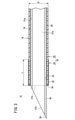
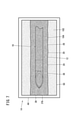
- FIG. 3 is a vertical cross-sectional view of the tip of the catheter assembly of FIG.
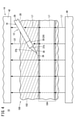
- FIG. 1 is a first explanatory view of a procedure for puncturing a blood vessel of the catheter assembly of FIG. It is a received light image of the state of FIG.
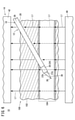
- FIG. 2 is a second explanatory view of the procedure for puncturing a blood vessel of the catheter assembly of FIG. It is a received light image of the state of FIG.
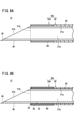
- FIG. 8A is a vertical cross-sectional view of the tip of the catheter assembly having a shaft having a light emitting portion according to the first modification
- FIG. 8B is a catheter having a shaft having a light emitting portion according to the second modification. It is a vertical sectional view of the tip part of an assembly.
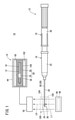
- the catheter system 10 includes a catheter assembly 12 capable of puncturing a blood vessel 104 of a biological site 100, and a blood vessel visualization system 14 for visualizing the blood vessel 104. ..
- the catheter assembly 12 is configured as an indwelling needle for administering an infusion solution (drug) into the blood vessel 104 of the biological site 100.
- the catheter assembly 12 is not limited to the one that administers the drug.
- the catheter assembly 12 has a catheter 16 and a puncture needle 18.
- the catheter 16 has a shaft 20 for insertion into the blood vessel 104 and a catheter hub 22 provided at the proximal end of the shaft 20.
- the shaft 20 has flexibility.
- the shaft 20 is a tubular member that can be continuously inserted into the blood vessel 104 (for example, basilic vein, median cubital vein, cephalic vein, etc.) of the biological site 100.
- the shaft 20 has a lumen 21a extending along the axial direction over its entire length (see FIG. 2).
- a tip opening 21b communicating with the lumen 21a is formed at the tip of the shaft 20.
- the shaft 20 is located at the tip of the shaft 20 and emits near-infrared light L0 (see FIG. 1) when irradiated with light, and the light emitting unit 24 extends from the light emitting unit 24 toward the base end side of the shaft 20. It has a non-light emitting unit 26 that is present and does not emit near-infrared light L0.
- the shaft 20 includes a shaft body 28 extending from the tip end portion of the shaft 20 to the base end portion. The shaft body 28 forms a non-light emitting portion 26.
- the light emitting unit 24 extends from the tip of the shaft 20 toward the base end.
- the length L of the light emitting portion 24 along the extending direction of the shaft 20 is set to 7 mm or less. Thereby, when the tip end portion of the catheter assembly 12 is punctured into the blood vessel 104, the entire light emitting portion 24 can be positioned in the blood vessel 104 (see FIG. 6).
- the length L of the light emitting unit 24 is preferably set to 5 mm or less, and more preferably set to 3 mm or less. In this case, when the tip of the catheter assembly 12 is punctured into the blood vessel 104, the entire light emitting portion 24 can be easily positioned in the blood vessel 104.
- the length L of the light emitting unit 24 is preferably set to 1 mm or more in consideration of the visibility of the light emitting unit 24 in the image (light receiving image 50) obtained by the blood vessel visualization system 14 shown in FIG.
- the length L of the light emitting unit 24 may be set to 6 times or less the outer diameter D of the non-light emitting unit 26 (shaft body 28). Thereby, when the tip end portion of the catheter assembly 12 is punctured into the blood vessel 104, the entire light emitting portion 24 can be positioned in the blood vessel 104 (see FIG. 6).
- the length L of the light emitting unit 24 is preferably set to 4 times or less the outer diameter D of the non-light emitting unit 26, and more preferably set to 2 times or less the outer diameter D of the non-light emitting unit 26. In this case, when the tip of the catheter assembly 12 is punctured into the blood vessel 104, the entire light emitting portion 24 can be easily positioned in the blood vessel 104.
- the length L of the light emitting unit 24 is 1 times the outer diameter D of the non-light emitting unit 26 in consideration of the visibility of the light emitting unit 24 in the image (light receiving image 50) obtained by the blood vessel visualization system 14 shown in FIG. It is preferable to set the above.
- the length L of the light emitting portion 24 is appropriately set according to the outer diameter of the blood vessel 104 into which the shaft 20 is inserted, the thickness of the shaft 20, the puncture angle, and the like.
- the peak wavelength of the near-infrared light L0 emitted by the light emitting unit 24 is in the wavelength range in which it is easily absorbed by hemoglobin in blood and easily penetrates the living tissue 102 (skin tissue, muscle tissue, etc.).
- the biological tissue 102 easily transmits a wavelength of 700 nm or more and 1000 nm or less.
- the reduced hemoglobin of blood flowing through the vein easily absorbs light having a wavelength around 660 nm.
- the oxidized hemoglobin of blood flowing through the artery easily absorbs light having a wavelength around 940 nm.
- the peak wavelength of the near-infrared light L0 emitted by the light emitting unit 24 is preferably in the range of 700 nm or more and 1000 nm or less. Further, in the case of the catheter assembly 12 (catheter for vein insertion) used for puncturing a vein, the peak wavelength of the near-infrared light L0 emitted by the light emitting unit 24 is preferably in the range of 700 nm or more and 800 nm or less. , 700 nm or more and 750 nm or less is more preferable.
- the peak wavelength of the near-infrared light L0 emitted by the light emitting unit 24 is preferably in the range of 800 nm or more and 1000 nm or less. It is more preferably in the range of 850 nm or more and 950 nm or less, and further preferably in the vicinity of 940 nm.
- the light emitting portion 24 has an outer light emitting layer 30 formed by applying a light emitting material to the outer surface of the tip portion of the shaft main body 28, and a light emitting material on the inner surface of the tip portion of the shaft main body 28. It has an inner light emitting layer 32 formed by coating, and a tip light emitting portion 34 formed by applying a light emitting material to the tip surface of the shaft main body 28. Such a light emitting portion 24 can be easily obtained by immersing the tip portion of the shaft main body 28 in a liquid light emitting material.
- each of the outer light emitting layer 30 and the inner light emitting layer 32 extends in an annular shape in the circumferential direction of the shaft main body 28.
- each of the outer light emitting layer 30 and the inner light emitting layer 32 may extend to a length of less than 360 ° (for example, in a semicircular shape) in the circumferential direction of the shaft main body 28.
- a plurality of the outer light emitting layer 30 and the inner light emitting layer 32 may be provided with a gap in the circumferential direction of the shaft main body 28.
- the light emitting unit 24 does not have to have either the outer light emitting layer 30 or the inner light emitting layer 32. Further, the light emitting unit 24 does not have to have the tip light emitting unit 34. That is, the light emitting unit 24 may have at least one of the outer light emitting layer 30 and the inner light emitting layer 32.
- the light emitting material is a fluorescent material (near red) that emits near-infrared light L0 when irradiated with light L1 (for example, near-infrared light or visible light) emitted by the irradiation unit 40 of the blood vessel visualization system 14.
- fluorescent material near red
- L1 for example, near-infrared light or visible light
- External light fluorescent dye is used. Examples of such a fluorescent material include those described in JP-A-2014-136115.
- a phosphorescent material that emits near-infrared light L0 when irradiated with light other than light L1 or light L1 may be used.
- the light emitting unit 24 is made capable of emitting light by irradiating the light emitting unit 24 with light in advance (before performing the blood vessel puncture procedure using the catheter system 10). Can be done. As a result, near-infrared light can be effectively emitted from the light emitting unit 24 in the biological part 100.
- the phosphorescent material include those described in the following chemical formulas.
- the shaft body 28 is formed to include a flexible resin material.
- resin materials include fluororesins such as polytetrafluoroethylene (PTFE), ethylene / tetrafluoroethylene copolymer (ETFE), and perfluoroalkoxy fluororesin (PFA), and olefin resins such as polyethylene and polypropylene.
- fluororesins such as polytetrafluoroethylene (PTFE), ethylene / tetrafluoroethylene copolymer (ETFE), and perfluoroalkoxy fluororesin (PFA)
- olefin resins such as polyethylene and polypropylene.
- olefin resins such as polyethylene and polypropylene.
- olefin resins such as polyethylene and polypropylene.
- examples thereof include resins or mixtures thereof, polyurethanes, polyesters, polyamides, polyether nylon resins, olefin resins and mixtures of ethylene-vinyl
- the portion of the shaft body 28 that forms the non-light emitting portion 26 is formed to include a material that absorbs the light L1 emitted by the irradiation portion 40 of the blood vessel visualization system 14.
- a material that absorbs the light L1 (for example, near infrared light)
- cyanine dye, phthalocyanine dye, naphthalocyanine compound, nickel dithiolene complex, squalium dye, quinone type examples thereof include compounds, diimmonium compounds and azo compounds.
- Such a near-infrared light absorbing dye is mixed (kneaded) with the resin material forming the shaft body 28.
- the shaft body 28 (non-light emitting portion 26) contains a near-infrared light absorbing dye.
- the near-infrared light absorbing dye may be applied to the outer surface of the shaft body 28 on the proximal end side of the light emitting portion 24.
- the catheter hub 22 is formed in a hollow shape (cylindrical shape).
- the catheter hub 22 is preferably made of a material that is harder than the shaft 20.
- the constituent material of the catheter hub 22 is not particularly limited, but is thermoplastic, for example, polypropylene, polycarbonate, polyamide, polysulphon, polyarylate, methacrylate-butylene-styrene copolymer, polyurethane, acrylic resin, ABS resin and the like.
- a resin can be preferably used.
- the puncture needle 18 includes a needle body 36 and a needle hub 38 provided at the base end portion of the needle body 36.
- the needle body 36 is a tubular member having rigidity capable of puncturing the biological part 100 (see FIG. 1).
- the needle body 36 has a lumen 37a extending along the axial direction. Examples of the material constituting the needle body 36 include metal materials such as stainless steel, aluminum, aluminum alloy, titanium, and titanium alloy.
- the needle body 36 is formed sufficiently longer than the shaft 20 and protrudes from the tip opening 21b of the shaft 20 in the initial state (assembled state) of the catheter assembly 12 (see FIGS. 1 and 3).
- a blade surface 39 inclined with respect to the axis of the needle body 36 is formed at the tip end portion of the needle body 36.
- the blade surface 39 is formed with a tip opening 37b that communicates with the lumen 37a of the needle body 36.
- the needle hub 38 is formed in a hollow shape (cylindrical shape).
- the constituent material of the needle hub 38 may be the same as the constituent material of the catheter hub 22 described above.
- the base end portion of the needle body 36 is fixed to the tip end portion of the needle hub 38.
- the needle hub 38 functions as an operating unit of the catheter assembly 12.
- the blood vessel visualization system 14 includes an irradiation unit 40, a light receiving unit 42, and an image display unit 44.
- the irradiation unit 40 irradiates the biological site 100 (visualization target) in which the catheter assembly 12 is punctured with light L1.
- the irradiation unit 40 has a light source 46 that emits light L1.
- the light source 46 emits near-infrared light as light L1.
- the near-infrared light emitted by the light source 46 preferably has a wavelength in the range of 700 nm or more and 2500 nm or less, more preferably a wavelength in the range of 700 nm or more and 1400 nm or less, and a wavelength in the range of 780 nm or more and 1050 nm or less. It is more preferable to have.
- Such near-infrared light is absorbed by the hemoglobin of blood.
- the light source 46 may emit visible light (not including near-infrared light). Further, the light source 46 may emit light including both near-infrared light and visible light.
- the light receiving unit 42 is arranged on the side opposite to the irradiation unit 40 with the biological part 100 interposed therebetween. In other words, the irradiation unit 40 and the light receiving unit 42 are arranged so as to face each other with the biological portion 100 interposed therebetween.
- the light receiving unit 42 is a camera (imaging unit) that receives light L1 guided from the biological part 100 and near infrared light L0 emitted by the light emitting unit 24.
- a CCD camera for near infrared light or the like is used as the light receiving unit 42.
- the image display unit 44 displays an image (light-receiving image 50) created based on the light L1 and the near-infrared light L0 received by the light-receiving unit 42.
- the image display unit 44 may be goggles that can be attached and detached by a person, or may be a stationary display.
- the blade surface 39 projects in the tip direction from the tip opening 21b of the shaft 20 in a state of facing upward.
- the user sets the blood vessel visualization system 14. Specifically, as shown in FIG. 4, the irradiation unit 40 is arranged below the living body part 100 (for example, the forearm of the human body) to be punctured, and the light receiving part 42 is arranged above the living body part 100. Then, the light L1 is irradiated from the irradiation unit 40 to the biological part 100, and the tip portion of the catheter assembly 12 is punctured into the biological part 100.
- the living body part 100 for example, the forearm of the human body
- the light L1 emitted by the irradiation unit 40 is transmitted while scattering in the biological tissue 102 (for example, in the skin tissue or muscle tissue) of the biological site 100, and the transmitted light L1 (transmitted light) is transmitted by the light receiving unit 42. Received light.
- the hemoglobin of blood flowing in the blood vessel 104 absorbs light L1.
- the light emitting portion 24 of the catheter 16 emits near-infrared light L0 when the light L1 is irradiated.
- the near-infrared light L0 emitted by the light emitting unit 24 is received by the light receiving unit 42.
- the non-light emitting portion 26 of the catheter 16 absorbs the light L1, and the needle body 36 reflects (does not transmit) the light L1.
- the image display unit 44 displays the light-receiving image 50 created based on the light L1 received by the light-receiving unit 42 and the near-infrared light L0.
- the light receiving image 50 displays a living tissue 102 (other than the blood vessel 104), a blood vessel 104, a light emitting unit 24, a non-light emitting unit 26, and a needle body 36.
- the light emitting unit 24 is displayed brightest (white), and the biological tissue 102 (other than the blood vessel 104) is displayed darker than the light emitting unit 24.
- the blood vessel 104, the non-light emitting portion 26, and the needle body 36 are displayed darker than the living tissue 102.
- the brightness (luminance) of the blood vessel 104, the non-light emitting portion 26, and the needle body 36 is substantially the same as each other. Thereby, the user can easily and clearly distinguish the blood vessel 104 and the light emitting unit 24 in the received light image 50.
- the appearance of the light emitting unit 24 changes (the light emitting unit 24 becomes dark).
- the brightness of the light emitting unit 24 is substantially the same as the brightness of the blood vessel 104. Therefore, the user can easily know from the light receiving image 50 that the tip of the catheter assembly 12 (the tip of the catheter 16 and the tip of the needle 36) has been inserted into the blood vessel 104 at a relatively early stage. can. In other words, the user can easily know the blood vessel securing of the catheter assembly 12 (the blood vessel securing of the catheter 16 and the blood vessel securing of the needle body 36) from the received light image 50 at a relatively early stage.
- the user removes the puncture needle 18 with the tip of the shaft 20 indwelled in the blood vessel 104, and administers the drug into the blood vessel 104 via the catheter 16.
- the catheter 16, the catheter assembly 12, and the catheter system 10 according to the present embodiment have the following effects.
- the shaft 20 is located at the tip of the shaft 20 and emits near-infrared light L0 by being irradiated with light (for example, light L1), and the light emitting unit 24 toward the proximal end side of the shaft 20. It has a non-light emitting unit 26 that extends and does not emit near-infrared light L0.
- the length L of the light emitting portion 24 along the extending direction of the shaft 20 is 7 mm or less, or 6 times or less the outer diameter D of the non-light emitting portion 26.
- the entire light emitting portion 24 can be positioned in the blood vessel 104.
- the entire light emitting unit 24 changes to dark. Therefore, the user can easily know the securing of the blood vessel of the catheter 16 from the light receiving image 50 at a relatively early stage.
- the non-light emitting unit 26 is provided over the entire range from the base end of the light emitting unit 24 to the base end of the shaft 20.
- the user can easily distinguish between the light emitting unit 24 and the non-light emitting unit 26 in the light receiving image 50 before the light emitting unit 24 is inserted into the blood vessel 104.
- the shaft 20 includes a shaft body 28 forming the non-light emitting portion 26.
- the light emitting unit 24 has a light emitting layer (at least one of the inner light emitting layer 32 and the outer light emitting layer 30) formed by applying a light emitting material to at least one of the inner surface and the outer surface of the tip portion of the shaft body 28. is doing.
- the light emitting unit 24 can be easily formed. Further, when the light emitting unit 24 has the outer light emitting layer 30, the near infrared light L0 emitted by the outer light emitting layer 30 can be efficiently guided to the light receiving unit 42. Further, when the light emitting unit 24 has the inner light emitting layer 32, it is possible to suppress the contact of the light emitting material with the biological part 100.
- the luminescent material includes a fluorescent material or a phosphorescent material.
- the light emitting unit 24 that emits near-infrared light L0 can be easily obtained.
- the non-light emitting portion 26 is formed to include a material that absorbs light L1.
- the user can more easily distinguish between the light emitting unit 24 and the non-light emitting unit 26 in the light receiving image 50 before the light emitting unit 24 is inserted into the blood vessel 104.
- the peak wavelength of the near-infrared light L0 emitted by the light emitting unit 24 is in the range of 700 nm or more and 1000 nm or less.
- the near-infrared light L0 emitted by the light emitting unit 24 can be easily transmitted to the living tissue 102 (other than the blood vessel 104) and easily absorbed by the hemoglobin of blood.
- the catheter assembly 12 includes a catheter 16 and a needle body 36 inserted through the catheter 16.
- the user can insert the tip of the catheter assembly 12 (the tip of the needle body 36 and the tip of the shaft 20) into the blood vessel 104 (securing the blood vessel of the catheter assembly 12).
- the tip of the catheter assembly 12 the tip of the needle body 36 and the tip of the shaft 20
- the blood vessel 104 securing the blood vessel of the catheter assembly 12.
- the catheter 16 and the irradiation unit 40 that irradiates the biological site 100 including the blood vessel 104 for inserting the catheter 16 with the light L1, and the light L1 and the light emitting unit 24 guided from the biological site 100 are emitted.
- It includes a light receiving unit 42 that receives light from the near infrared light L0, and an image display unit 44 that displays a light receiving image 50 created based on the light L1 received by the light receiving unit 42 and the near infrared light L0.
- the irradiation unit 40 and the light receiving unit 42 are arranged so as to face each other with the biological portion 100 interposed therebetween.
- the received light image 50 can be obtained by the light L1 transmitted through the biological part 100.
- the light emitting unit 24 can be clearly displayed in the light receiving image 50.
- the catheter 16 may include a shaft 20a having a light emitting portion 24a shown in FIG. 8A.
- the light emitting portion 24a has a light emitting wall portion 60 formed by the tip portion of the shaft main body 28 containing a light emitting material.
- the light emitting wall portion 60 is formed by mixing (kneading) a light emitting material with a resin material forming the shaft main body 28.
- the light emitting material the above-mentioned fluorescent material or phosphorescent material can be used.
- the catheter 16 may include a shaft 20b having a light emitting portion 24b shown in FIG. 8B.
- the light emitting unit 24b has a light emitting wall portion 60, an outer light emitting layer 30, an inner light emitting layer 32, and a tip light emitting unit 34. According to such a light emitting unit 24b, the same effect as that of the above-mentioned light emitting unit 24 is obtained.
- the light receiving unit 42 may be a spectrum camera that separates and captures light for each wavelength.
- the light receiving unit 42 may be displayed on the image display unit 44 in a color-coded manner (or in a color-coded manner) for each wavelength of the received light.
- the living tissue 102 other than the blood vessel 104
- the blood vessel 104 the blood vessel 104
- the light emitting unit 24, the non-light emitting unit 26, and the needle body 36 are displayed on the image display unit 44 in different colors (or color densities).
- the blood vessel visualization system 14 is not limited to the transmission type system that receives the transmitted light transmitted through the biological part 100 and displays the received light image 50, but receives the reflected light reflected by the biological part 100 and displays the received light image 50. It may be a reflective system.
- the embodiment comprises a shaft (20, 20a, 20b) for insertion into the blood vessel (104), wherein the shaft is a flexible and tubular catheter (16).
- the shaft is located at the tip of the shaft and emits near-infrared light (L0) by being irradiated with light (L1), and the light emitting portion (24, 24a, 24b) and the light emitting portion from the light emitting portion to the shaft.
- the length (L) of the light emitting portion along the extending direction of the shaft includes a non-light emitting portion (26) extending toward the proximal end side and not emitting the near infrared light.
- a catheter having a diameter of 7 mm or less or 6 times or less the outer diameter (D) of the non-light emitting portion is disclosed.
- the non-light emitting portion may be provided over the entire range from the proximal end of the light emitting portion to the proximal end of the shaft.
- the shaft includes a shaft body (28) forming the non-light emitting portion, and the light emitting portion is coated with a light emitting material on at least one of the inner surface and the outer surface of the tip portion of the shaft body. It may have a light emitting layer (30, 32) formed by the above.
- the shaft includes a shaft body forming the non-light emitting portion, and the light emitting portion (24a, 24b) is a light emitting wall formed by the tip portion of the shaft body containing a light emitting material. It may have a portion (60).
- the light emitting portion (24b) may have a light emitting wall portion formed by the tip portion of the shaft body containing a light emitting material.
- the light emitting material may contain a fluorescent material.
- the light emitting material may contain a phosphorescent material.
- the non-light emitting portion may be formed containing a material that absorbs light.
- the peak wavelength of the near-infrared light emitted by the light emitting portion may be in the range of 700 nm or more and 1000 nm or less.
- the embodiment discloses a catheter assembly (12) comprising the catheter described above and a needle body (36) inserted through the catheter.
- the above-described embodiment includes the above-mentioned catheter, an irradiation unit (40) that irradiates a biological site (100) including a blood vessel for inserting the catheter with light (L1), and the light guided from the biological site.
- the light receiving unit (42) that receives the near infrared light emitted by the light emitting unit and the light receiving image (50) created based on the light received by the light receiving unit and the near infrared light are displayed.
- a catheter system (10) comprising an image display unit (44) is disclosed.
- the catheter system may include a catheter assembly having the catheter and a needle inserted through the catheter.
- the irradiation unit and the light receiving unit may be arranged so as to face each other with the living body portion interposed therebetween.
Landscapes
- Health & Medical Sciences (AREA)
- Life Sciences & Earth Sciences (AREA)
- Engineering & Computer Science (AREA)
- Animal Behavior & Ethology (AREA)
- General Health & Medical Sciences (AREA)
- Veterinary Medicine (AREA)
- Biomedical Technology (AREA)
- Heart & Thoracic Surgery (AREA)
- Public Health (AREA)
- Biophysics (AREA)
- Surgery (AREA)
- Pulmonology (AREA)
- Anesthesiology (AREA)
- Hematology (AREA)
- Molecular Biology (AREA)
- Medical Informatics (AREA)
- Nuclear Medicine, Radiotherapy & Molecular Imaging (AREA)
- Robotics (AREA)
- Human Computer Interaction (AREA)
- Physics & Mathematics (AREA)
- Pathology (AREA)
- Media Introduction/Drainage Providing Device (AREA)
Priority Applications (2)
| Application Number | Priority Date | Filing Date | Title |
|---|---|---|---|
| JP2022544482A JP7826210B2 (ja) | 2020-08-24 | 2021-08-18 | カテーテル組立体及びカテーテルシステム |
| US18/111,482 US20230201529A1 (en) | 2020-08-24 | 2023-02-17 | Catheter, catheter assembly, and catheter system |
Applications Claiming Priority (2)
| Application Number | Priority Date | Filing Date | Title |
|---|---|---|---|
| JP2020140575 | 2020-08-24 | ||
| JP2020-140575 | 2020-08-24 |
Related Child Applications (1)
| Application Number | Title | Priority Date | Filing Date |
|---|---|---|---|
| US18/111,482 Continuation US20230201529A1 (en) | 2020-08-24 | 2023-02-17 | Catheter, catheter assembly, and catheter system |
Publications (1)
| Publication Number | Publication Date |
|---|---|
| WO2022044894A1 true WO2022044894A1 (ja) | 2022-03-03 |
Family
ID=80354248
Family Applications (1)
| Application Number | Title | Priority Date | Filing Date |
|---|---|---|---|
| PCT/JP2021/030095 Ceased WO2022044894A1 (ja) | 2020-08-24 | 2021-08-18 | カテーテル、カテーテル組立体及びカテーテルシステム |
Country Status (3)
| Country | Link |
|---|---|
| US (1) | US20230201529A1 (https=) |
| JP (1) | JP7826210B2 (https=) |
| WO (1) | WO2022044894A1 (https=) |
Citations (5)
| Publication number | Priority date | Publication date | Assignee | Title |
|---|---|---|---|---|
| JP2010081952A (ja) * | 2008-09-29 | 2010-04-15 | Terumo Corp | 留置針の針抜け検出装置と留置針組立体 |
| JP2012115535A (ja) * | 2010-12-02 | 2012-06-21 | Kochi Univ | 近赤外蛍光を発する医療具及び医療具位置確認システム |
| JP2012532682A (ja) * | 2009-07-09 | 2012-12-20 | ベクトン・ディキンソン・アンド・カンパニー | 体内への針の侵入を可視化するためのシステム及び方法 |
| JP2014136115A (ja) * | 2013-01-18 | 2014-07-28 | Terumo Corp | 留置針 |
| JP2020124335A (ja) * | 2019-02-04 | 2020-08-20 | フォルテ グロウ メディカル株式会社 | カテーテル |
Family Cites Families (8)
| Publication number | Priority date | Publication date | Assignee | Title |
|---|---|---|---|---|
| US4311138A (en) * | 1980-03-10 | 1982-01-19 | Sugarman Edward D | Illuminated hypodermic needle |
| US5695466A (en) * | 1993-07-23 | 1997-12-09 | Icu Medical, Inc. | Medical connection indicator and method of use |
| US20040236275A1 (en) | 2003-05-20 | 2004-11-25 | Pruitt Sean R. | Catheter having a light emitting component |
| US9179865B2 (en) | 2012-08-07 | 2015-11-10 | Clemson University | Luminescent tension-indicating orthopedic strain gauges for non-invasive measurements through tissue |
| EP3034580B1 (en) | 2013-08-13 | 2020-04-29 | DIC Corporation | Resin composition and molded article |
| WO2016132597A1 (ja) | 2015-02-18 | 2016-08-25 | Dic株式会社 | 樹脂組成物及び成形体 |
| US20190350672A1 (en) * | 2018-05-17 | 2019-11-21 | Visionary Medical Therapies, Inc. | Method and device for enhanced transdermal visualization of medical devices |
| CN114729888B (zh) * | 2019-12-27 | 2026-03-24 | 阿西耶斯医疗有限责任公司 | 用于医疗设备的实时荧光检测系统 |
-
2021
- 2021-08-18 WO PCT/JP2021/030095 patent/WO2022044894A1/ja not_active Ceased
- 2021-08-18 JP JP2022544482A patent/JP7826210B2/ja active Active
-
2023
- 2023-02-17 US US18/111,482 patent/US20230201529A1/en active Pending
Patent Citations (5)
| Publication number | Priority date | Publication date | Assignee | Title |
|---|---|---|---|---|
| JP2010081952A (ja) * | 2008-09-29 | 2010-04-15 | Terumo Corp | 留置針の針抜け検出装置と留置針組立体 |
| JP2012532682A (ja) * | 2009-07-09 | 2012-12-20 | ベクトン・ディキンソン・アンド・カンパニー | 体内への針の侵入を可視化するためのシステム及び方法 |
| JP2012115535A (ja) * | 2010-12-02 | 2012-06-21 | Kochi Univ | 近赤外蛍光を発する医療具及び医療具位置確認システム |
| JP2014136115A (ja) * | 2013-01-18 | 2014-07-28 | Terumo Corp | 留置針 |
| JP2020124335A (ja) * | 2019-02-04 | 2020-08-20 | フォルテ グロウ メディカル株式会社 | カテーテル |
Also Published As
| Publication number | Publication date |
|---|---|
| JP7826210B2 (ja) | 2026-03-09 |
| US20230201529A1 (en) | 2023-06-29 |
| JPWO2022044894A1 (https=) | 2022-03-03 |
Similar Documents
| Publication | Publication Date | Title |
|---|---|---|
| JP7254773B2 (ja) | 撮像デバイス | |
| JP5802135B2 (ja) | 超音波ガイド穿刺針及び留置針 | |
| JP7632511B2 (ja) | 生体内留置クリップ | |
| WO2022176880A1 (ja) | 血管穿刺デバイス及び血管穿刺システム | |
| JP6161096B2 (ja) | 生体圧迫クリップ | |
| JP7298596B2 (ja) | 生体内留置クリップ | |
| US9943667B2 (en) | Guide wire and catheter assembly | |
| US12427294B2 (en) | Implantable ports, implantable port-detecting devices, and methods thereof | |
| US20250010040A1 (en) | Catheter assembly and blood vessel puncture system | |
| WO2019004395A1 (ja) | 画像診断用カテーテル | |
| US11534531B2 (en) | Catheter | |
| WO2022044894A1 (ja) | カテーテル、カテーテル組立体及びカテーテルシステム | |
| EP4108283A1 (en) | Guide wire | |
| WO2024070898A1 (ja) | 血管穿刺デバイス及び血管穿刺システム | |
| US20240389913A1 (en) | Catheter assembly and catheter system | |
| JP5175673B2 (ja) | 留置針の針抜け検出装置と留置針組立体 | |
| JP2010011914A (ja) | 留置針及び穿刺針 | |
| US20250339649A1 (en) | Blood vessel puncture device and blood vessel puncture system | |
| US10932752B2 (en) | Catheter | |
| US20230017647A1 (en) | Puncture needle, catheter assembly, and vascular puncture system | |
| JP7674370B2 (ja) | 血管可視化装置及び血管穿刺システム | |
| JP3949986B2 (ja) | 医療用長尺体 | |
| US20070088195A1 (en) | Method of using an imaging catheter to conduct photodynamic procedures | |
| US20210196886A1 (en) | Puncture needle | |
| JPWO2023189225A5 (https=) |
Legal Events
| Date | Code | Title | Description |
|---|---|---|---|
| 121 | Ep: the epo has been informed by wipo that ep was designated in this application |
Ref document number: 21861322 Country of ref document: EP Kind code of ref document: A1 |
|
| ENP | Entry into the national phase |
Ref document number: 2022544482 Country of ref document: JP Kind code of ref document: A |
|
| NENP | Non-entry into the national phase |
Ref country code: DE |
|
| 122 | Ep: pct application non-entry in european phase |
Ref document number: 21861322 Country of ref document: EP Kind code of ref document: A1 |