WO2022044608A1 - 船舶航行支援装置、船舶航行支援方法、および、船舶航行支援プログラム - Google Patents
船舶航行支援装置、船舶航行支援方法、および、船舶航行支援プログラム Download PDFInfo
- Publication number
- WO2022044608A1 WO2022044608A1 PCT/JP2021/026771 JP2021026771W WO2022044608A1 WO 2022044608 A1 WO2022044608 A1 WO 2022044608A1 JP 2021026771 W JP2021026771 W JP 2021026771W WO 2022044608 A1 WO2022044608 A1 WO 2022044608A1
- Authority
- WO
- WIPO (PCT)
- Prior art keywords
- feature information
- information
- ship
- navigation support
- ship navigation
- Prior art date
- Legal status (The legal status is an assumption and is not a legal conclusion. Google has not performed a legal analysis and makes no representation as to the accuracy of the status listed.)
- Ceased
Links
Images









Classifications
-
- G—PHYSICS
- G01—MEASURING; TESTING
- G01C—MEASURING DISTANCES, LEVELS OR BEARINGS; SURVEYING; NAVIGATION; GYROSCOPIC INSTRUMENTS; PHOTOGRAMMETRY OR VIDEOGRAMMETRY
- G01C21/00—Navigation; Navigational instruments not provided for in groups G01C1/00 - G01C19/00
- G01C21/38—Electronic maps specially adapted for navigation; Updating thereof
- G01C21/3804—Creation or updating of map data
- G01C21/3833—Creation or updating of map data characterised by the source of data
- G01C21/3844—Data obtained from position sensors only, e.g. from inertial navigation
-
- B—PERFORMING OPERATIONS; TRANSPORTING
- B63—SHIPS OR OTHER WATERBORNE VESSELS; RELATED EQUIPMENT
- B63B—SHIPS OR OTHER WATERBORNE VESSELS; EQUIPMENT FOR SHIPPING
- B63B49/00—Arrangements of nautical instruments or navigational aids
-
- B—PERFORMING OPERATIONS; TRANSPORTING
- B63—SHIPS OR OTHER WATERBORNE VESSELS; RELATED EQUIPMENT
- B63B—SHIPS OR OTHER WATERBORNE VESSELS; EQUIPMENT FOR SHIPPING
- B63B39/00—Equipment to decrease pitch, roll, or like unwanted vessel movements; Apparatus for indicating vessel attitude
- B63B39/14—Equipment to decrease pitch, roll, or like unwanted vessel movements; Apparatus for indicating vessel attitude for indicating inclination or duration of roll
-
- B—PERFORMING OPERATIONS; TRANSPORTING
- B63—SHIPS OR OTHER WATERBORNE VESSELS; RELATED EQUIPMENT
- B63B—SHIPS OR OTHER WATERBORNE VESSELS; EQUIPMENT FOR SHIPPING
- B63B79/00—Monitoring properties or operating parameters of vessels in operation
- B63B79/10—Monitoring properties or operating parameters of vessels in operation using sensors, e.g. pressure sensors, strain gauges or accelerometers
-
- B—PERFORMING OPERATIONS; TRANSPORTING
- B63—SHIPS OR OTHER WATERBORNE VESSELS; RELATED EQUIPMENT
- B63B—SHIPS OR OTHER WATERBORNE VESSELS; EQUIPMENT FOR SHIPPING
- B63B79/00—Monitoring properties or operating parameters of vessels in operation
- B63B79/30—Monitoring properties or operating parameters of vessels in operation for diagnosing, testing or predicting the integrity or performance of vessels
-
- G—PHYSICS
- G01—MEASURING; TESTING
- G01C—MEASURING DISTANCES, LEVELS OR BEARINGS; SURVEYING; NAVIGATION; GYROSCOPIC INSTRUMENTS; PHOTOGRAMMETRY OR VIDEOGRAMMETRY
- G01C21/00—Navigation; Navigational instruments not provided for in groups G01C1/00 - G01C19/00
- G01C21/10—Navigation; Navigational instruments not provided for in groups G01C1/00 - G01C19/00 by using measurements of speed or acceleration
- G01C21/12—Navigation; Navigational instruments not provided for in groups G01C1/00 - G01C19/00 by using measurements of speed or acceleration executed aboard the object being navigated; Dead reckoning
- G01C21/16—Navigation; Navigational instruments not provided for in groups G01C1/00 - G01C19/00 by using measurements of speed or acceleration executed aboard the object being navigated; Dead reckoning by integrating acceleration or speed, i.e. inertial navigation
- G01C21/165—Navigation; Navigational instruments not provided for in groups G01C1/00 - G01C19/00 by using measurements of speed or acceleration executed aboard the object being navigated; Dead reckoning by integrating acceleration or speed, i.e. inertial navigation combined with non-inertial navigation instruments
- G01C21/1652—Navigation; Navigational instruments not provided for in groups G01C1/00 - G01C19/00 by using measurements of speed or acceleration executed aboard the object being navigated; Dead reckoning by integrating acceleration or speed, i.e. inertial navigation combined with non-inertial navigation instruments with ranging devices, e.g. LIDAR or RADAR
-
- G—PHYSICS
- G01—MEASURING; TESTING
- G01C—MEASURING DISTANCES, LEVELS OR BEARINGS; SURVEYING; NAVIGATION; GYROSCOPIC INSTRUMENTS; PHOTOGRAMMETRY OR VIDEOGRAMMETRY
- G01C21/00—Navigation; Navigational instruments not provided for in groups G01C1/00 - G01C19/00
- G01C21/20—Instruments for performing navigational calculations
- G01C21/203—Instruments for performing navigational calculations specially adapted for water-borne vessels
-
- G—PHYSICS
- G01—MEASURING; TESTING
- G01C—MEASURING DISTANCES, LEVELS OR BEARINGS; SURVEYING; NAVIGATION; GYROSCOPIC INSTRUMENTS; PHOTOGRAMMETRY OR VIDEOGRAMMETRY
- G01C3/00—Measuring distances in line of sight; Optical rangefinders
- G01C3/02—Details
-
- G—PHYSICS
- G01—MEASURING; TESTING
- G01S—RADIO DIRECTION-FINDING; RADIO NAVIGATION; DETERMINING DISTANCE OR VELOCITY BY USE OF RADIO WAVES; LOCATING OR PRESENCE-DETECTING BY USE OF THE REFLECTION OR RERADIATION OF RADIO WAVES; ANALOGOUS ARRANGEMENTS USING OTHER WAVES
- G01S17/00—Systems using the reflection or reradiation of electromagnetic waves other than radio waves, e.g. lidar systems
- G01S17/88—Lidar systems specially adapted for specific applications
- G01S17/93—Lidar systems specially adapted for specific applications for anti-collision purposes
-
- G—PHYSICS
- G05—CONTROLLING; REGULATING
- G05D—SYSTEMS FOR CONTROLLING OR REGULATING NON-ELECTRIC VARIABLES
- G05D1/00—Control of position, course, altitude or attitude of land, water, air or space vehicles, e.g. using automatic pilots
- G05D1/02—Control of position or course in two dimensions
- G05D1/0206—Control of position or course in two dimensions specially adapted to water vehicles
Definitions
- the present invention relates to a ship navigation support technique used when a ship is moored.
- Patent Document 1 describes a ship berthing support device.
- the distance between the ship and a plurality of points on the quay is measured by using the distance measuring means.
- the distance measured by the distance measuring means as shown in the prior art includes an error. Then, this error occurs with each measurement of the distance and increases sequentially.
- an object of the present invention is to suppress an error that occurs in movement or the like when a ship is moored.
- the ship navigation support device of the present invention includes a measurement unit and a feature information update unit.
- the measuring unit obtains measurement information for the target by using the distance measurement result for the area including the target where the ship is moored.
- the feature information update unit updates the feature information for the target by using the initial feature information for the target or the feature information before the update for the target and the measurement information.
- the distance measurement result of the target object is reflected in the updated feature information.
- FIG. 1 is a functional block diagram showing a configuration of a ship navigation support device according to an embodiment of the present invention.
- FIG. 2 is a functional block diagram showing the configuration of the provisional initial information setting unit.
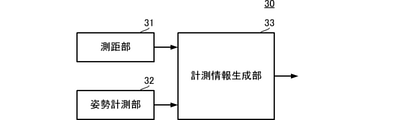
- FIG. 3 is a functional block diagram showing the configuration of the measurement unit.
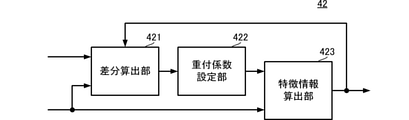
- FIG. 4 is a functional block diagram showing the configuration of the feature information update unit.
- FIG. 5 is a diagram showing an example of a method of designating provisional initial information.
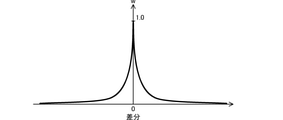
- FIG. 6 is a graph showing an example of setting an example of the weighting coefficient.
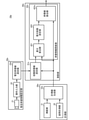
- FIG. 7 is a functional block diagram showing an example of a specific application example of the configuration of the ship navigation support device according to the embodiment of the present invention.
- FIG. 8 is a diagram for explaining the concept of updating the quay line.
- FIG. 10 (A), 9 (B), and 9 (C) are views showing the updated state of the quay line.
- 10 (A) and 10 (B) are flowcharts showing schematic processing of the ship navigation support method.
- 11 (A) is a flowchart showing a specific processing flow regarding the update of the feature information shown in FIG. 10 (A)
- FIG. 11 (B) is a specific flow regarding the update of the quay line shown in FIG. 10 (B). It is a flowchart which shows a typical processing flow.
- FIG. 12 is a flowchart showing another specific processing flow regarding the update of the feature information.
- FIG. 13 is a flowchart showing another specific processing flow regarding the update of the feature information.
- FIG. 14 (A) is a flowchart showing the processing of the ship navigation support method including the generation of navigation support information
- FIG. 14 (B) shows the processing of FIG. 14 (A) as a more specific target (quay).
- FIG. 15 is a functional block diagram showing a configuration of a ship navigation support device in a mode of calculating and updating a quay line and a quay reference point.
- 16 (A), 16 (B), and 16 (C) are diagrams showing the updated state of the quay line and the quay reference point.
- FIG. 17 is a flowchart showing a schematic process of a method of updating the quay line and the quay reference point.
- FIG. 18 is a flowchart showing a method of updating the quay reference point.
- FIG. 19 is a flowchart showing a process of setting provisional initial information from the past position coordinates of the feature information of the target object.
- FIG. 1 is a functional block diagram showing a configuration of a ship navigation support device according to an embodiment of the present invention.
- FIG. 2 is a functional block diagram showing the configuration of the provisional initial information setting unit.
- FIG. 3 is a functional block diagram showing the configuration of the measurement unit.
- the ship navigation support device 10 includes a provisional initial information setting unit 20, a measurement unit 30, and a calculation unit 40.
- the ship navigation support device 10 executes a ship navigation support program and a storage device that stores a program (ship navigation support program) that realizes a ship navigation support method, excluding the optical system part and the radio wave system part, for example. It can be realized by an arithmetic processing device such as a CPU. Further, the part of the storage device and the arithmetic processing unit can be realized by an IC or the like in which a navigation support program is incorporated.
- the provisional initial information setting unit 20 accepts the designation of provisional initial information for the characteristic information of the target at which the ship is moored or berthed (berthed).
- the provisional initial information setting unit 20 outputs the provisional initial information to the calculation unit 40.
- the target is a quay
- the feature information is the vector quantity of the quay line and the position coordinates of the quay reference point
- the provisional initial information is the provisional quay line (vector quantity) and the provisional quay reference. It is a point (position coordinate).
- the measuring unit 30 measures the distance to the area including the target where the ship is moored or berthed (berthed).
- the measurement unit 30 obtains measurement information for the target object by using the distance measurement result.
- the measurement unit 30 outputs the measurement information to the calculation unit 40.
- the measurement information is a vector quantity of a line segment (straight line).
- the calculation unit 40 includes an initial feature information setting unit 41 and a feature information update unit 42.
- the provisional initial information is input to the initial feature information setting unit 41.
- the measurement information is input to the initial feature information setting unit 41 and the feature information update unit 42.
- the initial feature information setting unit 41 sets the initial feature information using the provisional initial information and the measurement information.
- the initial feature information includes, for example, an initial quay line (vector quantity), an initial quay reference point (position coordinates), and the like.
- the initial feature information setting unit 41 sets this measurement information as the initial feature information. If there is a plurality of measurement information for the target object, the initial feature information setting unit 41 sets the initial feature information from the plurality of measurement information. As an example, the initial feature information setting unit 41 detects measurement information (maximum likelihood measurement information) whose position and direction with respect to the ship are most similar to the provisional initial information among a plurality of measurement information. The initial feature information setting unit 41 sets the maximum likelihood measurement information as the initial feature information. By performing such processing, the ship navigation support device 10 can suppress an error in the initial feature information as compared with manually inputting the initial feature information by the user or the like. The initial feature information setting unit 41 outputs the initial feature information to the feature information update unit 42.
- the feature information update unit 42 updates the feature information using the measurement information. For example, the feature information updating unit 42 updates to new feature information by using the measurement information at substantially the same time as the setting timing of the initial feature information. Further, the feature information updating unit 42 sequentially updates the feature information using the obtained measurement information. A more detailed configuration and processing of the feature information updating unit 42 will be described later.
- the ship navigation support device 10 can suppress an error included in the information (positional relationship, distance, direction, etc. between the ship and the target) that the ship wants to acquire when moving to the target.
- the ship navigation support device 10 can suppress an error included in the distance, direction, etc. between the ship and the quay line or the quay reference point in the movement (berthing, berthing) when the ship is moored.
- the provisional initial information setting unit 20 includes a camera 21, an operation input unit 22, and a provisional initial information setting unit 23.
- the camera 21 is connected to the operation input unit 22.
- the camera 21 is, for example, a monocular camera, and images an area including a target object (for example, a quay).
- the camera 21 outputs the captured image to the operation input unit 22.
- the operation input unit 22 is realized by, for example, a touch panel or the like.
- the operation input unit 22 displays the input image.
- the operation input unit 22 receives an operation input from the user and detects an operation position (operation locus) on the image.
- the operation input unit 22 outputs the operation position (operation locus) to the provisional initial information setting unit 23.
- the provisional initial information setting unit 23 converts the operation position (operation trajectory) into the vector quantity of the three-dimensional coordinate system set in the image, and sets it as the provisional initial information.
- the provisional initial information setting unit 23 outputs the provisional initial information to the calculation unit 40.
- FIG. 5 is a diagram showing an example of a method of designating provisional initial information.
- an image including the target quay 90 is displayed on the display screen.
- the operation input unit 22 detects the operation locus (the locus corresponding to the provisional quay line 920 in FIG. 5). More specifically, the operation input unit 22 detects a pixel group (pixel coordinate group) operated by a finger in the image as a locus. The operation input unit 22 outputs this locus to the provisional initial information setting unit 23.
- the provisional initial information setting unit 23 sets this locus as the provisional quay line 920.
- the provisional quay line 920 is represented by, for example, a vector quantity set by an orientation and a distance relative to the position of the ship.
- the provisional quay line 920 corresponds to the provisional initial information.
- the provisional initial information setting unit 23 outputs the provisional quay line 920 to the initial feature information setting unit 41 of the calculation unit 40.
- the measurement unit 30 includes a distance measurement unit 31, a posture measurement unit 32, and a measurement information generation unit 33.
- the ranging unit 31 is realized by, for example, LIDAR or the like.
- the ranging unit 31 may be another ranging device such as an optical system or a radio wave system such as LADAR.
- the ranging unit 31 performs three-dimensional ranging on the area including the target object, and detects a plurality of feature points.
- the ranging unit 31 outputs a plurality of feature points to the measurement information generation unit 33.
- the posture measuring unit 32 is realized by, for example, a posture sensor equipped on a ship.
- the attitude sensor may be one using GNSS signal positioning technology or one using an inertial sensor. Further, the attitude sensor may be a combination of a GNSS signal positioning technique and an inertial sensor. If the positioning technology of the GNSS signal is used, the position (position coordinates) of the ship can also be measured. In addition, if the GNSS signal positioning technology is used, the attitude can be measured with high accuracy in an open sky situation such as at sea.
- the posture measuring unit 32 measures the posture of the ship.
- the attitude measurement unit 32 outputs the attitude of the ship to the measurement information generation unit 33.
- the measurement information generation unit 33 converts (projects) a plurality of feature points obtained in three-dimensional coordinates into a two-dimensional coordinate system on a horizontal plane. At this time, the measurement information generation unit 33 uses the posture of the ship to raise a plurality of feature points of the three-dimensional coordinate system to the two-dimensional coordinate system on the horizontal plane even if the ship is swinging, for example. Can be converted to precision.
- the measurement information generation unit 33 applies a predetermined conversion process (for example, Hough transform process, etc.) to a plurality of feature points arranged at two-dimensional coordinates on the horizontal plane, and generates measurement information.
- the measurement information generation unit 33 outputs the generated measurement information to the initial feature information setting unit 41 and the feature information update unit 42 of the calculation unit 40.
- the process of converting a plurality of feature points obtained in three-dimensional coordinates into a two-dimensional coordinate system on a horizontal plane can be omitted.
- the calculation unit 40 includes an initial feature information setting unit 41 and a feature information update unit 42.
- the description of the initial feature information setting unit 41 is described above and is omitted.
- the initial feature information setting unit 41 sets the initial feature information using the provisional initial information and the measurement information, and outputs the initial feature information to the feature information update unit 42.
- FIG. 4 is a functional block diagram showing the configuration of the feature information update unit.
- the feature information updating unit 42 includes a difference calculation unit 421, a weighting coefficient setting unit 422, and a feature information calculation unit 423.
- the difference calculation unit 421 calculates the difference between the feature information and the measurement information. More specifically, when the initial feature information is input to the difference calculation unit 421, the difference calculation unit 421 calculates the difference between the initial feature information and the measurement information according to this timing. Further, when the feature information updated by the feature information calculation unit 423 is fed back to the difference calculation unit 421, the difference calculation unit 421 determines the difference between the fed back feature information and the measurement information according to the feedback timing. Is calculated.
- the measurement information according to the timing shown here means, for example, the measurement information obtained at the time immediately after the timing.
- the difference calculation unit 421 calculates the difference between the initial feature information or the fed-back feature information (feature information before update) and the measurement information for each of the plurality of measurement information.
- the difference calculation unit 421 outputs the difference from each measurement information to the weighting coefficient setting unit 422.
- the weighting coefficient setting unit 422 sets the weighting coefficient according to the difference for each measurement information.
- FIG. 6 is a graph showing an example of setting an example of the weighting coefficient. As shown in FIG. 6, the weighting coefficient is set so that the weighting coefficient w becomes smaller as the absolute value of the difference becomes larger.
- the weighting coefficient setting unit 422 outputs the weighting coefficient w for each measurement information to the feature information calculation unit 423.
- the feature information calculation unit 423 inputs the measurement information and the weighting coefficient w.
- the feature information calculation unit 423 calculates the feature information by using the measurement information and the weighting coefficient w for the measurement information. More specifically, the feature information calculation unit 423 normalizes the weighting coefficient w.
- the normalization here is to reset the weighting coefficient w so that all the weighting coefficients are added and become 1. In addition, this normalization processing may be performed by the weighting coefficient setting unit 422.
- the feature information calculation unit 423 multiplies the normalized weighting factor w by the measurement information.
- the feature information calculation unit 423 outputs the result of adding the measurement information multiplied by the weighting coefficient w as new feature information (feature information after update).
- the updated feature information is generated by adding the measurement information using the distance measurement result. As a result, the accumulation of errors due to overlapping updates is suppressed.
- the measurement information is multiplied by the weighting coefficient.
- the weighting coefficient is set so that the larger the difference from the feature information before the update, the smaller the influence on the feature information after the update. Therefore, the feature information after the update suppresses the influence of the error included in the feature information before the update, and is highly accurate with respect to the actual feature information.
- the ship navigation support device 10 can generate the feature information with high accuracy with respect to the actual feature information and while suppressing the update error.
- FIG. 7 is a functional block diagram showing an example of a specific application example of the configuration of the ship navigation support device according to the embodiment of the present invention. Note that FIG. 7 is basically the same as the figure in which FIGS. 1, 2, 3, and 4 are combined, and is different in that the target object, the feature information, and the like are embodied. In the following, only the parts that require additional explanation will be described, and the parts that can be understood in the above explanation will be omitted.
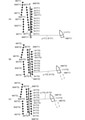
- FIG. 8 is a diagram for explaining the concept of updating the quay line. 9 (A), 9 (B), and 9 (C) are diagrams showing the updated state of the quay line.
- the ship navigation support device 10e includes a provisional quay information setting unit 20e, a measurement unit 30e, and a calculation unit 40e.
- the provisional quay information setting unit 20e corresponds to the above-mentioned provisional initial information setting unit 20.
- the measuring unit 30e corresponds to the measuring unit 30.
- the calculation unit 40e corresponds to the calculation unit 40.
- the provisional quay information setting unit 20e includes a camera 21, an operation input unit 22, and a provisional quay line setting unit 23e.
- the provisional quay line setting unit 23e corresponds to the provisional initial information setting unit 23, and sets the provisional quay line (see the provisional quay line 920 in FIG. 5 above) using the operation input result.
- the provisional quay line setting unit 23e outputs the provisional quay line to the calculation unit 40e.
- the measurement unit 30e includes a distance measurement unit 31, a posture measurement unit 32, and a measurement line generation unit 33e.
- the measurement line generation unit 33e corresponds to the measurement information generation unit 33, and generates a linear measurement line by using a plurality of feature points obtained by distance measurement and the posture of the ship 100.
- the measurement line is represented by the distance ⁇ from the reference point (for example, the sensor position) 111 of the ship 100 and the direction ⁇ of the measurement line with respect to the position of the ship 100.
- the distance ⁇ is the length of the perpendicular line drawn from the ship 100 to the measurement line
- the azimuth ⁇ is the angle formed by the reference direction and the extension direction of the perpendicular line in a predetermined coordinate system.
- the measurement line generation unit 33e outputs the measurement line to the calculation unit 40e.
- the calculation unit 40e includes an initial quay line setting unit 41e and a quay information update unit 42e.
- the initial quay line setting unit 41e corresponds to the initial feature information setting unit 41
- the quay information update unit 42e corresponds to the feature information update unit 42.
- the quay information updating unit 42e includes a difference calculation unit 421, a weighting coefficient setting unit 422, and a quay line calculation unit 423e.
- the quay line calculation unit 423e corresponds to the feature information calculation unit 423.
- the provisional quay line and the measurement line are input to the initial quay line setting unit 41e. If there is only one measurement line, the initial quay line setting unit 41e sets this measurement line as the initial quay line. If there are a plurality of measurement lines, the initial quay line setting unit 41e sets the maximum likelihood measurement line in the plurality of measurement lines to the initial quay line. For example, the initial quay line setting unit 41e sets the maximum likelihood measurement line to, for example, a measurement line having a parameter most similar to the parameters (distance ⁇ , direction ⁇ ) of the provisional quay line. The initial quay line setting unit 41e outputs the initial quay line to the quay information updating unit 42e.
- the initial quay line and the measurement line are input to the difference calculation unit 421 of the quay information update unit 42e.
- the difference calculation unit 421 calculates the difference from the initial quay line for each of the measurement lines. At this time, the difference calculation unit 421 calculates the difference for each parameter. That is, the difference calculation unit 421 calculates the difference ⁇ of the distance ⁇ and the difference ⁇ of the direction ⁇ with respect to the initial quay line for one measurement line.
- a plurality of measurement lines 931 (T1), 932 (T1), 933 (T1), 933 (T1) measured at the timing T1 immediately after that. T1), 934 (T1) are obtained.
- the measurement line 931 (T1) is obtained at the timing T1 and is generated from a plurality of feature points 81 (T1) arranged in a straight line.
- the measurement line 932 (T1) is obtained at timing T1 and is generated from a plurality of linearly arranged feature points 82 (T1)
- the measurement line 933 (T1) is obtained at timing T1 and linearly.
- the measurement line 934 (T1) is generated from the plurality of feature points 83 (T1) arranged side by side, and is generated from the plurality of feature points 84 (T1) arranged in a straight line at the timing T1.
- the difference calculation unit 421 outputs the difference for each measurement line to the weighting coefficient setting unit 422.
- the difference calculation unit 421 calculates the difference ⁇ 1 (T1) between the distance ⁇ 1 (T1) of the measurement line 931 (T1) and the distance ⁇ (T0) of the immediately preceding quay line 920 (T0).
- the difference calculation unit 421 calculates the difference ⁇ 1 (T1) between the direction ⁇ 1 (T1) of the measurement line 931 (T1) and the direction ⁇ (T0) of the immediately preceding quay line 920 (T0).
- the difference calculation unit 421 calculates the difference ⁇ 2 (T1) and the difference ⁇ 2 (T1) with respect to the measurement line 932 (T1), and the difference ⁇ 3 (T1) with respect to the measurement line 933 (T1).
- the difference ⁇ 3 (T1) is calculated, and the difference ⁇ 4 (T1) and the difference ⁇ 4 (T1) are calculated with respect to the measurement line 934 (T1). Then, the difference calculation unit 421 outputs these differences to the weighting coefficient setting unit 422.
- the weighting coefficient setting unit 422 sets the weighting coefficient according to the difference. More specifically, the weighting coefficient setting unit 422 sets the first weighting coefficient w ⁇ for the distance ⁇ according to the difference ⁇ with respect to the distance ⁇ . The weighting coefficient setting unit 422 sets the second weighting coefficient w ⁇ for the direction ⁇ according to the difference ⁇ with respect to the direction ⁇ . The weighting coefficient setting unit 422 outputs the first weighting coefficient w ⁇ and the second weighting coefficient w ⁇ to the quay line calculation unit 423e.
- the quay line calculation unit 423e normalizes the first weighting coefficient w ⁇ to each using the number of measurement lines to be added.
- the quay line calculation unit 423e normalizes the second doubled coefficient w ⁇ to each using the number of measurement lines to be added.
- the quay line calculation unit 423e multiplies the distance ⁇ by the normalized first weighting coefficient w ⁇ for each measurement line, and adds these multiplied values. For example, in the example of FIG. 8, the quay line calculation unit 423e multiplies the distance ⁇ 1 (T1) of the measurement line 931 (T1) by the first weighting coefficient w ⁇ 1 and the distance ⁇ 2 (T1) of the measurement line 932 (T1). Multiply T1) by the first weighting coefficient w ⁇ 2, multiply the distance ⁇ 3 (T1) of the measurement line 933 (T1) by the first weighting coefficient w ⁇ 3, and multiply the distance ⁇ 4 (T1) of the measurement line 934 (T1) by the first. By multiplying the single multiplication factor w ⁇ 4 and adding these multiplication values, the distance ⁇ (T1) of the quay line 920 (T1) at the timing T1 is calculated.
- the quay line calculation unit 423e multiplies the normalized second multiplication factor w ⁇ by the azimuth ⁇ for each measurement line, and adds these multiplied values. For example, in the example of FIG. 8, the quay line calculation unit 423e multiplies the direction ⁇ 1 (T1) of the measurement line 931 (T1) by the second multiplication factor w ⁇ 1, and the direction ⁇ 2 (the direction ⁇ 2 of the measurement line 932 (T1)). T1) is multiplied by the second multiplication coefficient w ⁇ 2, the orientation ⁇ 3 (T1) of the measurement line 933 (T1) is multiplied by the second overlap coefficient w ⁇ 3, and the orientation ⁇ 4 (T1) of the measurement line 934 (T1) is multiplied by the second. By multiplying by the double coefficient w ⁇ 4 and adding these multiplication values, the direction ⁇ (T1) of the quay line 920 (T1) at the timing T1 is calculated.
- the quay line 920 is sequentially updated as shown in FIGS. 9 (A), 9 (B), and 9 (C).
- the measurement lines 931 (T1), 932 (T1), 933 (T1), 934 (T1) at the timing T1 and the quay line 920 (T0) at the immediately preceding timing T0 are used.
- the quay line 920 (T1) at the timing T1 is generated, and the quay line 920 is updated.
- the timing T2 is formed by the measurement lines 931 (T2), 932 (T2), 933 (T2), 934 (T2) of the timing T2 and the quay line 920 (T1) at the immediately preceding timing T1.
- the quay line 920 (T2) is generated in, and the quay line 920 is updated.
- the timing T3 is formed by the measurement lines 931 (T3), 932 (T3), 933 (T3), 934 (T3) of the timing T3 and the quay line 920 (T2) at the immediately preceding timing T2.
- the quay line 920 (T3) is generated in, and the quay line 920 is updated.
- the ship navigation support device 10e can sequentially update the quay line 920 and suppress the accumulation of errors due to the update.
- this configuration and processing as shown in FIGS. 9 (A), 9 (B), and 9 (C), even if the ship 100 moves, the distance measurement results at each timing can be obtained. Since the quay line 920 is updated by using it, the influence of the error due to the movement can be suppressed.
- FIG. 10 (A) and 10 (B) are flowcharts showing the schematic processing of the ship navigation support method.
- FIG. 10B shows a case where the process of FIG. 10A is set for a more specific target (quay).
- the arithmetic processing unit (ship navigation support device) sets the initial feature information of the target object (S11).
- the arithmetic processing unit generates measurement information of the area including the target object (S12).
- the arithmetic processing unit updates the feature information by calculating new feature information from the initial information of the feature information of the target object or the feature information before the update and the measurement information (S13).
- the arithmetic processing unit sets the initial quay line (S11e) as shown in FIG. 10 (B).
- the arithmetic processing unit generates a measurement line in the area including the quay (S12e).
- the arithmetic processing unit updates the quay line by calculating a new quay line from the initial quay line or the quay line before the update and the measurement line (S13e).
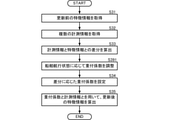
- FIG. 11A is a flowchart showing a specific processing flow for updating the feature information shown in FIG. 10A.
- FIG. 11B is a flowchart showing a specific processing flow regarding the update of the quay line shown in FIG. 10B.
- the arithmetic processing unit acquires the feature information before the update including the initial feature information (S31).
- the arithmetic processing unit acquires a plurality of measurement information (S32).
- the arithmetic processing unit calculates the difference between the measurement information and the feature information (S33).
- the arithmetic processing unit sets a weighting coefficient according to the difference for each measurement information (S34).
- the arithmetic processing unit calculates the updated feature information using the weighting coefficient and the measurement information (S35).
- the arithmetic processing unit acquires the quay line before the update including the initial quay line (S31e).
- the arithmetic processing unit acquires a plurality of measurement lines (S32e).
- the arithmetic processing unit calculates the difference between the measurement line and the quay line (S33e).
- the arithmetic processing unit sets a weighting coefficient according to the difference for each measurement line (S34e).
- the arithmetic processing unit calculates the updated quay line using the weighting coefficient and the measurement line (S35e).
- FIG. 12 is a flowchart showing another specific processing flow regarding the update of the feature information.
- the process shown in FIG. 12 is different from the process shown in FIG. 11A in the process of adjusting the weighting coefficient.
- the other processes shown in FIG. 12 are the same as the processes shown in FIG. 11 (A), and the description of the same parts will be omitted.
- the arithmetic processing unit adjusts the weighting coefficient according to the navigation state of the ship (S391). For example, in the arithmetic processing unit, the farther the ship is from the target object, the smaller the weight reduction method depending on the magnitude of the difference. Further, the arithmetic processing unit reduces the method of reducing the weight depending on the magnitude of the difference as the navigation speed of the ship, more specifically, for example, the approach speed to the target becomes faster. It should be noted that this adjustment content is an example, and for example, the weight reduction method may be reduced as the navigation state in which the error included in the distance measurement result and the measurement information becomes larger.
- the ship navigation support devices 10 and 10e can update the feature information (for example, the quay line) more accurately.
- FIG. 13 is a flowchart showing another specific processing flow regarding the update of the feature information.
- the process shown in FIG. 13 is different from the process shown in FIG. 11A in the measurement information selection process.
- the other processes shown in FIG. 13 are the same as the processes shown in FIG. 11 (A), and the description of the same parts will be omitted.
- the arithmetic processing unit excludes measurement information whose difference does not satisfy the condition (S392).
- This condition is, for example, that the difference exceeds the threshold value, more specifically, the difference ⁇ of the distance ⁇ exceeds the threshold value for distance, or the difference ⁇ of the direction ⁇ exceeds the threshold value for direction.
- the ship navigation support devices 10 and 10e can obtain measurement information from the calculation of the feature information, such as a shape that is clearly far from the target and a shape that is clearly different from the target, which adversely affects the calculation of the feature information. Can be excluded.
- the feature information (quay line) can be continuously updated even if the measurement information (measurement line) is hardly obtained at a certain timing.
- the ship navigation support devices 10 and 10e may adopt an averaging process such as a moving average for the feature information.
- the feature information calculation unit 423 of the calculation unit 40 performs weighted average processing of the feature information before the update and the calculated feature information, and calculates the feature information after the update.
- the quay line calculation unit 423e of the calculation unit 40e performs a weighted average processing of the quay line before the update and the calculated quay line to calculate the quay line after the update.
- FIG. 14A is a flowchart showing the processing of the ship navigation support method including the generation of navigation support information.
- FIG. 14B shows a case where the process of FIG. 14A is set for a more specific target (quay).
- the process shown in FIG. 14 (A) differs in that the process of generating navigation support information is added to the process shown in FIG. 10 (A), and the process shown in FIG. 14 (B) is different from the process shown in FIG. 10 (B).
- FIGS. 14 (A) and 14 (B) are the same as the processes shown in FIGS. 10 (A) and 10 (B), respectively, and the description of the same parts will be omitted.
- the arithmetic processing unit (ship navigation support device) generates navigation support information from the feature information (S14).
- the arithmetic processing unit when the feature information is a quay line, as shown in FIG. 14 (B), the arithmetic processing unit generates a quay line distance from the calculated (updated) quay line (S14e).
- the quay line distance is obtained, for example, by the quay line distance ⁇ .
- the mode of calculating and updating the quay line was shown. However, it is also possible to calculate and update other feature information about the quay. In the following, as other feature information, a mode in which a quay reference point is calculated and updated is shown.
- the quay reference point is a point that is used as a reference when the ship 100 berths, and is a point on the quay line.
- FIG. 15 is a functional block diagram showing a configuration of a ship navigation support device in a mode of calculating and updating a quay line and a quay reference point.
- the ship navigation support device 10f shown in FIG. 15 has a provisional quay reference point setting unit 232f, a quay reference point information setting unit 233f, a position measurement unit 34, and a position measurement unit 34 with respect to the ship navigation support device 10e shown in FIG. The difference is that the quay reference point calculation unit 424f is further provided.
- Other configurations of the ship navigation support device 10f are the same as those of the ship navigation support device 10e, and the description of the same parts will be omitted.
- the ship navigation support device 10f includes a provisional quay information setting unit 20f, a measurement unit 30f, and a calculation unit 40f.
- the provisional quay information setting unit 20f includes a camera 21, an operation input unit 22, a provisional quay line setting unit 231f, a provisional quay reference point setting unit 232f, and a quay reference point information setting unit 233f.
- the provisional quay line setting unit 231f has the same function as the provisional quay line setting unit 23e.
- the measurement unit 30f includes a distance measurement unit 31, a posture measurement unit 32, a measurement line generation unit 33f, and a position measurement unit 34.
- the measurement line generation unit 33f has the same function as the measurement line generation unit 33e.
- the position measurement unit 34 has, for example, a GNSS positioning function and measures the position of the ship 100.
- the calculation unit 40f includes an initial quay line setting unit 41f and a quay information update unit 42f.
- the initial quay line setting unit 41f has the same function as the initial quay line setting unit 41e.
- the quay information updating unit 42f includes a difference calculation unit 421, a weighting coefficient setting unit 422, a quay line calculation unit 423f, and a quay reference point calculation unit 424f.
- the quay line calculation unit 423f has the same function as the quay line calculation unit 423e.
- the renewal of the quay line is the same as the above-mentioned ship navigation support device 10e, and the description thereof will be omitted.
- the provisional quay reference point setting unit 232f sets the provisional quay reference point using the operation input result. For example, the provisional quay reference point setting unit 232f detects the coordinates of the operation position on the screen and sets the provisional quay reference point. The provisional quay reference point setting unit 232f outputs the provisional quay reference point to the quay reference point information setting unit 233f.
- the quay reference point information setting unit 233f calculates the direction ⁇ of the provisional quay reference point with respect to the ship 100 by using the provisional quay reference point, the attitude of the ship 100, and the position of the ship 100. Then, the quay reference point information setting unit 233f sets the provisional quay reference point including this direction ⁇ as the initial quay reference point. The quay reference point information setting unit 233f outputs the direction ⁇ of the initial quay reference point with respect to the ship 100, which is expressed using the direction ⁇ , to the quay reference point calculation unit 424f of the calculation unit 40f.
- the updated quay line, initial quay reference point, position of ship 100, and attitude of ship 100 are input to the quay reference point calculation unit 424f.
- the quay reference point calculation unit 424f calculates the change amount ⁇ of the azimuth ⁇ by using the change amount of the position of the ship 100 and the change amount of the attitude from the update timing of the previous quay reference point.
- the quay reference point calculation unit 424f corrects the initial quay reference point or the direction ⁇ before the update with the change amount ⁇ , and updates the direction ⁇ .
- the quay reference point calculation unit 424f calculates the intersection of the straight line indicated by the updated direction ⁇ and the updated quay line.
- the quay reference point calculation unit 424f calculates the coordinates of the updated quay reference point from the distance between the intersection and the ship 100 and the position of the ship 100. As a result, the quay reference point calculation unit 424f updates the quay reference point.
- the quay reference point can be updated together with the quay line.
- 16 (A), 16 (B), and 16 (C) are diagrams showing the updated state of the quay line and the quay reference point.
- the initial quay line 920 (T0) is updated to the quay line 920 (T1), and accordingly, the initial quay reference point 929 (T0) is changed to the quay reference point 929 (T1). Will be updated.
- the update of the quay reference point at this time that is, the azimuth ⁇ (T1) of the quay reference point 929 (T1) is the directional ⁇ (T0) of the initial quay reference point 929 (T0) due to the change in the position of the ship. It is obtained by correcting with the amount of change ⁇ v01 and the amount of change in direction ⁇ d01 due to the change in posture. Then, by obtaining the direction ⁇ (T1) of the quay reference point 929 (T1) and the quay line 920 (T1), the position coordinates of the quay reference point 929 (T1) can also be calculated.
- the quay line 920 (T1) is updated to the quay line 920 (T2), and accordingly, the quay reference point 929 (T1) is updated to the quay reference point 929 (T2).
- the update of the quay reference point at this time that is, the directional control ⁇ (T2) of the quay reference point 929 (T2) is the directional change amount of the quay reference point 929 (T1) directional ⁇ (T1) due to the change in the position of the ship. It is obtained by correcting with ⁇ v12 and the amount of directional change due to the change in posture ⁇ d12. Then, by obtaining the direction ⁇ (T2) of the quay reference point 929 (T2) and the quay line 920 (T2), the position coordinates of the quay reference point 929 (T2) can also be calculated.
- the quay line 920 (T2) is updated to the quay line 920 (T3), and accordingly, the quay reference point 929 (T2) is updated to the quay reference point 929 (T3).
- the update of the quay reference point at this time that is, the directional control ⁇ (T3) of the quay reference point 929 (T3) is the directional change amount of the quay reference point 929 (T2) directional ⁇ (T2) due to the change in the position of the ship. It is obtained by correcting with ⁇ v23 and the amount of directional change due to the change in posture ⁇ d23. Then, by obtaining the direction ⁇ (T3) of the quay reference point 929 (T3) and the quay line 920 (T3), the position coordinates of the quay reference point 929 (T3) can also be calculated.
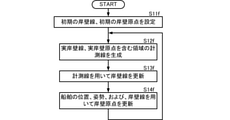
- FIG. 17 is a flowchart showing a schematic process of how to update the quay line and the quay reference point.
- the arithmetic processing unit (ship navigation support device) sets the initial quay line and the initial quay reference point (S11f).
- the arithmetic processing unit generates an actual quay line and a measurement line in a region including the actual quay reference point (S12f).
- the arithmetic processing unit updates the quay line using the measurement line (S13f).
- the arithmetic processing unit updates the quay reference point using the position, attitude, and updated quay line of the ship 100 (S14f).
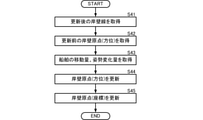
- FIG. 18 is a flowchart showing a method of updating the quay reference point.
- the arithmetic processing unit (ship navigation support device) acquires the updated quay line (S41).
- the arithmetic processing unit acquires the direction of the quay reference point before the update, for example, the quay reference point with respect to the ship 100 (S42).
- the arithmetic processing unit acquires the movement amount (position change amount) and posture change amount of the ship 100 (S43).
- the arithmetic processing device updates the quay reference point (direction) using the direction of the quay reference point before the update, the amount of movement of the ship 100 (the amount of change in position), and the amount of change in attitude (S44).
- the arithmetic processing unit updates the quay reference point (position coordinates) using the updated quay reference point (direction) and the updated quay line (S45).
- the ship navigation support device 10f can suppress an error in updating the quay reference point as well as updating the quay line.
- provisional initial information (provisional quay line)
- provisional initial information (provisional quay line) is set by the user's operation input.
- provisional initial information from past data on the feature information of the target.
- FIG. 19 is a flowchart showing a process of setting provisional initial information from the past position coordinates of the feature information of the target object.
- a mode in which the characteristic information of the target object is the quay line and the provisional initial information is the provisional quay line will be described.
- the arithmetic processing unit stores the past position coordinates of the quay line.
- the arithmetic processing unit reads out the past position coordinates of the quay line (S61).
- the arithmetic processing unit acquires the position coordinates of the ship (own ship) (S62).
- the acquisition of the position coordinates of the ship can be realized by using, for example, the above-mentioned GNSS signal positioning technique.
- the arithmetic processing unit calculates the relative position of the quay line with respect to the ship using these position coordinates (S63).
- the arithmetic processing unit sets a provisional quay line from a relative position (S64). For example, the arithmetic processing unit converts the relative position into a vector quantity set by the distance and direction with respect to the ship, and sets the provisional quay line.
- the mode in which the past position coordinates of the quay line are used is shown.
- a reference station on the quay line use a ship as a mobile station, detect a relative position using DGPS, RTK technology, or the like, and set a provisional quay line. It is also possible to receive the coordinates of the quay line from the outside and set the provisional quay line.
- the mode of setting the initial information from the measurement information is shown based on the provisional initial information.
- the provisional initial information may be set as the initial information as it is.
- the provisional initial information may be used as it is as the initial information because the error is small.
Landscapes
- Engineering & Computer Science (AREA)
- Radar, Positioning & Navigation (AREA)
- Remote Sensing (AREA)
- Physics & Mathematics (AREA)
- General Physics & Mathematics (AREA)
- Combustion & Propulsion (AREA)
- Chemical & Material Sciences (AREA)
- Mechanical Engineering (AREA)
- Ocean & Marine Engineering (AREA)
- Automation & Control Theory (AREA)
- Electromagnetism (AREA)
- Computer Networks & Wireless Communication (AREA)
- Aviation & Aerospace Engineering (AREA)
- Navigation (AREA)
Priority Applications (5)
| Application Number | Priority Date | Filing Date | Title |
|---|---|---|---|
| KR1020237008047A KR20230054843A (ko) | 2020-08-24 | 2021-07-16 | 선박 항행 지원 장치, 선박 항행 지원 방법, 및, 선박 항행 지원 프로그램 |
| CN202180034338.7A CN115551779B (zh) | 2020-08-24 | 2021-07-16 | 船舶航行支援装置、船舶航行支援方法以及船舶航行支援程序 |
| JP2022545531A JP7795465B2 (ja) | 2020-08-24 | 2021-07-16 | 船舶航行支援装置、船舶航行支援方法、および、船舶航行支援プログラム |
| EP21861037.6A EP4202360A4 (en) | 2020-08-24 | 2021-07-16 | VESSEL NAVIGATION ASSISTANCE DEVICE, VESSEL NAVIGATION ASSISTANCE METHOD AND VESSEL NAVIGATION ASSISTANCE PROGRAM |
| US18/174,400 US20230221138A1 (en) | 2020-08-24 | 2023-02-24 | Ship navigation assistance device, ship navigation assistance method, and ship navigation assistance program |
Applications Claiming Priority (2)
| Application Number | Priority Date | Filing Date | Title |
|---|---|---|---|
| JP2020140550 | 2020-08-24 | ||
| JP2020-140550 | 2020-08-24 |
Related Child Applications (1)
| Application Number | Title | Priority Date | Filing Date |
|---|---|---|---|
| US18/174,400 Continuation-In-Part US20230221138A1 (en) | 2020-08-24 | 2023-02-24 | Ship navigation assistance device, ship navigation assistance method, and ship navigation assistance program |
Publications (1)
| Publication Number | Publication Date |
|---|---|
| WO2022044608A1 true WO2022044608A1 (ja) | 2022-03-03 |
Family
ID=80355038
Family Applications (1)
| Application Number | Title | Priority Date | Filing Date |
|---|---|---|---|
| PCT/JP2021/026771 Ceased WO2022044608A1 (ja) | 2020-08-24 | 2021-07-16 | 船舶航行支援装置、船舶航行支援方法、および、船舶航行支援プログラム |
Country Status (6)
| Country | Link |
|---|---|
| US (1) | US20230221138A1 (https=) |
| EP (1) | EP4202360A4 (https=) |
| JP (1) | JP7795465B2 (https=) |
| KR (1) | KR20230054843A (https=) |
| CN (1) | CN115551779B (https=) |
| WO (1) | WO2022044608A1 (https=) |
Cited By (3)
| Publication number | Priority date | Publication date | Assignee | Title |
|---|---|---|---|---|
| JP2023135107A (ja) * | 2022-03-15 | 2023-09-28 | パイオニア株式会社 | 情報処理装置、制御方法、プログラム及び記憶媒体 |
| EP4494997A4 (en) * | 2022-03-15 | 2025-12-31 | Pioneer Corp | INFORMATION PROCESSING DEVICE, CONTROL METHOD, PROGRAM, AND STORAGE MEDIA |
| EP4494999A4 (en) * | 2022-03-15 | 2026-01-21 | Pioneer Corp | INFORMATION PROCESSING DEVICE, CONTROL METHOD, PROGRAM AND STORAGE MEDIA |
Families Citing this family (2)
| Publication number | Priority date | Publication date | Assignee | Title |
|---|---|---|---|---|
| EP4201800B1 (en) | 2020-08-24 | 2026-01-28 | Furuno Electric Co., Ltd. | Watercraft navigation assistance device, watercraft navigation assistance method, and watercraft navigation assistance program |
| DE102024128404A1 (de) * | 2024-10-01 | 2026-04-02 | Freie Hansestadt Bremen (Stadtgemeinde) | Verfahren zum Bereinigen einer Messwertreihe, Kajenschutzeinrichtung und Hafenterminal |
Citations (4)
| Publication number | Priority date | Publication date | Assignee | Title |
|---|---|---|---|---|
| JP2007041499A (ja) * | 2005-07-01 | 2007-02-15 | Advanced Telecommunication Research Institute International | 雑音抑圧装置、コンピュータプログラム、及び音声認識システム |
| JP2007106397A (ja) * | 2005-09-15 | 2007-04-26 | Yamaha Motor Co Ltd | 着岸支援装置およびそれを備えた船舶 |
| JP2012161444A (ja) * | 2011-02-07 | 2012-08-30 | Hitachi Medical Corp | X線ct装置 |
| JP2019079352A (ja) * | 2017-10-25 | 2019-05-23 | 新日鐵住金株式会社 | 情報処理装置、情報処理方法及びプログラム |
Family Cites Families (5)
| Publication number | Priority date | Publication date | Assignee | Title |
|---|---|---|---|---|
| JPS50244B1 (https=) | 1970-08-04 | 1975-01-07 | ||
| US11505292B2 (en) * | 2014-12-31 | 2022-11-22 | FLIR Belgium BVBA | Perimeter ranging sensor systems and methods |
| CN104615880B (zh) * | 2015-01-31 | 2017-08-01 | 电子科技大学中山学院 | 一种三维激光雷达点云匹配的快速icp方法 |
| WO2018100746A1 (ja) * | 2016-12-02 | 2018-06-07 | ヤマハ発動機株式会社 | 小型船舶及びその制御方法 |
| JP7083081B2 (ja) * | 2018-10-10 | 2022-06-10 | ヤンマーパワーテクノロジー株式会社 | 自動着岸装置 |
-
2021
- 2021-07-16 WO PCT/JP2021/026771 patent/WO2022044608A1/ja not_active Ceased
- 2021-07-16 CN CN202180034338.7A patent/CN115551779B/zh active Active
- 2021-07-16 JP JP2022545531A patent/JP7795465B2/ja active Active
- 2021-07-16 EP EP21861037.6A patent/EP4202360A4/en active Pending
- 2021-07-16 KR KR1020237008047A patent/KR20230054843A/ko active Pending
-
2023
- 2023-02-24 US US18/174,400 patent/US20230221138A1/en active Pending
Patent Citations (5)
| Publication number | Priority date | Publication date | Assignee | Title |
|---|---|---|---|---|
| JP2007041499A (ja) * | 2005-07-01 | 2007-02-15 | Advanced Telecommunication Research Institute International | 雑音抑圧装置、コンピュータプログラム、及び音声認識システム |
| JP2007106397A (ja) * | 2005-09-15 | 2007-04-26 | Yamaha Motor Co Ltd | 着岸支援装置およびそれを備えた船舶 |
| JP5000244B2 (ja) | 2005-09-15 | 2012-08-15 | ヤマハ発動機株式会社 | 着岸支援装置およびそれを備えた船舶 |
| JP2012161444A (ja) * | 2011-02-07 | 2012-08-30 | Hitachi Medical Corp | X線ct装置 |
| JP2019079352A (ja) * | 2017-10-25 | 2019-05-23 | 新日鐵住金株式会社 | 情報処理装置、情報処理方法及びプログラム |
Non-Patent Citations (1)
| Title |
|---|
| See also references of EP4202360A4 |
Cited By (3)
| Publication number | Priority date | Publication date | Assignee | Title |
|---|---|---|---|---|
| JP2023135107A (ja) * | 2022-03-15 | 2023-09-28 | パイオニア株式会社 | 情報処理装置、制御方法、プログラム及び記憶媒体 |
| EP4494997A4 (en) * | 2022-03-15 | 2025-12-31 | Pioneer Corp | INFORMATION PROCESSING DEVICE, CONTROL METHOD, PROGRAM, AND STORAGE MEDIA |
| EP4494999A4 (en) * | 2022-03-15 | 2026-01-21 | Pioneer Corp | INFORMATION PROCESSING DEVICE, CONTROL METHOD, PROGRAM AND STORAGE MEDIA |
Also Published As
| Publication number | Publication date |
|---|---|
| CN115551779B (zh) | 2026-04-17 |
| KR20230054843A (ko) | 2023-04-25 |
| EP4202360A4 (en) | 2024-09-25 |
| JPWO2022044608A1 (https=) | 2022-03-03 |
| US20230221138A1 (en) | 2023-07-13 |
| EP4202360A1 (en) | 2023-06-28 |
| JP7795465B2 (ja) | 2026-01-07 |
| CN115551779A (zh) | 2022-12-30 |
Similar Documents
| Publication | Publication Date | Title |
|---|---|---|
| WO2022044608A1 (ja) | 船舶航行支援装置、船舶航行支援方法、および、船舶航行支援プログラム | |
| US8330716B2 (en) | Input device and data processing system | |
| US11964737B2 (en) | Ship information displaying system, ship information displaying method and image generating device | |
| JP7138706B2 (ja) | 表示データ生成装置 | |
| EP3889031A1 (en) | Control target generation device and ship-steering control device | |
| EP4349707A1 (en) | Vessel navigation assistance device, vessel navigation assistance method, and vessel navigation assistance program | |
| US12411011B2 (en) | Ship navigation assistance device, ship navigation assistance method, and ship navigation assistance program | |
| WO2020100617A1 (ja) | 自動走行制御装置、自動走行制御方法および自動走行制御用プログラム | |
| WO2023040685A1 (zh) | 一种线激光设备的系统标定方法和装置 | |
| US9646424B2 (en) | Methods and processes for interactive display of three dimensional covariance | |
| US20240230949A9 (en) | Gravimeter zero-drift correction method, apparatus and electronic device | |
| CN102096918A (zh) | 一种交会对接用相机内参数的标定方法 | |
| WO2020080405A1 (ja) | 表示システム、表示装置、及び表示制御方法 | |
| US20150035749A1 (en) | Information processing device, information processing method, and program | |
| JP6227950B2 (ja) | センサの指向制御方法と装置 | |
| KR101786281B1 (ko) | 자기 헤딩 계산을 위한 디바이스 및 방법 | |
| JP5875248B2 (ja) | 画像処理装置、画像処理方法及びプログラム | |
| US20240248489A1 (en) | Ship body control device, ship body control system, ship body control method and ship body control program | |
| JP4677613B2 (ja) | 三次元形状測定システム | |
| JP2953285B2 (ja) | ポインティング装置 | |
| CN113758515A (zh) | 零点校准方法、装置、电子设备及计算机可读存储介质 | |
| WO2025126811A1 (ja) | 航行支援装置、航行支援データ生成方法、航行支援データ生成プログラム | |
| JP2005195375A (ja) | 多次元物理量測定装置、多次元物理量測定方法、および多次元物理量の演算プログラム |
Legal Events
| Date | Code | Title | Description |
|---|---|---|---|
| 121 | Ep: the epo has been informed by wipo that ep was designated in this application |
Ref document number: 21861037 Country of ref document: EP Kind code of ref document: A1 |
|
| ENP | Entry into the national phase |
Ref document number: 2022545531 Country of ref document: JP Kind code of ref document: A |
|
| ENP | Entry into the national phase |
Ref document number: 20237008047 Country of ref document: KR Kind code of ref document: A |
|
| NENP | Non-entry into the national phase |
Ref country code: DE |
|
| ENP | Entry into the national phase |
Ref document number: 2021861037 Country of ref document: EP Effective date: 20230324 |