WO2022034850A1 - 作業方法及び作業システム - Google Patents
作業方法及び作業システム Download PDFInfo
- Publication number
- WO2022034850A1 WO2022034850A1 PCT/JP2021/029096 JP2021029096W WO2022034850A1 WO 2022034850 A1 WO2022034850 A1 WO 2022034850A1 JP 2021029096 W JP2021029096 W JP 2021029096W WO 2022034850 A1 WO2022034850 A1 WO 2022034850A1
- Authority
- WO
- WIPO (PCT)
- Prior art keywords
- work
- magnetic marker
- magnetic
- vehicle
- marker
- Prior art date
- Legal status (The legal status is an assumption and is not a legal conclusion. Google has not performed a legal analysis and makes no representation as to the accuracy of the status listed.)
- Ceased
Links
Images






Classifications
-
- E—FIXED CONSTRUCTIONS
- E01—CONSTRUCTION OF ROADS, RAILWAYS, OR BRIDGES
- E01F—ADDITIONAL WORK, SUCH AS EQUIPPING ROADS OR THE CONSTRUCTION OF PLATFORMS, HELICOPTER LANDING STAGES, SIGNS, SNOW FENCES, OR THE LIKE
- E01F11/00—Road engineering aspects of Embedding pads or other sensitive devices in paving or other road surfaces, e.g. traffic detectors, vehicle-operated pressure-sensitive actuators, devices for monitoring atmospheric or road conditions
-
- E—FIXED CONSTRUCTIONS
- E01—CONSTRUCTION OF ROADS, RAILWAYS, OR BRIDGES
- E01H—STREET CLEANING; CLEANING OF PERMANENT WAYS; CLEANING BEACHES; DISPERSING OR PREVENTING FOG IN GENERAL CLEANING STREET OR RAILWAY FURNITURE OR TUNNEL WALLS
- E01H1/00—Removing undesirable matter from roads or like surfaces, with or without moistening of the surface
- E01H1/02—Brushing apparatus, e.g. with auxiliary instruments for mechanically loosening dirt
- E01H1/05—Brushing apparatus, e.g. with auxiliary instruments for mechanically loosening dirt with driven brushes
- E01H1/053—Brushing apparatus, e.g. with auxiliary instruments for mechanically loosening dirt with driven brushes having vertical axes
-
- E—FIXED CONSTRUCTIONS
- E01—CONSTRUCTION OF ROADS, RAILWAYS, OR BRIDGES
- E01C—CONSTRUCTION OF, OR SURFACES FOR, ROADS, SPORTS GROUNDS, OR THE LIKE; MACHINES OR AUXILIARY TOOLS FOR CONSTRUCTION OR REPAIR
- E01C23/00—Auxiliary devices or arrangements for constructing, repairing, reconditioning, or taking-up road or like surfaces
- E01C23/01—Devices or auxiliary means for setting-out or checking the configuration of new surfacing, e.g. templates, screed or reference line supports; Applications of apparatus for measuring, indicating, or recording the surface configuration of existing surfacing, e.g. profilographs
-
- E—FIXED CONSTRUCTIONS
- E01—CONSTRUCTION OF ROADS, RAILWAYS, OR BRIDGES
- E01F—ADDITIONAL WORK, SUCH AS EQUIPPING ROADS OR THE CONSTRUCTION OF PLATFORMS, HELICOPTER LANDING STAGES, SIGNS, SNOW FENCES, OR THE LIKE
- E01F9/00—Arrangement of road signs or traffic signals; Arrangements for enforcing caution
- E01F9/30—Arrangements interacting with transmitters or receivers otherwise than by visible means, e.g. using radar reflectors or radio transmitters
-
- G—PHYSICS
- G05—CONTROLLING; REGULATING
- G05D—SYSTEMS FOR CONTROLLING OR REGULATING NON-ELECTRIC VARIABLES
- G05D1/00—Control of position, course, altitude or attitude of land, water, air or space vehicles, e.g. using automatic pilots
- G05D1/02—Control of position or course in two dimensions
- G05D1/021—Control of position or course in two dimensions specially adapted to land vehicles
- G05D1/0259—Control of position or course in two dimensions specially adapted to land vehicles using magnetic or electromagnetic means
- G05D1/0263—Control of position or course in two dimensions specially adapted to land vehicles using magnetic or electromagnetic means using magnetic strips
-
- G—PHYSICS
- G08—SIGNALLING
- G08G—TRAFFIC CONTROL SYSTEMS
- G08G1/00—Traffic control systems for road vehicles
- G08G1/01—Detecting movement of traffic to be counted or controlled
- G08G1/042—Detecting movement of traffic to be counted or controlled using inductive or magnetic detectors
-
- G—PHYSICS
- G08—SIGNALLING
- G08G—TRAFFIC CONTROL SYSTEMS
- G08G1/00—Traffic control systems for road vehicles
- G08G1/09—Arrangements for giving variable traffic instructions
- G08G1/0962—Arrangements for giving variable traffic instructions having an indicator mounted inside the vehicle, e.g. giving voice messages
- G08G1/0967—Systems involving transmission of highway information, e.g. weather, speed limits
- G08G1/096708—Systems involving transmission of highway information, e.g. weather, speed limits where the received information might be used to generate an automatic action on the vehicle control
- G08G1/096725—Systems involving transmission of highway information, e.g. weather, speed limits where the received information might be used to generate an automatic action on the vehicle control where the received information generates an automatic action on the vehicle control
-
- G—PHYSICS
- G08—SIGNALLING
- G08G—TRAFFIC CONTROL SYSTEMS
- G08G1/00—Traffic control systems for road vehicles
- G08G1/09—Arrangements for giving variable traffic instructions
- G08G1/0962—Arrangements for giving variable traffic instructions having an indicator mounted inside the vehicle, e.g. giving voice messages
- G08G1/0967—Systems involving transmission of highway information, e.g. weather, speed limits
- G08G1/096766—Systems involving transmission of highway information, e.g. weather, speed limits where the system is characterised by the origin of the information transmission
- G08G1/096783—Systems involving transmission of highway information, e.g. weather, speed limits where the system is characterised by the origin of the information transmission where the origin of the information is a roadside individual element
Definitions
- the present invention relates to a work method and a work system for carrying out work such as maintenance of a track.
- Some of the work related to the runway such as maintenance, maintenance or management of the runway, requires the passage of vehicles, and there is a need for a method and system for efficiently carrying out the work related to the runway.
- the present invention is intended to provide a work method and a work system for efficiently carrying out work related to the runway on a runway on which a magnetic marker is laid.
- One aspect of the present invention is a work method in which a device that detects a magnetic marker while moving on a track on which a magnetic marker is laid carries out work for maintaining, maintaining, or managing the track. Identify the relative position of the device with respect to the magnetic marker and The location where the device works is identified based on the relative position. It is in the work method in which the apparatus carries out the work at the specified place.
- One aspect of the present invention is a work system including a device for detecting the magnetic marker while moving on a track on which a magnetic marker is laid, and the device performs work for maintaining, maintaining, or managing the track.
- a position specifying unit that specifies the relative position of the device with respect to the magnetic marker, It has a work location specifying portion that specifies a location where the apparatus works based on the relative position.
- the device is in a work system configured to perform work at a location specified by the work location identification unit.
- the place where the device works is specified based on the relative position of the device with respect to the magnetic marker. Then, the device carries out the work at the location specified in this way.
- the magnetic marker is fixed to the track, so there is little risk of its position fluctuating.
- the work location can be specified with high accuracy, and the apparatus can perform the work with high efficiency.
- the work method and work system according to the present invention are methods or systems that can efficiently carry out work related to the track.
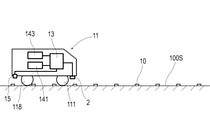
- FIG. 1 An explanatory view showing a bird's-eye view of a work vehicle on a lane in the first embodiment.
- the explanatory view which looks at the work vehicle on the lane from the side in Example 1.
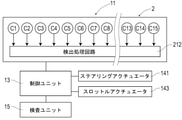
- FIG. The block diagram which shows the structure of the work vehicle in Example 1.
- FIG. An explanatory diagram illustrating a temporal change in a magnetic measurement value in a traveling direction when passing through a magnetic marker in the first embodiment.
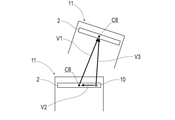
- FIG. The explanatory view of the relative position of the work vehicle after the magnetic marker detection in Example 1.
- FIG. An explanatory view showing a bird's-eye view of a work vehicle on a lane in the second embodiment.
- Example 1 This example is an example relating to a work method and a work system 1 for inspecting the magnetic marker 10 on a road (an example of a runway) 1R on which the magnetic marker 10 is laid. This content will be described with reference to FIGS. 1 to 10.
- the magnetic marker 10 is a marker for a road laid on the road surface 100S. Since the magnetic marker 10 forms a magnetic field around it, it can be magnetically detected.
- the magnetic markers 10 are arranged, for example, at intervals of 2 m along the center of the lane 100 divided by the left and right lane marks.
- the magnetic marker 10 is an example of an accessory (an accessory of the road 1R) constituting the road.
- the magnetic marker 10 is made of a flat circular magnet sheet having a diameter of 100 mm and a thickness of 2 mm.
- the magnet sheet is an isotropic ferrite rubber magnet having a maximum energy product (BHmax) of about 6.4 kJ / cubic meter.
- the surface magnetic flux density Gs of the magnetic marker 10 is about 45 mT or less.
- the magnetic marker 10 can be bonded to the road surface 100S, for example.
- As the adhesive for example, asphalt in a molten state or a softened state may be used.
- the work system 1 is configured to include a work vehicle 11 which is an example of the device.
- the work vehicle 11 (FIG. 2) is a vehicle that includes a steering wheel 111 and a driving wheel 118, and is capable of performing automatic traveling control including control of a steering angle that is the direction of the steering wheel 111.
- the work vehicle 11 includes a sensor array 2 for detecting magnetism, a control unit 13, a steering actuator 141, a throttle actuator 143, an inspection unit 15, and the like.
- the steering actuator 141 is an actuator that steers the steering wheel 111. By controlling the steering actuator 141, the course of the work vehicle 11 can be changed according to the steering of the steering wheel 111.
- the throttle actuator 143 is an actuator for opening / closing (controlling) the engine throttle. By controlling the throttle actuator 143, the engine output can be changed and the speed of the work vehicle 11 can be adjusted.
- the steering actuator 141 and the throttle actuator 143 can be controlled by the control unit 13.
- the sensor array 2 is a magnetic measurement unit in which a plurality of magnetic sensors Cn are arranged in a straight line.
- the sensor array 2 includes 15 magnetic sensors Cn (n is an integer of 1 to 15) arranged at intervals of 0.1 m along the longitudinal direction, and a detection processing circuit 212 for executing magnetic measurement processing and the like. ing.
- the central magnetic sensor C8 is located on the center line of the vehicle (center in the vehicle width direction). It is attached to the work vehicle 11 (FIG. 1).
- the magnetic sensor Cn is a sensor that detects magnetism by using a known MI effect (Magnet Impedance Effect) in which the impedance of a magnetic sensor such as an amorphous wire (not shown) changes sensitively in response to an external magnetic field.
- MI effect Magnetic Impedance Effect
- a magnetic sensor is arranged along three orthogonal axial directions, and it is possible to detect magnetism acting in these three axial directions.
- the sensor array 2 of this example detects magnetic components in the front-rear direction (traveling direction), the vehicle width direction, and the vertical direction in a state of being attached to the work vehicle 11.
- the detection processing circuit 212 is a circuit that executes marker detection processing and the like, which will be described later, for detecting the magnetic marker 10.
- the detection processing circuit 212 is configured by using a CPU (central processing unit) that executes various operations, as well as memory elements such as a ROM (read only memory) and a RAM (random access memory).
- the detection processing circuit 212 outputs one-dimensional magnetic distribution data which is a distribution of magnetic measurement values of each magnetic sensor Cn.
- the one-dimensional magnetic distribution data includes distribution data of magnetic strength acting in the front-rear direction, distribution data of magnetic strength acting in the vehicle width direction, and distribution data of magnetism acting in the vertical direction.
- the control unit 13 is a unit that controls the running of the work vehicle 11 and inspects the magnetic marker 10.
- the control unit 13 includes an electronic board on which electronic components such as a CPU and ROM / RAM are mounted, a storage device such as an HDD (hard disk drive) device or an SSD (solid state drive) device, and the like.
- the control unit 13 realizes a predetermined function by processing the control program read from the ROM or the like by the CPU.
- the control unit 13 controls the steering actuator 141 and the throttle actuator 143, whereby the work vehicle 11 is automatically driven. Further, the control unit 13 inspects the magnetic marker 10 by using the inspection unit 15 and the sensor array 2. The control unit 13 acquires the above-mentioned three types of one-dimensional magnetic distribution data output by the sensor array 2 and stores them over a predetermined period in the past.
- the inspection unit 15 is a unit that inspects the laying state of the magnetic marker 10.
- the inspection unit 15 outputs peeling information indicating whether or not the magnetic marker 10 is peeled from the road surface 100S.
- the inspection unit 15 is arranged in the work vehicle 11 at a distance of 5 m behind the sensor array 2.
- the inspection unit 15 includes an air nozzle 151 (see FIG. 9) that blows compressed air onto the road surface 100S, an imaging camera (not shown) that captures the magnetic marker 10, a sound collecting microphone (not shown), and a processing unit. It is composed of including. A plurality of air nozzles 151 are provided in the vehicle width direction so that compressed air can be injected at each position in the vehicle width direction. One or more image pickup cameras and sound collecting microphones are provided corresponding to almost the entire width direction of the work vehicle 11.
- the processing unit is a circuit that determines the presence or absence of peeling of the magnetic marker 10 (an example of the laying state).
- the processing unit detects the peeling by detecting the fluttering of the peeling portion that may occur when the compressed air is blown against the magnetic marker 10 in which the peeling has occurred.
- the processing unit processes the shooting data (moving image) and the sound data when the compressed air is blown, and detects the fluttering of the peeled portion and the sound of hitting the road surface 100S due to the fluttering.
- the edge of the magnetic marker 10 is fluttered in response to the blowing of compressed air, and in the image data taken by the imaging camera during that time, the edge of the magnetic marker 10 is image-like.
- the processing unit detects the presence or absence of peeling of the magnetic marker 10 by detecting this image-like blur.
- the edge of the magnetic marker 10 is fluttered in response to the blowing of compressed air, and the edge of the magnetic marker 10 is on the road surface in the sound data obtained by the sound collecting microphone during the fluttering. Includes the sound of tapping.
- the processing unit determines whether or not the magnetic marker 10 is peeled off by detecting the sound of the edge of the magnetic marker 10 hitting the road surface.
- a sound detection method there is a method of detecting a frequency component in which the magnetic marker 10 hits the road surface.
- the work vehicle 11 automatically travels along the lane 100 while detecting the magnetic marker 10, and inspects each magnetic marker 10 while traveling.
- A marker detection processing
- B automatic driving control
- C marker inspection
- the marker detection process is a process executed by the sensor array 2.
- the sensor array 2 executes the marker detection process at a frequency of 3 kHz using the magnetic sensor Cn.
- the detection processing circuit 212 of the sensor array 2 acquires the magnetic measurement values measured simultaneously by the 15 magnetic sensors Cn and executes the marker detection processing.
- the sensor array 2 inputs to the control unit 13 that it has been detected and the amount of lateral displacement (relative position) with respect to the magnetic marker 10 as a result of the marker detection process.
- the lateral displacement amount is a deviation in the vehicle width direction with respect to the magnetic marker 10 of the magnetic sensor C8 located at the center of the sensor array 2.
- the magnetic sensor Cn can measure the magnetic components in the front-rear direction and the vehicle width direction of the work vehicle 11. For example, when this magnetic sensor Cn moves in the front-rear direction and passes directly above the magnetic marker 10, the magnetic measurement values in the front-back direction are positive and negative inverted before and after the magnetic marker 10 as shown in FIG. It changes in time so as to intersect zero at a position directly above 10. While the work vehicle 11 is traveling, when a zero cross Zc in which the positive and negative of the magnetic measurement value in the front-rear direction detected by any of the magnetic sensors Cn is reversed occurs, the sensor array 2 is positioned directly above the magnetic marker 10. I can judge. The detection processing circuit 212 determines that the magnetic marker 10 has been detected when the sensor array 2 is located directly above the magnetic marker 10 and a zero cross of the magnetic measurement values in the front-rear direction occurs.
- the magnetic sensor moves along a virtual line in the vehicle width direction passing directly above the magnetic marker 10.
- the magnetic measurement value in the vehicle width direction is reversed on both sides of the magnetic marker 10 and changes so as to intersect zero at a position directly above the magnetic marker 10. Therefore, in the sensor array 2 in which 15 magnetic sensors Cn are arranged in the vehicle width direction, the positive / negative of the magnetic measurement value in the vehicle width direction detected by the magnetic sensor Cn differs depending on which side is located via the magnetic marker 10. Come on.
- a zero cross Zc in which the positive and negative of the magnetic measurement values in the vehicle width direction are reversed appears corresponding to the magnetic marker 10.
- the position of the zero cross Zc in the figure coincides with the position of the magnetic marker 10 in the vehicle width direction.
- the position of the magnetic marker 10 in the vehicle width direction is, for example, the position between two magnetic sensors Cn adjacent to each other with the zero cross Zc in between, or the magnetic measurement value in the vehicle width direction is zero and the magnetic sensors Cn on both outer sides. It can be specified as a position directly under the magnetic sensor Cn whose positive and negative are reversed.
- the detection processing circuit 212 measures the deviation of the representative point of the work vehicle 11 in the vehicle width direction with respect to the magnetic marker 10 as the amount of lateral displacement.
- the position of the magnetic sensor C8 at the center of the sensor array 2, that is, the center of the work vehicle 11 in the vehicle width direction is set as the representative point.
- the example in the figure is an example in which the work vehicle 11 is to the left in the lane 100.
- the positive / negative of the lateral displacement amount is positive when the representative point of the work vehicle 11 is shifted to the left and negative when the representative point of the work vehicle 11 is shifted to the right with respect to the magnetic marker 10.
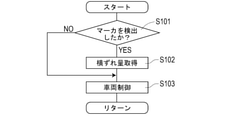
- the control unit 13 acquires the amount of lateral displacement (position relative to the magnetic marker 10) output by the sensor array 2 when the magnetic marker is detected (S101: YES) (S102). ).
- the control unit 13 executes vehicle control so that the amount of lateral displacement approaches a predetermined value such as zero (S103).
- the control unit 13, which is an example of the control unit, automatically drives the work vehicle 11 along the lane 100 (FIG. 1) by such control.
- the control unit 13 steers the steering wheel 111 to the right when the lateral displacement amount is positive, that is, when the work vehicle 11 is displaced to the left with respect to the magnetic marker 10.
- the steering actuator 141 is controlled in this way.
- the control unit 13 controls the throttle actuator 143 according to, for example, the steering amount.
- the control unit 13 controls the throttle actuator 143 so that the vehicle speed is suppressed when the steering amount is large, for example.
- the control unit 13 carries out three types of inspections, which are examples of work.
- the first and second inspections are inspections relating to the magnetic marker 10 detected by the sensor array 2.
- the third inspection is an inspection relating to the magnetic marker 10 which is predicted to be detected by the sensor array 2.
- the control unit 13 determines that the magnetic marker 10 that has passed all the first to third inspections is in good condition.
- the inspection result by the control unit 13 is recorded in the storage area of the storage device (control unit 13) at any time.
- the work vehicle 11 which is an example of the device records the result of performing the work of inspecting the magnetic marker 10 which is an example of an accessory by linking the positioning circuit for positioning the position and the position acquired by the positioning circuit. It is also good to have a circuit.
- a positioning means such as GPS (Global Positioning System) (not shown).
- GPS Global Positioning System
- a storage device such as an HDD (hard disk drive) device or an SSD (solid state drive) device can be used.
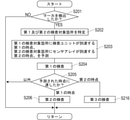
- the control unit 13 specifies a relative position (positional deviation) with respect to the magnetic marker 10 for the work vehicle 11 which is an example of the apparatus (S201: YES in FIG. 7). Positioning part). Then, the control unit 13 identifies the first and second inspection target locations by using the relative positions with respect to the detected magnetic marker 10 (S202, work location identification unit).
- the first inspection target location is the above-mentioned first and second inspection target location, and is the location where the magnetic marker 10 detected in step S201 is laid.
- the second inspection target location is the third inspection target location described above.
- the second inspection target location is a location where an undetected magnetic marker 10 adjacent to the magnetic marker 10 detected in step S201 is laid in front of the traveling direction.
- the control unit 13 uses the center of the sensor array 2 (the position of the magnetic sensor C8) as a representative point of the work vehicle 11 in the front-rear direction of the work vehicle 11 with respect to the magnetic marker 10. And the relative position in the vehicle width direction is specified (position specifying part).
- the positional deviation (relative position) of the work vehicle 11 in the front-rear direction with respect to the magnetic marker 10 is specified as zero.
- the lateral displacement amount acquired from the sensor array 2 is specified as a positional deviation (relative position) of the work vehicle 11 in the vehicle width direction with respect to the magnetic marker 10.
- the control unit 13 is located directly under the sensor array 2 in the front-rear direction and at a position deviated from the center of the sensor array 2 by the amount of lateral displacement in the vehicle width direction, that is, a position where the detected magnetic marker 10 is laid. ,
- the first inspection target location is specified (S202), and the first inspection is carried out (S204).
- the control unit 13 that carries out the first inspection reads out the one-dimensional magnetic distribution data output by the sensor array 2 from the storage area while facing the laying location of the magnetic marker 10 which is the first inspection target location.
- the distribution data of the magnetic strength in the vertical direction is good.
- the control unit 13 executes threshold processing on the one-dimensional magnetic distribution data (see FIG. 8).
- the magnitude of the magnetic measurement value (absolute value) at the position (first inspection target location) directly above the magnetic marker 10 in the one-dimensional magnetic distribution data is a predetermined magnetic strength (threshold Th). It is a process of determining whether or not the value exceeds.
- the control unit 13 determines that the magnetic characteristics of the magnetic marker 10 are good. On the other hand, if the threshold value Th is not satisfied, it is determined that the magnetic characteristics of the magnetic marker 10 are not good.
- the one-dimensional magnetic distribution illustrated in FIG. 8 is an example judged to be good.
- the second inspection is an inspection of the laid state of the magnetic marker 10, such as peeling from the road surface 100S (see FIG. 2).
- the control unit 13 predicts the time point at which the inspection unit 15 reaches the first inspection target location (the location where the magnetic marker 10 detected in S201 is laid) identified in step S202 (FIG. 7) above (S203). ).
- the control unit 13 has a first time point at which the inspection unit 15 reaches the laying place of the magnetic marker 10 which is the first inspection target place based on the vehicle speed and the steering angle, and the first time point thereof.
- the position of the magnetic marker 10 in the vehicle width direction is predicted.
- the control unit 13 uses the moving distance of the work vehicle 11 to determine that the predicted first time point has been reached. Specifically, when the moving distance of the work vehicle 11 after detecting the magnetic marker 10 in step S201 reaches a predetermined amount (5 m, which is the distance between the sensor array 2 and the inspection unit 15), the first step in step S202. It is determined that the first time point in which the inspection unit 15 reaches the inspection target portion of 1 has been reached (S205: first time point).
- the control unit 13 operates the inspection unit 15 when the inspection unit 15 faces the first inspection target location (the location where the magnetic marker 10 is laid detected in S201) (S205: first time point). Output a control signal to make it.
- This control signal includes information on the position of the magnetic marker 10 in the vehicle width direction predicted as described above.
- the inspection unit 15 carries out a second inspection in response to the control signal from the control unit 13 (S206).
- the inspection unit 15 first selects one or two or more air nozzles 151 corresponding to the positions of the magnetic marker 10 in the vehicle width direction represented by the control signal. Then, compressed air is injected from the selected air nozzle 151 toward the road surface 100S.
- the inspection unit 15 processes the imaging data and sound data of the magnetic marker 10 when the compressed air is injected, and determines whether or not the magnetic marker 10 is peeled off. For example, the inspection unit 15 determines the presence or absence of peeling by detecting the fluttering of the peeled portion in an image or detecting the fluttering sound. If the magnetic marker 10 is peeled off, the inspection result indicating that the laying state is defective is output, and if the magnetic marker 10 is not peeled off, the inspection result indicating that the laying state is good is output.
- the third inspection is an inspection relating to the arrangement of the magnetic marker 10. As described above, the third inspection is not the inspection of the detected magnetic marker 10, but the inspection of the magnetic marker 10 which is predicted to be detected in the future.
- the control unit 13 uses the location where the magnetic marker 10 adjacent to the front of the magnetic marker 10 is laid as the second inspection target location.
- Specify S202. This laying location is an example of the laying position of the new magnetic marker 10 whose detection is predicted in the future. As described above, in the configuration of this example, the magnetic markers 10 are arranged every 2 m.
- the control unit 13 identifies that the sensor array 2 is located directly above the magnetic marker 10 (an example of a relative position), and positions a position 2 m ahead of the sensor array 2 as a second position. It is specified as the inspection target part of.
- This inspection target location is an example of a location to be worked on in the future.
- the control unit 13 predicts a second time point at which the sensor array 2 reaches the next magnetic marker 10 laying point (second inspection target place) based on the steering angle and the vehicle speed (S203). Specifically, the control unit 13 lays the next magnetic marker 10 2 m ahead based on the steering angle and the vehicle speed with reference to the time when the magnetic marker 10 is detected in S201 of FIG. 7 (second). The second time point at which the sensor array 2 reaches the inspection target portion) is predicted.
- the control unit 13 determines that the predicted second time point has been reached by using the moving distance of the work vehicle 11 as in the case of the second inspection described above (S205). Specifically, the control unit 13 makes a second inspection when the moving distance of the work vehicle 11 after detecting the magnetic marker 10 in step S201 reaches a predetermined amount (2 m, which is the interval between the magnetic markers 10). It is determined that the second time point at which the sensor array 2 reaches the target location has been reached (S205: second time point).
- the control unit 13 carries out the third inspection (S216).
- the third inspection is an inspection as to whether or not the sensor array 2 can detect the magnetic marker 10.
- the control unit 13 can acquire the result that the magnetic marker 10 is detected from the sensor array 2 at the second time point, it determines that the magnetic markers 10 are correctly arranged at predetermined intervals.
- the moving distance of the work vehicle 11 from the implementation of the first inspection to the implementation of the second inspection and the third inspection is 5 m and 2 m, respectively. Therefore, based on the time when any of the magnetic markers 10 is detected in step S201 (the time when the first inspection is performed), the third inspection in step S216 is better than the second inspection in step S206. It will be implemented first.
- the control unit 13 identifies new first and second inspection target locations based on the magnetic marker 10. That is, after the first inspection is performed by first detecting any of the magnetic markers 10, the first inspection is performed, and then the second inspection is performed. And the second inspection target location is specified.
- the control unit 13 stores and manages data such as the first and second inspection target locations and the first and second time points for each magnetic marker 10.
- the control unit 13 has the same magnetic marker 10 in the first inspection performed in step S204 in FIG. 7, the second inspection performed in step S206, the third inspection performed in step S216, and all the inspections. When it is determined that the magnetic marker 10 is good, the magnetic marker 10 is determined to be good.
- the work system 1 of this example is a system in which the work vehicle 11 automatically travels along the magnetic marker 10 and inspects the magnetic marker 10 during the automatic travel.
- the work vehicle 11 which is an example of the apparatus inspects the magnetic marker 10 while automatically traveling along the magnetic marker 10.
- the magnetic characteristics first inspection
- the laying state second inspection
- the arrangement third inspection
- the shape inspection of the magnetic marker 10 can be performed, for example, by processing the captured image of the magnetic marker 10.
- various methods can be considered instead of the method of injecting the exemplified compressed air.
- the stamp-shaped member in the air suction state is pulled up from the state of being pressed against the magnetic marker 10
- all the suction holes are opened at almost the same time if peeling does not occur.
- the magnetic marker 10 is peeled off, the peeled portion is attracted and turned up when the stamp-shaped member is pulled up. At this time, the timing at which the suction hole corresponding to the peeled portion is opened is delayed from that of the other suction holes. If such a delay is detected, the peeling of the magnetic marker 10 can be detected.
- a work vehicle 11 capable of automatically traveling is illustrated as an example of the device.
- the device may be a vehicle that does not have driving wheels and is towed by human power or another vehicle.
- the vehicle speed can be detected by the rotation speed of the wheels and the like, and the course can be detected by the rotation difference between the left and right wheels and the steering angle of the steering wheels. If the vehicle is equipped with a sensor array 2 or an inspection unit 15, the above-mentioned (A) marker detection process and (C) marker inspection are carried out regardless of whether or not the vehicle is self-propelled or automatically driven. It is possible.
- the work carried out by the work vehicle 11 which is an apparatus may be a work of newly providing a magnetic marker 10 which is an example of an accessory constituting the runway 1R.
- a magnetic marker 10 which is an example of an accessory constituting the runway 1R.
- the work system 1 of this example it is possible to efficiently carry out the work of laying the magnetic marker 10 in the middle of the adjacent magnetic markers 10.
- the magnetic marker 10 determined to have insufficient magnetic force in the first inspection of this example is magnetized, thereby improving the state of the magnetic marker 10, which is an example of an accessory. Is also good.
- the magnetic pole property of the magnetic marker 10 that can be detected on the vehicle side may be specified and sequentially recorded in the storage device. In this case, a database of magnetic pole properties of the magnetic marker 10 laid along the lane 100 can be constructed.
- the work of specifying the laying position of the magnetic marker 10 may be added.
- the absolute position of the magnetic sensor C8 when the magnetic marker 10 is detected can be specified.
- the position displaced by the amount of lateral displacement when the magnetic marker 10 is detected can be specified as the absolute position of the magnetic marker 10.
- the work system 1 can carry out the work of maintaining, maintaining or managing the road 1R forming the runway.
- the work of inspecting the magnetic marker 10 corresponds to the work of maintenance and management.
- the work of laying a magnetic marker corresponds to the maintenance of the road 1R.
- the work of maintaining the road in relation to the magnetic marker includes, for example, the work of magnetizing a magnetic marker having a reduced magnetic force.
- the work of managing the road includes the work of measuring the magnetic force of the magnetic marker and the work of positioning the laying position of the magnetic marker.
- the work to maintain the road 1R includes the work of laying a new lane mark, the work of setting a curb, the work of setting a guardrail, the work of setting a plant in a median strip, the work of setting a sign along the road 1R, and the work of paving the road surface.
- Maintenance work for road 1R includes repairing and cleaning the pavement surface, repainting lane marks with reduced visibility, removing (cleaning) dust on the shoulders, and pruning plants. There is work to take appropriate measures when it becomes necessary.
- the road is good, such as inspecting the pavement for defects such as cracks and dents, inspecting the visibility of the lane mark, and checking for foreign matter on the road. There is work to check whether or not it is in such a state.
- the amount of lateral displacement in the vehicle width direction is measured as the relative position of the representative point of the work vehicle 11 with respect to the magnetic marker 10.
- the magnetic marker 10 is located directly below the sensor array 2, so that the positional deviation (relative position) in the front-rear direction is zero.
- the relative position of the work vehicle 11 when the front-rear direction is not zero that is, after passing through the magnetic marker 10.
- the movement vector V1 of the work vehicle 11 after passing through the magnetic marker 10 can be specified based on the elapsed time, the vehicle speed, the steering angle, and the like.
- the relative position of the work vehicle 11 with respect to the magnetic marker 10 after passing through the magnetic marker 10 can be specified as a total vector V3 of the vector V2 corresponding to the amount of lateral displacement when the magnetic marker 10 is detected and the movement vector V1. be. It is also possible to specify a work place based on the total vector V3 which is a relative position with respect to the magnetic marker 10.
- Example 2 This example is an example in which the work content is changed based on the work system of the first embodiment.
- the work content of the first embodiment is an inspection of the magnetic marker 10.
- the work content of this example is cleaning for improving the visibility of the lane mark (white line, lane marking) 100L that divides the lane. This content will be described with reference to FIG.
- the lane 100 targeted by the work system 1 of this example is an area divided by the left and right lane marks 100L.
- the magnetic markers 10 are arranged along the center of the lane 100, for example, at intervals of 2 m. Further, as in the first embodiment, the work vehicle 11 automatically travels along the lane 100 while detecting the magnetic marker 10.
- the work vehicle 11 of this example is provided with a pair of left and right rotating brushes 17 for cleaning the lane mark 100L.
- the rotary brush 17 is provided at the tip of an arm 171 attached to the front side of the work vehicle 11.
- the arm 171 is attached to the vehicle body in a state of being rotatable along the road surface 100S.
- the rotation range of the arm 171 is about 90 degrees between the rotation position of the arm 171 along the forward direction and the rotation position of the arm 171 along the vehicle width direction (outside). The range.
- the position of the rotating brush 17 in the vehicle width direction can be changed with respect to the work vehicle 11.
- the lane mark 100L can be cleaned by the rotating brush 17 regardless of the position of the work vehicle 11 in the lane 100 in the vehicle width direction.
- the work vehicle 11 includes, in addition to the electrical configuration of the first embodiment, a motor 173 that rotates the arm 171 and a motor control unit 170 that controls the motor 173.
- the motor control unit 170 controls the motor 173 according to the control information input from the control unit 13.
- the control information by the control unit 13 includes at least information on the amount of lateral displacement output by the sensor array 2.
- the motor control unit 170 rotates the arm 171 so that the rotary brush 17 is located directly above the lane mark 100L in response to control information such as the amount of lateral displacement input from the control unit 13.
- the work vehicle 11 When the work vehicle 11 is located in the middle of the adjacent magnetic markers 10, it is also possible to specify the relative position of the work vehicle 11 with respect to the detected magnetic marker 10 as described with reference to FIG. If the work location is specified based on this relative position, the work location can be specified with high accuracy even when the interval between the magnetic markers 10 becomes long.
- cleaning of the lane mark 100L is exemplified as a work.
- Various tasks can be considered, such as cleaning the shoulders of curbs, cleaning guardrails, managing planting pruning and watering, and inspecting RC structures such as the inner walls of tunnels.
- Work on an accessory (accessory) of the road 1R provided along the lane 100 is suitable for the work system of the present invention.
- the magnetic markers may be arranged along the arrangement direction. In this case, the work can be performed by the illustrated work system 1 regardless of whether the work environment is a road or a facility such as a factory.
- the other configurations and effects are the same as in Example 1.
Landscapes
- Engineering & Computer Science (AREA)
- Architecture (AREA)
- Civil Engineering (AREA)
- Structural Engineering (AREA)
- Physics & Mathematics (AREA)
- General Engineering & Computer Science (AREA)
- Aviation & Aerospace Engineering (AREA)
- Radar, Positioning & Navigation (AREA)
- Remote Sensing (AREA)
- General Physics & Mathematics (AREA)
- Automation & Control Theory (AREA)
- Electromagnetism (AREA)
- Control Of Position, Course, Altitude, Or Attitude Of Moving Bodies (AREA)
Priority Applications (4)
| Application Number | Priority Date | Filing Date | Title |
|---|---|---|---|
| JP2022542828A JP7659199B2 (ja) | 2020-08-08 | 2021-08-05 | 作業方法及び作業システム |
| US18/020,267 US20240011231A1 (en) | 2020-08-08 | 2021-08-05 | Work method and work system |
| EP21855929.2A EP4194610A4 (en) | 2020-08-08 | 2021-08-05 | WORKING PROCEDURES AND WORKING SYSTEM |
| CN202180056707.2A CN116034198A (zh) | 2020-08-08 | 2021-08-05 | 作业方法以及作业系统 |
Applications Claiming Priority (2)
| Application Number | Priority Date | Filing Date | Title |
|---|---|---|---|
| JP2020-135446 | 2020-08-08 | ||
| JP2020135446 | 2020-08-08 |
Publications (1)
| Publication Number | Publication Date |
|---|---|
| WO2022034850A1 true WO2022034850A1 (ja) | 2022-02-17 |
Family
ID=80247844
Family Applications (1)
| Application Number | Title | Priority Date | Filing Date |
|---|---|---|---|
| PCT/JP2021/029096 Ceased WO2022034850A1 (ja) | 2020-08-08 | 2021-08-05 | 作業方法及び作業システム |
Country Status (5)
| Country | Link |
|---|---|
| US (1) | US20240011231A1 (https=) |
| EP (1) | EP4194610A4 (https=) |
| JP (1) | JP7659199B2 (https=) |
| CN (1) | CN116034198A (https=) |
| WO (1) | WO2022034850A1 (https=) |
Citations (6)
| Publication number | Priority date | Publication date | Assignee | Title |
|---|---|---|---|---|
| JP2000045236A (ja) * | 1998-07-31 | 2000-02-15 | Pub Works Res Inst Ministry Of Constr | 道路マーカ着滋方法および装置 |
| JP2009007823A (ja) | 2007-06-28 | 2009-01-15 | Fukushima Pulse Kk | 道路清掃車 |
| WO2017141869A1 (ja) * | 2016-02-16 | 2017-08-24 | 愛知製鋼株式会社 | 作業車両システム及び磁気マーカの作業方法 |
| JP2018132791A (ja) * | 2017-02-13 | 2018-08-23 | 日本車輌製造株式会社 | 搬送車 |
| WO2020138467A1 (ja) * | 2018-12-28 | 2020-07-02 | 愛知製鋼株式会社 | 走行路診断システム |
| WO2020138465A1 (ja) * | 2018-12-28 | 2020-07-02 | 愛知製鋼株式会社 | 車両及び車両用の診断システム |
Family Cites Families (5)
| Publication number | Priority date | Publication date | Assignee | Title |
|---|---|---|---|---|
| JP2837071B2 (ja) * | 1993-09-03 | 1998-12-14 | 三菱重工業株式会社 | 締結部の緩み検出装置 |
| US8935057B2 (en) * | 2012-01-17 | 2015-01-13 | LimnTech LLC | Roadway mark data acquisition and analysis apparatus, systems, and methods |
| JP6928306B2 (ja) * | 2017-03-28 | 2021-09-01 | 愛知製鋼株式会社 | 磁気マーカの施工方法及び作業システム |
| CN109132067A (zh) * | 2017-06-27 | 2019-01-04 | 联合汽车电子有限公司 | 一种标签抓取机构及其抓取方法 |
| JP7047506B2 (ja) * | 2017-09-28 | 2022-04-05 | 愛知製鋼株式会社 | 車両用システム及びタグ通信方法 |
-
2021
- 2021-08-05 WO PCT/JP2021/029096 patent/WO2022034850A1/ja not_active Ceased
- 2021-08-05 JP JP2022542828A patent/JP7659199B2/ja active Active
- 2021-08-05 US US18/020,267 patent/US20240011231A1/en not_active Abandoned
- 2021-08-05 EP EP21855929.2A patent/EP4194610A4/en not_active Withdrawn
- 2021-08-05 CN CN202180056707.2A patent/CN116034198A/zh active Pending
Patent Citations (6)
| Publication number | Priority date | Publication date | Assignee | Title |
|---|---|---|---|---|
| JP2000045236A (ja) * | 1998-07-31 | 2000-02-15 | Pub Works Res Inst Ministry Of Constr | 道路マーカ着滋方法および装置 |
| JP2009007823A (ja) | 2007-06-28 | 2009-01-15 | Fukushima Pulse Kk | 道路清掃車 |
| WO2017141869A1 (ja) * | 2016-02-16 | 2017-08-24 | 愛知製鋼株式会社 | 作業車両システム及び磁気マーカの作業方法 |
| JP2018132791A (ja) * | 2017-02-13 | 2018-08-23 | 日本車輌製造株式会社 | 搬送車 |
| WO2020138467A1 (ja) * | 2018-12-28 | 2020-07-02 | 愛知製鋼株式会社 | 走行路診断システム |
| WO2020138465A1 (ja) * | 2018-12-28 | 2020-07-02 | 愛知製鋼株式会社 | 車両及び車両用の診断システム |
Non-Patent Citations (1)
| Title |
|---|
| See also references of EP4194610A4 |
Also Published As
| Publication number | Publication date |
|---|---|
| EP4194610A4 (en) | 2024-08-21 |
| EP4194610A1 (en) | 2023-06-14 |
| US20240011231A1 (en) | 2024-01-11 |
| JPWO2022034850A1 (https=) | 2022-02-17 |
| JP7659199B2 (ja) | 2025-04-09 |
| CN116034198A (zh) | 2023-04-28 |
Similar Documents
| Publication | Publication Date | Title |
|---|---|---|
| US10957188B2 (en) | Systems and methods for determining traffic flow using observations of surrounding vehicles | |
| US10699565B2 (en) | Systems and methods for inferring lane obstructions | |
| CN102622886B (zh) | 一种基于视频的车辆违章变道事件检测方法 | |
| CN103761877B (zh) | 基于雷达触发的闯红灯自动记录系统及方法 | |
| JP5433525B2 (ja) | 車両走行支援装置及び道路標示の作成方法 | |
| CA2871296C (en) | Method and system for calibrating laser profiling systems | |
| JP2016140235A (ja) | 車両速度を決定するための方法およびシステム | |
| US6378772B1 (en) | Road marker magnetizing method | |
| CN101604448A (zh) | 一种运动目标的测速方法和系统 | |
| US20230373521A1 (en) | System for automatically operable vehicles for the perception of road damages | |
| CN108986502B (zh) | 感应回路检测系统和方法 | |
| CN117826807A (zh) | 一种巡检机器人多传感器融合导航方法及装置 | |
| JP7389360B2 (ja) | 走行路診断システム | |
| JP2018055222A (ja) | 走路検出方法及び走路検出装置 | |
| CN114383620A (zh) | 车辆精准位置获取方法、系统、可读存储介质及车辆 | |
| JP7659199B2 (ja) | 作業方法及び作業システム | |
| CN106969923A (zh) | 一种车辆通道圆轨迹测试系统及方法 | |
| CN111252071B (zh) | 用于运行车辆的方法 | |
| CN119494185A (zh) | 一种自动驾驶仿真评测方法及仿真评测装置 | |
| JP4400258B2 (ja) | 高さ制限超過検知装置 | |
| AU2020101939A4 (en) | A system for pit hole detection and filling for road based on artificial intelligence | |
| CN115166720A (zh) | 一种基于轨迹拼接的城市道路全域轨迹采集方法和系统 | |
| US20210403030A1 (en) | Laser based computer controlled topographic profiler | |
| JP6143176B2 (ja) | 停止線検出装置、移動体制御装置及び停止線検出用プログラム | |
| WO2022270365A1 (ja) | 車両用システム |
Legal Events
| Date | Code | Title | Description |
|---|---|---|---|
| 121 | Ep: the epo has been informed by wipo that ep was designated in this application |
Ref document number: 21855929 Country of ref document: EP Kind code of ref document: A1 |
|
| DPE1 | Request for preliminary examination filed after expiration of 19th month from priority date (pct application filed from 20040101) | ||
| ENP | Entry into the national phase |
Ref document number: 2022542828 Country of ref document: JP Kind code of ref document: A |
|
| WWE | Wipo information: entry into national phase |
Ref document number: 18020267 Country of ref document: US |
|
| WWE | Wipo information: entry into national phase |
Ref document number: 2021855929 Country of ref document: EP |
|
| NENP | Non-entry into the national phase |
Ref country code: DE |
|
| ENP | Entry into the national phase |
Ref document number: 2021855929 Country of ref document: EP Effective date: 20230309 |
|
| WWW | Wipo information: withdrawn in national office |
Ref document number: 2021855929 Country of ref document: EP |