WO2022025189A1 - 電解コンデンサ - Google Patents
電解コンデンサ Download PDFInfo
- Publication number
- WO2022025189A1 WO2022025189A1 PCT/JP2021/028118 JP2021028118W WO2022025189A1 WO 2022025189 A1 WO2022025189 A1 WO 2022025189A1 JP 2021028118 W JP2021028118 W JP 2021028118W WO 2022025189 A1 WO2022025189 A1 WO 2022025189A1
- Authority
- WO
- WIPO (PCT)
- Prior art keywords
- compound
- electrolytic capacitor
- amine compound
- acid
- group
- Prior art date
- Legal status (The legal status is an assumption and is not a legal conclusion. Google has not performed a legal analysis and makes no representation as to the accuracy of the status listed.)
- Ceased
Links
Images
Classifications
-
- H—ELECTRICITY
- H01—ELECTRIC ELEMENTS
- H01G—CAPACITORS; CAPACITORS, RECTIFIERS, DETECTORS, SWITCHING DEVICES, LIGHT-SENSITIVE OR TEMPERATURE-SENSITIVE DEVICES OF THE ELECTROLYTIC TYPE
- H01G9/00—Electrolytic capacitors, rectifiers, detectors, switching devices, light-sensitive or temperature-sensitive devices; Processes of their manufacture
- H01G9/004—Details
- H01G9/022—Electrolytes; Absorbents
- H01G9/035—Liquid electrolytes, e.g. impregnating materials
-
- H—ELECTRICITY
- H01—ELECTRIC ELEMENTS
- H01G—CAPACITORS; CAPACITORS, RECTIFIERS, DETECTORS, SWITCHING DEVICES, LIGHT-SENSITIVE OR TEMPERATURE-SENSITIVE DEVICES OF THE ELECTROLYTIC TYPE
- H01G9/00—Electrolytic capacitors, rectifiers, detectors, switching devices, light-sensitive or temperature-sensitive devices; Processes of their manufacture
- H01G9/004—Details
- H01G9/022—Electrolytes; Absorbents
- H01G9/025—Solid electrolytes
- H01G9/028—Organic semiconducting electrolytes, e.g. TCNQ
-
- H—ELECTRICITY
- H01—ELECTRIC ELEMENTS
- H01G—CAPACITORS; CAPACITORS, RECTIFIERS, DETECTORS, SWITCHING DEVICES, LIGHT-SENSITIVE OR TEMPERATURE-SENSITIVE DEVICES OF THE ELECTROLYTIC TYPE
- H01G9/00—Electrolytic capacitors, rectifiers, detectors, switching devices, light-sensitive or temperature-sensitive devices; Processes of their manufacture
- H01G9/145—Liquid electrolytic capacitors
-
- H—ELECTRICITY
- H01—ELECTRIC ELEMENTS
- H01G—CAPACITORS; CAPACITORS, RECTIFIERS, DETECTORS, SWITCHING DEVICES, LIGHT-SENSITIVE OR TEMPERATURE-SENSITIVE DEVICES OF THE ELECTROLYTIC TYPE
- H01G9/00—Electrolytic capacitors, rectifiers, detectors, switching devices, light-sensitive or temperature-sensitive devices; Processes of their manufacture
- H01G9/15—Solid electrolytic capacitors
-
- H—ELECTRICITY
- H01—ELECTRIC ELEMENTS
- H01G—CAPACITORS; CAPACITORS, RECTIFIERS, DETECTORS, SWITCHING DEVICES, LIGHT-SENSITIVE OR TEMPERATURE-SENSITIVE DEVICES OF THE ELECTROLYTIC TYPE
- H01G9/00—Electrolytic capacitors, rectifiers, detectors, switching devices, light-sensitive or temperature-sensitive devices; Processes of their manufacture
- H01G9/004—Details
- H01G9/08—Housing; Encapsulation
-
- H—ELECTRICITY
- H01—ELECTRIC ELEMENTS
- H01G—CAPACITORS; CAPACITORS, RECTIFIERS, DETECTORS, SWITCHING DEVICES, LIGHT-SENSITIVE OR TEMPERATURE-SENSITIVE DEVICES OF THE ELECTROLYTIC TYPE
- H01G9/00—Electrolytic capacitors, rectifiers, detectors, switching devices, light-sensitive or temperature-sensitive devices; Processes of their manufacture
- H01G9/15—Solid electrolytic capacitors
- H01G9/151—Solid electrolytic capacitors with wound foil electrodes
Definitions
- the present invention relates to an electrolytic capacitor including a conductive polymer compound and a liquid component.
- the electrolytic capacitor includes a capacitor element and a liquid component (electrolytic solution).
- the capacitor element includes an anode having a dielectric layer on its surface and a conductive polymer compound covering at least a part of the dielectric layer.
- the liquid component includes an acid component, a base component, and a solvent.
- Patent Document 1 proposes that an electrolytic solution, such as ethylene glycol, is used as a solvent, ammonia is used as a base component, and azelaic acid or the like is used as an acid component.
- Patent Document 2 proposes that a tertiary amine such as triethylamine and a quaternary ammonium such as 1,2-dimethylimidazolinium are used as the base component of the electrolytic solution, and that the electrolytic solution contains an antioxidant such as phenol. Has been done.
- the amount of the organic carboxylic acid compound in the liquid component may decrease due to the esterification reaction.
- the pH of the liquid component may increase, the dopant of the conductive polymer may be dedoped, and the ESR of the electrolytic capacitor may increase.
- the film repair function of the liquid component may be deteriorated, and the leakage current of the electrolytic capacitor may be increased.
- ammonia, tertiary amine or quaternary ammonium is used as the base component of the liquid component, or if an antioxidant such as phenol is contained in the liquid component, the leakage current of the electrolytic capacitor may increase.
- the electrolytic capacitor contains a capacitor element and a liquid component, and the capacitor element comprises an anode having a dielectric layer on its surface and a conductive polymer compound covering at least a part of the dielectric layer.
- the liquid component comprises an acid component, a base component, and a solvent, the solvent contains an organic compound having a hydroxy group, the acid component contains an organic carboxylic acid compound, and the base component is. It contains at least one selected from the group consisting of primary amine compounds and secondary amine compounds.
- the other electrolytic capacitor comprises a capacitor element and a liquid component, wherein the capacitor element comprises an anode having a dielectric layer on its surface and a conductive polymer compound covering at least a part of the dielectric layer.
- the liquid component comprises an acid component, a base component, a solvent, and an antioxidant, and the base component is at least selected from the group consisting of a primary amine compound and a secondary amine compound. Includes one.
- the electrolytic capacitor according to the embodiment of the present invention includes a capacitor element and a liquid component.
- the capacitor element comprises an anode having a dielectric layer on its surface and a conductive polymer compound covering at least a part of the dielectric layer.
- the liquid component includes an acid component, a base component, and a solvent.
- the solvent contains an organic compound having a hydroxy group.
- the acid component includes an organic carboxylic acid compound.
- the base component contains at least one selected from the group consisting of a primary amine compound and a secondary amine compound (hereinafter, also referred to as a primary amine compound and the like).
- the amount of the organic carboxylic acid compound in the liquid component may decrease due to the esterification reaction.
- the pH of the liquid component may increase
- the dopant of the conductive polymer may be dedoped
- the ESR of the electrolytic capacitor may increase. Due to the decrease in the amount of the organic carboxylic acid compound, the film repair function (the function of repairing defects in the dielectric layer) of the liquid component may be lowered, and the leakage current of the electrolytic capacitor may be increased.
- the increase in ESR is suppressed by including at least one of a primary amine compound and a secondary amine compound (hereinafter, also referred to as a primary amine compound or the like) as a basic component in the liquid component. It was found that the increase in leakage current was suppressed.
- a primary amine compound and a secondary amine compound hereinafter, also referred to as a primary amine compound or the like
- the amount of the undissociated organic carboxylic acid compound in the liquid component is reduced as compared with the case where the liquid component contains at least one of the tertiary amine and ammonia. Esterification reaction is suppressed. Therefore, the decrease of the organic carboxylic acid compound due to the esterification reaction is suppressed, the increase of ESR due to the dedoping of the dopant of the conductive polymer is suppressed even when used for a long time, and the film repair function of the liquid component is sufficiently performed. It is maintained and the increase in leakage current is suppressed.
- the liquid component contains a primary amine compound or the like
- the pH of the liquid component is maintained low and the dedoping of the dopant from the conductive polymer compound is suppressed as compared with the case where the liquid component contains quaternary ammonium. , The increase in ESR is suppressed.
- the stability of the liquid component (for example, thermal stability) is appropriately ensured as compared with the case where the liquid component contains ammonia, a tertiary amine and / or a quaternary ammonium.
- the stability of the liquid component is appropriately ensured as compared with the case where the liquid component contains ammonia, a tertiary amine and / or a quaternary ammonium.
- the leakage current is particularly likely to increase. Therefore, the effect of the present invention of suppressing the increase in leakage current by including the primary amine compound or the like in the liquid component can be remarkably obtained.
- the liquid component may contain an antioxidant.
- the leakage current is smaller than when the liquid component contains ammonia, tertiary amine, and / or quaternary ammonium, and leakage due to the liquid component containing an antioxidant. The increase in current is suppressed.
- the electrolytic capacitor according to another embodiment of the present invention includes a capacitor element and a liquid component.
- the capacitor element comprises an anode having a dielectric layer on its surface and a conductive polymer compound covering at least a part of the dielectric layer.
- the liquid component includes an acid component, a base component, a solvent, and an antioxidant.
- the base component contains at least one selected from the group consisting of a primary amine compound and a secondary amine compound (hereinafter, also referred to as a primary amine compound and the like).
- Antioxidants are used for the purpose of suppressing deterioration of the conductive polymer compound due to oxidation.
- the film repair function of the liquid component may deteriorate due to the influence of the antioxidant, and the leakage current of the electrolytic capacitor may increase.
- the leakage current is smaller than when the liquid component contains ammonia, a tertiary amine, and / or a quaternary ammonium, and the liquid component contains an antioxidant.
- the increase in leakage current due to the above is suppressed. Even when an antioxidant is used, the effect of suppressing the increase in leakage current by including a primary amine compound or the like in the liquid component can be remarkably obtained in a medium-high voltage type (for example, a rated voltage of 160 V or more) electrolytic capacitor. ..
- the pH of the liquid component is maintained low as compared with the case where the liquid component contains a quaternary ammonium, and the dopant is dedoped from the conductive polymer compound. It is suppressed and the increase in ESR is suppressed.
- the liquid component contains at least one of the primary amine compound and the secondary amine compound as the basic component, the increase in ESR is suppressed and the increase in leakage current is suppressed.
- the organic compound having a hydroxy group preferably contains a glycerin compound.
- the organic carboxylic acid compound is more likely to interact with the hydroxy group of the glycerin compound than the phenolic antioxidant having a hydroxy group attached to the aromatic ring.
- the solvent contains a glycerin compound, the influence of the organic carboxylic acid compound on the phenolic antioxidant is reduced, and the function of suppressing the oxidative deterioration of the conductive polymer compound of the phenolic antioxidant is likely to be efficiently exhibited.
- the glycerin compound has a high boiling point, and the permeation from the sealing portion of the electrolytic capacitor to the outside is suppressed.
- the fluctuation of the amount of the glycerin compound is small, the stability of the liquid component including the primary amine compound is further enhanced, the amount of the acid component and the base component to be dissociated is stably maintained, and the film repair function of the liquid component is stable.
- the property is further improved, and the increase in leakage current is further suppressed.
- the liquid component is in direct contact with the dielectric layer or via a conductive polymer compound.
- the liquid component may be present between the dielectric layer of the anode body and the cathode body together with the conductive polymer compound.
- the liquid component enhances the contact property between the dielectric layer and the conductive polymer compound and has a film repair function.
- Gas chromatography-mass spectrometry (GC / MS) or the like is used for analysis of liquid components.
- liquid components include components that are liquid at room temperature (25 ° C.) (components that are not solidified).
- Preferred examples of such liquid component solvents include solvents that are liquid at room temperature (25 ° C.).
- the liquid component may be a component that is liquid at the temperature of an example when the electrolytic capacitor is used.
- Preferred examples of such a liquid component solvent include a solvent that is liquid at an example temperature when the electrolytic capacitor is used.
- the base component contains at least one of a primary amine compound and a secondary amine compound.
- the ratio of the total of the primary amine compound and the secondary amine compound to the basic components is preferably the largest, and all of the basic components may be at least one of the primary amine compound and the secondary amine compound.
- the base component may contain a small amount of components other than the primary amine compound and the secondary amine compound.
- the total ratio of ammonia, tertiary amine and quaternary ammonium to the base component is, for example, 2% by mass or less.
- the primary amine compound preferably contains at least one selected from the group consisting of an aliphatic primary amine compound and an aromatic primary amine compound.
- the secondary amine compound preferably contains at least one selected from the group consisting of an aliphatic secondary amine compound, an aromatic secondary amine compound and a heterocyclic secondary amine compound.
- the primary amine compound and the secondary amine compound one kind may be used alone, or two or more kinds may be used in combination.
- the heterocyclic secondary amine compound is a heterocyclic compound (heterocyclic compound) containing a nitrogen atom as a heteroatom, and one hydrogen atom is bonded to the nitrogen atom contained in the ring.
- Heteroatoms may include atoms other than nitrogen atoms (eg, oxygen atoms).
- the number of members of the heterocycle is, for example, 3 or more and 6 or less.
- the heterocycle is preferably free of unsaturated bonds.
- Aliphatic groups include chain or cyclic (excluding aromatic rings) hydrocarbon groups.
- the aliphatic group may be a linear hydrocarbon group from the viewpoint of reducing the influence of steric hindrance.
- the hydrocarbon group may be a saturated hydrocarbon group or an unsaturated hydrocarbon group.
- Aliphatic groups may contain ether bonds.
- a part of the hydrogen atom bonded to the carbon atom of the hydrocarbon group may be substituted with a substituent other than the hydrogen atom. Examples of the substituent include a hydroxyl group, a nitro group, a phenyl group and the like.
- the hydrocarbon group includes, for example, an alkyl group, a cycloalkyl group, an alkenyl group and the like.
- the number of carbon atoms of the hydrocarbon group may be, for example, 1 or more and 6 or less, and 1 or more and 4 or less. It may be present, and may be 3 or more and 6 or less.
- Aliphatic primary amine compounds include, for example, alkylamines, cycloalkylamines, polyamines, etheramines, and derivatives thereof.
- Alkylamines include methylamines, ethylamines, n-propylamines, isopropylamines, n-butylamines, isobutylamines, t-butylamines, and derivatives thereof.
- Cycloalkylamines include cyclohexylamines, amantadine, and derivatives thereof.
- Polyamines include ethylenediamine, hexamethylenediamine, spermidine, spermine, and derivatives thereof.
- the aliphatic primary amine compound preferably contains ethylamine, isopropylamine, t-butylamine, ethylenediamine, and hexamethylenediamine from the viewpoints of being easily available and relatively inexpensive.
- Aliphatic secondary amine compounds include, for example, dialkylamines and their derivatives.
- the two alkyl groups may be the same or different from each other.
- One of the two alkyl groups may be a cycloalkyl group or may contain an ether bond.
- Dialkylamines include dimethylamine, diethylamine, N-methylethylamine, N-methylpropylamine, N-methylisopropylamine, N-ethylpropylamine, N-ethylisopropylamine, dipropylamine, diisopropylamine, dibutylamine, N- Includes ethylisobutylamine, di-tert-butylamine, and derivatives thereof.
- the aliphatic secondary amine compound preferably contains diethylamine, diisopropylamine, and dibutylamine from the viewpoints of being easily available and relatively inexpensive.
- an aromatic primary amine compound two hydrogen atoms and one aromatic group are bonded to a nitrogen atom.
- an aromatic secondary amine compound one hydrogen atom and two aromatic groups or one aromatic group and one aliphatic group are bonded to a nitrogen atom.
- the two aromatic groups may be the same or different from each other.
- Aliphatic groups may include the aliphatic groups mentioned in the above aliphatic amine compounds.
- the aromatic group contains at least one aromatic ring, and includes, for example, an aryl group, an aralkyl group, and the like.
- the aryl group includes a phenyl group, a 2-methylphenyl group, a 3-methylphenyl group, a 4-methylphenyl group, a 1-naphthyl group, a 2-naphthyl group, a xsilyl group and the like.
- the aralkyl group includes a benzyl group, a 2-phenylethyl group and the like.
- a part of the hydrogen atom bonded to the carbon atom of the aromatic group may be substituted with a substituent other than the hydrogen atom. Examples of the substituent include a hydroxyl group, a nitro group, a phenyl group and the like.
- Aromatic primary amine compounds include, for example, arylamines, aralkylamines, and derivatives thereof.
- Arylamines include aniline, 2-methylaniline, 3-methylaniline, 4-methylaniline, 1-naphthylamine, 2-naphthylamine, and derivatives thereof.
- Aralkylamines include benzylamines, phenylethylamines, and derivatives thereof. Of these, benzylamine and phenylethylamine are preferable from the viewpoints of being easily available and relatively inexpensive.
- Aromatic secondary amine compounds include, for example, diarylamines, alkylarylamines, and derivatives thereof.
- Diarylamines include diphenylamines, N-phenyl-1-naphthylamines, N-phenyl-2-naphthylamines, and derivatives thereof.
- Alkylarylamines include N-methylaniline, N-ethylaniline, N-methyl-1-naphthylamine, N-methyl-2-naphthylamine, and derivatives thereof. Of these, diphenylamine is preferable from the viewpoint of being easily available and relatively inexpensive.
- the heterocyclic secondary amine compound includes aziridine, azetidine, pyrrolidine, piperidine, piperazine, morpholine, and derivatives thereof.
- the heterocyclic secondary amine compound preferably contains pyrrolidine, piperidine, morpholine, and derivatives thereof from the viewpoints of being easily available and relatively inexpensive.
- the acid component contributes to the film repair function.
- the acid component may include at least an organic carboxylic acid compound.
- the ratio of the organic carboxylic acid compound to the acid component is preferably the largest, and all of the acid components may be organic carboxylic acid compounds.
- the acid component may contain a small amount of a component other than the organic carboxylic acid compound. Examples of the components other than the organic carboxylic acid compound include inorganic acids such as phosphoric acid, boric acid, and sulfuric acid.
- the organic carboxylic acid compound may contain at least one selected from the group consisting of aromatic carboxylic acid compounds and aliphatic carboxylic acid compounds.
- the aliphatic carboxylic acid compound includes saturated aliphatic carboxylic acid, unsaturated aliphatic carboxylic acid and the like.
- Saturated aliphatic carboxylic acids include, for example, oxalic acid, malonic acid, succinic acid, glutaric acid, adipic acid, azelaic acid, sebatic acid, 1,6-decandicarboxylic acid, 1,7-octanedicarboxylic acid, formic acid, acetic acid, Includes propionic acid, butyric acid, isobutyric acid, valeric acid, caproic acid, enant acid, capric acid, pelargonic acid, capric acid, lauric acid, myristic acid, stearic acid, behenic acid and the like.
- Unsaturated aliphatic carboxylic acids include, for example, acrylic acid, methacrylic acid, maleic acid, fumaric acid, oleic acid and the like.
- the aliphatic carboxylic acid compound may be used alone or in combination of two or more.
- the aromatic carboxylic acid compound includes, for example, phthalic acid (ortho form), isophthalic acid (meth form), terephthalic acid (para form), benzoic acid, salicylic acid, trimellitic acid, pyromellitic acid and the like.
- the aromatic carboxylic acid compound may be used alone or in combination of two or more.
- organic carboxylic acid compounds are selected from benzoic acid, adipic acid, azelaic acid, sebatic acid, 1,6-decandicarboxylic acid, and 1,7-octanedicarboxylic acid from the viewpoint of improving the film repair function and thermal stability. It is preferable to include at least one selected from the group. These organic carboxylic acid compounds are suitably used for medium and high pressure type electrolytic capacitors (for example, the rated voltage is 160 V or more).
- the liquid component preferably contains more acid components than the base component.
- the acid component lowers the pH of the electrolytic solution from the initial stage and suppresses dedoping of the dopant from the conductive polymer.
- the acid component contributes to the film repair function of the liquid component, it is preferable that the acid component contains a larger amount of the acid component than the basic component.
- the molar ratio of the acid component to the base component is, for example, It is 1.1 or more, preferably 1.5 or more, and more preferably 1.5 or more and 10 or less.
- the pH of the liquid component may be 6 or less, or 1 or more and 5 or less.
- the total content of the acid component and the base component in the liquid component may be, for example, 5% by mass or more and 25% by mass or less, and 7% by mass or more and 15% by mass or less with respect to the entire liquid component. There may be. In the above range, the acid component and the base component are easily dissociated in the liquid component.
- the solvent may include at least an organic compound having a hydroxy group.
- the ratio of the organic compound having a hydroxy group to the solvent may be, for example, 5% by volume or more, 20% by volume or more, or all of the solvent may be an organic compound having a hydroxy group.
- the organic compound having a hydroxy group one kind may be used alone, or two or more kinds may be used in combination.
- the organic compound having a hydroxy group preferably contains a polyol compound.
- the polyol compound preferably contains at least one selected from the group consisting of glycerin compounds and glycol compounds (hereinafter, also referred to as glycerin compounds and the like).
- the solvent contains a glycerin compound or the like, the conductive polymer compound tends to swell, the orientation of the conductive polymer compound is improved, the conductivity of the conductive polymer compound (layer) is improved, and the ESR is reduced. easy.
- Glycerin compounds and the like have a relatively high boiling point, permeation from the sealing portion of the electrolytic capacitor to the outside is suppressed, deterioration of the film repair function due to a decrease in solvent is suppressed, and an increase in leakage current is suppressed. Further, the organic carboxylic acid compound is more likely to interact with a hydroxy group such as a glycerin compound than a phenolic antioxidant having a hydroxy group bonded to an aromatic ring. When the solvent contains a glycerin compound or the like, the influence of the organic carboxylic acid compound on the phenolic antioxidant is reduced, and the function of suppressing the oxidative deterioration of the conductive polymer compound of the phenolic antioxidant is likely to be efficiently exhibited.
- the glycerin compound is more preferable from the viewpoint that the interaction with the organic carboxylic acid compound is larger and the above-mentioned function of the phenolic antioxidant is more efficiently exhibited.
- the mass ratio of the glycerin compound to the solvent may be 20% by mass or more, or 25% by mass or more.
- Glycerin compounds include glycerin, polyglycerin, and derivatives thereof.
- examples of the glycerin or polyglycerin derivative include an ester in which at least a part of the hydroxy group of glycerin or polyglycerin is esterified, an alkylene oxide adduct of glycerin or polyglycerin, and the like.
- Polyglycerin contains a repeating structure of glycerin units.
- the number of repetitions of the glycerin unit contained in polyglycerin is, for example, 2 or more and 20 or less, may be 2 or more and 12 or less, may be 2 or more and 10 or less, and may be 2 or more and 6 or less. May be good.
- Examples of polyglycerin include diglycerin and triglycerin.
- the weight average molecular weight of polyglycerin is, for example, preferably 200 or more and 3000 or less, and more preferably 300 or more and 800 or less.
- Glycol compound includes alkylene glycol and the like.
- alkylene glycol examples include ethylene glycol, propylene glycol, butylene glycol, and hexylene glycol.
- ethylene glycol is preferable because it has a low viscosity and easily dissolves an acid component and a base component. Further, ethylene glycol has high thermal conductivity and excellent heat dissipation, and is preferable in terms of improving heat resistance.
- the glycol compound may contain a polyalkylene glycol compound.
- the polyalkylene glycol compound include polyalkylene glycol, a copolymer containing two or more kinds of alkylene oxide units, and a polyalkylene oxide adduct of a polyhydric alcohol.
- the alkylene oxide unit include ethylene oxide (EO) units and propylene oxide (PO) units.
- the polyhydric alcohol include glycerin and the like.
- the weight average molecular weight of the polyalkylene glycol compound is, for example, 100 or more and 3000 or less, and may be 100 or more and 2000 or less.
- the weight average molecular weight of polyethylene glycol (PEG) is, for example, 100 or more and 600 or less, and may be 100 or more and 400 or less.
- the solvent may contain other components other than the organic compound having a hydroxy group.
- examples of such a component include a sulfone compound, a sulfoxide compound, a lactone compound, a carbonate compound and the like.
- Examples of the sulfone compound include dimethyl sulfone, diethyl sulfone, sulfolane, 3-methyl sulfolane and the like.
- Examples of the sulfoxide compound include dimethyl sulfoxide and diethyl sulfoxide.
- Examples of the lactone compound include ⁇ -butyrolactone and ⁇ -valerolactone.
- Examples of the carbonate compound include dimethyl carbonate, diethyl carbonate, ethylmethyl carbonate, ethylene carbonate, propylene carbonate, fluoroethylene carbonate and the like.
- the components other than the organic compound having a hydroxy group one kind may be used alone, or two or more kinds may be used in combination.
- the antioxidant may contain at least one selected from the group consisting of phenol-based antioxidants, amine-based antioxidants, phosphorus-based antioxidants, sulfur-based antioxidants and aliphatic antioxidants. Among them, a phenolic antioxidant is preferable from the viewpoint of reactivity with dissolved oxygen and the like.
- the phenolic antioxidant preferably contains at least one selected from the group consisting of monophenolic antioxidants, bisphenolic antioxidants and polyphenolic antioxidants. Of these, polyphenolic antioxidants are preferred. When a primary amine compound or the like is used for a polyphenol-based antioxidant, the effect of suppressing an increase in leakage current can be easily obtained.
- the monophenolic antioxidant preferably contains 2,6-di-tert-butyl-4-methylphenol, butylhydroxyanisole, sesamol, tocopherol, tocotrienol, p-nitrophenol and the like. Further, the monophenolic antioxidant may contain mono, di, or tri ( ⁇ -methylbenzyl) phenol, trolox, normelatonin, ferulic acid and the like.
- the bisphenol-based antioxidant preferably contains anoxomer or the like.
- the bisphenol-based antioxidants are 2,2'-methylenebis (4-ethyl-6-tert-butylphenol), 2,2'-methylenebis (4-methyl-6-tert-butylphenol), and 4,4'-.
- Butyldenbis (3-ethyl-6-tert-butylphenol), 4,4'-thiobis (3-ethyl-6-tert-butylphenol), butylation reaction products of p-cresol and dicyclopentadiene and the like may be included.
- the polyphenolic antioxidant is preferably gallate, propyl gallate, chlorogenic acid, catechin, epigalocatechin, epigalocatechin gallate, rosmarinic acid, genquanin, luteolin, carnosic acid, carnosol, ursoric acid, pyrogallol, kebrazinic acid. , Hydroxytyrosol, dopamine, caffeic acid, adrenaline, noradrenaline, catechol, bovineol, hydroquinone, resorcinol and the like. Further, the polyphenol-based antioxidant preferably contains hydroquinone and a dielectric thereof. Derivatives of hydroquinone include 2,5-di-tert-butylhydroquinone, 2,5-di-tert-amylhydroquinone and the like.
- the polyphenolic antioxidants include protocatechuic acid, rutin, gnetin C, theaflavin, luteolin, resveratrol, pinocembrin, pinobanksin, 1,3,5-tris (3,5-di-tert-butyl-4-hydroxy).
- Benzyl) -1,3,5-triazine-2,4,6 (1H, 3H, 5H) -trione, 4,4', 4 "-(1-methylpropanol-3-iriden) tris (6-tert) -Butyl-m-cresol) and the like may be contained.
- Amine-based antioxidants include aromatic secondary amine-based antioxidants, benzotriazole-based antioxidants, benzimidazole-based antioxidants, amine-ketone-based antioxidants, and the like.
- the aromatic secondary amine-based antioxidant includes N-phenyl-1-naphthylamine, diphenylamine-based antioxidant, phenylenediamine-based antioxidant, and the like.
- Diphenylamine-based antioxidants include alkylated diphenylamines such as p, p'-dioctyldiphenylamine, 4,4'-bis ( ⁇ , ⁇ -dimethylbenzyl) diphenylamines, p- (p-toluenesulfonylamide) diphenylamines and the like.
- Phenylenediamine-based antioxidants include N, N'-di-2-naphthyl-p-phenylenediamine, N-phenyl-N'-isopyrropyr-p-phenylenediamine, N-phenyl-N'-(1,3-). It contains dimethylbutyl) -p-phenylenediamine, N-phenyl-N'-(3-methacryloyloxy-2-hydroxypropyl) -p-phenylenediamine and the like.
- Benzotriazole-based antioxidants include benzotriazole and the like.
- Benzimidazole-based antioxidants include benzimidazole, 2-mercaptobenzoimidazole, 2-mercaptomethylbenzoimidazole, imidazole dipeptide and the like.
- Amine-ketone antioxidants are 2,2,4-trimethyl-1,2-dihydroquinoline polymer, 6-ethoxy-1,2-dihydro-2,2,4-trimethylquinoline, reaction of diphenylamine with acetone. Includes substances, acetylcysteine, melatonin, etc.
- Phosphorus-based antioxidants include phosphate ester-based antioxidants, phosphite ester-based antioxidants, and the like.
- ester include monoalkyl esters, dialkyl esters, trialkyl esters and the like.
- phosphite ester-based antioxidant include tris (nonylphenyl) phosphite and the like.
- Sulfur-based antioxidants include thioether-based antioxidants, isothiocyanates, sulfites (salts), pyrosulfites (salts), and the like.
- Thioether-based antioxidants include phenothiazine, dibenzyldisulfide, diacetylsulfide, dilauryl thiodipropionate and the like.
- Aliphatic antioxidants include citric acid, L-ascorbic acid, erythorbic acid, ethylenediaminetetraacetic acid and the like.
- the antioxidant one type may be used alone, or two or more types may be used in combination.
- the content of the antioxidant in the liquid component is, for example, 1% by mass or more and 10% by mass or less with respect to the entire liquid component.
- the capacitor element contains at least an anode having a dielectric layer on its surface and a conductive polymer compound covering at least a part of the dielectric layer.
- the capacitor element will be described in detail.
- the anode body can contain a valve acting metal, an alloy containing a valve acting metal, a compound containing a valve acting metal, and the like. These materials can be used alone or in combination of two or more.
- the valve acting metal for example, aluminum, tantalum, niobium, and titanium are preferably used.
- the anode body having a porous surface can be obtained by, for example, roughening the surface of a base material (foil-shaped or plate-shaped base material, etc.) containing a valve acting metal by etching or the like.
- the anode body may be a molded body of particles containing a valve acting metal or a sintered body thereof.
- the sintered body has a porous structure.
- the dielectric layer is formed by anodizing the valve acting metal on the surface of the anode body by chemical conversion treatment or the like.
- the dielectric layer may be formed so as to cover at least a part of the anode body.
- the dielectric layer is usually formed on the surface of the anode. Since the dielectric layer is formed on the porous surface of the anode body, it is formed along the inner wall surface of the holes and pits on the surface of the anode body.
- the dielectric layer contains an oxide of the valve acting metal.
- the dielectric layer when tantalum is used as the valve acting metal contains Ta 2 O 5
- the dielectric layer when aluminum is used as the valve acting metal contains Al 2 O 3 .
- the dielectric layer is not limited to this, and may be any one that functions as a dielectric.
- the dielectric layer is formed along the surface of the anode, including the inner wall of the hole.
- Examples of the conductive polymer compound include ⁇ -conjugated polymer compounds.
- Examples of the conductive polymer compound include polypyrrole, polythiophene, polyfuran, polyaniline and the like. These may be used alone or in combination of two or more, or may be a copolymer of two or more monomers.
- the weight average molecular weight of the conductive polymer compound is, for example, 1000 to 100,000.
- polypyrrole, polythiophene, polyfuran, polyaniline and the like mean polymers having polypyrrole, polythiophene, polyfuran, polyaniline and the like as basic skeletons, respectively. Therefore, polypyrrole, polythiophene, polyfuran, polyaniline and the like may also contain their respective derivatives.
- polythiophene includes poly (3,4-ethylenedioxythiophene) and the like.
- the conductive polymer compound can be doped with a dopant.
- the dopant may be a polyanion.
- Specific examples of the polyanion include polyvinyl sulfonic acid, polystyrene sulfonic acid, polyallyl sulfonic acid, polyacrylic sulfonic acid, polymethacrylic sulfonic acid, poly (2-acrylamide-2-methylpropanesulfonic acid), polyisoprene sulfonic acid, and poly. Acrylic acid and the like can be mentioned. These may be used alone or in combination of two or more. Of these, polystyrene sulfonic acid is preferable.
- a conductive polymer layer (solid electrolyte layer).
- the conductive polymer layer may contain a dopant together with the conductive polymer compound.
- the conductive polymer layer constitutes a part of the cathode portion together with the cathode body.
- the conductive polymer layer may further contain an additive, if necessary.
- the conductive polymer layer can be formed, for example, by chemically polymerizing and / or electrolytically polymerizing the raw material monomer on the dielectric layer. Alternatively, it can be formed by contacting the dielectric layer with a solution in which the conductive polymer compound is dissolved or a dispersion in which the conductive polymer compound is dispersed. The conductive polymer layer may be formed so as to cover at least a part of the dielectric layer.
- the cathode body In the electrolytic capacitor, the cathode body may be arranged so as to face the anode body. A conductive polymer compound and a liquid component are interposed between the anode body and the cathode body.
- a metal foil may be used for the cathode body.
- the type of metal is not particularly limited, but it is preferable to use a valve acting metal such as aluminum, tantalum, niobium, or an alloy containing a valve acting metal. If necessary, the surface of the metal foil may be roughened.
- the surface of the metal foil may be provided with a chemical conversion film, or may be provided with a metal (dissimilar metal) or non-metal film different from the metal constituting the metal foil. Examples of the dissimilar metal and the non-metal include a metal such as titanium and a non-metal such as carbon.
- a separator When the metal foil is used for the cathode body, a separator may be arranged between the metal foil and the anode body.
- the separator is not particularly limited, and for example, a non-woven fabric containing fibers of cellulose, polyethylene terephthalate, vinylon, polyamide (for example, aromatic polyamide such as aliphatic polyamide and aramid) may be used.
- the electrolytic capacitor may have at least one capacitor element, and may have a plurality of capacitor elements.
- the number of capacitor elements included in the electrolytic capacitor may be determined according to the application.
- the electrolytic capacitor usually includes an exterior body that houses the capacitor element and the liquid component.
- the exterior body is not particularly limited, and a known exterior body may be used.
- An example of an exterior body includes a bottomed case and a sealing member.
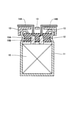
- FIG. 1 is a schematic cross-sectional view of an example of an electrolytic capacitor according to the present embodiment.
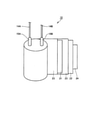
- FIG. 2 is a schematic view of a part of the capacitor element related to the electrolytic capacitor.
- the electrolytic capacitor shown in FIG. 1 includes a capacitor element 10, a liquid component (not shown), a bottomed case 11 that houses the capacitor element 10 and the liquid component, and a sealing member 12 that closes the opening of the bottomed case 11.
- the seat plate 13 that covers the sealing member 12, the lead wires 14A and 14B that are derived from the sealing member 12 and penetrate the seat plate 13, and the lead tabs 15A and 15B that connect the lead wires and the electrodes of the capacitor element 10. , Equipped with.
- the open end of the bottomed case 11 is curled so as to be crimped to the sealing member 12.
- the capacitor element 10 is manufactured from a winding body as shown in FIG.
- the wound body is a semi-finished product of the capacitor element 10, and means that the conductive polymer compound is not arranged between the anode body 21 having a dielectric layer on the surface and the cathode body 22.
- the winding body is formed by winding an anode body 21 connected to the lead tab 15A and a cathode body 22 connected to the lead tab 15B via a separator 23.
- the outermost circumference of the winding body is fixed by the winding stop tape 24. Note that FIG. 2 shows a partially unfolded state before fixing the outermost circumference of the winding body.
- the anode body 21 is provided with a metal foil whose surface is roughened, and a dielectric layer is formed on the roughened surface.
- the capacitor element 10 is formed by adhering a conductive polymer compound to at least a part of the surface of the dielectric layer.
- Step of preparing the anode body 21 and the cathode body 22 having a dielectric layer As a raw material for the anode body 21 and the cathode body 22, a metal foil containing a valve acting metal is used. In the case of the anode body 21, the surface of the metal foil is roughened by etching or the like, and a plurality of irregularities are formed on the surface of the metal foil. Next, a dielectric layer is formed on the surface of the roughened metal foil by chemical conversion treatment or the like. If necessary, the surface of the cathode body 22 may be roughened.
- the anode body 21 and the cathode body 22 are wound around the separator 23 to form a wound body.
- the lead tabs 15A and 15B may be wound while being wound, and the lead tabs 15A and 15B may be planted from the winding body as shown in FIG.
- the winding stop tape 24 is arranged on the outer surface of the cathode body 22 located on the outermost layer of the winding body, and the end portion of the cathode body 22 is fixed.
- the wound body may be further subjected to chemical conversion treatment in order to form a dielectric layer on the cut surface of the anode body 21.
- Step of forming the capacitor element 10 the dielectric layer is impregnated with a dispersion liquid of the conductive polymer compound to form a film of the conductive polymer compound covering at least a part of the dielectric layer.
- a film of the conductive polymer compound may be formed by immersing the winding body in the dispersion liquid of the conductive polymer compound.
- the step of applying the dispersion liquid of the conductive polymer compound to the surface of the dielectric layer may be repeated twice or more.
- the capacitor element 10 may be impregnated with a liquid component.
- an electrolytic capacitor containing a conductive polymer compound and a liquid component can be obtained.
- an electrolytic capacitor having an excellent repair function of the dielectric layer can be obtained.
- the capacitor element 10 is housed in the bottomed case 11 together with the liquid component so that the lead wires 14A and 14B are located on the opening side of the bottomed case 11.
- Examples of the material of the bottomed case 11 include metals such as aluminum, stainless steel, copper, iron, and brass, or alloys containing these.
- the opening of the bottomed case 11 is closed by the sealing member 12 through which the lead wires 14A and 14B penetrate, the opening end is crimped to the sealing member 12 and curled, and the seat plate 13 is arranged in the curled portion.
- the aging process may be performed while applying the rated voltage.
- the winding type electrolytic capacitor has been described, but the scope of application of the present invention is not limited to the above, and other electrolytic capacitors, for example, chip type electrolysis using a metal sintered body as an anode body. It can also be applied to capacitors and laminated electrolytic capacitors that use a metal plate as an anode.
- the rated voltage is 250 W.
- a wound electrolytic capacitor (diameter 10.0 mm ⁇ L (length) 20.0 mm) having a V (Work Voltage) and a rated capacitance of 7 ⁇ F was produced. The specific manufacturing method of the electrolytic capacitor will be described below.
- An aluminum foil having a thickness of 100 ⁇ m was subjected to an etching treatment to roughen the surface of the aluminum foil. Then, a dielectric layer was formed on the surface of the aluminum foil by chemical conversion treatment. The chemical conversion treatment was carried out by immersing an aluminum foil in an ammonium adipate solution and applying a voltage of 500 V to the aluminum foil. Then, the aluminum foil was cut to prepare an anode body.
- the anode lead tab and the cathode lead tab were connected to the anode body and the cathode body, and the anode body and the cathode body were wound through the separator while winding the lead tab.
- An anode lead wire and a cathode lead wire were connected to the end of each lead tab protruding from the winding body.
- the produced wound body was subjected to chemical conversion treatment again to form a dielectric layer at the cut end of the anode body.
- the end portion of the outer surface of the winding body was fixed with a winding stop tape to prepare a winding body.
- the winding body was immersed in the polymer dispersion contained in a predetermined container for 5 minutes in a reduced pressure atmosphere (40 kPa), and then the winding body was pulled up from the polymer dispersion. Next, the wound body impregnated with the polymer dispersion was dried in a drying oven at 150 ° C. for 20 minutes to form a conductive polymer layer covering at least a part of the dielectric layer. The capacitor element was formed in this way.
- the acid component and the base component shown in Table 1 were added to the solvent and mixed to prepare liquid components a1 to a2 and b1 to b3.
- a mixed solvent containing ethylene glycol (EG) and polyethylene glycol (PEG) (weight average molecular weight MW: 300) in a mass ratio of 25:75 was used.
- the primary amine of the liquid component a1 is monoethylamine
- the secondary amine of the liquid component a2 is diethylamine
- the tertiary amine of the liquid component b1 is triethylamine
- the quaternary ammonium of the liquid component b3 is tetraethylamine.
- the concentration of the acid component in the liquid component was 0.56 mol / kg.
- the concentration of the base component in the liquid component was 0.17 mol / kg.
- the molar ratio of (acid component / base component) was 3.3.
- A1 and A2 in Table 1 are electrolytic capacitors of Examples 1 and 2, respectively, using the liquid components a1 and a2.
- B1, B2 and B3 are electrolytic capacitors of Comparative Examples 1 to 3 using the liquid components b1, b2 and b3, respectively.
- Example 5 A liquid component similar to the liquid component a4, except that a mixed solvent containing glycerin (GL) and polyethylene glycol (PEG) (weight average molecular weight MW: 300) in a mass ratio of 25:75 was used as the solvent. Obtained a5.
- An electrolytic capacitor A5 of Example 5 was obtained in the same manner as the electrolytic capacitor A1 of Example 1 except that the liquid component a5 was used instead of the liquid component a1.
- the present invention can be used for electrolytic capacitors, and can be preferably used for electrolytic capacitors that require a small leakage current and low ESR.
Landscapes
- Engineering & Computer Science (AREA)
- Power Engineering (AREA)
- Chemical & Material Sciences (AREA)
- Chemical Kinetics & Catalysis (AREA)
- Electrochemistry (AREA)
- Microelectronics & Electronic Packaging (AREA)
- Compositions Of Macromolecular Compounds (AREA)
Priority Applications (4)
| Application Number | Priority Date | Filing Date | Title |
|---|---|---|---|
| JP2022539567A JPWO2022025189A1 (https=) | 2020-07-31 | 2021-07-29 | |
| US18/014,970 US12531188B2 (en) | 2020-07-31 | 2021-07-29 | Electrolytic capacitor |
| CN202180048835.2A CN115836367A (zh) | 2020-07-31 | 2021-07-29 | 电解电容器 |
| US19/423,147 US20260112544A1 (en) | 2020-07-31 | 2025-12-17 | Electrolytic capacitor |
Applications Claiming Priority (2)
| Application Number | Priority Date | Filing Date | Title |
|---|---|---|---|
| JP2020-130972 | 2020-07-31 | ||
| JP2020130972 | 2020-07-31 |
Related Child Applications (2)
| Application Number | Title | Priority Date | Filing Date |
|---|---|---|---|
| US18/014,970 A-371-Of-International US12531188B2 (en) | 2020-07-31 | 2021-07-29 | Electrolytic capacitor |
| US19/423,147 Continuation US20260112544A1 (en) | 2020-07-31 | 2025-12-17 | Electrolytic capacitor |
Publications (1)
| Publication Number | Publication Date |
|---|---|
| WO2022025189A1 true WO2022025189A1 (ja) | 2022-02-03 |
Family
ID=80036353
Family Applications (1)
| Application Number | Title | Priority Date | Filing Date |
|---|---|---|---|
| PCT/JP2021/028118 Ceased WO2022025189A1 (ja) | 2020-07-31 | 2021-07-29 | 電解コンデンサ |
Country Status (4)
| Country | Link |
|---|---|
| US (2) | US12531188B2 (https=) |
| JP (1) | JPWO2022025189A1 (https=) |
| CN (1) | CN115836367A (https=) |
| WO (1) | WO2022025189A1 (https=) |
Families Citing this family (1)
| Publication number | Priority date | Publication date | Assignee | Title |
|---|---|---|---|---|
| US12354812B2 (en) * | 2021-01-22 | 2025-07-08 | Panasonic Intellectual Property Management Co., Ltd. | Solid electrolytic capacitor element and solid electrolytic capacitor |
Citations (3)
| Publication number | Priority date | Publication date | Assignee | Title |
|---|---|---|---|---|
| JP2014195116A (ja) * | 2010-02-15 | 2014-10-09 | Panasonic Corp | 電解コンデンサの製造方法 |
| WO2017017947A1 (ja) * | 2015-07-29 | 2017-02-02 | パナソニックIpマネジメント株式会社 | 電解コンデンサ |
| JP2020107791A (ja) * | 2018-12-28 | 2020-07-09 | パナソニックIpマネジメント株式会社 | 電解コンデンサ |
Family Cites Families (4)
| Publication number | Priority date | Publication date | Assignee | Title |
|---|---|---|---|---|
| JP4534712B2 (ja) | 2004-10-21 | 2010-09-01 | パナソニック株式会社 | 電解コンデンサ |
| JP6740579B2 (ja) | 2015-08-12 | 2020-08-19 | 日本ケミコン株式会社 | 固体電解コンデンサおよび固体電解コンデンサの製造方法 |
| WO2017056447A1 (ja) * | 2015-09-28 | 2017-04-06 | パナソニックIpマネジメント株式会社 | 電解コンデンサ |
| CN109074960B (zh) * | 2016-03-25 | 2020-09-01 | 松下知识产权经营株式会社 | 电解电容器及其制造方法 |
-
2021
- 2021-07-29 WO PCT/JP2021/028118 patent/WO2022025189A1/ja not_active Ceased
- 2021-07-29 CN CN202180048835.2A patent/CN115836367A/zh active Pending
- 2021-07-29 US US18/014,970 patent/US12531188B2/en active Active
- 2021-07-29 JP JP2022539567A patent/JPWO2022025189A1/ja active Pending
-
2025
- 2025-12-17 US US19/423,147 patent/US20260112544A1/en active Pending
Patent Citations (3)
| Publication number | Priority date | Publication date | Assignee | Title |
|---|---|---|---|---|
| JP2014195116A (ja) * | 2010-02-15 | 2014-10-09 | Panasonic Corp | 電解コンデンサの製造方法 |
| WO2017017947A1 (ja) * | 2015-07-29 | 2017-02-02 | パナソニックIpマネジメント株式会社 | 電解コンデンサ |
| JP2020107791A (ja) * | 2018-12-28 | 2020-07-09 | パナソニックIpマネジメント株式会社 | 電解コンデンサ |
Also Published As
| Publication number | Publication date |
|---|---|
| CN115836367A (zh) | 2023-03-21 |
| US12531188B2 (en) | 2026-01-20 |
| US20260112544A1 (en) | 2026-04-23 |
| JPWO2022025189A1 (https=) | 2022-02-03 |
| US20230260716A1 (en) | 2023-08-17 |
Similar Documents
| Publication | Publication Date | Title |
|---|---|---|
| WO2022065434A1 (ja) | 電解コンデンサ | |
| JP7289071B2 (ja) | 電解コンデンサ | |
| US10354806B2 (en) | Electrolytic capacitor and method for manufacturing same | |
| US10755863B2 (en) | Electrolytic capacitor | |
| US11804334B2 (en) | Electrolytic capacitor comprising an anode body, a cathode body and a conductive polymer and a liquid component disposed between the anode body and the cathode body | |
| US20260112544A1 (en) | Electrolytic capacitor | |
| EP0811232B1 (en) | Electrolyte for electrolytic capacitor | |
| JPWO2019088059A1 (ja) | 電解コンデンサ | |
| JP2019091924A (ja) | ハイブリッド型電解コンデンサ用電解液 | |
| JP2025161943A (ja) | 電解コンデンサ | |
| JP2004253537A (ja) | 固体電解コンデンサ | |
| EP3270390A1 (en) | Electrolytic solution for aluminum electrolytic capacitor and aluminum electrolytic capacitor using same | |
| JP2026071356A (ja) | 電解コンデンサ | |
| HK40103661A (zh) | 电解电容器 |
Legal Events
| Date | Code | Title | Description |
|---|---|---|---|
| 121 | Ep: the epo has been informed by wipo that ep was designated in this application |
Ref document number: 21848788 Country of ref document: EP Kind code of ref document: A1 |
|
| ENP | Entry into the national phase |
Ref document number: 2022539567 Country of ref document: JP Kind code of ref document: A |
|
| NENP | Non-entry into the national phase |
Ref country code: DE |
|
| 122 | Ep: pct application non-entry in european phase |
Ref document number: 21848788 Country of ref document: EP Kind code of ref document: A1 |
|
| WWG | Wipo information: grant in national office |
Ref document number: 18014970 Country of ref document: US |