WO2022022398A1 - 一种嘧啶类化合物的盐和晶型及其制备方法 - Google Patents
一种嘧啶类化合物的盐和晶型及其制备方法 Download PDFInfo
- Publication number
- WO2022022398A1 WO2022022398A1 PCT/CN2021/108032 CN2021108032W WO2022022398A1 WO 2022022398 A1 WO2022022398 A1 WO 2022022398A1 CN 2021108032 W CN2021108032 W CN 2021108032W WO 2022022398 A1 WO2022022398 A1 WO 2022022398A1
- Authority
- WO
- WIPO (PCT)
- Prior art keywords
- compound
- crystal form
- fumarate
- salt
- xrpd pattern
- Prior art date
- Legal status (The legal status is an assumption and is not a legal conclusion. Google has not performed a legal analysis and makes no representation as to the accuracy of the status listed.)
- Ceased
Links
Images




Classifications
-
- A—HUMAN NECESSITIES
- A61—MEDICAL OR VETERINARY SCIENCE; HYGIENE
- A61P—SPECIFIC THERAPEUTIC ACTIVITY OF CHEMICAL COMPOUNDS OR MEDICINAL PREPARATIONS
- A61P1/00—Drugs for disorders of the alimentary tract or the digestive system
-
- A—HUMAN NECESSITIES
- A61—MEDICAL OR VETERINARY SCIENCE; HYGIENE
- A61K—PREPARATIONS FOR MEDICAL, DENTAL OR TOILETRY PURPOSES
- A61K31/00—Medicinal preparations containing organic active ingredients
- A61K31/33—Heterocyclic compounds
- A61K31/395—Heterocyclic compounds having nitrogen as a ring hetero atom, e.g. guanethidine or rifamycins
- A61K31/495—Heterocyclic compounds having nitrogen as a ring hetero atom, e.g. guanethidine or rifamycins having six-membered rings with two or more nitrogen atoms as the only ring heteroatoms, e.g. piperazine or tetrazines
- A61K31/505—Pyrimidines; Hydrogenated pyrimidines, e.g. trimethoprim
- A61K31/506—Pyrimidines; Hydrogenated pyrimidines, e.g. trimethoprim not condensed and containing further heterocyclic rings
-
- A—HUMAN NECESSITIES
- A61—MEDICAL OR VETERINARY SCIENCE; HYGIENE
- A61P—SPECIFIC THERAPEUTIC ACTIVITY OF CHEMICAL COMPOUNDS OR MEDICINAL PREPARATIONS
- A61P35/00—Antineoplastic agents
-
- C—CHEMISTRY; METALLURGY
- C07—ORGANIC CHEMISTRY
- C07C—ACYCLIC OR CARBOCYCLIC COMPOUNDS
- C07C309/00—Sulfonic acids; Halides, esters, or anhydrides thereof
- C07C309/01—Sulfonic acids
- C07C309/28—Sulfonic acids having sulfo groups bound to carbon atoms of six-membered aromatic rings of a carbon skeleton
- C07C309/29—Sulfonic acids having sulfo groups bound to carbon atoms of six-membered aromatic rings of a carbon skeleton of non-condensed six-membered aromatic rings
- C07C309/30—Sulfonic acids having sulfo groups bound to carbon atoms of six-membered aromatic rings of a carbon skeleton of non-condensed six-membered aromatic rings of six-membered aromatic rings substituted by alkyl groups
-
- C—CHEMISTRY; METALLURGY
- C07—ORGANIC CHEMISTRY
- C07C—ACYCLIC OR CARBOCYCLIC COMPOUNDS
- C07C57/00—Unsaturated compounds having carboxyl groups bound to acyclic carbon atoms
- C07C57/02—Unsaturated compounds having carboxyl groups bound to acyclic carbon atoms with only carbon-to-carbon double bonds as unsaturation
- C07C57/13—Dicarboxylic acids
- C07C57/15—Fumaric acid
-
- C—CHEMISTRY; METALLURGY
- C07—ORGANIC CHEMISTRY
- C07D—HETEROCYCLIC COMPOUNDS
- C07D487/00—Heterocyclic compounds containing nitrogen atoms as the only ring hetero atoms in the condensed system, not provided for by groups C07D451/00 - C07D477/00
- C07D487/02—Heterocyclic compounds containing nitrogen atoms as the only ring hetero atoms in the condensed system, not provided for by groups C07D451/00 - C07D477/00 in which the condensed system contains two hetero rings
- C07D487/08—Bridged systems
-
- C—CHEMISTRY; METALLURGY
- C07—ORGANIC CHEMISTRY
- C07B—GENERAL METHODS OF ORGANIC CHEMISTRY; APPARATUS THEREFOR
- C07B2200/00—Indexing scheme relating to specific properties of organic compounds
- C07B2200/13—Crystalline forms, e.g. polymorphs
Definitions
- the present invention relates to a salt and crystal form of a pyrimidine compound and a preparation method thereof.
- the present invention relates to 2-(6-(6-((6-(4-fluoro-1H-pyrazol-1-yl)pyridin-3-yl)methyl)-3,6-diazepine Bicyclo[3.1.1]heptan-3-yl)pyridin-3-yl)-6-methyl-N-(5-methyl-1H-pyrazol-3-yl)pyrimidin-4-amine (Compound I ) salts and crystalline forms and preparation methods thereof, wherein the salts can also be in various crystalline forms.
- Protein kinases are a class of enzymes that catalyze protein phosphorylation reactions. By mediating cell signaling processes, protein phosphorylation regulates cellular physiological activities, such as cell survival, proliferation, differentiation, apoptosis, and metabolism.
- the dysfunction of protein kinases is closely related to many diseases, including tumors, autoimmune diseases, inflammatory reactions, central nervous system diseases, cardiovascular diseases and diabetes.
- RET is a proto-oncogene
- its encoded RET protein is a transmembrane receptor-type tyrosine protein kinase consisting of a cysteine-rich cadherin-like extracellular domain (for ligand binding)
- the transmembrane region and the intracellular domain with tyrosine kinase activity are composed of three parts.
- Activated RET proteins can activate multiple downstream signaling pathways, including the RAS/RAF/ERK pathway, PI3K/Akt pathway, and JNK pathway, leading to cell proliferation, migration, and differentiation.
- RET gene alteration and abnormal expression of wild-type RET gene lead to abnormal activation of RET protein, which makes the signaling pathway overactive, which is one of the main mechanisms of carcinogenesis.
- Abnormally activated RET proteins participate in the proliferation and invasion of tumor cells through various signaling pathways, thereby affecting the occurrence and development of tumors.
- RET gene alterations have a more significant effect on the downstream cascade.
- RET gene mutations are mainly associated with medullary thyroid cancer and papillary thyroid cancer, while RET gene fusions are mainly associated with non-small cell lung cancer and chronic myeloid leukemia. Therefore, inhibiting RET activity has great medical value (Nature Reviews Cancer, 2014, 14(3): 173-86).
- RET inhibitors have great potential for the treatment and prevention of various diseases (eg, tumors, irritable bowel syndrome, etc.). Five compounds are currently in clinical trials, and compounds from multiple companies are in preclinical studies. However, there are no inhibitors targeting RET yet. Therefore, it is necessary to develop new, efficient and low-toxic RET inhibitors to meet the clinical needs.
- diseases eg, tumors, irritable bowel syndrome, etc.
- Five compounds are currently in clinical trials, and compounds from multiple companies are in preclinical studies. However, there are no inhibitors targeting RET yet. Therefore, it is necessary to develop new, efficient and low-toxic RET inhibitors to meet the clinical needs.
- crystalline forms may have properties more suitable for medical and pharmaceutical use under certain conditions, such as bioavailability, physical and/or chemical stability, purity and/or manufacturability, there is a desire in the art to develop RET inhibitors various crystalline forms.
- a first aspect of the present invention provides salts of Compound I, including a fumarate salt of Compound I and a p-toluenesulfonate salt of Compound I,
- the salt of compound I of the first aspect of the present invention can be in various crystal forms, including compound I fumarate crystal form and compound I p-toluenesulfonate crystal form, such as compound I fumarate crystal form A, compound I I fumarate crystal form B, compound I fumarate crystal form C, compound I fumarate crystal form D, compound I fumarate crystal form F, compound I fumarate crystal form G and compound I p-toluenesulfonate salt form A.
- a second aspect of the present invention provides Compound I, which is in crystalline form or amorphous, preferably Form I, Form II, Form III, Form IV, Form V or Form VI.
- a third aspect of the present invention provides a method of preparing a salt of Compound I, comprising reacting Compound I in any solid form with a mineral or organic acid, precipitating a solid, and subsequently isolating and drying the precipitated solid.
- the fourth aspect of the present invention provides a pharmaceutical composition
- a pharmaceutical composition comprising the above-mentioned salt of Compound I (eg Compound I fumarate or p-toluenesulfonate, especially Compound I fumarate crystalline form A, crystalline form B, crystalline Form C, crystal form D, crystal form F or crystal form G, or p-toluenesulfonate crystal form A) or compound I of the above-mentioned crystal form (for example crystal form I, crystal form II, crystal form III, crystal form IV, Form V or Form VI), and one or more pharmaceutically acceptable carriers.
- Compound I eg Compound I fumarate or p-toluenesulfonate, especially Compound I fumarate crystalline form A, crystalline form B, crystalline Form C, crystal form D, crystal form F or crystal form G, or p-toluenesulfonate crystal form A
- compound I of the above-mentioned crystal form for example crystal form I
- a fifth aspect of the present invention provides a method of preventing or treating a disease or condition associated with RET activity, comprising administering to an individual in need thereof a therapeutically effective amount of a salt of Compound I as described above (eg Compound I fumarate or paraben Tosylate, especially compound I fumarate crystal form A, crystal form B, crystal form C, crystal form D, crystal form F or crystal form G, or p-toluenesulfonate crystal form A) or above crystal A form of Compound I (eg, Form I, Form II, Form III, Form IV, Form V, or Form VI), or any combination thereof.
- a salt of Compound I as described above eg Compound I fumarate or paraben Tosylate, especially compound I fumarate crystal form A, crystal form B, crystal form C, crystal form D, crystal form F or crystal form G, or p-toluenesulfonate crystal form A
- crystal A form of Compound I eg, Form I, Form II, Form
- the disease or condition associated with RET activity is irritable bowel syndrome, or is a cancer or tumor, including lung cancer (eg, non-small cell lung cancer), breast cancer, head and neck cancer, rectal cancer, liver cancer, lymphoma, thyroid cancer (such as medullary or papillary thyroid cancer), colon cancer, multiple myeloma, melanoma, glioma, brain tumor or sarcoma.
- lung cancer eg, non-small cell lung cancer
- breast cancer breast cancer
- head and neck cancer rectal cancer
- liver cancer lymphoma
- thyroid cancer such as medullary or papillary thyroid cancer
- colon cancer multiple myeloma, melanoma, glioma, brain tumor or sarcoma.
- the sixth aspect of the present invention provides the above-mentioned salt of compound I (eg compound I fumarate or p-toluenesulfonate, especially compound I fumarate crystal form A, crystal form B, crystal form C, crystal form D , crystal form F or crystal form G, or p-toluenesulfonate crystal form A) or compound I of the above-mentioned crystal form (e.g. crystal form I, crystal form II, crystal form III, crystal form IV, crystal form V or crystal form VI), or any combination thereof, or a pharmaceutical composition comprising the same, in the manufacture of a medicament for the prevention or treatment of a disease or condition associated with RET activity.
- compound I eg compound I fumarate or p-toluenesulfonate, especially compound I fumarate crystal form A, crystal form B, crystal form C, crystal form D , crystal form F or crystal form G, or p-toluenesulfonate crystal form A
- the disease or condition associated with RET activity is irritable bowel syndrome, or is a cancer or tumor, including lung cancer (eg, non-small cell lung cancer), breast cancer, head and neck cancer, rectal cancer, liver cancer, lymphoma, thyroid cancer (such as medullary or papillary thyroid cancer), colon cancer, multiple myeloma, melanoma, glioma, brain tumor or sarcoma.
- lung cancer eg, non-small cell lung cancer
- breast cancer breast cancer
- head and neck cancer rectal cancer
- liver cancer lymphoma
- thyroid cancer such as medullary or papillary thyroid cancer
- colon cancer multiple myeloma, melanoma, glioma, brain tumor or sarcoma.
- the seventh aspect of the present invention provides the above-mentioned salt of compound I (eg compound I fumarate or p-toluenesulfonate, especially compound I fumarate crystal form A, crystal form B, crystal form C, crystal form D , crystal form F or crystal form G, or p-toluenesulfonate crystal form A) or compound I of the above-mentioned crystal form (e.g. crystal form I, crystal form II, crystal form III, crystal form IV, crystal form V or crystal form VI), or any combination thereof, or a pharmaceutical composition comprising the same, for the prevention or treatment of a disease or condition associated with RET activity.
- compound I eg compound I fumarate or p-toluenesulfonate, especially compound I fumarate crystal form A, crystal form B, crystal form C, crystal form D , crystal form F or crystal form G, or p-toluenesulfonate crystal form A
- compound I of the above-mentioned crystal form
- the disease or condition associated with RET activity is irritable bowel syndrome, or is a cancer or tumor, including lung cancer (eg, non-small cell lung cancer), breast cancer, head and neck cancer, rectal cancer, liver cancer, lymphoma, thyroid cancer (such as medullary or papillary thyroid cancer), colon cancer, multiple myeloma, melanoma, glioma, brain tumor or sarcoma.
- lung cancer eg, non-small cell lung cancer
- breast cancer breast cancer
- head and neck cancer rectal cancer
- liver cancer lymphoma
- thyroid cancer such as medullary or papillary thyroid cancer
- colon cancer multiple myeloma, melanoma, glioma, brain tumor or sarcoma.
- the compound I of the present invention has a good inhibitory effect on RET, and has good properties such as pharmacokinetics and safety. Additionally, the use of certain solvents and/or methods has been found to yield crystalline forms of Compound I or a salt thereof. These crystalline forms, including substantially pure forms and mixtures of substantially pure forms, exhibit one or more advantageous characteristics. For example, they offer bioavailability and stability advantages and are suitable for use as active ingredients in pharmaceutical formulations.
- the various crystalline forms of Compound 1 and its fumarate and p-toluenesulfonate salts provide one or more advantages such as: improving the manufacturing process of Compound 1, increasing the bioavailability of Compound 1 and/or Stability, improving the solubility of Compound I, improving the hygroscopicity of the compound, and/or improving the stability and extending the shelf life of a pharmaceutical formulation comprising Compound I.
- Figure 1 shows the X-ray powder diffraction (XRPD) pattern of Compound I fumarate salt form A prepared in Example 2, Method 1.
- FIG. 2 shows the XRPD pattern of Compound I fumarate salt form A prepared in Example 7.
- FIG. 3A shows the differential scanning calorimetry (DSC) pattern of Compound I fumarate salt Form A prepared in Example 7.
- DSC differential scanning calorimetry
- FIG. 3B shows the thermogravimetric analysis (TGA) pattern of Compound I fumarate salt Form A prepared in Example 7.
- FIG. 4 shows the XRPD pattern of Compound I fumarate salt form B prepared in Example 3.
- FIG. 5 shows the DSC spectrum of Compound I fumarate salt form B prepared in Example 3.
- FIG. 6 shows the XRPD pattern of Compound I fumarate salt Form C prepared in Example 4, Method 1.
- FIG. 7 shows the XRPD pattern of Compound I p-toluenesulfonate salt Form A prepared in Example 5.
- FIG. 8 shows the DSC spectrum of Compound I p-toluenesulfonate Form A prepared in Example 5.
- FIG. 9 shows the TGA spectrum of Compound I p-toluenesulfonate Form A prepared in Example 5.
- FIG. 10 shows the XRPD pattern of Compound I Form I prepared in Example 6.
- FIG. 11 shows the DSC spectrum of Compound I Form I prepared in Example 6.
- FIG. 12 shows the TGA spectrum of Compound I Form I prepared in Example 6.
- FIG. 13 shows the XRPD pattern of Compound I fumarate salt form D prepared in Example 8.
- FIG. 14 shows the DSC pattern of Compound I fumarate salt form D prepared in Example 8.
- FIG. 15 shows the TGA spectrum of Compound I fumarate salt form D prepared in Example 8.
- FIG. 16 shows the XRPD pattern of Compound I fumarate salt form F prepared in Example 9.
- FIG. 17 shows the DSC pattern of Compound I fumarate salt form F prepared in Example 9.
- FIG. 18 shows the TGA spectrum of Compound I fumarate salt form F prepared in Example 9.
- FIG. 19 shows the XRPD pattern of Compound I fumarate salt form G prepared in Example 10.
- FIG. 20 shows the DSC spectrum of Compound I fumarate salt form G prepared in Example 10.
- FIG. 21 shows the TGA spectrum of Compound I fumarate salt form G prepared in Example 10.
- FIG. 22 shows the XRPD pattern of Compound I, Form II, prepared in Example 12.
- FIG. 23 shows the DSC pattern of Compound I, Form II, prepared in Example 12.
- FIG. 24 shows the TGA spectrum of Compound I, Form II, prepared in Example 12.
- FIG. 25 shows the XRPD pattern of Compound I, Form III, prepared in Example 13.
- FIG. 26 shows the DSC spectrum of Compound I, Form III, prepared in Example 13.
- FIG. 27 shows the TGA spectrum of Compound I, Form III, prepared in Example 13.
- FIG. 28 shows the XRPD pattern of Compound I, Form IV prepared in Example 14.
- FIG. 29 shows the DSC pattern of Compound I, Form IV, prepared in Example 14.
- FIG. 30 shows the TGA spectrum of Compound I, Form IV, prepared in Example 14.
- FIG. 31 shows the XRPD pattern of Compound I, Form V, prepared in Example 15.
- FIG. 32 shows the DSC spectrum of Compound I, Form V, prepared in Example 15.
- FIG. 33 shows the TGA spectrum of Compound I Form V prepared in Example 15.
- FIG. 34 shows the XRPD pattern of Compound I, Form VI prepared in Example 16.
- FIG. 35 shows the DSC pattern of Compound I, Form VI, prepared in Example 16.
- FIG. 36 shows the TGA spectrum of Compound I, Form VI prepared in Example 16.
- FIG. 37 shows the XRPD pattern of Compound I amorphous prepared in Example 11.
- FIG. 38 shows the XRPD pattern of Compound I fumarate salt Form C prepared in Example 17.
- FIG. 39 shows the DSC spectrum of Compound I fumarate salt Form C prepared in Example 17.
- FIG. 40 shows the TGA spectrum of Compound I fumarate salt Form C prepared in Example 17.
- FIG. 41 shows the DVS spectrum of Compound I fumarate salt Form A prepared in Example 7.
- FIG. 42 shows the DVS spectrum of Compound I, Form VI, prepared in Example 16.
- the terms "optional” or “optionally” mean that the subsequently described event or circumstance may or may not occur, and that the description includes the occurrence and non-occurrence of said event or circumstance.
- crystalline form or “crystal” refers to any solid material that exhibits a three-dimensional ordering, as opposed to amorphous solid material, which produces a characteristic XRPD pattern with well-defined peaks.
- seed refers to an additive that can nucleate crystals in a crystallization process to accelerate or promote the growth of crystals of an enantiomer of the same crystal form or stereoconfiguration.
- X-ray powder diffraction pattern or "XRPD pattern” refers to an experimentally observed diffraction pattern or a parameter, data or value derived therefrom. XRPD patterns are typically characterized by peak position (abscissa) and/or peak intensity (ordinate).
- the term "diffraction angle" or "2[Theta]” refers to the peak position in degrees (°) based on X-ray diffraction experiments, and is generally the unit of abscissa in a diffraction pattern. If the reflection is diffracted when the incident beam forms an angle theta with a lattice plane, the experimental setup requires recording the reflected beam at an angle of 2theta. It should be understood that references herein to specific 2[Theta] values for a specific crystal form are intended to represent the 2[Theta] values (in degrees) measured using the X-ray diffraction experimental conditions described herein. For example, as described herein, using Cu-K ⁇ (K ⁇ 1 1.5406) monochromatic radiation.
- the XRPD patterns herein are preferably acquired on a PANalytacal X'Pert3 Powder X-ray Powder Diffraction Analyzer, and the transmission mode is preferably acquired on a PANalytacal X'Pert3 Powder X-ray Powder Diffraction Analyzer.
- the terms "substantially the same” or “substantially as shown in Figure x" for X-ray diffraction peaks are meant to take into account representative peak positions and intensity variations. For example, one skilled in the art will understand that the peak position (2 ⁇ ) will show some variation, typically as much as 0.1 to 0.2 degrees, and the instrument used to measure diffraction will also cause some variation. Additionally, those skilled in the art will understand that relative peak intensities can vary due to inter-instrument variability as well as degree of crystallinity, preferred orientation, prepared sample surface, and other factors known to those of skill in the art.
- room temperature refers to 20°C ⁇ 5°C.
- prevention includes inhibiting and delaying the onset of the disease, and includes not only prevention before the disease develops, but also prevention of the recurrence of the disease after treatment.
- the term "treating” refers to reversing, alleviating, or eliminating a targeted disease or condition. If a subject receives a therapeutic amount of a salt of a compound of the present invention, or a compound in crystalline form thereof, or a pharmaceutical composition of the present invention, the subject exhibits at least one indicator and symptom that is observable and/or detectable A detected remission and/or improvement indicates that the subject has been successfully "treated". It is understood that treatment includes not only complete treatment, but also incomplete treatment, but the achievement of some biologically or medically relevant result.
- treating means that a salt of a compound of the present invention or a compound in crystalline form thereof, or a pharmaceutical composition of the present invention, can achieve at least one of the following effects: (1) in experiencing or exhibiting disease pathology or symptoms (2) amelioration of disease (ie, reversal of pathology and/or symptomology) in animals that are experiencing or displaying disease pathology or symptomology ).
- the present invention provides a salt of Compound I, wherein the salt is selected from the group consisting of fumarate and p-toluenesulfonate
- the salt of Compound 1 is a fumarate salt of Compound 1, wherein the molar ratio of Compound 1 to fumaric acid is 1:1.
- the salt of Compound 1 is Compound 1 Fumarate Salt Form A, whose XRPD pattern exhibits at least two, at least three, at least four, at least five, or at least six diffraction angles 2 theta at maximum intensity (°).
- the XRPD pattern of Compound I Fumarate Salt Form A includes diffraction peaks at 2 ⁇ at about 5.44 ⁇ 0.2°, 9.75 ⁇ 0.2°, and/or 18.43 ⁇ 0.2°.
- the XRPD pattern of Compound I Fumarate Form A further comprises diffraction peaks at 2 ⁇ at about 17.28 ⁇ 0.2°, 18.13 ⁇ 0.2°, 26.55 ⁇ 0.2° and/or 27.86 ⁇ 0.2°. More preferably, the XRPD pattern of Compound I Fumarate Form A further comprises at about 10.99 ⁇ 0.2°, 12.09 ⁇ 0.2°, 13.89 ⁇ 0.2°, 14.87 ⁇ 0.2°, 16.25 ⁇ 0.2° and/or 19.11 ⁇ 0.2° Diffraction peaks at 2 ⁇ of °.
- the XRPD pattern of Compound I Fumarate Form A is also included at about 15.63 ⁇ 0.2°, 20.48 ⁇ 0.2°, 21.55 ⁇ 0.2°, 22.14 ⁇ 0.2°, 22.55 ⁇ 0.2°, 23.56 ⁇ 0.2°, Diffraction peaks at 2 ⁇ at 23.83 ⁇ 0.2° and/or 29.86 ⁇ 0.2°. More preferably, the XRPD pattern of Compound I Fumarate Form A is also included at about 12.84 ⁇ 0.2°, 16.56 ⁇ 0.2°, 16.74 ⁇ 0.2°, 17.02 ⁇ 0.2°, 19.70 ⁇ 0.2°, 21.08 ⁇ 0.2° and/or diffraction peaks at 2 ⁇ at 25.64 ⁇ 0.2°.
- the XRPD pattern of Compound I Fumarate Form A is substantially as shown in FIG. 1 , and preferably as shown in FIG. 1 .
- the XRPD pattern of Compound I Fumarate Form A is substantially as shown in FIG. 2 , and preferably as shown in FIG. 2 .
- the onset temperature of the endothermic peak of Compound I fumarate salt form A is about 206.5°C ⁇ 5°C, preferably about 206.5°C ⁇ 2°C; preferably, Compound I fumarate salt crystal
- the DSC spectrum of Form A is substantially as shown in Figure 3A, preferably as shown in Figure 3A.
- the TGA profile of Compound I Fumarate Form A is substantially as shown in Figure 3B, preferably as shown in Figure 3B.
- Compound I Fumarate Salt Form A is anhydrous.
- the molar ratio of Compound I to fumaric acid in Compound I fumarate salt Form A is 1:1.
- Compound 1 Fumarate Salt Form A has two or all of the following properties:
- the salt of Compound 1 is Compound 1 fumarate, Form B, whose XRPD pattern exhibits at least two, at least three, at least four, at least five, or at least six diffraction angles 2 theta at maximum intensity (°).
- the XRPD pattern of Compound I Fumarate Salt Form B comprises diffraction peaks at 2 ⁇ at about 9.12 ⁇ 0.2°, 16.57 ⁇ 0.2°, 24.78 ⁇ 0.2° and/or 25.74 ⁇ 0.2°.
- the XRPD pattern of Compound I fumarate salt Form B further comprises diffraction peaks at 2 ⁇ at about 15.64 ⁇ 0.2°, 18.05 ⁇ 0.2°, 21.13 ⁇ 0.2° and/or 22.08 ⁇ 0.2°.
- the XRPD pattern of Compound I Fumarate Form B further comprises 2 ⁇ at about 13.62 ⁇ 0.2°, 15.29 ⁇ 0.2°, 21.81 ⁇ 0.2°, 25.58 ⁇ 0.2° and/or 26.91 ⁇ 0.2° Diffraction peaks. Further preferably, the XRPD pattern of compound I fumarate salt form B also includes at about 5.70 ⁇ 0.2°, 11.50 ⁇ 0.2°, 16.26 ⁇ 0.2°, 17.31 ⁇ 0.2°, 19.64 ⁇ 0.2°, 23.87 ⁇ 0.2° and /or Diffraction peak at 2 ⁇ of 27.24 ⁇ 0.2°.
- the XRPD pattern of Compound I Fumarate Form B is substantially as shown in FIG. 4 , and preferably as shown in FIG. 4 .
- the onset temperature of the endothermic peak of Compound I Fumarate Form B is about 202.21°C ⁇ 5°C, and preferably about 202.21°C ⁇ 2°C. More preferably, the DSC spectrum of Compound I Fumarate Form B is substantially as shown in FIG. 5 , preferably as shown in FIG. 5 .
- Compound 1 Fumarate Form B has both of the following properties:
- the salt of Compound 1 is Compound 1 fumarate salt, Form C, whose XRPD pattern exhibits at least two, at least three, at least four, at least five, or at least six diffraction angles 2 theta at maximum intensity (°).
- the XRPD pattern of Compound I Fumarate Salt Form C includes diffraction peaks at 2 ⁇ at about 9.13 ⁇ 0.2° and/or 26.08 ⁇ 0.2°.
- the XRPD pattern of Compound I Fumarate Form C is further included at about 11.09 ⁇ 0.2°, 17.63 ⁇ 0.2°, 18.08 ⁇ 0.2°, 20.21 ⁇ 0.2°, 22.31 ⁇ 0.2° and/or 27.92 ⁇ 0.2° Diffraction peaks at 2 ⁇ .
- the XRPD pattern of Compound I Fumarate Form C further comprises 2 ⁇ at about 10.05 ⁇ 0.2°, 13.27 ⁇ 0.2°, 13.78 ⁇ 0.2°, 14.39 ⁇ 0.2° and/or 17.24 ⁇ 0.2° Diffraction peaks.
- the XRPD pattern of Compound I fumarate salt form C further comprises diffraction peaks at 2 ⁇ at about 8.58 ⁇ 0.2°, 16.84 ⁇ 0.2°, 23.12 ⁇ 0.2° and/or 25.13 ⁇ 0.2°.
- the XRPD pattern of Compound I Fumarate Form C is substantially as shown in FIG. 6 , and preferably as shown in FIG. 6 .
- the XRPD pattern of Compound I Fumarate Form C is substantially as shown in FIG. 38 , and preferably as shown in FIG. 38 .
- the DSC spectrum of Compound I Fumarate Form C is substantially as shown in FIG. 39 , preferably as shown in FIG. 39 .
- the TGA profile of Compound I Fumarate Form C is substantially as shown in FIG. 40 , preferably as shown in FIG. 40 .
- the XRPD pattern of Compound I Fumarate Form D is substantially as shown in FIG. 13 , and preferably as shown in FIG. 13 .
- the DSC spectrum of Compound I Fumarate Form D is substantially as shown in FIG. 14 , preferably as shown in FIG. 14 .
- the TGA profile of Compound I Fumarate Form D is substantially as shown in FIG. 15 , preferably as shown in FIG. 15 .
- the XRPD pattern of Compound I Fumarate Form F is substantially as shown in FIG. 16 , and preferably as shown in FIG. 16 .
- the DSC spectrum of Compound I Fumarate Form F is substantially as shown in Figure 17, preferably as shown in Figure 17.
- the TGA profile of Compound I Fumarate Form F is substantially as shown in FIG. 18 , preferably as shown in FIG. 18 .
- the XRPD pattern of Compound I Fumarate Form G is substantially as shown in FIG. 19 , and preferably as shown in FIG. 19 .
- the DSC spectrum of Compound I Fumarate Form G is substantially as shown in FIG. 20 , preferably as shown in FIG. 20 .
- the TGA profile of Compound I Fumarate Form G is substantially as shown in FIG. 21 , preferably as shown in FIG. 21 .
- the salt of Compound 1 is Compound 1 p-toluenesulfonate, Form A, whose XRPD pattern exhibits at least two, at least three, at least four, at least five, or at least six diffraction angles at maximum intensity 2 ⁇ (°).
- the XRPD pattern of Compound I p-toluenesulfonate salt Form A includes diffraction peaks at 2 ⁇ at about 4.69 ⁇ 0.2° and/or 13.87 ⁇ 0.2°.
- the XRPD pattern of Compound I p-toluenesulfonate salt Form A further comprises at about 16.98 ⁇ 0.2°, 18.23 ⁇ 0.2°, 19.27 ⁇ 0.2°, 19.98 ⁇ 0.2°, 22.08 ⁇ 0.2°, 23.35 ⁇ 0.2° and /or Diffraction peak at 2 ⁇ at 25.78 ⁇ 0.2°.
- the XRPD pattern of compound I p-toluenesulfonate salt form A further comprises at about 8.25 ⁇ 0.2°, 12.23 ⁇ 0.2°, 15.60 ⁇ 0.2°, 17.83 ⁇ 0.2°, 22.49 ⁇ 0.2°, 24.30 ⁇ 0.2° , diffraction peaks at 2 ⁇ at 25.17 ⁇ 0.2° and/or 28.13 ⁇ 0.2°.
- the XRPD pattern of Compound I p-toluenesulfonate salt Form A further comprises diffraction peaks at 2 ⁇ at about 10.65 ⁇ 0.2°, 12.77 ⁇ 0.2° and/or 20.84 ⁇ 0.2°.
- the XRPD pattern of Compound I p-toluenesulfonate salt Form A is substantially as shown in FIG. 7 , and preferably as shown in FIG. 7 .
- the onset temperature of the endothermic peak of Compound I p-toluenesulfonate salt Form A is about 43.71°C ⁇ 5°C, and preferably about 43.71°C ⁇ 2°C. More preferably, the DSC spectrum of compound I p-toluenesulfonate salt form A is substantially as shown in FIG. 8 , preferably as shown in FIG. 8 .
- the TGA spectrum of Compound I p-toluenesulfonate salt Form A is substantially as shown in FIG. 9 , preferably as shown in FIG. 9 .
- Compound 1 p-toluenesulfonate salt Form A has two or all of the following properties:
- the present invention provides Compound I in crystalline form.
- Compound 1 is Compound 1, Form I, whose XRPD pattern exhibits at least two, at least three, at least four, at least five, or at least six diffraction angles 2 theta (°) at maximum intensity.
- the XRPD pattern of Compound 1, Form I includes diffraction peaks at 2 ⁇ at about 18.00 ⁇ 0.2°, 19.55 ⁇ 0.2°, 22.62 ⁇ 0.2°, and/or 27.20 ⁇ 0.2°.
- the XRPD pattern of Compound I Form I further comprises diffraction peaks at 2 ⁇ at about 5.53 ⁇ 0.2°, 15.95 ⁇ 0.2° and/or 18.77 ⁇ 0.2°.
- the XRPD pattern of Compound I Form I further comprises at about 14.12 ⁇ 0.2°, 14.89 ⁇ 0.2°, 16.89 ⁇ 0.2°, 20.13 ⁇ 0.2°, 20.36 ⁇ 0.2°, 21.71 ⁇ 0.2°, 24.86 ⁇ 0.2° and/or diffraction peaks at 2 ⁇ at 25.67 ⁇ 0.2°.
- the XRPD pattern of Compound I Crystal Form I also includes at about 11.18 ⁇ 0.2°, 12.33 ⁇ 0.2°, 12.67 ⁇ 0.2°, 12.95 ⁇ 0.2°, 14.46 ⁇ 0.2°, 18.36 ⁇ 0.2°, 20.87 ⁇ 0.2° , 25.13 ⁇ 0.2°, 26.16 ⁇ 0.2°, 26.84 ⁇ 0.2°, 27.80 ⁇ 0.2° and/or 28.28 ⁇ 0.2° diffraction peaks at 2 ⁇ .
- the XRPD pattern of Compound I Form I is substantially as shown in FIG. 10 , and preferably as shown in FIG. 10 .
- the onset temperature of the endothermic peak of Compound I Form I is about 190.79°C ⁇ 5°C, and preferably about 190.79°C ⁇ 2°C. More preferably, the DSC spectrum of Compound I Form I is substantially as shown in FIG. 11 , preferably as shown in FIG. 11 .
- the TGA profile of Compound I Form I is substantially as shown in FIG. 12 , preferably as shown in FIG. 12 .
- Compound 1, Form I is anhydrous.
- Compound 1, Form I has two or all of the following properties:
- Compound I is Compound I, Form II, whose XRPD pattern exhibits at least two, at least three, or at least four diffraction angles 2 theta (°) at maximum intensity.
- the XRPD pattern of Compound I, Form II includes diffraction peaks at 2 ⁇ at about 15.03 ⁇ 0.2°, 16.25 ⁇ 0.2°, 20.61 ⁇ 0.2°, 21.69 ⁇ 0.2°, and/or 22.61 ⁇ 0.2°.
- the XRPD pattern of Compound I, Form II is substantially as shown in Figure 22, and preferably as shown in Figure 22.
- the onset temperature of the endothermic peak of Compound I Form II is about 128.4°C ⁇ 5°C, preferably about 128.4°C ⁇ 2°C. More preferably, the DSC spectrum of Compound I Form II is substantially as shown in FIG. 23 , preferably as shown in FIG. 23 .
- the TGA profile of Compound I Form II is substantially as shown in FIG. 24 , preferably as shown in FIG. 24 .
- the XRPD pattern of Compound I, Form III is substantially as shown in FIG. 25 , and preferably as shown in FIG. 25 .
- the DSC spectrum of Compound I Form III is substantially as shown in FIG. 26 , preferably as shown in FIG. 26 .
- the TGA profile of Compound I, Form III is substantially as shown in FIG. 27 , preferably as shown in FIG. 27 .
- the XRPD pattern of Compound I Form IV is substantially as shown in FIG. 28 , and preferably as shown in FIG. 28 .
- the DSC spectrum of Compound I, Form IV is substantially as shown in FIG. 29 , preferably as shown in FIG. 29 .
- the TGA profile of Compound I Form IV is substantially as shown in FIG. 30 , preferably as shown in FIG. 30 .
- the XRPD pattern of Compound I Form V is substantially as shown in FIG. 31 , and preferably as shown in FIG. 31 .
- the DSC spectrum of Compound I Form V is substantially as shown in FIG. 32 , preferably as shown in FIG. 32 .
- the TGA profile of Compound I Form V is substantially as shown in FIG. 33 , preferably as shown in FIG. 33 .
- Compound I is Compound I, Form VI, whose XRPD pattern exhibits at least two, at least three, at least four, at least five, or at least six diffraction angles 2 theta (°) at maximum intensity.
- the XRPD pattern of Compound I, Form VI includes diffraction peaks at 2 ⁇ at about 18.04 ⁇ 0.2°, 19.56 ⁇ 0.2°, 22.63 ⁇ 0.2°, and/or 27.24 ⁇ 0.2°.
- the XRPD pattern of Compound I Form VI further comprises diffraction peaks at 2 ⁇ at about 5.53 ⁇ 0.2°, 15.91 ⁇ 0.2° and/or 18.70 ⁇ 0.2°.
- the XRPD pattern of Compound I Form VI further comprises diffraction peaks at 2 ⁇ at about 14.14 ⁇ 0.2°, 14.88 ⁇ 0.2°, 16.90 ⁇ 0.2° and/or 20.37 ⁇ 0.2°.
- the XRPD pattern of compound I crystal form VI also includes at about 11.17 ⁇ 0.2°, 12.95 ⁇ 0.2°, 20.89 ⁇ 0.2°, 25.15 ⁇ 0.2°, 26.21 ⁇ 0.2°, 26.93 ⁇ 0.2° and/or 27.81 ⁇ 0.2° Diffraction peak at 2 ⁇ at 0.2°.
- the XRPD pattern of Compound I, Form VI is substantially as shown in FIG. 34 , and preferably as shown in FIG. 34 .
- the onset temperature of the endothermic peak of Compound I, Form VI is about 199.5°C ⁇ 5°C, preferably about 199.5°C ⁇ 2°C. More preferably, the DSC spectrum of Compound I Form VI is substantially as shown in FIG. 35 , preferably as shown in FIG. 35 .
- the TGA profile of Compound I, Form VI is substantially as shown in FIG. 36 , preferably as shown in FIG. 36 .
- Compound I, Form VI is anhydrous.
- solvents that can be used to prepare the various crystal forms of the present invention include, but are not limited to, for example, water, methanol, ethanol, isopropanol, tetrahydrofuran, 2-methyltetrahydrofuran, acetonitrile, ethyl acetate, N,N-dimethylmethane Amides and any mixtures thereof.
- the presence of impurities may affect the formation of one crystalline form of a compound in favor of another. Therefore, for the salt of compound I of the present invention (eg fumarate), in the salt-forming reaction of compound I and acid (eg fumaric acid), the presence of impurities in the system has an impact on the specific crystal form formed .
- the salt of compound I of the present invention eg fumarate
- acid eg fumaric acid
- the present invention provides a method for preparing one or more of the above-mentioned crystalline forms of Compound I or a salt thereof.
- a method for preparing Compound 1 fumarate salt Form A comprising reacting Compound 1 with fumaric acid in a solvent, and then isolating the resulting solid, wherein the solvent is methanol, tetrahydrofuran or 2-methyltetrahydrofuran.
- the reaction is carried out at elevated temperature (eg about 40-70°C, preferably about 50-60°C, eg about 55°C).
- a method for preparing Compound 1 Fumarate Salt Form A comprising adding a solvent to Compound 1, followed by adding fumaric acid to react, and then isolating the resulting solid, wherein the solvent is methanol , tetrahydrofuran or 2-methyltetrahydrofuran.
- a method for preparing Compound 1 Fumarate Salt Form B comprising reacting Compound 1 with fumaric acid in a solvent, and then isolating the resulting solid, wherein the solvent is methanol.
- the reaction is carried out at elevated temperature (eg about 40-70°C, preferably about 50-60°C, eg about 55°C).
- a method for preparing Compound 1 fumarate salt Form B comprising adding a solvent to fumaric acid, followed by adding Compound 1 to react, and then isolating the resulting solid, wherein the solvent is methanol .
- a method for preparing Compound I fumarate salt form C comprising compounding Compound I fumarate salt (fumarate salt form A or fumarate salt form B) with The solvent is mixed, wherein the solvent is a mixture of ethanol and water, followed by stirring and separation of the resulting solid.
- stirring is continued for a time sufficient for the conversion of Form A or Form B to Form C to occur, such as 1-5 days, preferably 2-4 days, such as 3 days (72 h). Stirring can be carried out at room temperature.
- a method for preparing Compound 1 Fumarate Salt Form D comprising mixing Compound 1 Fumarate Salt (eg, Fumarate Salt Form A) with a solvent, then stirring and isolating the resultant solid, wherein the solvent is N,N-dimethylformamide.
- stirring is continued for a time sufficient for the conversion of Form A to Form D to occur, such as 1-5 days, preferably 2-4 days, such as 3 days (72 h).
- Stirring can be performed at a temperature of 20-40°C (eg 20°C, 30°C, 40°C).
- a method for preparing Compound I fumarate salt form F comprising mixing Compound I fumarate salt (eg, fumarate salt form A) with a solvent, and then adding dropwise a poor solvent And separate the obtained solid, wherein the solvent is N,N-dimethylformamide, and the poor solvent is water.
- a method for preparing Compound 1 Fumarate Form G comprising mixing Compound 1 Fumarate (eg, Fumarate Form F) with a solvent, then stirring and isolating the resultant solid, wherein the solvent is n-heptane.
- stirring is continued for a time sufficient for the conversion of Form F to Form G to occur, eg 1-5 days, preferably 2-4 days, such as 3 days (72h).
- Stirring can be performed at a temperature of 20-40°C (eg 20°C, 30°C, 40°C).
- a method for preparing Compound 1 p-toluenesulfonic acid salt, Form A comprising reacting Compound 1 with p-toluenesulfonic acid in a solvent, and then isolating the resulting solid, wherein the solvent is acetonitrile .
- the reaction is carried out at room temperature or elevated temperature, eg, at a temperature of about 20-45°C.
- a method for preparing Compound 1, Form I comprising mixing Compound 1 with a solvent, and then stirring and isolating the resulting solid, wherein the solvent is ethyl acetate.
- stirring is continued for a time sufficient to produce Form I, eg 1-5 days, preferably 2-4 days, such as 3 days (72h). Stirring can be carried out at room temperature.
- a method for preparing Compound I, Form II comprising mixing Compound I, Form II (eg, Form I) with a solvent, and then stirring and isolating the resulting solid, wherein the solvent is N,N -dimethylformamide.
- stirring is continued for a time sufficient for conversion of Form I to Form II to occur, such as 1-5 days, preferably 2-4 days, such as 3 days (72 h).
- Stirring can be performed at a temperature of 20-40°C (eg 20°C, 30°C, 40°C).
- a method for preparing Compound I, Form III comprising mixing Compound I with a solvent, and then stirring and isolating the resulting solid, wherein the solvent is n-propanol.
- stirring is continued for a time sufficient to produce Form III, eg 1-5 days, preferably 2-4 days, such as 3 days (72h). Stirring can be carried out at room temperature.
- a method for preparing Compound I, Form IV comprising mixing Compound I with a solvent, and then stirring and isolating the resulting solid, wherein the solvent is dichloromethane.
- stirring is continued for a time sufficient to produce Form IV, eg 1-5 days, preferably 2-4 days, such as 3 days (72h). Stirring can be carried out at room temperature.
- a method for preparing Compound I, Form V comprising mixing Compound I with a solvent, and then stirring and isolating the resulting solid, wherein the solvent is acetonitrile.
- stirring is continued for a time sufficient to produce Form V, eg 1-5 days, preferably 2-4 days, such as 3 days (72h). Stirring can be carried out at room temperature.
- a method for preparing Compound I, Form VI comprising mixing Compound I with a solvent, wherein the solvent is methanol, and then placing at room temperature and isolating the resulting solid. Preferably, it is left at room temperature for a time sufficient to generate Form VI, eg 1 h-5 days, eg 5h, 10h, 1 day, 3 days, 5 days.
- XRPD X-ray powder diffraction
- DSC differential scanning calorimetry
- TGA thermogravimetric analysis
- NMR nuclear magnetic resonance
- the XRPD patterns of each crystal form were collected on a PANalytacal X'Pert3 Powder X-ray powder diffraction analyzer in transmission mode. Scanning 2 ⁇ range from 3.5° to 40° (CuK ⁇ emitter with wavelength of ), the scan current is 40mA, and the scan voltage is 40KV. Continuous transmission scans were performed using Absolute scan at room temperature with a step size of 0.013° and a dwell time of 50 s.
- the DSC spectra of each crystal form were collected using a TA DSC2500 differential scanning calorimeter.
- the test temperature range is 35°C to 250°C, and the heating rate is 10°C/min.
- nitrogen gas was purged at a flow rate of 50 ml/min.
- the TGA spectra of each crystal form were collected by METTLER TOLEDO TGA 1.
- the test temperature range is 35°C to 500°C, and the heating rate is 10°C/min.
- nitrogen gas was purged at a flow rate of 50 ml/min.
- the fifth step 2-(6-(6-((6-(4-fluoro-1H-pyrazol-1-yl)pyridin-3-yl)methyl)-3,6-diazabicyclo[3.1 .1]
- Preparation of heptan-3-yl)pyridin-3-yl)-6-methyl-N-(5-methyl-1H-pyrazol-3-yl)pyrimidin-4-amine (Compound I)
- Trifluoroacetate (22.82 mg) of compound 1g and compound 2a (27.47 mg) were added to methanol (1.0 mL), then triethylamine (4.45 mg) and sodium cyanoborohydride (13.86 mg) were added successively, And react at room temperature for 14h. After the reaction, the reaction solution was concentrated to dryness under reduced pressure, and was separated and purified by Prep-HPLC to obtain Compound I (7.0 mg) in amorphous form. MS m/z (ESI): 538.3 [M+H] + .
- Method 1 Compound I (10.0 g) prepared in Example 1 was added to a glass bottle, 200 mL of tetrahydrofuran was added, and the temperature was raised to 55°C. Fumaric acid (2.59 g) was added, the reaction was maintained at 55° C., and then filtered to obtain compound I fumarate crystal form A.
- the XRPD spectrum of the obtained compound I fumarate salt form A is shown in FIG. 1 , and the XRPD peak positions and relative peak intensities are listed in Table 1.
- Method 2 Compound I (10.0 g) prepared in Example 1 was added to a glass bottle, 200 mL of methanol was added, and the temperature was raised to 55°C. The amorphous powder of compound I as seed crystal was added, fumaric acid (2.59 g) was added, the reaction was kept at 55° C., and then filtered to obtain the crystal form A of compound I fumarate.
- Method 3 Compound I (10.0 g) prepared in Example 1 was added to a glass bottle, 200 mL of 2-methyltetrahydrofuran was added, and the temperature was raised to 55°C. Fumaric acid (2.59 g) was added, the reaction was maintained at 55° C., and then filtered to obtain compound I fumarate crystal form A.
- the XRPD spectra of compound I fumarate crystal form A obtained by method 2 and method 3 are basically as shown in FIG. 1 .
- Fumaric acid (3.24 g) was added to a glass bottle, 200 mL of methanol was added, and the temperature was raised to 55°C.
- the compound I (10.0 g) prepared in Example 1 was added in batches, the reaction was carried out at 55° C., and then filtered to obtain the crystal form B of compound I fumarate.
- the XRPD pattern of the obtained compound I fumarate salt form B is shown in FIG. 4 , and the XRPD peak positions and relative peak intensities are listed in Table 2.
- the DSC spectrum of the obtained compound I fumarate crystal form B is shown in Figure 5, and the onset temperature of the endothermic peak of the sample is about 202.21°C ⁇ 2°C.
- Method 1 Add compound I fumarate crystal form A (200 mg) into a glass bottle, add 4 mL of ethanol and 2 mL of water, stir at room temperature for 72 h, and then filter to obtain compound I fumarate crystal form C.
- the XRPD pattern of the obtained compound I fumarate salt form C is shown in FIG. 6 , and the XRPD peak positions and relative peak intensities are listed in Table 3.
- Method 2 Add compound I fumarate crystal form B (200 mg) into a glass bottle, add 4 mL of ethanol and 2 mL of water, stir at room temperature for 72 h, and then filter to obtain compound I fumarate crystal form C.
- the XPRD pattern of the obtained compound I fumarate salt form C is substantially as shown in FIG. 6 .
- the XRPD pattern of Compound I p-toluenesulfonate crystal form A is shown in FIG. 7 , and the XRPD peak positions and relative peak intensities are listed in Table 4.
- the XRPD pattern of compound I crystal form I is shown in FIG. 10 , and the XRPD peak positions and relative peak intensities are listed in Table 5.
- the XRPD spectrum of the obtained crystal is shown in FIG. 2 , and the XRPD peak positions and relative peak intensities are listed in Table 6. From the obtained XRPD data, it can be seen that the obtained crystal is compound I fumarate salt form A.
- the DSC spectrum is shown in Figure 3A, and the onset temperature of the endothermic peak of the sample is about 206.5 °C ⁇ 2 °C.
- Compound I fumarate salt form A (about 200 mg) was suspended and stirred in DMF (about 1 ml) at 20° C. or 40° C. for 72 h to obtain compound I fumarate salt crystal form D.
- the XRPD spectrum of the obtained crystal form D is shown in FIG. 13 , and the XRPD peak positions and relative peak intensities are listed in Table 7.
- the DSC spectrum is shown in Figure 14, and the onset temperature (onset) of the endothermic peak of the sample is about 159.0°C ⁇ 2°C.
- the TGA spectrum is shown in Figure 15. When heated to 180°C, the weight loss is about 11%.
- Compound I fumarate salt form A (4.0 g) was dissolved in hot DMF (60 ml) and 140 ml purified water was added. After adding seed crystals of compound I fumarate crystal form F (add 1.5 ml of water to a solution of about 100 mg/ml compound I fumarate salt in 500 ⁇ l, and precipitate crystal form F seed crystals), 40 ml of purified water was added dropwise. The solid was filtered and dried to obtain compound I fumarate crystal form F (2.67 g).
- the XRPD spectrum of the obtained crystal form F is shown in FIG. 16 , and the XRPD peak positions and relative peak intensities are listed in Table 8.
- the DSC spectrum is shown in Figure 17, and there is a broad endothermic peak at 40-150°C.
- the TGA spectrum is shown in Figure 18. When heated to 100°C, the weight loss is about 10%.
- Compound I fumarate salt form F (about 100 mg) was suspended and stirred in 1 ml of n-heptane at 40°C for 72 h. The solid was filtered and dried to obtain compound I fumarate crystal form G.
- the XRPD spectrum of the obtained crystal form G is shown in FIG. 19 , and the XRPD peak positions and relative peak intensities are listed in Table 9.
- the DSC spectrum is shown in Figure 20, and there is a broad endothermic peak at 40-140°C.
- the TGA spectrum is shown in Figure 21. When heated to 100°C, the weight loss is about 10%.
- Compound I crystal form I (about 100 mg) was suspended in 1 ml of DMF at 40° C., stirred for 72 h, centrifuged, and the solid was washed with n-heptane and dried to obtain compound I crystal form II.
- the XRPD spectrum of the obtained crystal form II is shown in FIG. 22 , and the XRPD peak positions and relative peak intensities are listed in Table 10.
- the DSC spectrum is shown in Figure 23.
- the TGA spectrum is shown in Figure 24. When heated to 160°C, the weight loss is 13.6%.
- Compound I amorphous (about 100 mg) was suspended in 1 ml of acetonitrile at 20° C., stirred for 72 h, centrifuged, and dried to obtain compound I crystal form V.
- the XRPD spectrum of the obtained crystal form V is shown in FIG. 31 , and the XRPD peak positions and relative peak intensities are listed in Table 13.
- the DSC spectrum is shown in Figure 32.
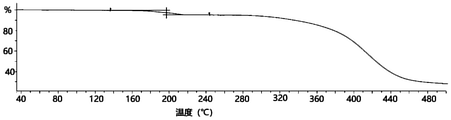
- the TGA spectrum is shown in Figure 33. When heated to 80°C, the weight loss is about 5%.
- Compound I fumarate crystal form A (6 g) was added to a glass bottle, 30 mL of ethanol and 30 mL of water were added, stirred at 45° C. for 12 h, and filtered to obtain compound I fumarate crystal form C.
- the XRPD spectrum of the obtained crystal form C is shown in FIG. 38 , and the XRPD peak positions and relative peak intensities are listed in Table 15.
- the DSC spectrum is shown in Figure 39.
- the TGA spectrum is shown in Figure 40. When heated to 100°C, the weight loss is about 7%.
- SMS Surface Measurement Systems
- Test method temperature 25°C; protective gas N 2 ; maximum equilibration time 120min; RH range 0%-90%-0%.
- SMS Surface Measurement Systems
- Test method temperature 25°C; protective gas N 2 ; maximum equilibration time 120min; RH range 0%-90%-0%.
- HTRF KinEASE-TK (Cisbio) kit was used to determine compound I fumarate crystal form A against RET wild-type, RET mutants (RET V804M , RET V804L and RET M918T ) and RET fusions (CCDC6-RET and KIF5B-RET) ) activity inhibition.
- RET enzymes After pre-incubating the above different types of RET enzymes with different concentrations of test compounds (9 concentration points) at room temperature for 30 min, substrates and adenosine triphosphate (ATP) were added to initiate the reaction. After 40min incubation at room temperature, TK antibody-cryptate and streptavidin-XL665 were added, and detection was performed after 60min incubation at room temperature.
- ATP adenosine triphosphate
- Percentage of relative inhibitory activity 1-(compound groups of different concentrations-blank control)/(negative control-blank control)*100%
- the percent relative inhibitory activity of the compound at different concentrations was plotted against the compound concentration, the curve was fitted according to a four-parameter model, and the IC50 value was calculated by the following formula:
- y is the percentage of relative inhibitory activity
- max and min are the maximum and minimum values of the fitted curve, respectively
- x is the logarithmic concentration of the compound
- Hillslope is the slope of the curve.
- mice (6) Female Balb/c mice (6) were orally administered 1 mg/kg of Compound I Fumarate Form A by gavage. Compounds were first dissolved in 0.5% methylcellulose solution and sonicated to ensure complete dissolution or uniform suspension of the compounds. At 30min, 1h, 2h, 4h, 8h, 12h, 16h, and 24h after administration, 0.2ml of blood (EDTA-K 2 anticoagulation) was collected by vein. The collected whole blood was temporarily stored in an ice box, centrifuged for 10 min within 2 h to separate plasma (4°C), and the collected plasma was stored in a -80°C refrigerator for testing.
- EDTA-K 2 anticoagulation EDTA-K 2 anticoagulation
- the plasma concentration of compound I was detected by LC-MS/MS, and the linear range was 10-10000ng/ml.
- the calculated pharmacokinetic parameters are shown in the table below.
Landscapes
- Chemical & Material Sciences (AREA)
- Organic Chemistry (AREA)
- Health & Medical Sciences (AREA)
- General Health & Medical Sciences (AREA)
- Life Sciences & Earth Sciences (AREA)
- Veterinary Medicine (AREA)
- Public Health (AREA)
- Medicinal Chemistry (AREA)
- Animal Behavior & Ethology (AREA)
- Pharmacology & Pharmacy (AREA)
- Nuclear Medicine, Radiotherapy & Molecular Imaging (AREA)
- General Chemical & Material Sciences (AREA)
- Chemical Kinetics & Catalysis (AREA)
- Epidemiology (AREA)
- Bioinformatics & Cheminformatics (AREA)
- Engineering & Computer Science (AREA)
- Pharmaceuticals Containing Other Organic And Inorganic Compounds (AREA)
- Nitrogen Condensed Heterocyclic Rings (AREA)
- Plural Heterocyclic Compounds (AREA)
Priority Applications (6)
| Application Number | Priority Date | Filing Date | Title |
|---|---|---|---|
| BR112023000065A BR112023000065A2 (pt) | 2020-07-28 | 2021-07-23 | Sal e forma cristalina de composto de pirimidina e métodos de preparação para os mesmos |
| KR1020227041673A KR20230044358A (ko) | 2020-07-28 | 2021-07-23 | 피리미딘 화합물의 염 및 결정형, 및 그의 제조 방법 |
| JP2023503101A JP7688690B2 (ja) | 2020-07-28 | 2021-07-23 | ピリミジン系化合物の塩、結晶形およびその調製方法 |
| EP21849031.6A EP4190781A4 (en) | 2020-07-28 | 2021-07-23 | SALT AND CRYSTAL FORM OF A PYRIMIDINE COMPOUND, AND METHODS OF PREPARATION THEREOF |
| CN202180038857.0A CN115702154A (zh) | 2020-07-28 | 2021-07-23 | 一种嘧啶类化合物的盐和晶型及其制备方法 |
| US18/017,104 US20230295174A1 (en) | 2020-07-28 | 2021-07-23 | Salt and crystal form of pyrimidine compound, and preparation methods therefor |
Applications Claiming Priority (2)
| Application Number | Priority Date | Filing Date | Title |
|---|---|---|---|
| CN202010737039 | 2020-07-28 | ||
| CN202010737039.7 | 2020-07-28 |
Publications (1)
| Publication Number | Publication Date |
|---|---|
| WO2022022398A1 true WO2022022398A1 (zh) | 2022-02-03 |
Family
ID=80037147
Family Applications (1)
| Application Number | Title | Priority Date | Filing Date |
|---|---|---|---|
| PCT/CN2021/108032 Ceased WO2022022398A1 (zh) | 2020-07-28 | 2021-07-23 | 一种嘧啶类化合物的盐和晶型及其制备方法 |
Country Status (7)
| Country | Link |
|---|---|
| US (1) | US20230295174A1 (https=) |
| EP (1) | EP4190781A4 (https=) |
| JP (1) | JP7688690B2 (https=) |
| KR (1) | KR20230044358A (https=) |
| CN (1) | CN115702154A (https=) |
| BR (1) | BR112023000065A2 (https=) |
| WO (1) | WO2022022398A1 (https=) |
Cited By (3)
| Publication number | Priority date | Publication date | Assignee | Title |
|---|---|---|---|---|
| WO2024240017A1 (zh) * | 2023-05-19 | 2024-11-28 | 四川科伦博泰生物医药股份有限公司 | 杂环化合物治疗与ret基因改变相关疾病的用途和方法 |
| WO2026018023A1 (en) | 2024-07-19 | 2026-01-22 | Ellipses Pharma Ltd | Synergistic combinations comprising lunbotinib for anti-cancer therapy |
| WO2026017002A1 (zh) * | 2024-07-16 | 2026-01-22 | 四川科伦博泰生物医药股份有限公司 | 以杂环化合物为活性成分的药物组合物、其制备方法及用途 |
Citations (6)
| Publication number | Priority date | Publication date | Assignee | Title |
|---|---|---|---|---|
| WO2006067614A2 (en) * | 2004-12-23 | 2006-06-29 | Pfizer Products Inc. | Heteroaromatic derivatives useful as anticancer agents |
| CN108349969A (zh) * | 2015-07-16 | 2018-07-31 | 阵列生物制药公司 | 作为RET激酶抑制剂的取代的吡唑并[1,5-a]吡啶化合物 |
| CN110267960A (zh) * | 2017-01-18 | 2019-09-20 | 阿雷生物药品公司 | 作为RET激酶抑制剂的取代的吡唑并[1,5-a]吡嗪化合物 |
| CN111285882A (zh) * | 2018-12-07 | 2020-06-16 | 四川科伦博泰生物医药股份有限公司 | 稠环化合物、包含其的药物组合物及其制备方法和用途 |
| CN111285886A (zh) * | 2018-12-06 | 2020-06-16 | 深圳市塔吉瑞生物医药有限公司 | 取代的吡唑并[1,5-a]吡啶化合物及包含该化合物的组合物及其用途 |
| WO2020168939A1 (zh) * | 2019-02-19 | 2020-08-27 | 四川科伦博泰生物医药股份有限公司 | 杂环化合物、包含其的药物组合物及其制备方法和用途 |
Family Cites Families (2)
| Publication number | Priority date | Publication date | Assignee | Title |
|---|---|---|---|---|
| US20080234267A1 (en) * | 2007-03-20 | 2008-09-25 | Karen Elizabeth Lackey | Compounds and Methods of Treatment |
| KR20230159367A (ko) | 2021-03-24 | 2023-11-21 | 쓰촨 케룬-바이오테크 바이오파마수티컬 컴퍼니 리미티드 | 키나아제 약물 내성 돌연변이와 관련된 질병의 치료에있어서의 헤테로사이클릭 화합물의 용도 및 그 방법 |
-
2021
- 2021-07-23 WO PCT/CN2021/108032 patent/WO2022022398A1/zh not_active Ceased
- 2021-07-23 KR KR1020227041673A patent/KR20230044358A/ko active Pending
- 2021-07-23 EP EP21849031.6A patent/EP4190781A4/en active Pending
- 2021-07-23 CN CN202180038857.0A patent/CN115702154A/zh active Pending
- 2021-07-23 US US18/017,104 patent/US20230295174A1/en active Pending
- 2021-07-23 BR BR112023000065A patent/BR112023000065A2/pt unknown
- 2021-07-23 JP JP2023503101A patent/JP7688690B2/ja active Active
Patent Citations (6)
| Publication number | Priority date | Publication date | Assignee | Title |
|---|---|---|---|---|
| WO2006067614A2 (en) * | 2004-12-23 | 2006-06-29 | Pfizer Products Inc. | Heteroaromatic derivatives useful as anticancer agents |
| CN108349969A (zh) * | 2015-07-16 | 2018-07-31 | 阵列生物制药公司 | 作为RET激酶抑制剂的取代的吡唑并[1,5-a]吡啶化合物 |
| CN110267960A (zh) * | 2017-01-18 | 2019-09-20 | 阿雷生物药品公司 | 作为RET激酶抑制剂的取代的吡唑并[1,5-a]吡嗪化合物 |
| CN111285886A (zh) * | 2018-12-06 | 2020-06-16 | 深圳市塔吉瑞生物医药有限公司 | 取代的吡唑并[1,5-a]吡啶化合物及包含该化合物的组合物及其用途 |
| CN111285882A (zh) * | 2018-12-07 | 2020-06-16 | 四川科伦博泰生物医药股份有限公司 | 稠环化合物、包含其的药物组合物及其制备方法和用途 |
| WO2020168939A1 (zh) * | 2019-02-19 | 2020-08-27 | 四川科伦博泰生物医药股份有限公司 | 杂环化合物、包含其的药物组合物及其制备方法和用途 |
Non-Patent Citations (2)
| Title |
|---|
| NATURE REVIEWS CANCER, vol. 14, no. 3, 2014, pages 173 - 86 |
| See also references of EP4190781A4 |
Cited By (3)
| Publication number | Priority date | Publication date | Assignee | Title |
|---|---|---|---|---|
| WO2024240017A1 (zh) * | 2023-05-19 | 2024-11-28 | 四川科伦博泰生物医药股份有限公司 | 杂环化合物治疗与ret基因改变相关疾病的用途和方法 |
| WO2026017002A1 (zh) * | 2024-07-16 | 2026-01-22 | 四川科伦博泰生物医药股份有限公司 | 以杂环化合物为活性成分的药物组合物、其制备方法及用途 |
| WO2026018023A1 (en) | 2024-07-19 | 2026-01-22 | Ellipses Pharma Ltd | Synergistic combinations comprising lunbotinib for anti-cancer therapy |
Also Published As
| Publication number | Publication date |
|---|---|
| JP2023535361A (ja) | 2023-08-17 |
| KR20230044358A (ko) | 2023-04-04 |
| JP7688690B2 (ja) | 2025-06-04 |
| CN115702154A (zh) | 2023-02-14 |
| EP4190781A4 (en) | 2023-12-27 |
| BR112023000065A2 (pt) | 2023-01-31 |
| US20230295174A1 (en) | 2023-09-21 |
| EP4190781A1 (en) | 2023-06-07 |
Similar Documents
| Publication | Publication Date | Title |
|---|---|---|
| US20240239735A1 (en) | Acid addition salt of rock inhibitor, and crystal form, composition and pharmaceutical use thereof | |
| KR101787784B1 (ko) | 3-(2,6―디클로로―3,5―디메톡시―페닐)-1-{6-[4-(4-에틸-피페라진-1-일)-페닐아미노]-피리미딘-4-일}-1-메틸-우레아의 결정질 형태 및 그의 염 | |
| CN116322678A (zh) | Jak抑制剂的盐型、晶型及其制备方法和应用 | |
| TWI904227B (zh) | Rho相關蛋白激酶抑制劑的鹽、其固體形式及其製備方法和用途 | |
| WO2022022398A1 (zh) | 一种嘧啶类化合物的盐和晶型及其制备方法 | |
| WO2021180238A1 (zh) | 一类用作激酶抑制剂的化合物及其应用 | |
| JP2025094218A (ja) | Jak2阻害剤の結晶形態 | |
| WO2023041026A1 (zh) | Rho相关蛋白激酶抑制剂或其溶剂合物的固体形式及其制备方法和用途 | |
| WO2016124067A1 (zh) | 一种周期素依赖性蛋白激酶抑制剂的羟乙基磺酸盐、其结晶形式及制备方法 | |
| US20240174669A1 (en) | Crystalline forms of a parp1 inhibitor | |
| CN105228625A (zh) | 大环rip2激酶抑制剂 | |
| CN121285557A (zh) | 喹啉取代化合物的晶体 | |
| KR20250130412A (ko) | 화합물 a의 염과 결정형, 및 그 제조 방법과 용도 | |
| US20250074908A1 (en) | Salt of rock inhibitor, crystal form of salt, composition, and pharmaceutical use | |
| WO2026036924A1 (zh) | 一种酪氨酸激酶抑制剂的可药用盐、晶体、制备方法及其用途 | |
| WO2025168124A1 (zh) | 喹唑啉类化合物、其药物组合物及其应用 | |
| US20250282761A1 (en) | Salt and crystal forms of an epidermal growth factor receptor inhibitor | |
| CN107043368A (zh) | 芳胺嘧啶化合物及其盐的结晶 | |
| TW202402757A (zh) | 7H-吡咯[2,3-d〕嘧啶-4-胺衍生物之結晶 | |
| CN116120347A (zh) | 芳杂环类化合物的晶型、其组合物、制备方法及其应用 | |
| WO2022237871A1 (zh) | 咪唑烷酮类化合物的多晶型物、制备方法及其用途 | |
| HK40083712A (en) | Salt and crystal form of pyrimidine compound, and preparation methods therefor | |
| WO2022083733A1 (zh) | 固体形式的布鲁顿酪氨酸激酶抑制剂化合物及其用途 | |
| CN107382975B (zh) | 氟代芳胺嘧啶化合物及其盐的结晶形式 | |
| HK40085075B (zh) | Rho相关蛋白激酶抑制剂的盐、其固体形式及其制备方法和用途 |
Legal Events
| Date | Code | Title | Description |
|---|---|---|---|
| 121 | Ep: the epo has been informed by wipo that ep was designated in this application |
Ref document number: 21849031 Country of ref document: EP Kind code of ref document: A1 |
|
| REG | Reference to national code |
Ref country code: BR Ref legal event code: B01A Ref document number: 112023000065 Country of ref document: BR |
|
| ENP | Entry into the national phase |
Ref document number: 2023503101 Country of ref document: JP Kind code of ref document: A |
|
| ENP | Entry into the national phase |
Ref document number: 112023000065 Country of ref document: BR Kind code of ref document: A2 Effective date: 20230103 |
|
| NENP | Non-entry into the national phase |
Ref country code: DE |
|
| ENP | Entry into the national phase |
Ref document number: 2021849031 Country of ref document: EP Effective date: 20230228 |