WO2022014050A1 - 積層体の製造方法 - Google Patents
積層体の製造方法 Download PDFInfo
- Publication number
- WO2022014050A1 WO2022014050A1 PCT/JP2020/027896 JP2020027896W WO2022014050A1 WO 2022014050 A1 WO2022014050 A1 WO 2022014050A1 JP 2020027896 W JP2020027896 W JP 2020027896W WO 2022014050 A1 WO2022014050 A1 WO 2022014050A1
- Authority
- WO
- WIPO (PCT)
- Prior art keywords
- particle layer
- silver
- silver particle
- base material
- reducing agent
- Prior art date
- Legal status (The legal status is an assumption and is not a legal conclusion. Google has not performed a legal analysis and makes no representation as to the accuracy of the status listed.)
- Ceased
Links
Images

Classifications
-
- B—PERFORMING OPERATIONS; TRANSPORTING
- B05—SPRAYING OR ATOMISING IN GENERAL; APPLYING FLUENT MATERIALS TO SURFACES, IN GENERAL
- B05D—PROCESSES FOR APPLYING FLUENT MATERIALS TO SURFACES, IN GENERAL
- B05D1/00—Processes for applying liquids or other fluent materials
- B05D1/36—Successively applying liquids or other fluent materials, e.g. without intermediate treatment
- B05D1/38—Successively applying liquids or other fluent materials, e.g. without intermediate treatment with intermediate treatment
-
- C—CHEMISTRY; METALLURGY
- C23—COATING METALLIC MATERIAL; COATING MATERIAL WITH METALLIC MATERIAL; CHEMICAL SURFACE TREATMENT; DIFFUSION TREATMENT OF METALLIC MATERIAL; COATING BY VACUUM EVAPORATION, BY SPUTTERING, BY ION IMPLANTATION OR BY CHEMICAL VAPOUR DEPOSITION, IN GENERAL; INHIBITING CORROSION OF METALLIC MATERIAL OR INCRUSTATION IN GENERAL
- C23C—COATING METALLIC MATERIAL; COATING MATERIAL WITH METALLIC MATERIAL; SURFACE TREATMENT OF METALLIC MATERIAL BY DIFFUSION INTO THE SURFACE, BY CHEMICAL CONVERSION OR SUBSTITUTION; COATING BY VACUUM EVAPORATION, BY SPUTTERING, BY ION IMPLANTATION OR BY CHEMICAL VAPOUR DEPOSITION, IN GENERAL
- C23C18/00—Chemical coating by decomposition of either liquid compounds or solutions of the coating forming compounds, without leaving reaction products of surface material in the coating; Contact plating
- C23C18/16—Chemical coating by decomposition of either liquid compounds or solutions of the coating forming compounds, without leaving reaction products of surface material in the coating; Contact plating by reduction or substitution, e.g. electroless plating
- C23C18/31—Coating with metals
- C23C18/42—Coating with noble metals
- C23C18/44—Coating with noble metals using reducing agents
-
- B—PERFORMING OPERATIONS; TRANSPORTING
- B22—CASTING; POWDER METALLURGY
- B22F—WORKING METALLIC POWDER; MANUFACTURE OF ARTICLES FROM METALLIC POWDER; MAKING METALLIC POWDER; APPARATUS OR DEVICES SPECIALLY ADAPTED FOR METALLIC POWDER
- B22F1/00—Metallic powder; Treatment of metallic powder, e.g. to facilitate working or to improve properties
- B22F1/06—Metallic powder characterised by the shape of the particles
-
- B—PERFORMING OPERATIONS; TRANSPORTING
- B05—SPRAYING OR ATOMISING IN GENERAL; APPLYING FLUENT MATERIALS TO SURFACES, IN GENERAL
- B05D—PROCESSES FOR APPLYING FLUENT MATERIALS TO SURFACES, IN GENERAL
- B05D7/00—Processes, other than flocking, specially adapted for applying liquids or other fluent materials to particular surfaces or for applying particular liquids or other fluent materials
- B05D7/24—Processes, other than flocking, specially adapted for applying liquids or other fluent materials to particular surfaces or for applying particular liquids or other fluent materials for applying particular liquids or other fluent materials
-
- B—PERFORMING OPERATIONS; TRANSPORTING
- B22—CASTING; POWDER METALLURGY
- B22F—WORKING METALLIC POWDER; MANUFACTURE OF ARTICLES FROM METALLIC POWDER; MAKING METALLIC POWDER; APPARATUS OR DEVICES SPECIALLY ADAPTED FOR METALLIC POWDER
- B22F9/00—Making metallic powder or suspensions thereof
- B22F9/16—Making metallic powder or suspensions thereof using chemical processes
- B22F9/18—Making metallic powder or suspensions thereof using chemical processes with reduction of metal compounds
- B22F9/24—Making metallic powder or suspensions thereof using chemical processes with reduction of metal compounds starting from liquid metal compounds, e.g. solutions
-
- B—PERFORMING OPERATIONS; TRANSPORTING
- B05—SPRAYING OR ATOMISING IN GENERAL; APPLYING FLUENT MATERIALS TO SURFACES, IN GENERAL
- B05D—PROCESSES FOR APPLYING FLUENT MATERIALS TO SURFACES, IN GENERAL
- B05D1/00—Processes for applying liquids or other fluent materials
- B05D1/02—Processes for applying liquids or other fluent materials performed by spraying
- B05D1/12—Applying particulate materials
-
- B—PERFORMING OPERATIONS; TRANSPORTING
- B05—SPRAYING OR ATOMISING IN GENERAL; APPLYING FLUENT MATERIALS TO SURFACES, IN GENERAL
- B05D—PROCESSES FOR APPLYING FLUENT MATERIALS TO SURFACES, IN GENERAL
- B05D2601/00—Inorganic fillers
- B05D2601/02—Inorganic fillers used for pigmentation effect, e.g. metallic effect
- B05D2601/10—Other metals
-
- B—PERFORMING OPERATIONS; TRANSPORTING
- B05—SPRAYING OR ATOMISING IN GENERAL; APPLYING FLUENT MATERIALS TO SURFACES, IN GENERAL
- B05D—PROCESSES FOR APPLYING FLUENT MATERIALS TO SURFACES, IN GENERAL
- B05D5/00—Processes for applying liquids or other fluent materials to surfaces to obtain special surface effects, finishes or structures
- B05D5/12—Processes for applying liquids or other fluent materials to surfaces to obtain special surface effects, finishes or structures to obtain a coating with specific electrical properties
-
- C—CHEMISTRY; METALLURGY
- C23—COATING METALLIC MATERIAL; COATING MATERIAL WITH METALLIC MATERIAL; CHEMICAL SURFACE TREATMENT; DIFFUSION TREATMENT OF METALLIC MATERIAL; COATING BY VACUUM EVAPORATION, BY SPUTTERING, BY ION IMPLANTATION OR BY CHEMICAL VAPOUR DEPOSITION, IN GENERAL; INHIBITING CORROSION OF METALLIC MATERIAL OR INCRUSTATION IN GENERAL
- C23C—COATING METALLIC MATERIAL; COATING MATERIAL WITH METALLIC MATERIAL; SURFACE TREATMENT OF METALLIC MATERIAL BY DIFFUSION INTO THE SURFACE, BY CHEMICAL CONVERSION OR SUBSTITUTION; COATING BY VACUUM EVAPORATION, BY SPUTTERING, BY ION IMPLANTATION OR BY CHEMICAL VAPOUR DEPOSITION, IN GENERAL
- C23C18/00—Chemical coating by decomposition of either liquid compounds or solutions of the coating forming compounds, without leaving reaction products of surface material in the coating; Contact plating
- C23C18/16—Chemical coating by decomposition of either liquid compounds or solutions of the coating forming compounds, without leaving reaction products of surface material in the coating; Contact plating by reduction or substitution, e.g. electroless plating
- C23C18/18—Pretreatment of the material to be coated
- C23C18/20—Pretreatment of the material to be coated of organic surfaces, e.g. resins
- C23C18/2006—Pretreatment of the material to be coated of organic surfaces, e.g. resins by other methods than those of C23C18/22 - C23C18/30
- C23C18/2046—Pretreatment of the material to be coated of organic surfaces, e.g. resins by other methods than those of C23C18/22 - C23C18/30 by chemical pretreatment
- C23C18/2073—Multistep pretreatment
- C23C18/2086—Multistep pretreatment with use of organic or inorganic compounds other than metals, first
-
- C—CHEMISTRY; METALLURGY
- C23—COATING METALLIC MATERIAL; COATING MATERIAL WITH METALLIC MATERIAL; CHEMICAL SURFACE TREATMENT; DIFFUSION TREATMENT OF METALLIC MATERIAL; COATING BY VACUUM EVAPORATION, BY SPUTTERING, BY ION IMPLANTATION OR BY CHEMICAL VAPOUR DEPOSITION, IN GENERAL; INHIBITING CORROSION OF METALLIC MATERIAL OR INCRUSTATION IN GENERAL
- C23C—COATING METALLIC MATERIAL; COATING MATERIAL WITH METALLIC MATERIAL; SURFACE TREATMENT OF METALLIC MATERIAL BY DIFFUSION INTO THE SURFACE, BY CHEMICAL CONVERSION OR SUBSTITUTION; COATING BY VACUUM EVAPORATION, BY SPUTTERING, BY ION IMPLANTATION OR BY CHEMICAL VAPOUR DEPOSITION, IN GENERAL
- C23C18/00—Chemical coating by decomposition of either liquid compounds or solutions of the coating forming compounds, without leaving reaction products of surface material in the coating; Contact plating
- C23C18/16—Chemical coating by decomposition of either liquid compounds or solutions of the coating forming compounds, without leaving reaction products of surface material in the coating; Contact plating by reduction or substitution, e.g. electroless plating
- C23C18/18—Pretreatment of the material to be coated
- C23C18/20—Pretreatment of the material to be coated of organic surfaces, e.g. resins
- C23C18/28—Sensitising or activating
- C23C18/285—Sensitising or activating with tin based compound or composition
Definitions
- This disclosure relates to a method for manufacturing a laminated body.
- the automatic collision avoidance system automatically brakes using the image data of the in-vehicle camera and the relative distance information to the object by the millimeter wave radar.
- the millimeter-wave radar transceiver that constitutes the automatic collision avoidance system should be located in the center of the front of the vehicle.
- the emblem of a car is generally placed in the center of the front of the car. Therefore, it is desirable to place a millimeter-wave radar transceiver behind the emblem of the automobile.
- automobile emblems have a metal film formed on a base material such as resin to express metallic luster.
- a base material such as resin
- Japanese Patent Application Laid-Open No. 2003-019765 describes a method for forming a metal film on a substrate by a silver mirror reaction.
- an object of the present invention is to provide a method for producing a laminate having a metallic luster and excellent transparency of a millimeter-wave radar.
- a step of forming a silver particle layer on a substrate comprising contacting an aqueous solution of an ammoniacal silver nitrate with an aqueous solution of a reducing agent, and the aqueous solution of the reducing agent contains a phenol compound as a reducing agent.
- Method for manufacturing a laminate ⁇ 2> The method for producing a laminate according to ⁇ 1>, wherein the phenol compound contains hydroquinone.
- the surface resistivity of the silver particles layer is 10 5 ⁇ / ⁇ or more, The method for producing a laminate according to ⁇ 1> or ⁇ 2>.
- ⁇ 4> The method for manufacturing a laminate according to any one of ⁇ 1> to ⁇ 3> for manufacturing automobile parts.
- a method for manufacturing a laminate having a metallic luster and excellent transparency of a millimeter wave radar there is provided a method for manufacturing a laminate having a metallic luster and excellent transparency of a millimeter wave radar.
- the numerical range indicated by using "-" includes the numerical values before and after "-" as the minimum value and the maximum value, respectively.
- the upper limit value or the lower limit value described in one numerical range may be replaced with the upper limit value or the lower limit value of the numerical range described in another stepwise description. ..
- the upper limit value or the lower limit value of the numerical range may be replaced with the value shown in the examples.
- each component may contain a plurality of applicable substances. When a plurality of substances corresponding to each component are present in the composition, the content or content of each component is the total content or content of the plurality of substances present in the composition unless otherwise specified. Means quantity.
- the particles corresponding to each component may contain a plurality of types of particles.
- the particle size of each component means a value for a mixture of the plurality of particles present in the composition unless otherwise specified.
- the term "layer” or “membrane” is used only in a part of the region, in addition to the case where the layer or the membrane is formed in the entire region when the region is observed. The case where it is formed is also included.
- the method for producing a laminate of the present disclosure includes a step of forming a silver particle layer on a substrate (hereinafter referred to as a silver particle layer forming step), in which the aqueous solution of ammoniacal silver nitrate and the aqueous solution of a reducing agent are brought into contact with each other.
- the reducing agent aqueous solution contains a phenol compound as a reducing agent, which is a method for producing a laminate.
- the laminate produced by the above method has a metallic luster and is excellent in the transparency of a millimeter-wave radar.
- the reason is not clear, but it can be inferred as follows.
- silver particles having relatively uniform sizes are arranged. Therefore, it is considered that the millimeter-wave radar easily penetrates through the gaps between the silver particles.
- a phenol compound as a reducing agent, it is considered that a silver particle layer in which silver particles having relatively uniform sizes are arranged is likely to be formed.
- the reason is not clear, but for example, when a phenol compound is used as the reducing agent, the progress of the reduction reaction is slower than when other reducing agents are used, and the growth rate of silver particles is likely to be uniform. Will be.
- the above method may be performed without using a dispersant.
- a dispersant is used to form a silver particle layer
- the surface of the silver particles is coated with the dispersant to suppress aggregation of the particles, and a silver particle layer that can pass through a millimeter-wave radar is obtained.
- the desired color tone may not be achieved due to the manifestation of the plasmon phenomenon.
- a phenol compound is used as a reducing agent, a silver particle layer capable of transmitting a millimeter-wave radar can be formed without using a dispersant.
- the material of the base material is not particularly limited, and an inorganic material such as glass, an organic material such as resin, or the like can be used.
- the resin include thermosetting resins and thermoplastic resins.
- thermoplastic resin examples include polyethylene, polypropylene, polycarbonate, polystyrene, polyvinyl chloride, vinyl polymer, polyester, polyamide, ABS resin (Acrylonirile-butadiene-styrene copolymer resin), polyester, and the like.
- thermoplastic elastomers examples include thermoplastic elastomers.
- thermosetting resin examples include silicone resin, polyurethane resin, polyester resin, melamine resin, epoxy resin, phenol resin, and urea resin.
- polypropylene, polycarbonate, ABS resin or the like As the material of the base material.
- Polypropylene has a light specific gravity among resins, is easy to process, has high tensile strength, impact strength and compressive strength, and is also excellent in weather resistance and heat resistance.
- ABS resin is a resin that is relatively easy to surface-treat among plastic materials, and is therefore easy to paint after molding the base material, and has excellent chemical resistance and rigidity, as well as impact resistance, heat resistance, and cold resistance. It is skilled at.
- Polycarbonate has high impact resistance among plastic materials, has excellent weather resistance and heat resistance, and has excellent transparency. Polycarbonate is also easy to process, and is a relatively light and durable material among plastic materials.
- the base material may be provided with an undercoat layer in order to improve the adhesion between the base material and the silver particle layer, smooth the surface of the base material, and the like.
- the material of the undercoat layer is not particularly limited and can be selected according to the purpose of the undercoat layer.
- fluororesin, polyester resin, epoxy resin, melamine resin, silicone resin, acrylic silicone resin, acrylic urethane resin and the like may be used. These resins may be in the state of a paint to which a solvent or the like is added.
- the thickness of the undercoat layer is not particularly limited, and is preferably about 5 ⁇ m to 25 ⁇ m from the viewpoint of ensuring a smooth surface.
- a primer layer may be provided between the undercoat layer and the base material body in order to enhance the adhesion between the undercoat layer and the base material body.
- the thickness of the base material can be appropriately designed according to the application of the laminated body.
- the shape of the base material is also not particularly limited.
- the formation of the silver particle layer is carried out by bringing the aqueous solution of ammoniacal silver nitrate into contact with the aqueous solution of the reducing agent.
- the aqueous ammoniacal silver nitrate solution is obtained by dissolving silver nitrate, ammonia, and at least one amine compound selected from the group consisting of amino alcohol compounds, amino acids and amino acid salts in water. Be done.
- the amine compound include amino alcohol compounds such as monoethanolamine, diethanolamine, diisopropanolamine, triethanolamine and triisopropanolamine, amino acids such as glycine, alanine and sodium glycine, or salts thereof.
- the content of silver nitrate, ammonia and amine compounds contained in the aqueous ammoniacal silver nitrate solution is not particularly limited.
- the concentration of silver nitrate contained in the aqueous ammoniacal silver nitrate solution is not particularly limited, but it is preferably adjusted in the range of 0.1% by mass to 10% by mass from the viewpoint of controlling the reaction rate.
- the pH of the aqueous ammoniacal silver nitrate solution is preferably adjusted between 10 and 13, and more preferably between 11 and 12.
- the aqueous reducing agent solution is obtained by dissolving a reducing agent containing a phenol compound and a strong alkaline component in water.
- a reducing agent containing a phenol compound and a strong alkaline component examples include benzenediol compounds such as hydroquinone, catechol and resorcinol, and hydroquinone is particularly preferable.
- the reducing agent may be a phenol compound alone or a combination of a phenol compound and a compound other than the phenol compound.
- the compound other than the phenol compound examples include hydrazine compounds such as hydrazine sulfate, hydrazine carbonate and hydrazine hydrate, sulfite compounds such as sodium sulfite, and thiosulfate compounds such as sodium thiosulfate.
- the ratio of the phenol compound is preferably 50% by mass or more, more preferably 70% by mass or more, and 90% by mass or more of the total amount of the reducing agent. Is more preferable.
- the strong alkaline component contained in the aqueous reducing agent include sodium hydroxide, potassium hydroxide and the like.
- the aqueous reducing agent solution may contain the above-mentioned amine compound, if necessary.
- the aqueous reducing agent solution may contain a compound containing a formyl group, if necessary.
- Specific examples of the compound containing a formyl group include glucose, glyoxal and the like.
- the content of the reducing agent contained in the aqueous reducing agent solution, the strong alkaline component, the amine compound contained as necessary, and the compound containing a formyl group contained as necessary is not particularly limited.
- the concentration of the reducing agent contained in the aqueous reducing agent solution is not particularly limited, but it is preferably adjusted in the range of 0.1% by mass to 10% by mass from the viewpoint of controlling the reaction rate.
- the pH of the aqueous reducing agent solution is preferably adjusted between 10 and 13, and more preferably between 10.5 and 11.5.
- the method of bringing the aqueous solution of ammoniacal silver nitrate into contact with the aqueous solution of the reducing agent is not particularly limited.
- a method of applying these aqueous solutions to the surface of the base material in a mixed state or in a non-mixed state can be mentioned.
- the method of applying the ammoniacal silver nitrate aqueous solution and the reducing agent aqueous solution to the silver mirror reaction treated surface is not particularly limited. Among these, spray coating that can form a uniform silver particle layer regardless of the shape of the base material is preferable.
- the spray application can be performed by using a known means such as an air brush and a spray gun.
- a surface activation treatment may be performed on the surface of the base material before forming the silver particle layer.
- a surface activation treatment liquid containing an inorganic tin compound is applied to the surface of the substrate. This causes tin to be present on the surface of the substrate. The presence of tin between the silver particle layer and the base material tends to improve the adhesion between the base material and the silver particles.
- Examples of the inorganic tin compound contained in the surface activation treatment liquid include inorganic tin compounds such as tin (II) chloride, tin (II) oxide, and tin (II) sulfate.
- the surface activation treatment liquid may contain hydrogen chloride, hydrogen peroxide, polyhydric alcohol and the like, if necessary, in addition to the inorganic tin compound.
- the content of these components contained in the surface activation treatment liquid is not particularly limited.
- the pH of the surface activation treatment liquid is preferably adjusted between 0.5 and 3.0, and more preferably between 0.5 and 1.5.
- Examples of the method of applying the surface activation treatment liquid to the surface of the base material include a method of immersing the base material in the surface activation treatment liquid, a method of applying the surface activation treatment liquid to the surface of the base material, and the like.
- spray coating is preferable because it can be applied uniformly regardless of the shape of the base material.
- the surface activation treatment it is preferable to remove excess surface activation treatment liquid adhering to the surface of the base material.
- the surface of the base material before forming the silver particle layer may be pretreated.
- an aqueous silver nitrate solution is applied to the surface of the substrate after the surface activation treatment described above. This causes silver to be present on the surface of the substrate. The presence of silver between the silver particle layer and the base material tends to cause silver particles of uniform size to easily precipitate.
- the pH of the pretreatment solution is preferably adjusted between 4.0 and 8.0, and more preferably between 6.0 and 7.0.
- Examples of the method of applying the pretreatment liquid to the surface of the base material include a method of immersing the base material in the pretreatment liquid, a method of applying the pretreatment liquid to the surface of the base material, and the like.
- spray coating is preferable because it can be applied uniformly regardless of the shape of the base material.
- an inactivation treatment solution which is an aqueous solution containing a strong alkaline component such as potassium hydroxide and a sulfite such as sodium sulfite, is brought into contact with the silver particle layer. This makes it possible to reduce the reaction activity between silver in the silver particle layer and residual ions such as chloride ions and sulfide ions.
- the content of the components contained in the inactivating liquid is not particularly limited.
- the pH of the inactivating treatment solution is preferably adjusted between 4.0 and 8.0, and more preferably between 7.0 and 8.0.
- a method of bringing the inactivating liquid into contact with the silver particle layer a method of immersing the substrate on which the silver particle layer is formed in the inactivating liquid, a method of applying the inactivating liquid to the silver particle layer, etc. Can be mentioned. Among these, spray coating is preferable because it can be uniformly applied regardless of the shape of the base material.
- the silver particle layer Before and after the inactivation treatment, it is preferable to wash the silver particle layer with deionized water or purified distilled water.
- the thickness of the silver particle layer formed on the base material is not particularly limited. From the viewpoint of obtaining sufficient metallic luster, it is preferably 50 nm or more, and from the viewpoint of obtaining sufficient millimeter-wave radar transparency, it is preferably 300 nm or less.
- the ratio of silver particles to the silver particle layer is preferably 95% or less.
- the ratio of silver particles to the silver particle layer is 95% or less, the transparency of the millimeter-wave radar tends to be further improved.
- the ratio of silver particles to the silver particle layer is preferably 80% or more.
- the ratio of silver particles to the silver particle layer is a value measured as follows. A transmission electron micrograph is taken at a magnification of 300,000 times for the cross section of the silver particle layer in the ornament in the thickness direction. For the obtained electron micrograph, the center line passing through the center in the thickness direction of the silver particle layer is determined. Next, the length of the portion where the center line and the silver particles overlap is obtained. The percentage of the value obtained by dividing the length of the portion where the center line and the silver particles overlap by the length of the entire center line is defined as the ratio of the silver particles to the silver particle layer.
- the surface resistivity of the silver particle layer is preferably 10 5 ⁇ / ⁇ or more, and more preferably 10 7 ⁇ / ⁇ or more. When the surface resistivity of the silver particle layer is within the above range, it can be determined that sufficient transparency of the millimeter wave radar is achieved.
- the upper limit of the surface resistivity of the silver particle layer is not particularly limited.
- the surface resistivity of the silver particle layer is a value measured according to JIS K6911: 2006.
- the laminate may have a layer other than the base material and the silver particle layer, if necessary.
- a top coat layer may be provided on the silver particle layer for the purpose of protecting the silver particle layer.
- the top coat layer preferably has transparency that does not hide the metallic luster of the silver particle layer and does not block the millimeter-wave radar, and even if it is colorless clear (colorless transparent), it is colored clear (colorless and transparent). It may be colored and transparent).
- the material of the top coat layer is not particularly limited, and for example, it can be selected from the above-mentioned resins as the material of the undercoat layer of the base material.
- the thickness of the top coat layer is not particularly limited, and is preferably about 20 ⁇ m to 40 ⁇ m. When the thickness of the top coat layer is 20 ⁇ m or more, the silver particle layer tends to be sufficiently protected, and when it is 40 ⁇ m or less, cracks, peeling, poor adhesion and the like due to aging tend to be less likely to occur.
- the laminate of the present disclosure has a metallic luster and is excellent in the transparency of a millimeter wave radar. Therefore, it can be particularly preferably used as an automobile part such as an emblem. Specifically, when the laminate is placed in front of the vehicle body as an automobile emblem, it functions as an emblem without interfering with the transmission and reception of the millimeter-wave radar by the millimeter-wave radar transceiver placed behind the emblem. Can be done. It can also be applied to other interior and exterior parts.
- Example 1 Preparation of base material The surface of the polycarbonate base material having a thickness of 2 mm was wiped with a waste cloth containing isopropyl alcohol to remove oil film, dirt and dust, and then the base material was dried.
- the substrate on which the undercoat layer was formed was spray-washed with pure water, and then a surface activation treatment liquid (MSPS-Sa1A manufactured by Mitsubishi Paper Mills Limited) was spray-coated. Then, it was spray-washed with pure water.
- the surface activation treatment liquid used is an aqueous solution having a pH of 1.0 containing tin (II) chloride, hydrogen chloride, hydrogen peroxide and a polyhydric alcohol.
- Pretreatment Step A pretreatment liquid (MSPS-Sa2A manufactured by Mitsubishi Paper Mills Limited) was spray-coated on the surface of the base material after the surface activation treatment, and then spray-cleaned with pure water. Is a silver nitrate aqueous solution having a pH of 6.8.
- Silver particle layer forming step An aqueous solution of ammoniacal silver nitrate and an aqueous solution of a reducing agent were spray-coated on the surface of the base material after the pretreatment at the same time with separate airbrushes.
- the discharge amount of the airbrush was 1.0 g / 10 seconds to 1.5 g / 10 seconds, respectively.
- silver particles were deposited on the surface of the base material by the silver mirror reaction, and a silver particle layer (thickness: 0.2 ⁇ m) having a silver luster was formed. Then, it was spray-washed with pure water.
- the aqueous aqueous solution of ammoniacal silver nitrate used is an aqueous solution having a pH of 11.5 (silver nitrate concentration: 0.5% by mass) containing silver nitrate, ammonia and triethanolamine.
- the reducing agent aqueous solution used is a pH 10.8 aqueous solution (hydroquinone concentration: 4.5% by mass) containing hydroquinone, triethanolamine, sodium hydroxide, and amino alcohol.
- Inactivation Treatment Step An inactivation treatment liquid (MSPS-R1A manufactured by Mitsubishi Paper Mills Limited) was spray-coated on the surface of the substrate after the silver particle layer formation step. Then, it was spray-washed with pure water.
- the deactivating treatment liquid used is an aqueous solution having a pH of 7.5 containing potassium hydroxide and sulfites.
- Example 1 A silver particle layer (thickness: 0.13 ⁇ m) was formed on the substrate in the same manner as in Example 1 except that an aqueous solution containing hydrazine sulfate (pH 10.1) was used as the reducing agent aqueous solution instead of hydroquinone. ..
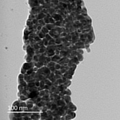
- FIG. 1 shows a photograph of the silver particle layer of the laminate prepared in Example 1 taken from the front using a transmission electron microscope (JEM-2100, manufactured by JEOL Ltd.).
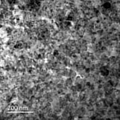
- FIG. 2 shows a photograph of a cross section of the silver particle layer taken with a transmission electron microscope (JEM-2100, manufactured by JEOL Ltd.).
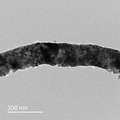
- FIG. 3 shows a photograph of the silver particle layer of the laminate prepared in Comparative Example 1 taken from the front using a transmission electron microscope (JEM-2100, manufactured by JEOL Ltd.).
- FIG. 4 shows a photograph of a cross section of the silver particle layer taken with a transmission electron microscope (JEM-2100, manufactured by JEOL Ltd.).
- Example 1 As shown in FIGS. 1 and 2, it was confirmed that the silver particle layer of Example 1 was arranged with silver particles having relatively uniform sizes. As shown in FIGS. 3 and 4, it was observed that the silver particle layer of Comparative Example 1 was in the form of a bulk in which silver particles were aggregated and had no gaps.
- a top coat clear M for MSPS manufactured by Ohashi Chemical Industries, Ltd., a top coat thinner P-7 for MSPS, and a top coat curing agent W for MSPS were mixed at 20:20:5.
- a composition for a top coat layer was prepared by blending according to (based on parts by mass). This composition was spray-coated on the silver particle layer of the laminate prepared in Example 1 and Comparative Example to form a top coat layer having a thickness of 25 ⁇ m.
- the transmitted attenuation was 0.99 dB.
- the transmission attenuation was 50.05 dB.
- the amount of transmission attenuation is defined by JIS R1679: 2007 (method for measuring radio wave absorption characteristics in the millimeter wave band of a radio wave absorber). It was calculated from the transmitted wave (transmission coefficient) obtained by the spatial method.
- the silver particle layer is superior in permeability to the millimeter-wave radar as compared with the case where a compound different from the phenol compound is used as the reducing agent. Can be found to be obtained.
Landscapes
- Chemical & Material Sciences (AREA)
- Engineering & Computer Science (AREA)
- Chemical Kinetics & Catalysis (AREA)
- General Chemical & Material Sciences (AREA)
- Life Sciences & Earth Sciences (AREA)
- Wood Science & Technology (AREA)
- Materials Engineering (AREA)
- Mechanical Engineering (AREA)
- Metallurgy (AREA)
- Organic Chemistry (AREA)
- Nanotechnology (AREA)
- Laminated Bodies (AREA)
- Application Of Or Painting With Fluid Materials (AREA)
- Chemically Coating (AREA)
Priority Applications (7)
| Application Number | Priority Date | Filing Date | Title |
|---|---|---|---|
| US18/016,019 US12303934B2 (en) | 2020-07-17 | 2020-07-17 | Method for manufacturing laminate |
| EP20945222.6A EP4180221A4 (en) | 2020-07-17 | 2020-07-17 | LAMINATE MANUFACTURING PROCESS |
| CN202080104820.9A CN116133759B (zh) | 2020-07-17 | 2020-07-17 | 层叠体的制造方法 |
| CN202410739480.7A CN118751919A (zh) | 2020-07-17 | 2020-07-17 | 层叠体的制造方法和层叠体 |
| PCT/JP2020/027896 WO2022014050A1 (ja) | 2020-07-17 | 2020-07-17 | 積層体の製造方法 |
| JP2022536101A JP7380887B2 (ja) | 2020-07-17 | 2020-07-17 | 積層体の製造方法 |
| JP2023187787A JP7826266B2 (ja) | 2020-07-17 | 2023-11-01 | 積層体の製造方法 |
Applications Claiming Priority (1)
| Application Number | Priority Date | Filing Date | Title |
|---|---|---|---|
| PCT/JP2020/027896 WO2022014050A1 (ja) | 2020-07-17 | 2020-07-17 | 積層体の製造方法 |
Publications (1)
| Publication Number | Publication Date |
|---|---|
| WO2022014050A1 true WO2022014050A1 (ja) | 2022-01-20 |
Family
ID=79554606
Family Applications (1)
| Application Number | Title | Priority Date | Filing Date |
|---|---|---|---|
| PCT/JP2020/027896 Ceased WO2022014050A1 (ja) | 2020-07-17 | 2020-07-17 | 積層体の製造方法 |
Country Status (5)
| Country | Link |
|---|---|
| US (1) | US12303934B2 (cg-RX-API-DMAC7.html) |
| EP (1) | EP4180221A4 (cg-RX-API-DMAC7.html) |
| JP (2) | JP7380887B2 (cg-RX-API-DMAC7.html) |
| CN (2) | CN118751919A (cg-RX-API-DMAC7.html) |
| WO (1) | WO2022014050A1 (cg-RX-API-DMAC7.html) |
Cited By (5)
| Publication number | Priority date | Publication date | Assignee | Title |
|---|---|---|---|---|
| WO2023243645A1 (ja) * | 2022-06-13 | 2023-12-21 | 株式会社レゾナック | 積層体 |
| WO2025032782A1 (ja) * | 2023-08-09 | 2025-02-13 | 株式会社レゾナック | 積層体及び積層体の製造方法 |
| WO2025094336A1 (ja) * | 2023-11-01 | 2025-05-08 | 株式会社レゾナック | コーティング剤液組成物、積層体の製造方法及び成形品 |
| WO2025205874A1 (ja) * | 2024-03-26 | 2025-10-02 | 株式会社レゾナック | 積層体、加飾装置、ミリ波レーダー装置、及びセンサー装置 |
| WO2025205873A1 (ja) * | 2024-03-26 | 2025-10-02 | 株式会社レゾナック | 積層体及び加飾装置 |
Citations (6)
| Publication number | Priority date | Publication date | Assignee | Title |
|---|---|---|---|---|
| JP2003019765A (ja) | 2001-07-06 | 2003-01-21 | Nissan Motor Co Ltd | 金属調塗装塗膜及びその製造方法 |
| JP2005213345A (ja) * | 2004-01-29 | 2005-08-11 | Taki Chem Co Ltd | 銀メッキ用コーティング組成物及びその製造方法 |
| JP2006045595A (ja) * | 2004-08-02 | 2006-02-16 | Yasuhiro Mori | 薄膜金属積層体の製造方法 |
| JP2008106081A (ja) * | 2006-10-23 | 2008-05-08 | Taki Chem Co Ltd | 紫外線硬化型コーティング組成物及び銀メッキ用表面処理剤 |
| JP2014139291A (ja) * | 2012-12-21 | 2014-07-31 | Fect Inc | 銀鏡膜層形成組成液、銀鏡膜層形成組成液の製造方法及び銀鏡膜塗面の形成方法 |
| JP2019177311A (ja) * | 2018-03-30 | 2019-10-17 | 豊田合成株式会社 | ミリ波透過性加飾品、銀鏡膜及びその形成方法 |
Family Cites Families (16)
| Publication number | Priority date | Publication date | Assignee | Title |
|---|---|---|---|---|
| KR100320753B1 (ko) * | 1999-10-23 | 2002-01-17 | 박한오 | 어류의 정원세포로부터 dna 추출방법 |
| US6739260B2 (en) * | 2001-05-17 | 2004-05-25 | Agfa-Gevaert | Method for the preparation of a negative working printing plate |
| JP4042397B2 (ja) * | 2001-11-07 | 2008-02-06 | ひかり製菓株式会社 | 呈味改良剤 |
| JP4200427B2 (ja) * | 2001-12-28 | 2008-12-24 | 株式会社村田製作所 | 複合酸化物粉末の製造方法 |
| EP1346843A1 (en) * | 2002-03-22 | 2003-09-24 | Fuji Photo Film Co., Ltd. | Image forming method |
| JP2004058006A (ja) * | 2002-07-31 | 2004-02-26 | First Ocean Kk | 電解水製造方法 |
| US6855233B2 (en) * | 2002-11-15 | 2005-02-15 | Kinji Sawada | Apparatus for production of strong alkali and acid electrolytic solution |
| JP4308572B2 (ja) * | 2003-05-13 | 2009-08-05 | 日本パーカライジング株式会社 | 熱交換器用アルミニウム合金製基体の表面処理方法およびこの方法により製造された熱交換器 |
| JP2008019485A (ja) * | 2006-07-14 | 2008-01-31 | Taki Chem Co Ltd | 銀メッキ製品の製造方法 |
| JP5163843B2 (ja) * | 2006-07-28 | 2013-03-13 | 三菱マテリアル株式会社 | 銀微粒子の製造方法 |
| JP2008063592A (ja) * | 2006-09-04 | 2008-03-21 | Taki Chem Co Ltd | 銀メッキ製品用変色抑制剤 |
| JP5139860B2 (ja) * | 2008-03-31 | 2013-02-06 | 三菱製紙株式会社 | 銀超微粒子の製造方法 |
| KR101857779B1 (ko) * | 2017-01-12 | 2018-05-14 | 주식회사 테라메탈 | 실버 코팅 글래스 프릿, 그 제조방법 및 실버 코팅 글래스 프릿을 이용한 솔라셀용 실버 페이스트 조성물 |
| US10043708B2 (en) * | 2016-11-09 | 2018-08-07 | Globalfoundries Inc. | Structure and method for capping cobalt contacts |
| US11155924B2 (en) * | 2017-03-31 | 2021-10-26 | Toyoda Gosei Co., Ltd. | Silver mirror film, decorative article, silver mirror film-forming liquid, and method for producing reducing liquid therefor |
| JP6848740B2 (ja) * | 2017-07-18 | 2021-03-24 | 株式会社リコー | インク、インク収容容器、画像記録装置、画像記録方法、及び記録物 |
-
2020
- 2020-07-17 EP EP20945222.6A patent/EP4180221A4/en active Pending
- 2020-07-17 CN CN202410739480.7A patent/CN118751919A/zh active Pending
- 2020-07-17 JP JP2022536101A patent/JP7380887B2/ja active Active
- 2020-07-17 CN CN202080104820.9A patent/CN116133759B/zh active Active
- 2020-07-17 WO PCT/JP2020/027896 patent/WO2022014050A1/ja not_active Ceased
- 2020-07-17 US US18/016,019 patent/US12303934B2/en active Active
-
2023
- 2023-11-01 JP JP2023187787A patent/JP7826266B2/ja active Active
Patent Citations (6)
| Publication number | Priority date | Publication date | Assignee | Title |
|---|---|---|---|---|
| JP2003019765A (ja) | 2001-07-06 | 2003-01-21 | Nissan Motor Co Ltd | 金属調塗装塗膜及びその製造方法 |
| JP2005213345A (ja) * | 2004-01-29 | 2005-08-11 | Taki Chem Co Ltd | 銀メッキ用コーティング組成物及びその製造方法 |
| JP2006045595A (ja) * | 2004-08-02 | 2006-02-16 | Yasuhiro Mori | 薄膜金属積層体の製造方法 |
| JP2008106081A (ja) * | 2006-10-23 | 2008-05-08 | Taki Chem Co Ltd | 紫外線硬化型コーティング組成物及び銀メッキ用表面処理剤 |
| JP2014139291A (ja) * | 2012-12-21 | 2014-07-31 | Fect Inc | 銀鏡膜層形成組成液、銀鏡膜層形成組成液の製造方法及び銀鏡膜塗面の形成方法 |
| JP2019177311A (ja) * | 2018-03-30 | 2019-10-17 | 豊田合成株式会社 | ミリ波透過性加飾品、銀鏡膜及びその形成方法 |
Non-Patent Citations (1)
| Title |
|---|
| See also references of EP4180221A4 |
Cited By (10)
| Publication number | Priority date | Publication date | Assignee | Title |
|---|---|---|---|---|
| WO2023243645A1 (ja) * | 2022-06-13 | 2023-12-21 | 株式会社レゾナック | 積層体 |
| WO2023243646A1 (ja) * | 2022-06-13 | 2023-12-21 | 株式会社レゾナック | センサーカバー |
| CN119212862A (zh) * | 2022-06-13 | 2024-12-27 | 株式会社力森诺科 | 层叠体 |
| CN119343235A (zh) * | 2022-06-13 | 2025-01-21 | 株式会社力森诺科 | 传感器罩 |
| EP4523902A4 (en) * | 2022-06-13 | 2025-09-03 | Resonac Corp | SENSOR COVER |
| EP4523901A4 (en) * | 2022-06-13 | 2025-09-24 | Resonac Corp | LAMINATE |
| WO2025032782A1 (ja) * | 2023-08-09 | 2025-02-13 | 株式会社レゾナック | 積層体及び積層体の製造方法 |
| WO2025094336A1 (ja) * | 2023-11-01 | 2025-05-08 | 株式会社レゾナック | コーティング剤液組成物、積層体の製造方法及び成形品 |
| WO2025205874A1 (ja) * | 2024-03-26 | 2025-10-02 | 株式会社レゾナック | 積層体、加飾装置、ミリ波レーダー装置、及びセンサー装置 |
| WO2025205873A1 (ja) * | 2024-03-26 | 2025-10-02 | 株式会社レゾナック | 積層体及び加飾装置 |
Also Published As
| Publication number | Publication date |
|---|---|
| JP7380887B2 (ja) | 2023-11-15 |
| US20230278070A1 (en) | 2023-09-07 |
| US12303934B2 (en) | 2025-05-20 |
| EP4180221A4 (en) | 2023-08-23 |
| CN116133759B (zh) | 2024-06-25 |
| JP7826266B2 (ja) | 2026-03-09 |
| JP2024003078A (ja) | 2024-01-11 |
| CN116133759A (zh) | 2023-05-16 |
| EP4180221A1 (en) | 2023-05-17 |
| JPWO2022014050A1 (cg-RX-API-DMAC7.html) | 2022-01-20 |
| CN118751919A (zh) | 2024-10-11 |
Similar Documents
| Publication | Publication Date | Title |
|---|---|---|
| JP7380887B2 (ja) | 積層体の製造方法 | |
| WO2020255383A1 (ja) | 装飾品 | |
| JP5465030B2 (ja) | 電磁波透過用金属被膜、電磁波透過用金属被膜の形成方法及び車載用レーダー装置 | |
| JPH09135097A (ja) | 電磁波シールド及びその形成方法 | |
| WO2023243645A1 (ja) | 積層体 | |
| JP3262748B2 (ja) | 銀メッキ層を備える積層品及びその製造方法 | |
| JP7388323B2 (ja) | 積層構造体及び対象物検知構造 | |
| US20040170855A1 (en) | Decorative film-like material and decorative sheet | |
| KR102121025B1 (ko) | 차량용 램프 코팅방법 | |
| WO2025032782A1 (ja) | 積層体及び積層体の製造方法 | |
| WO2011064633A1 (en) | Method of producing molded article for use in beam path of radar device, molded article for use in beam path of radar device | |
| EP4272955A1 (en) | Laminated structure and object detecting structure | |
| KR101611758B1 (ko) | 아연을 포함하는 금속판의 산화피막 형성 방법 | |
| JP2019142010A (ja) | 銀めっき積層体及びそれを用いた加飾成形品 | |
| WO2026018877A1 (ja) | 積層体、加飾装置、ミリ波レーダー装置、及びセンサー装置 | |
| WO2025094336A1 (ja) | コーティング剤液組成物、積層体の製造方法及び成形品 |
Legal Events
| Date | Code | Title | Description |
|---|---|---|---|
| 121 | Ep: the epo has been informed by wipo that ep was designated in this application |
Ref document number: 20945222 Country of ref document: EP Kind code of ref document: A1 |
|
| ENP | Entry into the national phase |
Ref document number: 2022536101 Country of ref document: JP Kind code of ref document: A |
|
| ENP | Entry into the national phase |
Ref document number: 2020945222 Country of ref document: EP Effective date: 20230209 |
|
| NENP | Non-entry into the national phase |
Ref country code: DE |
|
| WWG | Wipo information: grant in national office |
Ref document number: 18016019 Country of ref document: US |