WO2022009905A1 - リチウム同位体濃縮装置および多段式リチウム同位体濃縮装置、ならびにリチウム同位体濃縮方法 - Google Patents
リチウム同位体濃縮装置および多段式リチウム同位体濃縮装置、ならびにリチウム同位体濃縮方法 Download PDFInfo
- Publication number
- WO2022009905A1 WO2022009905A1 PCT/JP2021/025527 JP2021025527W WO2022009905A1 WO 2022009905 A1 WO2022009905 A1 WO 2022009905A1 JP 2021025527 W JP2021025527 W JP 2021025527W WO 2022009905 A1 WO2022009905 A1 WO 2022009905A1
- Authority
- WO
- WIPO (PCT)
- Prior art keywords
- lithium
- tank
- isotope
- aqueous solution
- electrolyte membrane
- Prior art date
- Legal status (The legal status is an assumption and is not a legal conclusion. Google has not performed a legal analysis and makes no representation as to the accuracy of the status listed.)
- Ceased
Links
Images







Classifications
-
- B—PERFORMING OPERATIONS; TRANSPORTING
- B01—PHYSICAL OR CHEMICAL PROCESSES OR APPARATUS IN GENERAL
- B01D—SEPARATION
- B01D59/00—Separation of different isotopes of the same chemical element
- B01D59/38—Separation by electrochemical methods
- B01D59/42—Separation by electrochemical methods by electromigration; by electrophoresis
-
- B—PERFORMING OPERATIONS; TRANSPORTING
- B01—PHYSICAL OR CHEMICAL PROCESSES OR APPARATUS IN GENERAL
- B01D—SEPARATION
- B01D59/00—Separation of different isotopes of the same chemical element
- B01D59/10—Separation by diffusion
- B01D59/12—Separation by diffusion by diffusion through barriers
-
- B—PERFORMING OPERATIONS; TRANSPORTING
- B01—PHYSICAL OR CHEMICAL PROCESSES OR APPARATUS IN GENERAL
- B01D—SEPARATION
- B01D61/00—Processes of separation using semi-permeable membranes, e.g. dialysis, osmosis or ultrafiltration; Apparatus, accessories or auxiliary operations specially adapted therefor
- B01D61/42—Electrodialysis; Electro-osmosis ; Electro-ultrafiltration; Membrane capacitive deionization
- B01D61/44—Ion-selective electrodialysis
- B01D61/52—Accessories; Auxiliary operation
-
- C—CHEMISTRY; METALLURGY
- C25—ELECTROLYTIC OR ELECTROPHORETIC PROCESSES; APPARATUS THEREFOR
- C25B—ELECTROLYTIC OR ELECTROPHORETIC PROCESSES FOR THE PRODUCTION OF COMPOUNDS OR NON-METALS; APPARATUS THEREFOR
- C25B9/00—Cells or assemblies of cells; Constructional parts of cells; Assemblies of constructional parts, e.g. electrode-diaphragm assemblies; Process-related cell features
- C25B9/60—Constructional parts of cells
- C25B9/67—Heating or cooling means
-
- B—PERFORMING OPERATIONS; TRANSPORTING
- B01—PHYSICAL OR CHEMICAL PROCESSES OR APPARATUS IN GENERAL
- B01D—SEPARATION
- B01D2313/00—Details relating to membrane modules or apparatus
- B01D2313/22—Cooling or heating elements
-
- B—PERFORMING OPERATIONS; TRANSPORTING
- B01—PHYSICAL OR CHEMICAL PROCESSES OR APPARATUS IN GENERAL
- B01D—SEPARATION
- B01D59/00—Separation of different isotopes of the same chemical element
- B01D59/10—Separation by diffusion
- B01D59/12—Separation by diffusion by diffusion through barriers
- B01D59/14—Construction of the barrier
-
- C—CHEMISTRY; METALLURGY
- C22—METALLURGY; FERROUS OR NON-FERROUS ALLOYS; TREATMENT OF ALLOYS OR NON-FERROUS METALS
- C22B—PRODUCTION AND REFINING OF METALS; PRETREATMENT OF RAW MATERIALS
- C22B26/00—Obtaining alkali, alkaline earth metals or magnesium
- C22B26/10—Obtaining alkali metals
- C22B26/12—Obtaining lithium
-
- C—CHEMISTRY; METALLURGY
- C25—ELECTROLYTIC OR ELECTROPHORETIC PROCESSES; APPARATUS THEREFOR
- C25B—ELECTROLYTIC OR ELECTROPHORETIC PROCESSES FOR THE PRODUCTION OF COMPOUNDS OR NON-METALS; APPARATUS THEREFOR
- C25B1/00—Electrolytic production of inorganic compounds or non-metals
- C25B1/01—Products
- C25B1/02—Hydrogen or oxygen
- C25B1/04—Hydrogen or oxygen by electrolysis of water
-
- C—CHEMISTRY; METALLURGY
- C25—ELECTROLYTIC OR ELECTROPHORETIC PROCESSES; APPARATUS THEREFOR
- C25B—ELECTROLYTIC OR ELECTROPHORETIC PROCESSES FOR THE PRODUCTION OF COMPOUNDS OR NON-METALS; APPARATUS THEREFOR
- C25B9/00—Cells or assemblies of cells; Constructional parts of cells; Assemblies of constructional parts, e.g. electrode-diaphragm assemblies; Process-related cell features
- C25B9/17—Cells comprising dimensionally-stable non-movable electrodes; Assemblies of constructional parts thereof
- C25B9/19—Cells comprising dimensionally-stable non-movable electrodes; Assemblies of constructional parts thereof with diaphragms
- C25B9/23—Cells comprising dimensionally-stable non-movable electrodes; Assemblies of constructional parts thereof with diaphragms comprising ion-exchange membranes in or on which electrode material is embedded
-
- C—CHEMISTRY; METALLURGY
- C25—ELECTROLYTIC OR ELECTROPHORETIC PROCESSES; APPARATUS THEREFOR
- C25B—ELECTROLYTIC OR ELECTROPHORETIC PROCESSES FOR THE PRODUCTION OF COMPOUNDS OR NON-METALS; APPARATUS THEREFOR
- C25B9/00—Cells or assemblies of cells; Constructional parts of cells; Assemblies of constructional parts, e.g. electrode-diaphragm assemblies; Process-related cell features
- C25B9/70—Assemblies comprising two or more cells
-
- Y—GENERAL TAGGING OF NEW TECHNOLOGICAL DEVELOPMENTS; GENERAL TAGGING OF CROSS-SECTIONAL TECHNOLOGIES SPANNING OVER SEVERAL SECTIONS OF THE IPC; TECHNICAL SUBJECTS COVERED BY FORMER USPC CROSS-REFERENCE ART COLLECTIONS [XRACs] AND DIGESTS
- Y02—TECHNOLOGIES OR APPLICATIONS FOR MITIGATION OR ADAPTATION AGAINST CLIMATE CHANGE
- Y02P—CLIMATE CHANGE MITIGATION TECHNOLOGIES IN THE PRODUCTION OR PROCESSING OF GOODS
- Y02P10/00—Technologies related to metal processing
- Y02P10/20—Recycling
Definitions
- the present invention relates to a lithium isotope concentrator for separating lithium isotopes, a multi-stage lithium isotope concentrator, and a lithium isotope enrichment method.
- Lithium (Li) has two stable isotopes, 7 Li and 6 Li, and its natural abundance ratios are 92.41 mol% and 7.59 mol%.
- 7 Li and 6 Li of mass number 6 of mass number 7 is different nature is large, for example, 7 Li is used pH (hydrogen ion concentration) Adjustment of the cooling fluid of the reactor.
- 6 Li is used for the production of tritium, which is the fuel for fusion reactors. Therefore, a technique has been developed to concentrate and separate 7 Li and 6 Li to a smaller amount of the other isotope, and selectively select lithium ion Li + from the amalgam method, molten salt method, distillation method, seawater, etc.
- the adsorption method and the electrodialysis method for example, Patent Document 1
- the adsorption method and electrodialysis method are relatively superior to the amalgam method, which uses a large amount of mercury, and the molten salt method and distillation method, which heat a lithium compound or the like at a high temperature, from the viewpoint of environmental load and the like.
- these methods utilize the fact that a large amount of 6 Li +, which has a high moving speed, is recovered due to its small mass, but the isotope separation coefficient is small and the productivity is low as an enrichment method. .. Therefore, the present inventors have found that the isotope separation coefficient is large only for a short time immediately after the start of operation for the concentration of lithium isotopes by the electrodialysis method, and a method for improving the efficiency by intermittently applying a voltage. (Patent Document 2, Non-Patent Document 1).
- Patent Document 2 The method described in Patent Document 2 and the like has room for further improvement in order to increase the isotope separation coefficient.
- the present invention has been made in view of the above problems, and an object of the present invention is to provide a safer and more efficient lithium isotope enricher, a multi-stage lithium isotope enricher, and a lithium isotope enricher.
- the lithium isotope concentrator according to the present invention is provided with a treatment tank divided into a first tank and a second tank, and 6 Li and 7 Li housed in the first tank are in the state of lithium ions.
- the multi-stage lithium isotope concentrator comprises two or more of the above-mentioned lithium isotope concentrators connected so as to integrate the treatment tanks, and the above-mentioned lithium isotope concentrator.
- Each lithium ion conductive electrolyte membrane is arranged so as to be separated from each other so as to partition the integrated treatment tank into three or more tanks, and the second tank of one of the two adjacent lithium isotope concentrators.
- the cooling device is configured to cool the aqueous solution contained in at least one of the partitioned treatment tanks.
- lithium ions move in the lithium ion conductive electrolyte membrane at a low temperature where the difference in mobility between 6 Li + and 7 Li + is large, and more 6 Li moves and is recovered.
- the lithium isotope enrichment method in a treatment tank divided into a first tank and a second tank by a lithium ion conductive electrolyte membrane, 6 Li and 7 Li contained in the first tank are lithium.
- This is a method of recovering an aqueous solution containing lithium ions having a higher isotope ratio of 6 Li than the aqueous solution from the aqueous solution contained in the ion state in the second tank.
- the lithium isotope enrichment method according to the present invention has a porous structure provided by contacting both sides of the lithium ion conductive electrolyte membrane while cooling the lithium ion conductive electrolyte membrane to 20 ° C. or lower.
- a voltage is applied between the electrodes of the above, with the first tank side as positive.
- the first tank side is positive between the electrodes having a porous structure provided in contact with each of both sides of the lithium ion conductive electrolyte membrane. Apply a voltage of .5 V or less.
- lithium ions are moved in the lithium ion conductive electrolyte membrane under the condition that the difference in mobility between 6 Li + and 7 Li + is large, and more 6 Li + is moved and recovered. Can be done.
- an aqueous solution having a higher isotope ratio of 6 Li can be recovered efficiently and safely. Further, according to the multi-stage lithium isotope concentrator according to the present invention, the isotope ratio of 6 Li can be further increased.
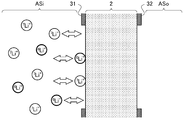
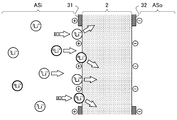
- FIG. 3 is an enlarged view of a main part explaining the behavior of lithium ions in an initial state in electrodialysis of lithium ions by the lithium isotope concentrator shown in FIG. 1. It is an enlarged view of the main part explaining the behavior of the lithium ion immediately after the start of movement in the electrodialysis of the lithium ion by the lithium isotope concentrator shown in FIG. 1.
- FIG. 3 is an enlarged view of a main part explaining the behavior of lithium ions in an initial state in electrodialysis of lithium ions by the lithium isotope concentrator shown in FIG. 1.
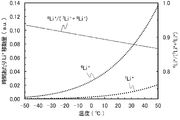
- FIG. 3 is an enlarged view of a main part explaining the behavior of lithium ions during movement in electrodialysis of lithium ions by the lithium isotope concentrator shown in FIG. 1. It is a model explaining ionic conduction in an electrolyte. It is a graph explaining the applied voltage dependence of the transfer amount per hour and the isotope ratio in the electrodialysis of lithium ion by simulation. It is a graph explaining the temperature dependence of the amount of movement of lithium ion per hour and the isotope ratio in electrodialysis by simulation.
- FIG. 6A is a partially enlarged view. It is a schematic diagram explaining the structure of the multistage lithium isotope enrichment apparatus which concerns on embodiment of this invention.
- the lithium isotope concentrator 10 As shown in FIG. 1, the lithium isotope concentrator 10 according to the embodiment of the present invention has a first electrode coated on each surface of a treatment tank 1, an electrolyte membrane (lithium ion conductive electrolyte membrane) 2, and an electrolyte membrane 2. It includes a 31 and a second electrode 32 (electrode), a power supply device 5, and a cooling device 6.
- the treatment tank 1 is divided into two, a supply tank (first tank) 11 for accommodating the Li-containing aqueous solution ASi and a recovery tank (second tank) 12 for accommodating the 6 Li recovery aqueous solution ASo, depending on the electrolyte membrane 2. It is partitioned.
- the power supply device 5 has a DC power supply, a positive (+) pole of the power supply is connected to a first electrode 31 provided on the supply tank 11 side, and a negative (-) pole is provided on the recovery tank 12 side. It is connected to the second electrode 32.
- the cooling device 6 cools the electrolyte membrane 2 via the Li-containing aqueous solution ASi in the supply tank 11.
- the treatment tank 1 is made of a material that does not deteriorate even if it comes into contact with the Li-containing aqueous solution ASi and the 6 Li recovery aqueous solution ASo.
- the processing tank 1 may have a volume corresponding to the required processing capacity, and the shape and the like are not particularly limited.
- the electrolyte membrane 2 is an electrolyte having lithium ion conductivity, and it is preferable that electrons e ⁇ do not conduct. Further, when the Li-containing aqueous solution ASi contains a metal ion other than Li + , it is preferable that the metal ion does not conduct to the electrolyte membrane 2. More preferably, it is a ceramic electrolyte having these properties. Specific examples thereof include lithium lanthanum titanium oxide (La 2 / 3-x Li 3x TiO 3 , also referred to as LLTO) and the like. Such an electrolyte membrane 2 has lattice defects at a constant rate, and since the size of the lattice defect sites is small, metal ions having a diameter larger than Li + are not conducted.
- LLTO lithium lanthanum titanium oxide
- a site where Li can exist such as an A site
- a Li site having vacancies is referred to as a Li site defect.
- the first electrode 31 and the second electrode 32 are a pair of electrodes provided for contacting each surface of the electrolyte membrane 2 and applying a voltage from both sides. While the first electrode 31 and the second electrode 32 apply a voltage over a wide range of the electrolyte membrane 2, the first electrode 31 and the second electrode 32 are porous such as a mesh so that the aqueous solutions ASi and ASo come into contact with a sufficient area of each surface of the electrolyte membrane 2. It has a quality structure.
- the first electrode 31 is provided on the surface of the electrolyte membrane 2 on the supply tank 11 side (hereinafter, appropriately referred to as a surface), has catalytic activity and electron conductivity for the reaction of the following formula (1), and contains Li.
- the second electrode 32 is provided on the surface of the electrolyte membrane 2 on the recovery tank 12 side (hereinafter, appropriately referred to as the back surface), has catalytic activity and electron conductivity for the reaction of the following formula (2), and the reaction can be carried out. It is formed of an electrode material that is stable when a voltage is applied, such as Pt, even in the 6 Li recovery aqueous solution ASo that has progressed to contain Li +.
- the power supply device 5 is a DC power supply device, in which the positive electrode is connected to the first electrode 31 and the negative electrode is connected to the second electrode 32, and a predetermined voltage V is applied.
- the cooling device 6 is provided to bring the electrolyte membrane 2 to a predetermined temperature, and cools the electrolyte membrane 2 via the Li-containing aqueous solution ASi or the 6 Li recovery aqueous solution ASo.
- the cooling device 6 a known device for cooling the liquid can be applied, and it is preferable that the cooling device 6 has a temperature adjusting function.
- the cooling device 6 is an immersion type (immersion type), and a pipe (refrigerant pipe) through which the refrigerant flows is immersed in the Li-containing aqueous solution ASi in the supply tank 11 and installed.
- the cooling device 6 only needs to be able to bring the electrolyte membrane 2 to a predetermined temperature, and it is not necessary to set the Li-containing aqueous solution ASi and the 6 Li recovery aqueous solution ASo to a uniform liquid temperature.
- a stirring device may be provided depending on the volume of the processing tank 1.
- the temperature of the electrolyte membrane 2 will be described in detail later, but in order to prevent the aqueous solutions ASI and ASo from freezing at 30 ° C. or lower, for example, the 6 Li recovery aqueous solution ASo starts the operation of the lithium isotope concentrator 10 (starts electrodialysis). ) If it is pure water at the time, it shall be 0 ° C or higher.
- the temperature of the electrolyte membrane 2 can be measured by using the liquid temperature of the Li-containing aqueous solution ASi or the 6 Li recovery aqueous solution ASo as an alternative.
- the refrigerant pipe of the cooling device 6 is made of a material that does not deteriorate even if it comes into contact with the Li-containing aqueous solution ASi or the 6 Li recovery aqueous solution ASo, and its shape is not particularly specified.
- the refrigerant pipes are installed so as to face each other in a wide area of the electrolyte membrane 2 by meandering in a plane shape according to the dimensions of the plate-shaped electrolyte membrane 2.
- the refrigerant pipe may be charged into both the supply tank 11 and the recovery tank 12.
- the cooling device 6 may have a structure in which the processing tank 1 has a double structure (jacket tank) and the refrigerant flows inside (jacket portion) thereof.
- the Li-containing aqueous solution ASi or the 6 Li recovery aqueous solution ASo may be circulated to the outside of the treatment tank 1 by a pump and cooled by a heat exchanger.
- the Li-containing aqueous solution ASi is a Li source and is an aqueous solution containing 7 Li and 6 Li cations 7 Li + and 6 Li + , for example, a lithium hydroxide (LiOH) aqueous solution, and is used in the lithium isotope concentrator 10. At the start of operation, it contains 7 Li + and 6 Li + in its natural abundance ratio.
- the 6 Li recovery aqueous solution ASo is an aqueous solution for containing a large amount of lithium ion Li + recovered from the Li-containing aqueous solution ASi, particularly 6 Li + , and is, for example, pure at the start of operation of the lithium isotope concentrator 10. It is water.
- 7 Li and 6 Li ( 7 Li + and 6 Li + ) are collectively referred to as Li (Li + ) when they are not distinguished from each other.
- Lithium isotope enrichment method The lithium isotope enrichment method according to the embodiment of the present invention will be described. First, with reference to FIG. 2, the lithium ion electrodialysis by the lithium isotope concentrator according to the embodiment will be described. In the lithium isotope concentrator 10 shown in FIG. 2, the cooling device 6 is omitted.
- the power supply device 5 applies a positive voltage + V to the second electrode 32 to the first electrode 31, in the vicinity of the first electrode 31, hydroxylation in the Li-containing aqueous solution ASi.
- the substance ion (OH ⁇ ) causes the reaction of the following formula (3) to release the electron e ⁇ to the first electrode 31, and water (H 2 O) and oxygen (O 2 ) are generated.
- the reaction of the following formula (4) in which Li + in the Li-containing aqueous solution ASi moves into the electrolyte membrane 2 in order to maintain the charge balance as the OH ⁇ decreases is carried out by the electrolyte. It occurs in the vicinity of the membrane 2.
- the Li + adsorbed in the vicinity of the Li site defect on the surface of the electrolyte membrane 2 sneaks into the Li site defect. Since the electrolyte membrane 2 has a potential gradient in which the potential on the back surface is lower than that on the front surface due to the electrodes 31 and 32, the Li + that has sunk into the Li site defects on the front surface is the Li site defects in the vicinity of the deep side of the electrolyte membrane 2. Jump to (hopping). As described above, Li + repeatedly moves from the Li site defect of the electrolyte membrane 2 to the Li site defect in the vicinity thereof, and finally as a reaction of the above formula (6), as shown in FIG. 3C, on the back surface. It moves from the Li site defect into the 6 Li recovery aqueous solution ASo.
- Li + adsorbed in the vicinity of the Li site defect moved to the deep part of the electrolyte membrane 2, and as a result, the vacant Li site defect was further adsorbed in the vicinity thereof.
- Li + moves and sneaks in, or new Li + is adsorbed from the Li-containing aqueous solution ASi, and these Li + move in the electrolyte membrane 2 in the same manner.
- Li site defects are filled with Li + or vacated again, so that the Li site defects newly generated on the surface of the electrolyte membrane 2 are adsorbed on the surface. The Li + that had been there can start moving to the back side.
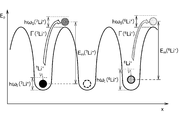
- FIG. 4 is a model for explaining ionic conduction in the electrolyte, where x is the position of the electrolyte membrane 2 in the thickness direction and E p is the potential energy.
- Li + 7 Li + , 6 Li +
- the ion thermally vibrates at the frequency ⁇ 0 at the position where the potential energy is minimized, and the ion can be hopping at the frequency (hopping rate ⁇ ) corresponding to this frequency (frequency factor) ⁇ 0.
- the frequency ⁇ 0 is inversely proportional to the square root of the mass of the ion. Since 6 Li has a mass as small as 6/7 times that of 7 Li, the frequency ⁇ 0 is ( ⁇ (7/6)) times that of 7 Li, and as will be described in detail later, the average in the electrolyte membrane 2 The moving speed is ( ⁇ (7/6)) times faster than 7 Li. Also, for example, if 7 Li + and 6 Li + are present at two equidistant locations in the vicinity of a Li site defect with the electrolyte membrane 2, it is estimated that 6 Li + will preferentially jump. Will be done.
- the potential energy of 7 Li + and 6 Li + at the Li site of the electrolyte membrane 2, that is, in the ground state increases by the amount of the zero-point vibration h ⁇ I.
- Zero-point oscillation h ⁇ I is isotope-dependent, and 6 Li + is larger than 7 Li +.
- the zero-point oscillation h ⁇ S is larger at 6 Li +. Therefore, 7 Li + is more of a small mass 6 Li + than the ground state, the excited state both zero vibration Etchiomega I, high potential energy in consideration of h ⁇ S.
- FIG. 5 shows the applied voltage dependence of the isotope ratios of 6 Li + , 7 Li + transfer amount and transfer Li + per hour by simulation.
- Maxwell - approximates the distribution of activation energy E a in accordance with the Boltzmann distribution at a normal distribution. Specifically, for each of 6 Li + and 7 Li + , the ratio of Li + exceeding the activation energy E a ( 6 Li + ⁇ 7 Li + ) is averaged for each energy received, and the activation energy E a is averaged. It was calculated from the probability density of the normal distribution as the value, and the cumulative value was multiplied by the frequency ⁇ 0 ratio to obtain the relative value of mobility ⁇ . The isotope ratio was calculated assuming that the abundance ratio of 7 Li + and 6 Li + before migration was 1: 1 for the sake of simplification of the simulation.
- the mobilities of 6 Li + and 7 Li + increase from 0 to an S-shaped curve as the applied voltage + V increases, respectively, but the activation energy E with respect to 7 Li +.
- a small 6 Li + is changed displaced smaller in the voltage + V, also partial high frequency gamma 0 ratio.
- lim ⁇ in FIG. 5 represents the limit of 6 Li + movement amount per hour. Therefore, the smaller the applied voltage + V is in the range in which 6 Li + is moved in the electrolyte membrane 2, the more 6 Li + moves with respect to 7 Li +.
- the electrolyte membrane 2 when the voltage applied between both sides of the electrolyte membrane 2 becomes larger than a certain value, a part of the transition metal ions constituting the electrolyte membrane 2 is reduced (for example, the electrolyte membrane 2 becomes if LLTO, Ti 4+ + e - ⁇ Ti 3+), the electrolyte membrane 2 electrons e from the recovery tank 12 side to the supply tank 11 side - so to conduct.
- the majority of a given electrical energy electrons e - since it is consumed in the conduction, decrease the voltage dependence of the mobility of Li +, energy efficiency is lowered in the movement of Li +.
- the reduction of a part of the transition metal ions constituting the electrolyte membrane 2 increases the ionic radius of the reduced ions (for example, if the electrolyte membrane 2 is LLTO, Ti 4+ ⁇ Ti 3+ ).
- the 6 Li isotope ratio of the moving Li + will drop sharply.
- the temperature of the electrolyte membrane 2 rises due to the Joule heat generated by the electron e ⁇ conducting the electrolyte membrane 2, the 6 Li isotope ratio of the moving Li + decreases, as will be described later.
- the voltage + V is preferably 2.0 V or less, and further, the smaller the applied voltage, the larger the isotope separation coefficient. Therefore, the voltage + V is more preferably 1.5 V or less, and 1.0 V or less. It is more preferable to have.
- the lower limit of the voltage + V is not particularly specified, and is 0, for example, depending on the electron conductivity of the electrolyte membrane 2 and the hydrogen ion concentration of the aqueous solutions Asi and ASo. It is preferable to set it in the range of .5 V or more. However, since the mobility ⁇ of Li + decreases as the applied voltage + V decreases, it is preferable that the productivity does not decrease too much.
- the ion mobility ⁇ is the relationship between the ion diffusion coefficient D and the following equation (7) (T: temperature (K), k: Boltzmann constant).
- the diffusion coefficient D is proportional to the hopping rate ⁇ as expressed by the following equation (8) (a: average distance between sites (jump length), n c : carrier density, f: ion and its surroundings. Correlation effect coefficient determined by, d: dimension of diffusion field).
- the frequency factor ⁇ 0 in the equation (8) is proportional to the temperature T as expressed by the following equation (9), and (Z s vib / Z I vib ) is inversely proportional to the square root of the mass number m.
- the frequency factor ⁇ 0 is inversely proportional to the square root of the mass number m (h: Planck constant, Z s vib : phonon distribution function at saddle point, Z I vib : phonon distribution function in the initial state, C 1 : constant. ).
- the diffusion coefficient D is expressed by the following equation (10).
- the ion mobility ⁇ is expressed by the following equation (11) (C 2 : constant).
- equation (11) the ion mobility mu, 7 with respect to Li +, small 6 Li + is higher mass number m and the activation energy E a.
- the ion mobility ⁇ depends on the temperature T, the degree of dependency is influenced by the activation energy E a.
- the relative 7 Li + , 6 Li + transfer amounts and transfer Li + isotope ratios per hour were calculated for the temperature dependence and are shown in FIG. 6A.
- the activation energy E a can, 7 Li + is 0.30 eV, 6 Li + was calculated as 0.25 eV.
- the isotope ratio was calculated assuming that the abundance ratio of 7 Li + and 6 Li + before migration was 1: 1 as in the voltage-dependent simulation.
- 7 Li +, 6 Li + mobility is increased each exponentially as the temperature increases, greater 7 Li + in it is the temperature dependence of the activation energy E a Is big. Therefore, as the temperature increases, the ratio of the low mobility 7 Li + to the high mobility 6 Li + decreases.
- the applicable temperature range in this embodiment is 0 to 100 ° C. when the aqueous solution ASo for recovering 6 Li is pure water at the start of electrodialysis.
- FIG. 6B shows an enlarged view of FIG. 6A at ⁇ 50 to 50 ° C.
- the temperature dependence of the 6 Li isotope ratio is substantially linear, and the lower the temperature, the higher the temperature dependence.
- the temperature of the electrolyte membrane 2 is preferably 20 ° C. or lower, more preferably 15 ° C. or lower, further preferably 10 ° C. or lower, and even more preferably 5 ° C. or lower.
- Li + 6 Li isotopic ratio of remaining in the Li-containing solution ASi (6 Li / (7 Li + 6 Li)) is reduced Therefore, the 6 Li isotope ratio of newly transferred Li + is reduced. Therefore, in order to concentrate 6 Li more efficiently, for example, when the 6 Li recovery aqueous solution ASo reaches a predetermined Li + concentration, or when a predetermined voltage application time elapses, the Li-containing aqueous solution ASi in the supply tank 11 May be replaced.
- aqueous solutions ASi and ASo containing the solute do not corrode the electrolyte membrane 2, the electrodes 31, 32 and the like.
- Specific examples thereof include salts such as sodium chloride (NaCl, salt), magnesium chloride (MgCl 2 ), calcium chloride (CaCl 2 ) and potassium chloride (KCl), and organic solvents such as ethylene glycol.
- salts such as sodium chloride (NaCl, salt), magnesium chloride (MgCl 2 ), calcium chloride (CaCl 2 ) and potassium chloride (KCl), and organic solvents such as ethylene glycol.
- the 6 Li recovery aqueous solution ASo When concentrating Li by evaporating water before bubbling carbon dioxide gas, the 6 Li recovery aqueous solution ASo should be used after removing the salt precipitated by the decrease in water by a general method such as filtration. Bubbling is preferred.
- the recovered 6 Li recovery aqueous solution ASo is subjected to normal electrodialysis or the like at a temperature of 0 ° C. or higher, for example, room temperature or higher (see, for example, Japanese Patent Application Laid-Open No. 2019-141807) before bubbling carbon dioxide gas. Li may be selectively recovered in pure water or the like.
- the electrolyte membrane 2 can be cooled to 0 ° C. or lower, more preferably to less than 0 ° C., to further increase the 6 Li isotope ratio and efficiently concentrate.
- Multi-stage lithium isotope concentrator In the lithium isotope concentrator 10 according to the present invention, an aqueous solution containing Li having a high 6 Li isotope ratio (6 Li recovery aqueous solution ASo) is obtained in the recovery tank 12 with respect to the Li-containing aqueous solution ASi in the supply tank 11. Will be. Therefore, by putting the 6- Li recovery aqueous solution ASo after Li recovery into the empty supply tank 11, an aqueous solution containing Li having a higher 6-Li isotope ratio can be obtained. Therefore, as shown in FIG.
- the power supply device 50 includes a power supply device 5 (see FIG. 1) of the lithium isotope concentrator 10 connected between the electrodes 31 and 32 on both sides of each electrolyte membrane 2, and the adjacent power supply devices 5 are connected in series. Is. When the voltage is applied intermittently, it is preferable to synchronize all the power supply devices 5. Further, in the multi-stage lithium isotope concentrator 20, the second electrode 32 and the first electrode 31 provided on the opposite surfaces of the two adjacent electrolyte membranes 2 are connected by a conductor. It is short-circuited.
- the cooling device 6A includes two refrigerant pipes charged into the tank 12 and the tank 14 in order to cool the four electrolyte membranes 2.
- the number of refrigerant pipes and the configuration of the cooling device 6A are not limited.
- the other elements are as described in the configuration of the lithium isotope concentrator 10. That is, the multi-stage lithium isotope concentrator 20 has a structure in which four lithium isotope concentrators 10 are connected so as to integrate each treatment tank 1 into the treatment tank 1A, and two adjacent lithium isotopes are connected. One of the recovery tanks 12 of the isotope concentrators 10 and 10 is also used as the other supply tank 11.
- the lithium isotope enrichment method using the multi-stage lithium isotope concentrator 20 is the same as the method using the lithium isotope concentrator 10, and the supply tank 11 at the left end in the figure contains 7 Li and 6 Li in a natural abundance ratio.
- the Li-containing aqueous solution ASi is charged, and pure water is charged into the other tanks 12, 13, 14, and 15.
- the plurality of power supplies of the power supply device 50 each apply a positive voltage + V, Li + moves from left to right in the figure, and the pure water in each of the tanks 12, 13, 14, and 15 is 6.
- the Li isotope ratio increases in the order of ASi ⁇ AS 1 ⁇ AS 2 ⁇ AS 3 ⁇ ASo. Therefore, even if the isotope separation coefficient due to the transfer of Li + in one electrolyte membrane 2 is not large, Li with a high 6 Li isotope ratio can be recovered, and the Li + mobility can be increased by low temperature or low voltage. It does not have to be extremely lowered, and productivity can be increased.
- the number of the electrolyte membrane 2 and the first electrode 31 and the second electrode 32 provided for each electrolyte membrane 2 is not particularly specified, and the larger the number, that is, the larger the number of lithium isotopes.
- the lithium isotope concentrator 10 is connected in one direction, and all the adjacent electrolyte membranes 2 and 2 are arranged facing each other. Adjacent electrolyte membranes 2 and 2 may be arranged perpendicular to each other by bending and connecting them.
- the lithium isotope concentrating device and the lithium isotope concentrating method according to the present invention have been described above, and the embodiments for carrying out the present invention have been described. Hereinafter, examples in which the effects of the present invention have been confirmed will be described. It should be noted that the present invention is not limited to this example and the above-described embodiment, and it goes without saying that various changes, modifications, etc. based on these descriptions are included in the gist of the present invention.
- the amount of change in the lithium isotope ratio was measured by changing the voltage application conditions.
- lithium isotope concentrator As the lithium isotope concentrator, a plate-shaped La 0.57 Li 0.29 TiO 3 (lithium ion conductive ceramics LLTO, manufactured by Toho Titanium Co., Ltd.) having a thickness of 50 mm ⁇ 50 mm and a thickness of 0.5 mm was used as the electrolyte membrane.
- a comb-shaped electrode having a thickness of 10 ⁇ m, a width of 0.5 mm, and an interval of 0.5 mm is formed as a first electrode and a second electrode in a region of 19.5 mm ⁇ 20.5 mm at the center of each of both sides of the electrolyte membrane.
- a lead wire for connecting to a power source was formed to be connected to this electrode.
- the first electrode, the second electrode, and the lead wire were formed by screen-printing Pt paste on the surface of the electrolyte membrane and firing at 900 ° C. for 1 hour in the air.
- the electrolyte membrane on which the electrodes and the like were formed was mounted in a treatment tank made of an acrylic plate and partitioned into a supply tank and a recovery tank, and the treatment tank was housed in a constant temperature bath having a temperature control function to form a lithium isotope concentrator.
- Li-containing aqueous solution to the supply tank of the lithium isotope enrichment apparatus 7 Li: 92.23mol%, 6 Li: a 1 mol / l lithium hydroxide aqueous solution containing Li in 7.77mol%, 6 Li collected in the collection tank
- aqueous solution for use 150 ml of pure water was added so that the first electrode and the second electrode were completely immersed. Then, the liquid temperatures of the lithium hydroxide aqueous solution and the pure water in the treatment tank were adjusted to 20 ° C.
- a power supply device was connected to the first electrode and the second electrode, and after adjusting to a predetermined liquid temperature for 12 hours or more, 2.0 V was applied for 3600 seconds using the first electrode as a positive electrode. While the voltage was applied, the current value was measured with an ammeter connected in series with the power supply device, and the aqueous solutions in the supply tank and the recovery tank were stirred, respectively. After applying the voltage, the aqueous solution in the recovery tank was recovered, and the amounts of 7 Li and 6 Li in the aqueous solution were measured by an inductively coupled plasma mass spectrometer (ICP-MS) device (Elan drc-e, manufactured by PerkinElmer Co., Ltd.).
- ICP-MS inductively coupled plasma mass spectrometer
- the supply tank and the recovery tank were newly replaced, the liquid temperature was changed, and 2.0 V was similarly applied for 3600 seconds.
- the liquid temperature was adjusted to 20 to 50 ° C. in 5 ° C. increments and to 0 ° C. Further, at a liquid temperature of 20 ° C., a voltage was applied at 1.0 to 2.0 V in 0.25 V increments and at 0.5 V for 3600 seconds in the same manner. After applying each voltage, the amounts of 7 Li and 6 Li in the aqueous solution recovered from the recovery tank were measured in the same manner, and the 6 Li isotope separation coefficient was calculated from the amounts of 7 Li and 6 Li.
- the 6 Li isotope separation coefficient is ((6 Li / 7 Li) molar ratio of the aqueous solution in the recovery tank after voltage application ) / ((6 Li / 7 Li) molar of the lithium hydroxide aqueous solution in the supply tank before voltage application). Ratio).
- the temperature-dependent graph of 6 Li + transfer amount (white circles: ⁇ ) and 6 Li isotope separation coefficient (black circles: ⁇ ) for an application time of 3600 seconds is shown in FIG. 8, and the applied voltage-dependent graph is shown in FIG. Each is shown.
- the lower the temperature the higher the 6 Li isotope separation coefficient, while the transfer amount of 6 Li + decreased, but even at 0 ° C, it remained at about 1/2 of 25 ° C, which is a sufficient amount. It can be said that it is possible to collect.
- the lower the applied voltage the higher the 6 Li isotope separation coefficient, but the amount of movement of 6 Li + decreased, and it was extremely small at 0.5 V.
- the 6 Li isotope separation coefficient corresponds to 0 ° C and 2.0V, but the transfer amount of 6 Li + is about 1/2, which is compared with the 6 Li isotope enrichment by cooling.
- the efficiency was low. From these facts, it can be said that the efficiency can be improved while increasing the 6 Li isotope separation coefficient by combining cooling and voltage control.
- Lithium isotope concentrator 20 Multi-stage lithium isotope concentrator 1,1A Treatment tank 11 Supply tank (first tank) 12 Recovery tank (2nd tank) 2 Electrolyte membrane (lithium ion conductive electrolyte membrane) 31 First electrode (electrode) 32 Second electrode (electrode) 5 Power supply device 50 Power supply device 6,6A Cooling device ASi Li-containing aqueous solution ASo 6 Li recovery aqueous solution
Landscapes
- Chemical & Material Sciences (AREA)
- Chemical Kinetics & Catalysis (AREA)
- Electrochemistry (AREA)
- Engineering & Computer Science (AREA)
- Health & Medical Sciences (AREA)
- Water Supply & Treatment (AREA)
- Molecular Biology (AREA)
- Life Sciences & Earth Sciences (AREA)
- Urology & Nephrology (AREA)
- Organic Chemistry (AREA)
- Metallurgy (AREA)
- Materials Engineering (AREA)
- Hybrid Cells (AREA)
Priority Applications (4)
| Application Number | Priority Date | Filing Date | Title |
|---|---|---|---|
| US18/003,701 US20230256390A1 (en) | 2020-07-07 | 2021-07-06 | Lithium isotope concentration device, multi-stage lithium isotope concentration device, and lithium isotope concentration method |
| EP21838411.3A EP4180115A4 (en) | 2020-07-07 | 2021-07-06 | LITHIUM ISOTOPE CONCENTRATION DEVICE, MULTI-STAGE LITHIUM ISOTOPE CONCENTRATION DEVICE AND LITHIUM ISOTOPE CONCENTRATION METHOD |
| CN202180048647.XA CN115916380A (zh) | 2020-07-07 | 2021-07-06 | 锂同位素浓缩装置和多级式锂同位素浓缩装置、及锂同位素浓缩方法 |
| JP2022535362A JP7709755B2 (ja) | 2020-07-07 | 2021-07-06 | リチウム同位体濃縮装置および多段式リチウム同位体濃縮装置、ならびにリチウム同位体濃縮方法 |
Applications Claiming Priority (2)
| Application Number | Priority Date | Filing Date | Title |
|---|---|---|---|
| JP2020117141 | 2020-07-07 | ||
| JP2020-117141 | 2020-07-07 |
Publications (1)
| Publication Number | Publication Date |
|---|---|
| WO2022009905A1 true WO2022009905A1 (ja) | 2022-01-13 |
Family
ID=79553227
Family Applications (1)
| Application Number | Title | Priority Date | Filing Date |
|---|---|---|---|
| PCT/JP2021/025527 Ceased WO2022009905A1 (ja) | 2020-07-07 | 2021-07-06 | リチウム同位体濃縮装置および多段式リチウム同位体濃縮装置、ならびにリチウム同位体濃縮方法 |
Country Status (5)
| Country | Link |
|---|---|
| US (1) | US20230256390A1 (https=) |
| EP (1) | EP4180115A4 (https=) |
| JP (1) | JP7709755B2 (https=) |
| CN (1) | CN115916380A (https=) |
| WO (1) | WO2022009905A1 (https=) |
Cited By (1)
| Publication number | Priority date | Publication date | Assignee | Title |
|---|---|---|---|---|
| EP4501439A4 (en) * | 2022-03-31 | 2026-04-01 | Univ Hirosaki | LITHIUM ISOTOPE CONCENTRATION DEVICE, MULTI-STAGE LITHIUM ISOTOPE CONCENTRATION DEVICE, AND LITHIUM ISOTOPE CONCENTRATION METHOD |
Citations (6)
| Publication number | Priority date | Publication date | Assignee | Title |
|---|---|---|---|---|
| JPS5324998A (en) * | 1976-08-17 | 1978-03-08 | Osaka Sanso Kougiyou Kk | Method of enriching light isotope |
| JP2007325983A (ja) * | 2006-06-06 | 2007-12-20 | Toray Ind Inc | 浄水器 |
| JP5429658B2 (ja) | 2008-07-29 | 2014-02-26 | 独立行政法人日本原子力研究開発機構 | リチウム同位体分離濃縮法および装置、並びに6Li同位体または7Li同位体高濃縮回収システムおよび回収方法 |
| JP2016528223A (ja) * | 2013-07-31 | 2016-09-15 | エボニック デグサ ゲーエムベーハーEvonik Degussa GmbH | 低下する分離温度を有する膜カスケード |
| JP2019141808A (ja) | 2018-02-22 | 2019-08-29 | 国立大学法人弘前大学 | リチウム同位体濃縮装置および多段式リチウム同位体濃縮装置、ならびにリチウム同位体濃縮方法 |
| JP2019141807A (ja) | 2018-02-22 | 2019-08-29 | 国立大学法人弘前大学 | リチウム回収装置およびリチウム回収方法 |
-
2021
- 2021-07-06 EP EP21838411.3A patent/EP4180115A4/en active Pending
- 2021-07-06 CN CN202180048647.XA patent/CN115916380A/zh active Pending
- 2021-07-06 JP JP2022535362A patent/JP7709755B2/ja active Active
- 2021-07-06 WO PCT/JP2021/025527 patent/WO2022009905A1/ja not_active Ceased
- 2021-07-06 US US18/003,701 patent/US20230256390A1/en active Pending
Patent Citations (6)
| Publication number | Priority date | Publication date | Assignee | Title |
|---|---|---|---|---|
| JPS5324998A (en) * | 1976-08-17 | 1978-03-08 | Osaka Sanso Kougiyou Kk | Method of enriching light isotope |
| JP2007325983A (ja) * | 2006-06-06 | 2007-12-20 | Toray Ind Inc | 浄水器 |
| JP5429658B2 (ja) | 2008-07-29 | 2014-02-26 | 独立行政法人日本原子力研究開発機構 | リチウム同位体分離濃縮法および装置、並びに6Li同位体または7Li同位体高濃縮回収システムおよび回収方法 |
| JP2016528223A (ja) * | 2013-07-31 | 2016-09-15 | エボニック デグサ ゲーエムベーハーEvonik Degussa GmbH | 低下する分離温度を有する膜カスケード |
| JP2019141808A (ja) | 2018-02-22 | 2019-08-29 | 国立大学法人弘前大学 | リチウム同位体濃縮装置および多段式リチウム同位体濃縮装置、ならびにリチウム同位体濃縮方法 |
| JP2019141807A (ja) | 2018-02-22 | 2019-08-29 | 国立大学法人弘前大学 | リチウム回収装置およびリチウム回収方法 |
Non-Patent Citations (2)
| Title |
|---|
| See also references of EP4180115A4 |
| SHUNSUKE HONDAKIYOTO SHIN-MURAKAZUYA SASAKI: "Lithium isotope enrichment by electrochemical pumping using solid lithium electrolytes", JOURNAL OF THE CERAMIC SOCIETY OF JAPAN, vol. 126, May 2018 (2018-05-01), pages 331 - 335 |
Cited By (1)
| Publication number | Priority date | Publication date | Assignee | Title |
|---|---|---|---|---|
| EP4501439A4 (en) * | 2022-03-31 | 2026-04-01 | Univ Hirosaki | LITHIUM ISOTOPE CONCENTRATION DEVICE, MULTI-STAGE LITHIUM ISOTOPE CONCENTRATION DEVICE, AND LITHIUM ISOTOPE CONCENTRATION METHOD |
Also Published As
| Publication number | Publication date |
|---|---|
| EP4180115A4 (en) | 2024-08-28 |
| US20230256390A1 (en) | 2023-08-17 |
| EP4180115A1 (en) | 2023-05-17 |
| JP7709755B2 (ja) | 2025-07-17 |
| JPWO2022009905A1 (https=) | 2022-01-13 |
| CN115916380A (zh) | 2023-04-04 |
Similar Documents
| Publication | Publication Date | Title |
|---|---|---|
| JP7103626B2 (ja) | リチウム回収装置およびリチウム回収方法 | |
| CN117881633B (zh) | 锂回收装置和锂回收方法 | |
| US8460814B2 (en) | Fluid-surfaced electrode | |
| JP5897512B2 (ja) | 重水の電解濃縮方法 | |
| JP7029798B2 (ja) | リチウム同位体濃縮装置および多段式リチウム同位体濃縮装置、ならびにリチウム同位体濃縮方法 | |
| US20110027627A1 (en) | Fluid-surfaced electrode | |
| US20110027638A1 (en) | Fluid-surfaced electrode | |
| WO2022009905A1 (ja) | リチウム同位体濃縮装置および多段式リチウム同位体濃縮装置、ならびにリチウム同位体濃縮方法 | |
| US20240149219A1 (en) | Lithium recovery device and lithium recovery method | |
| US10665868B2 (en) | Electrochemical cells and batteries | |
| US20250296048A1 (en) | Lithium isotope enrichment device, multi-stage lithium isotope enrichment device, and lithium isotope enrichment method | |
| EP4487940A1 (en) | Lithium recovery device and lithium recovery method | |
| JP7828658B2 (ja) | リチウム同位体濃縮装置および多段式リチウム同位体濃縮装置、ならびにリチウム同位体濃縮方法 | |
| US8945368B2 (en) | Separation and/or sequestration apparatus and methods | |
| CN118829483A (zh) | 锂回收装置和锂回收方法 | |
| WO2025070712A1 (ja) | リチウム回収装置、多室型リチウム回収装置、およびリチウム回収方法 | |
| Cocchiara et al. | Nanostructured Materials Obtained by Electrochemical Methods: From Fabrication to Application in Sensing, Energy Conversion, and Storage | |
| WO2025094613A1 (ja) | リチウム回収装置 | |
| TW202428343A (zh) | 在鹼性介質中生產氫氣與氫氧化鋰 | |
| Shinnawy et al. | Dual-Function Electrochemical Cell for Simultaneous Carbon Capture and Lithium Extraction from Saline Waters | |
| Wiley | NADH Reduced form of nicotinamide adenine dinucleotide (NAD C). NADH and NAD C are im-portant coenzymes in cellular energy production. With a! biochemical standard potential, E 0, of 0: 32 V NADH is a key redox and hydrogen |
Legal Events
| Date | Code | Title | Description |
|---|---|---|---|
| 121 | Ep: the epo has been informed by wipo that ep was designated in this application |
Ref document number: 21838411 Country of ref document: EP Kind code of ref document: A1 |
|
| DPE1 | Request for preliminary examination filed after expiration of 19th month from priority date (pct application filed from 20040101) | ||
| ENP | Entry into the national phase |
Ref document number: 2022535362 Country of ref document: JP Kind code of ref document: A |
|
| NENP | Non-entry into the national phase |
Ref country code: DE |
|
| ENP | Entry into the national phase |
Ref document number: 2021838411 Country of ref document: EP Effective date: 20230207 |