WO2022009566A1 - カテーテル - Google Patents
カテーテル Download PDFInfo
- Publication number
- WO2022009566A1 WO2022009566A1 PCT/JP2021/021005 JP2021021005W WO2022009566A1 WO 2022009566 A1 WO2022009566 A1 WO 2022009566A1 JP 2021021005 W JP2021021005 W JP 2021021005W WO 2022009566 A1 WO2022009566 A1 WO 2022009566A1
- Authority
- WO
- WIPO (PCT)
- Prior art keywords
- coil
- shaft
- distal end
- catheter
- leaf spring
- Prior art date
- Legal status (The legal status is an assumption and is not a legal conclusion. Google has not performed a legal analysis and makes no representation as to the accuracy of the status listed.)
- Ceased
Links
Images




Classifications
-
- A—HUMAN NECESSITIES
- A61—MEDICAL OR VETERINARY SCIENCE; HYGIENE
- A61M—DEVICES FOR INTRODUCING MEDIA INTO, OR ONTO, THE BODY; DEVICES FOR TRANSDUCING BODY MEDIA OR FOR TAKING MEDIA FROM THE BODY; DEVICES FOR PRODUCING OR ENDING SLEEP OR STUPOR
- A61M25/00—Catheters; Hollow probes
- A61M25/01—Introducing, guiding, advancing, emplacing or holding catheters
- A61M25/0105—Steering means as part of the catheter or advancing means; Markers for positioning
- A61M25/0133—Tip steering devices
- A61M25/0136—Handles therefor
-
- A—HUMAN NECESSITIES
- A61—MEDICAL OR VETERINARY SCIENCE; HYGIENE
- A61M—DEVICES FOR INTRODUCING MEDIA INTO, OR ONTO, THE BODY; DEVICES FOR TRANSDUCING BODY MEDIA OR FOR TAKING MEDIA FROM THE BODY; DEVICES FOR PRODUCING OR ENDING SLEEP OR STUPOR
- A61M25/00—Catheters; Hollow probes
- A61M25/01—Introducing, guiding, advancing, emplacing or holding catheters
- A61M25/0105—Steering means as part of the catheter or advancing means; Markers for positioning
- A61M25/0133—Tip steering devices
- A61M25/0147—Tip steering devices with movable mechanical means, e.g. pull wires
-
- A—HUMAN NECESSITIES
- A61—MEDICAL OR VETERINARY SCIENCE; HYGIENE
- A61B—DIAGNOSIS; SURGERY; IDENTIFICATION
- A61B18/00—Surgical instruments, devices or methods for transferring non-mechanical forms of energy to or from the body
- A61B18/04—Surgical instruments, devices or methods for transferring non-mechanical forms of energy to or from the body by heating
- A61B18/12—Surgical instruments, devices or methods for transferring non-mechanical forms of energy to or from the body by heating by passing a current through the tissue to be heated, e.g. high-frequency current
-
- A—HUMAN NECESSITIES
- A61—MEDICAL OR VETERINARY SCIENCE; HYGIENE
- A61M—DEVICES FOR INTRODUCING MEDIA INTO, OR ONTO, THE BODY; DEVICES FOR TRANSDUCING BODY MEDIA OR FOR TAKING MEDIA FROM THE BODY; DEVICES FOR PRODUCING OR ENDING SLEEP OR STUPOR
- A61M25/00—Catheters; Hollow probes
- A61M25/01—Introducing, guiding, advancing, emplacing or holding catheters
- A61M25/0105—Steering means as part of the catheter or advancing means; Markers for positioning
- A61M25/0133—Tip steering devices
- A61M25/0147—Tip steering devices with movable mechanical means, e.g. pull wires
- A61M2025/015—Details of the distal fixation of the movable mechanical means
-
- A—HUMAN NECESSITIES
- A61—MEDICAL OR VETERINARY SCIENCE; HYGIENE
- A61M—DEVICES FOR INTRODUCING MEDIA INTO, OR ONTO, THE BODY; DEVICES FOR TRANSDUCING BODY MEDIA OR FOR TAKING MEDIA FROM THE BODY; DEVICES FOR PRODUCING OR ENDING SLEEP OR STUPOR
- A61M25/00—Catheters; Hollow probes
- A61M25/01—Introducing, guiding, advancing, emplacing or holding catheters
- A61M25/0105—Steering means as part of the catheter or advancing means; Markers for positioning
- A61M25/0133—Tip steering devices
- A61M25/0138—Tip steering devices having flexible regions as a result of weakened outer material, e.g. slots, slits, cuts, joints or coils
-
- A—HUMAN NECESSITIES
- A61—MEDICAL OR VETERINARY SCIENCE; HYGIENE
- A61M—DEVICES FOR INTRODUCING MEDIA INTO, OR ONTO, THE BODY; DEVICES FOR TRANSDUCING BODY MEDIA OR FOR TAKING MEDIA FROM THE BODY; DEVICES FOR PRODUCING OR ENDING SLEEP OR STUPOR
- A61M25/00—Catheters; Hollow probes
- A61M25/01—Introducing, guiding, advancing, emplacing or holding catheters
- A61M25/0105—Steering means as part of the catheter or advancing means; Markers for positioning
- A61M25/0133—Tip steering devices
- A61M25/0144—Tip steering devices having flexible regions as a result of inner reinforcement means, e.g. struts or rods
Definitions
- the present invention relates to a catheter having a bendable distal portion.
- An electrode catheter having multiple electrodes in the distal part is used to measure the electric potential in the heart and perform pacing.
- Some catheters with such electrodes have a bendable distal portion by handle operation so that the distal portion of the catheter can be easily placed at a desired site in the heart.
- Such catheters can generally bend the distal portion of the catheter by pulling a wire anchored inside the tip of the catheter.
- the distal part of the catheter In order to deliver the distal part of the catheter to the optimum site according to the size and purpose of the heart, it is required that the distal part of the catheter be freely curved in the desired direction by wire operation. In addition, in order to prevent the distal part of the catheter from damaging the lumen wall of the living body or advancing in an undesired direction, the distal part of the catheter is twisted or broken (kink) when the distal part of the catheter is curved. Need to be suppressed. Therefore, various forms have been proposed for fixing the proximal side of the leaf spring for bending.
- the catheter connected to is disclosed.
- the operation wire is arranged in the operation wire tube, the leaf spring is arranged in the catheter tube, and the proximal end is fixed to the coil tube.
- the operation wire tube is fixed to the surface of a leaf spring or the like via an adhesive layer.
- the leaf spring is fixed to the coil tube via a coil stopper.
- the operating wire and the leaf spring are arranged in the distal tube, and the proximal end of the leaf spring is fixed to the proximal tube.
- a protective tube is located on the outside of the proximal tube. It is disclosed that the proximal end of the distal tube is distal to the distal end of the protective tube.
- connection portion can be fixed to the catheter tube, but when the connection portion is fixed, the portion becomes hard, so that a rigidity step in which the hardness changes abruptly occurs. For this reason, there is a risk that the catheter may break when the catheter is bent, or the force of wire operation may not be easily transmitted to the tip of the wire, resulting in a decrease in pushability. Further, when the conducting wire is arranged in the fixed portion, the conducting wire is also fixed, and the conducting wire may be stretched when the catheter is bent, which may adversely affect the curved shape.
- the present invention has been made in view of the above circumstances, and an object of the present invention is to prevent bending of the catheter and deterioration of pushability while preventing twisting of the bending axis at the distal portion of the catheter, and to prevent the desired bending.
- the purpose is to provide a catheter that can realize the shape.
- a catheter that could solve the above problems has a shaft with a distal end and a proximal end and a longitudinally extending lumen; a distal end and a proximal end and a distal end. With one or more wires whose ends are secured to the distal end of the shaft at the second connection and whose proximal end extends to the proximal end of the shaft; distal and proximal ends.
- a coil that has a longitudinally extending lumen in the lumen of the shaft and the wire is located in the lumen; with a distal end and a proximal end, in the lumen of the shaft
- a leaf spring that extends in the longitudinal direction, the first connection where the proximal end of the leaf spring is fixed to the distal end of the coil, and the distal end of the leaf spring is far from the shaft.
- the length from the distal end to the proximal end of the cover tube is characterized by less than 20 turns of the coil.
- a part of the inner cavity of the cover tube is in contact with the outside of the coil.
- the length from the distal end of the fixed portion to the distal end of the coil is preferably 1/3 or more of the length of the leaf spring.
- the length from the distal end of the fixed portion to the distal end of the coil is preferably not more than twice the length of the leaf spring.
- the cover tube is not fixed to the shaft.
- the length of the cover tube in the longitudinal direction is longer than the length of the leaf spring in the longitudinal direction.
- cover tube extends to the second connection portion, and the cover tube covers the wire and the leaf spring so that the leaf spring and the wire are not exposed in the shaft cavity.
- the present invention it is possible to prevent bending and deterioration of pushability of a catheter having a bendable distal portion of the catheter while preventing twisting of the bending axis of the distal portion of the catheter.
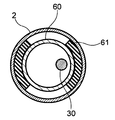
- FIG. 2 shows a sectional view taken along line III-III of the distal portion of the catheter shown in FIG. Another example of the III-III cross section of the distal catheter shown in FIG. 2 is shown.
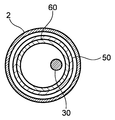
- FIG. 2 shows a VV cross-sectional view of the distal portion of the catheter shown in FIG.
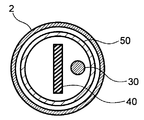
- FIG. 2 shows a VI-VI cross-sectional view of the distal portion of the catheter shown in FIG.
- the VII-VII cross-sectional view of the distal portion of the catheter shown in FIG. 2 is shown.
- the plan view of the coil which concerns on one Embodiment of this invention is shown.
- a longitudinal sectional view of the distal portion of the catheter according to another embodiment of the present invention is shown (partial plan view).
- the catheters of the present invention have a shaft with a distal end and a proximal end with a longitudinally extending lumen; a distal end and a proximal end, with the distal end being the shaft.
- a shaft with a distal end and a proximal end with a longitudinally extending lumen; a distal end and a proximal end, with the distal end being the shaft.
- wires fixed to the distal end and the proximal end extending to the proximal end of the shaft; having a distal end and a proximal end; longitudinally in the lumen of the shaft
- With a coil that has an extension in the lumen and the wire is located in the lumen; with a leaf spring that has a distal end and a proximal end and extends longitudinally in the lumen of the shaft.
- first connection where the proximal end of the leaf spring is fixed to the distal end of the coil and a second connection where the distal end of the leaf spring is fixed to the distal end of the shaft.
- a leaf spring having a portion ;; a cover tube having a distal end and a proximal end and having a longitudinally extending lumen in the lumen of the shaft, in the lumen.
- the distal portion of the coil, including the first connection, the wire and leaf springs are located, and the proximal end of the cover tube has a cover tube located distal to the proximal end of the coil.
- the coil has a fixing portion fixed to the shaft on the proximal side of the proximal end of the cover tube, and is close to the cover tube from the distal end of the fixing portion in the longitudinal direction of the shaft.
- the length to the position end is 20 turns or less of the coil.
- the catheter of the present invention bends the leaf spring connected to the distal end of the shaft by pulling the wire while ensuring the rigidity of the distal end of the shaft on the proximal end side by the coil.
- the distal end of the coil can be curved to the distal end of the catheter.
- the distal end of the coil and the fixed portion are not close to each other, it is possible to alleviate a rigidity step in which the rigidity changes sharply at the distal end of the coil, and it is possible to prevent bending of the catheter and deterioration of pushability. can. Furthermore, since the length from the distal end of the fixation to the proximal end of the cover tube is less than or equal to a predetermined value for the coil, the coil is between the distal end of the fixation and the proximal end of the cover tube. Deformation such as twisting is unlikely to occur.
- the catheter of the present invention can easily deliver the distal portion of the catheter to the desired position of the blood vessel or the heart, and the distal portion of the catheter may damage the luminal wall of the living body or be in an undesired direction. It is possible to prevent the progress to.
- the fixing of the coil, the cover tube, and the shaft in the present invention means that the coil, the cover tube, and the shaft are fixed by some kind of fixing means such as adhesion with an adhesive, brazing with solder, welding, etc., and are simply in contact with each other. Being in close contact is not called fixing.
- the cover tube may be provided on the outside of the coil by heat-shrinking the resin. In that case, the cover tube may be in close contact with the outside of the coil. In such a state, the cover tube and the coil are fixed. I don't say it is.
- the coil, the cover tube, and the shaft may be in close contact with each other, and the coil and the shaft may be indirectly in close contact with each other. It is not said that and is fixed. Further, even in a place where the shaft is provided in close contact with the outside of the coil at a place where the cover tube is not arranged in the longitudinal direction, it cannot be said that the coil and the shaft are fixed in such a state.
- FIG. 1 shows a plan view of a catheter according to an embodiment of the present invention, and a dotted line shows a state when the distal portion of the catheter is curved toward one side of a leaf spring in the radial direction of the shaft.
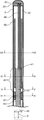
- FIG. 2 shows a longitudinal cross-sectional view of the distal portion when the catheter shown in FIG. 1 is not curved.
- the coil is a plan view.
- FIG. 3 represents a III-III cross section of the distal catheter shown in FIG. 2
- FIG. 4 represents another example of a III-III cross section of the distal catheter shown in FIG.
- FIG. 5 to 7 show a VV cross-sectional view, a VI-VI cross-sectional view, and a VII-VII cross-sectional view of the distal portion of the catheter shown in FIG. 2, respectively.
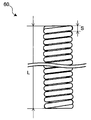
- FIG. 8 shows a plan view of the coil according to the embodiment of the present invention in a natural state.
- FIG. 9 shows a longitudinal sectional view of the distal portion of the catheter according to another embodiment of the present invention when it is not curved. In FIG. 9, the coil is a plan view.
- the proximal side refers to the user's hand side with respect to the extending direction of the shaft
- the distal side refers to the opposite side of the proximal side, that is, the treatment target side.
- the extending direction of the shaft is referred to as a longitudinal direction d L.
- the radial direction d R refers to the radial direction perpendicular to the extending direction of the shaft.
- the catheter 1 has a shaft 2 having a distal end and a proximal end and a lumen extending in the longitudinal direction d L. It is preferable that the tip portion 20 is arranged at the distal end of the shaft 2, and it is preferable that the handle 7 is arranged at the proximal end of the shaft 2.
- the shaft 2 is inserted into the body from the distal end and delivered to the treatment site. Therefore, it is preferably flexible, and a metal or resin can be used as the material. Since it is inserted into the body, it is preferable to use a biocompatible material.
- a device for treatment such as an electrode and a sensor can be arranged on the surface of the shaft 2. By providing an electrode on the surface of the shaft 2, it can be used as an electrode catheter for measuring electrocardiographic potential or an ablation catheter for cauterizing tissue.
- an internal structure for bending the catheter 1, a device for treatment such as a sensor and a conducting wire, and an internal structure thereof can be arranged.
- the conductive wire connects the distal side to an electrode provided on the surface of the shaft 2, and the proximal side of the conductor is connected to a detector or a power source through the proximal side of the catheter 1 to transmit an electric signal from the electrode. It can receive and energize the electrodes.
- the length, outer diameter, thickness, etc. of the shaft in the longitudinal direction d L can be selected from an appropriate size for treatment.
- the tip portion 20 is arranged at the distal end of the shaft 2.
- the tip portion 20 may be a member different from the shaft 2 or may be the same member.
- the tip portion 20 may include a portion inserted into the lumen of the shaft 2 or a portion protruding distally from the distal end of the shaft. ..
- the tip portion 20 is formed by closing the opening of the distal end portion of the shaft 2 by heat fusion or the like of the distal end portion of the shaft 2. You may.
- the handle 7 is arranged on the proximal side of the shaft 2, and it is preferable that the proximal end of the shaft 2 is fixed to the inside of the handle 7.
- a conducting wire extending from the cavity of the shaft 2 and a wire 30 described later are arranged.
- the handle 7 may include a wire operating portion 70 so that the wire 30 can be easily operated. By fixing the proximal end of the wire 30 to the wire operating portion 70, the wire operating portion 70 can be operated to pull the wire 30 or the like and bend the catheter distal portion 2D of the catheter 1.
- one or more catheters 1 have a distal end fixed to the distal end of the shaft 2 and a proximal end extending to the proximal end of the shaft 2.
- the wire 30 is an operation wire for bending the distal portion 2D of the catheter 1.
- One or more wires 30 are arranged. For example, by arranging two wires 30, each wire 30 is operated to both sides of the radial d R of the leaf spring 40 on one side and the other side, respectively. It can also be a bendable catheter 1.
- the wire 30 is located in the lumen of the shaft 2, the distal end is fixed to the distal end of the shaft 2, preferably the tip 20, and the proximal end extends to the proximal end of the handle 7. is doing.
- the proximal end of the wire 30 is preferably fixed to the handle 7.
- a metal wire such as stainless steel or a wire formed of a synthetic resin such as fluororesin can be used.
- Each wire 30 may be a single wire or may have a structure composed of a plurality of wires.
- the leaf spring 40 is a member that defines the bending direction of the catheter 1 and has a plate-like shape extending in the longitudinal direction d L of the shaft 2 having a distal end and a proximal end.
- the leaf spring 40 is preferably arranged along the longitudinal axis of the shaft 2. Since the leaf spring 40 has a plate-like shape, the bending direction of the catheter distal portion 2D of the catheter 1 can be fixed, and the catheter distal portion 2D is curved to one side and the other side of the radial direction d R. be able to.
- the distal end of the leaf spring 40 is fixed to the distal end of the shaft 2.
- the distal end portion of the leaf spring 40 is fixed to the tip portion 20.
- the proximal end of the leaf spring 40 is fixed to the distal end of the coil 60 by a first connection 41. That is, the leaf spring 40 has a first connection portion 41 in which the proximal end of the leaf spring 40 is fixed to the distal end of the coil 60, and the distal end of the leaf spring 40 is the distal end of the shaft 2. It can be said that it has a second connecting portion 42 fixed to the portion.
- the leaf spring 40 is a spring using a plate material, and examples of the material constituting the leaf spring 40 include metals such as stainless steel, titanium, carbon steel, nickel-titanium alloy, cobalt-chromium alloy, and tungsten alloy.
- examples of the material constituting the leaf spring 40 include synthetic resins such as aromatic polyetherketone resin (for example, PEEK), polycarbonate resin, and fiber reinforced resin.
- the leaf spring 40 may be made of synthetic rubber such as butadiene rubber, isoprene rubber, styrene butadiene rubber, ethylene propylene rubber, acrylic rubber, silicone rubber, or natural rubber. Above all, the material of the leaf spring 40 is preferably stainless steel.
- the ends of the first connection portion 41 between the shaft 2 and the distal end of the wire 30 or the leaf spring 40 and the coil 60 at the proximal end of the leaf spring 40 are directly fixed. It may be fixed by fixing the vicinity thereof.
- the method for fixing the distal end portion and the proximal end portion of the wire 30, the leaf spring 40, and the proximal end portion is not particularly limited, but may be fixed by soldering, for example, and the tip portion 20 and the coil 60 may be fixed. When it is a metal, it is preferably fixed by laser welding.
- a cover tube 50 and a coil 60 are arranged in the lumen of the catheter 1 from the distal side.
- the cover tube 50 has a lumen extending in the longitudinal direction d L , in which the wire 30 and the leaf spring 40 are arranged.
- the coil 60 has a lumen extending in the longitudinal direction d L , and the proximal end of the leaf spring 40 is fixed to the distal end.
- the cover tube 50 has a distal end and a proximal end, and has a lumen extending in the longitudinal direction d L in the lumen of the shaft 2. As shown in FIG. 2, a wire 30 and a leaf spring 40 are arranged in the cavity of the cover tube 50. On the proximal side of the cover tube 50, the distal portion of the coil 60 is located inside the cover tube 50. The distal portion of the coil 60 located in the lumen of the cover tube 50 includes the coil 60 and the first connection 41 of the leaf spring 40. The distal portion of the coil 60, including at least the first connection portion 41, is located inside the cover tube 50 so that when the wire 30 is pulled to bend the distal portion 2D of the catheter, the base end of the curvature.
- the distal catheter 2D can be curved in a certain direction without twisting.
- the distal end of the cover tube 50 may extend to the distal end of the shaft 2, or the portion of the distal end of the shaft 2 where the wire 30 and the leaf spring 40 are exposed from the cover tube 50. There may be.
- the proximal end of the cover tube 50 is located distal to the proximal end of the coil 60. As a result, the coil 60 and the shaft 2 can be fixed.
- the cover tube 50 is preferably flexible like the shaft 2, and is preferably made of an aromatic polyether ketone resin (for example, PEEK), a polycarbonate resin, a polyamide resin, a polyester resin, a polyurethane resin, or a polyolefin resin. It can be composed of a synthetic resin such as a resin, a vinyl chloride resin, a silicone resin, a natural rubber, or a synthetic rubber. It is preferable to provide these synthetic resins by heat-shrinking them on the outside of the coil 60.
- PEEK aromatic polyether ketone resin
- the coil 60 has a distal end and a proximal end, and has a lumen extending in the longitudinal direction d L in the lumen of the shaft 2.
- the coil 60 is arranged on the proximal side of the leaf spring 40 in the lumen of the shaft 2, and the proximal end of the leaf spring 40 is fixed to the distal end.
- a wire 30 is arranged in the cavity of the coil 60.
- the first connection portion 41 between the coil 60 and the leaf spring 40 may be such that the leaf spring 40 and the coil 60 are fixed, and the proximal end of the leaf spring 40 may be arranged in the lumen of the coil 60. , May be on the outside. Alternatively, the proximal end of the leaf spring 40 may be fixed to the distal end of the coil 60.
- the coil 60 receives the proximal end of the leaf spring 40 into the cavity, and a part of the leaf spring 40 is arranged in the cavity of the coil 60 to form the proximal end of the leaf spring 40. It is preferable that the portion is fixed. Thereby, the fixing between the leaf spring 40 and the coil 60 can be strengthened.
- the coil 60 By arranging the coil 60, the rigidity of the distal end portion 2D of the catheter on the distal end side can be ensured. From the viewpoint of ensuring the rigidity of the distal end portion 2D of the catheter on the distal end side, the coil 60 is preferably an uncompressed, so-called tightly wound coil. If the coil 60 is uncompressed, the distal end of the catheter 2D can be curved with respect to the distal end of the coil 60. Strictly speaking, the uncompressed coil has a ratio L C / L of 1 between the total length L of the coil in the natural state and the total length L C of the coil at the time of maximum compression, but the L C / L is 0.
- the case of 9 or more and 0.95 or more is also substantially uncompressed and is included in the uncompressed coil.
- the proximal end of the coil 60 may extend to the proximal end of the shaft 2 or may be located in the middle of the shaft 2.
- the coil 60 may be switched to a different tube in the middle of the shaft 2.
- the coil 60 is preferably flexible, and a metal or resin can be used as the material.
- a metal wire such as stainless steel or nickel-titanium alloy, an aromatic polyetherketone resin (for example, PEEK), or a polycarbonate resin can be used. It can be made of synthetic resin wire such as.
- the cross-sectional shape of the coil wire forming the coil 60 can be circular, quadrangular, or a combination thereof.
- the coil 60 is preferably a coil made of stainless steel and using a wire having a circular cross section.
- the coil wire diameter, coil diameter, and length of the coil 60 can be appropriately selected as needed.
- the coil 60 is preferably a coil around which a metal wire is wound.
- the diameter of the coil wire forming the coil 60 is preferably 0.1 mm to 0.5 mm.
- the coil 60 is formed of a coil wire having a quadrangular cross section, one side of the quadrangle can be 0.05 mm to 1 mm. Since the internal structure of the catheter 1 of the present invention is switched at the distal end of the coil 60, the coil is prevented from having a large change in the hardness of the catheter 1 between the distal end and the proximal side of the coil 60. It is preferable to select a size, flexibility and material of 60.
- the coil 60 has a fixing portion 61 fixed to the shaft 2 on the proximal side of the proximal end of the cover tube 50.
- the fixing portion 61 is provided by fixing by some kind of fixing means such as adhesion with an adhesive or brazing with solder or the like.
- the length d1 from the distal end of the fixing portion 61 to the proximal end of the cover tube 50 is 20 turns of the coil 60 in the natural state of the coil 60. It is as follows. Although it depends on the length of the fixed portion 61 in the longitudinal direction d L and the length of the portion where the coil 60 is arranged in the cavity of the cover tube 50, d1 is preferably short. For example, it is preferable that the length of the portion where the coil 60 is arranged in the cavity of the cover tube 50, the length of the fixing portion 61 in the longitudinal direction d L , and the length of d1 become shorter in this order.
- the fixing portion 61 can be arranged in the immediate vicinity of the proximal end of the cover tube 50, so that the coil 60 can be prevented from being deformed or twisted. Further, since the length of the coil 60 not arranged in the lumen of the cover tube 50 on the distal side of the fixing portion 61 can be shortened in the longitudinal direction d L , the distal side of the fixing portion 61 and the proximal side of the cover tube 50 can be shortened. When a bending operation is performed by pulling the wire 30 at a portion proximal to the end, problems such as twisting of the coil 60 can be prevented, and the distal portion 2D of the catheter can be bent in a certain direction.
- the fixing portion 61 since the fixing portion 61 is provided on the proximal side of the proximal end of the cover tube 50, the fixing portion 61 fixes the distal end of the coil 60, the coil 60, and the leaf spring 40. Since it does not overlap with the connecting portion 41 and a rigidity step in which the rigidity changes abruptly is unlikely to occur in the shaft 2, it is possible to prevent bending and deterioration of pushability when bending the distal portion 2D of the catheter.
- the fixing portion 61 is provided between the outer circumference of the coil 60 and the inner circumference of the shaft 2, and has a length in the longitudinal direction d L of the coil 60 and the shaft 2.
- the fixing portion 61 may be provided on all 360 ° of the circumference 360 ° between the outer circumference of the coil 60 and the inner circumference of the shaft 2, as shown in FIG. 3, or one as shown in FIG. It may be provided in the section.
- the total angle at which the fixing portion 61 exists on the circumference is preferably 60 ° or more, more preferably 90 ° or more. ..
- the fixing strength can be secured. Further, the total angle at which the fixed portion 61 exists on the circumference may be 240 ° or less, or 180 ° or less. If the total angle existing on the circumference of the fixing portion 61 is equal to or less than the above, the catheter 1 has a lead wire connected to an electrode or the like arranged at the distal end portion of the distal end portion 2D of the catheter. In this case, it is possible to secure an insertion passage for the conducting wire in the space formed between the outer circumference of the coil 60 and the inner circumference of the shaft 2. In such a configuration, since the conductor is not fixed, the conductor can be prevented from being pulled when the distal portion 2D of the catheter is curved, and the bending operation can be smoothly performed.
- the length of the fixed portion 61 in the longitudinal direction d L is not particularly limited, but is preferably 50 turns or less, more preferably 30 turns or less, and 10 turns or less of the coil 60. More preferred. If the length of the fixed portion 61 in the longitudinal direction d L is long, the rigidity of the shaft 2 of the portion where the fixed portion 61 is provided becomes high, and the rigidity step may cause problems such as bending and deterioration of pushability. There is. If the length of the fixing portion 61 in the longitudinal direction d L is less than or equal to the above, it is possible to prevent the rigidity step of the shaft 2 from being generated by the fixing portion 61. Can be curved.
- the catheter 1 has a lead wire connected to an electrode or the like arranged at the distal end portion of the distal end portion 2D of the catheter, the lead wire is inside the shaft 2 and outside the coil 60. Since the fixing portion 61 is arranged, even when the fixing portion 61 is provided on the entire outer periphery of the coil 60, the fixing of the conducting wire can be minimized by the short length of the fixing portion 61 in the longitudinal direction d L. , It is possible to prevent the conductors from being pulled and to perform the bending operation smoothly.
- one turn of the coil 60 is, as shown in FIG. 8, the axial length of the coil 60 for one turn in the natural state of the coil wire forming the coil 60.
- the coil 60 is an uncompressed coil and the ratio L C / L of the total length L of the coil in the natural state to the total length L C of the coil at the time of maximum compression is 1, one turn of the coil 60 forms the coil 60.
- One turn of the coil 60 can be measured as shown in FIG. 8 for one turn S. Therefore, 20 turns of the coil 60 is 20 times as long as 1 turn S.
- the catheter distal portion 2D of the catheter 1 is from the portion where the leaf spring 40 is exposed from the distal end of the coil 60 until the leaf spring 40 is fixed to the distal end portion of the shaft 2, for example, the distal end portion 20.
- the cover tube 50 may be provided on the outside of the coil 60 by heat shrinkage or the like so as to be in close contact with the outside of the coil 60. Since the cover tube 50 is in contact with the outside of the coil 60, it is possible to prevent the coil 60 from being deformed when the wire 30 is operated.
- the cover tube 50 does not have to be in contact with the outside of the coil 60 at all parts containing the coil 60, for example, a portion of the coil 60 from the distal end to a little proximal side, for example, the coil 60. The portion of about 3 turns or less does not have to be in contact with the cover tube 50.
- the cover tube 50 even if there is a portion where the cover tube 50 does not partially abut on the outside of the coil 60, the cover tube 50 abuts on the coil 60 at most of the portion including the coil 60. , The deformation of the coil 60 can be prevented.
- the length d 2 from the distal end of the fixing portion 61 to the distal end of the coil 60 is preferably 1/3 or more of the length of the leaf spring 40.
- the distal portion 2D of the catheter has high rigidity in the portion where the coil 60 exists in the longitudinal direction d L due to the rigidity of the coil 60 itself, and low in the portion where the coil 60 does not exist.
- the first connecting portion 41 in which the leaf spring 40 is fixed to the distal end of the coil 60 is also a portion for increasing the rigidity, a certain degree of rigidity change is unavoidable at the distal end of the coil 60.
- the fixed portion 61 since the rigidity of the fixed portion 61 is also high, the fixed portion 61 also causes a rigidity step.
- the catheter 1 is configured such that the length from the distal end of the fixing portion 61 to the distal end of the coil 60 is equal to or greater than the predetermined value with respect to the length of the leaf spring 40 which is a bending member.
- the change in rigidity at the distal end of the coil 60 and the change in rigidity due to the fixing portion 61 do not overlap, the change in rigidity can be dispersed, and as a result, a sudden difference in rigidity of the shaft 2 can be prevented, and the distal portion 2D of the catheter can be prevented. It is possible to prevent bending and deterioration of pushability when bending the.
- Length d2 to the distal end of the coil 60 from the distal end of the fixed portion 61 in the longitudinal direction d L of the shaft 2 may be 1/2 or more the length of the leaf spring 40, 3/4 or more May be.
- the length d 2 from the distal end of the fixing portion 61 to the distal end of the coil 60 is preferably not more than twice the length of the leaf spring 40.
- the length d2 from the distal end of the fixing portion 61 to the distal end of the coil 60 exceeds the above-mentioned predetermined value, the leaf spring 40 and the coil 60 of the shaft 2 become twisted when the entire shaft 2 is twisted. There is a possibility that the coil 60 will be fixed to the shaft 2 in the twisted state due to friction with the inner layer or the like.
- the leaf spring 40 remains twisted, and the distal portion 2D of the catheter cannot bend in a certain direction and bends in a spiral shape to the catheter to the desired position. Distal 2D may not be delivered.
- the length d2 from the distal end of the fixing portion 61 to the distal end of the coil 60 is twice or less the length of the leaf spring 40 which is a bending member, the leaf spring 40 and the coil
- the coil 60 can be fixed to the shaft 2 in a state where the 60 is not twisted, and the distal portion 2D of the catheter can be bent in a certain direction without twisting. From the distal end of the fixed portion 61 in the longitudinal direction d L to the distal end of the coil 60 length d2 is more preferably 1.5 times or less of the length of the leaf spring 40, more preferably 1 times or less.
- the cover tube 50 is not fixed to the shaft 2.
- the cover tube 50 in which the distal portion of the coil 60 including the first connection portion 41 between the leaf spring 40 and the coil 60 is arranged in the lumen is not fixed to the shaft 2, so that the rigidity of the distal end portion of the coil 60 is determined. Since the change and the change in rigidity due to the fixing of the cover tube 50 and the shaft 2 do not overlap, a sudden change in rigidity is unlikely to occur, so that the rigidity step of the distal portion 2D of the catheter is prevented and bending and deterioration of pushability are unlikely to occur. can do.
- the length of the cover tube 50 in the longitudinal direction d L is longer than the length of the leaf spring 40 in the longitudinal direction d L.
- Length in the longitudinal direction d L of the cover tube 50 is longer than the length of the longitudinal direction d L of the leaf spring 40, the cover tube 50, the lumen of the distal side of the coil 60 including the first connecting portion 41 While accommodating, the leaf spring 40 and the wire 30 distal to the first connection portion 41 can be accommodated in the lumen in the longitudinal direction d L, preventing the coil 60 from being deformed and protecting the leaf spring 40 and the wire 30. Is possible.
- the cover tube 50 extends to the second connection portion 42 in which the distal end portion of the leaf spring 40 is fixed to the shaft 2, and the cover tube 50 extends to the wire 30 and the leaf spring 40. It is preferable that the leaf spring 40 and the wire 30 are not exposed in the cavity of the shaft 2 by covering the above. By covering the entire length of the wire 30 and the leaf spring 40 with the cover tube 50, it is possible to sufficiently protect the leaf spring 40 and the wire 30 that repeat the bending operation by the bending operation in the bendable catheter distal portion 2D. Become.
- the catheter 1 has a lead wire connected to an electrode or the like arranged at the distal end portion of the distal end portion 2D of the catheter, the lead wire is inside the shaft 2 and outside the cover tube 50.
- the leaf spring 40 and the wire 30 are arranged in the cavity of the cover tube 50, the leaf spring 40 and the wire 30 are outside the cover tube 50 and are not exposed in the cavity of the shaft 2. Therefore, it is possible to prevent the leaf spring 40 and the wire 30 from interfering with the conducting wire.
- the cover tube 50 extends to the second connection portion 42 means that the cover tube 50 extends to the proximal end of the second connection portion 42 and the proximal end of the second connection portion 42. Includes extending to the vicinity.
Landscapes
- Health & Medical Sciences (AREA)
- Life Sciences & Earth Sciences (AREA)
- Engineering & Computer Science (AREA)
- Heart & Thoracic Surgery (AREA)
- Biomedical Technology (AREA)
- Veterinary Medicine (AREA)
- Animal Behavior & Ethology (AREA)
- General Health & Medical Sciences (AREA)
- Public Health (AREA)
- Anesthesiology (AREA)
- Pulmonology (AREA)
- Hematology (AREA)
- Biophysics (AREA)
- Mechanical Engineering (AREA)
- Surgery (AREA)
- Otolaryngology (AREA)
- Molecular Biology (AREA)
- Medical Informatics (AREA)
- Physics & Mathematics (AREA)
- Nuclear Medicine, Radiotherapy & Molecular Imaging (AREA)
- Plasma & Fusion (AREA)
- Media Introduction/Drainage Providing Device (AREA)
Priority Applications (2)
| Application Number | Priority Date | Filing Date | Title |
|---|---|---|---|
| US18/014,302 US12472330B2 (en) | 2020-07-08 | 2021-06-02 | Catheter |
| JP2022534952A JP7659558B2 (ja) | 2020-07-08 | 2021-06-02 | 電極カテーテル |
Applications Claiming Priority (2)
| Application Number | Priority Date | Filing Date | Title |
|---|---|---|---|
| JP2020-117631 | 2020-07-08 | ||
| JP2020117631 | 2020-07-08 |
Publications (1)
| Publication Number | Publication Date |
|---|---|
| WO2022009566A1 true WO2022009566A1 (ja) | 2022-01-13 |
Family
ID=79552368
Family Applications (1)
| Application Number | Title | Priority Date | Filing Date |
|---|---|---|---|
| PCT/JP2021/021005 Ceased WO2022009566A1 (ja) | 2020-07-08 | 2021-06-02 | カテーテル |
Country Status (3)
| Country | Link |
|---|---|
| US (1) | US12472330B2 (https=) |
| JP (1) | JP7659558B2 (https=) |
| WO (1) | WO2022009566A1 (https=) |
Families Citing this family (1)
| Publication number | Priority date | Publication date | Assignee | Title |
|---|---|---|---|---|
| US20240316314A1 (en) * | 2021-08-19 | 2024-09-26 | Kaneka Corporation | Catheter |
Citations (4)
| Publication number | Priority date | Publication date | Assignee | Title |
|---|---|---|---|---|
| US5984907A (en) * | 1995-06-05 | 1999-11-16 | Ep Technologies, Inc. | Transition sleeve assembly for catheters |
| JP2008245766A (ja) * | 2007-03-29 | 2008-10-16 | Japan Lifeline Co Ltd | 先端偏向操作可能カテーテル |
| JP2012518477A (ja) * | 2009-02-20 | 2012-08-16 | ボストン サイエンティフィック サイムド,インコーポレイテッド | 中間部の剛性を備えた移行領域を有する操作可能なカテーテル |
| WO2019156059A1 (ja) * | 2018-02-06 | 2019-08-15 | 株式会社カネカ | カテーテルおよびその製造方法 |
Family Cites Families (3)
| Publication number | Priority date | Publication date | Assignee | Title |
|---|---|---|---|---|
| JP4544457B2 (ja) | 2004-08-26 | 2010-09-15 | 日本ライフライン株式会社 | 先端偏向操作可能カテーテル |
| JP5787394B2 (ja) | 2011-03-25 | 2015-09-30 | 日本ライフライン株式会社 | 先端偏向操作可能カテーテル |
| JP6200140B2 (ja) | 2012-09-24 | 2017-09-20 | 日本ライフライン株式会社 | 電極カテーテル |
-
2021
- 2021-06-02 US US18/014,302 patent/US12472330B2/en active Active
- 2021-06-02 WO PCT/JP2021/021005 patent/WO2022009566A1/ja not_active Ceased
- 2021-06-02 JP JP2022534952A patent/JP7659558B2/ja active Active
Patent Citations (4)
| Publication number | Priority date | Publication date | Assignee | Title |
|---|---|---|---|---|
| US5984907A (en) * | 1995-06-05 | 1999-11-16 | Ep Technologies, Inc. | Transition sleeve assembly for catheters |
| JP2008245766A (ja) * | 2007-03-29 | 2008-10-16 | Japan Lifeline Co Ltd | 先端偏向操作可能カテーテル |
| JP2012518477A (ja) * | 2009-02-20 | 2012-08-16 | ボストン サイエンティフィック サイムド,インコーポレイテッド | 中間部の剛性を備えた移行領域を有する操作可能なカテーテル |
| WO2019156059A1 (ja) * | 2018-02-06 | 2019-08-15 | 株式会社カネカ | カテーテルおよびその製造方法 |
Also Published As
| Publication number | Publication date |
|---|---|
| JPWO2022009566A1 (https=) | 2022-01-13 |
| US20230256203A1 (en) | 2023-08-17 |
| JP7659558B2 (ja) | 2025-04-09 |
| US12472330B2 (en) | 2025-11-18 |
Similar Documents
| Publication | Publication Date | Title |
|---|---|---|
| US7101361B2 (en) | Steerable medical device having means for imparting curves in the device and in elongated implantable medical instruments | |
| EP2438956B1 (en) | Medical Guidewire | |
| JP2564458B2 (ja) | カテーテルガイドワイヤ | |
| EP1171193B1 (en) | Medical electrode lead | |
| US20100318001A1 (en) | Medical guidewire | |
| JP7651570B2 (ja) | カテーテル | |
| WO2022009566A1 (ja) | カテーテル | |
| CN108272538A (zh) | 肺减容弹性植入体及肺减容器械 | |
| WO2022009567A1 (ja) | カテーテル | |
| JP3895755B2 (ja) | 医療用チューブ | |
| EP1743589B1 (en) | High-frequency treatment instrument | |
| US20200238055A1 (en) | Guide wire | |
| JP2006271901A (ja) | コイル状造影マーカーとその製造方法、及びカテーテル | |
| JP7545339B2 (ja) | 多層コイル | |
| JP7846124B2 (ja) | カテーテル | |
| US20220096802A1 (en) | Guide wire | |
| JP2013208351A (ja) | ガイドワイヤ | |
| JP2023091652A (ja) | カテーテルハンドルおよびそれを備えたカテーテル | |
| JP2023028553A (ja) | カテーテル | |
| JP7701213B2 (ja) | 電極カテーテル | |
| JP2025152724A (ja) | カテーテル | |
| WO2019207676A1 (ja) | 処置具および処置システム | |
| WO2025028185A1 (ja) | カテーテル | |
| JP2009232949A (ja) | ガイディングカテーテル |
Legal Events
| Date | Code | Title | Description |
|---|---|---|---|
| 121 | Ep: the epo has been informed by wipo that ep was designated in this application |
Ref document number: 21837203 Country of ref document: EP Kind code of ref document: A1 |
|
| ENP | Entry into the national phase |
Ref document number: 2022534952 Country of ref document: JP Kind code of ref document: A |
|
| NENP | Non-entry into the national phase |
Ref country code: DE |
|
| 122 | Ep: pct application non-entry in european phase |
Ref document number: 21837203 Country of ref document: EP Kind code of ref document: A1 |
|
| WWG | Wipo information: grant in national office |
Ref document number: 18014302 Country of ref document: US |