WO2022004476A1 - 接着剤組成物 - Google Patents
接着剤組成物 Download PDFInfo
- Publication number
- WO2022004476A1 WO2022004476A1 PCT/JP2021/023522 JP2021023522W WO2022004476A1 WO 2022004476 A1 WO2022004476 A1 WO 2022004476A1 JP 2021023522 W JP2021023522 W JP 2021023522W WO 2022004476 A1 WO2022004476 A1 WO 2022004476A1
- Authority
- WO
- WIPO (PCT)
- Prior art keywords
- adhesive composition
- epoxy
- styrene
- modified resin
- adhesive
- Prior art date
- Legal status (The legal status is an assumption and is not a legal conclusion. Google has not performed a legal analysis and makes no representation as to the accuracy of the status listed.)
- Ceased
Links
Classifications
-
- B—PERFORMING OPERATIONS; TRANSPORTING
- B32—LAYERED PRODUCTS
- B32B—LAYERED PRODUCTS, i.e. PRODUCTS BUILT-UP OF STRATA OF FLAT OR NON-FLAT, e.g. CELLULAR OR HONEYCOMB, FORM
- B32B27/00—Layered products comprising a layer of synthetic resin
- B32B27/30—Layered products comprising a layer of synthetic resin comprising vinyl (co)polymers; comprising acrylic (co)polymers
-
- C—CHEMISTRY; METALLURGY
- C09—DYES; PAINTS; POLISHES; NATURAL RESINS; ADHESIVES; COMPOSITIONS NOT OTHERWISE PROVIDED FOR; APPLICATIONS OF MATERIALS NOT OTHERWISE PROVIDED FOR
- C09J—ADHESIVES; NON-MECHANICAL ASPECTS OF ADHESIVE PROCESSES IN GENERAL; ADHESIVE PROCESSES NOT PROVIDED FOR ELSEWHERE; USE OF MATERIALS AS ADHESIVES
- C09J125/00—Adhesives based on homopolymers or copolymers of compounds having one or more unsaturated aliphatic radicals, each having only one carbon-to-carbon double bond, and at least one being terminated by an aromatic carbocyclic ring; Adhesives based on derivatives of such polymers
- C09J125/02—Homopolymers or copolymers of hydrocarbons
- C09J125/04—Homopolymers or copolymers of styrene
- C09J125/08—Copolymers of styrene
- C09J125/10—Copolymers of styrene with conjugated dienes
-
- C—CHEMISTRY; METALLURGY
- C09—DYES; PAINTS; POLISHES; NATURAL RESINS; ADHESIVES; COMPOSITIONS NOT OTHERWISE PROVIDED FOR; APPLICATIONS OF MATERIALS NOT OTHERWISE PROVIDED FOR
- C09J—ADHESIVES; NON-MECHANICAL ASPECTS OF ADHESIVE PROCESSES IN GENERAL; ADHESIVE PROCESSES NOT PROVIDED FOR ELSEWHERE; USE OF MATERIALS AS ADHESIVES
- C09J153/00—Adhesives based on block copolymers containing at least one sequence of a polymer obtained by reactions only involving carbon-to-carbon unsaturated bonds; Adhesives based on derivatives of such polymers
- C09J153/02—Vinyl aromatic monomers and conjugated dienes
-
- C—CHEMISTRY; METALLURGY
- C09—DYES; PAINTS; POLISHES; NATURAL RESINS; ADHESIVES; COMPOSITIONS NOT OTHERWISE PROVIDED FOR; APPLICATIONS OF MATERIALS NOT OTHERWISE PROVIDED FOR
- C09J—ADHESIVES; NON-MECHANICAL ASPECTS OF ADHESIVE PROCESSES IN GENERAL; ADHESIVE PROCESSES NOT PROVIDED FOR ELSEWHERE; USE OF MATERIALS AS ADHESIVES
- C09J163/00—Adhesives based on epoxy resins; Adhesives based on derivatives of epoxy resins
-
- C—CHEMISTRY; METALLURGY
- C09—DYES; PAINTS; POLISHES; NATURAL RESINS; ADHESIVES; COMPOSITIONS NOT OTHERWISE PROVIDED FOR; APPLICATIONS OF MATERIALS NOT OTHERWISE PROVIDED FOR
- C09J—ADHESIVES; NON-MECHANICAL ASPECTS OF ADHESIVE PROCESSES IN GENERAL; ADHESIVE PROCESSES NOT PROVIDED FOR ELSEWHERE; USE OF MATERIALS AS ADHESIVES
- C09J163/00—Adhesives based on epoxy resins; Adhesives based on derivatives of epoxy resins
- C09J163/10—Epoxy resins modified by unsaturated compounds
Definitions
- the present invention relates to an adhesive composition. More specifically, the present invention relates to an adhesive composition that can be used for adhesive applications such as electronic components.
- FPC flexible printed wiring board
- a base material having a small loss even in the millimeter wave band of 28 GHz in order to efficiently transmit signals having frequencies in the 3.5 GHz and 28 GHz bands used in the 5th generation mobile communication system (hereinafter, also referred to as 5G), a base material having a small loss even in the millimeter wave band of 28 GHz. Films and adhesives are becoming more important.
- the low-dielectric adhesive has poor reactivity with the curing agent because the main agent molecule has few reactive groups. Further, when an epoxy resin is used as the curing agent, the dielectric loss tangent tends to be high. Due to these factors, it is extremely difficult to achieve both curability and low dielectric resistance, which affect the adhesiveness, heat resistance, and chemical resistance (solvent resistance) of the adhesive composition.
- the present invention exhibits good adhesion to a low-dielectric base film having poor adhesion while having good electrical characteristics (dielectric characteristics) compatible with 5G, and has heat resistance and chemical resistance (resistance to chemicals). It is an object of the present invention to provide an adhesive composition for forming a low-dielectric adhesive layer having a solvent-like property.
- the present invention includes the following aspects.
- R 1 , R 2 , R 3 and R 4 independently represent hydrogen or an organic group, respectively. However, at least one of R 1 and R 2 is an organic group, and R 3 and R 4 have an organic group. At least one of them is an organic group.
- R 5 and R 6 each independently represent hydrogen or an alkyl group having 10 or less carbon atoms.
- R 5 in the formula (2) may be the same or different
- R 6 in each formula (2) may be the same or different. * Represents a binding group. .)
- [7] The adhesive composition according to any one of [1] to [6], wherein the epoxy-modified resin contains an unsaturated bond other than an aromatic ring.
- [8] The adhesive composition according to [7], wherein the epoxy-modified resin has a structure represented by the following formula (3).
- R 7 and R 8 each independently represent hydrogen or an alkyl group having 10 or less carbon atoms.
- R 7 in the formula (3) may be the same or different, and R 8 in each formula (3) may be the same or different.
- * represents a binding group. .) [9] Any of [1] to [8], wherein the epoxy-modified resin has at least one of a structure represented by the following formula (4) and a structure represented by the following formula (5).
- the adhesive composition according to. (R 9 and R 10 each independently represent hydrogen or an alkyl group having 10 or less carbon atoms.
- R 9 in the formula (4) may be the same or different, and R 10 in each formula (4) may be the same or different.
- * Represents a binding group. .) R 11 and R 12 each independently represent hydrogen or an alkyl group having 10 or less carbon atoms. When a plurality of structures represented by the formula (5) are present in the epoxy-modified resin, R 11 in each formula (5) may be the same or different, and each formula (5) may be different. R 12 in) may each be the same or different.
- [15] The adhesive composition according to any one of [1] to [14], wherein the epoxy-modified resin has a weight average molecular weight (Mw) of 30,000 or more and 200,000 or less.
- Mw weight average molecular weight
- [16] The adhesive composition according to any one of [1] to [15], wherein the adhesive composition contains a filler.
- [18] The adhesive composition according to any one of [1] to [17], wherein the adhesive composition contains an organic peroxide.
- the relative permittivity of the adhesive layer measured at a frequency of 28 GHz with respect to the adhesive layer obtained by curing the adhesive composition according to any one of [1] to [18] is 3 or less.
- PEEK polyetheretherketone
- a copper-clad laminate comprising the laminate according to [20] or [21].
- the present invention while having good electrical characteristics (dielectric characteristics) compatible with 5G, it also exhibits good adhesion to a low-dielectric base film having poor adhesion, and has heat resistance and chemical resistance (resistance to chemicals). It is possible to provide an adhesive composition for forming a low-dielectric adhesive layer having a solvent-like property.
- the adhesive composition of the present invention the laminated body including the adhesive layer made of the adhesive composition, and the constituent members related to the electronic parts including the laminated body will be described in detail, but the constituent requirements described below will be described.
- the description of the above is an example as an embodiment of the present invention, and is not specified in these contents.
- the adhesive composition of the present invention contains a styrene-based elastomer and an epoxy-modified resin having a structure represented by the following formula (1).
- the adhesive composition of the present invention may contain other components, if necessary.
- the adhesive composition of the present invention containing a styrene-based elastomer and an epoxy-modified resin having a structure represented by the above formula (1) exhibits good adhesion even with a low-dielectric adhesive composition. It is an adhesive composition having excellent heat resistance and chemical resistance (solvent resistance).
- the styrene-based elastomer is a copolymer mainly composed of a block of a conjugated diene compound and an aromatic vinyl compound and a random structure, and a hydrogenated product thereof. There are few highly polar bonding groups in the molecule, and good electrical properties (dielectric properties) can be imparted to the composition. Further, as compared with other types of elastomers, it is easy to control the molecular weight, and it is also an advantage that the characteristics of the adhesive composition can be stably produced.
- aromatic vinyl compound examples include styrene, t-butylstyrene, ⁇ -methylstyrene, divinylbenzene, 1,1-diphenylethylene, N, N-diethyl-p-aminoethylstyrene, vinyltoluene and the like.
- conjugated diene compound examples include butadiene, isoprene, 1,3-pentadiene, 2,3-dimethyl-1,3-butadiene and the like.
- styrene-based elastomer examples include a styrene-butadiene block copolymer, a styrene-ethylene propylene block copolymer, a styrene-butadiene-styrene block copolymer, a styrene-isoprene-styrene block copolymer, and a styrene-ethylene butylene.
- -Styrene block copolymer, styrene-ethylene propylene-styrene block copolymer and the like can be mentioned.
- the styrene-based elastomer may be a modified styrene-based elastomer or an unmodified styrene-based elastomer, and may be selected according to the intended purpose without any particular limitation.
- a modified styrene-based elastomer such as the styrene-based elastomer containing a carboxy group or a styrene-based elastomer containing an amino group described below is preferable, and the adhesion by laminating and each temperature are different.
- an unmodified styrene-based elastomer is preferable.
- styrene-based elastomer Only one type of styrene-based elastomer may be used, or two or more types may be used in combination.
- a modified styrene-based elastomer with good surface adhesion to the adherend and an unmodified styrene-based elastomer whose elastic modulus can be adjusted for each temperature of the adhesive composition high adhesion can be achieved. It is possible to control the fluidity.
- styrene-ethylene from the viewpoint that adhesiveness and electrical properties (dielectric properties) can be imparted to the adhesive composition, the control of the molecular structure is relatively simple, and the properties of the adhesive composition can be easily adjusted.
- Butylene-styrene block copolymers and styrene-ethylenepropylene-styrene block copolymers are preferred.
- the mass ratio of styrene / ethylenebutylene in the styrene-ethylenebutylene-styrene block copolymer and the mass ratio of styrene / ethylenepropylene in the styrene-ethylenepropylene-styrene block copolymer are 10/90 to 50/50. It is preferably 20/80 to 40/60, and more preferably 20/80 to 40/60. When the mass ratio is within this range, an adhesive composition having excellent adhesive properties can be obtained.
- the styrene-based elastomer containing a carboxy group has high adhesion, can impart flexibility to the cured product, and is effective as a component that imparts good electrical characteristics. Since the styrene-based elastomer containing a carboxy group is contained in the adhesive composition, the adhesive composition is flexible even for an adherend such as a base film or a metal foil having good electrical characteristics and low polarity. Since the object can sufficiently follow the surface of the adherend, the highly polar carboxy group can develop the adhesiveness, so that the adhesiveness of the adhesive layer is improved.
- the styrene-based elastomer containing a carboxy group is reactive, the heat resistance and chemical resistance of the adhesive layer are improved by epoxy curing. Further, the inclusion of the carboxy group improves the dispersibility of the filler in the dispersion liquid.
- the styrene-based elastomer containing a carboxy group is a copolymer mainly composed of a block of a conjugated diene compound and an aromatic vinyl compound and a random structure, and a hydrogenated product thereof modified with an unsaturated carboxylic acid. .. Specific examples of the types of aromatic vinyl compounds and conjugated diene compounds and styrene-based elastomers are as described in the above section ⁇ Styrene-based elastomer>.
- Modification of the styrene-based elastomer containing a carboxy group can be performed, for example, by copolymerizing an unsaturated carboxylic acid at the time of polymerizing the styrene-based elastomer. It can also be carried out by heating and kneading a styrene-based elastomer and an unsaturated carboxylic acid in the presence of an organic peroxide.
- the unsaturated carboxylic acid include acrylic acid, methacrylic acid, maleic acid, itaconic acid, fumaric acid, maleic anhydride, and itaconic anhydride.
- the amount of modification with unsaturated carboxylic acid is preferably 0.1 to 10% by mass.
- the acid value of the styrene-based elastomer containing a carboxy group is preferably 0.1 to 25 mgKOH / g, and more preferably 0.5 to 23 mgKOH / g.
- this acid value is 0.1 mgKOH / g or more, the adhesive composition is sufficiently cured, and good adhesiveness and heat resistance can be obtained.
- the acid value is 30 mgKOH / g or less, the cohesive force of the adhesive composition is suppressed, so that the adhesiveness is excellent and the electrical characteristics are also excellent.
- the weight average molecular weight of the styrene-based elastomer containing a carboxy group is preferably 10,000 to 500,000, more preferably 30,000 to 300,000, and even more preferably 50,000 to 200,000.
- the weight average molecular weight is at least the above lower limit, excellent adhesiveness can be exhibited, and the coatability when dissolved in a solvent and coated is also improved.
- the weight average molecular weight is not more than the above upper limit, the compatibility with the epoxy resin is improved.
- the weight average molecular weight is a value obtained by converting the molecular weight measured by gel permeation chromatography (hereinafter, also referred to as “GPC”) into polystyrene.
- the content of the styrene-based elastomer containing a carboxy group is preferably 15 to 90 parts by mass with respect to 100 parts by mass of the solid content of the adhesive composition. When the content is within this range, an adhesive composition having excellent adhesive properties can be obtained.
- Styrene-based elastomer containing amino groups Since the styrene-based elastomer containing an amino group is contained in the adhesive composition, the amino group exhibits a strong interaction with the low-dielectric base film, and the reactivity of the adhesive composition becomes high. The adhesion of the adhesive layer is improved. Further, since the styrene-based elastomer containing an amino group is reactive, the heat resistance and chemical resistance of the adhesive layer are improved by epoxy curing. Since it contains an amino group, the adhesion to the metal is improved.
- the styrene-based elastomer containing an amino group is a copolymer of a conjugated diene compound and an aromatic vinyl compound mainly having a block and a random structure, and an amine-modified product thereof.
- Specific examples of the types of aromatic vinyl compounds and conjugated diene compounds and styrene-based elastomers are as described in the above section ⁇ Styrene-based elastomer>.
- the method for modifying the styrene-based elastomer with an amine is not particularly limited, and a known method can be used.
- an amine is polymerized by polymerizing a (hydrogenated) block copolymer using a polymerization initiator having an amino group.
- the weight average molecular weight of the styrene-based elastomer containing an amino group is preferably 10,000 to 500,000, more preferably 30,000 to 300,000, and further preferably 50,000 to 200,000.
- the weight average molecular weight is at least the above lower limit, excellent adhesiveness can be exhibited, and the coatability when dissolved in a solvent and coated is also improved.
- the weight average molecular weight is not more than the above upper limit, the compatibility with the epoxy resin is improved.
- the content of the styrene-based elastomer containing an amino group is preferably 15 to 90 parts by mass with respect to 100 parts by mass of the solid content of the adhesive composition. When the content is within this range, an adhesive composition having excellent adhesive properties can be obtained.
- the total amount of nitrogen in the styrene-based elastomer containing an amino group is preferably 50 to 5000 ppm. More preferably, it is 200 to 3000 ppm. When the total amount of nitrogen is at least the above lower limit, excellent adhesion can be exhibited. When the total amount of nitrogen is not more than the above upper limit, the electrical characteristics are excellent.
- the total amount of nitrogen in the styrene-based elastomer containing an amino group can be determined according to JIS-K2609 using a trace nitrogen analyzer ND-100 (manufactured by Mitsubishi Chemical Corporation).
- the epoxy-modified resin having the structure represented by the above formula (1) has an epoxy structure and the styrene containing the carboxy group and the amino group in the styrene-based elastomer containing the carboxy group, as compared with the ordinary epoxy resin.
- the reaction with the amino group in the system elastomer or the reaction rate of self-polymerization is fast, and it is effective as a component that develops high adhesiveness to the adherend and heat resistance of the cured adhesive.
- a preferred embodiment of the epoxy-modified resin is an epoxy-modified resin having a structure represented by the following formula (2).
- R 5 and R 6 each independently represent hydrogen or an alkyl group having 10 or less carbon atoms.
- R 5 in (2) may be the same or different
- R 6 in each formula (2) may be the same or different.
- * Represents a binding group.
- the epoxy-modified resin preferably contains an unsaturated bond other than an aromatic ring, such as an olefin skeleton or a vinyl group.
- unsaturated bonds other than aromatic rings such as olefin skeletons and vinyl groups, can be incorporated into reactions involving epoxy groups to accelerate reaction rates and increase crosslink density. As a result, heat resistance and chemical resistance can be improved even with a small blending amount.
- unsaturated bonds other than aromatic rings can be crosslinked by radical polymerization to increase the crosslink density of the epoxy-modified resin, and to improve heat resistance and chemical resistance.
- a preferred embodiment of the epoxy-modified resin is an epoxy-modified resin having a structure represented by the following formula (3).
- R 7 and R 8 each independently represent hydrogen or an alkyl group having 10 or less carbon atoms.
- R 7 in (3) may be the same or different
- R 8 in each formula (3) may be the same or different. * Represents a binding group.
- the epoxy-modified resin is preferably an epoxy-modified resin having a structure represented by the above formula (1) and a structure represented by the above formula (3), and the structure represented by the above formula (2) and the above formula. It is more preferable that the epoxy-modified resin has the structure represented by (3).
- Preferred embodiments of the epoxy-modified resin include an epoxy-modified resin having at least one of a structure represented by the following formula (4) and a structure represented by the following formula (5). It is also preferable to have both a structure represented by the following formula (4) and a structure represented by the following formula (5).
- R 9 and R 10 each independently represent hydrogen or an alkyl group having 10 or less carbon atoms.
- R 9 in (4) may be the same or different
- R 10 in each formula (4) may be the same or different. * Represents a binding group.
- R 11 and R 12 each independently represent hydrogen or an alkyl group having 10 or less carbon atoms.
- R 11 in (5) may be the same or different
- R 12 in each formula (5) may be the same or different. * Represents a binding group.
- the epoxy-modified resin has an epoxy-modified structure having a structure represented by the above formula (1), a structure represented by the above formula (4), and at least one of the structures represented by the above formula (5).
- a resin is preferable, and an epoxy having at least one of a structure represented by the above formula (2), a structure represented by the above formula (4), and a structure represented by the above formula (5). More preferably with a modified resin. Further, the structure represented by the above formula (1) and the above formula (2), the structure represented by the above formula (3), the structure represented by the above formula (4), and the above formula (5). Epoxy-modified resins having at least one of the structures represented are also preferred.
- the epoxy-modified resin is preferably an epoxy-modified organic compound obtained by modifying an organic compound containing an unsaturated bond.
- the structure represented by the above formula (1) and the unsaturated bond can coexist in the molecule depending on the modification rate, and the olefin skeleton or the reaction of the epoxy structure can be carried out. It is easy to impart the effect of unsaturated bonds other than aromatic rings such as vinyl groups.
- a reaction in which an epoxy skeleton is formed by a peroxide is effective.
- the epoxy-modified resin is preferably an epoxy-modified elastomer modified from an elastomer containing an unsaturated bond.
- the epoxy-modified elastomer can impart flexibility to the cured product, and by suppressing the decrease in toughness of the cured product due to epoxy curing, it is possible to maintain the adhesiveness when the laminate is bent, and to improve heat resistance and chemical resistance. Do not lower.
- the epoxy-modified resin is preferably a styrene-based elastomer.
- the epoxy-modified resin having the structure represented by the above formula (1) or the above formula (2) it is also preferable to have a structural unit of styrene in addition to the structures represented by the above formulas (3) to (5). .. Since the epoxy-modified resin is also a styrene-based elastomer together with the styrene-based elastomer contained in the adhesive resin composition of the present invention, compatibility is improved when both are mixed, and the styrene-based elastomer containing the carboxy group is used. This is because the reaction with the carboxy group in the elastomer and the amino group in the styrene-based elastomer containing the amino group can be efficiently proceeded.
- the epoxy-modified resin examples include an alicyclic epoxy compound having an alicyclic epoxy group such as epoxycyclohexane, an epoxidized polybutadiene, and an epoxy compound of a styrene-butadiene block copolymer. Above all, an epoxy compound of a styrene-butadiene block copolymer is more preferable. Since the styrene-butadiene block copolymer contains an unsaturated bond, the structure represented by the above formula (1) and the unsaturated bond can coexist in the molecule, and the olefin skeleton or vinyl can be involved in the reaction of the epoxy structure. It is easy to impart the effect of unsaturated bonds other than aromatic rings such as groups.
- epoxy-modified resin a commercially available epoxy compound can also be used.
- seroxide 2021P, seroxide 2081, seroxide 2000 manufactured by Daicel
- Eporide GT401, Epolide PB3600, Eporide PB4700 manufactured by Daicel
- Friend AT501 and Epofriend CT310 manufactured by Daicel
- the weight average molecular weight (Mw) of the epoxy-modified resin is preferably 30,000 or more, and more preferably 50,000 or more. When the weight average molecular weight is 30,000 or more, softening of the adhesive composition can be suppressed, and resin flow during heat pressure bonding can be prevented. When the weight average molecular weight is 50,000 or more, the flexibility of the epoxy-modified resin is improved and the toughness of the cured product is improved.
- the weight average molecular weight (Mw) of the epoxy-modified resin is preferably 200,000 or less, and more preferably 160,000 or less. When the weight average molecular weight is 200,000 or less, the compatibility with the styrene-based elastomer is further improved. When the weight average molecular weight is 160,000 or less, the elastic modulus of the adhesive composition can be lowered and the shape of the adherend can be followed.
- the content of the epoxy-modified resin is preferably 0.5 parts by mass or more, more preferably 1 part by mass or more, and further preferably 2 parts by mass or more with respect to 100 parts by mass of the resin composition. preferable.
- the content of the epoxy-modified resin is 0.5 parts by mass or more, epoxy curing with the modified styrene-based elastomer is possible, and the adhesiveness is improved.
- the content of the epoxy-modified resin is 1 part by mass or more, the adhesive composition is sufficiently cured and good heat resistance can be ensured.
- the content of the epoxy-modified resin is 2 parts by mass or more, the adhesive composition can further proceed with the crosslinking reaction, and good chemical resistance can be ensured.
- the content of the epoxy-modified resin is preferably 50 parts by mass or less, more preferably 25 parts by mass or less, and further preferably 15 parts by mass or less with respect to 100 parts by mass of the resin composition. ..
- the content of the epoxy-modified resin is 50 parts by mass or less, it is possible to achieve both low dielectric constant, heat resistance, and chemical resistance.
- the content of the epoxy-modified resin is 25 parts by mass or less, the flexibility of the adhesive composition after curing can be ensured and the adhesiveness is improved.
- the content of the epoxy-modified resin is 15 parts by mass or less, the dielectric can be further reduced.
- the epoxy equivalent of the epoxy-modified resin is 200 g / eq.
- the above is preferable, and 350 g / eq.
- the above is more preferable, and 900 g / eq.
- the above is more preferable.
- the epoxy equivalent of the epoxy-modified resin is 200 g / eq.
- the epoxy skeleton does not become too dense in the epoxy-modified resin, the reaction with the modified elastomer proceeds, and the adhesive composition forms a matrix, so that heat resistance and chemical resistance are improved.
- the epoxy equivalent of the epoxy-modified resin is 350 g / eq.
- the epoxy equivalent of the epoxy-modified resin is 900 g / eq. With the above, the adhesive composition becomes flexible and the adhesiveness is improved.
- the epoxy equivalent of the epoxy-modified resin is 20,000 g / eq. It is preferably 16,000 g / eq. It is more preferably 10,000 g / eq. The following is more preferable.
- the epoxy equivalent of the epoxy-modified resin is 20,000 g / eq. If the following, the adhesive composition can be epoxy-cured and the adhesiveness is improved.
- the epoxy equivalent of the epoxy-modified resin is 16,000 g / eq. If the following, the crosslink density of the cured adhesive composition is increased, and the heat resistance and chemical resistance are improved.
- the epoxy equivalent of the epoxy-modified resin is 10,000 g / eq. If the following is the case, even if the blending amount of the epoxy-modified resin is small, the matrix can be formed with the modified elastomer, so that the electrical characteristics can be improved while maintaining the heat resistance and chemical resistance.
- the adhesive composition of the present invention can contain other resin components in addition to the above-mentioned styrene-based elastomer and epoxy-modified resin.
- resin components for example, a thermoplastic resin other than the styrene-based elastomer can be contained to such an extent that the function of the adhesive composition is not affected.
- thermoplastic resins examples include phenoxy resin, polyamide resin, bismaleimide resin, polyester resin, polycarbonate resin, polyphenylene oxide resin, polyurethane resin, polyacetal resin, polyethylene resin, polypropylene resin, polyvinyl resin and the like. Can be mentioned. These thermoplastic resins may be used alone or in combination of two or more.
- the adhesive composition of the present invention includes fillers, radical polymerization initiators, tackifiers, flame retardants, curing agents, curing accelerators, coupling agents, heat aging inhibitors, and the like.
- a leveling agent, a defoaming agent, an inorganic filler, a pigment, a solvent and the like can be contained to such an extent that the function of the adhesive composition is not affected.
- the adhesive composition of the present invention preferably contains a filler.
- a filler for example, an inorganic filler is preferable from the viewpoint of heat resistance and mechanical property control of the adhesive composition, and as the inorganic filler, a silicon-based inorganic filler and boron nitride are used from the viewpoint of electrical properties. preferable.
- the silicon-based inorganic filler for example, mica and talc, which can control the mechanical properties of the adhesive composition even in a small amount and have excellent electrical characteristics, are preferable.
- an organic filler is preferable from the viewpoint of dispersibility and brittleness
- a styrene-based spherical filler is preferable from the viewpoint of electrical characteristics
- a styrene-based hollow filler is preferable. More preferred. These may be used alone or in combination of two or more.
- the content of the filler contained in the adhesive composition of the present invention is preferably 0.5 to 25 parts by volume with respect to 100 parts by volume of the resin composition, and 1 to 15 parts by volume with respect to 100 parts by volume of the resin composition. Is more preferable.
- the shape of the filler is not particularly limited and may be appropriately selected depending on the intended purpose.
- the inorganic filler may be a spherical inorganic filler or a non-spherical inorganic filler, but a non-spherical inorganic filler is preferable from the viewpoint of thermal expansion coefficient (CTE) and film strength.
- the shape of the non-spherical inorganic filler may be a three-dimensional shape other than a spherical shape (substantially a perfect circular spherical shape), and examples thereof include a plate shape, a scale shape, a columnar shape, a chain shape, and a fibrous shape. Among them, a plate-shaped or scaly inorganic filler is preferable, and a plate-shaped inorganic filler is more preferable, from the viewpoint of the coefficient of thermal expansion (CTE) and the film strength.
- the adhesive composition of the present invention preferably contains a radical polymerization initiator.
- Unsaturated bonds other than aromatic rings such as the above-mentioned olefin skeleton and vinyl group can crosslink the resin component even by radical polymerization, and further improve the adhesion (adhesiveness), heat resistance and chemical resistance of the adhesive layer. Can be improved.
- the type of the radical polymerization initiator is not particularly limited and may be appropriately selected depending on the intended purpose. For example, a peroxide capable of crosslinking at a temperature equivalent to that of epoxy curing, without proceeding with epoxy curing. Examples thereof include a photopolymerization initiator capable of pre-crosslinking.
- more preferable embodiments include, for example, organic peroxides.
- organic peroxides By containing an organic peroxide, the crosslink density of the adhesive composition is improved without containing a highly polar functional group, and the adhesive layer has more adhesiveness (adhesiveness), heat resistance and chemical resistance. Can be improved.
- the organic peroxide include benzoyl peroxide, lauroyl peroxide, t-butyl peroxypivalate, t-butyl peroxyethyl hexanoate, 1,1'-bis- (t-butyl peroxy) cyclohexane, and t-amyl.
- organic peroxides such as peroxy-2-ethylhexanoate and t-hexylperoxy-2-ethylhexanoate.
- tackifier examples include kumaron-inden resin, terpene resin, terpene-phenol resin, rosin resin, pt-butylphenol-acetylene resin, phenol-formaldehyde resin, xylene-formaldehyde resin, petroleum hydrocarbon resin, and the like. Examples thereof include hydrogenated hydrocarbon resins and terepine resins. These tackifiers may be used alone or in combination of two or more.
- the flame retardant may be either an organic flame retardant or an inorganic flame retardant.
- organic flame retardant include melamine phosphate, melamine polyphosphate, guanidine phosphate, guanidine polyphosphate, ammonium phosphate, ammonium polyphosphate, ammonium phosphate amide ammonium, polyphosphate amide ammonium, phosphate carbamate, and polyphosphate carbamate.
- Aluminum Trisdiphenylphosphite Aluminum Trismethylethylphosphinate, Aluminum Trisdiphenylphosphinate, Zinc bisdiethylphosphinate, Zinc bismethylethylphosphinate, Zinc bisdiphenylphosphite, Titanyl bisdiphenylphosphite, Titanium tetrakisdiethylphosphinate , Phosphate-based flame retardants such as titanyl bismethylethylphosphinate, titanium tetrakismethylethylphosphinate, titanyl bisdiphenylphosphinate, titanium tetrakisdiphenylphosphinate; , Isocyanuric acid compound, triazole compound, tetrazole compound, diazo compound, urea and other nitrogen-based flame retardant; silicone compound, silane compound and other silicon-based flame retardant.
- Examples of the inorganic flame retardant include metal hydroxides such as aluminum hydroxide, magnesium hydroxide, zirconium hydroxide, barium hydroxide, and calcium hydroxide; tin oxide, aluminum oxide, magnesium oxide, zirconium oxide, and zinc oxide.
- Metal oxides such as molybdenum oxide and nickel oxide; zinc carbonate, magnesium carbonate, barium carbonate, zinc borate, hydrated glass and the like can be mentioned. Two or more of these flame retardants can be used in combination.
- Examples of the above-mentioned curing agent include, but are not limited to, amine-based curing agents and acid anhydride-based curing agents.
- Examples of the amine-based curing agent include melamine resins such as methylated melamine resin, butylated melamine resin, and benzoguanamine resin, dicyandiamide, and 4,4'-diphenyldiaminosulfone.
- Examples of the acid anhydride include aromatic acid anhydrides and aliphatic acid anhydrides. These curing agents may be used alone or in combination of two or more.
- the curing accelerator is used, for example, for the purpose of accelerating the reaction between a styrene-based elastomer, particularly a modified styrene-based elastomer and an epoxy resin, and is a tertiary amine-based curing accelerator or a tertiary amine salt-based curing. Accelerators, imidazole-based curing accelerators, and the like can be used.
- tertiary amine-based curing accelerator examples include benzyldimethylamine, 2- (dimethylaminomethyl) phenol, 2,4,6-tris (dimethylaminomethyl) phenol, tetramethylguanidine, triethanolamine, N, N'. -Dimethylpiperazine, triethylenediamine, 1,8-diazabicyclo [5.4.0] undecene and the like can be mentioned.
- imidazole-based curing accelerator examples include 2-methylimidazole, 2-undecylimidazole, 2-heptadecylimidazole, 1,2-dimethylimidazole, 2-methyl-4-ethylimidazole, 2-phenylimidazole, and 2-phenyl-.
- Examples of the coupling agent include vinyltrimethoxysilane, 3-glycidoxypropyltrimethoxysilane, p-styryltrimethoxysilane, 3-methacryloxypropylmethyldimethoxysilane, 3-acryloxypropyltrimethoxysilane, and N.
- heat antiaging agent examples include 2,6-di-tert-butyl-4-methylphenol and n-octadecyl-3- (3', 5'-di-tert-butyl-4'-hydroxyphenyl) propione.
- tetrakis [methylene-3- (3,5-di-tert-butyl-4-hydroxyphenyl) propionate] methane, pentaerythritol tetrakis [3- (3,5-di-t-butyl-4-)
- Phenol-based antioxidants such as hydroxyphenol, triethylene glycol-bis [3- (3-t-butyl-5-methyl-4-hydroxyphenyl) propionate; dilauryl-3,3'-thiodipropionate, dimyristyl Sulfur-based antioxidants such as -3,3'-dithiopropionate; phosphorus-based antioxidants such as trisnonylphenylphosphite and tris (2,4-di-tert-butylphenyl) phosphite can be mentioned. These may be used alone or in combination of two or more.
- examples of the inorganic filler include powders made of titanium oxide, aluminum oxide, zinc oxide, carbon black, silica, copper, silver and the like. These may be used alone or in combination of two or more.
- the adhesive layer according to the present invention comprises the above-mentioned adhesive composition of the present invention.
- the adhesive composition forming the adhesive layer can be cured.
- the curing method is not particularly limited and may be appropriately selected depending on the intended purpose. Examples thereof include thermosetting.
- the thickness of the adhesive layer is not particularly limited and may be appropriately selected depending on the intended purpose. For example, the thickness is preferably 3 to 100 ⁇ m, more preferably 3 to 50 ⁇ m, and 5 to 30 ⁇ m. Is even more preferable.
- An adhesive layer can be produced by forming the above adhesive composition into a film.
- the adhesive composition can be produced by mixing a styrene-based elastomer, a resin composition containing an epoxy-modified resin having a structure represented by the above formula (1), and other components as necessary. ..
- the mixing method is not particularly limited, and the adhesive composition may be uniform. Since the adhesive composition is preferably used in the state of a solution or a dispersion, a solvent is also usually used.
- the solvent examples include alcohols such as methanol, ethanol, isopropyl alcohol, n-propyl alcohol, isobutyl alcohol, n-butyl alcohol, benzyl alcohol, ethylene glycol monomethyl ether, propylene glycol monomethyl ether, diethylene glycol monomethyl ether, and diacetone alcohol.
- alcohols such as methanol, ethanol, isopropyl alcohol, n-propyl alcohol, isobutyl alcohol, n-butyl alcohol, benzyl alcohol, ethylene glycol monomethyl ether, propylene glycol monomethyl ether, diethylene glycol monomethyl ether, and diacetone alcohol.
- Ketones such as acetone, methyl ethyl ketone, methyl isobutyl ketone, methyl amyl ketone, cyclohexanone, isophorone; aromatic hydrocarbons such as toluene, xylene, ethylbenzene, mesitylene; methyl acetate, ethyl acetate, butyl acetate, ethylene glycol monomethyl ether acete -Esters such as 3-methoxybutyl acetate; aliphatic hydrocarbons such as hexane, heptane, cyclohexane, methylcyclohexane and the like can be mentioned.
- the adhesive composition is a solution containing a solvent or a dispersion (resin varnish), coating on the base film and formation of the adhesive layer can be smoothly performed, and an adhesive layer having a desired thickness can be obtained. It can be easily obtained.
- the adhesive composition contains a solvent, the solid content concentration is preferably in the range of 3 to 80% by mass, more preferably 10 to 50% by mass, from the viewpoint of workability including formation of the adhesive layer. When the solid content concentration is 80% by mass or less, the viscosity of the solution is appropriate and it is easy to apply the solution uniformly.
- a resin varnish containing the adhesive composition and a solvent is applied to the surface of a base film to form a resin varnish layer, and then the resin varnish is formed.
- a B-stage-like adhesive layer can be formed.
- the B-staged adhesive layer means an uncured state or a semi-cured state in which a part of the adhesive composition has begun to be cured, and the adhesive composition is further cured by heating or the like. The state of doing.
- the method of applying the resin varnish on the base film is not particularly limited and may be appropriately selected depending on the intended purpose. For example, a spray method, a spin coat method, a dip method, a roll coat method, etc.
- the B-stage-shaped adhesive layer can be further heated or the like to form a cured adhesive layer.
- the relative permittivity ( ⁇ r) of the adhesive layer obtained by curing the adhesive composition of the present invention at a frequency of 28 GHz is preferably 3 or less, and more preferably 2.7 or less.
- the dielectric loss tangent (tan ⁇ ) of the adhesive layer at a frequency of 28 GHz is preferably 0.004 or less, more preferably 0.0025 or less, still more preferably 0.002 or less. If the relative permittivity is 3 or less and the dielectric loss tangent is 0.004 or less, it can be used for high-frequency FPC-related products with strict electrical characteristics requirements.
- the relative permittivity is 2.7 or less and the dielectric loss tangent is 0.0025 or less
- the electrical characteristics expected for the components of 5G-compatible high-frequency FPC-related products can be satisfied, which is equivalent to LCP. It has the electrical characteristics of the above, and can be suitably used for 5G high-frequency FPC-related products, which have strict requirements for electrical characteristics.
- the dielectric loss tangent is 0.002 or less, a high frequency FPC-related product having further improved transmission characteristics can be manufactured.
- the laminate of the present invention includes a base film and the adhesive layer on at least one surface of the base film.
- the base film used in the present invention can be selected depending on the intended use of the laminate.
- examples thereof include a polyimide film, a polyether ether ketone film, a polyphenylene sulfide film, an aramid film, a polyethylene naphthalate film, and a liquid crystal polymer film. ..
- a polyimide film, a polyetheretherketone (PEEK) film, a polyethylene naphthalate film, and a liquid crystal polymer film are preferable from the viewpoint of adhesiveness and electrical properties.
- the base film When the laminate of the present invention is used as a bonding sheet, the base film must be a releasable film, for example, polyethylene terephthalate film, polyethylene film, polypropylene film, silicone releasable paper, and polyolefin resin. Examples thereof include coated paper, TPX (polymethylpentene) film, and fluororesin film.
- the base film When the laminate of the present invention is used as a shield film, the base film needs to be a film having an electromagnetic wave shielding ability, and examples thereof include a laminate of a protective insulating layer and a metal foil.
- Coverlay film A coverlay film is mentioned as a preferable embodiment of the laminate according to the present invention.
- a laminate having an adhesive layer called a "coverlay film” is usually used to protect the wiring portion.
- This coverlay film includes an insulating resin layer and an adhesive layer formed on the surface thereof.
- the coverlay film is a laminate in which the adhesive layer is formed on at least one surface of the base film, and it is generally difficult to peel off the base film and the adhesive layer.
- the thickness of the base film contained in the coverlay film is preferably 5 to 100 ⁇ m, more preferably 5 to 50 ⁇ m, and even more preferably 5 to 30 ⁇ m.
- the coverlay film When the thickness of the base film is not more than the above upper limit, the coverlay film can be thinned. When the thickness of the base film is at least the above lower limit, the printed wiring board can be easily designed and handled well.
- a resin varnish containing the adhesive composition and a solvent is applied to the surface of the base film to form a resin varnish layer, and then a solvent is used from the resin varnish layer. By removing the above, it is possible to produce a coverlay film on which a B-stage-like adhesive layer is formed.
- the drying temperature at the time of removing the solvent is preferably 40 to 250 ° C, more preferably 70 to 170 ° C.
- Drying is performed by passing the laminate coated with the adhesive composition through a furnace in which hot air drying, far-infrared heating, high-frequency induction heating and the like are performed.
- a releasable film may be laminated on the surface of the adhesive layer for storage or the like.
- known films such as polyethylene terephthalate film, polyethylene film, polypropylene film, silicone releasable paper, polyolefin resin coated paper, TPX film, and fluororesin film are used. Since the coverlay film according to the present invention uses the low-dielectric adhesive composition of the present invention, high-speed transmission of electronic devices is possible, and the adhesive stability with electronic devices is also excellent. Become.
- a bonding sheet is mentioned as a preferred embodiment of the laminate according to the present invention.
- the bonding sheet is one in which the adhesive layer is formed on the surface of a releasable film (base film). Further, the bonding sheet may have an aspect in which an adhesive layer is provided between the two releasable films.
- the release film is peeled off before use.
- the releasable film the same one as described in the above (Coverlay film) column can be used.
- the thickness of the base film contained in the bonding sheet is preferably 5 to 100 ⁇ m, more preferably 25 to 75 ⁇ m, and even more preferably 38 to 50 ⁇ m.
- the bonding sheet can be easily manufactured and handled well.
- a method for producing the bonding sheet for example, there is a method in which a resin varnish containing the adhesive composition and the solvent is applied to the surface of the release film and dried in the same manner as in the case of the coverlay film. Since the bonding sheet according to the present invention uses the low-dielectric adhesive composition of the present invention, high-speed transmission of electronic devices is possible, and the adhesive stability with electronic devices is also excellent. ..
- a preferred embodiment of the laminate according to the present invention is a copper-clad laminate in which a copper foil is bonded to an adhesive layer in the laminate of the present invention.
- a copper foil is bonded to the copper-clad laminate using the above-mentioned laminate, and for example, a base film, an adhesive layer, and a copper foil are configured in this order.
- the adhesive layer and the copper foil may be formed on both sides of the base film.
- the adhesive composition used in the present invention is also excellent in adhesiveness to articles containing copper. Since the copper-clad laminate according to the present invention uses the low-dielectric adhesive composition of the present invention, it enables high-speed transmission of electronic devices and has excellent adhesive stability.
- the adhesive layer of the laminate is brought into surface contact with a copper foil, heat laminating is performed at 80 ° C to 200 ° C, and the adhesive layer is further cured by aftercure.
- the aftercure conditions can be, for example, 100 ° C. to 200 ° C., 30 minutes to 4 hours in an atmosphere of an inert gas.
- the copper foil is not particularly limited, and electrolytic copper foil, rolled copper foil, and the like can be used.
- a preferred embodiment of the laminate according to the present invention is a printed wiring board in which copper wiring is bonded to an adhesive layer in the laminate of the present invention.
- the printed wiring board is obtained by forming an electronic circuit on the copper-clad laminate.
- the base film and the copper wiring are bonded to each other using the above laminated body, and the base film, the adhesive layer, and the copper wiring are configured in this order.
- the adhesive layer and the copper wiring may be formed on both sides of the base film.
- a printed wiring board is manufactured by attaching a coverlay film to a surface having a wiring portion via an adhesive layer using a hot press or the like.
- the printed wiring board according to the present invention uses the low-dielectric adhesive composition of the present invention, it enables high-speed transmission of electronic devices and has excellent adhesive stability.
- a method for manufacturing a printed wiring board according to the present invention for example, the adhesive layer of the laminate is brought into contact with copper wiring, heat laminating is performed at 80 ° C to 200 ° C, and the adhesive layer is further subjected to aftercure. There is a way to cure.
- the aftercure conditions can be, for example, 100 ° C. to 200 ° C., 30 minutes to 4 hours.
- the shape of the copper wiring is not particularly limited, and the shape or the like may be appropriately selected as desired.
- the shield film is a film for shielding various electronic devices in order to cut electromagnetic noise that affects various electronic devices such as computers, mobile phones and analytical devices and causes malfunctions. Also called an electromagnetic wave shield film.
- the electromagnetic wave shielding film is formed by laminating, for example, an insulating resin layer, a metal layer, and an adhesive layer according to the present invention in this order. Since the shield film according to the present invention uses the low-dielectric adhesive composition of the present invention, high-speed transmission of electronic devices is possible, and the adhesive stability with electronic devices is also excellent. ..
- a preferred embodiment of the laminate according to the present invention is a printed wiring board with a shield film.
- the printed wiring board with a shield film is a printed wiring board provided with a printed circuit on at least one side of the substrate, on which the electromagnetic wave shielding film is attached.
- the printed wiring board with a shield film has, for example, a printed wiring board, an insulating film adjacent to the surface of the printed wiring board on the side where the printed circuit is provided, and the electromagnetic wave shielding film. Since the printed wiring board with a shield film according to the present invention uses the low-dielectric adhesive composition of the present invention, it enables high-speed transmission of electronic devices and has excellent adhesive stability.
- the acid value of this copolymer is 0 mgKOH / g, the styrene / ethylene butylene ratio is 30/70, and the weight average molecular weight is 67,000.
- the trade name "Clayton G1651" styrene-ethylenebutylene-styrene block copolymer manufactured by Clayton Co., Ltd. was used.
- the acid value of this copolymer is 0 mgKOH / g, the styrene / ethylene butylene ratio is 33/67, and the weight average molecular weight is 136,700.
- the styrene / ethylene butylene ratio of this copolymer is 40/60, the weight average molecular weight is 92,000, and the epoxy equivalent is 1055 g / eq. Is. (Epoxy modified resin)
- Epoxy modified resin The trade name "Epofriend CT310" (epoxydated product of styrene-butadiene block copolymer) manufactured by Daicel Corporation was used.
- the styrene / ethylene butylene ratio of this copolymer is 40/60, the weight average molecular weight is 93,000, and the epoxy equivalent is 2125 g / eq. Is.
- epoxy resin As the epoxy resin, a trade name "YX7700" (softening point 65 ° C.) manufactured by Mitsubishi Chemical Corporation, which is a novolak type epoxy resin, was used. The epoxy equivalent is 270 g / eq. Is. (Epoxy resin) As the epoxy resin, a trade name "HP-7200" (epoxy resin, softening point 56-66 ° C.) manufactured by DIC Corporation, which is a novolak type epoxy resin, was used. The epoxy equivalent is 259 g / eq. Is. (Perbutyl E) As the organic peroxide, the trade name "Perbutyl E", which is a peroxy ester manufactured by NOF CORPORATION, was used.
- MK-100DS The trade name "MK-100DS", which is a mica with an average particle diameter of 3 ⁇ m manufactured by Katakura Corp. Agri Co., Ltd., was used.
- UHP-S2 The trade name "UHP-S2", which is a scaly boron nitride manufactured by Showa Denko KK and has an average particle diameter of 0.7 ⁇ m, was used.
- OP935 The trade name "OP935", which is a flame retardant manufactured by Clariant Chemicals Co., Ltd., was used.
- the surface roughness of the glossy surface is a value obtained by measuring the roughness curve using a laser microscope and obtaining from this roughness curve based on JIS B 0601: 2013 (ISO 4287: 1997 Amd.1: 2009). .. (Release film)
- As the release film NP75SA (silicone release PET film, 75 ⁇ m) manufactured by Panac Co., Ltd. was used.
- the total amount of nitrogen contained in the amino group-containing styrene-based elastomer used in the examples was determined by the following method. ⁇ Measurement method> It was determined according to JIS-K2609 using a trace nitrogen analyzer ND-100 (manufactured by Mitsubishi Chemical Corporation).
- Example 1 Each component constituting the adhesive layer shown in Table 1 was contained in the ratio shown in Table 1, and these components were dissolved in a solvent to prepare a resin varnish having a solid content concentration of 20% by mass.
- the surface of the base film was corona-treated.
- the resin varnish was applied to the surface of the base film and dried in an oven at 110 ° C. for 4 minutes to volatilize toluene to form an adhesive layer, and a base film with an adhesive was obtained.
- the adhesive layer of the adhesive laminate was laminated so as to be in contact with the glossy surface of the electrolytic copper foil, and heat laminating was performed at 120 ° C. to obtain a pre-cured adhesive laminate.
- the adhesive layer was cured by after-curing the pre-cured adhesive laminate to obtain a post-cured adhesive laminate.
- the adhesion (N / cm) between the electrolytic copper foil of the cured adhesive laminate of Example 1 and the base film was measured.
- Adhesion (N / cm) After curing, the adhesive laminate was cut into a test piece with a width of 25 mm, and the adhesion was measured in accordance with JIS Z0237: 2009 (adhesive tape / adhesive sheet test method), with a peeling speed of 0.3 m / min and a peeling angle of 180.
- the adhesive force was measured by measuring the peeling strength when peeling the electrolytic copper foil from the base film with an adhesive fixed to the support at °.
- the relative permittivity and dielectric loss tangent at a frequency of 28 GHz were also measured for the adhesive layer in the cured adhesive laminate of Example 1.
- the adhesive layers were heat-laminated at 120 ° C. so that the adhesive surfaces were in contact with each other to form a pre-curing adhesive film (thickness 100 ⁇ m).
- This pre-curing adhesive film (thickness 100 ⁇ m) was allowed to stand in an oven and heat-cured at 150 ° C. for 60 minutes to prepare a post-curing adhesive film (100 mm ⁇ 100 mm).
- the release film was peeled off from the adhesive film, and the relative permittivity and dielectric loss tangent of the adhesive layer were measured.
- the heat resistance of the adhesive layer in the laminate of Example 1 was evaluated by a solder heat resistance test.
- solder heat resistance test In the solder heat resistance test, the adhesive laminate was floated in a solder bath at 288 ° C. for 10 seconds x 3 times with the base film surface facing up, and abnormal appearance such as swelling and peeling of the adhesive layer was confirmed. The heat resistance of the laminate was evaluated according to the following evaluation criteria. ⁇ No abnormality (no dissolution). ⁇ There is no abnormality in the end, but softening of the adhesive layer is observed during the test. ⁇ Although it was not peeled off, the adhesive layer was softened and a “stain pattern” was formed. ⁇ It is peeling off.
- Table 3 shows the results of each measurement.
- Example 2 to 15 In Example 1, the laminates of Examples 2 to 15 were prepared in the same manner as in Example 1 except that the types and blending amounts of the components constituting the adhesive layer were changed as shown in Table 1. .. The prepared laminate was evaluated in the same manner as in Example 1. The results are shown in Table 3.
- Example 1 Comparative Example 1 to Comparative Example 11
- Example 2 the laminates of Comparative Examples 1 to 11 were prepared in the same manner as in Example 1 except that the types and blending amounts of the components constituting the adhesive layer were changed as shown in Table 2. ..
- the prepared laminate was evaluated in the same manner as in Example 1. The results are shown in Table 4.
- the adhesive layer made of the adhesive composition of the present invention exhibits good electrical properties (dielectric properties) compatible with 5G, and is also excellent in adhesion, heat resistance, and solvent resistance. ing.
- the laminate having an adhesive layer made of the adhesive composition of the present invention is suitable for manufacturing FPC-related products for electronic devices such as smartphones, mobile phones, optical modules, digital cameras, game machines, notebook computers, and medical appliances. Can be used for.
Landscapes
- Chemical & Material Sciences (AREA)
- Organic Chemistry (AREA)
- Chemical Kinetics & Catalysis (AREA)
- Adhesives Or Adhesive Processes (AREA)
- Laminated Bodies (AREA)
Abstract
5G対応可能な良好な電気特性(誘電特性)を有しつつ、密着性の悪い低誘電基材フィルムに対しても良好な密着性を示し、耐熱性、耐薬品(耐溶剤)性を兼ね備えた低誘電接着層を形成するための接着剤組成物を提供する。 スチレン系エラストマーと下記式(1)で表される構造を有するエポキシ変性樹脂とを含有する接着剤組成物である。 (R1とR2とR3とR4は、それぞれ独立に水素、又は有機基を表す。ただし、R1とR2のうち少なくとも一方が有機基であり、かつ、R3とR4のうち少なくとも一方が有機基である。)
Description
本発明は、接着剤組成物に関する。詳しくは、電子部品等の接着用途に使用することができる接着剤組成物に関する。
電子機器の小型化、軽量化等に伴い、電子部品等の接着用途は多様化し、接着剤層付き積層体の需要は増大している。
また、電子部品の1つであるフレキシブルプリント配線板(以下、FPCともいう)では、大量のデータを高速で処理する必要があり、高周波数への対応が進んでいる。FPCの高周波数化には構成要素の低誘電化が必要であり、低誘電の基材フィルムや低誘電の接着剤の開発が行われている。特に、第5世代移動通信システム(以下、5Gともいう)で使われる3.5GHz及び28GHz帯域の周波数を有する信号を効率的に伝送するためには、28GHzのミリ波帯域でも損失が小さい基材フィルムや接着剤の重要性が大きくなっている。
また、電子部品の1つであるフレキシブルプリント配線板(以下、FPCともいう)では、大量のデータを高速で処理する必要があり、高周波数への対応が進んでいる。FPCの高周波数化には構成要素の低誘電化が必要であり、低誘電の基材フィルムや低誘電の接着剤の開発が行われている。特に、第5世代移動通信システム(以下、5Gともいう)で使われる3.5GHz及び28GHz帯域の周波数を有する信号を効率的に伝送するためには、28GHzのミリ波帯域でも損失が小さい基材フィルムや接着剤の重要性が大きくなっている。
しかし、低誘電の接着剤は、主剤分子の極性が低いため基材フィルムや電子部品関連の他の構成要素との密着性(接着性)が発現しづらく、また低誘電の基材フィルムも同様に接着剤との密着性(接着性)が悪いことがあり、密着性の向上が求められている。
そこで、良好な電気特性(低比誘電率、及び低誘電正接)を有しつつ、高い接着性に応えるため、カルボキシ基含有スチレン系エラストマー(A)と、エポキシ樹脂(B)とを含有する接着剤組成物を用い、該接着剤組成物からなる接着剤層と基材フィルムとからなる積層体についての提案がなされている(例えば、特許文献1参照)。
そこで、良好な電気特性(低比誘電率、及び低誘電正接)を有しつつ、高い接着性に応えるため、カルボキシ基含有スチレン系エラストマー(A)と、エポキシ樹脂(B)とを含有する接着剤組成物を用い、該接着剤組成物からなる接着剤層と基材フィルムとからなる積層体についての提案がなされている(例えば、特許文献1参照)。
しかし、低誘電の接着剤は、主剤分子に反応基が少ないため、硬化剤との反応性が悪い。さらに硬化剤として、エポキシ樹脂を用いると誘電正接が高くなる傾向がある。これらの要因により、接着剤組成物の密着性、耐熱性、耐薬品(耐溶剤)性に影響する硬化性と低誘電化との両立を図ることは極めて難しい。
そこで、本発明は、5G対応可能な良好な電気特性(誘電特性)を有しつつ、密着性の悪い低誘電基材フィルムに対しても良好な密着性を示し、耐熱性、耐薬品(耐溶剤)性を兼ね備えた低誘電接着層を形成するための接着剤組成物を提供することを目的とする。
本発明者らは、上記課題を解決するために鋭意研究を重ねた結果、スチレン系エラストマーと特定のエポキシ変性樹脂とを含有する接着剤組成物が、上記課題を解決できることを見出し、本発明を完成するに至った。
本発明は、以下の態様を包含するものである。
[1]スチレン系エラストマーと下記式(1)で表される構造を有するエポキシ変性樹脂とを含有する接着剤組成物。

(R1とR2とR3とR4は、それぞれ独立に水素、又は有機基を表す。ただし、R1とR2のうち少なくとも一方が有機基であり、かつ、R3とR4のうち少なくとも一方が有機基である。)
[2]前記スチレン系エラストマーが、カルボキシ基を含有するスチレン系エラストマーである、[1]に記載の接着剤組成物。
[3]前記スチレン系エラストマーが、アミノ基を含有するスチレン系エラストマーである、[1]に記載の接着剤組成物。
[4]前記エポキシ変性樹脂の含有量が、前記接着剤組成物100質量部に対して1~50質量部である、[1]~[3]のいずれかに記載の接着剤組成物。
[5]前記エポキシ変性樹脂のエポキシ当量が、200g/eq.以上20,000g/eq.以下である、[1]~[4]のいずれかに記載の接着剤組成物。
[6]前記エポキシ変性樹脂が、下記式(2)で表される構造を有する、[1]~[5]のいずれかに記載の接着剤組成物。
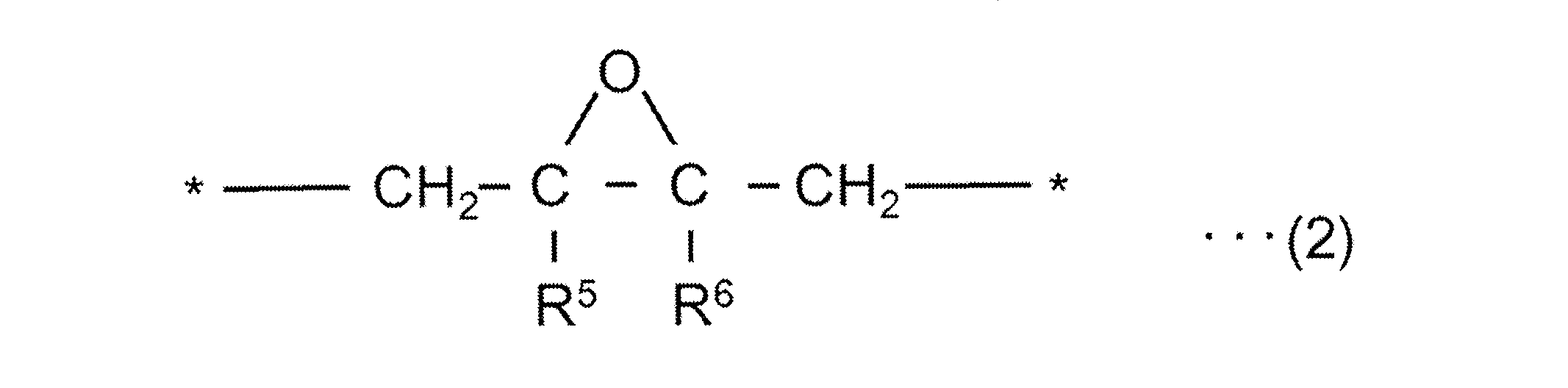
(R5とR6とは、それぞれ独立に水素、又は炭素数が10以下のアルキル基を表す。前記エポキシ変性樹脂中に前記式(2)で表される構造が複数存在する場合、それぞれの式(2)におけるR5は、それぞれ同一であっても異なっていてもよく、それぞれの式(2)におけるR6は、それぞれ同一であっても異なっていてもよい。*は結合基を表す。)
[7]前記エポキシ変性樹脂が、芳香環以外の不飽和結合を含む、[1]~[6]のいずれかに記載の接着剤組成物。
[8]前記エポキシ変性樹脂が、下記式(3)で表される構造を有する、[7]に記載の接着剤組成物。

(R7とR8とは、それぞれ独立に水素、又は炭素数が10以下のアルキル基を表す。前記エポキシ変性樹脂中に前記式(3)で表される構造が複数存在する場合、それぞれの式(3)におけるR7は、それぞれ同一であっても異なっていてもよく、それぞれの式(3)におけるR8は、それぞれ同一であっても異なっていてもよい。*は結合基を表す。)
[9]前記エポキシ変性樹脂が、下記式(4)で表される構造と下記式(5)で表される構造のうち少なくともいずれかの構造を有する、[1]~[8]のいずれかに記載の接着剤組成物。
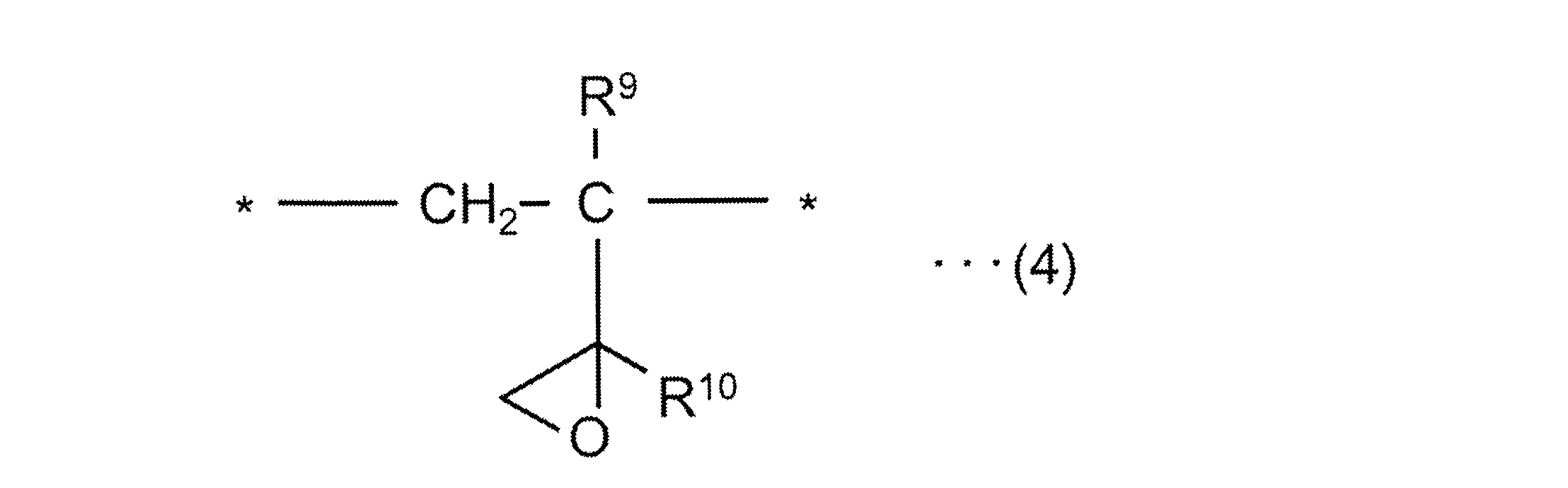
(R9とR10とは、それぞれ独立に水素、又は炭素数が10以下のアルキル基を表す。前記エポキシ変性樹脂中に前記式(4)で表される構造が複数存在する場合、それぞれの式(4)におけるR9は、それぞれ同一であっても異なっていてもよく、それぞれの式(4)におけるR10は、それぞれ同一であっても異なっていてもよい。*は結合基を表す。)

(R11とR12とは、それぞれ独立に水素、又は炭素数が10以下のアルキル基を表す。
前記エポキシ変性樹脂中に前記式(5)で表される構造が複数存在する場合、それぞれの式(5)におけるR11は、それぞれ同一であっても異なっていてもよく、それぞれの式(5)におけるR12は、それぞれ同一であっても異なっていてもよい。*は結合基を表す。)
[10]前記式(2)中のR5とR6が、ともに水素である、[6]に記載の接着剤組成物。
[11]前記式(3)中のR7とR8が、ともに水素である、[8]に記載の接着剤組成物。
[12]前記式(4)中のR9とR10が、ともに水素であるか、又は前記式(5)中のR11とR12が、ともに水素である、[9]に記載の接着剤組成物。
[13]前記エポキシ変性樹脂が、不飽和結合含有エラストマーを過酸化物で変性したエポキシ変性エラストマーである、[1]~[12]のいずれかに記載の接着剤組成物。
[14]前記エポキシ変性樹脂が、スチレン系エラストマーである、[1]~[13]のいずれかに記載の接着剤組成物。
[15]前記エポキシ変性樹脂の重量平均分子量(Mw)が、30,000以上200,000以下である、[1]~[14]のいずれかに記載の接着剤組成物。
[16]前記接着剤組成物が、フィラーを含有する、[1]~[15]のいずれかに記載の接着剤組成物。
[17]前記接着剤組成物が、ラジカル重合開始剤を含有する、[1]~[16]のいずれかに記載の接着剤組成物。
[18]前記接着剤組成物が、有機過酸化物を含有する、[1]~[17]のいずれかに記載の接着剤組成物。
[19][1]~[18]のいずれかに記載の接着剤組成物を硬化させてなる接着剤層に対し、周波数28GHzで測定した前記接着剤層の比誘電率が3以下であり、かつ誘電正接が0.004以下である、接着剤層。
[20]基材フィルムと、
[1]~[18]のいずれかに記載の接着剤組成物からなる接着剤層、又は[19]に記載の接着剤層と、を有する積層体。
[21]前記基材フィルムが、ポリエーテルエーテルケトン(PEEK)樹脂を含有する、[20]に記載の積層体。
[22][20]又は[21]に記載の積層体を含む接着剤層付きカバーレイフィルム。
[23][20]又は[21]に記載の積層体を含む銅張積層板。
[24][20]又は[21]に記載の積層体を含むプリント配線板。
[25][20]又は[21]に記載の積層体を含むシールドフィルム。
[26][20]又は[21]に記載の積層体を含むシールド付きプリント配線板。
[1]スチレン系エラストマーと下記式(1)で表される構造を有するエポキシ変性樹脂とを含有する接着剤組成物。
[2]前記スチレン系エラストマーが、カルボキシ基を含有するスチレン系エラストマーである、[1]に記載の接着剤組成物。
[3]前記スチレン系エラストマーが、アミノ基を含有するスチレン系エラストマーである、[1]に記載の接着剤組成物。
[4]前記エポキシ変性樹脂の含有量が、前記接着剤組成物100質量部に対して1~50質量部である、[1]~[3]のいずれかに記載の接着剤組成物。
[5]前記エポキシ変性樹脂のエポキシ当量が、200g/eq.以上20,000g/eq.以下である、[1]~[4]のいずれかに記載の接着剤組成物。
[6]前記エポキシ変性樹脂が、下記式(2)で表される構造を有する、[1]~[5]のいずれかに記載の接着剤組成物。
[7]前記エポキシ変性樹脂が、芳香環以外の不飽和結合を含む、[1]~[6]のいずれかに記載の接着剤組成物。
[8]前記エポキシ変性樹脂が、下記式(3)で表される構造を有する、[7]に記載の接着剤組成物。
[9]前記エポキシ変性樹脂が、下記式(4)で表される構造と下記式(5)で表される構造のうち少なくともいずれかの構造を有する、[1]~[8]のいずれかに記載の接着剤組成物。
前記エポキシ変性樹脂中に前記式(5)で表される構造が複数存在する場合、それぞれの式(5)におけるR11は、それぞれ同一であっても異なっていてもよく、それぞれの式(5)におけるR12は、それぞれ同一であっても異なっていてもよい。*は結合基を表す。)
[10]前記式(2)中のR5とR6が、ともに水素である、[6]に記載の接着剤組成物。
[11]前記式(3)中のR7とR8が、ともに水素である、[8]に記載の接着剤組成物。
[12]前記式(4)中のR9とR10が、ともに水素であるか、又は前記式(5)中のR11とR12が、ともに水素である、[9]に記載の接着剤組成物。
[13]前記エポキシ変性樹脂が、不飽和結合含有エラストマーを過酸化物で変性したエポキシ変性エラストマーである、[1]~[12]のいずれかに記載の接着剤組成物。
[14]前記エポキシ変性樹脂が、スチレン系エラストマーである、[1]~[13]のいずれかに記載の接着剤組成物。
[15]前記エポキシ変性樹脂の重量平均分子量(Mw)が、30,000以上200,000以下である、[1]~[14]のいずれかに記載の接着剤組成物。
[16]前記接着剤組成物が、フィラーを含有する、[1]~[15]のいずれかに記載の接着剤組成物。
[17]前記接着剤組成物が、ラジカル重合開始剤を含有する、[1]~[16]のいずれかに記載の接着剤組成物。
[18]前記接着剤組成物が、有機過酸化物を含有する、[1]~[17]のいずれかに記載の接着剤組成物。
[19][1]~[18]のいずれかに記載の接着剤組成物を硬化させてなる接着剤層に対し、周波数28GHzで測定した前記接着剤層の比誘電率が3以下であり、かつ誘電正接が0.004以下である、接着剤層。
[20]基材フィルムと、
[1]~[18]のいずれかに記載の接着剤組成物からなる接着剤層、又は[19]に記載の接着剤層と、を有する積層体。
[21]前記基材フィルムが、ポリエーテルエーテルケトン(PEEK)樹脂を含有する、[20]に記載の積層体。
[22][20]又は[21]に記載の積層体を含む接着剤層付きカバーレイフィルム。
[23][20]又は[21]に記載の積層体を含む銅張積層板。
[24][20]又は[21]に記載の積層体を含むプリント配線板。
[25][20]又は[21]に記載の積層体を含むシールドフィルム。
[26][20]又は[21]に記載の積層体を含むシールド付きプリント配線板。
本発明によれば、5G対応可能な良好な電気特性(誘電特性)を有しつつ、密着性の悪い低誘電基材フィルムに対しても良好な密着性を示し、耐熱性、耐薬品(耐溶剤)性を兼ね備えた低誘電接着層を形成するための接着剤組成物を提供することができる。
以下、本発明の接着剤組成物、該接着剤組成物からなる接着剤層を含む積層体、及び該積層体を含む電子部品関連の構成部材について詳細に説明するが、以下に記載する構成要件の説明は、本発明の一実施態様としての一例であり、これらの内容に特定されるものではない。
(接着剤組成物)
本発明の接着剤組成物は、スチレン系エラストマーと下記式(1)で表される構造を有するエポキシ変性樹脂とを含有する。
本発明の接着剤組成物は、スチレン系エラストマーと下記式(1)で表される構造を有するエポキシ変性樹脂とを含有する。

本発明の接着剤組成物は、必要に応じて、その他の成分を含有してもよい。
スチレン系エラストマーと上記式(1)で表される構造を有するエポキシ変性樹脂とを含有する本発明の接着剤組成物は、低誘電の接着剤組成物であっても良好な密着性を示し、耐熱性、耐薬品(耐溶剤)性にも優れた接着剤組成物となる。
<スチレン系エラストマー>
スチレン系エラストマーとは、共役ジエン化合物と芳香族ビニル化合物とのブロック及びランダム構造を主体とする共重合体、並びにその水素添加物である。
分子内に極性の高い結合基が少なく、組成物に良好な電気特性(誘電特性)を付与できる。また、他の種類のエラストマーと比較して、分子量の制御が容易で、接着剤組成物の特性を安定して生産性できることも利点である。
芳香族ビニル化合物としては、例えばスチレン、t-ブチルスチレン、α-メチルスチレン、ジビニルベンゼン、1,1-ジフェニルエチレン、N,N-ジエチル-p-アミノエチルスチレン、ビニルトルエン等が挙げられる。また、共役ジエン化合物としては、例えば、ブタジエン、イソプレン、1,3-ペンタジエン、2,3-ジメチル-1,3-ブタジエン等を挙げることができる。
スチレン系エラストマーの具体例としては、スチレン-ブタジエンブロック共重合体、スチレン-エチレンプロピレンブロック共重合体、スチレン-ブタジエン-スチレンブロック共重合体、スチレン-イソプレン-スチレンブロック共重合体、スチレン-エチレンブチレン-スチレンブロック共重合体及びスチレン-エチレンプロピレン-スチレンブロック共重合体等が挙げられる。
スチレン系エラストマーとは、共役ジエン化合物と芳香族ビニル化合物とのブロック及びランダム構造を主体とする共重合体、並びにその水素添加物である。
分子内に極性の高い結合基が少なく、組成物に良好な電気特性(誘電特性)を付与できる。また、他の種類のエラストマーと比較して、分子量の制御が容易で、接着剤組成物の特性を安定して生産性できることも利点である。
芳香族ビニル化合物としては、例えばスチレン、t-ブチルスチレン、α-メチルスチレン、ジビニルベンゼン、1,1-ジフェニルエチレン、N,N-ジエチル-p-アミノエチルスチレン、ビニルトルエン等が挙げられる。また、共役ジエン化合物としては、例えば、ブタジエン、イソプレン、1,3-ペンタジエン、2,3-ジメチル-1,3-ブタジエン等を挙げることができる。
スチレン系エラストマーの具体例としては、スチレン-ブタジエンブロック共重合体、スチレン-エチレンプロピレンブロック共重合体、スチレン-ブタジエン-スチレンブロック共重合体、スチレン-イソプレン-スチレンブロック共重合体、スチレン-エチレンブチレン-スチレンブロック共重合体及びスチレン-エチレンプロピレン-スチレンブロック共重合体等が挙げられる。
スチレン系エラストマーは、変性されているスチレン系エラストマーであっても、変性されていないスチレン系エラストマーであっても、特に制限はなく、目的に応じて選択することができる。硬化後の密着性を付与する成分としては、以下に記載するカルボキシ基を含有するスチレン系エラストマーやアミノ基を含有するスチレン系エラストマー等の変性スチレン系エラストマーが好ましく、ラミネートによる密着性や温度ごとの弾性率の調整する成分としては、変性されていないスチレン系エラストマーが好ましい。
スチレン系エラストマーは1種のみを用いてもよく、2種以上を併用してもよい。特に、被着体との表面密着力の良好な変性されたスチレン系エラストマーと接着剤組成物の温度ごとの弾性率の調整できる変性されていないスチレン系エラストマーを併用することで、高い密着性と流動性の制御が可能となる。
上記共重合体の中でも、接着剤組成物に接着性及び電気特性(誘電特性)を付与でき、分子構造の制御が比較的簡易で接着剤組成物の特性を調整しやすい観点から、スチレン-エチレンブチレン-スチレンブロック共重合体及びスチレン-エチレンプロピレン-スチレンブロック共重合体が好ましい。また、スチレン-エチレンブチレン-スチレンブロック共重合体におけるスチレン/エチレンブチレンの質量比、及びスチレン-エチレンプロピレン-スチレンブロック共重合体におけるスチレン/エチレンプロピレンの質量比は、10/90~50/50であることが好ましく、20/80~40/60であることがより好ましい。当該質量比がこの範囲内であれば、優れた接着特性を有する接着剤組成物とすることができる。
上記共重合体の中でも、接着剤組成物に接着性及び電気特性(誘電特性)を付与でき、分子構造の制御が比較的簡易で接着剤組成物の特性を調整しやすい観点から、スチレン-エチレンブチレン-スチレンブロック共重合体及びスチレン-エチレンプロピレン-スチレンブロック共重合体が好ましい。また、スチレン-エチレンブチレン-スチレンブロック共重合体におけるスチレン/エチレンブチレンの質量比、及びスチレン-エチレンプロピレン-スチレンブロック共重合体におけるスチレン/エチレンプロピレンの質量比は、10/90~50/50であることが好ましく、20/80~40/60であることがより好ましい。当該質量比がこの範囲内であれば、優れた接着特性を有する接着剤組成物とすることができる。
<<カルボキシ基を含有するスチレン系エラストマー>>
カルボキシ基を含有するスチレン系エラストマーは、密着性が高く、硬化物に柔軟性を付与でき、良好な電気特性を与える成分として有効である。
接着剤組成物中にカルボキシ基を含有するスチレン系エラストマーが含有されていることで、電気特性が良く極性が低い基材フィルムや金属箔等の被着体であっても、柔軟な接着剤組成物が被着体の表面に十分に追従できることで、極性の高いカルボキシ基が密着性を発現できるため、接着剤層の密着性が向上する。また、カルボキシ基を含有するスチレン系エラストマーは反応性があるため、エポキシ硬化により接着剤層の耐熱性や耐薬品性も向上する。
また、カルボキシ基を含有していることで、分散液中のフィラーの分散性が向上する。
カルボキシ基を含有するスチレン系エラストマーとは、共役ジエン化合物と芳香族ビニル化合物とのブロック及びランダム構造を主体とする共重合体、並びにその水素添加物を、不飽和カルボン酸で変性したものである。
芳香族ビニル化合物及び共役ジエン化合物の種類やスチレン系エラストマーの具体例としては、上記<スチレン系エラストマー>の欄で述べたとおりである。
カルボキシ基を含有するスチレン系エラストマーは、密着性が高く、硬化物に柔軟性を付与でき、良好な電気特性を与える成分として有効である。
接着剤組成物中にカルボキシ基を含有するスチレン系エラストマーが含有されていることで、電気特性が良く極性が低い基材フィルムや金属箔等の被着体であっても、柔軟な接着剤組成物が被着体の表面に十分に追従できることで、極性の高いカルボキシ基が密着性を発現できるため、接着剤層の密着性が向上する。また、カルボキシ基を含有するスチレン系エラストマーは反応性があるため、エポキシ硬化により接着剤層の耐熱性や耐薬品性も向上する。
また、カルボキシ基を含有していることで、分散液中のフィラーの分散性が向上する。
カルボキシ基を含有するスチレン系エラストマーとは、共役ジエン化合物と芳香族ビニル化合物とのブロック及びランダム構造を主体とする共重合体、並びにその水素添加物を、不飽和カルボン酸で変性したものである。
芳香族ビニル化合物及び共役ジエン化合物の種類やスチレン系エラストマーの具体例としては、上記<スチレン系エラストマー>の欄で述べたとおりである。
カルボキシ基を含有するスチレン系エラストマーの変性は、例えば、スチレン系エラストマーの重合時に、不飽和カルボン酸を共重合させることにより行うことができる。また、スチレン系エラストマーと不飽和カルボン酸を有機パーオキサイドの存在下に加熱、混練することにより行うこともできる。
不飽和カルボン酸としては、アクリル酸、メタクリル酸、マレイン酸、イタコン酸、フマル酸、無水マレイン酸、無水イタコン酸等を挙げることができる。
不飽和カルボン酸による変性量は、0.1~10質量%であることが好ましい。
カルボキシ基を含有するスチレン系エラストマーの酸価は、0.1~25mgKOH/gであることが好ましく、0.5~23mgKOH/gであることがより好ましい。この酸価が0.1mgKOH/g以上であると、接着剤組成物の硬化が十分であり、良好な接着性、及び耐熱性が得られる。一方、前記酸価が30mgKOH/g以下であると、接着剤組成物の凝集力が抑えられるため粘着性に優れ、電気特性にも優れる。
不飽和カルボン酸としては、アクリル酸、メタクリル酸、マレイン酸、イタコン酸、フマル酸、無水マレイン酸、無水イタコン酸等を挙げることができる。
不飽和カルボン酸による変性量は、0.1~10質量%であることが好ましい。
カルボキシ基を含有するスチレン系エラストマーの酸価は、0.1~25mgKOH/gであることが好ましく、0.5~23mgKOH/gであることがより好ましい。この酸価が0.1mgKOH/g以上であると、接着剤組成物の硬化が十分であり、良好な接着性、及び耐熱性が得られる。一方、前記酸価が30mgKOH/g以下であると、接着剤組成物の凝集力が抑えられるため粘着性に優れ、電気特性にも優れる。
また、カルボキシ基を含有するスチレン系エラストマーの重量平均分子量は、1~50万であることが好ましく、3~30万であることがより好ましく、5~20万であることが更に好ましい。重量平均分子量が上記下限以上であれば、優れた接着性を発現することができ、溶媒に溶解させて塗工する際の塗工性もよくなる。重量平均分子量が上記上限以下であれば、エポキシ樹脂との相溶性がよくなる。
重量平均分子量は、ゲル・パーミエーションクロマトグラフィー(以下、「GPC」ともいう)により測定した分子量をポリスチレン換算した値である。
重量平均分子量は、ゲル・パーミエーションクロマトグラフィー(以下、「GPC」ともいう)により測定した分子量をポリスチレン換算した値である。
カルボキシ基を含有するスチレン系エラストマーの含有量は、接着剤組成物の固形分100質量部に対して15~90質量部であることが好ましい。含有量がこの範囲内であれば、優れた接着特性を有する接着剤組成物とすることができる。
<<アミノ基を含有するスチレン系エラストマー>>
接着剤組成物中にアミノ基を含有するスチレン系エラストマーが含有されていることで、アミノ基が低誘電基材フィルムとの強い相互作用を発現し、接着剤組成物の反応性が高くなり、接着剤層の密着性が向上する。また、アミノ基を含有するスチレン系エラストマーは反応性があるため、エポキシ硬化により接着剤層の耐熱性や耐薬品性も向上する。
アミノ基を含有するため金属との密着性が向上する。
アミノ基を含有するスチレン系エラストマーとは、共役ジエン化合物と芳香族ビニル化合物とのブロック及びランダム構造を主体とする共重合体、並びにその水素添加物を、アミン変性したものである。
芳香族ビニル化合物及び共役ジエン化合物の種類やスチレン系エラストマーの具体例としては、上記<スチレン系エラストマー>の欄で述べたとおりである。
接着剤組成物中にアミノ基を含有するスチレン系エラストマーが含有されていることで、アミノ基が低誘電基材フィルムとの強い相互作用を発現し、接着剤組成物の反応性が高くなり、接着剤層の密着性が向上する。また、アミノ基を含有するスチレン系エラストマーは反応性があるため、エポキシ硬化により接着剤層の耐熱性や耐薬品性も向上する。
アミノ基を含有するため金属との密着性が向上する。
アミノ基を含有するスチレン系エラストマーとは、共役ジエン化合物と芳香族ビニル化合物とのブロック及びランダム構造を主体とする共重合体、並びにその水素添加物を、アミン変性したものである。
芳香族ビニル化合物及び共役ジエン化合物の種類やスチレン系エラストマーの具体例としては、上記<スチレン系エラストマー>の欄で述べたとおりである。
スチレン系エラストマーをアミン変性する方法は、特に限定されず、公知の方法を用いることができ、例えば、アミノ基を有する重合開始剤を用いて(水添)ブロック共重合体を重合することによりアミン変性する方法、アミノ基を有する不飽和単量体を、共重合する原料と用いることにより(水添)共重合体をアミン変性する方法、カルボキシ基を含有するスチレン系エラストマーにアミノ基を2つ以上有するアミン変性剤を反応させ、アミド構造、あるいは、またはイミド構造を形成することでアミン変性する方法等が挙げられる。
また、アミノ基を含有するスチレン系エラストマーの重量平均分子量は、1~50万であることが好ましく、3~30万であることがより好ましく、5~20万であることが更に好ましい。重量平均分子量が上記下限以上であれば、優れた接着性を発現することができ、溶媒に溶解させて塗工する際の塗工性もよくなる。重量平均分子量が上記上限以下であれば、エポキシ樹脂との相溶性がよくなる。
アミノ基を含有するスチレン系エラストマーの含有量は、接着剤組成物の固形分100質量部に対して15~90質量部であることが好ましい。含有量がこの範囲内であれば、優れた接着特性を有する接着剤組成物とすることができる。
無変性スチレン系エラストマーと変性スチレン系エラストマーを混ぜることで、接着性を維持しつつ、硬さの調整やMFRの制御、レジンフローの抑制が可能である。
接着剤組成物の低比誘電率と、密着性(接着性)とを担保するという観点からすると、アミノ基を含有するスチレン系エラストマー中の全窒素量は、50~5000ppmであることが好ましく、200~3000ppmであることがより好ましい。全窒素量が上記下限以上であれば、優れた密着性を発現できる。全窒素量が上記上限以下であれば、電気特性が優れる。
アミノ基を含有するスチレン系エラストマー中の全窒素量は、微量窒素分析装置ND―100型(三菱化学株式会社製)を使用して、JIS-K2609に従い求めることができる。
アミノ基を含有するスチレン系エラストマー中の全窒素量は、微量窒素分析装置ND―100型(三菱化学株式会社製)を使用して、JIS-K2609に従い求めることができる。
<エポキシ変性樹脂>
上記式(1)で表される構造を有するエポキシ変性樹脂は、通常のエポキシ樹脂と比較して、エポキシ構造と上記カルボキシ基を含有するスチレン系エラストマー中のカルボキシ基や上記アミノ基を含有するスチレン系エラストマー中のアミノ基との反応、あるいは自己重合する反応速度が速く、被着体に対する高い接着性や、接着剤硬化物の耐熱性を発現させる成分として有効である。
上記式(1)で表される構造を有するエポキシ変性樹脂は、通常のエポキシ樹脂と比較して、エポキシ構造と上記カルボキシ基を含有するスチレン系エラストマー中のカルボキシ基や上記アミノ基を含有するスチレン系エラストマー中のアミノ基との反応、あるいは自己重合する反応速度が速く、被着体に対する高い接着性や、接着剤硬化物の耐熱性を発現させる成分として有効である。
エポキシ変性樹脂の好ましい実施態様としては、下記式(2)で表される構造を有するエポキシ変性樹脂が挙げられる。
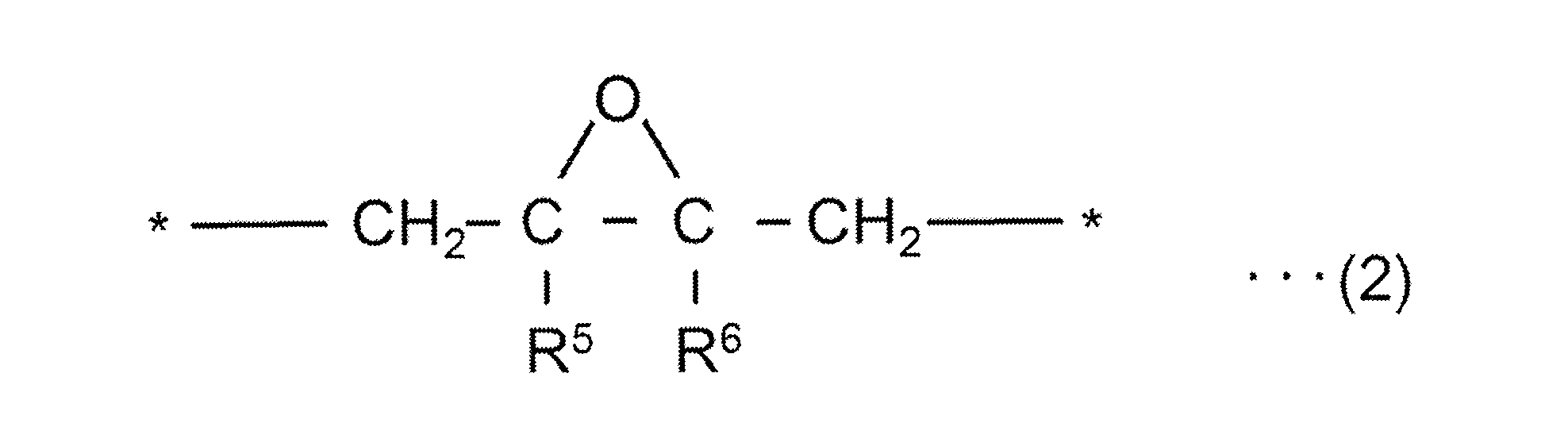
エポキシ基近くの立体障害が減少して、反応を十分に進行させることができる観点から、上記式(2)において、R5とR6が、ともに水素であるとより好ましい。
エポキシ変性樹脂は、オレフィン骨格やビニル基のような芳香環以外の不飽和結合を含むものであることが好ましい。オレフィン骨格やビニル基のような芳香環以外の不飽和結合は、エポキシ基の関わる反応に組み込まれることで、反応速度の促進と架橋密度を高めることができる。結果として、少ない配合量でも耐熱性や耐薬品性を向上することができる。また、後述するように芳香環以外の不飽和結合はラジカル重合にて架橋することで、エポキシ変性樹脂の架橋密度を高めることが可能で、耐熱性や耐薬品性を向上できる。
エポキシ変性樹脂の好ましい実施態様としては、下記式(3)で表される構造を有するエポキシ変性樹脂が挙げられる。
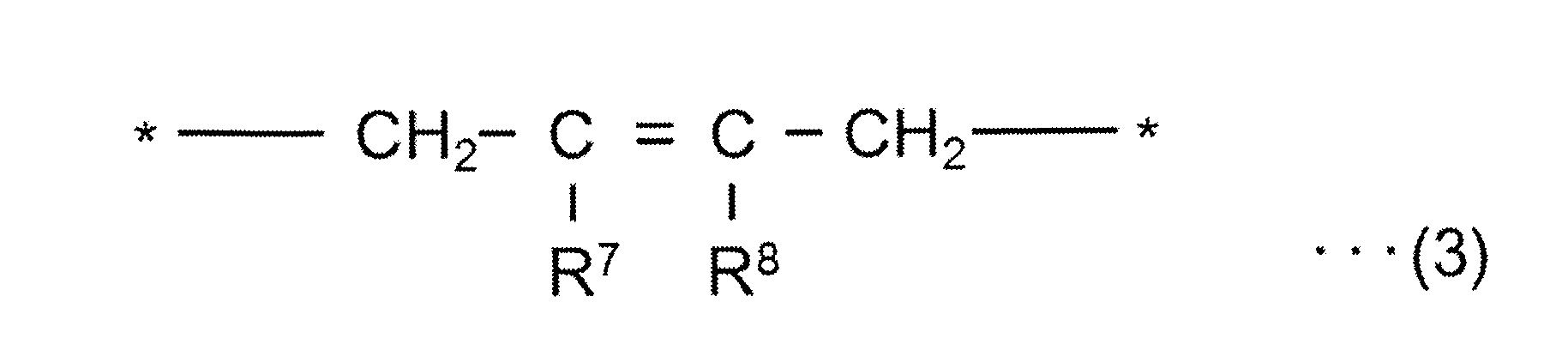
上記式(3)において、R7とR8が、ともに水素であるとより好ましい。
エポキシ変性樹脂が、上記式(1)で表される構造と上記式(3)で表される構造とを有するエポキシ変性樹脂であると好ましく、上記式(2)で表される構造と上記式(3)で表される構造とを有するエポキシ変性樹脂であるとより好ましい。
エポキシ変性樹脂の好ましい実施態様としては、下記式(4)で表される構造と下記式(5)で表される構造のうち少なくともいずれかの構造を有するエポキシ変性樹脂が挙げられる。下記式(4)で表される構造と下記式(5)で表される構造の両方の構造を有する場合も好ましい。

上記式(4)において、R9とR10が、ともに水素であるとより好ましい。
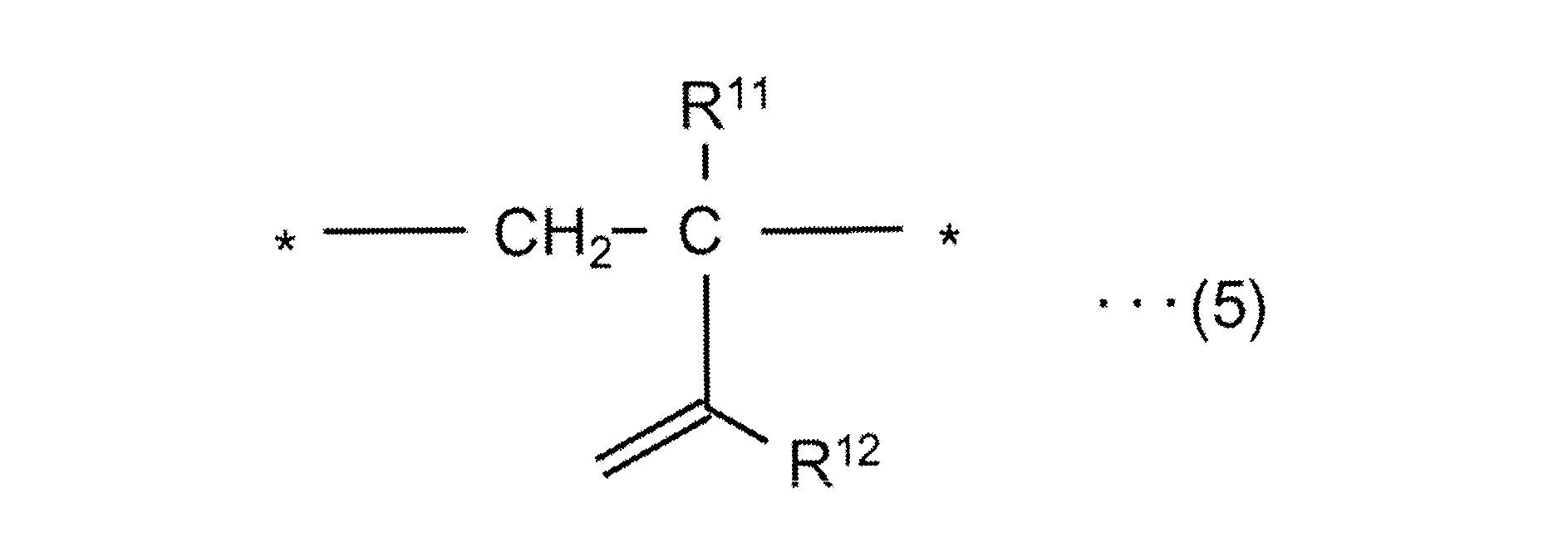
上記式(5)において、R11とR12が、ともに水素であるとより好ましい。
エポキシ変性樹脂が、上記式(1)で表される構造と、上記式(4)で表される構造と上記式(5)で表される構造のうち少なくともいずれかの構造とを有するエポキシ変性樹脂であると好ましく、上記式(2)で表される構造と、上記式(4)で表される構造と上記式(5)で表される構造のうち少なくともいずれかの構造とを有するエポキシ変性樹脂とより好ましい。
また、上記式(1)や上記式(2)で表される構造と、上記式(3)で表される構造と、さらに上記式(4)で表される構造と上記式(5)で表される構造のうち少なくともいずれかの構造とを有するエポキシ変性樹脂も好ましい。
また、上記式(1)や上記式(2)で表される構造と、上記式(3)で表される構造と、さらに上記式(4)で表される構造と上記式(5)で表される構造のうち少なくともいずれかの構造とを有するエポキシ変性樹脂も好ましい。
また、エポキシ変性樹脂は、不飽和結合を含有する有機化合物を変性したエポキシ変性有機化合物であることが好ましい。不飽和結合を含有する有機化合物を変性することで、変性率により分子内に上記式(1)で表される構造と不飽和結合とを共存させることができ、エポキシ構造の反応にオレフィン骨格やビニル基のような芳香環以外の不飽和結合の効果を付与しやすい。
ここで、不飽和結合を含有する有機化合物をエポキシ変性有機化合物へ変性する方法は、過酸化物によりエポキシ骨格の形成する反応が有効である。使用される過酸化物としては、過蟻酸、過酢酸、過プロピオン酸等の過カルボン酸化合物が挙げられる。
エポキシ変性樹脂は、不飽和結合を含有するエラストマーを変性したエポキシ変性エラストマーであることが好ましい。エポキシ変性エラストマーは硬化物に柔軟性を付与することができ、エポキシ硬化による硬化物の靭性低下を抑制することで、積層体を曲げた際の密着性を維持でき、耐熱性や耐薬品性を低下させない。
ここで、不飽和結合を含有する有機化合物をエポキシ変性有機化合物へ変性する方法は、過酸化物によりエポキシ骨格の形成する反応が有効である。使用される過酸化物としては、過蟻酸、過酢酸、過プロピオン酸等の過カルボン酸化合物が挙げられる。
エポキシ変性樹脂は、不飽和結合を含有するエラストマーを変性したエポキシ変性エラストマーであることが好ましい。エポキシ変性エラストマーは硬化物に柔軟性を付与することができ、エポキシ硬化による硬化物の靭性低下を抑制することで、積層体を曲げた際の密着性を維持でき、耐熱性や耐薬品性を低下させない。
さらにまた、エポキシ変性樹脂は、スチレン系エラストマーであることが好ましい。
上記式(1)や上記式(2)で表される構造を有するエポキシ変性樹脂において、上記式(3)~(5)で表される構造の他に、スチレンの構造単位を有することも好ましい。
本発明の接着樹脂組成物に含有される上記スチレン系エラストマーとともに、エポキシ変性樹脂もスチレン系エラストマーであることにより、両者を混合する際、相溶性を向上させ、上記カルボキシ基を含有するスチレン系エラストマー中のカルボキシ基や上記アミノ基を含有するスチレン系エラストマー中のアミノ基との反応を効率的に進行することができるからである。
上記式(1)や上記式(2)で表される構造を有するエポキシ変性樹脂において、上記式(3)~(5)で表される構造の他に、スチレンの構造単位を有することも好ましい。
本発明の接着樹脂組成物に含有される上記スチレン系エラストマーとともに、エポキシ変性樹脂もスチレン系エラストマーであることにより、両者を混合する際、相溶性を向上させ、上記カルボキシ基を含有するスチレン系エラストマー中のカルボキシ基や上記アミノ基を含有するスチレン系エラストマー中のアミノ基との反応を効率的に進行することができるからである。
エポキシ変性樹脂としては、エポキシシクロヘキサンなどの脂環式エポキシ基を有する脂環式エポキシ化合物、エポキシ化ポリブタジエン、スチレン-ブタジエンブロック共重合体のエポキシ化合物等が挙げられる。
中でも、スチレン-ブタジエンブロック共重合体のエポキシ化合物であることがより好ましい。スチレン-ブタジエンブロック共重合体が不飽和結合を含有するため、分子内に上記式(1)で表される構造と不飽和結合とを共存させることができ、エポキシ構造の反応にオレフィン骨格やビニル基のような芳香環以外の不飽和結合の効果を付与しやすい。
エポキシ変性樹脂としては、市販のエポキシ化合物を使用することもでき、例えば、セロキサイド2021P、セロキサイド2081、セロキサイド2000(ダイセル社製)や、エポリードGT401、エポリードPB3600、エポリードPB4700(ダイセル社製)や、エポフレンドAT501、エポフレンドCT310(ダイセル社製)が挙げられる。
中でも、スチレン-ブタジエンブロック共重合体のエポキシ化合物であることがより好ましい。スチレン-ブタジエンブロック共重合体が不飽和結合を含有するため、分子内に上記式(1)で表される構造と不飽和結合とを共存させることができ、エポキシ構造の反応にオレフィン骨格やビニル基のような芳香環以外の不飽和結合の効果を付与しやすい。
エポキシ変性樹脂としては、市販のエポキシ化合物を使用することもでき、例えば、セロキサイド2021P、セロキサイド2081、セロキサイド2000(ダイセル社製)や、エポリードGT401、エポリードPB3600、エポリードPB4700(ダイセル社製)や、エポフレンドAT501、エポフレンドCT310(ダイセル社製)が挙げられる。
エポキシ変性樹脂の重量平均分子量(Mw)は、30,000以上であることが好ましく、50,000以上であることがさらに好ましい。重量平均分子量が30,000以上であれば、接着剤組成物の軟化を抑制でき、加熱圧着した際の樹脂流れを防止できる。重量平均分子量が50,000以上であれば、エポキシ変性樹脂の柔軟性が向上し、硬化物の靭性が向上する。また、エポキシ変性樹脂の重量平均分子量(Mw)は、200,000以下であることが好ましく、160,000以下であることがさらに好ましい。重量平均分子量が200,000以下であれば、スチレン系エラストマーとの相溶性がさらに向上する。重量平均分子量が160,000以下であれば、接着剤組成物の弾性率を下げることができ、被着体の形状に追従できる。
上記エポキシ変性樹脂の含有量は、樹脂組成物100質量部に対して0.5質量部以上であることが好ましく、1質量部以上であることがより好ましく、2質量部以上であることがさらに好ましい。上記エポキシ変性樹脂の含有量が0.5質量部以上であれば、変性したスチレン系エラストマーとのエポキシ硬化が可能で、接着性が向上する。エポキシ変性樹脂の含有量が1質量部以上であれば、接着剤組成物は十分硬化し、良好な耐熱性を担保することができる。エポキシ変性樹脂の含有量が2質量部以上であれば、接着剤組成物はさらに架橋反応を進めることができ、良好な耐薬品性を担保することができる。また、エポキシ変性樹脂の含有量は、樹脂組成物100質量部に対して50質量部以下であることが好ましく、25質量部以下であることがより好ましく、15質量部以下であることがさらに好ましい。上記エポキシ変性樹脂の含有量が50質量部以下であれば、低誘電化と耐熱性、耐薬品性の両立が可能になる。上記エポキシ変性樹脂の含有量が25質量部以下であれば、硬化後の接着剤組成物の柔軟性を確保することができ、密着性が向上する。上記エポキシ変性樹脂の含有量が15質量部以下であれば、さらに低誘電化が可能になる。
上記エポキシ変性樹脂のエポキシ当量は、200g/eq.以上であることが好ましく、350g/eq.以上であることがより好ましく、900g/eq.以上であることがさらに好ましい。エポキシ変性樹脂のエポキシ当量が200g/eq.以上であれば、エポキシ変性樹脂にエポキシ骨格が密集しすぎず、変性されたエラストマーとの反応が進行し、接着剤組成物がマトリックスを形成することで、耐熱性や耐薬品性が向上する。エポキシ変性樹脂のエポキシ当量が350g/eq.以上であれば、エポキシ変性樹脂の配合量に対するエポキシ骨格の含有量が減少し、電気特性が向上する。エポキシ変性樹脂のエポキシ当量が900g/eq.以上であれば、接着剤組成物が柔軟になり、密着性が向上する。また、エポキシ変性樹脂のエポキシ当量は、20,000g/eq.以下であることが好ましく、16,000g/eq.以下であることがより好ましく、10,000g/eq.以下がさらに好ましい。エポキシ変性樹脂のエポキシ当量は、20,000g/eq.以下であれば、接着剤組成物のエポキシ硬化が可能になり、密着性が向上する。エポキシ変性樹脂のエポキシ当量は、16,000g/eq.以下であれば、硬化した接着剤組成物の架橋密度が増加して、耐熱性、耐薬品性が向上する。エポキシ変性樹脂のエポキシ当量は、10,000g/eq.以下であれば、エポキシ変性樹脂の配合量が少なくても、変性したエラストマーとマトリックスを形成できるため、耐熱性や耐薬品性を維持しつつ、電気特性を向上することができる。
<その他の成分>
本発明の接着剤組成物は、上述したスチレン系エラストマー、及びエポキシ変性樹脂に加えて、その他の樹脂成分を含有することができる。その他の樹脂成分として、例えば、スチレン系エラストマー以外の他の熱可塑性樹脂を、接着剤組成物の機能に影響を与えない程度に含有することができる。
本発明の接着剤組成物は、上述したスチレン系エラストマー、及びエポキシ変性樹脂に加えて、その他の樹脂成分を含有することができる。その他の樹脂成分として、例えば、スチレン系エラストマー以外の他の熱可塑性樹脂を、接着剤組成物の機能に影響を与えない程度に含有することができる。
上記他の熱可塑性樹脂としては、例えば、フェノキシ樹脂、ポリアミド樹脂、ビスマレイミド樹脂、ポリエステル樹脂、ポリカーボネート樹脂、ポリフェニレンオキシド樹脂、ポリウレタン樹脂、ポリアセタール樹脂、ポリエチレン系樹脂、ポリプロピレン系樹脂及びポリビニル系樹脂等が挙げられる。これらの熱可塑性樹脂は、単独で用いてもよいし、2種以上を併用してもよい。
さらに、本発明の接着剤組成物には、その他の樹脂成分以外にも、フィラー、ラジカル重合開始剤、粘着付与剤、難燃剤、硬化剤、硬化促進剤、カップリング剤、熱老化防止剤、レベリング剤、消泡剤、無機充填剤、顔料、及び溶媒等を、接着剤組成物の機能に影響を与えない程度に含有することができる。
<<フィラー>>
本発明の接着剤組成物は、フィラーを含有することが好ましい。
本発明に係るフィラーとしては、例えば、耐熱性や接着剤組成物の機械的特性制御の観点から、無機フィラーが好ましく、無機フィラーとしては、電気特性の観点から、ケイ素系無機フィラーおよび窒化ホウ素が好ましい。また、ケイ素系無機フィラーとしては、例えば、少量でも接着剤組成物の機械的物性の制御が可能で、電気特性にも優れるマイカおよびタルクが好ましい。
また、本発明に係るフィラーとしては、例えば、分散性や脆性の観点から、有機フィラーが好ましく、有機フィラーとしては、電気特性の観点から、スチレン系の真球状フィラーが好ましく、スチレン系中空フィラーがより好ましい。
これらは、単独で使用してもよいし、2種以上を組み合わせて使用してもよい。
本発明の接着剤組成物に含有されるフィラーの含有量は、樹脂組成物100体積部に対して0.5~25体積部が好ましく、樹脂組成物100体積部に対して1~15体積部であるとより好ましい。
フィラーの形状としては、特に限定されず、目的に応じて適宜選択することができる。例えば、無機フィラーは、球状無機フィラーでも非球状無機フィラーでもよいが、熱膨張率(CTE)、フィルム強度の観点からは、非球状無機フィラーが好ましい。非球状無機フィラーの形状は、球状(略真円球状)以外の三次元形状であればよく、例えば、板状、鱗片状、柱状、鎖状、繊維状等が挙げられる。中でも、熱膨張率(CTE)、フィルム強度の観点から、板状、鱗片状の無機フィラーが好ましく、板状の無機フィラーがより好ましい。
本発明の接着剤組成物は、フィラーを含有することが好ましい。
本発明に係るフィラーとしては、例えば、耐熱性や接着剤組成物の機械的特性制御の観点から、無機フィラーが好ましく、無機フィラーとしては、電気特性の観点から、ケイ素系無機フィラーおよび窒化ホウ素が好ましい。また、ケイ素系無機フィラーとしては、例えば、少量でも接着剤組成物の機械的物性の制御が可能で、電気特性にも優れるマイカおよびタルクが好ましい。
また、本発明に係るフィラーとしては、例えば、分散性や脆性の観点から、有機フィラーが好ましく、有機フィラーとしては、電気特性の観点から、スチレン系の真球状フィラーが好ましく、スチレン系中空フィラーがより好ましい。
これらは、単独で使用してもよいし、2種以上を組み合わせて使用してもよい。
本発明の接着剤組成物に含有されるフィラーの含有量は、樹脂組成物100体積部に対して0.5~25体積部が好ましく、樹脂組成物100体積部に対して1~15体積部であるとより好ましい。
フィラーの形状としては、特に限定されず、目的に応じて適宜選択することができる。例えば、無機フィラーは、球状無機フィラーでも非球状無機フィラーでもよいが、熱膨張率(CTE)、フィルム強度の観点からは、非球状無機フィラーが好ましい。非球状無機フィラーの形状は、球状(略真円球状)以外の三次元形状であればよく、例えば、板状、鱗片状、柱状、鎖状、繊維状等が挙げられる。中でも、熱膨張率(CTE)、フィルム強度の観点から、板状、鱗片状の無機フィラーが好ましく、板状の無機フィラーがより好ましい。
<<ラジカル重合開始剤>>
本発明の接着剤組成物は、ラジカル重合開始剤を含有することが好ましい。
前述のオレフィン骨格やビニル基のような芳香環以外の不飽和結合は、ラジカル重合でも樹脂成分の架橋が可能であり、より接着剤層の密着性(接着性)や耐熱性や耐薬品性を向上させることができる。
ラジカル重合開始剤の種類としては、特に制限はなく、適宜目的に応じて選択することができるが、例えば、エポキシ硬化と同等の温度で架橋が可能な過酸化物、エポキシ硬化を進行させずに事前架橋が可能な光重合開始剤等が挙げられる。
本発明の接着剤組成物は、ラジカル重合開始剤を含有することが好ましい。
前述のオレフィン骨格やビニル基のような芳香環以外の不飽和結合は、ラジカル重合でも樹脂成分の架橋が可能であり、より接着剤層の密着性(接着性)や耐熱性や耐薬品性を向上させることができる。
ラジカル重合開始剤の種類としては、特に制限はなく、適宜目的に応じて選択することができるが、例えば、エポキシ硬化と同等の温度で架橋が可能な過酸化物、エポキシ硬化を進行させずに事前架橋が可能な光重合開始剤等が挙げられる。
ラジカル重合性開始剤の中でも、より好ましい実施態様として、例えば、有機過酸化物が挙げられる。有機過酸化物を含有することにより、極性の高い官能基を含有せずに接着剤組成物の架橋密度を向上して、より接着剤層の密着性(接着性)や耐熱性や耐薬品性を向上させることができる。
有機過酸化物としては、例えば、ベンゾイルペルオキシド、ラウロイルペルオキシド、t-ブチルペルオキシピバレート、t-ブチルパーオキシエチルヘキサノエイト、1,1’-ビス-(t-ブチルペルオキシ)シクロヘキサン、t-アミルペルオキシ-2-エチルヘキサノエート、t-ヘキシルペルオキシ-2-エチルヘキサノエート等の有機過酸化物が挙げられる。
有機過酸化物としては、例えば、ベンゾイルペルオキシド、ラウロイルペルオキシド、t-ブチルペルオキシピバレート、t-ブチルパーオキシエチルヘキサノエイト、1,1’-ビス-(t-ブチルペルオキシ)シクロヘキサン、t-アミルペルオキシ-2-エチルヘキサノエート、t-ヘキシルペルオキシ-2-エチルヘキサノエート等の有機過酸化物が挙げられる。
上記粘着付与剤としては、例えば、クマロン-インデン樹脂、テルペン樹脂、テルペン-フェノール樹脂、ロジン樹脂、p-t-ブチルフェノール-アセチレン樹脂、フェノール-ホルムアルデヒド樹脂、キシレン-ホルムアルデヒド樹脂、石油系炭化水素樹脂、水素添加炭化水素樹脂、テレピン系樹脂等を挙げることができる。これらの粘着付与剤は、単独で用いてもよいし、2種以上を併用してもよい。
上記難燃剤は、有機系難燃剤及び無機系難燃剤のいずれでもよい。有機系難燃剤としては、例えば、リン酸メラミン、ポリリン酸メラミン、リン酸グアニジン、ポリリン酸グアニジン、リン酸アンモニウム、ポリリン酸アンモニウム、リン酸アミドアンモニウム、ポリリン酸アミドアンモニウム、リン酸カルバメート、ポリリン酸カルバメート、トリスジエチルホスフィン酸アルミニウム、トリスメチルエチルホスフィン酸アルミニウム、トリスジフェニルホスフィン酸アルミニウム、ビスジエチルホスフィン酸亜鉛、ビスメチルエチルホスフィン酸亜鉛、ビスジフェニルホスフィン酸亜鉛、ビスジエチルホスフィン酸チタニル、テトラキスジエチルホスフィン酸チタン、ビスメチルエチルホスフィン酸チタニル、テトラキスメチルエチルホスフィン酸チタン、ビスジフェニルホスフィン酸チタニル、テトラキスジフェニルホスフィン酸チタン等のリン系難燃剤; メラミン、メラム、メラミンシアヌレート等のトリアジン系化合物や、シアヌル酸化合物、イソシアヌル酸化合物、トリアゾール系化合物、テトラゾール化合物、ジアゾ化合物、尿素等の窒素系難燃剤;シリコーン化合物、シラン化合物等のケイ素系難燃剤等が挙げられる。また、無機系難燃剤としては、水酸化アルミニウム、水酸化マグネシウム、水酸化ジルコニウム、水酸化バリウム、水酸化カルシウム等の金属水酸化物;酸化スズ、酸化アルミニウム、酸化マグネシウム、酸化ジルコニウム、酸化亜鉛、酸化モリブデン、酸化ニッケル等の金属酸化物;炭酸亜鉛、炭酸マグネシウム、炭酸バリウム、ホウ酸亜鉛、水和ガラス等が挙げられる。これらの難燃剤は、2種以上を併用することができる。
上記硬化剤としては、アミン系硬化剤、酸無水物系硬化剤等が挙げられるが、これらに限定されるものではない。アミン系硬化剤としては、例えば、メチル化メラミン樹脂、ブチル化メラミン樹脂、ベンゾグアナミン樹脂等のメラミン樹脂、ジシアンジアミド、4,4’-ジフェニルジアミノスルホン等が挙げられる。また、酸無水物としては、芳香族系酸無水物、及び脂肪族系酸無水物が挙げられる。これらの硬化剤は、単独で用いてもよいし、2種以上を併用してもよい。
上記硬化促進剤は、例えば、スチレン系エラストマー、特に変性スチレン系エラストマーとエポキシ樹脂との反応を促進させる目的で使用するものであり、第三級アミン系硬化促進剤、第三級アミン塩系硬化促進剤及びイミダゾール系硬化促進剤等を使用することができる。
第三級アミン系硬化促進剤としては、ベンジルジメチルアミン、2-(ジメチルアミノメチル)フェノール、2,4,6-トリス(ジメチルアミノメチル)フェノール、テトラメチルグアニジン、トリエタノールアミン、N,N’-ジメチルピペラジン、トリエチレンジアミン、1,8-ジアザビシクロ[5.4.0]ウンデセン等が挙げられる。
第三級アミン塩系硬化促進剤としては、1,8-ジアザビシクロ[5.4.0]ウンデセンの、ギ酸塩、オクチル酸塩、p-トルエンスルホン酸塩、o-フタル酸塩、フェノール塩又はフェノールノボラック樹脂塩や、1,5-ジアザビシクロ[4.3.0]ノネンの、ギ酸塩、オクチル酸塩、p-トルエンスルホン酸塩、o-フタル酸塩、フェノール塩又はフェノールノボラック樹脂塩等が挙げられる。
イミダゾール系硬化促進剤としては、2-メチルイミダゾール、2-ウンデシルイミダゾール、2-ヘプタデシルイミダゾール、1,2-ジメチルイミダゾール、2-メチル-4-エチルイミダゾール、2-フェニルイミダゾール、2-フェニル-4-メチルイミダゾール、1-ベンジル-2-メチルイミダゾール、1-ベンジル-2-フェニルイミダゾール、2,4-ジアミノ-6-[2’-メチルイミダゾリル-(1’)]エチル-s-トリアジン、2,4-ジアミノ-6-[2’-ウンデシルイミダゾリル-(1’)]エチル-s-トリアジン、2,4-ジアミノ-6-[2’-エチル-4’-メチルイミダゾリル-(1’)]エチル-s-トリアジン、2,4-ジアミノ-6-[2’-メチルイミダゾリル-(1’)]エチル-s-トリアジンイソシアヌル酸付加物、2-フェニルイミダゾールイソシアヌル酸付加物、2-フェニル-4,5-ジヒドロキシメチルイミダゾール、2-フェニル-4-メチル-5-ヒドロキシメチルイミダゾール等が挙げられる。これらの硬化促進剤は、単独で用いてもよいし、2種以上を併用してもよい。
また、上記カップリング剤としては、ビニルトリメトキシシラン、3-グリシドキシプロピルトリメトキシシラン、p-スチリルトリメトキシシラン、3-メタクリロキシプロピルメチルジメトキシシラン、3-アクリロキシプロピルトリメトキシシラン、N-2-(アミノエチル)-3-アミノプロピルメチルジメトシキシラン、3-ウレイドプロピルトリエトキシシラン、3-メルカプトプロピルメチルジメトキシシラン、ビス(トリエトキシシリルプロピル)テトラスルフィド、3-イソシアネ-トプロピルトリエトキシシラン、イミダゾールシラン等のシラン系カップリング剤;チタネ-ト系カップリング剤;アルミネ-ト系カップリング剤;ジルコニウム系カップリング剤等が挙げられる。これらは、単独で用いてよいし、2種以上を組み合わせて用いてもよい。
上記熱老化防止剤としては、2,6-ジ-tert-ブチル-4-メチルフェノ-ル、n-オクタデシル-3-(3’,5’-ジ-tert-ブチル-4’-ヒドロキシフェニル)プロピオネ-ト、テトラキス〔メチレン-3-(3,5-ジ-tert-ブチル-4-ヒドロキシフェニル)プロピオネ-ト〕メタン、ペンタエリスリトールテトラキス[3-(3,5-ジ-t-ブチル-4-ヒドロキシフェノール、トリエチレングリコール-ビス〔3-(3-t-ブチル-5-メチル-4-ヒドロキシフェニル)プロピオネート等のフェノ-ル系酸化防止剤;ジラウリル-3,3’-チオジプロピオネ-ト、ジミリスチル-3,3’-ジチオプロピオネ-ト等のイオウ系酸化防止剤;トリスノニルフェニルホスファイト、トリス(2,4-ジ-tert-ブチルフェニル)ホスファイト等のリン系酸化防止剤等が挙げられる。これらは、単独で用いてよいし、2種以上を組み合わせて用いてもよい。
上記無機充填剤としては、酸化チタン、酸化アルミニウム、酸化亜鉛、カ-ボンブラック、シリカ、銅、及び銀等からなる粉体が挙げられる。これらは、単独で用いてよいし、2種以上を組み合わせて用いてもよい。
(接着剤層)
本発明に係る接着剤層は、上記本発明の接着剤組成物からなる。
接着剤層を形成する接着剤組成物は、硬化させることができる。
硬化方法としては、特に限定はなく、目的に応じて適宜選択することができ、例えば、熱硬化等が挙げられる。
接着剤層の厚みは、特に制限はなく、目的に応じて適宜選択することができるが、例えば、3~100μmであることが好ましく、3~50μmであることがより好ましく、5~30μmであることが更に好ましい。
本発明に係る接着剤層は、上記本発明の接着剤組成物からなる。
接着剤層を形成する接着剤組成物は、硬化させることができる。
硬化方法としては、特に限定はなく、目的に応じて適宜選択することができ、例えば、熱硬化等が挙げられる。
接着剤層の厚みは、特に制限はなく、目的に応じて適宜選択することができるが、例えば、3~100μmであることが好ましく、3~50μmであることがより好ましく、5~30μmであることが更に好ましい。
<接着剤層の製造方法>
上記接着剤組成物を成膜することで接着剤層を製造することができる。
上記接着剤組成物は、スチレン系エラストマー、及び上記式(1)で表される構造を有するエポキシ変性樹脂を含む樹脂組成物、さらに必要に応じてその他成分を混合することにより製造することができる。混合方法は特に限定されず、接着剤組成物が均一になればよい。接着剤組成物は、溶液又は分散液の状態で好ましく用いられることから、通常は、溶媒も使用される。
溶媒としては、例えば、メタノール、エタノール、イソプロピルアルコール、n-プロピルアルコール、イソブチルアルコール、n-ブチルアルコール、ベンジルアルコール、エチレングリコールモノメチルエーテル、プロピレングリコールモノメチルエーテル、ジエチレングリコールモノメチルエーテル、ジアセトンアルコール等のアルコール類;アセトン、メチルエチルケトン、メチルイソブチルケトン、メチルアミルケトン、シクロヘキサノン、イソホロン等のケトン類;トルエン、キシレン、エチルベンゼン、メシチレン等の芳香族炭化水素類;酢酸メチル、酢酸エチル、酢酸ブチル、エチレングリコールモノメチルエーテルアセテ-ト、3-メトキシブチルアセテート等のエステル類;ヘキサン、ヘプタン、シクロヘキサン、メチルシクロヘキサン等の脂肪族炭化水素類等が挙げられる。これらの溶媒は、単独で用いてよいし、2種以上を組み合わせて用いてもよい。
接着剤組成物が溶媒を含む溶液又は分散液(樹脂ワニス)であると、基材フィルムへの塗工及び接着剤層の形成を円滑に行うことができ、所望の厚さの接着剤層を容易に得ることができる。
接着剤組成物が溶媒を含む場合、接着剤層の形成を含む作業性等の観点から、固形分濃度は、好ましくは3~80質量%、より好ましくは10~50質量%の範囲である。固形分濃度が80質量%以下であると、溶液の粘度が適度であり、均一に塗工し易い。
接着剤層の製造方法のより具体的な実施態様としては、上記接着剤組成物及び溶媒を含有する樹脂ワニスを、基材フィルムの表面に塗布して樹脂ワニス層を形成した後、該樹脂ワニス層から溶媒を除去することにより、Bステージ状の接着剤層を形成することができる。ここで、接着剤層がBステージ状であるとは、接着剤組成物が未硬化状態あるいは一部が硬化し始めた半硬化状態をいい、加熱等により、接着剤組成物の硬化が更に進行する状態をいう。
ここで、基材フィルム上に樹脂ワニスを塗布する方法としては、特に制限はなく、目的に応じて適宜選択することができるが、例えば、スプレー法、スピンコート法、ディップ法、ロールコート法、ブレードコート法、ドクターロール法、ドクターブレード法、カーテンコート法、スリットコート法、スクリーン印刷法、インクジェット法、ディスペンス法等が挙げられる。
上記Bステージ状の接着剤層は、さらに加熱等を施し、硬化した接着剤層を形成することができる。
上記接着剤組成物を成膜することで接着剤層を製造することができる。
上記接着剤組成物は、スチレン系エラストマー、及び上記式(1)で表される構造を有するエポキシ変性樹脂を含む樹脂組成物、さらに必要に応じてその他成分を混合することにより製造することができる。混合方法は特に限定されず、接着剤組成物が均一になればよい。接着剤組成物は、溶液又は分散液の状態で好ましく用いられることから、通常は、溶媒も使用される。
溶媒としては、例えば、メタノール、エタノール、イソプロピルアルコール、n-プロピルアルコール、イソブチルアルコール、n-ブチルアルコール、ベンジルアルコール、エチレングリコールモノメチルエーテル、プロピレングリコールモノメチルエーテル、ジエチレングリコールモノメチルエーテル、ジアセトンアルコール等のアルコール類;アセトン、メチルエチルケトン、メチルイソブチルケトン、メチルアミルケトン、シクロヘキサノン、イソホロン等のケトン類;トルエン、キシレン、エチルベンゼン、メシチレン等の芳香族炭化水素類;酢酸メチル、酢酸エチル、酢酸ブチル、エチレングリコールモノメチルエーテルアセテ-ト、3-メトキシブチルアセテート等のエステル類;ヘキサン、ヘプタン、シクロヘキサン、メチルシクロヘキサン等の脂肪族炭化水素類等が挙げられる。これらの溶媒は、単独で用いてよいし、2種以上を組み合わせて用いてもよい。
接着剤組成物が溶媒を含む溶液又は分散液(樹脂ワニス)であると、基材フィルムへの塗工及び接着剤層の形成を円滑に行うことができ、所望の厚さの接着剤層を容易に得ることができる。
接着剤組成物が溶媒を含む場合、接着剤層の形成を含む作業性等の観点から、固形分濃度は、好ましくは3~80質量%、より好ましくは10~50質量%の範囲である。固形分濃度が80質量%以下であると、溶液の粘度が適度であり、均一に塗工し易い。
接着剤層の製造方法のより具体的な実施態様としては、上記接着剤組成物及び溶媒を含有する樹脂ワニスを、基材フィルムの表面に塗布して樹脂ワニス層を形成した後、該樹脂ワニス層から溶媒を除去することにより、Bステージ状の接着剤層を形成することができる。ここで、接着剤層がBステージ状であるとは、接着剤組成物が未硬化状態あるいは一部が硬化し始めた半硬化状態をいい、加熱等により、接着剤組成物の硬化が更に進行する状態をいう。
ここで、基材フィルム上に樹脂ワニスを塗布する方法としては、特に制限はなく、目的に応じて適宜選択することができるが、例えば、スプレー法、スピンコート法、ディップ法、ロールコート法、ブレードコート法、ドクターロール法、ドクターブレード法、カーテンコート法、スリットコート法、スクリーン印刷法、インクジェット法、ディスペンス法等が挙げられる。
上記Bステージ状の接着剤層は、さらに加熱等を施し、硬化した接着剤層を形成することができる。
<接着剤層の特性>
本発明の接着剤組成物を硬化させてなる接着剤層の周波数28GHzにおける比誘電率(εr)は3以下が好ましく、2.7以下がより好ましい。該接着剤層の周波数28GHzにおける誘電正接(tanδ)は0.004以下が好ましく、0.0025以下がより好ましく、0.002以下がさらに好ましい。
比誘電率が3以下であり、かつ、誘電正接が0.004以下であれば、電気特性の要求が厳しい高周波FPC関連製品にも用いることができる。また、比誘電率が2.7以下であり、かつ、誘電正接が0.0025以下であれば、5G対応高周波FPC関連製品の構成要素に期待される電気特性を満足することができ、LCP同等の電気特性となり、電気特性の要求が厳しい5G高周波FPC関連製品にも好適に用いることができる。さらに、誘電正接が0.002以下であれば、伝送特性がさらに改善された高周波FPC関連製品が製造可能となる。
本発明の接着剤組成物を硬化させてなる接着剤層の周波数28GHzにおける比誘電率(εr)は3以下が好ましく、2.7以下がより好ましい。該接着剤層の周波数28GHzにおける誘電正接(tanδ)は0.004以下が好ましく、0.0025以下がより好ましく、0.002以下がさらに好ましい。
比誘電率が3以下であり、かつ、誘電正接が0.004以下であれば、電気特性の要求が厳しい高周波FPC関連製品にも用いることができる。また、比誘電率が2.7以下であり、かつ、誘電正接が0.0025以下であれば、5G対応高周波FPC関連製品の構成要素に期待される電気特性を満足することができ、LCP同等の電気特性となり、電気特性の要求が厳しい5G高周波FPC関連製品にも好適に用いることができる。さらに、誘電正接が0.002以下であれば、伝送特性がさらに改善された高周波FPC関連製品が製造可能となる。
[比誘電率及び誘電正接]
接着剤層の比誘電率及び誘電正接は、ネットワークアナライザーMS46122B(Anritsu社製)と開放型共振器ファブリペローDPS-03(KEYCOM社製)とを使用し、開放型共振器法で、温度23℃、周波数28GHzの条件で測定することができる。
接着剤層の比誘電率及び誘電正接は、ネットワークアナライザーMS46122B(Anritsu社製)と開放型共振器ファブリペローDPS-03(KEYCOM社製)とを使用し、開放型共振器法で、温度23℃、周波数28GHzの条件で測定することができる。
(積層体)
本発明の積層体は、基材フィルムと、該基材フィルムの少なくとも一方の表面に上記接着剤層とを備える。
本発明の積層体は、基材フィルムと、該基材フィルムの少なくとも一方の表面に上記接着剤層とを備える。
<基材フィルム>
本発明に用いる基材フィルムは、積層体の用途により選択することができる。例えば、積層体をカバーレイフィルムや銅張積層板(CCL)として用いる場合は、ポリイミドフィルム、ポリエーテルエーテルケトンフィルム、ポリフェニレンサルファイドフィルム、アラミドフィルム、ポリエチレンナフタレートフィルム、及び液晶ポリマーフィルム等が挙げられる。これらの中でも、接着性及び電気特性の観点から、ポリイミドフィルム、ポリエーテルエーテルケトン(PEEK)フィルム、ポリエチレンナフタレートフィルム、及び液晶ポリマーフィルムが好ましい。
本発明に用いる基材フィルムは、積層体の用途により選択することができる。例えば、積層体をカバーレイフィルムや銅張積層板(CCL)として用いる場合は、ポリイミドフィルム、ポリエーテルエーテルケトンフィルム、ポリフェニレンサルファイドフィルム、アラミドフィルム、ポリエチレンナフタレートフィルム、及び液晶ポリマーフィルム等が挙げられる。これらの中でも、接着性及び電気特性の観点から、ポリイミドフィルム、ポリエーテルエーテルケトン(PEEK)フィルム、ポリエチレンナフタレートフィルム、及び液晶ポリマーフィルムが好ましい。
また、本発明の積層体をボンディングシートとして用いる場合には、基材フィルムは離型性フィルムである必要があり、例えば、ポリエチレンテレフタレートフィルム、ポリエチレンフィルム、ポリプロピレンフィルム、シリコーン離型処理紙、ポリオレフィン樹脂コート紙、TPX(ポリメチルペンテン)フィルム、及びフッ素系樹脂フィルム等が挙げられる。
本発明の積層体をシールドフィルムとして用いる場合には、基材フィルムは電磁波遮蔽能を有するフィルムである必要があり、例えば、保護絶縁層と金属箔の積層体等が挙げられる。
(カバーレイフィルム)
本発明に係る積層体の好ましい一実施態様として、カバーレイフィルムが挙げられる。
FPCを製造する場合、配線部分を保護するために、通常、「カバーレイフィルム」と呼ばれる接着剤層を有する積層体が用いられる。このカバーレイフィルムは、絶縁樹脂層と、その表面に形成された接着剤層とを備えている。
例えば、カバーレイフィルムは、上記基材フィルムの少なくとも一方の表面に上記接着剤層が形成されており、基材フィルムと接着剤層の剥離が一般に困難な積層体である。
カバーレイフィルムに含まれる基材フィルムの厚さは、5~100μmであることが好ましく、5~50μmであることがより好ましく、5~30μmであることが更に好ましい。基材フィルムの厚さが上記上限以下であれば、カバーレイフィルムを薄膜化することができる。基材フィルムの厚さが上記下限以上であれば、プリント配線板の設計が容易にでき、ハンドリングもよい。
カバーレイフィルムを製造する方法としては、例えば、上記接着剤組成物及び溶媒を含有する樹脂ワニスを、上記基材フィルムの表面に塗布して樹脂ワニス層を形成した後、該樹脂ワニス層から溶媒を除去することにより、Bステージ状の接着剤層が形成されたカバーレイフィルムを製造することができる。
溶媒を除去するときの乾燥温度は、40~250℃であることが好ましく、70~170℃であることがより好ましい。
乾燥は、接着剤組成物が塗布された積層体を、熱風乾燥、遠赤外線加熱、及び高周波誘導加熱等がなされる炉の中を通過させることにより行われる。
なお、必要に応じて、接着剤層の表面には、保管等のため、離型性フィルムを積層してもよい。離型性フィルムとしては、ポリエチレンテレフタレートフィルム、ポリエチレンフィルム、ポリプロピレンフィルム、シリコーン離型処理紙、ポリオレフィン樹脂コート紙、TPXフィルム、フッ素系樹脂フィルム等の公知のものが用いられる。
本発明に係るカバーレイフィルムは、低誘電な本発明の接着剤組成物を使用しているため、電子機器の高速伝送が可能であり、さらに電子機器との接着安定性にも優れたものとなる。
本発明に係る積層体の好ましい一実施態様として、カバーレイフィルムが挙げられる。
FPCを製造する場合、配線部分を保護するために、通常、「カバーレイフィルム」と呼ばれる接着剤層を有する積層体が用いられる。このカバーレイフィルムは、絶縁樹脂層と、その表面に形成された接着剤層とを備えている。
例えば、カバーレイフィルムは、上記基材フィルムの少なくとも一方の表面に上記接着剤層が形成されており、基材フィルムと接着剤層の剥離が一般に困難な積層体である。
カバーレイフィルムに含まれる基材フィルムの厚さは、5~100μmであることが好ましく、5~50μmであることがより好ましく、5~30μmであることが更に好ましい。基材フィルムの厚さが上記上限以下であれば、カバーレイフィルムを薄膜化することができる。基材フィルムの厚さが上記下限以上であれば、プリント配線板の設計が容易にでき、ハンドリングもよい。
カバーレイフィルムを製造する方法としては、例えば、上記接着剤組成物及び溶媒を含有する樹脂ワニスを、上記基材フィルムの表面に塗布して樹脂ワニス層を形成した後、該樹脂ワニス層から溶媒を除去することにより、Bステージ状の接着剤層が形成されたカバーレイフィルムを製造することができる。
溶媒を除去するときの乾燥温度は、40~250℃であることが好ましく、70~170℃であることがより好ましい。
乾燥は、接着剤組成物が塗布された積層体を、熱風乾燥、遠赤外線加熱、及び高周波誘導加熱等がなされる炉の中を通過させることにより行われる。
なお、必要に応じて、接着剤層の表面には、保管等のため、離型性フィルムを積層してもよい。離型性フィルムとしては、ポリエチレンテレフタレートフィルム、ポリエチレンフィルム、ポリプロピレンフィルム、シリコーン離型処理紙、ポリオレフィン樹脂コート紙、TPXフィルム、フッ素系樹脂フィルム等の公知のものが用いられる。
本発明に係るカバーレイフィルムは、低誘電な本発明の接着剤組成物を使用しているため、電子機器の高速伝送が可能であり、さらに電子機器との接着安定性にも優れたものとなる。
(ボンディングシート)
本発明に係る積層体の好ましい一実施態様として、ボンディングシートが挙げられる。
ボンディングシートは、離型性フィルム(基材フィルム)の表面に上記接着剤層が形成されているものである。また、ボンディングシートは、2枚の離型性フィルムの間に接着剤層を備える態様であってもよい。ボンディングシートを使用するときに、離型性フィルムを剥離して使用する。離型性フィルムは、上記(カバーレイフィルム)の欄で記載したものと同様なものを用いることができる。
ボンディングシートに含まれる基材フィルムの厚さは、5~100μmであることが好ましく、25~75μmであることがより好ましく、38~50μmであることが更に好ましい。基材フィルムの厚さが上記範囲内であれば、ボンディングシートの製造が容易であり、ハンドリングもよい。
ボンディングシートを製造する方法としては、例えば、離型性フィルムの表面に上記接着剤組成物及び溶媒を含有する樹脂ワニスを塗布し、上記カバーレイフィルムの場合と同様にして乾燥する方法がある。
本発明に係るボンディングシートは、低誘電な本発明の接着剤組成物を使用しているため、電子機器の高速伝送が可能であり、さらに電子機器との接着安定性にも優れたものとなる。
本発明に係る積層体の好ましい一実施態様として、ボンディングシートが挙げられる。
ボンディングシートは、離型性フィルム(基材フィルム)の表面に上記接着剤層が形成されているものである。また、ボンディングシートは、2枚の離型性フィルムの間に接着剤層を備える態様であってもよい。ボンディングシートを使用するときに、離型性フィルムを剥離して使用する。離型性フィルムは、上記(カバーレイフィルム)の欄で記載したものと同様なものを用いることができる。
ボンディングシートに含まれる基材フィルムの厚さは、5~100μmであることが好ましく、25~75μmであることがより好ましく、38~50μmであることが更に好ましい。基材フィルムの厚さが上記範囲内であれば、ボンディングシートの製造が容易であり、ハンドリングもよい。
ボンディングシートを製造する方法としては、例えば、離型性フィルムの表面に上記接着剤組成物及び溶媒を含有する樹脂ワニスを塗布し、上記カバーレイフィルムの場合と同様にして乾燥する方法がある。
本発明に係るボンディングシートは、低誘電な本発明の接着剤組成物を使用しているため、電子機器の高速伝送が可能であり、さらに電子機器との接着安定性にも優れたものとなる。
(銅張積層板(CCL))
本発明に係る積層体の好ましい一実施態様として、本発明の積層体中の接着剤層に、銅箔を貼り合せてなる銅張積層板が挙げられる。
銅張積層板は、上記積層体を用いて、銅箔が貼り合わされており、例えば、基材フィルム、接着剤層及び銅箔の順に構成されている。なお、接着剤層及び銅箔は、基材フィルムの両面に形成されていてもよい。
本発明で用いる接着剤組成物は、銅を含む物品との接着性にも優れている。
本発明に係る銅張積層板は、低誘電な本発明の接着剤組成物を使用しているため、電子機器の高速伝送を可能とし、かつ接着安定性に優れたものとなる。
本発明に係る積層体の好ましい一実施態様として、本発明の積層体中の接着剤層に、銅箔を貼り合せてなる銅張積層板が挙げられる。
銅張積層板は、上記積層体を用いて、銅箔が貼り合わされており、例えば、基材フィルム、接着剤層及び銅箔の順に構成されている。なお、接着剤層及び銅箔は、基材フィルムの両面に形成されていてもよい。
本発明で用いる接着剤組成物は、銅を含む物品との接着性にも優れている。
本発明に係る銅張積層板は、低誘電な本発明の接着剤組成物を使用しているため、電子機器の高速伝送を可能とし、かつ接着安定性に優れたものとなる。
銅張積層板を製造する方法としては、例えば、上記積層体の接着剤層と銅箔とを面接触させ、80℃~200℃で熱ラミネートを行い、更にアフターキュアにより接着剤層を硬化する方法がある。アフターキュアの条件は、例えば、不活性ガスの雰囲気下で100℃~200℃、30分~4時間とすることができる。なお、上記銅箔は、特に限定されず、電解銅箔、圧延銅箔等を用いることができる。
(プリント配線板)
本発明に係る積層体の好ましい一実施態様として、本発明の積層体中の接着剤層に、銅配線を貼り合せてなるプリント配線板が挙げられる。
プリント配線板は、上記銅張積層板に電子回路を形成することにより得られる。
プリント配線板は、上記積層体を用いて、基材フィルムと銅配線とが貼り合わされており、基材フィルム、接着層及び銅配線の順に構成されている。なお、接着層及び銅配線は、基材フィルムの両面に形成されていてもよい。
例えば、熱プレス等を利用して、配線部分を有する面に、接着剤層を介してカバーレイフィルムを貼り付けることにより、プリント配線板が製造される。
本発明に係るプリント配線板は、低誘電な本発明の接着剤組成物を使用しているため、電子機器の高速伝送を可能とし、かつ接着安定性に優れたものとなる。
本発明に係るプリント配線板を製造する方法としては、例えば、上記積層体の接着剤層と銅配線とを接触させ、80℃~200℃で熱ラミネートを行い、更にアフターキュアにより接着剤層を硬化する方法がある。アフターキュアの条件は、例えば、100℃~200℃、30分~4時間とすることができる。上記銅配線の形状は、特に限定されず、所望に応じ、適宜形状等を選択すればよい。
本発明に係る積層体の好ましい一実施態様として、本発明の積層体中の接着剤層に、銅配線を貼り合せてなるプリント配線板が挙げられる。
プリント配線板は、上記銅張積層板に電子回路を形成することにより得られる。
プリント配線板は、上記積層体を用いて、基材フィルムと銅配線とが貼り合わされており、基材フィルム、接着層及び銅配線の順に構成されている。なお、接着層及び銅配線は、基材フィルムの両面に形成されていてもよい。
例えば、熱プレス等を利用して、配線部分を有する面に、接着剤層を介してカバーレイフィルムを貼り付けることにより、プリント配線板が製造される。
本発明に係るプリント配線板は、低誘電な本発明の接着剤組成物を使用しているため、電子機器の高速伝送を可能とし、かつ接着安定性に優れたものとなる。
本発明に係るプリント配線板を製造する方法としては、例えば、上記積層体の接着剤層と銅配線とを接触させ、80℃~200℃で熱ラミネートを行い、更にアフターキュアにより接着剤層を硬化する方法がある。アフターキュアの条件は、例えば、100℃~200℃、30分~4時間とすることができる。上記銅配線の形状は、特に限定されず、所望に応じ、適宜形状等を選択すればよい。
(シールドフィルム)
本発明に係る積層体の好ましい一実施態様として、シールドフィルムが挙げられる。
シールドフィルムは、コンピュータや携帯電話や分析機器等の各種電子機器に影響し誤作動の原因となる電磁波ノイズをカットするために、各種電子機器にシールドするためのフィルムである。電磁波シールドフィルムともいう。
電磁波シールドフィルムは、例えば、絶縁樹脂層、金属層、及び本発明に係る接着層をこの順で積層してなる。
本発明に係るシールドフィルムは、低誘電な本発明の接着剤組成物を使用しているため、電子機器の高速伝送が可能であり、さらに電子機器との接着安定性にも優れたものとなる。
本発明に係る積層体の好ましい一実施態様として、シールドフィルムが挙げられる。
シールドフィルムは、コンピュータや携帯電話や分析機器等の各種電子機器に影響し誤作動の原因となる電磁波ノイズをカットするために、各種電子機器にシールドするためのフィルムである。電磁波シールドフィルムともいう。
電磁波シールドフィルムは、例えば、絶縁樹脂層、金属層、及び本発明に係る接着層をこの順で積層してなる。
本発明に係るシールドフィルムは、低誘電な本発明の接着剤組成物を使用しているため、電子機器の高速伝送が可能であり、さらに電子機器との接着安定性にも優れたものとなる。
(シールドフィルム付プリント配線板)
本発明に係る積層体の好ましい一実施態様として、シールドフィルム付プリント配線板が挙げられる。
シールドフィルム付プリント配線板は、基板の少なくとも片面にプリント回路が設けられたプリント配線板上に、上記電磁波シールドフィルムが貼付されたものである。
シールドフィルム付プリント配線板は、例えば、プリント配線板と、プリント配線板のプリント回路が設けられた側の面に隣接する絶縁フィルムと、上記電磁波シールドフィルムとを有する。
本発明に係るシールドフィルム付プリント配線板は、低誘電な本発明の接着剤組成物を使用しているため、電子機器の高速伝送を可能とし、かつ接着安定性に優れたものとなる。
本発明に係る積層体の好ましい一実施態様として、シールドフィルム付プリント配線板が挙げられる。
シールドフィルム付プリント配線板は、基板の少なくとも片面にプリント回路が設けられたプリント配線板上に、上記電磁波シールドフィルムが貼付されたものである。
シールドフィルム付プリント配線板は、例えば、プリント配線板と、プリント配線板のプリント回路が設けられた側の面に隣接する絶縁フィルムと、上記電磁波シールドフィルムとを有する。
本発明に係るシールドフィルム付プリント配線板は、低誘電な本発明の接着剤組成物を使用しているため、電子機器の高速伝送を可能とし、かつ接着安定性に優れたものとなる。
以下に実施例を挙げて本発明を更に詳述するが、本発明の範囲はこれらの実施例に限定されるものではない。なお、下記において、部及び%は、特に断らない限り、質量基準である。
(カルボキシ基を含有するスチレン系エラストマー)
旭化成株式会社製の商品名「タフテックM1911」(マレイン酸変性スチレン-エチレンブチレン-スチレンブロック共重合体)を用いた。この共重合体の酸価は2mgKOH/gであり、スチレン/エチレンブチレン比は30/70であり、重量平均分子量は69,000である。
(カルボキシ基を含有するスチレン系エラストマー)
旭化成株式会社製の商品名「タフテックM1913」(マレイン酸変性スチレン-エチレンブチレン-スチレンブロック共重合体)を用いた。この共重合体の酸価は10mgKOH/gであり、スチレン/エチレンブチレン比は30/70であり、重量平均分子量は67,000である。
(カルボキシ基を含有するスチレン系エラストマー)
クレイトン社製の商品名「クレイトンFG1901」(マレイン酸変性スチレン-エチレンブチレン-スチレンブロック共重合体)を用いた。この共重合体の酸価は19mgKOH/gであり、スチレン/エチレンブチレン比は30/70であり、重量平均分子量は81,000である。
(カルボキシ基を含有しないスチレン系エラストマー)
旭化成株式会社製の商品名「タフテックP1500」(水添スチレン系エラストマー)を用いた。この共重合体の酸価は0mgKOH/gであり、スチレン/エチレンブチレン比は30/70であり、重量平均分子量は67,000である。
(変性されていないスチレン系エラストマー)
クレイトン社製の商品名「クレイトンG1651」(スチレン-エチレンブチレン-スチレンブロック共重合体)を用いた。この共重合体の酸価は0mgKOH/gであり、スチレン/エチレンブチレン比は33/67であり、重量平均分子量は136,700である。
(アミノ基を含有するスチレン系エラストマー)
旭化成株式会社製の商品名「タフテックMP10」(アミン変性スチレン-エチレンブチレン-スチレン共重合体)を用いた。この共重合体のスチレン/エチレンブチレン比は30/70であり、重量平均分子量は78,000である。この共重合体に含有されている全窒素量は、430ppm(μg/g)であった。
(エポキシ変性樹脂)
株式会社ダイセル製の商品名「エポフレンドAT501」(スチレン-ブタジエンブロック共重合体のエポキシ化物)を用いた。この共重合体のスチレン/エチレンブチレン比は40/60であり、重量平均分子量は92,000であり、エポキシ当量は1055g/eq.である。
(エポキシ変性樹脂)
株式会社ダイセル製の商品名「エポフレンドCT310」(スチレン-ブタジエンブロック共重合体のエポキシ化物)を用いた。この共重合体のスチレン/エチレンブチレン比は40/60であり、重量平均分子量は93,000であり、エポキシ当量は2125g/eq.である。
(エポキシ樹脂)
エポキシ樹脂として、ノボラック型エポキシ樹脂である三菱ケミカル株式会社製の商品名「YX7700」(軟化点65℃)を用いた。エポキシ当量は270g/eq.である。
(エポキシ樹脂)
エポキシ樹脂として、ノボラック型エポキシ樹脂であるDIC株式会社製の商品名「HP-7200」(エポキシ樹脂、軟化点56-66℃)を用いた。エポキシ当量は259g/eq.である。
(パーブチルE)
有機過酸化物として、日油株式会社製のパーオキシエステルである商品名「パーブチルE」を用いた。
(MK-100DS)
片倉コープアグリ株式会社製の平均粒子径3μmのマイカである商品名「MK-100DS」を用いた。
(UHP-S2)
昭和電工株式会社製の平均粒子径0.7μmの鱗片状窒化ホウ素である商品名「UHP-S2」を用いた。
(OP935)
クラリアントケミカルズ株式会社製の難燃剤である商品名「OP935」を用いた。
(溶剤)
トルエン及びメチルエチルケトンからなる混合溶媒(質量比=90:10)を用いた。
(基材フィルム)
基材フィルムとして、信越ポリマー社製の「Shin-Etsu Sepla Film PEEK」(ポリエーテルエーテルケトン、厚さ50μm)を用いた。
(電解銅箔)
電解銅箔として、三井金属鉱業製の「TQ-M7-VSP」(電解銅箔、厚さ12μm、光沢面Rz1.27μm、光沢面Ra0.197μm、光沢面Rsm12.95μm)を用いた。光沢面の表面粗さは、レーザー顕微鏡を用いて粗さ曲線を測定し、この粗さ曲線から、JIS B 0601:2013(ISO 4287:1997 Amd.1:2009)に基づいて求めた値である。
(離型フィルム)
離型フィルムとして、パナック社製NP75SA(シリコーン離型PETフィルム、75μm)を用いた。
旭化成株式会社製の商品名「タフテックM1911」(マレイン酸変性スチレン-エチレンブチレン-スチレンブロック共重合体)を用いた。この共重合体の酸価は2mgKOH/gであり、スチレン/エチレンブチレン比は30/70であり、重量平均分子量は69,000である。
(カルボキシ基を含有するスチレン系エラストマー)
旭化成株式会社製の商品名「タフテックM1913」(マレイン酸変性スチレン-エチレンブチレン-スチレンブロック共重合体)を用いた。この共重合体の酸価は10mgKOH/gであり、スチレン/エチレンブチレン比は30/70であり、重量平均分子量は67,000である。
(カルボキシ基を含有するスチレン系エラストマー)
クレイトン社製の商品名「クレイトンFG1901」(マレイン酸変性スチレン-エチレンブチレン-スチレンブロック共重合体)を用いた。この共重合体の酸価は19mgKOH/gであり、スチレン/エチレンブチレン比は30/70であり、重量平均分子量は81,000である。
(カルボキシ基を含有しないスチレン系エラストマー)
旭化成株式会社製の商品名「タフテックP1500」(水添スチレン系エラストマー)を用いた。この共重合体の酸価は0mgKOH/gであり、スチレン/エチレンブチレン比は30/70であり、重量平均分子量は67,000である。
(変性されていないスチレン系エラストマー)
クレイトン社製の商品名「クレイトンG1651」(スチレン-エチレンブチレン-スチレンブロック共重合体)を用いた。この共重合体の酸価は0mgKOH/gであり、スチレン/エチレンブチレン比は33/67であり、重量平均分子量は136,700である。
(アミノ基を含有するスチレン系エラストマー)
旭化成株式会社製の商品名「タフテックMP10」(アミン変性スチレン-エチレンブチレン-スチレン共重合体)を用いた。この共重合体のスチレン/エチレンブチレン比は30/70であり、重量平均分子量は78,000である。この共重合体に含有されている全窒素量は、430ppm(μg/g)であった。
(エポキシ変性樹脂)
株式会社ダイセル製の商品名「エポフレンドAT501」(スチレン-ブタジエンブロック共重合体のエポキシ化物)を用いた。この共重合体のスチレン/エチレンブチレン比は40/60であり、重量平均分子量は92,000であり、エポキシ当量は1055g/eq.である。
(エポキシ変性樹脂)
株式会社ダイセル製の商品名「エポフレンドCT310」(スチレン-ブタジエンブロック共重合体のエポキシ化物)を用いた。この共重合体のスチレン/エチレンブチレン比は40/60であり、重量平均分子量は93,000であり、エポキシ当量は2125g/eq.である。
(エポキシ樹脂)
エポキシ樹脂として、ノボラック型エポキシ樹脂である三菱ケミカル株式会社製の商品名「YX7700」(軟化点65℃)を用いた。エポキシ当量は270g/eq.である。
(エポキシ樹脂)
エポキシ樹脂として、ノボラック型エポキシ樹脂であるDIC株式会社製の商品名「HP-7200」(エポキシ樹脂、軟化点56-66℃)を用いた。エポキシ当量は259g/eq.である。
(パーブチルE)
有機過酸化物として、日油株式会社製のパーオキシエステルである商品名「パーブチルE」を用いた。
(MK-100DS)
片倉コープアグリ株式会社製の平均粒子径3μmのマイカである商品名「MK-100DS」を用いた。
(UHP-S2)
昭和電工株式会社製の平均粒子径0.7μmの鱗片状窒化ホウ素である商品名「UHP-S2」を用いた。
(OP935)
クラリアントケミカルズ株式会社製の難燃剤である商品名「OP935」を用いた。
(溶剤)
トルエン及びメチルエチルケトンからなる混合溶媒(質量比=90:10)を用いた。
(基材フィルム)
基材フィルムとして、信越ポリマー社製の「Shin-Etsu Sepla Film PEEK」(ポリエーテルエーテルケトン、厚さ50μm)を用いた。
(電解銅箔)
電解銅箔として、三井金属鉱業製の「TQ-M7-VSP」(電解銅箔、厚さ12μm、光沢面Rz1.27μm、光沢面Ra0.197μm、光沢面Rsm12.95μm)を用いた。光沢面の表面粗さは、レーザー顕微鏡を用いて粗さ曲線を測定し、この粗さ曲線から、JIS B 0601:2013(ISO 4287:1997 Amd.1:2009)に基づいて求めた値である。
(離型フィルム)
離型フィルムとして、パナック社製NP75SA(シリコーン離型PETフィルム、75μm)を用いた。
(窒素含有量の測定)
実施例で使用した上記アミノ基を含有するスチレン系エラストマー中に含有されている全窒素量は以下の方法により求めた。
<測定方法>
微量窒素分析装置ND―100型(三菱化学株式会社製)を使用して、JIS-K2609に従い求めた。
実施例で使用した上記アミノ基を含有するスチレン系エラストマー中に含有されている全窒素量は以下の方法により求めた。
<測定方法>
微量窒素分析装置ND―100型(三菱化学株式会社製)を使用して、JIS-K2609に従い求めた。
(実施例1)
表1に示す接着剤層を構成する各成分を表1に示す割合で含有し、これら成分を溶剤に溶かし、固形分濃度が20質量%の樹脂ワニスを作製した。
基材フィルムの表面にコロナ処理を行った。
該樹脂ワニスを基材フィルムの表面に塗布し、110℃のオーブンで4分間乾燥させ、トルエンを揮発させることで接着剤層を形成し、接着剤付き基材フィルムを得た。接着剤積層体の接着剤層が電解銅箔の光沢面と接する様に重ね、120℃で熱ラミネートを行い、硬化前接着剤積層体を得た。硬化前接着剤積層体をアフターキュアを行うことにより接着剤層を硬化し、硬化後接着剤積層体を得た。
実施例1の硬化後接着剤積層体の電解銅箔と基材フィルムとの密着力(N/cm)を測定した。
表1に示す接着剤層を構成する各成分を表1に示す割合で含有し、これら成分を溶剤に溶かし、固形分濃度が20質量%の樹脂ワニスを作製した。
基材フィルムの表面にコロナ処理を行った。
該樹脂ワニスを基材フィルムの表面に塗布し、110℃のオーブンで4分間乾燥させ、トルエンを揮発させることで接着剤層を形成し、接着剤付き基材フィルムを得た。接着剤積層体の接着剤層が電解銅箔の光沢面と接する様に重ね、120℃で熱ラミネートを行い、硬化前接着剤積層体を得た。硬化前接着剤積層体をアフターキュアを行うことにより接着剤層を硬化し、硬化後接着剤積層体を得た。
実施例1の硬化後接着剤積層体の電解銅箔と基材フィルムとの密着力(N/cm)を測定した。
[密着力(N/cm)]
密着力は、硬化後接着剤積層体をカットして幅25mmの試験体とし、JIS Z0237:2009(粘着テープ・粘着シート試験方法)に準拠して、剥離速度0.3m/分、剥離角180°にて支持体に固定した接着剤付き基材フィルムから電解銅箔を剥がす際の剥離強度を測定することにより、密着力を測定した。
密着力は、硬化後接着剤積層体をカットして幅25mmの試験体とし、JIS Z0237:2009(粘着テープ・粘着シート試験方法)に準拠して、剥離速度0.3m/分、剥離角180°にて支持体に固定した接着剤付き基材フィルムから電解銅箔を剥がす際の剥離強度を測定することにより、密着力を測定した。
実施例1の硬化後接着剤積層体中の接着剤層について、周波数28GHzにおける比誘電率、及び誘電正接も測定した。
[比誘電率及び誘電正接]
接着剤層の比誘電率及び誘電正接は、ネットワークアナライザーMS46122B(Anritsu社製)と開放型共振器ファブリペローDPS-03(KEYCOM社製)とを使用し、開放型共振器法で、温度23℃、周波数28GHzの条件で測定した。測定試料は、離型フィルム上に樹脂ワニスを、ロ-ル塗布し、次いで、この塗膜付きフィルムをオーブン内に静置して、110℃で4分間乾燥させてBステージ状の接着剤層(厚さ50μm)を形成した。次に、この接着剤層を接着面同士が接する様に120℃で熱ラミネートして硬化前接着剤フィルム(厚さ100μm)を形成した。この硬化前接着剤フィルム(厚さ100μm)をオーブン内に静置して、150℃で60分間加熱硬化処理をして、硬化後接着剤フィルム(100mm×100mm)を作製した。硬化後接着剤フィルムから離型フィルムを剥離して接着剤層の比誘電率及び誘電正接を測定した。
接着剤層の比誘電率及び誘電正接は、ネットワークアナライザーMS46122B(Anritsu社製)と開放型共振器ファブリペローDPS-03(KEYCOM社製)とを使用し、開放型共振器法で、温度23℃、周波数28GHzの条件で測定した。測定試料は、離型フィルム上に樹脂ワニスを、ロ-ル塗布し、次いで、この塗膜付きフィルムをオーブン内に静置して、110℃で4分間乾燥させてBステージ状の接着剤層(厚さ50μm)を形成した。次に、この接着剤層を接着面同士が接する様に120℃で熱ラミネートして硬化前接着剤フィルム(厚さ100μm)を形成した。この硬化前接着剤フィルム(厚さ100μm)をオーブン内に静置して、150℃で60分間加熱硬化処理をして、硬化後接着剤フィルム(100mm×100mm)を作製した。硬化後接着剤フィルムから離型フィルムを剥離して接着剤層の比誘電率及び誘電正接を測定した。
実施例1の積層体中の接着剤層の耐熱性をはんだ耐熱試験により評価した。
[はんだ耐熱試験]
はんだ耐熱試験は基材フィルム面を上にして、硬化後接着剤積層体を288℃のはんだ浴に10秒間×3回浮かべ、接着剤層の膨れ、剥がれ等の外観異常を確認した。
以下の評価基準により、積層体の耐熱性を評価した。
◎ 異常なし(溶解もなし)。
○ 最終的に異常はないが、試験中に接着剤層の軟化がみられる。
△ 剥離はしていないが、接着剤層の軟化がみられ「シミ模様」ができている。
× 剥離している。
はんだ耐熱試験は基材フィルム面を上にして、硬化後接着剤積層体を288℃のはんだ浴に10秒間×3回浮かべ、接着剤層の膨れ、剥がれ等の外観異常を確認した。
以下の評価基準により、積層体の耐熱性を評価した。
◎ 異常なし(溶解もなし)。
○ 最終的に異常はないが、試験中に接着剤層の軟化がみられる。
△ 剥離はしていないが、接着剤層の軟化がみられ「シミ模様」ができている。
× 剥離している。
各測定結果を表3に示す。
(実施例2~実施例15)
実施例1において、接着剤層を構成する成分の種類及び配合量を表1に示すように変更した以外は、実施例1と同様にして、実施例2~実施例15の積層体を作製した。
作製した積層体に対して、実施例1と同様の評価を行った。
結果を表3に示す。
実施例1において、接着剤層を構成する成分の種類及び配合量を表1に示すように変更した以外は、実施例1と同様にして、実施例2~実施例15の積層体を作製した。
作製した積層体に対して、実施例1と同様の評価を行った。
結果を表3に示す。
(比較例1~比較例11)
実施例1において、接着剤層を構成する成分の種類及び配合量を表2に示すように変更した以外は、実施例1と同様にして、比較例1~比較例11の積層体を作製した。
作製した積層体に対して、実施例1と同様の評価を行った。
結果を表4に示す。
実施例1において、接着剤層を構成する成分の種類及び配合量を表2に示すように変更した以外は、実施例1と同様にして、比較例1~比較例11の積層体を作製した。
作製した積層体に対して、実施例1と同様の評価を行った。
結果を表4に示す。

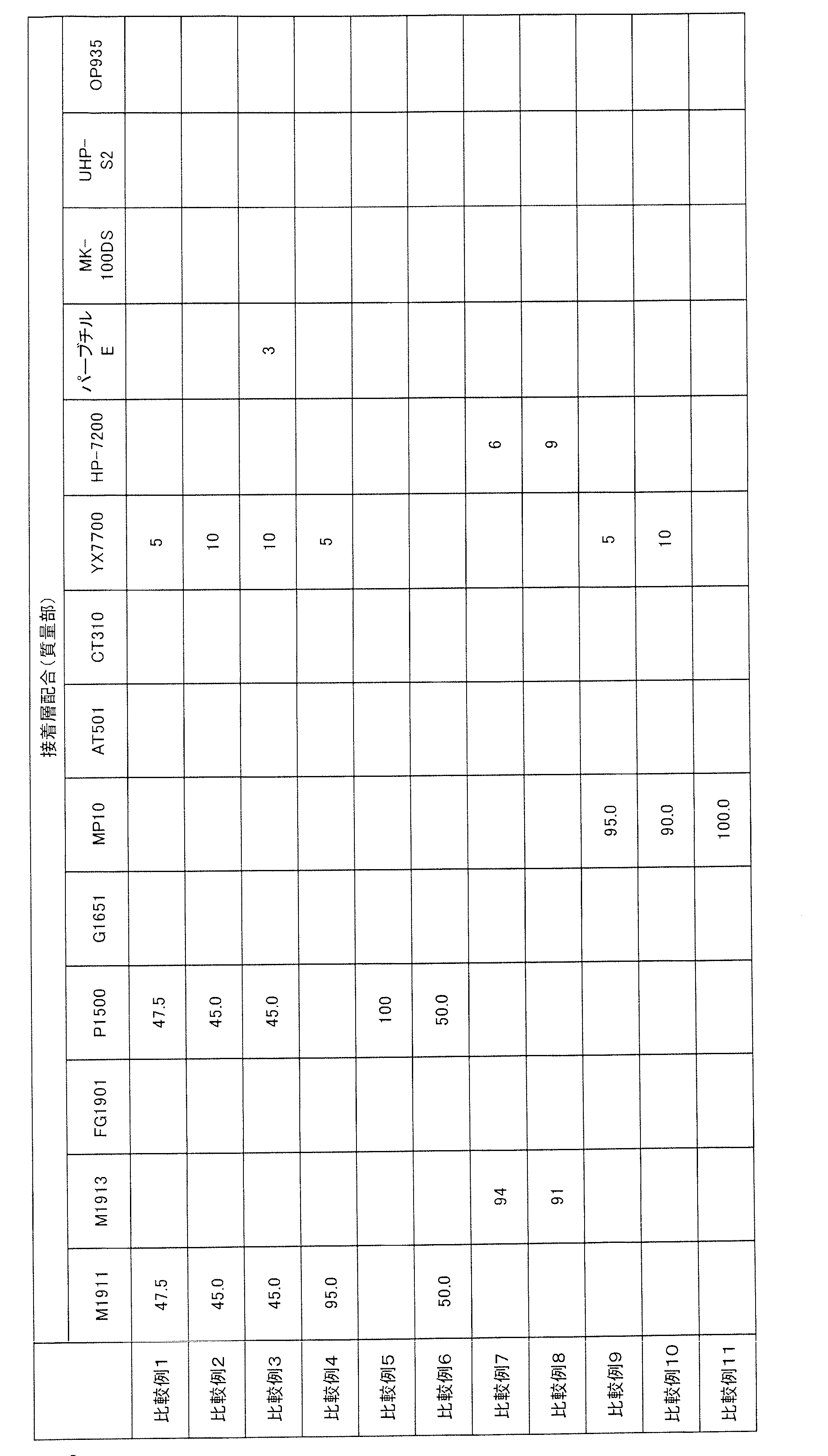
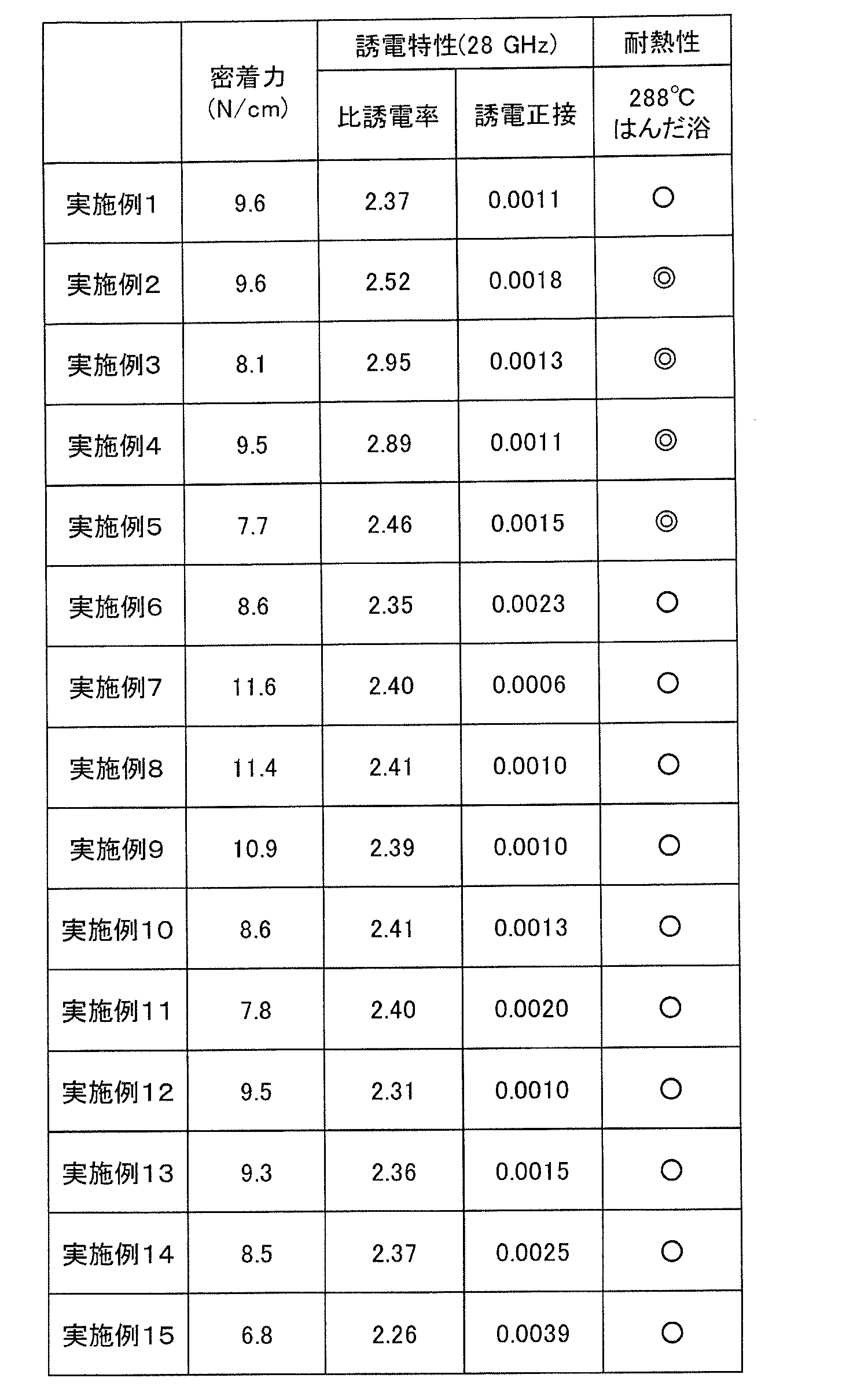
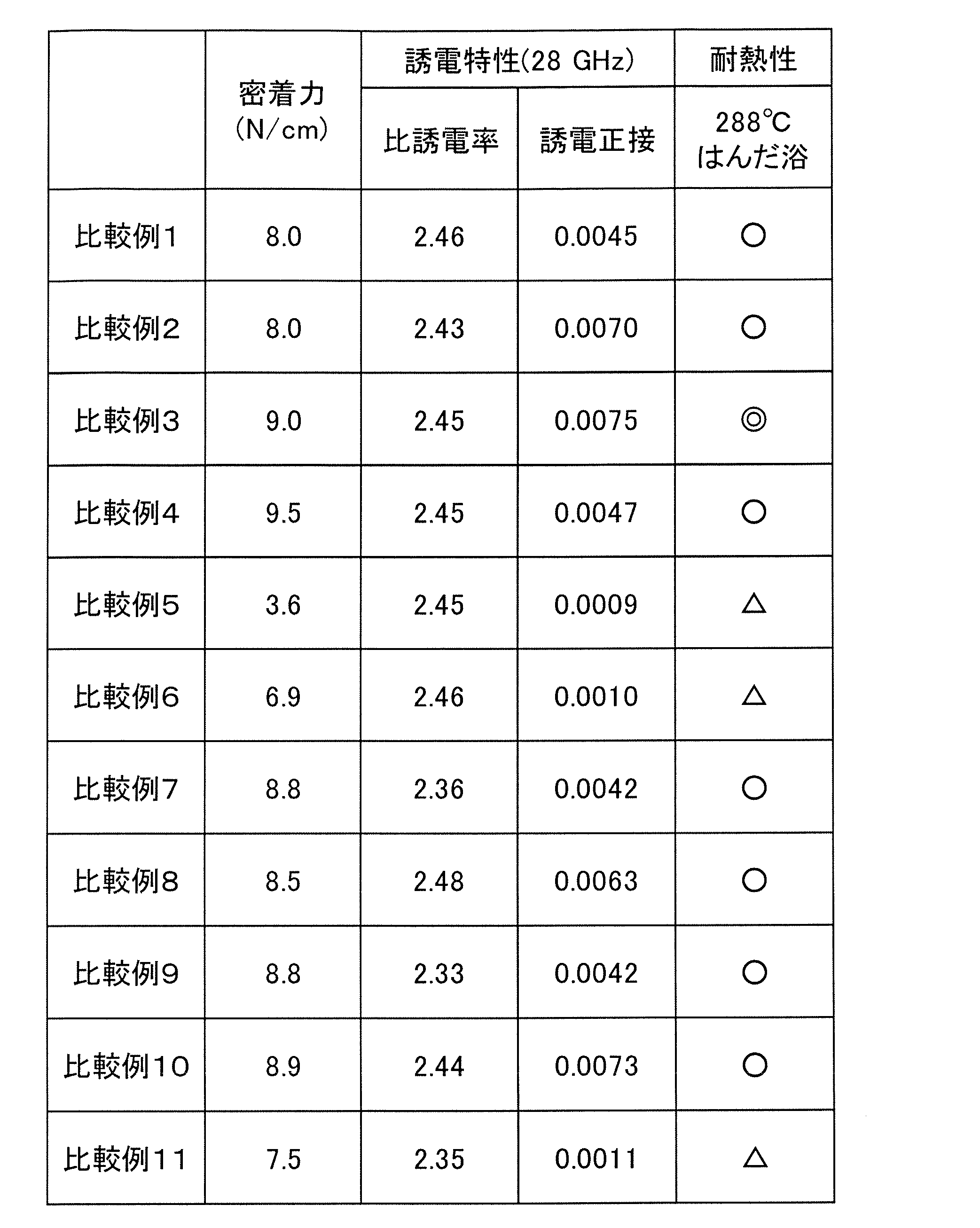
本発明の接着剤組成物からなる接着剤層を有する積層体は、スマートフォン、携帯電話、光モジュール、デジタルカメラ、ゲーム機、ノートパソコン、医療器具等の電子機器用のFPC関連製品の製造に好適に用いられ得る。
Claims (15)
- スチレン系エラストマーと下記式(1)で表される構造を有するエポキシ変性樹脂とを含有する接着剤組成物。

- 前記スチレン系エラストマーが、カルボキシ基を含有するスチレン系エラストマーである、請求項1に記載の接着剤組成物。
- 前記スチレン系エラストマーが、アミノ基を含有するスチレン系エラストマーである、請求項1に記載の接着剤組成物。
- 前記エポキシ変性樹脂の含有量が、前記接着剤組成物100質量部に対して1~50質量部である、請求項1~3のいずれか一項に記載の接着剤組成物。
- 前記エポキシ変性樹脂のエポキシ当量が、200g/eq.以上20,000g/eq.以下である、請求項1~4のいずれか一項に記載の接着剤組成物。
- 前記エポキシ変性樹脂が、下記式(2)で表される構造を有する、請求項1~5のいずれか一項に記載の接着剤組成物。
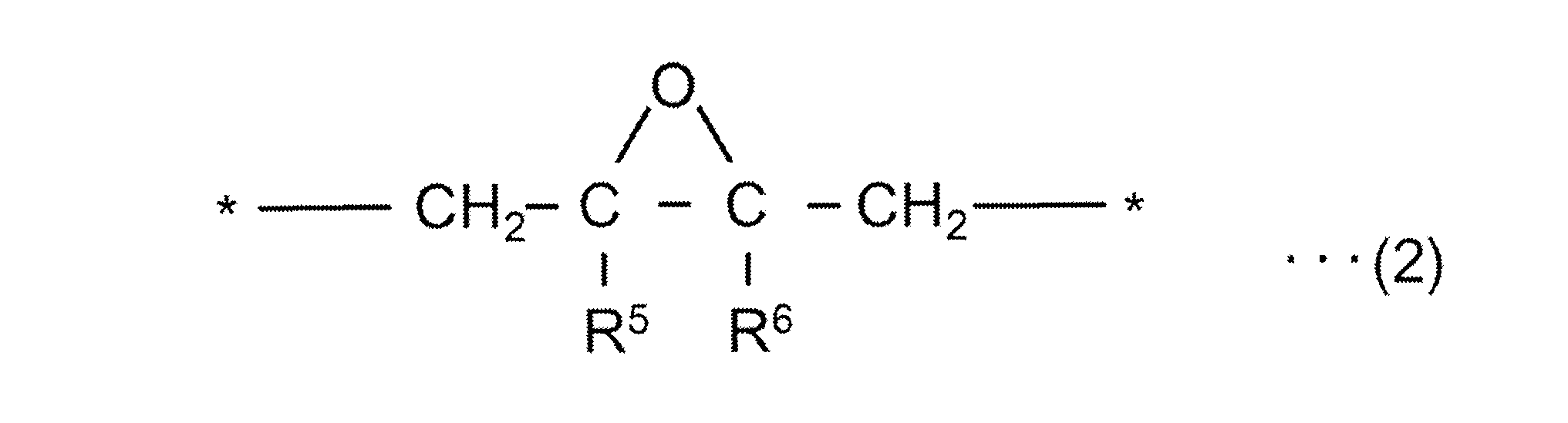
- 前記エポキシ変性樹脂が、芳香環以外の不飽和結合を含む、請求項1~6のいずれか一項に記載の接着剤組成物。
- 前記エポキシ変性樹脂が、下記式(3)で表される構造を有する、請求項7に記載の接着剤組成物。

- 前記式(2)中のR5とR6が、ともに水素である、請求項6に記載の接着剤組成物。
- 前記エポキシ変性樹脂が、スチレン系エラストマーである、請求項1~9のいずれか一項に記載の接着剤組成物。
- 前記エポキシ変性樹脂の重量平均分子量(Mw)が、30,000以上200,000以下である、請求項1~10のいずれか一項に記載の接着剤組成物。
- 前記接着剤組成物が、ラジカル重合開始剤を含有する、請求項1~11のいずれか一項に記載の接着剤組成物。
- 請求項1~12のいずれか一項に記載の接着剤組成物を硬化させてなる接着剤層に対し、周波数28GHzで測定した前記接着剤層の比誘電率が3以下であり、かつ誘電正接が0.004以下である、接着剤層。
- 基材フィルムと、
請求項1~12のいずれか一項に記載の接着剤組成物からなる接着剤層、又は請求項13に記載の接着剤層と、を有する積層体。 - 前記基材フィルムが、ポリエーテルエーテルケトン(PEEK)樹脂を含有する、請求項14に記載の積層体。
Priority Applications (2)
| Application Number | Priority Date | Filing Date | Title |
|---|---|---|---|
| JP2022533885A JP7690474B2 (ja) | 2020-07-01 | 2021-06-22 | 接着剤組成物 |
| CN202180045764.0A CN115996999A (zh) | 2020-07-01 | 2021-06-22 | 粘接剂组合物 |
Applications Claiming Priority (2)
| Application Number | Priority Date | Filing Date | Title |
|---|---|---|---|
| JP2020-113800 | 2020-07-01 | ||
| JP2020113800 | 2020-07-01 |
Publications (1)
| Publication Number | Publication Date |
|---|---|
| WO2022004476A1 true WO2022004476A1 (ja) | 2022-01-06 |
Family
ID=79316251
Family Applications (1)
| Application Number | Title | Priority Date | Filing Date |
|---|---|---|---|
| PCT/JP2021/023522 Ceased WO2022004476A1 (ja) | 2020-07-01 | 2021-06-22 | 接着剤組成物 |
Country Status (4)
| Country | Link |
|---|---|
| JP (1) | JP7690474B2 (ja) |
| CN (1) | CN115996999A (ja) |
| TW (1) | TWI795825B (ja) |
| WO (1) | WO2022004476A1 (ja) |
Cited By (1)
| Publication number | Priority date | Publication date | Assignee | Title |
|---|---|---|---|---|
| WO2024209940A1 (ja) * | 2023-04-06 | 2024-10-10 | Dic株式会社 | 熱硬化型接着シート及びプリント配線板 |
Families Citing this family (1)
| Publication number | Priority date | Publication date | Assignee | Title |
|---|---|---|---|---|
| WO2022070899A1 (ja) * | 2020-09-29 | 2022-04-07 | 日東電工株式会社 | 粘着剤組成物、粘着剤層、及び粘着シート |
Citations (5)
| Publication number | Priority date | Publication date | Assignee | Title |
|---|---|---|---|---|
| JPH08319466A (ja) * | 1995-03-20 | 1996-12-03 | Fujitsu Ltd | 接着剤、半導体装置及びその製造方法 |
| JP2002520441A (ja) * | 1998-07-10 | 2002-07-09 | スリーエム イノベイティブ プロパティズ カンパニー | 粘着付与された熱可塑性エポキシ感圧接着剤 |
| JP2005054000A (ja) * | 2003-08-08 | 2005-03-03 | Nitto Denko Corp | 鋼板用貼着シート |
| JP2009132879A (ja) * | 2007-11-02 | 2009-06-18 | Toray Ind Inc | 接着剤組成物およびそれを用いたカバーレイフィルム |
| WO2016017473A1 (ja) * | 2014-07-31 | 2016-02-04 | 東亞合成株式会社 | 接着剤層付き積層体、並びに、これを用いたフレキシブル銅張積層板及びフレキシブルフラットケーブル |
Family Cites Families (9)
| Publication number | Priority date | Publication date | Assignee | Title |
|---|---|---|---|---|
| DE102004031189A1 (de) * | 2004-06-28 | 2006-01-19 | Tesa Ag | Hitzeaktivierbares und vernetzbares Klebeband für die Verklebung von elektronischen Bauteilen und Leiterbahnen |
| JP2008189823A (ja) * | 2007-02-06 | 2008-08-21 | Yokohama Rubber Co Ltd:The | 熱硬化性接着剤組成物 |
| JP6019883B2 (ja) * | 2012-07-25 | 2016-11-02 | 日立化成株式会社 | 熱硬化性樹脂組成物、これを用いたプリプレグ、積層板及び多層プリント配線板 |
| CN105051094B (zh) * | 2012-09-20 | 2017-01-18 | 积水化学工业株式会社 | 绝缘树脂膜、预固化物、叠层体及多层基板 |
| JPWO2014147903A1 (ja) * | 2013-03-22 | 2017-02-16 | 東亞合成株式会社 | 接着剤組成物並びにこれを用いたカバーレイフィルム及びフレキシブル銅張積層板 |
| JP6379675B2 (ja) * | 2014-05-28 | 2018-08-29 | 日立化成株式会社 | 熱硬化性樹脂組成物、プリプレグ、樹脂付フィルム、積層板、多層プリント配線板及び半導体パッケージ |
| KR101797723B1 (ko) * | 2014-12-08 | 2017-11-14 | 셍기 테크놀로지 코. 엘티디. | 접착용 수지 조성물, 접착용 필름 및 연성 금속 적층체 |
| JP7069561B2 (ja) * | 2017-04-10 | 2022-05-18 | 昭和電工マテリアルズ株式会社 | 積層板の製造方法、プリント配線板の製造方法、及び半導体パッケージの製造方法 |
| JP7736567B2 (ja) * | 2019-12-23 | 2025-09-09 | 信越ポリマー株式会社 | 接着剤組成物 |
-
2021
- 2021-06-22 CN CN202180045764.0A patent/CN115996999A/zh active Pending
- 2021-06-22 WO PCT/JP2021/023522 patent/WO2022004476A1/ja not_active Ceased
- 2021-06-22 JP JP2022533885A patent/JP7690474B2/ja active Active
- 2021-06-29 TW TW110123664A patent/TWI795825B/zh active
Patent Citations (5)
| Publication number | Priority date | Publication date | Assignee | Title |
|---|---|---|---|---|
| JPH08319466A (ja) * | 1995-03-20 | 1996-12-03 | Fujitsu Ltd | 接着剤、半導体装置及びその製造方法 |
| JP2002520441A (ja) * | 1998-07-10 | 2002-07-09 | スリーエム イノベイティブ プロパティズ カンパニー | 粘着付与された熱可塑性エポキシ感圧接着剤 |
| JP2005054000A (ja) * | 2003-08-08 | 2005-03-03 | Nitto Denko Corp | 鋼板用貼着シート |
| JP2009132879A (ja) * | 2007-11-02 | 2009-06-18 | Toray Ind Inc | 接着剤組成物およびそれを用いたカバーレイフィルム |
| WO2016017473A1 (ja) * | 2014-07-31 | 2016-02-04 | 東亞合成株式会社 | 接着剤層付き積層体、並びに、これを用いたフレキシブル銅張積層板及びフレキシブルフラットケーブル |
Cited By (3)
| Publication number | Priority date | Publication date | Assignee | Title |
|---|---|---|---|---|
| WO2024209940A1 (ja) * | 2023-04-06 | 2024-10-10 | Dic株式会社 | 熱硬化型接着シート及びプリント配線板 |
| JPWO2024209940A1 (ja) * | 2023-04-06 | 2024-10-10 | ||
| JP7794360B2 (ja) | 2023-04-06 | 2026-01-06 | Dic株式会社 | 熱硬化型接着シート及びプリント配線板 |
Also Published As
| Publication number | Publication date |
|---|---|
| CN115996999A (zh) | 2023-04-21 |
| JPWO2022004476A1 (ja) | 2022-01-06 |
| TWI795825B (zh) | 2023-03-11 |
| TW202208577A (zh) | 2022-03-01 |
| JP7690474B2 (ja) | 2025-06-10 |
Similar Documents
| Publication | Publication Date | Title |
|---|---|---|
| JP6485577B2 (ja) | 接着剤層付き積層体、並びに、これを用いたフレキシブル銅張積層板及びフレキシブルフラットケーブル | |
| JP7736567B2 (ja) | 接着剤組成物 | |
| JP7192848B2 (ja) | 接着剤組成物及びこれを用いた接着剤層付き積層体 | |
| CN111196066A (zh) | 粘接剂组合物和使用了其的带有粘接剂层的层叠体 | |
| JP7745463B2 (ja) | 接着剤組成物 | |
| JP7716415B2 (ja) | 接着剤組成物 | |
| WO2022255136A1 (ja) | 接着剤組成物 | |
| WO2022255141A1 (ja) | 接着剤組成物 | |
| JP7763193B2 (ja) | 接着剤組成物 | |
| JP7690474B2 (ja) | 接着剤組成物 | |
| JP7745462B2 (ja) | 接着剤組成物 | |
| JP2022137124A (ja) | 低誘電性接着剤組成物 | |
| JP7287543B2 (ja) | 低誘電性接着剤組成物 | |
| JP2023032287A (ja) | 低誘電性接着剤組成物 | |
| JP2023083121A (ja) | 樹脂組成物、及び、これを用いたカバーレイフィルム、接着剤シート、樹脂付き金属箔、金属張積層板またはプリント配線板 | |
| JP2023032286A (ja) | 低誘電性接着剤組成物 |
Legal Events
| Date | Code | Title | Description |
|---|---|---|---|
| 121 | Ep: the epo has been informed by wipo that ep was designated in this application |
Ref document number: 21831999 Country of ref document: EP Kind code of ref document: A1 |
|
| ENP | Entry into the national phase |
Ref document number: 2022533885 Country of ref document: JP Kind code of ref document: A |
|
| NENP | Non-entry into the national phase |
Ref country code: DE |
|
| 122 | Ep: pct application non-entry in european phase |
Ref document number: 21831999 Country of ref document: EP Kind code of ref document: A1 |