WO2021256367A1 - ポリグアナミン、ポリグアナミンフィルム、及び、ポリグアナミンの製造方法 - Google Patents
ポリグアナミン、ポリグアナミンフィルム、及び、ポリグアナミンの製造方法 Download PDFInfo
- Publication number
- WO2021256367A1 WO2021256367A1 PCT/JP2021/022084 JP2021022084W WO2021256367A1 WO 2021256367 A1 WO2021256367 A1 WO 2021256367A1 JP 2021022084 W JP2021022084 W JP 2021022084W WO 2021256367 A1 WO2021256367 A1 WO 2021256367A1
- Authority
- WO
- WIPO (PCT)
- Prior art keywords
- polyguanamine
- film
- less
- bis
- ppm
- Prior art date
- Legal status (The legal status is an assumption and is not a legal conclusion. Google has not performed a legal analysis and makes no representation as to the accuracy of the status listed.)
- Ceased
Links
Classifications
-
- C—CHEMISTRY; METALLURGY
- C08—ORGANIC MACROMOLECULAR COMPOUNDS; THEIR PREPARATION OR CHEMICAL WORKING-UP; COMPOSITIONS BASED THEREON
- C08G—MACROMOLECULAR COMPOUNDS OBTAINED OTHERWISE THAN BY REACTIONS ONLY INVOLVING UNSATURATED CARBON-TO-CARBON BONDS
- C08G73/00—Macromolecular compounds obtained by reactions forming a linkage containing nitrogen with or without oxygen or carbon in the main chain of the macromolecule, not provided for in groups C08G12/00 - C08G71/00
- C08G73/06—Polycondensates having nitrogen-containing heterocyclic rings in the main chain of the macromolecule
-
- C—CHEMISTRY; METALLURGY
- C08—ORGANIC MACROMOLECULAR COMPOUNDS; THEIR PREPARATION OR CHEMICAL WORKING-UP; COMPOSITIONS BASED THEREON
- C08J—WORKING-UP; GENERAL PROCESSES OF COMPOUNDING; AFTER-TREATMENT NOT COVERED BY SUBCLASSES C08B, C08C, C08F, C08G or C08H
- C08J5/00—Manufacture of articles or shaped materials containing macromolecular substances
- C08J5/18—Manufacture of films or sheets
Definitions
- the present invention relates to polyguanamine, a polyguanamine film, and a method for producing polyguanamine.
- the transparent resin film is often exposed to a high temperature.
- a process in a temperature range of about 200 ° C. to 600 ° C. is required.
- a temperature of about 200 to 300 ° C. may be applied to the film, and further, in order to heat and dehydrogenate the amorphous silicon to obtain low temperature polysilicon, the temperature is about 450 ° C. to 600 ° C. May need to be heated. Therefore, the transparent resin film is required to have heat resistance, but as a practical matter, the transparent resin film that can withstand practical use in such a high temperature range is limited.
- polyguanamine is attracting attention as a functional polymer material because it contains a triazine ring in its main chain and has good thermal and mechanical properties.
- ring-containing polyguanamine having a cyclic guanamine skeleton in the main chain is significantly more than linear polyguanamine having no cyclic guanamine skeleton due to the aggregation property caused by multiple hydrogen bonds between molecules due to the introduction of the cyclic guanamine skeleton.
- Haruki Sasaki, Tomohiro Kotaki, Yuji Shibasaki, Yoshiyuki Oishi "Synthesis and Characteristics of Polyguanamine Containing Cyclic Guanamin", Proceedings of the Society of Polymer Science, 2018, vol. 67, No. 1, 3Pc003 Haruki Sasaki, Tomohiro Kotaki, Yuji Shibasaki, Yoshiyuki Oishi, "Elucidation of packing of polyguanamine containing high-strength and heat-resistant cyclic guanamine", Proceedings of the Society of Polymer Science, 2018, vol. 67, No. 2, 2Pe003
- the present invention has been made in view of the above-mentioned problems, and an object thereof is to provide a polyguanamine capable of obtaining a polyguanamine film having both colorless transparency and heat resistance. Another object of the present invention is to provide a polyguanamine film having both colorless transparency and heat resistance. Another object of the present invention is to provide a method for producing the polyguanamine.
- polyguanamine capable of obtaining a polyguanamine film having both colorless transparency and heat resistance, and a method for producing the polyguanamine.
- the present invention has been completed.
- the polyguanamine according to the present invention is It contains a repeating unit represented by the following formula (1) (where A is a divalent organic group having an aromatic ring structure and / or an alicyclic structure).
- A is a divalent organic group having an aromatic ring structure and / or an alicyclic structure.
- the polyguanamine film obtained by using the polyguanamine since the glass transition temperature is 350 ° C. or higher, the polyguanamine film obtained by using the polyguanamine has excellent heat resistance. Further, since the total light transmittance is 85% or more, the polyguanamine film obtained by using the polyguanamine has high transparency. Further, since the yellow index is 10 or less, it can be said that the polyguanamine film obtained by using the polyguanamine is colorless. That is, according to the polyguanamine according to the configuration, the glass transition temperature is 350 ° C. or higher, the total light transmittance is 85% or higher, and the yellow index is 10 or lower, so that colorless transparency and heat resistance are obtained. It is possible to obtain a polyguanamine film that has both sex and sex.
- the coefficient of linear thermal expansion between 100 and 300 ° C. is preferably 50 ppm / ° C. or less.
- the coefficient of linear thermal expansion is 50 ppm / ° C. or less, it can be said that the polyguanamine film obtained by using the polyguanamine is more excellent in shape stability at high temperature.
- the weight average molecular weight is preferably 170,000 or more.
- the weight average molecular weight is 170,000 or more, it can be said that the polyguanamine film obtained by using the polyguanamine is highly transparent and colorless.
- polyguanamine film according to the present invention is characterized by containing the polyguanamine.
- the polyguanamine film according to the above composition since it contains the polyguanamine, it has both colorless transparency and heat resistance.
- the method for producing polyguanamine according to the present invention is as follows. 5,17-Dichlorotetraazacalix [2] arene [2] Triazine and diamines having an aromatic ring structure and / or an alicyclic structure are polymerized in an organic solvent to obtain polyguanamine.
- the step A is a method for producing polyguanamine, which is carried out under the following reaction conditions. ⁇ Reaction conditions> Moisture content of the organic solvent under the inert gas atmosphere: 500 ppm or less Reaction temperature: 300 ° C. or less Reaction time: 60 hours or less.
- the present inventors have found that it is possible to enhance colorless transparency by suppressing the generation of a component (coloring component) that colors polyguanamine. rice field.
- the present inventors presume that the coloring component is an oxidized raw material, solvent, and decomposition products thereof for producing polyguanamine.
- the coloring component (a) a decomposition product of 5,17-dichlorotetraazacarix [2] arene [2] triazine, which is a monomer raw material for producing polyguanamine (for example, m-phenylenediamine (for example).
- Oxidized m-PDA Oxidized m-PDA
- (c) organic solvent for producing polyguanamine, and decomposition thereof I'm guessing that things are oxidized.
- the present inventors can improve the colorless transparency by suppressing the decomposition of the raw material and the solvent and suppressing the oxidation of the raw material and the solvent and the decomposition product thereof. I found it.
- the present inventors have obtained 5,17-dichlorotetraazacarix [2] arene [2] triazine and diamines having an aromatic ring structure and / or an alicyclic structure as an organic solvent.
- step A of obtaining polyguanamine by polymerization in the medium it has been found that it is possible to enhance colorless transparency by adopting the above reaction conditions, and the present invention has been completed.
- the method for producing polyguanamine according to the present invention in order to adopt the reaction conditions in the step A, the decomposition of the raw material and the solvent is suppressed, and the raw material, the solvent, and the above are used. It is possible to suppress the oxidation of the decomposition product and obtain a polyguanamine having colorless transparency.
- a polyguanamine capable of obtaining a polyguanamine film having both colorless transparency and heat resistance. Further, it is possible to provide a polyguanamine film having both colorless transparency and heat resistance.
- a method for producing the polyguanamine can be provided.
- the polyguanamine according to this embodiment is It contains a repeating unit represented by the following formula (1) (where A is a divalent organic group having an aromatic ring structure and / or an alicyclic structure). When measured as a film having a thickness of 5 ⁇ m, the glass transition temperature is 350 ° C. or higher, the total light transmittance is 85% or higher, and the yellow index is 10 or lower.
- polyguanamine is referred to as “polyguanamine” unless otherwise specified, and contains impurities that may be mixed during production (during synthesis). That is, the "polyguanamine” in the present specification is a composition containing pure polyguanamine containing no impurities and impurities that may be mixed during production (pure polyguanamine containing no impurities and may be mixed during production). It means a composition containing impurities and containing no other impurities (high-purity polyguanamine).
- the polyguanamine may or may not contain the impurities (for example, coloring components) as long as the glass transition temperature, the total light transmittance, and the yellow index satisfy the numerical range.
- A is a divalent organic group having an aromatic ring structure and / or an alicyclic structure. Wherein A is later in the section Description chemical structure of (exemplary enumeration) to diamines of the manufacturing method of Poriguanamin], two components became binding end of the amino group (NH 2 group) (two amino This part is a bond instead of a group).
- the glass transition temperature of the polyguanamine when measured as a film having a thickness of 5 ⁇ m is 350 ° C. or higher, preferably 400 ° C. or higher, and more preferably 450 ° C. or higher.
- the glass transition temperature can be increased by including the repeating unit represented by the above formula (1).
- the glass transition temperature can also be controlled, for example, by selecting the type of diamine as the monomer for producing the polyguanamine.
- the method for measuring the glass transition temperature is as described in Examples.
- the method for producing a film having a thickness of 5 ⁇ m for measuring the glass transition temperature is the method described in Example 5 or Example 6.
- the polyguanamine shall satisfy the numerical range of the glass transition temperature.
- the polyguanamine has a total light transmittance of 85% or more, preferably 87% or more, and more preferably 89% or more when measured as a film having a thickness of 5 ⁇ m.
- the total light transmittance can be controlled by the conditions for producing the polyguanamine (for example, the reaction conditions for polymerization).
- the method for measuring the total light transmittance is the method described in Examples.
- the method for producing a film having a thickness of 5 ⁇ m for measuring the total light transmittance is the method described in Example 5 or Example 6.
- the polyguanamine shall satisfy the numerical range of the total light transmittance. do.
- the polyguanamine has a yellow index (yellowness) of 10 or less, preferably 8 or less, and more preferably 6 or less when measured as a film having a thickness of 5 ⁇ m.
- the yellow index can be controlled by the conditions for producing the polyguanamine (for example, the reaction conditions for polymerization).
- the method for measuring the yellow index is the method described in the examples.
- the method for producing a film having a thickness of 5 ⁇ m for measuring the yellow index is the method described in Example 5 or Example 6.
- the polyguanamine shall satisfy the numerical range of the yellow index.
- the polyguanamine preferably has a coefficient of linear thermal expansion between 100 and 300 ° C. of 50 ppm / ° C. or less, more preferably 40 ppm / ° C. or less, still more preferably 30 ppm / ° C. or less, and particularly preferably. It is 20 ppm / ° C or less.
- the coefficient of linear thermal expansion is 50 ppm / ° C.
- the coefficient of linear thermal expansion can be reduced by including the repeating unit represented by the above formula (1).
- the coefficient of linear thermal expansion can also be controlled, for example, by selecting the type of diamine as the monomer for producing the polyguanamine. Specifically, the coefficient of linear thermal expansion can be reduced by selecting diamines having a linear molecular structure or diamines having a fixed conformation, and in particular, the molecular structure is linear. It can be significantly reduced by selecting the diamines in the form.
- diamines having a linear molecular structure examples include 2,2'-bis (trifluoromethyl) -4,4'-diaminobiphenyl and 4-amino-N- (4-aminophenyl) benzamide.
- diamines having a fixed conformation examples include 4,4'-[9H-fluoren-9,9-diyl] bisaniline. The method for measuring the coefficient of linear thermal expansion is the method described in Examples.
- the polyguanamine preferably has a weight average molecular weight of 170,000 or more, more preferably 190,000 or more, and further preferably 210,000 or more.
- the weight average molecular weight is preferably 2,000,000 or less, more preferably 1,500,000 or less, still more preferably 1,000,000 or less.
- the weight average molecular weight can be controlled by the reaction conditions at the time of polymerization and the like. The method for measuring the weight average molecular weight is as described in Examples.
- the polyguanamine film according to the present embodiment contains the polyguanamine. Since the polyguanamine film according to the present embodiment contains the polyguanamine, it has both colorless transparency and heat resistance.
- the content of the polyguanamine contained in the polyguanamine film is preferably 50% by mass or more, preferably 60% by mass or more, still more preferably 70% by mass or more, when the whole polyguanamine film is 100% by mass. Further, the content of the polyguanamine is preferably 100% by mass. When the content of the polyguanamine is 50% by mass or more, higher colorless transparency and heat resistance can be provided.
- composition other than the polyguanamine contained in the polyguanamine film examples include fine particles described later (listed as examples) in the section [Method for producing a polyguanamine film] and other transparent heat-resistant polymers (transparent polyimide, transparent polyamide). , Transparent polyamide-imide, etc.) and the like.
- the polyguanamine film has a glass transition temperature of 350 ° C. or higher, preferably 400 ° C. or higher, and more preferably 450 ° C. or higher when measured with a film thickness of 5 ⁇ m.
- the glass transition temperature is 350 ° C. or higher, the heat resistance is excellent. Even when the thickness of the polyguanamine film is not 5 ⁇ m, the glass transition temperature is the same as when the thickness is 5 ⁇ m.
- the polyguanamine film has a total light transmittance of 85% or more, preferably 87% or more, and more preferably 89% or more when measured with a film thickness of 5 ⁇ m.
- the thickness of the polyguanamine film is not 5 ⁇ m, it is determined as follows whether or not the total light transmittance of the polyguanamine film satisfies the numerical range. (1) For a film having a thickness larger than 5 ⁇ m, the film is measured as it is.
- the numerical range is always satisfied even when the thickness is 5 ⁇ m.
- the film having a thickness of less than 5 ⁇ m if the film is soluble in an organic solvent, the film is redissolved in the organic solvent, coated and dried to prepare a film having a thickness of 5 ⁇ m, and the measurement is performed. At this time, the solvent moisture content of the resin solution, the resin concentration, and the drying conditions are the same as in Example 6.
- the polyguanamine film has a yellow index (yellowness) of 10 or less, preferably 8 or less, and more preferably 6 or less when the film thickness is measured at 5 ⁇ m.
- the thickness of the polyguanamine film is not 5 ⁇ m, it is determined as follows whether or not the yellow index of the polyguanamine film satisfies the numerical range. (1) For a film having a thickness larger than 5 ⁇ m, the film is measured as it is.
- the numerical range is always satisfied even when the thickness is 5 ⁇ m.
- the film having a thickness of less than 5 ⁇ m if the film is soluble in an organic solvent, the film is redissolved in the organic solvent, coated and dried to prepare a film having a thickness of 5 ⁇ m, and the measurement is performed. At this time, the solvent moisture content of the resin solution, the resin concentration, and the drying conditions are the same as in Example 6.
- the thickness of the polyguanamine film is not particularly limited, but is preferably 3 ⁇ m or more, more preferably 11 ⁇ m or more, still more preferably 24 ⁇ m or more, still more preferably 45 ⁇ m or more.
- the thickness of the polyguanamine film is preferably 250 ⁇ m or less, more preferably 150 ⁇ m or less, still more preferably 90 ⁇ m or less. When the thickness of the polyguanamine film is 250 ⁇ m or less, it can be particularly suitably used for flexible electronic device applications.
- the method for producing polyguanamine according to this embodiment is 5,17-Dichlorotetraazacalix [2] arene [2] Triazine and diamines having an aromatic ring structure and / or an alicyclic structure are polymerized in an organic solvent to obtain polyguanamine.
- the step A is performed under the following reaction conditions. ⁇ Reaction conditions> Moisture content of the organic solvent under the inert gas atmosphere: 500 ppm or less Reaction temperature: 300 ° C. or less Reaction time: 60 hours or less.
- diamines having an aromatic ring structure and / or an alicyclic structure examples include 2,2'-dimethyl-4,4'-diaminobiphenyl and 1,4-bis [2- (4-aminophenyl) -2-. Propyl] benzene, 1,4-bis (4-amino-2-trifluoromethylphenoxy) benzene, 2,2'-bis (trifluoromethyl) -4,4'-diaminobiphenyl, 4,4'-bis (4,4'-bis ( 4-aminophenoxy) biphenyl, 4,4'-bis (3-aminophenoxy) biphenyl, bis [4- (3-aminophenoxy) phenyl] ketone, bis [4- (3-aminophenoxy) phenyl] sulfide, bis [4- (3-Aminophenoxy) phenyl] sulfone, 2,2-bis [4- (3-aminophenoxy) phenyl] propane, 2,2-bis
- a halogenated alkyl group or alkoxyl group having 1 to 3 carbon atoms in which a part or all of the hydrogen atom of the alkyl group or the alkoxyl group is substituted with a halogen atom.
- the diamines having an aromatic structure and / or an alicyclic structure may be used alone or in combination of two or more.
- the mixing ratio (molar ratio) of the raw material monomers is the notation method of [5,17-dichlorotetraazacarix [2] arene [2] triazine] / [diamine], preferably 0.800 to 1.200 /. It is 1.200 to 0.800, more preferably 0.900 to 1.100 / 1.100 to 0.900, and even more preferably 0.950 to 1.050 / 1.050 to 0.950.
- a high molecular weight polyguanamine can be obtained, and the polyguanamine film obtained by using the polyguanamine is highly transparent, colorless, and yet has a high molecular weight. It can be said that it is tough.
- the step A is performed under the following reaction conditions.
- Step A (polymerization step) may be carried out continuously, or may be carried out by dividing the polymerization reaction as needed. Further, the reaction temperature may be raised or lowered as long as it is within the following reaction conditions.
- the inert gas is not particularly limited as long as it cannot react with either the raw material monomer or the product polyguanamine, but is not particularly limited, and is, for example, nitrogen gas or noble gas (for example, helium gas, neon gas, argon gas). And so on.
- nitrogen gas or noble gas for example, helium gas, neon gas, argon gas.
- the oxygen concentration is less than 2.0% under the inert gas atmosphere under the reaction conditions of the step A. Since the colorless transparency of polyguanamine can be improved, it is preferably 1.5% or less, more preferably 1.0% or less, and further preferably 1.0% or less. Since it is preferable that the oxygen concentration is low, the lower limit is not particularly limited, but industrially, it may be 0.01% or more or 0.05% or more.
- the organic solvent is not particularly limited as long as it can dissolve both the raw material monomer and the product polyguanamine, and is not particularly limited, and is, for example, N-methyl-2-pyrrolidone and N-acetyl-2-. Examples thereof include pyrrolidone, N, N-dimethylformamide, N, N-dimethylformamide, N, N-dimethylacetamide, dimethyl sulfoxide, ⁇ -butyrolactone, and these solvents can be used alone or in combination.
- the water content of the organic solvent is preferably 500 ppm or less, more preferably 400 ppm or less, further preferably 300 ppm or less, further preferably 200 ppm or less, still more preferably 100 ppm or less.
- the smaller the water content the more preferable, but for example, it is 1 ppm or more, 2 ppm or more, 3 ppm or more, and the like.
- the means for reducing the water content to 500 ppm or less is not particularly limited, and examples thereof include a method of dehydrating with a dehydrating agent and a method of distilling.
- the organic solvent is preferably one that has been bubbling with the inert gas for preferably 10 minutes or longer, more preferably 20 minutes or longer, still more preferably 30 minutes or longer. By performing the bubbling treatment for 10 minutes or more, oxygen in the organic solvent can be removed, and coloring in the polymerization step can be suppressed.
- the reaction temperature is preferably 300 ° C. or lower, more preferably 250 ° C. or lower, and even more preferably 200 ° C. or lower.
- the reaction temperature can be 50 ° C. or higher, 75 ° C. or higher, 100 ° C. or higher, or the like from the viewpoint of improving the yield.
- the reaction time is preferably 60 hours or less, more preferably 30 hours or less, further preferably 10 hours or less, and even more preferably 5 hours or less.
- the reaction temperature can be 0.1 hours or longer, 0.5 hours or longer, 1.0 hours or longer, or the like from the viewpoint of improving the yield.
- an additive may be added.
- the additive include those that suppress aggregation between polyguanamine molecular chains, those that capture and / or neutralize hydrogen chloride released during a reaction, and the like.
- the substance that suppresses aggregation between polyguanamine molecular chains is not particularly limited as long as it can achieve the purpose, and examples thereof include lithium chloride and sodium chloride.
- the substance that captures and / or neutralizes hydrogen chloride released during the reaction is not particularly limited as long as it can achieve the purpose, but for example, cesium fluoride, potassium fluoride, cesium carbonate, etc. Examples include potassium carbonate and sodium carbonate.
- the pH of the reaction solution at the initial stage of the reaction is preferably in the range of 4.0 to 8.0, more preferably in the range of 4.5 to 7.5, and 5.0 to 7.
- the range of 0 is more preferable.
- the pH of the reaction solution at the initial stage of the reaction was adjusted after charging 5,17-dichlorotetraazacarix [2] arene [2] triazine, diamines having an aromatic ring structure and / or an alicyclic structure, an organic solvent and the like, and then stirring. 10 minutes after the start of the above, an appropriate amount of the reaction solution was sampled, and 20% by mass of deionized water was added to the sample solution, and the value was measured using a pH test paper.
- the pH of the reaction solution at the initial stage of the reaction is in the range of 4.0 to 8.0, it is possible to suppress the strong coloring of polyguanamine during the polymerization.
- the terminal amino group of the polyguanamine is preferably 50 eq / t or less in order to obtain a polyguanamine film having excellent colorless transparency, and more preferably 10 eq / t or less.
- a method for lowering the terminal amino group of the polyguanamine there are a method of using an excessive amount of dicarboxylic acid anhydride and a method of end-sealing with a monofunctional monomer, in addition to the method of increasing the molecular weight.
- the polymer exceeds 100-mer in order to obtain a polyguanamine film having excellent colorless transparency.
- a sealing agent for sealing the terminal amino group of the polyguanamine for example, a dicarboxylic acid anhydride or an acid chloride is used, but those containing an unsaturated bond or an aromatic directly linked to a carboxylic acid or an acid chloride are used. Those having a group are not preferable because they tend to be colored during heat treatment.
- Preferred dicarboxylic acid anhydrides include alicyclic dicarboxylic acid anhydrides such as cyclohexane-1,2-dicarboxylic acid anhydride, 4-methylcyclohexane-1,2-dicarboxylic acid anhydride, and cyclohexane-1,3-dicarboxylic acid anhydride. Examples thereof include, but are not limited to, alicyclic acid acidates such as cyclohexanecarbonyl chloride. These may be used alone or in combination of two or more.
- the surrounding atmosphere when measuring and adding the raw material monomer or the like is not particularly limited, but it is preferably the atmosphere substituted with the inert gas.
- the oxygen concentration is preferably 1.5% or less, more preferably 1.0% or less, and 0.5% or less. % Or less is more preferable.
- the order of addition of the raw material monomers and the like is not particularly limited, but it is preferable to add 5,17-dichlorotetraazacarix [2] arene [2] triazine to the solution of aromatic diamines.
- an end-capping agent it is preferable to add the end-capping agent after the synthesis of polyguanamine is completed.
- the amount of the organic solvent used may be sufficient as long as it is sufficient to dissolve the raw material monomer and the like, and is usually an amount used in which the solid content is 1 to 50% by mass, preferably 5 to 35% by mass.
- the amount used is%.
- the polyguanamine obtained by the reaction may be reprecipitated from the reaction solution using an appropriate anti-solvent.
- the poor solvent include acetone, methanol, ethanol, water and the like, but the solvent is not particularly limited as long as it can be efficiently reprecipitated.
- the solvent for removing the residual reaction solvent after reprecipitation is not particularly limited, but it is preferable to use the solvent used for reprecipitation.
- Polyguanamine can be obtained by reprecipitation and then drying.
- the polyguanamine obtained by the above-mentioned production method can be used as it is in the form of a solution containing polyguanamine as the reaction solution after the step A. Further, after the step A, the polyguanamine reprecipitated by the above method from the reaction solution can be dissolved again in the solvent to make it available in the form of a solution containing the polyguanamine.
- polyguanamine it is not particularly limited as long as it efficiently dissolves polyguanamine, but as an example, o-cresol, m-cresol, p-cresol, N-methyl-2-pyrrolidone, N- Examples thereof include organic solvents such as acetyl-2-pyrrolidone, N, N-dimethylformamide, N, N-dimethylformamide, N, N-dimethylacetamide, dimethyl sulfoxide, ⁇ -butyrolactone, sulfolane, and halogenated phenols.
- organic solvents such as acetyl-2-pyrrolidone, N, N-dimethylformamide, N, N-dimethylformamide, N, N-dimethylacetamide, dimethyl sulfoxide, ⁇ -butyrolactone, sulfolane, and halogenated phenols.
- the means for mixing the polyguanamine and the solvent is not particularly limited, but for example, a normal stirring blade, a method of mixing and stirring using a stirring blade for high viscosity, a multi-axis extruder, a static mixer, or the like is used. Further, mixing and stirring may be performed using a method using a mixing / dispersing machine for high viscosity such as a roll mill.
- the content of polyguanamine in the polyguanamine solution obtained by the above-mentioned production method is preferably 1 to 50% by mass, more preferably 5 to 30% by mass.
- the viscosity of the polyguanamine solution is preferably 0.1 to 2000 Pa ⁇ s, more preferably 1 to 1000 Pa ⁇ s as measured by a Brookfield viscometer, in that stable liquid feeding is possible. ..
- the method for producing a polyguanamine film according to this embodiment is Step A-1 to prepare the guanamine solution and Step B of applying the guanamine solution on the substrate, The step C is included in which the guanamine solution applied on the substrate is dried to remove the solvent.
- step A-1 As the guanamine solution prepared in the step A-1, the guanamine solution described in the step A can be used.
- step A-1 may be obtained by adding a step of further adding an additive (for example, fine particles) in the step A. good.
- fine particles may be added to the guanamine solution for the purpose of improving performance.
- the timing of addition of the fine particles includes, for example, a method of adding fine particles to an organic solvent before synthesizing polyguanamine, dispersing the fine particles, and then polymerizing, a method of adding the fine particles during the polymerization, a method of adding the fine particles after the completion of the polymerization, and the like. Can be mentioned. From the viewpoint that the fine particles are difficult to aggregate and are efficiently and uniformly dispersed, a method of adding the fine particles to an organic solvent before synthesizing polyguanamine, dispersing the fine particles, and then polymerizing the fine particles is preferable.
- the fine particles may be inorganic fine particles or organic fine particles, but the average particle size is preferably 0.05 ⁇ m or more and 1 ⁇ m or less, and more preferably 0.1 ⁇ m or more and 0.5 ⁇ m or less.
- the average particle size is preferably 0.05 ⁇ m or more and 1 ⁇ m or less, and more preferably 0.1 ⁇ m or more and 0.5 ⁇ m or less.
- the inorganic fine particles are not particularly limited, and a material usually used as a filler may be used.
- a material usually used as a filler may be used. Examples thereof include silicon nitride, silicon oxide, titanium oxide, aluminum oxide, magnesium oxide, zinc oxide, tin oxide, calcium carbonate, barium sulfate, talc, kaolin and calcium sulfate. Further, these may be used in combination.
- the organic fine particles are not particularly limited as long as they are materials that can be made into fine particles, but those having high heat resistance are preferable. Examples thereof include polyamide-based resins, polyimide-based resins, benzoguanamine-based resins, and melamine-based resins. Further, these may be used in combination.
- the shape of the fine particles is substantially spherical.
- the substantially spherical shape means that the shape of the projection drawing (for example, an observation image by a microscope) of the fine particles on a plane has an average sphericity of 0.7 or more, preferably 0.8 or more.
- the sphericity is the ratio of the minor axis to the major axis of the circumscribed ellipse in the projection drawing, and if the sphericity is 1.0, it is a true sphere.
- the sphericity can be easily obtained by image processing an enlarged image of particles.
- the average sphericity is the average value of the sphericity of 20 randomly selected particles.
- the refractive index of the fine particles is preferably in the range of 0.1 or less in absolute value of the difference from the refractive index of polyguanamine. It also needs to be insoluble in all chemicals that come into contact with it in the polyguanamine film manufacturing process.
- the fine particles are preferably contained in an amount of 100 ppm or more and 2.0% by mass or less, and more preferably 500 ppm or more and 0.5% by mass or less with respect to the obtained polyguanamine film.
- the fine particles are preferably contained in an amount of 100 ppm or more and 2.0% by mass or less, and more preferably 500 ppm or more and 0.5% by mass or less with respect to the obtained polyguanamine film.
- the guanamine solution is mixed with a fluorine-based or polysiloxane-based surfactant, a phenol-based, sulfur-based, phosphoric acid-based, or phosphorous acid-based antioxidant, carbon nanotube, or nanometal.
- a fluorine-based or polysiloxane-based surfactant such as phenol-based, sulfur-based, phosphoric acid-based, or phosphorous acid-based antioxidant, carbon nanotube, or nanometal.
- Various functions may be imparted by adding conductive materials such as materials, strong dielectric materials such as barium titanate, flame retardants such as phosphorus and halogen, and other phosphors and ultraviolet absorbers. ..
- the method of applying the polyguanamine solution on the substrate is not particularly limited, but for example, a method of rotational coating such as spin coating, a method of using a squeegee such as a doctor blade, an applicator, or a comma coater, and a screen printing method. And so on.
- the base material is not particularly limited, and examples thereof include an inorganic substrate such as a silicon wafer, a glass substrate, and a copper foil, and an organic substrate such as a polyethylene terephthalate film and a polyimide film.
- the base material is preferably a base material constituting an electric / electronic component, a wiring board, or the like.
- the drying temperature condition for removing the solvent from the polyguanamine solution applied on the substrate is preferably 60 ° C. or higher, more preferably 120 ° C. or higher, still more preferably 180 ° C. or higher.
- the drying temperature condition is preferably 500 ° C. or lower, more preferably 450 ° C. or lower, still more preferably 4000 ° C. or lower.
- the oxygen concentration in the oven at the time of drying is preferably 5% or less, more preferably 3% or less, and further preferably 1% or less.
- the step C may be performed continuously or may be divided as needed. Further, the drying temperature may be raised or lowered as long as it is within the drying temperature conditions.
- pre-bake in which the residual amount of the organic solvent in the polyguanamine film is 1% or more and 50% or less
- book in which the step C is dried at a drying temperature higher than the temperature condition of the pre-bake.
- the polyguanamine molecular chains in the polyguanamine film can be made closer together, and as a result, the heat resistance, dimensional stability, and mechanical properties of the polyguanamine film are further improved. be able to.
- Tg Glass transition temperature
- CTE coefficient of linear thermal expansion
- Total light transmittance (TT) of polyguanamine film The total light transmittance (TT) of the polyguanamine film was measured using HAZEMETER (NDH5000, manufactured by Nippon Denshoku Co., Ltd.). A D65 lamp was used as the light source. The same measurement was performed three times, and the arithmetic mean value was adopted.
- Example 1 Introduced 945.00 g of low water content N-methyl-2-pyrrolidone (NMP) (water content: 50 ppm) into a 2 L reaction vessel in a nitrogen-substituted glove box until the oxygen concentration was 0.1% or less. Then, dry nitrogen was blown in at a flow rate of 1.0 L / min for about 15 minutes. The water content of NMP after blowing nitrogen was 85 ppm.
- NMP N-methyl-2-pyrrolidone
- reaction vessel is taken out from the glove box, and the reaction solution is pale yellow by stirring under a dry nitrogen stream (flow rate 1.0 L / min, oxygen concentration in the reaction vessel 0.1% or less) at a temperature of 150 ° C. for 3 hours.
- the reaction solution is air-cooled and reprecipitated by adding it to 30 L of a 1 wt% ammonia / methanol solution, and the obtained solid is stirred under reflux of 20 L of methanol for 3 hours and then vacuum dried at 180 ° C. for 12 hours.
- Table 1 shows the appearance, number average molecular weight, and weight average molecular weight of the obtained polyguanamine A.
- Example 2 Introduced 945.00 g of low water content N-methyl-2-pyrrolidone (NMP) (water content: 50 ppm) into a 2 L reaction vessel in a nitrogen-substituted glove box until the oxygen concentration was 0.1% or less. Then, dry nitrogen was blown in at a flow rate of 1.0 L / min for about 15 minutes. The water content of NMP after blowing nitrogen was 84 ppm. Then, 131.70 g (0.300 mol) of 5,17-dichlorotetraazacalix [2] arene [2] triazine (TACLATA) and 104.53 g (0.300 mol) of 9,9-bis (4) were placed in the reaction vessel.
- NMP N-methyl-2-pyrrolidone
- Example 3 Introduced 945.00 g of low water content N-methyl-2-pyrrolidone (NMP) (water content: 50 ppm) into a 2 L reaction vessel in a nitrogen-substituted glove box until the oxygen concentration was 0.1% or less. Then, dry nitrogen was blown in at a flow rate of 1.0 L / min for about 15 minutes. The water content of NMP after blowing nitrogen was 82 ppm.
- NMP N-methyl-2-pyrrolidone
- reaction vessel is taken out from the glove box, and the reaction solution is pale yellow by stirring under a dry nitrogen stream (flow rate 1.0 L / min, oxygen concentration in the reaction vessel 0.1% or less) at a temperature of 150 ° C. for 3 hours.
- the reaction solution is air-cooled and reprecipitated by adding it to 30 L of a 1 wt% ammonia / methanol solution, and the obtained solid is stirred under reflux of 20 L of methanol for 3 hours and then vacuum dried at 180 ° C. for 12 hours.
- Table 1 shows the appearance, number average molecular weight, and weight average molecular weight of the obtained polyguanamine C.
- Example 4 Introduced 945.00 g of low water content N-methyl-2-pyrrolidone (NMP) (water content: 50 ppm) into a 2 L reaction vessel in a nitrogen-substituted glove box until the oxygen concentration was 0.1% or less. Then, dry nitrogen was blown in at a flow rate of 1.0 L / min for about 15 minutes. The water content of NMP after blowing nitrogen was 80 ppm.
- NMP N-methyl-2-pyrrolidone
- the reaction solution is air-cooled and reprecipitated by adding it to 30 L of a 1 wt% ammonia / methanol solution, and the obtained solid is stirred under reflux of 20 L of methanol for 3 hours and then vacuum dried at 180 ° C. for 12 hours.
- Table 1 shows the appearance, number average molecular weight, and weight average molecular weight of the obtained polyguanamine D.
- reaction vessel was taken out from the glove box and stirred under a dry nitrogen stream (flow rate 0.1 L / min, oxygen concentration in the reaction vessel 5.0%) at a temperature of 150 ° C. for 3 hours to obtain a brown reaction solution. rice field.
- reaction solution is air-cooled and reprecipitated by adding it to 30 L of a 1 wt% ammonia / methanol solution, and the obtained solid is stirred under reflux of 20 L of methanol for 3 hours and then vacuum dried at 180 ° C. for 12 hours.
- polyguanamine E was obtained.
- Table 1 shows the appearance, number average molecular weight, and weight average molecular weight of the obtained polyguanamine E.
- reaction vessel was taken out from the glove box and stirred under a dry nitrogen stream (flow rate 0.3 L / min, oxygen concentration in the reaction vessel 2.0%) at a temperature of 180 ° C. for 3 hours to obtain a brown reaction solution. rice field.
- the reaction solution is air-cooled and reprecipitated by adding it to 30 L of a 1 wt% ammonia / methanol solution, and the obtained solid is stirred under reflux of 20 L of methanol for 3 hours and then vacuum dried at 180 ° C. for 12 hours.
- polyguanamine F was obtained.
- Table 1 shows the appearance, number average molecular weight, and weight average molecular weight of the obtained polyguanamine F.
- Example 5 150 g of polyguanamine A and 850 g of low water content N, N'-dimethylacetamide (DMAc) (water content: 45 ppm) were introduced into a 2 L reaction vessel, a nitrogen introduction tube, a stirring seal, and a stirring rod were attached, and dried. A polyguanamine resin solution was obtained by stirring at room temperature for 1 hour under a nitrogen stream. Next, this polyguanamine resin solution was applied onto a polyester film having a thickness of 188 ⁇ m, and then put into an inert oven and heat-treated at 80 ° C. for 30 minutes under a dry nitrogen stream to obtain a semi-dried film (green film).
- DMAc N'-dimethylacetamide
- Example 6 150 g of polyguanamine A and 850 g of low water content N, N'-dimethylacetamide (DMAc) (water content: 48 ppm) were introduced into a 2 L reaction vessel, a nitrogen introduction tube, a stirring seal, and a stirring rod were attached, and dried. A polyguanamine resin solution was obtained by stirring at room temperature for 1 hour under a nitrogen stream. Next, this polyguanamine resin solution was applied onto a polyester film having a thickness of 188 ⁇ m, and then put into an inert oven and heat-treated at 80 ° C. for 30 minutes under a dry nitrogen stream to obtain a semi-dried film (green film).
- DMAc N'-dimethylacetamide
- Example 7 150 g of polyguanamine B and 850 g of low water content N, N'-dimethylacetamide (DMAc) (water content: 45 ppm) were introduced into a 2 L reaction vessel, a nitrogen introduction tube, a stirring seal, and a stirring rod were attached, and dried. A polyguanamine resin solution was obtained by stirring at room temperature for 1 hour under a nitrogen stream. Next, this polyguanamine resin solution was applied onto a polyester film having a thickness of 188 ⁇ m, and then put into an inert oven and heat-treated at 80 ° C. for 30 minutes under a dry nitrogen stream to obtain a semi-dried film (green film).
- DMAc N, N'-dimethylacetamide
- Example 8 150 g of polyguanamine C and 850 g of low water content N, N'-dimethylacetamide (DMAc) (water content: 47 ppm) were introduced into a 2 L reaction vessel, a nitrogen introduction tube, a stirring seal, and a stirring rod were attached, and dried.
- a polyguanamine resin solution was obtained by stirring at room temperature for 1 hour under a nitrogen stream.
- this polyguanamine resin solution was applied onto a polyester film having a thickness of 188 ⁇ m, and then put into an inert oven and heat-treated at 80 ° C. for 30 minutes under a dry nitrogen stream to obtain a semi-dried film (green film).
- Example 9 150 g of polyguanamine D and 850 g of low water content N, N'-dimethylacetamide (DMAc) (water content: 42 ppm) were introduced into a 2 L reaction vessel, a nitrogen introduction tube, a stirring seal, and a stirring rod were attached, and dried. A polyguanamine resin solution was obtained by stirring at room temperature for 1 hour under a nitrogen stream. Next, this polyguanamine resin solution was applied onto a polyester film having a thickness of 188 ⁇ m, and then put into an inert oven and heat-treated at 80 ° C. for 30 minutes under a dry nitrogen stream to obtain a semi-dried film (green film).
- DMAc N'-dimethylacetamide
- this green film was peeled off from the PET film, fixed to a metal frame, put into an inert oven, and subjected to nitrogen substitution at room temperature for 1.5 hours to bring the oxygen concentration in the inert oven to 8.0%, and then.
- the temperature was raised to 150 ° C. over 10 minutes, heat-treated at 150 ° C. for 2 hours, further heated to 250 ° C. over 10 minutes, and heated at 250 ° C. for 3 hours to obtain a 5 ⁇ m-thick yellow polyguanamine. I got a film.
- Table 3 shows the physical characteristics of the obtained polyguanamine film.
- the thickness of the polyguanamine film is larger than 5 ⁇ m, the film is measured as it is, and the measurement result is “the glass transition temperature is 350 ° C. or higher, the total light transmittance is 85% or higher, and the yellow index is”. It will be described with reference to the following reference examples 1 to 5 that if "10 or less” is satisfied, the numerical range is always satisfied even when the thickness is 5 ⁇ .
- Reference Examples 1 to 4 are examples in which the same polyguanamine A as in Example 6 is used and the thickness is made larger than 5 ⁇ m.
- the glass transition temperature is 350 ° C. or higher, the total light transmittance is 85% or higher, and the yellow index is If "10 or less” is satisfied, it can be seen that "the glass transition temperature is 350 ° C. or higher, the total light transmittance is 85% or higher, and the yellow index is 10 or lower” is always satisfied when measured with a thickness of 5 ⁇ m. ..
- Reference Example 5 is an example in which the same polyguanamine C as in Example 8 is used and the thickness is made larger than 5 ⁇ m.
- the glass transition temperature is 350 ° C. or higher, the total light transmittance is 85% or higher, and the yellow index is 10 or lower”. If the above condition is satisfied, it can be seen that "the glass transition temperature is 350 ° C. or higher, the total light transmittance is 85% or higher, and the yellow index is 10 or lower” is always satisfied when measured with a thickness of 5 ⁇ m.
Landscapes
- Chemical & Material Sciences (AREA)
- Health & Medical Sciences (AREA)
- Chemical Kinetics & Catalysis (AREA)
- Medicinal Chemistry (AREA)
- Polymers & Plastics (AREA)
- Organic Chemistry (AREA)
- Engineering & Computer Science (AREA)
- Manufacturing & Machinery (AREA)
- Materials Engineering (AREA)
- Macromolecular Compounds Obtained By Forming Nitrogen-Containing Linkages In General (AREA)
- Manufacture Of Macromolecular Shaped Articles (AREA)
- Polyamides (AREA)
Abstract
下記式(1)(式中、Aは芳香環構造及び/又は脂環構造を有する2価の有機基)で表される繰り返し単位を含み、厚み5μmのフィルムとして測定した場合のガラス転移温度が350℃以上であり、全光線透過率が85%以上であり、イエローインデックスが10以下であるポリグアナミン。
Description
本発明は、ポリグアナミン、ポリグアナミンフィルム、及び、ポリグアナミンの製造方法に関する。
近年、高機能化する携帯電話、デシタルカメラ、ディスプレイ機、その他各種電子機器類の小型化、軽量化、フレキシビリティ化の進展に伴い、従来のガラス基板に代わってこれらの用途に使用される透明樹脂フィルムへの期待が高まっている。
透明樹脂フィルム上に所望の機能素子を形成するプロセスにおいては、該透明樹脂フィルムは高温に曝されることが多い。例えば、ポリシリコンや酸化物半導体などの機能素子の形成においては200℃~600℃程度の温度域での工程が必要である。また、水素化アモルファスシリコン薄膜の作製においては200~300℃程度の温度がフィルムに加わる場合あり、さらに、アモルファスシリコンを加熱、脱水素化して低温ポリシリコンとするためには450℃~600℃程度の加熱が必要になる場合がある。そのため、該透明樹脂フィルムには耐熱性が求められるが、現実問題としてかかる高温域にて実用に耐える透明樹脂フィルムは限られている。
一方、ポリグアナミンは、主鎖にトリアジン環を含み、良好な熱特性、機械特性を有することから、機能性高分子材料として注目されている。特に、環状グアナミン骨格を主鎖に有する環含有ポリグアナミンは、環状グアナミン骨格の導入による分子間の多重水素結合に起因する凝集特性により、環状グアナミン骨格を持たない直鎖上ポリグアナミンよりも格段に高い耐熱性を有することが知られており、該ポリグアナミンからなるフィルムは、上述の高温域にて実用に耐える樹脂フィルムとして期待されているものである(例えば、非特許文献1~2参照)。
佐々木春基、小滝智博、芝崎祐二、大石好行、「環状グアナミン含有ポリグアナミンの合成と特性」、高分子学会予稿集、2018年、vol.67、No.1、3Pc003
佐々木春基、小滝智博、芝崎祐二、大石好行、「高強度・高耐熱性環状グアナミン含有ポリグアナミンのパッキングの解明」、高分子学会予稿集、2018年、vol.67、No.2、2Pe003
しかしながら、これまでに報告されている環含有ポリグアナミンからなるフィルムは、高温域にて実用に耐え得る耐熱性こそ有しているものの、無色透明性は不十分であり、携帯電話、デシタルカメラ、ディスプレイ機器、その他各種電子機器類の用途において、ガラス基板に代わって使用されるまでには至っていなかった。
本発明は、上述した課題に鑑みてなされたものであり、その目的は、無色透明性と耐熱性とを兼ね揃えたポリグアナミンフィルムを得ることが可能なポリグアナミンを提供することにある。また、本発明の目的は、無色透明性と耐熱性とを兼ね揃えたポリグアナミンフィルムを提供することにある。また、本発明の目的は、当該ポリグアナミンの製造方法を提供することにある。
本発明者らは、ポリグアナミンについて鋭意研究を行った結果、無色透明性と耐熱性とを兼ね揃えたポリグアナミンフィルムを得ることが可能なポリグアナミン、及び、当該ポリグアナミンの製造方法を見出し、本発明を完成するに至った。
すなわち、本発明に係るポリグアナミンは、
下記式(1)(式中、Aは芳香環構造及び/又は脂環構造を有する2価の有機基)で表される繰り返し単位を含み、
厚み5μmのフィルムとして測定した場合のガラス転移温度が350℃以上であり、全光線透過率が85%以上であり、イエローインデックスが10以下であることを特徴とする。
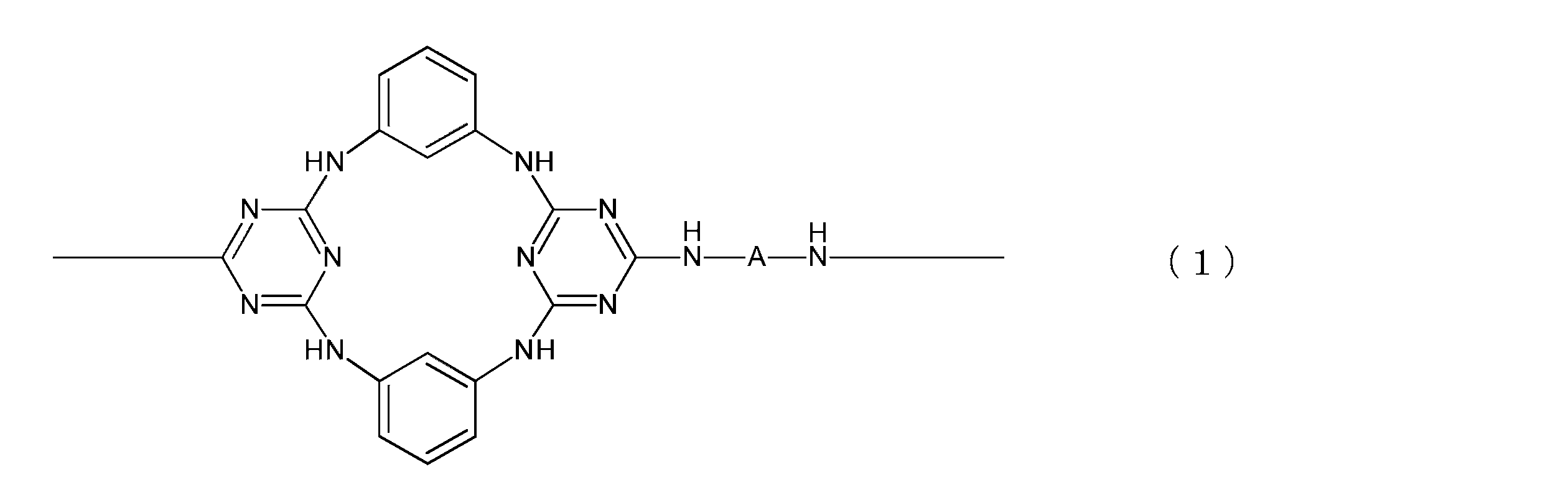
下記式(1)(式中、Aは芳香環構造及び/又は脂環構造を有する2価の有機基)で表される繰り返し単位を含み、
厚み5μmのフィルムとして測定した場合のガラス転移温度が350℃以上であり、全光線透過率が85%以上であり、イエローインデックスが10以下であることを特徴とする。
前記構成によれば、前記ガラス転移温度が350℃以上であるため、当該ポリグアナミンを用いて得られるポリグアナミンフィルムは、耐熱性に優れる。また、前記全光線透過率が85%以上であるため、当該ポリグアナミンを用いて得られるポリグアナミンフィルムは、透明性が高い。また、前記イエローインデックスが10以下であるため、当該ポリグアナミンを用いて得られるポリグアナミンフィルムは、無色であるといえる。
すなわち、前記構成に係るポリグアナミンによれば、前記ガラス転移温度が350℃以上であり、前記全光線透過率が85%以上であり、前記イエローインデックスが10以下であるため、無色透明性と耐熱性とを兼ね揃えるポリグアナミンフィルムを得ることが可能となる。
すなわち、前記構成に係るポリグアナミンによれば、前記ガラス転移温度が350℃以上であり、前記全光線透過率が85%以上であり、前記イエローインデックスが10以下であるため、無色透明性と耐熱性とを兼ね揃えるポリグアナミンフィルムを得ることが可能となる。
前記構成においては、100~300℃の間の線熱膨張係数が50ppm/℃以下であることが好ましい。
前記線熱膨張係数が50ppm/℃以下であると、当該ポリグアナミンを用いて得られるポリグアナミンフィルムは、高温での形状安定性により優れるといえる。
前記構成においては、重量平均分子量が170,000以上であることが好ましい。
前記重量平均分子量が170,000以上であると、当該ポリグアナミンを用いて得られるポリグアナミンフィルムは、透明性が高く、かつ、無色であるといえる。
また、本発明に係るポリグアナミンフィルムは、前記ポリグアナミンを含むことを特徴とする。
前記構成に係るポリグアナミンフィルムによれば、前記ポリグアナミンを含むため、無色透明性と耐熱性とを兼ね揃える。
また、本発明に係るポリグアナミンの製造方法は、
5,17-ジクロロテトラアザカリックス[2]アレーン[2]トリアジンと、芳香環構造及び/又は脂環構造を有するジアミン類とを、有機溶剤中で重合してポリグアナミンを得る工程Aを含み、
前記工程Aは、以下の反応条件下にて行うことを特徴とするポリグアナミンの製造方法。
<反応条件>
不活性ガス雰囲気下
前記有機溶剤の水分率:500ppm以下
反応温度:300℃以下
反応時間:60時間以内。
5,17-ジクロロテトラアザカリックス[2]アレーン[2]トリアジンと、芳香環構造及び/又は脂環構造を有するジアミン類とを、有機溶剤中で重合してポリグアナミンを得る工程Aを含み、
前記工程Aは、以下の反応条件下にて行うことを特徴とするポリグアナミンの製造方法。
<反応条件>
不活性ガス雰囲気下
前記有機溶剤の水分率:500ppm以下
反応温度:300℃以下
反応時間:60時間以内。
本発明者らは、ポリグアナミンの製造方法について鋭意検討を行った結果、ポリグアナミンを着色させる成分(着色成分)の発生を抑制することにより、無色透明性を高めることが可能であることを見出した。
本発明者らは、前記着色成分が、ポリグアナミンを製造するための原料、溶剤、及び、それらの分解物が酸化されたものであると推測している。具体的に、前記着色成分として、(a)ポリグアナミンを製造するためのモノマー原料である5,17-ジクロロテトラアザカリックス[2]アレーン[2]トリアジンの分解物(例えば、m-フェニレンジアミン(m-PDA))が酸化されたもの、(b)ポリグアナミンを製造するためのモノマー原料であるジアミン類が酸化されたもの、(c)ポリグアナミンを製造する際の有機溶剤、及び、その分解物が酸化されたもの、などを推測している。
そして、本発明者らは前記原料や前記溶剤の分解を抑制すること、及び、前記原料や前記溶剤及びその分解物の酸化を抑制することにより、無色透明性を高めることが可能であることを見出した。
そして、本発明者らは鋭意検討を行った結果、5,17-ジクロロテトラアザカリックス[2]アレーン[2]トリアジンと、芳香環構造及び/又は脂環構造を有するジアミン類とを、有機溶剤中で重合してポリグアナミンを得る工程Aにおいて、前記反応条件を採用することにより、無色透明性を高めることが可能であることを見出し、本発明を完成するに至った。
本発明に係るポリグアナミンの製造方法によれば、前記工程Aにおいて、前記反応条件を採用するため、前記原料や前記溶剤の分解を抑制すること、及び、前記原料、前記溶剤、及び、それらの分解物の酸化を抑制することができ、無色透明性を有するポリグアナミンを得ることが可能である。
また、本発明に係るポリグアナミンの製造方法によれば、モノマーとして5,17-ジクロロテトラアザカリックス[2]アレーン[2]トリアジンを使用しているため、耐熱性にも優れるポリグアナミンを得ることが可能である。
本発明者らは、前記着色成分が、ポリグアナミンを製造するための原料、溶剤、及び、それらの分解物が酸化されたものであると推測している。具体的に、前記着色成分として、(a)ポリグアナミンを製造するためのモノマー原料である5,17-ジクロロテトラアザカリックス[2]アレーン[2]トリアジンの分解物(例えば、m-フェニレンジアミン(m-PDA))が酸化されたもの、(b)ポリグアナミンを製造するためのモノマー原料であるジアミン類が酸化されたもの、(c)ポリグアナミンを製造する際の有機溶剤、及び、その分解物が酸化されたもの、などを推測している。
そして、本発明者らは前記原料や前記溶剤の分解を抑制すること、及び、前記原料や前記溶剤及びその分解物の酸化を抑制することにより、無色透明性を高めることが可能であることを見出した。
そして、本発明者らは鋭意検討を行った結果、5,17-ジクロロテトラアザカリックス[2]アレーン[2]トリアジンと、芳香環構造及び/又は脂環構造を有するジアミン類とを、有機溶剤中で重合してポリグアナミンを得る工程Aにおいて、前記反応条件を採用することにより、無色透明性を高めることが可能であることを見出し、本発明を完成するに至った。
本発明に係るポリグアナミンの製造方法によれば、前記工程Aにおいて、前記反応条件を採用するため、前記原料や前記溶剤の分解を抑制すること、及び、前記原料、前記溶剤、及び、それらの分解物の酸化を抑制することができ、無色透明性を有するポリグアナミンを得ることが可能である。
また、本発明に係るポリグアナミンの製造方法によれば、モノマーとして5,17-ジクロロテトラアザカリックス[2]アレーン[2]トリアジンを使用しているため、耐熱性にも優れるポリグアナミンを得ることが可能である。
本発明によれば、無色透明性と耐熱性とを兼ね揃えたポリグアナミンフィルムを得ることが可能なポリグアナミンを提供することができる。また、無色透明性と耐熱性とを兼ね揃えたポリグアナミンフィルムを提供することができる。また、当該ポリグアナミンの製造方法を提供することができる。
以下、本発明の実施形態について説明する。
[ポリグアナミン]
本実施形態に係るポリグアナミンは、
下記式(1)(式中、Aは芳香環構造及び/又は脂環構造を有する2価の有機基)で表される繰り返し単位を含み、
厚み5μmのフィルムとして測定した場合のガラス転移温度が350℃以上であり、全光線透過率が85%以上であり、イエローインデックスが10以下である。
本実施形態に係るポリグアナミンは、
下記式(1)(式中、Aは芳香環構造及び/又は脂環構造を有する2価の有機基)で表される繰り返し単位を含み、
厚み5μmのフィルムとして測定した場合のガラス転移温度が350℃以上であり、全光線透過率が85%以上であり、イエローインデックスが10以下である。

本明細書において、「ポリグアナミン」は、特に明示しない限り、製造時(合成時)に混入し得る不純物を含むものを「ポリグアナミン」という。つまり、本明細書における「ポリグアナミン」は、不純物を含まない純粋なポリグアナミンと、製造時に混入し得る不純物とを含む組成物(不純物を含まない純粋なポリグアナミン、及び、製造時に混入し得る不純物を含み、これら以外を含まない組成物(高純度ポリグアナミン))を意味する。
なお、前記ポリグアナミンは、前記ガラス転移温度、前記全光線透過率、及び、前記イエローインデックスが前記数値範囲を満たせばよく、前記不純物(例えば、着色成分)を含むか否かを問わない。
なお、前記ポリグアナミンは、前記ガラス転移温度、前記全光線透過率、及び、前記イエローインデックスが前記数値範囲を満たせばよく、前記不純物(例えば、着色成分)を含むか否かを問わない。
前記Aは芳香環構造及び/又は脂環構造を有する2価の有機基である。前記Aは、後に[ポリグアナミンの製造方法]の項で説明(例示列挙)するジアミン類の化学構造において、2つのアミノ基(NH2基)の部分が結合末端となった構成(2つのアミノ基の代わりにこの部分が結合手となった構成)である。
前記ポリグアナミンは、厚み5μmのフィルムとして測定した場合のガラス転移温度が350℃以上であり、好ましくは400℃以上であり、より好ましくは450℃以上である。また、前記ガラス転移温度は、高いほど好ましいが、例えば、600℃以下、575℃以下、550℃以下等である。前記ガラス転移温度が350℃以上であるため、当該ポリグアナミンを用いて得られるポリグアナミンフィルムは、耐熱性に優れる。前記ガラス転移温度は、上記式(1)で表される繰り返し単位を含むことにより高くすることができる。また、前記ガラス転移温度は、例えば、前記ポリグアナミンを製造するためのモノマーとしてのジアミン類の種類を選択することによっても制御することができる。前記ガラス転移温度の測定方法は、実施例に記載の方法による。
前記ガラス転移温度を測定するための厚み5μmのフィルムの作製方法は、実施例5、又は、実施例6に記載の方法とする。実施例5、及び、実施例6記載の方法で作製したフィルムの少なくとも一方が、前記ガラス転移温度の数値範囲を満たす場合、当該ポリグアナミンは、前記ガラス転移温度の数値範囲を満たすものとする。
前記ガラス転移温度を測定するための厚み5μmのフィルムの作製方法は、実施例5、又は、実施例6に記載の方法とする。実施例5、及び、実施例6記載の方法で作製したフィルムの少なくとも一方が、前記ガラス転移温度の数値範囲を満たす場合、当該ポリグアナミンは、前記ガラス転移温度の数値範囲を満たすものとする。
前記ポリグアナミンは、厚み5μmのフィルムとして測定した場合の全光線透過率が85%以上であり、好ましくは87%以上であり、より好ましくは89%以上である。また、前記全光線透過率は、高いほど好ましいが、例えば、99%以下、98%以下、97%以下等である。前記全光線透過率が85%以上であるため、当該ポリグアナミンを用いて得られるポリグアナミンフィルムは、透明性が高い。前記全光線透過率は、前記ポリグアナミンを製造する際の条件(例えば、重合する際の反応条件)により制御することができる。前記全光線透過率の測定方法は、実施例に記載の方法による。
前記全光線透過率を測定するための厚み5μmのフィルムの作製方法は、実施例5、又は、実施例6に記載の方法とする。実施例5、及び、実施例6記載の方法で作製したフィルムの少なくとも一方が、前記全光線透過率の数値範囲を満たす場合、当該ポリグアナミンは、前記全光線透過率の数値範囲を満たすものとする。
前記全光線透過率を測定するための厚み5μmのフィルムの作製方法は、実施例5、又は、実施例6に記載の方法とする。実施例5、及び、実施例6記載の方法で作製したフィルムの少なくとも一方が、前記全光線透過率の数値範囲を満たす場合、当該ポリグアナミンは、前記全光線透過率の数値範囲を満たすものとする。
前記ポリグアナミンは、厚み5μmのフィルムとして測定した場合のイエローインデックス(黄色度)が10以下であり、好ましくは8以下であり、より好ましくは6以下である。また、前記イエローインデックスは、小さいほど好ましいが、例えば、0.1以上、0.2以上、0.3以上等である。前記イエローインデックスが10以下であるため、当該ポリグアナミンを用いて得られるポリグアナミンフィルムは、無色であるといえる。前記イエローインデックスは、前記ポリグアナミンを製造する際の条件(例えば、重合する際の反応条件)により制御することができる。前記イエローインデックスの測定方法は、実施例に記載の方法による。
前記イエローインデックスを測定するための厚み5μmのフィルムの作製方法は、実施例5、又は、実施例6に記載の方法とする。実施例5、及び、実施例6記載の方法で作製したフィルムの少なくとも一方が、前記イエローインデックスの数値範囲を満たす場合、当該ポリグアナミンは、前記イエローインデックスの数値範囲を満たすものとする。
前記イエローインデックスを測定するための厚み5μmのフィルムの作製方法は、実施例5、又は、実施例6に記載の方法とする。実施例5、及び、実施例6記載の方法で作製したフィルムの少なくとも一方が、前記イエローインデックスの数値範囲を満たす場合、当該ポリグアナミンは、前記イエローインデックスの数値範囲を満たすものとする。
前記ポリグアナミンは、100~300℃の間の線熱膨張係数が50ppm/℃以下であることが好ましく、より好ましくは40ppm/℃以下であり、さらに好ましくは30ppm/℃以下であり、特に好ましくは20ppm/℃以下である。また、前記線熱膨張係数は、小さいほど好ましいが、例えば、-20ppm/℃以上、-10ppm/℃以上、-5ppm/℃以上等である。前記線熱膨張係数が50ppm/℃以下であると、当該ポリグアナミンを用いて得られるポリグアナミンフィルムは、高温での形状安定性により優れるといえる。前記線熱膨張係数は、上記式(1)で表される繰り返し単位を含むことにより小さくすることができる。また、前記線熱膨張係数は、例えば、前記ポリグアナミンを製造するためのモノマーとしてのジアミン類の種類を選択することによっても制御することができる。具体的に、前記線熱膨張係数は、分子構造が直鎖状であるジアミン類や立体配座が固定されているジアミン類を選択することにより、小さくすることができ、特に分子構造が直鎖状であるジアミン類を選択することによって顕著に小さくすることができる。分子構造が直鎖状であるジアミン類としては、例えば、2,2’-ビス(トリフルオロメチル)-4,4’-ジアミノビフェニルや4-アミノ-N-(4-アミノフェニル)ベンズアミドを挙げることができ、立体配座が固定されているジアミン類としては、例えば、4,4’-[9H-フルオレン-9,9-ジイル]ビスアニリンを挙げることができる。前記線熱膨張係数の測定方法は、実施例に記載の方法による。
前記ポリグアナミンは、重量平均分子量が170,000以上であることが好ましく、より好ましくは190,000以上であり、さらに好ましくは210,000以上である。また、前記重量平均分子量は、好ましくは2,000,000以下であり、より好ましくは1,500,000以下であり、さらに好ましくは1,000,000以下である。前記重量平均分子量が170,000以上であると、当該ポリグアナミンを用いて得られるポリグアナミンフィルムは、透明性が高く、かつ、無色であり、なお且つ、強靭であるといえる。前記重量平均分子量は、重合の際の反応条件等により制御することができる。前記重量平均分子量の測定方法は、実施例に記載の方法による。
[ポリグアナミンフィルム]
本実施形態に係るポリグアナミンフィルムは、前記ポリグアナミンを含む。本実施形態に係るポリグアナミンフィルムは、前記ポリグアナミンを含むため、無色透明性と耐熱性とを兼ね揃える。
本実施形態に係るポリグアナミンフィルムは、前記ポリグアナミンを含む。本実施形態に係るポリグアナミンフィルムは、前記ポリグアナミンを含むため、無色透明性と耐熱性とを兼ね揃える。
前記ポリグアナミンフィルムに含まれる前記ポリグアナミンの含有量は、ポリグアナミンフィルム全体を100質量%としたときに、50質量%以上が好ましく、60質量%以上が好ましく、70質量%以上がさらに好ましい。また、前記ポリグアナミンの含有量は、100質量%とすることも好ましい。前記ポリグアナミンの含有量が50質量%以上であると、より高い無色透明性と耐熱性とを備えることができる。
前記ポリグアナミンフィルムに含まれる前記ポリグアナミン以外の組成としては、例えば、後に[ポリグアナミンフィルムの製造方法]の項で説明(例示列挙)する微粒子や、他の透明耐熱ポリマー(透明ポリイミド、透明ポリアミド、透明ポリアミドイミド等)等を挙げることができる。
前記ポリグアナミンフィルムは、フィルム厚みを5μmとして測定した場合のガラス転移温度が350℃以上であり、好ましくは400℃以上であり、より好ましくは450℃以上である。また、前記ガラス転移温度は、高いほど好ましいが、例えば600℃以下、575℃以下、550℃以下等である。前記ガラス転移温度が350℃以上であると、耐熱性に優れる。
なお、前記ポリグアナミンフィルムの厚みが5μmではない場合であっても、ガラス転移温度は、厚みが5μmである場合と同じである。
なお、前記ポリグアナミンフィルムの厚みが5μmではない場合であっても、ガラス転移温度は、厚みが5μmである場合と同じである。
前記ポリグアナミンフィルムは、フィルム厚みを5μmとして測定した場合の全光線透過率が85%以上であり、好ましくは87%以上であり、より好ましくは89%以上である。また、前記全光線透過率は、高いほど好ましいが、例えば、99%以下、98%以下、97%以下等である。前記全光線透過率が85%以上であると、透明性が高い。
なお、前記ポリグアナミンフィルムの厚みが5μmではない場合、前記ポリグアナミンフィルムの全光線透過率が前記数値範囲を満たすか否かは、以下のようにして判断する。
(1)厚みが5μmより大きいフィルムについては、そのフィルムをそのまま測定する。厚みが5μmより大きいフィルムの測定結果が前記数値範囲を満たせば、必ず、厚みが5μの場合も当該数値範囲を満たすことになる。
(2)厚みが5μmよりも小さいフィルムについては、フィルムが有機溶剤に可溶の場合は、フィルムを有機溶剤に再溶解後、コーティング・乾燥して厚み5μmのフィルムを作成し、測定する。この際の樹脂溶液の溶媒水分率、樹脂濃度、及び、乾燥条件は、実施例6と同様とする。
なお、前記ポリグアナミンフィルムの厚みが5μmではない場合、前記ポリグアナミンフィルムの全光線透過率が前記数値範囲を満たすか否かは、以下のようにして判断する。
(1)厚みが5μmより大きいフィルムについては、そのフィルムをそのまま測定する。厚みが5μmより大きいフィルムの測定結果が前記数値範囲を満たせば、必ず、厚みが5μの場合も当該数値範囲を満たすことになる。
(2)厚みが5μmよりも小さいフィルムについては、フィルムが有機溶剤に可溶の場合は、フィルムを有機溶剤に再溶解後、コーティング・乾燥して厚み5μmのフィルムを作成し、測定する。この際の樹脂溶液の溶媒水分率、樹脂濃度、及び、乾燥条件は、実施例6と同様とする。
前記ポリグアナミンフィルムは、フィルム厚みを5μmとして測定した場合のイエローインデックス(黄色度)が10以下であり、好ましくは8以下であり、より好ましくは6以下である。また、前記イエローインデックスは、小さいほど好ましいが、例えば、0.1以上、0.2以上、0.3以上等である。前記イエローインデックスが10以下であるため、無色であるといえる。
なお、前記ポリグアナミンフィルムの厚みが5μmではない場合、前記ポリグアナミンフィルムのイエローインデックスが前記数値範囲を満たすか否かは、以下のようにして判断する。
(1)厚みが5μmより大きいフィルムについては、そのフィルムをそのまま測定する。厚みが5μmより大きいフィルムの測定結果が前記数値範囲を満たせば、必ず、厚みが5μの場合も当該数値範囲を満たすことになる。
(2)厚みが5μmよりも小さいフィルムについては、フィルムが有機溶剤に可溶の場合は、フィルムを有機溶剤に再溶解後、コーティング・乾燥して厚み5μmのフィルムを作成し、測定する。この際の樹脂溶液の溶媒水分率、樹脂濃度、及び、乾燥条件は、実施例6と同様とする。
なお、前記ポリグアナミンフィルムの厚みが5μmではない場合、前記ポリグアナミンフィルムのイエローインデックスが前記数値範囲を満たすか否かは、以下のようにして判断する。
(1)厚みが5μmより大きいフィルムについては、そのフィルムをそのまま測定する。厚みが5μmより大きいフィルムの測定結果が前記数値範囲を満たせば、必ず、厚みが5μの場合も当該数値範囲を満たすことになる。
(2)厚みが5μmよりも小さいフィルムについては、フィルムが有機溶剤に可溶の場合は、フィルムを有機溶剤に再溶解後、コーティング・乾燥して厚み5μmのフィルムを作成し、測定する。この際の樹脂溶液の溶媒水分率、樹脂濃度、及び、乾燥条件は、実施例6と同様とする。
前記ポリグアナミンフィルムの厚さは特に制限されないが、3μm以上が好ましく、より好ましくは11μm以上であり、さらに好ましくは24μm以上であり、より一層好ましくは45μm以上である。また、前記ポリグアナミンフィルムの厚さは、250μm以下であることが好ましく、より好ましくは150μm以下であり、さらに好ましくは90μm以下である。前記ポリグアナミンフィルムの厚さが250μm以下であると、特に、フレキシブル電子デバイス用途に好適に使用することができる。
[ポリグアナミンの製造方法]
本実施形態に係るポリグアナミンの製造方法は、
5,17-ジクロロテトラアザカリックス[2]アレーン[2]トリアジンと、芳香環構造及び/又は脂環構造を有するジアミン類とを、有機溶剤中で重合してポリグアナミンを得る工程Aを含み、
前記工程Aは、以下の反応条件下にて行う。
<反応条件>
不活性ガス雰囲気下
前記有機溶剤の水分率:500ppm以下
反応温度:300℃以下
反応時間:60時間以内。
本実施形態に係るポリグアナミンの製造方法は、
5,17-ジクロロテトラアザカリックス[2]アレーン[2]トリアジンと、芳香環構造及び/又は脂環構造を有するジアミン類とを、有機溶剤中で重合してポリグアナミンを得る工程Aを含み、
前記工程Aは、以下の反応条件下にて行う。
<反応条件>
不活性ガス雰囲気下
前記有機溶剤の水分率:500ppm以下
反応温度:300℃以下
反応時間:60時間以内。
5,17-ジクロロテトラアザカリックス[2]アレーン[2]トリアジンは、下記式(2)で表される。

5,17-ジクロロテトラアザカリックス[2]アレーン[2]トリアジンは、公知の技術(例えば、M.X.Wang,H.B.Yang,Journal of the American Chemical Society,126,15412-15422,(2004)に記載の技術)を用いて合成できる。
芳香環構造及び/又は脂環構造を有するジアミン類としては、例えば、2,2’-ジメチル-4,4’-ジアミノビフェニル、1,4-ビス[2-(4-アミノフェニル)-2-プロピル]ベンゼン、1,4-ビス(4-アミノ-2-トリフルオロメチルフェノキシ)ベンゼン、2,2’-ビス(トリフルオロメチル)-4,4’-ジアミノビフェニル、4,4’-ビス(4-アミノフェノキシ)ビフェニル、4,4’-ビス(3-アミノフェノキシ)ビフェニル、ビス[4-(3-アミノフェノキシ)フェニル]ケトン、ビス[4-(3-アミノフェノキシ)フェニル]スルフィド、ビス[4-(3-アミノフェノキシ)フェニル]スルホン、2,2-ビス[4-(3-アミノフェノキシ)フェニル]プロパン、2,2-ビス[4-(3-アミノフェノキシ)フェニル]-1,1,1,3,3,3-ヘキサフルオロプロパン、m-フェニレンジアミン、o-フェニレンジアミン、p-フェニレンジアミン、m-アミノベンジルアミン、p-アミノベンジルアミン、4-アミノ-N-(4-アミノフェニル)ベンズアミド、3,3’-ジアミノジフェニルエーテル、3,4’-ジアミノジフェニルエーテル、4,4’-ジアミノジフェニルエーテル、2,2’-トリフルオロメチル-4,4’-ジアミノジフェニルエーテル、3,3’-ジアミノジフェニルスルフィド、3,4’-ジアミノジフェニルスルフィド、4,4’-ジアミノジフェニルスルフィド、3,3’-ジアミノジフェニルスルホキシド、3,4’-ジアミノジフェニルスルホキシド、4,4’-ジアミノジフェニルスルホキシド、3,3’-ジアミノジフェニルスルホン、3,4’-ジアミノジフェニルスルホン、4,4’-ジアミノジフェニルスルホン、3,3’-ジアミノベンゾフェノン、3,4’-ジアミノベンゾフェノン、4,4’-ジアミノベンゾフェノン、3,3’-ジアミノジフェニルメタン、3,4’-ジアミノジフェニルメタン、4,4’-ジアミノジフェニルメタン、ビス[4-(4-アミノフェノキシ)フェニル]メタン、1,1-ビス[4-(4-アミノフェノキシ)フェニル]エタン、1,2-ビス[4-(4-アミノフェノキシ)フェニル]エタン、1,1-ビス[4-(4-アミノフェノキシ)フェニル]プロパン、1,2-ビス[4-(4-アミノフェノキシ)フェニル]プロパン、1,3-ビス[4-(4-アミノフェノキシ)フェニル]プロパン、2,2-ビス[4-(4-アミノフェノキシ)フェニル]プロパン、1,1-ビス[4-(4-アミノフェノキシ)フェニル]ブタン、1,3-ビス[4-(4-アミノフェノキシ)フェニル]ブタン、1,4-ビス[4-(4-アミノフェノキシ)フェニル]ブタン、2,2-ビス[4-(4-アミノフェノキシ)フェニル]ブタン、2,3-ビス[4-(4-アミノフェノキシ)フェニル]ブタン、2-[4-(4-アミノフェノキシ)フェニル]-2-[4-(4-アミノフェノキシ)-3-メチルフェニル]プロパン、2,2-ビス[4-(4-アミノフェノキシ)-3-メチルフェニル]プロパン、2-[4-(4-アミノフェノキシ)フェニル]-2-[4-(4-アミノフェノキシ)-3,5-ジメチルフェニル]プロパン、2,2-ビス[4-(4-アミノフェノキシ)-3,5-ジメチルフェニル]プロパン、2,2-ビス[4-(4-アミノフェノキシ)フェニル]-1,1,1,3,3,3-ヘキサフルオロプロパン、1,4-ビス(3-アミノフェノキシ)ベンゼン、1,3-ビス(3-アミノフェノキシ)ベンゼン、1,4-ビス(4-アミノフェノキシ)ベンゼン、4,4’-ビス(4-アミノフェノキシ)ビフェニル、ビス[4-(4-アミノフェノキシ)フェニル]ケトン、ビス[4-(4-アミノフェノキシ)フェニル]スルフィド、ビス[4-(4-アミノフェノキシ)フェニル]スルホキシド、ビス[4-(4-アミノフェノキシ)フェニル]スルホン、ビス[4-(3-アミノフェノキシ)フェニル]エーテル、ビス[4-(4-アミノフェノキシ)フェニル]エーテル、1,3-ビス[4-(4-アミノフェノキシ)ベンゾイル]ベンゼン、1,3-ビス[4-(3-アミノフェノキシ)ベンゾイル]ベンゼン、1,4-ビス[4-(3-アミノフェノキシ)ベンゾイル]ベンゼン、4,4’-ビス[(3-アミノフェノキシ)ベンゾイル]ベンゼン、1,1-ビス[4-(3-アミノフェノキシ)フェニル]プロパン、1,3-ビス[4-(3-アミノフェノキシ)フェニル]プロパン、3,4’-ジアミノジフェニルスルフィド、2,2-ビス[3-(3-アミノフェノキシ)フェニル]-1,1,1,3,3,3-ヘキサフルオロプロパン、ビス[4-(3-アミノフェノキシ)フェニル]メタン、1,1-ビス[4-(3-アミノフェノキシ)フェニル]エタン、1,2-ビス[4-(3-アミノフェノキシ)フェニル]エタン、ビス[4-(3-アミノフェノキシ)フェニル]スルホキシド、4,4’-ビス[3-(4-アミノフェノキシ)ベンゾイル]ジフェニルエーテル、4,4’-ビス[3-(3-アミノフェノキシ)ベンゾイル]ジフェニルエーテル、4,4’-ビス[4-(4-アミノ-α,α-ジメチルベンジル)フェノキシ]ベンゾフェノン、4,4’-ビス[4-(4-アミノ-α,α-ジメチルベンジル)フェノキシ]ジフェニルスルホン、ビス[4-{4-(4-アミノフェノキシ)フェノキシ}フェニル]スルホン、1,4-ビス[4-(4-アミノフェノキシ)フェノキシ-α,α-ジメチルベンジル]ベンゼン、1,3-ビス[4-(4-アミノフェノキシ)フェノキシ-α,α-ジメチルベンジル]ベンゼン、1,3-ビス[4-(4-アミノ-6-トリフルオロメチルフェノキシ)-α,α-ジメチルベンジル]ベンゼン、1,3-ビス[4-(4-アミノ-6-フルオロフェノキシ)-α,α-ジメチルベンジル]ベンゼン、1,3-ビス[4-(4-アミノ-6-メチルフェノキシ)-α,α-ジメチルベンジル]ベンゼン、1,3-ビス[4-(4-アミノ-6-シアノフェノキシ)-α,α-ジメチルベンジル]ベンゼン、3,3’-ジアミノ-4,4’-ジフェノキシベンゾフェノン、4,4’-ジアミノ-5,5’-ジフェノキシベンゾフェノン、3,4’-ジアミノ-4,5’-ジフェノキシベンゾフェノン、3,3’-ジアミノ-4-フェノキシベンゾフェノン、4,4’-ジアミノ-5-フェノキシベンゾフェノン、3,4’-ジアミノ-4-フェノキシベンゾフェノン、3,4’-ジアミノ-5’-フェノキシベンゾフェノン、3,3’-ジアミノ-4,4’-ジビフェノキシベンゾフェノン、4,4’-ジアミノ-5,5’-ジビフェノキシベンゾフェノン、3,4’-ジアミノ-4,5’-ジビフェノキシベンゾフェノン、3,3’-ジアミノ-4-ビフェノキシベンゾフェノン、4,4’-ジアミノ-5-ビフェノキシベンゾフェノン、3,4’-ジアミノ-4-ビフェノキシベンゾフェノン、3,4’-ジアミノ-5’-ビフェノキシベンゾフェノン、1,3-ビス(3-アミノ-4-フェノキシベンゾイル)ベンゼン、1,4-ビス(3-アミノ-4-フェノキシベンゾイル)ベンゼン、1,3-ビス(4-アミノ-5-フェノキシベンゾイル)ベンゼン、1,4-ビス(4-アミノ-5-フェノキシベンゾイル)ベンゼン、1,3-ビス(3-アミノ-4-ビフェノキシベンゾイル)ベンゼン、1,4-ビス(3-アミノ-4-ビフェノキシベンゾイル)ベンゼン、1,3-ビス(4-アミノ-5-ビフェノキシベンゾイル)ベンゼン、1,4-ビス(4-アミノ-5-ビフェノキシベンゾイル)ベンゼン、2,6-ビス[4-(4-アミノ-α,α-ジメチルベンジル)フェノキシ]ベンゾニトリル、4,4’-[9H-フルオレン-9,9-ジイル]ビスアニリン(別名「9,9-ビス(4-アミノフェニル)フルオレン」)、スピロ(キサンテン-9,9’-フルオレン)-2,6-ジイルビス(オキシカルボニル)]ビスアニリン、4,4’-[スピロ(キサンテン-9,9’-フルオレン)-2,6-ジイルビス(オキシカルボニル)]ビスアニリン、4,4’-[スピロ(キサンテン-9,9’-フルオレン)-3,6-ジイルビス(オキシカルボニル)]ビスアニリン、5-アミノ-2-(p-アミノフェニル)ベンゾオキサゾール、6-アミノ-2-(p-アミノフェニル)ベンゾオキサゾール、5-アミノ-2-(m-アミノフェニル)ベンゾオキサゾール、6-アミノ-2-(m-アミノフェニル)ベンゾオキサゾール、2,2’-p-フェニレンビス(5-アミノベンゾオキサゾール)、2,2’-p-フェニレンビス(6-アミノベンゾオキサゾール)、1-(5-アミノベンゾオキサゾロ)-4-(6-アミノベンゾオキサゾロ)ベンゼン、2,6-(4,4’-ジアミノジフェニル)ベンゾ[1,2-d:5,4-d’]ビスオキサゾール、2,6-(4,4’-ジアミノジフェニル)ベンゾ[1,2-d:4,5-d’]ビスオキサゾール、2,6-(3,4’-ジアミノジフェニル)ベンゾ[1,2-d:5,4-d’]ビスオキサゾール、2,6-(3,4’-ジアミノジフェニル)ベンゾ[1,2-d:4,5-d’]ビスオキサゾール、2,6-(3,3’-ジアミノジフェニル)ベンゾ[1,2-d:5,4-d’]ビスオキサゾール、2,6-(3,3’-ジアミノジフェニル)ベンゾ[1,2-d:4,5-d’]ビスオキサゾール、1,4-ジアミノシクロヘキサン、1,4-ジアミノ-2-メチルシクロヘキサン、1,4-ジアミノ-2-エチルシクロヘキサン、1,4-ジアミノ-2-n-プロピルシクロヘキサン、1,4-ジアミノ-2-イソプロピルシクロヘキサン、1,4-ジアミノ-2-n-ブチルシクロヘキサン、1,4-ジアミノ-2-イソブチルシクロヘキサン、1,4-ジアミノ-2-sec-ブチルシクロヘキサン、1,4-ジアミノ-2-tert-ブチルシクロヘキサン、4,4’-メチレンビス(2,6-ジメチルシクロヘキシルアミン)、シクロヘキサン-1,4-ジイルジメタンアミン、ビシクロ[2,2,1]ヘプタン-2,5-ジアミン、および上記ジアミン類の芳香環上及び/又は脂環上の水素原子の一部もしくは全てが、ハロゲン原子、炭素数1~3のアルキル基またはアルコキシル基、シアノ基、またはアルキル基またはアルコキシル基の水素原子の一部もしくは全部がハロゲン原子で置換された炭素数1~3のハロゲン化アルキル基またはアルコキシル基で置換されたジアミン類が挙げられる。これらの中で、2,2’-ジメチル-4,4’-ジアミノビフェニル、2,2’-ビス(トリフルオロメチル)-4,4’-ジアミノビフェニル、m-フェニレンジアミン、p-フェニレンジアミン、4-アミノ-N-(4-アミノフェニル)ベンズアミド、3,3’-ジアミノジフェニルエーテル、3,4’-ジアミノジフェニルエーテル、4,4’-ジアミノジフェニルエーテル、3,3’-ジアミノジフェニルスルホン、3,4’-ジアミノジフェニルスルホン、4,4’-ジアミノジフェニルスルホン、3,3’-ジアミノベンゾフェノン、4,4’-[9H-フルオレン-9,9-ジイル]ビスアニリン、1,4-ジアミノシクロヘキサン、1,4-ジアミノ-2-メチルシクロヘキサンが好ましく、2,2’-ビス(トリフルオロメチル)-4,4’-ジアミノビフェニル、4-アミノ-N-(4-アミノフェニル)ベンズアミド、3,4’-ジアミノジフェニルエーテル、3,4’-ジアミノジフェニルスルホン、4,4’-[9H-フルオレン-9,9-ジイル]ビスアニリン、1,4-ジアミノシクロヘキサンがより好ましく、2,2’-ビス(トリフルオロメチル)-4,4’-ジアミノビフェニル、4-アミノ-N-(4-アミノフェニル)ベンズアミド、4,4’-[9H-フルオレン-9,9-ジイル]ビスアニリンが更に好ましい。尚、芳香族構造及び/又は脂環構造を有するジアミン類は単独で使用してもよいし複数を組み合わせて使用してもよい。
前記の原料モノマーの混合比(モル比)は、[5,17-ジクロロテトラアザカリックス[2]アレーン[2]トリアジン]/[ジアミン]の表記方法で、好ましくは0.800~1.200/1.200~0.800、より好ましくは0.900~1.100/1.100~0.900、更に好ましくは0.950~1.050/1.050~0.950である。前記混合比にて、原料モノマーを混合することにより、高分子量のポリグアナミンを得ることができ、当該ポリグアナミンを用いて得られるポリグアナミンフィルムは、透明性が高く、かつ、無色であり、尚且つ、強靭であるといえる。
前記工程Aは、下記反応条件下にて行う。工程A(重合工程)は、連続して行ってもよく、必要に応じて重合反応を分割して行ってもよい。また、下記反応条件内であれば、反応温度を上下させてもよい。
<反応条件>
不活性ガス雰囲気下
前記有機溶剤の水分率:500ppm以下
反応温度:300℃以下
反応時間:60時間以内。
<反応条件>
不活性ガス雰囲気下
前記有機溶剤の水分率:500ppm以下
反応温度:300℃以下
反応時間:60時間以内。
前記不活性ガスとしては、原料モノマー及び生成物であるポリグアナミンのいずれとも反応し得ないものであれば特に限定されないが、例えば、窒素ガスや希ガス(例えば、ヘリウムガス、ネオンガス、アルゴンガス)などが挙げられる。前記工程Aを不活性ガス雰囲気下で行うことにより、酸素の混入を抑えることができる。従って、原料、有機溶剤、及び、それらの分解物の酸化を抑制することができ、副生物の量を少なくすることができる。その結果、最終的に得られるポリグアナミンの耐熱性や無色透明性を高めることができる。
前記工程Aの反応条件における不活性ガス雰囲気下とは、酸素濃度が2.0%未満であることが好ましい。ポリグアナミンの無色透明性を向上できることから、1.5%以下であることが好ましく、1.0%以下であることがより好ましく、1.0%以下であることがさらに好ましい。酸素濃度は低い方が好ましいため、下限は特に限定されないが、工業的には0.01%以上、0.05%以上であっても差し支えない。
前記有機溶剤としては、原料モノマー及び生成物であるポリグアナミンのいずれをも溶解することが可能なものであれば特に限定されないが、例えば、N-メチル-2-ピロリドン、N-アセチル-2-ピロリドン、N,N-ジメチルホルムアミド、N,N-ジメチルホルムアミド、N,N-ジメチルアセトアミド、ジメチルスルホキシド、γ-ブチロラクトン等があげられ、これらの溶媒は、単独あるいは混合して使用することができる。
前記有機溶剤の水分率としては、500ppm以下が好ましく、400ppm以下がより好ましく、300ppm以下が更に好ましく、200ppm以下が尚更に好ましく、100ppm以下がことさらに好ましい。前記水分率は、小さいほど好ましいが、例えば、1ppm以上、2ppm以上、3ppm以上等である。前記水分率を500ppm以下とすることにより、原料や有機溶剤の分解を抑制することができ、副生物の量を少なくすることができる。その結果、最終的に得られるポリグアナミンの耐熱性や無色透明性を高めることができる。前記水分率を500ppm以下とするための手段としては、特に限定されないが、例えば、脱水剤で脱水する方法や蒸留する方法などが挙げられる。
前記有機溶剤は、前記不活性ガスにて、好ましくは10分以上、より好ましくは20分以上、さらに好ましくは30分以上のバブリング処理が行われたものであることが好ましい。10分以上のバブリング処理を行うことで有機溶剤中の酸素を除去することができ、重合工程での着色を抑制することができる。
前記反応温度としては、300℃以下が好ましく、250℃以下がより好ましく、200℃以下が更に好ましい。反応温度を300℃以下とすることにより、原料や有機溶剤の分解を抑制することができ、副生物の量を少なくすることができる。その結果、最終的に得られるポリグアナミンの耐熱性や無色透明性を高めることができる。前記反応温度は、収率向上の観点から、50℃以上、75℃以上、100℃以上等とすることができる。
前記反応時間としては、60時間以内が好ましく、30時間以内がより好ましく、10時間以内が更に好ましく、5時間以内が尚更に好ましい。反応温度を60時間以内とすることより、原料や有機溶剤の分解を抑制することができ、副生物の量を少なくすることができる。その結果、最終的に得られるポリグアナミンの耐熱性や無色透明性を高めることができる。前記反応温度は、収率向上の観点から、0.1時間以上、0.5時間以上、1.0時間以上等とすることができる。
前記工程Aにおいては、添加剤を加えても良い。前記添加剤としてはポリグアナミン分子鎖間の凝集を抑制するものや、反応の際に遊離する塩化水素を捕捉及び/又は中和するもの等が挙げられる。ポリグアナミン分子鎖間の凝集を抑制するものとしては、目的を達成し得るものであれば特に限定されるわけではないが、例えば、塩化リチウムや塩化ナトリウムなどが挙げられる。反応の際に遊離する塩化水素を捕捉及び/又は中和するものとしては、目的を達成し得るものであれば特に限定されるわけではないが、例えばフッ化セシウム、フッ化カリウム、炭酸セシウム、炭酸カリウム、炭酸ナトリウムなどが挙げられる。
前記工程Aにおいては、反応初期の反応液のpHは4.0~8.0の範囲内であることが好ましく、4.5~7.5の範囲内がより好ましく、5.0~7.0の範囲内が更に好ましい。反応初期の反応液のpHは、5,17-ジクロロテトラアザカリックス[2]アレーン[2]トリアジンと、芳香環構造及び/又は脂環構造を有するジアミン類と、有機溶剤等を仕込んだ後に攪拌を開始してから10分後の反応液を適量サンプリングし、そのサンプリング液に対して20質量%の脱イオン水を加えたものに対してpH試験紙を使って測定した値をいう。反応初期の反応液のpHが4.0~8.0の範囲内にあると、重合途中でポリグアナミンが強く着色することを抑えることができる。
前記ポリグアナミンの末端アミノ基は、50eq/t以下であることが、無色透明性に優れるポリグアナミンフィルムを得るために好ましく、更には10eq/t以下であることが好ましい。
前記ポリグアナミンの末端アミノ基を低下させる方法としては、高分子量化させる方法の他に、ジカルボン酸無水物を過剰に用いる方法や、1官能のモノマーにより末端封止する方法があるが、いずれの場合も100量体を超えるポリマーであることが、無色透明性に優れるポリグアナミンフィルムを得るために好ましい。
前記ポリグアナミンの末端アミノ基を封止するための封止剤としては、例えばジカルボン酸無水物や酸塩化物などが用いられるが、不飽和結合を含むものやカルボン酸或いは酸クロライドに直結した芳香族を有するものは熱処理時に着色する傾向があるため好ましくない。好ましいジカルボン酸無水物としてはシクロヘキサン-1,2-ジカルボン酸無水物、4-メチルシクロヘキサン-1,2-ジカルボン酸無水物、シクロヘキサン-1,3-ジカルボン酸無水物などの脂環族ジカルボン酸無水物が挙げられ、好ましい酸塩化物としてはシクロヘキサンカルボニルクロライドなどの脂環族酸塩化物が挙げられるが、これらに限定されない。これらは単独または2種類以上を組み合わせて用いることもできる。
前期工程Aにおいて、原料モノマー等を計量及び添加する際の周囲の雰囲気は特に制限はないが、前記不活性ガスで置換された雰囲気であることが好ましい。尚、前記不活性ガスで置換された程度を判断する指標として雰囲気の酸素濃度を測定する方法があり、酸素濃度は1.5%以下が好ましく、1.0%以下がより好ましく、0.5%以下がさらに好ましい。酸素濃度が1.5%以下になるまで前記不活性ガスで置換することで、計量及び添加時の重合系内への酸素や水分の混入を抑制することでき、重合工程での着色を抑制することができる。
前記工程Aにおいて、原料モノマー等の添加順序には特に制限はないが、芳香族ジアミン類の溶液中に5,17-ジクロロテトラアザカリックス[2]アレーン[2]トリアジンを添加するのが好ましい。但し、末端封止剤を用いる場合には、ポリグアナミンの合成が完結した後に末端封止剤を添加するのが好ましい。
前記有機溶剤の使用量は、原料モノマー等を溶解するのに十分な量であればよく、通常は固形分が1~50質量%となる使用量であり、好ましくは固形分が5~35質量%となる使用量である。
前記工程Aの後、反応によって得られたポリグアナミンを、適当な貧溶媒を用いて反応溶液から再沈殿させても良い。前記貧溶媒としては、アセトン、メタノール、エタノール、水などが挙げられるが、効率よく再沈殿させることができるものであれば、特にこれらに限定されない。また、再沈殿した後の残存反応溶媒を除去する溶媒についても特に限定されないが、再沈殿させた際に用いた溶媒を使用することが好ましい。
再沈殿させた後、乾燥させることにより、ポリグアナミンを得ることができる。
前記製造方法により得られるポリグアナミンは、工程Aの後の反応溶液をそのままポリグアナミンを含む溶液という形態で利用可能することもできる。また、工程Aの後、反応溶液から上記手法で再沈殿させたポリグアナミンを再び溶媒に溶解させてポリグアナミンを含む溶液という形態で利用可能とすることもできる。後者の場合、ポリグアナミンを効率よく溶解させるものであれば、特に限定されるものではないが、例として、o-クレゾール、m-クレゾール、p-クレゾール、N-メチル-2-ピロリドン,N-アセチル-2-ピロリドン、N,N-ジメチルホルムアミド、N,N-ジメチルホルムアミド、N,N-ジメチルアセトアミド、ジメチルスルホキシド、γ-ブチロラクトン、スルホラン、ハロゲン化フェノール類等の有機溶剤が挙げられる。
ポリグアナミンと溶媒とを混合させる手段として、特に限定はされないが、例えば、通常の攪拌翼、高粘度用の攪拌翼を用いて混合攪拌する方法、多軸の押し出し機、あるいはスタティックミキサーなどを用いる方法、更には、ロールミルなどの高粘度用混合分散機を用いる方法を用いて混合攪拌することが挙げられる。
前記製造方法により得られるポリグアナミン溶液中のポリグアナミンの含有量としては、好ましくは1~50質量%、より好ましくは5~30質量%が挙げられる。この場合、前記ポリグアナミン溶液の粘度はブルックフィールド粘度計による測定で好ましくは0.1~2000Pa・s、より好ましくは1~1000Pa・sのものが、安定した送液が可能である点で好ましい。
[ポリグアナミンフィルムの製造方法]
本実施形態に係るポリグアナミンフィルムの製造方法は、
グアナミン溶液を準備する工程A-1と、
グアナミン溶液を基材上に塗布する工程Bと、
前記基材上に塗布されたグアナミン溶液を乾燥させて溶媒を除去する工程Cと
を含む。
本実施形態に係るポリグアナミンフィルムの製造方法は、
グアナミン溶液を準備する工程A-1と、
グアナミン溶液を基材上に塗布する工程Bと、
前記基材上に塗布されたグアナミン溶液を乾燥させて溶媒を除去する工程Cと
を含む。
前記工程A-1で準備するグアナミン溶液は、前記工程Aで説明したグアナミン溶液を用いることができる。なお、グアナミン溶液に、グアナミン、溶媒以外の添加物を添加する場合には、前記工程Aにおいて、さらに添加物(例えば、微粒子等)を添加する工程を加えたものを工程A-1とすればよい。
上述したように、前記工程A-1においては、グアナミン溶液に、性能向上を目的として微粒子を添加してもよい。
微粒子の添加のタイミングとしては、例えば、ポリグアナミンを合成する前の有機溶剤に微粒子を添加して分散させた後、重合する方法、前記重合途中に添加する方法、重合終了後に添加する方法などが挙げられる。微粒子を凝集させ難く、効率的に均一に分散させる観点からは、ポリグアナミンを合成する前の有機溶剤に微粒子を添加して分散させた後、重合する方法が好ましい。
前記微粒子としては無機微粒子でも有機微粒子でも良いが、平均粒径が0.05μm以上、1μm以下が望ましく、0.1μm以上、0.5μm以下が更に好ましい。前記平均粒径を0.05μm以上とすることにより、得られるフィルムに充分な易滑性を付与することができる。また、二次凝集による粗大粒子形成を抑制することができる。また、前記平均粒径を1μm以下とすることにより、光学特性の低下を抑制することができる。
前記無機微粒子としては特に限定されず、通常、フィラーとして用いられる素材を用いれば良い。例えば窒化ケイ素、酸化ケイ素、酸化チタン、酸化アルミニウム、酸化マグネシウム、酸化亜鉛、酸化錫、炭酸カルシウム、硫酸バリウム、タルク、カオリン、硫酸カルシウムなどが挙げられる。またこれらは複合して用いても良い。
前記有機微粒子としては特に限定されず、微粒子化が可能な素材であれば良いが、高耐熱のものが好ましい。例えばポリアミド系樹脂、ポリイミド系樹脂、ベンゾグアナミン系樹脂、メラミン系樹脂などが挙げられる。またこれらは複合して用いても良い。
前記微粒子の形状は、実質的に球状であることが好ましい。実質的に球状であるとは、微粒子の平面への投影図(例えば、顕微鏡による観察像)の形状が、平均球形度0.7以上好ましくは0.8以上である事を意味する。球形度とは、上記投影図の外接楕円の長径に対する短径の比であり、球形度が1.0であれば真球である。球形度は粒子の拡大画像を画像処理することなどにより容易に得ることができる。平均球形度は無作為に選んだ20個の粒子の球形度の平均値である。
前記微粒子の屈折率は、ポリグアナミンの屈折率との差の絶対値が0.1以下の範囲であることが好ましい。またポリグアナミンフィルム製造工程で接触する全ての化学物質に対して不溶である必要がある。
前記微粒子は、得られるポリグアナミンフィルムに対し100ppm以上、2.0質量%以下で含まれていることが好ましく、500ppm以上、0.5質量%以下の割合で含まれていることがより好ましい。前記微粒子を前記範囲内で含有させることにより、フィルムへの充分な易滑性を付与することができる。その結果、搬送性を向上させることができ、フィルム上に皺やキズなどの不良箇所の発生や、ロールに巻いた時のフィルム巻姿が悪化することを抑制することができる。
また、前記微粒子を前記範囲内で含有させることにより、フィルムの光学特性を悪化させることなく、易滑性を付与することができる。
また、前記微粒子を前記範囲内で含有させることにより、フィルムの光学特性を悪化させることなく、易滑性を付与することができる。
また、前記工程A-1では、グアナミン溶液に、フッ素系、ポリシロキサン系などの界面活性剤、フェノール系、イオウ系、リン酸系、亜リン酸系などの酸化防止剤、カーボンナノチューブ、ナノ金属材料などの導電性材料、チタン酸バリウムなどの強誘電性材料、リン系、ハロゲン系などの難燃剤、その他、蛍光体や紫外線吸収剤などを添加することで、各種機能を付与してもよい。
前記工程Bにおいて、ポリグアナミン溶液を基材上に塗布する方法は、特に限定されないが、例えば、スピンコートなど回転塗布する方法、ドクターブレードやアプリケーター、コンマコーターなどスキージを利用する方法、スクリーン印刷法などが挙げられる。
前記基材は、特に限定されないが、例えば、シリコンウェハ、ガラス基板、銅箔などの無機基板、ポリエチレンテレフタレートフィルムやポリイミドフィルムなどの有機基板などが挙げられる。前記基材は、電気電子部品、配線基板等を構成する基材であることが好ましい。
前記工程Cにおいて、基材上に塗布されたポリグアナミン溶液から溶媒を除去するための乾燥温度条件は、好ましくは60℃以上、より好ましくは120℃以上、なお好ましくは180℃以上である。乾燥温度を60℃以上とすることにより、乾燥時間を短くすることができ、充分な乾燥を行うことが可能となる。また、前記乾燥温度条件は、500℃以下が好ましく、より好ましくは450℃以下、さらに好ましくは4000℃以下である。前記乾燥温度条件を500℃以下とすることにより、熱劣化によりフィルムの無色透明性が損なわれることを防止することができる。また、フィルム物性が低下するなどの悪影響を防止することができる。
前記工程Cにおいて、乾燥時のオーブン内の酸素濃度は、5%以下であることが好ましく、3%以下であることがより好ましく、1%以下であることがさらに好ましい。
前記工程Cは、連続して行ってもよく、必要に応じて分割して行ってもよい。また、前記乾燥温度条件内であれば、乾燥温度を上下させてもよい。前記工程Cを分割して行う場合の例として、ポリグアナミンフィルム中の有機溶剤残存量を1%以上50%以下にする「プリベーク」と、プリベークの温度条件よりも高い乾燥温度で乾燥する「本乾燥」と、本乾燥よりも更に高い温度で乾燥する「アニール」に分割する手法が挙げられる。本乾燥の後にアニールを施すことでポリグアナミンフィルム中のポリグアナミン分子鎖間をより密な状態にすることができ、その結果、ポリグアナミンフィルムの耐熱性や寸法安定性、機械特性を更に向上させることができる。
以下、本発明に関し実施例を用いて詳細に説明するが、本発明はその要旨を超えない限り、以下の実施例に限定されるものではない。
以下の実施例における物性の評価方法は以下の通りである。
1.溶媒水分率
溶媒を0.5g秤量し、装置としてカールフィッシャー水分率計(平沼産業株式会社製、AQ-300型)を用い、発生液としてアクアライトRS(関東化学株式会社)、対極液としてアクアライトCN(関東化学株式会社)を使用して、溶媒水分率を測定した。
溶媒を0.5g秤量し、装置としてカールフィッシャー水分率計(平沼産業株式会社製、AQ-300型)を用い、発生液としてアクアライトRS(関東化学株式会社)、対極液としてアクアライトCN(関東化学株式会社)を使用して、溶媒水分率を測定した。
2.ポリグアナミンの数平均分子量(Mn)及び重量平均分子量(Mw)
ポリグアナミンを8mg秤量し、8mLの溶離液に浸漬させ、145℃10時間加熱攪拌した後、0.2μmのメンブランフィルターでろ過し、得られた溶液のGPC分析を以下の条件で行い、標準ポリスチレンを用いて数平均分子量及び重量平均分子量を算出した。
装置名:TOSOH HLC-8420GPC
カラム:TSKgel SuperAWM-H×2本
溶離液:DMAc/LiBr 30mM + H3PO4 60mM
流量:0.3mL/min
濃度:0.1%
検出器:RI検出器
カラム温度:40℃
注入量:10μL
分子量標準:標準ポリスチレン
ポリグアナミンを8mg秤量し、8mLの溶離液に浸漬させ、145℃10時間加熱攪拌した後、0.2μmのメンブランフィルターでろ過し、得られた溶液のGPC分析を以下の条件で行い、標準ポリスチレンを用いて数平均分子量及び重量平均分子量を算出した。
装置名:TOSOH HLC-8420GPC
カラム:TSKgel SuperAWM-H×2本
溶離液:DMAc/LiBr 30mM + H3PO4 60mM
流量:0.3mL/min
濃度:0.1%
検出器:RI検出器
カラム温度:40℃
注入量:10μL
分子量標準:標準ポリスチレン
3.ポリグアナミンフィルムの厚さ
ポリグアナミンフィルムの厚さをマイクロメーター(ファインリューフ社製、ミリトロン1254D)を用いて測定した。
ポリグアナミンフィルムの厚さをマイクロメーター(ファインリューフ社製、ミリトロン1254D)を用いて測定した。
4.ポリグアナミンフィルムのガラス転移温度(Tg)及び線熱膨張係数(CTE)
ポリグアナミンフィルムの伸縮率を下記条件で測定し、変曲点の温度をガラス転移温度(Tg)とし、100~300℃までを15℃間隔で分割し、各分割範囲の伸縮率/温度の平均値より線熱膨張係数(CTE)を算出した。
装置名 ; MACサイエンス社製TMA4000S
試料長さ ; 20mm
試料幅 ; 2mm
昇温開始温度 ; 25℃
昇温終了温度 ; 500℃
昇温速度 ; 5℃/min
雰囲気 ; アルゴン
ポリグアナミンフィルムの伸縮率を下記条件で測定し、変曲点の温度をガラス転移温度(Tg)とし、100~300℃までを15℃間隔で分割し、各分割範囲の伸縮率/温度の平均値より線熱膨張係数(CTE)を算出した。
装置名 ; MACサイエンス社製TMA4000S
試料長さ ; 20mm
試料幅 ; 2mm
昇温開始温度 ; 25℃
昇温終了温度 ; 500℃
昇温速度 ; 5℃/min
雰囲気 ; アルゴン
5.ポリグアナミンフィルムの全光線透過率(TT)
HAZEMETER(NDH5000、日本電色社製)を用いてポリグアナミンフィルムの全光線透過率(TT)を測定した。光源としてはD65ランプを使用した。尚、同様の測定を3回行い、その算術平均値を採用した。
HAZEMETER(NDH5000、日本電色社製)を用いてポリグアナミンフィルムの全光線透過率(TT)を測定した。光源としてはD65ランプを使用した。尚、同様の測定を3回行い、その算術平均値を採用した。
6.ポリグアナミンフィルムのイエローインデックス(YI)
カラーメーター(ZE6000、日本電色社製)およびC2光源を使用して、ASTMD1925に準じてポリグアナミンフィルムの三刺激値XYZ値を測定し、下記式により黄色度指数(YI)を算出した。尚、同様の測定を3回行い、その算術平均値を採用した。
YI=100×(1.28X-1.06Z)/Y
カラーメーター(ZE6000、日本電色社製)およびC2光源を使用して、ASTMD1925に準じてポリグアナミンフィルムの三刺激値XYZ値を測定し、下記式により黄色度指数(YI)を算出した。尚、同様の測定を3回行い、その算術平均値を採用した。
YI=100×(1.28X-1.06Z)/Y
7.ポリグアナミンフィルムの引張破断強度及び引張破断伸度
ポリグアナミンフィルムを長さ100mm、幅10mmの短冊状に切り出して試験片とし、引張試験機(島津製作所製オートグラフ(商品名)機種名AG-5000A)を用い、引張速度50mm/分、チャック間距離40mmで測定し、引張破断強度及び引張破断伸度を求めた。
ポリグアナミンフィルムを長さ100mm、幅10mmの短冊状に切り出して試験片とし、引張試験機(島津製作所製オートグラフ(商品名)機種名AG-5000A)を用い、引張速度50mm/分、チャック間距離40mmで測定し、引張破断強度及び引張破断伸度を求めた。
<ポリグアナミンの作製>
(実施例1)
酸素濃度が0.1%以下になるまで窒素置換されたグローブボックス内にて2Lの反応容器に945.00gの低水分率N-メチル-2-ピロリドン(NMP)(水分率:50ppm)を導入し、1.0L/分の流量で乾燥窒素を約15分間吹き込んだ。窒素吹き込み後のNMPの水分率は85ppmであった。次いで、反応容器に131.70g(0.300mol)の5,17-ジクロロテトラアザカリックス[2]アレーン[2]トリアジン(TACLATA)、104.53g(0.300mol)の9,9-ビス(4-アミノフェニル)フルオレン(BAFL)、47.25gの塩化リチウム(LiCl)を導入し、窒素導入管、還流管、攪拌シール、攪拌棒を取り付けた。次いで、反応容器をグローブボックスから取り出し、乾燥窒素気流下(流量1.0L/分、反応容器内酸素濃度0.1%以下)、150℃の温度で3時間攪拌することにより淡黄色の反応溶液を得た。次いで、反応溶液を空冷し、1wt%アンモニア/メタノール溶液30Lに投入することで再沈殿を行い、得られた固形物をメタノール20L還流下で3時間攪拌した後、180℃で12時間真空乾燥することによりポリグアナミンAを得た。得られたポリグアナミンAの外観、数平均分子量、重量平均分子量を表1に示す。
なお、反応容器に5,17-ジクロロテトラアザカリックス[2]アレーン[2]トリアジン(TACLATA)、9,9-ビス(4-アミノフェニル)フルオレン(BAFL)、及び、塩化リチウム(LiCl)を導入した後、攪拌を開始してから10分後の反応液を適量サンプリングし、そのサンプリング液に対して20質量%の脱イオン水を加え、pH試験紙を使ってpHを測定した。得られたpH値を「反応初期の反応液のpH」とした。反応初期の反応液のpHを表1に示す。以下の実施例、比較例についても、同様に反応初期の反応液のpHを測定した。結果を表1に示す。
(実施例1)
酸素濃度が0.1%以下になるまで窒素置換されたグローブボックス内にて2Lの反応容器に945.00gの低水分率N-メチル-2-ピロリドン(NMP)(水分率:50ppm)を導入し、1.0L/分の流量で乾燥窒素を約15分間吹き込んだ。窒素吹き込み後のNMPの水分率は85ppmであった。次いで、反応容器に131.70g(0.300mol)の5,17-ジクロロテトラアザカリックス[2]アレーン[2]トリアジン(TACLATA)、104.53g(0.300mol)の9,9-ビス(4-アミノフェニル)フルオレン(BAFL)、47.25gの塩化リチウム(LiCl)を導入し、窒素導入管、還流管、攪拌シール、攪拌棒を取り付けた。次いで、反応容器をグローブボックスから取り出し、乾燥窒素気流下(流量1.0L/分、反応容器内酸素濃度0.1%以下)、150℃の温度で3時間攪拌することにより淡黄色の反応溶液を得た。次いで、反応溶液を空冷し、1wt%アンモニア/メタノール溶液30Lに投入することで再沈殿を行い、得られた固形物をメタノール20L還流下で3時間攪拌した後、180℃で12時間真空乾燥することによりポリグアナミンAを得た。得られたポリグアナミンAの外観、数平均分子量、重量平均分子量を表1に示す。
なお、反応容器に5,17-ジクロロテトラアザカリックス[2]アレーン[2]トリアジン(TACLATA)、9,9-ビス(4-アミノフェニル)フルオレン(BAFL)、及び、塩化リチウム(LiCl)を導入した後、攪拌を開始してから10分後の反応液を適量サンプリングし、そのサンプリング液に対して20質量%の脱イオン水を加え、pH試験紙を使ってpHを測定した。得られたpH値を「反応初期の反応液のpH」とした。反応初期の反応液のpHを表1に示す。以下の実施例、比較例についても、同様に反応初期の反応液のpHを測定した。結果を表1に示す。
(実施例2)
酸素濃度が0.1%以下になるまで窒素置換されたグローブボックス内にて2Lの反応容器に945.00gの低水分率N-メチル-2-ピロリドン(NMP)(水分率:50ppm)を導入し、1.0L/分の流量で乾燥窒素を約15分間吹き込んだ。窒素吹き込み後のNMPの水分率は84ppmであった。次いで、反応容器に131.70g(0.300mol)の5,17-ジクロロテトラアザカリックス[2]アレーン[2]トリアジン(TACLATA)、104.53g(0.300mol)の9,9-ビス(4-アミノフェニル)フルオレン(BAFL)、47.25gの塩化リチウム(LiCl)を導入し、窒素導入管、還流管、攪拌シール、攪拌棒を取り付けた。次いで、反応容器をグローブボックスから取り出し、乾燥窒素気流下(流量1.0L/分、反応容器内酸素濃度0.1%以下)、150℃の温度で6時間攪拌することにより淡黄色の反応溶液を得た。次いで、反応溶液を空冷し、1wt%アンモニア/メタノール溶液30Lに投入することで再沈殿を行い、得られた固形物をメタノール20L還流下で3時間攪拌した後、180℃で12時間真空乾燥することによりポリグアナミンBを得た。得られたポリグアナミンBの外観、数平均分子量、重量平均分子量を表1に示す。
酸素濃度が0.1%以下になるまで窒素置換されたグローブボックス内にて2Lの反応容器に945.00gの低水分率N-メチル-2-ピロリドン(NMP)(水分率:50ppm)を導入し、1.0L/分の流量で乾燥窒素を約15分間吹き込んだ。窒素吹き込み後のNMPの水分率は84ppmであった。次いで、反応容器に131.70g(0.300mol)の5,17-ジクロロテトラアザカリックス[2]アレーン[2]トリアジン(TACLATA)、104.53g(0.300mol)の9,9-ビス(4-アミノフェニル)フルオレン(BAFL)、47.25gの塩化リチウム(LiCl)を導入し、窒素導入管、還流管、攪拌シール、攪拌棒を取り付けた。次いで、反応容器をグローブボックスから取り出し、乾燥窒素気流下(流量1.0L/分、反応容器内酸素濃度0.1%以下)、150℃の温度で6時間攪拌することにより淡黄色の反応溶液を得た。次いで、反応溶液を空冷し、1wt%アンモニア/メタノール溶液30Lに投入することで再沈殿を行い、得られた固形物をメタノール20L還流下で3時間攪拌した後、180℃で12時間真空乾燥することによりポリグアナミンBを得た。得られたポリグアナミンBの外観、数平均分子量、重量平均分子量を表1に示す。
(実施例3)
酸素濃度が0.1%以下になるまで窒素置換されたグローブボックス内にて2Lの反応容器に945.00gの低水分率N-メチル-2-ピロリドン(NMP)(水分率:50ppm)を導入し、1.0L/分の流量で乾燥窒素を約15分間吹き込んだ。窒素吹き込み後のNMPの水分率は82ppmであった。次いで、反応容器に131.70g(0.300mol)の5,17-ジクロロテトラアザカリックス[2]アレーン[2]トリアジン(TACLATA)、96.07g(0.300mol)の2,2’-ビス(トリフルオロメチル)-4,4’-ジアミノビフェニル(TFMB)、47.25gの塩化リチウム(LiCl)を導入し、窒素導入管、還流管、攪拌シール、攪拌棒を取り付けた。次いで、反応容器をグローブボックスから取り出し、乾燥窒素気流下(流量1.0L/分、反応容器内酸素濃度0.1%以下)、150℃の温度で3時間攪拌することにより淡黄色の反応溶液を得た。次いで、反応溶液を空冷し、1wt%アンモニア/メタノール溶液30Lに投入することで再沈殿を行い、得られた固形物をメタノール20L還流下で3時間攪拌した後、180℃で12時間真空乾燥することによりポリグアナミンCを得た。得られたポリグアナミンCの外観、数平均分子量、重量平均分子量を表1に示す。
酸素濃度が0.1%以下になるまで窒素置換されたグローブボックス内にて2Lの反応容器に945.00gの低水分率N-メチル-2-ピロリドン(NMP)(水分率:50ppm)を導入し、1.0L/分の流量で乾燥窒素を約15分間吹き込んだ。窒素吹き込み後のNMPの水分率は82ppmであった。次いで、反応容器に131.70g(0.300mol)の5,17-ジクロロテトラアザカリックス[2]アレーン[2]トリアジン(TACLATA)、96.07g(0.300mol)の2,2’-ビス(トリフルオロメチル)-4,4’-ジアミノビフェニル(TFMB)、47.25gの塩化リチウム(LiCl)を導入し、窒素導入管、還流管、攪拌シール、攪拌棒を取り付けた。次いで、反応容器をグローブボックスから取り出し、乾燥窒素気流下(流量1.0L/分、反応容器内酸素濃度0.1%以下)、150℃の温度で3時間攪拌することにより淡黄色の反応溶液を得た。次いで、反応溶液を空冷し、1wt%アンモニア/メタノール溶液30Lに投入することで再沈殿を行い、得られた固形物をメタノール20L還流下で3時間攪拌した後、180℃で12時間真空乾燥することによりポリグアナミンCを得た。得られたポリグアナミンCの外観、数平均分子量、重量平均分子量を表1に示す。
(実施例4)
酸素濃度が0.1%以下になるまで窒素置換されたグローブボックス内にて2Lの反応容器に945.00gの低水分率N-メチル-2-ピロリドン(NMP)(水分率:50ppm)を導入し、1.0L/分の流量で乾燥窒素を約15分間吹き込んだ。窒素吹き込み後のNMPの水分率は80ppmであった。次いで、反応容器に131.70g(0.300mol)の5,17-ジクロロテトラアザカリックス[2]アレーン[2]トリアジン(TACLATA)、68.18g(0.300mol)の4-アミノ-N-(4-アミノフェニル)ベンズアミド(DABAN)、47.25gの塩化リチウム(LiCl)を導入し、窒素導入管、還流管、攪拌シール、攪拌棒を取り付けた。次いで、反応容器をグローブボックスから取り出し、乾燥窒素気流下(流量1.0L/分、反応容器内酸素濃度0.1%以下)、150℃の温度で3時間攪拌することにより淡黄色の反応溶液を得た。次いで、反応溶液を空冷し、1wt%アンモニア/メタノール溶液30Lに投入することで再沈殿を行い、得られた固形物をメタノール20L還流下で3時間攪拌した後、180℃で12時間真空乾燥することによりポリグアナミンDを得た。得られたポリグアナミンDの外観、数平均分子量、重量平均分子量を表1に示す。
酸素濃度が0.1%以下になるまで窒素置換されたグローブボックス内にて2Lの反応容器に945.00gの低水分率N-メチル-2-ピロリドン(NMP)(水分率:50ppm)を導入し、1.0L/分の流量で乾燥窒素を約15分間吹き込んだ。窒素吹き込み後のNMPの水分率は80ppmであった。次いで、反応容器に131.70g(0.300mol)の5,17-ジクロロテトラアザカリックス[2]アレーン[2]トリアジン(TACLATA)、68.18g(0.300mol)の4-アミノ-N-(4-アミノフェニル)ベンズアミド(DABAN)、47.25gの塩化リチウム(LiCl)を導入し、窒素導入管、還流管、攪拌シール、攪拌棒を取り付けた。次いで、反応容器をグローブボックスから取り出し、乾燥窒素気流下(流量1.0L/分、反応容器内酸素濃度0.1%以下)、150℃の温度で3時間攪拌することにより淡黄色の反応溶液を得た。次いで、反応溶液を空冷し、1wt%アンモニア/メタノール溶液30Lに投入することで再沈殿を行い、得られた固形物をメタノール20L還流下で3時間攪拌した後、180℃で12時間真空乾燥することによりポリグアナミンDを得た。得られたポリグアナミンDの外観、数平均分子量、重量平均分子量を表1に示す。
(比較例1)
酸素濃度が5.0%になるまで窒素置換されたグローブボックス内にて2Lの反応容器に945.00gのN-メチル-2-ピロリドン(NMP)(水分率:300ppm)、131.70g(0.300mol)の5,17-ジクロロテトラアザカリックス[2]アレーン[2]トリアジン(TACLATA)、104.53g(0.300mol)の9,9-ビス(4-アミノフェニル)フルオレン(BAFL)、47.25gの塩化リチウム(LiCl)を導入し、窒素導入管、還流管、攪拌シール、攪拌棒を取り付けた。次いで、反応容器をグローブボックスから取り出し、乾燥窒素気流下(流量0.1L/分、反応容器内酸素濃度5.0%)、150℃の温度で3時間攪拌することにより茶褐色の反応溶液を得た。次いで、反応溶液を空冷し、1wt%アンモニア/メタノール溶液30Lに投入することで再沈殿を行い、得られた固形物をメタノール20L還流下で3時間攪拌した後、180℃で12時間真空乾燥することによりポリグアナミンEを得た。得られたポリグアナミンEの外観、数平均分子量、重量平均分子量を表1に示す。
酸素濃度が5.0%になるまで窒素置換されたグローブボックス内にて2Lの反応容器に945.00gのN-メチル-2-ピロリドン(NMP)(水分率:300ppm)、131.70g(0.300mol)の5,17-ジクロロテトラアザカリックス[2]アレーン[2]トリアジン(TACLATA)、104.53g(0.300mol)の9,9-ビス(4-アミノフェニル)フルオレン(BAFL)、47.25gの塩化リチウム(LiCl)を導入し、窒素導入管、還流管、攪拌シール、攪拌棒を取り付けた。次いで、反応容器をグローブボックスから取り出し、乾燥窒素気流下(流量0.1L/分、反応容器内酸素濃度5.0%)、150℃の温度で3時間攪拌することにより茶褐色の反応溶液を得た。次いで、反応溶液を空冷し、1wt%アンモニア/メタノール溶液30Lに投入することで再沈殿を行い、得られた固形物をメタノール20L還流下で3時間攪拌した後、180℃で12時間真空乾燥することによりポリグアナミンEを得た。得られたポリグアナミンEの外観、数平均分子量、重量平均分子量を表1に示す。
(比較例2)
酸素濃度が2.0%になるまで窒素置換されたグローブボックス内にて2Lの反応容器に945.00gのN-メチル-2-ピロリドン(NMP)(水分率:250ppm)、131.70g(0.300mol)の5,17-ジクロロテトラアザカリックス[2]アレーン[2]トリアジン(TACLATA)、104.53g(0.300mol)の9,9-ビス(4-アミノフェニル)フルオレン(BAFL)、47.25gの塩化リチウム(LiCl)を導入し、窒素導入管、還流管、攪拌シール、攪拌棒を取り付けた。次いで、反応容器をグローブボックスから取り出し、乾燥窒素気流下(流量0.3L/分、反応容器内酸素濃度2.0%)、180℃の温度で3時間攪拌することにより茶褐色の反応溶液を得た。次いで、反応溶液を空冷し、1wt%アンモニア/メタノール溶液30Lに投入することで再沈殿を行い、得られた固形物をメタノール20L還流下で3時間攪拌した後、180℃で12時間真空乾燥することによりポリグアナミンFを得た。得られたポリグアナミンFの外観、数平均分子量、重量平均分子量を表1に示す。
酸素濃度が2.0%になるまで窒素置換されたグローブボックス内にて2Lの反応容器に945.00gのN-メチル-2-ピロリドン(NMP)(水分率:250ppm)、131.70g(0.300mol)の5,17-ジクロロテトラアザカリックス[2]アレーン[2]トリアジン(TACLATA)、104.53g(0.300mol)の9,9-ビス(4-アミノフェニル)フルオレン(BAFL)、47.25gの塩化リチウム(LiCl)を導入し、窒素導入管、還流管、攪拌シール、攪拌棒を取り付けた。次いで、反応容器をグローブボックスから取り出し、乾燥窒素気流下(流量0.3L/分、反応容器内酸素濃度2.0%)、180℃の温度で3時間攪拌することにより茶褐色の反応溶液を得た。次いで、反応溶液を空冷し、1wt%アンモニア/メタノール溶液30Lに投入することで再沈殿を行い、得られた固形物をメタノール20L還流下で3時間攪拌した後、180℃で12時間真空乾燥することによりポリグアナミンFを得た。得られたポリグアナミンFの外観、数平均分子量、重量平均分子量を表1に示す。
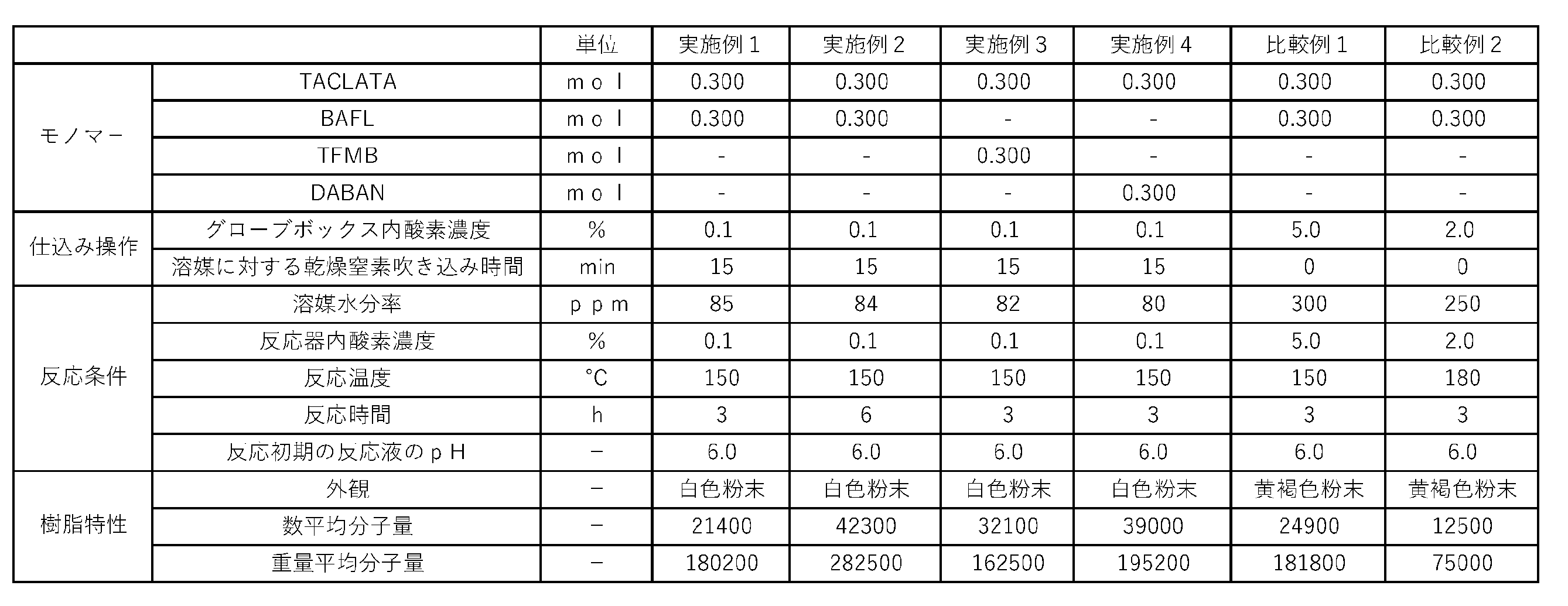
<ポリグアナミンフィルムの作製>
(実施例5)
150gのポリグアナミンAと850gの低水分率N,N’-ジメチルアセトアミド(DMAc)(水分率:45ppm)を2Lの反応容器内に導入し、窒素導入管、攪拌シール、攪拌棒を取り付け、乾燥窒素気流下、室温で1時間攪拌することによりポリグアナミン樹脂溶液を得た。次いで、このポリグアナミン樹脂溶液を厚み188μmのポリエステルフィルム上に塗布した後、イナートオーブンに投入し、乾燥窒素気流下、80℃で30分間熱処理することにより半乾燥フィルム(グリーンフィルム)を得た。次いで、このグリーンフィルムをPETフィルムから剥離し、金枠に固定した後、イナートオーブンに投入し、室温で1.5時間窒素置換することでイナートオーブン内酸素濃度を0.9%以下とした後、10分かけて150℃まで昇温し、150℃で2時間加熱処理することにより、厚さ5μmの無色透明のポリグアナミンフィルムを得た。得られたポリグアナミンフィルムの物性を表2に示す。
(実施例5)
150gのポリグアナミンAと850gの低水分率N,N’-ジメチルアセトアミド(DMAc)(水分率:45ppm)を2Lの反応容器内に導入し、窒素導入管、攪拌シール、攪拌棒を取り付け、乾燥窒素気流下、室温で1時間攪拌することによりポリグアナミン樹脂溶液を得た。次いで、このポリグアナミン樹脂溶液を厚み188μmのポリエステルフィルム上に塗布した後、イナートオーブンに投入し、乾燥窒素気流下、80℃で30分間熱処理することにより半乾燥フィルム(グリーンフィルム)を得た。次いで、このグリーンフィルムをPETフィルムから剥離し、金枠に固定した後、イナートオーブンに投入し、室温で1.5時間窒素置換することでイナートオーブン内酸素濃度を0.9%以下とした後、10分かけて150℃まで昇温し、150℃で2時間加熱処理することにより、厚さ5μmの無色透明のポリグアナミンフィルムを得た。得られたポリグアナミンフィルムの物性を表2に示す。
(実施例6)
150gのポリグアナミンAと850gの低水分率N,N’-ジメチルアセトアミド(DMAc)(水分率:48ppm)を2Lの反応容器内に導入し、窒素導入管、攪拌シール、攪拌棒を取り付け、乾燥窒素気流下、室温で1時間攪拌することによりポリグアナミン樹脂溶液を得た。次いで、このポリグアナミン樹脂溶液を厚み188μmのポリエステルフィルム上に塗布した後、イナートオーブンに投入し、乾燥窒素気流下、80℃で30分間熱処理することにより半乾燥フィルム(グリーンフィルム)を得た。次いで、このグリーンフィルムをPETフィルムから剥離し、金枠に固定した後、イナートオーブンに投入し、室温で1.5時間窒素置換することでイナートオーブン内酸素濃度を0.9%以下とした後、10分かけて150℃まで昇温し、150℃で2時間加熱処理し、更に10分かけて250℃まで昇温し、250℃で3時間加熱することにより、厚さ5μmの無色透明のポリグアナミンフィルムを得た。得られたポリグアナミンフィルムの物性を表2に示す。
150gのポリグアナミンAと850gの低水分率N,N’-ジメチルアセトアミド(DMAc)(水分率:48ppm)を2Lの反応容器内に導入し、窒素導入管、攪拌シール、攪拌棒を取り付け、乾燥窒素気流下、室温で1時間攪拌することによりポリグアナミン樹脂溶液を得た。次いで、このポリグアナミン樹脂溶液を厚み188μmのポリエステルフィルム上に塗布した後、イナートオーブンに投入し、乾燥窒素気流下、80℃で30分間熱処理することにより半乾燥フィルム(グリーンフィルム)を得た。次いで、このグリーンフィルムをPETフィルムから剥離し、金枠に固定した後、イナートオーブンに投入し、室温で1.5時間窒素置換することでイナートオーブン内酸素濃度を0.9%以下とした後、10分かけて150℃まで昇温し、150℃で2時間加熱処理し、更に10分かけて250℃まで昇温し、250℃で3時間加熱することにより、厚さ5μmの無色透明のポリグアナミンフィルムを得た。得られたポリグアナミンフィルムの物性を表2に示す。
(実施例7)
150gのポリグアナミンBと850gの低水分率N,N’-ジメチルアセトアミド(DMAc)(水分率:45ppm)を2Lの反応容器内に導入し、窒素導入管、攪拌シール、攪拌棒を取り付け、乾燥窒素気流下、室温で1時間攪拌することによりポリグアナミン樹脂溶液を得た。次いで、このポリグアナミン樹脂溶液を厚み188μmのポリエステルフィルム上に塗布した後、イナートオーブンに投入し、乾燥窒素気流下、80℃で30分間熱処理することにより半乾燥フィルム(グリーンフィルム)を得た。次いで、このグリーンフィルムをPETフィルムから剥離し、金枠に固定した後、イナートオーブンに投入し、室温で1.5時間窒素置換することでイナートオーブン内酸素濃度を0.9%以下とした後、10分かけて150℃まで昇温し、150℃で2時間加熱処理し、更に10分かけて250℃まで昇温し、250℃で3時間加熱することにより、厚さ5μmの無色透明のポリグアナミンフィルムを得た。得られたポリグアナミンフィルムの物性を表2に示す。
150gのポリグアナミンBと850gの低水分率N,N’-ジメチルアセトアミド(DMAc)(水分率:45ppm)を2Lの反応容器内に導入し、窒素導入管、攪拌シール、攪拌棒を取り付け、乾燥窒素気流下、室温で1時間攪拌することによりポリグアナミン樹脂溶液を得た。次いで、このポリグアナミン樹脂溶液を厚み188μmのポリエステルフィルム上に塗布した後、イナートオーブンに投入し、乾燥窒素気流下、80℃で30分間熱処理することにより半乾燥フィルム(グリーンフィルム)を得た。次いで、このグリーンフィルムをPETフィルムから剥離し、金枠に固定した後、イナートオーブンに投入し、室温で1.5時間窒素置換することでイナートオーブン内酸素濃度を0.9%以下とした後、10分かけて150℃まで昇温し、150℃で2時間加熱処理し、更に10分かけて250℃まで昇温し、250℃で3時間加熱することにより、厚さ5μmの無色透明のポリグアナミンフィルムを得た。得られたポリグアナミンフィルムの物性を表2に示す。
(実施例8)
150gのポリグアナミンCと850gの低水分率N,N’-ジメチルアセトアミド(DMAc)(水分率:47ppm)を2Lの反応容器内に導入し、窒素導入管、攪拌シール、攪拌棒を取り付け、乾燥窒素気流下、室温で1時間攪拌することによりポリグアナミン樹脂溶液を得た。次いで、このポリグアナミン樹脂溶液を厚み188μmのポリエステルフィルム上に塗布した後、イナートオーブンに投入し、乾燥窒素気流下、80℃で30分間熱処理することにより半乾燥フィルム(グリーンフィルム)を得た。次いで、このグリーンフィルムをPETフィルムから剥離し、金枠に固定した後、イナートオーブンに投入し、室温で1.5時間窒素置換することでイナートオーブン内酸素濃度を0.9%以下とした後、10分かけて150℃まで昇温し、150℃で2時間加熱処理し、更に10分かけて250℃まで昇温し、250℃で3時間加熱することにより、厚さ5μmの無色透明のポリグアナミンフィルムを得た。得られたポリグアナミンフィルムの物性を表2に示す。
150gのポリグアナミンCと850gの低水分率N,N’-ジメチルアセトアミド(DMAc)(水分率:47ppm)を2Lの反応容器内に導入し、窒素導入管、攪拌シール、攪拌棒を取り付け、乾燥窒素気流下、室温で1時間攪拌することによりポリグアナミン樹脂溶液を得た。次いで、このポリグアナミン樹脂溶液を厚み188μmのポリエステルフィルム上に塗布した後、イナートオーブンに投入し、乾燥窒素気流下、80℃で30分間熱処理することにより半乾燥フィルム(グリーンフィルム)を得た。次いで、このグリーンフィルムをPETフィルムから剥離し、金枠に固定した後、イナートオーブンに投入し、室温で1.5時間窒素置換することでイナートオーブン内酸素濃度を0.9%以下とした後、10分かけて150℃まで昇温し、150℃で2時間加熱処理し、更に10分かけて250℃まで昇温し、250℃で3時間加熱することにより、厚さ5μmの無色透明のポリグアナミンフィルムを得た。得られたポリグアナミンフィルムの物性を表2に示す。
(実施例9)
150gのポリグアナミンDと850gの低水分率N,N’-ジメチルアセトアミド(DMAc)(水分率:42ppm)を2Lの反応容器内に導入し、窒素導入管、攪拌シール、攪拌棒を取り付け、乾燥窒素気流下、室温で1時間攪拌することによりポリグアナミン樹脂溶液を得た。次いで、このポリグアナミン樹脂溶液を厚み188μmのポリエステルフィルム上に塗布した後、イナートオーブンに投入し、乾燥窒素気流下、80℃で30分間熱処理することにより半乾燥フィルム(グリーンフィルム)を得た。次いで、このグリーンフィルムをPETフィルムから剥離し、金枠に固定した後、イナートオーブンに投入し、室温で1.5時間窒素置換することでイナートオーブン内酸素濃度を0.9%以下とした後、10分かけて150℃まで昇温し、150℃で2時間加熱処理し、更に10分かけて250℃まで昇温し、250℃で3時間加熱することにより、厚さ5μmの無色透明のポリグアナミンフィルムを得た。得られたポリグアナミンフィルムの物性を表2に示す。
150gのポリグアナミンDと850gの低水分率N,N’-ジメチルアセトアミド(DMAc)(水分率:42ppm)を2Lの反応容器内に導入し、窒素導入管、攪拌シール、攪拌棒を取り付け、乾燥窒素気流下、室温で1時間攪拌することによりポリグアナミン樹脂溶液を得た。次いで、このポリグアナミン樹脂溶液を厚み188μmのポリエステルフィルム上に塗布した後、イナートオーブンに投入し、乾燥窒素気流下、80℃で30分間熱処理することにより半乾燥フィルム(グリーンフィルム)を得た。次いで、このグリーンフィルムをPETフィルムから剥離し、金枠に固定した後、イナートオーブンに投入し、室温で1.5時間窒素置換することでイナートオーブン内酸素濃度を0.9%以下とした後、10分かけて150℃まで昇温し、150℃で2時間加熱処理し、更に10分かけて250℃まで昇温し、250℃で3時間加熱することにより、厚さ5μmの無色透明のポリグアナミンフィルムを得た。得られたポリグアナミンフィルムの物性を表2に示す。
(比較例3)
150gのポリグアナミンEと850gの低水分率N,N’-ジメチルアセトアミド(DMAc)(水分率:43ppm)を2Lの反応容器内に導入し、窒素導入管、攪拌シール、攪拌棒を取り付け、乾燥窒素気流下、室温で1時間攪拌することによりポリグアナミン樹脂溶液を得た。次いで、このポリグアナミン樹脂溶液を厚み188μmのポリエステルフィルム上に塗布した後、イナートオーブンに投入し、乾燥窒素気流下、80℃で30分間熱処理することにより半乾燥フィルム(グリーンフィルム)を得た。次いで、このグリーンフィルムをPETフィルムから剥離し、金枠に固定した後、イナートオーブンに投入し、室温で1.5時間窒素置換することでイナートオーブン内酸素濃度を8.0%とした後、10分かけて150℃まで昇温し、150℃で2時間加熱処理し、更に10分かけて250℃まで昇温し、250℃で3時間加熱することにより、厚さ5μmの黄色のポリグアナミンフィルムを得た。得られたポリグアナミンフィルムの物性を表3に示す。
150gのポリグアナミンEと850gの低水分率N,N’-ジメチルアセトアミド(DMAc)(水分率:43ppm)を2Lの反応容器内に導入し、窒素導入管、攪拌シール、攪拌棒を取り付け、乾燥窒素気流下、室温で1時間攪拌することによりポリグアナミン樹脂溶液を得た。次いで、このポリグアナミン樹脂溶液を厚み188μmのポリエステルフィルム上に塗布した後、イナートオーブンに投入し、乾燥窒素気流下、80℃で30分間熱処理することにより半乾燥フィルム(グリーンフィルム)を得た。次いで、このグリーンフィルムをPETフィルムから剥離し、金枠に固定した後、イナートオーブンに投入し、室温で1.5時間窒素置換することでイナートオーブン内酸素濃度を8.0%とした後、10分かけて150℃まで昇温し、150℃で2時間加熱処理し、更に10分かけて250℃まで昇温し、250℃で3時間加熱することにより、厚さ5μmの黄色のポリグアナミンフィルムを得た。得られたポリグアナミンフィルムの物性を表3に示す。
(比較例4)
150gのポリグアナミンEと850gの低水分率N,N’-ジメチルアセトアミド(DMAc)(水分率:46ppm)を2Lの反応容器内に導入し、窒素導入管、攪拌シール、攪拌棒を取り付け、乾燥窒素気流下、室温で1時間攪拌することによりポリグアナミン樹脂溶液を得た。次いで、このポリグアナミン樹脂溶液を厚み188μmのポリエステルフィルム上に塗布した後、イナートオーブンに投入し、乾燥窒素気流下、80℃で30分間熱処理することにより半乾燥フィルム(グリーンフィルム)を得た。次いで、このグリーンフィルムをPETフィルムから剥離し、金枠に固定した後、イナートオーブンに投入し、室温で1.5時間窒素置換することでイナートオーブン内酸素濃度を0.9%以下とした後、10分かけて150℃まで昇温し、150℃で2時間加熱処理し、更に10分かけて250℃まで昇温し、250℃で3時間加熱することにより、厚さ5μmの黄色のポリグアナミンフィルムを得た。得られたポリグアナミンフィルムの物性を表3に示す。
150gのポリグアナミンEと850gの低水分率N,N’-ジメチルアセトアミド(DMAc)(水分率:46ppm)を2Lの反応容器内に導入し、窒素導入管、攪拌シール、攪拌棒を取り付け、乾燥窒素気流下、室温で1時間攪拌することによりポリグアナミン樹脂溶液を得た。次いで、このポリグアナミン樹脂溶液を厚み188μmのポリエステルフィルム上に塗布した後、イナートオーブンに投入し、乾燥窒素気流下、80℃で30分間熱処理することにより半乾燥フィルム(グリーンフィルム)を得た。次いで、このグリーンフィルムをPETフィルムから剥離し、金枠に固定した後、イナートオーブンに投入し、室温で1.5時間窒素置換することでイナートオーブン内酸素濃度を0.9%以下とした後、10分かけて150℃まで昇温し、150℃で2時間加熱処理し、更に10分かけて250℃まで昇温し、250℃で3時間加熱することにより、厚さ5μmの黄色のポリグアナミンフィルムを得た。得られたポリグアナミンフィルムの物性を表3に示す。
(比較例5)
150gのポリグアナミンFと850gの低水分率N,N’-ジメチルアセトアミド(DMAc)(水分率:46ppm)を2Lの反応容器内に導入し、窒素導入管、攪拌シール、攪拌棒を取り付け、乾燥窒素気流下、室温で1時間攪拌することによりポリグアナミン樹脂溶液を得た。次いで、このポリグアナミン樹脂溶液を厚み188μmのポリエステルフィルム上に塗布した後、イナートオーブンに投入し、乾燥窒素気流下、80℃で30分間熱処理することにより半乾燥フィルム(グリーンフィルム)を得た。次いで、このグリーンフィルムをPETフィルムから剥離し、金枠に固定した後、イナートオーブンに投入し、室温で1.5時間窒素置換することでイナートオーブン内酸素濃度を0.9%以下とした後、10分かけて150℃まで昇温し、150℃で2時間加熱処理し、更に10分かけて250℃まで昇温し、250℃で3時間加熱することにより、厚さ5μmの黄色のポリグアナミンフィルムを得た。得られたポリグアナミンフィルムの物性を表3に示す。
150gのポリグアナミンFと850gの低水分率N,N’-ジメチルアセトアミド(DMAc)(水分率:46ppm)を2Lの反応容器内に導入し、窒素導入管、攪拌シール、攪拌棒を取り付け、乾燥窒素気流下、室温で1時間攪拌することによりポリグアナミン樹脂溶液を得た。次いで、このポリグアナミン樹脂溶液を厚み188μmのポリエステルフィルム上に塗布した後、イナートオーブンに投入し、乾燥窒素気流下、80℃で30分間熱処理することにより半乾燥フィルム(グリーンフィルム)を得た。次いで、このグリーンフィルムをPETフィルムから剥離し、金枠に固定した後、イナートオーブンに投入し、室温で1.5時間窒素置換することでイナートオーブン内酸素濃度を0.9%以下とした後、10分かけて150℃まで昇温し、150℃で2時間加熱処理し、更に10分かけて250℃まで昇温し、250℃で3時間加熱することにより、厚さ5μmの黄色のポリグアナミンフィルムを得た。得られたポリグアナミンフィルムの物性を表3に示す。
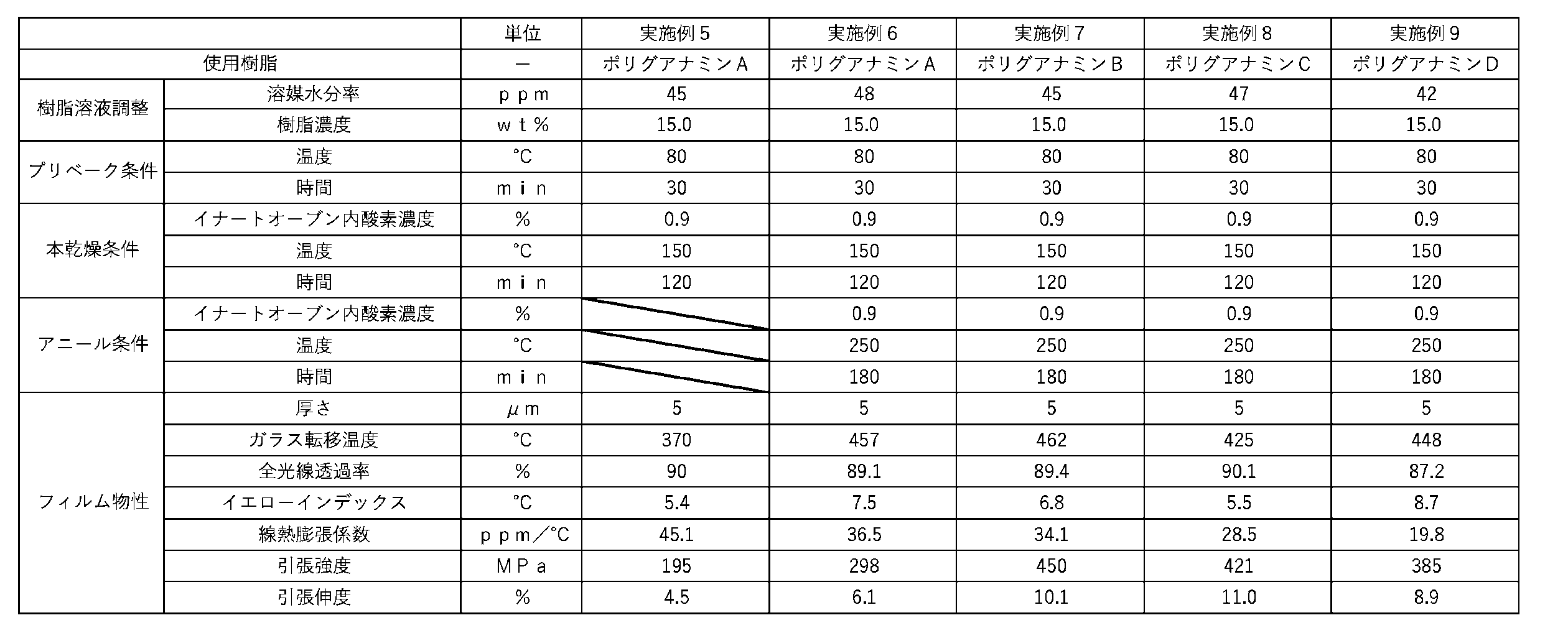
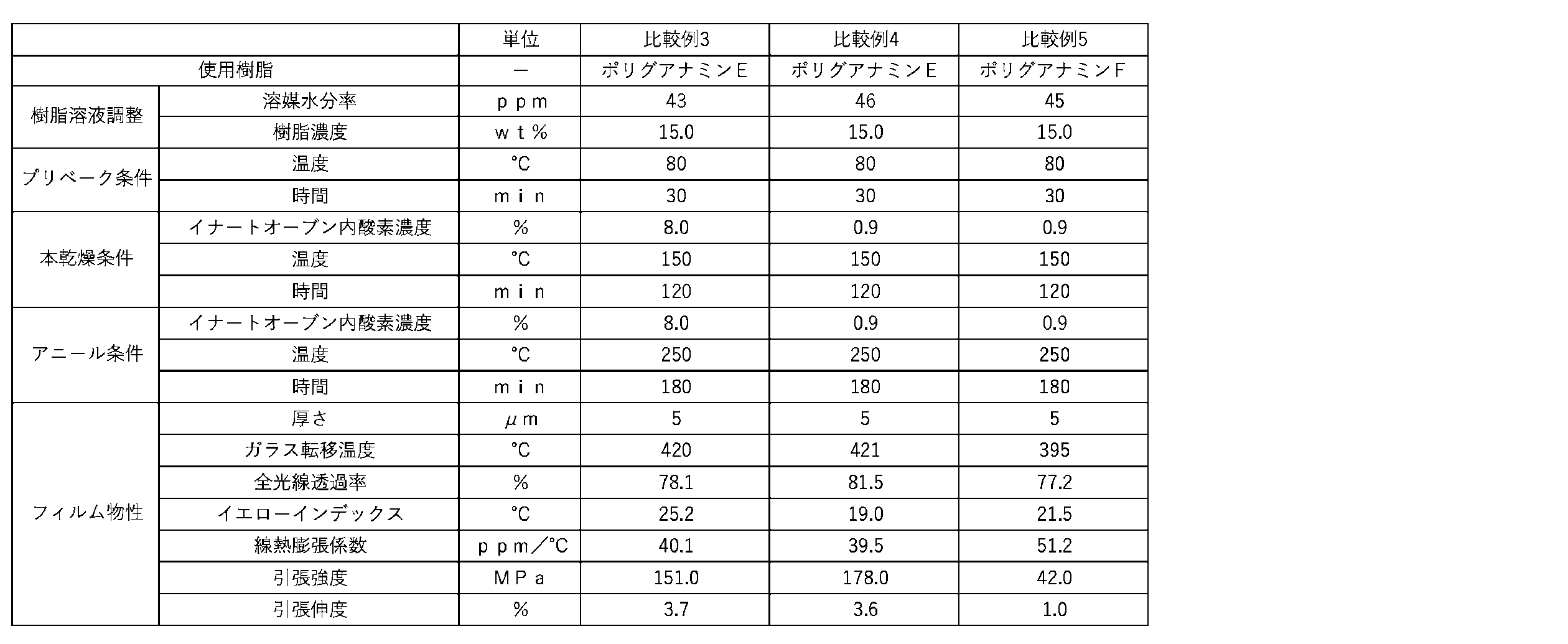
実施例1~4のポリグアナミン(ポリグアナミンA~D)は、合成時の反応条件が以下の反応条件であったため、適切な条件でフィルム化することにより、無色透明性と耐熱性とを兼ね揃えたポリグアナミンフィルムを得ることができた(実施例5~9)。
一方、比較例1,2のポリグアナミン(ポリグアナミンE、F)は、合成時の反応条件が以下の反応条件外であったため、当該ポリグアナミンをフィルム化しても、無色透明性を有するポリグアナミンフィルムを得ることができなかった(比較例3~5)。
<反応条件>
不活性ガス雰囲気下
前記有機溶剤の水分率:500ppm以下
反応温度:300℃以下
反応時間:60時間以内。
一方、比較例1,2のポリグアナミン(ポリグアナミンE、F)は、合成時の反応条件が以下の反応条件外であったため、当該ポリグアナミンをフィルム化しても、無色透明性を有するポリグアナミンフィルムを得ることができなかった(比較例3~5)。
<反応条件>
不活性ガス雰囲気下
前記有機溶剤の水分率:500ppm以下
反応温度:300℃以下
反応時間:60時間以内。
ここで、ポリグアナミンフィルムの厚みが5μmより大きい場合、当該フィルムをそのまま測定し、その測定結果が「ガラス転移温度が350℃以上であり、全光線透過率が85%以上であり、イエローインデックスが10以下」を満たせば、必ず、厚みが5μの場合も当該数値範囲を満たすことになることを、下記参考例1~5を用いて説明する。
(参考例1)
厚さを10μmに変更したこと以外は、実施例6と同様にして、参考例1に係るポリグアナミンフィルムを得た。得られたポリグアナミンフィルムの物性を表4に示す。
厚さを10μmに変更したこと以外は、実施例6と同様にして、参考例1に係るポリグアナミンフィルムを得た。得られたポリグアナミンフィルムの物性を表4に示す。
(参考例2)
厚さを15μmに変更したこと以外は、実施例6と同様にして、参考例2に係るポリグアナミンフィルムを得た。得られたポリグアナミンフィルムの物性を表4に示す。
厚さを15μmに変更したこと以外は、実施例6と同様にして、参考例2に係るポリグアナミンフィルムを得た。得られたポリグアナミンフィルムの物性を表4に示す。
(参考例3)
厚さを25μmに変更したこと以外は、実施例6と同様にして、参考例3に係るポリグアナミンフィルムを得た。得られたポリグアナミンフィルムの物性を表4に示す。
厚さを25μmに変更したこと以外は、実施例6と同様にして、参考例3に係るポリグアナミンフィルムを得た。得られたポリグアナミンフィルムの物性を表4に示す。
(参考例4)
厚さを50μmに変更したこと以外は、実施例6と同様にして、参考例4に係るポリグアナミンフィルムを得た。得られたポリグアナミンフィルムの物性を表4に示す。
厚さを50μmに変更したこと以外は、実施例6と同様にして、参考例4に係るポリグアナミンフィルムを得た。得られたポリグアナミンフィルムの物性を表4に示す。
(参考例5)
厚さを15μmに変更したこと以外は、実施例8と同様にして、参考例5に係るポリグアナミンフィルムを得た。得られたポリグアナミンフィルムの物性を表4に示す。
厚さを15μmに変更したこと以外は、実施例8と同様にして、参考例5に係るポリグアナミンフィルムを得た。得られたポリグアナミンフィルムの物性を表4に示す。

参考例1~4は、実施例6と同じポリグアナミンAを用い、厚みを5μmより大きくした場合の例である。参考例1~4の測定結果から分かるように、厚みを5μmより大きくして測定した場合に、「ガラス転移温度が350℃以上であり、全光線透過率が85%以上であり、イエローインデックスが10以下」を満たすならば、必ず、厚み5μmとして測定した場合に「ガラス転移温度が350℃以上であり、全光線透過率が85%以上であり、イエローインデックスが10以下」を満たすことが分かる。
同様に、参考例5は、実施例8と同じポリグアナミンCを用い、厚みを5μmより大きくした場合の例である。参考例5の測定結果から分かるように、厚みを5μmより大きくして測定した場合に、「ガラス転移温度が350℃以上であり、全光線透過率が85%以上であり、イエローインデックスが10以下」を満たすならば、必ず、厚み5μmとして測定した場合に「ガラス転移温度が350℃以上であり、全光線透過率が85%以上であり、イエローインデックスが10以下」を満たすことが分かる。
同様に、参考例5は、実施例8と同じポリグアナミンCを用い、厚みを5μmより大きくした場合の例である。参考例5の測定結果から分かるように、厚みを5μmより大きくして測定した場合に、「ガラス転移温度が350℃以上であり、全光線透過率が85%以上であり、イエローインデックスが10以下」を満たすならば、必ず、厚み5μmとして測定した場合に「ガラス転移温度が350℃以上であり、全光線透過率が85%以上であり、イエローインデックスが10以下」を満たすことが分かる。
Claims (5)
- 下記式(1)(式中、Aは芳香環構造及び/又は脂環構造を有する2価の有機基)で表される繰り返し単位を含み、
厚み5μmのフィルムとして測定した場合のガラス転移温度が350℃以上であり、全光線透過率が85%以上であり、イエローインデックスが10以下であることを特徴とするポリグアナミン。

- 100~300℃の間の線熱膨張係数が50ppm/℃以下であることを特徴とする請求項1に記載のポリグアナミン。
- 重量平均分子量が170,000以上であることを特徴とする請求項1または請求項2に記載のポリグアナミン。
- 請求項1~3のいずれか1に記載のポリグアナミンを含むことを特徴とするポリグアナミンフィルム。
- 5,17-ジクロロテトラアザカリックス[2]アレーン[2]トリアジンと、芳香環構造及び/又は脂環構造を有するジアミン類とを、有機溶剤中で重合してポリグアナミンを得る工程Aを含み、
前記工程Aは、以下の反応条件下にて行うことを特徴とするポリグアナミンの製造方法。
<反応条件>
不活性ガス雰囲気下
前記有機溶剤の水分率:500ppm以下
反応温度:300℃以下
反応時間:60時間以内。
Priority Applications (1)
| Application Number | Priority Date | Filing Date | Title |
|---|---|---|---|
| JP2022531736A JP7251749B2 (ja) | 2020-06-18 | 2021-06-10 | ポリグアナミン、ポリグアナミンフィルム、及び、ポリグアナミンの製造方法 |
Applications Claiming Priority (2)
| Application Number | Priority Date | Filing Date | Title |
|---|---|---|---|
| JP2020-105173 | 2020-06-18 | ||
| JP2020105173 | 2020-06-18 |
Publications (1)
| Publication Number | Publication Date |
|---|---|
| WO2021256367A1 true WO2021256367A1 (ja) | 2021-12-23 |
Family
ID=79267949
Family Applications (1)
| Application Number | Title | Priority Date | Filing Date |
|---|---|---|---|
| PCT/JP2021/022084 Ceased WO2021256367A1 (ja) | 2020-06-18 | 2021-06-10 | ポリグアナミン、ポリグアナミンフィルム、及び、ポリグアナミンの製造方法 |
Country Status (2)
| Country | Link |
|---|---|
| JP (1) | JP7251749B2 (ja) |
| WO (1) | WO2021256367A1 (ja) |
Citations (1)
| Publication number | Priority date | Publication date | Assignee | Title |
|---|---|---|---|---|
| JP2004156001A (ja) * | 2002-11-07 | 2004-06-03 | Sanei Kagaku Kk | フェノール性水酸基を含有するトリアジンジハライド及び芳香族(ポリ)グアナミン、並びにその組成物 |
-
2021
- 2021-06-10 WO PCT/JP2021/022084 patent/WO2021256367A1/ja not_active Ceased
- 2021-06-10 JP JP2022531736A patent/JP7251749B2/ja active Active
Patent Citations (1)
| Publication number | Priority date | Publication date | Assignee | Title |
|---|---|---|---|---|
| JP2004156001A (ja) * | 2002-11-07 | 2004-06-03 | Sanei Kagaku Kk | フェノール性水酸基を含有するトリアジンジハライド及び芳香族(ポリ)グアナミン、並びにその組成物 |
Non-Patent Citations (3)
| Title |
|---|
| FUKUSHI KEITO, MARUYAMA HARUKA, SHIBASAKI YUJI, FUJIMORI ATSUHIRO: "Polyguanamine Derivative-Based Supramolecular Assemblies with Multiple Hydrogen Bonding and Their Metal-Scavenging Abilities", LANGMUIR, AMERICAN CHEMICAL SOCIETY, US, vol. 36, no. 14, 25 March 2020 (2020-03-25), US , pages 3770 - 3781, XP055895069, ISSN: 0743-7463, DOI: 10.1021/acs.langmuir.0c00283 * |
| HOSHINO, YUI ET AL.: "Cyclic guanamine dichloride and polycondensation of diamino-polyethylene glycol at both ends", POLYMER PREPRINTS, vol. 65, no. 2, 2016, Japan, pages 2Pf016 * |
| SASAKI, HARUKI ET AL.: "Synthesis and properties of ring-containing polyguanamines consisting of cyclic guanamine dichloride monomers and aliphatic diamine monomers", PREPRINTS OF THE SOCIETY OF FIBER SCIENCE AND TECHNOLOGY, vol. 74, no. 1, 5 June 2019 (2019-06-05), Japan, pages 1E07 * |
Also Published As
| Publication number | Publication date |
|---|---|
| JP7251749B2 (ja) | 2023-04-04 |
| JPWO2021256367A1 (ja) | 2021-12-23 |
Similar Documents
| Publication | Publication Date | Title |
|---|---|---|
| CN109897180B (zh) | 聚酰胺酸溶液、利用其的透明聚酰亚胺树脂膜及透明基板 | |
| EP3444292B1 (en) | Colorless and transparent polyamide-imide film, and manufacturing method therefor | |
| JP6853870B2 (ja) | ポリイミド−ポリベンゾオキサゾール前駆体溶液、ポリイミド−ポリベンゾオキサゾールフィルム、及びその製造方法 | |
| TWI376393B (en) | Polyimide resin and liquid crystal alignment layer and polyimide film using the same | |
| CN108431086B (zh) | 使用脂环族单体的聚酰胺酸组合物及利用其的透明聚酰亚胺膜 | |
| CN110099946B (zh) | 透明聚酰亚胺膜 | |
| JP6929355B2 (ja) | ポリアミック酸、ポリイミド、ポリイミドフィルム、これを含む画像表示素子及びポリアミック酸の製造方法 | |
| JP6980919B2 (ja) | ポリアミック酸の製造方法、これから製造されたポリアミック酸、ポリイミド樹脂、及びポリイミドフィルム | |
| JP7349253B2 (ja) | ポリアミド酸、ポリアミド酸溶液、ポリイミド、ポリイミド膜、積層体およびフレキシブルデバイス、ならびにポリイミド膜の製造方法。 | |
| KR101292993B1 (ko) | 폴리이미드 수지와 이를 이용한 액정 배향막 및 필름 | |
| KR102251515B1 (ko) | 내용제성이 개선된 무색투명한 폴리아마이드-이미드 필름 | |
| TWI634136B (zh) | 聚醯亞胺聚合物以及聚醯亞胺膜 | |
| TW201942194A (zh) | 聚醯亞胺、聚醯亞胺溶液組成物、聚醯亞胺膜及基板 | |
| JP7317122B2 (ja) | ポリアミド酸組成物の製造方法、ポリアミド酸組成物、これを用いたポリイミドフィルムの製造方法及びその製造方法によって製造されたポリイミドフィルム | |
| TWI792536B (zh) | 聚醯亞胺聚合物膜、可撓顯示裝置基板以及使用其之可撓顯示裝置 | |
| JPWO2020067558A5 (ja) | ||
| JPWO2020067558A1 (ja) | ポリイミド前駆体及びそれから生じるポリイミド並びにフレキシブルデバイス | |
| JP7251749B2 (ja) | ポリグアナミン、ポリグアナミンフィルム、及び、ポリグアナミンの製造方法 | |
| KR20170054835A (ko) | 폴리이미드계 필름 형성용 조성물 및 이를 이용하여 제조된 투명 폴리이미드계 필름 | |
| TW201720855A (zh) | 聚醯亞胺聚合物、聚醯亞胺膜以及聚醯亞胺膜的製造方法 | |
| JP6846148B2 (ja) | ポリイミド前駆体溶液及びその製造方法並びにポリイミドフィルムの製造方法及び積層体の製造方法 | |
| TWI921459B (zh) | 聚醯亞胺前體清漆及其製造方法、聚醯亞胺及其製造方法、可撓性器件及配線基板用層疊體 | |
| JP6994712B2 (ja) | γ-ブチロラクトン溶媒中で重合した可溶性透明ポリイミド | |
| CN117616072A (zh) | 具有优异的折叠性能的光学膜和包括该光学膜的显示装置 | |
| TW202239889A (zh) | 聚醯亞胺前體清漆及其製造方法、聚醯亞胺及其製造方法、可撓性器件及配線基板用層疊體 |
Legal Events
| Date | Code | Title | Description |
|---|---|---|---|
| 121 | Ep: the epo has been informed by wipo that ep was designated in this application |
Ref document number: 21825994 Country of ref document: EP Kind code of ref document: A1 |
|
| ENP | Entry into the national phase |
Ref document number: 2022531736 Country of ref document: JP Kind code of ref document: A |
|
| NENP | Non-entry into the national phase |
Ref country code: DE |
|
| 122 | Ep: pct application non-entry in european phase |
Ref document number: 21825994 Country of ref document: EP Kind code of ref document: A1 |