WO2021240800A1 - 冷凍サイクル装置 - Google Patents
冷凍サイクル装置 Download PDFInfo
- Publication number
- WO2021240800A1 WO2021240800A1 PCT/JP2020/021394 JP2020021394W WO2021240800A1 WO 2021240800 A1 WO2021240800 A1 WO 2021240800A1 JP 2020021394 W JP2020021394 W JP 2020021394W WO 2021240800 A1 WO2021240800 A1 WO 2021240800A1
- Authority
- WO
- WIPO (PCT)
- Prior art keywords
- refrigerant
- valve
- gas
- liquid separator
- control device
- Prior art date
- Legal status (The legal status is an assumption and is not a legal conclusion. Google has not performed a legal analysis and makes no representation as to the accuracy of the status listed.)
- Ceased
Links
Images


Classifications
-
- F—MECHANICAL ENGINEERING; LIGHTING; HEATING; WEAPONS; BLASTING
- F25—REFRIGERATION OR COOLING; COMBINED HEATING AND REFRIGERATION SYSTEMS; HEAT PUMP SYSTEMS; MANUFACTURE OR STORAGE OF ICE; LIQUEFACTION SOLIDIFICATION OF GASES
- F25B—REFRIGERATION MACHINES, PLANTS OR SYSTEMS; COMBINED HEATING AND REFRIGERATION SYSTEMS; HEAT PUMP SYSTEMS
- F25B1/00—Compression machines, plants or systems with non-reversible cycle
Definitions
- This disclosure relates to a refrigeration cycle device.
- Patent Document 1 Japanese Patent Application Laid-Open No. 1-107061 connects a gas-liquid separator between an outdoor heat exchanger and an indoor heat exchanger, and precisely attaches a gas-liquid separator to the gas discharge side of the gas-liquid separator.
- Patent Document 1 Japanese Patent Application Laid-Open No. 1-107061
- a heat pump device to which a retaining tower is connected is disclosed.
- the gas refrigerant separated by the gas-liquid separator is stored in the rectification tower, so that the refrigerant composition changes.
- Patent Document 1 With the technique disclosed in Patent Document 1, it takes time to separate the liquid refrigerant and the gas refrigerant by the gas-liquid separator. Therefore, it takes time to change the refrigerant composition.
- the present disclosure has been made to solve the above problems, and an object thereof is to provide a refrigerating cycle apparatus in which the refrigerant composition can be easily changed.
- the non-cobo-boiling mixed refrigerant is discharged from the refrigerant circuit in which the compressor, the condenser, the gas-liquid separator, the decompression device, and the evaporator circulate in this order, and the gas-liquid separator. It is provided with a receiver for storing the gas refrigerant and a bypass pipe for returning a part of the refrigerant discharged from the compressor between the condenser and the gas-liquid separator in the refrigerant circuit. A part of the bypass pipe is arranged in the gas-liquid separator.
- the liquid refrigerant in the gas-liquid separator is heated by exchanging heat with the high-temperature and high-pressure refrigerant in the bypass pipe. NS. This promotes the separation of the liquid refrigerant and the gas refrigerant in the gas-liquid separator. As a result, it becomes easy to change the refrigerant composition.
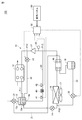
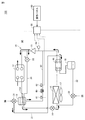
- FIG. It is a figure which shows the internal structure of the refrigerating cycle apparatus 100 which concerns on Embodiment 1.
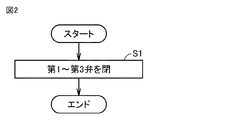
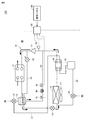
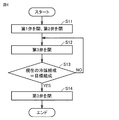
- FIG. It is a flowchart which shows the control flow of the control apparatus 50 when the hot water supply temperature is maintained below a reference temperature. It is a figure which shows the flow of the refrigerant in a refrigerating cycle apparatus 100 when a hot water supply temperature is maintained below a reference temperature. It is a flowchart which shows the control flow of the control apparatus 50 when the hot water supply temperature which exceeds a reference temperature is set. It is a figure which shows the flow of the refrigerant in a refrigerating cycle apparatus 100 when a hot water supply temperature exceeding a reference temperature is set.
- FIG. 1 is a diagram showing an internal configuration of the refrigeration cycle device 100 according to the first embodiment.
- the refrigeration cycle device 100 shown in FIG. 1 can be used, for example, as a water heater.
- a case where the refrigeration cycle device 100 is used as a water heater will be described.
- the refrigerating cycle device 100 includes a refrigerant circuit 10 in which a refrigerant circulates, and a receiver 18 configured to be able to store a part of the refrigerant circulating in the refrigerant circuit 10.
- a non-azeotropic mixed refrigerant is used as the refrigerant circulating in the refrigerant circuit 10.
- the non-azeotropic mixed refrigerant is a mixture containing a low boiling point refrigerant and a high boiling point refrigerant having a higher boiling point than the low boiling point refrigerant.
- the low boiling point refrigerant is, for example, R32 and has a large heating capacity.
- the high boiling point refrigerant is, for example, R1234yf, which is suitable for high temperature hot water discharge.
- the refrigerant circuit 10 is filled with a non-cobo-boiling mixed refrigerant having a composition suitable when the hot water supply temperature is set to the reference temperature or lower (hereinafter referred to as “reference composition”).
- the reference temperature is predetermined and is, for example, 45 ° C.
- the refrigerant circuit 10 includes a compressor 11, a condenser 12, a gas-liquid separator 13, an expansion valve 14 as a decompression device, and an evaporator 15.
- the refrigerant circulates in the order of the compressor 11, the condenser 12, the gas-liquid separator 13, the expansion valve 14, and the evaporator 15.
- the compressor 11 is a variable capacity type or fixed capacity type compressor.
- the discharge side of the compressor 11 is connected to the condenser 12.
- the condenser 12 is a heat exchanger on the user side, and heats are exchanged between the refrigerant flowing in the condenser 12 and the hot water supply water.
- the discharge side of the condenser 12 is connected to the gas-liquid separator 13.
- the gas-liquid separator 13 separates the refrigerant flowing out of the condenser 12 into a liquid refrigerant (hereinafter referred to as "liquid refrigerant”) and a gaseous refrigerant (hereinafter referred to as "gas refrigerant").
- liquid refrigerant hereinafter referred to as "liquid refrigerant”
- gas refrigerant hereinafter referred to as "gas refrigerant”
- the non-azeotropic mixed refrigerant filled in the refrigerant circuit 10 includes a low boiling point refrigerant and a high boiling point refrigerant. Therefore, the gas refrigerant separated by the gas-liquid separator 13 is mainly composed of a low boiling point refrigerant.
- the gas-liquid separator 13 is formed with two liquid refrigerant discharge ports 13a and 13b for discharging the liquid refrigerant and a gas refrigerant discharge port 13c for discharging the gas refrigerant.
- An expansion valve 14 is connected to the liquid refrigerant discharge port 13a.
- the expansion valve 14 is arranged between the gas-liquid separator 13 and the evaporator 15 and decompresses and expands the refrigerant flowing out of the gas-liquid separator 13.
- the expansion valve 14 may be an electronic expansion valve or the like whose opening degree can be adjusted, or may be a capillary tube or the like. The refrigerant decompressed and expanded by the expansion valve 14 flows to the evaporator 15.
- the evaporator 15 is a heat exchanger on the heat source side, and exchanges heat between the refrigerant flowing in the evaporator 12 and the air sent out by the blower 17. The refrigerant flowing out of the evaporator 15 is sucked into the compressor 11.
- the refrigeration cycle device 100 includes bypass pipes 20 and 23 and connection pipes 21 and 22 connected to the refrigerant circuit 10.
- the bypass pipe 20 connects the branch point P10 provided in the refrigerant circuit 10 and the confluence point P11 provided in the refrigerant circuit 10.
- the branch point P10 is provided between the compressor 11 and the condenser 12.
- the confluence point P11 is provided between the condenser 12 and the gas-liquid separator 13.
- the bypass pipe 20 returns a part of the refrigerant discharged from the compressor 11 between the condenser 12 and the gas-liquid separator 13 in the refrigerant circuit 10.
- a part of the bypass pipe 20 is arranged in the gas-liquid separator 13. Specifically, a part of the bypass pipe 20 is arranged in the gas-liquid separator 13 so as to be in contact with the liquid refrigerant.
- the high-temperature and high-pressure refrigerant discharged from the compressor 11 flows through the bypass pipe 20. Therefore, the liquid refrigerant in the gas-liquid separator 13 is heated by exchanging heat with the high-temperature and high-pressure refrigerant in the bypass pipe 20. This promotes the separation of the liquid refrigerant and the gas refrigerant in the gas-liquid separator 13.
- connection pipe 21 connects the gas refrigerant discharge port 13c of the gas-liquid separator 13 and the receiver 18. By providing the connection pipe 21, the receiver 18 stores the gas refrigerant discharged from the gas-liquid separator 13.
- connection pipe 22 connects the receiver 18 and the confluence point P12 provided in the refrigerant circuit 10.
- the merging point P12 is provided between the expansion valve 14 and the evaporator 15.
- the bypass pipe 23 connects the liquid refrigerant discharge port 13b of the gas-liquid separator 13 and the confluence point P13 provided in the refrigerant circuit 10.
- the confluence point P13 is provided on the suction side of the compressor 11.
- the bypass pipe 23 is provided with a capillary 40 as a decompression device. As a result, a part of the liquid refrigerant separated by the gas-liquid separator 13 is decompressed by the capillary 40 and returned to the suction side of the compressor 11.
- the refrigeration cycle device 100 includes a cooler 16 provided in the middle of the connection pipe 21.
- the cooler 16 exchanges heat between the refrigerant flowing out of the evaporator 15 and the gas refrigerant flowing through the connection pipe 21.
- the refrigerant flowing out of the evaporator 15 is low temperature and low pressure. Therefore, the cooler 16 cools the gas refrigerant flowing through the connecting pipe 21 by using the refrigerant flowing out from the evaporator 15.
- the gas refrigerant flowing through the connection pipe 21 changes to a liquid refrigerant.
- the liquid refrigerant is stored in the receiver 18.
- the cooler 16 is preferably arranged above the receiver 18. As a result, the refrigerant flowing in the connecting pipe 21 changes to a liquid when passing through the cooler 16, and then falls to the receiver 18 due to gravity. That is, it becomes easy to store the refrigerant in the receiver 18.
- the refrigeration cycle device 100 includes a first valve 31, a second valve 32, and a third valve 33 provided in the connection pipes 21 and 22 and the bypass pipe 20, respectively.
- the first valve 31, the second valve 32, and the third valve 33 are controlled to either an open state or a closed state.
- the refrigeration cycle device 100 includes temperature sensors 41 and 42 and a pressure sensor 43 as a detection unit for detecting the composition of the refrigerant circulating in the refrigerant circuit 10.
- the temperature sensor 41 measures the temperature of the refrigerant at the inlet of the capillary 40 in the bypass pipe 23.
- the temperature sensor 42 measures the temperature of the refrigerant at the outlet of the capillary 40 in the bypass pipe 23.
- the pressure sensor 43 measures the pressure of the refrigerant sucked into the compressor 11.
- the refrigeration cycle device 100 includes a control device 50 and an operation panel 60.
- the operation panel 60 receives, for example, the setting of the hot water supply temperature from the user of the hot water supply system.
- the control device 50 controls the operation of each part provided in the refrigeration cycle device 100. Specifically, the control device 50 has the first valve 31 and the second valve according to the set hot water supply temperature, the temperature measured by the temperature sensors 41 and 42, and the pressure measured by the pressure sensor 43. 32 and the third valve 33 are controlled.
- the refrigerant circuit 10 is filled with a non-azeotropic mixed refrigerant having a standard composition suitable when the hot water supply temperature is set to the reference temperature or lower. Therefore, when the hot water supply temperature is set to the reference temperature or lower, it is preferable that the refrigerant composition in the refrigerant circuit 10 approaches the reference composition. As a result, the concentration of the low boiling point refrigerant having a large heating capacity is increased in the refrigerant circuit 10, and the power consumption can be reduced. Therefore, when the hot water supply temperature is set to the reference temperature or lower, the control device 50 sets the first valve 31, the second valve 32, and the third valve 33 so as to reduce the amount of the low boiling point refrigerant stored in the receiver 18. Control.
- the control device 50 determines the refrigerant in the refrigerant circuit 10 based on the temperature measured by the temperature sensors 41 and 42 and the pressure measured by the pressure sensor 43. Calculate the composition.
- the refrigerant composition is represented, for example, at least one of the concentration of the low boiling point refrigerant and the concentration of the high boiling point refrigerant.
- the control device controls the first valve 31, the second valve 32, and the third valve 33 so that the calculated refrigerant composition matches the target composition suitable for the hot water supply temperature.
- the control device 50 can be configured by hardware such as a circuit device that realizes its function.
- the control device 50 can also be configured by an arithmetic unit such as a CPU (Central Processing Unit) and a memory in which software executed by the arithmetic unit is stored. The details of the control method of the control device 50 will be described below.
- the control device 50 may calculate the refrigerant composition in the refrigerant circuit 10 by using a known method. For example, the control device 50 calculates the refrigerant composition in the refrigerant circuit 10 by using the technique described in Japanese Patent Application Laid-Open No. 8-75280 (Patent Document 2).
- the control device 50 acquires the temperatures T1 and T2 measured by the temperature sensors 41 and 42 and the pressure P measured by the pressure sensor 43, respectively. Next, the control device 50 sets an assumed value ⁇ of the refrigerant composition in the refrigerant circuit 10.
- the assumed value ⁇ of the refrigerant composition, the temperature T1 at the inlet of the capillary 40, the pressure P of the refrigerant sucked into the compressor 11 (that is, the pressure at the outlet of the capillary 40), and the dryness X of the refrigerant at the outlet of the capillary 40 are The following relational expression (1) is satisfied.
- X f1 (T1, P, ⁇ ) ... (1)
- the above relational expression (1) is determined in advance by an experiment or the like.
- the control device 50 stores the relational expression (1) in advance, and calculates the dryness X by substituting the assumed value ⁇ , the temperature T1 and the pressure P into the relational expression (1).
- control device 50 calculates the refrigerant composition ⁇ 'in the refrigerant circuit 10 by using the temperature T2 at the outlet of the capillary 40, the calculated dryness X, and the pressure P.
- the above relational expression (2) is determined in advance by an experiment or the like.
- the control device 50 stores the relational expression (2) in advance, and calculates the refrigerant composition ⁇ 'by substituting the pressure P, the dryness X, and the temperature T2 into the relational expression (2).
- the control device 50 compares the refrigerant composition ⁇ 'and the assumed value ⁇ , and if they match, determines the refrigerant composition in the refrigerant circuit 10 to ⁇ '. If they do not match, the control device 50 reassumes the assumed value ⁇ and continues the calculation until the refrigerant composition ⁇ 'and the assumed value ⁇ match.
- FIG. 2 is a flowchart showing a control flow of the control device 50 when the hot water supply temperature is maintained below the reference temperature.
- FIG. 3 is a diagram showing the flow of the refrigerant in the refrigerating cycle device 100 when the hot water supply temperature is maintained below the reference temperature. In FIG. 3, the flow of the refrigerant is indicated by an arrow.
- control device 50 closes the first valve 31, the second valve 32, and the third valve 33 (step S1).
- the refrigerant circulates in the order of the compressor 11, the condenser 12, the gas-liquid separator 13, the expansion valve 14, and the evaporator 15. Since the first valve 31, the second valve 32, and the third valve 33 are closed, no refrigerant flows through the bypass pipe 20 and the connection pipes 21 and 22. Therefore, the low boiling point refrigerant is not stored in the receiver 18, and the refrigerant composition in the refrigerant circuit 10 is maintained at the reference composition.
- FIG. 4 is a flowchart showing a control flow of the control device 50 when a hot water supply temperature exceeding the reference temperature is set.
- FIG. 5 is a diagram showing the flow of the refrigerant in the refrigerating cycle device 100 when the hot water supply temperature exceeding the reference temperature is set.
- control device 50 opens the first valve 31 and closes the second valve 32 (step S11). Next, the control device 50 opens the third valve 33 (step S12).
- the gas refrigerant is discharged from the gas refrigerant discharge port 13c of the gas-liquid separator 13 to the connection pipe 21. Further, when the third valve 33 is opened, a high-temperature and high-pressure refrigerant flows through the bypass pipe 20. As a result, the liquid refrigerant in the gas-liquid separator 13 is heated by the refrigerant in the bypass pipe 20. As a result, the separation of the gas refrigerant and the liquid refrigerant by the gas-liquid separator 13 is promoted.
- the refrigerant in the bypass pipe 20 is cooled by the liquid refrigerant in the gas-liquid separator 13. Therefore, the state of the refrigerant near the confluence P11 in the bypass pipe 20 is close to the state of the refrigerant flowing out from the condenser 12. Therefore, there is no problem even if the refrigerant in the bypass pipe 20 is returned to the confluence point P11 of the refrigerant circuit 10. In other words, there is no need for elements (eg, heat exchangers or decompression devices) to return the refrigerant in the bypass pipe 20 to the refrigerant circuit 10.
- elements eg, heat exchangers or decompression devices
- the gas refrigerant discharged from the gas-liquid separator 13 is cooled by the cooler 16, changes to a liquid state, and is stored in the receiver 18. Since the second valve 32 is closed, the refrigerant stored in the receiver 18 is not returned to the refrigerant circuit 10.
- the gas refrigerant discharged from the gas-liquid separator 13 is mainly composed of a low boiling point refrigerant. Therefore, the concentration of the high boiling point refrigerant in the refrigerant circulating in the refrigerant circuit 10 increases. That is, the refrigerant composition in the refrigerant circuit 10 has a higher concentration of the high boiling point refrigerant than the reference composition.
- control device 50 calculates the refrigerant composition in the refrigerant circuit 10 using the measurement results of the temperature sensors 41 and 42 and the pressure sensor 43, and obtains the calculated refrigerant composition and the target composition. Are compared (step S13).
- the control device 50 stores in advance a table in which the hot water supply temperature and the target composition are associated with each other, and reads out the target composition corresponding to the set hot water supply temperature from the table.
- the table is created in advance by an experiment or the like so as to associate the hot water supply temperature with the target composition suitable for the hot water supply temperature.
- step S13 If the calculated refrigerant composition and the target composition do not match (NO in step S13), the process returns to step S12. As a result, the separation of the gas refrigerant and the liquid refrigerant by the gas-liquid separator 13 is promoted, the amount of the low boiling point refrigerant stored in the receiver 18 increases, and the concentration of the high boiling point refrigerant in the refrigerant circuit 10 increases.
- step S14 the control device 50 closes the third valve 33 (step S14).
- step S14 the supply of the high-temperature and high-pressure refrigerant to the bypass pipe 20 is stopped, and the discharge of the gas refrigerant from the gas-liquid separator 13 is suppressed.
- step S14 the process ends.
- step S13 is not limited to the case where the calculated refrigerant composition and the target composition are completely the same, and the difference between the calculated refrigerant composition and the target composition is a predetermined reference range. It can also include the case of being inside. That is, when the difference between the calculated refrigerant composition and the target composition is out of the reference range, the process returns to step S12, and the separation of the gas refrigerant and the liquid refrigerant by the gas-liquid separator 13 is promoted. When the difference between the calculated refrigerant composition and the target composition is out of the reference range, the process proceeds to step S14, and the discharge of the gas refrigerant from the gas-liquid separator 13 is suppressed.
- FIG. 6 is a flowchart showing a control flow of the control device 50 when the hot water supply temperature is returned to the reference temperature or lower.
- FIG. 7 is a diagram showing the flow of the refrigerant in the refrigerating cycle device 100 when the hot water supply temperature is returned to the reference temperature or lower.
- control device 50 opens the first valve 31 and the second valve 32, and closes the third valve 33 (step S21).
- the control device 50 determines whether or not the refrigerant has been discharged from the receiver 18 (step S22). Specifically, the control device 50 counts the time after completing step S21, and determines whether or not the counted time has reached a predetermined reference time.
- the reference time is set in advance by an experiment or the like so that the time is longer than the time required for all the refrigerant stored in the receiver 18 to be discharged. The control device 50 determines that the refrigerant has been discharged from the receiver 18 when the counted time reaches the reference time.
- step S22 If NO in step S22, the process returns to step S22. If YES in step S22, the low boiling point refrigerant stored in the receiver 18 returns to the refrigerant circuit 10, so that the concentration of the low boiling point refrigerant in the refrigerant circuit 10 increases, and the refrigerant composition in the refrigerant circuit 10 becomes the reference composition. return. Therefore, the control device 50 closes the first valve 31 and the second valve 32 (step S23). As a result, the refrigerating cycle apparatus 100 returns to the state shown in FIG.
- control device 50 may close the first valve 31.
- the non-azeotropic mixed refrigerant circulates in the order of the compressor 11, the condenser 12, the gas-liquid separator 13, the expansion valve 14 as the depressurizing device, and the evaporator 15. 10 is provided. Further, the refrigeration cycle device 100 separates the receiver 18 for storing the gas refrigerant discharged from the gas-liquid separator 13 and a part of the refrigerant discharged from the compressor 11 from the condenser 12 in the refrigerant circuit 10.
- a bypass pipe 20 for returning to and from the vessel 13 is provided. A part of the bypass pipe 20 is arranged in the gas-liquid separator 13.
- the high temperature and high pressure refrigerant discharged from the compressor 11 flows through the bypass pipe 20. Therefore, the liquid refrigerant in the gas-liquid separator 13 is heated by exchanging heat with the high-temperature and high-pressure refrigerant in the bypass pipe 20. As a result, in the gas-liquid separator 13, the separation between the liquid refrigerant and the gas refrigerant is promoted, and the refrigerant composition is likely to change.
- the refrigerating cycle device 100 includes a cooler 16 that cools the gas refrigerant by exchanging heat between the gas refrigerant discharged from the gas-liquid separator 13 and the refrigerant flowing out of the evaporator 15. ..
- the gas refrigerant discharged from the gas-liquid separator 13 is cooled by the cooler 16 and changes to a liquid state.
- the liquid refrigerant is stored in the receiver 18, and the size of the receiver 18 can be reduced.
- the refrigerating cycle device 100 includes temperature sensors 41 and 42 and a pressure sensor 43 as detection units for detecting the refrigerant composition in the refrigerant circuit 10, and a third valve 33 provided in the bypass pipe 20. Further, the refrigeration cycle apparatus 100 opens the third valve 33 according to the difference between the detected refrigerant composition and the target composition outside the reference range, and the refrigeration cycle device 100 opens according to the difference being within the reference range. A control device 50 for closing the three valves 33 is provided.
- the liquid refrigerant and the gas refrigerant in the gas-liquid separator 13 are caused by opening the third valve 33 according to the difference between the detected refrigerant composition and the target composition being out of the reference range. Is promoted, and it becomes easy to change the refrigerant composition in the refrigerant circuit 10.
- the third valve 33 By closing the third valve 33 according to the difference between the detected refrigerant composition and the target composition within the reference range, the separation of the liquid refrigerant and the gas refrigerant in the gas-liquid separator 13 is suppressed, and the refrigerant is suppressed.
- the refrigerant composition in the circuit 10 can be maintained at or close to the target composition.
- the refrigeration cycle device 100 includes a connection pipe 21 for connecting the gas-liquid separator 13 and the receiver 18, and a connection pipe 22 for connecting the receiver 18 and the refrigerant circuit 10. Further, the refrigeration cycle device 100 includes a first valve 31, a second valve 32 and a third valve 33, and a first valve 31, a second valve 32 and a third valve, respectively, provided in the connection pipes 21 and 22 and the bypass pipe 20. A control device 50 for controlling the valve 33 is provided.
- the non-azeotropic mixed refrigerant includes a low boiling point refrigerant and a high boiling point refrigerant having a higher boiling point than the low boiling point refrigerant.
- the control device 50 opens the first valve 31 and the third valve 33 and closes the second valve 32 when increasing the concentration of the high boiling point refrigerant in the refrigerant circuit 10.
- opening the third valve 33 promotes the separation of the liquid refrigerant and the gas refrigerant in the gas-liquid separator 13. Further, by opening the first valve 31 and closing the second valve 32, the gas refrigerant separated by the gas-liquid separator 13 is stored in the receiver 18.
- the gas refrigerant separated by the gas-liquid separator 13 mainly contains a low boiling point refrigerant. Therefore, the concentration of the high boiling point refrigerant in the refrigerant circuit 10 can be increased at an early stage.
- the control device 50 opens the second valve 32 and closes the third valve 33 when increasing the concentration of the low boiling point refrigerant in the refrigerant circuit 10 after increasing the concentration of the high boiling point refrigerant in the refrigerant circuit 10.
- the third valve 33 by closing the third valve 33, the separation between the liquid refrigerant and the gas refrigerant in the gas-liquid separator 13 is suppressed. Further, by opening the second valve 32, the refrigerant stored in the receiver 18 is returned to the refrigerant circuit 10.
- the receiver 18 mainly stores a low boiling point refrigerant. As a result, the concentration of the low boiling point refrigerant in the refrigerant circuit 10 can be increased at an early stage.
- Embodiment 2 The refrigeration cycle device 100 according to the first embodiment is used as a water heater. However, the refrigeration cycle device of the present disclosure is not limited to the water heater, and may be used as, for example, an air conditioner. The refrigeration cycle device 100 according to the second embodiment is used as an air conditioner.
- the refrigeration cycle device 100 according to the second embodiment has the same configuration as that of the first embodiment. However, one of the condenser 12 and the evaporator 15 is installed indoors, and the other is installed outdoors.
- the condenser 12 When the condenser 12 is installed indoors, the condenser 12 exchanges heat between the refrigerant in the refrigerant circuit 10 and the indoor air. As a result, the refrigeration cycle device 100 is used as a heating device for warming the indoor air.
- the evaporator 15 When the evaporator 15 is installed indoors, the evaporator 15 exchanges heat between the refrigerant in the refrigerant circuit 10 and the indoor air. As a result, the refrigeration cycle device 100 is used as a cooling device for cooling the indoor air.
- Embodiment 3 The refrigeration cycle apparatus according to the third embodiment will be described with reference to FIGS. 8 and 9. The same or common parts as those in the first embodiment are designated by the same reference numerals in the drawings, and the description thereof will not be repeated.
- the refrigeration cycle device according to the third embodiment is used as an air conditioner capable of switching between cooling operation and heating operation.
- FIG. 8 is a diagram showing the internal configuration of the refrigeration cycle device 200 according to the third embodiment and the flow of the refrigerant during the cooling operation.
- FIG. 9 is a diagram showing the internal configuration of the refrigeration cycle device 200 according to the third embodiment and the flow of the refrigerant during the heating operation.
- the refrigerating cycle device 200 shown in FIGS. 8 and 9 has a refrigerant circuit 210, a three-way valve 220, and a connection instead of the refrigerant circuit 10, the connecting pipe 22, and the control device 50, as compared with the refrigerating cycle device 100 shown in FIG. The difference is that the pipes 221 to 223 and the control device 250 are provided.
- the refrigerant circuit 210 includes an indoor heat exchanger 212, expansion valves 213, 214 and an outdoor heat exchanger 215 instead of the condenser 12, expansion valve 14 and evaporator 15 as compared to the refrigerant circuit 10 shown in FIG. Moreover, it is different in that it is provided with a four-way valve 211 and pipes 218 and 219.
- the four-way valve 211 switches the circulation state of the refrigerant in the refrigerant circuit 210.
- the four-way valve 211 has four ports P1 to P4.
- the port P3 is connected to the discharge port of the compressor 11.
- the indoor heat exchanger 212 is installed indoors and exchanges heat between the refrigerant in the refrigerant circuit 210 and the indoor air sent by the blower 216.
- the indoor heat exchanger 212 is connected between the port P2 of the four-way valve 211 and the expansion valve 213.
- the expansion valve 213 is arranged between the indoor heat exchanger 212 and the gas-liquid separator 13.
- the expansion valve 213 is an electronic expansion valve or the like whose opening degree can be adjusted.
- the expansion valve 213 is controlled to be fully open during the heating operation and does not operate as a decompression device.
- the expansion valve 213 operates as a decompression device during the cooling operation to depressurize and expand the refrigerant.
- the expansion valve 214 is arranged between the gas-liquid separator 13 and the outdoor heat exchanger 215.
- the expansion valve 214 is an electronic expansion valve or the like whose opening degree can be adjusted.
- the expansion valve 214 is controlled to be fully open during the cooling operation and does not operate as a depressurizing device.
- the expansion valve 214 operates as a decompression device during the heating operation to decompress and expand the refrigerant.
- the outdoor heat exchanger 215 is installed outdoors and exchanges heat between the refrigerant in the refrigerant circuit 210 and the outdoor air sent by the blower 217.
- the pipe 218 connects the port P1 of the four-way valve 211 and the suction port of the compressor 11.
- the cooler 16 exchanges heat between the refrigerant in the pipe 218 and the refrigerant in the connecting pipe 21.
- the pipe 219 connects the outdoor heat exchanger 215 and the port P4 of the four-way valve 211.
- the four-way valve 211 is controlled so that the port P1 and the port P2 communicate with each other and the port P3 and the port P4 communicate with each other during the cooling operation.
- the refrigerant discharged from the compressor 11 circulates in the order of the pipe 219, the outdoor heat exchanger 215, the expansion valve 214, the gas-liquid separator 13, the expansion valve 213, the indoor heat exchanger 212, and the pipe 218.
- the expansion valve 214 is controlled to be fully open during the cooling operation. Therefore, the refrigerant flowing out of the outdoor heat exchanger 215 reaches the gas-liquid separator 13 without being decompressed and expanded by the expansion valve 214.
- the outdoor heat exchanger 215 operates as a condenser and the indoor heat exchanger 212 operates as an evaporator. As a result, the indoor air is cooled by the indoor heat exchanger 212.
- the four-way valve 211 is controlled so that the port P1 and the port P4 communicate with each other and the port P2 and the port P3 communicate with each other during the heating operation.
- the refrigerant discharged from the compressor 11 is circulated in the order of the indoor heat exchanger 212, the expansion valve 213, the gas-liquid separator 13, the expansion valve 214, the outdoor heat exchanger 215, the pipe 219, and the pipe 218.
- the expansion valve 213 is controlled to be fully open during the heating operation. Therefore, the refrigerant flowing out of the indoor heat exchanger 212 reaches the gas-liquid separator 13 without being decompressed and expanded by the expansion valve 213.
- the indoor heat exchanger 212 operates as a condenser and the outdoor heat exchanger 215 operates as an evaporator. As a result, the indoor air is warmed by the indoor heat exchanger 212.
- the four-way valve 211 has a first circulation state (heating operation) in which the indoor heat exchanger 212 and the outdoor heat exchanger 215 are operated as a condenser and an evaporator, respectively, and the indoor heat exchanger 212 and the outdoor heat exchange.
- the second circulation state (cooling operation) in which the vessel 215 is operated as an evaporator and a condenser, respectively, is switched.
- the three-way valve 220 has three ports P5 to P7.
- the connection pipe 221 connects the port P5 and the receiver 18.
- a second valve 32 is provided on the connection pipe 221.
- the connection pipe 222 connects the port P6 and the confluence point P14 provided in the refrigerant circuit 210.
- the merging point P14 is provided between the expansion valve 214 and the outdoor heat exchanger 215.
- the connection pipe 223 connects the port P7 and the confluence point P15 provided in the refrigerant circuit 210.
- the merging point P15 is provided between the expansion valve 213 and the indoor heat exchanger 212.
- the three-way valve 220 is controlled so as to communicate the port P5 and the port P7 and shut off the port P6 during the cooling operation.
- the second valve 32 is opened, the refrigerant stored in the receiver 18 merges between the expansion valve 213 operating as a decompression device and the indoor heat exchanger 212 operating as an evaporator. It is returned to the point P15.
- the three-way valve 220 is controlled so as to communicate the port P5 and the port P6 and shut off the port P7 during the heating operation.
- the second valve 32 is opened, the refrigerant stored in the receiver 18 merges between the expansion valve 214 operating as a decompression device and the outdoor heat exchanger 215 operating as an evaporator. It is returned to the point P14.
- the control device 250 controls the four-way valve 211 and the three-way valve 220 according to the operation mode input to the operation panel 60. Specifically, the control device 250 controls the four-way valve 211 so that the port P1 and the port P2 communicate with each other and the port P3 and the port P4 communicate with each other when the cooling operation is input as the operation mode. Further, the control device 250 controls the three-way valve 220 so as to communicate the port P5 and the port P7 and shut off the port P6 when the cooling operation is input as the operation mode.
- control device 250 controls the four-way valve 211 so that the port P1 and the port P4 communicate with each other and the port P2 and the port P3 communicate with each other. Further, the control device 250 controls the three-way valve 220 so as to communicate the port P5 and the port P6 and shut off the port P7 when the heating operation is input as the operation mode.
- control device 250 controls the first valve 31, the second valve 32, and the third valve 33 according to the magnitude of the load. Specifically, the control device 250 determines whether the indoor load is "light” or "heavy". For example, the control device 250 determines that the load is light when the difference between the room temperature and the set temperature is equal to or less than a predetermined threshold value, and determines that the load is heavy when the difference exceeds the threshold value.
- control device 250 may determine whether the indoor load is "light” or “heavy” depending on the size of the indoor space. For example, the control device 250 determines the load in the room according to the room size input to the operation panel 60. Alternatively, the control device 250 determines that the difference between the temperature and the set temperature exceeds a predetermined first threshold value, and the amount of change in the indoor temperature per unit time is less than the predetermined second threshold value. The indoor space may be determined to be "large” and judged to be a heavy load.
- control device 250 When the control device 250 is maintained with a light load, the control device 250 performs the same processing as in FIG. That is, the control device 250 closes the first valve 31, the second valve 32, and the third valve 33.
- the control device 250 performs the same processing as in FIG. 4 when the load changes from a light load to a heavy load. That is, the control device 250 opens the first valve 31 and closes the second valve 32. Further, the control device 50 opens the third valve 33 until the refrigerant composition in the refrigerant circuit 210 matches the target composition.
- the target composition is predetermined according to the magnitude of the load.
- the control device 250 performs the same processing as in FIG. 6 when the load changes from a heavy load to a light load. That is, the control device 250 opens the first valve 31 and the second valve 32, and closes the third valve 33. The control device 50 closes the first valve 31 and the second valve 32 when the refrigerant is discharged from the receiver 18.
- 10,210 Refrigerant circuit 11 Compressor, 12 Condenser, 13 Gas-liquid separator, 13a, 13b Liquid refrigerant discharge port, 13c Gas refrigerant discharge port, 14,213,214 Expansion valve, 15 Evaporator, 16 Cooler, 17,216,217 blower, 18 receiver, 20,23 bypass piping, 21,22,221,222,223 connection piping, 31 1st valve, 32 2nd valve, 33 3rd valve, 40 capillary, 41,42 temperature Sensor, 43 pressure sensor, 50, 250 control device, 60 operation panel, 100, 200 refrigeration cycle device, 211 four-way valve, 212 indoor heat exchanger, 215 outdoor heat exchanger, 218, 219 piping, 220 three-way valve, P pressure , P1 to P7 ports, P10 branch point, P11 to P15 confluence.
Landscapes
- Engineering & Computer Science (AREA)
- Physics & Mathematics (AREA)
- Mechanical Engineering (AREA)
- Thermal Sciences (AREA)
- General Engineering & Computer Science (AREA)
- Compression-Type Refrigeration Machines With Reversible Cycles (AREA)
Priority Applications (2)
| Application Number | Priority Date | Filing Date | Title |
|---|---|---|---|
| PCT/JP2020/021394 WO2021240800A1 (ja) | 2020-05-29 | 2020-05-29 | 冷凍サイクル装置 |
| JP2022527457A JP7361913B2 (ja) | 2020-05-29 | 2020-05-29 | 冷凍サイクル装置 |
Applications Claiming Priority (1)
| Application Number | Priority Date | Filing Date | Title |
|---|---|---|---|
| PCT/JP2020/021394 WO2021240800A1 (ja) | 2020-05-29 | 2020-05-29 | 冷凍サイクル装置 |
Publications (1)
| Publication Number | Publication Date |
|---|---|
| WO2021240800A1 true WO2021240800A1 (ja) | 2021-12-02 |
Family
ID=78723296
Family Applications (1)
| Application Number | Title | Priority Date | Filing Date |
|---|---|---|---|
| PCT/JP2020/021394 Ceased WO2021240800A1 (ja) | 2020-05-29 | 2020-05-29 | 冷凍サイクル装置 |
Country Status (2)
| Country | Link |
|---|---|
| JP (1) | JP7361913B2 (https=) |
| WO (1) | WO2021240800A1 (https=) |
Citations (9)
| Publication number | Priority date | Publication date | Assignee | Title |
|---|---|---|---|---|
| JPS62261860A (ja) * | 1986-05-06 | 1987-11-14 | 三菱電機株式会社 | 冷凍サイクル |
| JPS6458964A (en) * | 1987-08-29 | 1989-03-06 | Daikin Ind Ltd | Heat pump system |
| JPH0350453A (ja) * | 1989-07-15 | 1991-03-05 | Nippondenso Co Ltd | 冷凍サイクル |
| JPH06337177A (ja) * | 1993-03-29 | 1994-12-06 | Toshiba Corp | 冷凍装置 |
| JPH07190515A (ja) * | 1993-11-19 | 1995-07-28 | Sanyo Electric Co Ltd | 冷凍装置 |
| JP2000130868A (ja) * | 1998-10-28 | 2000-05-12 | Tokyo Gas Co Ltd | 非共沸混合冷媒を作動流体とするロレンツサイクル化ヒートポンプシステム |
| JP2002081777A (ja) * | 2000-09-08 | 2002-03-22 | Hitachi Ltd | 冷凍サイクル |
| WO2015140884A1 (ja) * | 2014-03-17 | 2015-09-24 | 三菱電機株式会社 | 冷凍サイクル装置 |
| WO2017145826A1 (ja) * | 2016-02-24 | 2017-08-31 | 旭硝子株式会社 | 冷凍サイクル装置 |
Family Cites Families (1)
| Publication number | Priority date | Publication date | Assignee | Title |
|---|---|---|---|---|
| JP2017223405A (ja) * | 2016-06-15 | 2017-12-21 | 日立ジョンソンコントロールズ空調株式会社 | 室外機および冷凍サイクル装置 |
-
2020
- 2020-05-29 WO PCT/JP2020/021394 patent/WO2021240800A1/ja not_active Ceased
- 2020-05-29 JP JP2022527457A patent/JP7361913B2/ja active Active
Patent Citations (9)
| Publication number | Priority date | Publication date | Assignee | Title |
|---|---|---|---|---|
| JPS62261860A (ja) * | 1986-05-06 | 1987-11-14 | 三菱電機株式会社 | 冷凍サイクル |
| JPS6458964A (en) * | 1987-08-29 | 1989-03-06 | Daikin Ind Ltd | Heat pump system |
| JPH0350453A (ja) * | 1989-07-15 | 1991-03-05 | Nippondenso Co Ltd | 冷凍サイクル |
| JPH06337177A (ja) * | 1993-03-29 | 1994-12-06 | Toshiba Corp | 冷凍装置 |
| JPH07190515A (ja) * | 1993-11-19 | 1995-07-28 | Sanyo Electric Co Ltd | 冷凍装置 |
| JP2000130868A (ja) * | 1998-10-28 | 2000-05-12 | Tokyo Gas Co Ltd | 非共沸混合冷媒を作動流体とするロレンツサイクル化ヒートポンプシステム |
| JP2002081777A (ja) * | 2000-09-08 | 2002-03-22 | Hitachi Ltd | 冷凍サイクル |
| WO2015140884A1 (ja) * | 2014-03-17 | 2015-09-24 | 三菱電機株式会社 | 冷凍サイクル装置 |
| WO2017145826A1 (ja) * | 2016-02-24 | 2017-08-31 | 旭硝子株式会社 | 冷凍サイクル装置 |
Also Published As
| Publication number | Publication date |
|---|---|
| JP7361913B2 (ja) | 2023-10-16 |
| JPWO2021240800A1 (https=) | 2021-12-02 |
Similar Documents
| Publication | Publication Date | Title |
|---|---|---|
| JP6081033B1 (ja) | 空気調和装置 | |
| CN102844630B (zh) | 空调热水供给复合系统 | |
| CN104364590B (zh) | 空气调节装置 | |
| JP6479162B2 (ja) | 空気調和装置 | |
| CN113710971B (zh) | 空气调节装置 | |
| EP2413056A1 (en) | Air-conditioning apparatus | |
| US9625187B2 (en) | Combined air-conditioning and hot-water supply system | |
| EP3062031A1 (en) | Air conditioner | |
| JP7112057B1 (ja) | 空気調和装置 | |
| CN102466374A (zh) | 热泵式热水供给装置 | |
| JP6880213B2 (ja) | 空気調和装置 | |
| WO2014128830A1 (ja) | 空気調和装置 | |
| JP5893151B2 (ja) | 空調給湯複合システム | |
| JP5908183B1 (ja) | 空気調和装置 | |
| WO2014128831A1 (ja) | 空気調和装置 | |
| CN102713451A (zh) | 空调供热水复合系统 | |
| JP2017161182A (ja) | ヒートポンプ装置 | |
| US12104818B2 (en) | Air-conditioning apparatus | |
| WO2022239212A1 (ja) | 空気調和装置、及び空気調和システム | |
| WO2024071215A1 (ja) | 冷凍サイクル装置 | |
| EP3698084A1 (en) | Air-conditioning apparatus | |
| KR101692243B1 (ko) | 캐스캐이드 사이클을 이용한 히트 펌프 | |
| JP6537629B2 (ja) | 空気調和装置 | |
| KR20100088378A (ko) | 공기조화기 및 공기조화기의 제상운전방법 | |
| JP7361913B2 (ja) | 冷凍サイクル装置 |
Legal Events
| Date | Code | Title | Description |
|---|---|---|---|
| 121 | Ep: the epo has been informed by wipo that ep was designated in this application |
Ref document number: 20937660 Country of ref document: EP Kind code of ref document: A1 |
|
| ENP | Entry into the national phase |
Ref document number: 2022527457 Country of ref document: JP Kind code of ref document: A |
|
| NENP | Non-entry into the national phase |
Ref country code: DE |
|
| 122 | Ep: pct application non-entry in european phase |
Ref document number: 20937660 Country of ref document: EP Kind code of ref document: A1 |